Roadmap universal coverage
10 fold acceleration
If we go in the same speed, Kajiado county will reach
full water access by 2131; not 2030
Statement of WASH Alliance Kenya, Feb 2016
One of the members (AMREF) had invested millions of Euros during last 15 years
4/11/2016 1
Roadmap universal water coverage
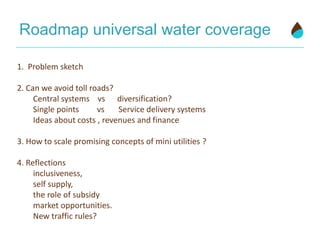
1. Problem sketch
2. Can we avoid toll roads?
Central systems vs diversification?
Single points vs Service delivery systems
Ideas about costs , revenues and finance
3. How to scale promising concepts of mini utilities ?
4. Reflections
inclusiveness,
self supply,
the role of subsidy
market opportunities.
New traffic rules?
Roadmap universal water coverage
-
200,000
400,000
600,000
800,000
1,000,000
1999 2,009 2019
urban
rural
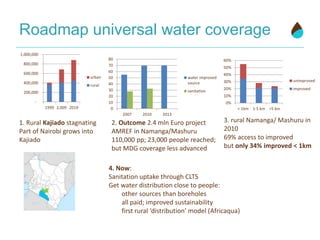
1. Rural Kajiado stagnating
Part of Nairobi grows into
Kajiado
0%
10%
20%
30%
40%
50%
60%
< 1km 1-5 km >5 km
unimproved
improved
3. rural Namanga/ Mashuru in
2010
69% access to improved
but only 34% improved < 1km
0
10
20
30
40
50
60
70
80
2007 2010 2013
water improved
source
sanitation
2. Outcome 2.4 mln Euro project
AMREF in Namanga/Mashuru
110,000 pp; 23,000 people reached;
but MDG coverage less advanced
4. Now:
Sanitation uptake through CLTS
Get water distribution close to people:
other sources than boreholes
all paid; improved sustainability
first rural ‘distribution’ model (Africaqua)
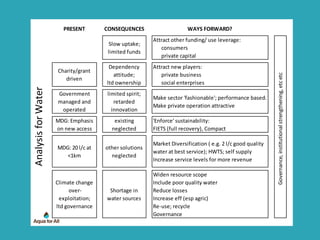
PRESENT CONSEQUENCES WAYS FORWARD?
Slow uptake;
limited funds
Attract other funding/ use leverage:
consumers
private capital
Charity/grant
driven
Dependency
attitude;
ltd ownership
Attract new players:
private business
social enterprises
Government
managed and
operated
limited spirit;
retarded
innovation
Make sector 'fashionable'; performance based.
Make private operation attractive
MDG: Emphasis
on new access
existing
neglected
'Enforce' sustainability:
FIETS (full recovery), Compact
MDG: 20 l/c at
<1km
other solutions
neglected
Market Diversification ( e.g. 2 l/c good quality
water at best service); HWTS; self supply
Increase service levels for more revenue
Climate change
over-
exploitation;
ltd governance
Shortage in
water sources
Widen resource scope
Include poor quality water
Reduce losses
Increase eff (esp agric)
Re-use; recycle
Governance
AnalysisforWater
Governance,institutionalstrengthening,etcetc
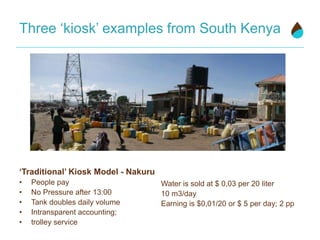
Three ‘kiosk’ examples from South Kenya
‘Traditional’ Kiosk Model - Nakuru
• People pay
• No Pressure after 13:00
• Tank doubles daily volume
• Intransparent accounting;
• trolley service
Water is sold at $ 0,03 per 20 liter
10 m3/day
Earning is $0,01/20 or $ 5 per day; 2 pp
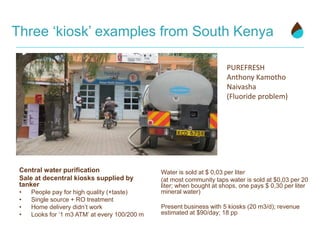
Three ‘kiosk’ examples from South Kenya
Central water purification
Sale at decentral kiosks supplied by
tanker
• People pay for high quality (+taste)
• Single source + RO treatment
• Home delivery didn’t work
• Looks for ‘1 m3 ATM’ at every 100/200 m
Water is sold at $ 0,03 per liter
(at most community taps water is sold at $0,03 per 20
liter; when bought at shops, one pays $ 0,30 per liter
mineral water)
Present business with 5 kiosks (20 m3/d); revenue
estimated at $90/day; 18 pp
PUREFRESH
Anthony Kamotho
Naivasha
(Fluoride problem)
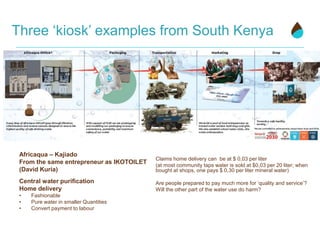
Three ‘kiosk’ examples from South Kenya
Africaqua – Kajiado
From the same entrepreneur as IKOTOILET
(David Kuria)
Central water purification
Home delivery
• Fashionable
• Pure water in smaller Quantities
• Convert payment to labour
Claims home delivery can be at $ 0,03 per liter
(at most community taps water is sold at $0,03 per 20 liter; when
bought at shops, one pays $ 0,30 per liter mineral water)
Are people prepared to pay much more for ‘quality and service’?
Will the other part of the water use do harm?
Can we avoid toll roads?
Example of New wash delivery services:
Considerations:
• Quality (service) rather
than quantity
• Service level agreements
• No need for 24/7
• Dual quality: clean vs safe,
contained, bulk, HWTS
options
• Affordable
• Service = time saving
• Service=> willingness to
pay
Mini water utilities and revenue
drivers:
• Public-private partnership
• Waterkiosks & home delivery
• Minigrids water
Sanitation:
• Public toilets
• Alternatives to pit latrine
• Collection & transport
• Minigrids waste water
• Nutrient recovery & biogas
renewable energy
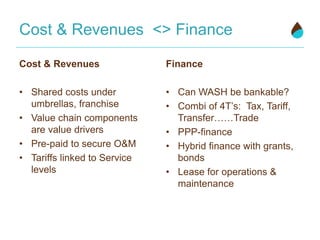
Cost & Revenues <> Finance
Cost & Revenues
• Shared costs under
umbrellas, franchise
• Value chain components
are value drivers
• Pre-paid to secure O&M
• Tariffs linked to Service
levels
Finance
• Can WASH be bankable?
• Combi of 4T’s: Tax, Tariff,
Transfer……Trade
• PPP-finance
• Hybrid finance with grants,
bonds
• Lease for operations &
maintenance
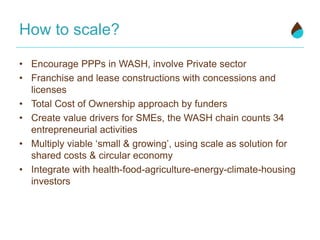
How to scale?
• Encourage PPPs in WASH, involve Private sector
• Franchise and lease constructions with concessions and
licenses
• Total Cost of Ownership approach by funders
• Create value drivers for SMEs, the WASH chain counts 34
entrepreneurial activities
• Multiply viable ‘small & growing’, using scale as solution for
shared costs & circular economy
• Integrate with health-food-agriculture-energy-climate-housing
investors
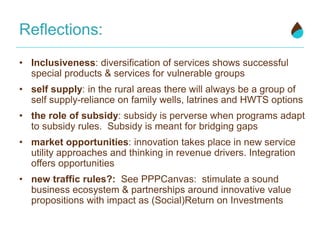
Reflections:
• Inclusiveness: diversification of services shows successful
special products & services for vulnerable groups
• self supply: in the rural areas there will always be a group of
self supply-reliance on family wells, latrines and HWTS options
• the role of subsidy: subsidy is perverse when programs adapt
to subsidy rules. Subsidy is meant for bridging gaps
• market opportunities: innovation takes place in new service
utility approaches and thinking in revenue drivers. Integration
offers opportunities
• new traffic rules?: See PPPCanvas: stimulate a sound
business ecosystem & partnerships around innovative value
propositions with impact as (Social)Return on Investments

Roadmap universal coverage 10 fold acceleration by Dick Bouman

  • 1.
    Roadmap universal coverage 10fold acceleration If we go in the same speed, Kajiado county will reach full water access by 2131; not 2030 Statement of WASH Alliance Kenya, Feb 2016 One of the members (AMREF) had invested millions of Euros during last 15 years 4/11/2016 1
  • 2.
    Roadmap universal watercoverage 1. Problem sketch 2. Can we avoid toll roads? Central systems vs diversification? Single points vs Service delivery systems Ideas about costs , revenues and finance 3. How to scale promising concepts of mini utilities ? 4. Reflections inclusiveness, self supply, the role of subsidy market opportunities. New traffic rules?
  • 3.
    Roadmap universal watercoverage - 200,000 400,000 600,000 800,000 1,000,000 1999 2,009 2019 urban rural 1. Rural Kajiado stagnating Part of Nairobi grows into Kajiado 0% 10% 20% 30% 40% 50% 60% < 1km 1-5 km >5 km unimproved improved 3. rural Namanga/ Mashuru in 2010 69% access to improved but only 34% improved < 1km 0 10 20 30 40 50 60 70 80 2007 2010 2013 water improved source sanitation 2. Outcome 2.4 mln Euro project AMREF in Namanga/Mashuru 110,000 pp; 23,000 people reached; but MDG coverage less advanced 4. Now: Sanitation uptake through CLTS Get water distribution close to people: other sources than boreholes all paid; improved sustainability first rural ‘distribution’ model (Africaqua)
  • 4.
    PRESENT CONSEQUENCES WAYSFORWARD? Slow uptake; limited funds Attract other funding/ use leverage: consumers private capital Charity/grant driven Dependency attitude; ltd ownership Attract new players: private business social enterprises Government managed and operated limited spirit; retarded innovation Make sector 'fashionable'; performance based. Make private operation attractive MDG: Emphasis on new access existing neglected 'Enforce' sustainability: FIETS (full recovery), Compact MDG: 20 l/c at <1km other solutions neglected Market Diversification ( e.g. 2 l/c good quality water at best service); HWTS; self supply Increase service levels for more revenue Climate change over- exploitation; ltd governance Shortage in water sources Widen resource scope Include poor quality water Reduce losses Increase eff (esp agric) Re-use; recycle Governance AnalysisforWater Governance,institutionalstrengthening,etcetc
  • 5.
    Three ‘kiosk’ examplesfrom South Kenya ‘Traditional’ Kiosk Model - Nakuru • People pay • No Pressure after 13:00 • Tank doubles daily volume • Intransparent accounting; • trolley service Water is sold at $ 0,03 per 20 liter 10 m3/day Earning is $0,01/20 or $ 5 per day; 2 pp
  • 6.
    Three ‘kiosk’ examplesfrom South Kenya Central water purification Sale at decentral kiosks supplied by tanker • People pay for high quality (+taste) • Single source + RO treatment • Home delivery didn’t work • Looks for ‘1 m3 ATM’ at every 100/200 m Water is sold at $ 0,03 per liter (at most community taps water is sold at $0,03 per 20 liter; when bought at shops, one pays $ 0,30 per liter mineral water) Present business with 5 kiosks (20 m3/d); revenue estimated at $90/day; 18 pp PUREFRESH Anthony Kamotho Naivasha (Fluoride problem)
  • 7.
    Three ‘kiosk’ examplesfrom South Kenya Africaqua – Kajiado From the same entrepreneur as IKOTOILET (David Kuria) Central water purification Home delivery • Fashionable • Pure water in smaller Quantities • Convert payment to labour Claims home delivery can be at $ 0,03 per liter (at most community taps water is sold at $0,03 per 20 liter; when bought at shops, one pays $ 0,30 per liter mineral water) Are people prepared to pay much more for ‘quality and service’? Will the other part of the water use do harm?
  • 8.
    Can we avoidtoll roads? Example of New wash delivery services: Considerations: • Quality (service) rather than quantity • Service level agreements • No need for 24/7 • Dual quality: clean vs safe, contained, bulk, HWTS options • Affordable • Service = time saving • Service=> willingness to pay Mini water utilities and revenue drivers: • Public-private partnership • Waterkiosks & home delivery • Minigrids water Sanitation: • Public toilets • Alternatives to pit latrine • Collection & transport • Minigrids waste water • Nutrient recovery & biogas renewable energy
  • 9.
    Cost & Revenues<> Finance Cost & Revenues • Shared costs under umbrellas, franchise • Value chain components are value drivers • Pre-paid to secure O&M • Tariffs linked to Service levels Finance • Can WASH be bankable? • Combi of 4T’s: Tax, Tariff, Transfer……Trade • PPP-finance • Hybrid finance with grants, bonds • Lease for operations & maintenance
  • 10.
    How to scale? •Encourage PPPs in WASH, involve Private sector • Franchise and lease constructions with concessions and licenses • Total Cost of Ownership approach by funders • Create value drivers for SMEs, the WASH chain counts 34 entrepreneurial activities • Multiply viable ‘small & growing’, using scale as solution for shared costs & circular economy • Integrate with health-food-agriculture-energy-climate-housing investors
  • 11.
    Reflections: • Inclusiveness: diversificationof services shows successful special products & services for vulnerable groups • self supply: in the rural areas there will always be a group of self supply-reliance on family wells, latrines and HWTS options • the role of subsidy: subsidy is perverse when programs adapt to subsidy rules. Subsidy is meant for bridging gaps • market opportunities: innovation takes place in new service utility approaches and thinking in revenue drivers. Integration offers opportunities • new traffic rules?: See PPPCanvas: stimulate a sound business ecosystem & partnerships around innovative value propositions with impact as (Social)Return on Investments