ROADMAP FOR
MATHEMATICS
2016 – 2018
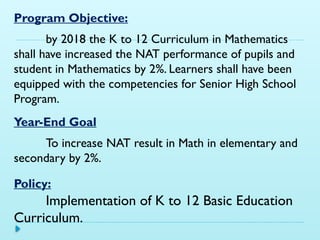
by 2018 the K to 12 Curriculum in Mathematics
shall have increased the NAT performance of pupils and
student in Mathematics by 2%. Learners shall have been
equipped with the competencies for Senior High School
Program.
Program Objective:
Year-End Goal
To increase NAT result in Math in elementary and
secondary by 2%.
Implementation of K to 12 Basic Education
Curriculum.
Policy:
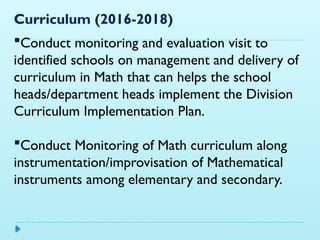
Curriculum (2016-2018)
Conduct monitoring and evaluation visit to
identified schools on management and delivery of
curriculum in Math that can helps the school
heads/department heads implement the Division
Curriculum Implementation Plan.
Conduct Monitoring of Math curriculum along
instrumentation/improvisation of Mathematical
instruments among elementary and secondary.
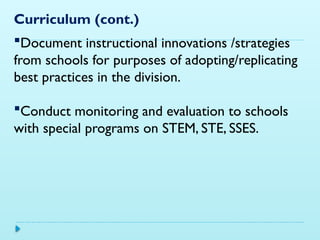
Curriculum (cont.)
Document instructional innovations /strategies
from schools for purposes of adopting/replicating
best practices in the division.
Conduct monitoring and evaluation to schools
with special programs on STEM, STE, SSES.
Assessment (2016)
a) Preparation/conduct of parallel test in NAT.
 Preparation of test on least learned
competencies by quarter
 Consolidation and finalization of prepared tests
for the division.
 Reproduction/replication of tests for the
division
 Conduct of mock tests in NAT to schools
 Analysis of test results by school.
b) Re-orientation on the preparation of table of
specification based on DepEd Order No. 8 s. 2015.
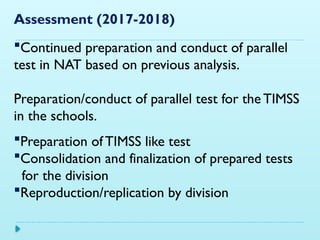
Assessment (2017-2018)
Continued preparation and conduct of parallel
test in NAT based on previous analysis.
Preparation/conduct of parallel test for the TIMSS
in the schools.
Preparation of TIMSS like test
Consolidation and finalization of prepared tests
for the division
Reproduction/replication by division
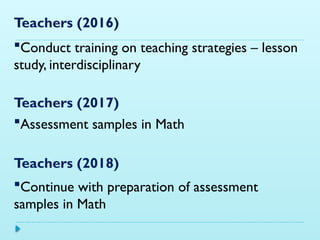
Teachers (2016)
Conduct training on teaching strategies – lesson
study, interdisciplinary
Continue with preparation of assessment
samples in Math
Teachers (2018)
Teachers (2017)
Assessment samples in Math
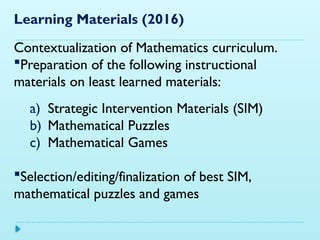
Learning Materials (2016)
Contextualization of Mathematics curriculum.
Preparation of the following instructional
materials on least learned materials:
a) Strategic Intervention Materials (SIM)
b) Mathematical Puzzles
c) Mathematical Games
Selection/editing/finalization of best SIM,
mathematical puzzles and games
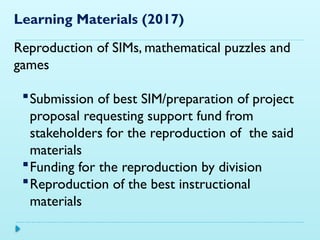
Learning Materials (2017)
Reproduction of SIMs, mathematical puzzles and
games
Submission of best SIM/preparation of project
proposal requesting support fund from
stakeholders for the reproduction of the said
materials
Funding for the reproduction by division
Reproduction of the best instructional
materials
Learning Materials (2018)
Continued preparation, selection editing,
finalization, reproduction and sharing of the best
SIMs, mathematical puzzles and games
Facilities and Equipment (2016)
Checking of Math instruments in schools
Facilities and Equipment (2017)
Checking of Math instruments in schools
Seminar on Math instrumentation / improvisation
Facilities and Equipment (2018)
Checking of Math instruments in schools
Program Management (2016-2018)
Conduct planning conference, monitoring and
evaluation of the K to 12
THANKYOU

ROADMAP FOR MATHEMATICS information.pptx

  • 1.
  • 2.
    by 2018 theK to 12 Curriculum in Mathematics shall have increased the NAT performance of pupils and student in Mathematics by 2%. Learners shall have been equipped with the competencies for Senior High School Program. Program Objective: Year-End Goal To increase NAT result in Math in elementary and secondary by 2%. Implementation of K to 12 Basic Education Curriculum. Policy:
  • 3.
    Curriculum (2016-2018) Conduct monitoringand evaluation visit to identified schools on management and delivery of curriculum in Math that can helps the school heads/department heads implement the Division Curriculum Implementation Plan. Conduct Monitoring of Math curriculum along instrumentation/improvisation of Mathematical instruments among elementary and secondary.
  • 4.
    Curriculum (cont.) Document instructionalinnovations /strategies from schools for purposes of adopting/replicating best practices in the division. Conduct monitoring and evaluation to schools with special programs on STEM, STE, SSES.
  • 5.
    Assessment (2016) a) Preparation/conductof parallel test in NAT.  Preparation of test on least learned competencies by quarter  Consolidation and finalization of prepared tests for the division.  Reproduction/replication of tests for the division  Conduct of mock tests in NAT to schools  Analysis of test results by school. b) Re-orientation on the preparation of table of specification based on DepEd Order No. 8 s. 2015.
  • 6.
    Assessment (2017-2018) Continued preparationand conduct of parallel test in NAT based on previous analysis. Preparation/conduct of parallel test for the TIMSS in the schools. Preparation of TIMSS like test Consolidation and finalization of prepared tests for the division Reproduction/replication by division
  • 7.
    Teachers (2016) Conduct trainingon teaching strategies – lesson study, interdisciplinary Continue with preparation of assessment samples in Math Teachers (2018) Teachers (2017) Assessment samples in Math
  • 8.
    Learning Materials (2016) Contextualizationof Mathematics curriculum. Preparation of the following instructional materials on least learned materials: a) Strategic Intervention Materials (SIM) b) Mathematical Puzzles c) Mathematical Games Selection/editing/finalization of best SIM, mathematical puzzles and games
  • 9.
    Learning Materials (2017) Reproductionof SIMs, mathematical puzzles and games Submission of best SIM/preparation of project proposal requesting support fund from stakeholders for the reproduction of the said materials Funding for the reproduction by division Reproduction of the best instructional materials
  • 10.
    Learning Materials (2018) Continuedpreparation, selection editing, finalization, reproduction and sharing of the best SIMs, mathematical puzzles and games
  • 11.
    Facilities and Equipment(2016) Checking of Math instruments in schools Facilities and Equipment (2017) Checking of Math instruments in schools Seminar on Math instrumentation / improvisation Facilities and Equipment (2018) Checking of Math instruments in schools
  • 12.
    Program Management (2016-2018) Conductplanning conference, monitoring and evaluation of the K to 12
  • 13.