1
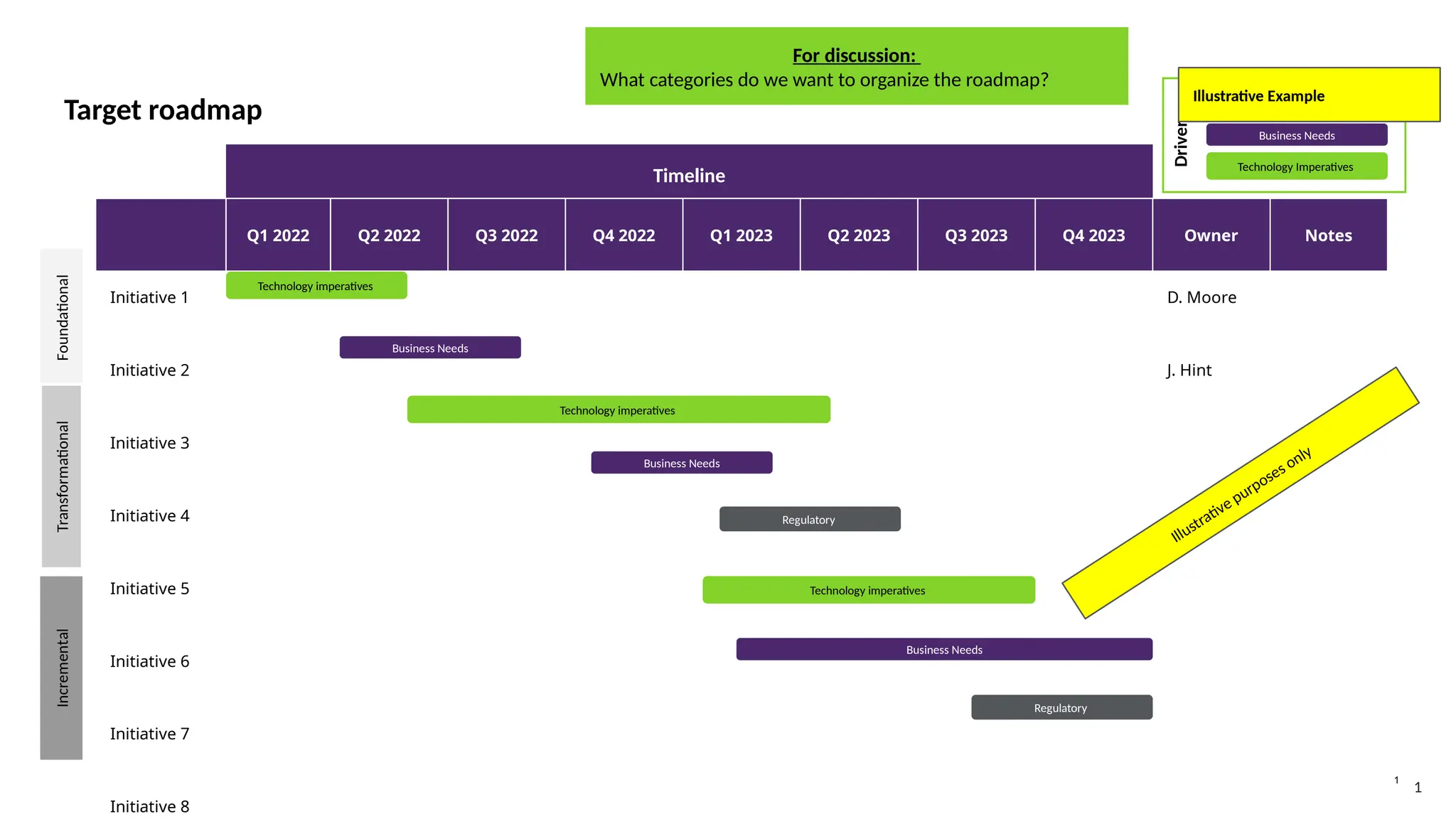
Target roadmap
1
Timeline
Q1 2022 Q2 2022 Q3 2022 Q4 2022 Q1 2023 Q2 2023 Q3 2023 Q4 2023 Owner Notes
Initiative 1 D. Moore
Initiative 2 J. Hint
Initiative 3
Initiative 4
Initiative 5
Initiative 6
Initiative 7
Initiative 8
Foundational
Transformational
Incremental
Business Needs
Technology Imperatives
Regulatory
Driver
Technology imperatives
Business Needs
Regulatory
Technology imperatives
Business Needs
Regulatory
Business Needs
For discussion:
What categories do we want to organize the roadmap?
Illustrative purposes only
Illustrative Example
2
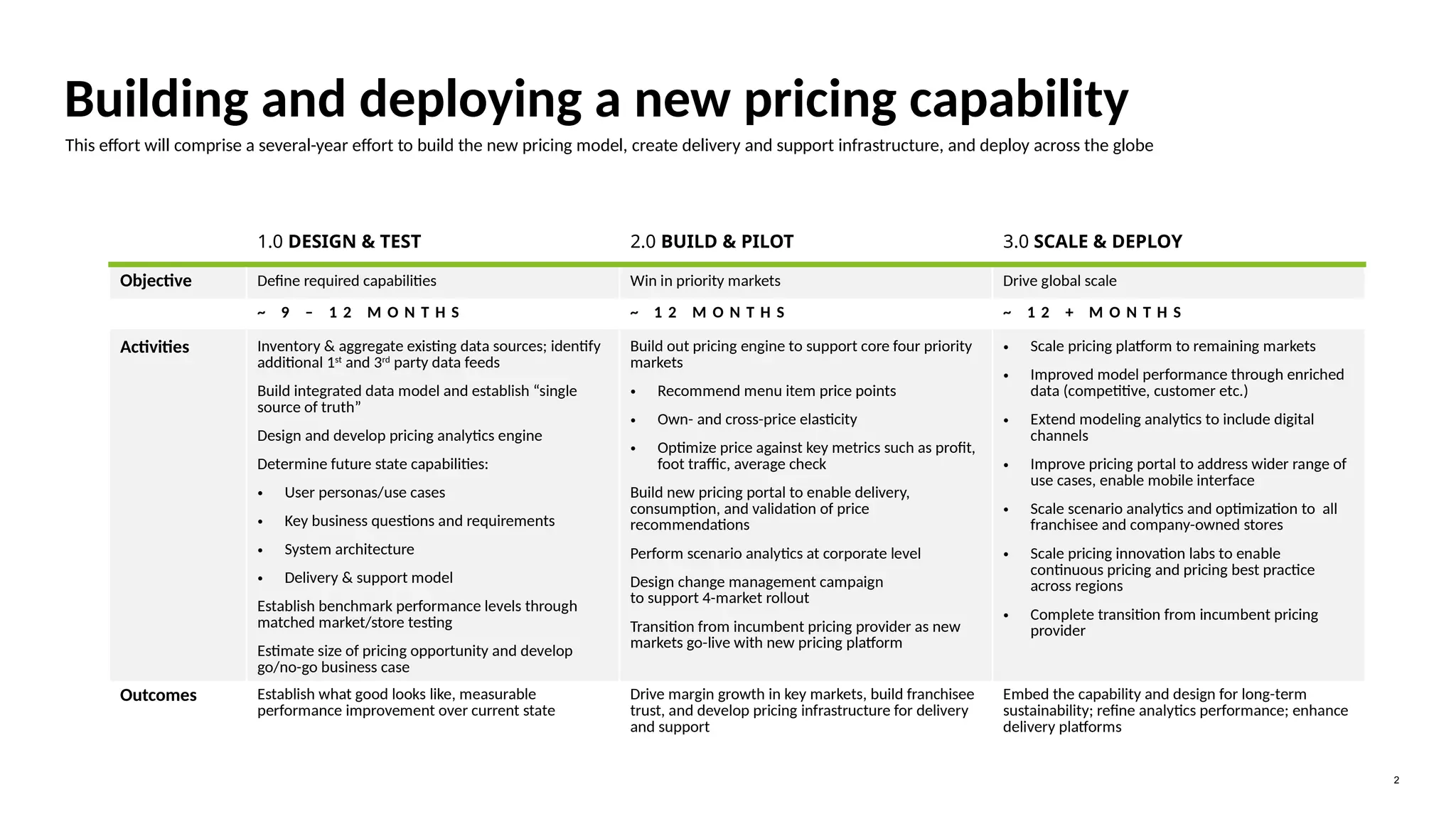
Building and deploying a new pricing capability
This effort will comprise a several-year effort to build the new pricing model, create delivery and support infrastructure, and deploy across the globe
1.0 DESIGN & TEST 2.0 BUILD & PILOT 3.0 SCALE & DEPLOY
Objective Define required capabilities Win in priority markets Drive global scale
~ 9 – 1 2 M O N T H S ~ 1 2 M O N T H S ~ 1 2 + M O N T H S
Activities Inventory & aggregate existing data sources; identify
additional 1st
and 3rd
party data feeds
Build integrated data model and establish “single
source of truth”
Design and develop pricing analytics engine
Determine future state capabilities:
• User personas/use cases
• Key business questions and requirements
• System architecture
• Delivery & support model
Establish benchmark performance levels through
matched market/store testing
Estimate size of pricing opportunity and develop
go/no-go business case
Build out pricing engine to support core four priority
markets
• Recommend menu item price points
• Own- and cross-price elasticity
• Optimize price against key metrics such as profit,
foot traffic, average check
Build new pricing portal to enable delivery,
consumption, and validation of price
recommendations
Perform scenario analytics at corporate level
Design change management campaign
to support 4-market rollout
Transition from incumbent pricing provider as new
markets go-live with new pricing platform
• Scale pricing platform to remaining markets
• Improved model performance through enriched
data (competitive, customer etc.)
• Extend modeling analytics to include digital
channels
• Improve pricing portal to address wider range of
use cases, enable mobile interface
• Scale scenario analytics and optimization to all
franchisee and company-owned stores
• Scale pricing innovation labs to enable
continuous pricing and pricing best practice
across regions
• Complete transition from incumbent pricing
provider
Outcomes Establish what good looks like, measurable
performance improvement over current state
Drive margin growth in key markets, build franchisee
trust, and develop pricing infrastructure for delivery
and support
Embed the capability and design for long-term
sustainability; refine analytics performance; enhance
delivery platforms
3
Ways to evolve a brand
There has been a broad undertaking to evolve the brand to deliver a modern approach to luxury, leveraging the brand’s iconic heritage and legacy; our culture change findings are a key
component of this process and will inform parallel initiatives
Brand team assessment of the
company’s portfolio
opportunities
Deloitte was engaged to develop and articulate the
service culture strategy and supporting signature services
and gestures
Deloitte Consulting was engaged to assist with conducting a
current state culture assessment, in order to identify
opportunities and define an activation strategy for
implementation
2017 2019
TODAY 2020
Across the portfolio there is an opportunity to leverage the culture assessment findings to inform a number
of ongoing initiatives in the brand space:
• Operating Model
• GM / Hotel Manager Onboarding
• Hotel Openings Process
• Technology Roadmap
Finalizing recommendations for Signature Services, including
alignment with the culture roadmap, and conducting pilots for brand
wide launch in 2019
Development of culture framework and activation strategy
Culture Change Initiative
Leverage Culture Change Findings
4
Resourcing Check-Points
Professional fees assume an average of standard approach for value capture across markets. We will work together to confirm the market-level value capture
approach at two resource check-points
GLOBAL LAUNCH &
IN-MARKET ACCELERATION
VALUE CAPTURE –
LIGHT
PHASE 2
• Team size as
described herein
• 4 weeks
• <10% of total fees
• Adequate resourcing
available
• Data accessible and
available and
harmonised
• Trade spend previously
analysed and tackled
• Confirmed value target
based on top-down
prioritisation is reduced
• 6-8 weeks per market
• Reduced team size
• Adequate resourcing
available
• Data accessible,
available, light cleansing
required
• Some trade spend
previously analysed
• Confirmed value target
based on top-down
prioritisation as
expected
• 12 weeks per market
• Standard team size
Timing and
Team Size
Potential
Drivers for
Resourcing
VALUE CAPTURE –
STANDARD
• Limited resourcing
available
• Data limited, requires
heavy cleansing, data
capture and validation
• Limited trade spend
analysis complete to
date
• Confirmed value target
based on top-down
prioritisation is higher
• 12-16 weeks per market
• Increased team size
VALUE CAPTURE –
HEAVY
Not to exceed estimate
based on standard
approach for all markets
PHASE 1
5
We know your company
2015 2016
The Client is currently integrating
with Company B in order to realize
its vision of being a global leader.
Deloitte advised the regional
integration in Americas and
Europe including set-up of regional
integration governance, project
planning, and approach for roll-out
of regional operating model.
Industry Integration
Transformation
Redesign
Deloitte supported with all aspects
of the Transformation program
including the redesign of the
operating model, standardization
of global processes,
implementation of global Service
Centers, launch of Success Factors,
and launch of an employee portal
using salesforce.com platform.
Cloud
The Client is transforming its Finance
and HR business processes and
replacing legacy applications with
Oracle’s Cloud software platform.
Deloitte is helping to standardize
and simplify processes, increase
efficiencies through automation and
process improvements, implement
a system to enable future growth,
increase the visibility of operational
information across the organization,
and use value-added analytics to
improve the ability to perform
financial and risk analysis of
operations.
2017
Innovation Strategy
Playbook
They wanted to establish greater
alignment between the innovation
efforts happening within each
business segment, and the business
segment’s strategy/ LROP. Doblin,
Deloitte’s innovation practice,
partnered with them to develop a
methodology for developing
innovation strategies, and
simultaneously piloted the approach
with three business segments. The
resulting playbook has since been
used to successfully develop the
innovation strategy.
White Space
Innovation Group
They wanted to invest in and build
disruptive new businesses to
complement its core, which had
experienced a stagnate growth rate.
Deloitte utilized a series of executive
team labs and the expertise of
Deloitte’s Center for the Edge to
explore new opportunity spaces.
We aligned leaders on the need to
create difference businesses and an
operating model to pursue new
business opportunities.
6
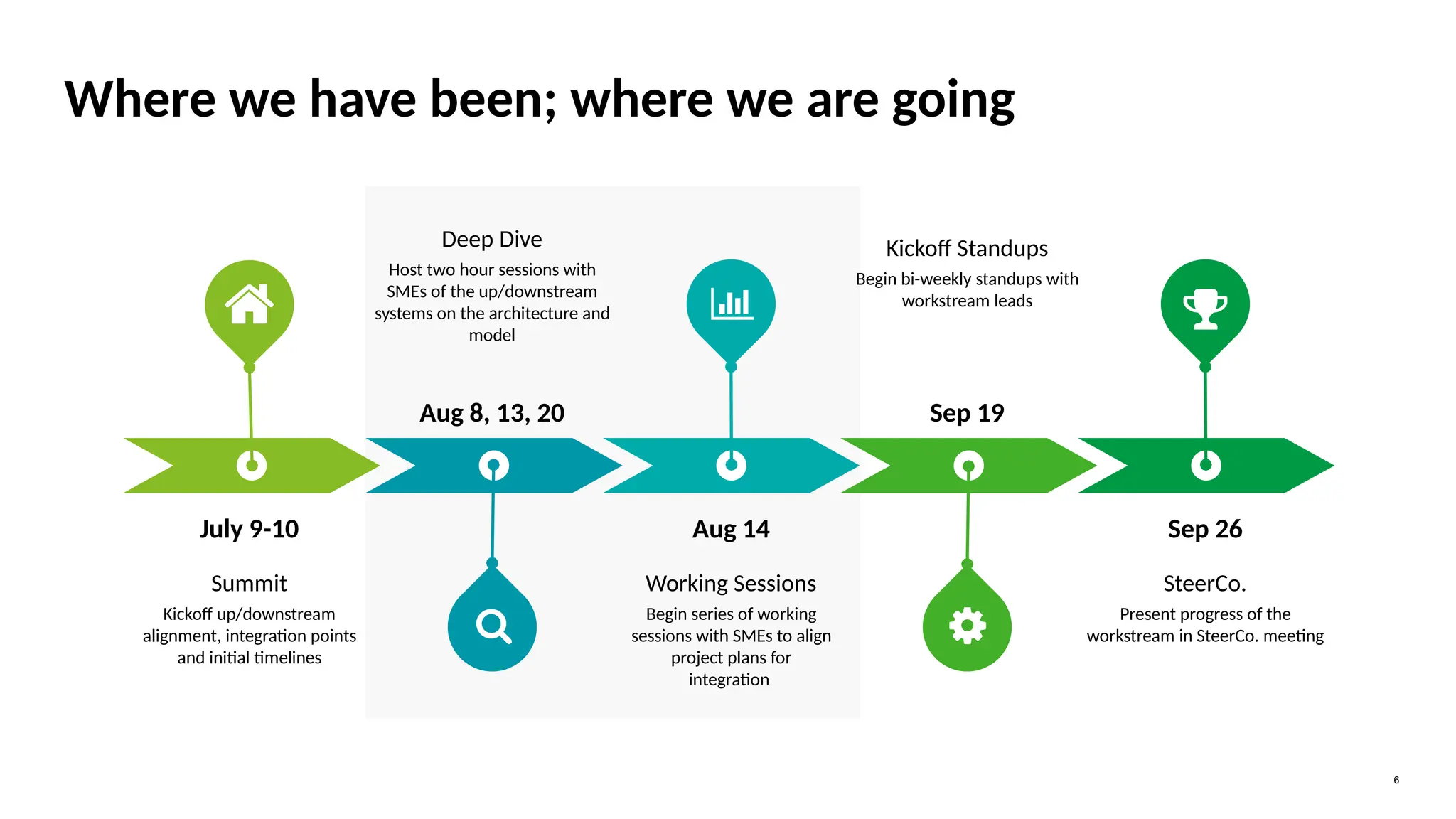
Where we have been; where we are going
July 9-10
Summit
Kickoff up/downstream
alignment, integration points
and initial timelines
Aug 14
Working Sessions
Begin series of working
sessions with SMEs to align
project plans for
integration
Sep 26
SteerCo.
Present progress of the
workstream in SteerCo. meeting
Sep 19
Kickoff Standups
Begin bi-weekly standups with
workstream leads
Aug 8, 13, 20
Deep Dive
Host two hour sessions with
SMEs of the up/downstream
systems on the architecture and
model
7
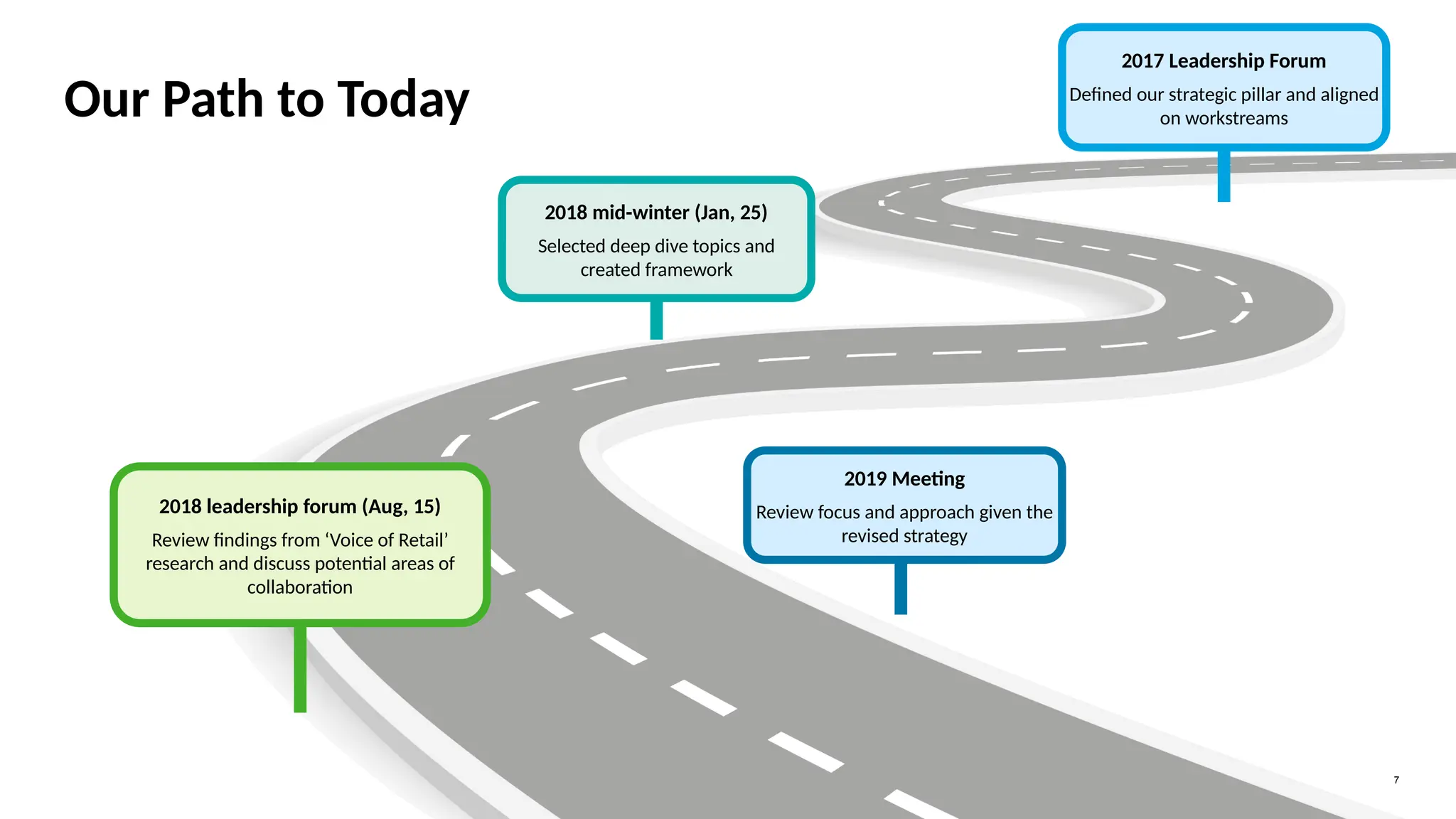
Our Path to Today
2018 leadership forum (Aug, 15)
Review findings from ‘Voice of Retail’
research and discuss potential areas of
collaboration
2017 Leadership Forum
Defined our strategic pillar and aligned
on workstreams
2019 Meeting
Review focus and approach given the
revised strategy
2018 mid-winter (Jan, 25)
Selected deep dive topics and
created framework
8
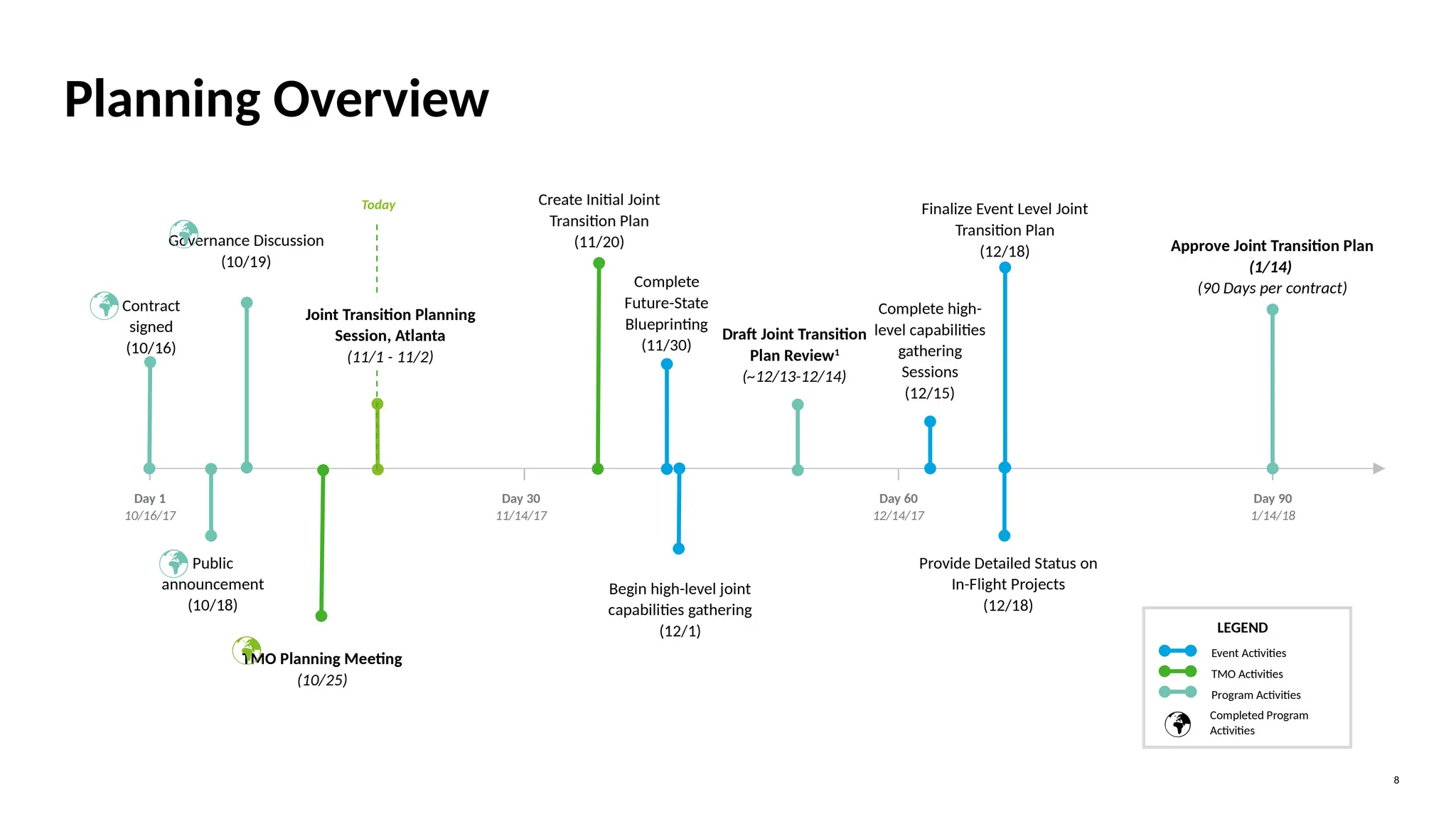
Planning Overview
Event Activities
TMO Activities
Program Activities
LEGEND
Day 1
10/16/17
Day 90
1/14/18
Complete
Future-State
Blueprinting
(11/30)
Day 60
12/14/17
Begin high-level joint
capabilities gathering
(12/1)
Complete high-
level capabilities
gathering
Sessions
(12/15)
Finalize Event Level Joint
Transition Plan
(12/18)
Provide Detailed Status on
In-Flight Projects
(12/18)
Contract
signed
(10/16)
Approve Joint Transition Plan
(1/14)
(90 Days per contract)
Create Initial Joint
Transition Plan
(11/20)
Public
announcement
(10/18)
Governance Discussion
(10/19)
Today
TMO Planning Meeting
(10/25)
Day 30
11/14/17
Draft Joint Transition
Plan Review1
(~12/13-12/14)

 Completed Program
Activities



Joint Transition Planning
Session, Atlanta
(11/1 - 11/2)
9
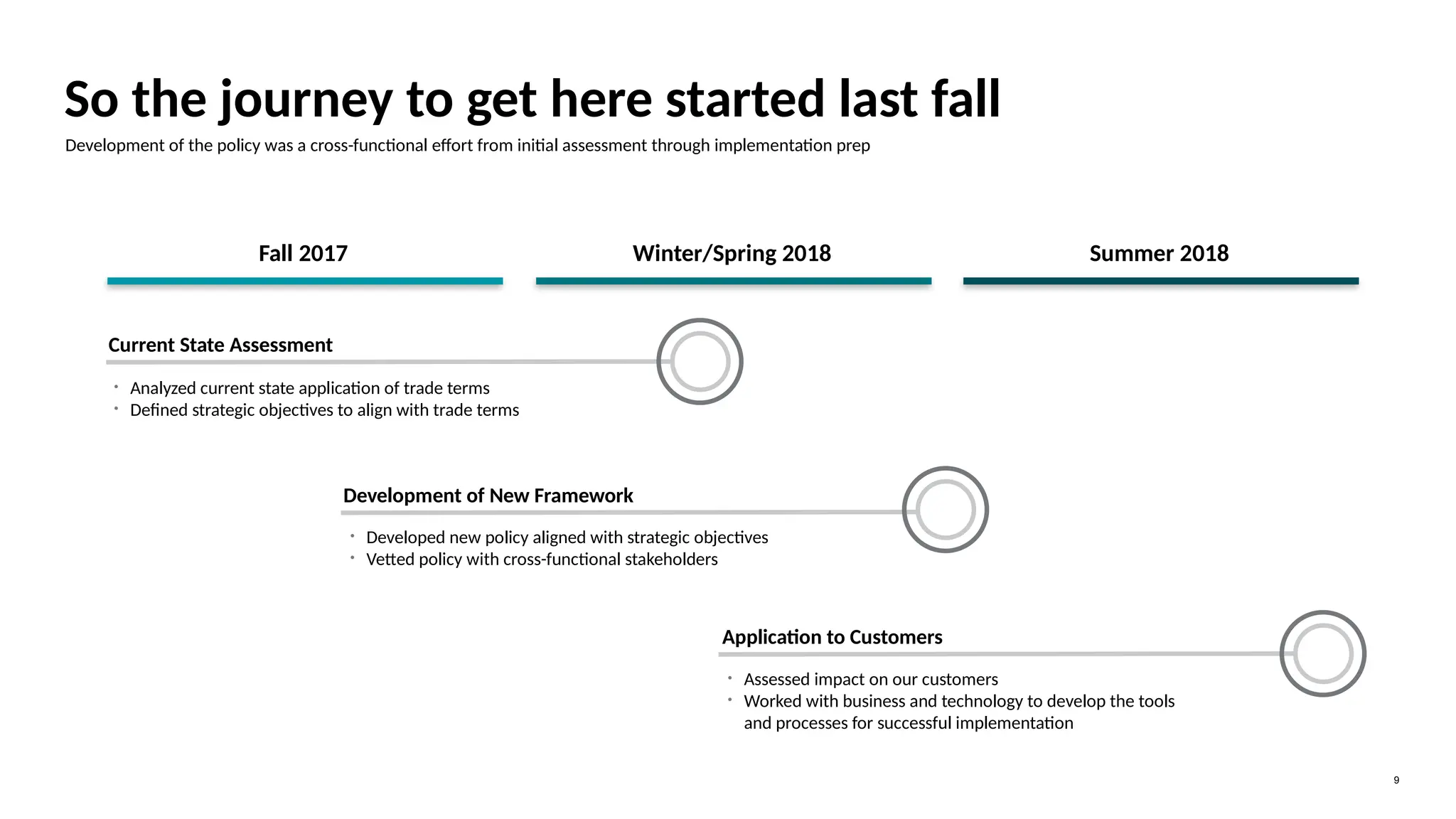
So the journey to get here started last fall
Development of the policy was a cross-functional effort from initial assessment through implementation prep
Current State Assessment
• Analyzed current state application of trade terms
• Defined strategic objectives to align with trade terms
Fall 2017 Winter/Spring 2018 Summer 2018
Development of New Framework
• Developed new policy aligned with strategic objectives
• Vetted policy with cross-functional stakeholders
Application to Customers
• Assessed impact on our customers
• Worked with business and technology to develop the tools
and processes for successful implementation
10
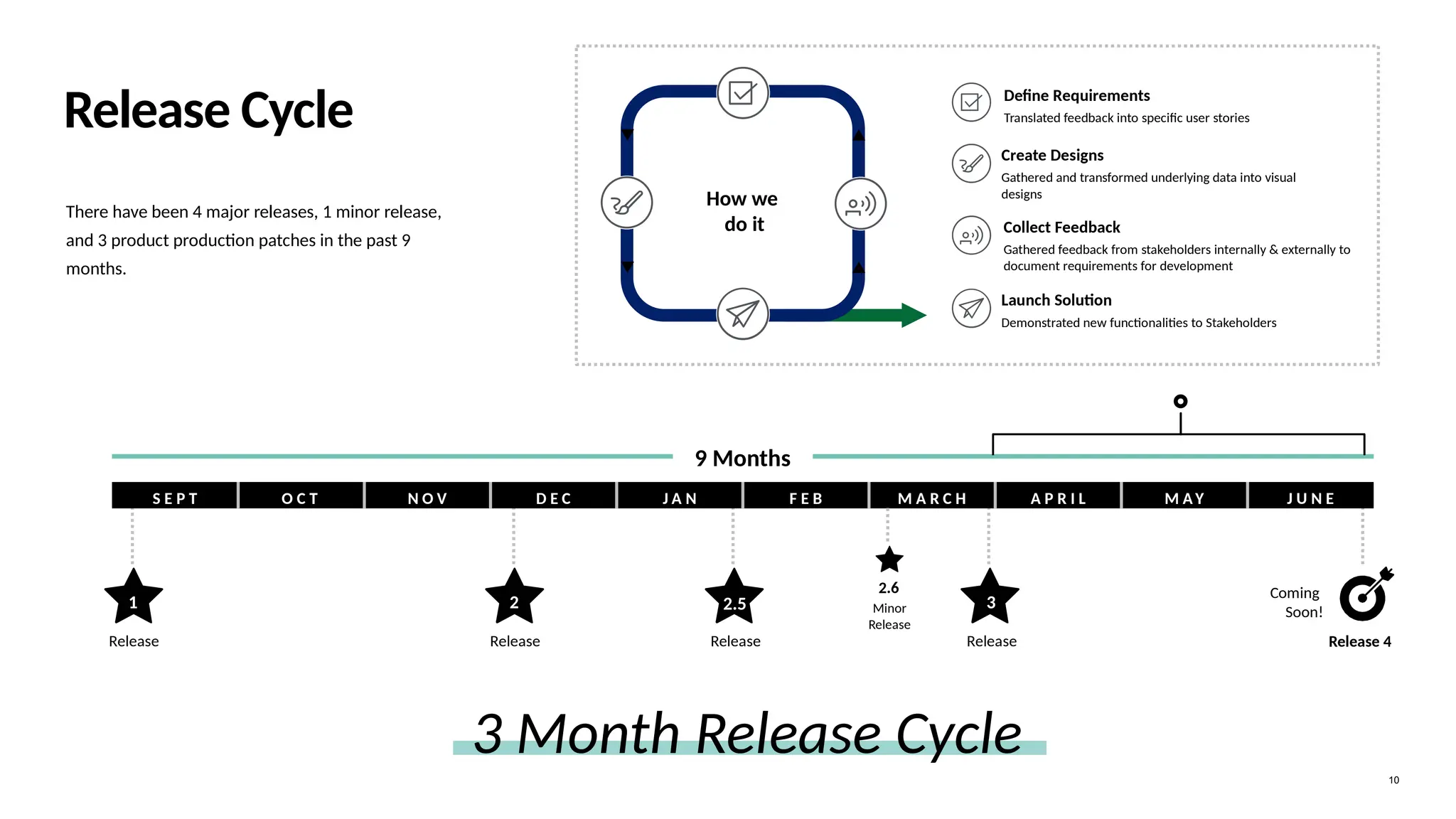
Release Cycle
There have been 4 major releases, 1 minor release,
and 3 product production patches in the past 9
months.
Collect Feedback
Gathered feedback from stakeholders internally & externally to
document requirements for development
Define Requirements
Translated feedback into specific user stories
Create Designs
Gathered and transformed underlying data into visual
designs
Launch Solution
Demonstrated new functionalities to Stakeholders
3 Month Release Cycle
S E P T O C T N O V D E C J A N F E B M A R C H A P R I L M AY J U N E
9 Months
How we
do it
1
Release
2
Release
2.5
Release
3
Release Release 4
Coming
Soon!
2.6
Minor
Release
11
11
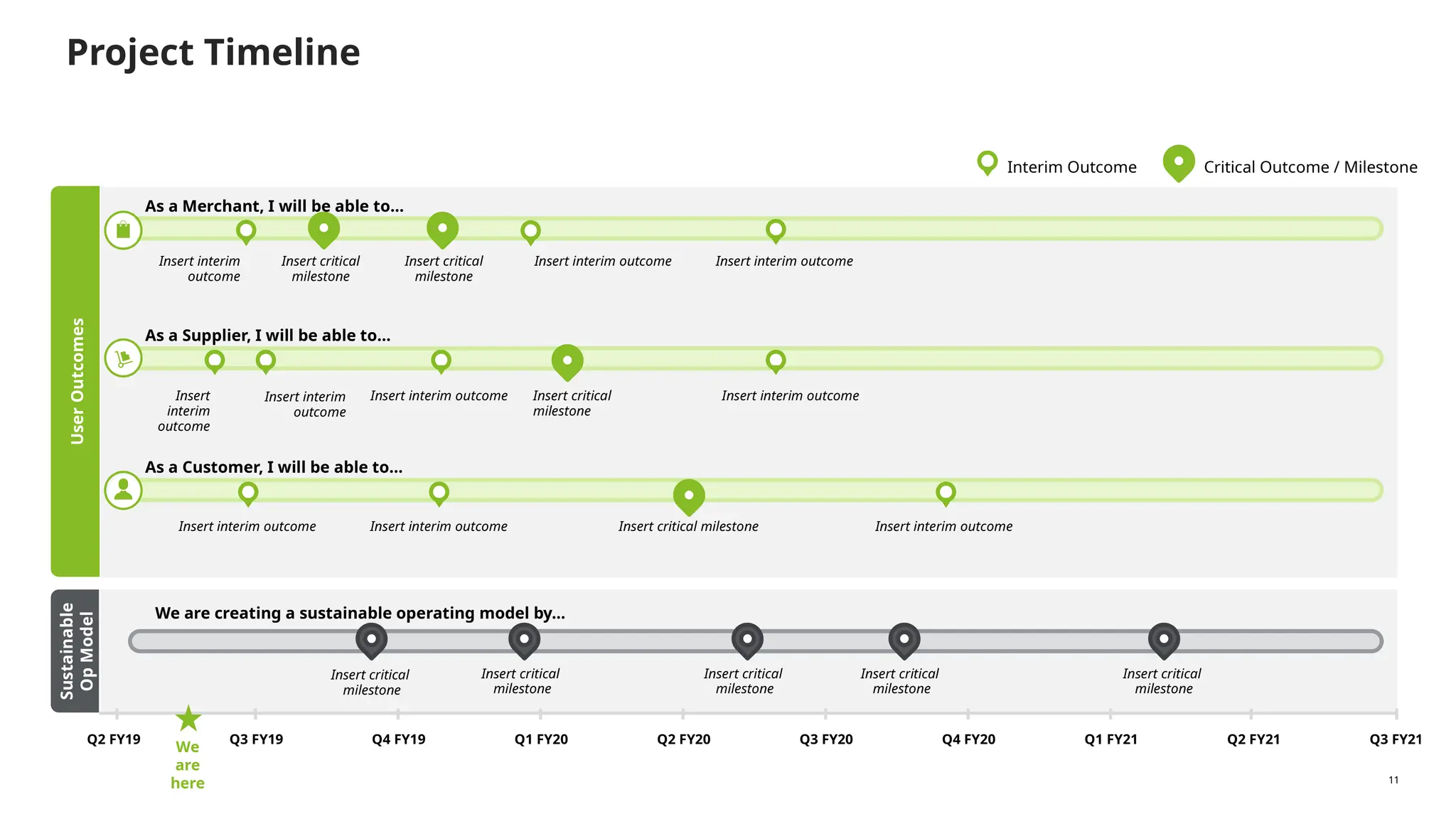
Project Timeline
User
Outcomes
Sustainable
Op
Model
Q2 FY19 Q3 FY19 Q4 FY19 Q1 FY20 Q2 FY20 Q3 FY20 Q4 FY20 Q1 FY21 Q2 FY21 Q3 FY21
Insert critical
milestone
Insert interim
outcome
Insert critical
milestone
Insert interim outcome
Insert interim
outcome
Insert interim outcome
Insert critical
milestone
Insert critical
milestone
Insert critical
milestone
Insert critical
milestone
Insert critical
milestone
Insert
interim
outcome
Insert interim outcome Insert interim outcome
Insert critical milestone Insert interim outcome
Insert interim outcome
As a Merchant, I will be able to…
As a Supplier, I will be able to…
We are creating a sustainable operating model by…
As a Customer, I will be able to…
Interim Outcome Critical Outcome / Milestone
We
are
here
Insert critical
milestone
12
12
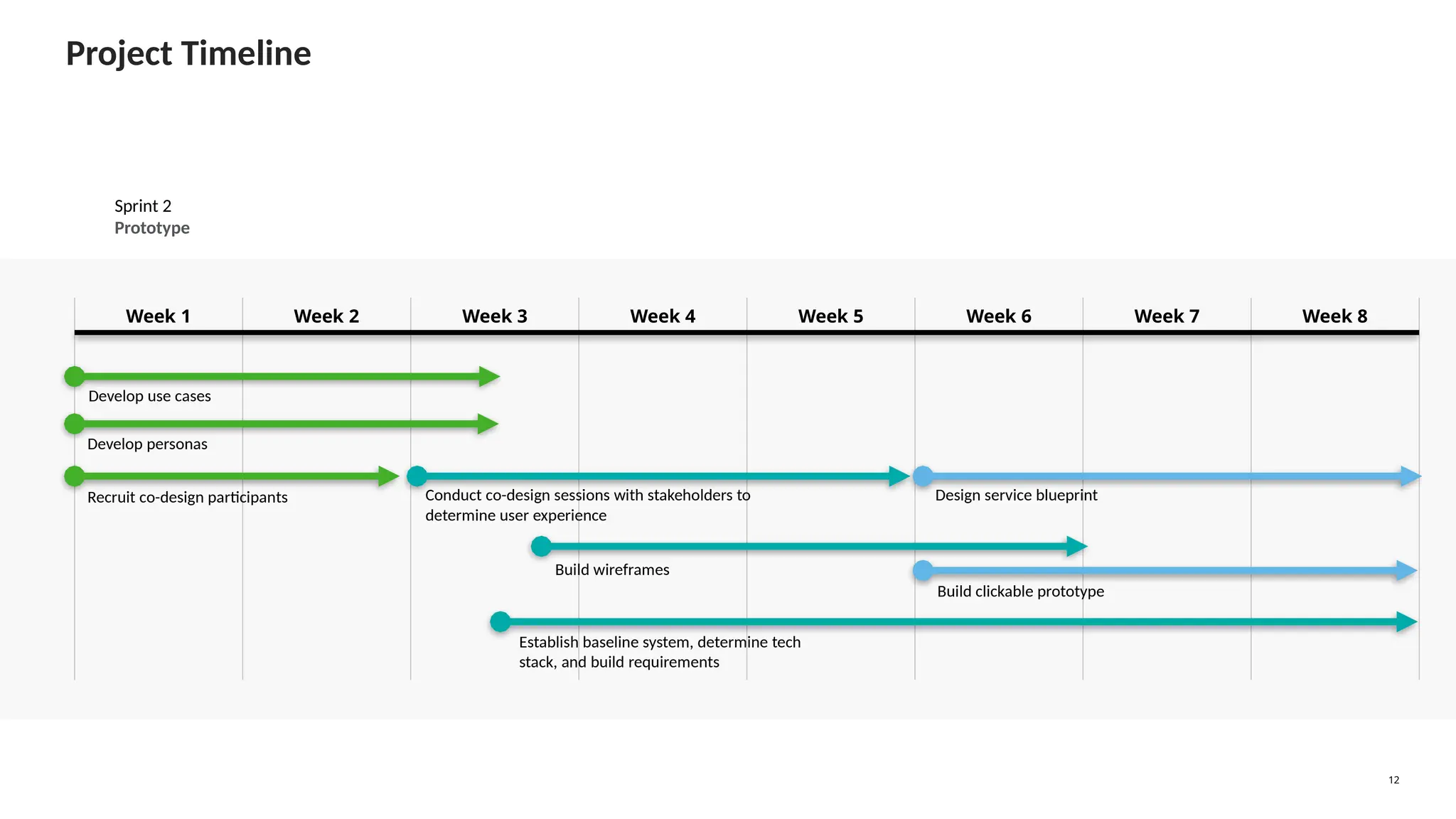
Project Timeline
Week 1 Week 2 Week 3 Week 4 Week 5 Week 6 Week 7 Week 8
Sprint 2
Prototype
Develop use cases
Conduct co-design sessions with stakeholders to
determine user experience
Recruit co-design participants
Build clickable prototype
Develop personas
Build wireframes
Establish baseline system, determine tech
stack, and build requirements
Design service blueprint
13
13
Our integrated timeline emphasizes rapid analysis and quick wins.
12 Week Full timeline
Week 0 Week 1 Week 2 Week 3 Week 4 Week 5 Week 6 Week 7 Week 8 Week 9 Week 10 Week 11 Week 12
ANALYTICS
FOUNDATION
OPERATIONAL
ANALYTICS
RETURNS
STRATEGY
Data
Request
Strategic Activation Session Strategic Activation Session Strategic Activation Session
Strategic Activation Session
Data Acquisition & Cleaning
Data Mapping
Data Documentation
Develop Costing Model
Develop Visualization Model
Supplier Review
Insights Field Observation
Workshop Prep Workshop Support
Analytics Roadmap Development
Greenhouse
Lab
14
14
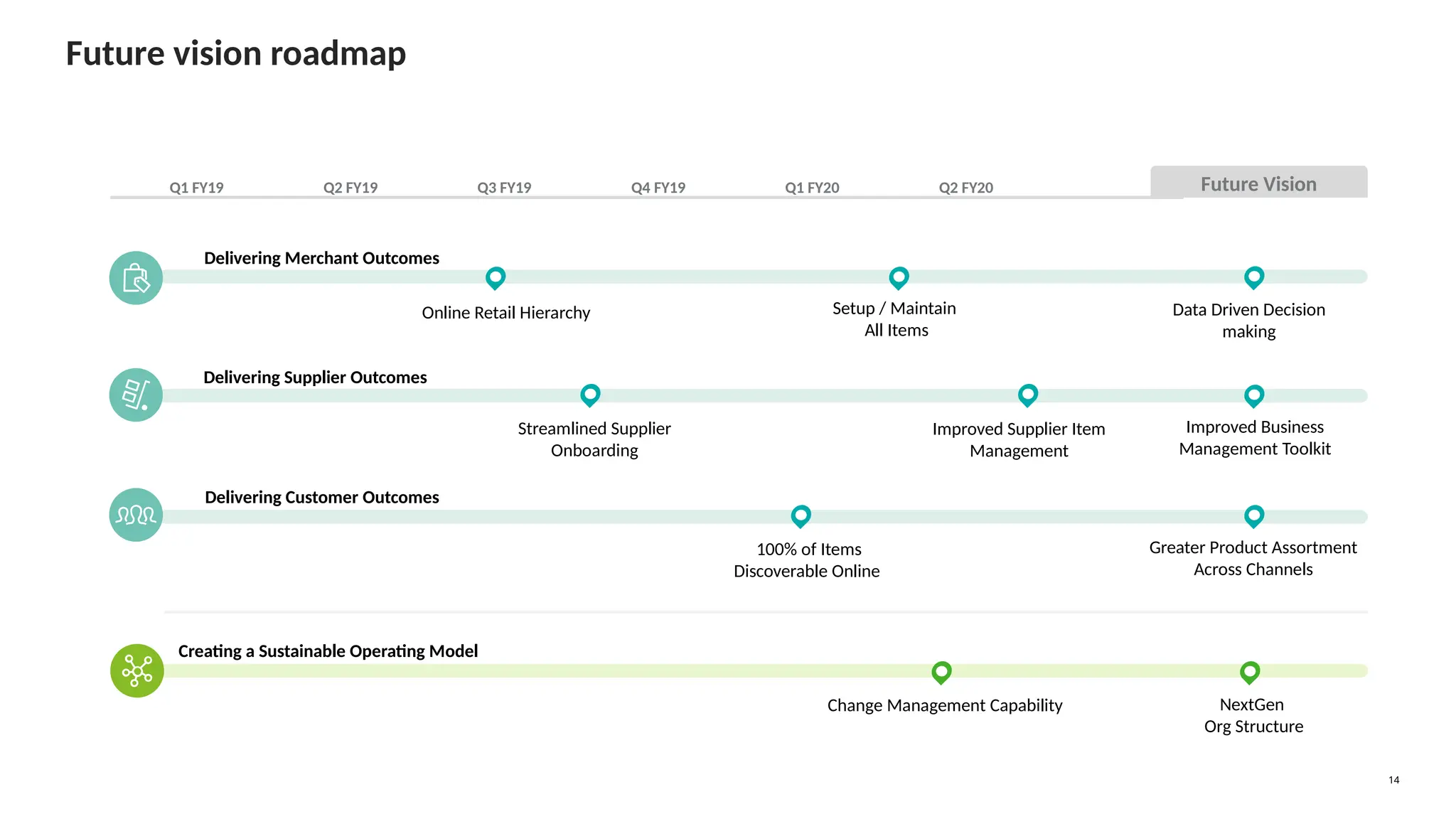
Future vision roadmap
NextGen
Org Structure
Creating a Sustainable Operating Model
Change Management Capability
Q2 FY19 Q3 FY19 Q4 FY19 Q1 FY20 Q2 FY20
Online Retail Hierarchy
Streamlined Supplier
Onboarding
100% of Items
Discoverable Online
Delivering Merchant Outcomes
Delivering Supplier Outcomes
Delivering Customer Outcomes
Q1 FY19
Data Driven Decision
making
Setup / Maintain
All Items
Improved Supplier Item
Management
Future Vision
Greater Product Assortment
Across Channels
Improved Business
Management Toolkit
15
15
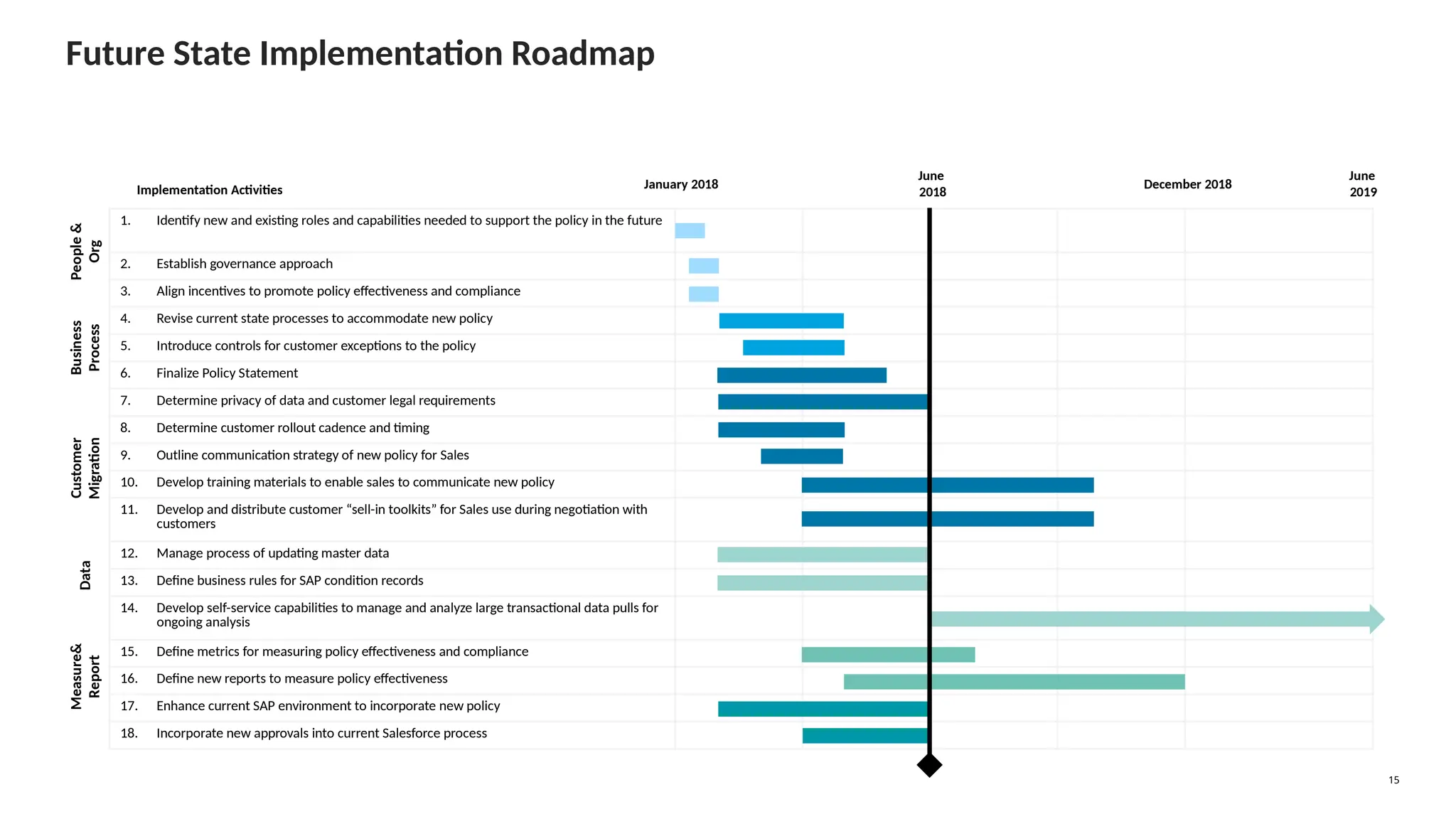
Future State Implementation Roadmap
1. Identify new and existing roles and capabilities needed to support the policy in the future
2. Establish governance approach
3. Align incentives to promote policy effectiveness and compliance
4. Revise current state processes to accommodate new policy
5. Introduce controls for customer exceptions to the policy
6. Finalize Policy Statement
7. Determine privacy of data and customer legal requirements
8. Determine customer rollout cadence and timing
9. Outline communication strategy of new policy for Sales
10. Develop training materials to enable sales to communicate new policy
11. Develop and distribute customer “sell-in toolkits” for Sales use during negotiation with
customers
12. Manage process of updating master data
13. Define business rules for SAP condition records
14. Develop self-service capabilities to manage and analyze large transactional data pulls for
ongoing analysis
15. Define metrics for measuring policy effectiveness and compliance
16. Define new reports to measure policy effectiveness
17. Enhance current SAP environment to incorporate new policy
18. Incorporate new approvals into current Salesforce process
January 2018
June
2018
December 2018
June
2019
People
&
Org
Business
Process
Customer
Migration
Data
Measure&
Report
Implementation Activities
16
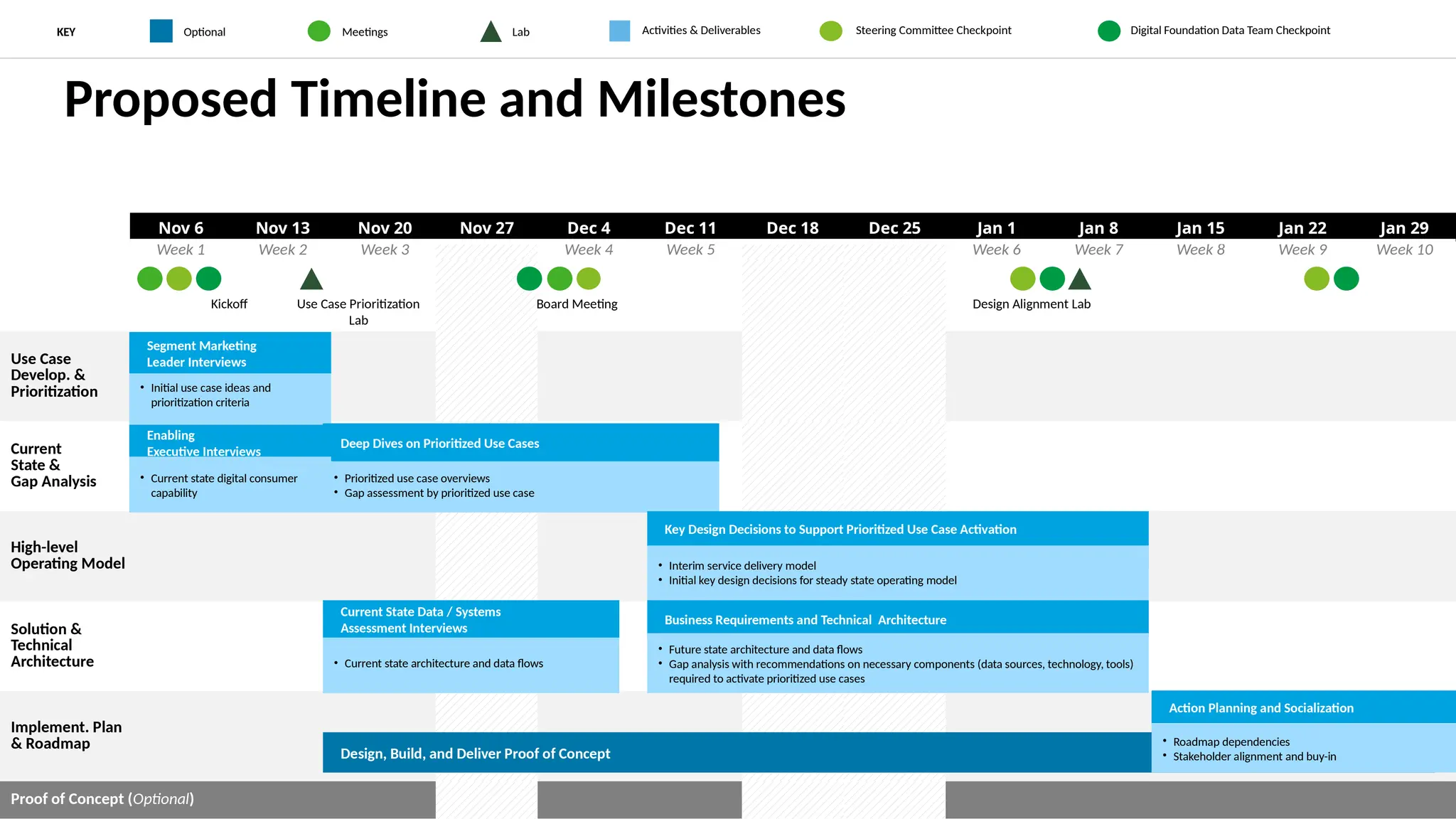
Proposed Timeline and Milestones
Nov 6 Nov 13 Nov 20 Nov 27 Dec 4 Dec 11 Dec 18 Dec 25 Jan 1 Jan 8 Jan 15 Jan 22 Jan 29
Week 1 Week 2 Week 3 Week 4 Week 5 Week 6 Week 7 Week 8 Week 9 Week 10
Use Case
Develop. &
Prioritization
Current
State &
Gap Analysis
High-level
Operating Model
Solution &
Technical
Architecture
Implement. Plan
& Roadmap
Proof of Concept (Optional)
Activities & Deliverables Steering Committee Checkpoint Digital Foundation Data Team Checkpoint
Use Case Prioritization
Lab
Design Alignment Lab
Board Meeting
Kickoff
Design, Build, and Deliver Proof of Concept
Business Requirements and Technical Architecture
Enabling
Executive Interviews
• Future state architecture and data flows
• Gap analysis with recommendations on necessary components (data sources, technology, tools)
required to activate prioritized use cases
• Current state architecture and data flows
Current State Data / Systems
Assessment Interviews
• Initial use case ideas and
prioritization criteria
• Prioritized use case overviews
• Gap assessment by prioritized use case
• Interim service delivery model
• Initial key design decisions for steady state operating model
Key Design Decisions to Support Prioritized Use Case Activation
Deep Dives on Prioritized Use Cases
• Current state digital consumer
capability
Segment Marketing
Leader Interviews
Action Planning and Socialization
• Roadmap dependencies
• Stakeholder alignment and buy-in
Lab
Meetings
Optional
KEY
17
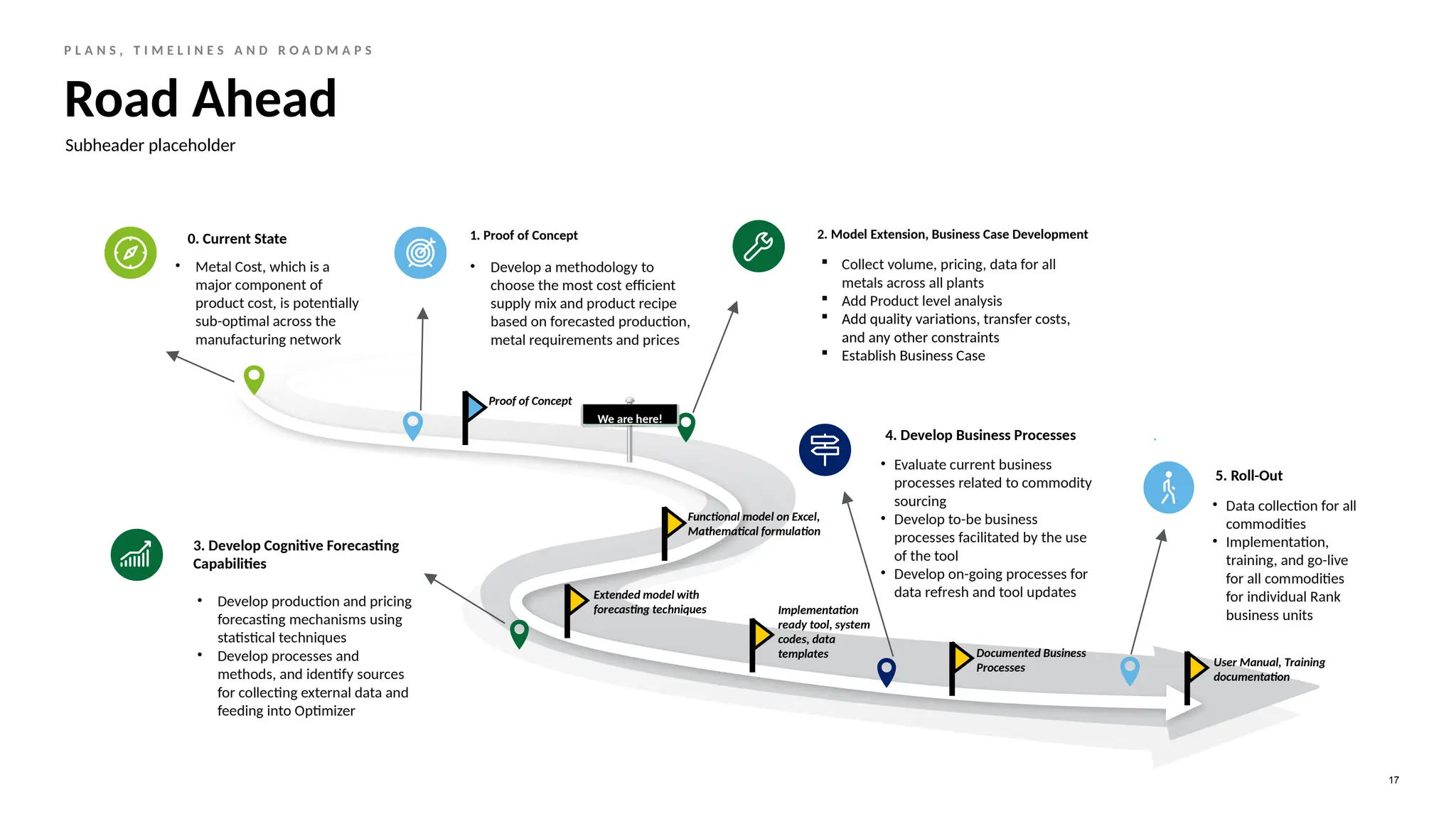
Road Ahead
Subheader placeholder
P L A N S , T I M E L I N E S A N D R O A D M A P S
0. Current State
• Metal Cost, which is a
major component of
product cost, is potentially
sub-optimal across the
manufacturing network
1. Proof of Concept
• Develop a methodology to
choose the most cost efficient
supply mix and product recipe
based on forecasted production,
metal requirements and prices
2. Model Extension, Business Case Development
 Collect volume, pricing, data for all
metals across all plants
 Add Product level analysis
 Add quality variations, transfer costs,
and any other constraints
 Establish Business Case
4. Develop Business Processes
• Evaluate current business
processes related to commodity
sourcing
• Develop to-be business
processes facilitated by the use
of the tool
• Develop on-going processes for
data refresh and tool updates
5. Roll-Out
• Data collection for all
commodities
• Implementation,
training, and go-live
for all commodities
for individual Rank
business units
We are here!
• Develop production and pricing
forecasting mechanisms using
statistical techniques
• Develop processes and
methods, and identify sources
for collecting external data and
feeding into Optimizer
3. Develop Cognitive Forecasting
Capabilities
Functional model on Excel,
Mathematical formulation
Extended model with
forecasting techniques Implementation
ready tool, system
codes, data
templates Documented Business
Processes User Manual, Training
documentation
Proof of Concept
18
Phased approach
We are targeting a phased approach; all subscribers receive price recommendations by April 2019
P L A N S , T I M E L I N E S A N D R O A D M A P S
2018 2019
AUG SEP OCT NOV DEC JAN FEB MAR APR
Pre-Launch Development
Alpha Test
Beta Orientation
Testing Comms.
Launch
Beta Test (2 Waves)
Wave 1 Wave 2
Co-op Pricing Roadshows Subscriber Support
Subscriber Enrollment Subscriber Pre-Launch Comms.
Non-indexed
Min. Wage Orientation +
Launch
Pre-Launch Development
Subscribed
Orientation +
Launch
Deloitte 2019 subscription
initiated
19
Calendar view
Subheader placeholder
P L A N S , T I M E L I N E S A N D R O A D M A P S
Sprint Cycle Milestones Release
Sunday Monday Tuesday Wednesday Thursday Friday Saturday
June 22 23 24 25 26 27 28
29 30 July 1 2 3 4 5
6 7 8 9 10 11 12
13 14 15 16 17 18 19
20 21 22 23 24 25 26
Phase 2
Phase 3
Phase 1
Launch
Phase 1
Touchpoint 1
Touchpoint 2
20
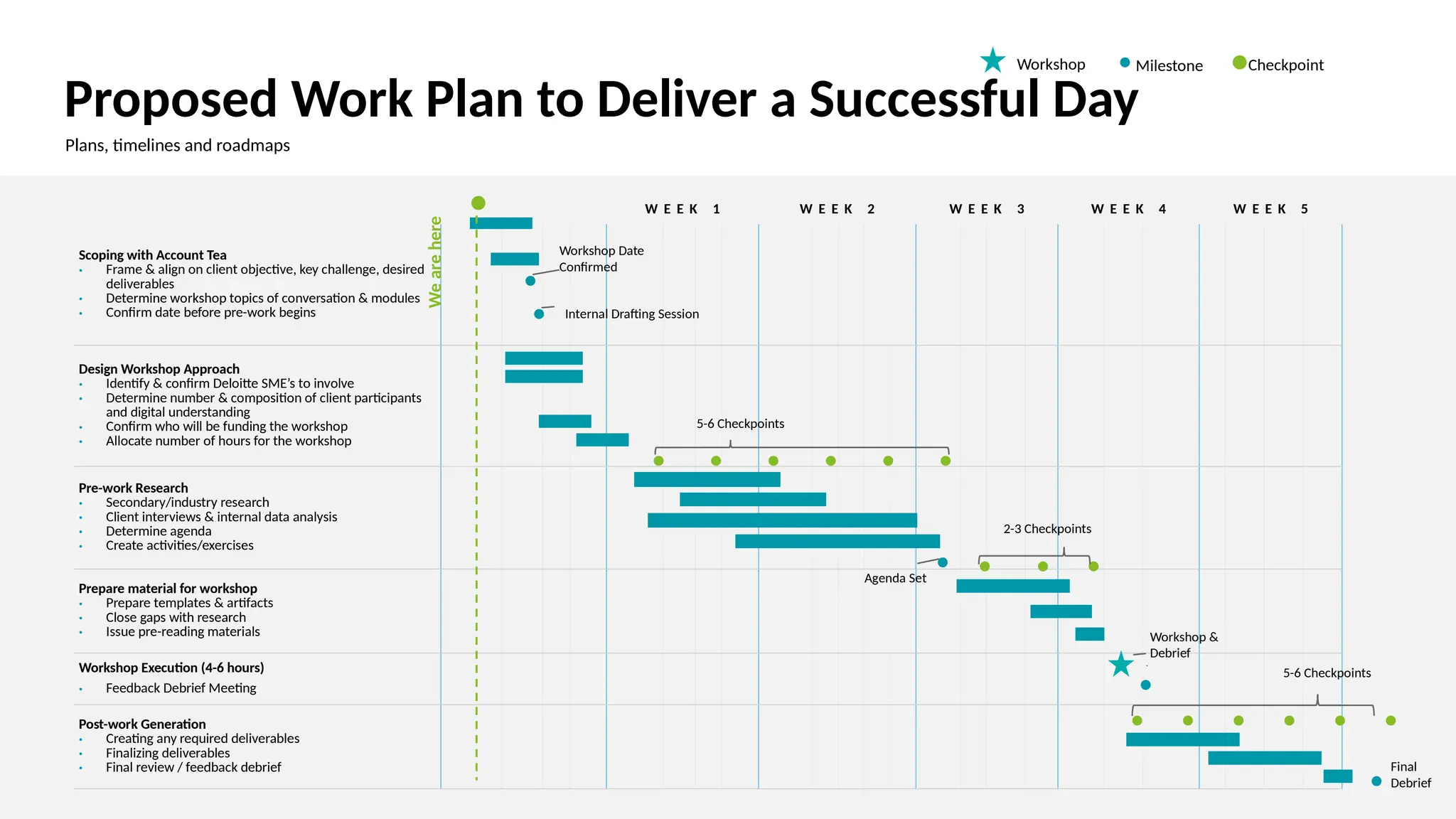
Proposed Work Plan to Deliver a Successful Day
Plans, timelines and roadmaps
W E E K 1 W E E K 2 W E E K 3 W E E K 4 W E E K 5
Scoping with Account Tea
• Frame & align on client objective, key challenge, desired
deliverables
• Determine workshop topics of conversation & modules
• Confirm date before pre-work begins
Design Workshop Approach
• Identify & confirm Deloitte SME’s to involve
• Determine number & composition of client participants
and digital understanding
• Confirm who will be funding the workshop
• Allocate number of hours for the workshop
Pre-work Research
• Secondary/industry research
• Client interviews & internal data analysis
• Determine agenda
• Create activities/exercises
Prepare material for workshop
• Prepare templates & artifacts
• Close gaps with research
• Issue pre-reading materials
Workshop Execution (4-6 hours)
• Feedback Debrief Meeting
Post-work Generation
• Creating any required deliverables
• Finalizing deliverables
• Final review / feedback debrief
Milestone
Workshop
Final
Debrief
Workshop &
Debrief
Agenda Set
Workshop Date
Confirmed
Checkpoint
5-6 Checkpoints
5-6 Checkpoints
2-3 Checkpoints
Internal Drafting Session
We
are
here
21
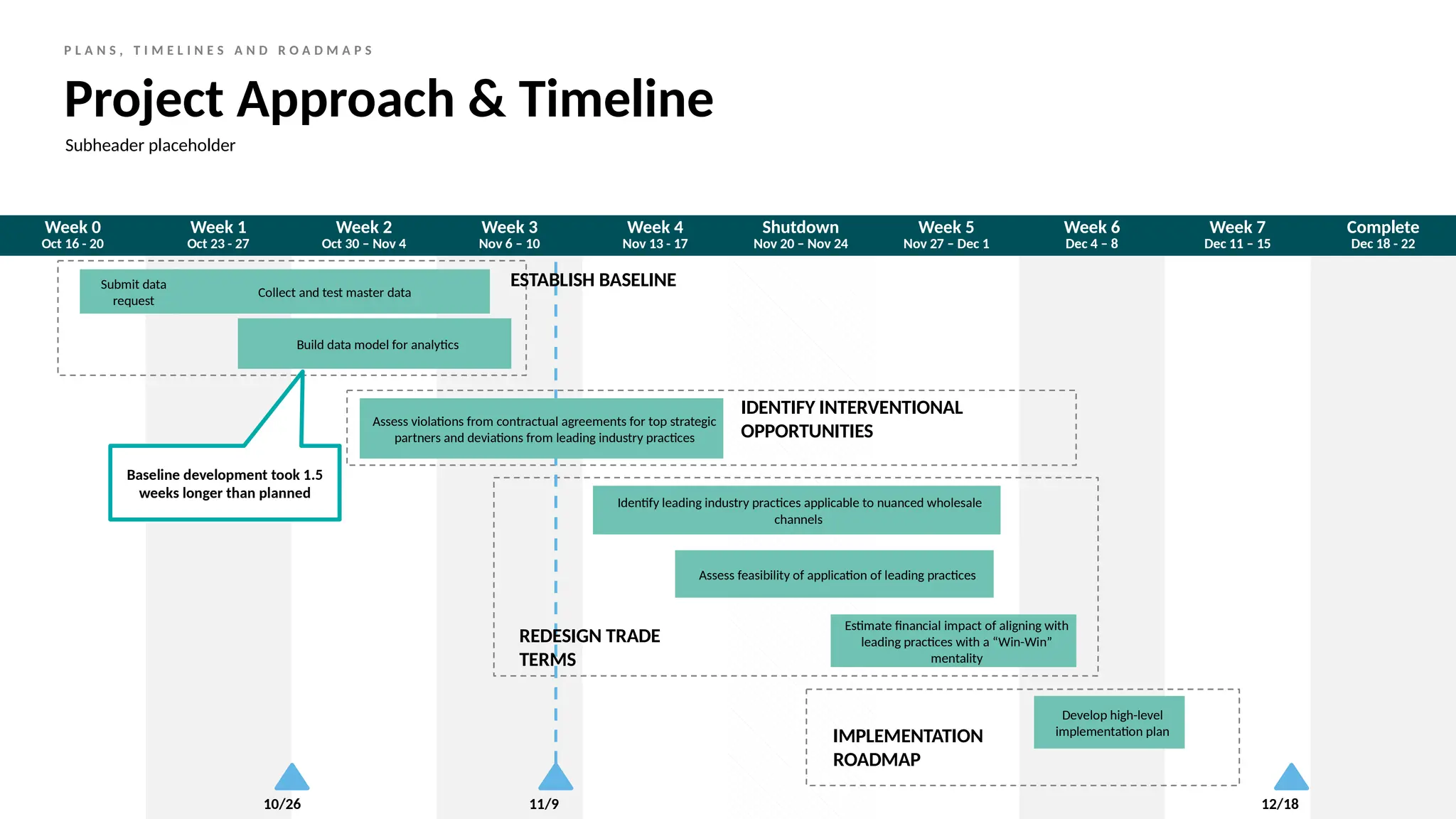
Project Approach & Timeline
Subheader placeholder
P L A N S , T I M E L I N E S A N D R O A D M A P S
Week 0
Oct 16 - 20
Week 1
Oct 23 - 27
Week 2
Oct 30 – Nov 4
Week 3
Nov 6 – 10
Week 4
Nov 13 - 17
Shutdown
Nov 20 – Nov 24
Week 5
Nov 27 – Dec 1
Week 6
Dec 4 – 8
Week 7
Dec 11 – 15
Complete
Dec 18 - 22
Build data model for analytics
Identify leading industry practices applicable to nuanced wholesale
channels
Assess feasibility of application of leading practices
Develop high-level
implementation plan
Collect and test master data
Estimate financial impact of aligning with
leading practices with a “Win-Win”
mentality
IMPLEMENTATION
ROADMAP
IDENTIFY INTERVENTIONAL
OPPORTUNITIES
Submit data
request
12/18
11/9
Assess violations from contractual agreements for top strategic
partners and deviations from leading industry practices
REDESIGN TRADE
TERMS
ESTABLISH BASELINE
10/26
Baseline development took 1.5
weeks longer than planned
22
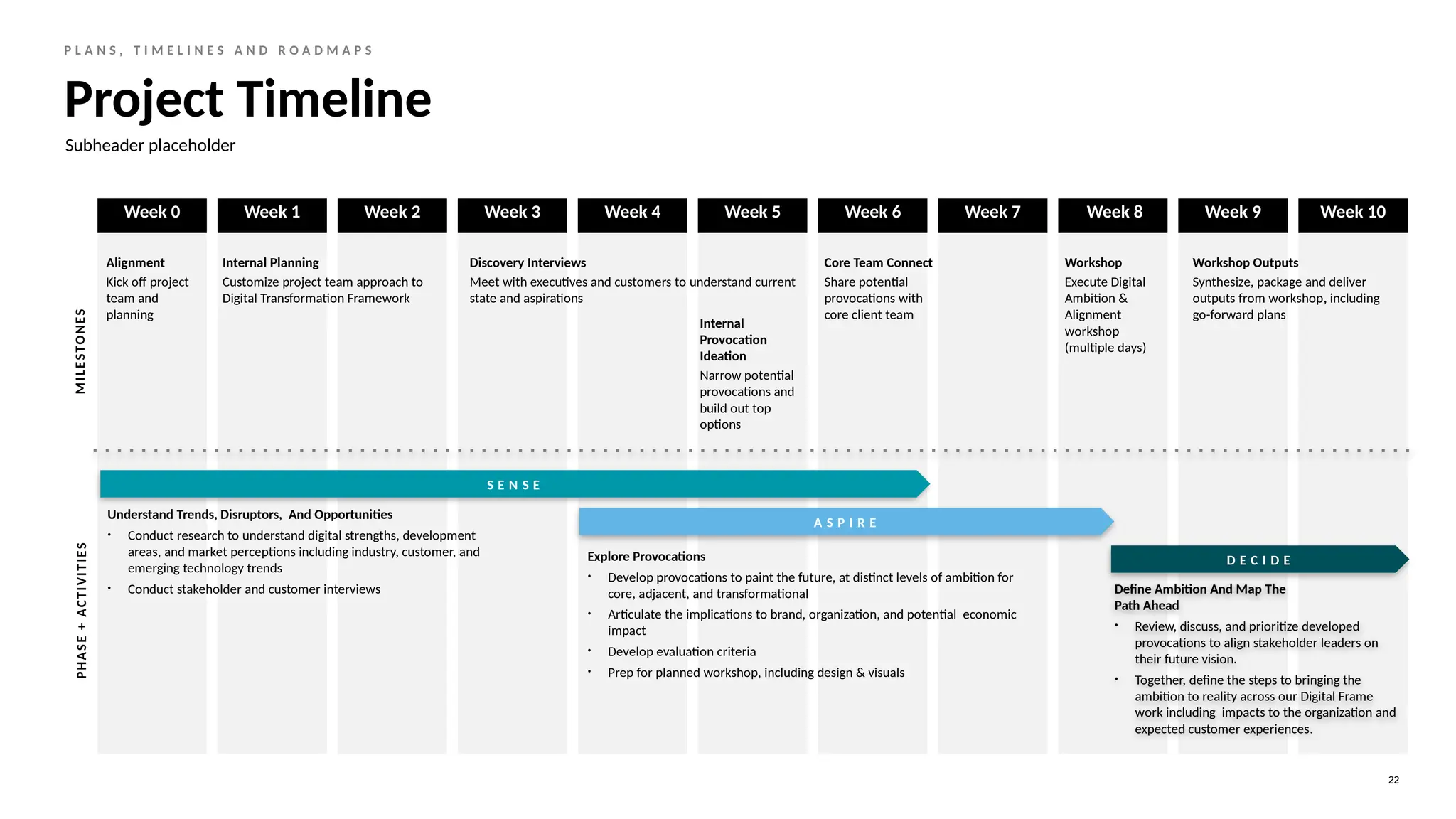
Project Timeline
Subheader placeholder
P L A N S , T I M E L I N E S A N D R O A D M A P S
Week 0 Week 1 Week 2 Week 3 Week 4 Week 5 Week 6 Week 7 Week 8 Week 9 Week 10
M
I
L
E
STO
N
E
S
P
H
A
S
E
+
AC
T
I
V
I
T
I
E
S
Alignment
Kick off project
team and
planning
Internal Planning
Customize project team approach to
Digital Transformation Framework
Discovery Interviews
Meet with executives and customers to understand current
state and aspirations
Workshop
Execute Digital
Ambition &
Alignment
workshop
(multiple days)
Workshop Outputs
Synthesize, package and deliver
outputs from workshop, including
go-forward plans
S E N S E
Understand Trends, Disruptors, And Opportunities
• Conduct research to understand digital strengths, development
areas, and market perceptions including industry, customer, and
emerging technology trends
• Conduct stakeholder and customer interviews
A S P I R E
Explore Provocations
• Develop provocations to paint the future, at distinct levels of ambition for
core, adjacent, and transformational
• Articulate the implications to brand, organization, and potential economic
impact
• Develop evaluation criteria
• Prep for planned workshop, including design & visuals
D E C I D E
Define Ambition And Map The
Path Ahead
• Review, discuss, and prioritize developed
provocations to align stakeholder leaders on
their future vision.
• Together, define the steps to bringing the
ambition to reality across our Digital Frame
work including impacts to the organization and
expected customer experiences.
Internal
Provocation
Ideation
Narrow potential
provocations and
build out top
options
Core Team Connect
Share potential
provocations with
core client team

Roadmap examples for tracking long term projects

  • 1.
    1 Target roadmap 1 Timeline Q1 2022Q2 2022 Q3 2022 Q4 2022 Q1 2023 Q2 2023 Q3 2023 Q4 2023 Owner Notes Initiative 1 D. Moore Initiative 2 J. Hint Initiative 3 Initiative 4 Initiative 5 Initiative 6 Initiative 7 Initiative 8 Foundational Transformational Incremental Business Needs Technology Imperatives Regulatory Driver Technology imperatives Technology imperatives Business Needs Regulatory Technology imperatives Business Needs Regulatory Business Needs For discussion: What categories do we want to organize the roadmap? Illustrative purposes only Illustrative Example
  • 2.
    2 Building and deployinga new pricing capability This effort will comprise a several-year effort to build the new pricing model, create delivery and support infrastructure, and deploy across the globe 1.0 DESIGN & TEST 2.0 BUILD & PILOT 3.0 SCALE & DEPLOY Objective Define required capabilities Win in priority markets Drive global scale ~ 9 – 1 2 M O N T H S ~ 1 2 M O N T H S ~ 1 2 + M O N T H S Activities Inventory & aggregate existing data sources; identify additional 1st and 3rd party data feeds Build integrated data model and establish “single source of truth” Design and develop pricing analytics engine Determine future state capabilities: • User personas/use cases • Key business questions and requirements • System architecture • Delivery & support model Establish benchmark performance levels through matched market/store testing Estimate size of pricing opportunity and develop go/no-go business case Build out pricing engine to support core four priority markets • Recommend menu item price points • Own- and cross-price elasticity • Optimize price against key metrics such as profit, foot traffic, average check Build new pricing portal to enable delivery, consumption, and validation of price recommendations Perform scenario analytics at corporate level Design change management campaign to support 4-market rollout Transition from incumbent pricing provider as new markets go-live with new pricing platform • Scale pricing platform to remaining markets • Improved model performance through enriched data (competitive, customer etc.) • Extend modeling analytics to include digital channels • Improve pricing portal to address wider range of use cases, enable mobile interface • Scale scenario analytics and optimization to all franchisee and company-owned stores • Scale pricing innovation labs to enable continuous pricing and pricing best practice across regions • Complete transition from incumbent pricing provider Outcomes Establish what good looks like, measurable performance improvement over current state Drive margin growth in key markets, build franchisee trust, and develop pricing infrastructure for delivery and support Embed the capability and design for long-term sustainability; refine analytics performance; enhance delivery platforms
  • 3.
    3 Ways to evolvea brand There has been a broad undertaking to evolve the brand to deliver a modern approach to luxury, leveraging the brand’s iconic heritage and legacy; our culture change findings are a key component of this process and will inform parallel initiatives Brand team assessment of the company’s portfolio opportunities Deloitte was engaged to develop and articulate the service culture strategy and supporting signature services and gestures Deloitte Consulting was engaged to assist with conducting a current state culture assessment, in order to identify opportunities and define an activation strategy for implementation 2017 2019 TODAY 2020 Across the portfolio there is an opportunity to leverage the culture assessment findings to inform a number of ongoing initiatives in the brand space: • Operating Model • GM / Hotel Manager Onboarding • Hotel Openings Process • Technology Roadmap Finalizing recommendations for Signature Services, including alignment with the culture roadmap, and conducting pilots for brand wide launch in 2019 Development of culture framework and activation strategy Culture Change Initiative Leverage Culture Change Findings
  • 4.
    4 Resourcing Check-Points Professional feesassume an average of standard approach for value capture across markets. We will work together to confirm the market-level value capture approach at two resource check-points GLOBAL LAUNCH & IN-MARKET ACCELERATION VALUE CAPTURE – LIGHT PHASE 2 • Team size as described herein • 4 weeks • <10% of total fees • Adequate resourcing available • Data accessible and available and harmonised • Trade spend previously analysed and tackled • Confirmed value target based on top-down prioritisation is reduced • 6-8 weeks per market • Reduced team size • Adequate resourcing available • Data accessible, available, light cleansing required • Some trade spend previously analysed • Confirmed value target based on top-down prioritisation as expected • 12 weeks per market • Standard team size Timing and Team Size Potential Drivers for Resourcing VALUE CAPTURE – STANDARD • Limited resourcing available • Data limited, requires heavy cleansing, data capture and validation • Limited trade spend analysis complete to date • Confirmed value target based on top-down prioritisation is higher • 12-16 weeks per market • Increased team size VALUE CAPTURE – HEAVY Not to exceed estimate based on standard approach for all markets PHASE 1
  • 5.
    5 We know yourcompany 2015 2016 The Client is currently integrating with Company B in order to realize its vision of being a global leader. Deloitte advised the regional integration in Americas and Europe including set-up of regional integration governance, project planning, and approach for roll-out of regional operating model. Industry Integration Transformation Redesign Deloitte supported with all aspects of the Transformation program including the redesign of the operating model, standardization of global processes, implementation of global Service Centers, launch of Success Factors, and launch of an employee portal using salesforce.com platform. Cloud The Client is transforming its Finance and HR business processes and replacing legacy applications with Oracle’s Cloud software platform. Deloitte is helping to standardize and simplify processes, increase efficiencies through automation and process improvements, implement a system to enable future growth, increase the visibility of operational information across the organization, and use value-added analytics to improve the ability to perform financial and risk analysis of operations. 2017 Innovation Strategy Playbook They wanted to establish greater alignment between the innovation efforts happening within each business segment, and the business segment’s strategy/ LROP. Doblin, Deloitte’s innovation practice, partnered with them to develop a methodology for developing innovation strategies, and simultaneously piloted the approach with three business segments. The resulting playbook has since been used to successfully develop the innovation strategy. White Space Innovation Group They wanted to invest in and build disruptive new businesses to complement its core, which had experienced a stagnate growth rate. Deloitte utilized a series of executive team labs and the expertise of Deloitte’s Center for the Edge to explore new opportunity spaces. We aligned leaders on the need to create difference businesses and an operating model to pursue new business opportunities.
  • 6.
    6 Where we havebeen; where we are going July 9-10 Summit Kickoff up/downstream alignment, integration points and initial timelines Aug 14 Working Sessions Begin series of working sessions with SMEs to align project plans for integration Sep 26 SteerCo. Present progress of the workstream in SteerCo. meeting Sep 19 Kickoff Standups Begin bi-weekly standups with workstream leads Aug 8, 13, 20 Deep Dive Host two hour sessions with SMEs of the up/downstream systems on the architecture and model
  • 7.
    7 Our Path toToday 2018 leadership forum (Aug, 15) Review findings from ‘Voice of Retail’ research and discuss potential areas of collaboration 2017 Leadership Forum Defined our strategic pillar and aligned on workstreams 2019 Meeting Review focus and approach given the revised strategy 2018 mid-winter (Jan, 25) Selected deep dive topics and created framework
  • 8.
    8 Planning Overview Event Activities TMOActivities Program Activities LEGEND Day 1 10/16/17 Day 90 1/14/18 Complete Future-State Blueprinting (11/30) Day 60 12/14/17 Begin high-level joint capabilities gathering (12/1) Complete high- level capabilities gathering Sessions (12/15) Finalize Event Level Joint Transition Plan (12/18) Provide Detailed Status on In-Flight Projects (12/18) Contract signed (10/16) Approve Joint Transition Plan (1/14) (90 Days per contract) Create Initial Joint Transition Plan (11/20) Public announcement (10/18) Governance Discussion (10/19) Today TMO Planning Meeting (10/25) Day 30 11/14/17 Draft Joint Transition Plan Review1 (~12/13-12/14)   Completed Program Activities    Joint Transition Planning Session, Atlanta (11/1 - 11/2)
  • 9.
    9 So the journeyto get here started last fall Development of the policy was a cross-functional effort from initial assessment through implementation prep Current State Assessment • Analyzed current state application of trade terms • Defined strategic objectives to align with trade terms Fall 2017 Winter/Spring 2018 Summer 2018 Development of New Framework • Developed new policy aligned with strategic objectives • Vetted policy with cross-functional stakeholders Application to Customers • Assessed impact on our customers • Worked with business and technology to develop the tools and processes for successful implementation
  • 10.
    10 Release Cycle There havebeen 4 major releases, 1 minor release, and 3 product production patches in the past 9 months. Collect Feedback Gathered feedback from stakeholders internally & externally to document requirements for development Define Requirements Translated feedback into specific user stories Create Designs Gathered and transformed underlying data into visual designs Launch Solution Demonstrated new functionalities to Stakeholders 3 Month Release Cycle S E P T O C T N O V D E C J A N F E B M A R C H A P R I L M AY J U N E 9 Months How we do it 1 Release 2 Release 2.5 Release 3 Release Release 4 Coming Soon! 2.6 Minor Release
  • 11.
    11 11 Project Timeline User Outcomes Sustainable Op Model Q2 FY19Q3 FY19 Q4 FY19 Q1 FY20 Q2 FY20 Q3 FY20 Q4 FY20 Q1 FY21 Q2 FY21 Q3 FY21 Insert critical milestone Insert interim outcome Insert critical milestone Insert interim outcome Insert interim outcome Insert interim outcome Insert critical milestone Insert critical milestone Insert critical milestone Insert critical milestone Insert critical milestone Insert interim outcome Insert interim outcome Insert interim outcome Insert critical milestone Insert interim outcome Insert interim outcome Insert interim outcome As a Merchant, I will be able to… As a Supplier, I will be able to… We are creating a sustainable operating model by… As a Customer, I will be able to… Interim Outcome Critical Outcome / Milestone We are here Insert critical milestone
  • 12.
    12 12 Project Timeline Week 1Week 2 Week 3 Week 4 Week 5 Week 6 Week 7 Week 8 Sprint 2 Prototype Develop use cases Conduct co-design sessions with stakeholders to determine user experience Recruit co-design participants Build clickable prototype Develop personas Build wireframes Establish baseline system, determine tech stack, and build requirements Design service blueprint
  • 13.
    13 13 Our integrated timelineemphasizes rapid analysis and quick wins. 12 Week Full timeline Week 0 Week 1 Week 2 Week 3 Week 4 Week 5 Week 6 Week 7 Week 8 Week 9 Week 10 Week 11 Week 12 ANALYTICS FOUNDATION OPERATIONAL ANALYTICS RETURNS STRATEGY Data Request Strategic Activation Session Strategic Activation Session Strategic Activation Session Strategic Activation Session Data Acquisition & Cleaning Data Mapping Data Documentation Develop Costing Model Develop Visualization Model Supplier Review Insights Field Observation Workshop Prep Workshop Support Analytics Roadmap Development Greenhouse Lab
  • 14.
    14 14 Future vision roadmap NextGen OrgStructure Creating a Sustainable Operating Model Change Management Capability Q2 FY19 Q3 FY19 Q4 FY19 Q1 FY20 Q2 FY20 Online Retail Hierarchy Streamlined Supplier Onboarding 100% of Items Discoverable Online Delivering Merchant Outcomes Delivering Supplier Outcomes Delivering Customer Outcomes Q1 FY19 Data Driven Decision making Setup / Maintain All Items Improved Supplier Item Management Future Vision Greater Product Assortment Across Channels Improved Business Management Toolkit
  • 15.
    15 15 Future State ImplementationRoadmap 1. Identify new and existing roles and capabilities needed to support the policy in the future 2. Establish governance approach 3. Align incentives to promote policy effectiveness and compliance 4. Revise current state processes to accommodate new policy 5. Introduce controls for customer exceptions to the policy 6. Finalize Policy Statement 7. Determine privacy of data and customer legal requirements 8. Determine customer rollout cadence and timing 9. Outline communication strategy of new policy for Sales 10. Develop training materials to enable sales to communicate new policy 11. Develop and distribute customer “sell-in toolkits” for Sales use during negotiation with customers 12. Manage process of updating master data 13. Define business rules for SAP condition records 14. Develop self-service capabilities to manage and analyze large transactional data pulls for ongoing analysis 15. Define metrics for measuring policy effectiveness and compliance 16. Define new reports to measure policy effectiveness 17. Enhance current SAP environment to incorporate new policy 18. Incorporate new approvals into current Salesforce process January 2018 June 2018 December 2018 June 2019 People & Org Business Process Customer Migration Data Measure& Report Implementation Activities
  • 16.
    16 Proposed Timeline andMilestones Nov 6 Nov 13 Nov 20 Nov 27 Dec 4 Dec 11 Dec 18 Dec 25 Jan 1 Jan 8 Jan 15 Jan 22 Jan 29 Week 1 Week 2 Week 3 Week 4 Week 5 Week 6 Week 7 Week 8 Week 9 Week 10 Use Case Develop. & Prioritization Current State & Gap Analysis High-level Operating Model Solution & Technical Architecture Implement. Plan & Roadmap Proof of Concept (Optional) Activities & Deliverables Steering Committee Checkpoint Digital Foundation Data Team Checkpoint Use Case Prioritization Lab Design Alignment Lab Board Meeting Kickoff Design, Build, and Deliver Proof of Concept Business Requirements and Technical Architecture Enabling Executive Interviews • Future state architecture and data flows • Gap analysis with recommendations on necessary components (data sources, technology, tools) required to activate prioritized use cases • Current state architecture and data flows Current State Data / Systems Assessment Interviews • Initial use case ideas and prioritization criteria • Prioritized use case overviews • Gap assessment by prioritized use case • Interim service delivery model • Initial key design decisions for steady state operating model Key Design Decisions to Support Prioritized Use Case Activation Deep Dives on Prioritized Use Cases • Current state digital consumer capability Segment Marketing Leader Interviews Action Planning and Socialization • Roadmap dependencies • Stakeholder alignment and buy-in Lab Meetings Optional KEY
  • 17.
    17 Road Ahead Subheader placeholder PL A N S , T I M E L I N E S A N D R O A D M A P S 0. Current State • Metal Cost, which is a major component of product cost, is potentially sub-optimal across the manufacturing network 1. Proof of Concept • Develop a methodology to choose the most cost efficient supply mix and product recipe based on forecasted production, metal requirements and prices 2. Model Extension, Business Case Development  Collect volume, pricing, data for all metals across all plants  Add Product level analysis  Add quality variations, transfer costs, and any other constraints  Establish Business Case 4. Develop Business Processes • Evaluate current business processes related to commodity sourcing • Develop to-be business processes facilitated by the use of the tool • Develop on-going processes for data refresh and tool updates 5. Roll-Out • Data collection for all commodities • Implementation, training, and go-live for all commodities for individual Rank business units We are here! • Develop production and pricing forecasting mechanisms using statistical techniques • Develop processes and methods, and identify sources for collecting external data and feeding into Optimizer 3. Develop Cognitive Forecasting Capabilities Functional model on Excel, Mathematical formulation Extended model with forecasting techniques Implementation ready tool, system codes, data templates Documented Business Processes User Manual, Training documentation Proof of Concept
  • 18.
    18 Phased approach We aretargeting a phased approach; all subscribers receive price recommendations by April 2019 P L A N S , T I M E L I N E S A N D R O A D M A P S 2018 2019 AUG SEP OCT NOV DEC JAN FEB MAR APR Pre-Launch Development Alpha Test Beta Orientation Testing Comms. Launch Beta Test (2 Waves) Wave 1 Wave 2 Co-op Pricing Roadshows Subscriber Support Subscriber Enrollment Subscriber Pre-Launch Comms. Non-indexed Min. Wage Orientation + Launch Pre-Launch Development Subscribed Orientation + Launch Deloitte 2019 subscription initiated
  • 19.
    19 Calendar view Subheader placeholder PL A N S , T I M E L I N E S A N D R O A D M A P S Sprint Cycle Milestones Release Sunday Monday Tuesday Wednesday Thursday Friday Saturday June 22 23 24 25 26 27 28 29 30 July 1 2 3 4 5 6 7 8 9 10 11 12 13 14 15 16 17 18 19 20 21 22 23 24 25 26 Phase 2 Phase 3 Phase 1 Launch Phase 1 Touchpoint 1 Touchpoint 2
  • 20.
    20 Proposed Work Planto Deliver a Successful Day Plans, timelines and roadmaps W E E K 1 W E E K 2 W E E K 3 W E E K 4 W E E K 5 Scoping with Account Tea • Frame & align on client objective, key challenge, desired deliverables • Determine workshop topics of conversation & modules • Confirm date before pre-work begins Design Workshop Approach • Identify & confirm Deloitte SME’s to involve • Determine number & composition of client participants and digital understanding • Confirm who will be funding the workshop • Allocate number of hours for the workshop Pre-work Research • Secondary/industry research • Client interviews & internal data analysis • Determine agenda • Create activities/exercises Prepare material for workshop • Prepare templates & artifacts • Close gaps with research • Issue pre-reading materials Workshop Execution (4-6 hours) • Feedback Debrief Meeting Post-work Generation • Creating any required deliverables • Finalizing deliverables • Final review / feedback debrief Milestone Workshop Final Debrief Workshop & Debrief Agenda Set Workshop Date Confirmed Checkpoint 5-6 Checkpoints 5-6 Checkpoints 2-3 Checkpoints Internal Drafting Session We are here
  • 21.
    21 Project Approach &Timeline Subheader placeholder P L A N S , T I M E L I N E S A N D R O A D M A P S Week 0 Oct 16 - 20 Week 1 Oct 23 - 27 Week 2 Oct 30 – Nov 4 Week 3 Nov 6 – 10 Week 4 Nov 13 - 17 Shutdown Nov 20 – Nov 24 Week 5 Nov 27 – Dec 1 Week 6 Dec 4 – 8 Week 7 Dec 11 – 15 Complete Dec 18 - 22 Build data model for analytics Identify leading industry practices applicable to nuanced wholesale channels Assess feasibility of application of leading practices Develop high-level implementation plan Collect and test master data Estimate financial impact of aligning with leading practices with a “Win-Win” mentality IMPLEMENTATION ROADMAP IDENTIFY INTERVENTIONAL OPPORTUNITIES Submit data request 12/18 11/9 Assess violations from contractual agreements for top strategic partners and deviations from leading industry practices REDESIGN TRADE TERMS ESTABLISH BASELINE 10/26 Baseline development took 1.5 weeks longer than planned
  • 22.
    22 Project Timeline Subheader placeholder PL A N S , T I M E L I N E S A N D R O A D M A P S Week 0 Week 1 Week 2 Week 3 Week 4 Week 5 Week 6 Week 7 Week 8 Week 9 Week 10 M I L E STO N E S P H A S E + AC T I V I T I E S Alignment Kick off project team and planning Internal Planning Customize project team approach to Digital Transformation Framework Discovery Interviews Meet with executives and customers to understand current state and aspirations Workshop Execute Digital Ambition & Alignment workshop (multiple days) Workshop Outputs Synthesize, package and deliver outputs from workshop, including go-forward plans S E N S E Understand Trends, Disruptors, And Opportunities • Conduct research to understand digital strengths, development areas, and market perceptions including industry, customer, and emerging technology trends • Conduct stakeholder and customer interviews A S P I R E Explore Provocations • Develop provocations to paint the future, at distinct levels of ambition for core, adjacent, and transformational • Articulate the implications to brand, organization, and potential economic impact • Develop evaluation criteria • Prep for planned workshop, including design & visuals D E C I D E Define Ambition And Map The Path Ahead • Review, discuss, and prioritize developed provocations to align stakeholder leaders on their future vision. • Together, define the steps to bringing the ambition to reality across our Digital Frame work including impacts to the organization and expected customer experiences. Internal Provocation Ideation Narrow potential provocations and build out top options Core Team Connect Share potential provocations with core client team

Editor's Notes

  • #17 Tags: roadmap
  • #18 Tags: approach, timeline, gantt chart
  • #19 Tags: calendar, timeline, sprint, phase
  • #20 Tags: workplan, project management, table, gantt chart
  • #21 Tags: approach, table, week, timeline
  • #22 Tags: week, phase, timeline, roadmap, phase, table