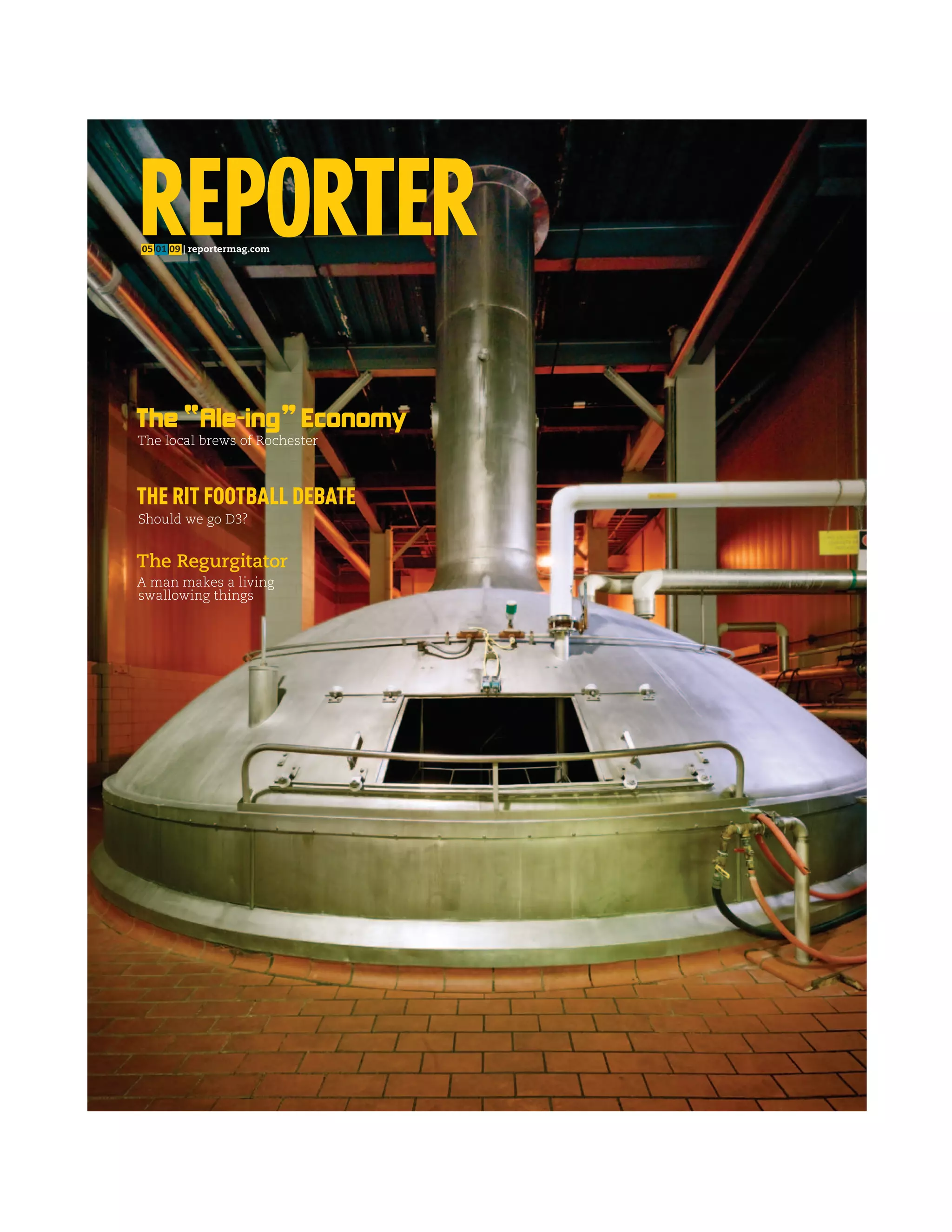
05 01 09 | reportermag.com
The local brews of Rochester
THE RIT FOOTBALL DEBATE
Should we go D3?
The Regurgitator
A man makes a living
swallowing things
The Ale-ing Economy
16 Section | 05.01.09
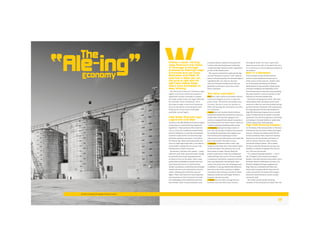
WWithout a doubt, working
class America’s first choice
of beverage is the lager
produced by American mega-
breweries such as Coors,
Budweiser and Pabst. At
less than a dollar per can,
the price is right and the
light taste makes these
beers more accessible for
easy drinking.
But the world of beer isn’t limited to light
lagers, and recent trends have pushed a
significant fraction of people to explore
the wider world of ales and lagers afforded
by craft beer. Here in Rochester, we’re
fortunate enough to have local breweries
that run the gamut, accounting for both
small batch artisan beers and highly
quaffable canned lagers.
Field Guide: American Light
Lagers and Craft Beer
The key to the affordability of American lagers
is that they are created with less expensive
ingredients. These products often substitute
corn or rice for the traditional malted barley,
which is sufficient to create the fermentation
needed to make alcohol. For both the mega-
breweries and their customers, it’s all about
the bottom line. Many Americans prefer the
taste of a light lager made with a corn adjunct
and wouldn’t consider the use of corn to be
detrimental to a beer’s character.
By contrast, craft beer is for purists — made
only from malt, hops, yeast and water, though
occasionally more exotic ingredients such
as wheat or fruit are fair game. After a long
period when drinkability and price were the
only relevant factors in an American beer
drinker’s preference, small breweries emerged
around the west coast and spread across the
nation, offering more distinctive ales and
lagers. These craft brews are more expensive
and sometimes so full of character that they
are challenging to the traditional American
beer drinker. Some of these breweries, such
as Samuel Adams, enjoyed such popularity
in their niche that they became nationally
recognized mega-breweries with a significant
portion of the market share.
The success of these beer styles led the big
national breweries to launch “craft” projects,
beers of elevated quality that shunned adjunct
ingredients like corn and rice. Because
they are still mass manufactured, they are
generally much lower in price than small
batch craft beers.
Why Drink Local Beer?
Price. Beer that’s made in Rochester doesn’t
need to be shipped very far to reach the
point of sale. The shorter the product has
to travel, the less it costs for retailers to
offer, minimizing the actual price you face
as a consumer.
Green. Here’s yet another situation where
being environmentally conservative saves you
money. Beer that has been shipped cross-
country or imported from abroad consumes a
lot of resources for not much reason, when you
could be enjoying something made nearby.
Community. Buying local keeps money in
your own community. It bolsters the economy
by fueling the businesses that support your
local brewery and employing an entire
infrastructure from the brewers who make the
beer to the retailer who sells it to you.
Freshness. If freshness didn’t count, why
would so many beers have “best before” dates
on the container? The closer you live to the
beer’s point of origin, the less likely the
product ended up on some non-refrigerated
trailer baking in the sun for 10 hours outside
a warehouse. Even better, unpasteurized ales
from microbreweries and brewpubs often
contain live yeasts from the brewing process.
In addition to tasting unbelievably delicious,
beer that is this fresh usually has a higher
nutritional value and more vitamin B, which
helps you drink more and longer without a
hangover the next morning.
Novelty. You can often arrange for local
brewery tours and watch your favorite
beverage be made. You learn a great deal
about the process and, at the end of the tour,
it is customary to receive generous samples of
the product.
Beer in a Recession
If the constant stream of bad economic
news in recent months has driven you to
drink, you’re not the only one. Alcohol sales
are notoriously recession-proof. Nielsen
Media Research reported that, following the
economic meltdown last September, most
(over 80 percent) of consumers were spending
the same amount or more on alcohol as they
had prior to the stock market dive.
But they’re not going out to drink. The same
release shows that consumers are far more
reluctant to dine out, and that includes hitting
up the local bar or brewpub. This is good news
for large operation bottlers like Rochester’s
High Falls Brewing Company, but you would
expect it bodes poorly for smaller craft brew
operations that sell the experience of drinking
and eating in the same facility or make most
of their money from draft keg sales.
High Falls Brewing Company
On the banks of the Genesee River in the heart
of Rochester lies the town’s oldest and largest
brewery. Twenty-two massive tanks fill the
facility’s backdrop. Here, they brew Genesee,
Genny Lite, and the Dundee craft beers, as
well as contract brews for other national
brands like Samuel Adams. This is where
the beer is brewed, fermented, canned, and
bottled in a miracle of industry that churns
out 1,250 cans per minute.
It’s a massive brewing operation — one of
the 10 largest in the country according to
Boulder, Colorado’s Brewers Association. Since
Anheuser-Busch’s 2008 buyout by InBev, the
Brazilian-Belgian beverage conglomerate,
High Falls has contended with Pabst and
Boston Beer Company (which they brew for
under contract) for the status of the largest
American-owned brewery, a point of pride
among the staff.
The credit crunch and the resulting
recession of the economy have taken their toll
Economy
Ale-ing
The
by Owen O’Connell | photographs by Robert Luessen
17
18 Section | 05.01.09
on High Falls as a manufacturing operation:
“The world economy has been affected. I don’t
think you could actually find anything that
is not ... The higher brand beers might see a
dip in sales because they are a higher price,
and the lower end beers might see more of an
increase,” notes Jason Zwetsch, health and
safety supervisor of High Falls.
Craft beer is a niche market. “Think of it
like the automotive industry,” says Zwetsch,
“There are going to be people who always want
trucks, utility vehicles, that sort of stuff, and
other people are going to want smaller cars.
One of the biggest factors in today’s market is
that people’s tastes have changed.”
To carve out a piece of the craft beer market,
High Falls has rebranded their formerly
defunct J.W. Dundee line, now known simply
as Dundee. The Dundee ales and lagers are
made from high-quality ingredients with no
corn or other adjuncts, and the bottles are
decorated with playfully illustrated labels
that help to complete the “craftsy” image.
It’s a very different style from the brewery’s
traditional mainstays: Genesee beer (a light
American lager made with corn as an adjunct)
and its low-calorie cousin, Genny Light.
High Falls has only recently offered tours of
their facility, which is not set up for tourism
in the same sense as most large breweries.
Guests must don hardhats and safety goggles,
while pants and waterproof shoes are strongly
advocated. There is no plate glass to shield you
from the spray of the cooling water that runs
over the can line, nor to mute the deafening
roar of the machinery.
Rohrbach Brewing Company
On a sparsely populated stretch of Buffalo Road
near Gates, there’s a brewery that is in many ways
the opposite of High Falls. Rohrbach is a brewpub,
a small craft brewing operation combined with
a restaurant that showcases small batch artisan
ales and lagers. A small staff tends to the brewing
of distinctive beers out of a few dozen fermenting
tanks, which are dwarfed by High Falls’s house-
sized equivalents.
Due to high demand, much of the brewing
has been moved off-site to an installation and
storefront on Railroad Street adjacent to the
Public Market, but some portion of the ales are
still brewed right in the restaurant.
Owner John Urlaub, who some may know
through RIT’s Beers of the World class, feels
that craft beer’s niche market offers him some
protection against the downturn. “We have loyal
customers. They’re used to a particular product
that they have from Rohrbach’s like a Scotch ale
or a Highland Lager or Bluebeary Ale. That’s their
beer that they like and they’re willing to spend
the money.”
One problem for brewpubs in this economic
climate is that people are staying home more
and dining out less in general. Unlike High
Falls, which maintains a large bottling facility,
traditionally the only way to enjoy a small batch
craft brew at home has been to fill a jug (known as
a growler) off the tap. With larger breweries like
High Falls offering craft beer at a lower price point
from the convenience of a supermarket shelf, it’s
not hard to understand why even some diehard
craft beer lovers would reach for a Dundee Craft
Pack rather than drive out to the brewery to have
a growler filled. The good news is that Rohrbach
has recently contracted with many local retailers
including Wegmans and 7-Eleven to sell growlers
of popular Rohrbach ales and lagers.
Urlaub isn’t daunted by High Falls venturing
into the craft beer market. Quite the opposite,
he believes that it raises the general trend for
Americans to enjoy more flavorful beers, and
it promotes Rochester as a place where high
quality local brews are made. “If somebody
picks up a Dundee or a Rohrbach’s, I’m happy
either way, so long as it’s not some out-of-
town brewery.”
I’ll drink to that!
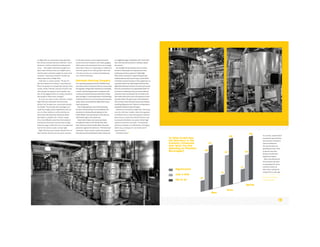
In a survey, nearly half of
consumers reported that
the economic downturn
has not influenced
the amount they are
spending on beer, wine,
or spirits; less than
20 percent indicate a
significant impact.
More than 80 percent
of consumers say they
are spending the same
amount or more on
beer, wine, and spirits
compared to a year ago.
Source: The Nielsen
Company, 2008
To What Extent Has
the Downturn in the
Economy influenced
How Much You Are
Spending on Alcoholic
Beverages?
13
14
17
40
37 34
47
49
48
Beer
SIgnificantly
Just a little
Not at all
Wine
Spirits
1918 Section | 05.01.09

RITReporterVol58No29Pg9-10

  • 1.
    05 01 09| reportermag.com The local brews of Rochester THE RIT FOOTBALL DEBATE Should we go D3? The Regurgitator A man makes a living swallowing things The Ale-ing Economy
  • 2.
    16 Section |05.01.09 WWithout a doubt, working class America’s first choice of beverage is the lager produced by American mega- breweries such as Coors, Budweiser and Pabst. At less than a dollar per can, the price is right and the light taste makes these beers more accessible for easy drinking. But the world of beer isn’t limited to light lagers, and recent trends have pushed a significant fraction of people to explore the wider world of ales and lagers afforded by craft beer. Here in Rochester, we’re fortunate enough to have local breweries that run the gamut, accounting for both small batch artisan beers and highly quaffable canned lagers. Field Guide: American Light Lagers and Craft Beer The key to the affordability of American lagers is that they are created with less expensive ingredients. These products often substitute corn or rice for the traditional malted barley, which is sufficient to create the fermentation needed to make alcohol. For both the mega- breweries and their customers, it’s all about the bottom line. Many Americans prefer the taste of a light lager made with a corn adjunct and wouldn’t consider the use of corn to be detrimental to a beer’s character. By contrast, craft beer is for purists — made only from malt, hops, yeast and water, though occasionally more exotic ingredients such as wheat or fruit are fair game. After a long period when drinkability and price were the only relevant factors in an American beer drinker’s preference, small breweries emerged around the west coast and spread across the nation, offering more distinctive ales and lagers. These craft brews are more expensive and sometimes so full of character that they are challenging to the traditional American beer drinker. Some of these breweries, such as Samuel Adams, enjoyed such popularity in their niche that they became nationally recognized mega-breweries with a significant portion of the market share. The success of these beer styles led the big national breweries to launch “craft” projects, beers of elevated quality that shunned adjunct ingredients like corn and rice. Because they are still mass manufactured, they are generally much lower in price than small batch craft beers. Why Drink Local Beer? Price. Beer that’s made in Rochester doesn’t need to be shipped very far to reach the point of sale. The shorter the product has to travel, the less it costs for retailers to offer, minimizing the actual price you face as a consumer. Green. Here’s yet another situation where being environmentally conservative saves you money. Beer that has been shipped cross- country or imported from abroad consumes a lot of resources for not much reason, when you could be enjoying something made nearby. Community. Buying local keeps money in your own community. It bolsters the economy by fueling the businesses that support your local brewery and employing an entire infrastructure from the brewers who make the beer to the retailer who sells it to you. Freshness. If freshness didn’t count, why would so many beers have “best before” dates on the container? The closer you live to the beer’s point of origin, the less likely the product ended up on some non-refrigerated trailer baking in the sun for 10 hours outside a warehouse. Even better, unpasteurized ales from microbreweries and brewpubs often contain live yeasts from the brewing process. In addition to tasting unbelievably delicious, beer that is this fresh usually has a higher nutritional value and more vitamin B, which helps you drink more and longer without a hangover the next morning. Novelty. You can often arrange for local brewery tours and watch your favorite beverage be made. You learn a great deal about the process and, at the end of the tour, it is customary to receive generous samples of the product. Beer in a Recession If the constant stream of bad economic news in recent months has driven you to drink, you’re not the only one. Alcohol sales are notoriously recession-proof. Nielsen Media Research reported that, following the economic meltdown last September, most (over 80 percent) of consumers were spending the same amount or more on alcohol as they had prior to the stock market dive. But they’re not going out to drink. The same release shows that consumers are far more reluctant to dine out, and that includes hitting up the local bar or brewpub. This is good news for large operation bottlers like Rochester’s High Falls Brewing Company, but you would expect it bodes poorly for smaller craft brew operations that sell the experience of drinking and eating in the same facility or make most of their money from draft keg sales. High Falls Brewing Company On the banks of the Genesee River in the heart of Rochester lies the town’s oldest and largest brewery. Twenty-two massive tanks fill the facility’s backdrop. Here, they brew Genesee, Genny Lite, and the Dundee craft beers, as well as contract brews for other national brands like Samuel Adams. This is where the beer is brewed, fermented, canned, and bottled in a miracle of industry that churns out 1,250 cans per minute. It’s a massive brewing operation — one of the 10 largest in the country according to Boulder, Colorado’s Brewers Association. Since Anheuser-Busch’s 2008 buyout by InBev, the Brazilian-Belgian beverage conglomerate, High Falls has contended with Pabst and Boston Beer Company (which they brew for under contract) for the status of the largest American-owned brewery, a point of pride among the staff. The credit crunch and the resulting recession of the economy have taken their toll Economy Ale-ing The by Owen O’Connell | photographs by Robert Luessen 17
  • 3.
    18 Section |05.01.09 on High Falls as a manufacturing operation: “The world economy has been affected. I don’t think you could actually find anything that is not ... The higher brand beers might see a dip in sales because they are a higher price, and the lower end beers might see more of an increase,” notes Jason Zwetsch, health and safety supervisor of High Falls. Craft beer is a niche market. “Think of it like the automotive industry,” says Zwetsch, “There are going to be people who always want trucks, utility vehicles, that sort of stuff, and other people are going to want smaller cars. One of the biggest factors in today’s market is that people’s tastes have changed.” To carve out a piece of the craft beer market, High Falls has rebranded their formerly defunct J.W. Dundee line, now known simply as Dundee. The Dundee ales and lagers are made from high-quality ingredients with no corn or other adjuncts, and the bottles are decorated with playfully illustrated labels that help to complete the “craftsy” image. It’s a very different style from the brewery’s traditional mainstays: Genesee beer (a light American lager made with corn as an adjunct) and its low-calorie cousin, Genny Light. High Falls has only recently offered tours of their facility, which is not set up for tourism in the same sense as most large breweries. Guests must don hardhats and safety goggles, while pants and waterproof shoes are strongly advocated. There is no plate glass to shield you from the spray of the cooling water that runs over the can line, nor to mute the deafening roar of the machinery. Rohrbach Brewing Company On a sparsely populated stretch of Buffalo Road near Gates, there’s a brewery that is in many ways the opposite of High Falls. Rohrbach is a brewpub, a small craft brewing operation combined with a restaurant that showcases small batch artisan ales and lagers. A small staff tends to the brewing of distinctive beers out of a few dozen fermenting tanks, which are dwarfed by High Falls’s house- sized equivalents. Due to high demand, much of the brewing has been moved off-site to an installation and storefront on Railroad Street adjacent to the Public Market, but some portion of the ales are still brewed right in the restaurant. Owner John Urlaub, who some may know through RIT’s Beers of the World class, feels that craft beer’s niche market offers him some protection against the downturn. “We have loyal customers. They’re used to a particular product that they have from Rohrbach’s like a Scotch ale or a Highland Lager or Bluebeary Ale. That’s their beer that they like and they’re willing to spend the money.” One problem for brewpubs in this economic climate is that people are staying home more and dining out less in general. Unlike High Falls, which maintains a large bottling facility, traditionally the only way to enjoy a small batch craft brew at home has been to fill a jug (known as a growler) off the tap. With larger breweries like High Falls offering craft beer at a lower price point from the convenience of a supermarket shelf, it’s not hard to understand why even some diehard craft beer lovers would reach for a Dundee Craft Pack rather than drive out to the brewery to have a growler filled. The good news is that Rohrbach has recently contracted with many local retailers including Wegmans and 7-Eleven to sell growlers of popular Rohrbach ales and lagers. Urlaub isn’t daunted by High Falls venturing into the craft beer market. Quite the opposite, he believes that it raises the general trend for Americans to enjoy more flavorful beers, and it promotes Rochester as a place where high quality local brews are made. “If somebody picks up a Dundee or a Rohrbach’s, I’m happy either way, so long as it’s not some out-of- town brewery.” I’ll drink to that! In a survey, nearly half of consumers reported that the economic downturn has not influenced the amount they are spending on beer, wine, or spirits; less than 20 percent indicate a significant impact. More than 80 percent of consumers say they are spending the same amount or more on beer, wine, and spirits compared to a year ago. Source: The Nielsen Company, 2008 To What Extent Has the Downturn in the Economy influenced How Much You Are Spending on Alcoholic Beverages? 13 14 17 40 37 34 47 49 48 Beer SIgnificantly Just a little Not at all Wine Spirits 1918 Section | 05.01.09