Risk Based
Testing
Matrix, Process & Examples
Bassam Al-Khatib
ISTQB Full CTAL Advanced Level &
Certified Ethical Hacker
A new idea toward technical software testing
Ground Rules 2
 Silent Mobile phones
 Questions are allowed at all times
 Join Sessions on time
 One meeting No sub-meetings
Area & Tools
Expectation? Parking Lot
3
Session Description
 This training will help Software Test
Engineers globally to Perform Risk
Based Testing (RBT) during design,
plan and implement testing using
a systematic approach and
applicable techniques
 Trainer: Bassam Al-Khatib
 Duration: 3 hours and 30 minutes
 Prerequisites: Elementary
certificates (Beginners level) in
software testing certificate
4
Instructional
Methods
 Following are instructional methods
 Lectures
 Group Discussions
 Individual/group assignments
5
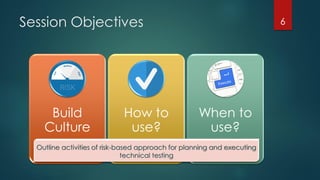
Session Objectives
Build
Culture
How to
use?
When to
use?
Outline activities of risk-based approach for planning and executing
technical testing
6
What's in it for me?
 This session is a chance for one more deep study for Risk Based
Testing (RBT), by analyzing approach, building risk matrixes, building
RBT activities to form a complete process and showing some
examples accordingly.
7
Agenda
 Preface
 How to start with Risk Based testing?
 Risk Management
 Risk identification
 Risk Analysis
 Risk Mitigation
 RBT in the Large & Small
 RBT Benefits
 Conclusion
8
Preface
The possibility of negative results, that would
occur and decrease customer perception
of a product quality or project success.
•What Risk Means?
9
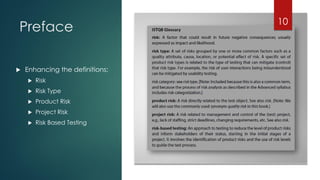
Preface
 Enhancing the definitions:
 Risk
 Risk Type
 Product Risk
 Project Risk
 Risk Based Testing
10
Preface 11
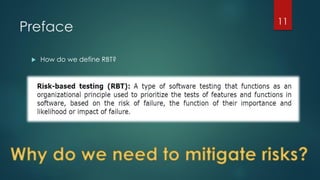
 How do we define RBT?
Preface
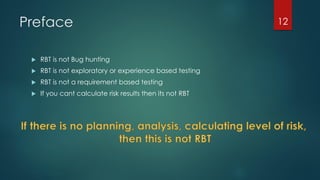
 RBT is not Bug hunting
 RBT is not exploratory or experience based testing
 RBT is not a requirement based testing
 If you cant calculate risk results then its not RBT
12
Preface
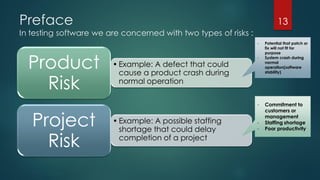
In testing software we are concerned with two types of risks :
• Example: A defect that could
cause a product crash during
normal operation
Product
Risk
• Example: A possible staffing
shortage that could delay
completion of a project
Project
Risk
13
- Potential that patch or
fix will not fit for
purpose
- System crash during
normal
operation(software
stability)
- Commitment to
customers or
management
- Staffing shortage
- Poor productivity
Preface
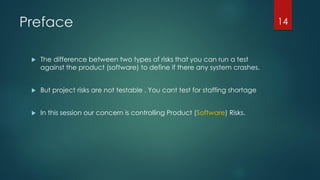
 The difference between two types of risks that you can run a test
against the product (software) to define if there any system crashes.
 But project risks are not testable . You cant test for staffing shortage
 In this session our concern is controlling Product (Software) Risks.
14
Preface
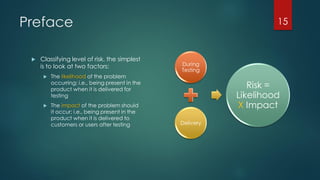
 Classifying level of risk, the simplest
is to look at two factors:
 The likelihood of the problem
occurring; i.e., being present in the
product when it is delivered for
testing
 The impact of the problem should
it occur; i.e., being present in the
product when it is delivered to
customers or users after testing
During
Testing
Delivery
Risk =
Likelihood
X Impact
15
How to Start with RBT? 16
 When ?
 Risk-based testing applied to
the project at very initial level
on any project
 Risk Management how to
start…
 Applying a set of procedures
and practices to identify,
analyze, prioritize and
controlling risk.
Risk Management
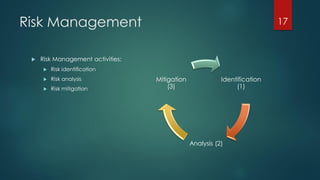
 Risk Management activities:
 Risk identification
 Risk analysis
 Risk mitigation
Identification
(1)
Analysis (2)
Mitigation
(3)
17
Risk Identification
 Identifying risks using the
following techniques:
 Expert interviews
 Independent assessments
 Use of risk templates
 Project retrospectives
 Risk workshops
18
Risk Identification
 Identifying risks using the
following techniques:
 Brainstorming ( Effective Test
Planning Meetings)
 Checklists
 Calling on past experience
 Review requirements
specifications (FRS, URS)
19
Risk Identification – By Example
 Let us apply some of the mentioned techniques to the following
Example.
 Lets go back to the printed example you have to discuss.
 The output of this group assignment is to record the identified risks.
 Build your FEMA Template [Failure Mode and Effect Analysis]
20
Risk Analysis – By Example
 Using the same FEMA template add “Likelihood” and “Impact” to
calculate “Expected Risks”
 You can then graph the Total loss of functionality according to
Likelihood & Impacts
21
Risk Analysis – By Example
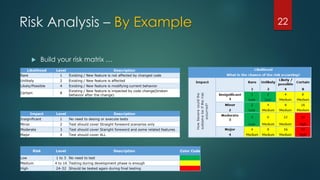
 Build your risk matrix …
22
Likelihood Level Description
Rare 1 Existing / New feature is not affected by changed code
Unlikely 2 Existing / New feature is affected
Likely/Possible 4 Existing / New feature is modifying current behavior
Certain 8
Existing / New feature is impacted by code change(broken
behavior after the change)
Impact Level Description
Insignificant 1 No need to desing or execute tests
Minor 2 Test should cover Straight foreword scenarios only
Moderate 3 Test should cover Staright foreword and some related features
Major 4 Test should cover ALL
Risk Level Description Color Code
Low 1 to 3 No need to test
Medium 4 to 16 Testing during development phase is enough
High 24-32 Should be tested again during final testing
Risk Analysis – By Example
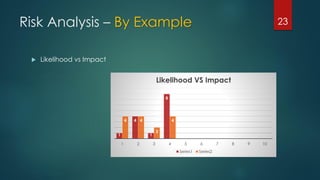
 Likelihood vs Impact
23
1
4
1
8
4 4
2
4
1 2 3 4 5 6 7 8 9 10
Likelihood VS Impact
Series1 Series2
Risk Mitigation
 Is the last step after risks being identified and analyzed
 It is the responsibility of Software Test Engineer to mitigate quality risks
via testing like:
 Applying new test types (Security , Performance)
 Use Extra test design techniques throughout the entire lifecycle
 New test cases to be added/removed
 Apply extra regression test for selected areas of functionality
24
Risk Mitigation
 It is the responsibility of the Test Manager to use the following
techniques to mitigate Project / Product risks:
 Test environment and tools readiness
 Check staff availability and qualification
 Prevent low quality of inputs to testing
 Prevent overly high rates of change for work products delivered to
testing
 Reduce lack of standards, rules, and techniques for the testing effort.
25
Risk Mitigation
 Proactively It is the responsibility of the Technical Test Analyst to use
the following techniques to mitigate Project / Product risks:
 Choose an appropriate test design technique(s)
 Reviews and inspections
 Reviews of test design
 The use of the most experienced people for complex tasks
 The strategies chosen for confirmation testing (retesting) and regression
testing
26
Risk Mitigation
 Helpful questions to Answer:
 Were requirements written well?
 Shall we institute reviews to improve their quality?
 Does the designed test demonstrates operation under certain
conditions and does not constitute a proof of correctness under all
possible conditions?
 Can we prioritize test according to level of risk?
 Do we need to reduce test execution time? Are the residual risk is
acceptable?
27
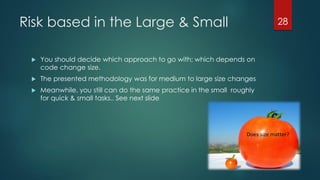
Risk based in the Large & Small
 You should decide which approach to go with; which depends on
code change size.
 The presented methodology was for medium to large size changes
 Meanwhile, you still can do the same practice in the small roughly
for quick & small tasks.. See next slide
28
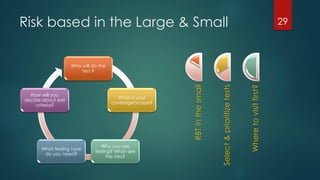
Risk based in the Large & Small 29
Who will do the
test ?
What is your
coverage/scope?
Why you are
testing? What are
the risks?
What testing type
do you need?
How will you
decide about exit
criteria?
RBTinthesmall
Select&prioritizetests
Wheretovisitfirst?
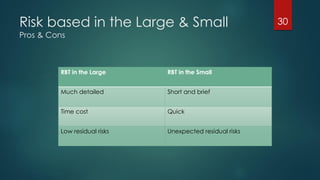
Risk based in the Large & Small
Pros & Cons
30
RBT in the Large RBT in the Small
Much detailed Short and brief
Time cost Quick
Low residual risks Unexpected residual risks
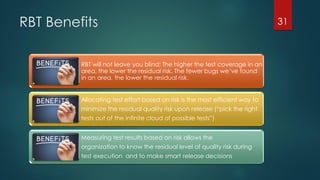
RBT Benefits
RBT will not leave you blind; The higher the test coverage in an
area, the lower the residual risk. The fewer bugs we’ve found
in an area, the lower the residual risk.
Allocating test effort based on risk is the most efficient way to
minimize the residual quality risk upon release (“pick the right
tests out of the infinite cloud of possible tests”)
Measuring test results based on risk allows the
organization to know the residual level of quality risk during
test execution and to make smart release decisions
31
RBT Benefits 32
Testing efforts are effectively organized, and level of priority of
each risk item is rated
Discovery of business-critical areas that were missed
No infeasible testing
Conclusion
 RBT is a culture that needs to be shared
 RBT makes it easier to decide about product
risks
 Can help to control both testing as well as risks
 RBT will lead to more feasible testing
 RBT can be applied always as per size of
change/fix
33
References
Advanced Software Testing V3 ISTQB CTAL – TTA Syllabus
34
Thank You!
35

Risk based testing a new case study

  • 1.
    Risk Based Testing Matrix, Process& Examples Bassam Al-Khatib ISTQB Full CTAL Advanced Level & Certified Ethical Hacker A new idea toward technical software testing
  • 2.
    Ground Rules 2 Silent Mobile phones  Questions are allowed at all times  Join Sessions on time  One meeting No sub-meetings
  • 3.
  • 4.
    Session Description  Thistraining will help Software Test Engineers globally to Perform Risk Based Testing (RBT) during design, plan and implement testing using a systematic approach and applicable techniques  Trainer: Bassam Al-Khatib  Duration: 3 hours and 30 minutes  Prerequisites: Elementary certificates (Beginners level) in software testing certificate 4
  • 5.
    Instructional Methods  Following areinstructional methods  Lectures  Group Discussions  Individual/group assignments 5
  • 6.
    Session Objectives Build Culture How to use? Whento use? Outline activities of risk-based approach for planning and executing technical testing 6
  • 7.
    What's in itfor me?  This session is a chance for one more deep study for Risk Based Testing (RBT), by analyzing approach, building risk matrixes, building RBT activities to form a complete process and showing some examples accordingly. 7
  • 8.
    Agenda  Preface  Howto start with Risk Based testing?  Risk Management  Risk identification  Risk Analysis  Risk Mitigation  RBT in the Large & Small  RBT Benefits  Conclusion 8
  • 9.
    Preface The possibility ofnegative results, that would occur and decrease customer perception of a product quality or project success. •What Risk Means? 9
  • 10.
    Preface  Enhancing thedefinitions:  Risk  Risk Type  Product Risk  Project Risk  Risk Based Testing 10
  • 11.
    Preface 11  Howdo we define RBT?
  • 12.
    Preface  RBT isnot Bug hunting  RBT is not exploratory or experience based testing  RBT is not a requirement based testing  If you cant calculate risk results then its not RBT 12
  • 13.
    Preface In testing softwarewe are concerned with two types of risks : • Example: A defect that could cause a product crash during normal operation Product Risk • Example: A possible staffing shortage that could delay completion of a project Project Risk 13 - Potential that patch or fix will not fit for purpose - System crash during normal operation(software stability) - Commitment to customers or management - Staffing shortage - Poor productivity
  • 14.
    Preface  The differencebetween two types of risks that you can run a test against the product (software) to define if there any system crashes.  But project risks are not testable . You cant test for staffing shortage  In this session our concern is controlling Product (Software) Risks. 14
  • 15.
    Preface  Classifying levelof risk, the simplest is to look at two factors:  The likelihood of the problem occurring; i.e., being present in the product when it is delivered for testing  The impact of the problem should it occur; i.e., being present in the product when it is delivered to customers or users after testing During Testing Delivery Risk = Likelihood X Impact 15
  • 16.
    How to Startwith RBT? 16  When ?  Risk-based testing applied to the project at very initial level on any project  Risk Management how to start…  Applying a set of procedures and practices to identify, analyze, prioritize and controlling risk.
  • 17.
    Risk Management  RiskManagement activities:  Risk identification  Risk analysis  Risk mitigation Identification (1) Analysis (2) Mitigation (3) 17
  • 18.
    Risk Identification  Identifyingrisks using the following techniques:  Expert interviews  Independent assessments  Use of risk templates  Project retrospectives  Risk workshops 18
  • 19.
    Risk Identification  Identifyingrisks using the following techniques:  Brainstorming ( Effective Test Planning Meetings)  Checklists  Calling on past experience  Review requirements specifications (FRS, URS) 19
  • 20.
    Risk Identification –By Example  Let us apply some of the mentioned techniques to the following Example.  Lets go back to the printed example you have to discuss.  The output of this group assignment is to record the identified risks.  Build your FEMA Template [Failure Mode and Effect Analysis] 20
  • 21.
    Risk Analysis –By Example  Using the same FEMA template add “Likelihood” and “Impact” to calculate “Expected Risks”  You can then graph the Total loss of functionality according to Likelihood & Impacts 21
  • 22.
    Risk Analysis –By Example  Build your risk matrix … 22 Likelihood Level Description Rare 1 Existing / New feature is not affected by changed code Unlikely 2 Existing / New feature is affected Likely/Possible 4 Existing / New feature is modifying current behavior Certain 8 Existing / New feature is impacted by code change(broken behavior after the change) Impact Level Description Insignificant 1 No need to desing or execute tests Minor 2 Test should cover Straight foreword scenarios only Moderate 3 Test should cover Staright foreword and some related features Major 4 Test should cover ALL Risk Level Description Color Code Low 1 to 3 No need to test Medium 4 to 16 Testing during development phase is enough High 24-32 Should be tested again during final testing
  • 23.
    Risk Analysis –By Example  Likelihood vs Impact 23 1 4 1 8 4 4 2 4 1 2 3 4 5 6 7 8 9 10 Likelihood VS Impact Series1 Series2
  • 24.
    Risk Mitigation  Isthe last step after risks being identified and analyzed  It is the responsibility of Software Test Engineer to mitigate quality risks via testing like:  Applying new test types (Security , Performance)  Use Extra test design techniques throughout the entire lifecycle  New test cases to be added/removed  Apply extra regression test for selected areas of functionality 24
  • 25.
    Risk Mitigation  Itis the responsibility of the Test Manager to use the following techniques to mitigate Project / Product risks:  Test environment and tools readiness  Check staff availability and qualification  Prevent low quality of inputs to testing  Prevent overly high rates of change for work products delivered to testing  Reduce lack of standards, rules, and techniques for the testing effort. 25
  • 26.
    Risk Mitigation  ProactivelyIt is the responsibility of the Technical Test Analyst to use the following techniques to mitigate Project / Product risks:  Choose an appropriate test design technique(s)  Reviews and inspections  Reviews of test design  The use of the most experienced people for complex tasks  The strategies chosen for confirmation testing (retesting) and regression testing 26
  • 27.
    Risk Mitigation  Helpfulquestions to Answer:  Were requirements written well?  Shall we institute reviews to improve their quality?  Does the designed test demonstrates operation under certain conditions and does not constitute a proof of correctness under all possible conditions?  Can we prioritize test according to level of risk?  Do we need to reduce test execution time? Are the residual risk is acceptable? 27
  • 28.
    Risk based inthe Large & Small  You should decide which approach to go with; which depends on code change size.  The presented methodology was for medium to large size changes  Meanwhile, you still can do the same practice in the small roughly for quick & small tasks.. See next slide 28
  • 29.
    Risk based inthe Large & Small 29 Who will do the test ? What is your coverage/scope? Why you are testing? What are the risks? What testing type do you need? How will you decide about exit criteria? RBTinthesmall Select&prioritizetests Wheretovisitfirst?
  • 30.
    Risk based inthe Large & Small Pros & Cons 30 RBT in the Large RBT in the Small Much detailed Short and brief Time cost Quick Low residual risks Unexpected residual risks
  • 31.
    RBT Benefits RBT willnot leave you blind; The higher the test coverage in an area, the lower the residual risk. The fewer bugs we’ve found in an area, the lower the residual risk. Allocating test effort based on risk is the most efficient way to minimize the residual quality risk upon release (“pick the right tests out of the infinite cloud of possible tests”) Measuring test results based on risk allows the organization to know the residual level of quality risk during test execution and to make smart release decisions 31
  • 32.
    RBT Benefits 32 Testingefforts are effectively organized, and level of priority of each risk item is rated Discovery of business-critical areas that were missed No infeasible testing
  • 33.
    Conclusion  RBT isa culture that needs to be shared  RBT makes it easier to decide about product risks  Can help to control both testing as well as risks  RBT will lead to more feasible testing  RBT can be applied always as per size of change/fix 33
  • 34.
    References Advanced Software TestingV3 ISTQB CTAL – TTA Syllabus 34
  • 35.