RISE TO EXERCISE
Why Is Exercise Important?Exercise is important because:It prevents certain diseases
It provides healthy life habits
It helps you maintain a healthy weight
It creates positive self-esteemDiseases Caused By Lack of ExerciseExercise Can Prevent Many DiseasesCardiovascular DiseasePertains to the heart and blood vesselsHypertensionHigh blood pressureObesityWhen your body weight is 20% or more above recommended weightDiabetes (type II)When the body cannot metabolize carbohydrates because the pancreas cannot produce insulin at all  or produces insufficient amounts.
Disease PreventionImprove NutritionChildren should reduce the amount of foods that are high in calories, high in sugar, foods that have a high fat content.  Focusing solely on weight loss is not the answer.  Prevention should be the focal point.Increase Physical ActivityChildren  should have at least 60 minutes of physical activity a day.  The main idea is to make a lifestyle change.
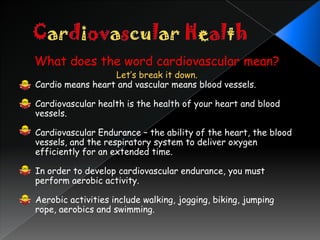
CardiovascularHealthWhat does the word cardiovascular mean?Let’s break it down.	Cardio means heart and vascular means blood vessels.	Cardiovascular health is the health of your heart and blood 	vessels.	Cardiovascular Endurance – the ability of the heart, the blood 	vessels, and the respiratory system to deliver oxygen 	efficiently for an extended time.  	In order to develop cardiovascular endurance, you must 	perform aerobic activity.	Aerobic activities include walking, jogging, biking, jumping 	rope, aerobics and swimming.
Do You Have A Healthy Heart?	A way to find out if you have a healthy heart is to do something fast paced, such as running up the stairs a few times.
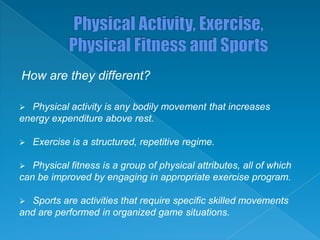
	Sit down and see how long it takes your heart rate to decrease.	if it slows down quickly, then you have a healthy heart. 	If it takes a little while for your heart rate to slow down, then your heart is unhealthy.Physical Activity, Exercise, Physical Fitness and SportsHow are they different?Physical activity is any bodily movement that increases energy expenditure above rest.
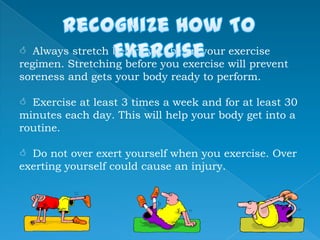
Exercise is a structured, repetitive regime.
Physical fitness is a group of physical attributes, all of which can be improved by engaging in appropriate exercise program.
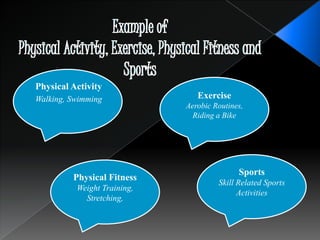
Sports are activities that require specific skilled movements and are performed in organized game situations.Example ofPhysical Activity, Exercise, Physical Fitness and SportsPhysical ActivityWalking, SwimmingExerciseAerobic Routines, Riding a BikeSportsSkill Related Sports ActivitiesPhysical FitnessWeight Training, Stretching,
Fitness and Your Weight	The National Center for Health Statistics has issued a growth chart to help doctors decide if children are at a healthy weight, whether it may be overweight or underweight.	This chart identifies height and weight percentiles for children ages 2 to 20. 	You have been a handout of the growth chart. (There are specific charts for boys and girls.)Look at the chart.  Find your height and weight and determine your percentage.
Did You Know……the head makes up ¼ of the child’s total length at birth and about 1/6 at age 6.… children in grades K-2 have short legs in relation to their upper bodies, therefore they are top heavy and fall more easily than adults do.?
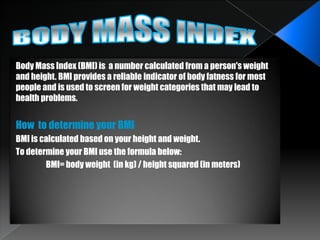
BODY MASS INDEX Body Mass Index (BMI) is  a number calculated from a person's weight and height. BMI provides a reliable indicator of body fatness for most people and is used to screen for weight categories that may lead to health problems.How  to determine your BMIBMI is calculated based on your height and weight.To determine your BMI use the formula below:	BMI= body weight  (in kg) / height squared (in meters)
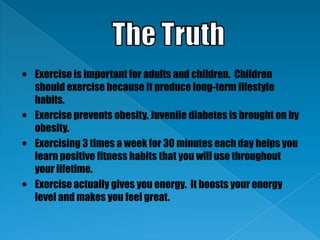
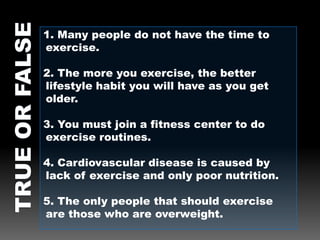
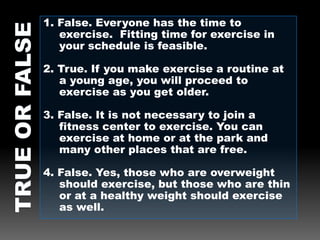
Lies About ExerciseExercise is only important for adults.
Exercise is not helpful with the disease called juvenile diabetes.
It is not recommended that you exercise at least three days a week for at least 30 minutes a day.

Rise to Exercise

  • 1.
  • 2.
    Why Is ExerciseImportant?Exercise is important because:It prevents certain diseases
  • 3.
  • 4.
    It helps youmaintain a healthy weight
  • 5.
    It creates positiveself-esteemDiseases Caused By Lack of ExerciseExercise Can Prevent Many DiseasesCardiovascular DiseasePertains to the heart and blood vesselsHypertensionHigh blood pressureObesityWhen your body weight is 20% or more above recommended weightDiabetes (type II)When the body cannot metabolize carbohydrates because the pancreas cannot produce insulin at all or produces insufficient amounts.
  • 6.
    Disease PreventionImprove NutritionChildrenshould reduce the amount of foods that are high in calories, high in sugar, foods that have a high fat content. Focusing solely on weight loss is not the answer. Prevention should be the focal point.Increase Physical ActivityChildren should have at least 60 minutes of physical activity a day. The main idea is to make a lifestyle change.
  • 7.
    CardiovascularHealthWhat does theword cardiovascular mean?Let’s break it down. Cardio means heart and vascular means blood vessels. Cardiovascular health is the health of your heart and blood vessels. Cardiovascular Endurance – the ability of the heart, the blood vessels, and the respiratory system to deliver oxygen efficiently for an extended time. In order to develop cardiovascular endurance, you must perform aerobic activity. Aerobic activities include walking, jogging, biking, jumping rope, aerobics and swimming.
  • 8.
    Do You HaveA Healthy Heart? A way to find out if you have a healthy heart is to do something fast paced, such as running up the stairs a few times.
  • 9.
    Sit down andsee how long it takes your heart rate to decrease. if it slows down quickly, then you have a healthy heart. If it takes a little while for your heart rate to slow down, then your heart is unhealthy.Physical Activity, Exercise, Physical Fitness and SportsHow are they different?Physical activity is any bodily movement that increases energy expenditure above rest.
  • 10.
    Exercise is astructured, repetitive regime.
  • 11.
    Physical fitness isa group of physical attributes, all of which can be improved by engaging in appropriate exercise program.
  • 12.
    Sports are activitiesthat require specific skilled movements and are performed in organized game situations.Example ofPhysical Activity, Exercise, Physical Fitness and SportsPhysical ActivityWalking, SwimmingExerciseAerobic Routines, Riding a BikeSportsSkill Related Sports ActivitiesPhysical FitnessWeight Training, Stretching,
  • 13.
    Fitness and YourWeight The National Center for Health Statistics has issued a growth chart to help doctors decide if children are at a healthy weight, whether it may be overweight or underweight. This chart identifies height and weight percentiles for children ages 2 to 20. You have been a handout of the growth chart. (There are specific charts for boys and girls.)Look at the chart. Find your height and weight and determine your percentage.
  • 14.
    Did You Know……thehead makes up ¼ of the child’s total length at birth and about 1/6 at age 6.… children in grades K-2 have short legs in relation to their upper bodies, therefore they are top heavy and fall more easily than adults do.?
  • 15.
    BODY MASS INDEXBody Mass Index (BMI) is a number calculated from a person's weight and height. BMI provides a reliable indicator of body fatness for most people and is used to screen for weight categories that may lead to health problems.How to determine your BMIBMI is calculated based on your height and weight.To determine your BMI use the formula below: BMI= body weight (in kg) / height squared (in meters)
  • 16.
    Lies About ExerciseExerciseis only important for adults.
  • 17.
    Exercise is nothelpful with the disease called juvenile diabetes.
  • 18.
    It is notrecommended that you exercise at least three days a week for at least 30 minutes a day.