Right to Information (RTI)
• RTI stands for Right to Information.
• Right to Information is a part of fundamental rights under Article
19(1) of the Constitution. Article 19 (1) says that every citizen has
freedom of speech and expression.
Right to Information Act, 2005
• It is an act to provide for setting out the practical regime of right to
information for citizens to under control of public authorities, in order
to promote transparency and accountability in the working of every
public authority, the constitution of a Central Information
Commission and State Information Commissions and for matters
connected therewith or incidental thereto.
Right to Information (RTI) is an Act of the Parliament of
India to provide for setting out the practical regime of right to
information for citizens and replaces the erstwhile Freedom
of information Act, 2002.
Under the provisions of the Act, any citizen of India may
request information from a "public authority" (a body of
Government or "instrumentality of State") which is required to
reply expeditiously or within thirty days.
The Act also requires every public authority to computerise their
records for wide dissemination and to proactively certain
categories of information so that the citizens need minimum
recourse to request for information formally.
This law was passed by Parliament on 15 June 2005 and came
fully into force on 12 October 2005.
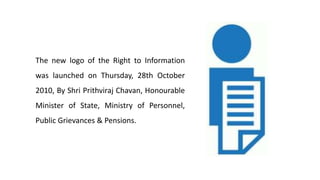
The new logo of the Right to Information
was launched on Thursday, 28th October
2010, By Shri Prithviraj Chavan, Honourable
Minister of State, Ministry of Personnel,
Public Grievances & Pensions.
The first application was given to a Pune police station.
Information disclosure in India was restricted by the Official
Secrets Act 1923 and various other special laws, which the
new RTI Act relaxes. It codifies a fundamental right of citizens.
First RTI application submitted by Naresh Kadyan of
Delhi on 12 October 2005 to the office of President
about Article 370 in Jammu and Kashmir.
Scope
The Act covers the whole of India except Jammu and Kashmir, where J&K
Freedom to Information Act is in force.
It covers all the constitutional authorities, including executive, legislature
and judiciary; any institution or body established or constituted by an act
of Parliament or a state legislature.
It is also defined in the Act that bodies or authorities established or
constituted by order or notification of appropriate government including
bodies "owned, controlled or substantially financed" by government, or
non-Government organizations "substantially financed, directly or
indirectly by funds".
Private bodies are not within the Act's ambit directly. As of
2014, private institutions and NGOs receiving over 95% of their
infrastructure funds from the government come under the Act.
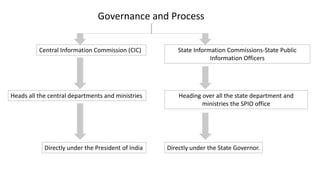
Governance and Process
Central Information Commission (CIC) State Information Commissions-State Public
Information Officers
Heads all the central departments and ministries Heading over all the state department and
ministries the SPIO office
Directly under the President of India Directly under the State Governor.
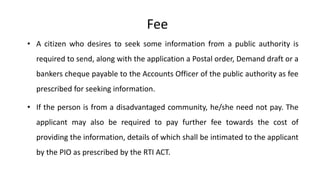
• A citizen who desires to seek some information from a public authority is
required to send, along with the application a Postal order, Demand draft or a
bankers cheque payable to the Accounts Officer of the public authority as fee
prescribed for seeking information.
• If the person is from a disadvantaged community, he/she need not pay. The
applicant may also be required to pay further fee towards the cost of
providing the information, details of which shall be intimated to the applicant
by the PIO as prescribed by the RTI ACT.
Fee
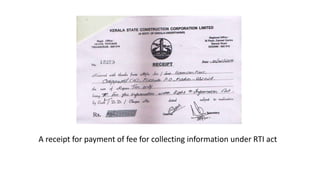
A receipt for payment of fee for collecting information under RTI act
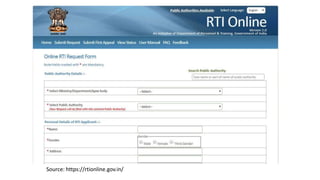
A digital portal has been set up, RTI Portal, a gateway to the citizens for
quick search of information on the details of first Appellate Authorities,
PIOs etc. amongst others, besides access to RTI related information /
disclosures published on the web by various Public Authorities under
the government of India as well as the State Governments.
It is an initiative taken by Department of Personnel and Training,
Ministry of Personnel, Public Grievances and Pensions to provide a RTI
Portal Gateway to the citizens for quick search of information on the
details of first Appellate Authorities, PIOs etc. amongst others, besides
access to RTI related information / disclosures published on the web
by various Public Authorities under the Government of India as well as
the State Governments.
Source: https://rtionline.gov.in/
Advantages of RTI
 Empowerment of the common man: The entire range of common man in the
nation has been empowered by such an initiative in which they have got the full
rights to be informed about anything that affects their life directly or indirectly
and the responsible bodies have to answer them positively.
 Easy mode of spreading information rightfully: The RTI has incubated a very
concrete and easy mode of spreading information of all kind in all form where
apt information will be received by only the person concerned and this will in
turn result in easy accessibility to information on one hand and time
conservation of all.
Advantages of RTI (Continues)
 Protection of Information: Since, the selected people with selected queries will be
entertained and informed rightfully and aptly, so this will lead to protection of
information thereby protecting everyone from being wrongly or inappropriately
informed or misinformed.
 Corruption will decrease gradually: If a person being asks for information on certain
products and services and the answer has to be delivered by a competent and
responsible authority then the chances of corruption will certainly minimize. People will
not have to bother about being cheated or victims of frauds and scams.
Advantages of RTI (Continues)
 There is no need to give reasons for the information requested
 It brings transparency
 It brings Accountability
 It helps to increase efficiency in governance
 It also encourages participation of people in democracy
 It makes information as a Right
 Government officers are bound to provide information to a citizen
subject to certain exceptions
Disadvantages of RTI
• Unnecessary chaos all over: There is a big drawback that sustains in our nation,
and that is a fact that in this immensely populated nation and that is the habit to
create unnecessary disturbance and chaos over a newly incorporated plan just
to create nuisance. Cases have been filed against fetching wrong information
and asking for abrupt information from different officials at various levels and
this creates nothing but an overall chaos.
• An extra burden to the Authorities: Since the authorized persons are already
having loads of works and tasks to be delivered at their end and after this new
act passed they have additional burden to be done and delivered.
Disadvantages of RTI (Continues)
• Multiple Public Information Officers (PIO): The government has appointed
multiple PIO’s. This results in running of citizens from office to office in search of
correct PIO who can yield correct information.
• People’s accessibility is hectic and time consuming: There are many offices of
PIO where the access of common man is very prolonged and it becomes very
hectic to carry out the process. The subsystems created beneath the system is
basically problematic.
introduction toRight to Information (RTI).pptx

introduction toRight to Information (RTI).pptx

  • 1.
  • 2.
    • RTI standsfor Right to Information. • Right to Information is a part of fundamental rights under Article 19(1) of the Constitution. Article 19 (1) says that every citizen has freedom of speech and expression.
  • 3.
    Right to InformationAct, 2005 • It is an act to provide for setting out the practical regime of right to information for citizens to under control of public authorities, in order to promote transparency and accountability in the working of every public authority, the constitution of a Central Information Commission and State Information Commissions and for matters connected therewith or incidental thereto.
  • 4.
    Right to Information(RTI) is an Act of the Parliament of India to provide for setting out the practical regime of right to information for citizens and replaces the erstwhile Freedom of information Act, 2002.
  • 5.
    Under the provisionsof the Act, any citizen of India may request information from a "public authority" (a body of Government or "instrumentality of State") which is required to reply expeditiously or within thirty days.
  • 6.
    The Act alsorequires every public authority to computerise their records for wide dissemination and to proactively certain categories of information so that the citizens need minimum recourse to request for information formally.
  • 7.
    This law waspassed by Parliament on 15 June 2005 and came fully into force on 12 October 2005.
  • 8.
    The new logoof the Right to Information was launched on Thursday, 28th October 2010, By Shri Prithviraj Chavan, Honourable Minister of State, Ministry of Personnel, Public Grievances & Pensions.
  • 9.
    The first applicationwas given to a Pune police station. Information disclosure in India was restricted by the Official Secrets Act 1923 and various other special laws, which the new RTI Act relaxes. It codifies a fundamental right of citizens.
  • 10.
    First RTI applicationsubmitted by Naresh Kadyan of Delhi on 12 October 2005 to the office of President about Article 370 in Jammu and Kashmir.
  • 11.
    Scope The Act coversthe whole of India except Jammu and Kashmir, where J&K Freedom to Information Act is in force. It covers all the constitutional authorities, including executive, legislature and judiciary; any institution or body established or constituted by an act of Parliament or a state legislature. It is also defined in the Act that bodies or authorities established or constituted by order or notification of appropriate government including bodies "owned, controlled or substantially financed" by government, or non-Government organizations "substantially financed, directly or indirectly by funds".
  • 12.
    Private bodies arenot within the Act's ambit directly. As of 2014, private institutions and NGOs receiving over 95% of their infrastructure funds from the government come under the Act.
  • 13.
    Governance and Process CentralInformation Commission (CIC) State Information Commissions-State Public Information Officers Heads all the central departments and ministries Heading over all the state department and ministries the SPIO office Directly under the President of India Directly under the State Governor.
  • 14.
    • A citizenwho desires to seek some information from a public authority is required to send, along with the application a Postal order, Demand draft or a bankers cheque payable to the Accounts Officer of the public authority as fee prescribed for seeking information. • If the person is from a disadvantaged community, he/she need not pay. The applicant may also be required to pay further fee towards the cost of providing the information, details of which shall be intimated to the applicant by the PIO as prescribed by the RTI ACT. Fee
  • 15.
    A receipt forpayment of fee for collecting information under RTI act
  • 16.
    A digital portalhas been set up, RTI Portal, a gateway to the citizens for quick search of information on the details of first Appellate Authorities, PIOs etc. amongst others, besides access to RTI related information / disclosures published on the web by various Public Authorities under the government of India as well as the State Governments.
  • 17.
    It is aninitiative taken by Department of Personnel and Training, Ministry of Personnel, Public Grievances and Pensions to provide a RTI Portal Gateway to the citizens for quick search of information on the details of first Appellate Authorities, PIOs etc. amongst others, besides access to RTI related information / disclosures published on the web by various Public Authorities under the Government of India as well as the State Governments.
  • 18.
  • 19.
    Advantages of RTI Empowerment of the common man: The entire range of common man in the nation has been empowered by such an initiative in which they have got the full rights to be informed about anything that affects their life directly or indirectly and the responsible bodies have to answer them positively.  Easy mode of spreading information rightfully: The RTI has incubated a very concrete and easy mode of spreading information of all kind in all form where apt information will be received by only the person concerned and this will in turn result in easy accessibility to information on one hand and time conservation of all.
  • 20.
    Advantages of RTI(Continues)  Protection of Information: Since, the selected people with selected queries will be entertained and informed rightfully and aptly, so this will lead to protection of information thereby protecting everyone from being wrongly or inappropriately informed or misinformed.  Corruption will decrease gradually: If a person being asks for information on certain products and services and the answer has to be delivered by a competent and responsible authority then the chances of corruption will certainly minimize. People will not have to bother about being cheated or victims of frauds and scams.
  • 21.
    Advantages of RTI(Continues)  There is no need to give reasons for the information requested  It brings transparency  It brings Accountability  It helps to increase efficiency in governance  It also encourages participation of people in democracy  It makes information as a Right  Government officers are bound to provide information to a citizen subject to certain exceptions
  • 22.
    Disadvantages of RTI •Unnecessary chaos all over: There is a big drawback that sustains in our nation, and that is a fact that in this immensely populated nation and that is the habit to create unnecessary disturbance and chaos over a newly incorporated plan just to create nuisance. Cases have been filed against fetching wrong information and asking for abrupt information from different officials at various levels and this creates nothing but an overall chaos. • An extra burden to the Authorities: Since the authorized persons are already having loads of works and tasks to be delivered at their end and after this new act passed they have additional burden to be done and delivered.
  • 23.
    Disadvantages of RTI(Continues) • Multiple Public Information Officers (PIO): The government has appointed multiple PIO’s. This results in running of citizens from office to office in search of correct PIO who can yield correct information. • People’s accessibility is hectic and time consuming: There are many offices of PIO where the access of common man is very prolonged and it becomes very hectic to carry out the process. The subsystems created beneath the system is basically problematic.