



Verifying Election Results :  Employing Statistics, Databases and Mobile Phones to Enhance Monitoring Richard L. Klein Senior Advisor, Elections
The Problem Elections are an accountability mechanism Elections need to reflect aggregate citizen preferences to be effective However, citizens may have little confidence that official results reflect their collective preferences Notably, results may be changed  after  they leave polling stations
The Response Parallel Vote Tabulation (PVT)  Citizens independently collect official results from individual polling stations Transmit figures to a central location Add numbers together Analyzed the data Share findings
Need for Speed Statistics Databases SMS (Texting) PVTs needs be completed quickly - before official results are announced  Electoral authorities will always have more resources than citizen initiatives Citizens, however, can still be faster by employing:
Statistics Reduces overall burden on citizen groups Greater attention to difficult to reach polling station Focus on Quality over Quantity Use statistics to deploy accredited, well-trained observers to a representative random sample of polling stations
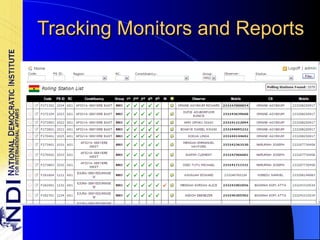
Databases Ensures monitors are deployed to all sampled polling stations Enhances data security Facilitates collection of data and data quality control Speeds and simplifies data analysis Employ databases to manage information about monitors as well as observation data
SMS (Texting) Speeds and simplifies movement of information Allows greater effort to be made collecting data from remote polling stations Permits two-way communication increasing response rates and improving data quality Develop SMS protocols to enable monitors to transmit observation data by text message
PVT Requirements Comprehensive monitoring of the entire electoral process Continuous monitoring at sampled polling stations from opening until the end of counting Coherent top-down network of citizens Training of citizens on monitoring and reporting
PVT Benefits More information available more quickly Systematic  information on  positive and negative  aspects of election Ability to verify official results or suggest “true” result of an election Increased voice citizen on conduct of elections
Ghana 2008/09 CODEO/CDD-Ghana National Network with experience observing four national elections PVT for presidential election Sample size of 1,070 polling stations Unified database of monitor information and observer data Moved 90% observer data via SMS
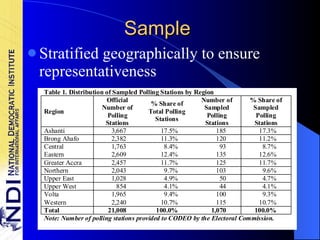
Sample Stratified geographically to ensure representativeness
Tracking Monitors and Reports
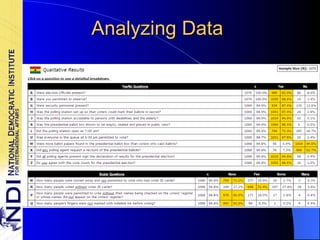
Analyzing Data
Drilling Down
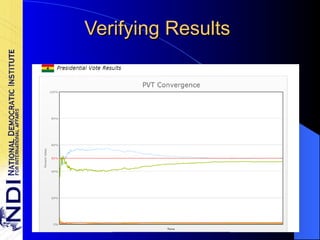
Verifying Results
SMS Codes
Outgoing SMS Messages
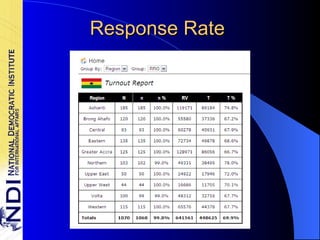
Response Rate
CODEO Statement
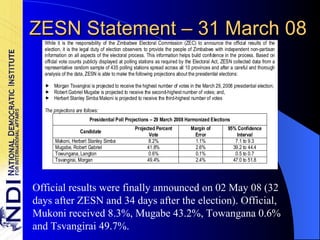
ZESN Statement – 31 March 08 Official results were finally announced on 02 May 08 (32 days after ZESN and 34 days after the election). Official, Mukoni received 8.3%, Mugabe 43.2%, Towangana 0.6% and Tsvangirai 49.7%.

Richard Verifying Election Results (Ndi)

  • 1.
    Verifying Election Results: Employing Statistics, Databases and Mobile Phones to Enhance Monitoring Richard L. Klein Senior Advisor, Elections
  • 2.
    The Problem Electionsare an accountability mechanism Elections need to reflect aggregate citizen preferences to be effective However, citizens may have little confidence that official results reflect their collective preferences Notably, results may be changed after they leave polling stations
  • 3.
    The Response ParallelVote Tabulation (PVT) Citizens independently collect official results from individual polling stations Transmit figures to a central location Add numbers together Analyzed the data Share findings
  • 4.
    Need for SpeedStatistics Databases SMS (Texting) PVTs needs be completed quickly - before official results are announced Electoral authorities will always have more resources than citizen initiatives Citizens, however, can still be faster by employing:
  • 5.
    Statistics Reduces overallburden on citizen groups Greater attention to difficult to reach polling station Focus on Quality over Quantity Use statistics to deploy accredited, well-trained observers to a representative random sample of polling stations
  • 6.
    Databases Ensures monitorsare deployed to all sampled polling stations Enhances data security Facilitates collection of data and data quality control Speeds and simplifies data analysis Employ databases to manage information about monitors as well as observation data
  • 7.
    SMS (Texting) Speedsand simplifies movement of information Allows greater effort to be made collecting data from remote polling stations Permits two-way communication increasing response rates and improving data quality Develop SMS protocols to enable monitors to transmit observation data by text message
  • 8.
    PVT Requirements Comprehensivemonitoring of the entire electoral process Continuous monitoring at sampled polling stations from opening until the end of counting Coherent top-down network of citizens Training of citizens on monitoring and reporting
  • 9.
    PVT Benefits Moreinformation available more quickly Systematic information on positive and negative aspects of election Ability to verify official results or suggest “true” result of an election Increased voice citizen on conduct of elections
  • 10.
    Ghana 2008/09 CODEO/CDD-GhanaNational Network with experience observing four national elections PVT for presidential election Sample size of 1,070 polling stations Unified database of monitor information and observer data Moved 90% observer data via SMS
  • 11.
    Sample Stratified geographicallyto ensure representativeness
  • 12.
  • 13.
  • 14.
  • 15.
  • 16.
  • 17.
  • 18.
  • 19.
  • 20.
    ZESN Statement –31 March 08 Official results were finally announced on 02 May 08 (32 days after ZESN and 34 days after the election). Official, Mukoni received 8.3%, Mugabe 43.2%, Towangana 0.6% and Tsvangirai 49.7%.

Editor's Notes

  • #3 Elections provide an important (but not only) mechanism by which citizens can hold their representatives accountable For elections to provide accountability the results must reflect aggregate citizen preferences If official results do not reflect the “will of the people” then elections cannot serve as a meaningful mechanism by which the citizens hold their representatives accountable.