2/4/2016 Architecture ­ Domain Driven Design Sample
http://localhost:11490/Home/Architecture 1/7
Software Architecture Applied
Robust and ready to grow
I used a combination of Frameworks and Patterns such as DDD, Ioc, TDD to create this solution. The
result is a robutst, testable, scalable and ready to change and grow Solution that as a Team is much
easier to work with since each layer has specific responsibilities and we can isolate the layers for Unit
Tests and focus on the task we are doing instead of spend time to reproduce the environment.
DDD ­ Domain Driven
The Domain represents the Company Business. It contains all Entities, Specifications, Validations and all
that is necessary for the business works. The Domain is agnostic to technogies and can't make a
reference in any Layer, except the CrossCutting tier. This way we can share the Domain between any
clients or UI or Services. If we force the Domain to make a reference on System.Web we bring
unecessaries things for this layer are useless when we need to implement a desktop app for example.
2/4/2016 Architecture ­ Domain Driven Design Sample
http://localhost:11490/Home/Architecture 2/7
Project Layers
1.Presentation
It's the UI layer where we can have Asp.Net MVC, WPF, Mobile, etc. It's responsible only for display data
with rich and robust layout. They must make a reference to the Application Layer and never access
direclty the Domain.
Basic flow MVC UI (Pipeline)
The User Request a URL
MVC Pipeline workflow starts with Router.
Then extract the Route from URL
Then it matches the extracted route with Mapped routes
MVC starts the Controller Initialization with Controller Factory based on the Route
The Action Execution Starts where the Model must be created and returned
The Result Execution Starts and MVC analyzes the ActionResult
If the Result is a View Result MVC starts the View Engine process (Razor or Aspx until MVC
4, Razor only after MVC 5)
If the Resul is NOT a View, MVC just return the Result(It can be a Json result, File,
RedirectResult, etc)
The execution returns to IIS that returns the final Http to the Client/Browser/User
2/4/2016 Architecture ­ Domain Driven Design Sample
http://localhost:11490/Home/Architecture 3/7
2.Services
Responsible for expose Services and APIs from our Application Layer. We can have here WebApi, WCF,
etc. They must make a reference to the Application Layer and never access direclty the Domain. The
WebApi is not finished but I included just to show how easy is to share functionalities from the Application
layer. Please check the SecurityController in Folder 2.Services in the Solution
3.Application
It's the Middleware between UI and Domain. It's responsible for abstract the UI and pass information to
the Domain. Also we can mantain the ViewModels and UI validations here to be shared. For example,
once defined the ViewModels here they can be easly shared between MVC and WebApi. Also, instead of
put all the validation rules in the Controller we give this responsability to the Application Service. So when
we need to figure out which method we have to invoke according with the given parameter we transfer
this responsibility to App layer and this method can be shared between UI avoid redunant code and
make the maintenance easy. If I need to change the rules, I change only in my App layer, any of the UIs
won't be changed.
4.Domain
The main layer. It's reponsible to represent the Business. This way we can speak the language of our
Client. The Domain must be agnostic to technology (client, web, etc). And must be focus on the business
rules and prepared to change and Grow. I expose the funcionalities of my Domain by Domain
Services(notice that is not the same as WCF or Web Services). The ideal scenario is Isolate your
Domain from other layes using a Midlleware Tier, for example on this Project is
DomainDrivenDesign.Application layer.
5.Infrastructure
Contains the Data layer which is responsible for bring the data from Datasources using preferable ORM.
I didn't implement the ORM layer to keep the solutin small and simple. The CrossCutting layer is
prepared to be used across the Project as auxiliary.
Asp.net MVC layer
2/4/2016 Architecture ­ Domain Driven Design Sample
http://localhost:11490/Home/Architecture 4/7
Partial Views
I used the Partial views to update just a piece of the Webpage. Partial views are usally used to Render
parts of view and can be shared between views. Example: Html.Partial("SearchResultGridPartial") I used
this aproach to avoid writing big If and facilitating code readability and maintenance as well Another good
thing is the partial view (grid/table ) should be responsible to display the data and the rules or validations
must be inside it. You could easily put the validation out of the view, but this is a bad practice and a error
prone approach since you have to repeat the validation every time you need to use this view.
AntiForgeryToken
I used the ValidateAntiForgeryToken to avoid cross­site injections. Basically it generates a Token in the
View and you decorate your Action with ValidateAntiForgeryToken attribute in order to validate the token.
Frameworks and Patterns used
Mobile First
I used Bootstrap to ensure that the Website would be responsible for Mobile devices. Also we can
hide some elements if we needed. But to make this Project simple I just implemented the width
attribute such as: content="width=device­width, initial­scale=1.0" I used the table­responsive in the
SearchResultGridPartial to make the table resizable to Mobile.
2/4/2016 Architecture ­ Domain Driven Design Sample
http://localhost:11490/Home/Architecture 5/7
IoC ­ Inversion of Control & DI ­ Dependency
Injection
Every layer is important but the Domain and Ioc tiers are crucial to have a system ready for accepts
changes and support the Business The SimpleInjection is used as Ioc Container to do the Dependency
Injections. Using this approach we can easly change any implementation of any Interface just changing
the references in the Ioc project. Besides, that facilitates the tests and we can Inject Fakes or Mocks to
any Layer or Tier and easly perform Unit Tests.
SOLID
I used strong Object oriented principles which is defined in SOLID specifications. It's a bit work in the
beginning but the result, maintenance and readability after is amazing.
SOLID relies on:
Single­responsiblity principle
Open­closed principle
Liskov substitution principle
Interface segregation principle
Dependency Inversion Principle
TDD
The main point here is start with tests and using the AAA concept: Arrange, Assert I developed first
the tests and the return must be a fail/red. Then I implement the code and run the tests again, then
the tests must be green/passed
BDD ­ Behavior Driven
The BDD relies on the tests should be created based on specifications of the System. You can
create Stories for each behavior an so on. I didn't use for this project but I could use Jasmine
framkework.
Mock
Since I'm using IoC in this project, is easly to Mock almost any layer and I use that to ISOLATE the
layer I'm testing. For example I used Mocks for test the Domain layer to inject a ISecurityRepository
with few values just to test the logic I need. So if there is problem with the method
2/4/2016 Architecture ­ Domain Driven Design Sample
http://localhost:11490/Home/Architecture 6/7
Single­responsiblity principle
A class should have one and only one reason to change, meaning that a class should have only one job.
For example, the class Repository(5.Infrastructure=>5.1.Data=>Repository) is responsible for the data
only. It doesn't send email or perform any other respon responsibility than take care of data.
Open­closed principle
Objects or entities should be open for extension, but closed for modification. For example, the class
Repository(5.Infrastructure=>5.1.Data=>SecurityRepository) extends the Repository class which keeps
the principle that the Objects sould be open to extend and close to modification. Another example is use
of Extension methods. For example instead of alter a Class we can add Extension methods the expand
its functionalites. I used that in static class StringExtensionMethods for String class but it can use for our
classes as well. This avoid that you change complex classes or objects reducing the change to get a
bug.
Liskov substitution principle
All this is stating is that every subclass/derived class should be substitutable for their base/parent class. I
used that when I ensured that the class Repository(5.Infrastructure=>5.1.Data=>SecurityRepository) is a
Repository and moreover it can act exacly as a Repository class. In other words, both Repository and
SecurityRepository are responsible only for provide de Data to the Domain.
Interface segregation principle
A client should never be forced to implement an interface that it doesn’t use or clients shouldn’t be forced
to depend on methods they do not use The class Repository is not using this principle for simplication
purposes, but we could easly apply on that. For example, Instead of exists all 3 methods for Insert,
update and Delete we could split those actions in separate Interfaces: IInsert, IUpdate, IDelete. And if
you need to Delete a Entity in your class you can implement this contract. I used that principle on
Citibank where some apps you could Insert and Search, but you couln't delete or update the data for
compliance purposes So this way you can avoid uncessary throw new NotImplementedException();
throughout your classes.
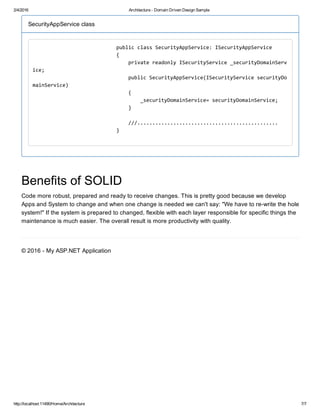
Dependency Inversion Principle
Entities must depend on abstractions not on concretions. It states that the high level module must not
depend on the low level module, but they should depend on abstractions. The Application layer depends
on Interfaces in the Domain Layer which means that doesn't matter what is the implementation, we
always reference the Interfaces and never the implementation itself. That helps a lot future changes
since we need to update only the IoC registers. This way, in the Application layer, we are passing control
of funcionalities to the Domain:
2/4/2016 Architecture ­ Domain Driven Design Sample
http://localhost:11490/Home/Architecture 7/7
SecurityAppService class
                            public class SecurityAppService: ISecurityAppService 
                            { 
                                private readonly ISecurityService _securityDomainServ
ice; 
                                public SecurityAppService(ISecurityService securityDo
mainService) 
                                { 
                                    _securityDomainService= securityDomainService; 
                                } 
                                 
                                ///............................................... 
                            } 
                        
Benefits of SOLID
Code more robust, prepared and ready to receive changes. This is pretty good because we develop
Apps and System to change and when one change is needed we can't say: "We have to re­write the hole
system!" If the system is prepared to changed, flexible with each layer responsible for specific things the
maintenance is much easier. The overall result is more productivity with quality.
© 2016 ­ My ASP.NET Application

Ricardo lourenco Coding portfolio Sample