RFID Technology:
Revolutionizing
Identification and
Tracking
Introduction
RFID technology, short for Radio Frequency Identification,
represents a groundbreaking system that harnesses
electromagnetic fields to effortlessly identify and monitor
tags affixed to objects. This innovative approach relies on
wireless, non-contact communication, facilitating seamless
data transfer via radio-frequency electromagnetic fields.
Key Characteristics of
RFID Technology:
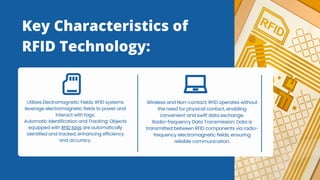
Utilizes Electromagnetic Fields: RFID systems
leverage electromagnetic fields to power and
interact with tags.
Automatic Identification and Tracking: Objects
equipped with RFID tags are automatically
identified and tracked, enhancing efficiency
and accuracy.
Wireless and Non-contact: RFID operates without
the need for physical contact, enabling
convenient and swift data exchange.
Radio-frequency Data Transmission: Data is
transmitted between RFID components via radio-
frequency electromagnetic fields, ensuring
reliable communication.
Diverse Applications of RFID:
01 02 03
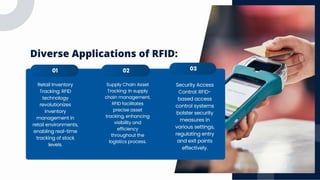
Retail Inventory
Tracking: RFID
technology
revolutionizes
inventory
management in
retail environments,
enabling real-time
tracking of stock
levels.
Supply Chain Asset
Tracking: In supply
chain management,
RFID facilitates
precise asset
tracking, enhancing
visibility and
efficiency
throughout the
logistics process.
Security Access
Control: RFID-
based access
control systems
bolster security
measures in
various settings,
regulating entry
and exit points
effectively.
Advantages of RFID
Technology:
Enhanced Inventory Accuracy: RFID systems
significantly improve inventory accuracy, reducing
discrepancies and enhancing stock management.
01
Efficiency in Supply Chain Management: The
implementation of RFID streamlines supply chain
operations, minimizing delays and optimizing
resource allocation.
02
Security and Access Control: RFID-based access
control systems bolster security measures,
safeguarding sensitive areas and assets.
03
Process Streamlining: Across various industries, RFID
technology streamlines processes, fostering
productivity and operational efficiency.
04
RFID technology emerges as a transformative force across diverse industries,
offering unparalleled benefits such as enhanced efficiency, improved security,
and streamlined processes. Despite its numerous advantages, addressing
challenges such as implementation costs and privacy concerns is crucial for the
widespread adoption and successful integration of RFID technology into existing
frameworks. With careful consideration and strategic planning, organizations
can harness the full potential of RFID to drive innovation and achieve operational
excellence.
THANK YOU!
https://www.intellistride.com/
Unit 103-104, 1st Floor, Prestige Infantry
Court,130, Infantry Road,Bangalore 560001
INDIA
8049554115

RFID Technology Revolutionizing Identification and Tracking.pdf

  • 1.
  • 2.
    Introduction RFID technology, shortfor Radio Frequency Identification, represents a groundbreaking system that harnesses electromagnetic fields to effortlessly identify and monitor tags affixed to objects. This innovative approach relies on wireless, non-contact communication, facilitating seamless data transfer via radio-frequency electromagnetic fields.
  • 3.
    Key Characteristics of RFIDTechnology: Utilizes Electromagnetic Fields: RFID systems leverage electromagnetic fields to power and interact with tags. Automatic Identification and Tracking: Objects equipped with RFID tags are automatically identified and tracked, enhancing efficiency and accuracy. Wireless and Non-contact: RFID operates without the need for physical contact, enabling convenient and swift data exchange. Radio-frequency Data Transmission: Data is transmitted between RFID components via radio- frequency electromagnetic fields, ensuring reliable communication.
  • 4.
    Diverse Applications ofRFID: 01 02 03 Retail Inventory Tracking: RFID technology revolutionizes inventory management in retail environments, enabling real-time tracking of stock levels. Supply Chain Asset Tracking: In supply chain management, RFID facilitates precise asset tracking, enhancing visibility and efficiency throughout the logistics process. Security Access Control: RFID- based access control systems bolster security measures in various settings, regulating entry and exit points effectively.
  • 5.
    Advantages of RFID Technology: EnhancedInventory Accuracy: RFID systems significantly improve inventory accuracy, reducing discrepancies and enhancing stock management. 01 Efficiency in Supply Chain Management: The implementation of RFID streamlines supply chain operations, minimizing delays and optimizing resource allocation. 02 Security and Access Control: RFID-based access control systems bolster security measures, safeguarding sensitive areas and assets. 03 Process Streamlining: Across various industries, RFID technology streamlines processes, fostering productivity and operational efficiency. 04
  • 6.
    RFID technology emergesas a transformative force across diverse industries, offering unparalleled benefits such as enhanced efficiency, improved security, and streamlined processes. Despite its numerous advantages, addressing challenges such as implementation costs and privacy concerns is crucial for the widespread adoption and successful integration of RFID technology into existing frameworks. With careful consideration and strategic planning, organizations can harness the full potential of RFID to drive innovation and achieve operational excellence.
  • 7.
    THANK YOU! https://www.intellistride.com/ Unit 103-104,1st Floor, Prestige Infantry Court,130, Infantry Road,Bangalore 560001 INDIA 8049554115