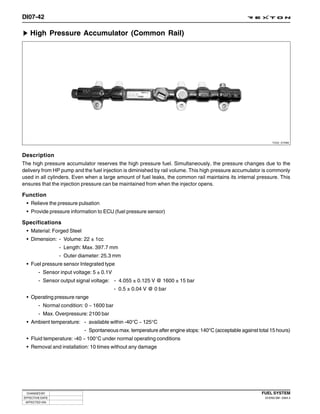
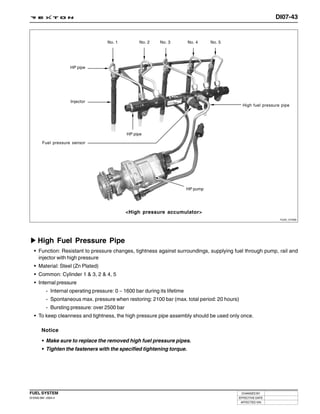
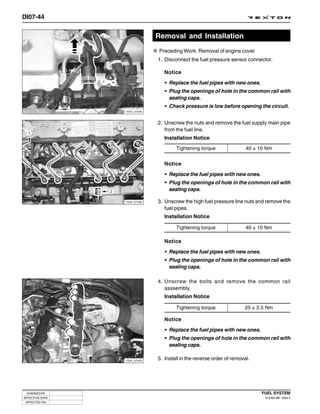
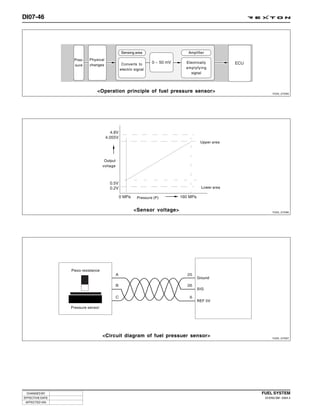
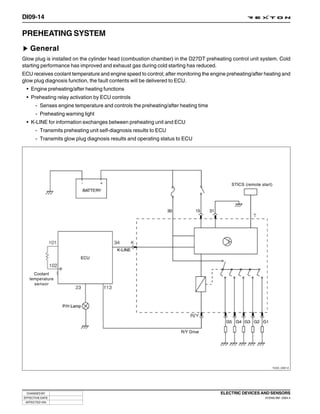
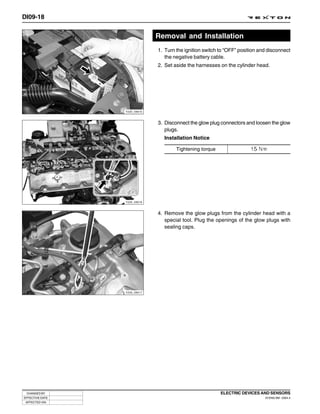
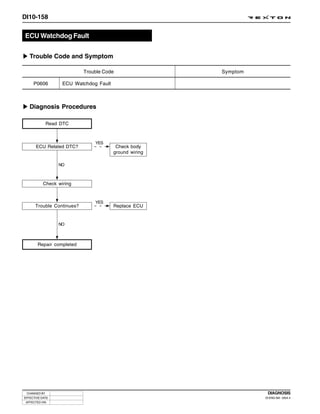
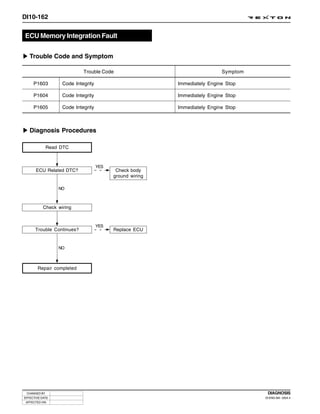
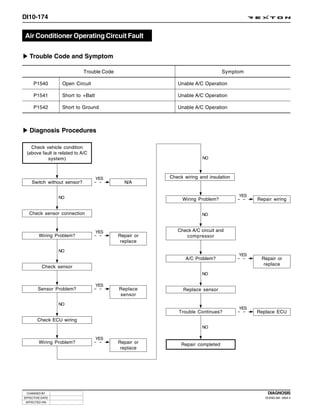
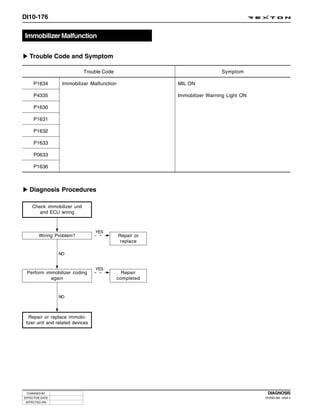
ENGINE
SERVICE MANUAL


       PYUNGTAEK, KOREA
SECTION INDEX

    SERVICE                                                  VOLUME 1 OF 2

  MANUAL(vol. 1 of 2)                                 GENERAL INFORMATION     DI0A


       REXTON                                         ENGINE ASSEMBLY         DI01


                                                      ENGINE HOUSING          DI02


                                                      INTAKE SYSTEM           DI03
                FOREWORD

This manual includes procedure for maintenance,       EXHAUST SYSTEM          DI04
adjustment, service operation and removal and
installation of components.
All information, illustrations and specifications     LUBRICATION SYSTEM      DI05
contained in this manual are based on the latest
product information available at the time of manual
approval.
The right is reserved to make changes at any time     COOLING SYSTEM          DI06
without notice.


                                                      FUEL SYSTEM             DI07


                                                      ENGINE CONTROL SYSTEM   DI08


                                                      ELECTRIC DEVICES AND
                                                      SENSORS                 DI09


        SSANGYONG MOTOR CO., LTD.
                                                      DIAGNOSIS               DI10
                       PYUNGTAEK, KOREA
DI ENGINE

                  CONTENTS

GENERAL INFORMATION .................... DI0A

ENGINE ASSEMBLY ............................. DI01
ENGINE HOUSING ................................ DI02
INTAKE SYSTEM................................... DI03

EXHAUST SYSTEM............................... DI04
LUBRICATION SYSTEM ....................... DI05
COOLING SYSTEM ............................... DI06

FUEL SYSTEM ...................................... DI07
ENGINE CONTROL SYSTEM ............... DI08
ELECTRIC DEVICES AND SENSORS . DI09

DIAGNOSIS ........................................... DI10
SECTION   DI0A


GENERAL INFORMATION
DI0A-1


           SECTION DI0A
               00


        GENERAL INFORMATION


                     Table of Contents

                     CLEANNESS ....................................... DI0A-3   FUEL SYSTEM ................................. DI0A-21

                     STRUCTURE ...................................... DI0A-8       Fuel supply system ...................... DI0A-22
                                                                                GENERAL SPECIFICATIONS ........... DI0A-23
                     ENGINE CONTROLS ....................... DI0A-11
                                                                                   Vehicle specifications ................... DI0A-23
                        ECU related components .............. DI0A-11
                                                                                   Maintenance ................................ DI0A-26
                        Engine and sensors ..................... DI0A-12
                        Electrical components and                               VEHICLE IDENTIFICATION .............. DI0A-28
                        pre heating system ...................... DI0A-13
                                                                                HOW TO USE AND MAINTAIN WORKSHOP
                     INTAKE SYSTEM ............................. DI0A-14        MANUAL ........................................... DI0A-30
                        Intake air flow chart ...................... DI0A-15       Consists of workshop manual ...... DI0A-30
                     INTAKE SYSTEM ............................. DI0A-16           Manual description ...................... DI0A-30
                                                                                   Guidelines for service work
                        Exhaust air flow chart ................... DI0A-17
                                                                                   safety ........................................... DI0A-31
                     LUBRICATION SYSTEM .................. DI0A-18                 Lifting points ................................. DI0A-36
                     COOLING SYSTEM ......................... DI0A-19              Tightening torque of standard
                                                                                   bolts .............................................. DI0A-37
                        Coolant flow chart ........................ DI0A-20


GENERAL INFORMATION                                                                                           CHANGED BY
DI ENG SM - 2004.4                                                                                          EFFECTIVE DATE
                                                                                                             AFFECTED VIN
DI0A-3


  CLEANNESS

     Cleanness of DI Engine Fuel System and Service Procedures

    The fuel system for DI engine consists of transfer (low pressure) line and high pressure line. Its highest pressure
    reaches over 1600 bar. Some components in injector and HP pump are machined at the micrometer 100 µm of
    preciseness. The pressure regulation and injector operation are done by electric source from engine ECU.
    Accordingly, if the internal valve is stucked due to foreign materials, injector remains open. Even in this case, the
    HP pump still operates to supply high pressurized fuel. This increases the pressure to combustion chamber (over
    250 bar) and may cause fatal damage to engine.
    You can compare the thickness of injector nozzle hole and hair as shown in below figure (left side). The right side
    figure shows the clearance between internal operating elements.


                                                                   Valve actuator lift: 0.028 mm
                                        Hair


                                               Diameter: 0.40 mm
                                                                                                            Operating
                                                                                                            clearance:
                                       Nozzle hole                                                          0.002 mm
                                                                                                            Diameter:
                                                                                                            2.0 mm


                                                                                                                     Y220_0A035


    The core elements of fuel system has very high preciseness that is easily affected by dust or very small foreign
    material. Therefore, make sure to keep the preliminary works and job procedures in next pages. If not, lots of
    system problems and claims may arise.


GENERAL INFORMATION                                                                                 CHANGED BY
DI ENG SM - 2004.4                                                                                 EFFECTIVE DATE
                                                                                                    AFFECTED VIN
DI0A-4


   Job procedures

     1. Always keep the workshop and lift clean (especially, from dust).

     2. Always keep the tools clean (from oil or foreign materials).

     3. Wear a clean vinyl apron to prevent the fuzz, dust and foreign materials from getting into fuel system. Wash
        your hands and do not wear working gloves.

     4. Follow the below procedures before starting service works for fuel system.


                             Carefully listen the symptoms and problems from customer.


                      Visually check the leaks and vehicle appearance on the wiring harnesses
                                       and connectors in engine compartment.


                                      Perform the diagnosis proceee with Scan-i
                                    (refer to “DIAGNOSIS” section in this manual).


                       Locate the fault. If the cause is from fuel system (from priming pump to
                        injector, including return line), follow the step 1 through step 3 above.


     5. If the problem is from HP pump, fuel supply line or injector, prepare the clean special tools and sealing caps
        to perform the diagnosis for DI engine fuel system in “DIAGNOSIS” section in this manual. At this point,
        thoroughly clean the related area in engine compartment.

         Notice

         Clean the engine compartment before starting service works.


     Tool kit for high pressure line       Took kit for low pressure line        Removal tool box and cap kits


 CHANGED BY                                                                                         GENERAL INFORMATION
EFFECTIVE DATE                                                                                               DI ENG SM - 2004.4
 AFFECTED VIN
DI0A-5


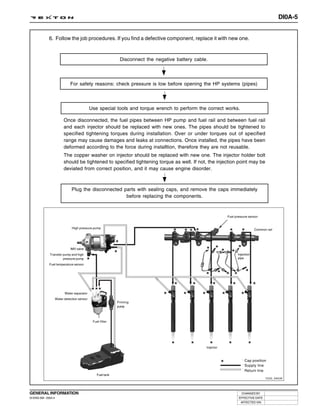
             6. Follow the job procedures. If you find a defective component, replace it with new one.


                                                               Disconnect the negative battery cable.


                               For safety reasons: check pressure is low before opening the HP systems (pipes)


                                              Use special tools and torque wrench to perform the correct works.

                          Once disconnected, the fuel pipes between HP pump and fuel rail and between fuel rail
                          and each injector should be replaced with new ones. The pipes should be tightened to
                          specified tightening torques during installation. Over or under torques out of specified
                          range may cause damages and leaks at connections. Once installed, the pipes have been
                          deformed according to the force during installtion, therefore they are not reusable.
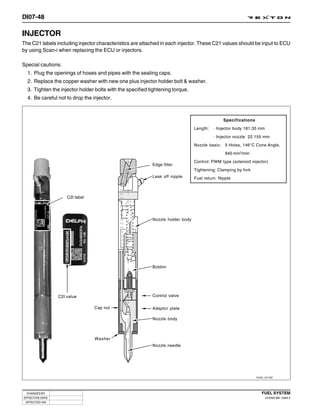
                          The copper washer on injector should be replaced with new one. The injector holder bolt
                          should be tightened to specified tightening torque as well. If not, the injection point may be
                          deviated from correct position, and it may cause engine disorder.


                                Plug the disconnected parts with sealing caps, and remove the caps immediately
                                                       before replacing the components.


                                                                                                               Fuel pressure sensor


                                High pressure pump                                                                               Common rail


                               IMV valve
              Transfer pump and high                                                                                 Injection
                       pressure pump                                                                                 pipe
              Fuel temperature sensor


                           Water separator
                     Water detection sensor
                                                              Priming
                                                              pump


                                               Fuel filter


                                                                                                    Injector


                                                                                                                          Cap position
                                                                                                                          Supply line
                                                                                                                          Return line
                                                  Fuel tank
                                                                                                                                       Y220_0A039


GENERAL INFORMATION                                                                                                     CHANGED BY
DI ENG SM - 2004.4                                                                                                    EFFECTIVE DATE
                                                                                                                       AFFECTED VIN
DI0A-6


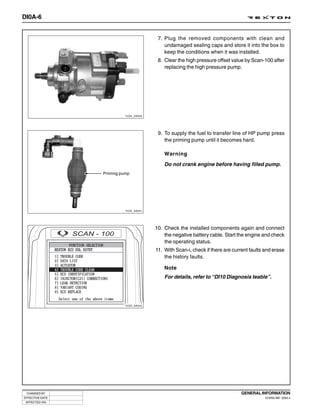
                                         7. Plug the removed components with clean and
                                            undamaged sealing caps and store it into the box to
                                            keep the conditions when it was installed.
                                         8. Clear the high pressure offset value by Scan-100 after
                                            replacing the high pressure pump.


                           Y220_0A040


                                         9. To supply the fuel to transfer line of HP pump press
                                            the priming pump until it becomes hard.

                                            Warning

                                            Do not crank engine before having filled pump.
                 Priming pump


                           Y220_0A041


                                        10. Check the installed components again and connect
                                            the negative battery cable. Start the engine and check
                                            the operating status.
                                        11. With Scan-i, check if there are current faults and erase
                                            the history faults.

                                            Note
                                            For details, refer to “DI10 Diagnosis teable”.


                           Y220_0A042


 CHANGED BY                                                                    GENERAL INFORMATION
EFFECTIVE DATE                                                                             DI ENG SM - 2004.4
 AFFECTED VIN
DI0A-7


     DI Engine and Its Expected Problems and Remedies Can be Caused
     by Water in Fuel

    SYSTEM SUPPLEMENT AGAINST PARAFFIN SEPARATION.
    In case of Diesel fuel, paraffin, one of the elements, can be separated from fuel during winter and then can stick on
    the fuel filter blocking fuel flow and causing difficult starting finally. Oil companies supply summer fuel and winter
    fuel by differentiating mixing ratio of kerosene and other elements by region and season. However, above phenomenon
    can be happened if stations have poor facilities or sell improper fuel for the season.
    In case of DI engine, purity of fuel is very important factor to keep internal preciseness of HP pump and injector.
    Accordingly, more dense mesh than conventional fuel filter is used. To prevent fuel filter internal clogging due to
    paraffin separation, SYMC is using fuel line that high pressure and temperature fuel injected by injector returns
    through fuel filter to have an effect of built-in heater (see fuel system).


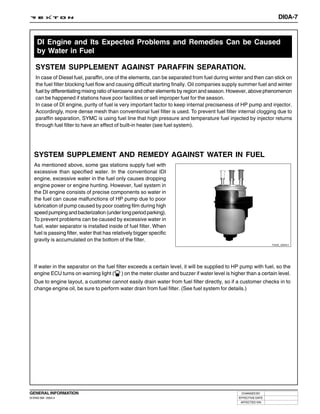
   SYSTEM SUPPLEMENT AND REMEDY AGAINST WATER IN FUEL
   As mentioned above, some gas stations supply fuel with
   excessive than specified water. In the conventional IDI
   engine, excessive water in the fuel only causes dropping
   engine power or engine hunting. However, fuel system in
   the DI engine consists of precise components so water in
   the fuel can cause malfunctions of HP pump due to poor
   lubrication of pump caused by poor coating film during high
   speed pumping and bacterization (under long period parking).
   To prevent problems can be caused by excessive water in
   fuel, water separator is installed inside of fuel filter. When
   fuel is passing filter, water that has relatively bigger specific
   gravity is accumulated on the bottom of the filter.
                                                                                                                  Y220_0A041


   If water in the separator on the fuel filter exceeds a certain level, it will be supplied to HP pump with fuel, so the
   engine ECU turns on warning light ( ) on the meter cluster and buzzer if water level is higher than a certain level.
   Due to engine layout, a customer cannot easily drain water from fuel filter directly, so if a customer checks in to
   change engine oil, be sure to perform water drain from fuel filter. (See fuel system for details.)


GENERAL INFORMATION                                                                               CHANGED BY
DI ENG SM - 2004.4                                                                               EFFECTIVE DATE
                                                                                                  AFFECTED VIN
DI0A-8


STRUCTURE

 Front view


                                                                      Rear view


                                                                                                               Y220_0A001


 1. TVD (Torsional Vibration Damper)    7. Cooling fan pulley & viscos clutch 13. Oil filter housing
 2. Air conditioner compressor          8. Aut tensioner pulley                14. Vacuum pump
 3. Power steering pump pulley          9. Auto tensioner                      15. Crank position sensor
 4. Idle pulley                        10. Poly-groove belt                    16. EGR valve
 5. Water pump pulley                  11. Cam position sensor                 17. Power steering pump
 6. Alternator                         12. Drive plate (M/T: DMF)              18. EGR center pipe


 CHANGED BY                                                                                     GENERAL INFORMATION
EFFECTIVE DATE                                                                                             DI ENG SM - 2004.4
 AFFECTED VIN
DI0A-9


   Top view


                                                                                 Y220_0A002


 19. Cylinder head cover    24. Fuel pipe          29. Booster pressure sensor
 20. Intake manifold        25. Injector           30. Oil separator
 21. Water outlet port      26. Fuel return line   31. Oil dipstic
 22. Common rail            27. Oil filler cap     32. EGR center pipe
 23. Fuel pressure sensor   28. Glow plug


GENERAL INFORMATION                                              CHANGED BY
DI ENG SM - 2004.4                                              EFFECTIVE DATE
                                                                 AFFECTED VIN
DI0A-10


 Left side view


                     Right side view


                                                                               Y220_0A003


33. Cylinder head             38. EGR - RH pipe   42. Turbocharger vacuum modulator
34. Cylinder block            39. Oil separator   43. EGR valve vacuum modulator
35. Oil pan                   40. Oil dipstic     44. EGR valve
36. Drain plug                41. HP pump         45. Exhaust manifold
37. Turbocharger


 CHANGED BY                                                       GENERAL INFORMATION
EFFECTIVE DATE                                                             DI ENG SM - 2004.4
 AFFECTED VIN
DI0A-11


  ENGINE CONTROLS
ECU RELATED COMPONENTS

                                                                      Fuel filter
        ECU/barometric sensor            Cam position sensor   (water detection sensor)   Accelerator pedal sensor


                     HFM sensor/intake air         Pre heating time relay                  Main relay
                     temperature sensor


                                                                                                                Y220_0A004


GENERAL INFORMATION                                                                            CHANGED BY
DI ENG SM - 2004.4                                                                            EFFECTIVE DATE
                                                                                               AFFECTED VIN
DI0A-12

ENGINE AND SENSORS

                                                            Crankshaft position
                     Injector           Common rail
                                                                  sensor


                    Glow plug                              Fuel pressure sensor


                 Camshaft position                         Booster pressure sensor
                     sensor


                     HP pump         Coolant temperature     Knock sensor (2)
                                           sensor


                                                                                      Y220_0A005


 CHANGED BY                                                            GENERAL INFORMATION
EFFECTIVE DATE                                                                    DI ENG SM - 2004.4
 AFFECTED VIN
DI0A-13

ELECTRICAL COMPONENTS AND PRE HEATING SYSTEM

                      Glow plug           Pre heating time relay


                                       Fuse box      Battery


                       Starter motor                    Alternator


                                                                     Y220_0A006


GENERAL INFORMATION                                CHANGED BY
DI ENG SM - 2004.4                                EFFECTIVE DATE
                                                   AFFECTED VIN
DI0A-14


INTAKE SYSTEM


      Air cleaner assembly     HFM sensor    Intake duct hose   Intake manifold


         Intake outlet hose   Turbocharger     Intercooler         Inlet hose


                                                                                    Y220_0A007


 CHANGED BY                                                         GENERAL INFORMATION
EFFECTIVE DATE                                                                  DI ENG SM - 2004.4
 AFFECTED VIN
DI0A-15

INTAKE AIR FLOW CHART


                                                                   Intake valve (in combustion chamber)


                                                                                                                        Intake manifold


                     Air cleaner side


                                                             Turbo-
                                                             charger           Engine
                                                             (compressor)


                                    HFM sensor


                                           Intake hose (outlet)              Intercooler                  Intake hose (inner)


                                                                                                                                     Y220_0A008


GENERAL INFORMATION                                                                                              CHANGED BY
DI ENG SM - 2004.4                                                                                              EFFECTIVE DATE
                                                                                                                 AFFECTED VIN
DI0A-16


INTAKE SYSTEM


                 Muffler                 Exhaust manifold            EGR valve


              Turbocharger   Catalytic converter       EGR pipe   Vacuum modulator


                                                                                     Y220_0A009


 CHANGED BY                                                            GENERAL INFORMATION
EFFECTIVE DATE                                                                   DI ENG SM - 2004.4
 AFFECTED VIN
DI0A-17

EXHAUST AIR FLOW CHART


                                 Catalytic converter         Exhaust pipe        Muffler


                                                                                                             Ambient
                                                                                                               air


                                                       Exhaust gas


                Turbocharger
                (turbine side)

                                                                                                EGR vacuum
                                                                                                modulator
                                                                                                To turbocharger
                                                                                                booster
                                                                                                 Turbocharger
                                                                                                 booster vacuum
                                                                                                 modulator

    Turbocharger booster                                                                         EGR valve

            Exhaust manifold


                                                                      EGR pipe


                                                                                                              Y220_0A010


GENERAL INFORMATION                                                                         CHANGED BY
DI ENG SM - 2004.4                                                                         EFFECTIVE DATE
                                                                                            AFFECTED VIN
DI0A-18


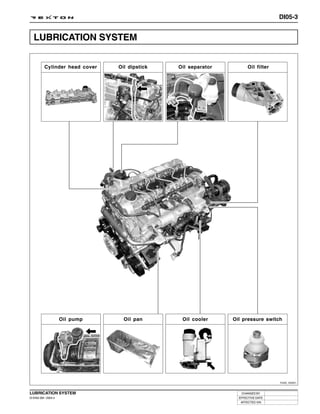
LUBRICATION SYSTEM


       Cylinder head cover   Oil dipstic      PCV valve          Engine oil filter
                                                                    housing


          Engine oil pump     Oil pan      Engine oil cooler   Engine oil pressure
                                                                     switch


                                                                                     Y220_0A011


 CHANGED BY                                                          GENERAL INFORMATION
EFFECTIVE DATE                                                                 DI ENG SM - 2004.4
 AFFECTED VIN
DI0A-19


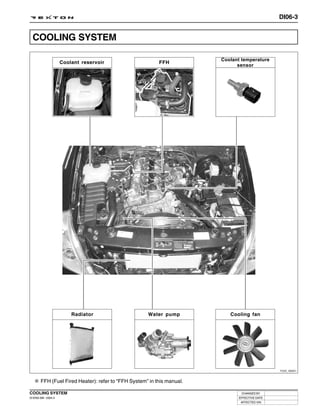
  COOLING SYSTEM


                     Coolant reservoir      Water pump


                     Radiator assembly   Cooling fan and fan
                                               clutch


                                                                  Y220_0A013


GENERAL INFORMATION                              CHANGED BY
DI ENG SM - 2004.4                              EFFECTIVE DATE
                                                 AFFECTED VIN
DI0A-20

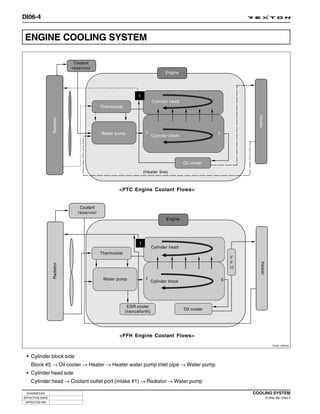
COOLANT FLOW CHART


                                               Heater


                                                    Oil cooler
                         Coolant reservoir                            Intake manifold


                 Thermostat
                                                                                        Coolant outlet port
                 Water pump


                 Inner hose                                                             Outlet hose


                                             Cooling fan


                                                           Radiator


                                                                                                                  Y220_0A014


 CHANGED BY                                                                                   GENERAL INFORMATION
EFFECTIVE DATE                                                                                                DI ENG SM - 2004.4
 AFFECTED VIN
DI0A-21


  FUEL SYSTEM


             Fuel return hose   Fuel pressure pipe        Common rail      Fuel filter


                     Injector                   HP pump                 Priming pump


                                                                                          Y220_0A015


GENERAL INFORMATION                                                      CHANGED BY
DI ENG SM - 2004.4                                                      EFFECTIVE DATE
                                                                         AFFECTED VIN
DI0A-22

FUEL SUPPLY SYSTEM

                                                                                                                 Fuel pressure sensor


        High pressure pump                                                                                                        Common rail


          IMV valve
        Low and high                                                                                                   High
                                                                                                                       pressure
      pressure pump
                                                                                                                       pipe
   Fuel temperature
            sensor


  Water separator
                                                                                                                                     Label
                 Fuel filter               Prining pump                                                                              (C21)


         Water detection
                 sensor


                                                                                                  Injector


                                                                                               Sensors
                                                                                         HFM sensor
                                                                                         Cam position sensor
                                                                                         Crank position sensor
                          Fuel tank                            ECU
                                                                                         Knock sensor etc.

    Components:
                                                                                                                           Supply line
    - High pressure fuel pump         - Fuel rails                    - Fuel pressure sensor                               Return line
    - Fuel injectors                  - Electroc control unit (ECU)   - Various sensors and actuators                      ECU communication line


                                                                                                                                                Y220_0A016


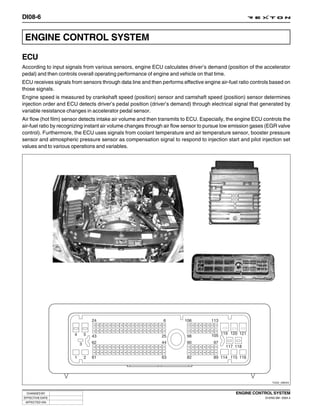
According to input signals from various sensors, engine ECU calculates driver’s demand (position of the accelerator
pedal) and then controls overall operating performance of engine and vehicle on that time.
ECU receives signals from sensors via data line and then performs effective engine air-fuel ratio controls based on those
signals. Engine speed is measured by crankshaft speed (position) sensor and camshaft speed (position) sensor deter-
mines injection order and ECU detects driver’s pedal position (driver’s demand) through electrical signal that is gener-
ated by variable resistance changes in accelerator pedal sensor. Air flow (hot film) sensor detects intake air volume and
sends the signals to ECU. Especially, the engine ECU controls the air-fuel ratio by recognizing instant air volume
changes from air flow sensor to decrease the emissions (EGR valve control). Furthermore, ECU uses signals from
coolant temperature sensor and air temperature sensor, booster pressure sensor and barometric sensor as compensa-
tion signal to respond to injection starting, pilot injection set values, various operations and variables.


 CHANGED BY                                                                                                                  GENERAL INFORMATION
EFFECTIVE DATE                                                                                                                            DI ENG SM - 2004.4
 AFFECTED VIN
DI0A-23


  GENERAL SPECIFICATIONS
VEHICLE SPECIFICATIONS
     Vehicle Dimension                          (mm)


                                             Y220_0A017


GENERAL INFORMATION         CHANGED BY
DI ENG SM - 2004.4         EFFECTIVE DATE
                            AFFECTED VIN
DI0A-24

   Specifications
  Systems                      Items                                            Diesel                              Remark
General          Overall length (mm)                                        4,720 (4,785)                         ( ): optional
                 Overall width (mm)                                              1,870                                 item

                 Overall height (mm)                                        1,760 (1,830)
                 Gross vehicle weight (kg)                        AT: 2450 (2510), MT: 2405 (2465)
                 Curb weight (kg)                                 AT: 1995 (2055), MT: 1950 (2010)
                 Min. turning radius (m)                                          5.6
                 Ground clearance (mm)                                            200
                 Fuel                                                            Diesel
                 Fuel tank capacity                                              80
Engine           Model                                                          D27DT
                 No. of cyl./Compression ratio                                   5/18:1
                 Total displacement                                             2,696 cc
                 Camshaft arrangement                                            DOHC
                 Max. power                                              170 ps/4,000 rpm
                 Max. torque                                            34.7 kg•m/1,800 rpm
                 Injection timing                                       ATDC 4° ± 1°(at idle)
                 Idle speed                                                 760 ± 50 rpm
                 Cooling system                                    Water-cooled/forced circulation
                 Coolant capacity                                         Approx. 11.5
                 Lubrication                                        Gear pump, forced circulation
                 Max. oil capacity                                               9.3
                 Turbo charger and cooling type                       Turbo charger, air-cooled
Manual           Type                                             Remote control, floor change type
transmission                               1st        IDI Engine        4.007          DI Engine      4.315
                                         2nd                            2.367                         2.475
                                            rd
                                           3                            1.473                         1.536
                                            th
                                           4                            1.000                         1.000
                                           5th                          0.872                         0.807
                                        Rev.                            3.700                         3.591
Automatic        Model                                                       Electronic
transmission     Type                                                    Floor change type
                                           1st             2.742                  3.595              2.742
                                         2nd               1.508                  2.186              1.508
                                            rd
                                           3               1.000                  1.405              1.000
                                            th
                                           4               0.708                  1.000              0.708
                                           5th                -                   0.831                -
                                       Rev. 1st            2.429                  3.162              2.429
                                                 nd
                                       Rev. 2                 -                   1.926                -

 CHANGED BY                                                                                                GENERAL INFORMATION
EFFECTIVE DATE                                                                                                      DI ENG SM - 2004.4
 AFFECTED VIN
DI0A-25

     Specifications (Cont’d)
    Systems                       Items                                    Diesel                                     Remark
Transfercase         Model                                                Part-time                          ( ): optional item
                     Type                                           Planetary gear type
                     Gear ratio           High                            1.000 : 1
                                          Low                             2.483 : 1
Clutch               Type                                    Hydraulic [A/T: Torque converter]
                     Disc type                                   Dry single diaphragm type
                                                            [A/T: 3 elements 1 stage 2 phases]
Power                Type                                             Rack and pinion
steering             Steering angle       Inner                            36° 17'
                                          Outer                            32° 40'
Front axle           Drive shaft type                                  Ball joint type
                     Axle housing type                                  Build-up type
Rear axle            Drive shaft type                                Semi-floating type
                     Axle housing type                                  Build-up type
Brake                Master cylinder type                               Tandem type
                     Booster type                                     Vacuum booster
                     Type                 Inner                             Disc
                                          Outer                         Drum (Disc)
                     Parking brake                            Cable type (internal expansion)
Suspension           Front                                        Wishbone + Coil spring
                     Rear                                            5-link + Coil spring
Air                  Refrigerant                                           R134a
conditioner          Compressor type                                     Vane type
Electrical           Battery type/Capacity (V-AH)                       MF / 12 - 90
                     Starter capacity (V-kW)                Diesel : 12 - 2.2, Gasoline : 12 - 1.8
                     Alternator capacity (V-A)        IDI             12 - 75 (12 - 90)
                                                       DI            12 - 140 (12 - 115)
                                                    Gasoline              12 - 115


GENERAL INFORMATION                                                                                   CHANGED BY
DI ENG SM - 2004.4                                                                                   EFFECTIVE DATE
                                                                                                      AFFECTED VIN
DI0A-26

MAINTENANCE
    Major Components and Service Interval
                                                                                      * Use only Ssangyong Genuine Parts.
     Components              Daily Weekly               Service Interval                               Remarks
Engine          Gasoline      O      -      Initial change: 10,000 km                  More frequent maintenance is required if
                                                                                       the vehicle is operated under severe
oil and         engine                      Replace at every 15,000 km                 condition.
oil filter                    O      -                                                 Severe conditions?
                DI diesel                   Initial change: 5,000 km
                                                                                       - Frequent low-speed operation as in
                engine                      Replace at every 10,000 km or 12 months      stop-and-go traffic
                                                                                       - When most trips are less than 6 km (in
                IDI diesel    O      -                                                   winter, less than 16 km)
                engine                                                                 - Driving in sandy, dusty, and salty road
                                                                                       - Driving in mountainous areas
                                                                                       - Extensive idling or high load operation
                                                                                         such as towing a trailer
Coolant                       O      -      Replace at every 60,000 km or 3 years
Brake pipe and hose           -      -      Initial inspection: 1,000 km
                                            Inspect at every 20,000 km, replace if necessary
Brake pad, shoe and           -      -      Inspect at every 10,000 km, check or adjust if necessary
disc
Air             Gasoline      -      O      Clean at every 15,000 km,                  If vehicle is operated under dusty or sandy
                                                                                       area, frequently clean and inspect the air
cleaner         engine                      Replace at every 60,000 km                 cleaner system. If necessary, replace the air
element                       -      O                                                 cleaner element.
                DI diesel                   Initial clean: 5,000 km,
                engine                      Clean at every 10,000 km, replace if
                IDI diesel    -      O      necessary,
                engine                      Replace at every 30,000 km
Fuel filter Gasoline          -      -      Replace at every 60,000 km
            engine
                DI diesel     -      -      Replace at every 30,000 km (Drain the water from fuel filter at every 10,000 km)
                engine
                IDI diesel    -      -      Replace at every 40,000 km
                engine
Auto-     4-speed             -      -      Inspect at every 30,000 km or 1 year,      More frequent maintenance is required if the
matic                                       replace if necessary (replace at every     vehicle is operated under severe condition.
transmis- 5-speed             -      -                                                 - Driving in unpaved road
                                            60,000 km if the vehicle is operated       - Towing a trailer
sion oil
                                            under severe conditions)
Manual transmission           -      -      Inspect at every 10,000 km,
oil                                         Replace at every 60,000 km
Transfer case oil             -      -      Inspect at every 10,000 km,
                                            Replace at every 60,000 km (but, frequently chexk the leaks)
Axle oil                      -      -      Replace at every 30,000 km
Air conditioner air           -      -      Replace at every 10,000 km                 More frequent maintenance is required if the
                                                                                       vehicle is operated under severe condition.
filter                                                                                 - Driving in sandy, dusty, and unpaved road
                                                                                       - Excessive operation of air conditioner or
                                                                                         heater
Spark plug (gasoline          -      -      Replace at every 60,000 km
engine)


 CHANGED BY                                                                                               GENERAL INFORMATION
EFFECTIVE DATE                                                                                                         DI ENG SM - 2004.4
 AFFECTED VIN
DI0A-27

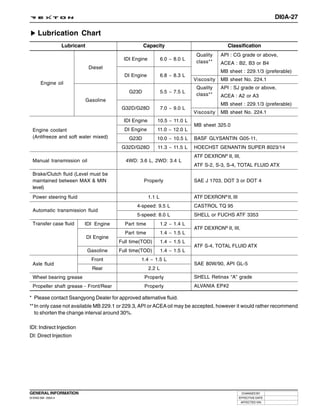
     Lubrication Chart
                     Lubricant                          Capacity                                 Classification
                                                                                   Quality    API : CG grade or above,
                                               IDI Engine           6.0 ~ 8.0 L
                                                                                   class**    ACEA : B2, B3 or B4
                                  Diesel
                                                                                              MB sheet : 229.1/3 (preferable)
                                               DI Engine            6.8 ~ 8.3 L
                                                                                  Viscosity   MB sheet No. 224.1
       Engine oil
                                                                                   Quality    API : SJ grade or above,
                                                 G23D               5.5 ~ 7.5 L
                                                                                   class**    ACEA : A2 or A3
                                 Gasoline
                                                                                              MB sheet : 229.1/3 (preferable)
                                              G32D/G28D             7.0 ~ 9.0 L
                                                                                  Viscosity   MB sheet No. 224.1
                                               IDI Engine       10.5 ~ 11.0 L
                                                                                  MB sheet 325.0
  Engine coolant                               DI Engine        11.0 ~ 12.0 L
  (Antifreeze and soft water mixed)              G23D           10.0 ~ 10.5 L     BASF GLYSANTIN G05-11,
                                              G32D/G28D         11.3 ~ 11.5 L     HOECHST GENANTIN SUPER 8023/14
                                                                                  ATF DEXRON® II, III,
  Manual transmission oil                      4WD: 3.6 L, 2WD: 3.4 L
                                                                                  ATF S-2, S-3, S-4, TOTAL FLUID ATX
  Brake/Clutch fluid (Level must be
  maintained between MAX & MIN                          Properly                  SAE J 1703, DOT 3 or DOT 4
  level)
  Power steering fluid                                      1.1 L                 ATF DEXRON® II, III
                                                    4-speed: 9.5 L                CASTROL TQ 95
  Automatic transmission fluid
                                                    5-speed: 8.0 L                SHELL or FUCHS ATF 3353
  Transfer case fluid        IDI Engine        Part time            1.2 ~ 1.4 L
                                                                                  ATF DEXRON® II, III,
                                               Part time            1.4 ~ 1.5 L
                                 DI Engine
                                             Full time(TOD)         1.4 ~ 1.5 L
                                                                                  ATF S-4, TOTAL FLUID ATX
                                 Gasoline    Full time(TOD)         1.4 ~ 1.5 L
                                   Front              1.4 ~ 1.5 L
  Axle fluid                                                                      SAE 80W/90, API GL-5
                                   Rear                     2.2 L
  Wheel bearing grease                                  Properly                  SHELL Retinax “A” grade
  Propeller shaft grease - Front/Rear                   Properly                  ALVANIA EP#2

* Please contact Ssangyong Dealer for approved alternative fluid.
** In only case not available MB 229.1 or 229.3, API or ACEA oil may be accepted, however it would rather recommend
   to shorten the change interval around 30%.

IDI: Indirect Injection
DI: Direct Injection


GENERAL INFORMATION                                                                                      CHANGED BY
DI ENG SM - 2004.4                                                                                      EFFECTIVE DATE
                                                                                                         AFFECTED VIN
DI0A-28


 VEHICLE IDENTIFICATION
1. Vehicle identification Number
Vehicle identification number (VIN) is is on the right front
axle upper frame.

[KPTPOA19S1P 122357]
K .. Nation       (K: Korea)
P .. Maker Identification (P: Ssangyong Motor Company)
T .. Vehicle Type          (T: Passenger car - 4WD)
P .. Line Models           (P: Rexton)
O . Body Type              (O: 5-door)
A .. Trim Level            (A: Standard, B: Deluxe,
                                                                                         Y220_0A018
                           C: Super deluxe)
1 .. Restraint System      (0: No seatbelts, 1: 3-point
                           seatbelts, 2: 2-point seatbelt)
9 .. Engine Type           (9: 3199cc, In-line 6 cylinders, Gasoline E32)
                           (D: 2874cc, Il-line 5 cylinders, Diesel)
S .. Check Digit           (S: All area except North America)
1 .. Model Year            (1: 2001, 2: 2002, 3: 2003)
P .. Plant Code            (P: Pyungtaek plant)
122357                     (Production serial number)


2. Certification Label
The certification label is affixed on the bottom of driver’s side
B-pillar.


                                                                                         Y220_0A019


  CHANGED BY                                                                GENERAL INFORMATION
EFFECTIVE DATE                                                                       DI ENG SM - 2004.4
 AFFECTED VIN
DI0A-29

3. Engine Serial Number
The engine serial number is stamped on the lower area of
cylinder block in exhaust manifold side.


                                                                                     Y220_0A020


4. Manual Transmission Number
The transmission label is affixed on the upper area of clutch
housing.


5. Automatic Transmission Number
The transmisson label is affixed on the right area of transmis-
sion housing.


                                                                                     Y220_0A021


6. Transfer Case Number
The transfer case label is affixed on the transfer case housing.


                                                                                     Y220_0A022


GENERAL INFORMATION                                                 CHANGED BY
DI ENG SM - 2004.4                                                 EFFECTIVE DATE
                                                                    AFFECTED VIN
DI0A-30


HOW TO USE AND MAINTAIN WORKSHOP MANUAL
CONSISTS OF WORKSHOP
MANUAL                                                                     Consists of Small Group
  1. Group: The manual is divided in large group like                  1. Contents: In small group, included subjects and
     engine, transmission, axle and others and this group                 detailed subjects are described in.
     is also divided in small group by vehicle state.                  2. General: In the general, summary of the small group
  2. Small group: Each small group consists of general,                   (assembly), function and operational principle,
     vehicle service, unit repair and special tool usage.                 specifications, structure and components, diagnosis
                                                                          and circuit diagram are described in.
MANUAL DESCRIPTION                                                     3. Vehicle service: Service works on the vehicle like
 • The contents of the manual consist of operational                      replacement of parts and inspection repairs are
   principle of system, specifications, diagnosis, removal/               described in the order of repair works with actual
   installation on vehicle, inspections, disassembly/                     photos and illustrations. Also cautions in service
   assembly of removed assembly, special tool usage.                      works, references and inspection methods after
   Not providing simple removal/installation information                  completion of service are described in.
   but focused on to describe much more functions, roles               4. Disassembly and assembly of unit assembly:
   and principles of system.                                              Detailed service works like disassembly, inspection,
 • Every automotive term like part name on the manual                     adjustment and assembly on removed component
   is the same in parts catalog, technical bulletin and                   (assembly) are described in with systematic contents
   drawings to avoid confusion among them.                                and photo illustration.

                                                           Vehicle model
                   Abbreviation of small
                   group and page


                                                        Bolded: Notice, Installation Notice,
                                                                Note


                 Describes information on the manual     Describes small group name, model
                 like modification, application date,    and publication date
                 applicable V.I.N

 CHANGED BY                                                                                             GENERAL INFORMATION
EFFECTIVE DATE                                                                                                    DI ENG SM - 2004.4
 AFFECTED VIN
DI0A-31

GUIDELINES FOR SERVICE WORK SAFETY
     General                                                     Cautions on Inspection/Service
                                                              Notice
                                                              During service works, be sure to observe below general
                                                              items for your safety.
                                                               • For service works, be sure to disconnect battery
                                                                 negative (-) terminal if not starting and inspection.
                                                               • While inspecting vehicle and replacing various
                                                                 consumable parts, be sure to take caution not to
                                                                 damage vehicle and injure people.
                                                               • Engine and transmission may be hot enough to
                                                                 burn you. So inspect related locations when they
                                                                 cooled down enough.
                                                 Y220_0A024
                                                               • If engine is running, keep your clothing, tools, hair
To maintain and operate the vehicle under optimum state          and hands away from moving parts.
by performing safe service works, the service works should     • Even when the ignition key is turned off and
be done by following correct methods and procedures.             positioned to LOCK, electrical fan can be operated
Accordingly, the purpose of this manual is to prevent dif-       while working on near around electrical fan or
ferences that can be caused by personal working method,          radiator grille if air conditioner or coolant
skill, ways and service procedures and to allow prompt/          temperature rises.
correct service works.                                         • Every oil can cause skin trouble. Immediately wash
                                                                 out with soap if contacted.
Note, Notice
                                                               • Painted surface of the body can be damaged if
While using this manual, there are a lot of Note or Notice
                                                                 spilled over with oil or anti-freeze.
having below meaning.
                                                               • Never go under vehicle if supported only with jack.
Note                                                           • Never near the battery and fuel related system to
Note means detailed description of supplementary                 flames that can cause fire like cigarette.
information on work procedure or skill.                        • Never disconnect or connect battery terminal or other
                                                                 electrical equipment if ignition key is turned on.
Notice
                                                               • While connecting the battery terminals, be cautious
Notice means precautions on tool/device or part                  of polarities (+, –) not to be confused.
damages or personal injuries that can occur during             • There are high voltage and currency on the battery
service works.                                                   and vehicle wires. So there can be fire if short-
                                                                 circuited.
However, above references and cautions cannot be inclu-
                                                               • Do not park while running the engine in an
sive measures, so should have habits of taking concerns
                                                                 enclosed area like garage. There can be toxication
and cautions based on common senses.
                                                                 with CO, so make sufficient ventilation.
                                                               • The electrical fan works electrically. So the fan can
                                                                 be operated unexpectedly during working causing
                                                                 injuries if the ignition key is not in LOCK position.
                                                                 Be sure to check whether ignition key is in LOCK
                                                                 position before work.
                                                               • Be careful not to touch hot components like
                                                                 catalytic converter, muffler and exhaust pipe when
                                                                 the engine is running or just stopped. They may
                                                                 burn you badly.

GENERAL INFORMATION                                                                          CHANGED BY
DI ENG SM - 2004.4                                                                          EFFECTIVE DATE
                                                                                             AFFECTED VIN
DI0A-32

   Guidelines on Engine Service                               Fuel and lubrication system
                                                              Painted surface of the body can be damaged or rubber
To prevent personal injuries and vehicle damages that can
                                                              products (hoes) can be corroded if engine oil and fuel are
be caused by mistakes during engine and unit inspection/
                                                              spilled over. If spilled over engine, foreign materials in air
repair and to secure optimum engine performance and
                                                              can be accumulated on the engine damaging fuel system.
safety after service works, basic cautions and service work
guidelines that can be easily forgotten during engine ser-      • If work on the fluid system such as fuel and oil, working
vice works are described in.                                      area should be well ventilated and mechanic should
                                                                  not smoke.
Cautions before service works                                   • Gasket or seal on the fuel/lubrication system should
 • Before work on engine and each electrical equipment,           be replaced with new and bolts and nuts should be
   be sure to disconnect battery negative (-) terminal.           tightened as specified.
  • Before service works, be sure to prepare the works by       • After removal/installation works, be sure to check
    cleaning and aligning work areas.                             whether there is leak on the connecting section.
  • Always position the ignition switch to OFF if not
    required. If not, there can be electrical equipment        If fine dust or foreign material enters into DI engine’s
    damages or personal injuries due to short-circuit or       fuel system, there can be serious damages between
    ground by mistake.                                         HP pump and injectors. So, be sure to cover removed
  • There should be no leak from fuel injection system         fuel system components with cap and protect removed
    (HP pump, fuel hose, high pressure pipe) of the D27DT      parts not to be contaminated with dirt. (Refer to clean-
    engine. So they should be protected from foreign           ness in this manual while working on DI engine fuel
    materials.                                                 system)
  • While removing the engine, do not position the jack
    and others under the oil pan or engine. To secure the
    safety, use only safety hook on the engine.               Electrical equipment
Engine and accessories                                        Electrical equipment should be handled more carefully.
Engine has a lot of precise portions so tightening torque     Currently, the engine is equipped with a lot of electrical
should be correct during disassembly/assembly and re-         equipments so there can be engine performance drops,
moval/installation and service work should be done in clean   incomplete combustion and other abnormals due to short
ways during disassembly/assembly.                             and poor contact. Mechanics should well aware of vehicle’s
                                                              electrical equipment.
Maintaining working area clean and cautious service ad-
ministration is essential element of service works while        • If have to work on the electrical equipment, be sure to
working on the engine and each section of the vehicle. So         disconnect battery negative (-) terminal and position
the mechanics should well aware of it.                            the ignition switch to off if not required.

  • While removing the engine, related parts (bolts,            • When replacing electrical equipment, use the same
    gaskets, etc.) should be aligned as a group.                  genuine part and be sure to check whether ground or
                                                                  connecting portions are correctly connected during
  • While disassembling/assembling internal components
                                                                  installation. If ground or connecting portion is loosened,
    of the engine, well aware of disassembly/assembly
                                                                  there can be vehicle fire or personal injury.
    section in this manual and clean each component with
    engine oil and then coat with oil before installation.
  • While removing engine, drain engine oil, coolant and
    fuel in fuel system to prevent leakage.
  • During service work of removal/installation, be sure to
    check each connected portions to engine not to make
    interference.


 CHANGED BY                                                                                         GENERAL INFORMATION
EFFECTIVE DATE                                                                                                 DI ENG SM - 2004.4
 AFFECTED VIN
DI0A-33


  During Service Work - Inspection
   1. Before lifting up the vehicle with lift, correctly support the
      lifting points and lift up.
   2. When using a jack, park the vehicle on the level ground
      and block front and rear wheels. Position the jack under
      the frame and lift up the vehicle and then support with
      chassis stand before service work.


                                                                                         Y220_0A025


   3. Before service work, be sure to disconnect battery
      negative (-) terminal to prevent damages by bad wire and
      short.


                                                                                         Y220_0A026


   4. If service from interior of the vehicle, use protection cover
      to prevent damage and contamination of seat and floor.
   5. Brake fluid and anti-freeze can damage painted surface
      of body. So carefully handle them during service work.


                                                                                         Y220_0A027


   6. Use recommended and specified tools to increase
      efficiency of service work.
   7. Use only genuine spare parts.


                                                                                         Y220_0A028


GENERAL INFORMATION                                                     CHANGED BY
DI ENG SM - 2004.4                                                     EFFECTIVE DATE
                                                                        AFFECTED VIN
DI0A-34

                               8. Never reuse cotter pin, gasket, O-ring, oil seal, lock
                                  washer and self-locking nut. Replace them with new.
                                  If reused, normal functions cannot be maintained.
                               9. Align the disassembled parts in clean according to
                                  disassembling order and group for easy assembling.
                              10. According to installing positions, the bolts and nuts have
                                  different hardness and design. So be careful not to mix
                                  removed bolts and nuts each other and align them
                                  according installing positions.
                              11. To inspect and assemble, clean the parts.
                              12. Securely clean the parts that related with oil not to be
                 Y220_0A029       affected by viscosity of oil.
                              13. Coat oil or grease on the driving and sliding surfaces
                                  before installing parts.
                              14. Use sealer or gasket to prevent leakage if necessary.
                              15. Damaged or not, never reuse removed gasket. Replace
                                  with new and cautious on installing directions.
                              16. Tighten every bolt and nut with specified torque.
                              17. When service work is completed, check finally whether
                                  the work is performed properly or the problem is solved.
                              18. If work on the fuel line between priming pump and injector
                                  (including return line), be sure to cover the removed parts
                                  with cap and be careful not to expose the connecting
                 Y220_0A030
                                  passage and removed parts to external foreign materials
                                  or dust. (Refer to cleanness.)
                              19. If remove high pressure fuel supply pipe between HP pump
                                  and fuel rail and high pressure fuel pipe between fuel rail
                                  and each injector, be sure to replace them with new.


 CHANGED BY                                                           GENERAL INFORMATION
EFFECTIVE DATE                                                                   DI ENG SM - 2004.4
 AFFECTED VIN
DI0A-35


  During Service Work for Electric
  Devices

Notice

Be careful not to modify or alter electrical system and
electrical device. Or there can be vehicle fire or serious
damage.

   1. Be sure to disconnect battery negative (-) terminal during
      every service work. Before disconnecting battery negative
      (-) terminal, turn off ignition key.                                               Y220_0A031


   2. Replace with specified capacity of fuse if there is bad,
      blown or short circuited fuse. If use electrical wire or steel
      wire other than fuse, there can be damages on the various
      electrical systems. If replaced with over-capacity fuse,
      there can be damages on the related electrical device
      and fire.
   3. Every wire on the vehicle should be fastened securely
      not to be loosened with fixing clip.
   4. If wires go through edges, protect them with tape or other
      materials not to be damaged.


   5. Carefully install the wires not to be damaged during
      installation/removal of parts due to interference.
   6. Be careful not to throw or drop each sensor or relay.
   7. Securely connect each connector until hear a “click”
      sound.


                                                                                         Y220_0A032


GENERAL INFORMATION                                                     CHANGED BY
DI ENG SM - 2004.4                                                     EFFECTIVE DATE
                                                                        AFFECTED VIN
DI0A-36

LIFTING POINTS
    Lifting Positions
1. 4-post lift
As illustrated, position the vehicle on the 4-post lift securely and block the front and rear of each tire not to move during
working.


Notice

During lifting, be sure to check whether vehicle is empty.
  • Board-on lift connection device installed in front of vehicle should be positioned in front of sill locating
    under the front door.
  • Install lift connecting device on the edge of front and rear of board-on lift.


Warning
• Be sure to use attachment during lifting to prevent the lift from contacting with body floor.
• While lifting the vehicle, widen the lift floor as far as possible to stabilize between vehicle front and rear. When
  fixing the lift floor, be careful not to contact with brake tube and fuel lines.


2. Safety jack and safety stand
If lift up the vehicle with safety jack and stand, should be more
careful during works.


Warning
• Never be under the vehicle if supported with only jack.
  If have to be under the vehicle, be sure to use safety
  block.
• Use wheel block in front and rear of every wheel.


                                                                                                                     Y220_0A033


  CHANGED BY                                                                                          GENERAL INFORMATION
EFFECTIVE DATE                                                                                                   DI ENG SM - 2004.4
 AFFECTED VIN
DI0A-37

TIGHTENING TORQUE OF STANDARD BOLTS
     Tightening Torque By Bolt Specification
                                                                Tightening Torque (kg.cm)
        Bolt
                     Pitch            Standard Tightening Torque                  Max. Allowable Tightening Torque
   Diameter
                                      4T              7T            9T               4T              7T             9T
         M3           0.5              5              9             13                7              12             17
         M4           0.7             12              20            30               16              27             40
         M5           0.8             24              40            57               32              53             77
         M6           1.0             41              68            99               55              91            130
         M8          1.25             88             160            230              130            210            310
        M10          1.25            190             330            470              260            430            620
                      1.5            190             310            450              250            420            600
        M12          1.25            350             580            840              460            770            1,100
                     1.75            330             550            790              440            730            1,000
        M14           1.5            550             910           1,300             730           1,200           1,900
        M16           1.5            830            1,100          2,000            1,100          1,900           2,700
        M18           1.5           1,200           2,000          2,900            1,600          2,700           3,800
        M20           1.5           1,700           2,800          4,000            2,200          3,700           5,300
        M22           1.5           2,300           3,800          5,400            3,000          5,000           7,200
        M24           1.5           2,900           4,900          7,000            3,900          6,500           9,400
                      2.0           2,800           4,700          6,800            3,800          6,300           9,100


                                                                                                                    Y220_0A034


   1. Metric bolt strength is embossed on the head of each         3. Determine extra proper tightening torque if tightens
      bolt. The strength of bolt can be classified as 4T, 7T,         with washer or packing.
      8.8T, 10.9T, 11T and 12.9T in general.                       4. If tightens bolts on the below materials, be sure to
   2. Observe standard tightening torque during bolt                  determine the proper torque.
      tightening works and can adjust torque to be proper                 • Aluminum alloy: Tighten to 80 % of above torque
      within 15 % if necessary. Try not to over max.                        table.
      allowable tightening torque if not required to do so.
                                                                          • Plastics: Tighten to 20 % of above torque table.


GENERAL INFORMATION                                                                                CHANGED BY
DI ENG SM - 2004.4                                                                                EFFECTIVE DATE
                                                                                                   AFFECTED VIN
MEMO
.............................................................................................................................................................................................................................................................................................................................................................................................................................................................................


.............................................................................................................................................................................................................................................................................................................................................................................................................................................................................


.............................................................................................................................................................................................................................................................................................................................................................................................................................................................................


.............................................................................................................................................................................................................................................................................................................................................................................................................................................................................


.............................................................................................................................................................................................................................................................................................................................................................................................................................................................................


.............................................................................................................................................................................................................................................................................................................................................................................................................................................................................


.............................................................................................................................................................................................................................................................................................................................................................................................................................................................................


.............................................................................................................................................................................................................................................................................................................................................................................................................................................................................


.............................................................................................................................................................................................................................................................................................................................................................................................................................................................................


.............................................................................................................................................................................................................................................................................................................................................................................................................................................................................


.............................................................................................................................................................................................................................................................................................................................................................................................................................................................................


.............................................................................................................................................................................................................................................................................................................................................................................................................................................................................


.............................................................................................................................................................................................................................................................................................................................................................................................................................................................................


.............................................................................................................................................................................................................................................................................................................................................................................................................................................................................


.............................................................................................................................................................................................................................................................................................................................................................................................................................................................................


.............................................................................................................................................................................................................................................................................................................................................................................................................................................................................


.............................................................................................................................................................................................................................................................................................................................................................................................................................................................................


.............................................................................................................................................................................................................................................................................................................................................................................................................................................................................


.............................................................................................................................................................................................................................................................................................................................................................................................................................................................................


.............................................................................................................................................................................................................................................................................................................................................................................................................................................................................


.............................................................................................................................................................................................................................................................................................................................................................................................................................................................................


.............................................................................................................................................................................................................................................................................................................................................................................................................................................................................


.............................................................................................................................................................................................................................................................................................................................................................................................................................................................................


.............................................................................................................................................................................................................................................................................................................................................................................................................................................................................


.............................................................................................................................................................................................................................................................................................................................................................................................................................................................................


.............................................................................................................................................................................................................................................................................................................................................................................................................................................................................


.............................................................................................................................................................................................................................................................................................................................................................................................................................................................................


.............................................................................................................................................................................................................................................................................................................................................................................................................................................................................


.............................................................................................................................................................................................................................................................................................................................................................................................................................................................................
SECTION   DI01


 ENGINE ASSEMBLY
DI01-1


           SECTION DI01
               00


                     ENGINE ASSEMBLY

                          Table of Contents

                          STRUCTURE AND FUNCTION DESCRIPTIONS ........ DI01-3
                            D27DT engine ........................................................ DI01-3
                            Engine performance curve ..................................... DI01-8
                            General diagnosis ................................................. DI01-10
                          DIAGNOSTIC INFORMATION AND PROCEDURE .. DI01-15
                            Oil leak diagnosis .................................................. DI01-15
                            Compression pressure test .................................. DI01-16
                            Cylinder pressure leakage test ............................ DI01-18
                            Tightening torque .................................................. DI01-19
                          REMOVAL AND INSTALLATION .............................. DI01-22
                            Engine mounting ................................................... DI01-22
                          DISASSEMBLY AND REASSEMBLY ........................ DI01-32
                            Components and special tools ............................. DI01-32


ENGINE ASSEMBLY                                                           CHANGED BY
DI ENG SM - 2004.4                                                      EFFECTIVE DATE
                                                                         AFFECTED VIN
DI01-3


  STRUCTURE AND FUNCTION DESCRIPTIONS
D27DT ENGINE
     Major Components in Engine and Engine Compartment
The advanced electronically controlled D27DT engine that has high pressure fuel system has been introduced to this
vehicle. It satisfies the strict emission regulation and provides improved output and maximum torque.


                                                                                                          Y220_01001


   1. Coolant reservoir                6. Fuse box                          11. EGR valve
   2. FFH device                       7. Battery                           12. Air cleaner assembly
   3. Brake fluid reservoir            8. Fuel filter                       13. Turbo charger
   4. Washer fluid reservoir           9. Power steering pump               14. Oil dipstick
   5. Common rail                     10. Priming pump


ENGINE ASSEMBLY                                                                             CHANGED BY
DI ENG SM - 2004.4                                                                       EFFECTIVE DATE
                                                                                          AFFECTED VIN
DI01-4

   Engine Structure

 Front View


                                                                   Rear View


                                                                                                          Y220_01002


 1. TVD (Torsional Vibration Damper)    7. Viscos fan clutch                   13. Oil filter
 2. Air conditioner compressor          8. Auto tensioner pulley               14. Vacuum pump
 3. Power steering pump pulley          9. Auto tensioner                      15. Crank position sensor
 4. Idle pulley                        10. Poly-grooved belt                   16. EGR valve
 5. Coolant pump pulley                11. Cam position sensor                 17. Power steering pump
 6. Alternator                         12. Drive plate (MT: DMF)               18. EGR to center pipe


 CHANGED BY                                                                                     ENGINE ASSEMBLY
EFFECTIVE DATE                                                                                       DI ENG SM - 2004.4
 AFFECTED VIN
DI01-5


   Top View


                                                                                 Y220_01003


 19. Cylinder head cover    24. Fuel pipe          29. Booster pressure sensor
 20. Intake manifold        25. Injector           30. PCV valve and oil separator
 21. Water outlet port      26. Fuel return line   31. Oil dipstick
 22. Common rail            27. Oil filler cap     32. EGR-LH pipe
 23. Fuel pressure sensor   28. Glow plug


ENGINE ASSEMBLY                                                  CHANGED BY
DI ENG SM - 2004.4                                              EFFECTIVE DATE
                                                                 AFFECTED VIN
DI01-6


 Left Side View


                                            Right Side View


                                                                                           Y220_01004


33. Cylinder head    38. EGR-RH pipe                      42. Turbo charger booster vacuum
34. Cylinder block   39. PCV valve and oil separator          modulator
35. Oil pan          40. Oil dipstick                     43. EGR valve vacuum modulator
36. Drain plug       41. High pressure pump               44. EGR valve
37. Turbo charger                                         45. Exhaust manifold


 CHANGED BY                                                                      ENGINE ASSEMBLY
EFFECTIVE DATE                                                                        DI ENG SM - 2004.4
 AFFECTED VIN
DI01-7

     Specifications
                            Description                                               Specification
  Engine                    Type/Number of cylinders                                D27DT/5-cylinder
  Cylinder                  Inner diameter (mm)                                            86.2
                            Stroke (mm)                                                    92.4
  Displacement (cc)                                                                        2696
  Compression ratio                                                                        18:1
  Maximum output (ps/rpm)                                                               170/4,000
  Maximum torque (kg.m/rpm)                                                             34.7/1,800

  Idle speed                For Manual Transmission                                   750 ± 50 rpm
                            For Automatic Transmission                                750 ± 50 rpm
  Valve                     Intake                   Opens (BTDC)                           16°
                                                     Closes (ABDC)                          33°
                            Exhaust                  Opens (BBDC)                           46°
                                                     Closes (ATDC)                          21°

  Camshaft                  Type                                                          DOHC
  Fuel system               Fuel type                                               Low sulfur diesel
                            Fuel pump type                                       Vane pump in HP pump
                            Fuel supply pressure                      HP pump inlet port: max. 400 mbar
                                                                      HP pump outlet port (with IMV fully open):
                                                                      over 1,050 bar
                            Water separation in fuel filter                        at every 10,000 km
                            Fuel tank capacity ( )                                          80
  Lubrication system        Oil specification                                      SAE 10W40, 5W40
                                                                          (MB Sheet 229.1, 229.3 approved oil)
                            Lubrication type                                         Forced delivery
                            Oil filter type                                    Full flow, filter element type
                            Oil capacity ( )                                             6.8 ~ 8.3
  Cooling system            Cooling type                                           Water cooling type
                            Cooling fan operation type                              Belt operated typr
                            Thermostat: Fully      Opening                                  85
                            Open: 100°C)           temperature (°C)
                                                   Type                              WAX pellet type
                            Coolant capacity ( )                                             11.5


ENGINE ASSEMBLY                                                                              CHANGED BY
DI ENG SM - 2004.4                                                                          EFFECTIVE DATE
                                                                                             AFFECTED VIN
DI01-8

ENGINE PERFORMANCE CURVE
   Output and Torque


                                       Output [PS]
     Torque [Nm]


                       Speed [rpm]


                                                          Y220_00025


 CHANGED BY                          ENGINE ASSEMBLY
EFFECTIVE DATE                                       DI ENG SM - 2004.4
 AFFECTED VIN
DI01-9

     Oil Temperature/Pressure and Boost Pressure

               Oil pressure [bar]


                                                                     Oil temperature [C]
               Boost pressure [bar]


                                      Speed [rpm]

                                                                                           Y220_00026


ENGINE ASSEMBLY                                      CHANGED BY
DI ENG SM - 2004.4                                  EFFECTIVE DATE
                                                     AFFECTED VIN
DI01-10

GENERAL DIAGNOSIS
             Condition                         Probable Cause                             Correction
 Hard Starting     Malfunction of    •   Faulty fuse.                        •   Replace the fuse.
 (With normal      Ignition System
 cranking)                           •   Faulty spark plug.                  •   Clean, adjust the plug gap or
                                                                                 replace.
                                     •   Electric leakage at the high        •   Replace the cable.
                                         tension cable.
                                     •   Poor connection of the high         •   Replace the cable or wires.
                                         tension cable or lead wires.
                                     •   Improper ignition timing.           •   Adjust the ignition timing.
                                     •   Faulty ignition coil.               •   Replace the ignition coil.
                   Malfunction of    •   Lock of fuel in the fuel tank.      •   Feed the fuel.
                   Fuel System
                                     •   Dirty or clogged fuel filter.       •   Replace the filter.
                                     •   Clogged fuel pipe.                  •   Clean the fuel pipe.
                                     •   Malfunction of the fuel pump.       •   Replace the fuel pump.
                                     •   Malfunction of the fuel injector.   •   Replace the injector.
                                     •   The foreign material in the fuel    •   Clean the fuel tank.
                                         tank.
                   Decline of        •   Poor tightening spark plug.         •   Tighten to the specified torque.
                   Compression                                                   Compression
                   Pressure
                                     •   Cracked cylinder head gasket.       •   Replace the gasket.
                                     •   Inadequate the valve clearance.     •   Adjust the clearance.
                                     •   Leakage of the valve clearance.     •   Repair the valve.
                                     •   Interference of the valve stem.     •   Replace the valve or the valve
                                                                                 guide.
                                     •   Low elasticity or damage of the     •   Replace the valve spring.
                                         valve spring.
                                     •   Abnormal interference of pistons    •   Replace the piston ring.
                                         and cylinders.
                                     •   Excessive wear of pistons,          •   Replace the ring or the piston
                                         rings, or cylinders.                    and boring or replace the
                                                                                 cylinder.
                   Others            •   Broken timing belt.                 •   Replace the belt.
                                     •   Loosening, damage or leakage        •   Connect the hose correctly or
                                         of the vacuum hose.                     replace it.
                                     •   Leakage of intake system.           •   Replace intake system.


 Lack of Engine    Decline of        •   Refer to above in this page.        •   Refer to above in this page.
 Power             Compression
                   Pressure
                   Malfunction of    •   Improper ignition timing.           •   Adjust the ignition timing.
                   Ignition System
                                     •   Faulty spark plug.                  •   Adjust or replace the spark plug.

                                     •   Electric leakage or poor            •   Connect the cable correctly or
                                         connection of the high tension          replace it.
                                         cable.


 CHANGED BY                                                                                          ENGINE ASSEMBLY
EFFECTIVE DATE                                                                                            DI ENG SM - 2004.4
 AFFECTED VIN
DI01-11

GENERAL DIAGNOSIS (Cont’d)
               Condition                          Probable Cause                             Correction
   Lack of Engine    Malfunction of     •   Clogged fuel pipe.                  •   Clean the pipe.
   Power             Fuel System
                                        •   Clogged or contaminated fuel        •   Replace the filter.
                                            filter.
                      Others            •   Clogged exhaust system.             •   Check and repair the system.
                                        •   Clogged or contaminated air         •   Clean or replace the air cleaner
                                            cleaner element.                        element.
                                        •   Leak of the intake manifold         •   Replace the gasket.
                                            gasket.
                                        •   Dragging brakes.                    •   Repair or replace the brakes.
   Rough Engine       Decline of        •   Refer to “Compression Pressure      •   Refer to “Compression Pressure
   Idling             Compression           Test”.                                  Test”.
                      Pressure
                      Malfunction of    •   Clogged fuel pipe.                  •   Clean the pipe.
                      Fuel System
                                        •   Clogged or contaminated fuel        •   Replace the filter.
                                            filter.
                                        •   Malfunction of the fuel pressure    •   Replace the regulator.
                                            regulator.
                      Malfunction of    •   Malfunction of the spark plug.      •   Adjust or replace the spark plug.
                      Ignition System
                                        •   Electric leakage or poor connec-    •   Connect the cable correctly or
                                            tion of the high tension cable.         replace it.

                                        •   Poor ignition timing.               •   Adjust the ignition timing.
                                        •   Malfunction of the ignition coil.   •   Replace the ignition coil.
                      Others            •   Clogged or contaminated air         •   Clean or replace the air cleaner
                                            cleaner element.                        element.
                                        •   Leak of the intake manifold         •   Replace the gasket.
                                            gasket.
                                        •   Poor connection or damage or        •   Connect the hose correctly or
                                            leakage of the vacuum hose.             replace it.
   Engine Hesitate    Decline of        •   Refer to “Compression Pressure      •   Refer to “Compression Pressure
   (Upon pressing     Compression           Test”.                                  Test”.
   accelerating       Pressure
   pedal, the
   engine makes
                      Malfunction of    •   Poor ignition timing.               •   Adjust the ignition timing.
                      Ignition System
   delayed re-                          •   Poor spark plug or Poor adjust-     •   Replace the plug or adjust the
   sponse This                              ment of the plug gap.                   gap.
   situation is                         •   Electric leakage or poor connec-    •   Connect the cable correctly or
   remarkable                               tion of the high tension cable.         replace it.
   when cruising or
   starting.)         Others            •   Malfunction of the air cleaner      •   Clean or replace the air cleaner
                                            system.                                 system.
                                        •   Leak of the intake manifold         •   Replace the gasket.
                                            gasket.


ENGINE ASSEMBLY                                                                               CHANGED BY
DI ENG SM - 2004.4                                                                          EFFECTIVE DATE
                                                                                             AFFECTED VIN
DI01-12

GENERAL DIAGNOSIS (Cont’d)
               Condition                         Probable Cause                                  Correction
 Engine Surging      Decline of        •   Refer to “Compression Pressure      •   Refer to “Compression Pressure
 (Engine power       Compression           Test”.                                  Test”.
 makes               Pressure
 fluctuation in a    Malfunction of
 fixed speed and                       •   Clogged fuel pipe.                  •   Clean the pipe.
                     Fuel System
 speed changes                         •   Clogged or contaminated fuel        •   Replace the filter.
 without                                   filter.
 operating the                         •   Malfunction of the fuel pressure    •   Replace the fuel pressure
 accelerating                              regulator.                              regulator.
 pedal.)
                     Malfunction of    •   Malfunction of the spark plug.      •   Adjust or replace the spark plug.
                     Ignition System
                                       •   Electric leakage or poor            •   Connect the cable correctly or
                                           connection of the high tension          replace it.
                                           cable.
                                       •   Poor ignition timing.               •   Adjust the ignition timing.
                    Others             •   Leak of the intake manifold         •   Clean or replace the gasket.
                                           gasket.
                                       •   Leakage of the vacuum hose.         •   Connect the hose correctly or
                                                                                   replace it.
 Excessive          Overtheated        •   Refer to “Overheat” in this page.   •   Refer to “Overheat” in this page.
 Detonation         Engine
 (According to
 the opening
                    Malfunction of     •   Abnormal spark plug.                •   Replace the spark plug.
                    Fuel System
 range of Mal-                         •   Poor ignition timing.               •   Adjust the ignition timing
 function of                           •   Electric leakage or poor            •   Connect the cable correctly or
 metallic is                               connection of the high tension          replace it.
 made with                                 cable.
 abnormal           Malfunction of
 explosion )
                                       •   Clogged or contaminated fuel        •   Clean or replace the fuel filter
                    Ignition System        filter and fuel pipe.                   and the fuel pipe.
                    Others             •   Leak of the intake manifold         •   Replace the gasket.
                                           gasket.
                                       •   Excessive carbon deposit due to     •   Remove the carbon.
                                           abnormal combustion.
 Overheat           Malfunction of     •   Lack of coolant.                    •   Refill coolant.
                    Cooling System
                                       •   Malfunction of the thermostat.      •   Replace the thermostat.
                                       •   Malfunction of the cooling fan.     •   Check or replace the cooling
                                                                                   fan.
                                       •   Poor water pump performance.        •   Replace the pump.
                                       •   Clogged or leaky radiator.          •   Clean, repair or replace the
                                                                                   radiator.
                    Malfunction of     •   Poor engine oil.                    •   Replace engine oil with the
                    Lubrication                                                    specified one.
                    System
                                       •   Blocking oil filter or strainer.    •   Clean or repair the oil filter or the
                                                                                   strainer.
                                       •   Lack of engine oil.                 •   Refill oil.
                                       •   Poor oil pump performance.          •   Replace or repair the pump.
                    Other              •   Leakage of oil                      •   Repair.
                                       •   Damaged cylinder head gasket.       •   Replace the gasket.


 CHANGED BY                                                                                             ENGINE ASSEMBLY
EFFECTIVE DATE                                                                                                DI ENG SM - 2004.4
 AFFECTED VIN
DI01-13

GENERAL DIAGNOSIS (Cont’d)
             Condition                           Probable Cause                                  Correction
   Poor Fuel       Decline of          •   Refer to “Compression Pressure      •   Refer to “Compression Pressure
   Consumption     Compression             Test”.                                  Test”.
                   Pressure
                     Malfunction of    •   Leakage of the fuel tank or the     •   Repair or replace the fuel tank or
                     Fuel System           fuel pipe.                              the fuel pipe
                     Malfunction of    •   Improper ignition timing.           •   Adjust the ignition timing.
                     Ignition System
                                       •   Abnormal spark plug                 •   Replace the plug.
                                           (Excessive carbon deposit,
                                           inadequate gap, burnt electrode).
                                       •   Electric leakage or poor            •   Connect the cable normally or
                                           connection of the high tension          replace it.
                                           cable.
                     Malfunction of    •   Malfunction of the thermostat.      •   Repair the thermostat.
                     Cooling System
                     Others            •   Improperly installed valve.         •   Repair or replace the valve.
                                       •   Low pressure of tires.              •   Adjust the pressure of tires.
   Excessive         Leakage of        •   Loosened oil drain plug.            •   Tighten the plug.
   Consumption of    Engine Oil
   Engine Oil
                                       •   Loosened oil pan bolt.              •   Tighten the bolt. Engine Oil
                                       •   Loosened oil filter.                •   Tighten the filter.
                                       •   Loosened oil pressure switch.       •   Tighten the switch.
                                       •   Leakage of camshaft front oil       •   Replace the seal.
                                           seal.
                                       •   Leakage of crankshaft front oil     •   Replace the seal.
                                           seal.
                                       •   Leakage at the cylinder head        •   Replace the gasket.
                                           cover gasket.
                                       •   Damage of the cylinder head         •   Replace the gasket.
                                           gasket.
                     Oil Mixing in     •   Stuck piston ring.                  •   Remove carbon and replace the
                     Combustion                                                    ring.
                     Chamber
                                       •   Worn piston or cylinder.            •   Replace the piston or the
                                                                                   cylinder.
                                       •   Worn piston ring or ring groove.    •   Replace the piston or ring.
                                       •   Inadequate position of the piston   •   Adjust the position.
                                           ring cutting part.
                                       •   Abrasion or damage of the valve     •   Replace the valve system.
                                           system.
   Low Oil           Malfunction of    •   Inadequate oil viscosity.           •   Replace with the specified one.
   Pressure          Lubrication
                     System
                                       •   Loosening of the oil pressure       •   Tighten the switch.
                                           switch.
                                       •   Lack of engine oil.                 •   Refill oil.
                                       •   Blocking oil strainer.              •   Clean the strainer.
                                       •   Lowered function of the oil         •   Replace the pump.
                                           pump.
                                       •   Abrasion or damage of the oil       •   Replace the valve.
                                           pump relief valve.

ENGINE ASSEMBLY                                                                                  CHANGED BY
DI ENG SM - 2004.4                                                                           EFFECTIVE DATE
                                                                                                 AFFECTED VIN
DI01-14

GENERAL DIAGNOSIS (Cont’d)
            Condition                       Probable Cause                            Correction
 Engine Noise     Valve Noise      •   Inadequate valve clearance         •   Adjust the valve clearance.
                                   •   Abrasion of valve stem or guide.   •   Replace the valve stem or the
                                                                              guide.
                                   •   Weak valve spring.                 •   Replace the spring.
                  Piston, Ring,    •   Abrasion of the piston, the ring   •   Boring the cylinder or replace
                  Cylinder Noise       or the cylinder.                       the piston, the ring or the
                                                                              cylinder.
                  Connecting Rod   •   Abrasion of the connecting rod     •   Replace the bearing.
                  Noise                bearing.
                                   •   Loosened the connecting rod        •   Tighten to the specified torque
                                       nut.
                  Crankshaft       •   Abrasion of the crankshaft         •   Replace the bearing.
                  Noise                bearing.
                                   •   Abrasion of the crankshaft         •   Grind or replace the crankshaft
                                       journal.                               journal.
                                   •   Loosened bearing cap bolt.         •   Tighten to the specified torque.
                                   •   Excessive clearance of the         •   Adjust or replace.
                                       crankshaft thrust bearing.
                                   •   Low oil pressure.                  •   Refer to “Low Oil Pressure” in
                                                                              this section.


 CHANGED BY                                                                                    ENGINE ASSEMBLY
EFFECTIVE DATE                                                                                       DI ENG SM - 2004.4
 AFFECTED VIN
DI01-15


  DIAGNOSTIC INFORMATION AND PROCEDURE
OIL LEAK DIAGNOSIS                                                     Black Light and Dye Method
Most fluid oil leaks are easily located and repaired by vi-         A dye and light kit is available for finding leaks, Refer to
sually finding the leak and replacing or repairing the nec-         the manufacturer's directions when using the kit.
essary parts. On some occasions a fluid leak may be dif-              1. Pour the specified amount of dye into the engine oil
ficult to locate or repair. The following procedures may                 fill tube.
help you in locating and repairing most leaks.
                                                                      2. Operate the vehicle normal operating conditions as
                                                                         directed in the kit.
     Finding the Leak                                                 3. Direct the light toward the suspected area. The dyed
   1. Identify the fluid. Determine whether it is engine oil,            fluid will appear as a yellow path leading to the
      automatic transmission fluid, power steering fluid, etc.           source.
   2. Identify where the fluid is leaking from.
           2.1 After running the vehicle at normal operating           Repairing the Leak
               temperature, park the vehicle over a large sheet     Once the origin of the leak has been pinpointed and traced
               of paper.                                            back to its source, the cause of the leak must be deter-
           2.2 Wait a few minutes.                                  mined in order for it to be repaired properly. If a gasket is
           2.3 You should be able to find the approximate           replaced, but the sealing flange is bent, the new gasket
               location of the leak by the drippings on the         will not repair the leak. The bent flange must be repaired
               paper.                                               also. Before attempting to repair a leak, check for the fol-
                                                                    lowing conditions and correct them as they may cause a
   3. Visually check around the suspected component.
                                                                    leak.
      Check around all the gasket mating surfaces for
      leaks. A mirror is useful for finding leaks in areas that
      are hard to reach.                                               Gaskets
   4. If the leak still cannot be found, it may be necessary          • The fluid level/pressure is too high.
      to clean the suspected area with a degreaser, steam
                                                                      • The crankcase ventilation system is malfunctioning.
      or spray solvent.
                                                                      • The fasteners are tightened improperly or the threads
           4.1 Clean the area well.
                                                                        are dirty or damaged.
           4.2 Dry the area.
                                                                      • The flanges or the sealing surface is warped.
           4.3 Operate the vehicle for several miles at normal
                                                                      • There are scratches, burrs or other damage to the
               operating temperature and varying speeds.
                                                                        sealing surface.
           4.4 After operating the vehicle, visually check the
                                                                      • The gasket is damaged or worn.
               suspected component.
                                                                      • There is cracking or porosity of the component.
           4.5 If you still cannot locate the leak, try using the
               powder or black light and dye method.                  • An improper seal was used (where applicable).

                                                                    Seals
     Powder Method                                                    • The fluid level/pressure is too high.
   1. Clean the suspected area.                                       • The crankcase ventilation system is malfunctioning.
   2. Apply an aerosol-type powder (such as foot powder)              • The seal bore is damaged (scratched, burred or nicked).
      to the suspected area.                                          • The seal is damaged or worn.
   3. Operate the vehicle under normal operating                      • Improper installation is evident.
      conditoins.
                                                                      • There are cracks in the components.
   4. Visually inspect the suspected component. You
                                                                      • The shaft surface is scratched, nicked or damaged.
      should be able to trace the leak path over the white
      powder surface to the source.                                   • A loose or worn bearing is causing excess seal wear.


ENGINE ASSEMBLY                                                                                       CHANGED BY
DI ENG SM - 2004.4                                                                                   EFFECTIVE DATE
                                                                                                      AFFECTED VIN
DI01-16

COMPRESSION PRESSURE TEST
The compression pressure test is to check the conditions of internal components (piston, piston ring, intake and
exhaust vale, cylinder head gasket). This test provides current engine operating status.

Notice
• Before cranking the engine, make sure that the test wiring, tools and persons are keeping away from moving
  components of engine (e.g., belt and cooling fan).
• Park the vehicle on the level ground and apply the parking brake.
• Do not allow anybody to be in front of the vehicle.


                                                                                                          Y220_01005


   Specifications
 Compression ratio                                                                  18 : 1
 Test temperature                                                   at normal operating temperature (80°C)
 Compression pressure        Normal value                                           32 bar
                             Minimum value                                          18 bar
 Permissible pressure difference between individual cylinders                     Max. 3 bar


 CHANGED BY                                                                                    ENGINE ASSEMBLY
EFFECTIVE DATE                                                                                       DI ENG SM - 2004.4
 AFFECTED VIN
DI01-17

     Measuring Procedure
Notice

• Disconnect the fuel rail pressure sensor connector to cut off the fuel injection.
• Discharge the combustion residues in the cylinders before testing the compression pressure.
• Apply the parking brake before cranking the engine.


   1. Warm the engine up to normal operating temperature
      (80°C).
   2. Disconnect the fuel rail pressure sensor connector to
      cut off the fuel injection.
   3. Place the diagram sheet to compression pressure tester.


                                                                                                        Y220_01006


   4. Remove the glow plugs and install the compression
      pressure tester into the plug hole.

                     Tightening torque (Tester)   15 Nm


                                                                                                        Y220_01007


   5. Crank the engine for approx. 10 seconds by using the
      start motor.
   6. Record the test result and measure the compression
      pressure of other cylinders with same manner.
   7. If the measured value is not within the specifications,
      perform the cylinder pressure leakage test.


                                                                                                        Y220_01008


ENGINE ASSEMBLY                                                                        CHANGED BY
DI ENG SM - 2004.4                                                                    EFFECTIVE DATE
                                                                                       AFFECTED VIN
DI01-18

CYLINDER PRESSURE LEAKAGE TEST
                                                           If the measured value of the compression pressure test is not
                                                           within the specifications, perform the cylinder pressure leak-
                                                           age test.


                                              Y220_01009


   Permissible Pressure Leakage
 Test temperature                                                     at normal operating temperature (80°C)
 At whole engine                                                                     Max. 25 %
 At valve and cylinder head gasket                                                   Max. 10 %
 At piston ring                                                                      Max. 20 %


Notice

• Perform the pressure in order: 1 - 2 - 3 - 4 - 5
• Do not test the cylinder pressure leakage with wet type test procedure. (do not inject the engine oil into the
  combustion chamber)


 CHANGED BY                                                                                            ENGINE ASSEMBLY
EFFECTIVE DATE                                                                                               DI ENG SM - 2004.4
 AFFECTED VIN
DI01-19

TIGHTENING TORQUE
  NO.                         Name                      Size        Quantity   Tightening Torque
    1        Oil nozzle                               M6 x 22          5                10 ± 1
                                                                                        55 ± 5
    2        Main bearing cap                        M11 x 62         12
                                                                                      90° ± 10°
                                                                                        40 ± 5
    3        Connecting rod cap                       M9 x 52          5
                                                                                      90° ± 10°
    4        Rear cover                               M6 x 20          6                10 ± 1
    5        Oil pump                               M8 x 35SOC         3               25 ± 2.5
    6        Oil baffle plate assembly                M6 x 20         10                10 ± 1
                                                      M6 x 16          1                10 ± 1
                                                      M6 x 40          6                10 ± 1
    7        T.G.C.C                                  M6 x 60          3                10 ± 1
                                                      M6 x 70          2                10 ± 1
                                                    M8 x 80SOC         1               25 ± 2.5
                                                                                        45 ± 5
    8        Flywheel                                M10 x 30          8
                                                                                      90° ± 10°
                                                                                       325 ± 33
    9        Crankshaft hub                          M18 x 50          1
                                                                                      90° ± 10°
                                                      M6 x 20         24                10 ± 1
                                                      M6 x 35          3                10 ± 1
   10        Oil pan
                                                      M6 x 38          3                10 ± 1
                                                      M6 x 40          4               25 ± 2.5
   11        High pressure pump assembly              M8 x 40          4               25 ± 2.5
   12        High pressure pump sprocket assembly   M14 x 1.5-8-1      1                65 ± 5
   13        High pressure pump bracket               M7 x 16          3        20 ± 2 x 90° + 10°
                                                      M8 x 25          2
                                                                                       25 ± 2.5
                                                      M8 x 50          2
   14        Cylinder head assembly                                            Step1: 20 Nm ± 2 Nm
                                                     M12 x 177        11
                                                                               Step2: 85 Nm ± 5 Nm
                                                     M12 x 158         1       Step3: 3 x 90° + 10°
   15        Camshaft cap                             M8 x 60         24               25 ± 2.5
   16        Stud bolt                                  M8            10               15 ± 1.5
             Camshaft sprocket (Intake)                                1               25 ± 2.5
   17                                                M11 x 52
             Camshaft sprocket (Exhaust)                               1              90° ± 10°
   18        Chain tensioner                            M22            1                65 ± 5
   19        Coolant temperature sensor                 M14            1               22 ± 2.2


ENGINE ASSEMBLY                                                                  CHANGED BY
DI ENG SM - 2004.4                                                              EFFECTIVE DATE
                                                                                 AFFECTED VIN
DI01-20

 NO.                      Name                            Size                 Quantity   Tightening Torque
                                                M8 x 45(LOWER)                    1            32 ± 3
 20      Auto tensioner
                                                      M12 x 90                    1            82 ± 6
 21      Water pump assembly                           M6 x 50                    7            10 ± 1
 22      Water pump pulley                             M6 x 12                    4            10 ± 1
 23      Hot water inlet pipe assembly                 M6 x 12                    2            10 ± 1
 24      Alternator bracket                            M8 x 32                    4            25 ± 2.5
 25      Alternator                                   M10 x 90                    2            46 ± 4.6
 26      Air conditioner compressor assembly           M8 x 95                    4            46 ± 4.6
         Air conditioner compressor bracket            M8 x 25                    1            25 ± 2.5
 27
         assembly                                      M8 x 60                    3            25 ± 2.5
         Air conditioner compressor sub                M6 x 14                    1            10 ± 1.0
 28
         bracket assembly                              M8 x 16                    1            25 ± 2.5
                                                       M8 x 45                    6            25 ± 2.5
 29      Intake manifold
                                                      M8 x 130                    6            25 ± 2.5
 30      Bracket                                       M6 x 16                    1            10 ± 1.0
 31      Knock sensor                                  M8 x 28                    2            20 ± 2.6
 32      Camshaft position sensor                      M8 x 16                    1            12 ± 1.7
 33      Booster pressure sensor                       M6 x 16                    2            10 ± 1.0
 34      Exhauster manifold                                M8                    10            40 ± 4
 35      Turbo charger assembly                            M8                     4            25 ± 2.5
 36      Turbo charger adaptor piece                                              1            32 ± 3.2
 37      Nut                                               M8                     1            25 ± 2.5
 38      Combination bolt                              M8 x 22                    1            25 ± 2.5
                                               M6 x 16 (Cylinder block side)      1            25 ± 2.5
 39      T/C oil supply pipe
                                                   M16 (T/C side)                 1            20 ± 2.0
                                                M6 x 16 (T/C side)                2            10 ± 1.0
 40      T/C oil return pipe
                                               M6 x 16 (Cylinder block side)      2            10 ± 1.0
 41      EGR valve assembly                            M8 x 22                    2            25 ± 2.5
                                                       M6 x 16                    2            10 ± 1.0
 42      EGR-LH pipe bolt
                                                       M8 x 22                    2            35 ± 2.0
                                                       M6 x 16                    4            10 ± 1.0
         EGR combination bolt
 43                                                    M8 x 16                    4            25 ± 2.5
         EGR-RH pipe nut                                   M8                     2            35 ± 2.0
 44      Glow plug cable nut                               M5                     5            15 ± 3
 45      Vacuum pump                                   M6 x 20                    3            10 ± 1.0
                                                       M6 x 25                    5            10 ± 1.0
 46      Cooling fan bracket assembly                  M6 x 65                    1            10 ± 1.0
                                                       M6 x 85                    3            10 ± 1.0
 47      Cylinder head cover                           M6 x 35                   21            23 ± 2.3

 CHANGED BY                                                                                       ENGINE ASSEMBLY
EFFECTIVE DATE                                                                                            DI ENG SM - 2004.4
 AFFECTED VIN
DI01-21

  NO.                        Name                  Size          Quantity        Tightening Torque
   48        Vacuum modulator                   M6 x 16SOC          4                   10 ± 1.0
   49        WDT combination bolt                M6 x 16            3                   10 ± 1.0
   50        Oil dipstick tube                   M6 x 16            1                   10 ± 1.0
                                                M8 x 35SOC          1                   25 ± 2.5
   51        Oil filter assembly                M8 x 50SOC          2                   25 ± 2.5
                                                M8 x 55SOC          1                   25 ± 2.5
   52        Fuel rail assembly                 M8 x 35SOC          3                   25 ± 2.5
                                                                                        10 ± 1.0
   53        Injector clamp washer               M6 x 60            5
                                                                                       180 + 20°
   54        Fuel pipe clip (H-C)                M6 x 19            1                   10 ± 1.0
   55        Fuel pipe clip (C-I)                M6 x 16            5                   10 ± 1.0
   56        Crankshaft position sensor          M5 x 17            1                   0.8 ± 0.4
   57        Crankshaft position sensor            GAP                                 0.7 ~ 1.5
   58        Fuel pressure sensor                                   1
   59        Wiring                              M6 x 16            5                   10 ± 1.0
                                                 M8 x 16            2                   25 ± 2.5
   60        Intake manifold bracket
                                                 M8 x 40            2                   25 ± 2.5
                                                 M8 x 100           2                   25 ± 2.5
   61        Power steering pump
                                                   NUT              2                   25 ± 2.5
   62        Piston protrusion                                      5               0.765 ~ 1.055
             Clearance between connecting rod
   63                                                               5                 0.05 ~ 0.31
             and pin boss
   64        End play of crankshaft                   NEW: 0.100 ~ 0.245 mm // USED: 0.300 mm


ENGINE ASSEMBLY                                                                   CHANGED BY
DI ENG SM - 2004.4                                                               EFFECTIVE DATE
                                                                                  AFFECTED VIN
DI01-22


 REMOVAL AND INSTALLATION
ENGINE MOUNTING

                                                                              1. Side Mountings

                                                                                         Left


                                                                                        Right


          2. Transmission Mounting


                                        3. Exhaust Manifold and Pipe         4. Cables and Connectors


                                                                                                            Y220_01010


Notice

1. Disconnect the negative battery cable before removal.
2. Drain the engine oil.
3. Drain the engine coolant.
4. Be careful not to splash the fuel to the vehicle body. It may cause a fire or vulcanization of rubber products.
   Make sure to block the fuel related hoses before removal.

 CHANGED BY                                                                                      ENGINE ASSEMBLY
EFFECTIVE DATE                                                                                         DI ENG SM - 2004.4
 AFFECTED VIN
DI01-23


  Engine Assembly - Removal
   1. Disconnect the negative battery cable.

        Notice
        If not necessary, place the ignition switch at “OFF”
        position.


                                                                                     Y220_01011


   2. Remove the engine hood assembly.

        Note
        Refer to “Body” section.


                                                                                     Y220_01012


   3. Remove the skid plate under the engine compartment.
        Installaiton Notice

                 Tightening torque         12 ± 1.2 Nm


                                                                                     Y220_01013


   4. Loosen the radiator drain cock and drain the coolant.

        Notice

        1. Be careful not to contact with coolant. If contacted,
           wash with soap and water to ensure all coolant is
           removed.
        2. Use only designated coolant.
        3. Open the coolant reservoir cap to help the
           draining.


                                                                                     Y220_01014


ENGINE ASSEMBLY                                                     CHANGED BY
DI ENG SM - 2004.4                                                 EFFECTIVE DATE
                                                                    AFFECTED VIN
DI01-24

                              5. Loosen the cylinder block drain plug (under the intake
                                 manifold) and drain the coolant completely.
                              6. Retighten the drain plug with the specified tightening
                                 torque.

                                       Tightening torque                30 Nm


                 Y220_01015


                              7. Remove the inlet hose (1) and the heater hose (2) under
                                 the radiator.

                                Notice

                                Be careful not to damage the rubber hose.


                 Y220_01016


                              8. Remove the coolant outlet hose over the radiator.

                                Notice

                                Be careful not to damage the rubber hose.


                 Y220_01017


                              9. Remove the radiator grille and loosen the hose clamp on
                                 the outlet port of turbo intercooler.

                                Note
                                For the removal and installation of radiator grille,
                                refer to “Cooling System” section.


                 Y220_01021


 CHANGED BY                                                             ENGINE ASSEMBLY
EFFECTIVE DATE                                                                DI ENG SM - 2004.4
 AFFECTED VIN
DI01-25

 10. Loosen the hose clamp on intake air hose of turbo charger
     and remove the intake air hose.


                                                                                    Y220_01022


  11. Separate the outlet hose of oil separator from the intake
      air hose of turbo charger.
 12. Loosen the clamp on the intake air duct hose of turbo
     charger at the air cleaner side and separate the hose
     from the air cleaner housing.


                                                                                    Y220_01018


 13. Loosen the clamps and remove the intake air hose from
     the turbo charger.


                                                                                    Y220_01020


 14. Loosen the clamp on the inlet hose of intercooler.


                                                                                    Y220_01023


ENGINE ASSEMBLY                                                    CHANGED BY
DI ENG SM - 2004.4                                                EFFECTIVE DATE
                                                                   AFFECTED VIN
DI01-26

                              15. Loosen the clamp on the intake manifold and remove the
                                  intake air hose.


                 Y220_01024


                              16. Remove the exhaust pipe mounting nuts from the turbo
                                  charger.
                                  Installation Notice

                                       Tightening torque             25 ± 2.5 Nm


                 Y220_01027


                              17. Remove the power steering inlet pipe and the outlet hose
                                  from the power steering pump.

                                  Notice
                                  Plug the openings of hoses and pump with caps not
                                  to flow out the oil.

                                  Installation Notice

                                      Inlet pipe union nut           25 ± 2.5 Nm


                 Y220_01028


                              18. Remove the vacuum hose from the brake booster.
                                  Installation Notice

                                    Vacuum pipe union nut
                                                                        10 Nm
                                    (at vacuum pump side)


                 Y220_01029


 CHANGED BY                                                             ENGINE ASSEMBLY
EFFECTIVE DATE                                                                DI ENG SM - 2004.4
 AFFECTED VIN
DI01-27

 19. Remove the supply inlet, supply outlet and return hose
     from the fuel filter.

        Notice

        1. When separating the hoses from the fuel filter,
           plug the openings with caps so that the
           contaminants will not get into the fuel system.
        2. Mark on all the hoses not to be mixed each other.


                                                                                   Y220_01030


 20. Remove the engine oil heater outlet hose.
 21. Disconnect the cables from the cylinder block and other
     components.
        (e.g., coolant temperature sensor cable and oil
        temperature switch)


                                                                                   Y220_01031


 22. Disconnect the engine ground cable and the alternator
     “+” terminal cable.

        Notice

        Make sure to properly tighten the cable nuts when
        installing. Otherwise, it may cause a poor ground or
        electric charging problem.


                                                                                   Y220_01032


 23. Disconnect the “ST” terminal and “+” terminal cables from
     the starter motor.

        Notice

        Make sure to properly tighten the cable nuts when
        installing. Otherwise, it may cause an engine starting
        problem.


                                                                                   Y220_01033


ENGINE ASSEMBLY                                                   CHANGED BY
DI ENG SM - 2004.4                                               EFFECTIVE DATE
                                                                  AFFECTED VIN
DI01-28

                              24. Disconnect the air conditioner compressor connector and
                                  remove the inlet and outlet pipes from the compressor.


                 Y220_01034


                              25. For the automatic transmission equipped vehicle, remove
                                  the oil cooler pipes.


                 Y220_01035


                                  Note
                                  The oil cooler pipes are connected to cylinder block
                                  at both sides and bottom area of oil with brackets.

                                  Installation Notice

                                   Pipe mounting bracket bolt         25 ± 2.5 Nm
                                     Pipe hose (radiator side)
                                                                      25 ± 2.5 Nm
                                            union nut


                 Y220_01036


                              26. Set up the special to the cooling fan pulley and remove
                                  the cooling fan assembly. To make the removal easier,
                                  loosen the radiator shroud.


                                  Installation Notice

                                     Cooling fan pulley bolt         10 ± 1.0 Nm


                 Y220_01038


 CHANGED BY                                                             ENGINE ASSEMBLY
EFFECTIVE DATE                                                                DI ENG SM - 2004.4
 AFFECTED VIN
DI01-29

 27. Remove the radiator shroud.


        Installation Notice
                Tightening torque         10 ± 1.0 Nm


                                                                                   Y220_01039


 28. Take off the fan belt from the engine.


        Note
        1. Insert a tool into the belt tensioner and rotate it
           counterclockwise to take off the fan belt.
        2. After installation of the fan belt, pump the belt
           tensioner 3 to 4 times.


                                                                                   Y220_01040


ENGINE ASSEMBLY                                                   CHANGED BY
DI ENG SM - 2004.4                                               EFFECTIVE DATE
                                                                  AFFECTED VIN
DI01-30

29. Remove the transmission mounting bolts and separate the engine assembly from the transmission assembly.


                                                                                                            Y220_01041


Note
1. Before unscrewing the transmission mounting
   bolts, remove the starter motor.

     Installation Notice

              Mounting bolt       55 ± 5 Nm


 CHANGED BY                                                                                      ENGINE ASSEMBLY
EFFECTIVE DATE                                                                                         DI ENG SM - 2004.4
 AFFECTED VIN
DI01-31

 30. Remove the engine assembly mounting nuts at both sides.
        Installation Notice

                     Mounting Nut         55 ± 5 Nm


                                                                                                              Y220_01042


 31. Hook the chain on the engine brackets and carefully      32. Put the removed engine assembly on the safety stand.
     pull out the engine assembly from the vehicle by using
     a hoist or crane.


                                                                                                              Y220_01043


ENGINE ASSEMBLY                                                                              CHANGED BY
DI ENG SM - 2004.4                                                                         EFFECTIVE DATE
                                                                                            AFFECTED VIN
DI01-32


DISASSEMBLY AND REASSEMBLY

COMPONENTS AND SPECIAL TOOLS
              Injector puller    Glow plug puller    Fuel pipe wrench       Sealing caps


       Injector copper washer
                puller


                                                                             Engine lock


      Valve remover/installer   Pulley lock/wrench    HP pump lock      HP pump bearing puller


                                                                                             Y220_01044


 CHANGED BY                                                                        ENGINE ASSEMBLY
EFFECTIVE DATE                                                                          DI ENG SM - 2004.4
 AFFECTED VIN
DI01-33


  Inspection Before Disassembly and
  Reassembly
Preparations and Preceding Works
  1. Remove the cylinder block drain plug and seal and
     completely drain the residual coolant from the cylinder
     block.

                 Tightening torque             30 Nm

        Notice
                                                                                       Y220_01045

        Replace the seal with new one once removed.

   2. When the fan belt is installed, gently pump the belt shock
      absorber mounting bolt (M19) 3 times.
   3. Take off the fan belt while pushing the mounting bolt (M19).


                                                                                       Y220_01046


   4. Loosen the oil drain plug and completely drain the engine
      oil.

                     Drain plug             25 ± 2.5 Nm


                                                                                       Y220_01047


ENGINE ASSEMBLY                                                       CHANGED BY
DI ENG SM - 2004.4                                                   EFFECTIVE DATE
                                                                      AFFECTED VIN
DI01-34


Accessories - Removal and Installation


                                      PCV valve and oil separator   EGR valve pipe (LH, Center, RH)


                                                                                              Power steering pump
                 Turbo charger


                                                                                              Cooling fan clutch


                                                                                              Auto tensioner


                                                 Alternator


                                       Fuel return hose


                                                                                                 Cable and connector


                                                                                                 Oil filter assembly


                                                                                                 EGR valve


         Air conditioner compressor                                                           Start motor


                                                           Mounting bracket
                                                                                                                    Y220_01048


 CHANGED BY                                                                                            ENGINE ASSEMBLY
EFFECTIVE DATE                                                                                                 DI ENG SM - 2004.4
 AFFECTED VIN
DI01-35


   • The engine accessories can be removed without any specific order. In general, remove the components from top
     to bottom. However, be careful not to splash the lubricants to engine and body when disassembly. Especially,
     avoid getting into other components.


     Removal and Installation Order of Major Accessories

        1. Vacuum Modulator                                 * Camshaft Position Sensor
                                                            * Crankshaft Position Sensor
                                                            * Injector Fuel Line Connector
                                                            * Glow Plug Connector
        2. Engine Cables and Connectors                     * Fuel Return Hose
                                                            * High/Low Pressure Hoses in HP Pump
                                                            * Ground Cables
                                                            * Fuel Pressure Sensor Connector
        3. Fuel Hoses                                       * Booster Pressure Sensor Connector
                                                            * Knock Sensor Connector
                                                            * Coolant Temperature Sensor Connector
                                                            * HP Pump: Fuel Temperature Sensor (Green)
     3-1. EGR Valve Assembly                                             IMV (Brown)


        4. Oil Filter Assembly


     4-1. Belt Tensioning Assembly


        5. Power Steering Pump Assembly


        6. Air Conditioner Compressor Assembly


        7. PCV Valve Assembly                           +                         Oil Dipstick Tube


        8. Turbo Charger                                                         Alternator Assembly

ENGINE ASSEMBLY                                                                               CHANGED BY
DI ENG SM - 2004.4                                                                           EFFECTIVE DATE
                                                                                              AFFECTED VIN
DI01-36

                                                        1. Remove the fuel pipes.
                                                            A. Remove the fuel supply pipes between each
                                                               cylinder and common rail with a special tool.
                                                            Installation Notice

                                                                 Tightening torque            40 ± 4.0 Nm


                                           Y220_01049


                                                          Notice

                                                          1. Plug the openings of injector nozzle and common
                                                             rail with sealing caps after removed the fuel pipes.


                                           Y220_01050


                                                          2. Replace the pipes with new ones. Be careful not
                                                             to be mixed the fuel pipes because the pipe
                                                             appearance of #1 and #3 cylinders and #2 and #4
                                                             are same each other.


      No. 1      No. 3   No. 2   No. 4   No. 5
                                           Y220_01051


                                                            B. Remove the high fuel pressure pipe mounting bolts
                                                               with a special tool.
                                                                   - High fuel pressure supply pipe at common rail
                                                                     side
                                                            Installation Notice

                                                                 Tightening torque             40 ± 4 Nm


                                           Y220_01052


 CHANGED BY                                                                                      ENGINE ASSEMBLY
EFFECTIVE DATE                                                                                         DI ENG SM - 2004.4
 AFFECTED VIN
DI01-37

          C. High fuel pressure supply pipe at HP pump side
           Installation Notice

                     Tightening torque     40 ± 4.0 Nm


                                                                                     Y220_01053


          D. Unscrew the bracket mounting bolts and remove the
             high fuel pressure supply pipes.

        Note
        Special tool: Fuel pipe remover and installer


                                                      Y220_01055
                                                                                     Y220_01054


ENGINE ASSEMBLY                                                     CHANGED BY
DI ENG SM - 2004.4                                                 EFFECTIVE DATE
                                                                    AFFECTED VIN
DI01-38

  2. Disconnect the vacuum hoses and module cables from the vacuum modulator.

     Notice

     Put the installation marks on the modulator hoses and connectors.


                                                                    To EGR valve
                                            EGR vacuum booster
                                             vacuum modulator

        Turbo charger
       booster vacuum
             modulator


                                                                                           From vacuum pump


                                                 To turbo charger
                                                      booster


                                                                                                              Y220_01056


                                                            A. Remove the vacuum modulator bracket.
                                                                (Upper: 10 M x 2, Lower: 10M x 2)
                                                            Installation Notice

                                                                    Upper bolt                25 ± 2.5 Nm
                                                                    Lower bolt                25 ± 2.5 Nm


                                         Y220_01057


 CHANGED BY                                                                                         ENGINE ASSEMBLY
EFFECTIVE DATE                                                                                           DI ENG SM - 2004.4
 AFFECTED VIN
DI01-39

   3. Disconnect the wiring harnesses and connectors from the engine.


             Fuel return hose                        Injector fuel line                 Glow plug connector
                                                        connector


             Camshaft position                                                           Crankshaft position
                 sensor                                                                       sensor


          HP pump connector                                                             Oil pressure switch

                                  Fuel temperature
                                  Sensor


                                  IMV


                                   Coolant temperature        Booster pressure sensor   Fuel pressure sensor
         Knock sensor connector                                     connector                connector
                                    sensor connector


                                                                                                            Y220_01058


ENGINE ASSEMBLY                                                                            CHANGED BY
DI ENG SM - 2004.4                                                                        EFFECTIVE DATE
                                                                                           AFFECTED VIN
DI01-40

                                A. Remove the cable assembly from the engine.

                                Important
                                1. If possible, remove the cables after removing the
                                   fuel pipes. It make the operation easier and protect
                                   the cables and connectors.


                 Y220_01059


                                2. Remove the cable screws and ground cable, and
                                   then remove the engine cable assembly.

                                Notice
                                • Be careful not to damage the HP pump connecting
                                  pipe (venturi) while removing the fuel hose from
                                  the HP pump.


                 Y220_01060


                              4. Disconnect the high and low fuel pressure hoses from
                                 the HP pump.

                                Notice

                                • Be careful not to damage the hose connections.
                                • Plug the openings in HP pump immediately after
                                  disconnecting the hoses.


                 Y220_01061


 CHANGED BY                                                           ENGINE ASSEMBLY
EFFECTIVE DATE                                                              DI ENG SM - 2004.4
 AFFECTED VIN
DI01-41

   5. Remove the EGR valve and EGR valve pipe.
        A. Disconnect the vacuum hose from the EGR valve.
        B. Unscrew the EGR valve bolts and EGR #1 pipe
           connecting bolts and remove the EGR valve and steel
           gasket.
        Installation Notice

                     EGR valve bolt        25 ± 2.5 Nm
                     EGR valve and
                                           25 ± 2.5 Nm
                     center pipe bolt

                                                                                       Y220_01062


        C. Remove the EGR valve #1 pipe.
        Installation Notice

                     Center pipe bolt      35 ± 3.5 Nm
           Center pipe and #1 pipe
                                           35 ± 3.5 Nm
                       bolt and nut

        Notice
        The EGR #2 pipe should be replaced with new one.


                                                                                       Y220_01063


        D. Unscrew the EGR valve #3 pipe (2) mounting bolts
           and remove the pipe from the exhaust manifold.
        Installation Notice
                 Tightening torque         35 ± 3.5 Nm

                                                                 2


        Notice
        1. The EGR #3 pipe should be replaced with new
           one.
        2. Make sure that the convex surface of new steel                              Y220_01064
           gasket is facing to the bolts.

   6. Remove the oil filter assembly.
        A. Remove the oil cooler hose.


                                                                                       Y220_01065


ENGINE ASSEMBLY                                                       CHANGED BY
DI ENG SM - 2004.4                                                   EFFECTIVE DATE
                                                                      AFFECTED VIN
DI01-42

                                  B. Remove the oil filter assembly mounting bolts.

                                Notice

                                Be careful not to flow out the residual oil from the
                                engine. If flown out, immediately wipe it out.


                 Y220_01066


                                  C. Remove the oil filter assembly from the cylinder block.
                                Installation Notice
                                  - Replace the oil filter gasket with new one.

                                      Tightening torque               25 ± 2.5 Nm


                 Y220_01067


                              7. Remove the belt tensioning device.
                                  A. Remove the shock absorber lower mounting bolt.
                                Installation Notice

                                      Tightening torque                32 ± 3 Nm


                 Y220_01068


                                  B. Remove the shock absorber upper mounting bolt.
                                  Installation Notice

                                       Tightening torque                82 ± 6 Nm


                 Y220_01069


 CHANGED BY                                                              ENGINE ASSEMBLY
EFFECTIVE DATE                                                                  DI ENG SM - 2004.4
 AFFECTED VIN
DI01-43

          C. Remove the belt tensioning device.
        Notice

        • To prevent the oil leaks, store the removed shock
          absorber assembly with standing up.
        • For air bleeding, pump the shock absorber around
          3 times after installation.
        • Be careful not to damage the rubber parts of the
          shock absorber when removing.
        • To prevent the oil leaks, remove the bolts from bottom
          to top section. On the contrary, when installing,
          tighten the bolts from top to bottom section.                              Y220_01070


   7. Remove the power steering pump assembly.
          A. Remove the power steering pump mounting bolts.
        Installation Notice

                 Tightening torque            25 ± 2.5 Nm

        Notice

        Be careful not to flow out the oil.


                                                                                     Y220_01071


          B. Remove the power steering pump assembly from the
             engine.

        Notice

        To prevent the oil leaks, store the removed power
        steering pump assembly with standing up.


                                                                                     Y220_01072


   8. Remove the air conditioner compressor assembly.
          A. Unscrew the bolts and remove the air conditioner
             compressor assembly.
        Installation Notice

                 Tightening torque            25 ± 2.5 Nm


                                                                                     Y220_01073


ENGINE ASSEMBLY                                                     CHANGED BY
DI ENG SM - 2004.4                                                 EFFECTIVE DATE
                                                                    AFFECTED VIN
DI01-44

                                 B. Unscrew the bolts and remove the air conditioner
                                    mounting bracket.
                                Installation Notice

                                         Front bolt               25 ± 2.5 Nm
                                         Side bolt                25 ± 2.5 Nm


                 Y220_01074


                              9. Remove the PCV valve assembly.
                                 A. Remove the PCV valve hose.


                 Y220_01075


                                 B. Remove the PCV valve hose connected to the engine
                                    oil hose.


                 Y220_01076


                                 C. Unscrew the PCV valve mounting bolts and remove
                                    the PCV valve assembly.
                                Installation Notice

                                     Tightening torque            10 ± 1.0 Nm


                 Y220_01077


 CHANGED BY                                                         ENGINE ASSEMBLY
EFFECTIVE DATE                                                            DI ENG SM - 2004.4
 AFFECTED VIN
DI01-45

 10. Remove the oil dipstick tube assembly.
        Unscrew the bracket bolts and remove the dipstick tube
        with O-ring.
        Installation Notice
        Insert new O-ring into the oil dipstick tube before
        installation.


                                                                                         Y220_01078


        Installation Notice

                 Tightening torque            10 ± 1.0 Nm


                                                                                         Y220_01079


  11. Remove the turbo charger assembly.
          A. Unscrew the bolts and remove the oil supply pipe.
        Installation Notice

                     Upper bolt (M19)         25 ± 2.5 Nm
                     Lower bolt (M17)         20 ± 2.0 Nm


                                                                                         Y220_01080


          B. Unscrew the bolts and remove the oil return pipe.
        Installation Notice
           • Make sure to install the gasket with correct direction.

                 Tightening torque            10 ± 1.0 Nm


                                                                                         Y220_01081


ENGINE ASSEMBLY                                                         CHANGED BY
DI ENG SM - 2004.4                                                     EFFECTIVE DATE
                                                                        AFFECTED VIN
DI01-46

                                   C. Unscrew the turbo charger mounting bracket bolts.
                                 Installation Notice

                                        Tightening torque            25 ± 2.5 Nm


                 Y220_01082


                                   D. Unscrew the turbo charger mounting bolts to exhaust
                                      manifold.

                                 Notice

                                 Use only 12 1/2 wrench.

                                 Installation Notice

                                        Tightening torque            25 ± 2.5 Nm


                 Y220_01083


                                   E. Remove the turbo charger assembly.


                 Y220_01084


                              12. Remove the alternator assembly.
                                   A. Unscrew the bolts and remove the alternator.

                                 Note
                                 Alternator Capacity: 140 A

                                 Installation Notice

                                        Tightening torque            46 ± 4.6 Nm


                 Y220_01085


 CHANGED BY                                                             ENGINE ASSEMBLY
EFFECTIVE DATE                                                               DI ENG SM - 2004.4
 AFFECTED VIN
DI01-47

          B. Remove the alternator mounting bracket.
        Installation Notice

                     M13 bolt              25 ± 2.5 Nm
                     Torx 6 bolt           25 ± 2.5 Nm


                                                                           Y220_01086


ENGINE ASSEMBLY                                           CHANGED BY
DI ENG SM - 2004.4                                       EFFECTIVE DATE
                                                          AFFECTED VIN
DI01-48


                              Engine - Disassembly and Reassembly
                              1. Unscrew the injector nozzle holder bolts (12-sided) and
                                 remove the injector bracket.
                                 Installation Notice

                                                                      9 ± 1.0 Nm,
                                       Tightening torque
                                                                       190° + 10°


                 Y220_01089


                              2. Remove the injectors with a injector extractor (special
                                 tool).

                                 Notice

                                 • Be careful not to take off the sealing caps on the
                                   injectors and fuel system.
                                 • Replace the copper washers with new ones when
                                   installing.


                 Y220_01090


                              3. If the copper washer is in injector hole, remove it with a
                                 special tool as shown in the figure.


                 Y220_01092


 CHANGED BY                                                              ENGINE ASSEMBLY
EFFECTIVE DATE                                                                 DI ENG SM - 2004.4
 AFFECTED VIN
DI01-49

   4. Remove the glow plugs with a special tool.
        Installation Notice

                 Tightening torque            15 ± 3 Nm


                                                                                  Y220_01091


   5. Unscrew the Torx bolts and remove the common rail from
      the engine.
        Installation Notice

                 Tightening torque           25 ± 2.5 Nm

        Notice
        Plug the openings with sealing cap.


                                                                                  Y220_01087


   6. Remove the booster sensor from the engine.
        Installation Notice

                 Tightening torque           10 ± 1.0 Nm


                                                                                  Y220_01088


   7. Unscrew the bolt and remove the camshaft position
      sensor.
        Installation Notice

                 Tightening torque           12 ± 1.7 Nm

           • Apply Loctite on the thread before installation.


                                                                                  Y220_01093


ENGINE ASSEMBLY                                                  CHANGED BY
DI ENG SM - 2004.4                                              EFFECTIVE DATE
                                                                 AFFECTED VIN
DI01-50

                               8. Unscrew the bolts and remove the cooling fan pulley while
                                  holding it with a special tool.

                                       Tightening torque              10 ± 1.0 Nm


                 Y220_01094


                               9. Remove the cooling fan belt idle pulley while holding it
                                  with a special tool.

                                       Tightening torque              10 ± 1.0 Nm


                 Y220_01095


                              10. Unscrew the bolts and remove the cooling fan bracket
                                  assembly (timing chain cover).

                                       Tightening torque              10 ± 1.0 Nm


                 Y220_01096


                              11. Unscrew the bolts and remove the cylinder head cover.

                                       Tightening torque              10 ± 1.0 Nm


                 Y220_01097


 CHANGED BY                                                              ENGINE ASSEMBLY
EFFECTIVE DATE                                                                 DI ENG SM - 2004.4
 AFFECTED VIN
DI01-51

 12. Turn over the engine and remove the oil pan.
        Installation Notice

                 Tightening torque            Nm
                     M6 x 20: 24 EA         10 ± 1.0
                     M6 x 35: 2 EA          10 ± 1.0
                     M6 x 85: 2 EA          10 ± 1.0
                     M8 x 40: 4 EA          25 ± 2.5


                                                                                   Y220_01100


        Installation Notice
        Remove the oil seal residues from the oil pan and
        apply the liquid gasket on the parting surface.


                                                                                   Y220_01101


 13. Unscrew the nuts and remove the exhaust manifold.
        Installation Notice

                 Tightening torque        40 ± 4.0 Nm


                                                                                   Y220_01102


        Notice

        The exhaust manifold gasket is removed along with
        the exhaust manifold. Mark the installation direction
        to prevent wrong installation. Otherwise, it may cause
        a sealing trouble.


                                                                                   Y220_01103


ENGINE ASSEMBLY                                                   CHANGED BY
DI ENG SM - 2004.4                                               EFFECTIVE DATE
                                                                  AFFECTED VIN
DI01-52

                              14. Unscrew the bolts and remove the thermostat.
                                  Installation Notice

                                       Tightening torque              10 ± 1.0 Nm

                                  Notice
                                  Be careful not to flow out the residual coolant.


                 Y220_01104


                              15. Unscrew the bolts and remove the water pump.
                                  Installation Notice

                                       Tightening torque              10 ± 1.0 Nm


                 Y220_01105


                              16. Unscrew the bolts and remove the water pump housing.
                                  Installation Notice

                                       Tightening torque              10 ± 1.0 Nm

                                  Notice
                                  Be careful not to flow out the residual coolant.


                 Y220_01106


                              17. Unscrew the bolts and remove the coolant inlet port from
                                  the intake manifold.
                                  Installation Notice

                                       Tightening torque              25 ± 2.5 Nm

                                  Notice
                                  Be careful not to get the coolant into the intake
                                  manifold and engine.


                 Y220_01107


 CHANGED BY                                                             ENGINE ASSEMBLY
EFFECTIVE DATE                                                                DI ENG SM - 2004.4
 AFFECTED VIN
DI01-53

 18. Unscrew the bolts and remove the intake manifold
     assembly.
        Installation Notice

                 Tightening torque       25 ± 2.5 Nm


                                                                                  Y220_01108


        Notice

        Replace the gasket with new one once removed.


                                                                                  Y220_01109


 19. Remove the vacuum pump from the cylinder head.
        Installation Notice

                 Tightening torque       10 ± 1.0 Nm


                                                                                  Y220_01110


 20. Install the engine lock (special tool) onto the flywheel
     ring gear so that the engine will not rotate.


                                                                                  Y220_01111


ENGINE ASSEMBLY                                                  CHANGED BY
DI ENG SM - 2004.4                                              EFFECTIVE DATE
                                                                 AFFECTED VIN
DI01-54

                              21. Remove the chain tensioner.
                                 Preceding works: removal of EGR pipe and oil dipstick
                                 tube

                                       Tightening torque            65 ± 5.0 Nm


                 Y220_01119


                              22. Pull out the lock pin and remove the upper chain guide
                                  bracket.


                 Y220_01112


                              23. Unscrew the bolt and remove the intake camshaft
                                  sprocket.
                                 Installation Notice

                                                                    25 ± 2.5 Nm,
                                       Tightening torque
                                                                      90° + 10°


                 Y220_01113


                              24. Unscrew the bolt and remove the exhaust camshaft
                                  sprocket.
                                 Installation Notice

                                                                    25 ± 2.5 Nm,
                                       Tightening torque
                                                                      90° + 10°


                 Y220_01114


 CHANGED BY                                                            ENGINE ASSEMBLY
EFFECTIVE DATE                                                               DI ENG SM - 2004.4
 AFFECTED VIN
DI01-55

 25. Remove the camshaft bearing cap bolts so that the
     tightening force can be relieved evenly.                          Exhaust
           • Intake: #1, #3, #6
           • Exhaust: #7, #9, #12
      * However, there is no specific removal sequence.


                                                                         Intake    Y220_01115


           • Intake: #2, #4, #5
           • Exhaust: #8, #10, #11
     * Do not remove the bolts at a time completely. Remove
       them step by step evenly or camshaft can be seriously
       damaged.
        Installation Notice

                 Tightening torque        25 ± 2.5 Nm


                                                                                   Y220_01116


 26. Remove the intake and exhaust camshafts from the
     cylinder head.


                                                                                   Y220_01117


 27. Remove the finger follower and the HLA device.
        Notice
        • Avoid contact with hot metal parts when removing
          the HLA device immediately after stopping the
          engine.
        • Be careful not to be contaminated by foreign
          materials.
        • To prevent the oil leaks, store the removed finger
          follower and HLA device with standing up.
        • If the HLA can be easily pressed in by hand, it
          indicates the oil inside of HLA has been flown out.
          In this case, replace it with new one.                                   Y220_01118


ENGINE ASSEMBLY                                                  CHANGED BY
DI ENG SM - 2004.4                                              EFFECTIVE DATE
                                                                 AFFECTED VIN
DI01-56

                              28. Pull out the pin and remove the timing chain guide from
                                  the engine.


                 Y220_01120


                              29. Remove the cylinder head bolts according to the
                                  numerical sequence.

                                  Installation Notice

                                       Tightening torque                  Nm
                                         M8 x 25: 2 EA                 25 ± 2.5
                                         M8 x 50: 2 EA                 25 ± 2.5
                                       M12 x 177: 11 EA
                                                                     85 ± 5 Nm,
                                       M12 x 158: 1 EA
                                                                    3 x 90° + 10°
                                      (Vacuum pump side)
                 Y220_01121


                              30. Measure the length of cylinder head bolts.
                                    • If the maximum length is exceeded by 2 mm, replace
                                      the cylinder head bolt.

                                           Length when new          Maximum Limit
                                              177 mm                     179 mm
                                              158 mm                     160 mm


                 Y220_01122


                              31. Remove the cylinder head.

                                  Notice

                                  • Inspect the cylinder head surface.
                                  • Store the removed injectors and glow plugs so that
                                    they will not be damaged.


                 Y220_01123


 CHANGED BY                                                              ENGINE ASSEMBLY
EFFECTIVE DATE                                                                 DI ENG SM - 2004.4
 AFFECTED VIN
DI01-57

 32. Measure the piston protrusion from the parting surface.
           • Specified Value: 0.765 ~ 1.055 mm


                                                                                     Y220_01124


 33. Remove the cylinder head gasket.

        Installation Notice
        • Replace the cylinder head gasket with new one.
          Make sure to place the “TOP” mark upward.
        1. Put the steel gasket on the cylinder block and
           position the cylinder head.


                                                                                     Y220_01125


        2. Tighten the cylinder head bolts to specified torque
           and torque angle.
                                     Step 1 20 ± 2.0 Nm
               Tightening torque     Step 2 85 ± 5.0 Nm
                                     Step 3 90 ± (3 times) + 10°

        • Apply the oil on the bolt thread when installing.
        • Always insert new washer first.
        • The bolts (12) at vacuum pump side are shorter
          than others.
                                                                                     Y220_01126


 34. Turn over the engine and remove the baffle plate.
        Installation Notice

                 Tightening torque           10 ± 1.0 Nm


                                                                                     Y220_01127


ENGINE ASSEMBLY                                                     CHANGED BY
DI ENG SM - 2004.4                                                 EFFECTIVE DATE
                                                                    AFFECTED VIN
DI01-58

                              35. Unscrew the bolts and remove the oil strainer assembly.
                                  Installation Notice

                                       Tightening torque               25 ± 2.5 Nm


                 Y220_01128


                              36. Remove the piston assembly from the cylinder block.
                                   A. Unscrew the bearing cap bolts.
                                  Installation Notice

                                            Step 1                     55 ± 5.0 Nm
                                            Step 2                      90° + 10°

                                  * Tighten the bolts from #1 cap.


                 Y220_01129


                                  Installation Notice
                                  * Align the oil grooves in bearing cap and connecting
                                    rod.

                                   B. Remove the bearing caps and lower bearing shells.


                 Y220_01130


                                   C. Remove the piston assembly through the cylinder.

                                  Notice
                                  Do not mix up upper and lower crankshaft bearing
                                  shells.


                 Y220_01131


 CHANGED BY                                                              ENGINE ASSEMBLY
EFFECTIVE DATE                                                                 DI ENG SM - 2004.4
 AFFECTED VIN
DI01-59

          D. Remove the snap ring piston pin from the piston.
          E. Disassemble the piston and connecting rod.
          F. Remove the piston rings from the piston.

        Installation Notice
        Replace the piston ring, bearing and snap ring with
        new ones.


                                                                                   Y220_01132


 37. Lock the flywheel and remove the center bolt and
     crankshaft pulley.
        Installation Notice

                                           325 ± 33 Nm,
                 Tightening torque
                                             90° + 10°


                                                                                   Y220_01133


 38. Remove the timing chain cover assembly.
          A. Remove the cover bolts.
        Installation Notice
                 Tightening torque          10 ± 1.0 Nm


                                                                                   Y220_01134


          B. Hold the timing chain and remove the timing chain
             cover by tapping it with a rubber hammer and a
             screwdriver.


        Installation Notice
        Apply the sealant on the parting surface.


                                                                                   Y220_01135


ENGINE ASSEMBLY                                                   CHANGED BY
DI ENG SM - 2004.4                                               EFFECTIVE DATE
                                                                  AFFECTED VIN
DI01-60

                              39. Remove the timing chain guide rail and timing chain.


                 Y220_01136


                              40. Remove the HP pump bolts and the HP pump bracket
                                  bolts.


                 Y220_01138


                                • Remove the HP pump assembly.


                 Y220_01139


                              41. Remove the crankshaft sprocket with a special tool.


                 Y220_01137


 CHANGED BY                                                             ENGINE ASSEMBLY
EFFECTIVE DATE                                                                DI ENG SM - 2004.4
 AFFECTED VIN
DI01-61

 42. Remove the flywheel and the crankshaft strainer.
        Installation Notice

                                          45 ± 5.0 Nm,
                 Tightening torque
                                            90° + 10°


 43. Unscrew the bolts and remove the crankshaft bearing
     caps.
        Installation Notice

                                          55 ± 5.0 Nm,
                 Tightening torque
                                            90° + 10°


                                                                                           Y220_01140


        Notice

        • Remove the bearing cap bolts from inside to outside
          with a pair.
        • Do not mix up the crankshaft bearing caps and
          shells.


                                                                                           Y220_01141


        Note

        • Install in the reverse order of removal.
        • Tighten the fasteners with the specified tightening torques.
        • Replace the gaskets and bearings with new ones.
        • Make sure to install the gaskets in correct direction.


ENGINE ASSEMBLY                                                           CHANGED BY
DI ENG SM - 2004.4                                                       EFFECTIVE DATE
                                                                          AFFECTED VIN
MEMO
.............................................................................................................................................................................................................................................................................................................................................................................................................................................................................


.............................................................................................................................................................................................................................................................................................................................................................................................................................................................................


.............................................................................................................................................................................................................................................................................................................................................................................................................................................................................


.............................................................................................................................................................................................................................................................................................................................................................................................................................................................................


.............................................................................................................................................................................................................................................................................................................................................................................................................................................................................


.............................................................................................................................................................................................................................................................................................................................................................................................................................................................................


.............................................................................................................................................................................................................................................................................................................................................................................................................................................................................


.............................................................................................................................................................................................................................................................................................................................................................................................................................................................................


.............................................................................................................................................................................................................................................................................................................................................................................................................................................................................


.............................................................................................................................................................................................................................................................................................................................................................................................................................................................................


.............................................................................................................................................................................................................................................................................................................................................................................................................................................................................


.............................................................................................................................................................................................................................................................................................................................................................................................................................................................................


.............................................................................................................................................................................................................................................................................................................................................................................................................................................................................


.............................................................................................................................................................................................................................................................................................................................................................................................................................................................................


.............................................................................................................................................................................................................................................................................................................................................................................................................................................................................


.............................................................................................................................................................................................................................................................................................................................................................................................................................................................................


.............................................................................................................................................................................................................................................................................................................................................................................................................................................................................


.............................................................................................................................................................................................................................................................................................................................................................................................................................................................................


.............................................................................................................................................................................................................................................................................................................................................................................................................................................................................


.............................................................................................................................................................................................................................................................................................................................................................................................................................................................................


.............................................................................................................................................................................................................................................................................................................................................................................................................................................................................


.............................................................................................................................................................................................................................................................................................................................................................................................................................................................................


.............................................................................................................................................................................................................................................................................................................................................................................................................................................................................


.............................................................................................................................................................................................................................................................................................................................................................................................................................................................................


.............................................................................................................................................................................................................................................................................................................................................................................................................................................................................


.............................................................................................................................................................................................................................................................................................................................................................................................................................................................................


.............................................................................................................................................................................................................................................................................................................................................................................................................................................................................


.............................................................................................................................................................................................................................................................................................................................................................................................................................................................................


.............................................................................................................................................................................................................................................................................................................................................................................................................................................................................
SECTION   DI02


   ENGINE HOUSING
DI02-1


           SECTION DI02
               00


                     ENGINE HOUSING

                          Table of Contents

                          CYLINDER HEAD/CYLINDER BLOCK ....................... DI02-3
                              Cylinder head .......................................................... DI02-3
                              Camshaft assembly .............................................. DI02-17
                              Timing chain assembly .......................................... DI02-25
                              Cylinder block ....................................................... DI02-29
                          CRANKSHAFT ........................................................... DI02-32
                              Arrangement of thrust washers and bearings ...... DI02-33
                              Torsional vibration damper ................................... DI02-38
                          FLYWHEEL ................................................................ DI02-42
                              Dual mass flywheel (DMF, Manual transmission
                              equipped vehicle) ................................................. DI02-42
                          PISTON AND CONNECTING ROD ............................ DI02-44
                              Piston ring ............................................................. DI02-45
                              Cylinder inner diameter and piston size ............... DI02-46
                          HIGH PRESSURE PUMP (HPP) ............................... DI02-51
                              Components locator ............................................. DI02-51


ENGINE HOUSING                                                                CHANGED BY
DI ENG SM - 2004.4                                                           EFFECTIVE DATE
                                                                              AFFECTED VIN
DI02-3


  CYLINDER HEAD/CYLINDER BLOCK
CYLINDER HEAD

                                                        Cylinder head bolt


                                                                                  Oil return check valve


                                                                                                                     Y220_02001


     System Characteristics
   • 4-valve DOHC valve mechanism                                       Intake port

   • Swirl and tangential port
   • 4-bolt type cylinder head bolt
   • Water jacket integrated casting
   • Integrated chain housing and cylinder head
   • Oil gallery: drilled and sealing with cap and screw plug                                                   Exhaust port


                                                                                                                     Y220_02002


ENGINE HOUSING                                                                                  CHANGED BY
DI ENG SM - 2004.4                                                                             EFFECTIVE DATE
                                                                                                AFFECTED VIN
DI02-4

                                 Cylinder Head Pressure Leakage Test
                                Preceding Works:
                               - Removal of cylinders
                               - Removal of intake and exhaust manifold
                               - Removal of valves


                              Test Procedures
                                1. Place the pressure plate on a flat-bed work bench.


                 Y220_02003


                                2. Install the cylinder head on the pressure plate.

                                        Tightening torque                 60 Nm

                                3. Immerse the cylinder head with the pressure plate into
                                   warm water (approx. 60°C) and pressurize with
                                   compressed air to 2 bar.

                                   Notice

                                   Examine the cylinder head for air bubbling. If the air
                                   bubbles are seen, replace the cylinder head.
                 Y220_02004


 CHANGED BY                                                                 ENGINE HOUSING
EFFECTIVE DATE                                                                  DI ENG SM - 2004.4
 AFFECTED VIN
DI02-5

     Cylinder Head Parting Surface Check
Specifications
  Height “A” (cylinder head parting surface - cylinder head cover parting surface)    142.9 ~ 143.1 mm
  Minimum height after machining                                                         142.4 mm
  Permissible unevenness of parting surface         in longitudinal direction             0.08 mm
                                                    in transverse direction                0.0 mm
  Permissible variation of parallelism of top parting surface to bottom in longitu-
                                                                                       within 0.1 mm
  dinal direction
  Peak-to-valley height                                                                  0.004 mm
  Valve recess “a”                                  Intake valve                        0.1 ~ 0.7 mm
                                                    Exhaust valve                       0.1 ~ 0.7 mm


Measurement
 1. Measure the cylinder head height “A”.

                          Limit           Over 142.4 mm

        Notice

        If the height is less than the limit, the cylinder head
        must be replaced.


                                                                                                         Y220_02005


   2. Insert the valves into the valve guides and measure the
      recesses.

                     Valve recess “a”      0.1 ~ 0.7 mm

        Notice

        If the measured value is out of the specified range,
        machine the valve seat as much as necessary until
        the specified value is achieved.


                                                                                                         Y220_02006


ENGINE HOUSING                                                                           CHANGED BY
DI ENG SM - 2004.4                                                                      EFFECTIVE DATE
                                                                                         AFFECTED VIN
DI02-6


                              Cylinder Head
                              - Disassembly and Reassembly

                               Disassembly
                              Preceding Works:
                              - Removal of fan belt
                              - Removal of fuel supply and return lines
                              - Removal of EGR related pipes
                              - Removal of intake manifold mounting bracket
                              - Removal of injector fuel line and connector, and glow plug
                 Y220_02007     connector

                                Notice

                                • Plug the openings of injector holes and common
                                  rail with the protective caps.

                              1. Remove the cylinder head cover.


                 Y220_02008


                              2. Remove the camshaft position sensor.
                                  • The intake manifold can be interfered by the sensor
                                    when installing.


                 Y220_02010


                              3. Mark on the intake camshaft sprocket and exhaust
                                 camshaft sprocket for timing setting during installation.


                 Y220_02011


 CHANGED BY                                                               ENGINE HOUSING
EFFECTIVE DATE                                                                DI ENG SM - 2004.4
 AFFECTED VIN
DI02-7

   4. Remove the chain tensioner.
    Preceding work: removal of EGR pipe and oil dipstick tube


                                                                                      Y220_02012


   5. Hold the camshafts and remove the intake camshaft
      sprocket and exhaust camshaft sprocket.


                                                                                      Y220_02013


   6. Pull out the lock pins with a sliding hammer and remove
      the upper guide rail.


        Notice

        Correctly align the electronic control module onto
        the shift plate by using two central pins when
        installing.


                                                                                      Y220_02014


   7. Remove the oil cooler, then remove the intake manifold.
           • The intake manifold can be interfered by the cylinder
             head bolt (M8 x 50).


                                                                                      Y220_02015


ENGINE HOUSING                                                        CHANGED BY
DI ENG SM - 2004.4                                                   EFFECTIVE DATE
                                                                      AFFECTED VIN
DI02-8

                               8. Remove the cylinder head bolts according to the
                                  numerical sequence.
                                     M8 x 25      :   2 EA
                                     M8 x 50      :   2 EA
                                     M12 x 177    :   11 EA
                                     M12 x 158    :   1 EA    (Vacuum pump side)


                 Y220_02016


                               9. Measure the length of cylinder head bolts.
                                   • If the maximum length is exceeded by 2 mm, replace
                                     the cylinder head bolt.

                                        Length when new             Maximum Limit
                                             177 mm                     179 mm
                                             158 mm                     160 mm


                 Y220_02017


                              10. Remove the cylinder head.

                                 Notice

                                 • Inspect the cylinder head surface.
                                 • Store the removed injectors and glow plugs so that
                                   they will not be damaged.


                 Y220_02018


                              11. Measure the piston protrusion from the parting surface.
                                   • Specified Value: 0.765 ~ 1.055 mm


                 Y220_02019


 CHANGED BY                                                               ENGINE HOUSING
EFFECTIVE DATE                                                                 DI ENG SM - 2004.4
 AFFECTED VIN
DI02-9

     Reassembly
   1. Install the cylinder head with the steel gasket.

        Notice

        Make sure to place the “TOP” mark upward.


                                                                                   Y220_02020


   2. Tighten the cylinder head bolts to specified torque and
      torque angle.
                                  Step 1 20 ± 2.0 Nm
            Tightening torque     Step 2 85 ± 5.0 Nm
                                  Step 3 270° (90° x 3) + 10°

        Notice

        • Apply the oil on the bolt thread when installing.
        • Always insert new washer first.
        • The bolts (12) at vacuum pump side are shorter than
          others.                                                                  Y220_02021


   3. Install the HLA device and finger follower. Check the HLA
      device with the diagnosis procedures before installation.

        Notice

        • Put the cylinder head on the locating pins.


                                                                                   Y220_02022


   4. Tighten the camshaft bearing cap bolts.
           • Intake: #2, #4, #5
           • Exhaust: #8, #10, #11


                                                                                   Y220_02023


ENGINE HOUSING                                                     CHANGED BY
DI ENG SM - 2004.4                                                EFFECTIVE DATE
                                                                   AFFECTED VIN
DI02-10

                                            • Exhaust: #1, #3, #6
                 Exhaust                    • Intake: #7, #9, #12

                                                Tightening torque               25 Nm

                                          Notice

                                          Check the finger follower positions and align if
                                          needed.


                  Intake   Y220_02024


                                        5. Install the intake and exhaust camshaft sprockets and
                                           the timing chain.
                                                Tightening torque            25 Nm + 90°

                                          Notice
                                          • If the sprocket bolt is stretched over 0.9 mm, replace
                                            it with new one.
                                          • Always install the intake camshaft sprocket first.
                                          • Ensure that the markings on camshaft sprocket and
                                            timing chain are aligned.
                                          • Make sure that the timing chain is securely seated
                           Y220_02025       on the guide rail.

                                        6. Rotate the crankshaft pulley two revolutions and ensure
                                           that the OT mark on the crankshaft pulley and the OT
                                           mark on the camshaft pulley are aligned.

                                          Notice

                                          If the markings are not aligned, reinstall the cylinder
                                          head.


                           Y220_02026


                                        7. Place the bearing cap with the OT marks on both
                                           camshafts facing upward.

                                          Notice
                                          • Apply the sealant on the cap (#12) for the vacuum
                                            pump when installing.
                                          • Apply the oil on the bearing journals before
                                            installation.


                           Y220_02027


 CHANGED BY                                                                        ENGINE HOUSING
EFFECTIVE DATE                                                                         DI ENG SM - 2004.4
 AFFECTED VIN
DI02-11

   8. Fit the timing chain onto the camshaft sprockets and
      install the upper guide rail.
           • Install the clamping guide rail pin.

        Notice

        • Install the guide rail with slanted side facing
          forward.
        • Be careful not to change the timing of HP pump
          when fitting the timing chain.


                                                                                      Y220_02028


   9. Tighten the intake and exhaust camshaft sprocket bolts.

                                              25 ± 2.5 Nm,
                 Tightening torque
                                                90° + 10°


                                                                                      Y220_02029


 10. Install the camshaft position sensor.
  11. Apply the Loctite to the bolt and tighten it.

                 Tightening torque                  10 Nm

 12. Check the intake camshaft before installing the vacuum
     pump.


                                                                                      Y220_02030


 13. Install the intake manifold. Install the oil cooler with new
     gasket.

                Tightening torque                   25 Nm


        Notice

        Ensure that there is no leaks around the coolant line
        for #1 cylinder


                                                                                      Y220_02031


ENGINE HOUSING                                                       CHANGED BY
DI ENG SM - 2004.4                                                  EFFECTIVE DATE
                                                                     AFFECTED VIN
DI02-12

                              14. Install the chain tensioner.

                                       Tightening torque             80 ± 8.0 Nm


                 Y220_02032


                              15. Install the cylinder head cover assembly.
                              16. Install the rubber gasket.


                 Y220_02033


                              17. Tighten the cylinder head cover bolts.

                                  Notice

                                  • Apply the sealant to the bolts for the vacuum pump
                                    and the timing chain cover.

                                       Tightening torque              10 ± 1.0 Nm


                 Y220_02034


                              18. Check the parting surface of the #12 bearing cap and the
                                  cylinder head for contacting.
                              19. Check if the O-ring is installed in the vacuum pump.
                              20. Install the vacuum pump with the key groove aligned.
                              21. Tighten the vacuum pump mounting bolts.

                                       Tightening torque              10 ± 1.0 Nm


                 Y220_02037


 CHANGED BY                                                                ENGINE HOUSING
EFFECTIVE DATE                                                                DI ENG SM - 2004.4
 AFFECTED VIN
DI02-13

 22. Install the PCV valve assembly on the cylinder head.

                 Tightening torque        10 ± 1.0 Nm


                                                                                    Y220_02035


 23. Engage the engine oil hose and the PCV valve hose.


                                                                                    Y220_02036


 24. Remove the protective caps and install the new fuel supply
     pipes.

        Notice

        • To keep the cleanness and protect the components,
          the fuel pipes should be replaced with new ones.
        • Be careful not to be mixed the fuel pipes because
          the pipe appearance of #1 and #3 cylinders and #2
          and #4 are same each other.


                                                                                    Y220_02038


ENGINE HOUSING                                                     CHANGED BY
DI ENG SM - 2004.4                                                EFFECTIVE DATE
                                                                   AFFECTED VIN
DI02-14


                              Intake/Exhaust - Removal/Installation
                              1. Remove the cylinder head assembly.


                 Y220_02039


                              2. Install the removed cylinder head on the assembly board
                                 (special tool) and set the supporting bar and lever (special
                                 tool) on the cylinder head.


                 Y220_02040


                              3. Push the valve spring seat down with the lever and remove
                                 the valve cotter, valve seat and valve spring.


                 Y220_02041


                              4. Remove the valves from the cylinder head.


                 Y220_02042


 CHANGED BY                                                                 ENGINE HOUSING
EFFECTIVE DATE                                                                   DI ENG SM - 2004.4
 AFFECTED VIN
DI02-15

     Special Tools and Equipment
          Name and Part Number             Application

  Compression pressure measur-
  ing adapter and gauge


                              Y220_02043                                   Y220_02044


  Pressure plate (cylinder head
  pressure leakage test)


                              Y220_02045                                   Y220_02046


  Pressure plate (intake camshaft
  pressure leakage test


                              Y220_02047                                   Y220_02048


  Pressure plate (exhaust camshaft
  pressure leakage test)


                              Y220_02049                                   Y220_02050


ENGINE HOUSING                                            CHANGED BY
DI ENG SM - 2004.4                                       EFFECTIVE DATE
                                                          AFFECTED VIN
DI02-16

       Name and Part Number              Application

Cylinder head hanger


                            Y220_02051                         Y220_02052


Supporting bar and lever


                            Y220_02053                         Y220_02054


Guide pin extractor


                            Y220_02055                         Y220_02056


Intake manifold guide pin


                            Y220_02057                         Y220_02058


 CHANGED BY                                            ENGINE HOUSING
EFFECTIVE DATE                                            DI ENG SM - 2004.4
 AFFECTED VIN
DI02-17

CAMSHAFT ASSEMBLY
    Preceding Work: Removal of cylinder head cover


                                               Intake camshaft and
                Finger follower and HLA         exhaust camshaft
                                                                     Camshaft sprockets


                                                Cylinder head


                Camshaft position sensor                               Chain tensioner


                                                                                              Y220_02059


ENGINE HOUSING                                                               CHANGED BY
DI ENG SM - 2004.4                                                          EFFECTIVE DATE
                                                                             AFFECTED VIN
DI02-18

    Camshaft Position Sensor


                                                                                      Gap


                                                                                               Hall voltage


                 <Location of camshaft position sensor>                  <Operation principle of hall sensor>
                                                                                                                     Y220_02060


The camshaft position sensor uses hall-effect to set the camshaft position and metallic-magnetic-material sensor end is
attached on the camshaft and then rotates with it. If sensor protrusion passes camshaft position sensor’s semi-conduc-
tor wafer, magnetic field changes direction of electron on the semi-conductor wafer to the current flow direction that
passes through wafer from the right angle. When operation power is supplied from camshaft position sensor, camshaft
hall sensor generates signal voltage. The signal voltage will be 0V if protrusion and camshaft position sensor are near
and 5 V if apart.
ECU can recognize that the No. 1 cylinder is under compression stroke by using this voltage signal (hall voltage).
The rotating speed of camshaft is half of the crankshaft and controls engine’s intake and exhaust valves. By installing
sensor on the camshaft, can recognize specific cylinder’s status, compression stroke or exhaust stroke, by using
camshaft position when the piston is moving toward TDC (OT). Especially when started first, it is difficult to calculate the
stroke of a specific cylinder with only crankshaft position sensor.
Accordingly, camshaft position sensor is necessary to identify the cylinders correctly during initial starting. However,
when engine is started, ECU learns every cylinder of the engine with crankshaft position sensor signals so can run the
engine even though the camshaft position sensor is defective during engine running.

                 Pulse generation                                          Cam angle ± 6°
                  Sensor air gap                                            0.2 ~ 1.8 mm
                 Tightening torque                                           10 ~ 14 Nm
           Operating temperature                                             - 40 ~ 130°C


                                                                                 Ground


                     Camshaft sensor


                         <Circuit diagram of camshaft position sensor>
                                                                                                                     Y220_02061


  CHANGED BY                                                                                                  ENGINE HOUSING
EFFECTIVE DATE                                                                                                   DI ENG SM - 2004.4
 AFFECTED VIN
DI02-19


  Removal
    Preceding Works:
   - Removal of fan belt
   - Removal of fuel supply and return lines
   - Removal of intake manifold mounting bracket


   1. Remove the injector fuel line and connector, and glow
      plug connector

        Notice
        Plug the openings of injector holes and common rail
        with the protective caps.


                                                                                Y220_02062


   2. Remove the cylinder head cover.


                                                                                Y220_02063


   3. Remove the camshaft position sensor.


                                                                                Y220_02065


ENGINE HOUSING                                                 CHANGED BY
DI ENG SM - 2004.4                                            EFFECTIVE DATE
                                                               AFFECTED VIN
DI02-20

                                        4. Mark on the intake camshaft sprocket and exhaust
                                           camshaft sprocket for timing setting during installation.


                           Y220_02066


                                        5. Remove the chain tensioner.


                                        Preceding work: removal of EGR pipe and oil dipstick tube


                           Y220_02067


                                        6. Hold the camshafts and remove the intake camshaft
                                           sprocket and exhaust camshaft sprocket.


                           Y220_02068


                                        7. Remove the camshaft bearing cap bolts so that the
                  Intake                   tightening force can be relieved evenly.
                                            • Intake: #1, #3, #6
                                            • Exhaust: #7, #9, #12


                                         * However, there is no specific removal sequence.


                 Exhaust
                           Y220_02069


 CHANGED BY                                                                         ENGINE HOUSING
EFFECTIVE DATE                                                                          DI ENG SM - 2004.4
 AFFECTED VIN
DI02-21

           • Intake: #2, #4, #5
           • Exhaust: #8, #10, #11
   * Do not remove the bolts at a time completely. Remove
     them step by step evenly or camshaft can be seriously
     damaged.


   8. Remove the intake and exhaust camshafts from the
      cylinder head.


                                                                               Y220_02070


   9. Remove the finger follower and the HLA device.

        Notice

        Avoid contact with hot metal parts when removing
        the HLA device immediately after stopping the
        engine.


                                                                               Y220_02071


ENGINE HOUSING                                                CHANGED BY
DI ENG SM - 2004.4                                           EFFECTIVE DATE
                                                              AFFECTED VIN
DI02-22


                                                     Installation
                                                     1. Install the HLA device and finger follower. Check the HLA
                                                        device with the diagnosis procedures before installation.

                                                       Notice

                                                       • Put the cylinder head on the locating pins.


                                        Y220_02072


                                                     2. Place the bearing cap with the OT marks on both
                                                        camshafts facing upward.

                                                       Notice

                                                       • Apply the sealant on the cap (#12) for the vacuum
                                                         pump when installing.
                                                       • Apply the oil on the bearing journals before
                                                         installation.


                                        Y220_02073


                                                     3. Tighten the camshaft bearing cap bolts.
                                                         • Intake: #2, #4, #5
                                                         • Exhaust: #8, #10, #11
      1          2   3   4       5      6


 7              8    9   10       11        12


                                        Y220_02074


                                                         • Intake: #1, #3, #6
                               Intake
                                                         • Exhaust: #7, #9, #12

      1          2   3   4       5      6                    Tightening torque                 25 Nm


                                                       Notice
  7             8    9   10       11        12
                                                       Check the finger follower positions and align if
                                                       needed.


                              Exhaust   Y220_02075


 CHANGED BY                                                                                       ENGINE HOUSING
EFFECTIVE DATE                                                                                       DI ENG SM - 2004.4
 AFFECTED VIN
DI02-23

    4. Install the intake and exhaust camshaft sprockets and
       the timing chain.

                 Tightening torque      25 Nm + 90° + 10°

        Notice
        • If the sprocket bolt is stretched over 0.9 mm, replace
          it with new one.
        • Always install the intake camshaft sprocket first.
        • Ensure that the markings on camshaft sprocket and
          timing chain are aligned.
        • Make sure that the timing chain is securely seated                         Y220_02076


          on the guide rail.

   5. Rotate the crankshaft pulley two revolutions and ensure
      that the OT mark on the crankshaft pulley and the OT
      mark on the camshaft pulley are aligned.

        Notice

        If the markings are not aligned, reinstall the cylinder
        head.


                                                                                     Y220_02077


   6. Install the chain tensioner.

                 Tightening torque         80 ± 8.0 Nm


                                                                                     Y220_02079


ENGINE HOUSING                                                      CHANGED BY
DI ENG SM - 2004.4                                                 EFFECTIVE DATE
                                                                    AFFECTED VIN
DI02-24

   Special Tools and Equipment
       Name and Part Number            Application

HLA remover


                          Y220_02080                         Y220_02081


Stem seal drift


                          Y220_02082                         Y220_02083


 CHANGED BY                                          ENGINE HOUSING
EFFECTIVE DATE                                          DI ENG SM - 2004.4
 AFFECTED VIN
DI02-25

TIMING CHAIN ASSEMBLY
     Chain Drive System
System Layout


                                  Oil injecting direction


                                                                                                         Y220_02084


   1. Exhaust camshaft sprocket                              7. Oil pump tensioner
   2. Upper guide rail                                       8. Oil pump sprocket
   3. Intake camshaft sprocket                               9. Crankshaft sprocket
   4. Clamping guide rail                                   10. Oil nozzle
   5. HP pump sprocket                                      11. Tensioner guide rail
   6. Lower guide rail                                      12. Chain tensioner


ENGINE HOUSING                                                                          CHANGED BY
DI ENG SM - 2004.4                                                                     EFFECTIVE DATE
                                                                                        AFFECTED VIN
DI02-26

Chain
 • Chain type: Double Bush
  • Pitch: 9.525 mm
  • Load limits: 19,000 N
  • No. of links: 144 EA
  • Overall length: 1371.6 mm
  • Replace when the chain is extended by 0.5 % from overall length (Replace if extended by over 6.858 mm)

Chain tensioner


                                      Check valve


                                                                        * Check valve opening pressure: 0.2 ~ 0.5 bar

                                                                                                                    Y220_02085


The major function of tensioner is optimizing the movement of chain drive system by using spring constant and oil
pressure in the tensioner.
The tensioner performs function of adjusting chain tension to be always tight, not loose, while engine running. By doing
so, can reduce wears of each guide rail and sprocket.

                                     65 ± 5.0 Nm
  Tightening torque
                           (Installed on the cylinder head)


Guide rail
Guide rail is used to optimize the movement of chain drive system like tensioner.
Guide rail can prevent chain slap when chain is extended and reduce chain wears.
Guide rail is needed especially when the distance between the sprockets are too long.
The material is plastic.

  • Location of guide rail
      - Tensioner guide rail: Between crankshaft sprocket and exhaust camshaft sprocket
      - Upper guide rail: Between exhaust camshaft sprocket and intake camshaft sprocket
      - Clamping guide rail: Between intake camshaft sprocket and HP pump sprocket
      - Lower guide rail: Between HP pump sprocket and crankshaft sprocket


  CHANGED BY                                                                                              ENGINE HOUSING
EFFECTIVE DATE                                                                                                 DI ENG SM - 2004.4
 AFFECTED VIN
DI02-27

Timing setting


                     Sprocket marking: 4 points
                     (Gold marking)
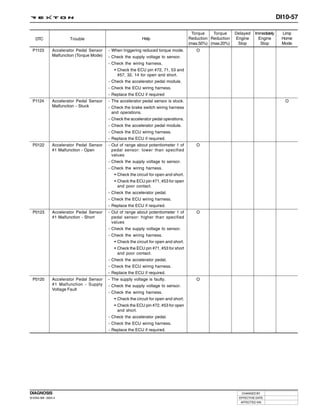


                                                  <Timing marking points on chain>
                                                                                                                   Y220_02086


   • Check marking links on the chain (Gold marking)
   • Locate a point with two continuous marking links and align it to a marking on crankshaft sprocket (      )
   • Align respective marking link to each camshaft sprocket (intake and exhaust) marking ( )
   • Align another marking link to HP pump sprocket marking (         )


ENGINE HOUSING                                                                                CHANGED BY
DI ENG SM - 2004.4                                                                           EFFECTIVE DATE
                                                                                              AFFECTED VIN
DI02-28


                              Removal and Installation
                               1. Remove the cylinder head assembly.
                               2. Remove the oil pan.
                               3. Remove the chain guide rail with a sliding hammer.
                               4. Remove the chain cover.


                 Y220_02087


                               5. Remove the oil pump drive chain.
                               6. Remove the upper guide rail while pushing the retaining
                                  spring with a screwdriver.
                               7. Remove the lower guide rail.
                               8. Remove the oil pump drive chain.


                 Y220_02088


                               9. Remove the tensioning guide rail.


                 Y220_02089


                              10. Remove the timing chain.
                              11. Install in the reverse order of removal.


                                * Thoroughly clean the removed components before
                                  installing.


                 Y220_02090


 CHANGED BY                                                                  ENGINE HOUSING
EFFECTIVE DATE                                                                  DI ENG SM - 2004.4
 AFFECTED VIN
DI02-29

CYLINDER BLOCK


                                                              Deep head bolt thread to prevent the
                                                              deformation at cylinder bore surfaces


                     Internal and external ribs considered         Water jacket design to increase
                            vibration and strength                      the cooling efficiency


                                                                 Cambering type skirt to reduce the noise


                                                                                                                   Y220_02091


     System Characteristics
   • Rib design by considering strength against engine         • Reinforcement of strength
     vibrations and weight                                         - Main bearing housing / Main bearing cap
   • Cambering type skirt design on case housing wall to           - Extended main bearing cap bolt
     reduce the engine noise
   • Water jacket design to increase the cooling efficiency
                                                               • Reducing the noise, vibration and harshness (NVH)
     of cylinder bore bridge
                                                                   - Minimize the vibration by adding external ribs
   • Deep head bolt thread to prevent the deformation at
     cylinder bore surfaces                                        - Adding the ribs around oil pan parting surface


ENGINE HOUSING                                                                                    CHANGED BY
DI ENG SM - 2004.4                                                                               EFFECTIVE DATE
                                                                                                  AFFECTED VIN
DI02-30

   Knock Sensor
Two knock sensors are located on the cylinder block (intake manifold side).
To detect engine vibration under abnormal combustion, knock sensor has piezoelectric element fixed on the
vibration plate and this vibration plate is fixed on the base. If happens knocking, pistons or connecting rods
vibrate and occurs heavy sounds that hit metal. Knock sensor is used to detect those knockings caused by
abnormal combustions. It controls idling stabilities and turns on the engine warning light when detects injector
damages. And also controls pilot injection very precisely during MAP learning.
When knock sensor is defective, engine ECU corrects injection timing based on MAP values like engine speed,
intake air volume and coolant temperature.

     Before checking the knock sensor unit, be sure to check the tightening torque of the sensor and connector
     connecting conditions.

              Insulating resistance                                      Min. 1MΩ
            Resonance frequency                                           25 kHz
           Operating temperature                                     - 40 ~ 150°C
                                                                26 ± 8 mV/g (at 5 kHz)
                  Output voltage                              22 ~ 37 mV/g (3 ~ 10 kHz)
                                                              22 ~ 57 mV/g (10 ~ 20 kHz)
                 Tightening torque                                       20 ± 5 Nm


                       <Location of knock sensor>
                                                                                                          Y220_02092


 1. Sensor housing                                         7. Piezo element
 2. Nut                                                    8. Lower contact plate
 3. Disc spring                                            9. Body
 4. Weight                                                10. Terminal
 5. Insulation disc                                       11. Resister
 6. Upper contact plate


 CHANGED BY                                                                                      ENGINE HOUSING
EFFECTIVE DATE                                                                                       DI ENG SM - 2004.4
 AFFECTED VIN
DI02-31

Notice
The knock sensor should be tightened with the specified tightening torque. Otherwise, the engine output may
be decreased and the “ENGINE CHECK” warning lamp may come on. The internal resistance of the sensor is
approx. 4.7 kΩ.


                                                                          Ground
                     Knock sensor

                                                                          Signal


                                                                          Signal

                     Knock sensor
                                                                          Ground


                                    <Circuit diagram of knock sensor>
                                                                                                     Y220_02093


ENGINE HOUSING                                                                      CHANGED BY
DI ENG SM - 2004.4                                                                 EFFECTIVE DATE
                                                                                    AFFECTED VIN
DI02-32


CRANKSHAFT
   Preceding Works: Removal of end cover
                    Removal of pistons
                    Removal of crankshaft sprocket


                                                                                                          Y220_02094


 3. Crankshaft main bearing shells, upper             7. Lower thrust bearing
 4. Upper thrust bearing                              8. Crankshaft main bearing cap
 5. Crankshaft                                        9. Crankshaft thrust bearing cap
 6. Crankshaft main bearing shells, lower            10. 12-sided stretch bolt ....... 55 ± 5.0 Nm, 90° + 10°


 CHANGED BY                                                                                     ENGINE HOUSING
EFFECTIVE DATE                                                                                       DI ENG SM - 2004.4
 AFFECTED VIN
DI02-33

ARRANGEMENT OF THRUST WASHERS AND BEARINGS


                                                                                                          Y220_02095


   1. Crankshaft                                            4. Crankshaft main bearing shells, lower
   2. Crankshaft main bearing shells, upper                 5. Lower thrust bearing
   3. Upper thrust bearing


Notice
The clearance between bearing shell and bore and between
bearing shell and journal are various. Refer to the table
on next page to select bearings when installing.


ENGINE HOUSING                                                                            CHANGED BY
DI ENG SM - 2004.4                                                                      EFFECTIVE DATE
                                                                                         AFFECTED VIN
DI02-34

   Dimensions of Crankshaft Main Bearing
                                                                                                                         (mm)
                 Color                   Crankshaft Journal      Upper Main Bearing             Lower Main Bearing
                 Blue                       57.965 ~ 57.960         2.260 ~ 2.255                   2.260 ~ 2.255
                 Yellow                     57.960 ~ 57.955         2.265 ~ 2.260                   2.265 ~ 2.260
                  Red                       57.955 ~ 57.950         2.270 ~ 2.265                   2.270 ~ 2.265
                 White                      57.950 ~ 57.945               -                         2.275 ~ 2.270
                 Violet                     57.945 ~ 57.940               -                         2.280 ~ 2.275


   Bearing Clearance
                                                                                                                         (mm)
                              Description                        Crankshaft Bearing                Thrust Bearing
                                                 When new           0.027 ~ 0.051                   0.026 ~ 0.068
       Radial clearance
                                                  Wear limit          Max. 0.070                        Max. 0.080
                                                 When new           0.100 ~ 0.254                           -
        Axial clearance
                                                  Wear limit          Max. 0.300                            -


   Matching the Fit Bearing Journal Width to Thrust Washers
                                                                                                                         (mm)
                    Fit bearing Journal Width                                 Thrust Washer Thickness
                            24.500 ~ 24.533                                              2.15
                            24.600 ~ 24.633                                              2.20
                             24.70 ~ 24.733                                              2.25
                            24.900 ~ 24.933                                              2.35
                            25.000 ~ 25.033                                              2.40


Notice

• Measure the crankshaft axial clearance and correct if necessary with appropriate thrust washers.
• Thrust washers of the same thickness must be installed on both sides of the fit bearing.


   Matching the Crankshaft Bearing Shells to Basic Bearing Bore in Crankcase
 Marking of Basic Bearing Bore in Lower Parting Surface        Relevant Crankshaft Bearing Shell With Color Coding
                          1 punch mark or blue                                   blue or white - blue
                        2 punch marks or yellow                                yellow or white - yellow
                          3 punch marks or red                                     red or white - red


   Matching Crankshaft Bearing Shells to Basic Bearing Journal of Crankshaft
      Marking of Bearing journals on Crank Webs                Relevant Crankshaft Bearing Shell With Color Coding
                           blue or white - blue                                  blue or white - blue
                          yellow or white - blue                               yellow or white - yellow
                           red or white - blue                                     red or white - red

 CHANGED BY                                                                                                 ENGINE HOUSING
EFFECTIVE DATE                                                                                                  DI ENG SM - 2004.4
 AFFECTED VIN
DI02-35

     Selection of Upper Main Bearing Shell
      Punch Mark           Color
                •           Blue
           • •             Yellow
          • • •             Red


                                                               Y220_02096


     Selection of Lower Main Bearing Shell
             Mark          Color
                B           Blue
                Y          Yellow
                R           Red
               W           White
                V          Violet


                                                               Y220_02097


ENGINE HOUSING                                CHANGED BY
DI ENG SM - 2004.4                           EFFECTIVE DATE
                                              AFFECTED VIN
DI02-36

   Crankshaft Position Sensor


                                                                                                          Permanent
                                                                                                          magnet

                                                                                                          Iron

                                                                          Standard                        coil
                                                                          position


                                                                                     Ring gear


                <Location of crankshaft position sensor>            <Structure of crankshaft position sensor>
                                                                                                                      Y220_02098


The crankshaft position sensor is located near to flywheel on the rear of cylinder block. It generates AC voltage between
increment type driven plate that fixed on flywheel inside. The sensor consists of soft iron core that winded copper wire
on permanent magnet and generates sign wave AC voltage when magnetism on the sensor wheel passes the sensor.
When the crankshaft rotates, ‘+’ signal will be generated from near the front edge and ‘-’ signal will be generated from
near the rear edge among teeth on the driven plate near to crankshaft position. The AC voltage increases as the engine
speed increases, however, no signal occurs from the 2-missing-tooth on the increment type driven plate. By using these
teeth, ECU recognizes TDC of No. 1 and 5 cylinders.
ECU converts the alternative signals into digital signals to recognize crankshaft position, piston position and engine
speed. The piston position that coupled with crankshaft is main factor in calculating injection timing. By analyzing the
reference position and camshaft position sensor, can recognize No. 1 cylinder and calculate the crankshaft speed.


                         <Drive plate>
                                                                                                                      Y220_02099


 A. Distance between ‘+’ max. voltage and ‘-’ max.              a. Front edge
     voltage                                                    b. Rear edge
                                                                c. 2-missing-tooth


 CHANGED BY                                                                                              ENGINE HOUSING
EFFECTIVE DATE                                                                                                   DI ENG SM - 2004.4
 AFFECTED VIN
DI02-37


                                                                                                Ground


                                          Crankshaft position                                   Signal
                        Drive plate            sensor


                                         <Circuit diagram of crankshaft position sensor>

                                                                                                                         Y220_02100


                      Output voltage                             Min. voltage: 1.0 V (40 rpm, air gap: 1.3 mm)
                       ( 1 ~ 150 V)                             Max voltage: 150 V (7000 rpm, air gap: 0.3 mm)
         Sensor unit coil resistance (Ω)                                        1,090 ± 15 %
                      Sensor air gap                                            0.3 ~ 1.5 mm
               Operating temperature                                             - 40 ~ 150°C
                     Tightening torque                                            6 ~ 8 Nm


ENGINE HOUSING                                                                                           CHANGED BY
DI ENG SM - 2004.4                                                                                   EFFECTIVE DATE
                                                                                                         AFFECTED VIN
DI02-38

TORSIONAL VIBRATION DAMPER


    Laser welding
                                                     Bearing


                                                    Cover

         Hub


                                                     Bushing


          Pin


                                                     Inertia ring


                                                     Silicone oil


                                                                                                                     Y220_02101


   System Description
 • Components: Hub, inertia mass, cover, bearing, bushing, silicon oil
 • Functions: The crankshaft pulley optimizes the drive system by reducing the amount of torsional vibration in crankshaft.
              Conventional rubber damper is limited in changing materials (rubbers) to absorb vibration, but this crankshaft
              pulley (viscous damper), using silicon oil, takes advantage of less changing viscosity according to the
              temperature.


 CHANGED BY                                                                                                 ENGINE HOUSING
EFFECTIVE DATE                                                                                                  DI ENG SM - 2004.4
 AFFECTED VIN
DI02-39


  Crankshaft - Disassembly
   1. Unscrew the bolts and remove the connecting rod journal
      bearing and bearing caps.

        Notice
        Position the #1 piston at TDC and remove the piston
        connecting rod journal bearing caps.


   2. Remove the bearing cap bolts.
                                                                                   Y220_02102
   3. Remove the bearing caps.

        Notice
        • The crankshaft bearing caps are marked with
          stamped numbers. Start to remove from the
          crankshaft pulley side.
        • Do not mix up the bearing shells.

   4. Remove the bearing caps and lower thrust bearing.
   5. Separate the lower bearing shells from the bearing caps.


                                                                                   Y220_02103


   6. Remove the crankshaft.


                                                                                   Y220_02104


   7. Remove the upper thrust washers.
   8. Remove the upper bearing shells from the crankcase.

        Notice

        Do not mix up the bearing shells.


                                                                                   Y220_02105


ENGINE HOUSING                                                    CHANGED BY
DI ENG SM - 2004.4                                               EFFECTIVE DATE
                                                                  AFFECTED VIN
DI02-40


                              Crankshaft - Reassembly
                              1. Thoroughly clean the oil galleries and check the journal
                                 section and bearings. Replace if necessary.


                 Y220_02106


                              2. Coat the upper thrust washers with oil and insert into the
                                 crankcase so that the oil grooves are facing the crank
                                 webs (arrow).
                              3. Coat the lower thrust washers with oil and insert into the
                                 crankcase so that the oil grooves are facing the crank
                                 webs (arrow).

                                 Notice

                                 The retaining lugs should be positioned in the grooves
                                 (arrow).

                 Y220_02107


                                 Notice
                                 If the maximum permissible length of L= 63.8 mm is
                                 exceeded, the 12-sided stretch bolts should be
                                 replaced.


                 Y220_02108


                              4. Coat the new crankshaft with engine oil and place it on
                                 the crankcase.
                              5. Install the crankshaft bearing caps according to the
                                 markings and tighten the bolts.

                                      Tightening torque          55 ± 5 Nm + 90° + 10°


                                 Notice
                                 Install from #1 cap.


                 Y220_02109


 CHANGED BY                                                                ENGINE HOUSING
EFFECTIVE DATE                                                                 DI ENG SM - 2004.4
 AFFECTED VIN
DI02-41

   6. Position the #1 piston at TDC and install the crankshaft.
   7. Install the piston connecting rod journal to the crankshaft
      journal and tighten the bolts.
   8. Measure the crankshaft bearing axial clearance.
           • When new: 0.100 ~ 0.245 mm
           • When used: 0.300 mm
   9. Rotate the crankshaft by hand and check whether it
      rotates smoothly.


                                                                                      Y220_02110


ENGINE HOUSING                                                       CHANGED BY
DI ENG SM - 2004.4                                                  EFFECTIVE DATE
                                                                     AFFECTED VIN
DI02-42


 FLYWHEEL
DUAL MASS FLYWHEEL (DMF, MANUAL TRANSMISSION EQUIPPED VEHICLE)

                                                                   Primary wheel
                                              Ring gear


                 Primary wheel
                                                    Secondary
                                                      wheel


                                                Plastic bushing


                                                                                                              Y220_02111


   System Description
This flywheel is installed to the rear end of crankshaft and transfers the output from the engine to the power train
mechanism. When starting the engine, this drive the crankshaft train mechanism initially by using the power from the
start motor. Also, DMF measure the crankshaft speed, sends the signals to ECU, and controls the ignition timing.


                  Conventional flywheel                                    DMF


                                                                                                              Y220_02147


 CHANGED BY                                                                                          ENGINE HOUSING
EFFECTIVE DATE                                                                                           DI ENG SM - 2004.4
 AFFECTED VIN
DI02-43

     Structure
Function and characteristics
 • When the output changes from the engine is high during
   power stroke ( ): The damper absorbs the shocks to
   reduce the changes to transmission.
   • When the output changes from the engine is low during
     compression stroke ( ): The damper increases the torque
     changes to clutch.


                                                                                                                <Example of DMF operation>
                                                                                                                                                  Y220_02112


<Torque change curve of engine and drive shaft>
                     Angular acceleration amplitude [1/s 2]


                                                              Conventional system                                   DMFW

                                                                                                                                  Engine


                                                                                    Engine


                                                                                Transmission
                                                                                                                           Transmission


                                                                  Speed [rpm]                                    Speed [rpm]
                                                                                                                                                  Y220_02113


     System Characteristics
Function                                                                                       Advantages of DMF
 • Filters irregularities of engine: The secondary flywheel                                     • Improved torque response by using 3-stage type spring:
   operates almost evenly so does not cause gear noises                                           Strengthens the torque response in all ranges (low,
   • The mass of the primary flywheel is less than                                                medium, and high speed) by applying respective spring
     conventional flywheel so the engine irregularity                                             constant at each range.
     increases more (less pulsation absorbing effect)                                           • Stable revolution of the primary and secondary wheel
   • Transmission protection function: Reduces the load to                                        by using planetary gear: Works as auxiliary damper
     powertrain (transmission) by blocking the irregularity                                       against spring changes
     of engine                                                                                  • Less heat generation due to no direct friction against
                                                                                                  spring surface: Plastic material is covered on the spring
Characteristics of DMF                                                                            outer surface
 • Reduced vibration noise from the powertrain by blocking
                                                                                                • Increased durability by using plastic bushing (extends
   the torsional vibrations
                                                                                                  the lifetime of grease)
   • Enhanced vehicle silence and riding comforts: reduced
     engine torque changes
   • Reduced shifting shocks
   • Smooth acceleration and deceleration
ENGINE HOUSING                                                                                                                  CHANGED BY
DI ENG SM - 2004.4                                                                                                             EFFECTIVE DATE
                                                                                                                                AFFECTED VIN
DI02-44


PISTON AND CONNECTING ROD


                                                                                                        Y220_02114


 1. Piston                                        4. Oil ring
 2. No.1 compression ring                         5. Piston pin
 3. No.2 compression ring                         6. Snap ring


                         Description                                   D27 DT ENG
Cylinder bore diameter                                               φ 86.2 (0~0.018) mm
Piston outer diameter (D1)                                          φ 86.133    (±0.009)   mm
Clearance between bore and piston                                          74
Piston cooling gallery                                                    Applied
Pin offset                                                                  N/A
Compression ratio                                                          18 : 1
Length of piston pin                                                     71.2 mm
Material of top ring / coating                                      Steel / Gas nitride
Tightening torque of connecting rod bolt                          40 ± 5.0 Nm, 90° + 10°
Permissible weight difference of connecting rod                             4g
Thickness of connecting rod bearing (Red)                           1.806 ~ 1.809 mm
Thickness of connecting rod bearing (Yellow)                        1.809 ~ 1.812 mm
Thickness of connecting rod bearing (Blue)                          1.812 ~ 1.815 mm


 CHANGED BY                                                                                     ENGINE HOUSING
EFFECTIVE DATE                                                                                     DI ENG SM - 2004.4
 AFFECTED VIN
DI02-45

PISTON RING

   1. No.1 compression ring
   2. No.2 compression ring
   3. Oil ring
   5. Coil spring and oil control ring
   6. Hook spring


                                                                                      Y220_02115


     Replacement of Piston Ring
   • Measure piston ring end play.
         - Piston ring end play (mm)
            1st groove: 0.20 ~ 0.35
            2nd groove: 0.20 ~ 0.35
            3rd groove: 0.20 ~ 0.40
         - Clearance between piston ring and piston (mm)
            1st compression ring: 0.075 ~ 0.119
            2nd compression ring: 0.050 ~ 0.090
            3rd oil ring: 0.030 ~ 0.070                                               Y220_02116


   • Install the piston so that “Y” marking on piston head is
     facing in the direction of travel. Arrange the piston ring
     ends to be 120° apart.
   • Adjust the hook spring joint in the oil ring 180 ° away from
     the ring end.


ENGINE HOUSING                                                       CHANGED BY
DI ENG SM - 2004.4                                                  EFFECTIVE DATE
                                                                     AFFECTED VIN
DI02-46

CYLINDER INNER DIAMETER AND PISTON SIZE


                                                                         Y220_02117


                                                                   (Unit : mm)
       Engine    Code   Used piston   Cylinder Diameter   Piston Diameter
        D27DT     A       A or X       86.200 ~ 86.206    86.124 ~ 86.130
                  X      A, B or X     86.206 ~ 86.212    86.129 ~ 86.137
                  B       B or X       86.212 ~ 86.218    86.136 ~ 86.142
                 +5         +5         86.250 ~ 86.260    86.167 ~ 86.181
                 + 10      + 10        86.300 ~ 86.310    86.217 ~ 86.231


 CHANGED BY                                                     ENGINE HOUSING
EFFECTIVE DATE                                                      DI ENG SM - 2004.4
 AFFECTED VIN
DI02-47


  Piston - Reassembly
   1. Install the compression ring and oil ring on the piston
      with a special tool.


                                                                                    Y220_02118


        Arrange the piston ring ends to be 120° apart.

        Notice
        • Install the No.1 and No.2 pistons so that “Y” marking
          on piston head is facing upward.
        • No.1 piston ring is thicker than No.2 piston ring.
        • Arrange the oil ring end to opposite position of
          current ring end.
        • Oil ring is not directional.
        • Make sure that the piston ring end is not aligned to
          axial direction and lateral direction.                                    Y220_02119


   2. Check the clearance of piston oil ring and compression
      ring with a thickness gauge and adjust if necessary.

                     1st groove          0.20 ~ 0.35 mm
                     2nd groove          0.20 ~ 0.35 mm
                     3rd groove          0.20 ~ 0.40 mm

     * Piston ring end play (mm)
        1st groove: 11.0 mm
        2nd groove: 10.5 mm
        3rd groove: 7.0 mm
                                                                                    Y220_02120


   3. Check the clearance of piston rings with a thickness
      gauge and adjust if necessary.

             No.1 compression ring        0.075 ~ 0.119 mm
              2nd compression ring        0.050 ~ 0.090 mm
                        3rd oil ring      0.040 ~ 0.080 mm


                                                                                    Y220_02121


ENGINE HOUSING                                                     CHANGED BY
DI ENG SM - 2004.4                                                EFFECTIVE DATE
                                                                   AFFECTED VIN
DI02-48

                              4. Fit the piston onto connecting rod so that the marking
                                 on piston crown and locking slot are facing to straight
                                 ahead direction.

                                Notice
                                Install the piston so that the piston recess (marking)
                                or the stamped surface of connecting rod is facing to
                                straight ahead direction.


                 Y220_02122


                              5. Lubricate piston pin and push in by hand.

                                Notice
                                Do not heat up the piston.

                              6. Place new snap rings into the grooves.

                                Notice

                                The snap rings should be replaced with new one.

                              7. Lubricate the cylinder bore, connecting rod bearing
                 Y220_02123
                                 journals, connecting rod bearing shells and pistons.

                              8. Push piston into the cylinder with a wooden stick.

                                Notice

                                The marking on the piston crown must be facing to
                                straight ahead direction.


                 Y220_02124


                              9. Insert connecting rod bearing shells.

                                Notice

                                • The upper and lower connecting rod bearings have
                                  same appearance. Therefore, make sure to check
                                  the part number before replacing them.
                                • Install bearing rod bearing cap so that so that the
                                  retaining lugs are on the same side of the
                                  connecting rod bearing.


                 Y220_02125


 CHANGED BY                                                               ENGINE HOUSING
EFFECTIVE DATE                                                               DI ENG SM - 2004.4
 AFFECTED VIN
DI02-49

 10. Measure stretch shaft diameter of the connecting rod
     bolts.

                       Limit “C”              7.1 mm


                                                                                 Y220_02126


  11. Lubricate the new connecting rod bolts and tighten.

                                            40 ± 5.0 Nm,
                 Tightening torque
                                              90° + 10°

           • End play of connecting rod cap

                     Specified value       0.5 ~ 1.5 mm


                                                                                 Y220_02127


 12. Position piston to TDC and measure the distance between
     piston and parting surface of crankcase.

              Permissible piston
                                        0.765 ~ 1.055 mm
                 protrusion

           • Measure at both ends of axial direction.


                                                                                 Y220_02128


ENGINE HOUSING                                                  CHANGED BY
DI ENG SM - 2004.4                                             EFFECTIVE DATE
                                                                AFFECTED VIN
DI02-50

   Special Tools and Equipment
       Name and Part Number            Application

Piston protrusion measuring jig


                          Y220_02129                         Y220_02130


Piston insertion jig


                          Y220_02131                         Y220_02132


 CHANGED BY                                          ENGINE HOUSING
EFFECTIVE DATE                                          DI ENG SM - 2004.4
 AFFECTED VIN
DI02-51


  HIGH PRESSURE PUMP (HPP)

COMPONENTS LOCATOR


                                                                        High pressure
                                                                             line
                                                    Low pressure line              Venturi return line


                                                           Fuel temperature sensor


                                   IMV connector

                                                                                     Inlet Metering
                                                                                      Valve (IMV)


                                                          High pressure
                                                           supply line


                                                                                                Y220_02133


   1. Inlet Metering Valve (IMV)       7. Low pressure pump
   2. Hydraulic pressure head          8. Fuel temperature sensor
   3. Plunger                          9. Venting
   4. Drive shaft and cam ring        10. High fuel pressure supply line
   5. Housing                         11. Pressure regulator
   6. Roller and shoe


ENGINE HOUSING                                                             CHANGED BY
DI ENG SM - 2004.4                                                        EFFECTIVE DATE
                                                                           AFFECTED VIN
DI02-52


                               HP Pump - Disassembly and Reassembly
                                Preceding works:
                                 - Removal of fan belt (including cooling fan and fan clutch)
                                   and fan shroud
                                 - Removal of intake manifold assembly
                                 - Removal of water pump pulley
                                 - Removal of auto tensioner
                                 - Removal of EGR pipe
                                 - Removal of oil dipstic gauge
                 Y220_02134

                              Notice
                              • To prevent oil leaks, store the removed auto tensioner
                                in upright position.
                              • Be careful not to damage the rubber bellows.
                              • Plug the oil ports for HP pump with sealing caps.


                                1. Set crankshaft pulley to OT point. Open the oil filler cap
                                   and check if the cam shaft notch marking is aligned to
                                   OT point.


                 Y220_02135


                                2. Remove the cooling fan idle pulley with a pulley holder
                                   (special tool).


                 Y220_02136


 CHANGED BY                                                                  ENGINE HOUSING
EFFECTIVE DATE                                                                   DI ENG SM - 2004.4
 AFFECTED VIN
DI02-53

   3. Remove the cooling fan bracket assembly.

        Notice

        Be careful not to get the sealant or foreign materials
        into the engine.


                                                                                   Y220_02137


   4. Place the marks on the chain and HP pump sprocket for
      installation.


                                                                                   Y220_02138


   5. Remove the vacuum modulator bracket.
   6. Remvoe the fuel pipes and wiring connectors which
      connected to fuel pump.


                                                                                   Y220_02148


   7. Turn the crankshaft pulley to the counter clockwise
      direction to ATDC 45° then remove the chain tensioner.
        Installation Notice

                 Tightening torque         80 ± 8Nm


                                                                                   Y220_02149


ENGINE HOUSING                                                    CHANGED BY
DI ENG SM - 2004.4                                               EFFECTIVE DATE
                                                                  AFFECTED VIN
DI02-54

                               8. While insert finger and push the chain guide backward
                                  direction and turn the crankshaft pulley to ATDC 65° by
                                  counter clockwise direction until feel the chain guide
                                  inclined backward.


                 Y220_02139


                               9. Install a special tool into the cooling fan bracket hole to
                                  hold the sprocket.


                 Y220_02140


                              10. Remove the sprocket bolts and center nut and after
                                  slightly lifted up the chain, remove the pump sprocket.
                                  Installation Notice

                                       Tightening torque                    Nm
                                         Sprocket bolt                 20 Nm + 90°
                                           Center nut                   65 ± 5 Nm


                 Y220_02141


                              11. Remove the HP pump bearing with HP pump bearing
                                  puller (special tool).

                                  Notice
                                  Do not apply excessive force. The timing chain may
                                  deviates.


                 Y220_02142


 CHANGED BY                                                                  ENGINE HOUSING
EFFECTIVE DATE                                                                   DI ENG SM - 2004.4
 AFFECTED VIN
DI02-55

 12. Remove the HP pump mounting bracket.
        Installation Notice

                 Tightening torque       24 ± 2.4 Nm


                                                                                 Y220_02143


 13. Unscrew the external bolts and remove the HP pump
     while rocking and tapping it with a rubber hammer.

        Notice

        • To prevent HP pump shaft damaging, do not apply
          excessive impact.
        • Do not apply excessive force. The timing chain may
          deviates.


                                                                                 Y220_02144


 14. Remove the HP pump.


 15. Install the new HP pump with sealing caps.

        Notice
        Remove the sealing caps only when connecting the
        pipes and hoses.

 16. When replaced the HP pump, initialize the fuel pressure
     by using SCAN-100. Refer to “Trouble Diagnosis” section
     in this manual.
                                                                                 Y220_02145


ENGINE HOUSING                                                  CHANGED BY
DI ENG SM - 2004.4                                             EFFECTIVE DATE
                                                                AFFECTED VIN
DI02-56

                                  Notice

                                  If the initialization of fuel pressure has not been
                                  performed, the engine ECU controls new HP pump
                                  with the stored offset value. This may cause the poor
                                  engine output.


                                  Install in the reverse order of removal and tighten the
                                  fasteners with the specified tightening torque.


                               1. HP pump sprocket
                               2. 12-sided sprocket mounting bolt
                               3. HP pump bearing housing
                               4. HP pump (High Pressure Pump)
                               5. HP pump shaft
                               6. HP pump center nut
                               7. HP pump outer bolt
                               8. HP pump bearing shaft
                               9. Oil gallery
                              10. Bearing bushing
                              11. Gasket

                                * Tightening torque
                 Y220_02146
                                                Center nut
                                                                       65 ± 5.0 Nm
                                         (M14 x 1.5 - 1EA)
                                                Outer bolt
                                                                       24 ± 2.4 Nm
                                           (M8 x 55 - 3EA)
                                            Sprocket bolt
                                                                       20 Nm ± 90°
                                           (M7 x 13 - 3EA)


 CHANGED BY                                                                ENGINE HOUSING
EFFECTIVE DATE                                                                 DI ENG SM - 2004.4
 AFFECTED VIN
SECTION   DI03


    INTAKE SYSTEM
DI03-1


           SECTION DI03
               00


                          INTAKE SYSTEM

                           Table of Contents

                           AIR FLOWS ................................................................. DI03-3

                           INTAKE SYSTEM LAYOUT ......................................... DI03-4
                               Components locator ............................................... DI03-4
                               Air cleaner ............................................................... DI03-5
                               Air flow sensor
                               (hot film air mass sensor) ....................................... DI03-8
                               Intercooler ............................................................. DI03-14
                               Intake manifold assembly ..................................... DI03-16
                           SPECIAL TOOLS AND EQUIPMENT ........................ DI03-17


INTAKE SYSTEM                                                                   CHANGED BY
DI ENG SM - 2004.4                                                            EFFECTIVE DATE
                                                                               AFFECTED VIN
DI03-3


  AIR FLOWS


                                                                           Intake Valve
                                                                     (in combustion chamber)


                                                                                                                  Intake Manifold


                     Air Cleaner


                                                           Turbo
                                                           Charger          Engine


                                   HFM Sensor


                                         Intake Air Outlet Hose         Intercooler                Intake Air Inlet Hose


                                                                                                                               Y220_03001


     Work Flow of Intake System
                                                                                                                     Combustion
        Air                     HFM                   Turbo                                     Intake
                                                                      Intercooler                                    Chamber in
      Cleaner                  Sensor                Charger                                   Manifold
                                                                                                                       Engine


INTAKE SYSTEM                                                                                               CHANGED BY
DI ENG SM - 2004.4                                                                                        EFFECTIVE DATE
                                                                                                           AFFECTED VIN
DI03-4


INTAKE SYSTEM LAYOUT

COMPONENTS LOCATOR


                 Air cleaner   Intake manifold


                 HFM sensor      Intercooler


                                                       Y220_03002


 CHANGED BY                                    INTAKE SYSTEM
EFFECTIVE DATE                                    DI ENG SM - 2004.4
 AFFECTED VIN
DI03-5

AIR CLEANER


                        Cover


                       Element


                       Housing


                                                                                                                 Y220_03003


     Specifications
            Element Type                                          Dry-Element Type
                                 * Initial cleaning: 5,000 km, Clean or change every 10,000 km as required.
                                   However, change every 30,000 km.
            Service Interval
                                 * If the vehicle is operated under severe condition (short distance driving, extensive
                                   idling or driving in dusty condition): More frequent maintenance is required.


INTAKE SYSTEM                                                                                   CHANGED BY
DI ENG SM - 2004.4                                                                            EFFECTIVE DATE
                                                                                               AFFECTED VIN
DI03-6


                              Air Cleaner Element - Replacement
                              Preceding Work: Disconnection of negative battery cable


                              1. Disconnect the HFM sensor connector.
                              2. Loosen the locking clamp and remove the intake duct.


                 Y220_03004


                              3. Unscrew the screws and remove the air cleaner cover.


                 Y220_03005


                              4. Remove the air cleaner element. Clean or replace the
                                 element as required.


                 Y220_03006


 CHANGED BY                                                             INTAKE SYSTEM
EFFECTIVE DATE                                                             DI ENG SM - 2004.4
 AFFECTED VIN
DI03-7


  Air Cleaner Housing
  - Removal and Installation
    Preceding Work: Removal of air cleaner cover


   1. Set aside the return hose and remove the coolant reservoir
      bolts.


                                                                                     Y220_03007


   2. Remove the air cleaner housing bolts.
   3. Install in the reverse order of removal.


                                                                                     Y220_03008


  Air Cleaner Housing/Element - Check
   1. Check the air cleaner body, cover and packing for
      deformation, corrosion and damage.
   2. Check the air duct for damage.


                                                                                     Y220_03009


   3. Check the air cleaner element for clogging, contamination
      and damage. If the element is partially clogged, remove
      the dust or foreign materials with the compressed air. If
      the contamination is severe, replace it with new one. Also,
      be careful not to contaminate during the replacement.
   4. Check the air cleaner housing for clogging, contamination
      and damage.
   5. If the inside of housing is contaminated, remove the
      contaminants.
        Notice
        When cleaning the air cleaner with compressed air,
        direct the air from inside (engine) to outside (ambient
        air). Otherwise, contaminants can get into the engine.                       Y220_03010


INTAKE SYSTEM                                                        CHANGED BY
DI ENG SM - 2004.4                                                  EFFECTIVE DATE
                                                                     AFFECTED VIN
DI03-8

AIR FLOW SENSOR (HOT FILM AIR MASS SENSOR)


                                                                                        Change history
                                                                                        inner tube added + grid (No.3)
                                                                                        added + sensing chip changed +
                                                                                        sensing section design changed


                                                                                        Results
                                                                                        Durability has enhanced 60
                                                                                        times (lab test results)


                                           <CI type HFM sensor structure>
                                                                                                                      Y220_03011


  1. Plug-in sensor                                               7. Hybrid
  2. Cylinder housing                                             8. Sensor
  3. Protection grid                                              9. Mounting plate
  4. Hybrid cover                                                10. O-ring
  5. Measuring duct cover                                        11. Temperature sensor
  6. Housing


Air flow sensor is locating on the air intake passage between air cleaner and intake manifold and measures air volume
flows to engine combustion chamber and intake air temperature.
And intake temperature sensor built-in the sensor detects intake temperature.
Internal circuit of the air flow sensor is being used to control the voltage value to control the temperature to maintain the
heating resistance (Rh) to 160°C that is higher temperature than intake air temperature that is measured by resistance
(RI).
Temperature sensor of the heating resistance (Rh) is measured by resistance (Rs).
If temperature changes occur due to increasing/decreasing intake air volume, voltage of the heating resistance changes
to maintain the intake air temperature changes to set value (160°C).
Control unit computes intake air volume based on voltage changes of heating resistance.
Intake air temperature is measured by NTC integrated in the sensor.


  CHANGED BY                                                                                                 INTAKE SYSTEM
EFFECTIVE DATE                                                                                                   DI ENG SM - 2004.4
 AFFECTED VIN
DI03-9

Intake air temperature sensor is a part of HFM sensor and a thermister and resister and detects air temperature
changes that flow into the engine. There occurs high resistance when temperature is low and low resistance when high
(NTC type).
ECU supplies 5 V to intake air temperature sensor and then measures voltage changes to determine the intake air
temperature. When air in the intake manifold is cold, the voltage is high and air is hot, the voltage is low.
The reason for using HFM sensor is that this sensor is most proper in controlling accurate air-fuel ratio to meet the legal
emission regulations. This sensor measures actual intake air mass into engine very accurately during specific instant
acceleration and deceleration, and determines engine loads and detects intake air pulsation and air flows.


Main functions of HFM sensor are:
   • Using for EGR feedback control
   • Using for turbocharger booster pressure control valve control
   • Using for fuel injecting compensation
CI type HFM sensor: The air flowing the sensor does not directs toward sensing section but flows along with lower wall
after passing protection grid to enhance durability of the sensor. Oil, water and dust less damage the sensor.


                     Air outlet                                   Air inlet


                                         <Structure of CI type HFM sensor>
                                                                                                                  Y220_03012


INTAKE SYSTEM                                                                                    CHANGED BY
DI ENG SM - 2004.4                                                                             EFFECTIVE DATE
                                                                                                AFFECTED VIN
DI03-10


                                               Power supply


                 Intake air
                 flow
                 sensor


                                                                        Ground


                                                                        Ground

                                                                                 Signal


                 Intake air temperature
                         sensor
                      HFM sensor

                                          <Circuit diagram of HFM sensor>
                                                                                                  Y220_03013


 CHANGED BY                                                                               INTAKE SYSTEM
EFFECTIVE DATE                                                                               DI ENG SM - 2004.4
 AFFECTED VIN
DI03-11


  HFM Sensor - Removal and Installation


                      HFM sensor


                                                                                Y220_03014


    Preceding Work: Disconnection of negative battery cable


   1. Disconnect the negative battery cable.
   2. Loosen the clamps on the air cleaner and the turbo
      charger and remove the duct.


                                                                                Y220_03015


   3. Unscrew the bolts and remove the HFM sensor assembly.

                 Tightening torque      10 ± 1.0 Nm


                                                                                Y220_03016


INTAKE SYSTEM                                                  CHANGED BY
DI ENG SM - 2004.4                                            EFFECTIVE DATE
                                                               AFFECTED VIN
DI03-12

                              4. Install in the reverse order of removal.


                 Y220_03017


                              Intake Air Outlet Hose (Turbo Charger)
                              - Removal and Installation
                              1. Remove the radiator grille.


                 Y220_03018


                              2. Loosen the clamp at both sides and remove the outlet
                                 hose.


                 Y220_03019


                              3. Loosen the clamp on the intake air hose and remove the
                                 intake air hose.
                                 Installation Notice

                                      Tightening torque                 6 ~ 7 Nm

                              4. Install in the reverse order of removal.

                                 Notice

                                 Securely fasten the clamps on the pipes and hoses.


                 Y220_03020


 CHANGED BY                                                                 INTAKE SYSTEM
EFFECTIVE DATE                                                                 DI ENG SM - 2004.4
 AFFECTED VIN
DI03-13


  Intake Air Inlet Duct (Air Cleaner)
  - Removal and Installation
   1. Loosen the clamp at intercooler side.
   2. Loosen the clamp at turbo charger side.


                                                                                  Y220_03021


   3. Separate the hose from the oil separator and remove the
      intake duct.
   4. Install in the reverse order of removal.


                                                                                  Y220_03022


  Intake Air Inlet Duct (Intake Manifold)
  - Removal and Installation
   1. Loosen the clamp on the inlet hose in intercooler.


                                                                                  Y220_03023


   2. Loosen the clamp at the intake manifold and remove the
      inlet hose.
        Installation Notice

                 Tightening torque           6 ~ 7 Nm

   3. Install in the reverse order of removal.


                                                                                  Y220_03024


INTAKE SYSTEM                                                    CHANGED BY
DI ENG SM - 2004.4                                              EFFECTIVE DATE
                                                                 AFFECTED VIN
DI03-14

INTERCOOLER
The turbo charger is designed to improve the engine power by introducing more air (oxygen) into the engine. However,
the intake air is heated (100 ~ 110°C) during the compression process in turbo charger compressor and the density is
lowered.
The intercooler is the device which cools (50 ~ 60°C) the air entering the engine. Colder air has more oxygen molecules
than warm air. Thus cooler air gives more power and better fuel economy.


                                                                                                                Y220_03025


  1. Intercooler


 CHANGED BY                                                                                             INTAKE SYSTEM
EFFECTIVE DATE                                                                                             DI ENG SM - 2004.4
 AFFECTED VIN
DI03-15


  Intercooler - Removal and Installation
   1. Remove the radiator grille.


                                                                                     Y220_03018


   2. Loosen the clamp at both sides (inlet and outlet) of the
      intercooler.
        Installation Notice

                 Tightening torque           6 ~ 7 Nm


                                                                                     Y220_03027


   3. Remove the intercooler mounting bolts.
        Installation Notice

                 Tightening torque         10 ± 1.0 Nm


                                                                                     Y220_03028


   4. Remove the air duct in intake manifold and the intercooler
      assembly.


   5. Install in the reverse order of removal.                                       Y220_03029


INTAKE SYSTEM                                                       CHANGED BY
DI ENG SM - 2004.4                                                 EFFECTIVE DATE
                                                                    AFFECTED VIN
DI03-16

INTAKE MANIFOLD ASSEMBLY


                                                                                                            Y220_03030


   System Characteristics
 • Shape that delivers the required capacity of compressed air from turbo charger to inlet port
 • Optimized EGR gas mixture in inlet chamber
 • Maximized intake efficiency with helical and tangential inlet port
      - Improving the swirl ratio in low and mid operating range
      - Improving the acceleration/fuel economy and reducing the maintenance in low and mid operating range
 • Integrated inlet port and coolant outlet port


 CHANGED BY                                                                                         INTAKE SYSTEM
EFFECTIVE DATE                                                                                         DI ENG SM - 2004.4
 AFFECTED VIN
DI03-17


  SPECIAL TOOLS AND EQUIPMENT

          Name and Part Number                                              Application
  Intake manifold locking guide pin       Installation of intake manifold


                             Y220_03031                                                                     Y220_03032


INTAKE SYSTEM                                                                              CHANGED BY
DI ENG SM - 2004.4                                                                        EFFECTIVE DATE
                                                                                           AFFECTED VIN
DI03-18


                              Intake Manifold - Removal/Installation
                               Preceding Work: Disconnection of negative battery cable


                              1. Lift up the vehicle and remove the skid plate.


                 Y220_03033


                              2. Open the coolant reservoir cap and remove loosen the
                                 drain cock to drain the coolant.


                 Y220_03034


                              3. Remove the air inlet hose (1) from intake manifold.
                              4. Loosen the clamp and remove the coolant inlet hose (2).


                 Y220_03035


                              5. Remove the coolant inlet port housing.
                              6. Remove the vacuum hose from EGR valve.
                              7. Remove the EGR valve mounting bolts and gasket.
                                 Remove the EGR exhaust pipe (primary) mounting bolts
                                 and gasket.

                                 Notice

                                 • Replace the pipes (2, 3) at both sides of EGR cooler
                                   (1) and gaskets with new ones.
                                 • Make sure that the convex surface of gasket is facing
                                   to the pressurized direction.
                 Y220_03036


 CHANGED BY                                                                INTAKE SYSTEM
EFFECTIVE DATE                                                                DI ENG SM - 2004.4
 AFFECTED VIN
DI03-19

   8. Remove the brackets and connectors from top section of
      the engine.
           - Vacuum hose bracket in turbo charger
           - Booster pressure sensor
           - Main wiring bracket
           - Ground cable bracket
           - Fuel pressure sensor connector
   9. Unscrew the bolts and remove the vacuum modulator
      bracket.

                 Tightening torque            9.0 Nm
                                                                                 Y220_03037


 10. Remove the HP pump fuel supply line bolts.
  11. Remove the HP pump fuel supply line mounting bracket.
 12. Remove the HP pump fuel return line at fuel filter.

        Notice

        • Plug the openings of pipes and ports with sealing
          caps to keep the cleanness of the fuel system.
        • Replace the pipes with new one once removed.


                                                                                 Y220_03038


 13. Remove the injector return line at HP pump.

        Notice

        • Be careful not to damage the pipes to HP pump.
        • Plug the fuel return port of the HP pump with a
          sealing cap.


                                                                                 Y220_03039


INTAKE SYSTEM                                                   CHANGED BY
DI ENG SM - 2004.4                                             EFFECTIVE DATE
                                                                AFFECTED VIN
DI03-20

                              14. Remove the intake manifold mounting bolts.

                                  Notice

                                  1. Check the length of the bolts before installation.
                                     M8 x 45: 6EA
                                     M8 x 130: 6EA

                                           Tightening torque            25 ± 2.5 Nm


                 Y220_03040


                              15. Lift up the vehicle and remove the propeller shaft joint
                                  bolts.
                              16. Unscrew the bolt in oil filter and remove the intake
                                  manifold and gasket.

                                  Notice
                                  • Replace the gasket with new one.
                                  • Make sure that the residual coolant in intake
                                    manifold gets into the inside of inlet port.


                 Y220_03041   17. Install in the reverse order of removal.

                                  Notice
                                  • Replace the gasket with new one.
                                  • If replaced only gasket without any other service
                                    operation, completely remove the coolant and other
                                    contaminants from the engine before installation.


 CHANGED BY                                                                  INTAKE SYSTEM
EFFECTIVE DATE                                                                  DI ENG SM - 2004.4
 AFFECTED VIN
SECTION   DI04


  EXHAUST SYSTEM
DI04-1


           SECTION DI04
               00


                     EXHAUST SYSTEM

                          Table of Contents

                          EXHAUST SYSTEM LAYOUT ..................................... DI04-3
                             Components locator ............................................... DI04-3
                             Exhaust gas flows ................................................... DI04-4
                             Turbo charger assembly ......................................... DI04-6
                          EGR VALVE AND VACUUM MODULATOR ............... DI04-27
                             EGR system .......................................................... DI04-27
                             EGR valve and turbo charger actuator
                             control vacuum circuit ........................................... DI04-28
                          EXHAUST SYSTEM AND MUFFLER ........................ DI04-36
                             Muffler ................................................................... DI04-36
                             System overview ................................................... DI04-37


EXHAUST SYSTEM                                                                 CHANGED BY
DI ENG SM - 2004.4                                                           EFFECTIVE DATE
                                                                              AFFECTED VIN
DI04-3


  EXHAUST SYSTEM LAYOUT
COMPONENTS LOCATOR

                     Muffler                 Exhaust manifold            EGR valve


                                 Catalytic converter
                 Turbo charger          (DOC)              EGR pipe   Vacuum modulator


                                                                                         Y220_04001


EXHAUST SYSTEM                                                           CHANGED BY
DI ENG SM - 2004.4                                                      EFFECTIVE DATE
                                                                         AFFECTED VIN
DI04-4

EXHAUST GAS FLOWS
                              Catalytic converter         Exhaust pipe               Muffler


                 A
                                                                                                                     Atmo-
                                                                                                                    sphere


                                            A       Exhaust gas


                 Turbo charger
                  (turbine side)


                                                                                                      EGR vacuum modulator

                                                                                                      To turbo
                                                                                                      charger booster
                                                                                                      Turbo charger booster
                                                                                                      vacuum modulator


    Turbo charger booster                                                                             EGR valve

           Exhaust manifold

                  Blow-by gas


                                                                     EGR pipe
                                                                                                                       Y220_04002


   Engine
                                     Exhaust                        Turbo                  Exhaust
 -Combustion                                                                                                      Atmosphere
                                     Manifold                      Charger                  Muffler
  Chamber-


                                                                                 Intake
                                                       EGR Valve
                                                                                Manifold


 CHANGED BY                                                                                                EXHAUST SYSTEM
EFFECTIVE DATE                                                                                                     DI ENG SM - 2004.4
 AFFECTED VIN
DI04-5


  Exhaust Manifold
  - Removal and Installation
   1. Remove the two intake hoses from the turbo charger.


                                                                                Y220_04003


   2. Remove the turbo charger assembly (refer to Turbo
      Charger section).


                                                                                Y220_04004


   3. Remove the #3 pipe of EGR valve from the exhaust
      manifold.

        Notice

        The #3 pipe of EGR valve is exposed to the high
        temperature and pressure of exhaust gas. Replace
        the gasket and pipe with new ones. Otherwise, it may
        cause the leakage of exhaust gas.

                Tightening torque          35 ± 3.5 Nm

                                                                                Y220_04005


   4. Unscrew the nuts and remove the exhaust manifold and
      gasket.

                Tightening torque          40 ± 4.0 Nm


        Notice

        Replace the gasket with new one.

   5. Install in the reverse order of removal.


                                                                                Y220_04006


EXHAUST SYSTEM                                                  CHANGED BY
DI ENG SM - 2004.4                                             EFFECTIVE DATE
                                                                AFFECTED VIN
DI04-6

TURBO CHARGER ASSEMBLY
The turbo charger is an air pump installed on the intake manifold. It enhances power and increases torque power of
engine to increase the fuel consumption rate. The engine without turbo charger cannot get as much power output as it
inducts air by the means of vacuum being generated from descending strokes of the piston. Therefore, by installing the
turbo charger on the intake manifold, it supplies great amounts of air to the cylinder increasing the volume efficiency
and, subsequently, enhances output power.
Also, as the engine’s power enhances, it increases the torque power and improves the fuel consumption rate. The
regular turbo charger operates by utilizing the pressure from the exhaust gas and the other, called Super Charger,
operates by utilizing power from the engine. When the turbo charger is installed, weight of the engine increases by 10
to 15 % whereas the output power increases by 35 to 45 %.


                                                                                                                            Y220_04007


                                                                      Operating Principle of Turbo Charger
                                                                   The turbo charger has one shaft where at each ends are in-
                                                                   stalled with two turbines having different angles to connect
                                                                   one end of housing to the intake manifold and the other end to
                                                      Turbine
                              Impeller                             the exhaust manifold. As the turbine, at exhaust end, is ro-
                                                                   tated by exhaust gas pressure the impeller, at intake end,
                              Intercooler                          gets rotated to send air around center of the impeller, being
                                                                   circumferentially accelerated by the centrifugal force, into the
                                                                   diffuser.
                 Intake                     Exhaust                The air, which has been introduced to the diffuser having a
                                                                   passage with big surface, transforms its speed energy into
                      Intercooler                                  the pressure energy while being supplied to the cylinder im-
                        coolant                                    proving the volume efficiency. Also, the exhaust efficiency
                                                      Y220_04008   improves as the exhaust turbine rotates. The turbo charger is
                                                                   often referred to as the exhaust turbine turbo charger.
                                                                   Diffuser: With the meaning of spreading out it is a device that
                                                                   transforms fluid’s speed energy into the pressure energy by
                                                                   enlarging the fluid’s passage to slow down the flow.

  CHANGED BY                                                                                                     EXHAUST SYSTEM
EFFECTIVE DATE                                                                                                         DI ENG SM - 2004.4
 AFFECTED VIN
DI04-7

     Construction of Turbo Charger
The turbine wheel in turbo charger and compressor wheel are installed at each side of the shaft. It is comprised with the
shaft supporting center housing (supporting the compressor with two float journal bearings), the turbine side parts of
Turbine Wheel, Shroud and Turbine Housing, and the compressor side parts of compressor wheel, back plate and
compressor housing.
   • The turbine rotates turbine wheel by receiving exhaust gas energy from the engine.
   • The compressor receives torque energy from the turbine and the compressor wheel inducts air to force it inside of
     the cylinder.


                                                                                                                Y220_04009


   1. Turbine housing                                           A. Air inlet (from atmosphere)
   2. Turbine wheel                                             B. Exhaust gas inlet (from cylinder)
   3. Compressor housing                                        D. Exhaust gas outlet (to atmosphere)
   4. Compressor wheel                                          E. Exhaust gas bypass passage
   5. Center housing                                            H. Oil supply opening
   6. Turbo charger booster pressure control valve              J. Oil return line
   7. Control link
   8. Bypass flap


EXHAUST SYSTEM                                                                                   CHANGED BY
DI ENG SM - 2004.4                                                                            EFFECTIVE DATE
                                                                                                 AFFECTED VIN
DI04-8


                                               Turbine
                                                                    Impeller
   Impeller
                                                                 The impeller is wings (wheel) installed on the intake end and
                       Turbine shaft                             performs the role of pressurizing air into the cylinder.


      Thrust collar    Floating bearing
                                                    Y220_04010


                                                                 The radial type has the impeller plate arranged in straight line
                                          Turbine                at the center of shaft and, compared to the backward type, is
      Impeller
                                                                 being widely used as it is simple, easy to manufacture and
                                                                 appropriate for high speed rotation. As the impeller rotates in
                                                                 the housing with the diffuser installed in it, the air receives
                                                                 centrifugal force to be accelerated in the direction of housing’s
                                               Exhaust gas
                                                                 outer circumference and flows into the diffuser.
                                                                 As surface of the passage increases, air flown into the dif-
                                                                 fuser transforms its speed energy into pressure energy and
                                                                 flows into the intake manifold where the pressurized air is
      Diffuser                                                   supplied to cylinder each time the intake valve of cylinder opens
                 Oil passage
                                                    Y220_04011
                                                                 up. Therefore, the efficiency of compressor is determined by
                                                                 the impeller and diffuser.


   Turbine
The turbine is wings installed at the exhaust end where, by the pressure of exhaust gas, it rotates the compressor and
performs the role of transforming heat energy of exhaust gas into torque energy. The radial type is used as the turbine’s
wings. Therefore, during operation of the engine, the turbine receives temperature of exhaust gas and it rotates in high
speed, it requires to have sufficient rigidity and heat resisting property.
During operation of the engine, exhaust gas discharged through the exhaust valve of each cylinder makes turbine rotate
by coming in contact with the turbine’s wings from the outer circumference within housing of the turbine and is ex-
hausted through the exhaust manifold. At the same time, as the impeller is on the same shaft, it rotates.


   Floating Bearing
Floating Bearing is a bearing, which supports the turbine shaft that rotates at about 10,000 to 15,000 rpm. It could be
rotated freely between the housing and the shaft as it gets lubricated by oil being supplied from the engine.

Notice

Stopping the engine immediately after driving at high speed stops oil from being supplied to the bearing and
may cause it to get burnt. Therefore, the engine must be stopped after cooling the turbo system by sufficiently
idling the engine.


  CHANGED BY                                                                                                    EXHAUST SYSTEM
EFFECTIVE DATE                                                                                                        DI ENG SM - 2004.4
 AFFECTED VIN
DI04-9

     Booster Pressure Control Valve Unit (Turbo Charger Actuator)
In order to reduce discharging of hazardous exhaust gas and to avoid the engine’s overrun the turbo charger must be
appropriately controlled. The maximum turbo charging pressure must be controlled as excessive increase in the pres-
sure and power output can cause critical damages to the engine. In order to control these, the booster pressure control
valve is installed on the turbo charger.
The difference of the booster pressure control between the existing IDI engine and DI engine is that in IDI engine, booster
pressure of the intake manifold operates the booster pressure control valve connected directly to the turbo charger
whereas in DI engine, the control is achieved by utilizing vacuum modulator (vacuum from a vacuum pump) designed to
control the booster pressure control valve. It operates booster pressure control valve by supplying electrical power to the
vacuum modulator having the amount of air being flown into the HFM sensor from the engine’s ECU as the base signal.
Refer to the EGR section in following pages for the function of turbo charger and HFM sensor in exhaust system.


Booster pressure control valve unit and vacuum modulator


                      Turbo charger booster                                   Turbo charger booster
                                                                                 vacuum modulator

                                                                                                                  Y220_04012


EXHAUST SYSTEM                                                                                   CHANGED BY
DI ENG SM - 2004.4                                                                             EFFECTIVE DATE
                                                                                                AFFECTED VIN
DI04-10

   Diagnosis and Maintenance for Turbo Charger System
 Cautions During Driving                                           Inspection of Turbo Charger
The following lists cautions to take during test drive and        When problem occurs with the turbo charger, it could cause
on the turbo charger vehicle, which must be considered            engine power decline, excessive discharge of exhaust gas,
during the operation;                                             outbreak of abnormal noise and excessive consumption
  1. It’s important not to drastically increase the engine        of oil.
     rpm starting the engine. It could make rotation at             1. Inspection when installed
     excessive speed even before the journal bearing is                  - Check the bolts and nuts foe looseness or missing
     lubricated and when the turbo charger rotates in poor
                                                                         - Check the intake and exhaust manifold for
     oil supply condition, it could cause damage of bearing
                                                                           looseness or damage
     seizure within few seconds.
                                                                         - Check the oil supply pipe and drain pipe for
  2. If the engine is running radically after replacing the
                                                                           damages
     engine oil or oil filter brings poor oil supply condition.
     To avoid this, it’s necessary to start off after idling             - Check the housing for crack and deterioration
     the engine for about 1 minute allowing oil to circulate        2. Inspection of turbine in turbo charger
     to the turbo charger after the replacement.                       Remove the exhaust pipe at the opening of the turbine
  3. When the engine is stopped abruptly after driving at              and check, with a lamp, the existence of interference
     high speed, the turbo charger continues to rotate in              of housing and wheel, oil leakage and contamination
     condition where the oil pressure is at ‘0’. In such               (at blade edge) of foreign materials.
     condition, an oil film between the journal bearing and              - Interference: In case where the oil leak sign exists,
     the housing shaft journal section gets broken and                     even the small traces of interferences on the
     this causes abrasion of the journal bearing due to the                turbine wheel mean, most of times, that abrasion
     rapid contact. The repeat of such condition significantly             has occurred on the journal bearing. Must inspect
     reduces life of the turbo charger. Therefore, the engine              after overhauling the turbo charger.
     should be stopped possibly in the idle condition.                   - Oil Leakage: Followings are the reasons for oil
                                                                           leakage condition;
     Notice
                                                                             • Problems in engine: In case where the oil is
     After string for long period of time during winter                        smeared on inner wall section of the exhaust
     season or in the low temperature condition where                          gas opening.
     the fluidity of engine oil declines, the engine,                        • Problems in turbo charger: In case where the
     before being started, should be cranked to                                oil is smeared on only at the exhaust gas
     circulate oil and must drive after checking the oil                       outlet section.
     pressure is in normal condition by idling the
     engine for few minutes.                                           Notice

                                                                       Idling for long period of time can cause oil
                                                                       leakage to the turbine side due to low pressure of
                                                                       exhaust gas and the rotation speed of turbine
                                                                       wheel. Please note this is not a turbo charger
                                                                       problem.


  CHANGED BY                                                                                                 EXHAUST SYSTEM
EFFECTIVE DATE                                                                                                     DI ENG SM - 2004.4
 AFFECTED VIN
DI04-11


           - Oil Drain Pipe Defect
                                                                     Inspection of Turbine
              In case where oil flow from the turbo charger
              sensor housing to the crank case is not smooth
                                                                    Thoroughly check the followings.
              would become the reason for leakage as oil builds
              up within the center housing. Also, oil thickens      Notice
              (sludge) at high temperature and becomes the
              indirect reason of wheel hub section. In such case,   Must absolutely not operate the turbo charger with the
              clogging and damage of the oil drain pipe and the     compressor outlet and inlet opened as it could damage
              pressure of blow-by gas within the crank case         the turbo charger or be hazardous during inspection.
              must be inspected.
                                                                       - Interference: In case where is trace of interference or
           - Damages from Foreign Materials
                                                                         smallest damage on the compressor wheel means,
              When the foreign materials get into the system,            most of times, that abrasion has occurred on the
              it could induce inner damage as rotating balance           journal bearing. Must inspect after the overhaul.
              of the turbo charger gets out of alignment.
                                                                       - Oil Leakage: The reason for oil leakage at the
                                                                         compressor section is the air cleaner, clogged by
                                                                         substances such as dust, causes the compressor
                                                                         inlet negative pressure;
                                                                          A. Rotating in high speed at no-load for extended
                                                                             period of time can cause oil leakage to the
                                                                             compressor section as oil pressure within the
                                                                             center housing gets higher than pressure within
                                                                             the compressor housing.
                                                                          B. Overuse of engine break (especially in low gear)
                                                                             in down hill makes significantly low exhaust gas
                                                                             energy compared to the time where great amount
                                                                             of air is required during idling conditions of the
                                                                             engine. Therefore, amount of air in the
                                                                             compressor inlet increases but the turbo charge
                                                                             pressure is not high, which makes negative
                                                                             pressure at the compressor section causing the
                                                                             oil leakage within the center housing.

                                                                         Notice

                                                                         No problem will occur with the turbo charger if
                                                                         above conditions are found in early stage but oil
                                                                         leaked over long period of time will solidify at
                                                                         each section causing to breakout secondary
                                                                         defects.
                                                                       - Damages by foreign materials: In case where the
                                                                         compressor wheel is damaged by foreign materials
                                                                         requires having an overhaul. At this time, it’s
                                                                         necessary to check whether the foreign materials have
                                                                         contaminated intake/exhaust manifold or inside of
                                                                         engine.


EXHAUST SYSTEM                                                                                       CHANGED BY
DI ENG SM - 2004.4                                                                                  EFFECTIVE DATE
                                                                                                     AFFECTED VIN
DI04-12

Path of Turbo Charger Defect
The following tries to understand the defects that can occur with vehicle installed with the turbo charger and to manage
the reasons of such defects.

1. In case where oil pan/oil pipe has been contaminated, oil filter is defected and where
   adhesive of gaskets has been contaminated into the oil line.


                                                Contamination of Oil


           Journal Bearing                                                                Clogging of Oil
           Damage or Wear                                                                    Passage


                Metal Contact                                                             Poor Oil Supply


                                            Shaft Journal Bearing Wear


                                                    Rotor Wear


                                                                                          Interference of
             Seal Wear at                       Seal Wear at Intake                      Turbine and Com-
            Exhaust System                           System                            pressor Components


                 Oil Leakage


                                                  Abnormal Noise                       Lack of Power/Poor
                                                                                      Acceleration (Lack of
                                                                                     Turbo Charged Pressure)


                                              Check Booster Pressure
                                                                                    Check Exhaust Gas Pipes
                                                   Control Valve


  CHANGED BY                                                                                           EXHAUST SYSTEM
EFFECTIVE DATE                                                                                              DI ENG SM - 2004.4
 AFFECTED VIN
DI04-13

2. Oil Pump Defect: Rapid over-loaded driving after replacing oil filter and oil and clogging of oil
   line.


                                                  Poor Oil Supply


                                      Metal Contact of Shaft /Journal Bearing/
                                             Center Housing Inner Part


                                     Journal Bearing/Center Housing Inner Part
                                                   Wear/Seizure


                                   Melt down of Bearing to Turbine Wheel Journal


                                            Rotor Rotational Movement


           Seal Wear at Exhaust                 Seal Wear at Intake                Interference of Turbine and
                 System                              System                         Compressor Components


                     Oil Leakage


                                                                                     Lack of Power/Poor
                                                  Abnormal Noise                    Acceleration (Lack of
                                                                                   Turbo Charged Pressure)


EXHAUST SYSTEM                                                                               CHANGED BY
DI ENG SM - 2004.4                                                                          EFFECTIVE DATE
                                                                                             AFFECTED VIN
DI04-14

3. Turbine Side: Inflow of foreign materials from engine
   Compressor Side: such as air filter, muffler and nut


                                    Inflow of Foreign Materials


     Inflow of Foreign Materials                                  Inflow of Foreign Materials
             into Turbine                                              into Compressor


                                                                  Compressor Wheel Blade
      Shaft Wheel Blade Break
                                                                          Break


                                    Unbalancing Rotor Rotation


                                       Rotor Bearing Wear


                                     Rotor Turning Movement


        Seal Wear at Exhaust           Seal Wear at Intake        Interference of Turbine and
              System                        System                 Compressor Components


                 Oil Leakage


                                                                  Lack of Power/Poor Accel-
                                         Abnormal Noise             eration (Lack of Turbo
                                                                     Charged Pressure)


 CHANGED BY                                                                         EXHAUST SYSTEM
EFFECTIVE DATE                                                                            DI ENG SM - 2004.4
 AFFECTED VIN
DI04-15

4. Defects caused by reasons other than that of the Turbo Charger.


             Oil Leakage at Turbine


                                                       <In case where the scanner                <Mechanical
                                                       displays as electrical malfunction>       Malfunction>
            Excessive Engine Wear                                             Excessive Inflow of Blow-By
                                                                               Gas, Idling at Low Speed,
                                                                               Clogging of Oil Drain Pipe
                                         Dampness or Poor Connec-
                                       tion of Turbo Charger Actuator
                                         Connecting Vacuum Circuit

             Oil Leakage at Turbine                                               Oil Leakage at Seal
               Housing Entrance

                                         Detection of DTC Code
                                        Caused By HFM Sensor or
                                         EGR Valve Malfunction
             Misunderstanding of Oil                                           Carbonization Caused By
                   Leakage                                                        High Temperature


                                        Vacuum Modulator Power
                                        Control Error for Controlling
              No Problems in Turbo                                                     Seal Wear
                                         Actuator in Engine ECU
                Charger System


                                                                                      Oil Leakage


         Oil Leakage at Compressor


                     Inflow of Dust                                          Increase of Negative Pressure
                                                                                 Increase at Inlet Side


          Oil Leak Sign at Compres-                                           Excessive Inflow of Blow-By
              sor Inlet and Outlet                                             Gas, No-Load High Speed
                                                                                       Rotation


             Misunderstanding of Oil                                             No Problems in Turbo
                   Leakage                                                         Charger System


EXHAUST SYSTEM                                                                         CHANGED BY
DI ENG SM - 2004.4                                                                    EFFECTIVE DATE
                                                                                       AFFECTED VIN
DI04-16

How to Diagnose
The followings are cautions to take in handling defects of turbo charger, which must be fully aware of;

   Cautions When Examining the Defects:
  1. After stopping the engine, check whether the bolts on pipe connecting section are loose as well as the connecting
     condition of vacuum port and modulator, which is connected to the actuator.
  2. During idling of the engine, check for leakage in the connecting section of pipe (hoses and pipes, duct connections,
     after the turbo charger) by applying soap water. The leakage condition in the engine block and turbine housing
     opening can be determined by the occurrence of abnormal noise of exhaust.
  3. By running the engine at idle speed, abnormal vibration and noise can be checked. Immediately stop the engine
     when abnormal vibration and noise is detected and make thorough inspection whether the turbo charger shaft
     wheel has any damages as well as checking the condition of connections between pipes.
  4. In case where the noise of engine is louder than usual, there is possibility of dampness in the areas related with air
     cleaner and engine or engine block and turbo charger. And it could affect the smooth supply of engine oil and
     discharge. 5. Check for damp condition in exhaust gas when there is sign of thermal discoloration or discharge of
     carbon in connecting area of the duct.
  6. When the engine rotates or in case where there is change in noise level, check for clogging of air cleaner or air
     cleaner duct or if there is any significant amount of dust in the compressor housing.
  7. During the inspection of center housing, inspect inside of the housing by removing the oil drain pipe to check for
     sludge generation and its attachment condition at shaft area or turbine side.
  8. Inspect or replace the air cleaner when the compressor wheel is damaged by inflow of foreign materials.
  9. Inspect both side of the turbo charger wheel after removing inlet and outlet pipe of the turbo charger.
        - Is the rotation smooth when the rotor is rotated by hand?
        - Is the movement of bearing normal?
        - Inspect whether there has been any signs of interference between two wheels.


     Notice

     It’s important not to drive the engine when the intake manifold hose has been removed.


  CHANGED BY                                                                                              EXHAUST SYSTEM
EFFECTIVE DATE                                                                                                 DI ENG SM - 2004.4
 AFFECTED VIN
DI04-17

     Diagnosis and Measure


         Poor Engine Power or Smoke Discharge


  Air Cleaner Contamination                 Slack between Compres-
                                 NO                                       NO
  and Clogging of Oil Pass                  sor Entrance and Exhaust           Leaks at Intake Manifold
       Type Air Cleaner                        Manifold Connection
                     YES                                    YES                             YES


     Replace Air Cleaner
  Element or Oil Pass Type                                                     Inspect and Repair
                                                Reconnect Connections
          Air Filter                                                             Intake Manifold


                                                                                                  NO


                                                                               Poor Rotation or Interfer-
    Leaks at Exhaust Mani-       NO             Leaks at Turbo Charger    NO
                                                                                ence of Turbo Charger
             fold                                 Connecting Flange
                                                                                    Components
                     YES                                                                    YES


  Inspect and Repair Intake                                                    Refer to Diagnosis
           Manifold                                                                   Table


                                                                                                  NO


                                                Clogging Between Com-
    Clogging Between Air         NO                                       NO
                                                pressor Exit and Intake        Clogging of Engine Muffler
   Cleaner and Compressor
                                                       Manifold
                     YES                                    YES                             YES


                                                                                Clean or Replace
  Clean or Replace Affected                 Clean or Replace Affected
                                                                                Affected Compo-
        Components                                Components
                                                                                      nents


                                                                                                  NO


                                              Weakness of Engine
  Clogging of Engine Intake/     NO         Function, Intake/Exhaust
      Exhaust Manifold                       Valve Damage, Timing
                                             Defects of Each Valve
                     YES                                    YES


       Inspect and Repair                         Inspect and Repair
      Related Components                         Related Components


EXHAUST SYSTEM                                                                    CHANGED BY
DI ENG SM - 2004.4                                                              EFFECTIVE DATE
                                                                                 AFFECTED VIN
DI04-18

Before Diagnosis
The base of making diagnosis on the EGR related system is the inspection on the connections of the vacuum hoses in
related system as the first priority. When abnormal condition occurs with the EGR system, the basic approach is, as
described in prior sentence, making detail inspections of vacuum circuits of each system before connecting the scan
tool or vacuum tester. It is necessary to manually check on the connections if there are any slacks or loose circuits even
if the visual inspection shows vacuum hose as being connected. If there are not any problems then the next inspection
area is the connections of the system connectors. Most problems with the occurrence of system malfunction are from
conditions of vacuum line and connector connections and the causes from the malfunction of mechanical mechanism is
actually very few.
For example, when there are no problems with basic components, let’s assume that there is a vehicle having vacuum
leak from connection slack in the vacuum line between EGR vacuum modulator and EGR valve. This vehicle, due to the
driving condition or, according to the circumstances, smog or other conditions, could create customer’s complaint and
by connecting the scanning device could display as the malfunction of the EGR valve’s potentiometer.
As previously explained, this car has a separate controller to control the Hoover EGR and, in accordance with various
input element, the controller controls EGR valve by regulating the force of vacuum being applied to the EGR valve through
PWM control. At this time, the controller has to receive feedback whether the EGR valve operates correctly according to
the value sent to the EGR modulator and this role is performed by the EGR potentiometer located at top section of the
EGR valve.
In other word, the controller sent correct output value to the EGR vacuum modulator but, due to the leakage of vacuum,
signal of required value can not be received from the EGR potentiometer causing to display as malfunction of related
parts.
As a reference, the EGR valve of diesel vehicle (DI Engine) controlling from the engine ECU to EGR system has different
shape than the Hoover EGR valve because the EGR valve’s operation signal in the DI engine is performed by the HFM
sensor instead of the EGR potentiometer.
This principle is that when the EGR valve opens up to flow exhaust gas into the intake unit the amount of fresh air,
comparatively, will be reduced. The DI engine ECU receives feedback signal of change in amount of air being passed
through the HFM sensor according to the opening amount of the EGR valve.


                 Hoover EGR System for IDI Engine                           EGR System for DI Engine
            (Including the EGR Valve Potentiometer)
                                                                                                                   Y220_04013


  CHANGED BY                                                                                            EXHAUST SYSTEM
EFFECTIVE DATE                                                                                                DI ENG SM - 2004.4
 AFFECTED VIN
DI04-19


The other big difference between the Hoover EGR and EGR controller for DI engine is that from two vacuum modulator,
one is same as being the modulator for EGR valve whereas the Hoover EGR system’s the other modulator controls
ALDA of injection pump and the DI engine’s the other modulator controls waist gate of the turbo charger.
This difference is in accordance with the difference in fuel injection method where the IDI engine has mechanical
injection system and DI engine is capable of making electronically controlled fuel injection.
In other word, to reduce the amount of the fuel injection in no-load rapid acceleration mode, the IDI engine’s Hoover EGR
utilizes solenoid valve to disconnect the connection circuit between intake manifold and ALDA causing negative pres-
sure to occur in the vacuum modulator to reduce the amount of fuel injection. When DI engine, basing input signal from
the related sensors such as acceleration pedal sensor and engine RPM, recognizes that current mode is the no-load
rapid acceleration mode it reduces the amount of fuel injection by sending short electrical signal to the injector. Therefore,
disregarding the modulator for the EGR valve in DI engine, one must keep in mind that the other modulator is used to
control the booster pressure valve in turbo charger.


EXHAUST SYSTEM                                                                                     CHANGED BY
DI ENG SM - 2004.4                                                                                EFFECTIVE DATE
                                                                                                   AFFECTED VIN
DI04-20


When Engine Exhaust Gas shows White Smog or Blue Smog


 Poor Connection between
                                   NO            Oil Leak Sign around        NO    Clogging of Engine Oil
  Compressor Outlet and
                                                    Intake Manifold                       Element
      Intake Manifold
                   YES                                       YES                             YES


         Reconnection                             Inspect PVC Line                 Replace Oil Filter


                                                                                                   NO


    Clogging or Damage                           Oil Leakage at Seal
                                   NO                                        NO   Engine Malfunction (Ring,
  between Air Cleaner and                       between Turbo Charger
                                                                                       Piston, Valve)
           Turbo                                   and Compressor
                   YES                                       YES                             YES


 Clean or Replace Affected                                                         Repair (overhaul)
                                               Refer to Diagnosis Table
       Components                                                                      Engine


                 Excessive Consumption of Engine Oil


                                                                                     Poor Oil Seal at Turbo
 Improper Inspection of Air        NO            Improper Viscosity of       NO
                                                                                  Compressor Side (Oil leak
  Cleaner Contamination                         Engine Oil Being Used             sign at housing and wheel)
                   YES                                       YES                             YES


     Replace Air Cleaner                                                          Refer to Diagnosis
                                              Replace with Specified Oil
          Element                                                                        Table


                                                                                                   NO


Poor Oil Seal at Turbo Turbine                   Oil Leakage at Engine
                                   NO
  Side (trace of leakage in                   Exhaust Manifold (damages
     housing and wheel)                         to ring, piston and valve)
                   YES                                       YES


  Refer to Diagnosis Table                     Inspect or repair Manifold


 CHANGED BY                                                                                  EXHAUST SYSTEM
EFFECTIVE DATE                                                                                     DI ENG SM - 2004.4
 AFFECTED VIN
DI04-21


      Abnormal Noise from Turbo Charger System


                                            Leaks at Pipe and Hose             Inflow of Foreign Material
  Contamination or Clogging     NO                                       NO
                                              Duct Parts between               to Compressor Entrance
       of Air Cleaner                      Manifolds of Turbo Charger                 or Housing
                     YES                                   YES                                   YES


                                                                                Inspect and Repair Air
        Clean or Replace If                      Inspect or Replace           Cleaner Element and Turbo
             required                               Connections                 Charger after Removing
                                                                                  Foreign Materials


                                                                                                   NO


                                                                               Poor Rotation of Rotating
  Inflow of Foreign Materials   NO         Inflow of Foreign Materials   NO
                                                                                Turbo Charger Compo-
       to Intake Manifold                           to Muffler
                                                                                nents and Interference
                     YES                                   YES                                   YES


    Inspect and Repair Air                                                      Repair Housing and
                                            Repair Muffler and Turbo
  Cleaner Element and Turbo                                                     Turbo Charger and
                                            Charger After Removing
    Charger after Removing                                                    Inspect Normal Opera-
                                               Foreign Materials
      Foreign Materials                                                           tion for Engine


                                                                                                   NO


   Check the Interference
   between Rotating Turbo
  Charger Components and
          Housing
                     YES


   Refer to Diagnosis Table


EXHAUST SYSTEM                                                                   CHANGED BY
DI ENG SM - 2004.4                                                              EFFECTIVE DATE
                                                                                 AFFECTED VIN
DI04-22


          Poor Rotation of the Turbo Charger


     Compressor Wheel                            Turbine Wheel Damages
                                  NO                                        NO   Interference of Compres-
    Damages By Inflow of                           By Inflow of Foreign
                                                                                  sor Wheel with Housing
      Foreign Material                                   Material
                 YES                                         YES                           YES


                                                                                 Fatigue and Wear in
    Repair or Replace Air
                                                  Repair or Replace Ex-            Bearing or Shaft
    Cleaner Element and
                                                     haust Manifold                Journal (Refer to
       Turbo Charger
                                                                                  Diagnosis Table)

                                                                                                 NO


                                                 Excessive Deposit of
  Clogging of Compressor          NO             Carbon or Combustion       NO    Gel Type Oil in Center
          by Dust                              Residues Inside of Turbine               Housing
                                               Wheel by Oil Contamination
                 YES                                         YES                               YES


    Repair or Replace Air                        Repair or Replace Turbo         Repair or Replace Engine
    Cleaner Element and                                  Charger                   Oil Filter and Turbo
       Turbo Charger                                                                      Charger


       Oil Leakage at Turbine in Turbo Charger


                                                                                 Gel Type Oil in Center
   Excessive Filling of Oil       NO              Clogging of Oil Drain     NO
                                                                                 Housing or Excessively
      When Installing                            Pipes in Turbo Charger
                                                                                   Contaminated Oil
                 YES                                         YES                           YES


     Oil Disappears After                        Clean or Replace Drain           Repair or Replace
         Combustion                                       Line                   Engine Oil Filter and
                                                                                   Turbo Charger


                                                                                                 NO


                                                  Poor Engine Function
    Deterioration of Turbo        NO
                                                 (Too High Blow-by gas
      Charger Journal
                                                 pressure in crankcase)
                 YES                                         YES


  Refer to Diagnosis Table                          Inspect PVC Line


 CHANGED BY                                                                                EXHAUST SYSTEM
EFFECTIVE DATE                                                                                   DI ENG SM - 2004.4
 AFFECTED VIN
DI04-23


     Oil Leakage at Compressor in Turbo Charger


                                                                              Clogging or Damage of
       Contamination of Air      NO                                     NO
                                              Too High Oil Viscosity         Pipe between Air Cleaner
        Cleaner Element
                                                                                and Turbo Charger
                     YES                                  YES                                YES


                                                                               Replace Damaged
       Clean or Replace Air                  Replace With Specified
                                                                               Components after
         Cleaner Element                              Oil
                                                                             Cleaning clogged Area


                                                                                                   NO


  Looseness in Connection
                                 NO           Oil Leakage at Intake     NO   Clogging of Oil Drain Pipe
    between Compressor
                                                    Manifold                 in Turbo Charger System
  Outlet and Intake Manifold
                     YES                                  YES                                YES


    Reconnect After Inspec-                 Inspect and Repair Intake        Clean Clogged Area
             tion                                    Manifold                  After Inspection


                                                                                                   NO


                                            Clogging Between Com-
   Deterioration or Damage       NO                                     NO
                                            pressor Outlet and Intake        Clogging of Engine Muffler
    to Compressor Wheel
                                                    Manifold
                     YES                                  YES                                  YES


   Clean, Repair or Replace
   Air Cleaner Element and                   Refer to Diagnosis Table            Inspect PCV Line
        Turbo Charger


EXHAUST SYSTEM                                                                  CHANGED BY
DI ENG SM - 2004.4                                                            EFFECTIVE DATE
                                                                               AFFECTED VIN
DI04-24


 Wear in Turbo Charger Inner Diameter and Shaft Journal


    Poor Oil Filling When
                                NO          Contamination of Oil Filter   NO      Lack of Oil in Turbo
   Installing or Replacing
       Turbo Charger                         or Use of Low Grade Oil                   Charger

                 YES                                      YES                              YES


                                               Clean or Replace Air
    Reinstall While Using
                                              Cleaner Element / Re-            Add Oil During Idling
        Specified Oil
                                             place With Specified Oil


                                                                                               NO


    Poor Oil Supply by                                                         Wear in Journal Section
                                NO            Clogging of Engine Oil      NO
   Clogging of Oil Supply                                                       By Clogging in Center
   Pipe in Turbo Charger                              Filter                          Housing
                 YES                                      YES                              YES


  Clean and Repair Dam-                                                         Repair or Replace
                                                Replace Oil Filter
    aged Components                                                              Turbo Charger


                                                                                               NO


  Poor Function of Engine
        Oil Pump
                 YES


   Inspect and Replace If
         Required


    For other diagnosis, refer to Diagnosis section.


 CHANGED BY                                                                               EXHAUST SYSTEM
EFFECTIVE DATE                                                                                 DI ENG SM - 2004.4
 AFFECTED VIN
DI04-25


  Turbo Charger Assembly
  - Removal and Installation
   1. Remove the drain plug and drain the engine oil from the
      oil pan.
        Installation Notice

                Tightening torque        25 ± 2.5 Nm


                                                                                  Y220_04015


   2. Remove the vacuum hose and inlet hose from the turbo
      charger.
        Installation Notice

                Tightening torque         6 ~ 7 Nm


                                                                                  Y220_04016


   3. Remove the bolts and nuts at the exhaust manifold in
      turbo charger.
        Installation Notice

                Tightening torque        25 ± 2.5 Nm


                                                                                  Y220_04017


   4. Remove the lower and upper bolts at turbo charger oil
      supply pipe.
        Installation Notice

                Tightening torque        23 ± 2.3 Nm


                                                                                  Y220_04018


EXHAUST SYSTEM                                                   CHANGED BY
DI ENG SM - 2004.4                                              EFFECTIVE DATE
                                                                 AFFECTED VIN
DI04-26

                               5. Remove the lower bolts at turbo charger oil return pipe.

                                  Notice

                                  Replace the steel gasket with new one.

                                  Installation Notice

                                       Tightening torque               25 ± 2.5 Nm


                 Y220_04019


                               6. Remove the lower bolt at turbo charger bracket.
                               7. Remove the turbo charger bracket bolts.
                                  Installation Notice

                                       Tightening torque               32 ± 3.2 Nm


                                  Notice

                                  Use only 12 1/2" wrench.


                 Y220_04020


                               8. Remove the bolts and nuts at the turbo charger and the
                                  exhaust manifold.
                                  Installation Notice

                                       Tightening torque               25 ± 2.5 Nm


                 Y220_04021


                               9. Remove the turbo charger assembly.
                              10. Install in the reverse order of removal.

                                  Notice

                                  • Replace the steel gasket with new one.
                                  • To prevent gas leaks, tighten the fasteners with the
                                    specified tightening torques.


                 Y220_04022


 CHANGED BY                                                                  EXHAUST SYSTEM
EFFECTIVE DATE                                                                   DI ENG SM - 2004.4
 AFFECTED VIN
DI04-27


  EGR VALVE AND VACUUM MODULATOR
EGR SYSTEM
     General Information
EGR system controls the opening vale of EGR valve by transmitting electrical signal (PWM control) from the engine
ECU to vacuum modulator. Also, the engine ECU receives the feedback signals of the amount of air flowing through the
HFM sensor.


                               Various sensor
                                      Signals


                                                                                                            Y220_04023


   1. EGR valve                                              4. EGR center pipe (EGR cooler)
   2. Vacuum modulator                                       5. Intake manifold
   3. Vacuum pump                                            6. Hfm sensor


EXHAUST SYSTEM                                                                             CHANGED BY
DI ENG SM - 2004.4                                                                        EFFECTIVE DATE
                                                                                           AFFECTED VIN
DI04-28

EGR VALVE AND TURBO CHARGER ACTUATOR CONTROL VACUUM
CIRCUIT
   Vacuum Modulator
The biggest difference between the vacuum circuit and layout of the Hoover EGR system after K2004 has been intro-
duced is the location of the vacuum modulator for EGR valve control and the function of the other modulator. In case of
EGR equipped vehicle (IDI Engine), it performs the role of controlling the PLA of injection pump whereas, in DI engine, it
controls the turbo charger actuator.


DI engine vacuum modulator
                                                                   1. EGR valve vacuum modulator
                                                                   2. Turbo charger booster vacuum modulator
                                           From vacuum pump

                                     To EGR Valve


          To turbo charger   Vacuum pump
              actuator

                                                     Y220_04024


IDI engine vacuum modulator (hoover EGR system - K2004)


                                                                                              To PLA (injection pump)


                                                    From vacuum pump


                                 To EGR valve
                                                                                                     From vacuum pump


                                                                                                                   Y220_04025


  1. Vacuum modulator for EGR valve control                       2. Vacuum modulator for injection pump PLA control


  CHANGED BY                                                                                            EXHAUST SYSTEM
EFFECTIVE DATE                                                                                                DI ENG SM - 2004.4
 AFFECTED VIN
DI04-29

     Vacuum Modulator and Vacuum Hose
Below figures illustrate vacuum hoses and related parts of EGR or turbo where wrong or poor connection of vacuum hose
would display condition of engine irregularity and defect diagnostic codes on the scan tool.

Related with EGR valve


                                                                                 From vacuum pump
                                                            EGR valve


                            Vacuum modulator for
                              EGR valve control


                                                                                                                Y220_04026


Related with turbo charger actuator


                     Turbo charger pressure valve


                                                    Vacuum modulator for turbo             From vacuum pump
                                                      charger booster control
                                                                                                                Y220_04027


EXHAUST SYSTEM                                                                                  CHANGED BY
DI ENG SM - 2004.4                                                                            EFFECTIVE DATE
                                                                                               AFFECTED VIN
DI04-30

   EGR System Diagram


                                                           Intercooler


                            Intake
                           manifold
                Exhaust
                manifold              EGR
                                      valve
                                                                             Vacuum
                                              Regulated   Modulator
                                                                              pump
                                               vacuum
                                              pressure


                                                     Duty
                                                   control


                                                          Feedback EGR           Air intake signal
                                                            (Air Mass)           (for EGR feed-
                                                                                  back control)
                                                              ECU
                                                    Improved target EGR                       Turbo charger


                                                          Pedal      RPM
                                                          signal    signal


                                                                                                                       Y220_04028


EGR Valve
EGR valve recirculates some of exhaust gases to intake system to reduce toxic NOx from engine according to ECU
signals.
 • EGR valve opening point : -270 mmHg


EGR Modulator
According to ECU signals, the vacuum modulator drives EGR valve by controlling vacuum pressure that is generated by
vacuum pump with PWM type controls.


 CHANGED BY                                                                                                   EXHAUST SYSTEM
EFFECTIVE DATE                                                                                                    DI ENG SM - 2004.4
 AFFECTED VIN
DI04-31

     Operation Principle of Vacuum Modulator

                                                                                             Vacuum pump


                                                                                                 Output vacuum


                                                                                                   ATM


                                                                                                  Plunger


                                                                                                  Connector


                           Vacuum control

                                                                                                  Diaphragm


                                                                                                  Seat assembly
                     Atmospheric pressure                                                         Spring

                                                                                                  Plunger


                                                                 Air flow


                           During duty increase (B)                                     During duty reduction (C)

               Vacuum is controlled according to relationship between chamber pressure (I) in rolling nipple cover and magnetic
               force (II) in plunger.


                                                                                                                                  Y220_04029


According to ECU signals, the solenoid valve controls the vacuum pressure that is generated by vacuum pump (-900 ±
20 mbar) with PWM type control and drives the mechanical EGR valve and turbo charger.

EXHAUST SYSTEM                                                                                                 CHANGED BY
DI ENG SM - 2004.4                                                                                            EFFECTIVE DATE
                                                                                                               AFFECTED VIN
DI04-32

Operating principle: Balance between original vacuum pressure and magnetic force (see above figure)
 • Normal state (Fig. A): Original vacuum and seat section, 3 stoppers keep sealing
 • Duty up state (Fig. B): Original vacuum pressure is connected to inside of diaphragm chamber
 • Duty down state (Fig. C): Increased diaphragm chamber pressure is connected to atmosphere to compensate the
   pressure.

                                                       Floating plunger                 Stroke
                                                                                        (mm)
                                                                                        Max. Distance     1mm
                                                             DUTY 50%


                                                                  Output C/V


                                                                                                               Y220_04030


  Operating principles when duty is applied from 0 to 50 %

Vacuum consumption: Compared to 50 % of duty, ON/OFF periods are most unstable and vacuum
consumption is most high.


  Flowing
  volume


                                                                                                               Y220_04031


Output Characteristics
          Output vacuum (-mmHg)


                                                                                               Up


                                                                                               Down


                                                                                                               Y220_04032


 CHANGED BY                                                                                           EXHAUST SYSTEM
EFFECTIVE DATE                                                                                            DI ENG SM - 2004.4
 AFFECTED VIN
DI04-33

Operating Conditions
 • Engine is running
   • Engine RPM is within a specified range. (EGR OFF under high RPM range)
   • Engine torque is within a specified range. (EGR OFF under high torque range)
   • Vehicle speed is within a specified range. (EGR OFF under high speed range)
   • Atmospheric pressure is within a specified range. (EGR OFF under high altitude and low atmospheric pressure)
   • Coolant temperature is within a specified range. (EGR OFF under high or low temperature)
   • EGR OFF under extended period of idling.


Control Logic
 • Main map: EGR volume is controlled based on intake air volume
   • Auxiliary map
         - Coolant temperature (Coolant temperature sensor)
         - Engine rpm (Crankshaft position sensor)
         - Engine load (TPS): Detection of sharp acceleration
         - Intake air temperature (HFM): Decreases when over 60°C
         - Atmospheric pressure (Barometric sensor): Compensation of altitude
   • Compensation value of auxiliary map will be increased/decreased based on main map then ECU calculates EGR
     volume finally to regulate the vacuum duty that applies to the vacuum modulator to control EGR valve openings.


Shut-off Conditions
 • Engine rpm: over 2,950 rpm
   • Vehicle speed: over 105 km/h
   • Coolant temperature: over 100°C or below 10°C
   • Idle period: over 50 seconds


EXHAUST SYSTEM                                                                             CHANGED BY
DI ENG SM - 2004.4                                                                        EFFECTIVE DATE
                                                                                           AFFECTED VIN
DI04-34


                                                            EGR Valve and Pipe
                                                            - Removal and Installation
                                                            1. Remove the vacuum hose from the EGR valve.


                                               Y220_04033


                                                            2. Unscrew the bolts and remove the EGR valve (2), EGR
                                                               valve #1 pipe (1) and gasket.

                                                                    Tightening torque               25 ± 2.5 Nm


                                               Y220_04034


                                                            3. Remove the EGR valve #1 pipe, #2 pipe, #3 pipe and
                                                               gaskets from the engine.

                                                                    Tightening torque               25 ± 2.5 Nm


                                               Y220_04035


                                                            4. Install in the reverse order of removal.

     EGR #3 pipe (LH)                                          Notice
                                   EGR #1 pipe (RH)
                                                               • Make sure to observe the specified tightening
                 EGR center pipe                                 torques.
                                                               • Never reuse the EGR #1 pipe (intake) and #3 pipe
                                                                 (exhaust) once removed.
                                                               • Replace the gaskets with new ones.


                                               Y220_04036


 CHANGED BY                                                                                               EXHAUST SYSTEM
EFFECTIVE DATE                                                                                                DI ENG SM - 2004.4
 AFFECTED VIN
DI04-35


  Vacuum Modulator
  - Removal and Installation
   1. Remove the vacuum hose from the vacuum modulator.


                                                                             Y220_04037


   2. Remove the vacuum modulator from the bracket.

                 Tightening torque         10 ± 1.0 Nm

   3. Install in the reverse order of removal.

        Notice
        Make sure that the vacuum hoses are connected to
        correct locations.


                                                                             Y220_04038


EXHAUST SYSTEM                                              CHANGED BY
DI ENG SM - 2004.4                                         EFFECTIVE DATE
                                                            AFFECTED VIN
DI04-36


 EXHAUST SYSTEM AND MUFFLER


                 (1) #1 Pipe (turbo charger side)                              (2) DOC (Diesel Oxidation Catalyst)


                                        (3) Muffler   Hanger                      Muffler         (4) Tail pipe


                                                                                                                       Y220_04039


MUFFLER
The muffler is located at the middle of the exhaust pipe and reduces the pulse noise and the tail pipe noise by eliminating
the flowing resistance from the exhaust gas.
The important elements of the muffler are volume, construction and location.


  CHANGED BY                                                                                               EXHAUST SYSTEM
EFFECTIVE DATE                                                                                                    DI ENG SM - 2004.4
 AFFECTED VIN
DI04-37

SYSTEM OVERVIEW
     Exhaust System                                              Muffler
Check the complete exhaust system and the nearby body        Aside from the exhaust manifold connection, the exhaust
areas and trunk lid for broken, damaged, missing or          system uses a flange and seal joint design rather than a
mispositioned parts, open seams, holes, loose                slip joint coupling design with clamp and U-bolts. If hole,
connections, or other deterioration which could permit       open seams, or any deterioration is discovered upon in-
exhaust fumes to seep into the trunk may be an indication    spection of the front muffler and pipe assembly, the com-
of a problem in one of these areas. Any defects should be    plete assembly should be replace, the complete assem-
corrected immediately.                                       bly should be replaced. The same procedure is applicable
                                                             to the rear muffler assembly. Heat shields for the front and
Notice                                                       rear muffler assembly and catalytic converter protect the
                                                             vehicle and the environment from the high temperatures
When you are inspecting or replacing exhaust system          that the exhaust system develops.
components, make sure there is adequate clearance
from all points on the underbody to avoid possible
overheating of the floor panel and possible damage to
the passenger compartment insulation and trim
                                                                 Heat Shield
materials.                                                   The heat shield protects the vehicle and components from
                                                             the high heat generated from the exhaust system.
                                                             In this vehicle, the heat shield to block the heat from DOC
     DOC (Diesel Oxidation Catalyst)                         is installed to the underbody, and the heat shield to block
                                                             the heat from the rear muffler is installed to the underbody
DOC (Diesel Oxidation Catalyst) is the purification device   between the fuel tank and the rear muffler.
to reduce the toxic emissions from the exhaust gas from
the engine. By using the chemical reaction, the amount of
toxic gas such as NOx can be reduced.
                                                                 Hanger
Notice                                                       The hanger is to support the components.
                                                             If the ganger is not properly installed, it may cause the
To prevent damage of DOC, never contact the lift pad
                                                             vibration that is very difficult to diagnose. Therefore, install
when lifting up the vehicle.
                                                             the hanger to the correct location so that the exhaust sys-
                                                             tem cannot contact to the underbody and other
                                                             components.


EXHAUST SYSTEM                                                                                   CHANGED BY
DI ENG SM - 2004.4                                                                             EFFECTIVE DATE
                                                                                                AFFECTED VIN
DI04-38

   DOC (Diesel Oxidation Catalyst)
System and principle                                            Catalytic converter structure
Oxidation catalytic technology for diesel engine is basi-       The Catalytic converter of monolith type consists of 2 walled
cally the same with it of gasoline engine used before de-       metal bodies which is made of Cordierite.
velopment of 3 primary catalyst (2 primary catalyst), and       The principal element of converter consists of the materi-
its effect and performance were already proved.                 als like Alumina or oxidized Serume in order to apply to
DOC (Diesel Oxidation Catalyst) reduces HO and CO con-          Ceramic Monolith. Washer coat operates first, and cata-
tained exhaust gas over 80 %, and removes SOF (Soluble          lytic metal elements (Pt, Pd, Ph) operates to washer coat
Organic Fraction) over 50 ~ 80 %, but because its portion       next.
in total PM is low, it reduces approx, 20 ~ 40 % of TPM         Monolith type is lighter than other types, easy to manu-
(Total Particulate Material).                                   facture and quickly approaches to proper temperature.
Because of low reducing rate for PM of DOC, in order to         Washer coat is used to make a contact surface with ex-
guarantee safety rate of PM regulation, this technology is      haust gas bigger by adhering closely to small holes of
being used mainly. And it should keep over 80% of PM            inner layer.
reducing rate, and at present it plays a role as a transition
                                                                If a lead compound or phosphorus adheres to the surface
stage.
                                                                and the temperature rises, its surface is decreased.
And also it reduces diesel odor and black smoke, plati-
                                                                The total area of general monolith converter is about
num or palladium are being used as a catalyst.
                                                                45,000 ~ 500,000 ft 3. (10 times of a football field)
On the other hand, it is a problem that it makes the reac-
                                                                Generally Alumina (AL2O3) is used as a raw material and
tion of oxidation, which SO2 produce SO3 and H2 SO4 by
                                                                its 7 phases of gamma, delta, theta have big areas and
reacting to oxygen in exhaust gas, if temperature of ex-
                                                                high stability for the temperature, and nowadays gamma
haust gas becomes over 300°C, and this produced gas is
                                                                Alumina is used usually.
very harmful to human body. To prevent is, previously it is
requested that the sulfur content rate of fuel should be
below 0.05 %, and in the future it is being expected to
keep it below 0.01 %.                                                                                  Cover
                                                                                         Insulation            Upper part of
                                                                                   Mat                          converter


                                                                                                               Plate

                                                                            Lower part of         Monolith catalyst
                                                                              converter


                                                                    Inlet gas                                          Outlet gas


                                                                                                                             Y220_04040


  CHANGED BY                                                                                                   EXHAUST SYSTEM
EFFECTIVE DATE                                                                                                          DI ENG SM - 2004.4
 AFFECTED VIN
DI04-39

Catalytic converter and temperature
Catalytic converter has the normal function of purification at a
range of the temperature. Because it has a weak point of de-
creasing of the purification rate in the condition of continuous
high temperature, it should keep the temperature range of 400
to 500°C for normal condition. HC purification rate becomes
better according to the increase of temperature in the normal
range of temperature. CO purification rate becomes the best
near the temperature of 450°C, and NOx does so near the
temperature of 400 to 500°C.


Purification of catalytic converter
 • Adhesion of soluble organic fraction (SOF) below 180°C
   • Purification of soluble organic fraction (SOF) over 180°C
      Chemical reaction formula
   • SOF(HC) + O2 ............... O2 + H2O
   • 2CO + O2 ...................... 2CO2
   • 2C2H6 + 7O2 ................. 4CO2 + 6H2O


                                                                                                                Y220_04041


                                                                    Aldehide

                                                                   Aromatic HC


                                                                                                                Y220_04042


   • Oxygen adheres to catalytic material : below 180°C

                                                                         Catalytic Material


                                                                                    Catalytic Material


                                                                                                                Y220_04043


EXHAUST SYSTEM                                                                                  CHANGED BY
DI ENG SM - 2004.4                                                                            EFFECTIVE DATE
                                                                                               AFFECTED VIN
DI04-40

                                                                • Catalytic material supplies each CO and HC with O2 for
                                                                  their oxidation : above 180°C


   Catalytic Material                Catalytic Material


                                                  Y220_04044


                                                                • Catalytic material conversion process by DOC
                 PAH (Aromatic HC)


                        Catalyzer


                                                  Y220_04045


                                                               Method for reduction of NOx
                                                               NOx is generated a great deal in case that combustion tem-
                                                               perature and excess air factor are high. EGR valve can de-
                                                               crease NOx (30 to 35 % decrease) by making temperature of
                                                               combustion chamber fall by means of exhaust gas re-
                                                               circulation.


 CHANGED BY                                                                                              EXHAUST SYSTEM
EFFECTIVE DATE                                                                                                DI ENG SM - 2004.4
 AFFECTED VIN
DI04-41


  #1 Exhaust Pipe
  - Removal and Installation
   1. Remove the upper bolts at turbo charger.

        Notice
        Use the universal type wrench.


                                                                   Y220_04046


   2. Remove the lower bolts and gasket.


                                                                   Y220_04047


   3. Remove the pipe mounting rubber.


                                                                   Y220_04048


   4. Remove the #1 exhaust pipe.
   5. Install in the reverse order of removal.


                                                                   Y220_04049


EXHAUST SYSTEM                                    CHANGED BY
DI ENG SM - 2004.4                               EFFECTIVE DATE
                                                  AFFECTED VIN
DI04-42


                              Catalytic Converter
                              - Removal and Installation
                              1. Unscrew the bolts at both sides and remove the gasket
                                 and the converter.
                              2. Install in the reverse order of removal.


                 Y220_04050


                              #2 Exhaust Pipe
                              - Removal and Installation
                              1. Unscrew the bolts and remove the gasket.


                 Y220_04051


                              2. Release the rear mounting lever with a screwdriver.


                 Y220_04052


                              3. Remove the #2 exhaust pipe.


                 Y220_04053
                              4. Install in the reverse order of removal.

 CHANGED BY                                                                 EXHAUST SYSTEM
EFFECTIVE DATE                                                                  DI ENG SM - 2004.4
 AFFECTED VIN
SECTION   DI05


 LUBRICATION SYSTEM
DI05-1


           SECTION DI05
               00


                     LUBRICATION SYSTEM

                           Table of Contents

                           LUBRICATION SYSTEM ............................................. DI05-3
                              Lubrication system layout ....................................... DI05-4
                              Lubrication diagram ................................................ DI05-5
                              Specifications .......................................................... DI05-6
                              Engine oil change ................................................. DI05-10
                              Oil pump ................................................................ DI05-14
                              Oil spray nozzle ..................................................... DI05-16
                              Oil pan assembly .................................................. DI05-17
                           TROUBLE DIAGNOSIS ............................................. DI05-18

                           SPECIAL TOOLS AND EQUIPMENT ........................ DI05-19


LUBRICATION SYSTEM                                                            CHANGED BY
DI ENG SM - 2004.4                                                           EFFECTIVE DATE
                                                                              AFFECTED VIN
DI05-3


  LUBRICATION SYSTEM

          Cylinder head cover   Oil dipstick   Oil separator          Oil filter


                     Oil pump     Oil pan       Oil cooler     Oil pressure switch


                                                                                   Y220_05001


LUBRICATION SYSTEM                                                CHANGED BY
DI ENG SM - 2004.4                                               EFFECTIVE DATE
                                                                  AFFECTED VIN
DI05-4

LUBRICATION SYSTEM LAYOUT

                                  Main oil gallery: φ 16
                                  Hole to cylinder head: φ 9
                                  Main bearing hole: φ 7
                                  Chain and injection pump: φ 7
                 Cylinder head    Return hole: φ 14
                                  Chain nozzle: φ 1
                                  HP pump bearing: φ 6


                 Cylinder block


                                                                            Y220_05002


 CHANGED BY                                                    LUBRICATION SYSTEM
EFFECTIVE DATE                                                         DI ENG SM - 2004.4
 AFFECTED VIN
DI05-5

LUBRICATION DIAGRAM


                                          Chain lubrication      REF-Roller      Camshaft bearing    Vacuum pump


                     Oil tensioner
                     check valve

                 Return check valve
                    to cylinder head             Oil injection nozzle            Turbo charger
                                                                 Thrust bearing          Connecting rod bearing Main bearing


                                                                              Filter by-pass valve


                                                                                        Oil
                                                                                       filter


                                                               By-pass throttle

                                            Contaminated oil                                         Clean oil gallery
                                                gallery


                              Oil pump            Relief valve

                                                                    Oil cooler


                                     Fuel tank

                                                                                                                                        Y220_05003


        1. Opening pressure of by-pass valve in oil filter: 3 ± 0.4 bar
        2. To prevent instant oil shortage after stopping the engine, the return check valve is installed in oil supply line of
           cylinder head.


LUBRICATION SYSTEM                                                                                                       CHANGED BY
DI ENG SM - 2004.4                                                                                                   EFFECTIVE DATE
                                                                                                                         AFFECTED VIN
DI05-6

SPECIFICATIONS
Engine oil                Specification               Approved by MB Sheet 229.1 or 229.3
                                                      Viscosity: See MB Sheet 224.1
                          Capacity                    6.8 ~ 8.3 liter
                          Service interval            Initial change: 5,000 km, Change every 10,000 km or
                                                      12 months (Frequently check the oil level and add if needed.
                                                      And, every 5,000 km or 6 months under severe conditions)
Engine oil filter                                     Same interval with engine oil
Oil relief valve opening pressure                     5.8 ± 0.3 bar

   Severe condition:
   - When most trips include extended idling and/or frequent low-speed operation as in stop-and-go traffic.
    - When most trips are less than 6 km (Operating when outside temperatures remain below freezing and when most
      trips are less than 16 km)
    - When operating in dusty, sandy and salty areas
    - In hilly or moutainous terrain
    - When doing frequent trailer towing


                                                               Oil Pressure Switch
                                                             • Operating temperature: -40 ~ 140°C
                                                             • Operating pressure: 0.3 ~ 0.55 bar
                                                             • Permissible pressure: 10 bar


                                             Y220_05004


 CHANGED BY                                                                                         LUBRICATION SYSTEM
EFFECTIVE DATE                                                                                              DI ENG SM - 2004.4
 AFFECTED VIN
DI05-7

     Oil Pump


                                                                                                       Y220_05005


                     Engine                             Oil                 Relief Valve Opening Pressure
                                                    MB SHEET
                     D27DT                           229.1/3                        5.8 ± 0.3 bar
                                               SAE 10W 40, 5W 40

    Differences between D27DT and old model (D29ST)
      - Enlarged pump capacity: Width of tooth (pump gear): 33 mm (D29ST: 30 mm)
      - Increased number of teeth (sprocket): 26 (D29ST: 24)


     Oil Cooler
   • Oil cooler mounting bolt: M6 x 16: 4

                Tightening torque           10 Nm

   • Replace two oil cooler gaskets with new ones when the
     oil cooler has been removed.


                                                                                                       Y220_05006


LUBRICATION SYSTEM                                                                     CHANGED BY
DI ENG SM - 2004.4                                                                    EFFECTIVE DATE
                                                                                       AFFECTED VIN
DI05-8

    Blow-by Gas Reduction Device


                                                                       Oil dipstick tube


                 PCV valve + oil
                   separator


                                                                   to air duct
                                                                      hose


                                                                                                                      Y220_05007


   Cylinder Head Cover

                                                                  Blow-by gas inlet port         Baffle plate


                                                                                    U-type oil
                                                                                    drain pipe
                                                                                                                      Y220_05008


Baffle plate assembly: The baffle plates in cylinder head cover separates oil and gas from blow-by gas, and controls the
blow-by gas speed to send only gas to separator.


  CHANGED BY                                                                                             LUBRICATION SYSTEM
EFFECTIVE DATE                                                                                                   DI ENG SM - 2004.4
 AFFECTED VIN
DI05-9

     Oil Separator


                     PCV valve
                                                                                    Outlet port (gas only)
                                                                                    (connected to air duct hose)


                                                                                        Inlet port (oil + gas)
                                                                                        (connected to cylinder head cover
                                                                                        through blow-by hose)

                Oil separator


                                                Oil drain (oil only)
                                 (connected to oil pan through oil dipstick tube)


                                                                                                                                    Y220_05009


The first separation will happen when blow-by gas passes through baffle plates in cylinder head cover; then oil and gas
will be separated due to cyclone effect after entering the oil separator inlet port. Separated oil returns to oil pan via oil
drain port and the gas will be burnt again after entering the combustion chamber through air duct hose via PCV valve that
opens/closes due to pressure differences between the intake side and crankcase.

     Engine Oil Pressure Check
Check the oil level and quality before checking the oil pressure.
   1. Drain the engine oil.
   2. Disconnect the oil pressure switch connector and remove the switch.
   3. Install the oil pressure gauge into the switch hole. Start the engine and let it run until the coolant temperature
      reaches at normal operating temperature (80 ~ 90°C).
   4. Raise the engine speed by 2000 rpm and measure the engine oil pressure.

          Specified oil pressure           2.5 ~ 3.0 kg/cm2(2000 RPM)

   5. Install the switch and engage the connector.

        Notice

        • Apply the Loctite onto the thread of the switch and
          check for oil leaks.

                 Tightening torque                  120 ~ 160 kg/cm2


LUBRICATION SYSTEM                                                                                                  CHANGED BY
DI ENG SM - 2004.4                                                                                                 EFFECTIVE DATE
                                                                                                                    AFFECTED VIN
DI05-10

ENGINE OIL CHANGE
Change interval: Initial change: 5,000 km, Change every 10,000 km or 12 months

  Frequently check and add if needed. Shorten the change interval under severe conditions.
       * Severe condition:
       - When most trips include extended idling and/or frequent low-speed operation as in stop-and-go traffic.
       - When most trips are less than 6 km (Operating when outside temperatures remain below freezing and
         when most trips are less than 16 km)
       - When operating in dusty, sandy and salty areas
       - In hilly or moutainous terrain
       - When doing frequent trailer towing


     Notice

     Water separation from the fuel filter should be performed when changing the engine oil.


                                                               Engine Oil Changing Procedures
                                                              1. Park the vehicle on the level ground and warm up the
                                                                 engine until it reaches normal operating temperature.
                                                              2. Stop the engine and wait around 5 minutes. Remove the
                                                                 oil filler cap, oil filter and oil drain plug to drain the oil.

                                                                 Notice
                                                                 After driving, the engine oil temperature may be high
                                                                 enough to burn you. Wait until the oil is cooled down.

                                                              3. Install new oil filter and tighten the drain plug with specified
                                                 Y220_05010      tighten torque.

                                                                         Oil drain plug                   25 ± 2.5 Nm

     Notice
     • Over-tightening may cause oil leaks.
     • Replace the drain plug washer with new one.

  4. Fill the engine oil through the oil filler opening.

     Notice

     The oil should not go above the upper mark on the dipstick. This would lead, for example, to increased oil
     consumption, fouling of the spark plugs and excessive formation of carbon residue.

  5. Close the oil filler cap and start the engine.
  6. Stop the engine again and check the oil level. Add the engine oil if needed and check for the oil leaks.


 CHANGED BY                                                                                              LUBRICATION SYSTEM
EFFECTIVE DATE                                                                                                      DI ENG SM - 2004.4
 AFFECTED VIN
DI05-11

Engine oil filter change
 1. For changing procedures, refer to the “Lubrication System” section in this manual.
           • Lubricate the engine oil gasket with engine oil before installation.
           • Tighten it with the specified tightening torque.

                     Oil filter               25 ± 2.5 Nm


                                                                                                           Y220_05011


LUBRICATION SYSTEM                                                                        CHANGED BY
DI ENG SM - 2004.4                                                                       EFFECTIVE DATE
                                                                                          AFFECTED VIN
DI05-12


                              Oil Filter and Cooler
                              - Removal and Installation
                               Preceding Works:
                              - Draining of engine oil
                              - Removal of EGR vacuum modulator bracket


                              1. Remove the oil cooler hoses (supply and return lines).


                 Y220_05012


                              2. Disconnect the ground cable from the oil pressure switch.


                 Y220_05013


                              3. Remove the oil cooler and filter mounting bolt.

                                 Notice

                                 Pay attention to the length of bolts.

                                      Tightening torque               23 ± 2.3 Nm


                 Y220_05014


                              4. Remove the oil cooler and filter assembly from the cylinder
                                 block.

                                 Notice

                                 The oil cooler and filter assembly cannot be replaced
                                 separately.


                 Y220_05015


 CHANGED BY                                                           LUBRICATION SYSTEM
EFFECTIVE DATE                                                                  DI ENG SM - 2004.4
 AFFECTED VIN
DI05-13

   5. Install in the reverse order of removal.


                                                                   Y220_05016


LUBRICATION SYSTEM                                CHANGED BY
DI ENG SM - 2004.4                               EFFECTIVE DATE
                                                  AFFECTED VIN
DI05-14

OIL PUMP


                                                                                                         Y220_05017


 1. Oil pump                             5. Screw plug ...................................................... 50 Nm
 2. Plunger                              6. Combination bolt ................................... 23 ± 2.3 Nm
 3. Compression spring                   7. Oil strainer
  4. Guide pin


                                      Oil Pump - Removal and Installation
                                      1. Remove the oil pan.

                                                Tightening torque                             Nm
                                                M6 x 20 (24 EA)                            10 ± 1.0
                                                 M6 x 35 (2 EA)                            10 ± 1.0
                                                 M6 x 85 (2 EA)                            10 ± 1.0
                                                 M8 x 40 (4 EA)                            25 ± 2.5

                         Y220_05018


                                      2. Remove the oil pump.
                                      3. Remove the screw plugs and the relief valve.
                                      4. Install in the reverse order of removal.
                                      5. Start the engine and check for oil leaks.


                         Y220_05019


 CHANGED BY                                                                            LUBRICATION SYSTEM
EFFECTIVE DATE                                                                                      DI ENG SM - 2004.4
 AFFECTED VIN
DI05-15


  Oil Dipstick Guide Tube
  - Removal and Installation
   1. Pull out the engine oil dipstick.
   2. Remove the EGR valve pipe (No.3).

                 Tightening torque         35 ± 3.5 Nm

        Notice

        Replace the pipe with new one.
                                                                                   Y220_05020


   3. Unscrew the bolt and remove the oil dipstick guide tube.

        Notice

        Replace the O-ring with new one.

   4. Install in the reverse order of removal.

                 Tightening torque               10 Nm


        Notice

        After installation, check for oil leaks.


LUBRICATION SYSTEM                                                CHANGED BY
DI ENG SM - 2004.4                                               EFFECTIVE DATE
                                                                  AFFECTED VIN
DI05-16

OIL SPRAY NOZZLE


                                                                                                     Y220_05021


 1. Fitting sleeve                     3. Combination bolt .............................................. 10 Nm
 2. Oil spray nozzle                   4. Oil duct


                                    Disassembly
                                    1. Remove the oil pan or crankshaft.
                                    2. Unscrew the bolts and remove the nozzle.


                       Y220_05022


 CHANGED BY                                                                         LUBRICATION SYSTEM
EFFECTIVE DATE                                                                                  DI ENG SM - 2004.4
 AFFECTED VIN
DI05-17

OIL PAN ASSEMBLY


                                                                                                                                       Y220_05023


   1. Oil pump                                                   44. Bolt ................................................................... 10 Nm
   9. Oil pump cover                                             45. Washer
 10. Bolt                                                        46. Bolt
 32. Drain plug                                                  49. Oil pump roller chain
 33. Drain plug .............. 25 ± 2.5 Nm(replace the washer)   50. Oil pump chain lock link
 35. Spring pin                                                  51. Oil pump chain tensioner
 36. Oil pump drive shaft                                        52. Oil pump chain spring
 37. Oil pump driven shaft                                       53. Bush
 38. Oil pump relief valve piston                                56. Oil pump sprocket
 39. Spring                                                      57. Bolt
 40. Oil pump relief valve pin                                   58. Dust cover
 41. Oil pump relief valve plug                                  59. Cylindrical pin


LUBRICATION SYSTEM                                                                                             CHANGED BY
DI ENG SM - 2004.4                                                                                           EFFECTIVE DATE
                                                                                                              AFFECTED VIN
DI05-18


TROUBLE DIAGNOSIS

        Symptom                                   Cause                            Action
                      • Loosened oil drain plug                      • Retighten
                      • Loosen oil pan bolts                         • Retighten
                      • Poor sealing at oil pan gasket               • Replace
                      • Loosened oil filter                          • Retighten
                      • Loosened oil pressure switch                 • Retighten
                      • Poor sealing at camshaft front oil seal      • Replace
                      • Poor sealing at crankshaft front oil seal    • Replace
                      • Poor sealing at crankshaft rear oil seal     • Replace
      Excessive oil
                      • Poor sealing at cylinder head cover gasket   • Replace
      consumption
                      • Damaged cylinder head cover gasket           • Replace
                      Oil intrusion into combustion chamber
                      • Stuck piston ring                            • Remove carbon or replace ring
                      • Worn piston or cylinder                      • Boring or replace
                      • Worn piston ring or ring groove              • Replace piston and piston ring
                      • Improper position of ring cut-outs           • Adjust
                      • Worn or damaged valve mechanism              • Replace
                      • Oil leaks                                    • Repair
                      • Defective turbo charger                      • Check
                      Defective lubrication system
                      • Improper viscosity                           • Replace with specified oil
                      • Loosened oil pressure switch                 • Retighten
     Low engine oil   • Low engine oil level                         • Add
       pressure
                      • Poor oil pump                                • Replace
                      • Worn or damaged oil pump relief valve        • Replace
                      • Clogged oil filter or oil strainer           • Replace or clean
                      • Oil leaks                                    • Repair


 CHANGED BY                                                                        LUBRICATION SYSTEM
EFFECTIVE DATE                                                                              DI ENG SM - 2004.4
 AFFECTED VIN
DI05-19


  SPECIAL TOOLS AND EQUIPMENT

          Name and Part Number            Application

  103 589 02 09 00
  Engine filter cap


                             Y220_05024


LUBRICATION SYSTEM                                       CHANGED BY
DI ENG SM - 2004.4                                      EFFECTIVE DATE
                                                         AFFECTED VIN
MEMO
.............................................................................................................................................................................................................................................................................................................................................................................................................................................................................


.............................................................................................................................................................................................................................................................................................................................................................................................................................................................................


.............................................................................................................................................................................................................................................................................................................................................................................................................................................................................


.............................................................................................................................................................................................................................................................................................................................................................................................................................................................................


.............................................................................................................................................................................................................................................................................................................................................................................................................................................................................


.............................................................................................................................................................................................................................................................................................................................................................................................................................................................................


.............................................................................................................................................................................................................................................................................................................................................................................................................................................................................


.............................................................................................................................................................................................................................................................................................................................................................................................................................................................................


.............................................................................................................................................................................................................................................................................................................................................................................................................................................................................


.............................................................................................................................................................................................................................................................................................................................................................................................................................................................................


.............................................................................................................................................................................................................................................................................................................................................................................................................................................................................


.............................................................................................................................................................................................................................................................................................................................................................................................................................................................................


.............................................................................................................................................................................................................................................................................................................................................................................................................................................................................


.............................................................................................................................................................................................................................................................................................................................................................................................................................................................................


.............................................................................................................................................................................................................................................................................................................................................................................................................................................................................


.............................................................................................................................................................................................................................................................................................................................................................................................................................................................................


.............................................................................................................................................................................................................................................................................................................................................................................................................................................................................


.............................................................................................................................................................................................................................................................................................................................................................................................................................................................................


.............................................................................................................................................................................................................................................................................................................................................................................................................................................................................


.............................................................................................................................................................................................................................................................................................................................................................................................................................................................................


.............................................................................................................................................................................................................................................................................................................................................................................................................................................................................


.............................................................................................................................................................................................................................................................................................................................................................................................................................................................................


.............................................................................................................................................................................................................................................................................................................................................................................................................................................................................


.............................................................................................................................................................................................................................................................................................................................................................................................................................................................................


.............................................................................................................................................................................................................................................................................................................................................................................................................................................................................


.............................................................................................................................................................................................................................................................................................................................................................................................................................................................................


.............................................................................................................................................................................................................................................................................................................................................................................................................................................................................


.............................................................................................................................................................................................................................................................................................................................................................................................................................................................................


.............................................................................................................................................................................................................................................................................................................................................................................................................................................................................
SECTION   DI06


  COOLING SYSTEM
DI06-1


           SECTION DI06
               00


                     COOLING SYSTEM

                          Table of Contents

                          COOLING SYSTEM .................................................... DI06-3

                          ENGINE COOLING SYSTEM ...................................... DI06-4
                             Specifications ........................................................ DI06-10
                          INSPECTION AND REPAIR ....................................... DI06-14
                             Inspection .............................................................. DI06-14
                          REMOVAL AND INSTALLATION ............................... DI06-16

                          PREHEATING SYSTEM ............................................ DI06-29
                             Overview ............................................................... DI06-30
                             Preheating relay ................................................... DI06-30
                             Preheating system diagram .................................. DI06-31


COOLING SYSTEM                                                               CHANGED BY
DI ENG SM - 2004.4                                                          EFFECTIVE DATE
                                                                             AFFECTED VIN
DI06-3


  COOLING SYSTEM

                                                                        Coolant temperature
                     Coolant reservoir                    FFH
                                                                              sensor


                         Radiator                    Water pump            Cooling fan


                                                                                               Y220_06001


       FFH (Fuel Fired Heater): refer to “FFH System” in this manual.

COOLING SYSTEM                                                                  CHANGED BY
DI ENG SM - 2004.4                                                            EFFECTIVE DATE
                                                                               AFFECTED VIN
DI06-4


ENGINE COOLING SYSTEM

                             Coolant
                            reservoir
                                                                              Engine


                                                                       Cylinder head
                                           Thermostat


                                                                                                       Heater
                 Radiator


                                           Water pump
                                                                       Cylinder block


                                                                                        Oil cooler

                                                                (Heater line)


                                                   <PTC Engine Coolant Flows>


                                Coolant
                               reservoir
                                                                              Engine


                                                                       Cylinder head
                                           Thermostat
                                                                                                         Heater
                 Radiator


                                            Water pump
                                                                       Cylinder block


                                                         EGR cooler
                                                                                        Oil cooler
                                                        (henceforth)


                                                   <FFH Engine Coolant Flows>
                                                                                                                       Y220_06002


 • Cylinder block side
    Block #5 → Oil cooler → Heater → Heater water pump inlet pipe → Water pump
 • Cylinder head side
    Cylinder head → Coolant outlet port (intake #1) → Radiator → Water pump

 CHANGED BY                                                                                          COOLING SYSTEM
EFFECTIVE DATE                                                                                                    DI ENG SM - 2004.4
 AFFECTED VIN
DI06-5

     Function Description


                                                                                                     Intake Manifold
               Cylinder Head


                                                                                                     Coolant Outlet Port


                                                                                                                           Y220_06003


   • Cylinder head coolant outlet port is integrated into intake manifold. (in front of cylinder #1)
      : Improved shape and gasket material to prevent coolant from leaking


                                                                  From cylinder head
                                                                                           From reservoir


                                                                                                 4
                                                                                                                      5
                                                                                 6


                                                                                                           From heater


                                                                        1              2             3
                                                                                                                           Y220_06004


   • In OM 600 engine, coolant inflows through the heater line rear section (cylinder #4 and #5) of cylinder head. However,
     in D27DT engine, coolant inflows from cylinder block through oil cooler (refer to coolant flows layout in previous
     page).
      : It prevents cooling efficiency from decreasing due to coolant separation between cylinder #4 and #5.


   • In OM 600 engine, the cooling fan is installed with water pump, however, in case of D27DT engine, it is connected to
     water pump with an additional pulley.


COOLING SYSTEM                                                                                        CHANGED BY
DI ENG SM - 2004.4                                                                                   EFFECTIVE DATE
                                                                                                      AFFECTED VIN
DI06-6

                              Radiator
                              This vehicle has a lightweight tube-and-fin aluminum radiator.
                              Be careful not to damage the radiator core when servicing.


                 Y220_06005


                              Water pump
                              The belt-driven centrifugal water pump consists of an impeller,
                              a drive shaft, and a belt pulley. The impeller is supported by a
                              completely sealed bearing.
                              The water pump is serviced as an assembly and, therefore,
                              cannot be disassembled.


                 Y220_06006


                              Coolant reservoir

                              Notice

                              Scalding hot coolant and steam could be blown out under
                              pressure, which could cause serious injury. Never remove
                              the coolant reservoir cap when the engine and radiator
                              are hot.

                              The coolant reservoir is a transparent plastic reservoir, similar
                              to the windshield washer reservoir. The coolant reservoir is
                              connected to the radiator by a hose and to the engine cooling
                 Y220_06007
                              system by another hose. As the vehicle is driven, the engine
                              coolant heats and expands. The portion of the engine coolant
                              displaced by this expansion flows from the radiator and the
                              engine into the coolant reservoir. The air trapped in the radia-
                              tor and the engine is degassed into the coolant reservoir.
                              When the engine stops, the engine coolant cools and
                              contracts. The displaced engine coolant is then drawn back
                              into the radiator and the engine. This keeps the radiator filled
                              with the coolant to the desired level at all times and increases
                              the cooling efficiency. Maintain the coolant level between the
                              MIN and MAX marks on the coolant reservoir when the sys-
                              tem is cold.


 CHANGED BY                                                                  COOLING SYSTEM
EFFECTIVE DATE                                                                     DI ENG SM - 2004.4
 AFFECTED VIN
DI06-7

     Thermostat
A wax pellet-type thermostat controls the flow of the engine
coolant through the engine cooling system. The thermostat is
mounted in the thermostat housing to the front of the cylinder
head. The thermostat stops the flow of the engine coolant
from the engine to the radiator to provide faster warm-up, and
to regulate the coolant temperature. The thermostat remains
closed while the engine coolant is cold, preventing circulation
of the engine coolant through the radiator. At this point, the
engine coolant is allowed to circulate only throughout the heater
core to warm it quickly and evenly. As the engine warms, the
thermostat opens. This allows the engine coolant to flow                                    Y220_06008

through the radiator where the heat is dissipated. This open-
ing and closing of the thermostat permits enough engine cool-
ant to enter the radiator to keep the engine within proper en-
gine temperature operating limits. The wax pellet in the ther-
mostat is hermetically sealed in a metal case. The wax ele-
ment of the thermostat expands when it is heated and con-
tracts when it is cooled. As the vehicle is driven and the en-
gine warms, the engine coolant temperature increases. When
the engine coolant reaches a specified temperature, the wax
pellet element in the thermostat expands and exerts pressure
against the metal case, forcing the valve open. This allows the
engine coolant to flow through the engine cooling system and
cool the engine. As the wax pellet cools, the contraction al-
lows a spring to close the valve.
The thermostat begins to open at 85°C and is fully open at
100°C. The thermostat closes at 85°C.

                                                       Operating
                      Thermostat                                       Opening Value (mm)
                                                    Temperature (°C)
                     Begins to open                        85°C              0.1 mm
                       Fully open                          100°C              8 mm


COOLING SYSTEM                                                              CHANGED BY
DI ENG SM - 2004.4                                                         EFFECTIVE DATE
                                                                            AFFECTED VIN
DI06-8

When closed (up to 85°C)                                            When partially opened (85°C ~ 100°C)


                                                       Y220_06009                                               Y220_06010


  X. from vrankcase
 Y. to crankcase
  Z. from radiator


When fully opened (above 100°C)
If the cooling system is fully filled with, the coolant is auto-
matically bled through ball valve (arrow) in thermostat.


                                                       Y220_06011                                              Y220_06012


  CHANGED BY                                                                                        COOLING SYSTEM
EFFECTIVE DATE                                                                                             DI ENG SM - 2004.4
 AFFECTED VIN
DI06-9

Viscous fan clutch


                                                                                                                 Y220_06014


                                                              The cooling fans are mounted behind the radiator in the
                                                              engine compartment. The electric cooling fans increase
                                                              the flow of air across the radiator fins and across the con-
                                                              denser on air conditioner. The fan is 320 mm in diameter
                                                              with five blades to aid the airflow through the radiator and
                                                              the condenser. An electric motor attached to the radiator
                                                              support drives the fan.
                                                                1. A/C Off or Non-AC Model
                                                 Y220_06013
                                                                     • The cooling fan operates at low speed when the
   1. Clutch housing         9. Pin                                    coolant temperature reaches 95°C and at high
   2. Drive disc            10. Bi-metal                               speed when the coolant temperature reaches
   3. Flange                11. Bracket cover                          100°C.
   4. Seal ring             12. Separator disc                       • The cooling fan is turned from high speed to low
                                                                       speed at 97°C and turns off at 90°C.
   5. Needle bearing        13. Supply port
   6. Cooling fan           14. Lever valve
                                                                2. A/C On
   7. Oil scraper           15. Oil chamber
                                                                     • The ECU will turn the cooling fan on at high speed
   8. Spring                16. Operating chamber                       when the A/C system is on.


The cooling speed increases approx. 1,000 rpm with wind       Engine coolant temperature sensor
noise when the engine speed is 4,000 to 4,500 rpm and
                                                              The Engine Coolant Temperature (ECT) sensor uses a tem-
the coolant temperature is 90 to 95°C.
                                                              perature to control the signal voltage to the Engine Control
                                                              Unit (ECU).
Notice
Keep hands, tools, and clothing away from the engine
cooling fans to help prevent personal injury. This fan
is electric and can turn on even when the engine is
not running.

Notice

If a fan blade is bent or damaged in any way, no attempt
should be made to repair or reuse the damaged part.
A bent or damaged fan assembly should always be
replaced with a new one to prevent possible injury.

                                                                                                                 Y220_06015


COOLING SYSTEM                                                                                  CHANGED BY
DI ENG SM - 2004.4                                                                            EFFECTIVE DATE
                                                                                               AFFECTED VIN
DI06-10

SPECIFICATIONS
                        Description                              Unit            Specification
Cooling system      Type                                          -      Water cooling forced circulation
Coolant             Capacity                                                          11.3
Thermostat          Type                                          -              Wax pellet type
                    Initial opening temperature    DI Engine      °C                   85
                                                   IDI Engine     °C                   80
                    Fully opening temperature      DI Engine      °C                   100
                                                   IDI Engine     °C                   95
                    Fully closing temperature      DI Engine      °C                   83
                                                   IDI Engine     °C                   78
                    Stroke                         DI Engine     mm                  min. 8
                                                   IDI Engine    mm                  min. 8
Cooling fan         Type                                          -                  Electric
                    Blades                                                              5
                    Diameter                                     mm                  320 (2)
                    Low speed ON temp                             °C                   91
                    Low speed OFF temp                            °C                   88
                    High speed ON temp                            °C                   95
                    High speed OFF temp                           °C                   92
                    High speed ON temp. (By A/C pressure)        psi                   270
Coolant reservoir   pressure valve opening pressure             Kg/cm2              1.2 ~ 1.5
                    Vacuum valve opening pressure               Kg/cm2                 0.1
Water pump          Type                                          -             Turbo centrifugal
                    Impeller diameter                            mm                   72.3
                    Impeller blades                                                    10
Radiator            Type                                          -                Down-flow
                    Core width                                   mm                    701
                    Core height                                  mm                    372
                    Core thickness                               mm                    18
                    Minimum radiation capability                Kcal/h               45,000
Coolant tempera-    Resistance (at 20°C)                         KΩ                3.33 ~ 3.78
ture sensor         Resistance (at 80°C)                         KΩ                0.32 ~ 0.35
Anti-freeze agent   Type                                          −               ALUTEC-P78
                    Mixture ratio (water and anti-freeze)         −                  50 : 50


 CHANGED BY                                                                                 COOLING SYSTEM
EFFECTIVE DATE                                                                                   DI ENG SM - 2004.4
 AFFECTED VIN
DI06-11

     Coolant Level Check

Notice

• Scalding hot coolant and steam could be blown out under pressure, which could cause serious injury. Never
  remove the coolant reservoir cap when the engine and radiator are hot.
• Take precautions to prevent antifreeze coming in contact with the skin, eyes or vehicle body. If contact
  happens, rinse affected areas immediately with plenty of water.

   1. Place the vehicle on a level ground and check the coolant level through the coolant reservoir.
   2. Add if needed. Change the coolant if necessary.


                                                                                                                Y220_06016


COOLING SYSTEM                                                                                 CHANGED BY
DI ENG SM - 2004.4                                                                            EFFECTIVE DATE
                                                                                               AFFECTED VIN
DI06-12

   Coolant Temperature Sensor


                                                                      Temp.


                                                                                                          Resistance
                    <Coolant Temperature Sensor>                      <Output Characteristics of Coolant Temperature Sensor>
                                                                                                                            Y220_06017


Coolant temperature sensor is a NTC resister that sends coolant temperature to ECU.
NTC resister has characteristics that if the engine temperature rises, the resistance lowers so the ECU detects lowering
signal voltages.
If the fuel injected into the engine through injector has more turbulence, then combusts very well. However, if engine tempera-
ture is too low, the fuel injected as foggy state forms big compounds causing incomplete combustion. So the sensor detects
coolant temperature and changes coolant temperature changes into voltage then sends to ECU to increase the fuel volume
during cold start for better starting. And detects engine overheating for fuel volume reduction to protect the engine.
ECU functions as below with coolant temperature sensor signals.
  • When engine is cold, controls fuel volume to correct idle speed
  • When engine is overheated, controls electrical fan and A/C compressor to protect the engine
  • Sends information for emission control

                 Temperature                       NTC 1 Resistance ( Ω )                       NTC 2 Resistance ( Ω )
                      20                                      2,550                                       6,062
                      50                                       826                                        1,800
                      80                                       321                                         638
                      120                                      123                                         200


                                                                                                      Signal


                Auto amp


                                                                                                 Ground


                                               <Coolant Temperature Sensor Circuit>                                         Y220_06018


  CHANGED BY                                                                                                     COOLING SYSTEM
EFFECTIVE DATE                                                                                                         DI ENG SM - 2004.4
 AFFECTED VIN
DI06-13

     Trouble Diagnosis
      Symptom                                  Cause                                                Action
  Low coolant        • Leaks in radiator                                         • Replace radiator
  level              • Leaks in coolant reservoir                                • Replace coolant reservoir
                     • Leaks in heater core                                      • Replace heater
                     • Leaks in hose connection                                  • Reconnect hose or replace clamp
                     • Damaged coolant hose                                      • Replace hose
                     • Leaks in water pump gasket                                • Replace gasket
                     • Leaks in water pump internal seal                         • Replace water pump
                     • Leaks in coolant inlet cap                                • Replace water inlet cap gasket
                     • Leaks in thermostat housing                               • Replace thermostat sealing
                     • Improper tightening torque of cylinder head               • Retighten
                     • Damaged cylinder head gasket                              • Replace cylinder head gasket
  Excessively        • Coolant leaks (too low coolant level)                     • Add coolant
  high coolant       • Improper coolant mixture ratio                            • Check coolant concentration
  temperature
                     • Kinked coolant hose                                       • Repair or replace hose
                     • Defective thermostat                                      • Replace thermostat
                     • Defective water pump                                      • Replace water pump
                     • Defective radiator                                        • Replace radiator
                     • Defective coolant reservoir and cap                       • Replace coolant reservoir or cap
                     • Cracks on cylinder head or cylinder block                 • Replace cylinder head or cylinder block
                     • Clogged coolant passages in cylinder head or cylinder block • Clean coolant passages
                     • Clogged radiator core                                     • Clean radiator core
                     • Improper operation of cooling fan                         • Replace cooling fan or repair related circuit
                     • Faulty temperature sensor or defective harness            • Replace sensor or repair related circuit
  Excessively        • Stuck thermostat (with open)                              • Replace thermostat
  low coolant        • Improper operation of cooling fan                         • Replace cooling fan or repair related circuit
  temperature
                     • Faulty temperature sensor or defective harness            • Replace sensor or repair related circuit


COOLING SYSTEM                                                                                      CHANGED BY
DI ENG SM - 2004.4                                                                                EFFECTIVE DATE
                                                                                                   AFFECTED VIN
DI06-14


INSPECTION AND REPAIR

INSPECTION

                                                   Cooling System
                                                    1. Release the pressure from coolant reservoir by loosening
                                                       one notch of coolant reservoir cap, and then remove the
                                                       cap.

                                                       Notice

                                                       Scalding hot coolant and steam could be blown out
                                                       under pressure, which could cause serious injury.
                                                       Never remove the coolant reservoir cap when the
                                                       before the temperature goes down below 90°C.
                                     Y220_06019


                                                    2. Add the coolant up to upper mark (arrow) on the reservoir.

                                                    3. Install the tester to the coolant reservoir and apply the
                                                       pressure of 1.4 bar.
                                                    4. Check the coolant hoses, pipes and connections for leaks
                                                       after the pointer of the tester drops. Replace or retighten
                                                       as required.


                                     Y220_06020


                                                   Thermostat
                 Temperature gauge
                                                  Immerse the thermostat into the water. Heat the water and
                                                  check the valve opening temperature.

                                                   Valve opening temperature           DI Engine: 85 ± 2°C


                                     Y220_06021


 CHANGED BY                                                                                     COOLING SYSTEM
EFFECTIVE DATE                                                                                        DI ENG SM - 2004.4
 AFFECTED VIN
DI06-15


  Coolant Temperature Gauge Unit
   1. Immerse the senor unit into the water. Heat the water
      and check the resistance.


                                                                                                       Y220_06022


   2. If the measured resistance is out of specified value,
      replace the gauge unit.
   3. Measure the resistance between terminal A and gauge
      unit housing, and terminal B and gauge unit housing.
                                                                   Terminal A
                                                                                                 Terminal B
                   Terminal A             0.4 Ω / 79°C
              (for coolant temp.)        23.8 Ω / 115°C
                       Terminal B        24.8 Ω / -20°C
                     (for glow plug)     3.25 Ω / 20°C


                                                                                                       Y220_06023


  Thermostat
   1. Immerse the thermostat into the oil. Heat the oil until it
      reaches the specified temperature and check if the
      coolant temperature switch is turned “OFF”.

            Coolant temperature at
                                            113 ± 3°C
                    point A

            Coolant temperature at
                   point B                    116°C

                                                                                                       Y220_06024
        Notice

        Use only engine oil for this inspection. Stir the oil
        during heating it. Never heat the oil over required
        temperature.


COOLING SYSTEM                                                                   CHANGED BY
DI ENG SM - 2004.4                                                              EFFECTIVE DATE
                                                                                 AFFECTED VIN
DI06-16


REMOVAL AND INSTALLATION

                              Coolant Hose (Inlet/Outlet)
                               Preceding Work: Draining of coolant
                              1. Loosen the clamp and remove the coolant outlet hose
                                 (engine to radiator).


                 Y220_06025


                              2. Disconnect the HFM sensor connector.
                              3. Remove the air intake duct from the air cleaner.


                 Y220_06026


                              4. Loosen the clamp and remove the coolant inlet hose
                                 (radiator to thermostat housing).


                 Y220_06027


 CHANGED BY                                                             COOLING SYSTEM
EFFECTIVE DATE                                                               DI ENG SM - 2004.4
 AFFECTED VIN
DI06-17

   5. Lift up the vehicle and remove the skid plate.
   6. Loosen the clamp and remove the lower inlet hose.


                                                                            Y220_06028


  Shroud and Cooling Fan/Clutch
    Preceding Works:
      - Draining of coolant
      - Removal of coolant inlet and outlet hose
      - Removal of V-belt


   1. Remove the radiator grille.


                                                                            Y220_06029


   2. Remove the air intake hoses.
   3. Set aside the coolant return pipe.


                                                                            Y220_06030


   4. Unscrew the upper bolts and loosen the shroud.


                                                                            Y220_06031


COOLING SYSTEM                                             CHANGED BY
DI ENG SM - 2004.4                                        EFFECTIVE DATE
                                                           AFFECTED VIN
DI06-18

                              5. Unscrew the center bolt and remove the cooling fan clutch
                                 while holding the pulley with counter holder (special tool).
                                 Installation Notice

                                     Tightening torque                45 ± 4.5 Nm


                 Y220_06033


                              6. Remove the shroud.
                              7. Install in the reverse order of removal.


                 Y220_06034


 CHANGED BY                                                                 COOLING SYSTEM
EFFECTIVE DATE                                                                   DI ENG SM - 2004.4
 AFFECTED VIN
DI06-19


  Water Pump - Assembly
    Preceding Works:
      - Draining of coolant
      - Removal of V-belt
      - Removal of shroud
      - Removal of cooling fan


                                                                                                                                                            Y220_06035


   1. Thermostat housing                                                               4. Belt pulley
   2. Gasket ........................................................... Replace       5. Bolt ................................................................... 10 Nm
   3. Bolt ................................................................... 10 Nm   6. Water pump


   1. Remove the V-belt while pressing down the auto tensioner
      adjusting bolt.


                                                                                                                                                            Y220_06036


COOLING SYSTEM                                                                                                                     CHANGED BY
DI ENG SM - 2004.4                                                                                                               EFFECTIVE DATE
                                                                                                                                   AFFECTED VIN
DI06-20

                              2. Unscrew the bolts and remove the EGR pipe and bracket.
                                 Installation Notice

                                      Tightening torque               23 ± 2.3 Nm


                 Y220_06037


                              3. Unscrew the bolts and remove the belt pulley while
                                 holding the belt pulley with a special tool.
                                 Installation Notice

                                      Tightening torque                     10 Nm


                 Y220_06038


                              4. Remove the oil dipstick tube.

                                 Notice

                                 • Replace the O-ring in oil dipstick with new one.
                                 • Plug the oil dipstick hole with a cap not to get the
                                   foreign materials into the engine.


                 Y220_06039


                              5. Unscrew the bolts and remove the water pump assembly.
                                 Installation Notice

                                      Tightening torque                     10 Nm

                                 Notice

                                 Remove the gasket residues from the sealing surface
                                 and replace the gasket with new one.


                 Y220_06040   6. Install in the reverse order of removal.
 CHANGED BY                                                                 COOLING SYSTEM
EFFECTIVE DATE                                                                  DI ENG SM - 2004.4
 AFFECTED VIN
DI06-21


  Thermostat
* Preceding Works:
   -   Draining of coolant
   -   Removal of V-belt
   -   Removal of cooling fan
   -   Removal of intake duct (air cleaner to turbo charger)


                                                                                                                     Y220_06041


   1. Gasket ...................................................... Replace      5. Thermostat
   2. Water pump housing                                                         6. Seal
   3. Connector                                                                  7. Coolant hose
   4. Bolt ............................................................. 10 Nm


COOLING SYSTEM                                                                                      CHANGED BY
DI ENG SM - 2004.4                                                                                 EFFECTIVE DATE
                                                                                                    AFFECTED VIN
DI06-22

                              1. Unscrew the bolts and remove the thermostat housing.
                                 Installation Notice

                                      Tightening torque               10 ± 1.0 Nm


                 Y220_06042


                              2. Remove the thermostat.
                              3. Install in the reverse order of removal.


                 Y220_06043


 CHANGED BY                                                                 COOLING SYSTEM
EFFECTIVE DATE                                                                  DI ENG SM - 2004.4
 AFFECTED VIN
DI06-23


  Water Pump Housing
    Preceding Works:
   - Removal of water pump assembly
   - Removal of thermostat assembly


   1. Remove the heater hose.


                                                                                    Y220_06044


   2. Unscrew the bolts and remove the alternator.
        Installation Notice

                 Tightening torque         46 ± 4.6 Nm


                                                                                    Y220_06045


   3. Unscrew the bolts and remove the alternator bracket.
        Installation Notice

                 Tightening torque         25 ± 2.5 Nm


                                                                                    Y220_06046


   4. Unscrew the bolts and remove the water pump housing.
        Installation Notice

                 Tightening torque         10 ± 1.0 Nm


        Notice

        • Be careful not to damage the O-ring in coolant outlet
          pipe (cylinder head side).
        • Remove the gasket residues from the sealing
          surface and replace the gasket with new one.
   5. Install in the reverse order of removal.                                      Y220_06047


COOLING SYSTEM                                                     CHANGED BY
DI ENG SM - 2004.4                                                EFFECTIVE DATE
                                                                   AFFECTED VIN
DI06-24


                              Radiator
                              Preceding Work: Draining of coolant


                              1. Lift up the vehicle and remove the skid plate.


                 Y220_06048


                              2. Remove the clips and washers from bottom of radiator at
                                 both sides.

                                Notice

                                Be careful not to damage the rubber bushing.


                 Y220_06049


                              3. Unscrew the bracket mounting bolts under the radiator
                                 condenser.
                                Installation Notice

                                      Tightening torque              10 ± 1.0 Nm


                 Y220_06050


                              4. Disconnect the oil inlet and outlet hoses from bottom of
                                 radiator.

                                Notice

                                • Plug the radiator oil holes with caps.
                                • Replace the hose washers with new ones.


                 Y220_06051


 CHANGED BY                                                              COOLING SYSTEM
EFFECTIVE DATE                                                                DI ENG SM - 2004.4
 AFFECTED VIN
DI06-25

   5. Remove the coolant outlet hose.


                                                                                   Y220_06052


   6. Remove the radiator grille.


                                                                                   Y220_06053


   7. Remove the coolant inlet hose and the cooler inlet hose.
   8. Remove the coolant return hose.


                                                                                   Y220_06054


   9. Unscrew the bolts and remove the shroud.


                                                                                   Y220_06055


COOLING SYSTEM                                                    CHANGED BY
DI ENG SM - 2004.4                                               EFFECTIVE DATE
                                                                  AFFECTED VIN
DI06-26

                              10. Unscrew the bolts and remove the radiator upper plate.
                                  Installation Notice

                                       Tightening torque               10 ± 1.0 Nm


                 Y220_06056


                              11. Unscrew the bracket mounting bolts on the radiator
                                  condenser.
                                  Installation Notice

                                       Tightening torque               10 ± 1.0 Nm


                 Y220_06057


                              12. Remove the radiator by pulling it up carefully.


                 Y220_06058


                              13. Install in the reverse order of removal.


 CHANGED BY                                                                  COOLING SYSTEM
EFFECTIVE DATE                                                                   DI ENG SM - 2004.4
 AFFECTED VIN
DI06-27


  Coolant Reservoir
   1. Drain the coolant.
   2. Remove the hoses.


                                                                              Y220_06059


   3. Unscrew the bolts and remove the coolant reservoir.
        Installation Notice

                 Tightening torque               7 Nm


   4. Install in the reverse order of removal.                                Y220_06060


COOLING SYSTEM                                               CHANGED BY
DI ENG SM - 2004.4                                          EFFECTIVE DATE
                                                             AFFECTED VIN
DI06-28


                              Draining and Adding of Coolant
                              1. Release the pressure from coolant reservoir by loosening
                                 one notch of coolant reservoir cap, and then remove the
                                 cap.

                                 Notice

                                 Scalding hot coolant and steam could be blown out
                                 under pressure, which could cause serious injury.
                                 Never remove the coolant reservoir cap when the
                                 before the temperature goes down below 90°C.
                 Y220_06061


                              2. Loosen the drain plug in bottom of radiator and drain the
                                 coolant.

                                 Notice

                                 Collect the drained coolant with a proper container.


                 Y220_06062


                              3. Remove the drain plug (1) and seal (2) in the cylinder
                                 block and drain the coolant.
                              4. Replace the seal with new one and install the drain plug.
                                 Installation Notice

                                      Tightening torque                   30 Nm


                 Y220_06063


                              5. Install the drain plug in bottom of radiator.
                              6. Add the coolant through the coolant reservoir.

                                 Notice

                                 • Keep the coolant mixture ratio of 50:50 (water : anti-
                                   freezer).
                                 • Add the coolant until the water flows out through
                                   the overflow hose.

                              7. Warm up the engine until the thermostat begins to open
                                 and check if the coolant level is at “FULL” mark on the
                                 reservoir. Add if necessary.

 CHANGED BY                                                               COOLING SYSTEM
EFFECTIVE DATE                                                                   DI ENG SM - 2004.4
 AFFECTED VIN
DI06-29


  PREHEATING SYSTEM

                       ECU       Glow indicator (meter cluster)


                     Glow plug              Preheating relay


                                                                     Y220_06068


COOLING SYSTEM                                      CHANGED BY
DI ENG SM - 2004.4                                 EFFECTIVE DATE
                                                    AFFECTED VIN
DI06-30

OVERVIEW
Glow plug is installed on the cylinder head (combustion chamber) in the D27DT preheating control unit system. Cold
starting performance has improved and exhaust gas during cold starting has reduced.
ECU receives coolant temperature and engine speed to control; after monitoring the engine preheating/after heating and
glow plug diagnosis function, the fault contents will be delivered to ECU.

 • Engine preheating/after heating functions
 • Preheating relay activation by ECU controls
      - Senses engine temperature and controls the preheating/after heating time
      - Glow indicator
 • K-LINE for information exchanges between preheating unit and ECU
      - Transmits preheating unit self-diagnosis results to ECU
      - Transmits glow plug diagnosis results and operating status to ECU


PREHEATING RELAY
   Structure


                                          K-LINE #1          IG1
                                          (ECU 34)       Power terminal


                                                                                               Glow plug
                                                                                              control signal
                                                 K                                             (ECU 113)
                                                                  R/Y

                                                                                             Ground terminal


                                                                                                   B+main wire
                                                                                                     (12V)
                                                          STICS terminal
                                  Glow plug               (remote start)
                                   terminal


                                                                                                                    Y220_06069


 CHANGED BY                                                                                          COOLING SYSTEM
EFFECTIVE DATE                                                                                                 DI ENG SM - 2004.4
 AFFECTED VIN
DI06-31

PREHEATING SYSTEM DIAGRAM


                                                                                    STICS(remote start)


           Coolant
       temperature
           sensor


                                                                                                          Y220_06070


     Specifications
                     Description                                Specification
  Rated voltage                    DC 12 V
  Operating voltage range          DC 8 ~ 15 V
  Operating range                  - 40 ~ + 100°C
  Relay operating voltage          Over 6.5 V
  Relay releasing voltage          Over 1.5 V
  Relay coil resistance            11.3 Ω
  Voltage drop                     Below 150 mV at each glow plug (at 16A of current)
  Parasitic current                MAX 1mA


COOLING SYSTEM                                                                          CHANGED BY
DI ENG SM - 2004.4                                                                  EFFECTIVE DATE
                                                                                        AFFECTED VIN
DI06-32

   Function
Preheating system controls and checks following functions and operating conditions.
Pre-Heating
 • The power will be supplied to the glow plugs by ECU controls when the power is supplied to the IG terminal from
   the battery and there are normal communications with ECU within 2 seconds. The surface of glow plug will be
   heated up to 850°C very quickly to aid combustion by vaporizing air-fuel mixture during compression stroke.
 • Preheating time is controlled by ECU.
After-heating
 • When the engine is started, after-heating starts by ECU controls. The idle rpm will be increased to reduce toxic
   smoke, pollutants and noises.
 • After-heating time is controlled by ECU.
Checking glow plugs
 • Check each glow plug for short in circuit
 • Check each glow plug for open in circuit due to overvoltage
 • Check glow plug for short to ground
Forceful relay shut-down
 • When glow plug is shorted to ground
K-Line communication
 • ECU sends the results to preheating time control relay through K-Line to start communication.
 • Preheating time control relay sends messages including self-diagnosis data for glow plugs to ECU.
 • Glow plug makes communication only as response to demand.
 • When power is supplied, ECU starts self-diagnosis within 2 seconds.
 • Under the following conditions, communication error occurs.
      - When there is no response from glow plug module within 2 seconds
      - When an error is detected in checksum
      - Less byte is received
 Error code of “P1720 - Pre heating control communication fail” will be reported.

Operating time

                 Coolant Temp.     -35 °C        -25 °C     -20 °C     -10 °C        0 °C       10 °C       20 °C
   Pre-          Operating Time    31 sec       22 sec      19 sec     17 sec       14 sec      0 sec       0 sec
  heating          Operating      • IG: “ON”                          Release   • After operating time elapsed
                   Conditions     • B+ : below 15.2V                 Conditions • IG: “OFF” • When engine cranking

                 Coolant Temp.     -30 °C        -20 °C     -10 °C      0 °C        10 °C       20 °C       35 °C
                 Operating Time    115 sec      80 sec      30 sec     19 sec       11 sec     11 sec       0 sec
   After-
  heating                         • After engine starting                       • After operating time elapsed
                   Operating                                          Release
                                                                                • Torque : 190/170 Nm
                   Conditions                                        Conditions
                                                                                • Speed: 2100/2050 rpm
                 Coolant Temp.     -30 °C        -25 °C     -20 °C     -10 °C        0 °C       10 °C       20 °C
   Glow          Operating Time    18 sec       16 sec      10 sec      5 sec       2 sec       0 sec       0 sec
 Indicator         Operating                                          Release
                                  • IG: “ON”                                    • When engine cranking
                   Conditions                                        Conditions

 CHANGED BY                                                                                         COOLING SYSTEM
EFFECTIVE DATE                                                                                           DI ENG SM - 2004.4
 AFFECTED VIN
SECTION   DI07


          FUEL SYSTEM
DI07-1


           SECTION DI07
               00


                          FUEL SYSTEM

                          Table of Contents

                          CAUTIONS FOR DI ENGINE ....................................... DI07-3

                          FUEL SYSTEM ............................................................ DI07-6
                             Fuel injection system .............................................. DI07-6
                             Fuel transfer line ................................................... DI07-12
                             Inlet metering valve (IMV) ..................................... DI07-14
                             High fuel pressure line .......................................... DI07-17
                             Injector .................................................................. DI07-48


FUEL SYSTEM                                                                   CHANGED BY
DI ENG SM - 2004.4                                                           EFFECTIVE DATE
                                                                              AFFECTED VIN
DI07-3


  CAUTIONS FOR DI ENGINE
This chapter describes the cautions for DI engine equipped vehicle. This includes the water separation from engine,
warning lights, symptoms when engine malfunctioning, causes and actions.


     DI Engine                                                    Water Separator Warning Light
Comparatively conventional diesel engines, DI engine con-                     When the water level inside water sepa-
trols the fuel injection and timing electrically, delivers high               rator in fuel filter exceeds a certain level
power and reduces less emission.                                              (approx. 39 cc), this warning light
                                                                              comes on and buzzer sounds.
                                                                              Also, the driving force of the vehicle
     System Safety Mode                                                       decreases (torque reduction). If these
When a severe failure has been occurred in a vehicle, the                     conditions occur, immediately drain
system safety mode is activated to protect the system. It                     the water from fuel filter.
reduces the driving force, restricts the engine speed (rpm)                   For the draining procedures, please re-
and stops engine operation. Refer to “Diagnosis” section                      fer to “How to drain the water from fuel
in this manual.                                                               filter” section.


FUEL SYSTEM                                                                                  CHANGED BY
DI ENG SM - 2004.4                                                                         EFFECTIVE DATE
                                                                                            AFFECTED VIN
DI07-4

   Priming Pump
The priming pump installed in fuel pump is the device to fill the fuel into the fuel filter. When the vehicle is under the
conditions as below, press the priming pump until it becomes rigid before starting the engine.

     WARNING
     Never reverse filter or use it in other place (clean side)

   Conditions for using Priming Pump
  1. After run out of fuel
  2. After draining the water from fuel separator
  3. After replacing filter or any intervention on system


   Fuel Filter and Water Separator


                                                                                                                   Y220_07003


  1. Fuel filter                                                 2. Water drain plug
  3. Priming pump                                                  (to be drained every 15,000km max.)
                                                                   Draining could be done at same time than oil
                                                                   change


Notice
• When replaced the fuel filter or drained the water from fuel filter, press the priming pump until it becomes
  rigid before starting the engine.
• The water drain from fuel filter should be performed whenever changing the engine oil.


  CHANGED BY                                                                                                FUEL SYSTEM
EFFECTIVE DATE                                                                                                DI ENG SM - 2004.4
 AFFECTED VIN
DI07-5

     Draining the Water From Fuel Filter
   1. Place the water container under the fuel filter.


                                                                                      Y220_07004


   2. Turn the drain plug (2) to “A” direction to drain the water.
   3. Press priming pump until all water is drained, then turn
      the drain plug to “B” direction to tighten it.

        Notice
        Be careful not to be injured by surrounding
        equipment during the working procedures.


                                                                                      Y220_07005


   4. Press the priming pump until it becomes rigid.
   5. Start the engine and check the conditions.
   6. Clear the fault code of ECU with scan 100.


        WARNING

        If the priming pump is not properly operated, air may
        get into the fuel line. It may cause starting problem
        or fuel system problem. Make sure to perform the
        job in step 4.

                                                                                      Y220_07006


FUEL SYSTEM                                                           CHANGED BY
DI ENG SM - 2004.4                                                   EFFECTIVE DATE
                                                                      AFFECTED VIN
DI07-6


 FUEL SYSTEM
FUEL INJECTION SYSTEM
   Electronic Control of Fuel System
                                                                                                      Fuel pressure sensor

               High pressure pump
                                                                                                                        Common rail


            IMV valve
       Low and high                                                                                         Injection
      pressure pump                                                                                           pipe
     Fuel temperature
              sensor


        Water separator
                  Fuel filter
                                            Priming
                                            pump
            Water detection
                    sensor


                                                                                        Injectors


                                                                                        Sensors
                                                                               HFM sensor
                                                                               Cam position sensor
                                                                               Crankshaft position sensor
                                Fuel tank                 ECU
                                                                               Knock sensor, etc.
         System composition
                                                                                                                  Supply line
       - High pressure fuel pump - Fuel rail                      - Fuel pressure sensor
                                                                                                                  Return line
       - Fuel injector              - Electronic control unit (ECU) - Other sensors and actuators                 ECU connecting line
                                                                                                                                  Y220_07007


According to input signals from various sensors, engine ECU calculates driver’s demand (position of the accelerator
pedal) and then controls overall operating performance of engine and vehicle on that time.
ECU receives signals from sensors via data line and then performs effective engine air-fuel ratio controls based on those
signals. Engine speed is measured by crankshaft speed (position) sensor and camshaft speed (position) sensor deter-
mines injection order and ECU detects driver’s pedal position (driver’s demand) through electrical signal that is gener-
ated by variable resistance changes in accelerator pedal sensor. Air flow (hot film) sensor detects intake air volume and
sends the signals to ECU. Especially, the engine ECU controls the air-fuel ratio by recognizing instant air volume
changes from air flow sensor to decrease the emissions (EGR valve control). Furthermore, ECU uses signals from
coolant temperature sensor and air temperature sensor, booster pressure sensor and atmospheric pressure sensor as
compensation signal to respond to injection starting, pilot injection set values, various operations and variables.

  CHANGED BY                                                                                                               FUEL SYSTEM
EFFECTIVE DATE                                                                                                               DI ENG SM - 2004.4
 AFFECTED VIN
DI07-7

     Composition of Fuel System
Components in fuel system are designed to generate and distribute high pressure, and they are controlled electronically
by engine ECU. Accordingly, fuel system is completely different from injection pump type fuel supply system on the
conventional Diesel engine. The fuel injection system in common rail engine is composed of transfer pressure section
that transfers fuel in low pressure, high pressure section that transfers fuel in high pressure and ECU control section.


                                                       High pressure pipe


                                                                  Common rail


                                                                                                Fuel pressure sensor


                     Injector


                                                             Priming pump


                                             Fuel pump                                            Fuel filter
                                (High pressure pump, transfer pump)


                                                          <Fuel line system>
                                                                                                                                       Y220_07008


Fuel route

                                                                                                                           Transfer
               Fuel tank                      Priming pump                        Fuel filter
                                                                                                                                pump


                                                          Transfer pressure line


                                                                                High pressure                          Fuel pressure
                Injector                       Common rail
                                                                                    pump                              regulation valve


                                            High pressure line

FUEL SYSTEM                                                                                                      CHANGED BY
DI ENG SM - 2004.4                                                                                              EFFECTIVE DATE
                                                                                                                 AFFECTED VIN
DI07-8

   Hydraulic cycle in Fuel Line (Transfer and High Pressure Line)


                      Transfer pressure                                              Pressure limiter
                          regulation                                                 (High pressure)


                       Transfer pump                           High pressure pump


                                                  Return
                                                  valve
                                                                                    Inlet
                                                                                    valve

                                                        below 2 bar

                 over - 0.48 bar
                                       Venturi                        Common rail
                                                                                                   Up to
                                                                                                 1600 bar


                                                   Injector
                                   Priming pump
                 Fuel filter


                                                                                        High pressure supply line
                                                                                        Transfer pressure supply line
                                                   Fuel tank                            Return line


                                                                                                                 Y220_07009


 CHANGED BY                                                                                             FUEL SYSTEM
EFFECTIVE DATE                                                                                              DI ENG SM - 2004.4
 AFFECTED VIN
DI07-9

     Components of Low Pressure Transfer Line
Low pressure stage is to supply sufficient fuel to high pressure section and components are as below.
   • Fuel tank (including strainer)
   • Hand priming pump
   • Fuel filter
   • Transfer pump
   • Other low pressure fuel hoses


Fuel tank
Fuel tank is made of anti-corrosion material and its allowable
pressure is 2 times of operating pressure (more than 0.3 bar).
It has protective cap and safety valve to prevent excessive
pressure building. Also, it has structure to prevent fuel from
leaking in shocks, slopes and corners and to supply fuel
smoothly.


                                                                                                           Y220_07010


Priming pump
If fuel runs out during driving or air gets into fuel line after fuel
filter replacement, it may cause poor engine starting or dam-
age to each component. Therefore, the hand priming pump is
installed to bleed air from transfer line.
When the vehicle is under the conditions as below, press the
priming pump until it becomes rigid before starting the engine.
   - After run out of fuel
   - After draining the water from fuel filter
   - After replacing the fuel filter
Press the priming pump until it becomes rigid before starting
the engine.                                                                                                Y220_07011


Fuel filter
It requires more purified fuel supply than conventional diesel
engine. If there are foreign materials in the fuel, fuel system
including pump components, delivery valve and injector nozzles
may be damaged.
Fuel filter purifies fuel before it reaches to high pressure pump
to help proper operations in high pressure pump. And more, it
separates water from fuel to prevent water from getting into
FIE system (high pressure line).


                                                                                                           Y220_07012


FUEL SYSTEM                                                                                CHANGED BY
DI ENG SM - 2004.4                                                                        EFFECTIVE DATE
                                                                                           AFFECTED VIN
DI07-10

   Components of High Pressure Transfer Line
In the high pressure section, sufficient fuel pressure that injectors requires will be generated and stored. The compo-
nents are as below:
 • High pressure pump
 • Rail pressure sensor
 • Pressure limit valve
 • Common rail
 • High pressure pipe
 • Injector
 • Fuel pressure regulating valve (IMV)

                                                                High pressure pump (including IMV and limit valve)
                                                                This is plunger pump that generates high pressure; and driven
                                                                by crankshaft with timing chain. The high pressure pump in-
                                                                creases system pressure of fuel to approx. 1,600 bar and this
                                                                compressed fuel is transferred to high pressure accumulator
                                                                (common rail) in tube through high pressure line.


                                                   Y220_07013


                                                                Common rail (including pressure sensor)
                                                                It stores fuel transferred from high pressure pump and also
                                                                stores actual high pressure of fuel. Even though the injectors
                                                                inject fuel from the rail, the fuel pressure in the rail is main-
                                                                tained to a specific value. It is because the effect of accumu-
                                                                lator is increased by unique elasticity of fuel. Fuel pressure is
                                                                measured by rail pressure sensor. And the inlet metering valve
                                                                (IMV) included in high pressure pump housing keeps pres-
                                                                sure to a desired level.


                                                   Y220_07014


       No.1 and 3 cylinder     No. 5 cylinder
                                                                High pressure pipe (fuel pipe)
                                                                Fuel line transfers high pressure fuel. Accordingly, it is made
                                                                of steel to endure intermittent high frequency pressure changes
                                                                that occur under maximum system pressure and injection
                                                                stops. Injection lines between rail and injectors are all in the
                                                                same length; it means the lengths between the rail and each
                                                                injector are the same and the differences in length are com-
                                                                pensated by each bending.


                             No.2 and 4 cylinder   Y220_07015


  CHANGED BY                                                                                                       FUEL SYSTEM
EFFECTIVE DATE                                                                                                       DI ENG SM - 2004.4
 AFFECTED VIN
DI07-11

Injectors
The fuel injection device is composed of electrical solenoid
valve, needle and nozzle and controlled by engine ECU. The
injector nozzle opens when solenoid valve is activated to di-
rectly inject the fuel into combustion chamber in engine. When
injector nozzle is open, remaining fuel after injection returns
to fuel tank through return line.


                                                                                                                Y220_07016


Transfer pump
The transfer pump is included in the housing of the high pres-
sure pump. The transfer pump is the volumetric blade type
pump. To deliver the continuously required fuel volume, the
pump transfers fuel from the fuel tank to high pressure pump.


                                                                                                                Y220_07017


Fuel Filter Replacement
 * Fuel filter change interval: every 30,000 km
   * Water separation interval: every 15,000 km max. (same with engine oil change interval)
   * Never reuse the removed fuel filter


FUEL SYSTEM                                                                                    CHANGED BY
DI ENG SM - 2004.4                                                                            EFFECTIVE DATE
                                                                                               AFFECTED VIN
DI07-12

FUEL TRANSFER LINE
   Transfer Pump
Description
The transfer pump is the device to provide sufficient fuel to high fuel pressure line and is mechanical type feed pump that
is driven by timing chain linked to crankshaft. This mechanical type feed pump is subject to air inflow, therefore, a hand
priming pump is installed to fill fuel in Low fuel pressure(LP) circuit.
The transfer pump is included in the housing of the HP pump. The transfer pump is the volumetric blade type pump and
consists of the following components:

  • A rotor turned by the shaft of the HP pump. The connection is provided by splines.
  • An eccentric liner fixed to the housing of the HP pump by 6 Torx bolts. The liner is positioned by two off-set pins in
    order to prevent any assembly errors.
  • Four blades set at 90°. Each blade is held against the liner by a coil spring.
  • The inlet and outlet orifice.


                                              Transfer pump       HP pump

                                           <Sectional view of fuel pump>


                                        <Sectional view of transfer pump>

                                                                                                                    Y220_07018


  CHANGED BY                                                                                                 FUEL SYSTEM
EFFECTIVE DATE                                                                                                 DI ENG SM - 2004.4
 AFFECTED VIN
DI07-13

Principle of operation

                                Housing                                                      Rotor


                                                                                        Blade
                                     Chamber
                                                                                                                      Y220_07025


Consider the chamber between the rotor, the liner and two successive blades (refer to above figure).
   • When the chamber is in position 1, the volume of the chamber is minimal. The changes in volume according to the
     angle of rotation of the rotor are small.
   • The rotor makes a quarter turn clockwise. The previous chamber is now in position 2.
      The inlet orifice is uncovered. The volume contained in the chamber quickly rises. The pressure inside the chamber
      drops sharply. Fuel is drawn into the chamber.
   • The rotor continues to rotate. It is now in position 3. The inlet and outlet orifices are now sealed off. The volume area
     controlled by the rotor, the liner and the two blades is at the maximum. The changes in volume according to the
     angle of rotation of the rotor are small.
   • The rotor continues to rotate. It is finally in position 4. The outlet orifice is uncovered. The volume area controlled by
     the rotor, the liner and the blades decreases quickly. The pressure inside the chamber rises sharply. The fuel is
     expelled under pressure. The depression caused by the transfer pump’s rotation is sufficient to draw in diesel fuel
     through the filter. The transfer pump is driven by the shaft of the HP pump, transfer pressure thus rises with engine
     speed. A regulating valve allows the transfer pressure to be maintained at a practically constant level (about 6 bar)
     throughout the whole range of engine operations by returning some of the fuel to the pump inlet.


                       Fuel
                     pressure
                       (bar)


                                                    Fuel pump speed (rpm)
                                                                                                                               Y220_07026


Characteristics of the transfer pump

     Regulating pressure                  6 bar
     Volume controlled                    5.6 cm3/revolution
     Flow                                 90 /h at 300 rpm pump
                                          650 /h at 2,500 rpm pump
    Intake capacity                       65 mbar at 100 rpm pump

FUEL SYSTEM                                                                                           CHANGED BY
DI ENG SM - 2004.4                                                                                   EFFECTIVE DATE
                                                                                                      AFFECTED VIN
DI07-14

INLET METERING VALVE (IMV)

                                                                          Overview

                                                                       The LP actuator, also called the inlet metering valve, is used
                                                                       to control the rail pressure by regulating the amount of fuel
                                                                       which is sent to the pumping element of the HP pump.
                                                                       This actuator has two purposes:


                                                          Y220_07027


                                   IMV effect
                                                                         1. Firstly, it allows the efficiency of the injection system to
                                                                            be improved, since the HP pump only compresses the
                                                  without IMV               amount of fuel necessary to maintain in the rail the level
                                                  with IMV                  of pressure required by the system as a function of the
                                                                            engine’s operating conditions.


                                   Torque (Nm)
                              Rail pressure = 80 bar      Y220_07028


                                                                         2. Secondary, it allows the temperature to be reduced in
                  Fuel temperature at
                   system backleak
                                                 without IMV                the fuel tank. When the excess fuel is discharged into
                                                 with IMV                   the back leak circuit, the pressure reduction in the fluid
                                                                            (from rail pressure down to atmospheric pressure) gives
                                                                            off a large amount of heat. This leads to a temperature
 Fuel Temp.(°C)


                                                                            rise in the fuel entering the tank. In order to prevent too
                                                                            high a temperature being reached, it is necessary to limit
                                                                            the amount of heat generated by the fuel pressure
                                                                            reduction, by reducing the back leak flow. To reduce the
                                                                            back leak flow, it is sufficient to adapt the flow of the HP
                                                                            pump to the engine’s requirements throughout its
                                                                            operating range.
                                  Torque (Nm)
                                                          Y220_07029


 CHANGED BY                                                                                                               FUEL SYSTEM
EFFECTIVE DATE                                                                                                              DI ENG SM - 2004.4
 AFFECTED VIN
DI07-15

     Composition of IMV
The IMV is located on the hydraulic head of the pump. It is fed with fuel by the transfer pump via two radial holes. A
cylindrical filter is fitted over the feed orifices of the IMV. This makes it possible to protect not only the LP actuator, but
also all the components of the injection system located downstream of the IMV.
The IMV consists of the following components:
   • A piston held in the fully open position by a spring.
   • A piston filter located at inlet.
   • Two O-rings ensuring pressure tightness between the hydraulic head and the body of the IMV.
   • A body provided with two radial inlet holes and an axial outlet hole.
   • Coil

                                                  Transfer pump                           Solenoid
                                                          Fuel
                                         Filter                                                            Spring


                     High pressure                                                                         Piston


                         Outlet hole   O-ring
                                                           Fuel
                                                  Transfer pump
                                                                                                                       Y220_07019


FUEL SYSTEM                                                                                           CHANGED BY
DI ENG SM - 2004.4                                                                                   EFFECTIVE DATE
                                                                                                      AFFECTED VIN
DI07-16

   Principle of Operation
The LP actuator is used to proportion the amount of fuel sent to the pumping element of the HP pump in such a way that
the pressure measured by the HP sensor is equal to the pressure demand sent out by the ECU. At each point of
operation, it is necessary to have:
 • Flow introduced into the HP pump = Injected flow + Injector backleak flow + injector control flow
The IMV is normally open when it is not being supplied with fuel. It cannot therefore be used as a safety device to shut
down the engine if required.
The IMV is controlled by current. The flow/current law is represented below.


                                               Flow / Current Law
                       Flow (I/hr)


                                                    Current (mA)
                                                                                                         Y220_07020


Specifications
 Piston stroke                       1.4 mm
 Diameter of holes                   3.4 mm
 Coil resistance                     5.4 Ω (at 25°C)
 Power supply                        Battery voltage (It is prohibited to supply the IMV directly at the battery voltage
                                     during the diagnostic test)
 Max. current                        1A
 Weight                              260 g
 Operating temperature               40°C < T < 125°C
 Fluid temperature                   40°C < T < 90°C
 Control logic                       Normally open without power (The flow decreases as the current rises).


 • ECU determines the value of the current to be sent to the IMV according to:


 • Engine speed
                                                E
 • Flow demand                                                       • Inlet Metering
                                                C
 • Rail pressure demand                                                Valve (IMV)
                                                U
 • Measured rail pressure


  CHANGED BY                                                                                                FUEL SYSTEM
EFFECTIVE DATE                                                                                                DI ENG SM - 2004.4
 AFFECTED VIN
DI07-17

HIGH FUEL PRESSURE LINE
     High Pressure Pump
Description
This pump generates high fuel pressure and is driven by timing chain (radial plunger principle). This pump pressurizes
the fuel to approx. 1600 bar and sends this high pressurized fuel to high pressure accumulator (common rail) via high
pressure line.
It is possible to extend the pumping phase in order to considerably reduce drive torque, vibration and noise since the pump no
longer determines the injection period. The differences from conventional rotary pumps lies in the fact that it is no longer the
hydraulic head rotor which turns inside the cam, but the cam which turns around the hydraulic head. Thus, any problems of
dynamic pressure tightness are eliminated because the high pressure is generated in the fixed part of the pump.


                                                                                    1. IMV (Inlet Metering Valve)
                                                                                    2. Hydraulic Head
                                                                                    3. Plunger
                                                                                    4. Drive shaft and cam ring
                                                                                    5. Housing
                                                                                    6. Roller and shoe
                                                                                    7. Transfer pump
                                                                                    8. Fuel temperature sensor
                                                                    Fuel            9. High fuel pressure - OUT
                                                                    discharge
                                                                                  10. Pressure regulator


                     Fuel supply


                                                                                                                       Y220_07021


Specifications
 • Maximum operating pressure: 1600 ± 150 bar
   • Max. Overpressure: 2100 bar
   • Maximum sealing pressure: when using a plug instead of PRV, no leaks around pump outlet port (when applying
     2500 bar of constant pressure)
   • Operating temperature: Continuously operating within temperature range of -30°C ~ 120°C in engine compartment
   • Inflowing fuel temperature: The maximum inflowing fuel temperature is 85°C (continuously able to operate)
   • Pump inlet pressure: Relative pressure Min. - 0.48 bar (to end of filter’s lifetime)
   • Driving torque: 15 Nm / 1600 bar
   • Gear ratio (engine: pump): 0.625
   • Lubrication:    - Inside lubrication (rear bearing): Fuel
                     - Outside lubrication (front bearing): Engine oil


FUEL SYSTEM                                                                                          CHANGED BY
DI ENG SM - 2004.4                                                                                 EFFECTIVE DATE
                                                                                                    AFFECTED VIN
DI07-18

Principle of operation
 • During the filling phase, the rollers are kept in contact with the cam by means of coil springs mounted on either side
   of each shoe. The transfer pressure is sufficient to open the inlet valve and to move the pumping plungers apart.
   Thus, the dead volume between the two plungers fills with fuel.
  • When the diametrically opposite rollers simultaneously encounter the leading edge of the cam, the plungers are
    pushed towards each other.
  • As soon as the pressure becomes higher than the transfer pressure, the inlet valve closes. When the pressure
    becomes higher than the pressure inside the rail, the delivery valve opens. Consequently, the fuel is pumped under
    pressure into the rail.
  • During the input phase, transfer pressure pushes back the inlet valve. Fuel enters the body of the pumping element.
    The valve closes as soon as the pressure in the pumping element becomes higher than the transfer pressure.
  • During the input phase, the ball of the delivery valve is subject to the rail pressure on its outer face and to the transfer
    pressure on its inner face. Thus the ball rests on its seat, ensuring the pressure tightness of the body of the pumping
    element. When the pressure in the element becomes higher than the pressure in the rail, the ball is unbalanced and
    it opens. Fuel is then pumped into the rail at high pressure.


          Roller


        Plunger


                           <Fuel input>                                              <Pressurize>
                                                                                                                         Y220_07022


This high pressure pump generates the driving torque with low peak torque to maintain the stress to driving components.
This torque is smaller than that of conventional injection pump, thus, only a small load will be applied to pump. The
required power to drive pump is determined by set pressure for rail and pump speed (delivery flow). Note that the fuel
leakage or defective pressure control valve may affect the engine output.


  CHANGED BY                                                                                                      FUEL SYSTEM
EFFECTIVE DATE                                                                                                      DI ENG SM - 2004.4
 AFFECTED VIN
DI07-19

Inlet valve and delivery valve
During the input phase, transfer pressure pushes back the inlet valve. Fuel enters the body of the pumping element.
Under the effect of the transfer pressure, the two plungers are forced apart. When the rollers simultaneously encounter
the leading edge of the cam, pressure suddenly rises in the body. Of the pumping element. The valve closes as soon as
the pressure in the pumping element becomes higher than the transfer pressure. During the input phase, the ball of the
delivery valve is subject to the rail pressure on its outer face and to the transfer pressure on its inner face. Thus the ball
rests on its seat, ensuring the pressure tightness of the body of the pumping element. When the two diametrically
opposite rollers encounter the leading edges of the cam, the plungers are forced together and pressure quickly rises in
the body of the pumping element. When the pressure in the element becomes higher than the pressure in the rail, the
ball is unbalanced and it opens. The spring calibration is negligible compared with the pressure forces. Fuel is then
pumped into the rail at high pressure.


                            <Inlet valve>                            <Delivery valve>
                                                                                                                     Y220_07023


Lubrication and cooling of the HP pump
Lubrication and cooling of the pump are provided by the fuel circulation. The minimum flow required to ensure adequate
operation of the pump is 50 /h.


Phasing of HP pump required and offer 2 advantages
Conventional fuel injection pumps ensure pressurizing and distribution of the fuel to the different injectors. It is essential
to set the pump in such a way that the injection occurs at the required place during the cycle. The HP pump of the
common rail system is no longer used for the fuel distribution, it is therefore not necessary to set the pump in relation
to the engine.
Nevertheless, the setting or phasing of the pump offers two advantages:
   • It allows the torque variations of the camshaft and the pump to be synchronized in order to reduce the stresses on
     the timing belt.
   • It allows pressure control to be improved by synchronizing peak pressures produced by the pump with pressure-
     drops caused by each injection.
This phasing allows pressure stability to be improved, which helps to reduce the difference in flow between the cylinders.


FUEL SYSTEM                                                                                        CHANGED BY
DI ENG SM - 2004.4                                                                                EFFECTIVE DATE
                                                                                                   AFFECTED VIN
DI07-20

   HP Pump Fuel Route
The fuel passed through the fuel filter is sent to the transfer pump via the HP inlet pump. this fuel passes through the
transfer pump by the transferring pressure and maintains the predefined value by the regulating valve in HP pump.
Also, this fuel gets into the IMV that controls only the fuel to the high pressure pump.
The below figure describes the pump operations when acceleration and deceleration.

When need high fuel pressure (acceleration)


                                                                            IMV open


                                                                                                   Venturi


                                                                                           to common rail


                                                            Fuel supply
                                                                                                     to fuel tank
                                                                                                      Backleak


                                  Transfer pump                                 High pressure pump
                                                                                                                         Y220_07024


  CHANGED BY                                                                                                   FUEL SYSTEM
EFFECTIVE DATE                                                                                                      DI ENG SM - 2004.4
 AFFECTED VIN
DI07-21

When do not need high fuel pressure (deceleration)


                                                                                 IMV close


                                                                                                     Venturi

                                                                                             to common rail


                                                                Fuel supply
                                                                                                       to fuel tank
                                                                                                        Backleak


                                            Transfer pump         High pressure pump
                                                                                                                        Y220_07030


The fuel is sent to the high pressure side (hydraulic head) and compressed by the plunger. And, goes into the common
rail through the high pressure pipe.
The IMV installed in the high pressure side (hydraulic head) of HP pump precisely controls the fuel amount and delivers
the rail pressure feedback same as required amount.
The IMV is controlled by ECU.

Performance curve of HP pump
The time required to obtain a sufficient pressure in the rail to enable the engine to start depends on the volume of the
system (definition of the rail, length of the pipes, etc.). The aim is to reach a pressure of 200 bars in 1.5 revolutions (3rd
compression).
   • Maximum operating pressure: 1600 ± 150 bar
                      Rail pressure (bar)


                                                            Engine speed (rpm)

                                                      <Pressure curve of HP pump>                                                Y220_07031


FUEL SYSTEM                                                                                              CHANGED BY
DI ENG SM - 2004.4                                                                                     EFFECTIVE DATE
                                                                                                        AFFECTED VIN
DI07-22

   Sectional View of HP Pump


                                 <Transfer Pump>                                      Y220_07032


                                                                     IMV valve


                 Drive shaft


                  <IMV Valve and High Pressure Pump (Drive Shaft)>                    Y220_07033


 CHANGED BY                                                                  FUEL SYSTEM
EFFECTIVE DATE                                                                   DI ENG SM - 2004.4
 AFFECTED VIN
DI07-23


                              Inlet valve


                                                                                      Temperature sensor


            Shoe and roller                                            Supply valve


                          <Inlet Valve, Outlet Valve, Shoe and Roller, Temperature Sensor>
                                                                                                           Y220_07034


                                                 <Hydraulic Head>
                                                                                                           Y220_07035


FUEL SYSTEM                                                                             CHANGED BY
DI ENG SM - 2004.4                                                                     EFFECTIVE DATE
                                                                                        AFFECTED VIN
DI07-24


Removal
  Preceding Works
 - Disconnection of negative battery cable
 - Removal of engine cover


The trouble diagnosis should be performed before removing the HP pump. Refer to “Diagnosis” section.


                                                          1. Remove the bolts on the fan shroud. Disconnect the air
                                                             intake duct from intake manifold and the coolant outlet
                                                             port connecting hose.

                                                             Notice

                                                             Plug the coolant port not to get the coolant into the
                                                             engine. Add the coolant as required when installing.


                                             Y220_07036


                                                          2. Remove the fan belt while pressing down the auto
                                                             tensioner adjusting bolt.


                                             Y220_07037


                                                          3. Unscrew the center bolt and remove the cooling fan clutch
                                                             while holding the pulley with counter holder (special tool).

                                                                  Tightening torque                45 ± 4.5 Nm

                                                          4. Remove the fan shroud and fan clutch simultaneously.


                                             Y220_07038


 CHANGED BY                                                                                                FUEL SYSTEM
EFFECTIVE DATE                                                                                               DI ENG SM - 2004.4
 AFFECTED VIN
DI07-25

   5. Unscrew the bolts and remove the belt pulley while
      holding the belt pulley with a special tool.

                 Tightening torque        10 ± 1.0 Nm


                                                                                   Y220_07039


   6. Unscrew the upper and lower bolts and remove the auto
      tensioner.

                 Tightening torque            Nm
                     Upper bolt           82 ± 6.0 Nm
                     Lower bolt           32 ± 3.0 Nm


        Notice
        To prevent oil leaks, store the removed auto tensioner
        in upright position.
                                                                                   Y220_07040


   7. Unscrew the bolts and remove the idle pulley.

                 Tightening torque        10 ± 1.0 Nm


                                                                                   Y220_07041


   8. Unscrew the bolts and remove the cooling fan bracket
      (timing chain cover side).

                 Tightening torque        10 ± 1.0 Nm


                                                                                   Y220_07042


FUEL SYSTEM                                                       CHANGED BY
DI ENG SM - 2004.4                                               EFFECTIVE DATE
                                                                  AFFECTED VIN
DI07-26

                               9. Remove the engine oil filler cap and adjust the mark on
                                  camshaft to TDC position.


                 Y220_07043


                              10. Align the TDC mark on the crankshaft pulley to the guide
                                  pin and rotate the pulley 720° counterclockwise. Check
                                  the mark on the camshaft again.


                 Y220_07044


                              11. Disconnect the vacuum line of EGR vacuum modulator
                                  (1), the vacuum line of turbo charger vacuum modulator
                                  (2) vacuum line and connectors.

                                  Notice

                                  Be careful not to be mixed the lines when installing.


                 Y220_07045


                              12. Unscrew the bolts and remove the intake manifold
                                  mounting bracket.
                                - Upper bolts: 13M/ 2EA
                                  Lower boltes: 5M/ 2EA (Hexagon bolt)

                                       Tightening torque             23 ± 2.3 Nm


                 Y220_07046


 CHANGED BY                                                                  FUEL SYSTEM
EFFECTIVE DATE                                                                DI ENG SM - 2004.4
 AFFECTED VIN
DI07-27

 13. Disconnect the connector behind HP pump, fuel pipes
     and hose lines.
           1) Fuel temperature sensor connector (green)
           2) IMV connector
           3) Fuel return hose (be careful not to break the HP
              pump connecting port)
           4) Venturi hose

        Notice

        Plug each opening with sealing cap.
                                                                                   Y220_07047


 14. Remove the coolant temperature sensor and the knock
     sensor.

                 Tightening torque             Nm
                     Knock sensor             22 Nm
              Temperature sensor              20 Nm


                                                                                   Y220_07048


 15. Unscrew the bolts and remove the high fuel pressure
     pipes at HP pump and common rail. Plug the openings
     with sealing caps.

                 Tightening torque            40 Nm

        Notice

        Replace the fuel pipes with new ones.


                                                                                   Y220_07049


 16. Remove the HP pump mounting bracket at engine.

                 Tightening torque         23 ± 2.3 Nm


                                                                                   Y220_07050


FUEL SYSTEM                                                       CHANGED BY
DI ENG SM - 2004.4                                               EFFECTIVE DATE
                                                                  AFFECTED VIN
DI07-28

                              17. Remove the intake EGR pipe and gasket.

                                  Notice

                                  • Replace the removed gasket with new one.
                                  • Replace the removed #1 and #3 pipes with new
                                    ones.


                 Y220_07050


                              18. Disconnect the HFM sensor connector.


                 Y220_07051


                              19. Loosen the clamp and separate the hose from air cleaner.


                 Y220_07052


                              20. Separate the connection lines from turbo charger and
                                  PCV separator.


                 Y220_07053


 CHANGED BY                                                                  FUEL SYSTEM
EFFECTIVE DATE                                                                DI ENG SM - 2004.4
 AFFECTED VIN
DI07-29

 21. Remove the exhaust EGR pipe and gasket (Front side -
     10 mm/ 2EA, Exhaust side - 13mm/ 2EA). Remove the
     center EGR pipe and mounting bolts (13mm/ 4EA).

        Notice
        • Replace the removed gasket with new one.
        • Replace the removed #1 and #3 pipes with new
          ones.


                                                                                   Y220_07054


 22. Remove the oil dipstick mounting bracket and oil dipstick
     tube with O-ring.

                 Tightening torque          10 Nm

        Notice
        Replace the O-ring with new one.


                                                                                   Y220_07055


 23. Remove the chain tensioner.


                                                                                   Y220_07056


 24. Mark on the HP pump sprocket and timing chain.


                                                                                   Y220_07057


FUEL SYSTEM                                                       CHANGED BY
DI ENG SM - 2004.4                                               EFFECTIVE DATE
                                                                  AFFECTED VIN
DI07-30

                              25. Remove the guide rail pins (lower and upper) with a special
                                  tool.


                 Y220_07058


                              26. Install the special tool (1) for holding HP pump sprocket,
                                  unscrew the mounting bolts and remove the sprocket. At
                                  this time, rotate the crankshaft 30° to 45° counterclockwise
                                  to remove the sprocket.

                                        Tightening torque               20 Nm ± 90°


                 Y220_07059


                              27. Remove the center nut for HP pump shaft.

                                        Tightening torque                65 ± 5 Nm


                 Y220_07060


                              28. Pull out the HP pump bearing with a special tool.

                                  Notice

                                  Be careful not to damage the bearing.


                 Y220_07061


 CHANGED BY                                                                     FUEL SYSTEM
EFFECTIVE DATE                                                                    DI ENG SM - 2004.4
 AFFECTED VIN
DI07-31

 29. Remove the HP pump bearing bracket (13mm - 3EA).

                 Tightening torque          24 Nm


                                                                             Y220_07062


 30. Remove the mounting bracket behind the HP pump.
 31. Slide the HP pump out rearward while holding it.

        Notice

        Plugs openings and put it in a box (for returns)


                                                                             Y220_07063


FUEL SYSTEM                                                 CHANGED BY
DI ENG SM - 2004.4                                         EFFECTIVE DATE
                                                            AFFECTED VIN
DI07-32


                                                                                     Y220_07064


 1. HP pump sprocket                  7. HP pump external bolt (24 ± 2.4 Nm)
 2. 12-sided bolt (20 Nm + 90°)       8. HP pump bearing shaft
 3. HP pump bearing housing           9. Oil gallery
 4. HP pump (High pressure pump)     10. Bearing bushing
 5. HP pump shaft                    11. Gasket
 6. HP pump center nut (65 ± 5 Nm)


 CHANGED BY                                                                    FUEL SYSTEM
EFFECTIVE DATE                                                                  DI ENG SM - 2004.4
 AFFECTED VIN
DI07-33


  Installation
   1. Install the gasket and HP pump.

        Notice

        Replace the removed gasket with new one.

        Warning

        Remove caps at last minute and always change removed HP pipes.


   2. Install the HP pump bearing bracket and HP pump to the
      cylinder block.

                 Tightening torque            24 ± 2.4 Nm

        Notice

        Align the oil galleries in cylinder block and bearing
        bracket.

   3. Install the bearing into the bracket.


                                                                                           Y220_07065


   4. Temporarily install the upper and lower guide rails to seat
      the chain.
   5. Temporarily tighten the center nut for HP pump shaft.

        Notice

        Be careful not to rotate the shaft.


                                                                                           Y220_07067


   6. Install the timing chain on the sprocket and lock the
      sprocket with a special tool.

        Notice

        Do not apply excessive force to the timing chain.
        Otherwise, the TDC point deviates from correct
        position.


                                                                                           Y220_07068


FUEL SYSTEM                                                               CHANGED BY
DI ENG SM - 2004.4                                                       EFFECTIVE DATE
                                                                          AFFECTED VIN
DI07-34

                                7. Tighten the center nut for HP pump.

                                        Tightening torque             65 ± 5.0 Nm

                                   Notice

                                   Replace the center nut with new one.

                              8. Press the upper and lower guide pins into the guide.

                                   Notice

                                   Check the timing chain and guide pin for contact.
                 Y220_07069


                                9. Align the marks on the HP pump sprocket and the timing
                                   chain and tighten the bolts.

                                        Tightening torque             20 Nm + 90°

                               10. Remove the special tool.


                 Y220_07070


                               11. Install the mounting bracket behind HP pump.

                                        Tightening torque             25 ± 2.5 Nm


                 Y220_07071


                               12. Install the chain tensioner.

                                        Tightening torque                80 ± 8 Nm

                                   Notice
                                   • Replace the chain tensioner washer with new one.
                                   • Be careful not to drop the washer into the hole.


                 Y220_07072


 CHANGED BY                                                                   FUEL SYSTEM
EFFECTIVE DATE                                                                 DI ENG SM - 2004.4
 AFFECTED VIN
DI07-35

 13. Check if the mark on the intake camshaft is at the correct
     position through oil filler opening.

        Notice

        Rotate the bolt on crankshaft damper pulley two
        revolutions and check if the mark on the intake
        camshaft is at the correct position.


                                                                                    Y220_07073


 14. Clean the timing chain cover parting surface and apply
     the sealant on it.


                                                                                    Y220_07074


 15. Install the timing chain cover.

        Notice

        Align the cover and the guide pin.

                 Tightening torque        10 ± 1.0 Nm


                                                                                    Y220_07075


 16. Install the auto tensioner assembly.
         - Upper bolt (24M):

                 Tightening torque        82 ± 6.0 Nm

         - Lower bolt(13M):

                 Tightening torque        32 ± 3.0 Nm


                                                                                    Y220_07076


FUEL SYSTEM                                                        CHANGED BY
DI ENG SM - 2004.4                                                EFFECTIVE DATE
                                                                   AFFECTED VIN
DI07-36

                                                        17. Install the coolant pump pulley.

                                                                  Tightening torque               10 ± 1.0 Nm


                                           Y220_07077


                                                        18. Install the fan clutch with a special tool.

                                                                  Tightening torque               10 ± 1.0 Nm

                                                        19. Install the oil dipstick tube and bracket.

                                                                  Tightening torque               10 ± 1.0 Nm


                                           Y220_07078


                                                        20. Install the exhaust EGR pipe and bracket.

                                                                  Tightening torque               10 ± 1.0 Nm

                                                            Notice
                                                            Make sure that the convex
                                                            surface of new steel gasket
                                                            is facing the direction as          Gasket        Installing
                                                                                                              direction
                                                            shown in the figure.

                                                        21. Engage the turbo charger and PCV separator connecting
                                                            lines.
                                           Y220_07079
                                                        22. Engage the air cleaner hose and tighten the clamp.
Notice                                                  23. Connect the HFM sensor connector.
                                                        24. Install the EGR center pipe.
If the initialization of fuel pressure has not been
performed, the engine ECU controls new HP pump                    Tightening torque               25 ± 2.5 Nm
with the stored offset value. This may cause the
poor engine output.                                     25. Connect the HP pump connectors and engage the hose lines.
                                                              - Fuel temperature sensor connectors and IMV connector
                                                              - Venturi hose and fuel return hose
                                                        26. Install the coolant temperature sensor and the knock sensor.
                                                        27. When replaced the HP pump, initialize the fuel pressure
                                                            by using Scan-i. Refer to “Trouble Diagnosis” section in
                                                            this manual.

 CHANGED BY                                                                                               FUEL SYSTEM
EFFECTIVE DATE                                                                                              DI ENG SM - 2004.4
 AFFECTED VIN
DI07-37

 27. Install the vacuum modulator to the intake manifold
     bracket.
 28. Connect the vacuum modulator connecting lines and
     connector.
           (1) Vacuum modulator for turbo charger control
           (2) Vacuum modulator for EGR valve control

        Notice

        Ensure that the vacuum hoses are connected to
        correct positions.
                                                                                      Y220_07080


 29. Connect the hose to coolant outlet port and tighten the
     clamp.
 30. Install the air intake duct.
 31. Install the fan belt while pressing the auto tensioner
     adjusting bolt.


                                                                                      Y220_07081


 32. Place the fan shroud in its location and install the cooling
     fan by using an open end wrench.

                 Tightening torque         10 ± 1.0 Nm

 33. Install the fan shroud.
 34. Add the coolant.
 35. Check all the connections for tightness and pump the
     priming pump to deliver the fuel to the transfer line of HP
     pump.
 36. Start the engine and check if abnormality is present.
 37. Run leak detection cycle to get rid of air in the system
     using scan 100.


FUEL SYSTEM                                                          CHANGED BY
DI ENG SM - 2004.4                                                  EFFECTIVE DATE
                                                                     AFFECTED VIN
DI07-38

   Fuel Filter
Function
Foreign materials in fuel can damage the pump components, transfer valve and injectors. Therefore, the high pressure
direct injection engine must use fuel filter. Otherwise, the operation performance will drop dramatically. And, diesel fuel
may contain water due to condensation by temperature changes and this condensation water can damage the system
by corroding the injection system. Thus, the common rail engine should have function that can drain water periodically.


                                                   from HP pump          to fuel tank


                                                          to HP pump
                                        from fuel tank


                 Water Sensor                                                 Fuel filter
                 Capacity: 120 cm3                                            Filter volume: 500 ± 25 cm 3
                                                                              Filtering efficiency
                 Warning light ON level: 75 cm 3
                                                                                    • Particles larger than 3µm > 98 %
                                                                                    • Particles larger than 5µm > 99.8 %
                                                                                    • Particles larger than 15µm > 100 %


                                                                       Drain plug


                                                                                                                              Y220_07082


  CHANGED BY                                                                                                         FUEL SYSTEM
EFFECTIVE DATE                                                                                                           DI ENG SM - 2004.4
 AFFECTED VIN
DI07-39

Change Interval: 30,000 km

Water separation and storage function
 • Function: It separates the condensation water from diesel fuel to prevent the water from getting into FIE system, and
   results in protection of FIE system. (manual drain)
   • Water storage capacity: 120 cc
   • Water sensor: light if over 39 cc
   • Water drain interval: When changing engine oil or every 20,000 km


Water sensor
It is integrated in the filter and sends signal to ECU when water level reaches at a specified value (over 39 cc) in the filter
to let the driver drain the water.


Fuel De-Waxing – Improving starting performance in cold weather
Due to characteristics of diesel fuel, some of fuel components solidify during cold winter under below a specific tempera-
ture (-15°C). When those symptoms happen, engine may stall; however, some of the fuel (temperature rises due to high
compression) in the HP pump in D27DT engine return to the filter to warm up fuel when temperature is below 50°C by
improving cold start performance during cold winter.


FUEL SYSTEM                                                                                         CHANGED BY
DI ENG SM - 2004.4                                                                                 EFFECTIVE DATE
                                                                                                    AFFECTED VIN
DI07-40


                              Removal and Installation
                              1. Disconnect the fuel supply and return hoses.

                                 Notice

                                 • Plug the openings of hoses and fuel filter with
                                   sealing caps.
                                 • Ensure that the hoses are connected to correct
                                   positions.

                 Y220_07084


                              2. Loosen the bracket bolts and disconnect the hose from
                                 the drain plug.
                              3. Remove the fuel filter.
                              4. Install in the reverse order of removal.
                              5. Press the priming pump until it becomes rigid to deliver
                                 the fuel to the transfer line of HP pump.


                 Y220_07085


 CHANGED BY                                                                 FUEL SYSTEM
EFFECTIVE DATE                                                               DI ENG SM - 2004.4
 AFFECTED VIN
DI07-41

     Priming Pump
If fuel runs out during driving or air gets into fuel line after fuel
filter replacement, it may cause poor engine starting or dam-
age to each component. Therefore, the hand priming pump is
installed to fill filter.
                                                                                      to fuel filter
When the vehicle is under the conditions as below, press the
priming pump until it becomes rigid before starting the engine.

Conditions for using Priming Pump
   - After run out of fuel
                                                                                                               from fuel tank
   - After draining the water from fuel filter
                                                                                                                                 Y220_07086
   - After replacing the fuel filter

        Notice

        When the fuel filter is replaced, the fuel in the fuel tank should be transferred to the filter by using priming
        pump. So never transfer the fuel in the fuel tank to the filter by driving HP pump with cranking the engine.


     Relations Between Pressure and Temperature In Fuel Transfer Line
                                     Pump inlet pressure


                                                       Pump


                                                                                       High pressure common rail

                     Fuel transfer
                         line


                                                                                              Injector
                                                      Ventury


                                     Pump outlet pressure          Injector No.1 return pressure       Injector No.5 return pressure
                                                                                                                                 Y220_07087


   • The fuel transfer line is the line between fuel tank and HP pump inlet port. The pressure on this line affects the
     lifetime of fuel filter.
   • Temperature of fuel transfer line
        - HP pump inlet temperature is less than 80°C.
        - The temperature of fuel pump inlet is up to 80°C.
           And, diesel fuel has lubrication effects due to its viscosity. Thus, the fuel is also used for pump lubrication.
           However, this lubrication performance drops as the temperature rises. Accordingly, when the fuel temperature is
           over 50°C, 100% of fuel is returned to fuel tank to cool down the temperature and then increase the lubrication
           effects of fuel and prevent heat damage on each section of high fuel pressure line.


FUEL SYSTEM                                                                                                  CHANGED BY
DI ENG SM - 2004.4                                                                                         EFFECTIVE DATE
                                                                                                            AFFECTED VIN
DI07-42

   High Pressure Accumulator (Common Rail)


                                                                                                                 Y220_07088


Description
The high pressure accumulator reserves the high pressure fuel. Simultaneously, the pressure changes due to the
delivery from HP pump and the fuel injection is diminished by rail volume. This high pressure accumulator is commonly
used in all cylinders. Even when a large amount of fuel leaks, the common rail maintains its internal pressure. This
ensures that the injection pressure can be maintained from when the injector opens.

Function
 • Relieve the pressure pulsation
 • Provide pressure information to ECU (fuel pressure sensor)

Specifications
 • Material: Forged Steel
 • Dimension: - Volume: 22 ± 1cc
                 - Length: Max. 397.7 mm
                 - Outer diameter: 25.3 mm
 • Fuel pressure sensor Integrated type
        - Sensor input voltage: 5 ± 0.1V
        - Sensor output signal voltage: - 4.055 ± 0.125 V @ 1600 ± 15 bar
                                           - 0.5 ± 0.04 V @ 0 bar
 • Operating pressure range
        - Normal condition: 0 ~ 1600 bar
        - Max. Overpressure: 2100 bar
 • Ambient temperature: - available within -40°C ~ 125°C
                            - Spontaneous max. temperature after engine stops: 140°C (acceptable against total 15 hours)
 • Fluid temperature: -40 ~ 100°C under normal operating conditions
 • Removal and installation: 10 times without any damage


 CHANGED BY                                                                                                FUEL SYSTEM
EFFECTIVE DATE                                                                                              DI ENG SM - 2004.4
 AFFECTED VIN
DI07-43


                                       No. 1         No. 2     No. 3         No. 4     No. 5


                      HP pipe


                      Injector
                                                                                                 High fuel pressure pipe


                                                HP pipe

         Fuel pressure sensor


                                                                             HP pump


                                                <High pressure accumulator>
                                                                                                                   Y220_07089


     High Fuel Pressure Pipe
   • Function: Resistant to pressure changes, tightness against surroundings, supplying fuel through pump, rail and
     injector with high pressure
   • Material: Steel (Zn Plated)
   • Common: Cylinder 1 & 3, 2 & 4, 5
   • Internal pressure
           - Internal operating pressure: 0 ~ 1600 bar during its lifetime
           - Spontaneous max. pressure when restoring: 2100 bar (max. total period: 20 hours)
           - Bursting pressure: over 2500 bar
   • To keep cleanness and tightness, the high pressure pipe assembly should be used only once.

        Notice

        • Make sure to replace the removed high fuel pressure pipes.
        • Tighten the fasteners with the specified tightening torque.


FUEL SYSTEM                                                                                     CHANGED BY
DI ENG SM - 2004.4                                                                             EFFECTIVE DATE
                                                                                                AFFECTED VIN
DI07-44


                              Removal and Installation
                               Preceding Work: Removal of engine cover
                              1. Disconnect the fuel pressure sensor connector.

                                 Notice

                                 • Replace the fuel pipes with new ones.
                                 • Plug the openings of hole in the common rail with
                                   sealing caps.
                                 • Check pressure is low before opening the circuit.
                 Y220_07090


                              2. Unscrew the nuts and remove the fuel supply main pipe
                                 from the fuel line.
                                 Installation Notice
                                      Tightening torque                40 ± 10 Nm


                                 Notice

                                 • Replace the fuel pipes with new ones.
                                 • Plug the openings of hole in the common rail with
                                   sealing caps.

                 Y220_07092   3. Unscrew the high fuel pressure line nuts and remove the
                                 fuel pipes.
                                 Installation Notice

                                      Tightening torque                40 ± 10 Nm

                                 Notice

                                 • Replace the fuel pipes with new ones.
                                 • Plug the openings of hole in the common rail with
                                   sealing caps.

                              4. Unscrew the bolts and remove the common rail
                                 asssembly.
                                 Installation Notice

                                      Tightening torque               25 ± 2.5 Nm

                                 Notice
                                 • Replace the fuel pipes with new ones.
                                 • Plug the openings of hole in the common rail with
                                   sealing caps.

                 Y220_07093
                              5. Install in the reverse order of removal.


 CHANGED BY                                                                  FUEL SYSTEM
EFFECTIVE DATE                                                                DI ENG SM - 2004.4
 AFFECTED VIN
DI07-45

     Fuel Pressure Sensor


                                                                                                                 Y220_07094


Fuel pressure sensor on the center of common rail detects instant fuel pressure changes and then sends to ECU. When
received these signals, ECU uses them to control fuel volume and injection time.
The fuel in the rail reaches to sensor diaphragm via blind hole in the pressure sensor and the pressure signal converts to
electrical signal. The signal measured by sensor will be amplified to input to ECU.
This piezo element type sensor changes pressure into electrical signal. Accordingly, when the shape of diaphragm
changes, electrical resistance in the layers on the diaphragm changes then can measure 0.5 ~ 5 V.
   • Sensor input voltage: 5 ± 0.1 V
   • Output signal voltage of sensor
         - 4.055 ± 0.125 V: 1600 ± 15bar
         - 0.5 ± 0.04 V: 0 bar


FUEL SYSTEM                                                                                     CHANGED BY
DI ENG SM - 2004.4                                                                             EFFECTIVE DATE
                                                                                                AFFECTED VIN
DI07-46


                                              Sensing area                Amplifier
                  Pres-    Physical
                                               Converts to               Electrically
                  sure     changes
                                              electric signal            amplyfying
                                                                            signal


                               <Operation principle of fuel pressure sensor>                         Y220_07095


                                                                                 Upper area


                                     Output
                                    voltage


                                                                                  Lower area

                                                        Pressure (P)


                                                      <Sensor voltage>                               Y220_07096


                 Piezo resistance

                                                                               Ground


                                                                               SIG


                                                                               REF 5V
                 Pressure sensor


                                    <Circuit diagram of fuel pressuer sensor>                        Y220_07097


 CHANGED BY                                                                                    FUEL SYSTEM
EFFECTIVE DATE                                                                                  DI ENG SM - 2004.4
 AFFECTED VIN
DI07-47

     Fuel Temperature Sensor


                                                                   Temperature
                                                                                               Resistance

                     <Fuel temperature sensor>             <Output characteristics of fuel temperature sensor>
                                                                                                                 Y220_07098


Fuel temperature sensor is a NTC resistor that sends fuel temperature to ECU.
In case of NTC resistor, the resistance lowers if engine temperature rises so the ECU detects lowering signal voltages.
Fuel temperature sensor is installed on the fuel return line to correct pressure after measuring fuel temperature. 5V is
supplied to the sensor and voltage drop by temperature is delivered to ECU to measure the fuel temperature through
analog-digital converter (ADC).

        Notice

        Fuel temp sensor not to be dismounted.


                                                                                      Signal


                                                                                 Ground


                                     <Circuit diagram of fuel temperature sensor>
                                                                                                                 Y220_07099


     HFM Sensor
      - Refer to “Intake System”

     Crankshaft Position Sensor
      - Refer to “Engine Assembly”

     Knock Sensor
      - Refer to “Engine Assembly”

     Camshaft Position Sensor
      - Refer to “Engine Assembly”

FUEL SYSTEM                                                                                     CHANGED BY
DI ENG SM - 2004.4                                                                             EFFECTIVE DATE
                                                                                                AFFECTED VIN
DI07-48

INJECTOR
The C21 labels including injector characteristics are attached in each injector. These C21 values should be input to ECU
by using Scan-i when replacing the ECU or injectors.

Special cautions:
  1. Plug the openings of hoses and pipes with the sealing caps.
  2. Replace the copper washer with new one plus injector holder bolt & washer.
  3. Tighten the injector holder bolts with the specified tightening torque.
  4. Be careful not to drop the injector.


                                                                                               Specifications
                                                                                Length:   · Injector body 181.35 mm
                                                                                          · Injector nozzle 22.155 mm
                                                                                Nozzle basic: 5 Holes, 146°C Cone Angle,
                                                                                                840 mm3/min
                                                                                Control: PWM type (solenoid injector)
                                                           Edge filter
                                                                                Tightening: Clamping by fork
                                                           Leak off nipple      Fuel return: Nipple


                     C2I label


                                                           Nozzle holder body


                                                           Bobbin


                 C2I value                                 Control valve

                                 Cap nut                   Adaptor plate

                                                           Nozzle body


                                 Washer
                                                           Nozzle needle


                                                                                                                Y220_07100


  CHANGED BY                                                                                                       FUEL SYSTEM
EFFECTIVE DATE                                                                                                        DI ENG SM - 2004.4
 AFFECTED VIN
DI07-49

The maximum injection pressures are approximately 1,600 bar. The forces to be overcome in order to lift the needle of
the injector are therefore very large. Because of this, it is impossible to directly control the injector by using an electro-
magnetic actuator, unless very high currents are used, which would be incompatible with the reaction times required for
the multiple injections. The injector is therefore indirectly controlled by means of a valve controlling the pressurizing or
discharging of the control chamber located above the needle:
   • When the needle is required to lift (at the start of injection): the valve is opened in order to discharge the control
     chamber into the back leak circuit.
   • When the needle has to close (at the end of injection): the valve closes again so that pressure is re-established in
     the control chamber.


Valve                                                                                         Valve
In order to guarantee response time and minimum energy
consumption:
   • The valve must be as light as possible.
                                                                       Volume                                       Contact
   • The valve stroke must be as short as possible.                      under                                      making seal
                                                                          high
   • The effort needed to move the valve must be minimal, which       pressure
                                                                                                                    Depressuriza-
     means that the valve must be in hydraulic equilibrium in                                                       tion grooves
                                                                         Valve
     the closed position.                                                                                           Volume under
                                                                          Spill
                                                                                                                    vacuum
Spring pressure ensures contact between the valve and its               orifice
seat. To lift the valve, it is therefore required to overcome the
force being applied by this spring.
                                                                                                                        Y220_07101


Spacer                                                                                       Spacer
The spacer is situated underneath the valve support. It inte-
grates the control chamber and the three calibrated orifice
which allow operation of the injector. These orifices are:                 INO inlet                               SPO spill
                                                                              irifice                              orifice
   • The injector supply orifice (Nozzle Path Orifice: NPO)
   • The control chamber discharge orifice (Spill Orifice: SPO)
   • The control chamber filling orifice (Inlet Orifice: INO)
                                                                                                                   Control
                                                                         NOP nozzle
                                                                                                                   chamber
                                                                         path orifice


                                                                                                                        Y220_07102


FUEL SYSTEM                                                                                        CHANGED BY
DI ENG SM - 2004.4                                                                                EFFECTIVE DATE
                                                                                                   AFFECTED VIN
DI07-50

   Principle of Operation


                          Ff = =
                           Ff pressure * space
           S
                          (Ff == Prail
                           (Ff Prail * S)     S)


                           Fo = pressure * space
                            Fo =
                           (Fo = Prail * S)
                            (Fo = Prail            A)


           A


                 Valve closed                       Valve opens                 Valve open           Valve closes       Valve closed
                 Needle closed                     Needle closed            Needle opens              Needle open       Needle closed
                  No injection                      No injection          Start of injection        End of injection     No injection


                                                                                                                                              Y220_07103


                                                                                    Injector at rest
                                                                                    The valve is closed. The control chamber is subject to the rail
                                                                                    pressure.
                                                                                    The pressure force applied by the fuel onto the needle is:
                                                                                               Ff = S * Prail
                                                                                    The needle is closed and hence there is no fluid circulation
                                                                                    through the NPO orifice. While static, the nozzle produces no
                                                                                    pressure drop. The cone of the needle is therefore subject to
                                                                                    the rail pressure. The force applied by the fuel to the needle is:
                                                                                               Fo = A * Prail
                                                                                    Since Ff > Fo, the needle is held in the closed position. There
                                                                                    is no injection.


                                                                                    Solenoid valve control
                                                                                    When the solenoid valve is energized, the valve opens. The
* S: The area of the flat upper surface of the injector’s needle                    fuel contained in the control chamber is expelled through the
* A: The area of the needle surface situated above the section                      discharge orifice known as the Spill Orifice (SPO).
     of contact between the needle and its seat
* Ff: The force applied by the fuel onto section “S”                                As soon as Ff > Fo, the needle remains held against its seat
* Fo:The force applied by the fuel onto section “A”                                 and there is no injection.
                                                                   Y220_07104


 CHANGED BY                                                                                                                             FUEL SYSTEM
EFFECTIVE DATE                                                                                                                           DI ENG SM - 2004.4
 AFFECTED VIN
DI07-51

Start of injection
As soon as Ff < Fo, or in other words:
           Pcontrol < Prail * A/S
The needle lifts and injection begins. As long as the valve is open, the injector’s needle remains lifted. When injection
begins, fuel circulation is established to feed the injector. The passage of the fuel through the inlet orifice of the injector
(similar to a nozzle) leads to a pressure drop which depends on the rail pressure.
When the rail pressure is at its highest (1600 bar), this pressure drop exceeds 100 bar. The pressure applied to the cone
of the needle (the injection pressure) is therefore lower than the rail pressure.


End of injection
As soon as the solenoid valve is de-energized, the valve closes and the control chamber is filled. Since the needle is
open, the thrust section areas situated on either side of the needle is therefore to apply different pressures to each of
these faces. The pressure in the control chamber cannot exceed the rail pressure, so it is therefore necessary to limit
the pressure applied to the needle’s cone. This pressure limitation is achieved by the NPO orifice which produces a
pressure drop when fuel is passing through it.
               Prail * S   (Prail -   P) * S
When static, this pressure drop is zero. When the pressure in the control chamber becomes higher than the pressure
applied to the needle’s cone, the injection stops.


FUEL SYSTEM                                                                                         CHANGED BY
DI ENG SM - 2004.4                                                                                 EFFECTIVE DATE
                                                                                                    AFFECTED VIN
DI07-52

   Injecting Process


                       Fuel is delivered to the injector


                       Delivered fuel is passed
                       through supply orifice (1) and
                       control chamber orifice (2)


                       The fuel is delivered to the
                       volume under high pressure
                       through the spill orifice (3)


                                                                 Y220_07105


 CHANGED BY                                                FUEL SYSTEM
EFFECTIVE DATE                                              DI ENG SM - 2004.4
 AFFECTED VIN
DI07-53


                     The fuel is delivered to the
                     control chamber (4) in spacer


                     The fuel begins to get into the
                     nozzle needle (5)


                     The nozzle needle is filled with
                     fuel and close the valve (6) by
                     increased pressure


                                                                          Y220_07106


FUEL SYSTEM                                              CHANGED BY
DI ENG SM - 2004.4                                      EFFECTIVE DATE
                                                         AFFECTED VIN
DI07-54


                 The pressure is delivered to the
                 spill orifice (3)


                 The pressure is delivered to the
                 control chamber (7) and the
                 nozzle needle (8)


                 The nozzle needle starts to open
                 and inject the fuel


                                                          Y220_07107


 CHANGED BY                                         FUEL SYSTEM
EFFECTIVE DATE                                       DI ENG SM - 2004.4
 AFFECTED VIN
DI07-55


                     The nozzle needle blocks the
                     control chamber (9)


                     The valve opens due to the
                     pressure decreases (10)


                     The pressure is delivered to
                     control chamber (11)


                                                                      Y220_07108


FUEL SYSTEM                                          CHANGED BY
DI ENG SM - 2004.4                                  EFFECTIVE DATE
                                                     AFFECTED VIN
DI07-56


                 It pushes the nozzle needle and
                 the control chamber opens (12)


                 The nozzle closes (13)


                                                         Y220_07109


 CHANGED BY                                        FUEL SYSTEM
EFFECTIVE DATE                                      DI ENG SM - 2004.4
 AFFECTED VIN
DI07-57

     Fuel pressure
Fuel pressure
 • Minimum operating pressure: start injection over 100 bar
   • Maximum operating pressure: 1,600 bar (max. operating pressure in normal conditions)
   • Max overpressure: 2,100 bar


Maximum fuel volume at each injector cycle
 • Pilot Injection 5 mm3
   • Main Injection    85 mm3 (within 200 ~ 1,600 bar)


                                                      Main injection


                                   Pilot injection


                                                             Small injection separation


                                                                                                                               Y220_07110


   • Small injection separation: min. 200
      (duration between the end of pilot injection and start of                           Opening delay definition
      main injection)


   • Opening Delay
                                                                            10%
     : Delayed time from applying operating voltage to start of          signal
                                                                                                                        Injection rate
                                                                       amplitude
       injection                                                                                                        Injector drive pulse


                                                                            10%
   • Adjustment of feedback injection volume: C2I                        signal
                                                                       amplitude


                                                                                          Time (   )
                                                                                                                                Y220_07111


FUEL SYSTEM                                                                                             CHANGED BY
DI ENG SM - 2004.4                                                                                     EFFECTIVE DATE
                                                                                                        AFFECTED VIN
DI07-58

   Injector control


                                   Current
                      Peak pull current
                          = 22.0 A

                        Through pull
                       current = 7.5 A                                             Peak hold current
                                                                                       = 22.0 A
                                                                                   Through hold current
                                                                                         = 7.5 A


                                                                                       Time
                                          Pull-in period      Hold period


                                                                                                                  Y220_07112


The control current of the coil takes the following form:
The low current allows the Joule effect losses in the ECU and injector to be reduced. The call current is higher than the
hold current because during the hold phase.
  • The air gap between the valve and the coil is reduced and the electromagnetic force to be applied to the valve can
    thus be reduced. It is no longer necessary to overcome the valve inertia.

Note
Joule Effect: The principle that the heat produced by an electric current is equal to the product of the resistance
              of the conductor, the square of the current, and the time for which it flows.
                 I: current (A)
                 R: resistance (Ω)
                 T: time (sec)
                 H: calori (cal)
Heat capacity (H) = 0.24 I 2RT


  CHANGED BY                                                                                                FUEL SYSTEM
EFFECTIVE DATE                                                                                               DI ENG SM - 2004.4
 AFFECTED VIN
DI07-59

     Fuel Injection
Other than conventional diesel engine, common diesel engine use two steps injection as follows:
   • Pilot Injection
   • Main Injection
In above two step injection, the fuel injection volume and injection timing is calibrated according to fuel pressure and fuel
temperature.

Pilot injection
Before starting main injection, a small amount of fuel is injected to help proper combustion. This injection is for reducing
the engine noise and vibration.
In other words, it makes the pressure increase in combustion chamber during combustion smooth to reduce the engine
noise and vibration (suppressing the surging). Basic values for pilot injection are adjusted according to the coolant
temperature and intake air pressure.


                                                                      Needle lift (k)
                Cylinder pressure (p)


                                                                                                                                                           Needle lift (k)
                                                                                         Cylinder pressure (p)


                                         Angle of crankshaft                                                          Angle of crankshaft
     <Characteristic curve of discharge without pilot injection>                        <Characteristic curve of discharge with pilot injection>
                                                                                                                                                                              Y220_07113


Main injection
Actual output from engine is achieved by main injection.
The main injection determines the pilot injection has been occurred, then calculates the injection volume. Accelerator
pedal sensor, engine rpm, coolant temperature, intake air temperature and atmospheric pressure are basic date to
calculate the fuel injection volume in main injection.
                        Pressure


                                                                                                                  1. Pilot injection
                                                                                                                  2. Main injection
                                                                                                                 1a. Ignition pressure with pilot injection
                                                                                                                 2a. Ignition pressure without pilot injection


                                              Angle of crankshaft

                                        <Characteristic curve of combustion chamber pressure during pilot injection>
                                                                                                                                                                              Y220_07114


FUEL SYSTEM                                                                                                                                 CHANGED BY
DI ENG SM - 2004.4                                                                                                                       EFFECTIVE DATE
                                                                                                                                            AFFECTED VIN
DI07-60


                              Removal and Installation

                               Preceding Work: Removal of engine cover
                              1. Disconnect the injector return hose.

                                 Notice

                                 Plug the openings with sealing caps.

                              2. Remove the relevant connector for the injector.

                 Y220_07115


                              3. Unscrew the bolts and remove the fuel pipes.

                                 Installation Notice

                                      Tightening torque               40 ± 10 Nm

                                 Installation Notice
                                 • Replace the fuel pipes with new ones.
                                 • Plug the openings of the common rail with sealing
                                   caps.


                 Y220_07116


                              4. Unscrew the injector holder bolts.

                                 Installation Notice

                                                                        9 ± 1.0 Nm
                                      Tightening torque
                                                                        180° ± 10°

                                 Replace the bolts and washer with new ones.

                              5. Disconnect the injector holder.


                 Y220_07117


                              6. Remove the injectors with a special tool.
                                 Notice
                                 • Plug the openings of the injectors with sealing caps.
                                 • Pull the dropped washer out from the engine with
                                   a special tool.
                                 • Clean carbon deposite in hole with specific tool.
                              7. Install in the reverse order of removal.
                              8. Do not forget to update C2I with Scan 100 and cross old
                                 C2I on label fitted on engine.
                                 Notice
                                 Replace the copper washer, holder bolts and washer
                 Y220_07118
                                 and fuel supply pipes with new ones.
 CHANGED BY                                                                   FUEL SYSTEM
EFFECTIVE DATE                                                                 DI ENG SM - 2004.4
 AFFECTED VIN
DI07-61

       ECU Wiring Diagram


FUEL SYSTEM                  CHANGED BY
DI ENG SM - 2004.4          EFFECTIVE DATE
                             AFFECTED VIN
MEMO
.............................................................................................................................................................................................................................................................................................................................................................................................................................................................................


.............................................................................................................................................................................................................................................................................................................................................................................................................................................................................


.............................................................................................................................................................................................................................................................................................................................................................................................................................................................................


.............................................................................................................................................................................................................................................................................................................................................................................................................................................................................


.............................................................................................................................................................................................................................................................................................................................................................................................................................................................................


.............................................................................................................................................................................................................................................................................................................................................................................................................................................................................


.............................................................................................................................................................................................................................................................................................................................................................................................................................................................................


.............................................................................................................................................................................................................................................................................................................................................................................................................................................................................


.............................................................................................................................................................................................................................................................................................................................................................................................................................................................................


.............................................................................................................................................................................................................................................................................................................................................................................................................................................................................


.............................................................................................................................................................................................................................................................................................................................................................................................................................................................................


.............................................................................................................................................................................................................................................................................................................................................................................................................................................................................


.............................................................................................................................................................................................................................................................................................................................................................................................................................................................................


.............................................................................................................................................................................................................................................................................................................................................................................................................................................................................


.............................................................................................................................................................................................................................................................................................................................................................................................................................................................................


.............................................................................................................................................................................................................................................................................................................................................................................................................................................................................


.............................................................................................................................................................................................................................................................................................................................................................................................................................................................................


.............................................................................................................................................................................................................................................................................................................................................................................................................................................................................


.............................................................................................................................................................................................................................................................................................................................................................................................................................................................................


.............................................................................................................................................................................................................................................................................................................................................................................................................................................................................


.............................................................................................................................................................................................................................................................................................................................................................................................................................................................................


.............................................................................................................................................................................................................................................................................................................................................................................................................................................................................


.............................................................................................................................................................................................................................................................................................................................................................................................................................................................................


.............................................................................................................................................................................................................................................................................................................................................................................................................................................................................


.............................................................................................................................................................................................................................................................................................................................................................................................................................................................................


.............................................................................................................................................................................................................................................................................................................................................................................................................................................................................


.............................................................................................................................................................................................................................................................................................................................................................................................................................................................................


.............................................................................................................................................................................................................................................................................................................................................................................................................................................................................


.............................................................................................................................................................................................................................................................................................................................................................................................................................................................................
SECTION   DI08


ENGINE CONTROL SYSTEM
DI08-1


           SECTION DI08
               00


       ENGINE CONTROL SYSTEM

                          Table of Contents

                          SENSORS FOR DIAGNOSIS ...................................... DI08-3
                             Engine ECU and other components ....................... DI08-3
                             Top view .................................................................. DI08-4
                             Side view ................................................................. DI08-5
                          ENGINE CONTROL SYSTEM ..................................... DI08-6
                             ECU ......................................................................... DI08-6
                             Fuel pressure control ........................................... DI08-12
                             Fuel injecstion control ........................................... DI08-13
                             Fuel flow control .................................................... DI08-14
                             Individual injector calibration (C2I) ....................... DI08-19
                             Minimum drive pulse (MDP) learning .................... DI08-21


ENGINE CONTROL SYSTEM                                                          CHANGED BY
DI ENG SM - 2004.4                                                           EFFECTIVE DATE
                                                                               AFFECTED VIN
DI08-3


  SENSORS FOR DIAGNOSIS

ENGINE ECU AND OTHER COMPONENTS
               ECU/barometric                  Camshaft position        Fuel filter    Accelerator pedal
                  sensor                           sensor             (water sensor)        sensor


                     HFM sensor / intake air
                      temperature sensor
                                                          Preheating relay             PTC Box


                                                                                                         Y220_08001


ENGINE CONTROL SYSTEM                                                                    CHANGED BY
DI ENG SM - 2004.4                                                                      EFFECTIVE DATE
                                                                                         AFFECTED VIN
DI08-4

TOP VIEW


                                                 Booster pressure
                Fuel pressure sensor                 sensor


                            Injectors (5)   Glow Plugs (5)


                                                                         Y220_08002


 CHANGED BY                                             ENGINE CONTROL SYSTEM
EFFECTIVE DATE                                                      DI ENG SM - 2004.4
 AFFECTED VIN
DI08-5

SIDE VIEW

                 Coolant temperature                        Knock sensors (2)
                       sensor


                                          Fuel pressure     Crankshaft position
               Fuel temperature sensor   regulating valve        sensor


                                                                                    Y220_08003


ENGINE CONTROL SYSTEM                                               CHANGED BY
DI ENG SM - 2004.4                                                 EFFECTIVE DATE
                                                                    AFFECTED VIN
DI08-6


 ENGINE CONTROL SYSTEM

ECU
According to input signals from various sensors, engine ECU calculates driver’s demand (position of the accelerator
pedal) and then controls overall operating performance of engine and vehicle on that time.
ECU receives signals from sensors through data line and then performs effective engine air-fuel ratio controls based on
those signals.
Engine speed is measured by crankshaft speed (position) sensor and camshaft speed (position) sensor determines
injection order and ECU detects driver’s pedal position (driver’s demand) through electrical signal that generated by
variable resistance changes in accelerator pedal sensor.
Air flow (hot film) sensor detects intake air volume and then transmits to ECU. Especially, the engine ECU controls the
air-fuel ratio by recognizing instant air volume changes through air flow sensor to pursue low emission gases (EGR valve
control). Furthermore, the ECU uses signals from coolant temperature and air temperature sensor, booster pressure
sensor and atmospheric pressure sensor as compensation signal to respond to injection start and pilot injection set
values and to various operations and variables.


                                                                                                                 Y220_08004


  CHANGED BY                                                                                   ENGINE CONTROL SYSTEM
EFFECTIVE DATE                                                                                              DI ENG SM - 2004.4
 AFFECTED VIN
DI08-7

    Pin No.                          Description                Pin No.                   Description
          1          Engine ground                                40      Fuel filter water detection sensor
          2          Engine ground                                41      RPM signal output
          3          Main power (IG 1)                            42
          4          Main power (IG 1)                            43
          5          Main power (IG 1)                            44      Knock sensor signal (#2)
          6          Rail pressure sensor power supply            45      Knock sensor signal (#1)
          7                                                       46      Knock sensor ground (#1)
          8                                                       47
          9          ECU power hold relay                         48
         10                                                       49
         11                                                       50      Auto cruise result signal
         12          ABD signal                                   51
         13                                                       52
         14          ACC 2 sensor ground                          53      ACC 1 sensor ground
         15                                                       54      CAN- H1
         16                                                       55
         17          Auto cruise OFF                              56
         18          Auto cruise safety switch                    57      ACC 2 sensor power supply
         19          A/C pressure signal                          58      Brake lamp switch
         20          Fuel filter water detection warning lamp     59
         21          Remote starter output                        60      Vehicle speed indication lamp
         22          Glow plug control                            61      Preheater #1
         23          Glow plug warning lamp                       62      Preheater #2
         24                                                       63      Knock sensor ground (#2)
         25          Rail pressure sensor signal                  64      HFM sensor (air temperature sensor)
         26          Rail pressure sensor ground                  65
         27                                                       66      Engine ground
         28          Engine ground                                67      Auto cruise deceleration signal
         29                                                       68
         30                                                       69
         31          Auto cruise acceleration signal              70
         32          ACC 2 sensor signal                          71      ACC 1 sensor signal
         33                                                       72      ACC 1 sensor power supply
         34          K-LINE #1                                    73      CAN -LO
         35          K-LINE #2                                    74
         36          Vehicle speed sensor signal input            75
         37          IG 1                                         76      A/C cycling pressure switch
         38          Clutch pedal switch                          77      Brake pedal switch
         39                                                       78      Trip computer

ENGINE CONTROL SYSTEM                                                                         CHANGED BY
DI ENG SM - 2004.4                                                                          EFFECTIVE DATE
                                                                                              AFFECTED VIN
DI08-8

  Pin No.                        Description            Pin No.                   Description
      79         A/C relay                               101      Coolant temperature signal
      80         Cooling fan LOW                         102      Coolant temperature sensor ground
      81         Cooling fan HIGH                        103      Camshaft position sensor signal
      82         Crankshaft position sensor (-)          104      Camshaft position sensor ground
      83         HFM sensor (air mass sensor)            105      Engine check warning lamp
      84         HFM sensor (ground)                     106
      85                                                 107      Blower switch
      86         HFM sensor (power supply)               108      Booster pressure sensor power supply
      87         IMV (fuel pressure regulating valve)    109      Fuel temperature sensor signal
      88         Engine ground                           110      Fuel temperature sensor ground
      89                                                  111     Camshaft position sensor power supply
      90         Crankshaft position sensor (+)          112      Immobilizer
      91                                                 113      Engine check warning lamp
      92                                                 114      Injector #1
      93                                                 115      Injector #4
      94                                                 116      Injector #3
      95         Waste gate actuator                     117      Injector ground (#1, 3, 4)
      96         EGR valve                               118      Injector ground (#2, 5)
      97                                                 119
      98                                                 120      Injector #5
      99         Booster pressure sensor signal          121      Injector #2
     100         Booster pressure sensor ground


 CHANGED BY                                                                           ENGINE CONTROL SYSTEM
EFFECTIVE DATE                                                                                      DI ENG SM - 2004.4
 AFFECTED VIN
DI08-9

     ECU Inputs·Outputs

                     Inputs                              Control                                  Output


  Booster pressure sensor
  Atmospheric pressure sensor                                                   Injector
  (Built-in ECU)                                                                EGR system
  Air flow sensor (HFM)                                                         Fuel pressure regulating valve (IMV)
  Coolant temperature sensor                                                    Electrical fan control (Low/High-speed)
  Fuel temperature sensor                                   E                   A/C compressor relay
  Fuel pressure sensor                                                          Glow plug relay
  Fuel filter water sensor                                                      Immobilizer
  Knock sensor
                                                            C                   Warning lights
  crankshaft position sensor                                                    (Water warning light, glow plug indica-
  camshaft position sensor
                                                            U                   tor light, engine warning light)
  Accelerator sensor                                                            Preheater (auxiliary heater)
  Vehicle speed sensor                                                          K - line
  Switch input signal                                                           CAN communication
  (IG, brake, clutch, A/C signal, A/C                                           Self-diagnosis
  compressor)


     Structure and Function of ECU
Function of ECU
ECU receives and analyzes signals from various sensors and then modifies those signals into permissible voltage levels
and analyzes to control respective actuators.
ECU microprocessor calculates injection period and injection timing proper for engine piston speed and crankshaft
angle based on input data and stored specific map to control the engine power and emission gas.
Output signal of the ECU microprocessor drives pressure control valve to control the rail pressure and activates
injector solenoid valve to control the fuel injection period and injection timing; so controls various actuators in
response to engine changes. Auxiliary function of ECU has adopted to reduce emission gas, improve fuel economy
and enhance safety, comforts and conveniences. For example, there are EGR, booster pressure control, autocruise
(export only) and immobilizer and adopted CAN communication to exchange data among electrical systems
(automatic T/M and brake system) in the vehicle fluently. And Scanner can be used to diagnose vehicle status and
defectives.
Operating temperature range of ECU is normally -40 ~ +85°C and protected from factors like oil, water and electromag-
netism and there should be no mechanical shocks.
To control the fuel volume precisely under repeated injections, high current should be applied instantly so there is
injector drive circuit in the ECU to generate necessary current during injector drive stages.
Current control circuit divides current applying time (injection time) into full-in-current-phase and hold-current-phase and
then the injectors should work very correctly under every working condition.

ENGINE CONTROL SYSTEM                                                                             CHANGED BY
DI ENG SM - 2004.4                                                                               EFFECTIVE DATE
                                                                                                  AFFECTED VIN
DI08-10

   Control Function of ECU
 • Controls by operating stages
      : To make optimum combustion under every operating stage, ECU should calculate proper injection volume in
        each stage by considering various factors.
 • Starting injection volume control
      : During initial starting, injecting fuel volume will be calculated by function of temperature and engine cranking
        speed.
         Starting injection continues from when the ignition switch is turned to ignition position to till the engine reaches
         to allowable minimum speed.
 • Driving mode control
      : If the vehicle runs normally, fuel injection volume will be calculated by accelerator pedal travel and engine rpm
        and the drive map will be used to match the drivers inputs with optimum engine power.


 CHANGED BY                                                                                        ENGINE CONTROL SYSTEM
EFFECTIVE DATE                                                                                                   DI ENG SM - 2004.4
 AFFECTED VIN
DI08-11


  ECU - Removal and Installation
   1. Flip up the front passenger’s seat and remove the ECU
      cover nuts.
   2. Remove the ECU bracket nuts.


                                                                                    Y220_08005


   3. Unscrew the ECU connect bolt and remove the ECU
      assembly.


                                                                                    Y220_08006


   4. Install in the reverse order of removal.
   5. Backup the below data with Scan-i when replacing the
      ECU.
           - Current ECU data
           - Vehicle Identification Number (VIN)
           - Variant coding data
           - Then, input the data into new ECU. For immobilizer
             equipped vehicle, additional coding operation is
             necessary.


                                                                                    Y220_08007


ENGINE CONTROL SYSTEM                                              CHANGED BY
DI ENG SM - 2004.4                                                EFFECTIVE DATE
                                                                   AFFECTED VIN
DI08-12

FUEL PRESSURE CONTROL
   Fuel Pressure Control Elements
Pressure control consists of 2 principle modules.
 • Determines rail pressure according to engine operating conditions.
 • Controls IMV to make the rail pressure to reach to the required value.
Pressure in the fuel rail is determined according to engine speed and load on the engine. The aim is to adapt the
injection pressure to the engine’s requirements.
 • When engine speed and load are high
    : The degree of turbulence is very great and the fuel can be injected at very high pressure in order to optimize
      combustion.
 • When engine speed and load are low
    : The degree of turbulence is low. If injection pressure is too high, the nozzle’s penetration will be excessive and part
      of the fuel will be sprayed directly onto the sides of the cylinder, causing incomplete combustion. So there occurs
      smoke and damages engine durability.
Fuel pressure is corrected according to air temperature, coolant temperature and atmospheric pressure and to take
account of the added ignition time caused by cold running or by high altitude driving. A special pressure demand is
necessary in order to obtain the additional flow required during starts. This demand is determined according to injected
fuel and coolant temperature.

   Fuel Pressure Control
Rail pressure is controlled by closed loop regulation of IMV. A mapping system – open loop – determines the current
which needs to be sent to the actuator in order to obtain the flow demanded by the ECU. The closed loop will correct the
current value depending on the difference between the pressure demand and the pressure measured.
 • If the pressure is lower than the demand, current is reduced so that the fuel sent to the high pressure pump is
   increased.
 • If the pressure is higher than the demand, current is increased so that the fuel sent to the high pressure pump is
   reduced.


                                  Flow demand
                                                                        IMV current
                                                          Open

                                  Engine speed
                                                                                             IMV

                                                                                            Current
                                  Rail pressure
                                    demand

                                                           Error     PIG      Correction
                                                                   governor


                                  Measured rail
                                   pressure

                                                                                                             Y220_08008


  CHANGED BY                                                                                          ENGINE CONTROL SYSTEM
EFFECTIVE DATE                                                                                                    DI ENG SM - 2004.4
 AFFECTED VIN
DI08-13

FUEL INJECSTION CONTROL
     Fuel Injection Control
Injection control is used in order to determine the characteristics of the pulse which is sent to the injectors.
Injection control consists as below.
   • Injection timing
   • Injection volume
   • Translating fuel injection timing and injection volume into values which can be interpreted by the injector driver.
      - a reference tooth (CTP)
      - the delay between this tooth and the start of the pulse (Toff)
      - the pulse time (Ton)

Main injection timing control
The pulse necessary for the main injection is determined as a function of the engine speed and of the injected flow.
The elements are;
   • A first correction is made according to the air and coolant temperatures.
      This correction makes it possible to adapt the timing to the operating temperature of the engine. When the engine is
      warm, the timing can be retarded to reduce the combustion temperature and polluting emissions (NOx). When the
      engine is cold, the timing advance must be sufficient to allow the combustion to begin correctly.
   • A second correction is made according to the atmospheric pressure.
      This correction is used to adapt the timing advance as a function of the atmospheric pressure and therefore the altitude.
   • A third correction is made according to the coolant temperature and the time which has passed since starting.
      This correction allows the injection timing advance to be increased while the engine is warming up (initial 30 seconds).
      The purpose of this correction is to reduce the misfiring and instabilities which are liable to occur after a cold start.
   • A fourth correction is made according to the pressure error.
      This correction is used to reduce the injection timing advance when the pressure in the rail is higher than the
      pressure demand.
   • A fifth correction is made according to the rate of EGR.
      This correction is used to correct the injection timing advance as a function of the rate of exhaust gas recirculation.
      When the EGR rate increases, the injection timing advance must in fact be increased in order to compensate for the
      fall in termperature in the cylinder.
During starting, the injection timing must be retarded in order to position the start of combustion close to the TDC. To do
this, special mapping is used to determine the injection timing advance as a function of the engine speed and of the
water temperature. This requirement only concerns the starting phase, since once the engine has started the system
must re-use the mapping and the corrections described previously.

Pilot injection timing control
The pilot injection timing is determined as a function of the engine speed and of the total flow.
The elements are;
   • A first correction is made according to the air and coolant temperatures.
      This correction allows the pilot injection timing to be adapted to the operating temperature of the engine.
   • A second correction is made according to the atmospheric pressure.
      This correction is used to adapt the pilot injection timing as a function of the atmospheric pressure and therefore the
      altitude.
During the starting phase, the pilot injection timing is determined as a function of the engine speed and of the coolant
temperature.

ENGINE CONTROL SYSTEM                                                                               CHANGED BY
DI ENG SM - 2004.4                                                                                 EFFECTIVE DATE
                                                                                                    AFFECTED VIN
DI08-14

FUEL FLOW CONTROL
 Main Flow Control
The main flow represents the amount of fuel injected into the cylinder during the main injection. The pilot flow represents
the amount of fuel injected during the pilot injection.
The total fuel injected during 1 cycle (main flow + pilot flow) is determined in the following manner.
  : The driver’s demand is compared with the value of the minimum flow determined by the idle speed controller.
      • When the driver depress the pedal, it is his demand which is taken into account by the system in order to
        determine the fuel injected.
      • When the driver release the pedal, the idle speed controller takes over to determine the minimum fuel which
        must be injected into the cylinder to prevent the enigne from stalling.
It is therefore the greater of these 2 values which is retained by the system. This value is then compared with the lower
flow limit determined by the ASR trajectory control system. As soon as the injected fuel becomes lower than the flow
limit determined by the ASR trajectory control system, the antagonistic torque (engine brake) transmitted to the drive
wheels exceeds the adherence capacity of the vehicle and there is therefore a risk of the drive wheels locking. The
system thus chooses the greater of these 2 values (main flow & pilot flow) in order to prevent any loss of control of the
vehicle during a sharp deceleration.
This value is then compared with the flow limit determined by the cruise control. As soon as the injected fuel becomes
lower than the flow limit determined by the cruise control, the vehicle’s speed falls below the value required by the driver.
The system therefore chooses the greater of these 2 values in order to maintain the speed at the required level.
This valve is then compared with the flow limit determined by the flow limitation strategy. This strategy allows the flow to
be limited as a function of the operating conditions of the engine. The system therefore chooses the smaller of these 2
values in order to protect the engine. This value is then compared with the fuel limit determined by the ASR trajectory
control system.
As soon as the injected fuel becomes higher than the fuel limit determined by the ASR trajectory control system, the
engine torque transmitted to the wheels exceeds the adhesion capacity of the vehicle and there is a risk of the drive
wheels skidding. The system therefore chooses the smaller of the two values in order to avoid any loss of control of the
vehicle during accelerations.


The anti-oscillation strategy makes it possible to compensate for fluctuations in engine speed during transient conditions.
This strategy leads to a fuel correction which is added to the total fuel of each cylinder. The correction is determined
before each injection as a function of the instantaneous engine speed.


A switch makes it possible to change over from the supercharge fuel to the total fuel according to the state of the engine.
  • Until the stating phase has finished, the system uses the supercharged fuel.
  • Once the engine changes to normal operation, the system uses the total fuel.


The main fuel is obtained by subtracting the pilot injection fuel from the total fuel.
A mapping determines the minimum fuel which can control an injector as a function of the rail pressure. As soon as the
main fuel falls below this value, the fuel demand changes to 0 because in any case the injector is not capable of injecting
the quantity demand.


  CHANGED BY                                                                                       ENGINE CONTROL SYSTEM
EFFECTIVE DATE                                                                                                   DI ENG SM - 2004.4
 AFFECTED VIN
DI08-15


              Driver’s request


              Idle speed controller


              ASR traction control


              Cruise control


              Flow limit


              Speed limiter


              ASR traction control
                                                                                       Engine status


              Anti-oscillation strategy


              Overflow


              Programmed engine stop


                                                                    Main flow < controllable min.flow

              Pilot injection flow

                                                                                 Main flow request
              0


                                                                                                                     Y220_08009


  Driver Demand
The driver demand is the translation of the pedal position into the fuel demand. It is calculated as a function of the pedal
position and of the engine speed. The driver demand is filtered in order to limit the hesitations caused by rapid changes
of the pedal position. A mapping determines the maximum fuel which can be injected as a function of the driver demand
and the rail pressure. Since the flow is proportional to the injection time and to the square root of the injection pressure,
it is necessary to limit the flow according to the pressure in order to avoid extending the injection for too long into the
engine cycle. The system compares the driver demand with this limit and chooses the smaller of the 2 values. The driver
demand is then corrected according to the coolant temperature. This correction is added to the driver demand.


ENGINE CONTROL SYSTEM                                                                                CHANGED BY
DI ENG SM - 2004.4                                                                                 EFFECTIVE DATE
                                                                                                     AFFECTED VIN
DI08-16

 Idle Speed Controller
The idle speed controller consists of 2 principal modules:
  • The first module determines the required idle speed according to:
      - The operating conditions of the engine (coolant temperature, gear engaged)
      - Any activation of the electrical consumers (power steering, air conditioning, others)
      - The battery voltage
      - The presence of any faults liable to interface with the rail pressure control or the injection control. In this case,
        the accelerated idle speed is activated to prevent the engine from stalling when operating in degraded mode.
      - It is possible to increase or to reduce the required idle speed with the aid of the diagnostic tool.
  • The second module is responsible for providing closed loop control of the engine’s idle speed by adapting the
    minimum fuel according to the difference between the required idle speed and the engine speed.

 Flow Limitation
The flow limitation strategy is based on the following strategies:
  • The flow limitation depending on the filling of the engine with air is determined according to the engine speed and the
    air flow. This limitation allows smoke emissions to be reduced during stabilized running.
  • The flow limitation depending on the atmospheric pressure is determined according to the engine speed and the
    atmospheric pressure. It allows smoke emissions to be reduced when driving at altitude.
  • The full load flow curve is determined according to the gear engaged and the engine speed. It allows the maximum
    torque delivered by the engine to be limited.
  • A performance limitation is introduced if faults liable to upset the rail pressure control or the injection control are
    detected by the system. In this case, and depending on the gravity of the fault, the system activates:
      - Reduced fuel logic 1: Guarantees 75 % of the performance without limiting the engine speed.
      - Reduced fuel logic 2: Guarantees 50 % of the performance with the engine speed limited to 3,000 rpm.
      - Reduce fuel logic 3: Limits the engine speed to 2,000 rpm.
The system chooses the lowest of all these values.
A correction depending on the coolant temperature is added to the flow limitation. This correction makes it possible to
reduce the mechanical stresses while the engine is warming up. The correction is determined according to the coolant
temperature, the engine speed and the time which has passed since starting.

Superchager Flow Demand
The supercharge flow is calculated according to the engine speed and the coolant temperature. A correction depending
on the air temperature and the atmospheric pressure is made in order to increase the supercharge flow during cold
starts. It is possible to alter the supercharge flow value by adding a flow offset with the aid of the diagnostic tool.

 Pilot flow control
The pilot flow represents the amount of fuel injected into the cylinder during the pilot injection. This amount is determined
according to the engine speed and the total flow.
  • A first correction is made according to the air and water temperature.
    This correction allows the pilot flow to be adapted to the operating temperature of the engine. When the engine is
    warm, the ignition time decreases because the end-of-compression temperature is higher. The pilot flow can therefore
    be reduced because there is obviously less combustion noise when the engine is warm.
  • A second correction is made according to the atmospheric pressure.
This correction is used to adapt the pilot flow according to the atmospheric pressure and therefore the altitude.
During starting, the pilot flow is determined on the basis of the engine speed and the coolant temperature.

  CHANGED BY                                                                                       ENGINE CONTROL SYSTEM
EFFECTIVE DATE                                                                                                   DI ENG SM - 2004.4
 AFFECTED VIN
DI08-17

  Cylinder Balancing Strategy
Balancing of the point to point flows
The pulse of each injector is corrected according to the difference in instantaneous speed measured between 2 succes-
sive injectors.
   • The instantaneous speeds on two successive injections are first calculated.
   • The difference between these two instantaneous speeds is then calculated.
   • Finally, the time to be added to the main injection pulse for the different injectors is determined. For each injector,
     this time is calculated according to the initial offset of the injector and the instantaneous speed difference.

Detection of an injector which has stuck closed
The cylinder balancing strategy also allows the detection of an injector which has stuck closed. The difference in instantaneous
speed between 2 successive injections then exceeds a predefined threshold. In this case, a fault is signaled by the system.

  Accelerometer Strategy
Resetting the pilot injection
The accelerometer is used to reset the pilot injection flow in closed loop for each injector. This method allows the
correction of any injector deviations over a period of time. The principle of use of the accelerometer is based on the
detection of the combustion noises.
The sensor is positioned in such a way as to receive the maximum signal for all the cylinders. The raw signals from the
accelerometer are processed to obtain a variable which quantifies the intensity of the combustion. This variable, known
as the ratio, consists of the ratio between the intensity of the background noise and the combustion noise.
   • A first window is used to establish the background noise level of the accelerometer signal for each cylinder. This
     window must therefore be positioned at a moment when there cannot be any combustion.
   • The second window is used to measure the intensity of the pilot combustion. Its position is such that only the
     combustion noises produced by the pilot injection are measured . It is therefore placed just before the main injection.
The accelerometer does not allow any evaluation of the quantity injected. However, the pulse value will be measured
when the injector starts injection and this pulse value is called the MDP (Minimum Drive Pulse). On the basis of this
information, it is possible to efficiently correct the pilot flows. The pilot injection resetting principle therefore consists of
determining the MDP, in other words the pulse corresponding to the start of the increase in value of the ratio (increase
of vibration due to fuel combustion).

                                                                                 Cylinder pressure
                                                                                 Needle lift

                          Major pilot injection                                  Ratio


                          Minor pilot injection


                          No pilot injection


                          No injection


                                                                                                                        Y220_08011


ENGINE CONTROL SYSTEM                                                                                 CHANGED BY
DI ENG SM - 2004.4                                                                                   EFFECTIVE DATE
                                                                                                      AFFECTED VIN
DI08-18

This is done periodically under certain operating conditions. When the resetting is finished, the new minimum pulse
value replaces the value obtained during the previous resetting. The first MDP value is provided by the C2I. Each
resetting then allows the closed loop of the MDP to be updated according to the deviation of the injector.

Detection of leaks in the cylinders
The accelerometer is also used to detect any injector which may have stuck open. The detection principle is based on
monitoring the ratio. If there is a leak in the cylinder, the accumulated fuel self-ignites as soon as the temperature and
pressure conditions are favorable (high engine speed, high load and small leak).
This combustion is set off at about 20 degrees before TDC and before main injection.
The ratio therefore increases considerably in the detection window. It is this increase which allows the leaks to be
detected. The threshold beyond which a fault is signaled is a percentage of the maximum possible value of the ratio.
Because of the severity of the recovery process (engine shut-down), the etection must be extremely robust.
An increase in the ratio can be the consequence of various causes:
  • Pilot injection too strong
  • Main combustion offset
  • Fuel leak in the cylinder
If the ratio becomes too high, the strategy initially restricts the pilot injection flow and retards the main injection. If the
ratio remains high despite these interventions, this shows that a real leak is present, a fault is signaled and the engine
is shut down.

Detection of an accelerometer fault
This strategy permits the detection of a fault in the sensor or in the wiring loom connecting the sensor to the ECU. It is
based on detection of the combustion. When the engine is idling, the detection window is set too low for the combustion
caused by the main injection. If the ratio increases, this shows that the accelerometer is working properly, but otherwise
a fault is signaled to indicate a sensor failure. The recovery modes associated with this fault consist of inhibition of the
pilot injection and discharge through the injectors.


  CHANGED BY                                                                                         ENGINE CONTROL SYSTEM
EFFECTIVE DATE                                                                                                     DI ENG SM - 2004.4
 AFFECTED VIN
DI08-19

INDIVIDUAL INJECTOR CALIBRATION (C2I)
Injected fuel is proportional to square root of injection time and rail pressure.
It is function between pulse and rail pressure and fuel injection curve is called injector characteristics curve having the
following shape.
          Delivery (mm3/st)


                                                                       Drive pulse (µsec)
                                                                                                                     Y220_08012


Common rail injectors are very accurate components. They are able to inject fuel delivery between 0.5 to 100 mg/str
under pressure varying from 150 to 1600 bar.
This high level of accuracy requires very low machining tolerances (few       ).
Nevertheless, due to the machining dispersion, the loss of charge through the functional orifices, the friction between
moving parts and electromagnetic field level are different from one injector to the other. So, the difference of fuel delivery
for the same pressure and the same pulse can reach 5 mg/str from one injector to the other. It is impossible to control
efficiently the engine with such a dispersion between the different injectors. It is necessary to add a correction that
allows injecting the demanded fuel delivery whatever the initial hydraulic characteristics of the injector is. The method
consists in correcting the pulse that is applied to the injector with an offset that depends on the initial hydraulic map of
the injector. So, the pulse should be corrected according to characteristics of each injector.


ENGINE CONTROL SYSTEM                                                                              CHANGED BY
DI ENG SM - 2004.4                                                                                EFFECTIVE DATE
                                                                                                   AFFECTED VIN
DI08-20

C2I is composed of models on these characteristics of injectors.
C2I consists of 16-digit; composed of numbers from 1 to 9 and alphabets from A to F. ECU remembers C2I, character-
istics of each injector, to make the most optimal fuel injection.
 • When replacing the injector, C2I code on the top of new injector should be input into ECU because the ECU is
   remembering the injector’s C2I value. If C2I is not input, engine power drops and occurs irregular combustion.
 • When ECU is replaced, C2I code of every injector should be input. If not, cannot accelerate the vehicle even when
   the accelerator pedal is depressed.


                                      C2I Number
                                      (16 digits)


                                                                                     C2I
                                                                                    value


                                                                                                              Y220_08013


   For coding of C2I, refer to “Diagnosis” section


 CHANGED BY                                                                                 ENGINE CONTROL SYSTEM
EFFECTIVE DATE                                                                                           DI ENG SM - 2004.4
 AFFECTED VIN
DI08-21

MINIMUM DRIVE PULSE (MDP) LEARNING
When the pulse value that the injector starts injection is measured, it is called mininum drive pulse (MDP). Through MDP
controls, can correct pilot injections effectively. Pilot injection volume is very small, 1 ~ 2 mm/str, so precise control of
the injector can be difficult if it gets old. So there needs MDP learning to control the very small volume precisely through
learning according to getting older injectors.


     Learning Conditions
  Coolant temperature                                          > 75°C
  Vehicle speed                                                > 50 Km/h (over 5 seconds)
  Intake manifold pressure                                     > 0.7 bar
  Engine speed                                                 > 2,500 rpm
  Battery voltage                                              10 V < MDP < 16 V
  Fuel temperature                                             0 < fuel temperature < 80 °C
  Initial MDP learning on each injector                        5 seconds


     Trouble Codes
          Trouble code                         Description                                      Diagnosis
  P1171                       Fault MDP learning on injector No. 1
  P1172                       Fault MDP learning on injector No. 2
  P1173                       Fault MDP learning on injector No. 3               • Check each injector
  P1174                       Fault MDP learning on injector No. 4
  P1175                       Fault MDP learning on injector No. 5


ENGINE CONTROL SYSTEM                                                                             CHANGED BY
DI ENG SM - 2004.4                                                                               EFFECTIVE DATE
                                                                                                  AFFECTED VIN
DI08-22

   Accelerator Pedal Sensor


   <Location of accelerator pedal sensor>                  <When depressing the accelerator pedal
                                                              and brake pedal simultaneously>
                                                                                                                Y220_08014


Accelerator pedal sensor changes accelerator pedal position into electrical signal and then sends to ECU to let know
the driver’s demand. There are 2 sensors in the accelerator pedal sensor. Accelerator pedal No.1 (ACC 1) sensor signal
determines fuel injection volume and injection timing during driving, and accelerator pedal No. 2 (ACC 2) sensor signal
compares whether the No. 1 sensor signal value is correct.
If accelerator pedal No. 1 and 2 sensors are defective, ECU remembers defect code, and acceleration responses are
getting bad and engine rpm hardly increases.

Notice
When depressing the accelerator pedal and brake pedal simultaneously while driving, the acceleration response
will be diminished abruptly and cannot drive with over 70 km/h even though depressing the accelerator pedal
to its end. At this time, the trouble code of “P-1124 Accelerator pedal sensor stuck” is stored into ECU. If
depressing the accelerator pedal over 3 times, it will be resumed to normal condition.
 * For detailed information, refer to “Diagnosis” section in this manual.


                                                                            Signal 1


                                                                            Ground


                                                                            Signal 2


                                                                            Ground


                                <Circuit diagram of Accelerator pedal sensor>                                   Y220_08015


  CHANGED BY                                                                                  ENGINE CONTROL SYSTEM
EFFECTIVE DATE                                                                                             DI ENG SM - 2004.4
 AFFECTED VIN
DI08-23

     Coolant Temperature Sensor


                                                                      Temp.


                                                                                                        Resistance
               <Coolant temperature sensor>                       <Output characteristics of coolant temperature
                                                                                     sensor>
                                                                                                                      Y220_08016


Coolant temperature sensor is a NTC resister that sends coolant temperature to ECU.
NTC resister has characteristics that if the engine temperature rises, the resistance lowers so the ECU detects lowering
signal voltages.
If the fuel injected into the engine through injector has more turbulence, then combusts very well. However, if engine
temperature is too low, the fuel injected as foggy state forms big compounds causing incomplete combustion. So the
sensor detects coolant temperature and changes coolant temperature changes into voltage then sends to ECU to
increase the fuel volume during cold start for better starting. And detects engine overheating for fuel volume reduction to
protect the engine.
ECU functions as below with coolant temperature sensor signals.
   • When engine is cold, controls fuel volume to correct idle speed.
   • When engine is overheated, controls electrical fan and A/C compressor to protect the engine.
   • Sends information for emission control.

                Temperature (°C)                                  Ω
                                                NTC 1 Resistance (Ω)                                        Ω
                                                                                          NTC 1 Resistance (Ω)
                      20                                 2,550                                      6,062
                      50                                  826                                       1,800
                      80                                  321                                         638
                      120                                 123                                         200


                                                                                             Signal


         Auto amp


                                                                                       Ground


                                   <Circuit diagram of coolant temperature sensor>                                    Y220_08017


ENGINE CONTROL SYSTEM                                                                            CHANGED BY
DI ENG SM - 2004.4                                                                              EFFECTIVE DATE
                                                                                                 AFFECTED VIN
DI08-24

   Boost Pressure Sensor


                                                                                       Not using terminals


         <Location of boost pressure sensor>                                          <Boost pressure sensor>
                                                                                                                              Y220_08018


Boost pressure sensor uses piezo element and uses only 3 terminals out of 6.
It sets fuel injection timing and corrects fuel injection volume according to atmospheric pressure.
The other function is determining EGR operation stops.
  • Output voltage calculation
     VO = VS x ( P x 0.004 - 0.04)                                   Voltage (V)
     VO : Output voltage
     VS : Supply voltage
     P : Applying voltage


                                                                                                             Pressure (bar)

                                                                                   <Output characteristics of sensor>
                                                                                                                              Y220_08019


                 Performance proofing pressure range                                        20 ~ 250 KPa
               Performance proofing temperature range                                        - 40 ~ 110°C
                 Storage proofing temperature range                                          - 40 ~ 125°C
                 Performance proofing supply voltage                                        4.85 ~ 5.35 V
                      Max. consuming current                                       10 mA (supply voltage at 5.35 V)
                           Responsibility                                                     TR     7ms
                          Tightening torque                                                     10 Nm


  CHANGED BY                                                                                             ENGINE CONTROL SYSTEM
EFFECTIVE DATE                                                                                                          DI ENG SM - 2004.4
 AFFECTED VIN
DI08-25


                                                                               Ground


                                                                               REF 5V


                                                                               SIG


                                    <Circuit diagram of booster pressure sensor>
                                                                                                             Y220_08020


     Vehicle Speed Sensor
The ABS or ESP control unit sends the vehicle speed signals to ECU. ECU uses these signals to calculate the vehicle
speed and meter cluster shows signals as vehicle speed.

Function
 - Limits idle control correction duty range
   - Controls cooling fan                                                         ABS
                                                                                   or
   - Cuts fuel injection if exceeds max. speed                               ESP control unit
   - Controls vehicle shifting feeling
   - Used for exhaust gas control mode                                                  CAN communication


                                                                 <Circuit diagram of vehicle speed sensor>
                                                                                                             Y220_08021


ENGINE CONTROL SYSTEM                                                                        CHANGED BY
DI ENG SM - 2004.4                                                                         EFFECTIVE DATE
                                                                                            AFFECTED VIN
DI08-26

    Barometric Pressure Sensor
It is built-in the ECU and detects absolute pressure of atmosphere to correct fuel injection timing and injection volume
according to altitude.

   Other switches
Brake switch
Brake switch detects brake pedal operations and then sends to engine ECU. It has dual structure with 2 combined
switches and there are brake switch 1 and 2. When these 2 signals are input, engine ECU recognizes as normal brake
signals. These switch signals are related with accelerator pedal sensor operations and used to control the fuel volume
during braking. It means there are no problems in operating accelerator pedal when the brake pedal is operated but the
fuel volume reduces if operates brake pedal while the accelerator pedal is depressed.


                                       Brake pedal switch (NC)


                                        Brake lamp switch (NO)


                                                <Brake switch circuit>
                                                                                                                    Y220_08022


Clutch pedal switch
Clutch pedal switch is installed on the upper of the clutch and sends clutch pedal operations to engine ECU. Contact
type switch allows engine ECU to recognize the shifting points to correct the fuel volume. It means it corrects fluctuation
happens during gear shifting. Another different function is canceling auto cruise function if equipped (auto cruise control
- equipped for export).


                                       Clutch pedal switch (NO)

                 Engine
                 ground


                                            <Clutch pedal switch circuit>
                                                                                                                    Y220_08023


  CHANGED BY                                                                                      ENGINE CONTROL SYSTEM
EFFECTIVE DATE                                                                                                 DI ENG SM - 2004.4
 AFFECTED VIN
SECTION   DI09

  ELECTRIC DEVICES AND
        SENSORS
DI09-1


           SECTION DI09
               00


                               ELECTRIC DEVICES
                                  AND SENSORS

                                  Table of Contents

                                  ELECTRIC DEVICES AND SENSORS ........................ DI09-3
                                     Sensors in engine compartment ............................. DI09-3
                                     Electric devices in engine compartment ................. DI09-4
                                     Specifications .......................................................... DI09-5
                                     Circuit diagram of preheating system ..................... DI09-6
                                     Circuit diagram of starting and alternator .............. DI09-7
                                  TROUBLE DIAGNOSIS ............................................... DI09-8
                                     General ................................................................... DI09-8
                                     Alternator .............................................................. DI09-10
                                     Starter ................................................................... DI09-12
                                     Preheating system ................................................ DI09-14
                                     Preheating time relay ............................................ DI09-16
                                     Glow plug .............................................................. DI09-17
                                  SPECIAL TOOLS AND EQUIPMENT ........................ DI09-19


ELECTRIC DEVICES AND SENSORS                                                          CHANGED BY
DI ENG SM - 2004.4                                                                   EFFECTIVE DATE
                                                                                      AFFECTED VIN
DI09-3


  ELECTRIC DEVICES AND SENSORS

SENSORS IN ENGINE COMPARTMENT

                 Fuel pressure sensor       Booster pressure
                                                sensor


                      Camshaft position    Oil pressure switch
                          sensor


                     Coolant temperature   Crankshaft position
                           sensor                sensor


                      Fuel temperature
                                             Knock sensor
                           sensor


                                                                   Y220_09001


ELECTRIC DEVICES AND SENSORS                       CHANGED BY
DI ENG SM - 2004.4                                EFFECTIVE DATE
                                                   AFFECTED VIN
DI09-4

ELECTRIC DEVICES IN ENGINE COMPARTMENT


                         Alternator                                  Glow plug
                                              Capacity
                                              PTC equipped vehicle
                                               : 12V - 140A
                                              FFH equipped vehicle
                                               : 12V - 115A


                 Air conditioner compressor                           Starter


                                                                                             Y220_09002


 CHANGED BY                                                            ELECTRIC DEVICES AND SENSORS
EFFECTIVE DATE                                                                          DI ENG SM - 2004.4
 AFFECTED VIN
DI09-5

SPECIFICATIONS
                       Description                             Unit            Specification
  Starter            Type                                        -                 WP220
                     Output power                               Kw                    2.2
                     No load test @ 12 volts                    A                     160
                     Drive pinion speed at no load             rpm                   4500
                     Drive pinion speed at load                rpm/A              1700/430
                     Brush length                              mm                      18
                     Armature diameter                         mm                      55
                     Armature run-out                          mm                     0.1
                     Segment groove depth                      mm                    21.7
  Alternator         Type                                        -                 CS128D
                     Output voltage / current                  V/A     PTC equipped vehicle: 12V-140A
                                                                       FFH equipped vehicle: 12V-115A
                     Regulator type                              -                     ←
                     Regulating voltage                         V                    14.6
                     Brush                        Length       mm                    12.5
                                                  Quantity       -                      2
                                                  Wear limit   mm                       7
  Battery            Type                                        -                    MF
                     Capacity                                   AH               12V - 90AH
                     Rupture capatity                           RC                    160
  Glow plug          Type                                        -              Seized type
                     Rated voltage                               -                    11.5
                     Circuit connection                          -                 Parallel
                     Preheating time                            sec            Max. 60 ~ 90


ELECTRIC DEVICES AND SENSORS                                                    CHANGED BY
DI ENG SM - 2004.4                                                             EFFECTIVE DATE
                                                                                AFFECTED VIN
DI09-6

CIRCUIT DIAGRAM OF PREHEATING SYSTEM


                                                             Y220_09003


 CHANGED BY                            ELECTRIC DEVICES AND SENSORS
EFFECTIVE DATE                                          DI ENG SM - 2004.4
 AFFECTED VIN
DI09-7

CIRCUIT DIAGRAM OF STARTING AND ALTERNATOR


                                                              Y220_09004


ELECTRIC DEVICES AND SENSORS                  CHANGED BY
DI ENG SM - 2004.4                           EFFECTIVE DATE
                                              AFFECTED VIN
DI09-8


TROUBLE DIAGNOSIS
GENERAL
                 Condition                   Probable Cause                            Correction
No crank                            • Low battery voltage.                 • Charging the battery or replace
                                                                             the battery.
                                    • Battery cable is loose,              • Repair or replace the battery
                                      corroded, or damaged.                  cable.
                                    • Faulty starter motor or starter      • Repair or replace the starter
                                      motor circuit is open.                 motor/starter motor circuit.
                                    • Faulty ignition switch.              • Replace the ignition switch.
                                    • Ground short.                        • Repair the ground short.
Crank ok, but too slow              • Low battery voltage.                 • Charging the battery or replace
                                                                             the battery.
                                    • Battery.                             • Repair or replace the battery
                                    • Battery cables are loose,              cable.
                                      corroded, or damaged.
                                    • Faulty starter motor.                • Repair or replace the starter
                                                                             motor.
Starter motor does not stop         • Faulty starter motor.                • Repair or replace the starter
                                                                             motor.
                                    • Faulty ignition switch.              • Replace the ignition switch.
Starter motor running, but not      • Broken the clutch pinion gear or     • Replace the starter motor.
cranking                              faulty starter motor.
                                    • Broken the flywheel ring gear.       • Replace the flywheel.
                                    • Connected circuit is open.           • Repair the open circuit.
Battery discharge                   • Loosen the generator drive belt.     • Adjust the belt tension or replace
                                                                             the belt.
                                    • The circuit is open or a short.      • Repair the open or a short circuit.
                                    • Battery run down.                    • Replace the battery.
                                    • Open ground circuit.                 • Repair the open ground circuit.
Charging indicator lamp does not    • Charging indicator lamp is blown     • Repair or replace the charging
work when the ignition switch on      or fuse is blown.                      indicator lamp/fuse.
(engine does not work)              • Faulty ignition switch.              • Replace the ignition switch.
                                    • Generator ground circuit is open     • Repair the circuit.
                                      or a short.
Charging indicator lamp does not    • Battery cable is corroded or         • Repair or replace the battery
put out lights after starting the     damaged.                               cable.
engine                              • Loosen the generator drive belt.     • Adjust the belt tension or replace
                                                                             the belt.
                                    • Faulty wiring harness.               • Repair the wiring harness.
Battery over charging               • Generator voltage regulator faulty   • Replace generator
                                    • Voltage detecfing wiring faulty      • Repair wiring


 CHANGED BY                                                                       ELECTRIC DEVICES AND SENSORS
EFFECTIVE DATE                                                                                          DI ENG SM - 2004.4
 AFFECTED VIN
DI09-9

                     Symptom                        Cause                                 Action
  Hard engine starting              • Ignition coil faulty                 • Replace ignition coil
                                    • Distributor (including optical       • Replace distribator (or sensor)
                                      sensor) faulty
                                    • Spark plug malfuntion                • Replace spark plug or adjust
                                                                             clearance
                                    • Ignition timing faulty (spark plug   • Resetting valve timing
                                      light is normal)
  Unstable engine idling            • Spark plug malfunction               • Replace spark plug or adjust
                                                                             clearance
                                    • Ignition coil faulty                 • Replace ignition coil
                                    • Ignition timing faulty               • Resetting valve timing
  Enging acceralation malfunction   • Ignition timing faulty               • Resetting valve timing


ELECTRIC DEVICES AND SENSORS                                                            CHANGED BY
DI ENG SM - 2004.4                                                                     EFFECTIVE DATE
                                                                                        AFFECTED VIN
DI09-10

ALTERNATOR


                                                                                                                  Y220_09005


 1. Cooling fan                                                                3. Alternator
 2. Bolt ............................................................. 45 Nm   4. Plug connection


 CHANGED BY                                                                                         ELECTRIC DEVICES AND SENSORS
EFFECTIVE DATE                                                                                                         DI ENG SM - 2004.4
 AFFECTED VIN
DI09-11


  Removal and Installation
   1. Disconnect the negative battery cable.
   2. Remove the plug connection.


                                                                       Y220_09006


   3. Unscrew the bolts and remove the alternator.
        Installation Notice

                 Tightening torque

   4. Install in the reverse order of removal.


                                                                       Y220_09007


ELECTRIC DEVICES AND SENSORS                          CHANGED BY
DI ENG SM - 2004.4                                   EFFECTIVE DATE
                                                      AFFECTED VIN
DI09-12

STARTER


                                                                                     Y220_09A008


 1. Starter      3. Nut .................................................................... 15 Nm
 2. Washer       4. Bolt ................................................................... 48 Nm


 CHANGED BY                                         ELECTRIC DEVICES AND SENSORS
EFFECTIVE DATE                                                                   DI ENG SM - 2004.4
 AFFECTED VIN
DI09-13


  Removal and Installation
   1. Disconnect the negative battery cable.
   2. Disconnect the starter terminal.


                                                                                   Y220_09009


   3. Lift up the vehicle and remove the front propeller shaft
      mounting bolts.


                                                                                   Y220_09010


   4. Remove the upper and lower mounting bolts.


   5. Install in the reverse order of removal.                                     Y220_09011


ELECTRIC DEVICES AND SENSORS                                      CHANGED BY
DI ENG SM - 2004.4                                               EFFECTIVE DATE
                                                                  AFFECTED VIN
DI09-14

PREHEATING SYSTEM
   General
Glow plug is installed on the cylinder head (combustion chamber) in the D27DT preheating control unit system. Cold
starting performance has improved and exhaust gas during cold starting has reduced.
ECU receives coolant temperature and engine speed to control; after monitoring the engine preheating/after heating and
glow plug diagnosis function, the fault contents will be delivered to ECU.
 • Engine preheating/after heating functions
 • Preheating relay activation by ECU controls
      - Senses engine temperature and controls the preheating/after heating time
      - Preheating warning light
 • K-LINE for information exchanges between preheating unit and ECU
      - Transmits preheating unit self-diagnosis results to ECU
      - Transmits glow plug diagnosis results and operating status to ECU


                                                                                            STICS (remote start)


     Coolant
   temperature
     sensor


                                                                                                                 Y220_09012


 CHANGED BY                                                                            ELECTRIC DEVICES AND SENSORS
EFFECTIVE DATE                                                                                              DI ENG SM - 2004.4
 AFFECTED VIN
DI09-15

     Function
Preheating system controls and checks following functions and operating conditions.


   • Pre-Heating
         : The power will be supplied to the glow plugs by ECU controls when the power is supplied to the IG terminal from
           the battery and there are normal communications with ECU within 2 seconds. The surface of glow plug will be
           heated up to 850°C very quickly to aid combustion by vaporizing air-fuel mixture during compression stroke.
            Preheating time is controlled by ECU.


   • While engine starting
         : Help to warm up engine


   • After-heating
         : When the engine is started, after-heating starts by ECU controls. The idle rpm will be increased to reduce toxic
           smoke, pollutants and noises.
             After-heating time is controlled by ECU.


   • Checking glow plugs
         - Check each glow plug for short in circuit
         - Check each glow plug for open in circuit due to overvoltage
         - Check glow plug for short to ground


   • Forceful relay shut-down
         - When glow plug is shorted to ground


   • K-Line communication
         - ECU sends the results to preheating time control relay through K-Line to start communication.
         - Preheating time control relay sends messages including self-diagnosis data for glow plugs to ECU.
         - Glow plug makes communication only as response to demand.
         - When power is supplied, ECU starts self-diagnosis within 2 seconds.
         - Under the following conditions, communication error occurs.
               When there is no response from glow plug module within 2 seconds
               When an error is detected in checksum
               Less byte is received
            Error code of “Pre heating control communication fail” will be reported.


ELECTRIC DEVICES AND SENSORS                                                                     CHANGED BY
DI ENG SM - 2004.4                                                                              EFFECTIVE DATE
                                                                                                 AFFECTED VIN
DI09-16

PREHEATING TIME RELAY
   Structure


                                           K-LINE #1      IG1 power
                                           (ECU 34)        terminal


                                                                                                      Glow plug control
                                                                                                           signal
                                                                                                         (ECU 113)

                                                                                                        Ground
                                                                                                        terminal


                                                                                                            B+ main
                                                                                                           wire (12V)
                                                          Relay signal output (5V)
                                     Glow plug terminal         to RESTICS
                                        #1~ #4 , #5


                                                                                                                          Y220_09013


   Specifications
                      Description                                                    Specification
                     Rated voltage                                                     DC 12 V
                 Operating voltage range                                              DC 8 ~ 15 V
                    Operating range                                                  - 40 ~ + 100°C
                 Relay operating voltage                                              Over 6.5 V
                 Relay releasing voltage                                              Over 1.5 V
                  Relay coil resistance                                                 11.3 Ω
                      Voltage drop                            Below 150 mV at each glow plug (at 16A of current)
                    Parasitic current                                                  Max. 1mA


 CHANGED BY                                                                                   ELECTRIC DEVICES AND SENSORS
EFFECTIVE DATE                                                                                                       DI ENG SM - 2004.4
 AFFECTED VIN
DI09-17

GLOW PLUG
Cylinder type glow plug is inserted into the cylinder and com-
posed of heating pin and housing.
There are heating coil and control coil in the heating pin and
those coils located inside of ceramic cover turn ON or OFF
the internal switch.

     Purposes of use
      - Preheating before engine starting
      - During engine starting
      - After-heating after engine starting                                                                               Y220_09014


     Conditions for glow plugs
      - Prompt heating and secured temperature stabilities (temperature changes) in low operating voltage
      - Should not exceed permissible max. temperature under max. operating voltage
      - Heating pin should have good heat-resisting properties against combustion gas and durability
      - Material of the glow plug should meet high stressing conditions (e.g., temperature, vibration and environmental
        factors)


     Specifications
                         Description                                            Specification
                         Rated voltage                                             11 ± 0.1 V
                     Current consumption                               Initial current I    intial   < 30.0 A
                        Preheating time                                    T   850°C   = 5 ± 1.5 sec.
       (From ambient temperature up to 85°C)
                     Operating temperature                                             900 °C
                       Tightening torque                                          15 + 3 Nm


     Trouble Code
Refer to “Diagnosis” section in this manual.


ELECTRIC DEVICES AND SENSORS                                                                             CHANGED BY
DI ENG SM - 2004.4                                                                                      EFFECTIVE DATE
                                                                                                         AFFECTED VIN
DI09-18


                              Removal and Installation
                              1. Turn the ignition switch to “OFF” position and disconnect
                                 the negative battery cable.
                              2. Set aside the harnesses on the cylinder head.


                 Y220_09015


                              3. Disconnect the glow plug connectors and loosen the glow
                                 plugs.
                                Installation Notice

                                      Tightening torque


                 Y220_09016


                              4. Remove the glow plugs from the cylinder head with a
                                 special tool. Plug the openings of the glow plugs with
                                 sealing caps.


                 Y220_09017


 CHANGED BY                                               ELECTRIC DEVICES AND SENSORS
EFFECTIVE DATE                                                                DI ENG SM - 2004.4
 AFFECTED VIN
DI09-19


  SPECIAL TOOLS AND EQUIPMENT

          Name and Part Number                                     Application

  Glow plug remover                         Removal of glow plug


                               Y220_09018                                                          Y220_09019


ELECTRIC DEVICES AND SENSORS                                                      CHANGED BY
DI ENG SM - 2004.4                                                               EFFECTIVE DATE
                                                                                  AFFECTED VIN
MEMO
.............................................................................................................................................................................................................................................................................................................................................................................................................................................................................


.............................................................................................................................................................................................................................................................................................................................................................................................................................................................................


.............................................................................................................................................................................................................................................................................................................................................................................................................................................................................


.............................................................................................................................................................................................................................................................................................................................................................................................................................................................................


.............................................................................................................................................................................................................................................................................................................................................................................................................................................................................


.............................................................................................................................................................................................................................................................................................................................................................................................................................................................................


.............................................................................................................................................................................................................................................................................................................................................................................................................................................................................


.............................................................................................................................................................................................................................................................................................................................................................................................................................................................................


.............................................................................................................................................................................................................................................................................................................................................................................................................................................................................


.............................................................................................................................................................................................................................................................................................................................................................................................................................................................................


.............................................................................................................................................................................................................................................................................................................................................................................................................................................................................


.............................................................................................................................................................................................................................................................................................................................................................................................................................................................................


.............................................................................................................................................................................................................................................................................................................................................................................................................................................................................


.............................................................................................................................................................................................................................................................................................................................................................................................................................................................................


.............................................................................................................................................................................................................................................................................................................................................................................................................................................................................


.............................................................................................................................................................................................................................................................................................................................................................................................................................................................................


.............................................................................................................................................................................................................................................................................................................................................................................................................................................................................


.............................................................................................................................................................................................................................................................................................................................................................................................................................................................................


.............................................................................................................................................................................................................................................................................................................................................................................................................................................................................


.............................................................................................................................................................................................................................................................................................................................................................................................................................................................................


.............................................................................................................................................................................................................................................................................................................................................................................................................................................................................


.............................................................................................................................................................................................................................................................................................................................................................................................................................................................................


.............................................................................................................................................................................................................................................................................................................................................................................................................................................................................


.............................................................................................................................................................................................................................................................................................................................................................................................................................................................................


.............................................................................................................................................................................................................................................................................................................................................................................................................................................................................


.............................................................................................................................................................................................................................................................................................................................................................................................................................................................................


.............................................................................................................................................................................................................................................................................................................................................................................................................................................................................


.............................................................................................................................................................................................................................................................................................................................................................................................................................................................................


.............................................................................................................................................................................................................................................................................................................................................................................................................................................................................
SECTION   DI10


           DIAGNOSIS
DI10-1


           SECTION DI10
               00


                                         DIAGNOSIS

                          Table of Contents

                          SCAN-I OPERATING PROCEDURES -
                          XDi270 ENGINE .......................................................... DI10-3

                          TROUBLE DIAGNOSIS TABLE ................................. DI10-23

                          FUEL SYSTEM DIAGNOSIS ................................... DI10-177


DIAGNOSIS                                                                  CHANGED BY
DI ENG SM - 2004.4                                                       EFFECTIVE DATE
                                                                          AFFECTED VIN
DI10-3


                     SCAN-I OPERATING PROCE-
                        DURES - XDi270 ENGINE


                             ENTERING DIAGNOSIS PROCEDURES .................... DI10-4

                             FUNCTION SELECTION ............................................. DI10-6
                                Check the trouble code .......................................... DI10-6
                                Sensor data check .................................................. DI10-7
                                Actuator check ........................................................ DI10-8
                                Trouble code clear ................................................ DI10-10
                                ECU identification .................................................. DI10-12
                                Injector coding (C2I) ............................................. DI10-13
                                Leak detection ...................................................... DI10-15
                                Variant coding ....................................................... DI10-16
                                ECU replace .......................................................... DI10-18


DIAGNOSIS                                                                     CHANGED BY
DI ENG SM - 2004.4                                                           EFFECTIVE DATE
                                                                              AFFECTED VIN
DI10-4


SCAN-I OPERATING PROCEDURES - D27DT ENGINE
                               ENTERING DIAGNOSIS PROCEDURES
                                1. Select “1] DIAGNOSIS” and press “   ” in “MAIN MENU”
                                   screen.


                  Y220_10001


                                2. Select “5] REXTON” and press “       ” in “VEHICLE
                                   SELECTION” screen.


                  Y220_10002


                                3. Select “1] ECU” and press “     ” in “CONTROL UNIT
                                   SELECTION” screen.


                  Y220_10003


 CHANGED BY                                                                  DIAGNOSIS
EFFECTIVE DATE                                                              DI ENG SM - 2004.4
 AFFECTED VIN
DI10-5


   4. Select “4] XDi 270” and press “     ” in “MODEL
      SELECTION” screen.


                                                                         Y220_10004


   5. The “FUNCTION SELECTION” screen is displayed.


                                                                         Y220_10005


DIAGNOSIS                                                CHANGED BY
DI ENG SM - 2004.4                                      EFFECTIVE DATE
                                                         AFFECTED VIN
DI10-6

                              FUNCTION SELECTION
                              Check the Trouble Code
                                Preceding work: Perform the “Entering Diagnosis Proce-
                                dures”


                 Y220_10006


                               1. Select “1] TROUBLE CODE” and press “ENTER” in
                                  “FUNCTION SELECTION” screen.


                 Y220_10007


                               2. The “DIAGNOSTIC TROUBLE CODEs” screen is
                                  displayed and it shows the trouble.

                                 Note
                                 If there is not any fault, “NO TROUBLE DETECTED”
                                 message appears.


                 Y220_10008


                               3. When selecting a trouble code, then
                                 if you press “   ”: Displays the sensor data for the
                                                     detected trouble (Freeze Frame
                                                     Mode).
                                 if you press “   ”: Displays the help tips for the
                                                     detected trouble.


                 Y220_10013


 CHANGED BY                                                                 DIAGNOSIS
EFFECTIVE DATE                                                             DI ENG SM - 2004.4
 AFFECTED VIN
DI10-7


  Sensor Data Check
      Preceding Work: Perform the “Entering Diagnosis Proce-
      dures”


                                                                                 Y220_10010


   1. Select “2] DATA LIST” and press “      ” in “FUNCTION
      SELECTION” screen.


                                                                                 Y220_10011


   2. The screen shows approx. 54 sensor data.


                                                                                 Y220_10012


   3. Select the items you want to see and press “      ” key
      to freeze them.

        Note
        You can freeze up to 5 items (*: selected items).


                                                                                 Y220_10013


DIAGNOSIS                                                        CHANGED BY
DI ENG SM - 2004.4                                              EFFECTIVE DATE
                                                                 AFFECTED VIN
DI10-8


                              Actuator Check
                               Preceding Work: Perform the “Entering Diagnosis Proce-
                               dures”


                 Y220_10014


                              1. Select “3] ACTUATOR” and press “       ” in “FUNCTION
                                 SELECTION” screen.


                 Y220_10015


                              2. The screen shows 14 items. Select the item you want to
                                 see and press “   ”.


                 Y220_10016


                              3. For example, if you select “02] GLOW PLUG” item and
                                 press “   ”, the screen as shown in figure is displayed.


                 Y220_10017


 CHANGED BY                                                                   DIAGNOSIS
EFFECTIVE DATE                                                               DI ENG SM - 2004.4
 AFFECTED VIN
DI10-9

   4. If you want to operate the glow plug relay, press “ ”
      key. The “OPERATING” message appears and the relay
      operation alarm sounds.


                                                                               Y220_10018


   5. If you want to stop the operation press “    ” key in
      keyboard.


                                                                               Y220_10019


DIAGNOSIS                                                      CHANGED BY
DI ENG SM - 2004.4                                            EFFECTIVE DATE
                                                               AFFECTED VIN
DI10-10


                              Trouble Code Clear
                               Preceding Work: Perform the “Entering Diagnosis Proce-
                               dures”


                 Y220_10020


                              1. Select “1] TROUBLE CODE” and press “                  ” in
                                 “FUNCTION SELECTION” screen.


                 Y220_10021


                              2. The “DIAGNOSTIC TROUBLE CODEs” screen is
                                 displayed and it shows the trouble.

                                Note
                                C = Current trouble, H = History trouble


                 Y220_10022


                              3. Fix the trouble and go back to “1] TROUBLE CODE”
                                 screen and check if the trouble has been changed to “H
                                 (History trouble code)” code.


                 Y220_10023


 CHANGED BY                                                                  DIAGNOSIS
EFFECTIVE DATE                                                              DI ENG SM - 2004.4
 AFFECTED VIN
DI10-11

   4. If the trouble has been change to “H (History trouble code)”
      code, press “         ” key to go back to “FUNCTION
      SELECTION” screen. In this screen, select “4] TROUBLE
      CODE CLEAR” and press “          ”.


                                                                                       Y220_10024


   5. The “TROUBLE CODE CLEAR” screen is displayed. If
      you press “ ”, only the history trouble codes will be
      cleared.

        Note
        • Current trouble codes will not be cleared.
        • Check the trouble codes after clearing the trouble
          codes.


                                                                                       Y220_10025


DIAGNOSIS                                                             CHANGED BY
DI ENG SM - 2004.4                                                   EFFECTIVE DATE
                                                                      AFFECTED VIN
DI10-12


                              ECU Identification
                               Preceding Work: Perform the “Entering Diagnosis Proce-
                               dures”


                 Y220_10027


                              1. Select “1] ECU IDENTIFICATION” and press “              ” in
                                 “FUNCTION SELECTION” screen.


                 Y220_10028


                              2. The “ECU IDENTIFICATION” screen that shows the VIN,
                                 ECU software number, ECU software version and
                                 programming date is displayed.


                 Y220_10029


                              3. If you replaced the ECU, press “   ” to input the vehicle
                                 identification number.


                 Y220_10030


 CHANGED BY                                                                   DIAGNOSIS
EFFECTIVE DATE                                                               DI ENG SM - 2004.4
 AFFECTED VIN
DI10-13


  Injector Coding (C2I)
      Preceding Work: Perform the “Entering Diagnosis Proce-
      dures”

Notice

If the injector/ECU has been replaced or the injector system
defective is suspected, go to C2I Coding item and check
the injector and coded injector C2I value.

                                                                                       Y220_10031


   1. Select “6] INJECTOR (C2I) CORRECTIONS” and press
      “    ” in “FUNCTION SELECTION” screen.


                                                                                       Y220_10032


   2. The “INJECTOR (C2I) CORRECTIONS” screen that shows
      current C2I coding values of #1 to #5 injector is displayed.
   3. If you replaced the ECU, enter the C2I value of the relevant
      injector.


                                                                                       Y220_10033


        Note
        • The C2I value of replacing injector is recorded in
          the label.
        • C2I coding number: 16 digits (ex, B1 B9 D4 1B 43
          C6 0E 4F)


                                                                                       Y220_10034


DIAGNOSIS                                                             CHANGED BY
DI ENG SM - 2004.4                                                   EFFECTIVE DATE
                                                                      AFFECTED VIN
DI10-14

                              3-1. If you enter the invalid C2I value of the relevant injector,
                                   the message as shown in figure appears with alarm sound.

                                   Note
                                   If you want to go back to previous screen, press
                                   “     ” key. You can see the previous C2I value.


                 Y220_10035


                              3-2. If you enter the valid C2I value of the relevant injector, the
                                   message as shown in figure appears with alarm sound.


                 Y220_10036


 CHANGED BY                                                                          DIAGNOSIS
EFFECTIVE DATE                                                                      DI ENG SM - 2004.4
 AFFECTED VIN
DI10-15


  Leak Detection
      Preceding Work: Perform the “Entering Diagnosis Proce-
      dures”

Note
This item is for checking the high fuel pressure after the
IMV supply line of HP pump in DI engine fuel system. If
you still suspect that the fuel pressure system is defective
even after no trouble is detected, perform the fuel pressure
test again by using a fuel pressure tool kit.
                                                                                 Y220_10037


   1. Select “7] LEAK DETECTION” and press “            ” in
      “FUNCTION SELECTION” screen.


                                                                                 Y220_10038


   2. The “LEAK DETECTION” screen that shows the checking
      conditions as shown in figure is displayed.


                                                                                 Y220_10040


DIAGNOSIS                                                       CHANGED BY
DI ENG SM - 2004.4                                             EFFECTIVE DATE
                                                                AFFECTED VIN
DI10-16


                              Variant Coding
                               Preceding Work: Perform the “Entering Diagnosis Proce-
                               dures”


                 Y220_10041


                              1. Select “8] VARIANT CODING” and press “              ” in
                                 “FUNCTION SELECTION” screen.


                 Y220_10042


                              2. When the “VARIANT CODING” screen is displayed,
                                 select “1] READ VARIANT VALUE” and press “ ”.


                 Y220_10043


                              3. The “VARIANT CODING” screen that shows currently
                                 equipped devices is displayed.


                 Y220_10044


 CHANGED BY                                                                DIAGNOSIS
EFFECTIVE DATE                                                            DI ENG SM - 2004.4
 AFFECTED VIN
DI10-17

   4. If you need to change the variant coding, press “ ”
      key to go back to “VARIANT CODING” screen. In the
      screen, select “2] WRITE VARIANT CODING” and press
      “     ”.


                                                                              Y220_10045


   5. When the “VARIANT CODING” screen is displayed,
      change the item by using arrow keys.


                                                                              Y220_10046


   6. If you press “  ”, the message as shown in figure
      appears. And, then “VARIANT CODING” screen is
      displayed.


   7. Select “READ VARIANT VALUE” to see the coding coded
      value.


                                                                              Y220_10047


DIAGNOSIS                                                    CHANGED BY
DI ENG SM - 2004.4                                          EFFECTIVE DATE
                                                             AFFECTED VIN
DI10-18


                              ECU Replace
                               Preceding Work: Perform the “Entering Diagnosis Proce-
                               dures”
                              1. Select “9] ECU REPLACE” and press “                    ” in
                                 “FUNCTION SELECTION” screen.


                 Y220_10048


                              2. When the “ECU REPLACE (STEP 2)” screen is displayed
                                 followed by “ECU REPLACE (STEP 1) screen, turn the
                                 ignition “OFF” and remove the currently installed ECU.


                                Notice
                                Do not turn off the Scan-100 at this time.
                                Record the below data:
                                 - Vehicle identification number
                                 - Variant coding value
                                 - C2I coding value
                 Y220_10049      - Multi calibration

                              3. Install the new ECU.


                 Y220_10050


 CHANGED BY                                                                   DIAGNOSIS
EFFECTIVE DATE                                                               DI ENG SM - 2004.4
 AFFECTED VIN
DI10-19

   4. If you turn the ignition switch to “ON” position and press “ ”, the message as shown in figure 1 (system
      initialization) appears, and then “MULTI CALIBRATION SELECTION” screen (fig. 2) is displayed.

   figure 1                                                  figure 2


                                                                                                        Y220_10051


   5. In “MULTI CALIBRATION SELECTION” screen, select “2]
      DOM/GEN” for automatic transmission equipped vehicle
      and select “4] DOM/GEN” for manual transmission
      equipped vehicle.


                                                                                                        Y220_10052


   6. When you press “       ”, the processing message as
      shown in figure appears.


                                                                                                       Y220_10051A


DIAGNOSIS                                                                              CHANGED BY
DI ENG SM - 2004.4                                                                    EFFECTIVE DATE
                                                                                       AFFECTED VIN
DI10-20

                               7. If the multi calibration is completed successfully, “ECU
                                  REPLACE (STEP 5) screen is displayed.
                                  Backup data:
                                    - Multi calibration value
                                    - VIN value
                                    - Variant code value
                                    - Injector (C2I) value


                 Y220_10053


                               8. In immobilizer equipped vehicle, the immobilizer coding
                                  should be done after completed the multi calibration.


                 Y220_10054


                               9. Press “     ” and enter the user password.


                 Y220_10055


                              10. If the password is invalid, the “access denied” screen as
                                  shown in figure is displayed.


                 Y220_10056


 CHANGED BY                                                                     DIAGNOSIS
EFFECTIVE DATE                                                                 DI ENG SM - 2004.4
 AFFECTED VIN
DI10-21

  11. If the password is valid, an immobilizer coding is started.


                                                                                      Y220_10057


 12. If you want to code for additional keys, remove the first
     key from key switch and insert the second key. Turn it
     to “ON” position and press “     ” to proceed.


                                                                                      Y220_10058


 13. You can code up to five keys with same manner.


 14. When the immobilizer coding is completed, press “  ”.
     The completion message as shown in figure appears.


                                                                                      Y220_10059


DIAGNOSIS                                                            CHANGED BY
DI ENG SM - 2004.4                                                  EFFECTIVE DATE
                                                                     AFFECTED VIN
DI10-22

                              15. When you turn the ignition key to “OFF” position, the
                                  message screen as shown in figure is displayed. Wait
                                  for 15 seconds and turn the ignition key to “ON” position.


                 Y220_10060


                              16. Press “     ” to return to “MAIN MENU” screen.


                 Y220_10061


 CHANGED BY                                                                      DIAGNOSIS
EFFECTIVE DATE                                                                  DI ENG SM - 2004.4
 AFFECTED VIN
DI10-23


                     TROUBLE DIAGNOSIS TABLE


                             INDEX OF DTC ..................................................... 10D-24, 71
                                Trouble diagnosis table ......................................... 10D-27
                                Trouble diagnosis procedures ............................... 10D-75


DIAGNOSIS                                                                   CHANGED BY
DI ENG SM - 2004.4                                                         EFFECTIVE DATE
                                                                            AFFECTED VIN
DI10-24


                                                                                         INDEX OF DTC
 P0102 Low HFM Sensor Signal (Circuit Open) .......... DI10-27                     P0704 Clutch switch malfunction ............................. DI10-38
 P0103 High HFM Sensor Signal (Circuit Short) .......... DI10-27                   P1115 Coolant Temperature Sensor Malfunction ....... DI10-39
 P0100 Air Mass Flow (HFM) Malfunction .................. DI10-28                  P0118 Coolant Temperature Sensor
 P0344 Cam Position Sensor Malfunction .................. DI10-28                            Malfunction - Short ........................................ DI10-39

 P0341 Cam Position Sensor Malfunction                                             P0117 Coolant Temperature Sensor
            (Poor Synchronization) .................................. DI10-28                Malfunction - Open ........................................ DI10-40

 P0219 Too Small Clearance of Crank Angle Sensor .. DI10-28                        P0115 Supply Voltage Fault to Coolant
 P0336 Too Large Clearance of Crank Angle Sensor . DI10-29                                   Temperature Sensor ...................................... DI10-40

 P0372 Crank Angle Sensor Malfunction .................... DI10-29                 P0685 Main Relay Malfunction .................................. DI10-40
 P1107 Barometric Sensor Circuit Short/GND Short ... DI10-29                       P1405 EGR Solenoid Valve Short Malfunction - Short .. DI10-40
 P1108 Barometric Sensor Circuit Short ..................... DI10-29               P1406 EGR Solenoid Valve Malfunction - Short ........ DI10-40
 P1105 Barometric Sensor Circuit Short ..................... DI10-29               P1480 Condenser Fan #1 Circuit Malfunction - Open . DI10-41
 P0562 Low Battery Voltage ...................................... DI10-30          P1481 Condenser Fan #1 Circuit Malfunction - Short . DI10-41
 P0563 High Battery Voltage ...................................... DI10-30         P1482 Condenser Fan #1 Circuit Malfunction -
 P0560 Battery Voltage Malfunction ........................... DI10-30                       Short to Ground ............................................. DI10-41

 P0109 Low Booster Pressure Sensor Signal ............ DI10-31                     P1526 Condenser Fan #2 Circuit Malfunction - Open . DI10-41
 P0106 High Booster Pressure Sensor Signal ............ DI10-31                    P1527 Condenser Fan #2 Circuit Malfunction - Short . DI10-41
 P0107 Booster Pressure Sensor Open/GND Short ... DI10-32                          P1528 Condenser Fan #2 Circuit Malfunction -
 P0108 Booster Pressure Sensor Short ..................... DI10-32                           Short to Ground ............................................. DI10-41

 P0105 Supply Voltage Fault to Booster                                             P0325 Accelerometer #1 (Knock Sensor)
            Pressure Sensor ............................................ DI10-33             Malfunction .................................................... DI10-42

 P1106 Booster Pressure Sensor Malfunction ........... DI10-33                     P0330 Accelerometer #2 (Knock Sensor)
 P1109 Booster Pressure Sensor Initial Check Fault . DI10-34                                 Malfunction .................................................... DI10-42

 P0571 Brake Pedal Switch Fault ............................... DI10-34            P1611 Injector Bank #1 Malfunction - Low Voltage ... DI10-42
 P1572 Brake Lamp Signal Fault ................................. DI10-35           P1612 Injector Bank #1 Malfunction - High Voltage ... DI10-43
 P1571 Brake Lamp Signal Fault ................................. DI10-35           P1618 Injector Bank #2 Malfunction - Low Voltage ... DI10-43
 P1286 Low Resistance for Injector #1 wiring harness . DI10-35                     P1619 Injector Bank #2 Malfunction - High Voltage .. DI10-43
 P1287 High Resistance for Injector #1 wiring harness .. DI10-36                   P0263 Injector #1 Balancing Fault ............................. DI10-44
 P1288 Low Resistance for Injector #2 wiring harness . DI10-36                     P0266 Injector #2 Balancing Fault ............................. DI10-44
 P1289 High Resistance for Injector #2 wiring harness .. DI10-36                   P0272 Injector #4 Balancing Fault ............................. DI10-44
 P1292 Low Resistance for Injector #4 wiring harness . DI10-37                     P0275 Injector #5 Balancing Fault ............................. DI10-44
 P1293 High Resistance for Injector #4 wiring harness .. DI10-37                   P0269 Injector #3 Balancing Fault ............................. DI10-44
 P1294 Low Resistance for Injector #5 wiring harness . DI10-37                     P0201 Injector #1 Circuit Open .................................. DI10-44
 P1295 High Resistance for Injector #5 wiring harness .. DI10-38                   P0202 Injector #2 Circuit Open ................................. DI10-44
 P1290 Low Resistance for Injector #3 wiring harness . DI10-38                     P0204 Injector #4 Circuit Open .................................. DI10-45
 P1291 High Resistance for Injector #3 wiring harness .. DI10-38                   P0205 Injector #5 Circuit Open .................................. DI10-45


 CHANGED BY                                                                                                                                            DIAGNOSIS
EFFECTIVE DATE                                                                                                                                       DI ENG SM - 2004.4
 AFFECTED VIN
DI10-25

   P0203         Injector #3 Circuit Open .................................. DI10-45            P0110   Intake Air Temperature Circuit Malfunction -

   P1201         Injector #1 Circuit Short .................................. DI10-45                   Source Power Problem .................................. DI10-55

   P1202         Injector #2 Circuit Short .................................. DI10-45           P1171   #1 Injector MDP Malfunction ........................... DI10-55

   P1204         Injector #4 Circuit Short .................................. DI10-45           P1172   #2 Injector MDP Malfunction ........................... DI10-55

   P1205         Injector #5 Circuit Short .................................. DI10-45           P1174   #4 Injector MDP Malfunction ........................... DI10-55

   P1203         Injector #3 Circuit Short .................................. DI10-46           P1175   #5 Injector MDP Malfunction ........................... DI10-55

   P0182         Fuel temperature sensor - Short to Ground ... DI10-46                          P1173   #3 Injector MDP Malfunction ........................... DI10-55

   P0183         Fuel temperature sensor - Short to B+ ........... DI10-46                      P1252   Too High IMV Pressure ................................... DI10-56

   P0180         Fuel temperature sensor - Malfunction .......... DI10-47                       P1120   Accelerator Pedal Sensor #1 Malfunction ..... DI10-56

   P1678         Glow Plug Malfunction - Open ...................... DI10-47                    P1121   Accelerator Pedal Sensor #2 Malfunction ..... DI10-56

   P1679         Glow Plug Malfunction - Short ...................... DI10-47                   P1122   Accelerator Pedal Sensor Malfunction

   P1680         Glow Plug Malfunction - Short to Ground ...... DI10-47                                 (Limp Home Mode) ......................................... DI10-56

   P1530         #1 Heater operating circuit - Open ................ DI10-47                    P1123   Accelerator Pedal Sensor Malfunction

   P1531         #1 Heater operating circuit - Short ................ DI10-48                           (Torque Mode) ............................................... DI10-57

   P1532         #1 Heater operating circuit - Short to Ground . DI10-48                        P1124   Accelerator Pedal Sensor Malfunction - Stuck .. DI10-57

   P1534         #2 Heater operating circuit - Open ................ DI10-48                    P0122   Accelerator Pedal Sensor #1 Malfunction -

   P1535         #2 Heater operating circuit - Short ................. DI10-48                          Open .............................................................. DI10-57

   P1536         #2 Heater operating circuit - Short to Ground DI10-48                          P0123   Accelerator Pedal Sensor #1 Malfunction -

   P1254         Maximum Rail Pressure Control Malfunction                                              Short .............................................................. DI10-57

                 (IMV Fault) .................................................... DI10-49       P0120   Accelerator Pedal Sensor #1 Malfunction -

   P1253         Minimum Rail Pressure Control Malfunction                                              Supply Voltage Fault ...................................... DI10-57

                 (IMV Fault) .................................................... DI10-49       P0222   Accelerator Pedal Sensor #2 Malfunction -

   P1256         Too Small Transfer Pressure Fuel in                                                    Open .............................................................. DI10-58
                 Rail Pressure System ..................................... DI10-50             P0223   Accelerator Pedal Sensor #2 Malfunction -

   P1257         Too Large Transfer Pressure Fuel in                                                    Short .............................................................. DI10-58

                 Rail Pressure System ..................................... DI10-50             P0220   Accelerator Pedal Sensor #2 Malfunction -

   P1258         Too Small High Pressure Fuel in                                                        Supply Voltage Fault ...................................... DI10-58

                 Rail Pressure System .................................... DI10-51              P0192   Fuel Rail Pressure Sensor Malfunction - Open .. DI10-58

   P1259         Too Large High Pressure Fuel in                                                P0193   Fuel Rail Pressure Sensor Malfunction - Short .. DI10-59
                 Rail Pressure System .................................... DI10-51              P0190   Supply Voltage Fault to

    P1191        Pressure Build Up - Too Slow ....................... DI10-52                           Fuel Rail Pressure Sensor .............................. DI10-59

   P0255         IMV Driver Circuit Malfunction - Open ........... DI10-52                      P0191   Fuel Rail Pressure Sensor Signal Fault .......... DI10-59

   P0251         IMV Driver Circuit Malfunction - Short ........... DI10-52                     P1192   Fuel Rail Pressure Sensor Initial Signal Fault -

   P0253         IMV Driver Circuit Malfunction -                                                       Low ............................................................... DI10-60

                 Short to Ground ............................................ DI10-52           P1193   Fuel Rail Pressure Sensor Initial Signal Fault -

    P0113        Intake Air Temperature Circuit Malfunction -                                           High ............................................................... DI10-60

                 Short .............................................................. DI10-53   P1190   Fuel Rail Pressure Sensor Initial Signal Fault .. DI10-60

    P0112        Intake Air Temperature Circuit Malfunction -                                   P0215   Main Relay Fault - Stuck ................................. DI10-61
                 Open ............................................................. DI10-54     P1500   Vehicle Speed Fault ....................................... DI10-61

                                                                                                P0642   ECU Supply Voltage 1 Fault - Low (5 V) ........ DI10-61

DIAGNOSIS                                                                                                                                 CHANGED BY
DI ENG SM - 2004.4                                                                                                                      EFFECTIVE DATE
                                                                                                                                          AFFECTED VIN
DI10-26

  P0643         ECU Supply Voltage 1 Fault - High (5 V) ........ DI10-61                    P1672   #2 Glow Plug Fault - Short (B+) ..................... DI10-67

  P0641         ECU Supply Voltage 1 Fault (5 V) ................... DI10-61                P1673   #3 Glow Plug Fault - Short (B+) ..................... DI10-67

  P0652         ECU Supply Voltage 2 Fault - Low (5 V) ........ DI10-62                     P1674   #4 Glow Plug Fault - Short (B+) ..................... DI10-67

  P0653         ECU Supply Voltage 2 Fault - High (5 V) ........ DI10-62                    P1675   #5 Glow Plug Fault - Short (B+) ..................... DI10-67

  P0651         ECU Supply Voltage 2 Fault (5 V) ................... DI10-62                P0700   TCU Signal Fault ............................................. DI10-67

  P0698         ECU Supply Voltage Fault - Low (2.5 V) ........ DI10-62                     P1540   Air Conditioner Operating Circuit Fault - Open . DI10-67

  P0699         ECU Supply Voltage Fault - High (2.5 V) ........ DI10-62                    P1541   Air Conditioner Operating Circuit Fault - Short . DI10-67

  P0697         ECU Supply Voltage Fault (2.5 V) ................... DI10-63                P1542   Air Conditioner Operating Circuit Fault -

  P0245         Turbo Charger Actuator Circuit Fault - Short .. DI10-63                             Short to Ground ............................................. DI10-67

  P0246         Turbo Charger Actuator Circuit Fault -                                      P1149   Too High Water Level in Fuel Filter ................. DI10-68

                Short to B+ ..................................................... DI10-63   P1634   Immobilizer Fault (refer to immobilizer section) .. DI10-68

  P0606         ECU Watchdog Fault ...................................... DI10-63           P1635   No response from Immobilizer

  P1607         ECU Injector Cut Fault ..................................... DI10-63                (refer to immobilizer section) ......................... DI10-68

  P1600         ECU Shut Down Fault ..................................... DI10-63           P1630   Wrong response from Immobilizer

  P1601         ECU Fault ....................................................... DI10-63           (refer to immobilizer section) ......................... DI10-68

  P1602         ECU Fault ....................................................... DI10-63   P1631   Immobilizer Fault (refer to immobilizer section) . DI10-68

  P1614         ECU C2I/MDP Fault ......................................... DI10-64         P1632   Immobilizer Fault (refer to immobilizer section) . DI10-68

  P1615         ECU Fault ....................................................... DI10-64   P1633   Immobilizer Fault (refer to immobilizer section) . DI10-69

  P1616         ECU Fault ....................................................... DI10-64   P0633   Immobilizer Fault (refer to immobilizer section) . DI10-69

  P1606         ECU Fault ....................................................... DI10-64   P1636   Immobilizer Fault (refer to immobilizer section) . DI10-69

  P1620         ECU Fault ....................................................... DI10-64

  P1621         ECU Fault ....................................................... DI10-64

  P1622         ECU Fault ....................................................... DI10-64

  P1603         ECU Fault ....................................................... DI10-64

  P1604         ECU Fault ....................................................... DI10-64

  P1605         ECU Fault ....................................................... DI10-64

  P1148         Accelerometer (Knock Sensor) Learning Fault . DI10-64

  P0400         EGR Control Valve Fault ................................. DI10-65

  P1235         VGT Operation Fault ...................................... DI10-65

  P1608         ECU Fault ....................................................... DI10-65

  P0335         No Crank Signals ............................................ DI10-65

  P1170         Torque Trim Fault - High ................................. DI10-65

  P1676         Glow Plug Communication Fault ..................... DI10-65

  P1677         Glow Plug Controller Fault .............................. DI10-65

  P0671         #1 Glow Plug Fault - Open ............................. DI10-66

  P0672         #2 Glow Plug Fault - Open ............................. DI10-66

  P0673         #3 Glow Plug Fault - Open ............................. DI10-66

  P0674         #4 Glow Plug Fault - Open ............................. DI10-66

  P0675         #5 Glow Plug Fault - Open ............................. DI10-66

  P1671         #1 Glow Plug Fault - Short (+B) ..................... DI10-66

 CHANGED BY                                                                                                                                               DIAGNOSIS
EFFECTIVE DATE                                                                                                                                           DI ENG SM - 2004.4
 AFFECTED VIN
DI10-27

TROUBLE DIAGNOSIS TABLE
                                                                                   Torque    Torque    Delayed   Immediately    Limp
    DTC               Trouble                            Help                    Reduction Reduction   Engine      Engine       Home
                                                                                 (max.50%) (max.20%)    Stop        Stop        Mode
  P0102        Low HFM Sensor Signal    - HFM sensing values are lower than
               (Circuit Open)             minimum sensing values.
                                        - Check the resistance in HFM sensor.
                                        - Check the ECU wiring harness (open
                                          and poor contact).
                                           • Check the ECU pin #82 and #84 for
                                             open circuit.
                                        - Actual air mass flow vs. Output
                                          voltages.
                                           • -20 Kg/h: 0.47 V
                                           • 0 Kg/h: 0.99 V
                                           • 10 Kg/h: 1.2226 ~ 1.2398 V
                                           • 15 Kg/h: 1.3552 ~ 1.3778 V
                                           • 30 Kg/h: 1.6783 ~ 1.7146 V
                                           • 60 Kg/h: 2.1619 ~ 2.2057 V
                                           • 120 Kg/h: 2.7215 ~ 2.7762 V
                                           • 250 Kg/h: 3.4388 ~ 3.5037 V
                                           • 370 Kg/h: 3.8796 ~ 3.9511 V
                                           • 480 Kg/h: 4.1945 ~ 4.2683 V
                                           • 640 Kg/h: 4.5667 ~ 4.6469 V
                                        - Replace the ECU if required.
  P0103        High HFM Sensor Signal   - HFM sensing values are higher than
               (Circuit Short)            maximum sensing values.
                                        - Check the resistance in HFM sensor.
                                        - Check the ECU wiring harness (open
                                          and poor contact).
                                           • Check the ECU pin #82 and #84 for
                                             open circuit.
                                        - Actual air mass flow vs. Output
                                          voltages.
                                           • -20 Kg/h: 0.47 V
                                           • 0 Kg/h: 0.99 V
                                           • 10 Kg/h: 1.2226 ~ 1.2398 V
                                           • 15 Kg/h: 1.3552 ~ 1.3778 V
                                           • 30 Kg/h: 1.6783 ~ 1.7146 V
                                           • 60 Kg/h: 2.1619 ~ 2.2057 V
                                           • 120 Kg/h: 2.7215 ~ 2.7762 V
                                           • 250 Kg/h: 3.4388 ~ 3.5037 V
                                           • 370 Kg/h: 3.8796 ~ 3.9511 V
                                           • 480 Kg/h: 4.1945 ~ 4.2683 V
                                           • 640 Kg/h: 4.5667 ~ 4.6469 V
                                        - Replace the ECU if required.


DIAGNOSIS                                                                                                 CHANGED BY
DI ENG SM - 2004.4                                                                                      EFFECTIVE DATE
                                                                                                         AFFECTED VIN
DI10-28

                                                                                           Torque    Torque     Delayed   Immediately     Limp
  DTC                Trouble                                  Help                        Reduction Reduction   Engine      Engine        Home
                                                                                          (max.50%) (max.20%)    Stop        Stop         Mode
P0100       Air Mass Flow (HFM) Mal-       - The external power supply is faulty.
            function                          • Check the external power supply.
                                              • Check the sensor wiring harness
                                                (open, short, poor contact).
                                           - Actual air mass flow vs. Output
                                             voltages.
                                              • -20 Kg/h: 0.47 V
                                              • 0 Kg/h: 0.99 V
                                              • 10 Kg/h: 1.2226 ~ 1.2398 V
                                              • 15 Kg/h: 1.3552 ~ 1.3778 V
                                              • 30 Kg/h: 1.6783 ~ 1.7146 V
                                              • 60 Kg/h: 2.1619 ~ 2.2057 V
                                              • 120 Kg/h: 2.7215 ~ 2.7762 V
                                              • 250 Kg/h: 3.4388 ~ 3.5037 V
                                              • 370 Kg/h: 3.8796 ~ 3.9511 V
                                              • 480 Kg/h: 4.1945 ~ 4.2683 V
                                              • 640 Kg/h: 4.5667 ~ 4.6469 V
                                           - Replace the ECU if required.
P0344       Cam Position Sensor Mal-       - No cam recognition signal (missing
            function                         events).
                                           - Check the source voltage of cam posi-
                                             tion sensor (ECU pin #111) (specified
                                             value: 4.5 ~ 12 V).
                                           - Check the sensor wiring harness for
                                             ECU pin #103 and #104 (open, short,
                                             poor contact).
                                           - Check the cam position sensor.
                                           - Measure the air gap: 0.2 ~ 1.8 mm
                                           - Replace the ECU if required.
P0341       Cam Position Sensor Malfunc-   - Not synchronized with Crank angle
            tion (Poor Synchronization)      signal.
                                           - Check the source voltage of cam posi-
                                             tion sensor (specified value: 4.5 ~ 12 V).
                                           - Check the sensor wiring harness for
                                             ECU pin #103 and #104 (open, short,
                                             poor contact).
                                           - Check the cam position sensor.
                                           - Measure the air gap: 0.2 ~ 1.8 mm
                                           - Replace the ECU if required.
P0219       Too Small Clearance of         - Crank angle signal faults or clearance
            Crank Angle Sensor               too close.
                                           - Check the sensor wiring harness for
                                             ECU pin #90 and #82 (open, short, poor
                                             contact).
                                           - Check the resistance of crank angle
                                             sensor: 1090 Ω ± 15 %.
                                           - Measure the air gap: 0.3 ~ 1.3 mm
                                              • 1.3 mm of air gap: outputs 1.0 V at
                                                40 rpm
                                              • 0.3 mm of air gap: outputs 150 V at
                                                7000 rpm
                                           - Check the teeth condition.
                                              • Drive plate (A/T), DMF (M/T)
                                           - Replace the ECU if required.


 CHANGED BY                                                                                                                             DIAGNOSIS
EFFECTIVE DATE                                                                                                                      DI ENG SM - 2004.4
 AFFECTED VIN
DI10-29

                                                                                          Torque   Torque     Delayed   Immediately    Limp
    DTC                 Trouble                                Help                     Reduction Reduction   Engine      Engine       Home
                                                                                        (max.50%) (max.20%)    Stop        Stop        Mode
  P0336         Too Large Clearance of      - Air gap of crank angle sensor is
                Crank Angle Sensor            abnormal.
                                            - Check the sensor wiring harness for
                                              ECU pin #90 and #82 (open, short, poor
                                              contact).
                                            - Check the resistance of crank angle
                                              sensor: 1090 Ω ± 15 %.
                                            - Measure the air gap: 0.3 ~ 1.3 mm
                                               • 1.3 mm of air gap: outputs 1.0 V at
                                                 40 rpm
                                               • 0.3 mm of air gap: outputs 150 V at
                                                 7000 rpm
                                            - Check the teeth condition.
                                               • Drive plate (A/T), DMF (M/T)
                                            - Replace the ECU if required.
  P0372         Crank Angle Sensor Mal-     - Even though cam position recognition
                function                      is normal, no crank angle signal recog-
                                              nition (missing tooth).
                                            - Check the sensor wiring harness for
                                              ECU pin #90 and #82 (open, short, poor
                                              contact).
                                            - Check the resistance of crank angle
                                              sensor: 1090 Ω ± 15 %.
                                            - Measure the air gap: 0.3 ~ 1.3 mm
                                               • 1.3 mm of air gap: outputs 1.0 V at
                                                 40 rpm
                                               • 0.3 mm of air gap: outputs 150 V at
                                                 7000 rpm
                                            - Check the teeth condition.
                                               • Drive plate (A/T), DMF (M/T)
                                            - Replace the ECU if required.
  P1107         Barometric Sensor Circuit   - Out of range about barometric sensor
                Short/GND Short               (short to ground).
                                            - Actual barometric pressure vs. Output
                                              voltages.
                                               • 15 Kpa: 0 V      35 Kpa: 1.0 V
                                               • 55 Kpa: 2.0 V    80 Kpa: 3.0 V
                                               • 100 Kpa: 4.0 V 110 Kpa: 4.5 V
                                            - Replace the ECU.
  P1108         Barometric Sensor Circuit   - Out of range about barometric sensor
                Short                         (short to B+).
                                            - Actual barometric pressure vs. Output
                                              voltages.
                                               • 15 Kpa: 0 V      35 Kpa: 1.0 V
                                               • 55 Kpa: 2.0 V    80 Kpa: 3.0 V
                                               • 100 Kpa: 4.0 V 110 Kpa: 4.5 V
                                            - Replace the ECU.
  P1105         Barometric Sensor Circuit   - Out of range about barometric sensor
                Short                         (over voltage).
                                            - Actual barometric pressure vs. Output
                                              voltages.
                                               • 15 Kpa: 0 V      35 Kpa: 1.0 V
                                               • 55 Kpa: 2.0 V    80 Kpa: 3.0 V
                                               • 100 Kpa: 4.0 V 110 Kpa: 4.5 V
                                            - Replace the ECU.


DIAGNOSIS                                                                                                        CHANGED BY
DI ENG SM - 2004.4                                                                                             EFFECTIVE DATE
                                                                                                                AFFECTED VIN
DI10-30

                                                                                      Torque    Torque    Delayed   Immediately     Limp
  DTC                Trouble                             Help                       Reduction Reduction   Engine      Engine        Home
                                                                                    (max.50%) (max.20%)    Stop        Stop         Mode
P0562       Low Battery Voltage        - Malfunction in recognition of system          O
                                         source voltage (Lower than threshold).
                                          • Less than minimum 8 Volts in 2000
                                            rpm below
                                          • Less than 10 Volts in 2000 rpm above.
                                       - Check the battery wiring harness for
                                         ECU pin #3, #4 and #5 (open, short,
                                         poor contact).
                                       - Check the battery main relay and fuse.
                                       - Check the body ground.
                                       - Measure the resistance between body
                                         ground and ECU ground.
                                          • Repair the ECU ground if the resis-
                                            tance is high.
                                       - Replace the ECU if required.
P0563       High Battery Voltage       - Malfunction in recognition of system          O
                                         source voltage (Higher than threshold).
                                          • More than minimum 16 Volts in 2000
                                            rpm below
                                       - Check the battery wiring harness for
                                         ECU pin #3, #4 and #5 (open, short,
                                         poor contact).
                                       - Check the alternator.
                                       - Check the body ground.
                                       - Measure the resistance between body
                                         ground and ECU ground.
                                          • Repair the ECU ground if the resis-
                                            tance is high.
                                       - Replace the ECU if required.
P0560       Battery Voltage Malfunc-   - Malfunction in recognition of system          O
            tion                         source voltage (A/D converter faults).
                                          • Less than minimum 8 Volts in 2000
                                            rpm below
                                          • Less than 10 Volts in 2000 rpm above.
                                       - Check the battery wiring harness for
                                         ECU pin #3, #4 and #5 (open, short,
                                         poor contact).
                                       - Check the battery main relay and fuse.
                                       - Check the body ground.
                                       - Measure the resistance between body
                                         ground and ECU ground.
                                          • Repair the ECU ground if the resis-
                                            tance is high.
                                       - Replace the ECU if required.


 CHANGED BY                                                                                                                       DIAGNOSIS
EFFECTIVE DATE                                                                                                                DI ENG SM - 2004.4
 AFFECTED VIN
DI10-31

                                                                                      Torque    Torque    Delayed   Immediately    Limp
    DTC               Trouble                             Help                      Reduction Reduction   Engine      Engine       Home
                                                                                    (max.50%) (max.20%)    Stop        Stop        Mode
  P0109        Low Booster Pressure    - Out of signal range about boost pres-
               Sensor Signal             sure sensor at Ignition key-On and En-
                                         gine Stop (Lower than specified values).
                                       - Check the supply voltage to sensor.
                                       - Actual boost pressure vs. Output
                                         voltages.
                                          • Raw Signal Range: 0.545 ~ 2.490 bar
                                          • 0.4 bar: 0.6120 V
                                          • 1.4 bar: 2.6520 V
                                          • 2.4 bar: 4.6920 V
                                       - Check the sensor wiring harness for ECU
                                         pin #99 and #100 (open, poor contact).
                                       - Visually check sensor and replace if
                                         required.
                                       - Replace the ECU if required.
                                       - Check whether existing or not about
                                         turbo boosting control malfunction
                                         (P1235) simultaneously.
                                       - If there is turbo boost control fault,
                                         Should be checked followings also;
                                          • Leakage before turbo system
                                          • Vacuum pump malfunction
                                          • Waste gate’ solenoid valve
                                          • Turbo charger system defect or mal-
                                            function itself
                                          • Air inlet restriction
                                          • Exhaust system restriction
  P0106        High Booster Pressure   - Out of signal range about boost pres-
               Sensor Signal             sure sensor at Ignition key-On and En-
                                         gine Stop (Higher than specified
                                         values).
                                       - Check the supply voltage to sensor.
                                       - Actual boost pressure vs. Output
                                         voltages.
                                          • Raw Signal Range: 0.545 ~ 2.490 bar
                                          • 0.4 bar: 0.6120 V
                                          • 1.4 bar: 2.6520 V
                                          • 2.4 bar: 4.6920 V
                                       - Check the sensor wiring harness for
                                         ECU pin #99 and #100 (open, poor
                                         contact).
                                       - Visually check sensor and replace if
                                         required.
                                       - Replace the ECU if required.
                                       - Check whether existing or not about
                                         turbo boosting control malfunction
                                         (P1235) simultaneously.
                                       - If there is turbo boost control fault,
                                         Should be checked followings also;
                                          • Leakage before turbo system
                                          • Vacuum pump malfunction
                                          • Waste gate’ solenoid valve
                                          • Turbo charger system defect or
                                            malfunction itself
                                          • Air inlet restriction
                                          • Exhaust system restriction


DIAGNOSIS                                                                                                    CHANGED BY
DI ENG SM - 2004.4                                                                                         EFFECTIVE DATE
                                                                                                            AFFECTED VIN
DI10-32

                                                                                   Torque    Torque    Delayed   Immediately     Limp
  DTC               Trouble                              Help                    Reduction Reduction   Engine      Engine        Home
                                                                                 (max.50%) (max.20%)    Stop        Stop         Mode
P0107       Booster Pressure Sensor   - Out of signal range about boost pres-
            Open/GND Short              sure sensor at Engine running condi-
                                        tion (Lower than specified values).
                                      - Check the supply voltage to sensor.
                                      - Actual boost pressure vs. Output volt-
                                        ages
                                         • Raw Signal Range: 0.545 ~ 2.490 bar
                                         • 0.4 bar: 0.6120 V
                                         • 1.4 bar: 2.6520 V
                                         • 2.4 bar: 4.6920 V
                                      - Check the sensor wiring harness for
                                        ECU pin #99 and #100 (open, poor
                                        contact).
                                      - Visually check sensor and replace if
                                        required.
                                      - Replace the ECU if required.
                                      - Check whether existing or not about
                                        turbo boosting control malfunction
                                        (P1235) simultaneously.
                                      - If there is turbo boost control fault,
                                        Should be checked followings also;
                                         • Leakage before turbo system
                                         • Vacuum pump malfunction
                                         • Waste gate’ solenoid valve
                                         • Turbo charger system defect or mal-
                                           function itself
                                         • Air inlet restriction
                                         • Exhaust system restriction
P0108       Booster Pressure Sensor   - Out of signal range about boost pres-
            Short                       sure sensor at Engine running condi-
                                        tion (Higher than specified values).
                                      - Check the supply voltage to sensor.
                                      - Actual boost pressure vs. Output volt-
                                        ages
                                         • Raw Signal Range: 0.545~2.490 bar
                                         • 0.4 bar: 0.6120 V
                                         • 1.4 bar: 2.6520 V
                                         • 2.4 bar: 4.6920 V
                                      - Check the sensor wiring harness for
                                        ECU pin #99 and #100 (open, poor
                                        contact).
                                      - Visually check sensor and replace if
                                        required.
                                      - Replace the ECU if required.
                                      - Check whether existing or not about
                                        turbo boosting control malfunction
                                        (P1235) simultaneously.
                                      - If there is turbo boost control fault,
                                        Should be checked followings also;
                                         • Leakage before turbo system
                                         • Vacuum pump malfunction
                                         • Waste gate’ solenoid valve
                                         • Turbo charger system defect or
                                           malfunction itself
                                         • Air inlet restriction
                                         • Exhaust system restriction


 CHANGED BY                                                                                                                    DIAGNOSIS
EFFECTIVE DATE                                                                                                             DI ENG SM - 2004.4
 AFFECTED VIN
DI10-33

                                                                                          Torque    Torque    Delayed   Immediately    Limp
    DTC                Trouble                              Help                        Reduction Reduction   Engine      Engine       Home
                                                                                        (max.50%) (max.20%)    Stop        Stop        Mode
  P0105        Supply Voltage Fault to   - Out of range of supply voltages about
               Booster Pressure Sensor     boost pressure sensor at Ignition key-
                                           On and Engine Stop (Higher than speci-
                                           fied values).
                                         - Check the supply voltage to sensor.
                                         - Actual boost pressure vs. Output voltages
                                            • Raw Signal Range: 0.545 ~ 2.490 bar
                                            • 0.4 bar: 0.6120 V
                                            • 1.4 bar: 2.6520 V
                                            • 2.4 bar: 4.6920 V
                                         - Check the sensor wiring harness for
                                           ECU pin #100 and #108 (open, poor
                                           contact).
                                         - Visually check sensor and replace if
                                           required.
                                         - Replace the ECU if required.
                                         - Check whether existing or not about
                                           turbo boosting control malfunction
                                           (P1235) simultaneously.
                                         - If there is turbo boost control fault,
                                           Should be checked followings also;
                                            • Leakage before turbo system
                                            • Vacuum pump malfunction
                                            • Waste gate’ solenoid valve
                                            • Turbo charger system defect or mal-
                                              function itself
                                            • Air inlet restriction
                                            • Exhaust system restriction
  P1106        Booster Pressure Sensor   - Out of range of supply voltages about
               Malfunction                 boost pressure sensor at Ignition key-
                                           On and Engine Stop (Higher than speci-
                                           fied values).
                                         - Check the supply voltage to sensor.
                                         - Actual boost pressure vs. Output voltages.
                                            • Raw Signal Range: 0.545 ~ 2.490 bar
                                            • 0.4 bar: 0.6120 V
                                            • 1.4 bar: 2.6520 V
                                            • 2.4 bar: 4.6920 V
                                         - Check the sensor wiring harness for
                                           ECU pin #99 and #100 (open, poor
                                           contact).
                                         - Visually check sensor and replace if
                                           required.
                                         - Replace the ECU if required.
                                         - Check whether existing or not about
                                           turbo boosting control malfunction
                                           (P1235) simultaneously.
                                         - If there is turbo boost control fault,
                                           Should be checked followings also;
                                            • Leakage before turbo system
                                            • Vacuum pump malfunction
                                            • Waste gate’ solenoid valve
                                            • Turbo charger system defect or
                                              malfunction itself
                                            • Air inlet restriction
                                            • Exhaust system restriction


DIAGNOSIS                                                                                                        CHANGED BY
DI ENG SM - 2004.4                                                                                             EFFECTIVE DATE
                                                                                                                AFFECTED VIN
DI10-34

                                                                                      Torque    Torque    Delayed   Immediately     Limp
  DTC               Trouble                               Help                      Reduction Reduction   Engine      Engine        Home
                                                                                    (max.50%) (max.20%)    Stop        Stop         Mode
P1109       Booster Pressure Sensor    - Implausible signal values or range about
            Initial Check Fault          boost pressure sensor at Engine run-
                                         ning condition (Higher than specified
                                         values).
                                       - Check the supply voltage to sensor.
                                       - Actual boost pressure vs. Output volt-
                                         ages
                                          • Raw Signal Range: 0.545 ~ 2.490 bar
                                          • 0.4 bar: 0.6120 V
                                          • 1.4 bar: 2.6520 V
                                          • 2.4 bar: 4.6920 V
                                       - Check the sensor wiring harness for
                                         ECU pin #99 and #100 (open, poor
                                         contact).
                                       - Visually check sensor and replace if
                                         required.
                                       - Replace the ECU if required.
                                       - Check whether existing or not about
                                         turbo boosting control malfunction
                                         (P1235) simultaneously.
                                       - If there is turbo boost control fault,
                                         Should be checked followings also;
                                          • Leakage before turbo system
                                          • Vacuum pump malfunction
                                          • Waste gate’ solenoid valve
                                          • Turbo charger system defect or mal-
                                            function itself
                                          • Air inlet restriction
                                          • Exhaust system restriction
P0571       Brake Pedal Switch Fault   - The brake pedal switch or light switch
                                         is faulty.
                                          • Brake pedal switch: Normal Close
                                            (NC)
                                          • Light switch: Normal Open (NO)
                                          • When operating the brake switch,
                                            one signal (NO) is sent to auto
                                            cruise and the other (NC) is sent to
                                            brake lamp.
                                       - Check the brake and light switch wir-
                                         ing harness.
                                       - Check the supply voltage to brake and
                                         light switch (12 V).
                                       - Check the brake and light switch for
                                         contact.
                                       - Check the ECU wiring harness for ECU
                                         pin #77 and #58 (short, poor contact).
                                       - Replace the ECU if required.


 CHANGED BY                                                                                                                       DIAGNOSIS
EFFECTIVE DATE                                                                                                                DI ENG SM - 2004.4
 AFFECTED VIN
DI10-35

                                                                                            Torque    Torque    Delayed   Immediately    Limp
    DTC                Trouble                                Help                        Reduction Reduction   Engine      Engine       Home
                                                                                          (max.50%) (max.20%)    Stop        Stop        Mode
  P1572        Brake Lamp Signal Fault     - The brake pedal switch or light switch
                                             is faulty.
                                              • Brake pedal switch: Normal Close
                                                (NC)
                                              • Light switch: Normal Open (NO)
                                              • When operating the brake pedal
                                                switch, one signal (NO) is sent to
                                                auto cruise and the other (NC) is
                                                sent to brake lamp.
                                           - Check the brake pedal and light switch
                                             wiring harness.
                                           - Check the supply voltage to brake pedal
                                             and light switch (12 V).
                                           - Check the brake pedal and light switch
                                             for contact.
                                           - Check the ECU wiring harness for ECU
                                             pin #58 (open, short, poor contact).
                                           - Replace the ECU if required.
  P1571        Brake Lamp Signal Fault     - The brake pedal switch is faulty.
                                              • Brake pedal switch: Normal Close
                                                (NC)
                                              • Light switch: Normal Open (NO)
                                              • When operating the brake pedal
                                                switch, one signal (NO) is sent to
                                                auto cruise and the other (NC) is
                                                sent to brake lamp.
                                           - Check the brake pedal switch wiring
                                             harness.
                                           - Check the supply voltage to brake pedal
                                             switch (12 V).
                                           - Check the brake pedal switch for
                                             contact.
                                           - Check the ECU wiring harness for ECU
                                             pin #77 (open, short, poor contact).
                                           - Replace the ECU if required.
  P1286        Low Resistance for Injec-   - Out of range about wiring harness re-
               tor #1 wiring harness         sistance for Injector #1.
                                              • Low: Less than 0.150 Ω (injector
                                                circuit open)
                                           - Check the injector #1 wiring harness
                                             and electric isolation.
                                           - Check the injector #1 wiring harness
                                             for open circuit.
                                              • If the pin in injector #1 is defective,
                                                replace injector #1 and perform C2I
                                                coding, then check again.
                                              • If the pin in injector #1 is not
                                                defective, check the ECU wiring
                                                harness.
                                           - Replace the ECU if required.


DIAGNOSIS                                                                                                          CHANGED BY
DI ENG SM - 2004.4                                                                                               EFFECTIVE DATE
                                                                                                                  AFFECTED VIN
DI10-36

                                                                                           Torque    Torque    Delayed   Immediately     Limp
  DTC                Trouble                                Help                         Reduction Reduction   Engine      Engine        Home
                                                                                         (max.50%) (max.20%)    Stop        Stop         Mode
P1287       High Resistance for Injec-   - Out of range about wiring harness re-
            tor #1 wiring harness          sistance for Injector #1.
                                            • High: More than 0.573 Ω (injector
                                              circuit short)
                                         - Check the injector #1 wiring harness
                                           and electric isolation.
                                         - Check the injector #1 wiring harness
                                           for short circuit.
                                            • If the trouble still exists after remov-
                                              ing the injector connector, replace
                                              injector #1 and perform C2I coding,
                                              then check again.
                                            • If the trouble is fixed after removing
                                              the injector connector, check the
                                              wiring harness between ECU and
                                              injector.
                                         - Replace the ECU if required.
P1288       Low Resistance for Injec-    - Out of range about wiring harness re-
            tor #2 wiring harness          sistance for Injector #2.
                                            • Low: Less than 0.150 Ω (injector
                                              circuit open)
                                         - Check the injector #2 wiring harness
                                           and electric isolation.
                                         - Check the injector #2 wiring harness
                                           for open circuit.
                                            • If the pin in injector #2 is defective,
                                              replace injector #2 and perform C2I
                                              coding, then check again.
                                            • If the pin in injector #2 is not
                                              defective, check the ECU wiring
                                              harness.
                                         - Replace the ECU if required.
P1289       High Resistance for Injec-   - Out of range about wiring harness re-
            tor #2 wiring harness          sistance for Injector #2.
                                            • High: More than 0.573 Ω (injector
                                              circuit short)
                                         - Check the injector #2 wiring harness
                                           and electric isolation.
                                         - Check the injector #2 wiring harness
                                           for short circuit.
                                            • If the trouble still exists after remov-
                                              ing the injector connector, replace
                                              injector #2 and perform C2I coding,
                                              then check again.
                                            • If the trouble is fixed after removing
                                              the injector connector, check the
                                              wiring harness between ECU and
                                              injector.
                                         - Replace the ECU if required.


 CHANGED BY                                                                                                                            DIAGNOSIS
EFFECTIVE DATE                                                                                                                     DI ENG SM - 2004.4
 AFFECTED VIN
DI10-37

                                                                                              Torque    Torque    Delayed   Immediately    Limp
    DTC                 Trouble                                Help                         Reduction Reduction   Engine      Engine       Home
                                                                                            (max.50%) (max.20%)    Stop        Stop        Mode
  P1292        Low Resistance for Injec-    - Out of range about wiring harness re-
               tor #4 wiring harness          sistance for Injector #4.
                                               • Low: Less than 0.150 Ω (injector
                                                 circuit open)
                                            - Check the injector #4 wiring harness
                                              and electric isolation.
                                            - Check the injector #4 wiring harness
                                              for open circuit.
                                               • If the pin in injector #4 is defective,
                                                 replace injector #4 and perform C2I
                                                 coding, then check again.
                                               • If the pin in injector #4 is not
                                                 defective, check the ECU wiring
                                                 harness.
                                            - Replace the ECU if required.
  P1293        High Resistance for Injec-   - Out of range about wiring harness re-
               tor #4 wiring harness          sistance for Injector #4.
                                               • High: More than 0.573 Ω (injector
                                                 circuit short)
                                            - Check the injector #4 wiring harness
                                              and electric isolation.
                                            - Check the injector #4 wiring harness
                                              for short circuit.
                                               • If the trouble still exists after remov-
                                                 ing the injector connector, replace
                                                 injector #4 and perform C2I coding,
                                                 then check again.
                                               • If the trouble is fixed after removing
                                                 the injector connector, check the
                                                 wiring harness between ECU and
                                                 injector.
                                            - Replace the ECU if required.
  P1294        Low Resistance for Injec-    - Out of range about wiring harness re-
               tor #5 wiring harness          sistance for Injector #5.
                                               • Low: Less than 0.150 Ω (injector
                                                 circuit open)
                                            - Check the injector #5 wiring harness
                                              and electric isolation.
                                            - Check the injector #5 wiring harness
                                              for open circuit.
                                               • If the pin in injector #5 is defective,
                                                 replace injector #5 and perform C2I
                                                 coding, then check again.
                                               • If the pin in injector #5 is not
                                                 defective, check the ECU wiring
                                                 harness.
                                            - Replace the ECU if required.


DIAGNOSIS                                                                                                            CHANGED BY
DI ENG SM - 2004.4                                                                                                 EFFECTIVE DATE
                                                                                                                    AFFECTED VIN
DI10-38

                                                                                           Torque    Torque    Delayed   Immediately     Limp
  DTC                Trouble                                Help                         Reduction Reduction   Engine      Engine        Home
                                                                                         (max.50%) (max.20%)    Stop        Stop         Mode
P1295       High Resistance for Injec-   - Out of range about wiring harness re-
            tor #5 wiring harness          sistance for Injector #5.
                                            • High: More than 0.573 Ω (injector
                                              circuit short)
                                         - Check the injector #5 wiring harness
                                           and electric isolation.
                                         - Check the injector #5 wiring harness
                                           for short circuit.
                                            • If the trouble still exists after remov-
                                              ing the injector connector, replace
                                              injector #5 and perform C2I coding,
                                              then check again.
                                            • If the trouble is fixed after removing
                                              the injector connector, check the
                                              wiring harness between ECU and
                                              injector.
                                         - Replace the ECU if required.
P1290       Low Resistance for Injec-    - Out of range about wiring harness re-
            tor #3 wiring harness          sistance for Injector #3.
                                            • Low: Less than 0.150 Ω (injector
                                              circuit open)
                                         - Check the injector #3 wiring harness
                                           and electric isolation.
                                         - Check the injector #3 wiring harness
                                           for open circuit.
                                            • If the pin in injector #3 is defective,
                                              replace injector #3 and perform C2I
                                              coding, then check again.
                                            • If the pin in injector #3 is not
                                              defective, check the ECU wiring
                                              harness.
                                         - Replace the ECU if required.
P1291       High Resistance for Injec-   - Out of range about wiring harness re-
            tor #3 wiring harness          sistance for Injector #3.
                                            • High: More than 0.573 Ω (injector
                                              circuit short)
                                         - Check the injector #3 wiring harness
                                           and electric isolation.
                                         - Check the injector #3 wiring harness
                                           for short circuit.
                                            • If the trouble still exists after remov-
                                              ing the injector connector, replace
                                              injector #3 and perform C2I coding,
                                              then check again.
                                            • If the trouble is fixed after removing
                                              the injector connector, check the
                                              wiring harness between ECU and
                                              injector.
                                         - Replace the ECU if required.
P0704       Clutch switch malfunction    - The clutch switch is faulty (Manual
                                           Transmission Only).
                                         - Check the switch wiring harness.
                                            • Check the ECU pin #38 for open,
                                              short and poor contact.
                                         - Check the switch supply voltage and
                                           operations.
                                         - Replace the ECU if required.


 CHANGED BY                                                                                                                            DIAGNOSIS
EFFECTIVE DATE                                                                                                                     DI ENG SM - 2004.4
 AFFECTED VIN
DI10-39

                                                                                           Torque    Torque    Delayed   Immediately    Limp
    DTC                Trouble                               Help                        Reduction Reduction   Engine      Engine       Home
                                                                                         (max.50%) (max.20%)    Stop        Stop        Mode
  P1115        Coolant Temperature Sen-   - Implausible values of coolant tempera-
               sor Malfunction              ture (If the temperature is below the
                                            limits values after warm up).
                                          - If Fuel temperature is invalid, the previ-
                                            ous coolant temperature is retained.
                                          - Check the supply voltage to sensor.
                                          - Actual air temp. vs. Resistance
                                             • 20°C: 2449 Ω
                                             • 50°C: 826.3 Ω
                                             • 80°C: 321.4 Ω
                                             • 100°C: 112.9 Ω
                                          - Check the wiring harness (open, short
                                            and poor contact).
                                             • ECU pin #101 and #102
                                          - Visually check the sensor and replace
                                            if required.
                                          - Check the thermostat, water pump ra-
                                            diator related coolant route (thermostat
                                            stuck).
                                          - Replace the ECU if required.
  P0118        Coolant Temperature Sen-   - Malfunction in recognition of coolant
               sor Malfunction - Short      temperature
                                             • More than maximum values (Circuit
                                               Short)
                                             • External power supply malfunction
                                          - If Fuel temperature is invalid, the previ-
                                            ous coolant temperature is retained.
                                          - Check the supply voltage to sensor.
                                          - Actual air temp. vs. Resistance
                                             • 20°C: 2449 Ω
                                             • 50°C: 826.3 Ω
                                             • 80°C: 321.4 Ω
                                             • 100°C: 112.9 Ω
                                          - Check the wiring harness (short and
                                            poor contact).
                                             • ECU pin #101 and #102
                                          - Visually check the sensor and replace
                                            if required.
                                          - Replace the ECU if required.


DIAGNOSIS                                                                                                         CHANGED BY
DI ENG SM - 2004.4                                                                                              EFFECTIVE DATE
                                                                                                                 AFFECTED VIN
DI10-40

                                                                                         Torque    Torque    Delayed   Immediately     Limp
  DTC                Trouble                              Help                         Reduction Reduction   Engine      Engine        Home
                                                                                       (max.50%) (max.20%)    Stop        Stop         Mode
P0117       Coolant Temperature Sen-   - Malfunction in recognition of coolant
            sor Malfunction - Open       temperature
                                          • Less than minimum values (Circuit
                                            Open)
                                          • External power supply malfunction
                                       - If Fuel temperature is invalid, the previ-
                                         ous coolant temperature is retained.
                                       - Check the supply voltage to sensor.
                                       - Actual air temp. vs. Resistance
                                          • 20°C: 2449 Ω
                                          • 50°C: 826.3 Ω
                                          • 80°C: 321.4 Ω
                                          • 100°C: 112.9 Ω
                                       - Check the wiring harness (open and
                                         poor contact).
                                          • ECU pin #101 and #102
                                       - Visually check the sensor and replace
                                         if required.
                                       - Replace the ECU if required.
P0115       Supply Voltage Fault to    - Check if the supply voltage of approx.
            Coolant Temperature Sen-     12 V is applied.
            sor
P0685       Main Relay Malfunction     - The the main relay is unexpectedly
                                         high/low state (ECU is supplied after 3
                                         seconds).
                                       - Relay resistance: 92 ± 9 Ω (at 20°C)
                                       - Check the relay wiring harness (open,
                                         short and poor contact).
                                          • Check for open and short: ECU pin #9.
                                       - If the forced operation is not available,
                                         replace the ECU.
P1405       EGR Solenoid Valve         - Out of range about EGR gas: High.
            Malfunction - Short to        • EGR controller circuit: Open or short
            ground                          to ground
                                       - Check the EGR actuator wiring harness.
                                       - Check the supply voltage to EGR sole-
                                         noid valve.
                                       - Check the EGR solenoid valve.
                                       - Check the EGR valve for stick.
                                       - Check the resistance of EGR actuator:
                                         15.4 Ω.
                                       - Check the ECU wiring harness for open
                                         and short.
                                          • ECU pin #96
P1406       EGR Solenoid Valve         - Out of range about EGR gas: Low.
            Malfunction - Short to        • EGR controller circuit: Short to battery
            +Batt
                                       - Check the EGR actuator wiring harness.
                                       - Check the supply voltage to EGR sole-
                                         noid valve.
                                       - Check the EGR solenoid valve.
                                       - Check the EGR valve for stick.
                                       - Check the resistance of EGR actuator:
                                         15.4 Ω
                                       - Check the ECU wiring harness for open
                                         and short.
                                          • ECU pin #96

 CHANGED BY                                                                                                                          DIAGNOSIS
EFFECTIVE DATE                                                                                                                   DI ENG SM - 2004.4
 AFFECTED VIN
DI10-41

                                                                                             Torque     Torque    Delayed   Immediately    Limp
    DTC                  Trouble                                  Help                      Reduction Reduction   Engine      Engine       Home
                                                                                            (max.50%) (max.20%)    Stop        Stop        Mode
  P1480        Condenser Fan #1 Circuit        - Condenser fan #1: Open
               Malfunction - Open              - Check the relay and relay wiring
                                                 harness.
                                               - Check the ECU wiring harness for open
                                                 and short.
                                                  • ECU pin #80
                                               - If the forced operation is not available
                                                 after replacing the relay, replace the
                                                 ECU.
  P1481        Condenser Fan #1 Circuit        - Condenser fan #1: Short
               Malfunction - Short             - Check the relay and relay wiring
                                                 harness.
                                               - Check the ECU wiring harness for open
                                                 and short.
                                                  • ECU pin #80
                                               - If the forced operation is not available
                                                 after replacing the relay, replace the
                                                 ECU.
  P1482        Condenser Fan #1 Circuit        - Condenser fan #1: Short to ground.
               Malfunction - Short to Ground   - Check the relay and relay wiring
                                                 harness.
                                               - Check the ECU wiring harness for open
                                                 and short.
                                                  • ECU pin #80
                                               - If the forced operation is not available
                                                 after replacing the relay, replace the
                                                 ECU.
  P1526        Condenser Fan #2 Circuit        - Condenser fan #2: Open
               Malfunction - Open              - Check the relay and relay wiring
                                                 harness.
                                               - Check the ECU wiring harness for open
                                                 and short.
                                                  • ECU pin #81
                                               - If the forced operation is not available
                                                 after replacing the relay, replace the
                                                 ECU.
  P1527        Condenser Fan #2 Circuit        - Condenser fan #2: Short
               Malfunction - Short             - Check the relay and relay wiring
                                                 harness.
                                               - Check the ECU wiring harness for open
                                                 and short.
                                                  • ECU pin #81
                                               - If the forced operation is not available
                                                 after replacing the relay, replace the
                                                 ECU.
  P1528        Condenser Fan #2 Circuit        - Condenser fan #2: Short to ground
               Malfunction - Short to Ground   - Check the relay and relay wiring
                                                 harness.
                                               - Check the ECU wiring harness for open
                                                 and short.
                                                  • ECU pin #81
                                               - If the forced operation is not available
                                                 after replacing the relay, replace the
                                                 ECU.


DIAGNOSIS                                                                                                            CHANGED BY
DI ENG SM - 2004.4                                                                                                 EFFECTIVE DATE
                                                                                                                    AFFECTED VIN
DI10-42

                                                                                            Torque   Torque     Delayed   Immediately     Limp
  DTC               Trouble                                 Help                          Reduction Reduction   Engine      Engine        Home
                                                                                          (max.50%) (max.20%)    Stop        Stop         Mode
P0325       Accelerometer #1 (Knock     - The signal / noise ratio is too low about
            Sensor) Malfunction           accelerometer # 1.
                                        - Check the accelerometer wiring har-
                                          ness and tightening torque.
                                           • Tightening torque: 20 ± 5 Nm
                                        - Check the ECU wiring harness for open
                                          and short.
                                           • ECU pin #45 and #46
                                        - If the trouble still exists even after re-
                                          placing the accelerometer, replace the
                                          ECU.
P0330       Accelerometer #2 (Knock     - The signal / noise ratio is too low about
            Sensor) Malfunction           accelerometer # 1.
                                        - Check the accelerometer wiring har-
                                          ness and tightening torque.
                                           • Tightening torque: 20 ± 5 Nm
                                        - Check the ECU wiring harness for open
                                          and short.
                                           • ECU pin #44 and #63
                                        - If the trouble still exists even after re-
                                          placing the accelerometer, replace the
                                          ECU.
P1611       Injector Bank #1 Malfunc-   - Malfunction of injector (#1, #4, #3) cir-
            tion - Low Voltage            cuit (Low): Short to Ground or to
                                          Battery.
                                        - Operating voltage: 6 ~ 18 V
                                        - Check the injector bank #1: Open and
                                          poor contact
                                        - Check if the trouble recurs with the
                                          injectors removed and the ignition key
                                          “OFF”.
                                           • If recurred, check the injector and
                                             ECU wiring harness.
                                        - Check if the trouble recurs while in-
                                          stalling the injectors one by one with
                                          the ignition key “ON”.
                                           • If recurred, replace the injector (perform
                                             C2I coding after replacement).
                                           • Check the other injectors with same
                                             manner.
                                        - Check the ECU wiring harness.
                                           • ECU pin #44 and #63
                                        - Replace the ECU if required.


 CHANGED BY                                                                                                                             DIAGNOSIS
EFFECTIVE DATE                                                                                                                      DI ENG SM - 2004.4
 AFFECTED VIN
DI10-43

                                                                                              Torque     Torque    Delayed   Immediately    Limp
    DTC                Trouble                                 Help                          Reduction Reduction   Engine      Engine       Home
                                                                                             (max.50%) (max.20%)    Stop        Stop        Mode
  P1612        Injector Bank #1 Malfunc-   - Malfunction of injector (#1, #4, #3) cir-
               tion - High Voltage           cuit (High): Short to Ground or to Battery.
                                           - Operating voltage: 6 ~ 18 V
                                           - Check the injector bank #1: Short and
                                             poor contact
                                           - Check if the trouble recurs with the injec-
                                             tors removed and the ignition key “OFF”.
                                              • If recurred, check the injector and
                                                ECU wiring harness.
                                           - Check if the trouble recurs while in-
                                             stalling the injectors one by one with
                                             the ignition key “ON”.
                                              • If recurred, replace the injector (perform
                                                C2I coding after replacement).
                                              • Check the other injectors with same
                                                manner.
                                           - Check the ECU wiring harness.
                                              • ECU pin #44 and #63
                                           - Replace the ECU if required.
  P1618        Injector Bank #2 Malfunc-   - Malfunction of injector (#2, #5) circuit
               tion - Low Voltage            (Low): Short to Ground or to Battery.
                                           - Operating voltage: 6 ~ 18 V
                                           - Check the injector bank #2: Open and
                                             poor contact
                                           - Check if the trouble recurs with the injec-
                                             tors removed and the ignition key “OFF”.
                                              • If recurred, check the injector and
                                                ECU wiring harness.
                                           - Check if the trouble recurs while in-
                                             stalling the injectors one by one with
                                             the ignition key “ON”.
                                              • If recurred, replace the injector (perform
                                                C2I coding after replacement).
                                              • Check the other injectors with same
                                                manner.
                                           - Check the ECU wiring harness.
                                              • ECU pin #44 and #63
                                           - Replace the ECU if required.
  P1619        Injector Bank #2 Malfunc-   - Malfunction of injector (#2, #5) circuit
               tion - High Voltage           (High): Short to Ground or to Battery.
                                           - Operating voltage: 6 ~ 18 V
                                           - Check the injector bank #2: Short and
                                             poor contact
                                           - Check if the trouble recurs with the injec-
                                             tors removed and the ignition key “OFF”.
                                              • If recurred, check the injector and
                                                ECU wiring harness.
                                           - Check if the trouble recurs while in-
                                             stalling the injectors one by one with
                                             the ignition key “ON”.
                                              • If recurred, replace the injector (perform
                                                C2I coding after replacement).
                                              • Check the other injectors with same
                                                manner.
                                           - Check the ECU wiring harness.
                                              • ECU pin #44 and #63
                                           - Replace the ECU if required.


DIAGNOSIS                                                                                                             CHANGED BY
DI ENG SM - 2004.4                                                                                                  EFFECTIVE DATE
                                                                                                                     AFFECTED VIN
DI10-44

                                                                                          Torque   Torque     Delayed   Immediately     Limp
  DTC                Trouble                                 Help                       Reduction Reduction   Engine      Engine        Home
                                                                                        (max.50%) (max.20%)    Stop        Stop         Mode
P0263       Injector #1 Balancing Fault   - Injector #1 cylinder balancing faults
                                            (Injector stuck closed).
                                          - Check the injector circuit for open.
                                          - Check the glow plug.
                                          - Check the inlet tube for clogging.
                                          - Check the EGR.
                                          - Replace the ECU if required (perform
                                            C2I coding after replacement).
P0266       Injector #2 Balancing Fault   - Injector #2 cylinder balancing faults
                                            (Injector stuck closed).
                                          - Check the injector circuit for open.
                                          - Check the glow plug.
                                          - Check the inlet tube for clogging.
                                          - Check the EGR.
                                          - Replace the ECU if required (perform
                                            C2I coding after replacement).
P0272       Injector #4 Balancing Fault   - Injector #4 cylinder balancing faults
                                            (Injector stuck closed).
                                          - Check the injector circuit for open.
                                          - Check the glow plug.
                                          - Check the inlet tube for clogging.
                                          - Check the EGR.
                                          - Replace the ECU if required (perform
                                            C2I coding after replacement).
P0275       Injector #5 Balancing Fault   - Injector #5 cylinder balancing faults
                                            (Injector stuck closed).
                                          - Check the injector circuit for open.
                                          - Check the glow plug.
                                          - Check the inlet tube for clogging.
                                          - Check the EGR.
                                          - Replace the ECU if required (perform
                                            C2I coding after replacement).
P0269       Injector #3 Balancing Fault   - Injector #3 cylinder balancing faults
                                            (Injector stuck closed).
                                          - Check the injector circuit for open.
                                          - Check the glow plug.
                                          - Check the inlet tube for clogging.
                                          - Check the EGR.
                                          - Replace the ECU if required (perform
                                            C2I coding after replacement).
P0201       Injector #1 Circuit Open      - Injector #1 circuit malfunction: Open.
                                             • If the injector pin is defective, per-
                                               form C2I coding and check again.
                                             • If the injector pin is normal, check
                                               the ECU wiring harness (ECU pin:
                                               #117, #114).
                                          - Replace the ECU if required.
P0202       Injector #2 Circuit Open      - Injector #2 circuit malfunction: Open.
                                             • If the injector pin is defective, per-
                                               form C2I coding and check again.
                                             • If the injector pin is normal, check
                                               the ECU wiring harness (ECU pin:
                                               #118, #121).
                                          - Replace the ECU if required.


 CHANGED BY                                                                                                                           DIAGNOSIS
EFFECTIVE DATE                                                                                                                    DI ENG SM - 2004.4
 AFFECTED VIN
DI10-45

                                                                                          Torque     Torque    Delayed   Immediately    Limp
    DTC                 Trouble                              Help                        Reduction Reduction   Engine      Engine       Home
                                                                                         (max.50%) (max.20%)    Stop        Stop        Mode
  P0204        Injector #4 Circuit Open    - Injector #4 circuit malfunction: Open.
                                              • If the injector pin is defective, per-
                                                form C2I coding and check again.
                                              • If the injector pin is normal, check
                                                the ECU wiring harness (ECU pin:
                                                #117, #115).
                                           - Replace the ECU if required.
  P0205        Injector #5 Circuit Open    - Injector #5 circuit malfunction: Open.
                                              • If the injector pin is defective, per-
                                                form C2I coding and check again.
                                              • If the injector pin is normal, check
                                                the ECU wiring harness (ECU pin:
                                                #118, #120).
                                           - Replace the ECU if required.
  P0203        Injector #3 Circuit Open    - Injector #3 circuit malfunction: Open.
                                              • If the injector pin is defective, per-
                                                form C2I coding and check again.
                                              • If the injector pin is normal, check
                                                the ECU wiring harness (ECU pin:
                                                #117, #116).
                                           - Replace the ECU if required.
  P1201        Injector #1 Circuit Short   - Injector #1 circuit malfunction: Short.
                                              • If the trouble recurs with the injec-
                                                tor removed, replace the injector.
                                                Perform C2I coding and check
                                                again.
                                              • If the trouble does not recur, check
                                                the wiring harness between the in-
                                                jector and ECU (ECU pin: #117, #114).
                                           - Replace the ECU if required.
  P1202        Injector #2 Circuit Short   - Injector #2 circuit malfunction: Short.
                                              • If the trouble recurs with the injec-
                                                tor removed, replace the injector.
                                                Perform C2I coding and check
                                                again.
                                              • If the trouble does not recur, check
                                                the wiring harness between the in-
                                                jector and ECU (ECU pin: #118, #121).
                                           - Replace the ECU if required.
  P1204        Injector #4 Circuit Short   - Injector #4 circuit malfunction: Short.
                                              • If the trouble recurs with the injec-
                                                tor removed, replace the injector.
                                                Perform C2I coding and check
                                                again.
                                              • If the trouble does not recur, check
                                                the wiring harness between the in-
                                                jector and ECU (ECU pin: #117, #115).
                                           - Replace the ECU if required.
  P1205        Injector #5 Circuit Short   - Injector #5 circuit malfunction: Short.
                                              • If the trouble recurs with the injec-
                                                tor removed, replace the injector.
                                                Perform C2I coding and check
                                                again.
                                              • If the trouble does not recur, check
                                                the wiring harness between the in-
                                                jector and ECU (ECU pin: #118, #120).
                                           - Replace the ECU if required.


DIAGNOSIS                                                                                                         CHANGED BY
DI ENG SM - 2004.4                                                                                              EFFECTIVE DATE
                                                                                                                 AFFECTED VIN
DI10-46

                                                                                       Torque   Torque     Delayed   Immediately     Limp
  DTC                Trouble                              Help                       Reduction Reduction   Engine      Engine        Home
                                                                                     (max.50%) (max.20%)    Stop        Stop         Mode
P1203       Injector #3 Circuit Short   - Injector #3 circuit malfunction: Short.
                                           • If the trouble recurs with the injec-
                                             tor removed, replace the injector.
                                             Perform C2I coding and check
                                             again.
                                           • If the trouble does not recur, check
                                             the wiring harness between the in-
                                             jector and ECU (ECU pin: #117, #116).
                                        - Replace the ECU if required.
P0182       Fuel temperature sensor -   - The sensing values are higher than
            Short to Ground               specified values for fuel temperature
                                          sensor. (More than maximum sensing
                                          values 140°C - Circuit Short)
                                        - Actual fuel temp. vs. Resistance
                                           • -40°C: 75.780 Ω     -20°C: 21.873 Ω
                                           • -10°C: 12.462 Ω     0°C: 7.355 Ω
                                           • 10°C: 4.481 Ω       20°C: 2.812 Ω
                                           • 25°C: 2.252 Ω       30°C: 1.814 Ω
                                           • 40°C: 1.199 Ω       50°C: 0.811 Ω
                                           • 70°C: 0.394 Ω       90°C: 0.206 Ω
                                           • 120°C: 0.087 Ω
                                        - Recovery values when fuel tempera-
                                          ture sensor failure: 95°C
                                        - Check the supply voltage to sensor.
                                        - Check the wiring harness for open,
                                          short and poor contact.
                                           • ECU pin: #109, #110
                                        - Check the ECU wiring and replace the
                                          ECU if required.
P0183       Fuel temperature sensor -   - The sensing values are lower than
            Short to B+                   specified values for fuel temperature
                                          sensor. (Less than maximum sensing
                                          values - 40°C - Circuit Open)
                                        - Actual fuel temp. vs. Resistance
                                           • -40°C: 75.780 Ω     -20°C: 21.873 Ω
                                           • -10°C: 12.462 Ω     0°C: 7.355 Ω
                                           • 10°C: 4.481 Ω       20°C: 2.812 Ω
                                           • 25°C: 2.252 Ω       30°C: 1.814 Ω
                                           • 40°C: 1.199 Ω       50°C: 0.811 Ω
                                           • 70°C: 0.394 Ω       90°C: 0.206 Ω
                                           • 120°C: 0.087 Ω
                                        - Recovery values when fuel tempera-
                                          ture sensor failure: 95°C
                                        - Check the supply voltage to sensor.
                                        - Check the wiring harness for open,
                                          short and poor contact.
                                           • ECU pin: #109, #110
                                        - Check the ECU wiring and replace the
                                          ECU if required.


 CHANGED BY                                                                                                                        DIAGNOSIS
EFFECTIVE DATE                                                                                                                 DI ENG SM - 2004.4
 AFFECTED VIN
DI10-47

                                                                                            Torque     Torque    Delayed   Immediately    Limp
    DTC                 Trouble                                 Help                       Reduction Reduction   Engine      Engine       Home
                                                                                           (max.50%) (max.20%)    Stop        Stop        Mode
  P0180        Fuel temperature sensor -     - The power source circuit is faulty for
               Malfunction                     fuel temperature sensor. (Fuel tem-
                                               perature sensor is mounted in high
                                               pressure pump)
                                             - Actual fuel temp. vs. Resistance
                                                • -40°C: 75.780 Ω      -20°C: 21.873 Ω
                                                • -10°C: 12.462 Ω      0°C: 7.355 Ω
                                                • 10°C: 4.481 Ω        20°C: 2.812 Ω
                                                • 25°C: 2.252 Ω        30°C: 1.814 Ω
                                                • 40°C: 1.199 Ω        50°C: 0.811 Ω
                                                • 70°C: 0.394 Ω        90°C: 0.206 Ω
                                                • 120°C: 0.087 Ω
                                             - Recovery values when fuel tempera-
                                               ture sensor failure: 95°C
                                             - Check the supply voltage to sensor.
                                             - Check the wiring harness for open,
                                               short and poor contact.
                                                • ECU pin: #109, #110
                                             - Check the ECU wiring and replace the
                                               ECU if required.
  P1678        Glow Plug Malfunction -       - Glow plug circuit malfunction: Open.
               Open                          - Check the glow plug wiring harness
                                               for open.
                                                • ECU pin #113
                                             - Check the glow plug relay operations.
                                             - Check the glow plug power supply.
                                             - Check the ECU wiring and replace the
                                               ECU if required.
  P1679        Glow Plug Malfunction -       - Glow plug circuit malfunction: Short.
               Short                         - Check the glow plug wiring harness
                                               for open.
                                                • ECU pin #113
                                             - Check the glow plug relay operations.
                                             - Check the glow plug power supply.
                                             - Check the ECU wiring and replace the
                                               ECU if required.
  P1680        Glow Plug Malfunction -       - Glow plug circuit malfunction: Short to
               Short to Ground                 ground.
                                             - Check the glow plug wiring harness
                                               for open.
                                                • ECU pin #113
                                             - Check the glow plug relay operations.
                                             - Check the glow plug power supply.
                                             - Check the ECU wiring and replace the
                                               ECU if required.
  P1530        #1 Heater operating circuit   - #1 heater circuit malfunction: Open.
               - Open                        - Check the wiring harness for open.
                                                • ECU pin #61
                                             - Check the heater relay operations.
                                             - If the forced operation is not available,
                                               replace the ECU.
                                             - Check the ECU wiring and replace the
                                               ECU if required.


DIAGNOSIS                                                                                                           CHANGED BY
DI ENG SM - 2004.4                                                                                                EFFECTIVE DATE
                                                                                                                   AFFECTED VIN
DI10-48

                                                                                          Torque   Torque     Delayed   Immediately     Limp
  DTC                Trouble                                 Help                       Reduction Reduction   Engine      Engine        Home
                                                                                        (max.50%) (max.20%)    Stop        Stop         Mode
P1531       #1 Heater operating circuit   - #1 heater circuit malfunction: Short.
            - Short                       - Check the wiring harness for short.
                                             • ECU pin #61
                                          - Check the heater relay operations.
                                          - If the forced operation is not available,
                                            replace the ECU.
                                          - Check the ECU wiring and replace the
                                            ECU if required.
P1532       #1 Heater operating circuit   - #1 heater circuit malfunction: Short to
            - Short to Ground               ground.
                                          - Check the wiring harness for short.
                                             • ECU pin #61
                                          - Check the heater relay operations.
                                          - If the forced operation is not available,
                                            replace the ECU.
                                          - Check the ECU wiring and replace the
                                            ECU if required.
P1534       #2 Heater operating circuit   - #2 heater circuit malfunction: Open.
            - Open                        - Check the wiring harness for open.
                                             • ECU pin #62
                                          - Check the heater relay operations.
                                          - If the forced operation is not available,
                                            replace the ECU.
                                          - Check the ECU wiring and replace the
                                            ECU if required.
P1535       #2 Heater operating circuit   - #2 heater circuit malfunction: Short.
            - Short                       - Check the wiring harness for short.
                                             • ECU pin #62
                                          - Check the heater relay operations.
                                          - If the forced operation is not available,
                                            replace the ECU.
                                          - Check the ECU wiring and replace the
                                            ECU if required.
P1536       #2 Heater operating circuit   - #2 heater circuit malfunction: Short to
            - Short to Ground               ground.
                                          - Check the wiring harness for short.
                                             • ECU pin #62
                                          - Check the heater relay operations.
                                          - If the forced operation is not available,
                                            replace the ECU.
                                          - Check the ECU wiring and replace the
                                            ECU if required.


 CHANGED BY                                                                                                                           DIAGNOSIS
EFFECTIVE DATE                                                                                                                    DI ENG SM - 2004.4
 AFFECTED VIN
DI10-49

                                                                                         Torque    Torque    Delayed   Immediately    Limp
    DTC                Trouble                              Help                       Reduction Reduction   Engine      Engine       Home
                                                                                       (max.50%) (max.20%)    Stop        Stop        Mode
  P1254        Maximum Rail Pressure      - Rail pressure faults: Too high
               Control Malfunction (IMV   - Check the IMV wiring harness.
               Fault)
                                          - Check the ECU wiring harness.
                                             • Check the ECU pin #87 for open and
                                               short.
                                          - Check the high pressure fuel lines, fuel
                                            rails and high pressure pipes for leaks.
                                          - Check the rail pressure sensor.
                                             • Supply voltage: 5 ± 0.1 V
                                             • Output voltage at 1600 bar: 4.055 ±
                                               0.125 V
                                             • Output voltage at atmospheric
                                               pressure: 0.5 ± 0.04 V
                                          - Check the transfer pressure fuel pres-
                                            sure lines.
                                             • Check the fuel level in fuel tank.
                                               Check the fuel system for air influx.
                                             • Check the fuel filter specification.
                                          - Check the IMV resistance: 5.44 Ω
                                             • When out of specified value: replace
                                               high pressure pump and IMV
                                          - Replace the ECU if required.
  P1253        Minimum Rail Pressure      - Rail pressure faults: Too low
               Control Malfunction (IMV   - Check the IMV wiring harness.
               Fault)
                                          - Check the ECU wiring harness.
                                             • Check the ECU pin #87 for open and
                                               short.
                                          - Check the high pressure fuel lines, fuel
                                            rails and high pressure pipes for leaks.
                                          - Check the rail pressure sensor.
                                             • Supply voltage: 5 ± 0.1 V
                                             • Output voltage at 1600 bar: 4.055 ±
                                               0.125 V
                                             • Output voltage at atmospheric
                                               pressure: 0.5 ± 0.04 V
                                          - Check the transfer pressure fuel pres-
                                            sure lines.
                                             • Check the fuel level in fuel tank.
                                               Check the fuel system for air influx.
                                             • Check the fuel filter specification.
                                          - Check the IMV resistance: 5.44 Ω
                                             • When out of specified value: replace
                                               high pressure pump and IMV
                                          - Replace the ECU if required.


DIAGNOSIS                                                                                                       CHANGED BY
DI ENG SM - 2004.4                                                                                            EFFECTIVE DATE
                                                                                                               AFFECTED VIN
DI10-50

                                                                                         Torque    Torque    Delayed   Immediately     Limp
  DTC                Trouble                                Help                       Reduction Reduction   Engine      Engine        Home
                                                                                       (max.50%) (max.20%)    Stop        Stop         Mode
P1256       Too Small Transfer Pres-     - Rail pressure fault: IMV current trim too
            sure Fuel in Rail Pressure     high, drift.
            System                       - Check the IMV wiring harness.
                                         - Check the ECU wiring harness.
                                            • Check the ECU pin #87 for open and
                                              short.
                                         - Check the rail pressure sensor.
                                            • Supply voltage: 5 ± 0.1 V
                                            • Output voltage at 1600 bar: 4.055 ±
                                              0.125 V
                                            • Output voltage at atmospheric
                                              pressure: 0.5 ± 0.04 V
                                         - Check the transfer pressure fuel pres-
                                           sure lines.
                                            • Check the fuel level in fuel tank.
                                              Check the fuel system for air influx.
                                            • Check the fuel filter specification.
                                         - Check the high pressure fuel system.
                                            • Check the fuel rails and high pres-
                                              sure pipes for leaks.
                                         - Check the IMV resistance: 5.44 Ω
                                            • When out of specified value: replace
                                              high pressure pump and IMV
                                         - Replace the ECU if required.
P1257       Too Large Transfer Pres-     - Rail pressure fault: IMV current trim too
            sure Fuel in Rail Pressure     high, drift.
            System                       - Check the IMV wiring harness.
                                         - Check the ECU wiring harness.
                                            • Check the ECU pin #87 for open and
                                              short.
                                         - Check the rail pressure sensor.
                                            • Supply voltage: 5 ± 0.1 V
                                            • Output voltage at 1600 bar: 4.055 ±
                                              0.125 V
                                            • Output voltage at atmospheric
                                              pressure: 0.5 ± 0.04 V
                                         - Check the transfer pressure fuel pres-
                                           sure lines.
                                            • Check the fuel level in fuel tank.
                                              Check the fuel system for air influx.
                                            • Check the fuel filter specification.
                                         - Check the high pressure fuel system.
                                            • Check the fuel rails and high pres-
                                              sure pipes for leaks.
                                         - Check the IMV resistance: 5.44 Ω
                                            • When out of specified value: replace
                                              high pressure pump and IMV
                                         - Replace the ECU if required.


 CHANGED BY                                                                                                                          DIAGNOSIS
EFFECTIVE DATE                                                                                                                   DI ENG SM - 2004.4
 AFFECTED VIN
DI10-51

                                                                                            Torque    Torque    Delayed   Immediately    Limp
    DTC                 Trouble                                Help                       Reduction Reduction   Engine      Engine       Home
                                                                                          (max.50%) (max.20%)    Stop        Stop        Mode
  P1258        Too Small High Pressure      - Rail pressure fault: IMV current trim too
               Fuel in Rail Pressure Sys-     high, drift.
               tem                          - Check the IMV wiring harness.
                                            - Check the ECU wiring harness.
                                               • Check the ECU pin #87 for open and
                                                 short.
                                            - Check the rail pressure sensor.
                                               • Supply voltage: 5 ± 0.1 V
                                               • Output voltage at 1600 bar: 4.055 ±
                                                 0.125V
                                               • Output voltage at atmospheric
                                                 pressure: 0.5 ± 0.04 V
                                            - Check the transfer pressure fuel lines.
                                               • Check the fuel level in fuel tank.
                                                 Check the fuel system for air influx.
                                               • Check the fuel filter specification.
                                            - Check the high pressure fuel system.
                                               • Check the fuel rails and high pres-
                                                 sure pipes for leaks.
                                            - Check the IMV resistance: 5.44 Ω
                                               • When out of specified value: replace
                                                 high pressure pump and IMV
                                            - Replace the ECU if required.
  P1259        Too Large High Pressure      - Rail pressure fault: IMV current trim too
               Fuel in Rail Pressure Sys-     high, drift.
               tem                          - Check the IMV wiring harness.
                                            - Check the ECU wiring harness.
                                               • Check the ECU pin #87 for open and
                                                 short.
                                            - Check the rail pressure sensor.
                                               • Supply voltage: 5 ± 0.1 V
                                               • Output voltage at 1600 bar: 4.055 ±
                                                 0.125 V
                                               • Output voltage at atmospheric
                                                 pressure: 0.5 ± 0.04 V
                                            - Check the transfer pressure fuel lines.
                                               • Check the fuel level in fuel tank.
                                                 Check the fuel system for air influx.
                                               • Check the fuel filter specification.
                                            - Check the high pressure fuel system.
                                               • Check the fuel rails and high pres-
                                                 sure pipes for leaks.
                                            - Check the IMV resistance: 5.44 Ω
                                               • When out of specified value: replace
                                                 high pressure pump and IMV
                                            - Replace the ECU if required.


DIAGNOSIS                                                                                                          CHANGED BY
DI ENG SM - 2004.4                                                                                               EFFECTIVE DATE
                                                                                                                  AFFECTED VIN
DI10-52

                                                                                         Torque    Torque    Delayed   Immediately     Limp
  DTC                Trouble                                Help                       Reduction Reduction   Engine      Engine        Home
                                                                                       (max.50%) (max.20%)    Stop        Stop         Mode
P1191       Pressure Build Up - Too       - The pressure build up during cranking
            Slow                            is too slow.
                                          - Check the IMV wiring harness.
                                          - Check the ECU wiring harness.
                                             • Check the ECU pin #87 for open and
                                               short.
                                          - Check the rail pressure sensor.
                                             • Supply voltage: 5 ± 0.1 V
                                             • Output voltage at 1600 bar: 4.055 ±
                                               0.125 V
                                             • Output voltage at atmospheric
                                               pressure: 0.5 ± 0.04 V
                                          - Check the transfer pressure fuel lines.
                                             • Check the fuel level in fuel tank.
                                               Check the fuel system for air influx.
                                             • Check the fuel filter specification.
                                          - Check the high pressure fuel system.
                                             • Check the fuel rails and high pres-
                                               sure pipes for leaks.
                                          - Check the IMV resistance: 5.44 Ω
                                             • When out of specified value: replace
                                               high pressure pump and IMV
                                          - Replace the ECU if required.
P0255       IMV Driver Circuit Malfunc-   - IMV driver circuit malfunction: Open                               O                          O
            tion - Open                   - Check the IMV wiring harness.
                                             • Check the ECU pin #87 for open.
                                          - Check the ECU wiring harness.
                                          - Check the IMV resistance.
                                             • When out of specified value: replace
                                               high pressure pump and IMV
                                          - Replace the ECU if required.
P0251       IMV Driver Circuit Malfunc-   - IMV driver circuit malfunction: Short                              O                          O
            tion - Short                  - Check the IMV wiring harness.
                                             • Check the ECU pin #87 for short.
                                          - Check the ECU wiring harness.
                                          - Check the IMV resistance.
                                             • When out of specified value: replace
                                               high pressure pump and IMV
                                          - Replace the ECU if required.
P0253       IMV Driver Circuit Malfunc-   - IMV driver circuit malfunction: Short to                           O                          O
            tion - Short to Ground          ground
                                          - Check the IMV wiring harness.
                                             • Check the ECU pin #87 for short to
                                               ground.
                                          - Check the ECU wiring harness.
                                          - Check the IMV resistance.
                                             • When out of specified value: replace
                                               high pressure pump and IMV
                                          - Replace the ECU if required.


 CHANGED BY                                                                                                                          DIAGNOSIS
EFFECTIVE DATE                                                                                                                   DI ENG SM - 2004.4
 AFFECTED VIN
DI10-53

                                                                                          Torque    Torque    Delayed   Immediately    Limp
    DTC                 Trouble                                  Help                   Reduction Reduction   Engine      Engine       Home
                                                                                        (max.50%) (max.20%)    Stop        Stop        Mode
  P0113        Intake Air Temperature Cir-   - The intake air temperature sensing
               cuit Malfunction - Short        value is lower than maximum value of
                                               150°C: Open
                                             - Check the supply voltage to sensor.
                                                • Actual air temperature vs. Voltages
                                                • 20°C: 2.65 Ω
                                                • 30°C: 2.18 Ω
                                                • 50°C: 1.40 Ω
                                                • Recovery values when intake air
                                                  temperature sensor failure: 50°C
                                             - Check the sensor wiring harness.
                                                • Check the source power circuit for
                                                  short to ground.
                                             - Check the sensor resistance.
                                                • Actual air temperature vs. Resis-
                                                  tance
                                                • -40°C: 39.260 Ω
                                                • -20°C: 13.850 Ω
                                                • 0°C: 5.499 Ω
                                                • 20°C: 2.420 Ω
                                                • 40°C: 1.166 Ω
                                                • 60°C: 0.609 Ω
                                                • 80°C: 0.340 Ω
                                                • 100°C: 0.202 Ω
                                                • 120°C: 0.127 Ω
                                                • Recovery values when intake air
                                                  temperature sensor failure: 50°C
                                             - Check the ECU wiring harness.
                                                • Check the ECU pin #64 and #84 for
                                                  open.
                                             - Replace the ECU if required.


DIAGNOSIS                                                                                                        CHANGED BY
DI ENG SM - 2004.4                                                                                             EFFECTIVE DATE
                                                                                                                AFFECTED VIN
DI10-54

                                                                                       Torque    Torque    Delayed   Immediately     Limp
  DTC                Trouble                                  Help                   Reduction Reduction   Engine      Engine        Home
                                                                                     (max.50%) (max.20%)    Stop        Stop         Mode
P0112       Intake Air Temperature Cir-   - The intake air temperature sensing
            cuit Malfunction - Open         value is lower than maximum value of
                                            150°C: Open
                                          - Check the supply voltage to sensor.
                                             • Actual air temperature vs. Voltages
                                             • 20°C: 2.65 Ω
                                             • 30°C: 2.18 Ω
                                             • 50°C: 1.40 Ω
                                             • Recovery values when intake air
                                               temperature sensor failure: 50°C
                                          - Check the sensor wiring harness.
                                             • Check the source power circuit for
                                               short to ground.
                                          - Check the sensor resistance.
                                             • Actual air temperature vs. Resis-
                                               tance
                                             • -40°C: 39.260 Ω
                                             • -20°C: 13.850 Ω
                                             • 0°C: 5.499 Ω
                                             • 20°C: 2.420 Ω
                                             • 40°C: 1.166 Ω
                                             • 60°C: 0.609 Ω
                                             • 80°C: 0.340 Ω
                                             • 100°C: 0.202 Ω
                                             • 120°C: 0.127 Ω
                                             • Recovery values when intake air
                                               temperature sensor failure: 50°C
                                          - Check the ECU wiring harness.
                                             • Check the ECU pin #64 and #84 for
                                               open.
                                          - Replace the ECU if required.


 CHANGED BY                                                                                                                        DIAGNOSIS
EFFECTIVE DATE                                                                                                                 DI ENG SM - 2004.4
 AFFECTED VIN
DI10-55

                                                                                          Torque    Torque    Delayed   Immediately    Limp
    DTC                 Trouble                                  Help                   Reduction Reduction   Engine      Engine       Home
                                                                                        (max.50%) (max.20%)    Stop        Stop        Mode
  P0110        Intake Air Temperature Cir-   - The intake air temperature sensing
               cuit Malfunction - Source       value is lower than minimum value or
               Power Problem                   higher than maximum value, or the ex-
                                               ternal power to HFM sensor is faulty.
                                             - Check the supply voltage to sensor.
                                                • Actual air temperature vs. Voltages
                                                • 20°C: 2.65 Ω
                                                • 30°C: 2.18 Ω
                                                • 50°C: 1.40 Ω
                                                • Recovery values when intake air
                                                  temperature sensor failure: 50°C
                                             - Check the sensor wiring harness.
                                                • Check the source power circuit for
                                                  short to ground.
                                             - Check the sensor resistance.
                                                • Actual air temperature vs. Resis-
                                                  tance
                                                • -40°C: 39.260 Ω
                                                • -20°C: 13.850 Ω
                                                • 0°C: 5.499 Ω
                                                • 20°C: 2.420 Ω
                                                • 40°C: 1.166 Ω
                                                • 60°C: 0.609 Ω
                                                • 80°C: 0.340 Ω
                                                • 100°C: 0.202 Ω
                                                • 120°C: 0.127 Ω
                                                • Recovery values when intake air
                                                  temperature sensor failure: 50°C
                                             - Check the ECU wiring harness.
                                                • Check the ECU pin #64 and #84 for
                                                  open and short.
                                             - Replace the ECU if required.
  P1171        #1 Injector MDP Malfunction   - The #1 injector MDP is faulty.
                                             - Replace the injector and perform C2I
                                               coding again.
  P1172        #2 Injector MDP Malfunction   - The #2 injector MDP is faulty.
                                             - Replace the injector and perform C2I
                                               coding again.
  P1174        #4 Injector MDP Malfunction   - The #4 injector MDP is faulty.
                                             - Replace the injector and perform C2I
                                               coding again.
  P1175        #5 Injector MDP Malfunction   - The #5 injector MDP is faulty.
                                             - Replace the injector and perform C2I
                                               coding again.
  P1173        #3 Injector MDP Malfunction   - The #3 injector MDP is faulty.
                                             - Replace the injector and perform C2I
                                               coding again.


DIAGNOSIS                                                                                                        CHANGED BY
DI ENG SM - 2004.4                                                                                             EFFECTIVE DATE
                                                                                                                AFFECTED VIN
DI10-56

                                                                                      Torque    Torque    Delayed   Immediately     Limp
  DTC               Trouble                              Help                       Reduction Reduction   Engine      Engine        Home
                                                                                    (max.50%) (max.20%)    Stop        Stop         Mode
P1252       Too High IMV Pressure      - The rail pressure is excessively high.
                                       - Check the IMV wiring harness.
                                       - Check the ECU wiring harness.
                                          • Check the ECU pin #87 for open and
                                            short.
                                       - Check the rail pressure sensor.
                                          • Supply voltage: 5 ± 0.1 V
                                          • Output voltage at 1600 bar: 4.055 ±
                                            0.125 V
                                          • Output voltage at atmospheric
                                            pressure: 0.5 ± 0.04 V
                                       - Check the transfer pressure fuel lines.
                                          • Check the fuel level in fuel tank.
                                            Check the fuel system for air influx.
                                          • Check the fuel filter specification.
                                       - Check the high pressure fuel system.
                                          • Check the fuel rails and high pres-
                                            sure pipes for leaks.
                                       - Check the IMV resistance: 5.44 Ω
                                          • When out of specified value: replace
                                            high pressure pump and IMV
                                       - Replace the ECU if required.
P1120       Accelerator Pedal Sensor   - The potentiometer 1 is not plausible          O
            #1 Malfunction               with potentiometer 2.
                                       - Check the supply voltage to sensor.
                                       - Check the wiring harness.
                                          • Check the ECU pin #72, 53 and #32,
                                            14 for open and short.
                                       - Check the accelerator pedal module.
                                       - Check the ECU wiring harness.
                                       - Replace the ECU if required.
P1121       Accelerator Pedal Sensor   - The potentiometer 1 is not plausible          O
            #2 Malfunction               with potentiometer 2.
                                       - Check the supply voltage to sensor.
                                       - Check the wiring harness.
                                          • Check the ECU pin #72, 53 and #32,
                                            14 for open and short.
                                       - Check the accelerator pedal module.
                                       - Check the ECU wiring harness.
                                       - Replace the ECU if required.
P1122       Accelerator Pedal Sensor   - When triggering limp home mode.
            Malfunction (Limp Home     - Check the supply voltage to sensor.
            Mode)
                                       - Check the wiring harness.
                                          • Check the ECU pin #72, 71, 53 and
                                            #57, 32, 14 for open and short.
                                       - Check the accelerator pedal module.
                                       - Check the ECU wiring harness.
                                       - Replace the ECU if required.


 CHANGED BY                                                                                                                       DIAGNOSIS
EFFECTIVE DATE                                                                                                                DI ENG SM - 2004.4
 AFFECTED VIN
DI10-57

                                                                                          Torque    Torque    Delayed   Immediately    Limp
    DTC                Trouble                               Help                       Reduction Reduction   Engine      Engine       Home
                                                                                        (max.50%) (max.20%)    Stop        Stop        Mode
  P1123        Accelerator Pedal Sensor    - When triggering reduced torque mode.          O
               Malfunction (Torque Mode)   - Check the supply voltage to sensor.
                                           - Check the wiring harness.
                                              • Check the ECU pin #72, 71, 53 and
                                                #57, 32, 14 for open and short.
                                           - Check the accelerator pedal module.
                                           - Check the ECU wiring harness.
                                           - Replace the ECU if required
  P1124        Accelerator Pedal Sensor    - The accelerator pedal sensor is stuck.                                                      O
               Malfunction - Stuck         - Check the brake switch wiring harness
                                             and operations.
                                           - Check the accelerator pedal operations.
                                           - Check the accelerator pedal module.
                                           - Check the ECU wiring harness.
                                           - Replace the ECU if required.
  P0122        Accelerator Pedal Sensor    - Out of range about potentiometer 1 of         O
               #1 Malfunction - Open         pedal sensor: lower than specified
                                             values
                                           - Check the supply voltage to sensor.
                                           - Check the wiring harness.
                                              • Check the circuit for open and short.
                                              • Check the ECU pin #71, #53 for open
                                                and poor contact.
                                           - Check the accelerator pedal.
                                           - Check the ECU wiring harness.
                                           - Replace the ECU if required.
  P0123        Accelerator Pedal Sensor    - Out of range about potentiometer 1 of         O
               #1 Malfunction - Short        pedal sensor: higher than specified
                                             values
                                           - Check the supply voltage to sensor.
                                           - Check the wiring harness.
                                              • Check the circuit for open and short.
                                              • Check the ECU pin #71, #53 for short
                                                and poor contact.
                                           - Check the accelerator pedal.
                                           - Check the ECU wiring harness.
                                           - Replace the ECU if required.
  P0120        Accelerator Pedal Sensor    - The supply voltage is faulty.                 O
               #1 Malfunction - Supply     - Check the supply voltage to sensor.
               Voltage Fault
                                           - Check the wiring harness.
                                              • Check the circuit for open and short.
                                              • Check the ECU pin #72, #53 for open
                                                and short.
                                           - Check the accelerator pedal.
                                           - Check the ECU wiring harness.
                                           - Replace the ECU if required.


DIAGNOSIS                                                                                                        CHANGED BY
DI ENG SM - 2004.4                                                                                             EFFECTIVE DATE
                                                                                                                AFFECTED VIN
DI10-58

                                                                                       Torque    Torque    Delayed   Immediately     Limp
  DTC               Trouble                               Help                       Reduction Reduction   Engine      Engine        Home
                                                                                     (max.50%) (max.20%)    Stop        Stop         Mode
P0222       Accelerator Pedal Sensor    - Out of range about potentiometer 2 of         O
            #2 Malfunction - Open         pedal sensor: lower than specified
                                          values
                                        - Check the supply voltage to sensor.
                                        - Check the wiring harness.
                                           • Check the circuit for open and short.
                                           • Check the ECU pin #32, #14 for open
                                             and poor contact.
                                        - Check the accelerator pedal.
                                        - Check the ECU wiring harness.
                                        - Replace the ECU if required.
P0223       Accelerator Pedal Sensor    - Out of range about potentiometer 2 of         O
            #2 Malfunction - Short        pedal sensor: higher than specified
                                          values
                                        - Check the supply voltage to sensor.
                                        - Check the wiring harness.
                                           • Check the circuit for open and short.
                                           • Check the ECU pin #32, #14 for short
                                             and poor contact.
                                        - Check the accelerator pedal.
                                        - Check the ECU wiring harness.
                                        - Replace the ECU if required.
P0220       Accelerator Pedal Sensor    - The supply voltage is faulty.                 O
            #2 Malfunction - Supply     - Check the supply voltage to sensor.
            Voltage Fault
                                        - Check the wiring harness.
                                           • Check the circuit for open and short.
                                           • Check the ECU pin #57, #14 for open
                                             and short.
                                        - Check the accelerator pedal.
                                        - Check the ECU wiring harness.
                                        - Replace the ECU if required.
P0192       Fuel Rail Pressure Sensor   - The fuel rail pressure sensing values         O
            Malfunction - Open            are lower than specified values.
                                           • Minimum sensing values: -     1 1 2
                                             bar (Open)
                                        - Check the supply voltage to sensor.
                                           • Output voltage at 1600 bar: 4.055 ±
                                             0.125 V
                                           • Output voltage at atmospheric
                                             pressure: 0.5 ± 0.04 V
                                        - Check the sensor and ECU wiring
                                          harness.
                                           • Check the ECU pin #25, #26 for open
                                             and poor contact.
                                           • Check the fuel rails and high pres-
                                             sure pipes for leaks.
                                        - Check the fuel rail pressure sensor.
                                        - Replace the ECU if required.


 CHANGED BY                                                                                                                        DIAGNOSIS
EFFECTIVE DATE                                                                                                                 DI ENG SM - 2004.4
 AFFECTED VIN
DI10-59

                                                                                         Torque    Torque    Delayed   Immediately    Limp
    DTC                Trouble                               Help                      Reduction Reduction   Engine      Engine       Home
                                                                                       (max.50%) (max.20%)    Stop        Stop        Mode
  P0193        Fuel Rail Pressure Sensor   - The fuel rail pressure sensing values        O
               Malfunction - Short           are higher than specified values.
                                              • Maximum sensing values: 1,600 bar
                                                (Short)
                                           - Check the supply voltage to sensor.
                                              • Output voltage at 1600 bar: 4.055±
                                                0.125V
                                              • Output voltage at atmospheric
                                                pressure: 0.5±0.04V
                                           - Check the sensor and ECU wiring
                                             harness.
                                              • Check the ECU pin #25, #26 for short
                                                and poor contact.
                                              • Check the fuel rails and high pres-
                                                sure pipes for leaks.
                                           - Check the fuel rail pressure sensor.
                                           - Replace the ECU if required.
  P0190        Supply Voltage Fault to     - The supply voltage to fuel rail pres-        O
               Fuel Rail Pressure Sensor     sure sensor is faulty.
                                           - Check the supply voltage to sensor.
                                              • Output voltage at 1600 bar: 4.055±
                                                0.125V
                                              • Output voltage at atmospheric
                                                pressure: 0.5±0.04V
                                           - Check the sensor and ECU wiring
                                             harness.
                                              • Check the ECU pin #6, #26 for open
                                                and short.
                                              • Check the fuel rails and high pres-
                                                sure pipes for leaks.
                                           - Check the fuel rail pressure sensor.
                                           - Replace the ECU if required.
  P0191        Fuel Rail Pressure Sensor   - The rail pressure drop is too high.          O
               Signal Fault                - Check the supply voltage to sensor.
                                              • Output voltage at 1600 bar: 4.055 ±
                                                0.125 V
                                              • Output voltage at atmospheric
                                                pressure: 0.5 ± 0.04 V
                                           - Check the sensor and ECU wiring
                                             harness.
                                              • Check the ECU pin #6, #26 for open
                                                and short.
                                              • Check the fuel rails and high pres-
                                                sure pipes for leaks.
                                           - Check the fuel rail pressure sensor.
                                           - Replace the ECU if required.


DIAGNOSIS                                                                                                       CHANGED BY
DI ENG SM - 2004.4                                                                                            EFFECTIVE DATE
                                                                                                               AFFECTED VIN
DI10-60

                                                                                        Torque    Torque    Delayed   Immediately     Limp
  DTC                Trouble                                Help                      Reduction Reduction   Engine      Engine        Home
                                                                                      (max.50%) (max.20%)    Stop        Stop         Mode
P1192       Fuel Rail Pressure Sensor     - The rail pressure sensor initial values      O
            Initial Signal Fault - Low      are lower than specified values with
                                            the ignition “ON”.
                                             • Minimum sensing values: -    90 bar
                                               (Open)
                                          - Check the supply voltage to sensor.
                                             • Output voltage at 1600 bar: 4.055 ±
                                               0.125 V
                                             • Output voltage at atmospheric
                                               pressure: 0.5 ± 0.04 V
                                          - Check the sensor and ECU wiring
                                            harness.
                                             • Check the ECU pin #25, #26 for open
                                               and poor contact.
                                             • Check the fuel rails and high pres-
                                               sure pipes for leaks.
                                          - Check the fuel rail pressure sensor.
                                          - Replace the ECU if required.
P1193       Fuel Rail Pressure Sensor     - The rail pressure sensor initial values      O
            Initial Signal Fault - High     are higher than specified values with
                                            the ignition “ON”.
                                             • Maximum sensing values: 90 bar
                                               (Short)
                                          - Check the supply voltage to sensor.
                                             • Output voltage at 1600 bar: 4.055 ±
                                               0.125 V
                                             • Output voltage at atmospheric
                                               pressure: 0.5 ± 0.04 V
                                          - Check the sensor and ECU wiring
                                            harness.
                                             • Check the ECU pin #25, #26 for short
                                               and poor contact.
                                             • Check the fuel rails and high pres-
                                               sure pipes for leaks.
                                          - Check the fuel rail pressure sensor.
                                          - Replace the ECU if required.
P1190       Fuel Rail Pressure Sensor     - The rail pressure sensor initial values      O
            Initial Signal Fault            are higher or lower than specified val-
                                            ues with the ignition “ON”.
                                             • Maximum sensing values: 90 bar
                                               (Short)
                                             • Minimum sensing values: -    90 bar
                                               (Open)
                                          - Check the supply voltage to sensor.
                                             • Output voltage at 1600 bar: 4.055 ±
                                               0.125 V
                                             • Output voltage at atmospheric
                                               pressure: 0.5 ± 0.04 V
                                          - Check the sensor and ECU wiring
                                            harness.
                                             • Check the ECU pin #25, #26 for open
                                               and short.
                                             • Check the fuel rails and high pres-
                                               sure pipes for leaks.
                                          - Check the fuel rail pressure sensor.
                                          - Replace the ECU if required.


 CHANGED BY                                                                                                                         DIAGNOSIS
EFFECTIVE DATE                                                                                                                  DI ENG SM - 2004.4
 AFFECTED VIN
DI10-61

                                                                                            Torque    Torque    Delayed   Immediately    Limp
    DTC                 Trouble                                Help                       Reduction Reduction   Engine      Engine       Home
                                                                                          (max.50%) (max.20%)    Stop        Stop        Mode
  P0215        Main Relay Fault - Stuck     - The main relay is stuck ; Shut down.
                                            - Resistance of main relay: 92 Ω ± 9 Ω
                                              (at 20°C)
                                            - Check the main relay wiring harness.
                                            - Check the ECU wiring harness.
                                               • Check the ECU pin #3, 4, 5 for open
                                                 and short.
                                            - If the forced operation is not available,
                                              replace the ECU.
                                            - Check the fuse for main relay
  P1500        Vehicle Speed Fault          - The vehicle speed signal through CAN
                                              communication is faulty.
                                            - Check the CAN communication line for
                                              open and short.
                                            - Check the ABS/ESP and TCU commu-
                                              nication lines.
                                            - Check the ECU wiring harness.
                                            - Replace the ECU if required.
  P0642        ECU Supply Voltage 1 Fault   - Malfunction reference supply voltage
               - Low (5 V)                    from ECU
                                               • Supply voltage: 5 V
                                            - Check the supply voltage to each sen-
                                              sor
                                               • Supply voltage (5 V): accelerator
                                                 pedal sensor 1, HFM sensor, rail
                                                 pressure sensor, booster pressure
                                                 sensor, cam sensor
                                            - Check the wiring harnesses.
                                            - Replace the ECU if required.
  P0643        ECU Supply Voltage 1 Fault   - Malfunction reference supply voltage
               - High (5 V)                   from ECU
                                               • Supply voltage: 5 V
                                            - Check the supply voltage to each sen-
                                              sor
                                               • Supply voltage (5 V): accelerator
                                                 pedal sensor 1, HFM sensor, rail
                                                 pressure sensor, booster pressure
                                                 sensor, cam sensor
                                            - Check the wiring harnesses.
                                            - Replace the ECU if required.
  P0641        ECU Supply Voltage 1 Fault   - Malfunction reference supply voltage
               (5 V)                          from ECU
                                               • Supply voltage: 5 V
                                            - Check the supply voltage to each sen-
                                              sor
                                               • Supply voltage (5 V): accelerator
                                                 pedal sensor 1, HFM sensor, rail
                                                 pressure sensor, booster pressure
                                                 sensor, cam sensor
                                            - Check the wiring harnesses.
                                            - Replace the ECU if required.


DIAGNOSIS                                                                                                          CHANGED BY
DI ENG SM - 2004.4                                                                                               EFFECTIVE DATE
                                                                                                                  AFFECTED VIN
DI10-62

                                                                                      Torque    Torque    Delayed   Immediately     Limp
  DTC                Trouble                              Help                      Reduction Reduction   Engine      Engine        Home
                                                                                    (max.50%) (max.20%)    Stop        Stop         Mode
P0652       ECU Supply Voltage 2 Fault   - Malfunction reference supply voltage                             O                          O
            - Low (5 V)                    from ECU
                                            • Supply voltage: 5 V
                                         - Check the supply voltage to each sen-
                                           sor
                                            • Supply voltage (5 V): accelerator
                                              pedal sensor 1, HFM sensor, rail
                                              pressure sensor, booster pressure
                                              sensor, cam sensor
                                         - Check the wiring harnesses.
                                         - Replace the ECU if required.
P0653       ECU Supply Voltage 2 Fault   - Malfunction reference supply voltage                             O                          O
            - High (5 V)                   from ECU
                                            • Supply voltage: 5 V
                                         - Check the supply voltage to each sen-
                                           sor
                                            • Supply voltage (5 V): accelerator
                                              pedal sensor 1, HFM sensor, rail
                                              pressure sensor, booster pressure
                                              sensor, cam sensor
                                         - Check the wiring harnesses.
                                         - Replace the ECU if required.
P0651       ECU Supply Voltage 2 Fault   - Malfunction reference supply voltage                             O                          O
            (5 V)                          from ECU
                                            • Supply voltage: 5 V
                                         - Check the supply voltage to each sen-
                                           sor
                                            • Supply voltage (5 V): accelerator
                                              pedal sensor 1, HFM sensor, rail
                                              pressure sensor, booster pressure
                                              sensor, cam sensor
                                         - Check the wiring harnesses.
                                         - Replace the ECU if required.
P0698       ECU Supply Voltage Fault -   - Malfunction reference supply voltage
            Low (2.5 V)                    from ECU
                                            • Supply voltage: 2.5 V
                                         - Check the supply voltage to each sen-
                                           sor
                                            • Supply voltage (2.5 V): accelerator
                                              pedal sensor 2
                                         - Check the wiring harnesses.
                                         - Replace the ECU if required.
P0699       ECU Supply Voltage Fault -   - Malfunction reference supply voltage
            High (2.5 V)                   from ECU
                                            • Supply voltage: 2.5 V
                                         - Check the supply voltage to each sen-
                                           sor
                                            • Supply voltage (2.55 V): accelera-
                                              tor pedal sensor 2
                                         - Check the wiring harnesses.
                                         - Replace the ECU if required.


 CHANGED BY                                                                                                                       DIAGNOSIS
EFFECTIVE DATE                                                                                                                DI ENG SM - 2004.4
 AFFECTED VIN
DI10-63

                                                                                          Torque    Torque    Delayed   Immediately    Limp
    DTC                 Trouble                                 Help                    Reduction Reduction   Engine      Engine       Home
                                                                                        (max.50%) (max.20%)    Stop        Stop        Mode
  P0697        ECU Supply Voltage Fault      - Malfunction reference supply voltage
               (2.5 V)                         from ECU
                                                • Supply voltage: 2.5 V
                                             - Check the supply voltage to each sen-
                                               sor
                                                • Supply voltage (2.55 V): accelera-
                                                  tor pedal sensor 2
                                             - Check the wiring harnesses.
                                             - Replace the ECU if required.
  P0245        Turbo Charger Actuator        - The waste gate driver circuit is short      O
               Circuit Fault - Short           to ground or open
                                             - Check the actuator wiring harness.
                                             - Check the solenoid valve.
                                             - Check the ECU wiring harness.
                                                • Check the ECU pin #95 for open and
                                                  short.
                                             - Replace the ECU if required.
  P0246        Turbo Charger Actuator        - The turbo charger actuator power            O
               Circuit Fault - Short to B+     source circuit is short.
                                             - Check the actuator wiring harness.
                                             - Check the solenoid valve.
                                             - Check the ECU wiring harness for short
                                               and poor contact.
                                             - Replace the ECU if required.
  P0606        ECU Watchdog Fault            - The ECU is defective.
                                             - Check the chassis ground wiring
                                               harness.
                                             - Check the ECU.
                                             - Replace the ECU if required.
  P1607        ECU Injector Cut Fault        - The ECU is defective.
                                             - Check the chassis ground wiring
                                               harness.
                                             - Check the ECU.
                                             - Replace the ECU if required.
  P1600        ECU Shut Down Fault           - The ECU is defective.
                                             - Check the chassis ground wiring
                                               harness.
                                             - Check the ECU.
                                             - Replace the ECU if required.
  P1601        ECU Fault                     - The ECU is defective.
                                             - Check the chassis ground wiring
                                               harness.
                                             - Check the ECU.
                                             - Replace the ECU if required.
  P1602        ECU Fault                     - The ECU is defective.
                                             - Check the chassis ground wiring
                                               harness.
                                             - Check the ECU.
                                             - Replace the ECU if required.


DIAGNOSIS                                                                                                        CHANGED BY
DI ENG SM - 2004.4                                                                                             EFFECTIVE DATE
                                                                                                                AFFECTED VIN
DI10-64

                                                                              Torque    Torque    Delayed   Immediately     Limp
  DTC               Trouble                             Help                Reduction Reduction   Engine      Engine        Home
                                                                            (max.50%) (max.20%)    Stop        Stop         Mode
P1614       ECU C2I/MDP Fault        - The ECU is defective.                                                                   O
                                     - Check the chassis ground wiring
                                       harness.
                                     - Check the ECU.
                                     - Replace the ECU if required.
P1615       ECU Fault                - The ECU is defective.                                                                   O
                                     - Check the chassis ground wiring
                                       harness.
                                     - Check the ECU.
                                     - Replace the ECU if required.
P1616       ECU Fault                - The ECU is defective.                                                                   O
                                     - Check the chassis ground wiring
                                       harness.
                                     - Check the ECU.
                                     - Replace the ECU if required.
P1606       ECU Fault                - The ECU is defective.                                                                   O
                                     - Check the chassis ground wiring
                                       harness.
                                     - Check the ECU.
                                     - Replace the ECU if required.
P1620       ECU Fault                - The ECU is defective.                                                                   O
                                     - Check the chassis ground wiring
                                       harness.
                                     - Check the ECU.
                                     - Replace the ECU if required.
P1621       ECU Fault                - The ECU is defective.                                                                   O
                                     - Check the chassis ground wiring
                                       harness.
                                     - Check the ECU.
                                     - Replace the ECU if required.
P1622       ECU Fault                - The ECU is defective.                                                                   O
                                     - Check the chassis ground wiring
                                       harness.
                                     - Check the ECU.
                                     - Replace the ECU if required.
P1603       ECU Fault                - The ECU is defective.                                                    O
                                     - Check the chassis ground wiring
                                       harness.
                                     - Check the ECU.
                                     - Replace the ECU if required.
P1604       ECU Fault                - The ECU is defective.                                                    O
                                     - Check the chassis ground wiring
                                       harness.
                                     - Check the ECU.
                                     - Replace the ECU if required.
P1605       ECU Fault                - The ECU is defective.                                                    O
                                     - Check the chassis ground wiring
                                       harness.
                                     - Check the ECU.
                                     - Replace the ECU if required.
P1148       Accelerometer (Knock     - Check if the MDP is successful.                   O
            Sensor) Learning Fault   - Check the accelerometer (knock
                                       sensor) sensor and wiring harness.
                                     - Replace the ECU if required.


 CHANGED BY                                                                                                               DIAGNOSIS
EFFECTIVE DATE                                                                                                        DI ENG SM - 2004.4
 AFFECTED VIN
DI10-65

                                                                                         Torque    Torque    Delayed   Immediately    Limp
    DTC                 Trouble                                 Help                   Reduction Reduction   Engine      Engine       Home
                                                                                       (max.50%) (max.20%)    Stop        Stop        Mode
  P0400        EGR Control Valve Fault      - When the EGR emission is more than
                                              specified value.
                                               • The EGR controller circuit is open
                                                 or short to ground.
                                               • The EGR controller is short to
                                                 battery.
                                            - Check the EGR actuator wiring harness.
                                            - Check the supply voltage to EGR sole-
                                              noid valve.
                                            - Check if the EGR valve is stuck.
                                            - Check the resistance of EGR valve: 15.
                                              4 Ω.
                                            - Check the ECU wiring harness.
                                               • Check the ECU pin #96 for open and
                                                 short.
  P1235        VGT Operation Fault          - The boost pressure control is faulty.       O
                                            - Check the air intake system.
                                            - Check the supply voltage to sensor.
                                            - Check the wiring harness and the ECU
                                              wiring harness.
                                            - Replace the ECU if required.
  P1608        ECU Fault                    - The ECU is defective.
                                            - Check the chassis ground wiring
                                              harness.
                                            - Check the ECU.
                                            - Replace the ECU if required.
  P0335        No Crank Signals             - Refer to P0372.
  P1170        Torque Trim Fault - High     - Refer to P0372.
  P1676        Glow Plug Communication      - The communication between ECU and
               Fault                          glow plug is faulty.
                                            - Check the communication line between
                                              ECU and glow plug.
                                            - Check the glow plug wiring harness.
                                            - Check the resistance of glow plug:
                                              below 1 Ω.
                                            - Check the glow plug relay.
                                            - Check the ECU wiring harness.
                                               • Check the ECU pin #113 for short to
                                                 ground.
                                            - Replace the ECU if required.
  P1677        Glow Plug Controller Fault   - The communication between ECU and
                                              glow plug is faulty.
                                            - Check the communication line between
                                              ECU and glow plug.
                                            - Check the glow plug wiring harness.
                                            - Check the resistance of glow plug:
                                              below 1Ω.
                                            - Check the glow plug relay.
                                            - Check the ECU wiring harness.
                                               • Check the ECU pin #113 for short to
                                                 ground.
                                            - Replace the ECU if required.


DIAGNOSIS                                                                                                       CHANGED BY
DI ENG SM - 2004.4                                                                                            EFFECTIVE DATE
                                                                                                               AFFECTED VIN
DI10-66

                                                                                    Torque    Torque    Delayed   Immediately     Limp
  DTC                Trouble                               Help                   Reduction Reduction   Engine      Engine        Home
                                                                                  (max.50%) (max.20%)    Stop        Stop         Mode
P0671       #1 Glow Plug Fault - Open    - The glow plug circuit is open.
                                         - Check the communication line between
                                           ECU and each glow plug.
                                         - Check each glow plug wiring harness.
                                         - Check the resistance of each glow
                                           plug: below 1 Ω.
                                         - Check each glow plug relay.
                                         - Check the ECU wiring harness.
                                         - Replace the ECU if required.
P0672       #2 Glow Plug Fault - Open    - The glow plug circuit is open.
                                         - Check the communication line between
                                           ECU and each glow plug.
                                         - Check each glow plug wiring harness.
                                         - Check the resistance of each glow
                                           plug: below 1 Ω.
                                         - Check each glow plug relay.
                                         - Check the ECU wiring harness.
                                         - Replace the ECU if required.
P0673       #3 Glow Plug Fault - Open    - The glow plug circuit is open.
                                         - Check the communication line between
                                           ECU and each glow plug.
                                         - Check each glow plug wiring harness.
                                         - Check the resistance of each glow
                                           plug: below 1 Ω.
                                         - Check each glow plug relay.
                                         - Check the ECU wiring harness.
                                         - Replace the ECU if required.
P0674       #4 Glow Plug Fault - Open    - The glow plug circuit is open.
                                         - Check the communication line between
                                           ECU and each glow plug.
                                         - Check each glow plug wiring harness.
                                         - Check the resistance of each glow
                                           plug: below 1Ω.
                                         - Check each glow plug relay.
                                         - Check the ECU wiring harness.
                                         - Replace the ECU if required.
P0675       #5 Glow Plug Fault - Open    - The glow plug circuit is open.
                                         - Check the communication line between
                                           ECU and each glow plug.
                                         - Check each glow plug wiring harness.
                                         - Check the resistance of each glow
                                           plug: below 1 Ω.
                                         - Check each glow plug relay.
                                         - Check the ECU wiring harness.
                                         - Replace the ECU if required.
P1671       #1 Glow Plug Fault - Short   - The glow plug circuit is short.
            (B+)                         - Check the communication line between
                                           ECU and each glow plug.
                                         - Check each glow plug wiring harness.
                                         - Check the resistance of each glow
                                           plug: below 1 Ω.
                                         - Check each glow plug relay.
                                         - Check the ECU wiring harness.
                                         - Replace the ECU if required.


 CHANGED BY                                                                                                                     DIAGNOSIS
EFFECTIVE DATE                                                                                                              DI ENG SM - 2004.4
 AFFECTED VIN
DI10-67

                                                                                        Torque    Torque    Delayed   Immediately    Limp
    DTC                 Trouble                               Help                    Reduction Reduction   Engine      Engine       Home
                                                                                      (max.50%) (max.20%)    Stop        Stop        Mode
  P1672        #2 Glow Plug Fault - Short   - The glow plug circuit is short.
               (B+)                         - Check the communication line between
                                              ECU and each glow plug.
                                            - Check each glow plug wiring harness.
                                            - Check the resistance of each glow
                                              plug: below 1 Ω
                                            - Check each glow plug relay.
                                            - Check the ECU wiring harness.
                                            - Replace the ECU if required.
  P1673        #3 Glow Plug Fault - Short   - The glow plug circuit is short.
               (B+)                         - Check the communication line between
                                              ECU and each glow plug.
                                            - Check each glow plug wiring harness.
                                            - Check the resistance of each glow
                                              plug: below 1 Ω
                                            - Check each glow plug relay.
                                            - Check the ECU wiring harness.
                                            - Replace the ECU if required.
  P1674        #4 Glow Plug Fault - Short   - The glow plug circuit is short.
               (B+)                         - Check the communication line between
                                              ECU and each glow plug.
                                            - Check each glow plug wiring harness.
                                            - Check the resistance of each glow
                                              plug: below 1 Ω
                                            - Check each glow plug relay.
                                            - Check the ECU wiring harness.
                                            - Replace the ECU if required.
  P1675        #5 Glow Plug Fault - Short   - The glow plug circuit is short.
               (B+)                         - Check the communication line between
                                              ECU and each glow plug.
                                            - Check each glow plug wiring harness.
                                            - Check the resistance of each glow
                                              plug: below 1Ω
                                            - Check each glow plug relay.
                                            - Check the ECU wiring harness.
                                            - Replace the ECU if required.
  P0700        TCU Signal Fault             - The communication between ECU and
                                              TCU is faulty.
                                            - Check the communication line between
                                              ECU and TCU.
                                            - Check the ECU pin #54, 73 for open
                                              and short.
                                            - Replace the ECU if required.
  P1540        Air Conditioner Operating    - Check the air conditioner sensors and
               Circuit Fault - Open           wiring harnesses.
                                            - Check the ECU wiring harness.
                                            - Check the ECU if required.
  P1541        Air Conditioner Operating    - Check the air conditioner sensors and
               Circuit Fault - Short          wiring harnesses.
                                            - Check the ECU wiring harness.
                                            - Check the ECU if required.
  P1542        Air Conditioner Operating    - Check the air conditioner sensors and
               Circuit Fault - Short to       wiring harnesses.
               Ground                       - Check the ECU wiring harness.
                                            - Check the ECU if required.

DIAGNOSIS                                                                                                      CHANGED BY
DI ENG SM - 2004.4                                                                                           EFFECTIVE DATE
                                                                                                              AFFECTED VIN
DI10-68

                                                                                           Torque    Torque    Delayed   Immediately     Limp
  DTC                Trouble                                 Help                        Reduction Reduction   Engine      Engine        Home
                                                                                         (max.50%) (max.20%)    Stop        Stop         Mode
P1149       Too High Water Level in       - Drain the water from fuel filter.
            Fuel Filter
P1634       Immobilizer Fault (refer to   - No response from immobilizer.
            immobilizer section)          - Perform the immobilizer coding again.
                                          - Check the ECU wiring harness.
                                             • Check the ECU pin #34 for open and
                                               short.
                                          - Check the immobilizer unit for open and
                                            short or check the supply voltage.
                                          - Check the immobilizer antenna.
                                          - Replace the ECU if required.
P1635       No response from Immobi-      - No response from immobilizer.
            lizer (refer to immobilizer   - Perform the immobilizer coding again.
            section)
                                          - Check the ECU wiring harness.
                                             • Check the ECU pin #34 for open and
                                               short.
                                          - Check the immobilizer unit for open and
                                            short or check the supply voltage.
                                          - Check the immobilizer antenna.
                                          - Replace the ECU if required.
P1630       Wrong response from Im-       - The invalid key is inserted or no communi-
            mobilizer (refer to immobi-     cation between transponder and immobi-
            lizer section)                  lizer (no response from transponder).
                                          - Perform the immobilizer coding again.
                                          - Check the ECU wiring harness.
                                             • Check the ECU pin #34 for open and
                                               short.
                                          - Check the immobilizer unit for open and
                                            short or check the supply voltage.
                                          - Check the immobilizer antenna and
                                            transponder for damage.
                                          - Replace the ECU if required.
P1631       Immobilizer Fault (refer to   - The immobilizer is not operating.
            immobilizer section)          - Perform the immobilizer coding again.
                                          - Check the ECU wiring harness.
                                             • Check the ECU pin #34 for open and
                                               short.
                                          - Check the immobilizer unit for open and
                                            short or check the supply voltage.
                                          - Check the immobilizer antenna and
                                            transponder for damage.
                                          - Replace the ECU if required.
P1632       Immobilizer Fault (refer to   - No response from immobilizer.
            immobilizer section)          - Perform the immobilizer coding again.
                                          - Check the ECU wiring harness.
                                             • Check the ECU pin #34 for open and
                                               short.
                                          - Check the immobilizer unit for open and
                                            short or check the supply voltage.
                                          - Check the immobilizer antenna and
                                            transponder for damage.
                                          - Replace the ECU if required.


 CHANGED BY                                                                                                                            DIAGNOSIS
EFFECTIVE DATE                                                                                                                     DI ENG SM - 2004.4
 AFFECTED VIN
DI10-69

                                                                                            Torque    Torque    Delayed   Immediately    Limp
    DTC                 Trouble                                 Help                      Reduction Reduction   Engine      Engine       Home
                                                                                          (max.50%) (max.20%)    Stop        Stop        Mode
  P1633        Immobilizer Fault (refer to   - No key coding.
               immobilizer section)          - Perform the immobilizer coding again.
                                             - Check the ECU wiring harness.
                                                • Check the ECU pin #34 for open and
                                                  short.
                                             - Check the immobilizer unit for open and
                                               short or check the supply voltage.
                                             - Check the immobilizer antenna and
                                               transponder for damage.
                                             - Replace the ECU if required.
  P0633        Immobilizer Fault (refer to   - Key memory is not available (permissible
               immobilizer section)            - 5).
                                             - Perform the immobilizer coding again.
                                             - Check the ECU wiring harness.
                                                • Check the ECU pin #34 for open and
                                                  short.
                                             - Check the immobilizer unit for open and
                                               short or check the supply voltage.
                                             - Check the immobilizer antenna and
                                               transponder for damage.
                                             - Replace the ECU if required.
  P1636        Immobilizer Fault (refer to   - Severe trouble is not defined.
               immobilizer section)          - Perform the immobilizer coding again.
                                             - Check the ECU wiring harness.
                                                • Check the ECU pin #34 for open and
                                                  short.
                                             - Check the immobilizer unit for open and
                                               short or check the supply voltage.
                                             - Check the immobilizer antenna and
                                               transponder for damage.
                                             - Replace the ECU if required.


DIAGNOSIS                                                                                                          CHANGED BY
DI ENG SM - 2004.4                                                                                               EFFECTIVE DATE
                                                                                                                  AFFECTED VIN
MEMO
.............................................................................................................................................................................................................................................................................................................................................................................................................................................................................


.............................................................................................................................................................................................................................................................................................................................................................................................................................................................................


.............................................................................................................................................................................................................................................................................................................................................................................................................................................................................


.............................................................................................................................................................................................................................................................................................................................................................................................................................................................................


.............................................................................................................................................................................................................................................................................................................................................................................................................................................................................


.............................................................................................................................................................................................................................................................................................................................................................................................................................................................................


.............................................................................................................................................................................................................................................................................................................................................................................................................................................................................


.............................................................................................................................................................................................................................................................................................................................................................................................................................................................................


.............................................................................................................................................................................................................................................................................................................................................................................................................................................................................


.............................................................................................................................................................................................................................................................................................................................................................................................................................................................................


.............................................................................................................................................................................................................................................................................................................................................................................................................................................................................


.............................................................................................................................................................................................................................................................................................................................................................................................................................................................................


.............................................................................................................................................................................................................................................................................................................................................................................................................................................................................


.............................................................................................................................................................................................................................................................................................................................................................................................................................................................................


.............................................................................................................................................................................................................................................................................................................................................................................................................................................................................


.............................................................................................................................................................................................................................................................................................................................................................................................................................................................................


.............................................................................................................................................................................................................................................................................................................................................................................................................................................................................


.............................................................................................................................................................................................................................................................................................................................................................................................................................................................................


.............................................................................................................................................................................................................................................................................................................................................................................................................................................................................


.............................................................................................................................................................................................................................................................................................................................................................................................................................................................................


.............................................................................................................................................................................................................................................................................................................................................................................................................................................................................


.............................................................................................................................................................................................................................................................................................................................................................................................................................................................................


.............................................................................................................................................................................................................................................................................................................................................................................................................................................................................


.............................................................................................................................................................................................................................................................................................................................................................................................................................................................................


.............................................................................................................................................................................................................................................................................................................................................................................................................................................................................


.............................................................................................................................................................................................................................................................................................................................................................................................................................................................................


.............................................................................................................................................................................................................................................................................................................................................................................................................................................................................


.............................................................................................................................................................................................................................................................................................................................................................................................................................................................................


.............................................................................................................................................................................................................................................................................................................................................................................................................................................................................
DI10-71


                                                                                          INDEX OF DTC
HMF sensor Signal Fault (Electric Failure) .......... DI10-75                    Brake Lamp Signal Fault ..................................... DI10-91
  P0102 ............................................................ DI10-75        P1572 ............................................................ DI10-91
  P0103 ............................................................ DI10-75        P1571 ............................................................ DI10-91
  P0100 ............................................................ DI10-75
                                                                                 High Wiring Resistance (Injector #1) ................... DI10-92
Cam Position Sensor (missing event) .................. DI10-76                      P1286 ............................................................ DI10-92
  P0344 ............................................................ DI10-76        P1287 ............................................................ DI10-92
Cam Position Sensor Malfunction                                                  High Wiring Resistance (Injector #2) ................... DI10-93
(Poor Synchronization of Crank and Cam) ........... DI10-77                         P1288 ............................................................ DI10-93
   P0341 ............................................................ DI10-77       P1289 ............................................................ DI10-93
Too Small Clearance of Crank Angle Sensor ........ DI10-78                       High Wiring Resistance (Injector #3) ................... DI10-94
   P0219 ............................................................ DI10-78       P1292 ............................................................ DI10-94
                                                                                    P1293 ............................................................ DI10-94
Too Large Clearance of Crank Angle Sensor ........ DI10-79
   P0336 ............................................................ DI10-79    High Wiring Resistance (Injector #4) ................... DI10-95
                                                                                    P1294 ............................................................ DI10-95
Crank Angle Sensor Malfunction .......................... DI10-80
                                                                                    P1295 ............................................................ DI10-95
   P0372 ............................................................ DI10-80
                                                                                 High Wiring Resistance (Injector #5) ................... DI10-96
Barometric Sensor Malfunction (Out of range, using
                                                                                    P1290 ............................................................ DI10-96
strategy of restoring by MAP sensor) .................. DI10-81
                                                                                    P1291 ............................................................ DI10-96
    P1107 ............................................................ DI10-81
    P1108 ............................................................ DI10-81   Clutch Switch Malfunction ................................... DI10-97
    P1105 ............................................................ DI10-81      P0704 ............................................................ DI10-97
Battery Voltage Monitoring Signal Malfunction ..... DI10-82                      Coolant Temperature Sensor Malfunction
   P0562 ............................................................ DI10-82    (Implausible Signal) ............................................. DI10-98
   P0563 ............................................................ DI10-82       P1115 ............................................................. DI10-98
   P0560 ............................................................ DI10-82
                                                                                 Coolant Temperature Sensor Malfunction
Booster Pressure Sensor Malfunction                                              (Electric Fault) .................................................... DI10-99
(Out of range with Key ON) ................................. DI10-84                P0117 ............................................................ DI10-99
   P0109 ............................................................ DI10-84       P0118 ............................................................ DI10-99
   P0106 ............................................................ DI10-84       P0115 ............................................................ DI10-99
Booster Pressure Sensor Malfunction                                              Too Fast or Low Main Relay Operation .............. DI10-100
(Out of range with Key ON) ................................. DI10-86                P0685 .......................................................... DI10-100
   P0107 ............................................................ DI10-86
                                                                                 EGR Actuator Malfunction ................................. DI10-101
   P0108 ............................................................ DI10-86
                                                                                   P1405 .......................................................... DI10-101
   P0105 ............................................................ DI10-86
                                                                                   P1406 .......................................................... DI10-101
   P1106 ............................................................ DI10-86
                                                                                 Condenser Fan Driving Signal Fault (Type 1) ..... DI10-102
Booster Pressure Malfunction
                                                                                   P1480 .......................................................... DI10-102
(Implausible Signal) ............................................. DI10-88
                                                                                   P1481 .......................................................... DI10-102
   P1109 ............................................................ DI10-88
                                                                                   P1482 .......................................................... DI10-102
Brake Pedal Switch Malfunction .......................... DI10-90
   P0571 ............................................................ DI10-90


DIAGNOSIS                                                                                                                    CHANGED BY
DI ENG SM - 2004.4                                                                                                         EFFECTIVE DATE
                                                                                                                            AFFECTED VIN
DI10-72

Condenser Fan Driving Signal Fault (Type 2) ..... DI10-103                      Open Circuit (Injector #3) ................................... DI10-119
  P1526 .......................................................... DI10-103       P0203 .......................................................... DI10-119
  P1527 .......................................................... DI10-103
                                                                                HSD Circuit Short to LSE (Injector #1) .............. DI10-120
  P1528 .......................................................... DI10-103
                                                                                  P1201 .......................................................... DI10-120
#1 Accelerometer Malfunction
                                                                                HSD Circuit Short to LSE (Injector #2) .............. DI10-121
(Idling Signal/Too Small Noise Ratio) ................. DI10-104
                                                                                  P1202 .......................................................... DI10-121
    P0325 .......................................................... DI10-104
                                                                                HSD Circuit Short to LSE (Injector #4) .............. DI10-122
#2 Accelerometer Malfunction
                                                                                  P1204 .......................................................... DI10-122
(Idling Signal/Too Small Noise Ratio) ................. DI10-105
    P0330 .......................................................... DI10-105   HSD Circuit Short to LSE (Injector #5) .............. DI10-123
                                                                                  P1205 .......................................................... DI10-123
Injector Bank 1 Malfunction
(Short to Ground or B+) ..................................... DI10-106          HSD Circuit Short to LSE (Injector #3) .............. DI10-124
    P1611 .......................................................... DI10-106     P1203 .......................................................... DI10-124
    P1612 .......................................................... DI10-106   Fuel Temperature Sensor Malfunction ................ DI10-125
Injector Bank 2 Malfunction                                                       P0182 .......................................................... DI10-125
(Short to Ground or B+) ..................................... DI10-108            P0183 .......................................................... DI10-125
    P1618 .......................................................... DI10-108     P0180 .......................................................... DI10-125
    P1619 .......................................................... DI10-108   Glow Plug Malfunction (Driving Signal) .............. DI10-126
Cylinder Balancing Fault (Injector #1) =                                           P1678 .......................................................... DI10-126
Clogged Air Intake System ................................ DI10-110                P1679 .......................................................... DI10-126
   P0263 .......................................................... DI10-110    Heater 1 Malfunction (Driving Signal) ................. DI10-127
Cylinder Balancing Fault (Injector #2) =                                          P1530 .......................................................... DI10-127
Clogged Air Intake System ................................. DI10-111              P1531 .......................................................... DI10-127
   P0266 ........................................................... DI10-111     P1532 .......................................................... DI10-127

Cylinder Balancing Fault (Injector #4) =                                        Heater 2 Malfunction (Driving Signal) ................. DI10-128
Clogged Air Intake System ................................ DI10-112               P1534 .......................................................... DI10-128
   P0272 .......................................................... DI10-112      P1535 .......................................................... DI10-128
                                                                                  P1536 .......................................................... DI10-128
Cylinder Balancing Fault (Injector #5) =
Clogged Air Intake System ................................ DI10-113             Rail Pressure Control Fault
   P0275 .......................................................... DI10-113    (Too High Pressure) ........................................... DI10-129
                                                                                   P1254 .......................................................... DI10-129
Cylinder Balancing Fault (Injector #3) =
                                                                                   P1253 .......................................................... DI10-129
Clogged Air Intake System ................................ DI10-114
   P0269 .......................................................... DI10-114    Rail Pressure Control Fault
                                                                                (Too High IMV Current Trim, drift) ....................... DI10-131
Open Circuit (Injector #1) ................................... DI10-115
                                                                                   P1256 .......................................................... DI10-131
  P0201 .......................................................... DI10-115
                                                                                   P1257 .......................................................... DI10-131
Open Circuit (Injector #2) ................................... DI10-116            P1258 .......................................................... DI10-131
  P0202 .......................................................... DI10-116        P1259 .......................................................... DI10-131
Open Circuit (Injector #4) ................................... DI10-117         Rail Pressure Control Fault
  P0204 .......................................................... DI10-117     (Too Slow Pressure Build Up while Cranking) .... DI10-133
                                                                                   P1191 .......................................................... DI10-133
Open Circuit (Injector #5) ................................... DI10-118
  P0205 .......................................................... DI10-118


  CHANGED BY                                                                                                                                  DIAGNOSIS
 EFFECTIVE DATE                                                                                                                              DI ENG SM - 2004.4
  AFFECTED VIN
DI10-73

IMV Operation Fault (Electrical Fault) ................ DI10-135                Accelerator Pedal Sensor Malfunction
  P0255 .......................................................... DI10-135     (Electrical Fault, Track 2) .................................. DI10-147
  P0251 .......................................................... DI10-135        P0222 .......................................................... DI10-147
  P0253 .......................................................... DI10-135        P0223 .......................................................... DI10-147
                                                                                   P0220 .......................................................... DI10-147
Intake Air Temperature Sensor Fault
(Electric Fault) .................................................. DI10-136    Fuel Rail Pressure Sensor Malfunction
    P0112 .......................................................... DI10-136   (Out of Range, ADC or Vref) .............................. DI10-148
    P0113 .......................................................... DI10-136      P0192 .......................................................... DI10-148
    P0110 .......................................................... DI10-136      P0193 .......................................................... DI10-148
                                                                                   P0190 .......................................................... DI10-148
MDP Fault (Injector #1) ..................................... DI10-137
                                                                                   P0191 .......................................................... DI10-148
  P1171 .......................................................... DI10-137
                                                                                Fuel Rail Pressure Sensor Malfunction
MDP Fault (Injector #2) ..................................... DI10-137
                                                                                (Out of Range when Key ON) ............................ DI10-150
  P1172 .......................................................... DI10-137
                                                                                   P1192 .......................................................... DI10-150
MDP Fault (Injector #4) ..................................... DI10-138             P1193 .......................................................... DI10-150
  P1174 .......................................................... DI10-138        P1190 .......................................................... DI10-150
MDP Fault (Injector #5) ..................................... DI10-138          Main Relay Malfunction - Stuck ......................... DI10-152
  P1175 .......................................................... DI10-138       P0215 .......................................................... DI10-152
MDP Fault (Injector #3) ..................................... DI10-139          Vehicle Speed Fault .......................................... DI10-153
  P1173 .......................................................... DI10-139       P1500 .......................................................... DI10-153
Rail Pressure Fault (Too High) ........................... DI10-140             5V Supply Voltage 1 Fault ................................. DI10-154
   P1252 .......................................................... DI10-140       P0642 .......................................................... DI10-154
Accelerator Pedal Sensor Malfunction                                               P0643 .......................................................... DI10-154
(Relationship between Track 1 and Track 2) ...... DI10-142                         P0641 .......................................................... DI10-154
   P1120 .......................................................... DI10-142    5V Supply Voltage 2 Fault ................................. DI10-155
   P1121 .......................................................... DI10-142       P0652 .......................................................... DI10-155
Accelerator Pedal Sensor Malfunction                                               P0653 .......................................................... DI10-155
(Limp Home Mode Operation) ........................... DI10-143                    P0651 .......................................................... DI10-155
   P1122 .......................................................... DI10-143    2.5V Supply Voltage Fault ................................. DI10-156
Accelerator Pedal Sensor Malfunction                                               P0698 .......................................................... DI10-156
(Torque Reduction Mode Operation) .................. DI10-144                      P0699 .......................................................... DI10-156
   P1123 .......................................................... DI10-144       P0697 .......................................................... DI10-156

Accelerator Pedal Sensor Malfunction                                            Turbo Charger Actuator Operation Fault (signal) DI10-157
(Electrical Fault, Pedal Stuck) ......................... DI10-145                 P0245 .......................................................... DI10-157
   P1124 .......................................................... DI10-145       P0246 .......................................................... DI10-157

Accelerator Pedal Sensor Malfunction                                            ECU Watchdog Fault ........................................ DI10-158
(Electrical Fault, Track 1) .................................. DI10-146           P0606 .......................................................... DI10-158
   P0122 .......................................................... DI10-146    ECU Watchdog Fault (Injector Cut-off) ............... DI10-159
   P0123 .......................................................... DI10-146      P1607 .......................................................... DI10-159
   P0120 .......................................................... DI10-146
                                                                                ECU Watchdog Fault (Watchdog Trip) .............. DI10-160
                                                                                  P1600 .......................................................... DI10-160
                                                                                  P1601 .......................................................... DI10-160
                                                                                  P1602 .......................................................... DI10-160


DIAGNOSIS                                                                                                                  CHANGED BY
DI ENG SM - 2004.4                                                                                                       EFFECTIVE DATE
                                                                                                                          AFFECTED VIN
DI10-74

ECU Non-Volatile Memory Fault ........................ DI10-161                   Glow Plug Module Circuit Malfunction - Open .... DI10-171
  P1614 .......................................................... DI10-161          P0674 .......................................................... DI10-171
  P1615 .......................................................... DI10-161          P0675 .......................................................... DI10-171
  P1616 .......................................................... DI10-161          P0671 .......................................................... DI10-171
  P1606 .......................................................... DI10-161          P0672 .......................................................... DI10-171
  P1620 .......................................................... DI10-161          P0673 .......................................................... DI10-171
  P1621 .......................................................... DI10-161
                                                                                  Glow Plug Module Circuit Malfunction - Short .... DI10-172
  P1622 .......................................................... DI10-161
                                                                                     P1674 .......................................................... DI10-172
ECU Memory Integration Fault .......................... DI10-162                     P1675 .......................................................... DI10-172
  P1603 .......................................................... DI10-162          P1671 .......................................................... DI10-172
  P1604 .......................................................... DI10-162          P1672 .......................................................... DI10-172
  P1605 .......................................................... DI10-162          P1673 .......................................................... DI10-172
Accelerometer Learning Fault ............................ DI10-163                TCU Signal Fault ............................................... DI10-173
   P1148 .......................................................... DI10-163        P0700 .......................................................... DI10-173
EGR Valve Control Fault .................................... DI10-164             Air Conditioner Operating Circuit Fault .............. DI10-174
  P0400 .......................................................... DI10-164           P1540 .......................................................... DI10-174
                                                                                      P1541 .......................................................... DI10-174
VGT Operation Fault ......................................... DI10-165
                                                                                      P1542 .......................................................... DI10-174
  P1235 .......................................................... DI10-165
                                                                                  Excessive Water in Fuel Filter ........................... DI10-175
TBD .................................................................. DI10-167
                                                                                     P1149 .......................................................... DI10-175
  P1608 .......................................................... DI10-167
                                                                                  Immobilizer Malfunction ..................................... DI10-176
No Crank Signal ................................................ DI10-168
                                                                                    P1634 .......................................................... DI10-176
   P0335 .......................................................... DI10-168
                                                                                    P4335 .......................................................... DI10-176
High Torque Trim ............................................... DI10-169           P1630 .......................................................... DI10-176
   P1170 .......................................................... DI10-169
                                                                                    P1631 .......................................................... DI10-176
Glow Plug Module Communication Fault ........... DI10-170                           P1632 .......................................................... DI10-176
   P1676 .......................................................... DI10-170        P1633 .......................................................... DI10-176
   P1677 .......................................................... DI10-170        P0633 .......................................................... DI10-176
                                                                                    P1636 .......................................................... DI10-176


  CHANGED BY                                                                                                                                     DIAGNOSIS
 EFFECTIVE DATE                                                                                                                                 DI ENG SM - 2004.4
  AFFECTED VIN
DI10-75

TROUBLE DIAGNOSIS PROCEDURES

  HMF sensor Signal Fault (Electric Failure)

     Trouble Code and Symptom

                              Trouble Code                                                  Symptom

       P0102          Low Signal                                        MIL ON

       P0103          High Signal                                       Not available EGR control(Air flow)

       P0100          Supply Voltage


     Diagnosis Procedures

                Read DTC


                                    YES
  Fault in sensor supply voltage?         Sensor problem caused by supply voltage.
                                          Locate the problem while disconnecting the
                                          sensor connector one by one. If not a sen-
                                          sor problem, check the sensor supply volt-
                                          age circuit for open and short.
                     NO


        Check sensor wiring
                                                                                   NO

                                    YES
           Wiring Problem?                   Repair or
                                              replace               Check wiring and insulation
                     NO
                                                                                                      YES
                                                                          Wiring Problem?                          Repair wiring
     Check sensor resistance
                                                                                   NO
                                    YES
       Resistance Problem?                   Replace
                                             sensor                         Replace ECU


          Check ECU wiring


                                    YES
           Wiring Problem?                   Repair or
                                              replace

                     NO


DIAGNOSIS                                                                                          CHANGED BY
DI ENG SM - 2004.4                                                                                EFFECTIVE DATE
                                                                                                   AFFECTED VIN
DI10-76


Cam Position Sensor (missing event)

   Trouble Code and Symptom

                            Trouble Code                                    Symptom

     P0344        Cam Position Sensor Malfunction


   Diagnosis Procedures

      Check sensor wiring


                                YES                                NO
        Wiring Problem?                    Repair or
                                            replace
                                                       Check wiring insulation
                 NO


                                                                                 YES
          Check sensor                                    Wiring Problem?              Repair wiring


                                YES                                NO
        Sensor Problem?                    Replace
                                           sensor
                                                       Check cam installation
                 NO


                                                                                 YES
       Check ECU wiring                                Cam Wheel Problem?              Replace cam
                                                                                          wheel

                                YES                                NO
        Wiring Problem?                    Repair or
                                            replace

                                                           Replace ECU
                 NO


     Check if the cam and
 flywheel signals are normal
     with an oscilloscope


                                YES
       Anmormal Signal?                    Repair or
                                            replace


 CHANGED BY                                                                                DIAGNOSIS
EFFECTIVE DATE                                                                            DI ENG SM - 2004.4
 AFFECTED VIN
DI10-77


  Cam Position Sensor Malfunction
  (Poor Synchronization of Crank and Cam)


     Trouble Code and Symptom

                               Trouble Code                                                  Symptom

       P0341          Cam Position Sensor Malfunction - Poor Synchro-    MIL ON
                      nization


     Diagnosis Procedures

        Check sensor wiring


                                    YES                                             NO
           Wiring Problem?                     Repair or
                                                replace
                                                                        Check wiring insulation
                     NO


                                                                                                      YES
             Check sensor                                                  Wiring Problem?                         Repair wiring


                                    YES                                             NO
           Sensor Problem?                     Replace
                                               sensor
                                                                        Check cam installation
                     NO


                                                                                                      YES
          Check ECU wiring                                              Cam Wheel Problem?                         Replace cam
                                                                                                                      wheel

                                    YES                                             NO
           Wiring Problem?                     Repair or
                                                replace

                                                                            Replace ECU
                     NO


       Check if the cam and
   flywheel signals are normal
       with an oscilloscope


                                    YES
         Anmormal Signal?                     Repair wiring


DIAGNOSIS                                                                                          CHANGED BY
DI ENG SM - 2004.4                                                                                EFFECTIVE DATE
                                                                                                   AFFECTED VIN
DI10-78


Too Small Clearance of Crank Angle
Sensor


   Trouble Code and Symptom

                            Trouble Code                                         Symptom

     P0219        Too Small Clearance of Crank Angle Sensor


   Diagnosis Procedures

      Check sensor wiring


                                YES
        Wiring Problem?                     Repair or
                                             replace
                                                                                      YES
                                                              Trouble Continues?            Replace APS
                 NO                                                                            wheel

                                                                       NO
       Check ECU wiring


                                                                Replace wheel
                                YES
        Wiring Problem?                     Repair or
                                             replace
                                                                                      YES
                                                              Trouble Continues?            Replace ECU
                 NO


                                                                       NO
  Check insulation and open
           circuit

                                                              Repair completed
                                YES
        Wiring Problem?                    Repair wiring


                 NO


                                YES
      Trouble Continues?                   Replace VR
                                             sensor

                 NO


     New sensor installed


 CHANGED BY                                                                                     DIAGNOSIS
EFFECTIVE DATE                                                                                 DI ENG SM - 2004.4
 AFFECTED VIN
DI10-79


  Too Large Clearance of Crank Angle
  Sensor


     Trouble Code and Symptom

                               Trouble Code                                           Symptom

       P0336          Too Large Clearance of Crank Angle Sensor   MIL ON


     Diagnosis Procedures

        Check sensor wiring


                                   YES
           Wiring Problem?                     Repair or
                                                replace
                                                                                             YES
                                                                  Trouble Continues?                      Replace APS
                     NO                                                                                      wheel

                                                                           NO
          Check ECU wiring


                                                                    Replace wheel
                                   YES
           Wiring Problem?                     Repair or
                                                replace
                                                                                             YES
                                                                  Trouble Continues?                      Replace ECU
                     NO


                                                                           NO
    Check insulation and open
             circuit

                                                                   Repair completed
                                   YES
           Wiring Problem?                    Repair wiring


                     NO


                                   YES
         Trouble Continues?                   Replace VR
                                                sensor

                     NO


        New sensor installed


DIAGNOSIS                                                                                 CHANGED BY
DI ENG SM - 2004.4                                                                       EFFECTIVE DATE
                                                                                          AFFECTED VIN
DI10-80


Crank Angle Sensor Malfunction

   Trouble Code and Symptom

                            Trouble Code                                       Symptom

     P0372        Crank Angle Sensor Malfunction 3         MIL ON


   Diagnosis Procedures

      Check sensor wiring


                                YES
        Wiring Problem?                     Repair or
                                             replace
                                                                                    YES
                                                           Trouble Continues?             Replace APS
                 NO                                                                          wheel

                                                                    NO
       Check ECU wiring


                                                             Replace wheel
                                YES
        Wiring Problem?                     Repair or
                                             replace
                                                                                    YES
                                                           Trouble Continues?             Replace ECU
                 NO


                                                                    NO
  Check insulation and open
           circuit

                                                            Repair completed
                                YES
        Wiring Problem?                    Repair wiring


                 NO


                                YES
      Trouble Continues?                   Replace VR
                                             sensor

                 NO


     New sensor installed


 CHANGED BY                                                                                   DIAGNOSIS
EFFECTIVE DATE                                                                               DI ENG SM - 2004.4
 AFFECTED VIN
DI10-81


  Barometric Sensor Malfunction
  (Out of range, using strategy of
  restoring by MAP sensor)


     Trouble Code and Symptom

                             Trouble Code   Symptom

        P1107        Low Signal

        P1108        High Signal

        P1105        Supply Voltage


     Diagnosis Procedures

              Replace ECU


DIAGNOSIS                                       CHANGED BY
DI ENG SM - 2004.4                             EFFECTIVE DATE
                                                AFFECTED VIN
DI10-82


Battery Voltage Monitoring Signal
Malfunction


   Trouble Code and Symptom

                         Trouble Code                      Symptom

     P0562       Low Signal             Not operatable.

     P0563       High Signal            Injector #1 resistance fault. Use estimate resis-
                                        tance level.

     P0560       Supply Voltage         Injector #2 resistance fault. Use estimate resis-
                                        tance level.

                                        Injector #4 resistance fault. Use estimate resis-
                                        tance level.

                                        Injector #5 resistance fault. Use estimate resis-
                                        tance level.

                                        Injector #3 resistance fault. Use estimate resis-
                                        tance level.

                                        Unable EGR control (Air Flow)

                                        Unable RPC trim problem detection

                                        Unable HP leak detection

                                        Unable accelerometer learing strategy

                                        MIL ON

                                        Operating limited rail pressure mode

                                        TBD


 CHANGED BY                                                                      DIAGNOSIS
EFFECTIVE DATE                                                                  DI ENG SM - 2004.4
 AFFECTED VIN
DI10-83


     Diagnosis Procedures

    Key ON and check battery
            voltage


                                YES
           Battery Problem?            Charge
                                       battery
                                                   Charge battery, check wiring

                     NO

                                                                                       YES
                                                   Charge battery, wiring problem                  Repair or
         Check battery wiring                                                                       replace

                                                                  NO
                                YES
      Battery Wiring Problem?          Repair or
                                        replace
                                                          Replace ECU
                     NO


          Check ECU wiring


                                YES
           Wiring Problem?             Repair or
                                        replace

                     NO


     Check resistance of body
     ground and ECU ground


                                YES
           High Resistance            Repair ECU
                                        ground


DIAGNOSIS                                                                           CHANGED BY
DI ENG SM - 2004.4                                                                EFFECTIVE DATE
                                                                                    AFFECTED VIN
DI10-84


Booster Pressure Sensor Malfunction
(Out of range with Key ON)


   Trouble Code and Symptom

                            Trouble Code                                                  Symptom

     P0109         Low

     P0106         High                                               Location demand=change the boost control to
                                                                      O.L. mode at f (boost demand, engine cycling speed)


   Diagnosis Procedures
  1. Diagnosis Procedures (Boost Pressure)

              Read DTC


                                  YES
 Booster Pressure Problem?                 Refer to Diagnosis Tree “Check sensor(1)”


                  NO


   Check air line malfunction:
     * VGT/Turbo. * Air filter.
 * Vacuum line. * Vacuum pump.
     * Solenoid valve open.
        * Vane condition.
    * Air inlet valve function


       Repiar Completed


 CHANGED BY                                                                                                    DIAGNOSIS
EFFECTIVE DATE                                                                                                DI ENG SM - 2004.4
 AFFECTED VIN
DI10-85


   2. Diagnosis Procedure (Check sensor (1))


                Read DTC


                                    YES
  Fault in sensor supply voltage?         Sensor problem caused by supply voltage.
                                          Locate the problem while disconnecting the
                                          sensor connector one by one. If not a sen-
                                          sor problem, check the sensor supply volt-
                                          age circuit for open and short.
                     NO


        Check sensor wiring
                                                                                   NO

                                    YES
           Wiring Problem?                  Repair or
                                             replace                Check wiring and insulation
                     NO
                                                                                                      YES
                                                                          Wiring Problem?                          Repair wiring
       Visually check sensor
                                                                                   NO
                                    YES
           Sensor Problem?                  Replace
                                            sensor                        Replace sensor
                     NO
                                                                                                      YES
                                                                        Trouble Continues?                         Replace ECU
          Check ECU wiring

                                                                                   NO
                                    YES
           Wiring Problem?                  Repair or
                                             replace                     Repiar Completed
                     NO


DIAGNOSIS                                                                                          CHANGED BY
DI ENG SM - 2004.4                                                                                EFFECTIVE DATE
                                                                                                   AFFECTED VIN
DI10-86


Booster Pressure Sensor Malfunction
(Out of range with Key ON)


   Trouble Code and Symptom

                            Trouble Code                                                  Symptom

     P0107         Low

     P0108         High                                               Location demand=change the boost control to
                                                                      O.L. mode at f (boost demand, engine cycling speed)

     P0105         Supply Voltage

     P1106         GRAD


   Diagnosis Procedures
  1. Diagnosis Procedures (Boost Pressure)

              Read DTC


                                  YES
 Booster Pressure Problem?                 Refer to Diagnosis Tree “Check sensor(1)”


                  NO


   Check air line malfunction:
     * VGT/Turbo. * Air filter.
 * Vacuum line. * Vacuum pump.
     * Solenoid valve open.
        * Vane condition.
    * Air inlet valve function


       Repiar Completed


 CHANGED BY                                                                                                    DIAGNOSIS
EFFECTIVE DATE                                                                                                DI ENG SM - 2004.4
 AFFECTED VIN
DI10-87


   2. Diagnosis Procedures (check sensor (1))


                Read DTC


                                    YES
  Fault in sensor supply voltage?         Sensor problem caused by supply voltage.
                                          Locate the problem while disconnecting the
                                          sensor connector one by one. If not a sen-
                                          sor problem, check the sensor supply volt-
                                          age circuit for open and short.
                     NO


        Check sensor wiring
                                                                                   NO

                                    YES
           Wiring Problem?                  Repair or
                                             replace                Check wiring and insulation
                     NO
                                                                                                      YES
                                                                          Wiring Problem?                          Repair wiring
       Visually check sensor
                                                                                   NO
                                    YES
           Sensor Problem?                  Replace
                                            sensor                        Replace sensor
                     NO
                                                                                                      YES
                                                                        Trouble Continues?                         Replace ECU
          Check ECU wiring

                                                                                   NO
                                    YES
           Wiring Problem?                  Repair or
                                             replace                     Repiar Completed
                     NO


DIAGNOSIS                                                                                          CHANGED BY
DI ENG SM - 2004.4                                                                                EFFECTIVE DATE
                                                                                                   AFFECTED VIN
DI10-88


Booster Pressure Malfunction
(Implausible Signal)


   Trouble Code and Symptom

                            Trouble Code                                                  Symptom

     P1109         Booster Pressure Sensor Malfunction

                                                                      Location demand=change the boost control to
                                                                      O.L. mode at f (boost demand, engine cycling speed)


   Diagnosis Procedures
  1. Diagnosis Procedures (Boost Pressure)

              Read DTC


                                  YES
   Booster Pressure Sensor                 Refer to Diagnosis Tree “Check sensor(1)”
          Problem?


                  NO


   Check air line malfunction:
     * VGT/Turbo. * Air filter.
 * Vacuum line. * Vacuum pump.
     * Solenoid valve open.
        * Vane condition.
    * Air inlet valve function


       Repiar Completed


 CHANGED BY                                                                                                    DIAGNOSIS
EFFECTIVE DATE                                                                                                DI ENG SM - 2004.4
 AFFECTED VIN
DI10-89


   2. Diagnosis Procedures (check sensor (1))


                Read DTC


                                    YES
  Fault in sensor supply voltage?         Sensor problem caused by supply voltage.
                                          Locate the problem while disconnecting the
                                          sensor connector one by one. If not a sen-
                                          sor problem, check the sensor supply volt-
                                          age circuit for open and short.
                     NO


        Check sensor wiring
                                                                                   NO

                                    YES
           Wiring Problem?                  Repair or
                                             replace                Check wiring and insulation
                     NO
                                                                                                      YES
                                                                          Wiring Problem?                          Repair wiring
       Visually check sensor
                                                                                   NO
                                    YES
           Sensor Problem?                  Replace
                                            sensor                        Replace sensor
                     NO
                                                                                                      YES
                                                                        Trouble Continues?                         Replace ECU
          Check ECU wiring

                                                                                   NO
                                    YES
           Wiring Problem?                  Repair or
                                             replace                     Repiar Completed
                     NO


DIAGNOSIS                                                                                          CHANGED BY
DI ENG SM - 2004.4                                                                                EFFECTIVE DATE
                                                                                                   AFFECTED VIN
DI10-90


Brake Pedal Switch Malfunction

   Trouble Code and Symptom

                             Trouble Code                                         Symptom

     P0571        Brake Pedal Switch Malfunction              MIL ON

                                                              Unable Cruise Control


   Diagnosis Procedures

      Check switch wiring


                                 YES                                     NO
        Wiring Problem?                      Repair or
                                              replace
                                                               Check ECU wiring
                 NO


                                                                                         YES
   Check 12V switch supply                                      Wiring Problem?                 Repair or
           voltage                                                                               replace

                                                                         NO
                                 YES
   Source Power Problem?                    Check wiring
                                             and fuse
                                                           Check wiring and insulation

                 NO

                                                                                         YES
                                                                Wiring Problem?                Repair wiring
    Check switch operation

                                                                         NO
                                 YES
        Switch Problem?                       Replace
                                               switch
                                                                 Replace ECU


 CHANGED BY                                                                                        DIAGNOSIS
EFFECTIVE DATE                                                                                    DI ENG SM - 2004.4
 AFFECTED VIN
DI10-91


  Brake Lamp Signal Fault

     Trouble Code and Symptom

                               Trouble Code                                         Symptom

       P1572          Brake Lamp Signal Fault                   MIL ON

       P1571          Brake Lamp Signal Fault                   MIL ON


     Diagnosis Procedures

         Check switch wiring


                                   YES                                     NO
           Wiring Problem?                     Repair or
                                                replace
                                                                 Check ECU wiring
                     NO


                                                                                               YES
     Check 12V switch supply                                      Wiring Problem?                            Repair or
             voltage                                                                                          replace

                                                                           NO
                                   YES
     Source Power Problem?                    Check wiring
                                               and fuse
                                                             Check wiring and insulation

                     NO

                                                                                               YES
                                                                  Wiring Problem?                           Repair wiring
      Check switch operation

                                                                           NO
                                   YES
           Switch Problem?                      Replace
                                                 switch
                                                                   Replace ECU


DIAGNOSIS                                                                                   CHANGED BY
DI ENG SM - 2004.4                                                                         EFFECTIVE DATE
                                                                                            AFFECTED VIN
DI10-92


High Wiring Resistance (Injector #1)

   Trouble Code and Symptom

                               Trouble Code                                     Symptom

     P1286         Low                                       Resistance of injector #1 fault. Use estimate re-
                                                             sistance level.

     P1287         High                                      MIL ON

                                                             Unable Dynamic Leak of Injector #1

                                                             Unable Accelerometer Learning Strategy


   Diagnosis Procedures

              Read DTC


                                   YES
           “Low” Fault?                       Refer to
                                          injector circuit
                                           malfunction
                  NO                        (open) tree


              Read DTC


                                   YES
           “High” Fault?                      Refer to
                                          injector circuit
                                           malfunction
                  NO                        (short) tree


    No any other possibility


 CHANGED BY                                                                                          DIAGNOSIS
EFFECTIVE DATE                                                                                      DI ENG SM - 2004.4
 AFFECTED VIN
DI10-93


  High Wiring Resistance (Injector #2)

     Trouble Code and Symptom

                                 Trouble Code                                     Symptom

       P1288           Low                                     Resistance of injector #2 fault. Use estimate re-
                                                               sistance level.

       P1289           High                                    MIL ON

                                                               Unable Dynamic Leak of Injector #2

                                                               Unable Accelerometer Learning Strategy


     Diagnosis Procedures

                Read DTC


                                     YES
               “Low” Fault?                     Refer to
                                            injector circuit
                                             malfunction
                     NO                       (open) tree


                Read DTC


                                     YES
             “High”s Fault?                     Refer to
                                            injector circuit
                                             malfunction
                     NO                       (short) tree


      No any other possibility


DIAGNOSIS                                                                               CHANGED BY
DI ENG SM - 2004.4                                                                     EFFECTIVE DATE
                                                                                        AFFECTED VIN
DI10-94


High Wiring Resistance (Injector #3)

   Trouble Code and Symptom

                               Trouble Code                                     Symptom

     P1292         Low                                       Resistance of injector #4 fault. Use estimate re-
                                                             sistance level.

     P1293         High                                      MIL ON

                                                             Unable Dynamic Leak of Injector #4

                                                             Unable Accelerometer Learning Strategy


   Diagnosis Procedures

              Read DTC


                                   YES
           “Low” Fault?                       Refer to
                                          injector circuit
                                           malfunction
                  NO                        (open) tree


              Read DTC


                                   YES
           “High” Fault?                      Refer to
                                          injector circuit
                                           malfunction
                  NO                        (short) tree


    No any other possibility


 CHANGED BY                                                                                          DIAGNOSIS
EFFECTIVE DATE                                                                                      DI ENG SM - 2004.4
 AFFECTED VIN
DI10-95


  High Wiring Resistance (Injector #4)

     Trouble Code and Symptom

                                 Trouble Code                                     Symptom

       P1294           Low                                     Resistance of injector #5 fault. Use estimate re-
                                                               sistance level.

       P1295           High                                    MIL ON

                                                               Unable Dynamic Leak of Injector #5

                                                               Unable Accelerometer Learning Strategy


     Diagnosis Procedures

                Read DTC


                                     YES
               “Low” Fault?                     Refer to
                                            injector circuit
                                             malfunction
                     NO                       (open) tree


                Read DTC


                                     YES
              “High” Fault?                     Refer to
                                            injector circuit
                                             malfunction
                     NO                       (short) tree


      No any other possibility


DIAGNOSIS                                                                               CHANGED BY
DI ENG SM - 2004.4                                                                     EFFECTIVE DATE
                                                                                        AFFECTED VIN
DI10-96


High Wiring Resistance (Injector #5)

   Trouble Code and Symptom

                               Trouble Code                                     Symptom

     P1290         Low                                       Resistance of injector #3 fault. Use estimate re-
                                                             sistance level.

     P1291         High                                      MIL ON

                                                             Unable Dynamic Leak of Injector #3

                                                             Unable Accelerometer Learning Strategy


   Diagnosis Procedures

              Read DTC


                                   YES
           “Low” Fault?                       Refer to
                                          injector circuit
                                           malfunction
                  NO                        (open) tree


              Read DTC


                                   YES
           “High” Fault?                      Refer to
                                          injector circuit
                                           malfunction
                  NO                        (short) tree


    No any other possibility


 CHANGED BY                                                                                          DIAGNOSIS
EFFECTIVE DATE                                                                                      DI ENG SM - 2004.4
 AFFECTED VIN
DI10-97


  Clutch Switch Malfunction

     Trouble Code and Symptom

                               Trouble Code                                         Symptom

       P0704          Clutch Switch Malfunction


     Diagnosis Procedures

         Check switch wiring


                                   YES                                     NO
           Wiring Problem?                     Repair or
                                                replace
                                                                 Check ECU wiring
                     NO


                                                                                               YES
     Check 12V switch supply                                      Wiring Problem?                            Repair or
             voltage                                                                                          replace

                                                                           NO
                                   YES
     Source Power Problem?                    Check wiring
                                               and fuse
                                                             Check wiring and insulation

                     NO

                                                                                               YES
                                                                  Wiring Problem?                           Repair wiring
      Check switch operation

                                                                           NO
                                   YES
     Switch Contact Problem?               Replace switch

                                                                   Replace ECU


DIAGNOSIS                                                                                   CHANGED BY
DI ENG SM - 2004.4                                                                         EFFECTIVE DATE
                                                                                            AFFECTED VIN
DI10-98


Coolant Temperature Sensor Malfunction
(Implausible Signal)


   Trouble Code and Symptom

                            Trouble Code                                                  Symptom

     P1115         Coolant Temperature Sensor Malfunction             Unable Air Conditioner Operation

                                                                      Below Limited Temperature of Engine Overheat
                                                                      Detection


   Diagnosis Procedures

              Read DTC


                                  YES
Fault in sensor supply voltage?         Sensor problem caused by supply voltage.
                                        Locate the problem while disconnecting the
                                        sensor connector one by one. If not a sen-
                                        sor problem, check the sensor supply volt-
                                        age circuit for open and short.
                  NO


      Check sensor wiring
                                                                                 NO

                                  YES
        Wiring Problem?                    Repair or
                                            replace               Check wiring and insulation
                  NO
                                                                                                YES
                                                                        Wiring Problem?                  Repair wiring
   Check sensor resistance
                                                                                 NO
                                  YES
     Resistance Problem?                   Replace
                                           sensor                         Replace ECU
                  NO


       Check ECU wiring


                                  YES
        Wiring Problem?                    Repair or
                                            replace

                  NO


 CHANGED BY                                                                                                  DIAGNOSIS
EFFECTIVE DATE                                                                                              DI ENG SM - 2004.4
 AFFECTED VIN
DI10-99


  Coolant Temperature Sensor Malfunction
  (Electric Fault)


     Trouble Code and Symptom

                              Trouble Code                                                  Symptom

        P0117         Low                                               Unable Air Conditioner Operation

        P0118         High                                              Below Limited Temperature of Engine Overheat
                                                                        Detection

        P0115         Supply Voltage


     Diagnosis Procedures

                Read DTC


                                    YES
  Fault in sensor supply voltage?         Sensor problem caused by supply voltage.
                                          Locate the problem while disconnecting the
                                          sensor connector one by one. If not a sen-
                                          sor problem, check the sensor supply volt-
                                          age circuit for open and short.
                     NO


        Check sensor wiring
                                                                                   NO

                                    YES
           Wiring Problem?                   Repair or
                                              replace               Check wiring and insulation
                     NO
                                                                                                      YES
                                                                          Wiring Problem?                          Repair wiring
     Check sensor resistance
                                                                                   NO
                                    YES
       Resistance Problem?                   Replace
                                             sensor                         Replace ECU
                     NO


          Check ECU wiring


                                    YES
           Wiring Problem?                   Repair or
                                              replace


DIAGNOSIS                                                                                          CHANGED BY
DI ENG SM - 2004.4                                                                                EFFECTIVE DATE
                                                                                                   AFFECTED VIN
DI10-100


Too Fast or Low Main Relay Operation

   Trouble Code and Symptom

                            Trouble Code                                            Symptom

     P0685        Main Relay Malfunction


   Diagnosis Procedures

       Check relay wiring


                                YES                                        NO
        Wiring Problem?                     Repair or
                                             replace
                                                             Perform forced operation
                 NO                                              and replace relay


       Check ECU wiring                                                                      YES
                                                           Not available forced operation?         Replace ECU

                                YES
        Wiring Problem?                     Repair or                      NO
                                             replace

                 NO
                                                                Repiar Completed


 Check wiring and insulation


                                YES
        Wiring Problem?                    Repair wiring


 CHANGED BY                                                                                           DIAGNOSIS
EFFECTIVE DATE                                                                                       DI ENG SM - 2004.4
 AFFECTED VIN
DI10-101


  EGR Actuator Malfunction

     Trouble Code and Symptom

                                Trouble Code                                       Symptom

       P1405          EGR Vacuum Modulator - Short to GND      MIL ON

       P1406          EGR Vacuum Modulator - Short to +Batt    Unable EGR Control (Air Flow)


     Diagnosis Procedures

        Check actuator wiring

                                                                         NO
                                    YES
           Wiring Problem?                      Repair or
                                                 replace        Replace actuator

                     NO
                                                                                          YES
                                                               Trouble Continues?                      Replace ECU
  Check resistance of actuator

                                                                         NO

                                    YES
       Resistance Problem?                       Replace
                                                 actuator
                                                                Repiar Completed

                     NO


          Check ECU wiring


                                    YES
           Wiring Problem?                      Repair or
                                                 replace

                     NO


   Check wiring and insulation


                                    YES
           Wiring Problem?                     Repair wiring


                     NO


DIAGNOSIS                                                                              CHANGED BY
DI ENG SM - 2004.4                                                                    EFFECTIVE DATE
                                                                                       AFFECTED VIN
DI10-102


Condenser Fan Driving Signal Fault
(Type 1)


   Trouble Code and Symptom

                            Trouble Code                                       Symptom

     P1480        Open Circuit                             Unable Air Conditioner Operation

     P1481        Short Circuit                            MIL ON

     P1482        Short to Ground                          Below Limited Temperature of Engine Overheat
                                                           Detection


   Diagnosis Procedures

       Check relay wiring

                                                                     NO
                                  YES
        Wiring Problem?                     Repair or
                                             replace
                                                            Repiar Completed
                 NO


       Check ECU wiring


                                  YES
        Wiring Problem?                     Repair or
                                             replace

                 NO


 Check wiring and insulation


                                  YES
        Wiring Problem?                    Repair wiring


                 NO


   Perform forced operation
       and replace relay


                                  YES
Not available forced operation?         Replace ECU


                 NO


 CHANGED BY                                                                                    DIAGNOSIS
EFFECTIVE DATE                                                                                DI ENG SM - 2004.4
 AFFECTED VIN
DI10-103


  Condenser Fan Driving Signal Fault
  (Type 2)


     Trouble Code and Symptom

                               Trouble Code                                       Symptom

       P1526          Open Circuit                            Unable Air Conditioner Operation

       P1527          Short Circuit                           MIL ON

       P1528          Short to Ground                         Below Limited Temperature of Engine Overheat
                                                              Detection


     Diagnosis Procedures

          Check relay wiring

                                                                        NO
                                      YES
           Wiring Problem?                     Repair or
                                                replace
                                                               Repiar Completed
                     NO


          Check ECU wiring


                                      YES
           Wiring Problem?                     Repair or
                                                replace

                     NO


   Check wiring and insulation


                                      YES
           Wiring Problem?                    Repair wiring


                     NO


     Perform forced drive and
           replace relay


                                      YES
  Not available forced operation?           Replace ECU


                     NO


DIAGNOSIS                                                                             CHANGED BY
DI ENG SM - 2004.4                                                                   EFFECTIVE DATE
                                                                                      AFFECTED VIN
DI10-104


#1 Accelerometer Malfunction
(Idling Signal/Too Small Noise Ratio)


   Trouble Code and Symptom

                            Trouble Code                                             Symptom

     P0325        #1 Accelerometer (Knock Sensor) Malfunction    MIL ON

                                                                 Unable Accelerometer Learning Strategy


   Diagnosis Procedures

“Caution: Check the sensing
value of coolant temp., intake
air temp., fuel temp. baromet-
ric pressure. Incorrect default
values of theses sensors may
cause wrong diagnosis.”

Check accelerometer wiring
and tightening torque, espe-
cially shield ground.

                                                                           NO
                                  YES
        Wiring Problem?                     Repair or
                                             replace            Replace accelerometer
                                                                   (knock sensor)
                 NO


                                                                                          YES
       Check ECU wiring                                          Trouble Continues?              Replace ECU


                                                                           NO
                                  YES
        Wiring Problem?                     Repair or
                                             replace
                                                                  Repiar Completed
                 NO


 Check wiring and insulation


                                  YES
        Wiring Problem?                    Repair wiring


                 NO


 CHANGED BY                                                                                          DIAGNOSIS
EFFECTIVE DATE                                                                                      DI ENG SM - 2004.4
 AFFECTED VIN
DI10-105


  #2 Accelerometer Malfunction
  (Idling Signal/Too Small Noise Ratio)


     Trouble Code and Symptom

                              Trouble Code                                               Symptom

       P0330          #2 Accelerometer (Knock Sensor) Malfunction    MIL ON

                                                                     Unable Accelerometer Learning Strategy


     Diagnosis Procedures

  “Caution: Check the sensing
  value of coolant temp., intake
  air temp., fuel temp. baromet-
  ric pressure. Incorrect default
  values of theses sensors
  may cause wrong diagnosis.”

  Check accelerometer wiring
  and tightening torque,
  especially shield ground.

                                                                               NO
                                    YES
           Wiring Problem?                    Repair or
                                               replace              Replace accelerometer
                                                                       (knock sensor)
                     NO


                                                                                                YES
          Check ECU wiring                                           Trouble Continues?                      Replace ECU


                                                                               NO
                                    YES
           Wiring Problem?                    Repair or
                                               replace
                                                                      Repiar Completed
                     NO


   Check wiring and insulation


                                    YES
           Wiring Problem?                   Repair wiring


                     NO


DIAGNOSIS                                                                                    CHANGED BY
DI ENG SM - 2004.4                                                                          EFFECTIVE DATE
                                                                                             AFFECTED VIN
DI10-106


Injector Bank 1 Malfunction
(Short to Ground or B+)


   Trouble Code and Symptom

                          Trouble Code                             Symptom

     P1611       Low Injector Bank 1 Voltage    Resistance of injector #1 fault. Use estimate re-
                                                sistance level.

     P1612       High Injector Bank 1 Voltage   Resistance of injector #4 fault. Use estimate re-
                                                sistance level.

                                                Resistance of injector #3 fault. Use estimate re-
                                                sistance level.

                                                MIL ON

                                                Unable Dynamic Leak of Injector #1

                                                Unable Dynamic Leak of Injector #4

                                                Unable Dynamic Leak of Injector #3

                                                Unable Cylinder Balancing

                                                Unable Injector #1 Operation

                                                Unable Injector #4 Operation

                                                Unable Injector #3 Operation

                                                Unable High Pressure Leak Detection

                                                Unable Accelerometer Learning Strategy


 CHANGED BY                                                                             DIAGNOSIS
EFFECTIVE DATE                                                                         DI ENG SM - 2004.4
 AFFECTED VIN
DI10-107


     Diagnosis Procedures
   1. Fuel Injection Bank 1/2                                2. Check Injector Wiring

   Injector - short (SC+ or SC-)                                 Check ECU wiring

   Key OFF and check injector
            wiring
                                                                                            YES
                                                                  Wiring Problem?                           Repair or
                                                                                                             replace
                                    YES
     Injector Wiring Problem?               Repair or                      NO
                                             replace

                     NO
                                                             Check wiring and insulation


   Disconnect injector connec-                                                              YES
         tor and key ON                                           Wiring Problem?                      Repair wiring


                                    YES                                    NO
         Trouble Continues?               Refer to check
                                          injector wiring

                     NO                                            Replace ECU


    Delete default and key OFF.
      Key ON while connecting
  injector connectors one by one.


                                    YES
          Trouble Recurred?                 Replace the
                                          injector - Enter
                                            new injector
                     NO                    C2I into ECU


  Repeat same procedures for
          all injectors


DIAGNOSIS                                                                                   CHANGED BY
DI ENG SM - 2004.4                                                                         EFFECTIVE DATE
                                                                                            AFFECTED VIN
DI10-108


Injector Bank 2 Malfunction
(Short to Ground or B+)


   Trouble Code and Symptom

                          Trouble Code                             Symptom

     P1618       Low Injector Bank 2 Voltage    Resistance of injector #2 fault. Use estimate re-
                                                sistance level.

     P1619       High Injector Bank 2 Voltage   Resistance of injector #5 fault. Use estimate re-
                                                sistance level.

                                                MIL ON

                                                Unable Dynamic Leak of Injector #2

                                                Unable Dynamic Leak of Injector #5

                                                Unable Cylinder Balancing

                                                Unable Injector #2 Operation

                                                Unable Injector #5 Operation

                                                Unable High Pressure Leak Detection

                                                Unable Accelerometer Learning Strategy


 CHANGED BY                                                                             DIAGNOSIS
EFFECTIVE DATE                                                                         DI ENG SM - 2004.4
 AFFECTED VIN
DI10-109


     Diagnosis Procedures
   1. Fuel Injection Bank 1/2                                2. Check Injector Wiring

             Injector - short                                    Check ECU wiring

    Key OFF and check injector
             wiring
                                                                                            YES
                                                                  Wiring Problem?                           Repair or
                                                                                                             replace
                                    YES
     Injector Wiring Problem?               Repair or                      NO
                                             replace

                     NO
                                                             Check wiring and insulation


   Disconnect injector connec-                                                              YES
         tor and key ON                                           Wiring Problem?                      Repair wiring


                                    YES                                    NO
         Trouble Continues?               Refer to check
                                          injector wiring

                     NO                                            Replace ECU


    Delete default and key OFF.
      Key ON while connecting
  injector connectors one by one.


                                    YES
          Trouble Recurred?                 Replace the
                                          injector - Enter
                                            new injector
                     NO                    C2I into ECU


  Repeat same procedures for
          all injectors


DIAGNOSIS                                                                                   CHANGED BY
DI ENG SM - 2004.4                                                                         EFFECTIVE DATE
                                                                                            AFFECTED VIN
DI10-110


Cylinder Balancing Fault (Injector #1) =
Clogged Air Intake System


   Trouble Code and Symptom

                              Trouble Code                                           Symptom

     P0263         #1 Cylinder Balancing Fault                   MIL ON

                                                                 Unable Accelerometer Learning Strategy


   Diagnosis Procedures

              Read DTC

                                                                            NO
                                  YES
     Injector Circuit Open?              Circuit Open:
                                         Wiring problem        Check air intake system

                  NO
                                                                                              YES
                                                             Air Intake System Clogged?               Repair air
                                                                                                    intake system
    Check engine hardware
                                                                                                      and check
                                                                            NO                           EGR

                                  YES
 Engine Hardware Problem?                     Repair or
                                               replace
                                                             Replace injector and enter new
                                                              injector C2I value into ECU
                  NO


        Check glow plug


                                  YES
      Glow Plug Problem?                      Repair or
                                               replace

                  NO


 Perform forced valve opera-
      tion and check it


                                  YES
         Valve Problem?                        Repair or
                                             replace valve

                  NO


 CHANGED BY                                                                                             DIAGNOSIS
EFFECTIVE DATE                                                                                         DI ENG SM - 2004.4
 AFFECTED VIN
DI10-111


  Cylinder Balancing Fault (Injector #2) =
  Clogged Air Intake System


     Trouble Code and Symptom

                                 Trouble Code                                         Symptom

       P0266          #2 Cylinder Balancing Fault                  MIL ON

                                                                   Unable Accelerometer Learning Strategy


     Diagnosis Procedures

                Read DTC

                                                                             NO
                                     YES
        Injector Circuit Open?              Circuit Open:
                                            Wiring problem       Check air intake system

                     NO
                                                                                                 YES
                                                                Air Intake System Clogged?                      Repair air
                                                                                                              intake system
      Check engine hardware
                                                                                                                and check
                                                                             NO                                    EGR

                                     YES
   Engine Hardware Problem?                      Repair or
                                                  replace
                                                                Replace injector and enter
                                                                new injector C2I into ECU
                     NO


           Check glow plug


                                     YES
        Glow Plug Problem?                       Repair or
                                                  replace

                     NO


   Perform forced valve opera-
        tion and check it


                                     YES
            Valve Problem?                        Repair or
                                                replace valve

                     NO


DIAGNOSIS                                                                                     CHANGED BY
DI ENG SM - 2004.4                                                                           EFFECTIVE DATE
                                                                                              AFFECTED VIN
DI10-112


Cylinder Balancing Fault (Injector #4) =
Clogged Air Intake System


   Trouble Code and Symptom

                              Trouble Code                                           Symptom

     P0272         #4 Cylinder Balancing Fault                   MIL ON

                                                                 Unable Accelerometer Learning Strategy


   Diagnosis Procedures

              Read DTC

                                                                            NO
                                  YES
     Injector Circuit Open?              Circuit Open:
                                         Wiring problem        Check air intake system

                  NO
                                                                                              YES
                                                             Air Intake System Clogged?               Repair air
                                                                                                    intake system
    Check engine hardware
                                                                                                      and check
                                                                            NO                           EGR

                                  YES
 Engine Hardware Problem?                     Repair or
                                               replace
                                                             Replace injector and enter new
                                                              injector C2I value into ECU
                  NO


        Check glow plug


                                  YES
      Glow Plug Problem?                      Repair or
                                               replace

                  NO


 Perform forced valve opera-
      tion and check it


                                  YES
         Valve Problem?                        Repair or
                                             replace valve

                  NO


 CHANGED BY                                                                                             DIAGNOSIS
EFFECTIVE DATE                                                                                         DI ENG SM - 2004.4
 AFFECTED VIN
DI10-113


  Cylinder Balancing Fault (Injector #5) =
  Clogged Air Intake System


     Trouble Code and Symptom

                                 Trouble Code                                           Symptom

       P0275          #5 Cylinder Balancing Fault                   MIL ON

                                                                    Unable Accelerometer Learning Strategy


     Diagnosis Procedures

                Read DTC

                                                                               NO
                                     YES
        Injector Circuit Open?              Circuit Open:
                                            Wiring problem        Check air intake system

                     NO
                                                                                                    YES
                                                                Air Intake System Clogged?                        Repair air
                                                                                                                intake system
      Check engine hardware
                                                                                                                  and check
                                                                               NO                                    EGR

                                     YES
   Engine Hardware Problem?                      Repair or
                                                  replace
                                                                Replace injector and enter new
                                                                 injector C2I value into ECU
                     NO


           Check glow plug


                                     YES
        Glow Plug Problem?                       Repair or
                                                  replace

                     NO


   Perform forced valve opera-
        tion and check it


                                     YES
            Valve Problem?                        Repair or
                                                replace valve

                     NO


DIAGNOSIS                                                                                        CHANGED BY
DI ENG SM - 2004.4                                                                           EFFECTIVE DATE
                                                                                                 AFFECTED VIN
DI10-114


Cylinder Balancing Fault (Injector #3) =
Clogged Air Intake System


   Trouble Code and Symptom

                              Trouble Code                                           Symptom

     P0269         #3 Cylinder Balancing Fault                   MIL ON

                                                                 Unable Accelerometer Learning Strategy


   Diagnosis Procedures

              Read DTC

                                                                            NO
                                  YES
     Injector Circuit Open?              Circuit Open:
                                         Wiring problem        Check air intake system

                  NO
                                                                                              YES
                                                             Air Intake System Clogged?               Repair air
                                                                                                    intake system
    Check engine hardware
                                                                                                      and check
                                                                            NO                           EGR

                                  YES
 Engine Hardware Problem?                     Repair or
                                               replace
                                                             Replace injector and enter new
                                                              injector C2I value into ECU
                  NO


        Check glow plug


                                  YES
      Glow Plug Problem?                      Repair or
                                               replace

                  NO


 Perform forced valve opera-
      tion and check it


                                  YES
         Valve Problem?                        Repair or
                                             replace valve

                  NO


 CHANGED BY                                                                                             DIAGNOSIS
EFFECTIVE DATE                                                                                         DI ENG SM - 2004.4
 AFFECTED VIN
DI10-115


  Open Circuit (Injector #1)

     Trouble Code and Symptom

                                Trouble Code                                     Symptom

       P0201          #1 Injector Circuit - Open             Unable RPC Trim Fault Detection

                                                             Unable H/P Leak Detection

                                                             Unable Accelerometer Learning Strategy


     Diagnosis Procedures

   Key OFF and check injector
            wiring
                                                                       NO


                                     YES
           Wiring Problem?                     Repair or      Check ECU wiring
                                                replace

                     NO                                                                 YES
                                                              Wiring Problem?                        Repair or
                                                                                                      replace
      Check wiring insulation
                                                                       NO


                                     YES
           Wiring Problem?                     Repair or        Replace ECU
                                                replace

                     NO


      “If the wiring is normal,
      disconnect the injector
    connectors and check the
   resistance (difficult to check
        injector resistance)”


                                     YES
     Injector Wiring Problem?                   Replace
                                                 injector
                                            and enter new
                     NO                       injector C2I
                                            value into ECU


DIAGNOSIS                                                                            CHANGED BY
DI ENG SM - 2004.4                                                                  EFFECTIVE DATE
                                                                                     AFFECTED VIN
DI10-116


Open Circuit (Injector #2)

   Trouble Code and Symptom

                              Trouble Code                                    Symptom

     P0202        #2 Injector Circuit - Open              Unable RPC Trim Fault Detection

                                                          Unable H/P Leak Detection

                                                          Unable Accelerometer Learning Strategy


   Diagnosis Procedures

  Key OFF and check injector
           wiring
                                                                    NO


                                  YES
        Wiring Problem?                      Repair or     Check ECU wiring
                                              replace

                 NO                                                                YES
                                                           Wiring Problem?                  Repair or
                                                                                             replace
    Check wiring insulation
                                                                    NO


                                  YES
        Wiring Problem?                      Repair or       Replace ECU
                                              replace

                 NO


    “If the wiring is normal,
    disconnect the injector
  connectors and check the
 resistance (difficult to check
      injector resistance)”


                                  YES
   Injector Wiring Problem?                  Replace
                                              injector
                                         and enter new
                 NO                        injector C2I
                                         value into ECU


 CHANGED BY                                                                                   DIAGNOSIS
EFFECTIVE DATE                                                                               DI ENG SM - 2004.4
 AFFECTED VIN
DI10-117


  Open Circuit (Injector #4)

     Trouble Code and Symptom

                                Trouble Code                                     Symptom

       P0204          #4 Injector Circuit - Open             Unable RPC Trim Fault Detection

                                                             Unable H/P Leak Detection

                                                             Unable Accelerometer Learning Strategy


     Diagnosis Procedures

    Key OFF and check injector
             wiring
                                                                       NO


                                     YES
           Wiring Problem?                     Repair or      Check ECU wiring
                                                replace

                     NO                                                                 YES
                                                              Wiring Problem?                        Repair or
                                                                                                      replace
      Check wiring insulation
                                                                       NO


                                     YES
           Wiring Problem?                     Repair or        Replace ECU
                                                replace

                     NO


      “If the wiring is normal,
      disconnect the injector
    connectors and check the
   resistance (difficult to check
        injector resistance)”


                                     YES
     Injector Wiring Problem?                   Replace
                                                 injector
                                            and enter new
                     NO                       injector C2I
                                            value into ECU


DIAGNOSIS                                                                            CHANGED BY
DI ENG SM - 2004.4                                                                  EFFECTIVE DATE
                                                                                     AFFECTED VIN
DI10-118


Open Circuit (Injector #5)

   Trouble Code and Symptom

                              Trouble Code                                    Symptom

     P0205        #5 Injector Circuit - Open              Unable RPC Trim Fault Detection

                                                          Unable H/P Leak Detection

                                                          Unable Accelerometer Learning Strategy


   Diagnosis Procedures

  Key OFF and check injector
           wiring
                                                                    NO


                                  YES
        Wiring Problem?                      Repair or     Check ECU wiring
                                              replace

                 NO                                                                YES
                                                           Wiring Problem?                  Repair or
                                                                                             replace
    Check wiring insulation
                                                                    NO


                                  YES
        Wiring Problem?                      Repair or       Replace ECU
                                              replace

                 NO


    “If the wiring is normal,
    disconnect the injector
  connectors and check the
 resistance (difficult to check
      injector resistance)”


                                  YES
   Injector Wiring Problem?                  Replace
                                              injector
                                         and enter new
                 NO                        injector C2I
                                         value into ECU


 CHANGED BY                                                                                   DIAGNOSIS
EFFECTIVE DATE                                                                               DI ENG SM - 2004.4
 AFFECTED VIN
DI10-119


  Open Circuit (Injector #3)

     Trouble Code and Symptom

                                Trouble Code                                     Symptom

       P0203          #3 Injector Circuit - Open             Unable RPC Trim Fault Detection

                                                             Unable H/P Leak Detection

                                                             Unable Accelerometer Learning Strategy


     Diagnosis Procedures

    Key OFF and check injector
             wiring
                                                                       NO


                                     YES
           Wiring Problem?                     Repair or      Check ECU wiring
                                                replace

                     NO                                                                 YES
                                                              Wiring Problem?                        Repair or
                                                                                                      replace
      Check wiring insulation
                                                                       NO


                                     YES
           Wiring Problem?                     Repair or        Replace ECU
                                                replace

                     NO


      “If the wiring is normal,
      disconnect the injector
    connectors and check the
   resistance (difficult to check
        injector resistance)”


                                     YES
     Injector Wiring Problem?                   Replace
                                                 injector
                                            and enter new
                     NO                       injector C2I
                                            value into ECU


DIAGNOSIS                                                                            CHANGED BY
DI ENG SM - 2004.4                                                                  EFFECTIVE DATE
                                                                                     AFFECTED VIN
DI10-120


HSD Circuit Short to LSE (Injector #1)

   Trouble Code and Symptom

                            Trouble Code                                       Symptom

     P1201        #1 Injector Circuit - Short              Unable RPC Trim Fault Detection

                                                           Unable H/P Leak Detection

                                                           Unable Accelerometer Learning Strategy


   Diagnosis Procedures

  Key OFF and check injector
           wiring
                                                                      NO


                                  YES
        Wiring Problem?                     Repair or     Check wiring insulation
                                             replace

                 NO                                                                 YES
                                                             Wiring Problem?                 Repair wiring


 Disconnect injector connector
                                                                      NO


                                  YES
  Same Trouble Continues?                    Replace          Replace ECU
                                              injector
                                         and enter new
                 NO                        injector C2I
                                         value into ECU


   Shorted injector circuit.
 Check wiring from injector tip
           to ECU.


                                  YES
        Wiring Problem?                     Repair or
                                             replace

                 NO


 CHANGED BY                                                                                      DIAGNOSIS
EFFECTIVE DATE                                                                                  DI ENG SM - 2004.4
 AFFECTED VIN
DI10-121


  HSD Circuit Short to LSE (Injector #2)

     Trouble Code and Symptom

                                Trouble Code                                       Symptom

       P1202          #2 Injector Circuit - Short              Unable RPC Trim Fault Detection

                                                               Unable H/P Leak Detection

                                                               Unable Accelerometer Learning Strategy


     Diagnosis Procedures

    Key OFF and check injector
             wiring
                                                                          NO


                                     YES
           Wiring Problem?                      Repair or     Check wiring insulation
                                                 replace

                     NO                                                                     YES
                                                                 Wiring Problem?                         Repair wiring


  Disconnect injector connector
                                                                          NO


                                     YES
    Same Trouble Continues?                      Replace          Replace ECU
                                                  injector
                                             and enter new
                     NO                        injector C2I
                                             value into ECU


    Shorted injector circuit.
  Check wiring from injector tip
            to ECU.


                                     YES
           Wiring Problem?                      Repair or
                                                 replace

                     NO


DIAGNOSIS                                                                                CHANGED BY
DI ENG SM - 2004.4                                                                      EFFECTIVE DATE
                                                                                         AFFECTED VIN
DI10-122


HSD Circuit Short to LSE (Injector #4)

   Trouble Code and Symptom

                            Trouble Code                                       Symptom

     P1204        #4 Injector Circuit - Short              Unable RPC Trim Fault Detection

                                                           Unable H/P Leak Detection

                                                           Unable Accelerometer Learning Strategy


   Diagnosis Procedures

  Key OFF and check injector
           wiring
                                                                      NO


                                  YES
        Wiring Problem?                     Repair or     Check wiring insulation
                                             replace

                 NO                                                                 YES
                                                             Wiring Problem?                 Repair wiring


 Disconnect injector connector
                                                                      NO


                                  YES
  Same Trouble Continues?                    Replace          Replace ECU
                                              injector
                                         and enter new
                 NO                        injector C2I
                                         value into ECU


   Shorted injector circuit.
 Check wiring from injector tip
           to ECU.


                                  YES
        Wiring Problem?                     Repair or
                                             replace

                 NO


 CHANGED BY                                                                                      DIAGNOSIS
EFFECTIVE DATE                                                                                  DI ENG SM - 2004.4
 AFFECTED VIN
DI10-123


  HSD Circuit Short to LSE (Injector #5)

     Trouble Code and Symptom

                                Trouble Code                                       Symptom

       P1205          #5 Injector Circuit - Short              Unable RPC Trim Fault Detection

                                                               Unable H/P Leak Detection

                                                               Unable Accelerometer Learning Strategy


     Diagnosis Procedures

    Key OFF and check injector
             wiring
                                                                          NO


                                     YES
           Wiring Problem?                      Repair or     Check wiring insulation
                                                 replace

                     NO                                                                     YES
                                                                 Wiring Problem?                         Repair wiring


  Disconnect injector connector
                                                                          NO


                                     YES
    Same Trouble Continues?                      Replace          Replace ECU
                                                  injector
                                             and enter new
                     NO                        injector C2I
                                             value into ECU


    Shorted injector circuit.
  Check wiring from injector tip
            to ECU.


                                     YES
           Wiring Problem?                      Repair or
                                                 replace

                     NO


DIAGNOSIS                                                                                CHANGED BY
DI ENG SM - 2004.4                                                                      EFFECTIVE DATE
                                                                                         AFFECTED VIN
DI10-124


HSD Circuit Short to LSE (Injector #3)

   Trouble Code and Symptom

                            Trouble Code                                       Symptom

     P1203        #3 Injector Circuit - Short              Unable RPC Trim Fault Detection

                                                           Unable H/P Leak Detection

                                                           Unable Accelerometer Learning Strategy


   Diagnosis Procedures

  Key OFF and check injector
           wiring
                                                                      NO


                                  YES
        Wiring Problem?                     Repair or     Check wiring insulation
                                             replace

                 NO                                                                 YES
                                                             Wiring Problem?                 Repair wiring


 Disconnect injector connector
                                                                      NO


                                  YES
  Same Trouble Continues?                    Replace          Replace ECU
                                              injector
                                         and enter new
                 NO                        injector C2I
                                         value into ECU


   Shorted injector circuit.
 Check wiring from injector tip
           to ECU.


                                  YES
        Wiring Problem?                     Repair or
                                             replace

                 NO


 CHANGED BY                                                                                      DIAGNOSIS
EFFECTIVE DATE                                                                                  DI ENG SM - 2004.4
 AFFECTED VIN
DI10-125


  Fuel Temperature Sensor Malfunction

     Trouble Code and Symptom

                              Trouble Code                                                  Symptom

       P0182          Low

       P0183          High

       P0180          Supply Voltage


     Diagnosis Procedures

                Read DTC


                                    YES
  Fault in sensor supply voltage?         Sensor problem caused by supply voltage
                                          to sensor. Locate the problem while dis-
                                          connecting the sensor connectors one by
                                          one. If not sensor problem, check sensor
                                          supply voltage circuit for open and short.
                     NO


        Check sensor wiring
                                                                                   NO

                                    YES
           Wiring Problem?                   Repair or
                                              replace               Check wiring and insulation
                     NO
                                                                                                      YES
                                                                          Wiring Problem?                          Repair wiring
     Check sensor resistance
                                                                                   NO
                                    YES
       Resistance Problem?                   Replace
                                             sensor                         Replace ECU
                     NO


          Check ECU wiring


                                    YES
           Wiring Problem?                   Repair or
                                              replace

                     NO


DIAGNOSIS                                                                                          CHANGED BY
DI ENG SM - 2004.4                                                                                EFFECTIVE DATE
                                                                                                   AFFECTED VIN
DI10-126


Glow Plug Malfunction (Driving Signal)

   Trouble Code and Symptom

                            Trouble Code                                       Symptom

     P1678        Open Circuit                             MIL ON

     P1679        Short Circuit                            Glow Plug Indicator ON

     P1680        Short to Ground


   Diagnosis Procedures

  Check glow plug box wiring

                                                                     NO
                                  YES
        Wiring Problem?                     Repair or
                                             replace
                                                            Repiar Completed
                 NO


       Check ECU wiring


                                  YES
        Wiring Problem?                     Repair or
                                             replace

                 NO


 Check wiring and insulation


                                  YES
        Wiring Problem?                    Repair wiring


                 NO


    Replace glow plug box


                                  YES
      Trouble Continues?                Replace ECU


                 NO


 CHANGED BY                                                                               DIAGNOSIS
EFFECTIVE DATE                                                                           DI ENG SM - 2004.4
 AFFECTED VIN
DI10-127


  Heater 1 Malfunction (Driving Signal)

     Trouble Code and Symptom

                               Trouble Code                                       Symptom

       P1530          Open Circuit                            Unable Heater Operation

       P1531          Short to +Batt

       P1532          Short to Ground


     Diagnosis Procedures

          Check relay wiring

                                                                       NO
                                       YES
           Wiring Problem?                     Repair or
                                                replace
                                                               Repiar Completed
                     NO


          Check ECU wiring


                                       YES
           Wiring Problem?                     Repair or
                                                replace

                     NO


   Check wiring and insulation


                                       YES
           Wiring Problem?                    Repair wiring


                     NO


     Perform forced operation
         and replace relay


                                       YES
  Not available forced operation?            Replace ECU


                     NO


DIAGNOSIS                                                                               CHANGED BY
DI ENG SM - 2004.4                                                                   EFFECTIVE DATE
                                                                                      AFFECTED VIN
DI10-128


Heater 2 Malfunction (Driving Signal)

   Trouble Code and Symptom

                            Trouble Code                                       Symptom

     P1534        Open Circuit                             Unable Heater Operation

     P1535        Short to +Batt

     P1536        Short to Ground


   Diagnosis Procedures

       Check relay wiring

                                                                    NO
                                   YES
        Wiring Problem?                     Repair or
                                             replace
                                                            Repiar Completed
                 NO


       Check ECU wiring


                                   YES
        Wiring Problem?                     Repair or
                                             replace

                 NO


 Check wiring and insulation


                                   YES
        Wiring Problem?                    Repair wiring


                 NO


   Perform forced operation
       and replace relay


                                   YES
Not available forced operation?          Replace ECU


                 NO


 CHANGED BY                                                                               DIAGNOSIS
EFFECTIVE DATE                                                                           DI ENG SM - 2004.4
 AFFECTED VIN
DI10-129


  Rail Pressure Control Fault
  (Too High Pressure)


     Trouble Code and Symptom

                              Trouble Code                                       Symptom

       P1254          Maximum Value                           Unable Accelerometer Decoding

       P1253          Minimum Value                           MIL ON

                                                              Unable Dynamic Leak of Injector #1

                                                              Unable Dynamic Leak of Injector #2

                                                              Unable Dynamic Leak of Injector #4

                                                              Unable Dynamic Leak of Injector #5

                                                              Unable Dynamic Leak of Injector #3

                                                              Unable Cylinder Balancing

                                                              Unable Accelerometer Learning Strategy


     Diagnosis Procedures
   1. Rail Pressure Control

                Read DTC


                                                                                           YES
                                  YES                         Transfer Fuel System                      Repair or
   Rail preaaure sensor or IMV               Refer to IMV
                                                                   Problem?                              replace
          Related DTC?                        diagnosis

                                                                        NO
                     NO

                                  YES                       Check high pressure fuel
       Rail Pressure Sensor                   Repair or
                                                                    system
             Problem?                          replace


                     NO                                                                    YES
                                                            H/P Fuel System Problem?                    Repair or
                                                                                                         replace
    Check transfer fuel system
                                                                        NO


                                                                 Replace ECU


DIAGNOSIS                                                                               CHANGED BY
DI ENG SM - 2004.4                                                                     EFFECTIVE DATE
                                                                                        AFFECTED VIN
DI10-130


  2. Transfer Fuel System                                      3. High Pressyre Fuel System

         Check fuel level                                      Check high pressure fuel
                                                                       system

                                      YES
        Fuel Exhausted?                        Add fuel                                   YES
                                                                    Cause Found?                Add fuel

                  NO
                                                                           NO


   “Visually check transfer fuel
 system (fuel leaks, installation)”
                                                               HP fuel system is normal


                                      YES
     Transfer Fuel System                     Repair or
          Problem?                             replace


                  NO


   Check if the air in transfer
    fuel system is too much


                                      YES
   Excessive Air in Transfer                    Install a
       Fuel System?                          container to
                                              H/P pump
                                                 venturi.
                                               Remove
                                            venturi return
                  NO                        lines. Fill fuel
                                               with hand
                                                 pump.


 Check fuel filter specification


                                      YES
    Different Specification?                Replace filter
                                            with new one

                  NO


 Transfer fuel system is normal


 CHANGED BY                                                                                         DIAGNOSIS
EFFECTIVE DATE                                                                                     DI ENG SM - 2004.4
 AFFECTED VIN
DI10-131


  Rail Pressure Control Fault
  (Too High IMV Current Trim, drift)


     Trouble Code and Symptom

                               Trouble Code                                       Symptom

       P1256          Small Delivery of Transfer Fuel          Unable Accelerometer Decoding

       P1257          Large Delivery of Transfer Fuel          MIL ON

       P1258          Small Delivery of High Pressure Fuel     Unable Dynamic Leak of Injector #1

       P1259          Large Delivery of High Pressure Fuel     Unable Dynamic Leak of Injector #2

                                                               Unable Dynamic Leak of Injector #4

                                                               Unable Dynamic Leak of Injector #5

                                                               Unable Dynamic Leak of Injector #3

                                                               Unable Cylinder Balancing

                                                               Unable Accelerometer Learning Strategy


     Diagnosis Procedures
   1. Diagnosis Procedures (Rail Pressure Control)

                Read DTC


                                                                                            YES
                                    YES                        Transfer Fuel System                      Repair or
   Rail preaaure sensor or IMV                Refer to IMV
                                                                    Problem?                              replace
          Related DTC?                         diagnosis

                                                                         NO
                     NO

                                    YES                      Check high pressure fuel
       Rail Pressure Sensor                    Repair or
                                                                     system
             Problem?                           replace


                     NO                                                                     YES
                                                             H/P Fuel System Problem?                    Repair or
                                                                                                          replace
    Check transfer fuel system
                                                                         NO


                                                                  Replace ECU


DIAGNOSIS                                                                                CHANGED BY
DI ENG SM - 2004.4                                                                      EFFECTIVE DATE
                                                                                         AFFECTED VIN
DI10-132


  2. Diagnosis Procedures (Transfer Fuel System)

         Check fuel level

                                                                               NO

                                      YES
        Fuel Exhausted?                        Add fuel
                                                               Check fuel filter specification

                  NO
                                                                                                 YES
                                                                  Different Specification?             Replace filter
                                                                                                       with new one
   “Visually check transfer fuel
 system (fuel leaks, installation)”
                                                                               NO


                                      YES
     Transfer Fuel System                     Repair or             Repiar Completed
          Problem?                             replace


                  NO


   Check if the air in transfer
    fuel system is too much


                                      YES
   Excessive Air in Transfer                    Install a
       Fuel System?                          container to
                                              H/P pump
                                                 venturi.
                                               Remove
                                            venturi return
                  NO
                                            lines. Fill fuel
                                               with hand
                                                 pump.


  3. Diagnosis Procedures (High Pressure Fuel System)

  Check transfer fuel system


                                      YES
         Cause Found?                         Repair or
                                               replace

                  NO


  H/P Fuel System - Normal

 CHANGED BY                                                                                                DIAGNOSIS
EFFECTIVE DATE                                                                                            DI ENG SM - 2004.4
 AFFECTED VIN
DI10-133


  Rail Pressure Control Fault (Too Slow
  Pressure Build Up while Cranking)


     Trouble Code and Symptom

                               Trouble Code                                       Symptom

        P1191         Rail Pressure Build Up - Too Slow        Unable Accelerometer Decoding

                                                               Unable Dynamic Leak of Injector #1

                                                               Unable Dynamic Leak of Injector #2

                                                               Unable Dynamic Leak of Injector #4

                                                               Unable Dynamic Leak of Injector #5

                                                               Unable Dynamic Leak of Injector #3

                                                               Unable Cylinder Balancing

                                                               Unable Accelerometer Learning Strategy

                                                               Limited Rail Pressure Mode Operation


     Diagnosis Procedures
   1. Diagnosis Procedures (Rail Pressure Control)

                Read DTC


                                                                                            YES
                                    YES                        Transfer Fuel System                      Repair or
   Rail preaaure sensor or IMV                Refer to IMV
                                                                    Problem?                              replace
          Related DTC?                         diagnosis

                                                                         NO
                     NO

                                    YES                      Check high pressure fuel
       Rail Pressure Sensor                    Repair or
                                                                     system
             Problem?                           replace


                     NO                                                                     YES
                                                             H/P Fuel System Problem?                    Repair or
                                                                                                          replace
    Check transfer fuel system
                                                                         NO


                                                                  Replace ECU


DIAGNOSIS                                                                                CHANGED BY
DI ENG SM - 2004.4                                                                      EFFECTIVE DATE
                                                                                         AFFECTED VIN
DI10-134


  2. Diagnosis Procedures (Transfer Fuel System)

         Check fuel level

                                                                               NO

                                      YES
        Fuel Exhausted?                        Add fuel
                                                               Check fuel filter specification

                  NO
                                                                                                 YES
                                                                  Different Specification?             Replace filter
                                                                                                       with new one
   “Visually check transfer fuel
 system (fuel leaks, installation)”
                                                                               NO


                                      YES
     Transfer Fuel System                     Repair or        Transfer fuel system is normal
          Problem?                             replace


                  NO


  Check if the air in transfer
fuel system is too much (with
    a low pressure tester)


                                      YES
   Excessive Air in Transfer                    Install a
       Fuel System?                          container to
                                              H/P pump
                                                 venturi.
                                               Remove
                                            venturi return
                  NO
                                            lines. Fill fuel
                                               with hand
                                                 pump.


  3. Diagnosis Procedures (High Pressyre Fuel System)

  Check transfer fuel system


                                      YES
         Cause Found?                         Repair or
                                               replace

                  NO


   HP fuel system is normal

 CHANGED BY                                                                                                DIAGNOSIS
EFFECTIVE DATE                                                                                            DI ENG SM - 2004.4
 AFFECTED VIN
DI10-135


  IMV Operation Fault (Electrical Fault)

     Trouble Code and Symptom

                               Trouble Code                                       Symptom

       P0255          Open Circuit                             Unable Accelerometer Decoding

       P0251          Short Circuit                            Delayed Engine Stop

       P0253          Short to Ground                          Unable Dynamic Leak of Injector #1

                                                               Unable Dynamic Leak of Injector #2

                                                               Unable Dynamic Leak of Injector #4

                                                               Unable Dynamic Leak of Injector #5

                                                               Unable Dynamic Leak of Injector #3

                                                               Unable Cylinder Balancing

                                                               Unable H/P Leak Detection

                                                               Unable Accelerometer Learning Strategy

                                                               Limited Rail Pressure Mode Operation


     Diagnosis Procedures

           Check IMV wiring
                                                                          NO


                                      YES                     Check resistance of IMV
           Wiring Problem?                     Repair or
                                                replace
                     NO                                                                     YES
                                                              Resistance Problem?                         Replace H/P
                                                                                                         pump and IMV
          Check ECU wiring
                                                                          NO


                                      YES                         Replace ECU
           Wiring Problem?                     Repair or
                                                replace
                     NO


   Check wiring and insulation


                                      YES
           Wiring Problem?                    Repair wiring


DIAGNOSIS                                                                                CHANGED BY
DI ENG SM - 2004.4                                                                      EFFECTIVE DATE
                                                                                         AFFECTED VIN
DI10-136


Intake Air Temperature Sensor Fault
(Electric Fault)


   Trouble Code and Symptom

                            Trouble Code                                                  Symptom

     P0112         High                                               MIL ON

     P0113         Low

     P0110         Supply Voltage


   Diagnosis Procedures

              Read DTC


                                  YES
Fault in sensor supply voltage?         Sensor problem caused by supply voltage
                                        to sensor. Locate the problem while dis-
                                        connecting the sensor connectors one by
                                        one. If not sensor problem, check sensor
                                        supply voltage circuit for open and short.
                  NO


      Check sensor wiring
                                                                                 NO

                                  YES
        Wiring Problem?                    Repair or
                                            replace               Check wiring and insulation
                  NO
                                                                                                YES
                                                                        Wiring Problem?               Repair wiring
   Check sensor resistance
                                                                                 NO
                                  YES
     Resistance Problem?                   Replace
                                           sensor                         Replace ECU
                  NO


       Check ECU wiring


                                  YES
        Wiring Problem?                    Repair or
                                            replace

                  NO


 CHANGED BY                                                                                               DIAGNOSIS
EFFECTIVE DATE                                                                                           DI ENG SM - 2004.4
 AFFECTED VIN
DI10-137


  MDP Fault (Injector #1)

     Trouble Code and Symptom

                             Trouble Code                         Symptom

        P1171        #1 Injector MDP Fault   Unable Accelerometer Decoding

                                             MIL ON

                                             Unable Pilot and Post Injection

                                             Unable Dynamic Leak of Injector #1

                                             Torque Limit For Injector Drift

                                             Unable Accelerometer Learning Strategy


     Diagnosis Procedures

   Enter the injector data into
   ECU after replacing injector


  MDP Fault (Injector #2)

     Trouble Code and Symptom

                             Trouble Code                         Symptom

        P1172        #2 Injector MDP Fault   Unable Accelerometer Decoding

                                             MIL ON

                                             Unable Pilot and Post Injection

                                             Unable Dynamic Leak of Injector #2

                                             Torque Limit For Injector Drift

                                             Unable Accelerometer Learning Strategy


     Diagnosis Procedures

   Enter the injector data into
   ECU after replacing injector


DIAGNOSIS                                                               CHANGED BY
DI ENG SM - 2004.4                                                     EFFECTIVE DATE
                                                                        AFFECTED VIN
DI10-138


MDP Fault (Injector #4)

   Trouble Code and Symptom

                           Trouble Code                        Symptom

     P1174       #4 Injector MDP Fault    Unable Accelerometer Decoding

                                          MIL ON

                                          Unable Pilot and Post Injection

                                          Unable Dynamic Leak of Injector #4

                                          Torque Limit For Injector Drift

                                          Unable Accelerometer Learning Strategy


   Diagnosis Procedures

 Enter the injector data into
 ECU after replacing injector


MDP Fault (Injector #5)

   Trouble Code and Symptom

                           Trouble Code                        Symptom

     P1175       #5 Injector MDP Fault    Unable Accelerometer Decoding

                                          MIL ON

                                          Unable Pilot and Post Injection

                                          Unable Dynamic Leak of Injector #5

                                          Torque Limit For Injector Drift

                                          Unable Accelerometer Learning Strategy


   Diagnosis Procedures

 Enter the injector data into
 ECU after replacing injector


 CHANGED BY                                                                     DIAGNOSIS
EFFECTIVE DATE                                                                 DI ENG SM - 2004.4
 AFFECTED VIN
DI10-139


  MDP Fault (Injector #3)

     Trouble Code and Symptom

                             Trouble Code                         Symptom

        P1173        #3 Injector MDP Fault   Unable Accelerometer Decoding

                                             MIL ON

                                             Unable Pilot and Post Injection

                                             Unable Dynamic Leak of Injector #3

                                             Torque Limit For Injector Drift

                                             Unable Accelerometer Learning Strategy


     Diagnosis Procedures

   Enter the injector data into
   ECU after replacing injector


DIAGNOSIS                                                               CHANGED BY
DI ENG SM - 2004.4                                                     EFFECTIVE DATE
                                                                        AFFECTED VIN
DI10-140


Rail Pressure Fault (Too High)

   Trouble Code and Symptom

                            Trouble Code                                    Symptom

     P1252         Too High IMV Pressure


   Diagnosis Procedures
  1. Diagnosis Procedures (Rail Pressure Control)

              Read DTC
                                                                   NO


                                                       Check high pressure fuel
                                YES                            system
 Rail preaaure sensor or IMV             Refer to
        Related DTC?                   IMV diagnosis

                                                                                  YES
                  NO                                   H/P Fuel System Problem?         Repair or
                                                                                         replace
                                YES                                NO
     Rail Pressure Sensor                  Repair or
           Problem?                         replace
                                                            Replace ECU
                  NO


  Check transfer fuel system


                                YES
     Transfer Fuel System                  Repair or
          Problem?                          replace


 CHANGED BY                                                                               DIAGNOSIS
EFFECTIVE DATE                                                                           DI ENG SM - 2004.4
 AFFECTED VIN
DI10-141


   2. Diagnosis Procedures (Transfer Fuel System)

            Check fuel level

                                                                                NO

                                       YES
           Fuel Exhausted?                      Add fuel
                                                                Check fuel filter specification

                     NO
                                                                                                     YES
                                                                   Different Specification?                      Replace filter
                                                                                                                 with new one
    “Visually check transfer fuel
  system (fuel leaks, installation)”
                                                                                NO


                                       YES
        Transfer Fuel System                   Repair or             Repiar Completed
             Problem?                           replace


                     NO


    Check if the air in transfer
  fuel system is too much (with
      a low pressure tester)


                                       YES
     Excessive Air in Transfer                   Install a
         Fuel System?                         container to
                                               H/P pump
                                                  venturi.
                                                Remove
                                             venturi return
                                             lines. Fill fuel
                                                with hand
                                                  pump.


   3. Diagnosis Procedures (High Pressyre Fuel System)

    Check transfer fuel system


                                       YES
             Cause Found?                      Repair or
                                                replace

                     NO


     HP fuel system is normal

DIAGNOSIS                                                                                         CHANGED BY
DI ENG SM - 2004.4                                                                            EFFECTIVE DATE
                                                                                                  AFFECTED VIN
DI10-142


Accelerator Pedal Sensor Malfunction
(Relationship between Track 1 and Track 2)


   Trouble Code and Symptom

                             Trouble Code                                                 Symptom

     P1120         Accelerator Pedal Sensor 1 Malfunction             Unable Cruise Control

     P1121         Accelerator Pedal Sensor 2 Malfunction

                                                                      Torque Reduction Mode Operation


   Diagnosis Procedures

              Read DTC


                                  YES
Fault in sensor supply voltage?         Sensor problem caused by supply voltage
                                        to sensor. Locate the problem while dis-
                                        connecting the sensor connectors one by
                                        one. If not sensor problem, check sensor
                                        supply voltage circuit for open and short.
                  NO


                                  YES
   Sensor Wiring Problem?                   Replace
                                            sensor                               NO

                                  YES
        Wiring Problem?                     Repair or
                                             replace              Check wiring and insulation
                  NO
                                                                                                YES
                                                                        Wiring Problem?                 Repair wiring
     Visually check sensor
                                                                                 NO
                                  YES
        Sensor Problem?                     Replace
                                            sensor                      Replace sensor
                  NO
                                                                                                YES
                                                                      Trouble Continues?                Replace ECU
       Check ECU wiring
                                                                                 NO
                                  YES
        Wiring Problem?                     Repair or
                                             replace                   Repiar Completed
                  NO


 CHANGED BY                                                                                                 DIAGNOSIS
EFFECTIVE DATE                                                                                             DI ENG SM - 2004.4
 AFFECTED VIN
DI10-143


  Accelerator Pedal Sensor Malfunction
  (Limp Home Mode Operation)


     Trouble Code and Symptom

                               Trouble Code                                                 Symptom

        P1122         Accelerator Pedal Sensor Malfunction (Limp        MIL ON
                      Home Mode)

                                                                        Limp Home Mode Operation


     Diagnosis Procedures

                Read DTC


                                    YES
  Fault in sensor supply voltage?         Sensor problem caused by supply voltage
                                          to sensor. Locate the problem while dis-
                                          connecting the sensor connectors one by
                                          one. If not sensor problem, check sensor
                                          supply voltage circuit for open and short.
                     NO


                                    YES
        Check sensor wiring                   Replace
                                              sensor                               NO

                                    YES
           Wiring Problem?                    Repair or
                                               replace              Check wiring and insulation
                     NO
                                                                                                      YES
                                                                          Wiring Problem?                          Repair wiring
       Visually check sensor
                                                                                   NO
                                    YES
           Sensor Problem?                    Replace
                                              sensor                      Replace sensor
                     NO
                                                                                                      YES
                                                                        Trouble Continues?                         Replace ECU
          Check ECU wiring
                                                                                   NO
                                    YES
           Wiring Problem?                    Repair or
                                               replace                   Repiar Completed
                     NO


DIAGNOSIS                                                                                          CHANGED BY
DI ENG SM - 2004.4                                                                                EFFECTIVE DATE
                                                                                                   AFFECTED VIN
DI10-144


Accelerator Pedal Sensor Malfunction
(Torque Reduction Mode Operation)


   Trouble Code and Symptom

                             Trouble Code                                                 Symptom

     P1123         Accelerator Pedal Sensor Malfunction (Torque       MIL ON
                   Mode)

                                                                      Torque Reduction Mode Operation


   Diagnosis Procedures

              Read DTC


                                  YES
Fault in sensor supply voltage?         Sensor problem caused by supply voltage
                                        to sensor. Locate the problem while dis-
                                        connecting the sensor connectors one by
                                        one. If not sensor problem, check sensor
                                        supply voltage circuit for open and short.
                  NO


                                  YES
      Check sensor wiring                   Replace
                                            sensor                               NO

                                  YES
        Wiring Problem?                     Repair or
                                             replace              Check wiring and insulation
                  NO
                                                                                                YES
                                                                        Wiring Problem?                 Repair wiring
     Visually check sensor
                                                                                 NO
                                  YES
        Sensor Problem?                     Replace
                                            sensor                      Replace sensor
                  NO
                                                                                                YES
                                                                      Trouble Continues?                Replace ECU
       Check ECU wiring
                                                                                 NO
                                  YES
        Wiring Problem?                     Repair or
                                             replace                   Repiar Completed
                  NO


 CHANGED BY                                                                                                 DIAGNOSIS
EFFECTIVE DATE                                                                                             DI ENG SM - 2004.4
 AFFECTED VIN
DI10-145


  Accelerator Pedal Sensor Malfunction
  (Electrical Fault, Pedal Stuck)


     Trouble Code and Symptom

                               Trouble Code                                               Symptom

        P1124         Accelerator Pedal Sensor Malfunction - Stuck    Unable Cruise Control

                                                                      Limp Home Mode Operation


     Diagnosis Procedures

                Read DTC
                                                                                 NO

                                     YES
     Brake switch malfunction                Repair or                 Check ECU wiring
                                           replace brake
                                              switch.
                     NO
                                                                                                   YES
                                                                        Wiring Problem?                          Repair or
                                                                                                                  replace
  Check if accelerator pedal is
            normal                                                               NO


                                     YES                             Check wiring insulation
     Accelerator Pedal Stuck?                  Replace
                                              accelerator
                                                pedal                                              YES
                     NO                                                 Wiring Problem?                         Repair wiring

    Check if accelerator pedal                                                   NO
  signal is correct with scan tool

                                                                     Replace brake switch
                                     YES
           Signal Problem?                    Repair or
                                               replace                                             YES
                                                                      Trouble Continues?                        Replace ECU
                     NO


  Check brake wiring connection                                                  NO


                                     YES                               Repiar Completed
           Wiring Problem?                    Repair or
                                               replace


DIAGNOSIS                                                                                       CHANGED BY
DI ENG SM - 2004.4                                                                             EFFECTIVE DATE
                                                                                                AFFECTED VIN
DI10-146


Accelerator Pedal Sensor Malfunction
(Electrical Fault, Track 1)


   Trouble Code and Symptom

                             Trouble Code                                                 Symptom

     P0122         Low                                                MIL ON

     P0123         High                                               Unable Cruise Control

     P0120         Supply Voltage                                     Limp Home Mode Operation


   Diagnosis Procedures

              Read DTC


                                  YES
Fault in sensor supply voltage?         Sensor problem caused by supply voltage
                                        to sensor. Locate the problem while dis-
                                        connecting the sensor connectors one by
                                        one. If not sensor problem, check sensor
                                        supply voltage circuit for open and short.
                  NO


      Check sensor wiring
                                                                                 NO

                                  YES
        Wiring Problem?                     Repair or
                                             replace              Check wiring and insulation
                  NO
                                                                                                YES
                                                                        Wiring Problem?               Repair wiring
     Visually check sensor
                                                                                 NO
                                  YES
        Sensor Problem?                     Replace
                                            sensor                      Replace sensor
                  NO
                                                                                                YES
                                                                      Trouble Continues?              Replace ECU
       Check ECU wiring
                                                                                 NO
                                  YES
        Wiring Problem?                     Repair or
                                             replace                   Repiar Completed
                  NO


 CHANGED BY                                                                                               DIAGNOSIS
EFFECTIVE DATE                                                                                           DI ENG SM - 2004.4
 AFFECTED VIN
DI10-147


  Accelerator Pedal Sensor Malfunction
  (Electrical Fault, Track 2)


     Trouble Code and Symptom

                               Trouble Code                                                 Symptom

       P0222          Low                                               MIL ON

       P0223          High                                              Unable Cruise Control

       P0220          Supply Voltage                                    Torque Reduction Mode Operation


     Diagnosis Procedures

                Read DTC


                                    YES
  Fault in sensor supply voltage?         Sensor problem caused by supply voltage
                                          to sensor. Locate the problem while dis-
                                          connecting the sensor connectors one by
                                          one. If not sensor problem, check sensor
                                          supply voltage circuit for open and short.
                     NO


        Check sensor wiring
                                                                                   NO

                                    YES
           Wiring Problem?                    Repair or
                                               replace              Check wiring and insulation
                     NO
                                                                                                      YES
                                                                          Wiring Problem?                          Repair wiring
       Visually check sensor
                                                                                   NO
                                    YES
           Sensor Problem?                    Replace
                                              sensor                      Replace sensor
                     NO
                                                                                                      YES
                                                                        Trouble Continues?                         Replace ECU
          Check ECU wiring
                                                                                   NO
                                    YES
           Wiring Problem?                    Repair or
                                               replace                   Repiar Completed
                     NO


DIAGNOSIS                                                                                          CHANGED BY
DI ENG SM - 2004.4                                                                                EFFECTIVE DATE
                                                                                                   AFFECTED VIN
DI10-148


Fuel Rail Pressure Sensor Malfunction
(Out of Range, ADC or Vref)


   Trouble Code and Symptom

                         Trouble Code                         Symptom

     P0192       Low                       Unable Pilot and Post Injection

     P0193       High                      Unable Dynamic Leak of Injector #1

     P0190       Supply Voltage            Unable Dynamic Leak of Injector #2

     P0191       Excessive Pressure Drop   Unable Dynamic Leak of Injector #4

                                           Unable Dynamic Leak of Injector #5

                                           Unable Dynamic Leak of Injector #3

                                           Unable RPC Trim Fault Detection

                                           Unable Cylinder Balancing

                                           Unable H/P Leak Detection

                                           Unable Accelerometer Learning Strategy

                                           Fully Forced Open IMV

                                           Limited Rail Pressure Mode Operation

                                           Unable High Rail Pressure Detection

                                           Torque Reduction Mode Operation


 CHANGED BY                                                                       DIAGNOSIS
EFFECTIVE DATE                                                                   DI ENG SM - 2004.4
 AFFECTED VIN
DI10-149


     Diagnosis Procedures

                Read DTC


                                 YES
       Sensor Voltage Fault?           Sensor problem caused by supply voltage
                                       to sensor. Locate the problem while dis-
                                       connecting the sensor connectors one by
                                       one. If not sensor problem, check sensor
                                       supply voltage circuit for open and short.
                     NO


        Check sensor wiring
       (Check sensor output)                                                    NO


                                 YES
           Wiring Problem?               Repair or                 Replace rail and sensor
                                          replace

                     NO                                                                          YES
                                                                     Trouble Continues?                       Replace ECU

          Check ECU wiring
                                                                                NO

                                 YES
           Wiring Problem?               Repair or                    Check fuel system
                                          replace

                     NO


   Check wiring and insulation


                                 YES
           Wiring Problem?             Repair wiring


DIAGNOSIS                                                                                     CHANGED BY
DI ENG SM - 2004.4                                                                           EFFECTIVE DATE
                                                                                              AFFECTED VIN
DI10-150


Fuel Rail Pressure Sensor Malfunction
(Out of Range when Key ON)


   Trouble Code and Symptom

                         Trouble Code                      Symptom

P1192            Low                    Unable Pilot and Post Injection

P1193            High                   Unable Dynamic Leak of Injector #1

P1190            Supply Voltage         Unable Dynamic Leak of Injector #2

                                        Unable Dynamic Leak of Injector #4

                                        Unable Dynamic Leak of Injector #5

                                        Unable Dynamic Leak of Injector #3

                                        Unable RPC Trim Fault Detection

                                        Unable Cylinder Balancing

                                        Unable H/P Leak Detection

                                        Unable Accelerometer Learning Strategy

                                        Fully Forced Open IMV

                                        Limited Rail Pressure Mode Operation

                                        Unable High Rail Pressure Detection

                                        Torque Reduction Mode Operation


 CHANGED BY                                                                    DIAGNOSIS
EFFECTIVE DATE                                                                DI ENG SM - 2004.4
 AFFECTED VIN
DI10-151


     Diagnosis Procedures

        Check sensor wiring
                                                                     NO

                                 YES
           Wiring Problem?              Repair or      Reinstall connect and wiring
                                         replace

                     NO
                                                                                         YES
                                                           Trouble Continues?                        Replace rail
                                                                                                     and sensor
          Check ECU wiring
                                                                     NO

                                 YES
           Wiring Problem?              Repair or           Repair completed
                                         replace
                     NO


    Check resistance of wiring


                                 YES
           Wiring Problem?             Repair wiring


DIAGNOSIS                                                                             CHANGED BY
DI ENG SM - 2004.4                                                                EFFECTIVE DATE
                                                                                      AFFECTED VIN
DI10-152


Main Relay Malfunction - Stuck

   Trouble Code and Symptom

                            Trouble Code                                         Symptom

     P0215        Main Relay Malfunction- Stuck             MIL ON


   Diagnosis Procedures

       Check relay wiring

                                                                       NO
                                YES
        Wiring Problem?                     Repair or
                                             replace       Perform forced operation
                                                               and replace relay
                 NO


                                                                                      YES
       Check ECU wiring                                      Not available forced           Replace ECU
                                                                 operation?


                                YES
        Wiring Problem?                     Repair or                  NO
                                             replace

                 NO                                           Repair completed


 Check wiring and insulation


                                YES
        Wiring Problem?                    Repair wiring


 CHANGED BY                                                                                    DIAGNOSIS
EFFECTIVE DATE                                                                                DI ENG SM - 2004.4
 AFFECTED VIN
DI10-153


  Vehicle Speed Fault

     Trouble Code and Symptom

                              Trouble Code                                           Symptom

       P1500          Vehicle Speed Fault                     Unable Cruise Control


     Diagnosis Procedures

     Check vehicle conditions

                                                                         NO
                                   YES
     Automatic Transmission                   Recognize
          Equipped?                         vehicle speed     Check gear box target
                                            through CAN.
                                              Check CAN
                     NO                          and
                                                                                            YES
                                            transmission.   Gear Box Target Problem?                     Replace gear
                                                                                                          box target
     Check sensor and wiring                                             NO


                                   YES                          Install new target
           Wiring Problem?                    Repair or
                                               replace

                     NO                                                                     YES
                                                              Trouble Continues?                         Replace ECU

          Check ECU wiring
                                                                         NO


                                   YES
           Wiring Problem?                    Repair or        Repair completed
                                               replace

                     NO


   Check wiring and insulation


                                   YES
           Wiring Problem?                    Repair or
                                               replace


DIAGNOSIS                                                                                CHANGED BY
DI ENG SM - 2004.4                                                                      EFFECTIVE DATE
                                                                                         AFFECTED VIN
DI10-154


5V Supply Voltage 1 Fault

   Trouble Code and Symptom

                               Trouble Code                                                 Symptom

     P0642          Low                                                   Unable Cruise Control

     P0643          High

     P0641          Supply Voltage


   Diagnosis Procedures

    Supply Voltage 1 (5V):
  Accelerator Pedal Sensor 1
 “Supply Voltage 2 (5V): HFM
    sensor, Rail pressure
   sensor, Boost pressure
  sensor and Cam sensor”
 Supply Voltage (2.5 V): Accelera-
       tor Pedal Sensor 2
              Read DTC


                                     YES
    All DTCs for sensors                   Sensor problem caused by supply voltage to
 connected to sensor supply                sensor. Locate the problem while discon-
          voltage?                         necting the sensor one by one. If not sensor
                                           problem, check wiring.

                  NO


           Check wiring


                                     YES
      Trouble Continues?                   Replace ECU


                  NO


       Repair completed


 CHANGED BY                                                                                            DIAGNOSIS
EFFECTIVE DATE                                                                                        DI ENG SM - 2004.4
 AFFECTED VIN
DI10-155


  5V Supply Voltage 2 Fault

     Trouble Code and Symptom

                                Trouble Code                                           Symptom

       P0652          Low

       P0653          High

       P0651          Supply Voltage


     Diagnosis Procedures

      Supply Voltage 1 (5 V):
    Accelerator Pedal Sensor 1
  “Supply Voltage 2 (5 V): HFM
     sensor, Rail pressure
    sensor, Boost pressure
   sensor and Cam sensor”
  Supply Voltage (2.5 V): Accelera-
        tor Pedal Sensor 2
                Read DTC


                                      YES
      All DTCs for sensors                  Sensor problem caused by supply voltage
   connected to sensor supply               to sensor. Locate the problem while dis-
            voltage?                        connecting the sensor one by one. If not
                                            sensor problem, check wiring.

                     NO


              Check wiring


                                      YES
         Trouble Continues?                 Replace ECU


                     NO


          Repair completed


DIAGNOSIS                                                                                  CHANGED BY
DI ENG SM - 2004.4                                                                        EFFECTIVE DATE
                                                                                           AFFECTED VIN
DI10-156


2.5V Supply Voltage Fault

   Trouble Code and Symptom

                           Trouble Code                                             Symptom

     P0698         Low                                            Unable Cruise Control

     P0699         High

     P0697         Supply Voltage


   Diagnosis Procedures

    Supply Voltage 1 (5 V):
  Accelerator Pedal Sensor 1
 “Supply Voltage 2 (5 V): HFM
    sensor, Rail pressure
   sensor, Boost pressure
  sensor and Cam sensor”
    Supply Voltage (2.5 V):
  Accelerator Pedal Sensor 2
              Read DTC


                                YES
    All DTCs for sensors              Sensor problem caused by supply voltage
 connected to sensor supply           to sensor. Locate the problem while dis-
          voltage?                    connecting the sensor one by one. If not
                                      sensor problem, check wiring.

                  NO


           Check wiring


                                YES
      Trouble Continues?              Replace ECU


                  NO


       Repair completed


 CHANGED BY                                                                                    DIAGNOSIS
EFFECTIVE DATE                                                                                DI ENG SM - 2004.4
 AFFECTED VIN
DI10-157


  Turbo Charger Actuator Operation Fault
  (signal)


     Trouble Code and Symptom

                                Trouble Code                                       Symptom

       P0245          Short to GND                             Unable Cruise Control

       P0246          Short Circuit to B+                      Unable VGT Operation


     Diagnosis Procedures

        Check actuator wiring

                                                                         NO
                                     YES
           Wiring Problem?                      Repair or
                                                 replace        Replace actuator

                     NO
                                                                                           YES
                                                               Trouble Continues?                       Replace ECU
  Check resistance of actuator
                                                                         NO

                                     YES
       Resistance Problem?                       Replace        Repair completed
                                                 actuator

                     NO


          Check EUC wiring


                                     YES
           Wiring Problem?                      Repair or
                                                 replace

                     NO


   Check wiring and insulation


                                     YES
           Wiring Problem?                     Repair wiring


                     NO


DIAGNOSIS                                                                               CHANGED BY
DI ENG SM - 2004.4                                                                     EFFECTIVE DATE
                                                                                        AFFECTED VIN
DI10-158


ECU Watchdog Fault

   Trouble Code and Symptom

                           Trouble Code                 Symptom

     P0606         ECU Watchdog Fault


   Diagnosis Procedures

              Read DTC


                               YES
      ECU Related DTC?                   Check body
                                        ground wiring

                  NO


           Check wiring


                               YES
      Trouble Continues?                Replace ECU


                  NO


       Repair completed


 CHANGED BY                                                        DIAGNOSIS
EFFECTIVE DATE                                                    DI ENG SM - 2004.4
 AFFECTED VIN
DI10-159


  ECU Watchdog Fault (Injector Cut-off)

     Trouble Code and Symptom

                               Trouble Code                  Symptom

       P1607          ECU Injector Cut-off


     Diagnosis Procedures

                Read DTC


                                    YES
         ECU Related DTC?                     Check body
                                             ground wiring

                     NO


              Check wiring


                                    YES
         Trouble Continues?                  Replace ECU


                     NO


          Repair completed


DIAGNOSIS                                                        CHANGED BY
DI ENG SM - 2004.4                                              EFFECTIVE DATE
                                                                 AFFECTED VIN
DI10-160


ECU Watchdog Fault (Watchdog Trip)

   Trouble Code and Symptom

                            Trouble Code                    Symptom

     P1600         Trip TPU Write Fault

     P1601         Trip Shut Dowm Write Fault

     P1602         Trip Noise Write Fault


   Diagnosis Procedures

              Read DTC


                                 YES
      ECU Related DTC?                       Check body
                                            ground wiring

                  NO


           Check wiring


                                 YES
      Trouble Continues?                    Replace ECU


                  NO


       Repair completed


 CHANGED BY                                                            DIAGNOSIS
EFFECTIVE DATE                                                        DI ENG SM - 2004.4
 AFFECTED VIN
DI10-161


  ECU Non-Volatile Memory Fault

     Trouble Code and Symptom

                              Trouble Code                                Symptom

       P1614          MDP                                 MIL ON/Limp Home Mode Operation

       P1615          Tele-Coding                         MIL ON/Limp Home Mode Operation

       P1616          Watchdog                            MIL ON/Limp Home Mode Operation

       P1606          CAN                                 MIL ON/Limp Home Mode Operation

       P1620          ECU Malfunction                     MIL ON/Limp Home Mode Operation

       P1621          ECU Malfunction                     MIL ON/Limp Home Mode Operation

       P1622          ECU Malfunction                     MIL ON


     Diagnosis Procedures

                Read DTC


                                    YES
         ECU Related DTC?                  Check body
                                          ground wiring

                     NO


              Check wiring


                                    YES
         Trouble Continues?               Replace ECU


                     NO


          Repair completed


DIAGNOSIS                                                                      CHANGED BY
DI ENG SM - 2004.4                                                            EFFECTIVE DATE
                                                                               AFFECTED VIN
DI10-162


ECU Memory Integration Fault

   Trouble Code and Symptom

                            Trouble Code                                   Symptom

     P1603         Code Integrity                         Immediately Engine Stop

     P1604         Code Integrity                         Immediately Engine Stop

     P1605         Code Integrity                         Immediately Engine Stop


   Diagnosis Procedures

              Read DTC


                                    YES
      ECU Related DTC?                     Check body
                                          ground wiring

                  NO


           Check wiring


                                    YES
      Trouble Continues?                  Replace ECU


                  NO


       Repair completed


 CHANGED BY                                                                           DIAGNOSIS
EFFECTIVE DATE                                                                       DI ENG SM - 2004.4
 AFFECTED VIN
DI10-163


  Accelerometer Learning Fault

     Trouble Code and Symptom

                              Trouble Code                                            Symptom

        P1148         Accelerometer (Knock Sensor) Learning Fault   Torque Reduction Operation

                                                                    Unable Cruise Control


     Diagnosis Procedures

                Read DTC


                                   YES
  Knock Sensor Related DTC?                    Refer to
                                             “Accelerom-
                                             eter (Knock
                     NO                        Sensor)
                                              Diagnosis”


  Vehicl driving conditions are
  not satisfy with MDP learning
          requirements


DIAGNOSIS                                                                                    CHANGED BY
DI ENG SM - 2004.4                                                                          EFFECTIVE DATE
                                                                                             AFFECTED VIN
DI10-164


EGR Valve Control Fault

   Trouble Code and Symptom

                           Trouble Code                                   Symptom

     P0400         EGR Valve Control Fault              Unable Cruise Control


   Diagnosis Procedures

              Read DTC


                                 YES
 EGR valve and HFM sensor                    Check
      related DTC?                        sensors and
                                          EGR system

                  NO


   Check vacuum modulator/
 turbo charger boost modula-
 tor and vacuum lines for leak
        and installation


       Repair completed


 CHANGED BY                                                                          DIAGNOSIS
EFFECTIVE DATE                                                                      DI ENG SM - 2004.4
 AFFECTED VIN
DI10-165


  VGT Operation Fault

     Trouble Code and Symptom

                              Trouble Code                                    Symptom

       P1235          VGT Operation Fault                  Unable Cruise Control

                                                           Location demand=change the boost control to O.L.
                                                           mode at f (boost demand, engine cycling speed)


     Diagnosis Procedures
   1. Diagnosis Procedures(Boost Pressure)

                Read DTC


                                   YES
    Boost Pressure Problem?                    Refer to
                                              Diagnosis
                                             Tree “Check
                     NO                       sensor(1)”


    Check air line malfunction:
      * VGT/Turbo. * Air filter.
  * Vacuum line. * Vacuum pump.
      * Solenoid valve open.
         * Vane condition.
     * Air inlet valve function


          Repair completed


DIAGNOSIS                                                                           CHANGED BY
DI ENG SM - 2004.4                                                                 EFFECTIVE DATE
                                                                                    AFFECTED VIN
DI10-166


  2. Diagnosis Procedures(Check sensor (1))

              Read DTC


                              YES
    Sensor Supply Voltage            Sensor problem caused by supply voltage
         Problem?                    to sensor. Locate the problem while dis-
                                     connecting the sensor connectors one by
                                     one. If not sensor problem, check sensor
                                     supply voltage circuit for open and short.
                  NO


      Check sensor wiring
                                                                              NO

                              YES
        Wiring Problem?                Repair or
                                        replace                Check wiring and insulation
                  NO
                                                                                             YES
                                                                     Wiring Problem?                Repair or
     Visually check sensor                                                                           replace

                                                                              NO
                              YES
        Sensor Problem?                Replace
                                       sensor                        Replace sensor
                  NO
                                                                                             YES
                                                                   Trouble Continues?              Replace ECU
       Check ECU wiring
                                                                              NO
                              YES
        Wiring Problem?                Repair or
                                        replace                     Check fuel system


 CHANGED BY                                                                                            DIAGNOSIS
EFFECTIVE DATE                                                                                        DI ENG SM - 2004.4
 AFFECTED VIN
DI10-167


  TBD

     Trouble Code and Symptom

                              Trouble Code               Symptom

       P1608          ECU Malfunction


     Diagnosis Procedures

                Read DTC


                                  YES
         ECU Related DTC?                 Check body
                                         ground wiring

                     NO


              Check wiring


                                  YES
         Trouble Continues?              Replace ECU


                     NO


          Repair completed


DIAGNOSIS                                                    CHANGED BY
DI ENG SM - 2004.4                                          EFFECTIVE DATE
                                                             AFFECTED VIN
DI10-168


No Crank Signal


   Trouble Code and Symptom

                            Trouble Code                                        Symptom

     P0335        No Crank Signal                          MIL ON


   Diagnosis Procedures

      Check sensor wiring


                                YES
        Wiring Problem?                     Repair or
                                                                                     YES
                                             replace       Trouble Continues?              Replace APS
                                                                                              wheel
                 NO
                                                                     NO

       Check ECU wiring
                                                            Install new wheel

                                YES
        Wiring Problem?                     Repair or
                                                                                     YES
                                             replace       Trouble Continues?              Replace ECU
                 NO
                                                                     NO

  Check wiring for open and
            short
                                                            Repair completed


                                YES
        Wiring Problem?                    Repair wiring


                 NO

                                YES
      Trouble Continues?                   Replace VR
                                             sensor

                 NO


       Install new sensor


 CHANGED BY                                                                                    DIAGNOSIS
EFFECTIVE DATE                                                                                DI ENG SM - 2004.4
 AFFECTED VIN
DI10-169


  High Torque Trim


     Trouble Code and Symptom

                                Trouble Code                                       Symptom

        P1170         High Torque Trim                          MIL ON


     Diagnosis Procedures

                Read DTC


                                    YES
          IMV Related DTC?                     Refer to IMV
                                                diagnosis

                     NO


                Read DTC
                                                                           NO


                                    YES
       Rail Pressure Sensor                     Repair or     Check high pressure fuel
             Problem?                            replace              system


                     NO
                                                                                              YES
                                                              High pressure fuel system                    Repair or
                                                                      Problem?                              replace
  Check transfer pressure fuel
            system
                                                                           NO


                                    YES
       Transfer pressure fuel                   Repair or           Replace ECU
         system Problem?                         replace


* Refer to “Check High and Transfer pressure system”.


DIAGNOSIS                                                                                  CHANGED BY
DI ENG SM - 2004.4                                                                        EFFECTIVE DATE
                                                                                           AFFECTED VIN
DI10-170


Glow Plug Module Communication Fault

   Trouble Code and Symptom

                            Trouble Code                                          Symptom

     P1676         Communication

     P1677         Controller


   Diagnosis Procedures

              Read DTC

                                                                        NO

                                YES
         Poor Glow Plug                 Communica-
        Communication?                  tion problem      Check wiring and insulation
                                       between ECU
                                       and glow plug
                  NO                      box. Check
                                                                                        YES
                                       related wirings.        Wiring Problem?                Repair wiring
  Check glow plug box wiring
                                                                        NO

                                YES
        Wiring Problem?                     Repair or       Replace glow plug box
                                             replace

                  NO
                                                                                        YES
                                                              Trouble Continues?              Replace ECU
 Check glow plug and wiring
  (Resistance: below 1 Ω)                                               NO


                                YES                            Repair completed
            Problems?                        Repair or
                                           replace glow
                                               plug
                  NO


       Check ECU wiring


                                YES
        Wiring Problem?                     Repair or
                                             replace


 CHANGED BY                                                                                       DIAGNOSIS
EFFECTIVE DATE                                                                                   DI ENG SM - 2004.4
 AFFECTED VIN
DI10-171


  Glow Plug Module Circuit Malfunction -
  Open


     Trouble Code and Symptom

                              Trouble Code                                            Symptom

       P0671          Glow Plug #1

       P0672          Glow Plug #2

       P0673          Glow Plug #3

       P0674          Glow Plug #4

       P0675          Glow Plug #5


     Diagnosis Procedures

                Read DTC
                                                                            NO

                                     YES
            Poor Glow Plug                  Communica-
           Communication?                   tion problem      Check wiring and insulation
                                           between ECU
                                           and glow plug
                     NO
                                              box. Check                                        YES
                                           related wirings.        Wiring Problem?                           Repair wiring
   Check glow plug box wiring
                                                                            NO


                                     YES                        Replace glow plug box
           Wiring Problem?                    Repair or
                                               replace
                     NO                                                                         YES
                                                                  Trouble Continues?                         Replace ECU

   Check glow plug and wiring
    (Resistance: below 1 Ω)                                                 NO


                                                                   Repair completed
                                     YES
                Problems?                      Repair or
                                             replace glow
                     NO
                                                 plug


          Check ECU wiring


                                     YES
           Wiring Problem?                    Repair or
                                               replace


DIAGNOSIS                                                                                    CHANGED BY
DI ENG SM - 2004.4                                                                          EFFECTIVE DATE
                                                                                             AFFECTED VIN
DI10-172


Glow Plug Module Circuit Malfunction -
Short (B+)


   Trouble Code and Symptom

                           Trouble Code                                            Symptom

     P1671         Glow Plug #1

     P1672         Glow Plug #2

     P1673         Glow Plug #3

     P1674         Glow Plug #4

     P1675         Glow Plug #5


   Diagnosis Procedures

              Read DTC
                                                                         NO

                                  YES
         Poor Glow Plug                  Communica-
        Communication?                   tion problem      Check wiring and insulation
                                        between ECU
                                        and glow plug
                  NO
                                           box. Check                                    YES
                                        related wirings.        Wiring Problem?                Repair wiring
  Check glow plug box wiring
                                                                         NO


                                  YES                        Replace glow plug box
        Wiring Problem?                    Repair or
                                            replace
                  NO                                                                     YES
                                                               Trouble Continues?              Replace ECU

 Check glow plug and wiring
  (Resistance: below 1 Ω)                                                NO


                                                                Repair completed
                                  YES
            Problems?                       Repair or
                                          replace glow
                  NO
                                              plug


       Check ECU wiring


                                  YES
        Wiring Problem?                    Repair or
                                            replace


 CHANGED BY                                                                                        DIAGNOSIS
EFFECTIVE DATE                                                                                    DI ENG SM - 2004.4
 AFFECTED VIN
DI10-173


  TCU Signal Fault

     Trouble Code and Symptom

                              Trouble Code                   Symptom

       P0700          TCU Signal Fault


     Diagnosis Procedures

          Check ECU wiring


                                   YES
           Wiring Problem?                    Repair or
                                               replace

                     NO


   Check wiring and insulation


                                   YES
           Wiring Problem?                   Repair wiring


                     NO


   Check CAN communication
 (between High and Low: 120 Ω)


                                   YES
     Communication problem                 Repair or
          continues                         replace
                                         (Replace TCU)

                     NO


          Repair completed


DIAGNOSIS                                                        CHANGED BY
DI ENG SM - 2004.4                                              EFFECTIVE DATE
                                                                 AFFECTED VIN
DI10-174


Air Conditioner Operating Circuit Fault

   Trouble Code and Symptom

                             Trouble Code                                       Symptom

     P1540        Open Circuit                             Unable A/C Operation

     P1541        Short to +Batt                           Unable A/C Operation

     P1542        Short to Ground                          Unable A/C Operation


   Diagnosis Procedures

   Check vehicle condition
 (above fault is related to A/C
           system)                                                    NO


                                   YES                  Check wiring and insulation
    Switch without sensor?                    N/A


                 NO                                                                   YES
                                                             Wiring Problem?                Repair wiring


   Check sensor connection                                            NO


                                   YES                     Check A/C circuit and
        Wiring Problem?                     Repair or         compressor
                                             replace

                 NO
                                                                                      YES
                                                               A/C Problem?                  Repair or
                                                                                              replace
          Check sensor
                                                                      NO

                                   YES
        Sensor Problem?                     Replace           Replace sensor
                                            sensor

                 NO
                                                                                      YES
                                                            Trouble Continues?              Replace ECU
       Check ECU wiring
                                                                      NO

                                   YES
        Wiring Problem?                     Repair or        Repair completed
                                             replace


 CHANGED BY                                                                                     DIAGNOSIS
EFFECTIVE DATE                                                                                 DI ENG SM - 2004.4
 AFFECTED VIN
DI10-175


  Excessive Water in Fuel Filter

     Trouble Code and Symptom

                                  Trouble Code                                        Symptom

        P1149          Excessive Water in Fuel Filter             Water Separator Warning Light ON
                                                                  Torque Reduction Mode Operation


     Diagnosis Procedures

           Remove fuel filter

                                                                             NO

                                      YES
          Water in fuel filter?                    Repair
                                                 completed         Check ECU wiring
                     NO

                                                                                                 YES
                                                                    Wiring Problem?                            Repair or
  Check water detection sensor
                                                                                                                replace

                                                                             NO
                                      YES
           Wiring Problem?                        Repair or
                                                   replace     Check wiring and insulation
                     NO

                                                                                                 YES
                                                                    Wiring Problem?                           Repair wiring
       Check water detection
          sensor wiring
                                                                             NO

                                      YES
           Wiring Problem?                        Repair or          Replace ECU
                                                   replace

                     NO


    Check resistance of water
        detection sensor


                                      YES
       Resistance Problem?                         Replace
                                                   coolant
                                                 temperature
                                                   sensor


DIAGNOSIS                                                                                     CHANGED BY
DI ENG SM - 2004.4                                                                           EFFECTIVE DATE
                                                                                              AFFECTED VIN
DI10-176


Immobilizer Malfunction

   Trouble Code and Symptom

                             Trouble Code                                Symptom

     P1634        Immobilizer Malfunction               MIL ON

     P4335                                              Immobilizer Warning Light ON

     P1630

     P1631

     P1632

     P1633

     P0633

     P1636


   Diagnosis Procedures

    Check immobilizer unit
       and ECU wiring


                                  YES
        Wiring Problem?                     Repair or
                                             replace

                 NO


                                  YES
 Perform immobilizer coding                   Repair
           again                            completed


                 NO


   Repair or replace immobi-
 lizer unit and related devices


 CHANGED BY                                                                             DIAGNOSIS
EFFECTIVE DATE                                                                         DI ENG SM - 2004.4
 AFFECTED VIN
DI10-177


                     FUEL SYSTEM DIAGNOSIS


                          OVERVIEW .............................................................. DI10-178
                             Fuel pressure system ......................................... DI10-179
                             Fuel system pressure test .................................. DI10-182
                             Fuel system check process ................................ DI10-184


DIAGNOSIS                                                                  CHANGED BY
DI ENG SM - 2004.4                                                        EFFECTIVE DATE
                                                                           AFFECTED VIN
DI10-178


 FUEL SYSTEM DIAGNOSIS
OVERVIEW
When the Diagnostic Trouble Code (DTC) is detected through scan tool, it’s necessary to check the transfer and high
pressure fuel lines in fuel system before replacing the components.
If the trouble continues even after the trouble has been fixed with scan tool, must perform the fuel pressure test.
Below schematic diagram shows the specifications of pressure, flow mass and temperature in fuel system.


                              Transfer fuel                                                            Pressure limit valve
                           pressure regulator                                                          (High pressure line)


                                                                                    High pressure
                              Transfer pump                                             pump


                                                                  Supply
                                                                   valve

                                                                                                    Suction
                                                                                                     valve

                                                                           Below 2 bar

                        Over - 0.48 bar
                                            Venturi                                      Common rail
                                                                                                                      Up to
                                                                                                                    1600 bar


                                                         -0.6 ~ 0.1 bar


                                                                   Injectors
                                          Priming pump
                       Fuel filter


                                                                                                            High pressure fuel
                                                                                                            supply line
                                                                                                            Transfer fuel supply line
                                                                    Fuel tank                               Return line
                                                                                                                               Y220_10062


  CHANGED BY                                                                                                                  DIAGNOSIS
EFFECTIVE DATE                                                                                                            DI ENG SM - 2004.4
 AFFECTED VIN
DI10-179

FUEL PRESSURE SYSTEM


                            Pressure/Volume Consumption in System   Pressure/Volume Displacement from Pump


                     Conservation of fuel pressure/
                     volume (rail) for proper system
                     operation


                                                                                        Pump capacity for
                                                                                        supplying the required
                                                                                        target pressure/volume
                              Injector back
                              leak volume


                              Fuel injection
                              volume


                                                                                                                    Y220_10063


DIAGNOSIS                                                                                          CHANGED BY
DI ENG SM - 2004.4                                                                               EFFECTIVE DATE
                                                                                                  AFFECTED VIN
DI10-180

   Example of Too Much Injector Back leak


                                                  Increased injector back leak volume


                                                                                 Pressure/volume loss


                           Injector back                                                Pump capacity
                           leak volume


                               Fuel injection
                                 volume


                                                Pressure/volume       Pressure/volume
                                                  consumption             build up


                                                                                                            Y220_10064


Too Much Injector Back leak
When the injector cannot be sealed due to entering the foreign materials

Ex.:
 • Foreign materials in fuel
 • Burnt out or worn high pressure pump
 • Mechanical damage in inside of injector


 CHANGED BY                                                                                              DIAGNOSIS
EFFECTIVE DATE                                                                                          DI ENG SM - 2004.4
 AFFECTED VIN
DI10-181

     Example of Pressure/Volume Loss in Pump


                                                   Decreased pressure/volume from
                                                               pump


                                                                               Pressure/volume loss


                               Injector back
                               leak volume


                                                                                    Pump capacity
                                Fuel injection
                                  volume


                                                 Pressure/volume    Pressure/volume
                                                   consumption          build up


                                                                                                                       Y220_10065


Pressure/Volume Loss in High Pressure Pump
When the required target pressure/volume cannot be delivered due to fuel supply line or pump damage

Ex.:
 • Air in fuel supply line
   • Excessive vacuum pressure in fuel supply line (-300 mbar)
   • Burnt out or mechanically damaged pump
   • Supply fuel with increased temperature ( > 65°C)


DIAGNOSIS                                                                                            CHANGED BY
DI ENG SM - 2004.4                                                                                  EFFECTIVE DATE
                                                                                                     AFFECTED VIN
DI10-182

FUEL SYSTEM PRESSURE TEST
   Test Tool Kit
For High Pressure Line


                                Y220_10066


For Transfer Line


                                Y220_10067


 CHANGED BY                  DIAGNOSIS
EFFECTIVE DATE              DI ENG SM - 2004.4
 AFFECTED VIN
DI10-183


     Prerequisite
   1. Check the connections in fuel supply lines.
   2. Check the fuel level in fuel tank.
   3. Check if the air exists in fuel supply lines (air bubbles in fuel supply lines or fuel with air bubbles).
   4. Check the fuel supply lines for leaks (transfer and high pressure).
   5. Check if the specified fuel is used.
   6. Check the fuel filter for contamination and abnormality.


     Fuel System Test Process

                                                        Determine DTC


                                            No                                     Yes
                                                        DTC Detected?


                        No    High pressure fuel                                     Fuel system
                               related problem                                       related DTC:
                                                                                    P1252, P1253,
                                                                                    P1254...P0251


                                                                                                          no
              Check and repair                                                                    Diagnose and repair
            transfer and H/P fuel                  Check fuel filter and H/P                      according to the de-
                   system                               fuel system                                   tected DTC


        Notice

        If more than one DTC have been detected, check the wiring
        harness for open or short first.
        Check the transfer fuel system and fuel filter before
        proceeding the high pressure fuel system check in next page.


DIAGNOSIS                                                                                           CHANGED BY
DI ENG SM - 2004.4                                                                                 EFFECTIVE DATE
                                                                                                    AFFECTED VIN
DI10-184

FUEL SYSTEM CHECK PROCESS
                                                           Initial Check
                                     • Transfer fuel system (air in system), specified fuel used
                                     • Fuel leaks, fuel filter
                                     • Diagnostic Trouble Code
                                     • Wiring harness
                                     • Abnormal noise from injector


                                                                                    No
                                                             No Abnormality                             Check and repair
                                                            in Initial Check?

                                                                       Yes

                                               Check fuel rail pressure (refer to 4-1)
                                               When cranking engine for 5 seconds
                                               after disconnecting IMV connector, is
                                               the rail pressure over 1,050 bar?


                                                                                             Check transfer fuel system (refer to 4-2)
                                                                                   Yes      Install the transparent tube between fuel
                                                                                            filter and priming pump. Check the trans-
                                                                                            fer fuel system for clogged or air bubbles.
                                                                                            Check if the vacuum pressure is proper.
                                                                       No
                                                                                               * Thoroughly clean the components
                                                                                                 before installation
                                                          Check the injector
                                                          back leak volume

    Method 1                                                            Method 2
        Static Test for Injector Back leak Volume                       Dynamic Test for Injector Back leak Volume (refer to 4-4)
                       (refer to 4-3)
                                                                                              (with engine running)
           (with engine cranking but not running)
                                                                            1. Warm up engine (coolant temp.: over 60°C), place an
    Place an empty plastic container under the return of                       empty plastic container under the return of injector, and
    injector:                                                                  start engine.
    Remove IMV and injector connectors, crank for 5                         2. Run the engine for 30 seconds at idle speed, perform :
    seconds, and check the injector back leak volume.                          fuel system pressure leakage test” with Scan-i, and
    The fuel length in tube should be over 20 cm.                              check the fuel level in container. It should be over 38 ml.


                                              High Pressure Pump Test (refer to 4-5)
                                    No       Install the closed rail into high pressure                No
                                             pump at outlet port. Remove IMV connector
                                             and crank engine for 5 seconds. Is the pres-
                              Yes                                                                           Yes
                                             sure over 1,050 bar?


                 Replace the injector                                                                 Replace the injector
     Enter new injector C2I data into ECU                                                    Enter new injector C2I data into ECU
          after replacing the injector                                                            after replacing the injector

          Perform the initial check again.                       Yes

                                                                       No


                                                    Replace high pressure pump

 CHANGED BY                                                                                                                     DIAGNOSIS
EFFECTIVE DATE                                                                                                                 DI ENG SM - 2004.4
 AFFECTED VIN
DI10-185

4-1. High Pressure System Pressure Test

     Fuel Rail Pressure Test
   1. Disconnect the fuel rail pressure sensor connector and
      IMV connector.


                                                                                       Y220_10068


   2. Install the pressure tester in tool kit to the fuel rail
      pressure sensor connector.


                                                                                       Y220_10069


   3. Crank the engine for 5 seconds (twice).
           - Read the maximum pressure displayed on the tester.
           - If the maximum pressure is below 1,050 bar, refer to
             “Fuel System Check Process” section.


                                                                                       Y220_10070


DIAGNOSIS                                                            CHANGED BY
DI ENG SM - 2004.4                                                  EFFECTIVE DATE
                                                                     AFFECTED VIN
DI10-186

                                 How To Use Pressure Tester
                                1. Check if the “TEST?” is displayed on the display when
                                   pressing the “   ” button.


                 Y220_10071


                                2. The maximum pressure will be displayed when pressing
                                   the button while cranking the engine (around 4 seconds
                                   elapsed from 5 seconds).

                              Note
                              The fuel rail pressure can be measured through the scan
                              tool.


                 Y220_10072


 CHANGED BY                                                                    DIAGNOSIS
EFFECTIVE DATE                                                                DI ENG SM - 2004.4
 AFFECTED VIN
DI10-187

4-2. Transfer Fuel System Test

     Test Procedures
   1. All wiring harnesses, connectors and fuel lines should
      be installed properly and the engine should be ready to
      start.
   2. Prepare the special tools for transfer fuel system test
      and thoroughly clean the system.


                                                                                                                    Y220_10073


   3. Disconnect the key connector for connecting the priming pump to fuel filter and install both connectors of the
      special tool to the fuel pump and the priming pump hoses.


                                                                                                                    Y220_10074


   4. Start the engine and visually check the transfer line for clogged and air bubbles while running the engine at idle
      speed.
   5. If the fuel flows are not smooth or air bubbles are found in fuel lines, locate the leaking area and correct it.


DIAGNOSIS                                                                                          CHANGED BY
DI ENG SM - 2004.4                                                                               EFFECTIVE DATE
                                                                                                  AFFECTED VIN
DI10-188

4-3. Static Test for Injector Back leak Volume
  1. Remove the injector return hose and seal the openings with screw type caps (included in tool kit).


                                                                                                                Y220_10076


                                                           2. Install the hoses from back leak test containers to return
                                                              nipples of injector.


                                             Y220_10077


                                                           3. Disconnect the IMV connector in H/P pump and the fuel
                                                              pressure sensor connector.


                                             Y220_10078


 CHANGED BY                                                                                                  DIAGNOSIS
EFFECTIVE DATE                                                                                              DI ENG SM - 2004.4
 AFFECTED VIN
DI10-189

   4. Crank the engine twice with 5 seconds of interval.
   5. Check if the back leak volume meets the specification.

                     Specified value       Below 20 cm


        Note
        If the measured value is out of specified value, replace
        the injector.


                                                                                      Y220_10079


DIAGNOSIS                                                           CHANGED BY
DI ENG SM - 2004.4                                                 EFFECTIVE DATE
                                                                    AFFECTED VIN
DI10-190

4-4. Dynamic Test for Injector Back leak Volume
  1. Start the engine and warm up until the coolant temperature reaches to 60°C.
  2. Remove the injector return hose and seal the openings with screw type caps (included in tool kit).


                                                                                                                  Y220_10080


                                                             3. Install the hoses from back leak test containers to return
                                                                nipples of injector.


                                               Y220_10081


  4. Start the engine and let it run for 2 minutes at idle speed.
  5. Check if the back leak volume meets the specification.

            Specified value         Below 38 ml


                                                                                                                  Y220_10082


 CHANGED BY                                                                                                    DIAGNOSIS
EFFECTIVE DATE                                                                                                DI ENG SM - 2004.4
 AFFECTED VIN
DI10-191


  PRESSURE LEAKAGE TEST WITH SCAN-100
   1. When performing the static test for injector back leak Volume, the fuel pressure leakage test with Scan-i should be
      done simultaneously. And, the fuel pressure leakage test with Scan-i can be done separately.


   2. Test Conditions:
           • No defective or faulty sensors and components in fuel system: checked by Scan-i
           • Coolant temperature: over 60°C


   3. The diagnosis procedures with Scan-i are as below:

   1) Install the Scan-i to the diagnostic connector. Select
      “DIAGNOSTICS” and press “ENTER” in “MAIN MENU”
      screen. Select “REXTON” and press “ENTER” in “VEHICLE
      SELECTION” screen.


   2) Select “ECU” and press “ENTER” in “CONTROL UNIT
      SELECTION” screen.


   3) Select “LEAK DETECTION” and press “ENTER” in
      “FUNCTION SELECTION” screen.


DIAGNOSIS                                                                                       CHANGED BY
DI ENG SM - 2004.4                                                                             EFFECTIVE DATE
                                                                                                AFFECTED VIN
DI10-192

                 4) If there are not any troubled conditions in “TEST
                    CONDITION” screen, press “ENTER”.


 CHANGED BY                                                 DIAGNOSIS
EFFECTIVE DATE                                             DI ENG SM - 2004.4
 AFFECTED VIN
DI10-193

4-5 High Pressure Pump Test
   1. Prepare the special tools for high pressure pump test
      and thoroughly clean the system.


                                                                                          Y220_10083


   2. Remove the high pressure fuel supply pipe and install
      the closed rail delivered with tool kit.


                     Specified value            40 Nm


    * The figure is to show the test method. However, the
       actual test operation should be done while the high
       pressure pump is installed in vehicle.
                                                                                          Y220_10084


   3. Install the opposite end of the closed rail into the fuel rail
      for test.

                     Specified value            40 Nm


                                                                                          Y220_10085


   4. Remove the high pressure fuel return hose and install
      the transparent tube between the high pressure pump
      and the return port of fuel rail for test.


                                                                                          Y220_10086


DIAGNOSIS                                                               CHANGED BY
DI ENG SM - 2004.4                                                     EFFECTIVE DATE
                                                                        AFFECTED VIN
DI10-194

                              5. Connect the digital tester connector into the sensor
                                 connector of fuel rail for test.
                              6. Disconnect the IMV connector and the fuel rail pressure
                                 sensor connector.
                              7. Check if the measured value on the digital tester meets
                                 the specified value.

                                       Specified value            Over 1,050 bar


                 Y220_10087


                                                                                 Y220_10088


 CHANGED BY                                                                   DIAGNOSIS
EFFECTIVE DATE                                                               DI ENG SM - 2004.4
 AFFECTED VIN
REXTON (1 OF 2)
           ENGINE SERVICE MANUAL

                         ISSUED BY
                   INTERNATIONAL A/S TEAM
                 SSANGYONG MOTOR CO., LTD.

             150-3, CHILGOI-DONG, PYUNGTAEK-SI
                 GYEONGGI-DO, 459-711 KOREA

                  TELEPHONE : 82-31-610-2740
                  FACSIMILE : 82-31-610-3762


NOTE:All rights reserved. Printed in SSANGYONG Motor Co., Ltd.
     No part of this book may be used or reproduced without the
     written permission of International A/S Team.

Rexton service manual engine

  • 1.
    ENGINE SERVICE MANUAL PYUNGTAEK, KOREA
  • 2.
    SECTION INDEX SERVICE VOLUME 1 OF 2 MANUAL(vol. 1 of 2) GENERAL INFORMATION DI0A REXTON ENGINE ASSEMBLY DI01 ENGINE HOUSING DI02 INTAKE SYSTEM DI03 FOREWORD This manual includes procedure for maintenance, EXHAUST SYSTEM DI04 adjustment, service operation and removal and installation of components. All information, illustrations and specifications LUBRICATION SYSTEM DI05 contained in this manual are based on the latest product information available at the time of manual approval. The right is reserved to make changes at any time COOLING SYSTEM DI06 without notice. FUEL SYSTEM DI07 ENGINE CONTROL SYSTEM DI08 ELECTRIC DEVICES AND SENSORS DI09 SSANGYONG MOTOR CO., LTD. DIAGNOSIS DI10 PYUNGTAEK, KOREA
  • 3.
    DI ENGINE CONTENTS GENERAL INFORMATION .................... DI0A ENGINE ASSEMBLY ............................. DI01 ENGINE HOUSING ................................ DI02 INTAKE SYSTEM................................... DI03 EXHAUST SYSTEM............................... DI04 LUBRICATION SYSTEM ....................... DI05 COOLING SYSTEM ............................... DI06 FUEL SYSTEM ...................................... DI07 ENGINE CONTROL SYSTEM ............... DI08 ELECTRIC DEVICES AND SENSORS . DI09 DIAGNOSIS ........................................... DI10
  • 4.
    SECTION DI0A GENERAL INFORMATION
  • 5.
    DI0A-1 SECTION DI0A 00 GENERAL INFORMATION Table of Contents CLEANNESS ....................................... DI0A-3 FUEL SYSTEM ................................. DI0A-21 STRUCTURE ...................................... DI0A-8 Fuel supply system ...................... DI0A-22 GENERAL SPECIFICATIONS ........... DI0A-23 ENGINE CONTROLS ....................... DI0A-11 Vehicle specifications ................... DI0A-23 ECU related components .............. DI0A-11 Maintenance ................................ DI0A-26 Engine and sensors ..................... DI0A-12 Electrical components and VEHICLE IDENTIFICATION .............. DI0A-28 pre heating system ...................... DI0A-13 HOW TO USE AND MAINTAIN WORKSHOP INTAKE SYSTEM ............................. DI0A-14 MANUAL ........................................... DI0A-30 Intake air flow chart ...................... DI0A-15 Consists of workshop manual ...... DI0A-30 INTAKE SYSTEM ............................. DI0A-16 Manual description ...................... DI0A-30 Guidelines for service work Exhaust air flow chart ................... DI0A-17 safety ........................................... DI0A-31 LUBRICATION SYSTEM .................. DI0A-18 Lifting points ................................. DI0A-36 COOLING SYSTEM ......................... DI0A-19 Tightening torque of standard bolts .............................................. DI0A-37 Coolant flow chart ........................ DI0A-20 GENERAL INFORMATION CHANGED BY DI ENG SM - 2004.4 EFFECTIVE DATE AFFECTED VIN
  • 7.
    DI0A-3 CLEANNESS Cleanness of DI Engine Fuel System and Service Procedures The fuel system for DI engine consists of transfer (low pressure) line and high pressure line. Its highest pressure reaches over 1600 bar. Some components in injector and HP pump are machined at the micrometer 100 µm of preciseness. The pressure regulation and injector operation are done by electric source from engine ECU. Accordingly, if the internal valve is stucked due to foreign materials, injector remains open. Even in this case, the HP pump still operates to supply high pressurized fuel. This increases the pressure to combustion chamber (over 250 bar) and may cause fatal damage to engine. You can compare the thickness of injector nozzle hole and hair as shown in below figure (left side). The right side figure shows the clearance between internal operating elements. Valve actuator lift: 0.028 mm Hair Diameter: 0.40 mm Operating clearance: Nozzle hole 0.002 mm Diameter: 2.0 mm Y220_0A035 The core elements of fuel system has very high preciseness that is easily affected by dust or very small foreign material. Therefore, make sure to keep the preliminary works and job procedures in next pages. If not, lots of system problems and claims may arise. GENERAL INFORMATION CHANGED BY DI ENG SM - 2004.4 EFFECTIVE DATE AFFECTED VIN
  • 8.
    DI0A-4 Job procedures 1. Always keep the workshop and lift clean (especially, from dust). 2. Always keep the tools clean (from oil or foreign materials). 3. Wear a clean vinyl apron to prevent the fuzz, dust and foreign materials from getting into fuel system. Wash your hands and do not wear working gloves. 4. Follow the below procedures before starting service works for fuel system. Carefully listen the symptoms and problems from customer. Visually check the leaks and vehicle appearance on the wiring harnesses and connectors in engine compartment. Perform the diagnosis proceee with Scan-i (refer to “DIAGNOSIS” section in this manual). Locate the fault. If the cause is from fuel system (from priming pump to injector, including return line), follow the step 1 through step 3 above. 5. If the problem is from HP pump, fuel supply line or injector, prepare the clean special tools and sealing caps to perform the diagnosis for DI engine fuel system in “DIAGNOSIS” section in this manual. At this point, thoroughly clean the related area in engine compartment. Notice Clean the engine compartment before starting service works. Tool kit for high pressure line Took kit for low pressure line Removal tool box and cap kits CHANGED BY GENERAL INFORMATION EFFECTIVE DATE DI ENG SM - 2004.4 AFFECTED VIN
  • 9.
    DI0A-5 6. Follow the job procedures. If you find a defective component, replace it with new one. Disconnect the negative battery cable. For safety reasons: check pressure is low before opening the HP systems (pipes) Use special tools and torque wrench to perform the correct works. Once disconnected, the fuel pipes between HP pump and fuel rail and between fuel rail and each injector should be replaced with new ones. The pipes should be tightened to specified tightening torques during installation. Over or under torques out of specified range may cause damages and leaks at connections. Once installed, the pipes have been deformed according to the force during installtion, therefore they are not reusable. The copper washer on injector should be replaced with new one. The injector holder bolt should be tightened to specified tightening torque as well. If not, the injection point may be deviated from correct position, and it may cause engine disorder. Plug the disconnected parts with sealing caps, and remove the caps immediately before replacing the components. Fuel pressure sensor High pressure pump Common rail IMV valve Transfer pump and high Injection pressure pump pipe Fuel temperature sensor Water separator Water detection sensor Priming pump Fuel filter Injector Cap position Supply line Return line Fuel tank Y220_0A039 GENERAL INFORMATION CHANGED BY DI ENG SM - 2004.4 EFFECTIVE DATE AFFECTED VIN
  • 10.
    DI0A-6 7. Plug the removed components with clean and undamaged sealing caps and store it into the box to keep the conditions when it was installed. 8. Clear the high pressure offset value by Scan-100 after replacing the high pressure pump. Y220_0A040 9. To supply the fuel to transfer line of HP pump press the priming pump until it becomes hard. Warning Do not crank engine before having filled pump. Priming pump Y220_0A041 10. Check the installed components again and connect the negative battery cable. Start the engine and check the operating status. 11. With Scan-i, check if there are current faults and erase the history faults. Note For details, refer to “DI10 Diagnosis teable”. Y220_0A042 CHANGED BY GENERAL INFORMATION EFFECTIVE DATE DI ENG SM - 2004.4 AFFECTED VIN
  • 11.
    DI0A-7 DI Engine and Its Expected Problems and Remedies Can be Caused by Water in Fuel SYSTEM SUPPLEMENT AGAINST PARAFFIN SEPARATION. In case of Diesel fuel, paraffin, one of the elements, can be separated from fuel during winter and then can stick on the fuel filter blocking fuel flow and causing difficult starting finally. Oil companies supply summer fuel and winter fuel by differentiating mixing ratio of kerosene and other elements by region and season. However, above phenomenon can be happened if stations have poor facilities or sell improper fuel for the season. In case of DI engine, purity of fuel is very important factor to keep internal preciseness of HP pump and injector. Accordingly, more dense mesh than conventional fuel filter is used. To prevent fuel filter internal clogging due to paraffin separation, SYMC is using fuel line that high pressure and temperature fuel injected by injector returns through fuel filter to have an effect of built-in heater (see fuel system). SYSTEM SUPPLEMENT AND REMEDY AGAINST WATER IN FUEL As mentioned above, some gas stations supply fuel with excessive than specified water. In the conventional IDI engine, excessive water in the fuel only causes dropping engine power or engine hunting. However, fuel system in the DI engine consists of precise components so water in the fuel can cause malfunctions of HP pump due to poor lubrication of pump caused by poor coating film during high speed pumping and bacterization (under long period parking). To prevent problems can be caused by excessive water in fuel, water separator is installed inside of fuel filter. When fuel is passing filter, water that has relatively bigger specific gravity is accumulated on the bottom of the filter. Y220_0A041 If water in the separator on the fuel filter exceeds a certain level, it will be supplied to HP pump with fuel, so the engine ECU turns on warning light ( ) on the meter cluster and buzzer if water level is higher than a certain level. Due to engine layout, a customer cannot easily drain water from fuel filter directly, so if a customer checks in to change engine oil, be sure to perform water drain from fuel filter. (See fuel system for details.) GENERAL INFORMATION CHANGED BY DI ENG SM - 2004.4 EFFECTIVE DATE AFFECTED VIN
  • 12.
    DI0A-8 STRUCTURE Front view Rear view Y220_0A001 1. TVD (Torsional Vibration Damper) 7. Cooling fan pulley & viscos clutch 13. Oil filter housing 2. Air conditioner compressor 8. Aut tensioner pulley 14. Vacuum pump 3. Power steering pump pulley 9. Auto tensioner 15. Crank position sensor 4. Idle pulley 10. Poly-groove belt 16. EGR valve 5. Water pump pulley 11. Cam position sensor 17. Power steering pump 6. Alternator 12. Drive plate (M/T: DMF) 18. EGR center pipe CHANGED BY GENERAL INFORMATION EFFECTIVE DATE DI ENG SM - 2004.4 AFFECTED VIN
  • 13.
    DI0A-9 Top view Y220_0A002 19. Cylinder head cover 24. Fuel pipe 29. Booster pressure sensor 20. Intake manifold 25. Injector 30. Oil separator 21. Water outlet port 26. Fuel return line 31. Oil dipstic 22. Common rail 27. Oil filler cap 32. EGR center pipe 23. Fuel pressure sensor 28. Glow plug GENERAL INFORMATION CHANGED BY DI ENG SM - 2004.4 EFFECTIVE DATE AFFECTED VIN
  • 14.
    DI0A-10 Left sideview Right side view Y220_0A003 33. Cylinder head 38. EGR - RH pipe 42. Turbocharger vacuum modulator 34. Cylinder block 39. Oil separator 43. EGR valve vacuum modulator 35. Oil pan 40. Oil dipstic 44. EGR valve 36. Drain plug 41. HP pump 45. Exhaust manifold 37. Turbocharger CHANGED BY GENERAL INFORMATION EFFECTIVE DATE DI ENG SM - 2004.4 AFFECTED VIN
  • 15.
    DI0A-11 ENGINECONTROLS ECU RELATED COMPONENTS Fuel filter ECU/barometric sensor Cam position sensor (water detection sensor) Accelerator pedal sensor HFM sensor/intake air Pre heating time relay Main relay temperature sensor Y220_0A004 GENERAL INFORMATION CHANGED BY DI ENG SM - 2004.4 EFFECTIVE DATE AFFECTED VIN
  • 16.
    DI0A-12 ENGINE AND SENSORS Crankshaft position Injector Common rail sensor Glow plug Fuel pressure sensor Camshaft position Booster pressure sensor sensor HP pump Coolant temperature Knock sensor (2) sensor Y220_0A005 CHANGED BY GENERAL INFORMATION EFFECTIVE DATE DI ENG SM - 2004.4 AFFECTED VIN
  • 17.
    DI0A-13 ELECTRICAL COMPONENTS ANDPRE HEATING SYSTEM Glow plug Pre heating time relay Fuse box Battery Starter motor Alternator Y220_0A006 GENERAL INFORMATION CHANGED BY DI ENG SM - 2004.4 EFFECTIVE DATE AFFECTED VIN
  • 18.
    DI0A-14 INTAKE SYSTEM Air cleaner assembly HFM sensor Intake duct hose Intake manifold Intake outlet hose Turbocharger Intercooler Inlet hose Y220_0A007 CHANGED BY GENERAL INFORMATION EFFECTIVE DATE DI ENG SM - 2004.4 AFFECTED VIN
  • 19.
    DI0A-15 INTAKE AIR FLOWCHART Intake valve (in combustion chamber) Intake manifold Air cleaner side Turbo- charger Engine (compressor) HFM sensor Intake hose (outlet) Intercooler Intake hose (inner) Y220_0A008 GENERAL INFORMATION CHANGED BY DI ENG SM - 2004.4 EFFECTIVE DATE AFFECTED VIN
  • 20.
    DI0A-16 INTAKE SYSTEM Muffler Exhaust manifold EGR valve Turbocharger Catalytic converter EGR pipe Vacuum modulator Y220_0A009 CHANGED BY GENERAL INFORMATION EFFECTIVE DATE DI ENG SM - 2004.4 AFFECTED VIN
  • 21.
    DI0A-17 EXHAUST AIR FLOWCHART Catalytic converter Exhaust pipe Muffler Ambient air Exhaust gas Turbocharger (turbine side) EGR vacuum modulator To turbocharger booster Turbocharger booster vacuum modulator Turbocharger booster EGR valve Exhaust manifold EGR pipe Y220_0A010 GENERAL INFORMATION CHANGED BY DI ENG SM - 2004.4 EFFECTIVE DATE AFFECTED VIN
  • 22.
    DI0A-18 LUBRICATION SYSTEM Cylinder head cover Oil dipstic PCV valve Engine oil filter housing Engine oil pump Oil pan Engine oil cooler Engine oil pressure switch Y220_0A011 CHANGED BY GENERAL INFORMATION EFFECTIVE DATE DI ENG SM - 2004.4 AFFECTED VIN
  • 23.
    DI0A-19 COOLINGSYSTEM Coolant reservoir Water pump Radiator assembly Cooling fan and fan clutch Y220_0A013 GENERAL INFORMATION CHANGED BY DI ENG SM - 2004.4 EFFECTIVE DATE AFFECTED VIN
  • 24.
    DI0A-20 COOLANT FLOW CHART Heater Oil cooler Coolant reservoir Intake manifold Thermostat Coolant outlet port Water pump Inner hose Outlet hose Cooling fan Radiator Y220_0A014 CHANGED BY GENERAL INFORMATION EFFECTIVE DATE DI ENG SM - 2004.4 AFFECTED VIN
  • 25.
    DI0A-21 FUELSYSTEM Fuel return hose Fuel pressure pipe Common rail Fuel filter Injector HP pump Priming pump Y220_0A015 GENERAL INFORMATION CHANGED BY DI ENG SM - 2004.4 EFFECTIVE DATE AFFECTED VIN
  • 26.
    DI0A-22 FUEL SUPPLY SYSTEM Fuel pressure sensor High pressure pump Common rail IMV valve Low and high High pressure pressure pump pipe Fuel temperature sensor Water separator Label Fuel filter Prining pump (C21) Water detection sensor Injector Sensors HFM sensor Cam position sensor Crank position sensor Fuel tank ECU Knock sensor etc. Components: Supply line - High pressure fuel pump - Fuel rails - Fuel pressure sensor Return line - Fuel injectors - Electroc control unit (ECU) - Various sensors and actuators ECU communication line Y220_0A016 According to input signals from various sensors, engine ECU calculates driver’s demand (position of the accelerator pedal) and then controls overall operating performance of engine and vehicle on that time. ECU receives signals from sensors via data line and then performs effective engine air-fuel ratio controls based on those signals. Engine speed is measured by crankshaft speed (position) sensor and camshaft speed (position) sensor deter- mines injection order and ECU detects driver’s pedal position (driver’s demand) through electrical signal that is gener- ated by variable resistance changes in accelerator pedal sensor. Air flow (hot film) sensor detects intake air volume and sends the signals to ECU. Especially, the engine ECU controls the air-fuel ratio by recognizing instant air volume changes from air flow sensor to decrease the emissions (EGR valve control). Furthermore, ECU uses signals from coolant temperature sensor and air temperature sensor, booster pressure sensor and barometric sensor as compensa- tion signal to respond to injection starting, pilot injection set values, various operations and variables. CHANGED BY GENERAL INFORMATION EFFECTIVE DATE DI ENG SM - 2004.4 AFFECTED VIN
  • 27.
    DI0A-23 GENERALSPECIFICATIONS VEHICLE SPECIFICATIONS Vehicle Dimension (mm) Y220_0A017 GENERAL INFORMATION CHANGED BY DI ENG SM - 2004.4 EFFECTIVE DATE AFFECTED VIN
  • 28.
    DI0A-24 Specifications Systems Items Diesel Remark General Overall length (mm) 4,720 (4,785) ( ): optional Overall width (mm) 1,870 item Overall height (mm) 1,760 (1,830) Gross vehicle weight (kg) AT: 2450 (2510), MT: 2405 (2465) Curb weight (kg) AT: 1995 (2055), MT: 1950 (2010) Min. turning radius (m) 5.6 Ground clearance (mm) 200 Fuel Diesel Fuel tank capacity 80 Engine Model D27DT No. of cyl./Compression ratio 5/18:1 Total displacement 2,696 cc Camshaft arrangement DOHC Max. power 170 ps/4,000 rpm Max. torque 34.7 kg•m/1,800 rpm Injection timing ATDC 4° ± 1°(at idle) Idle speed 760 ± 50 rpm Cooling system Water-cooled/forced circulation Coolant capacity Approx. 11.5 Lubrication Gear pump, forced circulation Max. oil capacity 9.3 Turbo charger and cooling type Turbo charger, air-cooled Manual Type Remote control, floor change type transmission 1st IDI Engine 4.007 DI Engine 4.315 2nd 2.367 2.475 rd 3 1.473 1.536 th 4 1.000 1.000 5th 0.872 0.807 Rev. 3.700 3.591 Automatic Model Electronic transmission Type Floor change type 1st 2.742 3.595 2.742 2nd 1.508 2.186 1.508 rd 3 1.000 1.405 1.000 th 4 0.708 1.000 0.708 5th - 0.831 - Rev. 1st 2.429 3.162 2.429 nd Rev. 2 - 1.926 - CHANGED BY GENERAL INFORMATION EFFECTIVE DATE DI ENG SM - 2004.4 AFFECTED VIN
  • 29.
    DI0A-25 Specifications (Cont’d) Systems Items Diesel Remark Transfercase Model Part-time ( ): optional item Type Planetary gear type Gear ratio High 1.000 : 1 Low 2.483 : 1 Clutch Type Hydraulic [A/T: Torque converter] Disc type Dry single diaphragm type [A/T: 3 elements 1 stage 2 phases] Power Type Rack and pinion steering Steering angle Inner 36° 17' Outer 32° 40' Front axle Drive shaft type Ball joint type Axle housing type Build-up type Rear axle Drive shaft type Semi-floating type Axle housing type Build-up type Brake Master cylinder type Tandem type Booster type Vacuum booster Type Inner Disc Outer Drum (Disc) Parking brake Cable type (internal expansion) Suspension Front Wishbone + Coil spring Rear 5-link + Coil spring Air Refrigerant R134a conditioner Compressor type Vane type Electrical Battery type/Capacity (V-AH) MF / 12 - 90 Starter capacity (V-kW) Diesel : 12 - 2.2, Gasoline : 12 - 1.8 Alternator capacity (V-A) IDI 12 - 75 (12 - 90) DI 12 - 140 (12 - 115) Gasoline 12 - 115 GENERAL INFORMATION CHANGED BY DI ENG SM - 2004.4 EFFECTIVE DATE AFFECTED VIN
  • 30.
    DI0A-26 MAINTENANCE Major Components and Service Interval * Use only Ssangyong Genuine Parts. Components Daily Weekly Service Interval Remarks Engine Gasoline O - Initial change: 10,000 km More frequent maintenance is required if the vehicle is operated under severe oil and engine Replace at every 15,000 km condition. oil filter O - Severe conditions? DI diesel Initial change: 5,000 km - Frequent low-speed operation as in engine Replace at every 10,000 km or 12 months stop-and-go traffic - When most trips are less than 6 km (in IDI diesel O - winter, less than 16 km) engine - Driving in sandy, dusty, and salty road - Driving in mountainous areas - Extensive idling or high load operation such as towing a trailer Coolant O - Replace at every 60,000 km or 3 years Brake pipe and hose - - Initial inspection: 1,000 km Inspect at every 20,000 km, replace if necessary Brake pad, shoe and - - Inspect at every 10,000 km, check or adjust if necessary disc Air Gasoline - O Clean at every 15,000 km, If vehicle is operated under dusty or sandy area, frequently clean and inspect the air cleaner engine Replace at every 60,000 km cleaner system. If necessary, replace the air element - O cleaner element. DI diesel Initial clean: 5,000 km, engine Clean at every 10,000 km, replace if IDI diesel - O necessary, engine Replace at every 30,000 km Fuel filter Gasoline - - Replace at every 60,000 km engine DI diesel - - Replace at every 30,000 km (Drain the water from fuel filter at every 10,000 km) engine IDI diesel - - Replace at every 40,000 km engine Auto- 4-speed - - Inspect at every 30,000 km or 1 year, More frequent maintenance is required if the matic replace if necessary (replace at every vehicle is operated under severe condition. transmis- 5-speed - - - Driving in unpaved road 60,000 km if the vehicle is operated - Towing a trailer sion oil under severe conditions) Manual transmission - - Inspect at every 10,000 km, oil Replace at every 60,000 km Transfer case oil - - Inspect at every 10,000 km, Replace at every 60,000 km (but, frequently chexk the leaks) Axle oil - - Replace at every 30,000 km Air conditioner air - - Replace at every 10,000 km More frequent maintenance is required if the vehicle is operated under severe condition. filter - Driving in sandy, dusty, and unpaved road - Excessive operation of air conditioner or heater Spark plug (gasoline - - Replace at every 60,000 km engine) CHANGED BY GENERAL INFORMATION EFFECTIVE DATE DI ENG SM - 2004.4 AFFECTED VIN
  • 31.
    DI0A-27 Lubrication Chart Lubricant Capacity Classification Quality API : CG grade or above, IDI Engine 6.0 ~ 8.0 L class** ACEA : B2, B3 or B4 Diesel MB sheet : 229.1/3 (preferable) DI Engine 6.8 ~ 8.3 L Viscosity MB sheet No. 224.1 Engine oil Quality API : SJ grade or above, G23D 5.5 ~ 7.5 L class** ACEA : A2 or A3 Gasoline MB sheet : 229.1/3 (preferable) G32D/G28D 7.0 ~ 9.0 L Viscosity MB sheet No. 224.1 IDI Engine 10.5 ~ 11.0 L MB sheet 325.0 Engine coolant DI Engine 11.0 ~ 12.0 L (Antifreeze and soft water mixed) G23D 10.0 ~ 10.5 L BASF GLYSANTIN G05-11, G32D/G28D 11.3 ~ 11.5 L HOECHST GENANTIN SUPER 8023/14 ATF DEXRON® II, III, Manual transmission oil 4WD: 3.6 L, 2WD: 3.4 L ATF S-2, S-3, S-4, TOTAL FLUID ATX Brake/Clutch fluid (Level must be maintained between MAX & MIN Properly SAE J 1703, DOT 3 or DOT 4 level) Power steering fluid 1.1 L ATF DEXRON® II, III 4-speed: 9.5 L CASTROL TQ 95 Automatic transmission fluid 5-speed: 8.0 L SHELL or FUCHS ATF 3353 Transfer case fluid IDI Engine Part time 1.2 ~ 1.4 L ATF DEXRON® II, III, Part time 1.4 ~ 1.5 L DI Engine Full time(TOD) 1.4 ~ 1.5 L ATF S-4, TOTAL FLUID ATX Gasoline Full time(TOD) 1.4 ~ 1.5 L Front 1.4 ~ 1.5 L Axle fluid SAE 80W/90, API GL-5 Rear 2.2 L Wheel bearing grease Properly SHELL Retinax “A” grade Propeller shaft grease - Front/Rear Properly ALVANIA EP#2 * Please contact Ssangyong Dealer for approved alternative fluid. ** In only case not available MB 229.1 or 229.3, API or ACEA oil may be accepted, however it would rather recommend to shorten the change interval around 30%. IDI: Indirect Injection DI: Direct Injection GENERAL INFORMATION CHANGED BY DI ENG SM - 2004.4 EFFECTIVE DATE AFFECTED VIN
  • 32.
    DI0A-28 VEHICLE IDENTIFICATION 1.Vehicle identification Number Vehicle identification number (VIN) is is on the right front axle upper frame. [KPTPOA19S1P 122357] K .. Nation (K: Korea) P .. Maker Identification (P: Ssangyong Motor Company) T .. Vehicle Type (T: Passenger car - 4WD) P .. Line Models (P: Rexton) O . Body Type (O: 5-door) A .. Trim Level (A: Standard, B: Deluxe, Y220_0A018 C: Super deluxe) 1 .. Restraint System (0: No seatbelts, 1: 3-point seatbelts, 2: 2-point seatbelt) 9 .. Engine Type (9: 3199cc, In-line 6 cylinders, Gasoline E32) (D: 2874cc, Il-line 5 cylinders, Diesel) S .. Check Digit (S: All area except North America) 1 .. Model Year (1: 2001, 2: 2002, 3: 2003) P .. Plant Code (P: Pyungtaek plant) 122357 (Production serial number) 2. Certification Label The certification label is affixed on the bottom of driver’s side B-pillar. Y220_0A019 CHANGED BY GENERAL INFORMATION EFFECTIVE DATE DI ENG SM - 2004.4 AFFECTED VIN
  • 33.
    DI0A-29 3. Engine SerialNumber The engine serial number is stamped on the lower area of cylinder block in exhaust manifold side. Y220_0A020 4. Manual Transmission Number The transmission label is affixed on the upper area of clutch housing. 5. Automatic Transmission Number The transmisson label is affixed on the right area of transmis- sion housing. Y220_0A021 6. Transfer Case Number The transfer case label is affixed on the transfer case housing. Y220_0A022 GENERAL INFORMATION CHANGED BY DI ENG SM - 2004.4 EFFECTIVE DATE AFFECTED VIN
  • 34.
    DI0A-30 HOW TO USEAND MAINTAIN WORKSHOP MANUAL CONSISTS OF WORKSHOP MANUAL Consists of Small Group 1. Group: The manual is divided in large group like 1. Contents: In small group, included subjects and engine, transmission, axle and others and this group detailed subjects are described in. is also divided in small group by vehicle state. 2. General: In the general, summary of the small group 2. Small group: Each small group consists of general, (assembly), function and operational principle, vehicle service, unit repair and special tool usage. specifications, structure and components, diagnosis and circuit diagram are described in. MANUAL DESCRIPTION 3. Vehicle service: Service works on the vehicle like • The contents of the manual consist of operational replacement of parts and inspection repairs are principle of system, specifications, diagnosis, removal/ described in the order of repair works with actual installation on vehicle, inspections, disassembly/ photos and illustrations. Also cautions in service assembly of removed assembly, special tool usage. works, references and inspection methods after Not providing simple removal/installation information completion of service are described in. but focused on to describe much more functions, roles 4. Disassembly and assembly of unit assembly: and principles of system. Detailed service works like disassembly, inspection, • Every automotive term like part name on the manual adjustment and assembly on removed component is the same in parts catalog, technical bulletin and (assembly) are described in with systematic contents drawings to avoid confusion among them. and photo illustration. Vehicle model Abbreviation of small group and page Bolded: Notice, Installation Notice, Note Describes information on the manual Describes small group name, model like modification, application date, and publication date applicable V.I.N CHANGED BY GENERAL INFORMATION EFFECTIVE DATE DI ENG SM - 2004.4 AFFECTED VIN
  • 35.
    DI0A-31 GUIDELINES FOR SERVICEWORK SAFETY General Cautions on Inspection/Service Notice During service works, be sure to observe below general items for your safety. • For service works, be sure to disconnect battery negative (-) terminal if not starting and inspection. • While inspecting vehicle and replacing various consumable parts, be sure to take caution not to damage vehicle and injure people. • Engine and transmission may be hot enough to burn you. So inspect related locations when they cooled down enough. Y220_0A024 • If engine is running, keep your clothing, tools, hair To maintain and operate the vehicle under optimum state and hands away from moving parts. by performing safe service works, the service works should • Even when the ignition key is turned off and be done by following correct methods and procedures. positioned to LOCK, electrical fan can be operated Accordingly, the purpose of this manual is to prevent dif- while working on near around electrical fan or ferences that can be caused by personal working method, radiator grille if air conditioner or coolant skill, ways and service procedures and to allow prompt/ temperature rises. correct service works. • Every oil can cause skin trouble. Immediately wash out with soap if contacted. Note, Notice • Painted surface of the body can be damaged if While using this manual, there are a lot of Note or Notice spilled over with oil or anti-freeze. having below meaning. • Never go under vehicle if supported only with jack. Note • Never near the battery and fuel related system to Note means detailed description of supplementary flames that can cause fire like cigarette. information on work procedure or skill. • Never disconnect or connect battery terminal or other electrical equipment if ignition key is turned on. Notice • While connecting the battery terminals, be cautious Notice means precautions on tool/device or part of polarities (+, –) not to be confused. damages or personal injuries that can occur during • There are high voltage and currency on the battery service works. and vehicle wires. So there can be fire if short- circuited. However, above references and cautions cannot be inclu- • Do not park while running the engine in an sive measures, so should have habits of taking concerns enclosed area like garage. There can be toxication and cautions based on common senses. with CO, so make sufficient ventilation. • The electrical fan works electrically. So the fan can be operated unexpectedly during working causing injuries if the ignition key is not in LOCK position. Be sure to check whether ignition key is in LOCK position before work. • Be careful not to touch hot components like catalytic converter, muffler and exhaust pipe when the engine is running or just stopped. They may burn you badly. GENERAL INFORMATION CHANGED BY DI ENG SM - 2004.4 EFFECTIVE DATE AFFECTED VIN
  • 36.
    DI0A-32 Guidelines on Engine Service Fuel and lubrication system Painted surface of the body can be damaged or rubber To prevent personal injuries and vehicle damages that can products (hoes) can be corroded if engine oil and fuel are be caused by mistakes during engine and unit inspection/ spilled over. If spilled over engine, foreign materials in air repair and to secure optimum engine performance and can be accumulated on the engine damaging fuel system. safety after service works, basic cautions and service work guidelines that can be easily forgotten during engine ser- • If work on the fluid system such as fuel and oil, working vice works are described in. area should be well ventilated and mechanic should not smoke. Cautions before service works • Gasket or seal on the fuel/lubrication system should • Before work on engine and each electrical equipment, be replaced with new and bolts and nuts should be be sure to disconnect battery negative (-) terminal. tightened as specified. • Before service works, be sure to prepare the works by • After removal/installation works, be sure to check cleaning and aligning work areas. whether there is leak on the connecting section. • Always position the ignition switch to OFF if not required. If not, there can be electrical equipment If fine dust or foreign material enters into DI engine’s damages or personal injuries due to short-circuit or fuel system, there can be serious damages between ground by mistake. HP pump and injectors. So, be sure to cover removed • There should be no leak from fuel injection system fuel system components with cap and protect removed (HP pump, fuel hose, high pressure pipe) of the D27DT parts not to be contaminated with dirt. (Refer to clean- engine. So they should be protected from foreign ness in this manual while working on DI engine fuel materials. system) • While removing the engine, do not position the jack and others under the oil pan or engine. To secure the safety, use only safety hook on the engine. Electrical equipment Engine and accessories Electrical equipment should be handled more carefully. Engine has a lot of precise portions so tightening torque Currently, the engine is equipped with a lot of electrical should be correct during disassembly/assembly and re- equipments so there can be engine performance drops, moval/installation and service work should be done in clean incomplete combustion and other abnormals due to short ways during disassembly/assembly. and poor contact. Mechanics should well aware of vehicle’s electrical equipment. Maintaining working area clean and cautious service ad- ministration is essential element of service works while • If have to work on the electrical equipment, be sure to working on the engine and each section of the vehicle. So disconnect battery negative (-) terminal and position the mechanics should well aware of it. the ignition switch to off if not required. • While removing the engine, related parts (bolts, • When replacing electrical equipment, use the same gaskets, etc.) should be aligned as a group. genuine part and be sure to check whether ground or connecting portions are correctly connected during • While disassembling/assembling internal components installation. If ground or connecting portion is loosened, of the engine, well aware of disassembly/assembly there can be vehicle fire or personal injury. section in this manual and clean each component with engine oil and then coat with oil before installation. • While removing engine, drain engine oil, coolant and fuel in fuel system to prevent leakage. • During service work of removal/installation, be sure to check each connected portions to engine not to make interference. CHANGED BY GENERAL INFORMATION EFFECTIVE DATE DI ENG SM - 2004.4 AFFECTED VIN
  • 37.
    DI0A-33 DuringService Work - Inspection 1. Before lifting up the vehicle with lift, correctly support the lifting points and lift up. 2. When using a jack, park the vehicle on the level ground and block front and rear wheels. Position the jack under the frame and lift up the vehicle and then support with chassis stand before service work. Y220_0A025 3. Before service work, be sure to disconnect battery negative (-) terminal to prevent damages by bad wire and short. Y220_0A026 4. If service from interior of the vehicle, use protection cover to prevent damage and contamination of seat and floor. 5. Brake fluid and anti-freeze can damage painted surface of body. So carefully handle them during service work. Y220_0A027 6. Use recommended and specified tools to increase efficiency of service work. 7. Use only genuine spare parts. Y220_0A028 GENERAL INFORMATION CHANGED BY DI ENG SM - 2004.4 EFFECTIVE DATE AFFECTED VIN
  • 38.
    DI0A-34 8. Never reuse cotter pin, gasket, O-ring, oil seal, lock washer and self-locking nut. Replace them with new. If reused, normal functions cannot be maintained. 9. Align the disassembled parts in clean according to disassembling order and group for easy assembling. 10. According to installing positions, the bolts and nuts have different hardness and design. So be careful not to mix removed bolts and nuts each other and align them according installing positions. 11. To inspect and assemble, clean the parts. 12. Securely clean the parts that related with oil not to be Y220_0A029 affected by viscosity of oil. 13. Coat oil or grease on the driving and sliding surfaces before installing parts. 14. Use sealer or gasket to prevent leakage if necessary. 15. Damaged or not, never reuse removed gasket. Replace with new and cautious on installing directions. 16. Tighten every bolt and nut with specified torque. 17. When service work is completed, check finally whether the work is performed properly or the problem is solved. 18. If work on the fuel line between priming pump and injector (including return line), be sure to cover the removed parts with cap and be careful not to expose the connecting Y220_0A030 passage and removed parts to external foreign materials or dust. (Refer to cleanness.) 19. If remove high pressure fuel supply pipe between HP pump and fuel rail and high pressure fuel pipe between fuel rail and each injector, be sure to replace them with new. CHANGED BY GENERAL INFORMATION EFFECTIVE DATE DI ENG SM - 2004.4 AFFECTED VIN
  • 39.
    DI0A-35 DuringService Work for Electric Devices Notice Be careful not to modify or alter electrical system and electrical device. Or there can be vehicle fire or serious damage. 1. Be sure to disconnect battery negative (-) terminal during every service work. Before disconnecting battery negative (-) terminal, turn off ignition key. Y220_0A031 2. Replace with specified capacity of fuse if there is bad, blown or short circuited fuse. If use electrical wire or steel wire other than fuse, there can be damages on the various electrical systems. If replaced with over-capacity fuse, there can be damages on the related electrical device and fire. 3. Every wire on the vehicle should be fastened securely not to be loosened with fixing clip. 4. If wires go through edges, protect them with tape or other materials not to be damaged. 5. Carefully install the wires not to be damaged during installation/removal of parts due to interference. 6. Be careful not to throw or drop each sensor or relay. 7. Securely connect each connector until hear a “click” sound. Y220_0A032 GENERAL INFORMATION CHANGED BY DI ENG SM - 2004.4 EFFECTIVE DATE AFFECTED VIN
  • 40.
    DI0A-36 LIFTING POINTS Lifting Positions 1. 4-post lift As illustrated, position the vehicle on the 4-post lift securely and block the front and rear of each tire not to move during working. Notice During lifting, be sure to check whether vehicle is empty. • Board-on lift connection device installed in front of vehicle should be positioned in front of sill locating under the front door. • Install lift connecting device on the edge of front and rear of board-on lift. Warning • Be sure to use attachment during lifting to prevent the lift from contacting with body floor. • While lifting the vehicle, widen the lift floor as far as possible to stabilize between vehicle front and rear. When fixing the lift floor, be careful not to contact with brake tube and fuel lines. 2. Safety jack and safety stand If lift up the vehicle with safety jack and stand, should be more careful during works. Warning • Never be under the vehicle if supported with only jack. If have to be under the vehicle, be sure to use safety block. • Use wheel block in front and rear of every wheel. Y220_0A033 CHANGED BY GENERAL INFORMATION EFFECTIVE DATE DI ENG SM - 2004.4 AFFECTED VIN
  • 41.
    DI0A-37 TIGHTENING TORQUE OFSTANDARD BOLTS Tightening Torque By Bolt Specification Tightening Torque (kg.cm) Bolt Pitch Standard Tightening Torque Max. Allowable Tightening Torque Diameter 4T 7T 9T 4T 7T 9T M3 0.5 5 9 13 7 12 17 M4 0.7 12 20 30 16 27 40 M5 0.8 24 40 57 32 53 77 M6 1.0 41 68 99 55 91 130 M8 1.25 88 160 230 130 210 310 M10 1.25 190 330 470 260 430 620 1.5 190 310 450 250 420 600 M12 1.25 350 580 840 460 770 1,100 1.75 330 550 790 440 730 1,000 M14 1.5 550 910 1,300 730 1,200 1,900 M16 1.5 830 1,100 2,000 1,100 1,900 2,700 M18 1.5 1,200 2,000 2,900 1,600 2,700 3,800 M20 1.5 1,700 2,800 4,000 2,200 3,700 5,300 M22 1.5 2,300 3,800 5,400 3,000 5,000 7,200 M24 1.5 2,900 4,900 7,000 3,900 6,500 9,400 2.0 2,800 4,700 6,800 3,800 6,300 9,100 Y220_0A034 1. Metric bolt strength is embossed on the head of each 3. Determine extra proper tightening torque if tightens bolt. The strength of bolt can be classified as 4T, 7T, with washer or packing. 8.8T, 10.9T, 11T and 12.9T in general. 4. If tightens bolts on the below materials, be sure to 2. Observe standard tightening torque during bolt determine the proper torque. tightening works and can adjust torque to be proper • Aluminum alloy: Tighten to 80 % of above torque within 15 % if necessary. Try not to over max. table. allowable tightening torque if not required to do so. • Plastics: Tighten to 20 % of above torque table. GENERAL INFORMATION CHANGED BY DI ENG SM - 2004.4 EFFECTIVE DATE AFFECTED VIN
  • 42.
    MEMO ............................................................................................................................................................................................................................................................................................................................................................................................................................................................................. ............................................................................................................................................................................................................................................................................................................................................................................................................................................................................. ............................................................................................................................................................................................................................................................................................................................................................................................................................................................................. ............................................................................................................................................................................................................................................................................................................................................................................................................................................................................. ............................................................................................................................................................................................................................................................................................................................................................................................................................................................................. ............................................................................................................................................................................................................................................................................................................................................................................................................................................................................. ............................................................................................................................................................................................................................................................................................................................................................................................................................................................................. ............................................................................................................................................................................................................................................................................................................................................................................................................................................................................. ............................................................................................................................................................................................................................................................................................................................................................................................................................................................................. ............................................................................................................................................................................................................................................................................................................................................................................................................................................................................. ............................................................................................................................................................................................................................................................................................................................................................................................................................................................................. ............................................................................................................................................................................................................................................................................................................................................................................................................................................................................. ............................................................................................................................................................................................................................................................................................................................................................................................................................................................................. ............................................................................................................................................................................................................................................................................................................................................................................................................................................................................. ............................................................................................................................................................................................................................................................................................................................................................................................................................................................................. ............................................................................................................................................................................................................................................................................................................................................................................................................................................................................. ............................................................................................................................................................................................................................................................................................................................................................................................................................................................................. ............................................................................................................................................................................................................................................................................................................................................................................................................................................................................. ............................................................................................................................................................................................................................................................................................................................................................................................................................................................................. ............................................................................................................................................................................................................................................................................................................................................................................................................................................................................. ............................................................................................................................................................................................................................................................................................................................................................................................................................................................................. ............................................................................................................................................................................................................................................................................................................................................................................................................................................................................. ............................................................................................................................................................................................................................................................................................................................................................................................................................................................................. ............................................................................................................................................................................................................................................................................................................................................................................................................................................................................. ............................................................................................................................................................................................................................................................................................................................................................................................................................................................................. ............................................................................................................................................................................................................................................................................................................................................................................................................................................................................. ............................................................................................................................................................................................................................................................................................................................................................................................................................................................................. ............................................................................................................................................................................................................................................................................................................................................................................................................................................................................. .............................................................................................................................................................................................................................................................................................................................................................................................................................................................................
  • 43.
    SECTION DI01 ENGINE ASSEMBLY
  • 44.
    DI01-1 SECTION DI01 00 ENGINE ASSEMBLY Table of Contents STRUCTURE AND FUNCTION DESCRIPTIONS ........ DI01-3 D27DT engine ........................................................ DI01-3 Engine performance curve ..................................... DI01-8 General diagnosis ................................................. DI01-10 DIAGNOSTIC INFORMATION AND PROCEDURE .. DI01-15 Oil leak diagnosis .................................................. DI01-15 Compression pressure test .................................. DI01-16 Cylinder pressure leakage test ............................ DI01-18 Tightening torque .................................................. DI01-19 REMOVAL AND INSTALLATION .............................. DI01-22 Engine mounting ................................................... DI01-22 DISASSEMBLY AND REASSEMBLY ........................ DI01-32 Components and special tools ............................. DI01-32 ENGINE ASSEMBLY CHANGED BY DI ENG SM - 2004.4 EFFECTIVE DATE AFFECTED VIN
  • 46.
    DI01-3 STRUCTUREAND FUNCTION DESCRIPTIONS D27DT ENGINE Major Components in Engine and Engine Compartment The advanced electronically controlled D27DT engine that has high pressure fuel system has been introduced to this vehicle. It satisfies the strict emission regulation and provides improved output and maximum torque. Y220_01001 1. Coolant reservoir 6. Fuse box 11. EGR valve 2. FFH device 7. Battery 12. Air cleaner assembly 3. Brake fluid reservoir 8. Fuel filter 13. Turbo charger 4. Washer fluid reservoir 9. Power steering pump 14. Oil dipstick 5. Common rail 10. Priming pump ENGINE ASSEMBLY CHANGED BY DI ENG SM - 2004.4 EFFECTIVE DATE AFFECTED VIN
  • 47.
    DI01-4 Engine Structure Front View Rear View Y220_01002 1. TVD (Torsional Vibration Damper) 7. Viscos fan clutch 13. Oil filter 2. Air conditioner compressor 8. Auto tensioner pulley 14. Vacuum pump 3. Power steering pump pulley 9. Auto tensioner 15. Crank position sensor 4. Idle pulley 10. Poly-grooved belt 16. EGR valve 5. Coolant pump pulley 11. Cam position sensor 17. Power steering pump 6. Alternator 12. Drive plate (MT: DMF) 18. EGR to center pipe CHANGED BY ENGINE ASSEMBLY EFFECTIVE DATE DI ENG SM - 2004.4 AFFECTED VIN
  • 48.
    DI01-5 Top View Y220_01003 19. Cylinder head cover 24. Fuel pipe 29. Booster pressure sensor 20. Intake manifold 25. Injector 30. PCV valve and oil separator 21. Water outlet port 26. Fuel return line 31. Oil dipstick 22. Common rail 27. Oil filler cap 32. EGR-LH pipe 23. Fuel pressure sensor 28. Glow plug ENGINE ASSEMBLY CHANGED BY DI ENG SM - 2004.4 EFFECTIVE DATE AFFECTED VIN
  • 49.
    DI01-6 Left SideView Right Side View Y220_01004 33. Cylinder head 38. EGR-RH pipe 42. Turbo charger booster vacuum 34. Cylinder block 39. PCV valve and oil separator modulator 35. Oil pan 40. Oil dipstick 43. EGR valve vacuum modulator 36. Drain plug 41. High pressure pump 44. EGR valve 37. Turbo charger 45. Exhaust manifold CHANGED BY ENGINE ASSEMBLY EFFECTIVE DATE DI ENG SM - 2004.4 AFFECTED VIN
  • 50.
    DI01-7 Specifications Description Specification Engine Type/Number of cylinders D27DT/5-cylinder Cylinder Inner diameter (mm) 86.2 Stroke (mm) 92.4 Displacement (cc) 2696 Compression ratio 18:1 Maximum output (ps/rpm) 170/4,000 Maximum torque (kg.m/rpm) 34.7/1,800 Idle speed For Manual Transmission 750 ± 50 rpm For Automatic Transmission 750 ± 50 rpm Valve Intake Opens (BTDC) 16° Closes (ABDC) 33° Exhaust Opens (BBDC) 46° Closes (ATDC) 21° Camshaft Type DOHC Fuel system Fuel type Low sulfur diesel Fuel pump type Vane pump in HP pump Fuel supply pressure HP pump inlet port: max. 400 mbar HP pump outlet port (with IMV fully open): over 1,050 bar Water separation in fuel filter at every 10,000 km Fuel tank capacity ( ) 80 Lubrication system Oil specification SAE 10W40, 5W40 (MB Sheet 229.1, 229.3 approved oil) Lubrication type Forced delivery Oil filter type Full flow, filter element type Oil capacity ( ) 6.8 ~ 8.3 Cooling system Cooling type Water cooling type Cooling fan operation type Belt operated typr Thermostat: Fully Opening 85 Open: 100°C) temperature (°C) Type WAX pellet type Coolant capacity ( ) 11.5 ENGINE ASSEMBLY CHANGED BY DI ENG SM - 2004.4 EFFECTIVE DATE AFFECTED VIN
  • 51.
    DI01-8 ENGINE PERFORMANCE CURVE Output and Torque Output [PS] Torque [Nm] Speed [rpm] Y220_00025 CHANGED BY ENGINE ASSEMBLY EFFECTIVE DATE DI ENG SM - 2004.4 AFFECTED VIN
  • 52.
    DI01-9 Oil Temperature/Pressure and Boost Pressure Oil pressure [bar] Oil temperature [C] Boost pressure [bar] Speed [rpm] Y220_00026 ENGINE ASSEMBLY CHANGED BY DI ENG SM - 2004.4 EFFECTIVE DATE AFFECTED VIN
  • 53.
    DI01-10 GENERAL DIAGNOSIS Condition Probable Cause Correction Hard Starting Malfunction of • Faulty fuse. • Replace the fuse. (With normal Ignition System cranking) • Faulty spark plug. • Clean, adjust the plug gap or replace. • Electric leakage at the high • Replace the cable. tension cable. • Poor connection of the high • Replace the cable or wires. tension cable or lead wires. • Improper ignition timing. • Adjust the ignition timing. • Faulty ignition coil. • Replace the ignition coil. Malfunction of • Lock of fuel in the fuel tank. • Feed the fuel. Fuel System • Dirty or clogged fuel filter. • Replace the filter. • Clogged fuel pipe. • Clean the fuel pipe. • Malfunction of the fuel pump. • Replace the fuel pump. • Malfunction of the fuel injector. • Replace the injector. • The foreign material in the fuel • Clean the fuel tank. tank. Decline of • Poor tightening spark plug. • Tighten to the specified torque. Compression Compression Pressure • Cracked cylinder head gasket. • Replace the gasket. • Inadequate the valve clearance. • Adjust the clearance. • Leakage of the valve clearance. • Repair the valve. • Interference of the valve stem. • Replace the valve or the valve guide. • Low elasticity or damage of the • Replace the valve spring. valve spring. • Abnormal interference of pistons • Replace the piston ring. and cylinders. • Excessive wear of pistons, • Replace the ring or the piston rings, or cylinders. and boring or replace the cylinder. Others • Broken timing belt. • Replace the belt. • Loosening, damage or leakage • Connect the hose correctly or of the vacuum hose. replace it. • Leakage of intake system. • Replace intake system. Lack of Engine Decline of • Refer to above in this page. • Refer to above in this page. Power Compression Pressure Malfunction of • Improper ignition timing. • Adjust the ignition timing. Ignition System • Faulty spark plug. • Adjust or replace the spark plug. • Electric leakage or poor • Connect the cable correctly or connection of the high tension replace it. cable. CHANGED BY ENGINE ASSEMBLY EFFECTIVE DATE DI ENG SM - 2004.4 AFFECTED VIN
  • 54.
    DI01-11 GENERAL DIAGNOSIS (Cont’d) Condition Probable Cause Correction Lack of Engine Malfunction of • Clogged fuel pipe. • Clean the pipe. Power Fuel System • Clogged or contaminated fuel • Replace the filter. filter. Others • Clogged exhaust system. • Check and repair the system. • Clogged or contaminated air • Clean or replace the air cleaner cleaner element. element. • Leak of the intake manifold • Replace the gasket. gasket. • Dragging brakes. • Repair or replace the brakes. Rough Engine Decline of • Refer to “Compression Pressure • Refer to “Compression Pressure Idling Compression Test”. Test”. Pressure Malfunction of • Clogged fuel pipe. • Clean the pipe. Fuel System • Clogged or contaminated fuel • Replace the filter. filter. • Malfunction of the fuel pressure • Replace the regulator. regulator. Malfunction of • Malfunction of the spark plug. • Adjust or replace the spark plug. Ignition System • Electric leakage or poor connec- • Connect the cable correctly or tion of the high tension cable. replace it. • Poor ignition timing. • Adjust the ignition timing. • Malfunction of the ignition coil. • Replace the ignition coil. Others • Clogged or contaminated air • Clean or replace the air cleaner cleaner element. element. • Leak of the intake manifold • Replace the gasket. gasket. • Poor connection or damage or • Connect the hose correctly or leakage of the vacuum hose. replace it. Engine Hesitate Decline of • Refer to “Compression Pressure • Refer to “Compression Pressure (Upon pressing Compression Test”. Test”. accelerating Pressure pedal, the engine makes Malfunction of • Poor ignition timing. • Adjust the ignition timing. Ignition System delayed re- • Poor spark plug or Poor adjust- • Replace the plug or adjust the sponse This ment of the plug gap. gap. situation is • Electric leakage or poor connec- • Connect the cable correctly or remarkable tion of the high tension cable. replace it. when cruising or starting.) Others • Malfunction of the air cleaner • Clean or replace the air cleaner system. system. • Leak of the intake manifold • Replace the gasket. gasket. ENGINE ASSEMBLY CHANGED BY DI ENG SM - 2004.4 EFFECTIVE DATE AFFECTED VIN
  • 55.
    DI01-12 GENERAL DIAGNOSIS (Cont’d) Condition Probable Cause Correction Engine Surging Decline of • Refer to “Compression Pressure • Refer to “Compression Pressure (Engine power Compression Test”. Test”. makes Pressure fluctuation in a Malfunction of fixed speed and • Clogged fuel pipe. • Clean the pipe. Fuel System speed changes • Clogged or contaminated fuel • Replace the filter. without filter. operating the • Malfunction of the fuel pressure • Replace the fuel pressure accelerating regulator. regulator. pedal.) Malfunction of • Malfunction of the spark plug. • Adjust or replace the spark plug. Ignition System • Electric leakage or poor • Connect the cable correctly or connection of the high tension replace it. cable. • Poor ignition timing. • Adjust the ignition timing. Others • Leak of the intake manifold • Clean or replace the gasket. gasket. • Leakage of the vacuum hose. • Connect the hose correctly or replace it. Excessive Overtheated • Refer to “Overheat” in this page. • Refer to “Overheat” in this page. Detonation Engine (According to the opening Malfunction of • Abnormal spark plug. • Replace the spark plug. Fuel System range of Mal- • Poor ignition timing. • Adjust the ignition timing function of • Electric leakage or poor • Connect the cable correctly or metallic is connection of the high tension replace it. made with cable. abnormal Malfunction of explosion ) • Clogged or contaminated fuel • Clean or replace the fuel filter Ignition System filter and fuel pipe. and the fuel pipe. Others • Leak of the intake manifold • Replace the gasket. gasket. • Excessive carbon deposit due to • Remove the carbon. abnormal combustion. Overheat Malfunction of • Lack of coolant. • Refill coolant. Cooling System • Malfunction of the thermostat. • Replace the thermostat. • Malfunction of the cooling fan. • Check or replace the cooling fan. • Poor water pump performance. • Replace the pump. • Clogged or leaky radiator. • Clean, repair or replace the radiator. Malfunction of • Poor engine oil. • Replace engine oil with the Lubrication specified one. System • Blocking oil filter or strainer. • Clean or repair the oil filter or the strainer. • Lack of engine oil. • Refill oil. • Poor oil pump performance. • Replace or repair the pump. Other • Leakage of oil • Repair. • Damaged cylinder head gasket. • Replace the gasket. CHANGED BY ENGINE ASSEMBLY EFFECTIVE DATE DI ENG SM - 2004.4 AFFECTED VIN
  • 56.
    DI01-13 GENERAL DIAGNOSIS (Cont’d) Condition Probable Cause Correction Poor Fuel Decline of • Refer to “Compression Pressure • Refer to “Compression Pressure Consumption Compression Test”. Test”. Pressure Malfunction of • Leakage of the fuel tank or the • Repair or replace the fuel tank or Fuel System fuel pipe. the fuel pipe Malfunction of • Improper ignition timing. • Adjust the ignition timing. Ignition System • Abnormal spark plug • Replace the plug. (Excessive carbon deposit, inadequate gap, burnt electrode). • Electric leakage or poor • Connect the cable normally or connection of the high tension replace it. cable. Malfunction of • Malfunction of the thermostat. • Repair the thermostat. Cooling System Others • Improperly installed valve. • Repair or replace the valve. • Low pressure of tires. • Adjust the pressure of tires. Excessive Leakage of • Loosened oil drain plug. • Tighten the plug. Consumption of Engine Oil Engine Oil • Loosened oil pan bolt. • Tighten the bolt. Engine Oil • Loosened oil filter. • Tighten the filter. • Loosened oil pressure switch. • Tighten the switch. • Leakage of camshaft front oil • Replace the seal. seal. • Leakage of crankshaft front oil • Replace the seal. seal. • Leakage at the cylinder head • Replace the gasket. cover gasket. • Damage of the cylinder head • Replace the gasket. gasket. Oil Mixing in • Stuck piston ring. • Remove carbon and replace the Combustion ring. Chamber • Worn piston or cylinder. • Replace the piston or the cylinder. • Worn piston ring or ring groove. • Replace the piston or ring. • Inadequate position of the piston • Adjust the position. ring cutting part. • Abrasion or damage of the valve • Replace the valve system. system. Low Oil Malfunction of • Inadequate oil viscosity. • Replace with the specified one. Pressure Lubrication System • Loosening of the oil pressure • Tighten the switch. switch. • Lack of engine oil. • Refill oil. • Blocking oil strainer. • Clean the strainer. • Lowered function of the oil • Replace the pump. pump. • Abrasion or damage of the oil • Replace the valve. pump relief valve. ENGINE ASSEMBLY CHANGED BY DI ENG SM - 2004.4 EFFECTIVE DATE AFFECTED VIN
  • 57.
    DI01-14 GENERAL DIAGNOSIS (Cont’d) Condition Probable Cause Correction Engine Noise Valve Noise • Inadequate valve clearance • Adjust the valve clearance. • Abrasion of valve stem or guide. • Replace the valve stem or the guide. • Weak valve spring. • Replace the spring. Piston, Ring, • Abrasion of the piston, the ring • Boring the cylinder or replace Cylinder Noise or the cylinder. the piston, the ring or the cylinder. Connecting Rod • Abrasion of the connecting rod • Replace the bearing. Noise bearing. • Loosened the connecting rod • Tighten to the specified torque nut. Crankshaft • Abrasion of the crankshaft • Replace the bearing. Noise bearing. • Abrasion of the crankshaft • Grind or replace the crankshaft journal. journal. • Loosened bearing cap bolt. • Tighten to the specified torque. • Excessive clearance of the • Adjust or replace. crankshaft thrust bearing. • Low oil pressure. • Refer to “Low Oil Pressure” in this section. CHANGED BY ENGINE ASSEMBLY EFFECTIVE DATE DI ENG SM - 2004.4 AFFECTED VIN
  • 58.
    DI01-15 DIAGNOSTICINFORMATION AND PROCEDURE OIL LEAK DIAGNOSIS Black Light and Dye Method Most fluid oil leaks are easily located and repaired by vi- A dye and light kit is available for finding leaks, Refer to sually finding the leak and replacing or repairing the nec- the manufacturer's directions when using the kit. essary parts. On some occasions a fluid leak may be dif- 1. Pour the specified amount of dye into the engine oil ficult to locate or repair. The following procedures may fill tube. help you in locating and repairing most leaks. 2. Operate the vehicle normal operating conditions as directed in the kit. Finding the Leak 3. Direct the light toward the suspected area. The dyed 1. Identify the fluid. Determine whether it is engine oil, fluid will appear as a yellow path leading to the automatic transmission fluid, power steering fluid, etc. source. 2. Identify where the fluid is leaking from. 2.1 After running the vehicle at normal operating Repairing the Leak temperature, park the vehicle over a large sheet Once the origin of the leak has been pinpointed and traced of paper. back to its source, the cause of the leak must be deter- 2.2 Wait a few minutes. mined in order for it to be repaired properly. If a gasket is 2.3 You should be able to find the approximate replaced, but the sealing flange is bent, the new gasket location of the leak by the drippings on the will not repair the leak. The bent flange must be repaired paper. also. Before attempting to repair a leak, check for the fol- lowing conditions and correct them as they may cause a 3. Visually check around the suspected component. leak. Check around all the gasket mating surfaces for leaks. A mirror is useful for finding leaks in areas that are hard to reach. Gaskets 4. If the leak still cannot be found, it may be necessary • The fluid level/pressure is too high. to clean the suspected area with a degreaser, steam • The crankcase ventilation system is malfunctioning. or spray solvent. • The fasteners are tightened improperly or the threads 4.1 Clean the area well. are dirty or damaged. 4.2 Dry the area. • The flanges or the sealing surface is warped. 4.3 Operate the vehicle for several miles at normal • There are scratches, burrs or other damage to the operating temperature and varying speeds. sealing surface. 4.4 After operating the vehicle, visually check the • The gasket is damaged or worn. suspected component. • There is cracking or porosity of the component. 4.5 If you still cannot locate the leak, try using the powder or black light and dye method. • An improper seal was used (where applicable). Seals Powder Method • The fluid level/pressure is too high. 1. Clean the suspected area. • The crankcase ventilation system is malfunctioning. 2. Apply an aerosol-type powder (such as foot powder) • The seal bore is damaged (scratched, burred or nicked). to the suspected area. • The seal is damaged or worn. 3. Operate the vehicle under normal operating • Improper installation is evident. conditoins. • There are cracks in the components. 4. Visually inspect the suspected component. You • The shaft surface is scratched, nicked or damaged. should be able to trace the leak path over the white powder surface to the source. • A loose or worn bearing is causing excess seal wear. ENGINE ASSEMBLY CHANGED BY DI ENG SM - 2004.4 EFFECTIVE DATE AFFECTED VIN
  • 59.
    DI01-16 COMPRESSION PRESSURE TEST Thecompression pressure test is to check the conditions of internal components (piston, piston ring, intake and exhaust vale, cylinder head gasket). This test provides current engine operating status. Notice • Before cranking the engine, make sure that the test wiring, tools and persons are keeping away from moving components of engine (e.g., belt and cooling fan). • Park the vehicle on the level ground and apply the parking brake. • Do not allow anybody to be in front of the vehicle. Y220_01005 Specifications Compression ratio 18 : 1 Test temperature at normal operating temperature (80°C) Compression pressure Normal value 32 bar Minimum value 18 bar Permissible pressure difference between individual cylinders Max. 3 bar CHANGED BY ENGINE ASSEMBLY EFFECTIVE DATE DI ENG SM - 2004.4 AFFECTED VIN
  • 60.
    DI01-17 Measuring Procedure Notice • Disconnect the fuel rail pressure sensor connector to cut off the fuel injection. • Discharge the combustion residues in the cylinders before testing the compression pressure. • Apply the parking brake before cranking the engine. 1. Warm the engine up to normal operating temperature (80°C). 2. Disconnect the fuel rail pressure sensor connector to cut off the fuel injection. 3. Place the diagram sheet to compression pressure tester. Y220_01006 4. Remove the glow plugs and install the compression pressure tester into the plug hole. Tightening torque (Tester) 15 Nm Y220_01007 5. Crank the engine for approx. 10 seconds by using the start motor. 6. Record the test result and measure the compression pressure of other cylinders with same manner. 7. If the measured value is not within the specifications, perform the cylinder pressure leakage test. Y220_01008 ENGINE ASSEMBLY CHANGED BY DI ENG SM - 2004.4 EFFECTIVE DATE AFFECTED VIN
  • 61.
    DI01-18 CYLINDER PRESSURE LEAKAGETEST If the measured value of the compression pressure test is not within the specifications, perform the cylinder pressure leak- age test. Y220_01009 Permissible Pressure Leakage Test temperature at normal operating temperature (80°C) At whole engine Max. 25 % At valve and cylinder head gasket Max. 10 % At piston ring Max. 20 % Notice • Perform the pressure in order: 1 - 2 - 3 - 4 - 5 • Do not test the cylinder pressure leakage with wet type test procedure. (do not inject the engine oil into the combustion chamber) CHANGED BY ENGINE ASSEMBLY EFFECTIVE DATE DI ENG SM - 2004.4 AFFECTED VIN
  • 62.
    DI01-19 TIGHTENING TORQUE NO. Name Size Quantity Tightening Torque 1 Oil nozzle M6 x 22 5 10 ± 1 55 ± 5 2 Main bearing cap M11 x 62 12 90° ± 10° 40 ± 5 3 Connecting rod cap M9 x 52 5 90° ± 10° 4 Rear cover M6 x 20 6 10 ± 1 5 Oil pump M8 x 35SOC 3 25 ± 2.5 6 Oil baffle plate assembly M6 x 20 10 10 ± 1 M6 x 16 1 10 ± 1 M6 x 40 6 10 ± 1 7 T.G.C.C M6 x 60 3 10 ± 1 M6 x 70 2 10 ± 1 M8 x 80SOC 1 25 ± 2.5 45 ± 5 8 Flywheel M10 x 30 8 90° ± 10° 325 ± 33 9 Crankshaft hub M18 x 50 1 90° ± 10° M6 x 20 24 10 ± 1 M6 x 35 3 10 ± 1 10 Oil pan M6 x 38 3 10 ± 1 M6 x 40 4 25 ± 2.5 11 High pressure pump assembly M8 x 40 4 25 ± 2.5 12 High pressure pump sprocket assembly M14 x 1.5-8-1 1 65 ± 5 13 High pressure pump bracket M7 x 16 3 20 ± 2 x 90° + 10° M8 x 25 2 25 ± 2.5 M8 x 50 2 14 Cylinder head assembly Step1: 20 Nm ± 2 Nm M12 x 177 11 Step2: 85 Nm ± 5 Nm M12 x 158 1 Step3: 3 x 90° + 10° 15 Camshaft cap M8 x 60 24 25 ± 2.5 16 Stud bolt M8 10 15 ± 1.5 Camshaft sprocket (Intake) 1 25 ± 2.5 17 M11 x 52 Camshaft sprocket (Exhaust) 1 90° ± 10° 18 Chain tensioner M22 1 65 ± 5 19 Coolant temperature sensor M14 1 22 ± 2.2 ENGINE ASSEMBLY CHANGED BY DI ENG SM - 2004.4 EFFECTIVE DATE AFFECTED VIN
  • 63.
    DI01-20 NO. Name Size Quantity Tightening Torque M8 x 45(LOWER) 1 32 ± 3 20 Auto tensioner M12 x 90 1 82 ± 6 21 Water pump assembly M6 x 50 7 10 ± 1 22 Water pump pulley M6 x 12 4 10 ± 1 23 Hot water inlet pipe assembly M6 x 12 2 10 ± 1 24 Alternator bracket M8 x 32 4 25 ± 2.5 25 Alternator M10 x 90 2 46 ± 4.6 26 Air conditioner compressor assembly M8 x 95 4 46 ± 4.6 Air conditioner compressor bracket M8 x 25 1 25 ± 2.5 27 assembly M8 x 60 3 25 ± 2.5 Air conditioner compressor sub M6 x 14 1 10 ± 1.0 28 bracket assembly M8 x 16 1 25 ± 2.5 M8 x 45 6 25 ± 2.5 29 Intake manifold M8 x 130 6 25 ± 2.5 30 Bracket M6 x 16 1 10 ± 1.0 31 Knock sensor M8 x 28 2 20 ± 2.6 32 Camshaft position sensor M8 x 16 1 12 ± 1.7 33 Booster pressure sensor M6 x 16 2 10 ± 1.0 34 Exhauster manifold M8 10 40 ± 4 35 Turbo charger assembly M8 4 25 ± 2.5 36 Turbo charger adaptor piece 1 32 ± 3.2 37 Nut M8 1 25 ± 2.5 38 Combination bolt M8 x 22 1 25 ± 2.5 M6 x 16 (Cylinder block side) 1 25 ± 2.5 39 T/C oil supply pipe M16 (T/C side) 1 20 ± 2.0 M6 x 16 (T/C side) 2 10 ± 1.0 40 T/C oil return pipe M6 x 16 (Cylinder block side) 2 10 ± 1.0 41 EGR valve assembly M8 x 22 2 25 ± 2.5 M6 x 16 2 10 ± 1.0 42 EGR-LH pipe bolt M8 x 22 2 35 ± 2.0 M6 x 16 4 10 ± 1.0 EGR combination bolt 43 M8 x 16 4 25 ± 2.5 EGR-RH pipe nut M8 2 35 ± 2.0 44 Glow plug cable nut M5 5 15 ± 3 45 Vacuum pump M6 x 20 3 10 ± 1.0 M6 x 25 5 10 ± 1.0 46 Cooling fan bracket assembly M6 x 65 1 10 ± 1.0 M6 x 85 3 10 ± 1.0 47 Cylinder head cover M6 x 35 21 23 ± 2.3 CHANGED BY ENGINE ASSEMBLY EFFECTIVE DATE DI ENG SM - 2004.4 AFFECTED VIN
  • 64.
    DI01-21 NO. Name Size Quantity Tightening Torque 48 Vacuum modulator M6 x 16SOC 4 10 ± 1.0 49 WDT combination bolt M6 x 16 3 10 ± 1.0 50 Oil dipstick tube M6 x 16 1 10 ± 1.0 M8 x 35SOC 1 25 ± 2.5 51 Oil filter assembly M8 x 50SOC 2 25 ± 2.5 M8 x 55SOC 1 25 ± 2.5 52 Fuel rail assembly M8 x 35SOC 3 25 ± 2.5 10 ± 1.0 53 Injector clamp washer M6 x 60 5 180 + 20° 54 Fuel pipe clip (H-C) M6 x 19 1 10 ± 1.0 55 Fuel pipe clip (C-I) M6 x 16 5 10 ± 1.0 56 Crankshaft position sensor M5 x 17 1 0.8 ± 0.4 57 Crankshaft position sensor GAP 0.7 ~ 1.5 58 Fuel pressure sensor 1 59 Wiring M6 x 16 5 10 ± 1.0 M8 x 16 2 25 ± 2.5 60 Intake manifold bracket M8 x 40 2 25 ± 2.5 M8 x 100 2 25 ± 2.5 61 Power steering pump NUT 2 25 ± 2.5 62 Piston protrusion 5 0.765 ~ 1.055 Clearance between connecting rod 63 5 0.05 ~ 0.31 and pin boss 64 End play of crankshaft NEW: 0.100 ~ 0.245 mm // USED: 0.300 mm ENGINE ASSEMBLY CHANGED BY DI ENG SM - 2004.4 EFFECTIVE DATE AFFECTED VIN
  • 65.
    DI01-22 REMOVAL ANDINSTALLATION ENGINE MOUNTING 1. Side Mountings Left Right 2. Transmission Mounting 3. Exhaust Manifold and Pipe 4. Cables and Connectors Y220_01010 Notice 1. Disconnect the negative battery cable before removal. 2. Drain the engine oil. 3. Drain the engine coolant. 4. Be careful not to splash the fuel to the vehicle body. It may cause a fire or vulcanization of rubber products. Make sure to block the fuel related hoses before removal. CHANGED BY ENGINE ASSEMBLY EFFECTIVE DATE DI ENG SM - 2004.4 AFFECTED VIN
  • 66.
    DI01-23 EngineAssembly - Removal 1. Disconnect the negative battery cable. Notice If not necessary, place the ignition switch at “OFF” position. Y220_01011 2. Remove the engine hood assembly. Note Refer to “Body” section. Y220_01012 3. Remove the skid plate under the engine compartment. Installaiton Notice Tightening torque 12 ± 1.2 Nm Y220_01013 4. Loosen the radiator drain cock and drain the coolant. Notice 1. Be careful not to contact with coolant. If contacted, wash with soap and water to ensure all coolant is removed. 2. Use only designated coolant. 3. Open the coolant reservoir cap to help the draining. Y220_01014 ENGINE ASSEMBLY CHANGED BY DI ENG SM - 2004.4 EFFECTIVE DATE AFFECTED VIN
  • 67.
    DI01-24 5. Loosen the cylinder block drain plug (under the intake manifold) and drain the coolant completely. 6. Retighten the drain plug with the specified tightening torque. Tightening torque 30 Nm Y220_01015 7. Remove the inlet hose (1) and the heater hose (2) under the radiator. Notice Be careful not to damage the rubber hose. Y220_01016 8. Remove the coolant outlet hose over the radiator. Notice Be careful not to damage the rubber hose. Y220_01017 9. Remove the radiator grille and loosen the hose clamp on the outlet port of turbo intercooler. Note For the removal and installation of radiator grille, refer to “Cooling System” section. Y220_01021 CHANGED BY ENGINE ASSEMBLY EFFECTIVE DATE DI ENG SM - 2004.4 AFFECTED VIN
  • 68.
    DI01-25 10. Loosenthe hose clamp on intake air hose of turbo charger and remove the intake air hose. Y220_01022 11. Separate the outlet hose of oil separator from the intake air hose of turbo charger. 12. Loosen the clamp on the intake air duct hose of turbo charger at the air cleaner side and separate the hose from the air cleaner housing. Y220_01018 13. Loosen the clamps and remove the intake air hose from the turbo charger. Y220_01020 14. Loosen the clamp on the inlet hose of intercooler. Y220_01023 ENGINE ASSEMBLY CHANGED BY DI ENG SM - 2004.4 EFFECTIVE DATE AFFECTED VIN
  • 69.
    DI01-26 15. Loosen the clamp on the intake manifold and remove the intake air hose. Y220_01024 16. Remove the exhaust pipe mounting nuts from the turbo charger. Installation Notice Tightening torque 25 ± 2.5 Nm Y220_01027 17. Remove the power steering inlet pipe and the outlet hose from the power steering pump. Notice Plug the openings of hoses and pump with caps not to flow out the oil. Installation Notice Inlet pipe union nut 25 ± 2.5 Nm Y220_01028 18. Remove the vacuum hose from the brake booster. Installation Notice Vacuum pipe union nut 10 Nm (at vacuum pump side) Y220_01029 CHANGED BY ENGINE ASSEMBLY EFFECTIVE DATE DI ENG SM - 2004.4 AFFECTED VIN
  • 70.
    DI01-27 19. Removethe supply inlet, supply outlet and return hose from the fuel filter. Notice 1. When separating the hoses from the fuel filter, plug the openings with caps so that the contaminants will not get into the fuel system. 2. Mark on all the hoses not to be mixed each other. Y220_01030 20. Remove the engine oil heater outlet hose. 21. Disconnect the cables from the cylinder block and other components. (e.g., coolant temperature sensor cable and oil temperature switch) Y220_01031 22. Disconnect the engine ground cable and the alternator “+” terminal cable. Notice Make sure to properly tighten the cable nuts when installing. Otherwise, it may cause a poor ground or electric charging problem. Y220_01032 23. Disconnect the “ST” terminal and “+” terminal cables from the starter motor. Notice Make sure to properly tighten the cable nuts when installing. Otherwise, it may cause an engine starting problem. Y220_01033 ENGINE ASSEMBLY CHANGED BY DI ENG SM - 2004.4 EFFECTIVE DATE AFFECTED VIN
  • 71.
    DI01-28 24. Disconnect the air conditioner compressor connector and remove the inlet and outlet pipes from the compressor. Y220_01034 25. For the automatic transmission equipped vehicle, remove the oil cooler pipes. Y220_01035 Note The oil cooler pipes are connected to cylinder block at both sides and bottom area of oil with brackets. Installation Notice Pipe mounting bracket bolt 25 ± 2.5 Nm Pipe hose (radiator side) 25 ± 2.5 Nm union nut Y220_01036 26. Set up the special to the cooling fan pulley and remove the cooling fan assembly. To make the removal easier, loosen the radiator shroud. Installation Notice Cooling fan pulley bolt 10 ± 1.0 Nm Y220_01038 CHANGED BY ENGINE ASSEMBLY EFFECTIVE DATE DI ENG SM - 2004.4 AFFECTED VIN
  • 72.
    DI01-29 27. Removethe radiator shroud. Installation Notice Tightening torque 10 ± 1.0 Nm Y220_01039 28. Take off the fan belt from the engine. Note 1. Insert a tool into the belt tensioner and rotate it counterclockwise to take off the fan belt. 2. After installation of the fan belt, pump the belt tensioner 3 to 4 times. Y220_01040 ENGINE ASSEMBLY CHANGED BY DI ENG SM - 2004.4 EFFECTIVE DATE AFFECTED VIN
  • 73.
    DI01-30 29. Remove thetransmission mounting bolts and separate the engine assembly from the transmission assembly. Y220_01041 Note 1. Before unscrewing the transmission mounting bolts, remove the starter motor. Installation Notice Mounting bolt 55 ± 5 Nm CHANGED BY ENGINE ASSEMBLY EFFECTIVE DATE DI ENG SM - 2004.4 AFFECTED VIN
  • 74.
    DI01-31 30. Removethe engine assembly mounting nuts at both sides. Installation Notice Mounting Nut 55 ± 5 Nm Y220_01042 31. Hook the chain on the engine brackets and carefully 32. Put the removed engine assembly on the safety stand. pull out the engine assembly from the vehicle by using a hoist or crane. Y220_01043 ENGINE ASSEMBLY CHANGED BY DI ENG SM - 2004.4 EFFECTIVE DATE AFFECTED VIN
  • 75.
    DI01-32 DISASSEMBLY AND REASSEMBLY COMPONENTSAND SPECIAL TOOLS Injector puller Glow plug puller Fuel pipe wrench Sealing caps Injector copper washer puller Engine lock Valve remover/installer Pulley lock/wrench HP pump lock HP pump bearing puller Y220_01044 CHANGED BY ENGINE ASSEMBLY EFFECTIVE DATE DI ENG SM - 2004.4 AFFECTED VIN
  • 76.
    DI01-33 InspectionBefore Disassembly and Reassembly Preparations and Preceding Works 1. Remove the cylinder block drain plug and seal and completely drain the residual coolant from the cylinder block. Tightening torque 30 Nm Notice Y220_01045 Replace the seal with new one once removed. 2. When the fan belt is installed, gently pump the belt shock absorber mounting bolt (M19) 3 times. 3. Take off the fan belt while pushing the mounting bolt (M19). Y220_01046 4. Loosen the oil drain plug and completely drain the engine oil. Drain plug 25 ± 2.5 Nm Y220_01047 ENGINE ASSEMBLY CHANGED BY DI ENG SM - 2004.4 EFFECTIVE DATE AFFECTED VIN
  • 77.
    DI01-34 Accessories - Removaland Installation PCV valve and oil separator EGR valve pipe (LH, Center, RH) Power steering pump Turbo charger Cooling fan clutch Auto tensioner Alternator Fuel return hose Cable and connector Oil filter assembly EGR valve Air conditioner compressor Start motor Mounting bracket Y220_01048 CHANGED BY ENGINE ASSEMBLY EFFECTIVE DATE DI ENG SM - 2004.4 AFFECTED VIN
  • 78.
    DI01-35 • The engine accessories can be removed without any specific order. In general, remove the components from top to bottom. However, be careful not to splash the lubricants to engine and body when disassembly. Especially, avoid getting into other components. Removal and Installation Order of Major Accessories 1. Vacuum Modulator * Camshaft Position Sensor * Crankshaft Position Sensor * Injector Fuel Line Connector * Glow Plug Connector 2. Engine Cables and Connectors * Fuel Return Hose * High/Low Pressure Hoses in HP Pump * Ground Cables * Fuel Pressure Sensor Connector 3. Fuel Hoses * Booster Pressure Sensor Connector * Knock Sensor Connector * Coolant Temperature Sensor Connector * HP Pump: Fuel Temperature Sensor (Green) 3-1. EGR Valve Assembly IMV (Brown) 4. Oil Filter Assembly 4-1. Belt Tensioning Assembly 5. Power Steering Pump Assembly 6. Air Conditioner Compressor Assembly 7. PCV Valve Assembly + Oil Dipstick Tube 8. Turbo Charger Alternator Assembly ENGINE ASSEMBLY CHANGED BY DI ENG SM - 2004.4 EFFECTIVE DATE AFFECTED VIN
  • 79.
    DI01-36 1. Remove the fuel pipes. A. Remove the fuel supply pipes between each cylinder and common rail with a special tool. Installation Notice Tightening torque 40 ± 4.0 Nm Y220_01049 Notice 1. Plug the openings of injector nozzle and common rail with sealing caps after removed the fuel pipes. Y220_01050 2. Replace the pipes with new ones. Be careful not to be mixed the fuel pipes because the pipe appearance of #1 and #3 cylinders and #2 and #4 are same each other. No. 1 No. 3 No. 2 No. 4 No. 5 Y220_01051 B. Remove the high fuel pressure pipe mounting bolts with a special tool. - High fuel pressure supply pipe at common rail side Installation Notice Tightening torque 40 ± 4 Nm Y220_01052 CHANGED BY ENGINE ASSEMBLY EFFECTIVE DATE DI ENG SM - 2004.4 AFFECTED VIN
  • 80.
    DI01-37 C. High fuel pressure supply pipe at HP pump side Installation Notice Tightening torque 40 ± 4.0 Nm Y220_01053 D. Unscrew the bracket mounting bolts and remove the high fuel pressure supply pipes. Note Special tool: Fuel pipe remover and installer Y220_01055 Y220_01054 ENGINE ASSEMBLY CHANGED BY DI ENG SM - 2004.4 EFFECTIVE DATE AFFECTED VIN
  • 81.
    DI01-38 2.Disconnect the vacuum hoses and module cables from the vacuum modulator. Notice Put the installation marks on the modulator hoses and connectors. To EGR valve EGR vacuum booster vacuum modulator Turbo charger booster vacuum modulator From vacuum pump To turbo charger booster Y220_01056 A. Remove the vacuum modulator bracket. (Upper: 10 M x 2, Lower: 10M x 2) Installation Notice Upper bolt 25 ± 2.5 Nm Lower bolt 25 ± 2.5 Nm Y220_01057 CHANGED BY ENGINE ASSEMBLY EFFECTIVE DATE DI ENG SM - 2004.4 AFFECTED VIN
  • 82.
    DI01-39 3. Disconnect the wiring harnesses and connectors from the engine. Fuel return hose Injector fuel line Glow plug connector connector Camshaft position Crankshaft position sensor sensor HP pump connector Oil pressure switch Fuel temperature Sensor IMV Coolant temperature Booster pressure sensor Fuel pressure sensor Knock sensor connector connector connector sensor connector Y220_01058 ENGINE ASSEMBLY CHANGED BY DI ENG SM - 2004.4 EFFECTIVE DATE AFFECTED VIN
  • 83.
    DI01-40 A. Remove the cable assembly from the engine. Important 1. If possible, remove the cables after removing the fuel pipes. It make the operation easier and protect the cables and connectors. Y220_01059 2. Remove the cable screws and ground cable, and then remove the engine cable assembly. Notice • Be careful not to damage the HP pump connecting pipe (venturi) while removing the fuel hose from the HP pump. Y220_01060 4. Disconnect the high and low fuel pressure hoses from the HP pump. Notice • Be careful not to damage the hose connections. • Plug the openings in HP pump immediately after disconnecting the hoses. Y220_01061 CHANGED BY ENGINE ASSEMBLY EFFECTIVE DATE DI ENG SM - 2004.4 AFFECTED VIN
  • 84.
    DI01-41 5. Remove the EGR valve and EGR valve pipe. A. Disconnect the vacuum hose from the EGR valve. B. Unscrew the EGR valve bolts and EGR #1 pipe connecting bolts and remove the EGR valve and steel gasket. Installation Notice EGR valve bolt 25 ± 2.5 Nm EGR valve and 25 ± 2.5 Nm center pipe bolt Y220_01062 C. Remove the EGR valve #1 pipe. Installation Notice Center pipe bolt 35 ± 3.5 Nm Center pipe and #1 pipe 35 ± 3.5 Nm bolt and nut Notice The EGR #2 pipe should be replaced with new one. Y220_01063 D. Unscrew the EGR valve #3 pipe (2) mounting bolts and remove the pipe from the exhaust manifold. Installation Notice Tightening torque 35 ± 3.5 Nm 2 Notice 1. The EGR #3 pipe should be replaced with new one. 2. Make sure that the convex surface of new steel Y220_01064 gasket is facing to the bolts. 6. Remove the oil filter assembly. A. Remove the oil cooler hose. Y220_01065 ENGINE ASSEMBLY CHANGED BY DI ENG SM - 2004.4 EFFECTIVE DATE AFFECTED VIN
  • 85.
    DI01-42 B. Remove the oil filter assembly mounting bolts. Notice Be careful not to flow out the residual oil from the engine. If flown out, immediately wipe it out. Y220_01066 C. Remove the oil filter assembly from the cylinder block. Installation Notice - Replace the oil filter gasket with new one. Tightening torque 25 ± 2.5 Nm Y220_01067 7. Remove the belt tensioning device. A. Remove the shock absorber lower mounting bolt. Installation Notice Tightening torque 32 ± 3 Nm Y220_01068 B. Remove the shock absorber upper mounting bolt. Installation Notice Tightening torque 82 ± 6 Nm Y220_01069 CHANGED BY ENGINE ASSEMBLY EFFECTIVE DATE DI ENG SM - 2004.4 AFFECTED VIN
  • 86.
    DI01-43 C. Remove the belt tensioning device. Notice • To prevent the oil leaks, store the removed shock absorber assembly with standing up. • For air bleeding, pump the shock absorber around 3 times after installation. • Be careful not to damage the rubber parts of the shock absorber when removing. • To prevent the oil leaks, remove the bolts from bottom to top section. On the contrary, when installing, tighten the bolts from top to bottom section. Y220_01070 7. Remove the power steering pump assembly. A. Remove the power steering pump mounting bolts. Installation Notice Tightening torque 25 ± 2.5 Nm Notice Be careful not to flow out the oil. Y220_01071 B. Remove the power steering pump assembly from the engine. Notice To prevent the oil leaks, store the removed power steering pump assembly with standing up. Y220_01072 8. Remove the air conditioner compressor assembly. A. Unscrew the bolts and remove the air conditioner compressor assembly. Installation Notice Tightening torque 25 ± 2.5 Nm Y220_01073 ENGINE ASSEMBLY CHANGED BY DI ENG SM - 2004.4 EFFECTIVE DATE AFFECTED VIN
  • 87.
    DI01-44 B. Unscrew the bolts and remove the air conditioner mounting bracket. Installation Notice Front bolt 25 ± 2.5 Nm Side bolt 25 ± 2.5 Nm Y220_01074 9. Remove the PCV valve assembly. A. Remove the PCV valve hose. Y220_01075 B. Remove the PCV valve hose connected to the engine oil hose. Y220_01076 C. Unscrew the PCV valve mounting bolts and remove the PCV valve assembly. Installation Notice Tightening torque 10 ± 1.0 Nm Y220_01077 CHANGED BY ENGINE ASSEMBLY EFFECTIVE DATE DI ENG SM - 2004.4 AFFECTED VIN
  • 88.
    DI01-45 10. Removethe oil dipstick tube assembly. Unscrew the bracket bolts and remove the dipstick tube with O-ring. Installation Notice Insert new O-ring into the oil dipstick tube before installation. Y220_01078 Installation Notice Tightening torque 10 ± 1.0 Nm Y220_01079 11. Remove the turbo charger assembly. A. Unscrew the bolts and remove the oil supply pipe. Installation Notice Upper bolt (M19) 25 ± 2.5 Nm Lower bolt (M17) 20 ± 2.0 Nm Y220_01080 B. Unscrew the bolts and remove the oil return pipe. Installation Notice • Make sure to install the gasket with correct direction. Tightening torque 10 ± 1.0 Nm Y220_01081 ENGINE ASSEMBLY CHANGED BY DI ENG SM - 2004.4 EFFECTIVE DATE AFFECTED VIN
  • 89.
    DI01-46 C. Unscrew the turbo charger mounting bracket bolts. Installation Notice Tightening torque 25 ± 2.5 Nm Y220_01082 D. Unscrew the turbo charger mounting bolts to exhaust manifold. Notice Use only 12 1/2 wrench. Installation Notice Tightening torque 25 ± 2.5 Nm Y220_01083 E. Remove the turbo charger assembly. Y220_01084 12. Remove the alternator assembly. A. Unscrew the bolts and remove the alternator. Note Alternator Capacity: 140 A Installation Notice Tightening torque 46 ± 4.6 Nm Y220_01085 CHANGED BY ENGINE ASSEMBLY EFFECTIVE DATE DI ENG SM - 2004.4 AFFECTED VIN
  • 90.
    DI01-47 B. Remove the alternator mounting bracket. Installation Notice M13 bolt 25 ± 2.5 Nm Torx 6 bolt 25 ± 2.5 Nm Y220_01086 ENGINE ASSEMBLY CHANGED BY DI ENG SM - 2004.4 EFFECTIVE DATE AFFECTED VIN
  • 91.
    DI01-48 Engine - Disassembly and Reassembly 1. Unscrew the injector nozzle holder bolts (12-sided) and remove the injector bracket. Installation Notice 9 ± 1.0 Nm, Tightening torque 190° + 10° Y220_01089 2. Remove the injectors with a injector extractor (special tool). Notice • Be careful not to take off the sealing caps on the injectors and fuel system. • Replace the copper washers with new ones when installing. Y220_01090 3. If the copper washer is in injector hole, remove it with a special tool as shown in the figure. Y220_01092 CHANGED BY ENGINE ASSEMBLY EFFECTIVE DATE DI ENG SM - 2004.4 AFFECTED VIN
  • 92.
    DI01-49 4. Remove the glow plugs with a special tool. Installation Notice Tightening torque 15 ± 3 Nm Y220_01091 5. Unscrew the Torx bolts and remove the common rail from the engine. Installation Notice Tightening torque 25 ± 2.5 Nm Notice Plug the openings with sealing cap. Y220_01087 6. Remove the booster sensor from the engine. Installation Notice Tightening torque 10 ± 1.0 Nm Y220_01088 7. Unscrew the bolt and remove the camshaft position sensor. Installation Notice Tightening torque 12 ± 1.7 Nm • Apply Loctite on the thread before installation. Y220_01093 ENGINE ASSEMBLY CHANGED BY DI ENG SM - 2004.4 EFFECTIVE DATE AFFECTED VIN
  • 93.
    DI01-50 8. Unscrew the bolts and remove the cooling fan pulley while holding it with a special tool. Tightening torque 10 ± 1.0 Nm Y220_01094 9. Remove the cooling fan belt idle pulley while holding it with a special tool. Tightening torque 10 ± 1.0 Nm Y220_01095 10. Unscrew the bolts and remove the cooling fan bracket assembly (timing chain cover). Tightening torque 10 ± 1.0 Nm Y220_01096 11. Unscrew the bolts and remove the cylinder head cover. Tightening torque 10 ± 1.0 Nm Y220_01097 CHANGED BY ENGINE ASSEMBLY EFFECTIVE DATE DI ENG SM - 2004.4 AFFECTED VIN
  • 94.
    DI01-51 12. Turnover the engine and remove the oil pan. Installation Notice Tightening torque Nm M6 x 20: 24 EA 10 ± 1.0 M6 x 35: 2 EA 10 ± 1.0 M6 x 85: 2 EA 10 ± 1.0 M8 x 40: 4 EA 25 ± 2.5 Y220_01100 Installation Notice Remove the oil seal residues from the oil pan and apply the liquid gasket on the parting surface. Y220_01101 13. Unscrew the nuts and remove the exhaust manifold. Installation Notice Tightening torque 40 ± 4.0 Nm Y220_01102 Notice The exhaust manifold gasket is removed along with the exhaust manifold. Mark the installation direction to prevent wrong installation. Otherwise, it may cause a sealing trouble. Y220_01103 ENGINE ASSEMBLY CHANGED BY DI ENG SM - 2004.4 EFFECTIVE DATE AFFECTED VIN
  • 95.
    DI01-52 14. Unscrew the bolts and remove the thermostat. Installation Notice Tightening torque 10 ± 1.0 Nm Notice Be careful not to flow out the residual coolant. Y220_01104 15. Unscrew the bolts and remove the water pump. Installation Notice Tightening torque 10 ± 1.0 Nm Y220_01105 16. Unscrew the bolts and remove the water pump housing. Installation Notice Tightening torque 10 ± 1.0 Nm Notice Be careful not to flow out the residual coolant. Y220_01106 17. Unscrew the bolts and remove the coolant inlet port from the intake manifold. Installation Notice Tightening torque 25 ± 2.5 Nm Notice Be careful not to get the coolant into the intake manifold and engine. Y220_01107 CHANGED BY ENGINE ASSEMBLY EFFECTIVE DATE DI ENG SM - 2004.4 AFFECTED VIN
  • 96.
    DI01-53 18. Unscrewthe bolts and remove the intake manifold assembly. Installation Notice Tightening torque 25 ± 2.5 Nm Y220_01108 Notice Replace the gasket with new one once removed. Y220_01109 19. Remove the vacuum pump from the cylinder head. Installation Notice Tightening torque 10 ± 1.0 Nm Y220_01110 20. Install the engine lock (special tool) onto the flywheel ring gear so that the engine will not rotate. Y220_01111 ENGINE ASSEMBLY CHANGED BY DI ENG SM - 2004.4 EFFECTIVE DATE AFFECTED VIN
  • 97.
    DI01-54 21. Remove the chain tensioner. Preceding works: removal of EGR pipe and oil dipstick tube Tightening torque 65 ± 5.0 Nm Y220_01119 22. Pull out the lock pin and remove the upper chain guide bracket. Y220_01112 23. Unscrew the bolt and remove the intake camshaft sprocket. Installation Notice 25 ± 2.5 Nm, Tightening torque 90° + 10° Y220_01113 24. Unscrew the bolt and remove the exhaust camshaft sprocket. Installation Notice 25 ± 2.5 Nm, Tightening torque 90° + 10° Y220_01114 CHANGED BY ENGINE ASSEMBLY EFFECTIVE DATE DI ENG SM - 2004.4 AFFECTED VIN
  • 98.
    DI01-55 25. Removethe camshaft bearing cap bolts so that the tightening force can be relieved evenly. Exhaust • Intake: #1, #3, #6 • Exhaust: #7, #9, #12 * However, there is no specific removal sequence. Intake Y220_01115 • Intake: #2, #4, #5 • Exhaust: #8, #10, #11 * Do not remove the bolts at a time completely. Remove them step by step evenly or camshaft can be seriously damaged. Installation Notice Tightening torque 25 ± 2.5 Nm Y220_01116 26. Remove the intake and exhaust camshafts from the cylinder head. Y220_01117 27. Remove the finger follower and the HLA device. Notice • Avoid contact with hot metal parts when removing the HLA device immediately after stopping the engine. • Be careful not to be contaminated by foreign materials. • To prevent the oil leaks, store the removed finger follower and HLA device with standing up. • If the HLA can be easily pressed in by hand, it indicates the oil inside of HLA has been flown out. In this case, replace it with new one. Y220_01118 ENGINE ASSEMBLY CHANGED BY DI ENG SM - 2004.4 EFFECTIVE DATE AFFECTED VIN
  • 99.
    DI01-56 28. Pull out the pin and remove the timing chain guide from the engine. Y220_01120 29. Remove the cylinder head bolts according to the numerical sequence. Installation Notice Tightening torque Nm M8 x 25: 2 EA 25 ± 2.5 M8 x 50: 2 EA 25 ± 2.5 M12 x 177: 11 EA 85 ± 5 Nm, M12 x 158: 1 EA 3 x 90° + 10° (Vacuum pump side) Y220_01121 30. Measure the length of cylinder head bolts. • If the maximum length is exceeded by 2 mm, replace the cylinder head bolt. Length when new Maximum Limit 177 mm 179 mm 158 mm 160 mm Y220_01122 31. Remove the cylinder head. Notice • Inspect the cylinder head surface. • Store the removed injectors and glow plugs so that they will not be damaged. Y220_01123 CHANGED BY ENGINE ASSEMBLY EFFECTIVE DATE DI ENG SM - 2004.4 AFFECTED VIN
  • 100.
    DI01-57 32. Measurethe piston protrusion from the parting surface. • Specified Value: 0.765 ~ 1.055 mm Y220_01124 33. Remove the cylinder head gasket. Installation Notice • Replace the cylinder head gasket with new one. Make sure to place the “TOP” mark upward. 1. Put the steel gasket on the cylinder block and position the cylinder head. Y220_01125 2. Tighten the cylinder head bolts to specified torque and torque angle. Step 1 20 ± 2.0 Nm Tightening torque Step 2 85 ± 5.0 Nm Step 3 90 ± (3 times) + 10° • Apply the oil on the bolt thread when installing. • Always insert new washer first. • The bolts (12) at vacuum pump side are shorter than others. Y220_01126 34. Turn over the engine and remove the baffle plate. Installation Notice Tightening torque 10 ± 1.0 Nm Y220_01127 ENGINE ASSEMBLY CHANGED BY DI ENG SM - 2004.4 EFFECTIVE DATE AFFECTED VIN
  • 101.
    DI01-58 35. Unscrew the bolts and remove the oil strainer assembly. Installation Notice Tightening torque 25 ± 2.5 Nm Y220_01128 36. Remove the piston assembly from the cylinder block. A. Unscrew the bearing cap bolts. Installation Notice Step 1 55 ± 5.0 Nm Step 2 90° + 10° * Tighten the bolts from #1 cap. Y220_01129 Installation Notice * Align the oil grooves in bearing cap and connecting rod. B. Remove the bearing caps and lower bearing shells. Y220_01130 C. Remove the piston assembly through the cylinder. Notice Do not mix up upper and lower crankshaft bearing shells. Y220_01131 CHANGED BY ENGINE ASSEMBLY EFFECTIVE DATE DI ENG SM - 2004.4 AFFECTED VIN
  • 102.
    DI01-59 D. Remove the snap ring piston pin from the piston. E. Disassemble the piston and connecting rod. F. Remove the piston rings from the piston. Installation Notice Replace the piston ring, bearing and snap ring with new ones. Y220_01132 37. Lock the flywheel and remove the center bolt and crankshaft pulley. Installation Notice 325 ± 33 Nm, Tightening torque 90° + 10° Y220_01133 38. Remove the timing chain cover assembly. A. Remove the cover bolts. Installation Notice Tightening torque 10 ± 1.0 Nm Y220_01134 B. Hold the timing chain and remove the timing chain cover by tapping it with a rubber hammer and a screwdriver. Installation Notice Apply the sealant on the parting surface. Y220_01135 ENGINE ASSEMBLY CHANGED BY DI ENG SM - 2004.4 EFFECTIVE DATE AFFECTED VIN
  • 103.
    DI01-60 39. Remove the timing chain guide rail and timing chain. Y220_01136 40. Remove the HP pump bolts and the HP pump bracket bolts. Y220_01138 • Remove the HP pump assembly. Y220_01139 41. Remove the crankshaft sprocket with a special tool. Y220_01137 CHANGED BY ENGINE ASSEMBLY EFFECTIVE DATE DI ENG SM - 2004.4 AFFECTED VIN
  • 104.
    DI01-61 42. Removethe flywheel and the crankshaft strainer. Installation Notice 45 ± 5.0 Nm, Tightening torque 90° + 10° 43. Unscrew the bolts and remove the crankshaft bearing caps. Installation Notice 55 ± 5.0 Nm, Tightening torque 90° + 10° Y220_01140 Notice • Remove the bearing cap bolts from inside to outside with a pair. • Do not mix up the crankshaft bearing caps and shells. Y220_01141 Note • Install in the reverse order of removal. • Tighten the fasteners with the specified tightening torques. • Replace the gaskets and bearings with new ones. • Make sure to install the gaskets in correct direction. ENGINE ASSEMBLY CHANGED BY DI ENG SM - 2004.4 EFFECTIVE DATE AFFECTED VIN
  • 105.
    MEMO ............................................................................................................................................................................................................................................................................................................................................................................................................................................................................. ............................................................................................................................................................................................................................................................................................................................................................................................................................................................................. ............................................................................................................................................................................................................................................................................................................................................................................................................................................................................. ............................................................................................................................................................................................................................................................................................................................................................................................................................................................................. ............................................................................................................................................................................................................................................................................................................................................................................................................................................................................. ............................................................................................................................................................................................................................................................................................................................................................................................................................................................................. ............................................................................................................................................................................................................................................................................................................................................................................................................................................................................. ............................................................................................................................................................................................................................................................................................................................................................................................................................................................................. ............................................................................................................................................................................................................................................................................................................................................................................................................................................................................. ............................................................................................................................................................................................................................................................................................................................................................................................................................................................................. ............................................................................................................................................................................................................................................................................................................................................................................................................................................................................. ............................................................................................................................................................................................................................................................................................................................................................................................................................................................................. ............................................................................................................................................................................................................................................................................................................................................................................................................................................................................. ............................................................................................................................................................................................................................................................................................................................................................................................................................................................................. ............................................................................................................................................................................................................................................................................................................................................................................................................................................................................. ............................................................................................................................................................................................................................................................................................................................................................................................................................................................................. ............................................................................................................................................................................................................................................................................................................................................................................................................................................................................. ............................................................................................................................................................................................................................................................................................................................................................................................................................................................................. ............................................................................................................................................................................................................................................................................................................................................................................................................................................................................. ............................................................................................................................................................................................................................................................................................................................................................................................................................................................................. ............................................................................................................................................................................................................................................................................................................................................................................................................................................................................. ............................................................................................................................................................................................................................................................................................................................................................................................................................................................................. ............................................................................................................................................................................................................................................................................................................................................................................................................................................................................. ............................................................................................................................................................................................................................................................................................................................................................................................................................................................................. ............................................................................................................................................................................................................................................................................................................................................................................................................................................................................. ............................................................................................................................................................................................................................................................................................................................................................................................................................................................................. ............................................................................................................................................................................................................................................................................................................................................................................................................................................................................. ............................................................................................................................................................................................................................................................................................................................................................................................................................................................................. .............................................................................................................................................................................................................................................................................................................................................................................................................................................................................
  • 106.
    SECTION DI02 ENGINE HOUSING
  • 107.
    DI02-1 SECTION DI02 00 ENGINE HOUSING Table of Contents CYLINDER HEAD/CYLINDER BLOCK ....................... DI02-3 Cylinder head .......................................................... DI02-3 Camshaft assembly .............................................. DI02-17 Timing chain assembly .......................................... DI02-25 Cylinder block ....................................................... DI02-29 CRANKSHAFT ........................................................... DI02-32 Arrangement of thrust washers and bearings ...... DI02-33 Torsional vibration damper ................................... DI02-38 FLYWHEEL ................................................................ DI02-42 Dual mass flywheel (DMF, Manual transmission equipped vehicle) ................................................. DI02-42 PISTON AND CONNECTING ROD ............................ DI02-44 Piston ring ............................................................. DI02-45 Cylinder inner diameter and piston size ............... DI02-46 HIGH PRESSURE PUMP (HPP) ............................... DI02-51 Components locator ............................................. DI02-51 ENGINE HOUSING CHANGED BY DI ENG SM - 2004.4 EFFECTIVE DATE AFFECTED VIN
  • 109.
    DI02-3 CYLINDERHEAD/CYLINDER BLOCK CYLINDER HEAD Cylinder head bolt Oil return check valve Y220_02001 System Characteristics • 4-valve DOHC valve mechanism Intake port • Swirl and tangential port • 4-bolt type cylinder head bolt • Water jacket integrated casting • Integrated chain housing and cylinder head • Oil gallery: drilled and sealing with cap and screw plug Exhaust port Y220_02002 ENGINE HOUSING CHANGED BY DI ENG SM - 2004.4 EFFECTIVE DATE AFFECTED VIN
  • 110.
    DI02-4 Cylinder Head Pressure Leakage Test Preceding Works: - Removal of cylinders - Removal of intake and exhaust manifold - Removal of valves Test Procedures 1. Place the pressure plate on a flat-bed work bench. Y220_02003 2. Install the cylinder head on the pressure plate. Tightening torque 60 Nm 3. Immerse the cylinder head with the pressure plate into warm water (approx. 60°C) and pressurize with compressed air to 2 bar. Notice Examine the cylinder head for air bubbling. If the air bubbles are seen, replace the cylinder head. Y220_02004 CHANGED BY ENGINE HOUSING EFFECTIVE DATE DI ENG SM - 2004.4 AFFECTED VIN
  • 111.
    DI02-5 Cylinder Head Parting Surface Check Specifications Height “A” (cylinder head parting surface - cylinder head cover parting surface) 142.9 ~ 143.1 mm Minimum height after machining 142.4 mm Permissible unevenness of parting surface in longitudinal direction 0.08 mm in transverse direction 0.0 mm Permissible variation of parallelism of top parting surface to bottom in longitu- within 0.1 mm dinal direction Peak-to-valley height 0.004 mm Valve recess “a” Intake valve 0.1 ~ 0.7 mm Exhaust valve 0.1 ~ 0.7 mm Measurement 1. Measure the cylinder head height “A”. Limit Over 142.4 mm Notice If the height is less than the limit, the cylinder head must be replaced. Y220_02005 2. Insert the valves into the valve guides and measure the recesses. Valve recess “a” 0.1 ~ 0.7 mm Notice If the measured value is out of the specified range, machine the valve seat as much as necessary until the specified value is achieved. Y220_02006 ENGINE HOUSING CHANGED BY DI ENG SM - 2004.4 EFFECTIVE DATE AFFECTED VIN
  • 112.
    DI02-6 Cylinder Head - Disassembly and Reassembly Disassembly Preceding Works: - Removal of fan belt - Removal of fuel supply and return lines - Removal of EGR related pipes - Removal of intake manifold mounting bracket - Removal of injector fuel line and connector, and glow plug Y220_02007 connector Notice • Plug the openings of injector holes and common rail with the protective caps. 1. Remove the cylinder head cover. Y220_02008 2. Remove the camshaft position sensor. • The intake manifold can be interfered by the sensor when installing. Y220_02010 3. Mark on the intake camshaft sprocket and exhaust camshaft sprocket for timing setting during installation. Y220_02011 CHANGED BY ENGINE HOUSING EFFECTIVE DATE DI ENG SM - 2004.4 AFFECTED VIN
  • 113.
    DI02-7 4. Remove the chain tensioner. Preceding work: removal of EGR pipe and oil dipstick tube Y220_02012 5. Hold the camshafts and remove the intake camshaft sprocket and exhaust camshaft sprocket. Y220_02013 6. Pull out the lock pins with a sliding hammer and remove the upper guide rail. Notice Correctly align the electronic control module onto the shift plate by using two central pins when installing. Y220_02014 7. Remove the oil cooler, then remove the intake manifold. • The intake manifold can be interfered by the cylinder head bolt (M8 x 50). Y220_02015 ENGINE HOUSING CHANGED BY DI ENG SM - 2004.4 EFFECTIVE DATE AFFECTED VIN
  • 114.
    DI02-8 8. Remove the cylinder head bolts according to the numerical sequence. M8 x 25 : 2 EA M8 x 50 : 2 EA M12 x 177 : 11 EA M12 x 158 : 1 EA (Vacuum pump side) Y220_02016 9. Measure the length of cylinder head bolts. • If the maximum length is exceeded by 2 mm, replace the cylinder head bolt. Length when new Maximum Limit 177 mm 179 mm 158 mm 160 mm Y220_02017 10. Remove the cylinder head. Notice • Inspect the cylinder head surface. • Store the removed injectors and glow plugs so that they will not be damaged. Y220_02018 11. Measure the piston protrusion from the parting surface. • Specified Value: 0.765 ~ 1.055 mm Y220_02019 CHANGED BY ENGINE HOUSING EFFECTIVE DATE DI ENG SM - 2004.4 AFFECTED VIN
  • 115.
    DI02-9 Reassembly 1. Install the cylinder head with the steel gasket. Notice Make sure to place the “TOP” mark upward. Y220_02020 2. Tighten the cylinder head bolts to specified torque and torque angle. Step 1 20 ± 2.0 Nm Tightening torque Step 2 85 ± 5.0 Nm Step 3 270° (90° x 3) + 10° Notice • Apply the oil on the bolt thread when installing. • Always insert new washer first. • The bolts (12) at vacuum pump side are shorter than others. Y220_02021 3. Install the HLA device and finger follower. Check the HLA device with the diagnosis procedures before installation. Notice • Put the cylinder head on the locating pins. Y220_02022 4. Tighten the camshaft bearing cap bolts. • Intake: #2, #4, #5 • Exhaust: #8, #10, #11 Y220_02023 ENGINE HOUSING CHANGED BY DI ENG SM - 2004.4 EFFECTIVE DATE AFFECTED VIN
  • 116.
    DI02-10 • Exhaust: #1, #3, #6 Exhaust • Intake: #7, #9, #12 Tightening torque 25 Nm Notice Check the finger follower positions and align if needed. Intake Y220_02024 5. Install the intake and exhaust camshaft sprockets and the timing chain. Tightening torque 25 Nm + 90° Notice • If the sprocket bolt is stretched over 0.9 mm, replace it with new one. • Always install the intake camshaft sprocket first. • Ensure that the markings on camshaft sprocket and timing chain are aligned. • Make sure that the timing chain is securely seated Y220_02025 on the guide rail. 6. Rotate the crankshaft pulley two revolutions and ensure that the OT mark on the crankshaft pulley and the OT mark on the camshaft pulley are aligned. Notice If the markings are not aligned, reinstall the cylinder head. Y220_02026 7. Place the bearing cap with the OT marks on both camshafts facing upward. Notice • Apply the sealant on the cap (#12) for the vacuum pump when installing. • Apply the oil on the bearing journals before installation. Y220_02027 CHANGED BY ENGINE HOUSING EFFECTIVE DATE DI ENG SM - 2004.4 AFFECTED VIN
  • 117.
    DI02-11 8. Fit the timing chain onto the camshaft sprockets and install the upper guide rail. • Install the clamping guide rail pin. Notice • Install the guide rail with slanted side facing forward. • Be careful not to change the timing of HP pump when fitting the timing chain. Y220_02028 9. Tighten the intake and exhaust camshaft sprocket bolts. 25 ± 2.5 Nm, Tightening torque 90° + 10° Y220_02029 10. Install the camshaft position sensor. 11. Apply the Loctite to the bolt and tighten it. Tightening torque 10 Nm 12. Check the intake camshaft before installing the vacuum pump. Y220_02030 13. Install the intake manifold. Install the oil cooler with new gasket. Tightening torque 25 Nm Notice Ensure that there is no leaks around the coolant line for #1 cylinder Y220_02031 ENGINE HOUSING CHANGED BY DI ENG SM - 2004.4 EFFECTIVE DATE AFFECTED VIN
  • 118.
    DI02-12 14. Install the chain tensioner. Tightening torque 80 ± 8.0 Nm Y220_02032 15. Install the cylinder head cover assembly. 16. Install the rubber gasket. Y220_02033 17. Tighten the cylinder head cover bolts. Notice • Apply the sealant to the bolts for the vacuum pump and the timing chain cover. Tightening torque 10 ± 1.0 Nm Y220_02034 18. Check the parting surface of the #12 bearing cap and the cylinder head for contacting. 19. Check if the O-ring is installed in the vacuum pump. 20. Install the vacuum pump with the key groove aligned. 21. Tighten the vacuum pump mounting bolts. Tightening torque 10 ± 1.0 Nm Y220_02037 CHANGED BY ENGINE HOUSING EFFECTIVE DATE DI ENG SM - 2004.4 AFFECTED VIN
  • 119.
    DI02-13 22. Installthe PCV valve assembly on the cylinder head. Tightening torque 10 ± 1.0 Nm Y220_02035 23. Engage the engine oil hose and the PCV valve hose. Y220_02036 24. Remove the protective caps and install the new fuel supply pipes. Notice • To keep the cleanness and protect the components, the fuel pipes should be replaced with new ones. • Be careful not to be mixed the fuel pipes because the pipe appearance of #1 and #3 cylinders and #2 and #4 are same each other. Y220_02038 ENGINE HOUSING CHANGED BY DI ENG SM - 2004.4 EFFECTIVE DATE AFFECTED VIN
  • 120.
    DI02-14 Intake/Exhaust - Removal/Installation 1. Remove the cylinder head assembly. Y220_02039 2. Install the removed cylinder head on the assembly board (special tool) and set the supporting bar and lever (special tool) on the cylinder head. Y220_02040 3. Push the valve spring seat down with the lever and remove the valve cotter, valve seat and valve spring. Y220_02041 4. Remove the valves from the cylinder head. Y220_02042 CHANGED BY ENGINE HOUSING EFFECTIVE DATE DI ENG SM - 2004.4 AFFECTED VIN
  • 121.
    DI02-15 Special Tools and Equipment Name and Part Number Application Compression pressure measur- ing adapter and gauge Y220_02043 Y220_02044 Pressure plate (cylinder head pressure leakage test) Y220_02045 Y220_02046 Pressure plate (intake camshaft pressure leakage test Y220_02047 Y220_02048 Pressure plate (exhaust camshaft pressure leakage test) Y220_02049 Y220_02050 ENGINE HOUSING CHANGED BY DI ENG SM - 2004.4 EFFECTIVE DATE AFFECTED VIN
  • 122.
    DI02-16 Name and Part Number Application Cylinder head hanger Y220_02051 Y220_02052 Supporting bar and lever Y220_02053 Y220_02054 Guide pin extractor Y220_02055 Y220_02056 Intake manifold guide pin Y220_02057 Y220_02058 CHANGED BY ENGINE HOUSING EFFECTIVE DATE DI ENG SM - 2004.4 AFFECTED VIN
  • 123.
    DI02-17 CAMSHAFT ASSEMBLY Preceding Work: Removal of cylinder head cover Intake camshaft and Finger follower and HLA exhaust camshaft Camshaft sprockets Cylinder head Camshaft position sensor Chain tensioner Y220_02059 ENGINE HOUSING CHANGED BY DI ENG SM - 2004.4 EFFECTIVE DATE AFFECTED VIN
  • 124.
    DI02-18 Camshaft Position Sensor Gap Hall voltage <Location of camshaft position sensor> <Operation principle of hall sensor> Y220_02060 The camshaft position sensor uses hall-effect to set the camshaft position and metallic-magnetic-material sensor end is attached on the camshaft and then rotates with it. If sensor protrusion passes camshaft position sensor’s semi-conduc- tor wafer, magnetic field changes direction of electron on the semi-conductor wafer to the current flow direction that passes through wafer from the right angle. When operation power is supplied from camshaft position sensor, camshaft hall sensor generates signal voltage. The signal voltage will be 0V if protrusion and camshaft position sensor are near and 5 V if apart. ECU can recognize that the No. 1 cylinder is under compression stroke by using this voltage signal (hall voltage). The rotating speed of camshaft is half of the crankshaft and controls engine’s intake and exhaust valves. By installing sensor on the camshaft, can recognize specific cylinder’s status, compression stroke or exhaust stroke, by using camshaft position when the piston is moving toward TDC (OT). Especially when started first, it is difficult to calculate the stroke of a specific cylinder with only crankshaft position sensor. Accordingly, camshaft position sensor is necessary to identify the cylinders correctly during initial starting. However, when engine is started, ECU learns every cylinder of the engine with crankshaft position sensor signals so can run the engine even though the camshaft position sensor is defective during engine running. Pulse generation Cam angle ± 6° Sensor air gap 0.2 ~ 1.8 mm Tightening torque 10 ~ 14 Nm Operating temperature - 40 ~ 130°C Ground Camshaft sensor <Circuit diagram of camshaft position sensor> Y220_02061 CHANGED BY ENGINE HOUSING EFFECTIVE DATE DI ENG SM - 2004.4 AFFECTED VIN
  • 125.
    DI02-19 Removal Preceding Works: - Removal of fan belt - Removal of fuel supply and return lines - Removal of intake manifold mounting bracket 1. Remove the injector fuel line and connector, and glow plug connector Notice Plug the openings of injector holes and common rail with the protective caps. Y220_02062 2. Remove the cylinder head cover. Y220_02063 3. Remove the camshaft position sensor. Y220_02065 ENGINE HOUSING CHANGED BY DI ENG SM - 2004.4 EFFECTIVE DATE AFFECTED VIN
  • 126.
    DI02-20 4. Mark on the intake camshaft sprocket and exhaust camshaft sprocket for timing setting during installation. Y220_02066 5. Remove the chain tensioner. Preceding work: removal of EGR pipe and oil dipstick tube Y220_02067 6. Hold the camshafts and remove the intake camshaft sprocket and exhaust camshaft sprocket. Y220_02068 7. Remove the camshaft bearing cap bolts so that the Intake tightening force can be relieved evenly. • Intake: #1, #3, #6 • Exhaust: #7, #9, #12 * However, there is no specific removal sequence. Exhaust Y220_02069 CHANGED BY ENGINE HOUSING EFFECTIVE DATE DI ENG SM - 2004.4 AFFECTED VIN
  • 127.
    DI02-21 • Intake: #2, #4, #5 • Exhaust: #8, #10, #11 * Do not remove the bolts at a time completely. Remove them step by step evenly or camshaft can be seriously damaged. 8. Remove the intake and exhaust camshafts from the cylinder head. Y220_02070 9. Remove the finger follower and the HLA device. Notice Avoid contact with hot metal parts when removing the HLA device immediately after stopping the engine. Y220_02071 ENGINE HOUSING CHANGED BY DI ENG SM - 2004.4 EFFECTIVE DATE AFFECTED VIN
  • 128.
    DI02-22 Installation 1. Install the HLA device and finger follower. Check the HLA device with the diagnosis procedures before installation. Notice • Put the cylinder head on the locating pins. Y220_02072 2. Place the bearing cap with the OT marks on both camshafts facing upward. Notice • Apply the sealant on the cap (#12) for the vacuum pump when installing. • Apply the oil on the bearing journals before installation. Y220_02073 3. Tighten the camshaft bearing cap bolts. • Intake: #2, #4, #5 • Exhaust: #8, #10, #11 1 2 3 4 5 6 7 8 9 10 11 12 Y220_02074 • Intake: #1, #3, #6 Intake • Exhaust: #7, #9, #12 1 2 3 4 5 6 Tightening torque 25 Nm Notice 7 8 9 10 11 12 Check the finger follower positions and align if needed. Exhaust Y220_02075 CHANGED BY ENGINE HOUSING EFFECTIVE DATE DI ENG SM - 2004.4 AFFECTED VIN
  • 129.
    DI02-23 4. Install the intake and exhaust camshaft sprockets and the timing chain. Tightening torque 25 Nm + 90° + 10° Notice • If the sprocket bolt is stretched over 0.9 mm, replace it with new one. • Always install the intake camshaft sprocket first. • Ensure that the markings on camshaft sprocket and timing chain are aligned. • Make sure that the timing chain is securely seated Y220_02076 on the guide rail. 5. Rotate the crankshaft pulley two revolutions and ensure that the OT mark on the crankshaft pulley and the OT mark on the camshaft pulley are aligned. Notice If the markings are not aligned, reinstall the cylinder head. Y220_02077 6. Install the chain tensioner. Tightening torque 80 ± 8.0 Nm Y220_02079 ENGINE HOUSING CHANGED BY DI ENG SM - 2004.4 EFFECTIVE DATE AFFECTED VIN
  • 130.
    DI02-24 Special Tools and Equipment Name and Part Number Application HLA remover Y220_02080 Y220_02081 Stem seal drift Y220_02082 Y220_02083 CHANGED BY ENGINE HOUSING EFFECTIVE DATE DI ENG SM - 2004.4 AFFECTED VIN
  • 131.
    DI02-25 TIMING CHAIN ASSEMBLY Chain Drive System System Layout Oil injecting direction Y220_02084 1. Exhaust camshaft sprocket 7. Oil pump tensioner 2. Upper guide rail 8. Oil pump sprocket 3. Intake camshaft sprocket 9. Crankshaft sprocket 4. Clamping guide rail 10. Oil nozzle 5. HP pump sprocket 11. Tensioner guide rail 6. Lower guide rail 12. Chain tensioner ENGINE HOUSING CHANGED BY DI ENG SM - 2004.4 EFFECTIVE DATE AFFECTED VIN
  • 132.
    DI02-26 Chain • Chaintype: Double Bush • Pitch: 9.525 mm • Load limits: 19,000 N • No. of links: 144 EA • Overall length: 1371.6 mm • Replace when the chain is extended by 0.5 % from overall length (Replace if extended by over 6.858 mm) Chain tensioner Check valve * Check valve opening pressure: 0.2 ~ 0.5 bar Y220_02085 The major function of tensioner is optimizing the movement of chain drive system by using spring constant and oil pressure in the tensioner. The tensioner performs function of adjusting chain tension to be always tight, not loose, while engine running. By doing so, can reduce wears of each guide rail and sprocket. 65 ± 5.0 Nm Tightening torque (Installed on the cylinder head) Guide rail Guide rail is used to optimize the movement of chain drive system like tensioner. Guide rail can prevent chain slap when chain is extended and reduce chain wears. Guide rail is needed especially when the distance between the sprockets are too long. The material is plastic. • Location of guide rail - Tensioner guide rail: Between crankshaft sprocket and exhaust camshaft sprocket - Upper guide rail: Between exhaust camshaft sprocket and intake camshaft sprocket - Clamping guide rail: Between intake camshaft sprocket and HP pump sprocket - Lower guide rail: Between HP pump sprocket and crankshaft sprocket CHANGED BY ENGINE HOUSING EFFECTIVE DATE DI ENG SM - 2004.4 AFFECTED VIN
  • 133.
    DI02-27 Timing setting Sprocket marking: 4 points (Gold marking) <Timing marking points on chain> Y220_02086 • Check marking links on the chain (Gold marking) • Locate a point with two continuous marking links and align it to a marking on crankshaft sprocket ( ) • Align respective marking link to each camshaft sprocket (intake and exhaust) marking ( ) • Align another marking link to HP pump sprocket marking ( ) ENGINE HOUSING CHANGED BY DI ENG SM - 2004.4 EFFECTIVE DATE AFFECTED VIN
  • 134.
    DI02-28 Removal and Installation 1. Remove the cylinder head assembly. 2. Remove the oil pan. 3. Remove the chain guide rail with a sliding hammer. 4. Remove the chain cover. Y220_02087 5. Remove the oil pump drive chain. 6. Remove the upper guide rail while pushing the retaining spring with a screwdriver. 7. Remove the lower guide rail. 8. Remove the oil pump drive chain. Y220_02088 9. Remove the tensioning guide rail. Y220_02089 10. Remove the timing chain. 11. Install in the reverse order of removal. * Thoroughly clean the removed components before installing. Y220_02090 CHANGED BY ENGINE HOUSING EFFECTIVE DATE DI ENG SM - 2004.4 AFFECTED VIN
  • 135.
    DI02-29 CYLINDER BLOCK Deep head bolt thread to prevent the deformation at cylinder bore surfaces Internal and external ribs considered Water jacket design to increase vibration and strength the cooling efficiency Cambering type skirt to reduce the noise Y220_02091 System Characteristics • Rib design by considering strength against engine • Reinforcement of strength vibrations and weight - Main bearing housing / Main bearing cap • Cambering type skirt design on case housing wall to - Extended main bearing cap bolt reduce the engine noise • Water jacket design to increase the cooling efficiency • Reducing the noise, vibration and harshness (NVH) of cylinder bore bridge - Minimize the vibration by adding external ribs • Deep head bolt thread to prevent the deformation at cylinder bore surfaces - Adding the ribs around oil pan parting surface ENGINE HOUSING CHANGED BY DI ENG SM - 2004.4 EFFECTIVE DATE AFFECTED VIN
  • 136.
    DI02-30 Knock Sensor Two knock sensors are located on the cylinder block (intake manifold side). To detect engine vibration under abnormal combustion, knock sensor has piezoelectric element fixed on the vibration plate and this vibration plate is fixed on the base. If happens knocking, pistons or connecting rods vibrate and occurs heavy sounds that hit metal. Knock sensor is used to detect those knockings caused by abnormal combustions. It controls idling stabilities and turns on the engine warning light when detects injector damages. And also controls pilot injection very precisely during MAP learning. When knock sensor is defective, engine ECU corrects injection timing based on MAP values like engine speed, intake air volume and coolant temperature. Before checking the knock sensor unit, be sure to check the tightening torque of the sensor and connector connecting conditions. Insulating resistance Min. 1MΩ Resonance frequency 25 kHz Operating temperature - 40 ~ 150°C 26 ± 8 mV/g (at 5 kHz) Output voltage 22 ~ 37 mV/g (3 ~ 10 kHz) 22 ~ 57 mV/g (10 ~ 20 kHz) Tightening torque 20 ± 5 Nm <Location of knock sensor> Y220_02092 1. Sensor housing 7. Piezo element 2. Nut 8. Lower contact plate 3. Disc spring 9. Body 4. Weight 10. Terminal 5. Insulation disc 11. Resister 6. Upper contact plate CHANGED BY ENGINE HOUSING EFFECTIVE DATE DI ENG SM - 2004.4 AFFECTED VIN
  • 137.
    DI02-31 Notice The knock sensorshould be tightened with the specified tightening torque. Otherwise, the engine output may be decreased and the “ENGINE CHECK” warning lamp may come on. The internal resistance of the sensor is approx. 4.7 kΩ. Ground Knock sensor Signal Signal Knock sensor Ground <Circuit diagram of knock sensor> Y220_02093 ENGINE HOUSING CHANGED BY DI ENG SM - 2004.4 EFFECTIVE DATE AFFECTED VIN
  • 138.
    DI02-32 CRANKSHAFT Preceding Works: Removal of end cover Removal of pistons Removal of crankshaft sprocket Y220_02094 3. Crankshaft main bearing shells, upper 7. Lower thrust bearing 4. Upper thrust bearing 8. Crankshaft main bearing cap 5. Crankshaft 9. Crankshaft thrust bearing cap 6. Crankshaft main bearing shells, lower 10. 12-sided stretch bolt ....... 55 ± 5.0 Nm, 90° + 10° CHANGED BY ENGINE HOUSING EFFECTIVE DATE DI ENG SM - 2004.4 AFFECTED VIN
  • 139.
    DI02-33 ARRANGEMENT OF THRUSTWASHERS AND BEARINGS Y220_02095 1. Crankshaft 4. Crankshaft main bearing shells, lower 2. Crankshaft main bearing shells, upper 5. Lower thrust bearing 3. Upper thrust bearing Notice The clearance between bearing shell and bore and between bearing shell and journal are various. Refer to the table on next page to select bearings when installing. ENGINE HOUSING CHANGED BY DI ENG SM - 2004.4 EFFECTIVE DATE AFFECTED VIN
  • 140.
    DI02-34 Dimensions of Crankshaft Main Bearing (mm) Color Crankshaft Journal Upper Main Bearing Lower Main Bearing Blue 57.965 ~ 57.960 2.260 ~ 2.255 2.260 ~ 2.255 Yellow 57.960 ~ 57.955 2.265 ~ 2.260 2.265 ~ 2.260 Red 57.955 ~ 57.950 2.270 ~ 2.265 2.270 ~ 2.265 White 57.950 ~ 57.945 - 2.275 ~ 2.270 Violet 57.945 ~ 57.940 - 2.280 ~ 2.275 Bearing Clearance (mm) Description Crankshaft Bearing Thrust Bearing When new 0.027 ~ 0.051 0.026 ~ 0.068 Radial clearance Wear limit Max. 0.070 Max. 0.080 When new 0.100 ~ 0.254 - Axial clearance Wear limit Max. 0.300 - Matching the Fit Bearing Journal Width to Thrust Washers (mm) Fit bearing Journal Width Thrust Washer Thickness 24.500 ~ 24.533 2.15 24.600 ~ 24.633 2.20 24.70 ~ 24.733 2.25 24.900 ~ 24.933 2.35 25.000 ~ 25.033 2.40 Notice • Measure the crankshaft axial clearance and correct if necessary with appropriate thrust washers. • Thrust washers of the same thickness must be installed on both sides of the fit bearing. Matching the Crankshaft Bearing Shells to Basic Bearing Bore in Crankcase Marking of Basic Bearing Bore in Lower Parting Surface Relevant Crankshaft Bearing Shell With Color Coding 1 punch mark or blue blue or white - blue 2 punch marks or yellow yellow or white - yellow 3 punch marks or red red or white - red Matching Crankshaft Bearing Shells to Basic Bearing Journal of Crankshaft Marking of Bearing journals on Crank Webs Relevant Crankshaft Bearing Shell With Color Coding blue or white - blue blue or white - blue yellow or white - blue yellow or white - yellow red or white - blue red or white - red CHANGED BY ENGINE HOUSING EFFECTIVE DATE DI ENG SM - 2004.4 AFFECTED VIN
  • 141.
    DI02-35 Selection of Upper Main Bearing Shell Punch Mark Color • Blue • • Yellow • • • Red Y220_02096 Selection of Lower Main Bearing Shell Mark Color B Blue Y Yellow R Red W White V Violet Y220_02097 ENGINE HOUSING CHANGED BY DI ENG SM - 2004.4 EFFECTIVE DATE AFFECTED VIN
  • 142.
    DI02-36 Crankshaft Position Sensor Permanent magnet Iron Standard coil position Ring gear <Location of crankshaft position sensor> <Structure of crankshaft position sensor> Y220_02098 The crankshaft position sensor is located near to flywheel on the rear of cylinder block. It generates AC voltage between increment type driven plate that fixed on flywheel inside. The sensor consists of soft iron core that winded copper wire on permanent magnet and generates sign wave AC voltage when magnetism on the sensor wheel passes the sensor. When the crankshaft rotates, ‘+’ signal will be generated from near the front edge and ‘-’ signal will be generated from near the rear edge among teeth on the driven plate near to crankshaft position. The AC voltage increases as the engine speed increases, however, no signal occurs from the 2-missing-tooth on the increment type driven plate. By using these teeth, ECU recognizes TDC of No. 1 and 5 cylinders. ECU converts the alternative signals into digital signals to recognize crankshaft position, piston position and engine speed. The piston position that coupled with crankshaft is main factor in calculating injection timing. By analyzing the reference position and camshaft position sensor, can recognize No. 1 cylinder and calculate the crankshaft speed. <Drive plate> Y220_02099 A. Distance between ‘+’ max. voltage and ‘-’ max. a. Front edge voltage b. Rear edge c. 2-missing-tooth CHANGED BY ENGINE HOUSING EFFECTIVE DATE DI ENG SM - 2004.4 AFFECTED VIN
  • 143.
    DI02-37 Ground Crankshaft position Signal Drive plate sensor <Circuit diagram of crankshaft position sensor> Y220_02100 Output voltage Min. voltage: 1.0 V (40 rpm, air gap: 1.3 mm) ( 1 ~ 150 V) Max voltage: 150 V (7000 rpm, air gap: 0.3 mm) Sensor unit coil resistance (Ω) 1,090 ± 15 % Sensor air gap 0.3 ~ 1.5 mm Operating temperature - 40 ~ 150°C Tightening torque 6 ~ 8 Nm ENGINE HOUSING CHANGED BY DI ENG SM - 2004.4 EFFECTIVE DATE AFFECTED VIN
  • 144.
    DI02-38 TORSIONAL VIBRATION DAMPER Laser welding Bearing Cover Hub Bushing Pin Inertia ring Silicone oil Y220_02101 System Description • Components: Hub, inertia mass, cover, bearing, bushing, silicon oil • Functions: The crankshaft pulley optimizes the drive system by reducing the amount of torsional vibration in crankshaft. Conventional rubber damper is limited in changing materials (rubbers) to absorb vibration, but this crankshaft pulley (viscous damper), using silicon oil, takes advantage of less changing viscosity according to the temperature. CHANGED BY ENGINE HOUSING EFFECTIVE DATE DI ENG SM - 2004.4 AFFECTED VIN
  • 145.
    DI02-39 Crankshaft- Disassembly 1. Unscrew the bolts and remove the connecting rod journal bearing and bearing caps. Notice Position the #1 piston at TDC and remove the piston connecting rod journal bearing caps. 2. Remove the bearing cap bolts. Y220_02102 3. Remove the bearing caps. Notice • The crankshaft bearing caps are marked with stamped numbers. Start to remove from the crankshaft pulley side. • Do not mix up the bearing shells. 4. Remove the bearing caps and lower thrust bearing. 5. Separate the lower bearing shells from the bearing caps. Y220_02103 6. Remove the crankshaft. Y220_02104 7. Remove the upper thrust washers. 8. Remove the upper bearing shells from the crankcase. Notice Do not mix up the bearing shells. Y220_02105 ENGINE HOUSING CHANGED BY DI ENG SM - 2004.4 EFFECTIVE DATE AFFECTED VIN
  • 146.
    DI02-40 Crankshaft - Reassembly 1. Thoroughly clean the oil galleries and check the journal section and bearings. Replace if necessary. Y220_02106 2. Coat the upper thrust washers with oil and insert into the crankcase so that the oil grooves are facing the crank webs (arrow). 3. Coat the lower thrust washers with oil and insert into the crankcase so that the oil grooves are facing the crank webs (arrow). Notice The retaining lugs should be positioned in the grooves (arrow). Y220_02107 Notice If the maximum permissible length of L= 63.8 mm is exceeded, the 12-sided stretch bolts should be replaced. Y220_02108 4. Coat the new crankshaft with engine oil and place it on the crankcase. 5. Install the crankshaft bearing caps according to the markings and tighten the bolts. Tightening torque 55 ± 5 Nm + 90° + 10° Notice Install from #1 cap. Y220_02109 CHANGED BY ENGINE HOUSING EFFECTIVE DATE DI ENG SM - 2004.4 AFFECTED VIN
  • 147.
    DI02-41 6. Position the #1 piston at TDC and install the crankshaft. 7. Install the piston connecting rod journal to the crankshaft journal and tighten the bolts. 8. Measure the crankshaft bearing axial clearance. • When new: 0.100 ~ 0.245 mm • When used: 0.300 mm 9. Rotate the crankshaft by hand and check whether it rotates smoothly. Y220_02110 ENGINE HOUSING CHANGED BY DI ENG SM - 2004.4 EFFECTIVE DATE AFFECTED VIN
  • 148.
    DI02-42 FLYWHEEL DUAL MASSFLYWHEEL (DMF, MANUAL TRANSMISSION EQUIPPED VEHICLE) Primary wheel Ring gear Primary wheel Secondary wheel Plastic bushing Y220_02111 System Description This flywheel is installed to the rear end of crankshaft and transfers the output from the engine to the power train mechanism. When starting the engine, this drive the crankshaft train mechanism initially by using the power from the start motor. Also, DMF measure the crankshaft speed, sends the signals to ECU, and controls the ignition timing. Conventional flywheel DMF Y220_02147 CHANGED BY ENGINE HOUSING EFFECTIVE DATE DI ENG SM - 2004.4 AFFECTED VIN
  • 149.
    DI02-43 Structure Function and characteristics • When the output changes from the engine is high during power stroke ( ): The damper absorbs the shocks to reduce the changes to transmission. • When the output changes from the engine is low during compression stroke ( ): The damper increases the torque changes to clutch. <Example of DMF operation> Y220_02112 <Torque change curve of engine and drive shaft> Angular acceleration amplitude [1/s 2] Conventional system DMFW Engine Engine Transmission Transmission Speed [rpm] Speed [rpm] Y220_02113 System Characteristics Function Advantages of DMF • Filters irregularities of engine: The secondary flywheel • Improved torque response by using 3-stage type spring: operates almost evenly so does not cause gear noises Strengthens the torque response in all ranges (low, • The mass of the primary flywheel is less than medium, and high speed) by applying respective spring conventional flywheel so the engine irregularity constant at each range. increases more (less pulsation absorbing effect) • Stable revolution of the primary and secondary wheel • Transmission protection function: Reduces the load to by using planetary gear: Works as auxiliary damper powertrain (transmission) by blocking the irregularity against spring changes of engine • Less heat generation due to no direct friction against spring surface: Plastic material is covered on the spring Characteristics of DMF outer surface • Reduced vibration noise from the powertrain by blocking • Increased durability by using plastic bushing (extends the torsional vibrations the lifetime of grease) • Enhanced vehicle silence and riding comforts: reduced engine torque changes • Reduced shifting shocks • Smooth acceleration and deceleration ENGINE HOUSING CHANGED BY DI ENG SM - 2004.4 EFFECTIVE DATE AFFECTED VIN
  • 150.
    DI02-44 PISTON AND CONNECTINGROD Y220_02114 1. Piston 4. Oil ring 2. No.1 compression ring 5. Piston pin 3. No.2 compression ring 6. Snap ring Description D27 DT ENG Cylinder bore diameter φ 86.2 (0~0.018) mm Piston outer diameter (D1) φ 86.133 (±0.009) mm Clearance between bore and piston 74 Piston cooling gallery Applied Pin offset N/A Compression ratio 18 : 1 Length of piston pin 71.2 mm Material of top ring / coating Steel / Gas nitride Tightening torque of connecting rod bolt 40 ± 5.0 Nm, 90° + 10° Permissible weight difference of connecting rod 4g Thickness of connecting rod bearing (Red) 1.806 ~ 1.809 mm Thickness of connecting rod bearing (Yellow) 1.809 ~ 1.812 mm Thickness of connecting rod bearing (Blue) 1.812 ~ 1.815 mm CHANGED BY ENGINE HOUSING EFFECTIVE DATE DI ENG SM - 2004.4 AFFECTED VIN
  • 151.
    DI02-45 PISTON RING 1. No.1 compression ring 2. No.2 compression ring 3. Oil ring 5. Coil spring and oil control ring 6. Hook spring Y220_02115 Replacement of Piston Ring • Measure piston ring end play. - Piston ring end play (mm) 1st groove: 0.20 ~ 0.35 2nd groove: 0.20 ~ 0.35 3rd groove: 0.20 ~ 0.40 - Clearance between piston ring and piston (mm) 1st compression ring: 0.075 ~ 0.119 2nd compression ring: 0.050 ~ 0.090 3rd oil ring: 0.030 ~ 0.070 Y220_02116 • Install the piston so that “Y” marking on piston head is facing in the direction of travel. Arrange the piston ring ends to be 120° apart. • Adjust the hook spring joint in the oil ring 180 ° away from the ring end. ENGINE HOUSING CHANGED BY DI ENG SM - 2004.4 EFFECTIVE DATE AFFECTED VIN
  • 152.
    DI02-46 CYLINDER INNER DIAMETERAND PISTON SIZE Y220_02117 (Unit : mm) Engine Code Used piston Cylinder Diameter Piston Diameter D27DT A A or X 86.200 ~ 86.206 86.124 ~ 86.130 X A, B or X 86.206 ~ 86.212 86.129 ~ 86.137 B B or X 86.212 ~ 86.218 86.136 ~ 86.142 +5 +5 86.250 ~ 86.260 86.167 ~ 86.181 + 10 + 10 86.300 ~ 86.310 86.217 ~ 86.231 CHANGED BY ENGINE HOUSING EFFECTIVE DATE DI ENG SM - 2004.4 AFFECTED VIN
  • 153.
    DI02-47 Piston- Reassembly 1. Install the compression ring and oil ring on the piston with a special tool. Y220_02118 Arrange the piston ring ends to be 120° apart. Notice • Install the No.1 and No.2 pistons so that “Y” marking on piston head is facing upward. • No.1 piston ring is thicker than No.2 piston ring. • Arrange the oil ring end to opposite position of current ring end. • Oil ring is not directional. • Make sure that the piston ring end is not aligned to axial direction and lateral direction. Y220_02119 2. Check the clearance of piston oil ring and compression ring with a thickness gauge and adjust if necessary. 1st groove 0.20 ~ 0.35 mm 2nd groove 0.20 ~ 0.35 mm 3rd groove 0.20 ~ 0.40 mm * Piston ring end play (mm) 1st groove: 11.0 mm 2nd groove: 10.5 mm 3rd groove: 7.0 mm Y220_02120 3. Check the clearance of piston rings with a thickness gauge and adjust if necessary. No.1 compression ring 0.075 ~ 0.119 mm 2nd compression ring 0.050 ~ 0.090 mm 3rd oil ring 0.040 ~ 0.080 mm Y220_02121 ENGINE HOUSING CHANGED BY DI ENG SM - 2004.4 EFFECTIVE DATE AFFECTED VIN
  • 154.
    DI02-48 4. Fit the piston onto connecting rod so that the marking on piston crown and locking slot are facing to straight ahead direction. Notice Install the piston so that the piston recess (marking) or the stamped surface of connecting rod is facing to straight ahead direction. Y220_02122 5. Lubricate piston pin and push in by hand. Notice Do not heat up the piston. 6. Place new snap rings into the grooves. Notice The snap rings should be replaced with new one. 7. Lubricate the cylinder bore, connecting rod bearing Y220_02123 journals, connecting rod bearing shells and pistons. 8. Push piston into the cylinder with a wooden stick. Notice The marking on the piston crown must be facing to straight ahead direction. Y220_02124 9. Insert connecting rod bearing shells. Notice • The upper and lower connecting rod bearings have same appearance. Therefore, make sure to check the part number before replacing them. • Install bearing rod bearing cap so that so that the retaining lugs are on the same side of the connecting rod bearing. Y220_02125 CHANGED BY ENGINE HOUSING EFFECTIVE DATE DI ENG SM - 2004.4 AFFECTED VIN
  • 155.
    DI02-49 10. Measurestretch shaft diameter of the connecting rod bolts. Limit “C” 7.1 mm Y220_02126 11. Lubricate the new connecting rod bolts and tighten. 40 ± 5.0 Nm, Tightening torque 90° + 10° • End play of connecting rod cap Specified value 0.5 ~ 1.5 mm Y220_02127 12. Position piston to TDC and measure the distance between piston and parting surface of crankcase. Permissible piston 0.765 ~ 1.055 mm protrusion • Measure at both ends of axial direction. Y220_02128 ENGINE HOUSING CHANGED BY DI ENG SM - 2004.4 EFFECTIVE DATE AFFECTED VIN
  • 156.
    DI02-50 Special Tools and Equipment Name and Part Number Application Piston protrusion measuring jig Y220_02129 Y220_02130 Piston insertion jig Y220_02131 Y220_02132 CHANGED BY ENGINE HOUSING EFFECTIVE DATE DI ENG SM - 2004.4 AFFECTED VIN
  • 157.
    DI02-51 HIGHPRESSURE PUMP (HPP) COMPONENTS LOCATOR High pressure line Low pressure line Venturi return line Fuel temperature sensor IMV connector Inlet Metering Valve (IMV) High pressure supply line Y220_02133 1. Inlet Metering Valve (IMV) 7. Low pressure pump 2. Hydraulic pressure head 8. Fuel temperature sensor 3. Plunger 9. Venting 4. Drive shaft and cam ring 10. High fuel pressure supply line 5. Housing 11. Pressure regulator 6. Roller and shoe ENGINE HOUSING CHANGED BY DI ENG SM - 2004.4 EFFECTIVE DATE AFFECTED VIN
  • 158.
    DI02-52 HP Pump - Disassembly and Reassembly Preceding works: - Removal of fan belt (including cooling fan and fan clutch) and fan shroud - Removal of intake manifold assembly - Removal of water pump pulley - Removal of auto tensioner - Removal of EGR pipe - Removal of oil dipstic gauge Y220_02134 Notice • To prevent oil leaks, store the removed auto tensioner in upright position. • Be careful not to damage the rubber bellows. • Plug the oil ports for HP pump with sealing caps. 1. Set crankshaft pulley to OT point. Open the oil filler cap and check if the cam shaft notch marking is aligned to OT point. Y220_02135 2. Remove the cooling fan idle pulley with a pulley holder (special tool). Y220_02136 CHANGED BY ENGINE HOUSING EFFECTIVE DATE DI ENG SM - 2004.4 AFFECTED VIN
  • 159.
    DI02-53 3. Remove the cooling fan bracket assembly. Notice Be careful not to get the sealant or foreign materials into the engine. Y220_02137 4. Place the marks on the chain and HP pump sprocket for installation. Y220_02138 5. Remove the vacuum modulator bracket. 6. Remvoe the fuel pipes and wiring connectors which connected to fuel pump. Y220_02148 7. Turn the crankshaft pulley to the counter clockwise direction to ATDC 45° then remove the chain tensioner. Installation Notice Tightening torque 80 ± 8Nm Y220_02149 ENGINE HOUSING CHANGED BY DI ENG SM - 2004.4 EFFECTIVE DATE AFFECTED VIN
  • 160.
    DI02-54 8. While insert finger and push the chain guide backward direction and turn the crankshaft pulley to ATDC 65° by counter clockwise direction until feel the chain guide inclined backward. Y220_02139 9. Install a special tool into the cooling fan bracket hole to hold the sprocket. Y220_02140 10. Remove the sprocket bolts and center nut and after slightly lifted up the chain, remove the pump sprocket. Installation Notice Tightening torque Nm Sprocket bolt 20 Nm + 90° Center nut 65 ± 5 Nm Y220_02141 11. Remove the HP pump bearing with HP pump bearing puller (special tool). Notice Do not apply excessive force. The timing chain may deviates. Y220_02142 CHANGED BY ENGINE HOUSING EFFECTIVE DATE DI ENG SM - 2004.4 AFFECTED VIN
  • 161.
    DI02-55 12. Removethe HP pump mounting bracket. Installation Notice Tightening torque 24 ± 2.4 Nm Y220_02143 13. Unscrew the external bolts and remove the HP pump while rocking and tapping it with a rubber hammer. Notice • To prevent HP pump shaft damaging, do not apply excessive impact. • Do not apply excessive force. The timing chain may deviates. Y220_02144 14. Remove the HP pump. 15. Install the new HP pump with sealing caps. Notice Remove the sealing caps only when connecting the pipes and hoses. 16. When replaced the HP pump, initialize the fuel pressure by using SCAN-100. Refer to “Trouble Diagnosis” section in this manual. Y220_02145 ENGINE HOUSING CHANGED BY DI ENG SM - 2004.4 EFFECTIVE DATE AFFECTED VIN
  • 162.
    DI02-56 Notice If the initialization of fuel pressure has not been performed, the engine ECU controls new HP pump with the stored offset value. This may cause the poor engine output. Install in the reverse order of removal and tighten the fasteners with the specified tightening torque. 1. HP pump sprocket 2. 12-sided sprocket mounting bolt 3. HP pump bearing housing 4. HP pump (High Pressure Pump) 5. HP pump shaft 6. HP pump center nut 7. HP pump outer bolt 8. HP pump bearing shaft 9. Oil gallery 10. Bearing bushing 11. Gasket * Tightening torque Y220_02146 Center nut 65 ± 5.0 Nm (M14 x 1.5 - 1EA) Outer bolt 24 ± 2.4 Nm (M8 x 55 - 3EA) Sprocket bolt 20 Nm ± 90° (M7 x 13 - 3EA) CHANGED BY ENGINE HOUSING EFFECTIVE DATE DI ENG SM - 2004.4 AFFECTED VIN
  • 163.
    SECTION DI03 INTAKE SYSTEM
  • 164.
    DI03-1 SECTION DI03 00 INTAKE SYSTEM Table of Contents AIR FLOWS ................................................................. DI03-3 INTAKE SYSTEM LAYOUT ......................................... DI03-4 Components locator ............................................... DI03-4 Air cleaner ............................................................... DI03-5 Air flow sensor (hot film air mass sensor) ....................................... DI03-8 Intercooler ............................................................. DI03-14 Intake manifold assembly ..................................... DI03-16 SPECIAL TOOLS AND EQUIPMENT ........................ DI03-17 INTAKE SYSTEM CHANGED BY DI ENG SM - 2004.4 EFFECTIVE DATE AFFECTED VIN
  • 166.
    DI03-3 AIRFLOWS Intake Valve (in combustion chamber) Intake Manifold Air Cleaner Turbo Charger Engine HFM Sensor Intake Air Outlet Hose Intercooler Intake Air Inlet Hose Y220_03001 Work Flow of Intake System Combustion Air HFM Turbo Intake Intercooler Chamber in Cleaner Sensor Charger Manifold Engine INTAKE SYSTEM CHANGED BY DI ENG SM - 2004.4 EFFECTIVE DATE AFFECTED VIN
  • 167.
    DI03-4 INTAKE SYSTEM LAYOUT COMPONENTSLOCATOR Air cleaner Intake manifold HFM sensor Intercooler Y220_03002 CHANGED BY INTAKE SYSTEM EFFECTIVE DATE DI ENG SM - 2004.4 AFFECTED VIN
  • 168.
    DI03-5 AIR CLEANER Cover Element Housing Y220_03003 Specifications Element Type Dry-Element Type * Initial cleaning: 5,000 km, Clean or change every 10,000 km as required. However, change every 30,000 km. Service Interval * If the vehicle is operated under severe condition (short distance driving, extensive idling or driving in dusty condition): More frequent maintenance is required. INTAKE SYSTEM CHANGED BY DI ENG SM - 2004.4 EFFECTIVE DATE AFFECTED VIN
  • 169.
    DI03-6 Air Cleaner Element - Replacement Preceding Work: Disconnection of negative battery cable 1. Disconnect the HFM sensor connector. 2. Loosen the locking clamp and remove the intake duct. Y220_03004 3. Unscrew the screws and remove the air cleaner cover. Y220_03005 4. Remove the air cleaner element. Clean or replace the element as required. Y220_03006 CHANGED BY INTAKE SYSTEM EFFECTIVE DATE DI ENG SM - 2004.4 AFFECTED VIN
  • 170.
    DI03-7 AirCleaner Housing - Removal and Installation Preceding Work: Removal of air cleaner cover 1. Set aside the return hose and remove the coolant reservoir bolts. Y220_03007 2. Remove the air cleaner housing bolts. 3. Install in the reverse order of removal. Y220_03008 Air Cleaner Housing/Element - Check 1. Check the air cleaner body, cover and packing for deformation, corrosion and damage. 2. Check the air duct for damage. Y220_03009 3. Check the air cleaner element for clogging, contamination and damage. If the element is partially clogged, remove the dust or foreign materials with the compressed air. If the contamination is severe, replace it with new one. Also, be careful not to contaminate during the replacement. 4. Check the air cleaner housing for clogging, contamination and damage. 5. If the inside of housing is contaminated, remove the contaminants. Notice When cleaning the air cleaner with compressed air, direct the air from inside (engine) to outside (ambient air). Otherwise, contaminants can get into the engine. Y220_03010 INTAKE SYSTEM CHANGED BY DI ENG SM - 2004.4 EFFECTIVE DATE AFFECTED VIN
  • 171.
    DI03-8 AIR FLOW SENSOR(HOT FILM AIR MASS SENSOR) Change history inner tube added + grid (No.3) added + sensing chip changed + sensing section design changed Results Durability has enhanced 60 times (lab test results) <CI type HFM sensor structure> Y220_03011 1. Plug-in sensor 7. Hybrid 2. Cylinder housing 8. Sensor 3. Protection grid 9. Mounting plate 4. Hybrid cover 10. O-ring 5. Measuring duct cover 11. Temperature sensor 6. Housing Air flow sensor is locating on the air intake passage between air cleaner and intake manifold and measures air volume flows to engine combustion chamber and intake air temperature. And intake temperature sensor built-in the sensor detects intake temperature. Internal circuit of the air flow sensor is being used to control the voltage value to control the temperature to maintain the heating resistance (Rh) to 160°C that is higher temperature than intake air temperature that is measured by resistance (RI). Temperature sensor of the heating resistance (Rh) is measured by resistance (Rs). If temperature changes occur due to increasing/decreasing intake air volume, voltage of the heating resistance changes to maintain the intake air temperature changes to set value (160°C). Control unit computes intake air volume based on voltage changes of heating resistance. Intake air temperature is measured by NTC integrated in the sensor. CHANGED BY INTAKE SYSTEM EFFECTIVE DATE DI ENG SM - 2004.4 AFFECTED VIN
  • 172.
    DI03-9 Intake air temperaturesensor is a part of HFM sensor and a thermister and resister and detects air temperature changes that flow into the engine. There occurs high resistance when temperature is low and low resistance when high (NTC type). ECU supplies 5 V to intake air temperature sensor and then measures voltage changes to determine the intake air temperature. When air in the intake manifold is cold, the voltage is high and air is hot, the voltage is low. The reason for using HFM sensor is that this sensor is most proper in controlling accurate air-fuel ratio to meet the legal emission regulations. This sensor measures actual intake air mass into engine very accurately during specific instant acceleration and deceleration, and determines engine loads and detects intake air pulsation and air flows. Main functions of HFM sensor are: • Using for EGR feedback control • Using for turbocharger booster pressure control valve control • Using for fuel injecting compensation CI type HFM sensor: The air flowing the sensor does not directs toward sensing section but flows along with lower wall after passing protection grid to enhance durability of the sensor. Oil, water and dust less damage the sensor. Air outlet Air inlet <Structure of CI type HFM sensor> Y220_03012 INTAKE SYSTEM CHANGED BY DI ENG SM - 2004.4 EFFECTIVE DATE AFFECTED VIN
  • 173.
    DI03-10 Power supply Intake air flow sensor Ground Ground Signal Intake air temperature sensor HFM sensor <Circuit diagram of HFM sensor> Y220_03013 CHANGED BY INTAKE SYSTEM EFFECTIVE DATE DI ENG SM - 2004.4 AFFECTED VIN
  • 174.
    DI03-11 HFMSensor - Removal and Installation HFM sensor Y220_03014 Preceding Work: Disconnection of negative battery cable 1. Disconnect the negative battery cable. 2. Loosen the clamps on the air cleaner and the turbo charger and remove the duct. Y220_03015 3. Unscrew the bolts and remove the HFM sensor assembly. Tightening torque 10 ± 1.0 Nm Y220_03016 INTAKE SYSTEM CHANGED BY DI ENG SM - 2004.4 EFFECTIVE DATE AFFECTED VIN
  • 175.
    DI03-12 4. Install in the reverse order of removal. Y220_03017 Intake Air Outlet Hose (Turbo Charger) - Removal and Installation 1. Remove the radiator grille. Y220_03018 2. Loosen the clamp at both sides and remove the outlet hose. Y220_03019 3. Loosen the clamp on the intake air hose and remove the intake air hose. Installation Notice Tightening torque 6 ~ 7 Nm 4. Install in the reverse order of removal. Notice Securely fasten the clamps on the pipes and hoses. Y220_03020 CHANGED BY INTAKE SYSTEM EFFECTIVE DATE DI ENG SM - 2004.4 AFFECTED VIN
  • 176.
    DI03-13 IntakeAir Inlet Duct (Air Cleaner) - Removal and Installation 1. Loosen the clamp at intercooler side. 2. Loosen the clamp at turbo charger side. Y220_03021 3. Separate the hose from the oil separator and remove the intake duct. 4. Install in the reverse order of removal. Y220_03022 Intake Air Inlet Duct (Intake Manifold) - Removal and Installation 1. Loosen the clamp on the inlet hose in intercooler. Y220_03023 2. Loosen the clamp at the intake manifold and remove the inlet hose. Installation Notice Tightening torque 6 ~ 7 Nm 3. Install in the reverse order of removal. Y220_03024 INTAKE SYSTEM CHANGED BY DI ENG SM - 2004.4 EFFECTIVE DATE AFFECTED VIN
  • 177.
    DI03-14 INTERCOOLER The turbo chargeris designed to improve the engine power by introducing more air (oxygen) into the engine. However, the intake air is heated (100 ~ 110°C) during the compression process in turbo charger compressor and the density is lowered. The intercooler is the device which cools (50 ~ 60°C) the air entering the engine. Colder air has more oxygen molecules than warm air. Thus cooler air gives more power and better fuel economy. Y220_03025 1. Intercooler CHANGED BY INTAKE SYSTEM EFFECTIVE DATE DI ENG SM - 2004.4 AFFECTED VIN
  • 178.
    DI03-15 Intercooler- Removal and Installation 1. Remove the radiator grille. Y220_03018 2. Loosen the clamp at both sides (inlet and outlet) of the intercooler. Installation Notice Tightening torque 6 ~ 7 Nm Y220_03027 3. Remove the intercooler mounting bolts. Installation Notice Tightening torque 10 ± 1.0 Nm Y220_03028 4. Remove the air duct in intake manifold and the intercooler assembly. 5. Install in the reverse order of removal. Y220_03029 INTAKE SYSTEM CHANGED BY DI ENG SM - 2004.4 EFFECTIVE DATE AFFECTED VIN
  • 179.
    DI03-16 INTAKE MANIFOLD ASSEMBLY Y220_03030 System Characteristics • Shape that delivers the required capacity of compressed air from turbo charger to inlet port • Optimized EGR gas mixture in inlet chamber • Maximized intake efficiency with helical and tangential inlet port - Improving the swirl ratio in low and mid operating range - Improving the acceleration/fuel economy and reducing the maintenance in low and mid operating range • Integrated inlet port and coolant outlet port CHANGED BY INTAKE SYSTEM EFFECTIVE DATE DI ENG SM - 2004.4 AFFECTED VIN
  • 180.
    DI03-17 SPECIALTOOLS AND EQUIPMENT Name and Part Number Application Intake manifold locking guide pin Installation of intake manifold Y220_03031 Y220_03032 INTAKE SYSTEM CHANGED BY DI ENG SM - 2004.4 EFFECTIVE DATE AFFECTED VIN
  • 181.
    DI03-18 Intake Manifold - Removal/Installation Preceding Work: Disconnection of negative battery cable 1. Lift up the vehicle and remove the skid plate. Y220_03033 2. Open the coolant reservoir cap and remove loosen the drain cock to drain the coolant. Y220_03034 3. Remove the air inlet hose (1) from intake manifold. 4. Loosen the clamp and remove the coolant inlet hose (2). Y220_03035 5. Remove the coolant inlet port housing. 6. Remove the vacuum hose from EGR valve. 7. Remove the EGR valve mounting bolts and gasket. Remove the EGR exhaust pipe (primary) mounting bolts and gasket. Notice • Replace the pipes (2, 3) at both sides of EGR cooler (1) and gaskets with new ones. • Make sure that the convex surface of gasket is facing to the pressurized direction. Y220_03036 CHANGED BY INTAKE SYSTEM EFFECTIVE DATE DI ENG SM - 2004.4 AFFECTED VIN
  • 182.
    DI03-19 8. Remove the brackets and connectors from top section of the engine. - Vacuum hose bracket in turbo charger - Booster pressure sensor - Main wiring bracket - Ground cable bracket - Fuel pressure sensor connector 9. Unscrew the bolts and remove the vacuum modulator bracket. Tightening torque 9.0 Nm Y220_03037 10. Remove the HP pump fuel supply line bolts. 11. Remove the HP pump fuel supply line mounting bracket. 12. Remove the HP pump fuel return line at fuel filter. Notice • Plug the openings of pipes and ports with sealing caps to keep the cleanness of the fuel system. • Replace the pipes with new one once removed. Y220_03038 13. Remove the injector return line at HP pump. Notice • Be careful not to damage the pipes to HP pump. • Plug the fuel return port of the HP pump with a sealing cap. Y220_03039 INTAKE SYSTEM CHANGED BY DI ENG SM - 2004.4 EFFECTIVE DATE AFFECTED VIN
  • 183.
    DI03-20 14. Remove the intake manifold mounting bolts. Notice 1. Check the length of the bolts before installation. M8 x 45: 6EA M8 x 130: 6EA Tightening torque 25 ± 2.5 Nm Y220_03040 15. Lift up the vehicle and remove the propeller shaft joint bolts. 16. Unscrew the bolt in oil filter and remove the intake manifold and gasket. Notice • Replace the gasket with new one. • Make sure that the residual coolant in intake manifold gets into the inside of inlet port. Y220_03041 17. Install in the reverse order of removal. Notice • Replace the gasket with new one. • If replaced only gasket without any other service operation, completely remove the coolant and other contaminants from the engine before installation. CHANGED BY INTAKE SYSTEM EFFECTIVE DATE DI ENG SM - 2004.4 AFFECTED VIN
  • 184.
    SECTION DI04 EXHAUST SYSTEM
  • 185.
    DI04-1 SECTION DI04 00 EXHAUST SYSTEM Table of Contents EXHAUST SYSTEM LAYOUT ..................................... DI04-3 Components locator ............................................... DI04-3 Exhaust gas flows ................................................... DI04-4 Turbo charger assembly ......................................... DI04-6 EGR VALVE AND VACUUM MODULATOR ............... DI04-27 EGR system .......................................................... DI04-27 EGR valve and turbo charger actuator control vacuum circuit ........................................... DI04-28 EXHAUST SYSTEM AND MUFFLER ........................ DI04-36 Muffler ................................................................... DI04-36 System overview ................................................... DI04-37 EXHAUST SYSTEM CHANGED BY DI ENG SM - 2004.4 EFFECTIVE DATE AFFECTED VIN
  • 187.
    DI04-3 EXHAUSTSYSTEM LAYOUT COMPONENTS LOCATOR Muffler Exhaust manifold EGR valve Catalytic converter Turbo charger (DOC) EGR pipe Vacuum modulator Y220_04001 EXHAUST SYSTEM CHANGED BY DI ENG SM - 2004.4 EFFECTIVE DATE AFFECTED VIN
  • 188.
    DI04-4 EXHAUST GAS FLOWS Catalytic converter Exhaust pipe Muffler A Atmo- sphere A Exhaust gas Turbo charger (turbine side) EGR vacuum modulator To turbo charger booster Turbo charger booster vacuum modulator Turbo charger booster EGR valve Exhaust manifold Blow-by gas EGR pipe Y220_04002 Engine Exhaust Turbo Exhaust -Combustion Atmosphere Manifold Charger Muffler Chamber- Intake EGR Valve Manifold CHANGED BY EXHAUST SYSTEM EFFECTIVE DATE DI ENG SM - 2004.4 AFFECTED VIN
  • 189.
    DI04-5 ExhaustManifold - Removal and Installation 1. Remove the two intake hoses from the turbo charger. Y220_04003 2. Remove the turbo charger assembly (refer to Turbo Charger section). Y220_04004 3. Remove the #3 pipe of EGR valve from the exhaust manifold. Notice The #3 pipe of EGR valve is exposed to the high temperature and pressure of exhaust gas. Replace the gasket and pipe with new ones. Otherwise, it may cause the leakage of exhaust gas. Tightening torque 35 ± 3.5 Nm Y220_04005 4. Unscrew the nuts and remove the exhaust manifold and gasket. Tightening torque 40 ± 4.0 Nm Notice Replace the gasket with new one. 5. Install in the reverse order of removal. Y220_04006 EXHAUST SYSTEM CHANGED BY DI ENG SM - 2004.4 EFFECTIVE DATE AFFECTED VIN
  • 190.
    DI04-6 TURBO CHARGER ASSEMBLY Theturbo charger is an air pump installed on the intake manifold. It enhances power and increases torque power of engine to increase the fuel consumption rate. The engine without turbo charger cannot get as much power output as it inducts air by the means of vacuum being generated from descending strokes of the piston. Therefore, by installing the turbo charger on the intake manifold, it supplies great amounts of air to the cylinder increasing the volume efficiency and, subsequently, enhances output power. Also, as the engine’s power enhances, it increases the torque power and improves the fuel consumption rate. The regular turbo charger operates by utilizing the pressure from the exhaust gas and the other, called Super Charger, operates by utilizing power from the engine. When the turbo charger is installed, weight of the engine increases by 10 to 15 % whereas the output power increases by 35 to 45 %. Y220_04007 Operating Principle of Turbo Charger The turbo charger has one shaft where at each ends are in- stalled with two turbines having different angles to connect one end of housing to the intake manifold and the other end to Turbine Impeller the exhaust manifold. As the turbine, at exhaust end, is ro- tated by exhaust gas pressure the impeller, at intake end, Intercooler gets rotated to send air around center of the impeller, being circumferentially accelerated by the centrifugal force, into the diffuser. Intake Exhaust The air, which has been introduced to the diffuser having a passage with big surface, transforms its speed energy into Intercooler the pressure energy while being supplied to the cylinder im- coolant proving the volume efficiency. Also, the exhaust efficiency Y220_04008 improves as the exhaust turbine rotates. The turbo charger is often referred to as the exhaust turbine turbo charger. Diffuser: With the meaning of spreading out it is a device that transforms fluid’s speed energy into the pressure energy by enlarging the fluid’s passage to slow down the flow. CHANGED BY EXHAUST SYSTEM EFFECTIVE DATE DI ENG SM - 2004.4 AFFECTED VIN
  • 191.
    DI04-7 Construction of Turbo Charger The turbine wheel in turbo charger and compressor wheel are installed at each side of the shaft. It is comprised with the shaft supporting center housing (supporting the compressor with two float journal bearings), the turbine side parts of Turbine Wheel, Shroud and Turbine Housing, and the compressor side parts of compressor wheel, back plate and compressor housing. • The turbine rotates turbine wheel by receiving exhaust gas energy from the engine. • The compressor receives torque energy from the turbine and the compressor wheel inducts air to force it inside of the cylinder. Y220_04009 1. Turbine housing A. Air inlet (from atmosphere) 2. Turbine wheel B. Exhaust gas inlet (from cylinder) 3. Compressor housing D. Exhaust gas outlet (to atmosphere) 4. Compressor wheel E. Exhaust gas bypass passage 5. Center housing H. Oil supply opening 6. Turbo charger booster pressure control valve J. Oil return line 7. Control link 8. Bypass flap EXHAUST SYSTEM CHANGED BY DI ENG SM - 2004.4 EFFECTIVE DATE AFFECTED VIN
  • 192.
    DI04-8 Turbine Impeller Impeller The impeller is wings (wheel) installed on the intake end and Turbine shaft performs the role of pressurizing air into the cylinder. Thrust collar Floating bearing Y220_04010 The radial type has the impeller plate arranged in straight line Turbine at the center of shaft and, compared to the backward type, is Impeller being widely used as it is simple, easy to manufacture and appropriate for high speed rotation. As the impeller rotates in the housing with the diffuser installed in it, the air receives centrifugal force to be accelerated in the direction of housing’s Exhaust gas outer circumference and flows into the diffuser. As surface of the passage increases, air flown into the dif- fuser transforms its speed energy into pressure energy and flows into the intake manifold where the pressurized air is Diffuser supplied to cylinder each time the intake valve of cylinder opens Oil passage Y220_04011 up. Therefore, the efficiency of compressor is determined by the impeller and diffuser. Turbine The turbine is wings installed at the exhaust end where, by the pressure of exhaust gas, it rotates the compressor and performs the role of transforming heat energy of exhaust gas into torque energy. The radial type is used as the turbine’s wings. Therefore, during operation of the engine, the turbine receives temperature of exhaust gas and it rotates in high speed, it requires to have sufficient rigidity and heat resisting property. During operation of the engine, exhaust gas discharged through the exhaust valve of each cylinder makes turbine rotate by coming in contact with the turbine’s wings from the outer circumference within housing of the turbine and is ex- hausted through the exhaust manifold. At the same time, as the impeller is on the same shaft, it rotates. Floating Bearing Floating Bearing is a bearing, which supports the turbine shaft that rotates at about 10,000 to 15,000 rpm. It could be rotated freely between the housing and the shaft as it gets lubricated by oil being supplied from the engine. Notice Stopping the engine immediately after driving at high speed stops oil from being supplied to the bearing and may cause it to get burnt. Therefore, the engine must be stopped after cooling the turbo system by sufficiently idling the engine. CHANGED BY EXHAUST SYSTEM EFFECTIVE DATE DI ENG SM - 2004.4 AFFECTED VIN
  • 193.
    DI04-9 Booster Pressure Control Valve Unit (Turbo Charger Actuator) In order to reduce discharging of hazardous exhaust gas and to avoid the engine’s overrun the turbo charger must be appropriately controlled. The maximum turbo charging pressure must be controlled as excessive increase in the pres- sure and power output can cause critical damages to the engine. In order to control these, the booster pressure control valve is installed on the turbo charger. The difference of the booster pressure control between the existing IDI engine and DI engine is that in IDI engine, booster pressure of the intake manifold operates the booster pressure control valve connected directly to the turbo charger whereas in DI engine, the control is achieved by utilizing vacuum modulator (vacuum from a vacuum pump) designed to control the booster pressure control valve. It operates booster pressure control valve by supplying electrical power to the vacuum modulator having the amount of air being flown into the HFM sensor from the engine’s ECU as the base signal. Refer to the EGR section in following pages for the function of turbo charger and HFM sensor in exhaust system. Booster pressure control valve unit and vacuum modulator Turbo charger booster Turbo charger booster vacuum modulator Y220_04012 EXHAUST SYSTEM CHANGED BY DI ENG SM - 2004.4 EFFECTIVE DATE AFFECTED VIN
  • 194.
    DI04-10 Diagnosis and Maintenance for Turbo Charger System Cautions During Driving Inspection of Turbo Charger The following lists cautions to take during test drive and When problem occurs with the turbo charger, it could cause on the turbo charger vehicle, which must be considered engine power decline, excessive discharge of exhaust gas, during the operation; outbreak of abnormal noise and excessive consumption 1. It’s important not to drastically increase the engine of oil. rpm starting the engine. It could make rotation at 1. Inspection when installed excessive speed even before the journal bearing is - Check the bolts and nuts foe looseness or missing lubricated and when the turbo charger rotates in poor - Check the intake and exhaust manifold for oil supply condition, it could cause damage of bearing looseness or damage seizure within few seconds. - Check the oil supply pipe and drain pipe for 2. If the engine is running radically after replacing the damages engine oil or oil filter brings poor oil supply condition. To avoid this, it’s necessary to start off after idling - Check the housing for crack and deterioration the engine for about 1 minute allowing oil to circulate 2. Inspection of turbine in turbo charger to the turbo charger after the replacement. Remove the exhaust pipe at the opening of the turbine 3. When the engine is stopped abruptly after driving at and check, with a lamp, the existence of interference high speed, the turbo charger continues to rotate in of housing and wheel, oil leakage and contamination condition where the oil pressure is at ‘0’. In such (at blade edge) of foreign materials. condition, an oil film between the journal bearing and - Interference: In case where the oil leak sign exists, the housing shaft journal section gets broken and even the small traces of interferences on the this causes abrasion of the journal bearing due to the turbine wheel mean, most of times, that abrasion rapid contact. The repeat of such condition significantly has occurred on the journal bearing. Must inspect reduces life of the turbo charger. Therefore, the engine after overhauling the turbo charger. should be stopped possibly in the idle condition. - Oil Leakage: Followings are the reasons for oil leakage condition; Notice • Problems in engine: In case where the oil is After string for long period of time during winter smeared on inner wall section of the exhaust season or in the low temperature condition where gas opening. the fluidity of engine oil declines, the engine, • Problems in turbo charger: In case where the before being started, should be cranked to oil is smeared on only at the exhaust gas circulate oil and must drive after checking the oil outlet section. pressure is in normal condition by idling the engine for few minutes. Notice Idling for long period of time can cause oil leakage to the turbine side due to low pressure of exhaust gas and the rotation speed of turbine wheel. Please note this is not a turbo charger problem. CHANGED BY EXHAUST SYSTEM EFFECTIVE DATE DI ENG SM - 2004.4 AFFECTED VIN
  • 195.
    DI04-11 - Oil Drain Pipe Defect Inspection of Turbine In case where oil flow from the turbo charger sensor housing to the crank case is not smooth Thoroughly check the followings. would become the reason for leakage as oil builds up within the center housing. Also, oil thickens Notice (sludge) at high temperature and becomes the indirect reason of wheel hub section. In such case, Must absolutely not operate the turbo charger with the clogging and damage of the oil drain pipe and the compressor outlet and inlet opened as it could damage pressure of blow-by gas within the crank case the turbo charger or be hazardous during inspection. must be inspected. - Interference: In case where is trace of interference or - Damages from Foreign Materials smallest damage on the compressor wheel means, When the foreign materials get into the system, most of times, that abrasion has occurred on the it could induce inner damage as rotating balance journal bearing. Must inspect after the overhaul. of the turbo charger gets out of alignment. - Oil Leakage: The reason for oil leakage at the compressor section is the air cleaner, clogged by substances such as dust, causes the compressor inlet negative pressure; A. Rotating in high speed at no-load for extended period of time can cause oil leakage to the compressor section as oil pressure within the center housing gets higher than pressure within the compressor housing. B. Overuse of engine break (especially in low gear) in down hill makes significantly low exhaust gas energy compared to the time where great amount of air is required during idling conditions of the engine. Therefore, amount of air in the compressor inlet increases but the turbo charge pressure is not high, which makes negative pressure at the compressor section causing the oil leakage within the center housing. Notice No problem will occur with the turbo charger if above conditions are found in early stage but oil leaked over long period of time will solidify at each section causing to breakout secondary defects. - Damages by foreign materials: In case where the compressor wheel is damaged by foreign materials requires having an overhaul. At this time, it’s necessary to check whether the foreign materials have contaminated intake/exhaust manifold or inside of engine. EXHAUST SYSTEM CHANGED BY DI ENG SM - 2004.4 EFFECTIVE DATE AFFECTED VIN
  • 196.
    DI04-12 Path of TurboCharger Defect The following tries to understand the defects that can occur with vehicle installed with the turbo charger and to manage the reasons of such defects. 1. In case where oil pan/oil pipe has been contaminated, oil filter is defected and where adhesive of gaskets has been contaminated into the oil line. Contamination of Oil Journal Bearing Clogging of Oil Damage or Wear Passage Metal Contact Poor Oil Supply Shaft Journal Bearing Wear Rotor Wear Interference of Seal Wear at Seal Wear at Intake Turbine and Com- Exhaust System System pressor Components Oil Leakage Abnormal Noise Lack of Power/Poor Acceleration (Lack of Turbo Charged Pressure) Check Booster Pressure Check Exhaust Gas Pipes Control Valve CHANGED BY EXHAUST SYSTEM EFFECTIVE DATE DI ENG SM - 2004.4 AFFECTED VIN
  • 197.
    DI04-13 2. Oil PumpDefect: Rapid over-loaded driving after replacing oil filter and oil and clogging of oil line. Poor Oil Supply Metal Contact of Shaft /Journal Bearing/ Center Housing Inner Part Journal Bearing/Center Housing Inner Part Wear/Seizure Melt down of Bearing to Turbine Wheel Journal Rotor Rotational Movement Seal Wear at Exhaust Seal Wear at Intake Interference of Turbine and System System Compressor Components Oil Leakage Lack of Power/Poor Abnormal Noise Acceleration (Lack of Turbo Charged Pressure) EXHAUST SYSTEM CHANGED BY DI ENG SM - 2004.4 EFFECTIVE DATE AFFECTED VIN
  • 198.
    DI04-14 3. Turbine Side:Inflow of foreign materials from engine Compressor Side: such as air filter, muffler and nut Inflow of Foreign Materials Inflow of Foreign Materials Inflow of Foreign Materials into Turbine into Compressor Compressor Wheel Blade Shaft Wheel Blade Break Break Unbalancing Rotor Rotation Rotor Bearing Wear Rotor Turning Movement Seal Wear at Exhaust Seal Wear at Intake Interference of Turbine and System System Compressor Components Oil Leakage Lack of Power/Poor Accel- Abnormal Noise eration (Lack of Turbo Charged Pressure) CHANGED BY EXHAUST SYSTEM EFFECTIVE DATE DI ENG SM - 2004.4 AFFECTED VIN
  • 199.
    DI04-15 4. Defects causedby reasons other than that of the Turbo Charger. Oil Leakage at Turbine <In case where the scanner <Mechanical displays as electrical malfunction> Malfunction> Excessive Engine Wear Excessive Inflow of Blow-By Gas, Idling at Low Speed, Clogging of Oil Drain Pipe Dampness or Poor Connec- tion of Turbo Charger Actuator Connecting Vacuum Circuit Oil Leakage at Turbine Oil Leakage at Seal Housing Entrance Detection of DTC Code Caused By HFM Sensor or EGR Valve Malfunction Misunderstanding of Oil Carbonization Caused By Leakage High Temperature Vacuum Modulator Power Control Error for Controlling No Problems in Turbo Seal Wear Actuator in Engine ECU Charger System Oil Leakage Oil Leakage at Compressor Inflow of Dust Increase of Negative Pressure Increase at Inlet Side Oil Leak Sign at Compres- Excessive Inflow of Blow-By sor Inlet and Outlet Gas, No-Load High Speed Rotation Misunderstanding of Oil No Problems in Turbo Leakage Charger System EXHAUST SYSTEM CHANGED BY DI ENG SM - 2004.4 EFFECTIVE DATE AFFECTED VIN
  • 200.
    DI04-16 How to Diagnose Thefollowings are cautions to take in handling defects of turbo charger, which must be fully aware of; Cautions When Examining the Defects: 1. After stopping the engine, check whether the bolts on pipe connecting section are loose as well as the connecting condition of vacuum port and modulator, which is connected to the actuator. 2. During idling of the engine, check for leakage in the connecting section of pipe (hoses and pipes, duct connections, after the turbo charger) by applying soap water. The leakage condition in the engine block and turbine housing opening can be determined by the occurrence of abnormal noise of exhaust. 3. By running the engine at idle speed, abnormal vibration and noise can be checked. Immediately stop the engine when abnormal vibration and noise is detected and make thorough inspection whether the turbo charger shaft wheel has any damages as well as checking the condition of connections between pipes. 4. In case where the noise of engine is louder than usual, there is possibility of dampness in the areas related with air cleaner and engine or engine block and turbo charger. And it could affect the smooth supply of engine oil and discharge. 5. Check for damp condition in exhaust gas when there is sign of thermal discoloration or discharge of carbon in connecting area of the duct. 6. When the engine rotates or in case where there is change in noise level, check for clogging of air cleaner or air cleaner duct or if there is any significant amount of dust in the compressor housing. 7. During the inspection of center housing, inspect inside of the housing by removing the oil drain pipe to check for sludge generation and its attachment condition at shaft area or turbine side. 8. Inspect or replace the air cleaner when the compressor wheel is damaged by inflow of foreign materials. 9. Inspect both side of the turbo charger wheel after removing inlet and outlet pipe of the turbo charger. - Is the rotation smooth when the rotor is rotated by hand? - Is the movement of bearing normal? - Inspect whether there has been any signs of interference between two wheels. Notice It’s important not to drive the engine when the intake manifold hose has been removed. CHANGED BY EXHAUST SYSTEM EFFECTIVE DATE DI ENG SM - 2004.4 AFFECTED VIN
  • 201.
    DI04-17 Diagnosis and Measure Poor Engine Power or Smoke Discharge Air Cleaner Contamination Slack between Compres- NO NO and Clogging of Oil Pass sor Entrance and Exhaust Leaks at Intake Manifold Type Air Cleaner Manifold Connection YES YES YES Replace Air Cleaner Element or Oil Pass Type Inspect and Repair Reconnect Connections Air Filter Intake Manifold NO Poor Rotation or Interfer- Leaks at Exhaust Mani- NO Leaks at Turbo Charger NO ence of Turbo Charger fold Connecting Flange Components YES YES Inspect and Repair Intake Refer to Diagnosis Manifold Table NO Clogging Between Com- Clogging Between Air NO NO pressor Exit and Intake Clogging of Engine Muffler Cleaner and Compressor Manifold YES YES YES Clean or Replace Clean or Replace Affected Clean or Replace Affected Affected Compo- Components Components nents NO Weakness of Engine Clogging of Engine Intake/ NO Function, Intake/Exhaust Exhaust Manifold Valve Damage, Timing Defects of Each Valve YES YES Inspect and Repair Inspect and Repair Related Components Related Components EXHAUST SYSTEM CHANGED BY DI ENG SM - 2004.4 EFFECTIVE DATE AFFECTED VIN
  • 202.
    DI04-18 Before Diagnosis The baseof making diagnosis on the EGR related system is the inspection on the connections of the vacuum hoses in related system as the first priority. When abnormal condition occurs with the EGR system, the basic approach is, as described in prior sentence, making detail inspections of vacuum circuits of each system before connecting the scan tool or vacuum tester. It is necessary to manually check on the connections if there are any slacks or loose circuits even if the visual inspection shows vacuum hose as being connected. If there are not any problems then the next inspection area is the connections of the system connectors. Most problems with the occurrence of system malfunction are from conditions of vacuum line and connector connections and the causes from the malfunction of mechanical mechanism is actually very few. For example, when there are no problems with basic components, let’s assume that there is a vehicle having vacuum leak from connection slack in the vacuum line between EGR vacuum modulator and EGR valve. This vehicle, due to the driving condition or, according to the circumstances, smog or other conditions, could create customer’s complaint and by connecting the scanning device could display as the malfunction of the EGR valve’s potentiometer. As previously explained, this car has a separate controller to control the Hoover EGR and, in accordance with various input element, the controller controls EGR valve by regulating the force of vacuum being applied to the EGR valve through PWM control. At this time, the controller has to receive feedback whether the EGR valve operates correctly according to the value sent to the EGR modulator and this role is performed by the EGR potentiometer located at top section of the EGR valve. In other word, the controller sent correct output value to the EGR vacuum modulator but, due to the leakage of vacuum, signal of required value can not be received from the EGR potentiometer causing to display as malfunction of related parts. As a reference, the EGR valve of diesel vehicle (DI Engine) controlling from the engine ECU to EGR system has different shape than the Hoover EGR valve because the EGR valve’s operation signal in the DI engine is performed by the HFM sensor instead of the EGR potentiometer. This principle is that when the EGR valve opens up to flow exhaust gas into the intake unit the amount of fresh air, comparatively, will be reduced. The DI engine ECU receives feedback signal of change in amount of air being passed through the HFM sensor according to the opening amount of the EGR valve. Hoover EGR System for IDI Engine EGR System for DI Engine (Including the EGR Valve Potentiometer) Y220_04013 CHANGED BY EXHAUST SYSTEM EFFECTIVE DATE DI ENG SM - 2004.4 AFFECTED VIN
  • 203.
    DI04-19 The other bigdifference between the Hoover EGR and EGR controller for DI engine is that from two vacuum modulator, one is same as being the modulator for EGR valve whereas the Hoover EGR system’s the other modulator controls ALDA of injection pump and the DI engine’s the other modulator controls waist gate of the turbo charger. This difference is in accordance with the difference in fuel injection method where the IDI engine has mechanical injection system and DI engine is capable of making electronically controlled fuel injection. In other word, to reduce the amount of the fuel injection in no-load rapid acceleration mode, the IDI engine’s Hoover EGR utilizes solenoid valve to disconnect the connection circuit between intake manifold and ALDA causing negative pres- sure to occur in the vacuum modulator to reduce the amount of fuel injection. When DI engine, basing input signal from the related sensors such as acceleration pedal sensor and engine RPM, recognizes that current mode is the no-load rapid acceleration mode it reduces the amount of fuel injection by sending short electrical signal to the injector. Therefore, disregarding the modulator for the EGR valve in DI engine, one must keep in mind that the other modulator is used to control the booster pressure valve in turbo charger. EXHAUST SYSTEM CHANGED BY DI ENG SM - 2004.4 EFFECTIVE DATE AFFECTED VIN
  • 204.
    DI04-20 When Engine ExhaustGas shows White Smog or Blue Smog Poor Connection between NO Oil Leak Sign around NO Clogging of Engine Oil Compressor Outlet and Intake Manifold Element Intake Manifold YES YES YES Reconnection Inspect PVC Line Replace Oil Filter NO Clogging or Damage Oil Leakage at Seal NO NO Engine Malfunction (Ring, between Air Cleaner and between Turbo Charger Piston, Valve) Turbo and Compressor YES YES YES Clean or Replace Affected Repair (overhaul) Refer to Diagnosis Table Components Engine Excessive Consumption of Engine Oil Poor Oil Seal at Turbo Improper Inspection of Air NO Improper Viscosity of NO Compressor Side (Oil leak Cleaner Contamination Engine Oil Being Used sign at housing and wheel) YES YES YES Replace Air Cleaner Refer to Diagnosis Replace with Specified Oil Element Table NO Poor Oil Seal at Turbo Turbine Oil Leakage at Engine NO Side (trace of leakage in Exhaust Manifold (damages housing and wheel) to ring, piston and valve) YES YES Refer to Diagnosis Table Inspect or repair Manifold CHANGED BY EXHAUST SYSTEM EFFECTIVE DATE DI ENG SM - 2004.4 AFFECTED VIN
  • 205.
    DI04-21 Abnormal Noise from Turbo Charger System Leaks at Pipe and Hose Inflow of Foreign Material Contamination or Clogging NO NO Duct Parts between to Compressor Entrance of Air Cleaner Manifolds of Turbo Charger or Housing YES YES YES Inspect and Repair Air Clean or Replace If Inspect or Replace Cleaner Element and Turbo required Connections Charger after Removing Foreign Materials NO Poor Rotation of Rotating Inflow of Foreign Materials NO Inflow of Foreign Materials NO Turbo Charger Compo- to Intake Manifold to Muffler nents and Interference YES YES YES Inspect and Repair Air Repair Housing and Repair Muffler and Turbo Cleaner Element and Turbo Turbo Charger and Charger After Removing Charger after Removing Inspect Normal Opera- Foreign Materials Foreign Materials tion for Engine NO Check the Interference between Rotating Turbo Charger Components and Housing YES Refer to Diagnosis Table EXHAUST SYSTEM CHANGED BY DI ENG SM - 2004.4 EFFECTIVE DATE AFFECTED VIN
  • 206.
    DI04-22 Poor Rotation of the Turbo Charger Compressor Wheel Turbine Wheel Damages NO NO Interference of Compres- Damages By Inflow of By Inflow of Foreign sor Wheel with Housing Foreign Material Material YES YES YES Fatigue and Wear in Repair or Replace Air Repair or Replace Ex- Bearing or Shaft Cleaner Element and haust Manifold Journal (Refer to Turbo Charger Diagnosis Table) NO Excessive Deposit of Clogging of Compressor NO Carbon or Combustion NO Gel Type Oil in Center by Dust Residues Inside of Turbine Housing Wheel by Oil Contamination YES YES YES Repair or Replace Air Repair or Replace Turbo Repair or Replace Engine Cleaner Element and Charger Oil Filter and Turbo Turbo Charger Charger Oil Leakage at Turbine in Turbo Charger Gel Type Oil in Center Excessive Filling of Oil NO Clogging of Oil Drain NO Housing or Excessively When Installing Pipes in Turbo Charger Contaminated Oil YES YES YES Oil Disappears After Clean or Replace Drain Repair or Replace Combustion Line Engine Oil Filter and Turbo Charger NO Poor Engine Function Deterioration of Turbo NO (Too High Blow-by gas Charger Journal pressure in crankcase) YES YES Refer to Diagnosis Table Inspect PVC Line CHANGED BY EXHAUST SYSTEM EFFECTIVE DATE DI ENG SM - 2004.4 AFFECTED VIN
  • 207.
    DI04-23 Oil Leakage at Compressor in Turbo Charger Clogging or Damage of Contamination of Air NO NO Too High Oil Viscosity Pipe between Air Cleaner Cleaner Element and Turbo Charger YES YES YES Replace Damaged Clean or Replace Air Replace With Specified Components after Cleaner Element Oil Cleaning clogged Area NO Looseness in Connection NO Oil Leakage at Intake NO Clogging of Oil Drain Pipe between Compressor Manifold in Turbo Charger System Outlet and Intake Manifold YES YES YES Reconnect After Inspec- Inspect and Repair Intake Clean Clogged Area tion Manifold After Inspection NO Clogging Between Com- Deterioration or Damage NO NO pressor Outlet and Intake Clogging of Engine Muffler to Compressor Wheel Manifold YES YES YES Clean, Repair or Replace Air Cleaner Element and Refer to Diagnosis Table Inspect PCV Line Turbo Charger EXHAUST SYSTEM CHANGED BY DI ENG SM - 2004.4 EFFECTIVE DATE AFFECTED VIN
  • 208.
    DI04-24 Wear inTurbo Charger Inner Diameter and Shaft Journal Poor Oil Filling When NO Contamination of Oil Filter NO Lack of Oil in Turbo Installing or Replacing Turbo Charger or Use of Low Grade Oil Charger YES YES YES Clean or Replace Air Reinstall While Using Cleaner Element / Re- Add Oil During Idling Specified Oil place With Specified Oil NO Poor Oil Supply by Wear in Journal Section NO Clogging of Engine Oil NO Clogging of Oil Supply By Clogging in Center Pipe in Turbo Charger Filter Housing YES YES YES Clean and Repair Dam- Repair or Replace Replace Oil Filter aged Components Turbo Charger NO Poor Function of Engine Oil Pump YES Inspect and Replace If Required For other diagnosis, refer to Diagnosis section. CHANGED BY EXHAUST SYSTEM EFFECTIVE DATE DI ENG SM - 2004.4 AFFECTED VIN
  • 209.
    DI04-25 TurboCharger Assembly - Removal and Installation 1. Remove the drain plug and drain the engine oil from the oil pan. Installation Notice Tightening torque 25 ± 2.5 Nm Y220_04015 2. Remove the vacuum hose and inlet hose from the turbo charger. Installation Notice Tightening torque 6 ~ 7 Nm Y220_04016 3. Remove the bolts and nuts at the exhaust manifold in turbo charger. Installation Notice Tightening torque 25 ± 2.5 Nm Y220_04017 4. Remove the lower and upper bolts at turbo charger oil supply pipe. Installation Notice Tightening torque 23 ± 2.3 Nm Y220_04018 EXHAUST SYSTEM CHANGED BY DI ENG SM - 2004.4 EFFECTIVE DATE AFFECTED VIN
  • 210.
    DI04-26 5. Remove the lower bolts at turbo charger oil return pipe. Notice Replace the steel gasket with new one. Installation Notice Tightening torque 25 ± 2.5 Nm Y220_04019 6. Remove the lower bolt at turbo charger bracket. 7. Remove the turbo charger bracket bolts. Installation Notice Tightening torque 32 ± 3.2 Nm Notice Use only 12 1/2" wrench. Y220_04020 8. Remove the bolts and nuts at the turbo charger and the exhaust manifold. Installation Notice Tightening torque 25 ± 2.5 Nm Y220_04021 9. Remove the turbo charger assembly. 10. Install in the reverse order of removal. Notice • Replace the steel gasket with new one. • To prevent gas leaks, tighten the fasteners with the specified tightening torques. Y220_04022 CHANGED BY EXHAUST SYSTEM EFFECTIVE DATE DI ENG SM - 2004.4 AFFECTED VIN
  • 211.
    DI04-27 EGRVALVE AND VACUUM MODULATOR EGR SYSTEM General Information EGR system controls the opening vale of EGR valve by transmitting electrical signal (PWM control) from the engine ECU to vacuum modulator. Also, the engine ECU receives the feedback signals of the amount of air flowing through the HFM sensor. Various sensor Signals Y220_04023 1. EGR valve 4. EGR center pipe (EGR cooler) 2. Vacuum modulator 5. Intake manifold 3. Vacuum pump 6. Hfm sensor EXHAUST SYSTEM CHANGED BY DI ENG SM - 2004.4 EFFECTIVE DATE AFFECTED VIN
  • 212.
    DI04-28 EGR VALVE ANDTURBO CHARGER ACTUATOR CONTROL VACUUM CIRCUIT Vacuum Modulator The biggest difference between the vacuum circuit and layout of the Hoover EGR system after K2004 has been intro- duced is the location of the vacuum modulator for EGR valve control and the function of the other modulator. In case of EGR equipped vehicle (IDI Engine), it performs the role of controlling the PLA of injection pump whereas, in DI engine, it controls the turbo charger actuator. DI engine vacuum modulator 1. EGR valve vacuum modulator 2. Turbo charger booster vacuum modulator From vacuum pump To EGR Valve To turbo charger Vacuum pump actuator Y220_04024 IDI engine vacuum modulator (hoover EGR system - K2004) To PLA (injection pump) From vacuum pump To EGR valve From vacuum pump Y220_04025 1. Vacuum modulator for EGR valve control 2. Vacuum modulator for injection pump PLA control CHANGED BY EXHAUST SYSTEM EFFECTIVE DATE DI ENG SM - 2004.4 AFFECTED VIN
  • 213.
    DI04-29 Vacuum Modulator and Vacuum Hose Below figures illustrate vacuum hoses and related parts of EGR or turbo where wrong or poor connection of vacuum hose would display condition of engine irregularity and defect diagnostic codes on the scan tool. Related with EGR valve From vacuum pump EGR valve Vacuum modulator for EGR valve control Y220_04026 Related with turbo charger actuator Turbo charger pressure valve Vacuum modulator for turbo From vacuum pump charger booster control Y220_04027 EXHAUST SYSTEM CHANGED BY DI ENG SM - 2004.4 EFFECTIVE DATE AFFECTED VIN
  • 214.
    DI04-30 EGR System Diagram Intercooler Intake manifold Exhaust manifold EGR valve Vacuum Regulated Modulator pump vacuum pressure Duty control Feedback EGR Air intake signal (Air Mass) (for EGR feed- back control) ECU Improved target EGR Turbo charger Pedal RPM signal signal Y220_04028 EGR Valve EGR valve recirculates some of exhaust gases to intake system to reduce toxic NOx from engine according to ECU signals. • EGR valve opening point : -270 mmHg EGR Modulator According to ECU signals, the vacuum modulator drives EGR valve by controlling vacuum pressure that is generated by vacuum pump with PWM type controls. CHANGED BY EXHAUST SYSTEM EFFECTIVE DATE DI ENG SM - 2004.4 AFFECTED VIN
  • 215.
    DI04-31 Operation Principle of Vacuum Modulator Vacuum pump Output vacuum ATM Plunger Connector Vacuum control Diaphragm Seat assembly Atmospheric pressure Spring Plunger Air flow During duty increase (B) During duty reduction (C) Vacuum is controlled according to relationship between chamber pressure (I) in rolling nipple cover and magnetic force (II) in plunger. Y220_04029 According to ECU signals, the solenoid valve controls the vacuum pressure that is generated by vacuum pump (-900 ± 20 mbar) with PWM type control and drives the mechanical EGR valve and turbo charger. EXHAUST SYSTEM CHANGED BY DI ENG SM - 2004.4 EFFECTIVE DATE AFFECTED VIN
  • 216.
    DI04-32 Operating principle: Balancebetween original vacuum pressure and magnetic force (see above figure) • Normal state (Fig. A): Original vacuum and seat section, 3 stoppers keep sealing • Duty up state (Fig. B): Original vacuum pressure is connected to inside of diaphragm chamber • Duty down state (Fig. C): Increased diaphragm chamber pressure is connected to atmosphere to compensate the pressure. Floating plunger Stroke (mm) Max. Distance 1mm DUTY 50% Output C/V Y220_04030 Operating principles when duty is applied from 0 to 50 % Vacuum consumption: Compared to 50 % of duty, ON/OFF periods are most unstable and vacuum consumption is most high. Flowing volume Y220_04031 Output Characteristics Output vacuum (-mmHg) Up Down Y220_04032 CHANGED BY EXHAUST SYSTEM EFFECTIVE DATE DI ENG SM - 2004.4 AFFECTED VIN
  • 217.
    DI04-33 Operating Conditions •Engine is running • Engine RPM is within a specified range. (EGR OFF under high RPM range) • Engine torque is within a specified range. (EGR OFF under high torque range) • Vehicle speed is within a specified range. (EGR OFF under high speed range) • Atmospheric pressure is within a specified range. (EGR OFF under high altitude and low atmospheric pressure) • Coolant temperature is within a specified range. (EGR OFF under high or low temperature) • EGR OFF under extended period of idling. Control Logic • Main map: EGR volume is controlled based on intake air volume • Auxiliary map - Coolant temperature (Coolant temperature sensor) - Engine rpm (Crankshaft position sensor) - Engine load (TPS): Detection of sharp acceleration - Intake air temperature (HFM): Decreases when over 60°C - Atmospheric pressure (Barometric sensor): Compensation of altitude • Compensation value of auxiliary map will be increased/decreased based on main map then ECU calculates EGR volume finally to regulate the vacuum duty that applies to the vacuum modulator to control EGR valve openings. Shut-off Conditions • Engine rpm: over 2,950 rpm • Vehicle speed: over 105 km/h • Coolant temperature: over 100°C or below 10°C • Idle period: over 50 seconds EXHAUST SYSTEM CHANGED BY DI ENG SM - 2004.4 EFFECTIVE DATE AFFECTED VIN
  • 218.
    DI04-34 EGR Valve and Pipe - Removal and Installation 1. Remove the vacuum hose from the EGR valve. Y220_04033 2. Unscrew the bolts and remove the EGR valve (2), EGR valve #1 pipe (1) and gasket. Tightening torque 25 ± 2.5 Nm Y220_04034 3. Remove the EGR valve #1 pipe, #2 pipe, #3 pipe and gaskets from the engine. Tightening torque 25 ± 2.5 Nm Y220_04035 4. Install in the reverse order of removal. EGR #3 pipe (LH) Notice EGR #1 pipe (RH) • Make sure to observe the specified tightening EGR center pipe torques. • Never reuse the EGR #1 pipe (intake) and #3 pipe (exhaust) once removed. • Replace the gaskets with new ones. Y220_04036 CHANGED BY EXHAUST SYSTEM EFFECTIVE DATE DI ENG SM - 2004.4 AFFECTED VIN
  • 219.
    DI04-35 VacuumModulator - Removal and Installation 1. Remove the vacuum hose from the vacuum modulator. Y220_04037 2. Remove the vacuum modulator from the bracket. Tightening torque 10 ± 1.0 Nm 3. Install in the reverse order of removal. Notice Make sure that the vacuum hoses are connected to correct locations. Y220_04038 EXHAUST SYSTEM CHANGED BY DI ENG SM - 2004.4 EFFECTIVE DATE AFFECTED VIN
  • 220.
    DI04-36 EXHAUST SYSTEMAND MUFFLER (1) #1 Pipe (turbo charger side) (2) DOC (Diesel Oxidation Catalyst) (3) Muffler Hanger Muffler (4) Tail pipe Y220_04039 MUFFLER The muffler is located at the middle of the exhaust pipe and reduces the pulse noise and the tail pipe noise by eliminating the flowing resistance from the exhaust gas. The important elements of the muffler are volume, construction and location. CHANGED BY EXHAUST SYSTEM EFFECTIVE DATE DI ENG SM - 2004.4 AFFECTED VIN
  • 221.
    DI04-37 SYSTEM OVERVIEW Exhaust System Muffler Check the complete exhaust system and the nearby body Aside from the exhaust manifold connection, the exhaust areas and trunk lid for broken, damaged, missing or system uses a flange and seal joint design rather than a mispositioned parts, open seams, holes, loose slip joint coupling design with clamp and U-bolts. If hole, connections, or other deterioration which could permit open seams, or any deterioration is discovered upon in- exhaust fumes to seep into the trunk may be an indication spection of the front muffler and pipe assembly, the com- of a problem in one of these areas. Any defects should be plete assembly should be replace, the complete assem- corrected immediately. bly should be replaced. The same procedure is applicable to the rear muffler assembly. Heat shields for the front and Notice rear muffler assembly and catalytic converter protect the vehicle and the environment from the high temperatures When you are inspecting or replacing exhaust system that the exhaust system develops. components, make sure there is adequate clearance from all points on the underbody to avoid possible overheating of the floor panel and possible damage to the passenger compartment insulation and trim Heat Shield materials. The heat shield protects the vehicle and components from the high heat generated from the exhaust system. In this vehicle, the heat shield to block the heat from DOC DOC (Diesel Oxidation Catalyst) is installed to the underbody, and the heat shield to block the heat from the rear muffler is installed to the underbody DOC (Diesel Oxidation Catalyst) is the purification device between the fuel tank and the rear muffler. to reduce the toxic emissions from the exhaust gas from the engine. By using the chemical reaction, the amount of toxic gas such as NOx can be reduced. Hanger Notice The hanger is to support the components. If the ganger is not properly installed, it may cause the To prevent damage of DOC, never contact the lift pad vibration that is very difficult to diagnose. Therefore, install when lifting up the vehicle. the hanger to the correct location so that the exhaust sys- tem cannot contact to the underbody and other components. EXHAUST SYSTEM CHANGED BY DI ENG SM - 2004.4 EFFECTIVE DATE AFFECTED VIN
  • 222.
    DI04-38 DOC (Diesel Oxidation Catalyst) System and principle Catalytic converter structure Oxidation catalytic technology for diesel engine is basi- The Catalytic converter of monolith type consists of 2 walled cally the same with it of gasoline engine used before de- metal bodies which is made of Cordierite. velopment of 3 primary catalyst (2 primary catalyst), and The principal element of converter consists of the materi- its effect and performance were already proved. als like Alumina or oxidized Serume in order to apply to DOC (Diesel Oxidation Catalyst) reduces HO and CO con- Ceramic Monolith. Washer coat operates first, and cata- tained exhaust gas over 80 %, and removes SOF (Soluble lytic metal elements (Pt, Pd, Ph) operates to washer coat Organic Fraction) over 50 ~ 80 %, but because its portion next. in total PM is low, it reduces approx, 20 ~ 40 % of TPM Monolith type is lighter than other types, easy to manu- (Total Particulate Material). facture and quickly approaches to proper temperature. Because of low reducing rate for PM of DOC, in order to Washer coat is used to make a contact surface with ex- guarantee safety rate of PM regulation, this technology is haust gas bigger by adhering closely to small holes of being used mainly. And it should keep over 80% of PM inner layer. reducing rate, and at present it plays a role as a transition If a lead compound or phosphorus adheres to the surface stage. and the temperature rises, its surface is decreased. And also it reduces diesel odor and black smoke, plati- The total area of general monolith converter is about num or palladium are being used as a catalyst. 45,000 ~ 500,000 ft 3. (10 times of a football field) On the other hand, it is a problem that it makes the reac- Generally Alumina (AL2O3) is used as a raw material and tion of oxidation, which SO2 produce SO3 and H2 SO4 by its 7 phases of gamma, delta, theta have big areas and reacting to oxygen in exhaust gas, if temperature of ex- high stability for the temperature, and nowadays gamma haust gas becomes over 300°C, and this produced gas is Alumina is used usually. very harmful to human body. To prevent is, previously it is requested that the sulfur content rate of fuel should be below 0.05 %, and in the future it is being expected to keep it below 0.01 %. Cover Insulation Upper part of Mat converter Plate Lower part of Monolith catalyst converter Inlet gas Outlet gas Y220_04040 CHANGED BY EXHAUST SYSTEM EFFECTIVE DATE DI ENG SM - 2004.4 AFFECTED VIN
  • 223.
    DI04-39 Catalytic converter andtemperature Catalytic converter has the normal function of purification at a range of the temperature. Because it has a weak point of de- creasing of the purification rate in the condition of continuous high temperature, it should keep the temperature range of 400 to 500°C for normal condition. HC purification rate becomes better according to the increase of temperature in the normal range of temperature. CO purification rate becomes the best near the temperature of 450°C, and NOx does so near the temperature of 400 to 500°C. Purification of catalytic converter • Adhesion of soluble organic fraction (SOF) below 180°C • Purification of soluble organic fraction (SOF) over 180°C Chemical reaction formula • SOF(HC) + O2 ............... O2 + H2O • 2CO + O2 ...................... 2CO2 • 2C2H6 + 7O2 ................. 4CO2 + 6H2O Y220_04041 Aldehide Aromatic HC Y220_04042 • Oxygen adheres to catalytic material : below 180°C Catalytic Material Catalytic Material Y220_04043 EXHAUST SYSTEM CHANGED BY DI ENG SM - 2004.4 EFFECTIVE DATE AFFECTED VIN
  • 224.
    DI04-40 • Catalytic material supplies each CO and HC with O2 for their oxidation : above 180°C Catalytic Material Catalytic Material Y220_04044 • Catalytic material conversion process by DOC PAH (Aromatic HC) Catalyzer Y220_04045 Method for reduction of NOx NOx is generated a great deal in case that combustion tem- perature and excess air factor are high. EGR valve can de- crease NOx (30 to 35 % decrease) by making temperature of combustion chamber fall by means of exhaust gas re- circulation. CHANGED BY EXHAUST SYSTEM EFFECTIVE DATE DI ENG SM - 2004.4 AFFECTED VIN
  • 225.
    DI04-41 #1Exhaust Pipe - Removal and Installation 1. Remove the upper bolts at turbo charger. Notice Use the universal type wrench. Y220_04046 2. Remove the lower bolts and gasket. Y220_04047 3. Remove the pipe mounting rubber. Y220_04048 4. Remove the #1 exhaust pipe. 5. Install in the reverse order of removal. Y220_04049 EXHAUST SYSTEM CHANGED BY DI ENG SM - 2004.4 EFFECTIVE DATE AFFECTED VIN
  • 226.
    DI04-42 Catalytic Converter - Removal and Installation 1. Unscrew the bolts at both sides and remove the gasket and the converter. 2. Install in the reverse order of removal. Y220_04050 #2 Exhaust Pipe - Removal and Installation 1. Unscrew the bolts and remove the gasket. Y220_04051 2. Release the rear mounting lever with a screwdriver. Y220_04052 3. Remove the #2 exhaust pipe. Y220_04053 4. Install in the reverse order of removal. CHANGED BY EXHAUST SYSTEM EFFECTIVE DATE DI ENG SM - 2004.4 AFFECTED VIN
  • 227.
    SECTION DI05 LUBRICATION SYSTEM
  • 228.
    DI05-1 SECTION DI05 00 LUBRICATION SYSTEM Table of Contents LUBRICATION SYSTEM ............................................. DI05-3 Lubrication system layout ....................................... DI05-4 Lubrication diagram ................................................ DI05-5 Specifications .......................................................... DI05-6 Engine oil change ................................................. DI05-10 Oil pump ................................................................ DI05-14 Oil spray nozzle ..................................................... DI05-16 Oil pan assembly .................................................. DI05-17 TROUBLE DIAGNOSIS ............................................. DI05-18 SPECIAL TOOLS AND EQUIPMENT ........................ DI05-19 LUBRICATION SYSTEM CHANGED BY DI ENG SM - 2004.4 EFFECTIVE DATE AFFECTED VIN
  • 230.
    DI05-3 LUBRICATIONSYSTEM Cylinder head cover Oil dipstick Oil separator Oil filter Oil pump Oil pan Oil cooler Oil pressure switch Y220_05001 LUBRICATION SYSTEM CHANGED BY DI ENG SM - 2004.4 EFFECTIVE DATE AFFECTED VIN
  • 231.
    DI05-4 LUBRICATION SYSTEM LAYOUT Main oil gallery: φ 16 Hole to cylinder head: φ 9 Main bearing hole: φ 7 Chain and injection pump: φ 7 Cylinder head Return hole: φ 14 Chain nozzle: φ 1 HP pump bearing: φ 6 Cylinder block Y220_05002 CHANGED BY LUBRICATION SYSTEM EFFECTIVE DATE DI ENG SM - 2004.4 AFFECTED VIN
  • 232.
    DI05-5 LUBRICATION DIAGRAM Chain lubrication REF-Roller Camshaft bearing Vacuum pump Oil tensioner check valve Return check valve to cylinder head Oil injection nozzle Turbo charger Thrust bearing Connecting rod bearing Main bearing Filter by-pass valve Oil filter By-pass throttle Contaminated oil Clean oil gallery gallery Oil pump Relief valve Oil cooler Fuel tank Y220_05003 1. Opening pressure of by-pass valve in oil filter: 3 ± 0.4 bar 2. To prevent instant oil shortage after stopping the engine, the return check valve is installed in oil supply line of cylinder head. LUBRICATION SYSTEM CHANGED BY DI ENG SM - 2004.4 EFFECTIVE DATE AFFECTED VIN
  • 233.
    DI05-6 SPECIFICATIONS Engine oil Specification Approved by MB Sheet 229.1 or 229.3 Viscosity: See MB Sheet 224.1 Capacity 6.8 ~ 8.3 liter Service interval Initial change: 5,000 km, Change every 10,000 km or 12 months (Frequently check the oil level and add if needed. And, every 5,000 km or 6 months under severe conditions) Engine oil filter Same interval with engine oil Oil relief valve opening pressure 5.8 ± 0.3 bar Severe condition: - When most trips include extended idling and/or frequent low-speed operation as in stop-and-go traffic. - When most trips are less than 6 km (Operating when outside temperatures remain below freezing and when most trips are less than 16 km) - When operating in dusty, sandy and salty areas - In hilly or moutainous terrain - When doing frequent trailer towing Oil Pressure Switch • Operating temperature: -40 ~ 140°C • Operating pressure: 0.3 ~ 0.55 bar • Permissible pressure: 10 bar Y220_05004 CHANGED BY LUBRICATION SYSTEM EFFECTIVE DATE DI ENG SM - 2004.4 AFFECTED VIN
  • 234.
    DI05-7 Oil Pump Y220_05005 Engine Oil Relief Valve Opening Pressure MB SHEET D27DT 229.1/3 5.8 ± 0.3 bar SAE 10W 40, 5W 40 Differences between D27DT and old model (D29ST) - Enlarged pump capacity: Width of tooth (pump gear): 33 mm (D29ST: 30 mm) - Increased number of teeth (sprocket): 26 (D29ST: 24) Oil Cooler • Oil cooler mounting bolt: M6 x 16: 4 Tightening torque 10 Nm • Replace two oil cooler gaskets with new ones when the oil cooler has been removed. Y220_05006 LUBRICATION SYSTEM CHANGED BY DI ENG SM - 2004.4 EFFECTIVE DATE AFFECTED VIN
  • 235.
    DI05-8 Blow-by Gas Reduction Device Oil dipstick tube PCV valve + oil separator to air duct hose Y220_05007 Cylinder Head Cover Blow-by gas inlet port Baffle plate U-type oil drain pipe Y220_05008 Baffle plate assembly: The baffle plates in cylinder head cover separates oil and gas from blow-by gas, and controls the blow-by gas speed to send only gas to separator. CHANGED BY LUBRICATION SYSTEM EFFECTIVE DATE DI ENG SM - 2004.4 AFFECTED VIN
  • 236.
    DI05-9 Oil Separator PCV valve Outlet port (gas only) (connected to air duct hose) Inlet port (oil + gas) (connected to cylinder head cover through blow-by hose) Oil separator Oil drain (oil only) (connected to oil pan through oil dipstick tube) Y220_05009 The first separation will happen when blow-by gas passes through baffle plates in cylinder head cover; then oil and gas will be separated due to cyclone effect after entering the oil separator inlet port. Separated oil returns to oil pan via oil drain port and the gas will be burnt again after entering the combustion chamber through air duct hose via PCV valve that opens/closes due to pressure differences between the intake side and crankcase. Engine Oil Pressure Check Check the oil level and quality before checking the oil pressure. 1. Drain the engine oil. 2. Disconnect the oil pressure switch connector and remove the switch. 3. Install the oil pressure gauge into the switch hole. Start the engine and let it run until the coolant temperature reaches at normal operating temperature (80 ~ 90°C). 4. Raise the engine speed by 2000 rpm and measure the engine oil pressure. Specified oil pressure 2.5 ~ 3.0 kg/cm2(2000 RPM) 5. Install the switch and engage the connector. Notice • Apply the Loctite onto the thread of the switch and check for oil leaks. Tightening torque 120 ~ 160 kg/cm2 LUBRICATION SYSTEM CHANGED BY DI ENG SM - 2004.4 EFFECTIVE DATE AFFECTED VIN
  • 237.
    DI05-10 ENGINE OIL CHANGE Changeinterval: Initial change: 5,000 km, Change every 10,000 km or 12 months Frequently check and add if needed. Shorten the change interval under severe conditions. * Severe condition: - When most trips include extended idling and/or frequent low-speed operation as in stop-and-go traffic. - When most trips are less than 6 km (Operating when outside temperatures remain below freezing and when most trips are less than 16 km) - When operating in dusty, sandy and salty areas - In hilly or moutainous terrain - When doing frequent trailer towing Notice Water separation from the fuel filter should be performed when changing the engine oil. Engine Oil Changing Procedures 1. Park the vehicle on the level ground and warm up the engine until it reaches normal operating temperature. 2. Stop the engine and wait around 5 minutes. Remove the oil filler cap, oil filter and oil drain plug to drain the oil. Notice After driving, the engine oil temperature may be high enough to burn you. Wait until the oil is cooled down. 3. Install new oil filter and tighten the drain plug with specified Y220_05010 tighten torque. Oil drain plug 25 ± 2.5 Nm Notice • Over-tightening may cause oil leaks. • Replace the drain plug washer with new one. 4. Fill the engine oil through the oil filler opening. Notice The oil should not go above the upper mark on the dipstick. This would lead, for example, to increased oil consumption, fouling of the spark plugs and excessive formation of carbon residue. 5. Close the oil filler cap and start the engine. 6. Stop the engine again and check the oil level. Add the engine oil if needed and check for the oil leaks. CHANGED BY LUBRICATION SYSTEM EFFECTIVE DATE DI ENG SM - 2004.4 AFFECTED VIN
  • 238.
    DI05-11 Engine oil filterchange 1. For changing procedures, refer to the “Lubrication System” section in this manual. • Lubricate the engine oil gasket with engine oil before installation. • Tighten it with the specified tightening torque. Oil filter 25 ± 2.5 Nm Y220_05011 LUBRICATION SYSTEM CHANGED BY DI ENG SM - 2004.4 EFFECTIVE DATE AFFECTED VIN
  • 239.
    DI05-12 Oil Filter and Cooler - Removal and Installation Preceding Works: - Draining of engine oil - Removal of EGR vacuum modulator bracket 1. Remove the oil cooler hoses (supply and return lines). Y220_05012 2. Disconnect the ground cable from the oil pressure switch. Y220_05013 3. Remove the oil cooler and filter mounting bolt. Notice Pay attention to the length of bolts. Tightening torque 23 ± 2.3 Nm Y220_05014 4. Remove the oil cooler and filter assembly from the cylinder block. Notice The oil cooler and filter assembly cannot be replaced separately. Y220_05015 CHANGED BY LUBRICATION SYSTEM EFFECTIVE DATE DI ENG SM - 2004.4 AFFECTED VIN
  • 240.
    DI05-13 5. Install in the reverse order of removal. Y220_05016 LUBRICATION SYSTEM CHANGED BY DI ENG SM - 2004.4 EFFECTIVE DATE AFFECTED VIN
  • 241.
    DI05-14 OIL PUMP Y220_05017 1. Oil pump 5. Screw plug ...................................................... 50 Nm 2. Plunger 6. Combination bolt ................................... 23 ± 2.3 Nm 3. Compression spring 7. Oil strainer 4. Guide pin Oil Pump - Removal and Installation 1. Remove the oil pan. Tightening torque Nm M6 x 20 (24 EA) 10 ± 1.0 M6 x 35 (2 EA) 10 ± 1.0 M6 x 85 (2 EA) 10 ± 1.0 M8 x 40 (4 EA) 25 ± 2.5 Y220_05018 2. Remove the oil pump. 3. Remove the screw plugs and the relief valve. 4. Install in the reverse order of removal. 5. Start the engine and check for oil leaks. Y220_05019 CHANGED BY LUBRICATION SYSTEM EFFECTIVE DATE DI ENG SM - 2004.4 AFFECTED VIN
  • 242.
    DI05-15 OilDipstick Guide Tube - Removal and Installation 1. Pull out the engine oil dipstick. 2. Remove the EGR valve pipe (No.3). Tightening torque 35 ± 3.5 Nm Notice Replace the pipe with new one. Y220_05020 3. Unscrew the bolt and remove the oil dipstick guide tube. Notice Replace the O-ring with new one. 4. Install in the reverse order of removal. Tightening torque 10 Nm Notice After installation, check for oil leaks. LUBRICATION SYSTEM CHANGED BY DI ENG SM - 2004.4 EFFECTIVE DATE AFFECTED VIN
  • 243.
    DI05-16 OIL SPRAY NOZZLE Y220_05021 1. Fitting sleeve 3. Combination bolt .............................................. 10 Nm 2. Oil spray nozzle 4. Oil duct Disassembly 1. Remove the oil pan or crankshaft. 2. Unscrew the bolts and remove the nozzle. Y220_05022 CHANGED BY LUBRICATION SYSTEM EFFECTIVE DATE DI ENG SM - 2004.4 AFFECTED VIN
  • 244.
    DI05-17 OIL PAN ASSEMBLY Y220_05023 1. Oil pump 44. Bolt ................................................................... 10 Nm 9. Oil pump cover 45. Washer 10. Bolt 46. Bolt 32. Drain plug 49. Oil pump roller chain 33. Drain plug .............. 25 ± 2.5 Nm(replace the washer) 50. Oil pump chain lock link 35. Spring pin 51. Oil pump chain tensioner 36. Oil pump drive shaft 52. Oil pump chain spring 37. Oil pump driven shaft 53. Bush 38. Oil pump relief valve piston 56. Oil pump sprocket 39. Spring 57. Bolt 40. Oil pump relief valve pin 58. Dust cover 41. Oil pump relief valve plug 59. Cylindrical pin LUBRICATION SYSTEM CHANGED BY DI ENG SM - 2004.4 EFFECTIVE DATE AFFECTED VIN
  • 245.
    DI05-18 TROUBLE DIAGNOSIS Symptom Cause Action • Loosened oil drain plug • Retighten • Loosen oil pan bolts • Retighten • Poor sealing at oil pan gasket • Replace • Loosened oil filter • Retighten • Loosened oil pressure switch • Retighten • Poor sealing at camshaft front oil seal • Replace • Poor sealing at crankshaft front oil seal • Replace • Poor sealing at crankshaft rear oil seal • Replace Excessive oil • Poor sealing at cylinder head cover gasket • Replace consumption • Damaged cylinder head cover gasket • Replace Oil intrusion into combustion chamber • Stuck piston ring • Remove carbon or replace ring • Worn piston or cylinder • Boring or replace • Worn piston ring or ring groove • Replace piston and piston ring • Improper position of ring cut-outs • Adjust • Worn or damaged valve mechanism • Replace • Oil leaks • Repair • Defective turbo charger • Check Defective lubrication system • Improper viscosity • Replace with specified oil • Loosened oil pressure switch • Retighten Low engine oil • Low engine oil level • Add pressure • Poor oil pump • Replace • Worn or damaged oil pump relief valve • Replace • Clogged oil filter or oil strainer • Replace or clean • Oil leaks • Repair CHANGED BY LUBRICATION SYSTEM EFFECTIVE DATE DI ENG SM - 2004.4 AFFECTED VIN
  • 246.
    DI05-19 SPECIALTOOLS AND EQUIPMENT Name and Part Number Application 103 589 02 09 00 Engine filter cap Y220_05024 LUBRICATION SYSTEM CHANGED BY DI ENG SM - 2004.4 EFFECTIVE DATE AFFECTED VIN
  • 247.
    MEMO ............................................................................................................................................................................................................................................................................................................................................................................................................................................................................. ............................................................................................................................................................................................................................................................................................................................................................................................................................................................................. ............................................................................................................................................................................................................................................................................................................................................................................................................................................................................. ............................................................................................................................................................................................................................................................................................................................................................................................................................................................................. ............................................................................................................................................................................................................................................................................................................................................................................................................................................................................. ............................................................................................................................................................................................................................................................................................................................................................................................................................................................................. ............................................................................................................................................................................................................................................................................................................................................................................................................................................................................. ............................................................................................................................................................................................................................................................................................................................................................................................................................................................................. ............................................................................................................................................................................................................................................................................................................................................................................................................................................................................. ............................................................................................................................................................................................................................................................................................................................................................................................................................................................................. ............................................................................................................................................................................................................................................................................................................................................................................................................................................................................. ............................................................................................................................................................................................................................................................................................................................................................................................................................................................................. ............................................................................................................................................................................................................................................................................................................................................................................................................................................................................. ............................................................................................................................................................................................................................................................................................................................................................................................................................................................................. ............................................................................................................................................................................................................................................................................................................................................................................................................................................................................. ............................................................................................................................................................................................................................................................................................................................................................................................................................................................................. ............................................................................................................................................................................................................................................................................................................................................................................................................................................................................. ............................................................................................................................................................................................................................................................................................................................................................................................................................................................................. ............................................................................................................................................................................................................................................................................................................................................................................................................................................................................. ............................................................................................................................................................................................................................................................................................................................................................................................................................................................................. ............................................................................................................................................................................................................................................................................................................................................................................................................................................................................. ............................................................................................................................................................................................................................................................................................................................................................................................................................................................................. ............................................................................................................................................................................................................................................................................................................................................................................................................................................................................. ............................................................................................................................................................................................................................................................................................................................................................................................................................................................................. ............................................................................................................................................................................................................................................................................................................................................................................................................................................................................. ............................................................................................................................................................................................................................................................................................................................................................................................................................................................................. ............................................................................................................................................................................................................................................................................................................................................................................................................................................................................. ............................................................................................................................................................................................................................................................................................................................................................................................................................................................................. .............................................................................................................................................................................................................................................................................................................................................................................................................................................................................
  • 248.
    SECTION DI06 COOLING SYSTEM
  • 249.
    DI06-1 SECTION DI06 00 COOLING SYSTEM Table of Contents COOLING SYSTEM .................................................... DI06-3 ENGINE COOLING SYSTEM ...................................... DI06-4 Specifications ........................................................ DI06-10 INSPECTION AND REPAIR ....................................... DI06-14 Inspection .............................................................. DI06-14 REMOVAL AND INSTALLATION ............................... DI06-16 PREHEATING SYSTEM ............................................ DI06-29 Overview ............................................................... DI06-30 Preheating relay ................................................... DI06-30 Preheating system diagram .................................. DI06-31 COOLING SYSTEM CHANGED BY DI ENG SM - 2004.4 EFFECTIVE DATE AFFECTED VIN
  • 251.
    DI06-3 COOLINGSYSTEM Coolant temperature Coolant reservoir FFH sensor Radiator Water pump Cooling fan Y220_06001 FFH (Fuel Fired Heater): refer to “FFH System” in this manual. COOLING SYSTEM CHANGED BY DI ENG SM - 2004.4 EFFECTIVE DATE AFFECTED VIN
  • 252.
    DI06-4 ENGINE COOLING SYSTEM Coolant reservoir Engine Cylinder head Thermostat Heater Radiator Water pump Cylinder block Oil cooler (Heater line) <PTC Engine Coolant Flows> Coolant reservoir Engine Cylinder head Thermostat Heater Radiator Water pump Cylinder block EGR cooler Oil cooler (henceforth) <FFH Engine Coolant Flows> Y220_06002 • Cylinder block side Block #5 → Oil cooler → Heater → Heater water pump inlet pipe → Water pump • Cylinder head side Cylinder head → Coolant outlet port (intake #1) → Radiator → Water pump CHANGED BY COOLING SYSTEM EFFECTIVE DATE DI ENG SM - 2004.4 AFFECTED VIN
  • 253.
    DI06-5 Function Description Intake Manifold Cylinder Head Coolant Outlet Port Y220_06003 • Cylinder head coolant outlet port is integrated into intake manifold. (in front of cylinder #1) : Improved shape and gasket material to prevent coolant from leaking From cylinder head From reservoir 4 5 6 From heater 1 2 3 Y220_06004 • In OM 600 engine, coolant inflows through the heater line rear section (cylinder #4 and #5) of cylinder head. However, in D27DT engine, coolant inflows from cylinder block through oil cooler (refer to coolant flows layout in previous page). : It prevents cooling efficiency from decreasing due to coolant separation between cylinder #4 and #5. • In OM 600 engine, the cooling fan is installed with water pump, however, in case of D27DT engine, it is connected to water pump with an additional pulley. COOLING SYSTEM CHANGED BY DI ENG SM - 2004.4 EFFECTIVE DATE AFFECTED VIN
  • 254.
    DI06-6 Radiator This vehicle has a lightweight tube-and-fin aluminum radiator. Be careful not to damage the radiator core when servicing. Y220_06005 Water pump The belt-driven centrifugal water pump consists of an impeller, a drive shaft, and a belt pulley. The impeller is supported by a completely sealed bearing. The water pump is serviced as an assembly and, therefore, cannot be disassembled. Y220_06006 Coolant reservoir Notice Scalding hot coolant and steam could be blown out under pressure, which could cause serious injury. Never remove the coolant reservoir cap when the engine and radiator are hot. The coolant reservoir is a transparent plastic reservoir, similar to the windshield washer reservoir. The coolant reservoir is connected to the radiator by a hose and to the engine cooling Y220_06007 system by another hose. As the vehicle is driven, the engine coolant heats and expands. The portion of the engine coolant displaced by this expansion flows from the radiator and the engine into the coolant reservoir. The air trapped in the radia- tor and the engine is degassed into the coolant reservoir. When the engine stops, the engine coolant cools and contracts. The displaced engine coolant is then drawn back into the radiator and the engine. This keeps the radiator filled with the coolant to the desired level at all times and increases the cooling efficiency. Maintain the coolant level between the MIN and MAX marks on the coolant reservoir when the sys- tem is cold. CHANGED BY COOLING SYSTEM EFFECTIVE DATE DI ENG SM - 2004.4 AFFECTED VIN
  • 255.
    DI06-7 Thermostat A wax pellet-type thermostat controls the flow of the engine coolant through the engine cooling system. The thermostat is mounted in the thermostat housing to the front of the cylinder head. The thermostat stops the flow of the engine coolant from the engine to the radiator to provide faster warm-up, and to regulate the coolant temperature. The thermostat remains closed while the engine coolant is cold, preventing circulation of the engine coolant through the radiator. At this point, the engine coolant is allowed to circulate only throughout the heater core to warm it quickly and evenly. As the engine warms, the thermostat opens. This allows the engine coolant to flow Y220_06008 through the radiator where the heat is dissipated. This open- ing and closing of the thermostat permits enough engine cool- ant to enter the radiator to keep the engine within proper en- gine temperature operating limits. The wax pellet in the ther- mostat is hermetically sealed in a metal case. The wax ele- ment of the thermostat expands when it is heated and con- tracts when it is cooled. As the vehicle is driven and the en- gine warms, the engine coolant temperature increases. When the engine coolant reaches a specified temperature, the wax pellet element in the thermostat expands and exerts pressure against the metal case, forcing the valve open. This allows the engine coolant to flow through the engine cooling system and cool the engine. As the wax pellet cools, the contraction al- lows a spring to close the valve. The thermostat begins to open at 85°C and is fully open at 100°C. The thermostat closes at 85°C. Operating Thermostat Opening Value (mm) Temperature (°C) Begins to open 85°C 0.1 mm Fully open 100°C 8 mm COOLING SYSTEM CHANGED BY DI ENG SM - 2004.4 EFFECTIVE DATE AFFECTED VIN
  • 256.
    DI06-8 When closed (upto 85°C) When partially opened (85°C ~ 100°C) Y220_06009 Y220_06010 X. from vrankcase Y. to crankcase Z. from radiator When fully opened (above 100°C) If the cooling system is fully filled with, the coolant is auto- matically bled through ball valve (arrow) in thermostat. Y220_06011 Y220_06012 CHANGED BY COOLING SYSTEM EFFECTIVE DATE DI ENG SM - 2004.4 AFFECTED VIN
  • 257.
    DI06-9 Viscous fan clutch Y220_06014 The cooling fans are mounted behind the radiator in the engine compartment. The electric cooling fans increase the flow of air across the radiator fins and across the con- denser on air conditioner. The fan is 320 mm in diameter with five blades to aid the airflow through the radiator and the condenser. An electric motor attached to the radiator support drives the fan. 1. A/C Off or Non-AC Model Y220_06013 • The cooling fan operates at low speed when the 1. Clutch housing 9. Pin coolant temperature reaches 95°C and at high 2. Drive disc 10. Bi-metal speed when the coolant temperature reaches 3. Flange 11. Bracket cover 100°C. 4. Seal ring 12. Separator disc • The cooling fan is turned from high speed to low speed at 97°C and turns off at 90°C. 5. Needle bearing 13. Supply port 6. Cooling fan 14. Lever valve 2. A/C On 7. Oil scraper 15. Oil chamber • The ECU will turn the cooling fan on at high speed 8. Spring 16. Operating chamber when the A/C system is on. The cooling speed increases approx. 1,000 rpm with wind Engine coolant temperature sensor noise when the engine speed is 4,000 to 4,500 rpm and The Engine Coolant Temperature (ECT) sensor uses a tem- the coolant temperature is 90 to 95°C. perature to control the signal voltage to the Engine Control Unit (ECU). Notice Keep hands, tools, and clothing away from the engine cooling fans to help prevent personal injury. This fan is electric and can turn on even when the engine is not running. Notice If a fan blade is bent or damaged in any way, no attempt should be made to repair or reuse the damaged part. A bent or damaged fan assembly should always be replaced with a new one to prevent possible injury. Y220_06015 COOLING SYSTEM CHANGED BY DI ENG SM - 2004.4 EFFECTIVE DATE AFFECTED VIN
  • 258.
    DI06-10 SPECIFICATIONS Description Unit Specification Cooling system Type - Water cooling forced circulation Coolant Capacity 11.3 Thermostat Type - Wax pellet type Initial opening temperature DI Engine °C 85 IDI Engine °C 80 Fully opening temperature DI Engine °C 100 IDI Engine °C 95 Fully closing temperature DI Engine °C 83 IDI Engine °C 78 Stroke DI Engine mm min. 8 IDI Engine mm min. 8 Cooling fan Type - Electric Blades 5 Diameter mm 320 (2) Low speed ON temp °C 91 Low speed OFF temp °C 88 High speed ON temp °C 95 High speed OFF temp °C 92 High speed ON temp. (By A/C pressure) psi 270 Coolant reservoir pressure valve opening pressure Kg/cm2 1.2 ~ 1.5 Vacuum valve opening pressure Kg/cm2 0.1 Water pump Type - Turbo centrifugal Impeller diameter mm 72.3 Impeller blades 10 Radiator Type - Down-flow Core width mm 701 Core height mm 372 Core thickness mm 18 Minimum radiation capability Kcal/h 45,000 Coolant tempera- Resistance (at 20°C) KΩ 3.33 ~ 3.78 ture sensor Resistance (at 80°C) KΩ 0.32 ~ 0.35 Anti-freeze agent Type − ALUTEC-P78 Mixture ratio (water and anti-freeze) − 50 : 50 CHANGED BY COOLING SYSTEM EFFECTIVE DATE DI ENG SM - 2004.4 AFFECTED VIN
  • 259.
    DI06-11 Coolant Level Check Notice • Scalding hot coolant and steam could be blown out under pressure, which could cause serious injury. Never remove the coolant reservoir cap when the engine and radiator are hot. • Take precautions to prevent antifreeze coming in contact with the skin, eyes or vehicle body. If contact happens, rinse affected areas immediately with plenty of water. 1. Place the vehicle on a level ground and check the coolant level through the coolant reservoir. 2. Add if needed. Change the coolant if necessary. Y220_06016 COOLING SYSTEM CHANGED BY DI ENG SM - 2004.4 EFFECTIVE DATE AFFECTED VIN
  • 260.
    DI06-12 Coolant Temperature Sensor Temp. Resistance <Coolant Temperature Sensor> <Output Characteristics of Coolant Temperature Sensor> Y220_06017 Coolant temperature sensor is a NTC resister that sends coolant temperature to ECU. NTC resister has characteristics that if the engine temperature rises, the resistance lowers so the ECU detects lowering signal voltages. If the fuel injected into the engine through injector has more turbulence, then combusts very well. However, if engine tempera- ture is too low, the fuel injected as foggy state forms big compounds causing incomplete combustion. So the sensor detects coolant temperature and changes coolant temperature changes into voltage then sends to ECU to increase the fuel volume during cold start for better starting. And detects engine overheating for fuel volume reduction to protect the engine. ECU functions as below with coolant temperature sensor signals. • When engine is cold, controls fuel volume to correct idle speed • When engine is overheated, controls electrical fan and A/C compressor to protect the engine • Sends information for emission control Temperature NTC 1 Resistance ( Ω ) NTC 2 Resistance ( Ω ) 20 2,550 6,062 50 826 1,800 80 321 638 120 123 200 Signal Auto amp Ground <Coolant Temperature Sensor Circuit> Y220_06018 CHANGED BY COOLING SYSTEM EFFECTIVE DATE DI ENG SM - 2004.4 AFFECTED VIN
  • 261.
    DI06-13 Trouble Diagnosis Symptom Cause Action Low coolant • Leaks in radiator • Replace radiator level • Leaks in coolant reservoir • Replace coolant reservoir • Leaks in heater core • Replace heater • Leaks in hose connection • Reconnect hose or replace clamp • Damaged coolant hose • Replace hose • Leaks in water pump gasket • Replace gasket • Leaks in water pump internal seal • Replace water pump • Leaks in coolant inlet cap • Replace water inlet cap gasket • Leaks in thermostat housing • Replace thermostat sealing • Improper tightening torque of cylinder head • Retighten • Damaged cylinder head gasket • Replace cylinder head gasket Excessively • Coolant leaks (too low coolant level) • Add coolant high coolant • Improper coolant mixture ratio • Check coolant concentration temperature • Kinked coolant hose • Repair or replace hose • Defective thermostat • Replace thermostat • Defective water pump • Replace water pump • Defective radiator • Replace radiator • Defective coolant reservoir and cap • Replace coolant reservoir or cap • Cracks on cylinder head or cylinder block • Replace cylinder head or cylinder block • Clogged coolant passages in cylinder head or cylinder block • Clean coolant passages • Clogged radiator core • Clean radiator core • Improper operation of cooling fan • Replace cooling fan or repair related circuit • Faulty temperature sensor or defective harness • Replace sensor or repair related circuit Excessively • Stuck thermostat (with open) • Replace thermostat low coolant • Improper operation of cooling fan • Replace cooling fan or repair related circuit temperature • Faulty temperature sensor or defective harness • Replace sensor or repair related circuit COOLING SYSTEM CHANGED BY DI ENG SM - 2004.4 EFFECTIVE DATE AFFECTED VIN
  • 262.
    DI06-14 INSPECTION AND REPAIR INSPECTION Cooling System 1. Release the pressure from coolant reservoir by loosening one notch of coolant reservoir cap, and then remove the cap. Notice Scalding hot coolant and steam could be blown out under pressure, which could cause serious injury. Never remove the coolant reservoir cap when the before the temperature goes down below 90°C. Y220_06019 2. Add the coolant up to upper mark (arrow) on the reservoir. 3. Install the tester to the coolant reservoir and apply the pressure of 1.4 bar. 4. Check the coolant hoses, pipes and connections for leaks after the pointer of the tester drops. Replace or retighten as required. Y220_06020 Thermostat Temperature gauge Immerse the thermostat into the water. Heat the water and check the valve opening temperature. Valve opening temperature DI Engine: 85 ± 2°C Y220_06021 CHANGED BY COOLING SYSTEM EFFECTIVE DATE DI ENG SM - 2004.4 AFFECTED VIN
  • 263.
    DI06-15 CoolantTemperature Gauge Unit 1. Immerse the senor unit into the water. Heat the water and check the resistance. Y220_06022 2. If the measured resistance is out of specified value, replace the gauge unit. 3. Measure the resistance between terminal A and gauge unit housing, and terminal B and gauge unit housing. Terminal A Terminal B Terminal A 0.4 Ω / 79°C (for coolant temp.) 23.8 Ω / 115°C Terminal B 24.8 Ω / -20°C (for glow plug) 3.25 Ω / 20°C Y220_06023 Thermostat 1. Immerse the thermostat into the oil. Heat the oil until it reaches the specified temperature and check if the coolant temperature switch is turned “OFF”. Coolant temperature at 113 ± 3°C point A Coolant temperature at point B 116°C Y220_06024 Notice Use only engine oil for this inspection. Stir the oil during heating it. Never heat the oil over required temperature. COOLING SYSTEM CHANGED BY DI ENG SM - 2004.4 EFFECTIVE DATE AFFECTED VIN
  • 264.
    DI06-16 REMOVAL AND INSTALLATION Coolant Hose (Inlet/Outlet) Preceding Work: Draining of coolant 1. Loosen the clamp and remove the coolant outlet hose (engine to radiator). Y220_06025 2. Disconnect the HFM sensor connector. 3. Remove the air intake duct from the air cleaner. Y220_06026 4. Loosen the clamp and remove the coolant inlet hose (radiator to thermostat housing). Y220_06027 CHANGED BY COOLING SYSTEM EFFECTIVE DATE DI ENG SM - 2004.4 AFFECTED VIN
  • 265.
    DI06-17 5. Lift up the vehicle and remove the skid plate. 6. Loosen the clamp and remove the lower inlet hose. Y220_06028 Shroud and Cooling Fan/Clutch Preceding Works: - Draining of coolant - Removal of coolant inlet and outlet hose - Removal of V-belt 1. Remove the radiator grille. Y220_06029 2. Remove the air intake hoses. 3. Set aside the coolant return pipe. Y220_06030 4. Unscrew the upper bolts and loosen the shroud. Y220_06031 COOLING SYSTEM CHANGED BY DI ENG SM - 2004.4 EFFECTIVE DATE AFFECTED VIN
  • 266.
    DI06-18 5. Unscrew the center bolt and remove the cooling fan clutch while holding the pulley with counter holder (special tool). Installation Notice Tightening torque 45 ± 4.5 Nm Y220_06033 6. Remove the shroud. 7. Install in the reverse order of removal. Y220_06034 CHANGED BY COOLING SYSTEM EFFECTIVE DATE DI ENG SM - 2004.4 AFFECTED VIN
  • 267.
    DI06-19 WaterPump - Assembly Preceding Works: - Draining of coolant - Removal of V-belt - Removal of shroud - Removal of cooling fan Y220_06035 1. Thermostat housing 4. Belt pulley 2. Gasket ........................................................... Replace 5. Bolt ................................................................... 10 Nm 3. Bolt ................................................................... 10 Nm 6. Water pump 1. Remove the V-belt while pressing down the auto tensioner adjusting bolt. Y220_06036 COOLING SYSTEM CHANGED BY DI ENG SM - 2004.4 EFFECTIVE DATE AFFECTED VIN
  • 268.
    DI06-20 2. Unscrew the bolts and remove the EGR pipe and bracket. Installation Notice Tightening torque 23 ± 2.3 Nm Y220_06037 3. Unscrew the bolts and remove the belt pulley while holding the belt pulley with a special tool. Installation Notice Tightening torque 10 Nm Y220_06038 4. Remove the oil dipstick tube. Notice • Replace the O-ring in oil dipstick with new one. • Plug the oil dipstick hole with a cap not to get the foreign materials into the engine. Y220_06039 5. Unscrew the bolts and remove the water pump assembly. Installation Notice Tightening torque 10 Nm Notice Remove the gasket residues from the sealing surface and replace the gasket with new one. Y220_06040 6. Install in the reverse order of removal. CHANGED BY COOLING SYSTEM EFFECTIVE DATE DI ENG SM - 2004.4 AFFECTED VIN
  • 269.
    DI06-21 Thermostat *Preceding Works: - Draining of coolant - Removal of V-belt - Removal of cooling fan - Removal of intake duct (air cleaner to turbo charger) Y220_06041 1. Gasket ...................................................... Replace 5. Thermostat 2. Water pump housing 6. Seal 3. Connector 7. Coolant hose 4. Bolt ............................................................. 10 Nm COOLING SYSTEM CHANGED BY DI ENG SM - 2004.4 EFFECTIVE DATE AFFECTED VIN
  • 270.
    DI06-22 1. Unscrew the bolts and remove the thermostat housing. Installation Notice Tightening torque 10 ± 1.0 Nm Y220_06042 2. Remove the thermostat. 3. Install in the reverse order of removal. Y220_06043 CHANGED BY COOLING SYSTEM EFFECTIVE DATE DI ENG SM - 2004.4 AFFECTED VIN
  • 271.
    DI06-23 WaterPump Housing Preceding Works: - Removal of water pump assembly - Removal of thermostat assembly 1. Remove the heater hose. Y220_06044 2. Unscrew the bolts and remove the alternator. Installation Notice Tightening torque 46 ± 4.6 Nm Y220_06045 3. Unscrew the bolts and remove the alternator bracket. Installation Notice Tightening torque 25 ± 2.5 Nm Y220_06046 4. Unscrew the bolts and remove the water pump housing. Installation Notice Tightening torque 10 ± 1.0 Nm Notice • Be careful not to damage the O-ring in coolant outlet pipe (cylinder head side). • Remove the gasket residues from the sealing surface and replace the gasket with new one. 5. Install in the reverse order of removal. Y220_06047 COOLING SYSTEM CHANGED BY DI ENG SM - 2004.4 EFFECTIVE DATE AFFECTED VIN
  • 272.
    DI06-24 Radiator Preceding Work: Draining of coolant 1. Lift up the vehicle and remove the skid plate. Y220_06048 2. Remove the clips and washers from bottom of radiator at both sides. Notice Be careful not to damage the rubber bushing. Y220_06049 3. Unscrew the bracket mounting bolts under the radiator condenser. Installation Notice Tightening torque 10 ± 1.0 Nm Y220_06050 4. Disconnect the oil inlet and outlet hoses from bottom of radiator. Notice • Plug the radiator oil holes with caps. • Replace the hose washers with new ones. Y220_06051 CHANGED BY COOLING SYSTEM EFFECTIVE DATE DI ENG SM - 2004.4 AFFECTED VIN
  • 273.
    DI06-25 5. Remove the coolant outlet hose. Y220_06052 6. Remove the radiator grille. Y220_06053 7. Remove the coolant inlet hose and the cooler inlet hose. 8. Remove the coolant return hose. Y220_06054 9. Unscrew the bolts and remove the shroud. Y220_06055 COOLING SYSTEM CHANGED BY DI ENG SM - 2004.4 EFFECTIVE DATE AFFECTED VIN
  • 274.
    DI06-26 10. Unscrew the bolts and remove the radiator upper plate. Installation Notice Tightening torque 10 ± 1.0 Nm Y220_06056 11. Unscrew the bracket mounting bolts on the radiator condenser. Installation Notice Tightening torque 10 ± 1.0 Nm Y220_06057 12. Remove the radiator by pulling it up carefully. Y220_06058 13. Install in the reverse order of removal. CHANGED BY COOLING SYSTEM EFFECTIVE DATE DI ENG SM - 2004.4 AFFECTED VIN
  • 275.
    DI06-27 CoolantReservoir 1. Drain the coolant. 2. Remove the hoses. Y220_06059 3. Unscrew the bolts and remove the coolant reservoir. Installation Notice Tightening torque 7 Nm 4. Install in the reverse order of removal. Y220_06060 COOLING SYSTEM CHANGED BY DI ENG SM - 2004.4 EFFECTIVE DATE AFFECTED VIN
  • 276.
    DI06-28 Draining and Adding of Coolant 1. Release the pressure from coolant reservoir by loosening one notch of coolant reservoir cap, and then remove the cap. Notice Scalding hot coolant and steam could be blown out under pressure, which could cause serious injury. Never remove the coolant reservoir cap when the before the temperature goes down below 90°C. Y220_06061 2. Loosen the drain plug in bottom of radiator and drain the coolant. Notice Collect the drained coolant with a proper container. Y220_06062 3. Remove the drain plug (1) and seal (2) in the cylinder block and drain the coolant. 4. Replace the seal with new one and install the drain plug. Installation Notice Tightening torque 30 Nm Y220_06063 5. Install the drain plug in bottom of radiator. 6. Add the coolant through the coolant reservoir. Notice • Keep the coolant mixture ratio of 50:50 (water : anti- freezer). • Add the coolant until the water flows out through the overflow hose. 7. Warm up the engine until the thermostat begins to open and check if the coolant level is at “FULL” mark on the reservoir. Add if necessary. CHANGED BY COOLING SYSTEM EFFECTIVE DATE DI ENG SM - 2004.4 AFFECTED VIN
  • 277.
    DI06-29 PREHEATINGSYSTEM ECU Glow indicator (meter cluster) Glow plug Preheating relay Y220_06068 COOLING SYSTEM CHANGED BY DI ENG SM - 2004.4 EFFECTIVE DATE AFFECTED VIN
  • 278.
    DI06-30 OVERVIEW Glow plug isinstalled on the cylinder head (combustion chamber) in the D27DT preheating control unit system. Cold starting performance has improved and exhaust gas during cold starting has reduced. ECU receives coolant temperature and engine speed to control; after monitoring the engine preheating/after heating and glow plug diagnosis function, the fault contents will be delivered to ECU. • Engine preheating/after heating functions • Preheating relay activation by ECU controls - Senses engine temperature and controls the preheating/after heating time - Glow indicator • K-LINE for information exchanges between preheating unit and ECU - Transmits preheating unit self-diagnosis results to ECU - Transmits glow plug diagnosis results and operating status to ECU PREHEATING RELAY Structure K-LINE #1 IG1 (ECU 34) Power terminal Glow plug control signal K (ECU 113) R/Y Ground terminal B+main wire (12V) STICS terminal Glow plug (remote start) terminal Y220_06069 CHANGED BY COOLING SYSTEM EFFECTIVE DATE DI ENG SM - 2004.4 AFFECTED VIN
  • 279.
    DI06-31 PREHEATING SYSTEM DIAGRAM STICS(remote start) Coolant temperature sensor Y220_06070 Specifications Description Specification Rated voltage DC 12 V Operating voltage range DC 8 ~ 15 V Operating range - 40 ~ + 100°C Relay operating voltage Over 6.5 V Relay releasing voltage Over 1.5 V Relay coil resistance 11.3 Ω Voltage drop Below 150 mV at each glow plug (at 16A of current) Parasitic current MAX 1mA COOLING SYSTEM CHANGED BY DI ENG SM - 2004.4 EFFECTIVE DATE AFFECTED VIN
  • 280.
    DI06-32 Function Preheating system controls and checks following functions and operating conditions. Pre-Heating • The power will be supplied to the glow plugs by ECU controls when the power is supplied to the IG terminal from the battery and there are normal communications with ECU within 2 seconds. The surface of glow plug will be heated up to 850°C very quickly to aid combustion by vaporizing air-fuel mixture during compression stroke. • Preheating time is controlled by ECU. After-heating • When the engine is started, after-heating starts by ECU controls. The idle rpm will be increased to reduce toxic smoke, pollutants and noises. • After-heating time is controlled by ECU. Checking glow plugs • Check each glow plug for short in circuit • Check each glow plug for open in circuit due to overvoltage • Check glow plug for short to ground Forceful relay shut-down • When glow plug is shorted to ground K-Line communication • ECU sends the results to preheating time control relay through K-Line to start communication. • Preheating time control relay sends messages including self-diagnosis data for glow plugs to ECU. • Glow plug makes communication only as response to demand. • When power is supplied, ECU starts self-diagnosis within 2 seconds. • Under the following conditions, communication error occurs. - When there is no response from glow plug module within 2 seconds - When an error is detected in checksum - Less byte is received Error code of “P1720 - Pre heating control communication fail” will be reported. Operating time Coolant Temp. -35 °C -25 °C -20 °C -10 °C 0 °C 10 °C 20 °C Pre- Operating Time 31 sec 22 sec 19 sec 17 sec 14 sec 0 sec 0 sec heating Operating • IG: “ON” Release • After operating time elapsed Conditions • B+ : below 15.2V Conditions • IG: “OFF” • When engine cranking Coolant Temp. -30 °C -20 °C -10 °C 0 °C 10 °C 20 °C 35 °C Operating Time 115 sec 80 sec 30 sec 19 sec 11 sec 11 sec 0 sec After- heating • After engine starting • After operating time elapsed Operating Release • Torque : 190/170 Nm Conditions Conditions • Speed: 2100/2050 rpm Coolant Temp. -30 °C -25 °C -20 °C -10 °C 0 °C 10 °C 20 °C Glow Operating Time 18 sec 16 sec 10 sec 5 sec 2 sec 0 sec 0 sec Indicator Operating Release • IG: “ON” • When engine cranking Conditions Conditions CHANGED BY COOLING SYSTEM EFFECTIVE DATE DI ENG SM - 2004.4 AFFECTED VIN
  • 281.
    SECTION DI07 FUEL SYSTEM
  • 282.
    DI07-1 SECTION DI07 00 FUEL SYSTEM Table of Contents CAUTIONS FOR DI ENGINE ....................................... DI07-3 FUEL SYSTEM ............................................................ DI07-6 Fuel injection system .............................................. DI07-6 Fuel transfer line ................................................... DI07-12 Inlet metering valve (IMV) ..................................... DI07-14 High fuel pressure line .......................................... DI07-17 Injector .................................................................. DI07-48 FUEL SYSTEM CHANGED BY DI ENG SM - 2004.4 EFFECTIVE DATE AFFECTED VIN
  • 284.
    DI07-3 CAUTIONSFOR DI ENGINE This chapter describes the cautions for DI engine equipped vehicle. This includes the water separation from engine, warning lights, symptoms when engine malfunctioning, causes and actions. DI Engine Water Separator Warning Light Comparatively conventional diesel engines, DI engine con- When the water level inside water sepa- trols the fuel injection and timing electrically, delivers high rator in fuel filter exceeds a certain level power and reduces less emission. (approx. 39 cc), this warning light comes on and buzzer sounds. Also, the driving force of the vehicle System Safety Mode decreases (torque reduction). If these When a severe failure has been occurred in a vehicle, the conditions occur, immediately drain system safety mode is activated to protect the system. It the water from fuel filter. reduces the driving force, restricts the engine speed (rpm) For the draining procedures, please re- and stops engine operation. Refer to “Diagnosis” section fer to “How to drain the water from fuel in this manual. filter” section. FUEL SYSTEM CHANGED BY DI ENG SM - 2004.4 EFFECTIVE DATE AFFECTED VIN
  • 285.
    DI07-4 Priming Pump The priming pump installed in fuel pump is the device to fill the fuel into the fuel filter. When the vehicle is under the conditions as below, press the priming pump until it becomes rigid before starting the engine. WARNING Never reverse filter or use it in other place (clean side) Conditions for using Priming Pump 1. After run out of fuel 2. After draining the water from fuel separator 3. After replacing filter or any intervention on system Fuel Filter and Water Separator Y220_07003 1. Fuel filter 2. Water drain plug 3. Priming pump (to be drained every 15,000km max.) Draining could be done at same time than oil change Notice • When replaced the fuel filter or drained the water from fuel filter, press the priming pump until it becomes rigid before starting the engine. • The water drain from fuel filter should be performed whenever changing the engine oil. CHANGED BY FUEL SYSTEM EFFECTIVE DATE DI ENG SM - 2004.4 AFFECTED VIN
  • 286.
    DI07-5 Draining the Water From Fuel Filter 1. Place the water container under the fuel filter. Y220_07004 2. Turn the drain plug (2) to “A” direction to drain the water. 3. Press priming pump until all water is drained, then turn the drain plug to “B” direction to tighten it. Notice Be careful not to be injured by surrounding equipment during the working procedures. Y220_07005 4. Press the priming pump until it becomes rigid. 5. Start the engine and check the conditions. 6. Clear the fault code of ECU with scan 100. WARNING If the priming pump is not properly operated, air may get into the fuel line. It may cause starting problem or fuel system problem. Make sure to perform the job in step 4. Y220_07006 FUEL SYSTEM CHANGED BY DI ENG SM - 2004.4 EFFECTIVE DATE AFFECTED VIN
  • 287.
    DI07-6 FUEL SYSTEM FUELINJECTION SYSTEM Electronic Control of Fuel System Fuel pressure sensor High pressure pump Common rail IMV valve Low and high Injection pressure pump pipe Fuel temperature sensor Water separator Fuel filter Priming pump Water detection sensor Injectors Sensors HFM sensor Cam position sensor Crankshaft position sensor Fuel tank ECU Knock sensor, etc. System composition Supply line - High pressure fuel pump - Fuel rail - Fuel pressure sensor Return line - Fuel injector - Electronic control unit (ECU) - Other sensors and actuators ECU connecting line Y220_07007 According to input signals from various sensors, engine ECU calculates driver’s demand (position of the accelerator pedal) and then controls overall operating performance of engine and vehicle on that time. ECU receives signals from sensors via data line and then performs effective engine air-fuel ratio controls based on those signals. Engine speed is measured by crankshaft speed (position) sensor and camshaft speed (position) sensor deter- mines injection order and ECU detects driver’s pedal position (driver’s demand) through electrical signal that is gener- ated by variable resistance changes in accelerator pedal sensor. Air flow (hot film) sensor detects intake air volume and sends the signals to ECU. Especially, the engine ECU controls the air-fuel ratio by recognizing instant air volume changes from air flow sensor to decrease the emissions (EGR valve control). Furthermore, ECU uses signals from coolant temperature sensor and air temperature sensor, booster pressure sensor and atmospheric pressure sensor as compensation signal to respond to injection starting, pilot injection set values, various operations and variables. CHANGED BY FUEL SYSTEM EFFECTIVE DATE DI ENG SM - 2004.4 AFFECTED VIN
  • 288.
    DI07-7 Composition of Fuel System Components in fuel system are designed to generate and distribute high pressure, and they are controlled electronically by engine ECU. Accordingly, fuel system is completely different from injection pump type fuel supply system on the conventional Diesel engine. The fuel injection system in common rail engine is composed of transfer pressure section that transfers fuel in low pressure, high pressure section that transfers fuel in high pressure and ECU control section. High pressure pipe Common rail Fuel pressure sensor Injector Priming pump Fuel pump Fuel filter (High pressure pump, transfer pump) <Fuel line system> Y220_07008 Fuel route Transfer Fuel tank Priming pump Fuel filter pump Transfer pressure line High pressure Fuel pressure Injector Common rail pump regulation valve High pressure line FUEL SYSTEM CHANGED BY DI ENG SM - 2004.4 EFFECTIVE DATE AFFECTED VIN
  • 289.
    DI07-8 Hydraulic cycle in Fuel Line (Transfer and High Pressure Line) Transfer pressure Pressure limiter regulation (High pressure) Transfer pump High pressure pump Return valve Inlet valve below 2 bar over - 0.48 bar Venturi Common rail Up to 1600 bar Injector Priming pump Fuel filter High pressure supply line Transfer pressure supply line Fuel tank Return line Y220_07009 CHANGED BY FUEL SYSTEM EFFECTIVE DATE DI ENG SM - 2004.4 AFFECTED VIN
  • 290.
    DI07-9 Components of Low Pressure Transfer Line Low pressure stage is to supply sufficient fuel to high pressure section and components are as below. • Fuel tank (including strainer) • Hand priming pump • Fuel filter • Transfer pump • Other low pressure fuel hoses Fuel tank Fuel tank is made of anti-corrosion material and its allowable pressure is 2 times of operating pressure (more than 0.3 bar). It has protective cap and safety valve to prevent excessive pressure building. Also, it has structure to prevent fuel from leaking in shocks, slopes and corners and to supply fuel smoothly. Y220_07010 Priming pump If fuel runs out during driving or air gets into fuel line after fuel filter replacement, it may cause poor engine starting or dam- age to each component. Therefore, the hand priming pump is installed to bleed air from transfer line. When the vehicle is under the conditions as below, press the priming pump until it becomes rigid before starting the engine. - After run out of fuel - After draining the water from fuel filter - After replacing the fuel filter Press the priming pump until it becomes rigid before starting the engine. Y220_07011 Fuel filter It requires more purified fuel supply than conventional diesel engine. If there are foreign materials in the fuel, fuel system including pump components, delivery valve and injector nozzles may be damaged. Fuel filter purifies fuel before it reaches to high pressure pump to help proper operations in high pressure pump. And more, it separates water from fuel to prevent water from getting into FIE system (high pressure line). Y220_07012 FUEL SYSTEM CHANGED BY DI ENG SM - 2004.4 EFFECTIVE DATE AFFECTED VIN
  • 291.
    DI07-10 Components of High Pressure Transfer Line In the high pressure section, sufficient fuel pressure that injectors requires will be generated and stored. The compo- nents are as below: • High pressure pump • Rail pressure sensor • Pressure limit valve • Common rail • High pressure pipe • Injector • Fuel pressure regulating valve (IMV) High pressure pump (including IMV and limit valve) This is plunger pump that generates high pressure; and driven by crankshaft with timing chain. The high pressure pump in- creases system pressure of fuel to approx. 1,600 bar and this compressed fuel is transferred to high pressure accumulator (common rail) in tube through high pressure line. Y220_07013 Common rail (including pressure sensor) It stores fuel transferred from high pressure pump and also stores actual high pressure of fuel. Even though the injectors inject fuel from the rail, the fuel pressure in the rail is main- tained to a specific value. It is because the effect of accumu- lator is increased by unique elasticity of fuel. Fuel pressure is measured by rail pressure sensor. And the inlet metering valve (IMV) included in high pressure pump housing keeps pres- sure to a desired level. Y220_07014 No.1 and 3 cylinder No. 5 cylinder High pressure pipe (fuel pipe) Fuel line transfers high pressure fuel. Accordingly, it is made of steel to endure intermittent high frequency pressure changes that occur under maximum system pressure and injection stops. Injection lines between rail and injectors are all in the same length; it means the lengths between the rail and each injector are the same and the differences in length are com- pensated by each bending. No.2 and 4 cylinder Y220_07015 CHANGED BY FUEL SYSTEM EFFECTIVE DATE DI ENG SM - 2004.4 AFFECTED VIN
  • 292.
    DI07-11 Injectors The fuel injectiondevice is composed of electrical solenoid valve, needle and nozzle and controlled by engine ECU. The injector nozzle opens when solenoid valve is activated to di- rectly inject the fuel into combustion chamber in engine. When injector nozzle is open, remaining fuel after injection returns to fuel tank through return line. Y220_07016 Transfer pump The transfer pump is included in the housing of the high pres- sure pump. The transfer pump is the volumetric blade type pump. To deliver the continuously required fuel volume, the pump transfers fuel from the fuel tank to high pressure pump. Y220_07017 Fuel Filter Replacement * Fuel filter change interval: every 30,000 km * Water separation interval: every 15,000 km max. (same with engine oil change interval) * Never reuse the removed fuel filter FUEL SYSTEM CHANGED BY DI ENG SM - 2004.4 EFFECTIVE DATE AFFECTED VIN
  • 293.
    DI07-12 FUEL TRANSFER LINE Transfer Pump Description The transfer pump is the device to provide sufficient fuel to high fuel pressure line and is mechanical type feed pump that is driven by timing chain linked to crankshaft. This mechanical type feed pump is subject to air inflow, therefore, a hand priming pump is installed to fill fuel in Low fuel pressure(LP) circuit. The transfer pump is included in the housing of the HP pump. The transfer pump is the volumetric blade type pump and consists of the following components: • A rotor turned by the shaft of the HP pump. The connection is provided by splines. • An eccentric liner fixed to the housing of the HP pump by 6 Torx bolts. The liner is positioned by two off-set pins in order to prevent any assembly errors. • Four blades set at 90°. Each blade is held against the liner by a coil spring. • The inlet and outlet orifice. Transfer pump HP pump <Sectional view of fuel pump> <Sectional view of transfer pump> Y220_07018 CHANGED BY FUEL SYSTEM EFFECTIVE DATE DI ENG SM - 2004.4 AFFECTED VIN
  • 294.
    DI07-13 Principle of operation Housing Rotor Blade Chamber Y220_07025 Consider the chamber between the rotor, the liner and two successive blades (refer to above figure). • When the chamber is in position 1, the volume of the chamber is minimal. The changes in volume according to the angle of rotation of the rotor are small. • The rotor makes a quarter turn clockwise. The previous chamber is now in position 2. The inlet orifice is uncovered. The volume contained in the chamber quickly rises. The pressure inside the chamber drops sharply. Fuel is drawn into the chamber. • The rotor continues to rotate. It is now in position 3. The inlet and outlet orifices are now sealed off. The volume area controlled by the rotor, the liner and the two blades is at the maximum. The changes in volume according to the angle of rotation of the rotor are small. • The rotor continues to rotate. It is finally in position 4. The outlet orifice is uncovered. The volume area controlled by the rotor, the liner and the blades decreases quickly. The pressure inside the chamber rises sharply. The fuel is expelled under pressure. The depression caused by the transfer pump’s rotation is sufficient to draw in diesel fuel through the filter. The transfer pump is driven by the shaft of the HP pump, transfer pressure thus rises with engine speed. A regulating valve allows the transfer pressure to be maintained at a practically constant level (about 6 bar) throughout the whole range of engine operations by returning some of the fuel to the pump inlet. Fuel pressure (bar) Fuel pump speed (rpm) Y220_07026 Characteristics of the transfer pump Regulating pressure 6 bar Volume controlled 5.6 cm3/revolution Flow 90 /h at 300 rpm pump 650 /h at 2,500 rpm pump Intake capacity 65 mbar at 100 rpm pump FUEL SYSTEM CHANGED BY DI ENG SM - 2004.4 EFFECTIVE DATE AFFECTED VIN
  • 295.
    DI07-14 INLET METERING VALVE(IMV) Overview The LP actuator, also called the inlet metering valve, is used to control the rail pressure by regulating the amount of fuel which is sent to the pumping element of the HP pump. This actuator has two purposes: Y220_07027 IMV effect 1. Firstly, it allows the efficiency of the injection system to be improved, since the HP pump only compresses the without IMV amount of fuel necessary to maintain in the rail the level with IMV of pressure required by the system as a function of the engine’s operating conditions. Torque (Nm) Rail pressure = 80 bar Y220_07028 2. Secondary, it allows the temperature to be reduced in Fuel temperature at system backleak without IMV the fuel tank. When the excess fuel is discharged into with IMV the back leak circuit, the pressure reduction in the fluid (from rail pressure down to atmospheric pressure) gives off a large amount of heat. This leads to a temperature Fuel Temp.(°C) rise in the fuel entering the tank. In order to prevent too high a temperature being reached, it is necessary to limit the amount of heat generated by the fuel pressure reduction, by reducing the back leak flow. To reduce the back leak flow, it is sufficient to adapt the flow of the HP pump to the engine’s requirements throughout its operating range. Torque (Nm) Y220_07029 CHANGED BY FUEL SYSTEM EFFECTIVE DATE DI ENG SM - 2004.4 AFFECTED VIN
  • 296.
    DI07-15 Composition of IMV The IMV is located on the hydraulic head of the pump. It is fed with fuel by the transfer pump via two radial holes. A cylindrical filter is fitted over the feed orifices of the IMV. This makes it possible to protect not only the LP actuator, but also all the components of the injection system located downstream of the IMV. The IMV consists of the following components: • A piston held in the fully open position by a spring. • A piston filter located at inlet. • Two O-rings ensuring pressure tightness between the hydraulic head and the body of the IMV. • A body provided with two radial inlet holes and an axial outlet hole. • Coil Transfer pump Solenoid Fuel Filter Spring High pressure Piston Outlet hole O-ring Fuel Transfer pump Y220_07019 FUEL SYSTEM CHANGED BY DI ENG SM - 2004.4 EFFECTIVE DATE AFFECTED VIN
  • 297.
    DI07-16 Principle of Operation The LP actuator is used to proportion the amount of fuel sent to the pumping element of the HP pump in such a way that the pressure measured by the HP sensor is equal to the pressure demand sent out by the ECU. At each point of operation, it is necessary to have: • Flow introduced into the HP pump = Injected flow + Injector backleak flow + injector control flow The IMV is normally open when it is not being supplied with fuel. It cannot therefore be used as a safety device to shut down the engine if required. The IMV is controlled by current. The flow/current law is represented below. Flow / Current Law Flow (I/hr) Current (mA) Y220_07020 Specifications Piston stroke 1.4 mm Diameter of holes 3.4 mm Coil resistance 5.4 Ω (at 25°C) Power supply Battery voltage (It is prohibited to supply the IMV directly at the battery voltage during the diagnostic test) Max. current 1A Weight 260 g Operating temperature 40°C < T < 125°C Fluid temperature 40°C < T < 90°C Control logic Normally open without power (The flow decreases as the current rises). • ECU determines the value of the current to be sent to the IMV according to: • Engine speed E • Flow demand • Inlet Metering C • Rail pressure demand Valve (IMV) U • Measured rail pressure CHANGED BY FUEL SYSTEM EFFECTIVE DATE DI ENG SM - 2004.4 AFFECTED VIN
  • 298.
    DI07-17 HIGH FUEL PRESSURELINE High Pressure Pump Description This pump generates high fuel pressure and is driven by timing chain (radial plunger principle). This pump pressurizes the fuel to approx. 1600 bar and sends this high pressurized fuel to high pressure accumulator (common rail) via high pressure line. It is possible to extend the pumping phase in order to considerably reduce drive torque, vibration and noise since the pump no longer determines the injection period. The differences from conventional rotary pumps lies in the fact that it is no longer the hydraulic head rotor which turns inside the cam, but the cam which turns around the hydraulic head. Thus, any problems of dynamic pressure tightness are eliminated because the high pressure is generated in the fixed part of the pump. 1. IMV (Inlet Metering Valve) 2. Hydraulic Head 3. Plunger 4. Drive shaft and cam ring 5. Housing 6. Roller and shoe 7. Transfer pump 8. Fuel temperature sensor Fuel 9. High fuel pressure - OUT discharge 10. Pressure regulator Fuel supply Y220_07021 Specifications • Maximum operating pressure: 1600 ± 150 bar • Max. Overpressure: 2100 bar • Maximum sealing pressure: when using a plug instead of PRV, no leaks around pump outlet port (when applying 2500 bar of constant pressure) • Operating temperature: Continuously operating within temperature range of -30°C ~ 120°C in engine compartment • Inflowing fuel temperature: The maximum inflowing fuel temperature is 85°C (continuously able to operate) • Pump inlet pressure: Relative pressure Min. - 0.48 bar (to end of filter’s lifetime) • Driving torque: 15 Nm / 1600 bar • Gear ratio (engine: pump): 0.625 • Lubrication: - Inside lubrication (rear bearing): Fuel - Outside lubrication (front bearing): Engine oil FUEL SYSTEM CHANGED BY DI ENG SM - 2004.4 EFFECTIVE DATE AFFECTED VIN
  • 299.
    DI07-18 Principle of operation • During the filling phase, the rollers are kept in contact with the cam by means of coil springs mounted on either side of each shoe. The transfer pressure is sufficient to open the inlet valve and to move the pumping plungers apart. Thus, the dead volume between the two plungers fills with fuel. • When the diametrically opposite rollers simultaneously encounter the leading edge of the cam, the plungers are pushed towards each other. • As soon as the pressure becomes higher than the transfer pressure, the inlet valve closes. When the pressure becomes higher than the pressure inside the rail, the delivery valve opens. Consequently, the fuel is pumped under pressure into the rail. • During the input phase, transfer pressure pushes back the inlet valve. Fuel enters the body of the pumping element. The valve closes as soon as the pressure in the pumping element becomes higher than the transfer pressure. • During the input phase, the ball of the delivery valve is subject to the rail pressure on its outer face and to the transfer pressure on its inner face. Thus the ball rests on its seat, ensuring the pressure tightness of the body of the pumping element. When the pressure in the element becomes higher than the pressure in the rail, the ball is unbalanced and it opens. Fuel is then pumped into the rail at high pressure. Roller Plunger <Fuel input> <Pressurize> Y220_07022 This high pressure pump generates the driving torque with low peak torque to maintain the stress to driving components. This torque is smaller than that of conventional injection pump, thus, only a small load will be applied to pump. The required power to drive pump is determined by set pressure for rail and pump speed (delivery flow). Note that the fuel leakage or defective pressure control valve may affect the engine output. CHANGED BY FUEL SYSTEM EFFECTIVE DATE DI ENG SM - 2004.4 AFFECTED VIN
  • 300.
    DI07-19 Inlet valve anddelivery valve During the input phase, transfer pressure pushes back the inlet valve. Fuel enters the body of the pumping element. Under the effect of the transfer pressure, the two plungers are forced apart. When the rollers simultaneously encounter the leading edge of the cam, pressure suddenly rises in the body. Of the pumping element. The valve closes as soon as the pressure in the pumping element becomes higher than the transfer pressure. During the input phase, the ball of the delivery valve is subject to the rail pressure on its outer face and to the transfer pressure on its inner face. Thus the ball rests on its seat, ensuring the pressure tightness of the body of the pumping element. When the two diametrically opposite rollers encounter the leading edges of the cam, the plungers are forced together and pressure quickly rises in the body of the pumping element. When the pressure in the element becomes higher than the pressure in the rail, the ball is unbalanced and it opens. The spring calibration is negligible compared with the pressure forces. Fuel is then pumped into the rail at high pressure. <Inlet valve> <Delivery valve> Y220_07023 Lubrication and cooling of the HP pump Lubrication and cooling of the pump are provided by the fuel circulation. The minimum flow required to ensure adequate operation of the pump is 50 /h. Phasing of HP pump required and offer 2 advantages Conventional fuel injection pumps ensure pressurizing and distribution of the fuel to the different injectors. It is essential to set the pump in such a way that the injection occurs at the required place during the cycle. The HP pump of the common rail system is no longer used for the fuel distribution, it is therefore not necessary to set the pump in relation to the engine. Nevertheless, the setting or phasing of the pump offers two advantages: • It allows the torque variations of the camshaft and the pump to be synchronized in order to reduce the stresses on the timing belt. • It allows pressure control to be improved by synchronizing peak pressures produced by the pump with pressure- drops caused by each injection. This phasing allows pressure stability to be improved, which helps to reduce the difference in flow between the cylinders. FUEL SYSTEM CHANGED BY DI ENG SM - 2004.4 EFFECTIVE DATE AFFECTED VIN
  • 301.
    DI07-20 HP Pump Fuel Route The fuel passed through the fuel filter is sent to the transfer pump via the HP inlet pump. this fuel passes through the transfer pump by the transferring pressure and maintains the predefined value by the regulating valve in HP pump. Also, this fuel gets into the IMV that controls only the fuel to the high pressure pump. The below figure describes the pump operations when acceleration and deceleration. When need high fuel pressure (acceleration) IMV open Venturi to common rail Fuel supply to fuel tank Backleak Transfer pump High pressure pump Y220_07024 CHANGED BY FUEL SYSTEM EFFECTIVE DATE DI ENG SM - 2004.4 AFFECTED VIN
  • 302.
    DI07-21 When do notneed high fuel pressure (deceleration) IMV close Venturi to common rail Fuel supply to fuel tank Backleak Transfer pump High pressure pump Y220_07030 The fuel is sent to the high pressure side (hydraulic head) and compressed by the plunger. And, goes into the common rail through the high pressure pipe. The IMV installed in the high pressure side (hydraulic head) of HP pump precisely controls the fuel amount and delivers the rail pressure feedback same as required amount. The IMV is controlled by ECU. Performance curve of HP pump The time required to obtain a sufficient pressure in the rail to enable the engine to start depends on the volume of the system (definition of the rail, length of the pipes, etc.). The aim is to reach a pressure of 200 bars in 1.5 revolutions (3rd compression). • Maximum operating pressure: 1600 ± 150 bar Rail pressure (bar) Engine speed (rpm) <Pressure curve of HP pump> Y220_07031 FUEL SYSTEM CHANGED BY DI ENG SM - 2004.4 EFFECTIVE DATE AFFECTED VIN
  • 303.
    DI07-22 Sectional View of HP Pump <Transfer Pump> Y220_07032 IMV valve Drive shaft <IMV Valve and High Pressure Pump (Drive Shaft)> Y220_07033 CHANGED BY FUEL SYSTEM EFFECTIVE DATE DI ENG SM - 2004.4 AFFECTED VIN
  • 304.
    DI07-23 Inlet valve Temperature sensor Shoe and roller Supply valve <Inlet Valve, Outlet Valve, Shoe and Roller, Temperature Sensor> Y220_07034 <Hydraulic Head> Y220_07035 FUEL SYSTEM CHANGED BY DI ENG SM - 2004.4 EFFECTIVE DATE AFFECTED VIN
  • 305.
    DI07-24 Removal PrecedingWorks - Disconnection of negative battery cable - Removal of engine cover The trouble diagnosis should be performed before removing the HP pump. Refer to “Diagnosis” section. 1. Remove the bolts on the fan shroud. Disconnect the air intake duct from intake manifold and the coolant outlet port connecting hose. Notice Plug the coolant port not to get the coolant into the engine. Add the coolant as required when installing. Y220_07036 2. Remove the fan belt while pressing down the auto tensioner adjusting bolt. Y220_07037 3. Unscrew the center bolt and remove the cooling fan clutch while holding the pulley with counter holder (special tool). Tightening torque 45 ± 4.5 Nm 4. Remove the fan shroud and fan clutch simultaneously. Y220_07038 CHANGED BY FUEL SYSTEM EFFECTIVE DATE DI ENG SM - 2004.4 AFFECTED VIN
  • 306.
    DI07-25 5. Unscrew the bolts and remove the belt pulley while holding the belt pulley with a special tool. Tightening torque 10 ± 1.0 Nm Y220_07039 6. Unscrew the upper and lower bolts and remove the auto tensioner. Tightening torque Nm Upper bolt 82 ± 6.0 Nm Lower bolt 32 ± 3.0 Nm Notice To prevent oil leaks, store the removed auto tensioner in upright position. Y220_07040 7. Unscrew the bolts and remove the idle pulley. Tightening torque 10 ± 1.0 Nm Y220_07041 8. Unscrew the bolts and remove the cooling fan bracket (timing chain cover side). Tightening torque 10 ± 1.0 Nm Y220_07042 FUEL SYSTEM CHANGED BY DI ENG SM - 2004.4 EFFECTIVE DATE AFFECTED VIN
  • 307.
    DI07-26 9. Remove the engine oil filler cap and adjust the mark on camshaft to TDC position. Y220_07043 10. Align the TDC mark on the crankshaft pulley to the guide pin and rotate the pulley 720° counterclockwise. Check the mark on the camshaft again. Y220_07044 11. Disconnect the vacuum line of EGR vacuum modulator (1), the vacuum line of turbo charger vacuum modulator (2) vacuum line and connectors. Notice Be careful not to be mixed the lines when installing. Y220_07045 12. Unscrew the bolts and remove the intake manifold mounting bracket. - Upper bolts: 13M/ 2EA Lower boltes: 5M/ 2EA (Hexagon bolt) Tightening torque 23 ± 2.3 Nm Y220_07046 CHANGED BY FUEL SYSTEM EFFECTIVE DATE DI ENG SM - 2004.4 AFFECTED VIN
  • 308.
    DI07-27 13. Disconnectthe connector behind HP pump, fuel pipes and hose lines. 1) Fuel temperature sensor connector (green) 2) IMV connector 3) Fuel return hose (be careful not to break the HP pump connecting port) 4) Venturi hose Notice Plug each opening with sealing cap. Y220_07047 14. Remove the coolant temperature sensor and the knock sensor. Tightening torque Nm Knock sensor 22 Nm Temperature sensor 20 Nm Y220_07048 15. Unscrew the bolts and remove the high fuel pressure pipes at HP pump and common rail. Plug the openings with sealing caps. Tightening torque 40 Nm Notice Replace the fuel pipes with new ones. Y220_07049 16. Remove the HP pump mounting bracket at engine. Tightening torque 23 ± 2.3 Nm Y220_07050 FUEL SYSTEM CHANGED BY DI ENG SM - 2004.4 EFFECTIVE DATE AFFECTED VIN
  • 309.
    DI07-28 17. Remove the intake EGR pipe and gasket. Notice • Replace the removed gasket with new one. • Replace the removed #1 and #3 pipes with new ones. Y220_07050 18. Disconnect the HFM sensor connector. Y220_07051 19. Loosen the clamp and separate the hose from air cleaner. Y220_07052 20. Separate the connection lines from turbo charger and PCV separator. Y220_07053 CHANGED BY FUEL SYSTEM EFFECTIVE DATE DI ENG SM - 2004.4 AFFECTED VIN
  • 310.
    DI07-29 21. Removethe exhaust EGR pipe and gasket (Front side - 10 mm/ 2EA, Exhaust side - 13mm/ 2EA). Remove the center EGR pipe and mounting bolts (13mm/ 4EA). Notice • Replace the removed gasket with new one. • Replace the removed #1 and #3 pipes with new ones. Y220_07054 22. Remove the oil dipstick mounting bracket and oil dipstick tube with O-ring. Tightening torque 10 Nm Notice Replace the O-ring with new one. Y220_07055 23. Remove the chain tensioner. Y220_07056 24. Mark on the HP pump sprocket and timing chain. Y220_07057 FUEL SYSTEM CHANGED BY DI ENG SM - 2004.4 EFFECTIVE DATE AFFECTED VIN
  • 311.
    DI07-30 25. Remove the guide rail pins (lower and upper) with a special tool. Y220_07058 26. Install the special tool (1) for holding HP pump sprocket, unscrew the mounting bolts and remove the sprocket. At this time, rotate the crankshaft 30° to 45° counterclockwise to remove the sprocket. Tightening torque 20 Nm ± 90° Y220_07059 27. Remove the center nut for HP pump shaft. Tightening torque 65 ± 5 Nm Y220_07060 28. Pull out the HP pump bearing with a special tool. Notice Be careful not to damage the bearing. Y220_07061 CHANGED BY FUEL SYSTEM EFFECTIVE DATE DI ENG SM - 2004.4 AFFECTED VIN
  • 312.
    DI07-31 29. Removethe HP pump bearing bracket (13mm - 3EA). Tightening torque 24 Nm Y220_07062 30. Remove the mounting bracket behind the HP pump. 31. Slide the HP pump out rearward while holding it. Notice Plugs openings and put it in a box (for returns) Y220_07063 FUEL SYSTEM CHANGED BY DI ENG SM - 2004.4 EFFECTIVE DATE AFFECTED VIN
  • 313.
    DI07-32 Y220_07064 1. HP pump sprocket 7. HP pump external bolt (24 ± 2.4 Nm) 2. 12-sided bolt (20 Nm + 90°) 8. HP pump bearing shaft 3. HP pump bearing housing 9. Oil gallery 4. HP pump (High pressure pump) 10. Bearing bushing 5. HP pump shaft 11. Gasket 6. HP pump center nut (65 ± 5 Nm) CHANGED BY FUEL SYSTEM EFFECTIVE DATE DI ENG SM - 2004.4 AFFECTED VIN
  • 314.
    DI07-33 Installation 1. Install the gasket and HP pump. Notice Replace the removed gasket with new one. Warning Remove caps at last minute and always change removed HP pipes. 2. Install the HP pump bearing bracket and HP pump to the cylinder block. Tightening torque 24 ± 2.4 Nm Notice Align the oil galleries in cylinder block and bearing bracket. 3. Install the bearing into the bracket. Y220_07065 4. Temporarily install the upper and lower guide rails to seat the chain. 5. Temporarily tighten the center nut for HP pump shaft. Notice Be careful not to rotate the shaft. Y220_07067 6. Install the timing chain on the sprocket and lock the sprocket with a special tool. Notice Do not apply excessive force to the timing chain. Otherwise, the TDC point deviates from correct position. Y220_07068 FUEL SYSTEM CHANGED BY DI ENG SM - 2004.4 EFFECTIVE DATE AFFECTED VIN
  • 315.
    DI07-34 7. Tighten the center nut for HP pump. Tightening torque 65 ± 5.0 Nm Notice Replace the center nut with new one. 8. Press the upper and lower guide pins into the guide. Notice Check the timing chain and guide pin for contact. Y220_07069 9. Align the marks on the HP pump sprocket and the timing chain and tighten the bolts. Tightening torque 20 Nm + 90° 10. Remove the special tool. Y220_07070 11. Install the mounting bracket behind HP pump. Tightening torque 25 ± 2.5 Nm Y220_07071 12. Install the chain tensioner. Tightening torque 80 ± 8 Nm Notice • Replace the chain tensioner washer with new one. • Be careful not to drop the washer into the hole. Y220_07072 CHANGED BY FUEL SYSTEM EFFECTIVE DATE DI ENG SM - 2004.4 AFFECTED VIN
  • 316.
    DI07-35 13. Checkif the mark on the intake camshaft is at the correct position through oil filler opening. Notice Rotate the bolt on crankshaft damper pulley two revolutions and check if the mark on the intake camshaft is at the correct position. Y220_07073 14. Clean the timing chain cover parting surface and apply the sealant on it. Y220_07074 15. Install the timing chain cover. Notice Align the cover and the guide pin. Tightening torque 10 ± 1.0 Nm Y220_07075 16. Install the auto tensioner assembly. - Upper bolt (24M): Tightening torque 82 ± 6.0 Nm - Lower bolt(13M): Tightening torque 32 ± 3.0 Nm Y220_07076 FUEL SYSTEM CHANGED BY DI ENG SM - 2004.4 EFFECTIVE DATE AFFECTED VIN
  • 317.
    DI07-36 17. Install the coolant pump pulley. Tightening torque 10 ± 1.0 Nm Y220_07077 18. Install the fan clutch with a special tool. Tightening torque 10 ± 1.0 Nm 19. Install the oil dipstick tube and bracket. Tightening torque 10 ± 1.0 Nm Y220_07078 20. Install the exhaust EGR pipe and bracket. Tightening torque 10 ± 1.0 Nm Notice Make sure that the convex surface of new steel gasket is facing the direction as Gasket Installing direction shown in the figure. 21. Engage the turbo charger and PCV separator connecting lines. Y220_07079 22. Engage the air cleaner hose and tighten the clamp. Notice 23. Connect the HFM sensor connector. 24. Install the EGR center pipe. If the initialization of fuel pressure has not been performed, the engine ECU controls new HP pump Tightening torque 25 ± 2.5 Nm with the stored offset value. This may cause the poor engine output. 25. Connect the HP pump connectors and engage the hose lines. - Fuel temperature sensor connectors and IMV connector - Venturi hose and fuel return hose 26. Install the coolant temperature sensor and the knock sensor. 27. When replaced the HP pump, initialize the fuel pressure by using Scan-i. Refer to “Trouble Diagnosis” section in this manual. CHANGED BY FUEL SYSTEM EFFECTIVE DATE DI ENG SM - 2004.4 AFFECTED VIN
  • 318.
    DI07-37 27. Installthe vacuum modulator to the intake manifold bracket. 28. Connect the vacuum modulator connecting lines and connector. (1) Vacuum modulator for turbo charger control (2) Vacuum modulator for EGR valve control Notice Ensure that the vacuum hoses are connected to correct positions. Y220_07080 29. Connect the hose to coolant outlet port and tighten the clamp. 30. Install the air intake duct. 31. Install the fan belt while pressing the auto tensioner adjusting bolt. Y220_07081 32. Place the fan shroud in its location and install the cooling fan by using an open end wrench. Tightening torque 10 ± 1.0 Nm 33. Install the fan shroud. 34. Add the coolant. 35. Check all the connections for tightness and pump the priming pump to deliver the fuel to the transfer line of HP pump. 36. Start the engine and check if abnormality is present. 37. Run leak detection cycle to get rid of air in the system using scan 100. FUEL SYSTEM CHANGED BY DI ENG SM - 2004.4 EFFECTIVE DATE AFFECTED VIN
  • 319.
    DI07-38 Fuel Filter Function Foreign materials in fuel can damage the pump components, transfer valve and injectors. Therefore, the high pressure direct injection engine must use fuel filter. Otherwise, the operation performance will drop dramatically. And, diesel fuel may contain water due to condensation by temperature changes and this condensation water can damage the system by corroding the injection system. Thus, the common rail engine should have function that can drain water periodically. from HP pump to fuel tank to HP pump from fuel tank Water Sensor Fuel filter Capacity: 120 cm3 Filter volume: 500 ± 25 cm 3 Filtering efficiency Warning light ON level: 75 cm 3 • Particles larger than 3µm > 98 % • Particles larger than 5µm > 99.8 % • Particles larger than 15µm > 100 % Drain plug Y220_07082 CHANGED BY FUEL SYSTEM EFFECTIVE DATE DI ENG SM - 2004.4 AFFECTED VIN
  • 320.
    DI07-39 Change Interval: 30,000km Water separation and storage function • Function: It separates the condensation water from diesel fuel to prevent the water from getting into FIE system, and results in protection of FIE system. (manual drain) • Water storage capacity: 120 cc • Water sensor: light if over 39 cc • Water drain interval: When changing engine oil or every 20,000 km Water sensor It is integrated in the filter and sends signal to ECU when water level reaches at a specified value (over 39 cc) in the filter to let the driver drain the water. Fuel De-Waxing – Improving starting performance in cold weather Due to characteristics of diesel fuel, some of fuel components solidify during cold winter under below a specific tempera- ture (-15°C). When those symptoms happen, engine may stall; however, some of the fuel (temperature rises due to high compression) in the HP pump in D27DT engine return to the filter to warm up fuel when temperature is below 50°C by improving cold start performance during cold winter. FUEL SYSTEM CHANGED BY DI ENG SM - 2004.4 EFFECTIVE DATE AFFECTED VIN
  • 321.
    DI07-40 Removal and Installation 1. Disconnect the fuel supply and return hoses. Notice • Plug the openings of hoses and fuel filter with sealing caps. • Ensure that the hoses are connected to correct positions. Y220_07084 2. Loosen the bracket bolts and disconnect the hose from the drain plug. 3. Remove the fuel filter. 4. Install in the reverse order of removal. 5. Press the priming pump until it becomes rigid to deliver the fuel to the transfer line of HP pump. Y220_07085 CHANGED BY FUEL SYSTEM EFFECTIVE DATE DI ENG SM - 2004.4 AFFECTED VIN
  • 322.
    DI07-41 Priming Pump If fuel runs out during driving or air gets into fuel line after fuel filter replacement, it may cause poor engine starting or dam- age to each component. Therefore, the hand priming pump is installed to fill filter. to fuel filter When the vehicle is under the conditions as below, press the priming pump until it becomes rigid before starting the engine. Conditions for using Priming Pump - After run out of fuel from fuel tank - After draining the water from fuel filter Y220_07086 - After replacing the fuel filter Notice When the fuel filter is replaced, the fuel in the fuel tank should be transferred to the filter by using priming pump. So never transfer the fuel in the fuel tank to the filter by driving HP pump with cranking the engine. Relations Between Pressure and Temperature In Fuel Transfer Line Pump inlet pressure Pump High pressure common rail Fuel transfer line Injector Ventury Pump outlet pressure Injector No.1 return pressure Injector No.5 return pressure Y220_07087 • The fuel transfer line is the line between fuel tank and HP pump inlet port. The pressure on this line affects the lifetime of fuel filter. • Temperature of fuel transfer line - HP pump inlet temperature is less than 80°C. - The temperature of fuel pump inlet is up to 80°C. And, diesel fuel has lubrication effects due to its viscosity. Thus, the fuel is also used for pump lubrication. However, this lubrication performance drops as the temperature rises. Accordingly, when the fuel temperature is over 50°C, 100% of fuel is returned to fuel tank to cool down the temperature and then increase the lubrication effects of fuel and prevent heat damage on each section of high fuel pressure line. FUEL SYSTEM CHANGED BY DI ENG SM - 2004.4 EFFECTIVE DATE AFFECTED VIN
  • 323.
    DI07-42 High Pressure Accumulator (Common Rail) Y220_07088 Description The high pressure accumulator reserves the high pressure fuel. Simultaneously, the pressure changes due to the delivery from HP pump and the fuel injection is diminished by rail volume. This high pressure accumulator is commonly used in all cylinders. Even when a large amount of fuel leaks, the common rail maintains its internal pressure. This ensures that the injection pressure can be maintained from when the injector opens. Function • Relieve the pressure pulsation • Provide pressure information to ECU (fuel pressure sensor) Specifications • Material: Forged Steel • Dimension: - Volume: 22 ± 1cc - Length: Max. 397.7 mm - Outer diameter: 25.3 mm • Fuel pressure sensor Integrated type - Sensor input voltage: 5 ± 0.1V - Sensor output signal voltage: - 4.055 ± 0.125 V @ 1600 ± 15 bar - 0.5 ± 0.04 V @ 0 bar • Operating pressure range - Normal condition: 0 ~ 1600 bar - Max. Overpressure: 2100 bar • Ambient temperature: - available within -40°C ~ 125°C - Spontaneous max. temperature after engine stops: 140°C (acceptable against total 15 hours) • Fluid temperature: -40 ~ 100°C under normal operating conditions • Removal and installation: 10 times without any damage CHANGED BY FUEL SYSTEM EFFECTIVE DATE DI ENG SM - 2004.4 AFFECTED VIN
  • 324.
    DI07-43 No. 1 No. 2 No. 3 No. 4 No. 5 HP pipe Injector High fuel pressure pipe HP pipe Fuel pressure sensor HP pump <High pressure accumulator> Y220_07089 High Fuel Pressure Pipe • Function: Resistant to pressure changes, tightness against surroundings, supplying fuel through pump, rail and injector with high pressure • Material: Steel (Zn Plated) • Common: Cylinder 1 & 3, 2 & 4, 5 • Internal pressure - Internal operating pressure: 0 ~ 1600 bar during its lifetime - Spontaneous max. pressure when restoring: 2100 bar (max. total period: 20 hours) - Bursting pressure: over 2500 bar • To keep cleanness and tightness, the high pressure pipe assembly should be used only once. Notice • Make sure to replace the removed high fuel pressure pipes. • Tighten the fasteners with the specified tightening torque. FUEL SYSTEM CHANGED BY DI ENG SM - 2004.4 EFFECTIVE DATE AFFECTED VIN
  • 325.
    DI07-44 Removal and Installation Preceding Work: Removal of engine cover 1. Disconnect the fuel pressure sensor connector. Notice • Replace the fuel pipes with new ones. • Plug the openings of hole in the common rail with sealing caps. • Check pressure is low before opening the circuit. Y220_07090 2. Unscrew the nuts and remove the fuel supply main pipe from the fuel line. Installation Notice Tightening torque 40 ± 10 Nm Notice • Replace the fuel pipes with new ones. • Plug the openings of hole in the common rail with sealing caps. Y220_07092 3. Unscrew the high fuel pressure line nuts and remove the fuel pipes. Installation Notice Tightening torque 40 ± 10 Nm Notice • Replace the fuel pipes with new ones. • Plug the openings of hole in the common rail with sealing caps. 4. Unscrew the bolts and remove the common rail asssembly. Installation Notice Tightening torque 25 ± 2.5 Nm Notice • Replace the fuel pipes with new ones. • Plug the openings of hole in the common rail with sealing caps. Y220_07093 5. Install in the reverse order of removal. CHANGED BY FUEL SYSTEM EFFECTIVE DATE DI ENG SM - 2004.4 AFFECTED VIN
  • 326.
    DI07-45 Fuel Pressure Sensor Y220_07094 Fuel pressure sensor on the center of common rail detects instant fuel pressure changes and then sends to ECU. When received these signals, ECU uses them to control fuel volume and injection time. The fuel in the rail reaches to sensor diaphragm via blind hole in the pressure sensor and the pressure signal converts to electrical signal. The signal measured by sensor will be amplified to input to ECU. This piezo element type sensor changes pressure into electrical signal. Accordingly, when the shape of diaphragm changes, electrical resistance in the layers on the diaphragm changes then can measure 0.5 ~ 5 V. • Sensor input voltage: 5 ± 0.1 V • Output signal voltage of sensor - 4.055 ± 0.125 V: 1600 ± 15bar - 0.5 ± 0.04 V: 0 bar FUEL SYSTEM CHANGED BY DI ENG SM - 2004.4 EFFECTIVE DATE AFFECTED VIN
  • 327.
    DI07-46 Sensing area Amplifier Pres- Physical Converts to Electrically sure changes electric signal amplyfying signal <Operation principle of fuel pressure sensor> Y220_07095 Upper area Output voltage Lower area Pressure (P) <Sensor voltage> Y220_07096 Piezo resistance Ground SIG REF 5V Pressure sensor <Circuit diagram of fuel pressuer sensor> Y220_07097 CHANGED BY FUEL SYSTEM EFFECTIVE DATE DI ENG SM - 2004.4 AFFECTED VIN
  • 328.
    DI07-47 Fuel Temperature Sensor Temperature Resistance <Fuel temperature sensor> <Output characteristics of fuel temperature sensor> Y220_07098 Fuel temperature sensor is a NTC resistor that sends fuel temperature to ECU. In case of NTC resistor, the resistance lowers if engine temperature rises so the ECU detects lowering signal voltages. Fuel temperature sensor is installed on the fuel return line to correct pressure after measuring fuel temperature. 5V is supplied to the sensor and voltage drop by temperature is delivered to ECU to measure the fuel temperature through analog-digital converter (ADC). Notice Fuel temp sensor not to be dismounted. Signal Ground <Circuit diagram of fuel temperature sensor> Y220_07099 HFM Sensor - Refer to “Intake System” Crankshaft Position Sensor - Refer to “Engine Assembly” Knock Sensor - Refer to “Engine Assembly” Camshaft Position Sensor - Refer to “Engine Assembly” FUEL SYSTEM CHANGED BY DI ENG SM - 2004.4 EFFECTIVE DATE AFFECTED VIN
  • 329.
    DI07-48 INJECTOR The C21 labelsincluding injector characteristics are attached in each injector. These C21 values should be input to ECU by using Scan-i when replacing the ECU or injectors. Special cautions: 1. Plug the openings of hoses and pipes with the sealing caps. 2. Replace the copper washer with new one plus injector holder bolt & washer. 3. Tighten the injector holder bolts with the specified tightening torque. 4. Be careful not to drop the injector. Specifications Length: · Injector body 181.35 mm · Injector nozzle 22.155 mm Nozzle basic: 5 Holes, 146°C Cone Angle, 840 mm3/min Control: PWM type (solenoid injector) Edge filter Tightening: Clamping by fork Leak off nipple Fuel return: Nipple C2I label Nozzle holder body Bobbin C2I value Control valve Cap nut Adaptor plate Nozzle body Washer Nozzle needle Y220_07100 CHANGED BY FUEL SYSTEM EFFECTIVE DATE DI ENG SM - 2004.4 AFFECTED VIN
  • 330.
    DI07-49 The maximum injectionpressures are approximately 1,600 bar. The forces to be overcome in order to lift the needle of the injector are therefore very large. Because of this, it is impossible to directly control the injector by using an electro- magnetic actuator, unless very high currents are used, which would be incompatible with the reaction times required for the multiple injections. The injector is therefore indirectly controlled by means of a valve controlling the pressurizing or discharging of the control chamber located above the needle: • When the needle is required to lift (at the start of injection): the valve is opened in order to discharge the control chamber into the back leak circuit. • When the needle has to close (at the end of injection): the valve closes again so that pressure is re-established in the control chamber. Valve Valve In order to guarantee response time and minimum energy consumption: • The valve must be as light as possible. Volume Contact • The valve stroke must be as short as possible. under making seal high • The effort needed to move the valve must be minimal, which pressure Depressuriza- means that the valve must be in hydraulic equilibrium in tion grooves Valve the closed position. Volume under Spill vacuum Spring pressure ensures contact between the valve and its orifice seat. To lift the valve, it is therefore required to overcome the force being applied by this spring. Y220_07101 Spacer Spacer The spacer is situated underneath the valve support. It inte- grates the control chamber and the three calibrated orifice which allow operation of the injector. These orifices are: INO inlet SPO spill irifice orifice • The injector supply orifice (Nozzle Path Orifice: NPO) • The control chamber discharge orifice (Spill Orifice: SPO) • The control chamber filling orifice (Inlet Orifice: INO) Control NOP nozzle chamber path orifice Y220_07102 FUEL SYSTEM CHANGED BY DI ENG SM - 2004.4 EFFECTIVE DATE AFFECTED VIN
  • 331.
    DI07-50 Principle of Operation Ff = = Ff pressure * space S (Ff == Prail (Ff Prail * S) S) Fo = pressure * space Fo = (Fo = Prail * S) (Fo = Prail A) A Valve closed Valve opens Valve open Valve closes Valve closed Needle closed Needle closed Needle opens Needle open Needle closed No injection No injection Start of injection End of injection No injection Y220_07103 Injector at rest The valve is closed. The control chamber is subject to the rail pressure. The pressure force applied by the fuel onto the needle is: Ff = S * Prail The needle is closed and hence there is no fluid circulation through the NPO orifice. While static, the nozzle produces no pressure drop. The cone of the needle is therefore subject to the rail pressure. The force applied by the fuel to the needle is: Fo = A * Prail Since Ff > Fo, the needle is held in the closed position. There is no injection. Solenoid valve control When the solenoid valve is energized, the valve opens. The * S: The area of the flat upper surface of the injector’s needle fuel contained in the control chamber is expelled through the * A: The area of the needle surface situated above the section discharge orifice known as the Spill Orifice (SPO). of contact between the needle and its seat * Ff: The force applied by the fuel onto section “S” As soon as Ff > Fo, the needle remains held against its seat * Fo:The force applied by the fuel onto section “A” and there is no injection. Y220_07104 CHANGED BY FUEL SYSTEM EFFECTIVE DATE DI ENG SM - 2004.4 AFFECTED VIN
  • 332.
    DI07-51 Start of injection Assoon as Ff < Fo, or in other words: Pcontrol < Prail * A/S The needle lifts and injection begins. As long as the valve is open, the injector’s needle remains lifted. When injection begins, fuel circulation is established to feed the injector. The passage of the fuel through the inlet orifice of the injector (similar to a nozzle) leads to a pressure drop which depends on the rail pressure. When the rail pressure is at its highest (1600 bar), this pressure drop exceeds 100 bar. The pressure applied to the cone of the needle (the injection pressure) is therefore lower than the rail pressure. End of injection As soon as the solenoid valve is de-energized, the valve closes and the control chamber is filled. Since the needle is open, the thrust section areas situated on either side of the needle is therefore to apply different pressures to each of these faces. The pressure in the control chamber cannot exceed the rail pressure, so it is therefore necessary to limit the pressure applied to the needle’s cone. This pressure limitation is achieved by the NPO orifice which produces a pressure drop when fuel is passing through it. Prail * S (Prail - P) * S When static, this pressure drop is zero. When the pressure in the control chamber becomes higher than the pressure applied to the needle’s cone, the injection stops. FUEL SYSTEM CHANGED BY DI ENG SM - 2004.4 EFFECTIVE DATE AFFECTED VIN
  • 333.
    DI07-52 Injecting Process Fuel is delivered to the injector Delivered fuel is passed through supply orifice (1) and control chamber orifice (2) The fuel is delivered to the volume under high pressure through the spill orifice (3) Y220_07105 CHANGED BY FUEL SYSTEM EFFECTIVE DATE DI ENG SM - 2004.4 AFFECTED VIN
  • 334.
    DI07-53 The fuel is delivered to the control chamber (4) in spacer The fuel begins to get into the nozzle needle (5) The nozzle needle is filled with fuel and close the valve (6) by increased pressure Y220_07106 FUEL SYSTEM CHANGED BY DI ENG SM - 2004.4 EFFECTIVE DATE AFFECTED VIN
  • 335.
    DI07-54 The pressure is delivered to the spill orifice (3) The pressure is delivered to the control chamber (7) and the nozzle needle (8) The nozzle needle starts to open and inject the fuel Y220_07107 CHANGED BY FUEL SYSTEM EFFECTIVE DATE DI ENG SM - 2004.4 AFFECTED VIN
  • 336.
    DI07-55 The nozzle needle blocks the control chamber (9) The valve opens due to the pressure decreases (10) The pressure is delivered to control chamber (11) Y220_07108 FUEL SYSTEM CHANGED BY DI ENG SM - 2004.4 EFFECTIVE DATE AFFECTED VIN
  • 337.
    DI07-56 It pushes the nozzle needle and the control chamber opens (12) The nozzle closes (13) Y220_07109 CHANGED BY FUEL SYSTEM EFFECTIVE DATE DI ENG SM - 2004.4 AFFECTED VIN
  • 338.
    DI07-57 Fuel pressure Fuel pressure • Minimum operating pressure: start injection over 100 bar • Maximum operating pressure: 1,600 bar (max. operating pressure in normal conditions) • Max overpressure: 2,100 bar Maximum fuel volume at each injector cycle • Pilot Injection 5 mm3 • Main Injection 85 mm3 (within 200 ~ 1,600 bar) Main injection Pilot injection Small injection separation Y220_07110 • Small injection separation: min. 200 (duration between the end of pilot injection and start of Opening delay definition main injection) • Opening Delay 10% : Delayed time from applying operating voltage to start of signal Injection rate amplitude injection Injector drive pulse 10% • Adjustment of feedback injection volume: C2I signal amplitude Time ( ) Y220_07111 FUEL SYSTEM CHANGED BY DI ENG SM - 2004.4 EFFECTIVE DATE AFFECTED VIN
  • 339.
    DI07-58 Injector control Current Peak pull current = 22.0 A Through pull current = 7.5 A Peak hold current = 22.0 A Through hold current = 7.5 A Time Pull-in period Hold period Y220_07112 The control current of the coil takes the following form: The low current allows the Joule effect losses in the ECU and injector to be reduced. The call current is higher than the hold current because during the hold phase. • The air gap between the valve and the coil is reduced and the electromagnetic force to be applied to the valve can thus be reduced. It is no longer necessary to overcome the valve inertia. Note Joule Effect: The principle that the heat produced by an electric current is equal to the product of the resistance of the conductor, the square of the current, and the time for which it flows. I: current (A) R: resistance (Ω) T: time (sec) H: calori (cal) Heat capacity (H) = 0.24 I 2RT CHANGED BY FUEL SYSTEM EFFECTIVE DATE DI ENG SM - 2004.4 AFFECTED VIN
  • 340.
    DI07-59 Fuel Injection Other than conventional diesel engine, common diesel engine use two steps injection as follows: • Pilot Injection • Main Injection In above two step injection, the fuel injection volume and injection timing is calibrated according to fuel pressure and fuel temperature. Pilot injection Before starting main injection, a small amount of fuel is injected to help proper combustion. This injection is for reducing the engine noise and vibration. In other words, it makes the pressure increase in combustion chamber during combustion smooth to reduce the engine noise and vibration (suppressing the surging). Basic values for pilot injection are adjusted according to the coolant temperature and intake air pressure. Needle lift (k) Cylinder pressure (p) Needle lift (k) Cylinder pressure (p) Angle of crankshaft Angle of crankshaft <Characteristic curve of discharge without pilot injection> <Characteristic curve of discharge with pilot injection> Y220_07113 Main injection Actual output from engine is achieved by main injection. The main injection determines the pilot injection has been occurred, then calculates the injection volume. Accelerator pedal sensor, engine rpm, coolant temperature, intake air temperature and atmospheric pressure are basic date to calculate the fuel injection volume in main injection. Pressure 1. Pilot injection 2. Main injection 1a. Ignition pressure with pilot injection 2a. Ignition pressure without pilot injection Angle of crankshaft <Characteristic curve of combustion chamber pressure during pilot injection> Y220_07114 FUEL SYSTEM CHANGED BY DI ENG SM - 2004.4 EFFECTIVE DATE AFFECTED VIN
  • 341.
    DI07-60 Removal and Installation Preceding Work: Removal of engine cover 1. Disconnect the injector return hose. Notice Plug the openings with sealing caps. 2. Remove the relevant connector for the injector. Y220_07115 3. Unscrew the bolts and remove the fuel pipes. Installation Notice Tightening torque 40 ± 10 Nm Installation Notice • Replace the fuel pipes with new ones. • Plug the openings of the common rail with sealing caps. Y220_07116 4. Unscrew the injector holder bolts. Installation Notice 9 ± 1.0 Nm Tightening torque 180° ± 10° Replace the bolts and washer with new ones. 5. Disconnect the injector holder. Y220_07117 6. Remove the injectors with a special tool. Notice • Plug the openings of the injectors with sealing caps. • Pull the dropped washer out from the engine with a special tool. • Clean carbon deposite in hole with specific tool. 7. Install in the reverse order of removal. 8. Do not forget to update C2I with Scan 100 and cross old C2I on label fitted on engine. Notice Replace the copper washer, holder bolts and washer Y220_07118 and fuel supply pipes with new ones. CHANGED BY FUEL SYSTEM EFFECTIVE DATE DI ENG SM - 2004.4 AFFECTED VIN
  • 342.
    DI07-61 ECU Wiring Diagram FUEL SYSTEM CHANGED BY DI ENG SM - 2004.4 EFFECTIVE DATE AFFECTED VIN
  • 343.
    MEMO ............................................................................................................................................................................................................................................................................................................................................................................................................................................................................. ............................................................................................................................................................................................................................................................................................................................................................................................................................................................................. ............................................................................................................................................................................................................................................................................................................................................................................................................................................................................. ............................................................................................................................................................................................................................................................................................................................................................................................................................................................................. ............................................................................................................................................................................................................................................................................................................................................................................................................................................................................. ............................................................................................................................................................................................................................................................................................................................................................................................................................................................................. ............................................................................................................................................................................................................................................................................................................................................................................................................................................................................. ............................................................................................................................................................................................................................................................................................................................................................................................................................................................................. ............................................................................................................................................................................................................................................................................................................................................................................................................................................................................. ............................................................................................................................................................................................................................................................................................................................................................................................................................................................................. ............................................................................................................................................................................................................................................................................................................................................................................................................................................................................. ............................................................................................................................................................................................................................................................................................................................................................................................................................................................................. ............................................................................................................................................................................................................................................................................................................................................................................................................................................................................. ............................................................................................................................................................................................................................................................................................................................................................................................................................................................................. ............................................................................................................................................................................................................................................................................................................................................................................................................................................................................. ............................................................................................................................................................................................................................................................................................................................................................................................................................................................................. ............................................................................................................................................................................................................................................................................................................................................................................................................................................................................. ............................................................................................................................................................................................................................................................................................................................................................................................................................................................................. ............................................................................................................................................................................................................................................................................................................................................................................................................................................................................. ............................................................................................................................................................................................................................................................................................................................................................................................................................................................................. ............................................................................................................................................................................................................................................................................................................................................................................................................................................................................. ............................................................................................................................................................................................................................................................................................................................................................................................................................................................................. ............................................................................................................................................................................................................................................................................................................................................................................................................................................................................. ............................................................................................................................................................................................................................................................................................................................................................................................................................................................................. ............................................................................................................................................................................................................................................................................................................................................................................................................................................................................. ............................................................................................................................................................................................................................................................................................................................................................................................................................................................................. ............................................................................................................................................................................................................................................................................................................................................................................................................................................................................. ............................................................................................................................................................................................................................................................................................................................................................................................................................................................................. .............................................................................................................................................................................................................................................................................................................................................................................................................................................................................
  • 344.
    SECTION DI08 ENGINE CONTROL SYSTEM
  • 345.
    DI08-1 SECTION DI08 00 ENGINE CONTROL SYSTEM Table of Contents SENSORS FOR DIAGNOSIS ...................................... DI08-3 Engine ECU and other components ....................... DI08-3 Top view .................................................................. DI08-4 Side view ................................................................. DI08-5 ENGINE CONTROL SYSTEM ..................................... DI08-6 ECU ......................................................................... DI08-6 Fuel pressure control ........................................... DI08-12 Fuel injecstion control ........................................... DI08-13 Fuel flow control .................................................... DI08-14 Individual injector calibration (C2I) ....................... DI08-19 Minimum drive pulse (MDP) learning .................... DI08-21 ENGINE CONTROL SYSTEM CHANGED BY DI ENG SM - 2004.4 EFFECTIVE DATE AFFECTED VIN
  • 347.
    DI08-3 SENSORSFOR DIAGNOSIS ENGINE ECU AND OTHER COMPONENTS ECU/barometric Camshaft position Fuel filter Accelerator pedal sensor sensor (water sensor) sensor HFM sensor / intake air temperature sensor Preheating relay PTC Box Y220_08001 ENGINE CONTROL SYSTEM CHANGED BY DI ENG SM - 2004.4 EFFECTIVE DATE AFFECTED VIN
  • 348.
    DI08-4 TOP VIEW Booster pressure Fuel pressure sensor sensor Injectors (5) Glow Plugs (5) Y220_08002 CHANGED BY ENGINE CONTROL SYSTEM EFFECTIVE DATE DI ENG SM - 2004.4 AFFECTED VIN
  • 349.
    DI08-5 SIDE VIEW Coolant temperature Knock sensors (2) sensor Fuel pressure Crankshaft position Fuel temperature sensor regulating valve sensor Y220_08003 ENGINE CONTROL SYSTEM CHANGED BY DI ENG SM - 2004.4 EFFECTIVE DATE AFFECTED VIN
  • 350.
    DI08-6 ENGINE CONTROLSYSTEM ECU According to input signals from various sensors, engine ECU calculates driver’s demand (position of the accelerator pedal) and then controls overall operating performance of engine and vehicle on that time. ECU receives signals from sensors through data line and then performs effective engine air-fuel ratio controls based on those signals. Engine speed is measured by crankshaft speed (position) sensor and camshaft speed (position) sensor determines injection order and ECU detects driver’s pedal position (driver’s demand) through electrical signal that generated by variable resistance changes in accelerator pedal sensor. Air flow (hot film) sensor detects intake air volume and then transmits to ECU. Especially, the engine ECU controls the air-fuel ratio by recognizing instant air volume changes through air flow sensor to pursue low emission gases (EGR valve control). Furthermore, the ECU uses signals from coolant temperature and air temperature sensor, booster pressure sensor and atmospheric pressure sensor as compensation signal to respond to injection start and pilot injection set values and to various operations and variables. Y220_08004 CHANGED BY ENGINE CONTROL SYSTEM EFFECTIVE DATE DI ENG SM - 2004.4 AFFECTED VIN
  • 351.
    DI08-7 Pin No. Description Pin No. Description 1 Engine ground 40 Fuel filter water detection sensor 2 Engine ground 41 RPM signal output 3 Main power (IG 1) 42 4 Main power (IG 1) 43 5 Main power (IG 1) 44 Knock sensor signal (#2) 6 Rail pressure sensor power supply 45 Knock sensor signal (#1) 7 46 Knock sensor ground (#1) 8 47 9 ECU power hold relay 48 10 49 11 50 Auto cruise result signal 12 ABD signal 51 13 52 14 ACC 2 sensor ground 53 ACC 1 sensor ground 15 54 CAN- H1 16 55 17 Auto cruise OFF 56 18 Auto cruise safety switch 57 ACC 2 sensor power supply 19 A/C pressure signal 58 Brake lamp switch 20 Fuel filter water detection warning lamp 59 21 Remote starter output 60 Vehicle speed indication lamp 22 Glow plug control 61 Preheater #1 23 Glow plug warning lamp 62 Preheater #2 24 63 Knock sensor ground (#2) 25 Rail pressure sensor signal 64 HFM sensor (air temperature sensor) 26 Rail pressure sensor ground 65 27 66 Engine ground 28 Engine ground 67 Auto cruise deceleration signal 29 68 30 69 31 Auto cruise acceleration signal 70 32 ACC 2 sensor signal 71 ACC 1 sensor signal 33 72 ACC 1 sensor power supply 34 K-LINE #1 73 CAN -LO 35 K-LINE #2 74 36 Vehicle speed sensor signal input 75 37 IG 1 76 A/C cycling pressure switch 38 Clutch pedal switch 77 Brake pedal switch 39 78 Trip computer ENGINE CONTROL SYSTEM CHANGED BY DI ENG SM - 2004.4 EFFECTIVE DATE AFFECTED VIN
  • 352.
    DI08-8 PinNo. Description Pin No. Description 79 A/C relay 101 Coolant temperature signal 80 Cooling fan LOW 102 Coolant temperature sensor ground 81 Cooling fan HIGH 103 Camshaft position sensor signal 82 Crankshaft position sensor (-) 104 Camshaft position sensor ground 83 HFM sensor (air mass sensor) 105 Engine check warning lamp 84 HFM sensor (ground) 106 85 107 Blower switch 86 HFM sensor (power supply) 108 Booster pressure sensor power supply 87 IMV (fuel pressure regulating valve) 109 Fuel temperature sensor signal 88 Engine ground 110 Fuel temperature sensor ground 89 111 Camshaft position sensor power supply 90 Crankshaft position sensor (+) 112 Immobilizer 91 113 Engine check warning lamp 92 114 Injector #1 93 115 Injector #4 94 116 Injector #3 95 Waste gate actuator 117 Injector ground (#1, 3, 4) 96 EGR valve 118 Injector ground (#2, 5) 97 119 98 120 Injector #5 99 Booster pressure sensor signal 121 Injector #2 100 Booster pressure sensor ground CHANGED BY ENGINE CONTROL SYSTEM EFFECTIVE DATE DI ENG SM - 2004.4 AFFECTED VIN
  • 353.
    DI08-9 ECU Inputs·Outputs Inputs Control Output Booster pressure sensor Atmospheric pressure sensor Injector (Built-in ECU) EGR system Air flow sensor (HFM) Fuel pressure regulating valve (IMV) Coolant temperature sensor Electrical fan control (Low/High-speed) Fuel temperature sensor E A/C compressor relay Fuel pressure sensor Glow plug relay Fuel filter water sensor Immobilizer Knock sensor C Warning lights crankshaft position sensor (Water warning light, glow plug indica- camshaft position sensor U tor light, engine warning light) Accelerator sensor Preheater (auxiliary heater) Vehicle speed sensor K - line Switch input signal CAN communication (IG, brake, clutch, A/C signal, A/C Self-diagnosis compressor) Structure and Function of ECU Function of ECU ECU receives and analyzes signals from various sensors and then modifies those signals into permissible voltage levels and analyzes to control respective actuators. ECU microprocessor calculates injection period and injection timing proper for engine piston speed and crankshaft angle based on input data and stored specific map to control the engine power and emission gas. Output signal of the ECU microprocessor drives pressure control valve to control the rail pressure and activates injector solenoid valve to control the fuel injection period and injection timing; so controls various actuators in response to engine changes. Auxiliary function of ECU has adopted to reduce emission gas, improve fuel economy and enhance safety, comforts and conveniences. For example, there are EGR, booster pressure control, autocruise (export only) and immobilizer and adopted CAN communication to exchange data among electrical systems (automatic T/M and brake system) in the vehicle fluently. And Scanner can be used to diagnose vehicle status and defectives. Operating temperature range of ECU is normally -40 ~ +85°C and protected from factors like oil, water and electromag- netism and there should be no mechanical shocks. To control the fuel volume precisely under repeated injections, high current should be applied instantly so there is injector drive circuit in the ECU to generate necessary current during injector drive stages. Current control circuit divides current applying time (injection time) into full-in-current-phase and hold-current-phase and then the injectors should work very correctly under every working condition. ENGINE CONTROL SYSTEM CHANGED BY DI ENG SM - 2004.4 EFFECTIVE DATE AFFECTED VIN
  • 354.
    DI08-10 Control Function of ECU • Controls by operating stages : To make optimum combustion under every operating stage, ECU should calculate proper injection volume in each stage by considering various factors. • Starting injection volume control : During initial starting, injecting fuel volume will be calculated by function of temperature and engine cranking speed. Starting injection continues from when the ignition switch is turned to ignition position to till the engine reaches to allowable minimum speed. • Driving mode control : If the vehicle runs normally, fuel injection volume will be calculated by accelerator pedal travel and engine rpm and the drive map will be used to match the drivers inputs with optimum engine power. CHANGED BY ENGINE CONTROL SYSTEM EFFECTIVE DATE DI ENG SM - 2004.4 AFFECTED VIN
  • 355.
    DI08-11 ECU- Removal and Installation 1. Flip up the front passenger’s seat and remove the ECU cover nuts. 2. Remove the ECU bracket nuts. Y220_08005 3. Unscrew the ECU connect bolt and remove the ECU assembly. Y220_08006 4. Install in the reverse order of removal. 5. Backup the below data with Scan-i when replacing the ECU. - Current ECU data - Vehicle Identification Number (VIN) - Variant coding data - Then, input the data into new ECU. For immobilizer equipped vehicle, additional coding operation is necessary. Y220_08007 ENGINE CONTROL SYSTEM CHANGED BY DI ENG SM - 2004.4 EFFECTIVE DATE AFFECTED VIN
  • 356.
    DI08-12 FUEL PRESSURE CONTROL Fuel Pressure Control Elements Pressure control consists of 2 principle modules. • Determines rail pressure according to engine operating conditions. • Controls IMV to make the rail pressure to reach to the required value. Pressure in the fuel rail is determined according to engine speed and load on the engine. The aim is to adapt the injection pressure to the engine’s requirements. • When engine speed and load are high : The degree of turbulence is very great and the fuel can be injected at very high pressure in order to optimize combustion. • When engine speed and load are low : The degree of turbulence is low. If injection pressure is too high, the nozzle’s penetration will be excessive and part of the fuel will be sprayed directly onto the sides of the cylinder, causing incomplete combustion. So there occurs smoke and damages engine durability. Fuel pressure is corrected according to air temperature, coolant temperature and atmospheric pressure and to take account of the added ignition time caused by cold running or by high altitude driving. A special pressure demand is necessary in order to obtain the additional flow required during starts. This demand is determined according to injected fuel and coolant temperature. Fuel Pressure Control Rail pressure is controlled by closed loop regulation of IMV. A mapping system – open loop – determines the current which needs to be sent to the actuator in order to obtain the flow demanded by the ECU. The closed loop will correct the current value depending on the difference between the pressure demand and the pressure measured. • If the pressure is lower than the demand, current is reduced so that the fuel sent to the high pressure pump is increased. • If the pressure is higher than the demand, current is increased so that the fuel sent to the high pressure pump is reduced. Flow demand IMV current Open Engine speed IMV Current Rail pressure demand Error PIG Correction governor Measured rail pressure Y220_08008 CHANGED BY ENGINE CONTROL SYSTEM EFFECTIVE DATE DI ENG SM - 2004.4 AFFECTED VIN
  • 357.
    DI08-13 FUEL INJECSTION CONTROL Fuel Injection Control Injection control is used in order to determine the characteristics of the pulse which is sent to the injectors. Injection control consists as below. • Injection timing • Injection volume • Translating fuel injection timing and injection volume into values which can be interpreted by the injector driver. - a reference tooth (CTP) - the delay between this tooth and the start of the pulse (Toff) - the pulse time (Ton) Main injection timing control The pulse necessary for the main injection is determined as a function of the engine speed and of the injected flow. The elements are; • A first correction is made according to the air and coolant temperatures. This correction makes it possible to adapt the timing to the operating temperature of the engine. When the engine is warm, the timing can be retarded to reduce the combustion temperature and polluting emissions (NOx). When the engine is cold, the timing advance must be sufficient to allow the combustion to begin correctly. • A second correction is made according to the atmospheric pressure. This correction is used to adapt the timing advance as a function of the atmospheric pressure and therefore the altitude. • A third correction is made according to the coolant temperature and the time which has passed since starting. This correction allows the injection timing advance to be increased while the engine is warming up (initial 30 seconds). The purpose of this correction is to reduce the misfiring and instabilities which are liable to occur after a cold start. • A fourth correction is made according to the pressure error. This correction is used to reduce the injection timing advance when the pressure in the rail is higher than the pressure demand. • A fifth correction is made according to the rate of EGR. This correction is used to correct the injection timing advance as a function of the rate of exhaust gas recirculation. When the EGR rate increases, the injection timing advance must in fact be increased in order to compensate for the fall in termperature in the cylinder. During starting, the injection timing must be retarded in order to position the start of combustion close to the TDC. To do this, special mapping is used to determine the injection timing advance as a function of the engine speed and of the water temperature. This requirement only concerns the starting phase, since once the engine has started the system must re-use the mapping and the corrections described previously. Pilot injection timing control The pilot injection timing is determined as a function of the engine speed and of the total flow. The elements are; • A first correction is made according to the air and coolant temperatures. This correction allows the pilot injection timing to be adapted to the operating temperature of the engine. • A second correction is made according to the atmospheric pressure. This correction is used to adapt the pilot injection timing as a function of the atmospheric pressure and therefore the altitude. During the starting phase, the pilot injection timing is determined as a function of the engine speed and of the coolant temperature. ENGINE CONTROL SYSTEM CHANGED BY DI ENG SM - 2004.4 EFFECTIVE DATE AFFECTED VIN
  • 358.
    DI08-14 FUEL FLOW CONTROL Main Flow Control The main flow represents the amount of fuel injected into the cylinder during the main injection. The pilot flow represents the amount of fuel injected during the pilot injection. The total fuel injected during 1 cycle (main flow + pilot flow) is determined in the following manner. : The driver’s demand is compared with the value of the minimum flow determined by the idle speed controller. • When the driver depress the pedal, it is his demand which is taken into account by the system in order to determine the fuel injected. • When the driver release the pedal, the idle speed controller takes over to determine the minimum fuel which must be injected into the cylinder to prevent the enigne from stalling. It is therefore the greater of these 2 values which is retained by the system. This value is then compared with the lower flow limit determined by the ASR trajectory control system. As soon as the injected fuel becomes lower than the flow limit determined by the ASR trajectory control system, the antagonistic torque (engine brake) transmitted to the drive wheels exceeds the adherence capacity of the vehicle and there is therefore a risk of the drive wheels locking. The system thus chooses the greater of these 2 values (main flow & pilot flow) in order to prevent any loss of control of the vehicle during a sharp deceleration. This value is then compared with the flow limit determined by the cruise control. As soon as the injected fuel becomes lower than the flow limit determined by the cruise control, the vehicle’s speed falls below the value required by the driver. The system therefore chooses the greater of these 2 values in order to maintain the speed at the required level. This valve is then compared with the flow limit determined by the flow limitation strategy. This strategy allows the flow to be limited as a function of the operating conditions of the engine. The system therefore chooses the smaller of these 2 values in order to protect the engine. This value is then compared with the fuel limit determined by the ASR trajectory control system. As soon as the injected fuel becomes higher than the fuel limit determined by the ASR trajectory control system, the engine torque transmitted to the wheels exceeds the adhesion capacity of the vehicle and there is a risk of the drive wheels skidding. The system therefore chooses the smaller of the two values in order to avoid any loss of control of the vehicle during accelerations. The anti-oscillation strategy makes it possible to compensate for fluctuations in engine speed during transient conditions. This strategy leads to a fuel correction which is added to the total fuel of each cylinder. The correction is determined before each injection as a function of the instantaneous engine speed. A switch makes it possible to change over from the supercharge fuel to the total fuel according to the state of the engine. • Until the stating phase has finished, the system uses the supercharged fuel. • Once the engine changes to normal operation, the system uses the total fuel. The main fuel is obtained by subtracting the pilot injection fuel from the total fuel. A mapping determines the minimum fuel which can control an injector as a function of the rail pressure. As soon as the main fuel falls below this value, the fuel demand changes to 0 because in any case the injector is not capable of injecting the quantity demand. CHANGED BY ENGINE CONTROL SYSTEM EFFECTIVE DATE DI ENG SM - 2004.4 AFFECTED VIN
  • 359.
    DI08-15 Driver’s request Idle speed controller ASR traction control Cruise control Flow limit Speed limiter ASR traction control Engine status Anti-oscillation strategy Overflow Programmed engine stop Main flow < controllable min.flow Pilot injection flow Main flow request 0 Y220_08009 Driver Demand The driver demand is the translation of the pedal position into the fuel demand. It is calculated as a function of the pedal position and of the engine speed. The driver demand is filtered in order to limit the hesitations caused by rapid changes of the pedal position. A mapping determines the maximum fuel which can be injected as a function of the driver demand and the rail pressure. Since the flow is proportional to the injection time and to the square root of the injection pressure, it is necessary to limit the flow according to the pressure in order to avoid extending the injection for too long into the engine cycle. The system compares the driver demand with this limit and chooses the smaller of the 2 values. The driver demand is then corrected according to the coolant temperature. This correction is added to the driver demand. ENGINE CONTROL SYSTEM CHANGED BY DI ENG SM - 2004.4 EFFECTIVE DATE AFFECTED VIN
  • 360.
    DI08-16 Idle SpeedController The idle speed controller consists of 2 principal modules: • The first module determines the required idle speed according to: - The operating conditions of the engine (coolant temperature, gear engaged) - Any activation of the electrical consumers (power steering, air conditioning, others) - The battery voltage - The presence of any faults liable to interface with the rail pressure control or the injection control. In this case, the accelerated idle speed is activated to prevent the engine from stalling when operating in degraded mode. - It is possible to increase or to reduce the required idle speed with the aid of the diagnostic tool. • The second module is responsible for providing closed loop control of the engine’s idle speed by adapting the minimum fuel according to the difference between the required idle speed and the engine speed. Flow Limitation The flow limitation strategy is based on the following strategies: • The flow limitation depending on the filling of the engine with air is determined according to the engine speed and the air flow. This limitation allows smoke emissions to be reduced during stabilized running. • The flow limitation depending on the atmospheric pressure is determined according to the engine speed and the atmospheric pressure. It allows smoke emissions to be reduced when driving at altitude. • The full load flow curve is determined according to the gear engaged and the engine speed. It allows the maximum torque delivered by the engine to be limited. • A performance limitation is introduced if faults liable to upset the rail pressure control or the injection control are detected by the system. In this case, and depending on the gravity of the fault, the system activates: - Reduced fuel logic 1: Guarantees 75 % of the performance without limiting the engine speed. - Reduced fuel logic 2: Guarantees 50 % of the performance with the engine speed limited to 3,000 rpm. - Reduce fuel logic 3: Limits the engine speed to 2,000 rpm. The system chooses the lowest of all these values. A correction depending on the coolant temperature is added to the flow limitation. This correction makes it possible to reduce the mechanical stresses while the engine is warming up. The correction is determined according to the coolant temperature, the engine speed and the time which has passed since starting. Superchager Flow Demand The supercharge flow is calculated according to the engine speed and the coolant temperature. A correction depending on the air temperature and the atmospheric pressure is made in order to increase the supercharge flow during cold starts. It is possible to alter the supercharge flow value by adding a flow offset with the aid of the diagnostic tool. Pilot flow control The pilot flow represents the amount of fuel injected into the cylinder during the pilot injection. This amount is determined according to the engine speed and the total flow. • A first correction is made according to the air and water temperature. This correction allows the pilot flow to be adapted to the operating temperature of the engine. When the engine is warm, the ignition time decreases because the end-of-compression temperature is higher. The pilot flow can therefore be reduced because there is obviously less combustion noise when the engine is warm. • A second correction is made according to the atmospheric pressure. This correction is used to adapt the pilot flow according to the atmospheric pressure and therefore the altitude. During starting, the pilot flow is determined on the basis of the engine speed and the coolant temperature. CHANGED BY ENGINE CONTROL SYSTEM EFFECTIVE DATE DI ENG SM - 2004.4 AFFECTED VIN
  • 361.
    DI08-17 CylinderBalancing Strategy Balancing of the point to point flows The pulse of each injector is corrected according to the difference in instantaneous speed measured between 2 succes- sive injectors. • The instantaneous speeds on two successive injections are first calculated. • The difference between these two instantaneous speeds is then calculated. • Finally, the time to be added to the main injection pulse for the different injectors is determined. For each injector, this time is calculated according to the initial offset of the injector and the instantaneous speed difference. Detection of an injector which has stuck closed The cylinder balancing strategy also allows the detection of an injector which has stuck closed. The difference in instantaneous speed between 2 successive injections then exceeds a predefined threshold. In this case, a fault is signaled by the system. Accelerometer Strategy Resetting the pilot injection The accelerometer is used to reset the pilot injection flow in closed loop for each injector. This method allows the correction of any injector deviations over a period of time. The principle of use of the accelerometer is based on the detection of the combustion noises. The sensor is positioned in such a way as to receive the maximum signal for all the cylinders. The raw signals from the accelerometer are processed to obtain a variable which quantifies the intensity of the combustion. This variable, known as the ratio, consists of the ratio between the intensity of the background noise and the combustion noise. • A first window is used to establish the background noise level of the accelerometer signal for each cylinder. This window must therefore be positioned at a moment when there cannot be any combustion. • The second window is used to measure the intensity of the pilot combustion. Its position is such that only the combustion noises produced by the pilot injection are measured . It is therefore placed just before the main injection. The accelerometer does not allow any evaluation of the quantity injected. However, the pulse value will be measured when the injector starts injection and this pulse value is called the MDP (Minimum Drive Pulse). On the basis of this information, it is possible to efficiently correct the pilot flows. The pilot injection resetting principle therefore consists of determining the MDP, in other words the pulse corresponding to the start of the increase in value of the ratio (increase of vibration due to fuel combustion). Cylinder pressure Needle lift Major pilot injection Ratio Minor pilot injection No pilot injection No injection Y220_08011 ENGINE CONTROL SYSTEM CHANGED BY DI ENG SM - 2004.4 EFFECTIVE DATE AFFECTED VIN
  • 362.
    DI08-18 This is doneperiodically under certain operating conditions. When the resetting is finished, the new minimum pulse value replaces the value obtained during the previous resetting. The first MDP value is provided by the C2I. Each resetting then allows the closed loop of the MDP to be updated according to the deviation of the injector. Detection of leaks in the cylinders The accelerometer is also used to detect any injector which may have stuck open. The detection principle is based on monitoring the ratio. If there is a leak in the cylinder, the accumulated fuel self-ignites as soon as the temperature and pressure conditions are favorable (high engine speed, high load and small leak). This combustion is set off at about 20 degrees before TDC and before main injection. The ratio therefore increases considerably in the detection window. It is this increase which allows the leaks to be detected. The threshold beyond which a fault is signaled is a percentage of the maximum possible value of the ratio. Because of the severity of the recovery process (engine shut-down), the etection must be extremely robust. An increase in the ratio can be the consequence of various causes: • Pilot injection too strong • Main combustion offset • Fuel leak in the cylinder If the ratio becomes too high, the strategy initially restricts the pilot injection flow and retards the main injection. If the ratio remains high despite these interventions, this shows that a real leak is present, a fault is signaled and the engine is shut down. Detection of an accelerometer fault This strategy permits the detection of a fault in the sensor or in the wiring loom connecting the sensor to the ECU. It is based on detection of the combustion. When the engine is idling, the detection window is set too low for the combustion caused by the main injection. If the ratio increases, this shows that the accelerometer is working properly, but otherwise a fault is signaled to indicate a sensor failure. The recovery modes associated with this fault consist of inhibition of the pilot injection and discharge through the injectors. CHANGED BY ENGINE CONTROL SYSTEM EFFECTIVE DATE DI ENG SM - 2004.4 AFFECTED VIN
  • 363.
    DI08-19 INDIVIDUAL INJECTOR CALIBRATION(C2I) Injected fuel is proportional to square root of injection time and rail pressure. It is function between pulse and rail pressure and fuel injection curve is called injector characteristics curve having the following shape. Delivery (mm3/st) Drive pulse (µsec) Y220_08012 Common rail injectors are very accurate components. They are able to inject fuel delivery between 0.5 to 100 mg/str under pressure varying from 150 to 1600 bar. This high level of accuracy requires very low machining tolerances (few ). Nevertheless, due to the machining dispersion, the loss of charge through the functional orifices, the friction between moving parts and electromagnetic field level are different from one injector to the other. So, the difference of fuel delivery for the same pressure and the same pulse can reach 5 mg/str from one injector to the other. It is impossible to control efficiently the engine with such a dispersion between the different injectors. It is necessary to add a correction that allows injecting the demanded fuel delivery whatever the initial hydraulic characteristics of the injector is. The method consists in correcting the pulse that is applied to the injector with an offset that depends on the initial hydraulic map of the injector. So, the pulse should be corrected according to characteristics of each injector. ENGINE CONTROL SYSTEM CHANGED BY DI ENG SM - 2004.4 EFFECTIVE DATE AFFECTED VIN
  • 364.
    DI08-20 C2I is composedof models on these characteristics of injectors. C2I consists of 16-digit; composed of numbers from 1 to 9 and alphabets from A to F. ECU remembers C2I, character- istics of each injector, to make the most optimal fuel injection. • When replacing the injector, C2I code on the top of new injector should be input into ECU because the ECU is remembering the injector’s C2I value. If C2I is not input, engine power drops and occurs irregular combustion. • When ECU is replaced, C2I code of every injector should be input. If not, cannot accelerate the vehicle even when the accelerator pedal is depressed. C2I Number (16 digits) C2I value Y220_08013 For coding of C2I, refer to “Diagnosis” section CHANGED BY ENGINE CONTROL SYSTEM EFFECTIVE DATE DI ENG SM - 2004.4 AFFECTED VIN
  • 365.
    DI08-21 MINIMUM DRIVE PULSE(MDP) LEARNING When the pulse value that the injector starts injection is measured, it is called mininum drive pulse (MDP). Through MDP controls, can correct pilot injections effectively. Pilot injection volume is very small, 1 ~ 2 mm/str, so precise control of the injector can be difficult if it gets old. So there needs MDP learning to control the very small volume precisely through learning according to getting older injectors. Learning Conditions Coolant temperature > 75°C Vehicle speed > 50 Km/h (over 5 seconds) Intake manifold pressure > 0.7 bar Engine speed > 2,500 rpm Battery voltage 10 V < MDP < 16 V Fuel temperature 0 < fuel temperature < 80 °C Initial MDP learning on each injector 5 seconds Trouble Codes Trouble code Description Diagnosis P1171 Fault MDP learning on injector No. 1 P1172 Fault MDP learning on injector No. 2 P1173 Fault MDP learning on injector No. 3 • Check each injector P1174 Fault MDP learning on injector No. 4 P1175 Fault MDP learning on injector No. 5 ENGINE CONTROL SYSTEM CHANGED BY DI ENG SM - 2004.4 EFFECTIVE DATE AFFECTED VIN
  • 366.
    DI08-22 Accelerator Pedal Sensor <Location of accelerator pedal sensor> <When depressing the accelerator pedal and brake pedal simultaneously> Y220_08014 Accelerator pedal sensor changes accelerator pedal position into electrical signal and then sends to ECU to let know the driver’s demand. There are 2 sensors in the accelerator pedal sensor. Accelerator pedal No.1 (ACC 1) sensor signal determines fuel injection volume and injection timing during driving, and accelerator pedal No. 2 (ACC 2) sensor signal compares whether the No. 1 sensor signal value is correct. If accelerator pedal No. 1 and 2 sensors are defective, ECU remembers defect code, and acceleration responses are getting bad and engine rpm hardly increases. Notice When depressing the accelerator pedal and brake pedal simultaneously while driving, the acceleration response will be diminished abruptly and cannot drive with over 70 km/h even though depressing the accelerator pedal to its end. At this time, the trouble code of “P-1124 Accelerator pedal sensor stuck” is stored into ECU. If depressing the accelerator pedal over 3 times, it will be resumed to normal condition. * For detailed information, refer to “Diagnosis” section in this manual. Signal 1 Ground Signal 2 Ground <Circuit diagram of Accelerator pedal sensor> Y220_08015 CHANGED BY ENGINE CONTROL SYSTEM EFFECTIVE DATE DI ENG SM - 2004.4 AFFECTED VIN
  • 367.
    DI08-23 Coolant Temperature Sensor Temp. Resistance <Coolant temperature sensor> <Output characteristics of coolant temperature sensor> Y220_08016 Coolant temperature sensor is a NTC resister that sends coolant temperature to ECU. NTC resister has characteristics that if the engine temperature rises, the resistance lowers so the ECU detects lowering signal voltages. If the fuel injected into the engine through injector has more turbulence, then combusts very well. However, if engine temperature is too low, the fuel injected as foggy state forms big compounds causing incomplete combustion. So the sensor detects coolant temperature and changes coolant temperature changes into voltage then sends to ECU to increase the fuel volume during cold start for better starting. And detects engine overheating for fuel volume reduction to protect the engine. ECU functions as below with coolant temperature sensor signals. • When engine is cold, controls fuel volume to correct idle speed. • When engine is overheated, controls electrical fan and A/C compressor to protect the engine. • Sends information for emission control. Temperature (°C) Ω NTC 1 Resistance (Ω) Ω NTC 1 Resistance (Ω) 20 2,550 6,062 50 826 1,800 80 321 638 120 123 200 Signal Auto amp Ground <Circuit diagram of coolant temperature sensor> Y220_08017 ENGINE CONTROL SYSTEM CHANGED BY DI ENG SM - 2004.4 EFFECTIVE DATE AFFECTED VIN
  • 368.
    DI08-24 Boost Pressure Sensor Not using terminals <Location of boost pressure sensor> <Boost pressure sensor> Y220_08018 Boost pressure sensor uses piezo element and uses only 3 terminals out of 6. It sets fuel injection timing and corrects fuel injection volume according to atmospheric pressure. The other function is determining EGR operation stops. • Output voltage calculation VO = VS x ( P x 0.004 - 0.04) Voltage (V) VO : Output voltage VS : Supply voltage P : Applying voltage Pressure (bar) <Output characteristics of sensor> Y220_08019 Performance proofing pressure range 20 ~ 250 KPa Performance proofing temperature range - 40 ~ 110°C Storage proofing temperature range - 40 ~ 125°C Performance proofing supply voltage 4.85 ~ 5.35 V Max. consuming current 10 mA (supply voltage at 5.35 V) Responsibility TR 7ms Tightening torque 10 Nm CHANGED BY ENGINE CONTROL SYSTEM EFFECTIVE DATE DI ENG SM - 2004.4 AFFECTED VIN
  • 369.
    DI08-25 Ground REF 5V SIG <Circuit diagram of booster pressure sensor> Y220_08020 Vehicle Speed Sensor The ABS or ESP control unit sends the vehicle speed signals to ECU. ECU uses these signals to calculate the vehicle speed and meter cluster shows signals as vehicle speed. Function - Limits idle control correction duty range - Controls cooling fan ABS or - Cuts fuel injection if exceeds max. speed ESP control unit - Controls vehicle shifting feeling - Used for exhaust gas control mode CAN communication <Circuit diagram of vehicle speed sensor> Y220_08021 ENGINE CONTROL SYSTEM CHANGED BY DI ENG SM - 2004.4 EFFECTIVE DATE AFFECTED VIN
  • 370.
    DI08-26 Barometric Pressure Sensor It is built-in the ECU and detects absolute pressure of atmosphere to correct fuel injection timing and injection volume according to altitude. Other switches Brake switch Brake switch detects brake pedal operations and then sends to engine ECU. It has dual structure with 2 combined switches and there are brake switch 1 and 2. When these 2 signals are input, engine ECU recognizes as normal brake signals. These switch signals are related with accelerator pedal sensor operations and used to control the fuel volume during braking. It means there are no problems in operating accelerator pedal when the brake pedal is operated but the fuel volume reduces if operates brake pedal while the accelerator pedal is depressed. Brake pedal switch (NC) Brake lamp switch (NO) <Brake switch circuit> Y220_08022 Clutch pedal switch Clutch pedal switch is installed on the upper of the clutch and sends clutch pedal operations to engine ECU. Contact type switch allows engine ECU to recognize the shifting points to correct the fuel volume. It means it corrects fluctuation happens during gear shifting. Another different function is canceling auto cruise function if equipped (auto cruise control - equipped for export). Clutch pedal switch (NO) Engine ground <Clutch pedal switch circuit> Y220_08023 CHANGED BY ENGINE CONTROL SYSTEM EFFECTIVE DATE DI ENG SM - 2004.4 AFFECTED VIN
  • 371.
    SECTION DI09 ELECTRIC DEVICES AND SENSORS
  • 372.
    DI09-1 SECTION DI09 00 ELECTRIC DEVICES AND SENSORS Table of Contents ELECTRIC DEVICES AND SENSORS ........................ DI09-3 Sensors in engine compartment ............................. DI09-3 Electric devices in engine compartment ................. DI09-4 Specifications .......................................................... DI09-5 Circuit diagram of preheating system ..................... DI09-6 Circuit diagram of starting and alternator .............. DI09-7 TROUBLE DIAGNOSIS ............................................... DI09-8 General ................................................................... DI09-8 Alternator .............................................................. DI09-10 Starter ................................................................... DI09-12 Preheating system ................................................ DI09-14 Preheating time relay ............................................ DI09-16 Glow plug .............................................................. DI09-17 SPECIAL TOOLS AND EQUIPMENT ........................ DI09-19 ELECTRIC DEVICES AND SENSORS CHANGED BY DI ENG SM - 2004.4 EFFECTIVE DATE AFFECTED VIN
  • 374.
    DI09-3 ELECTRICDEVICES AND SENSORS SENSORS IN ENGINE COMPARTMENT Fuel pressure sensor Booster pressure sensor Camshaft position Oil pressure switch sensor Coolant temperature Crankshaft position sensor sensor Fuel temperature Knock sensor sensor Y220_09001 ELECTRIC DEVICES AND SENSORS CHANGED BY DI ENG SM - 2004.4 EFFECTIVE DATE AFFECTED VIN
  • 375.
    DI09-4 ELECTRIC DEVICES INENGINE COMPARTMENT Alternator Glow plug Capacity PTC equipped vehicle : 12V - 140A FFH equipped vehicle : 12V - 115A Air conditioner compressor Starter Y220_09002 CHANGED BY ELECTRIC DEVICES AND SENSORS EFFECTIVE DATE DI ENG SM - 2004.4 AFFECTED VIN
  • 376.
    DI09-5 SPECIFICATIONS Description Unit Specification Starter Type - WP220 Output power Kw 2.2 No load test @ 12 volts A 160 Drive pinion speed at no load rpm 4500 Drive pinion speed at load rpm/A 1700/430 Brush length mm 18 Armature diameter mm 55 Armature run-out mm 0.1 Segment groove depth mm 21.7 Alternator Type - CS128D Output voltage / current V/A PTC equipped vehicle: 12V-140A FFH equipped vehicle: 12V-115A Regulator type - ← Regulating voltage V 14.6 Brush Length mm 12.5 Quantity - 2 Wear limit mm 7 Battery Type - MF Capacity AH 12V - 90AH Rupture capatity RC 160 Glow plug Type - Seized type Rated voltage - 11.5 Circuit connection - Parallel Preheating time sec Max. 60 ~ 90 ELECTRIC DEVICES AND SENSORS CHANGED BY DI ENG SM - 2004.4 EFFECTIVE DATE AFFECTED VIN
  • 377.
    DI09-6 CIRCUIT DIAGRAM OFPREHEATING SYSTEM Y220_09003 CHANGED BY ELECTRIC DEVICES AND SENSORS EFFECTIVE DATE DI ENG SM - 2004.4 AFFECTED VIN
  • 378.
    DI09-7 CIRCUIT DIAGRAM OFSTARTING AND ALTERNATOR Y220_09004 ELECTRIC DEVICES AND SENSORS CHANGED BY DI ENG SM - 2004.4 EFFECTIVE DATE AFFECTED VIN
  • 379.
    DI09-8 TROUBLE DIAGNOSIS GENERAL Condition Probable Cause Correction No crank • Low battery voltage. • Charging the battery or replace the battery. • Battery cable is loose, • Repair or replace the battery corroded, or damaged. cable. • Faulty starter motor or starter • Repair or replace the starter motor circuit is open. motor/starter motor circuit. • Faulty ignition switch. • Replace the ignition switch. • Ground short. • Repair the ground short. Crank ok, but too slow • Low battery voltage. • Charging the battery or replace the battery. • Battery. • Repair or replace the battery • Battery cables are loose, cable. corroded, or damaged. • Faulty starter motor. • Repair or replace the starter motor. Starter motor does not stop • Faulty starter motor. • Repair or replace the starter motor. • Faulty ignition switch. • Replace the ignition switch. Starter motor running, but not • Broken the clutch pinion gear or • Replace the starter motor. cranking faulty starter motor. • Broken the flywheel ring gear. • Replace the flywheel. • Connected circuit is open. • Repair the open circuit. Battery discharge • Loosen the generator drive belt. • Adjust the belt tension or replace the belt. • The circuit is open or a short. • Repair the open or a short circuit. • Battery run down. • Replace the battery. • Open ground circuit. • Repair the open ground circuit. Charging indicator lamp does not • Charging indicator lamp is blown • Repair or replace the charging work when the ignition switch on or fuse is blown. indicator lamp/fuse. (engine does not work) • Faulty ignition switch. • Replace the ignition switch. • Generator ground circuit is open • Repair the circuit. or a short. Charging indicator lamp does not • Battery cable is corroded or • Repair or replace the battery put out lights after starting the damaged. cable. engine • Loosen the generator drive belt. • Adjust the belt tension or replace the belt. • Faulty wiring harness. • Repair the wiring harness. Battery over charging • Generator voltage regulator faulty • Replace generator • Voltage detecfing wiring faulty • Repair wiring CHANGED BY ELECTRIC DEVICES AND SENSORS EFFECTIVE DATE DI ENG SM - 2004.4 AFFECTED VIN
  • 380.
    DI09-9 Symptom Cause Action Hard engine starting • Ignition coil faulty • Replace ignition coil • Distributor (including optical • Replace distribator (or sensor) sensor) faulty • Spark plug malfuntion • Replace spark plug or adjust clearance • Ignition timing faulty (spark plug • Resetting valve timing light is normal) Unstable engine idling • Spark plug malfunction • Replace spark plug or adjust clearance • Ignition coil faulty • Replace ignition coil • Ignition timing faulty • Resetting valve timing Enging acceralation malfunction • Ignition timing faulty • Resetting valve timing ELECTRIC DEVICES AND SENSORS CHANGED BY DI ENG SM - 2004.4 EFFECTIVE DATE AFFECTED VIN
  • 381.
    DI09-10 ALTERNATOR Y220_09005 1. Cooling fan 3. Alternator 2. Bolt ............................................................. 45 Nm 4. Plug connection CHANGED BY ELECTRIC DEVICES AND SENSORS EFFECTIVE DATE DI ENG SM - 2004.4 AFFECTED VIN
  • 382.
    DI09-11 Removaland Installation 1. Disconnect the negative battery cable. 2. Remove the plug connection. Y220_09006 3. Unscrew the bolts and remove the alternator. Installation Notice Tightening torque 4. Install in the reverse order of removal. Y220_09007 ELECTRIC DEVICES AND SENSORS CHANGED BY DI ENG SM - 2004.4 EFFECTIVE DATE AFFECTED VIN
  • 383.
    DI09-12 STARTER Y220_09A008 1. Starter 3. Nut .................................................................... 15 Nm 2. Washer 4. Bolt ................................................................... 48 Nm CHANGED BY ELECTRIC DEVICES AND SENSORS EFFECTIVE DATE DI ENG SM - 2004.4 AFFECTED VIN
  • 384.
    DI09-13 Removaland Installation 1. Disconnect the negative battery cable. 2. Disconnect the starter terminal. Y220_09009 3. Lift up the vehicle and remove the front propeller shaft mounting bolts. Y220_09010 4. Remove the upper and lower mounting bolts. 5. Install in the reverse order of removal. Y220_09011 ELECTRIC DEVICES AND SENSORS CHANGED BY DI ENG SM - 2004.4 EFFECTIVE DATE AFFECTED VIN
  • 385.
    DI09-14 PREHEATING SYSTEM General Glow plug is installed on the cylinder head (combustion chamber) in the D27DT preheating control unit system. Cold starting performance has improved and exhaust gas during cold starting has reduced. ECU receives coolant temperature and engine speed to control; after monitoring the engine preheating/after heating and glow plug diagnosis function, the fault contents will be delivered to ECU. • Engine preheating/after heating functions • Preheating relay activation by ECU controls - Senses engine temperature and controls the preheating/after heating time - Preheating warning light • K-LINE for information exchanges between preheating unit and ECU - Transmits preheating unit self-diagnosis results to ECU - Transmits glow plug diagnosis results and operating status to ECU STICS (remote start) Coolant temperature sensor Y220_09012 CHANGED BY ELECTRIC DEVICES AND SENSORS EFFECTIVE DATE DI ENG SM - 2004.4 AFFECTED VIN
  • 386.
    DI09-15 Function Preheating system controls and checks following functions and operating conditions. • Pre-Heating : The power will be supplied to the glow plugs by ECU controls when the power is supplied to the IG terminal from the battery and there are normal communications with ECU within 2 seconds. The surface of glow plug will be heated up to 850°C very quickly to aid combustion by vaporizing air-fuel mixture during compression stroke. Preheating time is controlled by ECU. • While engine starting : Help to warm up engine • After-heating : When the engine is started, after-heating starts by ECU controls. The idle rpm will be increased to reduce toxic smoke, pollutants and noises. After-heating time is controlled by ECU. • Checking glow plugs - Check each glow plug for short in circuit - Check each glow plug for open in circuit due to overvoltage - Check glow plug for short to ground • Forceful relay shut-down - When glow plug is shorted to ground • K-Line communication - ECU sends the results to preheating time control relay through K-Line to start communication. - Preheating time control relay sends messages including self-diagnosis data for glow plugs to ECU. - Glow plug makes communication only as response to demand. - When power is supplied, ECU starts self-diagnosis within 2 seconds. - Under the following conditions, communication error occurs. When there is no response from glow plug module within 2 seconds When an error is detected in checksum Less byte is received Error code of “Pre heating control communication fail” will be reported. ELECTRIC DEVICES AND SENSORS CHANGED BY DI ENG SM - 2004.4 EFFECTIVE DATE AFFECTED VIN
  • 387.
    DI09-16 PREHEATING TIME RELAY Structure K-LINE #1 IG1 power (ECU 34) terminal Glow plug control signal (ECU 113) Ground terminal B+ main wire (12V) Relay signal output (5V) Glow plug terminal to RESTICS #1~ #4 , #5 Y220_09013 Specifications Description Specification Rated voltage DC 12 V Operating voltage range DC 8 ~ 15 V Operating range - 40 ~ + 100°C Relay operating voltage Over 6.5 V Relay releasing voltage Over 1.5 V Relay coil resistance 11.3 Ω Voltage drop Below 150 mV at each glow plug (at 16A of current) Parasitic current Max. 1mA CHANGED BY ELECTRIC DEVICES AND SENSORS EFFECTIVE DATE DI ENG SM - 2004.4 AFFECTED VIN
  • 388.
    DI09-17 GLOW PLUG Cylinder typeglow plug is inserted into the cylinder and com- posed of heating pin and housing. There are heating coil and control coil in the heating pin and those coils located inside of ceramic cover turn ON or OFF the internal switch. Purposes of use - Preheating before engine starting - During engine starting - After-heating after engine starting Y220_09014 Conditions for glow plugs - Prompt heating and secured temperature stabilities (temperature changes) in low operating voltage - Should not exceed permissible max. temperature under max. operating voltage - Heating pin should have good heat-resisting properties against combustion gas and durability - Material of the glow plug should meet high stressing conditions (e.g., temperature, vibration and environmental factors) Specifications Description Specification Rated voltage 11 ± 0.1 V Current consumption Initial current I intial < 30.0 A Preheating time T 850°C = 5 ± 1.5 sec. (From ambient temperature up to 85°C) Operating temperature 900 °C Tightening torque 15 + 3 Nm Trouble Code Refer to “Diagnosis” section in this manual. ELECTRIC DEVICES AND SENSORS CHANGED BY DI ENG SM - 2004.4 EFFECTIVE DATE AFFECTED VIN
  • 389.
    DI09-18 Removal and Installation 1. Turn the ignition switch to “OFF” position and disconnect the negative battery cable. 2. Set aside the harnesses on the cylinder head. Y220_09015 3. Disconnect the glow plug connectors and loosen the glow plugs. Installation Notice Tightening torque Y220_09016 4. Remove the glow plugs from the cylinder head with a special tool. Plug the openings of the glow plugs with sealing caps. Y220_09017 CHANGED BY ELECTRIC DEVICES AND SENSORS EFFECTIVE DATE DI ENG SM - 2004.4 AFFECTED VIN
  • 390.
    DI09-19 SPECIALTOOLS AND EQUIPMENT Name and Part Number Application Glow plug remover Removal of glow plug Y220_09018 Y220_09019 ELECTRIC DEVICES AND SENSORS CHANGED BY DI ENG SM - 2004.4 EFFECTIVE DATE AFFECTED VIN
  • 391.
    MEMO ............................................................................................................................................................................................................................................................................................................................................................................................................................................................................. ............................................................................................................................................................................................................................................................................................................................................................................................................................................................................. ............................................................................................................................................................................................................................................................................................................................................................................................................................................................................. ............................................................................................................................................................................................................................................................................................................................................................................................................................................................................. ............................................................................................................................................................................................................................................................................................................................................................................................................................................................................. ............................................................................................................................................................................................................................................................................................................................................................................................................................................................................. ............................................................................................................................................................................................................................................................................................................................................................................................................................................................................. ............................................................................................................................................................................................................................................................................................................................................................................................................................................................................. ............................................................................................................................................................................................................................................................................................................................................................................................................................................................................. ............................................................................................................................................................................................................................................................................................................................................................................................................................................................................. ............................................................................................................................................................................................................................................................................................................................................................................................................................................................................. ............................................................................................................................................................................................................................................................................................................................................................................................................................................................................. ............................................................................................................................................................................................................................................................................................................................................................................................................................................................................. ............................................................................................................................................................................................................................................................................................................................................................................................................................................................................. ............................................................................................................................................................................................................................................................................................................................................................................................................................................................................. ............................................................................................................................................................................................................................................................................................................................................................................................................................................................................. ............................................................................................................................................................................................................................................................................................................................................................................................................................................................................. ............................................................................................................................................................................................................................................................................................................................................................................................................................................................................. ............................................................................................................................................................................................................................................................................................................................................................................................................................................................................. ............................................................................................................................................................................................................................................................................................................................................................................................................................................................................. ............................................................................................................................................................................................................................................................................................................................................................................................................................................................................. ............................................................................................................................................................................................................................................................................................................................................................................................................................................................................. ............................................................................................................................................................................................................................................................................................................................................................................................................................................................................. ............................................................................................................................................................................................................................................................................................................................................................................................................................................................................. ............................................................................................................................................................................................................................................................................................................................................................................................................................................................................. ............................................................................................................................................................................................................................................................................................................................................................................................................................................................................. ............................................................................................................................................................................................................................................................................................................................................................................................................................................................................. ............................................................................................................................................................................................................................................................................................................................................................................................................................................................................. .............................................................................................................................................................................................................................................................................................................................................................................................................................................................................
  • 392.
    SECTION DI10 DIAGNOSIS
  • 393.
    DI10-1 SECTION DI10 00 DIAGNOSIS Table of Contents SCAN-I OPERATING PROCEDURES - XDi270 ENGINE .......................................................... DI10-3 TROUBLE DIAGNOSIS TABLE ................................. DI10-23 FUEL SYSTEM DIAGNOSIS ................................... DI10-177 DIAGNOSIS CHANGED BY DI ENG SM - 2004.4 EFFECTIVE DATE AFFECTED VIN
  • 395.
    DI10-3 SCAN-I OPERATING PROCE- DURES - XDi270 ENGINE ENTERING DIAGNOSIS PROCEDURES .................... DI10-4 FUNCTION SELECTION ............................................. DI10-6 Check the trouble code .......................................... DI10-6 Sensor data check .................................................. DI10-7 Actuator check ........................................................ DI10-8 Trouble code clear ................................................ DI10-10 ECU identification .................................................. DI10-12 Injector coding (C2I) ............................................. DI10-13 Leak detection ...................................................... DI10-15 Variant coding ....................................................... DI10-16 ECU replace .......................................................... DI10-18 DIAGNOSIS CHANGED BY DI ENG SM - 2004.4 EFFECTIVE DATE AFFECTED VIN
  • 396.
    DI10-4 SCAN-I OPERATING PROCEDURES- D27DT ENGINE ENTERING DIAGNOSIS PROCEDURES 1. Select “1] DIAGNOSIS” and press “ ” in “MAIN MENU” screen. Y220_10001 2. Select “5] REXTON” and press “ ” in “VEHICLE SELECTION” screen. Y220_10002 3. Select “1] ECU” and press “ ” in “CONTROL UNIT SELECTION” screen. Y220_10003 CHANGED BY DIAGNOSIS EFFECTIVE DATE DI ENG SM - 2004.4 AFFECTED VIN
  • 397.
    DI10-5 4. Select “4] XDi 270” and press “ ” in “MODEL SELECTION” screen. Y220_10004 5. The “FUNCTION SELECTION” screen is displayed. Y220_10005 DIAGNOSIS CHANGED BY DI ENG SM - 2004.4 EFFECTIVE DATE AFFECTED VIN
  • 398.
    DI10-6 FUNCTION SELECTION Check the Trouble Code Preceding work: Perform the “Entering Diagnosis Proce- dures” Y220_10006 1. Select “1] TROUBLE CODE” and press “ENTER” in “FUNCTION SELECTION” screen. Y220_10007 2. The “DIAGNOSTIC TROUBLE CODEs” screen is displayed and it shows the trouble. Note If there is not any fault, “NO TROUBLE DETECTED” message appears. Y220_10008 3. When selecting a trouble code, then if you press “ ”: Displays the sensor data for the detected trouble (Freeze Frame Mode). if you press “ ”: Displays the help tips for the detected trouble. Y220_10013 CHANGED BY DIAGNOSIS EFFECTIVE DATE DI ENG SM - 2004.4 AFFECTED VIN
  • 399.
    DI10-7 SensorData Check Preceding Work: Perform the “Entering Diagnosis Proce- dures” Y220_10010 1. Select “2] DATA LIST” and press “ ” in “FUNCTION SELECTION” screen. Y220_10011 2. The screen shows approx. 54 sensor data. Y220_10012 3. Select the items you want to see and press “ ” key to freeze them. Note You can freeze up to 5 items (*: selected items). Y220_10013 DIAGNOSIS CHANGED BY DI ENG SM - 2004.4 EFFECTIVE DATE AFFECTED VIN
  • 400.
    DI10-8 Actuator Check Preceding Work: Perform the “Entering Diagnosis Proce- dures” Y220_10014 1. Select “3] ACTUATOR” and press “ ” in “FUNCTION SELECTION” screen. Y220_10015 2. The screen shows 14 items. Select the item you want to see and press “ ”. Y220_10016 3. For example, if you select “02] GLOW PLUG” item and press “ ”, the screen as shown in figure is displayed. Y220_10017 CHANGED BY DIAGNOSIS EFFECTIVE DATE DI ENG SM - 2004.4 AFFECTED VIN
  • 401.
    DI10-9 4. If you want to operate the glow plug relay, press “ ” key. The “OPERATING” message appears and the relay operation alarm sounds. Y220_10018 5. If you want to stop the operation press “ ” key in keyboard. Y220_10019 DIAGNOSIS CHANGED BY DI ENG SM - 2004.4 EFFECTIVE DATE AFFECTED VIN
  • 402.
    DI10-10 Trouble Code Clear Preceding Work: Perform the “Entering Diagnosis Proce- dures” Y220_10020 1. Select “1] TROUBLE CODE” and press “ ” in “FUNCTION SELECTION” screen. Y220_10021 2. The “DIAGNOSTIC TROUBLE CODEs” screen is displayed and it shows the trouble. Note C = Current trouble, H = History trouble Y220_10022 3. Fix the trouble and go back to “1] TROUBLE CODE” screen and check if the trouble has been changed to “H (History trouble code)” code. Y220_10023 CHANGED BY DIAGNOSIS EFFECTIVE DATE DI ENG SM - 2004.4 AFFECTED VIN
  • 403.
    DI10-11 4. If the trouble has been change to “H (History trouble code)” code, press “ ” key to go back to “FUNCTION SELECTION” screen. In this screen, select “4] TROUBLE CODE CLEAR” and press “ ”. Y220_10024 5. The “TROUBLE CODE CLEAR” screen is displayed. If you press “ ”, only the history trouble codes will be cleared. Note • Current trouble codes will not be cleared. • Check the trouble codes after clearing the trouble codes. Y220_10025 DIAGNOSIS CHANGED BY DI ENG SM - 2004.4 EFFECTIVE DATE AFFECTED VIN
  • 404.
    DI10-12 ECU Identification Preceding Work: Perform the “Entering Diagnosis Proce- dures” Y220_10027 1. Select “1] ECU IDENTIFICATION” and press “ ” in “FUNCTION SELECTION” screen. Y220_10028 2. The “ECU IDENTIFICATION” screen that shows the VIN, ECU software number, ECU software version and programming date is displayed. Y220_10029 3. If you replaced the ECU, press “ ” to input the vehicle identification number. Y220_10030 CHANGED BY DIAGNOSIS EFFECTIVE DATE DI ENG SM - 2004.4 AFFECTED VIN
  • 405.
    DI10-13 InjectorCoding (C2I) Preceding Work: Perform the “Entering Diagnosis Proce- dures” Notice If the injector/ECU has been replaced or the injector system defective is suspected, go to C2I Coding item and check the injector and coded injector C2I value. Y220_10031 1. Select “6] INJECTOR (C2I) CORRECTIONS” and press “ ” in “FUNCTION SELECTION” screen. Y220_10032 2. The “INJECTOR (C2I) CORRECTIONS” screen that shows current C2I coding values of #1 to #5 injector is displayed. 3. If you replaced the ECU, enter the C2I value of the relevant injector. Y220_10033 Note • The C2I value of replacing injector is recorded in the label. • C2I coding number: 16 digits (ex, B1 B9 D4 1B 43 C6 0E 4F) Y220_10034 DIAGNOSIS CHANGED BY DI ENG SM - 2004.4 EFFECTIVE DATE AFFECTED VIN
  • 406.
    DI10-14 3-1. If you enter the invalid C2I value of the relevant injector, the message as shown in figure appears with alarm sound. Note If you want to go back to previous screen, press “ ” key. You can see the previous C2I value. Y220_10035 3-2. If you enter the valid C2I value of the relevant injector, the message as shown in figure appears with alarm sound. Y220_10036 CHANGED BY DIAGNOSIS EFFECTIVE DATE DI ENG SM - 2004.4 AFFECTED VIN
  • 407.
    DI10-15 LeakDetection Preceding Work: Perform the “Entering Diagnosis Proce- dures” Note This item is for checking the high fuel pressure after the IMV supply line of HP pump in DI engine fuel system. If you still suspect that the fuel pressure system is defective even after no trouble is detected, perform the fuel pressure test again by using a fuel pressure tool kit. Y220_10037 1. Select “7] LEAK DETECTION” and press “ ” in “FUNCTION SELECTION” screen. Y220_10038 2. The “LEAK DETECTION” screen that shows the checking conditions as shown in figure is displayed. Y220_10040 DIAGNOSIS CHANGED BY DI ENG SM - 2004.4 EFFECTIVE DATE AFFECTED VIN
  • 408.
    DI10-16 Variant Coding Preceding Work: Perform the “Entering Diagnosis Proce- dures” Y220_10041 1. Select “8] VARIANT CODING” and press “ ” in “FUNCTION SELECTION” screen. Y220_10042 2. When the “VARIANT CODING” screen is displayed, select “1] READ VARIANT VALUE” and press “ ”. Y220_10043 3. The “VARIANT CODING” screen that shows currently equipped devices is displayed. Y220_10044 CHANGED BY DIAGNOSIS EFFECTIVE DATE DI ENG SM - 2004.4 AFFECTED VIN
  • 409.
    DI10-17 4. If you need to change the variant coding, press “ ” key to go back to “VARIANT CODING” screen. In the screen, select “2] WRITE VARIANT CODING” and press “ ”. Y220_10045 5. When the “VARIANT CODING” screen is displayed, change the item by using arrow keys. Y220_10046 6. If you press “ ”, the message as shown in figure appears. And, then “VARIANT CODING” screen is displayed. 7. Select “READ VARIANT VALUE” to see the coding coded value. Y220_10047 DIAGNOSIS CHANGED BY DI ENG SM - 2004.4 EFFECTIVE DATE AFFECTED VIN
  • 410.
    DI10-18 ECU Replace Preceding Work: Perform the “Entering Diagnosis Proce- dures” 1. Select “9] ECU REPLACE” and press “ ” in “FUNCTION SELECTION” screen. Y220_10048 2. When the “ECU REPLACE (STEP 2)” screen is displayed followed by “ECU REPLACE (STEP 1) screen, turn the ignition “OFF” and remove the currently installed ECU. Notice Do not turn off the Scan-100 at this time. Record the below data: - Vehicle identification number - Variant coding value - C2I coding value Y220_10049 - Multi calibration 3. Install the new ECU. Y220_10050 CHANGED BY DIAGNOSIS EFFECTIVE DATE DI ENG SM - 2004.4 AFFECTED VIN
  • 411.
    DI10-19 4. If you turn the ignition switch to “ON” position and press “ ”, the message as shown in figure 1 (system initialization) appears, and then “MULTI CALIBRATION SELECTION” screen (fig. 2) is displayed. figure 1 figure 2 Y220_10051 5. In “MULTI CALIBRATION SELECTION” screen, select “2] DOM/GEN” for automatic transmission equipped vehicle and select “4] DOM/GEN” for manual transmission equipped vehicle. Y220_10052 6. When you press “ ”, the processing message as shown in figure appears. Y220_10051A DIAGNOSIS CHANGED BY DI ENG SM - 2004.4 EFFECTIVE DATE AFFECTED VIN
  • 412.
    DI10-20 7. If the multi calibration is completed successfully, “ECU REPLACE (STEP 5) screen is displayed. Backup data: - Multi calibration value - VIN value - Variant code value - Injector (C2I) value Y220_10053 8. In immobilizer equipped vehicle, the immobilizer coding should be done after completed the multi calibration. Y220_10054 9. Press “ ” and enter the user password. Y220_10055 10. If the password is invalid, the “access denied” screen as shown in figure is displayed. Y220_10056 CHANGED BY DIAGNOSIS EFFECTIVE DATE DI ENG SM - 2004.4 AFFECTED VIN
  • 413.
    DI10-21 11.If the password is valid, an immobilizer coding is started. Y220_10057 12. If you want to code for additional keys, remove the first key from key switch and insert the second key. Turn it to “ON” position and press “ ” to proceed. Y220_10058 13. You can code up to five keys with same manner. 14. When the immobilizer coding is completed, press “ ”. The completion message as shown in figure appears. Y220_10059 DIAGNOSIS CHANGED BY DI ENG SM - 2004.4 EFFECTIVE DATE AFFECTED VIN
  • 414.
    DI10-22 15. When you turn the ignition key to “OFF” position, the message screen as shown in figure is displayed. Wait for 15 seconds and turn the ignition key to “ON” position. Y220_10060 16. Press “ ” to return to “MAIN MENU” screen. Y220_10061 CHANGED BY DIAGNOSIS EFFECTIVE DATE DI ENG SM - 2004.4 AFFECTED VIN
  • 415.
    DI10-23 TROUBLE DIAGNOSIS TABLE INDEX OF DTC ..................................................... 10D-24, 71 Trouble diagnosis table ......................................... 10D-27 Trouble diagnosis procedures ............................... 10D-75 DIAGNOSIS CHANGED BY DI ENG SM - 2004.4 EFFECTIVE DATE AFFECTED VIN
  • 416.
    DI10-24 INDEX OF DTC P0102 Low HFM Sensor Signal (Circuit Open) .......... DI10-27 P0704 Clutch switch malfunction ............................. DI10-38 P0103 High HFM Sensor Signal (Circuit Short) .......... DI10-27 P1115 Coolant Temperature Sensor Malfunction ....... DI10-39 P0100 Air Mass Flow (HFM) Malfunction .................. DI10-28 P0118 Coolant Temperature Sensor P0344 Cam Position Sensor Malfunction .................. DI10-28 Malfunction - Short ........................................ DI10-39 P0341 Cam Position Sensor Malfunction P0117 Coolant Temperature Sensor (Poor Synchronization) .................................. DI10-28 Malfunction - Open ........................................ DI10-40 P0219 Too Small Clearance of Crank Angle Sensor .. DI10-28 P0115 Supply Voltage Fault to Coolant P0336 Too Large Clearance of Crank Angle Sensor . DI10-29 Temperature Sensor ...................................... DI10-40 P0372 Crank Angle Sensor Malfunction .................... DI10-29 P0685 Main Relay Malfunction .................................. DI10-40 P1107 Barometric Sensor Circuit Short/GND Short ... DI10-29 P1405 EGR Solenoid Valve Short Malfunction - Short .. DI10-40 P1108 Barometric Sensor Circuit Short ..................... DI10-29 P1406 EGR Solenoid Valve Malfunction - Short ........ DI10-40 P1105 Barometric Sensor Circuit Short ..................... DI10-29 P1480 Condenser Fan #1 Circuit Malfunction - Open . DI10-41 P0562 Low Battery Voltage ...................................... DI10-30 P1481 Condenser Fan #1 Circuit Malfunction - Short . DI10-41 P0563 High Battery Voltage ...................................... DI10-30 P1482 Condenser Fan #1 Circuit Malfunction - P0560 Battery Voltage Malfunction ........................... DI10-30 Short to Ground ............................................. DI10-41 P0109 Low Booster Pressure Sensor Signal ............ DI10-31 P1526 Condenser Fan #2 Circuit Malfunction - Open . DI10-41 P0106 High Booster Pressure Sensor Signal ............ DI10-31 P1527 Condenser Fan #2 Circuit Malfunction - Short . DI10-41 P0107 Booster Pressure Sensor Open/GND Short ... DI10-32 P1528 Condenser Fan #2 Circuit Malfunction - P0108 Booster Pressure Sensor Short ..................... DI10-32 Short to Ground ............................................. DI10-41 P0105 Supply Voltage Fault to Booster P0325 Accelerometer #1 (Knock Sensor) Pressure Sensor ............................................ DI10-33 Malfunction .................................................... DI10-42 P1106 Booster Pressure Sensor Malfunction ........... DI10-33 P0330 Accelerometer #2 (Knock Sensor) P1109 Booster Pressure Sensor Initial Check Fault . DI10-34 Malfunction .................................................... DI10-42 P0571 Brake Pedal Switch Fault ............................... DI10-34 P1611 Injector Bank #1 Malfunction - Low Voltage ... DI10-42 P1572 Brake Lamp Signal Fault ................................. DI10-35 P1612 Injector Bank #1 Malfunction - High Voltage ... DI10-43 P1571 Brake Lamp Signal Fault ................................. DI10-35 P1618 Injector Bank #2 Malfunction - Low Voltage ... DI10-43 P1286 Low Resistance for Injector #1 wiring harness . DI10-35 P1619 Injector Bank #2 Malfunction - High Voltage .. DI10-43 P1287 High Resistance for Injector #1 wiring harness .. DI10-36 P0263 Injector #1 Balancing Fault ............................. DI10-44 P1288 Low Resistance for Injector #2 wiring harness . DI10-36 P0266 Injector #2 Balancing Fault ............................. DI10-44 P1289 High Resistance for Injector #2 wiring harness .. DI10-36 P0272 Injector #4 Balancing Fault ............................. DI10-44 P1292 Low Resistance for Injector #4 wiring harness . DI10-37 P0275 Injector #5 Balancing Fault ............................. DI10-44 P1293 High Resistance for Injector #4 wiring harness .. DI10-37 P0269 Injector #3 Balancing Fault ............................. DI10-44 P1294 Low Resistance for Injector #5 wiring harness . DI10-37 P0201 Injector #1 Circuit Open .................................. DI10-44 P1295 High Resistance for Injector #5 wiring harness .. DI10-38 P0202 Injector #2 Circuit Open ................................. DI10-44 P1290 Low Resistance for Injector #3 wiring harness . DI10-38 P0204 Injector #4 Circuit Open .................................. DI10-45 P1291 High Resistance for Injector #3 wiring harness .. DI10-38 P0205 Injector #5 Circuit Open .................................. DI10-45 CHANGED BY DIAGNOSIS EFFECTIVE DATE DI ENG SM - 2004.4 AFFECTED VIN
  • 417.
    DI10-25 P0203 Injector #3 Circuit Open .................................. DI10-45 P0110 Intake Air Temperature Circuit Malfunction - P1201 Injector #1 Circuit Short .................................. DI10-45 Source Power Problem .................................. DI10-55 P1202 Injector #2 Circuit Short .................................. DI10-45 P1171 #1 Injector MDP Malfunction ........................... DI10-55 P1204 Injector #4 Circuit Short .................................. DI10-45 P1172 #2 Injector MDP Malfunction ........................... DI10-55 P1205 Injector #5 Circuit Short .................................. DI10-45 P1174 #4 Injector MDP Malfunction ........................... DI10-55 P1203 Injector #3 Circuit Short .................................. DI10-46 P1175 #5 Injector MDP Malfunction ........................... DI10-55 P0182 Fuel temperature sensor - Short to Ground ... DI10-46 P1173 #3 Injector MDP Malfunction ........................... DI10-55 P0183 Fuel temperature sensor - Short to B+ ........... DI10-46 P1252 Too High IMV Pressure ................................... DI10-56 P0180 Fuel temperature sensor - Malfunction .......... DI10-47 P1120 Accelerator Pedal Sensor #1 Malfunction ..... DI10-56 P1678 Glow Plug Malfunction - Open ...................... DI10-47 P1121 Accelerator Pedal Sensor #2 Malfunction ..... DI10-56 P1679 Glow Plug Malfunction - Short ...................... DI10-47 P1122 Accelerator Pedal Sensor Malfunction P1680 Glow Plug Malfunction - Short to Ground ...... DI10-47 (Limp Home Mode) ......................................... DI10-56 P1530 #1 Heater operating circuit - Open ................ DI10-47 P1123 Accelerator Pedal Sensor Malfunction P1531 #1 Heater operating circuit - Short ................ DI10-48 (Torque Mode) ............................................... DI10-57 P1532 #1 Heater operating circuit - Short to Ground . DI10-48 P1124 Accelerator Pedal Sensor Malfunction - Stuck .. DI10-57 P1534 #2 Heater operating circuit - Open ................ DI10-48 P0122 Accelerator Pedal Sensor #1 Malfunction - P1535 #2 Heater operating circuit - Short ................. DI10-48 Open .............................................................. DI10-57 P1536 #2 Heater operating circuit - Short to Ground DI10-48 P0123 Accelerator Pedal Sensor #1 Malfunction - P1254 Maximum Rail Pressure Control Malfunction Short .............................................................. DI10-57 (IMV Fault) .................................................... DI10-49 P0120 Accelerator Pedal Sensor #1 Malfunction - P1253 Minimum Rail Pressure Control Malfunction Supply Voltage Fault ...................................... DI10-57 (IMV Fault) .................................................... DI10-49 P0222 Accelerator Pedal Sensor #2 Malfunction - P1256 Too Small Transfer Pressure Fuel in Open .............................................................. DI10-58 Rail Pressure System ..................................... DI10-50 P0223 Accelerator Pedal Sensor #2 Malfunction - P1257 Too Large Transfer Pressure Fuel in Short .............................................................. DI10-58 Rail Pressure System ..................................... DI10-50 P0220 Accelerator Pedal Sensor #2 Malfunction - P1258 Too Small High Pressure Fuel in Supply Voltage Fault ...................................... DI10-58 Rail Pressure System .................................... DI10-51 P0192 Fuel Rail Pressure Sensor Malfunction - Open .. DI10-58 P1259 Too Large High Pressure Fuel in P0193 Fuel Rail Pressure Sensor Malfunction - Short .. DI10-59 Rail Pressure System .................................... DI10-51 P0190 Supply Voltage Fault to P1191 Pressure Build Up - Too Slow ....................... DI10-52 Fuel Rail Pressure Sensor .............................. DI10-59 P0255 IMV Driver Circuit Malfunction - Open ........... DI10-52 P0191 Fuel Rail Pressure Sensor Signal Fault .......... DI10-59 P0251 IMV Driver Circuit Malfunction - Short ........... DI10-52 P1192 Fuel Rail Pressure Sensor Initial Signal Fault - P0253 IMV Driver Circuit Malfunction - Low ............................................................... DI10-60 Short to Ground ............................................ DI10-52 P1193 Fuel Rail Pressure Sensor Initial Signal Fault - P0113 Intake Air Temperature Circuit Malfunction - High ............................................................... DI10-60 Short .............................................................. DI10-53 P1190 Fuel Rail Pressure Sensor Initial Signal Fault .. DI10-60 P0112 Intake Air Temperature Circuit Malfunction - P0215 Main Relay Fault - Stuck ................................. DI10-61 Open ............................................................. DI10-54 P1500 Vehicle Speed Fault ....................................... DI10-61 P0642 ECU Supply Voltage 1 Fault - Low (5 V) ........ DI10-61 DIAGNOSIS CHANGED BY DI ENG SM - 2004.4 EFFECTIVE DATE AFFECTED VIN
  • 418.
    DI10-26 P0643 ECU Supply Voltage 1 Fault - High (5 V) ........ DI10-61 P1672 #2 Glow Plug Fault - Short (B+) ..................... DI10-67 P0641 ECU Supply Voltage 1 Fault (5 V) ................... DI10-61 P1673 #3 Glow Plug Fault - Short (B+) ..................... DI10-67 P0652 ECU Supply Voltage 2 Fault - Low (5 V) ........ DI10-62 P1674 #4 Glow Plug Fault - Short (B+) ..................... DI10-67 P0653 ECU Supply Voltage 2 Fault - High (5 V) ........ DI10-62 P1675 #5 Glow Plug Fault - Short (B+) ..................... DI10-67 P0651 ECU Supply Voltage 2 Fault (5 V) ................... DI10-62 P0700 TCU Signal Fault ............................................. DI10-67 P0698 ECU Supply Voltage Fault - Low (2.5 V) ........ DI10-62 P1540 Air Conditioner Operating Circuit Fault - Open . DI10-67 P0699 ECU Supply Voltage Fault - High (2.5 V) ........ DI10-62 P1541 Air Conditioner Operating Circuit Fault - Short . DI10-67 P0697 ECU Supply Voltage Fault (2.5 V) ................... DI10-63 P1542 Air Conditioner Operating Circuit Fault - P0245 Turbo Charger Actuator Circuit Fault - Short .. DI10-63 Short to Ground ............................................. DI10-67 P0246 Turbo Charger Actuator Circuit Fault - P1149 Too High Water Level in Fuel Filter ................. DI10-68 Short to B+ ..................................................... DI10-63 P1634 Immobilizer Fault (refer to immobilizer section) .. DI10-68 P0606 ECU Watchdog Fault ...................................... DI10-63 P1635 No response from Immobilizer P1607 ECU Injector Cut Fault ..................................... DI10-63 (refer to immobilizer section) ......................... DI10-68 P1600 ECU Shut Down Fault ..................................... DI10-63 P1630 Wrong response from Immobilizer P1601 ECU Fault ....................................................... DI10-63 (refer to immobilizer section) ......................... DI10-68 P1602 ECU Fault ....................................................... DI10-63 P1631 Immobilizer Fault (refer to immobilizer section) . DI10-68 P1614 ECU C2I/MDP Fault ......................................... DI10-64 P1632 Immobilizer Fault (refer to immobilizer section) . DI10-68 P1615 ECU Fault ....................................................... DI10-64 P1633 Immobilizer Fault (refer to immobilizer section) . DI10-69 P1616 ECU Fault ....................................................... DI10-64 P0633 Immobilizer Fault (refer to immobilizer section) . DI10-69 P1606 ECU Fault ....................................................... DI10-64 P1636 Immobilizer Fault (refer to immobilizer section) . DI10-69 P1620 ECU Fault ....................................................... DI10-64 P1621 ECU Fault ....................................................... DI10-64 P1622 ECU Fault ....................................................... DI10-64 P1603 ECU Fault ....................................................... DI10-64 P1604 ECU Fault ....................................................... DI10-64 P1605 ECU Fault ....................................................... DI10-64 P1148 Accelerometer (Knock Sensor) Learning Fault . DI10-64 P0400 EGR Control Valve Fault ................................. DI10-65 P1235 VGT Operation Fault ...................................... DI10-65 P1608 ECU Fault ....................................................... DI10-65 P0335 No Crank Signals ............................................ DI10-65 P1170 Torque Trim Fault - High ................................. DI10-65 P1676 Glow Plug Communication Fault ..................... DI10-65 P1677 Glow Plug Controller Fault .............................. DI10-65 P0671 #1 Glow Plug Fault - Open ............................. DI10-66 P0672 #2 Glow Plug Fault - Open ............................. DI10-66 P0673 #3 Glow Plug Fault - Open ............................. DI10-66 P0674 #4 Glow Plug Fault - Open ............................. DI10-66 P0675 #5 Glow Plug Fault - Open ............................. DI10-66 P1671 #1 Glow Plug Fault - Short (+B) ..................... DI10-66 CHANGED BY DIAGNOSIS EFFECTIVE DATE DI ENG SM - 2004.4 AFFECTED VIN
  • 419.
    DI10-27 TROUBLE DIAGNOSIS TABLE Torque Torque Delayed Immediately Limp DTC Trouble Help Reduction Reduction Engine Engine Home (max.50%) (max.20%) Stop Stop Mode P0102 Low HFM Sensor Signal - HFM sensing values are lower than (Circuit Open) minimum sensing values. - Check the resistance in HFM sensor. - Check the ECU wiring harness (open and poor contact). • Check the ECU pin #82 and #84 for open circuit. - Actual air mass flow vs. Output voltages. • -20 Kg/h: 0.47 V • 0 Kg/h: 0.99 V • 10 Kg/h: 1.2226 ~ 1.2398 V • 15 Kg/h: 1.3552 ~ 1.3778 V • 30 Kg/h: 1.6783 ~ 1.7146 V • 60 Kg/h: 2.1619 ~ 2.2057 V • 120 Kg/h: 2.7215 ~ 2.7762 V • 250 Kg/h: 3.4388 ~ 3.5037 V • 370 Kg/h: 3.8796 ~ 3.9511 V • 480 Kg/h: 4.1945 ~ 4.2683 V • 640 Kg/h: 4.5667 ~ 4.6469 V - Replace the ECU if required. P0103 High HFM Sensor Signal - HFM sensing values are higher than (Circuit Short) maximum sensing values. - Check the resistance in HFM sensor. - Check the ECU wiring harness (open and poor contact). • Check the ECU pin #82 and #84 for open circuit. - Actual air mass flow vs. Output voltages. • -20 Kg/h: 0.47 V • 0 Kg/h: 0.99 V • 10 Kg/h: 1.2226 ~ 1.2398 V • 15 Kg/h: 1.3552 ~ 1.3778 V • 30 Kg/h: 1.6783 ~ 1.7146 V • 60 Kg/h: 2.1619 ~ 2.2057 V • 120 Kg/h: 2.7215 ~ 2.7762 V • 250 Kg/h: 3.4388 ~ 3.5037 V • 370 Kg/h: 3.8796 ~ 3.9511 V • 480 Kg/h: 4.1945 ~ 4.2683 V • 640 Kg/h: 4.5667 ~ 4.6469 V - Replace the ECU if required. DIAGNOSIS CHANGED BY DI ENG SM - 2004.4 EFFECTIVE DATE AFFECTED VIN
  • 420.
    DI10-28 Torque Torque Delayed Immediately Limp DTC Trouble Help Reduction Reduction Engine Engine Home (max.50%) (max.20%) Stop Stop Mode P0100 Air Mass Flow (HFM) Mal- - The external power supply is faulty. function • Check the external power supply. • Check the sensor wiring harness (open, short, poor contact). - Actual air mass flow vs. Output voltages. • -20 Kg/h: 0.47 V • 0 Kg/h: 0.99 V • 10 Kg/h: 1.2226 ~ 1.2398 V • 15 Kg/h: 1.3552 ~ 1.3778 V • 30 Kg/h: 1.6783 ~ 1.7146 V • 60 Kg/h: 2.1619 ~ 2.2057 V • 120 Kg/h: 2.7215 ~ 2.7762 V • 250 Kg/h: 3.4388 ~ 3.5037 V • 370 Kg/h: 3.8796 ~ 3.9511 V • 480 Kg/h: 4.1945 ~ 4.2683 V • 640 Kg/h: 4.5667 ~ 4.6469 V - Replace the ECU if required. P0344 Cam Position Sensor Mal- - No cam recognition signal (missing function events). - Check the source voltage of cam posi- tion sensor (ECU pin #111) (specified value: 4.5 ~ 12 V). - Check the sensor wiring harness for ECU pin #103 and #104 (open, short, poor contact). - Check the cam position sensor. - Measure the air gap: 0.2 ~ 1.8 mm - Replace the ECU if required. P0341 Cam Position Sensor Malfunc- - Not synchronized with Crank angle tion (Poor Synchronization) signal. - Check the source voltage of cam posi- tion sensor (specified value: 4.5 ~ 12 V). - Check the sensor wiring harness for ECU pin #103 and #104 (open, short, poor contact). - Check the cam position sensor. - Measure the air gap: 0.2 ~ 1.8 mm - Replace the ECU if required. P0219 Too Small Clearance of - Crank angle signal faults or clearance Crank Angle Sensor too close. - Check the sensor wiring harness for ECU pin #90 and #82 (open, short, poor contact). - Check the resistance of crank angle sensor: 1090 Ω ± 15 %. - Measure the air gap: 0.3 ~ 1.3 mm • 1.3 mm of air gap: outputs 1.0 V at 40 rpm • 0.3 mm of air gap: outputs 150 V at 7000 rpm - Check the teeth condition. • Drive plate (A/T), DMF (M/T) - Replace the ECU if required. CHANGED BY DIAGNOSIS EFFECTIVE DATE DI ENG SM - 2004.4 AFFECTED VIN
  • 421.
    DI10-29 Torque Torque Delayed Immediately Limp DTC Trouble Help Reduction Reduction Engine Engine Home (max.50%) (max.20%) Stop Stop Mode P0336 Too Large Clearance of - Air gap of crank angle sensor is Crank Angle Sensor abnormal. - Check the sensor wiring harness for ECU pin #90 and #82 (open, short, poor contact). - Check the resistance of crank angle sensor: 1090 Ω ± 15 %. - Measure the air gap: 0.3 ~ 1.3 mm • 1.3 mm of air gap: outputs 1.0 V at 40 rpm • 0.3 mm of air gap: outputs 150 V at 7000 rpm - Check the teeth condition. • Drive plate (A/T), DMF (M/T) - Replace the ECU if required. P0372 Crank Angle Sensor Mal- - Even though cam position recognition function is normal, no crank angle signal recog- nition (missing tooth). - Check the sensor wiring harness for ECU pin #90 and #82 (open, short, poor contact). - Check the resistance of crank angle sensor: 1090 Ω ± 15 %. - Measure the air gap: 0.3 ~ 1.3 mm • 1.3 mm of air gap: outputs 1.0 V at 40 rpm • 0.3 mm of air gap: outputs 150 V at 7000 rpm - Check the teeth condition. • Drive plate (A/T), DMF (M/T) - Replace the ECU if required. P1107 Barometric Sensor Circuit - Out of range about barometric sensor Short/GND Short (short to ground). - Actual barometric pressure vs. Output voltages. • 15 Kpa: 0 V 35 Kpa: 1.0 V • 55 Kpa: 2.0 V 80 Kpa: 3.0 V • 100 Kpa: 4.0 V 110 Kpa: 4.5 V - Replace the ECU. P1108 Barometric Sensor Circuit - Out of range about barometric sensor Short (short to B+). - Actual barometric pressure vs. Output voltages. • 15 Kpa: 0 V 35 Kpa: 1.0 V • 55 Kpa: 2.0 V 80 Kpa: 3.0 V • 100 Kpa: 4.0 V 110 Kpa: 4.5 V - Replace the ECU. P1105 Barometric Sensor Circuit - Out of range about barometric sensor Short (over voltage). - Actual barometric pressure vs. Output voltages. • 15 Kpa: 0 V 35 Kpa: 1.0 V • 55 Kpa: 2.0 V 80 Kpa: 3.0 V • 100 Kpa: 4.0 V 110 Kpa: 4.5 V - Replace the ECU. DIAGNOSIS CHANGED BY DI ENG SM - 2004.4 EFFECTIVE DATE AFFECTED VIN
  • 422.
    DI10-30 Torque Torque Delayed Immediately Limp DTC Trouble Help Reduction Reduction Engine Engine Home (max.50%) (max.20%) Stop Stop Mode P0562 Low Battery Voltage - Malfunction in recognition of system O source voltage (Lower than threshold). • Less than minimum 8 Volts in 2000 rpm below • Less than 10 Volts in 2000 rpm above. - Check the battery wiring harness for ECU pin #3, #4 and #5 (open, short, poor contact). - Check the battery main relay and fuse. - Check the body ground. - Measure the resistance between body ground and ECU ground. • Repair the ECU ground if the resis- tance is high. - Replace the ECU if required. P0563 High Battery Voltage - Malfunction in recognition of system O source voltage (Higher than threshold). • More than minimum 16 Volts in 2000 rpm below - Check the battery wiring harness for ECU pin #3, #4 and #5 (open, short, poor contact). - Check the alternator. - Check the body ground. - Measure the resistance between body ground and ECU ground. • Repair the ECU ground if the resis- tance is high. - Replace the ECU if required. P0560 Battery Voltage Malfunc- - Malfunction in recognition of system O tion source voltage (A/D converter faults). • Less than minimum 8 Volts in 2000 rpm below • Less than 10 Volts in 2000 rpm above. - Check the battery wiring harness for ECU pin #3, #4 and #5 (open, short, poor contact). - Check the battery main relay and fuse. - Check the body ground. - Measure the resistance between body ground and ECU ground. • Repair the ECU ground if the resis- tance is high. - Replace the ECU if required. CHANGED BY DIAGNOSIS EFFECTIVE DATE DI ENG SM - 2004.4 AFFECTED VIN
  • 423.
    DI10-31 Torque Torque Delayed Immediately Limp DTC Trouble Help Reduction Reduction Engine Engine Home (max.50%) (max.20%) Stop Stop Mode P0109 Low Booster Pressure - Out of signal range about boost pres- Sensor Signal sure sensor at Ignition key-On and En- gine Stop (Lower than specified values). - Check the supply voltage to sensor. - Actual boost pressure vs. Output voltages. • Raw Signal Range: 0.545 ~ 2.490 bar • 0.4 bar: 0.6120 V • 1.4 bar: 2.6520 V • 2.4 bar: 4.6920 V - Check the sensor wiring harness for ECU pin #99 and #100 (open, poor contact). - Visually check sensor and replace if required. - Replace the ECU if required. - Check whether existing or not about turbo boosting control malfunction (P1235) simultaneously. - If there is turbo boost control fault, Should be checked followings also; • Leakage before turbo system • Vacuum pump malfunction • Waste gate’ solenoid valve • Turbo charger system defect or mal- function itself • Air inlet restriction • Exhaust system restriction P0106 High Booster Pressure - Out of signal range about boost pres- Sensor Signal sure sensor at Ignition key-On and En- gine Stop (Higher than specified values). - Check the supply voltage to sensor. - Actual boost pressure vs. Output voltages. • Raw Signal Range: 0.545 ~ 2.490 bar • 0.4 bar: 0.6120 V • 1.4 bar: 2.6520 V • 2.4 bar: 4.6920 V - Check the sensor wiring harness for ECU pin #99 and #100 (open, poor contact). - Visually check sensor and replace if required. - Replace the ECU if required. - Check whether existing or not about turbo boosting control malfunction (P1235) simultaneously. - If there is turbo boost control fault, Should be checked followings also; • Leakage before turbo system • Vacuum pump malfunction • Waste gate’ solenoid valve • Turbo charger system defect or malfunction itself • Air inlet restriction • Exhaust system restriction DIAGNOSIS CHANGED BY DI ENG SM - 2004.4 EFFECTIVE DATE AFFECTED VIN
  • 424.
    DI10-32 Torque Torque Delayed Immediately Limp DTC Trouble Help Reduction Reduction Engine Engine Home (max.50%) (max.20%) Stop Stop Mode P0107 Booster Pressure Sensor - Out of signal range about boost pres- Open/GND Short sure sensor at Engine running condi- tion (Lower than specified values). - Check the supply voltage to sensor. - Actual boost pressure vs. Output volt- ages • Raw Signal Range: 0.545 ~ 2.490 bar • 0.4 bar: 0.6120 V • 1.4 bar: 2.6520 V • 2.4 bar: 4.6920 V - Check the sensor wiring harness for ECU pin #99 and #100 (open, poor contact). - Visually check sensor and replace if required. - Replace the ECU if required. - Check whether existing or not about turbo boosting control malfunction (P1235) simultaneously. - If there is turbo boost control fault, Should be checked followings also; • Leakage before turbo system • Vacuum pump malfunction • Waste gate’ solenoid valve • Turbo charger system defect or mal- function itself • Air inlet restriction • Exhaust system restriction P0108 Booster Pressure Sensor - Out of signal range about boost pres- Short sure sensor at Engine running condi- tion (Higher than specified values). - Check the supply voltage to sensor. - Actual boost pressure vs. Output volt- ages • Raw Signal Range: 0.545~2.490 bar • 0.4 bar: 0.6120 V • 1.4 bar: 2.6520 V • 2.4 bar: 4.6920 V - Check the sensor wiring harness for ECU pin #99 and #100 (open, poor contact). - Visually check sensor and replace if required. - Replace the ECU if required. - Check whether existing or not about turbo boosting control malfunction (P1235) simultaneously. - If there is turbo boost control fault, Should be checked followings also; • Leakage before turbo system • Vacuum pump malfunction • Waste gate’ solenoid valve • Turbo charger system defect or malfunction itself • Air inlet restriction • Exhaust system restriction CHANGED BY DIAGNOSIS EFFECTIVE DATE DI ENG SM - 2004.4 AFFECTED VIN
  • 425.
    DI10-33 Torque Torque Delayed Immediately Limp DTC Trouble Help Reduction Reduction Engine Engine Home (max.50%) (max.20%) Stop Stop Mode P0105 Supply Voltage Fault to - Out of range of supply voltages about Booster Pressure Sensor boost pressure sensor at Ignition key- On and Engine Stop (Higher than speci- fied values). - Check the supply voltage to sensor. - Actual boost pressure vs. Output voltages • Raw Signal Range: 0.545 ~ 2.490 bar • 0.4 bar: 0.6120 V • 1.4 bar: 2.6520 V • 2.4 bar: 4.6920 V - Check the sensor wiring harness for ECU pin #100 and #108 (open, poor contact). - Visually check sensor and replace if required. - Replace the ECU if required. - Check whether existing or not about turbo boosting control malfunction (P1235) simultaneously. - If there is turbo boost control fault, Should be checked followings also; • Leakage before turbo system • Vacuum pump malfunction • Waste gate’ solenoid valve • Turbo charger system defect or mal- function itself • Air inlet restriction • Exhaust system restriction P1106 Booster Pressure Sensor - Out of range of supply voltages about Malfunction boost pressure sensor at Ignition key- On and Engine Stop (Higher than speci- fied values). - Check the supply voltage to sensor. - Actual boost pressure vs. Output voltages. • Raw Signal Range: 0.545 ~ 2.490 bar • 0.4 bar: 0.6120 V • 1.4 bar: 2.6520 V • 2.4 bar: 4.6920 V - Check the sensor wiring harness for ECU pin #99 and #100 (open, poor contact). - Visually check sensor and replace if required. - Replace the ECU if required. - Check whether existing or not about turbo boosting control malfunction (P1235) simultaneously. - If there is turbo boost control fault, Should be checked followings also; • Leakage before turbo system • Vacuum pump malfunction • Waste gate’ solenoid valve • Turbo charger system defect or malfunction itself • Air inlet restriction • Exhaust system restriction DIAGNOSIS CHANGED BY DI ENG SM - 2004.4 EFFECTIVE DATE AFFECTED VIN
  • 426.
    DI10-34 Torque Torque Delayed Immediately Limp DTC Trouble Help Reduction Reduction Engine Engine Home (max.50%) (max.20%) Stop Stop Mode P1109 Booster Pressure Sensor - Implausible signal values or range about Initial Check Fault boost pressure sensor at Engine run- ning condition (Higher than specified values). - Check the supply voltage to sensor. - Actual boost pressure vs. Output volt- ages • Raw Signal Range: 0.545 ~ 2.490 bar • 0.4 bar: 0.6120 V • 1.4 bar: 2.6520 V • 2.4 bar: 4.6920 V - Check the sensor wiring harness for ECU pin #99 and #100 (open, poor contact). - Visually check sensor and replace if required. - Replace the ECU if required. - Check whether existing or not about turbo boosting control malfunction (P1235) simultaneously. - If there is turbo boost control fault, Should be checked followings also; • Leakage before turbo system • Vacuum pump malfunction • Waste gate’ solenoid valve • Turbo charger system defect or mal- function itself • Air inlet restriction • Exhaust system restriction P0571 Brake Pedal Switch Fault - The brake pedal switch or light switch is faulty. • Brake pedal switch: Normal Close (NC) • Light switch: Normal Open (NO) • When operating the brake switch, one signal (NO) is sent to auto cruise and the other (NC) is sent to brake lamp. - Check the brake and light switch wir- ing harness. - Check the supply voltage to brake and light switch (12 V). - Check the brake and light switch for contact. - Check the ECU wiring harness for ECU pin #77 and #58 (short, poor contact). - Replace the ECU if required. CHANGED BY DIAGNOSIS EFFECTIVE DATE DI ENG SM - 2004.4 AFFECTED VIN
  • 427.
    DI10-35 Torque Torque Delayed Immediately Limp DTC Trouble Help Reduction Reduction Engine Engine Home (max.50%) (max.20%) Stop Stop Mode P1572 Brake Lamp Signal Fault - The brake pedal switch or light switch is faulty. • Brake pedal switch: Normal Close (NC) • Light switch: Normal Open (NO) • When operating the brake pedal switch, one signal (NO) is sent to auto cruise and the other (NC) is sent to brake lamp. - Check the brake pedal and light switch wiring harness. - Check the supply voltage to brake pedal and light switch (12 V). - Check the brake pedal and light switch for contact. - Check the ECU wiring harness for ECU pin #58 (open, short, poor contact). - Replace the ECU if required. P1571 Brake Lamp Signal Fault - The brake pedal switch is faulty. • Brake pedal switch: Normal Close (NC) • Light switch: Normal Open (NO) • When operating the brake pedal switch, one signal (NO) is sent to auto cruise and the other (NC) is sent to brake lamp. - Check the brake pedal switch wiring harness. - Check the supply voltage to brake pedal switch (12 V). - Check the brake pedal switch for contact. - Check the ECU wiring harness for ECU pin #77 (open, short, poor contact). - Replace the ECU if required. P1286 Low Resistance for Injec- - Out of range about wiring harness re- tor #1 wiring harness sistance for Injector #1. • Low: Less than 0.150 Ω (injector circuit open) - Check the injector #1 wiring harness and electric isolation. - Check the injector #1 wiring harness for open circuit. • If the pin in injector #1 is defective, replace injector #1 and perform C2I coding, then check again. • If the pin in injector #1 is not defective, check the ECU wiring harness. - Replace the ECU if required. DIAGNOSIS CHANGED BY DI ENG SM - 2004.4 EFFECTIVE DATE AFFECTED VIN
  • 428.
    DI10-36 Torque Torque Delayed Immediately Limp DTC Trouble Help Reduction Reduction Engine Engine Home (max.50%) (max.20%) Stop Stop Mode P1287 High Resistance for Injec- - Out of range about wiring harness re- tor #1 wiring harness sistance for Injector #1. • High: More than 0.573 Ω (injector circuit short) - Check the injector #1 wiring harness and electric isolation. - Check the injector #1 wiring harness for short circuit. • If the trouble still exists after remov- ing the injector connector, replace injector #1 and perform C2I coding, then check again. • If the trouble is fixed after removing the injector connector, check the wiring harness between ECU and injector. - Replace the ECU if required. P1288 Low Resistance for Injec- - Out of range about wiring harness re- tor #2 wiring harness sistance for Injector #2. • Low: Less than 0.150 Ω (injector circuit open) - Check the injector #2 wiring harness and electric isolation. - Check the injector #2 wiring harness for open circuit. • If the pin in injector #2 is defective, replace injector #2 and perform C2I coding, then check again. • If the pin in injector #2 is not defective, check the ECU wiring harness. - Replace the ECU if required. P1289 High Resistance for Injec- - Out of range about wiring harness re- tor #2 wiring harness sistance for Injector #2. • High: More than 0.573 Ω (injector circuit short) - Check the injector #2 wiring harness and electric isolation. - Check the injector #2 wiring harness for short circuit. • If the trouble still exists after remov- ing the injector connector, replace injector #2 and perform C2I coding, then check again. • If the trouble is fixed after removing the injector connector, check the wiring harness between ECU and injector. - Replace the ECU if required. CHANGED BY DIAGNOSIS EFFECTIVE DATE DI ENG SM - 2004.4 AFFECTED VIN
  • 429.
    DI10-37 Torque Torque Delayed Immediately Limp DTC Trouble Help Reduction Reduction Engine Engine Home (max.50%) (max.20%) Stop Stop Mode P1292 Low Resistance for Injec- - Out of range about wiring harness re- tor #4 wiring harness sistance for Injector #4. • Low: Less than 0.150 Ω (injector circuit open) - Check the injector #4 wiring harness and electric isolation. - Check the injector #4 wiring harness for open circuit. • If the pin in injector #4 is defective, replace injector #4 and perform C2I coding, then check again. • If the pin in injector #4 is not defective, check the ECU wiring harness. - Replace the ECU if required. P1293 High Resistance for Injec- - Out of range about wiring harness re- tor #4 wiring harness sistance for Injector #4. • High: More than 0.573 Ω (injector circuit short) - Check the injector #4 wiring harness and electric isolation. - Check the injector #4 wiring harness for short circuit. • If the trouble still exists after remov- ing the injector connector, replace injector #4 and perform C2I coding, then check again. • If the trouble is fixed after removing the injector connector, check the wiring harness between ECU and injector. - Replace the ECU if required. P1294 Low Resistance for Injec- - Out of range about wiring harness re- tor #5 wiring harness sistance for Injector #5. • Low: Less than 0.150 Ω (injector circuit open) - Check the injector #5 wiring harness and electric isolation. - Check the injector #5 wiring harness for open circuit. • If the pin in injector #5 is defective, replace injector #5 and perform C2I coding, then check again. • If the pin in injector #5 is not defective, check the ECU wiring harness. - Replace the ECU if required. DIAGNOSIS CHANGED BY DI ENG SM - 2004.4 EFFECTIVE DATE AFFECTED VIN
  • 430.
    DI10-38 Torque Torque Delayed Immediately Limp DTC Trouble Help Reduction Reduction Engine Engine Home (max.50%) (max.20%) Stop Stop Mode P1295 High Resistance for Injec- - Out of range about wiring harness re- tor #5 wiring harness sistance for Injector #5. • High: More than 0.573 Ω (injector circuit short) - Check the injector #5 wiring harness and electric isolation. - Check the injector #5 wiring harness for short circuit. • If the trouble still exists after remov- ing the injector connector, replace injector #5 and perform C2I coding, then check again. • If the trouble is fixed after removing the injector connector, check the wiring harness between ECU and injector. - Replace the ECU if required. P1290 Low Resistance for Injec- - Out of range about wiring harness re- tor #3 wiring harness sistance for Injector #3. • Low: Less than 0.150 Ω (injector circuit open) - Check the injector #3 wiring harness and electric isolation. - Check the injector #3 wiring harness for open circuit. • If the pin in injector #3 is defective, replace injector #3 and perform C2I coding, then check again. • If the pin in injector #3 is not defective, check the ECU wiring harness. - Replace the ECU if required. P1291 High Resistance for Injec- - Out of range about wiring harness re- tor #3 wiring harness sistance for Injector #3. • High: More than 0.573 Ω (injector circuit short) - Check the injector #3 wiring harness and electric isolation. - Check the injector #3 wiring harness for short circuit. • If the trouble still exists after remov- ing the injector connector, replace injector #3 and perform C2I coding, then check again. • If the trouble is fixed after removing the injector connector, check the wiring harness between ECU and injector. - Replace the ECU if required. P0704 Clutch switch malfunction - The clutch switch is faulty (Manual Transmission Only). - Check the switch wiring harness. • Check the ECU pin #38 for open, short and poor contact. - Check the switch supply voltage and operations. - Replace the ECU if required. CHANGED BY DIAGNOSIS EFFECTIVE DATE DI ENG SM - 2004.4 AFFECTED VIN
  • 431.
    DI10-39 Torque Torque Delayed Immediately Limp DTC Trouble Help Reduction Reduction Engine Engine Home (max.50%) (max.20%) Stop Stop Mode P1115 Coolant Temperature Sen- - Implausible values of coolant tempera- sor Malfunction ture (If the temperature is below the limits values after warm up). - If Fuel temperature is invalid, the previ- ous coolant temperature is retained. - Check the supply voltage to sensor. - Actual air temp. vs. Resistance • 20°C: 2449 Ω • 50°C: 826.3 Ω • 80°C: 321.4 Ω • 100°C: 112.9 Ω - Check the wiring harness (open, short and poor contact). • ECU pin #101 and #102 - Visually check the sensor and replace if required. - Check the thermostat, water pump ra- diator related coolant route (thermostat stuck). - Replace the ECU if required. P0118 Coolant Temperature Sen- - Malfunction in recognition of coolant sor Malfunction - Short temperature • More than maximum values (Circuit Short) • External power supply malfunction - If Fuel temperature is invalid, the previ- ous coolant temperature is retained. - Check the supply voltage to sensor. - Actual air temp. vs. Resistance • 20°C: 2449 Ω • 50°C: 826.3 Ω • 80°C: 321.4 Ω • 100°C: 112.9 Ω - Check the wiring harness (short and poor contact). • ECU pin #101 and #102 - Visually check the sensor and replace if required. - Replace the ECU if required. DIAGNOSIS CHANGED BY DI ENG SM - 2004.4 EFFECTIVE DATE AFFECTED VIN
  • 432.
    DI10-40 Torque Torque Delayed Immediately Limp DTC Trouble Help Reduction Reduction Engine Engine Home (max.50%) (max.20%) Stop Stop Mode P0117 Coolant Temperature Sen- - Malfunction in recognition of coolant sor Malfunction - Open temperature • Less than minimum values (Circuit Open) • External power supply malfunction - If Fuel temperature is invalid, the previ- ous coolant temperature is retained. - Check the supply voltage to sensor. - Actual air temp. vs. Resistance • 20°C: 2449 Ω • 50°C: 826.3 Ω • 80°C: 321.4 Ω • 100°C: 112.9 Ω - Check the wiring harness (open and poor contact). • ECU pin #101 and #102 - Visually check the sensor and replace if required. - Replace the ECU if required. P0115 Supply Voltage Fault to - Check if the supply voltage of approx. Coolant Temperature Sen- 12 V is applied. sor P0685 Main Relay Malfunction - The the main relay is unexpectedly high/low state (ECU is supplied after 3 seconds). - Relay resistance: 92 ± 9 Ω (at 20°C) - Check the relay wiring harness (open, short and poor contact). • Check for open and short: ECU pin #9. - If the forced operation is not available, replace the ECU. P1405 EGR Solenoid Valve - Out of range about EGR gas: High. Malfunction - Short to • EGR controller circuit: Open or short ground to ground - Check the EGR actuator wiring harness. - Check the supply voltage to EGR sole- noid valve. - Check the EGR solenoid valve. - Check the EGR valve for stick. - Check the resistance of EGR actuator: 15.4 Ω. - Check the ECU wiring harness for open and short. • ECU pin #96 P1406 EGR Solenoid Valve - Out of range about EGR gas: Low. Malfunction - Short to • EGR controller circuit: Short to battery +Batt - Check the EGR actuator wiring harness. - Check the supply voltage to EGR sole- noid valve. - Check the EGR solenoid valve. - Check the EGR valve for stick. - Check the resistance of EGR actuator: 15.4 Ω - Check the ECU wiring harness for open and short. • ECU pin #96 CHANGED BY DIAGNOSIS EFFECTIVE DATE DI ENG SM - 2004.4 AFFECTED VIN
  • 433.
    DI10-41 Torque Torque Delayed Immediately Limp DTC Trouble Help Reduction Reduction Engine Engine Home (max.50%) (max.20%) Stop Stop Mode P1480 Condenser Fan #1 Circuit - Condenser fan #1: Open Malfunction - Open - Check the relay and relay wiring harness. - Check the ECU wiring harness for open and short. • ECU pin #80 - If the forced operation is not available after replacing the relay, replace the ECU. P1481 Condenser Fan #1 Circuit - Condenser fan #1: Short Malfunction - Short - Check the relay and relay wiring harness. - Check the ECU wiring harness for open and short. • ECU pin #80 - If the forced operation is not available after replacing the relay, replace the ECU. P1482 Condenser Fan #1 Circuit - Condenser fan #1: Short to ground. Malfunction - Short to Ground - Check the relay and relay wiring harness. - Check the ECU wiring harness for open and short. • ECU pin #80 - If the forced operation is not available after replacing the relay, replace the ECU. P1526 Condenser Fan #2 Circuit - Condenser fan #2: Open Malfunction - Open - Check the relay and relay wiring harness. - Check the ECU wiring harness for open and short. • ECU pin #81 - If the forced operation is not available after replacing the relay, replace the ECU. P1527 Condenser Fan #2 Circuit - Condenser fan #2: Short Malfunction - Short - Check the relay and relay wiring harness. - Check the ECU wiring harness for open and short. • ECU pin #81 - If the forced operation is not available after replacing the relay, replace the ECU. P1528 Condenser Fan #2 Circuit - Condenser fan #2: Short to ground Malfunction - Short to Ground - Check the relay and relay wiring harness. - Check the ECU wiring harness for open and short. • ECU pin #81 - If the forced operation is not available after replacing the relay, replace the ECU. DIAGNOSIS CHANGED BY DI ENG SM - 2004.4 EFFECTIVE DATE AFFECTED VIN
  • 434.
    DI10-42 Torque Torque Delayed Immediately Limp DTC Trouble Help Reduction Reduction Engine Engine Home (max.50%) (max.20%) Stop Stop Mode P0325 Accelerometer #1 (Knock - The signal / noise ratio is too low about Sensor) Malfunction accelerometer # 1. - Check the accelerometer wiring har- ness and tightening torque. • Tightening torque: 20 ± 5 Nm - Check the ECU wiring harness for open and short. • ECU pin #45 and #46 - If the trouble still exists even after re- placing the accelerometer, replace the ECU. P0330 Accelerometer #2 (Knock - The signal / noise ratio is too low about Sensor) Malfunction accelerometer # 1. - Check the accelerometer wiring har- ness and tightening torque. • Tightening torque: 20 ± 5 Nm - Check the ECU wiring harness for open and short. • ECU pin #44 and #63 - If the trouble still exists even after re- placing the accelerometer, replace the ECU. P1611 Injector Bank #1 Malfunc- - Malfunction of injector (#1, #4, #3) cir- tion - Low Voltage cuit (Low): Short to Ground or to Battery. - Operating voltage: 6 ~ 18 V - Check the injector bank #1: Open and poor contact - Check if the trouble recurs with the injectors removed and the ignition key “OFF”. • If recurred, check the injector and ECU wiring harness. - Check if the trouble recurs while in- stalling the injectors one by one with the ignition key “ON”. • If recurred, replace the injector (perform C2I coding after replacement). • Check the other injectors with same manner. - Check the ECU wiring harness. • ECU pin #44 and #63 - Replace the ECU if required. CHANGED BY DIAGNOSIS EFFECTIVE DATE DI ENG SM - 2004.4 AFFECTED VIN
  • 435.
    DI10-43 Torque Torque Delayed Immediately Limp DTC Trouble Help Reduction Reduction Engine Engine Home (max.50%) (max.20%) Stop Stop Mode P1612 Injector Bank #1 Malfunc- - Malfunction of injector (#1, #4, #3) cir- tion - High Voltage cuit (High): Short to Ground or to Battery. - Operating voltage: 6 ~ 18 V - Check the injector bank #1: Short and poor contact - Check if the trouble recurs with the injec- tors removed and the ignition key “OFF”. • If recurred, check the injector and ECU wiring harness. - Check if the trouble recurs while in- stalling the injectors one by one with the ignition key “ON”. • If recurred, replace the injector (perform C2I coding after replacement). • Check the other injectors with same manner. - Check the ECU wiring harness. • ECU pin #44 and #63 - Replace the ECU if required. P1618 Injector Bank #2 Malfunc- - Malfunction of injector (#2, #5) circuit tion - Low Voltage (Low): Short to Ground or to Battery. - Operating voltage: 6 ~ 18 V - Check the injector bank #2: Open and poor contact - Check if the trouble recurs with the injec- tors removed and the ignition key “OFF”. • If recurred, check the injector and ECU wiring harness. - Check if the trouble recurs while in- stalling the injectors one by one with the ignition key “ON”. • If recurred, replace the injector (perform C2I coding after replacement). • Check the other injectors with same manner. - Check the ECU wiring harness. • ECU pin #44 and #63 - Replace the ECU if required. P1619 Injector Bank #2 Malfunc- - Malfunction of injector (#2, #5) circuit tion - High Voltage (High): Short to Ground or to Battery. - Operating voltage: 6 ~ 18 V - Check the injector bank #2: Short and poor contact - Check if the trouble recurs with the injec- tors removed and the ignition key “OFF”. • If recurred, check the injector and ECU wiring harness. - Check if the trouble recurs while in- stalling the injectors one by one with the ignition key “ON”. • If recurred, replace the injector (perform C2I coding after replacement). • Check the other injectors with same manner. - Check the ECU wiring harness. • ECU pin #44 and #63 - Replace the ECU if required. DIAGNOSIS CHANGED BY DI ENG SM - 2004.4 EFFECTIVE DATE AFFECTED VIN
  • 436.
    DI10-44 Torque Torque Delayed Immediately Limp DTC Trouble Help Reduction Reduction Engine Engine Home (max.50%) (max.20%) Stop Stop Mode P0263 Injector #1 Balancing Fault - Injector #1 cylinder balancing faults (Injector stuck closed). - Check the injector circuit for open. - Check the glow plug. - Check the inlet tube for clogging. - Check the EGR. - Replace the ECU if required (perform C2I coding after replacement). P0266 Injector #2 Balancing Fault - Injector #2 cylinder balancing faults (Injector stuck closed). - Check the injector circuit for open. - Check the glow plug. - Check the inlet tube for clogging. - Check the EGR. - Replace the ECU if required (perform C2I coding after replacement). P0272 Injector #4 Balancing Fault - Injector #4 cylinder balancing faults (Injector stuck closed). - Check the injector circuit for open. - Check the glow plug. - Check the inlet tube for clogging. - Check the EGR. - Replace the ECU if required (perform C2I coding after replacement). P0275 Injector #5 Balancing Fault - Injector #5 cylinder balancing faults (Injector stuck closed). - Check the injector circuit for open. - Check the glow plug. - Check the inlet tube for clogging. - Check the EGR. - Replace the ECU if required (perform C2I coding after replacement). P0269 Injector #3 Balancing Fault - Injector #3 cylinder balancing faults (Injector stuck closed). - Check the injector circuit for open. - Check the glow plug. - Check the inlet tube for clogging. - Check the EGR. - Replace the ECU if required (perform C2I coding after replacement). P0201 Injector #1 Circuit Open - Injector #1 circuit malfunction: Open. • If the injector pin is defective, per- form C2I coding and check again. • If the injector pin is normal, check the ECU wiring harness (ECU pin: #117, #114). - Replace the ECU if required. P0202 Injector #2 Circuit Open - Injector #2 circuit malfunction: Open. • If the injector pin is defective, per- form C2I coding and check again. • If the injector pin is normal, check the ECU wiring harness (ECU pin: #118, #121). - Replace the ECU if required. CHANGED BY DIAGNOSIS EFFECTIVE DATE DI ENG SM - 2004.4 AFFECTED VIN
  • 437.
    DI10-45 Torque Torque Delayed Immediately Limp DTC Trouble Help Reduction Reduction Engine Engine Home (max.50%) (max.20%) Stop Stop Mode P0204 Injector #4 Circuit Open - Injector #4 circuit malfunction: Open. • If the injector pin is defective, per- form C2I coding and check again. • If the injector pin is normal, check the ECU wiring harness (ECU pin: #117, #115). - Replace the ECU if required. P0205 Injector #5 Circuit Open - Injector #5 circuit malfunction: Open. • If the injector pin is defective, per- form C2I coding and check again. • If the injector pin is normal, check the ECU wiring harness (ECU pin: #118, #120). - Replace the ECU if required. P0203 Injector #3 Circuit Open - Injector #3 circuit malfunction: Open. • If the injector pin is defective, per- form C2I coding and check again. • If the injector pin is normal, check the ECU wiring harness (ECU pin: #117, #116). - Replace the ECU if required. P1201 Injector #1 Circuit Short - Injector #1 circuit malfunction: Short. • If the trouble recurs with the injec- tor removed, replace the injector. Perform C2I coding and check again. • If the trouble does not recur, check the wiring harness between the in- jector and ECU (ECU pin: #117, #114). - Replace the ECU if required. P1202 Injector #2 Circuit Short - Injector #2 circuit malfunction: Short. • If the trouble recurs with the injec- tor removed, replace the injector. Perform C2I coding and check again. • If the trouble does not recur, check the wiring harness between the in- jector and ECU (ECU pin: #118, #121). - Replace the ECU if required. P1204 Injector #4 Circuit Short - Injector #4 circuit malfunction: Short. • If the trouble recurs with the injec- tor removed, replace the injector. Perform C2I coding and check again. • If the trouble does not recur, check the wiring harness between the in- jector and ECU (ECU pin: #117, #115). - Replace the ECU if required. P1205 Injector #5 Circuit Short - Injector #5 circuit malfunction: Short. • If the trouble recurs with the injec- tor removed, replace the injector. Perform C2I coding and check again. • If the trouble does not recur, check the wiring harness between the in- jector and ECU (ECU pin: #118, #120). - Replace the ECU if required. DIAGNOSIS CHANGED BY DI ENG SM - 2004.4 EFFECTIVE DATE AFFECTED VIN
  • 438.
    DI10-46 Torque Torque Delayed Immediately Limp DTC Trouble Help Reduction Reduction Engine Engine Home (max.50%) (max.20%) Stop Stop Mode P1203 Injector #3 Circuit Short - Injector #3 circuit malfunction: Short. • If the trouble recurs with the injec- tor removed, replace the injector. Perform C2I coding and check again. • If the trouble does not recur, check the wiring harness between the in- jector and ECU (ECU pin: #117, #116). - Replace the ECU if required. P0182 Fuel temperature sensor - - The sensing values are higher than Short to Ground specified values for fuel temperature sensor. (More than maximum sensing values 140°C - Circuit Short) - Actual fuel temp. vs. Resistance • -40°C: 75.780 Ω -20°C: 21.873 Ω • -10°C: 12.462 Ω 0°C: 7.355 Ω • 10°C: 4.481 Ω 20°C: 2.812 Ω • 25°C: 2.252 Ω 30°C: 1.814 Ω • 40°C: 1.199 Ω 50°C: 0.811 Ω • 70°C: 0.394 Ω 90°C: 0.206 Ω • 120°C: 0.087 Ω - Recovery values when fuel tempera- ture sensor failure: 95°C - Check the supply voltage to sensor. - Check the wiring harness for open, short and poor contact. • ECU pin: #109, #110 - Check the ECU wiring and replace the ECU if required. P0183 Fuel temperature sensor - - The sensing values are lower than Short to B+ specified values for fuel temperature sensor. (Less than maximum sensing values - 40°C - Circuit Open) - Actual fuel temp. vs. Resistance • -40°C: 75.780 Ω -20°C: 21.873 Ω • -10°C: 12.462 Ω 0°C: 7.355 Ω • 10°C: 4.481 Ω 20°C: 2.812 Ω • 25°C: 2.252 Ω 30°C: 1.814 Ω • 40°C: 1.199 Ω 50°C: 0.811 Ω • 70°C: 0.394 Ω 90°C: 0.206 Ω • 120°C: 0.087 Ω - Recovery values when fuel tempera- ture sensor failure: 95°C - Check the supply voltage to sensor. - Check the wiring harness for open, short and poor contact. • ECU pin: #109, #110 - Check the ECU wiring and replace the ECU if required. CHANGED BY DIAGNOSIS EFFECTIVE DATE DI ENG SM - 2004.4 AFFECTED VIN
  • 439.
    DI10-47 Torque Torque Delayed Immediately Limp DTC Trouble Help Reduction Reduction Engine Engine Home (max.50%) (max.20%) Stop Stop Mode P0180 Fuel temperature sensor - - The power source circuit is faulty for Malfunction fuel temperature sensor. (Fuel tem- perature sensor is mounted in high pressure pump) - Actual fuel temp. vs. Resistance • -40°C: 75.780 Ω -20°C: 21.873 Ω • -10°C: 12.462 Ω 0°C: 7.355 Ω • 10°C: 4.481 Ω 20°C: 2.812 Ω • 25°C: 2.252 Ω 30°C: 1.814 Ω • 40°C: 1.199 Ω 50°C: 0.811 Ω • 70°C: 0.394 Ω 90°C: 0.206 Ω • 120°C: 0.087 Ω - Recovery values when fuel tempera- ture sensor failure: 95°C - Check the supply voltage to sensor. - Check the wiring harness for open, short and poor contact. • ECU pin: #109, #110 - Check the ECU wiring and replace the ECU if required. P1678 Glow Plug Malfunction - - Glow plug circuit malfunction: Open. Open - Check the glow plug wiring harness for open. • ECU pin #113 - Check the glow plug relay operations. - Check the glow plug power supply. - Check the ECU wiring and replace the ECU if required. P1679 Glow Plug Malfunction - - Glow plug circuit malfunction: Short. Short - Check the glow plug wiring harness for open. • ECU pin #113 - Check the glow plug relay operations. - Check the glow plug power supply. - Check the ECU wiring and replace the ECU if required. P1680 Glow Plug Malfunction - - Glow plug circuit malfunction: Short to Short to Ground ground. - Check the glow plug wiring harness for open. • ECU pin #113 - Check the glow plug relay operations. - Check the glow plug power supply. - Check the ECU wiring and replace the ECU if required. P1530 #1 Heater operating circuit - #1 heater circuit malfunction: Open. - Open - Check the wiring harness for open. • ECU pin #61 - Check the heater relay operations. - If the forced operation is not available, replace the ECU. - Check the ECU wiring and replace the ECU if required. DIAGNOSIS CHANGED BY DI ENG SM - 2004.4 EFFECTIVE DATE AFFECTED VIN
  • 440.
    DI10-48 Torque Torque Delayed Immediately Limp DTC Trouble Help Reduction Reduction Engine Engine Home (max.50%) (max.20%) Stop Stop Mode P1531 #1 Heater operating circuit - #1 heater circuit malfunction: Short. - Short - Check the wiring harness for short. • ECU pin #61 - Check the heater relay operations. - If the forced operation is not available, replace the ECU. - Check the ECU wiring and replace the ECU if required. P1532 #1 Heater operating circuit - #1 heater circuit malfunction: Short to - Short to Ground ground. - Check the wiring harness for short. • ECU pin #61 - Check the heater relay operations. - If the forced operation is not available, replace the ECU. - Check the ECU wiring and replace the ECU if required. P1534 #2 Heater operating circuit - #2 heater circuit malfunction: Open. - Open - Check the wiring harness for open. • ECU pin #62 - Check the heater relay operations. - If the forced operation is not available, replace the ECU. - Check the ECU wiring and replace the ECU if required. P1535 #2 Heater operating circuit - #2 heater circuit malfunction: Short. - Short - Check the wiring harness for short. • ECU pin #62 - Check the heater relay operations. - If the forced operation is not available, replace the ECU. - Check the ECU wiring and replace the ECU if required. P1536 #2 Heater operating circuit - #2 heater circuit malfunction: Short to - Short to Ground ground. - Check the wiring harness for short. • ECU pin #62 - Check the heater relay operations. - If the forced operation is not available, replace the ECU. - Check the ECU wiring and replace the ECU if required. CHANGED BY DIAGNOSIS EFFECTIVE DATE DI ENG SM - 2004.4 AFFECTED VIN
  • 441.
    DI10-49 Torque Torque Delayed Immediately Limp DTC Trouble Help Reduction Reduction Engine Engine Home (max.50%) (max.20%) Stop Stop Mode P1254 Maximum Rail Pressure - Rail pressure faults: Too high Control Malfunction (IMV - Check the IMV wiring harness. Fault) - Check the ECU wiring harness. • Check the ECU pin #87 for open and short. - Check the high pressure fuel lines, fuel rails and high pressure pipes for leaks. - Check the rail pressure sensor. • Supply voltage: 5 ± 0.1 V • Output voltage at 1600 bar: 4.055 ± 0.125 V • Output voltage at atmospheric pressure: 0.5 ± 0.04 V - Check the transfer pressure fuel pres- sure lines. • Check the fuel level in fuel tank. Check the fuel system for air influx. • Check the fuel filter specification. - Check the IMV resistance: 5.44 Ω • When out of specified value: replace high pressure pump and IMV - Replace the ECU if required. P1253 Minimum Rail Pressure - Rail pressure faults: Too low Control Malfunction (IMV - Check the IMV wiring harness. Fault) - Check the ECU wiring harness. • Check the ECU pin #87 for open and short. - Check the high pressure fuel lines, fuel rails and high pressure pipes for leaks. - Check the rail pressure sensor. • Supply voltage: 5 ± 0.1 V • Output voltage at 1600 bar: 4.055 ± 0.125 V • Output voltage at atmospheric pressure: 0.5 ± 0.04 V - Check the transfer pressure fuel pres- sure lines. • Check the fuel level in fuel tank. Check the fuel system for air influx. • Check the fuel filter specification. - Check the IMV resistance: 5.44 Ω • When out of specified value: replace high pressure pump and IMV - Replace the ECU if required. DIAGNOSIS CHANGED BY DI ENG SM - 2004.4 EFFECTIVE DATE AFFECTED VIN
  • 442.
    DI10-50 Torque Torque Delayed Immediately Limp DTC Trouble Help Reduction Reduction Engine Engine Home (max.50%) (max.20%) Stop Stop Mode P1256 Too Small Transfer Pres- - Rail pressure fault: IMV current trim too sure Fuel in Rail Pressure high, drift. System - Check the IMV wiring harness. - Check the ECU wiring harness. • Check the ECU pin #87 for open and short. - Check the rail pressure sensor. • Supply voltage: 5 ± 0.1 V • Output voltage at 1600 bar: 4.055 ± 0.125 V • Output voltage at atmospheric pressure: 0.5 ± 0.04 V - Check the transfer pressure fuel pres- sure lines. • Check the fuel level in fuel tank. Check the fuel system for air influx. • Check the fuel filter specification. - Check the high pressure fuel system. • Check the fuel rails and high pres- sure pipes for leaks. - Check the IMV resistance: 5.44 Ω • When out of specified value: replace high pressure pump and IMV - Replace the ECU if required. P1257 Too Large Transfer Pres- - Rail pressure fault: IMV current trim too sure Fuel in Rail Pressure high, drift. System - Check the IMV wiring harness. - Check the ECU wiring harness. • Check the ECU pin #87 for open and short. - Check the rail pressure sensor. • Supply voltage: 5 ± 0.1 V • Output voltage at 1600 bar: 4.055 ± 0.125 V • Output voltage at atmospheric pressure: 0.5 ± 0.04 V - Check the transfer pressure fuel pres- sure lines. • Check the fuel level in fuel tank. Check the fuel system for air influx. • Check the fuel filter specification. - Check the high pressure fuel system. • Check the fuel rails and high pres- sure pipes for leaks. - Check the IMV resistance: 5.44 Ω • When out of specified value: replace high pressure pump and IMV - Replace the ECU if required. CHANGED BY DIAGNOSIS EFFECTIVE DATE DI ENG SM - 2004.4 AFFECTED VIN
  • 443.
    DI10-51 Torque Torque Delayed Immediately Limp DTC Trouble Help Reduction Reduction Engine Engine Home (max.50%) (max.20%) Stop Stop Mode P1258 Too Small High Pressure - Rail pressure fault: IMV current trim too Fuel in Rail Pressure Sys- high, drift. tem - Check the IMV wiring harness. - Check the ECU wiring harness. • Check the ECU pin #87 for open and short. - Check the rail pressure sensor. • Supply voltage: 5 ± 0.1 V • Output voltage at 1600 bar: 4.055 ± 0.125V • Output voltage at atmospheric pressure: 0.5 ± 0.04 V - Check the transfer pressure fuel lines. • Check the fuel level in fuel tank. Check the fuel system for air influx. • Check the fuel filter specification. - Check the high pressure fuel system. • Check the fuel rails and high pres- sure pipes for leaks. - Check the IMV resistance: 5.44 Ω • When out of specified value: replace high pressure pump and IMV - Replace the ECU if required. P1259 Too Large High Pressure - Rail pressure fault: IMV current trim too Fuel in Rail Pressure Sys- high, drift. tem - Check the IMV wiring harness. - Check the ECU wiring harness. • Check the ECU pin #87 for open and short. - Check the rail pressure sensor. • Supply voltage: 5 ± 0.1 V • Output voltage at 1600 bar: 4.055 ± 0.125 V • Output voltage at atmospheric pressure: 0.5 ± 0.04 V - Check the transfer pressure fuel lines. • Check the fuel level in fuel tank. Check the fuel system for air influx. • Check the fuel filter specification. - Check the high pressure fuel system. • Check the fuel rails and high pres- sure pipes for leaks. - Check the IMV resistance: 5.44 Ω • When out of specified value: replace high pressure pump and IMV - Replace the ECU if required. DIAGNOSIS CHANGED BY DI ENG SM - 2004.4 EFFECTIVE DATE AFFECTED VIN
  • 444.
    DI10-52 Torque Torque Delayed Immediately Limp DTC Trouble Help Reduction Reduction Engine Engine Home (max.50%) (max.20%) Stop Stop Mode P1191 Pressure Build Up - Too - The pressure build up during cranking Slow is too slow. - Check the IMV wiring harness. - Check the ECU wiring harness. • Check the ECU pin #87 for open and short. - Check the rail pressure sensor. • Supply voltage: 5 ± 0.1 V • Output voltage at 1600 bar: 4.055 ± 0.125 V • Output voltage at atmospheric pressure: 0.5 ± 0.04 V - Check the transfer pressure fuel lines. • Check the fuel level in fuel tank. Check the fuel system for air influx. • Check the fuel filter specification. - Check the high pressure fuel system. • Check the fuel rails and high pres- sure pipes for leaks. - Check the IMV resistance: 5.44 Ω • When out of specified value: replace high pressure pump and IMV - Replace the ECU if required. P0255 IMV Driver Circuit Malfunc- - IMV driver circuit malfunction: Open O O tion - Open - Check the IMV wiring harness. • Check the ECU pin #87 for open. - Check the ECU wiring harness. - Check the IMV resistance. • When out of specified value: replace high pressure pump and IMV - Replace the ECU if required. P0251 IMV Driver Circuit Malfunc- - IMV driver circuit malfunction: Short O O tion - Short - Check the IMV wiring harness. • Check the ECU pin #87 for short. - Check the ECU wiring harness. - Check the IMV resistance. • When out of specified value: replace high pressure pump and IMV - Replace the ECU if required. P0253 IMV Driver Circuit Malfunc- - IMV driver circuit malfunction: Short to O O tion - Short to Ground ground - Check the IMV wiring harness. • Check the ECU pin #87 for short to ground. - Check the ECU wiring harness. - Check the IMV resistance. • When out of specified value: replace high pressure pump and IMV - Replace the ECU if required. CHANGED BY DIAGNOSIS EFFECTIVE DATE DI ENG SM - 2004.4 AFFECTED VIN
  • 445.
    DI10-53 Torque Torque Delayed Immediately Limp DTC Trouble Help Reduction Reduction Engine Engine Home (max.50%) (max.20%) Stop Stop Mode P0113 Intake Air Temperature Cir- - The intake air temperature sensing cuit Malfunction - Short value is lower than maximum value of 150°C: Open - Check the supply voltage to sensor. • Actual air temperature vs. Voltages • 20°C: 2.65 Ω • 30°C: 2.18 Ω • 50°C: 1.40 Ω • Recovery values when intake air temperature sensor failure: 50°C - Check the sensor wiring harness. • Check the source power circuit for short to ground. - Check the sensor resistance. • Actual air temperature vs. Resis- tance • -40°C: 39.260 Ω • -20°C: 13.850 Ω • 0°C: 5.499 Ω • 20°C: 2.420 Ω • 40°C: 1.166 Ω • 60°C: 0.609 Ω • 80°C: 0.340 Ω • 100°C: 0.202 Ω • 120°C: 0.127 Ω • Recovery values when intake air temperature sensor failure: 50°C - Check the ECU wiring harness. • Check the ECU pin #64 and #84 for open. - Replace the ECU if required. DIAGNOSIS CHANGED BY DI ENG SM - 2004.4 EFFECTIVE DATE AFFECTED VIN
  • 446.
    DI10-54 Torque Torque Delayed Immediately Limp DTC Trouble Help Reduction Reduction Engine Engine Home (max.50%) (max.20%) Stop Stop Mode P0112 Intake Air Temperature Cir- - The intake air temperature sensing cuit Malfunction - Open value is lower than maximum value of 150°C: Open - Check the supply voltage to sensor. • Actual air temperature vs. Voltages • 20°C: 2.65 Ω • 30°C: 2.18 Ω • 50°C: 1.40 Ω • Recovery values when intake air temperature sensor failure: 50°C - Check the sensor wiring harness. • Check the source power circuit for short to ground. - Check the sensor resistance. • Actual air temperature vs. Resis- tance • -40°C: 39.260 Ω • -20°C: 13.850 Ω • 0°C: 5.499 Ω • 20°C: 2.420 Ω • 40°C: 1.166 Ω • 60°C: 0.609 Ω • 80°C: 0.340 Ω • 100°C: 0.202 Ω • 120°C: 0.127 Ω • Recovery values when intake air temperature sensor failure: 50°C - Check the ECU wiring harness. • Check the ECU pin #64 and #84 for open. - Replace the ECU if required. CHANGED BY DIAGNOSIS EFFECTIVE DATE DI ENG SM - 2004.4 AFFECTED VIN
  • 447.
    DI10-55 Torque Torque Delayed Immediately Limp DTC Trouble Help Reduction Reduction Engine Engine Home (max.50%) (max.20%) Stop Stop Mode P0110 Intake Air Temperature Cir- - The intake air temperature sensing cuit Malfunction - Source value is lower than minimum value or Power Problem higher than maximum value, or the ex- ternal power to HFM sensor is faulty. - Check the supply voltage to sensor. • Actual air temperature vs. Voltages • 20°C: 2.65 Ω • 30°C: 2.18 Ω • 50°C: 1.40 Ω • Recovery values when intake air temperature sensor failure: 50°C - Check the sensor wiring harness. • Check the source power circuit for short to ground. - Check the sensor resistance. • Actual air temperature vs. Resis- tance • -40°C: 39.260 Ω • -20°C: 13.850 Ω • 0°C: 5.499 Ω • 20°C: 2.420 Ω • 40°C: 1.166 Ω • 60°C: 0.609 Ω • 80°C: 0.340 Ω • 100°C: 0.202 Ω • 120°C: 0.127 Ω • Recovery values when intake air temperature sensor failure: 50°C - Check the ECU wiring harness. • Check the ECU pin #64 and #84 for open and short. - Replace the ECU if required. P1171 #1 Injector MDP Malfunction - The #1 injector MDP is faulty. - Replace the injector and perform C2I coding again. P1172 #2 Injector MDP Malfunction - The #2 injector MDP is faulty. - Replace the injector and perform C2I coding again. P1174 #4 Injector MDP Malfunction - The #4 injector MDP is faulty. - Replace the injector and perform C2I coding again. P1175 #5 Injector MDP Malfunction - The #5 injector MDP is faulty. - Replace the injector and perform C2I coding again. P1173 #3 Injector MDP Malfunction - The #3 injector MDP is faulty. - Replace the injector and perform C2I coding again. DIAGNOSIS CHANGED BY DI ENG SM - 2004.4 EFFECTIVE DATE AFFECTED VIN
  • 448.
    DI10-56 Torque Torque Delayed Immediately Limp DTC Trouble Help Reduction Reduction Engine Engine Home (max.50%) (max.20%) Stop Stop Mode P1252 Too High IMV Pressure - The rail pressure is excessively high. - Check the IMV wiring harness. - Check the ECU wiring harness. • Check the ECU pin #87 for open and short. - Check the rail pressure sensor. • Supply voltage: 5 ± 0.1 V • Output voltage at 1600 bar: 4.055 ± 0.125 V • Output voltage at atmospheric pressure: 0.5 ± 0.04 V - Check the transfer pressure fuel lines. • Check the fuel level in fuel tank. Check the fuel system for air influx. • Check the fuel filter specification. - Check the high pressure fuel system. • Check the fuel rails and high pres- sure pipes for leaks. - Check the IMV resistance: 5.44 Ω • When out of specified value: replace high pressure pump and IMV - Replace the ECU if required. P1120 Accelerator Pedal Sensor - The potentiometer 1 is not plausible O #1 Malfunction with potentiometer 2. - Check the supply voltage to sensor. - Check the wiring harness. • Check the ECU pin #72, 53 and #32, 14 for open and short. - Check the accelerator pedal module. - Check the ECU wiring harness. - Replace the ECU if required. P1121 Accelerator Pedal Sensor - The potentiometer 1 is not plausible O #2 Malfunction with potentiometer 2. - Check the supply voltage to sensor. - Check the wiring harness. • Check the ECU pin #72, 53 and #32, 14 for open and short. - Check the accelerator pedal module. - Check the ECU wiring harness. - Replace the ECU if required. P1122 Accelerator Pedal Sensor - When triggering limp home mode. Malfunction (Limp Home - Check the supply voltage to sensor. Mode) - Check the wiring harness. • Check the ECU pin #72, 71, 53 and #57, 32, 14 for open and short. - Check the accelerator pedal module. - Check the ECU wiring harness. - Replace the ECU if required. CHANGED BY DIAGNOSIS EFFECTIVE DATE DI ENG SM - 2004.4 AFFECTED VIN
  • 449.
    DI10-57 Torque Torque Delayed Immediately Limp DTC Trouble Help Reduction Reduction Engine Engine Home (max.50%) (max.20%) Stop Stop Mode P1123 Accelerator Pedal Sensor - When triggering reduced torque mode. O Malfunction (Torque Mode) - Check the supply voltage to sensor. - Check the wiring harness. • Check the ECU pin #72, 71, 53 and #57, 32, 14 for open and short. - Check the accelerator pedal module. - Check the ECU wiring harness. - Replace the ECU if required P1124 Accelerator Pedal Sensor - The accelerator pedal sensor is stuck. O Malfunction - Stuck - Check the brake switch wiring harness and operations. - Check the accelerator pedal operations. - Check the accelerator pedal module. - Check the ECU wiring harness. - Replace the ECU if required. P0122 Accelerator Pedal Sensor - Out of range about potentiometer 1 of O #1 Malfunction - Open pedal sensor: lower than specified values - Check the supply voltage to sensor. - Check the wiring harness. • Check the circuit for open and short. • Check the ECU pin #71, #53 for open and poor contact. - Check the accelerator pedal. - Check the ECU wiring harness. - Replace the ECU if required. P0123 Accelerator Pedal Sensor - Out of range about potentiometer 1 of O #1 Malfunction - Short pedal sensor: higher than specified values - Check the supply voltage to sensor. - Check the wiring harness. • Check the circuit for open and short. • Check the ECU pin #71, #53 for short and poor contact. - Check the accelerator pedal. - Check the ECU wiring harness. - Replace the ECU if required. P0120 Accelerator Pedal Sensor - The supply voltage is faulty. O #1 Malfunction - Supply - Check the supply voltage to sensor. Voltage Fault - Check the wiring harness. • Check the circuit for open and short. • Check the ECU pin #72, #53 for open and short. - Check the accelerator pedal. - Check the ECU wiring harness. - Replace the ECU if required. DIAGNOSIS CHANGED BY DI ENG SM - 2004.4 EFFECTIVE DATE AFFECTED VIN
  • 450.
    DI10-58 Torque Torque Delayed Immediately Limp DTC Trouble Help Reduction Reduction Engine Engine Home (max.50%) (max.20%) Stop Stop Mode P0222 Accelerator Pedal Sensor - Out of range about potentiometer 2 of O #2 Malfunction - Open pedal sensor: lower than specified values - Check the supply voltage to sensor. - Check the wiring harness. • Check the circuit for open and short. • Check the ECU pin #32, #14 for open and poor contact. - Check the accelerator pedal. - Check the ECU wiring harness. - Replace the ECU if required. P0223 Accelerator Pedal Sensor - Out of range about potentiometer 2 of O #2 Malfunction - Short pedal sensor: higher than specified values - Check the supply voltage to sensor. - Check the wiring harness. • Check the circuit for open and short. • Check the ECU pin #32, #14 for short and poor contact. - Check the accelerator pedal. - Check the ECU wiring harness. - Replace the ECU if required. P0220 Accelerator Pedal Sensor - The supply voltage is faulty. O #2 Malfunction - Supply - Check the supply voltage to sensor. Voltage Fault - Check the wiring harness. • Check the circuit for open and short. • Check the ECU pin #57, #14 for open and short. - Check the accelerator pedal. - Check the ECU wiring harness. - Replace the ECU if required. P0192 Fuel Rail Pressure Sensor - The fuel rail pressure sensing values O Malfunction - Open are lower than specified values. • Minimum sensing values: - 1 1 2 bar (Open) - Check the supply voltage to sensor. • Output voltage at 1600 bar: 4.055 ± 0.125 V • Output voltage at atmospheric pressure: 0.5 ± 0.04 V - Check the sensor and ECU wiring harness. • Check the ECU pin #25, #26 for open and poor contact. • Check the fuel rails and high pres- sure pipes for leaks. - Check the fuel rail pressure sensor. - Replace the ECU if required. CHANGED BY DIAGNOSIS EFFECTIVE DATE DI ENG SM - 2004.4 AFFECTED VIN
  • 451.
    DI10-59 Torque Torque Delayed Immediately Limp DTC Trouble Help Reduction Reduction Engine Engine Home (max.50%) (max.20%) Stop Stop Mode P0193 Fuel Rail Pressure Sensor - The fuel rail pressure sensing values O Malfunction - Short are higher than specified values. • Maximum sensing values: 1,600 bar (Short) - Check the supply voltage to sensor. • Output voltage at 1600 bar: 4.055± 0.125V • Output voltage at atmospheric pressure: 0.5±0.04V - Check the sensor and ECU wiring harness. • Check the ECU pin #25, #26 for short and poor contact. • Check the fuel rails and high pres- sure pipes for leaks. - Check the fuel rail pressure sensor. - Replace the ECU if required. P0190 Supply Voltage Fault to - The supply voltage to fuel rail pres- O Fuel Rail Pressure Sensor sure sensor is faulty. - Check the supply voltage to sensor. • Output voltage at 1600 bar: 4.055± 0.125V • Output voltage at atmospheric pressure: 0.5±0.04V - Check the sensor and ECU wiring harness. • Check the ECU pin #6, #26 for open and short. • Check the fuel rails and high pres- sure pipes for leaks. - Check the fuel rail pressure sensor. - Replace the ECU if required. P0191 Fuel Rail Pressure Sensor - The rail pressure drop is too high. O Signal Fault - Check the supply voltage to sensor. • Output voltage at 1600 bar: 4.055 ± 0.125 V • Output voltage at atmospheric pressure: 0.5 ± 0.04 V - Check the sensor and ECU wiring harness. • Check the ECU pin #6, #26 for open and short. • Check the fuel rails and high pres- sure pipes for leaks. - Check the fuel rail pressure sensor. - Replace the ECU if required. DIAGNOSIS CHANGED BY DI ENG SM - 2004.4 EFFECTIVE DATE AFFECTED VIN
  • 452.
    DI10-60 Torque Torque Delayed Immediately Limp DTC Trouble Help Reduction Reduction Engine Engine Home (max.50%) (max.20%) Stop Stop Mode P1192 Fuel Rail Pressure Sensor - The rail pressure sensor initial values O Initial Signal Fault - Low are lower than specified values with the ignition “ON”. • Minimum sensing values: - 90 bar (Open) - Check the supply voltage to sensor. • Output voltage at 1600 bar: 4.055 ± 0.125 V • Output voltage at atmospheric pressure: 0.5 ± 0.04 V - Check the sensor and ECU wiring harness. • Check the ECU pin #25, #26 for open and poor contact. • Check the fuel rails and high pres- sure pipes for leaks. - Check the fuel rail pressure sensor. - Replace the ECU if required. P1193 Fuel Rail Pressure Sensor - The rail pressure sensor initial values O Initial Signal Fault - High are higher than specified values with the ignition “ON”. • Maximum sensing values: 90 bar (Short) - Check the supply voltage to sensor. • Output voltage at 1600 bar: 4.055 ± 0.125 V • Output voltage at atmospheric pressure: 0.5 ± 0.04 V - Check the sensor and ECU wiring harness. • Check the ECU pin #25, #26 for short and poor contact. • Check the fuel rails and high pres- sure pipes for leaks. - Check the fuel rail pressure sensor. - Replace the ECU if required. P1190 Fuel Rail Pressure Sensor - The rail pressure sensor initial values O Initial Signal Fault are higher or lower than specified val- ues with the ignition “ON”. • Maximum sensing values: 90 bar (Short) • Minimum sensing values: - 90 bar (Open) - Check the supply voltage to sensor. • Output voltage at 1600 bar: 4.055 ± 0.125 V • Output voltage at atmospheric pressure: 0.5 ± 0.04 V - Check the sensor and ECU wiring harness. • Check the ECU pin #25, #26 for open and short. • Check the fuel rails and high pres- sure pipes for leaks. - Check the fuel rail pressure sensor. - Replace the ECU if required. CHANGED BY DIAGNOSIS EFFECTIVE DATE DI ENG SM - 2004.4 AFFECTED VIN
  • 453.
    DI10-61 Torque Torque Delayed Immediately Limp DTC Trouble Help Reduction Reduction Engine Engine Home (max.50%) (max.20%) Stop Stop Mode P0215 Main Relay Fault - Stuck - The main relay is stuck ; Shut down. - Resistance of main relay: 92 Ω ± 9 Ω (at 20°C) - Check the main relay wiring harness. - Check the ECU wiring harness. • Check the ECU pin #3, 4, 5 for open and short. - If the forced operation is not available, replace the ECU. - Check the fuse for main relay P1500 Vehicle Speed Fault - The vehicle speed signal through CAN communication is faulty. - Check the CAN communication line for open and short. - Check the ABS/ESP and TCU commu- nication lines. - Check the ECU wiring harness. - Replace the ECU if required. P0642 ECU Supply Voltage 1 Fault - Malfunction reference supply voltage - Low (5 V) from ECU • Supply voltage: 5 V - Check the supply voltage to each sen- sor • Supply voltage (5 V): accelerator pedal sensor 1, HFM sensor, rail pressure sensor, booster pressure sensor, cam sensor - Check the wiring harnesses. - Replace the ECU if required. P0643 ECU Supply Voltage 1 Fault - Malfunction reference supply voltage - High (5 V) from ECU • Supply voltage: 5 V - Check the supply voltage to each sen- sor • Supply voltage (5 V): accelerator pedal sensor 1, HFM sensor, rail pressure sensor, booster pressure sensor, cam sensor - Check the wiring harnesses. - Replace the ECU if required. P0641 ECU Supply Voltage 1 Fault - Malfunction reference supply voltage (5 V) from ECU • Supply voltage: 5 V - Check the supply voltage to each sen- sor • Supply voltage (5 V): accelerator pedal sensor 1, HFM sensor, rail pressure sensor, booster pressure sensor, cam sensor - Check the wiring harnesses. - Replace the ECU if required. DIAGNOSIS CHANGED BY DI ENG SM - 2004.4 EFFECTIVE DATE AFFECTED VIN
  • 454.
    DI10-62 Torque Torque Delayed Immediately Limp DTC Trouble Help Reduction Reduction Engine Engine Home (max.50%) (max.20%) Stop Stop Mode P0652 ECU Supply Voltage 2 Fault - Malfunction reference supply voltage O O - Low (5 V) from ECU • Supply voltage: 5 V - Check the supply voltage to each sen- sor • Supply voltage (5 V): accelerator pedal sensor 1, HFM sensor, rail pressure sensor, booster pressure sensor, cam sensor - Check the wiring harnesses. - Replace the ECU if required. P0653 ECU Supply Voltage 2 Fault - Malfunction reference supply voltage O O - High (5 V) from ECU • Supply voltage: 5 V - Check the supply voltage to each sen- sor • Supply voltage (5 V): accelerator pedal sensor 1, HFM sensor, rail pressure sensor, booster pressure sensor, cam sensor - Check the wiring harnesses. - Replace the ECU if required. P0651 ECU Supply Voltage 2 Fault - Malfunction reference supply voltage O O (5 V) from ECU • Supply voltage: 5 V - Check the supply voltage to each sen- sor • Supply voltage (5 V): accelerator pedal sensor 1, HFM sensor, rail pressure sensor, booster pressure sensor, cam sensor - Check the wiring harnesses. - Replace the ECU if required. P0698 ECU Supply Voltage Fault - - Malfunction reference supply voltage Low (2.5 V) from ECU • Supply voltage: 2.5 V - Check the supply voltage to each sen- sor • Supply voltage (2.5 V): accelerator pedal sensor 2 - Check the wiring harnesses. - Replace the ECU if required. P0699 ECU Supply Voltage Fault - - Malfunction reference supply voltage High (2.5 V) from ECU • Supply voltage: 2.5 V - Check the supply voltage to each sen- sor • Supply voltage (2.55 V): accelera- tor pedal sensor 2 - Check the wiring harnesses. - Replace the ECU if required. CHANGED BY DIAGNOSIS EFFECTIVE DATE DI ENG SM - 2004.4 AFFECTED VIN
  • 455.
    DI10-63 Torque Torque Delayed Immediately Limp DTC Trouble Help Reduction Reduction Engine Engine Home (max.50%) (max.20%) Stop Stop Mode P0697 ECU Supply Voltage Fault - Malfunction reference supply voltage (2.5 V) from ECU • Supply voltage: 2.5 V - Check the supply voltage to each sen- sor • Supply voltage (2.55 V): accelera- tor pedal sensor 2 - Check the wiring harnesses. - Replace the ECU if required. P0245 Turbo Charger Actuator - The waste gate driver circuit is short O Circuit Fault - Short to ground or open - Check the actuator wiring harness. - Check the solenoid valve. - Check the ECU wiring harness. • Check the ECU pin #95 for open and short. - Replace the ECU if required. P0246 Turbo Charger Actuator - The turbo charger actuator power O Circuit Fault - Short to B+ source circuit is short. - Check the actuator wiring harness. - Check the solenoid valve. - Check the ECU wiring harness for short and poor contact. - Replace the ECU if required. P0606 ECU Watchdog Fault - The ECU is defective. - Check the chassis ground wiring harness. - Check the ECU. - Replace the ECU if required. P1607 ECU Injector Cut Fault - The ECU is defective. - Check the chassis ground wiring harness. - Check the ECU. - Replace the ECU if required. P1600 ECU Shut Down Fault - The ECU is defective. - Check the chassis ground wiring harness. - Check the ECU. - Replace the ECU if required. P1601 ECU Fault - The ECU is defective. - Check the chassis ground wiring harness. - Check the ECU. - Replace the ECU if required. P1602 ECU Fault - The ECU is defective. - Check the chassis ground wiring harness. - Check the ECU. - Replace the ECU if required. DIAGNOSIS CHANGED BY DI ENG SM - 2004.4 EFFECTIVE DATE AFFECTED VIN
  • 456.
    DI10-64 Torque Torque Delayed Immediately Limp DTC Trouble Help Reduction Reduction Engine Engine Home (max.50%) (max.20%) Stop Stop Mode P1614 ECU C2I/MDP Fault - The ECU is defective. O - Check the chassis ground wiring harness. - Check the ECU. - Replace the ECU if required. P1615 ECU Fault - The ECU is defective. O - Check the chassis ground wiring harness. - Check the ECU. - Replace the ECU if required. P1616 ECU Fault - The ECU is defective. O - Check the chassis ground wiring harness. - Check the ECU. - Replace the ECU if required. P1606 ECU Fault - The ECU is defective. O - Check the chassis ground wiring harness. - Check the ECU. - Replace the ECU if required. P1620 ECU Fault - The ECU is defective. O - Check the chassis ground wiring harness. - Check the ECU. - Replace the ECU if required. P1621 ECU Fault - The ECU is defective. O - Check the chassis ground wiring harness. - Check the ECU. - Replace the ECU if required. P1622 ECU Fault - The ECU is defective. O - Check the chassis ground wiring harness. - Check the ECU. - Replace the ECU if required. P1603 ECU Fault - The ECU is defective. O - Check the chassis ground wiring harness. - Check the ECU. - Replace the ECU if required. P1604 ECU Fault - The ECU is defective. O - Check the chassis ground wiring harness. - Check the ECU. - Replace the ECU if required. P1605 ECU Fault - The ECU is defective. O - Check the chassis ground wiring harness. - Check the ECU. - Replace the ECU if required. P1148 Accelerometer (Knock - Check if the MDP is successful. O Sensor) Learning Fault - Check the accelerometer (knock sensor) sensor and wiring harness. - Replace the ECU if required. CHANGED BY DIAGNOSIS EFFECTIVE DATE DI ENG SM - 2004.4 AFFECTED VIN
  • 457.
    DI10-65 Torque Torque Delayed Immediately Limp DTC Trouble Help Reduction Reduction Engine Engine Home (max.50%) (max.20%) Stop Stop Mode P0400 EGR Control Valve Fault - When the EGR emission is more than specified value. • The EGR controller circuit is open or short to ground. • The EGR controller is short to battery. - Check the EGR actuator wiring harness. - Check the supply voltage to EGR sole- noid valve. - Check if the EGR valve is stuck. - Check the resistance of EGR valve: 15. 4 Ω. - Check the ECU wiring harness. • Check the ECU pin #96 for open and short. P1235 VGT Operation Fault - The boost pressure control is faulty. O - Check the air intake system. - Check the supply voltage to sensor. - Check the wiring harness and the ECU wiring harness. - Replace the ECU if required. P1608 ECU Fault - The ECU is defective. - Check the chassis ground wiring harness. - Check the ECU. - Replace the ECU if required. P0335 No Crank Signals - Refer to P0372. P1170 Torque Trim Fault - High - Refer to P0372. P1676 Glow Plug Communication - The communication between ECU and Fault glow plug is faulty. - Check the communication line between ECU and glow plug. - Check the glow plug wiring harness. - Check the resistance of glow plug: below 1 Ω. - Check the glow plug relay. - Check the ECU wiring harness. • Check the ECU pin #113 for short to ground. - Replace the ECU if required. P1677 Glow Plug Controller Fault - The communication between ECU and glow plug is faulty. - Check the communication line between ECU and glow plug. - Check the glow plug wiring harness. - Check the resistance of glow plug: below 1Ω. - Check the glow plug relay. - Check the ECU wiring harness. • Check the ECU pin #113 for short to ground. - Replace the ECU if required. DIAGNOSIS CHANGED BY DI ENG SM - 2004.4 EFFECTIVE DATE AFFECTED VIN
  • 458.
    DI10-66 Torque Torque Delayed Immediately Limp DTC Trouble Help Reduction Reduction Engine Engine Home (max.50%) (max.20%) Stop Stop Mode P0671 #1 Glow Plug Fault - Open - The glow plug circuit is open. - Check the communication line between ECU and each glow plug. - Check each glow plug wiring harness. - Check the resistance of each glow plug: below 1 Ω. - Check each glow plug relay. - Check the ECU wiring harness. - Replace the ECU if required. P0672 #2 Glow Plug Fault - Open - The glow plug circuit is open. - Check the communication line between ECU and each glow plug. - Check each glow plug wiring harness. - Check the resistance of each glow plug: below 1 Ω. - Check each glow plug relay. - Check the ECU wiring harness. - Replace the ECU if required. P0673 #3 Glow Plug Fault - Open - The glow plug circuit is open. - Check the communication line between ECU and each glow plug. - Check each glow plug wiring harness. - Check the resistance of each glow plug: below 1 Ω. - Check each glow plug relay. - Check the ECU wiring harness. - Replace the ECU if required. P0674 #4 Glow Plug Fault - Open - The glow plug circuit is open. - Check the communication line between ECU and each glow plug. - Check each glow plug wiring harness. - Check the resistance of each glow plug: below 1Ω. - Check each glow plug relay. - Check the ECU wiring harness. - Replace the ECU if required. P0675 #5 Glow Plug Fault - Open - The glow plug circuit is open. - Check the communication line between ECU and each glow plug. - Check each glow plug wiring harness. - Check the resistance of each glow plug: below 1 Ω. - Check each glow plug relay. - Check the ECU wiring harness. - Replace the ECU if required. P1671 #1 Glow Plug Fault - Short - The glow plug circuit is short. (B+) - Check the communication line between ECU and each glow plug. - Check each glow plug wiring harness. - Check the resistance of each glow plug: below 1 Ω. - Check each glow plug relay. - Check the ECU wiring harness. - Replace the ECU if required. CHANGED BY DIAGNOSIS EFFECTIVE DATE DI ENG SM - 2004.4 AFFECTED VIN
  • 459.
    DI10-67 Torque Torque Delayed Immediately Limp DTC Trouble Help Reduction Reduction Engine Engine Home (max.50%) (max.20%) Stop Stop Mode P1672 #2 Glow Plug Fault - Short - The glow plug circuit is short. (B+) - Check the communication line between ECU and each glow plug. - Check each glow plug wiring harness. - Check the resistance of each glow plug: below 1 Ω - Check each glow plug relay. - Check the ECU wiring harness. - Replace the ECU if required. P1673 #3 Glow Plug Fault - Short - The glow plug circuit is short. (B+) - Check the communication line between ECU and each glow plug. - Check each glow plug wiring harness. - Check the resistance of each glow plug: below 1 Ω - Check each glow plug relay. - Check the ECU wiring harness. - Replace the ECU if required. P1674 #4 Glow Plug Fault - Short - The glow plug circuit is short. (B+) - Check the communication line between ECU and each glow plug. - Check each glow plug wiring harness. - Check the resistance of each glow plug: below 1 Ω - Check each glow plug relay. - Check the ECU wiring harness. - Replace the ECU if required. P1675 #5 Glow Plug Fault - Short - The glow plug circuit is short. (B+) - Check the communication line between ECU and each glow plug. - Check each glow plug wiring harness. - Check the resistance of each glow plug: below 1Ω - Check each glow plug relay. - Check the ECU wiring harness. - Replace the ECU if required. P0700 TCU Signal Fault - The communication between ECU and TCU is faulty. - Check the communication line between ECU and TCU. - Check the ECU pin #54, 73 for open and short. - Replace the ECU if required. P1540 Air Conditioner Operating - Check the air conditioner sensors and Circuit Fault - Open wiring harnesses. - Check the ECU wiring harness. - Check the ECU if required. P1541 Air Conditioner Operating - Check the air conditioner sensors and Circuit Fault - Short wiring harnesses. - Check the ECU wiring harness. - Check the ECU if required. P1542 Air Conditioner Operating - Check the air conditioner sensors and Circuit Fault - Short to wiring harnesses. Ground - Check the ECU wiring harness. - Check the ECU if required. DIAGNOSIS CHANGED BY DI ENG SM - 2004.4 EFFECTIVE DATE AFFECTED VIN
  • 460.
    DI10-68 Torque Torque Delayed Immediately Limp DTC Trouble Help Reduction Reduction Engine Engine Home (max.50%) (max.20%) Stop Stop Mode P1149 Too High Water Level in - Drain the water from fuel filter. Fuel Filter P1634 Immobilizer Fault (refer to - No response from immobilizer. immobilizer section) - Perform the immobilizer coding again. - Check the ECU wiring harness. • Check the ECU pin #34 for open and short. - Check the immobilizer unit for open and short or check the supply voltage. - Check the immobilizer antenna. - Replace the ECU if required. P1635 No response from Immobi- - No response from immobilizer. lizer (refer to immobilizer - Perform the immobilizer coding again. section) - Check the ECU wiring harness. • Check the ECU pin #34 for open and short. - Check the immobilizer unit for open and short or check the supply voltage. - Check the immobilizer antenna. - Replace the ECU if required. P1630 Wrong response from Im- - The invalid key is inserted or no communi- mobilizer (refer to immobi- cation between transponder and immobi- lizer section) lizer (no response from transponder). - Perform the immobilizer coding again. - Check the ECU wiring harness. • Check the ECU pin #34 for open and short. - Check the immobilizer unit for open and short or check the supply voltage. - Check the immobilizer antenna and transponder for damage. - Replace the ECU if required. P1631 Immobilizer Fault (refer to - The immobilizer is not operating. immobilizer section) - Perform the immobilizer coding again. - Check the ECU wiring harness. • Check the ECU pin #34 for open and short. - Check the immobilizer unit for open and short or check the supply voltage. - Check the immobilizer antenna and transponder for damage. - Replace the ECU if required. P1632 Immobilizer Fault (refer to - No response from immobilizer. immobilizer section) - Perform the immobilizer coding again. - Check the ECU wiring harness. • Check the ECU pin #34 for open and short. - Check the immobilizer unit for open and short or check the supply voltage. - Check the immobilizer antenna and transponder for damage. - Replace the ECU if required. CHANGED BY DIAGNOSIS EFFECTIVE DATE DI ENG SM - 2004.4 AFFECTED VIN
  • 461.
    DI10-69 Torque Torque Delayed Immediately Limp DTC Trouble Help Reduction Reduction Engine Engine Home (max.50%) (max.20%) Stop Stop Mode P1633 Immobilizer Fault (refer to - No key coding. immobilizer section) - Perform the immobilizer coding again. - Check the ECU wiring harness. • Check the ECU pin #34 for open and short. - Check the immobilizer unit for open and short or check the supply voltage. - Check the immobilizer antenna and transponder for damage. - Replace the ECU if required. P0633 Immobilizer Fault (refer to - Key memory is not available (permissible immobilizer section) - 5). - Perform the immobilizer coding again. - Check the ECU wiring harness. • Check the ECU pin #34 for open and short. - Check the immobilizer unit for open and short or check the supply voltage. - Check the immobilizer antenna and transponder for damage. - Replace the ECU if required. P1636 Immobilizer Fault (refer to - Severe trouble is not defined. immobilizer section) - Perform the immobilizer coding again. - Check the ECU wiring harness. • Check the ECU pin #34 for open and short. - Check the immobilizer unit for open and short or check the supply voltage. - Check the immobilizer antenna and transponder for damage. - Replace the ECU if required. DIAGNOSIS CHANGED BY DI ENG SM - 2004.4 EFFECTIVE DATE AFFECTED VIN
  • 462.
    MEMO ............................................................................................................................................................................................................................................................................................................................................................................................................................................................................. ............................................................................................................................................................................................................................................................................................................................................................................................................................................................................. ............................................................................................................................................................................................................................................................................................................................................................................................................................................................................. ............................................................................................................................................................................................................................................................................................................................................................................................................................................................................. ............................................................................................................................................................................................................................................................................................................................................................................................................................................................................. ............................................................................................................................................................................................................................................................................................................................................................................................................................................................................. ............................................................................................................................................................................................................................................................................................................................................................................................................................................................................. ............................................................................................................................................................................................................................................................................................................................................................................................................................................................................. ............................................................................................................................................................................................................................................................................................................................................................................................................................................................................. ............................................................................................................................................................................................................................................................................................................................................................................................................................................................................. ............................................................................................................................................................................................................................................................................................................................................................................................................................................................................. ............................................................................................................................................................................................................................................................................................................................................................................................................................................................................. ............................................................................................................................................................................................................................................................................................................................................................................................................................................................................. ............................................................................................................................................................................................................................................................................................................................................................................................................................................................................. ............................................................................................................................................................................................................................................................................................................................................................................................................................................................................. ............................................................................................................................................................................................................................................................................................................................................................................................................................................................................. ............................................................................................................................................................................................................................................................................................................................................................................................................................................................................. ............................................................................................................................................................................................................................................................................................................................................................................................................................................................................. ............................................................................................................................................................................................................................................................................................................................................................................................................................................................................. ............................................................................................................................................................................................................................................................................................................................................................................................................................................................................. ............................................................................................................................................................................................................................................................................................................................................................................................................................................................................. ............................................................................................................................................................................................................................................................................................................................................................................................................................................................................. ............................................................................................................................................................................................................................................................................................................................................................................................................................................................................. ............................................................................................................................................................................................................................................................................................................................................................................................................................................................................. ............................................................................................................................................................................................................................................................................................................................................................................................................................................................................. ............................................................................................................................................................................................................................................................................................................................................................................................................................................................................. ............................................................................................................................................................................................................................................................................................................................................................................................................................................................................. ............................................................................................................................................................................................................................................................................................................................................................................................................................................................................. .............................................................................................................................................................................................................................................................................................................................................................................................................................................................................
  • 463.
    DI10-71 INDEX OF DTC HMF sensor Signal Fault (Electric Failure) .......... DI10-75 Brake Lamp Signal Fault ..................................... DI10-91 P0102 ............................................................ DI10-75 P1572 ............................................................ DI10-91 P0103 ............................................................ DI10-75 P1571 ............................................................ DI10-91 P0100 ............................................................ DI10-75 High Wiring Resistance (Injector #1) ................... DI10-92 Cam Position Sensor (missing event) .................. DI10-76 P1286 ............................................................ DI10-92 P0344 ............................................................ DI10-76 P1287 ............................................................ DI10-92 Cam Position Sensor Malfunction High Wiring Resistance (Injector #2) ................... DI10-93 (Poor Synchronization of Crank and Cam) ........... DI10-77 P1288 ............................................................ DI10-93 P0341 ............................................................ DI10-77 P1289 ............................................................ DI10-93 Too Small Clearance of Crank Angle Sensor ........ DI10-78 High Wiring Resistance (Injector #3) ................... DI10-94 P0219 ............................................................ DI10-78 P1292 ............................................................ DI10-94 P1293 ............................................................ DI10-94 Too Large Clearance of Crank Angle Sensor ........ DI10-79 P0336 ............................................................ DI10-79 High Wiring Resistance (Injector #4) ................... DI10-95 P1294 ............................................................ DI10-95 Crank Angle Sensor Malfunction .......................... DI10-80 P1295 ............................................................ DI10-95 P0372 ............................................................ DI10-80 High Wiring Resistance (Injector #5) ................... DI10-96 Barometric Sensor Malfunction (Out of range, using P1290 ............................................................ DI10-96 strategy of restoring by MAP sensor) .................. DI10-81 P1291 ............................................................ DI10-96 P1107 ............................................................ DI10-81 P1108 ............................................................ DI10-81 Clutch Switch Malfunction ................................... DI10-97 P1105 ............................................................ DI10-81 P0704 ............................................................ DI10-97 Battery Voltage Monitoring Signal Malfunction ..... DI10-82 Coolant Temperature Sensor Malfunction P0562 ............................................................ DI10-82 (Implausible Signal) ............................................. DI10-98 P0563 ............................................................ DI10-82 P1115 ............................................................. DI10-98 P0560 ............................................................ DI10-82 Coolant Temperature Sensor Malfunction Booster Pressure Sensor Malfunction (Electric Fault) .................................................... DI10-99 (Out of range with Key ON) ................................. DI10-84 P0117 ............................................................ DI10-99 P0109 ............................................................ DI10-84 P0118 ............................................................ DI10-99 P0106 ............................................................ DI10-84 P0115 ............................................................ DI10-99 Booster Pressure Sensor Malfunction Too Fast or Low Main Relay Operation .............. DI10-100 (Out of range with Key ON) ................................. DI10-86 P0685 .......................................................... DI10-100 P0107 ............................................................ DI10-86 EGR Actuator Malfunction ................................. DI10-101 P0108 ............................................................ DI10-86 P1405 .......................................................... DI10-101 P0105 ............................................................ DI10-86 P1406 .......................................................... DI10-101 P1106 ............................................................ DI10-86 Condenser Fan Driving Signal Fault (Type 1) ..... DI10-102 Booster Pressure Malfunction P1480 .......................................................... DI10-102 (Implausible Signal) ............................................. DI10-88 P1481 .......................................................... DI10-102 P1109 ............................................................ DI10-88 P1482 .......................................................... DI10-102 Brake Pedal Switch Malfunction .......................... DI10-90 P0571 ............................................................ DI10-90 DIAGNOSIS CHANGED BY DI ENG SM - 2004.4 EFFECTIVE DATE AFFECTED VIN
  • 464.
    DI10-72 Condenser Fan DrivingSignal Fault (Type 2) ..... DI10-103 Open Circuit (Injector #3) ................................... DI10-119 P1526 .......................................................... DI10-103 P0203 .......................................................... DI10-119 P1527 .......................................................... DI10-103 HSD Circuit Short to LSE (Injector #1) .............. DI10-120 P1528 .......................................................... DI10-103 P1201 .......................................................... DI10-120 #1 Accelerometer Malfunction HSD Circuit Short to LSE (Injector #2) .............. DI10-121 (Idling Signal/Too Small Noise Ratio) ................. DI10-104 P1202 .......................................................... DI10-121 P0325 .......................................................... DI10-104 HSD Circuit Short to LSE (Injector #4) .............. DI10-122 #2 Accelerometer Malfunction P1204 .......................................................... DI10-122 (Idling Signal/Too Small Noise Ratio) ................. DI10-105 P0330 .......................................................... DI10-105 HSD Circuit Short to LSE (Injector #5) .............. DI10-123 P1205 .......................................................... DI10-123 Injector Bank 1 Malfunction (Short to Ground or B+) ..................................... DI10-106 HSD Circuit Short to LSE (Injector #3) .............. DI10-124 P1611 .......................................................... DI10-106 P1203 .......................................................... DI10-124 P1612 .......................................................... DI10-106 Fuel Temperature Sensor Malfunction ................ DI10-125 Injector Bank 2 Malfunction P0182 .......................................................... DI10-125 (Short to Ground or B+) ..................................... DI10-108 P0183 .......................................................... DI10-125 P1618 .......................................................... DI10-108 P0180 .......................................................... DI10-125 P1619 .......................................................... DI10-108 Glow Plug Malfunction (Driving Signal) .............. DI10-126 Cylinder Balancing Fault (Injector #1) = P1678 .......................................................... DI10-126 Clogged Air Intake System ................................ DI10-110 P1679 .......................................................... DI10-126 P0263 .......................................................... DI10-110 Heater 1 Malfunction (Driving Signal) ................. DI10-127 Cylinder Balancing Fault (Injector #2) = P1530 .......................................................... DI10-127 Clogged Air Intake System ................................. DI10-111 P1531 .......................................................... DI10-127 P0266 ........................................................... DI10-111 P1532 .......................................................... DI10-127 Cylinder Balancing Fault (Injector #4) = Heater 2 Malfunction (Driving Signal) ................. DI10-128 Clogged Air Intake System ................................ DI10-112 P1534 .......................................................... DI10-128 P0272 .......................................................... DI10-112 P1535 .......................................................... DI10-128 P1536 .......................................................... DI10-128 Cylinder Balancing Fault (Injector #5) = Clogged Air Intake System ................................ DI10-113 Rail Pressure Control Fault P0275 .......................................................... DI10-113 (Too High Pressure) ........................................... DI10-129 P1254 .......................................................... DI10-129 Cylinder Balancing Fault (Injector #3) = P1253 .......................................................... DI10-129 Clogged Air Intake System ................................ DI10-114 P0269 .......................................................... DI10-114 Rail Pressure Control Fault (Too High IMV Current Trim, drift) ....................... DI10-131 Open Circuit (Injector #1) ................................... DI10-115 P1256 .......................................................... DI10-131 P0201 .......................................................... DI10-115 P1257 .......................................................... DI10-131 Open Circuit (Injector #2) ................................... DI10-116 P1258 .......................................................... DI10-131 P0202 .......................................................... DI10-116 P1259 .......................................................... DI10-131 Open Circuit (Injector #4) ................................... DI10-117 Rail Pressure Control Fault P0204 .......................................................... DI10-117 (Too Slow Pressure Build Up while Cranking) .... DI10-133 P1191 .......................................................... DI10-133 Open Circuit (Injector #5) ................................... DI10-118 P0205 .......................................................... DI10-118 CHANGED BY DIAGNOSIS EFFECTIVE DATE DI ENG SM - 2004.4 AFFECTED VIN
  • 465.
    DI10-73 IMV Operation Fault(Electrical Fault) ................ DI10-135 Accelerator Pedal Sensor Malfunction P0255 .......................................................... DI10-135 (Electrical Fault, Track 2) .................................. DI10-147 P0251 .......................................................... DI10-135 P0222 .......................................................... DI10-147 P0253 .......................................................... DI10-135 P0223 .......................................................... DI10-147 P0220 .......................................................... DI10-147 Intake Air Temperature Sensor Fault (Electric Fault) .................................................. DI10-136 Fuel Rail Pressure Sensor Malfunction P0112 .......................................................... DI10-136 (Out of Range, ADC or Vref) .............................. DI10-148 P0113 .......................................................... DI10-136 P0192 .......................................................... DI10-148 P0110 .......................................................... DI10-136 P0193 .......................................................... DI10-148 P0190 .......................................................... DI10-148 MDP Fault (Injector #1) ..................................... DI10-137 P0191 .......................................................... DI10-148 P1171 .......................................................... DI10-137 Fuel Rail Pressure Sensor Malfunction MDP Fault (Injector #2) ..................................... DI10-137 (Out of Range when Key ON) ............................ DI10-150 P1172 .......................................................... DI10-137 P1192 .......................................................... DI10-150 MDP Fault (Injector #4) ..................................... DI10-138 P1193 .......................................................... DI10-150 P1174 .......................................................... DI10-138 P1190 .......................................................... DI10-150 MDP Fault (Injector #5) ..................................... DI10-138 Main Relay Malfunction - Stuck ......................... DI10-152 P1175 .......................................................... DI10-138 P0215 .......................................................... DI10-152 MDP Fault (Injector #3) ..................................... DI10-139 Vehicle Speed Fault .......................................... DI10-153 P1173 .......................................................... DI10-139 P1500 .......................................................... DI10-153 Rail Pressure Fault (Too High) ........................... DI10-140 5V Supply Voltage 1 Fault ................................. DI10-154 P1252 .......................................................... DI10-140 P0642 .......................................................... DI10-154 Accelerator Pedal Sensor Malfunction P0643 .......................................................... DI10-154 (Relationship between Track 1 and Track 2) ...... DI10-142 P0641 .......................................................... DI10-154 P1120 .......................................................... DI10-142 5V Supply Voltage 2 Fault ................................. DI10-155 P1121 .......................................................... DI10-142 P0652 .......................................................... DI10-155 Accelerator Pedal Sensor Malfunction P0653 .......................................................... DI10-155 (Limp Home Mode Operation) ........................... DI10-143 P0651 .......................................................... DI10-155 P1122 .......................................................... DI10-143 2.5V Supply Voltage Fault ................................. DI10-156 Accelerator Pedal Sensor Malfunction P0698 .......................................................... DI10-156 (Torque Reduction Mode Operation) .................. DI10-144 P0699 .......................................................... DI10-156 P1123 .......................................................... DI10-144 P0697 .......................................................... DI10-156 Accelerator Pedal Sensor Malfunction Turbo Charger Actuator Operation Fault (signal) DI10-157 (Electrical Fault, Pedal Stuck) ......................... DI10-145 P0245 .......................................................... DI10-157 P1124 .......................................................... DI10-145 P0246 .......................................................... DI10-157 Accelerator Pedal Sensor Malfunction ECU Watchdog Fault ........................................ DI10-158 (Electrical Fault, Track 1) .................................. DI10-146 P0606 .......................................................... DI10-158 P0122 .......................................................... DI10-146 ECU Watchdog Fault (Injector Cut-off) ............... DI10-159 P0123 .......................................................... DI10-146 P1607 .......................................................... DI10-159 P0120 .......................................................... DI10-146 ECU Watchdog Fault (Watchdog Trip) .............. DI10-160 P1600 .......................................................... DI10-160 P1601 .......................................................... DI10-160 P1602 .......................................................... DI10-160 DIAGNOSIS CHANGED BY DI ENG SM - 2004.4 EFFECTIVE DATE AFFECTED VIN
  • 466.
    DI10-74 ECU Non-Volatile MemoryFault ........................ DI10-161 Glow Plug Module Circuit Malfunction - Open .... DI10-171 P1614 .......................................................... DI10-161 P0674 .......................................................... DI10-171 P1615 .......................................................... DI10-161 P0675 .......................................................... DI10-171 P1616 .......................................................... DI10-161 P0671 .......................................................... DI10-171 P1606 .......................................................... DI10-161 P0672 .......................................................... DI10-171 P1620 .......................................................... DI10-161 P0673 .......................................................... DI10-171 P1621 .......................................................... DI10-161 Glow Plug Module Circuit Malfunction - Short .... DI10-172 P1622 .......................................................... DI10-161 P1674 .......................................................... DI10-172 ECU Memory Integration Fault .......................... DI10-162 P1675 .......................................................... DI10-172 P1603 .......................................................... DI10-162 P1671 .......................................................... DI10-172 P1604 .......................................................... DI10-162 P1672 .......................................................... DI10-172 P1605 .......................................................... DI10-162 P1673 .......................................................... DI10-172 Accelerometer Learning Fault ............................ DI10-163 TCU Signal Fault ............................................... DI10-173 P1148 .......................................................... DI10-163 P0700 .......................................................... DI10-173 EGR Valve Control Fault .................................... DI10-164 Air Conditioner Operating Circuit Fault .............. DI10-174 P0400 .......................................................... DI10-164 P1540 .......................................................... DI10-174 P1541 .......................................................... DI10-174 VGT Operation Fault ......................................... DI10-165 P1542 .......................................................... DI10-174 P1235 .......................................................... DI10-165 Excessive Water in Fuel Filter ........................... DI10-175 TBD .................................................................. DI10-167 P1149 .......................................................... DI10-175 P1608 .......................................................... DI10-167 Immobilizer Malfunction ..................................... DI10-176 No Crank Signal ................................................ DI10-168 P1634 .......................................................... DI10-176 P0335 .......................................................... DI10-168 P4335 .......................................................... DI10-176 High Torque Trim ............................................... DI10-169 P1630 .......................................................... DI10-176 P1170 .......................................................... DI10-169 P1631 .......................................................... DI10-176 Glow Plug Module Communication Fault ........... DI10-170 P1632 .......................................................... DI10-176 P1676 .......................................................... DI10-170 P1633 .......................................................... DI10-176 P1677 .......................................................... DI10-170 P0633 .......................................................... DI10-176 P1636 .......................................................... DI10-176 CHANGED BY DIAGNOSIS EFFECTIVE DATE DI ENG SM - 2004.4 AFFECTED VIN
  • 467.
    DI10-75 TROUBLE DIAGNOSIS PROCEDURES HMF sensor Signal Fault (Electric Failure) Trouble Code and Symptom Trouble Code Symptom P0102 Low Signal MIL ON P0103 High Signal Not available EGR control(Air flow) P0100 Supply Voltage Diagnosis Procedures Read DTC YES Fault in sensor supply voltage? Sensor problem caused by supply voltage. Locate the problem while disconnecting the sensor connector one by one. If not a sen- sor problem, check the sensor supply volt- age circuit for open and short. NO Check sensor wiring NO YES Wiring Problem? Repair or replace Check wiring and insulation NO YES Wiring Problem? Repair wiring Check sensor resistance NO YES Resistance Problem? Replace sensor Replace ECU Check ECU wiring YES Wiring Problem? Repair or replace NO DIAGNOSIS CHANGED BY DI ENG SM - 2004.4 EFFECTIVE DATE AFFECTED VIN
  • 468.
    DI10-76 Cam Position Sensor(missing event) Trouble Code and Symptom Trouble Code Symptom P0344 Cam Position Sensor Malfunction Diagnosis Procedures Check sensor wiring YES NO Wiring Problem? Repair or replace Check wiring insulation NO YES Check sensor Wiring Problem? Repair wiring YES NO Sensor Problem? Replace sensor Check cam installation NO YES Check ECU wiring Cam Wheel Problem? Replace cam wheel YES NO Wiring Problem? Repair or replace Replace ECU NO Check if the cam and flywheel signals are normal with an oscilloscope YES Anmormal Signal? Repair or replace CHANGED BY DIAGNOSIS EFFECTIVE DATE DI ENG SM - 2004.4 AFFECTED VIN
  • 469.
    DI10-77 CamPosition Sensor Malfunction (Poor Synchronization of Crank and Cam) Trouble Code and Symptom Trouble Code Symptom P0341 Cam Position Sensor Malfunction - Poor Synchro- MIL ON nization Diagnosis Procedures Check sensor wiring YES NO Wiring Problem? Repair or replace Check wiring insulation NO YES Check sensor Wiring Problem? Repair wiring YES NO Sensor Problem? Replace sensor Check cam installation NO YES Check ECU wiring Cam Wheel Problem? Replace cam wheel YES NO Wiring Problem? Repair or replace Replace ECU NO Check if the cam and flywheel signals are normal with an oscilloscope YES Anmormal Signal? Repair wiring DIAGNOSIS CHANGED BY DI ENG SM - 2004.4 EFFECTIVE DATE AFFECTED VIN
  • 470.
    DI10-78 Too Small Clearanceof Crank Angle Sensor Trouble Code and Symptom Trouble Code Symptom P0219 Too Small Clearance of Crank Angle Sensor Diagnosis Procedures Check sensor wiring YES Wiring Problem? Repair or replace YES Trouble Continues? Replace APS NO wheel NO Check ECU wiring Replace wheel YES Wiring Problem? Repair or replace YES Trouble Continues? Replace ECU NO NO Check insulation and open circuit Repair completed YES Wiring Problem? Repair wiring NO YES Trouble Continues? Replace VR sensor NO New sensor installed CHANGED BY DIAGNOSIS EFFECTIVE DATE DI ENG SM - 2004.4 AFFECTED VIN
  • 471.
    DI10-79 TooLarge Clearance of Crank Angle Sensor Trouble Code and Symptom Trouble Code Symptom P0336 Too Large Clearance of Crank Angle Sensor MIL ON Diagnosis Procedures Check sensor wiring YES Wiring Problem? Repair or replace YES Trouble Continues? Replace APS NO wheel NO Check ECU wiring Replace wheel YES Wiring Problem? Repair or replace YES Trouble Continues? Replace ECU NO NO Check insulation and open circuit Repair completed YES Wiring Problem? Repair wiring NO YES Trouble Continues? Replace VR sensor NO New sensor installed DIAGNOSIS CHANGED BY DI ENG SM - 2004.4 EFFECTIVE DATE AFFECTED VIN
  • 472.
    DI10-80 Crank Angle SensorMalfunction Trouble Code and Symptom Trouble Code Symptom P0372 Crank Angle Sensor Malfunction 3 MIL ON Diagnosis Procedures Check sensor wiring YES Wiring Problem? Repair or replace YES Trouble Continues? Replace APS NO wheel NO Check ECU wiring Replace wheel YES Wiring Problem? Repair or replace YES Trouble Continues? Replace ECU NO NO Check insulation and open circuit Repair completed YES Wiring Problem? Repair wiring NO YES Trouble Continues? Replace VR sensor NO New sensor installed CHANGED BY DIAGNOSIS EFFECTIVE DATE DI ENG SM - 2004.4 AFFECTED VIN
  • 473.
    DI10-81 BarometricSensor Malfunction (Out of range, using strategy of restoring by MAP sensor) Trouble Code and Symptom Trouble Code Symptom P1107 Low Signal P1108 High Signal P1105 Supply Voltage Diagnosis Procedures Replace ECU DIAGNOSIS CHANGED BY DI ENG SM - 2004.4 EFFECTIVE DATE AFFECTED VIN
  • 474.
    DI10-82 Battery Voltage MonitoringSignal Malfunction Trouble Code and Symptom Trouble Code Symptom P0562 Low Signal Not operatable. P0563 High Signal Injector #1 resistance fault. Use estimate resis- tance level. P0560 Supply Voltage Injector #2 resistance fault. Use estimate resis- tance level. Injector #4 resistance fault. Use estimate resis- tance level. Injector #5 resistance fault. Use estimate resis- tance level. Injector #3 resistance fault. Use estimate resis- tance level. Unable EGR control (Air Flow) Unable RPC trim problem detection Unable HP leak detection Unable accelerometer learing strategy MIL ON Operating limited rail pressure mode TBD CHANGED BY DIAGNOSIS EFFECTIVE DATE DI ENG SM - 2004.4 AFFECTED VIN
  • 475.
    DI10-83 Diagnosis Procedures Key ON and check battery voltage YES Battery Problem? Charge battery Charge battery, check wiring NO YES Charge battery, wiring problem Repair or Check battery wiring replace NO YES Battery Wiring Problem? Repair or replace Replace ECU NO Check ECU wiring YES Wiring Problem? Repair or replace NO Check resistance of body ground and ECU ground YES High Resistance Repair ECU ground DIAGNOSIS CHANGED BY DI ENG SM - 2004.4 EFFECTIVE DATE AFFECTED VIN
  • 476.
    DI10-84 Booster Pressure SensorMalfunction (Out of range with Key ON) Trouble Code and Symptom Trouble Code Symptom P0109 Low P0106 High Location demand=change the boost control to O.L. mode at f (boost demand, engine cycling speed) Diagnosis Procedures 1. Diagnosis Procedures (Boost Pressure) Read DTC YES Booster Pressure Problem? Refer to Diagnosis Tree “Check sensor(1)” NO Check air line malfunction: * VGT/Turbo. * Air filter. * Vacuum line. * Vacuum pump. * Solenoid valve open. * Vane condition. * Air inlet valve function Repiar Completed CHANGED BY DIAGNOSIS EFFECTIVE DATE DI ENG SM - 2004.4 AFFECTED VIN
  • 477.
    DI10-85 2. Diagnosis Procedure (Check sensor (1)) Read DTC YES Fault in sensor supply voltage? Sensor problem caused by supply voltage. Locate the problem while disconnecting the sensor connector one by one. If not a sen- sor problem, check the sensor supply volt- age circuit for open and short. NO Check sensor wiring NO YES Wiring Problem? Repair or replace Check wiring and insulation NO YES Wiring Problem? Repair wiring Visually check sensor NO YES Sensor Problem? Replace sensor Replace sensor NO YES Trouble Continues? Replace ECU Check ECU wiring NO YES Wiring Problem? Repair or replace Repiar Completed NO DIAGNOSIS CHANGED BY DI ENG SM - 2004.4 EFFECTIVE DATE AFFECTED VIN
  • 478.
    DI10-86 Booster Pressure SensorMalfunction (Out of range with Key ON) Trouble Code and Symptom Trouble Code Symptom P0107 Low P0108 High Location demand=change the boost control to O.L. mode at f (boost demand, engine cycling speed) P0105 Supply Voltage P1106 GRAD Diagnosis Procedures 1. Diagnosis Procedures (Boost Pressure) Read DTC YES Booster Pressure Problem? Refer to Diagnosis Tree “Check sensor(1)” NO Check air line malfunction: * VGT/Turbo. * Air filter. * Vacuum line. * Vacuum pump. * Solenoid valve open. * Vane condition. * Air inlet valve function Repiar Completed CHANGED BY DIAGNOSIS EFFECTIVE DATE DI ENG SM - 2004.4 AFFECTED VIN
  • 479.
    DI10-87 2. Diagnosis Procedures (check sensor (1)) Read DTC YES Fault in sensor supply voltage? Sensor problem caused by supply voltage. Locate the problem while disconnecting the sensor connector one by one. If not a sen- sor problem, check the sensor supply volt- age circuit for open and short. NO Check sensor wiring NO YES Wiring Problem? Repair or replace Check wiring and insulation NO YES Wiring Problem? Repair wiring Visually check sensor NO YES Sensor Problem? Replace sensor Replace sensor NO YES Trouble Continues? Replace ECU Check ECU wiring NO YES Wiring Problem? Repair or replace Repiar Completed NO DIAGNOSIS CHANGED BY DI ENG SM - 2004.4 EFFECTIVE DATE AFFECTED VIN
  • 480.
    DI10-88 Booster Pressure Malfunction (ImplausibleSignal) Trouble Code and Symptom Trouble Code Symptom P1109 Booster Pressure Sensor Malfunction Location demand=change the boost control to O.L. mode at f (boost demand, engine cycling speed) Diagnosis Procedures 1. Diagnosis Procedures (Boost Pressure) Read DTC YES Booster Pressure Sensor Refer to Diagnosis Tree “Check sensor(1)” Problem? NO Check air line malfunction: * VGT/Turbo. * Air filter. * Vacuum line. * Vacuum pump. * Solenoid valve open. * Vane condition. * Air inlet valve function Repiar Completed CHANGED BY DIAGNOSIS EFFECTIVE DATE DI ENG SM - 2004.4 AFFECTED VIN
  • 481.
    DI10-89 2. Diagnosis Procedures (check sensor (1)) Read DTC YES Fault in sensor supply voltage? Sensor problem caused by supply voltage. Locate the problem while disconnecting the sensor connector one by one. If not a sen- sor problem, check the sensor supply volt- age circuit for open and short. NO Check sensor wiring NO YES Wiring Problem? Repair or replace Check wiring and insulation NO YES Wiring Problem? Repair wiring Visually check sensor NO YES Sensor Problem? Replace sensor Replace sensor NO YES Trouble Continues? Replace ECU Check ECU wiring NO YES Wiring Problem? Repair or replace Repiar Completed NO DIAGNOSIS CHANGED BY DI ENG SM - 2004.4 EFFECTIVE DATE AFFECTED VIN
  • 482.
    DI10-90 Brake Pedal SwitchMalfunction Trouble Code and Symptom Trouble Code Symptom P0571 Brake Pedal Switch Malfunction MIL ON Unable Cruise Control Diagnosis Procedures Check switch wiring YES NO Wiring Problem? Repair or replace Check ECU wiring NO YES Check 12V switch supply Wiring Problem? Repair or voltage replace NO YES Source Power Problem? Check wiring and fuse Check wiring and insulation NO YES Wiring Problem? Repair wiring Check switch operation NO YES Switch Problem? Replace switch Replace ECU CHANGED BY DIAGNOSIS EFFECTIVE DATE DI ENG SM - 2004.4 AFFECTED VIN
  • 483.
    DI10-91 BrakeLamp Signal Fault Trouble Code and Symptom Trouble Code Symptom P1572 Brake Lamp Signal Fault MIL ON P1571 Brake Lamp Signal Fault MIL ON Diagnosis Procedures Check switch wiring YES NO Wiring Problem? Repair or replace Check ECU wiring NO YES Check 12V switch supply Wiring Problem? Repair or voltage replace NO YES Source Power Problem? Check wiring and fuse Check wiring and insulation NO YES Wiring Problem? Repair wiring Check switch operation NO YES Switch Problem? Replace switch Replace ECU DIAGNOSIS CHANGED BY DI ENG SM - 2004.4 EFFECTIVE DATE AFFECTED VIN
  • 484.
    DI10-92 High Wiring Resistance(Injector #1) Trouble Code and Symptom Trouble Code Symptom P1286 Low Resistance of injector #1 fault. Use estimate re- sistance level. P1287 High MIL ON Unable Dynamic Leak of Injector #1 Unable Accelerometer Learning Strategy Diagnosis Procedures Read DTC YES “Low” Fault? Refer to injector circuit malfunction NO (open) tree Read DTC YES “High” Fault? Refer to injector circuit malfunction NO (short) tree No any other possibility CHANGED BY DIAGNOSIS EFFECTIVE DATE DI ENG SM - 2004.4 AFFECTED VIN
  • 485.
    DI10-93 HighWiring Resistance (Injector #2) Trouble Code and Symptom Trouble Code Symptom P1288 Low Resistance of injector #2 fault. Use estimate re- sistance level. P1289 High MIL ON Unable Dynamic Leak of Injector #2 Unable Accelerometer Learning Strategy Diagnosis Procedures Read DTC YES “Low” Fault? Refer to injector circuit malfunction NO (open) tree Read DTC YES “High”s Fault? Refer to injector circuit malfunction NO (short) tree No any other possibility DIAGNOSIS CHANGED BY DI ENG SM - 2004.4 EFFECTIVE DATE AFFECTED VIN
  • 486.
    DI10-94 High Wiring Resistance(Injector #3) Trouble Code and Symptom Trouble Code Symptom P1292 Low Resistance of injector #4 fault. Use estimate re- sistance level. P1293 High MIL ON Unable Dynamic Leak of Injector #4 Unable Accelerometer Learning Strategy Diagnosis Procedures Read DTC YES “Low” Fault? Refer to injector circuit malfunction NO (open) tree Read DTC YES “High” Fault? Refer to injector circuit malfunction NO (short) tree No any other possibility CHANGED BY DIAGNOSIS EFFECTIVE DATE DI ENG SM - 2004.4 AFFECTED VIN
  • 487.
    DI10-95 HighWiring Resistance (Injector #4) Trouble Code and Symptom Trouble Code Symptom P1294 Low Resistance of injector #5 fault. Use estimate re- sistance level. P1295 High MIL ON Unable Dynamic Leak of Injector #5 Unable Accelerometer Learning Strategy Diagnosis Procedures Read DTC YES “Low” Fault? Refer to injector circuit malfunction NO (open) tree Read DTC YES “High” Fault? Refer to injector circuit malfunction NO (short) tree No any other possibility DIAGNOSIS CHANGED BY DI ENG SM - 2004.4 EFFECTIVE DATE AFFECTED VIN
  • 488.
    DI10-96 High Wiring Resistance(Injector #5) Trouble Code and Symptom Trouble Code Symptom P1290 Low Resistance of injector #3 fault. Use estimate re- sistance level. P1291 High MIL ON Unable Dynamic Leak of Injector #3 Unable Accelerometer Learning Strategy Diagnosis Procedures Read DTC YES “Low” Fault? Refer to injector circuit malfunction NO (open) tree Read DTC YES “High” Fault? Refer to injector circuit malfunction NO (short) tree No any other possibility CHANGED BY DIAGNOSIS EFFECTIVE DATE DI ENG SM - 2004.4 AFFECTED VIN
  • 489.
    DI10-97 ClutchSwitch Malfunction Trouble Code and Symptom Trouble Code Symptom P0704 Clutch Switch Malfunction Diagnosis Procedures Check switch wiring YES NO Wiring Problem? Repair or replace Check ECU wiring NO YES Check 12V switch supply Wiring Problem? Repair or voltage replace NO YES Source Power Problem? Check wiring and fuse Check wiring and insulation NO YES Wiring Problem? Repair wiring Check switch operation NO YES Switch Contact Problem? Replace switch Replace ECU DIAGNOSIS CHANGED BY DI ENG SM - 2004.4 EFFECTIVE DATE AFFECTED VIN
  • 490.
    DI10-98 Coolant Temperature SensorMalfunction (Implausible Signal) Trouble Code and Symptom Trouble Code Symptom P1115 Coolant Temperature Sensor Malfunction Unable Air Conditioner Operation Below Limited Temperature of Engine Overheat Detection Diagnosis Procedures Read DTC YES Fault in sensor supply voltage? Sensor problem caused by supply voltage. Locate the problem while disconnecting the sensor connector one by one. If not a sen- sor problem, check the sensor supply volt- age circuit for open and short. NO Check sensor wiring NO YES Wiring Problem? Repair or replace Check wiring and insulation NO YES Wiring Problem? Repair wiring Check sensor resistance NO YES Resistance Problem? Replace sensor Replace ECU NO Check ECU wiring YES Wiring Problem? Repair or replace NO CHANGED BY DIAGNOSIS EFFECTIVE DATE DI ENG SM - 2004.4 AFFECTED VIN
  • 491.
    DI10-99 CoolantTemperature Sensor Malfunction (Electric Fault) Trouble Code and Symptom Trouble Code Symptom P0117 Low Unable Air Conditioner Operation P0118 High Below Limited Temperature of Engine Overheat Detection P0115 Supply Voltage Diagnosis Procedures Read DTC YES Fault in sensor supply voltage? Sensor problem caused by supply voltage. Locate the problem while disconnecting the sensor connector one by one. If not a sen- sor problem, check the sensor supply volt- age circuit for open and short. NO Check sensor wiring NO YES Wiring Problem? Repair or replace Check wiring and insulation NO YES Wiring Problem? Repair wiring Check sensor resistance NO YES Resistance Problem? Replace sensor Replace ECU NO Check ECU wiring YES Wiring Problem? Repair or replace DIAGNOSIS CHANGED BY DI ENG SM - 2004.4 EFFECTIVE DATE AFFECTED VIN
  • 492.
    DI10-100 Too Fast orLow Main Relay Operation Trouble Code and Symptom Trouble Code Symptom P0685 Main Relay Malfunction Diagnosis Procedures Check relay wiring YES NO Wiring Problem? Repair or replace Perform forced operation NO and replace relay Check ECU wiring YES Not available forced operation? Replace ECU YES Wiring Problem? Repair or NO replace NO Repiar Completed Check wiring and insulation YES Wiring Problem? Repair wiring CHANGED BY DIAGNOSIS EFFECTIVE DATE DI ENG SM - 2004.4 AFFECTED VIN
  • 493.
    DI10-101 EGRActuator Malfunction Trouble Code and Symptom Trouble Code Symptom P1405 EGR Vacuum Modulator - Short to GND MIL ON P1406 EGR Vacuum Modulator - Short to +Batt Unable EGR Control (Air Flow) Diagnosis Procedures Check actuator wiring NO YES Wiring Problem? Repair or replace Replace actuator NO YES Trouble Continues? Replace ECU Check resistance of actuator NO YES Resistance Problem? Replace actuator Repiar Completed NO Check ECU wiring YES Wiring Problem? Repair or replace NO Check wiring and insulation YES Wiring Problem? Repair wiring NO DIAGNOSIS CHANGED BY DI ENG SM - 2004.4 EFFECTIVE DATE AFFECTED VIN
  • 494.
    DI10-102 Condenser Fan DrivingSignal Fault (Type 1) Trouble Code and Symptom Trouble Code Symptom P1480 Open Circuit Unable Air Conditioner Operation P1481 Short Circuit MIL ON P1482 Short to Ground Below Limited Temperature of Engine Overheat Detection Diagnosis Procedures Check relay wiring NO YES Wiring Problem? Repair or replace Repiar Completed NO Check ECU wiring YES Wiring Problem? Repair or replace NO Check wiring and insulation YES Wiring Problem? Repair wiring NO Perform forced operation and replace relay YES Not available forced operation? Replace ECU NO CHANGED BY DIAGNOSIS EFFECTIVE DATE DI ENG SM - 2004.4 AFFECTED VIN
  • 495.
    DI10-103 CondenserFan Driving Signal Fault (Type 2) Trouble Code and Symptom Trouble Code Symptom P1526 Open Circuit Unable Air Conditioner Operation P1527 Short Circuit MIL ON P1528 Short to Ground Below Limited Temperature of Engine Overheat Detection Diagnosis Procedures Check relay wiring NO YES Wiring Problem? Repair or replace Repiar Completed NO Check ECU wiring YES Wiring Problem? Repair or replace NO Check wiring and insulation YES Wiring Problem? Repair wiring NO Perform forced drive and replace relay YES Not available forced operation? Replace ECU NO DIAGNOSIS CHANGED BY DI ENG SM - 2004.4 EFFECTIVE DATE AFFECTED VIN
  • 496.
    DI10-104 #1 Accelerometer Malfunction (IdlingSignal/Too Small Noise Ratio) Trouble Code and Symptom Trouble Code Symptom P0325 #1 Accelerometer (Knock Sensor) Malfunction MIL ON Unable Accelerometer Learning Strategy Diagnosis Procedures “Caution: Check the sensing value of coolant temp., intake air temp., fuel temp. baromet- ric pressure. Incorrect default values of theses sensors may cause wrong diagnosis.” Check accelerometer wiring and tightening torque, espe- cially shield ground. NO YES Wiring Problem? Repair or replace Replace accelerometer (knock sensor) NO YES Check ECU wiring Trouble Continues? Replace ECU NO YES Wiring Problem? Repair or replace Repiar Completed NO Check wiring and insulation YES Wiring Problem? Repair wiring NO CHANGED BY DIAGNOSIS EFFECTIVE DATE DI ENG SM - 2004.4 AFFECTED VIN
  • 497.
    DI10-105 #2Accelerometer Malfunction (Idling Signal/Too Small Noise Ratio) Trouble Code and Symptom Trouble Code Symptom P0330 #2 Accelerometer (Knock Sensor) Malfunction MIL ON Unable Accelerometer Learning Strategy Diagnosis Procedures “Caution: Check the sensing value of coolant temp., intake air temp., fuel temp. baromet- ric pressure. Incorrect default values of theses sensors may cause wrong diagnosis.” Check accelerometer wiring and tightening torque, especially shield ground. NO YES Wiring Problem? Repair or replace Replace accelerometer (knock sensor) NO YES Check ECU wiring Trouble Continues? Replace ECU NO YES Wiring Problem? Repair or replace Repiar Completed NO Check wiring and insulation YES Wiring Problem? Repair wiring NO DIAGNOSIS CHANGED BY DI ENG SM - 2004.4 EFFECTIVE DATE AFFECTED VIN
  • 498.
    DI10-106 Injector Bank 1Malfunction (Short to Ground or B+) Trouble Code and Symptom Trouble Code Symptom P1611 Low Injector Bank 1 Voltage Resistance of injector #1 fault. Use estimate re- sistance level. P1612 High Injector Bank 1 Voltage Resistance of injector #4 fault. Use estimate re- sistance level. Resistance of injector #3 fault. Use estimate re- sistance level. MIL ON Unable Dynamic Leak of Injector #1 Unable Dynamic Leak of Injector #4 Unable Dynamic Leak of Injector #3 Unable Cylinder Balancing Unable Injector #1 Operation Unable Injector #4 Operation Unable Injector #3 Operation Unable High Pressure Leak Detection Unable Accelerometer Learning Strategy CHANGED BY DIAGNOSIS EFFECTIVE DATE DI ENG SM - 2004.4 AFFECTED VIN
  • 499.
    DI10-107 Diagnosis Procedures 1. Fuel Injection Bank 1/2 2. Check Injector Wiring Injector - short (SC+ or SC-) Check ECU wiring Key OFF and check injector wiring YES Wiring Problem? Repair or replace YES Injector Wiring Problem? Repair or NO replace NO Check wiring and insulation Disconnect injector connec- YES tor and key ON Wiring Problem? Repair wiring YES NO Trouble Continues? Refer to check injector wiring NO Replace ECU Delete default and key OFF. Key ON while connecting injector connectors one by one. YES Trouble Recurred? Replace the injector - Enter new injector NO C2I into ECU Repeat same procedures for all injectors DIAGNOSIS CHANGED BY DI ENG SM - 2004.4 EFFECTIVE DATE AFFECTED VIN
  • 500.
    DI10-108 Injector Bank 2Malfunction (Short to Ground or B+) Trouble Code and Symptom Trouble Code Symptom P1618 Low Injector Bank 2 Voltage Resistance of injector #2 fault. Use estimate re- sistance level. P1619 High Injector Bank 2 Voltage Resistance of injector #5 fault. Use estimate re- sistance level. MIL ON Unable Dynamic Leak of Injector #2 Unable Dynamic Leak of Injector #5 Unable Cylinder Balancing Unable Injector #2 Operation Unable Injector #5 Operation Unable High Pressure Leak Detection Unable Accelerometer Learning Strategy CHANGED BY DIAGNOSIS EFFECTIVE DATE DI ENG SM - 2004.4 AFFECTED VIN
  • 501.
    DI10-109 Diagnosis Procedures 1. Fuel Injection Bank 1/2 2. Check Injector Wiring Injector - short Check ECU wiring Key OFF and check injector wiring YES Wiring Problem? Repair or replace YES Injector Wiring Problem? Repair or NO replace NO Check wiring and insulation Disconnect injector connec- YES tor and key ON Wiring Problem? Repair wiring YES NO Trouble Continues? Refer to check injector wiring NO Replace ECU Delete default and key OFF. Key ON while connecting injector connectors one by one. YES Trouble Recurred? Replace the injector - Enter new injector NO C2I into ECU Repeat same procedures for all injectors DIAGNOSIS CHANGED BY DI ENG SM - 2004.4 EFFECTIVE DATE AFFECTED VIN
  • 502.
    DI10-110 Cylinder Balancing Fault(Injector #1) = Clogged Air Intake System Trouble Code and Symptom Trouble Code Symptom P0263 #1 Cylinder Balancing Fault MIL ON Unable Accelerometer Learning Strategy Diagnosis Procedures Read DTC NO YES Injector Circuit Open? Circuit Open: Wiring problem Check air intake system NO YES Air Intake System Clogged? Repair air intake system Check engine hardware and check NO EGR YES Engine Hardware Problem? Repair or replace Replace injector and enter new injector C2I value into ECU NO Check glow plug YES Glow Plug Problem? Repair or replace NO Perform forced valve opera- tion and check it YES Valve Problem? Repair or replace valve NO CHANGED BY DIAGNOSIS EFFECTIVE DATE DI ENG SM - 2004.4 AFFECTED VIN
  • 503.
    DI10-111 CylinderBalancing Fault (Injector #2) = Clogged Air Intake System Trouble Code and Symptom Trouble Code Symptom P0266 #2 Cylinder Balancing Fault MIL ON Unable Accelerometer Learning Strategy Diagnosis Procedures Read DTC NO YES Injector Circuit Open? Circuit Open: Wiring problem Check air intake system NO YES Air Intake System Clogged? Repair air intake system Check engine hardware and check NO EGR YES Engine Hardware Problem? Repair or replace Replace injector and enter new injector C2I into ECU NO Check glow plug YES Glow Plug Problem? Repair or replace NO Perform forced valve opera- tion and check it YES Valve Problem? Repair or replace valve NO DIAGNOSIS CHANGED BY DI ENG SM - 2004.4 EFFECTIVE DATE AFFECTED VIN
  • 504.
    DI10-112 Cylinder Balancing Fault(Injector #4) = Clogged Air Intake System Trouble Code and Symptom Trouble Code Symptom P0272 #4 Cylinder Balancing Fault MIL ON Unable Accelerometer Learning Strategy Diagnosis Procedures Read DTC NO YES Injector Circuit Open? Circuit Open: Wiring problem Check air intake system NO YES Air Intake System Clogged? Repair air intake system Check engine hardware and check NO EGR YES Engine Hardware Problem? Repair or replace Replace injector and enter new injector C2I value into ECU NO Check glow plug YES Glow Plug Problem? Repair or replace NO Perform forced valve opera- tion and check it YES Valve Problem? Repair or replace valve NO CHANGED BY DIAGNOSIS EFFECTIVE DATE DI ENG SM - 2004.4 AFFECTED VIN
  • 505.
    DI10-113 CylinderBalancing Fault (Injector #5) = Clogged Air Intake System Trouble Code and Symptom Trouble Code Symptom P0275 #5 Cylinder Balancing Fault MIL ON Unable Accelerometer Learning Strategy Diagnosis Procedures Read DTC NO YES Injector Circuit Open? Circuit Open: Wiring problem Check air intake system NO YES Air Intake System Clogged? Repair air intake system Check engine hardware and check NO EGR YES Engine Hardware Problem? Repair or replace Replace injector and enter new injector C2I value into ECU NO Check glow plug YES Glow Plug Problem? Repair or replace NO Perform forced valve opera- tion and check it YES Valve Problem? Repair or replace valve NO DIAGNOSIS CHANGED BY DI ENG SM - 2004.4 EFFECTIVE DATE AFFECTED VIN
  • 506.
    DI10-114 Cylinder Balancing Fault(Injector #3) = Clogged Air Intake System Trouble Code and Symptom Trouble Code Symptom P0269 #3 Cylinder Balancing Fault MIL ON Unable Accelerometer Learning Strategy Diagnosis Procedures Read DTC NO YES Injector Circuit Open? Circuit Open: Wiring problem Check air intake system NO YES Air Intake System Clogged? Repair air intake system Check engine hardware and check NO EGR YES Engine Hardware Problem? Repair or replace Replace injector and enter new injector C2I value into ECU NO Check glow plug YES Glow Plug Problem? Repair or replace NO Perform forced valve opera- tion and check it YES Valve Problem? Repair or replace valve NO CHANGED BY DIAGNOSIS EFFECTIVE DATE DI ENG SM - 2004.4 AFFECTED VIN
  • 507.
    DI10-115 OpenCircuit (Injector #1) Trouble Code and Symptom Trouble Code Symptom P0201 #1 Injector Circuit - Open Unable RPC Trim Fault Detection Unable H/P Leak Detection Unable Accelerometer Learning Strategy Diagnosis Procedures Key OFF and check injector wiring NO YES Wiring Problem? Repair or Check ECU wiring replace NO YES Wiring Problem? Repair or replace Check wiring insulation NO YES Wiring Problem? Repair or Replace ECU replace NO “If the wiring is normal, disconnect the injector connectors and check the resistance (difficult to check injector resistance)” YES Injector Wiring Problem? Replace injector and enter new NO injector C2I value into ECU DIAGNOSIS CHANGED BY DI ENG SM - 2004.4 EFFECTIVE DATE AFFECTED VIN
  • 508.
    DI10-116 Open Circuit (Injector#2) Trouble Code and Symptom Trouble Code Symptom P0202 #2 Injector Circuit - Open Unable RPC Trim Fault Detection Unable H/P Leak Detection Unable Accelerometer Learning Strategy Diagnosis Procedures Key OFF and check injector wiring NO YES Wiring Problem? Repair or Check ECU wiring replace NO YES Wiring Problem? Repair or replace Check wiring insulation NO YES Wiring Problem? Repair or Replace ECU replace NO “If the wiring is normal, disconnect the injector connectors and check the resistance (difficult to check injector resistance)” YES Injector Wiring Problem? Replace injector and enter new NO injector C2I value into ECU CHANGED BY DIAGNOSIS EFFECTIVE DATE DI ENG SM - 2004.4 AFFECTED VIN
  • 509.
    DI10-117 OpenCircuit (Injector #4) Trouble Code and Symptom Trouble Code Symptom P0204 #4 Injector Circuit - Open Unable RPC Trim Fault Detection Unable H/P Leak Detection Unable Accelerometer Learning Strategy Diagnosis Procedures Key OFF and check injector wiring NO YES Wiring Problem? Repair or Check ECU wiring replace NO YES Wiring Problem? Repair or replace Check wiring insulation NO YES Wiring Problem? Repair or Replace ECU replace NO “If the wiring is normal, disconnect the injector connectors and check the resistance (difficult to check injector resistance)” YES Injector Wiring Problem? Replace injector and enter new NO injector C2I value into ECU DIAGNOSIS CHANGED BY DI ENG SM - 2004.4 EFFECTIVE DATE AFFECTED VIN
  • 510.
    DI10-118 Open Circuit (Injector#5) Trouble Code and Symptom Trouble Code Symptom P0205 #5 Injector Circuit - Open Unable RPC Trim Fault Detection Unable H/P Leak Detection Unable Accelerometer Learning Strategy Diagnosis Procedures Key OFF and check injector wiring NO YES Wiring Problem? Repair or Check ECU wiring replace NO YES Wiring Problem? Repair or replace Check wiring insulation NO YES Wiring Problem? Repair or Replace ECU replace NO “If the wiring is normal, disconnect the injector connectors and check the resistance (difficult to check injector resistance)” YES Injector Wiring Problem? Replace injector and enter new NO injector C2I value into ECU CHANGED BY DIAGNOSIS EFFECTIVE DATE DI ENG SM - 2004.4 AFFECTED VIN
  • 511.
    DI10-119 OpenCircuit (Injector #3) Trouble Code and Symptom Trouble Code Symptom P0203 #3 Injector Circuit - Open Unable RPC Trim Fault Detection Unable H/P Leak Detection Unable Accelerometer Learning Strategy Diagnosis Procedures Key OFF and check injector wiring NO YES Wiring Problem? Repair or Check ECU wiring replace NO YES Wiring Problem? Repair or replace Check wiring insulation NO YES Wiring Problem? Repair or Replace ECU replace NO “If the wiring is normal, disconnect the injector connectors and check the resistance (difficult to check injector resistance)” YES Injector Wiring Problem? Replace injector and enter new NO injector C2I value into ECU DIAGNOSIS CHANGED BY DI ENG SM - 2004.4 EFFECTIVE DATE AFFECTED VIN
  • 512.
    DI10-120 HSD Circuit Shortto LSE (Injector #1) Trouble Code and Symptom Trouble Code Symptom P1201 #1 Injector Circuit - Short Unable RPC Trim Fault Detection Unable H/P Leak Detection Unable Accelerometer Learning Strategy Diagnosis Procedures Key OFF and check injector wiring NO YES Wiring Problem? Repair or Check wiring insulation replace NO YES Wiring Problem? Repair wiring Disconnect injector connector NO YES Same Trouble Continues? Replace Replace ECU injector and enter new NO injector C2I value into ECU Shorted injector circuit. Check wiring from injector tip to ECU. YES Wiring Problem? Repair or replace NO CHANGED BY DIAGNOSIS EFFECTIVE DATE DI ENG SM - 2004.4 AFFECTED VIN
  • 513.
    DI10-121 HSDCircuit Short to LSE (Injector #2) Trouble Code and Symptom Trouble Code Symptom P1202 #2 Injector Circuit - Short Unable RPC Trim Fault Detection Unable H/P Leak Detection Unable Accelerometer Learning Strategy Diagnosis Procedures Key OFF and check injector wiring NO YES Wiring Problem? Repair or Check wiring insulation replace NO YES Wiring Problem? Repair wiring Disconnect injector connector NO YES Same Trouble Continues? Replace Replace ECU injector and enter new NO injector C2I value into ECU Shorted injector circuit. Check wiring from injector tip to ECU. YES Wiring Problem? Repair or replace NO DIAGNOSIS CHANGED BY DI ENG SM - 2004.4 EFFECTIVE DATE AFFECTED VIN
  • 514.
    DI10-122 HSD Circuit Shortto LSE (Injector #4) Trouble Code and Symptom Trouble Code Symptom P1204 #4 Injector Circuit - Short Unable RPC Trim Fault Detection Unable H/P Leak Detection Unable Accelerometer Learning Strategy Diagnosis Procedures Key OFF and check injector wiring NO YES Wiring Problem? Repair or Check wiring insulation replace NO YES Wiring Problem? Repair wiring Disconnect injector connector NO YES Same Trouble Continues? Replace Replace ECU injector and enter new NO injector C2I value into ECU Shorted injector circuit. Check wiring from injector tip to ECU. YES Wiring Problem? Repair or replace NO CHANGED BY DIAGNOSIS EFFECTIVE DATE DI ENG SM - 2004.4 AFFECTED VIN
  • 515.
    DI10-123 HSDCircuit Short to LSE (Injector #5) Trouble Code and Symptom Trouble Code Symptom P1205 #5 Injector Circuit - Short Unable RPC Trim Fault Detection Unable H/P Leak Detection Unable Accelerometer Learning Strategy Diagnosis Procedures Key OFF and check injector wiring NO YES Wiring Problem? Repair or Check wiring insulation replace NO YES Wiring Problem? Repair wiring Disconnect injector connector NO YES Same Trouble Continues? Replace Replace ECU injector and enter new NO injector C2I value into ECU Shorted injector circuit. Check wiring from injector tip to ECU. YES Wiring Problem? Repair or replace NO DIAGNOSIS CHANGED BY DI ENG SM - 2004.4 EFFECTIVE DATE AFFECTED VIN
  • 516.
    DI10-124 HSD Circuit Shortto LSE (Injector #3) Trouble Code and Symptom Trouble Code Symptom P1203 #3 Injector Circuit - Short Unable RPC Trim Fault Detection Unable H/P Leak Detection Unable Accelerometer Learning Strategy Diagnosis Procedures Key OFF and check injector wiring NO YES Wiring Problem? Repair or Check wiring insulation replace NO YES Wiring Problem? Repair wiring Disconnect injector connector NO YES Same Trouble Continues? Replace Replace ECU injector and enter new NO injector C2I value into ECU Shorted injector circuit. Check wiring from injector tip to ECU. YES Wiring Problem? Repair or replace NO CHANGED BY DIAGNOSIS EFFECTIVE DATE DI ENG SM - 2004.4 AFFECTED VIN
  • 517.
    DI10-125 FuelTemperature Sensor Malfunction Trouble Code and Symptom Trouble Code Symptom P0182 Low P0183 High P0180 Supply Voltage Diagnosis Procedures Read DTC YES Fault in sensor supply voltage? Sensor problem caused by supply voltage to sensor. Locate the problem while dis- connecting the sensor connectors one by one. If not sensor problem, check sensor supply voltage circuit for open and short. NO Check sensor wiring NO YES Wiring Problem? Repair or replace Check wiring and insulation NO YES Wiring Problem? Repair wiring Check sensor resistance NO YES Resistance Problem? Replace sensor Replace ECU NO Check ECU wiring YES Wiring Problem? Repair or replace NO DIAGNOSIS CHANGED BY DI ENG SM - 2004.4 EFFECTIVE DATE AFFECTED VIN
  • 518.
    DI10-126 Glow Plug Malfunction(Driving Signal) Trouble Code and Symptom Trouble Code Symptom P1678 Open Circuit MIL ON P1679 Short Circuit Glow Plug Indicator ON P1680 Short to Ground Diagnosis Procedures Check glow plug box wiring NO YES Wiring Problem? Repair or replace Repiar Completed NO Check ECU wiring YES Wiring Problem? Repair or replace NO Check wiring and insulation YES Wiring Problem? Repair wiring NO Replace glow plug box YES Trouble Continues? Replace ECU NO CHANGED BY DIAGNOSIS EFFECTIVE DATE DI ENG SM - 2004.4 AFFECTED VIN
  • 519.
    DI10-127 Heater1 Malfunction (Driving Signal) Trouble Code and Symptom Trouble Code Symptom P1530 Open Circuit Unable Heater Operation P1531 Short to +Batt P1532 Short to Ground Diagnosis Procedures Check relay wiring NO YES Wiring Problem? Repair or replace Repiar Completed NO Check ECU wiring YES Wiring Problem? Repair or replace NO Check wiring and insulation YES Wiring Problem? Repair wiring NO Perform forced operation and replace relay YES Not available forced operation? Replace ECU NO DIAGNOSIS CHANGED BY DI ENG SM - 2004.4 EFFECTIVE DATE AFFECTED VIN
  • 520.
    DI10-128 Heater 2 Malfunction(Driving Signal) Trouble Code and Symptom Trouble Code Symptom P1534 Open Circuit Unable Heater Operation P1535 Short to +Batt P1536 Short to Ground Diagnosis Procedures Check relay wiring NO YES Wiring Problem? Repair or replace Repiar Completed NO Check ECU wiring YES Wiring Problem? Repair or replace NO Check wiring and insulation YES Wiring Problem? Repair wiring NO Perform forced operation and replace relay YES Not available forced operation? Replace ECU NO CHANGED BY DIAGNOSIS EFFECTIVE DATE DI ENG SM - 2004.4 AFFECTED VIN
  • 521.
    DI10-129 RailPressure Control Fault (Too High Pressure) Trouble Code and Symptom Trouble Code Symptom P1254 Maximum Value Unable Accelerometer Decoding P1253 Minimum Value MIL ON Unable Dynamic Leak of Injector #1 Unable Dynamic Leak of Injector #2 Unable Dynamic Leak of Injector #4 Unable Dynamic Leak of Injector #5 Unable Dynamic Leak of Injector #3 Unable Cylinder Balancing Unable Accelerometer Learning Strategy Diagnosis Procedures 1. Rail Pressure Control Read DTC YES YES Transfer Fuel System Repair or Rail preaaure sensor or IMV Refer to IMV Problem? replace Related DTC? diagnosis NO NO YES Check high pressure fuel Rail Pressure Sensor Repair or system Problem? replace NO YES H/P Fuel System Problem? Repair or replace Check transfer fuel system NO Replace ECU DIAGNOSIS CHANGED BY DI ENG SM - 2004.4 EFFECTIVE DATE AFFECTED VIN
  • 522.
    DI10-130 2.Transfer Fuel System 3. High Pressyre Fuel System Check fuel level Check high pressure fuel system YES Fuel Exhausted? Add fuel YES Cause Found? Add fuel NO NO “Visually check transfer fuel system (fuel leaks, installation)” HP fuel system is normal YES Transfer Fuel System Repair or Problem? replace NO Check if the air in transfer fuel system is too much YES Excessive Air in Transfer Install a Fuel System? container to H/P pump venturi. Remove venturi return NO lines. Fill fuel with hand pump. Check fuel filter specification YES Different Specification? Replace filter with new one NO Transfer fuel system is normal CHANGED BY DIAGNOSIS EFFECTIVE DATE DI ENG SM - 2004.4 AFFECTED VIN
  • 523.
    DI10-131 RailPressure Control Fault (Too High IMV Current Trim, drift) Trouble Code and Symptom Trouble Code Symptom P1256 Small Delivery of Transfer Fuel Unable Accelerometer Decoding P1257 Large Delivery of Transfer Fuel MIL ON P1258 Small Delivery of High Pressure Fuel Unable Dynamic Leak of Injector #1 P1259 Large Delivery of High Pressure Fuel Unable Dynamic Leak of Injector #2 Unable Dynamic Leak of Injector #4 Unable Dynamic Leak of Injector #5 Unable Dynamic Leak of Injector #3 Unable Cylinder Balancing Unable Accelerometer Learning Strategy Diagnosis Procedures 1. Diagnosis Procedures (Rail Pressure Control) Read DTC YES YES Transfer Fuel System Repair or Rail preaaure sensor or IMV Refer to IMV Problem? replace Related DTC? diagnosis NO NO YES Check high pressure fuel Rail Pressure Sensor Repair or system Problem? replace NO YES H/P Fuel System Problem? Repair or replace Check transfer fuel system NO Replace ECU DIAGNOSIS CHANGED BY DI ENG SM - 2004.4 EFFECTIVE DATE AFFECTED VIN
  • 524.
    DI10-132 2.Diagnosis Procedures (Transfer Fuel System) Check fuel level NO YES Fuel Exhausted? Add fuel Check fuel filter specification NO YES Different Specification? Replace filter with new one “Visually check transfer fuel system (fuel leaks, installation)” NO YES Transfer Fuel System Repair or Repiar Completed Problem? replace NO Check if the air in transfer fuel system is too much YES Excessive Air in Transfer Install a Fuel System? container to H/P pump venturi. Remove venturi return NO lines. Fill fuel with hand pump. 3. Diagnosis Procedures (High Pressure Fuel System) Check transfer fuel system YES Cause Found? Repair or replace NO H/P Fuel System - Normal CHANGED BY DIAGNOSIS EFFECTIVE DATE DI ENG SM - 2004.4 AFFECTED VIN
  • 525.
    DI10-133 RailPressure Control Fault (Too Slow Pressure Build Up while Cranking) Trouble Code and Symptom Trouble Code Symptom P1191 Rail Pressure Build Up - Too Slow Unable Accelerometer Decoding Unable Dynamic Leak of Injector #1 Unable Dynamic Leak of Injector #2 Unable Dynamic Leak of Injector #4 Unable Dynamic Leak of Injector #5 Unable Dynamic Leak of Injector #3 Unable Cylinder Balancing Unable Accelerometer Learning Strategy Limited Rail Pressure Mode Operation Diagnosis Procedures 1. Diagnosis Procedures (Rail Pressure Control) Read DTC YES YES Transfer Fuel System Repair or Rail preaaure sensor or IMV Refer to IMV Problem? replace Related DTC? diagnosis NO NO YES Check high pressure fuel Rail Pressure Sensor Repair or system Problem? replace NO YES H/P Fuel System Problem? Repair or replace Check transfer fuel system NO Replace ECU DIAGNOSIS CHANGED BY DI ENG SM - 2004.4 EFFECTIVE DATE AFFECTED VIN
  • 526.
    DI10-134 2.Diagnosis Procedures (Transfer Fuel System) Check fuel level NO YES Fuel Exhausted? Add fuel Check fuel filter specification NO YES Different Specification? Replace filter with new one “Visually check transfer fuel system (fuel leaks, installation)” NO YES Transfer Fuel System Repair or Transfer fuel system is normal Problem? replace NO Check if the air in transfer fuel system is too much (with a low pressure tester) YES Excessive Air in Transfer Install a Fuel System? container to H/P pump venturi. Remove venturi return NO lines. Fill fuel with hand pump. 3. Diagnosis Procedures (High Pressyre Fuel System) Check transfer fuel system YES Cause Found? Repair or replace NO HP fuel system is normal CHANGED BY DIAGNOSIS EFFECTIVE DATE DI ENG SM - 2004.4 AFFECTED VIN
  • 527.
    DI10-135 IMVOperation Fault (Electrical Fault) Trouble Code and Symptom Trouble Code Symptom P0255 Open Circuit Unable Accelerometer Decoding P0251 Short Circuit Delayed Engine Stop P0253 Short to Ground Unable Dynamic Leak of Injector #1 Unable Dynamic Leak of Injector #2 Unable Dynamic Leak of Injector #4 Unable Dynamic Leak of Injector #5 Unable Dynamic Leak of Injector #3 Unable Cylinder Balancing Unable H/P Leak Detection Unable Accelerometer Learning Strategy Limited Rail Pressure Mode Operation Diagnosis Procedures Check IMV wiring NO YES Check resistance of IMV Wiring Problem? Repair or replace NO YES Resistance Problem? Replace H/P pump and IMV Check ECU wiring NO YES Replace ECU Wiring Problem? Repair or replace NO Check wiring and insulation YES Wiring Problem? Repair wiring DIAGNOSIS CHANGED BY DI ENG SM - 2004.4 EFFECTIVE DATE AFFECTED VIN
  • 528.
    DI10-136 Intake Air TemperatureSensor Fault (Electric Fault) Trouble Code and Symptom Trouble Code Symptom P0112 High MIL ON P0113 Low P0110 Supply Voltage Diagnosis Procedures Read DTC YES Fault in sensor supply voltage? Sensor problem caused by supply voltage to sensor. Locate the problem while dis- connecting the sensor connectors one by one. If not sensor problem, check sensor supply voltage circuit for open and short. NO Check sensor wiring NO YES Wiring Problem? Repair or replace Check wiring and insulation NO YES Wiring Problem? Repair wiring Check sensor resistance NO YES Resistance Problem? Replace sensor Replace ECU NO Check ECU wiring YES Wiring Problem? Repair or replace NO CHANGED BY DIAGNOSIS EFFECTIVE DATE DI ENG SM - 2004.4 AFFECTED VIN
  • 529.
    DI10-137 MDPFault (Injector #1) Trouble Code and Symptom Trouble Code Symptom P1171 #1 Injector MDP Fault Unable Accelerometer Decoding MIL ON Unable Pilot and Post Injection Unable Dynamic Leak of Injector #1 Torque Limit For Injector Drift Unable Accelerometer Learning Strategy Diagnosis Procedures Enter the injector data into ECU after replacing injector MDP Fault (Injector #2) Trouble Code and Symptom Trouble Code Symptom P1172 #2 Injector MDP Fault Unable Accelerometer Decoding MIL ON Unable Pilot and Post Injection Unable Dynamic Leak of Injector #2 Torque Limit For Injector Drift Unable Accelerometer Learning Strategy Diagnosis Procedures Enter the injector data into ECU after replacing injector DIAGNOSIS CHANGED BY DI ENG SM - 2004.4 EFFECTIVE DATE AFFECTED VIN
  • 530.
    DI10-138 MDP Fault (Injector#4) Trouble Code and Symptom Trouble Code Symptom P1174 #4 Injector MDP Fault Unable Accelerometer Decoding MIL ON Unable Pilot and Post Injection Unable Dynamic Leak of Injector #4 Torque Limit For Injector Drift Unable Accelerometer Learning Strategy Diagnosis Procedures Enter the injector data into ECU after replacing injector MDP Fault (Injector #5) Trouble Code and Symptom Trouble Code Symptom P1175 #5 Injector MDP Fault Unable Accelerometer Decoding MIL ON Unable Pilot and Post Injection Unable Dynamic Leak of Injector #5 Torque Limit For Injector Drift Unable Accelerometer Learning Strategy Diagnosis Procedures Enter the injector data into ECU after replacing injector CHANGED BY DIAGNOSIS EFFECTIVE DATE DI ENG SM - 2004.4 AFFECTED VIN
  • 531.
    DI10-139 MDPFault (Injector #3) Trouble Code and Symptom Trouble Code Symptom P1173 #3 Injector MDP Fault Unable Accelerometer Decoding MIL ON Unable Pilot and Post Injection Unable Dynamic Leak of Injector #3 Torque Limit For Injector Drift Unable Accelerometer Learning Strategy Diagnosis Procedures Enter the injector data into ECU after replacing injector DIAGNOSIS CHANGED BY DI ENG SM - 2004.4 EFFECTIVE DATE AFFECTED VIN
  • 532.
    DI10-140 Rail Pressure Fault(Too High) Trouble Code and Symptom Trouble Code Symptom P1252 Too High IMV Pressure Diagnosis Procedures 1. Diagnosis Procedures (Rail Pressure Control) Read DTC NO Check high pressure fuel YES system Rail preaaure sensor or IMV Refer to Related DTC? IMV diagnosis YES NO H/P Fuel System Problem? Repair or replace YES NO Rail Pressure Sensor Repair or Problem? replace Replace ECU NO Check transfer fuel system YES Transfer Fuel System Repair or Problem? replace CHANGED BY DIAGNOSIS EFFECTIVE DATE DI ENG SM - 2004.4 AFFECTED VIN
  • 533.
    DI10-141 2. Diagnosis Procedures (Transfer Fuel System) Check fuel level NO YES Fuel Exhausted? Add fuel Check fuel filter specification NO YES Different Specification? Replace filter with new one “Visually check transfer fuel system (fuel leaks, installation)” NO YES Transfer Fuel System Repair or Repiar Completed Problem? replace NO Check if the air in transfer fuel system is too much (with a low pressure tester) YES Excessive Air in Transfer Install a Fuel System? container to H/P pump venturi. Remove venturi return lines. Fill fuel with hand pump. 3. Diagnosis Procedures (High Pressyre Fuel System) Check transfer fuel system YES Cause Found? Repair or replace NO HP fuel system is normal DIAGNOSIS CHANGED BY DI ENG SM - 2004.4 EFFECTIVE DATE AFFECTED VIN
  • 534.
    DI10-142 Accelerator Pedal SensorMalfunction (Relationship between Track 1 and Track 2) Trouble Code and Symptom Trouble Code Symptom P1120 Accelerator Pedal Sensor 1 Malfunction Unable Cruise Control P1121 Accelerator Pedal Sensor 2 Malfunction Torque Reduction Mode Operation Diagnosis Procedures Read DTC YES Fault in sensor supply voltage? Sensor problem caused by supply voltage to sensor. Locate the problem while dis- connecting the sensor connectors one by one. If not sensor problem, check sensor supply voltage circuit for open and short. NO YES Sensor Wiring Problem? Replace sensor NO YES Wiring Problem? Repair or replace Check wiring and insulation NO YES Wiring Problem? Repair wiring Visually check sensor NO YES Sensor Problem? Replace sensor Replace sensor NO YES Trouble Continues? Replace ECU Check ECU wiring NO YES Wiring Problem? Repair or replace Repiar Completed NO CHANGED BY DIAGNOSIS EFFECTIVE DATE DI ENG SM - 2004.4 AFFECTED VIN
  • 535.
    DI10-143 AcceleratorPedal Sensor Malfunction (Limp Home Mode Operation) Trouble Code and Symptom Trouble Code Symptom P1122 Accelerator Pedal Sensor Malfunction (Limp MIL ON Home Mode) Limp Home Mode Operation Diagnosis Procedures Read DTC YES Fault in sensor supply voltage? Sensor problem caused by supply voltage to sensor. Locate the problem while dis- connecting the sensor connectors one by one. If not sensor problem, check sensor supply voltage circuit for open and short. NO YES Check sensor wiring Replace sensor NO YES Wiring Problem? Repair or replace Check wiring and insulation NO YES Wiring Problem? Repair wiring Visually check sensor NO YES Sensor Problem? Replace sensor Replace sensor NO YES Trouble Continues? Replace ECU Check ECU wiring NO YES Wiring Problem? Repair or replace Repiar Completed NO DIAGNOSIS CHANGED BY DI ENG SM - 2004.4 EFFECTIVE DATE AFFECTED VIN
  • 536.
    DI10-144 Accelerator Pedal SensorMalfunction (Torque Reduction Mode Operation) Trouble Code and Symptom Trouble Code Symptom P1123 Accelerator Pedal Sensor Malfunction (Torque MIL ON Mode) Torque Reduction Mode Operation Diagnosis Procedures Read DTC YES Fault in sensor supply voltage? Sensor problem caused by supply voltage to sensor. Locate the problem while dis- connecting the sensor connectors one by one. If not sensor problem, check sensor supply voltage circuit for open and short. NO YES Check sensor wiring Replace sensor NO YES Wiring Problem? Repair or replace Check wiring and insulation NO YES Wiring Problem? Repair wiring Visually check sensor NO YES Sensor Problem? Replace sensor Replace sensor NO YES Trouble Continues? Replace ECU Check ECU wiring NO YES Wiring Problem? Repair or replace Repiar Completed NO CHANGED BY DIAGNOSIS EFFECTIVE DATE DI ENG SM - 2004.4 AFFECTED VIN
  • 537.
    DI10-145 AcceleratorPedal Sensor Malfunction (Electrical Fault, Pedal Stuck) Trouble Code and Symptom Trouble Code Symptom P1124 Accelerator Pedal Sensor Malfunction - Stuck Unable Cruise Control Limp Home Mode Operation Diagnosis Procedures Read DTC NO YES Brake switch malfunction Repair or Check ECU wiring replace brake switch. NO YES Wiring Problem? Repair or replace Check if accelerator pedal is normal NO YES Check wiring insulation Accelerator Pedal Stuck? Replace accelerator pedal YES NO Wiring Problem? Repair wiring Check if accelerator pedal NO signal is correct with scan tool Replace brake switch YES Signal Problem? Repair or replace YES Trouble Continues? Replace ECU NO Check brake wiring connection NO YES Repiar Completed Wiring Problem? Repair or replace DIAGNOSIS CHANGED BY DI ENG SM - 2004.4 EFFECTIVE DATE AFFECTED VIN
  • 538.
    DI10-146 Accelerator Pedal SensorMalfunction (Electrical Fault, Track 1) Trouble Code and Symptom Trouble Code Symptom P0122 Low MIL ON P0123 High Unable Cruise Control P0120 Supply Voltage Limp Home Mode Operation Diagnosis Procedures Read DTC YES Fault in sensor supply voltage? Sensor problem caused by supply voltage to sensor. Locate the problem while dis- connecting the sensor connectors one by one. If not sensor problem, check sensor supply voltage circuit for open and short. NO Check sensor wiring NO YES Wiring Problem? Repair or replace Check wiring and insulation NO YES Wiring Problem? Repair wiring Visually check sensor NO YES Sensor Problem? Replace sensor Replace sensor NO YES Trouble Continues? Replace ECU Check ECU wiring NO YES Wiring Problem? Repair or replace Repiar Completed NO CHANGED BY DIAGNOSIS EFFECTIVE DATE DI ENG SM - 2004.4 AFFECTED VIN
  • 539.
    DI10-147 AcceleratorPedal Sensor Malfunction (Electrical Fault, Track 2) Trouble Code and Symptom Trouble Code Symptom P0222 Low MIL ON P0223 High Unable Cruise Control P0220 Supply Voltage Torque Reduction Mode Operation Diagnosis Procedures Read DTC YES Fault in sensor supply voltage? Sensor problem caused by supply voltage to sensor. Locate the problem while dis- connecting the sensor connectors one by one. If not sensor problem, check sensor supply voltage circuit for open and short. NO Check sensor wiring NO YES Wiring Problem? Repair or replace Check wiring and insulation NO YES Wiring Problem? Repair wiring Visually check sensor NO YES Sensor Problem? Replace sensor Replace sensor NO YES Trouble Continues? Replace ECU Check ECU wiring NO YES Wiring Problem? Repair or replace Repiar Completed NO DIAGNOSIS CHANGED BY DI ENG SM - 2004.4 EFFECTIVE DATE AFFECTED VIN
  • 540.
    DI10-148 Fuel Rail PressureSensor Malfunction (Out of Range, ADC or Vref) Trouble Code and Symptom Trouble Code Symptom P0192 Low Unable Pilot and Post Injection P0193 High Unable Dynamic Leak of Injector #1 P0190 Supply Voltage Unable Dynamic Leak of Injector #2 P0191 Excessive Pressure Drop Unable Dynamic Leak of Injector #4 Unable Dynamic Leak of Injector #5 Unable Dynamic Leak of Injector #3 Unable RPC Trim Fault Detection Unable Cylinder Balancing Unable H/P Leak Detection Unable Accelerometer Learning Strategy Fully Forced Open IMV Limited Rail Pressure Mode Operation Unable High Rail Pressure Detection Torque Reduction Mode Operation CHANGED BY DIAGNOSIS EFFECTIVE DATE DI ENG SM - 2004.4 AFFECTED VIN
  • 541.
    DI10-149 Diagnosis Procedures Read DTC YES Sensor Voltage Fault? Sensor problem caused by supply voltage to sensor. Locate the problem while dis- connecting the sensor connectors one by one. If not sensor problem, check sensor supply voltage circuit for open and short. NO Check sensor wiring (Check sensor output) NO YES Wiring Problem? Repair or Replace rail and sensor replace NO YES Trouble Continues? Replace ECU Check ECU wiring NO YES Wiring Problem? Repair or Check fuel system replace NO Check wiring and insulation YES Wiring Problem? Repair wiring DIAGNOSIS CHANGED BY DI ENG SM - 2004.4 EFFECTIVE DATE AFFECTED VIN
  • 542.
    DI10-150 Fuel Rail PressureSensor Malfunction (Out of Range when Key ON) Trouble Code and Symptom Trouble Code Symptom P1192 Low Unable Pilot and Post Injection P1193 High Unable Dynamic Leak of Injector #1 P1190 Supply Voltage Unable Dynamic Leak of Injector #2 Unable Dynamic Leak of Injector #4 Unable Dynamic Leak of Injector #5 Unable Dynamic Leak of Injector #3 Unable RPC Trim Fault Detection Unable Cylinder Balancing Unable H/P Leak Detection Unable Accelerometer Learning Strategy Fully Forced Open IMV Limited Rail Pressure Mode Operation Unable High Rail Pressure Detection Torque Reduction Mode Operation CHANGED BY DIAGNOSIS EFFECTIVE DATE DI ENG SM - 2004.4 AFFECTED VIN
  • 543.
    DI10-151 Diagnosis Procedures Check sensor wiring NO YES Wiring Problem? Repair or Reinstall connect and wiring replace NO YES Trouble Continues? Replace rail and sensor Check ECU wiring NO YES Wiring Problem? Repair or Repair completed replace NO Check resistance of wiring YES Wiring Problem? Repair wiring DIAGNOSIS CHANGED BY DI ENG SM - 2004.4 EFFECTIVE DATE AFFECTED VIN
  • 544.
    DI10-152 Main Relay Malfunction- Stuck Trouble Code and Symptom Trouble Code Symptom P0215 Main Relay Malfunction- Stuck MIL ON Diagnosis Procedures Check relay wiring NO YES Wiring Problem? Repair or replace Perform forced operation and replace relay NO YES Check ECU wiring Not available forced Replace ECU operation? YES Wiring Problem? Repair or NO replace NO Repair completed Check wiring and insulation YES Wiring Problem? Repair wiring CHANGED BY DIAGNOSIS EFFECTIVE DATE DI ENG SM - 2004.4 AFFECTED VIN
  • 545.
    DI10-153 VehicleSpeed Fault Trouble Code and Symptom Trouble Code Symptom P1500 Vehicle Speed Fault Unable Cruise Control Diagnosis Procedures Check vehicle conditions NO YES Automatic Transmission Recognize Equipped? vehicle speed Check gear box target through CAN. Check CAN NO and YES transmission. Gear Box Target Problem? Replace gear box target Check sensor and wiring NO YES Install new target Wiring Problem? Repair or replace NO YES Trouble Continues? Replace ECU Check ECU wiring NO YES Wiring Problem? Repair or Repair completed replace NO Check wiring and insulation YES Wiring Problem? Repair or replace DIAGNOSIS CHANGED BY DI ENG SM - 2004.4 EFFECTIVE DATE AFFECTED VIN
  • 546.
    DI10-154 5V Supply Voltage1 Fault Trouble Code and Symptom Trouble Code Symptom P0642 Low Unable Cruise Control P0643 High P0641 Supply Voltage Diagnosis Procedures Supply Voltage 1 (5V): Accelerator Pedal Sensor 1 “Supply Voltage 2 (5V): HFM sensor, Rail pressure sensor, Boost pressure sensor and Cam sensor” Supply Voltage (2.5 V): Accelera- tor Pedal Sensor 2 Read DTC YES All DTCs for sensors Sensor problem caused by supply voltage to connected to sensor supply sensor. Locate the problem while discon- voltage? necting the sensor one by one. If not sensor problem, check wiring. NO Check wiring YES Trouble Continues? Replace ECU NO Repair completed CHANGED BY DIAGNOSIS EFFECTIVE DATE DI ENG SM - 2004.4 AFFECTED VIN
  • 547.
    DI10-155 5VSupply Voltage 2 Fault Trouble Code and Symptom Trouble Code Symptom P0652 Low P0653 High P0651 Supply Voltage Diagnosis Procedures Supply Voltage 1 (5 V): Accelerator Pedal Sensor 1 “Supply Voltage 2 (5 V): HFM sensor, Rail pressure sensor, Boost pressure sensor and Cam sensor” Supply Voltage (2.5 V): Accelera- tor Pedal Sensor 2 Read DTC YES All DTCs for sensors Sensor problem caused by supply voltage connected to sensor supply to sensor. Locate the problem while dis- voltage? connecting the sensor one by one. If not sensor problem, check wiring. NO Check wiring YES Trouble Continues? Replace ECU NO Repair completed DIAGNOSIS CHANGED BY DI ENG SM - 2004.4 EFFECTIVE DATE AFFECTED VIN
  • 548.
    DI10-156 2.5V Supply VoltageFault Trouble Code and Symptom Trouble Code Symptom P0698 Low Unable Cruise Control P0699 High P0697 Supply Voltage Diagnosis Procedures Supply Voltage 1 (5 V): Accelerator Pedal Sensor 1 “Supply Voltage 2 (5 V): HFM sensor, Rail pressure sensor, Boost pressure sensor and Cam sensor” Supply Voltage (2.5 V): Accelerator Pedal Sensor 2 Read DTC YES All DTCs for sensors Sensor problem caused by supply voltage connected to sensor supply to sensor. Locate the problem while dis- voltage? connecting the sensor one by one. If not sensor problem, check wiring. NO Check wiring YES Trouble Continues? Replace ECU NO Repair completed CHANGED BY DIAGNOSIS EFFECTIVE DATE DI ENG SM - 2004.4 AFFECTED VIN
  • 549.
    DI10-157 TurboCharger Actuator Operation Fault (signal) Trouble Code and Symptom Trouble Code Symptom P0245 Short to GND Unable Cruise Control P0246 Short Circuit to B+ Unable VGT Operation Diagnosis Procedures Check actuator wiring NO YES Wiring Problem? Repair or replace Replace actuator NO YES Trouble Continues? Replace ECU Check resistance of actuator NO YES Resistance Problem? Replace Repair completed actuator NO Check EUC wiring YES Wiring Problem? Repair or replace NO Check wiring and insulation YES Wiring Problem? Repair wiring NO DIAGNOSIS CHANGED BY DI ENG SM - 2004.4 EFFECTIVE DATE AFFECTED VIN
  • 550.
    DI10-158 ECU Watchdog Fault Trouble Code and Symptom Trouble Code Symptom P0606 ECU Watchdog Fault Diagnosis Procedures Read DTC YES ECU Related DTC? Check body ground wiring NO Check wiring YES Trouble Continues? Replace ECU NO Repair completed CHANGED BY DIAGNOSIS EFFECTIVE DATE DI ENG SM - 2004.4 AFFECTED VIN
  • 551.
    DI10-159 ECUWatchdog Fault (Injector Cut-off) Trouble Code and Symptom Trouble Code Symptom P1607 ECU Injector Cut-off Diagnosis Procedures Read DTC YES ECU Related DTC? Check body ground wiring NO Check wiring YES Trouble Continues? Replace ECU NO Repair completed DIAGNOSIS CHANGED BY DI ENG SM - 2004.4 EFFECTIVE DATE AFFECTED VIN
  • 552.
    DI10-160 ECU Watchdog Fault(Watchdog Trip) Trouble Code and Symptom Trouble Code Symptom P1600 Trip TPU Write Fault P1601 Trip Shut Dowm Write Fault P1602 Trip Noise Write Fault Diagnosis Procedures Read DTC YES ECU Related DTC? Check body ground wiring NO Check wiring YES Trouble Continues? Replace ECU NO Repair completed CHANGED BY DIAGNOSIS EFFECTIVE DATE DI ENG SM - 2004.4 AFFECTED VIN
  • 553.
    DI10-161 ECUNon-Volatile Memory Fault Trouble Code and Symptom Trouble Code Symptom P1614 MDP MIL ON/Limp Home Mode Operation P1615 Tele-Coding MIL ON/Limp Home Mode Operation P1616 Watchdog MIL ON/Limp Home Mode Operation P1606 CAN MIL ON/Limp Home Mode Operation P1620 ECU Malfunction MIL ON/Limp Home Mode Operation P1621 ECU Malfunction MIL ON/Limp Home Mode Operation P1622 ECU Malfunction MIL ON Diagnosis Procedures Read DTC YES ECU Related DTC? Check body ground wiring NO Check wiring YES Trouble Continues? Replace ECU NO Repair completed DIAGNOSIS CHANGED BY DI ENG SM - 2004.4 EFFECTIVE DATE AFFECTED VIN
  • 554.
    DI10-162 ECU Memory IntegrationFault Trouble Code and Symptom Trouble Code Symptom P1603 Code Integrity Immediately Engine Stop P1604 Code Integrity Immediately Engine Stop P1605 Code Integrity Immediately Engine Stop Diagnosis Procedures Read DTC YES ECU Related DTC? Check body ground wiring NO Check wiring YES Trouble Continues? Replace ECU NO Repair completed CHANGED BY DIAGNOSIS EFFECTIVE DATE DI ENG SM - 2004.4 AFFECTED VIN
  • 555.
    DI10-163 AccelerometerLearning Fault Trouble Code and Symptom Trouble Code Symptom P1148 Accelerometer (Knock Sensor) Learning Fault Torque Reduction Operation Unable Cruise Control Diagnosis Procedures Read DTC YES Knock Sensor Related DTC? Refer to “Accelerom- eter (Knock NO Sensor) Diagnosis” Vehicl driving conditions are not satisfy with MDP learning requirements DIAGNOSIS CHANGED BY DI ENG SM - 2004.4 EFFECTIVE DATE AFFECTED VIN
  • 556.
    DI10-164 EGR Valve ControlFault Trouble Code and Symptom Trouble Code Symptom P0400 EGR Valve Control Fault Unable Cruise Control Diagnosis Procedures Read DTC YES EGR valve and HFM sensor Check related DTC? sensors and EGR system NO Check vacuum modulator/ turbo charger boost modula- tor and vacuum lines for leak and installation Repair completed CHANGED BY DIAGNOSIS EFFECTIVE DATE DI ENG SM - 2004.4 AFFECTED VIN
  • 557.
    DI10-165 VGTOperation Fault Trouble Code and Symptom Trouble Code Symptom P1235 VGT Operation Fault Unable Cruise Control Location demand=change the boost control to O.L. mode at f (boost demand, engine cycling speed) Diagnosis Procedures 1. Diagnosis Procedures(Boost Pressure) Read DTC YES Boost Pressure Problem? Refer to Diagnosis Tree “Check NO sensor(1)” Check air line malfunction: * VGT/Turbo. * Air filter. * Vacuum line. * Vacuum pump. * Solenoid valve open. * Vane condition. * Air inlet valve function Repair completed DIAGNOSIS CHANGED BY DI ENG SM - 2004.4 EFFECTIVE DATE AFFECTED VIN
  • 558.
    DI10-166 2.Diagnosis Procedures(Check sensor (1)) Read DTC YES Sensor Supply Voltage Sensor problem caused by supply voltage Problem? to sensor. Locate the problem while dis- connecting the sensor connectors one by one. If not sensor problem, check sensor supply voltage circuit for open and short. NO Check sensor wiring NO YES Wiring Problem? Repair or replace Check wiring and insulation NO YES Wiring Problem? Repair or Visually check sensor replace NO YES Sensor Problem? Replace sensor Replace sensor NO YES Trouble Continues? Replace ECU Check ECU wiring NO YES Wiring Problem? Repair or replace Check fuel system CHANGED BY DIAGNOSIS EFFECTIVE DATE DI ENG SM - 2004.4 AFFECTED VIN
  • 559.
    DI10-167 TBD Trouble Code and Symptom Trouble Code Symptom P1608 ECU Malfunction Diagnosis Procedures Read DTC YES ECU Related DTC? Check body ground wiring NO Check wiring YES Trouble Continues? Replace ECU NO Repair completed DIAGNOSIS CHANGED BY DI ENG SM - 2004.4 EFFECTIVE DATE AFFECTED VIN
  • 560.
    DI10-168 No Crank Signal Trouble Code and Symptom Trouble Code Symptom P0335 No Crank Signal MIL ON Diagnosis Procedures Check sensor wiring YES Wiring Problem? Repair or YES replace Trouble Continues? Replace APS wheel NO NO Check ECU wiring Install new wheel YES Wiring Problem? Repair or YES replace Trouble Continues? Replace ECU NO NO Check wiring for open and short Repair completed YES Wiring Problem? Repair wiring NO YES Trouble Continues? Replace VR sensor NO Install new sensor CHANGED BY DIAGNOSIS EFFECTIVE DATE DI ENG SM - 2004.4 AFFECTED VIN
  • 561.
    DI10-169 HighTorque Trim Trouble Code and Symptom Trouble Code Symptom P1170 High Torque Trim MIL ON Diagnosis Procedures Read DTC YES IMV Related DTC? Refer to IMV diagnosis NO Read DTC NO YES Rail Pressure Sensor Repair or Check high pressure fuel Problem? replace system NO YES High pressure fuel system Repair or Problem? replace Check transfer pressure fuel system NO YES Transfer pressure fuel Repair or Replace ECU system Problem? replace * Refer to “Check High and Transfer pressure system”. DIAGNOSIS CHANGED BY DI ENG SM - 2004.4 EFFECTIVE DATE AFFECTED VIN
  • 562.
    DI10-170 Glow Plug ModuleCommunication Fault Trouble Code and Symptom Trouble Code Symptom P1676 Communication P1677 Controller Diagnosis Procedures Read DTC NO YES Poor Glow Plug Communica- Communication? tion problem Check wiring and insulation between ECU and glow plug NO box. Check YES related wirings. Wiring Problem? Repair wiring Check glow plug box wiring NO YES Wiring Problem? Repair or Replace glow plug box replace NO YES Trouble Continues? Replace ECU Check glow plug and wiring (Resistance: below 1 Ω) NO YES Repair completed Problems? Repair or replace glow plug NO Check ECU wiring YES Wiring Problem? Repair or replace CHANGED BY DIAGNOSIS EFFECTIVE DATE DI ENG SM - 2004.4 AFFECTED VIN
  • 563.
    DI10-171 GlowPlug Module Circuit Malfunction - Open Trouble Code and Symptom Trouble Code Symptom P0671 Glow Plug #1 P0672 Glow Plug #2 P0673 Glow Plug #3 P0674 Glow Plug #4 P0675 Glow Plug #5 Diagnosis Procedures Read DTC NO YES Poor Glow Plug Communica- Communication? tion problem Check wiring and insulation between ECU and glow plug NO box. Check YES related wirings. Wiring Problem? Repair wiring Check glow plug box wiring NO YES Replace glow plug box Wiring Problem? Repair or replace NO YES Trouble Continues? Replace ECU Check glow plug and wiring (Resistance: below 1 Ω) NO Repair completed YES Problems? Repair or replace glow NO plug Check ECU wiring YES Wiring Problem? Repair or replace DIAGNOSIS CHANGED BY DI ENG SM - 2004.4 EFFECTIVE DATE AFFECTED VIN
  • 564.
    DI10-172 Glow Plug ModuleCircuit Malfunction - Short (B+) Trouble Code and Symptom Trouble Code Symptom P1671 Glow Plug #1 P1672 Glow Plug #2 P1673 Glow Plug #3 P1674 Glow Plug #4 P1675 Glow Plug #5 Diagnosis Procedures Read DTC NO YES Poor Glow Plug Communica- Communication? tion problem Check wiring and insulation between ECU and glow plug NO box. Check YES related wirings. Wiring Problem? Repair wiring Check glow plug box wiring NO YES Replace glow plug box Wiring Problem? Repair or replace NO YES Trouble Continues? Replace ECU Check glow plug and wiring (Resistance: below 1 Ω) NO Repair completed YES Problems? Repair or replace glow NO plug Check ECU wiring YES Wiring Problem? Repair or replace CHANGED BY DIAGNOSIS EFFECTIVE DATE DI ENG SM - 2004.4 AFFECTED VIN
  • 565.
    DI10-173 TCUSignal Fault Trouble Code and Symptom Trouble Code Symptom P0700 TCU Signal Fault Diagnosis Procedures Check ECU wiring YES Wiring Problem? Repair or replace NO Check wiring and insulation YES Wiring Problem? Repair wiring NO Check CAN communication (between High and Low: 120 Ω) YES Communication problem Repair or continues replace (Replace TCU) NO Repair completed DIAGNOSIS CHANGED BY DI ENG SM - 2004.4 EFFECTIVE DATE AFFECTED VIN
  • 566.
    DI10-174 Air Conditioner OperatingCircuit Fault Trouble Code and Symptom Trouble Code Symptom P1540 Open Circuit Unable A/C Operation P1541 Short to +Batt Unable A/C Operation P1542 Short to Ground Unable A/C Operation Diagnosis Procedures Check vehicle condition (above fault is related to A/C system) NO YES Check wiring and insulation Switch without sensor? N/A NO YES Wiring Problem? Repair wiring Check sensor connection NO YES Check A/C circuit and Wiring Problem? Repair or compressor replace NO YES A/C Problem? Repair or replace Check sensor NO YES Sensor Problem? Replace Replace sensor sensor NO YES Trouble Continues? Replace ECU Check ECU wiring NO YES Wiring Problem? Repair or Repair completed replace CHANGED BY DIAGNOSIS EFFECTIVE DATE DI ENG SM - 2004.4 AFFECTED VIN
  • 567.
    DI10-175 ExcessiveWater in Fuel Filter Trouble Code and Symptom Trouble Code Symptom P1149 Excessive Water in Fuel Filter Water Separator Warning Light ON Torque Reduction Mode Operation Diagnosis Procedures Remove fuel filter NO YES Water in fuel filter? Repair completed Check ECU wiring NO YES Wiring Problem? Repair or Check water detection sensor replace NO YES Wiring Problem? Repair or replace Check wiring and insulation NO YES Wiring Problem? Repair wiring Check water detection sensor wiring NO YES Wiring Problem? Repair or Replace ECU replace NO Check resistance of water detection sensor YES Resistance Problem? Replace coolant temperature sensor DIAGNOSIS CHANGED BY DI ENG SM - 2004.4 EFFECTIVE DATE AFFECTED VIN
  • 568.
    DI10-176 Immobilizer Malfunction Trouble Code and Symptom Trouble Code Symptom P1634 Immobilizer Malfunction MIL ON P4335 Immobilizer Warning Light ON P1630 P1631 P1632 P1633 P0633 P1636 Diagnosis Procedures Check immobilizer unit and ECU wiring YES Wiring Problem? Repair or replace NO YES Perform immobilizer coding Repair again completed NO Repair or replace immobi- lizer unit and related devices CHANGED BY DIAGNOSIS EFFECTIVE DATE DI ENG SM - 2004.4 AFFECTED VIN
  • 569.
    DI10-177 FUEL SYSTEM DIAGNOSIS OVERVIEW .............................................................. DI10-178 Fuel pressure system ......................................... DI10-179 Fuel system pressure test .................................. DI10-182 Fuel system check process ................................ DI10-184 DIAGNOSIS CHANGED BY DI ENG SM - 2004.4 EFFECTIVE DATE AFFECTED VIN
  • 570.
    DI10-178 FUEL SYSTEMDIAGNOSIS OVERVIEW When the Diagnostic Trouble Code (DTC) is detected through scan tool, it’s necessary to check the transfer and high pressure fuel lines in fuel system before replacing the components. If the trouble continues even after the trouble has been fixed with scan tool, must perform the fuel pressure test. Below schematic diagram shows the specifications of pressure, flow mass and temperature in fuel system. Transfer fuel Pressure limit valve pressure regulator (High pressure line) High pressure Transfer pump pump Supply valve Suction valve Below 2 bar Over - 0.48 bar Venturi Common rail Up to 1600 bar -0.6 ~ 0.1 bar Injectors Priming pump Fuel filter High pressure fuel supply line Transfer fuel supply line Fuel tank Return line Y220_10062 CHANGED BY DIAGNOSIS EFFECTIVE DATE DI ENG SM - 2004.4 AFFECTED VIN
  • 571.
    DI10-179 FUEL PRESSURE SYSTEM Pressure/Volume Consumption in System Pressure/Volume Displacement from Pump Conservation of fuel pressure/ volume (rail) for proper system operation Pump capacity for supplying the required target pressure/volume Injector back leak volume Fuel injection volume Y220_10063 DIAGNOSIS CHANGED BY DI ENG SM - 2004.4 EFFECTIVE DATE AFFECTED VIN
  • 572.
    DI10-180 Example of Too Much Injector Back leak Increased injector back leak volume Pressure/volume loss Injector back Pump capacity leak volume Fuel injection volume Pressure/volume Pressure/volume consumption build up Y220_10064 Too Much Injector Back leak When the injector cannot be sealed due to entering the foreign materials Ex.: • Foreign materials in fuel • Burnt out or worn high pressure pump • Mechanical damage in inside of injector CHANGED BY DIAGNOSIS EFFECTIVE DATE DI ENG SM - 2004.4 AFFECTED VIN
  • 573.
    DI10-181 Example of Pressure/Volume Loss in Pump Decreased pressure/volume from pump Pressure/volume loss Injector back leak volume Pump capacity Fuel injection volume Pressure/volume Pressure/volume consumption build up Y220_10065 Pressure/Volume Loss in High Pressure Pump When the required target pressure/volume cannot be delivered due to fuel supply line or pump damage Ex.: • Air in fuel supply line • Excessive vacuum pressure in fuel supply line (-300 mbar) • Burnt out or mechanically damaged pump • Supply fuel with increased temperature ( > 65°C) DIAGNOSIS CHANGED BY DI ENG SM - 2004.4 EFFECTIVE DATE AFFECTED VIN
  • 574.
    DI10-182 FUEL SYSTEM PRESSURETEST Test Tool Kit For High Pressure Line Y220_10066 For Transfer Line Y220_10067 CHANGED BY DIAGNOSIS EFFECTIVE DATE DI ENG SM - 2004.4 AFFECTED VIN
  • 575.
    DI10-183 Prerequisite 1. Check the connections in fuel supply lines. 2. Check the fuel level in fuel tank. 3. Check if the air exists in fuel supply lines (air bubbles in fuel supply lines or fuel with air bubbles). 4. Check the fuel supply lines for leaks (transfer and high pressure). 5. Check if the specified fuel is used. 6. Check the fuel filter for contamination and abnormality. Fuel System Test Process Determine DTC No Yes DTC Detected? No High pressure fuel Fuel system related problem related DTC: P1252, P1253, P1254...P0251 no Check and repair Diagnose and repair transfer and H/P fuel Check fuel filter and H/P according to the de- system fuel system tected DTC Notice If more than one DTC have been detected, check the wiring harness for open or short first. Check the transfer fuel system and fuel filter before proceeding the high pressure fuel system check in next page. DIAGNOSIS CHANGED BY DI ENG SM - 2004.4 EFFECTIVE DATE AFFECTED VIN
  • 576.
    DI10-184 FUEL SYSTEM CHECKPROCESS Initial Check • Transfer fuel system (air in system), specified fuel used • Fuel leaks, fuel filter • Diagnostic Trouble Code • Wiring harness • Abnormal noise from injector No No Abnormality Check and repair in Initial Check? Yes Check fuel rail pressure (refer to 4-1) When cranking engine for 5 seconds after disconnecting IMV connector, is the rail pressure over 1,050 bar? Check transfer fuel system (refer to 4-2) Yes Install the transparent tube between fuel filter and priming pump. Check the trans- fer fuel system for clogged or air bubbles. Check if the vacuum pressure is proper. No * Thoroughly clean the components before installation Check the injector back leak volume Method 1 Method 2 Static Test for Injector Back leak Volume Dynamic Test for Injector Back leak Volume (refer to 4-4) (refer to 4-3) (with engine running) (with engine cranking but not running) 1. Warm up engine (coolant temp.: over 60°C), place an Place an empty plastic container under the return of empty plastic container under the return of injector, and injector: start engine. Remove IMV and injector connectors, crank for 5 2. Run the engine for 30 seconds at idle speed, perform : seconds, and check the injector back leak volume. fuel system pressure leakage test” with Scan-i, and The fuel length in tube should be over 20 cm. check the fuel level in container. It should be over 38 ml. High Pressure Pump Test (refer to 4-5) No Install the closed rail into high pressure No pump at outlet port. Remove IMV connector and crank engine for 5 seconds. Is the pres- Yes Yes sure over 1,050 bar? Replace the injector Replace the injector Enter new injector C2I data into ECU Enter new injector C2I data into ECU after replacing the injector after replacing the injector Perform the initial check again. Yes No Replace high pressure pump CHANGED BY DIAGNOSIS EFFECTIVE DATE DI ENG SM - 2004.4 AFFECTED VIN
  • 577.
    DI10-185 4-1. High PressureSystem Pressure Test Fuel Rail Pressure Test 1. Disconnect the fuel rail pressure sensor connector and IMV connector. Y220_10068 2. Install the pressure tester in tool kit to the fuel rail pressure sensor connector. Y220_10069 3. Crank the engine for 5 seconds (twice). - Read the maximum pressure displayed on the tester. - If the maximum pressure is below 1,050 bar, refer to “Fuel System Check Process” section. Y220_10070 DIAGNOSIS CHANGED BY DI ENG SM - 2004.4 EFFECTIVE DATE AFFECTED VIN
  • 578.
    DI10-186 How To Use Pressure Tester 1. Check if the “TEST?” is displayed on the display when pressing the “ ” button. Y220_10071 2. The maximum pressure will be displayed when pressing the button while cranking the engine (around 4 seconds elapsed from 5 seconds). Note The fuel rail pressure can be measured through the scan tool. Y220_10072 CHANGED BY DIAGNOSIS EFFECTIVE DATE DI ENG SM - 2004.4 AFFECTED VIN
  • 579.
    DI10-187 4-2. Transfer FuelSystem Test Test Procedures 1. All wiring harnesses, connectors and fuel lines should be installed properly and the engine should be ready to start. 2. Prepare the special tools for transfer fuel system test and thoroughly clean the system. Y220_10073 3. Disconnect the key connector for connecting the priming pump to fuel filter and install both connectors of the special tool to the fuel pump and the priming pump hoses. Y220_10074 4. Start the engine and visually check the transfer line for clogged and air bubbles while running the engine at idle speed. 5. If the fuel flows are not smooth or air bubbles are found in fuel lines, locate the leaking area and correct it. DIAGNOSIS CHANGED BY DI ENG SM - 2004.4 EFFECTIVE DATE AFFECTED VIN
  • 580.
    DI10-188 4-3. Static Testfor Injector Back leak Volume 1. Remove the injector return hose and seal the openings with screw type caps (included in tool kit). Y220_10076 2. Install the hoses from back leak test containers to return nipples of injector. Y220_10077 3. Disconnect the IMV connector in H/P pump and the fuel pressure sensor connector. Y220_10078 CHANGED BY DIAGNOSIS EFFECTIVE DATE DI ENG SM - 2004.4 AFFECTED VIN
  • 581.
    DI10-189 4. Crank the engine twice with 5 seconds of interval. 5. Check if the back leak volume meets the specification. Specified value Below 20 cm Note If the measured value is out of specified value, replace the injector. Y220_10079 DIAGNOSIS CHANGED BY DI ENG SM - 2004.4 EFFECTIVE DATE AFFECTED VIN
  • 582.
    DI10-190 4-4. Dynamic Testfor Injector Back leak Volume 1. Start the engine and warm up until the coolant temperature reaches to 60°C. 2. Remove the injector return hose and seal the openings with screw type caps (included in tool kit). Y220_10080 3. Install the hoses from back leak test containers to return nipples of injector. Y220_10081 4. Start the engine and let it run for 2 minutes at idle speed. 5. Check if the back leak volume meets the specification. Specified value Below 38 ml Y220_10082 CHANGED BY DIAGNOSIS EFFECTIVE DATE DI ENG SM - 2004.4 AFFECTED VIN
  • 583.
    DI10-191 PRESSURELEAKAGE TEST WITH SCAN-100 1. When performing the static test for injector back leak Volume, the fuel pressure leakage test with Scan-i should be done simultaneously. And, the fuel pressure leakage test with Scan-i can be done separately. 2. Test Conditions: • No defective or faulty sensors and components in fuel system: checked by Scan-i • Coolant temperature: over 60°C 3. The diagnosis procedures with Scan-i are as below: 1) Install the Scan-i to the diagnostic connector. Select “DIAGNOSTICS” and press “ENTER” in “MAIN MENU” screen. Select “REXTON” and press “ENTER” in “VEHICLE SELECTION” screen. 2) Select “ECU” and press “ENTER” in “CONTROL UNIT SELECTION” screen. 3) Select “LEAK DETECTION” and press “ENTER” in “FUNCTION SELECTION” screen. DIAGNOSIS CHANGED BY DI ENG SM - 2004.4 EFFECTIVE DATE AFFECTED VIN
  • 584.
    DI10-192 4) If there are not any troubled conditions in “TEST CONDITION” screen, press “ENTER”. CHANGED BY DIAGNOSIS EFFECTIVE DATE DI ENG SM - 2004.4 AFFECTED VIN
  • 585.
    DI10-193 4-5 High PressurePump Test 1. Prepare the special tools for high pressure pump test and thoroughly clean the system. Y220_10083 2. Remove the high pressure fuel supply pipe and install the closed rail delivered with tool kit. Specified value 40 Nm * The figure is to show the test method. However, the actual test operation should be done while the high pressure pump is installed in vehicle. Y220_10084 3. Install the opposite end of the closed rail into the fuel rail for test. Specified value 40 Nm Y220_10085 4. Remove the high pressure fuel return hose and install the transparent tube between the high pressure pump and the return port of fuel rail for test. Y220_10086 DIAGNOSIS CHANGED BY DI ENG SM - 2004.4 EFFECTIVE DATE AFFECTED VIN
  • 586.
    DI10-194 5. Connect the digital tester connector into the sensor connector of fuel rail for test. 6. Disconnect the IMV connector and the fuel rail pressure sensor connector. 7. Check if the measured value on the digital tester meets the specified value. Specified value Over 1,050 bar Y220_10087 Y220_10088 CHANGED BY DIAGNOSIS EFFECTIVE DATE DI ENG SM - 2004.4 AFFECTED VIN
  • 587.
    REXTON (1 OF2) ENGINE SERVICE MANUAL ISSUED BY INTERNATIONAL A/S TEAM SSANGYONG MOTOR CO., LTD. 150-3, CHILGOI-DONG, PYUNGTAEK-SI GYEONGGI-DO, 459-711 KOREA TELEPHONE : 82-31-610-2740 FACSIMILE : 82-31-610-3762 NOTE:All rights reserved. Printed in SSANGYONG Motor Co., Ltd. No part of this book may be used or reproduced without the written permission of International A/S Team.