REVISITING SHARPES SINGLE INDEX AND
OPTIMAL PORTFOLIO
Dr.TAZEENTAJ MAHAT, GBS HUBLI
Agenda
P R O F I T
I
S
K
O
L S
01 Introduction
02 Literature review
03 Objectives and Research Methodology
04 Findings
05 Conclusion
William F. Sharpe was born on June 16, 1934 in Boston,
Massachusetts. A friend introduced William F. Sharpe to Harry
Markowitz, thus he proceeded to work closely with him on the
topic Portfolio Analysis Based on a Simplified Model of the
Relationships Among Securities. Harry guided his dissertation,
after which he received the PhD degree in 1961. He was
invited to take a position at the Stanford University Graduate
School of Business, in 1970. He completed a book, Portfolio
Theory and Capital Markets, and Asset Allocation Tools.
William F. Sharpe has also received awards from diverse
constituencies. He is the proud recipient of the American
Assembly of Collegiate Schools of Business award for the field
of business education in 1980 and the Financial Analysts'
Federation Nicholas Molodovsky Award for outstanding
contributions to the [finance] profession in 1989. He received
the Nobel Prize in Economic Sciences with Harry Markowitz
and Merton Miller in 1990.
the Single Index Model of portfolio return and risk can
be computed easily.3n+1 calculations, thus only 151
calculations for a portfolio of 50 shares.
.
William Sharpe
LITERATURE REVIEW
42 stocks of NSE. 8 stocks were found to be above the cutoff rate and thus were used to
form the portfolio . the paper concludes that index helps the investors to choose better
stocks
Mahmud applied the model to 178 stocks of Dhaka stock exchange . the constructed
portfolio of 65.18% from 3 stocks out performed the market
Mahmud 2020
paper titled “Construction Of Optimal Portfolio Using Sharpe’s Single Index Model - A Study With
Reference To Banking And Automobile Sectors.” Used monthly closing prices of 5 companies from
banking sector and 5 companies from auto mobile sector listed in the Bombay stock exchange (BSE).
Share prices for the period of October 2016 to September 2017 were considered. They calculated a
“cut-off” rate from the collected data and used it to construct the optimal portfolio.
Ms. S.Subashree, Dr. M.Bhoopa
Most of the literature highlights on the ease of calculation and formation of the
portfolio. All the papers identify the cutoff rate and the stocks that can form the
portfolio. Very few papers evaluate the portfolio thus formed know the risk and
return of the portfolio. This paper attempts to cover that gap
GAP
Patel 2018, Sangeeta,et..all 2021
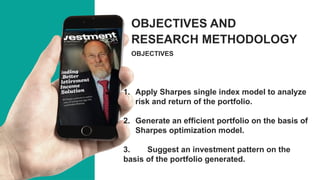
1. Apply Sharpes single index model to analyze
risk and return of the portfolio.
2. Generate an efficient portfolio on the basis of
Sharpes optimization model.
3. Suggest an investment pattern on the
basis of the portfolio generated.
OBJECTIVES
OBJECTIVES AND
RESEARCH METHODOLOGY
26 securities from the National Stock
exchange.
highest turnover
The portfolio is very diverse;. The
sectors included are IT, Pharmacy,
textile, conglomerates, finance,
petroleum, automobile, FMCGs, tea
RESEARCH
METHODOLOGY
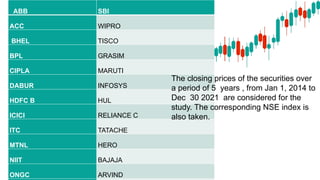
ABB SBI
ACC WIPRO
BHEL TISCO
BPL GRASIM
CIPLA MARUTI
DABUR INFOSYS
HDFC B HUL
ICICI RELIANCE C
ITC TATACHE
MTNL HERO
NIIT BAJAJA
ONGC ARVIND
The closing prices of the securities over
a period of 5 years , from Jan 1, 2014 to
Dec 30 2021 are considered for the
study. The corresponding NSE index is
also taken.
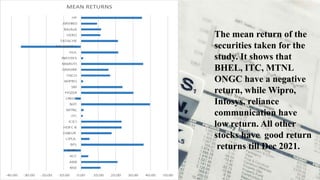
The mean return of the
securities taken for the
study. It shows that
BHEL, ITC, MTNL
ONGC have a negative
return, while Wipro,
Infosys, reliance
communication have
low return. All other
stocks have good return
returns till Dec 2021.
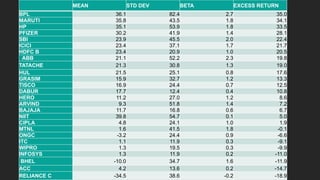
MEAN STD DEV BETA EXCESS RETURN
BPL 36.1 82.4 2.7 35.0
MARUTI 35.8 43.5 1.8 34.1
HP 35.1 53.9 1.8 33.5
PFIZER 30.2 41.9 1.4 28.1
SBI 23.9 45.5 2.0 22.4
ICICI 23.4 37.1 1.7 21.7
HDFC B 23.4 20.9 1.0 20.5
ABB 21.1 52.2 2.3 19.8
TATACHE 21.3 30.8 1.3 19.0
HUL 21.5 25.1 0.8 17.6
GRASIM 15.9 32.7 1.2 13.3
TISCO 16.9 24.4 0.7 12.5
DABUR 17.7 12.4 0.4 10.8
HERO 11.2 27.0 1.2 8.6
ARVIND 9.3 51.8 1.4 7.2
BAJAJA 11.7 16.8 0.6 6.7
NIIT 39.8 54.7 0.1 5.0
CIPLA 4.8 24.1 1.0 1.9
MTNL 1.6 41.5 1.8 -0.1
ONGC -3.2 24.4 0.9 -6.6
ITC 1.1 11.9 0.3 -9.1
WIPRO 1.3 19.5 0.3 -9.9
INFOSYS 1.3 11.9 0.2 -11.0
BHEL -10.0 34.7 1.6 -11.9
ACC 4.2 13.6 0.2 -14.7
RELIANCE C -34.5 38.6 -0.2 -18.9
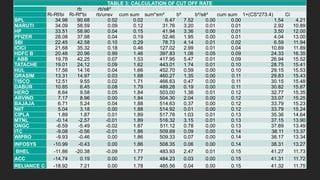
TABLE 3: CALCULATION OF CUT OFF RATE
rb rb/sê²
Ri-Rf/bi Ri-Rf*bi rb/unsv cum sum sum*sm² b² b²/sê² cum sum 1+(CS*273.4) Ci
BPL 34.98 90.68 0.02 0.02 6.47 7.52 0.00 0.00 1.54 4.21
MARUTI 34.09 58.59 0.09 0.12 31.76 3.20 0.01 0.01 2.92 10.89
HP 33.51 58.90 0.04 0.15 41.94 3.36 0.00 0.01 3.50 12.00
PFIZER 28.08 37.98 0.04 0.19 52.46 1.95 0.00 0.01 4.04 13.00
SBI 22.45 42.58 0.10 0.29 78.73 4.14 0.01 0.02 6.59 11.94
ICICI 21.68 35.32 0.18 0.46 127.02 2.99 0.01 0.04 10.69 11.89
HDFC B 20.48 20.96 0.99 1.46 397.83 1.06 0.05 0.09 24.33 16.35
ABB 19.78 42.25 0.07 1.53 417.95 5.47 0.01 0.09 26.94 15.52
TATACHE 19.01 24.12 0.09 1.62 443.01 1.74 0.01 0.10 28.75 15.41
HUL 17.56 14.16 0.04 1.66 452.70 0.59 0.00 0.10 29.15 15.53
GRASIM 13.31 14.97 0.03 1.68 460.27 1.35 0.00 0.11 29.83 15.43
TISCO 12.51 9.55 0.02 1.71 466.63 0.47 0.00 0.11 30.15 15.48
DABUR 10.85 6.45 0.08 1.79 489.28 0.19 0.00 0.11 30.82 15.87
HERO 8.64 9.58 0.05 1.84 503.00 1.36 0.01 0.12 32.77 15.35
ARVIND 7.17 8.96 0.00 1.84 504.30 2.04 0.00 0.12 33.07 15.25
BAJAJA 6.71 5.24 0.04 1.88 514.63 0.37 0.00 0.12 33.79 15.23
NIIT 5.04 3.18 0.00 1.88 514.92 0.01 0.00 0.12 33.79 15.24
CIPLA 1.89 1.87 0.01 1.89 517.78 1.03 0.01 0.13 35.36 14.64
MTNL -0.14 -2.57 -0.01 1.89 516.32 3.15 0.01 0.13 37.15 13.90
ONGC -6.59 -5.49 -0.02 1.87 511.12 0.78 0.00 0.13 37.89 13.49
ITC -9.08 -0.56 -0.01 1.86 509.69 0.09 0.00 0.14 38.11 13.37
WIPRO -9.93 -0.46 0.00 1.86 509.33 0.07 0.00 0.14 38.17 13.34
INFOSYS -10.99 -0.43 0.00 1.86 508.35 0.06 0.00 0.14 38.31 13.27
BHEL -11.86 -20.38 -0.09 1.77 483.93 2.47 0.01 0.15 41.27 11.73
ACC -14.74 0.19 0.00 1.77 484.23 0.03 0.00 0.15 41.31 11.72
RELIANCE C -18.92 7.21 0.00 1.78 485.56 0.04 0.00 0.15 41.32 11.75
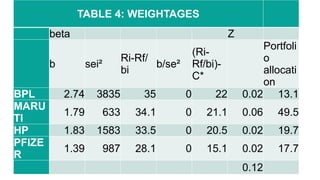
TABLE 4: WEIGHTAGES
beta Z
b sei²
Ri-Rf/
bi
b/se²
(Ri-
Rf/bi)-
C*
Portfoli
o
allocati
on
BPL 2.74 3835 35 0 22 0.02 13.1
MARU
TI
1.79 633 34.1 0 21.1 0.06 49.5
HP 1.83 1583 33.5 0 20.5 0.02 19.7
PFIZE
R
1.39 987 28.1 0 15.1 0.02 17.7
0.12
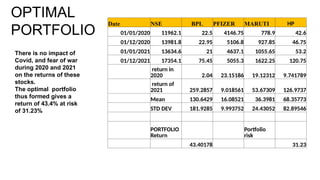
OPTIMAL
PORTFOLIO
Date NSE BPL PFIZER MARUTI HP
01/01/2020 11962.1 22.5 4146.75 778.9 42.6
01/12/2020 13981.8 22.95 5106.8 927.85 46.75
01/01/2021 13634.6 21 4637.1 1055.65 53.2
01/12/2021 17354.1 75.45 5055.3 1622.25 120.75
return in
2020 2.04 23.15186 19.12312 9.741789
return of
2021 259.2857 9.018561 53.67309 126.9737
Mean 130.6429 16.08521 36.3981 68.35773
STD DEV 181.9285 9.993752 24.43052 82.89546
PORTFOLIO
Return
Portfolio
risk
43.40178 31.23
There is no impact of
Covid, and fear of war
during 2020 and 2021
on the returns of these
stocks.
The optimal portfolio
thus formed gives a
return of 43.4% at risk
of 31.23%
A wide gamut of people including common people with
not an idea of portfolio management are lured in to
moneymaking with ease.
They want to enjoy capital appreciation apart from hedge
against inflation. Investors have an infinite range of
securities to choose from.
Apart from the dilemma of risk and return they also face
the difficult question of how much to invest and in which
share.
Sharpes optimization model pulls the investors out of
this dilemma. The model is easier to understand and also
requires less calculation on the part of the investor
CONCLUSION
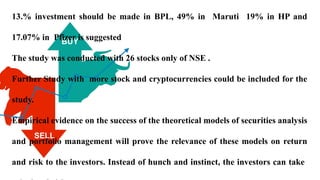
13.% investment should be made in BPL, 49% in Maruti 19% in HP and
17.07% in Pfizer is suggested
The study was conducted with 26 stocks only of NSE .
Further Study with more stock and cryptocurrencies could be included for the
study.
Empirical evidence on the success of the theoretical models of securities analysis
and portfolio management will prove the relevance of these models on return
and risk to the investors. Instead of hunch and instinct, the investors can take
THANK YOU
Insert the Subtitle of Your Presentation
P R O F I T
I
S
K
O
L S

REVISITING SHARPES SINGLE INDEX AND OPTIMAL PORTFOLIO

  • 1.
    REVISITING SHARPES SINGLEINDEX AND OPTIMAL PORTFOLIO Dr.TAZEENTAJ MAHAT, GBS HUBLI
  • 2.
    Agenda P R OF I T I S K O L S 01 Introduction 02 Literature review 03 Objectives and Research Methodology 04 Findings 05 Conclusion
  • 3.
    William F. Sharpewas born on June 16, 1934 in Boston, Massachusetts. A friend introduced William F. Sharpe to Harry Markowitz, thus he proceeded to work closely with him on the topic Portfolio Analysis Based on a Simplified Model of the Relationships Among Securities. Harry guided his dissertation, after which he received the PhD degree in 1961. He was invited to take a position at the Stanford University Graduate School of Business, in 1970. He completed a book, Portfolio Theory and Capital Markets, and Asset Allocation Tools. William F. Sharpe has also received awards from diverse constituencies. He is the proud recipient of the American Assembly of Collegiate Schools of Business award for the field of business education in 1980 and the Financial Analysts' Federation Nicholas Molodovsky Award for outstanding contributions to the [finance] profession in 1989. He received the Nobel Prize in Economic Sciences with Harry Markowitz and Merton Miller in 1990. the Single Index Model of portfolio return and risk can be computed easily.3n+1 calculations, thus only 151 calculations for a portfolio of 50 shares. . William Sharpe
  • 4.
    LITERATURE REVIEW 42 stocksof NSE. 8 stocks were found to be above the cutoff rate and thus were used to form the portfolio . the paper concludes that index helps the investors to choose better stocks Mahmud applied the model to 178 stocks of Dhaka stock exchange . the constructed portfolio of 65.18% from 3 stocks out performed the market Mahmud 2020 paper titled “Construction Of Optimal Portfolio Using Sharpe’s Single Index Model - A Study With Reference To Banking And Automobile Sectors.” Used monthly closing prices of 5 companies from banking sector and 5 companies from auto mobile sector listed in the Bombay stock exchange (BSE). Share prices for the period of October 2016 to September 2017 were considered. They calculated a “cut-off” rate from the collected data and used it to construct the optimal portfolio. Ms. S.Subashree, Dr. M.Bhoopa Most of the literature highlights on the ease of calculation and formation of the portfolio. All the papers identify the cutoff rate and the stocks that can form the portfolio. Very few papers evaluate the portfolio thus formed know the risk and return of the portfolio. This paper attempts to cover that gap GAP Patel 2018, Sangeeta,et..all 2021
  • 5.
    1. Apply Sharpessingle index model to analyze risk and return of the portfolio. 2. Generate an efficient portfolio on the basis of Sharpes optimization model. 3. Suggest an investment pattern on the basis of the portfolio generated. OBJECTIVES OBJECTIVES AND RESEARCH METHODOLOGY
  • 6.
    26 securities fromthe National Stock exchange. highest turnover The portfolio is very diverse;. The sectors included are IT, Pharmacy, textile, conglomerates, finance, petroleum, automobile, FMCGs, tea RESEARCH METHODOLOGY
  • 7.
    ABB SBI ACC WIPRO BHELTISCO BPL GRASIM CIPLA MARUTI DABUR INFOSYS HDFC B HUL ICICI RELIANCE C ITC TATACHE MTNL HERO NIIT BAJAJA ONGC ARVIND The closing prices of the securities over a period of 5 years , from Jan 1, 2014 to Dec 30 2021 are considered for the study. The corresponding NSE index is also taken.
  • 8.
    The mean returnof the securities taken for the study. It shows that BHEL, ITC, MTNL ONGC have a negative return, while Wipro, Infosys, reliance communication have low return. All other stocks have good return returns till Dec 2021.
  • 9.
    MEAN STD DEVBETA EXCESS RETURN BPL 36.1 82.4 2.7 35.0 MARUTI 35.8 43.5 1.8 34.1 HP 35.1 53.9 1.8 33.5 PFIZER 30.2 41.9 1.4 28.1 SBI 23.9 45.5 2.0 22.4 ICICI 23.4 37.1 1.7 21.7 HDFC B 23.4 20.9 1.0 20.5 ABB 21.1 52.2 2.3 19.8 TATACHE 21.3 30.8 1.3 19.0 HUL 21.5 25.1 0.8 17.6 GRASIM 15.9 32.7 1.2 13.3 TISCO 16.9 24.4 0.7 12.5 DABUR 17.7 12.4 0.4 10.8 HERO 11.2 27.0 1.2 8.6 ARVIND 9.3 51.8 1.4 7.2 BAJAJA 11.7 16.8 0.6 6.7 NIIT 39.8 54.7 0.1 5.0 CIPLA 4.8 24.1 1.0 1.9 MTNL 1.6 41.5 1.8 -0.1 ONGC -3.2 24.4 0.9 -6.6 ITC 1.1 11.9 0.3 -9.1 WIPRO 1.3 19.5 0.3 -9.9 INFOSYS 1.3 11.9 0.2 -11.0 BHEL -10.0 34.7 1.6 -11.9 ACC 4.2 13.6 0.2 -14.7 RELIANCE C -34.5 38.6 -0.2 -18.9
  • 10.
    TABLE 3: CALCULATIONOF CUT OFF RATE rb rb/sê² Ri-Rf/bi Ri-Rf*bi rb/unsv cum sum sum*sm² b² b²/sê² cum sum 1+(CS*273.4) Ci BPL 34.98 90.68 0.02 0.02 6.47 7.52 0.00 0.00 1.54 4.21 MARUTI 34.09 58.59 0.09 0.12 31.76 3.20 0.01 0.01 2.92 10.89 HP 33.51 58.90 0.04 0.15 41.94 3.36 0.00 0.01 3.50 12.00 PFIZER 28.08 37.98 0.04 0.19 52.46 1.95 0.00 0.01 4.04 13.00 SBI 22.45 42.58 0.10 0.29 78.73 4.14 0.01 0.02 6.59 11.94 ICICI 21.68 35.32 0.18 0.46 127.02 2.99 0.01 0.04 10.69 11.89 HDFC B 20.48 20.96 0.99 1.46 397.83 1.06 0.05 0.09 24.33 16.35 ABB 19.78 42.25 0.07 1.53 417.95 5.47 0.01 0.09 26.94 15.52 TATACHE 19.01 24.12 0.09 1.62 443.01 1.74 0.01 0.10 28.75 15.41 HUL 17.56 14.16 0.04 1.66 452.70 0.59 0.00 0.10 29.15 15.53 GRASIM 13.31 14.97 0.03 1.68 460.27 1.35 0.00 0.11 29.83 15.43 TISCO 12.51 9.55 0.02 1.71 466.63 0.47 0.00 0.11 30.15 15.48 DABUR 10.85 6.45 0.08 1.79 489.28 0.19 0.00 0.11 30.82 15.87 HERO 8.64 9.58 0.05 1.84 503.00 1.36 0.01 0.12 32.77 15.35 ARVIND 7.17 8.96 0.00 1.84 504.30 2.04 0.00 0.12 33.07 15.25 BAJAJA 6.71 5.24 0.04 1.88 514.63 0.37 0.00 0.12 33.79 15.23 NIIT 5.04 3.18 0.00 1.88 514.92 0.01 0.00 0.12 33.79 15.24 CIPLA 1.89 1.87 0.01 1.89 517.78 1.03 0.01 0.13 35.36 14.64 MTNL -0.14 -2.57 -0.01 1.89 516.32 3.15 0.01 0.13 37.15 13.90 ONGC -6.59 -5.49 -0.02 1.87 511.12 0.78 0.00 0.13 37.89 13.49 ITC -9.08 -0.56 -0.01 1.86 509.69 0.09 0.00 0.14 38.11 13.37 WIPRO -9.93 -0.46 0.00 1.86 509.33 0.07 0.00 0.14 38.17 13.34 INFOSYS -10.99 -0.43 0.00 1.86 508.35 0.06 0.00 0.14 38.31 13.27 BHEL -11.86 -20.38 -0.09 1.77 483.93 2.47 0.01 0.15 41.27 11.73 ACC -14.74 0.19 0.00 1.77 484.23 0.03 0.00 0.15 41.31 11.72 RELIANCE C -18.92 7.21 0.00 1.78 485.56 0.04 0.00 0.15 41.32 11.75
  • 11.
    TABLE 4: WEIGHTAGES betaZ b sei² Ri-Rf/ bi b/se² (Ri- Rf/bi)- C* Portfoli o allocati on BPL 2.74 3835 35 0 22 0.02 13.1 MARU TI 1.79 633 34.1 0 21.1 0.06 49.5 HP 1.83 1583 33.5 0 20.5 0.02 19.7 PFIZE R 1.39 987 28.1 0 15.1 0.02 17.7 0.12
  • 12.
    OPTIMAL PORTFOLIO Date NSE BPLPFIZER MARUTI HP 01/01/2020 11962.1 22.5 4146.75 778.9 42.6 01/12/2020 13981.8 22.95 5106.8 927.85 46.75 01/01/2021 13634.6 21 4637.1 1055.65 53.2 01/12/2021 17354.1 75.45 5055.3 1622.25 120.75 return in 2020 2.04 23.15186 19.12312 9.741789 return of 2021 259.2857 9.018561 53.67309 126.9737 Mean 130.6429 16.08521 36.3981 68.35773 STD DEV 181.9285 9.993752 24.43052 82.89546 PORTFOLIO Return Portfolio risk 43.40178 31.23 There is no impact of Covid, and fear of war during 2020 and 2021 on the returns of these stocks. The optimal portfolio thus formed gives a return of 43.4% at risk of 31.23%
  • 13.
    A wide gamutof people including common people with not an idea of portfolio management are lured in to moneymaking with ease. They want to enjoy capital appreciation apart from hedge against inflation. Investors have an infinite range of securities to choose from. Apart from the dilemma of risk and return they also face the difficult question of how much to invest and in which share. Sharpes optimization model pulls the investors out of this dilemma. The model is easier to understand and also requires less calculation on the part of the investor CONCLUSION
  • 14.
    13.% investment shouldbe made in BPL, 49% in Maruti 19% in HP and 17.07% in Pfizer is suggested The study was conducted with 26 stocks only of NSE . Further Study with more stock and cryptocurrencies could be included for the study. Empirical evidence on the success of the theoretical models of securities analysis and portfolio management will prove the relevance of these models on return and risk to the investors. Instead of hunch and instinct, the investors can take
  • 15.
    THANK YOU Insert theSubtitle of Your Presentation P R O F I T I S K O L S