




Rethinking
Debian release
18th
November 2017
Hideki Yamane <henrich@debian.org>
Why rethink release?
● “Debian is old”
● “Debian (stable) is old”
● “Debian (stable) is old (for our usage)”
● “Some packages are still old and buggy,
but no update”
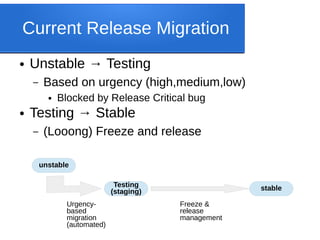
Current Release Migration
● Unstable → Testing
– Based on urgency (high,medium,low)
● Blocked by Release Critical bug
● Testing → Stable
– (Looong) Freeze and release
unstable
Testing
(staging)
Urgency-
based
migration
(automated)
stable
Freeze &
release
management
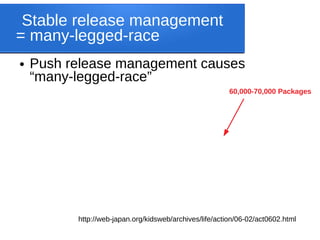
Stable release management
= many-legged-race
● Push release management causes
“many-legged-race”
http://web-japan.org/kidsweb/archives/life/action/06-02/act0602.html
60,000-70,000 Packages
Its result...
● Like this...
https://www.youtube.com/watch?v=Rwqvx99Gz2U
Another Problem:
Is that package tested, really?
● Who tests it?
– Sometimes "Passive test" doesn't work well
● Code never matures
– Code != Wine / Whiskey
– But time makes features to rot...
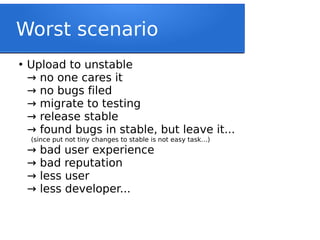
Worst scenario
●
Upload to unstable
no one cares it→
no bugs filed→
migrate to testing→
release stable→
found bugs in stable, but leave it...→
(since put not tiny changes to stable is not easy task…)
bad user experience→
bad reputation→
less user→
less developer...→
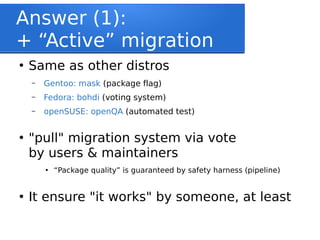
Answer (1):
+ “Active” migration
●
Same as other distros
– Gentoo: mask (package flag)
– Fedora: bohdi (voting system)
– openSUSE: openQA (automated test)
●
"pull" migration system via vote
by users & maintainers
●
“Package quality” is guaranteed by safety harness (pipeline)
●
It ensure "it works" by someone, at least
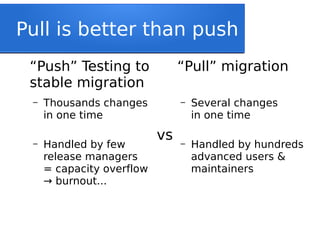
Pull is better than push
“Push” Testing to
stable migration
– Thousands changes
in one time
– Handled by few
release managers
= capacity overflow
burnout...→
“Pull” migration
– Several changes
in one time
– Handled by hundreds
advanced users &
maintainers
vs
Answer (2):
New distribution
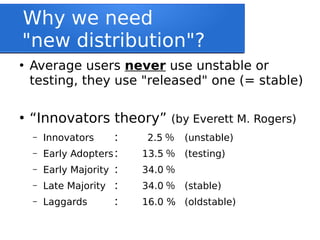
Why we need
"new distribution"?
●
Average users never use unstable or
testing, they use "released" one (= stable)
●
“Innovators theory” (by Everett M. Rogers)
– Innovators : 2.5 % (unstable)
– Early Adopters: 13.5 % (testing)
– Early Majority : 34.0 %
– Late Majority : 34.0 % (stable)
– Laggards : 16.0 % (oldstable)
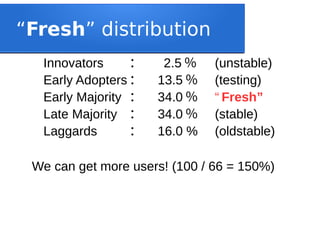
“Fresh” distribution
Innovators : 2.5 % (unstable)
Early Adopters: 13.5 % (testing)
Early Majority : 34.0 % “ Fresh”
Late Majority : 34.0 % (stable)
Laggards : 16.0 % (oldstable)
We can get more users! (100 / 66 = 150%)
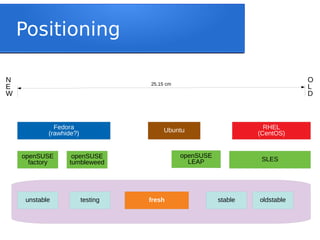
Positioning
openSUSE
factory
openSUSE
LEAP
openSUSE
tumbleweed SLES
Fedora
(rawhide?)
RHEL
(CentOS)Ubuntu
unstable testing fresh stable oldstable
25.15 cm
N
E
W
O
L
D
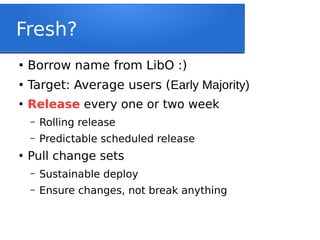
Fresh?
●
Borrow name from LibO :)
●
Target: Average users (Early Majority)
●
Release every one or two week
– Rolling release
– Predictable scheduled release
●
Pull change sets
– Sustainable deploy
– Ensure changes, not break anything
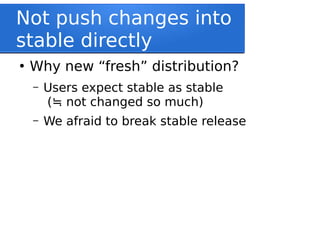
Not push changes into
stable directly
●
Why new “fresh” distribution?
– Users expect stable as stable
( not changed so much)≒
– We afraid to break stable release
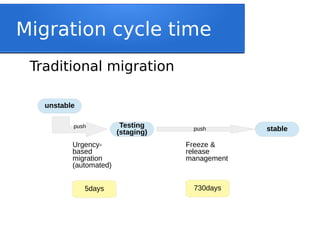
Migration cycle time
Traditional migration
unstable
Testing
(staging)
Urgency-
based
migration
(automated)
stable
5days 730days
push
Freeze &
release
management
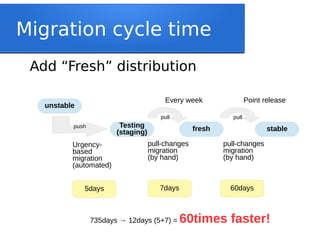
Migration cycle time
Add “Fresh” distribution
unstable
Testing
(staging) fresh
pull
Urgency-
based
migration
(automated)
pull-changes
migration
(by hand)
stable
pull
pull-changes
migration
(by hand)
Point releaseEvery week
5days 7days 60days
735days → 12days (5+7) = 60times faster!
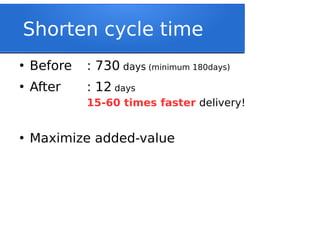
Shorten cycle time
●
Before : 730 days (minimum 180days)
●
After : 12 days
15-60 times faster delivery!
●
Maximize added-value
Change the rule!
● There was a reason to make rules
– Unstable – Testing – Stable
– Long freeze term and release
● But situation has changed, then rules
should be changed, too. Because its rule
becomes bottleneck
Faster release
introduce more bugs?
●
Q: It may introduce more bugs!
– A: “test early and fail fast” on fresh stage,
but less bugs in stable since more test
users watch it.
– Testers
●
Previous : 2.5 + 13.5 = 16.0
●
Fresh : 2.5 + 13.5 + 34.0 = 50.0 → 300%
“Fresh”: Pros & Cons
●
Pros)
– 150% users, 300% testers
– 60 times faster release
– Same cadence, its release date & changes are predictable
– Changes in each release are small, users can bite it (No Big Bang release)
●
Less freeze term for next release
●
Not need to hassle to make huge release note
●
Moe "real acceptance test" by real users for next stable release
●
Cons)
– It just costs
●
Infrastructure change
●
Docs & website update
●
More release manager & publicity work
●
Prepare security fix (but delta with unstable is small, right?)
– maybe it reduce backport effort in stable
Metrics?
●
More testers
– BTS number
– RC in stable / bugs in stable
●
More users
– Download number

Rethinking debian-release

  • 1.
  • 2.
    Why rethink release? ●“Debian is old” ● “Debian (stable) is old” ● “Debian (stable) is old (for our usage)” ● “Some packages are still old and buggy, but no update”
  • 3.
    Current Release Migration ●Unstable → Testing – Based on urgency (high,medium,low) ● Blocked by Release Critical bug ● Testing → Stable – (Looong) Freeze and release unstable Testing (staging) Urgency- based migration (automated) stable Freeze & release management
  • 4.
    Stable release management =many-legged-race ● Push release management causes “many-legged-race” http://web-japan.org/kidsweb/archives/life/action/06-02/act0602.html 60,000-70,000 Packages
  • 5.
    Its result... ● Likethis... https://www.youtube.com/watch?v=Rwqvx99Gz2U
  • 6.
    Another Problem: Is thatpackage tested, really? ● Who tests it? – Sometimes "Passive test" doesn't work well ● Code never matures – Code != Wine / Whiskey – But time makes features to rot...
  • 7.
    Worst scenario ● Upload tounstable no one cares it→ no bugs filed→ migrate to testing→ release stable→ found bugs in stable, but leave it...→ (since put not tiny changes to stable is not easy task…) bad user experience→ bad reputation→ less user→ less developer...→
  • 8.
    Answer (1): + “Active”migration ● Same as other distros – Gentoo: mask (package flag) – Fedora: bohdi (voting system) – openSUSE: openQA (automated test) ● "pull" migration system via vote by users & maintainers ● “Package quality” is guaranteed by safety harness (pipeline) ● It ensure "it works" by someone, at least
  • 9.
    Pull is betterthan push “Push” Testing to stable migration – Thousands changes in one time – Handled by few release managers = capacity overflow burnout...→ “Pull” migration – Several changes in one time – Handled by hundreds advanced users & maintainers vs
  • 10.
  • 11.
    Why we need "newdistribution"? ● Average users never use unstable or testing, they use "released" one (= stable) ● “Innovators theory” (by Everett M. Rogers) – Innovators : 2.5 % (unstable) – Early Adopters: 13.5 % (testing) – Early Majority : 34.0 % – Late Majority : 34.0 % (stable) – Laggards : 16.0 % (oldstable)
  • 12.
    “Fresh” distribution Innovators :2.5 % (unstable) Early Adopters: 13.5 % (testing) Early Majority : 34.0 % “ Fresh” Late Majority : 34.0 % (stable) Laggards : 16.0 % (oldstable) We can get more users! (100 / 66 = 150%)
  • 13.
  • 14.
    Fresh? ● Borrow name fromLibO :) ● Target: Average users (Early Majority) ● Release every one or two week – Rolling release – Predictable scheduled release ● Pull change sets – Sustainable deploy – Ensure changes, not break anything
  • 15.
    Not push changesinto stable directly ● Why new “fresh” distribution? – Users expect stable as stable ( not changed so much)≒ – We afraid to break stable release
  • 16.
    Migration cycle time Traditionalmigration unstable Testing (staging) Urgency- based migration (automated) stable 5days 730days push Freeze & release management
  • 17.
    Migration cycle time Add“Fresh” distribution unstable Testing (staging) fresh pull Urgency- based migration (automated) pull-changes migration (by hand) stable pull pull-changes migration (by hand) Point releaseEvery week 5days 7days 60days 735days → 12days (5+7) = 60times faster!
  • 18.
    Shorten cycle time ● Before: 730 days (minimum 180days) ● After : 12 days 15-60 times faster delivery! ● Maximize added-value
  • 19.
    Change the rule! ●There was a reason to make rules – Unstable – Testing – Stable – Long freeze term and release ● But situation has changed, then rules should be changed, too. Because its rule becomes bottleneck
  • 20.
    Faster release introduce morebugs? ● Q: It may introduce more bugs! – A: “test early and fail fast” on fresh stage, but less bugs in stable since more test users watch it. – Testers ● Previous : 2.5 + 13.5 = 16.0 ● Fresh : 2.5 + 13.5 + 34.0 = 50.0 → 300%
  • 21.
    “Fresh”: Pros &Cons ● Pros) – 150% users, 300% testers – 60 times faster release – Same cadence, its release date & changes are predictable – Changes in each release are small, users can bite it (No Big Bang release) ● Less freeze term for next release ● Not need to hassle to make huge release note ● Moe "real acceptance test" by real users for next stable release ● Cons) – It just costs ● Infrastructure change ● Docs & website update ● More release manager & publicity work ● Prepare security fix (but delta with unstable is small, right?) – maybe it reduce backport effort in stable
  • 22.
    Metrics? ● More testers – BTSnumber – RC in stable / bugs in stable ● More users – Download number