RETAIL
MANAGEMENT
Challenges In The Industry
☐ Low domestic competition
■ Because of fragmented nature of industry
☐ Lack of exposure to global best practices
■ Low entry barriers for unorganized retailing
■ Moderate entry barriers for organized retailing
☐ Wholesale system under-invested leading to 20-40% wastage
☐ Non level playing field issues
■ Wide differences in treatment of small and large retailers
Challenges In The Industry…
☐ Real Estate low Availability and high cost
☐ Supply Chain Inconsistency
☐ Poor Infrastructure
☐ Lack of Skilled Manpower
☐ Complex tax Structure
☐ Heavy Stamp Duties
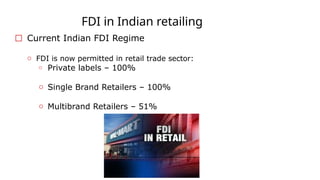
FDI in Indian retailing
☐ Current Indian FDI Regime
o FDI is now permitted in retail trade sector:
o Private labels – 100%
o Single Brand Retailers – 100%
o Multibrand Retailers – 51%
Why FDI?
☐ Improve competition
☐ Develop the market
☐ Greater level of exports due to increased sourcing by major players
■ Sourcing by Wal-Mart from China improved multifold after FDI
permitted in China
Similar increase in sourcing observed for Metro in India
Provides access to global markets for Indian producers
Why FDI?...
☐ Investment in technology
■ Cold storage chains solve the perennial problem of wastage
Greater investment in the food processing sector technology
Better operations in production cycle and distribution
Better lifestyle
Greater level of wages paid by international players usually
More product variety Newer product
categories
Economies of scale to help lower consumer price Increased
purchasing capacity of consumers
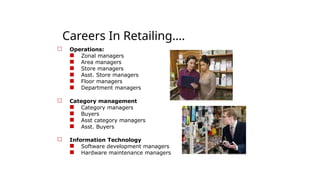
Careers In Retailing….
☐ Operations:
■
■
■
■
■
■
Zonal managers
Area managers
Store managers
Asst. Store managers
Floor managers
Department managers
☐ Category management
■
■
■
■
Category managers
Buyers
Asst category managers
Asst. Buyers
☐ Information Technology
■
■
Software development managers
Hardware maintenance managers
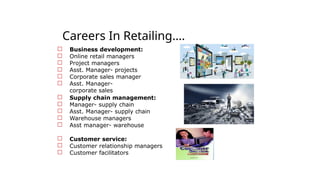
Careers In Retailing….
☐
☐
☐
☐
☐
☐
Business development:
Online retail managers
Project managers
Asst. Manager- projects
Corporate sales manager
Asst. Manager-
corporate sales
☐
☐
☐
☐
☐
Supply chain management:
Manager- supply chain
Asst. Manager- supply chain
Warehouse managers
Asst manager- warehouse
☐
☐
☐
Customer service:
Customer relationship managers
Customer facilitators
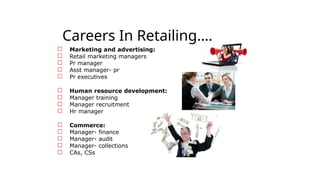
Careers In Retailing….
☐
☐
☐
☐
☐
Marketing and advertising:
Retail marketing managers
Pr manager
Asst manager- pr
Pr executives
☐
☐
☐
☐
Human resource development:
Manager training
Manager recruitment
Hr manager
☐
☐
☐
☐
☐
Commerce:
Manager- finance
Manager- audit
Manager- collections
CAs, CSs
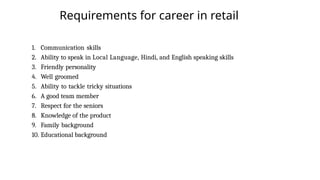
Requirements for career in retail
1. Communication skills
2. Ability to speak in Local Language, Hindi, and English speaking skills
3. Friendly personality
4. Well groomed
5. Ability to tackle tricky situations
6. A good team member
7. Respect for the seniors
8. Knowledge of the product
9. Family background
10. Educational background
Retail Customer
Buying Behavior
Buying behavior refers to the decision-
making process that consumers go
through when purchasing a product or
service.
It involves the actions and attitudes of
individuals or organizations when they
buy and use products or services
Understanding buying behavior is important for businesses
and marketers, as it helps them to:
1. Identify target markets and customer needs
2. Develop effective marketing strategies and tactics
3. Create products and services that meet customer needs
and preferences
4. Build strong relationships with customers and improve
customer satisfaction.
Buying behaviour is influenced by various factors, including:
Cultural Factors: Shared values, beliefs, and behaviors of a society
Social Factors: Reference groups, family, social class, and other social influences
Personal Factors: Individual characteristics such as personality, lifestyle,
motivation, perception, attitudes, and learning
Psychological Factors: Perception, motivation, learning, and attitudes
Economic Factors: Income, employment, inflation, and overall economic
conditions
By understanding these factors and stages, retailers can develop effective
strategies to influence customer buying behavior, enhance customer
satisfaction, and drive sales.
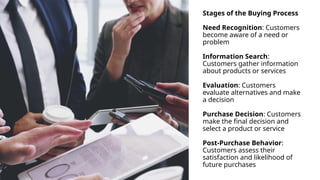
Stages of the Buying Process
Need Recognition: Customers
become aware of a need or
problem
Information Search:
Customers gather information
about products or services
Evaluation: Customers
evaluate alternatives and make
a decision
Purchase Decision: Customers
make the final decision and
select a product or service
Post-Purchase Behavior:
Customers assess their
satisfaction and likelihood of
future purchases
There are different types of buying behavior, including:
1. Routine buying behavior: Repeat purchases of familiar products –News
paper, Magazine, Milk, Eggs, Bread
2. Limited buying behavior: Purchasing a product with some degree of
evaluation: Cosmetics, seeks advice and suggestions
3. Extensive buying behavior: Purchasing a product with a high degree of
evaluation, Comparisions, reviews– Mobiles, Laptops, Electronic gadgets
4. Impulsive Buying Decisions :Impulsive buying decisions are made on the
spur of the moment, without much thought or evaluation. Examples
include buying a snack or utility Item.
5. Habitual Buying Decisions:
Habitual buying decisions are made out of habit, without much thought or evaluation. Examples include buying a daily
newspaper or a favorite snack.
6. Complex Buying Decisions:
Complex buying decisions involve a high degree of evaluation and comparison among available options, and may require
expert advice. Examples include buying a business software or a medical device.
7. Dissonance-Reducing Buying Decisions:
Dissonance-reducing buying decisions involve a high degree of evaluation and comparison among available options, in
order to reduce post-purchase dissonance. Examples include buying a high-end luxury item.
8. Variety-Seeking Buying Decisions:
Variety-seeking buying decisions involve seeking new and different products or experiences. Examples include trying a
new restaurant or a new type of cuisine.
These categories are not
mutually exclusive, and buying
decisions can involve a
combination of these factors.
Stages of the Buying Process
Need Recognition: Customers become aware of a need or
problem
Information Search: Customers gather information about
products or services
Evaluation: Customers evaluate alternatives and make a
decision
Purchase Decision: Customers make the final decision and
select a product or service
Post-Purchase Behavior: Customers assess their satisfaction
and likelihood of future purchases
Different Types of
Buyers
• The Researcher or Showroomer
• The Deal Seeker or Bargain Hunter
• The Window Shopping Wanderer
• The Decisive, Take Charge Type
• The Sociable Chatter
• The In & Out Sure Buyer
• The Angry, Demanding Pessimist
• The Regular
The Researcher or Showroomer
Indecisive and willing to shop
around
Focus on Quality of the product
or service instead of price
Highlight other benefits or
deals
Tangential In-store offers, like
great loyalty programs or
warranty policies
The Deal Seeker or Bargain H
unter
Money-Focused and Frugal
They are not impulse buyers.
Haggle over price
Openly complain about how
expensive a certain product is
Add perceived value to any
purchase
Offer flat discount
The Window Shopping
Wanderer
Non-Committal,
Leisurely
Enjoy shopping for
shopping purpose
Don’t be pushy, offer
help and suggestions
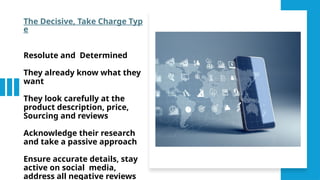
The Decisive, Take Charge Typ
e
Resolute and Determined
They already know what they
want
They look carefully at the
product description, price,
Sourcing and reviews
Acknowledge their research
and take a passive approach
Ensure accurate details, stay
active on social media,
address all negative reviews
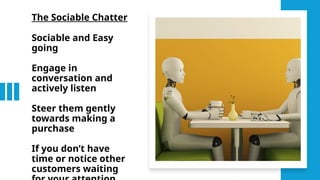
The Sociable Chatter
Sociable and Easy
going
Engage in
conversation and
actively listen
Steer them gently
towards making a
purchase
If you don’t have
time or notice other
customers waiting
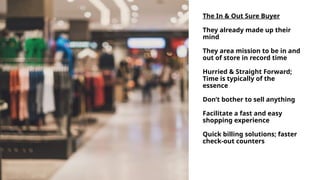
The In & Out Sure Buyer
They already made up their
mind
They area mission to be in and
out of store in record time
Hurried & Straight Forward;
Time is typically of the
essence
Don’t bother to sell anything
Facilitate a fast and easy
shopping experience
Quick billing solutions; faster
check-out counters
The Angry, Demanding Pessim
ist
Loud, Angry and proud of it
Irrational shoppers; Looking for reasons to get
upset
Looking for force deals
Stay Clam and protect your staff from their wrath
Don’t show any emotions
Ask them what would be the fair solution
The Regular
Affable and Generous
Thank them
You wouldn’t be doing what you do without
this group
Offer generous loyalty programs
Incentivize frequent visits
Small gifts on their special days
Retail Management Customer buying behaviour.pptx

Retail Management Customer buying behaviour.pptx

  • 1.
  • 3.
    Challenges In TheIndustry ☐ Low domestic competition ■ Because of fragmented nature of industry ☐ Lack of exposure to global best practices ■ Low entry barriers for unorganized retailing ■ Moderate entry barriers for organized retailing ☐ Wholesale system under-invested leading to 20-40% wastage ☐ Non level playing field issues ■ Wide differences in treatment of small and large retailers
  • 4.
    Challenges In TheIndustry… ☐ Real Estate low Availability and high cost ☐ Supply Chain Inconsistency ☐ Poor Infrastructure ☐ Lack of Skilled Manpower ☐ Complex tax Structure ☐ Heavy Stamp Duties
  • 5.
    FDI in Indianretailing ☐ Current Indian FDI Regime o FDI is now permitted in retail trade sector: o Private labels – 100% o Single Brand Retailers – 100% o Multibrand Retailers – 51%
  • 6.
    Why FDI? ☐ Improvecompetition ☐ Develop the market ☐ Greater level of exports due to increased sourcing by major players ■ Sourcing by Wal-Mart from China improved multifold after FDI permitted in China Similar increase in sourcing observed for Metro in India Provides access to global markets for Indian producers
  • 7.
    Why FDI?... ☐ Investmentin technology ■ Cold storage chains solve the perennial problem of wastage Greater investment in the food processing sector technology Better operations in production cycle and distribution Better lifestyle Greater level of wages paid by international players usually More product variety Newer product categories Economies of scale to help lower consumer price Increased purchasing capacity of consumers
  • 8.
    Careers In Retailing…. ☐Operations: ■ ■ ■ ■ ■ ■ Zonal managers Area managers Store managers Asst. Store managers Floor managers Department managers ☐ Category management ■ ■ ■ ■ Category managers Buyers Asst category managers Asst. Buyers ☐ Information Technology ■ ■ Software development managers Hardware maintenance managers
  • 9.
    Careers In Retailing…. ☐ ☐ ☐ ☐ ☐ ☐ Businessdevelopment: Online retail managers Project managers Asst. Manager- projects Corporate sales manager Asst. Manager- corporate sales ☐ ☐ ☐ ☐ ☐ Supply chain management: Manager- supply chain Asst. Manager- supply chain Warehouse managers Asst manager- warehouse ☐ ☐ ☐ Customer service: Customer relationship managers Customer facilitators
  • 10.
    Careers In Retailing…. ☐ ☐ ☐ ☐ ☐ Marketingand advertising: Retail marketing managers Pr manager Asst manager- pr Pr executives ☐ ☐ ☐ ☐ Human resource development: Manager training Manager recruitment Hr manager ☐ ☐ ☐ ☐ ☐ Commerce: Manager- finance Manager- audit Manager- collections CAs, CSs
  • 11.
    Requirements for careerin retail 1. Communication skills 2. Ability to speak in Local Language, Hindi, and English speaking skills 3. Friendly personality 4. Well groomed 5. Ability to tackle tricky situations 6. A good team member 7. Respect for the seniors 8. Knowledge of the product 9. Family background 10. Educational background
  • 12.
  • 13.
    Buying behavior refersto the decision- making process that consumers go through when purchasing a product or service. It involves the actions and attitudes of individuals or organizations when they buy and use products or services
  • 14.
    Understanding buying behavioris important for businesses and marketers, as it helps them to: 1. Identify target markets and customer needs 2. Develop effective marketing strategies and tactics 3. Create products and services that meet customer needs and preferences 4. Build strong relationships with customers and improve customer satisfaction.
  • 15.
    Buying behaviour isinfluenced by various factors, including: Cultural Factors: Shared values, beliefs, and behaviors of a society Social Factors: Reference groups, family, social class, and other social influences Personal Factors: Individual characteristics such as personality, lifestyle, motivation, perception, attitudes, and learning Psychological Factors: Perception, motivation, learning, and attitudes Economic Factors: Income, employment, inflation, and overall economic conditions By understanding these factors and stages, retailers can develop effective strategies to influence customer buying behavior, enhance customer satisfaction, and drive sales.
  • 16.
    Stages of theBuying Process Need Recognition: Customers become aware of a need or problem Information Search: Customers gather information about products or services Evaluation: Customers evaluate alternatives and make a decision Purchase Decision: Customers make the final decision and select a product or service Post-Purchase Behavior: Customers assess their satisfaction and likelihood of future purchases
  • 17.
    There are differenttypes of buying behavior, including: 1. Routine buying behavior: Repeat purchases of familiar products –News paper, Magazine, Milk, Eggs, Bread 2. Limited buying behavior: Purchasing a product with some degree of evaluation: Cosmetics, seeks advice and suggestions 3. Extensive buying behavior: Purchasing a product with a high degree of evaluation, Comparisions, reviews– Mobiles, Laptops, Electronic gadgets 4. Impulsive Buying Decisions :Impulsive buying decisions are made on the spur of the moment, without much thought or evaluation. Examples include buying a snack or utility Item.
  • 18.
    5. Habitual BuyingDecisions: Habitual buying decisions are made out of habit, without much thought or evaluation. Examples include buying a daily newspaper or a favorite snack. 6. Complex Buying Decisions: Complex buying decisions involve a high degree of evaluation and comparison among available options, and may require expert advice. Examples include buying a business software or a medical device. 7. Dissonance-Reducing Buying Decisions: Dissonance-reducing buying decisions involve a high degree of evaluation and comparison among available options, in order to reduce post-purchase dissonance. Examples include buying a high-end luxury item. 8. Variety-Seeking Buying Decisions: Variety-seeking buying decisions involve seeking new and different products or experiences. Examples include trying a new restaurant or a new type of cuisine.
  • 19.
    These categories arenot mutually exclusive, and buying decisions can involve a combination of these factors.
  • 20.
    Stages of theBuying Process Need Recognition: Customers become aware of a need or problem Information Search: Customers gather information about products or services Evaluation: Customers evaluate alternatives and make a decision Purchase Decision: Customers make the final decision and select a product or service Post-Purchase Behavior: Customers assess their satisfaction and likelihood of future purchases
  • 21.
    Different Types of Buyers •The Researcher or Showroomer • The Deal Seeker or Bargain Hunter • The Window Shopping Wanderer • The Decisive, Take Charge Type • The Sociable Chatter • The In & Out Sure Buyer • The Angry, Demanding Pessimist • The Regular
  • 22.
    The Researcher orShowroomer Indecisive and willing to shop around Focus on Quality of the product or service instead of price Highlight other benefits or deals Tangential In-store offers, like great loyalty programs or warranty policies
  • 23.
    The Deal Seekeror Bargain H unter Money-Focused and Frugal They are not impulse buyers. Haggle over price Openly complain about how expensive a certain product is Add perceived value to any purchase Offer flat discount
  • 24.
    The Window Shopping Wanderer Non-Committal, Leisurely Enjoyshopping for shopping purpose Don’t be pushy, offer help and suggestions
  • 25.
    The Decisive, TakeCharge Typ e Resolute and Determined They already know what they want They look carefully at the product description, price, Sourcing and reviews Acknowledge their research and take a passive approach Ensure accurate details, stay active on social media, address all negative reviews
  • 26.
    The Sociable Chatter Sociableand Easy going Engage in conversation and actively listen Steer them gently towards making a purchase If you don’t have time or notice other customers waiting
  • 27.
    The In &Out Sure Buyer They already made up their mind They area mission to be in and out of store in record time Hurried & Straight Forward; Time is typically of the essence Don’t bother to sell anything Facilitate a fast and easy shopping experience Quick billing solutions; faster check-out counters
  • 28.
    The Angry, DemandingPessim ist Loud, Angry and proud of it Irrational shoppers; Looking for reasons to get upset Looking for force deals Stay Clam and protect your staff from their wrath Don’t show any emotions Ask them what would be the fair solution
  • 29.
    The Regular Affable andGenerous Thank them You wouldn’t be doing what you do without this group Offer generous loyalty programs Incentivize frequent visits Small gifts on their special days