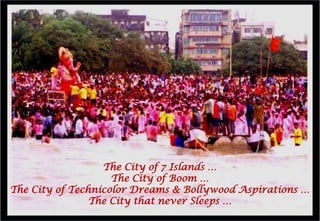
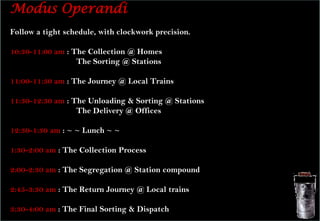
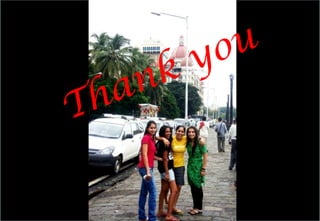
The City of 7 Islands …The City of Boom …The City of Technicolor Dreams & Bollywood Aspirations …The City that never Sleeps …
Mumbai !!!
Retail Environment in MumbaiPresented by:Kanika  GuptaPGDVM&SD  09-10
Retail environment  in IndiaEven though India has well over 5 million retail outlets of all sizes and styles (non-styles) the country surely lacks anything that can resemble a retailing industry in the modern sense of the term. This presents local as well as  international retailing specialists with a great opportunity.    As much as 96 per cent of the 5 million-plus outlets are smaller than 500 square feet in area. This means that India per capita retailing space is about 2 square feet (compared to 16 square feet in the United States). India's per capita retailing space is thus the lowest in the world (source: KSA Technopak (I) Pvt Ltd, the India operation of the US-based Kurt Salmon Associates).
  Just over 8 per cent of India's population is engaged in retailing (compared to 20 per cent in the United States). There is no data on this sector's contribution to the GDP. `
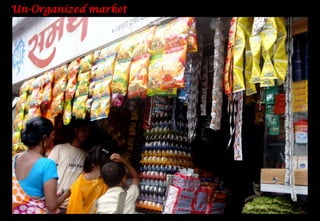
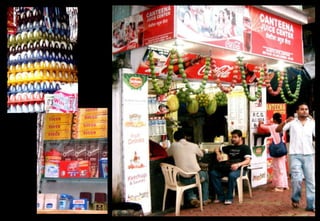
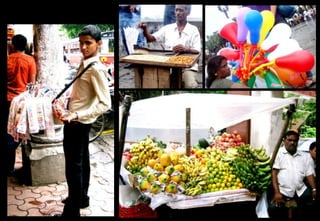
Un-Organized marketTraditionally the retail industry in India was largely unorganized. Since centuries ago this format has established in  villages & cities and have created a stronghold on the Indian mindset.This format comprises of: Drug stores
 ‘Kirana’ Stores
 Pan Wala’s
 Mandi’s & Flea Markets
 Fruit & Vegetable Vendors
 Medium and small grocery stores
  In order to survive in the growing reorganized retail market, the ‘kirana’ stores business should either cooperate or combat with the organized Indian retail.
  Of the total retail sales,  the food & grocery segment constitutes the major chunk here.Constraints:  Comparatively weak financial state
  Physical space constraints
  Expansion ProblemsUn-Organized market
Organized market Organized retailing in India have started recently and is concentrating mainly in metropolitan cities such as Delhi & Mumbai.Indian organized retail market is growing at a fast pace due to the boom in the India retail industry. In 2005, the retail industry in India amounted to Rs 10,000 billion accounting for about 10% to the country's GDP. This growing change can be seen from the fact that 1500 supermarkets, 325 departmental stores, and 300 new malls are being built. Constraints: But players in the organized sector have big expenses to meet, and yet have to keep prices low enough to be able to compete with the traditional sector.
 High costs for the organized sector arises from:
higher labor costs,
 social security to employees,
 high quality real estate,
 much bigger premises,
 comfort facilities such as air-conditioning, back-up power supply, taxes etc.
 Organized retailing also has to cope with the middle class psychology that the bigger and brighter a sales outlet is, the more expensive it will be. Retail environment in Mumbai  Mumbai is an established retail hub of the Indian Sub Continent. It leads in every trend to hit the indian Markets.
 India's first true shopping mall – complete with food courts, recreation facilities and large car parking space – was inaugurated as lately as in 1999 in Mumbai. (this mall is called "Crossroads"). The prospects are very encouraging. The first steps towards sophisticated retailing are being taken, and "Crossroads" is the best example of this awakening. More such malls have been planned in the other big cities of India. The Pioneer  -  Crossroads Mall Crossroads is the first ever full fledged shopping mall in Mumbai, and perhaps in India. Opened in 1999 by Piramal Holdings Ltd., a subsidiary of a major pharmaceutical group, it is India's first mall management company. The mall covers an area of 150,000 square feet (14,000 m²), spread over four buildings in the heart of the city.Its ideal location in the upmarket South Mumbai precinct of Tardeo, along with the novelty factor of a shopping mall, turned out be the cause of its instant success. Today the mall is just one amongst the dozens of new malls mushroomed in ever nook and corner of the city.
Consumer BehaviorThe growth in the Indian organized retail market is mainly due to the change in the consumers behavior. The changing consumer behavior is due to the preferences of the Indian buyer along with the gender driven increase of purchasing power which has taken a different hue among the marketers which are now forced to look at them as an important purchase group and drawing marketing promotions budgets accordingly. This change has come in the consumer due to increased income, changing lifestyles, and patterns of demography which are favorable. Now the consumer wants to shop at a place where he can get food, entertainment, and shopping all under one roof. This has given Indian organized retail market a major boost.
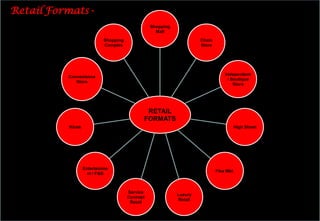
RetailFormats-
Retail Formats – Shopping Malls – Inorbit Malad, Inorbit Vashi, Palladium,
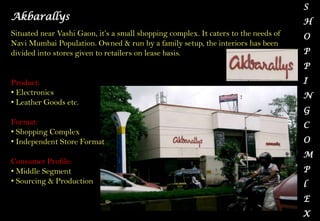
 Shopping Complex – Akbarally, Metro Plaza, Haji Ali
 High Street Mall – Phoenix Mill Mall
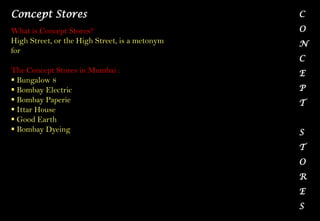
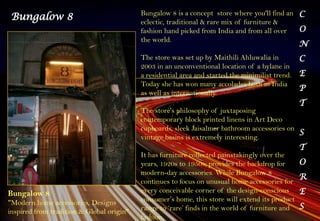
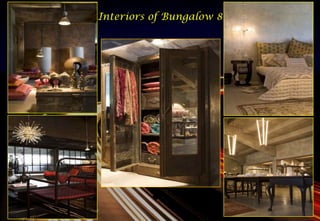
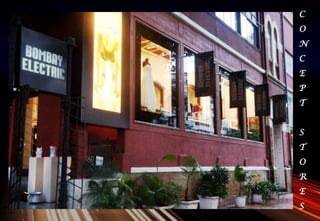
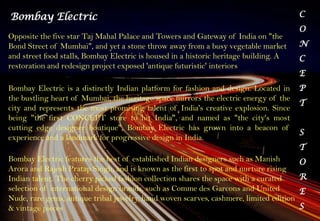
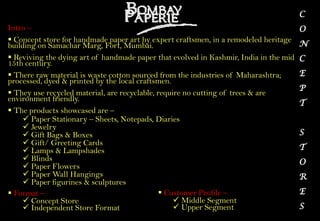
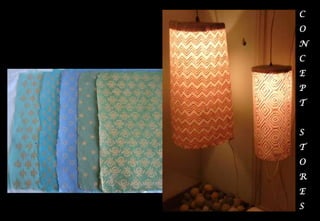
 Boutique/Independent Stores – Bombay Electric, Bungalow 8, AL Habib. Bombay Paperie
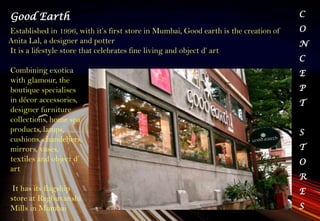
 Chain Stores – Good Earth
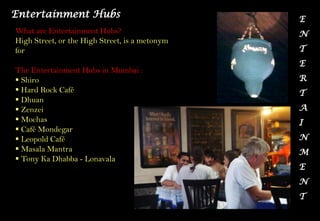
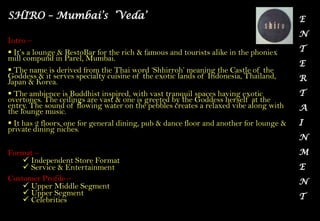
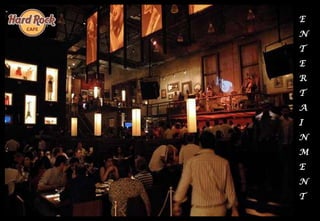
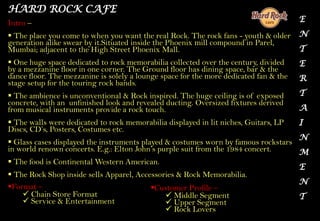
 F&B / Service – Shiro, Hard Rock, Leopold, Zenzi, Dhuan, Tony Ka Dhabba
 Luxury Retail – Taj Shopping Arcade, Galleria @ Trident
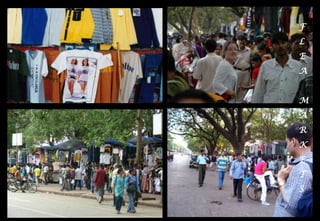
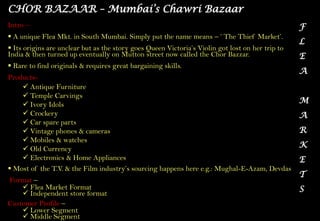
 Flea Mkt. – Fashion Street, Chor Bazaar, Crawford Market, Fishing Market
 Convenience Stores – Kirana Stores, Chemist, Muchhad Pan Wala
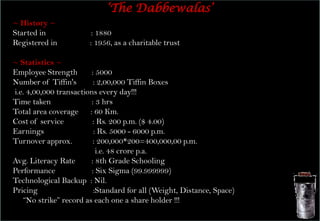
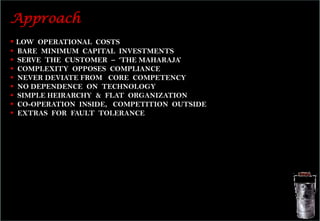
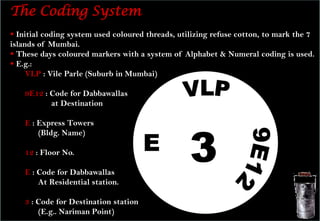
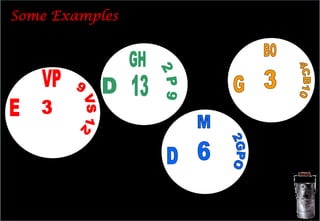
 Concept Reatil – The Dabbewala, Shoe Laundry, Car Spa
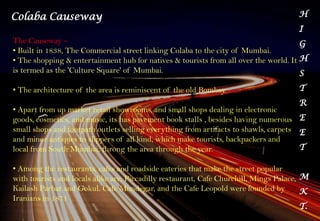
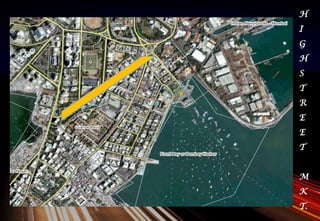
 Kiosks – Airport Retail, Juice Corner, Chado Tea, Tezz Nachos, Chuski, Popcorn, CornStallsRetail hubs –Colaba, Lokhandwala, Bandra, Malad, Parel  among others.
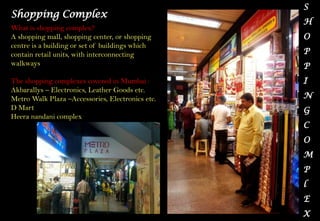
Shopping MallSHOPPINGMALlWhat is shopping mall?A group of retail outlets designed and built with ways for pedestrians on one or more levels to form a unified whole under one roof.Shopping malls in Mumbai are known as the paradise of style and fashion.From dress materials, accessories, swim suits to branded apparels and life style equipments, these shopping malls cater to the multi-pronged needs of the customersThe shopping malls covered in Mumbai : Inorbit,
 Hypercity,
 Phoenix Mill Mall
 Palladium
 Crossroads
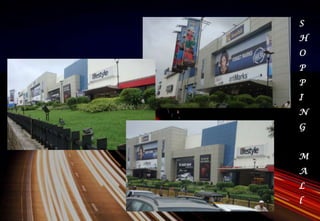
 AtriaInorbit Mall - MaladSHOPPINGMALlLocated in the country's commercial capital, Mumbai, Inorbit, Malad .Committed to setting benchmarks in the Indian Retail Industry, its success is attributed to our unique positioning as a true one-stop lifestyle destination.In its core, lies the understanding that shopping is a multifaceted experience. Conceptualized  by the world renowned UK based Chapman Taylor Partners, the mall, of universal class and appeal, seeks to provide a one-stop destination for fashion, lifestyle, food, and entertainment leading to an international shopping experience for families. They have to there credit 15 awards, which include ‘Mall of the Year’ Award for 2 years in a row, 2005 and 2006, 'Best managed Mall at the 2007 CNBC Real Estate Awards and the coveted International Maxi Award.
SHOPPINGMALl
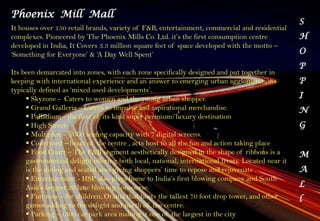
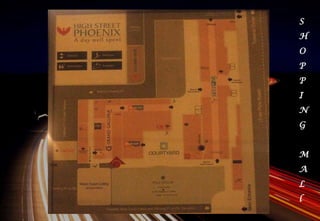
Phoenix  Mill  MallSHOPPINGMALlIt houses over 150 retail brands, variety of F&B, entertainment, commercial and residential complexes. Pioneered by The Phoenix Mills Co. Ltd. it’s the first consumption centre developed in India, It Covers 3.3 million square feet of space developed with the motto – ‘Something for Everyone’ & ‘A Day Well Spent’Its been demarcated into zones, with each zone specifically designed and put together in keeping with international experience and an answer to emerging urban agglomerations typically defined as ‘mixed used developments’.  Skyzone -  Caters to women and the young urban shopper.
 Grand Galleria – Caters to impulse and aspirational merchandise.
 Palladium - the first of its kind super premium/luxury destination
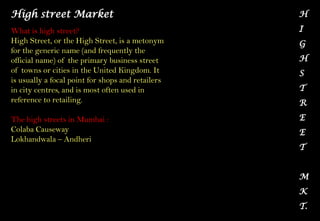
 High Street-
 Multiplex -  2000 seating capacity with 7 digital screens.
 Courtyard – heart of the centre , acts host to all the fun and action taking place
 Food Court – The F&B segment aesthetically designed in the shape of ribbons is a gastronomical delight offering both local, national, international treats. Located near it is the dining and seated area giving shoppers’ time to repose and rejuvenate .
 Entertainment - HSP also plays home to India’s first blowing company and South Asia’s largest 20 lane blowing concourse. 
 Fun zone - for children, Orama that hosts the tallest 70 foot drop tower, and other games adding to the delight and mirth of the centre.
 Parking - 1300 car park area making it one of the largest in the city.Phoenix Mill MallFormats – Shopping Mall, High Street Format, Destination FormatCustomer profile  – The typical shopper at High Street Phoenix falls in the Socio Economic Class A & B (SEC A and B) who has a pocket and a mind of his own. He knows what he wants and he knows High Street High Street Phoenix is the best place to get it!The shopper falls in the age bracket of 18 to 35. A getaway for the whole family with a huge following in students and new wage earners with well-paying jobs. They are the free-spirited souls, mostly unmarried, who frequent the place whenever they find the time or need a break or just want to hang out. The average individual spending at High Street Phoenix ranges anywhere between Rs.500 and Rs. 2,000 notching a much higher figure for family spending.At High Street Phoenix however, male shoppers outnumber female shoppers, what with the food and entertainment zones tingling their tastes and taste buds.
SHOPPINGMALl

Retail Formats In Mumbai

  • 1.
    The City of7 Islands …The City of Boom …The City of Technicolor Dreams & Bollywood Aspirations …The City that never Sleeps …
  • 2.
  • 3.
    Retail Environment inMumbaiPresented by:Kanika GuptaPGDVM&SD 09-10
  • 4.
    Retail environment in IndiaEven though India has well over 5 million retail outlets of all sizes and styles (non-styles) the country surely lacks anything that can resemble a retailing industry in the modern sense of the term. This presents local as well as international retailing specialists with a great opportunity. As much as 96 per cent of the 5 million-plus outlets are smaller than 500 square feet in area. This means that India per capita retailing space is about 2 square feet (compared to 16 square feet in the United States). India's per capita retailing space is thus the lowest in the world (source: KSA Technopak (I) Pvt Ltd, the India operation of the US-based Kurt Salmon Associates).
  • 5.
    Justover 8 per cent of India's population is engaged in retailing (compared to 20 per cent in the United States). There is no data on this sector's contribution to the GDP. `
  • 6.
    Un-Organized marketTraditionally theretail industry in India was largely unorganized. Since centuries ago this format has established in villages & cities and have created a stronghold on the Indian mindset.This format comprises of: Drug stores
  • 7.
  • 8.
  • 9.
    Mandi’s &Flea Markets
  • 10.
    Fruit &Vegetable Vendors
  • 11.
    Medium andsmall grocery stores
  • 12.
    Inorder to survive in the growing reorganized retail market, the ‘kirana’ stores business should either cooperate or combat with the organized Indian retail.
  • 13.
    Ofthe total retail sales, the food & grocery segment constitutes the major chunk here.Constraints: Comparatively weak financial state
  • 14.
    Physicalspace constraints
  • 15.
    ExpansionProblemsUn-Organized market
  • 18.
    Organized market Organizedretailing in India have started recently and is concentrating mainly in metropolitan cities such as Delhi & Mumbai.Indian organized retail market is growing at a fast pace due to the boom in the India retail industry. In 2005, the retail industry in India amounted to Rs 10,000 billion accounting for about 10% to the country's GDP. This growing change can be seen from the fact that 1500 supermarkets, 325 departmental stores, and 300 new malls are being built. Constraints: But players in the organized sector have big expenses to meet, and yet have to keep prices low enough to be able to compete with the traditional sector.
  • 19.
    High costsfor the organized sector arises from:
  • 20.
  • 21.
    social securityto employees,
  • 22.
    high qualityreal estate,
  • 23.
    much biggerpremises,
  • 24.
    comfort facilitiessuch as air-conditioning, back-up power supply, taxes etc.
  • 25.
    Organized retailingalso has to cope with the middle class psychology that the bigger and brighter a sales outlet is, the more expensive it will be. Retail environment in Mumbai Mumbai is an established retail hub of the Indian Sub Continent. It leads in every trend to hit the indian Markets.
  • 26.
    India's firsttrue shopping mall – complete with food courts, recreation facilities and large car parking space – was inaugurated as lately as in 1999 in Mumbai. (this mall is called "Crossroads"). The prospects are very encouraging. The first steps towards sophisticated retailing are being taken, and "Crossroads" is the best example of this awakening. More such malls have been planned in the other big cities of India. The Pioneer - Crossroads Mall Crossroads is the first ever full fledged shopping mall in Mumbai, and perhaps in India. Opened in 1999 by Piramal Holdings Ltd., a subsidiary of a major pharmaceutical group, it is India's first mall management company. The mall covers an area of 150,000 square feet (14,000 m²), spread over four buildings in the heart of the city.Its ideal location in the upmarket South Mumbai precinct of Tardeo, along with the novelty factor of a shopping mall, turned out be the cause of its instant success. Today the mall is just one amongst the dozens of new malls mushroomed in ever nook and corner of the city.
  • 27.
    Consumer BehaviorThe growthin the Indian organized retail market is mainly due to the change in the consumers behavior. The changing consumer behavior is due to the preferences of the Indian buyer along with the gender driven increase of purchasing power which has taken a different hue among the marketers which are now forced to look at them as an important purchase group and drawing marketing promotions budgets accordingly. This change has come in the consumer due to increased income, changing lifestyles, and patterns of demography which are favorable. Now the consumer wants to shop at a place where he can get food, entertainment, and shopping all under one roof. This has given Indian organized retail market a major boost.
  • 28.
  • 29.
    Retail Formats –Shopping Malls – Inorbit Malad, Inorbit Vashi, Palladium,
  • 30.
    Shopping Complex– Akbarally, Metro Plaza, Haji Ali
  • 31.
    High StreetMall – Phoenix Mill Mall
  • 32.
    Boutique/Independent Stores– Bombay Electric, Bungalow 8, AL Habib. Bombay Paperie
  • 33.
    Chain Stores– Good Earth
  • 34.
    F&B /Service – Shiro, Hard Rock, Leopold, Zenzi, Dhuan, Tony Ka Dhabba
  • 35.
    Luxury Retail– Taj Shopping Arcade, Galleria @ Trident
  • 36.
    Flea Mkt.– Fashion Street, Chor Bazaar, Crawford Market, Fishing Market
  • 37.
    Convenience Stores– Kirana Stores, Chemist, Muchhad Pan Wala
  • 38.
    Concept Reatil– The Dabbewala, Shoe Laundry, Car Spa
  • 39.
    Kiosks –Airport Retail, Juice Corner, Chado Tea, Tezz Nachos, Chuski, Popcorn, CornStallsRetail hubs –Colaba, Lokhandwala, Bandra, Malad, Parel among others.
  • 40.
    Shopping MallSHOPPINGMALlWhat isshopping mall?A group of retail outlets designed and built with ways for pedestrians on one or more levels to form a unified whole under one roof.Shopping malls in Mumbai are known as the paradise of style and fashion.From dress materials, accessories, swim suits to branded apparels and life style equipments, these shopping malls cater to the multi-pronged needs of the customersThe shopping malls covered in Mumbai : Inorbit,
  • 41.
  • 42.
  • 43.
  • 44.
  • 45.
    AtriaInorbit Mall- MaladSHOPPINGMALlLocated in the country's commercial capital, Mumbai, Inorbit, Malad .Committed to setting benchmarks in the Indian Retail Industry, its success is attributed to our unique positioning as a true one-stop lifestyle destination.In its core, lies the understanding that shopping is a multifaceted experience. Conceptualized by the world renowned UK based Chapman Taylor Partners, the mall, of universal class and appeal, seeks to provide a one-stop destination for fashion, lifestyle, food, and entertainment leading to an international shopping experience for families. They have to there credit 15 awards, which include ‘Mall of the Year’ Award for 2 years in a row, 2005 and 2006, 'Best managed Mall at the 2007 CNBC Real Estate Awards and the coveted International Maxi Award.
  • 46.
  • 47.
    Phoenix Mill MallSHOPPINGMALlIt houses over 150 retail brands, variety of F&B, entertainment, commercial and residential complexes. Pioneered by The Phoenix Mills Co. Ltd. it’s the first consumption centre developed in India, It Covers 3.3 million square feet of space developed with the motto – ‘Something for Everyone’ & ‘A Day Well Spent’Its been demarcated into zones, with each zone specifically designed and put together in keeping with international experience and an answer to emerging urban agglomerations typically defined as ‘mixed used developments’. Skyzone - Caters to women and the young urban shopper.
  • 48.
    Grand Galleria– Caters to impulse and aspirational merchandise.
  • 49.
    Palladium -the first of its kind super premium/luxury destination
  • 50.
  • 51.
    Multiplex - 2000 seating capacity with 7 digital screens.
  • 52.
    Courtyard –heart of the centre , acts host to all the fun and action taking place
  • 53.
    Food Court– The F&B segment aesthetically designed in the shape of ribbons is a gastronomical delight offering both local, national, international treats. Located near it is the dining and seated area giving shoppers’ time to repose and rejuvenate .
  • 54.
    Entertainment -HSP also plays home to India’s first blowing company and South Asia’s largest 20 lane blowing concourse. 
  • 55.
    Fun zone- for children, Orama that hosts the tallest 70 foot drop tower, and other games adding to the delight and mirth of the centre.
  • 56.
    Parking -1300 car park area making it one of the largest in the city.Phoenix Mill MallFormats – Shopping Mall, High Street Format, Destination FormatCustomer profile – The typical shopper at High Street Phoenix falls in the Socio Economic Class A & B (SEC A and B) who has a pocket and a mind of his own. He knows what he wants and he knows High Street High Street Phoenix is the best place to get it!The shopper falls in the age bracket of 18 to 35. A getaway for the whole family with a huge following in students and new wage earners with well-paying jobs. They are the free-spirited souls, mostly unmarried, who frequent the place whenever they find the time or need a break or just want to hang out. The average individual spending at High Street Phoenix ranges anywhere between Rs.500 and Rs. 2,000 notching a much higher figure for family spending.At High Street Phoenix however, male shoppers outnumber female shoppers, what with the food and entertainment zones tingling their tastes and taste buds.
  • 57.