RESTful Services and Distributed OSGi

Friends or Foes


                                       Roland Tritsch
                                        Director PS FUSE
                      ACCU 2009 - Apr., 23rd - Oxford (UK)
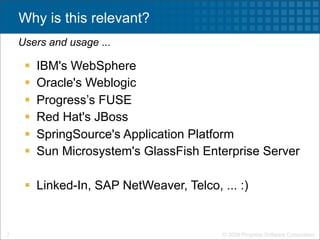
Why is this relevant?
    Users and usage ...

        IBM's WebSphere
        Oracle's Weblogic
        Progress’s FUSE
        Red Hat's JBoss
        SpringSource's Application Platform
        Sun Microsystem's GlassFish Enterprise Server

      Linked-In, SAP NetWeaver, Telco, ... :)


2                                        © 2009 Progress Software Corporation
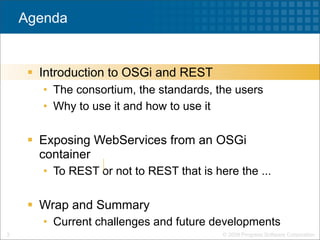
Agenda


      Introduction to OSGi and REST
       • The consortium, the standards, the users
       • Why to use it and how to use it

      Exposing WebServices from an OSGi
       container
       • To REST or not to REST that is here the ...

      Wrap and Summary
       • Current challenges and future developments
3                                         © 2009 Progress Software Corporation
The History


     OSGi originally stood for “Open Services
      Gateway initiative”
       • An initiative focused on deploying Java solutions
         into “residential gateways” for smart homes and
         building controls
       • The OSGi alliance was founded in 1999 to
         promote wide scale adoption of OSGi technology
     OSGi tackles the problem of deploying and
      administering Java “modules” (aka “bundles”)
       • Lifecycle - How to load, start, and stop Java
         bundles without shutting down the JVM
4                                          © 2009 Progress Software Corporation
The Benefits
    My personal hit list ...


      Mobile to Mainframe


      Managing the “CLASSPATH hell”


      With great tools/tooling around it


5                                           © 2009 Progress Software Corporation
The OSGi Alliance


     The OSGi alliance is made up of over 40
      members. Including ...
       • IBM, Progress, RedHat, SpringSource,
         Gigaspaces, Sun Microsystems ...
     Specifications are created by expert groups
       • Core Platform Expert Group (CPEG)
       • Vehicle Expert Group (VEG) - OSGi in the
         automotive industry
       • Mobile Expert Group (MEG) - OSGi in mobile
         telecommunications

6                                       © 2009 Progress Software Corporation
The OSGi Alliance (cont.)


     Specifications are created by expert groups
       • Residential Expert Group (REG) - OSGi in
         consumer and residential applications
       • Enterprise Expert Group (EEG) - OSGi in
         enterprise IT infrastructure applications
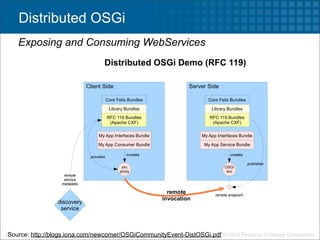
          – Distributed OSGi/RFC 119 describes how to allow
            remote invocations between OSGi containers
              A reference implementation is based on Apache CXF


7                                               © 2009 Progress Software Corporation
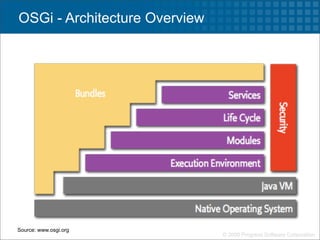
OSGi - Architecture Overview


Source: www.osgi.org
                               © 2009 Progress Software Corporation
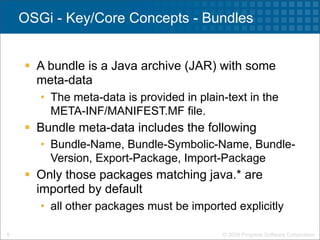
OSGi - Key/Core Concepts - Bundles


     A bundle is a Java archive (JAR) with some
      meta-data
       • The meta-data is provided in plain-text in the
         META-INF/MANIFEST.MF file.
     Bundle meta-data includes the following
       • Bundle-Name, Bundle-Symbolic-Name, Bundle-
         Version, Export-Package, Import-Package
     Only those packages matching java.* are
      imported by default
       • all other packages must be imported explicitly

9                                          © 2009 Progress Software Corporation
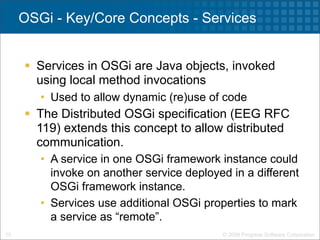
OSGi - Key/Core Concepts - Services


      Services in OSGi are Java objects, invoked
       using local method invocations
        • Used to allow dynamic (re)use of code
      The Distributed OSGi specification (EEG RFC
       119) extends this concept to allow distributed
       communication.
        • A service in one OSGi framework instance could
          invoke on another service deployed in a different
          OSGi framework instance.
        • Services use additional OSGi properties to mark
          a service as “remote”.
10                                         © 2009 Progress Software Corporation
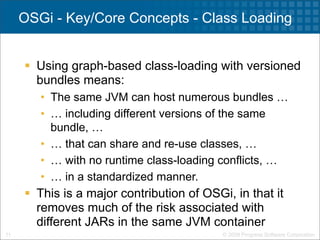
OSGi - Key/Core Concepts - Class Loading


      Using graph-based class-loading with versioned
       bundles means:
        • The same JVM can host numerous bundles …
        • … including different versions of the same
          bundle, …
        • … that can share and re-use classes, …
        • … with no runtime class-loading conflicts, …
        • … in a standardized manner.
      This is a major contribution of OSGi, in that it
       removes much of the risk associated with
       different JARs in the same JVM container
11                                         © 2009 Progress Software Corporation
OSGi - Implementations
     The “not-complete” list ... :)

       Apache Felix (from Apache Software
        Foundation)
          • Distributed under ASL 2.0
          • http://felix.apache.org/
       Equinox (from Eclipse Foundation)
          • Distributed under the Eclipse License
          • http://eclipse.org/equinox
       Knoplerfish (knoplerfish.org)
          • Distributed under the Knoplerfish License
          • http://knoplerfish.org
12                                           © 2009 Progress Software Corporation
REST - Introduction


      JAX-RS/JSR311 provides Java language
       support for RESTful services
        • For more information on REST, see Roy
          Fielding’s Ph.D. thesis:
          – http://www.ics.uci.edu/~fielding/pubs/dissertation/
            top.htm
      The approach is ideal for services that will be
       consumed by rich, browser- based internet client
       technologies like JavaScript and Google Web
       Toolkit (GWT)

13                                            © 2009 Progress Software Corporation
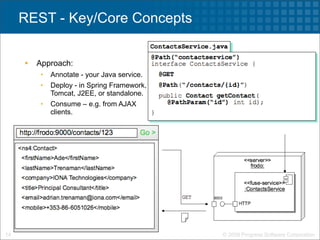
REST - Key/Core Concepts


        Approach:
         •   Annotate - your Java service.
         •   Deploy - in Spring Framework,
             Tomcat, J2EE, or standalone.
         •   Consume – e.g. from AJAX
             clients.


14                                           © 2009 Progress Software Corporation
The REST Interface


      No formal interface definition language (WSDL,
       IDL) is used
        • However, XSD is often used for data definition.
      A service’s “parameters” are passed via payload
       and URL
        • http://localhost:9000/contacts/007
        • Apache CXF supports multiple payloads,
          including XML and JSON


15                                         © 2009 Progress Software Corporation
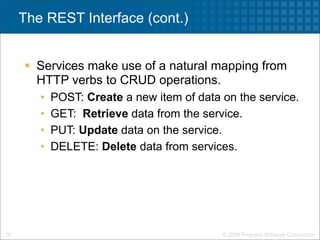
The REST Interface (cont.)


      Services make use of a natural mapping from
       HTTP verbs to CRUD operations.
        •   POST: Create a new item of data on the service.
        •   GET: Retrieve data from the service.
        •   PUT: Update data on the service.
        •   DELETE: Delete data from services.


16                                          © 2009 Progress Software Corporation
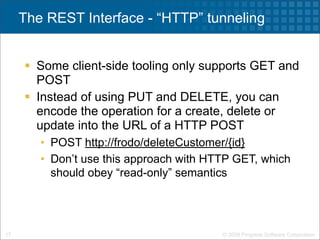
The REST Interface - “HTTP” tunneling


      Some client-side tooling only supports GET and
       POST
      Instead of using PUT and DELETE, you can
       encode the operation for a create, delete or
       update into the URL of a HTTP POST
        • POST http://frodo/deleteCustomer/{id}
        • Don’t use this approach with HTTP GET, which
          should obey “read-only” semantics


17                                       © 2009 Progress Software Corporation
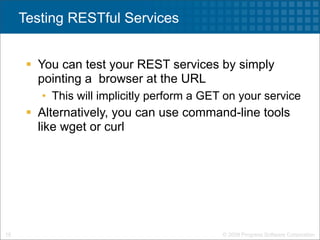
Testing RESTful Services


       You can test your REST services by simply
        pointing a browser at the URL
        • This will implicitly perform a GET on your service
       Alternatively, you can use command-line tools
        like wget or curl


18                                          © 2009 Progress Software Corporation
Agenda


       Introduction to OSGi and REST
        • The consortium, the standards, the users
        • Why to use it and how to use it

       Exposing WebServices from an OSGi
        container
        • To REST or not to REST that is here the ...

       Wrap and Summary
        • Current challenges and future developments
19                                         © 2009 Progress Software Corporation
Distributed OSGi
    Exposing and Consuming WebServices
                                         !"#$%"&'$()*+,-"*!(./*0123*4456

                                 (+&"/A%!&'"                               !"#$"#%!&'"

                                             ()#"%*"+&,%-./'+"0                   ()#"%*"+&,%-./'+"0

                                              1&2#3#4%-./'+"0                      1&2#3#4%-./'+"0
                                             5*(%667%-./'+"0                      5*(%667%-./'+"0
                                              89:3;<"%(=*>                         89:3;<"%(=*>

                                      ?4%9::%@/A"#B3;"0%-./'+"                 ?4%9::%@/A"#B3;"0%-./'+"

                                      ?4%9::%()/0.E"#%-./'+"                    ?4%9::%!"#$&;"%-./'+"

                                                       +02.3#&                               !"#$%#&
                                  '".2+1#&
                                                                                                       '()*+&,#&
                                                     0$;                                  C!D&
                                                    :#),4                                  0$;
                       "#-.%#
                       &#"2+!#
                      -#%$1$%$

                                                                    %(./$(           "#-.%#/#01'.+0%
                                                                  "78/9:$"/7
                  '&0;)$"#4
                   0"#$&;"
                  !                                                 !


 Source: http://blogs.iona.com/newcomer/OSGiCommunityEvent-DistOSGi.pdf © 2009 Progress Software Corporation
20
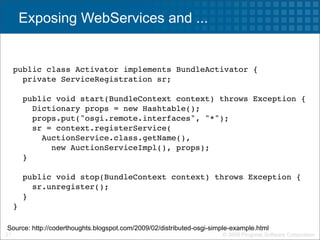
Exposing WebServices and ...


     public class Activator implements BundleActivator {
       private ServiceRegistration sr;

       public void start(BundleContext context) throws Exception {
         Dictionary props = new Hashtable();
         props.put("osgi.remote.interfaces", "*");
         sr = context.registerService(
           AuctionService.class.getName(),
             new AuctionServiceImpl(), props);
       }

       public void stop(BundleContext context) throws Exception {
         sr.unregister();
       }
     }

Source: http://coderthoughts.blogspot.com/2009/02/distributed-osgi-simple-example.html
21                                                                    © 2009 Progress Software Corporation
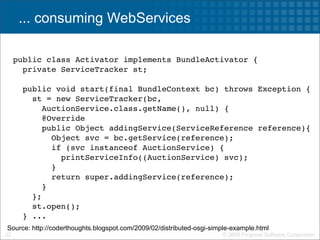
... consuming WebServices

     public class Activator implements BundleActivator {
       private ServiceTracker st;

       public void start(final BundleContext bc) throws Exception {
         st = new ServiceTracker(bc,
            AuctionService.class.getName(), null) {
           @Override
           public Object addingService(ServiceReference reference){
             Object svc = bc.getService(reference);
             if (svc instanceof AuctionService) {
               printServiceInfo((AuctionService) svc);
             }
             return super.addingService(reference);
           }
         };
         st.open();
       } ...
Source: http://coderthoughts.blogspot.com/2009/02/distributed-osgi-simple-example.html
22                                                                    © 2009 Progress Software Corporation
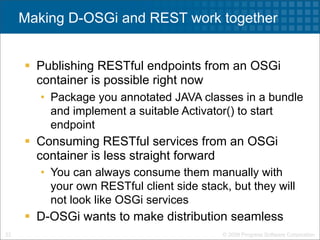
Making D-OSGi and REST work together


      Publishing RESTful endpoints from an OSGi
       container is possible right now
        • Package you annotated JAVA classes in a bundle
          and implement a suitable Activator() to start
          endpoint
      Consuming RESTful services from an OSGi
       container is less straight forward
        • You can always consume them manually with
          your own RESTful client side stack, but they will
          not look like OSGi services
      D-OSGi wants to make distribution seamless
23                                          © 2009 Progress Software Corporation
Making D-OSGi and REST work together


      The JAX-RS/JSR311 spec does not define a
       client side API for RESTful services ...

      ... but Jersey and Apache CXF do have such
       APIs, means ...

      ... both of these implementations are probably
       suitable to be plugged-in D-OSGi to allow OSGi
       containers to get seamless access to RESTful
       services
24                                     © 2009 Progress Software Corporation
Agenda


       Introduction to OSGi and REST
        • The consortium, the standards, the users
        • Why to use it and how to use it

       Exposing WebServices from an OSGi
        container
        • To REST or not to REST that is here the ...

       Wrap and Summary
        • Current challenges and future developments
25                                         © 2009 Progress Software Corporation
References


      The OSGi Alliance - http://www.osgi.org

      REST - http://www.ics.uci.edu/~fielding/pubs/
       dissertation/top.htm

      Distributed OSGi
        • Reference Implementation - http://cxf.apache.org/
          distributed-osgi.html


26                                         © 2009 Progress Software Corporation
Current Situation and Next Steps


      OSGi is on the rise

      With the efforts around D-OSGi, (RESTful)
       WebServices are first class citizens in the OSGi
       world
        • OSGi will become the de-facto deployment
          environment for (RESTful) WebServices

      The next steps could be to extend D-OSGi to
       include support for async messaging

27                                       © 2009 Progress Software Corporation
Questions


28               © 2009 Progress Software Corporation
Questions


             Thank You!


29                   © 2009 Progress Software Corporation
30   © 2009 Progress Software Corporation

RESTful Services and Distributed OSGi - 04/2009

  • 1.
    RESTful Services andDistributed OSGi Friends or Foes Roland Tritsch Director PS FUSE ACCU 2009 - Apr., 23rd - Oxford (UK)
  • 2.
    Why is thisrelevant? Users and usage ...  IBM's WebSphere  Oracle's Weblogic  Progress’s FUSE  Red Hat's JBoss  SpringSource's Application Platform  Sun Microsystem's GlassFish Enterprise Server  Linked-In, SAP NetWeaver, Telco, ... :) 2 © 2009 Progress Software Corporation
  • 3.
    Agenda  Introduction to OSGi and REST • The consortium, the standards, the users • Why to use it and how to use it  Exposing WebServices from an OSGi container • To REST or not to REST that is here the ...  Wrap and Summary • Current challenges and future developments 3 © 2009 Progress Software Corporation
  • 4.
    The History  OSGi originally stood for “Open Services Gateway initiative” • An initiative focused on deploying Java solutions into “residential gateways” for smart homes and building controls • The OSGi alliance was founded in 1999 to promote wide scale adoption of OSGi technology  OSGi tackles the problem of deploying and administering Java “modules” (aka “bundles”) • Lifecycle - How to load, start, and stop Java bundles without shutting down the JVM 4 © 2009 Progress Software Corporation
  • 5.
    The Benefits My personal hit list ...  Mobile to Mainframe  Managing the “CLASSPATH hell”  With great tools/tooling around it 5 © 2009 Progress Software Corporation
  • 6.
    The OSGi Alliance  The OSGi alliance is made up of over 40 members. Including ... • IBM, Progress, RedHat, SpringSource, Gigaspaces, Sun Microsystems ...  Specifications are created by expert groups • Core Platform Expert Group (CPEG) • Vehicle Expert Group (VEG) - OSGi in the automotive industry • Mobile Expert Group (MEG) - OSGi in mobile telecommunications 6 © 2009 Progress Software Corporation
  • 7.
    The OSGi Alliance(cont.)  Specifications are created by expert groups • Residential Expert Group (REG) - OSGi in consumer and residential applications • Enterprise Expert Group (EEG) - OSGi in enterprise IT infrastructure applications – Distributed OSGi/RFC 119 describes how to allow remote invocations between OSGi containers  A reference implementation is based on Apache CXF 7 © 2009 Progress Software Corporation
  • 8.
    OSGi - ArchitectureOverview Source: www.osgi.org © 2009 Progress Software Corporation
  • 9.
    OSGi - Key/CoreConcepts - Bundles  A bundle is a Java archive (JAR) with some meta-data • The meta-data is provided in plain-text in the META-INF/MANIFEST.MF file.  Bundle meta-data includes the following • Bundle-Name, Bundle-Symbolic-Name, Bundle- Version, Export-Package, Import-Package  Only those packages matching java.* are imported by default • all other packages must be imported explicitly 9 © 2009 Progress Software Corporation
  • 10.
    OSGi - Key/CoreConcepts - Services  Services in OSGi are Java objects, invoked using local method invocations • Used to allow dynamic (re)use of code  The Distributed OSGi specification (EEG RFC 119) extends this concept to allow distributed communication. • A service in one OSGi framework instance could invoke on another service deployed in a different OSGi framework instance. • Services use additional OSGi properties to mark a service as “remote”. 10 © 2009 Progress Software Corporation
  • 11.
    OSGi - Key/CoreConcepts - Class Loading  Using graph-based class-loading with versioned bundles means: • The same JVM can host numerous bundles … • … including different versions of the same bundle, … • … that can share and re-use classes, … • … with no runtime class-loading conflicts, … • … in a standardized manner.  This is a major contribution of OSGi, in that it removes much of the risk associated with different JARs in the same JVM container 11 © 2009 Progress Software Corporation
  • 12.
    OSGi - Implementations The “not-complete” list ... :)  Apache Felix (from Apache Software Foundation) • Distributed under ASL 2.0 • http://felix.apache.org/  Equinox (from Eclipse Foundation) • Distributed under the Eclipse License • http://eclipse.org/equinox  Knoplerfish (knoplerfish.org) • Distributed under the Knoplerfish License • http://knoplerfish.org 12 © 2009 Progress Software Corporation
  • 13.
    REST - Introduction  JAX-RS/JSR311 provides Java language support for RESTful services • For more information on REST, see Roy Fielding’s Ph.D. thesis: – http://www.ics.uci.edu/~fielding/pubs/dissertation/ top.htm  The approach is ideal for services that will be consumed by rich, browser- based internet client technologies like JavaScript and Google Web Toolkit (GWT) 13 © 2009 Progress Software Corporation
  • 14.
    REST - Key/CoreConcepts  Approach: • Annotate - your Java service. • Deploy - in Spring Framework, Tomcat, J2EE, or standalone. • Consume – e.g. from AJAX clients. 14 © 2009 Progress Software Corporation
  • 15.
    The REST Interface  No formal interface definition language (WSDL, IDL) is used • However, XSD is often used for data definition.  A service’s “parameters” are passed via payload and URL • http://localhost:9000/contacts/007 • Apache CXF supports multiple payloads, including XML and JSON 15 © 2009 Progress Software Corporation
  • 16.
    The REST Interface(cont.)  Services make use of a natural mapping from HTTP verbs to CRUD operations. • POST: Create a new item of data on the service. • GET: Retrieve data from the service. • PUT: Update data on the service. • DELETE: Delete data from services. 16 © 2009 Progress Software Corporation
  • 17.
    The REST Interface- “HTTP” tunneling  Some client-side tooling only supports GET and POST  Instead of using PUT and DELETE, you can encode the operation for a create, delete or update into the URL of a HTTP POST • POST http://frodo/deleteCustomer/{id} • Don’t use this approach with HTTP GET, which should obey “read-only” semantics 17 © 2009 Progress Software Corporation
  • 18.
    Testing RESTful Services  You can test your REST services by simply pointing a browser at the URL • This will implicitly perform a GET on your service  Alternatively, you can use command-line tools like wget or curl 18 © 2009 Progress Software Corporation
  • 19.
    Agenda  Introduction to OSGi and REST • The consortium, the standards, the users • Why to use it and how to use it  Exposing WebServices from an OSGi container • To REST or not to REST that is here the ...  Wrap and Summary • Current challenges and future developments 19 © 2009 Progress Software Corporation
  • 20.
    Distributed OSGi Exposing and Consuming WebServices !"#$%"&'$()*+,-"*!(./*0123*4456 (+&"/A%!&'" !"#$"#%!&'" ()#"%*"+&,%-./'+"0 ()#"%*"+&,%-./'+"0 1&2#3#4%-./'+"0 1&2#3#4%-./'+"0 5*(%667%-./'+"0 5*(%667%-./'+"0 89:3;<"%(=*> 89:3;<"%(=*> ?4%9::%@/A"#B3;"0%-./'+" ?4%9::%@/A"#B3;"0%-./'+" ?4%9::%()/0.E"#%-./'+" ?4%9::%!"#$&;"%-./'+" +02.3#& !"#$%#& '".2+1#& '()*+&,#& 0$; C!D& :#),4 0$; "#-.%# &#"2+!# -#%$1$%$ %(./$( "#-.%#/#01'.+0% "78/9:$"/7 '&0;)$"#4 0"#$&;" ! ! Source: http://blogs.iona.com/newcomer/OSGiCommunityEvent-DistOSGi.pdf © 2009 Progress Software Corporation 20
  • 21.
    Exposing WebServices and... public class Activator implements BundleActivator {   private ServiceRegistration sr;   public void start(BundleContext context) throws Exception {     Dictionary props = new Hashtable();     props.put("osgi.remote.interfaces", "*");     sr = context.registerService( AuctionService.class.getName(),         new AuctionServiceImpl(), props);   }   public void stop(BundleContext context) throws Exception {     sr.unregister();   } } Source: http://coderthoughts.blogspot.com/2009/02/distributed-osgi-simple-example.html 21 © 2009 Progress Software Corporation
  • 22.
    ... consuming WebServices public class Activator implements BundleActivator {   private ServiceTracker st;   public void start(final BundleContext bc) throws Exception {     st = new ServiceTracker(bc, AuctionService.class.getName(), null) {       @Override       public Object addingService(ServiceReference reference){         Object svc = bc.getService(reference);         if (svc instanceof AuctionService) {           printServiceInfo((AuctionService) svc);         }         return super.addingService(reference);       }     };     st.open();   } ... Source: http://coderthoughts.blogspot.com/2009/02/distributed-osgi-simple-example.html 22 © 2009 Progress Software Corporation
  • 23.
    Making D-OSGi andREST work together  Publishing RESTful endpoints from an OSGi container is possible right now • Package you annotated JAVA classes in a bundle and implement a suitable Activator() to start endpoint  Consuming RESTful services from an OSGi container is less straight forward • You can always consume them manually with your own RESTful client side stack, but they will not look like OSGi services  D-OSGi wants to make distribution seamless 23 © 2009 Progress Software Corporation
  • 24.
    Making D-OSGi andREST work together  The JAX-RS/JSR311 spec does not define a client side API for RESTful services ...  ... but Jersey and Apache CXF do have such APIs, means ...  ... both of these implementations are probably suitable to be plugged-in D-OSGi to allow OSGi containers to get seamless access to RESTful services 24 © 2009 Progress Software Corporation
  • 25.
    Agenda  Introduction to OSGi and REST • The consortium, the standards, the users • Why to use it and how to use it  Exposing WebServices from an OSGi container • To REST or not to REST that is here the ...  Wrap and Summary • Current challenges and future developments 25 © 2009 Progress Software Corporation
  • 26.
    References  The OSGi Alliance - http://www.osgi.org  REST - http://www.ics.uci.edu/~fielding/pubs/ dissertation/top.htm  Distributed OSGi • Reference Implementation - http://cxf.apache.org/ distributed-osgi.html 26 © 2009 Progress Software Corporation
  • 27.
    Current Situation andNext Steps  OSGi is on the rise  With the efforts around D-OSGi, (RESTful) WebServices are first class citizens in the OSGi world • OSGi will become the de-facto deployment environment for (RESTful) WebServices  The next steps could be to extend D-OSGi to include support for async messaging 27 © 2009 Progress Software Corporation
  • 28.
    Questions 28 © 2009 Progress Software Corporation
  • 29.
    Questions Thank You! 29 © 2009 Progress Software Corporation
  • 30.
    30 © 2009 Progress Software Corporation