Welcome to
Classes
BYJU’S
Alternating Current
What you already know
What you will learn
S8: Resonance
1 . Pure AC circuits
2 . RC and L R AC circuits
3 . Impedance
4. Powe r in AC circuits
5 . Se rie s L CR circuits
1 . Condition for re sonance
2 . Graphical representation
3 . Num e ricals on re sonance
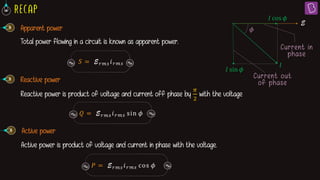
Apparent power
Total power flowing in a circuit is known as apparent power.
𝑆 = E𝑟𝑚𝑠 𝑖𝑟𝑚𝑠
Reactive power is product of voltage and current off phase by
𝜋
2
with the voltage
𝑄 = E𝑟𝑚𝑠 𝑖𝑟𝑚𝑠 sin 𝜙
Reactive power Current out
of phase
Current in
phase
E
𝐼
𝐼 sin 𝜙
𝜙
𝐼 cos 𝜙
𝑃 = E𝑟𝑚𝑠 𝑖𝑟𝑚𝑠 cos 𝜙
Active power is product of voltage and current in phase with the voltage.
Active power
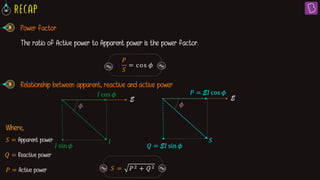
Power factor
The ratio of Active power to Apparent power is the power factor.
𝑃
𝑆
= cos 𝜙
Relationship between apparent, reactive and active power
E
𝑆
𝑄 = E𝐼 sin 𝜙
𝜙
𝑃 = E𝐼 cos 𝜙
E
𝐼
𝐼 sin 𝜙
𝜙
𝐼 cos 𝜙
Where,
𝑆 = Apparent power
𝑄 = Reactive power
𝑃 = Active power 𝑆 = 𝑃2 + 𝑄2
Series L-C-R circuit 𝑅
𝑉 = 𝑉𝑚 sin(𝜔𝑡)
𝐶
𝐿
𝐼 = 𝐼𝑚 sin(𝜔𝑡 + 𝜙)
𝐼
𝑉𝑅
𝜔𝑡 + 𝜙
𝑉𝐿
𝑉𝐶
𝑉𝑅
𝑉𝐶𝑚 − 𝑉𝐿𝑚
𝜙
𝜔𝑡
𝑉
𝑉𝑚
2 = 𝑉𝑅𝑚
2
+ 𝑉𝐶𝑚 − 𝑉𝐿𝑚
2
𝑉𝑚
2 = 𝐼𝑚 𝑅 2 + 𝐼𝑚 𝑋𝐶 − 𝐼𝑚 𝑋𝐿
2
𝑉𝑚
2 = 𝐼𝑚
2 [𝑅2 + 𝑋𝐶 − 𝑋𝐿
2]
𝐼𝑚 =
𝑉𝑚
𝑅2 + 𝑋𝐶 − 𝑋𝐿
2
𝑉𝐶 + 𝑉𝐿
𝑉𝑅𝑚
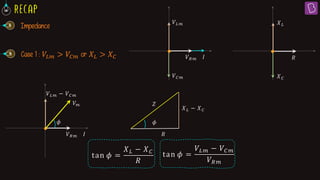
Impedance
𝑅
𝑋𝐶
𝑋𝐿
𝑉𝑅𝑚 𝐼
𝑉𝐶𝑚
𝑉𝐿𝑚
𝑉𝐿𝑚 − 𝑉𝐶𝑚
𝑉𝑅𝑚 𝐼
𝑉𝑚
𝜙 𝜙
𝑅
𝑋𝐿 − 𝑋𝐶
𝑍
tan 𝜙 =
𝑋𝐿 − 𝑋𝐶
𝑅
tan 𝜙 =
𝑉𝐿𝑚 − 𝑉𝐶𝑚
𝑉𝑅𝑚
Case 1 : 𝑉𝐿𝑚 > 𝑉𝐶𝑚 or 𝑋𝐿 > 𝑋𝐶
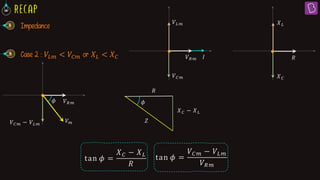
Impedance
𝑅
𝑋𝐶
𝑋𝐿
𝑉𝑅𝑚 𝐼
𝑉𝐶𝑚
𝑉𝐿𝑚
Case 2 : 𝑉𝐿𝑚 < 𝑉𝐶𝑚 or 𝑋𝐿 < 𝑋𝐶
𝑉𝐶𝑚 − 𝑉𝐿𝑚
𝑉𝑅𝑚
𝜙 𝜙
𝑅
𝑋𝐶 − 𝑋𝐿
𝑍
tan 𝜙 =
𝑋𝐶 − 𝑋𝐿
𝑅
tan 𝜙 =
𝑉𝐶𝑚 − 𝑉𝐿𝑚
𝑉𝑅𝑚
𝑉𝑚
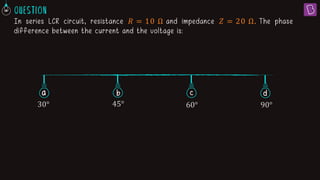
In series LCR circuit, resistance 𝑅 = 10 Ω and impedance 𝑍 = 20 Ω. The phase
difference between the current and the voltage is:
a b c
30° 45° 60° 90°
d
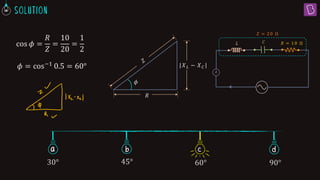
𝜙
𝑅
|𝑋𝐿 − 𝑋𝐶 |
𝑅 = 10 Ω
𝐶
𝐿
𝐴
cos 𝜙 =
𝑅
𝑍
=
10
20
=
1
2
𝑍 = 20 Ω
𝜙 = cos−1 0.5 = 60°
c
a b
30° 45° 60° 90°
d
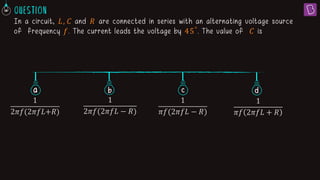
In a circuit, 𝐿, 𝐶 and 𝑅 are connected in series with an alternating voltage source
of frequency 𝑓. The current leads the voltage by 45°
. The value of 𝐶 is
a b c
1
2ߨ݂(2ߨ݂‫ܮ‬+ܴ)
1
2𝜋𝑓(2𝜋𝑓𝐿 − 𝑅)
1
𝜋𝑓(2𝜋𝑓𝐿 − 𝑅)
1
𝜋𝑓 2𝜋𝑓𝐿 + 𝑅
d
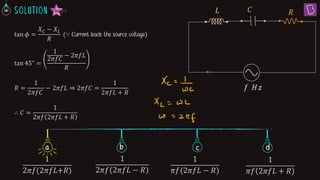
tan 𝜙 =
𝑋𝐶 − 𝑋𝐿
𝑅
(∵ Current leads the source voltage)
tan 45∘ =
1
2𝜋𝑓𝐶
− 2𝜋𝑓𝐿
𝑅
𝑅 =
1
2𝜋𝑓𝐶
− 2𝜋𝑓𝐿 ⇒ 2𝜋𝑓𝐶 =
1
2𝜋𝑓𝐿 + 𝑅
∴ 𝐶 =
1
2𝜋𝑓 2𝜋𝑓𝐿 + 𝑅
𝑅
𝑓 𝐻𝑧
𝐶
𝐿
b c d
a
1
2ߨ݂(2ߨ݂‫ܮ‬+ܴ)
1
2𝜋𝑓(2𝜋𝑓𝐿 − 𝑅)
1
𝜋𝑓(2𝜋𝑓𝐿 − 𝑅)
1
𝜋𝑓 2𝜋𝑓𝐿 + 𝑅
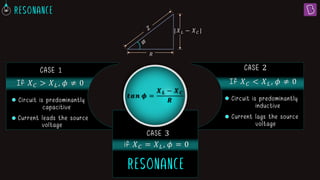
CASE 2
If 𝑋𝐶 < 𝑋𝐿 , 𝜙 ≠ 0
Circuit is predominantly
inductive
Current lags the source
voltage
CASE 1
If 𝑋𝐶 > 𝑋𝐿 , 𝜙 ≠ 0
Circuit is predominantly
capacitive
Current leads the source
voltage
CASE 3
if 𝑋𝐶 = 𝑋𝐿 , 𝜙 = 0
𝒕𝒂𝒏 𝝓 =
𝑿𝑳 − 𝑿𝑪
𝑹
𝜙
𝑅
|𝑋𝐿 − 𝑋𝐶 |
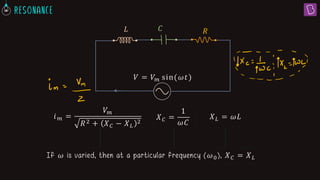
𝑅
𝐶
𝐿
𝑖𝑚 =
𝑉𝑚
𝑅2 + 𝑋𝐶 − 𝑋𝐿
2
𝑋𝐶 =
1
𝜔𝐶
𝑋𝐿 = 𝜔𝐿
If 𝜔 is varied, then at a particular frequency (𝜔0), 𝑋𝐶 = 𝑋𝐿
𝑉 = 𝑉𝑚 sin(𝜔𝑡)
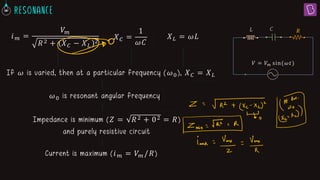
𝑖𝑚 =
𝑉𝑚
𝑅2 + 𝑋𝐶 − 𝑋𝐿
2
𝑋𝐶 =
1
𝜔𝐶
𝑋𝐿 = 𝜔𝐿
𝜔0 is resonant angular frequency
Impedance is minimum (𝑍 = 𝑅2 + 02 = 𝑅)
and purely resistive circuit
Current is maximum (𝑖𝑚 = 𝑉𝑚 /𝑅)
If 𝜔 is varied, then at a particular frequency (𝜔0), 𝑋𝐶 = 𝑋𝐿
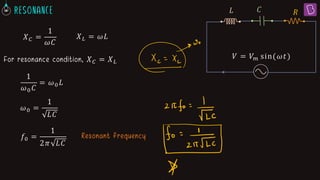
𝑋𝐶 =
1
𝜔𝐶
𝑋𝐿 = 𝜔𝐿
For resonance condition, 𝑋𝐶 = 𝑋𝐿
1
𝜔0𝐶
= 𝜔0𝐿
𝜔0 =
1
𝐿𝐶
𝑓0 =
1
2𝜋 𝐿𝐶
Resonant frequency
𝑅
𝐶
𝐿
𝑉 = 𝑉𝑚 sin(𝜔𝑡)
|
𝑓
𝑓0
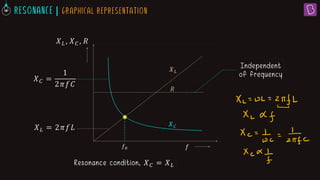
𝑋𝐶 =
1
2𝜋𝑓𝐶
𝑋𝐿 = 2𝜋𝑓𝐿
𝑋𝐿
𝑅
𝑋𝐶
Independent
of frequency
Resonance condition, 𝑋𝐶 = 𝑋𝐿
𝑋𝐿 , 𝑋𝐶 , 𝑅
|
𝑓
𝑓0
𝑋𝐿
𝑅
𝑋𝐶
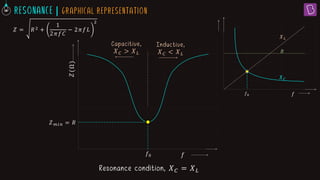
𝑍
(Ω)
𝑓
𝑓0
𝑍𝑚𝑖𝑛 = 𝑅
𝑍 = 𝑅2 +
1
2𝜋𝑓𝐶
− 2𝜋𝑓𝐿
2
Resonance condition, 𝑋𝐶 = 𝑋𝐿
Capacitive,
𝑋𝐶 > 𝑋𝐿
Inductive,
𝑋𝐶 < 𝑋𝐿
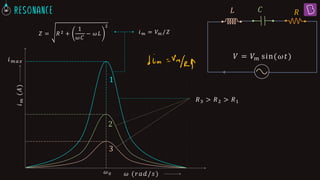
𝑖
𝑚
(𝐴
)
𝜔 (𝑟𝑎𝑑/𝑠)
𝜔0
𝑍 = 𝑅2 +
1
𝜔𝐶
− 𝜔𝐿
2
𝑅
𝐶
𝐿
𝑉 = 𝑉𝑚 sin(𝜔𝑡)
𝑖𝑚 = 𝑉𝑚 /𝑍
𝑖𝑚𝑎𝑥
1
2
3
𝑅3 > 𝑅2 > 𝑅1
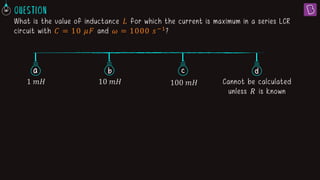
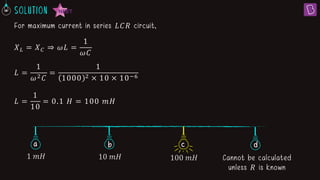
What is the value of inductance 𝐿 for which the current is maximum in a series LCR
circuit with 𝐶 = 10 𝜇𝐹 and 𝜔 = 1000 𝑠−1?
a b c
1 𝑚𝐻 10 𝑚𝐻 100 𝑚𝐻 Cannot be calculated
unless 𝑅 is known
d
𝑋𝐿 = 𝑋𝐶 ⇒ 𝜔𝐿 =
1
𝜔𝐶
𝐿 =
1
𝜔2𝐶
=
1
1000 2 × 10 × 10−6
𝐿 =
1
10
= 0.1 𝐻 = 100 𝑚𝐻
For maximum current in series 𝐿𝐶𝑅 circuit,
a b d
c
1 𝑚𝐻 10 𝑚𝐻 100 𝑚𝐻 Cannot be calculated
unless 𝑅 is known
a b c
𝜋 𝑍𝑒𝑟𝑜 𝜋/4 𝜋/2
d
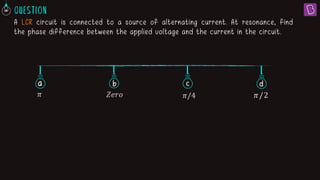
A LCR circuit is connected to a source of alternating current. At resonance, find
the phase difference between the applied voltage and the current in the circuit.
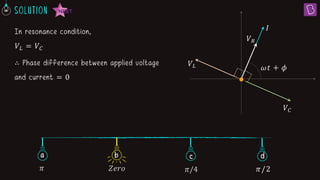
𝐼
𝑉𝑅
𝜔𝑡 + 𝜙
𝑉𝐿
𝑉𝐶
In resonance condition,
𝑉𝐿 = 𝑉𝐶
∴ Phase difference between applied voltage
and current = 0
a c d
b
𝜋 𝑍𝑒𝑟𝑜 𝜋/4 𝜋/2
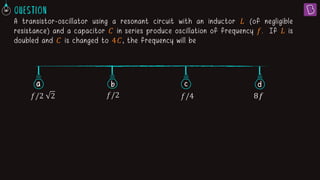
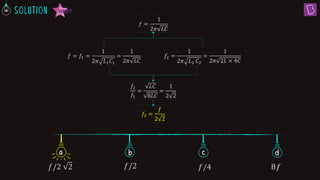
A transistor-oscillator using a resonant circuit with an inductor 𝐿 (of negligible
resistance) and a capacitor 𝐶 in series produce oscillation of frequency 𝑓. If 𝐿 is
doubled and 𝐶 is changed to 4𝐶, the frequency will be
a b c
𝑓/2 2 𝑓/2 𝑓/4 8𝑓
d
𝑓 =
1
2𝜋 𝐿𝐶
𝑓 = 𝑓1 =
1
2𝜋 𝐿1𝐶1
=
1
2𝜋 𝐿𝐶
𝑓2 =
1
2𝜋 𝐿2 𝐶2
=
1
2𝜋 2𝐿 × 4𝐶
𝑓2
𝑓1
=
𝐿𝐶
8𝐿𝐶
=
1
2 2
𝑓2 =
𝑓
2 2
a b c
𝑓/2 2 𝑓/2 𝑓/4 8𝑓
d

Resonance.pdf

  • 1.
    Welcome to Classes BYJU’S Alternating Current Whatyou already know What you will learn S8: Resonance 1 . Pure AC circuits 2 . RC and L R AC circuits 3 . Impedance 4. Powe r in AC circuits 5 . Se rie s L CR circuits 1 . Condition for re sonance 2 . Graphical representation 3 . Num e ricals on re sonance
  • 2.
    Apparent power Total powerflowing in a circuit is known as apparent power. 𝑆 = E𝑟𝑚𝑠 𝑖𝑟𝑚𝑠 Reactive power is product of voltage and current off phase by 𝜋 2 with the voltage 𝑄 = E𝑟𝑚𝑠 𝑖𝑟𝑚𝑠 sin 𝜙 Reactive power Current out of phase Current in phase E 𝐼 𝐼 sin 𝜙 𝜙 𝐼 cos 𝜙 𝑃 = E𝑟𝑚𝑠 𝑖𝑟𝑚𝑠 cos 𝜙 Active power is product of voltage and current in phase with the voltage. Active power
  • 3.
    Power factor The ratioof Active power to Apparent power is the power factor. 𝑃 𝑆 = cos 𝜙 Relationship between apparent, reactive and active power E 𝑆 𝑄 = E𝐼 sin 𝜙 𝜙 𝑃 = E𝐼 cos 𝜙 E 𝐼 𝐼 sin 𝜙 𝜙 𝐼 cos 𝜙 Where, 𝑆 = Apparent power 𝑄 = Reactive power 𝑃 = Active power 𝑆 = 𝑃2 + 𝑄2
  • 4.
    Series L-C-R circuit𝑅 𝑉 = 𝑉𝑚 sin(𝜔𝑡) 𝐶 𝐿 𝐼 = 𝐼𝑚 sin(𝜔𝑡 + 𝜙) 𝐼 𝑉𝑅 𝜔𝑡 + 𝜙 𝑉𝐿 𝑉𝐶 𝑉𝑅 𝑉𝐶𝑚 − 𝑉𝐿𝑚 𝜙 𝜔𝑡 𝑉 𝑉𝑚 2 = 𝑉𝑅𝑚 2 + 𝑉𝐶𝑚 − 𝑉𝐿𝑚 2 𝑉𝑚 2 = 𝐼𝑚 𝑅 2 + 𝐼𝑚 𝑋𝐶 − 𝐼𝑚 𝑋𝐿 2 𝑉𝑚 2 = 𝐼𝑚 2 [𝑅2 + 𝑋𝐶 − 𝑋𝐿 2] 𝐼𝑚 = 𝑉𝑚 𝑅2 + 𝑋𝐶 − 𝑋𝐿 2 𝑉𝐶 + 𝑉𝐿 𝑉𝑅𝑚
  • 5.
    Impedance 𝑅 𝑋𝐶 𝑋𝐿 𝑉𝑅𝑚 𝐼 𝑉𝐶𝑚 𝑉𝐿𝑚 𝑉𝐿𝑚 −𝑉𝐶𝑚 𝑉𝑅𝑚 𝐼 𝑉𝑚 𝜙 𝜙 𝑅 𝑋𝐿 − 𝑋𝐶 𝑍 tan 𝜙 = 𝑋𝐿 − 𝑋𝐶 𝑅 tan 𝜙 = 𝑉𝐿𝑚 − 𝑉𝐶𝑚 𝑉𝑅𝑚 Case 1 : 𝑉𝐿𝑚 > 𝑉𝐶𝑚 or 𝑋𝐿 > 𝑋𝐶
  • 6.
    Impedance 𝑅 𝑋𝐶 𝑋𝐿 𝑉𝑅𝑚 𝐼 𝑉𝐶𝑚 𝑉𝐿𝑚 Case 2: 𝑉𝐿𝑚 < 𝑉𝐶𝑚 or 𝑋𝐿 < 𝑋𝐶 𝑉𝐶𝑚 − 𝑉𝐿𝑚 𝑉𝑅𝑚 𝜙 𝜙 𝑅 𝑋𝐶 − 𝑋𝐿 𝑍 tan 𝜙 = 𝑋𝐶 − 𝑋𝐿 𝑅 tan 𝜙 = 𝑉𝐶𝑚 − 𝑉𝐿𝑚 𝑉𝑅𝑚 𝑉𝑚
  • 7.
    In series LCRcircuit, resistance 𝑅 = 10 Ω and impedance 𝑍 = 20 Ω. The phase difference between the current and the voltage is: a b c 30° 45° 60° 90° d
  • 8.
    𝜙 𝑅 |𝑋𝐿 − 𝑋𝐶| 𝑅 = 10 Ω 𝐶 𝐿 𝐴 cos 𝜙 = 𝑅 𝑍 = 10 20 = 1 2 𝑍 = 20 Ω 𝜙 = cos−1 0.5 = 60° c a b 30° 45° 60° 90° d
  • 9.
    In a circuit,𝐿, 𝐶 and 𝑅 are connected in series with an alternating voltage source of frequency 𝑓. The current leads the voltage by 45° . The value of 𝐶 is a b c 1 2ߨ݂(2ߨ݂‫ܮ‬+ܴ) 1 2𝜋𝑓(2𝜋𝑓𝐿 − 𝑅) 1 𝜋𝑓(2𝜋𝑓𝐿 − 𝑅) 1 𝜋𝑓 2𝜋𝑓𝐿 + 𝑅 d
  • 10.
    tan 𝜙 = 𝑋𝐶− 𝑋𝐿 𝑅 (∵ Current leads the source voltage) tan 45∘ = 1 2𝜋𝑓𝐶 − 2𝜋𝑓𝐿 𝑅 𝑅 = 1 2𝜋𝑓𝐶 − 2𝜋𝑓𝐿 ⇒ 2𝜋𝑓𝐶 = 1 2𝜋𝑓𝐿 + 𝑅 ∴ 𝐶 = 1 2𝜋𝑓 2𝜋𝑓𝐿 + 𝑅 𝑅 𝑓 𝐻𝑧 𝐶 𝐿 b c d a 1 2ߨ݂(2ߨ݂‫ܮ‬+ܴ) 1 2𝜋𝑓(2𝜋𝑓𝐿 − 𝑅) 1 𝜋𝑓(2𝜋𝑓𝐿 − 𝑅) 1 𝜋𝑓 2𝜋𝑓𝐿 + 𝑅
  • 11.
    CASE 2 If 𝑋𝐶< 𝑋𝐿 , 𝜙 ≠ 0 Circuit is predominantly inductive Current lags the source voltage CASE 1 If 𝑋𝐶 > 𝑋𝐿 , 𝜙 ≠ 0 Circuit is predominantly capacitive Current leads the source voltage CASE 3 if 𝑋𝐶 = 𝑋𝐿 , 𝜙 = 0 𝒕𝒂𝒏 𝝓 = 𝑿𝑳 − 𝑿𝑪 𝑹 𝜙 𝑅 |𝑋𝐿 − 𝑋𝐶 |
  • 12.
    𝑅 𝐶 𝐿 𝑖𝑚 = 𝑉𝑚 𝑅2 +𝑋𝐶 − 𝑋𝐿 2 𝑋𝐶 = 1 𝜔𝐶 𝑋𝐿 = 𝜔𝐿 If 𝜔 is varied, then at a particular frequency (𝜔0), 𝑋𝐶 = 𝑋𝐿 𝑉 = 𝑉𝑚 sin(𝜔𝑡)
  • 13.
    𝑖𝑚 = 𝑉𝑚 𝑅2 +𝑋𝐶 − 𝑋𝐿 2 𝑋𝐶 = 1 𝜔𝐶 𝑋𝐿 = 𝜔𝐿 𝜔0 is resonant angular frequency Impedance is minimum (𝑍 = 𝑅2 + 02 = 𝑅) and purely resistive circuit Current is maximum (𝑖𝑚 = 𝑉𝑚 /𝑅) If 𝜔 is varied, then at a particular frequency (𝜔0), 𝑋𝐶 = 𝑋𝐿
  • 14.
    𝑋𝐶 = 1 𝜔𝐶 𝑋𝐿 =𝜔𝐿 For resonance condition, 𝑋𝐶 = 𝑋𝐿 1 𝜔0𝐶 = 𝜔0𝐿 𝜔0 = 1 𝐿𝐶 𝑓0 = 1 2𝜋 𝐿𝐶 Resonant frequency 𝑅 𝐶 𝐿 𝑉 = 𝑉𝑚 sin(𝜔𝑡)
  • 15.
    | 𝑓 𝑓0 𝑋𝐶 = 1 2𝜋𝑓𝐶 𝑋𝐿 =2𝜋𝑓𝐿 𝑋𝐿 𝑅 𝑋𝐶 Independent of frequency Resonance condition, 𝑋𝐶 = 𝑋𝐿 𝑋𝐿 , 𝑋𝐶 , 𝑅
  • 16.
    | 𝑓 𝑓0 𝑋𝐿 𝑅 𝑋𝐶 𝑍 (Ω) 𝑓 𝑓0 𝑍𝑚𝑖𝑛 = 𝑅 𝑍= 𝑅2 + 1 2𝜋𝑓𝐶 − 2𝜋𝑓𝐿 2 Resonance condition, 𝑋𝐶 = 𝑋𝐿 Capacitive, 𝑋𝐶 > 𝑋𝐿 Inductive, 𝑋𝐶 < 𝑋𝐿
  • 17.
    𝑖 𝑚 (𝐴 ) 𝜔 (𝑟𝑎𝑑/𝑠) 𝜔0 𝑍 =𝑅2 + 1 𝜔𝐶 − 𝜔𝐿 2 𝑅 𝐶 𝐿 𝑉 = 𝑉𝑚 sin(𝜔𝑡) 𝑖𝑚 = 𝑉𝑚 /𝑍 𝑖𝑚𝑎𝑥 1 2 3 𝑅3 > 𝑅2 > 𝑅1
  • 18.
    What is thevalue of inductance 𝐿 for which the current is maximum in a series LCR circuit with 𝐶 = 10 𝜇𝐹 and 𝜔 = 1000 𝑠−1? a b c 1 𝑚𝐻 10 𝑚𝐻 100 𝑚𝐻 Cannot be calculated unless 𝑅 is known d
  • 19.
    𝑋𝐿 = 𝑋𝐶⇒ 𝜔𝐿 = 1 𝜔𝐶 𝐿 = 1 𝜔2𝐶 = 1 1000 2 × 10 × 10−6 𝐿 = 1 10 = 0.1 𝐻 = 100 𝑚𝐻 For maximum current in series 𝐿𝐶𝑅 circuit, a b d c 1 𝑚𝐻 10 𝑚𝐻 100 𝑚𝐻 Cannot be calculated unless 𝑅 is known
  • 20.
    a b c 𝜋𝑍𝑒𝑟𝑜 𝜋/4 𝜋/2 d A LCR circuit is connected to a source of alternating current. At resonance, find the phase difference between the applied voltage and the current in the circuit.
  • 21.
    𝐼 𝑉𝑅 𝜔𝑡 + 𝜙 𝑉𝐿 𝑉𝐶 Inresonance condition, 𝑉𝐿 = 𝑉𝐶 ∴ Phase difference between applied voltage and current = 0 a c d b 𝜋 𝑍𝑒𝑟𝑜 𝜋/4 𝜋/2
  • 22.
    A transistor-oscillator usinga resonant circuit with an inductor 𝐿 (of negligible resistance) and a capacitor 𝐶 in series produce oscillation of frequency 𝑓. If 𝐿 is doubled and 𝐶 is changed to 4𝐶, the frequency will be a b c 𝑓/2 2 𝑓/2 𝑓/4 8𝑓 d
  • 23.
    𝑓 = 1 2𝜋 𝐿𝐶 𝑓= 𝑓1 = 1 2𝜋 𝐿1𝐶1 = 1 2𝜋 𝐿𝐶 𝑓2 = 1 2𝜋 𝐿2 𝐶2 = 1 2𝜋 2𝐿 × 4𝐶 𝑓2 𝑓1 = 𝐿𝐶 8𝐿𝐶 = 1 2 2 𝑓2 = 𝑓 2 2 a b c 𝑓/2 2 𝑓/2 𝑓/4 8𝑓 d