ReSIPLAST
THIN ADHESIVE FILM WATERPROOFING
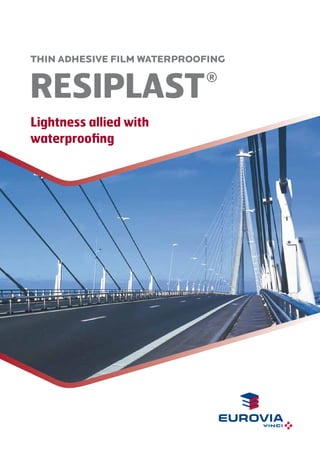
Lightness allied with
waterproofing
ReSIPLAST
THIN ADHESIVE FILM WATERPROOFING
key benefits
Easy application
Available in many colours
Ultra light-weight waterproofing
Can be applied to vertical structures
Key figures
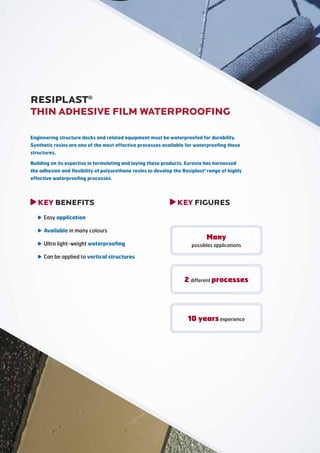
Engineering structure decks and related equipment must be waterproofed for durability.
Synthetic resins are one of the most effective processes available for waterproofing these
structures.
Building on its expertise in formulating and laying these products, Eurovia has harnessed
the adhesion and flexibility of polyurethane resins to develop the Resiplastrange of highly
effective waterproofing processes.
Many
possibles applications
2 different processes
10 years experience
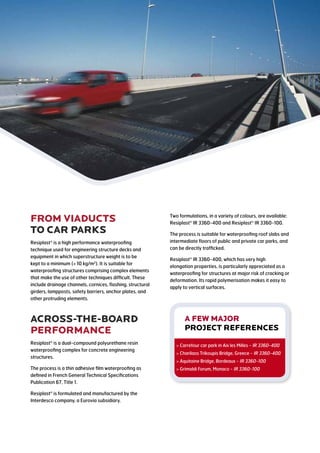
from VIADUCts
to car PARKs
Resiplast is a high performance waterproofing
technique used for engineering structure decks and
equipment in which superstructure weight is to be
kept to a minimum ( 10 kg/m2
). It is suitable for
waterproofing structures comprising complex elements
that make the use of other techniques difficult. These
include drainage channels, cornices, flashing, structural
girders, lampposts, safety barriers, anchor plates, and
other protruding elements.
ACROSS-THE-BOARD
PERFORMANCE
Resiplast is a dual-compound polyurethane resin
waterproofing complex for concrete engineering
structures.
The process is a thin adhesive film waterproofing as
defined in French General Technical Specifications
Publication 67, Title 1.
Resiplast is formulated and manufactured by the
Interdesco company, a Eurovia subsidiary.
Two formulations, in a variety of colours, are available:
Resiplast IR 3360-400 and Resiplast IR 3360-100.
The process is suitable for waterproofing roof slabs and
intermediate floors of public and private car parks, and
can be directly trafficked.
Resiplast IR 3360-400, which has very high
elongation properties, is particularly appreciated as a
waterproofing for structures at major risk of cracking or
deformation. Its rapid polymerisation makes it easy to
apply to vertical surfaces.
A FEW MAJOR
project references
 Carrefour car park in Aix les Milles - IR 3360-400
 Charilaos Trikoupis Bridge, Greece - IR 3360-400
 Aquitaine Bridge, Bordeaux - IR 3360-100
 Grimaldi Forum, Monaco - IR 3360-100
A MATERIAL WITH
Many AdVANTAGEs
Resiplast IR 3360-400 and IR 3360-100 differ
primarily in their speed of polymerisation and their
mechanical properties, particularly flexibility.
At 20°C and 10 mm/min, the elongation performance
of the two products is identical before and after
thermal shock.
application
expertise
Resiplast is always applied to a surface that has been
carefully prepared by grit blasting, sand blasting or
grinding. Substrate macrotexture (NF EN 13036-1)
must be less than 1 mm. The first layer of Resiplast is
a tack primer with a spread rate of 300 to 500 g/m2
,
depending on substrate porosity.
A polyurethane resin is used on a dry substrate, an
epoxy resin is used when the substrate is slightly
damp. Silica with a grading of about 1 mm is strewn
over this layer. The main constituent of the complex,
the actual waterproofing, is a 2.5 mm thick layer of
polyurethane resin.
 Resiplast IR 3360-400 sets instantaneously at
high temperatures (50 to 70°C). It is sprayed by a
high-pressure mixing gun specially produced by the
Sept Résine company, a Eurovia subsidiary
 Resiplast IR 3360-100 polymerises at ambient
temperatures. It is spread manually with a serrated
float. It can also be applied with a spray gun.
If the waterproofing is overlaid with an asphalt mix, a
tack coat of Resiplast IR 3360-100 is laid at a spread
rate of 600 to 700 g/m2
and gritted with 4 to
5 kg/m2
of 2/4 mm dry and clean materials to ensure
mechanical bonding to the asphalt mix.
If the waterproofing is to be directly trafficked, e.g. by
light vehicles (car parks) or pedestrians (footpaths),
an additional anti-skid surface dressing with suitably
graded aggregates is sufficient.
If the waterproofing is to remain visible, it is coated
with a polyurethane resin finishing (at 100 to
200 g/m2
) that is stable in ultra-violet light. The
equipment used to apply Resiplast does not require
road access to the worksite.
TECHNICAL DEPARTMENT
18, place de l’Europe - 92565 Rueil-Malmaison Cedex
Tel. : 33 (0)1 47 16 38 00 - Fax : 33 (0)1 47 16 38 01
www.eurovia.com
technique@eurovia.com
-February2014-photoscredit:photolibraryEurovia
Pot life (NF P 18-810)
IR 3360-400	 20 to 30 sec
IR 3360-100	 20 to 30 min
Shore A hardness at 7 days (NF P 98-285)
IR 3360-400	 75
IR 3360-100	 90 to 95
Tensile elongation (NF P 98-283)
At 20 °C and 10 mm/min
IR 3360-400	 600%
IR 3360-100	 70%
At -10 °C and 1 mm/min
IR 3360-400	 400%
IR 3360-100	 20%
Technical Opinions were issued for the IR 3360-400 and
IR 3360-100 processes in June 2006 and March 2007
respectively.

Resiplast - Lightness allied with waterproofing

  • 1.
    ReSIPLAST THIN ADHESIVE FILMWATERPROOFING Lightness allied with waterproofing
  • 2.
    ReSIPLAST THIN ADHESIVE FILMWATERPROOFING key benefits Easy application Available in many colours Ultra light-weight waterproofing Can be applied to vertical structures Key figures Engineering structure decks and related equipment must be waterproofed for durability. Synthetic resins are one of the most effective processes available for waterproofing these structures. Building on its expertise in formulating and laying these products, Eurovia has harnessed the adhesion and flexibility of polyurethane resins to develop the Resiplastrange of highly effective waterproofing processes. Many possibles applications 2 different processes 10 years experience
  • 3.
    from VIADUCts to carPARKs Resiplast is a high performance waterproofing technique used for engineering structure decks and equipment in which superstructure weight is to be kept to a minimum ( 10 kg/m2 ). It is suitable for waterproofing structures comprising complex elements that make the use of other techniques difficult. These include drainage channels, cornices, flashing, structural girders, lampposts, safety barriers, anchor plates, and other protruding elements. ACROSS-THE-BOARD PERFORMANCE Resiplast is a dual-compound polyurethane resin waterproofing complex for concrete engineering structures. The process is a thin adhesive film waterproofing as defined in French General Technical Specifications Publication 67, Title 1. Resiplast is formulated and manufactured by the Interdesco company, a Eurovia subsidiary. Two formulations, in a variety of colours, are available: Resiplast IR 3360-400 and Resiplast IR 3360-100. The process is suitable for waterproofing roof slabs and intermediate floors of public and private car parks, and can be directly trafficked. Resiplast IR 3360-400, which has very high elongation properties, is particularly appreciated as a waterproofing for structures at major risk of cracking or deformation. Its rapid polymerisation makes it easy to apply to vertical surfaces. A FEW MAJOR project references Carrefour car park in Aix les Milles - IR 3360-400 Charilaos Trikoupis Bridge, Greece - IR 3360-400 Aquitaine Bridge, Bordeaux - IR 3360-100 Grimaldi Forum, Monaco - IR 3360-100
  • 4.
    A MATERIAL WITH ManyAdVANTAGEs Resiplast IR 3360-400 and IR 3360-100 differ primarily in their speed of polymerisation and their mechanical properties, particularly flexibility. At 20°C and 10 mm/min, the elongation performance of the two products is identical before and after thermal shock. application expertise Resiplast is always applied to a surface that has been carefully prepared by grit blasting, sand blasting or grinding. Substrate macrotexture (NF EN 13036-1) must be less than 1 mm. The first layer of Resiplast is a tack primer with a spread rate of 300 to 500 g/m2 , depending on substrate porosity. A polyurethane resin is used on a dry substrate, an epoxy resin is used when the substrate is slightly damp. Silica with a grading of about 1 mm is strewn over this layer. The main constituent of the complex, the actual waterproofing, is a 2.5 mm thick layer of polyurethane resin. Resiplast IR 3360-400 sets instantaneously at high temperatures (50 to 70°C). It is sprayed by a high-pressure mixing gun specially produced by the Sept Résine company, a Eurovia subsidiary Resiplast IR 3360-100 polymerises at ambient temperatures. It is spread manually with a serrated float. It can also be applied with a spray gun. If the waterproofing is overlaid with an asphalt mix, a tack coat of Resiplast IR 3360-100 is laid at a spread rate of 600 to 700 g/m2 and gritted with 4 to 5 kg/m2 of 2/4 mm dry and clean materials to ensure mechanical bonding to the asphalt mix. If the waterproofing is to be directly trafficked, e.g. by light vehicles (car parks) or pedestrians (footpaths), an additional anti-skid surface dressing with suitably graded aggregates is sufficient. If the waterproofing is to remain visible, it is coated with a polyurethane resin finishing (at 100 to 200 g/m2 ) that is stable in ultra-violet light. The equipment used to apply Resiplast does not require road access to the worksite. TECHNICAL DEPARTMENT 18, place de l’Europe - 92565 Rueil-Malmaison Cedex Tel. : 33 (0)1 47 16 38 00 - Fax : 33 (0)1 47 16 38 01 www.eurovia.com technique@eurovia.com -February2014-photoscredit:photolibraryEurovia Pot life (NF P 18-810) IR 3360-400 20 to 30 sec IR 3360-100 20 to 30 min Shore A hardness at 7 days (NF P 98-285) IR 3360-400 75 IR 3360-100 90 to 95 Tensile elongation (NF P 98-283) At 20 °C and 10 mm/min IR 3360-400 600% IR 3360-100 70% At -10 °C and 1 mm/min IR 3360-400 400% IR 3360-100 20% Technical Opinions were issued for the IR 3360-400 and IR 3360-100 processes in June 2006 and March 2007 respectively.