Associate Assessment
Residential Property
Management
February 2017
2
Associate
Assessment Pathway guide
Residential Property Management
Introduction ..............................................................................................................................................................................................................................................................................................................................................................3
Competencies .......................................................................................................................................................................................................................................................................................................................................................................3
What is Residential Property Management? ........................................................................................................................................................................................................................................................3
Residential Property Management competencies ......................................................................................................................................................................4
Technical competencies ..................................................................................................................................................................................................................................................................................................................................5
Mandatory competencies ........................................................................................................................................................................................................................................................................................................................15
Continuing professional development (CPD) ...................................................................................................................................................................................................................................................16
3
Associate
Assessment Pathway guide
Residential Property Management
Introduction
In order to become an RICS Associate you must demonstrate that
you have knowledge, understanding and practical ability relevant to
a surveying role – in this case, Residential Property Management.
This guide explains the competencies for your pathway, with examples
of how you can show you meet the requirements.
Refer to this guide while preparing your submission for assessment.
The Associate Assessment Candidate Guide gives further essential
information on how to prepare for the assessment.
Competencies
A competency is the knowledge, skills, abilities and behaviours needed for
a particular role or task. RICS competencies equip you to work in your
chosen pathway.
The six technical competencies are the pathway-specific ‘hard’ skills
needed for your role.
The eight mandatory competencies are the ‘soft’ business skills
demonstrating your ability to work with colleagues, manage workloads
and act with integrity. All candidates, regardless of their pathway, need
these skills.
What is Residential Property
Management?
This pathway is suitable for people embarking on a career as a manager
of residential property, either managing long leasehold property in the
private, subsidised or public sector.
Residential property managers help residential owners, in all sectors of the
market, make the most of their assets and are instrumental in improving
the lives of many residential occupiers.
Residential property managers work right across the residential sector.
They may work for a private practice, managing blocks of flats for a private
or institutional landlord client, they may be employed directly by private
companies, for example providers of sheltered housing. Alternatively they
may work for a social landlord or for a local administration.
Residential property managers manage and maintain all communal
aspects of residential property, they account for shared charges and
resolve disputes at all levels. Managing a residential property involves
complying with legal obligations, for example, landlord and tenant,
planning, health and safety and fire regulations.
The scope of Residential Property Management is extremely varied
and services are likely to include:
• management of on-site staff
• resolving disputes
• evidence for tribunals
• formulating debt recovery strategies
• health and safety
• improving energy efficiency
• lease negotiations
• negotiating service level agreements
• preparing maintenance plans
• maintenance management
• risk assessments
• service charge accounting
• strategic planning.
4
Associate
Assessment Pathway guide
Residential Property Management
You must achieve the following four technical competencies:
• maintenance management
• property management
• property management accounting
• relationship management and dispute handling.
Plus two of the following:
• applied sustainability
• housing management and policy
• landlord and tenant
• property records/information systems
• risk management.
You must complete all eight mandatory competencies:
• client care
• communication and negotiation
• conduct rules, ethics and professional practice
• conflict avoidance, management and dispute resolution procedures
• data management
• health and safety
• sustainability
• teamworking.
Residential Property Management competencies
5
Associate
Assessment Pathway guide
Residential Property Management
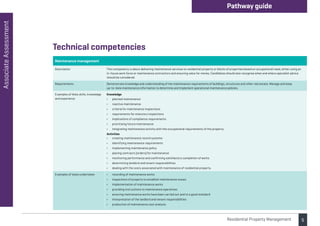
Maintenance management
Description This competency is about delivering maintenance services to residential property or blocks of properties based on occupational need, either using an
in-house work force or maintenance contractors and ensuring value for money. Candidates should also recognise when and where specialist advice
should be considered.
Requirements Demonstrate knowledge and understanding of the maintenance requirements of buildings, structures and other real estate. Manage and keep
up-to-date maintenance information to determine and implement operational maintenance policies.
Examples of likely skills, knowledge
and experience
Knowledge
• planned maintenance
• reactive maintenance
• criteria for maintenance inspections
• requirements for statutory inspections
• implications of compliance requirements
• prioritising future maintenance
• integrating maintenance activity with the occupational requirements of the property.
Activities
• creating maintenance record systems
• identifying maintenance requirements
• implementing maintenance policy
• placing contracts (orders) for maintenance
• monitoring performance and confirming satisfactory completion of works
• determining landlord and tenant responsibilities
• dealing with the costs associated with maintenance of residential property.
Examples of tasks undertaken • recording of maintenance works
• inspections of property to establish maintenance issues
• implementation of maintenance works
• providing instructions to maintenance operatives
• ensuring maintenance works have been carried out and to a good standard
• interpretation of the landlord and tenant responsibilities
• production of maintenance cost analysis.
Technical competencies
6
Associate
Assessment Pathway guide
Residential Property Management
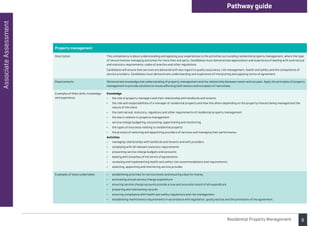
Property management
Description This competency is about understanding and applying your experiences to the activities surrounding residential property management, where the type
of tenure involves managing outcomes for more than one party. Candidates must demonstrate appreciation and experience of dealing with contractual
and statutory requirements, codes of practice and other regulations.
Candidates will ensure that services are delivered with due regard to quality assurance, risk management, health and safety and the competence of
service providers. Candidates must demonstrate understanding and experience of interpreting and applying terms of agreement.
Requirements Demonstrate knowledge and understanding of property management and the relationship between owner and occupier. Apply the principles of property
management to provide solutions to issues affecting both owners and occupiers of real estate.
Examples of likely skills, knowledge
and experience
Knowledge
• the role of property managers and their relationship with landlords and tenants
•	
the role and responsibilities of a manager of residential property and how this alters depending on the property interest being managed and the
nature of the client
• the contractual, statutory, regulatory and other requirements of residential property management
• the law in relation to property management
• service charge budgeting, accounting, apportioning and monitoring
• the types of insurance relating to residential property
• the process of selecting and appointing providers of services and managing their performance.
Activities
• managing relationships with landlords and tenants and with providers
• complying with all relevant statutory requirements
• presenting service charge budgets and accounts
• dealing with breaches of the terms of agreements
• reviewing and implementing health and safety risk recommendations and requirements
• selecting, appointing and monitoring service provider.
Examples of tasks undertaken • establishing priorities for service levels and ensuring value for money
• estimating annual service charge expenditure
• ensuring service charge accounts provide a true and accurate record of all expenditure
• preparing and maintaining records
• ensuring compliance with health and safety regulations and risk management
• establishing maintenance requirements in accordance with legislation, good practice and the provisions of the agreement.
7
Associate
Assessment Pathway guide
Residential Property Management
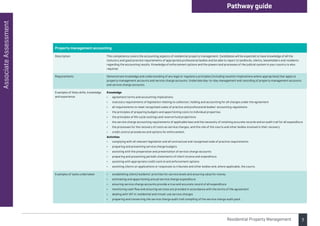
Property management accounting
Description This competency covers the accounting aspects of residential property management. Candidates will be expected to have knowledge of all the
statutory and good practice requirements of appropriate professional bodies and be able to report to landlords, clients, leaseholders and residents
regarding the accounting results. Knowledge of enforcement options and the powers and processes of the judicial system in your country is also
required.
Requirements Demonstrate knowledge and understanding of any legal or regulatory principles (including taxation implications where appropriate) that apply to
property management accounts and service charge accounts. Undertake day-to-day management and recording of property management accounts
and service charge accounts.
Examples of likely skills, knowledge
and experience
Knowledge
• agreement terms and accounting implications
• statutory requirements of legislation relating to collection, holding and accounting for all charges under the agreement
• all requirements to meet recognised codes of practice and professional bodies’ accounting regulations
• the principles of preparing budgets and apportioning costs to individual properties
• the principles of life cycle costings and reserve fund projections
• the service charge accounting requirements of applicable laws and the necessity of retaining accurate records and an audit trail for all expenditure
• the processes for the recovery of costs as service charges, and the role of the courts and other bodies involved in their recovery
• credit control procedures and options for enforcement.
Activities
• complying with all relevant legislation and all contractual and recognised code of practice requirements
• preparing and presenting service charge budgets
• assisting with the preparation and presentation of service charge accounts
• preparing and presenting periodic statements of client income and expenditure
• assisting with appropriate credit control and enforcement options
• assisting clients on applications or responses to tribunals and other bodies and, where applicable, the courts.
Examples of tasks undertaken •	
establishing client/residents’ priorities for service levels and ensuring value for money
• estimating and apportioning annual service charge expenditure
• ensuring service charge accounts provide a true and accurate record of all expenditure
• monitoring cash flow and ensuring services are provided in accordance with the terms of the agreement
• dealing with VAT in residential and mixed-use service charges
• preparing and conserving the service charge audit trail compiling of the service charge audit pack.
8
Associate
Assessment Pathway guide
Residential Property Management
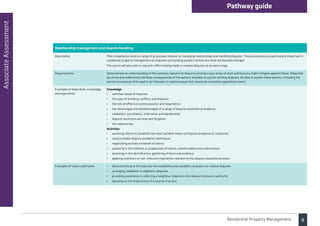
Relationship management and dispute handling
Description This competency covers a range of processes relevant to managing relationships and handling disputes. These processes are particularly important in
residential property management as disputes surrounding people’s homes are often emotionally charged.
The courts will also wish to see prior efforts being made to resolve disputes at an early stage.
Requirements Demonstrate an understanding of the common reasons for disputes arising in your areas of work and how you might mitigate against these. Show that
you know and understand the likely consequences of the options available to you for settling disputes. Be able to explain these options, including the
correct procedures that need to be followed, to resolve issues that cannot be settled by negotiated means.
Examples of likely skills, knowledge
and experience
Knowledge
• common cause of disputes
• the ways of avoiding conflicts and disputes
• the role of effective communication and negotiation
• the advantages and disadvantages of a range of dispute resolution procedures
• mediation, conciliation, arbitration and adjudication
• dispute resolution services and litigation
• the relevant law.
Activities
• assisting clients to establish the most suitable means of dispute avoidance or resolution
• using suitable dispute avoidance techniques
• negotiating actively on behalf of clients
• assisting in the collation or preparation of claims, counterclaims and submissions
• assisting in the identification, gathering of facts and evidence
• applying statutory or non-statutory legislation relevant to the dispute resolution process.
Examples of tasks undertaken • demonstrating to third parties the availability and suitability of powers to resolve disputes
• arranging mediation in neighbour disputes
• providing assistance in referring a neighbour dispute to the relevant statutory authority
• advising on the implications of a course of action.
9
Associate
Assessment Pathway guide
Residential Property Management
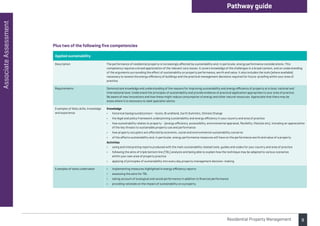
Plus two of the following five competencies
Applied sustainability
Description The performance of residential property is increasingly affected by sustainability and, in particular, energy performance considerations. This
competency requires a broad appreciation of the relevant core issues. It covers knowledge of the challenges in a broad context, and an understanding
of the arguments surrounding the effect of sustainability on property performance, worth and value. It also includes the tools (where available)
necessary to assess the energy efficiency of buildings and the practical management decisions required for future-proofing within your area of
practice.
Requirements Demonstrate knowledge and understanding of the reasons for improving sustainability and energy efficiency of property at a local, national and
international level. Understand the principles of sustainability and provide evidence of practical application appropriate to your area of practice.
Be aware of new innovations and how these might reduce consumption of energy and other natural resources. Appreciate that there may be
areas where it is necessary to seek specialist advice.
Examples of likely skills, knowledge
and experience
Knowledge
• historical background/context – Kyoto, Brundtland, Earth Summits, Climate Change
• the legal and policy framework underpinning sustainability and energy efficiency in your country and area of practice
•	
how sustainability relates to property – (energy efficiency, accessibility, environmental appraisal, flexibility, lifestyle etc), including an appreciation
of the key threats to sustainable property use and performance
• how property occupiers are affected by economic, social and environmental sustainability concerns
• of the effects sustainability and, in particular, energy performance measures will have on the performance worth and value of a property.
Activities
• using and interpreting reports produced with the main sustainability related tools, guides and codes for your country and area of practice
•	
following the aims of triple bottom line (TBL) analysis and being able to explain how the technique may be adapted to various scenarios
within your own area of property practice
• applying of principles of sustainability into every day property management decision-making.
Examples of tasks undertaken • implementing measures highlighted in energy efficiency reports
• assessing the aims for TBL
• taking account of ecological and social performance in addition to financial performance
• providing rationale on the impact of sustainability on a property.
10
Associate
Assessment Pathway guide
Residential Property Management
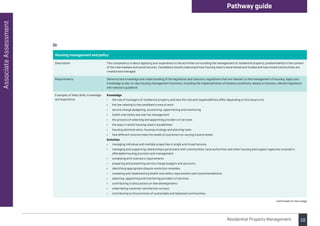
Or
Housing management and policy
Description This competency is about applying your experience to the activities surrounding the management of residential property, predominantly in the context
of the intermediate and social tenures. Candidates should understand how housing need is ascertained and funded and how mixed communities are
created and managed.
Requirements Demonstrate knowledge and understanding of the legislation and statutory regulations that are relevant to the management of housing. Apply your
knowledge to day-to-day housing management functions, including the implementation of tenancy conditions, leases or licences, relevant legislation
and statutory guidance.
Examples of likely skills, knowledge
and experience
Knowledge
• the role of managers of residential property and how the role and responsibilities differ depending on the tenure mix
• the law relating to the candidate’s area of work
• service charge budgeting, accounting, apportioning and monitoring
• health and safety law and risk management
• the process of selecting and appointing providers of services
• the ways in which housing need is established
• housing administration, housing strategy and planning tools
• how different tenures meet the needs of customers on varying income levels.
Activities
• managing individual and multiple properties in single and mixed tenures
•	
managing and supporting relationships particularly with communities, local authorities and other housing and support agencies involved in
affordable housing provision and management
• complying with statutory requirements
• preparing and presenting service charge budgets and accounts
• identifying appropriate dispute resolution remedies
• reviewing and implementing health and safety requirements and recommendations
• selecting, appointing and monitoring providers of services
• contributing to discussions on new developments
• undertaking customer satisfaction surveys
• contributing to the provision of sustainable and balanced communities.
continued on next page
11
Associate
Assessment Pathway guide
Residential Property Management
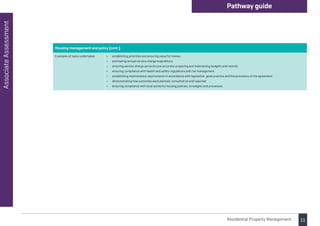
Housing management and policy (cont.)
Examples of tasks undertaken • establishing priorities and ensuring value for money
• estimating annual service charge expenditure
• ensuring service charge accounts are accurate; preparing and maintaining budgets and records
• ensuring compliance with health and safety regulations and risk management
• establishing maintenance requirements in accordance with legislation, good practice and the provisions of the agreement
• demonstrating how outcomes were planned, consulted on and reported
• ensuring compliance with local authority housing policies, strategies and processes.
12
Associate
Assessment Pathway guide
Residential Property Management
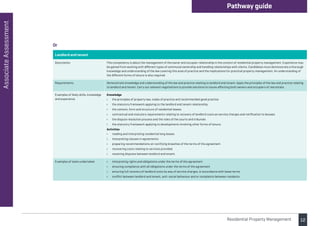
Or
Landlord and tenant
Description This competency is about the management of the owner and occupier relationship in the context of residential property management. Experience may
be gained from working with different types of communal ownership and handling relationships with clients. Candidates must demonstrate a thorough
knowledge and understanding of the law covering this area of practice and the implications for practical property management. An understanding of
the different forms of tenure is also required.
Requirements Demonstrate knowledge and understanding of the law and practice relating to landlord and tenant. Apply the principles of the law and practice relating
to landlord and tenant. Carry out relevant negotiations to provide solutions to issues affecting both owners and occupiers of real estate.
Examples of likely skills, knowledge
and experience
Knowledge
• the principles of property law, codes of practice and recommended good practice
• the statutory framework applying to the landlord and tenant relationship
• the content, form and structure of residential leases
• contractual and statutory requirements relating to recovery of landlord costs as service charges and notification to lessees
• the dispute resolution process and the roles of the courts and tribunals
• the statutory framework applying to developments involving other forms of tenure.
Activities
• reading and interpreting residential long leases
• interpreting clauses in agreements
• preparing recommendations on rectifying breaches of the terms of the agreement
• recovering costs relating to services provided
• resolving disputes between landlord and tenant.
Examples of tasks undertaken • interpreting rights and obligations under the terms of the agreement
• ensuring compliance with all obligations under the terms of the agreement
• ensuring full recovery of landlord costs by way of service charges, in accordance with lease terms
• conflict between landlord and tenant, anti-social behaviour and or complaints between residents.
13
Associate
Assessment Pathway guide
Residential Property Management
Or
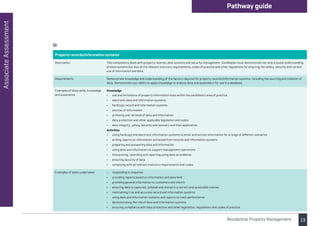
Property records/information systems
Description This competency deals with property records, data systems and security management. Candidates must demonstrate not only a sound understanding
of data systems but also of the relevant statutory requirements, codes of practice and other regulations for ensuring the safety, security and correct
use of information and data.
Requirements Demonstrate knowledge and understanding of the factors required for property records/information systems, including the sourcing and collation of
data. Demonstrate your ability to apply knowledge to analyse data and assemble it for use in a database.
Examples of likely skills, knowledge
and experience
Knowledge
• use and limitations of property information tools within the candidate’s area of practice
• electronic data and information systems
• hardcopy record and information systems
• sources of information
• archiving and retrieval of data and information
• data protection and other applicable legislation and codes
• data integrity, safety, security and recovery and their application.
Activities
• using hardcopy and electronic information systems to enter and extract information for a range of different scenarios
• writing reports on information extracted from records and information systems
• preparing and presenting data and information
• using data and information to support management operations
• interpreting, recording and reporting using data as evidence
• ensuring security of data
• complying with all relevant statutory requirements and codes.
Examples of tasks undertaken • responding to enquiries
• providing reports based on information and data held
• providing general information to customers and clients
• ensuring data is captured, collated and stored in a correct and accessible manner
• maintaining true and accurate record and information systems
• using data and information systems and reports to track performance
• demonstrating the role of data and information systems
• ensuring compliance with data protection and other legislation, regulations and codes of practice.
14
Associate
Assessment Pathway guide
Residential Property Management
Or
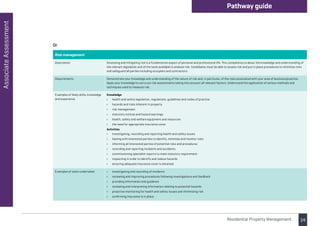
Risk management
Description Assessing and mitigating risk is a fundamental aspect of personal and professional life. This competency is about the knowledge and understanding of
the relevant legislation and of the tools available to analyse risk. Candidates must be able to assess risk and put in place procedures to minimise risks
and safeguard all parties including occupiers and contractors.
Requirements Demonstrate your knowledge and understanding of the nature of risk and, in particular, of the risks associated with your area of business/practice.
Apply your knowledge to carry out risk assessments taking into account all relevant factors. Understand the application of various methods and
techniques used to measure risk.
Examples of likely skills, knowledge
and experience
Knowledge
• health and safety legislation, regulations, guidelines and codes of practice
• hazards and risks inherent in property
• risk management
• statutory notices and hazard warnings
• health, safety and welfare equipment and resources
• the need for appropriate insurance cover.
Activities
• investigating, recording and reporting health and safety issues
• liaising with interested parties to identify, minimise and monitor risks
• informing all interested parties of potential risks and procedures
• recording and reporting incidents and accidents
• commissioning specialist reports to meet statutory requirement
• inspecting in order to identify and reduce hazards
• ensuring adequate insurance cover is obtained.
Examples of tasks undertaken • investigating and recording of incidents
• reviewing and improving procedures following investigations and feedback
• providing information and guidance
• reviewing and interpreting information relating to potential hazards
• proactive monitoring for health and safety issues and minimising risk
• confirming insurance is in place.
15
Associate
Assessment Pathway guide
Residential Property Management
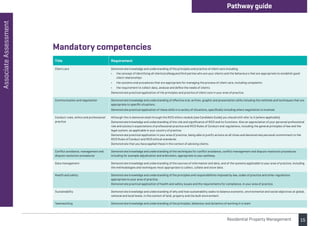
Mandatory competencies
Title Requirement
Client care Demonstrate knowledge and understanding of the principles and practice of client care including:
•	
the concept of identifying all clients/colleagues/third parties who are your clients and the behaviours that are appropriate to establish good
client relationships
• the systems and procedures that are appropriate for managing the process of client care, including complaints
• the requirement to collect data, analyse and define the needs of clients.
Demonstrate practical application of the principles and practice of client care in your area of practice.
Communication and negotiation Demonstrate knowledge and understanding of effective oral, written, graphic and presentation skills including the methods and techniques that are
appropriate to specific situations.
Demonstrate practical application of these skills in a variety of situations, specifically including where negotiation is involved.
Conduct rules, ethics and professional
practice
Although this is demonstrated through the RICS ethics module (see Candidate Guide) you should still refer to it (where applicable).
Demonstrate knowledge and understanding of the role and significance of RICS and its functions. Also an appreciation of your personal professional
role and society’s expectations of professional practice and RICS Rules of Conduct and regulations, including the general principles of law and the
legal system, as applicable in your country of practice.
Demonstrate practical application in your area of practice, being able to justify actions at all times and demonstrate personal commitment to the
RICS Rules of Conduct and RICS ethical standards.
Demonstrate that you have applied these in the context of advising clients.
Conflict avoidance, management and
dispute resolution procedures
Demonstrate knowledge and understanding of the techniques for conflict avoidance, conflict management and dispute resolution procedures
including for example adjudication and arbitration, appropriate to your pathway.
Data management Demonstrate knowledge and understanding of the sources of information and data, and of the systems applicable to your area of practice, including
the methodologies and techniques most appropriate to collect, collate and store data.
Health and safety Demonstrate knowledge and understanding of the principles and responsibilities imposed by law, codes of practice and other regulations
appropriate to your area of practice.
Demonstrate practical application of health and safety issues and the requirements for compliance, in your area of practice.
Sustainability Demonstrate knowledge and understanding of why and how sustainability seeks to balance economic, environmental and social objectives at global,
national and local levels, in the context of land, property and the built environment.
Teamworking Demonstrate knowledge and understanding of the principles, behaviour and dynamics of working in a team.
16
Associate
Assessment Pathway guide
Residential Property Management
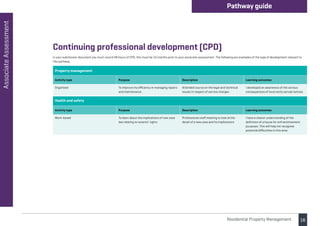
Continuing professional development (CPD)
In your submission document you must record 48 hours of CPD, this must be 12 months prior to your associate assessment. The following are examples of the type of development relevant to
this pathway.
Property management
Activity type Purpose Description Learning outcomes
Organised To improve my efficiency in managing repairs
and maintenance
Attended course on the legal and technical
issues in respect of service charges
I developed an awareness of the serious
consequences of incorrectly served notices
Health and safety
Activity type Purpose Description Learning outcomes
Work-based To learn about the implications of new case
law relating to tenants’ rights
Professional staff meeting to look at the
detail of a new case and its implications
I have a clearer understanding of the
definition of a house for enfranchisement
purposes. This will help me recognise
potential difficulties in this area
17
Associate
Assessment Pathway guide
Residential Property Management
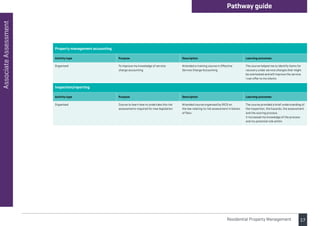
Property management accounting
Activity type Purpose Description Learning outcomes
Organised To improve my knowledge of service
charge accounting
Attended a training course in Effective
Service Charge Accounting
The course helped me to identify items for
recovery under service charges that might
be overlooked and will improve the service
I can offer to my clients
Inspection/reporting
Activity type Purpose Description Learning outcomes
Organised Course to learn how to undertake the risk
assessments required for new legislation
Attended course organised by RICS on
the law relating to risk assessment in blocks
of flats
The course provided a brief understanding of
the inspection, the hazards, the assessment
and the scoring process.
It increased my knowledge of the process
and my potential role within
Confidence through professional standards
RICS promotes and enforces the highest professional qualifications and standards
in the development and management of land, real estate, construction and
infrastructure. Our name promises the consistent delivery of standards –
bringing confidence to the markets we serve.
We accredit 125,000 professionals and any individual or firm registered with RICS is
subject to our quality assurance. Their expertise covers property, asset valuation and real
estate management; the costing and leadership of construction projects; the development
of infrastructure; and the management of natural resources, such as mining, farms and
woodland. From environmental assessments and building controls to negotiating land
rights in an emerging economy; if our professionals are involved the same standards and
ethics apply.
We believe that standards underpin effective markets. With up to seventy per cent of the
world’s wealth bound up in land and real estate, our sector is vital to economic development,
helping to support stable, sustainable investment and growth around the globe.
With offices covering the major political and financial centres of the world, our market
presence means we are ideally placed to influence policy and embed professional standards.
We work at a cross-governmental level, delivering international standards that will support
a safe and vibrant marketplace in land, real estate, construction and infrastructure, for the
benefit of all.
We are proud of our reputation and we guard it fiercely, so clients who work with an RICS
professional can have confidence in the quality and ethics of the services they receive.
GLOBAL/MARCH
2017/DML/20102/PATHWAY
GUIDE
United Kingdom RICS HQ
Parliament Square, London SW1P 3AD
United Kingdom
t +44 (0)24 7686 8555
f +44 (0)20 7334 3811
contactrics@rics.org
Media enquiries pressoffice@rics.org
Ireland
38 Merrion Square, Dublin 2,
Ireland
t +353 1 644 5500
f +353 1 661 1797
ricsireland@rics.org
Europe
(excluding UK and Ireland)
Rue Ducale 67,
1000 Brussels, Belgium
t +32 2 733 10 19
f +32 2 742 97 48
ricseurope@rics.org
Middle East
Office B303,
The Design House,
Sufouh Gardens,
Dubai, UAE
PO Box 502986
t +971 4 446 2808
ricsmena@rics.org
Africa
PO Box 3400, Witkoppen 2068,
South Africa
t +27 11 467 2857
f +27 86 514 0655
ricsafrica@rics.org
Americas
One Grand Central Place,
60 East 42nd Street, Suite #542,
New York 10165 – 2811, USA
t +1 212 847 7400
f +1 212 847 7401
ricsamericas@rics.org
South America
Rua Maranhão, 584 – cj 104,
São Paulo – SP, Brasil
t +55 11 2925 0068
ricsbrasil@rics.org
Oceania
Suite 1, Level 9,
1 Castlereagh Street,
Sydney NSW 2000. Australia
t +61 2 9216 2333
f +61 2 9232 5591
oceania@rics.org
East Asia
3707 Hopewell Centre,
183 Queen’s Road East
Wanchai, Hong Kong
t +852 2537 7117
f +852 2537 2756
ricseastasia@rics.org
China (Shanghai)
Room 2006, Garden Square,
968 Beijing Road West,
Shanghai, China
t +86 21 5243 3090
f +86 21 5243 3091
ricschina@rics.org
China (Beijing)
Room 2507-2508B, Jing Guang Centre,
No.1 Hu Jia Lou Road, Chaoyang District
Beijing 100020, China
t +86 10 6597 8586
f +86 10 6581 0021
ricschina@rics.org
Japan
Level 14 Hibiya Central Building,
1-2-9 Nishi Shimbashi Minato-Ku,
Tokyo 105-0003, Japan
t +81 3 5532 8813
f +81 3 5532 8814
ricsjapan@rics.org
ASEAN
#27-16, International Plaza,
10 Anson Road,
Singapore 079903
t +65 6812 8188
f +65 6221 9269
ricssingapore@rics.org
South Asia
48  49 Centrum Plaza,
Sector Road, Sector 53,
Gurgaon – 122002, India
t +91 124 459 5400
f +91 124 459 5402
ricsindia@rics.org

residential-property-management-pathway-guide-associate-rics.pdf

  • 1.
  • 2.
    2 Associate Assessment Pathway guide ResidentialProperty Management Residential Property Management Introduction ..............................................................................................................................................................................................................................................................................................................................................................3 Competencies .......................................................................................................................................................................................................................................................................................................................................................................3 What is Residential Property Management? ........................................................................................................................................................................................................................................................3 Residential Property Management competencies ......................................................................................................................................................................4 Technical competencies ..................................................................................................................................................................................................................................................................................................................................5 Mandatory competencies ........................................................................................................................................................................................................................................................................................................................15 Continuing professional development (CPD) ...................................................................................................................................................................................................................................................16
  • 3.
    3 Associate Assessment Pathway guide ResidentialProperty Management Introduction In order to become an RICS Associate you must demonstrate that you have knowledge, understanding and practical ability relevant to a surveying role – in this case, Residential Property Management. This guide explains the competencies for your pathway, with examples of how you can show you meet the requirements. Refer to this guide while preparing your submission for assessment. The Associate Assessment Candidate Guide gives further essential information on how to prepare for the assessment. Competencies A competency is the knowledge, skills, abilities and behaviours needed for a particular role or task. RICS competencies equip you to work in your chosen pathway. The six technical competencies are the pathway-specific ‘hard’ skills needed for your role. The eight mandatory competencies are the ‘soft’ business skills demonstrating your ability to work with colleagues, manage workloads and act with integrity. All candidates, regardless of their pathway, need these skills. What is Residential Property Management? This pathway is suitable for people embarking on a career as a manager of residential property, either managing long leasehold property in the private, subsidised or public sector. Residential property managers help residential owners, in all sectors of the market, make the most of their assets and are instrumental in improving the lives of many residential occupiers. Residential property managers work right across the residential sector. They may work for a private practice, managing blocks of flats for a private or institutional landlord client, they may be employed directly by private companies, for example providers of sheltered housing. Alternatively they may work for a social landlord or for a local administration. Residential property managers manage and maintain all communal aspects of residential property, they account for shared charges and resolve disputes at all levels. Managing a residential property involves complying with legal obligations, for example, landlord and tenant, planning, health and safety and fire regulations. The scope of Residential Property Management is extremely varied and services are likely to include: • management of on-site staff • resolving disputes • evidence for tribunals • formulating debt recovery strategies • health and safety • improving energy efficiency • lease negotiations • negotiating service level agreements • preparing maintenance plans • maintenance management • risk assessments • service charge accounting • strategic planning.
  • 4.
    4 Associate Assessment Pathway guide ResidentialProperty Management You must achieve the following four technical competencies: • maintenance management • property management • property management accounting • relationship management and dispute handling. Plus two of the following: • applied sustainability • housing management and policy • landlord and tenant • property records/information systems • risk management. You must complete all eight mandatory competencies: • client care • communication and negotiation • conduct rules, ethics and professional practice • conflict avoidance, management and dispute resolution procedures • data management • health and safety • sustainability • teamworking. Residential Property Management competencies
  • 5.
    5 Associate Assessment Pathway guide ResidentialProperty Management Maintenance management Description This competency is about delivering maintenance services to residential property or blocks of properties based on occupational need, either using an in-house work force or maintenance contractors and ensuring value for money. Candidates should also recognise when and where specialist advice should be considered. Requirements Demonstrate knowledge and understanding of the maintenance requirements of buildings, structures and other real estate. Manage and keep up-to-date maintenance information to determine and implement operational maintenance policies. Examples of likely skills, knowledge and experience Knowledge • planned maintenance • reactive maintenance • criteria for maintenance inspections • requirements for statutory inspections • implications of compliance requirements • prioritising future maintenance • integrating maintenance activity with the occupational requirements of the property. Activities • creating maintenance record systems • identifying maintenance requirements • implementing maintenance policy • placing contracts (orders) for maintenance • monitoring performance and confirming satisfactory completion of works • determining landlord and tenant responsibilities • dealing with the costs associated with maintenance of residential property. Examples of tasks undertaken • recording of maintenance works • inspections of property to establish maintenance issues • implementation of maintenance works • providing instructions to maintenance operatives • ensuring maintenance works have been carried out and to a good standard • interpretation of the landlord and tenant responsibilities • production of maintenance cost analysis. Technical competencies
  • 6.
    6 Associate Assessment Pathway guide ResidentialProperty Management Property management Description This competency is about understanding and applying your experiences to the activities surrounding residential property management, where the type of tenure involves managing outcomes for more than one party. Candidates must demonstrate appreciation and experience of dealing with contractual and statutory requirements, codes of practice and other regulations. Candidates will ensure that services are delivered with due regard to quality assurance, risk management, health and safety and the competence of service providers. Candidates must demonstrate understanding and experience of interpreting and applying terms of agreement. Requirements Demonstrate knowledge and understanding of property management and the relationship between owner and occupier. Apply the principles of property management to provide solutions to issues affecting both owners and occupiers of real estate. Examples of likely skills, knowledge and experience Knowledge • the role of property managers and their relationship with landlords and tenants • the role and responsibilities of a manager of residential property and how this alters depending on the property interest being managed and the nature of the client • the contractual, statutory, regulatory and other requirements of residential property management • the law in relation to property management • service charge budgeting, accounting, apportioning and monitoring • the types of insurance relating to residential property • the process of selecting and appointing providers of services and managing their performance. Activities • managing relationships with landlords and tenants and with providers • complying with all relevant statutory requirements • presenting service charge budgets and accounts • dealing with breaches of the terms of agreements • reviewing and implementing health and safety risk recommendations and requirements • selecting, appointing and monitoring service provider. Examples of tasks undertaken • establishing priorities for service levels and ensuring value for money • estimating annual service charge expenditure • ensuring service charge accounts provide a true and accurate record of all expenditure • preparing and maintaining records • ensuring compliance with health and safety regulations and risk management • establishing maintenance requirements in accordance with legislation, good practice and the provisions of the agreement.
  • 7.
    7 Associate Assessment Pathway guide ResidentialProperty Management Property management accounting Description This competency covers the accounting aspects of residential property management. Candidates will be expected to have knowledge of all the statutory and good practice requirements of appropriate professional bodies and be able to report to landlords, clients, leaseholders and residents regarding the accounting results. Knowledge of enforcement options and the powers and processes of the judicial system in your country is also required. Requirements Demonstrate knowledge and understanding of any legal or regulatory principles (including taxation implications where appropriate) that apply to property management accounts and service charge accounts. Undertake day-to-day management and recording of property management accounts and service charge accounts. Examples of likely skills, knowledge and experience Knowledge • agreement terms and accounting implications • statutory requirements of legislation relating to collection, holding and accounting for all charges under the agreement • all requirements to meet recognised codes of practice and professional bodies’ accounting regulations • the principles of preparing budgets and apportioning costs to individual properties • the principles of life cycle costings and reserve fund projections • the service charge accounting requirements of applicable laws and the necessity of retaining accurate records and an audit trail for all expenditure • the processes for the recovery of costs as service charges, and the role of the courts and other bodies involved in their recovery • credit control procedures and options for enforcement. Activities • complying with all relevant legislation and all contractual and recognised code of practice requirements • preparing and presenting service charge budgets • assisting with the preparation and presentation of service charge accounts • preparing and presenting periodic statements of client income and expenditure • assisting with appropriate credit control and enforcement options • assisting clients on applications or responses to tribunals and other bodies and, where applicable, the courts. Examples of tasks undertaken • establishing client/residents’ priorities for service levels and ensuring value for money • estimating and apportioning annual service charge expenditure • ensuring service charge accounts provide a true and accurate record of all expenditure • monitoring cash flow and ensuring services are provided in accordance with the terms of the agreement • dealing with VAT in residential and mixed-use service charges • preparing and conserving the service charge audit trail compiling of the service charge audit pack.
  • 8.
    8 Associate Assessment Pathway guide ResidentialProperty Management Relationship management and dispute handling Description This competency covers a range of processes relevant to managing relationships and handling disputes. These processes are particularly important in residential property management as disputes surrounding people’s homes are often emotionally charged. The courts will also wish to see prior efforts being made to resolve disputes at an early stage. Requirements Demonstrate an understanding of the common reasons for disputes arising in your areas of work and how you might mitigate against these. Show that you know and understand the likely consequences of the options available to you for settling disputes. Be able to explain these options, including the correct procedures that need to be followed, to resolve issues that cannot be settled by negotiated means. Examples of likely skills, knowledge and experience Knowledge • common cause of disputes • the ways of avoiding conflicts and disputes • the role of effective communication and negotiation • the advantages and disadvantages of a range of dispute resolution procedures • mediation, conciliation, arbitration and adjudication • dispute resolution services and litigation • the relevant law. Activities • assisting clients to establish the most suitable means of dispute avoidance or resolution • using suitable dispute avoidance techniques • negotiating actively on behalf of clients • assisting in the collation or preparation of claims, counterclaims and submissions • assisting in the identification, gathering of facts and evidence • applying statutory or non-statutory legislation relevant to the dispute resolution process. Examples of tasks undertaken • demonstrating to third parties the availability and suitability of powers to resolve disputes • arranging mediation in neighbour disputes • providing assistance in referring a neighbour dispute to the relevant statutory authority • advising on the implications of a course of action.
  • 9.
    9 Associate Assessment Pathway guide ResidentialProperty Management Plus two of the following five competencies Applied sustainability Description The performance of residential property is increasingly affected by sustainability and, in particular, energy performance considerations. This competency requires a broad appreciation of the relevant core issues. It covers knowledge of the challenges in a broad context, and an understanding of the arguments surrounding the effect of sustainability on property performance, worth and value. It also includes the tools (where available) necessary to assess the energy efficiency of buildings and the practical management decisions required for future-proofing within your area of practice. Requirements Demonstrate knowledge and understanding of the reasons for improving sustainability and energy efficiency of property at a local, national and international level. Understand the principles of sustainability and provide evidence of practical application appropriate to your area of practice. Be aware of new innovations and how these might reduce consumption of energy and other natural resources. Appreciate that there may be areas where it is necessary to seek specialist advice. Examples of likely skills, knowledge and experience Knowledge • historical background/context – Kyoto, Brundtland, Earth Summits, Climate Change • the legal and policy framework underpinning sustainability and energy efficiency in your country and area of practice • how sustainability relates to property – (energy efficiency, accessibility, environmental appraisal, flexibility, lifestyle etc), including an appreciation of the key threats to sustainable property use and performance • how property occupiers are affected by economic, social and environmental sustainability concerns • of the effects sustainability and, in particular, energy performance measures will have on the performance worth and value of a property. Activities • using and interpreting reports produced with the main sustainability related tools, guides and codes for your country and area of practice • following the aims of triple bottom line (TBL) analysis and being able to explain how the technique may be adapted to various scenarios within your own area of property practice • applying of principles of sustainability into every day property management decision-making. Examples of tasks undertaken • implementing measures highlighted in energy efficiency reports • assessing the aims for TBL • taking account of ecological and social performance in addition to financial performance • providing rationale on the impact of sustainability on a property.
  • 10.
    10 Associate Assessment Pathway guide ResidentialProperty Management Or Housing management and policy Description This competency is about applying your experience to the activities surrounding the management of residential property, predominantly in the context of the intermediate and social tenures. Candidates should understand how housing need is ascertained and funded and how mixed communities are created and managed. Requirements Demonstrate knowledge and understanding of the legislation and statutory regulations that are relevant to the management of housing. Apply your knowledge to day-to-day housing management functions, including the implementation of tenancy conditions, leases or licences, relevant legislation and statutory guidance. Examples of likely skills, knowledge and experience Knowledge • the role of managers of residential property and how the role and responsibilities differ depending on the tenure mix • the law relating to the candidate’s area of work • service charge budgeting, accounting, apportioning and monitoring • health and safety law and risk management • the process of selecting and appointing providers of services • the ways in which housing need is established • housing administration, housing strategy and planning tools • how different tenures meet the needs of customers on varying income levels. Activities • managing individual and multiple properties in single and mixed tenures • managing and supporting relationships particularly with communities, local authorities and other housing and support agencies involved in affordable housing provision and management • complying with statutory requirements • preparing and presenting service charge budgets and accounts • identifying appropriate dispute resolution remedies • reviewing and implementing health and safety requirements and recommendations • selecting, appointing and monitoring providers of services • contributing to discussions on new developments • undertaking customer satisfaction surveys • contributing to the provision of sustainable and balanced communities. continued on next page
  • 11.
    11 Associate Assessment Pathway guide ResidentialProperty Management Housing management and policy (cont.) Examples of tasks undertaken • establishing priorities and ensuring value for money • estimating annual service charge expenditure • ensuring service charge accounts are accurate; preparing and maintaining budgets and records • ensuring compliance with health and safety regulations and risk management • establishing maintenance requirements in accordance with legislation, good practice and the provisions of the agreement • demonstrating how outcomes were planned, consulted on and reported • ensuring compliance with local authority housing policies, strategies and processes.
  • 12.
    12 Associate Assessment Pathway guide ResidentialProperty Management Or Landlord and tenant Description This competency is about the management of the owner and occupier relationship in the context of residential property management. Experience may be gained from working with different types of communal ownership and handling relationships with clients. Candidates must demonstrate a thorough knowledge and understanding of the law covering this area of practice and the implications for practical property management. An understanding of the different forms of tenure is also required. Requirements Demonstrate knowledge and understanding of the law and practice relating to landlord and tenant. Apply the principles of the law and practice relating to landlord and tenant. Carry out relevant negotiations to provide solutions to issues affecting both owners and occupiers of real estate. Examples of likely skills, knowledge and experience Knowledge • the principles of property law, codes of practice and recommended good practice • the statutory framework applying to the landlord and tenant relationship • the content, form and structure of residential leases • contractual and statutory requirements relating to recovery of landlord costs as service charges and notification to lessees • the dispute resolution process and the roles of the courts and tribunals • the statutory framework applying to developments involving other forms of tenure. Activities • reading and interpreting residential long leases • interpreting clauses in agreements • preparing recommendations on rectifying breaches of the terms of the agreement • recovering costs relating to services provided • resolving disputes between landlord and tenant. Examples of tasks undertaken • interpreting rights and obligations under the terms of the agreement • ensuring compliance with all obligations under the terms of the agreement • ensuring full recovery of landlord costs by way of service charges, in accordance with lease terms • conflict between landlord and tenant, anti-social behaviour and or complaints between residents.
  • 13.
    13 Associate Assessment Pathway guide ResidentialProperty Management Or Property records/information systems Description This competency deals with property records, data systems and security management. Candidates must demonstrate not only a sound understanding of data systems but also of the relevant statutory requirements, codes of practice and other regulations for ensuring the safety, security and correct use of information and data. Requirements Demonstrate knowledge and understanding of the factors required for property records/information systems, including the sourcing and collation of data. Demonstrate your ability to apply knowledge to analyse data and assemble it for use in a database. Examples of likely skills, knowledge and experience Knowledge • use and limitations of property information tools within the candidate’s area of practice • electronic data and information systems • hardcopy record and information systems • sources of information • archiving and retrieval of data and information • data protection and other applicable legislation and codes • data integrity, safety, security and recovery and their application. Activities • using hardcopy and electronic information systems to enter and extract information for a range of different scenarios • writing reports on information extracted from records and information systems • preparing and presenting data and information • using data and information to support management operations • interpreting, recording and reporting using data as evidence • ensuring security of data • complying with all relevant statutory requirements and codes. Examples of tasks undertaken • responding to enquiries • providing reports based on information and data held • providing general information to customers and clients • ensuring data is captured, collated and stored in a correct and accessible manner • maintaining true and accurate record and information systems • using data and information systems and reports to track performance • demonstrating the role of data and information systems • ensuring compliance with data protection and other legislation, regulations and codes of practice.
  • 14.
    14 Associate Assessment Pathway guide ResidentialProperty Management Or Risk management Description Assessing and mitigating risk is a fundamental aspect of personal and professional life. This competency is about the knowledge and understanding of the relevant legislation and of the tools available to analyse risk. Candidates must be able to assess risk and put in place procedures to minimise risks and safeguard all parties including occupiers and contractors. Requirements Demonstrate your knowledge and understanding of the nature of risk and, in particular, of the risks associated with your area of business/practice. Apply your knowledge to carry out risk assessments taking into account all relevant factors. Understand the application of various methods and techniques used to measure risk. Examples of likely skills, knowledge and experience Knowledge • health and safety legislation, regulations, guidelines and codes of practice • hazards and risks inherent in property • risk management • statutory notices and hazard warnings • health, safety and welfare equipment and resources • the need for appropriate insurance cover. Activities • investigating, recording and reporting health and safety issues • liaising with interested parties to identify, minimise and monitor risks • informing all interested parties of potential risks and procedures • recording and reporting incidents and accidents • commissioning specialist reports to meet statutory requirement • inspecting in order to identify and reduce hazards • ensuring adequate insurance cover is obtained. Examples of tasks undertaken • investigating and recording of incidents • reviewing and improving procedures following investigations and feedback • providing information and guidance • reviewing and interpreting information relating to potential hazards • proactive monitoring for health and safety issues and minimising risk • confirming insurance is in place.
  • 15.
    15 Associate Assessment Pathway guide ResidentialProperty Management Mandatory competencies Title Requirement Client care Demonstrate knowledge and understanding of the principles and practice of client care including: • the concept of identifying all clients/colleagues/third parties who are your clients and the behaviours that are appropriate to establish good client relationships • the systems and procedures that are appropriate for managing the process of client care, including complaints • the requirement to collect data, analyse and define the needs of clients. Demonstrate practical application of the principles and practice of client care in your area of practice. Communication and negotiation Demonstrate knowledge and understanding of effective oral, written, graphic and presentation skills including the methods and techniques that are appropriate to specific situations. Demonstrate practical application of these skills in a variety of situations, specifically including where negotiation is involved. Conduct rules, ethics and professional practice Although this is demonstrated through the RICS ethics module (see Candidate Guide) you should still refer to it (where applicable). Demonstrate knowledge and understanding of the role and significance of RICS and its functions. Also an appreciation of your personal professional role and society’s expectations of professional practice and RICS Rules of Conduct and regulations, including the general principles of law and the legal system, as applicable in your country of practice. Demonstrate practical application in your area of practice, being able to justify actions at all times and demonstrate personal commitment to the RICS Rules of Conduct and RICS ethical standards. Demonstrate that you have applied these in the context of advising clients. Conflict avoidance, management and dispute resolution procedures Demonstrate knowledge and understanding of the techniques for conflict avoidance, conflict management and dispute resolution procedures including for example adjudication and arbitration, appropriate to your pathway. Data management Demonstrate knowledge and understanding of the sources of information and data, and of the systems applicable to your area of practice, including the methodologies and techniques most appropriate to collect, collate and store data. Health and safety Demonstrate knowledge and understanding of the principles and responsibilities imposed by law, codes of practice and other regulations appropriate to your area of practice. Demonstrate practical application of health and safety issues and the requirements for compliance, in your area of practice. Sustainability Demonstrate knowledge and understanding of why and how sustainability seeks to balance economic, environmental and social objectives at global, national and local levels, in the context of land, property and the built environment. Teamworking Demonstrate knowledge and understanding of the principles, behaviour and dynamics of working in a team.
  • 16.
    16 Associate Assessment Pathway guide ResidentialProperty Management Continuing professional development (CPD) In your submission document you must record 48 hours of CPD, this must be 12 months prior to your associate assessment. The following are examples of the type of development relevant to this pathway. Property management Activity type Purpose Description Learning outcomes Organised To improve my efficiency in managing repairs and maintenance Attended course on the legal and technical issues in respect of service charges I developed an awareness of the serious consequences of incorrectly served notices Health and safety Activity type Purpose Description Learning outcomes Work-based To learn about the implications of new case law relating to tenants’ rights Professional staff meeting to look at the detail of a new case and its implications I have a clearer understanding of the definition of a house for enfranchisement purposes. This will help me recognise potential difficulties in this area
  • 17.
    17 Associate Assessment Pathway guide ResidentialProperty Management Property management accounting Activity type Purpose Description Learning outcomes Organised To improve my knowledge of service charge accounting Attended a training course in Effective Service Charge Accounting The course helped me to identify items for recovery under service charges that might be overlooked and will improve the service I can offer to my clients Inspection/reporting Activity type Purpose Description Learning outcomes Organised Course to learn how to undertake the risk assessments required for new legislation Attended course organised by RICS on the law relating to risk assessment in blocks of flats The course provided a brief understanding of the inspection, the hazards, the assessment and the scoring process. It increased my knowledge of the process and my potential role within
  • 18.
    Confidence through professionalstandards RICS promotes and enforces the highest professional qualifications and standards in the development and management of land, real estate, construction and infrastructure. Our name promises the consistent delivery of standards – bringing confidence to the markets we serve. We accredit 125,000 professionals and any individual or firm registered with RICS is subject to our quality assurance. Their expertise covers property, asset valuation and real estate management; the costing and leadership of construction projects; the development of infrastructure; and the management of natural resources, such as mining, farms and woodland. From environmental assessments and building controls to negotiating land rights in an emerging economy; if our professionals are involved the same standards and ethics apply. We believe that standards underpin effective markets. With up to seventy per cent of the world’s wealth bound up in land and real estate, our sector is vital to economic development, helping to support stable, sustainable investment and growth around the globe. With offices covering the major political and financial centres of the world, our market presence means we are ideally placed to influence policy and embed professional standards. We work at a cross-governmental level, delivering international standards that will support a safe and vibrant marketplace in land, real estate, construction and infrastructure, for the benefit of all. We are proud of our reputation and we guard it fiercely, so clients who work with an RICS professional can have confidence in the quality and ethics of the services they receive. GLOBAL/MARCH 2017/DML/20102/PATHWAY GUIDE United Kingdom RICS HQ Parliament Square, London SW1P 3AD United Kingdom t +44 (0)24 7686 8555 f +44 (0)20 7334 3811 contactrics@rics.org Media enquiries pressoffice@rics.org Ireland 38 Merrion Square, Dublin 2, Ireland t +353 1 644 5500 f +353 1 661 1797 ricsireland@rics.org Europe (excluding UK and Ireland) Rue Ducale 67, 1000 Brussels, Belgium t +32 2 733 10 19 f +32 2 742 97 48 ricseurope@rics.org Middle East Office B303, The Design House, Sufouh Gardens, Dubai, UAE PO Box 502986 t +971 4 446 2808 ricsmena@rics.org Africa PO Box 3400, Witkoppen 2068, South Africa t +27 11 467 2857 f +27 86 514 0655 ricsafrica@rics.org Americas One Grand Central Place, 60 East 42nd Street, Suite #542, New York 10165 – 2811, USA t +1 212 847 7400 f +1 212 847 7401 ricsamericas@rics.org South America Rua Maranhão, 584 – cj 104, São Paulo – SP, Brasil t +55 11 2925 0068 ricsbrasil@rics.org Oceania Suite 1, Level 9, 1 Castlereagh Street, Sydney NSW 2000. Australia t +61 2 9216 2333 f +61 2 9232 5591 oceania@rics.org East Asia 3707 Hopewell Centre, 183 Queen’s Road East Wanchai, Hong Kong t +852 2537 7117 f +852 2537 2756 ricseastasia@rics.org China (Shanghai) Room 2006, Garden Square, 968 Beijing Road West, Shanghai, China t +86 21 5243 3090 f +86 21 5243 3091 ricschina@rics.org China (Beijing) Room 2507-2508B, Jing Guang Centre, No.1 Hu Jia Lou Road, Chaoyang District Beijing 100020, China t +86 10 6597 8586 f +86 10 6581 0021 ricschina@rics.org Japan Level 14 Hibiya Central Building, 1-2-9 Nishi Shimbashi Minato-Ku, Tokyo 105-0003, Japan t +81 3 5532 8813 f +81 3 5532 8814 ricsjapan@rics.org ASEAN #27-16, International Plaza, 10 Anson Road, Singapore 079903 t +65 6812 8188 f +65 6221 9269 ricssingapore@rics.org South Asia 48 49 Centrum Plaza, Sector Road, Sector 53, Gurgaon – 122002, India t +91 124 459 5400 f +91 124 459 5402 ricsindia@rics.org