Metastatic Breast Cancer:
Select Updates
Olwen Hahn, MD
Associate Professor of Medicine
The University of Chicago
Dionna Koval
Patient Advocate
June 2020
Outline
• Her2- Positive Breast Cancer
• Triple Negative Breast Cancer
• ER+ Breast Cancer
• Surgery in deNovo Mets. BrCa
• Patient – Doctor Communication
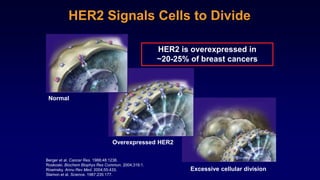
Normal
Overexpressed HER2
Excessive cellular division
HER2 Signals Cells to Divide
Berger et al. Cancer Res. 1988;48:1238.
Roskoski. Biochem Biophys Res Commun. 2004;319:1.
Rowinsky. Annu Rev Med. 2004;55:433.
Slamon et al. Science. 1987;235:177.
HER2 is overexpressed in
~20-25% of breast cancers
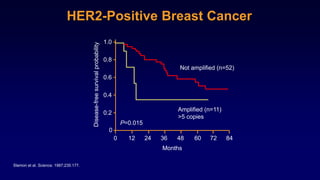
HER2-Positive Breast Cancer
Slamon et al. Science. 1987;235:177.
Months
0
12 24 36 48 60 72 84
Disease-freesurvivalprobability
Not amplified (n=52)
Amplified (n=11)
>5 copies
0
P=0.015
0.2
0.4
0.6
0.8
1.0
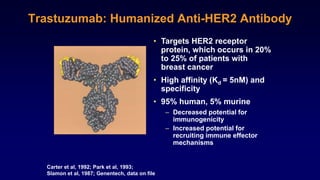
• Targets HER2 receptor
protein, which occurs in 20%
to 25% of patients with
breast cancer
• High affinity (Kd = 5nM) and
specificity
• 95% human, 5% murine
– Decreased potential for
immunogenicity
– Increased potential for
recruiting immune effector
mechanisms
Carter et al, 1992; Park et al, 1993;
Slamon et al, 1987; Genentech, data on file
Trastuzumab: Humanized Anti-HER2 Antibody
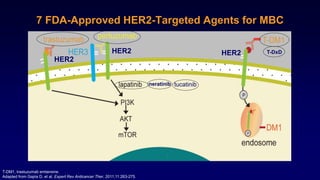
7 FDA-Approved HER2-Targeted Agents for MBC
T-DM1, trastuzumab emtansine.
Adapted from Gajria D, et al. Expert Rev Anticancer Ther. 2011;11:263-275.
T-DxD
neratinib
HER2
HER2 HER2
tucatinib
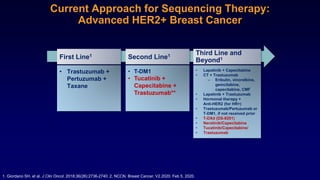
Current Approach for Sequencing Therapy:
Advanced HER2+ Breast Cancer
First Line1
• Trastuzumab +
Pertuzumab +
Taxane
Third Line and
Beyond1
• Lapatinib + Capecitabine
• CT + Trastuzumab
– Eribulin, vinorelbine,
gemcitabine,
capecitabine, CMF
• Lapatinib + Trastuzumab
• Hormonal therapy +
Anti-HER2 (for HR+)
• Trastuzumab/Pertuzumab or
T-DM1, if not received prior
• T-DXd (DS-8201)
• Neratinib/Capecitabine
• Tucatinib/Capecitabine/
• Trastuzumab
Second Line1
• T-DM1
• Tucatinib +
Capecitabine +
Trastuzumab**
1. Giordano SH, et al. J Clin Oncol. 2018;36(26):2736-2740; 2. NCCN. Breast Cancer. V2.2020. Feb 5, 2020.
Newly Approved Therapies
Fam-trastuzumab deruxtecan-nxki
(DS-8201, T-DXd)
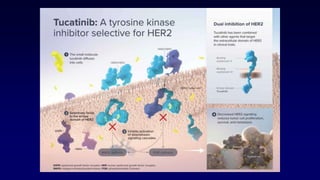
Tucatinib
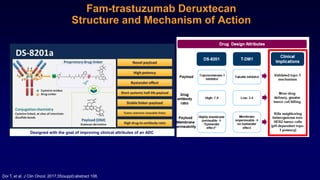
Doi T, et al. J Clin Oncol. 2017;35(suppl):abstract 108..
Fam-trastuzumab Deruxtecan
Structure and Mechanism of Action
Designed with the goal of improving clinical attributes of an ADC
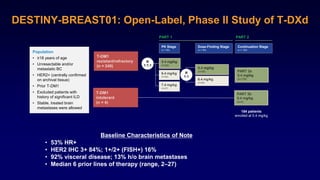
DESTINY-BREAST01: Open-Label, Phase II Study of T-DXd
Baseline Characteristics of Note
• 53% HR+
• HER2 IHC 3+ 84%; 1+/2+ (FISH+) 16%
• 92% visceral disease; 13% h/o brain metastases
• Median 6 prior lines of therapy (range, 2–27)
Population
• ≥18 years of age
• Unresectable and/or
metastatic BC
• HER2+ (centrally confirmed
on archival tissue)
• Prior T-DM1
• Excluded patients with
history of significant ILD
• Stable, treated brain
metastases were allowed
T-DM1
resistant/refractory
(n = 249)
R
1:1:1
PK Stage
(n = 65)
PART 1
6.4 mg/kg
(n=22)
7.4 mg/kg
(n=21)
5.4 mg/kg
(n=22)
PART 2
Continuation Stage
(n = 134)
PART 2a
5.4 mg/kg
(n=130)
T-DM1
intolerant
(n = 4)
PART 2b
5.4 mg/kg
(n=4)
Dose-Finding Stage
(n = 54)
R
1:1
5.4 mg/kg
(n=28)
6.4 mg/kg
(n=26)
PART 2a
5.4 mg/kg
(n=130)
PART 2b
5.4 mg/kg
(n=4)
5.4 mg/kg
(n=22)
5.4 mg/kg
(n=28)
184 patients
enrolled at 5.4 mg/kg
Modi S, et al. N Engl J Med. 2019;382(7):610-621.
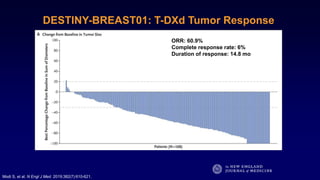
DESTINY-BREAST01: T-DXd Tumor Response
ORR: 60.9%
Complete response rate: 6%
Duration of response: 14.8 mo
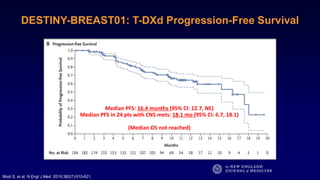
DESTINY-BREAST01: T-DXd Progression-Free Survival
Median PFS: 16.4 months (95% CI: 12.7, NE)
Median PFS in 24 pts with CNS mets: 18.1 mo (95% CI: 6.7, 18.1)
(Median OS not reached)
Modi S, et al. N Engl J Med. 2019;382(7):610-621.
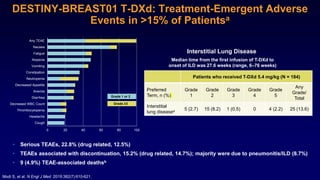
DESTINY-BREAST01 T-DXd: Treatment-Emergent Adverse
Events in >15% of Patientsa
0 20 40 60 80 100
Cough
Headache
Thrombocytopenia
Decreased WBC Count
Diarrhea
Anemia
Decreased Appetite
Neutropenia
Constipation
Vomiting
Alopecia
Fatigue
Nausea
Any TEAE
Grade 1 or 2
Grade ≥3
• Serious TEAEs, 22.8% (drug related, 12.5%)
• TEAEs associated with discontinuation, 15.2% (drug related, 14.7%); majority were due to pneumonitis/ILD (8.7%)
• 9 (4.9%) TEAE-associated deathsb
Patients who received T-DXd 5.4 mg/kg (N = 184)
Preferred
Term, n (%)
Grade
1
Grade
2
Grade
3
Grade
4
Grade
5
Any
Grade/
Total
Interstitial
lung diseasea 5 (2.7) 15 (8.2) 1 (0.5) 0 4 (2.2) 25 (13.6)
Interstitial Lung Disease
Median time from the first infusion of T-DXd to
onset of ILD was 27.6 weeks (range, 6–76 weeks)
Modi S, et al. N Engl J Med. 2019;382(7):610-621.
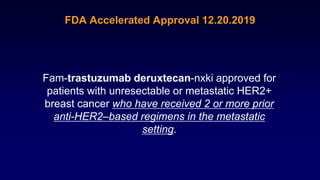
FDA Accelerated Approval 12.20.2019
Fam-trastuzumab deruxtecan-nxki approved for
patients with unresectable or metastatic HER2+
breast cancer who have received 2 or more prior
anti-HER2–based regimens in the metastatic
setting.
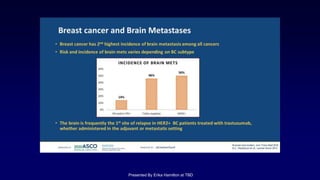
Breast cancer and Brain Metastases
Presented By Erika Hamilton at TBD
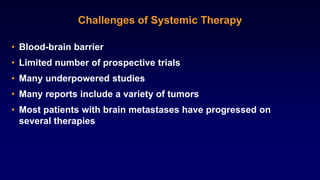
Challenges of Systemic Therapy
• Blood-brain barrier
• Limited number of prospective trials
• Many underpowered studies
• Many reports include a variety of tumors
• Most patients with brain metastases have progressed on
several therapies
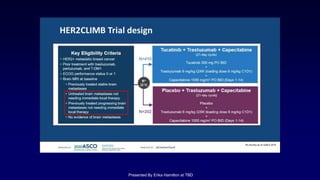
HER2CLIMB Trial design
Presented By Erika Hamilton at TBD
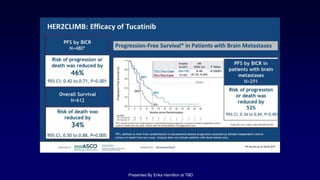
HER2CLIMB: Efficacy of Tucatinib
Presented By Erika Hamilton at TBD
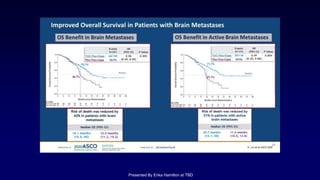
OS Benefit in Brain Metastases
Presented By Erika Hamilton at TBD
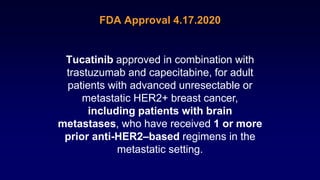
FDA Approval 4.17.2020
Tucatinib approved in combination with
trastuzumab and capecitabine, for adult
patients with advanced unresectable or
metastatic HER2+ breast cancer,
including patients with brain
metastases, who have received 1 or more
prior anti-HER2–based regimens in the
metastatic setting.
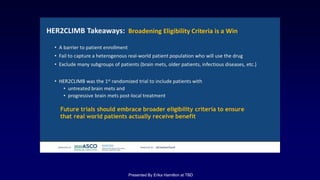
HER2CLIMB Takeaways: Broadening Eligibility Criteria is a Win
Presented By Erika Hamilton at TBD
What this means for patients?
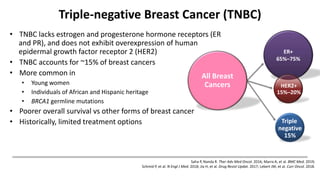
Triple-negative Breast Cancer (TNBC)
• TNBC lacks estrogen and progesterone hormone receptors (ER
and PR), and does not exhibit overexpression of human
epidermal growth factor receptor 2 (HER2)
• TNBC accounts for ~15% of breast cancers
• More common in
• Young women
• Individuals of African and Hispanic heritage
• BRCA1 germline mutations
• Poorer overall survival vs other forms of breast cancer
• Historically, limited treatment options
Saha P, Nanda R. Ther Adv Med Oncol. 2016; Marra A, et al. BMC Med. 2019;
Schmid P, et al. N Engl J Med. 2018; Jia H, et al. Drug Resist Updat. 2017; Lebert JM, et al. Curr Oncol. 2018.
All Breast
Cancers
ER+
65%–75%
HER2+
15%–20%
Triple
negative
15%
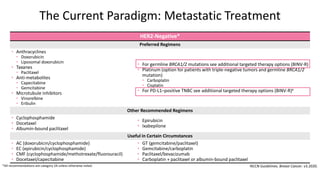
The Current Paradigm: Metastatic Treatment
HER2-Negative*
Preferred Regimens
• Anthracyclines
• Doxorubicin
• Liposomal doxorubicin
• Taxanes
• Paclitaxel
• Anti-metabolites
• Capecitabine
• Gemcitabine
• Microtubule inhibitors
• Vinorelbine
• Eribulin
• For germline BRCA1/2 mutations see additional targeted therapy options (BINV-R)
• Platinum (option for patients with triple-negative tumors and germline BRCA1/2
mutation)
• Carboplatin
• Cisplatin
• For PD-L1–positive TNBC see additional targeted therapy options (BINV-R)e
Other Recommended Regimens
• Cyclophosphamide
• Docetaxel
• Albumin-bound paclitaxel
• Epirubicin
• Ixabepilone
Useful in Certain Circumstances
• AC (doxorubicin/cyclophosphamide)
• EC (epirubicin/cyclophosphamide)
• CMF (cyclophosphamide/methotrexate/fluorouracil)
• Docetaxel/capecitabine
• GT (gemcitabine/paclitaxel)
• Gemcitabine/carboplatin
• Paclitaxel/bevacizumab
• Carboplatin + paclitaxel or albumin-bound paclitaxel
NCCN Guidelines. Breast Cancer. v3.2020.*All recommendations are category 2A unless otherwise noted.
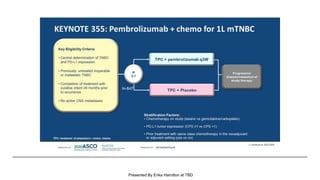
KEYNOTE 355: Pembrolizumab + chemo for 1L mTNBC
Presented By Erika Hamilton at TBD
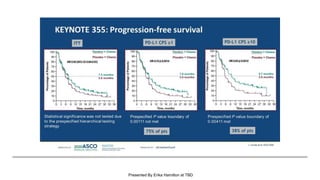
KEYNOTE 355: Progression-free survival
Presented By Erika Hamilton at TBD
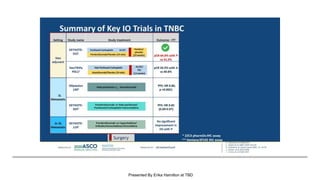
Summary of Key IO Trials in TNBC
Presented By Erika Hamilton at TBD
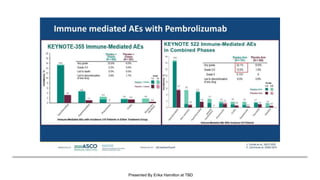
Immune mediated AEs with Pembrolizumab
Presented By Erika Hamilton at TBD
New Drug Approval
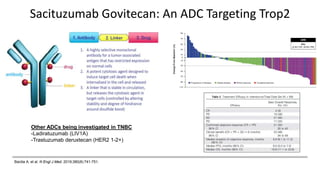
Sacituzumab Govitecan: An ADC Targeting Trop2
Bardia A, et al. N Engl J Med. 2019;380(8):741-751.
Other ADCs being investigated in TNBC
-Ladiratuzumab (LIV1A)
-Trastuzumab deruxtecan (HER2 1-2+)
Drugs in Development for Advanced TNBC
• Immunotherapy
– With chemo and other targeted therapies
• PARP Inhibitors (approved for BRCA1&2 mutation carriers
alone)
– Alone or with chemo or immunotherapy
• Antibody Drug Conjugates
– Sacituzumab approved, others being investigated
• Androgen Receptor Antagonists
What this means for patients?
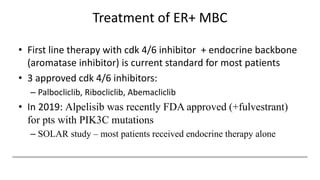
Treatment of ER+ MBC
• First line therapy with cdk 4/6 inhibitor + endocrine backbone
(aromatase inhibitor) is current standard for most patients
• 3 approved cdk 4/6 inhibitors:
– Palbocliclib, Ribocliclib, Abemacliclib
• In 2019: Alpelisib was recently FDA approved (+fulvestrant)
for pts with PIK3C mutations
– SOLAR study – most patients received endocrine therapy alone
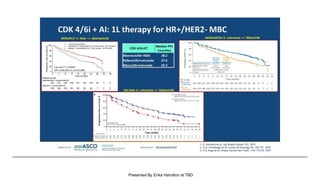
CDK 4/6i + AI: 1L therapy for HR+/HER2- MBC
Presented By Erika Hamilton at TBD
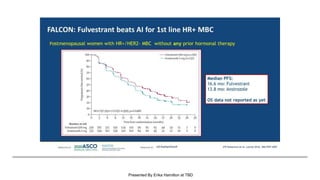
FALCON: Fulvestrant beats AI for 1st line HR+ MBC
Presented By Erika Hamilton at TBD
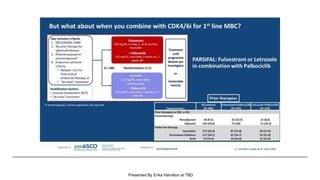
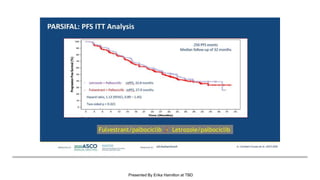
PARSIFAL: Fulvestrant or Letrozole in combination with Palbociclib
Presented By Erika Hamilton at TBD
PARSIFAL: PFS ITT Analysis
Presented By Erika Hamilton at TBD
Slide 4
Presented By Hope Rugo at TBD
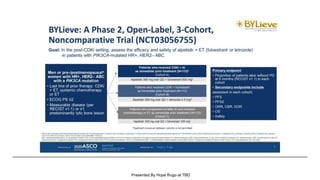
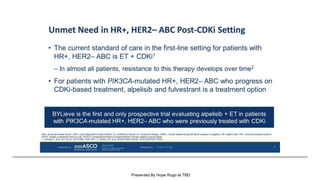
BYLieve: A Phase 2, Open-Label, 3-Cohort, Noncomparative Trial (NCT03056755)
Presented By Hope Rugo at TBD
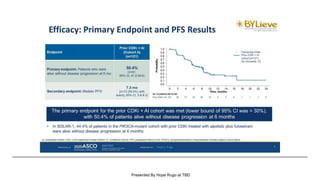
<br />Efficacy: Primary Endpoint and PFS Results<br /><br />
Presented By Hope Rugo at TBD
What this information means for patients?
Role of Surgery to Primary Tumor in
De Novo Metastatic Breast Cancer
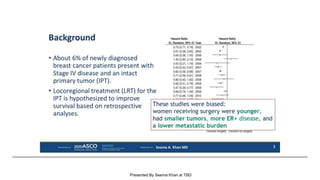
Background
Presented By Seema Khan at TBD
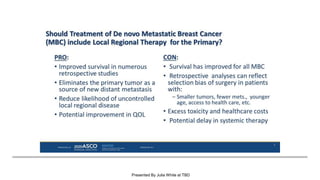
Should Treatment of De novo Metastatic Breast Cancer (MBC) include Local Regional Therapy for the Primary?
Presented By Julia White at TBD
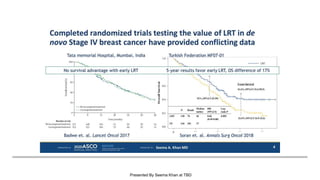
Completed randomized trials testing the value of LRT in de novo Stage IV breast cancer have provided conflicting data
Presented By Seema Khan at TBD
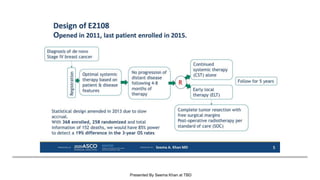
Design of E2108 <br />Opened in 2011, last patient enrolled in 2015. <br />
Presented By Seema Khan at TBD
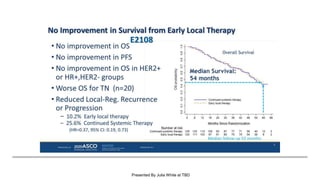
No Improvement in Survival from Early Local Therapy<br />E2108
Presented By Julia White at TBD
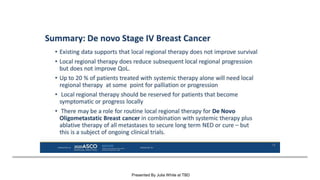
Summary: De novo Stage IV Breast Cancer
Presented By Julia White at TBD
What this means for patients?
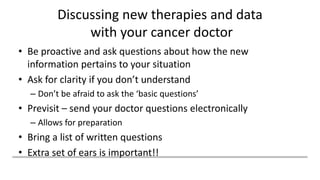
Discussing new therapies and data
with your cancer doctor
• Be proactive and ask questions about how the new
information pertains to your situation
• Ask for clarity if you don’t understand
– Don’t be afraid to ask the ‘basic questions’
• Previsit – send your doctor questions electronically
– Allows for preparation
• Bring a list of written questions
• Extra set of ears is important!!
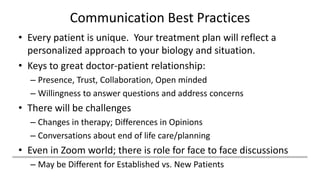
Communication Best Practices
• Every patient is unique. Your treatment plan will reflect a
personalized approach to your biology and situation.
• Keys to great doctor-patient relationship:
– Presence, Trust, Collaboration, Open minded
– Willingness to answer questions and address concerns
• There will be challenges
– Changes in therapy; Differences in Opinions
– Conversations about end of life care/planning
• Even in Zoom world; there is role for face to face discussions
– May be Different for Established vs. New Patients
How to find a clinical trial
• Ask you doctor
• Academic cancer center have intakes offices
– Nurse navigation and research staff
– Cancer center websites
• Clinicaltrials.gov
• Local and National Advocacy groups:
– ACS, CancerCare, Komen, Living Beyond Breast Cancer
– And many more
Thank you!
• Acknowledgements to Dr. Rita Nanda (UChicago) and presenters at ASCO 2020 Virtual Meeting for slides

Research Update on MBC

  • 1.
    Metastatic Breast Cancer: SelectUpdates Olwen Hahn, MD Associate Professor of Medicine The University of Chicago Dionna Koval Patient Advocate June 2020
  • 2.
    Outline • Her2- PositiveBreast Cancer • Triple Negative Breast Cancer • ER+ Breast Cancer • Surgery in deNovo Mets. BrCa • Patient – Doctor Communication
  • 3.
    Normal Overexpressed HER2 Excessive cellulardivision HER2 Signals Cells to Divide Berger et al. Cancer Res. 1988;48:1238. Roskoski. Biochem Biophys Res Commun. 2004;319:1. Rowinsky. Annu Rev Med. 2004;55:433. Slamon et al. Science. 1987;235:177. HER2 is overexpressed in ~20-25% of breast cancers
  • 4.
    HER2-Positive Breast Cancer Slamonet al. Science. 1987;235:177. Months 0 12 24 36 48 60 72 84 Disease-freesurvivalprobability Not amplified (n=52) Amplified (n=11) >5 copies 0 P=0.015 0.2 0.4 0.6 0.8 1.0
  • 5.
    • Targets HER2receptor protein, which occurs in 20% to 25% of patients with breast cancer • High affinity (Kd = 5nM) and specificity • 95% human, 5% murine – Decreased potential for immunogenicity – Increased potential for recruiting immune effector mechanisms Carter et al, 1992; Park et al, 1993; Slamon et al, 1987; Genentech, data on file Trastuzumab: Humanized Anti-HER2 Antibody
  • 6.
    7 FDA-Approved HER2-TargetedAgents for MBC T-DM1, trastuzumab emtansine. Adapted from Gajria D, et al. Expert Rev Anticancer Ther. 2011;11:263-275. T-DxD neratinib HER2 HER2 HER2 tucatinib
  • 7.
    Current Approach forSequencing Therapy: Advanced HER2+ Breast Cancer First Line1 • Trastuzumab + Pertuzumab + Taxane Third Line and Beyond1 • Lapatinib + Capecitabine • CT + Trastuzumab – Eribulin, vinorelbine, gemcitabine, capecitabine, CMF • Lapatinib + Trastuzumab • Hormonal therapy + Anti-HER2 (for HR+) • Trastuzumab/Pertuzumab or T-DM1, if not received prior • T-DXd (DS-8201) • Neratinib/Capecitabine • Tucatinib/Capecitabine/ • Trastuzumab Second Line1 • T-DM1 • Tucatinib + Capecitabine + Trastuzumab** 1. Giordano SH, et al. J Clin Oncol. 2018;36(26):2736-2740; 2. NCCN. Breast Cancer. V2.2020. Feb 5, 2020.
  • 8.
    Newly Approved Therapies Fam-trastuzumabderuxtecan-nxki (DS-8201, T-DXd) Tucatinib
  • 9.
    Doi T, etal. J Clin Oncol. 2017;35(suppl):abstract 108.. Fam-trastuzumab Deruxtecan Structure and Mechanism of Action Designed with the goal of improving clinical attributes of an ADC
  • 10.
    DESTINY-BREAST01: Open-Label, PhaseII Study of T-DXd Baseline Characteristics of Note • 53% HR+ • HER2 IHC 3+ 84%; 1+/2+ (FISH+) 16% • 92% visceral disease; 13% h/o brain metastases • Median 6 prior lines of therapy (range, 2–27) Population • ≥18 years of age • Unresectable and/or metastatic BC • HER2+ (centrally confirmed on archival tissue) • Prior T-DM1 • Excluded patients with history of significant ILD • Stable, treated brain metastases were allowed T-DM1 resistant/refractory (n = 249) R 1:1:1 PK Stage (n = 65) PART 1 6.4 mg/kg (n=22) 7.4 mg/kg (n=21) 5.4 mg/kg (n=22) PART 2 Continuation Stage (n = 134) PART 2a 5.4 mg/kg (n=130) T-DM1 intolerant (n = 4) PART 2b 5.4 mg/kg (n=4) Dose-Finding Stage (n = 54) R 1:1 5.4 mg/kg (n=28) 6.4 mg/kg (n=26) PART 2a 5.4 mg/kg (n=130) PART 2b 5.4 mg/kg (n=4) 5.4 mg/kg (n=22) 5.4 mg/kg (n=28) 184 patients enrolled at 5.4 mg/kg
  • 11.
    Modi S, etal. N Engl J Med. 2019;382(7):610-621. DESTINY-BREAST01: T-DXd Tumor Response ORR: 60.9% Complete response rate: 6% Duration of response: 14.8 mo
  • 12.
    DESTINY-BREAST01: T-DXd Progression-FreeSurvival Median PFS: 16.4 months (95% CI: 12.7, NE) Median PFS in 24 pts with CNS mets: 18.1 mo (95% CI: 6.7, 18.1) (Median OS not reached) Modi S, et al. N Engl J Med. 2019;382(7):610-621.
  • 13.
    DESTINY-BREAST01 T-DXd: Treatment-EmergentAdverse Events in >15% of Patientsa 0 20 40 60 80 100 Cough Headache Thrombocytopenia Decreased WBC Count Diarrhea Anemia Decreased Appetite Neutropenia Constipation Vomiting Alopecia Fatigue Nausea Any TEAE Grade 1 or 2 Grade ≥3 • Serious TEAEs, 22.8% (drug related, 12.5%) • TEAEs associated with discontinuation, 15.2% (drug related, 14.7%); majority were due to pneumonitis/ILD (8.7%) • 9 (4.9%) TEAE-associated deathsb Patients who received T-DXd 5.4 mg/kg (N = 184) Preferred Term, n (%) Grade 1 Grade 2 Grade 3 Grade 4 Grade 5 Any Grade/ Total Interstitial lung diseasea 5 (2.7) 15 (8.2) 1 (0.5) 0 4 (2.2) 25 (13.6) Interstitial Lung Disease Median time from the first infusion of T-DXd to onset of ILD was 27.6 weeks (range, 6–76 weeks) Modi S, et al. N Engl J Med. 2019;382(7):610-621.
  • 14.
    FDA Accelerated Approval12.20.2019 Fam-trastuzumab deruxtecan-nxki approved for patients with unresectable or metastatic HER2+ breast cancer who have received 2 or more prior anti-HER2–based regimens in the metastatic setting.
  • 15.
    Breast cancer andBrain Metastases Presented By Erika Hamilton at TBD
  • 16.
    Challenges of SystemicTherapy • Blood-brain barrier • Limited number of prospective trials • Many underpowered studies • Many reports include a variety of tumors • Most patients with brain metastases have progressed on several therapies
  • 18.
    HER2CLIMB Trial design PresentedBy Erika Hamilton at TBD
  • 19.
    HER2CLIMB: Efficacy ofTucatinib Presented By Erika Hamilton at TBD
  • 20.
    OS Benefit inBrain Metastases Presented By Erika Hamilton at TBD
  • 21.
    FDA Approval 4.17.2020 Tucatinibapproved in combination with trastuzumab and capecitabine, for adult patients with advanced unresectable or metastatic HER2+ breast cancer, including patients with brain metastases, who have received 1 or more prior anti-HER2–based regimens in the metastatic setting.
  • 22.
    HER2CLIMB Takeaways: BroadeningEligibility Criteria is a Win Presented By Erika Hamilton at TBD
  • 23.
    What this meansfor patients?
  • 24.
    Triple-negative Breast Cancer(TNBC) • TNBC lacks estrogen and progesterone hormone receptors (ER and PR), and does not exhibit overexpression of human epidermal growth factor receptor 2 (HER2) • TNBC accounts for ~15% of breast cancers • More common in • Young women • Individuals of African and Hispanic heritage • BRCA1 germline mutations • Poorer overall survival vs other forms of breast cancer • Historically, limited treatment options Saha P, Nanda R. Ther Adv Med Oncol. 2016; Marra A, et al. BMC Med. 2019; Schmid P, et al. N Engl J Med. 2018; Jia H, et al. Drug Resist Updat. 2017; Lebert JM, et al. Curr Oncol. 2018. All Breast Cancers ER+ 65%–75% HER2+ 15%–20% Triple negative 15%
  • 25.
    The Current Paradigm:Metastatic Treatment HER2-Negative* Preferred Regimens • Anthracyclines • Doxorubicin • Liposomal doxorubicin • Taxanes • Paclitaxel • Anti-metabolites • Capecitabine • Gemcitabine • Microtubule inhibitors • Vinorelbine • Eribulin • For germline BRCA1/2 mutations see additional targeted therapy options (BINV-R) • Platinum (option for patients with triple-negative tumors and germline BRCA1/2 mutation) • Carboplatin • Cisplatin • For PD-L1–positive TNBC see additional targeted therapy options (BINV-R)e Other Recommended Regimens • Cyclophosphamide • Docetaxel • Albumin-bound paclitaxel • Epirubicin • Ixabepilone Useful in Certain Circumstances • AC (doxorubicin/cyclophosphamide) • EC (epirubicin/cyclophosphamide) • CMF (cyclophosphamide/methotrexate/fluorouracil) • Docetaxel/capecitabine • GT (gemcitabine/paclitaxel) • Gemcitabine/carboplatin • Paclitaxel/bevacizumab • Carboplatin + paclitaxel or albumin-bound paclitaxel NCCN Guidelines. Breast Cancer. v3.2020.*All recommendations are category 2A unless otherwise noted.
  • 26.
    KEYNOTE 355: Pembrolizumab+ chemo for 1L mTNBC Presented By Erika Hamilton at TBD
  • 27.
    KEYNOTE 355: Progression-freesurvival Presented By Erika Hamilton at TBD
  • 28.
    Summary of KeyIO Trials in TNBC Presented By Erika Hamilton at TBD
  • 29.
    Immune mediated AEswith Pembrolizumab Presented By Erika Hamilton at TBD
  • 30.
  • 31.
    Sacituzumab Govitecan: AnADC Targeting Trop2 Bardia A, et al. N Engl J Med. 2019;380(8):741-751. Other ADCs being investigated in TNBC -Ladiratuzumab (LIV1A) -Trastuzumab deruxtecan (HER2 1-2+)
  • 32.
    Drugs in Developmentfor Advanced TNBC • Immunotherapy – With chemo and other targeted therapies • PARP Inhibitors (approved for BRCA1&2 mutation carriers alone) – Alone or with chemo or immunotherapy • Antibody Drug Conjugates – Sacituzumab approved, others being investigated • Androgen Receptor Antagonists
  • 33.
    What this meansfor patients?
  • 34.
    Treatment of ER+MBC • First line therapy with cdk 4/6 inhibitor + endocrine backbone (aromatase inhibitor) is current standard for most patients • 3 approved cdk 4/6 inhibitors: – Palbocliclib, Ribocliclib, Abemacliclib • In 2019: Alpelisib was recently FDA approved (+fulvestrant) for pts with PIK3C mutations – SOLAR study – most patients received endocrine therapy alone
  • 35.
    CDK 4/6i +AI: 1L therapy for HR+/HER2- MBC Presented By Erika Hamilton at TBD
  • 36.
    FALCON: Fulvestrant beatsAI for 1st line HR+ MBC Presented By Erika Hamilton at TBD
  • 37.
    PARSIFAL: Fulvestrant orLetrozole in combination with Palbociclib Presented By Erika Hamilton at TBD
  • 38.
    PARSIFAL: PFS ITTAnalysis Presented By Erika Hamilton at TBD
  • 39.
    Slide 4 Presented ByHope Rugo at TBD
  • 40.
    BYLieve: A Phase2, Open-Label, 3-Cohort, Noncomparative Trial (NCT03056755) Presented By Hope Rugo at TBD
  • 41.
    <br />Efficacy: PrimaryEndpoint and PFS Results<br /><br /> Presented By Hope Rugo at TBD
  • 42.
    What this informationmeans for patients?
  • 43.
    Role of Surgeryto Primary Tumor in De Novo Metastatic Breast Cancer
  • 44.
  • 45.
    Should Treatment ofDe novo Metastatic Breast Cancer (MBC) include Local Regional Therapy for the Primary? Presented By Julia White at TBD
  • 46.
    Completed randomized trialstesting the value of LRT in de novo Stage IV breast cancer have provided conflicting data Presented By Seema Khan at TBD
  • 47.
    Design of E2108<br />Opened in 2011, last patient enrolled in 2015. <br /> Presented By Seema Khan at TBD
  • 48.
    No Improvement inSurvival from Early Local Therapy<br />E2108 Presented By Julia White at TBD
  • 49.
    Summary: De novoStage IV Breast Cancer Presented By Julia White at TBD
  • 50.
    What this meansfor patients?
  • 51.
    Discussing new therapiesand data with your cancer doctor • Be proactive and ask questions about how the new information pertains to your situation • Ask for clarity if you don’t understand – Don’t be afraid to ask the ‘basic questions’ • Previsit – send your doctor questions electronically – Allows for preparation • Bring a list of written questions • Extra set of ears is important!!
  • 52.
    Communication Best Practices •Every patient is unique. Your treatment plan will reflect a personalized approach to your biology and situation. • Keys to great doctor-patient relationship: – Presence, Trust, Collaboration, Open minded – Willingness to answer questions and address concerns • There will be challenges – Changes in therapy; Differences in Opinions – Conversations about end of life care/planning • Even in Zoom world; there is role for face to face discussions – May be Different for Established vs. New Patients
  • 53.
    How to finda clinical trial • Ask you doctor • Academic cancer center have intakes offices – Nurse navigation and research staff – Cancer center websites • Clinicaltrials.gov • Local and National Advocacy groups: – ACS, CancerCare, Komen, Living Beyond Breast Cancer – And many more
  • 54.
    Thank you! • Acknowledgementsto Dr. Rita Nanda (UChicago) and presenters at ASCO 2020 Virtual Meeting for slides