2
Training objectives
• Toenables the student to understand basic section of
proposal and report document
• To show How to use referencing
• To show document formatting .
3.
3
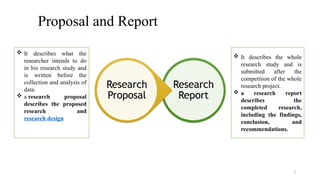
It describeswhat the
researcher intends to do
in his research study and
is written before the
collection and analysis of
data.
a research proposal
describes the proposed
research and
research design
It describes the whole
research study and is
submitted after the
competition of the whole
research project.
a research report
describes the
completed research,
including the findings,
conclusion, and
recommendations.
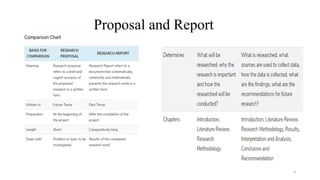
Proposal and Report
5
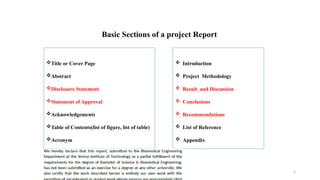
Basic Sections ofa project Report
Introduction
Project Methodology
Result and Discussion
Conclusions
Recommendations
List of Reference
Appendix
Title or Cover Page
Abstract
Disclosure Statement
Statement of Approval
Acknowledgements
Table of Contents(list of figure, list of table)
Acronym
6.
6
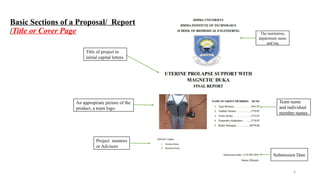
Basic Sections ofa Proposal/ Report
/Title or Cover Page The institution,
department name
and log
Title of project in
initial capital letters
Project mentors
or Advisors
An appropriate picture of the
product, a team logo.
Submission Date
Team name
and individual
member names
7.
7
Basic Sections ofa Proposal/ Report Title or Cover Page
What is your Title or Cover Page?
8.
8
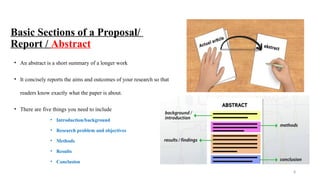
Basic Sections ofa Proposal/
Report / Abstract
• An abstract is a short summary of a longer work
• It concisely reports the aims and outcomes of your research so that
readers know exactly what the paper is about.
• There are five things you need to include
• Introduction/background
• Research problem and objectives
• Methods
• Results
• Conclusion
9.
9
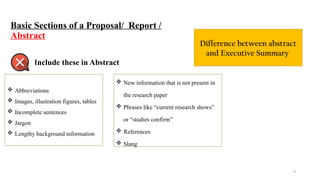
Basic Sections ofa Proposal/ Report /
Abstract
Include these in Abstract
New information that is not present in
the research paper
Phrases like “current research shows”
or “studies confirm”
References
Slang
Abbreviations
Images, illustration figures, tables
Incomplete sentences
Jargon
Lengthy background information
Difference between abstract
and Executive Summary
10.
10
Basic Sections ofa Proposal/ Report / Abstract
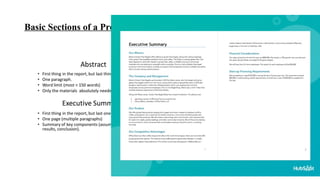
Difference between abstract
and Executive Summary
13
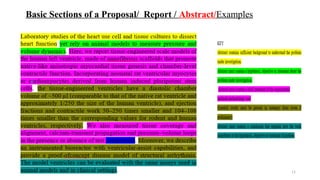
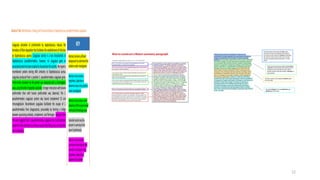
Basic Sections ofa Proposal/ Report / Abstract
Check your abstract as it includes those
sections
Identify and color your abstract as
introduction, problem statement, objective,
result and conclusion
14.
14
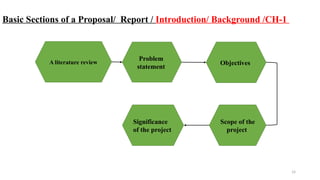
Basic Sections ofa Proposal/ Report / Introduction/ Background /CH-1
A literature review Objectives
Problem
statement
Significance
of the project
Scope of the
project
16
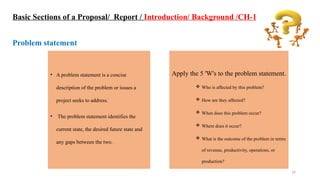
• A problemstatement is a concise
description of the problem or issues a
project seeks to address.
• The problem statement identifies the
current state, the desired future state and
any gaps between the two.
Basic Sections of a Proposal/ Report / Introduction/ Background /CH-1
Problem statement
Apply the 5 'W's to the problem statement.
Who is affected by this problem?
How are they affected?
When does this problem occur?
Where does it occur?
What is the outcome of the problem in terms
of revenue, productivity, operations, or
production?
17.
17
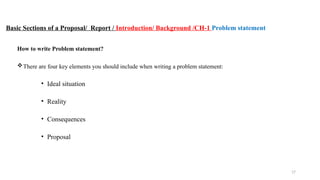
Basic Sections ofa Proposal/ Report / Introduction/ Background /CH-1 Problem statement
How to write Problem statement?
There are four key elements you should include when writing a problem statement:
• Ideal situation
• Reality
• Consequences
• Proposal
18.
18
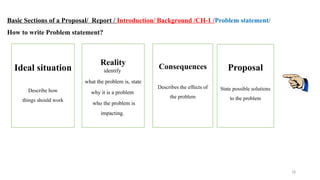
Ideal situation
Describe how
thingsshould work
Reality
identify
what the problem is, state
why it is a problem
who the problem is
impacting.
Consequences
Describes the effects of
the problem
Proposal
State possible solutions
to the problem
Basic Sections of a Proposal/ Report / Introduction/ Background /CH-1 /Problem statement/
How to write Problem statement?
19.
19
Basic Sections ofa Proposal/ Report / Introduction/ Background /CH-1 / Problem statement/ Examples
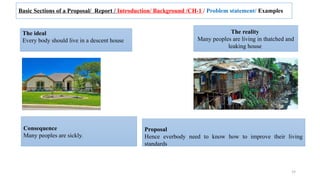
The ideal
Every body should live in a descent house
The reality
Many peoples are living in thatched and
leaking house
Consequence
Many peoples are sickly.
Proposal
Hence everbody need to know how to improve their living
standards
20.
20
Basic Sections ofa Proposal/ Report / Introduction/ Background /CH-1 / Problem statement/ Examples
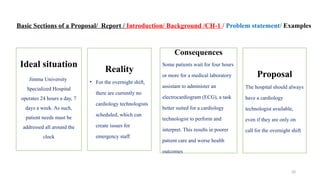
Ideal situation
Jimma University
Specialized Hospital
operates 24 hours a day, 7
days a week. As such,
patient needs must be
addressed all around the
clock
Reality
• For the overnight shift,
there are currently no
cardiology technologists
scheduled, which can
create issues for
emergency staff
Consequences
Some patients wait for four hours
or more for a medical laboratory
assistant to administer an
electrocardiogram (ECG), a task
better suited for a cardiology
technologist to perform and
interpret. This results in poorer
patient care and worse health
outcomes
Proposal
The hospital should always
have a cardiology
technologist available,
even if they are only on
call for the overnight shift
21.
21
Basic Sections ofa Proposal/ Report / Introduction/ Background /CH-1 / Problem statement/
Check your problem statement as it includes those
sections
Identify and color your problem statement as
Ideal situation
Reality
Consequences
Proposal
22.
22
Basic Sections ofa Proposal/ Report / Introduction/ Background /CH-1 /
Objective of the project
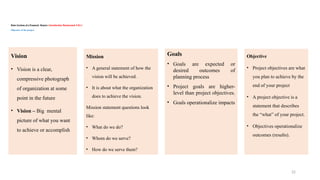
Mission
• A general statement of how the
vision will be achieved.
• It is about what the organization
does to achieve the vision.
Mission statement questions look
like:
• What do we do?
• Whom do we serve?
• How do we serve them?
Vision
• Vision is a clear,
compressive photograph
of organization at some
point in the future
• Vision – Big mental
picture of what you want
to achieve or accomplish
Goals
• Goals are expected or
desired outcomes of
planning process
• Project goals are higher-
level than project objectives.
• Goals operationalize impacts
Objective
• Project objectives are what
you plan to achieve by the
end of your project
• A project objective is a
statement that describes
the “what” of your project.
• Objectives operationalize
outcomes (results).
23.
23
Basic Sections ofa Proposal/ Report / Introduction/ Background /CH-1 /
Objective of the project/
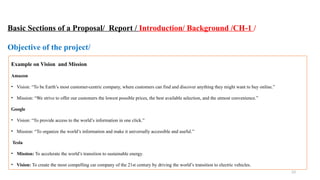
Example on Vision and Mission
Amazon
• Vision: “To be Earth’s most customer-centric company, where customers can find and discover anything they might want to buy online.”
• Mission: “We strive to offer our customers the lowest possible prices, the best available selection, and the utmost convenience.”
Google
• Vision: “To provide access to the world’s information in one click.”
• Mission: “To organize the world’s information and make it universally accessible and useful.”
Tesla
• Mission: To accelerate the world’s transition to sustainable energy.
• Vision: To create the most compelling car company of the 21st century by driving the world’s transition to electric vehicles.
24.
24
Basic Sections ofa Proposal/ Report / Introduction/ Background /CH-1 /
Objective of the project/
Jimma University
Vision
• Jimma University aspires to be one of the premier universities in Africa and renowned in the world by 2025.
Mission
• To train high caliber national and international professionals, undertaking quality and problem solving research, serving and engaging
local, national, and global communities through its cherished and innovative Community Based Education (CBE).
Goals
To build culture of academic excellence that champions students’ success in intellectual expertise, graduation and employability;
To develop highest standards of research that gives solutions to the pressing national and global challenges;
To empower the community to resolve their own issues through our creative and responsive services;
To build a diverse global network in intercultural, curricular and co-curricular opportunities that make students globally competent
and
To create mutual partnership for reputation, financial sustainability and maximizing investment.
25.
25
Basic Sections ofa Proposal/ Report / Introduction/ Background /CH-1 /
Objective of the project
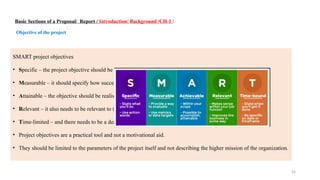
SMART project objectives
• Specific – the project objective should be detailed and unambiguous.
• Measurable – it should specify how success will be measured.
• Attainable – the objective should be realistic.
• Relevant – it also needs to be relevant to the brand and aims of the organization.
• Time-limited – and there needs to be a deadline
• Project objectives are a practical tool and not a motivational aid.
• They should be limited to the parameters of the project itself and not describing the higher mission of the organization.
26.
26
Basic Sections ofa Proposal/ Report / Introduction/ Background /CH-1 /
Objective of the project
SMART project objectives
Example 1
• I will obtain a job as a high school math teacher within three months after graduating with my Bachelor of Science in
Education.
Specific: The goal of becoming a high school math teacher is well-defined
Measurable: Success can be measured by the number of applications, interviews and job offers.
Achievable: The goal setter will have the appropriate degree for the job.
Relevant: The goal setter is planning to get a job in the education industry after getting an education degree.
Time-based: The goal setter has set a deadline to achieve their objective within the three months following graduation.
27.
27
Basic Sections ofa Proposal/ Report / Introduction/ Background /CH-1 /
Objective of the project
SMART project objectives
Example 1
• I will earn a promotion to senior customer service representative by completing the required
training modules in three months and applying for the role at the end of next quarter.
• Specific: The goal setter has clearly set the objective to be promoted to senior customer services rep.
• Measurable: Success can be measured by training module completion, filing the application and earning the
promotion.
• Achievable: The goal setter will complete the training necessary to earn the promotion.
• Relevant: The goal setter is planning to apply for the promotion after finishing their training modules.
• Time-based: The goal setter has set a deadline to achieve their objective at the end of the following business
quarter.
28.
28
Basic Sections ofa Proposal/ Report / Introduction/ Background /CH-1 /
Objective of the project
General objective
• Here is usually globally only one, as it encompasses the entirety of an investigation or
a project
• In general, research general objectives describe what we expect to achieve by a
project.
• When you write objectives use
Specific objectives .
• There are usually several,
• More detailed
To + active verb + your title
29.
29
Basic Sections ofa Proposal/ Report / Introduction/ Background /CH-1 /
Objective of the project/Example
Title :-Multilanguage body fat analyzer
General Objectives
• The general objective of this project is to design Multilanguage body fata analyzer which measures fat contents
automatically.
Specific objectives
• To identify and collect appropriate materials for the construction of the device
• To construct the prototype of the design
• To construct the real device based on the prototype
• To test the prototype with the constraint
• To compare the deigned device with existing one
31
Basic Sections ofa Proposal/ Report / Introduction/ Background /CH-Constraints
• A constraint, in project, is any restriction that defines a project's
limitations; the scope, for example, is the limit of what the project is
expected to accomplish.
• The three most significant project constraints – schedule(time), cost and
scope
Exercise
What is your project constraints
32.
32
Basic Sections ofa Proposal/ Report / Introduction/ Background /CH-1 / Significant of the
project
• It describes importance of your project.
• It ensures your readers to understand the impact of your work
How to Write Significance of the Study:
1. Use your research problem as a starting point
2. State how your research will contribute to the existing literature in the field.
3. Explain how your research will benefit society.
4. Mention the specific persons or institutions who will benefit from your study.
5. Indicate how your study may help future studies in the field.
33.
33
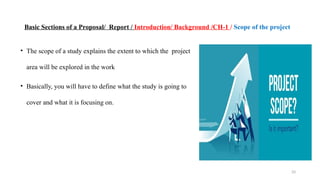
Basic Sections ofa Proposal/ Report / Introduction/ Background /CH-1 / Scope of the project
• The scope of a study explains the extent to which the project
area will be explored in the work
• Basically, you will have to define what the study is going to
cover and what it is focusing on.
34.
34
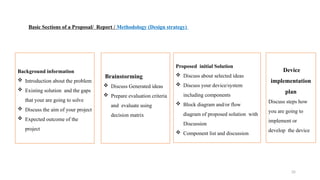
Basic Sections ofa Proposal/ Report / Methodology (Design strategy)/CH-2
• It summarizes how you planned and developed your approach for the design
• Components included / Materials in greater depth
• Implementation plan
• Major steps necessary for implementation
• Include any references for resources used in development of the design
• Appropriate and well-formatted figures and tables
• Working principle of your design system
35.
35
Basic Sections ofa Proposal/ Report / Methodology (Design strategy)
Background information
Introduction about the problem
Existing solution and the gaps
that your are going to solve
Discuss the aim of your project
Expected outcome of the
project
Proposed initial Solution
Discuss about selected ideas
Discuss your device/system
including components
Block diagram and/or flow
diagram of proposed solution with
Discussion
Component list and discussion
Device
implementation
plan
Discuss steps how
you are going to
implement or
develop the device
Brainstorming
Discuss Generated ideas
Prepare evaluation criteria
and evaluate using
decision matrix
36.
36
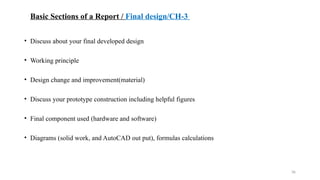
Basic Sections ofa Report / Final design/CH-3
• Discuss about your final developed design
• Working principle
• Design change and improvement(material)
• Discuss your prototype construction including helpful figures
• Final component used (hardware and software)
• Diagrams (solid work, and AutoCAD out put), formulas calculations
37.
37
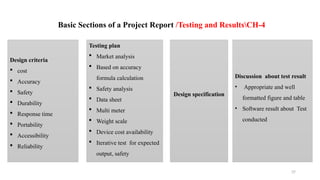
Basic Sections ofa Project Report /Testing and ResultsCH-4
Design criteria
cost
Accuracy
Safety
Durability
Response time
Portability
Accessibility
Reliability
Testing plan
Market analysis
Based on accuracy
formula calculation
Safety analysis
Data sheet
Multi meter
Weight scale
Device cost availability
Iterative test for expected
output, safety
Design specification
Discussion about test result
• Appropriate and well
formatted figure and table
• Software result about Test
conducted
38.
38
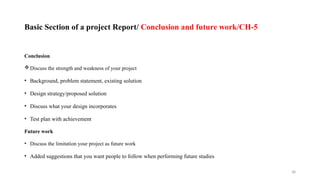
Basic Section ofa project Report/ Conclusion and future work/CH-5
Conclusion
Discuss the strength and weakness of your project
• Background, problem statement, existing solution
• Design strategy/proposed solution
• Discuss what your design incorporates
• Test plan with achievement
Future work
• Discuss the limitation your project as future work
• Added suggestions that you want people to follow when performing future studies
40
Basic Section ofa project Report/ Appendix
• A section at the end of a paper that includes information that is too detailed for the text of the
paper itself
• Includes codes, mathematical derivations or calculations, detailed technical drawings, or tables of
raw data
• Each appendix must be referred to by name in bold font (Appendix A, Appendix B, Appendix C,
etc.)
• Each appendix must also have a title
• Begin each appendix on a separate page with page number
42
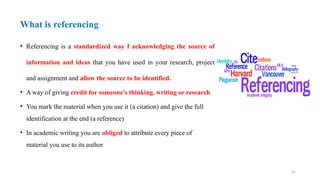
What is referencing
•Referencing is a standardized way f acknowledging the source of
information and ideas that you have used in your research, project
and assignment and allow the source to be identified.
• A way of giving credit for someone's thinking, writing or research
• You mark the material when you use it (a citation) and give the full
identification at the end (a reference)
• In academic writing you are obliged to attribute every piece of
material you use to its author
44
What should wereference?
• Print and electronics book
• Website
• Print and electronic journal articles
• News paper
• Conference paper
• Data published in repository
• Video, film
45.
45
How to cite:citing reference in the body of your text
• With all referencing style, there are two parts of referencing :citing and referencing list.
• Citing means when in your work, you have used an idea from books, journal articles, websites,
etc. you must acknowledged this in your text. This is referred to as ‘citing’.
• You mark the material when you use it (a citation) and give the full identification at the end (a
referencing list )
• Each pieces of work which is cited in your text should have a unique, assigned in the order of
citation
• When you use another person’s work in your own work, either by referring to their ideas, or by
including a direct quotation, you must acknowledge this in the text of your work. This
acknowledgement is called a citation.
46.
46
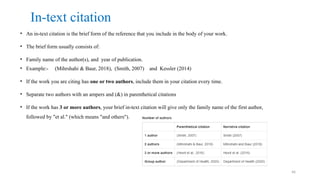
In-text citation
• Anin-text citation is the brief form of the reference that you include in the body of your work.
• The brief form usually consists of:
• Family name of the author(s), and year of publication.
• Example:- (Mihrshahi & Baur, 2018), (Smith, 2007) and Kessler (2014)
• If the work you are citing has one or two authors, include them in your citation every time.
• Separate two authors with an ampers and (&) in parenthetical citations
• If the work has 3 or more authors, your brief in-text citation will give only the family name of the first author,
followed by "et al." (which means "and others").
47.
47
Styles of referencing
•Particular referencing styles are preferred by particular academic disciplines because
they work better with the kind of texts that are most commonly used in that discipline.
48.
48
Styles of referencing
Vancouverstyle
References are identified by Arabic numerals
• The numbers are assigned in the order of citation.
• If a piece of work is cited more than once, the same citation number must
be used.
• This number is commonly enclosed in round brackets (1), but it can also be
written inside square brackets [1], as a superscript1
, or as a combination of
brackets and superscript [1]
.
• Example: Smith (3)or smith [3] presents convincing evidence that global
warming is a much bigger threat than previous research has assumed
49.
49
Harvard referencing style
•References are identified by the name of the author(s) and the year of publication.
• It is used predominantly in the humanities and social sciences.
• For in-text citations that are part of the sentence use brackets to enclose only the
year of publication like this: Smith (2009).
• If you put the entire in-text citation within brackets, no second pair of brackets are
needed for the year, like this: (Johnson 2005).
50.
50
IEEE referencing style
•The IEEE referencing style is specified by the Institute of Electrical and
Electronics Engineers, and is used widely in electronics and related disciplines.
• Make sure to check your departments' specific guidance for any preferred formats.
• IEEE uses numeric in-text citations, where the number of the reference(s) is
given in square brackets after the information, summary or quote:
• Example
• A recent study [1] has demonstrated the effectiveness of…
• The results presented here have also been confirmed elsewhere [2].
• Exercise
52
Page Numbering andTable & Figure Caption
Page Numbering
• Go to the first page for which you want to have numbered pages.
• At the top of the page, before the first line/word, click on the document to place your curser.
• Then choose Page Layout from the top menu.
• Next select Breaks - Next Page.
• Now choose Insert from the top menu and then select Page Numbers and then choose how you want them to appear
in the document.
• With the number still highlighted, choose Page Number from the top menu, then select Format Page Numbers.
• Under Page Numbering, choose Start At and then select a starting number.
53.
53
Page Numbering andTable & Figure Caption
Table & Figure Caption
Right-click on the first figure or table in your document.
Select Insert Caption from the pop-up menu.
Select the figure or table and then select Insert Caption from the References tab in the
ribbon.




![48
Styles of referencing
Vancouver style
References are identified by Arabic numerals
• The numbers are assigned in the order of citation.
• If a piece of work is cited more than once, the same citation number must
be used.
• This number is commonly enclosed in round brackets (1), but it can also be
written inside square brackets [1], as a superscript1
, or as a combination of
brackets and superscript [1]
.
• Example: Smith (3)or smith [3] presents convincing evidence that global
warming is a much bigger threat than previous research has assumed](https://image.slidesharecdn.com/training-250429101008-9d35666f/85/Research-Report-Writing-Training-for-Students-48-320.jpg)
![50
IEEE referencing style
• The IEEE referencing style is specified by the Institute of Electrical and
Electronics Engineers, and is used widely in electronics and related disciplines.
• Make sure to check your departments' specific guidance for any preferred formats.
• IEEE uses numeric in-text citations, where the number of the reference(s) is
given in square brackets after the information, summary or quote:
• Example
• A recent study [1] has demonstrated the effectiveness of…
• The results presented here have also been confirmed elsewhere [2].
• Exercise](https://image.slidesharecdn.com/training-250429101008-9d35666f/85/Research-Report-Writing-Training-for-Students-50-320.jpg)