Research Findings on General Mills, Inc. and Kraft Foods, Inc.VSB 1005 – Business DynamicsBy Andrew Bieler, Kathryn Cassavell, Marcelo Mazzocato and Michelle Phillips
General Mills, Inc. (GIS)
CompanyDescriptionUS Retail of packaged food (76%), International sales and food service: total revenue of nearly $16biSecond largest food company in the cereal sector; owner of the Cheerios brandFirst factory: Gold Medal Flour in Minneapolis, in the 1860sIncorporated in 192866 production facilities, 40 in the USHeadquartered in Minneapolis, MN33,000 employeeswww.generalmills.com
Company Description (cont.)Several leading and well-known brandsGreen Giant, Cheerios, Pillsbury, Betty Crocker, HaagenDazs, Nature Valley, Yoplait
General Mills In the News
General Mills Mum onReports of Yoplait PurchaseU.S. foods group General Mills declined to comment on Sunday on a British newspaper report that it was mulling a bid for French yogurt maker Yoplait following a contract dispute.
The Sunday Times said in an unsourced report that the maker of Cheerios cereal could pay 1 billion pounds ($1.56 billion) for unlisted Yoplait, whose products it distributes in the United States.General Mills Invests in New Production FacilityThe Minneapolis based General Mills announced their new $100 million investment into expansion of its Murfreesboro production facility.
 “I’m very pleased to have one of the world’s most respected food companies growing and thriving in Tennessee,” said Governor Bredesen. “This expansion is not just an endorsement of Tennessee’s business climate, but in the quality and productivity of the workforce in Murfreesboro.”GM Managing Director TakesNew RoleThe managing director of General Mills' operations in the UK, Ireland and the Nordic region, has been elected president of UK industry body the Food and Drink Federation (FDF).
Jim Moseley has held his role with General Mills since 1999 and for the past four years has served as vice and deputy president of the FDF and chair of its Food Safety and Scientific Steering Group 
Financial Analysis1. Profitability: recovery in margins. Efficiency gains forced by input prices. Increase in net margin, ROA and ROE in the past five years.2. Asset Management: high asset turnover ratios associated with high efficiency. Drop in average collection period. Short but constant inventory period. Periods are expected of the packaged food industry.
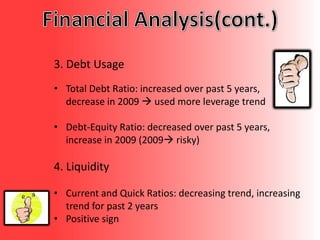
Financial Analysis (Cont.)3. Debt: high debt ratios but showing drops in the past years. Analysts say D/E is expected to fall significantly in the next five years. This trend shows the company’s high levels of debt are manageable.4. Liquidity: ratios show an upward trend but still lower than industry average.
Kraft Foods, Inc. (KFT)
Company Description #1 US Food Company, #2 worldwide (Hoover’s)
 Food industry
 1903- James L. Kraft opened cheese business – Chicago, IL
 Sectors: snacks, beverages, cheese, convenience meals, packaged grocery productsCompany Description (cont.) Headquarters: Northfield, IL
 Incorporated in 2000
 97,000 Employees
 Sell products – 160 countries
 Operations in 70 countries  Kraft in the NewsKraft’s Cookie, Cracker Sales Crumble in U.S.July 26, 2010 Rosenfeld predicted a 9% to 11% increase in EPS after Cadbury
Cookie sales down 4.6%
 Cracker sales down 3.8%
 Lost 1% of Market ShareKraft Gets Boost From CadburyAugust 5, 2010Profits up 13%Revenues up 25%Gross margin up 2.4%Earnings up 11%. Cadbury strong in foreign marketsAsia & Latin America

Research presentation[1]

  • 1.
    Research Findings onGeneral Mills, Inc. and Kraft Foods, Inc.VSB 1005 – Business DynamicsBy Andrew Bieler, Kathryn Cassavell, Marcelo Mazzocato and Michelle Phillips
  • 2.
  • 3.
    CompanyDescriptionUS Retail ofpackaged food (76%), International sales and food service: total revenue of nearly $16biSecond largest food company in the cereal sector; owner of the Cheerios brandFirst factory: Gold Medal Flour in Minneapolis, in the 1860sIncorporated in 192866 production facilities, 40 in the USHeadquartered in Minneapolis, MN33,000 employeeswww.generalmills.com
  • 4.
    Company Description (cont.)Severalleading and well-known brandsGreen Giant, Cheerios, Pillsbury, Betty Crocker, HaagenDazs, Nature Valley, Yoplait
  • 5.
  • 6.
    General Mills MumonReports of Yoplait PurchaseU.S. foods group General Mills declined to comment on Sunday on a British newspaper report that it was mulling a bid for French yogurt maker Yoplait following a contract dispute.
  • 7.
    The Sunday Timessaid in an unsourced report that the maker of Cheerios cereal could pay 1 billion pounds ($1.56 billion) for unlisted Yoplait, whose products it distributes in the United States.General Mills Invests in New Production FacilityThe Minneapolis based General Mills announced their new $100 million investment into expansion of its Murfreesboro production facility.
  • 8.
    “I’m verypleased to have one of the world’s most respected food companies growing and thriving in Tennessee,” said Governor Bredesen. “This expansion is not just an endorsement of Tennessee’s business climate, but in the quality and productivity of the workforce in Murfreesboro.”GM Managing Director TakesNew RoleThe managing director of General Mills' operations in the UK, Ireland and the Nordic region, has been elected president of UK industry body the Food and Drink Federation (FDF).
  • 9.
    Jim Moseley hasheld his role with General Mills since 1999 and for the past four years has served as vice and deputy president of the FDF and chair of its Food Safety and Scientific Steering Group 
  • 10.
    Financial Analysis1. Profitability:recovery in margins. Efficiency gains forced by input prices. Increase in net margin, ROA and ROE in the past five years.2. Asset Management: high asset turnover ratios associated with high efficiency. Drop in average collection period. Short but constant inventory period. Periods are expected of the packaged food industry.
  • 11.
    Financial Analysis (Cont.)3.Debt: high debt ratios but showing drops in the past years. Analysts say D/E is expected to fall significantly in the next five years. This trend shows the company’s high levels of debt are manageable.4. Liquidity: ratios show an upward trend but still lower than industry average.
  • 12.
  • 13.
    Company Description #1US Food Company, #2 worldwide (Hoover’s)
  • 14.
  • 15.
    1903- JamesL. Kraft opened cheese business – Chicago, IL
  • 16.
    Sectors: snacks,beverages, cheese, convenience meals, packaged grocery productsCompany Description (cont.) Headquarters: Northfield, IL
  • 17.
  • 18.
  • 19.
    Sell products– 160 countries
  • 20.
    Operations in70 countries Kraft in the NewsKraft’s Cookie, Cracker Sales Crumble in U.S.July 26, 2010 Rosenfeld predicted a 9% to 11% increase in EPS after Cadbury
  • 21.
  • 22.
  • 23.
    Lost 1%of Market ShareKraft Gets Boost From CadburyAugust 5, 2010Profits up 13%Revenues up 25%Gross margin up 2.4%Earnings up 11%. Cadbury strong in foreign marketsAsia & Latin America

Editor's Notes

  • #13  Largest player in food and beverage industry in North America James Kraft- 1903 Public 1924 National Dairy Phillip Morris 2000 – Nabisco Holdings 2001 – NYSE Sectors $1 billion Over 50 brands exceed $100 million
  • #14  160 countries – including US, Canada, Europe, Latin America, Asia Pacific, Africa, and Middle East
  • #18 PROFITABILITY Declining IncreaseASSET MANAGEMENT Turnover Ratios- Poor asset management Generating less sales per asset Periods-- Longer to collect- Hold inventory longer-- Overall poor – showed improvement in the last year
  • #19 DEBT USAGE TDR: 2009 decrease  good sign. DER: more aggressive Risky – volatile earningsLIQUIDITY Good financial strength