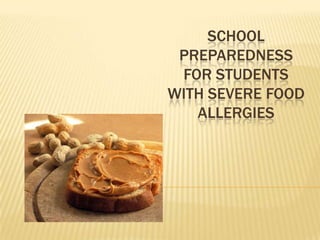
School Preparedness for Students with Severe Food Allergies
School Preparedness for Students with Severe Food AllergiesNuts, Dairy, Gluten, Soy… any commonality?		       Yes! All are allergens!Allergy or Intolerance?		       Symptoms are common for both.6 - 8%  of elementary students are affected18% Increase in past decadein cases
Problem statementDue to the rise of food allergies – severe or otherwise – in young children, it is imperative that elementary schools protect their students’ health.
What you need to know…Food allergies are more prevalent in children
 They are sometimes “outgrown”
 4 out of every 100 children has a food allergy
 Increased risk for developing other allergies
 Children with coexisting allergies are more prone to anaphylaxis and   death
 3.9% of children under 17 affected This means that…
Tell Me More…No significant difference between genders
More likely to affect non-Hispanic children
84% of food reactions happen in schools
Most schools do not use the current Food Allergy and Anaphylaxis Network’s (FAAN) Food Allergy Action PlanWhat is FAAN?The Food Allergy and Anaphylaxis Network’s Food Allergy Action Plan, or FAAN, is a government supported guideline for food allergy safety. This includes (and is not limited to) :Schools be knowledgeable about current state and district policy and law

Research presentation

  • 1.
    School Preparedness forStudents with Severe Food Allergies
  • 2.
    School Preparedness forStudents with Severe Food AllergiesNuts, Dairy, Gluten, Soy… any commonality? Yes! All are allergens!Allergy or Intolerance? Symptoms are common for both.6 - 8% of elementary students are affected18% Increase in past decadein cases
  • 3.
    Problem statementDue tothe rise of food allergies – severe or otherwise – in young children, it is imperative that elementary schools protect their students’ health.
  • 4.
    What you needto know…Food allergies are more prevalent in children
  • 5.
    They aresometimes “outgrown”
  • 6.
    4 outof every 100 children has a food allergy
  • 7.
    Increased riskfor developing other allergies
  • 8.
    Children withcoexisting allergies are more prone to anaphylaxis and death
  • 9.
    3.9% ofchildren under 17 affected This means that…
  • 10.
    Tell Me More…Nosignificant difference between genders
  • 11.
    More likely toaffect non-Hispanic children
  • 12.
    84% of foodreactions happen in schools
  • 13.
    Most schools donot use the current Food Allergy and Anaphylaxis Network’s (FAAN) Food Allergy Action PlanWhat is FAAN?The Food Allergy and Anaphylaxis Network’s Food Allergy Action Plan, or FAAN, is a government supported guideline for food allergy safety. This includes (and is not limited to) :Schools be knowledgeable about current state and district policy and law