PowerPoint Template ©2009 Texas Christian University, Center for Instructional Services. For Educational Use Only. Content is the property of the presenter and their resources.
Background
Casey Life Skills areas of concentration:
• Work and study habits
• Planning and goal-setting
• Using community resources
• Daily living activities
• Budgeting and paying bills
• Computer literacy
• Their permanent connections to caring
adults
Purpose
The purpose of this study was to evaluate the effectiveness of the Casey Life Skills
curriculum when used with homeless young adults living in a transitional living program
•
Limitations
• Time limited research
• Small sample size not representative of
general homeless population
• Experience of Facilitators
• Length of Workshop
• External conflict with case manager or
other housemates
• Non Standardized measure
All Grown Up: Working With Homeless Young Adults to Become Independent
Andrea K. Alisauski, Texas Christian University
Linda Goodman, LMSW, Program Director, Transitional Living Program
James Petrovich, LMSW, PhD Texas Christian University
Sample
• Homeless
• Sheltered Residential Clients
• Ages 18-21
• 6 Males and 7 Females
• 8 African Americans, 3 Hispanic, 2
Caucasian
Methods
• Data collected from 2/19/15 – 4/1/15
• Non- experimental post test design
• Anonymous agency created evaluation
• Six 1 hour life skills workshops evaluated
• Data evaluated on Likert scale
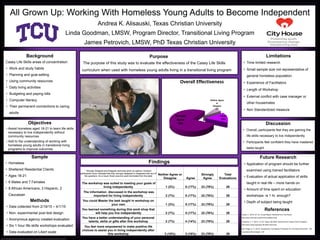
* Strongly Disagree and Disagree were also given as options, however,
participants never indicated that they strongly disagreed or disagreed with any of
the questions. As a result, those columns were eliminated from the table
Neither Agree or
Disagree Agree
Strongly
Agree
Total
Evaluations
The workshop was suited to meeting your goals of
living independently 1 (3%) 5 (17%) 23 (79%) 29
The information discussed in the workshop was
important for living independently 2 (7%) 5 (17%) 22 (76%) 29
You could Master the task taught in workshop on
your own 1 (3%) 5 (17%) 23 (79%) 29
You learned something during this work shop that
will help you live independently 2 (7%) 5 (17%) 22 (76%) 29
You have a better understanding of your personal
talents, skills or gifts after this workshop 2 (7%) 4 (14%) 23 (79%) 29
You feel more empowered to make positive life
choices to assist you in living independently after
this workshop 3 (10%) 3 (10%) 23 (79%) 29
Neither Agree
or
Disagree
6%
Agree
16%
Strongly
Agree
78%
Overall Effectiveness
Objectives
• Assist homeless aged 18-21 to learn life skills
necessary to live independently without
community resources
• Add to the understanding of working with
homeless young adults in transitional living
programs to improve outcomes
Findings
Discussion
• Overall, participants feel they are gaining the
life skills necessary to live independently.
• Participants feel confident they have mastered
tasks taught
Future Research
• Application of program should be further
examined using trained facilitators
• Evaluation of actual application of skills
taught in real life – more hands on
• Amount of time spent on education
workshops- is 1 hr. enough?
• Depth of subject being taught
References
House, C. (2015, 04 10). Annual Report. Retrieved from City House :
http://www.cityhouse.org/2014AnnualReport.pdf
Programs, C. F. (2014, 10 15). Casey Life Skills. Retrieved from Casey Family Programs:
http://www.casey.org/casey-life-skills-resources
Ken Hodge, S. D. (2012). Developing a Conceptual Framework For Life Skills Intervention. The
Counseling Psychologist, 1-28.

research poster

  • 1.
    PowerPoint Template ©2009Texas Christian University, Center for Instructional Services. For Educational Use Only. Content is the property of the presenter and their resources. Background Casey Life Skills areas of concentration: • Work and study habits • Planning and goal-setting • Using community resources • Daily living activities • Budgeting and paying bills • Computer literacy • Their permanent connections to caring adults Purpose The purpose of this study was to evaluate the effectiveness of the Casey Life Skills curriculum when used with homeless young adults living in a transitional living program • Limitations • Time limited research • Small sample size not representative of general homeless population • Experience of Facilitators • Length of Workshop • External conflict with case manager or other housemates • Non Standardized measure All Grown Up: Working With Homeless Young Adults to Become Independent Andrea K. Alisauski, Texas Christian University Linda Goodman, LMSW, Program Director, Transitional Living Program James Petrovich, LMSW, PhD Texas Christian University Sample • Homeless • Sheltered Residential Clients • Ages 18-21 • 6 Males and 7 Females • 8 African Americans, 3 Hispanic, 2 Caucasian Methods • Data collected from 2/19/15 – 4/1/15 • Non- experimental post test design • Anonymous agency created evaluation • Six 1 hour life skills workshops evaluated • Data evaluated on Likert scale * Strongly Disagree and Disagree were also given as options, however, participants never indicated that they strongly disagreed or disagreed with any of the questions. As a result, those columns were eliminated from the table Neither Agree or Disagree Agree Strongly Agree Total Evaluations The workshop was suited to meeting your goals of living independently 1 (3%) 5 (17%) 23 (79%) 29 The information discussed in the workshop was important for living independently 2 (7%) 5 (17%) 22 (76%) 29 You could Master the task taught in workshop on your own 1 (3%) 5 (17%) 23 (79%) 29 You learned something during this work shop that will help you live independently 2 (7%) 5 (17%) 22 (76%) 29 You have a better understanding of your personal talents, skills or gifts after this workshop 2 (7%) 4 (14%) 23 (79%) 29 You feel more empowered to make positive life choices to assist you in living independently after this workshop 3 (10%) 3 (10%) 23 (79%) 29 Neither Agree or Disagree 6% Agree 16% Strongly Agree 78% Overall Effectiveness Objectives • Assist homeless aged 18-21 to learn life skills necessary to live independently without community resources • Add to the understanding of working with homeless young adults in transitional living programs to improve outcomes Findings Discussion • Overall, participants feel they are gaining the life skills necessary to live independently. • Participants feel confident they have mastered tasks taught Future Research • Application of program should be further examined using trained facilitators • Evaluation of actual application of skills taught in real life – more hands on • Amount of time spent on education workshops- is 1 hr. enough? • Depth of subject being taught References House, C. (2015, 04 10). Annual Report. Retrieved from City House : http://www.cityhouse.org/2014AnnualReport.pdf Programs, C. F. (2014, 10 15). Casey Life Skills. Retrieved from Casey Family Programs: http://www.casey.org/casey-life-skills-resources Ken Hodge, S. D. (2012). Developing a Conceptual Framework For Life Skills Intervention. The Counseling Psychologist, 1-28.