Cantranece Rorie
Dr. Dollar
SOC 302-Data Analysis
How Does Family Socialization with Criminal Behavior Affect Arrest Records into
Adulthood?
INTRODUCTION:
The focus on criminal behavior has been the start of significant research for the
sociological field. The relationship between family and criminal behavior has been
researched, analyzed, and published many time over because we know that the first point of
socialization starts with the family in the and home. The data analyzed and researched was
done on traditional and non-traditional families. The traditional family paradigm is one in
which both parents, the mother and the father, are present and active in the child’s life. Also,
there is the non-traditional family which can include, one parent or parents of the same sex,
and there are the families that adopt children. In this paper, I want to explain through research
and data analysis how family socialization and environmental factors can contribute into a
child offending once they have reached adulthood.
LITERATURE REVIEW:
“Farrington et al. (1996) speculated that ‘this may partly be because most American
criminologists were trained as sociologists and are concerned to avoid any suggestion that
offending might be genetically transmitted (although, of course, the concentration of
offending in families might also be explainable by environmental transmission)” (Farrington,
et al 2009). Parents who have criminal records, or display behavior with criminal tendencies,
may pass on the traits and mannerisms to their offspring. Travis Hirschi’s Social Bond
Theory is the foundation of criminological theories of why people gravitate towards crime.
In the article Criminality and Family Formation: Effects of Marriage and Parenthood
on Criminal Behavior for Men and women, it referenced the fact that although some parents
may cite that becoming a parent is their reason that crime is no longer appealing, that does
not account for the other portion of respondents that continue to offend after marriage or the
birth of a child. Another article however supported the hypothesis that marriage does in fact
decrease the urges to cease any criminal behavior, with those respondents being men. “As
soon as men enter marriage, less time is allocated to unstructured peer activities. Even more
speculative is the idea that the effect of marriage on desistance is the result of changes in
“one’s sense of self”” (Zoutewelle-Terovan, et al 2012). This relates to the Social Bond
Theory because positive bonds decrease the risk of those who are entering into marriage from
being involved in criminal activity.
The intergenerational transmission of crime is due to negative familial socialization
and environmental factors, such as the neighborhood you live in. Parents or grandparents who
are involved in crime are more like to transmit those traits to their children. They may see
criminal behavior as a normal means of survival, which in turn creates an environment of
encouragement, motive, and opportunity for the child. Low income families are also at risk
for intergenerational transmission of criminality because of the lack of resources, and as
previously stated, they use this as a means of survival and providing basic necessities for the
household.
“Not only parental convictions are taken into account, but also poor housing, low
family income, low family socio-economic status and a father’s poor job record. People from
lower-class backgrounds, who live in poor housing or whose fathers are unemployed might
attract more attention from the police and justice agencies” (Besemer, et al 2013). These risk
factors are also target rich for law enforcement to have an increased presence in lower
socioeconomic status neighborhoods, which also increases the chance of the parents and/or
children to be stopped or arrested by police.
Sociology is the study of people, their behaviors, and factors that contribute to their
environment. Many things contribute to a person’s socialization skills, and learning from the
family and surrounding neighbors is the first point of how they interact with others outside of
our comfort zone. If the family is deeply imbedded in criminal behavior, there is no doubt
that a child will grow up believing that what they have seen and learned is the way to operate
as an adult. They may even seek others who have similar backgrounds, and enter into
relationships grounded in criminal activity. This further resonates on intergenerational
transmission if there is no specific point or person to break the cycle.
The article Official Bias in Intergenerational Transmission of Criminal Behaviour, it
states in the first sentence that “Children of convicted parents have a higher risk of getting
convicted than children of non-convicted parents” (Besemer, et al 2013). Children who are
products of their environments repeat the same cycles that they were raised in. This article
reported the factors that justice agencies could use in order to form a bias against those who
are offending. Low income, parental convictions, and poor job records are a few that were
measured in their study.
Furthermore, children imitate both the positive and negative actions of their parents.
“Criminal parents tend to live and raise their children in the least-favourable social
environments, which increases the children’s chance of criminal behavior” (Van der Rakt, et
al 2009). Negative bonds in childhood often lead to the formation of negative bonds into
adulthood. This transfers from generation to generation thorough lack of intervention from a
responsible adult. For example, children who witness their parents physically committing a
criminal act, such as stealing, runs the risk of repeating the same actions once they reach their
teenage years. They see these actions as normal behavior, therefore, they will more likely
gravitate towards these actions in the future. The skill of criminal behavior, a golden
opportunity, and lack of intervention by authority creates the perfect opportunity for a crime
to be committed.
“...criminal behaviour influences, and is influenced by, the frequency and type of
associations with criminal others (that is, association with criminal others influences criminal
behaviour, and criminal bahaviour influences the type of friends with whom that individual is
associated) (Thornberry et al. 1994)” (Boduszek, et al 2014). Strong attachments and lack of
parental control also are high risk factors contributing to negative behavior.
RESEARCH HYPOTHESIS:
I wanted to know how socializing with parents and other family members who
participate in criminal behavior during childhood affected a person’s likelihood repeating
those same behaviors and being arrested in adulthood. I hypothesized that children who grow
up in a household where criminal behavior is present, will also display those same behaviors
and be arrested as an adult.
My null (H°) hypothesis is: “Family socialization during childhood does not have any
effects future arrests in adulthood.”
My research (H¹) hypothesis is: “Family socialization during childhood does have an
effect on future arrests in adulthood.”
METHODS:
Gathering Data
For my research, I obtained my data from the National General Social Survey GSS)
from the years 1972 to 2014. The GSS Survey gathers data measuring the race, gender, age,
work life, school life, home life, and attitudes of respondents. For my research question, I
focused on two specific variables to test for their significance: have you ever been arrested
and how often do you spend time with your parents. I chose to control for race to see how
arrest percentages varied across racial categories. I chose to do a crosstab of my independent
and dependent variables first to test my hypothesis. After analyzing those result, I then
conducted a multivariate crosstab by adding race to further test my hypothesis against my
control variable.
Once I ran both crosstabs using the uncompromised data from the GSS Survey, I then
recoded my variables and ran an additional multivariate crosstab to see if there was any
difference in the results. I looked at the current response options for my independent variable
in the GSS codebook and noting that some response options weren’t necessary to include in
my data, I recoded the ones I would use to gather my data so that they could be clear and
recoded the others as system missing. The response options for time spent with parents listed
11 options, but I condensed them into 7 to retain clear, concise responses that would translate
into data relative to my research question.
As for my dependent variable, the options listed for having ever been arrested were as
follows: yes, no, refused to answer, nap, didn’t know, and not applicable. Because I wanted
my results to depict whether or not someone was arrested, I recoded the response options to
two: yes or no.
Because of how I wanted race to be presented in my data, I chose to leave the
categories of responses as they were originally presented in the GSS codebook. The three
categories of responses yielded the exact results I was looking for without consolidating the
responses into two. I wanted to only included whites and non-whites in my data, but the 3
options of white, black, and other added another aspect to my data that would have excluded
important percentage of arrests.
ANALYSIS:
My results are based on the hypothesis of familial socialization during childhood
leading to arrests in adulthood. As stated previously in methods, I used a cross-tabulation to
gauge the correlation between spending time with parents and being arrested. Further, I
conducted a multivariate crosstab to control for race to see the significance between different
groups of people. With the cross-tabulations, I also included a Chi-Square test to delve deeper
into the statistical significance of my variables. The value p < .05 is used to determine the
statistical significance of two or more variables.
RESULTS:
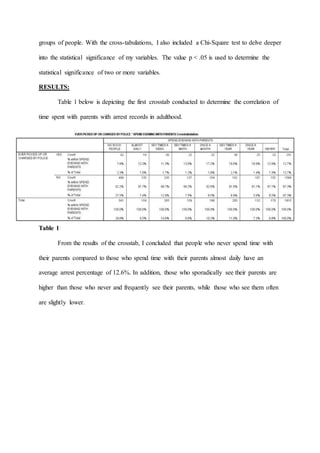
Table 1 below is depicting the first crosstab conducted to determine the correlation of
time spent with parents with arrest records in adulthood.
Table 1
From the results of the crosstab, I concluded that people who never spend time with
their parents compared to those who spend time with their parents almost daily have an
average arrest percentage of 12.6%. In addition, those who sporadically see their parents are
higher than those who never and frequently see their parents, while those who see them often
are slightly lower.
Table 2
Statistical significance is determined by the equation p < .05. Table 2 shows the Chi-
Square test conducted during this crosstab which yielded a statistical significance of .000.
Since the statistical significance between the likelihood of arrest and time spent with parents
is less than .05, I can reject my null hypothesis and accept my research hypothesis.
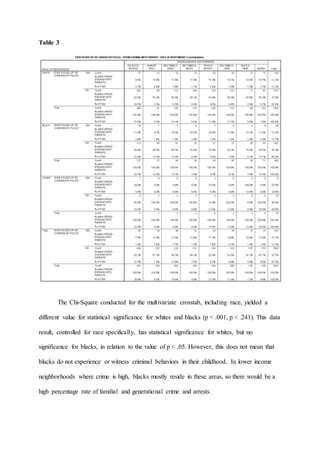
For my multivariate crosstab, I included my control variable, race to look for any
significance across racial groups. Among white respondents, those who have never spent time
with their parents had an arrest difference of 0.01% from those who see their parents almost
daily. Among black respondents, those who have never spent time with their parents
compared to those who see them almost daily, have an average arrest percentage of 10.5%.
Table 3 reflects this data.
Table 3
The Chi-Square conducted for the multivariate crosstab, including race, yielded a
different value for statistical significance for whites and blacks (p < .001, p < .241). This data
result, controlled for race specifically, has statistical significance for whites, but no
significance for blacks, in relation to the value of p < .05. However, this does not mean that
blacks do not experience or witness criminal behaviors in their childhood. In lower income
neighborhoods where crime is high, blacks mostly reside in these areas, so there would be a
high percentage rate of familial and generational crime and arrests.
“When parents are more frequent offenders, children have more opportunities to
observe and imitate their parents’ delinquent behaviour and motivations and thus one would
expect more offspring crime” (Besemer 2014). Watching repeated patterns of behavior
become a normal routine, instilling the behavior as a function in everyday life.
DISCUSSION AND CONCLUSION:
“Previous research, however, tends to conclude that older children are more strongly
impacted by parental conviction, imprisonment and maltreatment. Therefore, it is expected
that intergenerational transmission is stronger when children were older at the time of
parental conviction” (Besemer 2014). Children are more perceptive in their early year and
teen years. Parental criminality as a means of survival carries over to the older children who
may assume the responsibility if the parent is arrested.
The purpose of my analysis was to find the significance between familial
socialization, or parental involvement during childhood, and arrests in adulthood due to
criminal behavior. My findings were as follows: Parental involvement in criminal activity,
along with child exposure to such behavior, does in fact have an effect on whether children
gravitate toward criminal behavior in adulthood. Familial transmission is often a factor if
more than one generational lives in the household, or in the surrounding areas.
Further analysis yielded the result that for whites, there is statistical significance that
supports my hypothesis. As for black, the value for statistical significance was above that of p
< .05, but that doesn’t rule out that my hypothesis does not include blacks. It just means that
of the respondents for my specific data, there was no statistical significance.
In conclusion, my hypothesis, family socialization during childhood does have an
effect on future arrests in adulthood, was accepted through the analysis of my data and the
result of my crosstab between my independent and dependent variables, including the Chi-
Square test.
REFERENCES
Besemer, S. 2014. ‘The impact of timing and frequency of parental criminal behaviour
and risk factors on offspring offending.” Psychology, Crime & Law 20(1), 78-99.
Besemer, S., Farrington, D. P., & Bijleveld, C. C. 2013. “Official Bias in
Intergenerational Transmission of Criminal Behaviour.” British Journal of Criminology
53(3), 438-455.
Boduszek, D., Adamson, G., Shevlin, M., Hyland, P., & Dhingra, K. 2014. “Psycho-
sociological Investigation of Criminal Behaviour within a Prison Sample Using
Retrospective Data.” Howard Journal of Criminal Justice 53(1), 31-48.
Farrington, D. P., Coid, J. W., & Murray, J. 2009. “Family factors in the intergenerational
transmission of offending.” Criminal Behaviour & Mental Health 19(2), 109-124.
van de Rakt, M., Nieuwbeerta, P., & Apel, R. 2009. « Association of criminal convictions
between family members: Effects of siblings, fathers and mothers.” Criminal Behaviour
& Mental Health 19(2), 94-108.
Zoutewelle-Terovan, M., van der Geest, V., Liefbroer, A., & Bijleveld, C. 2014.
“Criminality and Family Formation: Effects of Marriage and Parenthood on Criminal
Behavior for Men and Women.” Crime & Delinquency 60(8), 1209-1234.

Research Paper for 302

  • 1.
    Cantranece Rorie Dr. Dollar SOC302-Data Analysis How Does Family Socialization with Criminal Behavior Affect Arrest Records into Adulthood? INTRODUCTION: The focus on criminal behavior has been the start of significant research for the sociological field. The relationship between family and criminal behavior has been researched, analyzed, and published many time over because we know that the first point of socialization starts with the family in the and home. The data analyzed and researched was done on traditional and non-traditional families. The traditional family paradigm is one in which both parents, the mother and the father, are present and active in the child’s life. Also, there is the non-traditional family which can include, one parent or parents of the same sex, and there are the families that adopt children. In this paper, I want to explain through research and data analysis how family socialization and environmental factors can contribute into a child offending once they have reached adulthood. LITERATURE REVIEW: “Farrington et al. (1996) speculated that ‘this may partly be because most American criminologists were trained as sociologists and are concerned to avoid any suggestion that offending might be genetically transmitted (although, of course, the concentration of offending in families might also be explainable by environmental transmission)” (Farrington, et al 2009). Parents who have criminal records, or display behavior with criminal tendencies, may pass on the traits and mannerisms to their offspring. Travis Hirschi’s Social Bond Theory is the foundation of criminological theories of why people gravitate towards crime. In the article Criminality and Family Formation: Effects of Marriage and Parenthood on Criminal Behavior for Men and women, it referenced the fact that although some parents may cite that becoming a parent is their reason that crime is no longer appealing, that does
  • 2.
    not account forthe other portion of respondents that continue to offend after marriage or the birth of a child. Another article however supported the hypothesis that marriage does in fact decrease the urges to cease any criminal behavior, with those respondents being men. “As soon as men enter marriage, less time is allocated to unstructured peer activities. Even more speculative is the idea that the effect of marriage on desistance is the result of changes in “one’s sense of self”” (Zoutewelle-Terovan, et al 2012). This relates to the Social Bond Theory because positive bonds decrease the risk of those who are entering into marriage from being involved in criminal activity. The intergenerational transmission of crime is due to negative familial socialization and environmental factors, such as the neighborhood you live in. Parents or grandparents who are involved in crime are more like to transmit those traits to their children. They may see criminal behavior as a normal means of survival, which in turn creates an environment of encouragement, motive, and opportunity for the child. Low income families are also at risk for intergenerational transmission of criminality because of the lack of resources, and as previously stated, they use this as a means of survival and providing basic necessities for the household. “Not only parental convictions are taken into account, but also poor housing, low family income, low family socio-economic status and a father’s poor job record. People from lower-class backgrounds, who live in poor housing or whose fathers are unemployed might attract more attention from the police and justice agencies” (Besemer, et al 2013). These risk factors are also target rich for law enforcement to have an increased presence in lower socioeconomic status neighborhoods, which also increases the chance of the parents and/or children to be stopped or arrested by police. Sociology is the study of people, their behaviors, and factors that contribute to their environment. Many things contribute to a person’s socialization skills, and learning from the
  • 3.
    family and surroundingneighbors is the first point of how they interact with others outside of our comfort zone. If the family is deeply imbedded in criminal behavior, there is no doubt that a child will grow up believing that what they have seen and learned is the way to operate as an adult. They may even seek others who have similar backgrounds, and enter into relationships grounded in criminal activity. This further resonates on intergenerational transmission if there is no specific point or person to break the cycle. The article Official Bias in Intergenerational Transmission of Criminal Behaviour, it states in the first sentence that “Children of convicted parents have a higher risk of getting convicted than children of non-convicted parents” (Besemer, et al 2013). Children who are products of their environments repeat the same cycles that they were raised in. This article reported the factors that justice agencies could use in order to form a bias against those who are offending. Low income, parental convictions, and poor job records are a few that were measured in their study. Furthermore, children imitate both the positive and negative actions of their parents. “Criminal parents tend to live and raise their children in the least-favourable social environments, which increases the children’s chance of criminal behavior” (Van der Rakt, et al 2009). Negative bonds in childhood often lead to the formation of negative bonds into adulthood. This transfers from generation to generation thorough lack of intervention from a responsible adult. For example, children who witness their parents physically committing a criminal act, such as stealing, runs the risk of repeating the same actions once they reach their teenage years. They see these actions as normal behavior, therefore, they will more likely gravitate towards these actions in the future. The skill of criminal behavior, a golden opportunity, and lack of intervention by authority creates the perfect opportunity for a crime to be committed.
  • 4.
    “...criminal behaviour influences,and is influenced by, the frequency and type of associations with criminal others (that is, association with criminal others influences criminal behaviour, and criminal bahaviour influences the type of friends with whom that individual is associated) (Thornberry et al. 1994)” (Boduszek, et al 2014). Strong attachments and lack of parental control also are high risk factors contributing to negative behavior. RESEARCH HYPOTHESIS: I wanted to know how socializing with parents and other family members who participate in criminal behavior during childhood affected a person’s likelihood repeating those same behaviors and being arrested in adulthood. I hypothesized that children who grow up in a household where criminal behavior is present, will also display those same behaviors and be arrested as an adult. My null (H°) hypothesis is: “Family socialization during childhood does not have any effects future arrests in adulthood.” My research (H¹) hypothesis is: “Family socialization during childhood does have an effect on future arrests in adulthood.” METHODS: Gathering Data For my research, I obtained my data from the National General Social Survey GSS) from the years 1972 to 2014. The GSS Survey gathers data measuring the race, gender, age, work life, school life, home life, and attitudes of respondents. For my research question, I focused on two specific variables to test for their significance: have you ever been arrested and how often do you spend time with your parents. I chose to control for race to see how arrest percentages varied across racial categories. I chose to do a crosstab of my independent and dependent variables first to test my hypothesis. After analyzing those result, I then
  • 5.
    conducted a multivariatecrosstab by adding race to further test my hypothesis against my control variable. Once I ran both crosstabs using the uncompromised data from the GSS Survey, I then recoded my variables and ran an additional multivariate crosstab to see if there was any difference in the results. I looked at the current response options for my independent variable in the GSS codebook and noting that some response options weren’t necessary to include in my data, I recoded the ones I would use to gather my data so that they could be clear and recoded the others as system missing. The response options for time spent with parents listed 11 options, but I condensed them into 7 to retain clear, concise responses that would translate into data relative to my research question. As for my dependent variable, the options listed for having ever been arrested were as follows: yes, no, refused to answer, nap, didn’t know, and not applicable. Because I wanted my results to depict whether or not someone was arrested, I recoded the response options to two: yes or no. Because of how I wanted race to be presented in my data, I chose to leave the categories of responses as they were originally presented in the GSS codebook. The three categories of responses yielded the exact results I was looking for without consolidating the responses into two. I wanted to only included whites and non-whites in my data, but the 3 options of white, black, and other added another aspect to my data that would have excluded important percentage of arrests. ANALYSIS: My results are based on the hypothesis of familial socialization during childhood leading to arrests in adulthood. As stated previously in methods, I used a cross-tabulation to gauge the correlation between spending time with parents and being arrested. Further, I conducted a multivariate crosstab to control for race to see the significance between different
  • 6.
    groups of people.With the cross-tabulations, I also included a Chi-Square test to delve deeper into the statistical significance of my variables. The value p < .05 is used to determine the statistical significance of two or more variables. RESULTS: Table 1 below is depicting the first crosstab conducted to determine the correlation of time spent with parents with arrest records in adulthood. Table 1 From the results of the crosstab, I concluded that people who never spend time with their parents compared to those who spend time with their parents almost daily have an average arrest percentage of 12.6%. In addition, those who sporadically see their parents are higher than those who never and frequently see their parents, while those who see them often are slightly lower.
  • 7.
    Table 2 Statistical significanceis determined by the equation p < .05. Table 2 shows the Chi- Square test conducted during this crosstab which yielded a statistical significance of .000. Since the statistical significance between the likelihood of arrest and time spent with parents is less than .05, I can reject my null hypothesis and accept my research hypothesis. For my multivariate crosstab, I included my control variable, race to look for any significance across racial groups. Among white respondents, those who have never spent time with their parents had an arrest difference of 0.01% from those who see their parents almost daily. Among black respondents, those who have never spent time with their parents compared to those who see them almost daily, have an average arrest percentage of 10.5%. Table 3 reflects this data.
  • 8.
    Table 3 The Chi-Squareconducted for the multivariate crosstab, including race, yielded a different value for statistical significance for whites and blacks (p < .001, p < .241). This data result, controlled for race specifically, has statistical significance for whites, but no significance for blacks, in relation to the value of p < .05. However, this does not mean that blacks do not experience or witness criminal behaviors in their childhood. In lower income neighborhoods where crime is high, blacks mostly reside in these areas, so there would be a high percentage rate of familial and generational crime and arrests.
  • 9.
    “When parents aremore frequent offenders, children have more opportunities to observe and imitate their parents’ delinquent behaviour and motivations and thus one would expect more offspring crime” (Besemer 2014). Watching repeated patterns of behavior become a normal routine, instilling the behavior as a function in everyday life. DISCUSSION AND CONCLUSION: “Previous research, however, tends to conclude that older children are more strongly impacted by parental conviction, imprisonment and maltreatment. Therefore, it is expected that intergenerational transmission is stronger when children were older at the time of parental conviction” (Besemer 2014). Children are more perceptive in their early year and teen years. Parental criminality as a means of survival carries over to the older children who may assume the responsibility if the parent is arrested. The purpose of my analysis was to find the significance between familial socialization, or parental involvement during childhood, and arrests in adulthood due to criminal behavior. My findings were as follows: Parental involvement in criminal activity, along with child exposure to such behavior, does in fact have an effect on whether children gravitate toward criminal behavior in adulthood. Familial transmission is often a factor if more than one generational lives in the household, or in the surrounding areas. Further analysis yielded the result that for whites, there is statistical significance that supports my hypothesis. As for black, the value for statistical significance was above that of p < .05, but that doesn’t rule out that my hypothesis does not include blacks. It just means that of the respondents for my specific data, there was no statistical significance. In conclusion, my hypothesis, family socialization during childhood does have an effect on future arrests in adulthood, was accepted through the analysis of my data and the result of my crosstab between my independent and dependent variables, including the Chi- Square test.
  • 10.
    REFERENCES Besemer, S. 2014.‘The impact of timing and frequency of parental criminal behaviour and risk factors on offspring offending.” Psychology, Crime & Law 20(1), 78-99. Besemer, S., Farrington, D. P., & Bijleveld, C. C. 2013. “Official Bias in Intergenerational Transmission of Criminal Behaviour.” British Journal of Criminology 53(3), 438-455. Boduszek, D., Adamson, G., Shevlin, M., Hyland, P., & Dhingra, K. 2014. “Psycho- sociological Investigation of Criminal Behaviour within a Prison Sample Using Retrospective Data.” Howard Journal of Criminal Justice 53(1), 31-48. Farrington, D. P., Coid, J. W., & Murray, J. 2009. “Family factors in the intergenerational transmission of offending.” Criminal Behaviour & Mental Health 19(2), 109-124. van de Rakt, M., Nieuwbeerta, P., & Apel, R. 2009. « Association of criminal convictions between family members: Effects of siblings, fathers and mothers.” Criminal Behaviour & Mental Health 19(2), 94-108. Zoutewelle-Terovan, M., van der Geest, V., Liefbroer, A., & Bijleveld, C. 2014. “Criminality and Family Formation: Effects of Marriage and Parenthood on Criminal Behavior for Men and Women.” Crime & Delinquency 60(8), 1209-1234.