ECN 723 Research Project
EFFECTS OF ENVIRONMENTAL POLICY
Nicholas Lombardi
ECN 723 Research Project Instructor: Claustre Bajona
The Research Paper is submitted
In partial fulfillment of the requirements for the
Applied Research Methods course in the
Bachelor of Arts degree
In
International Economics and Finance
Ryerson University
Toronto, Ontario, Canada
 Nicholas Lombardi 2015
Author’s Declaration Page
I hereby declare that I am the sole author of this Research Paper.
I authorize Ryerson University to lend this Research Paper to other institutions or
individuals for the purpose of scholarly research.
____________________________ _12/15/2015____________________
Signature Date
I further authorize Ryerson University to reproduce this Research Paper by
photocopying or by other means, in total or in part, at the request of other institutions
or individuals for the purpose of scholarly research.
___________________________ _12/15/2015____________________
Signature Date
Effects of Environmental Policy
A Research Paper presented to Ryerson University in partial fulfillment of the
requirement
for the degree of Bachelor of Arts in International Economics and Finance
By Nicholas Lombardi
ABSTRACT
An implementation of greenhouse gas (GHG) emissions reduction policies on the
energy sector and the resulting effects on the economy. This paper examines the
effects utilizing the energy and environment GTAP-E model developed by Burniaux and
Truong. By analyzing the effects on the region this paper compares and contrasts the
results to the findings of similar studies regarding GHG emissions reduction policies in
Canada. It is found that the implementation of a carbon tax policy is effective in reducing
GHG emissions output while having a slight positive effect on the economy. The
reductions in GHG emissions output are seen through the use of carbon trading.
Carbon trading allows for the region to place the burden of producing c02 emissions on
countries importing the commodity producing emissions.
KEYWORDS
Computable general equilibrium, GHG emissions, carbon tax, Canada, energy and
environment
i
Tables of Contents
1. Introduction……………………………………………………………………………....1
2. Review of the literature………………………………………………………………....2
3. The model..……………………………………………………………………………....5
FIGURE 1: production structure…………………………………....………………….7
FIGURE 2: flows in economy….……………………………………………………….8
4. Data and parameters...……………………………….………………………...……..10
TABLE 1: policy variables……………………………………………………………..11
TABLE 2: endogenous variables……………………………………………………..12
TABLE 3: sector wide endogenous variables………...……...……………………..12
5. Results…...……………………………………………………………………..……....15
TABLE 5: change of policy variables…….…………………………………………..15
TABLE 6: change of endogenous variables…….…………………………………..16
TABLE 7: change of sector wide endogenous variables…………………………..16
6. Conclusions…………………………………………………………………………….19
Appendix A: Data sources………………………………...………………………………21
References………………………………………………………………………………….22
ii
List of Tables
TABLE 1: policy variables……………………………..…………………………………..11
TABLE 2: endogenous variables……………………………..…………………………..12
TABLE 3: sector wide endogenous variables………….....……...……………………..12
TABLE 5: change of policy variables…….………………………..……………………..15
TABLE 6: change of endogenous variables…….…………………..…………………..16
TABLE 7: change of sector wide endogenous variables………..……………………..16
ii
List of Figures
FIGURE 1: production structure……………..………………………....………………….7
FIGURE 2: flows in economy….………………..………………………………………….8
1
1. Introduction
Climate change is becoming a growing concern across the globe and Canada ranks
very poorly on their ability to combat growing greenhouse gas (GHG) emissions. The
major contributions to GHG emissions output in Canada stem from the energy sector
with fossil fuels, electricity and agriculture being the highest of them all. Furthermore,
fossil fuels and other energy intensive industries use up large amounts of energy and as
a result emit large amounts of GHG emissions. This growing concern about GHG
emissions output has brought on a multitude of ideas of how to control and reduce the
output of emissions in countries like Canada. The Kyoto Protocol treaty which was
negotiated in 1997 is an agreement of industrialized nations to collectively reduce their
GHG emissions. In the regions of interest of this study (RoA1), Canada and countries
amongst this group have a 10% GHG reduction target. In order to meet this target this
study examines two GHG policies that have been put forth over the years. Firstly, by
implementing a carbon tax which targets a 60%-70% reduction in carbon emissions in
Canada, this study examines the effects on households and output from the energy
sectors. Secondly, this study examines the effects of reducing output subsidies in the
fossil fuel sectors (coal and oil). Since these two sectors are major contributors to GHG
emissions, primary targets for GHG emissions reductions, and are also heavily
subsidized by the government, the study seeks to understand the effects of eliminating
such subsidies and their contribution to potential reductions in GHG emissions. Thus,
the main objective of this study is to examine the economic and environmental effects of
implementing GHG policies into the RoA1 region with a focus on Canada. By doing so,
this study cross references its results with the findings of similar papers and goals of the
2
Canadian government to formulate an educated conclusion about the effectiveness of
such policies. It is important to note that the carbon emissions data for some sectors
was not available at the time of this study. The data available was previously
aggregated by Bruniaux and Truong (2002).
The rest of the paper is organized as follows. Section 2 describes the literature used for
this study and the importance of the papers to this study. Section 3 describes the model
structures and data used in the study. Section 4 presents the simulation results and
interpretations of the two policy shocks. Section 5 draws some conclusions regarding
the findings.
2. Literature Review
When addressing the concerns of implementing GHG (greenhouse gas) emissions
policies, it is necessary to analyze the socio-economic benefits whilst taking into
account any possible negative externalities. Upon reviewing the sources that pertain to
the study, a few articles have played a much more significant part in deriving an
understanding of these concerns and examining the results. Murphy, Rivers, and
Jaccard (2007) set out to examine the effects of a GHG reduction policy by
implementing a tax, or an emissions cap, and observing the policies’ effect on industrial
energy consumption in Canada. Since Canada is a poorly rated country in regards to
GHG emissions, outputting a significant amount, and the majority of the contributions
are coming from the industrial sector through energy consumption and production, this
study lays out an important model to understand the effects of implementing such
policies. The model as presented by the authors, takes into account the changes in
3
technology, which affect energy efficiency and emissions output, by allowing technology
to be retired and replaced over time, about every five years according to a specified
function. When looking at energy consumption and emissions output in the industrial
sector, older technologies tend to be less efficient and produce higher emissions. Thus,
it is necessary to allow the model to take into account technology growth to address
aspects of the GHG problem. Although the model allows for technology growth, it does
not account for further investment in existing technologies. Thus, the costs of replacing
technologies may be overstated. This affects my study, given that I aim to examine the
effects of implementing such policies on GDP and GDP growth. Thus, if the costs of
implementing newer technologies, where older technologies could be upgraded or
maintained at a cheaper cost, is overstated it may have a spill-over effect on GDP and
inevitably GDP growth. Since the energy sector in Canada is a significant contributor to
GDP, the implementation of an energy tax or emissions cap will have a direct effect on
GDP and GDP growth. Rivers (2014) outlines the fundamental goals as well as the
positive and negative aspects of implementing a carbon tax in Canada. This provides a
foundation for my first experiment as I utilize the target GHG emission reductions
outlined by Rivers (2014) when implementing a carbon tax. As another source of
reducing GHG emissions Sawyer, Stiebert, and Beugin (2011) examine how offsets:
monetary investments in a project or activity to reduce GHG emissions, are a key
source in reducing GHG emissions because they have minimal social costs and
compliment market based systems. Thus, rather than implementing an energy tax or
emissions cap, the authors examine how these ‘offsets’ have come to play a significant
role in Canada’s GHG policies. The article presented by the authors provides empirical
4
analysis as to how the economy has benefited from such policies, and how we can
further induce such funding to increase their effect. The theories underlying this article
are important in my study, yet the actual application of implementing ‘offsets’ into the
GTAP model may be hindered. Thus, though the model the authors present provides a
good alternative and understanding to other sources of managing GHG emissions, it
may not be directly identifiable in my study, and must serve as an external source of
funding. To understand the direct effect of GHG emissions policies, Steenhof and
Weber (2011) present a more isolated case as they examine factors impacting the
electricity sector’s GHG emissions in Canada. The authors implement a decomposition
model to specify how particular GHG policies have affected the electricity sector, as well
as how the electricity sector has come to effect GHG emissions. The electricity sector is
the highest source of emissions output in Canada when taking into account production
and consumption, and thus, when analyzing the effects of GHG policies on the energy
sector, this article provides a good basis of how one of the major components of
Canada’s energy sector is affected by GHG policies. To gain a sound understanding of
how GHG emissions policies on the energy sector will affect GDP and GDP growth it is
important to have an understanding of the existing policies and how they have worked.
The International Energy Agency (2010) has provided a thorough analysis of Canada’s
energy policies. The report examines all aspects of Canada’s energy sector; analyses
key components, forecasts growth, and provides feedback to existing policies. The
report is a main reference for existing data and policies in Canada and will be helpful
when identifying the appropriate policies to implement. Further, given the understanding
of the socio-economic effects of energy taxes, the National Energy Board of Canada
5
(2011) provides a report on energy supply and demand projections to 2035. It is
necessary to understand how energy production and consumption will move into the
future when developing policies that may affect future output. Greiner, Gruene and
Semmler (2013) analyze the effects of economic growth throughout the transition from
non-renewable to renewable energy. The majority of sources of renewable energy
(solar, wind, tidal) emit far less emissions than traditional non-renewable energy
sources. Thus, this article provides a theoretical platform to understand the
transformative effects of GHG policies on the energy sector and its effect GDP in
growth. Additionally, Krautkraemer (1985) provides a theoretical model outlining the
necessary conditions to preserve natural environments where a non-renewable energy
source is found. These two articles agree in that they are two main goals of the
environmentalist movement. Thus, when discussing about GHG emissions policies it is
important to keep these goals in mind. Lastly, Cremer, DeDonder and Gahvari (2007)
examine the positive economic effects which come from energy taxes. By setting up
three different political models, the authors attempt to show the positive economic
effects, which are often external, as arguments for energy taxes. They note that the
burden of such taxes is often transcended onto tax payers, and the implementation of
such taxes are often derived from tax payers through voting. Thus, the article provides a
sufficient reference as to how GHG policies may be formed and how to reduce the
burden on taxpayers.
6
3. Model Structure
The GTAP-E (Burniaux and Truong) model is an adaptation of the GTAP model for
application of energy and environmental policies. The database used in the GTAP-E
model contains data on carbon dioxide emissions which is an important measure when
looking at the effects of GHG policies since the goal is to reduce these emissions
output. It is necessary to use this model as it allows for inter-fuel and inter-factor
substitution in production and consumption, further it allows for capture of the economic
and environmental effects from changes in energy and environmental policies. When
looking at the effects of implementing GHG policies it is important to be able to capture
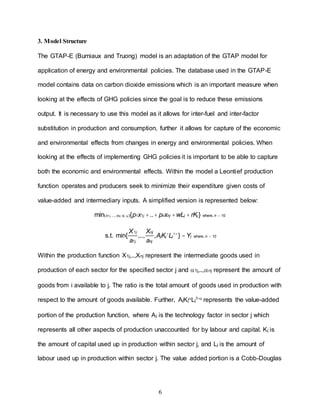
both the economic and environmental effects. Within the model a Leontief production
function operates and producers seek to minimize their expenditure given costs of
value-added and intermediary inputs. A simplified version is represented below:
Within the production function X1j,..,Xnj represent the intermediate goods used in
production of each sector for the specified sector j and 1j,..,nj represent the amount of
goods from i available to j. The ratio is the total amount of goods used in production with
respect to the amount of goods available. Further, AjKjLj1- represents the value-added
portion of the production function, where Aj is the technology factor in sector j which
represents all other aspects of production unaccounted for by labour and capital. Kj is
the amount of capital used up in production within sector j, and Lj is the amount of
labour used up in production within sector j. The value added portion is a Cobb-Douglas
min(x1j, ..., xnj, Kj, Lj ){p1x1j +..+ pnxnj +wLj + rKj} where, n = 10
s.t. min{
X1j
a1j
,..,
Xnj
anj
,AjKj
a
Lj
1-a
} =Yj where, n = 10
7
production function which exhibits constant returns to scale and thus the factor elasticity
us equal to one.
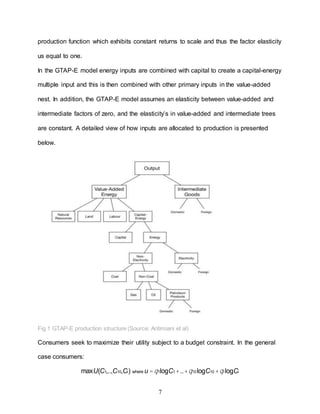
In the GTAP-E model energy inputs are combined with capital to create a capital-energy
multiple input and this is then combined with other primary inputs in the value-added
nest. In addition, the GTAP-E model assumes an elasticity between value-added and
intermediate factors of zero, and the elasticity’s in value-added and intermediate trees
are constant. A detailed view of how inputs are allocated to production is presented
below.
Fig 1 GTAP-E production structure (Source: Antimiani et al)
Consumers seek to maximize their utility subject to a budget constraint. In the general
case consumers:
maxU(C1,..,C10,Ci) where u =q1logC1 +..+q10logC10 +qi logCi
8
Consumers choose what to consume based on prices in all sectors (P1,..,P10) and the
amount of their working capital (rK) and labour income (wL). The consumers utility
function is a CES utility function and therefore the sum of all share parameters ()
equate to one. The variables C1,..,C10,Ci denote the consumption of goods in all sectors
1,..,10 and investment respectively.
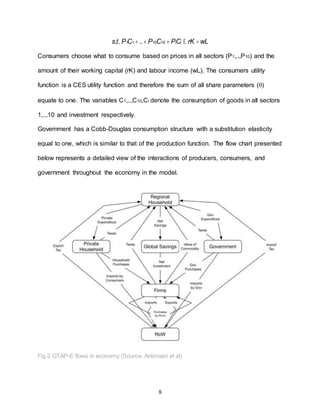
Government has a Cobb-Douglas consumption structure with a substitution elasticity
equal to one, which is similar to that of the production function. The flow chart presented
below represents a detailed view of the interactions of producers, consumers, and
government throughout the economy in the model.
Fig 2 GTAP-E flows in economy (Source: Antimiani et al)
s.t. P1C1+..+P10C10 +PiCi £ rK +wL
9
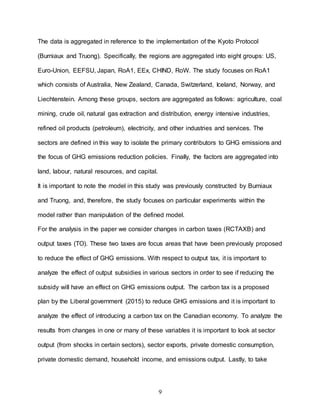
The data is aggregated in reference to the implementation of the Kyoto Protocol
(Burniaux and Truong). Specifically, the regions are aggregated into eight groups: US,
Euro-Union, EEFSU, Japan, RoA1, EEx, CHIND, RoW. The study focuses on RoA1
which consists of Australia, New Zealand, Canada, Switzerland, Iceland, Norway, and
Liechtenstein. Among these groups, sectors are aggregated as follows: agriculture, coal
mining, crude oil, natural gas extraction and distribution, energy intensive industries,
refined oil products (petroleum), electricity, and other industries and services. The
sectors are defined in this way to isolate the primary contributors to GHG emissions and
the focus of GHG emissions reduction policies. Finally, the factors are aggregated into
land, labour, natural resources, and capital.
It is important to note the model in this study was previously constructed by Burniaux
and Truong, and, therefore, the study focuses on particular experiments within the
model rather than manipulation of the defined model.
For the analysis in the paper we consider changes in carbon taxes (RCTAXB) and
output taxes (TO). These two taxes are focus areas that have been previously proposed
to reduce the effect of GHG emissions. With respect to output tax, it is important to
analyze the effect of output subsidies in various sectors in order to see if reducing the
subsidy will have an effect on GHG emissions output. The carbon tax is a proposed
plan by the Liberal government (2015) to reduce GHG emissions and it is important to
analyze the effect of introducing a carbon tax on the Canadian economy. To analyze the
results from changes in one or many of these variables it is important to look at sector
output (from shocks in certain sectors), sector exports, private domestic consumption,
private domestic demand, household income, and emissions output. Lastly, to take
10
advantage of the factor and fuel substitution a sensitivity analysis is conducted in order
to measure the effect of increasing the substitutability of the input factors and between
different fuel options.
4. Data and Parameters
The data presented represents a baseline of the variables before any changes in policy
and then the percentage change from implementation of those changes. It is important
to define the policy changes before showing the data. The first experiment (T1) consists
of the implementation of a carbon tax on carbon emissions output of 12.88%, which
elicits a 60-70% decline in carbon emissions and adheres to the carbon tax policy which
is outlined in The Case for Carbon Tax (Rivers, 2014). The second experiment (T2), is a
reduction of output subsidies to the fossil fuel sectors, specifically to coal and oil, the
largest – subsidized contributors to GHG emissions. The data is presented in three
different tables representing the exogenous and endogenous variables as well as a few
specified parameters. Some of the endogenous variables, such as household income
and GDP, are represented in a separate graph as they are categorized by region and
not by sector. As previously denoted the region of interest in this study is RoA1 which
consists of the countries with a 10% emissions reduction target according to the Kyoto
Protocol. Specifically, the focus is on Canada although the data is representing the
combination of all countries in this region. Therefore, the effects which are to be seen
from implementing the policies are in conjunction with the region rather than a singular
country yet they are still indicative of what may happen in Canada. Furthermore, we
only report the sector of interest rather than all sectors defined in the model. This is
11
important to this study as the presented sectors are the major areas of GHG emission
contributions and are of particular interest as when targeting areas for GHG emissions
reduction policies.
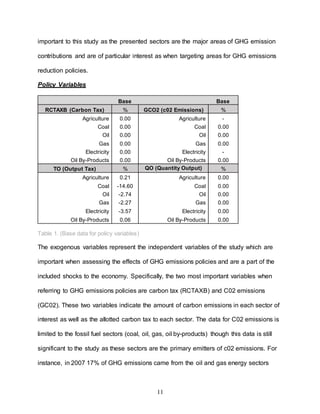
Policy Variables
Base Base
RCTAXB (Carbon Tax) % GCO2 (c02 Emissions) %
Agriculture 0.00 Agriculture -
Coal 0.00 Coal 0.00
Oil 0.00 Oil 0.00
Gas 0.00 Gas 0.00
Electricity 0.00 Electricity -
Oil By-Products 0.00 Oil By-Products 0.00
TO (Output Tax) % QO (Quantity Output) %
Agriculture 0.21 Agriculture 0.00
Coal -14.60 Coal 0.00
Oil -2.74 Oil 0.00
Gas -2.27 Gas 0.00
Electricity -3.57 Electricity 0.00
Oil By-Products 0.06 Oil By-Products 0.00
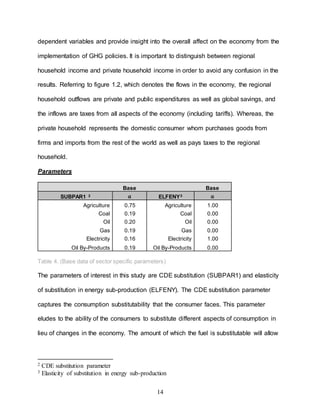
Table 1. (Base data for policy variables)
The exogenous variables represent the independent variables of the study which are
important when assessing the effects of GHG emissions policies and are a part of the
included shocks to the economy. Specifically, the two most important variables when
referring to GHG emissions policies are carbon tax (RCTAXB) and C02 emissions
(GC02). These two variables indicate the amount of carbon emissions in each sector of
interest as well as the allotted carbon tax to each sector. The data for C02 emissions is
limited to the fossil fuel sectors (coal, oil, gas, oil by-products) though this data is still
significant to the study as these sectors are the primary emitters of c02 emissions. For
instance, in 2007 17% of GHG emissions came from the oil and gas energy sectors
12
(International Energy Agency, 2010). Conversely, output tax (subsidy) data is available
for all sectors which allows for the reduction of subsidies in each sector of interest.
However, rather than shocking all subsidies it was pertinent to the study to shock only
the subsidies in the coal and oil sectors as they have the most detrimental effects on the
environment and therefore are the most important to look at when reducing subsidies as
a GHG emissions reduction policy. Moreover, it would be redundant to shock all
subsidies as the effects would transcend throughout all sectors and aspects of the
economy since all producers, consumers, and governments rely on energy thus
reducing subsidies in all energy sectors will affect the whole economy. Further studies
may look at shocking single sectors and analyzing the independent effects rather than
the combination of effects from the reduction in the coal and oil sectors.
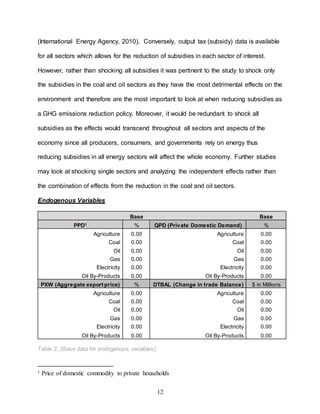
Endogenous Variables
Base Base
PPD1 % QPD (Private Domestic Demand) %
Agriculture 0.00 Agriculture 0.00
Coal 0.00 Coal 0.00
Oil 0.00 Oil 0.00
Gas 0.00 Gas 0.00
Electricity 0.00 Electricity 0.00
Oil By-Products 0.00 Oil By-Products 0.00
PXW (Aggregate export price) % DTBAL (Change in trade Balance) $ in Millions
Agriculture 0.00 Agriculture 0.00
Coal 0.00 Coal 0.00
Oil 0.00 Oil 0.00
Gas 0.00 Gas 0.00
Electricity 0.00 Electricity 0.00
Oil By-Products 0.00 Oil By-Products 0.00
Table 2. (Base data for endogenous variables)
1 Price of domestic commodity to private households
13
The endogenous variables presented in figure 2.2 represent the dependent variables in
this study. These variables are important when analyzing the effects from shocks to the
independent (exogenous) variables. The effects can be broken down into two
categories: external effects and internal effects. The external effects consist of the
effects on exports and export prices within the sectors of interest. These are important
variables to study as they are major contributors to GDP in Canada, especially in the Oil
and Electricity sectors. Furthermore, by looking at the changes to export prices and the
trade balance we can view the effects on GDP from major exporting sectors. The
internal effects consist of the effects on domestic household’s demand and domestic
household’s prices of commodities in these sectors. These are important measures to
understand the effects of the two GHG policies on the domestic economy. Specifically,
this paper looks to analyze the effects that transcend down to the domestic consumer
from implementing such policies.
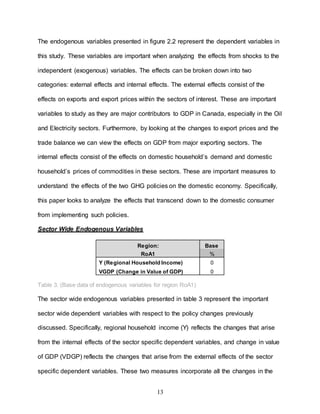
Sector Wide Endogenous Variables
Region: Base
RoA1 %
Y (Regional Household Income) 0
VGDP (Change in Value of GDP) 0
Table 3. (Base data of endogenous variables for region RoA1)
The sector wide endogenous variables presented in table 3 represent the important
sector wide dependent variables with respect to the policy changes previously
discussed. Specifically, regional household income (Y) reflects the changes that arise
from the internal effects of the sector specific dependent variables, and change in value
of GDP (VDGP) reflects the changes that arise from the external effects of the sector
specific dependent variables. These two measures incorporate all the changes in the
14
dependent variables and provide insight into the overall affect on the economy from the
implementation of GHG policies. It is important to distinguish between regional
household income and private household income in order to avoid any confusion in the
results. Referring to figure 1.2, which denotes the flows in the economy, the regional
household outflows are private and public expenditures as well as global savings, and
the inflows are taxes from all aspects of the economy (including tariffs). Whereas, the
private household represents the domestic consumer whom purchases goods from
firms and imports from the rest of the world as well as pays taxes to the regional
household.
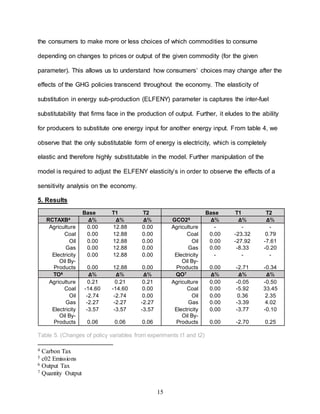
Parameters
Base Base
SUBPAR1 2 ⍺ ELFENY3 ⍺
Agriculture 0.75 Agriculture 1.00
Coal 0.19 Coal 0.00
Oil 0.20 Oil 0.00
Gas 0.19 Gas 0.00
Electricity 0.16 Electricity 1.00
Oil By-Products 0.19 Oil By-Products 0.00
Table 4. (Base data of sector specific parameters)
The parameters of interest in this study are CDE substitution (SUBPAR1) and elasticity
of substitution in energy sub-production (ELFENY). The CDE substitution parameter
captures the consumption substitutability that the consumer faces. This parameter
eludes to the ability of the consumers to substitute different aspects of consumption in
lieu of changes in the economy. The amount of which the fuel is substitutable will allow
2 CDE substitution parameter
3 Elasticity of substitution in energy sub-production
15
the consumers to make more or less choices of which commodities to consume
depending on changes to prices or output of the given commodity (for the given
parameter). This allows us to understand how consumers’ choices may change after the
effects of the GHG policies transcend throughout the economy. The elasticity of
substitution in energy sub-production (ELFENY) parameter is captures the inter-fuel
substitutability that firms face in the production of output. Further, it eludes to the ability
for producers to substitute one energy input for another energy input. From table 4, we
observe that the only substitutable form of energy is electricity, which is completely
elastic and therefore highly substitutable in the model. Further manipulation of the
model is required to adjust the ELFENY elasticity’s in order to observe the effects of a
sensitivity analysis on the economy.
5. Results
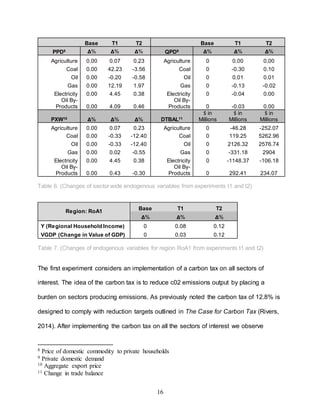
Table 5. (Changes of policy variables from experiments t1 and t2)
4 Carbon Tax
5 c02 Emissions
6 Output Tax
7 Quantity Output
Base T1 T2 Base T1 T2
RCTAXB4 𝝙% 𝝙% 𝝙% GCO25 𝝙% 𝝙% 𝝙%
Agriculture 0.00 12.88 0.00 Agriculture - - -
Coal 0.00 12.88 0.00 Coal 0.00 -23.32 0.79
Oil 0.00 12.88 0.00 Oil 0.00 -27.92 -7.61
Gas 0.00 12.88 0.00 Gas 0.00 -8.33 -0.20
Electricity 0.00 12.88 0.00 Electricity - - -
Oil By-
Products 0.00 12.88 0.00
Oil By-
Products 0.00 -2.71 -0.34
TO6 𝝙% 𝝙% 𝝙% QO7 𝝙% 𝝙% 𝝙%
Agriculture 0.21 0.21 0.21 Agriculture 0.00 -0.05 -0.50
Coal -14.60 -14.60 0.00 Coal 0.00 -5.92 33.45
Oil -2.74 -2.74 0.00 Oil 0.00 0.36 2.35
Gas -2.27 -2.27 -2.27 Gas 0.00 -3.39 4.02
Electricity -3.57 -3.57 -3.57 Electricity 0.00 -3.77 -0.10
Oil By-
Products 0.06 0.06 0.06
Oil By-
Products 0.00 -2.70 0.25
16
Base T1 T2 Base T1 T2
PPD8 𝝙% 𝝙% 𝝙% QPD9 𝝙% 𝝙% 𝝙%
Agriculture 0.00 0.07 0.23 Agriculture 0 0.00 0.00
Coal 0.00 42.23 -3.56 Coal 0 -0.30 0.10
Oil 0.00 -0.20 -0.58 Oil 0 0.01 0.01
Gas 0.00 12.19 1.97 Gas 0 -0.13 -0.02
Electricity 0.00 4.45 0.38 Electricity 0 -0.04 0.00
Oil By-
Products 0.00 4.09 0.46
Oil By-
Products 0 -0.03 0.00
PXW10 𝝙% 𝝙% 𝝙% DTBAL11
$ in
Millions
$ in
Millions
$ in
Millions
Agriculture 0.00 0.07 0.23 Agriculture 0 -46.28 -252.07
Coal 0.00 -0.33 -12.40 Coal 0 119.25 5262.96
Oil 0.00 -0.33 -12.40 Oil 0 2126.32 2576.74
Gas 0.00 0.02 -0.55 Gas 0 -331.18 2904
Electricity 0.00 4.45 0.38 Electricity 0 -1148.37 -106.18
Oil By-
Products 0.00 0.43 -0.30
Oil By-
Products 0 292.41 234.07
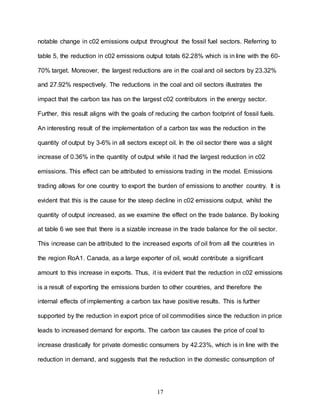
Table 6. (Changes of sector wide endogenous variables from experiments t1 and t2)
Region: RoA1
Base T1 T2
𝝙% 𝝙% 𝝙%
Y (Regional Household Income) 0 0.08 0.12
VGDP (Change in Value of GDP) 0 0.03 0.12
Table 7. (Changes of endogenous variables for region RoA1 from experiments t1 and t2)
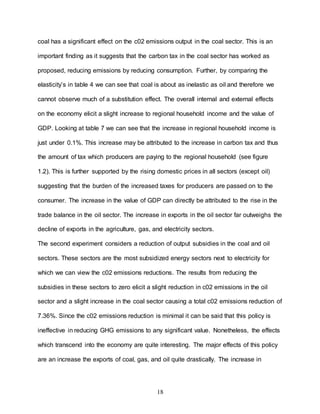
The first experiment considers an implementation of a carbon tax on all sectors of
interest. The idea of the carbon tax is to reduce c02 emissions output by placing a
burden on sectors producing emissions. As previously noted the carbon tax of 12.8% is
designed to comply with reduction targets outlined in The Case for Carbon Tax (Rivers,
2014). After implementing the carbon tax on all the sectors of interest we observe
8 Price of domestic commodity to private households
9 Private domestic demand
10 Aggregate export price
11 Change in trade balance
17
notable change in c02 emissions output throughout the fossil fuel sectors. Referring to
table 5, the reduction in c02 emissions output totals 62.28% which is in line with the 60-
70% target. Moreover, the largest reductions are in the coal and oil sectors by 23.32%
and 27.92% respectively. The reductions in the coal and oil sectors illustrates the
impact that the carbon tax has on the largest c02 contributors in the energy sector.
Further, this result aligns with the goals of reducing the carbon footprint of fossil fuels.
An interesting result of the implementation of a carbon tax was the reduction in the
quantity of output by 3-6% in all sectors except oil. In the oil sector there was a slight
increase of 0.36% in the quantity of output while it had the largest reduction in c02
emissions. This effect can be attributed to emissions trading in the model. Emissions
trading allows for one country to export the burden of emissions to another country. It is
evident that this is the cause for the steep decline in c02 emissions output, whilst the
quantity of output increased, as we examine the effect on the trade balance. By looking
at table 6 we see that there is a sizable increase in the trade balance for the oil sector.
This increase can be attributed to the increased exports of oil from all the countries in
the region RoA1. Canada, as a large exporter of oil, would contribute a significant
amount to this increase in exports. Thus, it is evident that the reduction in c02 emissions
is a result of exporting the emissions burden to other countries, and therefore the
internal effects of implementing a carbon tax have positive results. This is further
supported by the reduction in export price of oil commodities since the reduction in price
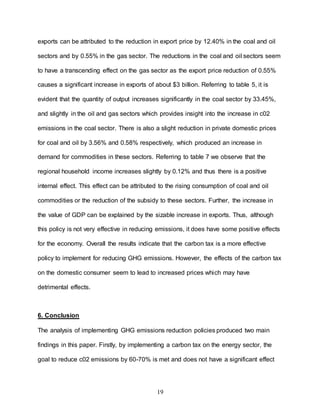
leads to increased demand for exports. The carbon tax causes the price of coal to
increase drastically for private domestic consumers by 42.23%, which is in line with the
reduction in demand, and suggests that the reduction in the domestic consumption of
18
coal has a significant effect on the c02 emissions output in the coal sector. This is an
important finding as it suggests that the carbon tax in the coal sector has worked as
proposed, reducing emissions by reducing consumption. Further, by comparing the
elasticity’s in table 4 we can see that coal is about as inelastic as oil and therefore we
cannot observe much of a substitution effect. The overall internal and external effects
on the economy elicit a slight increase to regional household income and the value of
GDP. Looking at table 7 we can see that the increase in regional household income is
just under 0.1%. This increase may be attributed to the increase in carbon tax and thus
the amount of tax which producers are paying to the regional household (see figure
1.2). This is further supported by the rising domestic prices in all sectors (except oil)
suggesting that the burden of the increased taxes for producers are passed on to the
consumer. The increase in the value of GDP can directly be attributed to the rise in the
trade balance in the oil sector. The increase in exports in the oil sector far outweighs the
decline of exports in the agriculture, gas, and electricity sectors.
The second experiment considers a reduction of output subsidies in the coal and oil
sectors. These sectors are the most subsidized energy sectors next to electricity for
which we can view the c02 emissions reductions. The results from reducing the
subsidies in these sectors to zero elicit a slight reduction in c02 emissions in the oil
sector and a slight increase in the coal sector causing a total c02 emissions reduction of
7.36%. Since the c02 emissions reduction is minimal it can be said that this policy is
ineffective in reducing GHG emissions to any significant value. Nonetheless, the effects
which transcend into the economy are quite interesting. The major effects of this policy
are an increase the exports of coal, gas, and oil quite drastically. The increase in
19
exports can be attributed to the reduction in export price by 12.40% in the coal and oil
sectors and by 0.55% in the gas sector. The reductions in the coal and oil sectors seem
to have a transcending effect on the gas sector as the export price reduction of 0.55%
causes a significant increase in exports of about $3 billion. Referring to table 5, it is
evident that the quantity of output increases significantly in the coal sector by 33.45%,
and slightly in the oil and gas sectors which provides insight into the increase in c02
emissions in the coal sector. There is also a slight reduction in private domestic prices
for coal and oil by 3.56% and 0.58% respectively, which produced an increase in
demand for commodities in these sectors. Referring to table 7 we observe that the
regional household income increases slightly by 0.12% and thus there is a positive
internal effect. This effect can be attributed to the rising consumption of coal and oil
commodities or the reduction of the subsidy to these sectors. Further, the increase in
the value of GDP can be explained by the sizable increase in exports. Thus, although
this policy is not very effective in reducing emissions, it does have some positive effects
for the economy. Overall the results indicate that the carbon tax is a more effective
policy to implement for reducing GHG emissions. However, the effects of the carbon tax
on the domestic consumer seem to lead to increased prices which may have
detrimental effects.
6. Conclusion
The analysis of implementing GHG emissions reduction policies produced two main
findings in this paper. Firstly, by implementing a carbon tax on the energy sector, the
goal to reduce c02 emissions by 60-70% is met and does not have a significant effect
20
on the economy. The economy experiences a significant rise in exports on the affected
sectors causing the region RoA1 to use carbon trading as a mechanism to produce the
reduction in GHG emissions. The increase in exports offsets the decrease in domestic
demand and produces a slight positive effect on GDP. Thus, the policy is effective in
reducing GHG emissions while not affecting the economy as whole in a significant way.
Secondly, the reduction in output subsidies has minimal effects on reducing GHG
emissions yet also stimulates export growth in the effected sectors producing a slight
increase in GDP. Thus, this policy is not an effective tool when addressing the problem
of reducing GHG emissions. Within both these experiments there is a need to analyze
the effects on welfare of private households. Thus, going forward a welfare
decomposition which denotes the specific areas the private households are affected will
be important in assessing how the carbon tax transcends from firms to consumers. In
addition, incorporating a tax benefit policy where the collections from the carbon tax
transfer back to private households in the form of a lump-sum payment would provide
an incentive for the private households to support the policy. Thus, though we cannot
conclude how GHG emissions policies effect the private households we can see that
firms and the economy as a whole are not adversely affected, and therefore, the
implementation of a carbon tax policy would be a successful policy to address the
growing concern of GHG emissions.
21
Appendix A: Data Sources
All data is precompiled by Burniaux and Truong (2002) within the GTAP-E model.
22
References
Rivers, Nicholas. “The Case for a Carbon Tax in Canada.” Insert journal (November
2014): insert pages.
Steenhof, Paul A. and Chris J. Weber. “An assessment of factors effecting Canada’s
electricity sector’s GHG emissions.” Energy Policy 39 (2011): 4089-4096.
National Energy Board. “Canada’s energy future: energy supply and demand
projections to 3025.” National Energy Board (2011): 64.
Greiner, Alfred, Lars Gruene and Willi Semmler. “Economic growth and the transition
from non-renewable to renewable energy.” Environmental and Development
Economics 19 (2013): 417-439.
International Energy Agency. “Energy Policies of Canada.” International Energy Agency
(2010).
Cremer, Helmuth, Philippe DeDonder and Firouz Ghavari. “Energy Taxes in Three
Political Economy Models.” The B.E. Journal of Economic Analysis & Policy 7
(2007).
Murphy, Rose, Nic Rivers and Mark Jaccard. “Hybrid modeling of industrial energy
consumption and green gas emissions Canada.” Energy Economics 29 (2007): 826-
846.
Krautkraemer, Jeffrey A. “Optimal growth, resource amenities and the preservation of
natural environments.” Review of Economics Studies 52 (1985): 153-170.
Bataille, Christopher G.F. “Design and Application of a Technologically Explicit Hybrid
Energy-Economy Policy Model with Micro and Macro Economic Dynamics.” Simon
Fraser University (2005).
Sawyer, Dave et Al. “Regulating carbon emissions in Canada: offsets and Canada’s
GHG emissions: reducing costs, improving competitiveness, and lowering
emissions.” International Institute for Sustainable Development (2011).
Antimiani, Alessandro et Al. “The GTAP-E: Model Description and Improvements.”
Springer Science (2012).

Research Paper

  • 1.
    ECN 723 ResearchProject EFFECTS OF ENVIRONMENTAL POLICY Nicholas Lombardi ECN 723 Research Project Instructor: Claustre Bajona The Research Paper is submitted In partial fulfillment of the requirements for the Applied Research Methods course in the Bachelor of Arts degree In International Economics and Finance Ryerson University Toronto, Ontario, Canada  Nicholas Lombardi 2015
  • 2.
    Author’s Declaration Page Ihereby declare that I am the sole author of this Research Paper. I authorize Ryerson University to lend this Research Paper to other institutions or individuals for the purpose of scholarly research. ____________________________ _12/15/2015____________________ Signature Date I further authorize Ryerson University to reproduce this Research Paper by photocopying or by other means, in total or in part, at the request of other institutions or individuals for the purpose of scholarly research. ___________________________ _12/15/2015____________________ Signature Date
  • 3.
    Effects of EnvironmentalPolicy A Research Paper presented to Ryerson University in partial fulfillment of the requirement for the degree of Bachelor of Arts in International Economics and Finance By Nicholas Lombardi ABSTRACT An implementation of greenhouse gas (GHG) emissions reduction policies on the energy sector and the resulting effects on the economy. This paper examines the effects utilizing the energy and environment GTAP-E model developed by Burniaux and Truong. By analyzing the effects on the region this paper compares and contrasts the results to the findings of similar studies regarding GHG emissions reduction policies in Canada. It is found that the implementation of a carbon tax policy is effective in reducing GHG emissions output while having a slight positive effect on the economy. The reductions in GHG emissions output are seen through the use of carbon trading. Carbon trading allows for the region to place the burden of producing c02 emissions on countries importing the commodity producing emissions. KEYWORDS Computable general equilibrium, GHG emissions, carbon tax, Canada, energy and environment
  • 4.
    i Tables of Contents 1.Introduction……………………………………………………………………………....1 2. Review of the literature………………………………………………………………....2 3. The model..……………………………………………………………………………....5 FIGURE 1: production structure…………………………………....………………….7 FIGURE 2: flows in economy….……………………………………………………….8 4. Data and parameters...……………………………….………………………...……..10 TABLE 1: policy variables……………………………………………………………..11 TABLE 2: endogenous variables……………………………………………………..12 TABLE 3: sector wide endogenous variables………...……...……………………..12 5. Results…...……………………………………………………………………..……....15 TABLE 5: change of policy variables…….…………………………………………..15 TABLE 6: change of endogenous variables…….…………………………………..16 TABLE 7: change of sector wide endogenous variables…………………………..16 6. Conclusions…………………………………………………………………………….19 Appendix A: Data sources………………………………...………………………………21 References………………………………………………………………………………….22
  • 5.
    ii List of Tables TABLE1: policy variables……………………………..…………………………………..11 TABLE 2: endogenous variables……………………………..…………………………..12 TABLE 3: sector wide endogenous variables………….....……...……………………..12 TABLE 5: change of policy variables…….………………………..……………………..15 TABLE 6: change of endogenous variables…….…………………..…………………..16 TABLE 7: change of sector wide endogenous variables………..……………………..16
  • 6.
    ii List of Figures FIGURE1: production structure……………..………………………....………………….7 FIGURE 2: flows in economy….………………..………………………………………….8
  • 7.
    1 1. Introduction Climate changeis becoming a growing concern across the globe and Canada ranks very poorly on their ability to combat growing greenhouse gas (GHG) emissions. The major contributions to GHG emissions output in Canada stem from the energy sector with fossil fuels, electricity and agriculture being the highest of them all. Furthermore, fossil fuels and other energy intensive industries use up large amounts of energy and as a result emit large amounts of GHG emissions. This growing concern about GHG emissions output has brought on a multitude of ideas of how to control and reduce the output of emissions in countries like Canada. The Kyoto Protocol treaty which was negotiated in 1997 is an agreement of industrialized nations to collectively reduce their GHG emissions. In the regions of interest of this study (RoA1), Canada and countries amongst this group have a 10% GHG reduction target. In order to meet this target this study examines two GHG policies that have been put forth over the years. Firstly, by implementing a carbon tax which targets a 60%-70% reduction in carbon emissions in Canada, this study examines the effects on households and output from the energy sectors. Secondly, this study examines the effects of reducing output subsidies in the fossil fuel sectors (coal and oil). Since these two sectors are major contributors to GHG emissions, primary targets for GHG emissions reductions, and are also heavily subsidized by the government, the study seeks to understand the effects of eliminating such subsidies and their contribution to potential reductions in GHG emissions. Thus, the main objective of this study is to examine the economic and environmental effects of implementing GHG policies into the RoA1 region with a focus on Canada. By doing so, this study cross references its results with the findings of similar papers and goals of the
  • 8.
    2 Canadian government toformulate an educated conclusion about the effectiveness of such policies. It is important to note that the carbon emissions data for some sectors was not available at the time of this study. The data available was previously aggregated by Bruniaux and Truong (2002). The rest of the paper is organized as follows. Section 2 describes the literature used for this study and the importance of the papers to this study. Section 3 describes the model structures and data used in the study. Section 4 presents the simulation results and interpretations of the two policy shocks. Section 5 draws some conclusions regarding the findings. 2. Literature Review When addressing the concerns of implementing GHG (greenhouse gas) emissions policies, it is necessary to analyze the socio-economic benefits whilst taking into account any possible negative externalities. Upon reviewing the sources that pertain to the study, a few articles have played a much more significant part in deriving an understanding of these concerns and examining the results. Murphy, Rivers, and Jaccard (2007) set out to examine the effects of a GHG reduction policy by implementing a tax, or an emissions cap, and observing the policies’ effect on industrial energy consumption in Canada. Since Canada is a poorly rated country in regards to GHG emissions, outputting a significant amount, and the majority of the contributions are coming from the industrial sector through energy consumption and production, this study lays out an important model to understand the effects of implementing such policies. The model as presented by the authors, takes into account the changes in
  • 9.
    3 technology, which affectenergy efficiency and emissions output, by allowing technology to be retired and replaced over time, about every five years according to a specified function. When looking at energy consumption and emissions output in the industrial sector, older technologies tend to be less efficient and produce higher emissions. Thus, it is necessary to allow the model to take into account technology growth to address aspects of the GHG problem. Although the model allows for technology growth, it does not account for further investment in existing technologies. Thus, the costs of replacing technologies may be overstated. This affects my study, given that I aim to examine the effects of implementing such policies on GDP and GDP growth. Thus, if the costs of implementing newer technologies, where older technologies could be upgraded or maintained at a cheaper cost, is overstated it may have a spill-over effect on GDP and inevitably GDP growth. Since the energy sector in Canada is a significant contributor to GDP, the implementation of an energy tax or emissions cap will have a direct effect on GDP and GDP growth. Rivers (2014) outlines the fundamental goals as well as the positive and negative aspects of implementing a carbon tax in Canada. This provides a foundation for my first experiment as I utilize the target GHG emission reductions outlined by Rivers (2014) when implementing a carbon tax. As another source of reducing GHG emissions Sawyer, Stiebert, and Beugin (2011) examine how offsets: monetary investments in a project or activity to reduce GHG emissions, are a key source in reducing GHG emissions because they have minimal social costs and compliment market based systems. Thus, rather than implementing an energy tax or emissions cap, the authors examine how these ‘offsets’ have come to play a significant role in Canada’s GHG policies. The article presented by the authors provides empirical
  • 10.
    4 analysis as tohow the economy has benefited from such policies, and how we can further induce such funding to increase their effect. The theories underlying this article are important in my study, yet the actual application of implementing ‘offsets’ into the GTAP model may be hindered. Thus, though the model the authors present provides a good alternative and understanding to other sources of managing GHG emissions, it may not be directly identifiable in my study, and must serve as an external source of funding. To understand the direct effect of GHG emissions policies, Steenhof and Weber (2011) present a more isolated case as they examine factors impacting the electricity sector’s GHG emissions in Canada. The authors implement a decomposition model to specify how particular GHG policies have affected the electricity sector, as well as how the electricity sector has come to effect GHG emissions. The electricity sector is the highest source of emissions output in Canada when taking into account production and consumption, and thus, when analyzing the effects of GHG policies on the energy sector, this article provides a good basis of how one of the major components of Canada’s energy sector is affected by GHG policies. To gain a sound understanding of how GHG emissions policies on the energy sector will affect GDP and GDP growth it is important to have an understanding of the existing policies and how they have worked. The International Energy Agency (2010) has provided a thorough analysis of Canada’s energy policies. The report examines all aspects of Canada’s energy sector; analyses key components, forecasts growth, and provides feedback to existing policies. The report is a main reference for existing data and policies in Canada and will be helpful when identifying the appropriate policies to implement. Further, given the understanding of the socio-economic effects of energy taxes, the National Energy Board of Canada
  • 11.
    5 (2011) provides areport on energy supply and demand projections to 2035. It is necessary to understand how energy production and consumption will move into the future when developing policies that may affect future output. Greiner, Gruene and Semmler (2013) analyze the effects of economic growth throughout the transition from non-renewable to renewable energy. The majority of sources of renewable energy (solar, wind, tidal) emit far less emissions than traditional non-renewable energy sources. Thus, this article provides a theoretical platform to understand the transformative effects of GHG policies on the energy sector and its effect GDP in growth. Additionally, Krautkraemer (1985) provides a theoretical model outlining the necessary conditions to preserve natural environments where a non-renewable energy source is found. These two articles agree in that they are two main goals of the environmentalist movement. Thus, when discussing about GHG emissions policies it is important to keep these goals in mind. Lastly, Cremer, DeDonder and Gahvari (2007) examine the positive economic effects which come from energy taxes. By setting up three different political models, the authors attempt to show the positive economic effects, which are often external, as arguments for energy taxes. They note that the burden of such taxes is often transcended onto tax payers, and the implementation of such taxes are often derived from tax payers through voting. Thus, the article provides a sufficient reference as to how GHG policies may be formed and how to reduce the burden on taxpayers.
  • 12.
    6 3. Model Structure TheGTAP-E (Burniaux and Truong) model is an adaptation of the GTAP model for application of energy and environmental policies. The database used in the GTAP-E model contains data on carbon dioxide emissions which is an important measure when looking at the effects of GHG policies since the goal is to reduce these emissions output. It is necessary to use this model as it allows for inter-fuel and inter-factor substitution in production and consumption, further it allows for capture of the economic and environmental effects from changes in energy and environmental policies. When looking at the effects of implementing GHG policies it is important to be able to capture both the economic and environmental effects. Within the model a Leontief production function operates and producers seek to minimize their expenditure given costs of value-added and intermediary inputs. A simplified version is represented below: Within the production function X1j,..,Xnj represent the intermediate goods used in production of each sector for the specified sector j and 1j,..,nj represent the amount of goods from i available to j. The ratio is the total amount of goods used in production with respect to the amount of goods available. Further, AjKjLj1- represents the value-added portion of the production function, where Aj is the technology factor in sector j which represents all other aspects of production unaccounted for by labour and capital. Kj is the amount of capital used up in production within sector j, and Lj is the amount of labour used up in production within sector j. The value added portion is a Cobb-Douglas min(x1j, ..., xnj, Kj, Lj ){p1x1j +..+ pnxnj +wLj + rKj} where, n = 10 s.t. min{ X1j a1j ,.., Xnj anj ,AjKj a Lj 1-a } =Yj where, n = 10
  • 13.
    7 production function whichexhibits constant returns to scale and thus the factor elasticity us equal to one. In the GTAP-E model energy inputs are combined with capital to create a capital-energy multiple input and this is then combined with other primary inputs in the value-added nest. In addition, the GTAP-E model assumes an elasticity between value-added and intermediate factors of zero, and the elasticity’s in value-added and intermediate trees are constant. A detailed view of how inputs are allocated to production is presented below. Fig 1 GTAP-E production structure (Source: Antimiani et al) Consumers seek to maximize their utility subject to a budget constraint. In the general case consumers: maxU(C1,..,C10,Ci) where u =q1logC1 +..+q10logC10 +qi logCi
  • 14.
    8 Consumers choose whatto consume based on prices in all sectors (P1,..,P10) and the amount of their working capital (rK) and labour income (wL). The consumers utility function is a CES utility function and therefore the sum of all share parameters () equate to one. The variables C1,..,C10,Ci denote the consumption of goods in all sectors 1,..,10 and investment respectively. Government has a Cobb-Douglas consumption structure with a substitution elasticity equal to one, which is similar to that of the production function. The flow chart presented below represents a detailed view of the interactions of producers, consumers, and government throughout the economy in the model. Fig 2 GTAP-E flows in economy (Source: Antimiani et al) s.t. P1C1+..+P10C10 +PiCi £ rK +wL
  • 15.
    9 The data isaggregated in reference to the implementation of the Kyoto Protocol (Burniaux and Truong). Specifically, the regions are aggregated into eight groups: US, Euro-Union, EEFSU, Japan, RoA1, EEx, CHIND, RoW. The study focuses on RoA1 which consists of Australia, New Zealand, Canada, Switzerland, Iceland, Norway, and Liechtenstein. Among these groups, sectors are aggregated as follows: agriculture, coal mining, crude oil, natural gas extraction and distribution, energy intensive industries, refined oil products (petroleum), electricity, and other industries and services. The sectors are defined in this way to isolate the primary contributors to GHG emissions and the focus of GHG emissions reduction policies. Finally, the factors are aggregated into land, labour, natural resources, and capital. It is important to note the model in this study was previously constructed by Burniaux and Truong, and, therefore, the study focuses on particular experiments within the model rather than manipulation of the defined model. For the analysis in the paper we consider changes in carbon taxes (RCTAXB) and output taxes (TO). These two taxes are focus areas that have been previously proposed to reduce the effect of GHG emissions. With respect to output tax, it is important to analyze the effect of output subsidies in various sectors in order to see if reducing the subsidy will have an effect on GHG emissions output. The carbon tax is a proposed plan by the Liberal government (2015) to reduce GHG emissions and it is important to analyze the effect of introducing a carbon tax on the Canadian economy. To analyze the results from changes in one or many of these variables it is important to look at sector output (from shocks in certain sectors), sector exports, private domestic consumption, private domestic demand, household income, and emissions output. Lastly, to take
  • 16.
    10 advantage of thefactor and fuel substitution a sensitivity analysis is conducted in order to measure the effect of increasing the substitutability of the input factors and between different fuel options. 4. Data and Parameters The data presented represents a baseline of the variables before any changes in policy and then the percentage change from implementation of those changes. It is important to define the policy changes before showing the data. The first experiment (T1) consists of the implementation of a carbon tax on carbon emissions output of 12.88%, which elicits a 60-70% decline in carbon emissions and adheres to the carbon tax policy which is outlined in The Case for Carbon Tax (Rivers, 2014). The second experiment (T2), is a reduction of output subsidies to the fossil fuel sectors, specifically to coal and oil, the largest – subsidized contributors to GHG emissions. The data is presented in three different tables representing the exogenous and endogenous variables as well as a few specified parameters. Some of the endogenous variables, such as household income and GDP, are represented in a separate graph as they are categorized by region and not by sector. As previously denoted the region of interest in this study is RoA1 which consists of the countries with a 10% emissions reduction target according to the Kyoto Protocol. Specifically, the focus is on Canada although the data is representing the combination of all countries in this region. Therefore, the effects which are to be seen from implementing the policies are in conjunction with the region rather than a singular country yet they are still indicative of what may happen in Canada. Furthermore, we only report the sector of interest rather than all sectors defined in the model. This is
  • 17.
    11 important to thisstudy as the presented sectors are the major areas of GHG emission contributions and are of particular interest as when targeting areas for GHG emissions reduction policies. Policy Variables Base Base RCTAXB (Carbon Tax) % GCO2 (c02 Emissions) % Agriculture 0.00 Agriculture - Coal 0.00 Coal 0.00 Oil 0.00 Oil 0.00 Gas 0.00 Gas 0.00 Electricity 0.00 Electricity - Oil By-Products 0.00 Oil By-Products 0.00 TO (Output Tax) % QO (Quantity Output) % Agriculture 0.21 Agriculture 0.00 Coal -14.60 Coal 0.00 Oil -2.74 Oil 0.00 Gas -2.27 Gas 0.00 Electricity -3.57 Electricity 0.00 Oil By-Products 0.06 Oil By-Products 0.00 Table 1. (Base data for policy variables) The exogenous variables represent the independent variables of the study which are important when assessing the effects of GHG emissions policies and are a part of the included shocks to the economy. Specifically, the two most important variables when referring to GHG emissions policies are carbon tax (RCTAXB) and C02 emissions (GC02). These two variables indicate the amount of carbon emissions in each sector of interest as well as the allotted carbon tax to each sector. The data for C02 emissions is limited to the fossil fuel sectors (coal, oil, gas, oil by-products) though this data is still significant to the study as these sectors are the primary emitters of c02 emissions. For instance, in 2007 17% of GHG emissions came from the oil and gas energy sectors
  • 18.
    12 (International Energy Agency,2010). Conversely, output tax (subsidy) data is available for all sectors which allows for the reduction of subsidies in each sector of interest. However, rather than shocking all subsidies it was pertinent to the study to shock only the subsidies in the coal and oil sectors as they have the most detrimental effects on the environment and therefore are the most important to look at when reducing subsidies as a GHG emissions reduction policy. Moreover, it would be redundant to shock all subsidies as the effects would transcend throughout all sectors and aspects of the economy since all producers, consumers, and governments rely on energy thus reducing subsidies in all energy sectors will affect the whole economy. Further studies may look at shocking single sectors and analyzing the independent effects rather than the combination of effects from the reduction in the coal and oil sectors. Endogenous Variables Base Base PPD1 % QPD (Private Domestic Demand) % Agriculture 0.00 Agriculture 0.00 Coal 0.00 Coal 0.00 Oil 0.00 Oil 0.00 Gas 0.00 Gas 0.00 Electricity 0.00 Electricity 0.00 Oil By-Products 0.00 Oil By-Products 0.00 PXW (Aggregate export price) % DTBAL (Change in trade Balance) $ in Millions Agriculture 0.00 Agriculture 0.00 Coal 0.00 Coal 0.00 Oil 0.00 Oil 0.00 Gas 0.00 Gas 0.00 Electricity 0.00 Electricity 0.00 Oil By-Products 0.00 Oil By-Products 0.00 Table 2. (Base data for endogenous variables) 1 Price of domestic commodity to private households
  • 19.
    13 The endogenous variablespresented in figure 2.2 represent the dependent variables in this study. These variables are important when analyzing the effects from shocks to the independent (exogenous) variables. The effects can be broken down into two categories: external effects and internal effects. The external effects consist of the effects on exports and export prices within the sectors of interest. These are important variables to study as they are major contributors to GDP in Canada, especially in the Oil and Electricity sectors. Furthermore, by looking at the changes to export prices and the trade balance we can view the effects on GDP from major exporting sectors. The internal effects consist of the effects on domestic household’s demand and domestic household’s prices of commodities in these sectors. These are important measures to understand the effects of the two GHG policies on the domestic economy. Specifically, this paper looks to analyze the effects that transcend down to the domestic consumer from implementing such policies. Sector Wide Endogenous Variables Region: Base RoA1 % Y (Regional Household Income) 0 VGDP (Change in Value of GDP) 0 Table 3. (Base data of endogenous variables for region RoA1) The sector wide endogenous variables presented in table 3 represent the important sector wide dependent variables with respect to the policy changes previously discussed. Specifically, regional household income (Y) reflects the changes that arise from the internal effects of the sector specific dependent variables, and change in value of GDP (VDGP) reflects the changes that arise from the external effects of the sector specific dependent variables. These two measures incorporate all the changes in the
  • 20.
    14 dependent variables andprovide insight into the overall affect on the economy from the implementation of GHG policies. It is important to distinguish between regional household income and private household income in order to avoid any confusion in the results. Referring to figure 1.2, which denotes the flows in the economy, the regional household outflows are private and public expenditures as well as global savings, and the inflows are taxes from all aspects of the economy (including tariffs). Whereas, the private household represents the domestic consumer whom purchases goods from firms and imports from the rest of the world as well as pays taxes to the regional household. Parameters Base Base SUBPAR1 2 ⍺ ELFENY3 ⍺ Agriculture 0.75 Agriculture 1.00 Coal 0.19 Coal 0.00 Oil 0.20 Oil 0.00 Gas 0.19 Gas 0.00 Electricity 0.16 Electricity 1.00 Oil By-Products 0.19 Oil By-Products 0.00 Table 4. (Base data of sector specific parameters) The parameters of interest in this study are CDE substitution (SUBPAR1) and elasticity of substitution in energy sub-production (ELFENY). The CDE substitution parameter captures the consumption substitutability that the consumer faces. This parameter eludes to the ability of the consumers to substitute different aspects of consumption in lieu of changes in the economy. The amount of which the fuel is substitutable will allow 2 CDE substitution parameter 3 Elasticity of substitution in energy sub-production
  • 21.
    15 the consumers tomake more or less choices of which commodities to consume depending on changes to prices or output of the given commodity (for the given parameter). This allows us to understand how consumers’ choices may change after the effects of the GHG policies transcend throughout the economy. The elasticity of substitution in energy sub-production (ELFENY) parameter is captures the inter-fuel substitutability that firms face in the production of output. Further, it eludes to the ability for producers to substitute one energy input for another energy input. From table 4, we observe that the only substitutable form of energy is electricity, which is completely elastic and therefore highly substitutable in the model. Further manipulation of the model is required to adjust the ELFENY elasticity’s in order to observe the effects of a sensitivity analysis on the economy. 5. Results Table 5. (Changes of policy variables from experiments t1 and t2) 4 Carbon Tax 5 c02 Emissions 6 Output Tax 7 Quantity Output Base T1 T2 Base T1 T2 RCTAXB4 𝝙% 𝝙% 𝝙% GCO25 𝝙% 𝝙% 𝝙% Agriculture 0.00 12.88 0.00 Agriculture - - - Coal 0.00 12.88 0.00 Coal 0.00 -23.32 0.79 Oil 0.00 12.88 0.00 Oil 0.00 -27.92 -7.61 Gas 0.00 12.88 0.00 Gas 0.00 -8.33 -0.20 Electricity 0.00 12.88 0.00 Electricity - - - Oil By- Products 0.00 12.88 0.00 Oil By- Products 0.00 -2.71 -0.34 TO6 𝝙% 𝝙% 𝝙% QO7 𝝙% 𝝙% 𝝙% Agriculture 0.21 0.21 0.21 Agriculture 0.00 -0.05 -0.50 Coal -14.60 -14.60 0.00 Coal 0.00 -5.92 33.45 Oil -2.74 -2.74 0.00 Oil 0.00 0.36 2.35 Gas -2.27 -2.27 -2.27 Gas 0.00 -3.39 4.02 Electricity -3.57 -3.57 -3.57 Electricity 0.00 -3.77 -0.10 Oil By- Products 0.06 0.06 0.06 Oil By- Products 0.00 -2.70 0.25
  • 22.
    16 Base T1 T2Base T1 T2 PPD8 𝝙% 𝝙% 𝝙% QPD9 𝝙% 𝝙% 𝝙% Agriculture 0.00 0.07 0.23 Agriculture 0 0.00 0.00 Coal 0.00 42.23 -3.56 Coal 0 -0.30 0.10 Oil 0.00 -0.20 -0.58 Oil 0 0.01 0.01 Gas 0.00 12.19 1.97 Gas 0 -0.13 -0.02 Electricity 0.00 4.45 0.38 Electricity 0 -0.04 0.00 Oil By- Products 0.00 4.09 0.46 Oil By- Products 0 -0.03 0.00 PXW10 𝝙% 𝝙% 𝝙% DTBAL11 $ in Millions $ in Millions $ in Millions Agriculture 0.00 0.07 0.23 Agriculture 0 -46.28 -252.07 Coal 0.00 -0.33 -12.40 Coal 0 119.25 5262.96 Oil 0.00 -0.33 -12.40 Oil 0 2126.32 2576.74 Gas 0.00 0.02 -0.55 Gas 0 -331.18 2904 Electricity 0.00 4.45 0.38 Electricity 0 -1148.37 -106.18 Oil By- Products 0.00 0.43 -0.30 Oil By- Products 0 292.41 234.07 Table 6. (Changes of sector wide endogenous variables from experiments t1 and t2) Region: RoA1 Base T1 T2 𝝙% 𝝙% 𝝙% Y (Regional Household Income) 0 0.08 0.12 VGDP (Change in Value of GDP) 0 0.03 0.12 Table 7. (Changes of endogenous variables for region RoA1 from experiments t1 and t2) The first experiment considers an implementation of a carbon tax on all sectors of interest. The idea of the carbon tax is to reduce c02 emissions output by placing a burden on sectors producing emissions. As previously noted the carbon tax of 12.8% is designed to comply with reduction targets outlined in The Case for Carbon Tax (Rivers, 2014). After implementing the carbon tax on all the sectors of interest we observe 8 Price of domestic commodity to private households 9 Private domestic demand 10 Aggregate export price 11 Change in trade balance
  • 23.
    17 notable change inc02 emissions output throughout the fossil fuel sectors. Referring to table 5, the reduction in c02 emissions output totals 62.28% which is in line with the 60- 70% target. Moreover, the largest reductions are in the coal and oil sectors by 23.32% and 27.92% respectively. The reductions in the coal and oil sectors illustrates the impact that the carbon tax has on the largest c02 contributors in the energy sector. Further, this result aligns with the goals of reducing the carbon footprint of fossil fuels. An interesting result of the implementation of a carbon tax was the reduction in the quantity of output by 3-6% in all sectors except oil. In the oil sector there was a slight increase of 0.36% in the quantity of output while it had the largest reduction in c02 emissions. This effect can be attributed to emissions trading in the model. Emissions trading allows for one country to export the burden of emissions to another country. It is evident that this is the cause for the steep decline in c02 emissions output, whilst the quantity of output increased, as we examine the effect on the trade balance. By looking at table 6 we see that there is a sizable increase in the trade balance for the oil sector. This increase can be attributed to the increased exports of oil from all the countries in the region RoA1. Canada, as a large exporter of oil, would contribute a significant amount to this increase in exports. Thus, it is evident that the reduction in c02 emissions is a result of exporting the emissions burden to other countries, and therefore the internal effects of implementing a carbon tax have positive results. This is further supported by the reduction in export price of oil commodities since the reduction in price leads to increased demand for exports. The carbon tax causes the price of coal to increase drastically for private domestic consumers by 42.23%, which is in line with the reduction in demand, and suggests that the reduction in the domestic consumption of
  • 24.
    18 coal has asignificant effect on the c02 emissions output in the coal sector. This is an important finding as it suggests that the carbon tax in the coal sector has worked as proposed, reducing emissions by reducing consumption. Further, by comparing the elasticity’s in table 4 we can see that coal is about as inelastic as oil and therefore we cannot observe much of a substitution effect. The overall internal and external effects on the economy elicit a slight increase to regional household income and the value of GDP. Looking at table 7 we can see that the increase in regional household income is just under 0.1%. This increase may be attributed to the increase in carbon tax and thus the amount of tax which producers are paying to the regional household (see figure 1.2). This is further supported by the rising domestic prices in all sectors (except oil) suggesting that the burden of the increased taxes for producers are passed on to the consumer. The increase in the value of GDP can directly be attributed to the rise in the trade balance in the oil sector. The increase in exports in the oil sector far outweighs the decline of exports in the agriculture, gas, and electricity sectors. The second experiment considers a reduction of output subsidies in the coal and oil sectors. These sectors are the most subsidized energy sectors next to electricity for which we can view the c02 emissions reductions. The results from reducing the subsidies in these sectors to zero elicit a slight reduction in c02 emissions in the oil sector and a slight increase in the coal sector causing a total c02 emissions reduction of 7.36%. Since the c02 emissions reduction is minimal it can be said that this policy is ineffective in reducing GHG emissions to any significant value. Nonetheless, the effects which transcend into the economy are quite interesting. The major effects of this policy are an increase the exports of coal, gas, and oil quite drastically. The increase in
  • 25.
    19 exports can beattributed to the reduction in export price by 12.40% in the coal and oil sectors and by 0.55% in the gas sector. The reductions in the coal and oil sectors seem to have a transcending effect on the gas sector as the export price reduction of 0.55% causes a significant increase in exports of about $3 billion. Referring to table 5, it is evident that the quantity of output increases significantly in the coal sector by 33.45%, and slightly in the oil and gas sectors which provides insight into the increase in c02 emissions in the coal sector. There is also a slight reduction in private domestic prices for coal and oil by 3.56% and 0.58% respectively, which produced an increase in demand for commodities in these sectors. Referring to table 7 we observe that the regional household income increases slightly by 0.12% and thus there is a positive internal effect. This effect can be attributed to the rising consumption of coal and oil commodities or the reduction of the subsidy to these sectors. Further, the increase in the value of GDP can be explained by the sizable increase in exports. Thus, although this policy is not very effective in reducing emissions, it does have some positive effects for the economy. Overall the results indicate that the carbon tax is a more effective policy to implement for reducing GHG emissions. However, the effects of the carbon tax on the domestic consumer seem to lead to increased prices which may have detrimental effects. 6. Conclusion The analysis of implementing GHG emissions reduction policies produced two main findings in this paper. Firstly, by implementing a carbon tax on the energy sector, the goal to reduce c02 emissions by 60-70% is met and does not have a significant effect
  • 26.
    20 on the economy.The economy experiences a significant rise in exports on the affected sectors causing the region RoA1 to use carbon trading as a mechanism to produce the reduction in GHG emissions. The increase in exports offsets the decrease in domestic demand and produces a slight positive effect on GDP. Thus, the policy is effective in reducing GHG emissions while not affecting the economy as whole in a significant way. Secondly, the reduction in output subsidies has minimal effects on reducing GHG emissions yet also stimulates export growth in the effected sectors producing a slight increase in GDP. Thus, this policy is not an effective tool when addressing the problem of reducing GHG emissions. Within both these experiments there is a need to analyze the effects on welfare of private households. Thus, going forward a welfare decomposition which denotes the specific areas the private households are affected will be important in assessing how the carbon tax transcends from firms to consumers. In addition, incorporating a tax benefit policy where the collections from the carbon tax transfer back to private households in the form of a lump-sum payment would provide an incentive for the private households to support the policy. Thus, though we cannot conclude how GHG emissions policies effect the private households we can see that firms and the economy as a whole are not adversely affected, and therefore, the implementation of a carbon tax policy would be a successful policy to address the growing concern of GHG emissions.
  • 27.
    21 Appendix A: DataSources All data is precompiled by Burniaux and Truong (2002) within the GTAP-E model.
  • 28.
    22 References Rivers, Nicholas. “TheCase for a Carbon Tax in Canada.” Insert journal (November 2014): insert pages. Steenhof, Paul A. and Chris J. Weber. “An assessment of factors effecting Canada’s electricity sector’s GHG emissions.” Energy Policy 39 (2011): 4089-4096. National Energy Board. “Canada’s energy future: energy supply and demand projections to 3025.” National Energy Board (2011): 64. Greiner, Alfred, Lars Gruene and Willi Semmler. “Economic growth and the transition from non-renewable to renewable energy.” Environmental and Development Economics 19 (2013): 417-439. International Energy Agency. “Energy Policies of Canada.” International Energy Agency (2010). Cremer, Helmuth, Philippe DeDonder and Firouz Ghavari. “Energy Taxes in Three Political Economy Models.” The B.E. Journal of Economic Analysis & Policy 7 (2007). Murphy, Rose, Nic Rivers and Mark Jaccard. “Hybrid modeling of industrial energy consumption and green gas emissions Canada.” Energy Economics 29 (2007): 826- 846. Krautkraemer, Jeffrey A. “Optimal growth, resource amenities and the preservation of natural environments.” Review of Economics Studies 52 (1985): 153-170. Bataille, Christopher G.F. “Design and Application of a Technologically Explicit Hybrid Energy-Economy Policy Model with Micro and Macro Economic Dynamics.” Simon Fraser University (2005). Sawyer, Dave et Al. “Regulating carbon emissions in Canada: offsets and Canada’s GHG emissions: reducing costs, improving competitiveness, and lowering emissions.” International Institute for Sustainable Development (2011). Antimiani, Alessandro et Al. “The GTAP-E: Model Description and Improvements.” Springer Science (2012).