Online Persuasion:

 How the Written Word Drives WOM
 Evidence from Consumer-Generated Product
 Reviews(Mar,2011)


Jin Li
Lingjing Zhan
Introduction & Background

•   Importance of word of mouth in marketing

•   Development of Word of mouth on Internet
PURPOSE
• To examine how the language style,
  organizational structure, and other content
  features of consumer-generated, online
  product reviews affect review adoption.
Studies
• Study 1 : the authors analyzed a data set of
  online product reviews regarding a consumer
  electronic device and identified the content
  features that positively or negatively
  influenced review adoption.
• Study 2 : used an experimental approach to
  probe the boundary conditions under which
  some effects observed in study 1 may or may
  not have occurred.
Study 1
Methodology
• STEP 1 Determine the platform and product
  that can apply the research

 PLATFORM                 Product
WHY AMAZON?
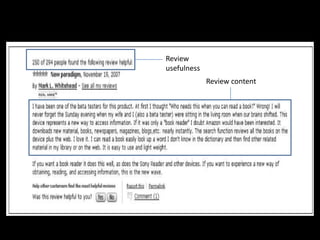
• Each reviewer can provided an overall
  evaluation using a 1- to 5-star scale and a
  qualitative product review. Readers also could
  evaluate the helpfulness of a review on a
  dichotomous scale (“Yes” or “No”), and they
  could post comments after the review as well
Review
usefulness
             Review content
Why kindle?
•People are more likely to consult other buyers’ views when they
consider purchasing high involved product(Riegner, 2007).
•Kindle is a brand new product
Methodology
STEP 2 SAMPLEING
• Sampling
      They use the review on Amazon. But only the reviews that had been
      evaluated by at least 50 readers (i.e., in the statement “m of n people
      found the following review helpful,” n ≥ 50) were selected, for a total of
      737 reviews for analysis.

• The distribution of early product ratings
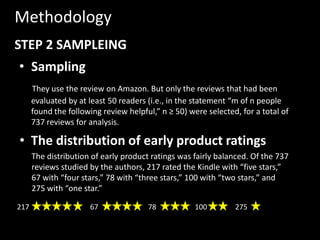
      The distribution of early product ratings was fairly balanced. Of the 737
      reviews studied by the authors, 217 rated the Kindle with “five stars,”
      67 with “four stars,” 78 with “three stars,” 100 with “two stars,” and
      275 with “one star.”

217                   67               78            100        275
Methodology
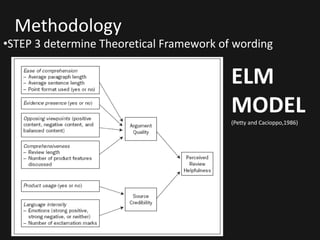
•STEP 3 determine Theoretical Framework of wording

                                          ELM
                                          MODEL
                                          (Petty and Cacioppo,1986)
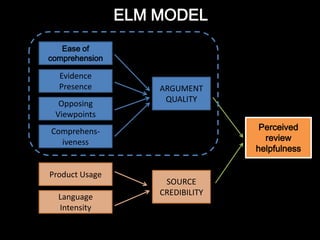
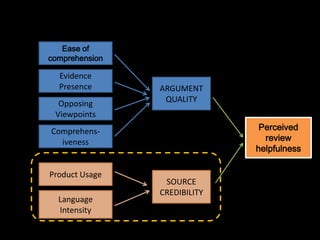
ELM MODEL
   Ease of
comprehension

  Evidence
  Presence          ARGUMENT
  Opposing           QUALITY
 Viewpoints
Comprehens-                        Perceived
  iveness                           review
                                  helpfulness

Product Usage
                     SOURCE
  Language          CREDIBILITY
  Intensity
ARGUMENT QUALITY1:論點品質的衡量
         Study
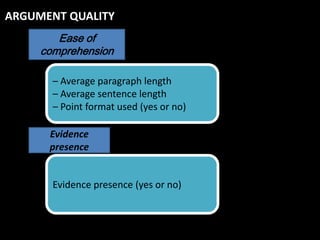
      Ease of
   comprehension

     – Average paragraph length
     – Average sentence length
     – Point format used (yes or no)

    Evidence
    presence


     Evidence presence (yes or no)
ARGUMENT QUALITY


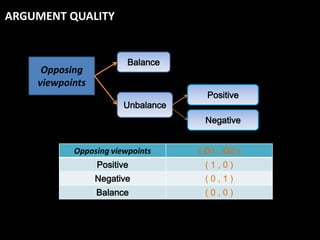
                        Balance
     Opposing
    viewpoints
                                     Positive
                       Unbalance
                                    Negative


           Opposing viewpoints     ( D1 , D2 )
                 Positive           (1,0)
                 Negative           (0,1)
                 Balance            (0,0)
ARGUMENT QUALITY1:論點品質的衡量
         Study


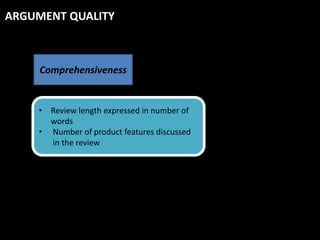
   Comprehensiveness


   • Review length expressed in number of
     words
   • Number of product features discussed
     in the review
Ease of
comprehension

  Evidence
  Presence      ARGUMENT
  Opposing       QUALITY
 Viewpoints
Comprehens-                    Perceived
  iveness                       review
                              helpfulness

Product Usage
                 SOURCE
                CREDIBILITY
  Language
  Intensity
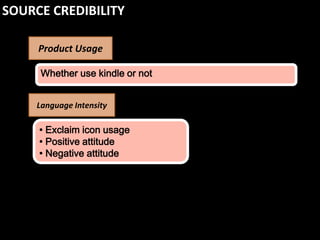
Study 1:來源可信度的衡量
SOURCE CREDIBILITY

   Product Usage

    Whether use kindle or not


   Language Intensity

   • Exclaim icon usage
   • Positive attitude
   • Negative attitude
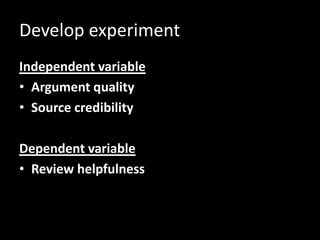
Develop experiment
Independent variable
• Argument quality
• Source credibility

Dependent variable
• Review helpfulness
Methodology
  STEP 4 ENCODING the review
•WHY?
Have to determine whether the independent variable appeared or not
(like emotion, evidence appeared, opposing view point)

•HOW?
Two native-English speakers were recruited as independent judges.
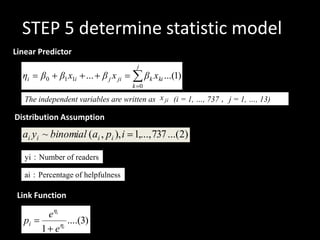
STEP 5 determine statistic model
Linear Predictor
                                     j
  ηi   β0     β1 x1i ... β j x ji         βk xki ...(1)
                                    k 0

   The independent variables are written as x ji (i = 1, …, 737 ,j = 1, …, 13)

Distribution Assumption)                       ai

  ai yi ~ binomial (ai , pi ), i 1,..., 737 ...(2)
                 yi
   yi:Number of readers

   ai:Percentage of helpfulness

 Link Function

         e ηi
  pi          ηi
                 ....(3)
        1 e
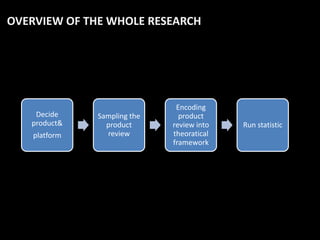
OVERVIEW OF THE WHOLE RESEARCH


                               Encoding
    Decide     Sampling the     product
   product&      product      review into   Run statistic
    platform     review       theoratical
                              framework
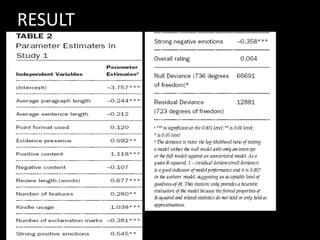
RESULT
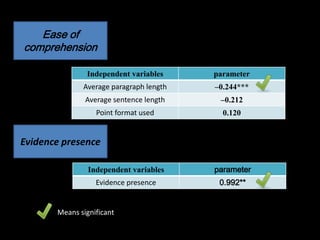
Ease of
comprehension

               Independent variables     parameter
              Average paragraph length   –0.244***
               Average sentence length    –0.212
                  Point format used        0.120


Evidence presence

                Independent variables    parameter
                  Evidence presence       0.992**


       Means significant
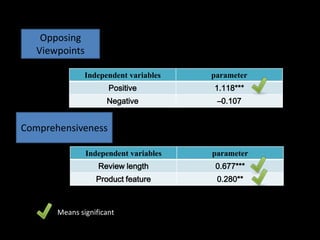
Opposing
   Viewpoints

               Independent variables    parameter
                      Positive          1.118***
                     Negative            –0.107


Comprehensiveness

                Independent variables   parameter
                   Review length         0.677***
                  Product feature        0.280**


       Means significant
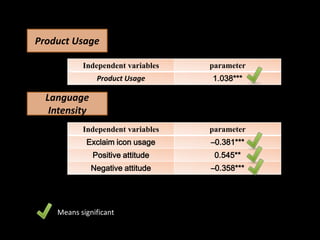
Product Usage

           Independent variables   parameter
                Product Usage      1.038***

  Language
   Intensity
           Independent variables   parameter
            Exclaim icon usage     –0.381***
               Positive attitude    0.545**
               Negative attitude   –0.358***


    Means significant
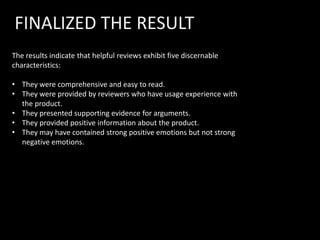
FINALIZED THE RESULT
The results indicate that helpful reviews exhibit five discernable
characteristics:

• They were comprehensive and easy to read.
• They were provided by reviewers who have usage experience with
  the product.
• They presented supporting evidence for arguments.
• They provided positive information about the product.
• They may have contained strong positive emotions but not strong
  negative emotions.
Conclusion
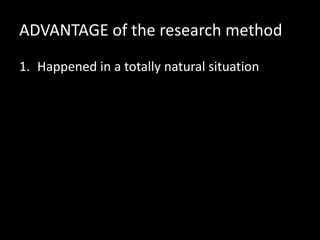
ADVANTAGE of the research method
1. Happened in a totally natural situation
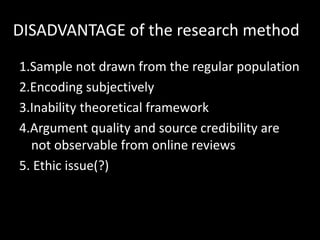
DISADVANTAGE of the research method
1.Sample not drawn from the regular population
2.Encoding subjectively
3.Inability theoretical framework
4.Argument quality and source credibility are
  not observable from online reviews
5. Ethic issue(?)
Marketing implication
• Companies can increase the usefulness of message on their
  Web sites

• Companies can identifying the most influential voices in the
  community.

• Help to create a good testimonial ads
  • Use short sentences
  • Offer evidence for claims
  • Provide information on as many important
    features as possible
  • Avoid the use of exclamation marks.
What should a good
Thank for your you attention!

Research method final

  • 1.
    Online Persuasion: Howthe Written Word Drives WOM Evidence from Consumer-Generated Product Reviews(Mar,2011) Jin Li Lingjing Zhan
  • 2.
    Introduction & Background • Importance of word of mouth in marketing • Development of Word of mouth on Internet
  • 3.
    PURPOSE • To examinehow the language style, organizational structure, and other content features of consumer-generated, online product reviews affect review adoption.
  • 4.
    Studies • Study 1: the authors analyzed a data set of online product reviews regarding a consumer electronic device and identified the content features that positively or negatively influenced review adoption. • Study 2 : used an experimental approach to probe the boundary conditions under which some effects observed in study 1 may or may not have occurred.
  • 5.
  • 6.
    Methodology • STEP 1Determine the platform and product that can apply the research PLATFORM Product
  • 7.
    WHY AMAZON? • Eachreviewer can provided an overall evaluation using a 1- to 5-star scale and a qualitative product review. Readers also could evaluate the helpfulness of a review on a dichotomous scale (“Yes” or “No”), and they could post comments after the review as well
  • 8.
    Review usefulness Review content
  • 9.
    Why kindle? •People aremore likely to consult other buyers’ views when they consider purchasing high involved product(Riegner, 2007). •Kindle is a brand new product
  • 10.
    Methodology STEP 2 SAMPLEING •Sampling They use the review on Amazon. But only the reviews that had been evaluated by at least 50 readers (i.e., in the statement “m of n people found the following review helpful,” n ≥ 50) were selected, for a total of 737 reviews for analysis. • The distribution of early product ratings The distribution of early product ratings was fairly balanced. Of the 737 reviews studied by the authors, 217 rated the Kindle with “five stars,” 67 with “four stars,” 78 with “three stars,” 100 with “two stars,” and 275 with “one star.” 217 67 78 100 275
  • 11.
    Methodology •STEP 3 determineTheoretical Framework of wording ELM MODEL (Petty and Cacioppo,1986)
  • 12.
    ELM MODEL Ease of comprehension Evidence Presence ARGUMENT Opposing QUALITY Viewpoints Comprehens- Perceived iveness review helpfulness Product Usage SOURCE Language CREDIBILITY Intensity
  • 13.
    ARGUMENT QUALITY1:論點品質的衡量 Study Ease of comprehension – Average paragraph length – Average sentence length – Point format used (yes or no) Evidence presence Evidence presence (yes or no)
  • 14.
    ARGUMENT QUALITY Balance Opposing viewpoints Positive Unbalance Negative Opposing viewpoints ( D1 , D2 ) Positive (1,0) Negative (0,1) Balance (0,0)
  • 15.
    ARGUMENT QUALITY1:論點品質的衡量 Study Comprehensiveness • Review length expressed in number of words • Number of product features discussed in the review
  • 16.
    Ease of comprehension Evidence Presence ARGUMENT Opposing QUALITY Viewpoints Comprehens- Perceived iveness review helpfulness Product Usage SOURCE CREDIBILITY Language Intensity
  • 17.
    Study 1:來源可信度的衡量 SOURCE CREDIBILITY Product Usage Whether use kindle or not Language Intensity • Exclaim icon usage • Positive attitude • Negative attitude
  • 18.
    Develop experiment Independent variable •Argument quality • Source credibility Dependent variable • Review helpfulness
  • 19.
    Methodology STEP4 ENCODING the review •WHY? Have to determine whether the independent variable appeared or not (like emotion, evidence appeared, opposing view point) •HOW? Two native-English speakers were recruited as independent judges.
  • 21.
    STEP 5 determinestatistic model Linear Predictor j ηi β0 β1 x1i ... β j x ji βk xki ...(1) k 0 The independent variables are written as x ji (i = 1, …, 737 ,j = 1, …, 13) Distribution Assumption) ai ai yi ~ binomial (ai , pi ), i 1,..., 737 ...(2) yi yi:Number of readers ai:Percentage of helpfulness Link Function e ηi pi ηi ....(3) 1 e
  • 22.
    OVERVIEW OF THEWHOLE RESEARCH Encoding Decide Sampling the product product& product review into Run statistic platform review theoratical framework
  • 23.
  • 24.
    Ease of comprehension Independent variables parameter Average paragraph length –0.244*** Average sentence length –0.212 Point format used 0.120 Evidence presence Independent variables parameter Evidence presence 0.992** Means significant
  • 25.
    Opposing Viewpoints Independent variables parameter Positive 1.118*** Negative –0.107 Comprehensiveness Independent variables parameter Review length 0.677*** Product feature 0.280** Means significant
  • 26.
    Product Usage Independent variables parameter Product Usage 1.038*** Language Intensity Independent variables parameter Exclaim icon usage –0.381*** Positive attitude 0.545** Negative attitude –0.358*** Means significant
  • 27.
    FINALIZED THE RESULT Theresults indicate that helpful reviews exhibit five discernable characteristics: • They were comprehensive and easy to read. • They were provided by reviewers who have usage experience with the product. • They presented supporting evidence for arguments. • They provided positive information about the product. • They may have contained strong positive emotions but not strong negative emotions.
  • 28.
  • 29.
    ADVANTAGE of theresearch method 1. Happened in a totally natural situation
  • 30.
    DISADVANTAGE of theresearch method 1.Sample not drawn from the regular population 2.Encoding subjectively 3.Inability theoretical framework 4.Argument quality and source credibility are not observable from online reviews 5. Ethic issue(?)
  • 31.
    Marketing implication • Companiescan increase the usefulness of message on their Web sites • Companies can identifying the most influential voices in the community. • Help to create a good testimonial ads • Use short sentences • Offer evidence for claims • Provide information on as many important features as possible • Avoid the use of exclamation marks.
  • 33.
  • 35.
    Thank for youryou attention!