Recommended
PPTX
Lecture Slides-Topic: Item Writing.pptx
PDF
Item development.pdf for national examination development
PPTX
Best Practices in Item Writing
PPT
Item analysis in a testing and evaluation.ppt
PPTX
PPTX
PPT
PPTX
table of specification for teachers principals and educational leaders .pptx
PPTX
PPT
DOCX
Stages of test writings final by joy,, language testing
PDF
PPTX
Item Analysis and scaling methods...pptx
PPTX
DOCX
Powerpoint presentation about test development process
PPTX
PDF
Becoming a software testing expert
PPT
Applied Psych Test Design: Part B - Test and Item Development
PDF
Developing And Validating Test Items Thomas M Haladyna Michael C Rodriguez
PPT
Classroom Tests (By Dr. Daniel T.)_2.ppt
PPT
Classroom Tests (By Dr. Daniel T.)_2.ppt
PPT
developing and using test effectively.ppt
PPTX
PPTX
principles of Nursing Education for UGs_MAE (3).pptx
PDF
Tips for Creating and Delivering Effective Mobile Assessments
PDF
Handbook Of Test Development 2nd Edition Suzanne Lane Mark R Raymond
PPT
test-development presentations to download
PDF
Handbook of Test Development 2nd Edition Suzanne Lane
More Related Content
PPTX
Lecture Slides-Topic: Item Writing.pptx
PDF
Item development.pdf for national examination development
PPTX
Best Practices in Item Writing
PPT
Item analysis in a testing and evaluation.ppt
PPTX
PPTX
PPT
PPTX
table of specification for teachers principals and educational leaders .pptx
Similar to Writing Good 2023 Test Questions.pptx
PPTX
PPT
DOCX
Stages of test writings final by joy,, language testing
PDF
PPTX
Item Analysis and scaling methods...pptx
PPTX
DOCX
Powerpoint presentation about test development process
PPTX
PDF
Becoming a software testing expert
PPT
Applied Psych Test Design: Part B - Test and Item Development
PDF
Developing And Validating Test Items Thomas M Haladyna Michael C Rodriguez
PPT
Classroom Tests (By Dr. Daniel T.)_2.ppt
PPT
Classroom Tests (By Dr. Daniel T.)_2.ppt
PPT
developing and using test effectively.ppt
PPTX
PPTX
principles of Nursing Education for UGs_MAE (3).pptx
PDF
Tips for Creating and Delivering Effective Mobile Assessments
PDF
Handbook Of Test Development 2nd Edition Suzanne Lane Mark R Raymond
PPT
test-development presentations to download
PDF
Handbook of Test Development 2nd Edition Suzanne Lane
Writing Good 2023 Test Questions.pptx 1. Copyright © 1995-2004 Questionmark Corporation and/or Questionmark Computing Limited, known collectively as Questionmark. All rights reserved.
Questionmark is a registered trademark of Questionmark Computing Limited. All other trademarks are acknowledged.
Slide 1
How to Write Good Test
Questions
PREPARED AND PRESENTED BY:
Alpine Media Corporation
James B. Olsen, Vice President
and Chief Scientist
Bruce Bunderson, President and
CEO
2. Copyright © 1995-2004 Questionmark Corporation and/or Questionmark Computing Limited, known collectively as Questionmark. All rights reserved.
Questionmark is a registered trademark of Questionmark Computing Limited. All other trademarks are acknowledged.
Slide 2
Abstract
This presentation outlines the procedures and
processes for developing effective test
questions. It emphasizes the importance of
starting the authoring process with
meaningful question ideas and explains how
to identify them. We show how to develop
effective test questions from the ideas.
Examples from a wide variety of item types
are provided and discussed.
3. Copyright © 1995-2004 Questionmark Corporation and/or Questionmark Computing Limited, known collectively as Questionmark. All rights reserved.
Questionmark is a registered trademark of Questionmark Computing Limited. All other trademarks are acknowledged.
Slide 3
Alpine Media Corporation
Established 1992
Certification Exams
Practice Exams
Language Training
Psychometric Consulting
Partner of Questionmark since 2000
4. Copyright © 1995-2004 Questionmark Corporation and/or Questionmark Computing Limited, known collectively as Questionmark. All rights reserved.
Questionmark is a registered trademark of Questionmark Computing Limited. All other trademarks are acknowledged.
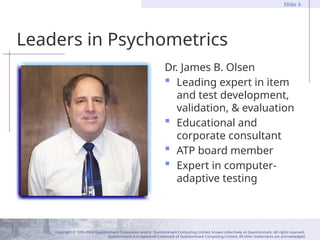
Slide 4
Leaders in Psychometrics
Dr. James B. Olsen
Leading expert in item
and test development,
validation, & evaluation
Educational and
corporate consultant
ATP board member
Expert in computer-
adaptive testing
5. Copyright © 1995-2004 Questionmark Corporation and/or Questionmark Computing Limited, known collectively as Questionmark. All rights reserved.
Questionmark is a registered trademark of Questionmark Computing Limited. All other trademarks are acknowledged.
Slide 5
Item Writing is a Creative Art
“Item writing is an art. It requires an uncommon
combination of special abilities. It is mastered only
through extensive and critically supervised practice.
It demands and tends to develop high standards of
quality and a sense of pride in craftsmanship.”
“Item writing is essentially creative. Each item as it is
being written presents new problems and new
opportunities. Just as there can be no set formulas
for producing a good story and a good painting, so
there can be no set of rules that will guarantee the
production of good test items.” Robert L. Ebel 1951
6. Copyright © 1995-2004 Questionmark Corporation and/or Questionmark Computing Limited, known collectively as Questionmark. All rights reserved.
Questionmark is a registered trademark of Questionmark Computing Limited. All other trademarks are acknowledged.
Slide 6
Requirements for Writing Good
Items
1. The item writer must have thorough mastery of the subject
matter being tested.
2. The writer must possess a rational and well developed set of
thinking processes to determine what is most important to
test.
3. The writer must understand the individuals for whom the
test or items are intended,
4. The item writer must be a master of verbal communication.
5. The item writer must be skilled in handling the special
technology used for item writing.
6. The process of constructing good test items is not simple.
7. Copyright © 1995-2004 Questionmark Corporation and/or Questionmark Computing Limited, known collectively as Questionmark. All rights reserved.
Questionmark is a registered trademark of Questionmark Computing Limited. All other trademarks are acknowledged.
Slide 7
Ideas for Test Items
Every test item begins with an idea in the
mind of the item writer. The production
and selection of ideas upon which test
items may be based is one of the most
difficult problems facing the item writer.
The item writer is given the responsibility
of producing ideas and developing them as
items that will satisfy the specification of
the test plan. The quality of the test
produced depends to a considerable extent
upon the item writer’s success in dealing
with this problem.
8. Copyright © 1995-2004 Questionmark Corporation and/or Questionmark Computing Limited, known collectively as Questionmark. All rights reserved.
Questionmark is a registered trademark of Questionmark Computing Limited. All other trademarks are acknowledged.
Slide 8
The Nature of Item Ideas
In actual practice item ideas are seldom
formally stated. Usually they exist only
temporarily and with no verbal explicitness in
the mind of the item writer. An idea occurs to
the writer, the writer judges the probable
contribution of the item to the test, and if this
is satisfactory, the writer proceeds
immediately to write it in approximately its
final form.
9. Copyright © 1995-2004 Questionmark Corporation and/or Questionmark Computing Limited, known collectively as Questionmark. All rights reserved.
Questionmark is a registered trademark of Questionmark Computing Limited. All other trademarks are acknowledged.
Slide 9
Item Ideas
There is no automatic process for the
production of item ideas. They must be
invented or discovered and in the process
chance ideas and inspirations are very
important. It is possible, however, to
stimulate these processes by appropriate
material.
10. Copyright © 1995-2004 Questionmark Corporation and/or Questionmark Computing Limited, known collectively as Questionmark. All rights reserved.
Questionmark is a registered trademark of Questionmark Computing Limited. All other trademarks are acknowledged.
Slide 10
Item Ideas
Item ideas should also be selected on the basis of
importance. While the test plan usually indicates
the general aspects of achievement that are
regarded as important, it is the responsibility of
the item writer to select the important specific
aspects of achievement as item topics.
Finally, in the selection of item ideas it is necessary
to consider their probable ability to discriminate
between those that possess and those who lack a
given understanding or ability.
11. Copyright © 1995-2004 Questionmark Corporation and/or Questionmark Computing Limited, known collectively as Questionmark. All rights reserved.
Questionmark is a registered trademark of Questionmark Computing Limited. All other trademarks are acknowledged.
Slide 11
Selecting Item Ideas
“The process of selecting item ideas goes on
simultaneously with the process of inventing
them. Skill in item writing depends not only
upon prolific inventiveness but also upon
discriminating judgment in the selection. In
selecting item ideas, the writer must consider
their appropriateness, importance, and
probable discriminating ability.” Robert Ebel
12. Copyright © 1995-2004 Questionmark Corporation and/or Questionmark Computing Limited, known collectively as Questionmark. All rights reserved.
Questionmark is a registered trademark of Questionmark Computing Limited. All other trademarks are acknowledged.
Slide 12
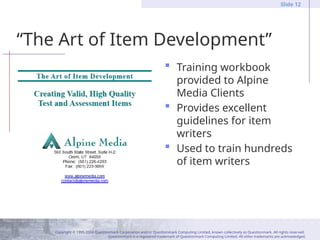
“The Art of Item Development”
Training workbook
provided to Alpine
Media Clients
Provides excellent
guidelines for item
writers
Used to train hundreds
of item writers
13. Copyright © 1995-2004 Questionmark Corporation and/or Questionmark Computing Limited, known collectively as Questionmark. All rights reserved.
Questionmark is a registered trademark of Questionmark Computing Limited. All other trademarks are acknowledged.
Slide 13
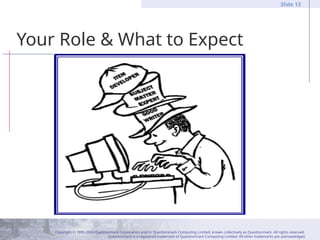
Your Role & What to Expect
14. Copyright © 1995-2004 Questionmark Corporation and/or Questionmark Computing Limited, known collectively as Questionmark. All rights reserved.
Questionmark is a registered trademark of Questionmark Computing Limited. All other trademarks are acknowledged.
Slide 14
Effective Test Items
Valid and high quality items
Match the objective
Test at the appropriate cognitive level
Are clear and correct
15. Copyright © 1995-2004 Questionmark Corporation and/or Questionmark Computing Limited, known collectively as Questionmark. All rights reserved.
Questionmark is a registered trademark of Questionmark Computing Limited. All other trademarks are acknowledged.
Slide 15
Rule #1
Only ask people
questions they can
answer.
(Van Mondfrans, 1985)
16. Copyright © 1995-2004 Questionmark Corporation and/or Questionmark Computing Limited, known collectively as Questionmark. All rights reserved.
Questionmark is a registered trademark of Questionmark Computing Limited. All other trademarks are acknowledged.
Slide 16
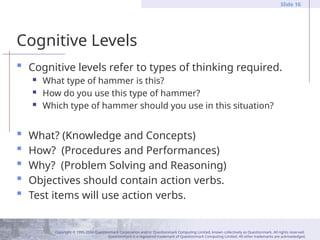
Cognitive Levels
Cognitive levels refer to types of thinking required.
What type of hammer is this?
How do you use this type of hammer?
Which type of hammer should you use in this situation?
What? (Knowledge and Concepts)
How? (Procedures and Performances)
Why? (Problem Solving and Reasoning)
Objectives should contain action verbs.
Test items will use action verbs.
17. Copyright © 1995-2004 Questionmark Corporation and/or Questionmark Computing Limited, known collectively as Questionmark. All rights reserved.
Questionmark is a registered trademark of Questionmark Computing Limited. All other trademarks are acknowledged.
Slide 17
Three Main Types of Questions
Knowledge, Skill, Performance
Mastery, Power and Speed
Selected Response and Constructed Response
18. Copyright © 1995-2004 Questionmark Corporation and/or Questionmark Computing Limited, known collectively as Questionmark. All rights reserved.
Questionmark is a registered trademark of Questionmark Computing Limited. All other trademarks are acknowledged.
Slide 18
Knowledge, Skill, Performance
Knowledge items require the candidate to demonstrate their
knowledge of a fact, principle or procedure
Skill items require the candidate to apply or use knowledge in
novel ways You may also use skill items to evaluate
combinations of physical and cognitive abilities.
Performance items require the candidate to use skills in a
process or sequence to accomplish a task
19. Copyright © 1995-2004 Questionmark Corporation and/or Questionmark Computing Limited, known collectively as Questionmark. All rights reserved.
Questionmark is a registered trademark of Questionmark Computing Limited. All other trademarks are acknowledged.
Slide 19
Mastery, Power, and Speed
Mastery test items contain critical information that every
competent candidate must know to exam is often set at 90% or
higher.
Power test items contain information that is important for
competence but that not every candidate will know.
Items for speeded tests are not necessarily different from power
items. Speeded tests involve severe time constraints on the
candidate, such that an average candidate will not be able to
complete all the items.
20. Copyright © 1995-2004 Questionmark Corporation and/or Questionmark Computing Limited, known collectively as Questionmark. All rights reserved.
Questionmark is a registered trademark of Questionmark Computing Limited. All other trademarks are acknowledged.
Slide 20
Selected & Constructed Response
Selected response items require the candidate to select
an answer from a set of options (e.g., multiple choice
or true/false).
Constructed response items require the candidate to
write something (i.e., short answer, fill in the blank,
essay, or performance tasks).
21. Copyright © 1995-2004 Questionmark Corporation and/or Questionmark Computing Limited, known collectively as Questionmark. All rights reserved.
Questionmark is a registered trademark of Questionmark Computing Limited. All other trademarks are acknowledged.
Slide 21
Variety of Item Types
Multiple Choice
Multiple-selection
(Multiple Response)
Point-and-Click
(Hotspot)
Matching
Drag-and drop
Order and Rank
Objects
Short Answer
22. Copyright © 1995-2004 Questionmark Corporation and/or Questionmark Computing Limited, known collectively as Questionmark. All rights reserved.
Questionmark is a registered trademark of Questionmark Computing Limited. All other trademarks are acknowledged.
Slide 22
Item Type: Multiple Choice
Presents a problem in the form of a question stem.
Requires the candidate to select one absolutely
correct answer from among several (four or five)
incorrect but plausible options.
Can measure content at all cognitive levels.
Can be used with stems that are incomplete
sentences (though we recommend stems that use
complete sentences).
23. Copyright © 1995-2004 Questionmark Corporation and/or Questionmark Computing Limited, known collectively as Questionmark. All rights reserved.
Questionmark is a registered trademark of Questionmark Computing Limited. All other trademarks are acknowledged.
Slide 23
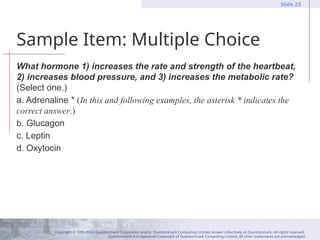
Sample Item: Multiple Choice
What hormone 1) increases the rate and strength of the heartbeat,
2) increases blood pressure, and 3) increases the metabolic rate?
(Select one.)
a. Adrenaline * (In this and following examples, the asterisk * indicates the
correct answer.)
b. Glucagon
c. Leptin
d. Oxytocin
24. Copyright © 1995-2004 Questionmark Corporation and/or Questionmark Computing Limited, known collectively as Questionmark. All rights reserved.
Questionmark is a registered trademark of Questionmark Computing Limited. All other trademarks are acknowledged.
Slide 24
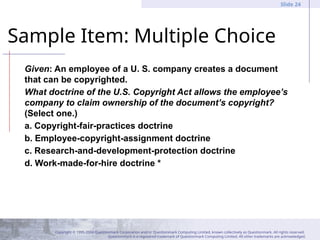
Sample Item: Multiple Choice
Given: An employee of a U. S. company creates a document
that can be copyrighted.
What doctrine of the U.S. Copyright Act allows the employee’s
company to claim ownership of the document’s copyright?
(Select one.)
a. Copyright-fair-practices doctrine
b. Employee-copyright-assignment doctrine
c. Research-and-development-protection doctrine
d. Work-made-for-hire doctrine *
25. Copyright © 1995-2004 Questionmark Corporation and/or Questionmark Computing Limited, known collectively as Questionmark. All rights reserved.
Questionmark is a registered trademark of Questionmark Computing Limited. All other trademarks are acknowledged.
Slide 25
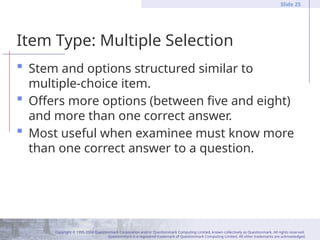
Item Type: Multiple Selection
Stem and options structured similar to
multiple-choice item.
Offers more options (between five and eight)
and more than one correct answer.
Most useful when examinee must know more
than one correct answer to a question.
26. Copyright © 1995-2004 Questionmark Corporation and/or Questionmark Computing Limited, known collectively as Questionmark. All rights reserved.
Questionmark is a registered trademark of Questionmark Computing Limited. All other trademarks are acknowledged.
Slide 26
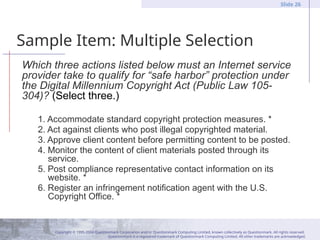
Sample Item: Multiple Selection
Which three actions listed below must an Internet service
provider take to qualify for “safe harbor” protection under
the Digital Millennium Copyright Act (Public Law 105-
304)? (Select three.)
1. Accommodate standard copyright protection measures. *
2. Act against clients who post illegal copyrighted material.
3. Approve client content before permitting content to be posted.
4. Monitor the content of client materials posted through its
service.
5. Post compliance representative contact information on its
website. *
6. Register an infringement notification agent with the U.S.
Copyright Office. *
27. Copyright © 1995-2004 Questionmark Corporation and/or Questionmark Computing Limited, known collectively as Questionmark. All rights reserved.
Questionmark is a registered trademark of Questionmark Computing Limited. All other trademarks are acknowledged.
Slide 27
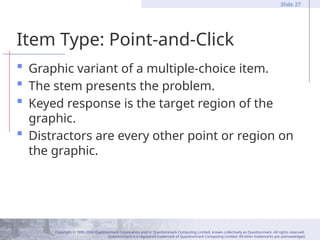
Item Type: Point-and-Click
Graphic variant of a multiple-choice item.
The stem presents the problem.
Keyed response is the target region of the
graphic.
Distractors are every other point or region on
the graphic.
28. Copyright © 1995-2004 Questionmark Corporation and/or Questionmark Computing Limited, known collectively as Questionmark. All rights reserved.
Questionmark is a registered trademark of Questionmark Computing Limited. All other trademarks are acknowledged.
Slide 28
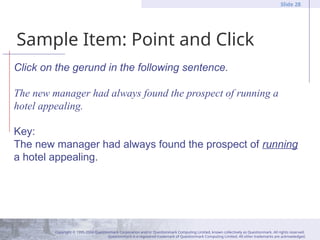
Sample Item: Point and Click
Click on the gerund in the following sentence.
The new manager had always found the prospect of running a
hotel appealing.
Key:
The new manager had always found the prospect of running
a hotel appealing.
29. Copyright © 1995-2004 Questionmark Corporation and/or Questionmark Computing Limited, known collectively as Questionmark. All rights reserved.
Questionmark is a registered trademark of Questionmark Computing Limited. All other trademarks are acknowledged.
Slide 29
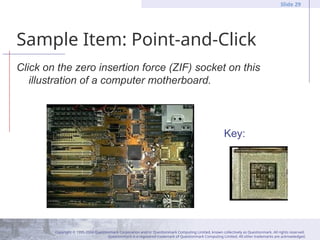
Sample Item: Point-and-Click
Click on the zero insertion force (ZIF) socket on this
illustration of a computer motherboard.
Key:
30. Copyright © 1995-2004 Questionmark Corporation and/or Questionmark Computing Limited, known collectively as Questionmark. All rights reserved.
Questionmark is a registered trademark of Questionmark Computing Limited. All other trademarks are acknowledged.
Slide 30
Item Type: Matching
Item presents a numbered list of stems and a
lettered set of options.
Item tests knowledge of facts, definitions, and
classifications.
Examinee matches stems with appropriate
options.
31. Copyright © 1995-2004 Questionmark Corporation and/or Questionmark Computing Limited, known collectively as Questionmark. All rights reserved.
Questionmark is a registered trademark of Questionmark Computing Limited. All other trademarks are acknowledged.
Slide 31
Sample Item: Matching
____ 1. deliquescent
____ 2. excurrent
____ 3. fugacious
____ 4. stoloniferous
a. Covered with coarse or stiff, long hairs
b. Falling or withering away very early (3)
c. Having a trunk dividing into several
large branches (1)
d. Having lower branches or runners
which tend to root (4)
e. Not capable of doing well under dense
forest cover
f. Having the axis prolonged to form an
undivided main trunk (2)
g. Terminating in a rigid, sharp point
Match each plant characteristic on the left with its correct definition in the list on
the right. (Write the letter of the definition in the space provided.)
32. Copyright © 1995-2004 Questionmark Corporation and/or Questionmark Computing Limited, known collectively as Questionmark. All rights reserved.
Questionmark is a registered trademark of Questionmark Computing Limited. All other trademarks are acknowledged.
Slide 32
Item Type: Drag-and-Drop
A graphic variant of the matching item type.
Requires candidate to select a “source” object
with the mouse pointer, drag it to a desired
“destination” location on the screen and then
“drop” it on the chosen spot.
33. Copyright © 1995-2004 Questionmark Corporation and/or Questionmark Computing Limited, known collectively as Questionmark. All rights reserved.
Questionmark is a registered trademark of Questionmark Computing Limited. All other trademarks are acknowledged.
Slide 33
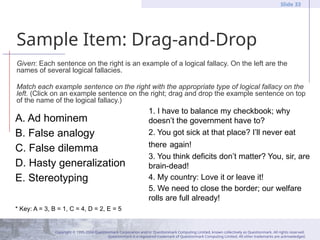
Sample Item: Drag-and-Drop
Given: Each sentence on the right is an example of a logical fallacy. On the left are the
names of several logical fallacies.
Match each example sentence on the right with the appropriate type of logical fallacy on the
left. (Click on an example sentence on the right; drag and drop the example sentence on top
of the name of the logical fallacy.)
A. Ad hominem
B. False analogy
C. False dilemma
D. Hasty generalization
E. Stereotyping
* Key: A = 3, B = 1, C = 4, D = 2, E = 5
1. I have to balance my checkbook; why
doesn’t the government have to?
2. You got sick at that place? I’ll never eat
there again!
3. You think deficits don’t matter? You, sir, are
brain-dead!
4. My country: Love it or leave it!
5. We need to close the border; our welfare
rolls are full already!
34. Copyright © 1995-2004 Questionmark Corporation and/or Questionmark Computing Limited, known collectively as Questionmark. All rights reserved.
Questionmark is a registered trademark of Questionmark Computing Limited. All other trademarks are acknowledged.
Slide 34
Item Type: Order and Rank
Objects
Variant of matching and drag-and-drop item
types.
Candidate drags source objects to destination
locations in a specific order (chronological,
ranking, sequence of steps, etc.).
35. Copyright © 1995-2004 Questionmark Corporation and/or Questionmark Computing Limited, known collectively as Questionmark. All rights reserved.
Questionmark is a registered trademark of Questionmark Computing Limited. All other trademarks are acknowledged.
Slide 35
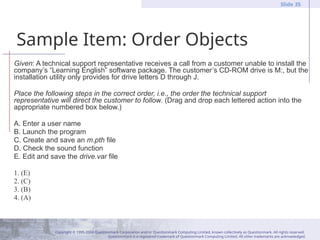
Sample Item: Order Objects
Given: A technical support representative receives a call from a customer unable to install the
company’s “Learning English” software package. The customer’s CD-ROM drive is M:, but the
installation utility only provides for drive letters D through J.
Place the following steps in the correct order, i.e., the order the technical support
representative will direct the customer to follow. (Drag and drop each lettered action into the
appropriate numbered box below.)
A. Enter a user name
B. Launch the program
C. Create and save an m.pth file
D. Check the sound function
E. Edit and save the drive.var file
1. (E)
2. (C)
3. (B)
4. (A)
36. Copyright © 1995-2004 Questionmark Corporation and/or Questionmark Computing Limited, known collectively as Questionmark. All rights reserved.
Questionmark is a registered trademark of Questionmark Computing Limited. All other trademarks are acknowledged.
Slide 36
Item Type: Short Answer
Rarely used due to computerized-scoring difficulties.
Stem presents a complete, direct question that a
knowledgeable candidate can answer without actually
reading options.
Stems should call for responses limited to three words
or less.
Item type works for factual recall of exact words or
numbers such as computer syntax, dates, etc.
37. Copyright © 1995-2004 Questionmark Corporation and/or Questionmark Computing Limited, known collectively as Questionmark. All rights reserved.
Questionmark is a registered trademark of Questionmark Computing Limited. All other trademarks are acknowledged.
Slide 37
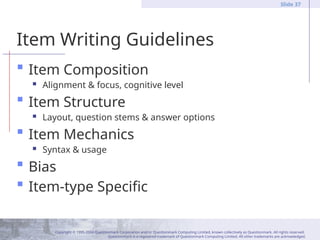
Item Writing Guidelines
Item Composition
Alignment & focus, cognitive level
Item Structure
Layout, question stems & answer options
Item Mechanics
Syntax & usage
Bias
Item-type Specific
38. Copyright © 1995-2004 Questionmark Corporation and/or Questionmark Computing Limited, known collectively as Questionmark. All rights reserved.
Questionmark is a registered trademark of Questionmark Computing Limited. All other trademarks are acknowledged.
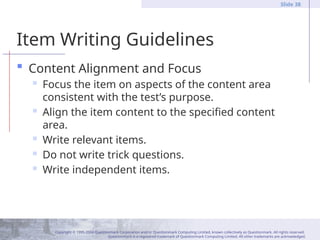
Slide 38
Item Writing Guidelines
Content Alignment and Focus
Focus the item on aspects of the content area
consistent with the test’s purpose.
Align the item content to the specified content
area.
Write relevant items.
Do not write trick questions.
Write independent items.
39. Copyright © 1995-2004 Questionmark Corporation and/or Questionmark Computing Limited, known collectively as Questionmark. All rights reserved.
Questionmark is a registered trademark of Questionmark Computing Limited. All other trademarks are acknowledged.
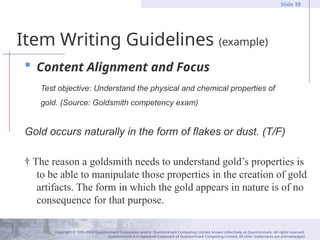
Slide 39
Item Writing Guidelines (example)
Content Alignment and Focus
Test objective: Understand the physical and chemical properties of
gold. (Source: Goldsmith competency exam)
Gold occurs naturally in the form of flakes or dust. (T/F)
† The reason a goldsmith needs to understand gold’s properties is
to be able to manipulate those properties in the creation of gold
artifacts. The form in which the gold appears in nature is of no
consequence for that purpose.
40. Copyright © 1995-2004 Questionmark Corporation and/or Questionmark Computing Limited, known collectively as Questionmark. All rights reserved.
Questionmark is a registered trademark of Questionmark Computing Limited. All other trademarks are acknowledged.
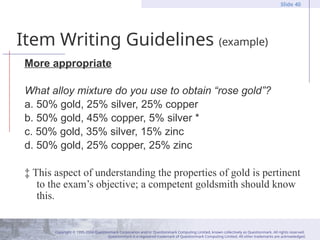
Slide 40
Item Writing Guidelines (example)
More appropriate
What alloy mixture do you use to obtain “rose gold”?
a. 50% gold, 25% silver, 25% copper
b. 50% gold, 45% copper, 5% silver *
c. 50% gold, 35% silver, 15% zinc
d. 50% gold, 25% copper, 25% zinc
‡ This aspect of understanding the properties of gold is pertinent
to the exam’s objective; a competent goldsmith should know
this.
41. Copyright © 1995-2004 Questionmark Corporation and/or Questionmark Computing Limited, known collectively as Questionmark. All rights reserved.
Questionmark is a registered trademark of Questionmark Computing Limited. All other trademarks are acknowledged.
Slide 41
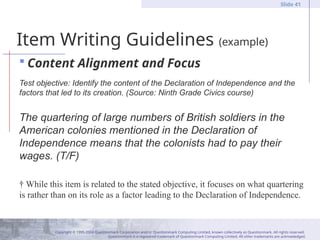
Item Writing Guidelines (example)
Content Alignment and Focus
Test objective: Identify the content of the Declaration of Independence and the
factors that led to its creation. (Source: Ninth Grade Civics course)
The quartering of large numbers of British soldiers in the
American colonies mentioned in the Declaration of
Independence means that the colonists had to pay their
wages. (T/F)
† While this item is related to the stated objective, it focuses on what quartering
is rather than on its role as a factor leading to the Declaration of Independence.
42. Copyright © 1995-2004 Questionmark Corporation and/or Questionmark Computing Limited, known collectively as Questionmark. All rights reserved.
Questionmark is a registered trademark of Questionmark Computing Limited. All other trademarks are acknowledged.
Slide 42
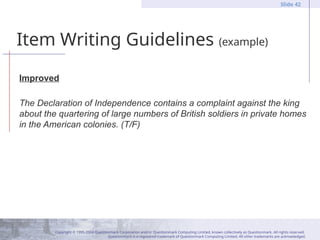
Item Writing Guidelines (example)
Improved
The Declaration of Independence contains a complaint against the king
about the quartering of large numbers of British soldiers in private homes
in the American colonies. (T/F)
43. Copyright © 1995-2004 Questionmark Corporation and/or Questionmark Computing Limited, known collectively as Questionmark. All rights reserved.
Questionmark is a registered trademark of Questionmark Computing Limited. All other trademarks are acknowledged.
Slide 43
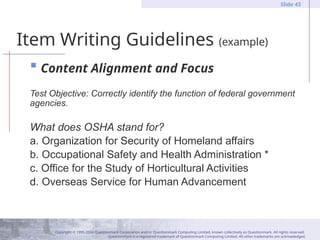
Item Writing Guidelines (example)
Content Alignment and Focus
Test Objective: Correctly identify the function of federal government
agencies.
What does OSHA stand for?
a. Organization for Security of Homeland affairs
b. Occupational Safety and Health Administration *
c. Office for the Study of Horticultural Activities
d. Overseas Service for Human Advancement
44. Copyright © 1995-2004 Questionmark Corporation and/or Questionmark Computing Limited, known collectively as Questionmark. All rights reserved.
Questionmark is a registered trademark of Questionmark Computing Limited. All other trademarks are acknowledged.
Slide 44
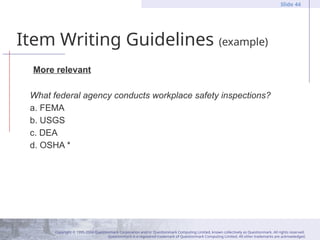
Item Writing Guidelines (example)
More relevant
What federal agency conducts workplace safety inspections?
a. FEMA
b. USGS
c. DEA
d. OSHA *
45. Copyright © 1995-2004 Questionmark Corporation and/or Questionmark Computing Limited, known collectively as Questionmark. All rights reserved.
Questionmark is a registered trademark of Questionmark Computing Limited. All other trademarks are acknowledged.
Slide 45
Item Writing Guidelines (example)
Content Alignment and Focus
Beethoven’s Symphony No. 3 in E-Flat minor was also known as the
Eroica Symphony.
TRUE *FALSE
46. Copyright © 1995-2004 Questionmark Corporation and/or Questionmark Computing Limited, known collectively as Questionmark. All rights reserved.
Questionmark is a registered trademark of Questionmark Computing Limited. All other trademarks are acknowledged.
Slide 46
Item Writing Guidelines (example)
Content Alignment and Focus
Beethoven’s Symphony No. 3 in E-Flat Major was also known as the
Eroica Symphony.
*TRUE FALSE
47. Copyright © 1995-2004 Questionmark Corporation and/or Questionmark Computing Limited, known collectively as Questionmark. All rights reserved.
Questionmark is a registered trademark of Questionmark Computing Limited. All other trademarks are acknowledged.
Slide 47
Item Writing Guidelines (example)
Content Alignment and Focus
Given: The table below shows the revenues for public
education of three states for a given year. [see table]
What is the average revenue?
Follow-up question:
Given: Each state had an average enrollment of 1.7 million
students.
What is the average per capita revenue?
48. Copyright © 1995-2004 Questionmark Corporation and/or Questionmark Computing Limited, known collectively as Questionmark. All rights reserved.
Questionmark is a registered trademark of Questionmark Computing Limited. All other trademarks are acknowledged.
Slide 48
Item Writing Guidelines (example)
Independent Follow-up Item
Given: Four states had an average enrollment of 980,000 students and
average revenue of $8 billion.
What is the average per capita revenue?
49. Copyright © 1995-2004 Questionmark Corporation and/or Questionmark Computing Limited, known collectively as Questionmark. All rights reserved.
Questionmark is a registered trademark of Questionmark Computing Limited. All other trademarks are acknowledged.
Slide 49
Item Writing Guidelines
Cognitive Level
Match the item’s cognitive level to the level
expected of qualified examinees.
Write the items at the correct level of difficulty.
50. Copyright © 1995-2004 Questionmark Corporation and/or Questionmark Computing Limited, known collectively as Questionmark. All rights reserved.
Questionmark is a registered trademark of Questionmark Computing Limited. All other trademarks are acknowledged.
Slide 50
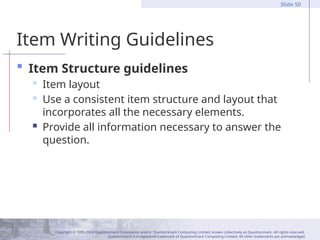
Item Writing Guidelines
Item Structure guidelines
Item layout
Use a consistent item structure and layout that
incorporates all the necessary elements.
Provide all information necessary to answer the
question.
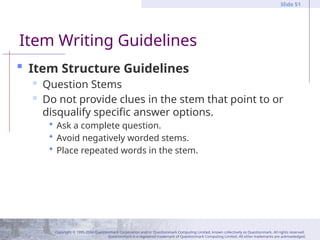
51. Copyright © 1995-2004 Questionmark Corporation and/or Questionmark Computing Limited, known collectively as Questionmark. All rights reserved.
Questionmark is a registered trademark of Questionmark Computing Limited. All other trademarks are acknowledged.
Slide 51
Item Structure Guidelines
Question Stems
Do not provide clues in the stem that point to or
disqualify specific answer options.
Ask a complete question.
Avoid negatively worded stems.
Place repeated words in the stem.
Item Writing Guidelines
52. Copyright © 1995-2004 Questionmark Corporation and/or Questionmark Computing Limited, known collectively as Questionmark. All rights reserved.
Questionmark is a registered trademark of Questionmark Computing Limited. All other trademarks are acknowledged.
Slide 52
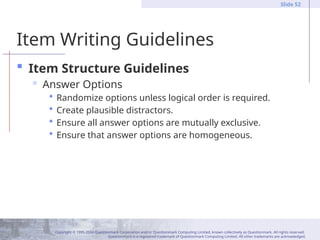
Item Writing Guidelines
Item Structure Guidelines
Answer Options
Randomize options unless logical order is required.
Create plausible distractors.
Ensure all answer options are mutually exclusive.
Ensure that answer options are homogeneous.
53. Copyright © 1995-2004 Questionmark Corporation and/or Questionmark Computing Limited, known collectively as Questionmark. All rights reserved.
Questionmark is a registered trademark of Questionmark Computing Limited. All other trademarks are acknowledged.
Slide 53
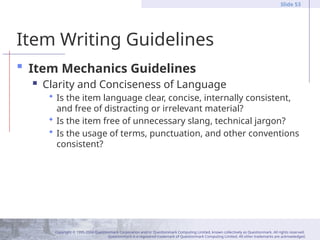
Item Writing Guidelines
Item Mechanics Guidelines
Clarity and Conciseness of Language
Is the item language clear, concise, internally consistent,
and free of distracting or irrelevant material?
Is the item free of unnecessary slang, technical jargon?
Is the usage of terms, punctuation, and other conventions
consistent?
54. Copyright © 1995-2004 Questionmark Corporation and/or Questionmark Computing Limited, known collectively as Questionmark. All rights reserved.
Questionmark is a registered trademark of Questionmark Computing Limited. All other trademarks are acknowledged.
Slide 54
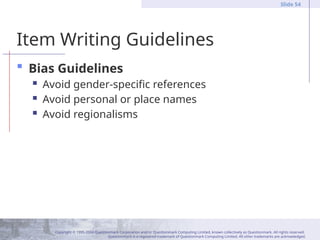
Item Writing Guidelines
Bias Guidelines
Avoid gender-specific references
Avoid personal or place names
Avoid regionalisms
55. Copyright © 1995-2004 Questionmark Corporation and/or Questionmark Computing Limited, known collectively as Questionmark. All rights reserved.
Questionmark is a registered trademark of Questionmark Computing Limited. All other trademarks are acknowledged.
Slide 55
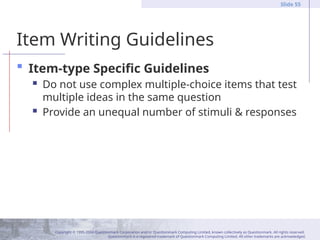
Item Writing Guidelines
Item-type Specific Guidelines
Do not use complex multiple-choice items that test
multiple ideas in the same question
Provide an unequal number of stimuli & responses
56. Copyright © 1995-2004 Questionmark Corporation and/or Questionmark Computing Limited, known collectively as Questionmark. All rights reserved.
Questionmark is a registered trademark of Questionmark Computing Limited. All other trademarks are acknowledged.
Slide 56
Effective Test Items
Valid and high quality items
Matches the objective
Appropriate cognitive level
Clear and correct
57. Copyright © 1995-2004 Questionmark Corporation and/or Questionmark Computing Limited, known collectively as Questionmark. All rights reserved.
Questionmark is a registered trademark of Questionmark Computing Limited. All other trademarks are acknowledged.
Slide 57
Examples of Original and Revised
Test Items
This section shows several examples of
original or first edition test items and how
these items were improved with revision.
58. Copyright © 1995-2004 Questionmark Corporation and/or Questionmark Computing Limited, known collectively as Questionmark. All rights reserved.
Questionmark is a registered trademark of Questionmark Computing Limited. All other trademarks are acknowledged.
Slide 58
Example 1 (Multiple Selection) –
Original Item
Given: [none]
Stem: Identify expenses that can be used as deductions on your
federal taxes. Check all that apply.
Options:
A. state and local income taxes*
B. gifts to charity*
C. gifts to family
D. home mortgage interest*
E. home mortgage payments
F. real estate taxes*
Reference:
Title: U.S. Income Tax Forms, Year: 2001, Page #: Schedule A & B.
59. Copyright © 1995-2004 Questionmark Corporation and/or Questionmark Computing Limited, known collectively as Questionmark. All rights reserved.
Questionmark is a registered trademark of Questionmark Computing Limited. All other trademarks are acknowledged.
Slide 59
Example 1 (Multiple Selection) –
Revised Item
Given: A single homeowner whose sole source of income is a salary of $55,000
per year files using Form 1040 and itemizes deductions.
Stem: Which of the following expenses may this taxpayer claim as deductions?
(Select all that apply.)
Options:
A. state income taxes*
B. local income taxes*
C. gifts to charity*
D. gifts to family
E. home mortgage interest*
F. home mortgage payments
G. real estate taxes*
Reference:
U.S. Internal Revenue Service, Instructions for Schedules to Form 1040: 2001
Instructions for Schedule A, Itemized Deductions, pp. 1-8.
60. Copyright © 1995-2004 Questionmark Corporation and/or Questionmark Computing Limited, known collectively as Questionmark. All rights reserved.
Questionmark is a registered trademark of Questionmark Computing Limited. All other trademarks are acknowledged.
Slide 60
Example 1 (Matching) – Original
Item
Given: [None.]
Question Stem: Each of the items below may be washed in an automatic front-
load washing machine. For each item, select the best temperature setting
for the wash cycle. (Type the number of the correct setting in the space
provided.)
Stimuli (premises):
1. Lightly soiled white towel
2. Silk blouse
3. Non-colorfast cotton shirt
4. Heavily soiled colorfast jeans
5. Woolen jacket
Response options:
A. Cold
B. Warm
C. Hot
61. Copyright © 1995-2004 Questionmark Corporation and/or Questionmark Computing Limited, known collectively as Questionmark. All rights reserved.
Questionmark is a registered trademark of Questionmark Computing Limited. All other trademarks are acknowledged.
Slide 61
Example 1 (Matching) – Revised
Item
Given: [None needed.]
Question Stem: Match each clothing item on the left with the appropriate
washing machine temperature setting on the right. (Place the letter for the
temperature setting in the space provided. You may use a setting more
than once.)
Stimuli (premises):
1. White cotton robe (B)
2. Washable silk blouse (A)
3. Non-colorfast cotton shirt (A)
4. Heavily soiled colorfast jeans (C)
5. Washable woolen jacket (B)
Response Options:
A. Cold
B. Warm
C. Hot
62. Copyright © 1995-2004 Questionmark Corporation and/or Questionmark Computing Limited, known collectively as Questionmark. All rights reserved.
Questionmark is a registered trademark of Questionmark Computing Limited. All other trademarks are acknowledged.
Slide 62
Practical Application Exercises
This section presents a series of fourteen
application exercises that allow us to practice
and discuss what has learned so far about
writing effective test items.
63. Copyright © 1995-2004 Questionmark Corporation and/or Questionmark Computing Limited, known collectively as Questionmark. All rights reserved.
Questionmark is a registered trademark of Questionmark Computing Limited. All other trademarks are acknowledged.
Slide 63
Applied Exercise 1
Instructional Objective: Describe the provisions of each article of the
U. S. Constitution.
Unacceptable
The U.S. Constitution consists of nine articles.
64. Copyright © 1995-2004 Questionmark Corporation and/or Questionmark Computing Limited, known collectively as Questionmark. All rights reserved.
Questionmark is a registered trademark of Questionmark Computing Limited. All other trademarks are acknowledged.
Slide 64
Applied Exercise 1 (continued)
Instructional Objective: Describe the provisions
of each article of the U. S. Constitution.
Unacceptable
The U.S. Constitution consists of nine articles.
Acceptable
Article I of the U.S. Constitution lays out the functions and
powers of the executive branch of government.
65. Copyright © 1995-2004 Questionmark Corporation and/or Questionmark Computing Limited, known collectively as Questionmark. All rights reserved.
Questionmark is a registered trademark of Questionmark Computing Limited. All other trademarks are acknowledged.
Slide 65
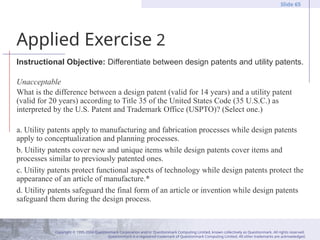
Applied Exercise 2
Instructional Objective: Differentiate between design patents and utility patents.
Unacceptable
What is the difference between a design patent (valid for 14 years) and a utility patent
(valid for 20 years) according to Title 35 of the United States Code (35 U.S.C.) as
interpreted by the U.S. Patent and Trademark Office (USPTO)? (Select one.)
a. Utility patents apply to manufacturing and fabrication processes while design patents
apply to conceptualization and planning processes.
b. Utility patents cover new and unique items while design patents cover items and
processes similar to previously patented ones.
c. Utility patents protect functional aspects of technology while design patents protect the
appearance of an article of manufacture.*
d. Utility patents safeguard the final form of an article or invention while design patents
safeguard them during the design process.
66. Copyright © 1995-2004 Questionmark Corporation and/or Questionmark Computing Limited, known collectively as Questionmark. All rights reserved.
Questionmark is a registered trademark of Questionmark Computing Limited. All other trademarks are acknowledged.
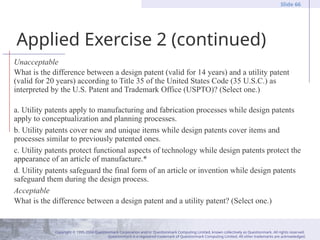
Slide 66
Applied Exercise 2 (continued)
Unacceptable
What is the difference between a design patent (valid for 14 years) and a utility patent
(valid for 20 years) according to Title 35 of the United States Code (35 U.S.C.) as
interpreted by the U.S. Patent and Trademark Office (USPTO)? (Select one.)
a. Utility patents apply to manufacturing and fabrication processes while design patents
apply to conceptualization and planning processes.
b. Utility patents cover new and unique items while design patents cover items and
processes similar to previously patented ones.
c. Utility patents protect functional aspects of technology while design patents protect the
appearance of an article of manufacture.*
d. Utility patents safeguard the final form of an article or invention while design patents
safeguard them during the design process.
Acceptable
What is the difference between a design patent and a utility patent? (Select one.)
67. Copyright © 1995-2004 Questionmark Corporation and/or Questionmark Computing Limited, known collectively as Questionmark. All rights reserved.
Questionmark is a registered trademark of Questionmark Computing Limited. All other trademarks are acknowledged.
Slide 67
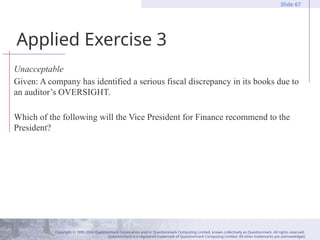
Applied Exercise 3
Unacceptable
Given: A company has identified a serious fiscal discrepancy in its books due to
an auditor’s OVERSIGHT.
Which of the following will the Vice President for Finance recommend to the
President?
68. Copyright © 1995-2004 Questionmark Corporation and/or Questionmark Computing Limited, known collectively as Questionmark. All rights reserved.
Questionmark is a registered trademark of Questionmark Computing Limited. All other trademarks are acknowledged.
Slide 68
Applied Exercise 3 (continued)
Unacceptable
Given: A company has identified a serious fiscal discrepancy in its books due
to an auditor’s OVERSIGHT. [There follows a full description of the
specifics.]
Which of the following will the Vice President for Finance recommend to the
President?
Acceptable
Given: A company has identified a serious fiscal discrepancy in its books due
to an auditor’s ERROR.
69. Copyright © 1995-2004 Questionmark Corporation and/or Questionmark Computing Limited, known collectively as Questionmark. All rights reserved.
Questionmark is a registered trademark of Questionmark Computing Limited. All other trademarks are acknowledged.
Slide 69
Applied Exercise 4
Unacceptable
Which of the following statements about mixing
bricklaying mortar is correct? (Select one.)
a. Use two parts sand, one part cement, and one part lime.
b. Mix to a soft, pliable consistency about like toothpaste.*
c. ALWAYS add a plasticiser to the mix.
d. Mix cement and water before adding sand.
70. Copyright © 1995-2004 Questionmark Corporation and/or Questionmark Computing Limited, known collectively as Questionmark. All rights reserved.
Questionmark is a registered trademark of Questionmark Computing Limited. All other trademarks are acknowledged.
Slide 70
Applied Exercise 4 (continued)
Acceptable
Which of the following statements about mixing
bricklaying mortar is correct? (Select one.)
a. Use two parts sand, one part cement, and one part lime.
b. Mix to a soft, pliable consistency about like toothpaste.*
c. Add a plasticiser to stiffen the mix.
d. Mix cement and water before adding sand.
71. Copyright © 1995-2004 Questionmark Corporation and/or Questionmark Computing Limited, known collectively as Questionmark. All rights reserved.
Questionmark is a registered trademark of Questionmark Computing Limited. All other trademarks are acknowledged.
Slide 71
Applied Exercise 5
Unacceptable
Blowing pure oxygen at supersonic velocity into the basic oxygen furnace
charge creates endothermic reactions sufficient to shorten the refining time to
about 20 minutes, depending on the size of the heat.
72. Copyright © 1995-2004 Questionmark Corporation and/or Questionmark Computing Limited, known collectively as Questionmark. All rights reserved.
Questionmark is a registered trademark of Questionmark Computing Limited. All other trademarks are acknowledged.
Slide 72
Applied Exercise 5 (continued)
Unacceptable
Blowing pure oxygen at supersonic velocity into the basic oxygen
furnace charge creates endothermic reactions sufficient to shorten
the refining time to about 20 minutes, depending on the size of the
heat.
Acceptable
Blowing pure oxygen at high speed into a mixture of liquid iron
and scrap metal greatly reduces the processing time for a batch of
steel.
73. Copyright © 1995-2004 Questionmark Corporation and/or Questionmark Computing Limited, known collectively as Questionmark. All rights reserved.
Questionmark is a registered trademark of Questionmark Computing Limited. All other trademarks are acknowledged.
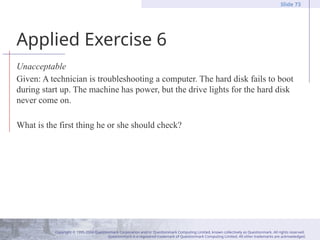
Slide 73
Applied Exercise 6
Unacceptable
Given: A technician is troubleshooting a computer. The hard disk fails to boot
during start up. The machine has power, but the drive lights for the hard disk
never come on.
What is the first thing he or she should check?
74. Copyright © 1995-2004 Questionmark Corporation and/or Questionmark Computing Limited, known collectively as Questionmark. All rights reserved.
Questionmark is a registered trademark of Questionmark Computing Limited. All other trademarks are acknowledged.
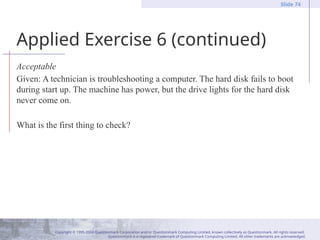
Slide 74
Applied Exercise 6 (continued)
Acceptable
Given: A technician is troubleshooting a computer. The hard disk fails to boot
during start up. The machine has power, but the drive lights for the hard disk
never come on.
What is the first thing to check?
75. Copyright © 1995-2004 Questionmark Corporation and/or Questionmark Computing Limited, known collectively as Questionmark. All rights reserved.
Questionmark is a registered trademark of Questionmark Computing Limited. All other trademarks are acknowledged.
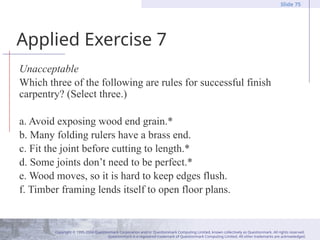
Slide 75
Applied Exercise 7
Unacceptable
Which three of the following are rules for successful finish
carpentry? (Select three.)
a. Avoid exposing wood end grain.*
b. Many folding rulers have a brass end.
c. Fit the joint before cutting to length.*
d. Some joints don’t need to be perfect.*
e. Wood moves, so it is hard to keep edges flush.
f. Timber framing lends itself to open floor plans.
76. Copyright © 1995-2004 Questionmark Corporation and/or Questionmark Computing Limited, known collectively as Questionmark. All rights reserved.
Questionmark is a registered trademark of Questionmark Computing Limited. All other trademarks are acknowledged.
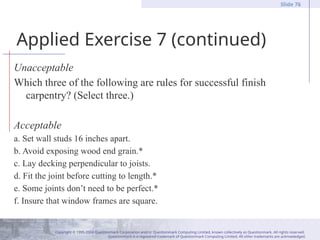
Slide 76
Applied Exercise 7 (continued)
Unacceptable
Which three of the following are rules for successful finish
carpentry? (Select three.)
Acceptable
a. Set wall studs 16 inches apart.
b. Avoid exposing wood end grain.*
c. Lay decking perpendicular to joists.
d. Fit the joint before cutting to length.*
e. Some joints don’t need to be perfect.*
f. Insure that window frames are square.
77. Copyright © 1995-2004 Questionmark Corporation and/or Questionmark Computing Limited, known collectively as Questionmark. All rights reserved.
Questionmark is a registered trademark of Questionmark Computing Limited. All other trademarks are acknowledged.
Slide 77
Applied Exercise 8
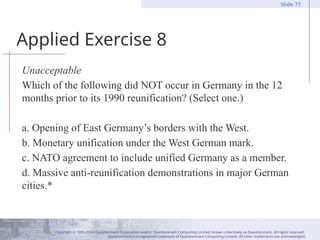
Unacceptable
Which of the following did NOT occur in Germany in the 12
months prior to its 1990 reunification? (Select one.)
a. Opening of East Germany’s borders with the West.
b. Monetary unification under the West German mark.
c. NATO agreement to include unified Germany as a member.
d. Massive anti-reunification demonstrations in major German
cities.*
78. Copyright © 1995-2004 Questionmark Corporation and/or Questionmark Computing Limited, known collectively as Questionmark. All rights reserved.
Questionmark is a registered trademark of Questionmark Computing Limited. All other trademarks are acknowledged.
Slide 78
Applied Exercise 8 (continued)
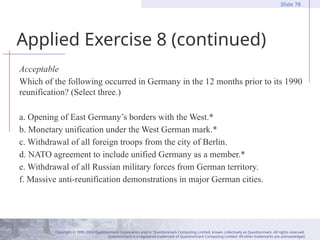
Acceptable
Which of the following occurred in Germany in the 12 months prior to its 1990
reunification? (Select three.)
a. Opening of East Germany’s borders with the West.*
b. Monetary unification under the West German mark.*
c. Withdrawal of all foreign troops from the city of Berlin.
d. NATO agreement to include unified Germany as a member.*
e. Withdrawal of all Russian military forces from German territory.
f. Massive anti-reunification demonstrations in major German cities.
79. Copyright © 1995-2004 Questionmark Corporation and/or Questionmark Computing Limited, known collectively as Questionmark. All rights reserved.
Questionmark is a registered trademark of Questionmark Computing Limited. All other trademarks are acknowledged.
Slide 79
Applied Exercise 9
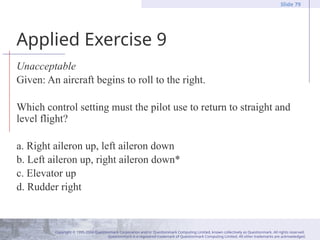
Unacceptable
Given: An aircraft begins to roll to the right.
Which control setting must the pilot use to return to straight and
level flight?
a. Right aileron up, left aileron down
b. Left aileron up, right aileron down*
c. Elevator up
d. Rudder right
80. Copyright © 1995-2004 Questionmark Corporation and/or Questionmark Computing Limited, known collectively as Questionmark. All rights reserved.
Questionmark is a registered trademark of Questionmark Computing Limited. All other trademarks are acknowledged.
Slide 80
Applied Exercise 9 (continued)
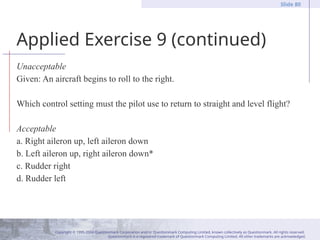
Unacceptable
Given: An aircraft begins to roll to the right.
Which control setting must the pilot use to return to straight and level flight?
Acceptable
a. Right aileron up, left aileron down
b. Left aileron up, right aileron down*
c. Rudder right
d. Rudder left
81. Copyright © 1995-2004 Questionmark Corporation and/or Questionmark Computing Limited, known collectively as Questionmark. All rights reserved.
Questionmark is a registered trademark of Questionmark Computing Limited. All other trademarks are acknowledged.
Slide 81
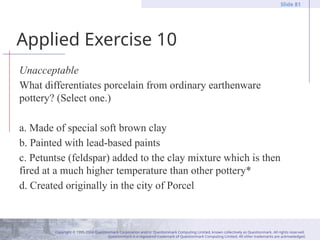
Applied Exercise 10
Unacceptable
What differentiates porcelain from ordinary earthenware
pottery? (Select one.)
a. Made of special soft brown clay
b. Painted with lead-based paints
c. Petuntse (feldspar) added to the clay mixture which is then
fired at a much higher temperature than other pottery*
d. Created originally in the city of Porcel
82. Copyright © 1995-2004 Questionmark Corporation and/or Questionmark Computing Limited, known collectively as Questionmark. All rights reserved.
Questionmark is a registered trademark of Questionmark Computing Limited. All other trademarks are acknowledged.
Slide 82
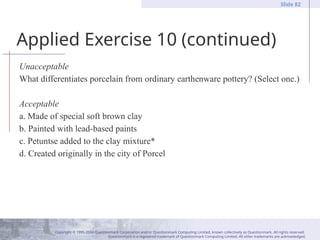
Applied Exercise 10 (continued)
Unacceptable
What differentiates porcelain from ordinary earthenware pottery? (Select one.)
Acceptable
a. Made of special soft brown clay
b. Painted with lead-based paints
c. Petuntse added to the clay mixture*
d. Created originally in the city of Porcel
83. Copyright © 1995-2004 Questionmark Corporation and/or Questionmark Computing Limited, known collectively as Questionmark. All rights reserved.
Questionmark is a registered trademark of Questionmark Computing Limited. All other trademarks are acknowledged.
Slide 83
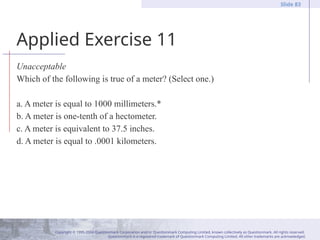
Applied Exercise 11
Unacceptable
Which of the following is true of a meter? (Select one.)
a. A meter is equal to 1000 millimeters.*
b. A meter is one-tenth of a hectometer.
c. A meter is equivalent to 37.5 inches.
d. A meter is equal to .0001 kilometers.
84. Copyright © 1995-2004 Questionmark Corporation and/or Questionmark Computing Limited, known collectively as Questionmark. All rights reserved.
Questionmark is a registered trademark of Questionmark Computing Limited. All other trademarks are acknowledged.
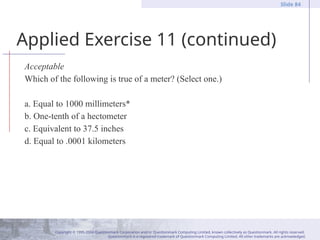
Slide 84
Applied Exercise 11 (continued)
Acceptable
Which of the following is true of a meter? (Select one.)
a. Equal to 1000 millimeters*
b. One-tenth of a hectometer
c. Equivalent to 37.5 inches
d. Equal to .0001 kilometers
85. Copyright © 1995-2004 Questionmark Corporation and/or Questionmark Computing Limited, known collectively as Questionmark. All rights reserved.
Questionmark is a registered trademark of Questionmark Computing Limited. All other trademarks are acknowledged.
Slide 85
Applied Exercise 12
Unacceptable
Match the terms with the definitions.
86. Copyright © 1995-2004 Questionmark Corporation and/or Questionmark Computing Limited, known collectively as Questionmark. All rights reserved.
Questionmark is a registered trademark of Questionmark Computing Limited. All other trademarks are acknowledged.
Slide 86
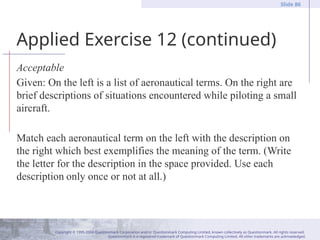
Applied Exercise 12 (continued)
Acceptable
Given: On the left is a list of aeronautical terms. On the right are
brief descriptions of situations encountered while piloting a small
aircraft.
Match each aeronautical term on the left with the description on
the right which best exemplifies the meaning of the term. (Write
the letter for the description in the space provided. Use each
description only once or not at all.)
87. Copyright © 1995-2004 Questionmark Corporation and/or Questionmark Computing Limited, known collectively as Questionmark. All rights reserved.
Questionmark is a registered trademark of Questionmark Computing Limited. All other trademarks are acknowledged.
Slide 87
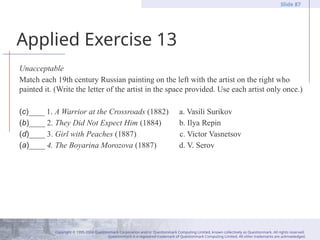
Applied Exercise 13
Unacceptable
Match each 19th century Russian painting on the left with the artist on the right who
painted it. (Write the letter of the artist in the space provided. Use each artist only once.)
(c)____ 1. A Warrior at the Crossroads (1882) a. Vasili Surikov
(b)____ 2. They Did Not Expect Him (1884) b. Ilya Repin
(d)____ 3. Girl with Peaches (1887) c. Victor Vasnetsov
(a)____ 4. The Boyarina Morozova (1887) d. V. Serov
88. Copyright © 1995-2004 Questionmark Corporation and/or Questionmark Computing Limited, known collectively as Questionmark. All rights reserved.
Questionmark is a registered trademark of Questionmark Computing Limited. All other trademarks are acknowledged.
Slide 88
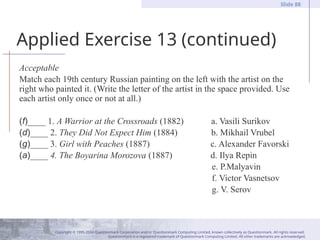
Applied Exercise 13 (continued)
Acceptable
Match each 19th century Russian painting on the left with the artist on the
right who painted it. (Write the letter of the artist in the space provided. Use
each artist only once or not at all.)
(f)____ 1. A Warrior at the Crossroads (1882) a. Vasili Surikov
(d)____ 2. They Did Not Expect Him (1884) b. Mikhail Vrubel
(g)____ 3. Girl with Peaches (1887) c. Alexander Favorski
(a)____ 4. The Boyarina Morozova (1887) d. Ilya Repin
e. P.Malyavin
f. Victor Vasnetsov
g. V. Serov
89. Copyright © 1995-2004 Questionmark Corporation and/or Questionmark Computing Limited, known collectively as Questionmark. All rights reserved.
Questionmark is a registered trademark of Questionmark Computing Limited. All other trademarks are acknowledged.
Slide 89
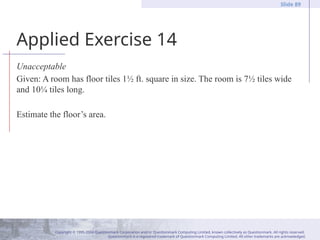
Applied Exercise 14
Unacceptable
Given: A room has floor tiles 1½ ft. square in size. The room is 7½ tiles wide
and 10¼ tiles long.
Estimate the floor’s area.
90. Copyright © 1995-2004 Questionmark Corporation and/or Questionmark Computing Limited, known collectively as Questionmark. All rights reserved.
Questionmark is a registered trademark of Questionmark Computing Limited. All other trademarks are acknowledged.
Slide 90
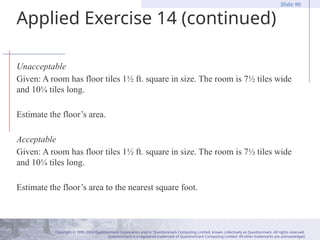
Applied Exercise 14 (continued)
Unacceptable
Given: A room has floor tiles 1½ ft. square in size. The room is 7½ tiles wide
and 10¼ tiles long.
Estimate the floor’s area.
Acceptable
Given: A room has floor tiles 1½ ft. square in size. The room is 7½ tiles wide
and 10¼ tiles long.
Estimate the floor’s area to the nearest square foot.
91. Copyright © 1995-2004 Questionmark Corporation and/or Questionmark Computing Limited, known collectively as Questionmark. All rights reserved.
Questionmark is a registered trademark of Questionmark Computing Limited. All other trademarks are acknowledged.
Slide 91
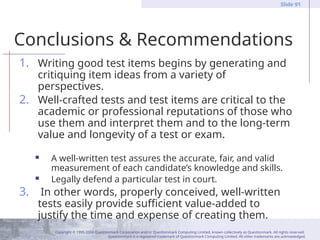
Conclusions & Recommendations
1. Writing good test items begins by generating and
critiquing item ideas from a variety of
perspectives.
2. Well-crafted tests and test items are critical to the
academic or professional reputations of those who
use them and interpret them and to the long-term
value and longevity of a test or exam.
A well-written test assures the accurate, fair, and valid
measurement of each candidate’s knowledge and skills.
Legally defend a particular test in court.
3. In other words, properly conceived, well-written
tests easily provide sufficient value-added to
justify the time and expense of creating them.
Editor's Notes #4 Board member since 2002
ATP (Association of Test Publishers)
Dr. Olsen has twenty-seven years experience in testing and assessment. He is responsible for job task analyses, test development and psychometric analyses and consults with corporations and national and state assessment and education agencies concerning technology and assessment. He has served as the principal investigator for several National Science Foundation and U.S. Department of Education grant awards. Dr. Olsen also serves as an Adjunct Faculty Member, Instructional Psychology and Technology Department, College of Education, at Brigham Young University and has also conducted seminars and classes for Educational Technology and Educational Measurement.
Dr. Olsen is a board member and standards committee member of the Association of Test Publishers and a member of the International Test Commission. He is a primary contributing author to the ATP Guidelines for Computer Based Testing. Dr. Olsen received his Ph.D. in Instructional Psychology from Brigham Young University and B.S. in Psychology from the University of Utah. #12 The workbook contains information on
Test Definition and Item Validity
Cognitive Levels
Test Item Types
Item Creation #13 Item developer
SME -- SMEs that will bring diverse perspectives to the effort
Good writer
Writing and review process overview
#14 We will provide detailed lists of objectives for each competency – built by SMEs in previous workshops
Cognitive level will be covered in just a moment
Clear and correct will be covered through the use of templates and by adhering to the item writing rules #16 What type of hammer is this?
How do you use this type of hammer?
Which type of hammer should you use in this situation? #18 Knowledge Items: Demonstrate their knowledge of a fact, principle or procedure
Skill Items: Solve problems, make decisions, evaluate possibilities, write a research paper, etc. #19 Mastery Tests:
Power Tests: Most instructional, competency, certification, and licensure exams are power tests.
The passing score on a power exam is often set between 60% and 80%.
Speeded Tests: Speeded tests are only used in rare circumstances to either a) match a high-pressure situation found on the job you are testing; or b) separate low to high performing candidates on a selection exam. #26 Talk about the instructions on # to select #33 Have the learners notice that there is something wrong with the example.
No matter how hard we tried to make good examples, we still make mistakes.
The issue: There is an equal number of destination and sources. #35 Notice that there is a distractor in the list (D) #37 Guidelines address several broad areas. We will review several of the key areas of concern, but very strongly recommend that you carefully review the entire Item Creation section (pp. 38-89). For the first few guidelines we will show an example on the screen & discuss it. Thereafter, please refer to the appropriate pages in the Item Writing Guide. #38 This is the foundation of sound testing. The items must address the objectives for the test.
Let’s take a look at a couple of examples. #39 This item exemplifies the rule: “Focus the item on aspects of the content area consistent with the test’s purpose.” (pp. 44-45). The test blueprint/specification tells you what the test’s purpose is; always keep it in mind. #40 This item is clearly better aligned to the stated purpose of the exam. #41 Align the item content to the specified content area. (pp. 45-46) #42 Item now focuses on the role of quartering as a factor leading to the Declaration of Independence. #43 Write relevant items (p. 46).
This is trivial information, clearly not relevant to the test objective. #44 This item now focuses on relevant information that the test taker should know to be competent. #45 Do not write trick questions (p. 48). Such items measure “puzzle-solving,” reading ability, or other irrelevant issues rather than the subject itself. The objective of testing is to measure, not to trip up candidates.
The only thing making the item false is the E-flat minor rather than Major.
#46 Do not write trick questions (p. 48). Such items measure “puzzle-solving,” reading ability, or other irrelevant issues rather than the subject itself. The objective of testing is to measure, not to trip up candidates.
The only thing making the item false is the E-flat minor rather than Major.
#47 Write independent items (pp. 48).
The follow-up question requires knowledge of the correct response to the original item and is therefore not an independent item. In this case, candidates would automatically miss the second item, even if they know how to compute per capita revenue.
#48 This version gives the candidate new data to use in the required calculation. It is independent of the previous items but tests the same knowledge. In this case, the candidate could show that they knew how to compute the per capita revenue.
Please refer to your Item Writing Guide for examples illustrating the remaining points we will discuss.
#49 Tom covered the subject of cognitive levels earlier, and this is also closely linked to the issue of focusing on stated objectives.
See pp. 54-56 of the Guide for examples.
The exam blueprint we will provide indicates the appropriate cognitive level for each objective.
What? (Knowledge)
How? (Performance)
Why? (Reasoning)
The item writer’s task is to formulate the question to that cognitive level, as well as to keep in mind who the target test population is, so as to write items at an appropriate level of difficulty. #50 Expect item writers to follow the format described in the Guide.
Clear & concise given statement or scenario, if necessary. (Common error to give too much information.)
Clear & concise instructions. (Vague instructions distract from the measurement of knowledge or skill.)
Question stem that clearly states the actual question the candidate is to answer.
Answer options and distractors from which to select the correct response. #53 Note that Item Writers should refer to the Guide for discussion of a few rules specific to each item type (pp. 81-89). #54 Note that Item Writers should refer to the Guide for discussion of a few rules specific to each item type (pp. 81-89). #55 Note that Item Writers should refer to the Guide for discussion of a few rules specific to each item type (pp. 81-89). #58 Given: A given statement setting up a specific situation would be appropriate with an objective of this sort; there are too many variables otherwise.
Stem:
Ref. Rules 2-05, 3-01. As stated, the question stem basically reiterates the objective statement. Recommend phrasing as a question.Ref. 3-04d. Recommend using active voice for clarity.
Recommend setting instructions off from stem text by using (parentheses.)
Options:
Option A: May want to separate these into two separate options: “state income tax payments” and “local income tax payments.”]
Option B: The answer options are indeed all “expenses”—that is good. They are also similar in length and the distractors seem plausible.
Reference: In a case like this reference a page number in the instructions for Schedules A & B rather than the schedules themselves. And include fairly complete bibliographical information for a published source. #59 Given: A given statement setting up a specific situation would be appropriate with an objective of this sort; there are too many variables otherwise.
Stem:
Ref. Rules 2-05, 3-01. As stated, the question stem basically reiterates the objective statement. Recommend phrasing as a question.Ref. 3-04d. Recommend using active voice for clarity.
Recommend setting instructions off from stem text by using (parentheses.)
Options:
Option A: May want to separate these into two separate options: “state income tax payments” and “local income tax payments.”]
Option B: The answer options are indeed all “expenses”—that is good. They are also similar in length and the distractors seem plausible.
Reference: In a case like this reference a page number in the instructions for Schedules A & B rather than the schedules themselves. And include fairly complete bibliographical information for a published source. #60 Given:
Ref. 3-01, 3-02. Avoid two-sentence question stems. If there is sufficient necessary information for two sentences, place some of it in a given statement. In this instance, however, we simplified the question statement instead.
Ref. 2-03. Need to strengthen directions a bit.
Question Stem: See comments for given statement.
Stimuli (premises):
Ref. 2-04. One of the options (a) is NOT an article of clothing. Test-wise candidates would ignore it.
Ref. 2-13. Two of the stimuli are markedly shorter than the others.
Response options: Writer recommended retaining a fixed order (cold, warm, hot) in presenting the options. Good point. Randomization would serve no useful purpose here.
#61 Given:
Ref. 3-01, 3-02. Avoid two-sentence question stems. If there is sufficient necessary information for two sentences, place some of it in a given statement. In this instance, however, we simplified the question statement instead.
Ref. 2-03. Need to strengthen directions a bit.
Question Stem: See comments for given statement.
Stimuli (premises):
Ref. 2-04. One of the options (a) is NOT an article of clothing. Test-wise candidates would ignore it.
Ref. 2-13. Two of the stimuli are markedly shorter than the others.
Response options: Writer recommended retaining a fixed order (cold, warm, hot) in presenting the options. Good point. Randomization would serve no useful purpose here.
#63 Relevant Items
The number of articles in the Constitution is not relevant to the stated objective. Focus on the content. #65 Test, not teach
The additional details, while informative, are not necessary to clearly state the question. #67 Words with multiple meanings.
Here the word “oversight” may be interpreted two ways. The VP’s recommendation depends to some extent on whether the auditor is the cause or the discoverer of the error. #69 No absolute modifiers
Testwise candidates may see absolute modifiers as a clue that the item writer intended the option to be false. #71 Appropriate reading level
This item uses difficult technical terminology which may not communicate effectively to all candidates.
#73 No gender pronouns
Avoid even seemingly unbiased gender references.
#75 Homogeneous options
Options (b), (e), and (f) are true statements, but are not RULES. In the acceptable version, options (a), (c) and (f) are RULES, but refer to framing rather than finish carpentry. #77 Positively worded stems
Negatively worded items are unnecessarily difficult for a candidate to sort out. Avoid this problem by making the item multiple selection rather than multiple choice if the candidate must be aware of several correct options.
#79 Option Clusters
Testwise candidates will suspect that the correct response is one of the options in the matched (a) and (b) pair and discount the other options. #81 Options similar length
Testwise candidates are more likely to select the longest, most complex option if unsure of the correct answer. Make sure distractors are all equally plausible and appealing. #83 Repeated words in stem
Removing repeated words from options to the stem contributes to brevity and simplicity. #85 Clear directions
Tell the candidate exactly what the matching task is and what to do to correctly answer the item. #87 Unequal # matching stems/options
It is a more valid test of the candidate’s knowledge to include distractors in the list of options. #89 Level of precision in computations
There is no indication of how precisely to estimate or what unit of measure to use.
![Copyright © 1995-2004 Questionmark Corporation and/or Questionmark Computing Limited, known collectively as Questionmark. All rights reserved.
Questionmark is a registered trademark of Questionmark Computing Limited. All other trademarks are acknowledged.
Slide 47
Item Writing Guidelines (example)
Content Alignment and Focus
Given: The table below shows the revenues for public
education of three states for a given year. [see table]
What is the average revenue?
Follow-up question:
Given: Each state had an average enrollment of 1.7 million
students.
What is the average per capita revenue?](https://image.slidesharecdn.com/writinggoodtestquestions-250623233701-baef9759/85/Writing-Good-2023-Test-Questions-pptx-47-320.jpg)
![Copyright © 1995-2004 Questionmark Corporation and/or Questionmark Computing Limited, known collectively as Questionmark. All rights reserved.
Questionmark is a registered trademark of Questionmark Computing Limited. All other trademarks are acknowledged.
Slide 58
Example 1 (Multiple Selection) –
Original Item
Given: [none]
Stem: Identify expenses that can be used as deductions on your
federal taxes. Check all that apply.
Options:
A. state and local income taxes*
B. gifts to charity*
C. gifts to family
D. home mortgage interest*
E. home mortgage payments
F. real estate taxes*
Reference:
Title: U.S. Income Tax Forms, Year: 2001, Page #: Schedule A & B.](https://image.slidesharecdn.com/writinggoodtestquestions-250623233701-baef9759/85/Writing-Good-2023-Test-Questions-pptx-58-320.jpg)
![Copyright © 1995-2004 Questionmark Corporation and/or Questionmark Computing Limited, known collectively as Questionmark. All rights reserved.
Questionmark is a registered trademark of Questionmark Computing Limited. All other trademarks are acknowledged.
Slide 60
Example 1 (Matching) – Original
Item
Given: [None.]
Question Stem: Each of the items below may be washed in an automatic front-
load washing machine. For each item, select the best temperature setting
for the wash cycle. (Type the number of the correct setting in the space
provided.)
Stimuli (premises):
1. Lightly soiled white towel
2. Silk blouse
3. Non-colorfast cotton shirt
4. Heavily soiled colorfast jeans
5. Woolen jacket
Response options:
A. Cold
B. Warm
C. Hot](https://image.slidesharecdn.com/writinggoodtestquestions-250623233701-baef9759/85/Writing-Good-2023-Test-Questions-pptx-60-320.jpg)
![Copyright © 1995-2004 Questionmark Corporation and/or Questionmark Computing Limited, known collectively as Questionmark. All rights reserved.
Questionmark is a registered trademark of Questionmark Computing Limited. All other trademarks are acknowledged.
Slide 61
Example 1 (Matching) – Revised
Item
Given: [None needed.]
Question Stem: Match each clothing item on the left with the appropriate
washing machine temperature setting on the right. (Place the letter for the
temperature setting in the space provided. You may use a setting more
than once.)
Stimuli (premises):
1. White cotton robe (B)
2. Washable silk blouse (A)
3. Non-colorfast cotton shirt (A)
4. Heavily soiled colorfast jeans (C)
5. Washable woolen jacket (B)
Response Options:
A. Cold
B. Warm
C. Hot](https://image.slidesharecdn.com/writinggoodtestquestions-250623233701-baef9759/85/Writing-Good-2023-Test-Questions-pptx-61-320.jpg)
![Copyright © 1995-2004 Questionmark Corporation and/or Questionmark Computing Limited, known collectively as Questionmark. All rights reserved.
Questionmark is a registered trademark of Questionmark Computing Limited. All other trademarks are acknowledged.
Slide 68
Applied Exercise 3 (continued)
Unacceptable
Given: A company has identified a serious fiscal discrepancy in its books due
to an auditor’s OVERSIGHT. [There follows a full description of the
specifics.]
Which of the following will the Vice President for Finance recommend to the
President?
Acceptable
Given: A company has identified a serious fiscal discrepancy in its books due
to an auditor’s ERROR.](https://image.slidesharecdn.com/writinggoodtestquestions-250623233701-baef9759/85/Writing-Good-2023-Test-Questions-pptx-68-320.jpg)