METHODS OF RESEARCH
TOPICS
2
1. GATHERING DATA
2. UPDATING YOUR METHODS
3. ADHERING TO RESEARCH ETHICS
1. GATHERING DATA
PRESENTATION
TITLE
3
 Gathering data is a crucial step in any research or project.
 It involves collecting information relevant to your objectives
and research questions.
 Effective data gathering ensures the quality and reliability
of your findings.
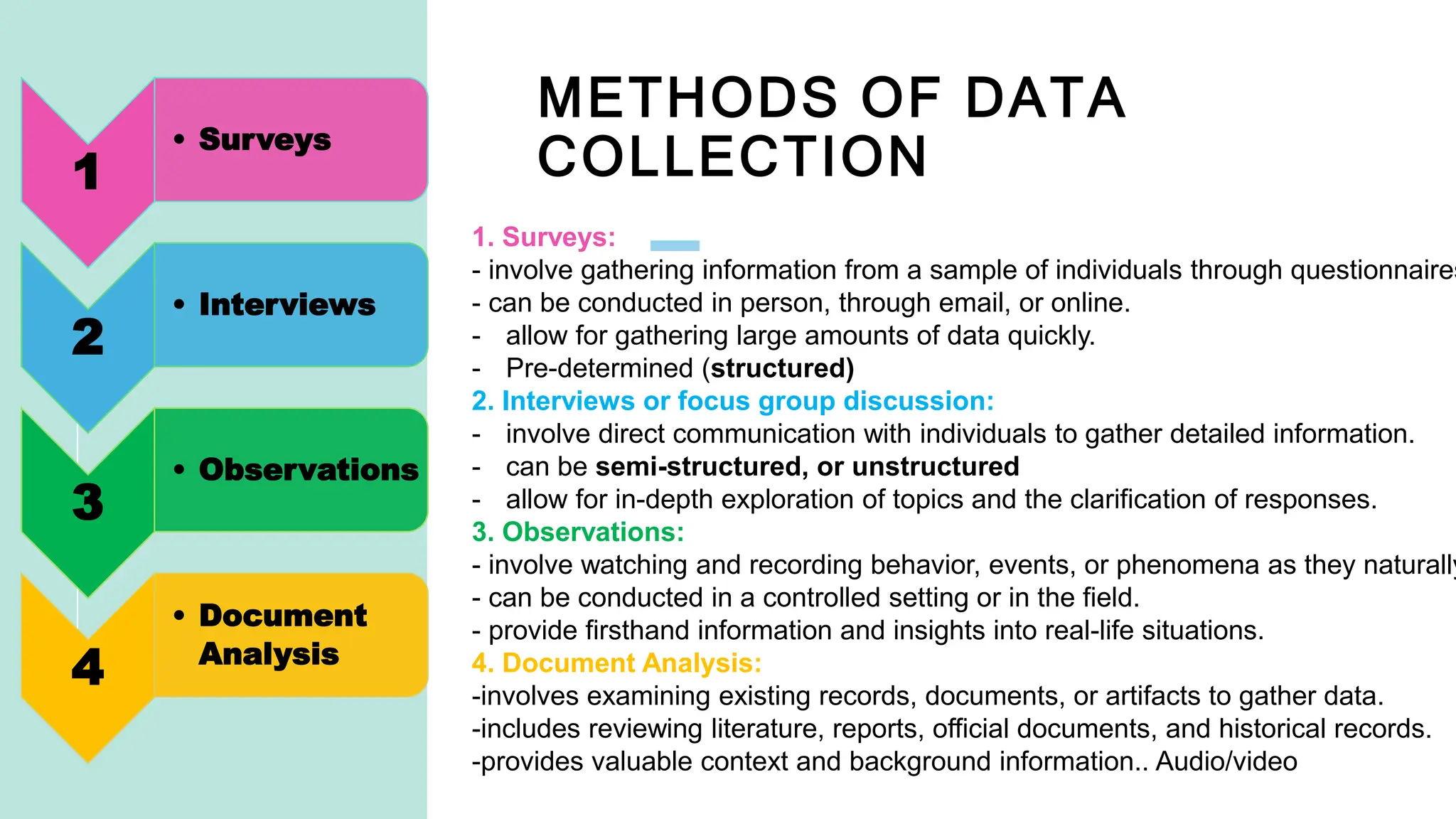
METHODS OF DATA
COLLECTION
4
1. Surveys:
- involve gathering information from a sample of individuals through questionnaires
- can be conducted in person, through email, or online.
- allow for gathering large amounts of data quickly.
- Pre-determined (structured)
2. Interviews or focus group discussion:
- involve direct communication with individuals to gather detailed information.
- can be semi-structured, or unstructured
- allow for in-depth exploration of topics and the clarification of responses.
3. Observations:
- involve watching and recording behavior, events, or phenomena as they naturally
- can be conducted in a controlled setting or in the field.
- provide firsthand information and insights into real-life situations.
4. Document Analysis:
-involves examining existing records, documents, or artifacts to gather data.
-includes reviewing literature, reports, official documents, and historical records.
-provides valuable context and background information.. Audio/video
1
• Surveys
2
• Interviews
3
• Observations
4
• Document
Analysis
SHARE YOUR DATA
GATHERING
EXPERIENCES
5
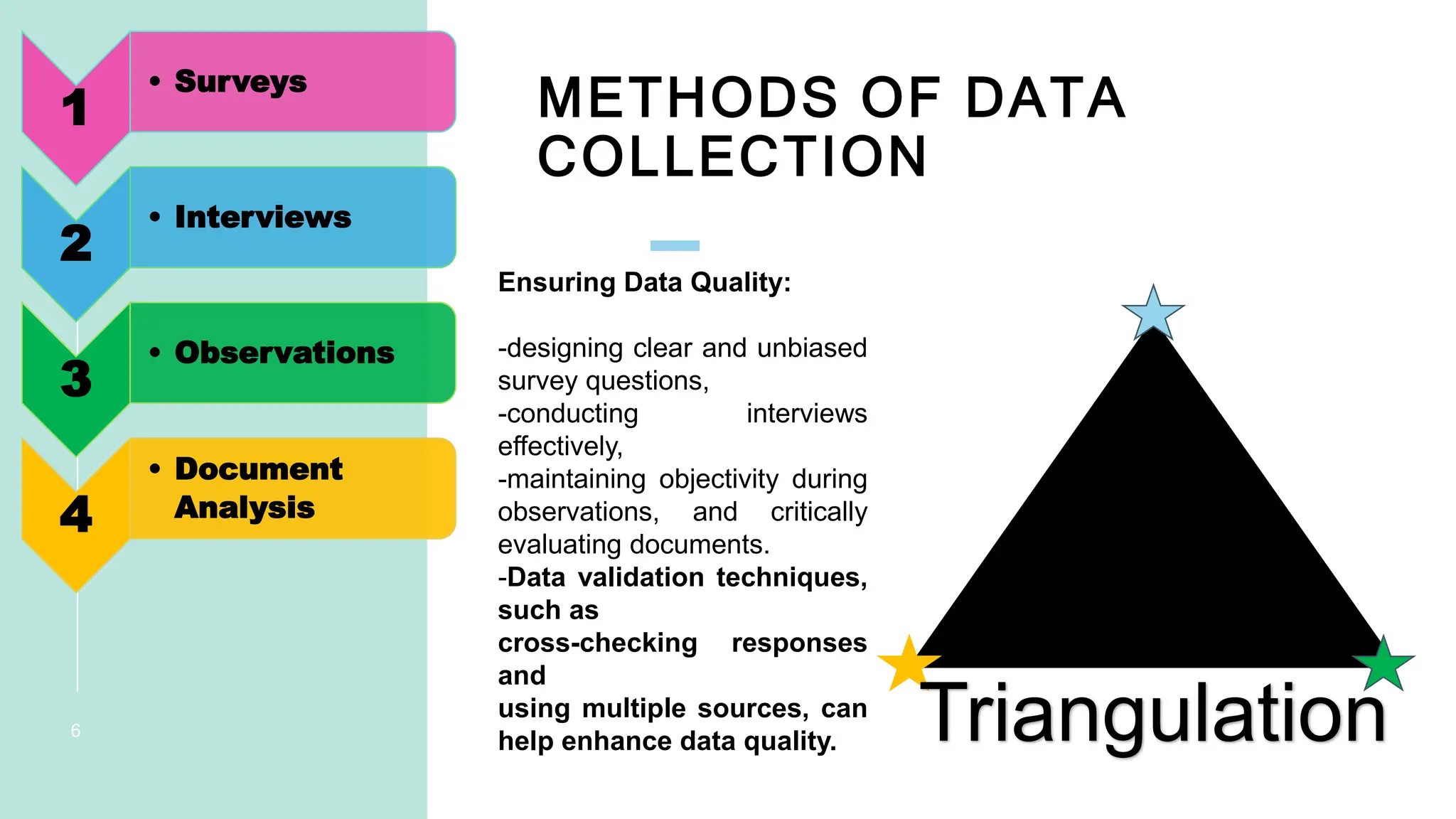
METHODS OF DATA
COLLECTION
6
1
• Surveys
2
• Interviews
3
• Observations
4
• Document
Analysis
Triangulation
Ensuring Data Quality:
-designing clear and unbiased
survey questions,
-conducting interviews
effectively,
-maintaining objectivity during
observations, and critically
evaluating documents.
-Data validation techniques,
such as
cross-checking responses
and
using multiple sources, can
help enhance data quality.
2. UPDATING YOUR
METHODS
7
 Inform the advisory committee about the changes you
intend to do and seek for their approval;
#number of participants
 Inform the advisory committee of all the changes made
during the defense; #change of SOP basing on the data
gathered
 Be transparent of the actual process
3. ADHERING TO
RESEARCH ETHICS
PRESENTATION
TITLE
8
adhering to research ethics is crucial.
“A research unethically
Researchers have a responsibility to conduct
their work ethically, ensuring the dignity,
rights, and welfare of participants while
maintaining the integrity and credibility of their
research findings.
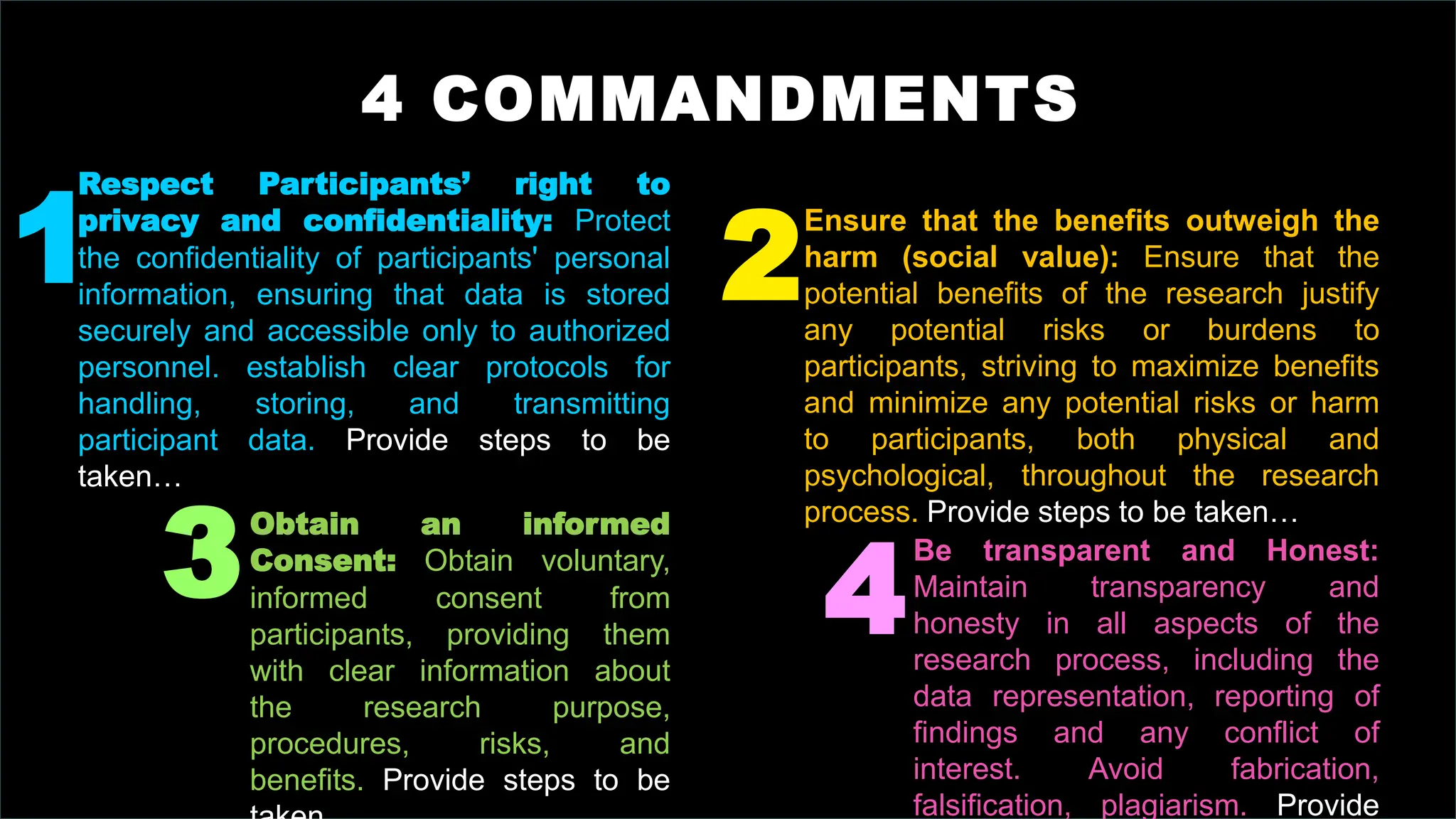
4 COMMANDMENTS
Respect Participants’ right to
privacy and confidentiality: Protect
the confidentiality of participants' personal
information, ensuring that data is stored
securely and accessible only to authorized
personnel. establish clear protocols for
handling, storing, and transmitting
participant data. Provide steps to be
taken…
Obtain an informed
Consent: Obtain voluntary,
informed consent from
participants, providing them
with clear information about
the research purpose,
procedures, risks, and
benefits. Provide steps to be
Be transparent and Honest:
Maintain transparency and
honesty in all aspects of the
research process, including the
data representation, reporting of
findings and any conflict of
interest. Avoid fabrication,
falsification, plagiarism. Provide
Ensure that the benefits outweigh the
harm (social value): Ensure that the
potential benefits of the research justify
any potential risks or burdens to
participants, striving to maximize benefits
and minimize any potential risks or harm
to participants, both physical and
psychological, throughout the research
process. Provide steps to be taken…
1
3 4
2
SHARE YOUR
THOUGHTS
1 0
1 1
“BEFORE YOU ACT, THINK:
WILL THIS DO MORE GOOD
THAN HARM FOR
EVERYONE? IF THE ANSWER
IS YES, THEN
IT'S A STEP WORTH
TAKING.”
THANK YOU

RESEARCH METHOD: DATA GATHERING AND ETHICS IN RESEARCH

  • 1.
  • 2.
    TOPICS 2 1. GATHERING DATA 2.UPDATING YOUR METHODS 3. ADHERING TO RESEARCH ETHICS
  • 3.
    1. GATHERING DATA PRESENTATION TITLE 3 Gathering data is a crucial step in any research or project.  It involves collecting information relevant to your objectives and research questions.  Effective data gathering ensures the quality and reliability of your findings.
  • 4.
    METHODS OF DATA COLLECTION 4 1.Surveys: - involve gathering information from a sample of individuals through questionnaires - can be conducted in person, through email, or online. - allow for gathering large amounts of data quickly. - Pre-determined (structured) 2. Interviews or focus group discussion: - involve direct communication with individuals to gather detailed information. - can be semi-structured, or unstructured - allow for in-depth exploration of topics and the clarification of responses. 3. Observations: - involve watching and recording behavior, events, or phenomena as they naturally - can be conducted in a controlled setting or in the field. - provide firsthand information and insights into real-life situations. 4. Document Analysis: -involves examining existing records, documents, or artifacts to gather data. -includes reviewing literature, reports, official documents, and historical records. -provides valuable context and background information.. Audio/video 1 • Surveys 2 • Interviews 3 • Observations 4 • Document Analysis
  • 5.
  • 6.
    METHODS OF DATA COLLECTION 6 1 •Surveys 2 • Interviews 3 • Observations 4 • Document Analysis Triangulation Ensuring Data Quality: -designing clear and unbiased survey questions, -conducting interviews effectively, -maintaining objectivity during observations, and critically evaluating documents. -Data validation techniques, such as cross-checking responses and using multiple sources, can help enhance data quality.
  • 7.
    2. UPDATING YOUR METHODS 7 Inform the advisory committee about the changes you intend to do and seek for their approval; #number of participants  Inform the advisory committee of all the changes made during the defense; #change of SOP basing on the data gathered  Be transparent of the actual process
  • 8.
    3. ADHERING TO RESEARCHETHICS PRESENTATION TITLE 8 adhering to research ethics is crucial. “A research unethically Researchers have a responsibility to conduct their work ethically, ensuring the dignity, rights, and welfare of participants while maintaining the integrity and credibility of their research findings.
  • 9.
    4 COMMANDMENTS Respect Participants’right to privacy and confidentiality: Protect the confidentiality of participants' personal information, ensuring that data is stored securely and accessible only to authorized personnel. establish clear protocols for handling, storing, and transmitting participant data. Provide steps to be taken… Obtain an informed Consent: Obtain voluntary, informed consent from participants, providing them with clear information about the research purpose, procedures, risks, and benefits. Provide steps to be Be transparent and Honest: Maintain transparency and honesty in all aspects of the research process, including the data representation, reporting of findings and any conflict of interest. Avoid fabrication, falsification, plagiarism. Provide Ensure that the benefits outweigh the harm (social value): Ensure that the potential benefits of the research justify any potential risks or burdens to participants, striving to maximize benefits and minimize any potential risks or harm to participants, both physical and psychological, throughout the research process. Provide steps to be taken… 1 3 4 2
  • 10.
  • 11.
    1 1 “BEFORE YOUACT, THINK: WILL THIS DO MORE GOOD THAN HARM FOR EVERYONE? IF THE ANSWER IS YES, THEN IT'S A STEP WORTH TAKING.”
  • 12.