PRACTICAL RESEARCH 2
IMRAD CHAPTER 1 & 2
THESIS(IMRAD & IMFAD)
Chapter I – BACKGROUND OF THE STUDY
• INTRODUCTION
• LITERATURE REVIEW
• THEORETICAL AND CONCEPTUAL FRAMEWORK
• STATEMENT OF THE PROBLEM OR RESEARCH OBJECTIVE
• SIGNIFICANCE OF THE STUDY
• SCOPE AND LIMITATION
• DEFINITION OF TERMS
THESIS(IMRAD & IMFAD)
Chapter II - METHOD
• RESEARCH DESIGN
• RESEARCH LOCALE
• SUBJECTS/REPONDENTS/PARTICIPANTS
• SAMPLE
• INSTRUMENTS
• DATA COLLECTIONS
• ETHICAL CONSIDERATION
CHAPTER I – BACKGROUND OFTHE STUDY
This section contains the
rationale regarding the need to
conduct the research.
INTRODUCTION
•This section provides the background and aim of
the research to be conducted. This demonstrates
the in-depth understanding and knowledge of the
researcher/s on the research problem supported
by the findings and recommendations from
previous researches and literature.
INTRODUCTION
• A comprehensive representation of the broad problem(s) or
research question(s) under investigation.
• Some background information about the topic under
investigation in different perspective (mega Level, macro Level
and micro level).
• Details of any related theories.
• Reason(s) why the research is conducted to justify it.
HOWTO WRITEYOUR
INTRODUCTION
•Make your outline
•Stay focused
•Use noteworthy statements
•Use quotations that lend authority to your work
•Review
LITERATURE REVIEW
• This section contains the related literature and studies that
are considered as relevant to the present study. In writing the
literature review, researchers should take note of the year the
literature was published, or the studies were conducted. A
literature synthesis is included at the end of the chapter
which explains the difference/s between the reviewed studies
or literature to the present research problem.
LITERATURE REVIEW
•Research literature and related studies refer to
sources of readings that are significant contributions
to the present research.
•Related studies are critical pieces of writing that
contextualize or provide background to a new piece
of research.
LITERATURE REVIEW
•all the published research in that field
•survey research on a particular area or topic.
•knit together theories and results from multiple
studies to give an overview of a field of research
RESEARCH LITERATURE WRITING
• Identify and define the topic that you will be reviewing.
• Conduct a literature search.
• Read through the research that you have found and take notes.
• Organize your notes and thoughts; create an outline.
• Write the literature review itself and edit and revise as needed.
• Incorporate the literature review into your research paper draft.
THEORETICAL AND/OR CONCEPTUAL
FRAMEWORKS
• The use of theoretical and/or conceptual framework depends on the research
design to be used in the study. Researches intended to develop theory, testing
theory, or application of theory utilizes the theoretical framework. The
theories that serve as the backbone/framework of the study is explained in this
section. While for non-theoretical research, a conceptual framework is
applicable. The conceptual framework expresses the relationship among the
variables that are raised in the study.
STATEMENT OFTHE PROBLEM OR
RESEARCH OBJECTIVES
• The problem should be stated precisely, accurately and clearly.
• It can be stated either in the declarative or interrogative form.
• It can be either one main statement question, or a series of
statements/questions, or a combination of these forms.
• The problem should be defined in terms of the data that can
be obtained.
STATEMENT OFTHE PROBLEM OR
RESEARCH OBJECTIVES
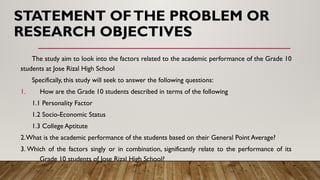
The study aim to look into the factors related to the academic performance of the Grade 10
students at Jose Rizal High School
Specifically, this study will seek to answer the following questions:
1. How are the Grade 10 students described in terms of the following
1.1 Personality Factor
1.2 Socio-Economic Status
1.3 College Aptitute
2.What is the academic performance of the students based on their General Point Average?
3. Which of the factors singly or in combination, significantly relate to the performance of its
Grade 10 students of Jose Rizal High School?
SIGNIFICANCE OFTHE STUDY
• Reveals the intellectual merit of the proposed activity.
• Pressing reason why this study needs to be conducted.
• It shall indicate the broader impacts of the proposed activity on
advance discovery and understanding while promoting teaching,
training and learning.
• Dissemination of the study to the broadest possible audience and the
benefit of the bigger society from the study.
SIGNIFICANCE OFTHE STUDY
The findings of the study have a great value in helping the parents, teachers,
administrator as well as the learners.
To the administrator, it would serve as a basis on the kind of programs and
policies that might be complemented to improve the level of the performance of
student.
To the teacher, the study would provide additional knowledge on how factors
related to Academic performance could be improved for greater improvement of the
academic performance of the learners.
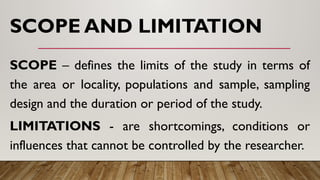
SCOPE AND LIMITATION
SCOPE – defines the limits of the study in terms of
the area or locality, populations and sample, sampling
design and the duration or period of the study.
LIMITATIONS - are shortcomings, conditions or
influences that cannot be controlled by the researcher.
SCOPE AND LIMITATION
This study attempted to look into the factors
that are related to the Academic Performance of
the Grade 10 Students of Jose Rizal High School
of Capas,Tarlac for the school year 2020-2021.
The study specifically determined the ………
DEFINITION OFTERMS
This section defines the conceptual and operational definition
of important terminologies that appear in
the study
Research studies usually include terms that must be carefully
and precisely defined, so that others know exactly what has
been done and there are no ambiguities.
DEFINITION OFTERMS
Conceptual definition explains what to measure or
observe (what a word or a term means for your study)
Operational definition defines exactly how to
measure or observe it.
Research Introduction, Methodology Results And Discussion format

Research Introduction, Methodology Results And Discussion format

  • 1.
  • 2.
    THESIS(IMRAD & IMFAD) ChapterI – BACKGROUND OF THE STUDY • INTRODUCTION • LITERATURE REVIEW • THEORETICAL AND CONCEPTUAL FRAMEWORK • STATEMENT OF THE PROBLEM OR RESEARCH OBJECTIVE • SIGNIFICANCE OF THE STUDY • SCOPE AND LIMITATION • DEFINITION OF TERMS
  • 3.
    THESIS(IMRAD & IMFAD) ChapterII - METHOD • RESEARCH DESIGN • RESEARCH LOCALE • SUBJECTS/REPONDENTS/PARTICIPANTS • SAMPLE • INSTRUMENTS • DATA COLLECTIONS • ETHICAL CONSIDERATION
  • 4.
    CHAPTER I –BACKGROUND OFTHE STUDY This section contains the rationale regarding the need to conduct the research.
  • 5.
    INTRODUCTION •This section providesthe background and aim of the research to be conducted. This demonstrates the in-depth understanding and knowledge of the researcher/s on the research problem supported by the findings and recommendations from previous researches and literature.
  • 6.
    INTRODUCTION • A comprehensiverepresentation of the broad problem(s) or research question(s) under investigation. • Some background information about the topic under investigation in different perspective (mega Level, macro Level and micro level). • Details of any related theories. • Reason(s) why the research is conducted to justify it.
  • 7.
    HOWTO WRITEYOUR INTRODUCTION •Make youroutline •Stay focused •Use noteworthy statements •Use quotations that lend authority to your work •Review
  • 8.
    LITERATURE REVIEW • Thissection contains the related literature and studies that are considered as relevant to the present study. In writing the literature review, researchers should take note of the year the literature was published, or the studies were conducted. A literature synthesis is included at the end of the chapter which explains the difference/s between the reviewed studies or literature to the present research problem.
  • 9.
    LITERATURE REVIEW •Research literatureand related studies refer to sources of readings that are significant contributions to the present research. •Related studies are critical pieces of writing that contextualize or provide background to a new piece of research.
  • 10.
    LITERATURE REVIEW •all thepublished research in that field •survey research on a particular area or topic. •knit together theories and results from multiple studies to give an overview of a field of research
  • 12.
    RESEARCH LITERATURE WRITING •Identify and define the topic that you will be reviewing. • Conduct a literature search. • Read through the research that you have found and take notes. • Organize your notes and thoughts; create an outline. • Write the literature review itself and edit and revise as needed. • Incorporate the literature review into your research paper draft.
  • 13.
    THEORETICAL AND/OR CONCEPTUAL FRAMEWORKS •The use of theoretical and/or conceptual framework depends on the research design to be used in the study. Researches intended to develop theory, testing theory, or application of theory utilizes the theoretical framework. The theories that serve as the backbone/framework of the study is explained in this section. While for non-theoretical research, a conceptual framework is applicable. The conceptual framework expresses the relationship among the variables that are raised in the study.
  • 14.
    STATEMENT OFTHE PROBLEMOR RESEARCH OBJECTIVES • The problem should be stated precisely, accurately and clearly. • It can be stated either in the declarative or interrogative form. • It can be either one main statement question, or a series of statements/questions, or a combination of these forms. • The problem should be defined in terms of the data that can be obtained.
  • 15.
    STATEMENT OFTHE PROBLEMOR RESEARCH OBJECTIVES The study aim to look into the factors related to the academic performance of the Grade 10 students at Jose Rizal High School Specifically, this study will seek to answer the following questions: 1. How are the Grade 10 students described in terms of the following 1.1 Personality Factor 1.2 Socio-Economic Status 1.3 College Aptitute 2.What is the academic performance of the students based on their General Point Average? 3. Which of the factors singly or in combination, significantly relate to the performance of its Grade 10 students of Jose Rizal High School?
  • 16.
    SIGNIFICANCE OFTHE STUDY •Reveals the intellectual merit of the proposed activity. • Pressing reason why this study needs to be conducted. • It shall indicate the broader impacts of the proposed activity on advance discovery and understanding while promoting teaching, training and learning. • Dissemination of the study to the broadest possible audience and the benefit of the bigger society from the study.
  • 17.
    SIGNIFICANCE OFTHE STUDY Thefindings of the study have a great value in helping the parents, teachers, administrator as well as the learners. To the administrator, it would serve as a basis on the kind of programs and policies that might be complemented to improve the level of the performance of student. To the teacher, the study would provide additional knowledge on how factors related to Academic performance could be improved for greater improvement of the academic performance of the learners.
  • 18.
    SCOPE AND LIMITATION SCOPE– defines the limits of the study in terms of the area or locality, populations and sample, sampling design and the duration or period of the study. LIMITATIONS - are shortcomings, conditions or influences that cannot be controlled by the researcher.
  • 19.
    SCOPE AND LIMITATION Thisstudy attempted to look into the factors that are related to the Academic Performance of the Grade 10 Students of Jose Rizal High School of Capas,Tarlac for the school year 2020-2021. The study specifically determined the ………
  • 20.
    DEFINITION OFTERMS This sectiondefines the conceptual and operational definition of important terminologies that appear in the study Research studies usually include terms that must be carefully and precisely defined, so that others know exactly what has been done and there are no ambiguities.
  • 21.
    DEFINITION OFTERMS Conceptual definitionexplains what to measure or observe (what a word or a term means for your study) Operational definition defines exactly how to measure or observe it.