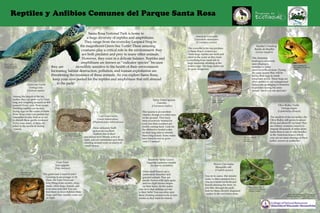
Reptiles y Anfibios Comunes del Parque Santa Rosa
Santa Rosa National Park is home to
a huge diversity of reptiles and amphibians.
They range from the everyday Leopard Frog to
the magnificent Green Sea Turtle! These amazing
creatures play a critical role in the environment: they
are both predator and prey to many other animals.
However, they exist in a delicate balance. Reptiles and
amphibians are known as “indicator species” because
they are incredibly sensitive to the health of their environment.
Increasing habitat destruction, pollution, and human exploitation are
threatening the existance of these animals. As you explore Santa Rosa,
keep your eyes peeled for the reptiles and amphibians that still abound
in the park!Green Sea Turtle
Tortuga lora
(Chelonia mydas)
Among the largest of the sea
turtles, they can grow up to 3 feet
long and weighing as much as 400
pounds! Every year, these ocean-
dwelling reptiles can be seen
laying eggs on the coasts of Santa
Rosa. Keep your eyes peeled, but
remember to only look so as not
to disturb these gentle creatures!
Every year, many of them are
killed in the trawls of shrimp
vessels.
American Crocodile
Crocodrilo americano
(Crocodylus acutus)
The crocodile is the top predator
in Santa Rosa’s waterways.
These large reptiles are swift and
silent in the water as they hunt
everything from small fish to
large mammals drinking at the
waters edge. The large males can
be quite dangerous
Stauffer’s Treefrog
Ranita de Stauffer
(Scinax staufferi)
This charming
treefrog is commonly
seen clinging to
branches or plant
stems in wetland areas. During
the rainy season they will be
laying their eggs in small,
temporary pools. These frogs are
often spotted in our campground
bathrooms or clinging to branches
in puddles during the rainy
season. See if you can spot any!
Leaf-Toed Gecko
Gueco tuberculoso
(Phylllodactylus tuberculosus)
These delicately built
geckos are excellent
climbers due to their
specialized toes! Mostly active at
night, you can sometimes spot them
climbing around rocks in search of
small insects.
Spiny-Tailed Iguana
Garrobo
(Ctenosaura similis)
This iguana is an excellent
climber, though it is often seen
on the ground. They have
been excessively hunted for
food, but their numbers are
slowly coming back. Look for
the distinctive keeled scales
on their long tails to identify
these long lizards. Some males
have been known to grow
over 1.5 meters!
Rosebelly Spiny Lizard
Lagartija espinosa variable
(Sceloporus variabilis)
These small lizards are a
particularly beautiful and
graceful animal. They are
mostly brown with light spots
and two light brown stripes
on their backs. Its the males
who have that striking red tint
to their belly! You can often spot
them climbing around rocks or tree
trunks as they hunt for insects.
Brown Vine Snake
Bejuquilla café
(Oxybelis aeneus)
True to its name, this slender
snake is often mistaken for a
vine as it hunts for birds and
lizards amoung the trees. As
you hike through the park,
look for these cleverly disguised
snakes in the wet forest areas.
Photo Courtesy Of:
Dr. Tim Burkhardt, 2005
Photo Courtesy Of:
Anywhere Costa Rica by
Pompilro Campos
Cane Toad
Sapo gigante
(Bufo marinus)
This giant toad is hard to miss!
Growing to an average of 10-
15cm, the Cane Toad eats
everything from spiders, slugs,
snails, other frogs, lizards, and
even mice and rats! You can
find them in dryer habitats than
frogs, and they usually come out
at night.
Olive Ridley Turtle
Tortuga negra
(Lepidochelys olivacea)
The smallest of the sea turtles, the
Olive Ridley still grows to about
45 kg and about 65 cm long! They
are solitary creatures, known to
migrate thousands of miles alone.
Santa Rosa is one of only beaches
in the American tropics where
you can see mass nestings of these
turtles, known as arribadas!
Photo Courtesy Of:
Tim Martin
naturepl.com
Photo Courtesy Of:
Christian Mehlfuhrer,
2007
Photo Courtesy Of:
Diana-Terry Hibbitts,
2012
Photo Courtesy Of:
ShareAlike 2.5 by Maciej
Pabijan
Photo Courtesy Of:
Lorenzo Menendez,
National Geographic
Photo Courtesy Of:
Roman Pashkeev
Photo Courtesy Of:
Brian Gatwicke
This poster was created by Environmental
Education students at UWSP as part of their
capstone experience.

Reptiles

  • 1.
    Reptiles y AnfibiosComunes del Parque Santa Rosa Santa Rosa National Park is home to a huge diversity of reptiles and amphibians. They range from the everyday Leopard Frog to the magnificent Green Sea Turtle! These amazing creatures play a critical role in the environment: they are both predator and prey to many other animals. However, they exist in a delicate balance. Reptiles and amphibians are known as “indicator species” because they are incredibly sensitive to the health of their environment. Increasing habitat destruction, pollution, and human exploitation are threatening the existance of these animals. As you explore Santa Rosa, keep your eyes peeled for the reptiles and amphibians that still abound in the park!Green Sea Turtle Tortuga lora (Chelonia mydas) Among the largest of the sea turtles, they can grow up to 3 feet long and weighing as much as 400 pounds! Every year, these ocean- dwelling reptiles can be seen laying eggs on the coasts of Santa Rosa. Keep your eyes peeled, but remember to only look so as not to disturb these gentle creatures! Every year, many of them are killed in the trawls of shrimp vessels. American Crocodile Crocodrilo americano (Crocodylus acutus) The crocodile is the top predator in Santa Rosa’s waterways. These large reptiles are swift and silent in the water as they hunt everything from small fish to large mammals drinking at the waters edge. The large males can be quite dangerous Stauffer’s Treefrog Ranita de Stauffer (Scinax staufferi) This charming treefrog is commonly seen clinging to branches or plant stems in wetland areas. During the rainy season they will be laying their eggs in small, temporary pools. These frogs are often spotted in our campground bathrooms or clinging to branches in puddles during the rainy season. See if you can spot any! Leaf-Toed Gecko Gueco tuberculoso (Phylllodactylus tuberculosus) These delicately built geckos are excellent climbers due to their specialized toes! Mostly active at night, you can sometimes spot them climbing around rocks in search of small insects. Spiny-Tailed Iguana Garrobo (Ctenosaura similis) This iguana is an excellent climber, though it is often seen on the ground. They have been excessively hunted for food, but their numbers are slowly coming back. Look for the distinctive keeled scales on their long tails to identify these long lizards. Some males have been known to grow over 1.5 meters! Rosebelly Spiny Lizard Lagartija espinosa variable (Sceloporus variabilis) These small lizards are a particularly beautiful and graceful animal. They are mostly brown with light spots and two light brown stripes on their backs. Its the males who have that striking red tint to their belly! You can often spot them climbing around rocks or tree trunks as they hunt for insects. Brown Vine Snake Bejuquilla café (Oxybelis aeneus) True to its name, this slender snake is often mistaken for a vine as it hunts for birds and lizards amoung the trees. As you hike through the park, look for these cleverly disguised snakes in the wet forest areas. Photo Courtesy Of: Dr. Tim Burkhardt, 2005 Photo Courtesy Of: Anywhere Costa Rica by Pompilro Campos Cane Toad Sapo gigante (Bufo marinus) This giant toad is hard to miss! Growing to an average of 10- 15cm, the Cane Toad eats everything from spiders, slugs, snails, other frogs, lizards, and even mice and rats! You can find them in dryer habitats than frogs, and they usually come out at night. Olive Ridley Turtle Tortuga negra (Lepidochelys olivacea) The smallest of the sea turtles, the Olive Ridley still grows to about 45 kg and about 65 cm long! They are solitary creatures, known to migrate thousands of miles alone. Santa Rosa is one of only beaches in the American tropics where you can see mass nestings of these turtles, known as arribadas! Photo Courtesy Of: Tim Martin naturepl.com Photo Courtesy Of: Christian Mehlfuhrer, 2007 Photo Courtesy Of: Diana-Terry Hibbitts, 2012 Photo Courtesy Of: ShareAlike 2.5 by Maciej Pabijan Photo Courtesy Of: Lorenzo Menendez, National Geographic Photo Courtesy Of: Roman Pashkeev Photo Courtesy Of: Brian Gatwicke This poster was created by Environmental Education students at UWSP as part of their capstone experience.