My Mullica River
Picture Book
Veronica Coia
© Copyright 2013, All rights reserved. www.veronicacoia.com.
My Mullica River Picture Book
Table of Contents:
River ........................................................ 1
Blue Heron................................................4
Red Bellied Turtles....................................6
Canadian Geese.....................................10
Ducks.....................................................12
Birds.......................................................14
Dragonfly................................................16
Damselfly................................................20
Frog........................................................22
Flowers...................................................24
Batsto Village..........................................32
Bridges...................................................34
Snake......................................................36
Ghost?....................................................37
Acknowledgements
References: Thank you Gabriel Coia, Vanessa and
Angelo Lello, Steven Seidler, Bob Moyer, Wikipedia.
org, Pineypower.com, and Hogan Photo. Without your
boats, technical skills, expertise and websites, this
book would not be possible nor accurate!
Talent: A special thanks to Batsto Village, God, Mother
Nature, and all of the creatures and flowers pictured.
Below: Evening Primrose (Genus Oenethera).
1
Ahhh, I love my Mullica River. It is,
literally and figuratively, my home
sweet home, as is the Batsto River.
The Batsto is a 22.9 mile long (36.9
km) tributary of the 50.6 mile (81.4
km) Mullica River, located in the
Pine Barrens of the Wharton State
Forest in southern New Jersey. They
meet up at The Forks, located in
Sweetwater. The Batsto is pretty
narrow; as is the upstream portion
of the Mullica. The fragrant cedar
water transitions into salt water,
widening as it approaches the
Great Bay, home of some of the
least disturbed wetlands habitats
in the Northeastern U.S. It flows
into the Atlantic Ocean.
2
I have never truly
appreciated how
fragrant the Pine
Barrens were
until I returned for
summer break
from art school.
As we got closer
to the house I’d
lived throughout
my teens, I deeply
inhaled that sweet,
fragrant scent
far into my city
polluted lungs.
Mmmm, to this
day, it is one of
the best scents
on Earth!
Each summer, I
go out as often as
possible with my
nephew Gabe,
whose kayaks and
canoes bring us
to branches of the
3
river upstream so
undetected, quiet
and beautiful,
we consider
it our church.
I also venture
downstream as
much as possible,
usually in my
sister Vanessa
and her husband
Angelo’s motor
boat, La Nostra.
When the tide and
conditions are just
right, we head
out to the ocean
into the salty air.
Don’t you just
love that funky
eggy smell?
I know, books
aren’t scented,
so, I hope you
will enjoy my
picture book.
4 5
ready to capture
them. It took five
years to get these
pictures, and I’m
still not satisfied!
They tend to be
loners; I don’t
recall ever seeing
one hanging out
with another.
They do, however,
stick close to
trees surrounding
water along the
east coast of the
United States.
I love watching
them in flight;
and hearing their
wings in motion.
They move so
gracefully and
are quite stealth!
The Great Blue
Heron, (Ardea
herodias) are
actually a cool
grayish color
initially; acquiring
the more bluish
hue as they age.
Although they
stand approximately
4 feet tall, and
have a wingspan
of 68–79 inches
(167–201 cm),
these graceful
wading birds
are surprisingly
light, weighing in
between 4 and
8 lbs (2.1–3.6 kg).
I call them elusive
because they are
camera-shy, only
appearing when
my camera is not
76
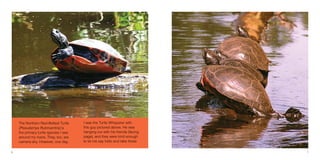
The Northern Red-Bellied Turtle
(Pseudemys Rubriventris) is
the primary turtle species I see
around my rivers. They, too, are
camera-shy. However, one day,
I was the Turtle Whisperer with
this guy pictured above. He was
hanging out with his friends (facing
page), and they were kind enough
to let me say hello and take these
9
Further upstream, on the Batsto,
we came across another kind turtle,
who had this crack in his shell.
Fortunately, he seemed on the
8
pictures. Although his friends took
off, he and I hung out for a bit. I was
so close I saw his eyeball blinking!
I whispered to him that I wanted his
life by the water sunning, swimming
or hiding when those pesky humans
show up. I felt honored and amazed
to be in his presence.
mend, and showed no signs of
distress, but the mystery remains:
how, exactly, did this turtle get that
crack in the shell?
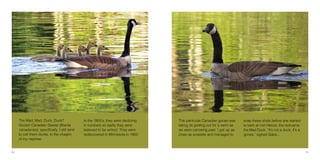
This particular Canadian goose was
taking its gosling out for a swim as
we were canoeing past. I got up as
close as possible and managed to
snap these shots before she started
to bark at me! Hence, the nickname
the Mad Duck. “It’s not a duck, it’s a
goose,” sighed Gabe...
11
The Mad, Mad, Duck, Duck?
Goose! Canadian Geese (Branta
canadensis), specifically. I still tend
to call them ducks, to the chagrin
of my nephew.
In the 1950’s, they were declining
in numbers so badly they were
believed to be extinct. They were
rediscovered in Minnesota in 1962.
10
1312
What kind of duck is this, in
addition to being adorable? A
Mallard? Transitional Mallard? Or
is it a Hybrid with American Black
Duck? He hung out with us much
of the afternoon. We were in a
silly mood, and somehow we
ended up affectionately calling him
Puppyducky. We’ve seen him at
least one other time that summer,
he’s easy to spot with the unusual
spotting! Puppyducky, you’re the
one! On another day, we came
across this other duck, er, I meant
to say Canadian Goose, further
upstream. She seemed to be in a
rather mellow mood, which worked
out well for me as I took this photo.
She happily posed, unlike that
barking “mad duck-goose.”
15
I’m still trying to identify this bird we
found nesting (at left). He appears
to have a black head and white
breast, and his beak appears to
be a lighter color.
14
I had an easier time identifying
this other mad bird: a Black Crow
(Corvus brachyrhynchos), who
appeared quite intent on pecking
away at the stony looking object.
great shots, it was hard to narrow
down to two, so I’m showing four!
Are those the eyes, with brown
pupils, or at this angle, are they her
ears that appear to have a burst
17
Strike a pose! Despite the need for
speed, this lovely lady hung out
and struck many poses for me, after
initially resisting, and at one point,
flying into my face! I got so many
16
The Great Blue Skimmer Dragonfly
(Libellula vibrans Fabricius) are
among the largest, with a length
between (50–63 mm). They get
their blue tinge as they mature.
Dragonflies are among the fastest
flying insects, with speeds between
22–34 mph (10–15 meters per
second). I’ve never been able to
catch them...until this particular day.
18 19
front edges of the wings, what an
amazing creature! Her head shape
resembles that of a skull, that is kind
of creepy! If she can hold this
pose, she won’t need a mask
for Halloween! Yo, Scullface!
of blue shaped similarly to a star?
Looking at her from each angle, it’s
hard to tell; I’m beginning to think
that what I initially thought were
the eyes are actually the nose!
At this angle, can you see the
teeth? Note too, the interesting
yellow spots on each of the
20 21
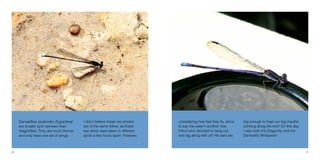
Damselflies (suborder Zygoptera)
are smaller and narrower than
dragonflies. They are much thinner
and only have one set of wings.
I don’t believe these two photos
are of the same fellow, as these
two shots were taken in different
spots a few hours apart. However,
considering how fast they fly, who’s
to say this wasn’t another new
friend who decided to hang out
and tag along with us? His ears are
big enough to hear our big mouths
echoing along the river! On this day,
I was both the Dragonfly and the
Damselfly Whisperer!
22 23
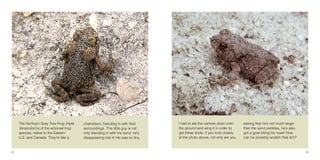
I had to set the camera down onto
the ground and wing it in order to
get these shots. If you look closely
at the photo above, not only are you
The Northern Gray Tree Frog (Hyla
Versicolor) is of the arboreal frog
species, native to the Eastern
U.S. and Canada. They’re like a
chameleon, blending in with their
surroundings. This little guy is not
only blending in with the sand, he’s
disappearing into it! He was so tiny,
seeing that he’s not much larger
than the sand pebbles, he’s also
got a gnat biting his nose! How
can he possibly scratch that itch?
This Yellow Pond Lily (Nuphar
variegatum) literally looks like a burst
of sunshine from within. Note how
the pattern in the center of the flower
resembles the sun. I waded into the
2524
lily pads as the sun was setting, (my
toes were green by the time I was
done). The photo above was aimed
directly into the water; that’s the river
behind the flower, not the night...
27
If you’re surrounded
by Pickerel Weed
(Pontedaria cordata),
you must be amongst
the lily pads. This one
must be napping
in this photo.
The purple leaves
burst open each
morning; obviously
this was later
in the afternoon.
I’ve always thought
they added a burst
of color amongst the
pines and the rivers,
as do the yellow
Evening Primrose
(Genus Oenethera)
on the facing page
which were in full
bloom for miles
along the Mullica.
26
28 29
The pink flowers on the left, Swamp
Milkweed (Asclepia incarnata)
were spotted only a few times on
the Batsto, towards the village,
as were the vibrant St. Johnswort
(Hypericum pyramidatum), above.
The center of this flower is orange,
and was spotted even less often
than it’s neighbor.
30 31
The Turk’s Cap, or Tiger Lily
(Lilium superbum), left, is a native
Northern American plant along
the east coast of the U.S. and
can grow from 3–7 feet. The
New York Ironweed (Vernonia
noveboracensis), above, shows
spectrum of pink within the buds.
33
This is one of the houses in Historic
Batsto Village, located on Route
542 in the Wharton State Forest, in
Atlantic County, New Jersey. The
facing page is the waterfall dam
beside it, which separates a lake
from the area of the Batsto River
where we canoe. I never knew this
waterfall existed until fairly recently
when we paddled upstream during
32
high tide and were able to reach
it. There’s another dam just below
Route 542 where we tend to, at
times, bottom out when trying to
quickly paddle over the concrete
barrier. Not pictured are a few
pleasant tourists enjoying the
beauty and history of the Village as
we waved hello and simultaneously
snapped photos of each other.
34
Among my best times growing up
were spent hanging by the Green
Bank Bridge (left). We used to go
to “The Steps” (replaced by the
wall pictured on the horizon line)
and hang at the Pavilion, prior
to overregulation. We’re heading
downstream in the canoe. The view
from the Lower Bank Bridge (above),
is a very serene and inspiring place
to clear out your headspace. From
this view, we’re looking upstream.
35
3736
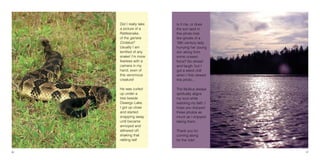
Did I really take
a picture of a
Rattlesnake,
of the genera
Crotalus?
Usually I am
terrified of any
snake! I’m more
fearless with a
camera in my
hand, even of
this venomous
creature!
He was curled
up under a
tree beside
Oswego Lake.
I got up close
and started
snapping away
until became
annoyed and
slithered off,
shaking that
rattling tail!
Is it me, or does
the sun spot in
this photo look
like ghosts of a
19th century lady
hurrying her young
son along from
some unseen
force? Go ahead
and laugh, but I
got a weird chill
when I first viewed
this photo....
The Mullica always
spiritually aligns
my soul while
restoring my faith, I
hope you enjoyed
these photos as
much as I enjoyed
taking them.
Thank you for
coming along
for the ride!
My Mullica River Picture Book by Veronica-Ann Coia.
© Copyright 2013, All rights reserved. www.veronicacoia.com
My Mullica River Picture Book is a canoe journey
of the Mullica River and its tributary, The Batsto
River, showcasing images of the habitat native
to the South Jersey Pine Barrens, located in
Sweetwater and Batsto, New Jersey. Design,
photography and commentary by Veronica Coia.
My Mullica River Picture Book

riverbook_web

  • 1.
    My Mullica River PictureBook Veronica Coia
  • 2.
    © Copyright 2013,All rights reserved. www.veronicacoia.com. My Mullica River Picture Book Table of Contents: River ........................................................ 1 Blue Heron................................................4 Red Bellied Turtles....................................6 Canadian Geese.....................................10 Ducks.....................................................12 Birds.......................................................14 Dragonfly................................................16 Damselfly................................................20 Frog........................................................22 Flowers...................................................24 Batsto Village..........................................32 Bridges...................................................34 Snake......................................................36 Ghost?....................................................37 Acknowledgements References: Thank you Gabriel Coia, Vanessa and Angelo Lello, Steven Seidler, Bob Moyer, Wikipedia. org, Pineypower.com, and Hogan Photo. Without your boats, technical skills, expertise and websites, this book would not be possible nor accurate! Talent: A special thanks to Batsto Village, God, Mother Nature, and all of the creatures and flowers pictured. Below: Evening Primrose (Genus Oenethera).
  • 3.
    1 Ahhh, I lovemy Mullica River. It is, literally and figuratively, my home sweet home, as is the Batsto River. The Batsto is a 22.9 mile long (36.9 km) tributary of the 50.6 mile (81.4 km) Mullica River, located in the Pine Barrens of the Wharton State Forest in southern New Jersey. They meet up at The Forks, located in Sweetwater. The Batsto is pretty narrow; as is the upstream portion of the Mullica. The fragrant cedar water transitions into salt water, widening as it approaches the Great Bay, home of some of the least disturbed wetlands habitats in the Northeastern U.S. It flows into the Atlantic Ocean.
  • 4.
    2 I have nevertruly appreciated how fragrant the Pine Barrens were until I returned for summer break from art school. As we got closer to the house I’d lived throughout my teens, I deeply inhaled that sweet, fragrant scent far into my city polluted lungs. Mmmm, to this day, it is one of the best scents on Earth! Each summer, I go out as often as possible with my nephew Gabe, whose kayaks and canoes bring us to branches of the 3 river upstream so undetected, quiet and beautiful, we consider it our church. I also venture downstream as much as possible, usually in my sister Vanessa and her husband Angelo’s motor boat, La Nostra. When the tide and conditions are just right, we head out to the ocean into the salty air. Don’t you just love that funky eggy smell? I know, books aren’t scented, so, I hope you will enjoy my picture book.
  • 5.
    4 5 ready tocapture them. It took five years to get these pictures, and I’m still not satisfied! They tend to be loners; I don’t recall ever seeing one hanging out with another. They do, however, stick close to trees surrounding water along the east coast of the United States. I love watching them in flight; and hearing their wings in motion. They move so gracefully and are quite stealth! The Great Blue Heron, (Ardea herodias) are actually a cool grayish color initially; acquiring the more bluish hue as they age. Although they stand approximately 4 feet tall, and have a wingspan of 68–79 inches (167–201 cm), these graceful wading birds are surprisingly light, weighing in between 4 and 8 lbs (2.1–3.6 kg). I call them elusive because they are camera-shy, only appearing when my camera is not
  • 6.
    76 The Northern Red-BelliedTurtle (Pseudemys Rubriventris) is the primary turtle species I see around my rivers. They, too, are camera-shy. However, one day, I was the Turtle Whisperer with this guy pictured above. He was hanging out with his friends (facing page), and they were kind enough to let me say hello and take these
  • 7.
    9 Further upstream, onthe Batsto, we came across another kind turtle, who had this crack in his shell. Fortunately, he seemed on the 8 pictures. Although his friends took off, he and I hung out for a bit. I was so close I saw his eyeball blinking! I whispered to him that I wanted his life by the water sunning, swimming or hiding when those pesky humans show up. I felt honored and amazed to be in his presence. mend, and showed no signs of distress, but the mystery remains: how, exactly, did this turtle get that crack in the shell?
  • 8.
    This particular Canadiangoose was taking its gosling out for a swim as we were canoeing past. I got up as close as possible and managed to snap these shots before she started to bark at me! Hence, the nickname the Mad Duck. “It’s not a duck, it’s a goose,” sighed Gabe... 11 The Mad, Mad, Duck, Duck? Goose! Canadian Geese (Branta canadensis), specifically. I still tend to call them ducks, to the chagrin of my nephew. In the 1950’s, they were declining in numbers so badly they were believed to be extinct. They were rediscovered in Minnesota in 1962. 10
  • 9.
    1312 What kind ofduck is this, in addition to being adorable? A Mallard? Transitional Mallard? Or is it a Hybrid with American Black Duck? He hung out with us much of the afternoon. We were in a silly mood, and somehow we ended up affectionately calling him Puppyducky. We’ve seen him at least one other time that summer, he’s easy to spot with the unusual spotting! Puppyducky, you’re the one! On another day, we came across this other duck, er, I meant to say Canadian Goose, further upstream. She seemed to be in a rather mellow mood, which worked out well for me as I took this photo. She happily posed, unlike that barking “mad duck-goose.”
  • 10.
    15 I’m still tryingto identify this bird we found nesting (at left). He appears to have a black head and white breast, and his beak appears to be a lighter color. 14 I had an easier time identifying this other mad bird: a Black Crow (Corvus brachyrhynchos), who appeared quite intent on pecking away at the stony looking object.
  • 11.
    great shots, itwas hard to narrow down to two, so I’m showing four! Are those the eyes, with brown pupils, or at this angle, are they her ears that appear to have a burst 17 Strike a pose! Despite the need for speed, this lovely lady hung out and struck many poses for me, after initially resisting, and at one point, flying into my face! I got so many 16 The Great Blue Skimmer Dragonfly (Libellula vibrans Fabricius) are among the largest, with a length between (50–63 mm). They get their blue tinge as they mature. Dragonflies are among the fastest flying insects, with speeds between 22–34 mph (10–15 meters per second). I’ve never been able to catch them...until this particular day.
  • 12.
    18 19 front edgesof the wings, what an amazing creature! Her head shape resembles that of a skull, that is kind of creepy! If she can hold this pose, she won’t need a mask for Halloween! Yo, Scullface! of blue shaped similarly to a star? Looking at her from each angle, it’s hard to tell; I’m beginning to think that what I initially thought were the eyes are actually the nose! At this angle, can you see the teeth? Note too, the interesting yellow spots on each of the
  • 13.
    20 21 Damselflies (suborderZygoptera) are smaller and narrower than dragonflies. They are much thinner and only have one set of wings. I don’t believe these two photos are of the same fellow, as these two shots were taken in different spots a few hours apart. However, considering how fast they fly, who’s to say this wasn’t another new friend who decided to hang out and tag along with us? His ears are big enough to hear our big mouths echoing along the river! On this day, I was both the Dragonfly and the Damselfly Whisperer!
  • 14.
    22 23 I hadto set the camera down onto the ground and wing it in order to get these shots. If you look closely at the photo above, not only are you The Northern Gray Tree Frog (Hyla Versicolor) is of the arboreal frog species, native to the Eastern U.S. and Canada. They’re like a chameleon, blending in with their surroundings. This little guy is not only blending in with the sand, he’s disappearing into it! He was so tiny, seeing that he’s not much larger than the sand pebbles, he’s also got a gnat biting his nose! How can he possibly scratch that itch?
  • 15.
    This Yellow PondLily (Nuphar variegatum) literally looks like a burst of sunshine from within. Note how the pattern in the center of the flower resembles the sun. I waded into the 2524 lily pads as the sun was setting, (my toes were green by the time I was done). The photo above was aimed directly into the water; that’s the river behind the flower, not the night...
  • 16.
    27 If you’re surrounded byPickerel Weed (Pontedaria cordata), you must be amongst the lily pads. This one must be napping in this photo. The purple leaves burst open each morning; obviously this was later in the afternoon. I’ve always thought they added a burst of color amongst the pines and the rivers, as do the yellow Evening Primrose (Genus Oenethera) on the facing page which were in full bloom for miles along the Mullica. 26
  • 17.
    28 29 The pinkflowers on the left, Swamp Milkweed (Asclepia incarnata) were spotted only a few times on the Batsto, towards the village, as were the vibrant St. Johnswort (Hypericum pyramidatum), above. The center of this flower is orange, and was spotted even less often than it’s neighbor.
  • 18.
    30 31 The Turk’sCap, or Tiger Lily (Lilium superbum), left, is a native Northern American plant along the east coast of the U.S. and can grow from 3–7 feet. The New York Ironweed (Vernonia noveboracensis), above, shows spectrum of pink within the buds.
  • 19.
    33 This is oneof the houses in Historic Batsto Village, located on Route 542 in the Wharton State Forest, in Atlantic County, New Jersey. The facing page is the waterfall dam beside it, which separates a lake from the area of the Batsto River where we canoe. I never knew this waterfall existed until fairly recently when we paddled upstream during 32 high tide and were able to reach it. There’s another dam just below Route 542 where we tend to, at times, bottom out when trying to quickly paddle over the concrete barrier. Not pictured are a few pleasant tourists enjoying the beauty and history of the Village as we waved hello and simultaneously snapped photos of each other.
  • 20.
    34 Among my besttimes growing up were spent hanging by the Green Bank Bridge (left). We used to go to “The Steps” (replaced by the wall pictured on the horizon line) and hang at the Pavilion, prior to overregulation. We’re heading downstream in the canoe. The view from the Lower Bank Bridge (above), is a very serene and inspiring place to clear out your headspace. From this view, we’re looking upstream. 35
  • 21.
    3736 Did I reallytake a picture of a Rattlesnake, of the genera Crotalus? Usually I am terrified of any snake! I’m more fearless with a camera in my hand, even of this venomous creature! He was curled up under a tree beside Oswego Lake. I got up close and started snapping away until became annoyed and slithered off, shaking that rattling tail! Is it me, or does the sun spot in this photo look like ghosts of a 19th century lady hurrying her young son along from some unseen force? Go ahead and laugh, but I got a weird chill when I first viewed this photo.... The Mullica always spiritually aligns my soul while restoring my faith, I hope you enjoyed these photos as much as I enjoyed taking them. Thank you for coming along for the ride!
  • 22.
    My Mullica RiverPicture Book by Veronica-Ann Coia. © Copyright 2013, All rights reserved. www.veronicacoia.com My Mullica River Picture Book is a canoe journey of the Mullica River and its tributary, The Batsto River, showcasing images of the habitat native to the South Jersey Pine Barrens, located in Sweetwater and Batsto, New Jersey. Design, photography and commentary by Veronica Coia. My Mullica River Picture Book