Project Report
Submitted by: AshimaKhurana, DFBMMP150823
2015-2017
Submitted to MAFMG Course Team
4th
December 2015
Pearl Academy
New Delhi
Declaration
I hereby declare that the project work entitled “Report on H&M”, submitted to the Pearl
Academy, is a record of an original work done by me under the guidance of Dr.SunitaKonwar,
Course Leader of Masters in Fashion Marketing, and this project is submitted in the partial
fulfilment of the requirements for the award of the degree of Master in Fashion Marketing. The
results embodied in this work have not been submitted to any other University or Institute for the
award of any degree or diploma.
Name of the student: AshimaKhurana
Signature:
Acknowledgment
I am highly grateful to the course leader of Masters in Fashion Marketing, Dr.SunitaKonwar for
her constant guidance and supervision as well as for providing necessary information regarding
the project and also the support and motivation for the completing the project. I have made a lot
of efforts in this project, however it would have not been possible without the kind support and
help of many individuals, I would like to convey my heartiest gratitude to Dr.Ponamkumar, for
her constant help and encouragement, I would like to extend my special gratitude and thanks to
Mr RajeeshRavindran, Dr.PreetiGoel, Ms Preeti Dewan, Mrs Usha , Mr Piyush Pandey, Mrs
Ritu Jain, Mr Rahul Jain for giving me such attention and time. Without their kind word, friendly
advice during the project, this would have not been possible.
A special thanks to H&M’s assistant manager & Visual Merchandiser of Select City Walk saket
store, for giving an insight into the working structure of the brand.I would like to thanks the
various consumers for their kind cooperation and allowing the interviews with them. Also I
would like to express my thanks for Ex-employee of ZARA for providing inside information of
the firm. In the end I would like to express my gratitude towards my parents and friends for kind
co-operation and encouragement which helped me in completion of this project.
Name: AshimaKhurana
Course: MA Fashion Marketing
Cohort: 2015-17
Bridge Semester 0
List of Figures
Figure 1 Market apparel size Projection
Figure 2 Shopping Pattern
Figure 3-5 Research Methodology
Figure 6 Ambience Vasant Kunj
Figure 7 Promotional Launch Party
Figure 8-12 Select City Walk
Figure 13 Lead Time
Figure 14 Supply Chain
Figure 15-19 Sustainability initiatives of H&M
Figure 20-21 Growth of H&M
Figure 22-29 Financials
Figure 30-43 Consumer Analysis
Figure 44-47 Competitor Analysis
Figure 48 BCG
Table of Content
S.No. Topic
1) Introduction
1.1 Growth of Fast Fashion across the Country
1.2 About H&M
1.3 Rationale
1.4 Research Objectives
2) Company’s Business Profile
2.1 Brief History of H&M
2.2 Mission and Vision of the Firm
2.3 Usp of H&M
3) Marketing Mix
3.1 Product Mix
3.2 STP
3.3 Ans-off Matrix
3.3.1 Indian Scenario
3.3.2 Global Scenario
4) Retail Mix
5) Organisational Structure
6) HRM
6.1 Recruitment and selection Process
6.2 Social Compliance
7) Supply Chain Management
8) Sustainability Initiatives by H&M
9) Growth of H&M in decade
10) Financial Analysis
11) Pest Analysis
12) Consumer Analysis
12.1 Interpretation
12.2 SWOT
13) Competitor Analysis
13.1 Interviews
13.2 BCG Matrix
14) Conclusion & Reflections
15) References
16) Annexures
H&M- Fashion for All
MAFMG
Semester 0
1
Ashima khurana
Executive Summary
The project aims to gain knowledge about the brand H&M Globally as well as in relation to it’s recent
entry in India. Since it has given consumer a new choice for the fast fashion products. Also globally
leading this brand had been planning to enter India since past few years and after it’s entry it marked the
first day sales crossing 1.75 Crores showing the enthusiasm of the consumers towards the firm. Also
presence of it’s competitors from past few years has lead to a comparative study for the same. The prime
aim of the project is to study 3 things
1. The brand
2. The consumer’s forming perception about this newly entered brand
3. To draw a comparison between H&M and it’s competitor
To study the brand, interview were conducted with the internal customers of the firm to know it’s
working policies and internal environment. Also on look at the website gave the full information about
the connectivity of the firm across the globe and it’s ethical working conditions. Since the company have
major focus on sustainability thereby reports and articles of company’s initiatives towards the cause were
looked at. Since the firm has entered India 2 months ago therefore the consumer’s perception towards the
brand holds utter importance since the firm’s success or failure depends more on how the customers find
their product. Thus a consumer analysis was conducted with aim to know the what the final consumers
think about H&M. Also few shoppers were interview as to how was their experience at H&M
The firm has entered a competitive environment where the fast- fashion brands are already established
thereby a comparison was drawn among the brands both in terms of satisfaction of internal customers as
well as external customers for better understanding and suggestions for further areas of improvement.
Also a comparison in terms of difference in Economic Environment over past 5 years was studied.
The report finds that the brand is doing well globally and has been able to keep it’s employees happy and
satisfied and has achieved the rank 24 in the world by Great places to work. Also financially the company
is in healthy state. However there is a lot to go do for external customers in terms of Location of the
stores, Trust, Awareness, Merchandise.
The information collected in consumer analysis was from the sample size of 99. Thereby the analysis are
in accordance to the sample size and in depth interviews conducted with the consumers as well as
employees
H&M- Fashion for All
MAFMG
Semester 0
2
Ashima khurana
 Introduction
In India the Textile & Apparel market was estimated at INR 3,20,000 crore (USD 58 billion), in
2013, and is projected to grow at a CAGR of 9% to INR 7,57,000 crore (USD 138 billion) by
2023 (Technopak 2015). It is the second largest industry in India, giving employment to
approximately 45 million people (India Brand Equity Foundation 2015). Moreover if you look
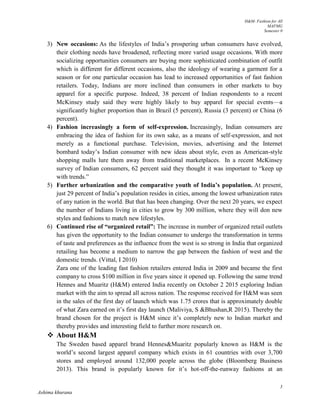
at the market size projection in table below India got the highest annual compound growth rate of
12% that means that the market size in India is projected to grow at the highest pace in the
following forecast.
The growth of apparel industry and the potential of the nation haslead to increased investment of
foreign retailers. The partial growth in this sector can be attributed to the emergence of new
industry players called “fast fashion retailers”- which can be seen as an explosive expansion in
past few years. Fast fashion is a phrase used for designs that move quickly from the catwalk to
showrooms to tap the latest consumer
trends, is growing at a yearly pace of
25-30%, twice the rate of the overall
market (Tandon,S&Agarwal,S 2013)
The tables were turned from classic
fashions to fast fashion by coming up
of ZARA in India in 2009 which
became the first apparel brand in
India to cross $100-million sales
mark, five years after it opened it’s
first shop here.(Malviya,S 2015)
Fast-Fashion In India
The reasons for the rapid growing fast fashion in Indian consumers could be following:
1) Increase in disposable income. By 2005, 21 million of India’s 210 million households
already earned more than $4,000 a year, qualifying them for membership in what we call
“the consuming class.” Based on McKinsey research, by 2015 the number of consuming
class households will likely triple to 64 million.
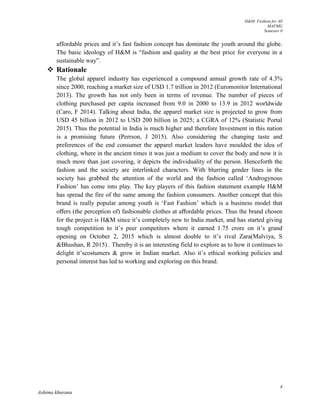
2) Both the Genders in India equally love
shopping for clothes: According to UN reports
India’s population is the youngest across the
world. Another research tells that both the
genders in India equally love shopping for
apparels.In a market where almost all shoppers
love or enjoy clothes shopping, it is no surprise
that India is projected to become the world's third
largest apparel market by 2020.
Source: Statista.com
Figure:1
Source: Cottoninc.com
Figure: 2
H&M- Fashion for All
MAFMG
Semester 0
3
Ashima khurana
3) New occasions: As the lifestyles of India’s prospering urban consumers have evolved,
their clothing needs have broadened, reflecting more varied usage occasions. With more
socializing opportunities consumers are buying more sophisticated combination of outfit
which is different for different occasions, also the ideology of wearing a garment for a
season or for one particular occasion has lead to increased opportunities of fast fashion
retailers. Today, Indians are more inclined than consumers in other markets to buy
apparel for a specific purpose. Indeed, 38 percent of Indian respondents to a recent
McKinsey study said they were highly likely to buy apparel for special events—a
significantly higher proportion than in Brazil (5 percent), Russia (3 percent) or China (6
percent).
4) Fashion increasingly a form of self-expression. Increasingly, Indian consumers are
embracing the idea of fashion for its own sake, as a means of self-expression, and not
merely as a functional purchase. Television, movies, advertising and the Internet
bombard today’s Indian consumer with new ideas about style, even as American-style
shopping malls lure them away from traditional marketplaces. In a recent McKinsey
survey of Indian consumers, 62 percent said they thought it was important to “keep up
with trends.”
5) Further urbanization and the comparative youth of India’s population. At present,
just 29 percent of India’s population resides in cities, among the lowest urbanization rates
of any nation in the world. But that has been changing. Over the next 20 years, we expect
the number of Indians living in cities to grow by 300 million, where they will don new
styles and fashions to match new lifestyles.
6) Continued rise of “organized retail”: The increase in number of organized retail outlets
has given the opportunity to the Indian consumer to undergo the transformation in terms
of taste and preferences as the influence from the west is so strong in India that organized
retailing has become a medium to narrow the gap between the fashion of west and the
domestic trends. (Vittal, I 2010)
Zara one of the leading fast fashion retailers entered India in 2009 and became the first
company to cross $100 million in five years since it opened up. Following the same trend
Hennes and Muaritz (H&M) entered India recently on October 2 2015 exploring Indian
market with the aim to spread all across nation. The response received for H&M was seen
in the sales of the first day of launch which was 1.75 crores that is approximately double
of what Zara earned on it’s first day launch (Maliviya, S &Bhushan,R 2015). Thereby the
brand chosen for the project is H&M since it’s completely new to Indian market and
thereby provides and interesting field to further more research on.
 About H&M
The Sweden based apparel brand Hennes&Muaritz popularly known as H&M is the
world’s second largest apparel company which exists in 61 countries with over 3,700
stores and employed around 132,000 people across the globe (Bloomberg Business
2013). This brand is popularly known for it’s hot-off-the-runway fashions at an
H&M- Fashion for All
MAFMG
Semester 0
4
Ashima khurana
affordable prices and it’s fast fashion concept has dominate the youth around the globe.
The basic ideology of H&M is “fashion and quality at the best price for everyone in a
sustainable way”.
 Rationale
The global apparel industry has experienced a compound annual growth rate of 4.3%
since 2000, reaching a market size of USD 1.7 trillion in 2012 (Euromonitor International
2013). The growth has not only been in terms of revenue. The number of pieces of
clothing purchased per capita increased from 9.0 in 2000 to 13.9 in 2012 worldwide
(Caro, F 2014). Talking about India, the apparel market size is projected to grow from
USD 45 billion in 2012 to USD 200 billion in 2025; a CGRA of 12% (Statistic Portal
2015). Thus the potential in India is much higher and therefore Investment in this nation
is a promising future (Perrson, J 2015). Also considering the changing taste and
preferences of the end consumer the apparel market leaders have moulded the idea of
clothing, where in the ancient times it was just a medium to cover the body and now it is
much more than just covering, it depicts the individuality of the person. Henceforth the
fashion and the society are interlinked characters. With blurring gender lines in the
society has grabbed the attention of the world and the fashion called ‘Androgynous
Fashion’ has come into play. The key players of this fashion statement example H&M
has spread the fire of the same among the fashion consumers. Another concept that this
brand is really popular among youth is ‘Fast Fashion’ which is a business model that
offers (the perception of) fashionable clothes at affordable prices. Thus the brand chosen
for the project is H&M since it’s completely new to India market, and has started giving
tough competition to it’s peer competitors where it earned 1.75 crore on it’s grand
opening on October 2, 2015 which is almost double to it’s rival Zara(Malviya, S
&Bhushan, R 2015) . Thereby it is an interesting field to explore as to how it continues to
delight it’scostumers & grow in Indian market. Also it’s ethical working policies and
personal interest has led to working and exploring on this brand.
H&M- Fashion for All
MAFMG
Semester 0
5
Ashima khurana
 Research Methodology
CCv
RO1: To gain an In-depth knowledge of the brand H&M
Research Design: Exploratory
Data Collection Tool
Primary Secondary
Interview of the Visual Merchandiser
(Kumud)
Interview of the Assistant Store Manager (Mason)
Store- Select City Walk
Personal Observation
-Store Observation Select City Walk
-Store Observation Ambience Vasant Kunj
-Visual Merchandise
-Merchandise Assortment
-Consumer’s Buying Behavior
Company’s Website
Company’s Online Reports
-Report on Sustainability
-Annual Reports
E-Newspapers
-Economic Times
-Times of India
-Hindustan Times
Journals & Articles
-Fast Fashion
-Sustainability Supply Chain
Case Study
-HRM Case study for H&M
Figure: 3
H&M- Fashion for All
MAFMG
Semester 0
6
Ashima khurana
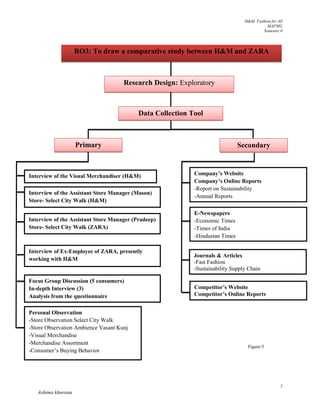
RO2: To Examine Consumer’s buying behavior for H&M
Research Design: Exploratory & Descriptive
Data Collection Tool
Primary
Quantitative Qualitative
Close Ended Questionnaire
(Structured & Non-Disguised)
Sampling Process
Sample
Technique:Convenienc
e & Judgmental
Sampling
Sample Size: 99
Sample Area:
Delhi NCR
In-Depth Interview
(2)
Personal Observation
Data Analysis:SPSS
-M Annova
-Crosstab
-Mean
Figure:4
H&M- Fashion for All
MAFMG
Semester 0
7
Ashima khurana
CCv
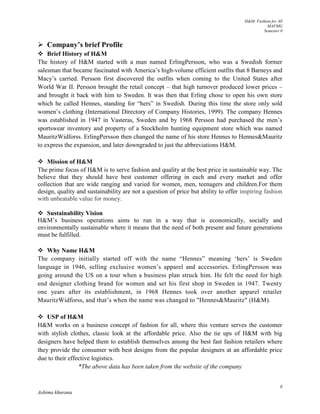
RO3: To draw a comparative study between H&M and ZARA
Research Design: Exploratory
Data Collection Tool
Primary Secondary
Interview of the Visual Merchandiser (H&M)
Interview of the Assistant Store Manager (Mason)
Store- Select City Walk (H&M)
Personal Observation
-Store Observation Select City Walk
-Store Observation Ambience Vasant Kunj
-Visual Merchandise
-Merchandise Assortment
-Consumer’s Buying Behavior
Company’s Website
Company’s Online Reports
-Report on Sustainability
-Annual Reports
E-Newspapers
-Economic Times
-Times of India
-Hindustan Times
Journals & Articles
-Fast Fashion
-Sustainability Supply Chain
Competitor’s Website
Competitor’s Online Reports
Interview of the Assistant Store Manager (Pradeep)
Store- Select City Walk (ZARA)
Interview of Ex-Employee of ZARA, presently
working with H&M
Focus Group Discussion (5 consumers)
In-depth Interview (3)
Analysis from the questionnaire
Figure:5
H&M- Fashion for All
MAFMG
Semester 0
8
Ashima khurana
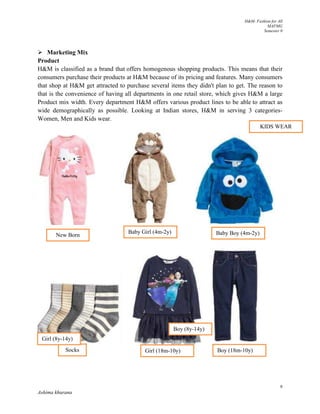
 Company’s brief Profile
 Brief History of H&M
The history of H&M started with a man named ErlingPersson, who was a Swedish former
salesman that became fascinated with America’s high-volume efficient outfits that 8 Barneys and
Macy’s carried. Persson first discovered the outfits when coming to the United States after
World War II. Persson brought the retail concept – that high turnover produced lower prices –
and brought it back with him to Sweden. It was then that Erling chose to open his own store
which he called Hennes, standing for “hers” in Swedish. During this time the store only sold
women’s clothing (International Directory of Company Histories, 1999). The company Hennes
was established in 1947 in Vasteras, Sweden and by 1968 Persson had purchased the men’s
sportswear inventory and property of a Stockholm hunting equipment store which was named
MauritzWidforss. ErlingPersson then changed the name of his store Hennes to Hennes&Mauritz
to express the expansion, and later downgraded to just the abbreviations H&M.
 Mission of H&M
The prime focus of H&M is to serve fashion and quality at the best price in sustainable way. The
believe that they should have best customer offering in each and every market and offer
collection that are wide ranging and varied for women, men, teenagers and children.For them
design, quality and sustainability are not a question of price but ability to offer inspiring fashion
with unbeatable value for money.
 Sustainability Vision
H&M’s business operations aims to run in a way that is economically, socially and
environmentally sustainable where it means that the need of both present and future generations
must be fulfilled.
 Why Name H&M
The company initially started off with the name “Hennes” meaning ‘hers’ is Sweden
language in 1946, selling exclusive women’s apparel and accessories. ErlingPersson was
going around the US on a tour when a business plan struck him. He felt the need for high
end designer clothing brand for women and set his first shop in Sweden in 1947. Twenty
one years after its establishment, in 1968 Hennes took over another apparel retailer
MauritzWidforss, and that’s when the name was changed to "Hennes&Mauritz" (H&M).
 USP of H&M
H&M works on a business concept of fashion for all, where this venture serves the customer
with stylish clothes, classic look at the affordable price. Also the tie ups of H&M with big
designers have helped them to establish themselves among the best fast fashion retailers where
they provide the consumer with best designs from the popular designers at an affordable price
due to their effective logistics.
*The above data has been taken from the website of the company
H&M- Fashion for All
MAFMG
Semester 0
9
Ashima khurana
 Marketing Mix
Product
H&M is classified as a brand that offers homogenous shopping products. This means that their
consumers purchase their products at H&M because of its pricing and features. Many consumers
that shop at H&M get attracted to purchase several items they didn't plan to get. The reason to
that is the convenience of having all departments in one retail store, which gives H&M a large
Product mix width. Every department H&M offers various product lines to be able to attract as
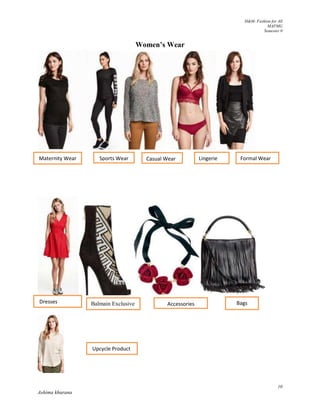
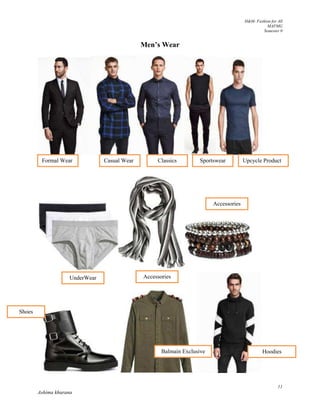
wide demographically as possible. Looking at Indian stores, H&M in serving 3 categories-
Women, Men and Kids wear.
New Born
Baby Girl (4m-2y) Baby Boy (4m-2y)
Socks Girl (18m-10y) Boy (18m-10y)
Girl (8y-14y)
Boy (8y-14y)
KIDS WEAR
H&M- Fashion for All
MAFMG
Semester 0
10
Ashima khurana
Women’s Wear
Maternity Wear Sports Wear Casual Wear Lingerie Formal Wear
Dresses Balmain Exclusive Accessories Bags
Upcycle Product
H&M- Fashion for All
MAFMG
Semester 0
11
Ashima khurana
Men’s Wear
Formal Wear Casual Wear Classics
Wear
Sportswear
Wear
Upcycle Product
UnderWear Accessories
Accessories
Shoes
Balmain Exclusive Hoodies
H&M- Fashion for All
MAFMG
Semester 0
12
Ashima khurana
Price
The price strategy of H&M is designed based on their customer’sneeds which is low price and
high fashion. H&M outsources the production to countries where the labor cost is much lower.
To control transportation cost, outsourcing was arranged according to different product. Those
high fashion products which target at the European market were produced in Turkey, because of
the short product life cycle (Regner, P &Yildiz, E 2013).In addition, basic products are produced
in Asia because they allow longer transportation time and bear lower risk. The company also
conduct strict cost control plan. For example, very few executives have secretaries or have cell
phone privilege. The product range at the H&M store in Delhi has been aggressively priced with
T-shirts starting at Rs.399. Women’s clothing and accessories with prices that start at Rs.149 for
hair bands and go up to Rs.18,999 for the costliest of dresses. Denim trousers for women are
available at Rs.699 while those for men start at Rs.999. Local sourcing helped the brand sell
polo T-shirts for as low as Rs.500. (Mitra, S 2015)
Place
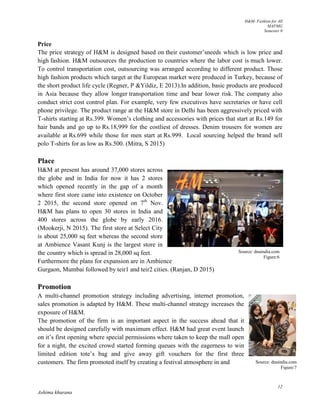
H&M at present has around 37,000 stores across
the globe and in India for now it has 2 stores
which opened recently in the gap of a month
where first store came into existence on October
2 2015, the second store opened on 7th
Nov.
H&M has plans to open 30 stores in India and
400 stores across the globe by early 2016.
(Mookerji, N 2015). The first store at Select City
is about 25,000 sq feet whereas the second store
at Ambience Vasant Kunj is the largest store in
the country which is spread in 28,000 sq feet.
Furthermore the plans for expansion are in Ambience
Gurgaon, Mumbai followed by teir1 and teir2 cities. (Ranjan, D 2015)
Promotion
A multi-channel promotion strategy including advertising, internet promotion,
sales promotion is adapted by H&M. These multi-channel strategy increases the
exposure of H&M.
The promotion of the firm is an important aspect in the success ahead that it
should be designed carefully with maximum effect. H&M had great event launch
on it’s first opening where special permissions where taken to keep the mall open
for a night, the excited crowd started forming queues with the eagerness to win
limited edition tote’s bag and give away gift vouchers for the first three
customers. The firm promoted itself by creating a festival atmosphere in and
Source: dnaindia.com
Figure:6
Source: dnaindia.com
Figure:7
H&M- Fashion for All
MAFMG
Semester 0
13
Ashima khurana
outside the mall. However one thing that remains common in all H&M is the great launch party
where Bollywood stars where seen in the next collection of H&M. In the second store launch
similar procedure was followed to delight customers in addition to that was the DJ and on ground
entertainment for the customers. (Regner, P &Yildiz, E 2013)
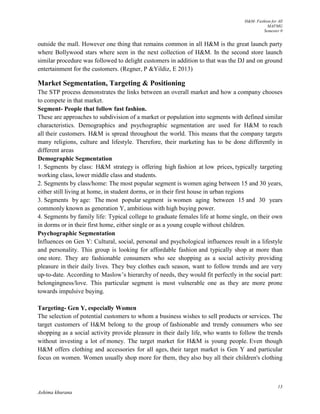
Market Segmentation, Targeting & Positioning
The STP process demonstrates the links between an overall market and how a company chooses
to compete in that market.
Segment- People that follow fast fashion.
These are approaches to subdivision of a market or population into segments with defined similar
characteristics. Demographics and psychographic segmentation are used for H&M to reach
all their customers. H&M is spread throughout the world. This means that the company targets
many religions, culture and lifestyle. Therefore, their marketing has to be done differently in
different areas
Demographic Segmentation
1. Segments by class: H&M strategy is offering high fashion at low prices, typically targeting
working class, lower middle class and students.
2. Segments by class/home: The most popular segment is women aging between 15 and 30 years,
either still living at home, in student dorms, or in their first house in urban regions
3. Segments by age: The most popular segment is women aging between 15 and 30 years
commonly known as generation Y, ambitious with high buying power.
4. Segments by family life: Typical college to graduate females life at home single, on their own
in dorms or in their first home, either single or as a young couple without children.
Psychographic Segmentation
Influences on Gen Y: Cultural, social, personal and psychological influences result in a lifestyle
and personality. This group is looking for affordable fashion and typically shop at more than
one store. They are fashionable consumers who see shopping as a social activity providing
pleasure in their daily lives. They buy clothes each season, want to follow trends and are very
up-to-date. According to Maslow’s hierarchy of needs, they would fit perfectly in the social part:
belongingness/love. This particular segment is most vulnerable one as they are more prone
towards impulsive buying.
Targeting- Gen Y, especially Women
The selection of potential customers to whom a business wishes to sell products or services. The
target customers of H&M belong to the group of fashionable and trendy consumers who see
shopping as a social activity provide pleasure in their daily life, who wants to follow the trends
without investing a lot of money. The target market for H&M is young people. Even though
H&M offers clothing and accessories for all ages, their target market is Gen Y and particular
focus on women. Women usually shop more for them, they also buy all their children's clothing
H&M- Fashion for All
MAFMG
Semester 0
14
Ashima khurana
and often their husbands or boyfriends as well. With their low prices H&M targets woman in the
lower middle class and working class, this is a concentrated targeting strategy.
Positioning
One of the aim of marketing is to position the brand in minds of consumer in a way which makes
them superior to their competitive brands. H&M is a retailer that is looking to provide consumers
with fashionable, high-quality clothing at the best price possible. They are known for offering
“fast fashion” clothing, in other words from runway to racks in record time, and sell across the
globe. Particularly if you look at India H&M is on an introductory stage with it’s recent entry,
however the company being the second largest fast fashion retailer across the globe has formed
certain preconceptions in mind of domestic consumers which has somewhat positioned the firm
next to Zara, GAP, Forever 21. H&M claiming to be more economical, sustainable has given a
competitive edge to the firm. (Regner, P &Yildiz, E 2013)
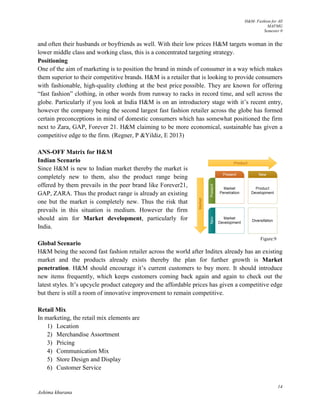
ANS-OFF Matrix for H&M
Indian Scenario
Since H&M is new to Indian market thereby the market is
completely new to them, also the product range being
offered by them prevails in the peer brand like Forever21,
GAP, ZARA. Thus the product range is already an existing
one but the market is completely new. Thus the risk that
prevails in this situation is medium. However the firm
should aim for Market development, particularly for
India.
Global Scenario
H&M being the second fast fashion retailer across the world after Inditex already has an existing
market and the products already exists thereby the plan for further growth is Market
penetration. H&M should encourage it’s current customers to buy more. It should introduce
new items frequently, which keeps customers coming back again and again to check out the
latest styles. It’s upcycle product category and the affordable prices has given a competitive edge
but there is still a room of innovative improvement to remain competitive.
Retail Mix
In marketing, the retail mix elements are
1) Location
2) Merchandise Assortment
3) Pricing
4) Communication Mix
5) Store Design and Display
6) Customer Service
Figure:9
H&M- Fashion for All
MAFMG
Semester 0
15
Ashima khurana
Source: dnaindia.com
Figure:10
Location
H&M chosed Delhi to open it’s first store in the whole India due to the population which is
ranked second in the whole world and the capital being the richest state of India where people
have higher disposable incomes. Furthermore it has come up with 2 stores in 2 elite malls of
South-ex of Delhi, and has plan to come up in Gurgaon as well. If you look at the footfall in
these malls it is pretty high as compared to the other malls, also the size of the store till now of
H&M has being huge, around 25,000- 28,000sq feet thereby it is possible for huge malls only to
accommodate such huge sized stores thus the target malls has being big in the areas they are
spread across. Also majority of the target audience resides in South-Delhi, however this doesn’t
mean that H&M has no plan to expand in north Delhi but the first location was decided keeping
in mind the above mentioned factors.
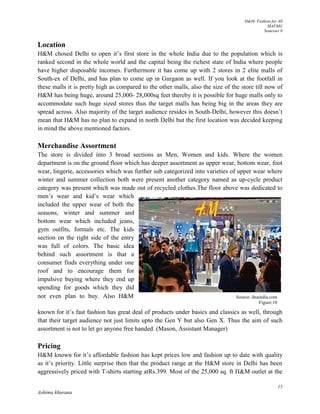
Merchandise Assortment
The store is divided into 3 broad sections as Men, Women and kids. Where the women
department is on the ground floor which has deeper assortment as upper wear, bottom wear, foot
wear, lingerie, accessories which was further sub categorized into varieties of upper wear where
winter and summer collection both were present another category named as up-cycle product
category was present which was made out of recycled clothes.The floor above was dedicated to
men’s wear and kid’s wear which
included the upper wear of both the
seasons, winter and summer and
bottom wear which included jeans,
gym outfits, formals etc. The kids
section on the right side of the entry
was full of colors. The basic idea
behind such assortment is that a
consumer finds everything under one
roof and to encourage them for
impulsive buying where they end up
spending for goods which they did
not even plan to buy. Also H&M
known for it’s fast fashion has great deal of products under basics and classics as well, through
that their target audience not just limits upto the Gen Y but also Gen X. Thus the aim of such
assortment is not to let go anyone free handed. (Mason, Assistant Manager)
Pricing
H&M known for it’s affordable fashion has kept prices low and fashion up to date with quality
as it’s priority. Little surprise then that the product range at the H&M store in Delhi has been
aggressively priced with T-shirts starting atRs.399. Most of the 25,000 sq. ft H&M outlet at the
H&M- Fashion for All
MAFMG
Semester 0
16
Ashima khurana
mall is dedicated to women’s clothing and accessories with prices that start at Rs.149 for hair
bands and go up to Rs.18,999 for the costliest of dresses. Denim trousers for women are
available at Rs.699 while those for men start at Rs.999. Local sourcing helped the brand sell
polo T-shirts for as low as Rs.500.
Store Display
Each store is unique – but should also be easily recognisable. Interiors have to provide a
functional and flexible framework that invites customers to step inside and guide them through
the different departments, while offering an exciting shopping experience. Displays, both in
windows and inside, put parts of the current in-store selection in focus and provide styling tips
and inspiration. Global display guidelines are created in a large “test store” near the H&M Head
Office in Stockholm. Displays are changed frequently and themed around an association or a
feeling, but always keep the clothes in focus.
Customer service
H&M aims to provide customer with highest satisfaction. On personal observation H&M has
somewhat succeeded in delighting it’s customers. Each department had sales advisors serving
each customer with the required merchandise, helping them out with the available sizes and other
options available. Considering it’s return policy then they are happy to exchange or refund any
unsuitable merchandise within 30 days provided that they are in a resalable and unused
condition, accompanied by original price tags and original receipt. For reasons of hygiene,
underwear, swimsuits, pierced earrings and cosmetics cannot be exchanged. However refunds
can be easily made in store of original purchase through H&M Merchandise card valid for 1
year. (H&M India). Also H&M offers gift cards to it’s customers which can be loaded from Rs
500-5000/-, the card can be used to give full or partial payment for the good purchased, even the
refund balance will be transferred directly to the card, just the customers need to know his/her
card number. (Kalra, A 2015)
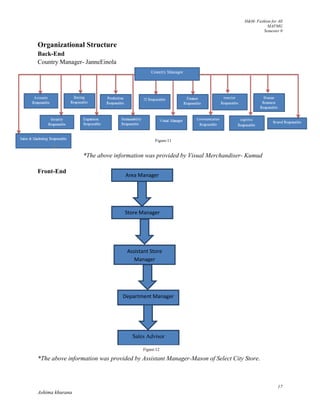
Organizational Structure
H&M has a matrix organization in which the Managing Director appoints the members
of the executive management team and country managers. H&M’s matrix organisation
means that the members of the executive management team are responsible for their
department’s support, training and best practice, and for each country working efficiently in
accordance with the policies and guidelines issued by the Head Office. Country managers have
overall responsibility for sales, profitability and all departments in their country.
H&M- Fashion for All
MAFMG
Semester 0
17
Ashima khurana
Organizational Structure
Back-End
Country Manager- JanneEinola
Front-End
*The above information was provided by Assistant Manager-Mason of Select City Store.
Area Manager
Store Manager
Assistant Store
Manager
Department Manager
Sales Advisor
*The above information was provided by Visual Merchandiser- Kumud
Figure:11
Figure:12
H&M- Fashion for All
MAFMG
Semester 0
18
Ashima khurana
Human Resource Management (HRM)
HRM is the term used to describe formal systems devised for the management of people within
an organization.
Human Resources in H&M
The corporate objective of H&M is to expand worldwide and hence with the
continuous increase in the employee strength. The staff H&M is spread
approximately across 37 countries which come from different cultural background. Their
strategy is to recruit local people whenever they open they open the new store. The main policies
of H&M can be categorized as:
 Overall policies and values
The website of the H&M indicates that the company’s main objective is to be a good
employer. At H&M, the HR activities are guided in such a way that every individual have
equal fundamental rights. This means that everyone will have fair wages and working hours.
They all have full freedom of association and development within the company.
 An Inclusive Workplace
They consider their internal customers as they reason of success and are committed to
maintaining an inclusive workplace. It’s one where human rights are recognised, and where
everyone treats each other with integrity, respect, humbleness and dignity
 H&M works in teams and lead by example
As per there website, teamwork is essential at H&M and is part of their culture. They are
always driven by their values and lead by example. They believe leaders should always be
role models and set a good example in everything they do
 You Grow We Grow
H&M has being providing a fun, creative and dynamic workplace so everybody working
within the firm they all grow together. Great opportunities are provided through internal
recruitment and work rotation. Everyone is a talent and makes a difference at H&M.
 Use of open Door Policy
Their Open Door Policy grants all colleagues the opportunity to openly discuss any work-
related issue directly with their managers.
 They Strive for Sustainability in everything they do
Sustainability makes business sense and is an integral part of everything they do. It’s a shared
responsibility of everyone working at H&M, where everyone’s efforts make a difference.
 H&M Incentive Program-HIP for all working at H&M
H&M know that their employees are the key to our success. To show them appreciation, H&M
has created HIP – the H&M Incentive Program – which since 2011 After their employees
have spent five years with H&M, they begin to share the profit increase made by the H&M
Group. The longer they are an employee, the more they will receive. It’s that simple, and is
H&M- Fashion for All
MAFMG
Semester 0
19
Ashima khurana
the same for everyone in the H&M Group, in all countries, regardless of position, salary, or
contract of employment. The employees will receive payouts from HIP when they turn 62.
However, from the year 2021 our employees can choose to receive their first payout as soon
as they have been with the H&M Group for ten years.
*The above data has been taken from the company’s website
Words of Internal Employees
The prime goal of H&M is to expand around the globe has given rises to many programs to
motivate and develop the internal customers. The firm is a flat organization however it might
look difficult to move up in such system however the opposite is true in the case of H&M as per
their career website and personal interaction with the employees. Mason, assistant manager at
H&M store saket who has being working with H&M since pretty long strongly believe that the
best part of working with the firm is the progression, also the experience that H&M gives in
terms of working with different nationalities and culture and travelling to different countries is
another motivational factor for the employess. The live example of progression within the firm
is the present CEO- JanneEinola who is the country manager for India and have being working
with H&M since 1998 and started the job as Department Manager of a store.
Also another employee (VM) felt that the firm delivers what it says specially in terms of
sustainability. The firm gives you space to working according to your knowledge and ethics
which motivates to do more.
Recruitment and Selection Process
H&M group has around 132,000 employees. The corporate culture of H&M has been one of the
major factor in enabling them one of the world’s largest fashion company and at the same time
enjoying the high profitability. According to the head of HR department of H&M all the
university credits and great grades in the world does not give any guarantee of getting a job or a
fast-track career. The company looks for people with right personality, more than anything else.
H&M belief that skills can be gathered as you go, but personality and right attitude cannot be
taught to a person. Since the tempo of the company is always high and is a fast growing
company, therefore employees who are self driven and who have the capability of direct
communication are the main requirement of the company. Hence people who likes decision
making and responsibility are recruited by the company. These are the basic requirement for
H&M to recruit the employees and drive its basis for selection process. There website indicates
that selection is based on personal interview which contains ‘structured situational based’, which
include latest fashion trends and customer service. The selection is followed by panel of
interviews and sample test. Candidates are filtered at each stage of selection process. (Bansal, A
2011)
Social Compliance
Social compliance refers to the way a company looks after the health and safety of its employees
and its accountability for safe practices. At H&M they want to maintain pleasant and sustainable
working environments throughout our operations. This includes ensuring that a person as an
H&M- Fashion for All
MAFMG
Semester 0
20
Ashima khurana
employee have a safe workplace. H&M takes preventative measures to ensure the long-term
safety and good health of our employees. They encourage their employees to report accidents
or unsafe working conditions to their manager.
Role of HRM in H&M’s success
H&M is an effective multinational organization. The principle accomplishment of H&M
essentially lies in the plan of action of the organization. All the outlining system is being done
inside and halfway. The entire assembling is being outsourcing with no bargain on the nature of
the item. The organization is fruitful in dealing with all the center qualities in admiration of
nation and social contrasts. The elements of HR strategy, like in housetraining, improving
performance through local recruitment, job rotation, increasing commitment and total rewards
have been in HR procedures and strategies and are practiced by the company. The HIP program
that has been launched in 2011 is an initiative to motivate the employees to deliver their best and
stay loyal to the firm. Thereby the policies are such that incorporates every employee to be a part
of the combined benefit. Rising above monetary terms, the in-house initiatives to make the
employee feel free to communicate with the above head is another important aspect of it’s
policy. Thus the HR strategies of the company are one of the reasons for the success of the
business.
Lead Time taken by H&M
The following graph shows a comparison between the Lead time taken by the fast fashion
products of H&M (12 Weeks) and the Classic products of H&M.
Source: Caro and Mart´ınez-de-Alb´eniz (2013)
Figure:13
H&M- Fashion for All
MAFMG
Semester 0
21
Ashima khurana
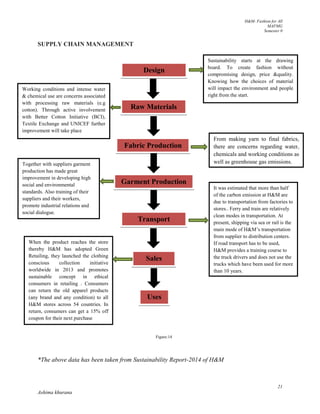
SUPPLY CHAIN MANAGEMENT
*The above data has been taken from Sustainability Report-2014 of H&M
Design
Raw Materials
Fabric Production
Garment Production
Transport
Sales
Uses
Sustainability starts at the drawing
board. To create fashion without
compromising design, price &quality.
Knowing how the choices of material
will impact the environment and people
right from the start.
Working conditions and intense water
& chemical use are concerns associated
with processing raw materials (e.g
cotton). Through active involvement
with Better Cotton Initiative (BCI),
Textile Exchange and UNICEF further
improvement will take place
From making yarn to final fabrics,
there are concerns regarding water,
chemicals and working conditions as
well as greenhouse gas emissions.
Together with suppliers garment
production has made great
improvement in developing high
social and environmental
standards. Also training of their
suppliers and their workers,
promote industrial relations and
social dialogue.
It was estimated that more than half
of the carbon emission at H&M are
due to transportation from factories to
stores.. Ferry and train are relatively
clean modes in transportation. At
present, shipping via sea or rail is the
main mode of H&M’s transportation
from supplier to distribution centers.
If road transport has to be used,
H&M provides a training course to
the truck drivers and does not use the
trucks which have been used for more
than 10 years.
When the product reaches the store
thereby H&M has adopted Green
Retailing, they launched the clothing
conscious collection initiative
worldwide in 2013 and promotes
sustainable concept in ethical
consumers in retailing . Consumers
can return the old apparel products
(any brand and any condition) to all
H&M stores across 54 countries. In
return, consumers can get a 15% off
coupon for their next purchase
Figure:14
H&M- Fashion for All
MAFMG
Semester 0
22
Ashima khurana
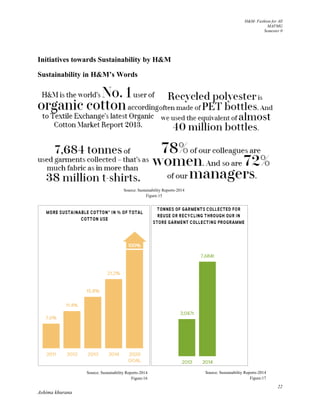
Initiatives towards Sustainability by H&M
Sustainability in H&M’s Words
Source: Sustainability Reports-2014
Figure:15
Source: Sustainability Reports-2014
Figure:16
Source: Sustainability Reports-2014
Figure:17
H&M- Fashion for All
MAFMG
Semester 0
23
Ashima khurana
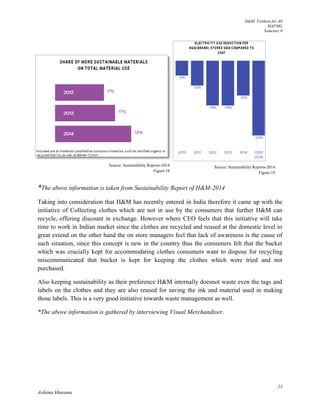
*The above information is taken from Sustainability Report of H&M-2014
Taking into consideration that H&M has recently entered in India therefore it came up with the
initiative of Collecting clothes which are not in use by the consumers that further H&M can
recycle, offering discount in exchange. However where CEO feels that this initiative will take
time to work in Indian market since the clothes are recycled and reused at the domestic level to
great extend on the other hand the on store managers feel that lack of awareness is the cause of
such situation, since this concept is new in the country thus the consumers felt that the bucket
which was crucially kept for accommodating clothes consumers want to dispose for recycling
miscommunicated that bucket is kept for keeping the clothes which were tried and not
purchased.
Also keeping sustainability as their preference H&M internally doesnot waste even the tags and
labels on the clothes and they are also reused for saving the ink and material used in making
those labels. This is a very good initiative towards waste management as well.
*The above information is gathered by interviewing Visual Merchandiser.
Source: Sustainability Reports-2014
Figure:18
Source: Sustainability Reports-2014
Figure:19
H&M- Fashion for All
MAFMG
Semester 0
24
Ashima khurana
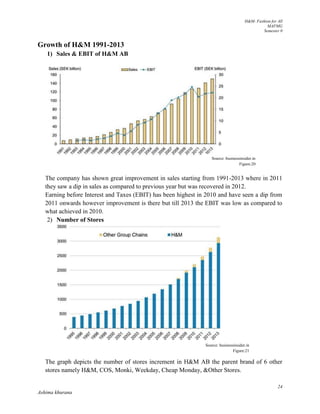
Growth of H&M 1991-2013
1) Sales & EBIT of H&M AB
The company has shown great improvement in sales starting from 1991-2013 where in 2011
they saw a dip in sales as compared to previous year but was recovered in 2012.
Earning before Interest and Taxes (EBIT) has been highest in 2010 and have seen a dip from
2011 onwards however improvement is there but till 2013 the EBIT was low as compared to
what achieved in 2010.
2) Number of Stores
The graph depicts the number of stores increment in H&M AB the parent brand of 6 other
stores namely H&M, COS, Monki, Weekday, Cheap Monday, &Other Stores.
Source: businessinsider.in
Figure:20
Source: businessinsider.in
Figure:21
H&M- Fashion for All
MAFMG
Semester 0
25
Ashima khurana
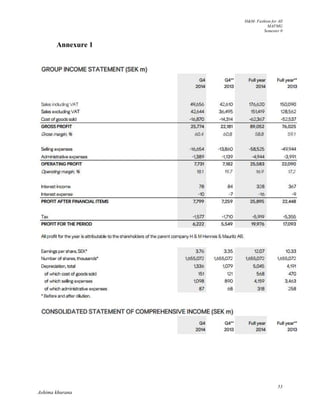
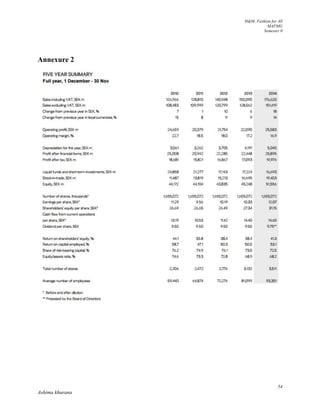
Financials Analysis For H&M
Profitability Ratios
Gross profit percentage = (Gross profits/ Net Revenue)*100
2012 = (711871/120799)*100
= 59.4%
2013 = (76025/128562)*100
= 59.1%
2014 = (89052/151419)*100
= 58.8%
Net profit percentage = (Net profit/ Net Sales)*100
2012 = (16867/ 120799)*100
= 13.96%
2013 = (17093/128562)*100
= 13.29%
2014 = (19976/151419)*100
= 13.19%
2012 2013 2014
H&M 59.40% 59.10% 58.80%
58.40%
58.60%
58.80%
59.00%
59.20%
59.40%
59.60%
Gross Profit Percentage
2012 2013 2014
H&M 13.96% 13.29% 13.19%
12.50%
13.00%
13.50%
14.00%
14.50%
Net Profit Percentage
Interpretation: Gross Profit Margins helps to know the Direct efficiency of the firm. H&M’s GPP has
decreased from 59.40% in 2012 to 58.80% in 2014 however on whole the firm is performing well and
in in good financial health
Interpretation: Net Profit Margin are helpful in knowing the overall efficiency of the firm. The
decreasing NPP isn’t a good signature as it indicates that the net profits are increasing but net sales
are increasing at a higher rate thereby signify low NPP. The firm anyhow is giving an Average
performance
Figure:22
Figure:23
H&M- Fashion for All
MAFMG
Semester 0
26
Ashima khurana
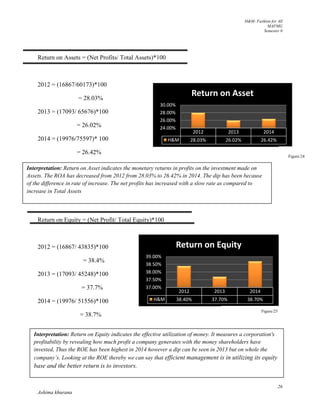
Return on Assets = (Net Profits/ Total Assets)*100
2012 = (16867/60173)*100
= 28.03%
2013 = (17093/ 65676)*100
= 26.02%
2014 = (19976/75597)* 100
= 26.42%
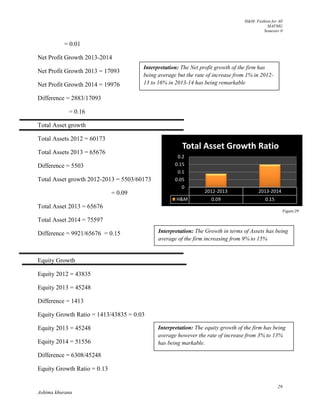
Return on Equity = (Net Profit/ Total Equity)*100
2012 = (16867/ 43835)*100
= 38.4%
2013 = (17093/ 45248)*100
= 37.7%
2014 = (19976/ 51556)*100
= 38.7%
2012 2013 2014
H&M 28.03% 26.02% 26.42%
24.00%
26.00%
28.00%
30.00%
Return on Asset
2012 2013 2014
H&M 38.40% 37.70% 38.70%
37.00%
37.50%
38.00%
38.50%
39.00%
Return on Equity
Interpretation: Return on Asset indicates the monetary returns in profits on the investment made on
Assets. The ROA has decreased from 2012 from 28.03% to 26.42% in 2014. The dip has been because
of the difference in rate of increase. The net profits has increased with a slow rate as compared to
increase in Total Assets
Interpretation: Return on Equity indicates the effective utilization of money. It measures a corporation's
profitability by revealing how much profit a company generates with the money shareholders have
invested, Thus the ROE has been highest in 2014 however a dip can be seen in 2013 but on whole the
company’s. Looking at the ROE thereby we can say that efficient management is in utilizing its equity
base and the better return is to investors.
Figure:24
Figure:25
H&M- Fashion for All
MAFMG
Semester 0
27
Ashima khurana
Return on Investment (in %age)
ROI= (Net Profit+ Interest Expenses)/(Debt+ Equity)*100
Debt = 0
2012 = [{16867+(-5)}/0+43835]*100
=38.46%
2013 = [{17093 + (-9)}/0+45248]
=37.75%
2014 = [{19976 + (-16)}/0 + 51556]*100
=38.71%
Liquidity Analysis
Current Ratio = Current Asset/Current Liability
2012 = 37232/14010
= 2:6
2013 = 39188/17397
= 2:2
2014 = 42741/20303
= 2:1
2012 2013 2014
H&M 38.46% 37.75% 38.71%
37.00%
38.00%
39.00%
Return on Investment (in
percentage)
2012 2013 2014
H&M 2.6 2.2 2.1
0
1
2
3
Current Ratios
Interpretation:Return on Investment (ROI) is the amount that is returned on the investment made in a
company. H&M had highest ROI in 2014 during the period of 2012-2014, however a decline in ROI
was seen in 2013 but was soon covered in the next year.
Interpretation: Current Ratio indicates if the firm has sufficient assets to meet the current liabilities
within the span of 1 year or less. Where 2:1is the ideal situation which was achieved in 2014 before
that current liabilities had always being more starting from 2012 then decreasing in 2013 and
reaching the ideal scenario in 2014.
Figure:26
Figure:27
H&M- Fashion for All
MAFMG
Semester 0
28
Ashima khurana
Quick Ratio = Quick Assets/ Current Liabilities
2012 = 22019/14010
= 1:5
2013 = 22493/17397
= 1:2
2014 = 23338/20303
= 1:1
Growth Formula
Growth Ratios = Difference/Previous Year
Sales Growth 2012-2013
Sales Growth 2012 = 120799
Sales Growth 2013 = 128,562
Difference = 7763
Growth Ratios = 7763/120799
= 0.06
Sales Growth 2013-2014
Sales Growth 2013 = 128,562
Sales Growth 2014 = 151419
Difference = 22857
Growth Ratios= 22857/128562
= 0.17
Net Profit Growth 2012-2013
Net Profit Growth 2012- 16867
Net Profit Growth 2013- 17093
Difference= 226/16867
2012-2013 2013-2014
H&M 0.06 0.17
0
0.05
0.1
0.15
0.2
Growth Ratio
Interpretation: Quick Ratio indicate how well a company can meet it’s
short-term financial liabilities. Where 1:1 is the ideal situation which
the firm reached in 2014 however when the firm exceeds 1:5 as a ratio
this indicates that the assets are more thereby liquidity is more thus no
investment has happened. Thus the firm was close to this scenario in
2014
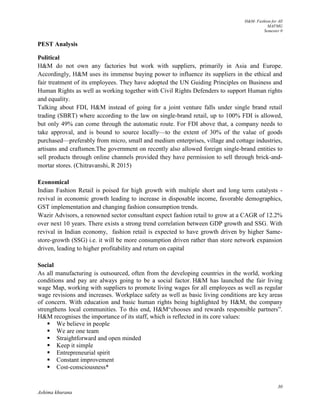
Interpretation: The growth Ratio indicates the overall
growth of the firm in comparison with the previous
years. However overall growth of H&M’s has been
average but the rate of increase from 2012-2013 to
2013-2014 has being markable.
Figure:28
H&M- Fashion for All
MAFMG
Semester 0
29
Ashima khurana
= 0.01
Net Profit Growth 2013-2014
Net Profit Growth 2013 = 17093
Net Profit Growth 2014 = 19976
Difference = 2883/17093
= 0.16
Total Asset growth
Total Assets 2012 = 60173
Total Assets 2013 = 65676
Difference = 5503
Total Asset growth 2012-2013 = 5503/60173
= 0.09
Total Asset 2013 = 65676
Total Asset 2014 = 75597
Difference = 9921/65676 = 0.15
Equity Growth
Equity 2012 = 43835
Equity 2013 = 45248
Difference = 1413
Equity Growth Ratio = 1413/43835 = 0.03
Equity 2013 = 45248
Equity 2014 = 51556
Difference = 6308/45248
Equity Growth Ratio = 0.13
2012-2013 2013-2014
H&M 0.09 0.15
0
0.05
0.1
0.15
0.2
Total Asset Growth Ratio
Interpretation: The Net profit growth of the firm has
being average but the rate of increase from 1% in 2012-
13 to 16% in 2013-14 has being remarkable
Interpretation: The Growth in terms of Assets has being
average of the firm increasing from 9% to 15%
Interpretation: The equity growth of the firm has being
average however the rate of increase from 3% to 13%
has being markable.
Figure:29
H&M- Fashion for All
MAFMG
Semester 0
30
Ashima khurana
PEST Analysis
Political
H&M do not own any factories but work with suppliers, primarily in Asia and Europe.
Accordingly, H&M uses its immense buying power to influence its suppliers in the ethical and
fair treatment of its employees. They have adopted the UN Guiding Principles on Business and
Human Rights as well as working together with Civil Rights Defenders to support Human rights
and equality.
Talking about FDI, H&M instead of going for a joint venture falls under single brand retail
trading (SBRT) where according to the law on single-brand retail, up to 100% FDI is allowed,
but only 49% can come through the automatic route. For FDI above that, a company needs to
take approval, and is bound to source locally—to the extent of 30% of the value of goods
purchased—preferably from micro, small and medium enterprises, village and cottage industries,
artisans and craftsmen.The government on recently also allowed foreign single-brand entities to
sell products through online channels provided they have permission to sell through brick-and-
mortar stores. (Chitravanshi, R 2015)
Economical
Indian Fashion Retail is poised for high growth with multiple short and long term catalysts -
revival in economic growth leading to increase in disposable income, favorable demographics,
GST implementation and changing fashion consumption trends.
Wazir Advisors, a renowned sector consultant expect fashion retail to grow at a CAGR of 12.2%
over next 10 years. There exists a strong trend correlation between GDP growth and SSG. With
revival in Indian economy, fashion retail is expected to have growth driven by higher Same-
store-growth (SSG) i.e. it will be more consumption driven rather than store network expansion
driven, leading to higher profitability and return on capital
Social
As all manufacturing is outsourced, often from the developing countries in the world, working
conditions and pay are always going to be a social factor. H&M has launched the fair living
wage Map, working with suppliers to promote living wages for all employees as well as regular
wage revisions and increases. Workplace safety as well as basic living conditions are key areas
of concern. With education and basic human rights being highlighted by H&M, the company
strengthens local communities. To this end, H&M“chooses and rewards responsible partners”.
H&M recognises the importance of its staff, which is reflected in its core values:
 We believe in people
 We are one team
 Straightforward and open minded
 Keep it simple
 Entrepreneurial spirit
 Constant improvement
 Cost-consciousness*
H&M- Fashion for All
MAFMG
Semester 0
31
Ashima khurana
Technological
H&M has embraced and harnessed new technology with regards to it’s advertising and branding.
They are now using a multiple platform arena to approach and promote their fast-fashion,
thereby appealing to the younger generation. In order to create a more efficient customer
experience, pilot stores in New York have installed payment centers in changing room to avoid
long. Theyhave started working with textile innovators Worn Again on testing ground-breaking
fibre-recycling technology that aims to meet the growing demand for cotton and polyester
production worldwide. The "textile-to-textile, chemical-recycling technology", as it is called,
separates and extracts the materials from old clothing, which is then re-spun into new yarns.In
an effort to reduce their impact on the environment H&M has introduced new technologies invits
production lines e.g: 21% of shoes now use water soluble glues. Alsorecycled polyester which is
often made of PET bottles they used the equivalent of almost 40 million bottles.*
*The above data has been taken from company’s website
Consumer Analysis
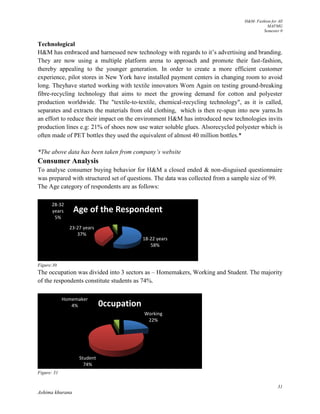
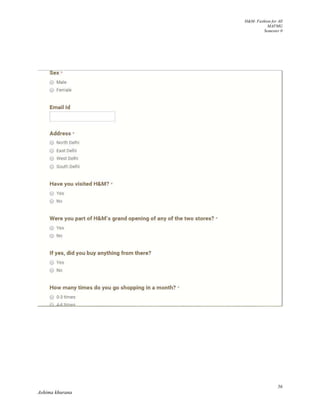
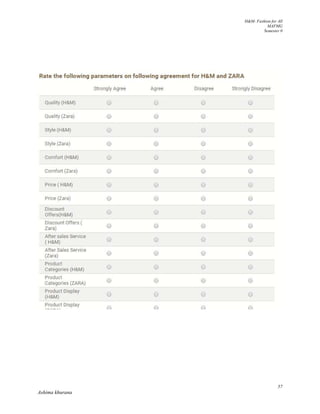
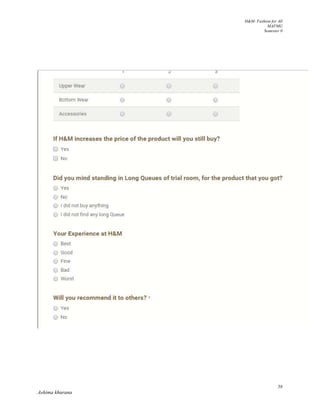
To analyse consumer buying behavior for H&M a closed ended & non-disguised questionnaire
was prepared with structured set of questions. The data was collected from a sample size of 99.
The Age category of respondents are as follows:
Figure:30
The occupation was divided into 3 sectors as – Homemakers, Working and Student. The majority
of the respondents constitute students as 74%.
Figure: 31
18-22 years
58%
23-27 years
37%
28-32
years
5%
Age of the Respondent
Working
22%
Student
74%
Homemaker
4% 0ccupation
H&M- Fashion for All
MAFMG
Semester 0
32
Ashima khurana
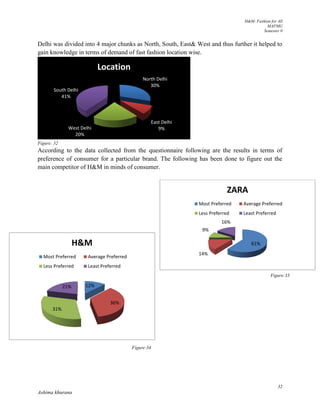
Delhi was divided into 4 major chunks as North, South, East& West and thus further it helped to
gain knowledge in terms of demand of fast fashion location wise.
Figure: 32
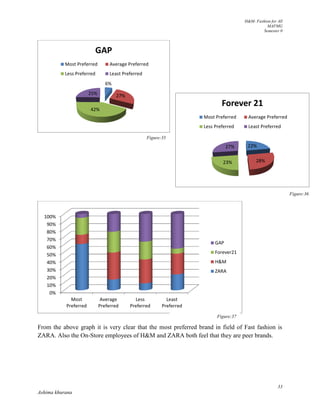
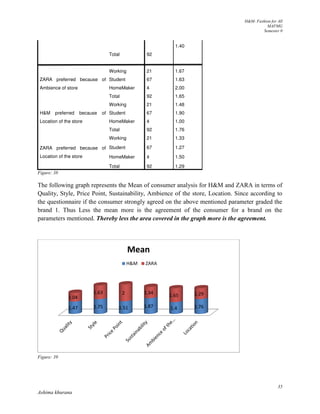
According to the data collected from the questionnaire following are the results in terms of
preference of consumer for a particular brand. The following has been done to figure out the
main competitor of H&M in minds of consumer.
North Delhi
30%
East Delhi
9%
West Delhi
20%
South Delhi
41%
Location
61%
14%
9%
16%
ZARA
Most Preferred Average Preferred
Less Preferred Least Preferred
12%
36%
31%
21%
H&M
Most Preferred Average Preferred
Less Preferred Least Preferred
Figure:33
Figure:34
H&M- Fashion for All
MAFMG
Semester 0
33
Ashima khurana
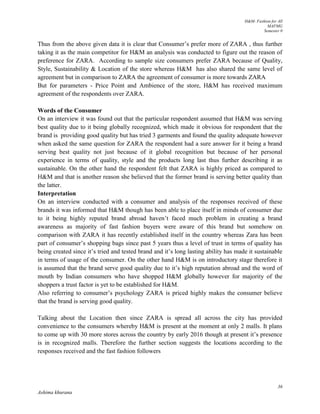
From the above graph it is very clear that the most preferred brand in field of Fast fashion is
ZARA. Also the On-Store employees of H&M and ZARA both feel that they are peer brands.
6%
27%
42%
25%
GAP
Most Preferred Average Preferred
Less Preferred Least Preferred
0%
10%
20%
30%
40%
50%
60%
70%
80%
90%
100%
Most
Preferred
Average
Preferred
Less
Preferred
Least
Preferred
GAP
Forever21
H&M
ZARA
22%
28%
23%
27%
Forever 21
Most Preferred Average Preferred
Less Preferred Least Preferred
Figure:35
Figure:36
Figure:37
H&M- Fashion for All
MAFMG
Semester 0
34
Ashima khurana
N Mean
H&M preferred because of
Quality
Working 21 1.48
Student 67 1.49
HomeMaker 4 1.00
Total 92 1.47
ZARA preferred because of
Quality
Working 21 1.05
Student 67 1.04
HomeMaker 4 1.00
Total 92 1.04
H&M preferred because of
Style
Working 21 1.76
Student 67 1.75
HomeMaker 4 1.75
Total 92 1.75
ZARA preferred because of
Style
Working 21 1.76
Student 67 1.60
HomeMaker 4 1.50
Total 92 1.63
H&M preferred because of
Price points
Working 21 1.62
Student 67 1.49
HomeMaker 4 1.25
Total 92 1.51
ZARA preferred because of
Price points
Working 21 1.95
Student 67 2.03
HomeMaker 4 2.00
Total 92 2.01
ZARA preferred because of
Sustainability
Working 21 1.38
Student 67 1.30
HomeMaker 4 1.75
Total 92 1.34
H&M preferred because of
Sustainability
Working 21 2.00
Student 67 1.84
HomeMaker 4 1.75
Total 92 1.87
H&M preferred because of
Ambience of store
Working 21 1.38
Student 67 1.40
HomeMaker 4 1.50
H&M- Fashion for All
MAFMG
Semester 0
35
Ashima khurana
Total 92
1.40
ZARA preferred because of
Ambience of store
Working 21 1.67
Student 67 1.63
HomeMaker 4 2.00
Total 92 1.65
H&M preferred because of
Location of the store
Working 21 1.48
Student 67 1.90
HomeMaker 4 1.00
Total 92 1.76
ZARA preferred because of
Location of the store
Working 21 1.33
Student 67 1.27
HomeMaker 4 1.50
Total 92 1.29
Figure: 38
The following graph represents the Mean of consumer analysis for H&M and ZARA in terms of
Quality, Style, Price Point, Sustainability, Ambience of the store, Location. Since according to
the questionnaire if the consumer strongly agreed on the above mentioned parameter graded the
brand 1. Thus Less the mean more is the agreement of the consumer for a brand on the
parameters mentioned. Thereby less the area covered in the graph more is the agreement.
Figure: 39
1.47 1.75 1.51 1.87 1.4 1.76
1.04
1.63 2 1.34
1.65 1.29
Mean
H&M ZARA
H&M- Fashion for All
MAFMG
Semester 0
36
Ashima khurana
Thus from the above given data it is clear that Consumer’s prefer more of ZARA , thus further
taking it as the main competitor for H&M an analysis was conducted to figure out the reason of
preference for ZARA. According to sample size consumers prefer ZARA because of Quality,
Style, Sustainability & Location of the store whereas H&M has also shared the same level of
agreement but in comparison to ZARA the agreement of consumer is more towards ZARA
But for parameters - Price Point and Ambience of the store, H&M has received maximum
agreement of the respondents over ZARA.
Words of the Consumer
On an interview it was found out that the particular respondent assumed that H&M was serving
best quality due to it being globally recognized, which made it obvious for respondent that the
brand is providing good quality but has tried 3 garments and found the quality adequate however
when asked the same question for ZARA the respondent had a sure answer for it being a brand
serving best quality not just because of it global recognition but because of her personal
experience in terms of quality, style and the products long last thus further describing it as
sustainable. On the other hand the respondent felt that ZARA is highly priced as compared to
H&M and that is another reason she believed that the former brand is serving better quality than
the latter.
Interpretation
On an interview conducted with a consumer and analysis of the responses received of these
brands it was informed that H&M though has been able to place itself in minds of consumer due
to it being highly reputed brand abroad haven’t faced much problem in creating a brand
awareness as majority of fast fashion buyers were aware of this brand but somehow on
comparison with ZARA it has recently established itself in the country whereas Zara has been
part of consumer’s shopping bags since past 5 years thus a level of trust in terms of quality has
being created since it’s tried and tested brand and it’s long lasting ability has made it sustainable
in terms of usage of the consumer. On the other hand H&M is on introductory stage therefore it
is assumed that the brand serve good quality due to it’s high reputation abroad and the word of
mouth by Indian consumers who have shopped H&M globally however for majority of the
shoppers a trust factor is yet to be established for H&M.
Also referring to consumer’s psychology ZARA is priced highly makes the consumer believe
that the brand is serving good quality.
Talking about the Location then since ZARA is spread all across the city has provided
convenience to the consumers whereby H&M is present at the moment at only 2 malls. It plans
to come up with 30 more stores across the country by early 2016 though at present it’s presence
is in recognized malls. Therefore the further section suggests the locations according to the
responses received and the fast fashion followers
H&M- Fashion for All
MAFMG
Semester 0
37
Ashima khurana
Respondents following the concept of fast fashion * Location of Respondent Crosstabulation
Count
Location of Respondent Total
North Delhi East Delhi West Delhi South Delhi
Respondents following the
concept of fast fashion
Yes 20 6 17 26 69
No 10 3 3 14 30
Total 30 9 20 40 99
Figure: 40
Interpretation: In the graph above it is clear that among the respondents majority of people
following fast fashion are from South Delhi, however the presence of the brand in the malls of
south make it convenient of consumers to travel.
Looking at the second highest majority then North Delhi people follow the concept of fast
fashion followed by people of West Delhi and least number of people follow the concept in East.
However the store has made it presence in South for now.
According to the CEO of H&M quality retail space is a problem in the country thereby taking
into consideration the retail standards of the firm and unavailability of quality retail space in
North specifically a store opening in the west will serve an additional benefit to the firm as
presence of it’s peer competitors in west will give the firm a competitive edge and also the
convenience to the followers of the fast fashion.
If we look at the geographic scenario
North-South =32.8 Kms
North-West = 22.3 Kms
29%
9%
24%
38%
Respondents following Fast fashion
according to location
North Delhi
East Delhi
West Delhi
South Delhi
H&M- Fashion for All
MAFMG
Semester 0
38
Ashima khurana
North- East = 21.4 Kms
Also for people of East the nearest mall would be Noida where the store has declared it’s
opening in GIP which is 10 Kms away.
Thereby looking at the following four factors:
1) Presence of fast fashion across the city
2) Presence of it’s competitors in West
3) Footfall in the malls of the west
4) Geographic scenario
The firm should consider West as an option to open it’s store which for now the firm has no
plans*
*Information received via Visual Merchandiser
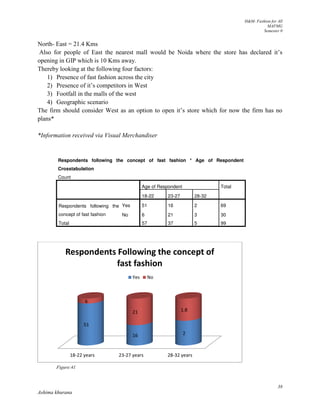
Respondents following the concept of fast fashion * Age of Respondent
Crosstabulation
Count
Age of Respondent Total
18-22 23-27 28-32
Respondents following the
concept of fast fashion
Yes 51 16 2 69
No 6 21 3 30
Total 57 37 5 99
Figure:41
18-22 years 23-27 years 28-32 years
51
16 2
6
21 1.8
Respondents Following the concept of
fast fashion
Yes No
H&M- Fashion for All
MAFMG
Semester 0
39
Ashima khurana
In the above data it is clear that the age group of 18-22 is the majority age group following the
concept of fast fashion. Thereby taking this age group further we looked at the reasons of
following fast fashion further ranking as 1 being the most preferred reason and 4 being the least
preferred reason.
Figure: 42
Preference for Fast fashion because of Price Points * Age of Respondent Crosstabulation
Count
Age of Respondent Total
18-22 23-27 28-32
Preference for Fast fashion
because of Price Points
Most Preferred 6 5 1 12
Average Preferred 3 5 0 8
Less Preferred 5 3 1 9
Least Preferred 36 3 0 39
Total 50 16 2 68
In the above data majority of respondents of age group of 18-22 has given Least preference to
price thereby depicting that price is not the reason for them following fast fashion. However the
further table depicts the price sensitivity of the consumer for H&M.
18-22 Years 23-27 years 28-32 years
6
5
1
3
5 0
5
3 1
36
3
0
Preference for fast fashion because of price
wrt Age
Most Preferred Average Preferred Less Preferred Least Preferred
H&M- Fashion for All
MAFMG
Semester 0
40
Ashima khurana
Figure: 43
If H&M increases the price, Respondent's willingness to buy * Age of Respondent
Crosstabulation
Count
Age of Respondent Total
18-22 23-27 28-32
If H&M increases the price,
Respondent's willingness to
buy
Yes 6 8 0 14
No 47 26 5 78
Total 53 34 5 92
Thus the above data depicts that if the price of H&M increases majority of the consumer of the
age group 18-22 won’t be willing to buy the products thereby depicting the price sensitivity of
consumer towards H&M. Thus the demand of H&M products is elastic.
Interpretation:
The demand of H&M is elastic in nature that is the consumers are price sensitive which indicates
that if the firm increases the price of it’s product the consumers will shift to availability of
substitute products for the same.
However from the above graphs it is clear that among the respondents majority of consumers of
age group 18-22 follow the concept of fast fashion.
Furthermore most of them giving least preference to price indicates that price points of the fast
fashion products hold least value to the consumer
0
10
20
30
40
50
60
18-22 23-27 28-32
No
Yes
H&M- Fashion for All
MAFMG
Semester 0
41
Ashima khurana
However if you look at the 3rd
graph majority of the consumers of age group 18-22 are price
sensitive when it comes to only H&M
The reason of such behavior is that H&M has established itself all across the globe as affordable
fashion, thereby hype in prices will lead to violation of the words with which it has presented
itself in front of the world. Also H&M is new to Indian market and is on the stage of establishing
itself thereby if it increases the prices then consumers may shift to peer brands present in the
market selling almost same merchandise and have established themselves in terms of reputation,
trust, awareness.
Also on an interview with the consumer about the pricing of H&M abroad and pricing in India it
was informed that the good are bit costlier here as compared to abroad, she gave an example of a
Jegging which costed her 10£ in London which is about ₹1003/- whereas that same jegging she
found here to be of 1600₹ and merchandise is almost the same she added.
Competitor Analysis
Strategic technique used to evaluate outside competitors. The analysis seeks to identify
weaknesses and strengths that a company's competitors may have, and then use
that information to improve efforts within the company. (Bhagat M, 2014) An effective analysis
will first obtain important information from competitors and then based on this information
predict how the competitor will react under certain circumstances and thereafter plan it’s next
action. It is a healthy way for the firm to predict it’s own market position and also what steps
should be adopted to improve the same.
H&M’s recent entry in India has made it’s competitors to gear up for the domestic market.
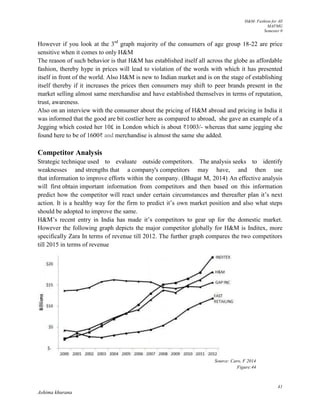
However the following graph depicts the major competitor globally for H&M is Inditex, more
specifically Zara In terms of revenue till 2012. The further graph compares the two competitors
till 2015 in terms of revenue
Source: Caro, F 2014
Figure:44
H&M- Fashion for All
MAFMG
Semester 0
42
Ashima khurana
Also with the personal interview conducted with the Assistant Manager of H&M revealed that
they consider Zara as their major competitor specially in India since the former has an
established market since past 5 years and has been the only company to cross 100 million dollar
in such short span of time since it’s inception in domestic market however the later has just
entered.
On an interview conducted with CEO-Karl John Perrson by Chaitali Chakravarty &RasulBailay
in Economic Times about Zara being an established brand in India and questioning about to late
entry in India market to which he replied “There are so many examples of countries where we
entered late - if you call them late. But we have done well irrespective of when we have entered.”
He also learned from Zara’s success, that India is an interesting market with super promising
future and he believes that his firm will do well in the country.
To know more about the scenario field study was conducted in which the assistant managers of
Zara and H&M were interviewed and following were the outcomes:
Store visit to H&M, Saket
Interview of the Assistant Manager- Mason
The location visited for H&M was Select City walk Saket on 9Th
November 2015. The assistant
manager of the store Mr. Mason was interviewed. He has being recruited from UK to India for 3
months and has being working here since the first day of opening. He looked really excited to
work here as the response till now received from the Indian consumer has being delighting as it
was much more than that was expected. He asked us to visit us on weekends and there is no
place for even them to stand. The store spread across 25,000sq feet area still finds it tough to
accommodate the number of consumers especially on weekends. On being asked about potential
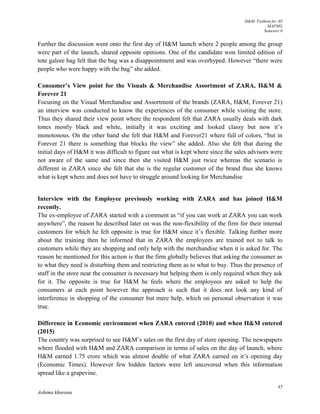
here of their upcycle product category which is completely a new concept for Indian consumer,
to which he replied with utter confidence that they are sure that this new concept brought by
0
5
10
15
20
25
2013 2014
Net
Revenue
In
Billion
$
Growth of 3 brands
H&M
ZARA
GAP
Source:Annual Reports
Figure:45
H&M- Fashion for All
MAFMG
Semester 0
43
Ashima khurana
them will surely be a success here as well. This initiative was started in UK and the response was
marvelous there and have expectation of that response from here as well. Also Mason while
answering to target Delhi out of all metropolitan cities as the first store for H&M said that the
aim of the company is to spread all across India but then to start from the capital, since the
population of the city is huge and also people have higher disposable income here thus the first
experiment was planned to be conducted in the capital and then to proceed further and spread all
across country. Furthermore asking about their competition in India he said that not just Zara but
GAP, Forever 21 are also their competitors but their affordability gives them a competitive edge.
Also the firm had Diwali special discounts and has plans to come up with special discount offers
and gift cards for Christmas. Since Mason has being associated with H&M for pretty long and is
the internal customers of the firm therefore the interview concluded with the last question asking
for the best thing about working with H&M to which he replied that ‘Progression is the best, for
example I have worked in US then in Finland then UK and now I am here for next three months,
you get to travel lot of countries, interact with lot of different cultures and the internal
progression is something that keeps you motivated and keep going’.
Further to know about what competitors feel about H&M coming to India and if there has being
any decrease in the footfall or sales, we went to Zara in the same mall and interviewed their
Assistant Manager- Pradeep
Store Visit to Zara, Saket
Interview with the Assistant Manager- Pradeep
In order to understand the effect of H&M on it’s competitors we interviewed Assistant Manager
of Zara, Select City Walk, Saket. The interview started with talking about H&M coming to India
to which he responded that yes it has finally come here too. Furthermore talking about how the
footfall has decreased since H&M has come he said that ‘yes the footfall has decreased, earlier
weekends use to be full, even today they are full but the number of people have decreased’.
According to him what customers they have in their stores now are the loyal customers who has
being associated with Zara since pretty long and our aware about their quality in exchange of
price they pay and the trend they follow. Thus when asked about any plans to change the policies
or any change that has already come to specifically after H&M, to which he confidently said that
they haven’t received any orders for changing anything till now and have no expectation of any
change in the near future, since he feels that they have being doing great till now and will be
doing great in the near future as well. Also the focus is now majorily on the customers
satisfaction. All of them aim for delighting customers, earlier it was difficult to attend customers
but now they can serve them with the best facilities and attend them individually. This is also the
short term goal of the firm.
Critical Analysis & Personal Observation
H&M- Fashion for All
MAFMG
Semester 0
44
Ashima khurana
On visit to both the stores at the same location, in the same day reveals lot of thing about the
stores and when the comparison is drawn then definitely yes H&M has given a tough
competition to Zara. A visit on Monday which is considered to be usually a hectic, monotonous
first day of the new week, was a planned day to know the footfall of both the stores, thereby the
footfall was more in H&M and majority of the people who went out of the store had H&M
packed bag in hand which says that majority of people who came in H&M came out of store
buying at least something whereas the scenario was different in Zara where the footfall was
countable on fingers and majority of people went out without buying anything. However 2 hour
of observation on each store is not a right evidence to know the footfall, thereby an informal
interview conducted with the Assistant store manager was helpful to gain some idea about the
changing situations. However Zara has created a trust factor among the consumers which H&M
has started building thereby H&M holds a power there since it has already a well settled brand
image. If you look at the sales person, H&M store staff has mix and match of different cultures,
where majority of them were from India but few were from US, UK and Africa. There was no
particular dress code being followed by them rather each department followed a different dress
code where one department was dressed up in complete black outfit, the other department had
red T-shirt in common. Over all this difference created a Unique and a youthful environment
within the store. Since that target audience is youth thus the servers for the same is people of
early Gen Y. On the other hand the visit to Zara store, the sales person followed the same dress
code throughout that is black formals, all of them are from India. Overall the store is more of
what the stores usually are in India. The sales persons are from Gen Y. However the ambience
has more of black and white contrasts whereas H&M has a colorful ambience.
Focus Group Discussion
Topic of Discussion- H&M v/s ZARA
The group included 5 people with 3 males and 2 females. Where 3 people supported ZARA over
h&m since they felt that it’s too early to judge if h&m would beat zara as the trust of quality is
still missing, one of them believed that h&m is selling clothes here which aren’t giving good
response abroad. On focusing on the price points the supporters of Zara felt that though the
prices are high but the brand has made itself capable to blindly trust them and buy on those price
points which h&m has started doing. However the other 2 supporting H&M felt that though the
firm has just entered India but it has got great response on the first day itself also considering the
fact that H&M claims to sell merchandise at affordable prices. One of them believed that ZARA
has being ruling India in terms of number of customers they had but now Indians have got
something new to look ahead, “if you compare at just zara and h&m, then H&M is something
new to look ahead’’ he added. The supporter of Zara on the other hand felt not much difference
in terms of price for both the firms. H&M was low but was near to ZARA. However on asking
that if the price points increase for both the firms then would the buying behavior remain the
same for to which 5 of them disagreed and said that if this case happens in near future then they
will prefer ZARA over H&M which means that the candidates were price sensitive for H&M.
H&M- Fashion for All
MAFMG
Semester 0
45
Ashima khurana
Further the discussion went onto the first day of H&M launch where 2 people among the group
were part of the launch, shared opposite opinions. One of the candidate won limited edition of
tote galore bag felt that the bag was a disappointment and was overhyped. However “there were
people who were happy with the bag” she added.
Consumer’s View point for the Visuals & Merchandise Assortment of ZARA, H&M &
Forever 21
Focusing on the Visual Merchandise and Assortment of the brands (ZARA, H&M, Forever 21)
an interview was conducted to know the experiences of the consumer while visiting the store.
Thus they shared their view point where the respondent felt that ZARA usually deals with dark
tones mostly black and white, initially it was exciting and looked classy but now it’s
monotonous. On the other hand she felt that H&M and Forever21 where full of colors, “but in
Forever 21 there is something that blocks the view” she added. Also she felt that during the
initial days of H&M it was difficult to figure out what is kept where since the sales advisors were
not aware of the same and since then she visited H&M just twice whereas the scenario is
different in ZARA since she felt that she is the regular customer of the brand thus she knows
what is kept where and does not have to struggle around looking for Merchandise
Interview with the Employee previously working with ZARA and has joined H&M
recently.
The ex-employee of ZARA started with a comment as “if you can work at ZARA you can work
anywhere”, the reason he described later on was the non-flexibility of the firm for their internal
customers for which he felt opposite is true for H&M since it’s flexible. Talking further more
about the training then he informed that in ZARA the employees are trained not to talk to
customers while they are shopping and only help with the merchandise when it is asked for. The
reason he mentioned for this action is that the firm globally believes that asking the consumer as
to what they need is disturbing them and restricting them as to what to buy. Thus the presence of
staff in the store near the consumer is necessary but helping them is only required when they ask
for it. The opposite is true for H&M he feels where the employees are asked to help the
consumers at each point however the approach is such that it does not look any kind of
interference in shopping of the consumer but mere help, which on personal observation it was
true.
Difference in Economic environment when ZARA entered (2010) and when H&M entered
(2015)
The country was surprised to see H&M’s sales on the first day of store opening. The newspapers
where flooded with H&M and ZARA comparison in terms of sales on the day of launch, where
H&M earned 1.75 crore which was almost double of what ZARA earned on it’s opening day
(Economic Times). However few hidden factors were left uncovered when this information
spread like a grapevine.
H&M- Fashion for All
MAFMG
Semester 0
46
Ashima khurana
The following section brings into focus the difference in economic environment of the country
with respect to ZARA’s opening in 2010 and H&M’s opening in 2015
1) Change in GDP
GDP is an important indicator to the country’s economical health if the GDP is growing
it means that the country is progressing whereas if GDP is decreasing the country is
heading towards poor economical health. Also rate of growth of GDP is an important
indicator which signifies that a firm can hire more workers and can afford to pay higher
salaries and wages, which leads to more spending by consumers on goods and services.
2) Increase in Disposable Income
With the increase in the disposable income of the consumers of the nation the purchasing
power has increased therefore the consumer base has increase in India.
ZARA opening H&M’s opening
GDP
Growth
Rate
Source:Knoema.com
Figure:46
H&M- Fashion for All
MAFMG
Semester 0
47
Ashima khurana
In the graph it is very clear that the disposable income of Indian consumers is increasing
rapidly. However there is a huge difference between the level of disposable income in
2010 and 2015. Inspite of low Disposable income ZARA managed to make 50 lakhs on
first day of sales whereas H&M made 1.75 crores on the first day with high level of
disposable income in the country.
3) Differences in FDI policy of India
In accordance with Indian regulations on foreign direct investment (FDI), the Spanish
fast-fashion retailer partnered with the Tata Group, India, to form a joint venture in
February 2009. Inditex owns 51% of this partnership while Tata's subsidiary Trent
Limited holds 49%. Due to various challenges the company faces, store expansion has
been slow, as only one store was planned to open in 2010 (Franchise Expo 2010)
However H&M instead of going for a joint venture falls under single brand retail trading
(SBRT) where according to the law on single-brand retail, up to 100% FDI is allowed,
but only 49% can come through the automatic route. Also change in FDI policies recently
has proved an advantage to the firm as the firm can now soon open it’s online store in
India. Also SBRT are suppose to source 30% from India which H&M has already being
doing. The firm has planned to open 30 outlets across the country by early 2015.
(Economic Times 2015)
4) Brand awareness : With the above mention factors and increasing influence of western
culture the awareness of foreign brands have also increased, also the craze of buying the
international brands have increased.
Figure:47
H&M- Fashion for All
MAFMG
Semester 0
48
Ashima khurana
Difference in their Marketing Mix
H&M ZARA
Product : The products that H&M is serving
follows the same trend as Zara mainly dealing
with Menswear, Women’s wear, Kids wear and
also has recycled clothes as separate category .
Product: Zara is serving the same line to
customers with Zara man, Zara Woman and
Zara Kid. TRF is also a separate department in
the store. And also has plan to launch Zara
Home Furnishing in Brick and Mortar form in
India soon.
Price: One of the goal of H&M is to make
fashion affordable for all thereby the prices
kept by them are low and accessible to even
middle class people whereas in Zara the prices
are targeting upper middle class income group.
Price: The prices of Zara are bit costly as
compared to H&M but due to faith that it has
built in minds of consumers in past 5 years the
customers have turned price insensitive for this
particular brand
Place: The firm has just entered the Indian
Market with 2 stores till now but has plan to
open 30 stores by early 2016. The key
ingredient it is looking for is huge retail space
for example it is spread in the area of 25,000sq
feet in Select City
Place: The firm has been in India since past 5
years and has 16 stores in India and soon is
planning to come up with Zara home
furnishing in the form of brick and mortar. On
comparing the retail size of the store in the
same location then Zara is occupied 15,000 sq
feet area
Promotion: H&M has used more of Social and
print media to promote itself. It came up with a
4 page print advertisement to announce the
launch in India. Also the firm uses a common
strategy for all launches which is a great launch
party where the celebs are seen wearing H&M
clothing.
Promotion : Zara follows Zero investment in
promotion strategy and follows more of online
promotion and word of mouth
*The above data has been taken from the websites of respective firms
BCG Matrix
Figure:48
H&M- Fashion for All
MAFMG
Semester 0
49
Ashima khurana
The following BCG has been calculated taking into consideration their net revenues of
the firms globally. The market share of H&M has being increasing consistently whereas a
dip is seen in Market growth which is relatively low. Thereby falling under the star
category.
ZARA had an increment in the market share in the year 2012-2013 and further a dip in
the same in the year 2014. However a considerable decrease is seen in market growth of
ZARA thereby putting it under Cash Cows
On the other hand GAP has seen a dip in Market share over the span of three years
however least decrease among the three brands has been experienced by GAP in terms of
Market growth thereby putting it under Market Growth.
Conclusion
 The firm has focus on 3 major chunks that they feel are responsible for their growth in
the global market - Internal customers
-External Customers
-Environment (Sustainability)
 The firm has succeeded in satisfying the employees with it’s effective HRM policies and
also making them a part of the success of the firm, their HIP –Incentive program has
created a desire for the employee to stay loyal to the firm and thereby saving the cost of
recruiting and selection process. The result being that H&M has being ranked on 24th
rank in the world and comes under the category of best companies to work with
according to a research by Fortune partnering with Great Place to work.
 Taking into consideration that H&M has entered India recently therefore the awareness of
the sustainability initiatives of the firm is missing. The people in India are not aware
about the ethical working policies of H&M. A drift has being seen in the buying pattern
of consumers preferring more from the brand with moral grounds. Thus it can be an
advantage for the firm. Therefore company with span of time and focus on spreading
awareness about the environmental initiatives can prove itself to be most sustainable
among the other brands present
 Also the Movement carried out by H&M about conscious clothing consumption was
miscommunicated to people therefore an awareness about that initiative via a popular
celebrity can be a way to incorporate more people for good cause
 The stores are located in South Delhi and have plans to spread in Noida and Gurgaon
however another expansion in West would give a good opportunity to the firm in terms of
sales, footfall and brand awareness providing more convenience to the consumers. They
as for now aren’t planning any store in west.
 Celebrity influence the consumers in big way thus tie up with films in term of outfits and
celebrity endorsement can help to tap the market
H&M- Fashion for All
MAFMG
Semester 0
50
Ashima khurana
 The change in FDI policy has given an advantage to the firm as now it can soon open it’s
online store in India due to it being already present in brick and mortar form
 According to the responses they have inelastic demand towards fast fashion however
have elastic demand towards H&M thus the firm should not plan to increases it’s prices
in near future.
 Also the consumer are overall happy with the products and services offered by H&M but
when on comparison with ZARA, the consumers would prefer ZARA due to it’s
established trust and brand Image in minds of consumer for which H&M take time
 The rate at which H&M has plans of progressing in terms of number of stores is more
than the rate at which ZARA has progressed. For H&M has plans to open 30 stores by
2016 whereas ZARA has 16 stores in 5 years.
Reflections
The research classes helped me in a great way to prepare my research objectives and
conduct a primary research on my brand. The communication classes were useful to write
my objectives and rational and also taught me the correct presentation skills. Statistics
classes were very helpful for the purpose of analysing the data from the questionnaires.
The marketing classes taught me the purpose of doing SWOT analysis and analysing the
strengths and weaknesses of my brand and also help me identify the target market of the
brand (market segmentation). The retail classes were one of the most important and
useful classes since they helped me look at the stores through the eyes of a fashion
marketer, to understand the retail mix and the importance of visual merchandising. The
classroom teachings of ‘Phenomenon of Fashion Demand’ were useful in understanding
the concept of elements and principles of design and thereby understanding their
importance in making and placing the garments in order to attract the customers. The
teachings in the finance classes helped me study the balance sheet and profit and loss
account of Biba Apparels and thereby calculating the required ratios to understand the
growth of the company over the years. Human Resource and Organizational Behaviour
classes helped me study the organization structure of the company and taught me the
importance of human resource management. It also helped me understand the need to
have strong harmony and communication skills amongst the members within an
organization. The activities held during the classes helped me understand the importance
of working as a team and using the resources effectively and efficiently to achieve my
target. The module ‘Market Response to Fashion Demand’ helped me understand the
supply chain of the company and how the product is made, beginning from the
conception to production and finally reaching the end customer for consumption.
H&M- Fashion for All
MAFMG
Semester 0
51
Ashima khurana
References
 Tandon, S & Agarwal, S 2013, Fast Fashion catches fancy of Indian
Consumers. Retrieved on November 2, 2015, from
http://www.livemint.com/Industry/ll0DswclMpprlxZaYs4GjO/Fast-fashion-
catches-fancy-of-Indian-consumers.html
 Malviya, S 2015, Zara becomes the first apparel brand in India to cross
$100-Million sales mark. Retrieved on November 5, 2015, from
http://articles.economictimes.indiatimes.com/2015-07-
10/news/64282723_1_inditex-trent-zara-brand-owner
 Vittal, I 2010, India’s fast growing fashion market. Retrieved on November
6, 2015, from http://www.mckinseyonmarketingandsales.com/indias-fast-
growing-apparel-market
 Stock, K 2013, H&M has being slower than it’s fast-fashion rival in
escaping Europe. Retrieved on November 7, 2015 from
http://www.bloomberg.com/bw/articles/2013-06-13/h-and-m-has-been-
slower-than-its-fast-fashion-rival-in-escaping-europe
 Regner, P &Yildiz, H 2013, H&M in fast fashion: Continued Success.
Retrieved on November 10, 2015 from
https://www.academia.edu/11463068/CASE_STUDY_H_and_M_in_fast_fa
shion_continued_success
 Mitra, S 2015, H&M to invest 100 pounds in 5 years in India. Retrieved on
November 10, 2015 from
http://www.livemint.com/Industry/XIdhqECSRa2W8YQFJLTBTP/HM-to-
start-Indian-operations-with-three-stores-plans-more.html
 Ranjan, D 2015,H&M Opens second store in India. Retrieved on November
11, 2015 from http://rtn.asia/d-r/15302/hm-opens-second-store-in-delhi
 Kalra, A 2015, H&M’s Next Target: The Middle Class Indian. Retrieved on
November 11, 2015 from http://www.businessoffashion.com/articles/global-
currents/hms-next-target-the-indian-middle-class
 Technopak 2015, Textile and Apparel Compendium 2015. Retrieved on
November 12,2015 from
http://b2bimages.iimg.in/files/retail_files/reports/data_file-China-dominates-
the-global-Textile-Apparel-exports-with-40-share-1434619354.pdf
H&M- Fashion for All
MAFMG
Semester 0
52
Ashima khurana
 Peterson, H 2014, 5 Charts that show H&M’s Progressive growth. Retrieved
on November 15, 2015 from http://www.businessinsider.in/5-Charts-That-
Show-HMs-Explosive-Growth/articleshow/42208347.cms
 Chitravanshi, R 2015, Revised FDI regulations allowed single brand retail
companies to sell online. Retrieved on November 20, 2015 from
http://economictimes.indiatimes.com/industry/services/retail/revised-fdi-
regulations-allow-single-brand-retail-companies-with-stores-to-sell-
online/articleshow/49865946.cms
 Franchise Expo 2010,Inditex JV launches first ZARA store in Delhi.
Retrieved on November 23, 2015 from
http://www.franchiseexpo.in/resources/franchise-news/jun-
2010/inditexjvlaunchesfirstzarastoreindelhi
H&M- Fashion for All
MAFMG
Semester 0
53
Ashima khurana
Annexure 1
H&M- Fashion for All
MAFMG
Semester 0
54
Ashima khurana
Annexure 2
H&M- Fashion for All
MAFMG
Semester 0
55
Ashima khurana
Annexure 3
H&M- Fashion for All
MAFMG
Semester 0
56
Ashima khurana
H&M- Fashion for All
MAFMG
Semester 0
57
Ashima khurana
H&M- Fashion for All
MAFMG
Semester 0
58
Ashima khurana
H&M- Fashion for All
MAFMG
Semester 0
59
Ashima khurana

Report_on_H_and_M_India (1).pdf

  • 1.
    Project Report Submitted by:AshimaKhurana, DFBMMP150823 2015-2017 Submitted to MAFMG Course Team 4th December 2015 Pearl Academy New Delhi
  • 2.
    Declaration I hereby declarethat the project work entitled “Report on H&M”, submitted to the Pearl Academy, is a record of an original work done by me under the guidance of Dr.SunitaKonwar, Course Leader of Masters in Fashion Marketing, and this project is submitted in the partial fulfilment of the requirements for the award of the degree of Master in Fashion Marketing. The results embodied in this work have not been submitted to any other University or Institute for the award of any degree or diploma. Name of the student: AshimaKhurana Signature:
  • 3.
    Acknowledgment I am highlygrateful to the course leader of Masters in Fashion Marketing, Dr.SunitaKonwar for her constant guidance and supervision as well as for providing necessary information regarding the project and also the support and motivation for the completing the project. I have made a lot of efforts in this project, however it would have not been possible without the kind support and help of many individuals, I would like to convey my heartiest gratitude to Dr.Ponamkumar, for her constant help and encouragement, I would like to extend my special gratitude and thanks to Mr RajeeshRavindran, Dr.PreetiGoel, Ms Preeti Dewan, Mrs Usha , Mr Piyush Pandey, Mrs Ritu Jain, Mr Rahul Jain for giving me such attention and time. Without their kind word, friendly advice during the project, this would have not been possible. A special thanks to H&M’s assistant manager & Visual Merchandiser of Select City Walk saket store, for giving an insight into the working structure of the brand.I would like to thanks the various consumers for their kind cooperation and allowing the interviews with them. Also I would like to express my thanks for Ex-employee of ZARA for providing inside information of the firm. In the end I would like to express my gratitude towards my parents and friends for kind co-operation and encouragement which helped me in completion of this project. Name: AshimaKhurana Course: MA Fashion Marketing Cohort: 2015-17 Bridge Semester 0
  • 4.
    List of Figures Figure1 Market apparel size Projection Figure 2 Shopping Pattern Figure 3-5 Research Methodology Figure 6 Ambience Vasant Kunj Figure 7 Promotional Launch Party Figure 8-12 Select City Walk Figure 13 Lead Time Figure 14 Supply Chain Figure 15-19 Sustainability initiatives of H&M Figure 20-21 Growth of H&M Figure 22-29 Financials Figure 30-43 Consumer Analysis Figure 44-47 Competitor Analysis Figure 48 BCG
  • 5.
    Table of Content S.No.Topic 1) Introduction 1.1 Growth of Fast Fashion across the Country 1.2 About H&M 1.3 Rationale 1.4 Research Objectives 2) Company’s Business Profile 2.1 Brief History of H&M 2.2 Mission and Vision of the Firm 2.3 Usp of H&M 3) Marketing Mix 3.1 Product Mix 3.2 STP 3.3 Ans-off Matrix 3.3.1 Indian Scenario 3.3.2 Global Scenario 4) Retail Mix 5) Organisational Structure 6) HRM 6.1 Recruitment and selection Process 6.2 Social Compliance 7) Supply Chain Management 8) Sustainability Initiatives by H&M 9) Growth of H&M in decade 10) Financial Analysis 11) Pest Analysis 12) Consumer Analysis 12.1 Interpretation 12.2 SWOT 13) Competitor Analysis 13.1 Interviews 13.2 BCG Matrix 14) Conclusion & Reflections 15) References 16) Annexures
  • 6.
    H&M- Fashion forAll MAFMG Semester 0 1 Ashima khurana Executive Summary The project aims to gain knowledge about the brand H&M Globally as well as in relation to it’s recent entry in India. Since it has given consumer a new choice for the fast fashion products. Also globally leading this brand had been planning to enter India since past few years and after it’s entry it marked the first day sales crossing 1.75 Crores showing the enthusiasm of the consumers towards the firm. Also presence of it’s competitors from past few years has lead to a comparative study for the same. The prime aim of the project is to study 3 things 1. The brand 2. The consumer’s forming perception about this newly entered brand 3. To draw a comparison between H&M and it’s competitor To study the brand, interview were conducted with the internal customers of the firm to know it’s working policies and internal environment. Also on look at the website gave the full information about the connectivity of the firm across the globe and it’s ethical working conditions. Since the company have major focus on sustainability thereby reports and articles of company’s initiatives towards the cause were looked at. Since the firm has entered India 2 months ago therefore the consumer’s perception towards the brand holds utter importance since the firm’s success or failure depends more on how the customers find their product. Thus a consumer analysis was conducted with aim to know the what the final consumers think about H&M. Also few shoppers were interview as to how was their experience at H&M The firm has entered a competitive environment where the fast- fashion brands are already established thereby a comparison was drawn among the brands both in terms of satisfaction of internal customers as well as external customers for better understanding and suggestions for further areas of improvement. Also a comparison in terms of difference in Economic Environment over past 5 years was studied. The report finds that the brand is doing well globally and has been able to keep it’s employees happy and satisfied and has achieved the rank 24 in the world by Great places to work. Also financially the company is in healthy state. However there is a lot to go do for external customers in terms of Location of the stores, Trust, Awareness, Merchandise. The information collected in consumer analysis was from the sample size of 99. Thereby the analysis are in accordance to the sample size and in depth interviews conducted with the consumers as well as employees
  • 7.
    H&M- Fashion forAll MAFMG Semester 0 2 Ashima khurana  Introduction In India the Textile & Apparel market was estimated at INR 3,20,000 crore (USD 58 billion), in 2013, and is projected to grow at a CAGR of 9% to INR 7,57,000 crore (USD 138 billion) by 2023 (Technopak 2015). It is the second largest industry in India, giving employment to approximately 45 million people (India Brand Equity Foundation 2015). Moreover if you look at the market size projection in table below India got the highest annual compound growth rate of 12% that means that the market size in India is projected to grow at the highest pace in the following forecast. The growth of apparel industry and the potential of the nation haslead to increased investment of foreign retailers. The partial growth in this sector can be attributed to the emergence of new industry players called “fast fashion retailers”- which can be seen as an explosive expansion in past few years. Fast fashion is a phrase used for designs that move quickly from the catwalk to showrooms to tap the latest consumer trends, is growing at a yearly pace of 25-30%, twice the rate of the overall market (Tandon,S&Agarwal,S 2013) The tables were turned from classic fashions to fast fashion by coming up of ZARA in India in 2009 which became the first apparel brand in India to cross $100-million sales mark, five years after it opened it’s first shop here.(Malviya,S 2015) Fast-Fashion In India The reasons for the rapid growing fast fashion in Indian consumers could be following: 1) Increase in disposable income. By 2005, 21 million of India’s 210 million households already earned more than $4,000 a year, qualifying them for membership in what we call “the consuming class.” Based on McKinsey research, by 2015 the number of consuming class households will likely triple to 64 million. 2) Both the Genders in India equally love shopping for clothes: According to UN reports India’s population is the youngest across the world. Another research tells that both the genders in India equally love shopping for apparels.In a market where almost all shoppers love or enjoy clothes shopping, it is no surprise that India is projected to become the world's third largest apparel market by 2020. Source: Statista.com Figure:1 Source: Cottoninc.com Figure: 2
  • 8.
    H&M- Fashion forAll MAFMG Semester 0 3 Ashima khurana 3) New occasions: As the lifestyles of India’s prospering urban consumers have evolved, their clothing needs have broadened, reflecting more varied usage occasions. With more socializing opportunities consumers are buying more sophisticated combination of outfit which is different for different occasions, also the ideology of wearing a garment for a season or for one particular occasion has lead to increased opportunities of fast fashion retailers. Today, Indians are more inclined than consumers in other markets to buy apparel for a specific purpose. Indeed, 38 percent of Indian respondents to a recent McKinsey study said they were highly likely to buy apparel for special events—a significantly higher proportion than in Brazil (5 percent), Russia (3 percent) or China (6 percent). 4) Fashion increasingly a form of self-expression. Increasingly, Indian consumers are embracing the idea of fashion for its own sake, as a means of self-expression, and not merely as a functional purchase. Television, movies, advertising and the Internet bombard today’s Indian consumer with new ideas about style, even as American-style shopping malls lure them away from traditional marketplaces. In a recent McKinsey survey of Indian consumers, 62 percent said they thought it was important to “keep up with trends.” 5) Further urbanization and the comparative youth of India’s population. At present, just 29 percent of India’s population resides in cities, among the lowest urbanization rates of any nation in the world. But that has been changing. Over the next 20 years, we expect the number of Indians living in cities to grow by 300 million, where they will don new styles and fashions to match new lifestyles. 6) Continued rise of “organized retail”: The increase in number of organized retail outlets has given the opportunity to the Indian consumer to undergo the transformation in terms of taste and preferences as the influence from the west is so strong in India that organized retailing has become a medium to narrow the gap between the fashion of west and the domestic trends. (Vittal, I 2010) Zara one of the leading fast fashion retailers entered India in 2009 and became the first company to cross $100 million in five years since it opened up. Following the same trend Hennes and Muaritz (H&M) entered India recently on October 2 2015 exploring Indian market with the aim to spread all across nation. The response received for H&M was seen in the sales of the first day of launch which was 1.75 crores that is approximately double of what Zara earned on it’s first day launch (Maliviya, S &Bhushan,R 2015). Thereby the brand chosen for the project is H&M since it’s completely new to Indian market and thereby provides and interesting field to further more research on.  About H&M The Sweden based apparel brand Hennes&Muaritz popularly known as H&M is the world’s second largest apparel company which exists in 61 countries with over 3,700 stores and employed around 132,000 people across the globe (Bloomberg Business 2013). This brand is popularly known for it’s hot-off-the-runway fashions at an
  • 9.
    H&M- Fashion forAll MAFMG Semester 0 4 Ashima khurana affordable prices and it’s fast fashion concept has dominate the youth around the globe. The basic ideology of H&M is “fashion and quality at the best price for everyone in a sustainable way”.  Rationale The global apparel industry has experienced a compound annual growth rate of 4.3% since 2000, reaching a market size of USD 1.7 trillion in 2012 (Euromonitor International 2013). The growth has not only been in terms of revenue. The number of pieces of clothing purchased per capita increased from 9.0 in 2000 to 13.9 in 2012 worldwide (Caro, F 2014). Talking about India, the apparel market size is projected to grow from USD 45 billion in 2012 to USD 200 billion in 2025; a CGRA of 12% (Statistic Portal 2015). Thus the potential in India is much higher and therefore Investment in this nation is a promising future (Perrson, J 2015). Also considering the changing taste and preferences of the end consumer the apparel market leaders have moulded the idea of clothing, where in the ancient times it was just a medium to cover the body and now it is much more than just covering, it depicts the individuality of the person. Henceforth the fashion and the society are interlinked characters. With blurring gender lines in the society has grabbed the attention of the world and the fashion called ‘Androgynous Fashion’ has come into play. The key players of this fashion statement example H&M has spread the fire of the same among the fashion consumers. Another concept that this brand is really popular among youth is ‘Fast Fashion’ which is a business model that offers (the perception of) fashionable clothes at affordable prices. Thus the brand chosen for the project is H&M since it’s completely new to India market, and has started giving tough competition to it’s peer competitors where it earned 1.75 crore on it’s grand opening on October 2, 2015 which is almost double to it’s rival Zara(Malviya, S &Bhushan, R 2015) . Thereby it is an interesting field to explore as to how it continues to delight it’scostumers & grow in Indian market. Also it’s ethical working policies and personal interest has led to working and exploring on this brand.
  • 10.
    H&M- Fashion forAll MAFMG Semester 0 5 Ashima khurana  Research Methodology CCv RO1: To gain an In-depth knowledge of the brand H&M Research Design: Exploratory Data Collection Tool Primary Secondary Interview of the Visual Merchandiser (Kumud) Interview of the Assistant Store Manager (Mason) Store- Select City Walk Personal Observation -Store Observation Select City Walk -Store Observation Ambience Vasant Kunj -Visual Merchandise -Merchandise Assortment -Consumer’s Buying Behavior Company’s Website Company’s Online Reports -Report on Sustainability -Annual Reports E-Newspapers -Economic Times -Times of India -Hindustan Times Journals & Articles -Fast Fashion -Sustainability Supply Chain Case Study -HRM Case study for H&M Figure: 3
  • 11.
    H&M- Fashion forAll MAFMG Semester 0 6 Ashima khurana RO2: To Examine Consumer’s buying behavior for H&M Research Design: Exploratory & Descriptive Data Collection Tool Primary Quantitative Qualitative Close Ended Questionnaire (Structured & Non-Disguised) Sampling Process Sample Technique:Convenienc e & Judgmental Sampling Sample Size: 99 Sample Area: Delhi NCR In-Depth Interview (2) Personal Observation Data Analysis:SPSS -M Annova -Crosstab -Mean Figure:4
  • 12.
    H&M- Fashion forAll MAFMG Semester 0 7 Ashima khurana CCv RO3: To draw a comparative study between H&M and ZARA Research Design: Exploratory Data Collection Tool Primary Secondary Interview of the Visual Merchandiser (H&M) Interview of the Assistant Store Manager (Mason) Store- Select City Walk (H&M) Personal Observation -Store Observation Select City Walk -Store Observation Ambience Vasant Kunj -Visual Merchandise -Merchandise Assortment -Consumer’s Buying Behavior Company’s Website Company’s Online Reports -Report on Sustainability -Annual Reports E-Newspapers -Economic Times -Times of India -Hindustan Times Journals & Articles -Fast Fashion -Sustainability Supply Chain Competitor’s Website Competitor’s Online Reports Interview of the Assistant Store Manager (Pradeep) Store- Select City Walk (ZARA) Interview of Ex-Employee of ZARA, presently working with H&M Focus Group Discussion (5 consumers) In-depth Interview (3) Analysis from the questionnaire Figure:5
  • 13.
    H&M- Fashion forAll MAFMG Semester 0 8 Ashima khurana  Company’s brief Profile  Brief History of H&M The history of H&M started with a man named ErlingPersson, who was a Swedish former salesman that became fascinated with America’s high-volume efficient outfits that 8 Barneys and Macy’s carried. Persson first discovered the outfits when coming to the United States after World War II. Persson brought the retail concept – that high turnover produced lower prices – and brought it back with him to Sweden. It was then that Erling chose to open his own store which he called Hennes, standing for “hers” in Swedish. During this time the store only sold women’s clothing (International Directory of Company Histories, 1999). The company Hennes was established in 1947 in Vasteras, Sweden and by 1968 Persson had purchased the men’s sportswear inventory and property of a Stockholm hunting equipment store which was named MauritzWidforss. ErlingPersson then changed the name of his store Hennes to Hennes&Mauritz to express the expansion, and later downgraded to just the abbreviations H&M.  Mission of H&M The prime focus of H&M is to serve fashion and quality at the best price in sustainable way. The believe that they should have best customer offering in each and every market and offer collection that are wide ranging and varied for women, men, teenagers and children.For them design, quality and sustainability are not a question of price but ability to offer inspiring fashion with unbeatable value for money.  Sustainability Vision H&M’s business operations aims to run in a way that is economically, socially and environmentally sustainable where it means that the need of both present and future generations must be fulfilled.  Why Name H&M The company initially started off with the name “Hennes” meaning ‘hers’ is Sweden language in 1946, selling exclusive women’s apparel and accessories. ErlingPersson was going around the US on a tour when a business plan struck him. He felt the need for high end designer clothing brand for women and set his first shop in Sweden in 1947. Twenty one years after its establishment, in 1968 Hennes took over another apparel retailer MauritzWidforss, and that’s when the name was changed to "Hennes&Mauritz" (H&M).  USP of H&M H&M works on a business concept of fashion for all, where this venture serves the customer with stylish clothes, classic look at the affordable price. Also the tie ups of H&M with big designers have helped them to establish themselves among the best fast fashion retailers where they provide the consumer with best designs from the popular designers at an affordable price due to their effective logistics. *The above data has been taken from the website of the company
  • 14.
    H&M- Fashion forAll MAFMG Semester 0 9 Ashima khurana  Marketing Mix Product H&M is classified as a brand that offers homogenous shopping products. This means that their consumers purchase their products at H&M because of its pricing and features. Many consumers that shop at H&M get attracted to purchase several items they didn't plan to get. The reason to that is the convenience of having all departments in one retail store, which gives H&M a large Product mix width. Every department H&M offers various product lines to be able to attract as wide demographically as possible. Looking at Indian stores, H&M in serving 3 categories- Women, Men and Kids wear. New Born Baby Girl (4m-2y) Baby Boy (4m-2y) Socks Girl (18m-10y) Boy (18m-10y) Girl (8y-14y) Boy (8y-14y) KIDS WEAR
  • 15.
    H&M- Fashion forAll MAFMG Semester 0 10 Ashima khurana Women’s Wear Maternity Wear Sports Wear Casual Wear Lingerie Formal Wear Dresses Balmain Exclusive Accessories Bags Upcycle Product
  • 16.
    H&M- Fashion forAll MAFMG Semester 0 11 Ashima khurana Men’s Wear Formal Wear Casual Wear Classics Wear Sportswear Wear Upcycle Product UnderWear Accessories Accessories Shoes Balmain Exclusive Hoodies
  • 17.
    H&M- Fashion forAll MAFMG Semester 0 12 Ashima khurana Price The price strategy of H&M is designed based on their customer’sneeds which is low price and high fashion. H&M outsources the production to countries where the labor cost is much lower. To control transportation cost, outsourcing was arranged according to different product. Those high fashion products which target at the European market were produced in Turkey, because of the short product life cycle (Regner, P &Yildiz, E 2013).In addition, basic products are produced in Asia because they allow longer transportation time and bear lower risk. The company also conduct strict cost control plan. For example, very few executives have secretaries or have cell phone privilege. The product range at the H&M store in Delhi has been aggressively priced with T-shirts starting at Rs.399. Women’s clothing and accessories with prices that start at Rs.149 for hair bands and go up to Rs.18,999 for the costliest of dresses. Denim trousers for women are available at Rs.699 while those for men start at Rs.999. Local sourcing helped the brand sell polo T-shirts for as low as Rs.500. (Mitra, S 2015) Place H&M at present has around 37,000 stores across the globe and in India for now it has 2 stores which opened recently in the gap of a month where first store came into existence on October 2 2015, the second store opened on 7th Nov. H&M has plans to open 30 stores in India and 400 stores across the globe by early 2016. (Mookerji, N 2015). The first store at Select City is about 25,000 sq feet whereas the second store at Ambience Vasant Kunj is the largest store in the country which is spread in 28,000 sq feet. Furthermore the plans for expansion are in Ambience Gurgaon, Mumbai followed by teir1 and teir2 cities. (Ranjan, D 2015) Promotion A multi-channel promotion strategy including advertising, internet promotion, sales promotion is adapted by H&M. These multi-channel strategy increases the exposure of H&M. The promotion of the firm is an important aspect in the success ahead that it should be designed carefully with maximum effect. H&M had great event launch on it’s first opening where special permissions where taken to keep the mall open for a night, the excited crowd started forming queues with the eagerness to win limited edition tote’s bag and give away gift vouchers for the first three customers. The firm promoted itself by creating a festival atmosphere in and Source: dnaindia.com Figure:6 Source: dnaindia.com Figure:7
  • 18.
    H&M- Fashion forAll MAFMG Semester 0 13 Ashima khurana outside the mall. However one thing that remains common in all H&M is the great launch party where Bollywood stars where seen in the next collection of H&M. In the second store launch similar procedure was followed to delight customers in addition to that was the DJ and on ground entertainment for the customers. (Regner, P &Yildiz, E 2013) Market Segmentation, Targeting & Positioning The STP process demonstrates the links between an overall market and how a company chooses to compete in that market. Segment- People that follow fast fashion. These are approaches to subdivision of a market or population into segments with defined similar characteristics. Demographics and psychographic segmentation are used for H&M to reach all their customers. H&M is spread throughout the world. This means that the company targets many religions, culture and lifestyle. Therefore, their marketing has to be done differently in different areas Demographic Segmentation 1. Segments by class: H&M strategy is offering high fashion at low prices, typically targeting working class, lower middle class and students. 2. Segments by class/home: The most popular segment is women aging between 15 and 30 years, either still living at home, in student dorms, or in their first house in urban regions 3. Segments by age: The most popular segment is women aging between 15 and 30 years commonly known as generation Y, ambitious with high buying power. 4. Segments by family life: Typical college to graduate females life at home single, on their own in dorms or in their first home, either single or as a young couple without children. Psychographic Segmentation Influences on Gen Y: Cultural, social, personal and psychological influences result in a lifestyle and personality. This group is looking for affordable fashion and typically shop at more than one store. They are fashionable consumers who see shopping as a social activity providing pleasure in their daily lives. They buy clothes each season, want to follow trends and are very up-to-date. According to Maslow’s hierarchy of needs, they would fit perfectly in the social part: belongingness/love. This particular segment is most vulnerable one as they are more prone towards impulsive buying. Targeting- Gen Y, especially Women The selection of potential customers to whom a business wishes to sell products or services. The target customers of H&M belong to the group of fashionable and trendy consumers who see shopping as a social activity provide pleasure in their daily life, who wants to follow the trends without investing a lot of money. The target market for H&M is young people. Even though H&M offers clothing and accessories for all ages, their target market is Gen Y and particular focus on women. Women usually shop more for them, they also buy all their children's clothing
  • 19.
    H&M- Fashion forAll MAFMG Semester 0 14 Ashima khurana and often their husbands or boyfriends as well. With their low prices H&M targets woman in the lower middle class and working class, this is a concentrated targeting strategy. Positioning One of the aim of marketing is to position the brand in minds of consumer in a way which makes them superior to their competitive brands. H&M is a retailer that is looking to provide consumers with fashionable, high-quality clothing at the best price possible. They are known for offering “fast fashion” clothing, in other words from runway to racks in record time, and sell across the globe. Particularly if you look at India H&M is on an introductory stage with it’s recent entry, however the company being the second largest fast fashion retailer across the globe has formed certain preconceptions in mind of domestic consumers which has somewhat positioned the firm next to Zara, GAP, Forever 21. H&M claiming to be more economical, sustainable has given a competitive edge to the firm. (Regner, P &Yildiz, E 2013) ANS-OFF Matrix for H&M Indian Scenario Since H&M is new to Indian market thereby the market is completely new to them, also the product range being offered by them prevails in the peer brand like Forever21, GAP, ZARA. Thus the product range is already an existing one but the market is completely new. Thus the risk that prevails in this situation is medium. However the firm should aim for Market development, particularly for India. Global Scenario H&M being the second fast fashion retailer across the world after Inditex already has an existing market and the products already exists thereby the plan for further growth is Market penetration. H&M should encourage it’s current customers to buy more. It should introduce new items frequently, which keeps customers coming back again and again to check out the latest styles. It’s upcycle product category and the affordable prices has given a competitive edge but there is still a room of innovative improvement to remain competitive. Retail Mix In marketing, the retail mix elements are 1) Location 2) Merchandise Assortment 3) Pricing 4) Communication Mix 5) Store Design and Display 6) Customer Service Figure:9
  • 20.
    H&M- Fashion forAll MAFMG Semester 0 15 Ashima khurana Source: dnaindia.com Figure:10 Location H&M chosed Delhi to open it’s first store in the whole India due to the population which is ranked second in the whole world and the capital being the richest state of India where people have higher disposable incomes. Furthermore it has come up with 2 stores in 2 elite malls of South-ex of Delhi, and has plan to come up in Gurgaon as well. If you look at the footfall in these malls it is pretty high as compared to the other malls, also the size of the store till now of H&M has being huge, around 25,000- 28,000sq feet thereby it is possible for huge malls only to accommodate such huge sized stores thus the target malls has being big in the areas they are spread across. Also majority of the target audience resides in South-Delhi, however this doesn’t mean that H&M has no plan to expand in north Delhi but the first location was decided keeping in mind the above mentioned factors. Merchandise Assortment The store is divided into 3 broad sections as Men, Women and kids. Where the women department is on the ground floor which has deeper assortment as upper wear, bottom wear, foot wear, lingerie, accessories which was further sub categorized into varieties of upper wear where winter and summer collection both were present another category named as up-cycle product category was present which was made out of recycled clothes.The floor above was dedicated to men’s wear and kid’s wear which included the upper wear of both the seasons, winter and summer and bottom wear which included jeans, gym outfits, formals etc. The kids section on the right side of the entry was full of colors. The basic idea behind such assortment is that a consumer finds everything under one roof and to encourage them for impulsive buying where they end up spending for goods which they did not even plan to buy. Also H&M known for it’s fast fashion has great deal of products under basics and classics as well, through that their target audience not just limits upto the Gen Y but also Gen X. Thus the aim of such assortment is not to let go anyone free handed. (Mason, Assistant Manager) Pricing H&M known for it’s affordable fashion has kept prices low and fashion up to date with quality as it’s priority. Little surprise then that the product range at the H&M store in Delhi has been aggressively priced with T-shirts starting atRs.399. Most of the 25,000 sq. ft H&M outlet at the
  • 21.
    H&M- Fashion forAll MAFMG Semester 0 16 Ashima khurana mall is dedicated to women’s clothing and accessories with prices that start at Rs.149 for hair bands and go up to Rs.18,999 for the costliest of dresses. Denim trousers for women are available at Rs.699 while those for men start at Rs.999. Local sourcing helped the brand sell polo T-shirts for as low as Rs.500. Store Display Each store is unique – but should also be easily recognisable. Interiors have to provide a functional and flexible framework that invites customers to step inside and guide them through the different departments, while offering an exciting shopping experience. Displays, both in windows and inside, put parts of the current in-store selection in focus and provide styling tips and inspiration. Global display guidelines are created in a large “test store” near the H&M Head Office in Stockholm. Displays are changed frequently and themed around an association or a feeling, but always keep the clothes in focus. Customer service H&M aims to provide customer with highest satisfaction. On personal observation H&M has somewhat succeeded in delighting it’s customers. Each department had sales advisors serving each customer with the required merchandise, helping them out with the available sizes and other options available. Considering it’s return policy then they are happy to exchange or refund any unsuitable merchandise within 30 days provided that they are in a resalable and unused condition, accompanied by original price tags and original receipt. For reasons of hygiene, underwear, swimsuits, pierced earrings and cosmetics cannot be exchanged. However refunds can be easily made in store of original purchase through H&M Merchandise card valid for 1 year. (H&M India). Also H&M offers gift cards to it’s customers which can be loaded from Rs 500-5000/-, the card can be used to give full or partial payment for the good purchased, even the refund balance will be transferred directly to the card, just the customers need to know his/her card number. (Kalra, A 2015) Organizational Structure H&M has a matrix organization in which the Managing Director appoints the members of the executive management team and country managers. H&M’s matrix organisation means that the members of the executive management team are responsible for their department’s support, training and best practice, and for each country working efficiently in accordance with the policies and guidelines issued by the Head Office. Country managers have overall responsibility for sales, profitability and all departments in their country.
  • 22.
    H&M- Fashion forAll MAFMG Semester 0 17 Ashima khurana Organizational Structure Back-End Country Manager- JanneEinola Front-End *The above information was provided by Assistant Manager-Mason of Select City Store. Area Manager Store Manager Assistant Store Manager Department Manager Sales Advisor *The above information was provided by Visual Merchandiser- Kumud Figure:11 Figure:12
  • 23.
    H&M- Fashion forAll MAFMG Semester 0 18 Ashima khurana Human Resource Management (HRM) HRM is the term used to describe formal systems devised for the management of people within an organization. Human Resources in H&M The corporate objective of H&M is to expand worldwide and hence with the continuous increase in the employee strength. The staff H&M is spread approximately across 37 countries which come from different cultural background. Their strategy is to recruit local people whenever they open they open the new store. The main policies of H&M can be categorized as:  Overall policies and values The website of the H&M indicates that the company’s main objective is to be a good employer. At H&M, the HR activities are guided in such a way that every individual have equal fundamental rights. This means that everyone will have fair wages and working hours. They all have full freedom of association and development within the company.  An Inclusive Workplace They consider their internal customers as they reason of success and are committed to maintaining an inclusive workplace. It’s one where human rights are recognised, and where everyone treats each other with integrity, respect, humbleness and dignity  H&M works in teams and lead by example As per there website, teamwork is essential at H&M and is part of their culture. They are always driven by their values and lead by example. They believe leaders should always be role models and set a good example in everything they do  You Grow We Grow H&M has being providing a fun, creative and dynamic workplace so everybody working within the firm they all grow together. Great opportunities are provided through internal recruitment and work rotation. Everyone is a talent and makes a difference at H&M.  Use of open Door Policy Their Open Door Policy grants all colleagues the opportunity to openly discuss any work- related issue directly with their managers.  They Strive for Sustainability in everything they do Sustainability makes business sense and is an integral part of everything they do. It’s a shared responsibility of everyone working at H&M, where everyone’s efforts make a difference.  H&M Incentive Program-HIP for all working at H&M H&M know that their employees are the key to our success. To show them appreciation, H&M has created HIP – the H&M Incentive Program – which since 2011 After their employees have spent five years with H&M, they begin to share the profit increase made by the H&M Group. The longer they are an employee, the more they will receive. It’s that simple, and is
  • 24.
    H&M- Fashion forAll MAFMG Semester 0 19 Ashima khurana the same for everyone in the H&M Group, in all countries, regardless of position, salary, or contract of employment. The employees will receive payouts from HIP when they turn 62. However, from the year 2021 our employees can choose to receive their first payout as soon as they have been with the H&M Group for ten years. *The above data has been taken from the company’s website Words of Internal Employees The prime goal of H&M is to expand around the globe has given rises to many programs to motivate and develop the internal customers. The firm is a flat organization however it might look difficult to move up in such system however the opposite is true in the case of H&M as per their career website and personal interaction with the employees. Mason, assistant manager at H&M store saket who has being working with H&M since pretty long strongly believe that the best part of working with the firm is the progression, also the experience that H&M gives in terms of working with different nationalities and culture and travelling to different countries is another motivational factor for the employess. The live example of progression within the firm is the present CEO- JanneEinola who is the country manager for India and have being working with H&M since 1998 and started the job as Department Manager of a store. Also another employee (VM) felt that the firm delivers what it says specially in terms of sustainability. The firm gives you space to working according to your knowledge and ethics which motivates to do more. Recruitment and Selection Process H&M group has around 132,000 employees. The corporate culture of H&M has been one of the major factor in enabling them one of the world’s largest fashion company and at the same time enjoying the high profitability. According to the head of HR department of H&M all the university credits and great grades in the world does not give any guarantee of getting a job or a fast-track career. The company looks for people with right personality, more than anything else. H&M belief that skills can be gathered as you go, but personality and right attitude cannot be taught to a person. Since the tempo of the company is always high and is a fast growing company, therefore employees who are self driven and who have the capability of direct communication are the main requirement of the company. Hence people who likes decision making and responsibility are recruited by the company. These are the basic requirement for H&M to recruit the employees and drive its basis for selection process. There website indicates that selection is based on personal interview which contains ‘structured situational based’, which include latest fashion trends and customer service. The selection is followed by panel of interviews and sample test. Candidates are filtered at each stage of selection process. (Bansal, A 2011) Social Compliance Social compliance refers to the way a company looks after the health and safety of its employees and its accountability for safe practices. At H&M they want to maintain pleasant and sustainable working environments throughout our operations. This includes ensuring that a person as an
  • 25.
    H&M- Fashion forAll MAFMG Semester 0 20 Ashima khurana employee have a safe workplace. H&M takes preventative measures to ensure the long-term safety and good health of our employees. They encourage their employees to report accidents or unsafe working conditions to their manager. Role of HRM in H&M’s success H&M is an effective multinational organization. The principle accomplishment of H&M essentially lies in the plan of action of the organization. All the outlining system is being done inside and halfway. The entire assembling is being outsourcing with no bargain on the nature of the item. The organization is fruitful in dealing with all the center qualities in admiration of nation and social contrasts. The elements of HR strategy, like in housetraining, improving performance through local recruitment, job rotation, increasing commitment and total rewards have been in HR procedures and strategies and are practiced by the company. The HIP program that has been launched in 2011 is an initiative to motivate the employees to deliver their best and stay loyal to the firm. Thereby the policies are such that incorporates every employee to be a part of the combined benefit. Rising above monetary terms, the in-house initiatives to make the employee feel free to communicate with the above head is another important aspect of it’s policy. Thus the HR strategies of the company are one of the reasons for the success of the business. Lead Time taken by H&M The following graph shows a comparison between the Lead time taken by the fast fashion products of H&M (12 Weeks) and the Classic products of H&M. Source: Caro and Mart´ınez-de-Alb´eniz (2013) Figure:13
  • 26.
    H&M- Fashion forAll MAFMG Semester 0 21 Ashima khurana SUPPLY CHAIN MANAGEMENT *The above data has been taken from Sustainability Report-2014 of H&M Design Raw Materials Fabric Production Garment Production Transport Sales Uses Sustainability starts at the drawing board. To create fashion without compromising design, price &quality. Knowing how the choices of material will impact the environment and people right from the start. Working conditions and intense water & chemical use are concerns associated with processing raw materials (e.g cotton). Through active involvement with Better Cotton Initiative (BCI), Textile Exchange and UNICEF further improvement will take place From making yarn to final fabrics, there are concerns regarding water, chemicals and working conditions as well as greenhouse gas emissions. Together with suppliers garment production has made great improvement in developing high social and environmental standards. Also training of their suppliers and their workers, promote industrial relations and social dialogue. It was estimated that more than half of the carbon emission at H&M are due to transportation from factories to stores.. Ferry and train are relatively clean modes in transportation. At present, shipping via sea or rail is the main mode of H&M’s transportation from supplier to distribution centers. If road transport has to be used, H&M provides a training course to the truck drivers and does not use the trucks which have been used for more than 10 years. When the product reaches the store thereby H&M has adopted Green Retailing, they launched the clothing conscious collection initiative worldwide in 2013 and promotes sustainable concept in ethical consumers in retailing . Consumers can return the old apparel products (any brand and any condition) to all H&M stores across 54 countries. In return, consumers can get a 15% off coupon for their next purchase Figure:14
  • 27.
    H&M- Fashion forAll MAFMG Semester 0 22 Ashima khurana Initiatives towards Sustainability by H&M Sustainability in H&M’s Words Source: Sustainability Reports-2014 Figure:15 Source: Sustainability Reports-2014 Figure:16 Source: Sustainability Reports-2014 Figure:17
  • 28.
    H&M- Fashion forAll MAFMG Semester 0 23 Ashima khurana *The above information is taken from Sustainability Report of H&M-2014 Taking into consideration that H&M has recently entered in India therefore it came up with the initiative of Collecting clothes which are not in use by the consumers that further H&M can recycle, offering discount in exchange. However where CEO feels that this initiative will take time to work in Indian market since the clothes are recycled and reused at the domestic level to great extend on the other hand the on store managers feel that lack of awareness is the cause of such situation, since this concept is new in the country thus the consumers felt that the bucket which was crucially kept for accommodating clothes consumers want to dispose for recycling miscommunicated that bucket is kept for keeping the clothes which were tried and not purchased. Also keeping sustainability as their preference H&M internally doesnot waste even the tags and labels on the clothes and they are also reused for saving the ink and material used in making those labels. This is a very good initiative towards waste management as well. *The above information is gathered by interviewing Visual Merchandiser. Source: Sustainability Reports-2014 Figure:18 Source: Sustainability Reports-2014 Figure:19
  • 29.
    H&M- Fashion forAll MAFMG Semester 0 24 Ashima khurana Growth of H&M 1991-2013 1) Sales & EBIT of H&M AB The company has shown great improvement in sales starting from 1991-2013 where in 2011 they saw a dip in sales as compared to previous year but was recovered in 2012. Earning before Interest and Taxes (EBIT) has been highest in 2010 and have seen a dip from 2011 onwards however improvement is there but till 2013 the EBIT was low as compared to what achieved in 2010. 2) Number of Stores The graph depicts the number of stores increment in H&M AB the parent brand of 6 other stores namely H&M, COS, Monki, Weekday, Cheap Monday, &Other Stores. Source: businessinsider.in Figure:20 Source: businessinsider.in Figure:21
  • 30.
    H&M- Fashion forAll MAFMG Semester 0 25 Ashima khurana Financials Analysis For H&M Profitability Ratios Gross profit percentage = (Gross profits/ Net Revenue)*100 2012 = (711871/120799)*100 = 59.4% 2013 = (76025/128562)*100 = 59.1% 2014 = (89052/151419)*100 = 58.8% Net profit percentage = (Net profit/ Net Sales)*100 2012 = (16867/ 120799)*100 = 13.96% 2013 = (17093/128562)*100 = 13.29% 2014 = (19976/151419)*100 = 13.19% 2012 2013 2014 H&M 59.40% 59.10% 58.80% 58.40% 58.60% 58.80% 59.00% 59.20% 59.40% 59.60% Gross Profit Percentage 2012 2013 2014 H&M 13.96% 13.29% 13.19% 12.50% 13.00% 13.50% 14.00% 14.50% Net Profit Percentage Interpretation: Gross Profit Margins helps to know the Direct efficiency of the firm. H&M’s GPP has decreased from 59.40% in 2012 to 58.80% in 2014 however on whole the firm is performing well and in in good financial health Interpretation: Net Profit Margin are helpful in knowing the overall efficiency of the firm. The decreasing NPP isn’t a good signature as it indicates that the net profits are increasing but net sales are increasing at a higher rate thereby signify low NPP. The firm anyhow is giving an Average performance Figure:22 Figure:23
  • 31.
    H&M- Fashion forAll MAFMG Semester 0 26 Ashima khurana Return on Assets = (Net Profits/ Total Assets)*100 2012 = (16867/60173)*100 = 28.03% 2013 = (17093/ 65676)*100 = 26.02% 2014 = (19976/75597)* 100 = 26.42% Return on Equity = (Net Profit/ Total Equity)*100 2012 = (16867/ 43835)*100 = 38.4% 2013 = (17093/ 45248)*100 = 37.7% 2014 = (19976/ 51556)*100 = 38.7% 2012 2013 2014 H&M 28.03% 26.02% 26.42% 24.00% 26.00% 28.00% 30.00% Return on Asset 2012 2013 2014 H&M 38.40% 37.70% 38.70% 37.00% 37.50% 38.00% 38.50% 39.00% Return on Equity Interpretation: Return on Asset indicates the monetary returns in profits on the investment made on Assets. The ROA has decreased from 2012 from 28.03% to 26.42% in 2014. The dip has been because of the difference in rate of increase. The net profits has increased with a slow rate as compared to increase in Total Assets Interpretation: Return on Equity indicates the effective utilization of money. It measures a corporation's profitability by revealing how much profit a company generates with the money shareholders have invested, Thus the ROE has been highest in 2014 however a dip can be seen in 2013 but on whole the company’s. Looking at the ROE thereby we can say that efficient management is in utilizing its equity base and the better return is to investors. Figure:24 Figure:25
  • 32.
    H&M- Fashion forAll MAFMG Semester 0 27 Ashima khurana Return on Investment (in %age) ROI= (Net Profit+ Interest Expenses)/(Debt+ Equity)*100 Debt = 0 2012 = [{16867+(-5)}/0+43835]*100 =38.46% 2013 = [{17093 + (-9)}/0+45248] =37.75% 2014 = [{19976 + (-16)}/0 + 51556]*100 =38.71% Liquidity Analysis Current Ratio = Current Asset/Current Liability 2012 = 37232/14010 = 2:6 2013 = 39188/17397 = 2:2 2014 = 42741/20303 = 2:1 2012 2013 2014 H&M 38.46% 37.75% 38.71% 37.00% 38.00% 39.00% Return on Investment (in percentage) 2012 2013 2014 H&M 2.6 2.2 2.1 0 1 2 3 Current Ratios Interpretation:Return on Investment (ROI) is the amount that is returned on the investment made in a company. H&M had highest ROI in 2014 during the period of 2012-2014, however a decline in ROI was seen in 2013 but was soon covered in the next year. Interpretation: Current Ratio indicates if the firm has sufficient assets to meet the current liabilities within the span of 1 year or less. Where 2:1is the ideal situation which was achieved in 2014 before that current liabilities had always being more starting from 2012 then decreasing in 2013 and reaching the ideal scenario in 2014. Figure:26 Figure:27
  • 33.
    H&M- Fashion forAll MAFMG Semester 0 28 Ashima khurana Quick Ratio = Quick Assets/ Current Liabilities 2012 = 22019/14010 = 1:5 2013 = 22493/17397 = 1:2 2014 = 23338/20303 = 1:1 Growth Formula Growth Ratios = Difference/Previous Year Sales Growth 2012-2013 Sales Growth 2012 = 120799 Sales Growth 2013 = 128,562 Difference = 7763 Growth Ratios = 7763/120799 = 0.06 Sales Growth 2013-2014 Sales Growth 2013 = 128,562 Sales Growth 2014 = 151419 Difference = 22857 Growth Ratios= 22857/128562 = 0.17 Net Profit Growth 2012-2013 Net Profit Growth 2012- 16867 Net Profit Growth 2013- 17093 Difference= 226/16867 2012-2013 2013-2014 H&M 0.06 0.17 0 0.05 0.1 0.15 0.2 Growth Ratio Interpretation: Quick Ratio indicate how well a company can meet it’s short-term financial liabilities. Where 1:1 is the ideal situation which the firm reached in 2014 however when the firm exceeds 1:5 as a ratio this indicates that the assets are more thereby liquidity is more thus no investment has happened. Thus the firm was close to this scenario in 2014 Interpretation: The growth Ratio indicates the overall growth of the firm in comparison with the previous years. However overall growth of H&M’s has been average but the rate of increase from 2012-2013 to 2013-2014 has being markable. Figure:28
  • 34.
    H&M- Fashion forAll MAFMG Semester 0 29 Ashima khurana = 0.01 Net Profit Growth 2013-2014 Net Profit Growth 2013 = 17093 Net Profit Growth 2014 = 19976 Difference = 2883/17093 = 0.16 Total Asset growth Total Assets 2012 = 60173 Total Assets 2013 = 65676 Difference = 5503 Total Asset growth 2012-2013 = 5503/60173 = 0.09 Total Asset 2013 = 65676 Total Asset 2014 = 75597 Difference = 9921/65676 = 0.15 Equity Growth Equity 2012 = 43835 Equity 2013 = 45248 Difference = 1413 Equity Growth Ratio = 1413/43835 = 0.03 Equity 2013 = 45248 Equity 2014 = 51556 Difference = 6308/45248 Equity Growth Ratio = 0.13 2012-2013 2013-2014 H&M 0.09 0.15 0 0.05 0.1 0.15 0.2 Total Asset Growth Ratio Interpretation: The Net profit growth of the firm has being average but the rate of increase from 1% in 2012- 13 to 16% in 2013-14 has being remarkable Interpretation: The Growth in terms of Assets has being average of the firm increasing from 9% to 15% Interpretation: The equity growth of the firm has being average however the rate of increase from 3% to 13% has being markable. Figure:29
  • 35.
    H&M- Fashion forAll MAFMG Semester 0 30 Ashima khurana PEST Analysis Political H&M do not own any factories but work with suppliers, primarily in Asia and Europe. Accordingly, H&M uses its immense buying power to influence its suppliers in the ethical and fair treatment of its employees. They have adopted the UN Guiding Principles on Business and Human Rights as well as working together with Civil Rights Defenders to support Human rights and equality. Talking about FDI, H&M instead of going for a joint venture falls under single brand retail trading (SBRT) where according to the law on single-brand retail, up to 100% FDI is allowed, but only 49% can come through the automatic route. For FDI above that, a company needs to take approval, and is bound to source locally—to the extent of 30% of the value of goods purchased—preferably from micro, small and medium enterprises, village and cottage industries, artisans and craftsmen.The government on recently also allowed foreign single-brand entities to sell products through online channels provided they have permission to sell through brick-and- mortar stores. (Chitravanshi, R 2015) Economical Indian Fashion Retail is poised for high growth with multiple short and long term catalysts - revival in economic growth leading to increase in disposable income, favorable demographics, GST implementation and changing fashion consumption trends. Wazir Advisors, a renowned sector consultant expect fashion retail to grow at a CAGR of 12.2% over next 10 years. There exists a strong trend correlation between GDP growth and SSG. With revival in Indian economy, fashion retail is expected to have growth driven by higher Same- store-growth (SSG) i.e. it will be more consumption driven rather than store network expansion driven, leading to higher profitability and return on capital Social As all manufacturing is outsourced, often from the developing countries in the world, working conditions and pay are always going to be a social factor. H&M has launched the fair living wage Map, working with suppliers to promote living wages for all employees as well as regular wage revisions and increases. Workplace safety as well as basic living conditions are key areas of concern. With education and basic human rights being highlighted by H&M, the company strengthens local communities. To this end, H&M“chooses and rewards responsible partners”. H&M recognises the importance of its staff, which is reflected in its core values:  We believe in people  We are one team  Straightforward and open minded  Keep it simple  Entrepreneurial spirit  Constant improvement  Cost-consciousness*
  • 36.
    H&M- Fashion forAll MAFMG Semester 0 31 Ashima khurana Technological H&M has embraced and harnessed new technology with regards to it’s advertising and branding. They are now using a multiple platform arena to approach and promote their fast-fashion, thereby appealing to the younger generation. In order to create a more efficient customer experience, pilot stores in New York have installed payment centers in changing room to avoid long. Theyhave started working with textile innovators Worn Again on testing ground-breaking fibre-recycling technology that aims to meet the growing demand for cotton and polyester production worldwide. The "textile-to-textile, chemical-recycling technology", as it is called, separates and extracts the materials from old clothing, which is then re-spun into new yarns.In an effort to reduce their impact on the environment H&M has introduced new technologies invits production lines e.g: 21% of shoes now use water soluble glues. Alsorecycled polyester which is often made of PET bottles they used the equivalent of almost 40 million bottles.* *The above data has been taken from company’s website Consumer Analysis To analyse consumer buying behavior for H&M a closed ended & non-disguised questionnaire was prepared with structured set of questions. The data was collected from a sample size of 99. The Age category of respondents are as follows: Figure:30 The occupation was divided into 3 sectors as – Homemakers, Working and Student. The majority of the respondents constitute students as 74%. Figure: 31 18-22 years 58% 23-27 years 37% 28-32 years 5% Age of the Respondent Working 22% Student 74% Homemaker 4% 0ccupation
  • 37.
    H&M- Fashion forAll MAFMG Semester 0 32 Ashima khurana Delhi was divided into 4 major chunks as North, South, East& West and thus further it helped to gain knowledge in terms of demand of fast fashion location wise. Figure: 32 According to the data collected from the questionnaire following are the results in terms of preference of consumer for a particular brand. The following has been done to figure out the main competitor of H&M in minds of consumer. North Delhi 30% East Delhi 9% West Delhi 20% South Delhi 41% Location 61% 14% 9% 16% ZARA Most Preferred Average Preferred Less Preferred Least Preferred 12% 36% 31% 21% H&M Most Preferred Average Preferred Less Preferred Least Preferred Figure:33 Figure:34
  • 38.
    H&M- Fashion forAll MAFMG Semester 0 33 Ashima khurana From the above graph it is very clear that the most preferred brand in field of Fast fashion is ZARA. Also the On-Store employees of H&M and ZARA both feel that they are peer brands. 6% 27% 42% 25% GAP Most Preferred Average Preferred Less Preferred Least Preferred 0% 10% 20% 30% 40% 50% 60% 70% 80% 90% 100% Most Preferred Average Preferred Less Preferred Least Preferred GAP Forever21 H&M ZARA 22% 28% 23% 27% Forever 21 Most Preferred Average Preferred Less Preferred Least Preferred Figure:35 Figure:36 Figure:37
  • 39.
    H&M- Fashion forAll MAFMG Semester 0 34 Ashima khurana N Mean H&M preferred because of Quality Working 21 1.48 Student 67 1.49 HomeMaker 4 1.00 Total 92 1.47 ZARA preferred because of Quality Working 21 1.05 Student 67 1.04 HomeMaker 4 1.00 Total 92 1.04 H&M preferred because of Style Working 21 1.76 Student 67 1.75 HomeMaker 4 1.75 Total 92 1.75 ZARA preferred because of Style Working 21 1.76 Student 67 1.60 HomeMaker 4 1.50 Total 92 1.63 H&M preferred because of Price points Working 21 1.62 Student 67 1.49 HomeMaker 4 1.25 Total 92 1.51 ZARA preferred because of Price points Working 21 1.95 Student 67 2.03 HomeMaker 4 2.00 Total 92 2.01 ZARA preferred because of Sustainability Working 21 1.38 Student 67 1.30 HomeMaker 4 1.75 Total 92 1.34 H&M preferred because of Sustainability Working 21 2.00 Student 67 1.84 HomeMaker 4 1.75 Total 92 1.87 H&M preferred because of Ambience of store Working 21 1.38 Student 67 1.40 HomeMaker 4 1.50
  • 40.
    H&M- Fashion forAll MAFMG Semester 0 35 Ashima khurana Total 92 1.40 ZARA preferred because of Ambience of store Working 21 1.67 Student 67 1.63 HomeMaker 4 2.00 Total 92 1.65 H&M preferred because of Location of the store Working 21 1.48 Student 67 1.90 HomeMaker 4 1.00 Total 92 1.76 ZARA preferred because of Location of the store Working 21 1.33 Student 67 1.27 HomeMaker 4 1.50 Total 92 1.29 Figure: 38 The following graph represents the Mean of consumer analysis for H&M and ZARA in terms of Quality, Style, Price Point, Sustainability, Ambience of the store, Location. Since according to the questionnaire if the consumer strongly agreed on the above mentioned parameter graded the brand 1. Thus Less the mean more is the agreement of the consumer for a brand on the parameters mentioned. Thereby less the area covered in the graph more is the agreement. Figure: 39 1.47 1.75 1.51 1.87 1.4 1.76 1.04 1.63 2 1.34 1.65 1.29 Mean H&M ZARA
  • 41.
    H&M- Fashion forAll MAFMG Semester 0 36 Ashima khurana Thus from the above given data it is clear that Consumer’s prefer more of ZARA , thus further taking it as the main competitor for H&M an analysis was conducted to figure out the reason of preference for ZARA. According to sample size consumers prefer ZARA because of Quality, Style, Sustainability & Location of the store whereas H&M has also shared the same level of agreement but in comparison to ZARA the agreement of consumer is more towards ZARA But for parameters - Price Point and Ambience of the store, H&M has received maximum agreement of the respondents over ZARA. Words of the Consumer On an interview it was found out that the particular respondent assumed that H&M was serving best quality due to it being globally recognized, which made it obvious for respondent that the brand is providing good quality but has tried 3 garments and found the quality adequate however when asked the same question for ZARA the respondent had a sure answer for it being a brand serving best quality not just because of it global recognition but because of her personal experience in terms of quality, style and the products long last thus further describing it as sustainable. On the other hand the respondent felt that ZARA is highly priced as compared to H&M and that is another reason she believed that the former brand is serving better quality than the latter. Interpretation On an interview conducted with a consumer and analysis of the responses received of these brands it was informed that H&M though has been able to place itself in minds of consumer due to it being highly reputed brand abroad haven’t faced much problem in creating a brand awareness as majority of fast fashion buyers were aware of this brand but somehow on comparison with ZARA it has recently established itself in the country whereas Zara has been part of consumer’s shopping bags since past 5 years thus a level of trust in terms of quality has being created since it’s tried and tested brand and it’s long lasting ability has made it sustainable in terms of usage of the consumer. On the other hand H&M is on introductory stage therefore it is assumed that the brand serve good quality due to it’s high reputation abroad and the word of mouth by Indian consumers who have shopped H&M globally however for majority of the shoppers a trust factor is yet to be established for H&M. Also referring to consumer’s psychology ZARA is priced highly makes the consumer believe that the brand is serving good quality. Talking about the Location then since ZARA is spread all across the city has provided convenience to the consumers whereby H&M is present at the moment at only 2 malls. It plans to come up with 30 more stores across the country by early 2016 though at present it’s presence is in recognized malls. Therefore the further section suggests the locations according to the responses received and the fast fashion followers
  • 42.
    H&M- Fashion forAll MAFMG Semester 0 37 Ashima khurana Respondents following the concept of fast fashion * Location of Respondent Crosstabulation Count Location of Respondent Total North Delhi East Delhi West Delhi South Delhi Respondents following the concept of fast fashion Yes 20 6 17 26 69 No 10 3 3 14 30 Total 30 9 20 40 99 Figure: 40 Interpretation: In the graph above it is clear that among the respondents majority of people following fast fashion are from South Delhi, however the presence of the brand in the malls of south make it convenient of consumers to travel. Looking at the second highest majority then North Delhi people follow the concept of fast fashion followed by people of West Delhi and least number of people follow the concept in East. However the store has made it presence in South for now. According to the CEO of H&M quality retail space is a problem in the country thereby taking into consideration the retail standards of the firm and unavailability of quality retail space in North specifically a store opening in the west will serve an additional benefit to the firm as presence of it’s peer competitors in west will give the firm a competitive edge and also the convenience to the followers of the fast fashion. If we look at the geographic scenario North-South =32.8 Kms North-West = 22.3 Kms 29% 9% 24% 38% Respondents following Fast fashion according to location North Delhi East Delhi West Delhi South Delhi
  • 43.
    H&M- Fashion forAll MAFMG Semester 0 38 Ashima khurana North- East = 21.4 Kms Also for people of East the nearest mall would be Noida where the store has declared it’s opening in GIP which is 10 Kms away. Thereby looking at the following four factors: 1) Presence of fast fashion across the city 2) Presence of it’s competitors in West 3) Footfall in the malls of the west 4) Geographic scenario The firm should consider West as an option to open it’s store which for now the firm has no plans* *Information received via Visual Merchandiser Respondents following the concept of fast fashion * Age of Respondent Crosstabulation Count Age of Respondent Total 18-22 23-27 28-32 Respondents following the concept of fast fashion Yes 51 16 2 69 No 6 21 3 30 Total 57 37 5 99 Figure:41 18-22 years 23-27 years 28-32 years 51 16 2 6 21 1.8 Respondents Following the concept of fast fashion Yes No
  • 44.
    H&M- Fashion forAll MAFMG Semester 0 39 Ashima khurana In the above data it is clear that the age group of 18-22 is the majority age group following the concept of fast fashion. Thereby taking this age group further we looked at the reasons of following fast fashion further ranking as 1 being the most preferred reason and 4 being the least preferred reason. Figure: 42 Preference for Fast fashion because of Price Points * Age of Respondent Crosstabulation Count Age of Respondent Total 18-22 23-27 28-32 Preference for Fast fashion because of Price Points Most Preferred 6 5 1 12 Average Preferred 3 5 0 8 Less Preferred 5 3 1 9 Least Preferred 36 3 0 39 Total 50 16 2 68 In the above data majority of respondents of age group of 18-22 has given Least preference to price thereby depicting that price is not the reason for them following fast fashion. However the further table depicts the price sensitivity of the consumer for H&M. 18-22 Years 23-27 years 28-32 years 6 5 1 3 5 0 5 3 1 36 3 0 Preference for fast fashion because of price wrt Age Most Preferred Average Preferred Less Preferred Least Preferred
  • 45.
    H&M- Fashion forAll MAFMG Semester 0 40 Ashima khurana Figure: 43 If H&M increases the price, Respondent's willingness to buy * Age of Respondent Crosstabulation Count Age of Respondent Total 18-22 23-27 28-32 If H&M increases the price, Respondent's willingness to buy Yes 6 8 0 14 No 47 26 5 78 Total 53 34 5 92 Thus the above data depicts that if the price of H&M increases majority of the consumer of the age group 18-22 won’t be willing to buy the products thereby depicting the price sensitivity of consumer towards H&M. Thus the demand of H&M products is elastic. Interpretation: The demand of H&M is elastic in nature that is the consumers are price sensitive which indicates that if the firm increases the price of it’s product the consumers will shift to availability of substitute products for the same. However from the above graphs it is clear that among the respondents majority of consumers of age group 18-22 follow the concept of fast fashion. Furthermore most of them giving least preference to price indicates that price points of the fast fashion products hold least value to the consumer 0 10 20 30 40 50 60 18-22 23-27 28-32 No Yes
  • 46.
    H&M- Fashion forAll MAFMG Semester 0 41 Ashima khurana However if you look at the 3rd graph majority of the consumers of age group 18-22 are price sensitive when it comes to only H&M The reason of such behavior is that H&M has established itself all across the globe as affordable fashion, thereby hype in prices will lead to violation of the words with which it has presented itself in front of the world. Also H&M is new to Indian market and is on the stage of establishing itself thereby if it increases the prices then consumers may shift to peer brands present in the market selling almost same merchandise and have established themselves in terms of reputation, trust, awareness. Also on an interview with the consumer about the pricing of H&M abroad and pricing in India it was informed that the good are bit costlier here as compared to abroad, she gave an example of a Jegging which costed her 10£ in London which is about ₹1003/- whereas that same jegging she found here to be of 1600₹ and merchandise is almost the same she added. Competitor Analysis Strategic technique used to evaluate outside competitors. The analysis seeks to identify weaknesses and strengths that a company's competitors may have, and then use that information to improve efforts within the company. (Bhagat M, 2014) An effective analysis will first obtain important information from competitors and then based on this information predict how the competitor will react under certain circumstances and thereafter plan it’s next action. It is a healthy way for the firm to predict it’s own market position and also what steps should be adopted to improve the same. H&M’s recent entry in India has made it’s competitors to gear up for the domestic market. However the following graph depicts the major competitor globally for H&M is Inditex, more specifically Zara In terms of revenue till 2012. The further graph compares the two competitors till 2015 in terms of revenue Source: Caro, F 2014 Figure:44
  • 47.
    H&M- Fashion forAll MAFMG Semester 0 42 Ashima khurana Also with the personal interview conducted with the Assistant Manager of H&M revealed that they consider Zara as their major competitor specially in India since the former has an established market since past 5 years and has been the only company to cross 100 million dollar in such short span of time since it’s inception in domestic market however the later has just entered. On an interview conducted with CEO-Karl John Perrson by Chaitali Chakravarty &RasulBailay in Economic Times about Zara being an established brand in India and questioning about to late entry in India market to which he replied “There are so many examples of countries where we entered late - if you call them late. But we have done well irrespective of when we have entered.” He also learned from Zara’s success, that India is an interesting market with super promising future and he believes that his firm will do well in the country. To know more about the scenario field study was conducted in which the assistant managers of Zara and H&M were interviewed and following were the outcomes: Store visit to H&M, Saket Interview of the Assistant Manager- Mason The location visited for H&M was Select City walk Saket on 9Th November 2015. The assistant manager of the store Mr. Mason was interviewed. He has being recruited from UK to India for 3 months and has being working here since the first day of opening. He looked really excited to work here as the response till now received from the Indian consumer has being delighting as it was much more than that was expected. He asked us to visit us on weekends and there is no place for even them to stand. The store spread across 25,000sq feet area still finds it tough to accommodate the number of consumers especially on weekends. On being asked about potential here of their upcycle product category which is completely a new concept for Indian consumer, to which he replied with utter confidence that they are sure that this new concept brought by 0 5 10 15 20 25 2013 2014 Net Revenue In Billion $ Growth of 3 brands H&M ZARA GAP Source:Annual Reports Figure:45
  • 48.
    H&M- Fashion forAll MAFMG Semester 0 43 Ashima khurana them will surely be a success here as well. This initiative was started in UK and the response was marvelous there and have expectation of that response from here as well. Also Mason while answering to target Delhi out of all metropolitan cities as the first store for H&M said that the aim of the company is to spread all across India but then to start from the capital, since the population of the city is huge and also people have higher disposable income here thus the first experiment was planned to be conducted in the capital and then to proceed further and spread all across country. Furthermore asking about their competition in India he said that not just Zara but GAP, Forever 21 are also their competitors but their affordability gives them a competitive edge. Also the firm had Diwali special discounts and has plans to come up with special discount offers and gift cards for Christmas. Since Mason has being associated with H&M for pretty long and is the internal customers of the firm therefore the interview concluded with the last question asking for the best thing about working with H&M to which he replied that ‘Progression is the best, for example I have worked in US then in Finland then UK and now I am here for next three months, you get to travel lot of countries, interact with lot of different cultures and the internal progression is something that keeps you motivated and keep going’. Further to know about what competitors feel about H&M coming to India and if there has being any decrease in the footfall or sales, we went to Zara in the same mall and interviewed their Assistant Manager- Pradeep Store Visit to Zara, Saket Interview with the Assistant Manager- Pradeep In order to understand the effect of H&M on it’s competitors we interviewed Assistant Manager of Zara, Select City Walk, Saket. The interview started with talking about H&M coming to India to which he responded that yes it has finally come here too. Furthermore talking about how the footfall has decreased since H&M has come he said that ‘yes the footfall has decreased, earlier weekends use to be full, even today they are full but the number of people have decreased’. According to him what customers they have in their stores now are the loyal customers who has being associated with Zara since pretty long and our aware about their quality in exchange of price they pay and the trend they follow. Thus when asked about any plans to change the policies or any change that has already come to specifically after H&M, to which he confidently said that they haven’t received any orders for changing anything till now and have no expectation of any change in the near future, since he feels that they have being doing great till now and will be doing great in the near future as well. Also the focus is now majorily on the customers satisfaction. All of them aim for delighting customers, earlier it was difficult to attend customers but now they can serve them with the best facilities and attend them individually. This is also the short term goal of the firm. Critical Analysis & Personal Observation
  • 49.
    H&M- Fashion forAll MAFMG Semester 0 44 Ashima khurana On visit to both the stores at the same location, in the same day reveals lot of thing about the stores and when the comparison is drawn then definitely yes H&M has given a tough competition to Zara. A visit on Monday which is considered to be usually a hectic, monotonous first day of the new week, was a planned day to know the footfall of both the stores, thereby the footfall was more in H&M and majority of the people who went out of the store had H&M packed bag in hand which says that majority of people who came in H&M came out of store buying at least something whereas the scenario was different in Zara where the footfall was countable on fingers and majority of people went out without buying anything. However 2 hour of observation on each store is not a right evidence to know the footfall, thereby an informal interview conducted with the Assistant store manager was helpful to gain some idea about the changing situations. However Zara has created a trust factor among the consumers which H&M has started building thereby H&M holds a power there since it has already a well settled brand image. If you look at the sales person, H&M store staff has mix and match of different cultures, where majority of them were from India but few were from US, UK and Africa. There was no particular dress code being followed by them rather each department followed a different dress code where one department was dressed up in complete black outfit, the other department had red T-shirt in common. Over all this difference created a Unique and a youthful environment within the store. Since that target audience is youth thus the servers for the same is people of early Gen Y. On the other hand the visit to Zara store, the sales person followed the same dress code throughout that is black formals, all of them are from India. Overall the store is more of what the stores usually are in India. The sales persons are from Gen Y. However the ambience has more of black and white contrasts whereas H&M has a colorful ambience. Focus Group Discussion Topic of Discussion- H&M v/s ZARA The group included 5 people with 3 males and 2 females. Where 3 people supported ZARA over h&m since they felt that it’s too early to judge if h&m would beat zara as the trust of quality is still missing, one of them believed that h&m is selling clothes here which aren’t giving good response abroad. On focusing on the price points the supporters of Zara felt that though the prices are high but the brand has made itself capable to blindly trust them and buy on those price points which h&m has started doing. However the other 2 supporting H&M felt that though the firm has just entered India but it has got great response on the first day itself also considering the fact that H&M claims to sell merchandise at affordable prices. One of them believed that ZARA has being ruling India in terms of number of customers they had but now Indians have got something new to look ahead, “if you compare at just zara and h&m, then H&M is something new to look ahead’’ he added. The supporter of Zara on the other hand felt not much difference in terms of price for both the firms. H&M was low but was near to ZARA. However on asking that if the price points increase for both the firms then would the buying behavior remain the same for to which 5 of them disagreed and said that if this case happens in near future then they will prefer ZARA over H&M which means that the candidates were price sensitive for H&M.
  • 50.
    H&M- Fashion forAll MAFMG Semester 0 45 Ashima khurana Further the discussion went onto the first day of H&M launch where 2 people among the group were part of the launch, shared opposite opinions. One of the candidate won limited edition of tote galore bag felt that the bag was a disappointment and was overhyped. However “there were people who were happy with the bag” she added. Consumer’s View point for the Visuals & Merchandise Assortment of ZARA, H&M & Forever 21 Focusing on the Visual Merchandise and Assortment of the brands (ZARA, H&M, Forever 21) an interview was conducted to know the experiences of the consumer while visiting the store. Thus they shared their view point where the respondent felt that ZARA usually deals with dark tones mostly black and white, initially it was exciting and looked classy but now it’s monotonous. On the other hand she felt that H&M and Forever21 where full of colors, “but in Forever 21 there is something that blocks the view” she added. Also she felt that during the initial days of H&M it was difficult to figure out what is kept where since the sales advisors were not aware of the same and since then she visited H&M just twice whereas the scenario is different in ZARA since she felt that she is the regular customer of the brand thus she knows what is kept where and does not have to struggle around looking for Merchandise Interview with the Employee previously working with ZARA and has joined H&M recently. The ex-employee of ZARA started with a comment as “if you can work at ZARA you can work anywhere”, the reason he described later on was the non-flexibility of the firm for their internal customers for which he felt opposite is true for H&M since it’s flexible. Talking further more about the training then he informed that in ZARA the employees are trained not to talk to customers while they are shopping and only help with the merchandise when it is asked for. The reason he mentioned for this action is that the firm globally believes that asking the consumer as to what they need is disturbing them and restricting them as to what to buy. Thus the presence of staff in the store near the consumer is necessary but helping them is only required when they ask for it. The opposite is true for H&M he feels where the employees are asked to help the consumers at each point however the approach is such that it does not look any kind of interference in shopping of the consumer but mere help, which on personal observation it was true. Difference in Economic environment when ZARA entered (2010) and when H&M entered (2015) The country was surprised to see H&M’s sales on the first day of store opening. The newspapers where flooded with H&M and ZARA comparison in terms of sales on the day of launch, where H&M earned 1.75 crore which was almost double of what ZARA earned on it’s opening day (Economic Times). However few hidden factors were left uncovered when this information spread like a grapevine.
  • 51.
    H&M- Fashion forAll MAFMG Semester 0 46 Ashima khurana The following section brings into focus the difference in economic environment of the country with respect to ZARA’s opening in 2010 and H&M’s opening in 2015 1) Change in GDP GDP is an important indicator to the country’s economical health if the GDP is growing it means that the country is progressing whereas if GDP is decreasing the country is heading towards poor economical health. Also rate of growth of GDP is an important indicator which signifies that a firm can hire more workers and can afford to pay higher salaries and wages, which leads to more spending by consumers on goods and services. 2) Increase in Disposable Income With the increase in the disposable income of the consumers of the nation the purchasing power has increased therefore the consumer base has increase in India. ZARA opening H&M’s opening GDP Growth Rate Source:Knoema.com Figure:46
  • 52.
    H&M- Fashion forAll MAFMG Semester 0 47 Ashima khurana In the graph it is very clear that the disposable income of Indian consumers is increasing rapidly. However there is a huge difference between the level of disposable income in 2010 and 2015. Inspite of low Disposable income ZARA managed to make 50 lakhs on first day of sales whereas H&M made 1.75 crores on the first day with high level of disposable income in the country. 3) Differences in FDI policy of India In accordance with Indian regulations on foreign direct investment (FDI), the Spanish fast-fashion retailer partnered with the Tata Group, India, to form a joint venture in February 2009. Inditex owns 51% of this partnership while Tata's subsidiary Trent Limited holds 49%. Due to various challenges the company faces, store expansion has been slow, as only one store was planned to open in 2010 (Franchise Expo 2010) However H&M instead of going for a joint venture falls under single brand retail trading (SBRT) where according to the law on single-brand retail, up to 100% FDI is allowed, but only 49% can come through the automatic route. Also change in FDI policies recently has proved an advantage to the firm as the firm can now soon open it’s online store in India. Also SBRT are suppose to source 30% from India which H&M has already being doing. The firm has planned to open 30 outlets across the country by early 2015. (Economic Times 2015) 4) Brand awareness : With the above mention factors and increasing influence of western culture the awareness of foreign brands have also increased, also the craze of buying the international brands have increased. Figure:47
  • 53.
    H&M- Fashion forAll MAFMG Semester 0 48 Ashima khurana Difference in their Marketing Mix H&M ZARA Product : The products that H&M is serving follows the same trend as Zara mainly dealing with Menswear, Women’s wear, Kids wear and also has recycled clothes as separate category . Product: Zara is serving the same line to customers with Zara man, Zara Woman and Zara Kid. TRF is also a separate department in the store. And also has plan to launch Zara Home Furnishing in Brick and Mortar form in India soon. Price: One of the goal of H&M is to make fashion affordable for all thereby the prices kept by them are low and accessible to even middle class people whereas in Zara the prices are targeting upper middle class income group. Price: The prices of Zara are bit costly as compared to H&M but due to faith that it has built in minds of consumers in past 5 years the customers have turned price insensitive for this particular brand Place: The firm has just entered the Indian Market with 2 stores till now but has plan to open 30 stores by early 2016. The key ingredient it is looking for is huge retail space for example it is spread in the area of 25,000sq feet in Select City Place: The firm has been in India since past 5 years and has 16 stores in India and soon is planning to come up with Zara home furnishing in the form of brick and mortar. On comparing the retail size of the store in the same location then Zara is occupied 15,000 sq feet area Promotion: H&M has used more of Social and print media to promote itself. It came up with a 4 page print advertisement to announce the launch in India. Also the firm uses a common strategy for all launches which is a great launch party where the celebs are seen wearing H&M clothing. Promotion : Zara follows Zero investment in promotion strategy and follows more of online promotion and word of mouth *The above data has been taken from the websites of respective firms BCG Matrix Figure:48
  • 54.
    H&M- Fashion forAll MAFMG Semester 0 49 Ashima khurana The following BCG has been calculated taking into consideration their net revenues of the firms globally. The market share of H&M has being increasing consistently whereas a dip is seen in Market growth which is relatively low. Thereby falling under the star category. ZARA had an increment in the market share in the year 2012-2013 and further a dip in the same in the year 2014. However a considerable decrease is seen in market growth of ZARA thereby putting it under Cash Cows On the other hand GAP has seen a dip in Market share over the span of three years however least decrease among the three brands has been experienced by GAP in terms of Market growth thereby putting it under Market Growth. Conclusion  The firm has focus on 3 major chunks that they feel are responsible for their growth in the global market - Internal customers -External Customers -Environment (Sustainability)  The firm has succeeded in satisfying the employees with it’s effective HRM policies and also making them a part of the success of the firm, their HIP –Incentive program has created a desire for the employee to stay loyal to the firm and thereby saving the cost of recruiting and selection process. The result being that H&M has being ranked on 24th rank in the world and comes under the category of best companies to work with according to a research by Fortune partnering with Great Place to work.  Taking into consideration that H&M has entered India recently therefore the awareness of the sustainability initiatives of the firm is missing. The people in India are not aware about the ethical working policies of H&M. A drift has being seen in the buying pattern of consumers preferring more from the brand with moral grounds. Thus it can be an advantage for the firm. Therefore company with span of time and focus on spreading awareness about the environmental initiatives can prove itself to be most sustainable among the other brands present  Also the Movement carried out by H&M about conscious clothing consumption was miscommunicated to people therefore an awareness about that initiative via a popular celebrity can be a way to incorporate more people for good cause  The stores are located in South Delhi and have plans to spread in Noida and Gurgaon however another expansion in West would give a good opportunity to the firm in terms of sales, footfall and brand awareness providing more convenience to the consumers. They as for now aren’t planning any store in west.  Celebrity influence the consumers in big way thus tie up with films in term of outfits and celebrity endorsement can help to tap the market
  • 55.
    H&M- Fashion forAll MAFMG Semester 0 50 Ashima khurana  The change in FDI policy has given an advantage to the firm as now it can soon open it’s online store in India due to it being already present in brick and mortar form  According to the responses they have inelastic demand towards fast fashion however have elastic demand towards H&M thus the firm should not plan to increases it’s prices in near future.  Also the consumer are overall happy with the products and services offered by H&M but when on comparison with ZARA, the consumers would prefer ZARA due to it’s established trust and brand Image in minds of consumer for which H&M take time  The rate at which H&M has plans of progressing in terms of number of stores is more than the rate at which ZARA has progressed. For H&M has plans to open 30 stores by 2016 whereas ZARA has 16 stores in 5 years. Reflections The research classes helped me in a great way to prepare my research objectives and conduct a primary research on my brand. The communication classes were useful to write my objectives and rational and also taught me the correct presentation skills. Statistics classes were very helpful for the purpose of analysing the data from the questionnaires. The marketing classes taught me the purpose of doing SWOT analysis and analysing the strengths and weaknesses of my brand and also help me identify the target market of the brand (market segmentation). The retail classes were one of the most important and useful classes since they helped me look at the stores through the eyes of a fashion marketer, to understand the retail mix and the importance of visual merchandising. The classroom teachings of ‘Phenomenon of Fashion Demand’ were useful in understanding the concept of elements and principles of design and thereby understanding their importance in making and placing the garments in order to attract the customers. The teachings in the finance classes helped me study the balance sheet and profit and loss account of Biba Apparels and thereby calculating the required ratios to understand the growth of the company over the years. Human Resource and Organizational Behaviour classes helped me study the organization structure of the company and taught me the importance of human resource management. It also helped me understand the need to have strong harmony and communication skills amongst the members within an organization. The activities held during the classes helped me understand the importance of working as a team and using the resources effectively and efficiently to achieve my target. The module ‘Market Response to Fashion Demand’ helped me understand the supply chain of the company and how the product is made, beginning from the conception to production and finally reaching the end customer for consumption.
  • 56.
    H&M- Fashion forAll MAFMG Semester 0 51 Ashima khurana References  Tandon, S & Agarwal, S 2013, Fast Fashion catches fancy of Indian Consumers. Retrieved on November 2, 2015, from http://www.livemint.com/Industry/ll0DswclMpprlxZaYs4GjO/Fast-fashion- catches-fancy-of-Indian-consumers.html  Malviya, S 2015, Zara becomes the first apparel brand in India to cross $100-Million sales mark. Retrieved on November 5, 2015, from http://articles.economictimes.indiatimes.com/2015-07- 10/news/64282723_1_inditex-trent-zara-brand-owner  Vittal, I 2010, India’s fast growing fashion market. Retrieved on November 6, 2015, from http://www.mckinseyonmarketingandsales.com/indias-fast- growing-apparel-market  Stock, K 2013, H&M has being slower than it’s fast-fashion rival in escaping Europe. Retrieved on November 7, 2015 from http://www.bloomberg.com/bw/articles/2013-06-13/h-and-m-has-been- slower-than-its-fast-fashion-rival-in-escaping-europe  Regner, P &Yildiz, H 2013, H&M in fast fashion: Continued Success. Retrieved on November 10, 2015 from https://www.academia.edu/11463068/CASE_STUDY_H_and_M_in_fast_fa shion_continued_success  Mitra, S 2015, H&M to invest 100 pounds in 5 years in India. Retrieved on November 10, 2015 from http://www.livemint.com/Industry/XIdhqECSRa2W8YQFJLTBTP/HM-to- start-Indian-operations-with-three-stores-plans-more.html  Ranjan, D 2015,H&M Opens second store in India. Retrieved on November 11, 2015 from http://rtn.asia/d-r/15302/hm-opens-second-store-in-delhi  Kalra, A 2015, H&M’s Next Target: The Middle Class Indian. Retrieved on November 11, 2015 from http://www.businessoffashion.com/articles/global- currents/hms-next-target-the-indian-middle-class  Technopak 2015, Textile and Apparel Compendium 2015. Retrieved on November 12,2015 from http://b2bimages.iimg.in/files/retail_files/reports/data_file-China-dominates- the-global-Textile-Apparel-exports-with-40-share-1434619354.pdf
  • 57.
    H&M- Fashion forAll MAFMG Semester 0 52 Ashima khurana  Peterson, H 2014, 5 Charts that show H&M’s Progressive growth. Retrieved on November 15, 2015 from http://www.businessinsider.in/5-Charts-That- Show-HMs-Explosive-Growth/articleshow/42208347.cms  Chitravanshi, R 2015, Revised FDI regulations allowed single brand retail companies to sell online. Retrieved on November 20, 2015 from http://economictimes.indiatimes.com/industry/services/retail/revised-fdi- regulations-allow-single-brand-retail-companies-with-stores-to-sell- online/articleshow/49865946.cms  Franchise Expo 2010,Inditex JV launches first ZARA store in Delhi. Retrieved on November 23, 2015 from http://www.franchiseexpo.in/resources/franchise-news/jun- 2010/inditexjvlaunchesfirstzarastoreindelhi
  • 58.
    H&M- Fashion forAll MAFMG Semester 0 53 Ashima khurana Annexure 1
  • 59.
    H&M- Fashion forAll MAFMG Semester 0 54 Ashima khurana Annexure 2
  • 60.
    H&M- Fashion forAll MAFMG Semester 0 55 Ashima khurana Annexure 3
  • 61.
    H&M- Fashion forAll MAFMG Semester 0 56 Ashima khurana
  • 62.
    H&M- Fashion forAll MAFMG Semester 0 57 Ashima khurana
  • 63.
    H&M- Fashion forAll MAFMG Semester 0 58 Ashima khurana
  • 64.
    H&M- Fashion forAll MAFMG Semester 0 59 Ashima khurana