NGO Regional Center for Sustainable Development-Kratovo
str. Gotse Delchev No.24
tel/fax. 00389 31 481 542
e-mail:regionalencentar@gmail.com
www.regionalencentar.org.mk


   Illegal Dumping and Garbage Accumulation in
                Kratovo, Macedonia


                              Volunteer Ecology Kratovo


                                       Kratovo,
                                       May 2010
NGO Regional Center for Sustainable Development-Kratovo
    str. Gotse Delchev No.24
    tel/fax. 00389 31 481 542
    e-mail:regionalencentar@gmail.com
    www.regionalencentar.org.mk


Introduction

The Municipality of Kratovo is located in the northeastern part of Macedonia and has an
area of 375.44 km². The municipality borders the municipalities of Kriva Palanka,
Pribishtip, Sveti Nikole, Kumanovo and Kocani.

According to the latest census, the Municipality Kratovo has a total population of 10,441
inhabitants, with 6,924 residents in the City of Kratovo. The Kriva River and the
Zletovska River run through the territory of Kratovo and the Kratovska River runs
through the center of the City of Kratovo.

Like any municipality today, Kratovo faces a variety of problems, but one problem that
stands out is solid waste management. Kratovo’s steep terrain, narrow and
inaccessible streets, lack of a good garbage truck, insufficient public environmental
awareness, and the lack of long-term strategy for solid waste management are among
the root causes of the current solid waste management situation.

In recent years a number of organizations 1 have made efforts to place containers for
recycling, organize education workshops, and create awareness campaigns. This is a
start but there should be more actions to protect and improve the environment.

Inconsistent solid waste collection, lack of programs for waste management in
accordance with the Law, and ineffective enforcement of penalties for littering all
contribute to the creation of illegal landfills in the Municipality of Kratovo. 2

In March 2009 Volunteer Ecology Kratovo (VEK) was established within the NGO
"Regional Center for Sustainable Development”-Kratovo by local students assisted by
Peace Corps Volunteers living in Kratovo. This local environmental club is comprised of
youth and adult volunteers and has engaged in litter cleaning actions in public spaces in
Kratovo and learned about various global and local environmental issues. VEK began
out of concern by the student volunteers that their town of Kratovo was covered in
garbage. They were primarily concerned about the accumulation of litter and the
phenomenon of illegal dumping in the town.

As VEK volunteers learned more about the negative effects of littering and illegal
dumping, they began to beg the questions, “How does this affect us and the people of
our town?” and “If people knew what the effects were, would they continue the
destructive behavior?” These very real concerns and subsequent questions led to this
project “Getting the Facts, Informing the Citizens.”


1
  NGO “Sunny Hill Rajkovac“, NGO “Regional Center for Sustainable Development” -Kratovo, Engineers
    Without Borders Engineers at the University of Florida, United States Peace Corps.
2
  Municipality of Kratovo. 2008. Local Environmental Action Plan.
NGO Regional Center for Sustainable Development-Kratovo
    str. Gotse Delchev No.24
    tel/fax. 00389 31 481 542
    e-mail:regionalencentar@gmail.com
    www.regionalencentar.org.mk


The initial data for this project, was sourced from the Municipality of Kratovo’s 2008
Local Environmental Action Plan (LEAP). In section 5.3.3. of the LEAP, several illegal
dumpsites in the town of Kratovo are listed: in-between Carsiski and Jorkshirski
Bridges, in Stara Musala, at Gligor Pazavanski Street (under Radin bridge), in the
Tabacka neighborhood, in the Koshari neighborhood, in the Merak neighborhood, by
the meteorological station, at the carpenter's workshop of Sileks, and along the
Kratovska River.

After reading the LEAP, VEK wanted to know if these illegal dumpsites still existed, if
there were other illegal dumpsites, inform the public of their locations and the negative
effects illegal dumps have on public health.


Materials

This research project was accomplished using Global Positioning Systems (GPS) units
and Geographic Information System (GIS) software. The following equipment was
utilized in this project:
     • One Garmin Colorado 400t Handheld GPS Unit
     • Three Garmin eTrex Vista H Handheld GPS Navigator Units
     • One Ricoh Caplio 500SE Model B GPS Camera
     • GPS-Photo Link: GIS Pro Series software
     • Garmin MapSource Software
     • Minnesota Department of Natural Resources DNR Garmin Software
     • ESRI ArcGIS ArcEditor Software Suite


Methods

The existing GPS and/or GIS data is available about Macedonia is on a national scale.
No GPS and/or GIS data could be found for the City of Kratovo. As a result, VEK
volunteers took the GPS units and the GPS camera out into the city of Kratovo to collect
and mark waypoints (points with latitude and longitude coordinates). Waypoints were
collected for prominent buildings and landmarks, roads, rivers, sites of illegal dumps,
and sites where garbage accumulation in the river was particularly large.

The waypoints were then synched into the computer from the Garmin GPS units.
Waypoint names were organized and standardized in the Garmin MapSource Software.
After waypoints were organized they were transferred back onto the Garmin GPS units
and then re-downloaded into the DNR Garmin Software. Here the waypoint data was
saved in text files. Then in ESRI ArcGIS Arc Map, the text files were imported as X,Y
data and then exported as ESRI Shapefiles as their own geographic layers to create our
map. For this project we used all WGS_1984 datums and the
WGS_1984_PDC_Mercator projected coordinate system.
NGO Regional Center for Sustainable Development-Kratovo
   str. Gotse Delchev No.24
   tel/fax. 00389 31 481 542
   e-mail:regionalencentar@gmail.com
   www.regionalencentar.org.mk


Once the waypoints were layers on the map in ESRI ArcMap, the numerous waypoint
tracks that represented roads and rivers were traced over and made into lines instead of
hundreds of points. Then the points around the edges of illegal dumpsites were
connected to create polygons, which were colored red so they would be easily visible on
the map. Once the illegal dumpsites were polygons the area of each illegal dumpsite
was calculated. Then a green hexagon symbol was chosen to show the points of
extreme garbage accumulation in the rivers. Then logical symbols were chosen to
represent various bridges, buildings and landmarks throughout Kratovo to help show the
exact locations of the illegal dumpsites.

The GPS camera photographs were downloaded into the computer. Then the GPS-
Photo Link: GIS Pro Series software was used to transform the photos into ESRI
Shapefiles. The Shapefiles were then imported as a layer of photographic waypoints on
the map in ArcMap. Once the map included all the features necessary, a legend, scale
bar, and compass rose was added and the maps were saved as jpeg and bmp files to
be used in the leaflets, report, and presentation.


Results

As seen from the table below, VEK found there are seven main sites of illegal dumping
around the city of Kratovo. The total combined areas of the dumpsites are
approximately 18191 m2.


                               Illegal Dumpsites                Size

                 Near Argulishki Bridge and Burekov Bridge      330 m2

                 Merak Neighborhood                            1550 m2

                 Koshari Neighborhood                          1829 m2

                 Near the bridge by the Bus Station            2394 m2

                 Karshi Bavcha Park                            3076 m2

                 Near Jokshirski Bridge                        4019 m2

                 Stara Musala                                  4993 m2

                      Table 1: Locations and sizes of illegal dumps
NGO Regional Center for Sustainable Development-Kratovo
   str. Gotse Delchev No.24
   tel/fax. 00389 31 481 542
   e-mail:regionalencentar@gmail.com
   www.regionalencentar.org.mk


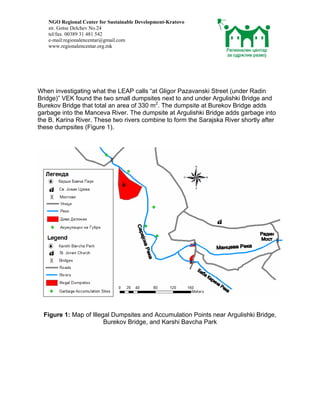
When investigating what the LEAP calls “at Gligor Pazavanski Street (under Radin
Bridge)” VEK found the two small dumpsites next to and under Argulishki Bridge and
Burekov Bridge that total an area of 330 m2. The dumpsite at Burekov Bridge adds
garbage into the Manceva River. The dumpsite at Argulishki Bridge adds garbage into
the B. Karina River. These two rivers combine to form the Sarajska River shortly after
these dumpsites (Figure 1).


  Figure 1: Map of Illegal Dumpsites and Accumulation Points near Argulishki Bridge,
                        Burekov Bridge, and Karshi Bavcha Park
NGO Regional Center for Sustainable Development-Kratovo
   str. Gotse Delchev No.24
   tel/fax. 00389 31 481 542
   e-mail:regionalencentar@gmail.com
   www.regionalencentar.org.mk


Karshi Bavcha Park is located along side the Sarajska River. The illegal dumpsite here
covers most of the park and the ravine leading down to the river totaling an area of 3076
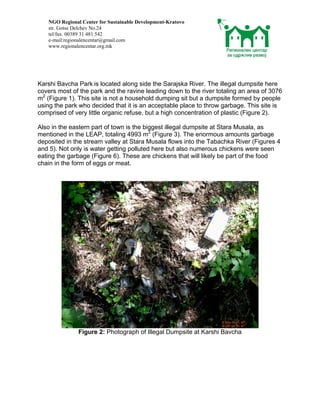
m2 (Figure 1). This site is not a household dumping sit but a dumpsite formed by people
using the park who decided that it is an acceptable place to throw garbage. This site is
comprised of very little organic refuse, but a high concentration of plastic (Figure 2).

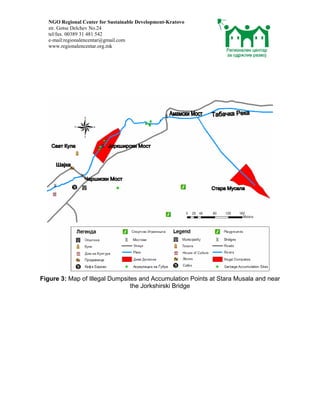
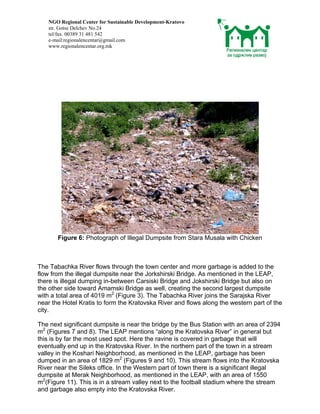
Also in the eastern part of town is the biggest illegal dumpsite at Stara Musala, as
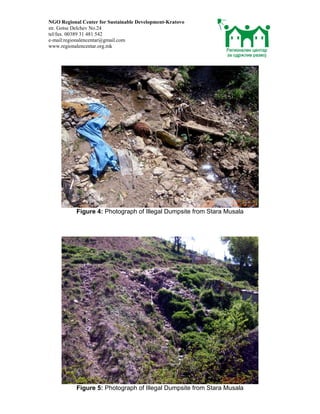
mentioned in the LEAP, totaling 4993 m2 (Figure 3). The enormous amounts garbage
deposited in the stream valley at Stara Musala flows into the Tabachka River (Figures 4
and 5). Not only is water getting polluted here but also numerous chickens were seen
eating the garbage (Figure 6). These are chickens that will likely be part of the food
chain in the form of eggs or meat.


               Figure 2: Photograph of Illegal Dumpsite at Karshi Bavcha
NGO Regional Center for Sustainable Development-Kratovo
  str. Gotse Delchev No.24
  tel/fax. 00389 31 481 542
  e-mail:regionalencentar@gmail.com
  www.regionalencentar.org.mk


Figure 3: Map of Illegal Dumpsites and Accumulation Points at Stara Musala and near
                                the Jorkshirski Bridge
NGO Regional Center for Sustainable Development-Kratovo
str. Gotse Delchev No.24
tel/fax. 00389 31 481 542
e-mail:regionalencentar@gmail.com
www.regionalencentar.org.mk


           Figure 4: Photograph of Illegal Dumpsite from Stara Musala


           Figure 5: Photograph of Illegal Dumpsite from Stara Musala
NGO Regional Center for Sustainable Development-Kratovo
   str. Gotse Delchev No.24
   tel/fax. 00389 31 481 542
   e-mail:regionalencentar@gmail.com
   www.regionalencentar.org.mk


       Figure 6: Photograph of Illegal Dumpsite from Stara Musala with Chicken


The Tabachka River flows through the town center and more garbage is added to the
flow from the illegal dumpsite near the Jorkshirski Bridge. As mentioned in the LEAP,
there is illegal dumping in-between Carsiski Bridge and Jokshirski Bridge but also on
the other side toward Amamski Bridge as well, creating the second largest dumpsite
with a total area of 4019 m2 (Figure 3). The Tabachka River joins the Sarajska River
near the Hotel Kratis to form the Kratovska River and flows along the western part of the
city.

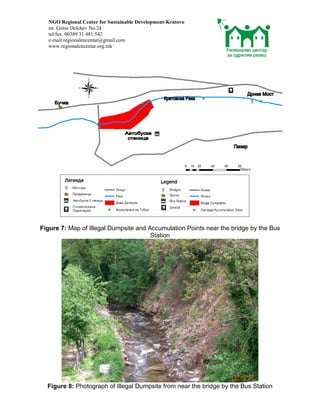
The next significant dumpsite is near the bridge by the Bus Station with an area of 2394
m2 (Figures 7 and 8). The LEAP mentions “along the Kratovska River” in general but
this is by far the most used spot. Here the ravine is covered in garbage that will
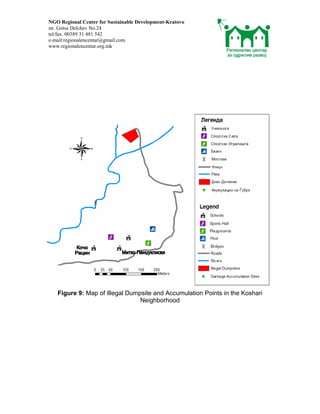
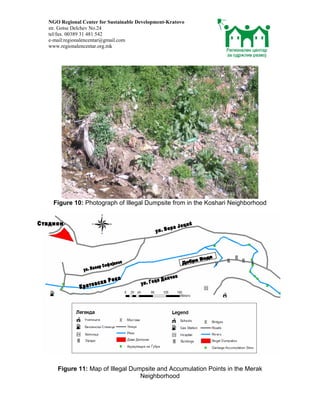
eventually end up in the Kratovska River. In the northern part of the town in a stream
valley in the Koshari Neighborhood, as mentioned in the LEAP, garbage has been
dumped in an area of 1829 m2 (Figures 9 and 10). This stream flows into the Kratovska
River near the Sileks office. In the Western part of town there is a significant illegal
dumpsite at Merak Neighborhood, as mentioned in the LEAP, with an area of 1550
m2(Figure 11). This is in a stream valley next to the football stadium where the stream
and garbage also empty into the Kratovska River.
NGO Regional Center for Sustainable Development-Kratovo
  str. Gotse Delchev No.24
  tel/fax. 00389 31 481 542
  e-mail:regionalencentar@gmail.com
  www.regionalencentar.org.mk


Figure 7: Map of Illegal Dumpsite and Accumulation Points near the bridge by the Bus
                                       Station


  Figure 8: Photograph of Illegal Dumpsite from near the bridge by the Bus Station
NGO Regional Center for Sustainable Development-Kratovo
str. Gotse Delchev No.24
tel/fax. 00389 31 481 542
e-mail:regionalencentar@gmail.com
www.regionalencentar.org.mk


   Figure 9: Map of Illegal Dumpsite and Accumulation Points in the Koshari
                                Neighborhood
NGO Regional Center for Sustainable Development-Kratovo
str. Gotse Delchev No.24
tel/fax. 00389 31 481 542
e-mail:regionalencentar@gmail.com
www.regionalencentar.org.mk


  Figure 10: Photograph of Illegal Dumpsite from in the Koshari Neighborhood


   Figure 11: Map of Illegal Dumpsite and Accumulation Points in the Merak
                                Neighborhood
NGO Regional Center for Sustainable Development-Kratovo
    str. Gotse Delchev No.24
    tel/fax. 00389 31 481 542
    e-mail:regionalencentar@gmail.com
    www.regionalencentar.org.mk


VEK observed that the illegal dumpsites at Argulishki Bridge, Burekov Bridge, and at the
Merak Neighborhood were right next to places with two or three garbage dumpsters.
This led VEK to the conclusion that the Municipality of Kratovo and the Public Utility
recognized that these were good locations for garbage dumpsters and that placing them
there was a great effort to prevent further dumping. The continued presence of garbage
at these sites could be due to one of the following reasons:
    a) The amount of garbage of garbage is larger than the capacity of the garbage
       dumpsters
    b) There was so much dumping in the past that a lot of garbage still remains and
       still needs to be cleaned up

The rest of the dumpsites were not near garbage dumpsters.

There are numerous other smaller illegal dumpsites around the city of Kratovo. The
seven mentioned here are the biggest which indicates numerous people are using
them.

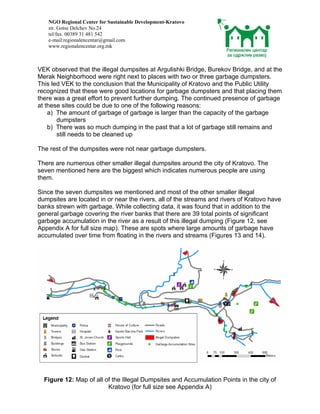
Since the seven dumpsites we mentioned and most of the other smaller illegal
dumpsites are located in or near the rivers, all of the streams and rivers of Kratovo have
banks strewn with garbage. While collecting data, it was found that in addition to the
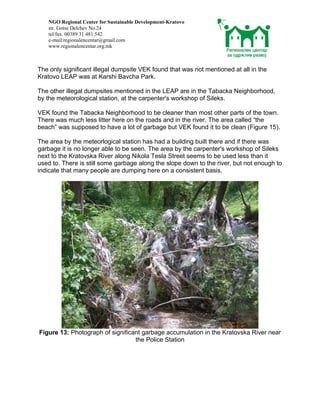
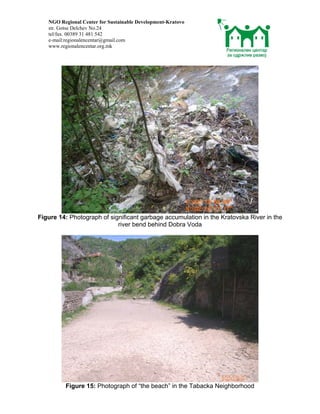
general garbage covering the river banks that there are 39 total points of significant
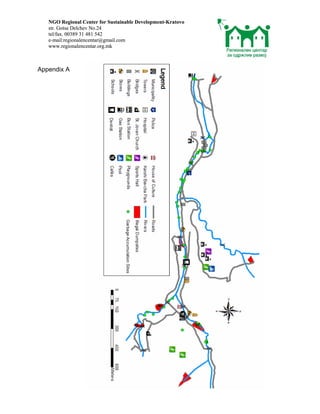
garbage accumulation in the river as a result of this illegal dumping (Figure 12, see
Appendix A for full size map). These are spots where large amounts of garbage have
accumulated over time from floating in the rivers and streams (Figures 13 and 14).


  Figure 12: Map of all of the Illegal Dumpsites and Accumulation Points in the city of
                         Kratovo (for full size see Appendix A)
NGO Regional Center for Sustainable Development-Kratovo
   str. Gotse Delchev No.24
   tel/fax. 00389 31 481 542
   e-mail:regionalencentar@gmail.com
   www.regionalencentar.org.mk


The only significant illegal dumpsite VEK found that was not mentioned at all in the
Kratovo LEAP was at Karshi Bavcha Park.

The other illegal dumpsites mentioned in the LEAP are in the Tabacka Neighborhood,
by the meteorological station, at the carpenter's workshop of Sileks.

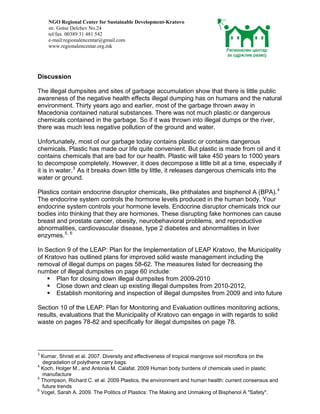
VEK found the Tabacka Neighborhood to be cleaner than most other parts of the town.
There was much less litter here on the roads and in the river. The area called “the
beach” was supposed to have a lot of garbage but VEK found it to be clean (Figure 15).

The area by the meteorlogical station has had a building built there and if there was
garbage it is no longer able to be seen. The area by the carpenter's workshop of Sileks
next to the Kratovska River along Nikola Tesla Street seems to be used less than it
used to. There is still some garbage along the slope down to the river, but not enough to
indicate that many people are dumping here on a consistent basis.


Figure 13: Photograph of significant garbage accumulation in the Kratovska River near
                                  the Police Station
NGO Regional Center for Sustainable Development-Kratovo
   str. Gotse Delchev No.24
   tel/fax. 00389 31 481 542
   e-mail:regionalencentar@gmail.com
   www.regionalencentar.org.mk


Figure 14: Photograph of significant garbage accumulation in the Kratovska River in the
                            river bend behind Dobra Voda


         Figure 15: Photograph of “the beach” in the Tabacka Neighborhood
NGO Regional Center for Sustainable Development-Kratovo
    str. Gotse Delchev No.24
    tel/fax. 00389 31 481 542
    e-mail:regionalencentar@gmail.com
    www.regionalencentar.org.mk


Discussion

The illegal dumpsites and sites of garbage accumulation show that there is little public
awareness of the negative health effects illegal dumping has on humans and the natural
environment. Thirty years ago and earlier, most of the garbage thrown away in
Macedonia contained natural substances. There was not much plastic or dangerous
chemicals contained in the garbage. So if it was thrown into illegal dumps or the river,
there was much less negative pollution of the ground and water.

Unfortunately, most of our garbage today contains plastic or contains dangerous
chemicals. Plastic has made our life quite convenient. But plastic is made from oil and it
contains chemicals that are bad for our health. Plastic will take 450 years to 1000 years
to decompose completely. However, it does decompose a little bit at a time, especially if
it is in water. 3 As it breaks down little by little, it releases dangerous chemicals into the
water or ground.

Plastics contain endocrine disruptor chemicals, like phthalates and bisphenol A (BPA). 4
The endocrine system controls the hormone levels produced in the human body. Your
endocrine system controls your hormone levels. Endocrine disruptor chemicals trick our
bodies into thinking that they are hormones. These disrupting fake hormones can cause
breast and prostate cancer, obesity, neurobehavioral problems, and reproductive
abnormalities, cardiovascular disease, type 2 diabetes and abnormalities in liver
enzymes. 5, 6

In Section 9 of the LEAP: Plan for the Implementation of LEAP Kratovo, the Municipality
of Kratovo has outlined plans for improved solid waste management including the
removal of illegal dumps on pages 58-62. The measures listed for decreasing the
number of illegal dumpsites on page 60 include:
       Plan for closing down illegal dumpsites from 2009-2010
       Close down and clean up existing illegal dumpsites from 2010-2012,
       Establish monitoring and inspection of illegal dumpsites from 2009 and into future

Section 10 of the LEAP: Plan for Monitoring and Evaluation outlines monitoring actions,
results, evaluations that the Municipality of Kratovo can engage in with regards to solid
waste on pages 78-82 and specifically for illegal dumpsites on page 78.


3
  Kumar, Shristi et al. 2007. Diversity and effectiveness of tropical mangrove soil microflora on the
  degradation of polythene carry bags.
4
  Koch, Holger M., and Antonia M. Calafat. 2009 Human body burdens of chemicals used in plastic
  manufacture
5
  Thompson, Richard C. et al. 2009 Plastics, the environment and human health: current consensus and
  future trends
6
  Vogel, Sarah A. 2009. The Politics of Plastics: The Making and Unmaking of Bisphenol A "Safety".
NGO Regional Center for Sustainable Development-Kratovo
       str. Gotse Delchev No.24
       tel/fax. 00389 31 481 542
       e-mail:regionalencentar@gmail.com
       www.regionalencentar.org.mk


VEK hopes this report will be used to help the plans for closing the illegal dumpsites
mentioned in the LEAP.


Recommendations

VEK recommends that Kratovo’s citizens use garbage dumpsters, garbage cans, and
recycle bins to properly dispose of their solid waste. Like at the illegal dumpsites at
Argulishki Bridge, Burekov Bridge, and at the Merak Neighborhood, citizens can throw
their garbage in the containers instead of walking past the containers to throw them into
the river. VEK would also recommend that citizens recycle PET plastic, as plastic
creates the most dangerous health situation in the environment. Kratovo has a PET
plastic recycling collection system in place. The containers are placed around the town
and VEK would hope that citizens walk a little out of their way to use them.

Karshi Bavcha Park is a site of cultural and historical importance in addition to its
natural value as the only park in the City of Kratovo. This park should not be neglected.
VEK recommends that the illegal dumpsite at Karshi Bavcha Park should be cleaned
up, new and numerous garbage containers be placed there, that the containers be
emptied regularly, and that in the future should be monitored so it remains a clean,
beautiful place for local citizens and tourists.

For the other four major illegal dumpsites, VEK would recommend that the Municipality
of Kratovo place garbage dumpsters there for people to use. Garbage containers
conveniently placed for citizens to use will help stop illegal dumping. VEK would also
recommend that the Municipality of Kratovo place more recycling containers around
town to encourage people to recycle more. Studies have shown “‘make recycling easy’
was the overwhelming message from both the focus groups and the household
surveys” 7 . VEK recently acquired some recycle bins that will be placed in areas without
recycle bins by the end of May 2010.

VEK noticed that Section 5.2 of the LEAP: Thematic Area Water, it does not mention
pollution from garbage in the water as a problem. Considering the vast amounts of
garbage in the rivers and along the banks of all the rivers in Kratovo, VEK would
recommend that a plan and cleanup of garbage accumulation points in the rivers be
developed. We hope that this water pollution from garbage is closely monitored in the
future. VEK would also recommend that more garbage cans are placed on the bridges
to discourage garbage from being thrown into the rivers.

VEK and the “Regional Center for Sustainable Development”-Kratovo also offer the
following recommendations to the Municipality, the Public Utility and the Ministry of
Environment and Physical Planning:


7
    Strange, Kit. 2003. Overview of Waste Management Options: Their Efficacy and Acceptability.
NGO Regional Center for Sustainable Development-Kratovo
    str. Gotse Delchev No.24
    tel/fax. 00389 31 481 542
    e-mail:regionalencentar@gmail.com
    www.regionalencentar.org.mk


 a) Organize a broad action including a large number of entities to clean up existing
    illegal landfills

 b) Set up information panels on the illegal dumping of waste

 c) Strengthening monitoring and inspection services as mentioned in Section 10 of the
     LEAP: Plan for Monitoring and Evaluation

 d) Purchase of a better garbage truck

 e) Installation of additional bins and containers and regular collection of garbage

 f) Continue and expand workshops and educational campaigns in schools and
     kindergartens

 g) Prepare long-term strategy for solid waste management

 h) Financial support to organizations that engage in selecting and recycling of waste

 i) Introduction of an environmental tax

 j) Enact deposit refund scheme (example: plastic bottles are sold for 5 denari extra
     and then when the plastic bottles are returned to shops the 5 denari are refunded)


Conclusion

This report was created by a group of volunteers, youth and adult, who care about the
people and the environment of Kratovo. VEK hopes that the public will take this
scientific information seriously. The people of Kratovo do not need to have health
problems because of illegal dumping. In addition, Kratovo has great potential for
economic success in the tourism sector. However, the issues addressed in this report
reduce this potential for tourism development as tourists prefer to spend their vacation
time in clean and healthy environments.

VEK hopes that the illegal landfills will be cleaned up by the competent institutions with
in the 2010-2012 time frame listed in the LEAP. VEK would recommend that the illegal
dumpsites be cleaned up as soon as possible to ensure the health and safety of
Kratovo’s people and environment. VEK hopes that there will be greater mobility,
engagement, and cooperation of all institutions to contribute towards changing the
current situation.

VEK hopes that local authorities, the Public Utility Company and the local population will
work towards creating a clean and healthy city, a city more comfortable place for all
residents and visitors.
NGO Regional Center for Sustainable Development-Kratovo
   str. Gotse Delchev No.24
   tel/fax. 00389 31 481 542
   e-mail:regionalencentar@gmail.com
   www.regionalencentar.org.mk


Works Cited

Koch, Holger M., and Antonia M. Calafat. 2009 Human body burdens of chemicals used
   in plastic manufacture. Philosophical Transactions of the Royal Society Biological
   Sciences 364, 2063-2078. (doi:10.1098/rstb.2008.0208)

Kumar, Shristi et al. 2007. Diversity and effectiveness of tropical mangrove soil
  microflora on the degradation of polythene carry bags. Revista de Biologia
  Tropical/International Journal of Tropical Biology and Conservation 55, 777-786.
  ISSN-0034-7744

Municipality of Kratovo. 2008. Municipality of Kratovo Local Environmental Action Plan.
  Ministry of Environment and Physical Planning. Republic of Macedonia. 28-82.

Strange, Kit. 2003. Overview of Waste Management Options: Their Efficacy and
   Acceptability. Environmental and Health Impact of Solid Waste Management
   Activities: issues in Environmental Science and Technology. 48.

Thompson, Richard C. et al. 2009 Plastics, the environment and human health: current
   consensus and future trends. Philosophical Transactions of the Royal Society
   Biological Sciences 364. 2153-2166. (doi:10.1098/rstb.2009.0053)

Vogel, Sarah A. 2009. The Politics of Plastics: The Making and Unmaking of Bisphenol
  A "Safety". American Journal of Public Health 99, S559–S566.
  (doi:10.2105/AJPH.2008.159228)
NGO Regional Center for Sustainable Development-Kratovo
str. Gotse Delchev No.24
tel/fax. 00389 31 481 542
e-mail:regionalencentar@gmail.com
www.regionalencentar.org.mk
NGO Regional Center for Sustainable Development-Kratovo
   str. Gotse Delchev No.24
   tel/fax. 00389 31 481 542
   e-mail:regionalencentar@gmail.com
   www.regionalencentar.org.mk


Appendix A

Report for Institutions EN

  • 1.
    NGO Regional Centerfor Sustainable Development-Kratovo str. Gotse Delchev No.24 tel/fax. 00389 31 481 542 e-mail:regionalencentar@gmail.com www.regionalencentar.org.mk Illegal Dumping and Garbage Accumulation in Kratovo, Macedonia Volunteer Ecology Kratovo Kratovo, May 2010
  • 2.
    NGO Regional Centerfor Sustainable Development-Kratovo str. Gotse Delchev No.24 tel/fax. 00389 31 481 542 e-mail:regionalencentar@gmail.com www.regionalencentar.org.mk Introduction The Municipality of Kratovo is located in the northeastern part of Macedonia and has an area of 375.44 km². The municipality borders the municipalities of Kriva Palanka, Pribishtip, Sveti Nikole, Kumanovo and Kocani. According to the latest census, the Municipality Kratovo has a total population of 10,441 inhabitants, with 6,924 residents in the City of Kratovo. The Kriva River and the Zletovska River run through the territory of Kratovo and the Kratovska River runs through the center of the City of Kratovo. Like any municipality today, Kratovo faces a variety of problems, but one problem that stands out is solid waste management. Kratovo’s steep terrain, narrow and inaccessible streets, lack of a good garbage truck, insufficient public environmental awareness, and the lack of long-term strategy for solid waste management are among the root causes of the current solid waste management situation. In recent years a number of organizations 1 have made efforts to place containers for recycling, organize education workshops, and create awareness campaigns. This is a start but there should be more actions to protect and improve the environment. Inconsistent solid waste collection, lack of programs for waste management in accordance with the Law, and ineffective enforcement of penalties for littering all contribute to the creation of illegal landfills in the Municipality of Kratovo. 2 In March 2009 Volunteer Ecology Kratovo (VEK) was established within the NGO "Regional Center for Sustainable Development”-Kratovo by local students assisted by Peace Corps Volunteers living in Kratovo. This local environmental club is comprised of youth and adult volunteers and has engaged in litter cleaning actions in public spaces in Kratovo and learned about various global and local environmental issues. VEK began out of concern by the student volunteers that their town of Kratovo was covered in garbage. They were primarily concerned about the accumulation of litter and the phenomenon of illegal dumping in the town. As VEK volunteers learned more about the negative effects of littering and illegal dumping, they began to beg the questions, “How does this affect us and the people of our town?” and “If people knew what the effects were, would they continue the destructive behavior?” These very real concerns and subsequent questions led to this project “Getting the Facts, Informing the Citizens.” 1 NGO “Sunny Hill Rajkovac“, NGO “Regional Center for Sustainable Development” -Kratovo, Engineers Without Borders Engineers at the University of Florida, United States Peace Corps. 2 Municipality of Kratovo. 2008. Local Environmental Action Plan.
  • 3.
    NGO Regional Centerfor Sustainable Development-Kratovo str. Gotse Delchev No.24 tel/fax. 00389 31 481 542 e-mail:regionalencentar@gmail.com www.regionalencentar.org.mk The initial data for this project, was sourced from the Municipality of Kratovo’s 2008 Local Environmental Action Plan (LEAP). In section 5.3.3. of the LEAP, several illegal dumpsites in the town of Kratovo are listed: in-between Carsiski and Jorkshirski Bridges, in Stara Musala, at Gligor Pazavanski Street (under Radin bridge), in the Tabacka neighborhood, in the Koshari neighborhood, in the Merak neighborhood, by the meteorological station, at the carpenter's workshop of Sileks, and along the Kratovska River. After reading the LEAP, VEK wanted to know if these illegal dumpsites still existed, if there were other illegal dumpsites, inform the public of their locations and the negative effects illegal dumps have on public health. Materials This research project was accomplished using Global Positioning Systems (GPS) units and Geographic Information System (GIS) software. The following equipment was utilized in this project: • One Garmin Colorado 400t Handheld GPS Unit • Three Garmin eTrex Vista H Handheld GPS Navigator Units • One Ricoh Caplio 500SE Model B GPS Camera • GPS-Photo Link: GIS Pro Series software • Garmin MapSource Software • Minnesota Department of Natural Resources DNR Garmin Software • ESRI ArcGIS ArcEditor Software Suite Methods The existing GPS and/or GIS data is available about Macedonia is on a national scale. No GPS and/or GIS data could be found for the City of Kratovo. As a result, VEK volunteers took the GPS units and the GPS camera out into the city of Kratovo to collect and mark waypoints (points with latitude and longitude coordinates). Waypoints were collected for prominent buildings and landmarks, roads, rivers, sites of illegal dumps, and sites where garbage accumulation in the river was particularly large. The waypoints were then synched into the computer from the Garmin GPS units. Waypoint names were organized and standardized in the Garmin MapSource Software. After waypoints were organized they were transferred back onto the Garmin GPS units and then re-downloaded into the DNR Garmin Software. Here the waypoint data was saved in text files. Then in ESRI ArcGIS Arc Map, the text files were imported as X,Y data and then exported as ESRI Shapefiles as their own geographic layers to create our map. For this project we used all WGS_1984 datums and the WGS_1984_PDC_Mercator projected coordinate system.
  • 4.
    NGO Regional Centerfor Sustainable Development-Kratovo str. Gotse Delchev No.24 tel/fax. 00389 31 481 542 e-mail:regionalencentar@gmail.com www.regionalencentar.org.mk Once the waypoints were layers on the map in ESRI ArcMap, the numerous waypoint tracks that represented roads and rivers were traced over and made into lines instead of hundreds of points. Then the points around the edges of illegal dumpsites were connected to create polygons, which were colored red so they would be easily visible on the map. Once the illegal dumpsites were polygons the area of each illegal dumpsite was calculated. Then a green hexagon symbol was chosen to show the points of extreme garbage accumulation in the rivers. Then logical symbols were chosen to represent various bridges, buildings and landmarks throughout Kratovo to help show the exact locations of the illegal dumpsites. The GPS camera photographs were downloaded into the computer. Then the GPS- Photo Link: GIS Pro Series software was used to transform the photos into ESRI Shapefiles. The Shapefiles were then imported as a layer of photographic waypoints on the map in ArcMap. Once the map included all the features necessary, a legend, scale bar, and compass rose was added and the maps were saved as jpeg and bmp files to be used in the leaflets, report, and presentation. Results As seen from the table below, VEK found there are seven main sites of illegal dumping around the city of Kratovo. The total combined areas of the dumpsites are approximately 18191 m2. Illegal Dumpsites Size Near Argulishki Bridge and Burekov Bridge 330 m2 Merak Neighborhood 1550 m2 Koshari Neighborhood 1829 m2 Near the bridge by the Bus Station 2394 m2 Karshi Bavcha Park 3076 m2 Near Jokshirski Bridge 4019 m2 Stara Musala 4993 m2 Table 1: Locations and sizes of illegal dumps
  • 5.
    NGO Regional Centerfor Sustainable Development-Kratovo str. Gotse Delchev No.24 tel/fax. 00389 31 481 542 e-mail:regionalencentar@gmail.com www.regionalencentar.org.mk When investigating what the LEAP calls “at Gligor Pazavanski Street (under Radin Bridge)” VEK found the two small dumpsites next to and under Argulishki Bridge and Burekov Bridge that total an area of 330 m2. The dumpsite at Burekov Bridge adds garbage into the Manceva River. The dumpsite at Argulishki Bridge adds garbage into the B. Karina River. These two rivers combine to form the Sarajska River shortly after these dumpsites (Figure 1). Figure 1: Map of Illegal Dumpsites and Accumulation Points near Argulishki Bridge, Burekov Bridge, and Karshi Bavcha Park
  • 6.
    NGO Regional Centerfor Sustainable Development-Kratovo str. Gotse Delchev No.24 tel/fax. 00389 31 481 542 e-mail:regionalencentar@gmail.com www.regionalencentar.org.mk Karshi Bavcha Park is located along side the Sarajska River. The illegal dumpsite here covers most of the park and the ravine leading down to the river totaling an area of 3076 m2 (Figure 1). This site is not a household dumping sit but a dumpsite formed by people using the park who decided that it is an acceptable place to throw garbage. This site is comprised of very little organic refuse, but a high concentration of plastic (Figure 2). Also in the eastern part of town is the biggest illegal dumpsite at Stara Musala, as mentioned in the LEAP, totaling 4993 m2 (Figure 3). The enormous amounts garbage deposited in the stream valley at Stara Musala flows into the Tabachka River (Figures 4 and 5). Not only is water getting polluted here but also numerous chickens were seen eating the garbage (Figure 6). These are chickens that will likely be part of the food chain in the form of eggs or meat. Figure 2: Photograph of Illegal Dumpsite at Karshi Bavcha
  • 7.
    NGO Regional Centerfor Sustainable Development-Kratovo str. Gotse Delchev No.24 tel/fax. 00389 31 481 542 e-mail:regionalencentar@gmail.com www.regionalencentar.org.mk Figure 3: Map of Illegal Dumpsites and Accumulation Points at Stara Musala and near the Jorkshirski Bridge
  • 8.
    NGO Regional Centerfor Sustainable Development-Kratovo str. Gotse Delchev No.24 tel/fax. 00389 31 481 542 e-mail:regionalencentar@gmail.com www.regionalencentar.org.mk Figure 4: Photograph of Illegal Dumpsite from Stara Musala Figure 5: Photograph of Illegal Dumpsite from Stara Musala
  • 9.
    NGO Regional Centerfor Sustainable Development-Kratovo str. Gotse Delchev No.24 tel/fax. 00389 31 481 542 e-mail:regionalencentar@gmail.com www.regionalencentar.org.mk Figure 6: Photograph of Illegal Dumpsite from Stara Musala with Chicken The Tabachka River flows through the town center and more garbage is added to the flow from the illegal dumpsite near the Jorkshirski Bridge. As mentioned in the LEAP, there is illegal dumping in-between Carsiski Bridge and Jokshirski Bridge but also on the other side toward Amamski Bridge as well, creating the second largest dumpsite with a total area of 4019 m2 (Figure 3). The Tabachka River joins the Sarajska River near the Hotel Kratis to form the Kratovska River and flows along the western part of the city. The next significant dumpsite is near the bridge by the Bus Station with an area of 2394 m2 (Figures 7 and 8). The LEAP mentions “along the Kratovska River” in general but this is by far the most used spot. Here the ravine is covered in garbage that will eventually end up in the Kratovska River. In the northern part of the town in a stream valley in the Koshari Neighborhood, as mentioned in the LEAP, garbage has been dumped in an area of 1829 m2 (Figures 9 and 10). This stream flows into the Kratovska River near the Sileks office. In the Western part of town there is a significant illegal dumpsite at Merak Neighborhood, as mentioned in the LEAP, with an area of 1550 m2(Figure 11). This is in a stream valley next to the football stadium where the stream and garbage also empty into the Kratovska River.
  • 10.
    NGO Regional Centerfor Sustainable Development-Kratovo str. Gotse Delchev No.24 tel/fax. 00389 31 481 542 e-mail:regionalencentar@gmail.com www.regionalencentar.org.mk Figure 7: Map of Illegal Dumpsite and Accumulation Points near the bridge by the Bus Station Figure 8: Photograph of Illegal Dumpsite from near the bridge by the Bus Station
  • 11.
    NGO Regional Centerfor Sustainable Development-Kratovo str. Gotse Delchev No.24 tel/fax. 00389 31 481 542 e-mail:regionalencentar@gmail.com www.regionalencentar.org.mk Figure 9: Map of Illegal Dumpsite and Accumulation Points in the Koshari Neighborhood
  • 12.
    NGO Regional Centerfor Sustainable Development-Kratovo str. Gotse Delchev No.24 tel/fax. 00389 31 481 542 e-mail:regionalencentar@gmail.com www.regionalencentar.org.mk Figure 10: Photograph of Illegal Dumpsite from in the Koshari Neighborhood Figure 11: Map of Illegal Dumpsite and Accumulation Points in the Merak Neighborhood
  • 13.
    NGO Regional Centerfor Sustainable Development-Kratovo str. Gotse Delchev No.24 tel/fax. 00389 31 481 542 e-mail:regionalencentar@gmail.com www.regionalencentar.org.mk VEK observed that the illegal dumpsites at Argulishki Bridge, Burekov Bridge, and at the Merak Neighborhood were right next to places with two or three garbage dumpsters. This led VEK to the conclusion that the Municipality of Kratovo and the Public Utility recognized that these were good locations for garbage dumpsters and that placing them there was a great effort to prevent further dumping. The continued presence of garbage at these sites could be due to one of the following reasons: a) The amount of garbage of garbage is larger than the capacity of the garbage dumpsters b) There was so much dumping in the past that a lot of garbage still remains and still needs to be cleaned up The rest of the dumpsites were not near garbage dumpsters. There are numerous other smaller illegal dumpsites around the city of Kratovo. The seven mentioned here are the biggest which indicates numerous people are using them. Since the seven dumpsites we mentioned and most of the other smaller illegal dumpsites are located in or near the rivers, all of the streams and rivers of Kratovo have banks strewn with garbage. While collecting data, it was found that in addition to the general garbage covering the river banks that there are 39 total points of significant garbage accumulation in the river as a result of this illegal dumping (Figure 12, see Appendix A for full size map). These are spots where large amounts of garbage have accumulated over time from floating in the rivers and streams (Figures 13 and 14). Figure 12: Map of all of the Illegal Dumpsites and Accumulation Points in the city of Kratovo (for full size see Appendix A)
  • 14.
    NGO Regional Centerfor Sustainable Development-Kratovo str. Gotse Delchev No.24 tel/fax. 00389 31 481 542 e-mail:regionalencentar@gmail.com www.regionalencentar.org.mk The only significant illegal dumpsite VEK found that was not mentioned at all in the Kratovo LEAP was at Karshi Bavcha Park. The other illegal dumpsites mentioned in the LEAP are in the Tabacka Neighborhood, by the meteorological station, at the carpenter's workshop of Sileks. VEK found the Tabacka Neighborhood to be cleaner than most other parts of the town. There was much less litter here on the roads and in the river. The area called “the beach” was supposed to have a lot of garbage but VEK found it to be clean (Figure 15). The area by the meteorlogical station has had a building built there and if there was garbage it is no longer able to be seen. The area by the carpenter's workshop of Sileks next to the Kratovska River along Nikola Tesla Street seems to be used less than it used to. There is still some garbage along the slope down to the river, but not enough to indicate that many people are dumping here on a consistent basis. Figure 13: Photograph of significant garbage accumulation in the Kratovska River near the Police Station
  • 15.
    NGO Regional Centerfor Sustainable Development-Kratovo str. Gotse Delchev No.24 tel/fax. 00389 31 481 542 e-mail:regionalencentar@gmail.com www.regionalencentar.org.mk Figure 14: Photograph of significant garbage accumulation in the Kratovska River in the river bend behind Dobra Voda Figure 15: Photograph of “the beach” in the Tabacka Neighborhood
  • 16.
    NGO Regional Centerfor Sustainable Development-Kratovo str. Gotse Delchev No.24 tel/fax. 00389 31 481 542 e-mail:regionalencentar@gmail.com www.regionalencentar.org.mk Discussion The illegal dumpsites and sites of garbage accumulation show that there is little public awareness of the negative health effects illegal dumping has on humans and the natural environment. Thirty years ago and earlier, most of the garbage thrown away in Macedonia contained natural substances. There was not much plastic or dangerous chemicals contained in the garbage. So if it was thrown into illegal dumps or the river, there was much less negative pollution of the ground and water. Unfortunately, most of our garbage today contains plastic or contains dangerous chemicals. Plastic has made our life quite convenient. But plastic is made from oil and it contains chemicals that are bad for our health. Plastic will take 450 years to 1000 years to decompose completely. However, it does decompose a little bit at a time, especially if it is in water. 3 As it breaks down little by little, it releases dangerous chemicals into the water or ground. Plastics contain endocrine disruptor chemicals, like phthalates and bisphenol A (BPA). 4 The endocrine system controls the hormone levels produced in the human body. Your endocrine system controls your hormone levels. Endocrine disruptor chemicals trick our bodies into thinking that they are hormones. These disrupting fake hormones can cause breast and prostate cancer, obesity, neurobehavioral problems, and reproductive abnormalities, cardiovascular disease, type 2 diabetes and abnormalities in liver enzymes. 5, 6 In Section 9 of the LEAP: Plan for the Implementation of LEAP Kratovo, the Municipality of Kratovo has outlined plans for improved solid waste management including the removal of illegal dumps on pages 58-62. The measures listed for decreasing the number of illegal dumpsites on page 60 include: Plan for closing down illegal dumpsites from 2009-2010 Close down and clean up existing illegal dumpsites from 2010-2012, Establish monitoring and inspection of illegal dumpsites from 2009 and into future Section 10 of the LEAP: Plan for Monitoring and Evaluation outlines monitoring actions, results, evaluations that the Municipality of Kratovo can engage in with regards to solid waste on pages 78-82 and specifically for illegal dumpsites on page 78. 3 Kumar, Shristi et al. 2007. Diversity and effectiveness of tropical mangrove soil microflora on the degradation of polythene carry bags. 4 Koch, Holger M., and Antonia M. Calafat. 2009 Human body burdens of chemicals used in plastic manufacture 5 Thompson, Richard C. et al. 2009 Plastics, the environment and human health: current consensus and future trends 6 Vogel, Sarah A. 2009. The Politics of Plastics: The Making and Unmaking of Bisphenol A "Safety".
  • 17.
    NGO Regional Centerfor Sustainable Development-Kratovo str. Gotse Delchev No.24 tel/fax. 00389 31 481 542 e-mail:regionalencentar@gmail.com www.regionalencentar.org.mk VEK hopes this report will be used to help the plans for closing the illegal dumpsites mentioned in the LEAP. Recommendations VEK recommends that Kratovo’s citizens use garbage dumpsters, garbage cans, and recycle bins to properly dispose of their solid waste. Like at the illegal dumpsites at Argulishki Bridge, Burekov Bridge, and at the Merak Neighborhood, citizens can throw their garbage in the containers instead of walking past the containers to throw them into the river. VEK would also recommend that citizens recycle PET plastic, as plastic creates the most dangerous health situation in the environment. Kratovo has a PET plastic recycling collection system in place. The containers are placed around the town and VEK would hope that citizens walk a little out of their way to use them. Karshi Bavcha Park is a site of cultural and historical importance in addition to its natural value as the only park in the City of Kratovo. This park should not be neglected. VEK recommends that the illegal dumpsite at Karshi Bavcha Park should be cleaned up, new and numerous garbage containers be placed there, that the containers be emptied regularly, and that in the future should be monitored so it remains a clean, beautiful place for local citizens and tourists. For the other four major illegal dumpsites, VEK would recommend that the Municipality of Kratovo place garbage dumpsters there for people to use. Garbage containers conveniently placed for citizens to use will help stop illegal dumping. VEK would also recommend that the Municipality of Kratovo place more recycling containers around town to encourage people to recycle more. Studies have shown “‘make recycling easy’ was the overwhelming message from both the focus groups and the household surveys” 7 . VEK recently acquired some recycle bins that will be placed in areas without recycle bins by the end of May 2010. VEK noticed that Section 5.2 of the LEAP: Thematic Area Water, it does not mention pollution from garbage in the water as a problem. Considering the vast amounts of garbage in the rivers and along the banks of all the rivers in Kratovo, VEK would recommend that a plan and cleanup of garbage accumulation points in the rivers be developed. We hope that this water pollution from garbage is closely monitored in the future. VEK would also recommend that more garbage cans are placed on the bridges to discourage garbage from being thrown into the rivers. VEK and the “Regional Center for Sustainable Development”-Kratovo also offer the following recommendations to the Municipality, the Public Utility and the Ministry of Environment and Physical Planning: 7 Strange, Kit. 2003. Overview of Waste Management Options: Their Efficacy and Acceptability.
  • 18.
    NGO Regional Centerfor Sustainable Development-Kratovo str. Gotse Delchev No.24 tel/fax. 00389 31 481 542 e-mail:regionalencentar@gmail.com www.regionalencentar.org.mk a) Organize a broad action including a large number of entities to clean up existing illegal landfills b) Set up information panels on the illegal dumping of waste c) Strengthening monitoring and inspection services as mentioned in Section 10 of the LEAP: Plan for Monitoring and Evaluation d) Purchase of a better garbage truck e) Installation of additional bins and containers and regular collection of garbage f) Continue and expand workshops and educational campaigns in schools and kindergartens g) Prepare long-term strategy for solid waste management h) Financial support to organizations that engage in selecting and recycling of waste i) Introduction of an environmental tax j) Enact deposit refund scheme (example: plastic bottles are sold for 5 denari extra and then when the plastic bottles are returned to shops the 5 denari are refunded) Conclusion This report was created by a group of volunteers, youth and adult, who care about the people and the environment of Kratovo. VEK hopes that the public will take this scientific information seriously. The people of Kratovo do not need to have health problems because of illegal dumping. In addition, Kratovo has great potential for economic success in the tourism sector. However, the issues addressed in this report reduce this potential for tourism development as tourists prefer to spend their vacation time in clean and healthy environments. VEK hopes that the illegal landfills will be cleaned up by the competent institutions with in the 2010-2012 time frame listed in the LEAP. VEK would recommend that the illegal dumpsites be cleaned up as soon as possible to ensure the health and safety of Kratovo’s people and environment. VEK hopes that there will be greater mobility, engagement, and cooperation of all institutions to contribute towards changing the current situation. VEK hopes that local authorities, the Public Utility Company and the local population will work towards creating a clean and healthy city, a city more comfortable place for all residents and visitors.
  • 19.
    NGO Regional Centerfor Sustainable Development-Kratovo str. Gotse Delchev No.24 tel/fax. 00389 31 481 542 e-mail:regionalencentar@gmail.com www.regionalencentar.org.mk Works Cited Koch, Holger M., and Antonia M. Calafat. 2009 Human body burdens of chemicals used in plastic manufacture. Philosophical Transactions of the Royal Society Biological Sciences 364, 2063-2078. (doi:10.1098/rstb.2008.0208) Kumar, Shristi et al. 2007. Diversity and effectiveness of tropical mangrove soil microflora on the degradation of polythene carry bags. Revista de Biologia Tropical/International Journal of Tropical Biology and Conservation 55, 777-786. ISSN-0034-7744 Municipality of Kratovo. 2008. Municipality of Kratovo Local Environmental Action Plan. Ministry of Environment and Physical Planning. Republic of Macedonia. 28-82. Strange, Kit. 2003. Overview of Waste Management Options: Their Efficacy and Acceptability. Environmental and Health Impact of Solid Waste Management Activities: issues in Environmental Science and Technology. 48. Thompson, Richard C. et al. 2009 Plastics, the environment and human health: current consensus and future trends. Philosophical Transactions of the Royal Society Biological Sciences 364. 2153-2166. (doi:10.1098/rstb.2009.0053) Vogel, Sarah A. 2009. The Politics of Plastics: The Making and Unmaking of Bisphenol A "Safety". American Journal of Public Health 99, S559–S566. (doi:10.2105/AJPH.2008.159228)
  • 20.
    NGO Regional Centerfor Sustainable Development-Kratovo str. Gotse Delchev No.24 tel/fax. 00389 31 481 542 e-mail:regionalencentar@gmail.com www.regionalencentar.org.mk
  • 21.
    NGO Regional Centerfor Sustainable Development-Kratovo str. Gotse Delchev No.24 tel/fax. 00389 31 481 542 e-mail:regionalencentar@gmail.com www.regionalencentar.org.mk Appendix A