Replacing Over-retained
Deciduous Maxillary Canines
with Small Diameter Implants
Dr. A. F. Paghdiwala
Pearl Dental Arts, Newtown, PA
www.pearldentalarts.com
1-888-PEARL81 or 215-504-4070
A 57 years old school teacher,
had congenitally missing
maxillary permanent canines bilaterally
Due to resorption,
both canines had almost no roots
 The presence of roots gives bulk and
volume to the alveolar bone
 Since the roots of the deciduous canines
had resorbed and there were no
permanent teeth underlying them, the
alveolar ridge was extremely thin bucco-
lingually apical to the deciduous canines
Options available to replace the
over-retained canines
 Flipper
 Cast Partial Denture
 Fixed Bridge
 Maryland Bridge
 Implant Supported Crown
After discussing the pros and cons
of the various options,
the patient preferred to get an
Implant supported crown
Why the patient had reservations
about getting implants
 Fear and Anxiety
 Cost
 Time
 Need for Bone Grafting- another
invasive procedure, increasing her fear
and anxiety
Advantages of small diameter
implants for this patient
 Less invasive
 Only one drill needed - osteotomy completed
faster
 No need for bone grafting, no need to reflect
flap - less anxiety for patient
 Less expensive - implant less expensive,
separate abutment not needed, less chairside
time
 Treatment completed faster
 Small diameter implant, easier to fit when
available room and width of bone compromised
The deciduous canine was
extracted
Steps in Placing
Small Diameter Dental
Implants
Each Implant takes less than 10 minutes
and usually, no incision or suturing is needed
• Local Anesthetic
• Osteotomy with 1.1 mm surgical drill, x-ray
• Insert the Implant with a finger wrench
• Place it in some more with a Wing Nut
• Secure it in completely with a mini wrench
Steps in placing the implant-
Implant is threaded in with a finger wrench
Steps in placing the implant-
Implant inserted some more with wing nut
Steps in placing the implant-
Implant seated to position with mini wrench
The dental implant was placed
3M (Imtec) MDI Max Standard O-Ball 13mm.
A Composite Resin Build-up
was made directly onto the
implant
Radiographs Two Weeks Post-op
The resin build-ups were
prepped, impressions made,
Porcelain Crowns cemented
Radiographs Two Years Post-Op
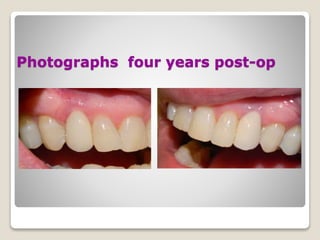
Photographs four years post-op
Radiographs four years post-op
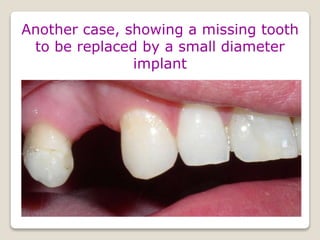
Another case, showing a missing tooth
to be replaced by a small diameter
implant
Implant inserted
Missing tooth built up directly
on top of Implant with resin
This small diameter implant with resin buildup
has been in function for 8 years
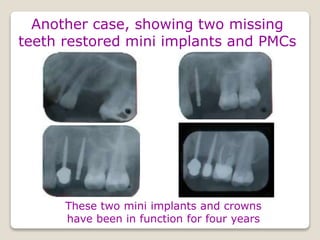
Another case, showing two missing
teeth restored mini implants and PMCs
These two mini implants and crowns
have been in function for four years
Conclusion
• small diameter implants are usually
placed to support removable dentures
•For replacing individual teeth,
standard diameter Implants are usually
the method of choice
•However, some patients may not be
prepared to accept implants for various
reasons:
- fear and anxiety
- cost of treatment
- length of time involved
• In addition, oral conditions may not
allow standard diameter implants, such
as reduced mesio-distal space or
inadequate width of bone bucco-
lingually
In these cases, small diameter dental
implants may be presented to the
patient as a less invasive, less
expensive, faster treatment option for
replacing the missing teeth.
In this presenter’s experience,
a direct resin build-up
right onto the small diameter implants
can be an extremely inexpensive and
quick temporary cosmetic solution for a
patient short on time and finances

Replacing over retained baby teeth with mini dental implants

  • 1.
    Replacing Over-retained Deciduous MaxillaryCanines with Small Diameter Implants Dr. A. F. Paghdiwala Pearl Dental Arts, Newtown, PA www.pearldentalarts.com 1-888-PEARL81 or 215-504-4070
  • 2.
    A 57 yearsold school teacher, had congenitally missing maxillary permanent canines bilaterally
  • 3.
    Due to resorption, bothcanines had almost no roots
  • 4.
     The presenceof roots gives bulk and volume to the alveolar bone  Since the roots of the deciduous canines had resorbed and there were no permanent teeth underlying them, the alveolar ridge was extremely thin bucco- lingually apical to the deciduous canines
  • 5.
    Options available toreplace the over-retained canines  Flipper  Cast Partial Denture  Fixed Bridge  Maryland Bridge  Implant Supported Crown After discussing the pros and cons of the various options, the patient preferred to get an Implant supported crown
  • 6.
    Why the patienthad reservations about getting implants  Fear and Anxiety  Cost  Time  Need for Bone Grafting- another invasive procedure, increasing her fear and anxiety
  • 7.
    Advantages of smalldiameter implants for this patient  Less invasive  Only one drill needed - osteotomy completed faster  No need for bone grafting, no need to reflect flap - less anxiety for patient  Less expensive - implant less expensive, separate abutment not needed, less chairside time  Treatment completed faster  Small diameter implant, easier to fit when available room and width of bone compromised
  • 8.
    The deciduous caninewas extracted
  • 9.
    Steps in Placing SmallDiameter Dental Implants Each Implant takes less than 10 minutes and usually, no incision or suturing is needed • Local Anesthetic • Osteotomy with 1.1 mm surgical drill, x-ray • Insert the Implant with a finger wrench • Place it in some more with a Wing Nut • Secure it in completely with a mini wrench
  • 10.
    Steps in placingthe implant- Implant is threaded in with a finger wrench
  • 11.
    Steps in placingthe implant- Implant inserted some more with wing nut
  • 12.
    Steps in placingthe implant- Implant seated to position with mini wrench
  • 13.
    The dental implantwas placed 3M (Imtec) MDI Max Standard O-Ball 13mm.
  • 14.
    A Composite ResinBuild-up was made directly onto the implant
  • 15.
  • 16.
    The resin build-upswere prepped, impressions made, Porcelain Crowns cemented
  • 17.
  • 18.
  • 19.
  • 20.
    Another case, showinga missing tooth to be replaced by a small diameter implant
  • 21.
  • 22.
    Missing tooth builtup directly on top of Implant with resin This small diameter implant with resin buildup has been in function for 8 years
  • 23.
    Another case, showingtwo missing teeth restored mini implants and PMCs These two mini implants and crowns have been in function for four years
  • 24.
    Conclusion • small diameterimplants are usually placed to support removable dentures •For replacing individual teeth, standard diameter Implants are usually the method of choice
  • 25.
    •However, some patientsmay not be prepared to accept implants for various reasons: - fear and anxiety - cost of treatment - length of time involved • In addition, oral conditions may not allow standard diameter implants, such as reduced mesio-distal space or inadequate width of bone bucco- lingually
  • 26.
    In these cases,small diameter dental implants may be presented to the patient as a less invasive, less expensive, faster treatment option for replacing the missing teeth. In this presenter’s experience, a direct resin build-up right onto the small diameter implants can be an extremely inexpensive and quick temporary cosmetic solution for a patient short on time and finances