A new definition for animal-free testing
REPLACING ANIMAL-DERIVED COMPONENTS
IN REGULATORY IN VITRO METHODS
Dr Carol Treasure
Founder and CEO, XCellR8 Ltd, UK
carol.treasure@x-cellr8.com
PISC webinar: Replacing Foetal Bovine Serum in Cell Culture Media
11th July 2019
© XCellR8 Ltd
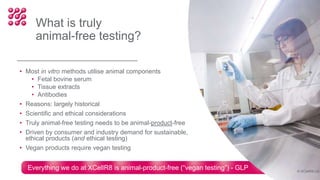
• Most in vitro methods utilise animal components
• Fetal bovine serum
• Tissue extracts
• Antibodies
• Reasons: largely historical
• Scientific and ethical considerations
• Truly animal-free testing needs to be animal-product-free
• Driven by consumer and industry demand for sustainable,
ethical products (and ethical testing)
• Vegan products require vegan testing
Everything we do at XCellR8 is animal-product-free (“vegan testing”) - GLP
What is truly
animal-free testing?
© XCellR8 Ltd
Animal-product-free
skin sensitisation testing
THE CHALLENGE
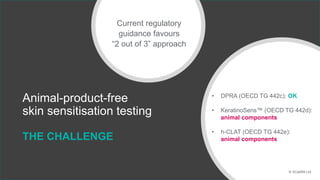
Current regulatory
guidance favours
“2 out of 3” approach
• DPRA (OECD TG 442c): OK
• KeratinoSens™ (OECD TG 442d):
animal components
• h-CLAT (OECD TG 442e):
animal components
© XCellR8 Ltd
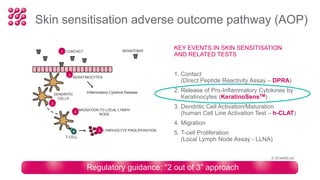
Skin sensitisation adverse outcome pathway (AOP)
Regulatory guidance: “2 out of 3” approach
SENSITISER
T-CELL
1
2
KERATINOCYTES
CONTACT
Inflammatory Cytokine Release
3
4
LYMPHOCYTE PROLIFERATION
DENDRITIC
CELLS
MIGRATION TO LOCAL LYMPH
NODE
5
KEY EVENTS IN SKIN SENSITISATION
AND RELATED TESTS
1. Contact
(Direct Peptide Reactivity Assay – DPRA)
2. Release of Pro-Inflammatory Cytokines by
Keratinocytes (KeratinoSensTM)
3. Dendritic Cell Activation/Maturation
(human Cell Line Activation Test – h-CLAT)
4. Migration
5. T-cell Proliferation
(Local Lymph Node Assay - LLNA)
© XCellR8 Ltd
Adaptation of the KeratinoSens™
Skin Sensitisation Test (OECD TG 442d)
to Xeno-Free Conditions
Published in ALTEX:
Belot, N., Sim, B., Longmore, CL., Roscoe, L. and Treasure, C. (2017)
Adaptation of the KeratinoSens™ skin sensitisation test to animal-product-free cell culture >
© XCellR8 Ltd
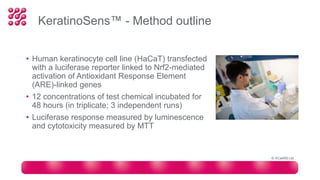
KeratinoSens™ - Method outline
• Human keratinocyte cell line (HaCaT) transfected
with a luciferase reporter linked to Nrf2-mediated
activation of Antioxidant Response Element
(ARE)-linked genes
• 12 concentrations of test chemical incubated for
48 hours (in triplicate; 3 independent runs)
• Luciferase response measured by luminescence
and cytotoxicity measured by MTT
© XCellR8 Ltd
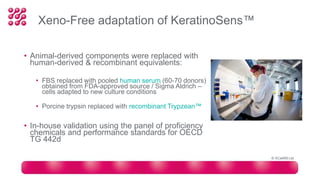
Xeno-Free adaptation of KeratinoSens™
• Animal-derived components were replaced with
human-derived & recombinant equivalents:
• FBS replaced with pooled human serum (60-70 donors)
obtained from FDA-approved source / Sigma Aldrich –
cells adapted to new culture conditions
• Porcine trypsin replaced with recombinant Trypzean™
• In-house validation using the panel of proficiency
chemicals and performance standards for OECD
TG 442d
© XCellR8 Ltd
KeratinoSens™ cell line adaptation
to culture in human serum
• Basal medium: Dulbecco’s Modified Eagle’s Medium (DMEM)
• Gradual adaptation (weaning) from 10% FBS to 10% pooled
human serum
• Comparable morphology and growth rates (population doubling
times)
• Sample cell counts after 72 hours in culture (seeding density 1.2
x 105 cells/ml):
• FBS: 3.6 x 10⁵ cells/ml
• Human serum: 4.9 x 10⁵ cells/ml
• Sub-cultured at 80-90% confluence using TrypZean®
(recombinant trypsin product)
• Growth rates sustained up to passage 22 (compared with p25
reported in FBS)
© XCellR8 Ltd
KeratinoSens™ xeno-free adaptation:
In-house validation
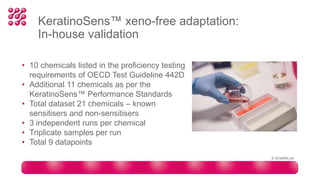
• 10 chemicals listed in the proficiency testing
requirements of OECD Test Guideline 442D
• Additional 11 chemicals as per the
KeratinoSens™ Performance Standards
• Total dataset 21 chemicals – known
sensitisers and non-sensitisers
• 3 independent runs per chemical
• Triplicate samples per run
• Total 9 datapoints
© XCellR8 Ltd
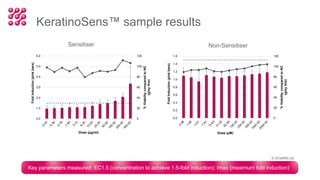
KeratinoSens™ sample results
Key parameters measured: EC1.5 (concentration to achieve 1.5-fold induction); Imax (maximum fold induction)
0
20
40
60
80
100
120
0.0
1.0
2.0
3.0
4.0
5.0
6.0
%ViabilitycomparedtoNC
(greyline)
FoldInduction(pinkbars)
Dose (µg/ml)
0
20
40
60
80
100
120
0.0
0.2
0.4
0.6
0.8
1.0
1.2
1.4
1.6
%ViabilitycomparedtoNC
(greyline)
FoldInduction(pinkbars)
Dose (µM)
Sensitiser Non-Sensitiser
© XCellR8 Ltd
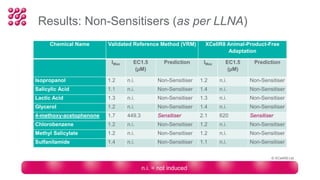
Results: Non-Sensitisers (as per LLNA)
Chemical Name Validated Reference Method (VRM) XCellR8 Animal-Product-Free
Adaptation
IMax EC1.5
(µM)
Prediction IMax EC1.5
(µM)
Prediction
Isopropanol 1.2 n.i. Non-Sensitiser 1.2 n.i. Non-Sensitiser
Salicylic Acid 1.1 n.i. Non-Sensitiser 1.4 n.i. Non-Sensitiser
Lactic Acid 1.3 n.i. Non-Sensitiser 1.3 n.i. Non-Sensitiser
Glycerol 1.2 n.i. Non-Sensitiser 1.4 n.i. Non-Sensitiser
4-methoxy-acetophenone 1.7 449.3 Sensitiser 2.1 620 Sensitiser
Chlorobenzene 1.2 n.i. Non-Sensitiser 1.2 n.i. Non-Sensitiser
Methyl Salicylate 1.2 n.i. Non-Sensitiser 1.2 n.i. Non-Sensitiser
Sulfanilamide 1.4 n.i. Non-Sensitiser 1.1 n.i. Non-Sensitiser
n.i. = not induced
© XCellR8 Ltd
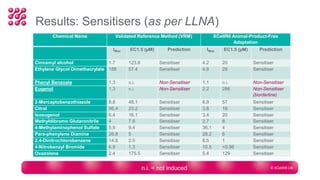
Results: Sensitisers (as per LLNA)
Chemical Name Validated Reference Method (VRM) XCellR8 Animal-Product-Free
Adaptation
IMax EC1.5 (µM) Prediction IMax EC1.5 (µM) Prediction
Cinnamyl alcohol 1.7 123.6 Sensitiser 4.2 20 Sensitiser
Ethylene Glycol Dimethacrylate 188 57.4 Sensitiser 4.8 29 Sensitiser
Phenyl Benzoate 1.3 n.i. Non-Sensitiser 1.1 n.i. Non-Sensitiser
Eugenol 1.3 n.i. Non-Sensitiser 2.2 286 Non-Sensitiser
(borderline)
2-Mercaptobenzothiazole 8.8 48.1 Sensitiser 6.9 57 Sensitiser
Citral 96.4 23.2 Sensitiser 3.8 18 Sensitiser
Isoeugenol 6.4 16.1 Sensitiser 3.4 20 Sensitiser
Methyldibromo Glutaronitrile 4 7.8 Sensitiser 2.7 8 Sensitiser
4-Methylaminophenol Sulfate 5.9 9.4 Sensitiser 36.1 4 Sensitiser
Para-phenylene Diamine 26.8 5 Sensitiser 28.2 6 Sensitiser
2,4-Dinitrochlorobenzene 14.8 2.5 Sensitiser 8.5 1 Sensitiser
4-Nitrobenzyl Bromide 6.9 1.3 Sensitiser 10.5 <0.98 Sensitiser
Oxazolone 2.4 175.5 Sensitiser 5.4 129 Sensitiser
n.i. = not induced © XCellR8 Ltd
Reproducibility of the test
between human serum
batches
• Over 2.5 years: >15 batches of pooled
human serum have been used, each
batch 60-70 donors.
• Mean IMAX of positive control (cinnamic
aldehyde) at 32uM: 1.84 +/- 0.322
• All 20 reference chemicals correctly classified in
line with Validated Reference Method (VRM)
• Data accepted by the OECD Expert Working
Group on Skin Sensitisation and WNT National
Co-Ordinators’ Committee
• Adapted method published as an Annex to the
VRM in the new version of OECD TG 442d 2018
• Therefore full acceptance as a regulatory method
Animal-product-free (APF) adaptation of KeratinoSens™
Conclusions
© XCellR8 Ltd
Current and
future work
• Participation in thought-starter paper
and OECD workshop on the ethical use
of human reagents:
• Addressing potential ethical issues
regarding the supply of human-derived
products or reagents in in vitro OECD Test
Guidelines. Published in ALTEX 2019
• Xeno-free adaptation of h-CLAT including
human serum and animal-free antibodies:
• Edwards et al, ALTEX, 2018
• Adaptation of KeratinoSens™ and
h-CLAT to fully defined conditions
• Auditing supply chains for all products
used in the XCellR8 lab
© XCellR8 Ltd
Thanks to the XCellR8 team!
© XCellR8 Ltd
Thank you!
Dr Carol Treasure
carol.treasure@x-cellr8.com
www.x-cellr8.com
@XCellR8_Labs Dr Carol Treasure
© XCellR8 Ltd
Further reading
• Getting under the skin of
in vitro skin sensitisation
testing ebook
• Topics include potency
assessment and testing
finished products
Download your copy >
Available at x-cellr8.com/in-vitro-skin-sensitisation-testing/

Replacing animal-derived components in regulatory in vitro tests

  • 1.
    A new definitionfor animal-free testing REPLACING ANIMAL-DERIVED COMPONENTS IN REGULATORY IN VITRO METHODS Dr Carol Treasure Founder and CEO, XCellR8 Ltd, UK carol.treasure@x-cellr8.com PISC webinar: Replacing Foetal Bovine Serum in Cell Culture Media 11th July 2019 © XCellR8 Ltd
  • 2.
    • Most invitro methods utilise animal components • Fetal bovine serum • Tissue extracts • Antibodies • Reasons: largely historical • Scientific and ethical considerations • Truly animal-free testing needs to be animal-product-free • Driven by consumer and industry demand for sustainable, ethical products (and ethical testing) • Vegan products require vegan testing Everything we do at XCellR8 is animal-product-free (“vegan testing”) - GLP What is truly animal-free testing? © XCellR8 Ltd
  • 3.
    Animal-product-free skin sensitisation testing THECHALLENGE Current regulatory guidance favours “2 out of 3” approach • DPRA (OECD TG 442c): OK • KeratinoSens™ (OECD TG 442d): animal components • h-CLAT (OECD TG 442e): animal components © XCellR8 Ltd
  • 4.
    Skin sensitisation adverseoutcome pathway (AOP) Regulatory guidance: “2 out of 3” approach SENSITISER T-CELL 1 2 KERATINOCYTES CONTACT Inflammatory Cytokine Release 3 4 LYMPHOCYTE PROLIFERATION DENDRITIC CELLS MIGRATION TO LOCAL LYMPH NODE 5 KEY EVENTS IN SKIN SENSITISATION AND RELATED TESTS 1. Contact (Direct Peptide Reactivity Assay – DPRA) 2. Release of Pro-Inflammatory Cytokines by Keratinocytes (KeratinoSensTM) 3. Dendritic Cell Activation/Maturation (human Cell Line Activation Test – h-CLAT) 4. Migration 5. T-cell Proliferation (Local Lymph Node Assay - LLNA) © XCellR8 Ltd
  • 5.
    Adaptation of theKeratinoSens™ Skin Sensitisation Test (OECD TG 442d) to Xeno-Free Conditions Published in ALTEX: Belot, N., Sim, B., Longmore, CL., Roscoe, L. and Treasure, C. (2017) Adaptation of the KeratinoSens™ skin sensitisation test to animal-product-free cell culture > © XCellR8 Ltd
  • 6.
    KeratinoSens™ - Methodoutline • Human keratinocyte cell line (HaCaT) transfected with a luciferase reporter linked to Nrf2-mediated activation of Antioxidant Response Element (ARE)-linked genes • 12 concentrations of test chemical incubated for 48 hours (in triplicate; 3 independent runs) • Luciferase response measured by luminescence and cytotoxicity measured by MTT © XCellR8 Ltd
  • 7.
    Xeno-Free adaptation ofKeratinoSens™ • Animal-derived components were replaced with human-derived & recombinant equivalents: • FBS replaced with pooled human serum (60-70 donors) obtained from FDA-approved source / Sigma Aldrich – cells adapted to new culture conditions • Porcine trypsin replaced with recombinant Trypzean™ • In-house validation using the panel of proficiency chemicals and performance standards for OECD TG 442d © XCellR8 Ltd
  • 8.
    KeratinoSens™ cell lineadaptation to culture in human serum • Basal medium: Dulbecco’s Modified Eagle’s Medium (DMEM) • Gradual adaptation (weaning) from 10% FBS to 10% pooled human serum • Comparable morphology and growth rates (population doubling times) • Sample cell counts after 72 hours in culture (seeding density 1.2 x 10⁵ cells/ml): • FBS: 3.6 x 10⁵ cells/ml • Human serum: 4.9 x 10⁵ cells/ml • Sub-cultured at 80-90% confluence using TrypZean® (recombinant trypsin product) • Growth rates sustained up to passage 22 (compared with p25 reported in FBS) © XCellR8 Ltd
  • 9.
    KeratinoSens™ xeno-free adaptation: In-housevalidation • 10 chemicals listed in the proficiency testing requirements of OECD Test Guideline 442D • Additional 11 chemicals as per the KeratinoSens™ Performance Standards • Total dataset 21 chemicals – known sensitisers and non-sensitisers • 3 independent runs per chemical • Triplicate samples per run • Total 9 datapoints © XCellR8 Ltd
  • 10.
    KeratinoSens™ sample results Keyparameters measured: EC1.5 (concentration to achieve 1.5-fold induction); Imax (maximum fold induction) 0 20 40 60 80 100 120 0.0 1.0 2.0 3.0 4.0 5.0 6.0 %ViabilitycomparedtoNC (greyline) FoldInduction(pinkbars) Dose (µg/ml) 0 20 40 60 80 100 120 0.0 0.2 0.4 0.6 0.8 1.0 1.2 1.4 1.6 %ViabilitycomparedtoNC (greyline) FoldInduction(pinkbars) Dose (µM) Sensitiser Non-Sensitiser © XCellR8 Ltd
  • 11.
    Results: Non-Sensitisers (asper LLNA) Chemical Name Validated Reference Method (VRM) XCellR8 Animal-Product-Free Adaptation IMax EC1.5 (µM) Prediction IMax EC1.5 (µM) Prediction Isopropanol 1.2 n.i. Non-Sensitiser 1.2 n.i. Non-Sensitiser Salicylic Acid 1.1 n.i. Non-Sensitiser 1.4 n.i. Non-Sensitiser Lactic Acid 1.3 n.i. Non-Sensitiser 1.3 n.i. Non-Sensitiser Glycerol 1.2 n.i. Non-Sensitiser 1.4 n.i. Non-Sensitiser 4-methoxy-acetophenone 1.7 449.3 Sensitiser 2.1 620 Sensitiser Chlorobenzene 1.2 n.i. Non-Sensitiser 1.2 n.i. Non-Sensitiser Methyl Salicylate 1.2 n.i. Non-Sensitiser 1.2 n.i. Non-Sensitiser Sulfanilamide 1.4 n.i. Non-Sensitiser 1.1 n.i. Non-Sensitiser n.i. = not induced © XCellR8 Ltd
  • 12.
    Results: Sensitisers (asper LLNA) Chemical Name Validated Reference Method (VRM) XCellR8 Animal-Product-Free Adaptation IMax EC1.5 (µM) Prediction IMax EC1.5 (µM) Prediction Cinnamyl alcohol 1.7 123.6 Sensitiser 4.2 20 Sensitiser Ethylene Glycol Dimethacrylate 188 57.4 Sensitiser 4.8 29 Sensitiser Phenyl Benzoate 1.3 n.i. Non-Sensitiser 1.1 n.i. Non-Sensitiser Eugenol 1.3 n.i. Non-Sensitiser 2.2 286 Non-Sensitiser (borderline) 2-Mercaptobenzothiazole 8.8 48.1 Sensitiser 6.9 57 Sensitiser Citral 96.4 23.2 Sensitiser 3.8 18 Sensitiser Isoeugenol 6.4 16.1 Sensitiser 3.4 20 Sensitiser Methyldibromo Glutaronitrile 4 7.8 Sensitiser 2.7 8 Sensitiser 4-Methylaminophenol Sulfate 5.9 9.4 Sensitiser 36.1 4 Sensitiser Para-phenylene Diamine 26.8 5 Sensitiser 28.2 6 Sensitiser 2,4-Dinitrochlorobenzene 14.8 2.5 Sensitiser 8.5 1 Sensitiser 4-Nitrobenzyl Bromide 6.9 1.3 Sensitiser 10.5 <0.98 Sensitiser Oxazolone 2.4 175.5 Sensitiser 5.4 129 Sensitiser n.i. = not induced © XCellR8 Ltd
  • 13.
    Reproducibility of thetest between human serum batches • Over 2.5 years: >15 batches of pooled human serum have been used, each batch 60-70 donors. • Mean IMAX of positive control (cinnamic aldehyde) at 32uM: 1.84 +/- 0.322
  • 14.
    • All 20reference chemicals correctly classified in line with Validated Reference Method (VRM) • Data accepted by the OECD Expert Working Group on Skin Sensitisation and WNT National Co-Ordinators’ Committee • Adapted method published as an Annex to the VRM in the new version of OECD TG 442d 2018 • Therefore full acceptance as a regulatory method Animal-product-free (APF) adaptation of KeratinoSens™ Conclusions © XCellR8 Ltd
  • 15.
    Current and future work •Participation in thought-starter paper and OECD workshop on the ethical use of human reagents: • Addressing potential ethical issues regarding the supply of human-derived products or reagents in in vitro OECD Test Guidelines. Published in ALTEX 2019 • Xeno-free adaptation of h-CLAT including human serum and animal-free antibodies: • Edwards et al, ALTEX, 2018 • Adaptation of KeratinoSens™ and h-CLAT to fully defined conditions • Auditing supply chains for all products used in the XCellR8 lab © XCellR8 Ltd
  • 16.
    Thanks to theXCellR8 team! © XCellR8 Ltd
  • 17.
    Thank you! Dr CarolTreasure carol.treasure@x-cellr8.com www.x-cellr8.com @XCellR8_Labs Dr Carol Treasure © XCellR8 Ltd
  • 18.
    Further reading • Gettingunder the skin of in vitro skin sensitisation testing ebook • Topics include potency assessment and testing finished products Download your copy > Available at x-cellr8.com/in-vitro-skin-sensitisation-testing/