Research on knowledge
translation and mobilization
CHALLENGES TO BE MET
Christian Dagenais, Ph.D
Esther Mc Sween-Cadieux, Ph.D
Canadian KMb Forum
November 24th 2020
www.equiperenard.org
research team in partnership
to learn more about our work
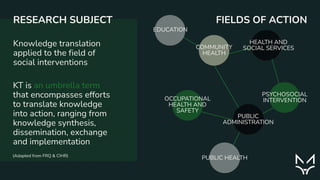
RESEARCH SUBJECT
Knowledge translation
applied to the field of
social interventions 
KT is an umbrella term
that encompasses efforts
to translate knowledge
into action, ranging from
knowledge synthesis,
dissemination, exchange
and implementation
EDUCATION
COMMUNITY
HEALTH
OCCUPATIONAL
HEALTH AND
SAFETY
PUBLIC
ADMINISTRATION
PUBLIC HEALTH
PSYCHOSOCIAL
INTERVENTION
HEALTH AND
SOCIAL SERVICES
FIELDS OF ACTION
(Adapted from FRQ & CIHR)
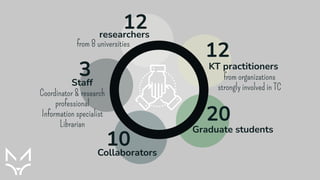
12
12
20
10
3
Graduate students
KT practitioners
researchers
Staff
Collaborators
from organizations
strongly involved in TC
from 8 universities
Coordinator & research
professional
Information specialist
Librarian
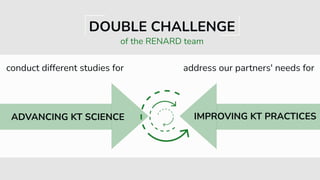
ADVANCING KT SCIENCE IMPROVING KT PRACTICES
conduct different studies for address our partners' needs for
DOUBLE CHALLENGE
of the RENARD team
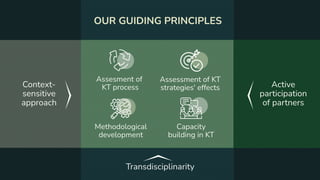
Assesment of 
KT process
Assessment of KT
strategies' effects
Methodological
development
Capacity
building in KT
Transdisciplinarity
Active
participation
of partners
Context-
sensitive
approach
OUR GUIDING PRINCIPLES
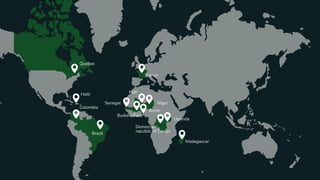
Madagascar
Uganda
Democratic
republic of CongoBrazil
Colombia
Quebec
France
Niger
Benin
Burkina Faso
Senegal
MaliHaiti
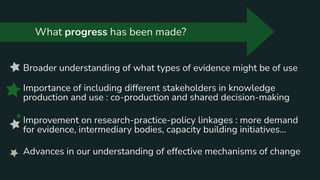
What progress has been made?
Broader understanding of what types of evidence might be of use
Importance of including different stakeholders in knowledge
production and use : co-production and shared decision-making
Improvement on research-practice-policy linkages : more demand
for evidence, intermediary bodies, capacity building initiatives...
Advances in our understanding of effective mechanisms of change
3
ongoing challenges
we want to address in
the coming years...
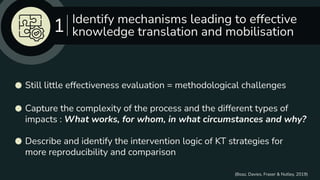
Identify mechanisms leading to effective
knowledge translation and mobilisation
Still little effectiveness evaluation = methodological challenges
Capture the complexity of the process and the different types of
impacts : What works, for whom, in what circumstances and why?
Describe and identify the intervention logic of KT strategies for 
more reproducibility and comparison
1
(Boaz, Davies, Fraser & Nutley, 2019)
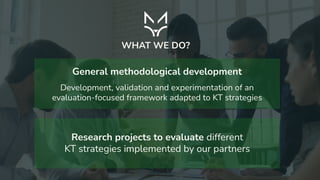
General methodological development
Research projects to evaluate different
KT strategies implemented by our partners
WHAT WE DO?
Development, validation and experimentation of an
evaluation-focused framework adapted to KT strategies
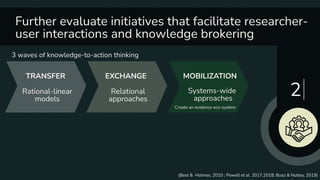
Rational-linear
models
Relational
approaches
Systems-wide 
approaches
TRANSFER EXCHANGE MOBILIZATION
Create an evidence eco-system
(Best &  Holmes, 2010 ; Powell et al. 2017,2018; Boaz & Nutley, 2019)
2
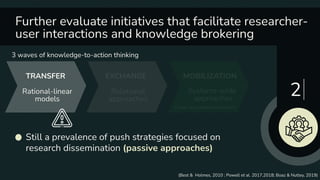
3 waves of knowledge-to-action thinking
Further evaluate initiatives that facilitate researcher-
user interactions and knowledge brokering
Rational-linear
models
Relational
approaches
Systems-wide 
approaches
TRANSFER EXCHANGE MOBILIZATION
Create an evidence eco-system
(Best &  Holmes, 2010 ; Powell et al. 2017,2018; Boaz & Nutley, 2019)
2
3 waves of knowledge-to-action thinking
Still a prevalence of push strategies focused on
research dissemination (passive approaches)
Further evaluate initiatives that facilitate researcher-
user interactions and knowledge brokering
Rational-linear
models
Promising but still little evidence on effectiveness of
interaction mechanisms (coproduction, integrated
KT) and knowledge brokering mechanisms
Relational
approaches
Systems-wide 
approaches
TRANSFER EXCHANGE MOBILIZATION
Create an evidence eco-system
(Best &  Holmes, 2010 ; Powell et al. 2017,2018; Boaz & Nutley, 2019)
2
Further evaluate initiatives that facilitate researcher-
user interactions and knowledge brokering
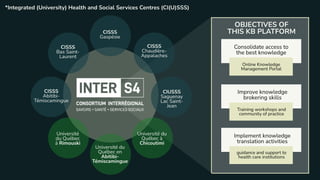
CISSS
Abitibi-
Témiscamingue
CISSS
Bas Saint-
Laurent
CISSS
Chaudière-
Appalaches
CISSS
Gaspésie
CIUSSS
Saguenay
Lac Saint-
Jean
Université
du Québec
à Rimouski
Université du
Québec à
Chicoutimi
Université du
Québec en
Abitibi-
Témiscamingue
OBJECTIVES OF
THIS KB PLATFORM
Consolidate access to
the best knowledge
Improve knowledge
brokering skills
Implement knowledge
translation activities
Online Knowledge
Management Portal
Training workshops and
community of practice
guidance and support to
health care institutions
*Integrated (University) Health and Social Services Centres (CI(U)SSS)
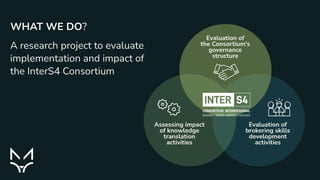
Evaluation of
brokering skills
development
activities
Evaluation of
the Consortium's
governance
structure
Assessing impact
of knowledge
translation
activities
A research project to evaluate
implementation and impact of
the InterS4 Consortium
WHAT WE DO?
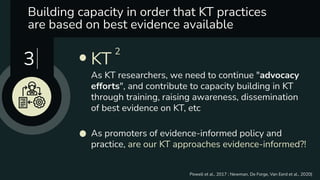
Building capacity in order that KT practices
are based on best evidence available 
As promoters of evidence-informed policy and
practice, are our KT approaches evidence-informed?!
KT
2
As KT researchers, we need to continue "advocacy
efforts", and contribute to capacity building in KT
through training, raising awareness, dissemination
of best evidence on KT, etc
3
Powell et al., 2017 ; Newman, De Forge, Van Eerd et al., 2020)
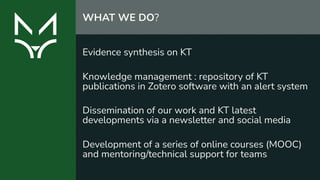
Evidence synthesis on KT 
Knowledge management : repository of KT
publications in Zotero software with an alert system
Dissemination of our work and KT latest
developments via a newsletter and social media 
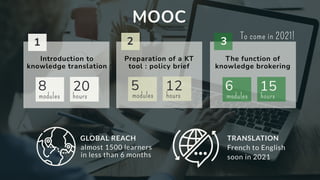
Development of a series of online courses (MOOC)
and mentoring/technical support for teams
WHAT WE DO?
MOOC
1
Introduction to
knowledge translation
Preparation of a KT
tool : policy brief
The function of
knowledge brokering
modules
2 3
8
hours
20
modules
5
hours
12
modules
6
hours
15
To come in 2021!
French to English
soon in 2021
GLOBAL REACH TRANSLATION
almost 1500 learners
in less than 6 months
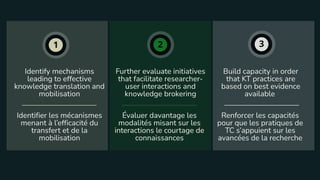
1 2 3
Build capacity in order
that KT practices are
based on best evidence
available 
Further evaluate initiatives
that facilitate researcher-
user interactions and
knowledge brokering
Identify mechanisms
leading to effective
knowledge translation and
mobilisation
Évaluer davantage les
modalités misant sur les
interactions le courtage de
connaissances
Identifier les mécanismes
menant à l’efficacité du
transfert et de la
mobilisation
Renforcer les capacités
pour que les pratiques de
TC s’appuient sur les
avancées de la recherche
Do you see other challenges
for the coming years?

RENARD team - challenges for coming years

  • 1.
    Research on knowledge translationand mobilization CHALLENGES TO BE MET Christian Dagenais, Ph.D Esther Mc Sween-Cadieux, Ph.D Canadian KMb Forum November 24th 2020
  • 2.
    www.equiperenard.org research team inpartnership to learn more about our work
  • 3.
    RESEARCH SUBJECT Knowledge translation appliedto the field of social interventions  KT is an umbrella term that encompasses efforts to translate knowledge into action, ranging from knowledge synthesis, dissemination, exchange and implementation EDUCATION COMMUNITY HEALTH OCCUPATIONAL HEALTH AND SAFETY PUBLIC ADMINISTRATION PUBLIC HEALTH PSYCHOSOCIAL INTERVENTION HEALTH AND SOCIAL SERVICES FIELDS OF ACTION (Adapted from FRQ & CIHR)
  • 4.
    12 12 20 10 3 Graduate students KT practitioners researchers Staff Collaborators from organizations stronglyinvolved in TC from 8 universities Coordinator & research professional Information specialist Librarian
  • 5.
    ADVANCING KT SCIENCEIMPROVING KT PRACTICES conduct different studies for address our partners' needs for DOUBLE CHALLENGE of the RENARD team
  • 6.
    Assesment of  KT process Assessmentof KT strategies' effects Methodological development Capacity building in KT Transdisciplinarity Active participation of partners Context- sensitive approach OUR GUIDING PRINCIPLES
  • 7.
  • 8.
    What progress hasbeen made? Broader understanding of what types of evidence might be of use Importance of including different stakeholders in knowledge production and use : co-production and shared decision-making Improvement on research-practice-policy linkages : more demand for evidence, intermediary bodies, capacity building initiatives... Advances in our understanding of effective mechanisms of change
  • 9.
    3 ongoing challenges we want toaddress in the coming years...
  • 10.
    Identify mechanisms leadingto effective knowledge translation and mobilisation Still little effectiveness evaluation = methodological challenges Capture the complexity of the process and the different types of impacts : What works, for whom, in what circumstances and why? Describe and identify the intervention logic of KT strategies for  more reproducibility and comparison 1 (Boaz, Davies, Fraser & Nutley, 2019)
  • 11.
    General methodological development Research projectsto evaluate different KT strategies implemented by our partners WHAT WE DO? Development, validation and experimentation of an evaluation-focused framework adapted to KT strategies
  • 12.
    Rational-linear models Relational approaches Systems-wide  approaches TRANSFER EXCHANGE MOBILIZATION Createan evidence eco-system (Best &  Holmes, 2010 ; Powell et al. 2017,2018; Boaz & Nutley, 2019) 2 3 waves of knowledge-to-action thinking Further evaluate initiatives that facilitate researcher- user interactions and knowledge brokering
  • 13.
    Rational-linear models Relational approaches Systems-wide  approaches TRANSFER EXCHANGE MOBILIZATION Createan evidence eco-system (Best &  Holmes, 2010 ; Powell et al. 2017,2018; Boaz & Nutley, 2019) 2 3 waves of knowledge-to-action thinking Still a prevalence of push strategies focused on research dissemination (passive approaches) Further evaluate initiatives that facilitate researcher- user interactions and knowledge brokering
  • 14.
    Rational-linear models Promising but stilllittle evidence on effectiveness of interaction mechanisms (coproduction, integrated KT) and knowledge brokering mechanisms Relational approaches Systems-wide  approaches TRANSFER EXCHANGE MOBILIZATION Create an evidence eco-system (Best &  Holmes, 2010 ; Powell et al. 2017,2018; Boaz & Nutley, 2019) 2 Further evaluate initiatives that facilitate researcher- user interactions and knowledge brokering
  • 15.
    CISSS Abitibi- Témiscamingue CISSS Bas Saint- Laurent CISSS Chaudière- Appalaches CISSS Gaspésie CIUSSS Saguenay Lac Saint- Jean Université duQuébec à Rimouski Université du Québec à Chicoutimi Université du Québec en Abitibi- Témiscamingue OBJECTIVES OF THIS KB PLATFORM Consolidate access to the best knowledge Improve knowledge brokering skills Implement knowledge translation activities Online Knowledge Management Portal Training workshops and community of practice guidance and support to health care institutions *Integrated (University) Health and Social Services Centres (CI(U)SSS)
  • 16.
    Evaluation of brokering skills development activities Evaluationof the Consortium's governance structure Assessing impact of knowledge translation activities A research project to evaluate implementation and impact of the InterS4 Consortium WHAT WE DO?
  • 17.
    Building capacity inorder that KT practices are based on best evidence available  As promoters of evidence-informed policy and practice, are our KT approaches evidence-informed?! KT 2 As KT researchers, we need to continue "advocacy efforts", and contribute to capacity building in KT through training, raising awareness, dissemination of best evidence on KT, etc 3 Powell et al., 2017 ; Newman, De Forge, Van Eerd et al., 2020)
  • 18.
    Evidence synthesis onKT  Knowledge management : repository of KT publications in Zotero software with an alert system Dissemination of our work and KT latest developments via a newsletter and social media  Development of a series of online courses (MOOC) and mentoring/technical support for teams WHAT WE DO?
  • 19.
    MOOC 1 Introduction to knowledge translation Preparationof a KT tool : policy brief The function of knowledge brokering modules 2 3 8 hours 20 modules 5 hours 12 modules 6 hours 15 To come in 2021! French to English soon in 2021 GLOBAL REACH TRANSLATION almost 1500 learners in less than 6 months
  • 20.
    1 2 3 Buildcapacity in order that KT practices are based on best evidence available  Further evaluate initiatives that facilitate researcher- user interactions and knowledge brokering Identify mechanisms leading to effective knowledge translation and mobilisation Évaluer davantage les modalités misant sur les interactions le courtage de connaissances Identifier les mécanismes menant à l’efficacité du transfert et de la mobilisation Renforcer les capacités pour que les pratiques de TC s’appuient sur les avancées de la recherche
  • 21.
    Do you seeother challenges for the coming years?