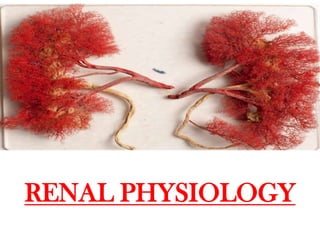
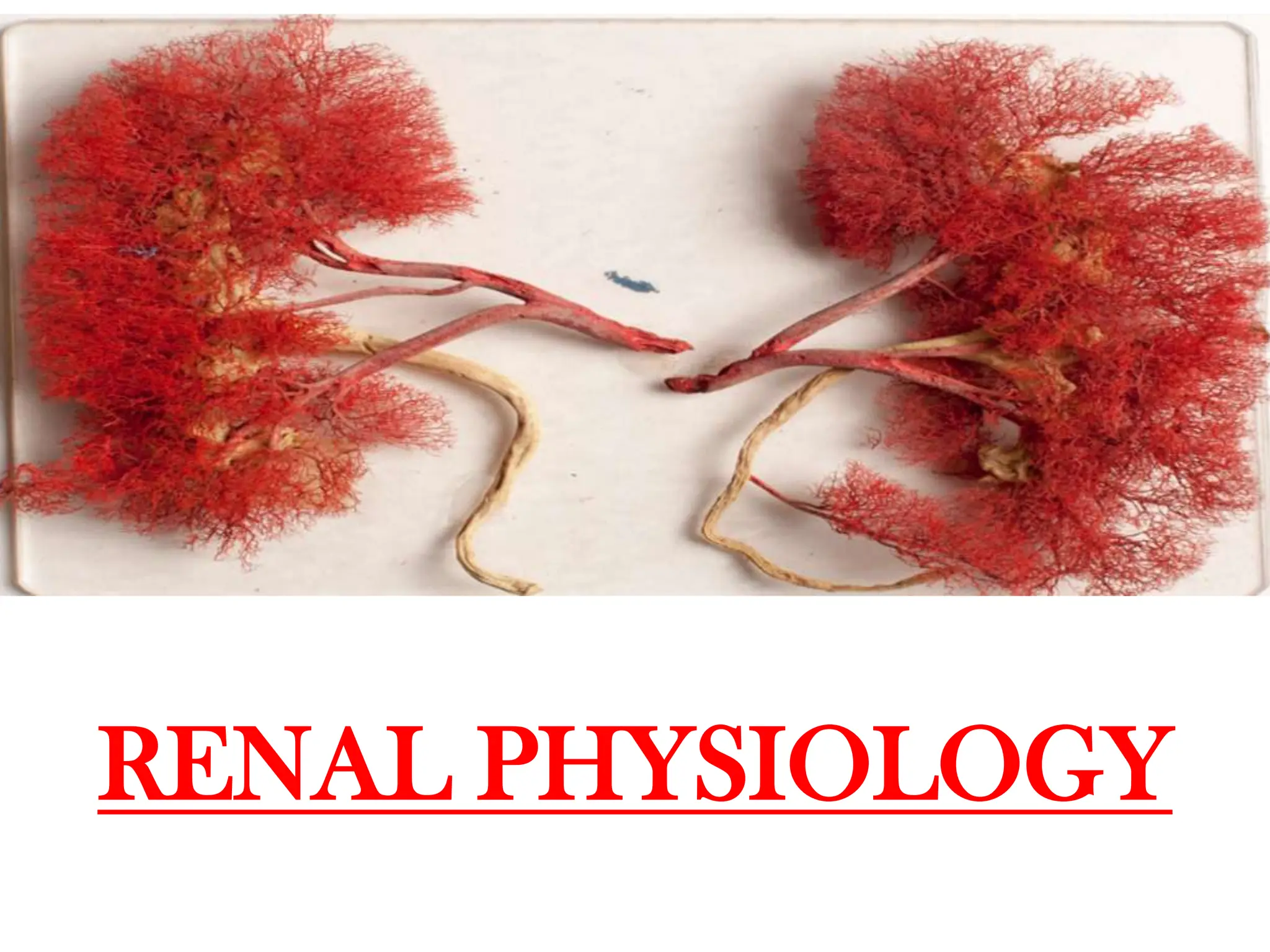
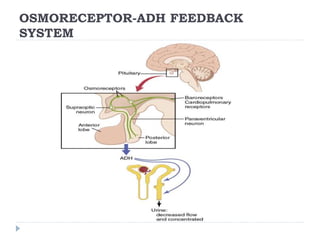
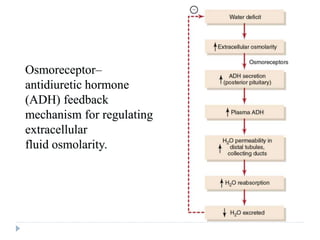
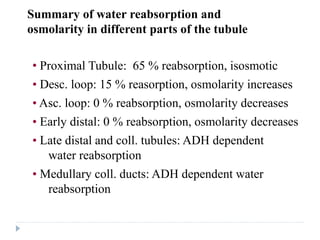
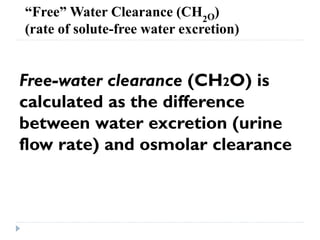
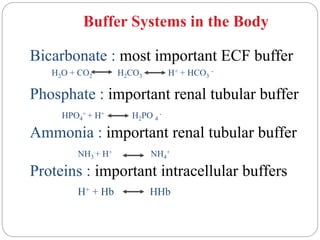
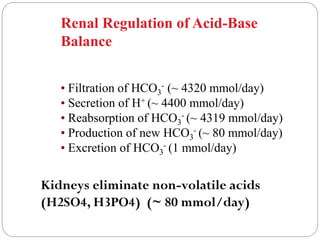
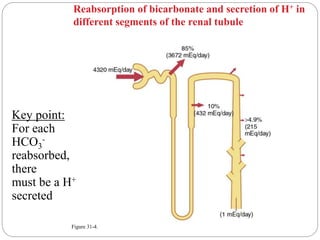
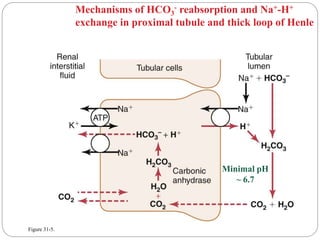
RENAL PHYSIOLOGY
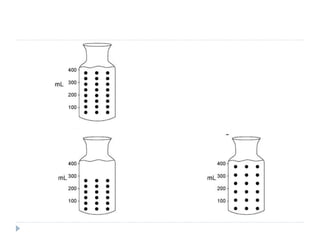
Normal osmolality of human plasma= _________
Normal osmolality of human plasma= 280-290 mOsm/kg H2O
Osmolarity is the number of osmoles per liter
of solution.
Osmolality is the concentration of osmoles per
kg of water.
Dissolved solutes that displace water are called
osmoles. One mole of any dissolved solute (an
Avogadro number of it) is 1 osmole
A solution (1L) containing 50 mM urea and 100 mM NaCl has
an osmolarity of _____________ mOsm/L
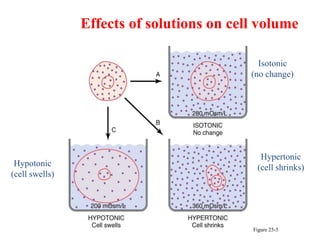
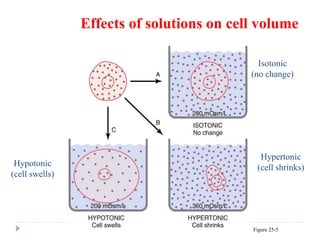
Figure 25-5
Isotonic
(no change)
Hypertonic
(cell shrinks)
Hypotonic
(cell swells)
Effects of solutions on cell volume.
• What is the osmolarity of a
5 % glucose solution ?
• Is the solution hyperosmotic,
hypo-osmotic, or isosmotic ?
Question
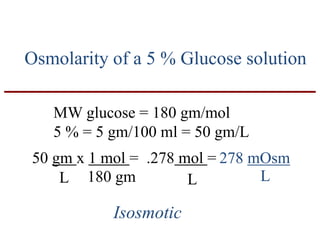
Osmolarity of a 5 % Glucose solution
MW glucose = 180 gm/mol
5 % = 5 gm/100 ml = 50 gm/L
Isosmotic
50 gm x 1 mol = .278 mol =
L 180 gm L
278 mOsm
L
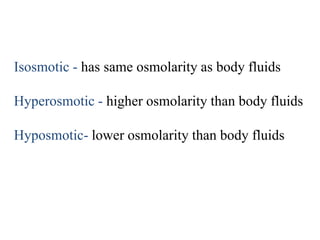
Isosmotic - has same osmolarity as body fluids
Hyperosmotic - higher osmolarity than body fluids
Hyposmotic- lower osmolarity than body fluids
40
300
200
100
0
0 10 20 30
OSMOLARITY
mOsm/L
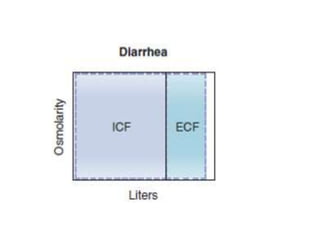
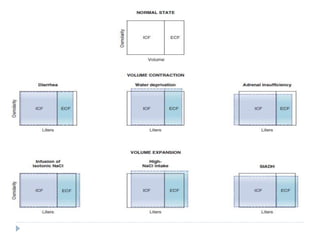
Normal State
VOLUME (L)
ECF
ICF
1.
2.
3.
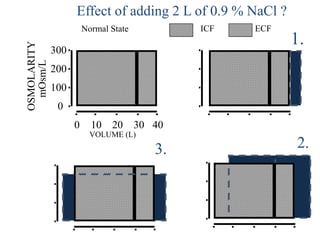
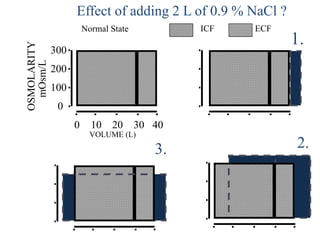
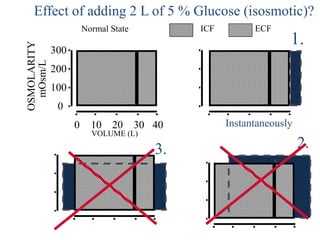
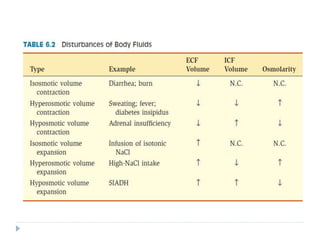
Effect of adding 2 L of 0.9 % NaCl ?
40
300
200
100
0
0 10 20 30
OSMOLARITY
mOsm/L
Normal State
VOLUME (L)
ECF
ICF
1.
2.
3.
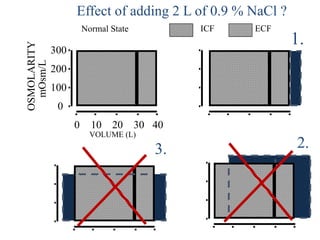
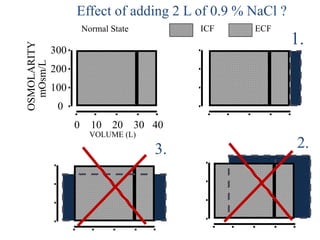
Effect of adding 2 L of 0.9 % NaCl ?
40
300
200
100
0
0 10 20 30
OSMOLARITY
mOsm/L
Normal State
VOLUME (L)
ECF
ICF
1.
2.
3.
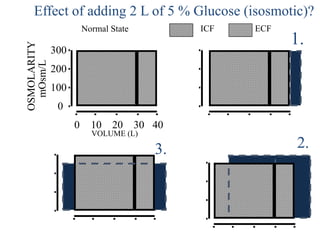
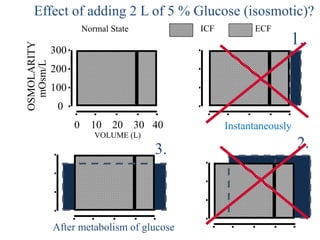
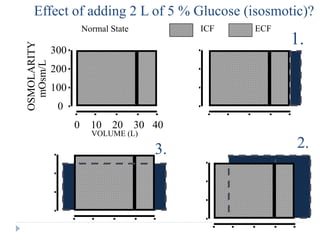
Effect of adding 2 L of 5 % Glucose (isosmotic)?
40
300
200
100
0
0 10 20 30
OSMOLARITY
mOsm/L
Normal State
VOLUME (L)
ECF
ICF
1.
2.
3.
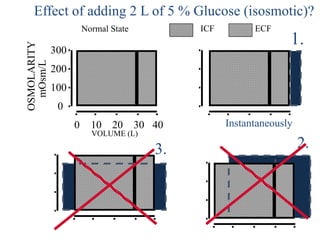
Instantaneously
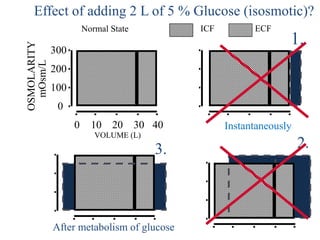
Effect of adding 2 L of 5 % Glucose (isosmotic)?
40
300
200
100
0
0 10 20 30
OSMOLARITY
mOsm/L
Normal State
VOLUME (L)
ECF
ICF
1.
2.
3.
Effect of adding 2 L of 5 % Glucose (isosmotic)?
Instantaneously
After metabolism of glucose
40
300
200
100
0
0 10 20 30
OSMOLARITY
mOsm/L
Normal State
VOLUME (L)
ECF
ICF
1.
2.
3.
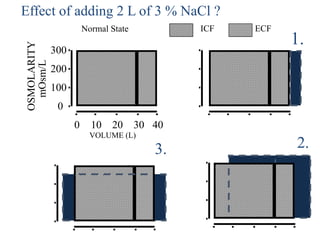
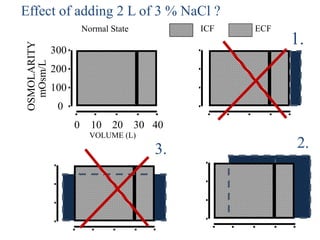
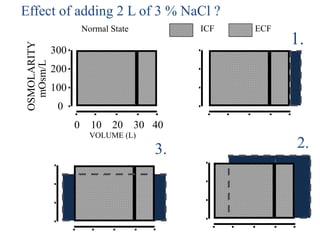
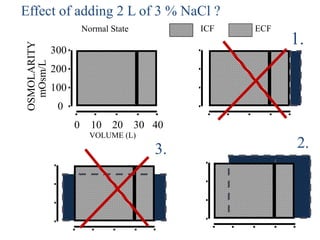
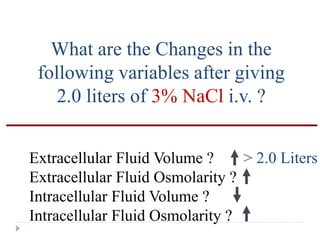
Effect of adding 2 L of 3 % NaCl ?
40
300
200
100
0
0 10 20 30
OSMOLARITY
mOsm/L
Normal State
VOLUME (L)
ECF
ICF
1.
2.
3.
Effect of adding 2 L of 3 % NaCl ?
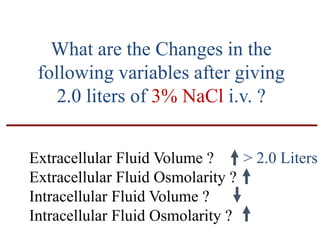
What are the Changes in the
following variables after giving
2.0 liters of 3% NaCl i.v. ?
Extracellular Fluid Volume ?
Extracellular Fluid Osmolarity ?
Intracellular Fluid Volume ?
Intracellular Fluid Osmolarity ?
> 2.0 Liters
RENAL PHYSIOLOGY
Learning Objectives:
At the end of this lecture, students should be able to describe
• Functions of Kidney
• ‘Physiologic’ freedom
• Components of Urinary/Excretory/Renal system
• External features & location of kidneys & applied
aspects.
• Inner structure of kidneys
Functions of the kidney
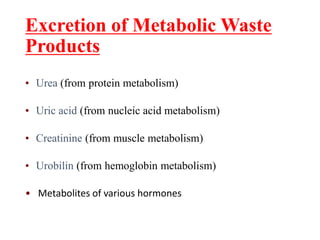
Excretion of Metabolic Waste
Products
• Urea (from protein metabolism)
• Uric acid (from nucleic acid metabolism)
• Creatinine (from muscle metabolism)
• Urobilin (from hemoglobin metabolism)
• Metabolites of various hormones
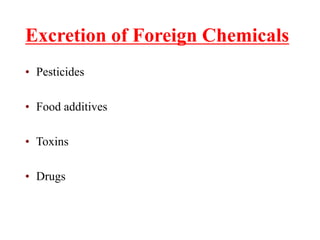
Excretion of Foreign Chemicals
• Pesticides
• Food additives
• Toxins
• Drugs
Regulation of Water and Electrolyte
Balances.
Excretion of water and electrolytes must
precisely match intake
Balance Concept
Fluid and electrolyte balances are necessary,
in the long-term, to maintain life.
Fluid Loss = Fluid Intake
Electrolyte Loss = Electrolyte Intake
Fluid Intake: regulated by thirst mechanism, habits
Electrolyte intake: governed by dietary habits
Fluid Output: regulated mainly by kidneys
Electrolyte output: regulated mainly by kidneys
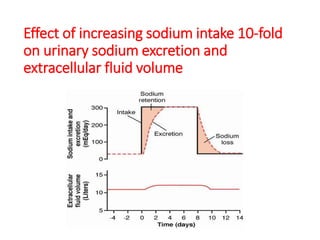
Effect of increasing sodium intake 10-fold
on urinary sodium excretion and
extracellular fluid volume
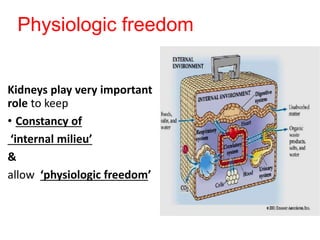
Physiologic freedom
Kidneys play very important
role to keep
• Constancy of
‘internal milieu’
&
allow ‘physiologic freedom’
Allow to
Move into varying environment and take in varying diets and
fluids
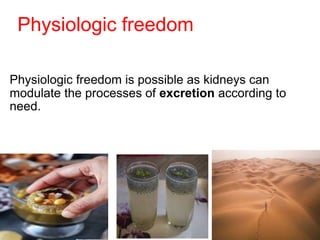
Physiologic freedom
Physiologic freedom is possible as kidneys can
modulate the processes of excretion according to
need.
Regulation of Water and
Electrolyte Balances
• Sodium and Water
• Potassium
• Hydrogen Ions
• Calcium, Phosphate, Magnesium
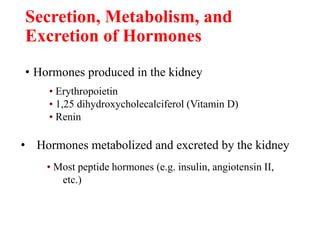
Secretion, Metabolism, and
Excretion of Hormones
• Hormones produced in the kidney
• Erythropoietin
• 1,25 dihydroxycholecalciferol (Vitamin D)
• Renin
• Hormones metabolized and excreted by the kidney
• Most peptide hormones (e.g. insulin, angiotensin II,
etc.)
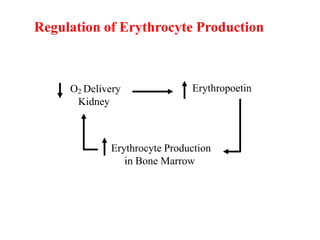
Regulation of Erythrocyte Production
O2 Delivery
Kidney
Erythropoetin
Erythrocyte Production
in Bone Marrow
Regulation of Arterial Pressure
Endocrine Organ
•renin-angiotensin system
Control of Extracellular Fluid Volume
Regulation of Vitamin D Activity
• Kidney produces active form of vitamin D
(1,25 dihydroxy vitamin D3)
• Vitamin D3 is important in calcium and
phosphate metabolism
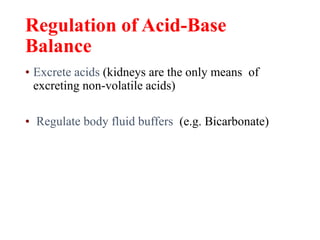
Regulation of Acid-Base
Balance
• Excrete acids (kidneys are the only means of
excreting non-volatile acids)
• Regulate body fluid buffers (e.g. Bicarbonate)
Glucose Synthesis
Gluconeogenesis: kidneys synthesize glucose
from precursors (e.g. amino acids) during prolonged
fasting
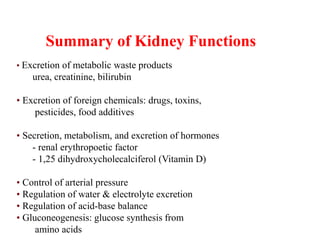
Summary of Kidney Functions
• Excretion of metabolic waste products
urea, creatinine, bilirubin
• Excretion of foreign chemicals: drugs, toxins,
pesticides, food additives
• Secretion, metabolism, and excretion of hormones
- renal erythropoetic factor
- 1,25 dihydroxycholecalciferol (Vitamin D)
• Control of arterial pressure
• Regulation of water & electrolyte excretion
• Regulation of acid-base balance
• Gluconeogenesis: glucose synthesis from
amino acids
Physiologic Anatomy of the Kidneys
The earliest insights into renal
physiology came from the assiduous
study of anatomy because, to a large
degree, renal function follows
structure
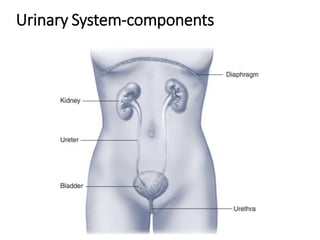
Urinary System-components
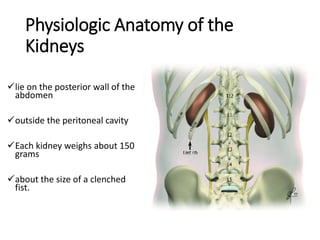
Physiologic Anatomy of the
Kidneys
lie on the posterior wall of the
abdomen
outside the peritoneal cavity
Each kidney weighs about 150
grams
about the size of a clenched
fist.
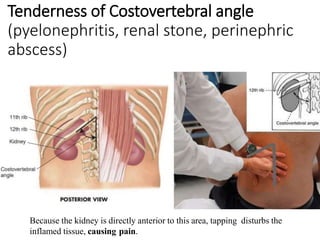
Tenderness of Costovertebral angle
(pyelonephritis, renal stone, perinephric
abscess)
Because the kidney is directly anterior to this area, tapping disturbs the
inflamed tissue, causing pain.
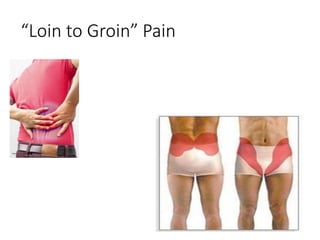
“Loin to Groin” Pain
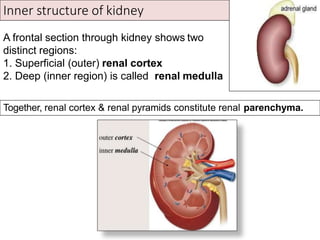
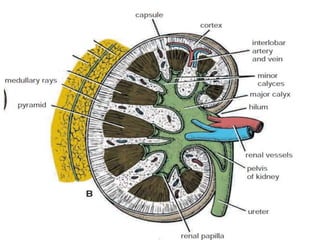
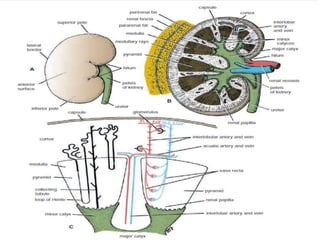
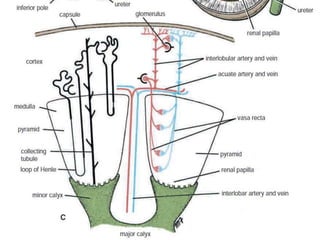
Inner structure of kidney
A frontal section through kidney shows two
distinct regions:
1. Superficial (outer) renal cortex
2. Deep (inner region) is called renal medulla
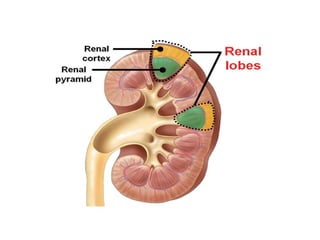
Together, renal cortex & renal pyramids constitute renal parenchyma.
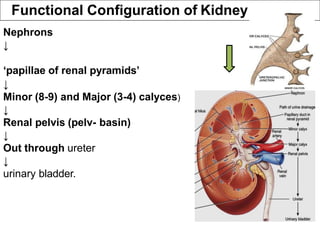
Functional Configuration of Kidney
Nephrons
↓
‘papillae of renal pyramids’
↓
Minor (8-9) and Major (3-4) calyces)
↓
Renal pelvis (pelv- basin)
↓
Out through ureter
↓
urinary bladder.
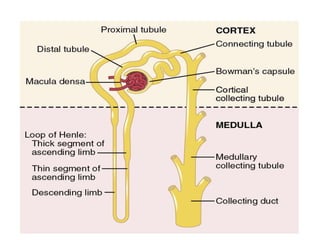
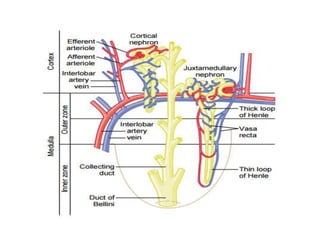
Nephron Tubular Segments
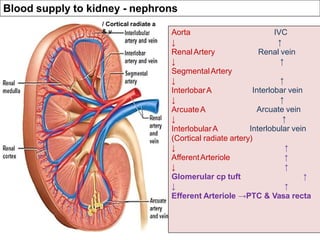
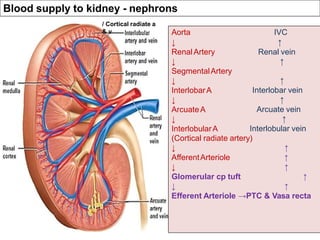
Blood supply to kidney - nephrons
/ Cortical radiate a
& v IVC
↑
Renal vein
↑
Aorta
↓
Renal Artery
↓
SegmentalArtery
↓
InterlobarA
↓
ArcuateA
↓
InterlobularA
↑
Interlobar vein
↑
Arcuate vein
↑
Interlobular vein
↑
↑
↑
↑
(Cortical radiate artery)
↓
AfferentArteriole
↓
Glomerular cp tuft
↓ ↑
Efferent Arteriole →PTC & Vasa recta
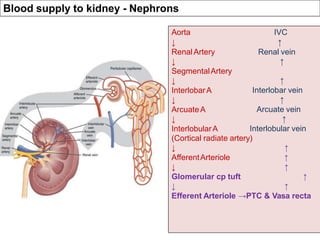
IVC
↑
Renal vein
↑
Aorta
↓
Renal Artery
↓
SegmentalArtery
↓
InterlobarA
↓
ArcuateA
↓
InterlobularA
↑
Interlobar vein
↑
Arcuate vein
↑
Interlobular vein
↑
↑
↑
↑
(Cortical radiate artery)
↓
AfferentArteriole
↓
Glomerular cp tuft
↓ ↑
Efferent Arteriole →PTC & Vasa recta
Blood supply to kidney - Nephrons
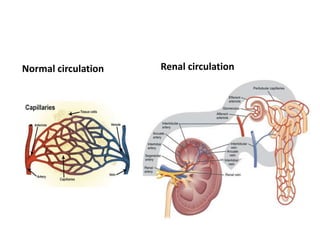
Normal circulation Renal circulation
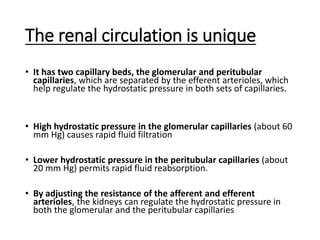
The renal circulation is unique
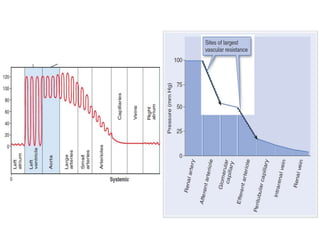
• It has two capillary beds, the glomerular and peritubular
capillaries, which are separated by the efferent arterioles, which
help regulate the hydrostatic pressure in both sets of capillaries.
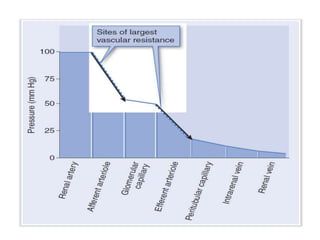
• High hydrostatic pressure in the glomerular capillaries (about 60
mm Hg) causes rapid fluid filtration
• Lower hydrostatic pressure in the peritubular capillaries (about
20 mm Hg) permits rapid fluid reabsorption.
• By adjusting the resistance of the afferent and efferent
arterioles, the kidneys can regulate the hydrostatic pressure in
both the glomerular and the peritubular capillaries
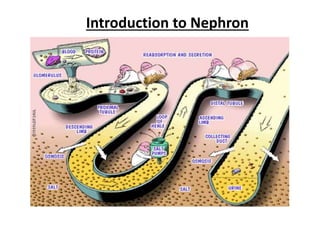
Introduction to Nephron
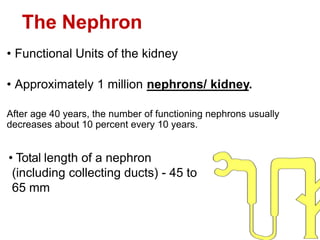
The Nephron
• Functional Units of the kidney
• Approximately 1 million nephrons/ kidney.
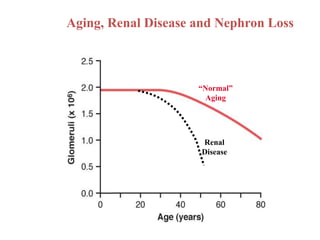
After age 40 years, the number of functioning nephrons usually
decreases about 10 percent every 10 years.
• Total length of a nephron
(including collecting ducts) - 45 to
65 mm
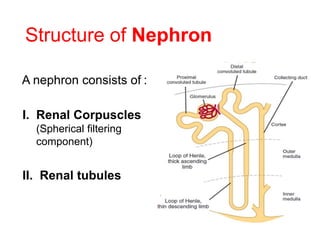
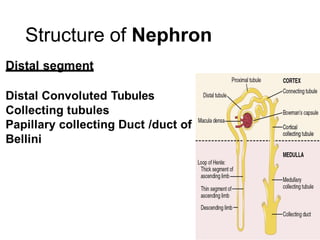
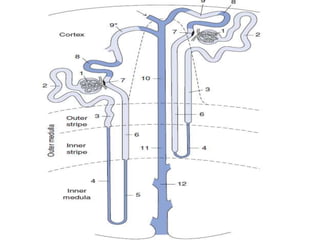
Structure of Nephron
A nephron consists of :
I. Renal Corpuscles
(Spherical filtering
component)
II. Renal tubules
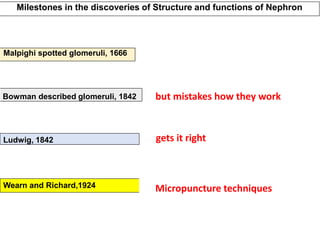
Bowman described glomeruli, 1842
Ludwig, 1842
Wearn and Richard,1924
Malpighi spotted glomeruli, 1666
Milestones in the discoveries of Structure and functions of Nephron
Micropuncture techniques
but mistakes how they work
gets it right
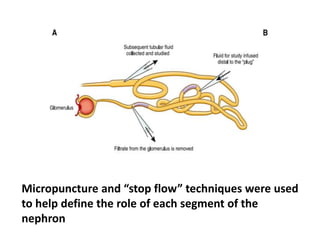
Micropuncture and “stop flow” techniques were used
to help define the role of each segment of the
nephron
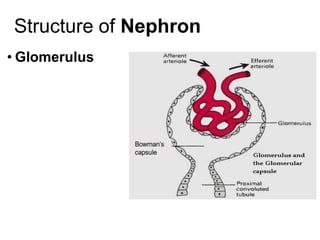
Structure of Nephron
• Glomerulus
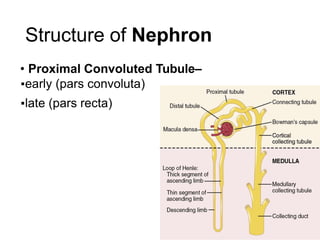
Structure of Nephron
• Proximal Convoluted Tubule–
▪early (pars convoluta)
▪late (pars recta)
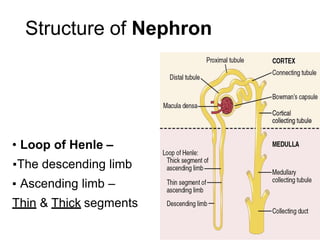
Structure of Nephron
• Loop of Henle –
▪The descending limb
▪ Ascending limb –
Thin & Thick segments
Structure of Nephron
Blood supply to kidney - nephrons
/ Cortical radiate a
& v IVC
↑
Renal vein
↑
Aorta
↓
Renal Artery
↓
SegmentalArtery
↓
InterlobarA
↓
ArcuateA
↓
InterlobularA
↑
Interlobar vein
↑
Arcuate vein
↑
Interlobular vein
↑
↑
↑
↑
(Cortical radiate artery)
↓
AfferentArteriole
↓
Glomerular cp tuft
↓ ↑
Efferent Arteriole →PTC & Vasa recta
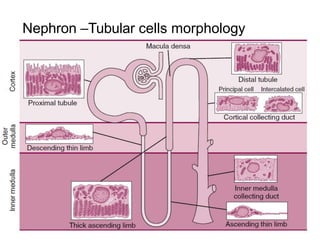
Nephron –Tubular cells morphology
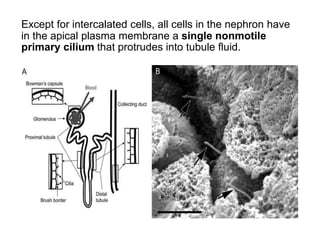
Except for intercalated cells, all cells in the nephron have
in the apical plasma membrane a single nonmotile
primary cilium that protrudes into tubule fluid.
MECHANISM OF
URINE FORMATION
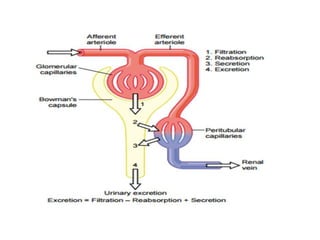
Urine Formation Results from
Glomerular Filtration,
Tubular Reabsorption, and
Tubular Secretion
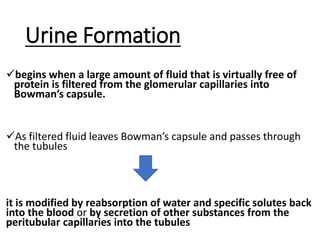
Urine Formation
begins when a large amount of fluid that is virtually free of
protein is filtered from the glomerular capillaries into
Bowman’s capsule.
As filtered fluid leaves Bowman’s capsule and passes through
the tubules
it is modified by reabsorption of water and specific solutes back
into the blood or by secretion of other substances from the
peritubular capillaries into the tubules
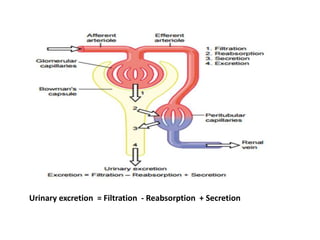
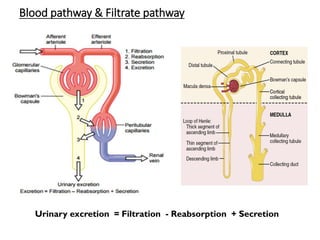
Urinary excretion = Filtration - Reabsorption + Secretion
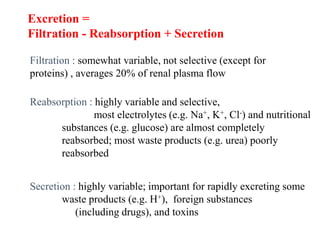
Excretion =
Filtration - Reabsorption + Secretion
Filtration : somewhat variable, not selective (except for
proteins) , averages 20% of renal plasma flow
Reabsorption : highly variable and selective,
most electrolytes (e.g. Na+, K+, Cl-) and nutritional
substances (e.g. glucose) are almost completely
reabsorbed; most waste products (e.g. urea) poorly
reabsorbed
Secretion : highly variable; important for rapidly excreting some
waste products (e.g. H+), foreign substances
(including drugs), and toxins
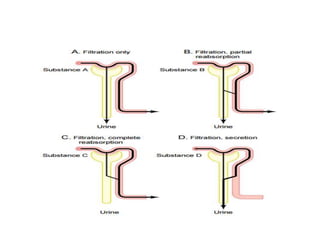
• For each substance in the plasma, a particular
combination of filtration, reabsorption, and
secretion occurs.
Rate at which the substance is
excreted in the urine depends on
the relative rates of three basic
renal processes (filtration,
reabsorption, and secretion).
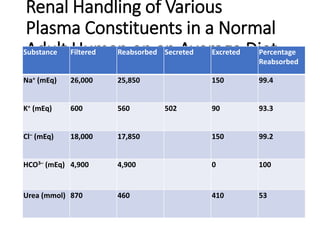
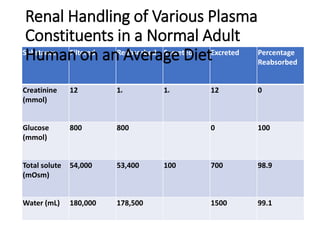
Renal Handling of Various
Plasma Constituents in a Normal
Adult Human on an Average Diet
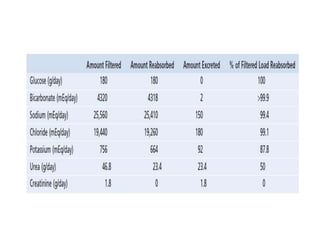
Substance Filtered Reabsorbed Secreted Excreted Percentage
Reabsorbed
Na+ (mEq) 26,000 25,850 150 99.4
K+ (mEq) 600 560 502 90 93.3
Cl– (mEq) 18,000 17,850 150 99.2
HCO3– (mEq) 4,900 4,900 0 100
Urea (mmol) 870 460 410 53
Substance Filtered Reabsorbed Secreted Excreted Percentage
Reabsorbed
Creatinine
(mmol)
12 1v 1v 12 0
Glucose
(mmol)
800 800 0 100
Total solute
(mOsm)
54,000 53,400 100 700 98.9
Water (mL) 180,000 178,500 1500 99.1
Renal Handling of Various Plasma
Constituents in a Normal Adult
Human on an Average Diet
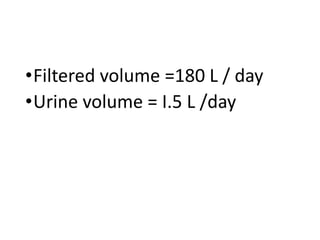
•Filtered volume =180 L / day
•Urine volume = I.5 L /day
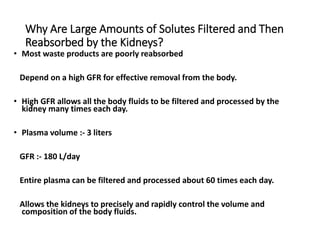
Why Are Large Amounts of Solutes Filtered and Then
Reabsorbed by the Kidneys?
• Most waste products are poorly reabsorbed
Depend on a high GFR for effective removal from the body.
• High GFR allows all the body fluids to be filtered and processed by the
kidney many times each day.
• Plasma volume :- 3 liters
GFR :- 180 L/day
Entire plasma can be filtered and processed about 60 times each day.
Allows the kidneys to precisely and rapidly control the volume and
composition of the body fluids.
Glomerular Filtration
(production of an ultrafiltrate of
plasma across the glomerulus)
—The First Step in Urine
Formation
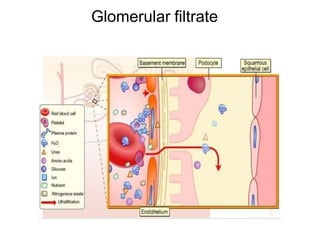
Glomerular filtrate
Glomerular Filtration(production of an ultrafiltrate of plasma across
the glomerulus)—The First Step in Urine Formation
• Urine formation begins with filtration of large amounts of fluid through
the glomerular capillaries into Bowman’s capsule (dilated, blind end of
the nephron).
• the filtered fluid (called the glomerular filtrate) is essentially protein-
free and devoid of cellular elements, including red blood cells.
• The concentrations of other constituents of the glomerular filtrate,
including most salts and organic molecules, are similar to the
concentrations in the plasma.
• Exceptions to this generalization include a few low-molecular-weight
substances, such as calcium and fatty acids, that are not freely filtered
because they are partially bound to the plasma proteins.
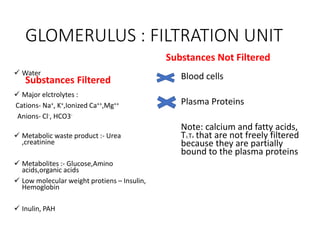
GLOMERULUS : FILTRATION UNIT
Substances Filtered
Substances Not Filtered
 Water
 Major elctrolytes :
Cations- Na+, K+,Ionized Ca++,Mg++
Anions- Cl-, HCO3-
 Metabolic waste product :- Urea
,creatinine
 Metabolites :- Glucose,Amino
acids,organic acids
 Low molecular weight protiens – Insulin,
Hemoglobin
 Inulin, PAH
Blood cells
Plasma Proteins
Note: calcium and fatty acids,
T3,T4 that are not freely filtered
because they are partially
bound to the plasma proteins
• Note that freely filtered does not mean all filtered.
• It just means that the amount filtered is in exact proportion to
the fraction of plasma volume that is filtered.
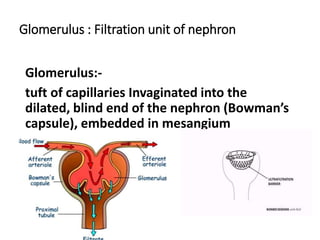
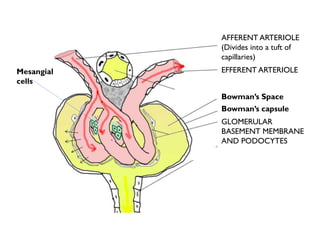
Glomerulus : Filtration unit of nephron
Glomerulus:-
tuft of capillaries Invaginated into the
dilated, blind end of the nephron (Bowman’s
capsule), embedded in mesangium
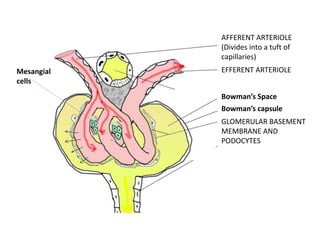
AFFERENT ARTERIOLE
(Divides into a tuft of
capillaries)
EFFERENT ARTERIOLE
Bowman’s capsule
GLOMERULAR BASEMENT
MEMBRANE AND
PODOCYTES
Bowman’s Space
Mesangial
cells
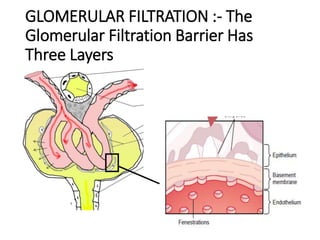
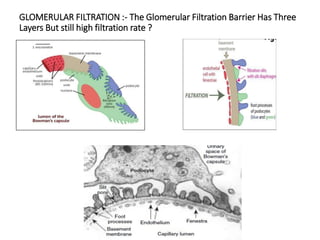
GLOMERULAR FILTRATION :- The
Glomerular Filtration Barrier Has
Three Layers
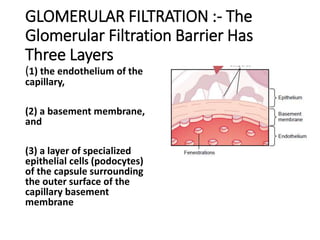
GLOMERULAR FILTRATION :- The
Glomerular Filtration Barrier Has
Three Layers
(1) the endothelium of the
capillary,
(2) a basement membrane,
and
(3) a layer of specialized
epithelial cells (podocytes)
of the capsule surrounding
the outer surface of the
capillary basement
membrane
GLOMERULAR FILTRATION :- The Glomerular Filtration Barrier Has Three
Layers But still high filtration rate ?
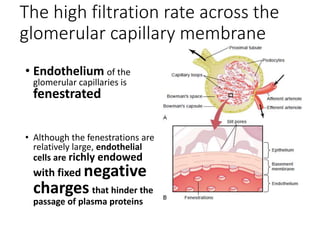
The high filtration rate across the
glomerular capillary membrane
• Endothelium of the
glomerular capillaries is
fenestrated
• Although the fenestrations are
relatively large, endothelial
cells are richly endowed
with fixed negative
charges that hinder the
passage of plasma proteins
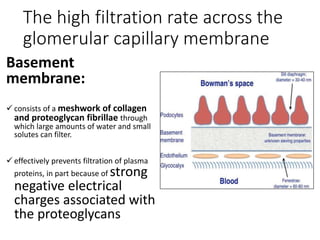
The high filtration rate across the
glomerular capillary membrane
Basement
membrane:
 consists of a meshwork of collagen
and proteoglycan fibrillae through
which large amounts of water and small
solutes can filter.
 effectively prevents filtration of plasma
proteins, in part because of strong
negative electrical
charges associated with
the proteoglycans
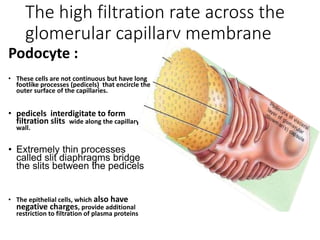
The high filtration rate across the
glomerular capillary membrane
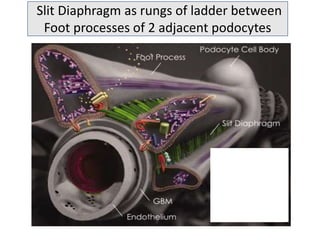
Podocyte :
• These cells are not continuous but have long
footlike processes (pedicels) that encircle the
outer surface of the capillaries.
• pedicels interdigitate to form
filtration slits wide along the capillary
wall.
• Extremely thin processes
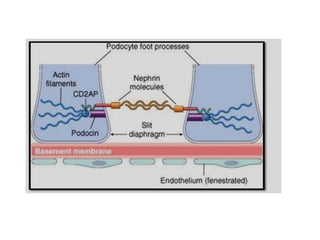
called slit diaphragms bridge
the slits between the pedicels
• The epithelial cells, which also have
negative charges, provide additional
restriction to filtration of plasma proteins
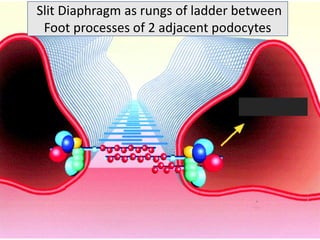
Slit Diaphragm as rungs of ladder between
Foot processes of 2 adjacent podocytes
Spaces between slit diaphragms
constitute the path through which
the filtrate, travels to enter
Bowman’s space.
Slit Diaphragm as rungs of ladder between
Foot processes of 2 adjacent podocytes
• while the basement membrane may
contribute to the selectivity of the filtration
barrier, integrity of the slit diaphragms is
essential to prevent excessive leak of plasma
protein (albumin). Some protein-wasting
diseases are associated with abnormal slit
diaphragm structure
• the effective pore size of the glomerular membrane (8 nm)
• Functionally, the glomerular membrane permits the free
passage of neutral substances up to 4 nm in diameter and
almost totally excludes those with diameters greater than
8 nm.
• However, the charges on molecules as well as their
diameters affect their passage into Bowman’s capsule.
• .
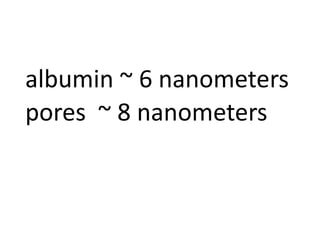
albumin ~ 6 nanometers
pores ~ 8 nanometers
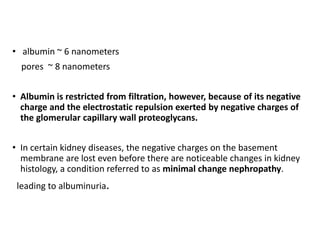
• albumin ~ 6 nanometers
pores ~ 8 nanometers
• Albumin is restricted from filtration, however, because of its negative
charge and the electrostatic repulsion exerted by negative charges of
the glomerular capillary wall proteoglycans.
• In certain kidney diseases, the negative charges on the basement
membrane are lost even before there are noticeable changes in kidney
histology, a condition referred to as minimal change nephropathy.
leading to albuminuria.
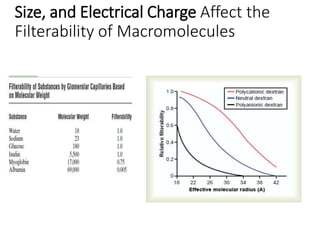
Size, and Electrical Charge Affect the
Filterability of Macromolecules
AFFERENT ARTERIOLE
(Divides into a tuft of
capillaries)
EFFERENT ARTERIOLE
Bowman’s capsule
GLOMERULAR
BASEMENT MEMBRANE
AND PODOCYTES
Bowman’s Space
Mesangial
cells
MESANGIAL CELLS
• provide structural support to the glomerular tuft, produce
and maintain mesangial matrix,
• The “mesangium” refers to the mesangial cells together
with the mesangial matrix they produce.
• act as phagocytes and remove trapped material from the
basement membrane of the capillaries.
• They also contain large numbers of myofilaments and can
contract in response to a variety of stimuli in a manner
similar to vascular smooth muscle cells.
Applied - Kidney diseases
(Nephropathies) and Filtration
Barrier
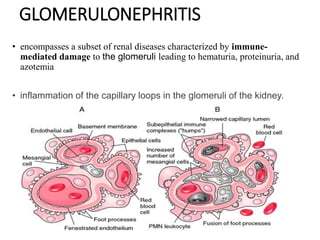
GLOMERULONEPHRITIS
• encompasses a subset of renal diseases characterized by immune-
mediated damage to the glomeruli leading to hematuria, proteinuria, and
azotemia
• inflammation of the capillary loops in the glomeruli of the kidney.
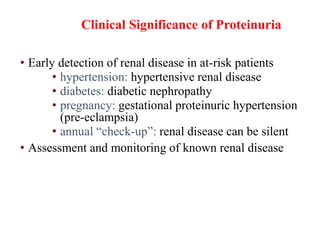
Clinical Significance of Proteinuria
• Early detection of renal disease in at-risk patients
• hypertension: hypertensive renal disease
• diabetes: diabetic nephropathy
• pregnancy: gestational proteinuric hypertension
(pre-eclampsia)
• annual “check-up”: renal disease can be silent
• Assessment and monitoring of known renal disease
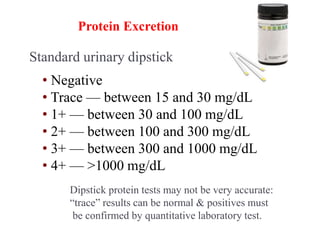
Standard urinary dipstick
• Negative
• Trace — between 15 and 30 mg/dL
• 1+ — between 30 and 100 mg/dL
• 2+ — between 100 and 300 mg/dL
• 3+ — between 300 and 1000 mg/dL
• 4+ — >1000 mg/dL
Measurement of Urinary
Protein Excretion
Dipstick protein tests may not be very accurate:
“trace” results can be normal & positives must
be confirmed by quantitative laboratory test.
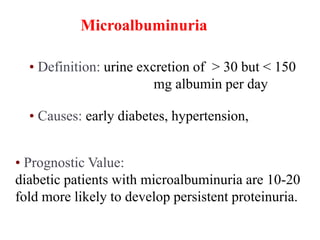
Microalbuminuria
• Definition: urine excretion of > 30 but < 150
mg albumin per day
• Causes: early diabetes, hypertension,
• Prognostic Value:
diabetic patients with microalbuminuria are 10-20
fold more likely to develop persistent proteinuria.
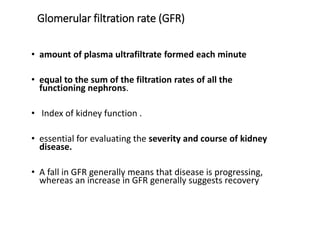
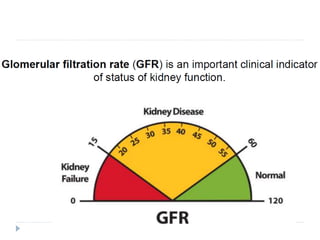
Glomerular filtration rate (GFR)
• amount of plasma ultrafiltrate formed each minute
• equal to the sum of the filtration rates of all the
functioning nephrons.
• Index of kidney function .
• essential for evaluating the severity and course of kidney
disease.
• A fall in GFR generally means that disease is progressing,
whereas an increase in GFR generally suggests recovery
Glomerular filtration rate (GFR)
• amount of plasma ultrafiltrate formed each minute
• equal to the sum of the filtration rates of all the
functioning nephrons.
• Index of kidney function .
• essential for evaluating the severity and course of kidney
disease.
• A fall in GFR generally means that disease is progressing,
whereas an increase in GFR generally suggests recovery
Normal GFR
• The GFR in a healthy person of average size is
approximately 125 mL/min.
• A rate of 125 mL/min is 7.5 L/h, or 180 L/d.
Q. Calculate filtration fraction
Renal Blood Flow = 1 L/min
GFR = 120 mL/min
.
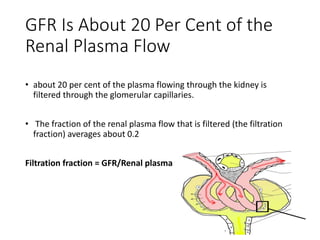
GFR Is About 20 Per Cent of the
Renal Plasma Flow
• about 20 per cent of the plasma flowing through the kidney is
filtered through the glomerular capillaries.
• The fraction of the renal plasma flow that is filtered (the filtration
fraction) averages about 0.2
Filtration fraction = GFR/Renal plasma flow
Renal blood flow
• High blood flow (~22% of cardiac output)
• High blood flow needed for high GFR
• Oxygen and nutrients delivered to kidneys
normally greatly exceeds their metabolic
needs
• A large fraction of renal oxygen consumption is
related to renal tubular sodium reabsorption
Determinants of Glomerular Filtration Rate
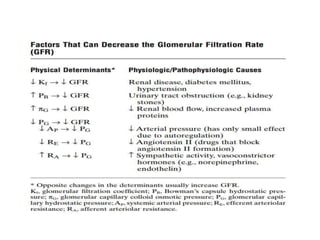
• The factors governing filtration across the glomerular
capillaries are the same as those governing filtration
across all other capillaries.
the size of the capillary bed
the permeability of the capillaries
the hydrostatic and osmotic pressure gradients across
the capillary wall
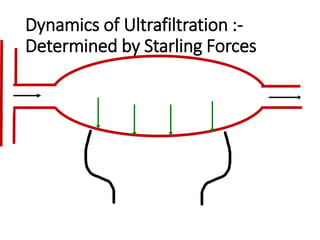
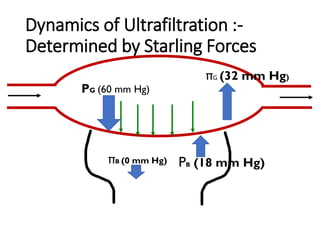
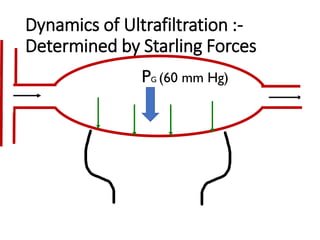
Dynamics of Ultrafiltration :-
Determined by Starling Forces
• Oncotic pressure, or colloid osmotic pressure, is a
form of osmotic pressure exerted by proteins,
notably albumin, in a blood vessel's plasma
(blood/liquid) that usually tends to pull water into
the circulatory system. It is the opposing force to
hydrostatic pressure.
• hydrostatic pressure in blood vessels is the pressure
of the blood against the wall. It is the opposing
force to oncotic pressure
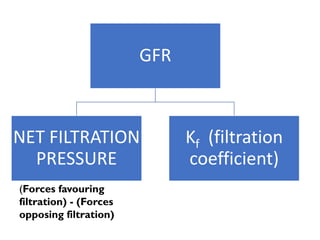
GFR
NET FILTRATION
PRESSURE
Kf (filtration
coefficient)
(Forces favouring
filtration) - (Forces
opposing filtration)
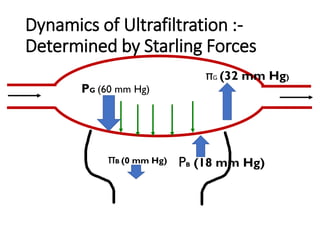
Dynamics of Ultrafiltration :-
Determined by Starling Forces
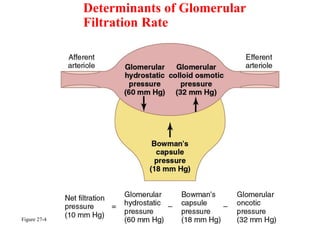
PG (60 mm Hg)
πB (0 mm Hg) PB (18 mm Hg)
πG (32 mm Hg)
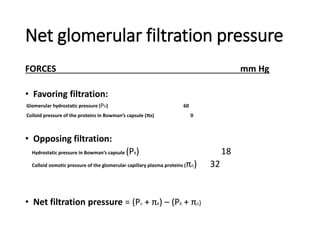
Net glomerular filtration pressure
FORCES mm Hg
• Favoring filtration:
Glomerular hydrostatic pressure (PG) 60
Colloid pressure of the proteins in Bowman’s capsule (πB) 0
• Opposing filtration:
Hydrostatic pressure in Bowman’s capsule (PB) 18
Colloid osmotic pressure of the glomerular capillary plasma proteins (πG) 32
• Net filtration pressure = (PG + πB) – (PB + πG)
Determinants of Glomerular
Filtration Rate
Figure 27-4
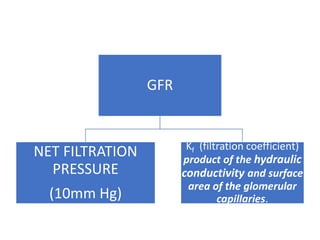
GFR
NET FILTRATION
PRESSURE
(10mm Hg)
Kf (filtration coefficient)
product of the hydraulic
conductivity and surface
area of the glomerular
capillaries.
Dynamics of Ultrafiltration :-
Determined by Starling Forces
PG (60 mm Hg)
πB (0 mm Hg) PB (18 mm Hg)
πG (32 mm Hg)
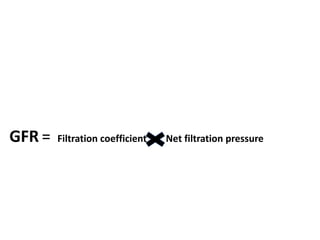
GFR = Filtration coefficient Net filtration pressure
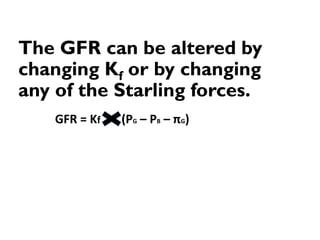
The GFR can be altered by
changing Kf or by changing
any of the Starling forces.
GFR = Kf (PG – PB – πG)
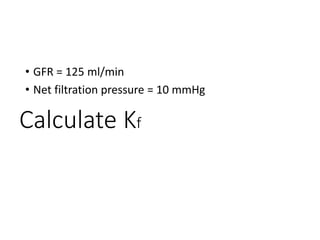
Calculate Kf
• GFR = 125 ml/min
• Net filtration pressure = 10 mmHg
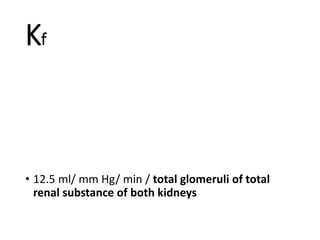
Kf
• 12.5 ml/ mm Hg/ min / total glomeruli of total
renal substance of both kidneys
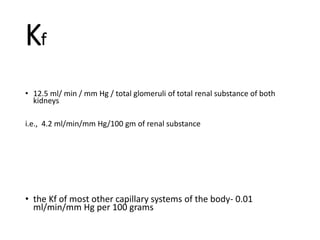
Kf
• 12.5 ml/ min / mm Hg / total glomeruli of total renal substance of both
kidneys
i.e., 4.2 ml/min/mm Hg/100 gm of renal substance
• the Kf of most other capillary systems of the body- 0.01
ml/min/mm Hg per 100 grams
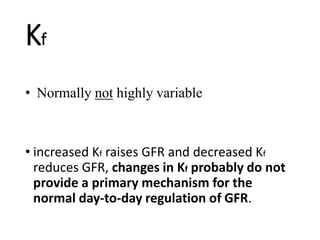
• Normally not highly variable
• increased Kf raises GFR and decreased Kf
reduces GFR, changes in Kf probably do not
provide a primary mechanism for the
normal day-to-day regulation of GFR.
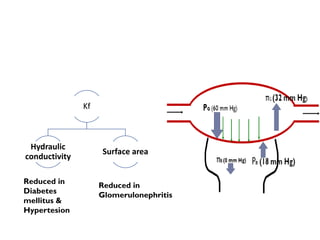
Kf
Kf
Hydraulic
conductivity
Surface area
Reduced in
Diabetes
mellitus &
Hypertesion
Reduced in
Glomerulonephritis
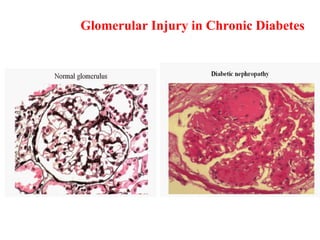
Glomerular Injury in Chronic Diabetes
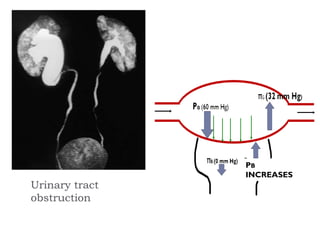
Bowman’s Capsule hydrostatic
Pressure (PB)
• Not a physiological regulator of GFR
• Tubular Obstruction
kidney stones
tubular necrosis
• Urinary tract obstruction
Prostate hypertrophy/cancer
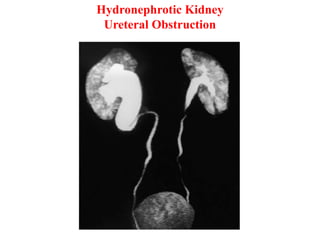
Hydronephrotic Kidney
Ureteral Obstruction
PB
INCREASES
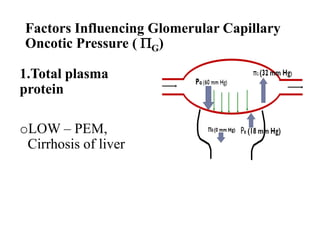
Factors Influencing Glomerular Capillary
Oncotic Pressure ( PG)
1.Total plasma
protein
oLOW – PEM,
Cirrhosis of liver
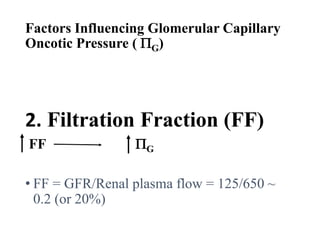
Factors Influencing Glomerular Capillary
Oncotic Pressure ( PG)
2. Filtration Fraction (FF)
FF PG
• FF = GFR/Renal plasma flow = 125/650 ~
0.2 (or 20%)
Net Filtration Pressure
PB = 18
PG = 60
PG =
PG = 60
PG =
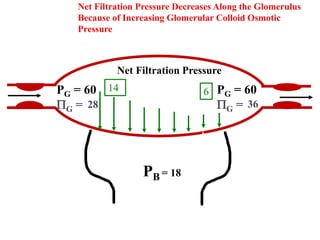
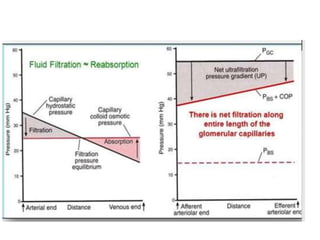
Net Filtration Pressure Decreases Along the Glomerulus
Because of Increasing Glomerular Colloid Osmotic
Pressure
14 6
28 36
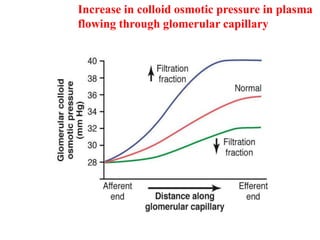
Increase in colloid osmotic pressure in plasma
flowing through glomerular capillary
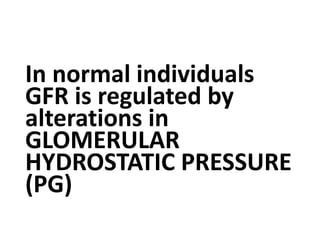
In normal individuals
GFR is regulated by
alterations in
GLOMERULAR
HYDROSTATIC PRESSURE
(PG)
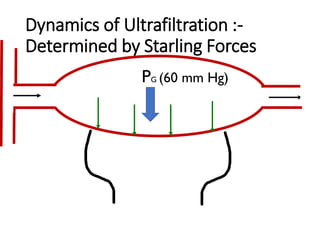
Dynamics of Ultrafiltration :-
Determined by Starling Forces
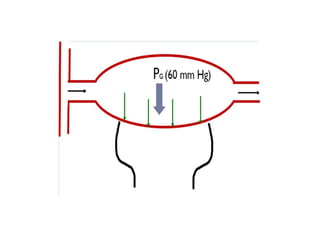
PG (60 mm Hg)
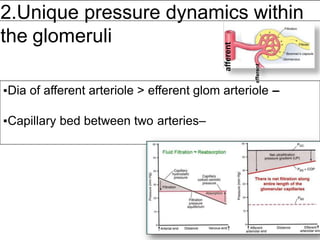
▪Dia of afferent arteriole > efferent glom arteriole –
▪Capillary bed between two arteries–
2.Unique pressure dynamics within
the glomeruli
afferent
efferent
Dynamics of Ultrafiltration :-
Determined by Starling Forces
PG (60 mm Hg)
Glomerular Hydrostatic Pressure (PG)
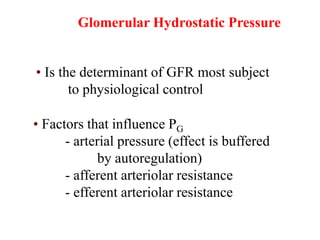
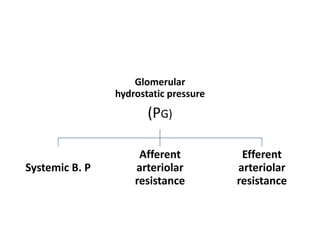
• Is the determinant of GFR most subject
to physiological control
• Factors that influence PG
- arterial pressure (effect is buffered
by autoregulation)
- afferent arteriolar resistance
- efferent arteriolar resistance
Glomerular
hydrostatic pressure
(PG)
Systemic B. P
Afferent
arteriolar
resistance
Efferent
arteriolar
resistance
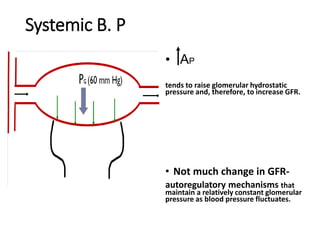
Systemic B. P
• AP
tends to raise glomerular hydrostatic
pressure and, therefore, to increase GFR.
• Not much change in GFR-
autoregulatory mechanisms that
maintain a relatively constant glomerular
pressure as blood pressure fluctuates.
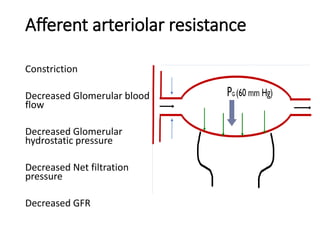
Afferent arteriolar resistance
Constriction
Decreased Glomerular blood
flow
Decreased Glomerular
hydrostatic pressure
Decreased Net filtration
pressure
Decreased GFR
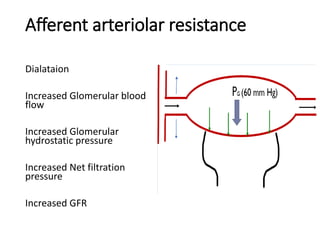
Afferent arteriolar resistance
Dialataion
Increased Glomerular blood
flow
Increased Glomerular
hydrostatic pressure
Increased Net filtration
pressure
Increased GFR
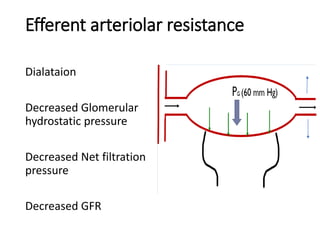
Efferent arteriolar resistance
Dialataion
Decreased Glomerular
hydrostatic pressure
Decreased Net filtration
pressure
Decreased GFR
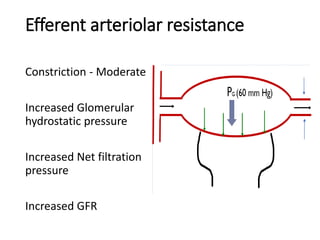
Efferent arteriolar resistance
Constriction - Moderate
Increased Glomerular
hydrostatic pressure
Increased Net filtration
pressure
Increased GFR
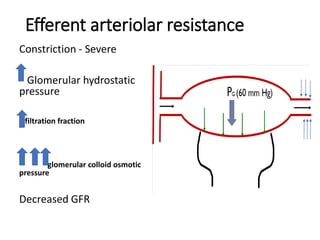
Efferent arteriolar resistance
Constriction - Severe
Glomerular hydrostatic
pressure
filtration fraction
glomerular colloid osmotic
pressure
Decreased GFR
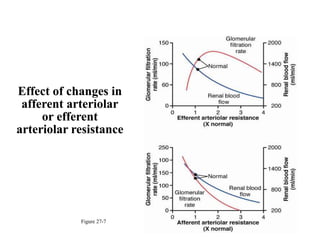
Effect of changes in
afferent arteriolar
or efferent
arteriolar resistance
Figure 27-7
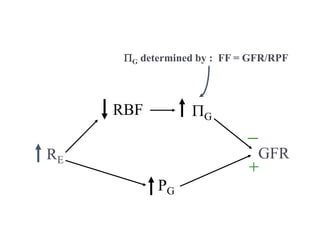
RE
RBF PG
GFR
PG
+
_
PG determined by : FF = GFR/RPF
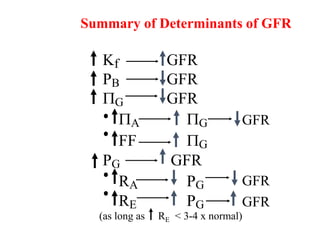
Kf GFR
PB GFR
PG GFR
PA PG
FF PG
PG GFR
RA PG
RE PG
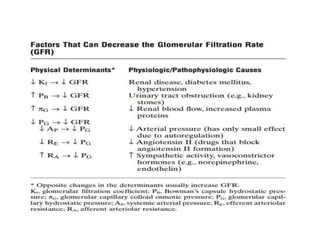
Summary of Determinants of GFR
GFR
GFR
GFR
(as long as RE < 3-4 x normal)
Determinants of Renal Blood
Flow (RBF)
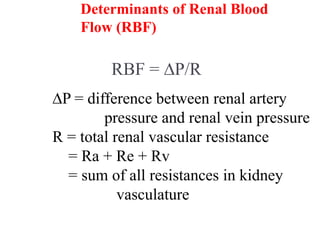
RBF = P/R
P = difference between renal artery
pressure and renal vein pressure
R = total renal vascular resistance
= Ra + Re + Rv
= sum of all resistances in kidney
vasculature
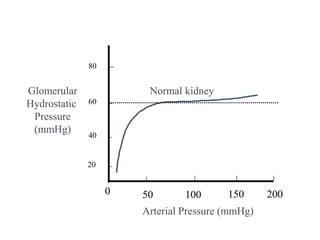
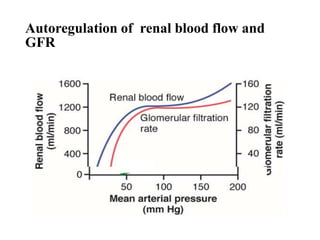
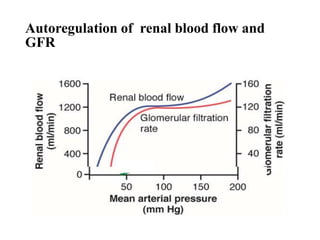
Autoregulation of renal blood flow and GFR
Autoregulation of renal blood flow and
GFR
50 100 150 200
0
Arterial Pressure (mmHg)
Glomerular
Hydrostatic
Pressure
(mmHg)
60
40
20
80
Normal kidney
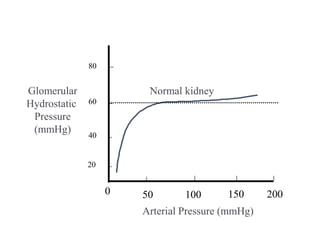
Autoregulation of renal blood flow and GFR
Autoregulation of renal blood flow and
GFR
50 100 150 200
0
Arterial Pressure (mmHg)
Glomerular
Hydrostatic
Pressure
(mmHg)
60
40
20
80
Normal kidney
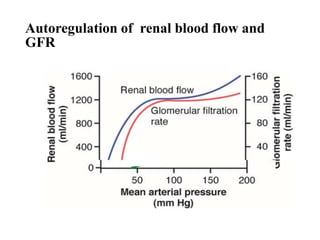
To protect the glomerular capillaries from
hypertensive damage and to preserve a
healthy GFR at different arterial pressure
values, changes in GFR and RBF are
minimized by several mechanisms that we
collectively call autoregulation.
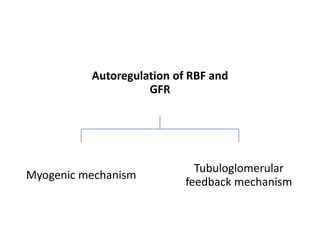
Autoregulation of RBF and
GFR
Myogenic mechanism
Tubuloglomerular
feedback mechanism
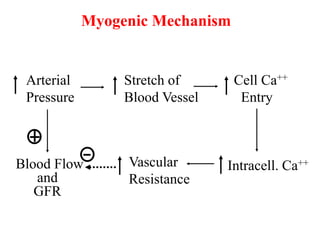
Myogenic Mechanism
Arterial
Pressure
Blood Flow
and
GFR
Vascular
Resistance
Intracell. Ca++
Cell Ca++
Entry
Stretch of
Blood Vessel
The myogenic response is very fast-acting (within
1 second) and protects the glomeruli from short-
term fluctuations in blood pressure
 Tubuloglomerular feedback mechanism
depends on special anatomical arrangements of the
juxtaglomerular complex
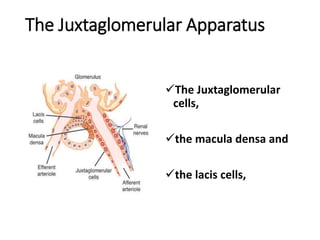
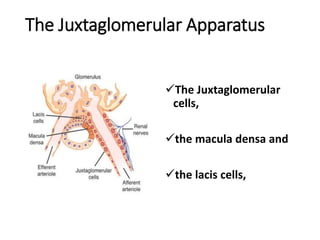
The Juxtaglomerular Apparatus
The Juxtaglomerular
cells,
the macula densa and
the lacis cells,
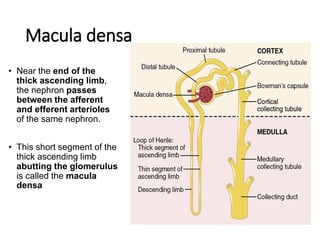
Macula densa
• Near the end of the
thick ascending limb,
the nephron passes
between the afferent
and efferent arterioles
of the same nephron.
• This short segment of the
thick ascending limb
abutting the glomerulus
is called the macula
densa
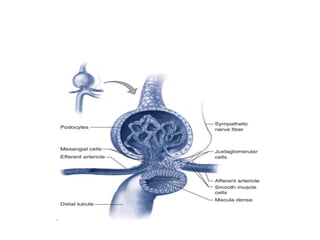
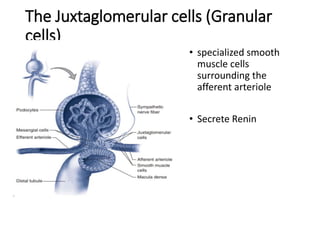
The Juxtaglomerular cells (Granular
cells)
• specialized smooth
muscle cells
surrounding the
afferent arteriole
• Secrete Renin
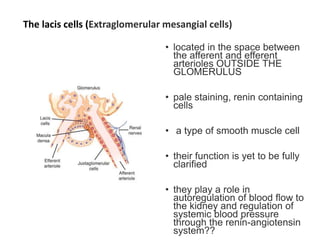
The lacis cells (Extraglomerular mesangial cells)
• located in the space between
the afferent and efferent
arterioles OUTSIDE THE
GLOMERULUS
• pale staining, renin containing
cells
• a type of smooth muscle cell
• their function is yet to be fully
clarified
• they play a role in
autoregulation of blood flow to
the kidney and regulation of
systemic blood pressure
through the renin-angiotensin
system??
The Juxtaglomerular Apparatus
The Juxtaglomerular
cells,
the macula densa and
the lacis cells,
Autoregulation - Tubuloglomerular
feedback mechanism
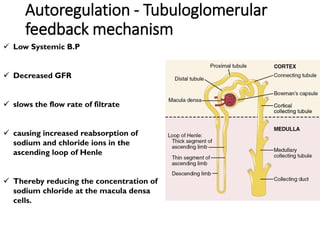
 Low Systemic B.P
 Decreased GFR
 slows the flow rate of filtrate
 causing increased reabsorption of
sodium and chloride ions in the
ascending loop of Henle
 Thereby reducing the concentration of
sodium chloride at the macula densa
cells.
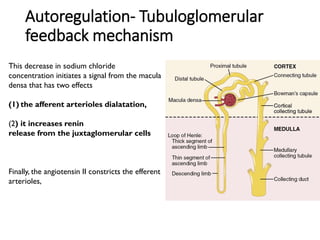
Autoregulation- Tubuloglomerular
feedback mechanism
This decrease in sodium chloride
concentration initiates a signal from the macula
densa that has two effects
(1) the afferent arterioles dialatation,
(2) it increases renin
release from the juxtaglomerular cells
Finally, the angiotensin II constricts the efferent
arterioles,
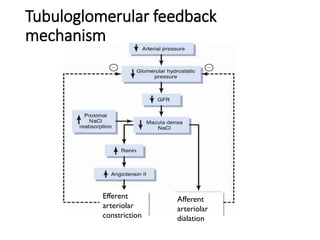
Tubuloglomerular feedback
mechanism
Afferent
arteriolar
dialation
Efferent
arteriolar
constriction
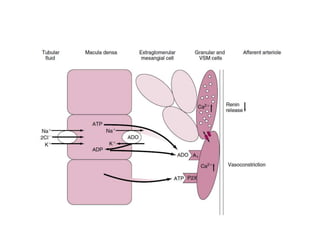
HOW MACULA DENSA TRIGGERS
CHANGES AFFERENT ARTERIOLAR
RESISTANCE • An increase in the GFR elevates the [NaCl] in
tubule fluid at the macula densa.
• Na+ and Cl– enter the macula densa cells via the Na–
K–2Cl cotransporter
• increased Na, K ATPase activity
• increased ATP hydrolysis causes more adenosine is
formed.
• increase in adenosine triphosphate (ATP) and
adenosine (ADO) release
• ATP and adenosine binds to receptors in the
plasma membrane of smooth muscle cells
surrounding the afferent arteriole
• both of which increase intracellular [Ca++].
• afferent vasoconstriction and a resultant decrease in
GFR.
HOW MACULA DENSA TRIGGERS
CHANGES IN RENIN SECRETION
• that ATP and ADO also inhibit
renin release by granular cells
in the afferent arteriole.
• This action, too, results from
an increase in intracellular
[Ca++], reflecting electrical
coupling of the granular and
vascular smooth muscle
(VSM) cells
.
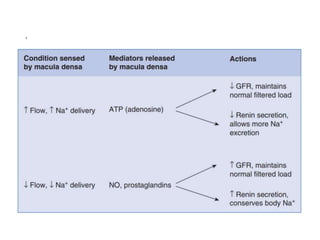
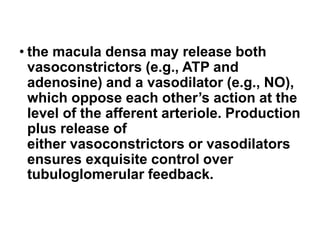
• the macula densa may release both
vasoconstrictors (e.g., ATP and
adenosine) and a vasodilator (e.g., NO),
which oppose each other’s action at the
level of the afferent arteriole. Production
plus release of
either vasoconstrictors or vasodilators
ensures exquisite control over
tubuloglomerular feedback.
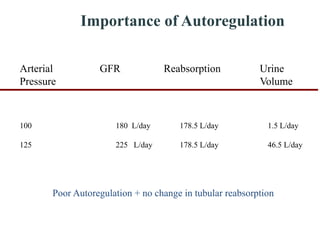
100 180 L/day 178.5 L/day 1.5 L/day
125 225 L/day 178.5 L/day 46.5 L/day
Importance of Autoregulation
Arterial GFR Reabsorption Urine
Pressure Volume
Poor Autoregulation + no change in tubular reabsorption
Autoregulation of renal blood flow and
GFR
• Despite autoregulation, RBF and GFR can
be changed by certain hormones and by
changes in sympathetic nerve activity
PHYSIOLOGICAL CONTROL OF
GLOMERULAR FILTRATION AND RENAL
BLOOD FLOW
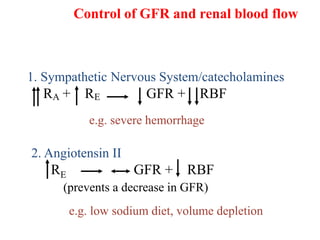
1. Sympathetic Nervous System/catecholamines
RA + RE GFR + RBF
Control of GFR and renal blood flow
2. Angiotensin II
RE GFR + RBF
(prevents a decrease in GFR)
e.g. severe hemorrhage
e.g. low sodium diet, volume depletion
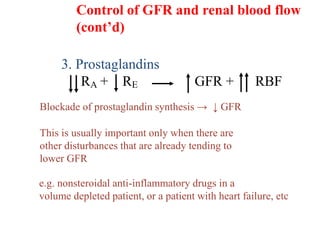
Control of GFR and renal blood flow
(cont’d)
3. Prostaglandins
RA + RE GFR + RBF
Blockade of prostaglandin synthesis → ↓ GFR
This is usually important only when there are
other disturbances that are already tending to
lower GFR
e.g. nonsteroidal anti-inflammatory drugs in a
volume depleted patient, or a patient with heart failure, etc
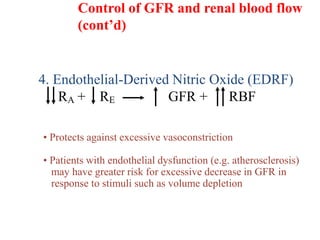
4. Endothelial-Derived Nitric Oxide (EDRF)
RA + RE GFR + RBF
• Protects against excessive vasoconstriction
• Patients with endothelial dysfunction (e.g. atherosclerosis)
may have greater risk for excessive decrease in GFR in
response to stimuli such as volume depletion
Control of GFR and renal blood flow
(cont’d)
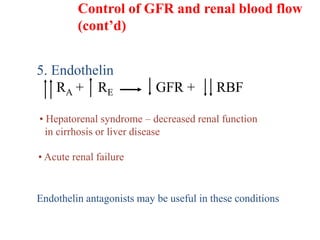
5. Endothelin
RA + RE GFR + RBF
• Hepatorenal syndrome – decreased renal function
in cirrhosis or liver disease
• Acute renal failure
Endothelin antagonists may be useful in these conditions
Control of GFR and renal blood flow
(cont’d)
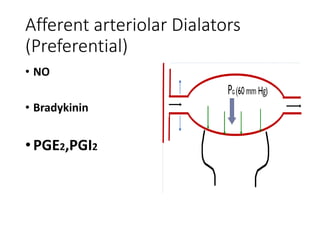
Afferent arteriolar Dialators
(Preferential)
• NO
• Bradykinin
•PGE2,PGI2
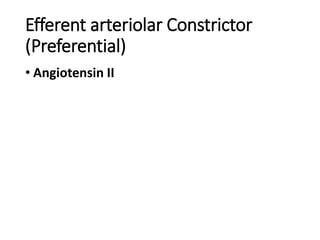
Efferent arteriolar Constrictor
(Preferential)
• Angiotensin II
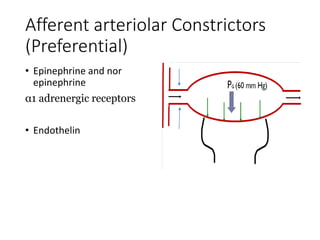
Afferent arteriolar Constrictors
(Preferential)
• Epinephrine and nor
epinephrine
α1 adrenergic receptors
• Endothelin
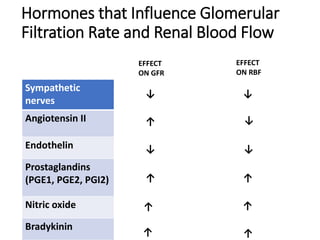
Hormones that Influence Glomerular
Filtration Rate and Renal Blood Flow
Sympathetic
nerves
Angiotensin II
Endothelin
Prostaglandins
(PGE1, PGE2, PGI2)
Nitric oxide
Bradykinin
EFFECT
ON GFR
EFFECT
ON RBF
↓ ↓
↑ ↓
↓ ↓
↑ ↑
↑ ↑
↑ ↑
Other Factors That Influence GFR
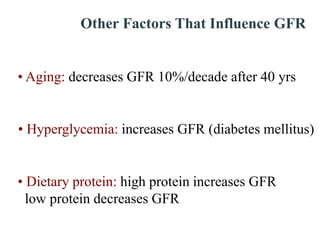
• Aging: decreases GFR 10%/decade after 40 yrs
• Hyperglycemia: increases GFR (diabetes mellitus)
• Dietary protein: high protein increases GFR
low protein decreases GFR
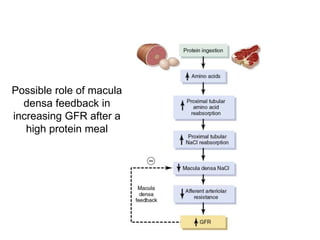
Possible role of macula
densa feedback in
increasing GFR after a
high protein meal
 Clearance
volume of plasma per unit time from
which all of a specific substance is
removed.
Renal Clearance
• Renal clearance of a substance is the volume of
plasma completely cleared of a substance
per min by the kidneys.
Note: Renal clearance means that the substance is
removed from the plasma and excreted in the urine.
If the plasma passing through the kidneys
contains 1 milligram of a substance in each
millilitre and if 1 milligram of this substance is
also excreted into the urine each minute, then
calculate the volume of plasma which is
“cleared” of the substance per minute…
 If the plasma passing through the kidneys
contains 1 milligram of a substance in each
millilitre and if 1 milligram of this substance is
also excreted into the urine each minute, then 1
ml/min of the plasma is “cleared” of the
substance.
Renal Clearance
• Renal clearance of a substance is the volume of
plasma completely cleared of a substance
per min by the kidneys.
Note: Renal clearance means that the substance is
removed from the plasma and excreted in the urine.
The concept of renal clearance is based on the
Fick’s principle (i.e., mass balance or
conservation of mass).
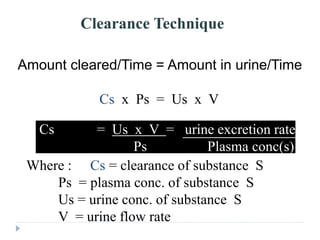
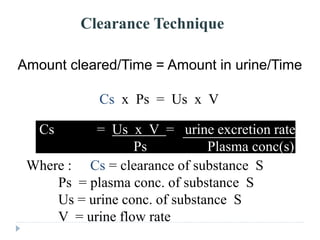
Clearance Technique
Amount cleared/Time = Amount in urine/Time
Cs x Ps = Us x V
Where : Cs = clearance of substance S
Ps = plasma conc. of substance S
Us = urine conc. of substance S
V = urine flow rate
Cs = Us x V = urine excretion rate s
Ps Plasma conc(s)
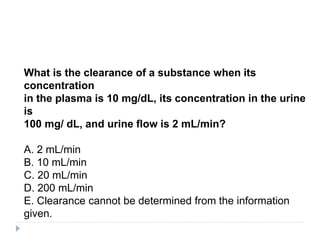
What is the clearance of a substance when its
concentration
in the plasma is 10 mg/dL, its concentration in the urine
is
100 mg/ dL, and urine flow is 2 mL/min?
A. 2 mL/min
B. 10 mL/min
C. 20 mL/min
D. 200 mL/min
E. Clearance cannot be determined from the information
given.
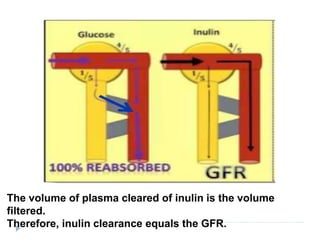
The volume of plasma cleared of inulin is the volume
filtered.
Therefore, inulin clearance equals the GFR.
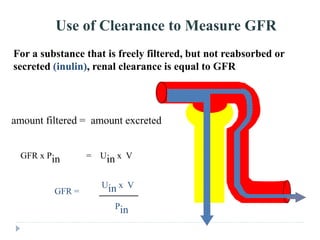
For a substance that is freely filtered, but not reabsorbed or
secreted (inulin), renal clearance is equal to GFR
Use of Clearance to Measure GFR
amount filtered = amount excreted
GFR x Pin = Uin x V
GFR =
Pin
Uin x V
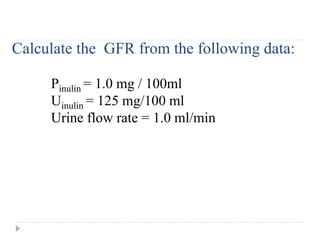
Calculate the GFR from the following data:
Pinulin = 1.0 mg / 100ml
Uinulin = 125 mg/100 ml
Urine flow rate = 1.0 ml/min
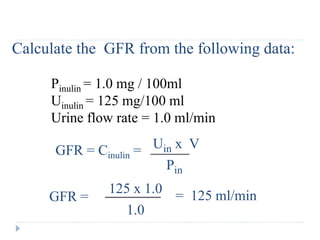
Calculate the GFR from the following data:
Pinulin = 1.0 mg / 100ml
Uinulin = 125 mg/100 ml
Urine flow rate = 1.0 ml/min
GFR =
125 x 1.0
1.0
= 125 ml/min
GFR = Cinulin =
Pin
Uin x V
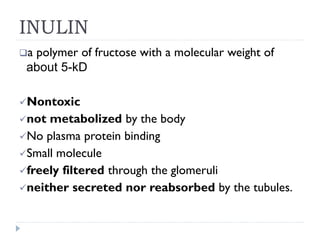
INULIN
a polymer of fructose with a molecular weight of
about 5-kD
Nontoxic
not metabolized by the body
No plasma protein binding
Small molecule
freely filtered through the glomeruli
neither secreted nor reabsorbed by the tubules.
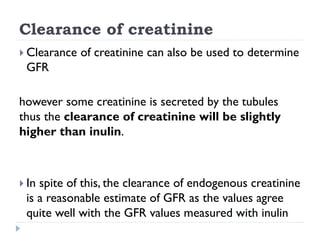
Clearance of creatinine
 Clearance of creatinine can also be used to determine
GFR
however some creatinine is secreted by the tubules
thus the clearance of creatinine will be slightly
higher than inulin.
 In spite of this, the clearance of endogenous creatinine
is a reasonable estimate of GFR as the values agree
quite well with the GFR values measured with inulin
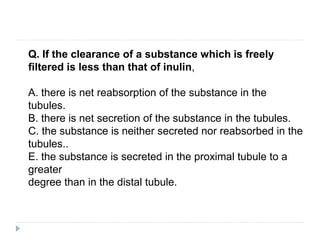
Q. If the clearance of a substance which is freely
filtered is less than that of inulin,
A. there is net reabsorption of the substance in the
tubules.
B. there is net secretion of the substance in the tubules.
C. the substance is neither secreted nor reabsorbed in the
tubules..
E. the substance is secreted in the proximal tubule to a
greater
degree than in the distal tubule.
 Can something have a clearance greater than
the GFR?
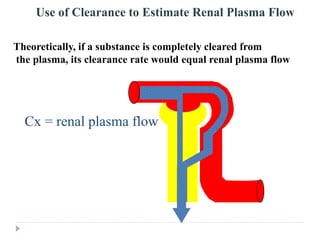
Theoretically, if a substance is completely cleared from
the plasma, its clearance rate would equal renal plasma flow
Use of Clearance to Estimate Renal Plasma Flow
Cx = renal plasma flow
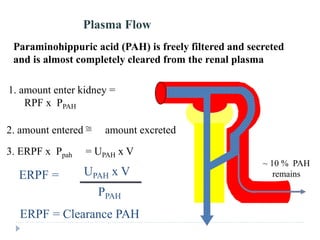
Paraminohippuric acid (PAH) is freely filtered and secreted
and is almost completely cleared from the renal plasma
Use of PAH Clearance to Estimate Renal
Plasma Flow
1. amount enter kidney =
RPF x PPAH
3. ERPF x Ppah = UPAH x V
ERPF = UPAH x V
PPAH
ERPF = Clearance PAH
2. amount entered = amount excreted
~
~ 10 % PAH
remains
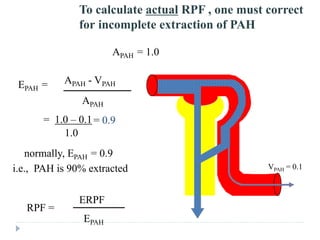
To calculate actual RPF , one must correct
for incomplete extraction of PAH
EPAH = APAH - VPAH
APAH
RPF =
ERPF
EPAH
normally, EPAH = 0.9
i.e., PAH is 90% extracted
APAH = 1.0
= 1.0 – 0.1
1.0
= 0.9
VPAH = 0.1
A patient is infused with paraaminohippuric acid
(PAH) to measure renal blood flow (RBF). She has a
urine flow rate of 1 mL/min, a plasma [PAH] of 1
mg/mL, a urine [PAH] of 600 mg/mL, and a hematocrit
of 45%. What is her “effective” RBF?
(A) 600 mL/min
(B) 660 mL/min
(C) 1091 mL/min
(D) 1333 mL/min
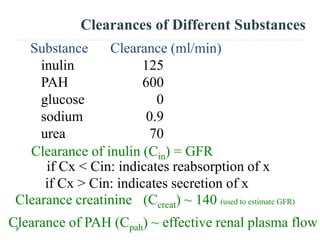
Clearances of Different Substances
Clearance of inulin (Cin) = GFR
if Cx < Cin: indicates reabsorption of x
Clearance of PAH (Cpah) ~ effective renal plasma flow
Substance Clearance (ml/min)
inulin 125
PAH 600
glucose 0
sodium 0.9
urea 70
Clearance creatinine (Ccreat) ~ 140 (used to estimate GFR)
if Cx > Cin: indicates secretion of x
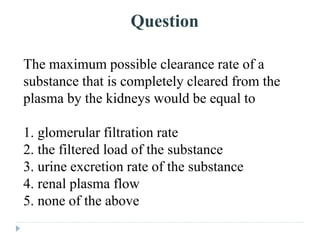
Question
The maximum possible clearance rate of a
substance that is completely cleared from the
plasma by the kidneys would be equal to
1. glomerular filtration rate
2. the filtered load of the substance
3. urine excretion rate of the substance
4. renal plasma flow
5. none of the above
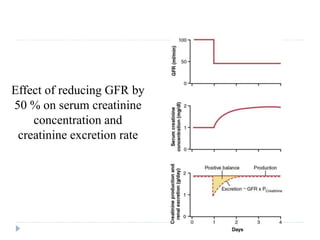
Effect of reducing GFR by
50 % on serum creatinine
concentration and
creatinine excretion rate
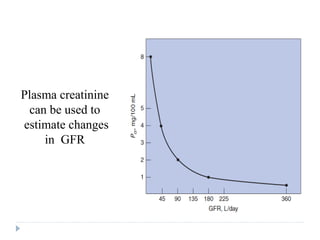
Plasma creatinine
can be used to
estimate changes
in GFR
Plasma creatinine concentration
varies inversely with GFR and is a
practical indicator of how well the
kidneys are filtering.
Which of the following substances has the
highest renal clearance?
(A) Para-aminohippuric acid (PAH)
(B) Inulin
(C) Glucose
(D) Na+
The following information was obtained in a 20-year-old
college student who was participating in a research study
in the Clinical Research Unit:
Plasma Urine
[Inulin] = 1 mg/mL [Inulin] = 150 mg/mL
[X] = 2 mg/Ml [X] = 100 mg/mL
Urine flow rate = 1
mL/min
Assuming that X is freely filtered, which of the following
statements is most correct?
(A) There is net secretion of X
(B) There is net reabsorption of X
(C) The clearance of X could be used to measure the
glomerular filtration rate (GFR)
(D) The clearance of X is greater than the clearance of
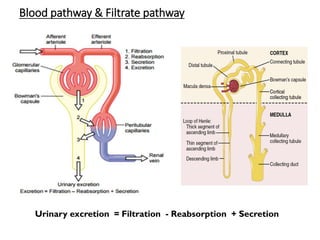
Blood pathway & Filtrate pathway
Urinary excretion = Filtration - Reabsorption + Secretion
•Filtered volume =180 L / day
•Urine volume = I.5 L /day
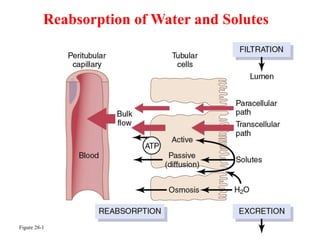
Reabsorption of Water and Solutes
Figure 28-1
Reabsorption of Water and Solutes
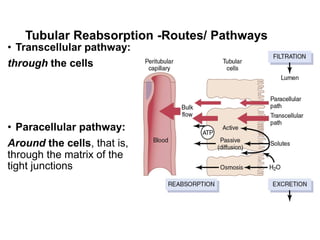
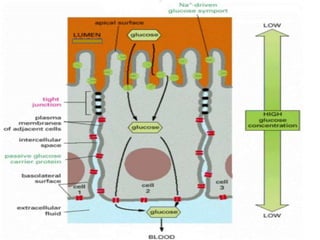
Tubular Reabsorption -Routes/ Pathways
• Transcellular pathway:
through the cells
• Paracellular pathway:
Around the cells, that is,
through the matrix of the
tight junctions
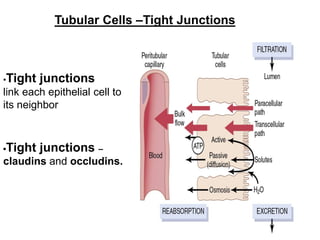
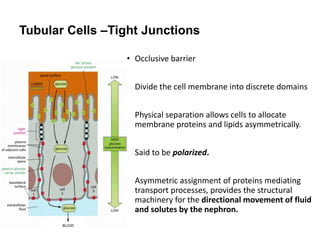
Tubular Cells –Tight Junctions
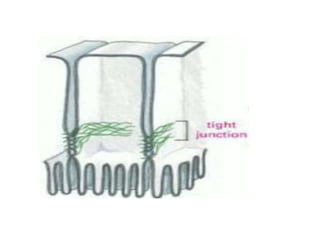
▪Tight junctions
link each epithelial cell to
its neighbor
▪Tight junctions –
claudins and occludins.
• Occlusive barrier
• Divide the cell membrane into discrete domains
.
• Physical separation allows cells to allocate
membrane proteins and lipids asymmetrically.
• Said to be polarized.
• Asymmetric assignment of proteins mediating
transport processes, provides the structural
machinery for the directional movement of fluid
and solutes by the nephron.
Tubular Cells –Tight Junctions
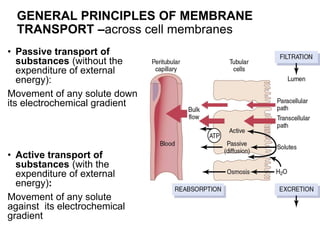
• Passive transport of
substances (without the
expenditure of external
energy):
Movement of any solute down
its electrochemical gradient
• Active transport of
substances (with the
expenditure of external
energy):
Movement of any solute
against its electrochemical
gradient
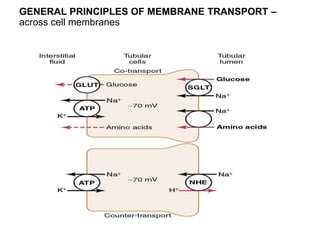
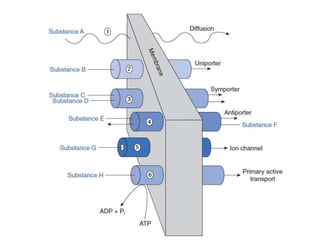
GENERAL PRINCIPLES OF MEMBRANE
TRANSPORT –across cell membranes
GENERAL PRINCIPLES OF MEMBRANE TRANSPORT –
across cell membranes
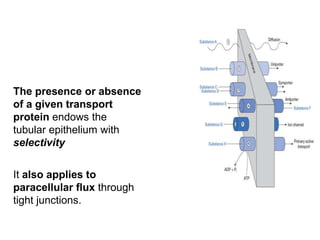
The presence or absence
of a given transport
protein endows the
tubular epithelium with
selectivity
It also applies to
paracellular flux through
tight junctions.
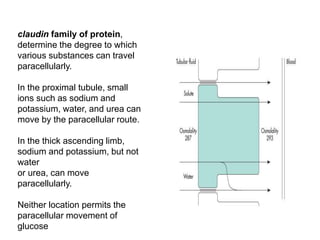
claudin family of protein,
determine the degree to which
various substances can travel
paracellularly.
In the proximal tubule, small
ions such as sodium and
potassium, water, and urea can
move by the paracellular route.
In the thick ascending limb,
sodium and potassium, but not
water
or urea, can move
paracellularly.
Neither location permits the
paracellular movement of
glucose
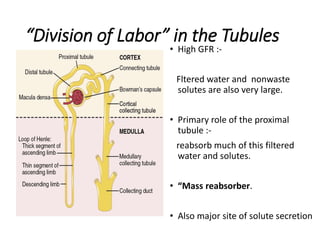
• High GFR :-
Fltered water and nonwaste
solutes are also very large.
• Primary role of the proximal
tubule :-
reabsorb much of this filtered
water and solutes.
• “Mass reabsorber.
• Also major site of solute secretion
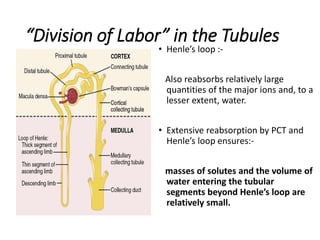
“Division of Labor” in the Tubules
• Henle’s loop :-
Also reabsorbs relatively large
quantities of the major ions and, to a
lesser extent, water.
• Extensive reabsorption by PCT and
Henle’s loop ensures:-
masses of solutes and the volume of
water entering the tubular
segments beyond Henle’s loop are
relatively small.
“Division of Labor” in the Tubules
• Distal segments :-
fine-tuning for most substances
• Determines the final amounts
excreted in the urine by adjusting
their rates of reabsorption and, in
a few cases, secretion.
• Most homeostatic controls are
exerted.
“Division of Labor” in the Tubules
Blood pathway & Filtrate pathway
Urinary excretion = Filtration - Reabsorption + Secretion
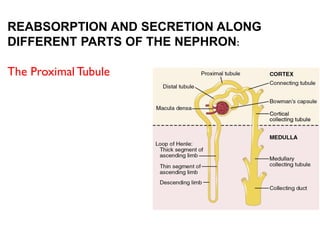
REABSORPTION AND SECRETION ALONG
DIFFERENT PARTS OF THE NEPHRON:
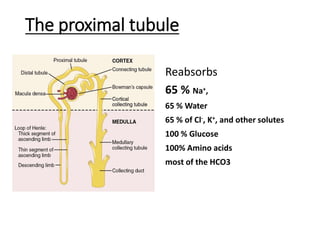
The Proximal Tubule
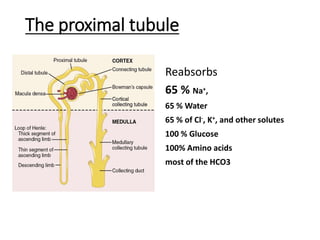
The proximal tubule
Reabsorbs
65 % Na+,
65 % Water
65 % of Cl-, K+, and other solutes
100 % Glucose
100% Amino acids
most of the HCO3
SOLUTE AND WATER REABSORPTION
ALONG THE NEPHRON :- Proximal
Tubule
• Reabsorbs approximately 65% of the filtered water, Na+, Cl-,
K+, and other solutes.
• In addition, the proximal tubule reabsorbs virtually all the
glucose and amino acids filtered by the glomerulus.
• The key element in proximal tubule reabsorption is the Na+,K+-
ATPase in the basolateral membrane
• Reabsorption of virtually all organic solutes, Cl-, other ions, and
water is coupled to Na+ reabsorption.
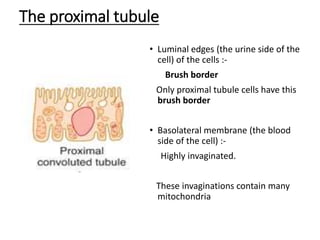
• Luminal edges (the urine side of the
cell) of the cells :-
Brush border
Only proximal tubule cells have this
brush border
• Basolateral membrane (the blood
side of the cell) :-
Highly invaginated.
These invaginations contain many
mitochondria
The proximal tubule
•The key element in proximal tubule
reabsorption is the Na+,K+-ATPase
in the basolateral membrane
In the proximal tubule the transport
of water and every solute is tied
directly or indirectly to the active
transport of sodium by the Na-K-
ATPase
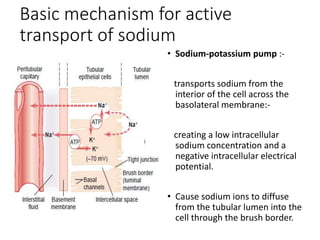
Basic mechanism for active
transport of sodium
• Sodium-potassium pump :-
transports sodium from the
interior of the cell across the
basolateral membrane:-
creating a low intracellular
sodium concentration and a
negative intracellular electrical
potential.
• Cause sodium ions to diffuse
from the tubular lumen into the
cell through the brush border.
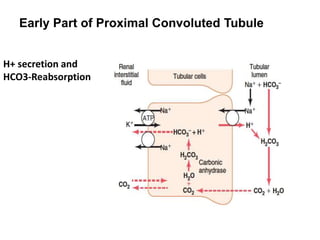
• First half of Proximal tubule
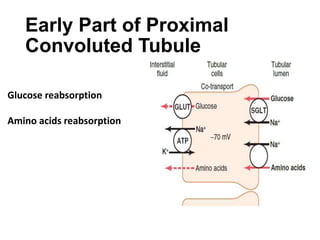
Early Part of Proximal Convoluted Tubule
H+ secretion and
HCO3-Reabsorption
Glucose reabsorption
Amino acids reabsorption
Early Part of Proximal
Convoluted Tubule
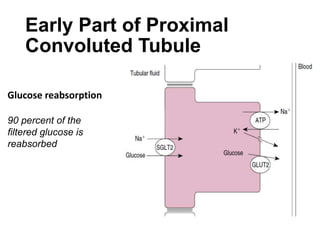
Glucose reabsorption
90 percent of the
filtered glucose is
reabsorbed
Early Part of Proximal
Convoluted Tubule
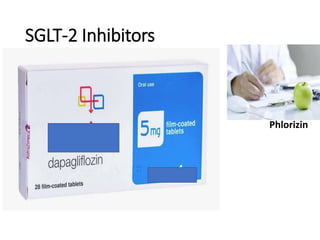
SGLT-2 Inhibitors
Phlorizin
Na+ reabsorption :-First half of
proximal tubule
• Na+ is reabsorbed primarily with HCO3
- and, to a
lesser degree,a number of organic molecules (e.g.,
glucose, amino acids)
• Second half of Proximal tubule
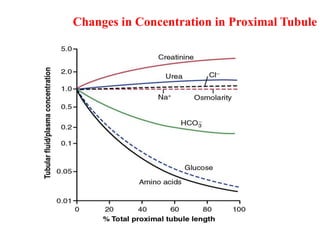
Changes in Concentration in Proximal Tubule
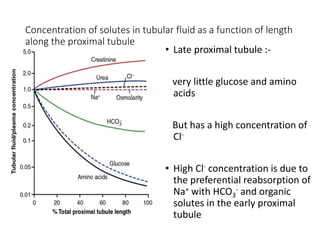
• Late proximal tubule :-
very little glucose and amino
acids
But has a high concentration of
Cl-
• High Cl- concentration is due to
the preferential reabsorption of
Na+ with HCO3
- and organic
solutes in the early proximal
tubule
Concentration of solutes in tubular fluid as a function of length
along the proximal tubule
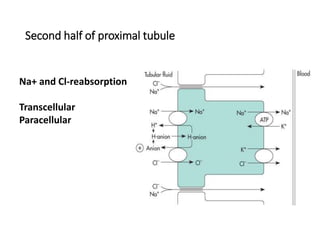
Second half of proximal tubule
Na+ and Cl-reabsorption
Transcellular
Paracellular
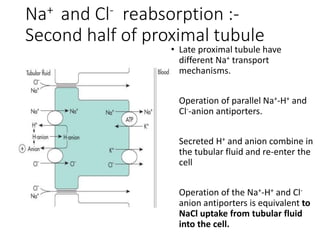
• Late proximal tubule have
different Na+ transport
mechanisms.
• Operation of parallel Na+-H+ and
Cl--anion antiporters.
• Secreted H+ and anion combine in
the tubular fluid and re-enter the
cell
• Operation of the Na+-H+ and Cl-
anion antiporters is equivalent to
NaCl uptake from tubular fluid
into the cell.
Na+ and Cl- reabsorption :-
Second half of proximal tubule
• Paracellular NaCl reabsorption
Rise in [Cl-] in the tubular fluid in the
early proximal tubule
Diffusion of Cl- from the tubular lumen
across the tight junctions into the
lateral intercellular space.
• Tubular fluid become positively
charged relative to the blood.
• Positive transepithelial voltage causes
the diffusion of Na+ out of the tubular
fluid across the tight junctions.
Na+ reabsorption :-Second half of
proximal tubule
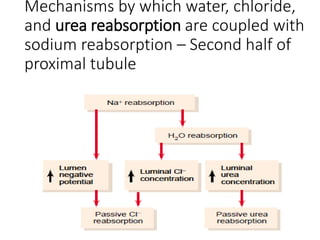
Mechanisms by which water, chloride,
and urea reabsorption are coupled with
sodium reabsorption – Second half of
proximal tubule
Second half of proximal tubule
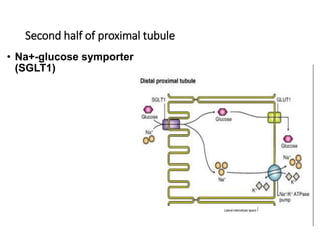
• Na+-glucose symporter
(SGLT1)
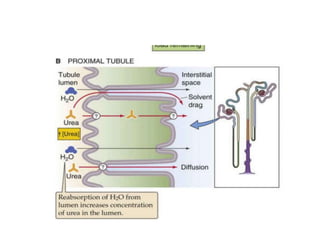
• Water reabsorption along the proximal tubule
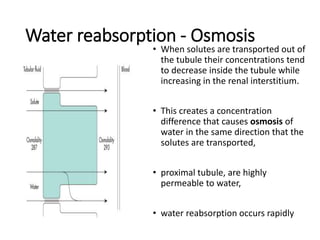
Water reabsorption - Osmosis
• When solutes are transported out of
the tubule their concentrations tend
to decrease inside the tubule while
increasing in the renal interstitium.
• This creates a concentration
difference that causes osmosis of
water in the same direction that the
solutes are transported,
• proximal tubule, are highly
permeable to water,
• water reabsorption occurs rapidly
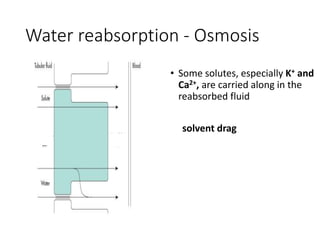
Water reabsorption - Osmosis
• Some solutes, especially K+ and
Ca2+, are carried along in the
reabsorbed fluid
solvent drag
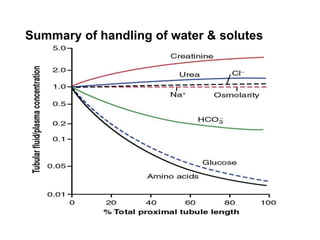
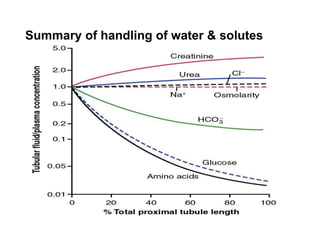
Summary of handling of water & solutes
• [TF/P]x is the concentration of substance X in tubular fluid
relative to the concentration in plasma.
[TF/P]X = 1.0. X has not been reabsorbed or secreted (all freely
filtered substances in Bowman's space), or X is reabsorbed in
proportion to water (e.g., Na in proximal tubule)
[TF/P]X < 1.0. X is reabsorbed more than water
[TF/P]X > 1.0. X is reabsorbed less than water or X is secreted
Summary of handling of water & solutes
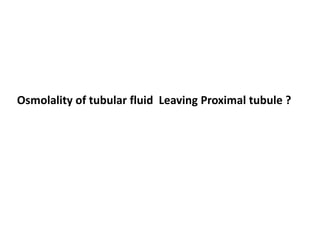
Osmolality of tubular fluid Leaving Proximal tubule ?
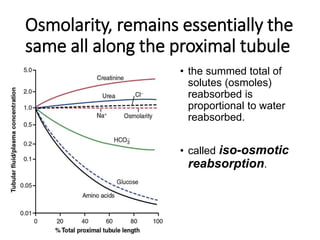
Osmolarity, remains essentially the
same all along the proximal tubule
• the summed total of
solutes (osmoles)
reabsorbed is
proportional to water
reabsorbed.
• called iso-osmotic
reabsorption.
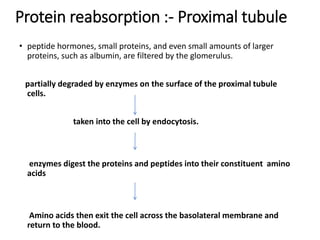
Protein reabsorption :- Proximal tubule
• peptide hormones, small proteins, and even small amounts of larger
proteins, such as albumin, are filtered by the glomerulus.
partially degraded by enzymes on the surface of the proximal tubule
cells.
taken into the cell by endocytosis.
enzymes digest the proteins and peptides into their constituent amino
acids
Amino acids then exit the cell across the basolateral membrane and
return to the blood.
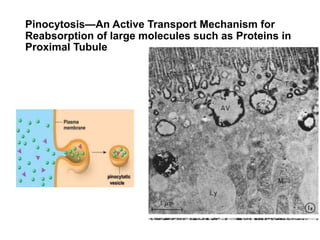
Pinocytosis—An Active Transport Mechanism for
Reabsorption of large molecules such as Proteins in
Proximal Tubule
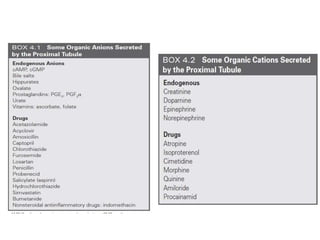
Secretion of Organic Acids and
Bases by the Proximal Tubule
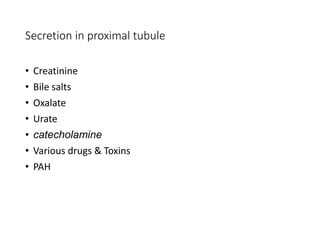
Secretion in proximal tubule
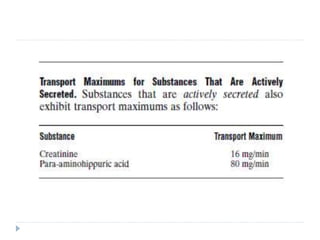
• Creatinine
• Bile salts
• Oxalate
• Urate
• catecholamine
• Various drugs & Toxins
• PAH
• Many organic anions compete for the same secretory
pathways
• Similar competition is observed for organic cation
secretion by the proximal tubule
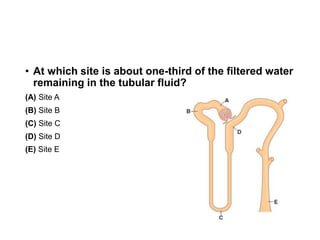
• At which site is about one-third of the filtered water
remaining in the tubular fluid?
(A) Site A
(B) Site B
(C) Site C
(D) Site D
(E) Site E
• Water channel present in proximal convoluted tubule is:
1. Aquaporin 1
2. Aquaporin 2
3. Aquaporin 3
4. Aquaporin 4
• At the leaving end of proximal convoluted tubule , percentage of
filtered solute and water is approximately:
1) 35% solute and 35% water
2) 45%solute and 45% water
3) 35% solute and 45% water
4) 45%solute and 35% water
• Percentage of filtered urea, reabsorbed by Proximal tubule is
about:
1. 00-20
2. 50 -60
3. 70-95
4. 80-100
• In the presence of ADH, the greatest fraction of filtered water is absorbed in the
A. proximal tubule.
B. loop of Henle.
C. distal tubule.
D. cortical collecting duct.
E. medullary collecting duct.
• In the absence of ADH, the greatest fraction of filtered water is absorbed in the
A. proximal tubule.
B. loop of Henle.
C. distal tubule.
D. cortical collecting duct.
E. medullary collecting duct.
The proximal tubule
Reabsorbs
65 % Na+,
65 % Water
65 % of Cl-, K+, and other solutes
100 % Glucose
100% Amino acids
most of the HCO3
Limits on Rate of Transport: Tubular
transport maximum (Tm) and Gradient-
limited Systems
The classification is based on the leakiness of the tight
junctions
The rate of reabsorption for any
substance is limited by the capacity
of the transporters (Tm systems) or
by paracellular back leak (gradient-
limited)
Gradient-limited systems.
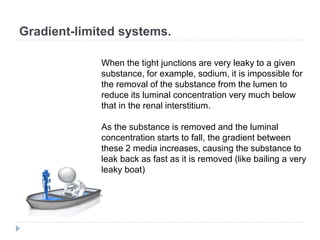
When the tight junctions are very leaky to a given
substance, for example, sodium, it is impossible for
the removal of the substance from the lumen to
reduce its luminal concentration very much below
that in the renal interstitium.
As the substance is removed and the luminal
concentration starts to fall, the gradient between
these 2 media increases, causing the substance to
leak back as fast as it is removed (like bailing a very
leaky boat)
Sodium reabsorption in the proximal tubule :
 Gradient limited reabsorption
Tm-limited systems: In this case the tight
junctions are impermeable to the solutes in
question. There is no back leak and no limit
on the size of the difference in
concentration between lumen and
interstitium.
Transport Maximum for Substances That Are
Actively Reabsorbed.
A limit to the rate at which the
solute can be transported
 This limit is due to saturation of the specific
transport systems involved when the amount of
solute delivered to the tubule exceeds the capacity of
the carrier proteins and specific enzymes involved in
the transport
Glucose transport system in the proximal tubule
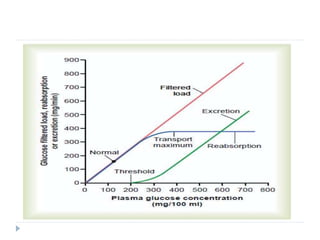
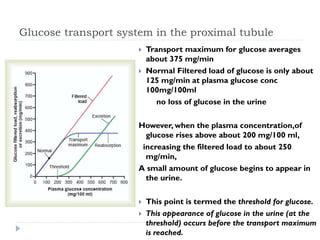
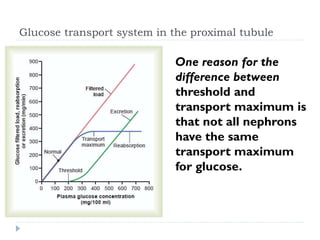
 Transport maximum for glucose averages
about 375 mg/min
 Normal Filtered load of glucose is only about
125 mg/min at plasma glucose conc
100mg/100ml
no loss of glucose in the urine
However, when the plasma concentration,of
glucose rises above about 200 mg/100 ml,
increasing the filtered load to about 250
mg/min,
A small amount of glucose begins to appear in
the urine.
 This point is termed the threshold for glucose.
 This appearance of glucose in the urine (at the
threshold) occurs before the transport maximum
is reached.
Glucose transport system in the proximal tubule
One reason for the
difference between
threshold and
transport maximum is
that not all nephrons
have the same
transport maximum
for glucose.
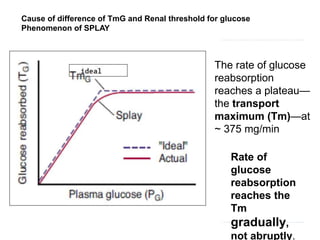
Cause of difference of TmG and Renal threshold for glucose
Phenomenon of SPLAY
Rate of
glucose
reabsorption
reaches the
Tm
gradually,
not abruptly.
The rate of glucose
reabsorption
reaches a plateau—
the transport
maximum (Tm)—at
~ 375 mg/min
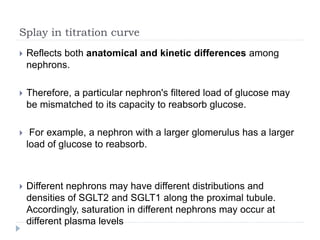
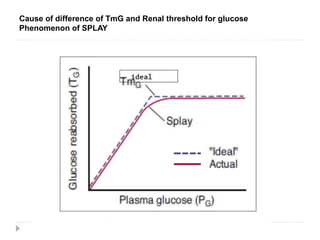
Splay in titration curve
 Reflects both anatomical and kinetic differences among
nephrons.
 Therefore, a particular nephron's filtered load of glucose may
be mismatched to its capacity to reabsorb glucose.
 For example, a nephron with a larger glomerulus has a larger
load of glucose to reabsorb.
 Different nephrons may have different distributions and
densities of SGLT2 and SGLT1 along the proximal tubule.
Accordingly, saturation in different nephrons may occur at
different plasma levels
Cause of difference of TmG and Renal threshold for glucose
Phenomenon of SPLAY
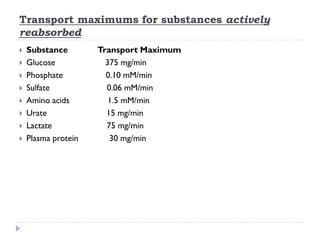
Transport maximums for substances actively
reabsorbed
 Substance Transport Maximum
 Glucose 375 mg/min
 Phosphate 0.10 mM/min
 Sulfate 0.06 mM/min
 Amino acids 1.5 mM/min
 Urate 15 mg/min
 Lactate 75 mg/min
 Plasma protein 30 mg/min
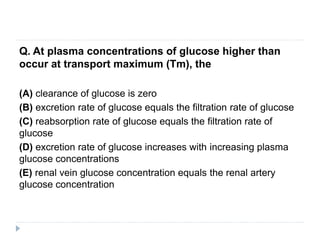
Q. At plasma concentrations of glucose higher than
occur at transport maximum (Tm), the
(A) clearance of glucose is zero
(B) excretion rate of glucose equals the filtration rate of glucose
(C) reabsorption rate of glucose equals the filtration rate of
glucose
(D) excretion rate of glucose increases with increasing plasma
glucose concentrations
(E) renal vein glucose concentration equals the renal artery
glucose concentration
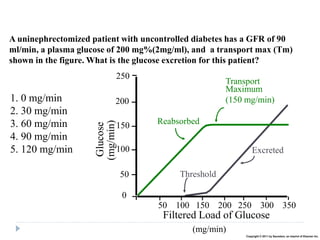
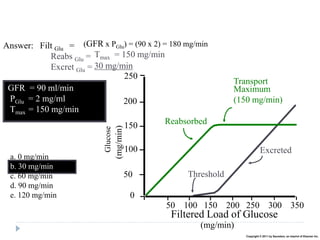
A uninephrectomized patient with uncontrolled diabetes has a GFR of 90
ml/min, a plasma glucose of 200 mg%(2mg/ml), and a transport max (Tm)
shown in the figure. What is the glucose excretion for this patient?
.
Reabsorbed
Excreted
Transport
Maximum
(150 mg/min)
Threshold
250
200
150
100
50
0
Glucose
(mg/min)
1. 0 mg/min
2. 30 mg/min
3. 60 mg/min
4. 90 mg/min
5. 120 mg/min
50 100 150 200 250 300 350
Filtered Load of Glucose
(mg/min)
Copyright © 2011 by Saunders, an imprint of Elsevier Inc.
Answer: Filt Glu =
Reabs Glu =
Excret Glu =
.
Reabsorbed
Excreted
Threshold
250
200
150
100
50
0
Glucose
(mg/min)
Filtered Load of Glucose
(mg/min)
a. 0 mg/min
b. 30 mg/min
c. 60 mg/min
d. 90 mg/min
e. 120 mg/min
GFR = 90 ml/min
PGlu = 2 mg/ml
Tmax = 150 mg/min
50 100 150 200 250 300 350
Transport
Maximum
(150 mg/min)
(GFR x PGlu) = (90 x 2) = 180 mg/min
Tmax = 150 mg/min
30 mg/min
Copyright © 2011 by Saunders, an imprint of Elsevier Inc.
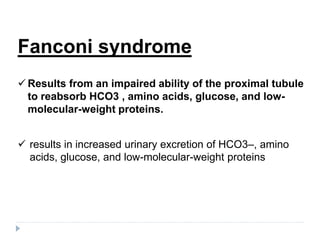
Fanconi syndrome
 Results from an impaired ability of the proximal tubule
to reabsorb HCO3 , amino acids, glucose, and low-
molecular-weight proteins.
 results in increased urinary excretion of HCO3–, amino
acids, glucose, and low-molecular-weight proteins
SOLUTE AND WATER REABSORPTION ALONG
THE NEPHRON :- Henle’s loop
SOLUTE AND WATER REABSORPTION ALONG THE
NEPHRON :- Henle’s loop
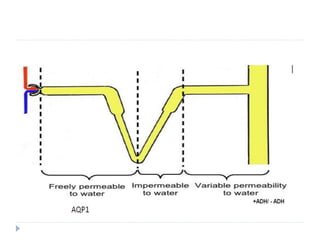
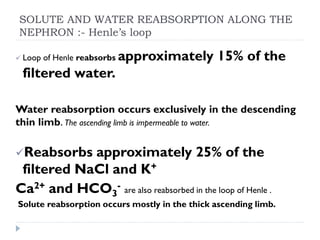
 Loop of Henle reabsorbs approximately 15% of the
filtered water.
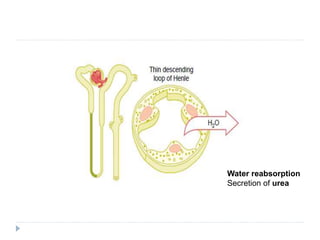
Water reabsorption occurs exclusively in the descending
thin limb. The ascending limb is impermeable to water.
Reabsorbs approximately 25% of the
filtered NaCl and K+
Ca2+ and HCO3
- are also reabsorbed in the loop of Henle .
Solute reabsorption occurs mostly in the thick ascending limb.
Water reabsorption
Secretion of urea
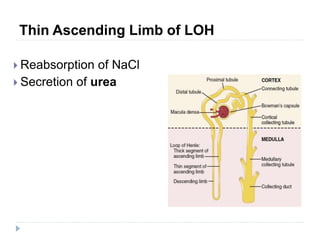
 Thin Ascending Limb of LOH
Thin Ascending Limb of LOH
 Reabsorption of NaCl
 Secretion of urea
Thick ascending limb of LOH
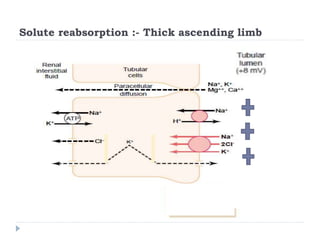
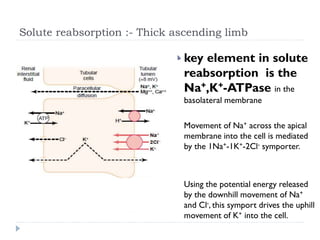
Solute reabsorption :- Thick ascending limb
 key element in solute
reabsorption is the
Na+,K+-ATPase in the
basolateral membrane
 Movement of Na+ across the apical
membrane into the cell is mediated
by the 1Na+-1K+-2Cl- symporter.
 Using the potential energy released
by the downhill movement of Na+
and Cl-, this symport drives the uphill
movement of K+ into the cell.
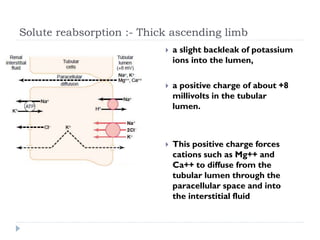
Solute reabsorption :- Thick ascending limb
 a slight backleak of potassium
ions into the lumen,
 a positive charge of about +8
millivolts in the tubular
lumen.
 This positive charge forces
cations such as Mg++ and
Ca++ to diffuse from the
tubular lumen through the
paracellular space and into
the interstitial fluid
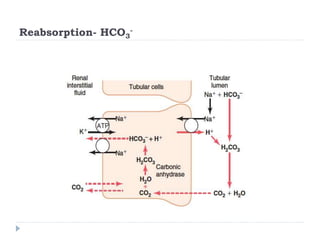
Reabsorption- HCO3
-
SOLUTE AND WATER REABSORPTION ALONG THE
NEPHRON :- Henle’s loop
 Loop of Henle reabsorbs approximately 15% of the
filtered water.
Water reabsorption occurs exclusively in the descending
thin limb. The ascending limb is impermeable to water.
Reabsorbs approximately 25% of the
filtered NaCl and K+
Ca2+ and HCO3
- are also reabsorbed in the loop of Henle .
Solute reabsorption occurs mostly in the thick ascending limb.
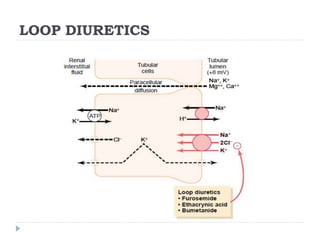
LOOP DIURETICS
Applied -Bartter Syndrome
Mutations in the gene coding for the Na+-
K+-2Cl− symporter (NKCC)→
Applied -Bartter Syndrome
Mutations in the gene coding for the Na+-
K+-2Cl− symporter (NKCC)→ hypokalaemia,
metabolic alkalosis, and hyperaldosteronism
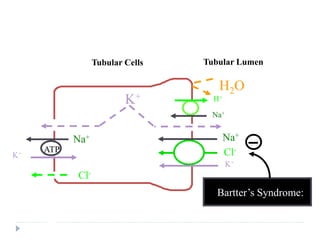
Tubular Lumen
Tubular Cells
Bartter’s Syndrome: Decreased Activity of Na-K-2Cl
Co-Transporter in Thick Ascending Loop of Henle
Na+
ATP
Cl-
K+
K+
Cl-
Na+
ATP
H2O
Bartter’s Syndrome:
K+
Na+
H+
SOLUTE AND WATER REABSORPTION ALONG THE
NEPHRON :-Distal Tubule and Collecting Duct
reabsorb approximately 8% of the filtered NaCl,
secrete variable amounts of K+ and H+
Reabsorb a variable amount of water (∼8% to
17%).
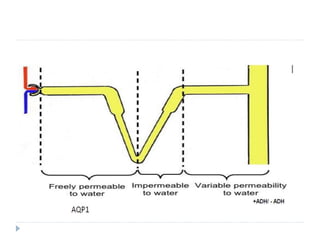
Water reabsorption depends on the
plasma concentration of ADH.
The initial segment of the distal tubule (the early distal
tubule) reabsorbs Na+, Cl–, and Ca++ and is impermeable
to water
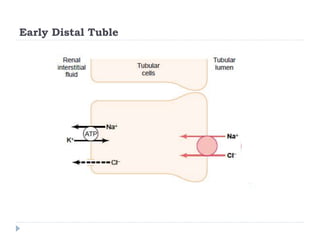
Early Distal Tuble
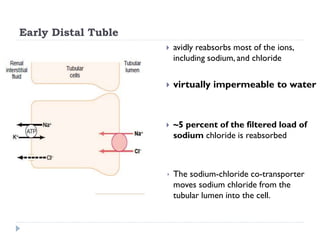
Early Distal Tuble
 avidly reabsorbs most of the ions,
including sodium, and chloride
 virtually impermeable to water
 ~5 percent of the filtered load of
sodium chloride is reabsorbed
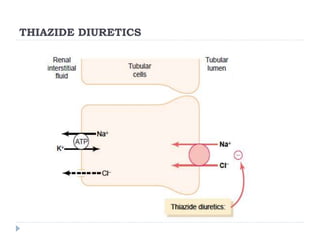
 The sodium-chloride co-transporter
moves sodium chloride from the
tubular lumen into the cell.
THIAZIDE DIURETICS
Tubular Lumen
Tubular Cells
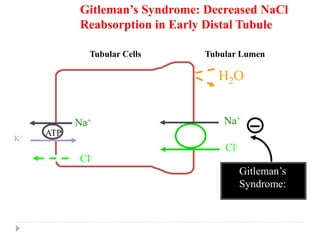
Gitleman’s Syndrome: Decreased NaCl
Reabsorption in Early Distal Tubule
Na+
ATP
Cl-
K+
Cl-
Na+
ATP
H2O
Gitleman’s
Syndrome:
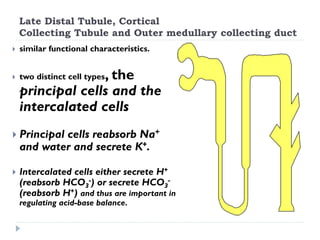
Late Distal Tubule, Cortical
Collecting Tubule and Outer medullary collecting duct
 similar functional characteristics.
 two distinct cell types, the
principal cells and the
intercalated cells
 Principal cells reabsorb Na+
and water and secrete K+.
 Intercalated cells either secrete H+
(reabsorb HCO3
-) or secrete HCO3
-
(reabsorb H+) and thus are important in
regulating acid-base balance.
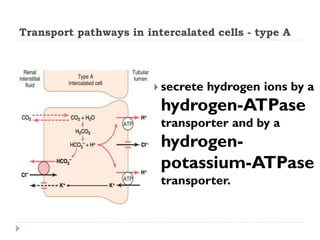
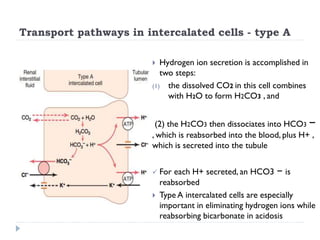
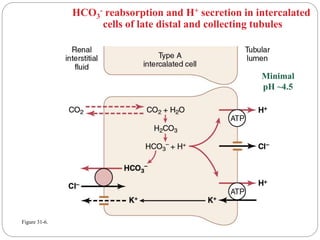
Transport pathways in intercalated cells - type A
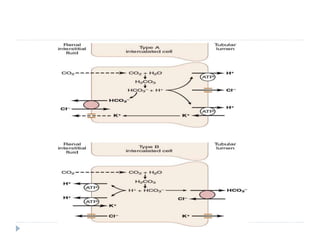
 secrete hydrogen ions by a
hydrogen-ATPase
transporter and by a
hydrogen-
potassium-ATPase
transporter.
Transport pathways in intercalated cells - type A
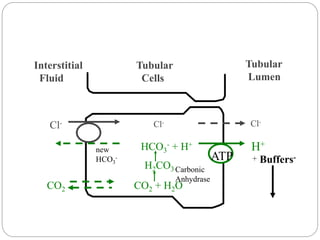
 Hydrogen ion secretion is accomplished in
two steps:
(1) the dissolved CO2 in this cell combines
with H2O to form H2CO3 , and
(2) the H2CO3 then dissociates into HCO3 −
, which is reabsorbed into the blood, plus H+ ,
which is secreted into the tubule
 For each H+ secreted, an HCO3 − is
reabsorbed
 Type A intercalated cells are especially
important in eliminating hydrogen ions while
reabsorbing bicarbonate in acidosis
Type B intercalated cells have functions
opposite to those of type A cells and
secrete bicarbonate into the tubular
lumen while reabsorbing hydrogen ions
in alkalosis.
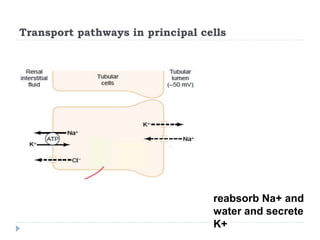
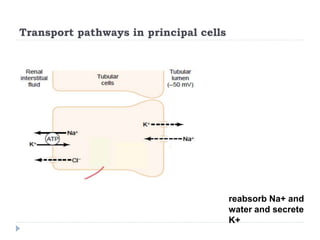
Transport pathways in principal cells
reabsorb Na+ and
water and secrete
K+
Transport pathways in principal cells
 Sodium reabsorption and
potassium secretion by the
principal cells depend on the
activity of a sodium-
potassium ATPase
pump in each cell’s
basolateral membrane.
 This pump maintains a low sodium
concentration inside the cell and,
therefore, favors sodium diffusion
into the cell through special channels
[epithelial Na+-selective
channels (ENaCs)]
Transport pathways in principal cells
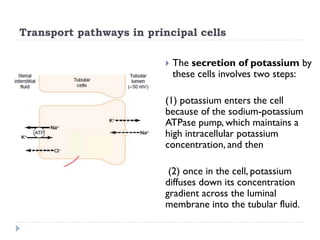
 The secretion of potassium by
these cells involves two steps:
(1) potassium enters the cell
because of the sodium-potassium
ATPase pump, which maintains a
high intracellular potassium
concentration, and then
(2) once in the cell, potassium
diffuses down its concentration
gradient across the luminal
membrane into the tubular fluid.
Transport pathways in principal cells
reabsorb Na+ and
water and secrete
K+
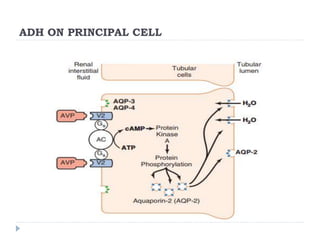
ADH ON PRINCIPAL CELL
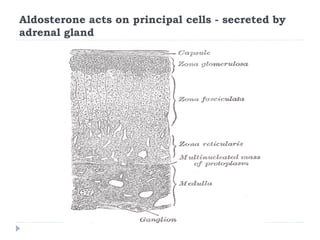
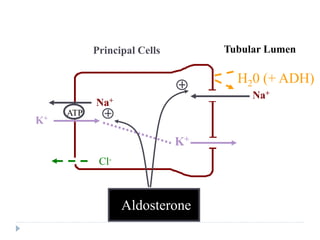
Aldosterone acts on principal cells - secreted by
adrenal gland
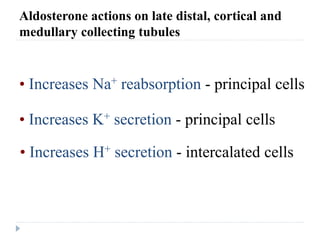
Aldosterone actions on late distal, cortical and
medullary collecting tubules
• Increases Na+ reabsorption - principal cells
• Increases K+ secretion - principal cells
• Increases H+ secretion - intercalated cells
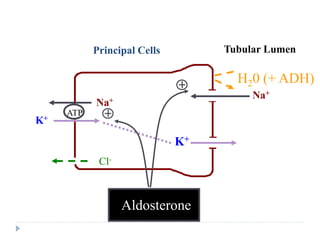
Late Distal, Cortical and Medullary
Collecting Tubules
Tubular Lumen
Principal Cells
Cl-
H20 (+ ADH)
Aldosterone
K+
Na+
ATP
K+
ATP
Na+
Aldosterone enhances the reabsorption of NaCl
across principal cells by:
 activation of ENaCs
 activation of Na+-K+-ATPase
 increasing amount of the sodium channel (ENaC) in the
apical cell membrane;
 increasing the amount of Na+-K+-ATPase in the
basolateral membrane;
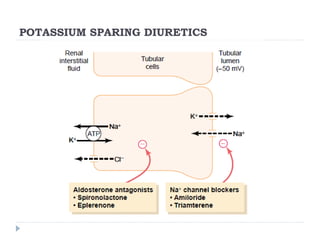
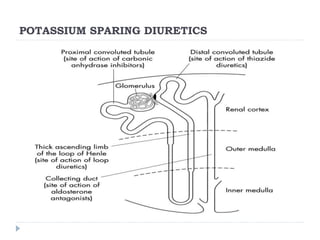
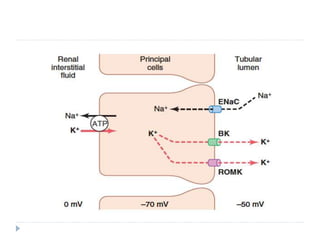
POTASSIUM SPARING DIURETICS
 The most important use of the K+-sparing
diuretics is in combination with thiazide or
loop diuretics to reduce urinary K+ losses.
Tubular Lumen
Tubular Cells
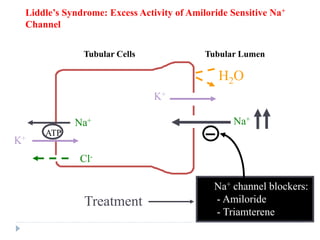
Liddle’s Syndrome: Excess Activity of Amiloride Sensitive Na+
Channel
Na+
ATP
Cl-
K+
Na+
ATP
H2O
K+
Na+ channel blockers:
- Amiloride
- Triamterene
Treatment
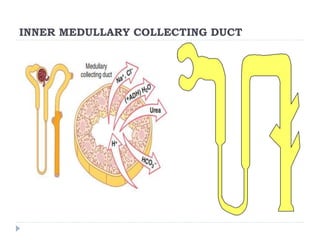
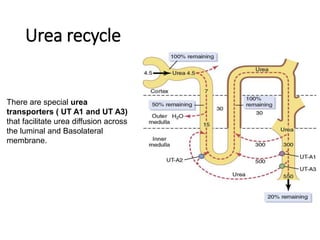
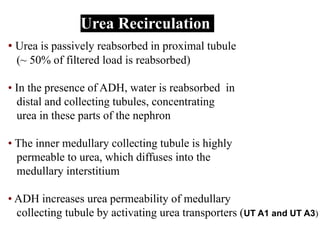
INNER MEDULLARY COLLECTING DUCT
 Unlike the cortical collecting tubule, the medullary
collecting duct is permeable to urea, and there are special urea
transporters that facilitate urea diffusion across the luminal and basolateral
membranes.
 Therefore, some of the tubular urea is reabsorbed into the medullary
interstitium, helping to raise the osmolality in this region of the
kidneys and contributing to the kidneys’ overall ability to form concentrated
urine.
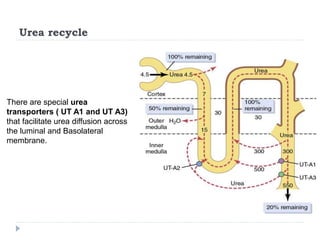
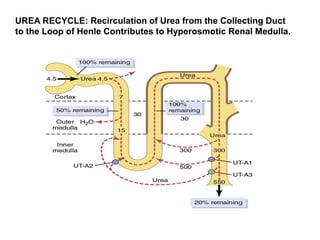
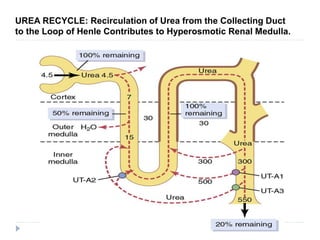
Urea recycle
There are special urea
transporters ( UT A1 and UT A3)
that facilitate urea diffusion across
the luminal and Basolateral
membrane.
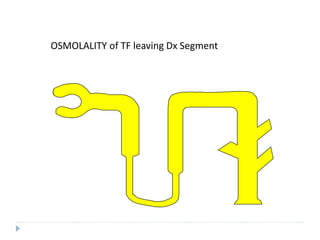
OSMOLALITY of TF leaving Dx Segment
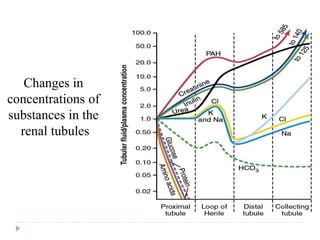
Changes in
concentrations of
substances in the
renal tubules
Concentrations of solutes in different parts of the
tubule depend on relative reabsorption of the
solutes compared to water
• If water is reabsorbed to a greater extent than the
solute, the solute will become more concentrated in
the tubule (e.g. creatinine, inulin)
• If water is reabsorbed to a lesser extent than the
solute, the solute will become less concentrated in
the tubule (e.g. glucose, amino acids)
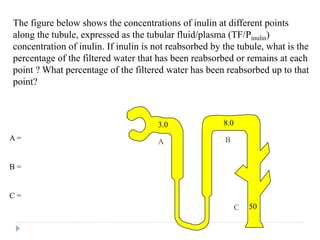
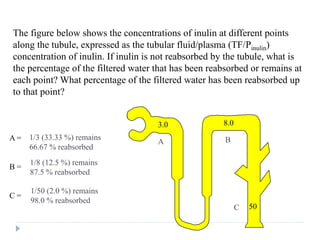
The figure below shows the concentrations of inulin at different points
along the tubule, expressed as the tubular fluid/plasma (TF/Pinulin)
concentration of inulin. If inulin is not reabsorbed by the tubule, what is the
percentage of the filtered water that has been reabsorbed or remains at each
point ? What percentage of the filtered water has been reabsorbed up to that
point?
A =
B =
C =
A
3.0
B
8.0
C 50
The figure below shows the concentrations of inulin at different points
along the tubule, expressed as the tubular fluid/plasma (TF/Pinulin)
concentration of inulin. If inulin is not reabsorbed by the tubule, what is
the percentage of the filtered water that has been reabsorbed or remains at
each point? What percentage of the filtered water has been reabsorbed up
to that point?
A =
B =
C =
A
3.0
B
8.0
C 50
1/3 (33.33 %) remains
66.67 % reabsorbed
1/8 (12.5 %) remains
87.5 % reabsorbed
1/50 (2.0 %) remains
98.0 % reabsorbed
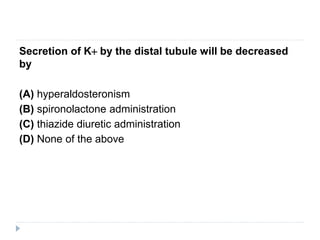
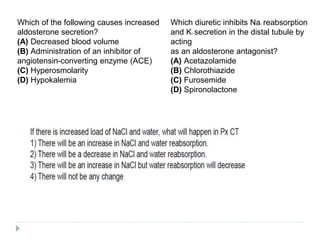
Secretion of K+ by the distal tubule will be decreased
by
(A) hyperaldosteronism
(B) spironolactone administration
(C) thiazide diuretic administration
(D) None of the above
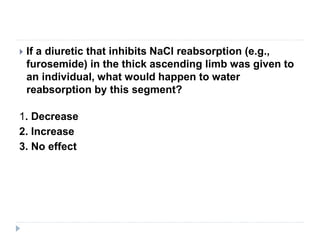
 If a diuretic that inhibits NaCl reabsorption (e.g.,
furosemide) in the thick ascending limb was given to
an individual, what would happen to water
reabsorption by this segment?
1. Decrease
2. Increase
3. No effect
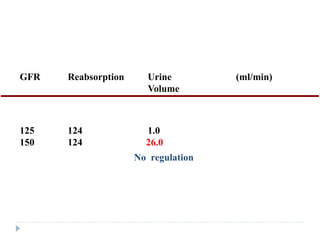
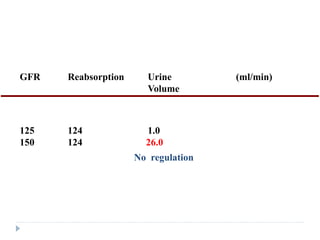
GFR Reabsorption Urine (ml/min)
Volume
No regulation
125 124 1.0
150 124 26.0
 It is essential to maintain a precise balance
between tubular reabsorption and glomerular
filtration,
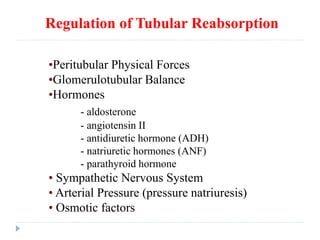
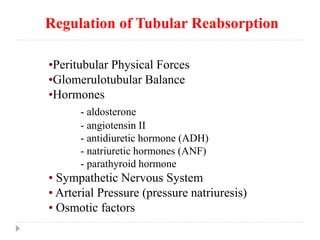
Regulation of Tubular Reabsorption
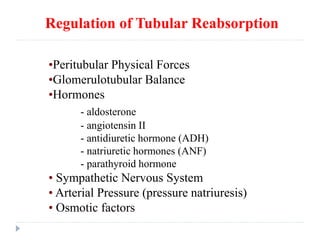
•Peritubular Physical Forces
•Glomerulotubular Balance
•Hormones
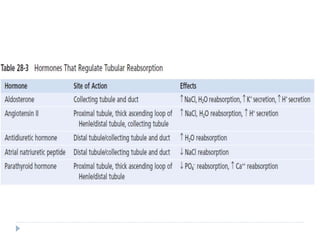
- aldosterone
- angiotensin II
- antidiuretic hormone (ADH)
- natriuretic hormones (ANF)
- parathyroid hormone
• Sympathetic Nervous System
• Arterial Pressure (pressure natriuresis)
• Osmotic factors
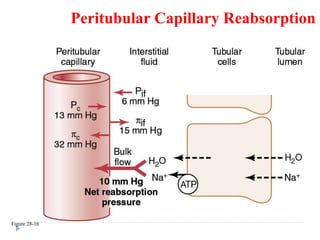
Peritubular Capillary Reabsorption
Figure 28-16
Peritubular Capillary Reabsorption
(cont’d)
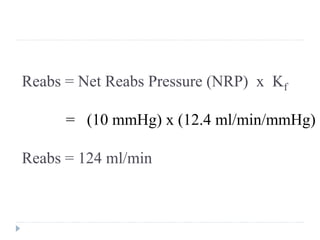
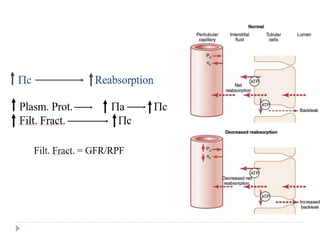
Reabs = Net Reabs Pressure (NRP) x Kf
= (10 mmHg) x (12.4 ml/min/mmHg)
Reabs = 124 ml/min
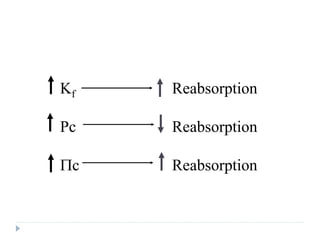
Determinants of Peritubular
Capillary Reabsorption
Kf Reabsorption
Pc Reabsorption
Pc Reabsorption
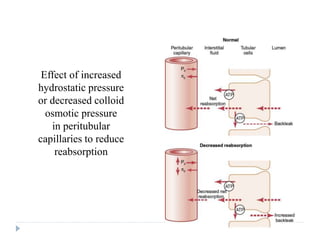
Effect of increased
hydrostatic pressure
or decreased colloid
osmotic pressure
in peritubular
capillaries to reduce
reabsorption
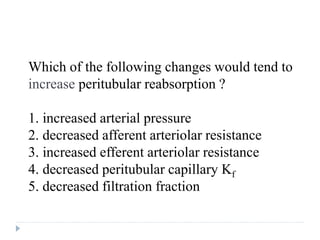
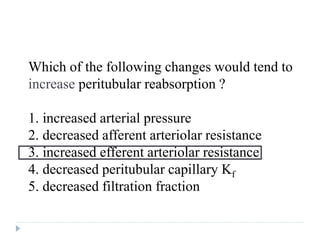
Which of the following changes would tend to
increase peritubular reabsorption ?
1. increased arterial pressure
2. decreased afferent arteriolar resistance
3. increased efferent arteriolar resistance
4. decreased peritubular capillary Kf
5. decreased filtration fraction
Question
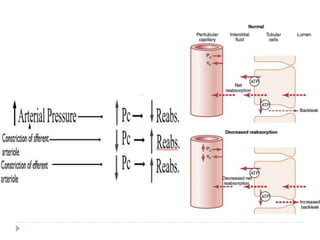
Which of the following changes would tend to
increase peritubular reabsorption ?
1. increased arterial pressure
2. decreased afferent arteriolar resistance
3. increased efferent arteriolar resistance
4. decreased peritubular capillary Kf
5. decreased filtration fraction
Question
GFR Reabsorption Urine (ml/min)
Volume
No regulation
125 124 1.0
150 124 26.0
Regulation of Tubular Reabsorption
• Glomerulotubular Balance
Glomerulotubular balance:
buffer the effects of spontaneous
changes in GFR on urine output.
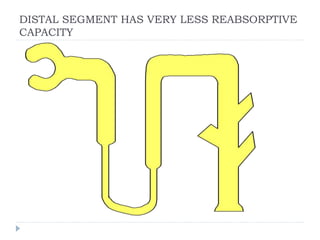
DISTAL SEGMENT HAS VERY LESS REABSORPTIVE
CAPACITY
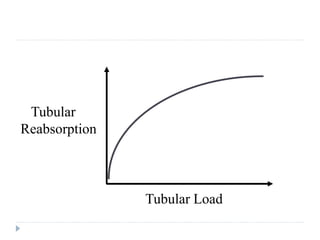
Glomerulotubular balance :- Reduces the impact of GFR
changes on the amount of Na+ and water excreted in the
urine.
 An increase in GFR causes an increase in the reabsorption of
solutes, and consequently of water, primarily in the proximal
tubule, so that in general the percentage of the solute
reabsorbed is held constant
a constant fraction of the filtered Na+
and water is reabsorbed from the
proximal tubule despite variations in
GFR.
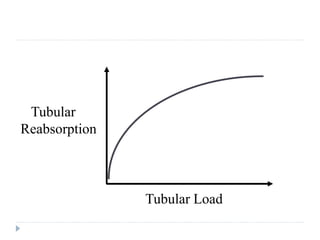
Glomerulotubular Balance
Tubular
Reabsorption
Tubular Load
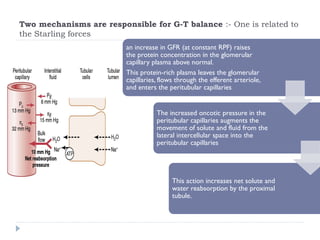
an increase in GFR (at constant RPF) raises
the protein concentration in the glomerular
capillary plasma above normal.
This protein-rich plasma leaves the glomerular
capillaries, flows through the efferent arteriole,
and enters the peritubular capillaries
The increased oncotic pressure in the
peritubular capillaries augments the
movement of solute and fluid from the
lateral intercellular space into the
peritubular capillaries
This action increases net solute and
water reabsorption by the proximal
tubule.
Two mechanisms are responsible for G-T balance :- One is related to
the Starling forces
Second mechanism
 Initiated by an increase in the filtered load of glucose and amino acids.
 Reabsorption of Na+ in the early proximal tubule is coupled to that of glucose
and amino acids.
 The rate of Na+ reabsorption therefore depends in part on the
filtered load of glucose and amino acids.
 As GFR and the filtered load of glucose and amino acids increase, Na+ and
water reabsorption also rise
Glomerulotubular Balance
Tubular
Reabsorption
Tubular Load
Glomerulotubular balance:
buffer the effects of spontaneous
changes in GFR on urine output.
Regulation of Tubular Reabsorption
• Glomerulotubular Balance
• Peritubular Physical Forces
• Hormones
- aldosterone
- angiotensin II
- antidiuretic hormone (ADH)
- natriuretic hormones (ANF)
- parathyroid hormone
• Sympathetic Nervous System
• Arterial Pressure (pressure natriuresis)
• Osmotic factors
Aldosterone actions
• Increases Na+ reabsorption - principal cells
• Increases K+ secretion - principal cells
• Increases H+ secretion - intercalated cells
Tubular Lumen
Principal Cells
Cl-
H20 (+ ADH)
Aldosterone
K+
Na+
ATP
K+
ATP
Na+
• Excess aldosterone (Primary aldosteronism
Conn’s syndrome) - Na+ retention,
hypokalemia, alkalosis, hypertension
Abnormal Aldosterone Production
• Aldosterone deficiency - Addison’s disease
Na+ wasting, hyperkalemia, hypotension
Angiotensin II
Angiotensin II Increases Na+ and
Water Reabsorption
• Stimulates aldosterone secretion
• Directly increases Na+ reabsorption
(proximal, loop, distal, collecting tubules)
• Constricts efferent arterioles
- decreases peritubular capillary
hydrostatic pressure
- increases filtration fraction, which increases
peritubular colloid osmotic pressure)
Figure 28-18
Angiotensin II increases renal tubular
sodium reabsorption
Antidiuretic Hormone (ADH)
• Increases H2O permeability and reabsorption in
distal and collecting tubules
• Allows differential control of H2O and solute excretion
• Important controller of extracellular fluid osmolarity
• Secreted by posterior pituitary
Figure 29-10
ADH synthesis in
the magnocellular
neurons of hypothalamus,
release by the posterior
pituitary, and action
on the kidneys
Figure 28-18
Mechanism of action of ADH in distal and
collecting tubules
Feedback Control of Extracellular Fluid
Osmolarity by ADH
Extracell. Osm
ADH secretion
Tubular H2O permeability
H2O Reabsorption
H2O Excretion
(osmoreceptors-
hypothalamus
(distal, collecting)
(posterior pituitary)
Atrial natriuretic peptide
increases Na+ excretion
• Secreted by cardiac atria in response to stretch
(increased blood volume)
• Directly inhibits Na+ reabsorption
• Inhibits renin release and aldosterone formation
• Increases GFR
• Helps to minimize blood volume expansion
Atrial Natriuretic Peptide (ANP)
Blood volume
Renal Na+ and H2O reabsorption
Renin release aldosterone GFR
Ang II
Na+ and H2O excretion
ANP
Parathyroid hormone increases
renal Ca++ reabsorption
• Released by parathyroids in response to
decreased extracellular Ca++
• Increases Ca++ reabsorption by kidneys
• Increases Ca++ reabsorption by gut
• Decreases phosphate reabsorption
• Helps to increase extracellular Ca++
Control of Ca++ by Parathyroid
Hormone
Extracellular
[Ca++]
PTH
Renal Ca++
Reabsorption
Intestinal Ca++
Reabsorption
Ca++ Release
From Bones
Vitamin D3
Activation
Regulation of Tubular Reabsorption
•Peritubular Physical Forces
•Glomerulotubular Balance
•Hormones
- aldosterone
- angiotensin II
- antidiuretic hormone (ADH)
- natriuretic hormones (ANF)
- parathyroid hormone
• Sympathetic Nervous System
• Arterial Pressure (pressure natriuresis)
• Osmotic factors
Sympathetic nervous system
increases Na+ reabsorption
• Directly stimulates Na+ reabsorption
• Stimulates renin release
• Decreases GFR and renal blood flow
(only a high levels of sympathetic
stimulation)
Regulation of Tubular Reabsorption
•Peritubular Physical Forces
•Glomerulotubular Balance
•Hormones
- aldosterone
- angiotensin II
- antidiuretic hormone (ADH)
- natriuretic hormones (ANF)
- parathyroid hormone
• Sympathetic Nervous System
• Arterial Pressure (pressure natriuresis)
• Osmotic factors
EFFECT OF ARTERIAL PRESSURE ON URINE
OUTPUT— PRESSURE NATRIURESIS
AND PRESSURE DIURESIS
Increased Arterial Pressure Decreases Na+
Reabsorption (Pressure Natriuresis)
Increased Arterial Pressure Decreases Na+
Reabsorption (Pressure Natriuresis)
• Increased peritubular capillary hydrostatic
pressure
• Decreased renin and aldosterone
• Increased release of intrarenal natriuretic factors
Increased Arterial Pressure Decreases Na+
Reabsorption (Pressure Natriuresis)
Aldosterone escape
100
130
1
Mean
Arterial
Pressure
(mmHg)
Urinary
sodium
Excretion
(x normal)
“Escape” from Sodium Retention
During Excess Aldosterone Infusion
Aldosterone Infusion
Time (days)
0 2 4 6
Aldosterone leads to Na+ retention and hence volume
expansion.
Eventually, the pressure natriuresis raises Na+ excretion
toward prealdosterone levels.
Thus, the kidney can escape the Na+-retaining effect of
aldosterone, albeit at the price of expanding the extracellular
volume and causing hypertension
Osmotic Effects on Reabsorption
• Water is reabsorbed only by osmosis
• Increasing the amount of unreabsorbed solutes
in the tubules decreases water reabsorption
i.e., diabetes mellitus: unreabsorbed glucose in
tubules causes diuresis and water loss
i.e., osmotic diuretics (mannitol)
Regulation of Tubular Reabsorption
•Peritubular Physical Forces
•Glomerulotubular Balance
•Hormones
- aldosterone
- angiotensin II
- antidiuretic hormone (ADH)
- natriuretic hormones (ANF)
- parathyroid hormone
• Sympathetic Nervous System
• Arterial Pressure (pressure natriuresis)
• Osmotic factors
Which of the following causes increased
aldosterone secretion?
(A) Decreased blood volume
(B) Administration of an inhibitor of
angiotensin-converting enzyme (ACE)
(C) Hyperosmolarity
(D) Hypokalemia
Which diuretic inhibits Na+ reabsorption
and K+ secretion in the distal tubule by
acting
as an aldosterone antagonist?
(A) Acetazolamide
(B) Chlorothiazide
(C) Furosemide
(D) Spironolactone
Urine Concentration and
Dilution
•WHY KIDNEY HAS TO PRODUCE
SOMETIME CONCENTRATED URINE
AND SOMETIME DILUTED URINE ?
•HOW KIDNEY DO SO?
600 mOsm of solute
must be excreted per
day
Concentration and Dilution
of the Urine
• Maximal urine concentration
= 1200 - 1400 mOsm / L
• Minimal urine concentration
= 50 - 70 mOsm / L
Formation of a dilute urine
• Continue electrolyte
reabsorption
• Decrease water
reabsorption
Mechanism:
Decreased ADH release
and reduced water
permeability in distal
and collecting
tubules
Formation of a dilute urine
Concentration and Dilution of the Urine
• Maximal urine concentration
= 1200 - 1400 mOsm / L
• Minimal urine concentration
= 50 - 70 mOsm / L
Formation of a Concentrated Urine when
antidiuretic hormone (ADH) are high.
Formation of a Concentrated Urine when
antidiuretic hormone (ADH) are high.
REQUIREMENTS for forming
concentrated urine
A high level of ADH
which increases the permeability of the distal tubules
and collecting ducts to water, thereby allowing these
tubular segments to avidly reabsorb water
A high osmolarity of the renal
medullary interstitial fluid
which provides the osmotic gradient necessary for
water reabsorption to occur in the presence of high
levels of ADH.
JUXTAMEDULLARY
NEPHRONS
Gradient of increasing osmolality along the medullary
pyramids.
Produced by the operation of the
loops of Henle as countercurrent
multipliers & Urea recycling
Maintained by the operation of
the vasa recta as countercurrent
exchangers.
• A countercurrent system is a system in which
the inflow runs parallel to, counter to, and in
close proximity to the outflow for some
distance.
• This occurs for both the loops of Henle and
the vasa recta in the renal medulla
Countercurrent multiplier system
in the loop of Henle.
Countercurrent multiplier system in the loop of Henle.
Figure 29-4
Countercurrent multiplier system in the loop of Henle.
Countercurrent Multiplication
• Countercurrent multiplication is the process in which a small gradient
established at any level of the loop of Henle is increased (multiplied) into
a much larger gradient along the axis of the loop.
• The operation of each loop of Henle as a countercurrent multiplier
depends on
(a)the high permeability of the thin descending limb to water .
(b) the active transport of Na+ and Cl– out of the thick ascending limb
(c)the inflow of isotonic tubular fluid from the proximal tubule, with
outflow of hypotonic fluid into the distal tubule.
UREA RECYCLE: Recirculation of Urea from the Collecting Duct
to the Loop of Henle Contributes to Hyperosmotic Renal Medulla.
Urea recycle
There are special urea
transporters ( UT A1 and UT A3)
that facilitate urea diffusion across
the luminal and Basolateral
membrane.
Urea Recirculation
• Urea is passively reabsorbed in proximal tubule
(~ 50% of filtered load is reabsorbed)
• In the presence of ADH, water is reabsorbed in
distal and collecting tubules, concentrating
urea in these parts of the nephron
• The inner medullary collecting tubule is highly
permeable to urea, which diffuses into the
medullary interstitium
• ADH increases urea permeability of medullary
collecting tubule by activating urea transporters (UT A1 and UT A3)
UREA CONTRIBUTES TO HYPEROSMOTIC
RENAL MEDULLARY INTERSTITIUM AND
FORMATION OF CONCENTRATED URINE
• Urea contributes about 40 to 50 per cent of the
osmolarity (500-600 mOsm/L) of the renal
medullary interstitium when the kidney is forming
a maximally concentrated urine.
• When there is water deficit and blood
concentrations of ADH are high, large amounts of
urea are passively reabsorbed from the inner
medullary collecting ducts into the interstitium.
Formation of a concentrated urine when
antidiuretic hormone (ADH) levels are high.
The Vasa Recta Preserve
Hyperosmolarity of Renal Medulla
• The vasa recta serve
as countercurrent
exchangers
Figure 29-7
The Vasa Recta Preserve Hyperosmolarity of
Renal Medulla
• Vasa recta blood
flow is low (only 1-2
% of total renal blood
flow)
• Blood towards medulla 
progressively more concentrated,
partly by solute entry from the
interstitium and partly by loss of
water into the interstitium
• As blood ascends back toward the
cortex, it becomes progressively
less concentrated as solutes diffuse
back out into the medullary
interstitium and as water moves
into the vasa recta
• The vasa recta do not create the
medullary hyperosmolarity, but
prevent it from being dissipated.
• The u-shaped structure of the vessels
minimizes loss of solute from the
interstitium
.
HOW POSTERIOR PITUTARY COMES TO
KNOW THE SITUATION TO INCREASE OR
DECREASE ADH SECRETION?
OSMORECEPTOR-ADH FEEDBACK SYSTEM
Osmoreceptor–
antidiuretic hormone
(ADH) feedback
mechanism for regulating
extracellular
fluid osmolarity.
Formation of a dilute urine
Formation of a Concentrated Urine
Figure 29-7
The Vasa Recta Preserve Hyperosmolarity of
Renal Medulla
UREA RECYCLE: Recirculation of Urea from the Collecting Duct
to the Loop of Henle Contributes to Hyperosmotic Renal Medulla.
HOW POSTERIOR PITUTARY COMES
TO KNOWTHE SITUATIONTO
INCREASE OR DECREASE ADH
SECRETION?
OSMORECEPTOR-ADH FEEDBACK
SYSTEM
Osmoreceptor–
antidiuretic hormone
(ADH) feedback
mechanism for regulating
extracellular
fluid osmolarity.
Summary of water reabsorption and
osmolarity in different parts of the tubule
• Proximal Tubule: 65 % reabsorption, isosmotic
• Desc. loop: 15 % reasorption, osmolarity increases
• Asc. loop: 0 % reabsorption, osmolarity decreases
• Early distal: 0 % reabsorption, osmolarity decreases
• Late distal and coll. tubules: ADH dependent
water reabsorption
• Medullary coll. ducts: ADH dependent water
reabsorption
“Free” Water Clearance (CH2O)
(rate of solute-free water excretion)
Free-water clearance (CH2O) is
calculated as the difference
between water excretion (urine
flow rate) and osmolar clearance
Osmolar clearance (The total clearance of
solutes from the blood)
 If plasma osmolarity is 300 mOsm/L, urine osmolarity is 600
mOsm/L, and urine flow rate is 1 ml/min,
 How many ml of plasma are being cleared of solute each
minute?
 The total clearance of solutes from the blood can be expressed
as the osmolar clearance (Cosm);
Clearance Technique
Amount cleared/Time = Amount in urine/Time
Cs x Ps = Us x V
Where : Cs = clearance of substance S
Ps = plasma conc. of substance S
Us = urine conc. of substance S
V = urine flow rate
Cs = Us x V = urine excretion rate s
Ps Plasma conc(s)
“Free” Water Clearance (CH2O)
(rate of solute-free water excretion)
Free-water clearance (CH2O) is
calculated as the difference
between water excretion (urine
flow rate) and osmolar clearance
CH2O = V - Uosm x V
Posm
where:
Uosm = urine osmolarity
V = urine flow rate
P = plasma osmolarity
If: Uosm < Posm, CH2O = +
If: Uosm > Posm, CH2O = -
rate of
free-water
clearance
represents
the rate at
which
solute-free
water is
excreted
by the
kidneys
“Free” Water Clearance (CH2O)
(rate of solute-free water excretion)
Question
Given the following data, calculate “free water”
clearance :
urine flow rate = 6.0 ml/min
urine osmolarity = 150 mOsm /L
plasma osmolarity = 300 mOsm / L
Is free water clearance in this example positive
or negative ?
Answer
CH2O = V - Uosm x V
Posm
= 6.0 - ( 150 x 6 )
300
= 6.0 - 3.0
= + 3.0 ml / min (positive)
Concentration and Dilution
of the Urine
• Maximal urine concentration
= 1200 - 1400 mOsm / L
• Minimal urine concentration
= 50 - 70 mOsm / L
Obligatory Urine Volume
The minimum urine volume in which the excreted
solute can be dissolved and excreted
Example:
If the max. urine osmolarity is 1200 mOsm/L,
and 600 mOsm of solute must be excreted each
day to maintain electrolyte balance, the
obligatory urine volume is:
600 mOsm/d
1200 mOsm/L
= 0.5 L/day
Disorders of Urine Concentrating Ability
Clinical Implications
Diabetes insipidus:
results when there is a vasopressin deficiency or
inability of the kidneys to respond to vasopressin.
 Symptoms of diabetes insipidus:
Polyuria
Polydipsia
Central Diabetes Insipidus.
Nephrogenic Diabetes Insipidus.
Disorders of Urine Concentrating Ability
• Failure to produce ADH :
“Central” diabetes insipidus
• Failure to respond to ADH:
“nephrogenic” diabetes insipidus
- impaired loop NaCl reabs. (loop diuretics)
- drug induced renal damage: lithium, tetracyclines
- kidney disease: pyelonephritis, hydronephrosis,
chronic renal failure
- malnutrition (decreased urea concentration)
In either case, large volumes of dilute urine are formed, which
tends to cause dehydration unless fluid intake is increased by
the same amount as urine volume is increased.
 Lack of a prompt decrease in urine volume and an increase in
urine osmolarity within 2 hours after injection of desmopressin
is strongly suggestive of nephrogenic diabetes insipidus.
CONTROL OF EXTRACELLULAR
FLUID OSMOLARITY AND SODIUM
CONCENTRATION
Estimating Plasma Osmolarity From
Plasma Sodium Concentration
 Posm = 2.1 × PNa+ (mmol/L)
 Posm = 2 × [PNa+ ,mmol/L] + [Pglucose,mmol/L] + [Purea,mmol/L]
CONTROL OF EXTRACELLULAR FLUID
OSMOLARITY AND SODIUM CONCENTRATION
OSMORECEPTOR-ADH
FEEDBACK SYSTEM
THIRST
OSMORECEPTOR-ADH FEEDBACK SYSTEM
 The kidneys minimize fluid loss during water deficits through
the osmoreceptor-ADH feedback system.
 Adequate fluid intake, however, is necessary to counterbalance
whatever fluid loss does occur through sweating and breathing
and through the gastrointestinal tract.
 Fluid intake is regulated by the thirst mechanism
THIRST
Intracellular dehydration
of thirst centres
30 60 90 120 150 180
Sodium Intake (mEq/day)
136
140
144
148
152
Plasma
Sodium
Conc.
(mEq/L)
normal
Effect of Changes in Sodium Intake on Plasma
Sodium After Blocking ADH-Thirst System
ADH-Thirst
blocked
Figure 25-5
Isotonic
(no change)
Hypertonic
(cell shrinks)
Hypotonic
(cell swells)
Effects of solutions on cell volume.
Consequences of Hyponatremia
and Hypernatremia
• Water moves in and out of cells
 cells swell (hyponatremia) or shrink
(hypernatremia)
• This has profound effects on the brain.
- Neurologic function is altered (confusion, seizures)
- Rapid shrinking can tear vessels and cause hemorrhage.
- Rapid swelling can cause herniation.
Because the skull is rigid, the brain cannot
increase its volume by more than 10 % without
being forced down the neck (herniation).
Effects of acute and
chronic hyponatremia
on the brain
Do not correct too rapidly –can cause brain
shrinkage
Treat with great caution!!
40
300
200
100
0
0 10 20 30
OSMOLARITY
mOsm/L
Normal State
VOLUME (L)
ECF
ICF
1.
2.
3.
Effect of adding 2 L of 0.9 % NaCl ?
40
300
200
100
0
0 10 20 30
OSMOLARITY
mOsm/L
Normal State
VOLUME (L)
ECF
ICF
1.
2.
3.
Effect of adding 2 L of 0.9 % NaCl ?
40
300
200
100
0
0 10 20 30
OSMOLARITY
mOsm/L
Normal State
VOLUME (L)
ECF
ICF
1.
2.
3.
Effect of adding 2 L of 5 % Glucose (isosmotic)?
40
300
200
100
0
0 10 20 30
OSMOLARITY
mOsm/L
Normal State
VOLUME (L)
ECF
ICF
1.
2.
3.
Instantaneously
Effect of adding 2 L of 5 % Glucose (isosmotic)?
40
300
200
100
0
0 10 20 30
OSMOLARITY
mOsm/L
Normal State
VOLUME (L)
ECF
ICF
1.
2.
3.
Effect of adding 2 L of 5 % Glucose (isosmotic)?
Instantaneously
After metabolism of glucose
40
300
200
100
0
0 10 20 30
OSMOLARITY
mOsm/L
Normal State
VOLUME (L)
ECF
ICF
1.
2.
3.
Effect of adding 2 L of 3 % NaCl ?
40
300
200
100
0
0 10 20 30
OSMOLARITY
mOsm/L
Normal State
VOLUME (L)
ECF
ICF
1.
2.
3.
Effect of adding 2 L of 3 % NaCl ?
What are the Changes in the
following variables after giving
2.0 liters of 3% NaCl i.v. ?
Extracellular Fluid Volume ?
Extracellular Fluid Osmolarity ?
Intracellular Fluid Volume ?
Intracellular Fluid Osmolarity ?
> 2.0 Liters
Figure 25-1
Body fluid
distribution:
Edema
Intracellular Edema
• Hyponatremia
• Depression of tissue metabolic systems
(e.g. hypothyroidism)
• Inadequate tissue nutrition
(e.g. ischemia, stroke)
• Inflammation of tissues (increased cell
membrane permeability)
Causes of Extracellular Edema
(increased interstitial fluid volume)
• Increased capillary filtration
• Failure of lymphatics to return
interstitial fluid to circulation
Determinants of Capillary Filtration
FILT = Kf (Pc - Pisf - Pc + Pisf) ≈ 1.9 ml/min
Capillary
Pressure (Pc)
Plasma Colloid
Osmotic Pressure ( Pc)
Interstitial
Fluid Pressure
(Pisf)
Interstitial Colloid
Osmotic Pressure
(Pisf)
Kf 17.3
-3.0
28.0
8.0
Causes of Increased Capillary Filtration
FILT = Kf (Pc - Pisf - Pc + Pisf)
Increased Kf : toxins, ischemic damage, infections, etc
Increased Pc:
• increased arterial pressure, excess fluid retention,
Decreased Pc :
• nephrotic syndrome
• cirrhosis
• malnutrition
Figure 25-1
Lymphatics
X
Lymphatic Failure
= Edema
Safety Factors Against Edema
• Low compliance of interstitium when= 3 mmHg
interstitial fluid pressure is negative
• Increased lymph flow = 7 mmHg
• “ Washdown” of interstitial protein = 7 mmHg
at high lymph flow rates
Total Safety factor = 17 mmHg
- 8 - 4 0 + 4
12
24
36
48
60
0
Interstitial
Fluid
Volume
(liters)
Interstitial Fluid Pressure
(mmHg)
Free
Fluid
Gel
Fluid
Low compliance
High
Compliance
Compliance = V
P
POTASSIUM BALANCE
The most important stimuli for aldosterone are
(1) increased extracellular potassium concentration and
(2) increased angiotensin II levels, which typically occur in conditions
associated with sodium and volume depletion or low blood pressure.
CALCIUM HANDLING BY KIDNEY
Parathyroid hormone increases
renal Ca++ reabsorption
• Released by parathyroids in response to
decreased extracellular Ca++
• Increases Ca++ reabsorption by kidneys
• Increases Ca++ reabsorption by gut
• Decreases phosphate reabsorption
• Helps to increase extracellular Ca++
•Micturition
Micturition
a process by which the urinary bladder
empties itself when it becomes filled.
It is a complete autonomic spinal reflex to get
urine outside the body, that is facilitated or
inhibited by higher brain centres (in adults).
PHYSIOLOGICAL ANATOMY
OF THE BLADDER
Urinary system in males and females
Innervation of the Bladder.
Principal nerve supply of the bladder is by way of
the pelvic nerves (S-2, S-3, S-4)
both sensory nerve fibers and motor nerve fibers.
The sensory fibers detect the degree of stretch in
the bladder wall.
The motor nerves transmitted in the pelvic nerves
are parasympathetic fibers.
Cystometry: study of the relation
between intravesical pressure and volume
Cystometrogram : A plot of intravesical
pressure against the volume of fluid
• Empty bladder-
intravesicular pressure -0
• 30 to 50 ml of urine- pressure
rises to 5 to 10 cm of water.
• Additional urine—200 to 300
ml—can collect with only a
small additional rise in
pressure;
.
• Beyond 300 to 400 ml urine -
pressure rise rapidly
Law of Laplace
This law states that the pressure in a spherical
viscus is equal to twice the wall tension divided by
the radius.
In the case of the bladder, the tension increases as
the organ fills, but so does the radius.
Therefore, the pressure increase is slight until the
organ is relatively full.
• First desire for micturition is felt at
a bladder volume of about 150
mL.
• A marked sense of bladder fullness
at about 400 ml
• Bladder discomfort 400 -600 ml
• Bladder pain above 600 ml
• Obligatory urination happens at
700 ml
Cystometrogram
Superimposed micturition waves in
the cystometrogram
• periodic acute increases in
pressure that last from a few
seconds to more than a
minute.
• The pressure peaks may rise
only a few centimeters of
water or may rise to more
than 100 centimeters of
water.
• caused by the micturition
reflex.
Filling of bladder
Micturition reflex initiated by
sensory stretch receptors in the
bladder wall
(Sensory signals pelvic nerve
 sacral segments of the cord
 reflexively back again to the
bladder through the
parasympathetic nerve fibers
by way of these same nerves.)
Filling of the bladder – partially filled
Reflex contractions
Acute increase in pressure
Contractions relax spontaneously
Pressure falls back to baseline
Bladder continues to fill
Reflex contractions – more frequently and powerful
• Once the micturition reflex becomes powerful enough,
it causes another reflex, which passes through the
pudendal nerves to the external sphincter to inhibit it.
• If this inhibition is more potent than the voluntary
constrictor signals to the external sphincter, urination
will occur.
• If not, urination will not occur until the bladder fills still
further and the micturition reflex becomes more
powerful.
Facilitation or Inhibition of
Micturition by the Brain
(1) strong facilitative and inhibitory centers in the
brain stem, located mainly in the pons, and
(2) several centers located in the cerebral cortex that
are mainly inhibitory but can become excitatory
1. The higher centers keep the micturition reflex
partially inhibited, except when micturition is desired.
2. The higher centers can prevent micturition, even if
the micturition reflex occurs, by tonic contraction of
the external bladder sphincter until a convenient time
presents itself.
3. When it is time to urinate, the cortical centers can
facilitate the sacral micturition centers to help initiate
a micturition reflex and at the same time inhibit the
external urinary sphincter so that urination can occur.
Micturition is fundamentally a
autonomic spinal reflex facilitated
and inhibited by higher brain
centers.
Abnormalitiesofmicturition
Effect of spinal cord transection:
Spinal shock:
• bladder becomesflaccid and unresponsive
• It becomesoverfilled and urine dribbles through
the sphincters(overflow incontinence).
After spinal shock
phasehas passed
• thevoiding reflex returns
with novoluntarycontrol.
Automatic Bladder Caused by Spinal Cord Damage
Above the Sacral Region.
Atonic Bladder and Incontinence Caused by
Destruction of Sensory Nerve Fibers
• bladder is filled without any stretch signals to
spinal cord.
• So the bladder is completely filled with urine
without any micturition.
• overflow incontinence
• A common cause of atonic bladder is crush injury
to the sacral region of the spinal cord
• E.g.:- Spinal injury, Syphilis.
Uninhibited Neurogenic Bladder
Caused by Lack of Inhibitory Signals
from the Brain.
• frequent and relatively uncontrolled micturition.
• This condition derives from partial damage in the
spinal cord or the brain stem that interrupts most of
the inhibitory signals.
• even a small quantity of urine elicits an uncontrollable
micturition reflex,
The micturition reflex is centered in the:
a. Medulla
b. Sacral cord
c. Hypothalamus
d. Lumbar cord
• A person has a car accident and there is an injury
in his spinal cord(L1,L2). After the initial phase of
spinal shock, what is expected to happen to
bladder ?
a. paralyzed and flaccid bladder
b. Emptying with voluntary control
c. Loss of voluntary control
RENAL CONTROL OF ACID BASE
BALANCE
Normal H+ concentration = 0.00004 mEq/L (40 nEq/L)
 The limits of pH compatible with life: 7-7.7
Importance of Buffer Systems
Normal H+ concentration = 0.00004 mEq/L
About 80 milliequivalents of H+ is either ingested or
produced each day by metabolism,
>>>>>> normal H+ concentration
Swan & Pitts Experiment
 Dog received an infusion of 14,000,000
nmoles H+ per litre of body water.
 This caused a drop in pH from 7.44 ([H+] = 36
nmoles/l) to a pH of 7.14 ([H+] = 72 nmoles/l)
That is, a rise in [H+] of only 36 nmoles/l.
 SO: what had happened to the other 13,999,964
nmoles/l that were infused.
 Where did the missing H+ go?
 They were hidden on buffers and so these
hydrogen ions were hidden from view.
Make no mistake: the body has:
 a HUGE buffering capacity, and
 this system is essentially IMMEDIATE in effect.
 For these 2 reasons, physicochemical buffering provides a
powerful first defence against acid-base perturbations.
Mechanisms of Hydrogen Ion
Regulation
[H+] is precisely regulated
(pH range 7.2 - 7.4)
1. Body fluid chemical buffers (rapid but temporary)
- bicarbonate - ammonia
- proteins - phosphate
2. Lungs (rapid, eliminates CO2)
[H+] ventilation CO2 loss
3. Kidneys (slow, powerful); eliminates non-volatile acids
- secretes H+
- reabsorbs HCO3
-
- generates new HCO3
-
Buffer Systems in the Body
Bicarbonate : most important ECF buffer
Phosphate : important renal tubular buffer
HPO4
= + H+ H2PO 4
-
Ammonia : important renal tubular buffer
NH3 + H+ NH4
+
Proteins : important intracellular buffers
H+ + Hb HHb
H2O + CO2 H2CO3 H+ + HCO3
-
Figure 31-1.
Titration curve for bicarbonate buffer system
Buffer Systems in the Body
Bicarbonate : most important ECF buffer
Phosphate : important renal tubular buffer
HPO4
= + H+ H2PO 4
-
Ammonia : important renal tubular buffer
NH3 + H+ NH4
+
Proteins : important intracellular buffers
H+ + Hb HHb
H2O + CO2 H2CO3 H+ + HCO3
-
In a patient with a plasma pH of 7.10, the [HCO3–]/[H2CO3]
ratio in plasma is:
A. 20.
B. 10.
C. 2.
D. 1.
E. 0.1.
Mechanisms of Hydrogen Ion
Regulation
[H+] is precisely regulated
(pH range 7.2 - 7.4)
1. Body fluid chemical buffers (rapid but temporary)
- bicarbonate - ammonia
- proteins - phosphate
2. Lungs (rapid, eliminates CO2)
[H+] ventilation CO2 loss
3. Kidneys (slow, powerful); eliminates non-volatile acids
- secretes H+
- reabsorbs HCO3
-
- generates new HCO3
-
Renal Regulation of Acid-Base
Balance
• Filtration of HCO3
- (~ 4320 mmol/day)
• Secretion of H+ (~ 4400 mmol/day)
• Reabsorption of HCO3
- (~ 4319 mmol/day)
• Production of new HCO3
- (~ 80 mmol/day)
• Excretion of HCO3
- (1 mmol/day)
Kidneys eliminate non-volatile acids
(H2SO4, H3PO4) (~ 80 mmol/day)
Figure 31-4.
Key point:
For each
HCO3
-
reabsorbed,
there
must be a H+
secreted
Reabsorption of bicarbonate and secretion of H+ in
different segments of the renal tubule
Figure 31-5.
Mechanisms of HCO3
- reabsorption and Na+-H+
exchange in proximal tubule and thick loop of Henle
Minimal pH
~ 6.7
HCO3
- reabsorption and H+ secretion in intercalated
cells of late distal and collecting tubules
Figure 31-6.
Minimal
pH ~4.5
 pH of urine
 Urine pH ranges from 4.5 to 8.
 Normally it is slightly acidic lying between 6 – 6.5.
Minimum urine pH = 4.5
= 10-4.5
= 3 x 10⁻⁵ moles/L
i.e., the maximal [H+] of urine is 0.03 mmol/L
Yet, the kidneys must excrete, under normal
conditions, at least 60 mmol non-volatile acids
each day. To excrete this as free H+ would require:
Minimum urine pH = 4.5
= 10-4.5
= 3 x 10⁻⁵ moles/L
i.e., the maximal [H+] of urine is 0.03 mmol/L
Yet, the kidneys must excrete, under normal
conditions, at least 60 mmol non-volatile acids
each day. To excrete this as free H+ would require:
.03mmol/L
= 2000 L per day !!!
60 mmol
Importance of Renal Tubular
Buffers
Interstitial
Fluid
Tubular
Cells
Tubular
Lumen
+ Buffers-
H+
HCO3
- + H+
H2CO3
CO2 + H2O
CO2
Carbonic
Anhydrase
Cl- Cl- Cl-
ATP
new
HCO3
-
Figure 31-7.
Buffering of secreted H+ by filtered phosphate
(NaHPO4
-) and generation of “new” HCO3
-
“New” HCO3
-
Phosphate as a Tubular Fluid Buffer
There is a high concentration of phosphate in the
tubular fluid; pK = 6.8
Phosphate normally buffers about 30 mmol/day H+
(about 100 mmol/day phosphate is filtered
but 70% is reabsorbed)
Phosphate buffering capacity does not change much
with acid-base disturbances (phosphate is not
the major tubular buffer in chronic acidosis)
Acid
Excretion
(mmoles/day)
0
100
200
300
400
500
H2PO
4
- -
NH4
+
Normal Acidosis for 4 Days
Phosphate and Ammonium Buffering
In Chronic Acidosis
Figure 31-8.
“New” HCO3
-
Production and secretion of NH4
+ and HCO3
- by
proximal, thick loop of Henle and distal tubules
Figure 30-9.
Buffering of H+ by NH3 in collecting tubules
“New” HCO3
-
Renal ammonium-ammonia buffer system is subject to
physiological control.
An increase in extracellular fluid hydrogen ion
concentration:
 Stimulates renal glutamine metabolism
 Increase the formation of NH4
+
 New bicarbonate to be used in hydrogen ion
buffering;
A decrease in hydrogen ion concentration has the
opposite effect.
• Acidosis:
- increased H+ secretion
- increased HCO3
- reabsorption
- production of new HCO3
-
• Alkalosis:
- decreased H+ secretion
- decreased HCO3
- reabsorption
- loss of HCO3
- in urine
Renal Compensations for
Acid-Base Disorders
Quantification of Normal Renal
Acid-Base Regulation
Net H+ excretion = 59 mmol/day
= titratable acid (NaHPO4-) (30 mmol/d)
+ NH4
+ excretion (30 mmol/d)
- HCO3
- excretion (1 mmol/d)
• The titratable acid measurement does not
include H+ in association with NH4+ because
the pK of the ammonia-ammonium reaction is
9.2, and titration with NaOH to a pH of 7.4
does not remove the H+ from NH4+
Question
The following data were taken from a patient:
urine volume = 1.0 liter/day
urine HCO3
- concentration = 2 mmol/liter
urine NH4
+ concentration = 15 mmol/liter
urine titratable acid = 10 mmol/liter
• What is the daily net acid excretion in this patient ?
• What is the daily net rate of HCO3
- addition to
the extracellular fluids ?
Answer
The following data were taken from a patient:
urine volume = 1.0 liter/day
urine HCO3
- concentration = 2 mmol/liter
urine NH4
+ concentration = 15 mmol/liter
urine titratable acid = 10 mmol/liter
net acid excretion = Titr. Acid + NH4
+ excret - HCO3
-
= (10 x 1) + (15 x 1) - (1 x 2)
= 23 mmol/day
net rate of HCO3
- addition to body = 23 mmol/day
Renal Compensation for Acidosis
Titratable acid = 35 mmol/day (small increase)
NH4
+ excretion = 165 mmol/day (increased)
HCO3
- excretion = 0 mmol/day (decreased)
Total = 200 mmol/day
Increased addition of HCO3
- to body by kidneys
(increased H+ loss by kidneys)
This can increase to as high as 500 mmol/day
Renal Compensation for Alkalosis
Titratable acid = 0 mmol/day (decreased)
NH4
+ excretion = 0 mmol/day (decreased)
HCO3
- excretion = 80 mmol/day (increased)
Total = 80 mmol/day
Net loss of HCO3
- from body
HCO3
- excretion can increase markedly in alkalosis
H2O + CO2 H2CO3 H+ + HCO3
-
Classification of Acid-Base Disorders
from plasma pH, pCO2, and HCO3
-
Acidosis: pH < 7.4
- metabolic: HCO3
-
- respiratory: pCO2
Alkalosis: pH > 7.4
- metabolic: HCO3
-
- respiratory: pCO2
Classification of Acid-Base Disorders
from plasma pH, pCO2, and HCO3
-
Q.1- A person was admitted in a coma. Analysis of the arterial blood gave the
following values:
PCO2 16 mm Hg, HCO3- 5 mmol/l and pH 7.1. What is the underlying acid-
base disorder?
a) Metabolic Acidosis
b) Metabolic Alkalosis
c) Respiratory Acidosis
d) Respiratory Alkalosis
Q.2- In a man undergoing surgery, it was necessary to aspirate the contents of
the upper gastrointestinal tract. After surgery, the following values were
obtained from an arterial blood sample: pH 7.55, PCO2 52 mm Hg and HCO3
- 40 mmol/l. What is the underlying disorder?
a) Metabolic Acidosis
b) Metabolic Alkalosis
c) Respiratory Acidosis
d) Respiratory Alkalosis
Question
A patient presents in the emergency room and the
following data are obtained from the clinical labs:
plasma pH= 7.15, HCO3
- = 8 mmol/L, pCO2= 24 mmHg
This patient is in a state of:
1. metabolic alkalosis with partial respiratory compensation
2. respiratory alkalosis with partial renal compensation
3. metabolic acidosis with partial respiratory compensation
4. respiratory acidosis with partial renal compensation
Question
A patient presents in the emergency room and the
following data are obtained from the clinical labs:
plasma pH= 7.15, HCO3
- = 8 mmol/L, pCO2= 24 mmHg
This patient is in a state of:
1. metabolic alkalosis with partial respiratory
compensation
2. respiratory alkalosis with partial renal compensation
3. metabolic acidosis with partial respiratory
compensation
4. respiratory acidosis with partial renal compensation
Disturbance pH HCO3
- pCO2 Compensation
metabolic
acidosis
respiratory
acidosis
metabolic
alkalosis
respiratory
alkalosis
Classification of Acid-Base Disturbances
Plasma
ventilation
renal HCO3
production
renal HCO3
production
ventilation
renal HCO3
excretion
renal HCO3
excretion
A plasma sample revealed the following values
in a patient:
pH = 7.12
PCO2 = 50
HCO3
- = 18
diagnose this patient’s acid-base status:
acidotic or alkalotic?
respiratory, metabolic, or both?
Question
Acidotic
Both
Mixed acidosis: metabolic and respiratory acidosis
This could occur, for example, in a patient with
acute HCO3 – loss from the gastrointestinal tract
because of diarrhea (metabolic acidosis) who also
has emphysema (respiratory acidosis).
Mixed acidosis
Mixed Acid-Base Disturbances
pH= 7.60
pCO2 = 30 mmHg
plasma HCO3
- = 29 mmol/L
What is the diagnosis?
Two or more underlying causes of acid-base disorder.
Mixed Alkalosis
• Metabolic alkalosis : increased HCO3
-
• Respiratory alkalosis : decreased pCO2
THE SIGGAARD–ANDERSEN
CURVE NOMOGRAM
Use of “Anion Gap” as a Diagnostic
Tool for Metabolic Acidosis
Increased Anion Gap (normal Cl-)
• diabetes mellitus (ketoacidosis)
• lactic acidosis
• aspirin (acetysalicylic acid) poisoning
• methanol poisoning
Normal Anion Gap (increased Cl-, hyperchloremia)
• diarrhea
• renal tubular acidosis
•carbonic anhydrase inhibitors
Anion Gap as a Diagnostic Tool
In body fluids: total cations = total anions
Cations (mEq/L) Anions (mEq/L)
Na+ (142) Cl- (108)
HCO3
- (24)
Unmeasured
K+ (4) Proteins (17)
Ca++ (5) Phosphate,
Mg++ (2) Sulfate,
lactate, etc (4)
Total (153) (153)
Anion Gap as a Diagnostic Tool
(cont’d)
In body fluids: total cations = total anions
Na+ + unmeasured cations = Cl- + HCO3
- + unmeasured anions
unmeasured anions - unmeasured cations = Na+ - Cl- - HCO3
- = anion gap
= 142 - 108 - 24 = 10 mEq/L
Normal anion gap = 8 - 16 mEq / L
Use of “Anion Gap” as a Diagnostic
Tool for Metabolic Acidosis
Na+ - Cl- - HCO3-
Increased Anion Gap (normal Cl-)
• diabetes mellitus (ketoacidosis)
• lactic acidosis
• aspirin (acetysalicylic acid) poisoning
• methanol poisoning
Normal Anion Gap (increased Cl-, hyperchloremia)
• diarrhea
• renal tubular acidosis
• carbonic anhydrase inhibitors
Laboratory values for a patient include the following:
arterial pH = 7.34
Plasma HCO3
- = 15
Plasma PCO2
= 29
Plasma Cl- = 118
Plasma Na+ = 142
What type of acid-base disorder does this patient have?
What is his anion gap?
Question
Laboratory values for a patient include the following:
arterial pH = 7.34
Plasma HCO3
- = 15
Plasma PCO2
= 29
Plasma Cl- = 118
Plasma Na+ = 142
What type of acid-base disorder does this patient have?
What is his anion gap?
Metabolic Acidosis
Respiratory Compensation
Anion gap = 142 - 118 - 15 = 9 (normal)
Which of the following are the most likely
causes of his acid-base disorder?
a. diarrhea
b. diabetes mellitus
c. aspirin poisoning
d. primary aldosteronism
Which of the following are the most likely
causes of his acid-base disorder?
a. diarrhea
b. diabetes mellitus
c. aspirin poisoning
d. primary aldosteronism
Laboratory values for an uncontrolled diabetic
patient include the following:
arterial pH = 7.25
Plasma HCO3
- = 12
Plasma PCO2
= 28
Plasma Cl- = 102
Plasma Na+ = 142
What type of acid-base disorder does this patient have?
What is his anion gap?
Question
Laboratory values for an uncontrolled diabetic
patient include the following:
arterial pH = 7.25
Plasma HCO3
- = 12
Plasma PCO2
= 28
Plasma Cl- = 102
Plasma Na+ = 142
What type of acid-base disorder does this patient have?
Metabolic Acidosis
Respiratory Compensation
Anion gap = 142 - 102 - 12 = 28
What is his anion gap?
Which of the following are the most likely
causes of his acid-base disorder?
a. diarrhea
b. diabetes mellitus
c. Renal tubular acidosis
d. primary aldosteronism
Which of the following are the most likely
causes of his acid-base disorder?
a. diarrhea
b. diabetes mellitus
c. Renal tubular acidosis
d. primary aldosteronism
Use of “Anion Gap” as a Diagnostic
Tool for Metabolic Acidosis
Increased Anion Gap (normal Cl-)
• diabetes mellitus (ketoacidosis)
• lactic acidosis
• aspirin (acetysalicylic acid) poisoning
• methanol poisoning
Normal Anion Gap (increased Cl-, hyperchloremia)
• diarrhea
• renal tubular acidosis
•carbonic anhydrase inhibitors
Kidney Diseases
• Acute kidney injury (AKI): kidney
function abruptly decreases (GFR declines)
over days to weeks, but may recover
• Chronic kidney disease (CKD): kidney
function (GFR) declines progressively over
months to years, and is usually irreversible,
but can be slowed or perhaps arrested with
effective treatment
Renal Failure
• Renal Insufficiency: 25-30% of normal
GFR
• Renal Failure: 10-25% of normal GFR
• End Stage Renal Failure - < 10-15 % of
GFR
Acute Kidney Injury (AKI)
• Prerenal AKI - caused by decreased blood flow to kidneys (~ 50-55% of
AKI)
- volume depletion (hemorrhage, dehydration)
- heart failure
• Intrarenal AKI - caused by abnormalities within the kidneys (~ 35-40% of
AKI)
- small vessel or glomerular injury (vasculitis,
acute glomerulonephritis, etc)
- renal tubular injury (tubular necrosis – ischemia, toxins, heavy metals, CCl4,
etc)
• Postrenal AKI - caused by abnormalities in the lower urinary tract (~ 5%
of AKI)
- kidney stones
- prostatic hypertrophy
- bladder cancer
Chronic kidney
disease:
a slowly
developing
vicious
cycle ?
Number of nephrons 2,000,000
Total GFR (ml/min) 125
GFR per nephron (nl/min) 62.5
Urine flow rate (ml/min) 1.5
Volume excreted 0.75
per nephron (nl/min)
Normal
Total Renal Excretion and Excretion
Per Nephron in Chronic Renal Failure
75% loss of
nephrons
500,000
40
80
1.5
3.0
Renal
Disease
“Normal”
Aging
Aging, Renal Disease and Nephron Loss
Question
A 26-year-old man develops glomerulonephritis
and his GFR decreases by 50% and remains at
that level. For which of the following substances
do you expect to find the greatest increase in plasma
concentration?
1. Creatinine
2. K+
3. Glucose
4. Na+
5. Phosphate
6. H+
Question
A 26-year-old man develops glomerulonephritis
and his GFR decreases by 50% and remains at
that level. For which of the following substances
do you expect to find the greatest increase in plasma
concentration?
1. Creatinine
2. K+
3. Glucose
4. Na+
5. Phosphate
6. H+
Figure 32-5
Chronic Renal Disease and Plasma
Concentrations of Solutes
Figure 32-6
Development of isothenuria with loss of
functional nephrons
Effect of kidney Failure on
Extracellular Substances
Treatment of
kidney failure
with dialysis
The basic principle of the
artificial kidney is to pass blood
through minute blood channels
bounded by a thin membrane.
On the other side of the
membrane is a dialyzing
fluid into which unwanted
substances in the blood pass by
diffusion.
Treatment of
kidney failure
with dialysis
Figure 32-8
The rate of movement of solute
across the dialyzing membrane
depends on
(1) the concentration gradient of
the solute between the two
solutions,
(2) the permeability
of the membrane to the solute,
(3) the surface area of the
membrane, and
(4) the length of time that the
blood and fluid remain in contact
with the membrane.
ESRD adjusted prevalent rates

Renal Physiolgy.pdf - kidney and functions

  • 1.
  • 3.
    Normal osmolality ofhuman plasma= _________
  • 4.
    Normal osmolality ofhuman plasma= 280-290 mOsm/kg H2O
  • 5.
    Osmolarity is thenumber of osmoles per liter of solution. Osmolality is the concentration of osmoles per kg of water.
  • 6.
    Dissolved solutes thatdisplace water are called osmoles. One mole of any dissolved solute (an Avogadro number of it) is 1 osmole
  • 7.
    A solution (1L)containing 50 mM urea and 100 mM NaCl has an osmolarity of _____________ mOsm/L
  • 8.
    Figure 25-5 Isotonic (no change) Hypertonic (cellshrinks) Hypotonic (cell swells) Effects of solutions on cell volume.
  • 9.
    • What isthe osmolarity of a 5 % glucose solution ? • Is the solution hyperosmotic, hypo-osmotic, or isosmotic ? Question
  • 10.
    Osmolarity of a5 % Glucose solution MW glucose = 180 gm/mol 5 % = 5 gm/100 ml = 50 gm/L Isosmotic 50 gm x 1 mol = .278 mol = L 180 gm L 278 mOsm L
  • 11.
    Isosmotic - hassame osmolarity as body fluids Hyperosmotic - higher osmolarity than body fluids Hyposmotic- lower osmolarity than body fluids
  • 12.
    40 300 200 100 0 0 10 2030 OSMOLARITY mOsm/L Normal State VOLUME (L) ECF ICF 1. 2. 3. Effect of adding 2 L of 0.9 % NaCl ?
  • 13.
    40 300 200 100 0 0 10 2030 OSMOLARITY mOsm/L Normal State VOLUME (L) ECF ICF 1. 2. 3. Effect of adding 2 L of 0.9 % NaCl ?
  • 14.
    40 300 200 100 0 0 10 2030 OSMOLARITY mOsm/L Normal State VOLUME (L) ECF ICF 1. 2. 3. Effect of adding 2 L of 5 % Glucose (isosmotic)?
  • 15.
    40 300 200 100 0 0 10 2030 OSMOLARITY mOsm/L Normal State VOLUME (L) ECF ICF 1. 2. 3. Instantaneously Effect of adding 2 L of 5 % Glucose (isosmotic)?
  • 16.
    40 300 200 100 0 0 10 2030 OSMOLARITY mOsm/L Normal State VOLUME (L) ECF ICF 1. 2. 3. Effect of adding 2 L of 5 % Glucose (isosmotic)? Instantaneously After metabolism of glucose
  • 17.
    40 300 200 100 0 0 10 2030 OSMOLARITY mOsm/L Normal State VOLUME (L) ECF ICF 1. 2. 3. Effect of adding 2 L of 3 % NaCl ?
  • 18.
    40 300 200 100 0 0 10 2030 OSMOLARITY mOsm/L Normal State VOLUME (L) ECF ICF 1. 2. 3. Effect of adding 2 L of 3 % NaCl ?
  • 19.
    What are theChanges in the following variables after giving 2.0 liters of 3% NaCl i.v. ? Extracellular Fluid Volume ? Extracellular Fluid Osmolarity ? Intracellular Fluid Volume ? Intracellular Fluid Osmolarity ? > 2.0 Liters
  • 21.
  • 22.
    Learning Objectives: At theend of this lecture, students should be able to describe • Functions of Kidney • ‘Physiologic’ freedom • Components of Urinary/Excretory/Renal system • External features & location of kidneys & applied aspects. • Inner structure of kidneys
  • 23.
  • 24.
    Excretion of MetabolicWaste Products • Urea (from protein metabolism) • Uric acid (from nucleic acid metabolism) • Creatinine (from muscle metabolism) • Urobilin (from hemoglobin metabolism) • Metabolites of various hormones
  • 25.
    Excretion of ForeignChemicals • Pesticides • Food additives • Toxins • Drugs
  • 26.
    Regulation of Waterand Electrolyte Balances. Excretion of water and electrolytes must precisely match intake
  • 28.
    Balance Concept Fluid andelectrolyte balances are necessary, in the long-term, to maintain life. Fluid Loss = Fluid Intake Electrolyte Loss = Electrolyte Intake Fluid Intake: regulated by thirst mechanism, habits Electrolyte intake: governed by dietary habits Fluid Output: regulated mainly by kidneys Electrolyte output: regulated mainly by kidneys
  • 29.
    Effect of increasingsodium intake 10-fold on urinary sodium excretion and extracellular fluid volume
  • 30.
    Physiologic freedom Kidneys playvery important role to keep • Constancy of ‘internal milieu’ & allow ‘physiologic freedom’
  • 31.
    Allow to Move intovarying environment and take in varying diets and fluids
  • 32.
    Physiologic freedom Physiologic freedomis possible as kidneys can modulate the processes of excretion according to need.
  • 33.
    Regulation of Waterand Electrolyte Balances • Sodium and Water • Potassium • Hydrogen Ions • Calcium, Phosphate, Magnesium
  • 34.
    Secretion, Metabolism, and Excretionof Hormones • Hormones produced in the kidney • Erythropoietin • 1,25 dihydroxycholecalciferol (Vitamin D) • Renin • Hormones metabolized and excreted by the kidney • Most peptide hormones (e.g. insulin, angiotensin II, etc.)
  • 35.
    Regulation of ErythrocyteProduction O2 Delivery Kidney Erythropoetin Erythrocyte Production in Bone Marrow
  • 36.
    Regulation of ArterialPressure Endocrine Organ •renin-angiotensin system Control of Extracellular Fluid Volume
  • 37.
    Regulation of VitaminD Activity • Kidney produces active form of vitamin D (1,25 dihydroxy vitamin D3) • Vitamin D3 is important in calcium and phosphate metabolism
  • 38.
    Regulation of Acid-Base Balance •Excrete acids (kidneys are the only means of excreting non-volatile acids) • Regulate body fluid buffers (e.g. Bicarbonate)
  • 39.
    Glucose Synthesis Gluconeogenesis: kidneyssynthesize glucose from precursors (e.g. amino acids) during prolonged fasting
  • 40.
    Summary of KidneyFunctions • Excretion of metabolic waste products urea, creatinine, bilirubin • Excretion of foreign chemicals: drugs, toxins, pesticides, food additives • Secretion, metabolism, and excretion of hormones - renal erythropoetic factor - 1,25 dihydroxycholecalciferol (Vitamin D) • Control of arterial pressure • Regulation of water & electrolyte excretion • Regulation of acid-base balance • Gluconeogenesis: glucose synthesis from amino acids
  • 41.
    Physiologic Anatomy ofthe Kidneys The earliest insights into renal physiology came from the assiduous study of anatomy because, to a large degree, renal function follows structure
  • 42.
  • 43.
    Physiologic Anatomy ofthe Kidneys lie on the posterior wall of the abdomen outside the peritoneal cavity Each kidney weighs about 150 grams about the size of a clenched fist.
  • 44.
    Tenderness of Costovertebralangle (pyelonephritis, renal stone, perinephric abscess) Because the kidney is directly anterior to this area, tapping disturbs the inflamed tissue, causing pain.
  • 45.
  • 46.
    Inner structure ofkidney A frontal section through kidney shows two distinct regions: 1. Superficial (outer) renal cortex 2. Deep (inner region) is called renal medulla Together, renal cortex & renal pyramids constitute renal parenchyma.
  • 49.
    Functional Configuration ofKidney Nephrons ↓ ‘papillae of renal pyramids’ ↓ Minor (8-9) and Major (3-4) calyces) ↓ Renal pelvis (pelv- basin) ↓ Out through ureter ↓ urinary bladder.
  • 51.
  • 52.
    Blood supply tokidney - nephrons / Cortical radiate a & v IVC ↑ Renal vein ↑ Aorta ↓ Renal Artery ↓ SegmentalArtery ↓ InterlobarA ↓ ArcuateA ↓ InterlobularA ↑ Interlobar vein ↑ Arcuate vein ↑ Interlobular vein ↑ ↑ ↑ ↑ (Cortical radiate artery) ↓ AfferentArteriole ↓ Glomerular cp tuft ↓ ↑ Efferent Arteriole →PTC & Vasa recta
  • 53.
    IVC ↑ Renal vein ↑ Aorta ↓ Renal Artery ↓ SegmentalArtery ↓ InterlobarA ↓ ArcuateA ↓ InterlobularA ↑ Interlobarvein ↑ Arcuate vein ↑ Interlobular vein ↑ ↑ ↑ ↑ (Cortical radiate artery) ↓ AfferentArteriole ↓ Glomerular cp tuft ↓ ↑ Efferent Arteriole →PTC & Vasa recta Blood supply to kidney - Nephrons
  • 54.
  • 56.
    The renal circulationis unique • It has two capillary beds, the glomerular and peritubular capillaries, which are separated by the efferent arterioles, which help regulate the hydrostatic pressure in both sets of capillaries. • High hydrostatic pressure in the glomerular capillaries (about 60 mm Hg) causes rapid fluid filtration • Lower hydrostatic pressure in the peritubular capillaries (about 20 mm Hg) permits rapid fluid reabsorption. • By adjusting the resistance of the afferent and efferent arterioles, the kidneys can regulate the hydrostatic pressure in both the glomerular and the peritubular capillaries
  • 58.
  • 59.
    The Nephron • FunctionalUnits of the kidney • Approximately 1 million nephrons/ kidney. After age 40 years, the number of functioning nephrons usually decreases about 10 percent every 10 years. • Total length of a nephron (including collecting ducts) - 45 to 65 mm
  • 60.
    Structure of Nephron Anephron consists of : I. Renal Corpuscles (Spherical filtering component) II. Renal tubules
  • 61.
    Bowman described glomeruli,1842 Ludwig, 1842 Wearn and Richard,1924 Malpighi spotted glomeruli, 1666 Milestones in the discoveries of Structure and functions of Nephron Micropuncture techniques but mistakes how they work gets it right
  • 62.
    Micropuncture and “stopflow” techniques were used to help define the role of each segment of the nephron
  • 63.
  • 64.
    Structure of Nephron •Proximal Convoluted Tubule– ▪early (pars convoluta) ▪late (pars recta)
  • 65.
    Structure of Nephron •Loop of Henle – ▪The descending limb ▪ Ascending limb – Thin & Thick segments
  • 66.
  • 70.
    Blood supply tokidney - nephrons / Cortical radiate a & v IVC ↑ Renal vein ↑ Aorta ↓ Renal Artery ↓ SegmentalArtery ↓ InterlobarA ↓ ArcuateA ↓ InterlobularA ↑ Interlobar vein ↑ Arcuate vein ↑ Interlobular vein ↑ ↑ ↑ ↑ (Cortical radiate artery) ↓ AfferentArteriole ↓ Glomerular cp tuft ↓ ↑ Efferent Arteriole →PTC & Vasa recta
  • 71.
  • 72.
    Except for intercalatedcells, all cells in the nephron have in the apical plasma membrane a single nonmotile primary cilium that protrudes into tubule fluid.
  • 73.
  • 74.
    Urine Formation Resultsfrom Glomerular Filtration, Tubular Reabsorption, and Tubular Secretion
  • 75.
    Urine Formation begins whena large amount of fluid that is virtually free of protein is filtered from the glomerular capillaries into Bowman’s capsule. As filtered fluid leaves Bowman’s capsule and passes through the tubules it is modified by reabsorption of water and specific solutes back into the blood or by secretion of other substances from the peritubular capillaries into the tubules
  • 76.
    Urinary excretion =Filtration - Reabsorption + Secretion
  • 77.
    Excretion = Filtration -Reabsorption + Secretion Filtration : somewhat variable, not selective (except for proteins) , averages 20% of renal plasma flow Reabsorption : highly variable and selective, most electrolytes (e.g. Na+, K+, Cl-) and nutritional substances (e.g. glucose) are almost completely reabsorbed; most waste products (e.g. urea) poorly reabsorbed Secretion : highly variable; important for rapidly excreting some waste products (e.g. H+), foreign substances (including drugs), and toxins
  • 78.
    • For eachsubstance in the plasma, a particular combination of filtration, reabsorption, and secretion occurs.
  • 80.
    Rate at whichthe substance is excreted in the urine depends on the relative rates of three basic renal processes (filtration, reabsorption, and secretion).
  • 81.
    Renal Handling ofVarious Plasma Constituents in a Normal Adult Human on an Average Diet Substance Filtered Reabsorbed Secreted Excreted Percentage Reabsorbed Na+ (mEq) 26,000 25,850 150 99.4 K+ (mEq) 600 560 502 90 93.3 Cl– (mEq) 18,000 17,850 150 99.2 HCO3– (mEq) 4,900 4,900 0 100 Urea (mmol) 870 460 410 53
  • 82.
    Substance Filtered ReabsorbedSecreted Excreted Percentage Reabsorbed Creatinine (mmol) 12 1v 1v 12 0 Glucose (mmol) 800 800 0 100 Total solute (mOsm) 54,000 53,400 100 700 98.9 Water (mL) 180,000 178,500 1500 99.1 Renal Handling of Various Plasma Constituents in a Normal Adult Human on an Average Diet
  • 83.
    •Filtered volume =180L / day •Urine volume = I.5 L /day
  • 84.
    Why Are LargeAmounts of Solutes Filtered and Then Reabsorbed by the Kidneys? • Most waste products are poorly reabsorbed Depend on a high GFR for effective removal from the body. • High GFR allows all the body fluids to be filtered and processed by the kidney many times each day. • Plasma volume :- 3 liters GFR :- 180 L/day Entire plasma can be filtered and processed about 60 times each day. Allows the kidneys to precisely and rapidly control the volume and composition of the body fluids.
  • 85.
    Glomerular Filtration (production ofan ultrafiltrate of plasma across the glomerulus) —The First Step in Urine Formation
  • 86.
  • 87.
    Glomerular Filtration(production ofan ultrafiltrate of plasma across the glomerulus)—The First Step in Urine Formation • Urine formation begins with filtration of large amounts of fluid through the glomerular capillaries into Bowman’s capsule (dilated, blind end of the nephron). • the filtered fluid (called the glomerular filtrate) is essentially protein- free and devoid of cellular elements, including red blood cells. • The concentrations of other constituents of the glomerular filtrate, including most salts and organic molecules, are similar to the concentrations in the plasma. • Exceptions to this generalization include a few low-molecular-weight substances, such as calcium and fatty acids, that are not freely filtered because they are partially bound to the plasma proteins.
  • 88.
    GLOMERULUS : FILTRATIONUNIT Substances Filtered Substances Not Filtered  Water  Major elctrolytes : Cations- Na+, K+,Ionized Ca++,Mg++ Anions- Cl-, HCO3-  Metabolic waste product :- Urea ,creatinine  Metabolites :- Glucose,Amino acids,organic acids  Low molecular weight protiens – Insulin, Hemoglobin  Inulin, PAH Blood cells Plasma Proteins Note: calcium and fatty acids, T3,T4 that are not freely filtered because they are partially bound to the plasma proteins
  • 89.
    • Note thatfreely filtered does not mean all filtered. • It just means that the amount filtered is in exact proportion to the fraction of plasma volume that is filtered.
  • 90.
    Glomerulus : Filtrationunit of nephron Glomerulus:- tuft of capillaries Invaginated into the dilated, blind end of the nephron (Bowman’s capsule), embedded in mesangium
  • 91.
    AFFERENT ARTERIOLE (Divides intoa tuft of capillaries) EFFERENT ARTERIOLE Bowman’s capsule GLOMERULAR BASEMENT MEMBRANE AND PODOCYTES Bowman’s Space Mesangial cells
  • 92.
    GLOMERULAR FILTRATION :-The Glomerular Filtration Barrier Has Three Layers
  • 93.
    GLOMERULAR FILTRATION :-The Glomerular Filtration Barrier Has Three Layers (1) the endothelium of the capillary, (2) a basement membrane, and (3) a layer of specialized epithelial cells (podocytes) of the capsule surrounding the outer surface of the capillary basement membrane
  • 94.
    GLOMERULAR FILTRATION :-The Glomerular Filtration Barrier Has Three Layers But still high filtration rate ?
  • 95.
    The high filtrationrate across the glomerular capillary membrane • Endothelium of the glomerular capillaries is fenestrated • Although the fenestrations are relatively large, endothelial cells are richly endowed with fixed negative charges that hinder the passage of plasma proteins
  • 96.
    The high filtrationrate across the glomerular capillary membrane Basement membrane:  consists of a meshwork of collagen and proteoglycan fibrillae through which large amounts of water and small solutes can filter.  effectively prevents filtration of plasma proteins, in part because of strong negative electrical charges associated with the proteoglycans
  • 97.
    The high filtrationrate across the glomerular capillary membrane Podocyte : • These cells are not continuous but have long footlike processes (pedicels) that encircle the outer surface of the capillaries. • pedicels interdigitate to form filtration slits wide along the capillary wall. • Extremely thin processes called slit diaphragms bridge the slits between the pedicels • The epithelial cells, which also have negative charges, provide additional restriction to filtration of plasma proteins
  • 98.
    Slit Diaphragm asrungs of ladder between Foot processes of 2 adjacent podocytes
  • 100.
    Spaces between slitdiaphragms constitute the path through which the filtrate, travels to enter Bowman’s space.
  • 101.
    Slit Diaphragm asrungs of ladder between Foot processes of 2 adjacent podocytes
  • 102.
    • while thebasement membrane may contribute to the selectivity of the filtration barrier, integrity of the slit diaphragms is essential to prevent excessive leak of plasma protein (albumin). Some protein-wasting diseases are associated with abnormal slit diaphragm structure
  • 103.
    • the effectivepore size of the glomerular membrane (8 nm) • Functionally, the glomerular membrane permits the free passage of neutral substances up to 4 nm in diameter and almost totally excludes those with diameters greater than 8 nm. • However, the charges on molecules as well as their diameters affect their passage into Bowman’s capsule. • .
  • 104.
    albumin ~ 6nanometers pores ~ 8 nanometers
  • 105.
    • albumin ~6 nanometers pores ~ 8 nanometers • Albumin is restricted from filtration, however, because of its negative charge and the electrostatic repulsion exerted by negative charges of the glomerular capillary wall proteoglycans. • In certain kidney diseases, the negative charges on the basement membrane are lost even before there are noticeable changes in kidney histology, a condition referred to as minimal change nephropathy. leading to albuminuria.
  • 106.
    Size, and ElectricalCharge Affect the Filterability of Macromolecules
  • 107.
    AFFERENT ARTERIOLE (Divides intoa tuft of capillaries) EFFERENT ARTERIOLE Bowman’s capsule GLOMERULAR BASEMENT MEMBRANE AND PODOCYTES Bowman’s Space Mesangial cells
  • 108.
    MESANGIAL CELLS • providestructural support to the glomerular tuft, produce and maintain mesangial matrix, • The “mesangium” refers to the mesangial cells together with the mesangial matrix they produce. • act as phagocytes and remove trapped material from the basement membrane of the capillaries. • They also contain large numbers of myofilaments and can contract in response to a variety of stimuli in a manner similar to vascular smooth muscle cells.
  • 109.
    Applied - Kidneydiseases (Nephropathies) and Filtration Barrier
  • 110.
    GLOMERULONEPHRITIS • encompasses asubset of renal diseases characterized by immune- mediated damage to the glomeruli leading to hematuria, proteinuria, and azotemia • inflammation of the capillary loops in the glomeruli of the kidney.
  • 111.
    Clinical Significance ofProteinuria • Early detection of renal disease in at-risk patients • hypertension: hypertensive renal disease • diabetes: diabetic nephropathy • pregnancy: gestational proteinuric hypertension (pre-eclampsia) • annual “check-up”: renal disease can be silent • Assessment and monitoring of known renal disease
  • 112.
    Standard urinary dipstick •Negative • Trace — between 15 and 30 mg/dL • 1+ — between 30 and 100 mg/dL • 2+ — between 100 and 300 mg/dL • 3+ — between 300 and 1000 mg/dL • 4+ — >1000 mg/dL Measurement of Urinary Protein Excretion Dipstick protein tests may not be very accurate: “trace” results can be normal & positives must be confirmed by quantitative laboratory test.
  • 113.
    Microalbuminuria • Definition: urineexcretion of > 30 but < 150 mg albumin per day • Causes: early diabetes, hypertension, • Prognostic Value: diabetic patients with microalbuminuria are 10-20 fold more likely to develop persistent proteinuria.
  • 114.
    Glomerular filtration rate(GFR) • amount of plasma ultrafiltrate formed each minute • equal to the sum of the filtration rates of all the functioning nephrons. • Index of kidney function . • essential for evaluating the severity and course of kidney disease. • A fall in GFR generally means that disease is progressing, whereas an increase in GFR generally suggests recovery
  • 115.
    Glomerular filtration rate(GFR) • amount of plasma ultrafiltrate formed each minute • equal to the sum of the filtration rates of all the functioning nephrons. • Index of kidney function . • essential for evaluating the severity and course of kidney disease. • A fall in GFR generally means that disease is progressing, whereas an increase in GFR generally suggests recovery
  • 116.
    Normal GFR • TheGFR in a healthy person of average size is approximately 125 mL/min. • A rate of 125 mL/min is 7.5 L/h, or 180 L/d.
  • 117.
    Q. Calculate filtrationfraction Renal Blood Flow = 1 L/min GFR = 120 mL/min .
  • 118.
    GFR Is About20 Per Cent of the Renal Plasma Flow • about 20 per cent of the plasma flowing through the kidney is filtered through the glomerular capillaries. • The fraction of the renal plasma flow that is filtered (the filtration fraction) averages about 0.2 Filtration fraction = GFR/Renal plasma flow
  • 119.
    Renal blood flow •High blood flow (~22% of cardiac output) • High blood flow needed for high GFR • Oxygen and nutrients delivered to kidneys normally greatly exceeds their metabolic needs • A large fraction of renal oxygen consumption is related to renal tubular sodium reabsorption
  • 120.
  • 121.
    • The factorsgoverning filtration across the glomerular capillaries are the same as those governing filtration across all other capillaries. the size of the capillary bed the permeability of the capillaries the hydrostatic and osmotic pressure gradients across the capillary wall
  • 122.
    Dynamics of Ultrafiltration:- Determined by Starling Forces
  • 123.
    • Oncotic pressure,or colloid osmotic pressure, is a form of osmotic pressure exerted by proteins, notably albumin, in a blood vessel's plasma (blood/liquid) that usually tends to pull water into the circulatory system. It is the opposing force to hydrostatic pressure. • hydrostatic pressure in blood vessels is the pressure of the blood against the wall. It is the opposing force to oncotic pressure
  • 124.
    GFR NET FILTRATION PRESSURE Kf (filtration coefficient) (Forcesfavouring filtration) - (Forces opposing filtration)
  • 125.
    Dynamics of Ultrafiltration:- Determined by Starling Forces PG (60 mm Hg) πB (0 mm Hg) PB (18 mm Hg) πG (32 mm Hg)
  • 126.
    Net glomerular filtrationpressure FORCES mm Hg • Favoring filtration: Glomerular hydrostatic pressure (PG) 60 Colloid pressure of the proteins in Bowman’s capsule (πB) 0 • Opposing filtration: Hydrostatic pressure in Bowman’s capsule (PB) 18 Colloid osmotic pressure of the glomerular capillary plasma proteins (πG) 32 • Net filtration pressure = (PG + πB) – (PB + πG)
  • 127.
  • 128.
    GFR NET FILTRATION PRESSURE (10mm Hg) Kf(filtration coefficient) product of the hydraulic conductivity and surface area of the glomerular capillaries.
  • 129.
    Dynamics of Ultrafiltration:- Determined by Starling Forces PG (60 mm Hg) πB (0 mm Hg) PB (18 mm Hg) πG (32 mm Hg)
  • 130.
    GFR = Filtrationcoefficient Net filtration pressure
  • 131.
    The GFR canbe altered by changing Kf or by changing any of the Starling forces. GFR = Kf (PG – PB – πG)
  • 132.
    Calculate Kf • GFR= 125 ml/min • Net filtration pressure = 10 mmHg
  • 133.
    Kf • 12.5 ml/mm Hg/ min / total glomeruli of total renal substance of both kidneys
  • 134.
    Kf • 12.5 ml/min / mm Hg / total glomeruli of total renal substance of both kidneys i.e., 4.2 ml/min/mm Hg/100 gm of renal substance • the Kf of most other capillary systems of the body- 0.01 ml/min/mm Hg per 100 grams
  • 135.
    • Normally nothighly variable • increased Kf raises GFR and decreased Kf reduces GFR, changes in Kf probably do not provide a primary mechanism for the normal day-to-day regulation of GFR. Kf
  • 136.
  • 137.
    Glomerular Injury inChronic Diabetes
  • 138.
    Bowman’s Capsule hydrostatic Pressure(PB) • Not a physiological regulator of GFR • Tubular Obstruction kidney stones tubular necrosis • Urinary tract obstruction Prostate hypertrophy/cancer
  • 139.
  • 140.
  • 141.
    Factors Influencing GlomerularCapillary Oncotic Pressure ( PG) 1.Total plasma protein oLOW – PEM, Cirrhosis of liver
  • 142.
    Factors Influencing GlomerularCapillary Oncotic Pressure ( PG) 2. Filtration Fraction (FF) FF PG • FF = GFR/Renal plasma flow = 125/650 ~ 0.2 (or 20%)
  • 143.
    Net Filtration Pressure PB= 18 PG = 60 PG = PG = 60 PG = Net Filtration Pressure Decreases Along the Glomerulus Because of Increasing Glomerular Colloid Osmotic Pressure 14 6 28 36
  • 144.
    Increase in colloidosmotic pressure in plasma flowing through glomerular capillary
  • 145.
    In normal individuals GFRis regulated by alterations in GLOMERULAR HYDROSTATIC PRESSURE (PG)
  • 146.
    Dynamics of Ultrafiltration:- Determined by Starling Forces PG (60 mm Hg)
  • 148.
    ▪Dia of afferentarteriole > efferent glom arteriole – ▪Capillary bed between two arteries– 2.Unique pressure dynamics within the glomeruli afferent efferent
  • 150.
    Dynamics of Ultrafiltration:- Determined by Starling Forces PG (60 mm Hg)
  • 151.
    Glomerular Hydrostatic Pressure(PG) • Is the determinant of GFR most subject to physiological control • Factors that influence PG - arterial pressure (effect is buffered by autoregulation) - afferent arteriolar resistance - efferent arteriolar resistance
  • 152.
    Glomerular hydrostatic pressure (PG) Systemic B.P Afferent arteriolar resistance Efferent arteriolar resistance
  • 154.
    Systemic B. P •AP tends to raise glomerular hydrostatic pressure and, therefore, to increase GFR. • Not much change in GFR- autoregulatory mechanisms that maintain a relatively constant glomerular pressure as blood pressure fluctuates.
  • 155.
    Afferent arteriolar resistance Constriction DecreasedGlomerular blood flow Decreased Glomerular hydrostatic pressure Decreased Net filtration pressure Decreased GFR
  • 156.
    Afferent arteriolar resistance Dialataion IncreasedGlomerular blood flow Increased Glomerular hydrostatic pressure Increased Net filtration pressure Increased GFR
  • 157.
    Efferent arteriolar resistance Dialataion DecreasedGlomerular hydrostatic pressure Decreased Net filtration pressure Decreased GFR
  • 158.
    Efferent arteriolar resistance Constriction- Moderate Increased Glomerular hydrostatic pressure Increased Net filtration pressure Increased GFR
  • 159.
    Efferent arteriolar resistance Constriction- Severe Glomerular hydrostatic pressure filtration fraction glomerular colloid osmotic pressure Decreased GFR
  • 160.
    Effect of changesin afferent arteriolar or efferent arteriolar resistance Figure 27-7
  • 161.
  • 162.
    Kf GFR PB GFR PGGFR PA PG FF PG PG GFR RA PG RE PG Summary of Determinants of GFR GFR GFR GFR (as long as RE < 3-4 x normal)
  • 164.
    Determinants of RenalBlood Flow (RBF) RBF = P/R P = difference between renal artery pressure and renal vein pressure R = total renal vascular resistance = Ra + Re + Rv = sum of all resistances in kidney vasculature
  • 165.
    Autoregulation of renalblood flow and GFR
  • 166.
    Autoregulation of renalblood flow and GFR
  • 167.
    50 100 150200 0 Arterial Pressure (mmHg) Glomerular Hydrostatic Pressure (mmHg) 60 40 20 80 Normal kidney
  • 168.
    Autoregulation of renalblood flow and GFR
  • 169.
    Autoregulation of renalblood flow and GFR
  • 170.
    50 100 150200 0 Arterial Pressure (mmHg) Glomerular Hydrostatic Pressure (mmHg) 60 40 20 80 Normal kidney
  • 171.
    To protect theglomerular capillaries from hypertensive damage and to preserve a healthy GFR at different arterial pressure values, changes in GFR and RBF are minimized by several mechanisms that we collectively call autoregulation.
  • 172.
    Autoregulation of RBFand GFR Myogenic mechanism Tubuloglomerular feedback mechanism
  • 173.
  • 174.
    The myogenic responseis very fast-acting (within 1 second) and protects the glomeruli from short- term fluctuations in blood pressure
  • 175.
     Tubuloglomerular feedbackmechanism depends on special anatomical arrangements of the juxtaglomerular complex
  • 176.
    The Juxtaglomerular Apparatus TheJuxtaglomerular cells, the macula densa and the lacis cells,
  • 177.
    Macula densa • Nearthe end of the thick ascending limb, the nephron passes between the afferent and efferent arterioles of the same nephron. • This short segment of the thick ascending limb abutting the glomerulus is called the macula densa
  • 179.
    The Juxtaglomerular cells(Granular cells) • specialized smooth muscle cells surrounding the afferent arteriole • Secrete Renin
  • 180.
    The lacis cells(Extraglomerular mesangial cells) • located in the space between the afferent and efferent arterioles OUTSIDE THE GLOMERULUS • pale staining, renin containing cells • a type of smooth muscle cell • their function is yet to be fully clarified • they play a role in autoregulation of blood flow to the kidney and regulation of systemic blood pressure through the renin-angiotensin system??
  • 181.
    The Juxtaglomerular Apparatus TheJuxtaglomerular cells, the macula densa and the lacis cells,
  • 183.
    Autoregulation - Tubuloglomerular feedbackmechanism  Low Systemic B.P  Decreased GFR  slows the flow rate of filtrate  causing increased reabsorption of sodium and chloride ions in the ascending loop of Henle  Thereby reducing the concentration of sodium chloride at the macula densa cells.
  • 184.
    Autoregulation- Tubuloglomerular feedback mechanism Thisdecrease in sodium chloride concentration initiates a signal from the macula densa that has two effects (1) the afferent arterioles dialatation, (2) it increases renin release from the juxtaglomerular cells Finally, the angiotensin II constricts the efferent arterioles,
  • 185.
  • 186.
    HOW MACULA DENSATRIGGERS CHANGES AFFERENT ARTERIOLAR RESISTANCE • An increase in the GFR elevates the [NaCl] in tubule fluid at the macula densa. • Na+ and Cl– enter the macula densa cells via the Na– K–2Cl cotransporter • increased Na, K ATPase activity • increased ATP hydrolysis causes more adenosine is formed. • increase in adenosine triphosphate (ATP) and adenosine (ADO) release • ATP and adenosine binds to receptors in the plasma membrane of smooth muscle cells surrounding the afferent arteriole • both of which increase intracellular [Ca++]. • afferent vasoconstriction and a resultant decrease in GFR.
  • 187.
    HOW MACULA DENSATRIGGERS CHANGES IN RENIN SECRETION • that ATP and ADO also inhibit renin release by granular cells in the afferent arteriole. • This action, too, results from an increase in intracellular [Ca++], reflecting electrical coupling of the granular and vascular smooth muscle (VSM) cells
  • 189.
  • 190.
    • the maculadensa may release both vasoconstrictors (e.g., ATP and adenosine) and a vasodilator (e.g., NO), which oppose each other’s action at the level of the afferent arteriole. Production plus release of either vasoconstrictors or vasodilators ensures exquisite control over tubuloglomerular feedback.
  • 191.
    100 180 L/day178.5 L/day 1.5 L/day 125 225 L/day 178.5 L/day 46.5 L/day Importance of Autoregulation Arterial GFR Reabsorption Urine Pressure Volume Poor Autoregulation + no change in tubular reabsorption
  • 192.
    Autoregulation of renalblood flow and GFR
  • 193.
    • Despite autoregulation,RBF and GFR can be changed by certain hormones and by changes in sympathetic nerve activity
  • 194.
    PHYSIOLOGICAL CONTROL OF GLOMERULARFILTRATION AND RENAL BLOOD FLOW
  • 195.
    1. Sympathetic NervousSystem/catecholamines RA + RE GFR + RBF Control of GFR and renal blood flow 2. Angiotensin II RE GFR + RBF (prevents a decrease in GFR) e.g. severe hemorrhage e.g. low sodium diet, volume depletion
  • 196.
    Control of GFRand renal blood flow (cont’d) 3. Prostaglandins RA + RE GFR + RBF Blockade of prostaglandin synthesis → ↓ GFR This is usually important only when there are other disturbances that are already tending to lower GFR e.g. nonsteroidal anti-inflammatory drugs in a volume depleted patient, or a patient with heart failure, etc
  • 197.
    4. Endothelial-Derived NitricOxide (EDRF) RA + RE GFR + RBF • Protects against excessive vasoconstriction • Patients with endothelial dysfunction (e.g. atherosclerosis) may have greater risk for excessive decrease in GFR in response to stimuli such as volume depletion Control of GFR and renal blood flow (cont’d)
  • 198.
    5. Endothelin RA +RE GFR + RBF • Hepatorenal syndrome – decreased renal function in cirrhosis or liver disease • Acute renal failure Endothelin antagonists may be useful in these conditions Control of GFR and renal blood flow (cont’d)
  • 199.
  • 200.
  • 201.
    Afferent arteriolar Constrictors (Preferential) •Epinephrine and nor epinephrine α1 adrenergic receptors • Endothelin
  • 202.
    Hormones that InfluenceGlomerular Filtration Rate and Renal Blood Flow Sympathetic nerves Angiotensin II Endothelin Prostaglandins (PGE1, PGE2, PGI2) Nitric oxide Bradykinin EFFECT ON GFR EFFECT ON RBF ↓ ↓ ↑ ↓ ↓ ↓ ↑ ↑ ↑ ↑ ↑ ↑
  • 205.
    Other Factors ThatInfluence GFR • Aging: decreases GFR 10%/decade after 40 yrs • Hyperglycemia: increases GFR (diabetes mellitus) • Dietary protein: high protein increases GFR low protein decreases GFR
  • 206.
    Possible role ofmacula densa feedback in increasing GFR after a high protein meal
  • 208.
     Clearance volume ofplasma per unit time from which all of a specific substance is removed.
  • 209.
    Renal Clearance • Renalclearance of a substance is the volume of plasma completely cleared of a substance per min by the kidneys. Note: Renal clearance means that the substance is removed from the plasma and excreted in the urine.
  • 210.
    If the plasmapassing through the kidneys contains 1 milligram of a substance in each millilitre and if 1 milligram of this substance is also excreted into the urine each minute, then calculate the volume of plasma which is “cleared” of the substance per minute…
  • 211.
     If theplasma passing through the kidneys contains 1 milligram of a substance in each millilitre and if 1 milligram of this substance is also excreted into the urine each minute, then 1 ml/min of the plasma is “cleared” of the substance.
  • 212.
    Renal Clearance • Renalclearance of a substance is the volume of plasma completely cleared of a substance per min by the kidneys. Note: Renal clearance means that the substance is removed from the plasma and excreted in the urine.
  • 214.
    The concept ofrenal clearance is based on the Fick’s principle (i.e., mass balance or conservation of mass).
  • 215.
    Clearance Technique Amount cleared/Time= Amount in urine/Time Cs x Ps = Us x V Where : Cs = clearance of substance S Ps = plasma conc. of substance S Us = urine conc. of substance S V = urine flow rate Cs = Us x V = urine excretion rate s Ps Plasma conc(s)
  • 216.
    What is theclearance of a substance when its concentration in the plasma is 10 mg/dL, its concentration in the urine is 100 mg/ dL, and urine flow is 2 mL/min? A. 2 mL/min B. 10 mL/min C. 20 mL/min D. 200 mL/min E. Clearance cannot be determined from the information given.
  • 217.
    The volume ofplasma cleared of inulin is the volume filtered. Therefore, inulin clearance equals the GFR.
  • 218.
    For a substancethat is freely filtered, but not reabsorbed or secreted (inulin), renal clearance is equal to GFR Use of Clearance to Measure GFR amount filtered = amount excreted GFR x Pin = Uin x V GFR = Pin Uin x V
  • 219.
    Calculate the GFRfrom the following data: Pinulin = 1.0 mg / 100ml Uinulin = 125 mg/100 ml Urine flow rate = 1.0 ml/min
  • 220.
    Calculate the GFRfrom the following data: Pinulin = 1.0 mg / 100ml Uinulin = 125 mg/100 ml Urine flow rate = 1.0 ml/min GFR = 125 x 1.0 1.0 = 125 ml/min GFR = Cinulin = Pin Uin x V
  • 221.
    INULIN a polymer offructose with a molecular weight of about 5-kD Nontoxic not metabolized by the body No plasma protein binding Small molecule freely filtered through the glomeruli neither secreted nor reabsorbed by the tubules.
  • 222.
    Clearance of creatinine Clearance of creatinine can also be used to determine GFR however some creatinine is secreted by the tubules thus the clearance of creatinine will be slightly higher than inulin.  In spite of this, the clearance of endogenous creatinine is a reasonable estimate of GFR as the values agree quite well with the GFR values measured with inulin
  • 223.
    Q. If theclearance of a substance which is freely filtered is less than that of inulin, A. there is net reabsorption of the substance in the tubules. B. there is net secretion of the substance in the tubules. C. the substance is neither secreted nor reabsorbed in the tubules.. E. the substance is secreted in the proximal tubule to a greater degree than in the distal tubule.
  • 224.
     Can somethinghave a clearance greater than the GFR?
  • 225.
    Theoretically, if asubstance is completely cleared from the plasma, its clearance rate would equal renal plasma flow Use of Clearance to Estimate Renal Plasma Flow Cx = renal plasma flow
  • 226.
    Paraminohippuric acid (PAH)is freely filtered and secreted and is almost completely cleared from the renal plasma Use of PAH Clearance to Estimate Renal Plasma Flow 1. amount enter kidney = RPF x PPAH 3. ERPF x Ppah = UPAH x V ERPF = UPAH x V PPAH ERPF = Clearance PAH 2. amount entered = amount excreted ~ ~ 10 % PAH remains
  • 227.
    To calculate actualRPF , one must correct for incomplete extraction of PAH EPAH = APAH - VPAH APAH RPF = ERPF EPAH normally, EPAH = 0.9 i.e., PAH is 90% extracted APAH = 1.0 = 1.0 – 0.1 1.0 = 0.9 VPAH = 0.1
  • 228.
    A patient isinfused with paraaminohippuric acid (PAH) to measure renal blood flow (RBF). She has a urine flow rate of 1 mL/min, a plasma [PAH] of 1 mg/mL, a urine [PAH] of 600 mg/mL, and a hematocrit of 45%. What is her “effective” RBF? (A) 600 mL/min (B) 660 mL/min (C) 1091 mL/min (D) 1333 mL/min
  • 229.
    Clearances of DifferentSubstances Clearance of inulin (Cin) = GFR if Cx < Cin: indicates reabsorption of x Clearance of PAH (Cpah) ~ effective renal plasma flow Substance Clearance (ml/min) inulin 125 PAH 600 glucose 0 sodium 0.9 urea 70 Clearance creatinine (Ccreat) ~ 140 (used to estimate GFR) if Cx > Cin: indicates secretion of x
  • 230.
    Question The maximum possibleclearance rate of a substance that is completely cleared from the plasma by the kidneys would be equal to 1. glomerular filtration rate 2. the filtered load of the substance 3. urine excretion rate of the substance 4. renal plasma flow 5. none of the above
  • 231.
    Effect of reducingGFR by 50 % on serum creatinine concentration and creatinine excretion rate
  • 232.
    Plasma creatinine can beused to estimate changes in GFR
  • 233.
    Plasma creatinine concentration variesinversely with GFR and is a practical indicator of how well the kidneys are filtering.
  • 234.
    Which of thefollowing substances has the highest renal clearance? (A) Para-aminohippuric acid (PAH) (B) Inulin (C) Glucose (D) Na+
  • 235.
    The following informationwas obtained in a 20-year-old college student who was participating in a research study in the Clinical Research Unit: Plasma Urine [Inulin] = 1 mg/mL [Inulin] = 150 mg/mL [X] = 2 mg/Ml [X] = 100 mg/mL Urine flow rate = 1 mL/min Assuming that X is freely filtered, which of the following statements is most correct? (A) There is net secretion of X (B) There is net reabsorption of X (C) The clearance of X could be used to measure the glomerular filtration rate (GFR) (D) The clearance of X is greater than the clearance of
  • 236.
    Blood pathway &Filtrate pathway Urinary excretion = Filtration - Reabsorption + Secretion
  • 238.
    •Filtered volume =180L / day •Urine volume = I.5 L /day
  • 239.
    Reabsorption of Waterand Solutes Figure 28-1 Reabsorption of Water and Solutes
  • 240.
    Tubular Reabsorption -Routes/Pathways • Transcellular pathway: through the cells • Paracellular pathway: Around the cells, that is, through the matrix of the tight junctions
  • 241.
    Tubular Cells –TightJunctions ▪Tight junctions link each epithelial cell to its neighbor ▪Tight junctions – claudins and occludins.
  • 244.
    • Occlusive barrier •Divide the cell membrane into discrete domains . • Physical separation allows cells to allocate membrane proteins and lipids asymmetrically. • Said to be polarized. • Asymmetric assignment of proteins mediating transport processes, provides the structural machinery for the directional movement of fluid and solutes by the nephron. Tubular Cells –Tight Junctions
  • 245.
    • Passive transportof substances (without the expenditure of external energy): Movement of any solute down its electrochemical gradient • Active transport of substances (with the expenditure of external energy): Movement of any solute against its electrochemical gradient GENERAL PRINCIPLES OF MEMBRANE TRANSPORT –across cell membranes
  • 246.
    GENERAL PRINCIPLES OFMEMBRANE TRANSPORT – across cell membranes
  • 248.
    The presence orabsence of a given transport protein endows the tubular epithelium with selectivity It also applies to paracellular flux through tight junctions.
  • 249.
    claudin family ofprotein, determine the degree to which various substances can travel paracellularly. In the proximal tubule, small ions such as sodium and potassium, water, and urea can move by the paracellular route. In the thick ascending limb, sodium and potassium, but not water or urea, can move paracellularly. Neither location permits the paracellular movement of glucose
  • 250.
    • High GFR:- Fltered water and nonwaste solutes are also very large. • Primary role of the proximal tubule :- reabsorb much of this filtered water and solutes. • “Mass reabsorber. • Also major site of solute secretion “Division of Labor” in the Tubules
  • 251.
    • Henle’s loop:- Also reabsorbs relatively large quantities of the major ions and, to a lesser extent, water. • Extensive reabsorption by PCT and Henle’s loop ensures:- masses of solutes and the volume of water entering the tubular segments beyond Henle’s loop are relatively small. “Division of Labor” in the Tubules
  • 252.
    • Distal segments:- fine-tuning for most substances • Determines the final amounts excreted in the urine by adjusting their rates of reabsorption and, in a few cases, secretion. • Most homeostatic controls are exerted. “Division of Labor” in the Tubules
  • 253.
    Blood pathway &Filtrate pathway Urinary excretion = Filtration - Reabsorption + Secretion
  • 255.
    REABSORPTION AND SECRETIONALONG DIFFERENT PARTS OF THE NEPHRON: The Proximal Tubule
  • 256.
    The proximal tubule Reabsorbs 65% Na+, 65 % Water 65 % of Cl-, K+, and other solutes 100 % Glucose 100% Amino acids most of the HCO3
  • 257.
    SOLUTE AND WATERREABSORPTION ALONG THE NEPHRON :- Proximal Tubule • Reabsorbs approximately 65% of the filtered water, Na+, Cl-, K+, and other solutes. • In addition, the proximal tubule reabsorbs virtually all the glucose and amino acids filtered by the glomerulus. • The key element in proximal tubule reabsorption is the Na+,K+- ATPase in the basolateral membrane • Reabsorption of virtually all organic solutes, Cl-, other ions, and water is coupled to Na+ reabsorption.
  • 258.
    • Luminal edges(the urine side of the cell) of the cells :- Brush border Only proximal tubule cells have this brush border • Basolateral membrane (the blood side of the cell) :- Highly invaginated. These invaginations contain many mitochondria The proximal tubule
  • 259.
    •The key elementin proximal tubule reabsorption is the Na+,K+-ATPase in the basolateral membrane
  • 260.
    In the proximaltubule the transport of water and every solute is tied directly or indirectly to the active transport of sodium by the Na-K- ATPase
  • 261.
    Basic mechanism foractive transport of sodium • Sodium-potassium pump :- transports sodium from the interior of the cell across the basolateral membrane:- creating a low intracellular sodium concentration and a negative intracellular electrical potential. • Cause sodium ions to diffuse from the tubular lumen into the cell through the brush border.
  • 262.
    • First halfof Proximal tubule
  • 263.
    Early Part ofProximal Convoluted Tubule H+ secretion and HCO3-Reabsorption
  • 264.
    Glucose reabsorption Amino acidsreabsorption Early Part of Proximal Convoluted Tubule
  • 265.
    Glucose reabsorption 90 percentof the filtered glucose is reabsorbed Early Part of Proximal Convoluted Tubule
  • 266.
  • 267.
    Na+ reabsorption :-Firsthalf of proximal tubule • Na+ is reabsorbed primarily with HCO3 - and, to a lesser degree,a number of organic molecules (e.g., glucose, amino acids)
  • 268.
    • Second halfof Proximal tubule
  • 269.
    Changes in Concentrationin Proximal Tubule
  • 270.
    • Late proximaltubule :- very little glucose and amino acids But has a high concentration of Cl- • High Cl- concentration is due to the preferential reabsorption of Na+ with HCO3 - and organic solutes in the early proximal tubule Concentration of solutes in tubular fluid as a function of length along the proximal tubule
  • 271.
    Second half ofproximal tubule Na+ and Cl-reabsorption Transcellular Paracellular
  • 272.
    • Late proximaltubule have different Na+ transport mechanisms. • Operation of parallel Na+-H+ and Cl--anion antiporters. • Secreted H+ and anion combine in the tubular fluid and re-enter the cell • Operation of the Na+-H+ and Cl- anion antiporters is equivalent to NaCl uptake from tubular fluid into the cell. Na+ and Cl- reabsorption :- Second half of proximal tubule
  • 273.
    • Paracellular NaClreabsorption Rise in [Cl-] in the tubular fluid in the early proximal tubule Diffusion of Cl- from the tubular lumen across the tight junctions into the lateral intercellular space. • Tubular fluid become positively charged relative to the blood. • Positive transepithelial voltage causes the diffusion of Na+ out of the tubular fluid across the tight junctions. Na+ reabsorption :-Second half of proximal tubule
  • 274.
    Mechanisms by whichwater, chloride, and urea reabsorption are coupled with sodium reabsorption – Second half of proximal tubule
  • 276.
    Second half ofproximal tubule • Na+-glucose symporter (SGLT1)
  • 277.
    • Water reabsorptionalong the proximal tubule
  • 278.
    Water reabsorption -Osmosis • When solutes are transported out of the tubule their concentrations tend to decrease inside the tubule while increasing in the renal interstitium. • This creates a concentration difference that causes osmosis of water in the same direction that the solutes are transported, • proximal tubule, are highly permeable to water, • water reabsorption occurs rapidly
  • 279.
    Water reabsorption -Osmosis • Some solutes, especially K+ and Ca2+, are carried along in the reabsorbed fluid solvent drag
  • 280.
    Summary of handlingof water & solutes
  • 281.
    • [TF/P]x isthe concentration of substance X in tubular fluid relative to the concentration in plasma.
  • 282.
    [TF/P]X = 1.0.X has not been reabsorbed or secreted (all freely filtered substances in Bowman's space), or X is reabsorbed in proportion to water (e.g., Na in proximal tubule) [TF/P]X < 1.0. X is reabsorbed more than water [TF/P]X > 1.0. X is reabsorbed less than water or X is secreted
  • 283.
    Summary of handlingof water & solutes
  • 284.
    Osmolality of tubularfluid Leaving Proximal tubule ?
  • 285.
    Osmolarity, remains essentiallythe same all along the proximal tubule • the summed total of solutes (osmoles) reabsorbed is proportional to water reabsorbed. • called iso-osmotic reabsorption.
  • 286.
    Protein reabsorption :-Proximal tubule • peptide hormones, small proteins, and even small amounts of larger proteins, such as albumin, are filtered by the glomerulus. partially degraded by enzymes on the surface of the proximal tubule cells. taken into the cell by endocytosis. enzymes digest the proteins and peptides into their constituent amino acids Amino acids then exit the cell across the basolateral membrane and return to the blood.
  • 287.
    Pinocytosis—An Active TransportMechanism for Reabsorption of large molecules such as Proteins in Proximal Tubule
  • 288.
    Secretion of OrganicAcids and Bases by the Proximal Tubule
  • 289.
    Secretion in proximaltubule • Creatinine • Bile salts • Oxalate • Urate • catecholamine • Various drugs & Toxins • PAH
  • 292.
    • Many organicanions compete for the same secretory pathways • Similar competition is observed for organic cation secretion by the proximal tubule
  • 293.
    • At whichsite is about one-third of the filtered water remaining in the tubular fluid? (A) Site A (B) Site B (C) Site C (D) Site D (E) Site E
  • 294.
    • Water channelpresent in proximal convoluted tubule is: 1. Aquaporin 1 2. Aquaporin 2 3. Aquaporin 3 4. Aquaporin 4 • At the leaving end of proximal convoluted tubule , percentage of filtered solute and water is approximately: 1) 35% solute and 35% water 2) 45%solute and 45% water 3) 35% solute and 45% water 4) 45%solute and 35% water
  • 295.
    • Percentage offiltered urea, reabsorbed by Proximal tubule is about: 1. 00-20 2. 50 -60 3. 70-95 4. 80-100
  • 296.
    • In thepresence of ADH, the greatest fraction of filtered water is absorbed in the A. proximal tubule. B. loop of Henle. C. distal tubule. D. cortical collecting duct. E. medullary collecting duct. • In the absence of ADH, the greatest fraction of filtered water is absorbed in the A. proximal tubule. B. loop of Henle. C. distal tubule. D. cortical collecting duct. E. medullary collecting duct.
  • 297.
    The proximal tubule Reabsorbs 65% Na+, 65 % Water 65 % of Cl-, K+, and other solutes 100 % Glucose 100% Amino acids most of the HCO3
  • 298.
    Limits on Rateof Transport: Tubular transport maximum (Tm) and Gradient- limited Systems The classification is based on the leakiness of the tight junctions
  • 299.
    The rate ofreabsorption for any substance is limited by the capacity of the transporters (Tm systems) or by paracellular back leak (gradient- limited)
  • 300.
  • 301.
    Gradient-limited systems. When thetight junctions are very leaky to a given substance, for example, sodium, it is impossible for the removal of the substance from the lumen to reduce its luminal concentration very much below that in the renal interstitium. As the substance is removed and the luminal concentration starts to fall, the gradient between these 2 media increases, causing the substance to leak back as fast as it is removed (like bailing a very leaky boat)
  • 302.
    Sodium reabsorption inthe proximal tubule :  Gradient limited reabsorption
  • 303.
    Tm-limited systems: Inthis case the tight junctions are impermeable to the solutes in question. There is no back leak and no limit on the size of the difference in concentration between lumen and interstitium.
  • 304.
    Transport Maximum forSubstances That Are Actively Reabsorbed. A limit to the rate at which the solute can be transported  This limit is due to saturation of the specific transport systems involved when the amount of solute delivered to the tubule exceeds the capacity of the carrier proteins and specific enzymes involved in the transport
  • 306.
    Glucose transport systemin the proximal tubule  Transport maximum for glucose averages about 375 mg/min  Normal Filtered load of glucose is only about 125 mg/min at plasma glucose conc 100mg/100ml no loss of glucose in the urine However, when the plasma concentration,of glucose rises above about 200 mg/100 ml, increasing the filtered load to about 250 mg/min, A small amount of glucose begins to appear in the urine.  This point is termed the threshold for glucose.  This appearance of glucose in the urine (at the threshold) occurs before the transport maximum is reached.
  • 307.
    Glucose transport systemin the proximal tubule One reason for the difference between threshold and transport maximum is that not all nephrons have the same transport maximum for glucose.
  • 308.
    Cause of differenceof TmG and Renal threshold for glucose Phenomenon of SPLAY Rate of glucose reabsorption reaches the Tm gradually, not abruptly. The rate of glucose reabsorption reaches a plateau— the transport maximum (Tm)—at ~ 375 mg/min
  • 309.
    Splay in titrationcurve  Reflects both anatomical and kinetic differences among nephrons.  Therefore, a particular nephron's filtered load of glucose may be mismatched to its capacity to reabsorb glucose.  For example, a nephron with a larger glomerulus has a larger load of glucose to reabsorb.  Different nephrons may have different distributions and densities of SGLT2 and SGLT1 along the proximal tubule. Accordingly, saturation in different nephrons may occur at different plasma levels
  • 310.
    Cause of differenceof TmG and Renal threshold for glucose Phenomenon of SPLAY
  • 311.
    Transport maximums forsubstances actively reabsorbed  Substance Transport Maximum  Glucose 375 mg/min  Phosphate 0.10 mM/min  Sulfate 0.06 mM/min  Amino acids 1.5 mM/min  Urate 15 mg/min  Lactate 75 mg/min  Plasma protein 30 mg/min
  • 313.
    Q. At plasmaconcentrations of glucose higher than occur at transport maximum (Tm), the (A) clearance of glucose is zero (B) excretion rate of glucose equals the filtration rate of glucose (C) reabsorption rate of glucose equals the filtration rate of glucose (D) excretion rate of glucose increases with increasing plasma glucose concentrations (E) renal vein glucose concentration equals the renal artery glucose concentration
  • 314.
    A uninephrectomized patientwith uncontrolled diabetes has a GFR of 90 ml/min, a plasma glucose of 200 mg%(2mg/ml), and a transport max (Tm) shown in the figure. What is the glucose excretion for this patient? . Reabsorbed Excreted Transport Maximum (150 mg/min) Threshold 250 200 150 100 50 0 Glucose (mg/min) 1. 0 mg/min 2. 30 mg/min 3. 60 mg/min 4. 90 mg/min 5. 120 mg/min 50 100 150 200 250 300 350 Filtered Load of Glucose (mg/min) Copyright © 2011 by Saunders, an imprint of Elsevier Inc.
  • 315.
    Answer: Filt Glu= Reabs Glu = Excret Glu = . Reabsorbed Excreted Threshold 250 200 150 100 50 0 Glucose (mg/min) Filtered Load of Glucose (mg/min) a. 0 mg/min b. 30 mg/min c. 60 mg/min d. 90 mg/min e. 120 mg/min GFR = 90 ml/min PGlu = 2 mg/ml Tmax = 150 mg/min 50 100 150 200 250 300 350 Transport Maximum (150 mg/min) (GFR x PGlu) = (90 x 2) = 180 mg/min Tmax = 150 mg/min 30 mg/min Copyright © 2011 by Saunders, an imprint of Elsevier Inc.
  • 316.
    Fanconi syndrome  Resultsfrom an impaired ability of the proximal tubule to reabsorb HCO3 , amino acids, glucose, and low- molecular-weight proteins.  results in increased urinary excretion of HCO3–, amino acids, glucose, and low-molecular-weight proteins
  • 317.
    SOLUTE AND WATERREABSORPTION ALONG THE NEPHRON :- Henle’s loop
  • 319.
    SOLUTE AND WATERREABSORPTION ALONG THE NEPHRON :- Henle’s loop  Loop of Henle reabsorbs approximately 15% of the filtered water. Water reabsorption occurs exclusively in the descending thin limb. The ascending limb is impermeable to water. Reabsorbs approximately 25% of the filtered NaCl and K+ Ca2+ and HCO3 - are also reabsorbed in the loop of Henle . Solute reabsorption occurs mostly in the thick ascending limb.
  • 320.
  • 321.
     Thin AscendingLimb of LOH
  • 322.
    Thin Ascending Limbof LOH  Reabsorption of NaCl  Secretion of urea
  • 323.
  • 324.
    Solute reabsorption :-Thick ascending limb
  • 325.
    Solute reabsorption :-Thick ascending limb  key element in solute reabsorption is the Na+,K+-ATPase in the basolateral membrane  Movement of Na+ across the apical membrane into the cell is mediated by the 1Na+-1K+-2Cl- symporter.  Using the potential energy released by the downhill movement of Na+ and Cl-, this symport drives the uphill movement of K+ into the cell.
  • 326.
    Solute reabsorption :-Thick ascending limb  a slight backleak of potassium ions into the lumen,  a positive charge of about +8 millivolts in the tubular lumen.  This positive charge forces cations such as Mg++ and Ca++ to diffuse from the tubular lumen through the paracellular space and into the interstitial fluid
  • 327.
  • 328.
    SOLUTE AND WATERREABSORPTION ALONG THE NEPHRON :- Henle’s loop  Loop of Henle reabsorbs approximately 15% of the filtered water. Water reabsorption occurs exclusively in the descending thin limb. The ascending limb is impermeable to water. Reabsorbs approximately 25% of the filtered NaCl and K+ Ca2+ and HCO3 - are also reabsorbed in the loop of Henle . Solute reabsorption occurs mostly in the thick ascending limb.
  • 329.
  • 330.
    Applied -Bartter Syndrome Mutationsin the gene coding for the Na+- K+-2Cl− symporter (NKCC)→
  • 331.
    Applied -Bartter Syndrome Mutationsin the gene coding for the Na+- K+-2Cl− symporter (NKCC)→ hypokalaemia, metabolic alkalosis, and hyperaldosteronism
  • 332.
    Tubular Lumen Tubular Cells Bartter’sSyndrome: Decreased Activity of Na-K-2Cl Co-Transporter in Thick Ascending Loop of Henle Na+ ATP Cl- K+ K+ Cl- Na+ ATP H2O Bartter’s Syndrome: K+ Na+ H+
  • 333.
    SOLUTE AND WATERREABSORPTION ALONG THE NEPHRON :-Distal Tubule and Collecting Duct reabsorb approximately 8% of the filtered NaCl, secrete variable amounts of K+ and H+ Reabsorb a variable amount of water (∼8% to 17%). Water reabsorption depends on the plasma concentration of ADH.
  • 334.
    The initial segmentof the distal tubule (the early distal tubule) reabsorbs Na+, Cl–, and Ca++ and is impermeable to water
  • 335.
  • 336.
    Early Distal Tuble avidly reabsorbs most of the ions, including sodium, and chloride  virtually impermeable to water  ~5 percent of the filtered load of sodium chloride is reabsorbed  The sodium-chloride co-transporter moves sodium chloride from the tubular lumen into the cell.
  • 337.
  • 338.
    Tubular Lumen Tubular Cells Gitleman’sSyndrome: Decreased NaCl Reabsorption in Early Distal Tubule Na+ ATP Cl- K+ Cl- Na+ ATP H2O Gitleman’s Syndrome:
  • 339.
    Late Distal Tubule,Cortical Collecting Tubule and Outer medullary collecting duct  similar functional characteristics.  two distinct cell types, the principal cells and the intercalated cells  Principal cells reabsorb Na+ and water and secrete K+.  Intercalated cells either secrete H+ (reabsorb HCO3 -) or secrete HCO3 - (reabsorb H+) and thus are important in regulating acid-base balance.
  • 340.
    Transport pathways inintercalated cells - type A  secrete hydrogen ions by a hydrogen-ATPase transporter and by a hydrogen- potassium-ATPase transporter.
  • 341.
    Transport pathways inintercalated cells - type A  Hydrogen ion secretion is accomplished in two steps: (1) the dissolved CO2 in this cell combines with H2O to form H2CO3 , and (2) the H2CO3 then dissociates into HCO3 − , which is reabsorbed into the blood, plus H+ , which is secreted into the tubule  For each H+ secreted, an HCO3 − is reabsorbed  Type A intercalated cells are especially important in eliminating hydrogen ions while reabsorbing bicarbonate in acidosis
  • 343.
    Type B intercalatedcells have functions opposite to those of type A cells and secrete bicarbonate into the tubular lumen while reabsorbing hydrogen ions in alkalosis.
  • 344.
    Transport pathways inprincipal cells reabsorb Na+ and water and secrete K+
  • 345.
    Transport pathways inprincipal cells  Sodium reabsorption and potassium secretion by the principal cells depend on the activity of a sodium- potassium ATPase pump in each cell’s basolateral membrane.  This pump maintains a low sodium concentration inside the cell and, therefore, favors sodium diffusion into the cell through special channels [epithelial Na+-selective channels (ENaCs)]
  • 346.
    Transport pathways inprincipal cells  The secretion of potassium by these cells involves two steps: (1) potassium enters the cell because of the sodium-potassium ATPase pump, which maintains a high intracellular potassium concentration, and then (2) once in the cell, potassium diffuses down its concentration gradient across the luminal membrane into the tubular fluid.
  • 347.
    Transport pathways inprincipal cells reabsorb Na+ and water and secrete K+
  • 349.
  • 350.
    Aldosterone acts onprincipal cells - secreted by adrenal gland
  • 351.
    Aldosterone actions onlate distal, cortical and medullary collecting tubules • Increases Na+ reabsorption - principal cells • Increases K+ secretion - principal cells • Increases H+ secretion - intercalated cells
  • 352.
    Late Distal, Corticaland Medullary Collecting Tubules Tubular Lumen Principal Cells Cl- H20 (+ ADH) Aldosterone K+ Na+ ATP K+ ATP Na+
  • 353.
    Aldosterone enhances thereabsorption of NaCl across principal cells by:  activation of ENaCs  activation of Na+-K+-ATPase  increasing amount of the sodium channel (ENaC) in the apical cell membrane;  increasing the amount of Na+-K+-ATPase in the basolateral membrane;
  • 354.
  • 355.
  • 357.
     The mostimportant use of the K+-sparing diuretics is in combination with thiazide or loop diuretics to reduce urinary K+ losses.
  • 358.
    Tubular Lumen Tubular Cells Liddle’sSyndrome: Excess Activity of Amiloride Sensitive Na+ Channel Na+ ATP Cl- K+ Na+ ATP H2O K+ Na+ channel blockers: - Amiloride - Triamterene Treatment
  • 359.
  • 360.
    INNER MEDULLARY COLLECTINGDUCT  Unlike the cortical collecting tubule, the medullary collecting duct is permeable to urea, and there are special urea transporters that facilitate urea diffusion across the luminal and basolateral membranes.  Therefore, some of the tubular urea is reabsorbed into the medullary interstitium, helping to raise the osmolality in this region of the kidneys and contributing to the kidneys’ overall ability to form concentrated urine.
  • 361.
    Urea recycle There arespecial urea transporters ( UT A1 and UT A3) that facilitate urea diffusion across the luminal and Basolateral membrane.
  • 362.
    OSMOLALITY of TFleaving Dx Segment
  • 363.
  • 364.
    Concentrations of solutesin different parts of the tubule depend on relative reabsorption of the solutes compared to water • If water is reabsorbed to a greater extent than the solute, the solute will become more concentrated in the tubule (e.g. creatinine, inulin) • If water is reabsorbed to a lesser extent than the solute, the solute will become less concentrated in the tubule (e.g. glucose, amino acids)
  • 365.
    The figure belowshows the concentrations of inulin at different points along the tubule, expressed as the tubular fluid/plasma (TF/Pinulin) concentration of inulin. If inulin is not reabsorbed by the tubule, what is the percentage of the filtered water that has been reabsorbed or remains at each point ? What percentage of the filtered water has been reabsorbed up to that point? A = B = C = A 3.0 B 8.0 C 50
  • 366.
    The figure belowshows the concentrations of inulin at different points along the tubule, expressed as the tubular fluid/plasma (TF/Pinulin) concentration of inulin. If inulin is not reabsorbed by the tubule, what is the percentage of the filtered water that has been reabsorbed or remains at each point? What percentage of the filtered water has been reabsorbed up to that point? A = B = C = A 3.0 B 8.0 C 50 1/3 (33.33 %) remains 66.67 % reabsorbed 1/8 (12.5 %) remains 87.5 % reabsorbed 1/50 (2.0 %) remains 98.0 % reabsorbed
  • 367.
    Secretion of K+by the distal tubule will be decreased by (A) hyperaldosteronism (B) spironolactone administration (C) thiazide diuretic administration (D) None of the above
  • 368.
     If adiuretic that inhibits NaCl reabsorption (e.g., furosemide) in the thick ascending limb was given to an individual, what would happen to water reabsorption by this segment? 1. Decrease 2. Increase 3. No effect
  • 369.
    GFR Reabsorption Urine(ml/min) Volume No regulation 125 124 1.0 150 124 26.0
  • 370.
     It isessential to maintain a precise balance between tubular reabsorption and glomerular filtration,
  • 371.
    Regulation of TubularReabsorption •Peritubular Physical Forces •Glomerulotubular Balance •Hormones - aldosterone - angiotensin II - antidiuretic hormone (ADH) - natriuretic hormones (ANF) - parathyroid hormone • Sympathetic Nervous System • Arterial Pressure (pressure natriuresis) • Osmotic factors
  • 372.
  • 373.
    Peritubular Capillary Reabsorption (cont’d) Reabs= Net Reabs Pressure (NRP) x Kf = (10 mmHg) x (12.4 ml/min/mmHg) Reabs = 124 ml/min
  • 374.
    Determinants of Peritubular CapillaryReabsorption Kf Reabsorption Pc Reabsorption Pc Reabsorption
  • 375.
    Effect of increased hydrostaticpressure or decreased colloid osmotic pressure in peritubular capillaries to reduce reabsorption
  • 376.
    Which of thefollowing changes would tend to increase peritubular reabsorption ? 1. increased arterial pressure 2. decreased afferent arteriolar resistance 3. increased efferent arteriolar resistance 4. decreased peritubular capillary Kf 5. decreased filtration fraction Question
  • 379.
    Which of thefollowing changes would tend to increase peritubular reabsorption ? 1. increased arterial pressure 2. decreased afferent arteriolar resistance 3. increased efferent arteriolar resistance 4. decreased peritubular capillary Kf 5. decreased filtration fraction Question
  • 380.
    GFR Reabsorption Urine(ml/min) Volume No regulation 125 124 1.0 150 124 26.0
  • 381.
    Regulation of TubularReabsorption • Glomerulotubular Balance
  • 382.
    Glomerulotubular balance: buffer theeffects of spontaneous changes in GFR on urine output.
  • 383.
    DISTAL SEGMENT HASVERY LESS REABSORPTIVE CAPACITY
  • 384.
    Glomerulotubular balance :-Reduces the impact of GFR changes on the amount of Na+ and water excreted in the urine.  An increase in GFR causes an increase in the reabsorption of solutes, and consequently of water, primarily in the proximal tubule, so that in general the percentage of the solute reabsorbed is held constant a constant fraction of the filtered Na+ and water is reabsorbed from the proximal tubule despite variations in GFR.
  • 385.
  • 386.
    an increase inGFR (at constant RPF) raises the protein concentration in the glomerular capillary plasma above normal. This protein-rich plasma leaves the glomerular capillaries, flows through the efferent arteriole, and enters the peritubular capillaries The increased oncotic pressure in the peritubular capillaries augments the movement of solute and fluid from the lateral intercellular space into the peritubular capillaries This action increases net solute and water reabsorption by the proximal tubule. Two mechanisms are responsible for G-T balance :- One is related to the Starling forces
  • 387.
    Second mechanism  Initiatedby an increase in the filtered load of glucose and amino acids.  Reabsorption of Na+ in the early proximal tubule is coupled to that of glucose and amino acids.  The rate of Na+ reabsorption therefore depends in part on the filtered load of glucose and amino acids.  As GFR and the filtered load of glucose and amino acids increase, Na+ and water reabsorption also rise
  • 388.
  • 389.
    Glomerulotubular balance: buffer theeffects of spontaneous changes in GFR on urine output.
  • 390.
    Regulation of TubularReabsorption • Glomerulotubular Balance • Peritubular Physical Forces • Hormones - aldosterone - angiotensin II - antidiuretic hormone (ADH) - natriuretic hormones (ANF) - parathyroid hormone • Sympathetic Nervous System • Arterial Pressure (pressure natriuresis) • Osmotic factors
  • 391.
    Aldosterone actions • IncreasesNa+ reabsorption - principal cells • Increases K+ secretion - principal cells • Increases H+ secretion - intercalated cells
  • 392.
    Tubular Lumen Principal Cells Cl- H20(+ ADH) Aldosterone K+ Na+ ATP K+ ATP Na+
  • 393.
    • Excess aldosterone(Primary aldosteronism Conn’s syndrome) - Na+ retention, hypokalemia, alkalosis, hypertension Abnormal Aldosterone Production • Aldosterone deficiency - Addison’s disease Na+ wasting, hyperkalemia, hypotension
  • 394.
  • 395.
    Angiotensin II IncreasesNa+ and Water Reabsorption • Stimulates aldosterone secretion • Directly increases Na+ reabsorption (proximal, loop, distal, collecting tubules) • Constricts efferent arterioles - decreases peritubular capillary hydrostatic pressure - increases filtration fraction, which increases peritubular colloid osmotic pressure)
  • 396.
    Figure 28-18 Angiotensin IIincreases renal tubular sodium reabsorption
  • 397.
    Antidiuretic Hormone (ADH) •Increases H2O permeability and reabsorption in distal and collecting tubules • Allows differential control of H2O and solute excretion • Important controller of extracellular fluid osmolarity • Secreted by posterior pituitary
  • 398.
    Figure 29-10 ADH synthesisin the magnocellular neurons of hypothalamus, release by the posterior pituitary, and action on the kidneys
  • 399.
    Figure 28-18 Mechanism ofaction of ADH in distal and collecting tubules
  • 400.
    Feedback Control ofExtracellular Fluid Osmolarity by ADH Extracell. Osm ADH secretion Tubular H2O permeability H2O Reabsorption H2O Excretion (osmoreceptors- hypothalamus (distal, collecting) (distal, collecting) (posterior pituitary)
  • 401.
  • 402.
    Atrial natriuretic peptide increasesNa+ excretion • Secreted by cardiac atria in response to stretch (increased blood volume) • Directly inhibits Na+ reabsorption • Inhibits renin release and aldosterone formation • Increases GFR • Helps to minimize blood volume expansion
  • 403.
    Atrial Natriuretic Peptide(ANP) Blood volume Renal Na+ and H2O reabsorption Renin release aldosterone GFR Ang II Na+ and H2O excretion ANP
  • 404.
    Parathyroid hormone increases renalCa++ reabsorption • Released by parathyroids in response to decreased extracellular Ca++ • Increases Ca++ reabsorption by kidneys • Increases Ca++ reabsorption by gut • Decreases phosphate reabsorption • Helps to increase extracellular Ca++
  • 405.
    Control of Ca++by Parathyroid Hormone Extracellular [Ca++] PTH Renal Ca++ Reabsorption Intestinal Ca++ Reabsorption Ca++ Release From Bones Vitamin D3 Activation
  • 408.
    Regulation of TubularReabsorption •Peritubular Physical Forces •Glomerulotubular Balance •Hormones - aldosterone - angiotensin II - antidiuretic hormone (ADH) - natriuretic hormones (ANF) - parathyroid hormone • Sympathetic Nervous System • Arterial Pressure (pressure natriuresis) • Osmotic factors
  • 409.
    Sympathetic nervous system increasesNa+ reabsorption • Directly stimulates Na+ reabsorption • Stimulates renin release • Decreases GFR and renal blood flow (only a high levels of sympathetic stimulation)
  • 410.
    Regulation of TubularReabsorption •Peritubular Physical Forces •Glomerulotubular Balance •Hormones - aldosterone - angiotensin II - antidiuretic hormone (ADH) - natriuretic hormones (ANF) - parathyroid hormone • Sympathetic Nervous System • Arterial Pressure (pressure natriuresis) • Osmotic factors
  • 411.
    EFFECT OF ARTERIALPRESSURE ON URINE OUTPUT— PRESSURE NATRIURESIS AND PRESSURE DIURESIS
  • 412.
    Increased Arterial PressureDecreases Na+ Reabsorption (Pressure Natriuresis)
  • 413.
    Increased Arterial PressureDecreases Na+ Reabsorption (Pressure Natriuresis) • Increased peritubular capillary hydrostatic pressure • Decreased renin and aldosterone • Increased release of intrarenal natriuretic factors
  • 414.
    Increased Arterial PressureDecreases Na+ Reabsorption (Pressure Natriuresis)
  • 415.
  • 416.
    100 130 1 Mean Arterial Pressure (mmHg) Urinary sodium Excretion (x normal) “Escape” fromSodium Retention During Excess Aldosterone Infusion Aldosterone Infusion Time (days) 0 2 4 6
  • 417.
    Aldosterone leads toNa+ retention and hence volume expansion. Eventually, the pressure natriuresis raises Na+ excretion toward prealdosterone levels. Thus, the kidney can escape the Na+-retaining effect of aldosterone, albeit at the price of expanding the extracellular volume and causing hypertension
  • 418.
    Osmotic Effects onReabsorption • Water is reabsorbed only by osmosis • Increasing the amount of unreabsorbed solutes in the tubules decreases water reabsorption i.e., diabetes mellitus: unreabsorbed glucose in tubules causes diuresis and water loss i.e., osmotic diuretics (mannitol)
  • 419.
    Regulation of TubularReabsorption •Peritubular Physical Forces •Glomerulotubular Balance •Hormones - aldosterone - angiotensin II - antidiuretic hormone (ADH) - natriuretic hormones (ANF) - parathyroid hormone • Sympathetic Nervous System • Arterial Pressure (pressure natriuresis) • Osmotic factors
  • 420.
    Which of thefollowing causes increased aldosterone secretion? (A) Decreased blood volume (B) Administration of an inhibitor of angiotensin-converting enzyme (ACE) (C) Hyperosmolarity (D) Hypokalemia Which diuretic inhibits Na+ reabsorption and K+ secretion in the distal tubule by acting as an aldosterone antagonist? (A) Acetazolamide (B) Chlorothiazide (C) Furosemide (D) Spironolactone
  • 421.
  • 422.
    •WHY KIDNEY HASTO PRODUCE SOMETIME CONCENTRATED URINE AND SOMETIME DILUTED URINE ? •HOW KIDNEY DO SO?
  • 423.
    600 mOsm ofsolute must be excreted per day
  • 425.
    Concentration and Dilution ofthe Urine • Maximal urine concentration = 1200 - 1400 mOsm / L • Minimal urine concentration = 50 - 70 mOsm / L
  • 426.
    Formation of adilute urine
  • 427.
    • Continue electrolyte reabsorption •Decrease water reabsorption Mechanism: Decreased ADH release and reduced water permeability in distal and collecting tubules Formation of a dilute urine
  • 428.
    Concentration and Dilutionof the Urine • Maximal urine concentration = 1200 - 1400 mOsm / L • Minimal urine concentration = 50 - 70 mOsm / L
  • 429.
    Formation of aConcentrated Urine when antidiuretic hormone (ADH) are high.
  • 430.
    Formation of aConcentrated Urine when antidiuretic hormone (ADH) are high.
  • 431.
    REQUIREMENTS for forming concentratedurine A high level of ADH which increases the permeability of the distal tubules and collecting ducts to water, thereby allowing these tubular segments to avidly reabsorb water A high osmolarity of the renal medullary interstitial fluid which provides the osmotic gradient necessary for water reabsorption to occur in the presence of high levels of ADH.
  • 432.
  • 434.
    Gradient of increasingosmolality along the medullary pyramids. Produced by the operation of the loops of Henle as countercurrent multipliers & Urea recycling Maintained by the operation of the vasa recta as countercurrent exchangers.
  • 435.
    • A countercurrentsystem is a system in which the inflow runs parallel to, counter to, and in close proximity to the outflow for some distance. • This occurs for both the loops of Henle and the vasa recta in the renal medulla
  • 436.
  • 437.
    Countercurrent multiplier systemin the loop of Henle.
  • 438.
    Figure 29-4 Countercurrent multipliersystem in the loop of Henle.
  • 439.
    Countercurrent Multiplication • Countercurrentmultiplication is the process in which a small gradient established at any level of the loop of Henle is increased (multiplied) into a much larger gradient along the axis of the loop. • The operation of each loop of Henle as a countercurrent multiplier depends on (a)the high permeability of the thin descending limb to water . (b) the active transport of Na+ and Cl– out of the thick ascending limb (c)the inflow of isotonic tubular fluid from the proximal tubule, with outflow of hypotonic fluid into the distal tubule.
  • 440.
    UREA RECYCLE: Recirculationof Urea from the Collecting Duct to the Loop of Henle Contributes to Hyperosmotic Renal Medulla.
  • 441.
    Urea recycle There arespecial urea transporters ( UT A1 and UT A3) that facilitate urea diffusion across the luminal and Basolateral membrane.
  • 442.
    Urea Recirculation • Ureais passively reabsorbed in proximal tubule (~ 50% of filtered load is reabsorbed) • In the presence of ADH, water is reabsorbed in distal and collecting tubules, concentrating urea in these parts of the nephron • The inner medullary collecting tubule is highly permeable to urea, which diffuses into the medullary interstitium • ADH increases urea permeability of medullary collecting tubule by activating urea transporters (UT A1 and UT A3)
  • 443.
    UREA CONTRIBUTES TOHYPEROSMOTIC RENAL MEDULLARY INTERSTITIUM AND FORMATION OF CONCENTRATED URINE • Urea contributes about 40 to 50 per cent of the osmolarity (500-600 mOsm/L) of the renal medullary interstitium when the kidney is forming a maximally concentrated urine. • When there is water deficit and blood concentrations of ADH are high, large amounts of urea are passively reabsorbed from the inner medullary collecting ducts into the interstitium.
  • 444.
    Formation of aconcentrated urine when antidiuretic hormone (ADH) levels are high.
  • 445.
    The Vasa RectaPreserve Hyperosmolarity of Renal Medulla
  • 446.
    • The vasarecta serve as countercurrent exchangers Figure 29-7 The Vasa Recta Preserve Hyperosmolarity of Renal Medulla • Vasa recta blood flow is low (only 1-2 % of total renal blood flow)
  • 447.
    • Blood towardsmedulla  progressively more concentrated, partly by solute entry from the interstitium and partly by loss of water into the interstitium • As blood ascends back toward the cortex, it becomes progressively less concentrated as solutes diffuse back out into the medullary interstitium and as water moves into the vasa recta
  • 448.
    • The vasarecta do not create the medullary hyperosmolarity, but prevent it from being dissipated. • The u-shaped structure of the vessels minimizes loss of solute from the interstitium .
  • 449.
    HOW POSTERIOR PITUTARYCOMES TO KNOW THE SITUATION TO INCREASE OR DECREASE ADH SECRETION?
  • 450.
  • 451.
    Osmoreceptor– antidiuretic hormone (ADH) feedback mechanismfor regulating extracellular fluid osmolarity.
  • 453.
    Formation of adilute urine
  • 454.
    Formation of aConcentrated Urine
  • 456.
    Figure 29-7 The VasaRecta Preserve Hyperosmolarity of Renal Medulla
  • 457.
    UREA RECYCLE: Recirculationof Urea from the Collecting Duct to the Loop of Henle Contributes to Hyperosmotic Renal Medulla.
  • 458.
    HOW POSTERIOR PITUTARYCOMES TO KNOWTHE SITUATIONTO INCREASE OR DECREASE ADH SECRETION?
  • 459.
  • 460.
    Osmoreceptor– antidiuretic hormone (ADH) feedback mechanismfor regulating extracellular fluid osmolarity.
  • 461.
    Summary of waterreabsorption and osmolarity in different parts of the tubule • Proximal Tubule: 65 % reabsorption, isosmotic • Desc. loop: 15 % reasorption, osmolarity increases • Asc. loop: 0 % reabsorption, osmolarity decreases • Early distal: 0 % reabsorption, osmolarity decreases • Late distal and coll. tubules: ADH dependent water reabsorption • Medullary coll. ducts: ADH dependent water reabsorption
  • 462.
    “Free” Water Clearance(CH2O) (rate of solute-free water excretion) Free-water clearance (CH2O) is calculated as the difference between water excretion (urine flow rate) and osmolar clearance
  • 463.
    Osmolar clearance (Thetotal clearance of solutes from the blood)  If plasma osmolarity is 300 mOsm/L, urine osmolarity is 600 mOsm/L, and urine flow rate is 1 ml/min,  How many ml of plasma are being cleared of solute each minute?  The total clearance of solutes from the blood can be expressed as the osmolar clearance (Cosm);
  • 464.
    Clearance Technique Amount cleared/Time= Amount in urine/Time Cs x Ps = Us x V Where : Cs = clearance of substance S Ps = plasma conc. of substance S Us = urine conc. of substance S V = urine flow rate Cs = Us x V = urine excretion rate s Ps Plasma conc(s)
  • 465.
    “Free” Water Clearance(CH2O) (rate of solute-free water excretion) Free-water clearance (CH2O) is calculated as the difference between water excretion (urine flow rate) and osmolar clearance
  • 466.
    CH2O = V- Uosm x V Posm where: Uosm = urine osmolarity V = urine flow rate P = plasma osmolarity If: Uosm < Posm, CH2O = + If: Uosm > Posm, CH2O = - rate of free-water clearance represents the rate at which solute-free water is excreted by the kidneys “Free” Water Clearance (CH2O) (rate of solute-free water excretion)
  • 467.
    Question Given the followingdata, calculate “free water” clearance : urine flow rate = 6.0 ml/min urine osmolarity = 150 mOsm /L plasma osmolarity = 300 mOsm / L Is free water clearance in this example positive or negative ?
  • 468.
    Answer CH2O = V- Uosm x V Posm = 6.0 - ( 150 x 6 ) 300 = 6.0 - 3.0 = + 3.0 ml / min (positive)
  • 469.
    Concentration and Dilution ofthe Urine • Maximal urine concentration = 1200 - 1400 mOsm / L • Minimal urine concentration = 50 - 70 mOsm / L
  • 470.
    Obligatory Urine Volume Theminimum urine volume in which the excreted solute can be dissolved and excreted
  • 471.
    Example: If the max.urine osmolarity is 1200 mOsm/L, and 600 mOsm of solute must be excreted each day to maintain electrolyte balance, the obligatory urine volume is: 600 mOsm/d 1200 mOsm/L = 0.5 L/day
  • 472.
    Disorders of UrineConcentrating Ability
  • 473.
    Clinical Implications Diabetes insipidus: resultswhen there is a vasopressin deficiency or inability of the kidneys to respond to vasopressin.  Symptoms of diabetes insipidus: Polyuria Polydipsia Central Diabetes Insipidus. Nephrogenic Diabetes Insipidus.
  • 474.
    Disorders of UrineConcentrating Ability • Failure to produce ADH : “Central” diabetes insipidus • Failure to respond to ADH: “nephrogenic” diabetes insipidus - impaired loop NaCl reabs. (loop diuretics) - drug induced renal damage: lithium, tetracyclines - kidney disease: pyelonephritis, hydronephrosis, chronic renal failure - malnutrition (decreased urea concentration)
  • 475.
    In either case,large volumes of dilute urine are formed, which tends to cause dehydration unless fluid intake is increased by the same amount as urine volume is increased.
  • 476.
     Lack ofa prompt decrease in urine volume and an increase in urine osmolarity within 2 hours after injection of desmopressin is strongly suggestive of nephrogenic diabetes insipidus.
  • 477.
    CONTROL OF EXTRACELLULAR FLUIDOSMOLARITY AND SODIUM CONCENTRATION
  • 478.
    Estimating Plasma OsmolarityFrom Plasma Sodium Concentration  Posm = 2.1 × PNa+ (mmol/L)  Posm = 2 × [PNa+ ,mmol/L] + [Pglucose,mmol/L] + [Purea,mmol/L]
  • 479.
    CONTROL OF EXTRACELLULARFLUID OSMOLARITY AND SODIUM CONCENTRATION OSMORECEPTOR-ADH FEEDBACK SYSTEM THIRST
  • 480.
  • 481.
     The kidneysminimize fluid loss during water deficits through the osmoreceptor-ADH feedback system.  Adequate fluid intake, however, is necessary to counterbalance whatever fluid loss does occur through sweating and breathing and through the gastrointestinal tract.  Fluid intake is regulated by the thirst mechanism
  • 482.
  • 485.
    30 60 90120 150 180 Sodium Intake (mEq/day) 136 140 144 148 152 Plasma Sodium Conc. (mEq/L) normal Effect of Changes in Sodium Intake on Plasma Sodium After Blocking ADH-Thirst System ADH-Thirst blocked
  • 486.
    Figure 25-5 Isotonic (no change) Hypertonic (cellshrinks) Hypotonic (cell swells) Effects of solutions on cell volume.
  • 487.
    Consequences of Hyponatremia andHypernatremia • Water moves in and out of cells  cells swell (hyponatremia) or shrink (hypernatremia) • This has profound effects on the brain. - Neurologic function is altered (confusion, seizures) - Rapid shrinking can tear vessels and cause hemorrhage. - Rapid swelling can cause herniation. Because the skull is rigid, the brain cannot increase its volume by more than 10 % without being forced down the neck (herniation).
  • 488.
    Effects of acuteand chronic hyponatremia on the brain Do not correct too rapidly –can cause brain shrinkage Treat with great caution!!
  • 489.
    40 300 200 100 0 0 10 2030 OSMOLARITY mOsm/L Normal State VOLUME (L) ECF ICF 1. 2. 3. Effect of adding 2 L of 0.9 % NaCl ?
  • 490.
    40 300 200 100 0 0 10 2030 OSMOLARITY mOsm/L Normal State VOLUME (L) ECF ICF 1. 2. 3. Effect of adding 2 L of 0.9 % NaCl ?
  • 491.
    40 300 200 100 0 0 10 2030 OSMOLARITY mOsm/L Normal State VOLUME (L) ECF ICF 1. 2. 3. Effect of adding 2 L of 5 % Glucose (isosmotic)?
  • 492.
    40 300 200 100 0 0 10 2030 OSMOLARITY mOsm/L Normal State VOLUME (L) ECF ICF 1. 2. 3. Instantaneously Effect of adding 2 L of 5 % Glucose (isosmotic)?
  • 493.
    40 300 200 100 0 0 10 2030 OSMOLARITY mOsm/L Normal State VOLUME (L) ECF ICF 1. 2. 3. Effect of adding 2 L of 5 % Glucose (isosmotic)? Instantaneously After metabolism of glucose
  • 494.
    40 300 200 100 0 0 10 2030 OSMOLARITY mOsm/L Normal State VOLUME (L) ECF ICF 1. 2. 3. Effect of adding 2 L of 3 % NaCl ?
  • 495.
    40 300 200 100 0 0 10 2030 OSMOLARITY mOsm/L Normal State VOLUME (L) ECF ICF 1. 2. 3. Effect of adding 2 L of 3 % NaCl ?
  • 496.
    What are theChanges in the following variables after giving 2.0 liters of 3% NaCl i.v. ? Extracellular Fluid Volume ? Extracellular Fluid Osmolarity ? Intracellular Fluid Volume ? Intracellular Fluid Osmolarity ? > 2.0 Liters
  • 499.
  • 500.
    Intracellular Edema • Hyponatremia •Depression of tissue metabolic systems (e.g. hypothyroidism) • Inadequate tissue nutrition (e.g. ischemia, stroke) • Inflammation of tissues (increased cell membrane permeability)
  • 501.
    Causes of ExtracellularEdema (increased interstitial fluid volume) • Increased capillary filtration • Failure of lymphatics to return interstitial fluid to circulation
  • 502.
    Determinants of CapillaryFiltration FILT = Kf (Pc - Pisf - Pc + Pisf) ≈ 1.9 ml/min Capillary Pressure (Pc) Plasma Colloid Osmotic Pressure ( Pc) Interstitial Fluid Pressure (Pisf) Interstitial Colloid Osmotic Pressure (Pisf) Kf 17.3 -3.0 28.0 8.0
  • 503.
    Causes of IncreasedCapillary Filtration FILT = Kf (Pc - Pisf - Pc + Pisf) Increased Kf : toxins, ischemic damage, infections, etc Increased Pc: • increased arterial pressure, excess fluid retention, Decreased Pc : • nephrotic syndrome • cirrhosis • malnutrition
  • 504.
  • 507.
    Safety Factors AgainstEdema • Low compliance of interstitium when= 3 mmHg interstitial fluid pressure is negative • Increased lymph flow = 7 mmHg • “ Washdown” of interstitial protein = 7 mmHg at high lymph flow rates Total Safety factor = 17 mmHg
  • 508.
    - 8 -4 0 + 4 12 24 36 48 60 0 Interstitial Fluid Volume (liters) Interstitial Fluid Pressure (mmHg) Free Fluid Gel Fluid Low compliance High Compliance Compliance = V P
  • 511.
  • 517.
    The most importantstimuli for aldosterone are (1) increased extracellular potassium concentration and (2) increased angiotensin II levels, which typically occur in conditions associated with sodium and volume depletion or low blood pressure.
  • 519.
  • 521.
    Parathyroid hormone increases renalCa++ reabsorption • Released by parathyroids in response to decreased extracellular Ca++ • Increases Ca++ reabsorption by kidneys • Increases Ca++ reabsorption by gut • Decreases phosphate reabsorption • Helps to increase extracellular Ca++
  • 524.
  • 526.
    Micturition a process bywhich the urinary bladder empties itself when it becomes filled. It is a complete autonomic spinal reflex to get urine outside the body, that is facilitated or inhibited by higher brain centres (in adults).
  • 527.
  • 528.
    Urinary system inmales and females
  • 530.
  • 532.
    Principal nerve supplyof the bladder is by way of the pelvic nerves (S-2, S-3, S-4) both sensory nerve fibers and motor nerve fibers. The sensory fibers detect the degree of stretch in the bladder wall. The motor nerves transmitted in the pelvic nerves are parasympathetic fibers.
  • 533.
    Cystometry: study ofthe relation between intravesical pressure and volume
  • 534.
    Cystometrogram : Aplot of intravesical pressure against the volume of fluid • Empty bladder- intravesicular pressure -0 • 30 to 50 ml of urine- pressure rises to 5 to 10 cm of water. • Additional urine—200 to 300 ml—can collect with only a small additional rise in pressure; . • Beyond 300 to 400 ml urine - pressure rise rapidly
  • 535.
    Law of Laplace Thislaw states that the pressure in a spherical viscus is equal to twice the wall tension divided by the radius. In the case of the bladder, the tension increases as the organ fills, but so does the radius. Therefore, the pressure increase is slight until the organ is relatively full.
  • 536.
    • First desirefor micturition is felt at a bladder volume of about 150 mL. • A marked sense of bladder fullness at about 400 ml • Bladder discomfort 400 -600 ml • Bladder pain above 600 ml • Obligatory urination happens at 700 ml Cystometrogram
  • 537.
    Superimposed micturition wavesin the cystometrogram • periodic acute increases in pressure that last from a few seconds to more than a minute. • The pressure peaks may rise only a few centimeters of water or may rise to more than 100 centimeters of water. • caused by the micturition reflex.
  • 538.
    Filling of bladder Micturitionreflex initiated by sensory stretch receptors in the bladder wall (Sensory signals pelvic nerve  sacral segments of the cord  reflexively back again to the bladder through the parasympathetic nerve fibers by way of these same nerves.)
  • 540.
    Filling of thebladder – partially filled Reflex contractions Acute increase in pressure Contractions relax spontaneously Pressure falls back to baseline Bladder continues to fill Reflex contractions – more frequently and powerful
  • 541.
    • Once themicturition reflex becomes powerful enough, it causes another reflex, which passes through the pudendal nerves to the external sphincter to inhibit it. • If this inhibition is more potent than the voluntary constrictor signals to the external sphincter, urination will occur. • If not, urination will not occur until the bladder fills still further and the micturition reflex becomes more powerful.
  • 542.
    Facilitation or Inhibitionof Micturition by the Brain (1) strong facilitative and inhibitory centers in the brain stem, located mainly in the pons, and (2) several centers located in the cerebral cortex that are mainly inhibitory but can become excitatory
  • 543.
    1. The highercenters keep the micturition reflex partially inhibited, except when micturition is desired. 2. The higher centers can prevent micturition, even if the micturition reflex occurs, by tonic contraction of the external bladder sphincter until a convenient time presents itself. 3. When it is time to urinate, the cortical centers can facilitate the sacral micturition centers to help initiate a micturition reflex and at the same time inhibit the external urinary sphincter so that urination can occur.
  • 545.
    Micturition is fundamentallya autonomic spinal reflex facilitated and inhibited by higher brain centers.
  • 546.
    Abnormalitiesofmicturition Effect of spinalcord transection: Spinal shock: • bladder becomesflaccid and unresponsive • It becomesoverfilled and urine dribbles through the sphincters(overflow incontinence). After spinal shock phasehas passed • thevoiding reflex returns with novoluntarycontrol. Automatic Bladder Caused by Spinal Cord Damage Above the Sacral Region.
  • 547.
    Atonic Bladder andIncontinence Caused by Destruction of Sensory Nerve Fibers • bladder is filled without any stretch signals to spinal cord. • So the bladder is completely filled with urine without any micturition. • overflow incontinence • A common cause of atonic bladder is crush injury to the sacral region of the spinal cord • E.g.:- Spinal injury, Syphilis.
  • 548.
    Uninhibited Neurogenic Bladder Causedby Lack of Inhibitory Signals from the Brain. • frequent and relatively uncontrolled micturition. • This condition derives from partial damage in the spinal cord or the brain stem that interrupts most of the inhibitory signals. • even a small quantity of urine elicits an uncontrollable micturition reflex,
  • 549.
    The micturition reflexis centered in the: a. Medulla b. Sacral cord c. Hypothalamus d. Lumbar cord
  • 550.
    • A personhas a car accident and there is an injury in his spinal cord(L1,L2). After the initial phase of spinal shock, what is expected to happen to bladder ? a. paralyzed and flaccid bladder b. Emptying with voluntary control c. Loss of voluntary control
  • 551.
    RENAL CONTROL OFACID BASE BALANCE
  • 552.
    Normal H+ concentration= 0.00004 mEq/L (40 nEq/L)
  • 553.
     The limitsof pH compatible with life: 7-7.7
  • 554.
    Importance of BufferSystems Normal H+ concentration = 0.00004 mEq/L About 80 milliequivalents of H+ is either ingested or produced each day by metabolism, >>>>>> normal H+ concentration
  • 555.
    Swan & PittsExperiment  Dog received an infusion of 14,000,000 nmoles H+ per litre of body water.  This caused a drop in pH from 7.44 ([H+] = 36 nmoles/l) to a pH of 7.14 ([H+] = 72 nmoles/l) That is, a rise in [H+] of only 36 nmoles/l.  SO: what had happened to the other 13,999,964 nmoles/l that were infused.  Where did the missing H+ go?  They were hidden on buffers and so these hydrogen ions were hidden from view.
  • 556.
    Make no mistake:the body has:  a HUGE buffering capacity, and  this system is essentially IMMEDIATE in effect.  For these 2 reasons, physicochemical buffering provides a powerful first defence against acid-base perturbations.
  • 557.
    Mechanisms of HydrogenIon Regulation [H+] is precisely regulated (pH range 7.2 - 7.4) 1. Body fluid chemical buffers (rapid but temporary) - bicarbonate - ammonia - proteins - phosphate 2. Lungs (rapid, eliminates CO2) [H+] ventilation CO2 loss 3. Kidneys (slow, powerful); eliminates non-volatile acids - secretes H+ - reabsorbs HCO3 - - generates new HCO3 -
  • 558.
    Buffer Systems inthe Body Bicarbonate : most important ECF buffer Phosphate : important renal tubular buffer HPO4 = + H+ H2PO 4 - Ammonia : important renal tubular buffer NH3 + H+ NH4 + Proteins : important intracellular buffers H+ + Hb HHb H2O + CO2 H2CO3 H+ + HCO3 -
  • 560.
    Figure 31-1. Titration curvefor bicarbonate buffer system
  • 561.
    Buffer Systems inthe Body Bicarbonate : most important ECF buffer Phosphate : important renal tubular buffer HPO4 = + H+ H2PO 4 - Ammonia : important renal tubular buffer NH3 + H+ NH4 + Proteins : important intracellular buffers H+ + Hb HHb H2O + CO2 H2CO3 H+ + HCO3 -
  • 562.
    In a patientwith a plasma pH of 7.10, the [HCO3–]/[H2CO3] ratio in plasma is: A. 20. B. 10. C. 2. D. 1. E. 0.1.
  • 563.
    Mechanisms of HydrogenIon Regulation [H+] is precisely regulated (pH range 7.2 - 7.4) 1. Body fluid chemical buffers (rapid but temporary) - bicarbonate - ammonia - proteins - phosphate 2. Lungs (rapid, eliminates CO2) [H+] ventilation CO2 loss 3. Kidneys (slow, powerful); eliminates non-volatile acids - secretes H+ - reabsorbs HCO3 - - generates new HCO3 -
  • 564.
    Renal Regulation ofAcid-Base Balance • Filtration of HCO3 - (~ 4320 mmol/day) • Secretion of H+ (~ 4400 mmol/day) • Reabsorption of HCO3 - (~ 4319 mmol/day) • Production of new HCO3 - (~ 80 mmol/day) • Excretion of HCO3 - (1 mmol/day) Kidneys eliminate non-volatile acids (H2SO4, H3PO4) (~ 80 mmol/day)
  • 565.
    Figure 31-4. Key point: Foreach HCO3 - reabsorbed, there must be a H+ secreted Reabsorption of bicarbonate and secretion of H+ in different segments of the renal tubule
  • 566.
    Figure 31-5. Mechanisms ofHCO3 - reabsorption and Na+-H+ exchange in proximal tubule and thick loop of Henle Minimal pH ~ 6.7
  • 567.
    HCO3 - reabsorption andH+ secretion in intercalated cells of late distal and collecting tubules Figure 31-6. Minimal pH ~4.5
  • 568.
     pH ofurine  Urine pH ranges from 4.5 to 8.  Normally it is slightly acidic lying between 6 – 6.5.
  • 569.
    Minimum urine pH= 4.5 = 10-4.5 = 3 x 10⁻⁵ moles/L i.e., the maximal [H+] of urine is 0.03 mmol/L Yet, the kidneys must excrete, under normal conditions, at least 60 mmol non-volatile acids each day. To excrete this as free H+ would require:
  • 570.
    Minimum urine pH= 4.5 = 10-4.5 = 3 x 10⁻⁵ moles/L i.e., the maximal [H+] of urine is 0.03 mmol/L Yet, the kidneys must excrete, under normal conditions, at least 60 mmol non-volatile acids each day. To excrete this as free H+ would require: .03mmol/L = 2000 L per day !!! 60 mmol
  • 571.
    Importance of RenalTubular Buffers
  • 572.
    Interstitial Fluid Tubular Cells Tubular Lumen + Buffers- H+ HCO3 - +H+ H2CO3 CO2 + H2O CO2 Carbonic Anhydrase Cl- Cl- Cl- ATP new HCO3 -
  • 573.
    Figure 31-7. Buffering ofsecreted H+ by filtered phosphate (NaHPO4 -) and generation of “new” HCO3 - “New” HCO3 -
  • 574.
    Phosphate as aTubular Fluid Buffer There is a high concentration of phosphate in the tubular fluid; pK = 6.8 Phosphate normally buffers about 30 mmol/day H+ (about 100 mmol/day phosphate is filtered but 70% is reabsorbed) Phosphate buffering capacity does not change much with acid-base disturbances (phosphate is not the major tubular buffer in chronic acidosis)
  • 575.
    Acid Excretion (mmoles/day) 0 100 200 300 400 500 H2PO 4 - - NH4 + Normal Acidosisfor 4 Days Phosphate and Ammonium Buffering In Chronic Acidosis
  • 576.
    Figure 31-8. “New” HCO3 - Productionand secretion of NH4 + and HCO3 - by proximal, thick loop of Henle and distal tubules
  • 578.
    Figure 30-9. Buffering ofH+ by NH3 in collecting tubules “New” HCO3 -
  • 580.
    Renal ammonium-ammonia buffersystem is subject to physiological control. An increase in extracellular fluid hydrogen ion concentration:  Stimulates renal glutamine metabolism  Increase the formation of NH4 +  New bicarbonate to be used in hydrogen ion buffering; A decrease in hydrogen ion concentration has the opposite effect.
  • 581.
    • Acidosis: - increasedH+ secretion - increased HCO3 - reabsorption - production of new HCO3 - • Alkalosis: - decreased H+ secretion - decreased HCO3 - reabsorption - loss of HCO3 - in urine Renal Compensations for Acid-Base Disorders
  • 582.
    Quantification of NormalRenal Acid-Base Regulation Net H+ excretion = 59 mmol/day = titratable acid (NaHPO4-) (30 mmol/d) + NH4 + excretion (30 mmol/d) - HCO3 - excretion (1 mmol/d)
  • 583.
    • The titratableacid measurement does not include H+ in association with NH4+ because the pK of the ammonia-ammonium reaction is 9.2, and titration with NaOH to a pH of 7.4 does not remove the H+ from NH4+
  • 584.
    Question The following datawere taken from a patient: urine volume = 1.0 liter/day urine HCO3 - concentration = 2 mmol/liter urine NH4 + concentration = 15 mmol/liter urine titratable acid = 10 mmol/liter • What is the daily net acid excretion in this patient ? • What is the daily net rate of HCO3 - addition to the extracellular fluids ?
  • 585.
    Answer The following datawere taken from a patient: urine volume = 1.0 liter/day urine HCO3 - concentration = 2 mmol/liter urine NH4 + concentration = 15 mmol/liter urine titratable acid = 10 mmol/liter net acid excretion = Titr. Acid + NH4 + excret - HCO3 - = (10 x 1) + (15 x 1) - (1 x 2) = 23 mmol/day net rate of HCO3 - addition to body = 23 mmol/day
  • 586.
    Renal Compensation forAcidosis Titratable acid = 35 mmol/day (small increase) NH4 + excretion = 165 mmol/day (increased) HCO3 - excretion = 0 mmol/day (decreased) Total = 200 mmol/day Increased addition of HCO3 - to body by kidneys (increased H+ loss by kidneys) This can increase to as high as 500 mmol/day
  • 587.
    Renal Compensation forAlkalosis Titratable acid = 0 mmol/day (decreased) NH4 + excretion = 0 mmol/day (decreased) HCO3 - excretion = 80 mmol/day (increased) Total = 80 mmol/day Net loss of HCO3 - from body HCO3 - excretion can increase markedly in alkalosis
  • 588.
    H2O + CO2H2CO3 H+ + HCO3 - Classification of Acid-Base Disorders from plasma pH, pCO2, and HCO3 - Acidosis: pH < 7.4 - metabolic: HCO3 - - respiratory: pCO2 Alkalosis: pH > 7.4 - metabolic: HCO3 - - respiratory: pCO2
  • 589.
    Classification of Acid-BaseDisorders from plasma pH, pCO2, and HCO3 -
  • 590.
    Q.1- A personwas admitted in a coma. Analysis of the arterial blood gave the following values: PCO2 16 mm Hg, HCO3- 5 mmol/l and pH 7.1. What is the underlying acid- base disorder? a) Metabolic Acidosis b) Metabolic Alkalosis c) Respiratory Acidosis d) Respiratory Alkalosis Q.2- In a man undergoing surgery, it was necessary to aspirate the contents of the upper gastrointestinal tract. After surgery, the following values were obtained from an arterial blood sample: pH 7.55, PCO2 52 mm Hg and HCO3 - 40 mmol/l. What is the underlying disorder? a) Metabolic Acidosis b) Metabolic Alkalosis c) Respiratory Acidosis d) Respiratory Alkalosis
  • 591.
    Question A patient presentsin the emergency room and the following data are obtained from the clinical labs: plasma pH= 7.15, HCO3 - = 8 mmol/L, pCO2= 24 mmHg This patient is in a state of: 1. metabolic alkalosis with partial respiratory compensation 2. respiratory alkalosis with partial renal compensation 3. metabolic acidosis with partial respiratory compensation 4. respiratory acidosis with partial renal compensation
  • 592.
    Question A patient presentsin the emergency room and the following data are obtained from the clinical labs: plasma pH= 7.15, HCO3 - = 8 mmol/L, pCO2= 24 mmHg This patient is in a state of: 1. metabolic alkalosis with partial respiratory compensation 2. respiratory alkalosis with partial renal compensation 3. metabolic acidosis with partial respiratory compensation 4. respiratory acidosis with partial renal compensation
  • 593.
    Disturbance pH HCO3 -pCO2 Compensation metabolic acidosis respiratory acidosis metabolic alkalosis respiratory alkalosis Classification of Acid-Base Disturbances Plasma ventilation renal HCO3 production renal HCO3 production ventilation renal HCO3 excretion renal HCO3 excretion
  • 594.
    A plasma samplerevealed the following values in a patient: pH = 7.12 PCO2 = 50 HCO3 - = 18 diagnose this patient’s acid-base status: acidotic or alkalotic? respiratory, metabolic, or both? Question Acidotic Both Mixed acidosis: metabolic and respiratory acidosis
  • 595.
    This could occur,for example, in a patient with acute HCO3 – loss from the gastrointestinal tract because of diarrhea (metabolic acidosis) who also has emphysema (respiratory acidosis). Mixed acidosis
  • 596.
    Mixed Acid-Base Disturbances pH=7.60 pCO2 = 30 mmHg plasma HCO3 - = 29 mmol/L What is the diagnosis? Two or more underlying causes of acid-base disorder. Mixed Alkalosis • Metabolic alkalosis : increased HCO3 - • Respiratory alkalosis : decreased pCO2
  • 597.
  • 601.
    Use of “AnionGap” as a Diagnostic Tool for Metabolic Acidosis Increased Anion Gap (normal Cl-) • diabetes mellitus (ketoacidosis) • lactic acidosis • aspirin (acetysalicylic acid) poisoning • methanol poisoning Normal Anion Gap (increased Cl-, hyperchloremia) • diarrhea • renal tubular acidosis •carbonic anhydrase inhibitors
  • 602.
    Anion Gap asa Diagnostic Tool In body fluids: total cations = total anions Cations (mEq/L) Anions (mEq/L) Na+ (142) Cl- (108) HCO3 - (24) Unmeasured K+ (4) Proteins (17) Ca++ (5) Phosphate, Mg++ (2) Sulfate, lactate, etc (4) Total (153) (153)
  • 603.
    Anion Gap asa Diagnostic Tool (cont’d) In body fluids: total cations = total anions Na+ + unmeasured cations = Cl- + HCO3 - + unmeasured anions unmeasured anions - unmeasured cations = Na+ - Cl- - HCO3 - = anion gap = 142 - 108 - 24 = 10 mEq/L Normal anion gap = 8 - 16 mEq / L
  • 604.
    Use of “AnionGap” as a Diagnostic Tool for Metabolic Acidosis Na+ - Cl- - HCO3- Increased Anion Gap (normal Cl-) • diabetes mellitus (ketoacidosis) • lactic acidosis • aspirin (acetysalicylic acid) poisoning • methanol poisoning Normal Anion Gap (increased Cl-, hyperchloremia) • diarrhea • renal tubular acidosis • carbonic anhydrase inhibitors
  • 605.
    Laboratory values fora patient include the following: arterial pH = 7.34 Plasma HCO3 - = 15 Plasma PCO2 = 29 Plasma Cl- = 118 Plasma Na+ = 142 What type of acid-base disorder does this patient have? What is his anion gap? Question
  • 606.
    Laboratory values fora patient include the following: arterial pH = 7.34 Plasma HCO3 - = 15 Plasma PCO2 = 29 Plasma Cl- = 118 Plasma Na+ = 142 What type of acid-base disorder does this patient have? What is his anion gap? Metabolic Acidosis Respiratory Compensation Anion gap = 142 - 118 - 15 = 9 (normal)
  • 607.
    Which of thefollowing are the most likely causes of his acid-base disorder? a. diarrhea b. diabetes mellitus c. aspirin poisoning d. primary aldosteronism
  • 608.
    Which of thefollowing are the most likely causes of his acid-base disorder? a. diarrhea b. diabetes mellitus c. aspirin poisoning d. primary aldosteronism
  • 609.
    Laboratory values foran uncontrolled diabetic patient include the following: arterial pH = 7.25 Plasma HCO3 - = 12 Plasma PCO2 = 28 Plasma Cl- = 102 Plasma Na+ = 142 What type of acid-base disorder does this patient have? What is his anion gap? Question
  • 610.
    Laboratory values foran uncontrolled diabetic patient include the following: arterial pH = 7.25 Plasma HCO3 - = 12 Plasma PCO2 = 28 Plasma Cl- = 102 Plasma Na+ = 142 What type of acid-base disorder does this patient have? Metabolic Acidosis Respiratory Compensation Anion gap = 142 - 102 - 12 = 28 What is his anion gap?
  • 611.
    Which of thefollowing are the most likely causes of his acid-base disorder? a. diarrhea b. diabetes mellitus c. Renal tubular acidosis d. primary aldosteronism
  • 612.
    Which of thefollowing are the most likely causes of his acid-base disorder? a. diarrhea b. diabetes mellitus c. Renal tubular acidosis d. primary aldosteronism
  • 613.
    Use of “AnionGap” as a Diagnostic Tool for Metabolic Acidosis Increased Anion Gap (normal Cl-) • diabetes mellitus (ketoacidosis) • lactic acidosis • aspirin (acetysalicylic acid) poisoning • methanol poisoning Normal Anion Gap (increased Cl-, hyperchloremia) • diarrhea • renal tubular acidosis •carbonic anhydrase inhibitors
  • 614.
    Kidney Diseases • Acutekidney injury (AKI): kidney function abruptly decreases (GFR declines) over days to weeks, but may recover • Chronic kidney disease (CKD): kidney function (GFR) declines progressively over months to years, and is usually irreversible, but can be slowed or perhaps arrested with effective treatment
  • 615.
    Renal Failure • RenalInsufficiency: 25-30% of normal GFR • Renal Failure: 10-25% of normal GFR • End Stage Renal Failure - < 10-15 % of GFR
  • 616.
    Acute Kidney Injury(AKI) • Prerenal AKI - caused by decreased blood flow to kidneys (~ 50-55% of AKI) - volume depletion (hemorrhage, dehydration) - heart failure • Intrarenal AKI - caused by abnormalities within the kidneys (~ 35-40% of AKI) - small vessel or glomerular injury (vasculitis, acute glomerulonephritis, etc) - renal tubular injury (tubular necrosis – ischemia, toxins, heavy metals, CCl4, etc) • Postrenal AKI - caused by abnormalities in the lower urinary tract (~ 5% of AKI) - kidney stones - prostatic hypertrophy - bladder cancer
  • 617.
  • 618.
    Number of nephrons2,000,000 Total GFR (ml/min) 125 GFR per nephron (nl/min) 62.5 Urine flow rate (ml/min) 1.5 Volume excreted 0.75 per nephron (nl/min) Normal Total Renal Excretion and Excretion Per Nephron in Chronic Renal Failure 75% loss of nephrons 500,000 40 80 1.5 3.0
  • 619.
  • 620.
    Question A 26-year-old mandevelops glomerulonephritis and his GFR decreases by 50% and remains at that level. For which of the following substances do you expect to find the greatest increase in plasma concentration? 1. Creatinine 2. K+ 3. Glucose 4. Na+ 5. Phosphate 6. H+
  • 621.
    Question A 26-year-old mandevelops glomerulonephritis and his GFR decreases by 50% and remains at that level. For which of the following substances do you expect to find the greatest increase in plasma concentration? 1. Creatinine 2. K+ 3. Glucose 4. Na+ 5. Phosphate 6. H+
  • 622.
    Figure 32-5 Chronic RenalDisease and Plasma Concentrations of Solutes
  • 623.
    Figure 32-6 Development ofisothenuria with loss of functional nephrons
  • 624.
    Effect of kidneyFailure on Extracellular Substances
  • 625.
    Treatment of kidney failure withdialysis The basic principle of the artificial kidney is to pass blood through minute blood channels bounded by a thin membrane. On the other side of the membrane is a dialyzing fluid into which unwanted substances in the blood pass by diffusion.
  • 627.
    Treatment of kidney failure withdialysis Figure 32-8 The rate of movement of solute across the dialyzing membrane depends on (1) the concentration gradient of the solute between the two solutions, (2) the permeability of the membrane to the solute, (3) the surface area of the membrane, and (4) the length of time that the blood and fluid remain in contact with the membrane.
  • 634.