Renal Function
Test (RFT)
A comprehensive overview
By Taiba Abdulrahman Khan
Introduction
What is Renal
Function?
Kidney's role in
maintaining
homeostasis.
Filtration,
reabsorption,
secretion, and
excretion
processes.
Importance of
maintaining fluid,
electrolyte balance,
and waste removal.
Overview of Renal
Function Tests:
Tests to assess how
efficiently the
kidneys are
working.
Importance in
clinical settings.
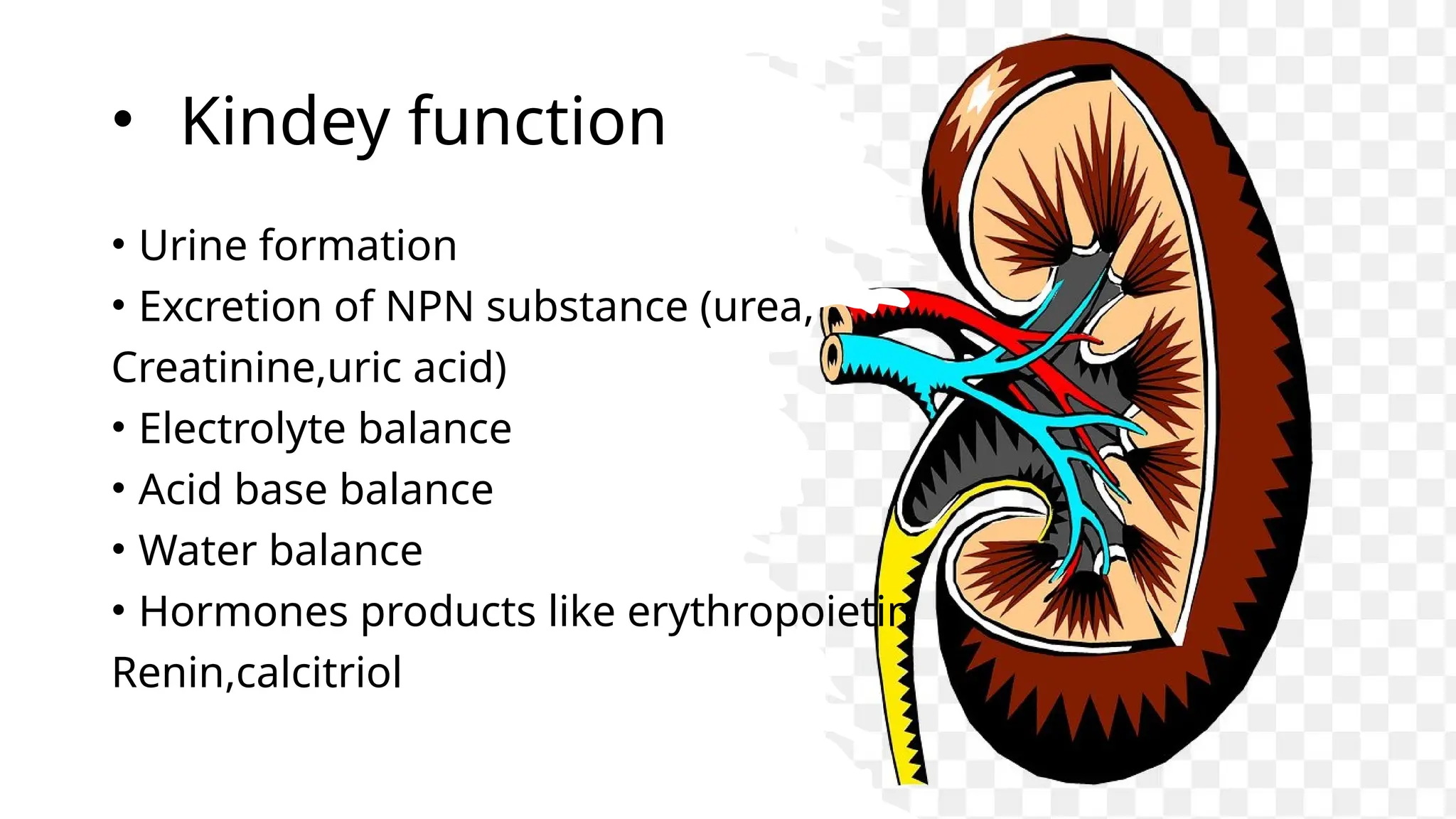
• Urine formation
• Excretion of NPN substance (urea,
Creatinine,uric acid)
• Electrolyte balance
• Acid base balance
• Water balance
• Hormones products like erythropoietin
Renin,calcitriol
• Kindey function
CLINICAL SIGNIFICANCE
INCREASED
• Dehydration
• UTIs
• Hight protein
• Kidney disease
• Cardiac failure
• Severe burn
DECREASE
• Liver failure
• Malnutrition
• Very low protein diet
Types of Renal
Function Tests
• Serum Creatinine:
• Measures creatinine, a waste product from muscle
metabolism.
• Significance of elevated levels.
• Normal range 0.7 to 1.3mg/dL
• Blood Urea Nitrogen (BUN):
• Measures the amount of nitrogen in the blood
from urea, a waste product of protein metabolism.
• Normal range 6 to 24mg/dl(2.1 to 8.5mmol/L)
Types of Renal
Function Tests
Urinalysis:
• General test to check for signs of kidney
disease.
• Includes appearance, concentration, and
content (protein, blood, etc.)
Albumin-to-Creatinine Ratio (ACR):
• Checks for albumin in urine, a sign of kidney
damage.
Factors Affecting Renal
Function Test Results
Preanalytical Factors:
• Importance of sample collection (timing, handling,
fasting/non-fasting).
• Effects of medications, diet, and hydration on test
results.
Analytical Factors:
• Sensitivity and specificity of the testing methods.
• Lab quality control procedures for accurate results.
• Post-analytical Considerations:
• Interpretation of results by clinicians.
Common Conditions
Detected by RFT
Acute Kidney
Injury (AKI)
Chronic Kidney
Disease (CKD)
Glomerulonephrit
is
Urinary tract
infections (UTIs)
Diabetic
Nephropathy
Hypertensive
Nephropathy
Pre-renal, Causes of
Kidney Dysfunction
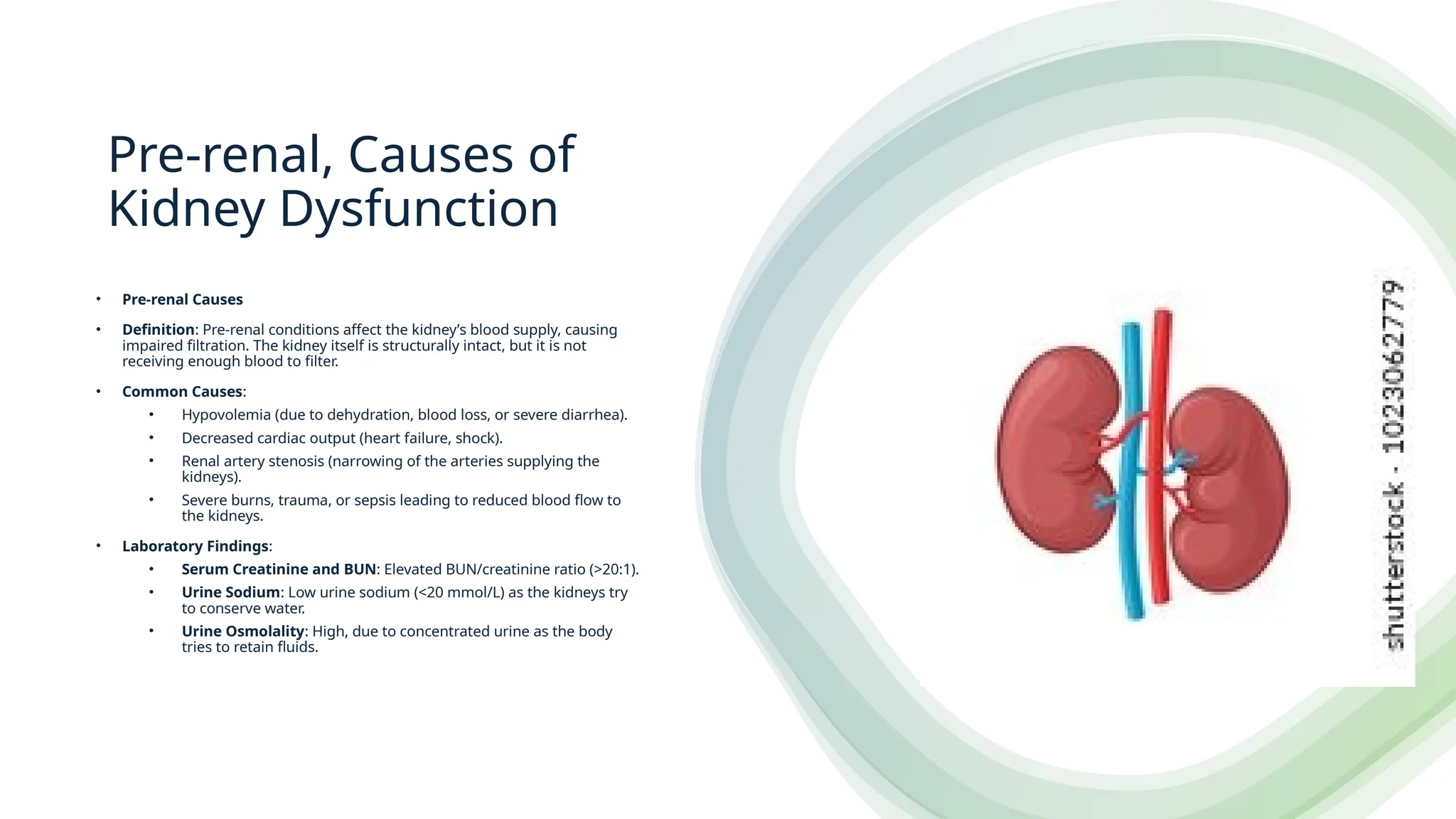
• Pre-renal Causes
• Definition: Pre-renal conditions affect the kidney’s blood supply, causing
impaired filtration. The kidney itself is structurally intact, but it is not
receiving enough blood to filter.
• Common Causes:
• Hypovolemia (due to dehydration, blood loss, or severe diarrhea).
• Decreased cardiac output (heart failure, shock).
• Renal artery stenosis (narrowing of the arteries supplying the
kidneys).
• Severe burns, trauma, or sepsis leading to reduced blood flow to
the kidneys.
• Laboratory Findings:
• Serum Creatinine and BUN: Elevated BUN/creatinine ratio (>20:1).
• Urine Sodium: Low urine sodium (<20 mmol/L) as the kidneys try
to conserve water.
• Urine Osmolality: High, due to concentrated urine as the body
tries to retain fluids.
Renal Causes of
Kidney Dysfunction
• Renal (Intrinsic) Causes
• Definition: Intrinsic conditions directly damage the kidneys,
typically the nephrons.
• Common Causes:
• Acute tubular necrosis (ATN).
• Glomerulonephritis (inflammation of the glomeruli).
• Interstitial nephritis (inflammation of the kidney’s
interstitium).
• Ischemia or toxins (e.g., certain medications, contrast
dyes).
• Laboratory Findings:
• Urinalysis: Presence of casts (e.g., granular casts in
ATN, red cell casts in glomerulonephritis).
• Urine Sodium: Higher (>40 mmol/L) due to impaired
reabsorption.
• Serum Creatinine: Elevated, with no significant
BUN/creatinine ratio difference.
Post-renal Causes of Kidney
Dysfunction
• Post-renal Causes
• Definition: Post-renal causes involve obstruction of urine flow, leading to pressure buildup and decreased
kidney function. The blockage can occur in the ureters, bladder, or urethra.
• Common Causes:
• Kidney stones (urolithiasis).
• Enlarged prostate (benign prostatic hyperplasia - BPH).
• Tumors obstructing urinary tract (e.g., bladder or prostate cancer).
• Urethral strictures or congenital anomalies.
• Laboratory Findings:
• Serum Creatinine and BUN: Both elevated, with a normal BUN/creatinine ratio.
• Urinalysis: Possible hematuria (blood in urine) or infection.
• Imaging: Ultrasound or CT to identify obstruction.
• Urine Flow: Decreased or intermittent flow of urine.
This Photo by Unknown Author is licensed under CC BY-SA-NC
Symptoms Indicating the Need for RFT
SWELLING
(EDEMA)
FATIGUE,
WEAKNESS
DECREASED
URINE OUTPUT
OR DARK URINE
NAUSEA,
VOMITING
SHORTNESS OF
BREATH
Preparation and Procedure
WHAT PATIENTS NEED TO
KNOW BEFORE TAKING AN
RFT.
HOW BLOOD AND URINE
SAMPLES ARE COLLECTED.
WHAT TO EXPECT DURING
THE PROCESS.
Interpreting Test
Results
Elevated Serum Creatinine and BUN:
•Interpretation in terms of kidney dysfunction.
•Differential diagnosis: Prerenal, renal, and
postrenal causes.
Low GFR and Implications:
•Risk of progressing to end-stage renal
disease (ESRD).
Proteinuria and Albuminuria:
•Diagnostic significance and how to interpret
the severity.
Management of Renal Dysfunction
Dietary Changes
Medications
Dialysis
Kidney Transplant:
Future of Renal Function Testing
BIOMARKERS IN
DEVELOPMENT:
POINT-OF-CARE
TESTING (POCT):
AUTOMATION AND AI
IN RENAL
DIAGNOSTICS:
Conclusion
Early detection and
management of kidney
disease.
Importance of precision in
laboratory techniques.
Role of RFT in overall
patient management.
•Thanks
any
questions
?

Renal Function Test or Kidney function Test-1.pptx

  • 1.
    Renal Function Test (RFT) Acomprehensive overview By Taiba Abdulrahman Khan
  • 2.
    Introduction What is Renal Function? Kidney'srole in maintaining homeostasis. Filtration, reabsorption, secretion, and excretion processes. Importance of maintaining fluid, electrolyte balance, and waste removal. Overview of Renal Function Tests: Tests to assess how efficiently the kidneys are working. Importance in clinical settings.
  • 3.
    • Urine formation •Excretion of NPN substance (urea, Creatinine,uric acid) • Electrolyte balance • Acid base balance • Water balance • Hormones products like erythropoietin Renin,calcitriol • Kindey function
  • 4.
    CLINICAL SIGNIFICANCE INCREASED • Dehydration •UTIs • Hight protein • Kidney disease • Cardiac failure • Severe burn DECREASE • Liver failure • Malnutrition • Very low protein diet
  • 5.
    Types of Renal FunctionTests • Serum Creatinine: • Measures creatinine, a waste product from muscle metabolism. • Significance of elevated levels. • Normal range 0.7 to 1.3mg/dL • Blood Urea Nitrogen (BUN): • Measures the amount of nitrogen in the blood from urea, a waste product of protein metabolism. • Normal range 6 to 24mg/dl(2.1 to 8.5mmol/L)
  • 6.
    Types of Renal FunctionTests Urinalysis: • General test to check for signs of kidney disease. • Includes appearance, concentration, and content (protein, blood, etc.) Albumin-to-Creatinine Ratio (ACR): • Checks for albumin in urine, a sign of kidney damage.
  • 7.
    Factors Affecting Renal FunctionTest Results Preanalytical Factors: • Importance of sample collection (timing, handling, fasting/non-fasting). • Effects of medications, diet, and hydration on test results. Analytical Factors: • Sensitivity and specificity of the testing methods. • Lab quality control procedures for accurate results. • Post-analytical Considerations: • Interpretation of results by clinicians.
  • 8.
    Common Conditions Detected byRFT Acute Kidney Injury (AKI) Chronic Kidney Disease (CKD) Glomerulonephrit is Urinary tract infections (UTIs) Diabetic Nephropathy Hypertensive Nephropathy
  • 9.
    Pre-renal, Causes of KidneyDysfunction • Pre-renal Causes • Definition: Pre-renal conditions affect the kidney’s blood supply, causing impaired filtration. The kidney itself is structurally intact, but it is not receiving enough blood to filter. • Common Causes: • Hypovolemia (due to dehydration, blood loss, or severe diarrhea). • Decreased cardiac output (heart failure, shock). • Renal artery stenosis (narrowing of the arteries supplying the kidneys). • Severe burns, trauma, or sepsis leading to reduced blood flow to the kidneys. • Laboratory Findings: • Serum Creatinine and BUN: Elevated BUN/creatinine ratio (>20:1). • Urine Sodium: Low urine sodium (<20 mmol/L) as the kidneys try to conserve water. • Urine Osmolality: High, due to concentrated urine as the body tries to retain fluids.
  • 10.
    Renal Causes of KidneyDysfunction • Renal (Intrinsic) Causes • Definition: Intrinsic conditions directly damage the kidneys, typically the nephrons. • Common Causes: • Acute tubular necrosis (ATN). • Glomerulonephritis (inflammation of the glomeruli). • Interstitial nephritis (inflammation of the kidney’s interstitium). • Ischemia or toxins (e.g., certain medications, contrast dyes). • Laboratory Findings: • Urinalysis: Presence of casts (e.g., granular casts in ATN, red cell casts in glomerulonephritis). • Urine Sodium: Higher (>40 mmol/L) due to impaired reabsorption. • Serum Creatinine: Elevated, with no significant BUN/creatinine ratio difference.
  • 11.
    Post-renal Causes ofKidney Dysfunction • Post-renal Causes • Definition: Post-renal causes involve obstruction of urine flow, leading to pressure buildup and decreased kidney function. The blockage can occur in the ureters, bladder, or urethra. • Common Causes: • Kidney stones (urolithiasis). • Enlarged prostate (benign prostatic hyperplasia - BPH). • Tumors obstructing urinary tract (e.g., bladder or prostate cancer). • Urethral strictures or congenital anomalies. • Laboratory Findings: • Serum Creatinine and BUN: Both elevated, with a normal BUN/creatinine ratio. • Urinalysis: Possible hematuria (blood in urine) or infection. • Imaging: Ultrasound or CT to identify obstruction. • Urine Flow: Decreased or intermittent flow of urine. This Photo by Unknown Author is licensed under CC BY-SA-NC
  • 12.
    Symptoms Indicating theNeed for RFT SWELLING (EDEMA) FATIGUE, WEAKNESS DECREASED URINE OUTPUT OR DARK URINE NAUSEA, VOMITING SHORTNESS OF BREATH
  • 13.
    Preparation and Procedure WHATPATIENTS NEED TO KNOW BEFORE TAKING AN RFT. HOW BLOOD AND URINE SAMPLES ARE COLLECTED. WHAT TO EXPECT DURING THE PROCESS.
  • 14.
    Interpreting Test Results Elevated SerumCreatinine and BUN: •Interpretation in terms of kidney dysfunction. •Differential diagnosis: Prerenal, renal, and postrenal causes. Low GFR and Implications: •Risk of progressing to end-stage renal disease (ESRD). Proteinuria and Albuminuria: •Diagnostic significance and how to interpret the severity.
  • 15.
    Management of RenalDysfunction Dietary Changes Medications Dialysis Kidney Transplant:
  • 16.
    Future of RenalFunction Testing BIOMARKERS IN DEVELOPMENT: POINT-OF-CARE TESTING (POCT): AUTOMATION AND AI IN RENAL DIAGNOSTICS:
  • 17.
    Conclusion Early detection and managementof kidney disease. Importance of precision in laboratory techniques. Role of RFT in overall patient management.
  • 18.