OVERVIEW
• Oil and Gas industry
• Oil demand and supply in India
• Gas demand and supply in India
• Key Growth Drivers
• Reliance Petroleum Limited
• SWOT analysis
• Porter’s 5 forces
• Value Chain Model
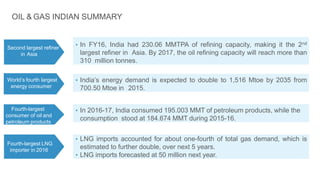
World’s fourth largest
energy consumer
• India’s energy demand is expected to double to 1,516 Mtoe by 2035 from
700.50 Mtoe in 2015.
Fourth-largest
consumer of oil and
petroleum products
• In 2016-17, India consumed 195.003 MMT of petroleum products, while the
consumption stood at 184.674 MMT during 2015-16.
Fourth-largest LNG
importer in 2016
• LNG imports accounted for about one-fourth of total gas demand, which is
estimated to further double, over next 5 years.
• LNG imports forecasted at 50 million next year.
Second largest refiner
in Asia
• In FY16, India had 230.06 MMTPA of refining capacity, making it the 2nd
largest refiner in Asia. By 2017, the oil refining capacity will reach more than
310 million tonnes.
OIL & GAS INDIAN SUMMARY
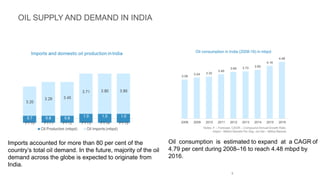
Oil consumption in India (2008-16) in mbpd
Oil consumption is estimated to expand at a CAGR of
4.79 per cent during 2008–16 to reach 4.48 mbpd by
2016.
OIL SUPPLY AND DEMAND IN INDIA
3.08
4
3.24 3.32
3.49
3.69 3.73 3.85
4.16
4.48
2008 2009 2010 2011 2012 2013 2014 2015 2016
Notes: F – Forecast, CAGR – Compound AnnualGrowth Rate,
mbpd – Million Barrels Per Day, mn bbl – Million Barrels
Imports accounted for more than 80 per cent of the
country’s total oil demand. In the future, majority of the oil
demand across the globe is expected to originate from
India.
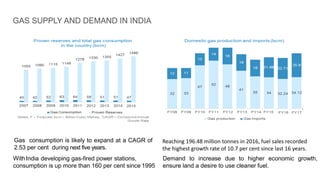
Gas consumption is likely to expand at a CAGR of
2.53 per cent during next five years.
Reaching 196.48 million tonnes in 2016, fuel sales recorded
the highest growth rate of 10.7 per cent since last 16 years.
Demand to increase due to higher economic growth,
ensure land a desire to use cleaner fuel.
WithIndia developing gas-fired power stations,
consumption is up more than 160 per cent since 1995
GAS SUPPLY AND DEMAND IN INDIA
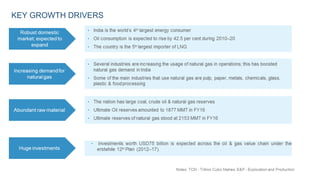
KEY GROWTH DRIVERS
Reliance Petroleum Limited
• Reliance Petroleum Limited was set up by reliance industries
Limited, one of India’s largest private sector companies based in
Ahmedabad
• Currently, RPL is subsidiary of RIL, and has interests in the
downstream oil business. RPL also benefits from the strategic
alliance with Chevron India holding Pvt. Ltd, Singapore which has a
stake of 5 percent in the company
• RPL was formed to set up a greenfield petroleum refinery and
polypropylene plant in the special economic zone(SEZ) at Jamnagar
in Gujrat
• The global sized, highly complex refinery is being located adjacent to
RIL’s existing refinery and petrochemical complex, which the largest
and the most efficient refinery in the world
• The commissioning of the RPL refinery catapults Reliance into the
league of the largest private players globally both in terms of
complex refining capacity and earning potential. It has an aggregate
refining capacity of 1.24 million barrels of oil per day in any single
location in the world
SWOT
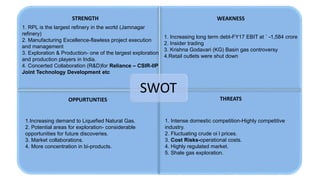
1. RPL is the largest refinery in the world (Jamnagar
refinery)
2. Manufacturing Excellence-flawless project execution
and management
3. Exploration & Production- one of the largest exploration
and production players in India.
4. Concerted Collaboration (R&D)for Reliance – CSIR-IIP
Joint Technology Development etc
1. Increasing long term debt-FY17 EBIT at ` -1,584 crore
2. Insider trading
3. Krishna Godavari (KG) Basin gas controversy
4.Retail outlets were shut down
STRENGTH WEAKNESS
THREATSOPPURTUNTIES
1.Increasing demand to Liquefied Natural Gas.
2. Potential areas for exploration- considerable
opportunities for future discoveries.
3. Market collaborations.
4. More concentration in bi-products.
1. Intense domestic competition-Highly competitive
industry.
2. Fluctuating crude oi l prices.
3. Cost Risks-operational costs.
4. Highly regulated market.
5. Shale gas exploration.
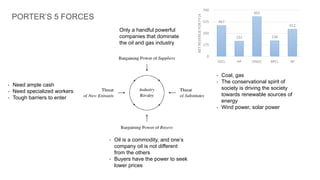
Only a handful powerful
companies that dominate
the oil and gas industry
• Need ample cash
• Need specialized workers
• Tough barriers to enter
• Oil is a commodity, and one’s
company oil is not different
from the others
• Buyers have the power to seek
lower prices
• Coal, gas
• The conservational spirit of
society is driving the society
towards renewable sources of
energy
• Wind power, solar power
467
232
602
238
412
0
175
350
525
700
IOCL HP ONGC BPCL RP
NETREVENUEFORFY14
PORTER’S 5 FORCES
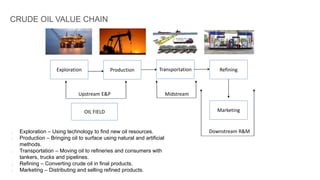
CRUDE OIL VALUE CHAIN
Exploration Production Transportation Refining
Marketing
Upstream E&P
Downstream R&M
Midstream
OIL FIELD
 Exploration – Using technology to find new oil resources.
 Production – Bringing oil to surface using natural and artificial
methods.
 Transportation – Moving oil to refineries and consumers with
tankers, trucks and pipelines.
 Refining – Converting crude oil in final products.
 Marketing – Distributing and selling refined products.
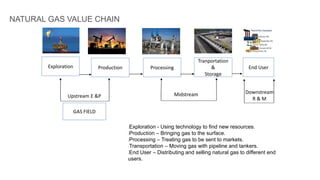
NATURAL GAS VALUE CHAIN
Exploration Production Processing
Tranportation
&
Storage
End User
Upstream E &P
Downstream
R & M
Midstream
GAS FIELD
Exploration - Using technology to find new resources.
Production – Bringing gas to the surface.
Processing – Treating gas to be sent to markets.
Transportation – Moving gas with pipeline and tankers.
End User – Distributing and selling natural gas to different end
users.
Reliance power limited

Reliance power limited

  • 2.
    OVERVIEW • Oil andGas industry • Oil demand and supply in India • Gas demand and supply in India • Key Growth Drivers • Reliance Petroleum Limited • SWOT analysis • Porter’s 5 forces • Value Chain Model
  • 3.
    World’s fourth largest energyconsumer • India’s energy demand is expected to double to 1,516 Mtoe by 2035 from 700.50 Mtoe in 2015. Fourth-largest consumer of oil and petroleum products • In 2016-17, India consumed 195.003 MMT of petroleum products, while the consumption stood at 184.674 MMT during 2015-16. Fourth-largest LNG importer in 2016 • LNG imports accounted for about one-fourth of total gas demand, which is estimated to further double, over next 5 years. • LNG imports forecasted at 50 million next year. Second largest refiner in Asia • In FY16, India had 230.06 MMTPA of refining capacity, making it the 2nd largest refiner in Asia. By 2017, the oil refining capacity will reach more than 310 million tonnes. OIL & GAS INDIAN SUMMARY
  • 4.
    Oil consumption inIndia (2008-16) in mbpd Oil consumption is estimated to expand at a CAGR of 4.79 per cent during 2008–16 to reach 4.48 mbpd by 2016. OIL SUPPLY AND DEMAND IN INDIA 3.08 4 3.24 3.32 3.49 3.69 3.73 3.85 4.16 4.48 2008 2009 2010 2011 2012 2013 2014 2015 2016 Notes: F – Forecast, CAGR – Compound AnnualGrowth Rate, mbpd – Million Barrels Per Day, mn bbl – Million Barrels Imports accounted for more than 80 per cent of the country’s total oil demand. In the future, majority of the oil demand across the globe is expected to originate from India.
  • 5.
    Gas consumption islikely to expand at a CAGR of 2.53 per cent during next five years. Reaching 196.48 million tonnes in 2016, fuel sales recorded the highest growth rate of 10.7 per cent since last 16 years. Demand to increase due to higher economic growth, ensure land a desire to use cleaner fuel. WithIndia developing gas-fired power stations, consumption is up more than 160 per cent since 1995 GAS SUPPLY AND DEMAND IN INDIA
  • 6.
  • 7.
    Reliance Petroleum Limited •Reliance Petroleum Limited was set up by reliance industries Limited, one of India’s largest private sector companies based in Ahmedabad • Currently, RPL is subsidiary of RIL, and has interests in the downstream oil business. RPL also benefits from the strategic alliance with Chevron India holding Pvt. Ltd, Singapore which has a stake of 5 percent in the company • RPL was formed to set up a greenfield petroleum refinery and polypropylene plant in the special economic zone(SEZ) at Jamnagar in Gujrat • The global sized, highly complex refinery is being located adjacent to RIL’s existing refinery and petrochemical complex, which the largest and the most efficient refinery in the world • The commissioning of the RPL refinery catapults Reliance into the league of the largest private players globally both in terms of complex refining capacity and earning potential. It has an aggregate refining capacity of 1.24 million barrels of oil per day in any single location in the world
  • 8.
    SWOT 1. RPL isthe largest refinery in the world (Jamnagar refinery) 2. Manufacturing Excellence-flawless project execution and management 3. Exploration & Production- one of the largest exploration and production players in India. 4. Concerted Collaboration (R&D)for Reliance – CSIR-IIP Joint Technology Development etc 1. Increasing long term debt-FY17 EBIT at ` -1,584 crore 2. Insider trading 3. Krishna Godavari (KG) Basin gas controversy 4.Retail outlets were shut down STRENGTH WEAKNESS THREATSOPPURTUNTIES 1.Increasing demand to Liquefied Natural Gas. 2. Potential areas for exploration- considerable opportunities for future discoveries. 3. Market collaborations. 4. More concentration in bi-products. 1. Intense domestic competition-Highly competitive industry. 2. Fluctuating crude oi l prices. 3. Cost Risks-operational costs. 4. Highly regulated market. 5. Shale gas exploration.
  • 9.
    Only a handfulpowerful companies that dominate the oil and gas industry • Need ample cash • Need specialized workers • Tough barriers to enter • Oil is a commodity, and one’s company oil is not different from the others • Buyers have the power to seek lower prices • Coal, gas • The conservational spirit of society is driving the society towards renewable sources of energy • Wind power, solar power 467 232 602 238 412 0 175 350 525 700 IOCL HP ONGC BPCL RP NETREVENUEFORFY14 PORTER’S 5 FORCES
  • 10.
    CRUDE OIL VALUECHAIN Exploration Production Transportation Refining Marketing Upstream E&P Downstream R&M Midstream OIL FIELD  Exploration – Using technology to find new oil resources.  Production – Bringing oil to surface using natural and artificial methods.  Transportation – Moving oil to refineries and consumers with tankers, trucks and pipelines.  Refining – Converting crude oil in final products.  Marketing – Distributing and selling refined products.
  • 11.
    NATURAL GAS VALUECHAIN Exploration Production Processing Tranportation & Storage End User Upstream E &P Downstream R & M Midstream GAS FIELD Exploration - Using technology to find new resources. Production – Bringing gas to the surface. Processing – Treating gas to be sent to markets. Transportation – Moving gas with pipeline and tankers. End User – Distributing and selling natural gas to different end users.