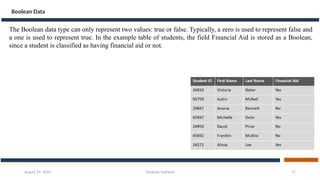
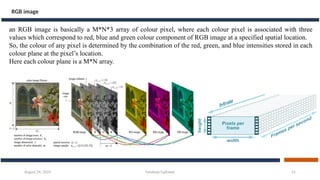
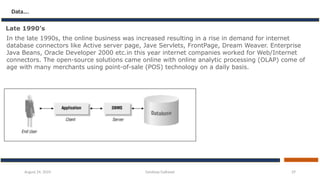
The document provides an overview of relational database management systems, including their definitions, structures, advantages, and limitations compared to traditional file processing systems. It outlines the course structure, evaluation methods, and key reference materials, alongside discussions on data types, storage methods, and the historical evolution of databases from magnetic tape to modern DBMS software. Additionally, it highlights various data types such as text, numeric, boolean, and digital images, emphasizing the significance of databases in organizing and managing inter-related data efficiently.