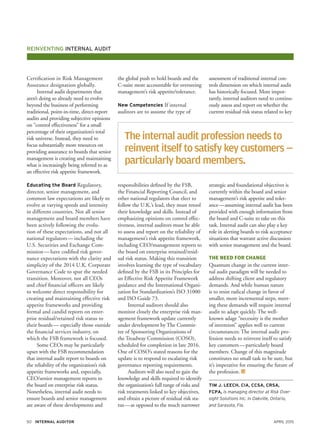
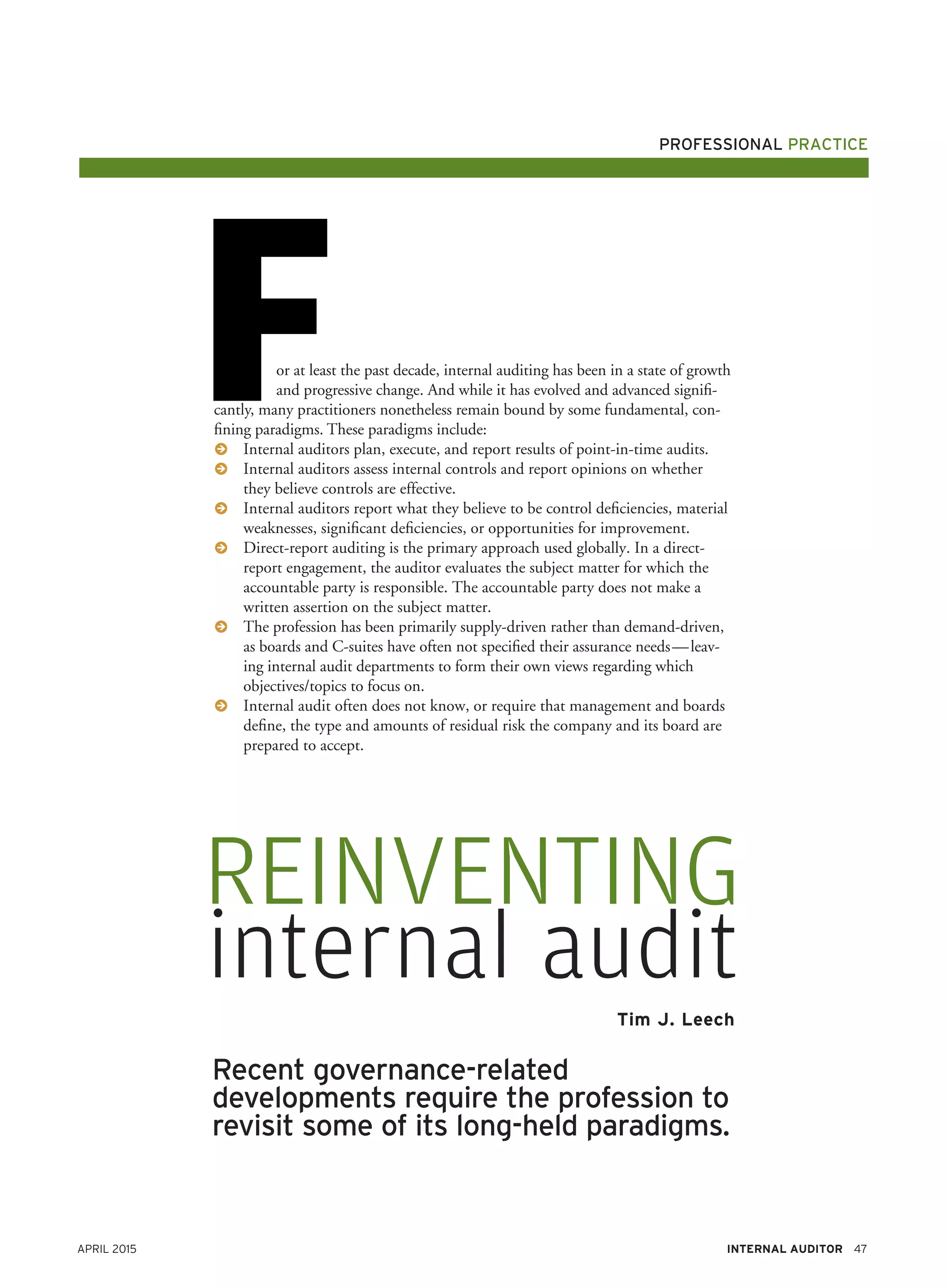
The document discusses how recent governance developments are requiring the internal auditing profession to revisit some of its long-held paradigms and practices. It outlines several paradigms that internal auditing has traditionally followed, such as point-in-time audits and direct-report engagements. It then discusses key global developments like the creation of the Financial Stability Board that are shifting expectations for boards, management, and internal auditing. The FSB guidance calls for internal audit to assess the reliability of an organization's entire risk appetite framework and risk reporting. This represents a fundamental change from traditional internal audit practices and paradigms.
![April 2015 49Internal Auditor
say internal auditing adds less than
“significant value” to their organiza-
tion. Moreover, only 49 percent of
senior management and 64 percent of
board members say internal auditing
is delivering on expectations.
Implications for
Internal Auditing
The changes described are causing regu-
lators, boards, and senior executives to
reconsider and reshape what they want
and expect from internal audit. What
once constituted fine, even laudable
deliverables from internal audit in the
minds of many boards, C-level execu-
tives, and regulators is being reshaped
by increasing expectations that internal
audit play a key role in helping boards
demonstrably oversee management’s risk
appetite and tolerance.
FSB’s Guidance for Internal Audit
I
n its Principles for an Effective Risk Appetite Framework, the Financial Sta-
bility Board proposes specific responsibilities for internal audit and other
independent assessors. The framework states that internal audit should:
»» Routinely include assessments of the risk assessment framework (RAF)
on an institutionwide basis as well as on an individual business line and
legal entity basis.
»» Identify whether breaches in risk limits are being appropriately identi-
fied, escalated, and reported, and report on the implementation of the
RAF to the board and senior management as appropriate.
»» Independently assess the design and effectiveness of the RAF periodi-
cally, as well as its alignment with supervisory expectations.
»» Assess the effectiveness of the implementation of the RAF, including
linkage to organizational culture, as well as strategic and business plan-
ning, compensation, and decision-making processes.
»» Assess the design and effectiveness of risk measurement techniques
and [management information systems] used to monitor the institu-
tion’s risk profile in relation to its risk appetite.
»» Report any material deficiencies in the RAF and on alignment (or other-
wise) of risk appetite and risk profile with risk culture to the board and
senior management timely.
»» Evaluate the need to supplement its own independent assessment with
expertise from third parties to provide a comprehensive independent
view of the effectiveness of the RAF.
Risk Reporting The FSB has defined
roles for the board, senior manage-
ment, and internal audit that call
for a fundamental accountability
shift — a shift that would require
management to continuously assess
and report upward on risk status.
Moreover, it would require internal
audit to help management build and
maintain systems for this purpose,
as well as assess and report opinions
to the board on how well manage-
ment is discharging its assigned risk
governance responsibilities. This
new paradigm requires fundamental
shifts in existing internal audit edu-
cational resources. The IIA modified
its Performance Standard 2120: Risk
Management in 2010 specifically to
provide support for the shift, and
in 2012 it also began offering the
Visit our mobile app + InternalAuditor.org
to watch the author discuss changes facing internal audit.
To comment
on this article,
email the
author at
tim.leech@
theiia.org](https://image.slidesharecdn.com/72ea3289-12ef-4555-bcc6-366e5596f473-150508132559-lva1-app6891/85/Reinventing-Internal-Audit-Final-April-2015-3-320.jpg)