Steven F. Schutzer, MD
Medical Director, Connecticut Joint
Replacement Institute
President, Connecticut Joint Replacment
Surgeons, LLC
Steven F. Schutzer, MD
Disclosures
• Medical Director, CT Joint Replacement Institute
• President, CT Joint Replacement Surgeons, LLC
• Investor, Renovis Surgical Technologies
• Unpaid Consultant, Renovis Surgical Technologies
• Editorial staff, J. Arthroplasty
• Principal, Novel Healthcare Solutions, LLC
The entrepreneurial spirit of the
independent private practice surgeon,
working at an arms length relationship
with a hospital partner, can more rapidly
and effectively create sustainable
healthcare value than other contemporary
alignment models.
Bias
“He who is not courageous enough to take risk,
will accomplish nothing in life.”
Muhammad Ali
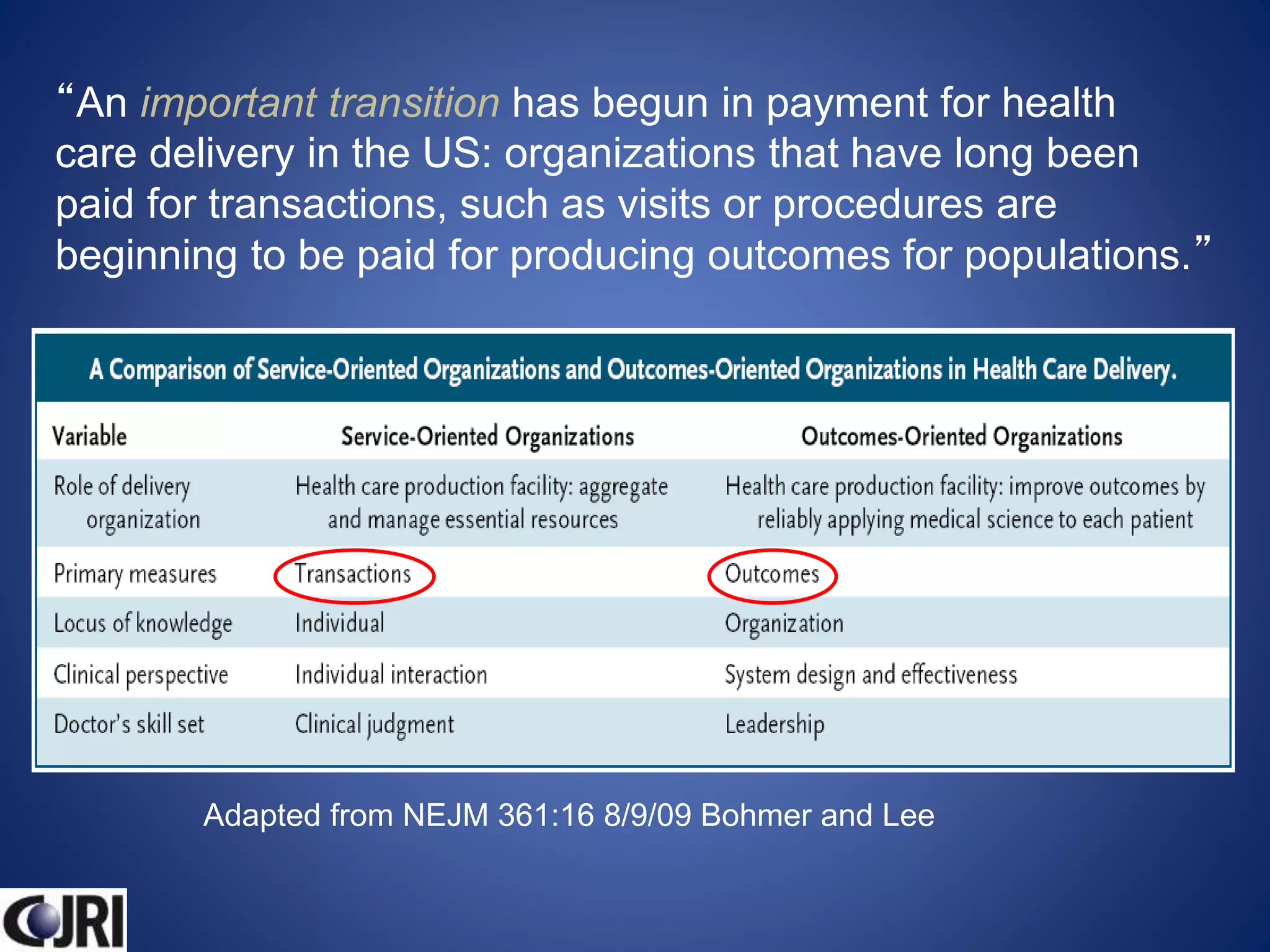
Adapted from NEJM 361:16 8/9/09 Bohmer and Lee
“An important transition has begun in payment for health
care delivery in the US: organizations that have long been
paid for transactions, such as visits or procedures are
beginning to be paid for producing outcomes for populations.”
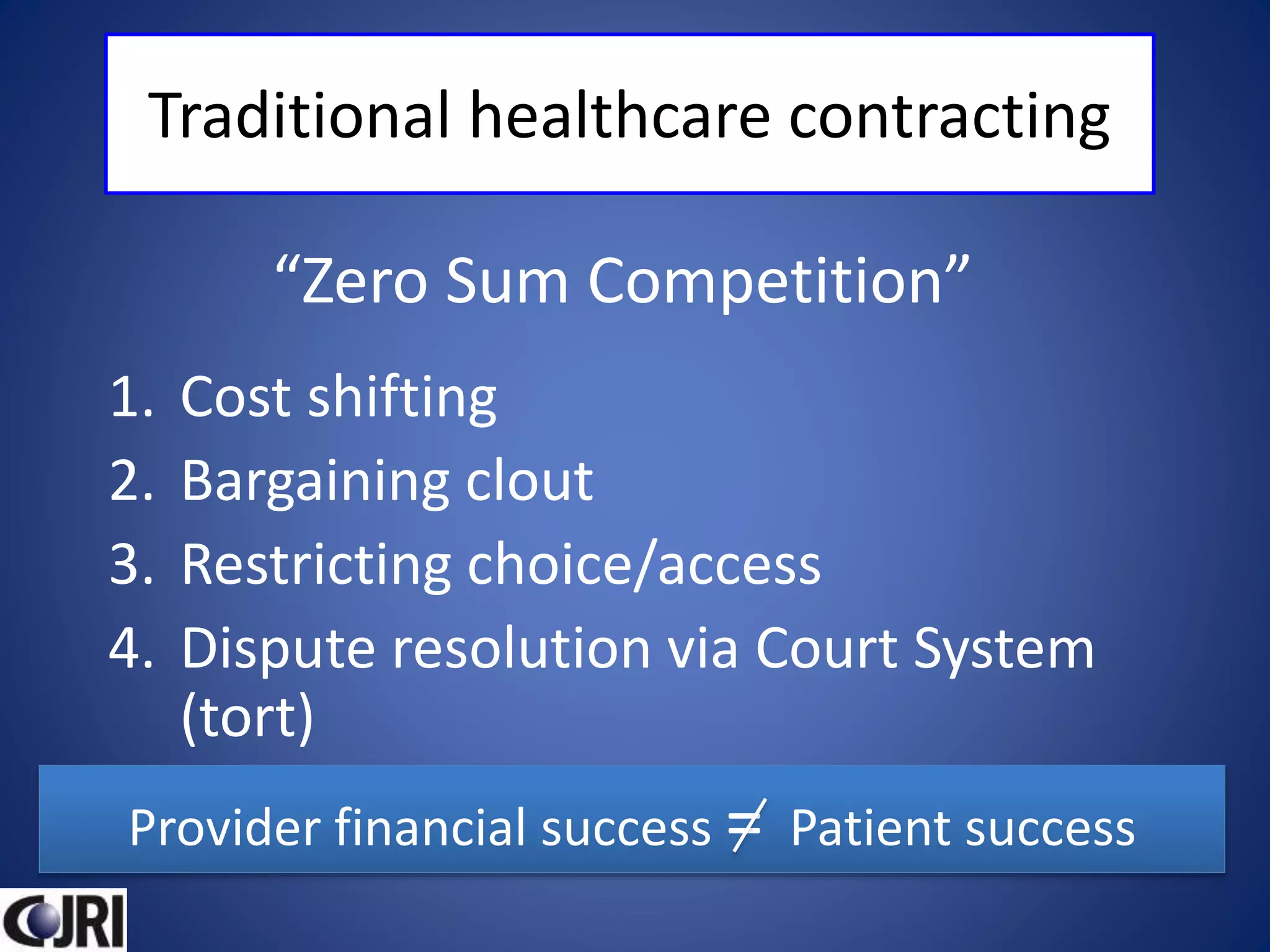
Traditional healthcare contracting
1. Cost shifting
2. Bargaining clout
3. Restricting choice/access
4. Dispute resolution via Court System
(tort)
“Zero Sum Competition”
Traditional healthcare contracting
1. Cost shifting
2. Bargaining clout
3. Restricting choice/access
4. Dispute resolution via Court System
(tort)
“Zero Sum Competition”
Provider financial success = Patient success
Professor Porter:
“Create the right kind of competition”
“Positive Sum Competition”
Based on creation of healthcare value and market
competition aligned with outcomes/cost for a
specific medical condition.
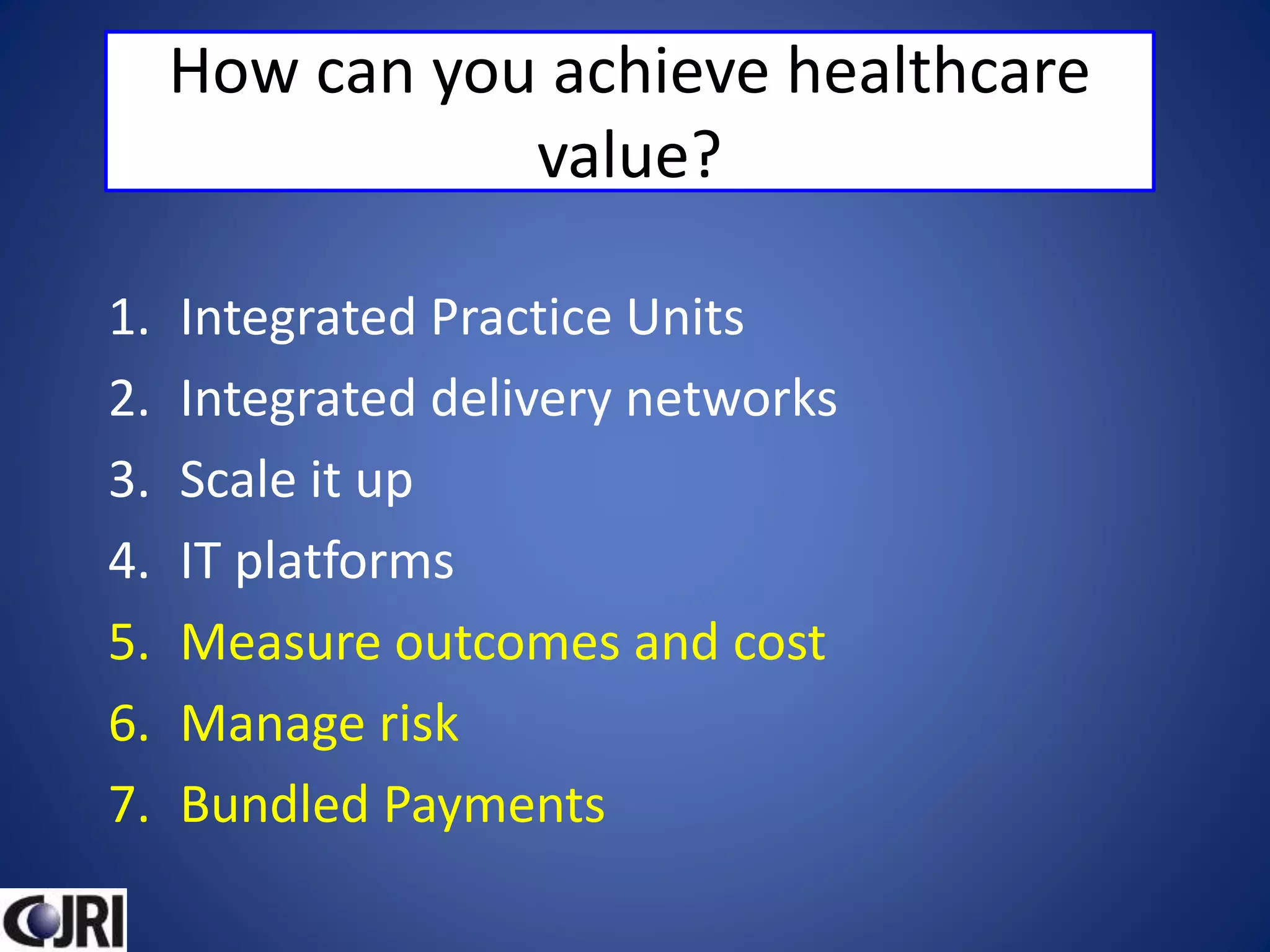
How can you achieve healthcare
value?
1. Integrated Practice Units
2. Integrated delivery networks
3. Scale it up
4. IT platforms
5. Measure outcomes and cost
6. Manage risk
7. Bundled Payments
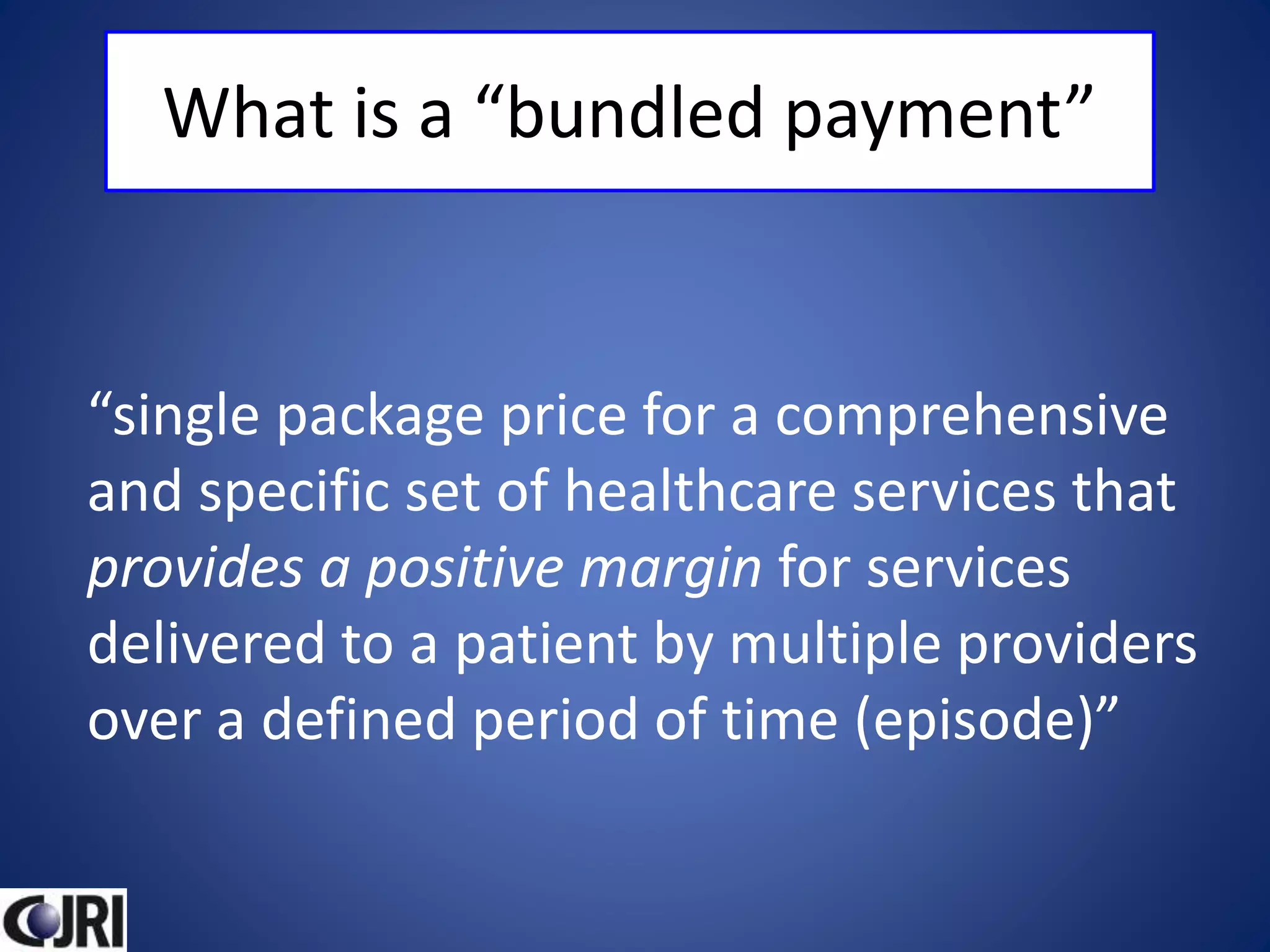
What is a “bundled payment”
“single package price for a comprehensive
and specific set of healthcare services that
provides a positive margin for services
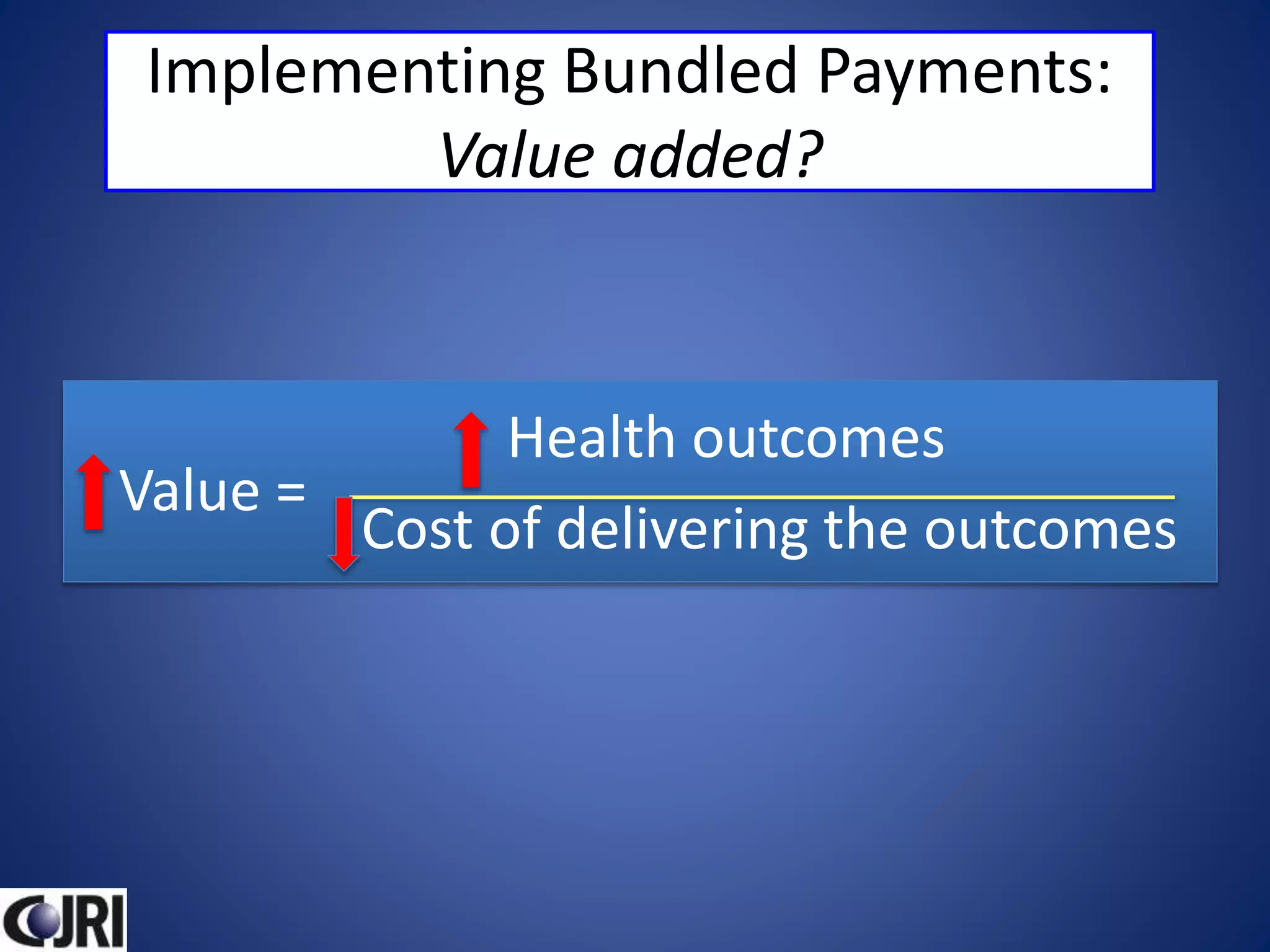
delivered to a patient by multiple providers
over a defined period of time (episode)”
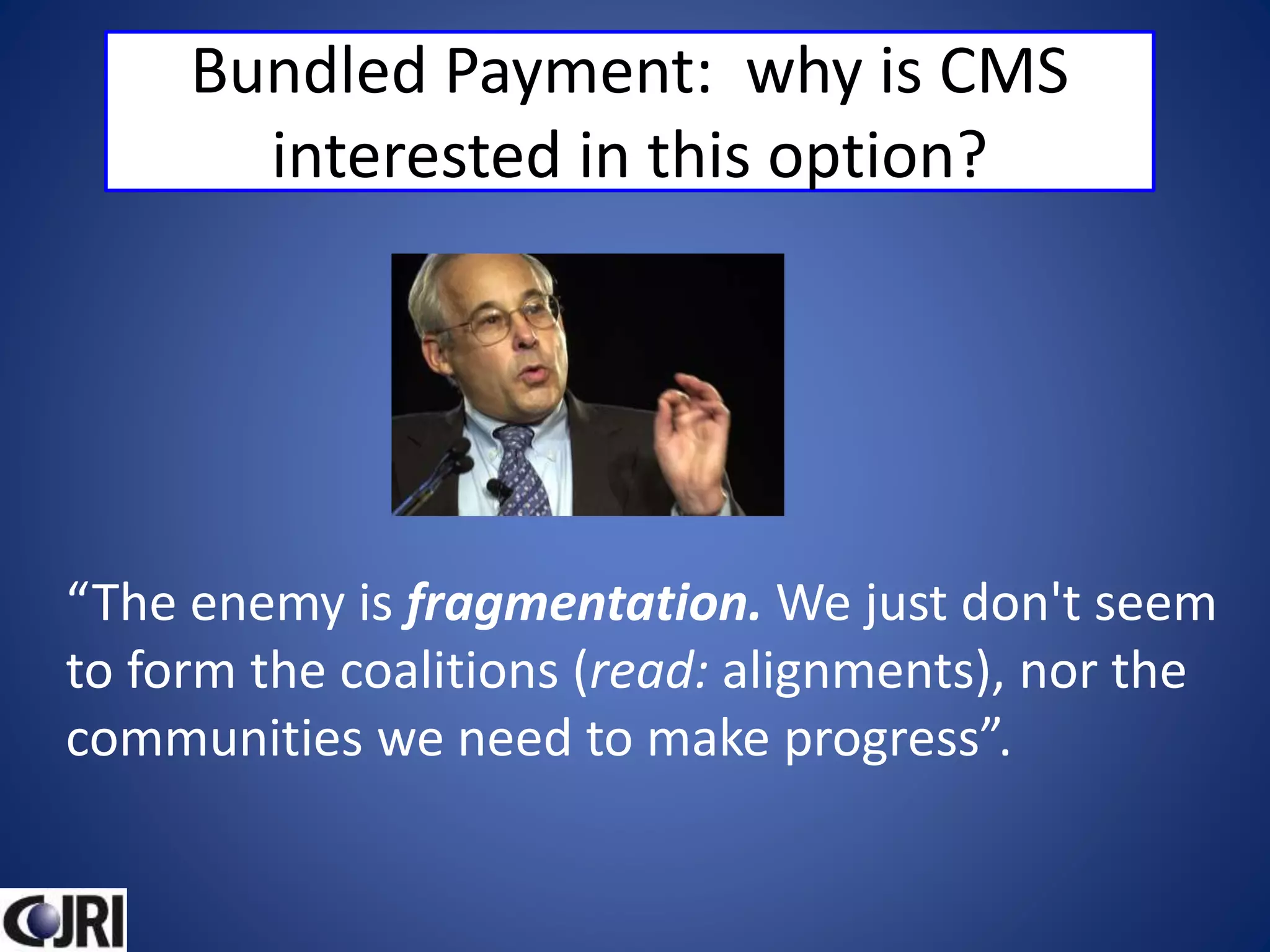
Bundled Payment: why is CMS
interested in this option?
“The enemy is fragmentation. We just don't seem
to form the coalitions (read: alignments), nor the
communities we need to make progress”.
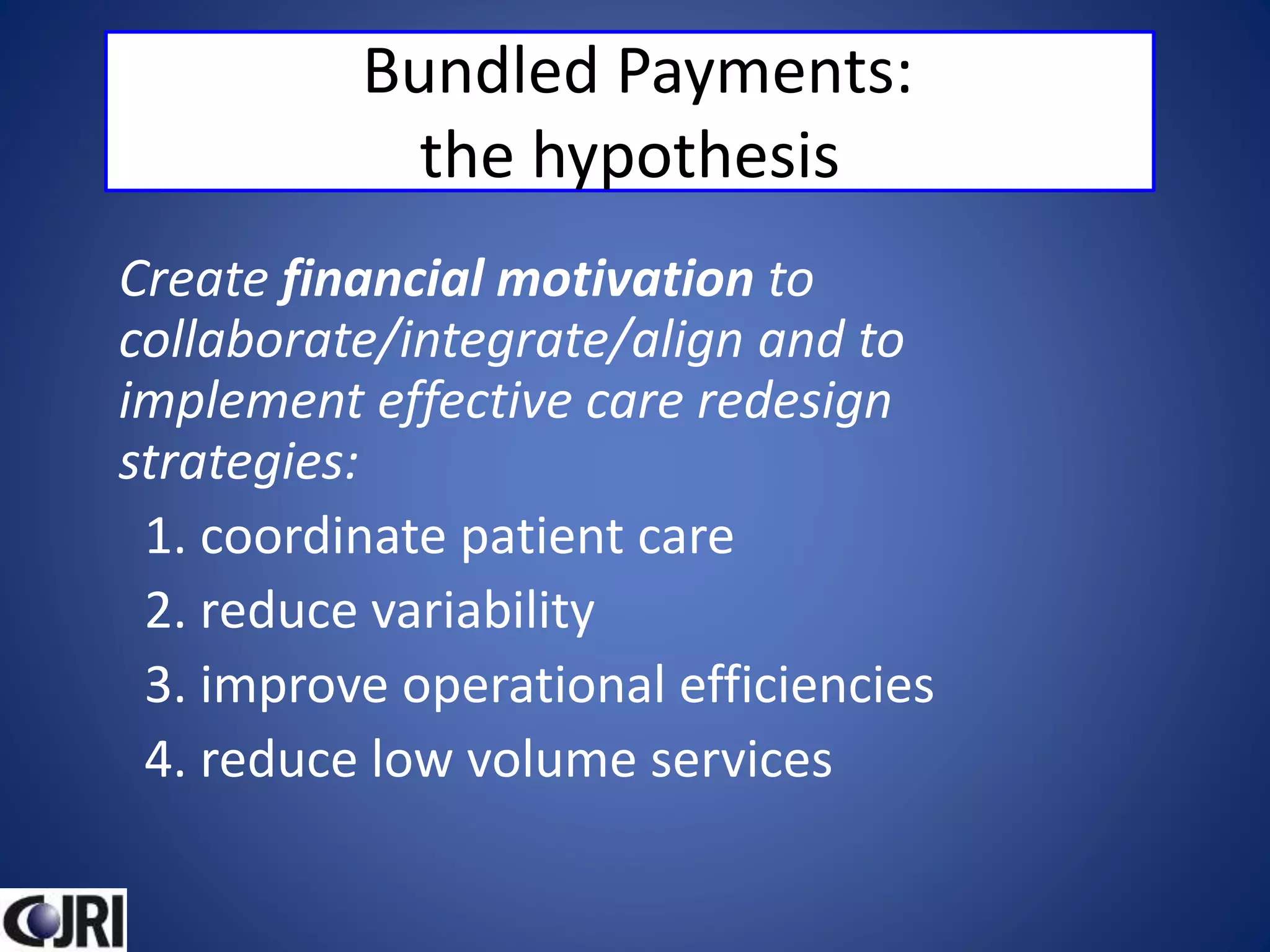
Bundled Payments:
the hypothesis
Create financial motivation to
collaborate/integrate/align and to
implement effective care redesign
strategies:
1. coordinate patient care
2. reduce variability
3. improve operational efficiencies
4. reduce low volume services
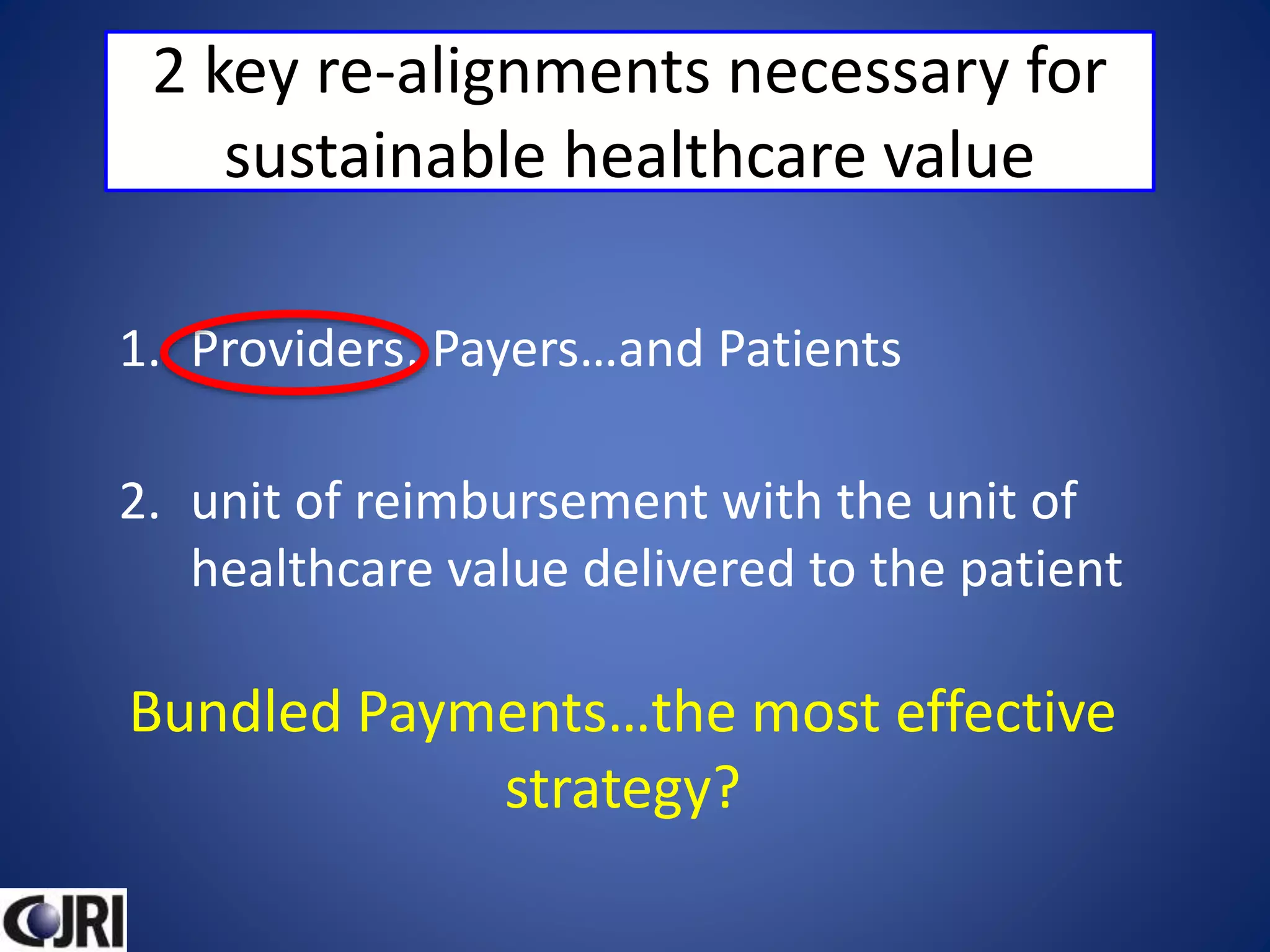
2 key re-alignments necessary for
sustainable healthcare value
1. Providers, Payers…and Patients
2. unit of reimbursement with the unit of
healthcare value delivered to the patient
Bundled Payments…the most effective
strategy?
What is the evidence that Bundling
works in healthcare?
1. Medicare 5 year CABG Demonstration
2. 2009 NEJM article
3. Prometheus models/pilots
4. Provencare experience
5. Medicare ACE Demonstration project
6. CJRI data
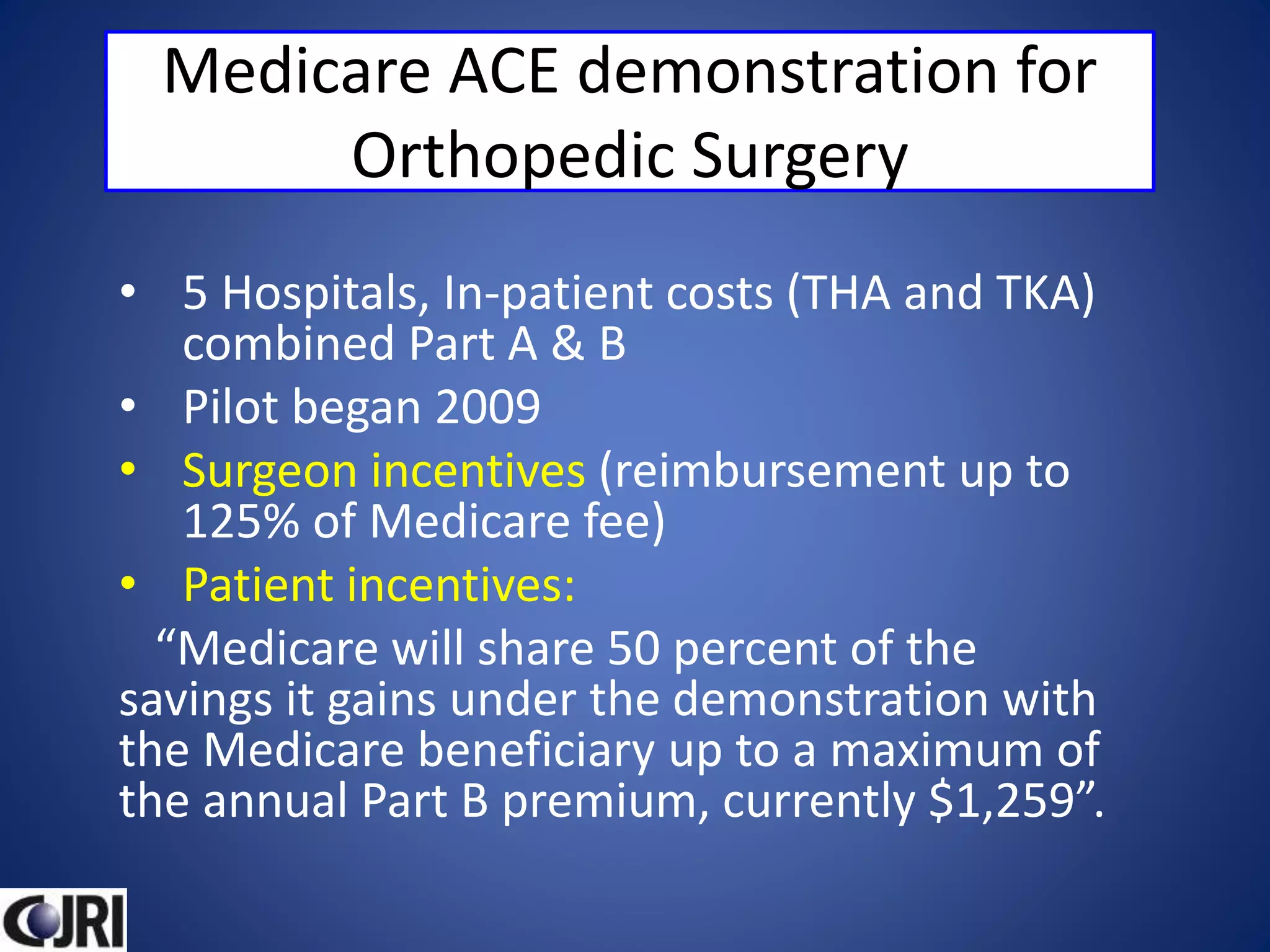
Medicare ACE demonstration for
Orthopedic Surgery
• 5 Hospitals, In-patient costs (THA and TKA)
combined Part A & B
• Pilot began 2009
• Surgeon incentives (reimbursement up to
125% of Medicare fee)
• Patient incentives:
“Medicare will share 50 percent of the
savings it gains under the demonstration with
the Medicare beneficiary up to a maximum of
the annual Part B premium, currently $1,259”.
Medicare ACE demonstration for
Orthopedic Surgery
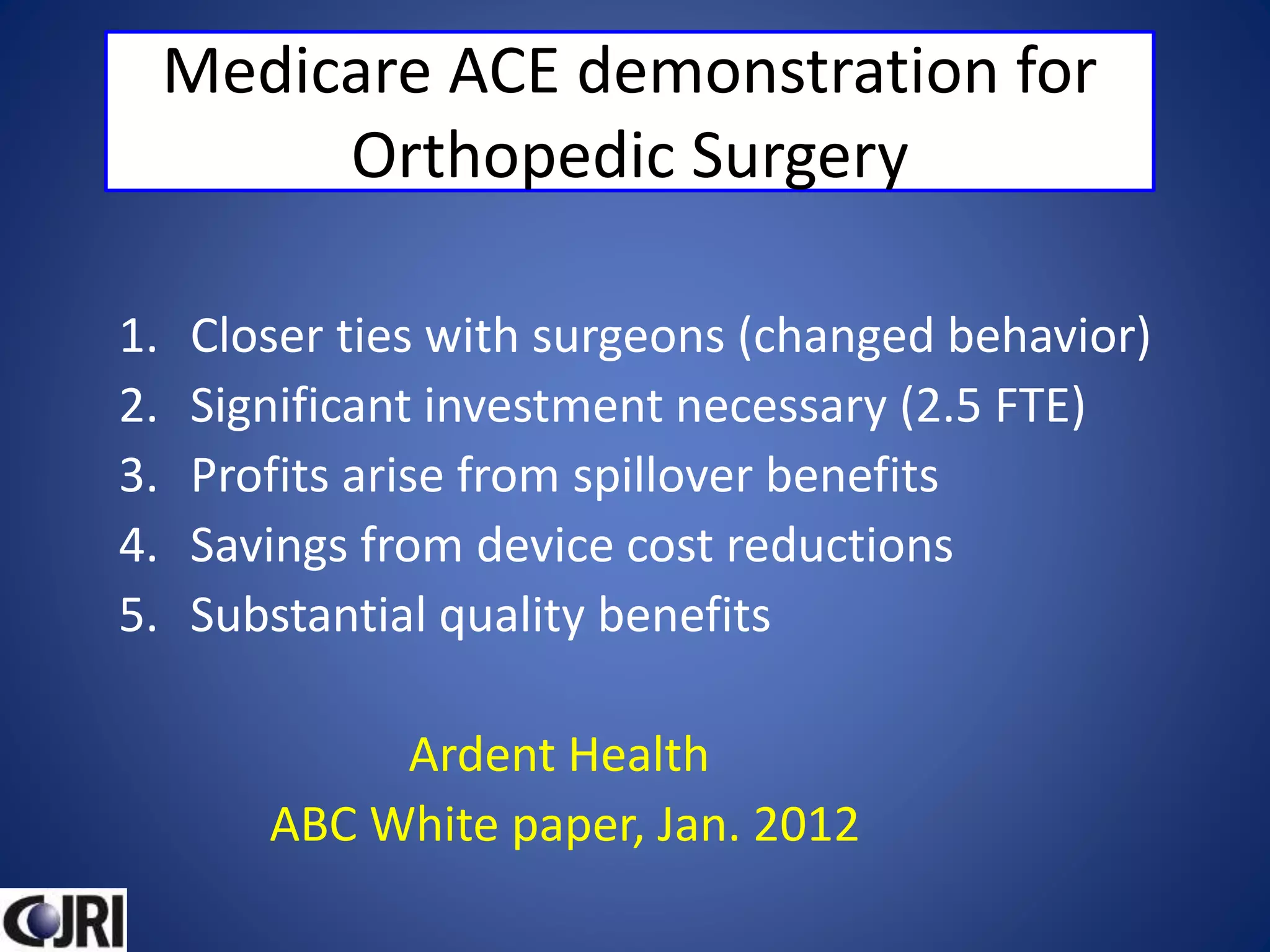
1. Closer ties with surgeons (changed behavior)
2. Significant investment necessary (2.5 FTE)
3. Profits arise from spillover benefits
4. Savings from device cost reductions
5. Substantial quality benefits
Ardent Health
ABC White paper, Jan. 2012
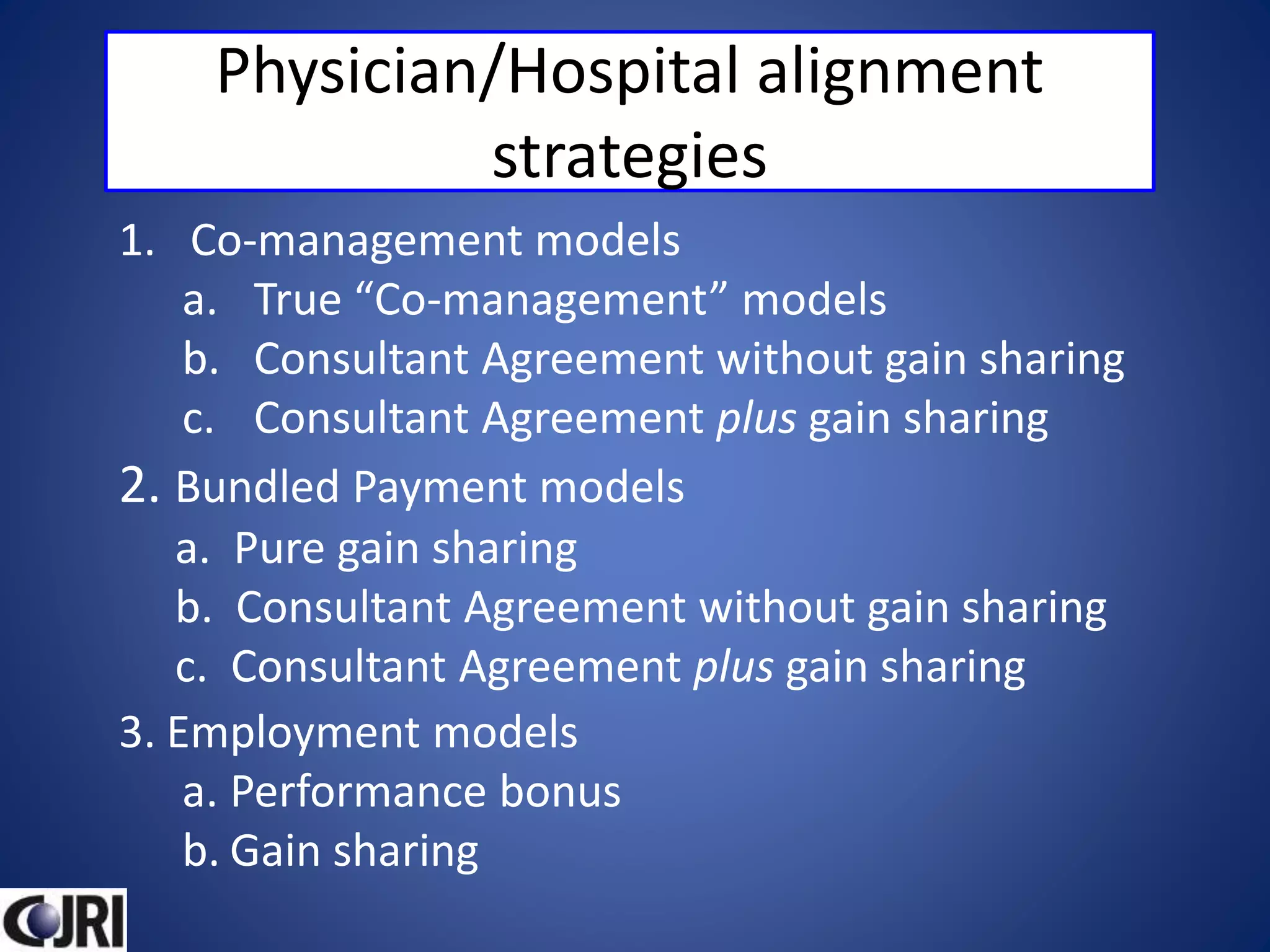
Physician/Hospital alignment
strategies
1. Co-management models
a. True “Co-management” models
b. Consultant Agreement without gain sharing
c. Consultant Agreement plus gain sharing
2. Bundled Payment models
a. Pure gain sharing
b. Consultant Agreement without gain sharing
c. Consultant Agreement plus gain sharing
3. Employment models
a. Performance bonus
b. Gain sharing
Provider alignment strategies:
Bundled payment
Under BP contracts (without gain sharing)
alignment is achieved by tying Physician
reimbursement for services with
compliance with consensus based best
practices/EBM protocols.
Connecticut Joint Replacement Surgeons, LLC
incorporated November, 2006
• 10 “community” Arthroplasty surgeons
from 5 different private orthopedic
practices
• Shared vision…create a world class
Institute for Joint Replacement surgery
• Commitment to “standardization”
• Commitment to “data driven” decision
making
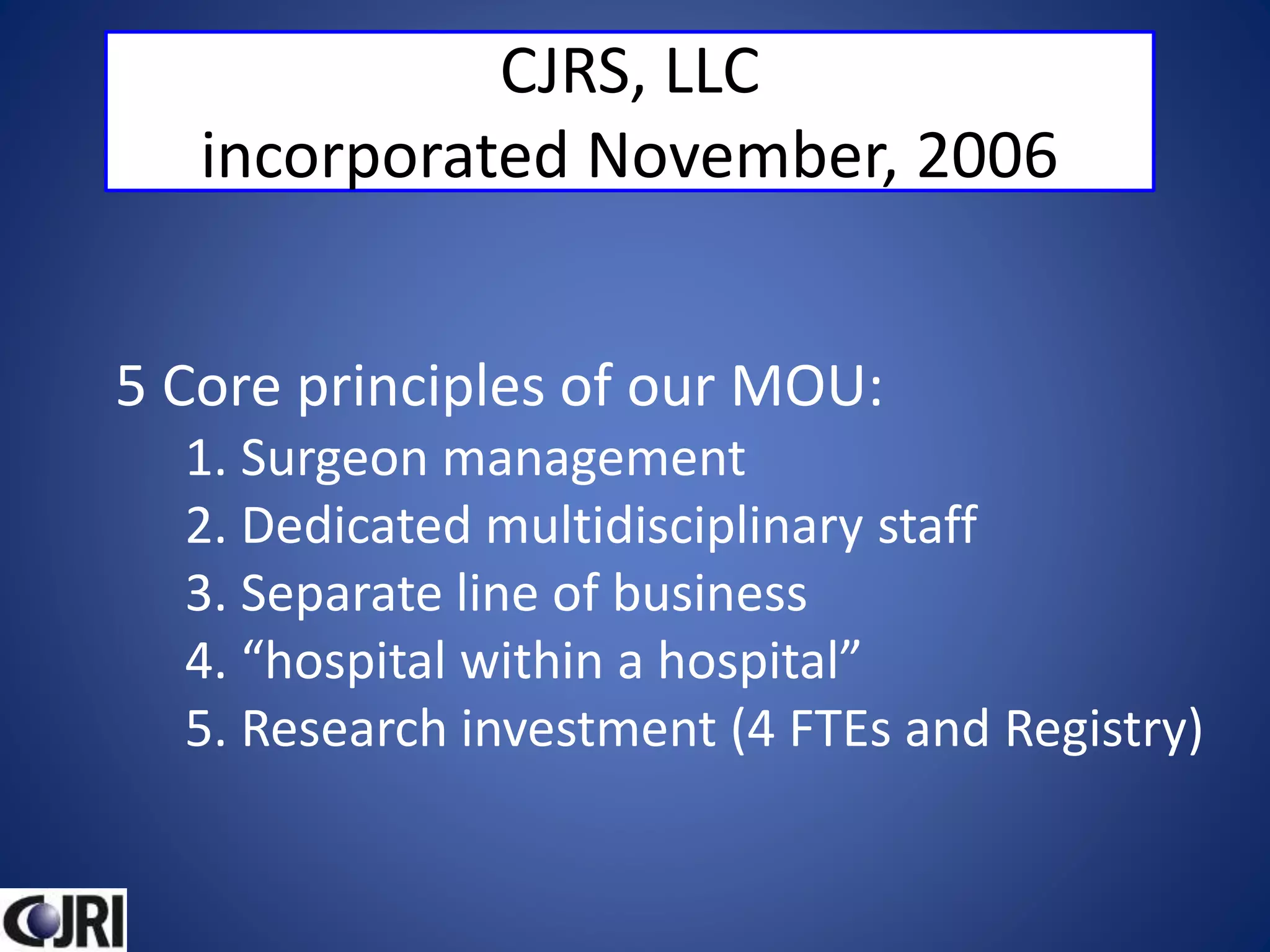
CJRS, LLC
incorporated November, 2006
5 Core principles of our MOU:
1. Surgeon management
2. Dedicated multidisciplinary staff
3. Separate line of business
4. “hospital within a hospital”
5. Research investment (4 FTEs and Registry)
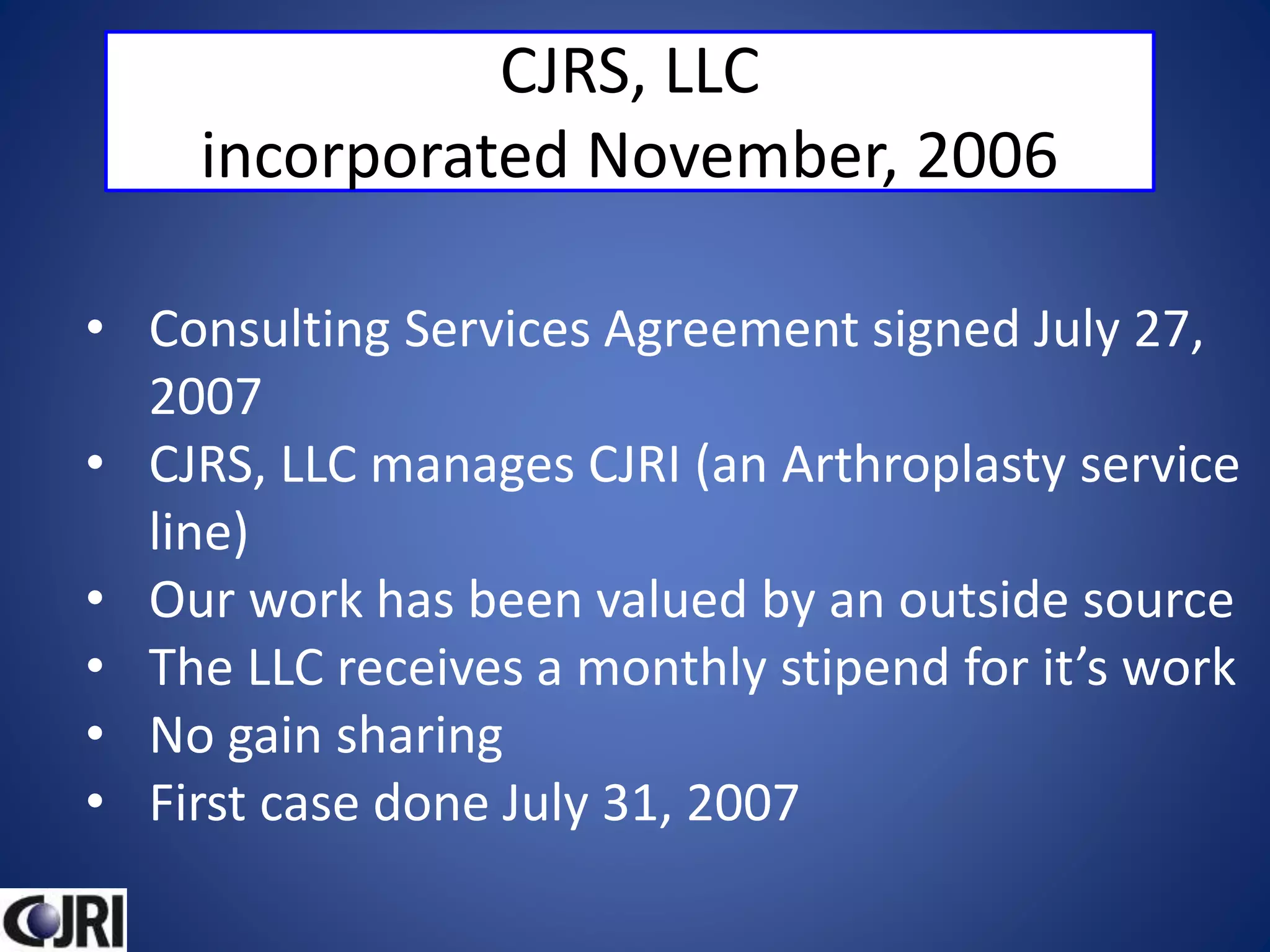
CJRS, LLC
incorporated November, 2006
• Consulting Services Agreement signed July 27,
2007
• CJRS, LLC manages CJRI (an Arthroplasty service
line)
• Our work has been valued by an outside source
• The LLC receives a monthly stipend for it’s work
• No gain sharing
• First case done July 31, 2007
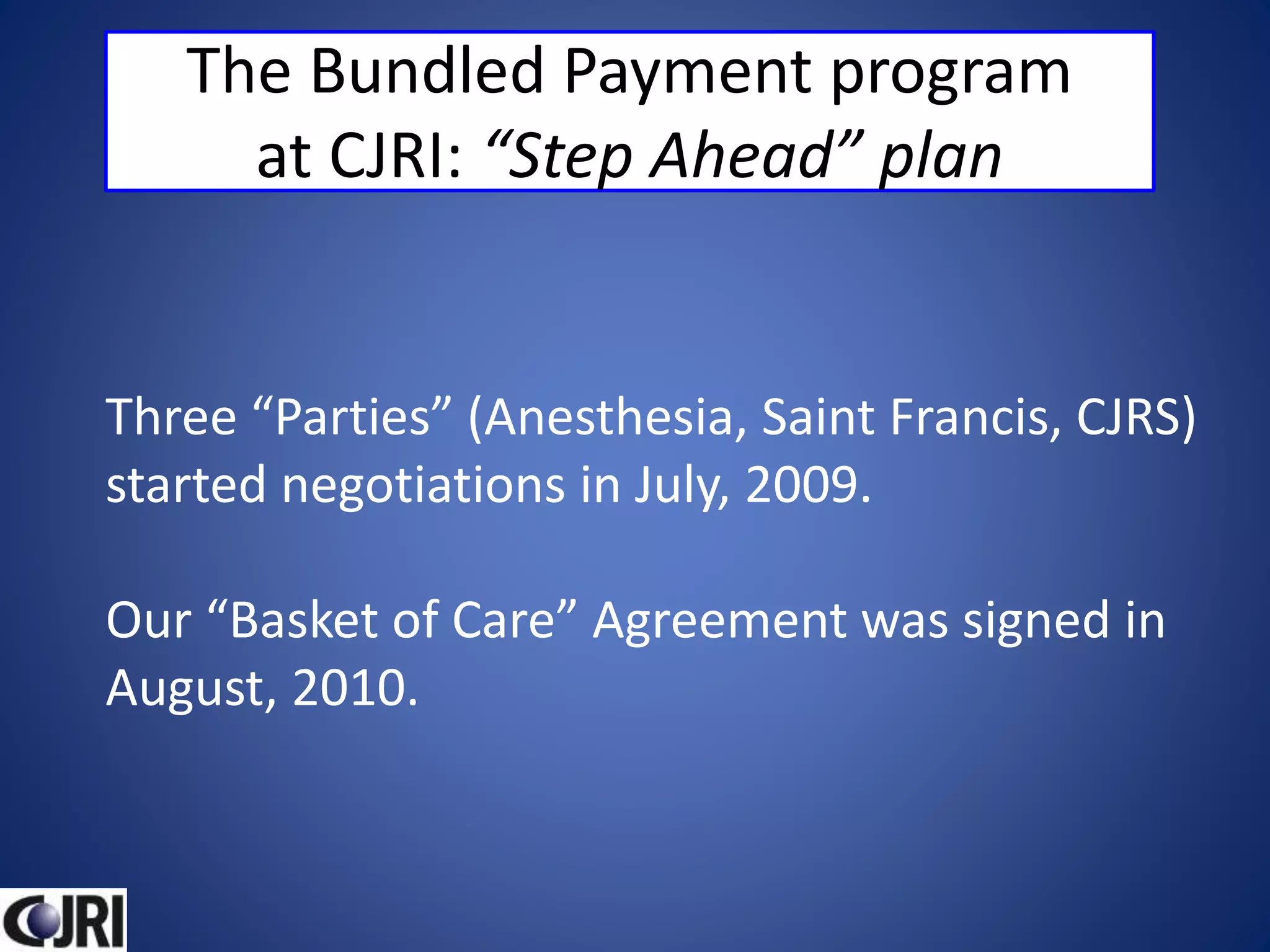
The Bundled Payment program
at CJRI: “Step Ahead” plan
Three “Parties” (Anesthesia, Saint Francis, CJRS)
started negotiations in July, 2009.
Our “Basket of Care” Agreement was signed in
August, 2010.
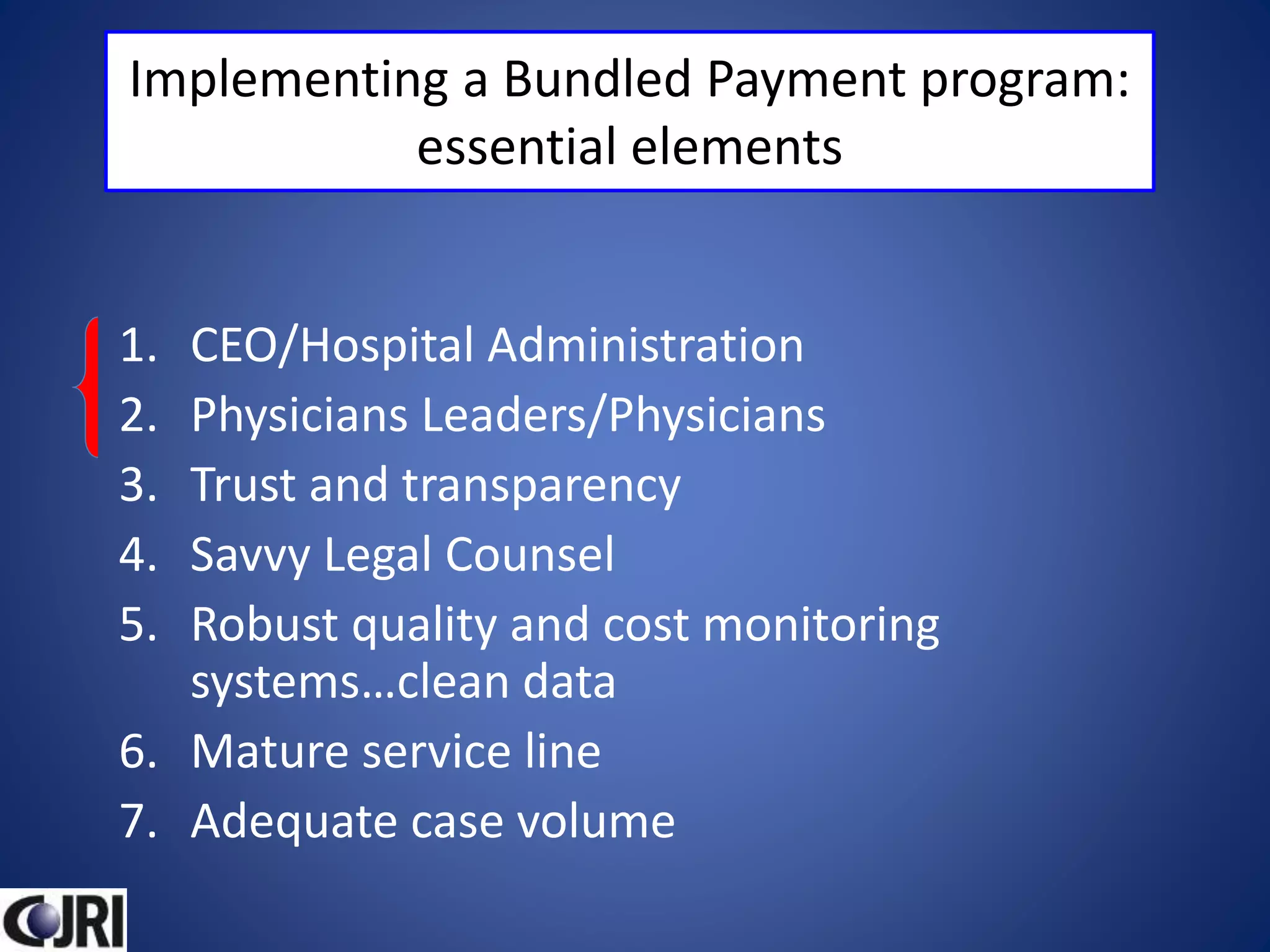
Implementing a Bundled Payment program:
essential elements
1. CEO/Hospital Administration
2. Physicians Leaders/Physicians
3. Trust and transparency
4. Savvy Legal Counsel
5. Robust quality and cost monitoring
systems…clean data
6. Mature service line
7. Adequate case volume
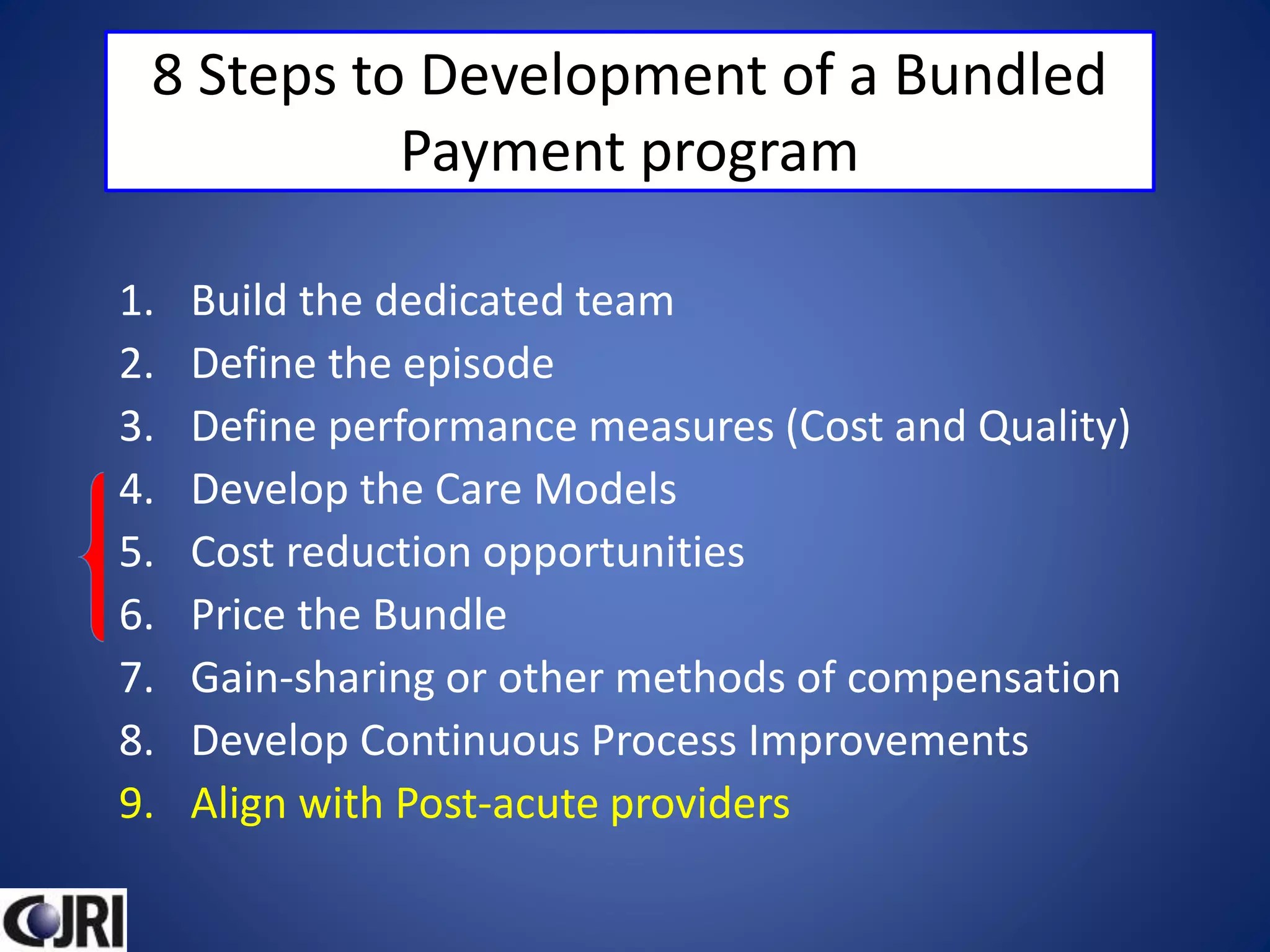
8 Steps to Development of a Bundled
Payment program
1. Build the dedicated team
2. Define the episode
3. Define performance measures (Cost and Quality)
4. Develop the Care Models
5. Cost reduction opportunities
6. Price the Bundle
7. Gain-sharing or other methods of compensation
8. Develop Continuous Process Improvements
9. Align with Post-acute providers
1. Build the dedicated team
For the effort to succeed, there needs to
be a “cultural transformation” focused
on creation of a new healthcare delivery
model
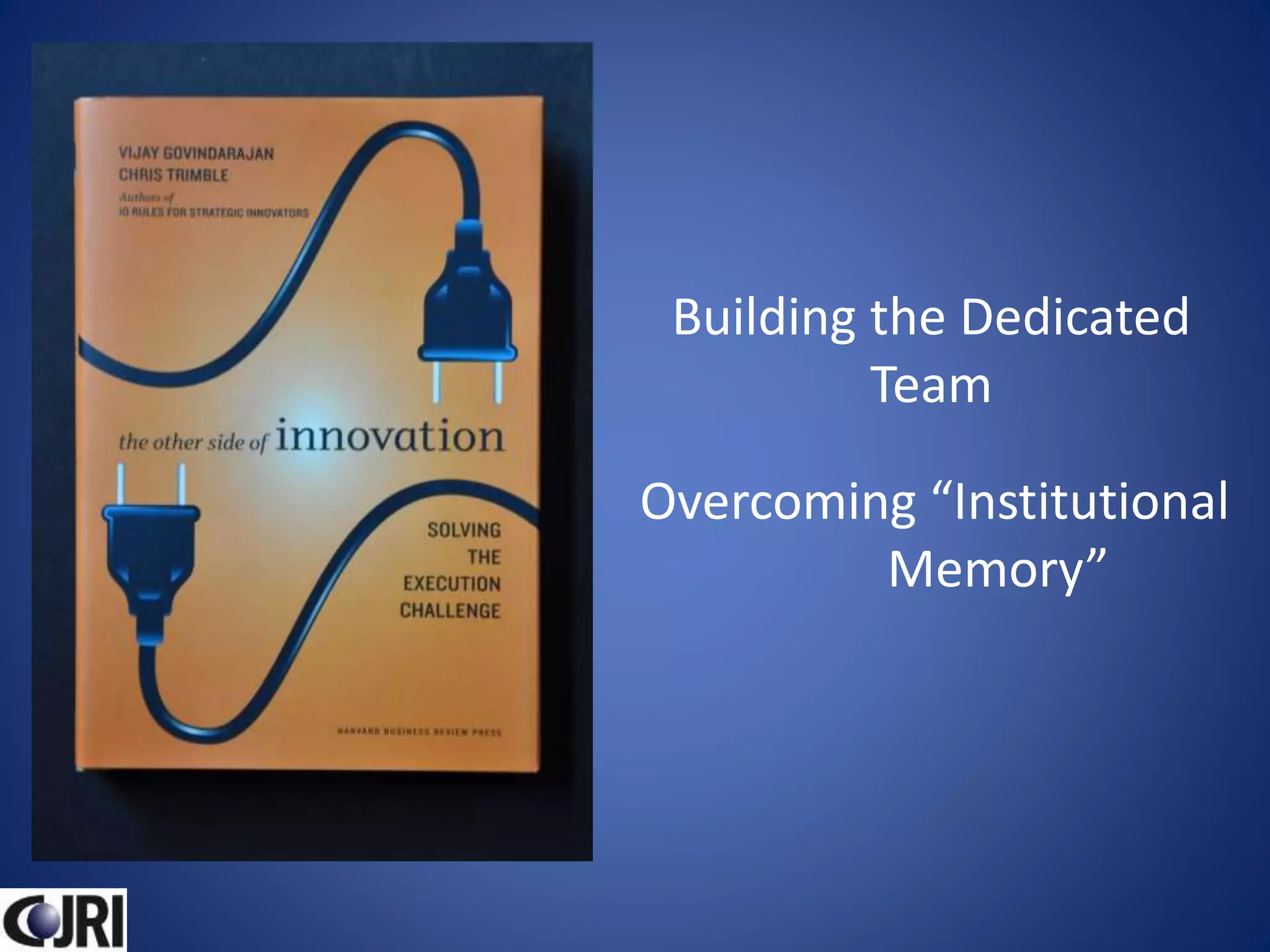
Building the Dedicated
Team
Overcoming “Institutional
Memory”
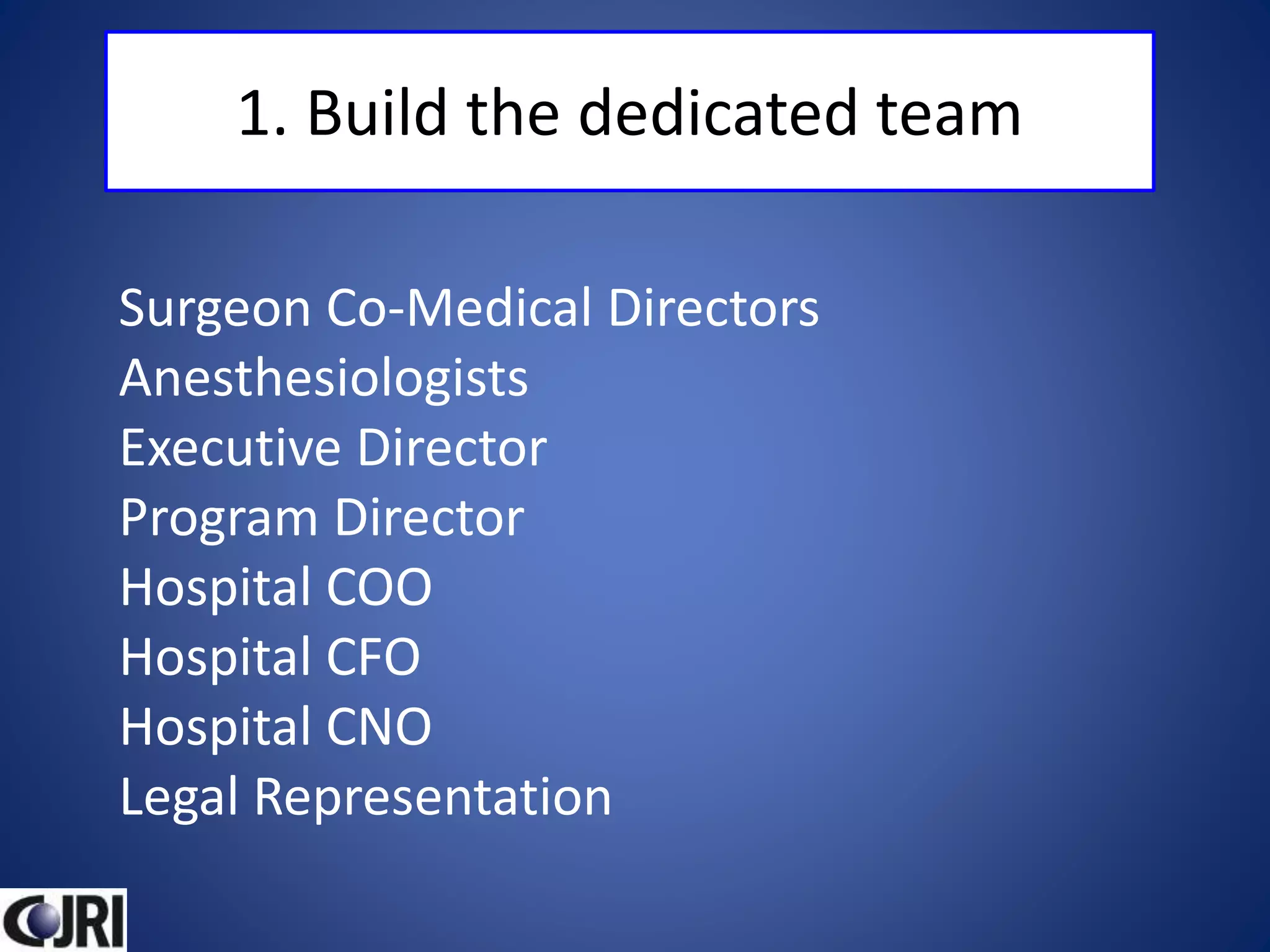
1. Build the dedicated team
Surgeon Co-Medical Directors
Anesthesiologists
Executive Director
Program Director
Hospital COO
Hospital CFO
Hospital CNO
Legal Representation
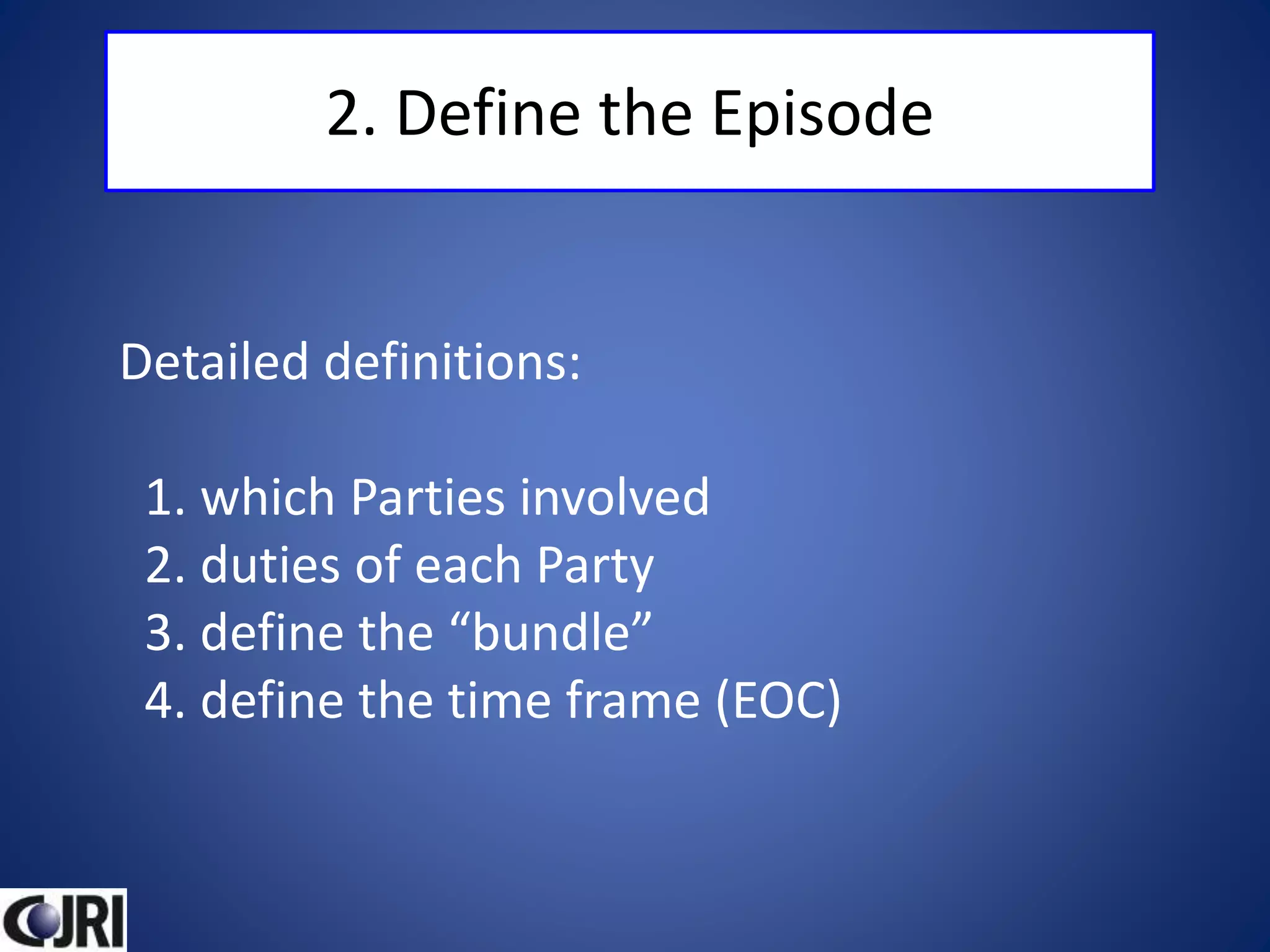
2. Define the Episode
Detailed definitions:
1. which Parties involved
2. duties of each Party
3. define the “bundle”
4. define the time frame (EOC)
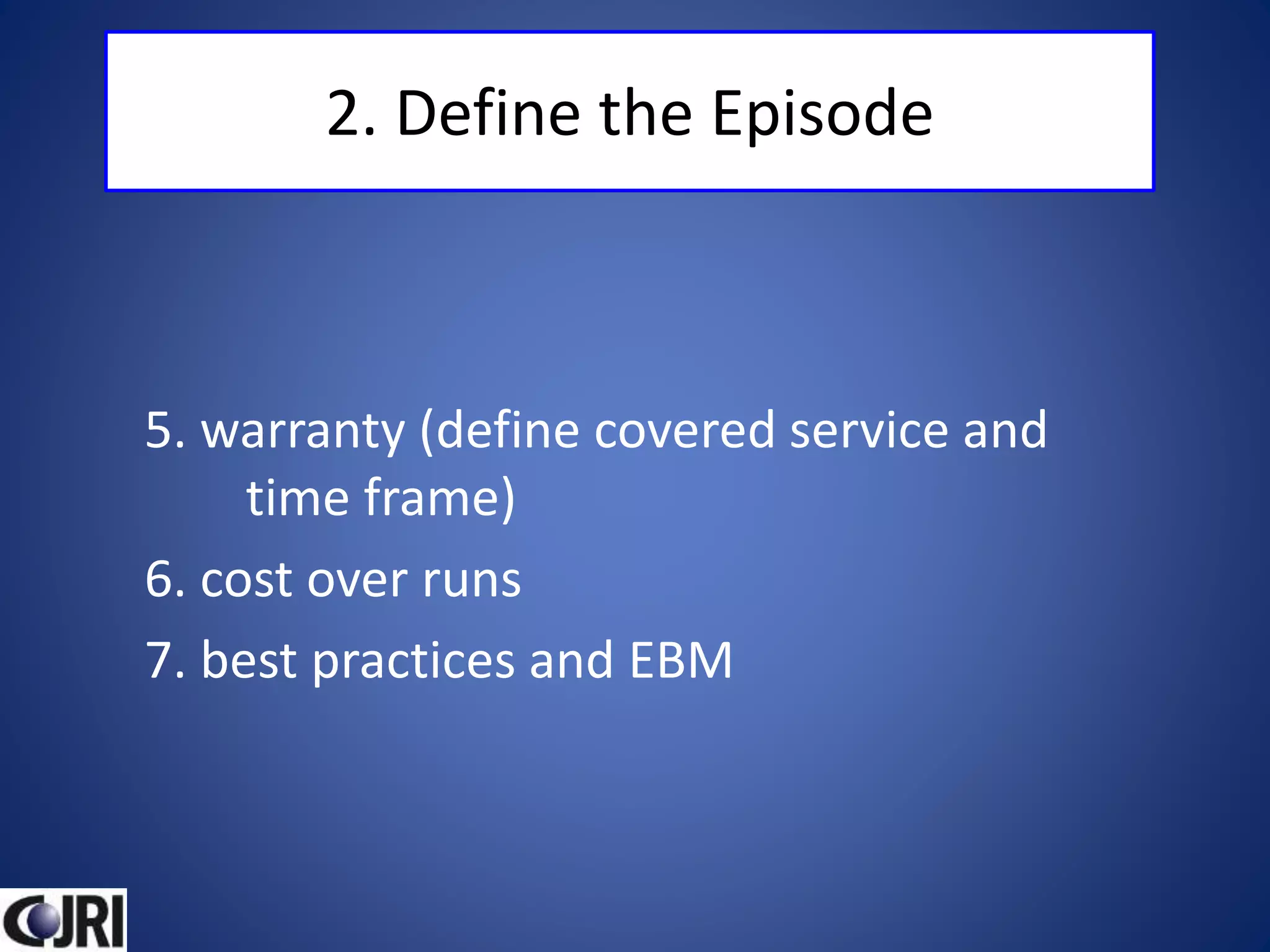
2. Define the Episode
5. warranty (define covered service and
time frame)
6. cost over runs
7. best practices and EBM
2. Define the Episode
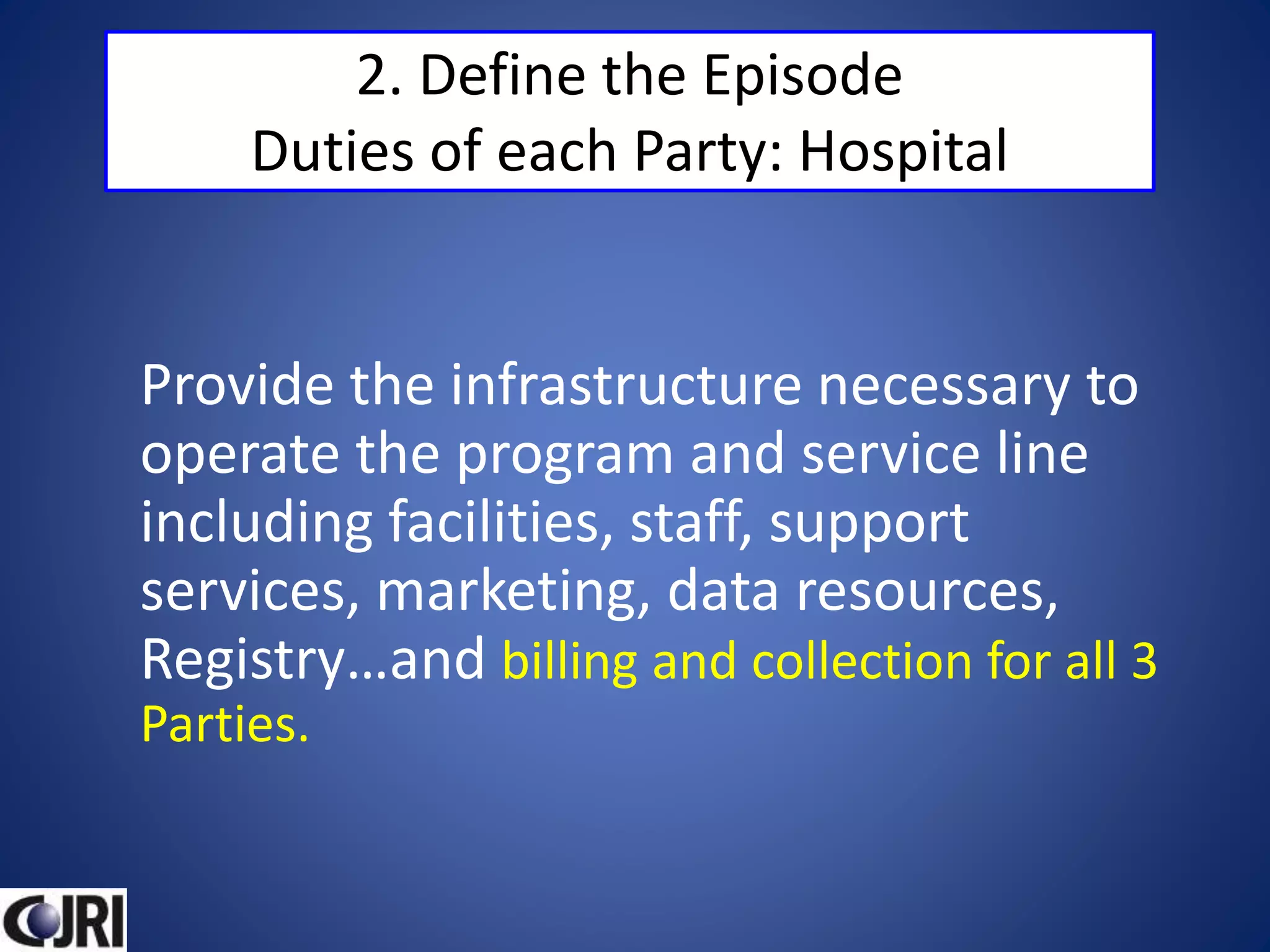
Duties of each Party: Hospital
Provide the infrastructure necessary to
operate the program and service line
including facilities, staff, support
services, marketing, data resources,
Registry…and billing and collection for all 3
Parties.
2. Define the Episode
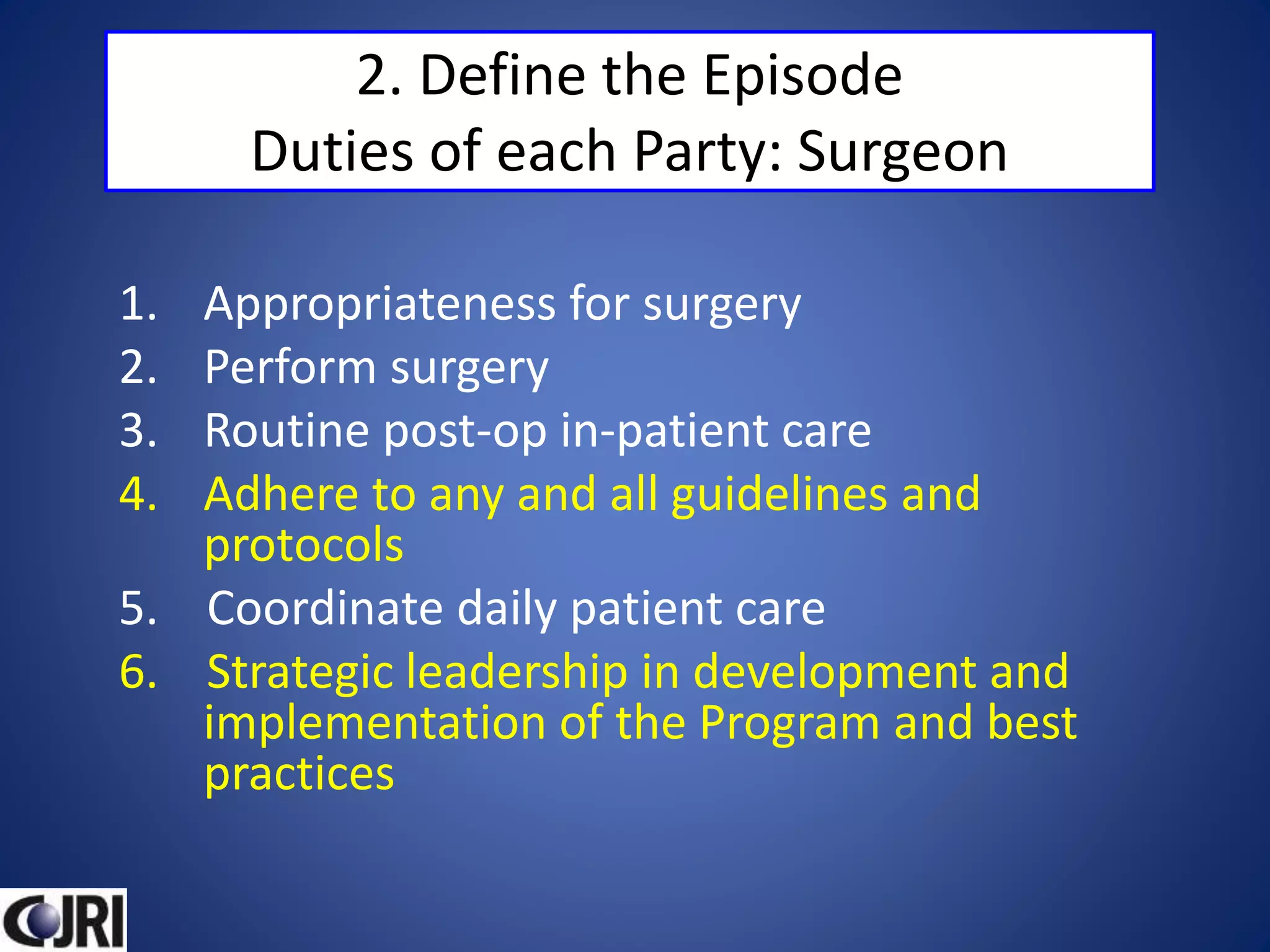
Duties of each Party: Surgeon
1. Appropriateness for surgery
2. Perform surgery
3. Routine post-op in-patient care
4. Adhere to any and all guidelines and
protocols
5. Coordinate daily patient care
6. Strategic leadership in development and
implementation of the Program and best
practices
2. Define the Episode
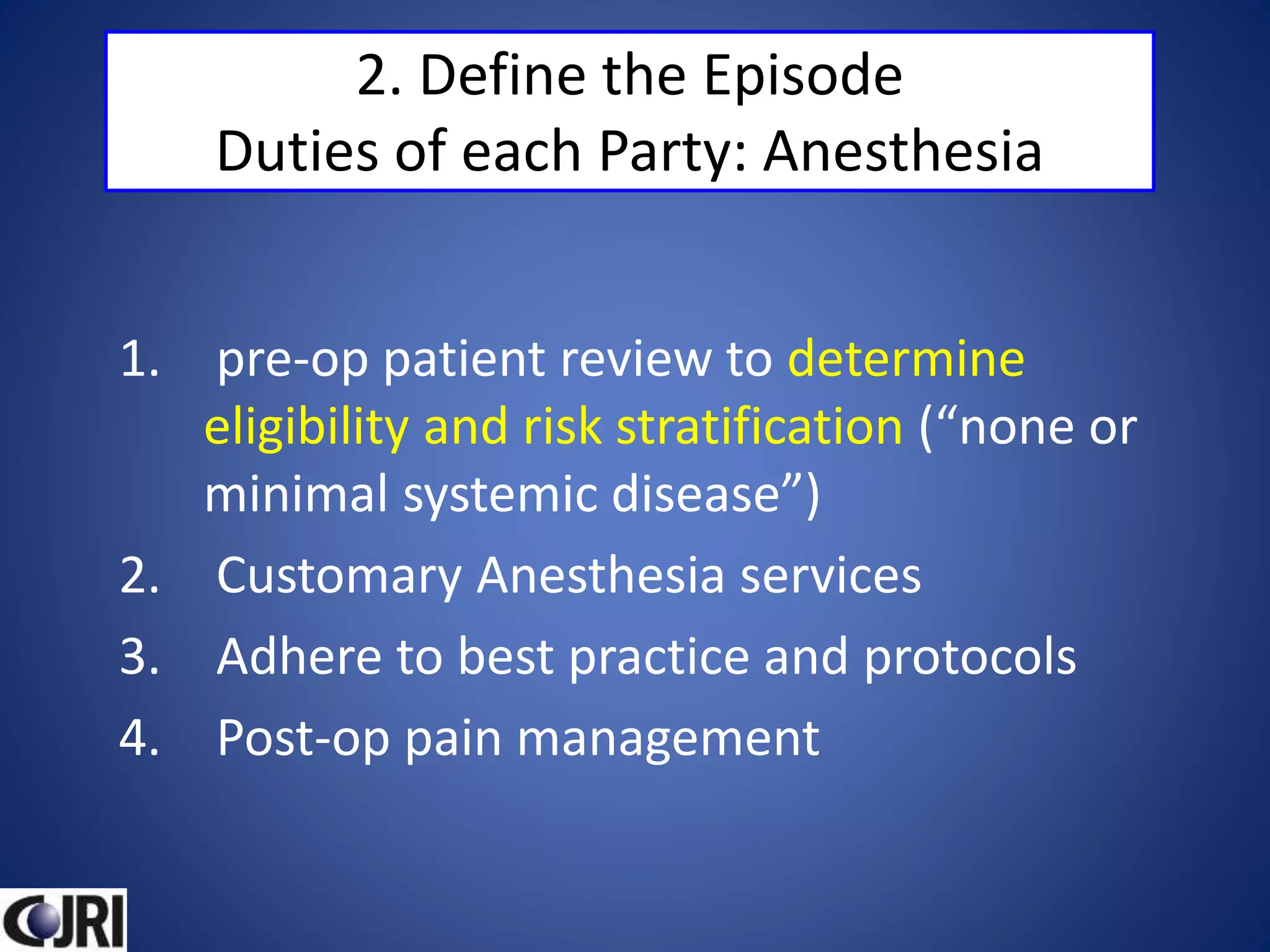
Duties of each Party: Anesthesia
1. pre-op patient review to determine
eligibility and risk stratification (“none or
minimal systemic disease”)
2. Customary Anesthesia services
3. Adhere to best practice and protocols
4. Post-op pain management
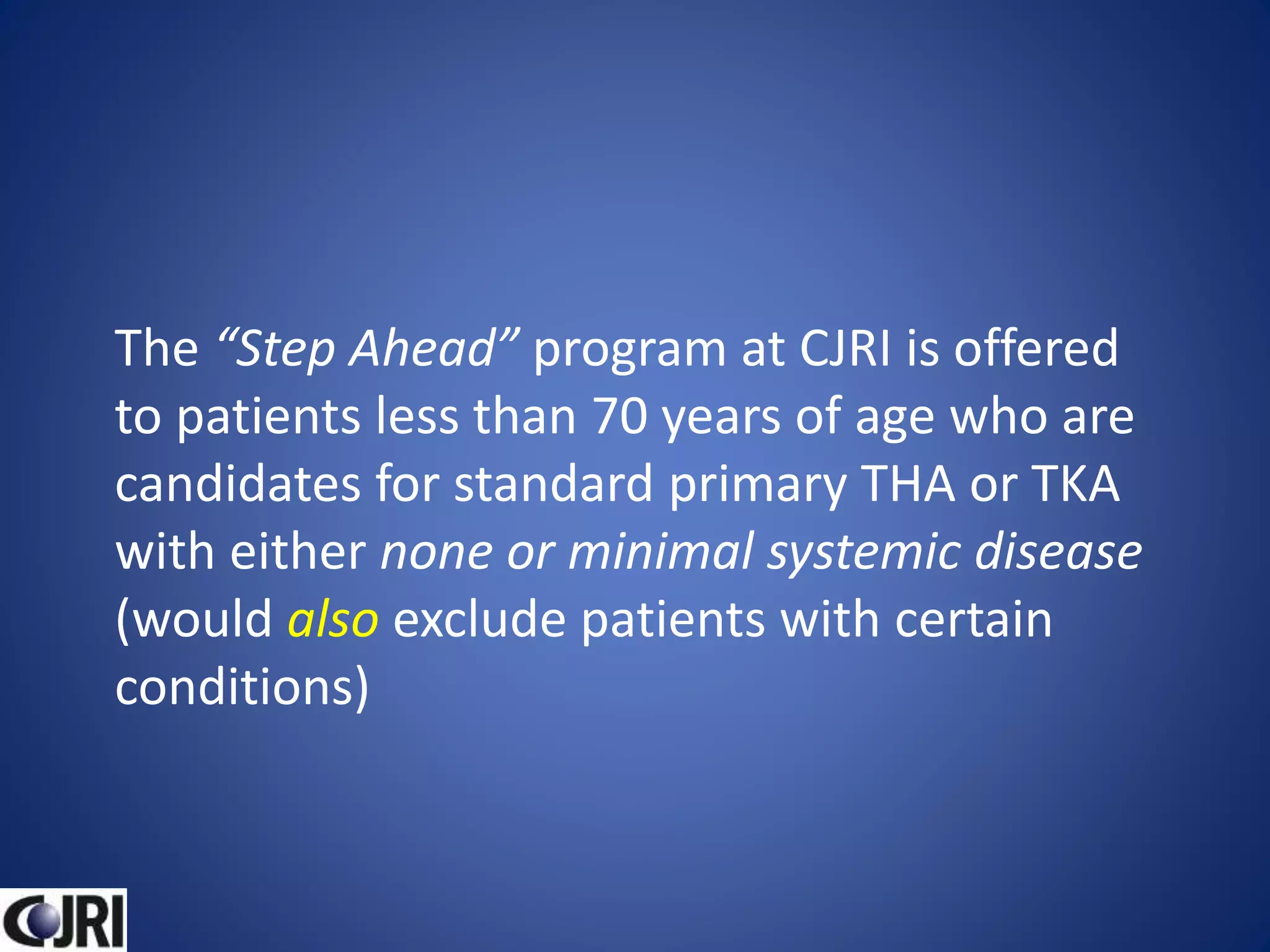
The “Step Ahead” program at CJRI is offered
to patients less than 70 years of age who are
candidates for standard primary THA or TKA
with either none or minimal systemic disease
(would also exclude patients with certain
conditions)
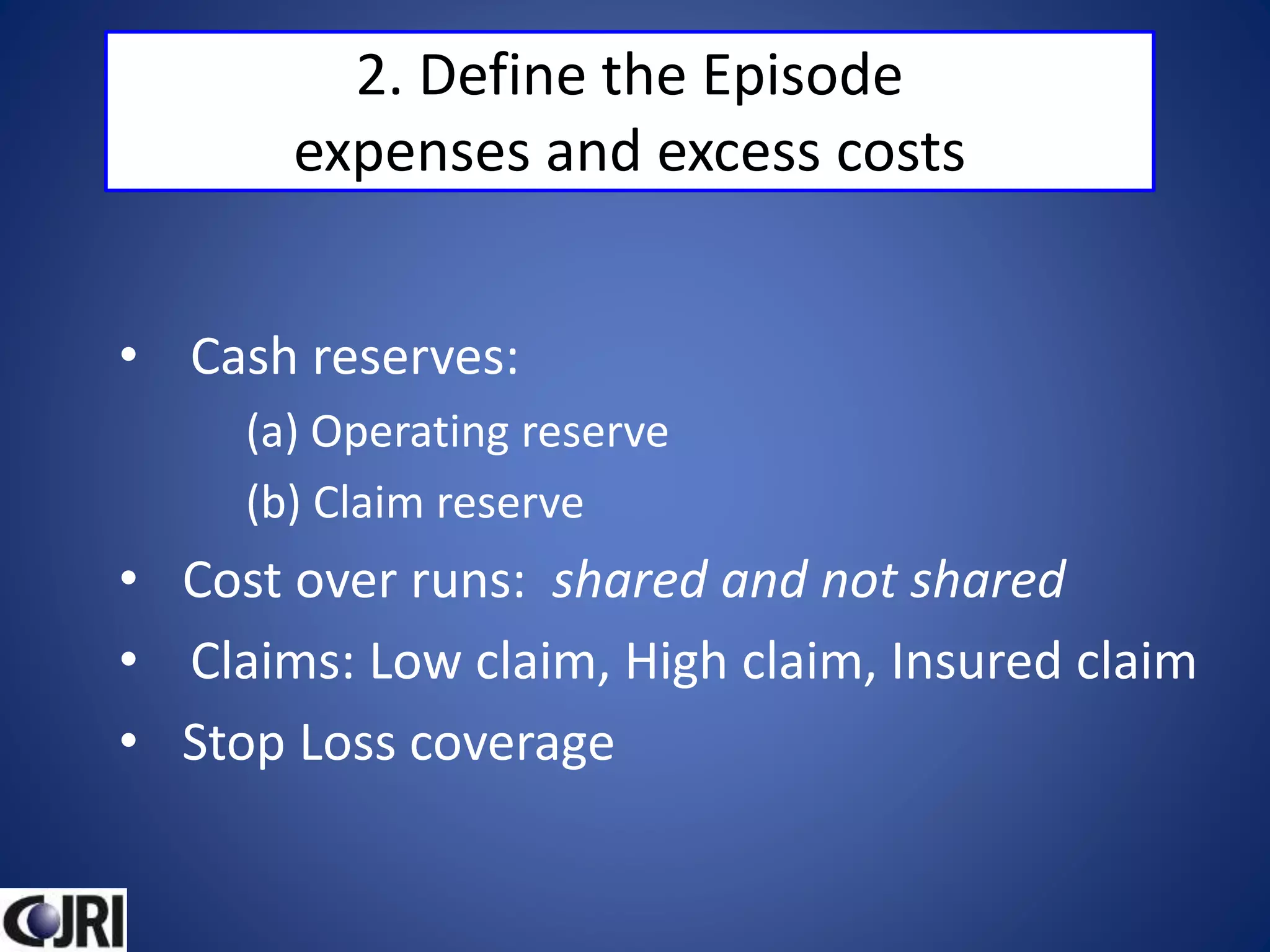
2. Define the Episode
expenses and excess costs
• Cash reserves:
(a) Operating reserve
(b) Claim reserve
• Cost over runs: shared and not shared
• Claims: Low claim, High claim, Insured claim
• Stop Loss coverage
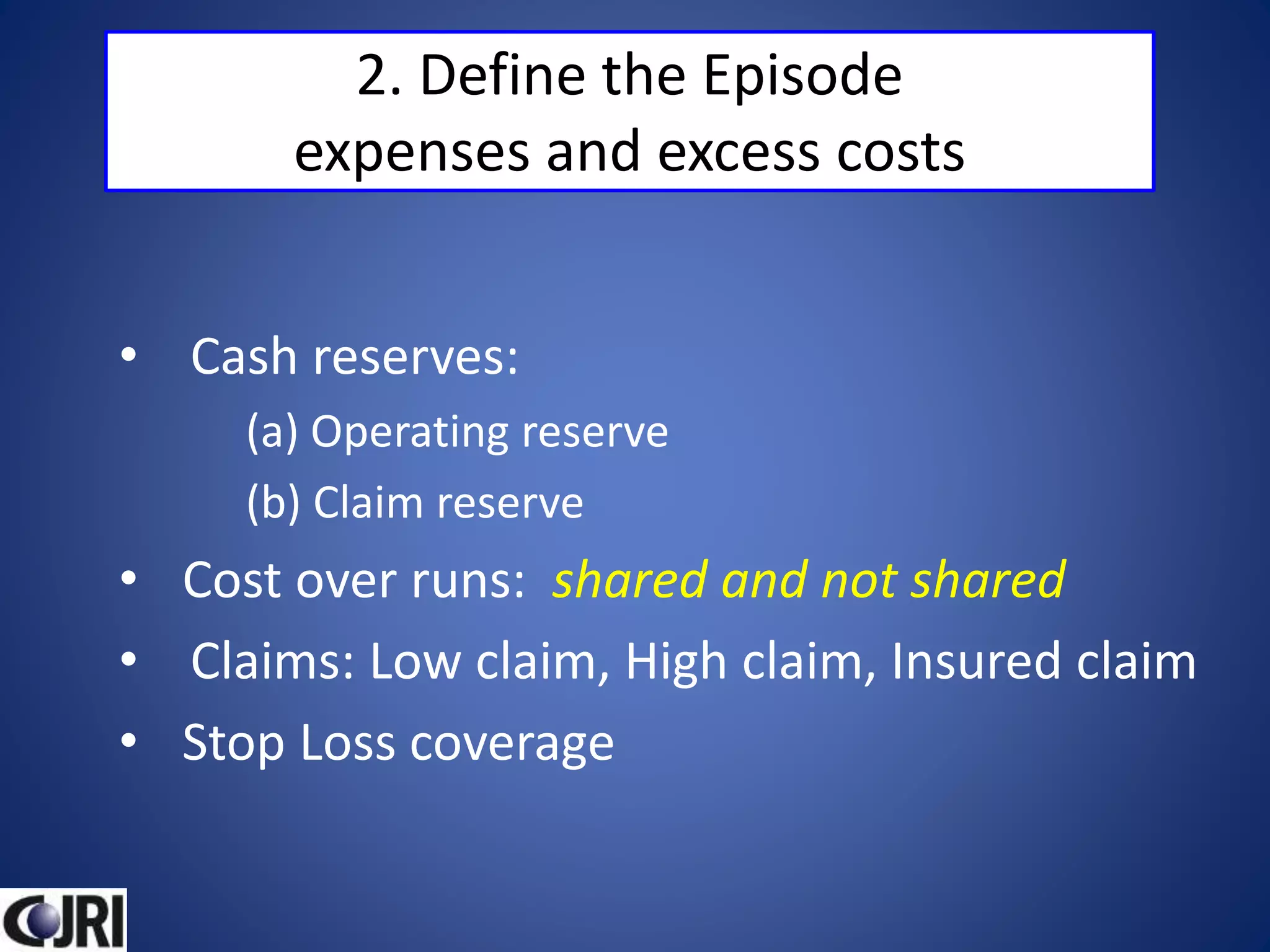
2. Define the Episode
expenses and excess costs
• Cash reserves:
(a) Operating reserve
(b) Claim reserve
• Cost over runs: shared and not shared
• Claims: Low claim, High claim, Insured claim
• Stop Loss coverage
Excess costs: not shared
“Excess costs resulting from unwarranted or
deliberate deviation from the approved
protocols.”
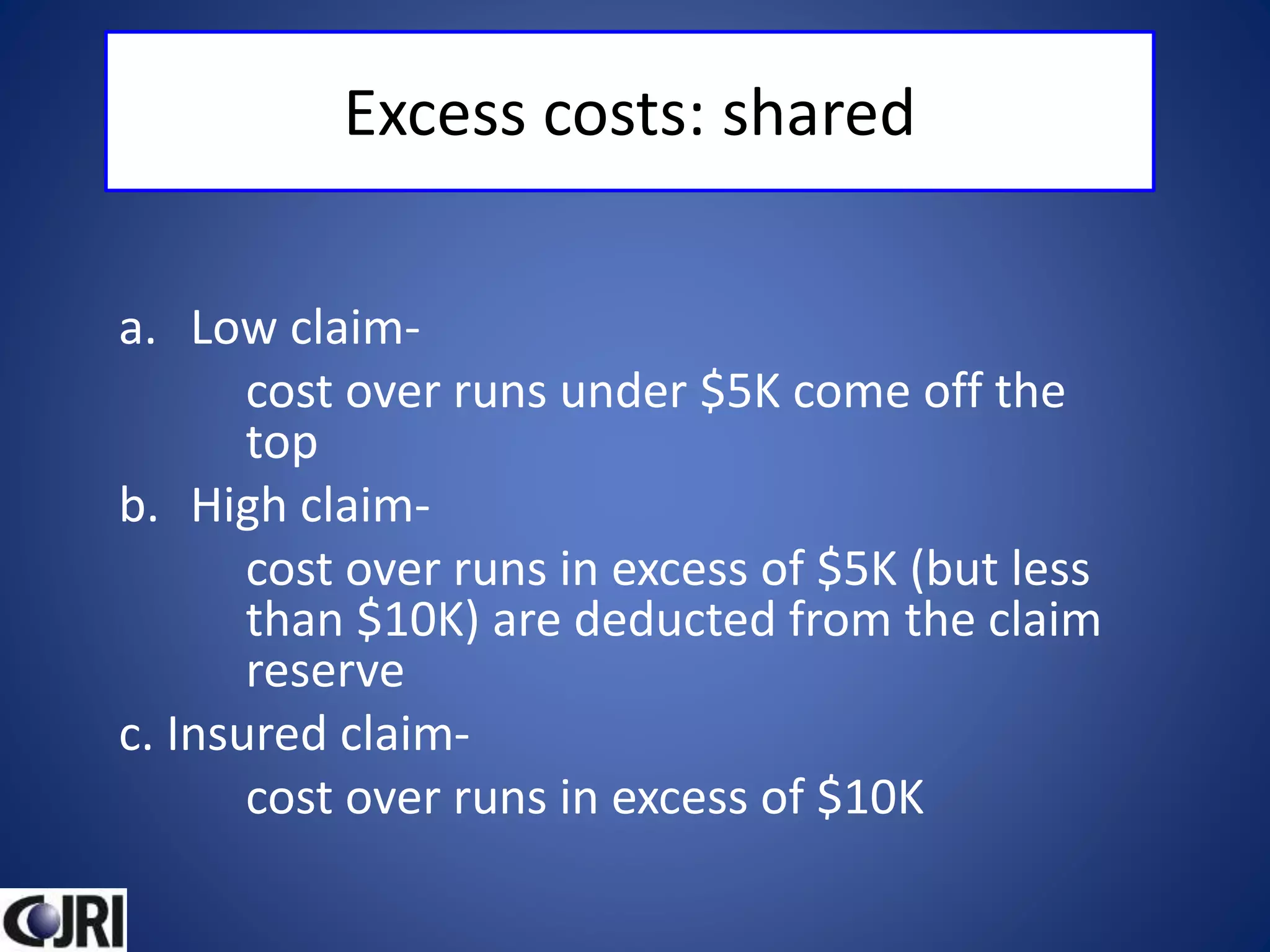
Excess costs: shared
a. Low claim-
cost over runs under $5K come off the
top
b. High claim-
cost over runs in excess of $5K (but less
than $10K) are deducted from the claim
reserve
c. Insured claim-
cost over runs in excess of $10K
“Step Ahead”
Stop Loss policy
Provided by our Med Malpractice carrier
$250,000 annual contract limit
$10K deductible per claim
Shared excess costs greater than $10K
become an “Insured claim”
2. Define the Episode
Patient Warranty
Negotiable terms
Re-admissions for surgical site complications:
wound complications (hematomas,
infections, cellulitis, dehiscence)
peri-prosthetic fractures
instability
3. Define Performance Measures:
Cost
Outcomes and Quality
Patient Reported Outcomes
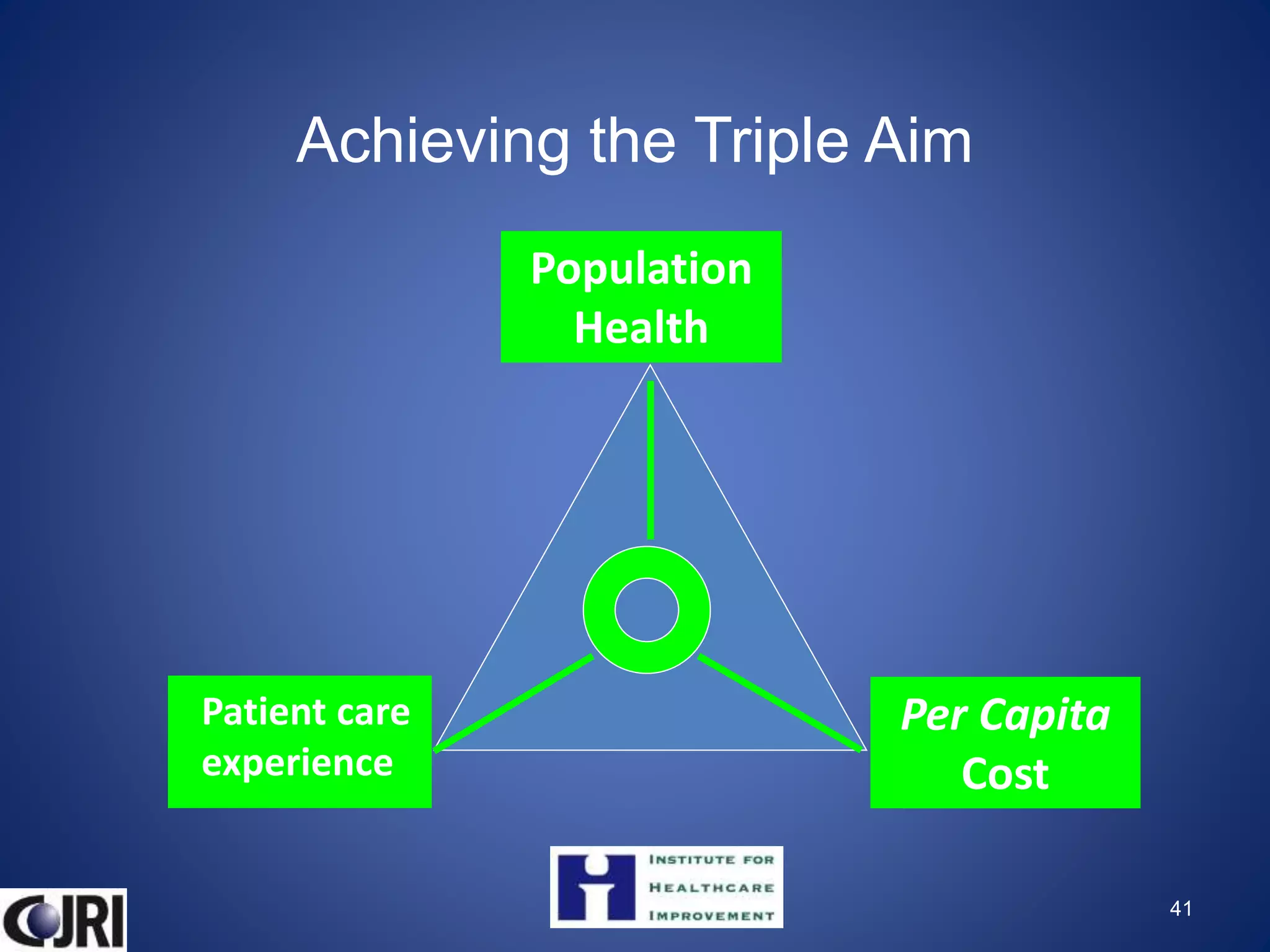
Achieving the Triple Aim
Population
Health
Per Capita
Cost
41
Patient care
experience
3. Define Performance Measures:
Cost
Hospital cost/case
Surgeon’s cost for services
Anesthesia cost for services
Cost/case for re-admissions
3. Define Performance Measures:
Outcomes and Quality
Re-admissions (30, 60 90 day)
Complications (30, 60, 90 day)
HCAHPS scores
SCIP measures
Press Ganey scores
LOS
Post-acute discharge (home vs ECF)
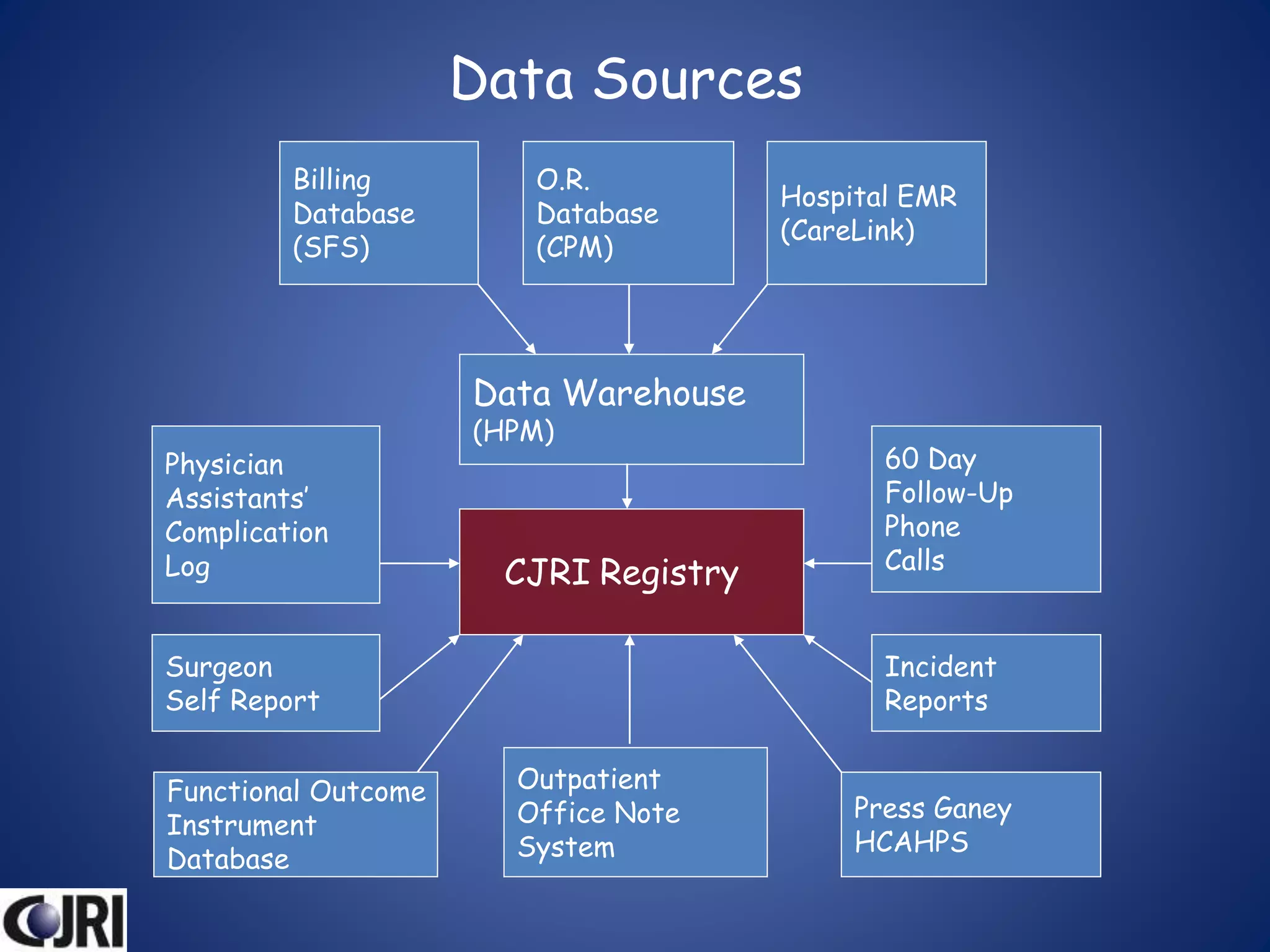
Data Sources
Billing
Database
(SFS)
O.R.
Database
(CPM)
Hospital EMR
(CareLink)
Data Warehouse
(HPM)
CJRI Registry
Physician
Assistants’
Complication
Log
Surgeon
Self Report
Incident
Reports
60 Day
Follow-Up
Phone
Calls
Functional Outcome
Instrument
Database
Outpatient
Office Note
System
Press Ganey
HCAHPS
4. Develop the Care Models
A unique opportunity to map out, end to end,
the patient experience and then perform a
complete care re-design of your program
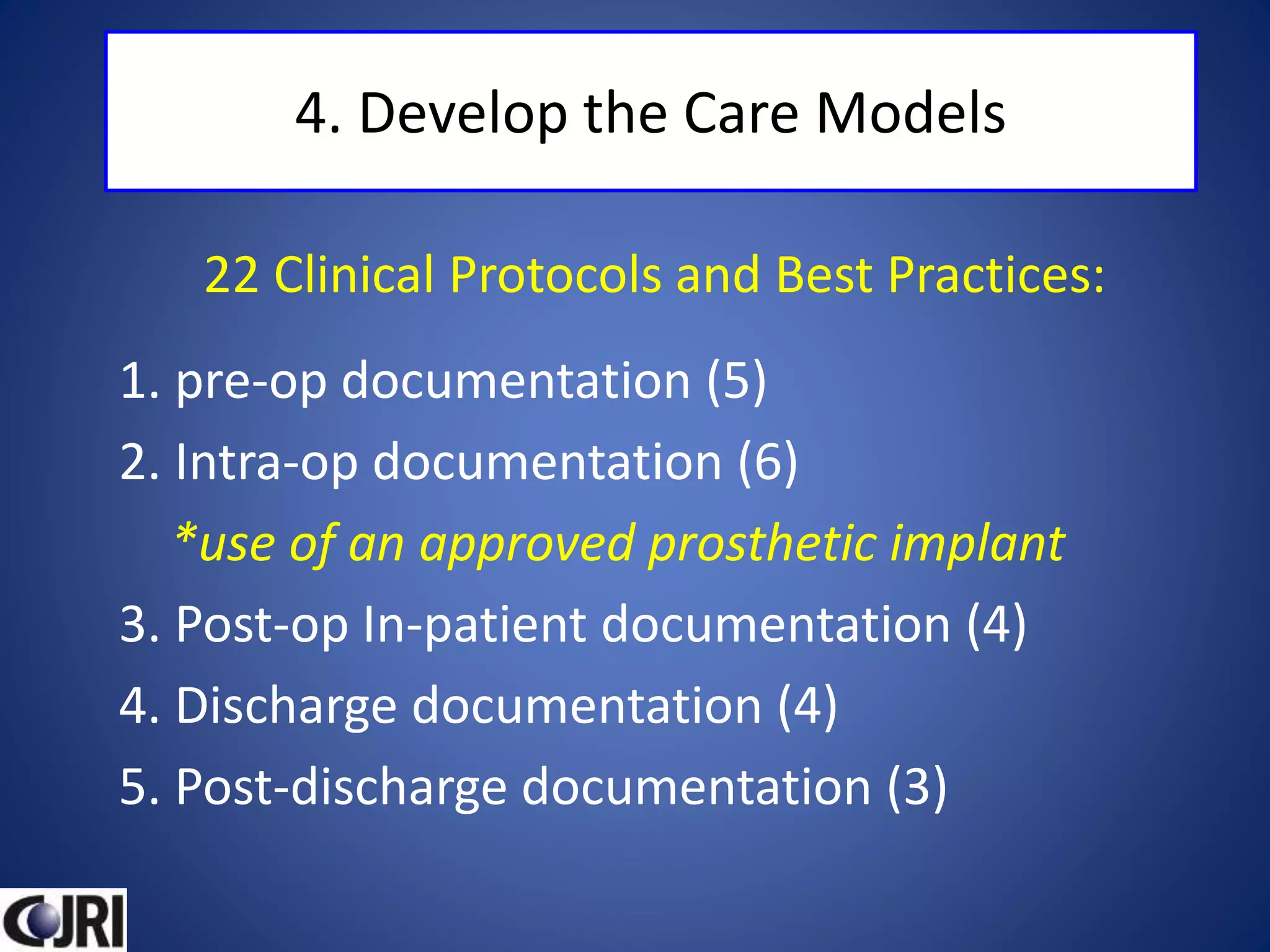
4. Develop the Care Models
1. pre-op documentation (5)
2. Intra-op documentation (6)
*use of an approved prosthetic implant
3. Post-op In-patient documentation (4)
4. Discharge documentation (4)
5. Post-discharge documentation (3)
22 Clinical Protocols and Best Practices:
Physician Agreement and
Acknowledgement
Each Orthopedic surgeon and Anesthesiologist
that performs BP surgery will participate in an
in-service that outlines in detail their specific
responsibilities, the protocols/best practices,
and their own personal financial risks for non-
compliance.
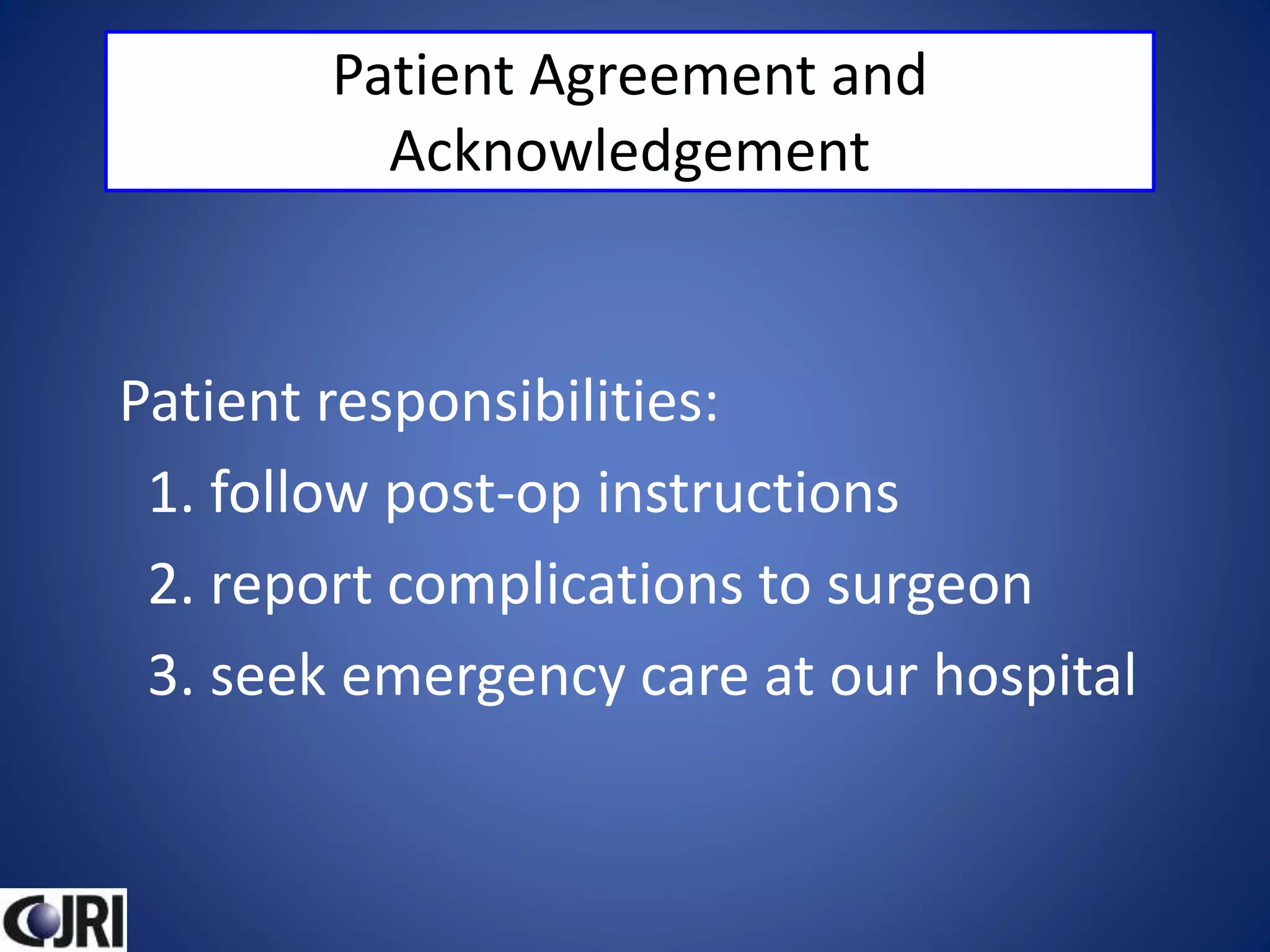
Patient Agreement and
Acknowledgement
Patient responsibilities:
1. follow post-op instructions
2. report complications to surgeon
3. seek emergency care at our hospital
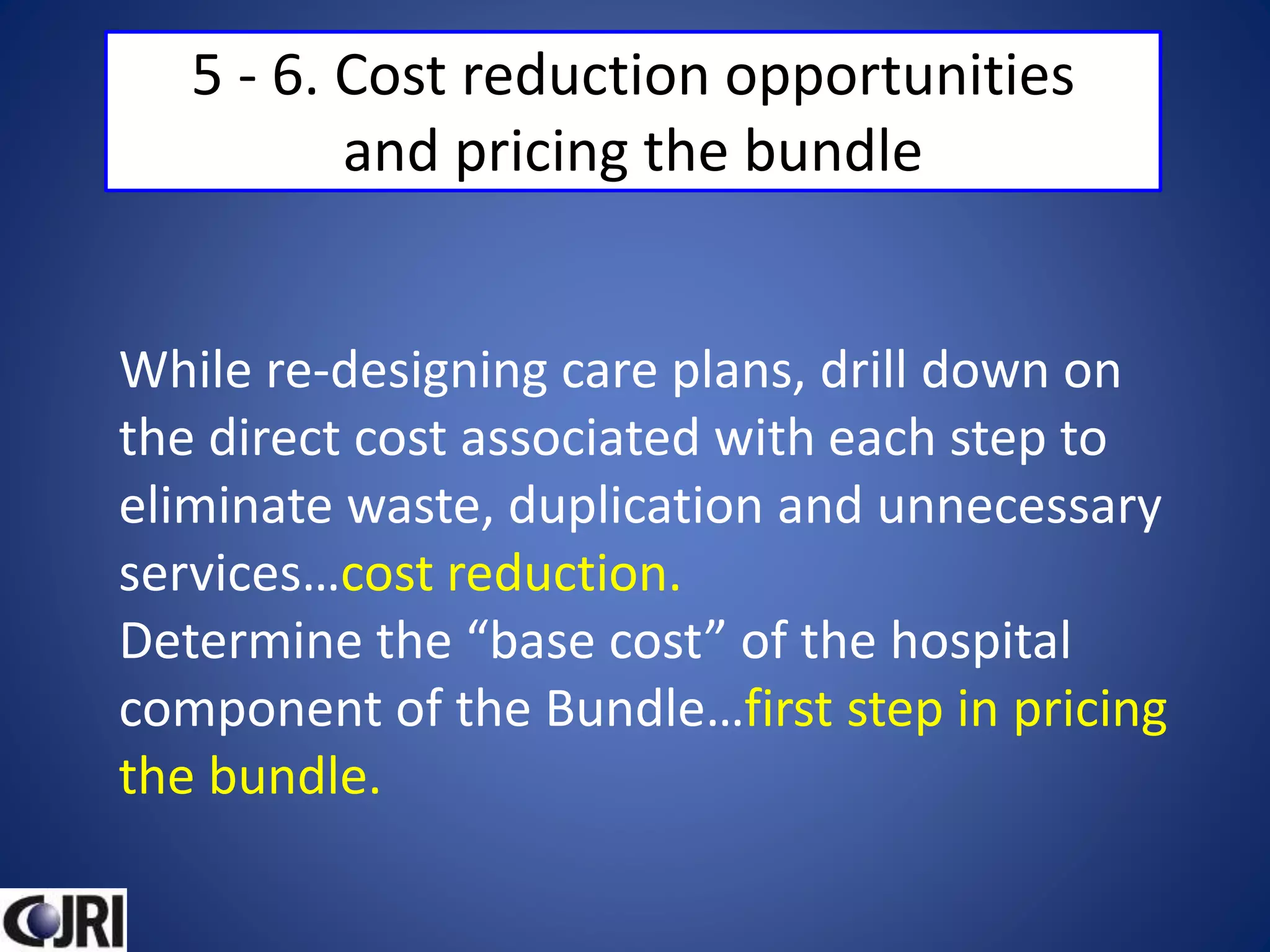
5 - 6. Cost reduction opportunities
and pricing the bundle
While re-designing care plans, drill down on
the direct cost associated with each step to
eliminate waste, duplication and unnecessary
services…cost reduction.
Determine the “base cost” of the hospital
component of the Bundle…first step in pricing
the bundle.
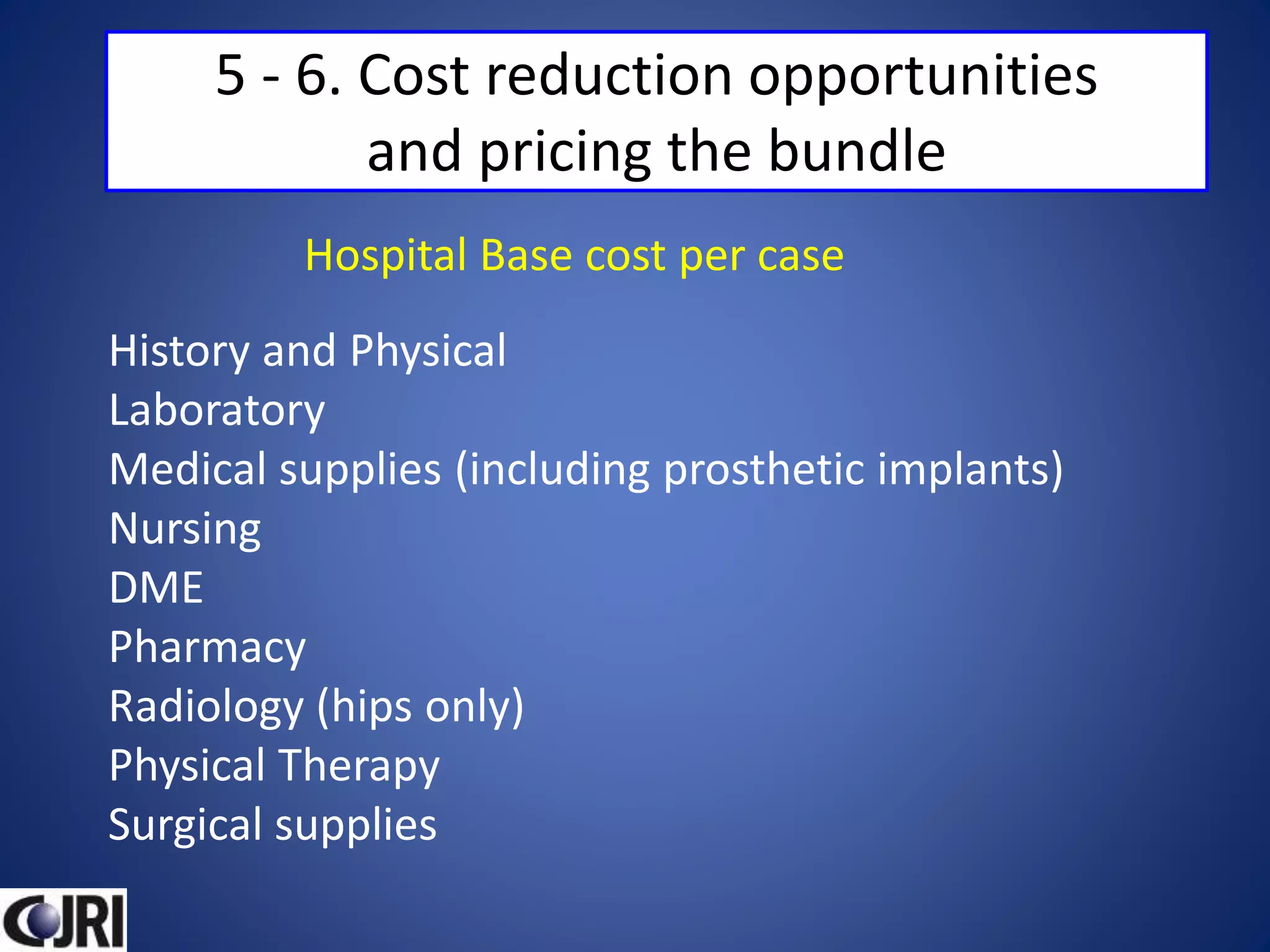
5 - 6. Cost reduction opportunities
and pricing the bundle
History and Physical
Laboratory
Medical supplies (including prosthetic implants)
Nursing
DME
Pharmacy
Radiology (hips only)
Physical Therapy
Surgical supplies
Hospital Base cost per case
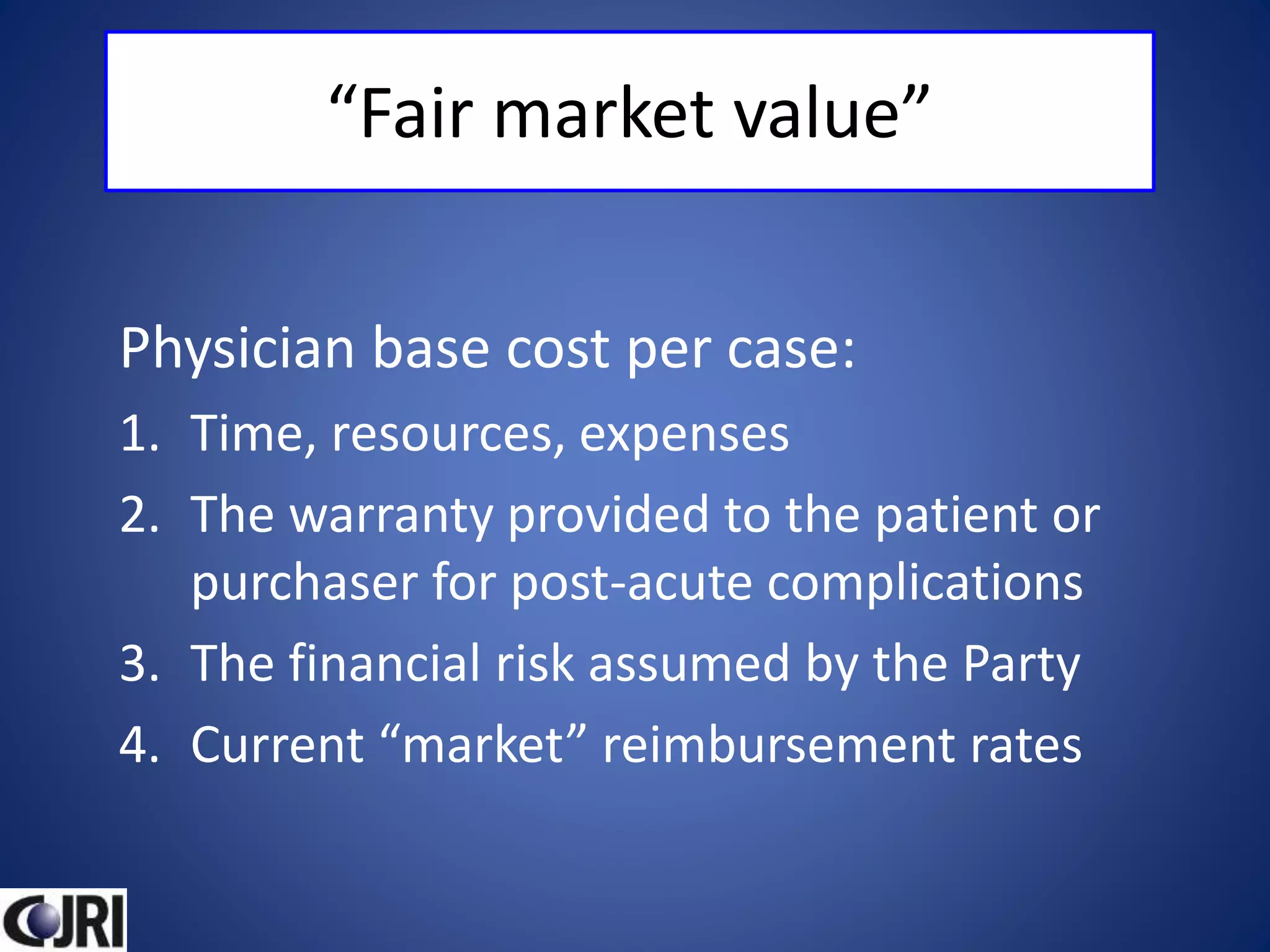
“Fair market value”
Physician base cost per case:
1. Time, resources, expenses
2. The warranty provided to the patient or
purchaser for post-acute complications
3. The financial risk assumed by the Party
4. Current “market” reimbursement rates
5 - 6. Cost reduction opportunities
and pricing the bundle
Surgeon Base cost per case
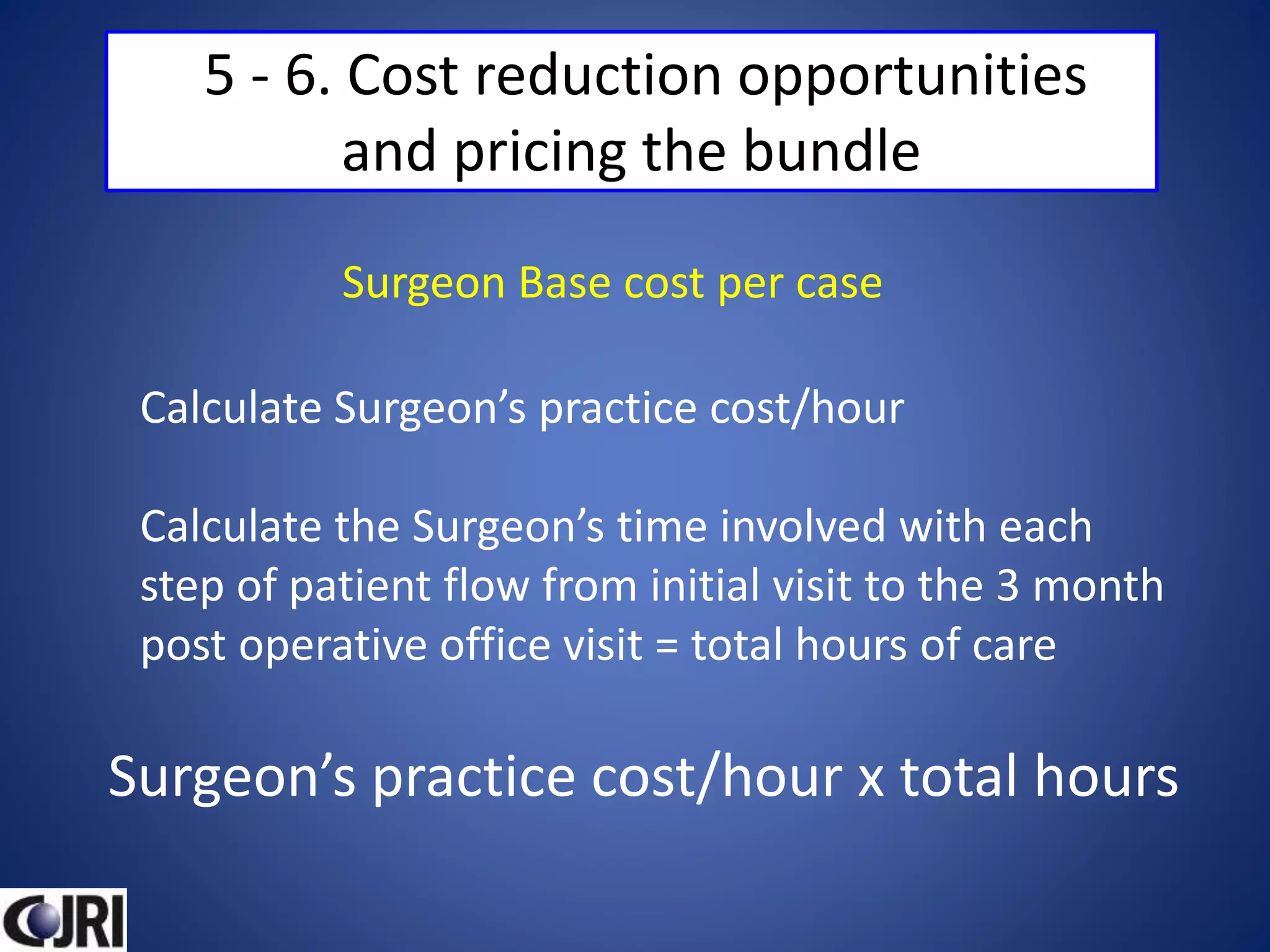
Calculate Surgeon’s practice cost/hour
Calculate the Surgeon’s time involved with each
step of patient flow from initial visit to the 3 month
post operative office visit = total hours of care
Surgeon’s practice cost/hour x total hours
5 - 6. Cost reduction opportunities
and pricing the bundle
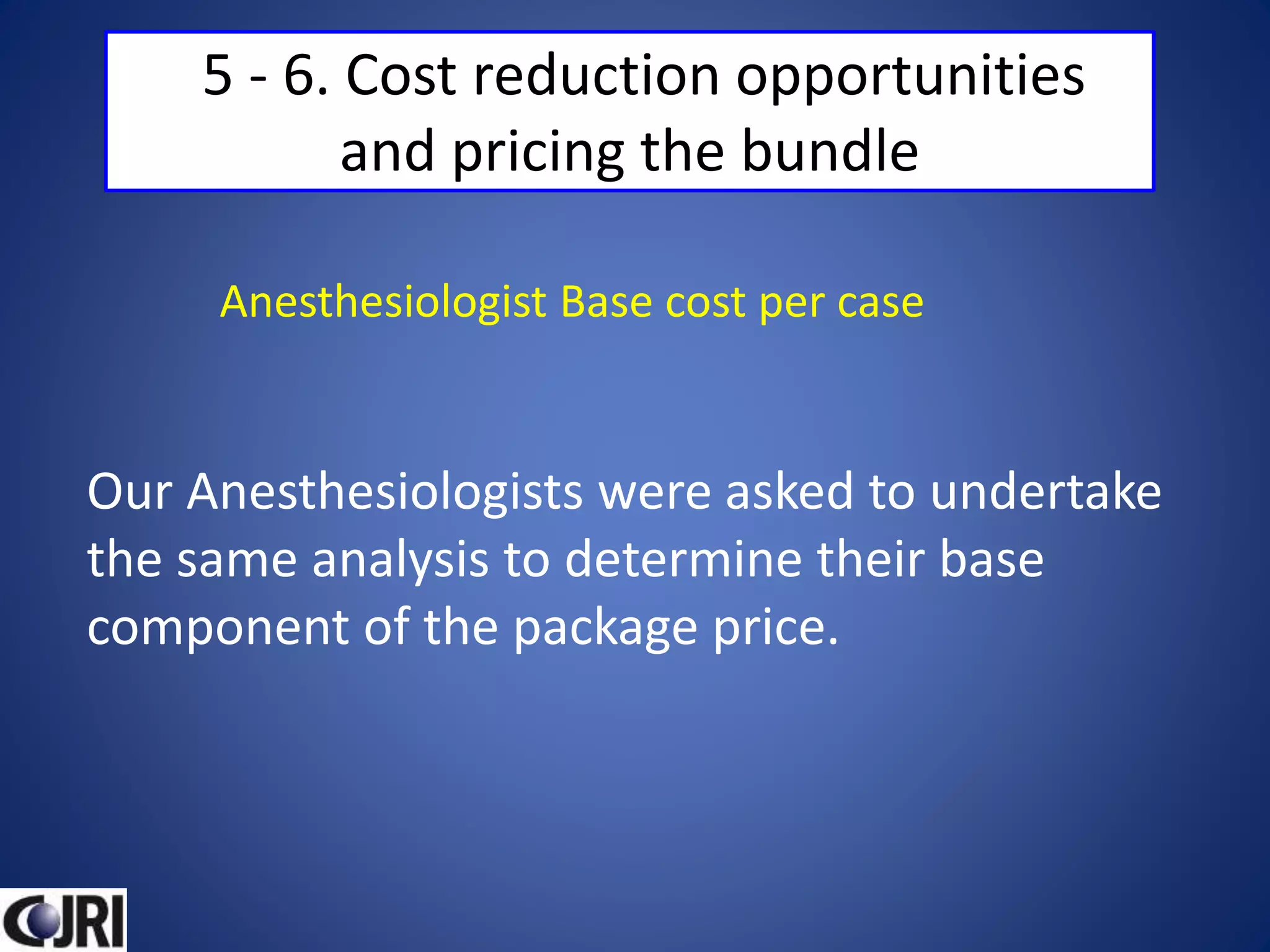
Our Anesthesiologists were asked to undertake
the same analysis to determine their base
component of the package price.
Anesthesiologist Base cost per case
Total Bundled Payment for Primary
THA and TKA
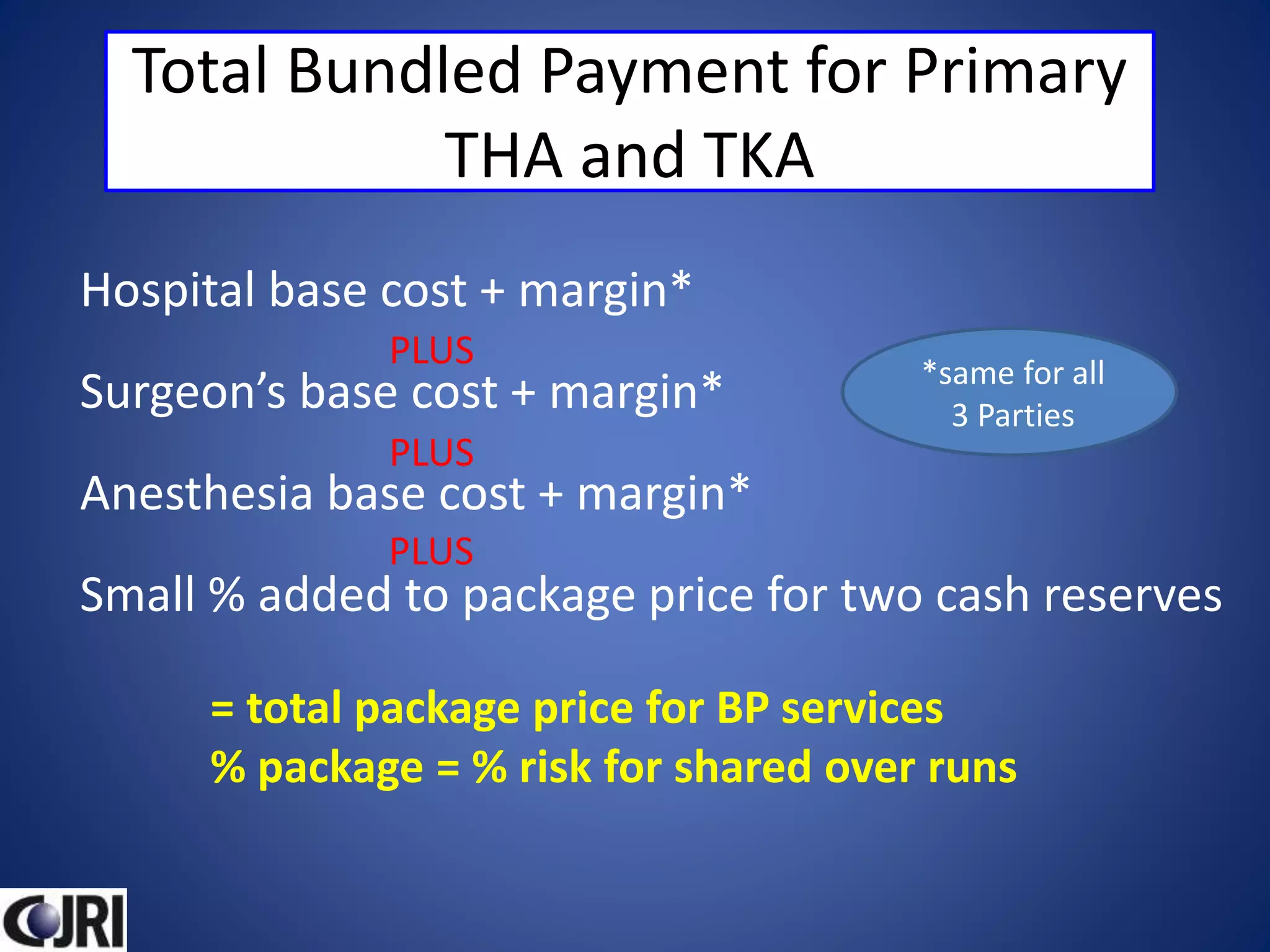
Hospital base cost + margin*
Surgeon’s base cost + margin*
Anesthesia base cost + margin*
Small % added to package price for two cash reserves
PLUS
PLUS
= total package price for BP services
% package = % risk for shared over runs
*same for all
3 Parties
PLUS
5 - 6. Cost reduction opportunities
and pricing the bundle
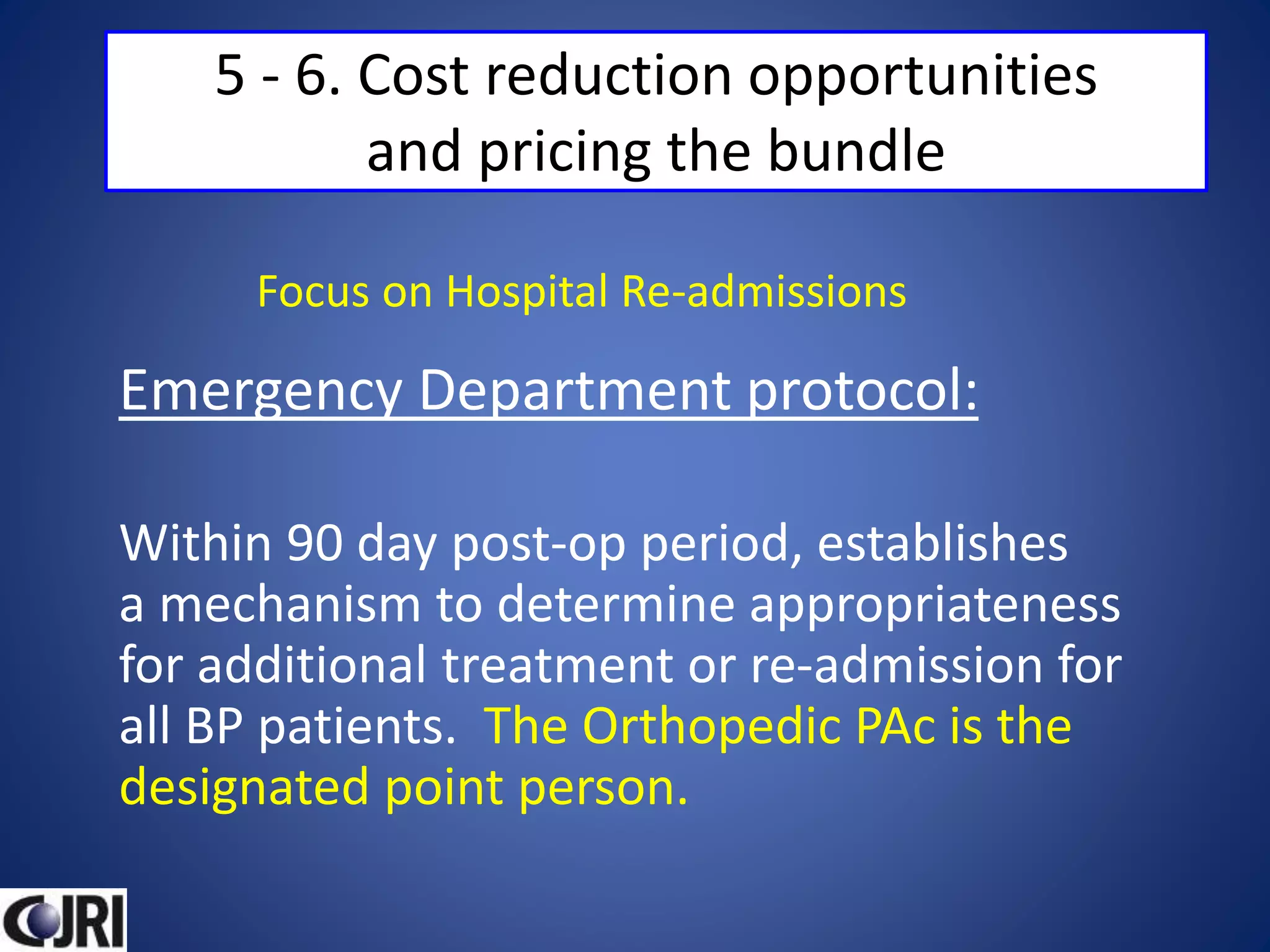
Emergency Department protocol:
Within 90 day post-op period, establishes
a mechanism to determine appropriateness
for additional treatment or re-admission for
all BP patients. The Orthopedic PAc is the
designated point person.
Focus on Hospital Re-admissions
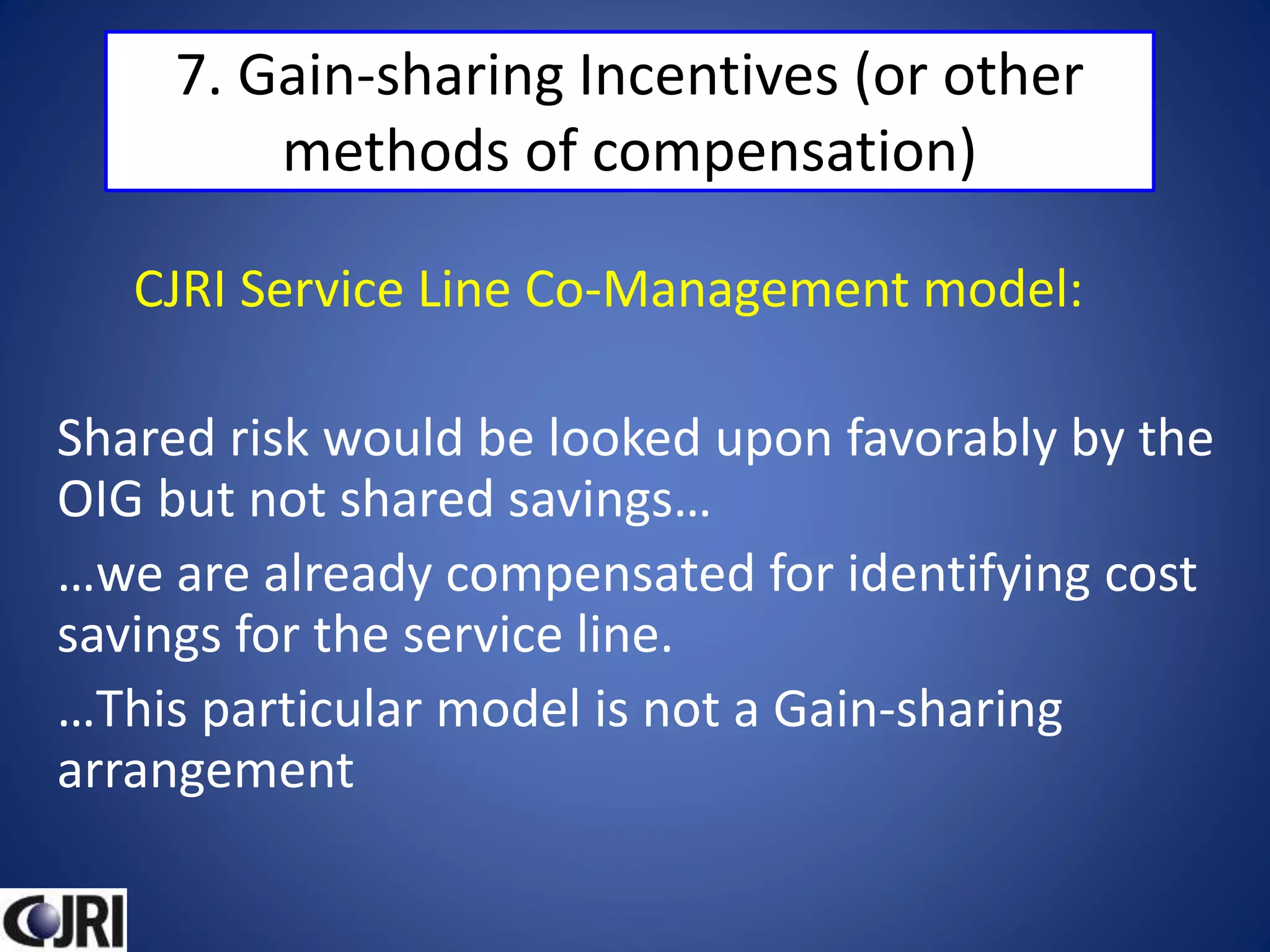
7. Gain-sharing Incentives (or other
methods of compensation)
CJRI Service Line Co-Management model:
Shared risk would be looked upon favorably by the
OIG but not shared savings…
…we are already compensated for identifying cost
savings for the service line.
…This particular model is not a Gain-sharing
arrangement
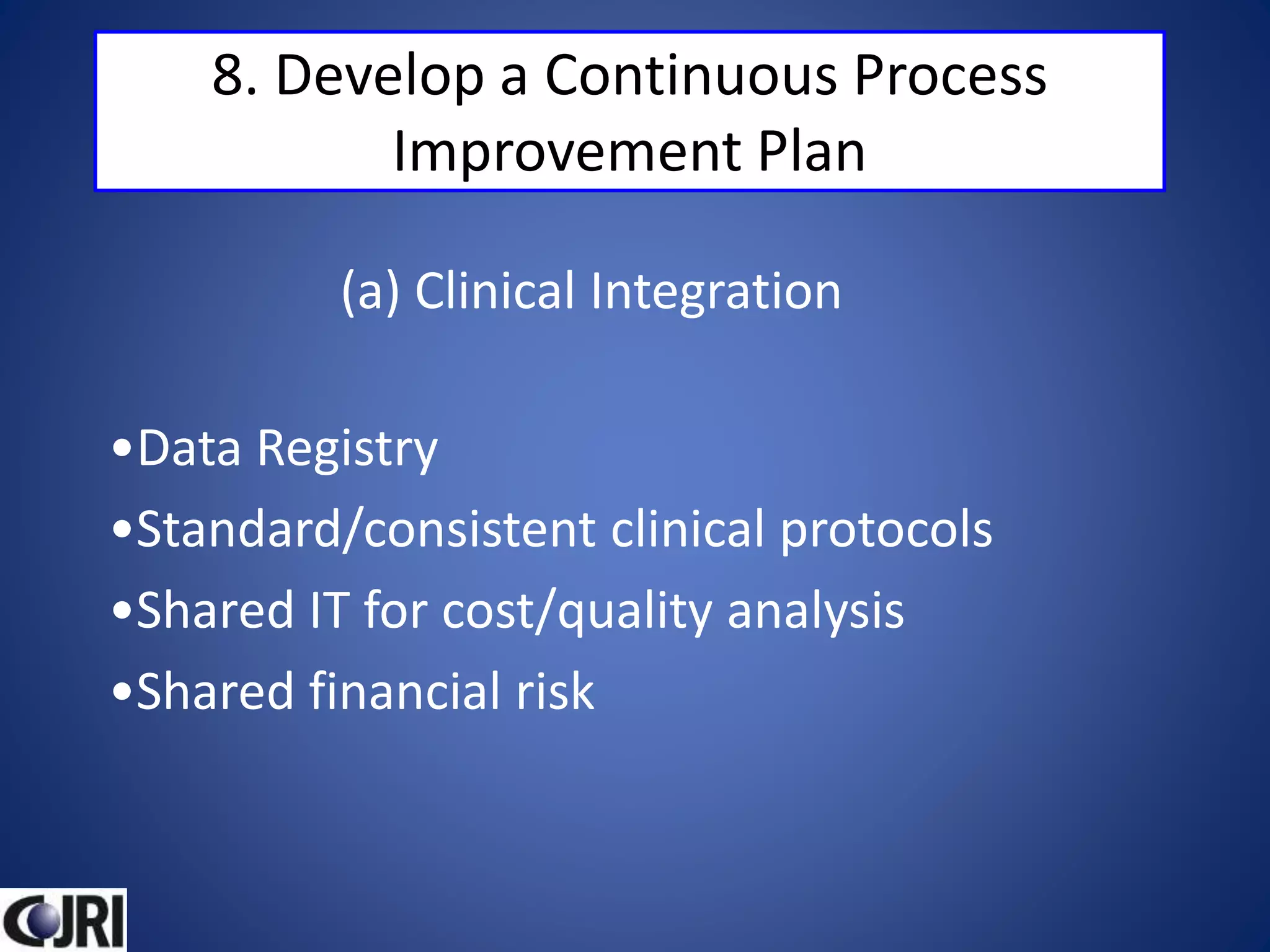
8. Develop a Continuous Process
Improvement Plan
•Data Registry
•Standard/consistent clinical protocols
•Shared IT for cost/quality analysis
•Shared financial risk
(a) Clinical Integration
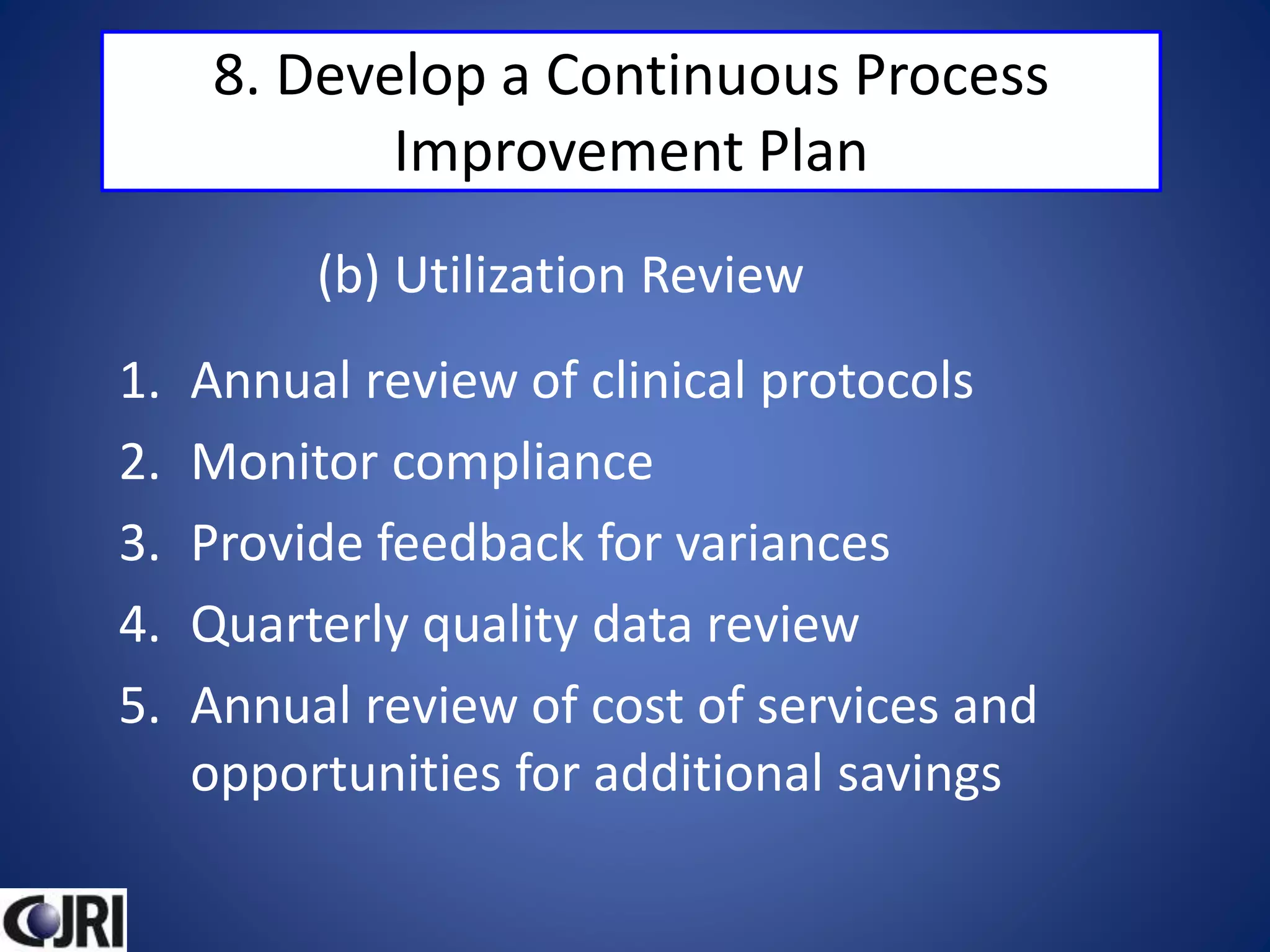
8. Develop a Continuous Process
Improvement Plan
1. Annual review of clinical protocols
2. Monitor compliance
3. Provide feedback for variances
4. Quarterly quality data review
5. Annual review of cost of services and
opportunities for additional savings
(b) Utilization Review
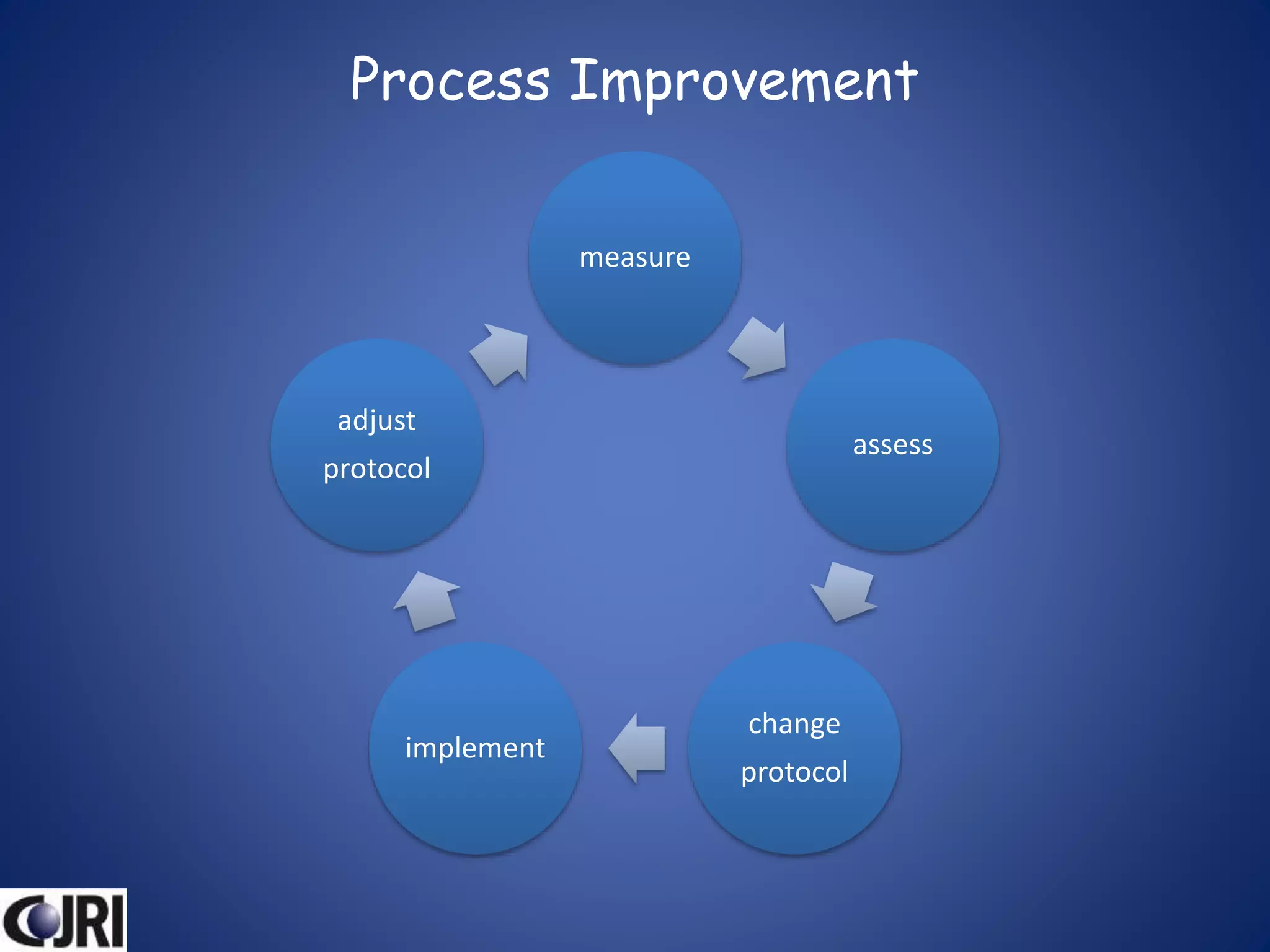
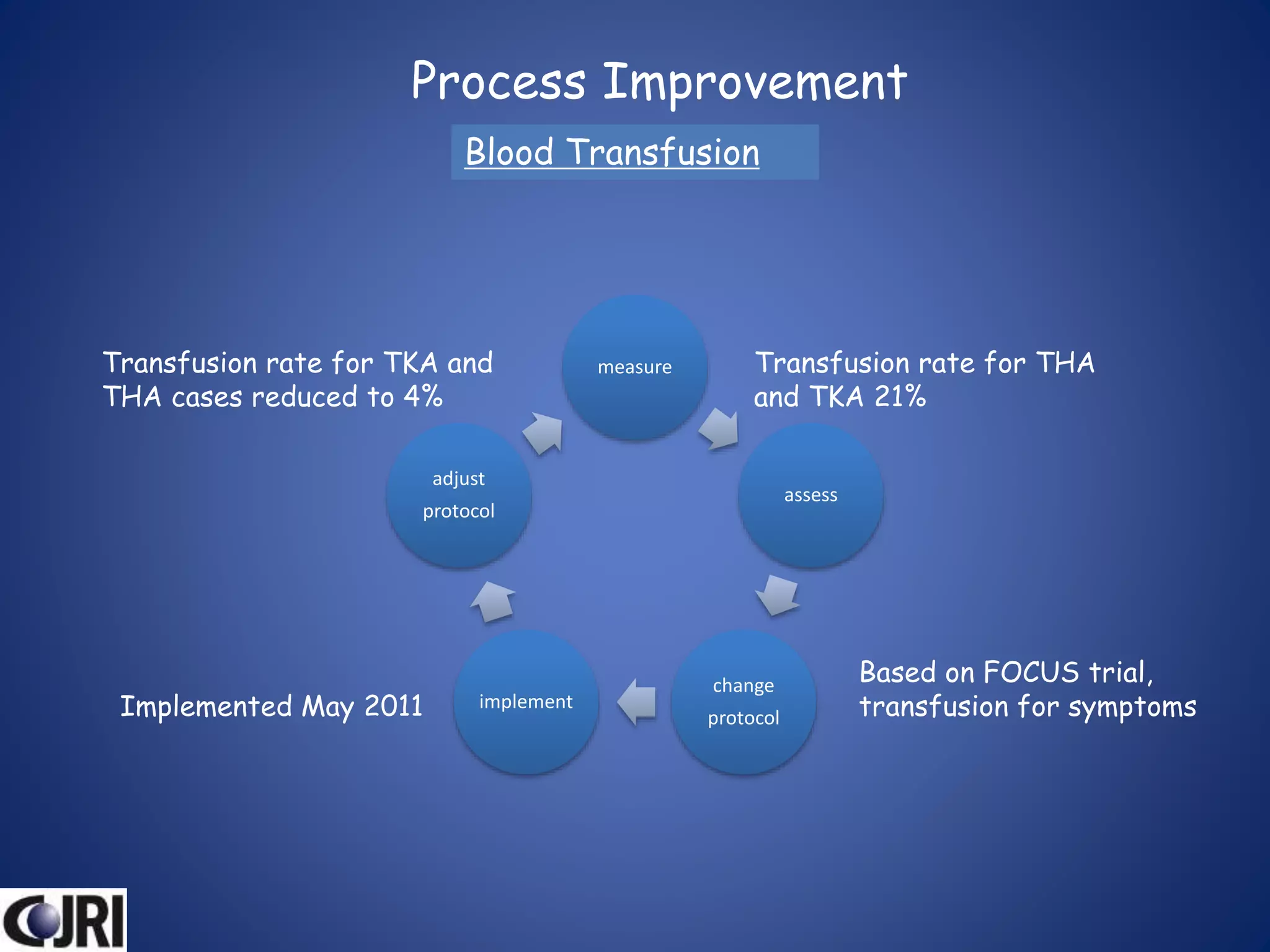
Process Improvement
measure
assess
change
protocol
implement
adjust
protocol
Process Improvement
measure
assess
change
protocol
implement
adjust
protocol
Blood Transfusion
Based on FOCUS trial,
transfusion for symptomsImplemented May 2011
Transfusion rate for TKA and
THA cases reduced to 4%
Transfusion rate for THA
and TKA 21%
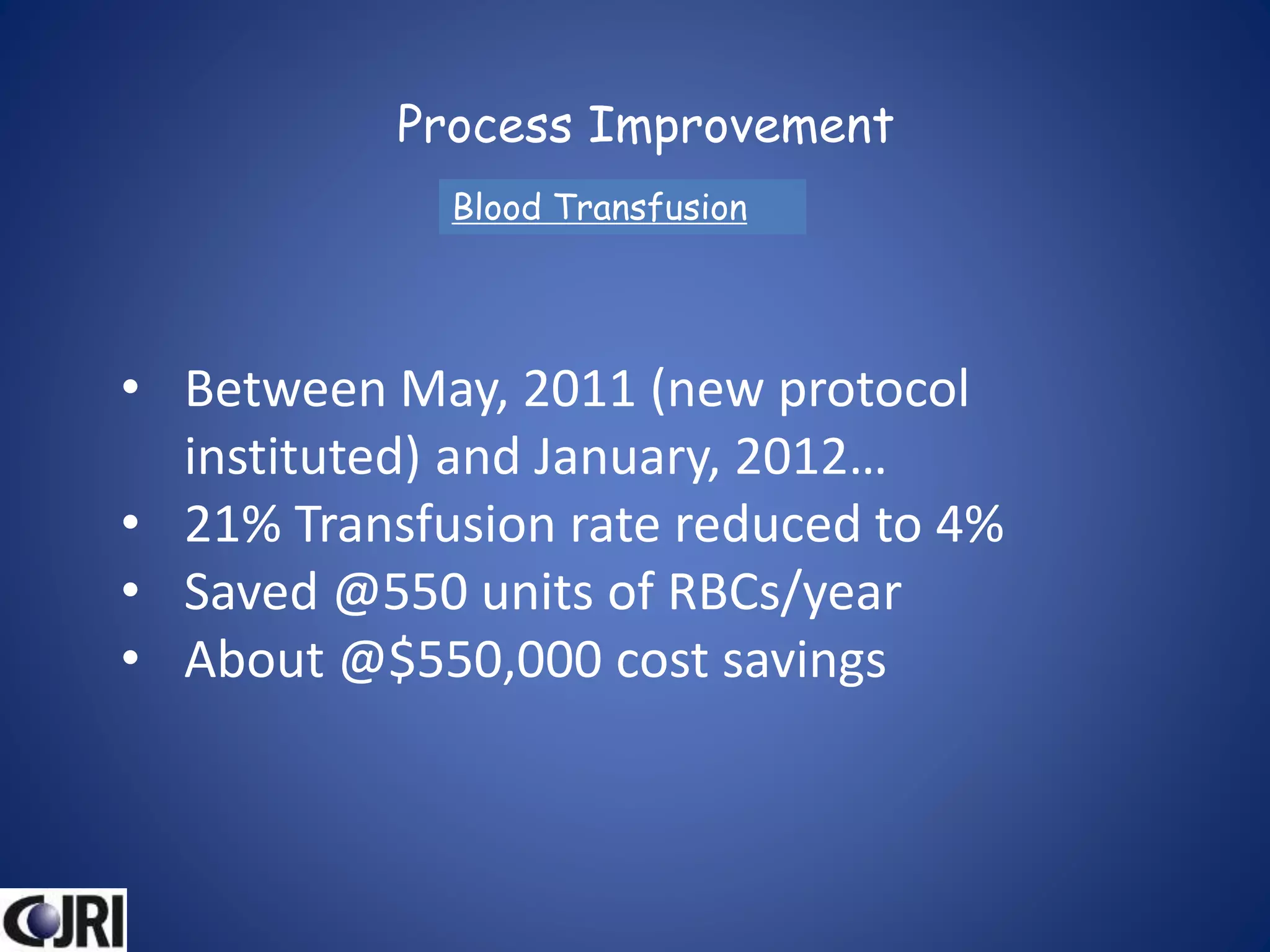
Process Improvement
Blood Transfusion
• Between May, 2011 (new protocol
instituted) and January, 2012…
• 21% Transfusion rate reduced to 4%
• Saved @550 units of RBCs/year
• About @$550,000 cost savings
9. Develop relationships with Post-
acute providers
1. ECFs
2. Homecare Agencies
Both participated in our TDABC project
with the Harvard Business School
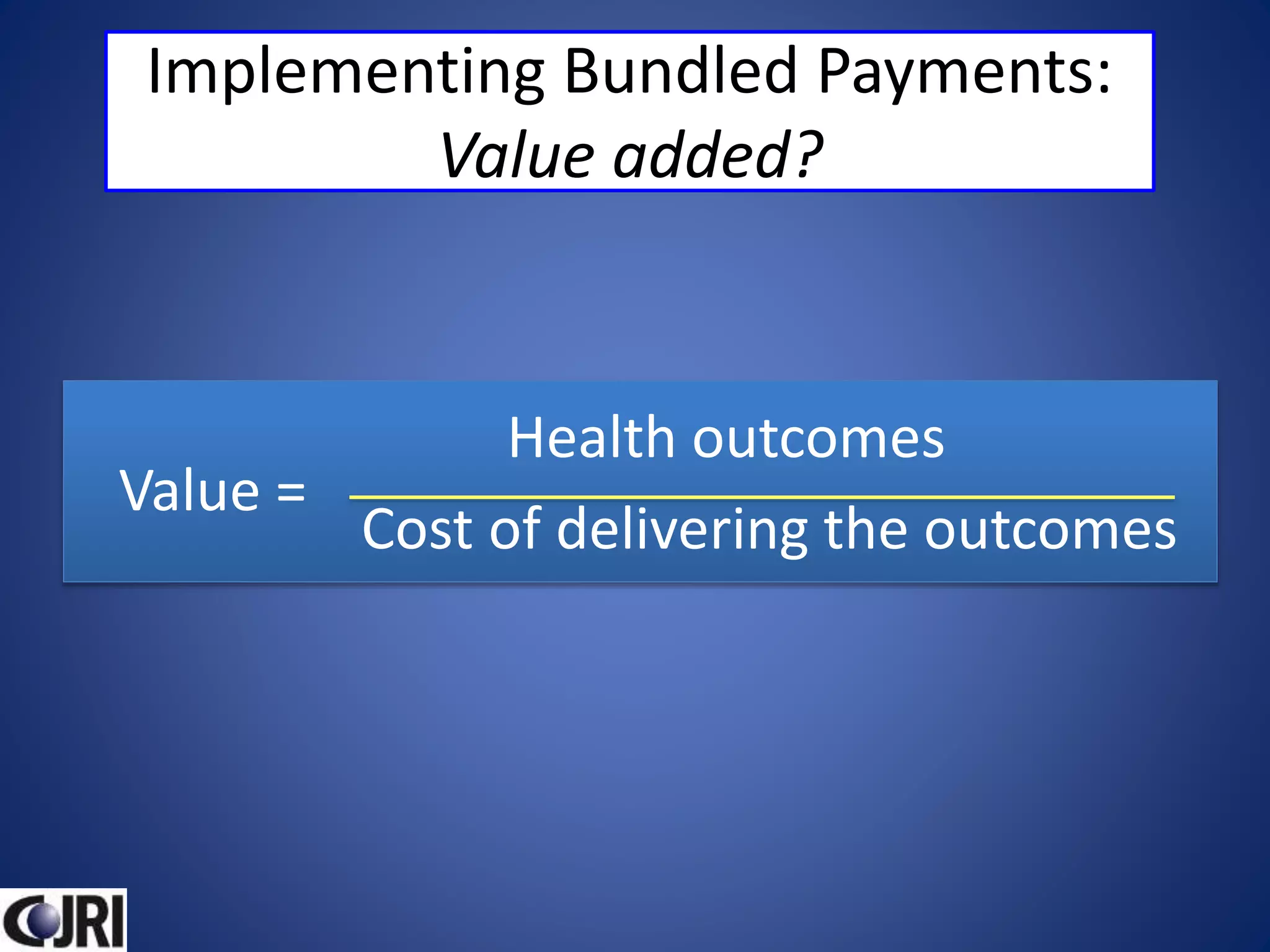
Implementing Bundled Payments:
Value added?
Health outcomes
Cost of delivering the outcomes
Value =
Implementing Bundled Payments:
Value added?
Health outcomes
Cost of delivering the outcomes
Value =
Implementing Bundled Payments:
Value added?
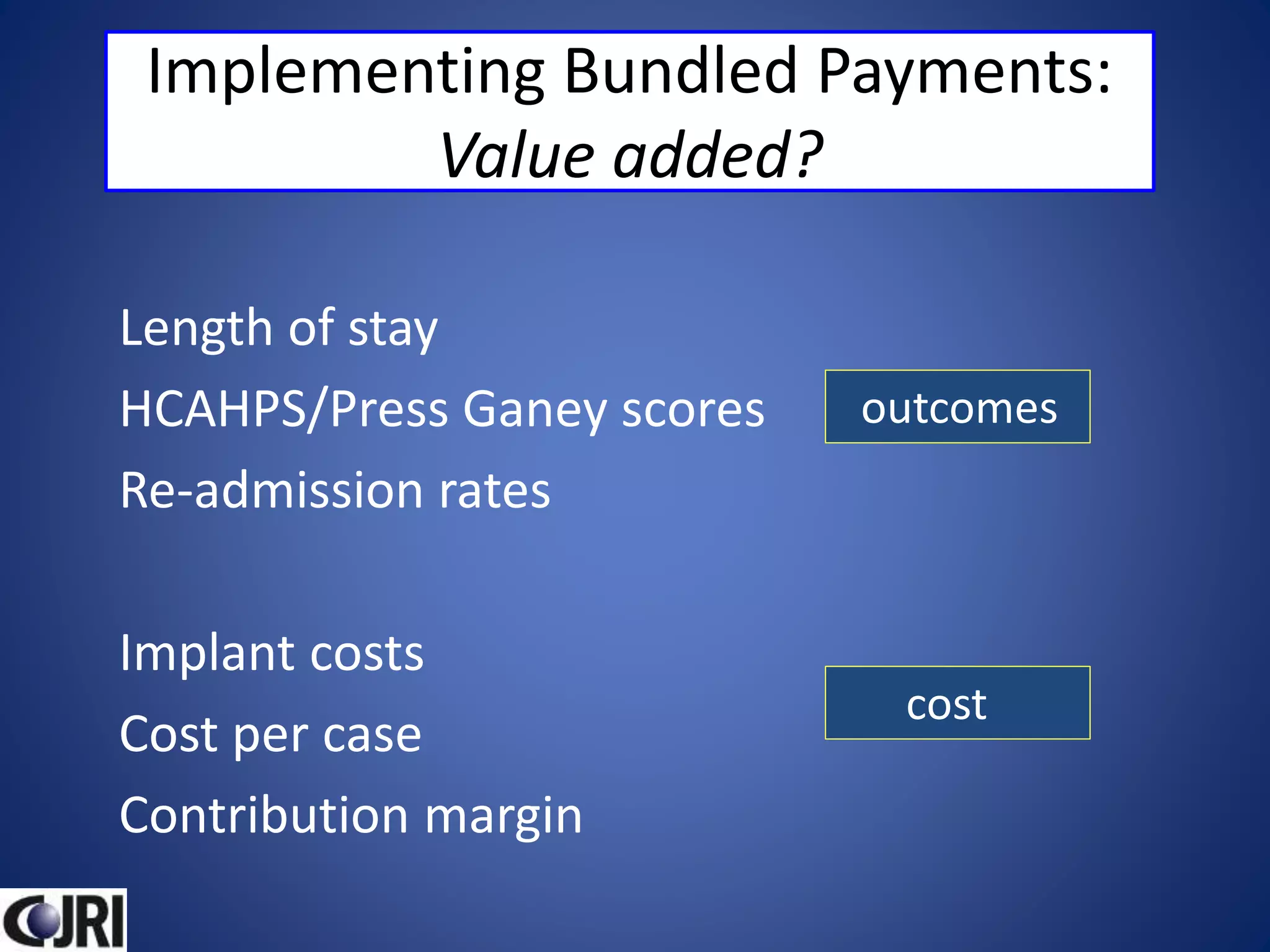
Length of stay
HCAHPS/Press Ganey scores
Re-admission rates
Implant costs
Cost per case
Contribution margin
outcomes
cost
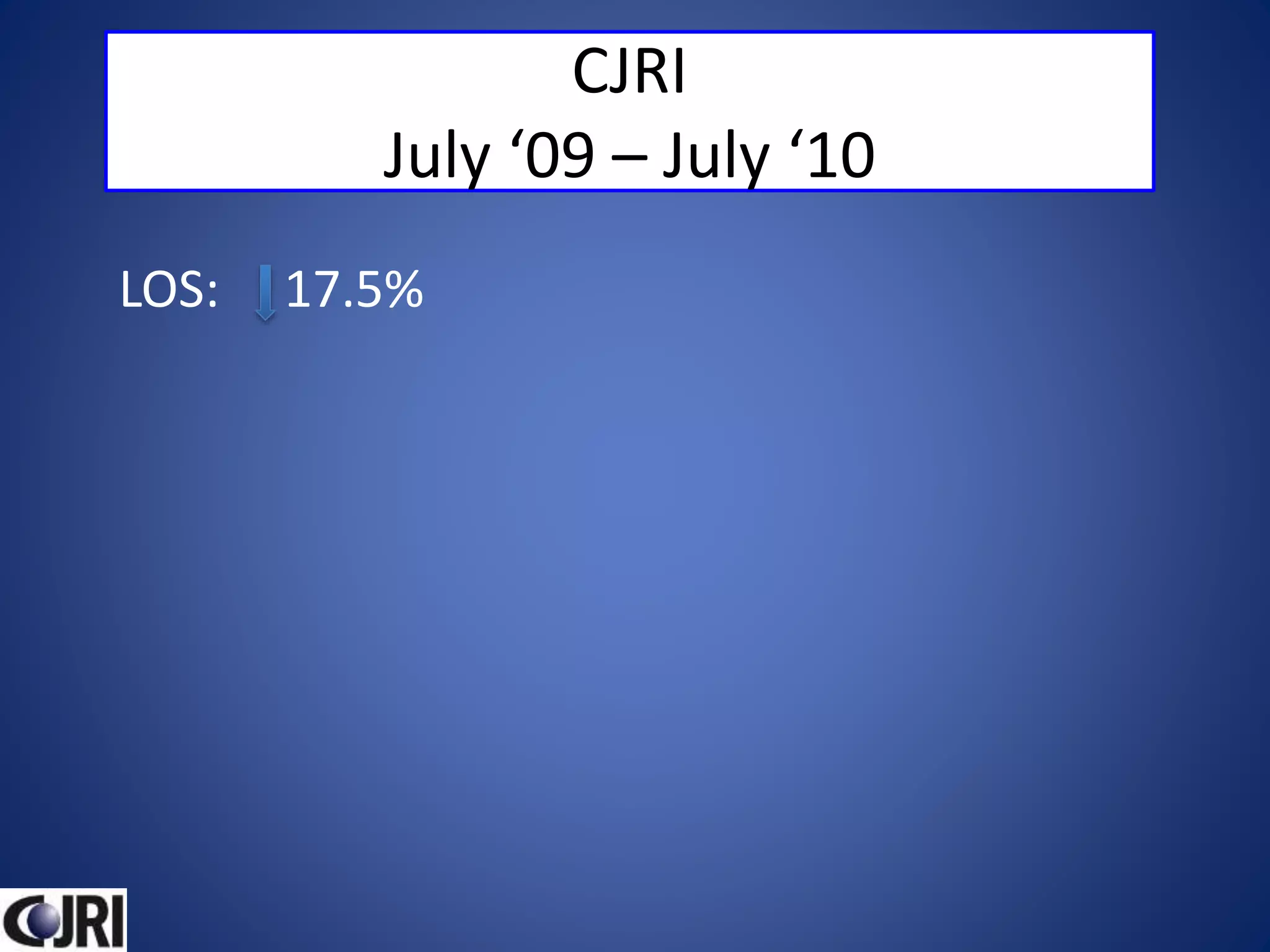
CJRI
July ‘09 – July ‘10
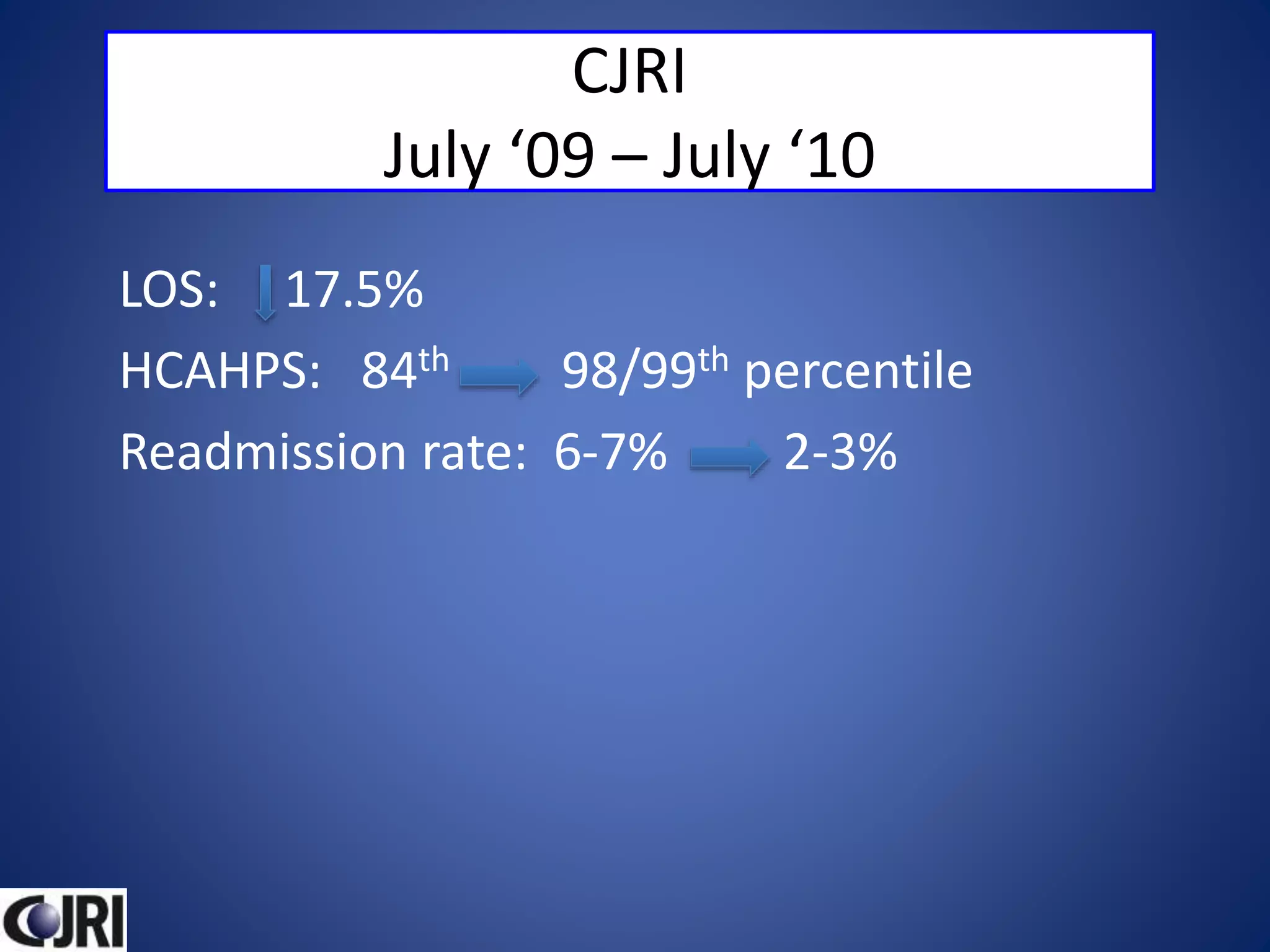
LOS: 17.5%
CJRI
July ‘09 – July ‘10
LOS: 17.5%
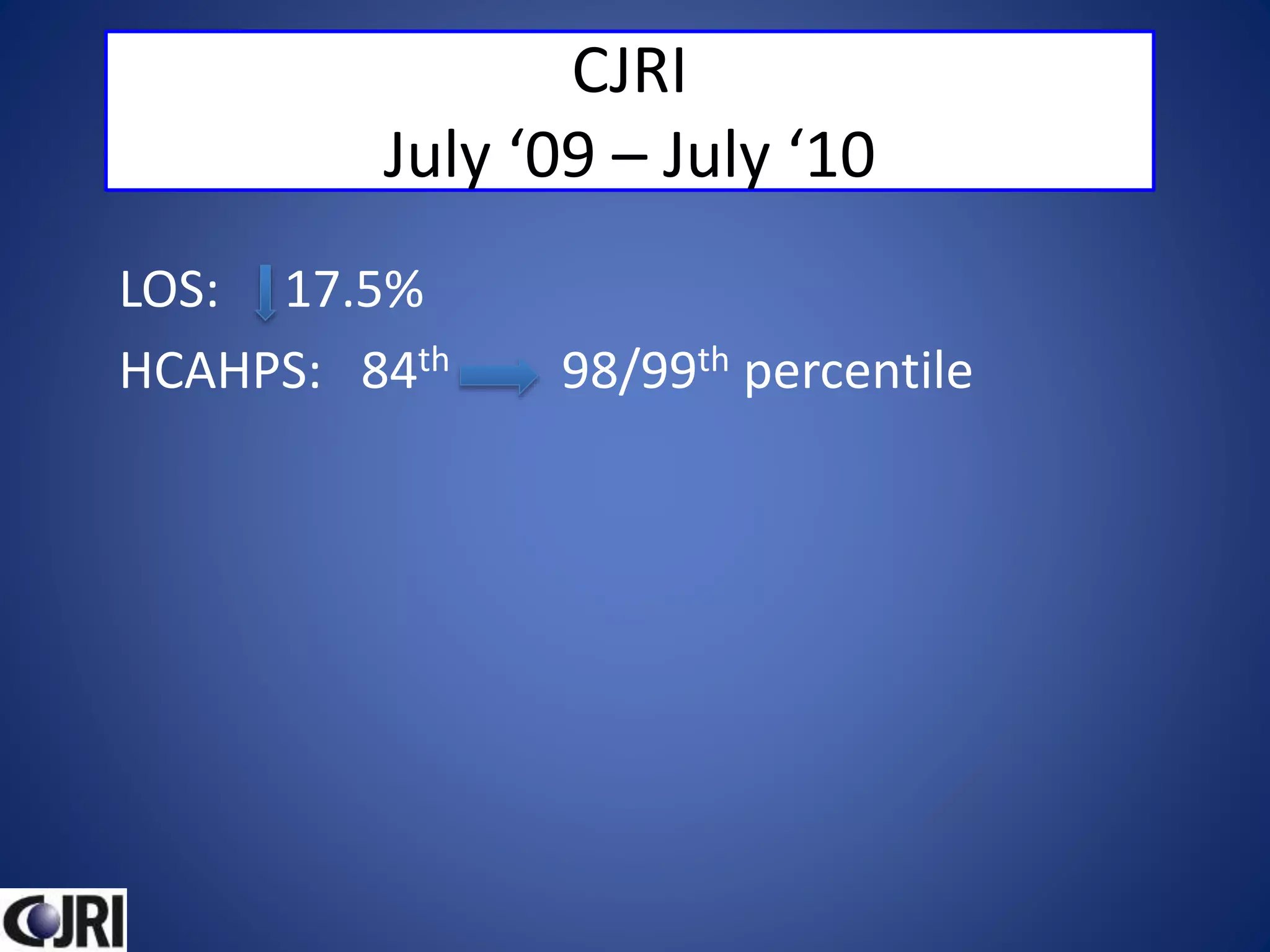
HCAHPS: 84th 98/99th percentile
CJRI
July ‘09 – July ‘10
LOS: 17.5%
HCAHPS: 84th 98/99th percentile
Readmission rate: 6-7% 2-3%
CJRI
July ‘09 – July ‘10
LOS: 17.5%
HCAHPS: 84th 98/99th percentile
Readmission rate: 6-7% 2-3%
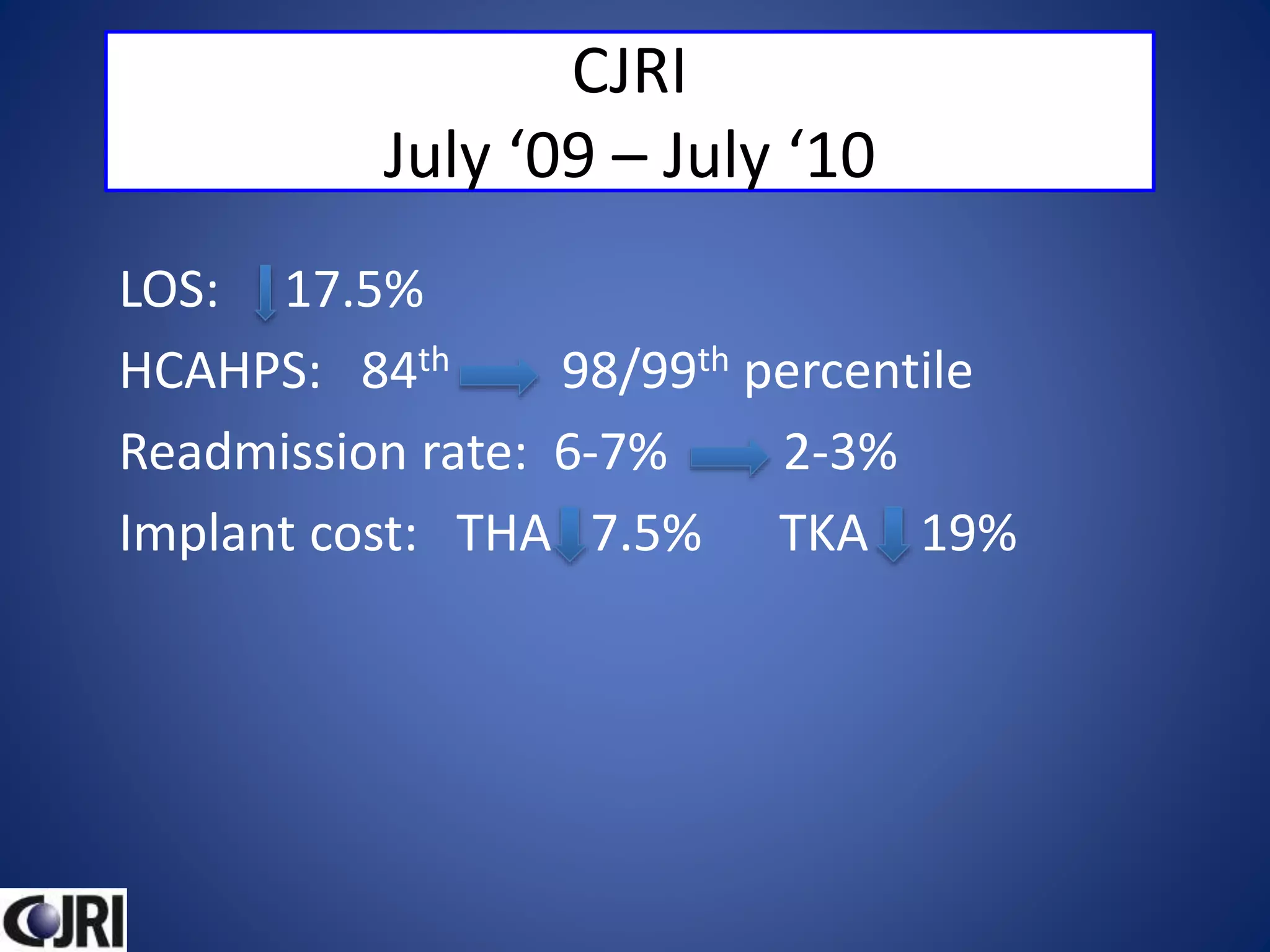
Implant cost: THA 7.5% TKA 19%
CJRI
July ‘09 – July ‘10
LOS: 17.5%
HCAHPS: 84th 98/99th percentile
Readmission rate: 6-7% 2-3%
Implant cost: THA 7.5% TKA 19%
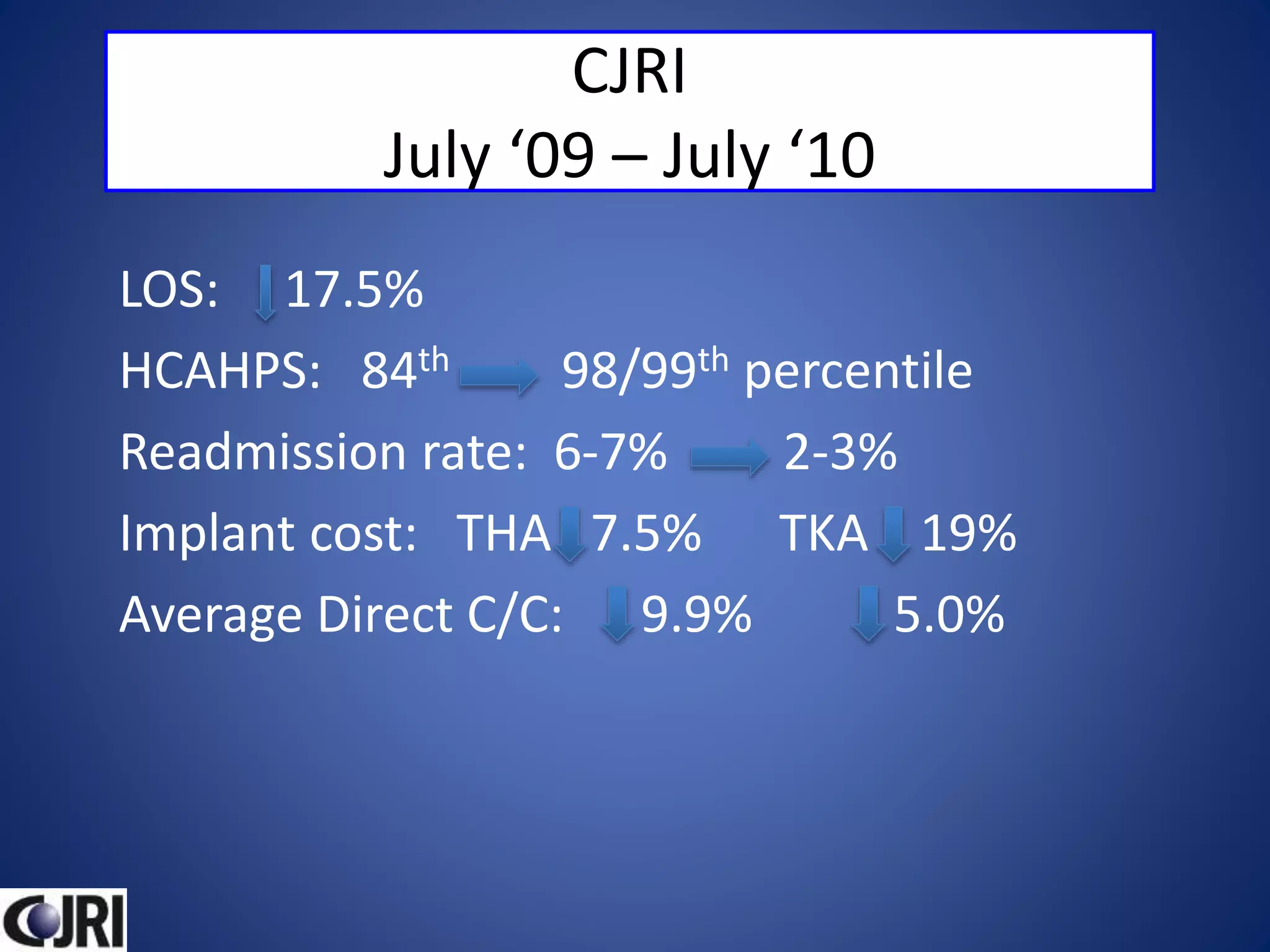
Average Direct C/C: 9.9% 5.0%
CJRI
July ‘09 – July ‘10
LOS: 17.5%
HCAHPS: 84th 98/99th percentile
Readmission rate: 6-7% 2-3%
Implant cost: THA 7.5% TKA 19%
Average Direct C/C: 9.9% 5.0%
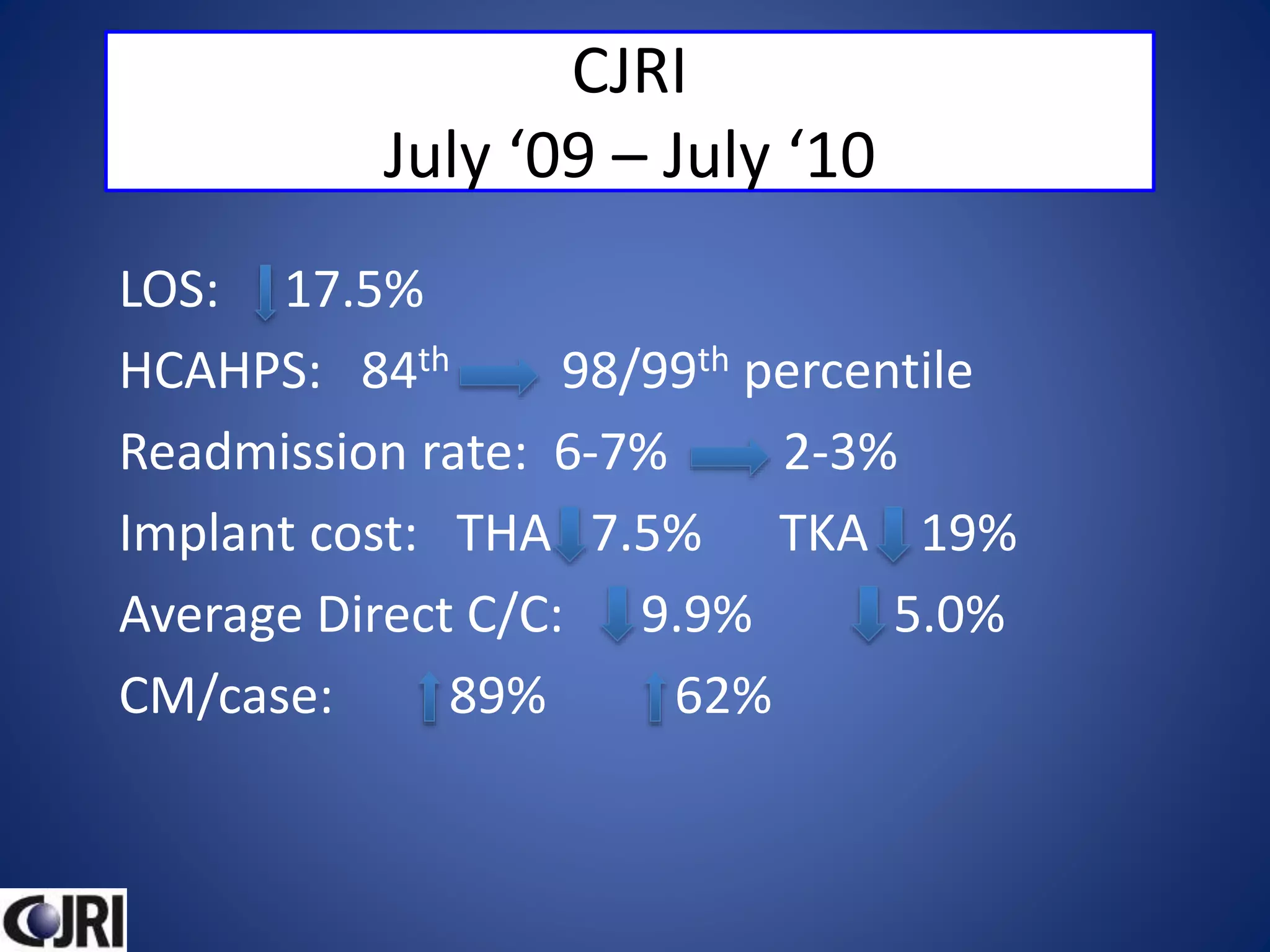
CM/case: 89% 62%
CJRI
Review of Surgeon and Anesthesiologist
compliance with Bundled Payment clinical
protocols…
100% compliance with no variances
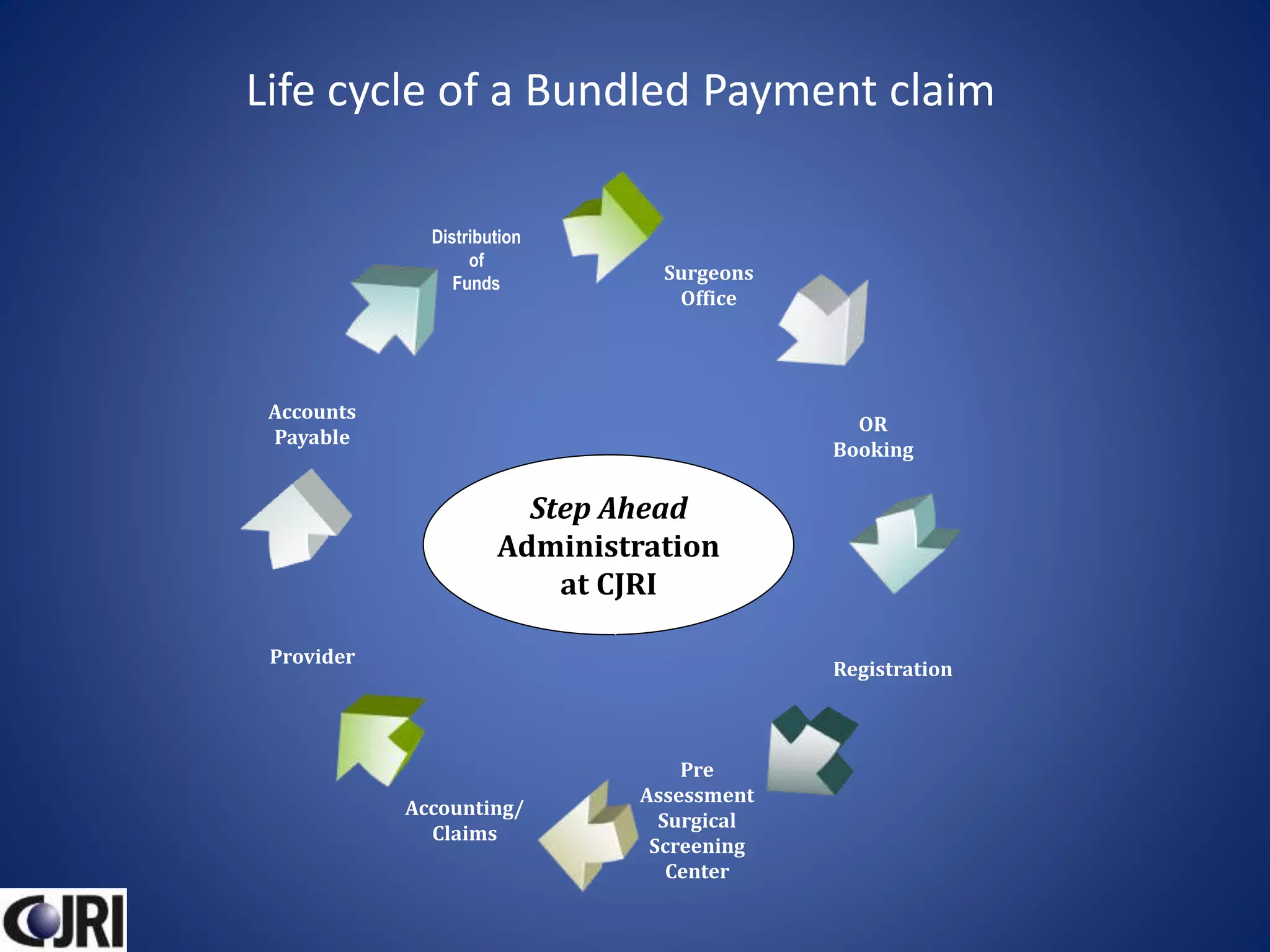
Accounting/
Claims
Accounts
Payable
Distribution
of
Funds
Surgeons
Office
OR
Booking
Registration
Pre
Assessment
Surgical
Screening
Center
Provider
Step Ahead
Administration
at CJRI
at CJRI
Life cycle of a Bundled Payment claim
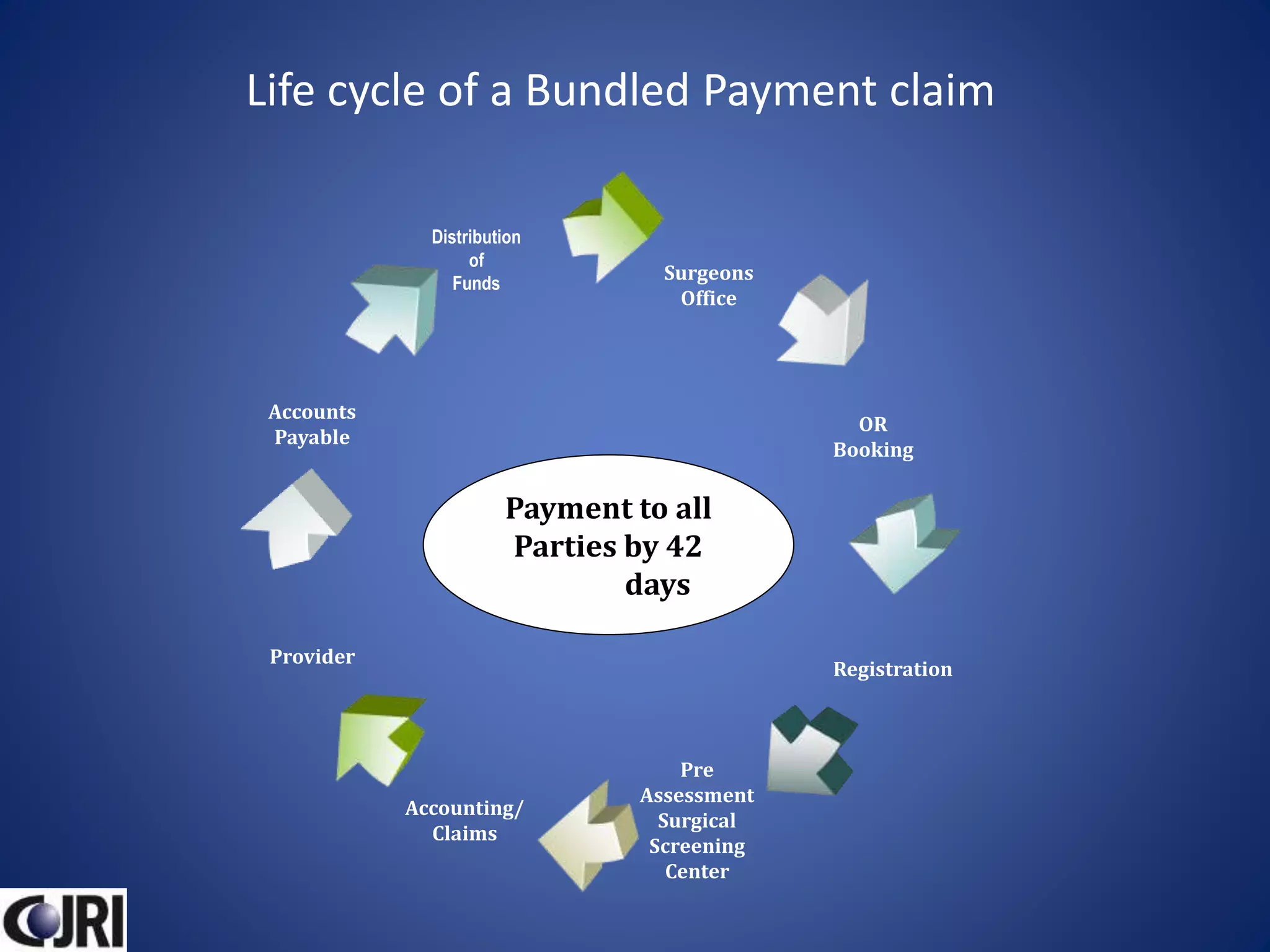
Accounting/
Claims
Accounts
Payable
Distribution
of
Funds
Surgeons
Office
OR
Booking
Registration
Pre
Assessment
Surgical
Screening
Center
Provider
Payment to all
Parties by 42
daysCJ
RI
Life cycle of a Bundled Payment claim
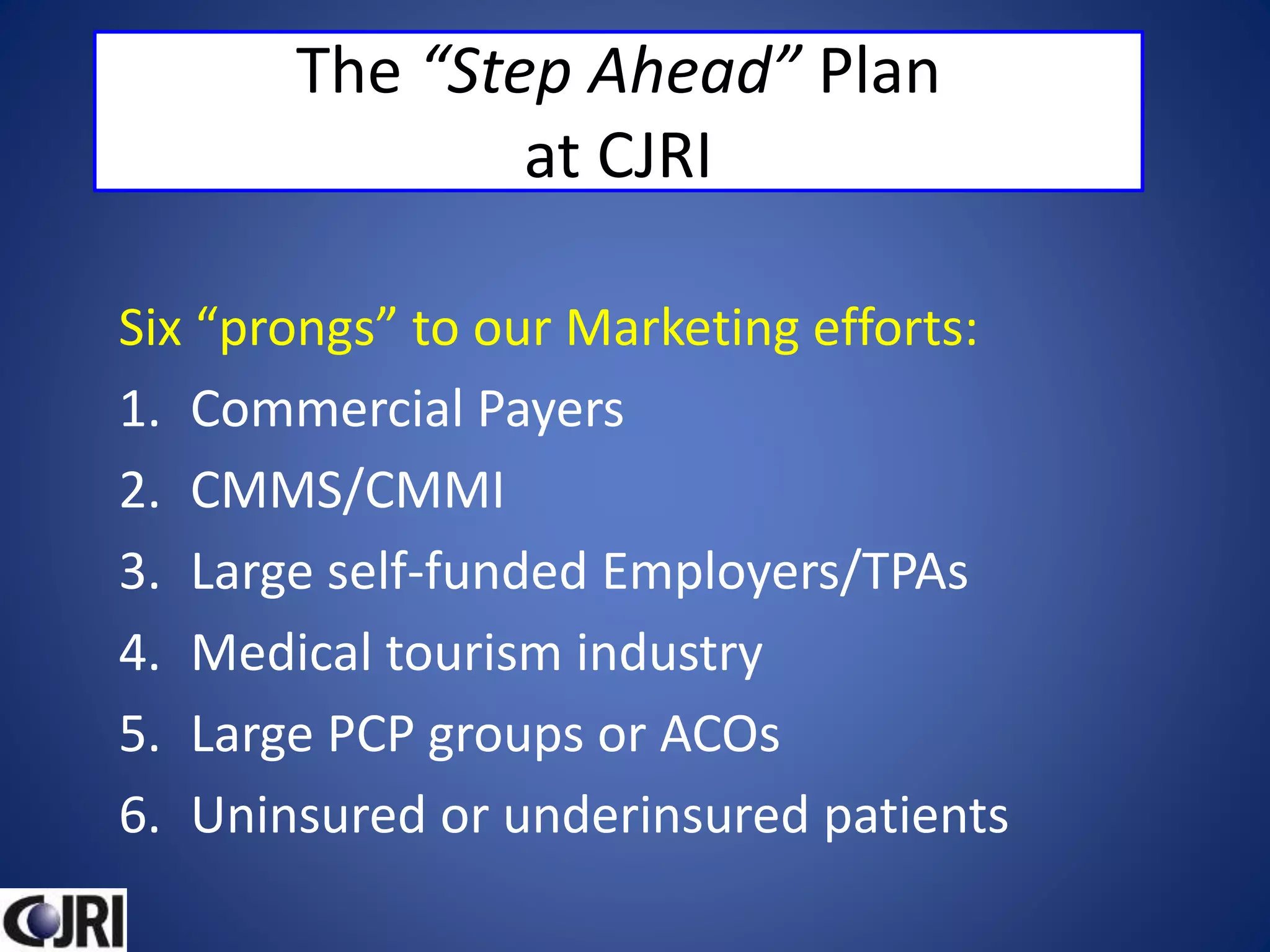
The “Step Ahead” Plan
at CJRI
Six “prongs” to our Marketing efforts:
1. Commercial Payers
2. CMMS/CMMI
3. Large self-funded Employers/TPAs
4. Medical tourism industry
5. Large PCP groups or ACOs
6. Uninsured or underinsured patients
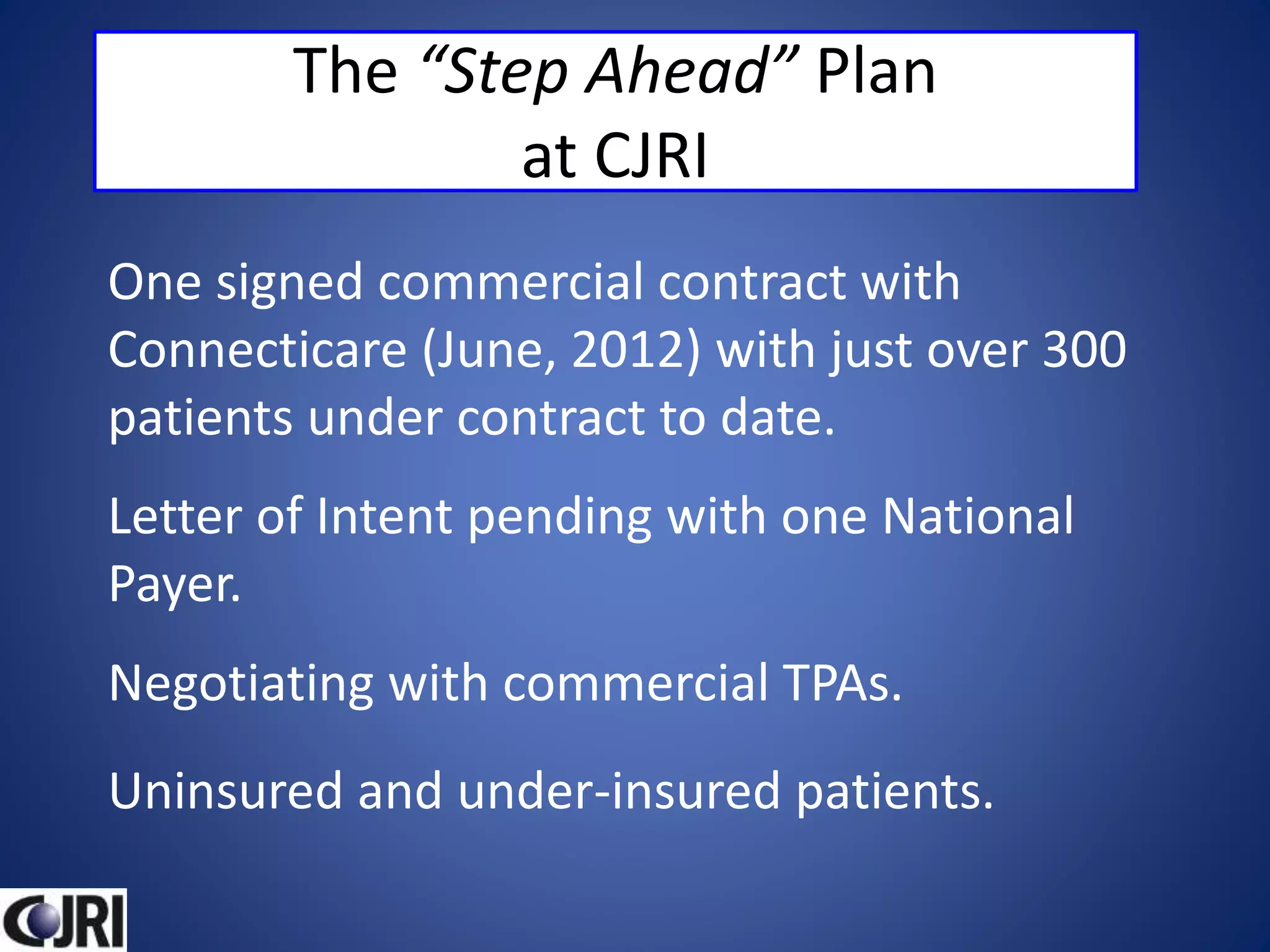
The “Step Ahead” Plan
at CJRI
One signed commercial contract with
Connecticare (June, 2012) with just over 300
patients under contract to date.
Letter of Intent pending with one National
Payer.
Negotiating with commercial TPAs.
Uninsured and under-insured patients.
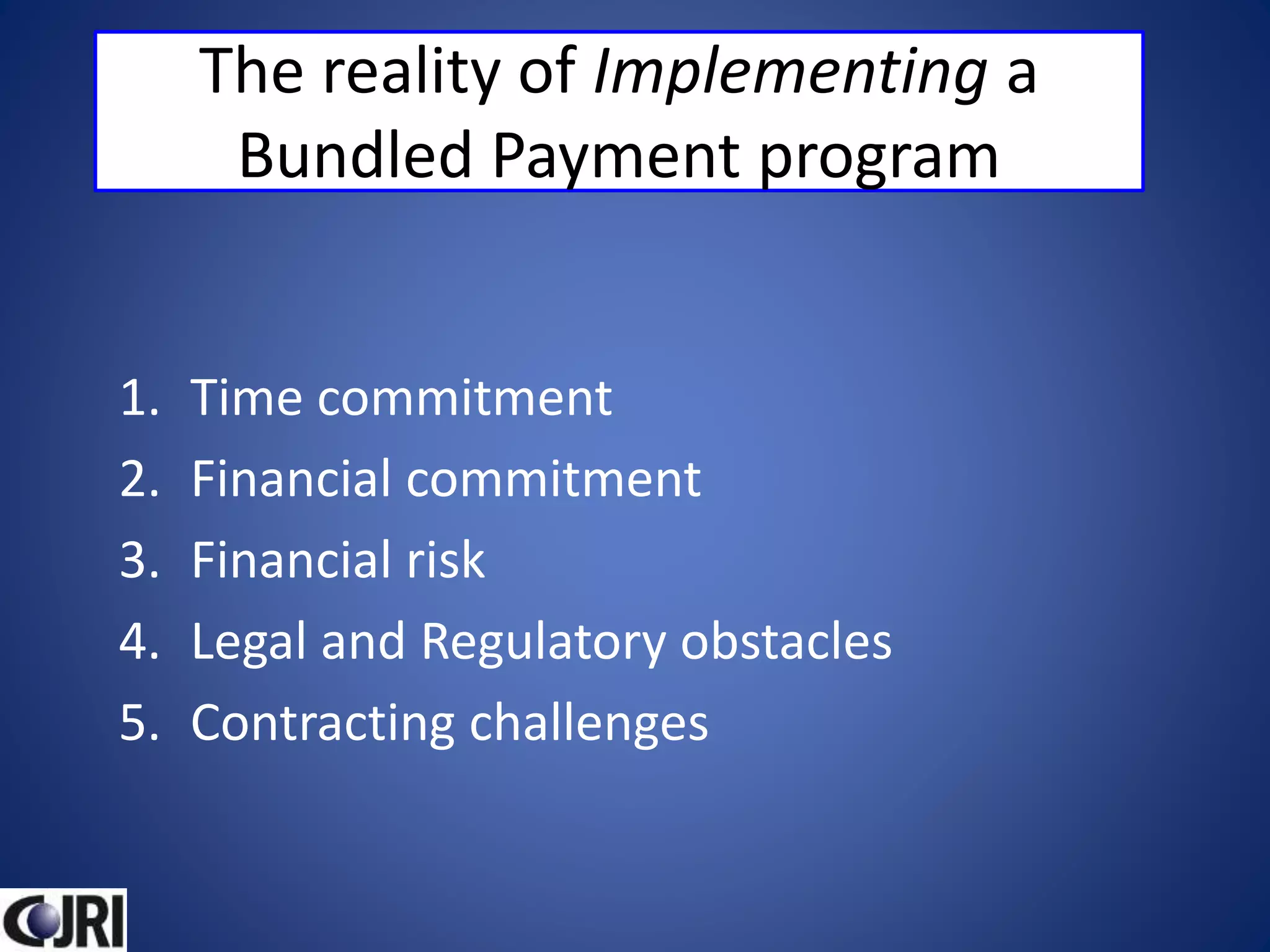
The reality of Implementing a
Bundled Payment program
1. Time commitment
2. Financial commitment
3. Financial risk
4. Legal and Regulatory obstacles
5. Contracting challenges
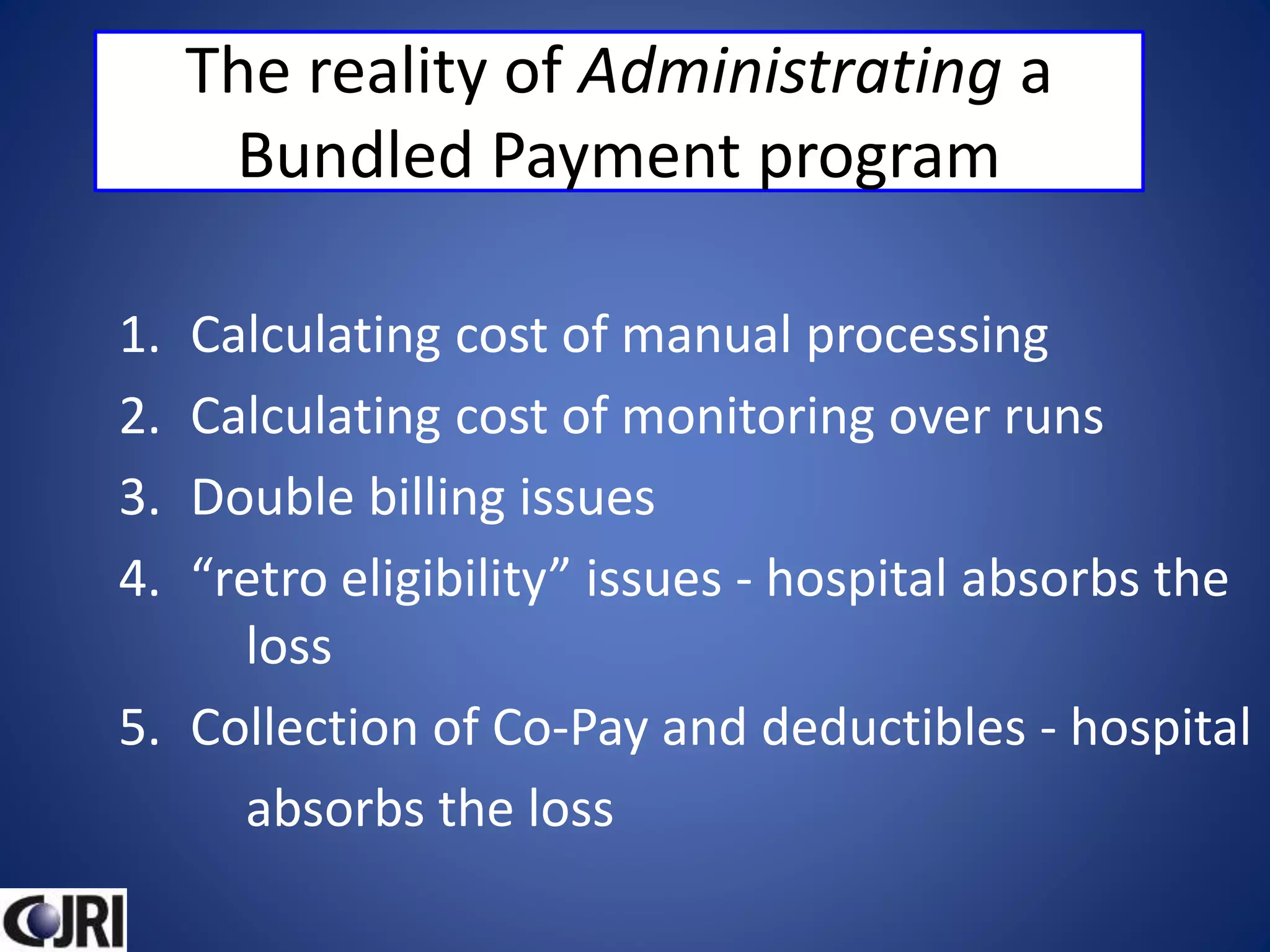
The reality of Administrating a
Bundled Payment program
1. Calculating cost of manual processing
2. Calculating cost of monitoring over runs
3. Double billing issues
4. “retro eligibility” issues - hospital absorbs the
loss
5. Collection of Co-Pay and deductibles - hospital
absorbs the loss
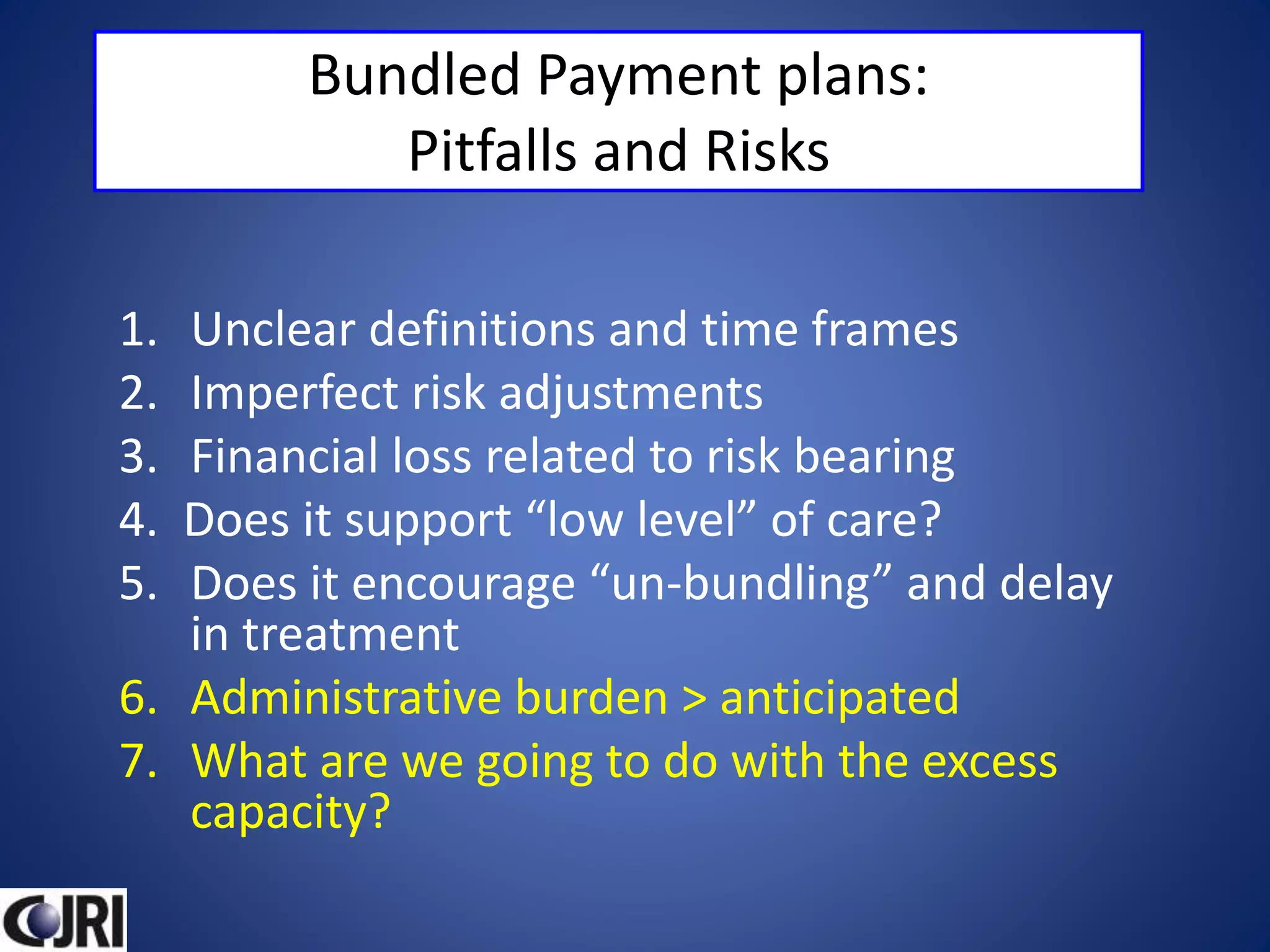
Bundled Payment plans:
Pitfalls and Risks
1. Unclear definitions and time frames
2. Imperfect risk adjustments
3. Financial loss related to risk bearing
4. Does it support “low level” of care?
5. Does it encourage “un-bundling” and delay
in treatment
6. Administrative burden > anticipated
7. What are we going to do with the excess
capacity?
Bundled Payment plans:
Risks
8. Caution: Is it just another way for the
Commercial Payers to make more
money by shifting risk and
administrative burden?
Bundled Payment plans:
Benefits of implementation
1. Changes culture of distrust
2. Aligns incentives and goals
3. cuts the “fat” and waste
4. Keeps the patient at the “top of the
pyramid”
5. Preserves entrepreneurial spirit
6. Encourages healthy re-alignments
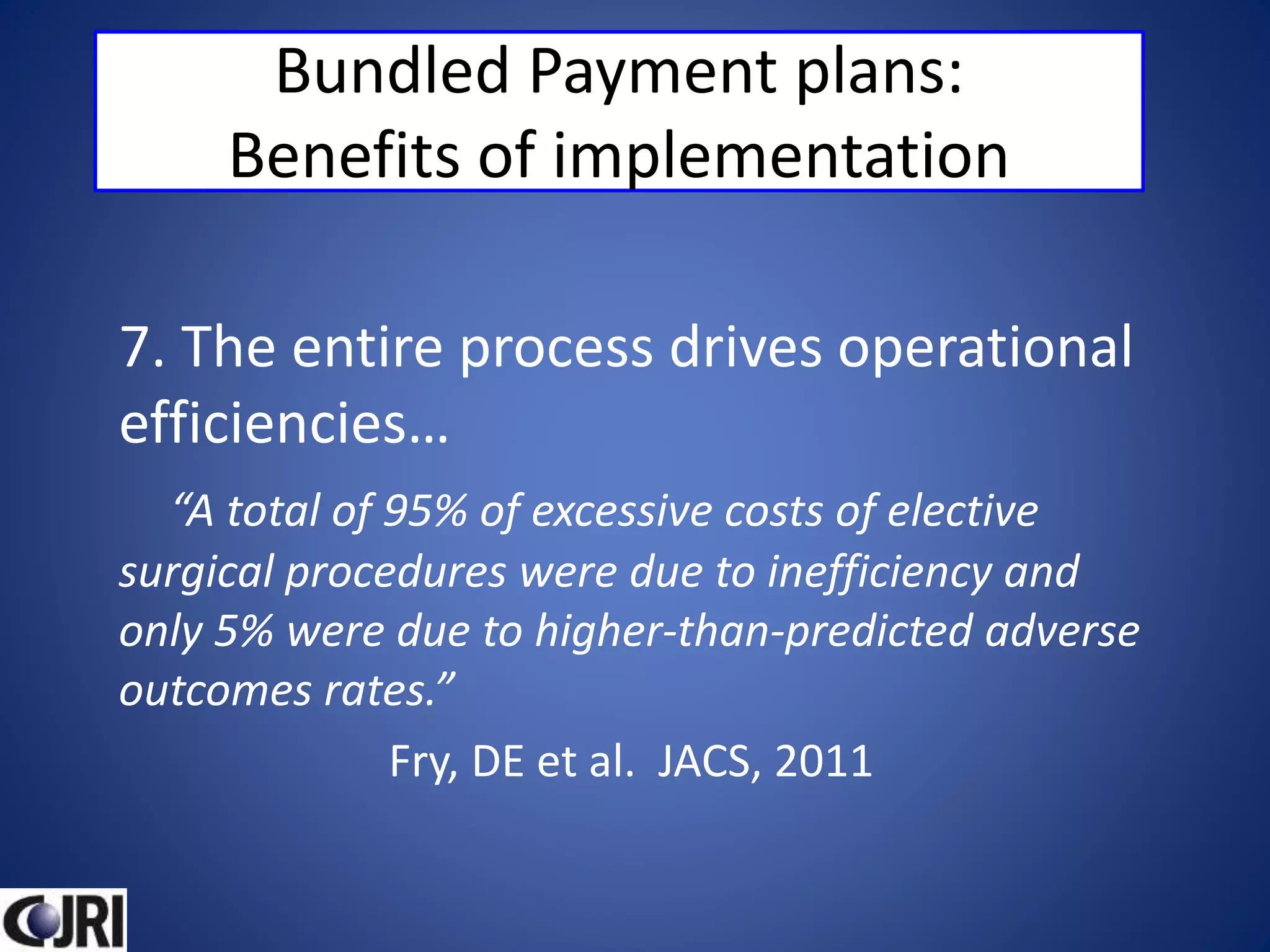
Bundled Payment plans:
Benefits of implementation
7. The entire process drives operational
efficiencies…
“A total of 95% of excessive costs of elective
surgical procedures were due to inefficiency and
only 5% were due to higher-than-predicted adverse
outcomes rates.”
Fry, DE et al. JACS, 2011
Bundled Payment Plan
We recently completed a re-evaluation of
our BP program including post-acute
services together with the Harvard Business
School and IHI’s JRLC using Time-Driven
Activity Based Costing methodology.
Professors Porter and Kaplan
“Value measurement in Healthcare”
• Time
• Patience
• Discipline
• Steady Physician leadership
• Real $$ cost
• Opportunity cost
Elements of a successful Value
journey
Conclusions
• Despite movement towards restructuring
healthcare delivery, competing agendas and
misaligned priorities still remain between
payers and providers
• Broad adoption of the Value Agenda will not be
easy
• Performing TDABC, embedding PFCC and
implementing bundled payments adds
considerable value nonetheless
• YOU must be a player in this space!
Bundled Payment Plan
The end game for your entity will be a re-
alignment of incentives amongst all
Participants toward delivering the highest
quality of care at the lowest cost to the
patient and purchaser. This will allow you to
compete in the new Healthcare market…
based on Value.
This was done by a bunch of “community”
Orthopedic surgeons
“Healing is an Art, Medicine is a
Science…Healthcare is a business”
Thank you for your attention and
good luck with this work
91
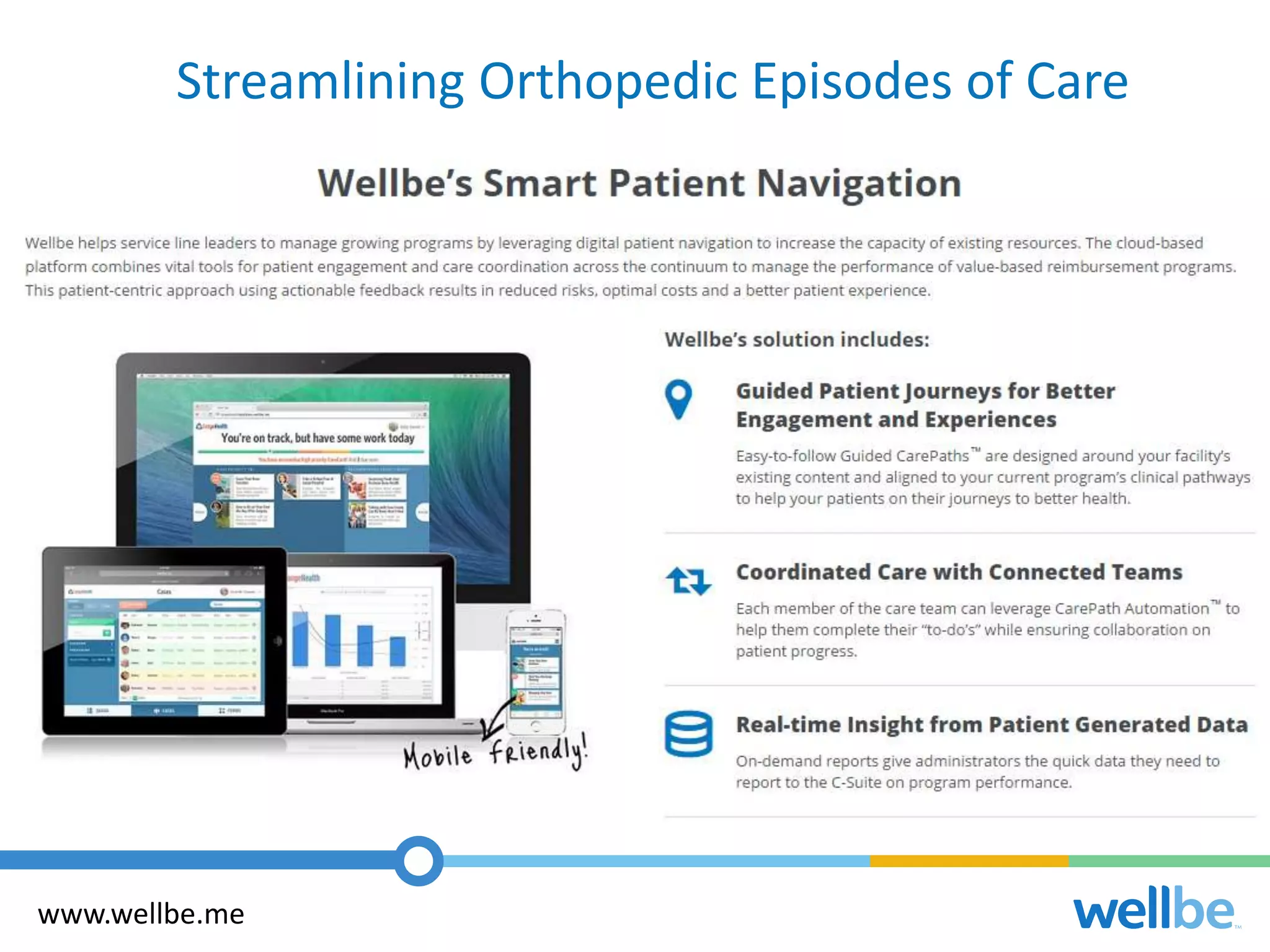
Streamlining Orthopedic Episodes of Care
www.wellbe.me

Implementing Bundled Payments: A Deeper Dive

  • 1.
    Steven F. Schutzer,MD Medical Director, Connecticut Joint Replacement Institute President, Connecticut Joint Replacment Surgeons, LLC
  • 2.
    Steven F. Schutzer,MD Disclosures • Medical Director, CT Joint Replacement Institute • President, CT Joint Replacement Surgeons, LLC • Investor, Renovis Surgical Technologies • Unpaid Consultant, Renovis Surgical Technologies • Editorial staff, J. Arthroplasty • Principal, Novel Healthcare Solutions, LLC
  • 3.
    The entrepreneurial spiritof the independent private practice surgeon, working at an arms length relationship with a hospital partner, can more rapidly and effectively create sustainable healthcare value than other contemporary alignment models. Bias
  • 4.
    “He who isnot courageous enough to take risk, will accomplish nothing in life.” Muhammad Ali
  • 5.
    Adapted from NEJM361:16 8/9/09 Bohmer and Lee “An important transition has begun in payment for health care delivery in the US: organizations that have long been paid for transactions, such as visits or procedures are beginning to be paid for producing outcomes for populations.”
  • 6.
    Traditional healthcare contracting 1.Cost shifting 2. Bargaining clout 3. Restricting choice/access 4. Dispute resolution via Court System (tort) “Zero Sum Competition”
  • 7.
    Traditional healthcare contracting 1.Cost shifting 2. Bargaining clout 3. Restricting choice/access 4. Dispute resolution via Court System (tort) “Zero Sum Competition” Provider financial success = Patient success
  • 8.
    Professor Porter: “Create theright kind of competition” “Positive Sum Competition” Based on creation of healthcare value and market competition aligned with outcomes/cost for a specific medical condition.
  • 9.
    How can youachieve healthcare value? 1. Integrated Practice Units 2. Integrated delivery networks 3. Scale it up 4. IT platforms 5. Measure outcomes and cost 6. Manage risk 7. Bundled Payments
  • 10.
    What is a“bundled payment” “single package price for a comprehensive and specific set of healthcare services that provides a positive margin for services delivered to a patient by multiple providers over a defined period of time (episode)”
  • 11.
    Bundled Payment: whyis CMS interested in this option? “The enemy is fragmentation. We just don't seem to form the coalitions (read: alignments), nor the communities we need to make progress”.
  • 12.
    Bundled Payments: the hypothesis Createfinancial motivation to collaborate/integrate/align and to implement effective care redesign strategies: 1. coordinate patient care 2. reduce variability 3. improve operational efficiencies 4. reduce low volume services
  • 13.
    2 key re-alignmentsnecessary for sustainable healthcare value 1. Providers, Payers…and Patients 2. unit of reimbursement with the unit of healthcare value delivered to the patient Bundled Payments…the most effective strategy?
  • 14.
    What is theevidence that Bundling works in healthcare? 1. Medicare 5 year CABG Demonstration 2. 2009 NEJM article 3. Prometheus models/pilots 4. Provencare experience 5. Medicare ACE Demonstration project 6. CJRI data
  • 15.
    Medicare ACE demonstrationfor Orthopedic Surgery • 5 Hospitals, In-patient costs (THA and TKA) combined Part A & B • Pilot began 2009 • Surgeon incentives (reimbursement up to 125% of Medicare fee) • Patient incentives: “Medicare will share 50 percent of the savings it gains under the demonstration with the Medicare beneficiary up to a maximum of the annual Part B premium, currently $1,259”.
  • 16.
    Medicare ACE demonstrationfor Orthopedic Surgery 1. Closer ties with surgeons (changed behavior) 2. Significant investment necessary (2.5 FTE) 3. Profits arise from spillover benefits 4. Savings from device cost reductions 5. Substantial quality benefits Ardent Health ABC White paper, Jan. 2012
  • 17.
    Physician/Hospital alignment strategies 1. Co-managementmodels a. True “Co-management” models b. Consultant Agreement without gain sharing c. Consultant Agreement plus gain sharing 2. Bundled Payment models a. Pure gain sharing b. Consultant Agreement without gain sharing c. Consultant Agreement plus gain sharing 3. Employment models a. Performance bonus b. Gain sharing
  • 18.
    Provider alignment strategies: Bundledpayment Under BP contracts (without gain sharing) alignment is achieved by tying Physician reimbursement for services with compliance with consensus based best practices/EBM protocols.
  • 19.
    Connecticut Joint ReplacementSurgeons, LLC incorporated November, 2006 • 10 “community” Arthroplasty surgeons from 5 different private orthopedic practices • Shared vision…create a world class Institute for Joint Replacement surgery • Commitment to “standardization” • Commitment to “data driven” decision making
  • 20.
    CJRS, LLC incorporated November,2006 5 Core principles of our MOU: 1. Surgeon management 2. Dedicated multidisciplinary staff 3. Separate line of business 4. “hospital within a hospital” 5. Research investment (4 FTEs and Registry)
  • 21.
    CJRS, LLC incorporated November,2006 • Consulting Services Agreement signed July 27, 2007 • CJRS, LLC manages CJRI (an Arthroplasty service line) • Our work has been valued by an outside source • The LLC receives a monthly stipend for it’s work • No gain sharing • First case done July 31, 2007
  • 22.
    The Bundled Paymentprogram at CJRI: “Step Ahead” plan Three “Parties” (Anesthesia, Saint Francis, CJRS) started negotiations in July, 2009. Our “Basket of Care” Agreement was signed in August, 2010.
  • 23.
    Implementing a BundledPayment program: essential elements 1. CEO/Hospital Administration 2. Physicians Leaders/Physicians 3. Trust and transparency 4. Savvy Legal Counsel 5. Robust quality and cost monitoring systems…clean data 6. Mature service line 7. Adequate case volume
  • 24.
    8 Steps toDevelopment of a Bundled Payment program 1. Build the dedicated team 2. Define the episode 3. Define performance measures (Cost and Quality) 4. Develop the Care Models 5. Cost reduction opportunities 6. Price the Bundle 7. Gain-sharing or other methods of compensation 8. Develop Continuous Process Improvements 9. Align with Post-acute providers
  • 25.
    1. Build thededicated team For the effort to succeed, there needs to be a “cultural transformation” focused on creation of a new healthcare delivery model
  • 26.
    Building the Dedicated Team Overcoming“Institutional Memory”
  • 27.
    1. Build thededicated team Surgeon Co-Medical Directors Anesthesiologists Executive Director Program Director Hospital COO Hospital CFO Hospital CNO Legal Representation
  • 28.
    2. Define theEpisode Detailed definitions: 1. which Parties involved 2. duties of each Party 3. define the “bundle” 4. define the time frame (EOC)
  • 29.
    2. Define theEpisode 5. warranty (define covered service and time frame) 6. cost over runs 7. best practices and EBM
  • 30.
    2. Define theEpisode Duties of each Party: Hospital Provide the infrastructure necessary to operate the program and service line including facilities, staff, support services, marketing, data resources, Registry…and billing and collection for all 3 Parties.
  • 31.
    2. Define theEpisode Duties of each Party: Surgeon 1. Appropriateness for surgery 2. Perform surgery 3. Routine post-op in-patient care 4. Adhere to any and all guidelines and protocols 5. Coordinate daily patient care 6. Strategic leadership in development and implementation of the Program and best practices
  • 32.
    2. Define theEpisode Duties of each Party: Anesthesia 1. pre-op patient review to determine eligibility and risk stratification (“none or minimal systemic disease”) 2. Customary Anesthesia services 3. Adhere to best practice and protocols 4. Post-op pain management
  • 33.
    The “Step Ahead”program at CJRI is offered to patients less than 70 years of age who are candidates for standard primary THA or TKA with either none or minimal systemic disease (would also exclude patients with certain conditions)
  • 34.
    2. Define theEpisode expenses and excess costs • Cash reserves: (a) Operating reserve (b) Claim reserve • Cost over runs: shared and not shared • Claims: Low claim, High claim, Insured claim • Stop Loss coverage
  • 35.
    2. Define theEpisode expenses and excess costs • Cash reserves: (a) Operating reserve (b) Claim reserve • Cost over runs: shared and not shared • Claims: Low claim, High claim, Insured claim • Stop Loss coverage
  • 36.
    Excess costs: notshared “Excess costs resulting from unwarranted or deliberate deviation from the approved protocols.”
  • 37.
    Excess costs: shared a.Low claim- cost over runs under $5K come off the top b. High claim- cost over runs in excess of $5K (but less than $10K) are deducted from the claim reserve c. Insured claim- cost over runs in excess of $10K
  • 38.
    “Step Ahead” Stop Losspolicy Provided by our Med Malpractice carrier $250,000 annual contract limit $10K deductible per claim Shared excess costs greater than $10K become an “Insured claim”
  • 39.
    2. Define theEpisode Patient Warranty Negotiable terms Re-admissions for surgical site complications: wound complications (hematomas, infections, cellulitis, dehiscence) peri-prosthetic fractures instability
  • 40.
    3. Define PerformanceMeasures: Cost Outcomes and Quality Patient Reported Outcomes
  • 41.
    Achieving the TripleAim Population Health Per Capita Cost 41 Patient care experience
  • 42.
    3. Define PerformanceMeasures: Cost Hospital cost/case Surgeon’s cost for services Anesthesia cost for services Cost/case for re-admissions
  • 43.
    3. Define PerformanceMeasures: Outcomes and Quality Re-admissions (30, 60 90 day) Complications (30, 60, 90 day) HCAHPS scores SCIP measures Press Ganey scores LOS Post-acute discharge (home vs ECF)
  • 44.
    Data Sources Billing Database (SFS) O.R. Database (CPM) Hospital EMR (CareLink) DataWarehouse (HPM) CJRI Registry Physician Assistants’ Complication Log Surgeon Self Report Incident Reports 60 Day Follow-Up Phone Calls Functional Outcome Instrument Database Outpatient Office Note System Press Ganey HCAHPS
  • 45.
    4. Develop theCare Models A unique opportunity to map out, end to end, the patient experience and then perform a complete care re-design of your program
  • 46.
    4. Develop theCare Models 1. pre-op documentation (5) 2. Intra-op documentation (6) *use of an approved prosthetic implant 3. Post-op In-patient documentation (4) 4. Discharge documentation (4) 5. Post-discharge documentation (3) 22 Clinical Protocols and Best Practices:
  • 47.
    Physician Agreement and Acknowledgement EachOrthopedic surgeon and Anesthesiologist that performs BP surgery will participate in an in-service that outlines in detail their specific responsibilities, the protocols/best practices, and their own personal financial risks for non- compliance.
  • 48.
    Patient Agreement and Acknowledgement Patientresponsibilities: 1. follow post-op instructions 2. report complications to surgeon 3. seek emergency care at our hospital
  • 49.
    5 - 6.Cost reduction opportunities and pricing the bundle While re-designing care plans, drill down on the direct cost associated with each step to eliminate waste, duplication and unnecessary services…cost reduction. Determine the “base cost” of the hospital component of the Bundle…first step in pricing the bundle.
  • 50.
    5 - 6.Cost reduction opportunities and pricing the bundle History and Physical Laboratory Medical supplies (including prosthetic implants) Nursing DME Pharmacy Radiology (hips only) Physical Therapy Surgical supplies Hospital Base cost per case
  • 51.
    “Fair market value” Physicianbase cost per case: 1. Time, resources, expenses 2. The warranty provided to the patient or purchaser for post-acute complications 3. The financial risk assumed by the Party 4. Current “market” reimbursement rates
  • 52.
    5 - 6.Cost reduction opportunities and pricing the bundle Surgeon Base cost per case Calculate Surgeon’s practice cost/hour Calculate the Surgeon’s time involved with each step of patient flow from initial visit to the 3 month post operative office visit = total hours of care Surgeon’s practice cost/hour x total hours
  • 53.
    5 - 6.Cost reduction opportunities and pricing the bundle Our Anesthesiologists were asked to undertake the same analysis to determine their base component of the package price. Anesthesiologist Base cost per case
  • 54.
    Total Bundled Paymentfor Primary THA and TKA Hospital base cost + margin* Surgeon’s base cost + margin* Anesthesia base cost + margin* Small % added to package price for two cash reserves PLUS PLUS = total package price for BP services % package = % risk for shared over runs *same for all 3 Parties PLUS
  • 55.
    5 - 6.Cost reduction opportunities and pricing the bundle Emergency Department protocol: Within 90 day post-op period, establishes a mechanism to determine appropriateness for additional treatment or re-admission for all BP patients. The Orthopedic PAc is the designated point person. Focus on Hospital Re-admissions
  • 56.
    7. Gain-sharing Incentives(or other methods of compensation) CJRI Service Line Co-Management model: Shared risk would be looked upon favorably by the OIG but not shared savings… …we are already compensated for identifying cost savings for the service line. …This particular model is not a Gain-sharing arrangement
  • 57.
    8. Develop aContinuous Process Improvement Plan •Data Registry •Standard/consistent clinical protocols •Shared IT for cost/quality analysis •Shared financial risk (a) Clinical Integration
  • 58.
    8. Develop aContinuous Process Improvement Plan 1. Annual review of clinical protocols 2. Monitor compliance 3. Provide feedback for variances 4. Quarterly quality data review 5. Annual review of cost of services and opportunities for additional savings (b) Utilization Review
  • 59.
  • 60.
    Process Improvement measure assess change protocol implement adjust protocol Blood Transfusion Basedon FOCUS trial, transfusion for symptomsImplemented May 2011 Transfusion rate for TKA and THA cases reduced to 4% Transfusion rate for THA and TKA 21%
  • 61.
    Process Improvement Blood Transfusion •Between May, 2011 (new protocol instituted) and January, 2012… • 21% Transfusion rate reduced to 4% • Saved @550 units of RBCs/year • About @$550,000 cost savings
  • 62.
    9. Develop relationshipswith Post- acute providers 1. ECFs 2. Homecare Agencies Both participated in our TDABC project with the Harvard Business School
  • 63.
    Implementing Bundled Payments: Valueadded? Health outcomes Cost of delivering the outcomes Value =
  • 64.
    Implementing Bundled Payments: Valueadded? Health outcomes Cost of delivering the outcomes Value =
  • 65.
    Implementing Bundled Payments: Valueadded? Length of stay HCAHPS/Press Ganey scores Re-admission rates Implant costs Cost per case Contribution margin outcomes cost
  • 66.
    CJRI July ‘09 –July ‘10 LOS: 17.5%
  • 67.
    CJRI July ‘09 –July ‘10 LOS: 17.5% HCAHPS: 84th 98/99th percentile
  • 68.
    CJRI July ‘09 –July ‘10 LOS: 17.5% HCAHPS: 84th 98/99th percentile Readmission rate: 6-7% 2-3%
  • 69.
    CJRI July ‘09 –July ‘10 LOS: 17.5% HCAHPS: 84th 98/99th percentile Readmission rate: 6-7% 2-3% Implant cost: THA 7.5% TKA 19%
  • 70.
    CJRI July ‘09 –July ‘10 LOS: 17.5% HCAHPS: 84th 98/99th percentile Readmission rate: 6-7% 2-3% Implant cost: THA 7.5% TKA 19% Average Direct C/C: 9.9% 5.0%
  • 71.
    CJRI July ‘09 –July ‘10 LOS: 17.5% HCAHPS: 84th 98/99th percentile Readmission rate: 6-7% 2-3% Implant cost: THA 7.5% TKA 19% Average Direct C/C: 9.9% 5.0% CM/case: 89% 62%
  • 72.
    CJRI Review of Surgeonand Anesthesiologist compliance with Bundled Payment clinical protocols… 100% compliance with no variances
  • 73.
  • 74.
  • 75.
    The “Step Ahead”Plan at CJRI Six “prongs” to our Marketing efforts: 1. Commercial Payers 2. CMMS/CMMI 3. Large self-funded Employers/TPAs 4. Medical tourism industry 5. Large PCP groups or ACOs 6. Uninsured or underinsured patients
  • 76.
    The “Step Ahead”Plan at CJRI One signed commercial contract with Connecticare (June, 2012) with just over 300 patients under contract to date. Letter of Intent pending with one National Payer. Negotiating with commercial TPAs. Uninsured and under-insured patients.
  • 77.
    The reality ofImplementing a Bundled Payment program 1. Time commitment 2. Financial commitment 3. Financial risk 4. Legal and Regulatory obstacles 5. Contracting challenges
  • 78.
    The reality ofAdministrating a Bundled Payment program 1. Calculating cost of manual processing 2. Calculating cost of monitoring over runs 3. Double billing issues 4. “retro eligibility” issues - hospital absorbs the loss 5. Collection of Co-Pay and deductibles - hospital absorbs the loss
  • 79.
    Bundled Payment plans: Pitfallsand Risks 1. Unclear definitions and time frames 2. Imperfect risk adjustments 3. Financial loss related to risk bearing 4. Does it support “low level” of care? 5. Does it encourage “un-bundling” and delay in treatment 6. Administrative burden > anticipated 7. What are we going to do with the excess capacity?
  • 80.
    Bundled Payment plans: Risks 8.Caution: Is it just another way for the Commercial Payers to make more money by shifting risk and administrative burden?
  • 81.
    Bundled Payment plans: Benefitsof implementation 1. Changes culture of distrust 2. Aligns incentives and goals 3. cuts the “fat” and waste 4. Keeps the patient at the “top of the pyramid” 5. Preserves entrepreneurial spirit 6. Encourages healthy re-alignments
  • 82.
    Bundled Payment plans: Benefitsof implementation 7. The entire process drives operational efficiencies… “A total of 95% of excessive costs of elective surgical procedures were due to inefficiency and only 5% were due to higher-than-predicted adverse outcomes rates.” Fry, DE et al. JACS, 2011
  • 83.
    Bundled Payment Plan Werecently completed a re-evaluation of our BP program including post-acute services together with the Harvard Business School and IHI’s JRLC using Time-Driven Activity Based Costing methodology.
  • 84.
    Professors Porter andKaplan “Value measurement in Healthcare”
  • 85.
    • Time • Patience •Discipline • Steady Physician leadership • Real $$ cost • Opportunity cost Elements of a successful Value journey
  • 86.
    Conclusions • Despite movementtowards restructuring healthcare delivery, competing agendas and misaligned priorities still remain between payers and providers • Broad adoption of the Value Agenda will not be easy • Performing TDABC, embedding PFCC and implementing bundled payments adds considerable value nonetheless • YOU must be a player in this space!
  • 87.
    Bundled Payment Plan Theend game for your entity will be a re- alignment of incentives amongst all Participants toward delivering the highest quality of care at the lowest cost to the patient and purchaser. This will allow you to compete in the new Healthcare market… based on Value.
  • 88.
    This was doneby a bunch of “community” Orthopedic surgeons
  • 89.
    “Healing is anArt, Medicine is a Science…Healthcare is a business”
  • 90.
    Thank you foryour attention and good luck with this work
  • 91.