Reflection assignments
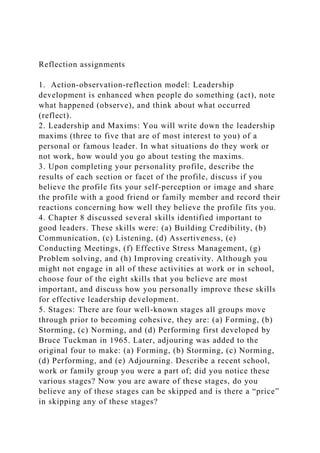
1. Action-observation-reflection model: Leadership
development is enhanced when people do something (act), note
what happened (observe), and think about what occurred
(reflect).
2. Leadership and Maxims: You will write down the leadership
maxims (three to five that are of most interest to you) of a
personal or famous leader. In what situations do they work or
not work, how would you go about testing the maxims.
3. Upon completing your personality profile, describe the
results of each section or facet of the profile, discuss if you
believe the profile fits your self-perception or image and share
the profile with a good friend or family member and record their
reactions concerning how well they believe the profile fits you.
4. Chapter 8 discussed several skills identified important to
good leaders. These skills were: (a) Building Credibility, (b)
Communication, (c) Listening, (d) Assertiveness, (e)
Conducting Meetings, (f) Effective Stress Management, (g)
Problem solving, and (h) Improving creativity. Although you
might not engage in all of these activities at work or in school,
choose four of the eight skills that you believe are most
important, and discuss how you personally improve these skills
for effective leadership development.
5. Stages: There are four well-known stages all groups move
through prior to becoming cohesive, they are: (a) Forming, (b)
Storming, (c) Norming, and (d) Performing first developed by
Bruce Tuckman in 1965. Later, adjouring was added to the
original four to make: (a) Forming, (b) Storming, (c) Norming,
(d) Performing, and (e) Adjourning. Describe a recent school,
work or family group you were a part of; did you notice these
various stages? Now you are aware of these stages, do you
believe any of these stages can be skipped and is there a “price”
in skipping any of these stages?
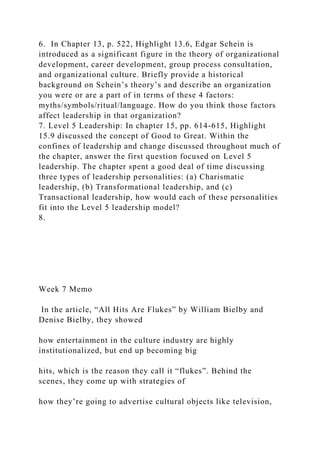
6. In Chapter 13, p. 522, Highlight 13.6, Edgar Schein is
introduced as a significant figure in the theory of organizational
development, career development, group process consultation,
and organizational culture. Briefly provide a historical
background on Schein’s theory’s and describe an organization
you were or are a part of in terms of these 4 factors:
myths/symbols/ritual/language. How do you think those factors
affect leadership in that organization?
7. Level 5 Leadership: In chapter 15, pp. 614-615, Highlight
15.9 discussed the concept of Good to Great. Within the
confines of leadership and change discussed throughout much of
the chapter, answer the first question focused on Level 5
leadership. The chapter spent a good deal of time discussing
three types of leadership personalities: (a) Charismatic
leadership, (b) Transformational leadership, and (c)
Transactional leadership, how would each of these personalities
fit into the Level 5 leadership model?
8.
Week 7 Memo
In the article, “All Hits Are Flukes” by William Bielby and
Denise Bielby, they showed
how entertainment in the culture industry are highly
institutionalized, but end up becoming big
hits, which is the reason they call it “flukes”. Behind the
scenes, they come up with strategies of
how they’re going to advertise cultural objects like television,
music and etc. They have
acknowledged that these cultural products only happen in high
profit making enterprises. The
Bielby’s have conducted research on three factors that they
believed helped with these “flukes”.
The three factors that they think helped with these flukes are
what makes the audience connect
with the creators or critics, how the new product cannot be as
easily evaluated, and how the new
cultural can be commercially and critically separated. In their
case study, the setting is highly
centralized, there’s no prediction on commercial and critical
success, and the assessments are
separated. With their findings, they found that reputation,
imitation, and genre help highly
institutionalized situations with their decision-making.
Although this may be a reason behind
their flukes, they don’t believe that necessarily all highly
institutionalized markets hit flukes.
There are possibilities of things failing and not becoming a big
hit, but industries that hit flukes
like to reassure others that they succeed by thinking rationally.
In the article, “Guys in Suits with Charts: Audience Research
in U.S. Public Radio” by
Alan Stavitsky, he describes how U.S. public radio changed
throughout the years ever since they
relied on audience research to figure out what type of
broadcasting attracts the most listeners.
Although it helped public radio managers make decisions about
programming and fundraising,
some people believed that audience research changed the whole
conception of what public radio
was originally about. Before audience research, public radio
served a purpose to educate, but
eventually converted over to what attracts the most audience.
Critics saw the radio station people
as “guys in suits with charts and pages of numbers” whom only
targeted an audience that would
help them financially, but failed to see the underlying reason of
public radio, which was to help
people intellectually and with their moral values.
As audience research became more popular, NPR started to look
for demographics and
psychographics of their listeners to see which audience they
were attracting. It helped NPR
figure out a game plan of what they should do, but there was
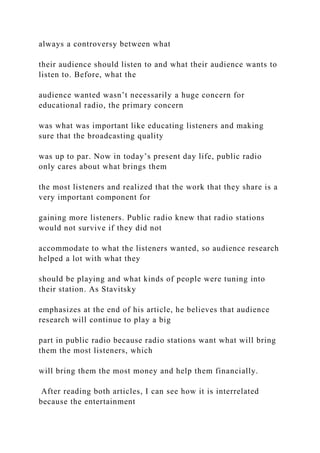
always a controversy between what
their audience should listen to and what their audience wants to
listen to. Before, what the
audience wanted wasn’t necessarily a huge concern for
educational radio, the primary concern
was what was important like educating listeners and making
sure that the broadcasting quality
was up to par. Now in today’s present day life, public radio
only cares about what brings them
the most listeners and realized that the work that they share is a
very important component for
gaining more listeners. Public radio knew that radio stations
would not survive if they did not
accommodate to what the listeners wanted, so audience research
helped a lot with what they
should be playing and what kinds of people were tuning into
their station. As Stavitsky
emphasizes at the end of his article, he believes that audience
research will continue to play a big
part in public radio because radio stations want what will bring
them the most listeners, which
will bring them the most money and help them financially.
After reading both articles, I can see how it is interrelated
because the entertainment
industry and the NPR both have strategies that will help them
attract big audiences. It is always
hard to tell if something is going to be big or not, but being
apart of the entertainment industry,
producers and radio management have to take chances. With
taking chances, they know that they
have to make rational decisions that will benefit their future.
Both sources of media are highly
institutionalized because there’s a structure of how the
entertainment industry works and a
structure of how radio broadcasting works. In the entertainment
industry, there are a lot of shows
that people can watch from news to comedy shows to romantic
movies. When it comes to NPR,
nowadays people don’t turn on the radio to listen to news, they
turn on the radio to listen to
music and with audience research it helped radio managers
figure out songs they should play
more. The more they play the popular song, the more they get
more audience and revenue to
support their station.
For example, since the song Havana by Camila Cabello is
getting a lot of radio play that
must mean program directors at the music stations like it and
see a lot of listeners tuning in when
they play it. Radio stations realize that this is currently the
number one hit pop song that people
love and if they don’t play it in rotation, people are going to
lose interest in their station and skip
to other stations to find this song. I find this particularly true
because when I turn on the radio
and hear other songs aside from the top hits that I’ve been
hearing, I usually change stations until
I hear something that I like. But, when I hear a song on the
radio too much, it makes me tired of
it and makes me want to switch stations until I hear something
else too. I think that is what
makes the radio industry tricky. They try to accommodate to
what they think their listener’s
want, but don’t realize that it can be a little too much, but they
don’t see it as too much because
the song is ranked number one on the charts, so they just
assume that people will switch over to
their radio station if they play it.
I can see how the radio industry has changed from the past to
today’s present day. Before
there was a purpose to educate the listeners, but as the years
went on, radio stations became
money hungry and only cared about what brings in the most
money. Of course they’re going to
play a hit song over something more “educational”. Listeners
can see that when they flip through
radio stations and see the same songs playing. I think this is
why certain genre radio stations help
with what people want to listen to. I know that if I listen to the
popular radio stations in LA, I’m
going to hear the same stuff. Due to that, I switch over to an
RnB station because I know they
aren’t going to play the top 40, but play throwback songs that
I’ll enjoy actually more than
mainstream music.
When radio stations test the waters on a new song, they throw
it into rotation to see how
many listeners tune in when they play it, and when they see that
a lot of people tune in, that’s
when they rotate the song like crazy. Audience research helps
and with the right precautions,
songs become flukes, but only certain songs. It is not likely that
every song the radio station
plays is a fluke, but most of the time it becomes a hit record.
Another artist I can think of is
Khalid and his hit song “Location”. When people started finding
out about Khalid and his hit
song, radio stations knew that to attract his fan and maybe new
listeners, they would have to spin
his song in rotation. I have seen this happen with new artists
who become recently discovered.
Radio stations start playing their music and see the difference in
audience.
Overall, after reading these two articles, I have realized that
the entertainment and music
industry have to take a lot of initiative if they want to be
successful. They want to make smart
moves and a lot of rational thinking is involved to help their
business grow. As we see this
industry now, I wonder if it’ll be the same a decade from now.

Reflection assignments1. Action-observation-reflection model.docx

  • 1.
    Reflection assignments 1. Action-observation-reflectionmodel: Leadership development is enhanced when people do something (act), note what happened (observe), and think about what occurred (reflect). 2. Leadership and Maxims: You will write down the leadership maxims (three to five that are of most interest to you) of a personal or famous leader. In what situations do they work or not work, how would you go about testing the maxims. 3. Upon completing your personality profile, describe the results of each section or facet of the profile, discuss if you believe the profile fits your self-perception or image and share the profile with a good friend or family member and record their reactions concerning how well they believe the profile fits you. 4. Chapter 8 discussed several skills identified important to good leaders. These skills were: (a) Building Credibility, (b) Communication, (c) Listening, (d) Assertiveness, (e) Conducting Meetings, (f) Effective Stress Management, (g) Problem solving, and (h) Improving creativity. Although you might not engage in all of these activities at work or in school, choose four of the eight skills that you believe are most important, and discuss how you personally improve these skills for effective leadership development. 5. Stages: There are four well-known stages all groups move through prior to becoming cohesive, they are: (a) Forming, (b) Storming, (c) Norming, and (d) Performing first developed by Bruce Tuckman in 1965. Later, adjouring was added to the original four to make: (a) Forming, (b) Storming, (c) Norming, (d) Performing, and (e) Adjourning. Describe a recent school, work or family group you were a part of; did you notice these various stages? Now you are aware of these stages, do you believe any of these stages can be skipped and is there a “price” in skipping any of these stages?
  • 2.
    6. In Chapter13, p. 522, Highlight 13.6, Edgar Schein is introduced as a significant figure in the theory of organizational development, career development, group process consultation, and organizational culture. Briefly provide a historical background on Schein’s theory’s and describe an organization you were or are a part of in terms of these 4 factors: myths/symbols/ritual/language. How do you think those factors affect leadership in that organization? 7. Level 5 Leadership: In chapter 15, pp. 614-615, Highlight 15.9 discussed the concept of Good to Great. Within the confines of leadership and change discussed throughout much of the chapter, answer the first question focused on Level 5 leadership. The chapter spent a good deal of time discussing three types of leadership personalities: (a) Charismatic leadership, (b) Transformational leadership, and (c) Transactional leadership, how would each of these personalities fit into the Level 5 leadership model? 8. Week 7 Memo In the article, “All Hits Are Flukes” by William Bielby and Denise Bielby, they showed how entertainment in the culture industry are highly institutionalized, but end up becoming big hits, which is the reason they call it “flukes”. Behind the scenes, they come up with strategies of how they’re going to advertise cultural objects like television,
  • 3.
    music and etc.They have acknowledged that these cultural products only happen in high profit making enterprises. The Bielby’s have conducted research on three factors that they believed helped with these “flukes”. The three factors that they think helped with these flukes are what makes the audience connect with the creators or critics, how the new product cannot be as easily evaluated, and how the new cultural can be commercially and critically separated. In their case study, the setting is highly centralized, there’s no prediction on commercial and critical success, and the assessments are separated. With their findings, they found that reputation, imitation, and genre help highly institutionalized situations with their decision-making. Although this may be a reason behind their flukes, they don’t believe that necessarily all highly institutionalized markets hit flukes. There are possibilities of things failing and not becoming a big hit, but industries that hit flukes like to reassure others that they succeed by thinking rationally. In the article, “Guys in Suits with Charts: Audience Research in U.S. Public Radio” by
  • 4.
    Alan Stavitsky, hedescribes how U.S. public radio changed throughout the years ever since they relied on audience research to figure out what type of broadcasting attracts the most listeners. Although it helped public radio managers make decisions about programming and fundraising, some people believed that audience research changed the whole conception of what public radio was originally about. Before audience research, public radio served a purpose to educate, but eventually converted over to what attracts the most audience. Critics saw the radio station people as “guys in suits with charts and pages of numbers” whom only targeted an audience that would help them financially, but failed to see the underlying reason of public radio, which was to help people intellectually and with their moral values. As audience research became more popular, NPR started to look for demographics and psychographics of their listeners to see which audience they were attracting. It helped NPR figure out a game plan of what they should do, but there was
  • 5.
    always a controversybetween what their audience should listen to and what their audience wants to listen to. Before, what the audience wanted wasn’t necessarily a huge concern for educational radio, the primary concern was what was important like educating listeners and making sure that the broadcasting quality was up to par. Now in today’s present day life, public radio only cares about what brings them the most listeners and realized that the work that they share is a very important component for gaining more listeners. Public radio knew that radio stations would not survive if they did not accommodate to what the listeners wanted, so audience research helped a lot with what they should be playing and what kinds of people were tuning into their station. As Stavitsky emphasizes at the end of his article, he believes that audience research will continue to play a big part in public radio because radio stations want what will bring them the most listeners, which will bring them the most money and help them financially. After reading both articles, I can see how it is interrelated because the entertainment
  • 6.
    industry and theNPR both have strategies that will help them attract big audiences. It is always hard to tell if something is going to be big or not, but being apart of the entertainment industry, producers and radio management have to take chances. With taking chances, they know that they have to make rational decisions that will benefit their future. Both sources of media are highly institutionalized because there’s a structure of how the entertainment industry works and a structure of how radio broadcasting works. In the entertainment industry, there are a lot of shows that people can watch from news to comedy shows to romantic movies. When it comes to NPR, nowadays people don’t turn on the radio to listen to news, they turn on the radio to listen to music and with audience research it helped radio managers figure out songs they should play more. The more they play the popular song, the more they get more audience and revenue to support their station. For example, since the song Havana by Camila Cabello is
  • 7.
    getting a lotof radio play that must mean program directors at the music stations like it and see a lot of listeners tuning in when they play it. Radio stations realize that this is currently the number one hit pop song that people love and if they don’t play it in rotation, people are going to lose interest in their station and skip to other stations to find this song. I find this particularly true because when I turn on the radio and hear other songs aside from the top hits that I’ve been hearing, I usually change stations until I hear something that I like. But, when I hear a song on the radio too much, it makes me tired of it and makes me want to switch stations until I hear something else too. I think that is what makes the radio industry tricky. They try to accommodate to what they think their listener’s want, but don’t realize that it can be a little too much, but they don’t see it as too much because the song is ranked number one on the charts, so they just assume that people will switch over to their radio station if they play it.
  • 8.
    I can seehow the radio industry has changed from the past to today’s present day. Before there was a purpose to educate the listeners, but as the years went on, radio stations became money hungry and only cared about what brings in the most money. Of course they’re going to play a hit song over something more “educational”. Listeners can see that when they flip through radio stations and see the same songs playing. I think this is why certain genre radio stations help with what people want to listen to. I know that if I listen to the popular radio stations in LA, I’m going to hear the same stuff. Due to that, I switch over to an RnB station because I know they aren’t going to play the top 40, but play throwback songs that I’ll enjoy actually more than mainstream music. When radio stations test the waters on a new song, they throw it into rotation to see how many listeners tune in when they play it, and when they see that a lot of people tune in, that’s when they rotate the song like crazy. Audience research helps and with the right precautions, songs become flukes, but only certain songs. It is not likely that
  • 9.
    every song theradio station plays is a fluke, but most of the time it becomes a hit record. Another artist I can think of is Khalid and his hit song “Location”. When people started finding out about Khalid and his hit song, radio stations knew that to attract his fan and maybe new listeners, they would have to spin his song in rotation. I have seen this happen with new artists who become recently discovered. Radio stations start playing their music and see the difference in audience. Overall, after reading these two articles, I have realized that the entertainment and music industry have to take a lot of initiative if they want to be successful. They want to make smart moves and a lot of rational thinking is involved to help their business grow. As we see this industry now, I wonder if it’ll be the same a decade from now.