Referendum: concept
and types
Completed by the
students KRD -302
Sergienko Maya
Protsenko Anna
Opanasenko
Kateryna
Comparative characteristics of the
referendum and elections
Types of referendums on the object
of conduct :
The subject of the
referendum are matters
within the exclusive
solution to the
Constitution as a result of
the popular consultation

Conducted to identify
public opinion on specific
issues of interest to some
of the region's population
Referendum (the territory of
conducting)
Conducted across the entire
country. It is advisable to conduct
before a nationwide referendum the
broad public discussion of the
issues resolved by referendum.

Conducted within individual subjects
of the federation (in the federal state)
or political units (in unitary and
federal states) in order to address
critical local issues.
According to the Constitution of Ukraine
(Art.72) nationwide, All-Ukrainian
referendum designated by the Verkhovna
Rada or the President.
National referendum is called
on the people's initiative on the
request of at least three million
citizens of Ukraine who are
entitled to vote, provided that
the signatures on the
referendum collected not less
than two-thirds of regions and
not less than one hundred
thousand signatures in each
region.
Local referendums
According to the Ministry of Justice from 1991
to 2009 in Ukraine was held 150 local referendums:
50 – on administrative-territorial structure;
34 – for changing the name of the place;
31 – Institutional issues, including early
termination of the representative bodies of local
government;
13 – for the public welfare;
12 – Land Affairs;
10 - other issues.
Historical facts:
A special legal literature assumed date of the first
ever referendum 1439, and his "homeland" Switzerland (Canton Bern), although there are
expressed other opinions on this occasion.

There were two national
referendums in Ukraine December 1, 1991 and
April 17, 2000
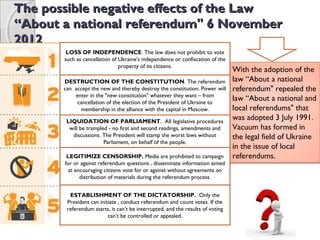
The possible negative effects of the Law
“About a national referendum" 6 November
2012
LOSS OF INDEPENDENCE. The law does not prohibit to vote
such as cancellation of Ukraine's independence or confiscation of the
property of its citizens.
DESTRUCTION OF THE CONSTITUTION. The referendum
can accept the new and thereby destroy the constitution. Power will
enter in the "new constitution" whatever they want – from
cancellation of the election of the President of Ukraine to
membership in the alliance with the capital in Moscow.
LIQUIDATION OF PARLIAMENT. All legislative procedures
will be trampled - no first and second readings, amendments and
discussions. The President will stamp the worst laws without
Parliament, on behalf of the people.
LEGITIMIZE CENSORSHIP. Media are prohibited to campaign
for or against referendum questions , disseminate information aimed
at encouraging citizens vote for or against without agreements on
distribution of materials during the referendum process.
ESTABLISHMENT OF THE DICTATORSHIP. Only the
President can initiate , conduct referendum and count votes. If the
referendum starts, it can’t be interrupted, and the results of voting
can’t be controlled or appealed.

With the adoption of the
law “About a national
referendum" repealed the
law “About a national and
local referendums" that
was adopted 3 July 1991.
Vacuum has formed in
the legal field of Ukraine
in the issue of local
referendums.
The reaction on the Law “About a
national referendum"
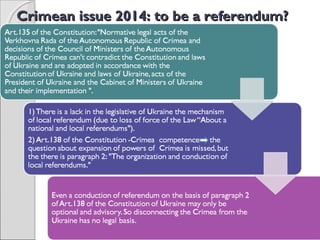
Crimean issue 2014: to be a referendum?
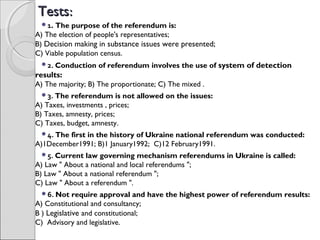
Tests:
1.

The purpose of the referendum is:
A) The election of people's representatives;
B) Decision making in substance issues were presented;
C) Viable population census.
2. Conduction

of referendum involves the use of system of detection

results:
A) The majority; B) The proportionate; C) The mixed .
3. The

referendum is not allowed on the issues:
A) Taxes, investments , prices;
B) Taxes, amnesty, prices;
C) Taxes, budget, amnesty.
4. The

first in the history of Ukraine national referendum was conducted:
A)1December1991; B)1 January1992; C)12 February1991.
5. Current

law governing mechanism referendums in Ukraine is called:
A) Law " About a national and local referendums ";
B) Law " About a national referendum ";
C) Law " About a referendum ".
6. Not

require approval and have the highest power of referendum results:
A) Constitutional and consultancy;
B ) Legislative and constitutional;
C) Advisory and legislative.
THANKS FOR YOUR
ATTENTION!

Referendum: concept and types (Ukraine)

  • 1.
    Referendum: concept and types Completedby the students KRD -302 Sergienko Maya Protsenko Anna Opanasenko Kateryna
  • 3.
    Comparative characteristics ofthe referendum and elections
  • 4.
    Types of referendumson the object of conduct :
  • 5.
    The subject ofthe referendum are matters within the exclusive solution to the Constitution as a result of the popular consultation Conducted to identify public opinion on specific issues of interest to some of the region's population
  • 6.
    Referendum (the territoryof conducting) Conducted across the entire country. It is advisable to conduct before a nationwide referendum the broad public discussion of the issues resolved by referendum. Conducted within individual subjects of the federation (in the federal state) or political units (in unitary and federal states) in order to address critical local issues.
  • 7.
    According to theConstitution of Ukraine (Art.72) nationwide, All-Ukrainian referendum designated by the Verkhovna Rada or the President. National referendum is called on the people's initiative on the request of at least three million citizens of Ukraine who are entitled to vote, provided that the signatures on the referendum collected not less than two-thirds of regions and not less than one hundred thousand signatures in each region.
  • 9.
    Local referendums According tothe Ministry of Justice from 1991 to 2009 in Ukraine was held 150 local referendums: 50 – on administrative-territorial structure; 34 – for changing the name of the place; 31 – Institutional issues, including early termination of the representative bodies of local government; 13 – for the public welfare; 12 – Land Affairs; 10 - other issues.
  • 11.
    Historical facts: A speciallegal literature assumed date of the first ever referendum 1439, and his "homeland" Switzerland (Canton Bern), although there are expressed other opinions on this occasion. There were two national referendums in Ukraine December 1, 1991 and April 17, 2000
  • 12.
    The possible negativeeffects of the Law “About a national referendum" 6 November 2012 LOSS OF INDEPENDENCE. The law does not prohibit to vote such as cancellation of Ukraine's independence or confiscation of the property of its citizens. DESTRUCTION OF THE CONSTITUTION. The referendum can accept the new and thereby destroy the constitution. Power will enter in the "new constitution" whatever they want – from cancellation of the election of the President of Ukraine to membership in the alliance with the capital in Moscow. LIQUIDATION OF PARLIAMENT. All legislative procedures will be trampled - no first and second readings, amendments and discussions. The President will stamp the worst laws without Parliament, on behalf of the people. LEGITIMIZE CENSORSHIP. Media are prohibited to campaign for or against referendum questions , disseminate information aimed at encouraging citizens vote for or against without agreements on distribution of materials during the referendum process. ESTABLISHMENT OF THE DICTATORSHIP. Only the President can initiate , conduct referendum and count votes. If the referendum starts, it can’t be interrupted, and the results of voting can’t be controlled or appealed. With the adoption of the law “About a national referendum" repealed the law “About a national and local referendums" that was adopted 3 July 1991. Vacuum has formed in the legal field of Ukraine in the issue of local referendums.
  • 13.
    The reaction onthe Law “About a national referendum"
  • 14.
    Crimean issue 2014:to be a referendum?
  • 15.
    Tests: 1. The purpose ofthe referendum is: A) The election of people's representatives; B) Decision making in substance issues were presented; C) Viable population census. 2. Conduction of referendum involves the use of system of detection results: A) The majority; B) The proportionate; C) The mixed . 3. The referendum is not allowed on the issues: A) Taxes, investments , prices; B) Taxes, amnesty, prices; C) Taxes, budget, amnesty. 4. The first in the history of Ukraine national referendum was conducted: A)1December1991; B)1 January1992; C)12 February1991. 5. Current law governing mechanism referendums in Ukraine is called: A) Law " About a national and local referendums "; B) Law " About a national referendum "; C) Law " About a referendum ". 6. Not require approval and have the highest power of referendum results: A) Constitutional and consultancy; B ) Legislative and constitutional; C) Advisory and legislative.
  • 16.