NETGEAR RangeMax™ 
Dual Band Wireless-N 
Router WNDR3300 
Reference Manual 
NETGEAR, Inc. 
4500 Great America Parkway 
Santa Clara, CA 95054 USA 
202-10301-01 
February 2008 
v1.0
© 2008 by NETGEAR, Inc. All rights reserved. 
Product Registration, Support, and Documentation 
Register your product at http://www.NETGEAR.com/register. Registration is required before you can use our telephone 
support service. Product updates and Web support are always available by going to: 
http://www.netgear.com/support. 
Setup documentation is available on the CD, on the support website, and on the documentation website. When the 
wireless router is connected to the Internet, click the Knowledgebase or the Documentation link under Web Support in 
the main menu to view support information. 
Trademarks 
NETGEAR and the NETGEAR logo are registered trademarks, and RangeMax and Smart Wizard are trademarks of 
NETGEAR. Inc. in the United States and/or other countries. Microsoft, Windows, and Windows NT are registered 
trademarks and Windows Vista is a trademark of Microsoft Corporation. Other brand and product names are registered 
trademarks or trademarks of their respective holders. 
Statement of Conditions 
In the interest of improving internal design, operational function, and/or reliability, NETGEAR reserves the right to 
make changes to the products described in this document without notice. 
NETGEAR does not assume any liability that may occur due to the use or application of the product(s) or circuit 
layout(s) described herein. 
Certificate of the Manufacturer/Importer 
It is hereby certified that the RangeMax Dual Band Wireless-N Router WNDR3300 has been suppressed in accordance 
with the conditions set out in the BMPT-AmtsblVfg 243/1991 and Vfg 46/1992. The operation of some equipment (for 
example, test transmitters) in accordance with the regulations may, however, be subject to certain restrictions. Please 
refer to the notes in the operating instructions. 
Federal Office for Telecommunications Approvals has been notified of the placing of this equipment on the market 
and has been granted the right to test the series for compliance with the regulations. 
Bestätigung des Herstellers/Importeurs 
Es wird hiermit bestätigt, daß das RangeMax Dual Band Wireless-N Router WNDR3300 gemäß der im BMPT-AmtsblVfg 
v1.0, February 2008 
ii 
243/1991 und Vfg 46/1992 aufgeführten Bestimmungen entstört ist. Das vorschriftsmäßige Betreiben 
einiger Geräte (z.B. Testsender) kann jedoch gewissen Beschränkungen unterliegen. Lesen Sie dazu bitte die 
Anmerkungen in der Betriebsanleitung. 
Das Bundesamt für Zulassungen in der Telekommunikation wurde davon unterrichtet, daß dieses Gerät auf den Markt 
gebracht wurde und es ist berechtigt, die Serie auf die Erfüllung der Vorschriften hin zu überprüfen. 
Regulatory Compliance Information 
This section includes user requirements for operating this product in accordance with National laws for usage of radio 
spectrum and operation of radio devices. Failure of the end-user to comply with the applicable requirements may result 
in unlawful operation and adverse action against the end-user by the applicable National regulatory authority.
v1.0, February 2008 
iii 
NOTE: This product’s firmware limits operation to only the channels allowed in a particular Region or Country. 
Therefore, all options described in this user's guide may not be available in your version of the product. 
Europe – EU Declaration of Conformity 
Marking by the above symbol indicates compliance with the Essential Requirements of the R&TTE Directive of the 
European Union (1999/5/EC). This equipment meets the following conformance standards: 
EN300 328, EN301 893, EN301 489-17, EN60950 
A printed copy of the EU Declaration of Conformity certificate for this product is provided in the 
WNDR3300 product package. 
Europe – Declaration of Conformity in Languages of the European Community 
Cesky [Czech] NETGEAR Inc. tímto prohlašuje, že tento Radiolan je ve shode se základními 
požadavky a dalšími príslušnými ustanoveními smernice 1999/5/ES.. 
Dansk 
[Danish] 
Undertegnede NETGEAR Inc. erklærer herved, at følgende udstyr Radiolan overholder 
de væsentlige krav og øvrige relevante krav i direktiv 1999/5/EF. 
Deutsch 
[German] 
Hiermit erklärt NETGEAR Inc., dass sich das Gerät Radiolan in Übereinstimmung mit 
den grundlegenden Anforderungen und den übrigen einschlägigen Bestimmungen der 
Richtlinie 1999/5/EG befindet. 
Eesti 
[Estonian] 
Käesolevaga kinnitab NETGEAR Inc. seadme Radiolan vastavust direktiivi 1999/5/EÜ 
põhinõuetele ja nimetatud direktiivist tulenevatele teistele asjakohastele sätetele. 
English Hereby, NETGEAR Inc., declares that this Radiolan is in compliance with the essential 
requirements and other relevant provisions of Directive 1999/5/EC. 
Español 
[Spanish] 
Por medio de la presente NETGEAR Inc. declara que el Radiolan cumple con los 
requisitos esenciales y cualesquiera otras disposiciones aplicables o exigibles de la 
Directiva 1999/5/CE. 
Ελληνική 
[Greek] 
ΜΕ ΤΗΝ ΠΑΡΟΥΣΑ NETGEAR Inc. ΔΗΛΩΝΕΙ ΟΤΙ Radiolan ΣΥΜΜΟΡΦΩΝΕΤΑΙ 
ΠΡΟΣ ΤΙΣ ΟΥΣΙΩΔΕΙΣ ΑΠΑΙΤΗΣΕΙΣ ΚΑΙ ΤΙΣ ΛΟΙΠΕΣ ΣΧΕΤΙΚΕΣ ΔΙΑΤΑΞΕΙΣ ΤΗΣ 
ΟΔΗΓΙΑΣ 1999/5/ΕΚ. 
Français 
[French] 
Par la présente NETGEAR Inc. déclare que l'appareil Radiolan est conforme aux 
exigences essentielles et aux autres dispositions pertinentes de la directive 1999/5/CE. 
Italiano [Italian] Con la presente NETGEAR Inc. dichiara che questo Radiolan è conforme ai requisiti 
essenziali ed alle altre disposizioni pertinenti stabilite dalla direttiva 1999/5/CE. 
Latviski 
[Latvian] 
Ar šo NETGEAR Inc. deklarē, ka Radiolan atbilst Direktīvas 1999/5/EK būtiskajām 
prasībām un citiem ar to saistītajiem noteikumiem. 
Lietuvių 
[Lithuanian] 
Šiuo NETGEAR Inc. deklaruoja, kad šis Radiolan atitinka esminius reikalavimus ir kitas 
1999/5/EB Direktyvos nuostatas.
Nederlands 
[Dutch] 
FCC Requirements for Operation in the United States 
FCC Information to User 
This product does not contain any user serviceable components and is to be used with approved antennas only. Any 
product changes or modifications will invalidate all applicable regulatory certifications and approvals 
FCC Guidelines for Human Exposure 
This equipment complies with FCC radiation exposure limits set forth for an uncontrolled environment. This equipment 
should be installed and operated with minimum distance of 20 cm between the radiator and your body. 
This transmitter must not be co-located or operating in conjunction with any other antenna or transmitter. 
v1.0, February 2008 
iv 
Hierbij verklaart NETGEAR Inc. dat het toestel Radiolan in overeenstemming is met de 
essentiële eisen en de andere relevante bepalingen van richtlijn 1999/5/EG. 
Malti [Maltese] Hawnhekk, NETGEAR Inc., jiddikjara li dan Radiolan jikkonforma mal-htigijiet 
essenzjali u ma provvedimenti ohrajn relevanti li hemm fid-Dirrettiva 1999/5/EC. 
Magyar 
[Hungarian] 
Alulírott, NETGEAR Inc. nyilatkozom, hogy a Radiolan megfelel a vonatkozó alapvetõ 
követelményeknek és az 1999/5/EC irányelv egyéb elõírásainak. 
Polski [Polish] Niniejszym NETGEAR Inc. oświadcza, że Radiolan jest zgodny z zasadniczymi 
wymogami oraz pozostałymi stosownymi postanowieniami Dyrektywy 1999/5/EC. 
Português 
[Portuguese] 
NETGEAR Inc. declara que este Radiolan está conforme com os requisitos essenciais 
e outras disposições da Directiva 1999/5/CE. 
Slovensko 
[Slovenian] 
NETGEAR Inc. izjavlja, da je ta Radiolan v skladu z bistvenimi zahtevami in ostalimi 
relevantnimi določili direktive 1999/5/ES. 
Slovensky 
[Slovak] 
NETGEAR Inc. týmto vyhlasuje, _e Radiolan spĺňa základné po_iadavky a všetky 
príslušné ustanovenia Smernice 1999/5/ES. 
Suomi 
[Finnish] 
NETGEAR Inc. vakuuttaa täten että Radiolan tyyppinen laite on direktiivin 1999/5/EY 
oleellisten vaatimusten ja sitä koskevien direktiivin muiden ehtojen mukainen. 
Svenska 
[Swedish] 
Härmed intygar NETGEAR Inc. att denna Radiolan står I överensstämmelse med de 
väsentliga egenskapskrav och övriga relevanta bestämmelser som framgår av direktiv 
1999/5/EG. 
Íslenska 
[Icelandic] 
Hér með lýsir NETGEAR Inc. yfir því að Radiolan er í samræmi við grunnkröfur og aðrar 
kröfur, sem gerðar eru í tilskipun 1999/5/EC. 
Norsk 
[Norwegian] 
NETGEAR Inc. erklærer herved at utstyret Radiolan er i samsvar med de 
grunnleggende krav og øvrige relevante krav i direktiv 1999/5/EF.
FCC Declaration Of Conformity 
We NETGEAR, Inc., 4500 Great America Parkway, Santa Clara, CA 95054, declare under our sole responsibility that 
the model WNDR3300 RangeMax Dual Band Wireless-N Router WNDR3300 complies with Part 15 of FCC Rules. 
Operation is subject to the following two conditions: 
• This device may not cause harmful interference, and 
• This device must accept any interference received, including interference that may cause undesired operation. 
FCC Radio Frequency Interference Warnings & Instructions 
This equipment has been tested and found to comply with the limits for a Class B digital device, pursuant to Part 15 of 
the FCC Rules. These limits are designed to provide reasonable protection against harmful interference in a residential 
installation. This equipment uses and can radiate radio frequency energy and, if not installed and used in accordance 
with the instructions, may cause harmful interference to radio communications. However, there is no guarantee that 
interference will not occur in a particular installation. If this equipment does cause harmful interference to radio or 
television reception, which can be determined by turning the equipment off and on, the user is encouraged to try to 
correct the interference by one or more of the following methods: 
• Reorient or relocate the receiving antenna 
• Increase the separation between the equipment and the receiver 
• Connect the equipment into an electrical outlet on a circuit different from that which the radio receiver is connected 
• Consult the dealer or an experienced radio/TV technician for help. 
RangeMax Dual Band Wireless-N Router 
Tested to Comply 
with FCC Standards 
Modifications made to the product, unless expressly approved by NETGEAR, Inc., could void the user's right to operate 
the equipment. 
Maximum Wireless Signal Rate Derived from IEEE Standard 802.11 Specifications 
Actual data throughput will vary. Network conditions and environmental factors, including volume of network traffic, 
building materials and construction, and network overhead, lower actual data throughput rate. 
v1.0, February 2008 
v 
FOR HOME OR OFFICE USE
Model Number: WNDR3300 
Publication Date: February 2008 
Product Family: Wireless Router 
Product Name: RangeMax Dual Band Wireless-N Router WNDR3300 
Home or Business Product: Home 
Language: English 
Publication Part Number: 202-10301-01 
v1.0, February 2008 
Product and Publication Details 
vi
NETGEAR RangeMax™ Dual Band Wireless-N Router WNDR3300 Reference Manual 
Contents vii 
v1.0, February 2008 
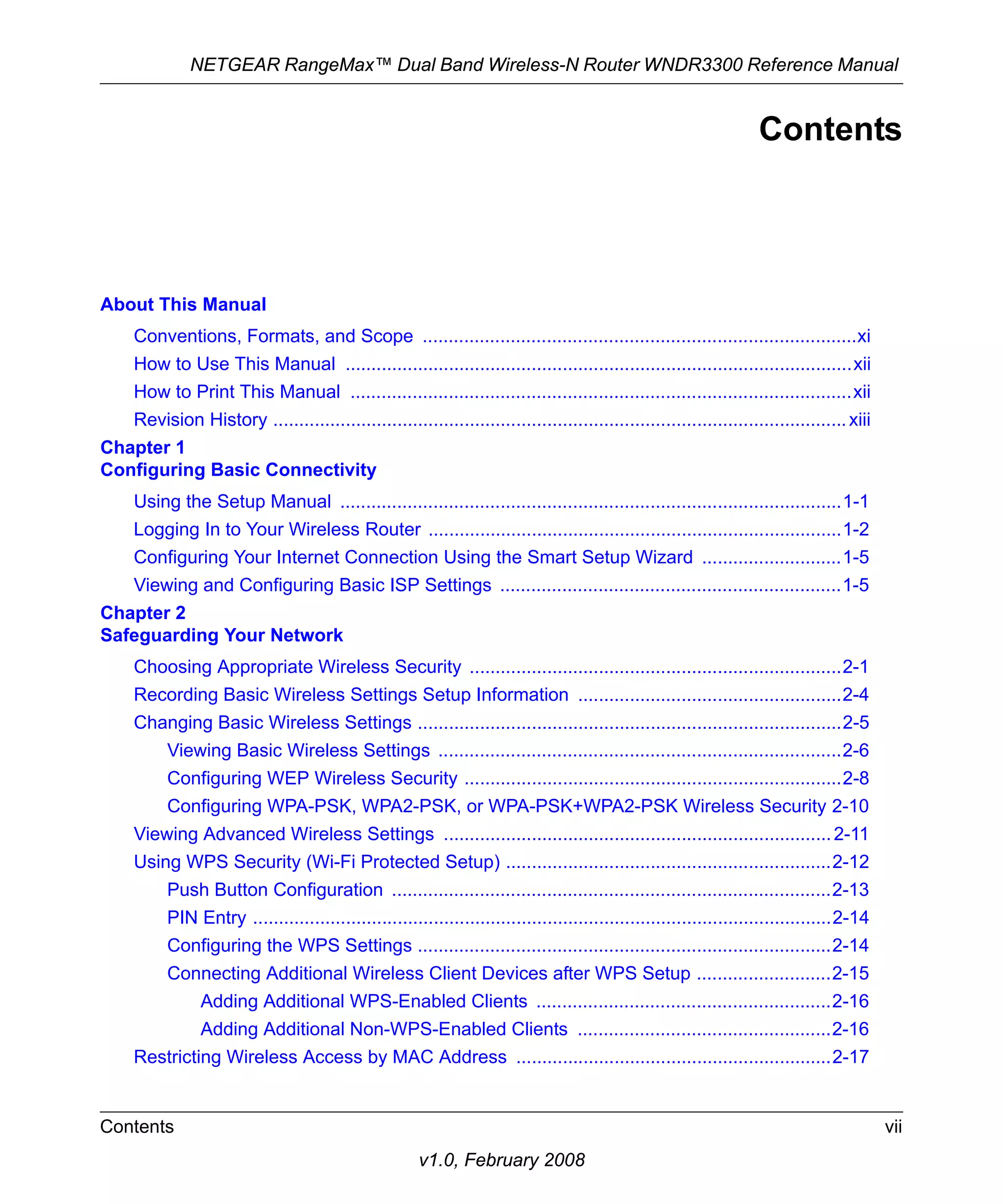
Contents 
About This Manual 
Conventions, Formats, and Scope ....................................................................................xi 
How to Use This Manual ..................................................................................................xii 
How to Print This Manual .................................................................................................xii 
Revision History ............................................................................................................... xiii 
Chapter 1 
Configuring Basic Connectivity 
Using the Setup Manual .................................................................................................1-1 
Logging In to Your Wireless Router ................................................................................1-2 
Configuring Your Internet Connection Using the Smart Setup Wizard ...........................1-5 
Viewing and Configuring Basic ISP Settings ..................................................................1-5 
Chapter 2 
Safeguarding Your Network 
Choosing Appropriate Wireless Security ........................................................................2-1 
Recording Basic Wireless Settings Setup Information ...................................................2-4 
Changing Basic Wireless Settings ..................................................................................2-5 
Viewing Basic Wireless Settings ..............................................................................2-6 
Configuring WEP Wireless Security .........................................................................2-8 
Configuring WPA-PSK, WPA2-PSK, or WPA-PSK+WPA2-PSK Wireless Security 2-10 
Viewing Advanced Wireless Settings ........................................................................... 2-11 
Using WPS Security (Wi-Fi Protected Setup) ...............................................................2-12 
Push Button Configuration .....................................................................................2-13 
PIN Entry ................................................................................................................2-14 
Configuring the WPS Settings ................................................................................2-14 
Connecting Additional Wireless Client Devices after WPS Setup ..........................2-15 
Adding Additional WPS-Enabled Clients .........................................................2-16 
Adding Additional Non-WPS-Enabled Clients .................................................2-16 
Restricting Wireless Access by MAC Address .............................................................2-17
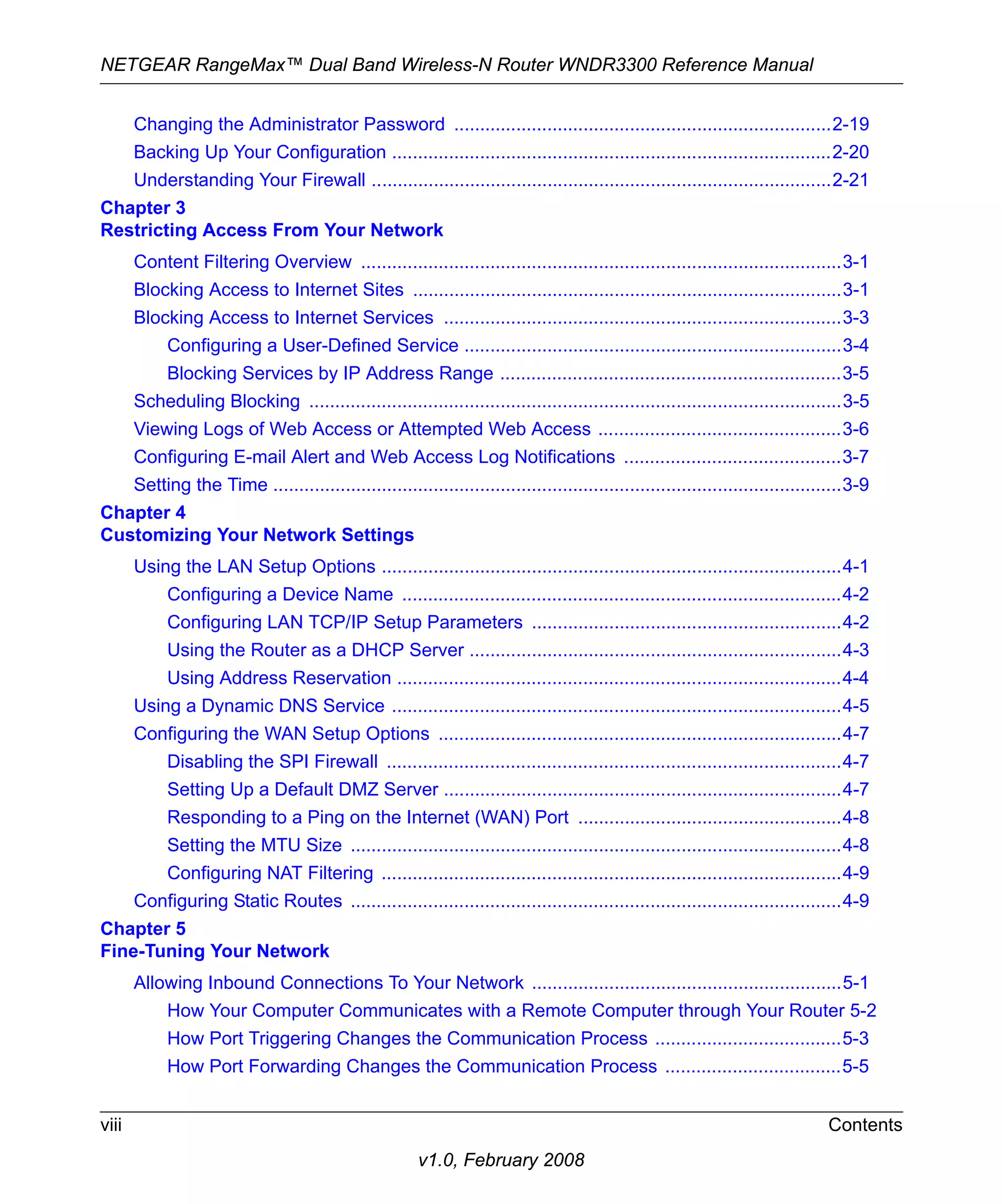
NETGEAR RangeMax™ Dual Band Wireless-N Router WNDR3300 Reference Manual 
Changing the Administrator Password .........................................................................2-19 
Backing Up Your Configuration .....................................................................................2-20 
Understanding Your Firewall .........................................................................................2-21 
Chapter 3 
Restricting Access From Your Network 
Content Filtering Overview .............................................................................................3-1 
Blocking Access to Internet Sites ...................................................................................3-1 
Blocking Access to Internet Services .............................................................................3-3 
Configuring a User-Defined Service .........................................................................3-4 
Blocking Services by IP Address Range ..................................................................3-5 
Scheduling Blocking .......................................................................................................3-5 
Viewing Logs of Web Access or Attempted Web Access ...............................................3-6 
Configuring E-mail Alert and Web Access Log Notifications ..........................................3-7 
Setting the Time ..............................................................................................................3-9 
viii Contents 
v1.0, February 2008 
Chapter 4 
Customizing Your Network Settings 
Using the LAN Setup Options .........................................................................................4-1 
Configuring a Device Name .....................................................................................4-2 
Configuring LAN TCP/IP Setup Parameters ............................................................4-2 
Using the Router as a DHCP Server ........................................................................4-3 
Using Address Reservation ......................................................................................4-4 
Using a Dynamic DNS Service .......................................................................................4-5 
Configuring the WAN Setup Options ..............................................................................4-7 
Disabling the SPI Firewall ........................................................................................4-7 
Setting Up a Default DMZ Server .............................................................................4-7 
Responding to a Ping on the Internet (WAN) Port ...................................................4-8 
Setting the MTU Size ...............................................................................................4-8 
Configuring NAT Filtering .........................................................................................4-9 
Configuring Static Routes ...............................................................................................4-9 
Chapter 5 
Fine-Tuning Your Network 
Allowing Inbound Connections To Your Network ............................................................5-1 
How Your Computer Communicates with a Remote Computer through Your Router 5-2 
How Port Triggering Changes the Communication Process ....................................5-3 
How Port Forwarding Changes the Communication Process ..................................5-5
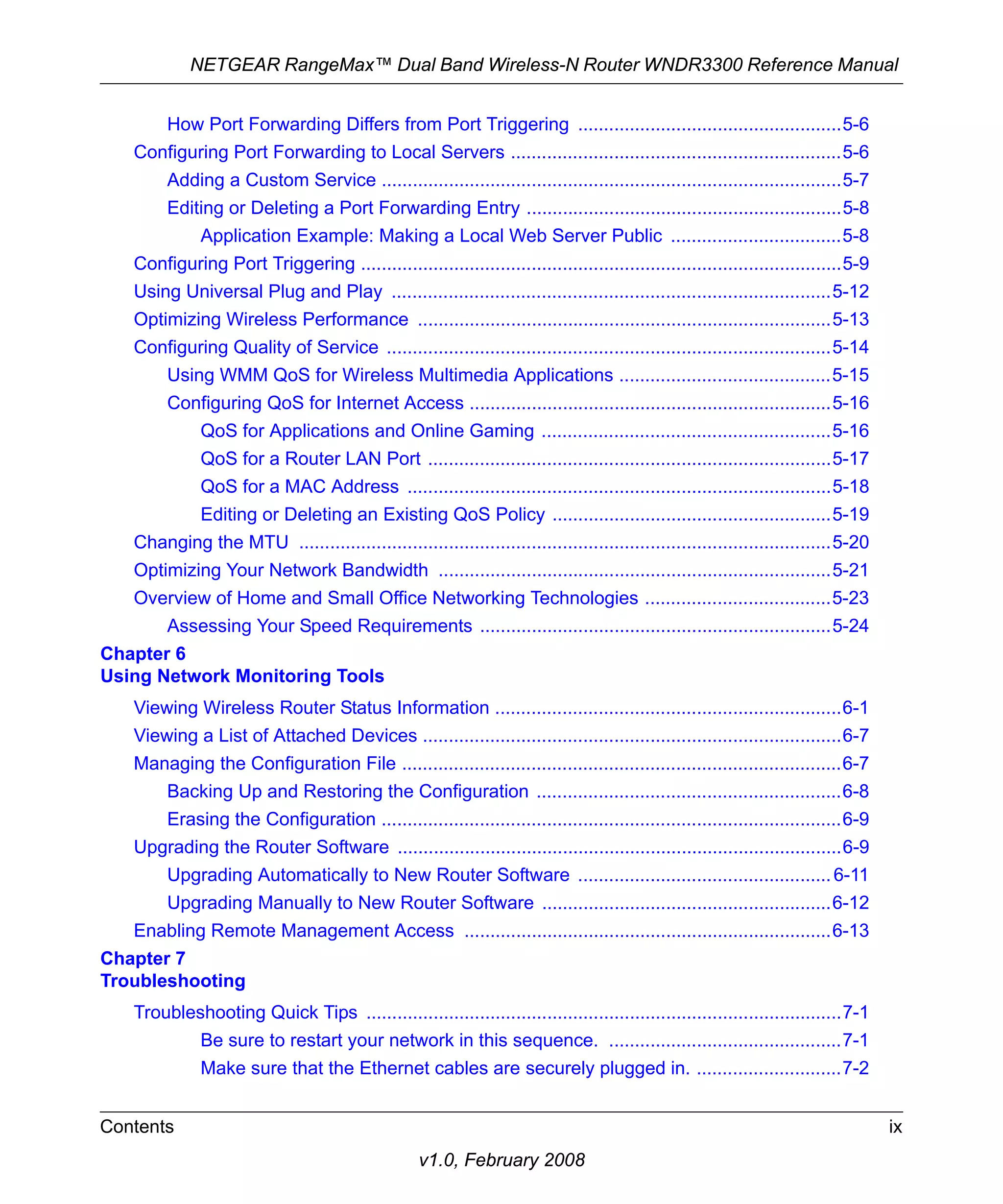
NETGEAR RangeMax™ Dual Band Wireless-N Router WNDR3300 Reference Manual 
How Port Forwarding Differs from Port Triggering ...................................................5-6 
Configuring Port Forwarding to Local Servers ................................................................5-6 
Adding a Custom Service .........................................................................................5-7 
Editing or Deleting a Port Forwarding Entry .............................................................5-8 
Application Example: Making a Local Web Server Public .................................5-8 
Configuring Port Triggering .............................................................................................5-9 
Using Universal Plug and Play .....................................................................................5-12 
Optimizing Wireless Performance ................................................................................5-13 
Configuring Quality of Service ......................................................................................5-14 
Using WMM QoS for Wireless Multimedia Applications .........................................5-15 
Configuring QoS for Internet Access ......................................................................5-16 
QoS for Applications and Online Gaming ........................................................5-16 
QoS for a Router LAN Port ..............................................................................5-17 
QoS for a MAC Address ..................................................................................5-18 
Editing or Deleting an Existing QoS Policy ......................................................5-19 
Changing the MTU .......................................................................................................5-20 
Optimizing Your Network Bandwidth ............................................................................5-21 
Overview of Home and Small Office Networking Technologies ....................................5-23 
Assessing Your Speed Requirements ....................................................................5-24 
Contents ix 
v1.0, February 2008 
Chapter 6 
Using Network Monitoring Tools 
Viewing Wireless Router Status Information ...................................................................6-1 
Viewing a List of Attached Devices .................................................................................6-7 
Managing the Configuration File .....................................................................................6-7 
Backing Up and Restoring the Configuration ...........................................................6-8 
Erasing the Configuration .........................................................................................6-9 
Upgrading the Router Software ......................................................................................6-9 
Upgrading Automatically to New Router Software ................................................. 6-11 
Upgrading Manually to New Router Software ........................................................6-12 
Enabling Remote Management Access .......................................................................6-13 
Chapter 7 
Troubleshooting 
Troubleshooting Quick Tips ............................................................................................7-1 
Be sure to restart your network in this sequence. .............................................7-1 
Make sure that the Ethernet cables are securely plugged in. ............................7-2
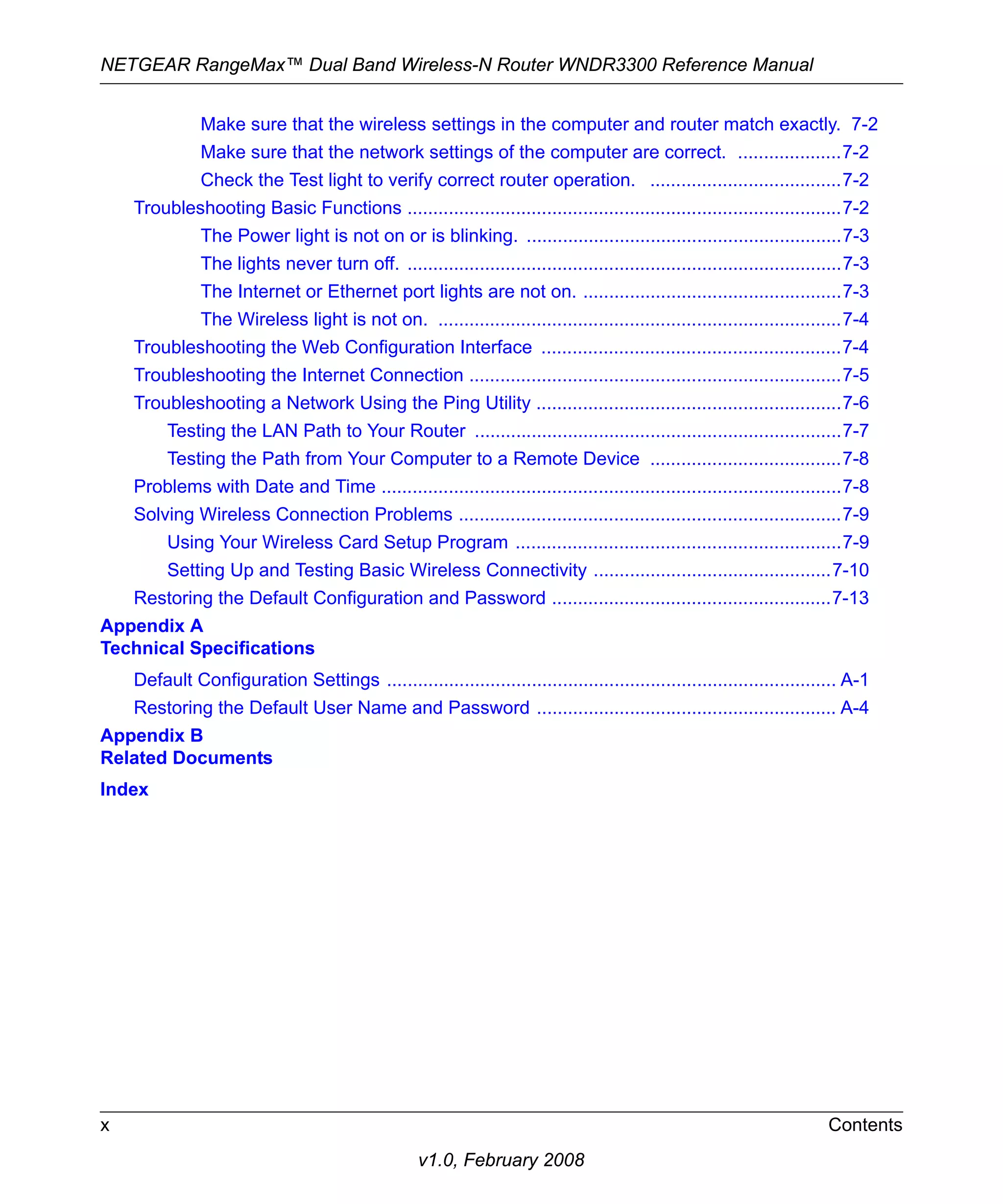
NETGEAR RangeMax™ Dual Band Wireless-N Router WNDR3300 Reference Manual 
Make sure that the wireless settings in the computer and router match exactly. 7-2 
Make sure that the network settings of the computer are correct. ....................7-2 
Check the Test light to verify correct router operation. .....................................7-2 
Troubleshooting Basic Functions ....................................................................................7-2 
The Power light is not on or is blinking. .............................................................7-3 
The lights never turn off. ....................................................................................7-3 
The Internet or Ethernet port lights are not on. ..................................................7-3 
The Wireless light is not on. ..............................................................................7-4 
Troubleshooting the Web Configuration Interface ..........................................................7-4 
Troubleshooting the Internet Connection ........................................................................7-5 
Troubleshooting a Network Using the Ping Utility ...........................................................7-6 
Testing the LAN Path to Your Router .......................................................................7-7 
Testing the Path from Your Computer to a Remote Device .....................................7-8 
Problems with Date and Time .........................................................................................7-8 
Solving Wireless Connection Problems ..........................................................................7-9 
Using Your Wireless Card Setup Program ...............................................................7-9 
Setting Up and Testing Basic Wireless Connectivity ..............................................7-10 
Restoring the Default Configuration and Password ......................................................7-13 
x Contents 
v1.0, February 2008 
Appendix A 
Technical Specifications 
Default Configuration Settings ....................................................................................... A-1 
Restoring the Default User Name and Password .......................................................... A-4 
Appendix B 
Related Documents 
Index
NETGEAR RangeMax™ Dual Band Wireless-N Router WNDR3300 Reference Manual 
xi 
Italic Emphasis, books, CDs 
Bold User input, IP addresses, GUI screen text 
Fixed Command prompt, CLI text, code 
Italic URL links 
v1.0, February 2008 
About This Manual 
The user manual provides information for configuring the features of the NETGEAR® RangeMax 
Dual Band Wireless-N Router WNDR3300 beyond initial configuration settings. Initial 
configuration instructions can be found in the NETGEAR Wireless Router Setup Manual. You 
should have basic to intermediate computer and Internet skills. 
Conventions, Formats, and Scope 
The conventions, formats, and scope of this manual are described in the following paragraphs: 
• Typographical conventions. This manual uses the following typographical conventions: 
• Formats. This manual uses the following formats to highlight special messages: 
Note: This format is used to highlight information of importance or special interest. 
Tip: This format is used to highlight a procedure that will save time or resources. 
Warning: Ignoring this type of note might result in a malfunction or damage to the 
equipment, a breach of security, or a loss of data.
NETGEAR RangeMax™ Dual Band Wireless-N Router WNDR3300 Reference Manual 
Danger: This is a safety warning. Failure to take heed of this notice might result in 
personal injury or death. 
• Scope. This manual is written for the WNDR3300 router according to these specifications: 
Product Version RangeMax Dual Band Wireless-N Router WNDR3300 
Manual Publication Date February 2008 
For more information about network, Internet, firewall, and VPN technologies, see the links to the 
NETGEAR website in Appendix B, “Related Documents.” 
Note: Product updates are available on the NETGEAR, Inc. website at 
http://www.netgear.com/support. 
How to Use This Manual 
The HTML version of this manual includes the following: 
• Buttons, and , for browsing forward or backward through the manual one page 
xii 
v1.0, February 2008 
at a time. 
• A button that displays the table of contents and an button that displays an 
index. Double-click a link in the table of contents or index to navigate directly to where the 
topic is described in the manual. 
• A button to access the full NETGEAR, Inc. online knowledge base for the product 
model. 
• Links to PDF versions of the full manual and individual chapters. 
How to Print This Manual 
To print this manual, you can choose one of the following options, according to your needs. 
• Printing a page from HTML. Each page in the HTML version of the manual is dedicated to 
a major topic. Select File > Print from the browser menu to print the page contents.
NETGEAR RangeMax™ Dual Band Wireless-N Router WNDR3300 Reference Manual 
– Printing from PDF. Your computer must have the free Adobe Acrobat Reader installed 
for you to view and print PDF files. The Acrobat Reader is available on the Adobe website 
at http://www.adobe.com. 
– Printing a PDF chapter. Use the PDF of This Chapter link at the top left of any page. 
• Click the PDF of This Chapter link at the top left of any page in the chapter you want 
– Printing a PDF version of the complete manual. Use the Complete PDF Manual link 
at the top left of any page. 
• Click the Complete PDF Manual link at the top left of any page in the manual. The 
Tip: If your printer supports printing two pages on a single sheet of paper, you can 
xiii 
to print. The PDF version of the chapter you were viewing opens in a browser 
window. 
• Click the print icon in the upper left of your browser window. 
PDF version of the complete manual opens in a browser window. 
• Click the print icon in the upper left of your browser window. 
save paper and printer ink by selecting this feature. 
v1.0, February 2008 
Revision History 
NETGEAR, Inc. is constantly searching for ways to improve its products and documentation. The 
following table indicates any changes that might have been made since the WNDR3300 router was 
introduced. 
Table 1-1. Publication Revision History 
Version Date Description 
v1.0 February 2008 Original publication.
NETGEAR RangeMax™ Dual Band Wireless-N Router WNDR3300 Reference Manual 
xiv 
v1.0, February 2008
NETGEAR RangeMax™ Dual Band Wireless-N Router WNDR3300 Reference Manual 
Note: NETGEAR recommends using the Smart Wizard™ on the Resource CD for initial 
configuration, as described in the NETGEAR Wireless Router Setup Manual. 
Configuring Basic Connectivity 1-1 
v1.0, February 2008 
Chapter 1 
Configuring Basic Connectivity 
This chapter describes the settings for your Internet connection and your wireless local area 
network (LAN) connection. When you perform the initial configuration of your wireless router 
using the Resource CD as described in the NETGEAR Wireless Router Setup Manual, these 
settings are specified automatically for you. This chapter provides further details about these 
connectivity settings, as well as instructions on how to log in to the router for further 
configuration. 
This chapter includes the following sections: 
• “Using the Setup Manual” 
• “Logging In to Your Wireless Router” on page 1-2 
• “Configuring Your Internet Connection Using the Smart Setup Wizard” on page 1-5 
• “Viewing and Configuring Basic ISP Settings” on page 1-5 
Using the Setup Manual 
For first-time installation of your wireless router, refer to the NETGEAR Wireless Router Setup 
Manual. The Setup Manual explains how to launch the NETGEAR Smart Wizard on the Resource 
CD to step you through the procedure to connect your router, modem, and computers. The Smart 
Wizard assists you in configuring your wireless settings and enabling wireless security for your 
network. After initial configuration using the Setup Manual, you can use the information in this 
Reference Manual to configure additional features of your wireless router. 
For installation instructions in a language other than English, refer to the language options on the 
Resource CD.
NETGEAR RangeMax™ Dual Band Wireless-N Router WNDR3300 Reference Manual 
Logging In to Your Wireless Router 
When the wireless router is connected to your network, you can access and configure the router 
using your browser. 
To access the Web Configuration Manager: 
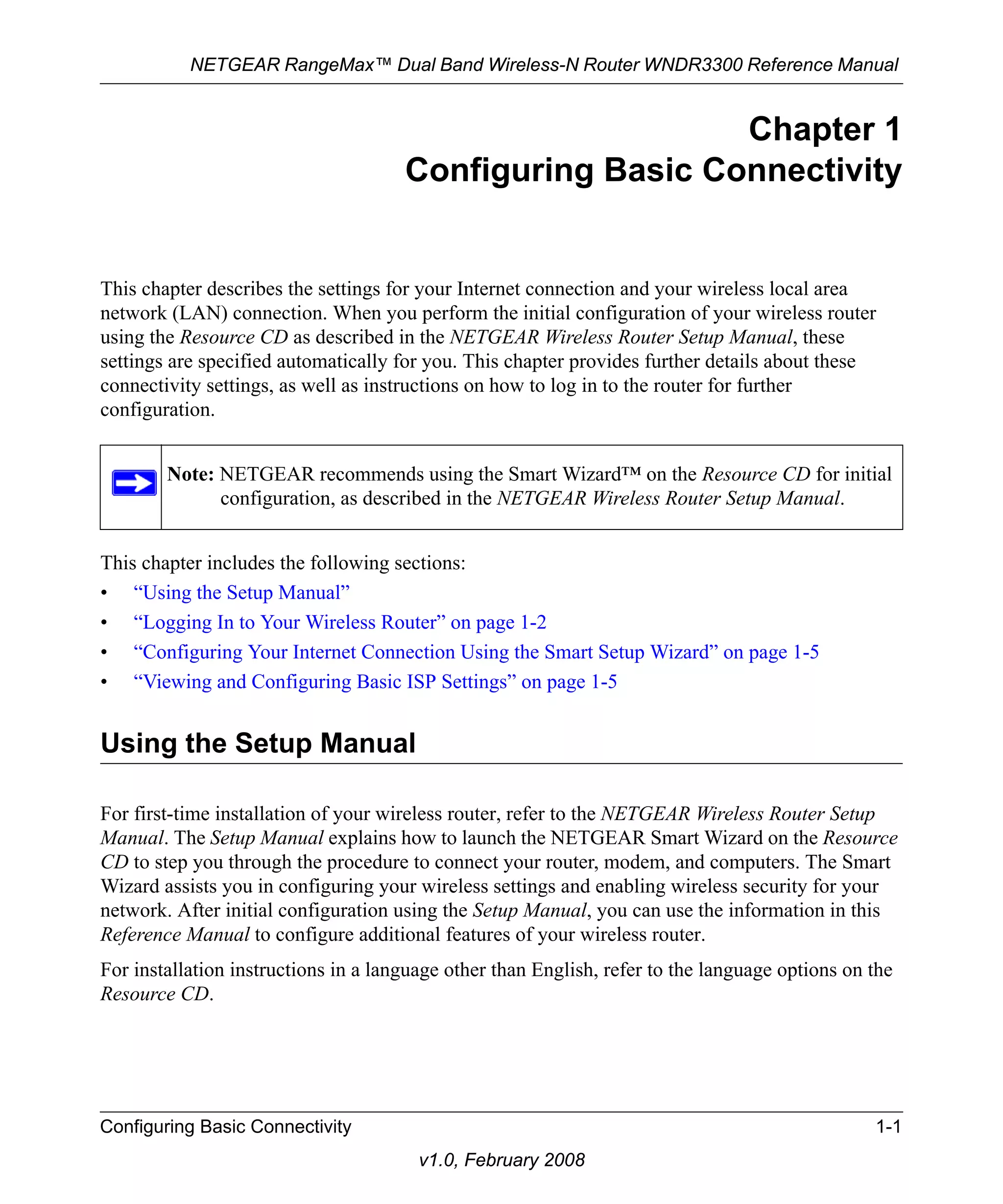
1. Connect to the wireless router by typing http://www.routerlogin.net or the router’s LAN IP 
address (default is 192.168.1.1) in the address field of your browser, and then press Enter. A 
login window displays: 
2. Enter admin for the router user name and your password (or the default, password). For 
information about how to change the password, see “Changing the Administrator Password” 
on page 2-19. 
1-2 Configuring Basic Connectivity 
v1.0, February 2008 
Figure 1-1 
Tip: You can connect to the wireless router by typing either of these URLs in the 
address field of your browser, and then pressing Enter: 
• http://www.routerlogin.net 
• http://www.routerlogin.com 
If these URLs do not work, you must type the IP address of the router, for 
example, http://www.192.168.1.1. 
Note: The router user name and password are not the same as any other user name or 
password you might use to log in to your Internet connection.
NETGEAR RangeMax™ Dual Band Wireless-N Router WNDR3300 Reference Manual 
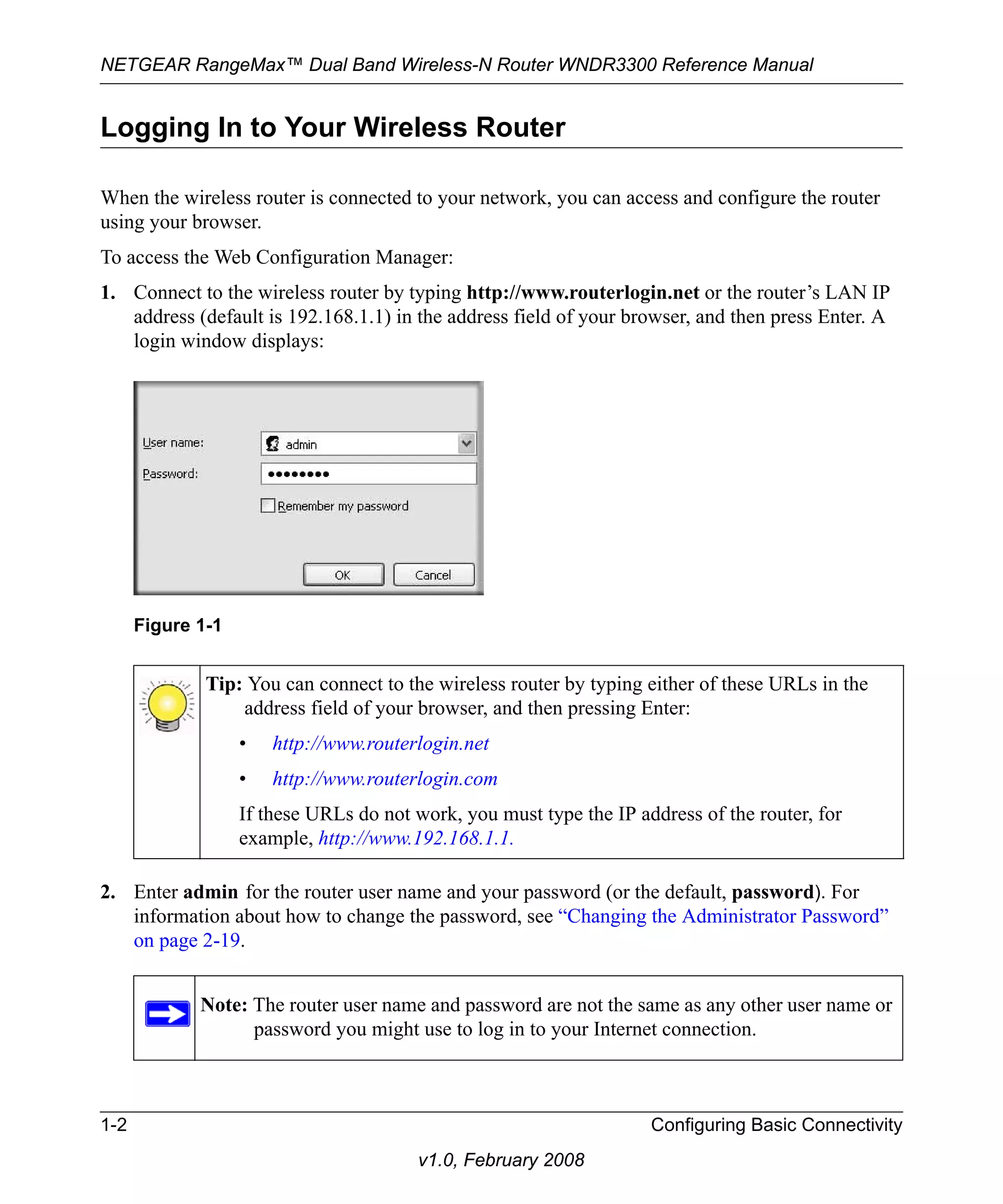
The Checking for Firmware Updates screen displays unless you previously cleared the Check 
for Updated Firmware Upon Log-in check box. 
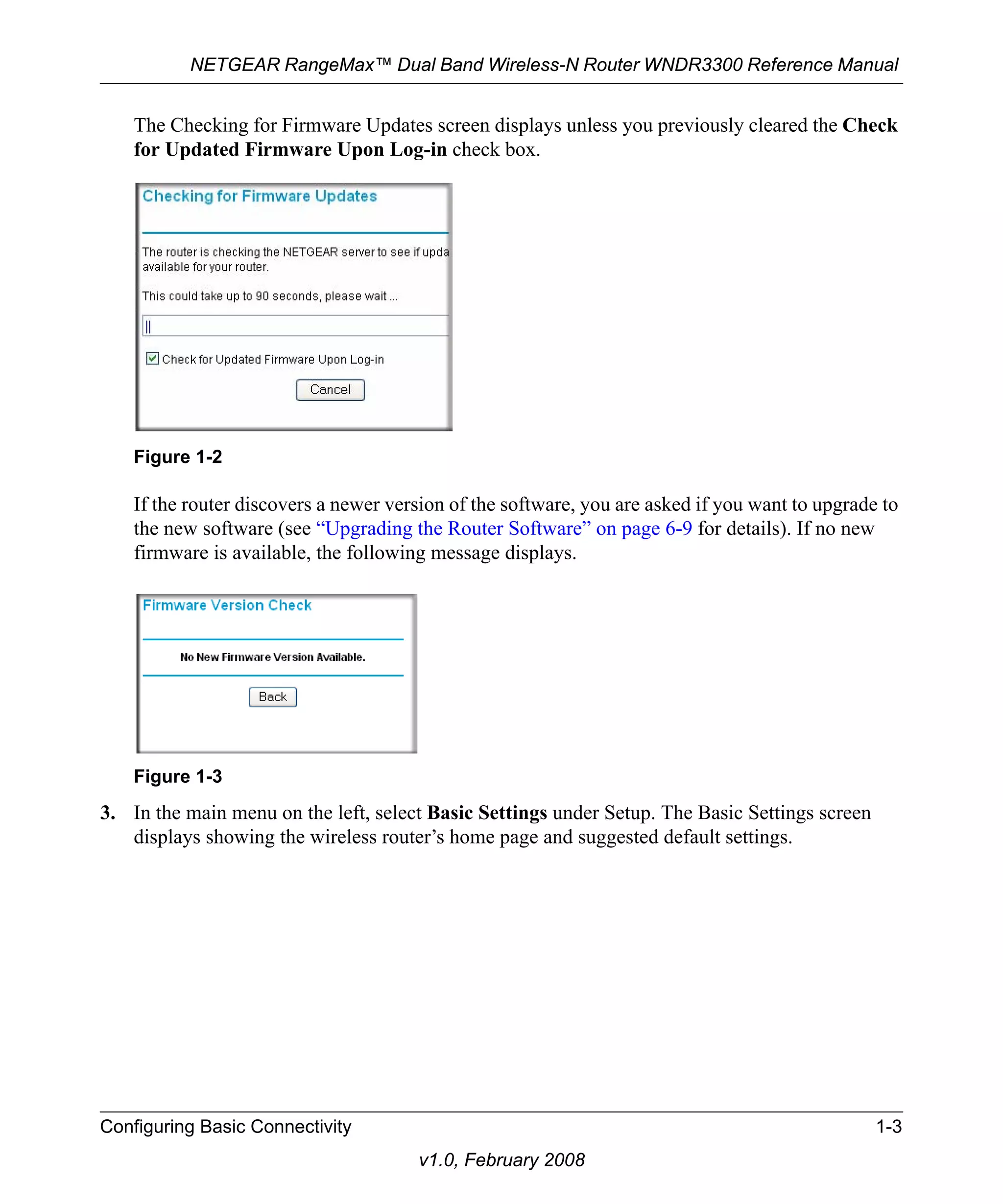
If the router discovers a newer version of the software, you are asked if you want to upgrade to 
the new software (see “Upgrading the Router Software” on page 6-9 for details). If no new 
firmware is available, the following message displays. 
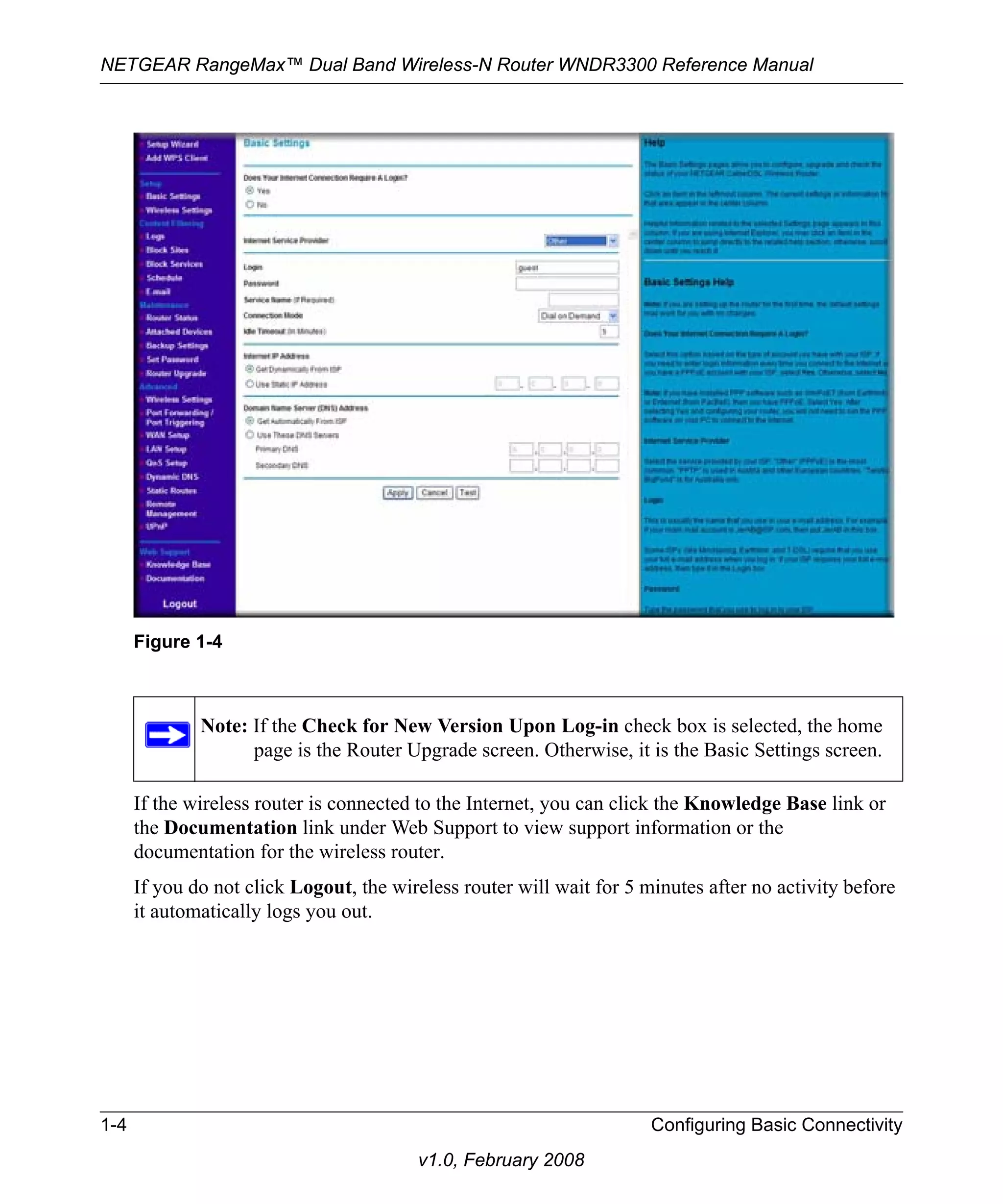
3. In the main menu on the left, select Basic Settings under Setup. The Basic Settings screen 
displays showing the wireless router’s home page and suggested default settings. 
Configuring Basic Connectivity 1-3 
v1.0, February 2008 
Figure 1-2 
Figure 1-3
NETGEAR RangeMax™ Dual Band Wireless-N Router WNDR3300 Reference Manual 
If the wireless router is connected to the Internet, you can click the Knowledge Base link or 
the Documentation link under Web Support to view support information or the 
documentation for the wireless router. 
If you do not click Logout, the wireless router will wait for 5 minutes after no activity before 
it automatically logs you out. 
1-4 Configuring Basic Connectivity 
v1.0, February 2008 
Figure 1-4 
Note: If the Check for New Version Upon Log-in check box is selected, the home 
page is the Router Upgrade screen. Otherwise, it is the Basic Settings screen.
NETGEAR RangeMax™ Dual Band Wireless-N Router WNDR3300 Reference Manual 
Configuring Your Internet Connection Using the Smart Setup 
Wizard 
You can manually configure your Internet connection using the Basic Settings screen, or you can 
allow the Smart Setup Wizard to determine your Internet Service Provider (ISP) configuration. 
The Smart Setup Wizard searches your Internet connection for servers and protocols to determine 
your ISP configuration. This feature is not the same as the Smart Wizard configuration assistant 
that appears only when the router is in its factory default state. To use the Smart Setup Wizard to 
assist with configuration or to verify the Internet connection settings, follow this procedure: 
1. From the top of the main menu of the browser interface, click Setup Wizard. 
2. Click Next to proceed. Enter your ISP settings, as needed. 
3. At the end of the Setup Wizard, click Test to verify your Internet connection. If you have 
trouble connecting to the Internet, see Chapter 7, “Troubleshooting.” 
Viewing and Configuring Basic ISP Settings 
Settings related to your Internet service are specified in the Basic Settings screen. To access the 
Basic Settings screen, from the main menu of the router’s Web Configuration Interface, under 
Setup, select Basic Settings. 
The content you see in the Basic Settings screen depends on whether your ISP requires that you 
log in with a user name and password for Internet access. 
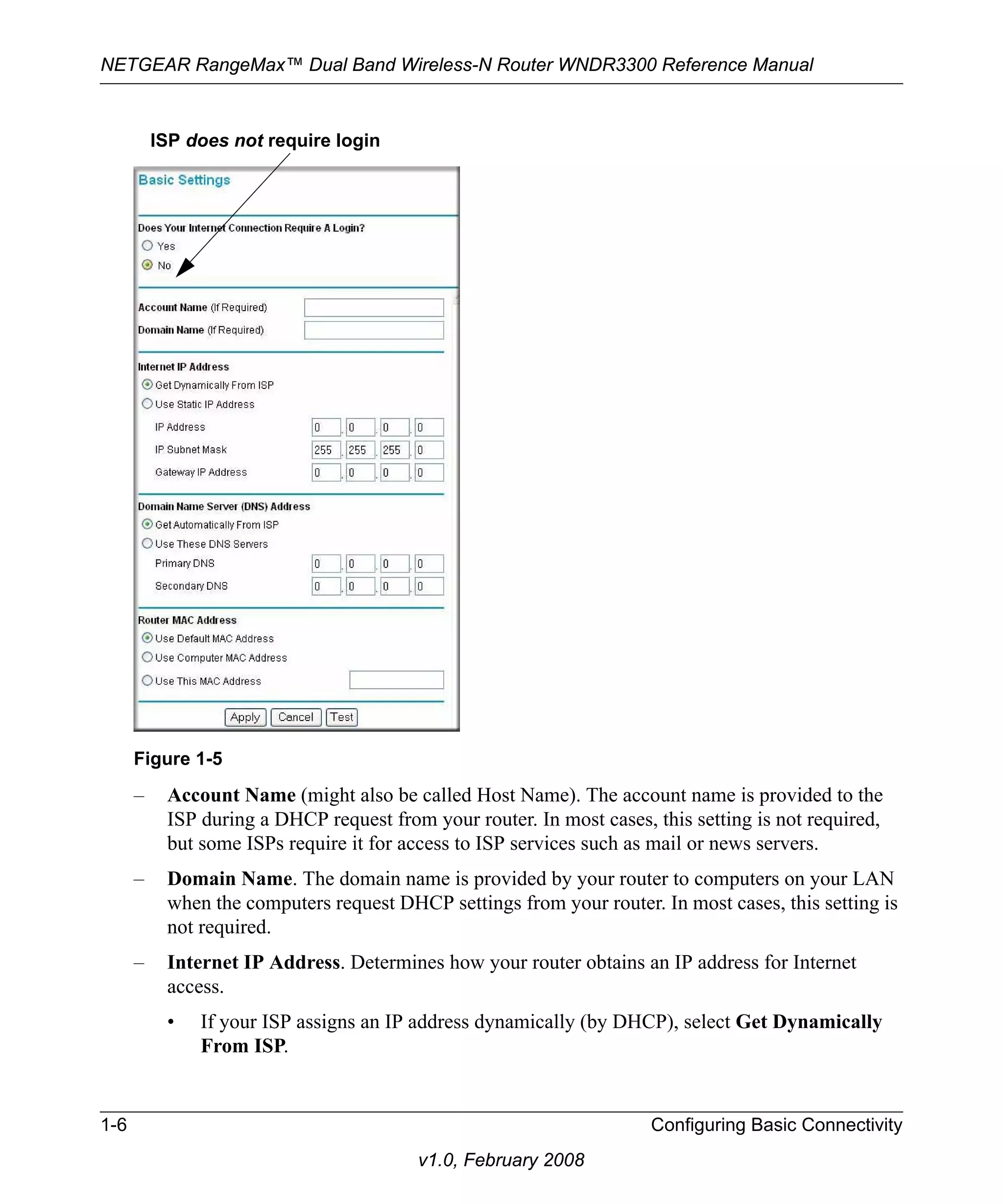
• No login required by ISP. If no login is required by your ISP, the following settings appear in 
Configuring Basic Connectivity 1-5 
v1.0, February 2008 
the Basic Settings screen.
NETGEAR RangeMax™ Dual Band Wireless-N Router WNDR3300 Reference Manual 
ISP does not require login 
Figure 1-5 
– Account Name (might also be called Host Name). The account name is provided to the 
ISP during a DHCP request from your router. In most cases, this setting is not required, 
but some ISPs require it for access to ISP services such as mail or news servers. 
– Domain Name. The domain name is provided by your router to computers on your LAN 
when the computers request DHCP settings from your router. In most cases, this setting is 
not required. 
– Internet IP Address. Determines how your router obtains an IP address for Internet 
access. 
• If your ISP assigns an IP address dynamically (by DHCP), select Get Dynamically 
1-6 Configuring Basic Connectivity 
v1.0, February 2008 
From ISP.
NETGEAR RangeMax™ Dual Band Wireless-N Router WNDR3300 Reference Manual 
• If your ISP has assigned you a permanent, fixed (static) IP address for your computer, 
select Use Static IP Address. Enter the IP address that your ISP assigned. Also, enter 
the subnet mask and the gateway IP address. The gateway is the ISP’s router to which 
your router will connect. 
– Domain Name Server (DNS) Address. If you know that your ISP does not automatically 
transmit DNS addresses to the router during login, select Use These DNS Servers, and 
enter the IP address of your ISP’s primary DNS server. If a secondary DNS server address 
is available, enter it also. 
Note: If you enter or change a DNS address, restart the computers on your 
network so that these settings take effect. 
– Router MAC Address. This section determines the Ethernet MAC address that the router 
will use on the Internet port. Typically, you would leave Use Default Address selected. 
However, some ISPs (especially cable modem providers) register the Ethernet MAC 
address of the network interface card in your computer when your account is first opened. 
They then accept only traffic from the MAC address of that computer. This feature allows 
your router to masquerade as that computer by “cloning” or “spoofing” its MAC address. 
To change the MAC address, select one of the following methods: 
• Select Use Computer MAC Address. The router will then capture and use the MAC 
address of the computer that you are now using. You must be using the one computer 
that is allowed by the ISP. 
• Select Use This MAC Address, and type it in here. 
– Does Your Internet Connection Require A Login?. If you usually must use a login 
program such as WinPOET to access the Internet, your Internet connection requires a 
login. After you select Yes, the Basic Settings screen displays, as shown in the following 
figure. 
Note: After you finish setting up your router, you will no longer need to start the 
ISP’s login program on your computer to access the Internet. When you 
start an Internet application, your router will automatically log you in. 
Configuring Basic Connectivity 1-7 
v1.0, February 2008
NETGEAR RangeMax™ Dual Band Wireless-N Router WNDR3300 Reference Manual 
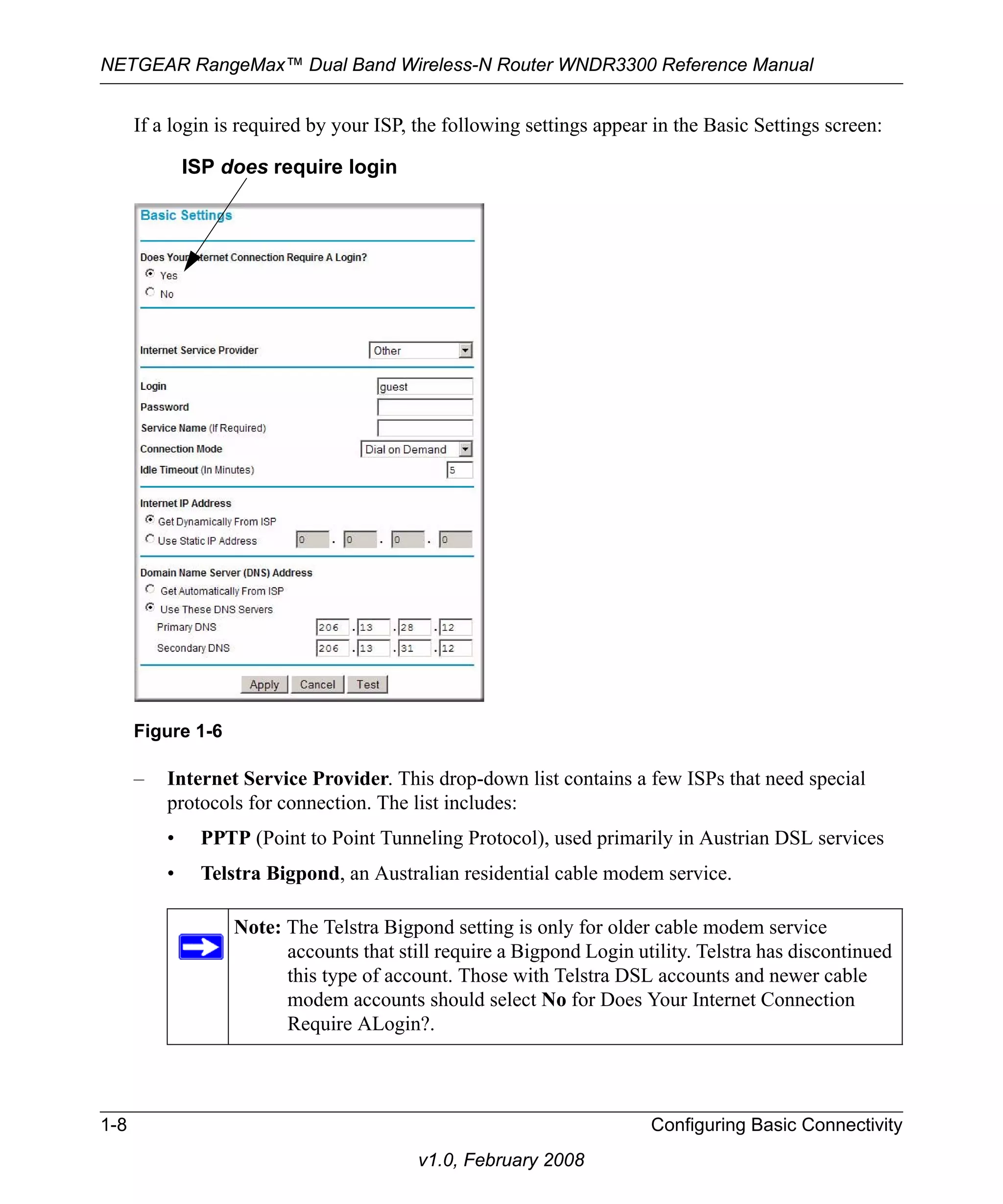
If a login is required by your ISP, the following settings appear in the Basic Settings screen: 
ISP does require login 
– Internet Service Provider. This drop-down list contains a few ISPs that need special 
protocols for connection. The list includes: 
• PPTP (Point to Point Tunneling Protocol), used primarily in Austrian DSL services 
• Telstra Bigpond, an Australian residential cable modem service. 
1-8 Configuring Basic Connectivity 
v1.0, February 2008 
Figure 1-6 
Note: The Telstra Bigpond setting is only for older cable modem service 
accounts that still require a Bigpond Login utility. Telstra has discontinued 
this type of account. Those with Telstra DSL accounts and newer cable 
modem accounts should select No for Does Your Internet Connection 
Require ALogin?.
NETGEAR RangeMax™ Dual Band Wireless-N Router WNDR3300 Reference Manual 
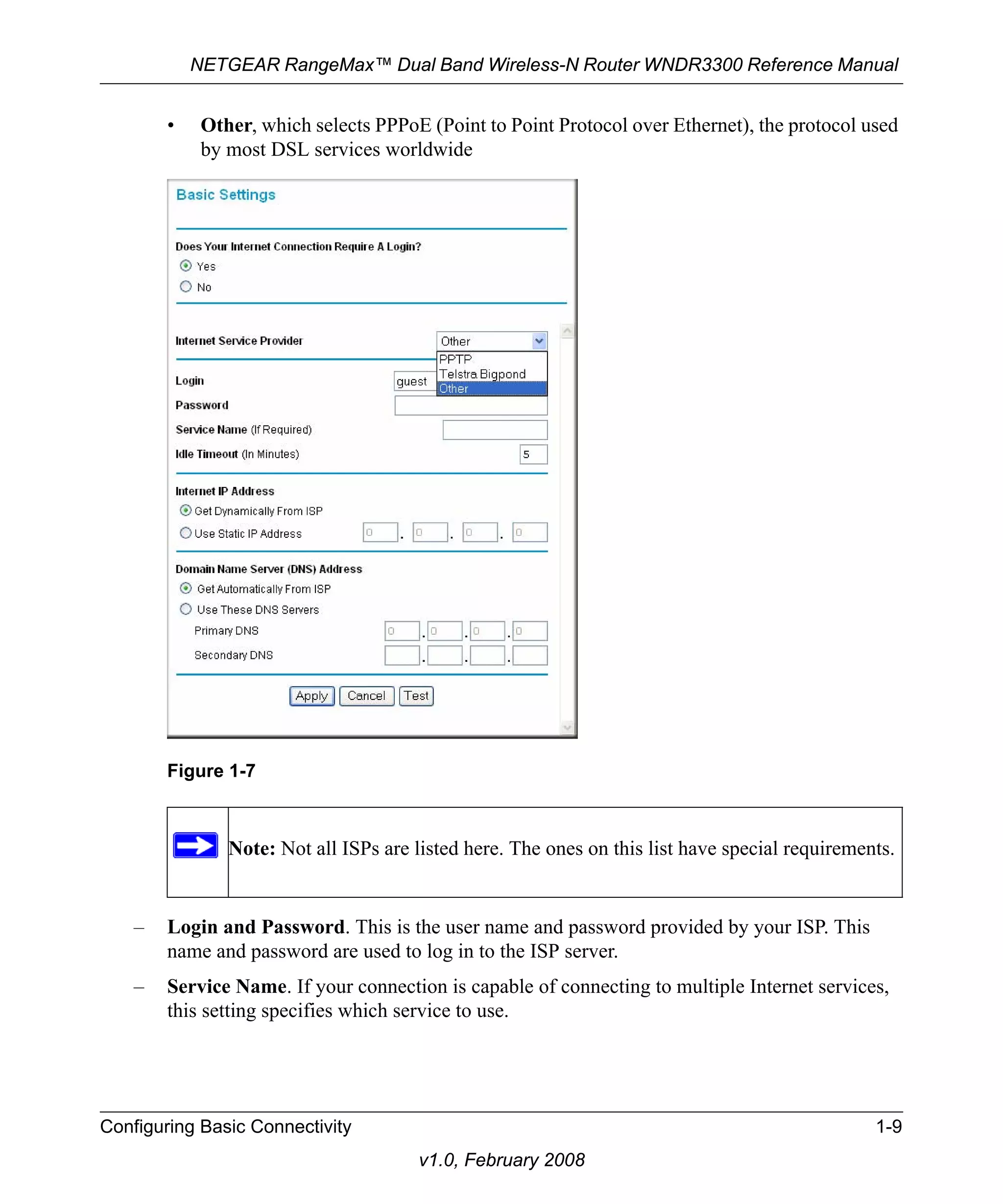
• Other, which selects PPPoE (Point to Point Protocol over Ethernet), the protocol used 
by most DSL services worldwide 
– Login and Password. This is the user name and password provided by your ISP. This 
name and password are used to log in to the ISP server. 
– Service Name. If your connection is capable of connecting to multiple Internet services, 
this setting specifies which service to use. 
Configuring Basic Connectivity 1-9 
v1.0, February 2008 
Figure 1-7 
Note: Not all ISPs are listed here. The ones on this list have special requirements.
NETGEAR RangeMax™ Dual Band Wireless-N Router WNDR3300 Reference Manual 
– Connection Mode. This drop-down list (shown in Figure 1-6 on page 1-8) specifies when 
the router will connect to and disconnect from the Internet. The list includes: 
• Always On. The router logs in to the Internet immediately after booting and never 
1-10 Configuring Basic Connectivity 
v1.0, February 2008 
disconnects. 
• Dial on Demand. The router logs in only when outgoing traffic is present and logs out 
after the idle time-out. 
• Manually Connect. The router logs in or logs out only when the user clicks Connect 
or Disconnect in the Router Status screen. 
– Idle Timeout. Your Internet connection is logged out if there is no data transfer during the 
specified time interval. 
– Domain Name Server (DNS) Address. If you know that your ISP does not automatically 
transmit DNS addresses to the router during login, select Use These DNS Servers, and 
enter the IP address of your ISP’s primary DNS server. If a secondary DNS server address 
is available, enter it also. 
Note: If you enter or change a DNS address, restart the computers on your 
network so that these settings take effect.
NETGEAR RangeMax™ Dual Band Wireless-N Router WNDR3300 Reference Manual 
Safeguarding Your Network 2-1 
v1.0, February 2008 
Chapter 2 
Safeguarding Your Network 
The RangeMax Dual Band Wireless-N Router WNDR3300 provides highly effective security 
features, which are covered in detail in this chapter. 
This chapter includes the following sections: 
• “Choosing Appropriate Wireless Security” 
• “Recording Basic Wireless Settings Setup Information” on page 2-4 
• “Changing Basic Wireless Settings” on page 2-5 
• “Viewing Advanced Wireless Settings” on page 2-11 
• “Using WPS Security (Wi-Fi Protected Setup)” on page 2-12 
• “Restricting Wireless Access by MAC Address” on page 2-17 
• “Changing the Administrator Password” on page 2-19 
• “Backing Up Your Configuration” on page 2-20 
• “Understanding Your Firewall” on page 2-21 
Choosing Appropriate Wireless Security 
Unlike wired networks, wireless networks allow anyone with a compatible adapter to receive your 
wireless data transmissions well beyond your walls. Operating an unsecured wireless network 
creates an opportunity for outsiders to eavesdrop on your network traffic or to enter your network 
to access your computers and files. Indoors, computers can connect over 802.11g/n wireless 
networks at ranges of up to 300 feet. Such distances can allow for others outside your immediate 
area to access your network. Use the security features of your wireless equipment that are 
appropriate to your needs. 
The time it takes to establish a wireless connection can vary depending on both your security 
settings and router placement. 
Stronger security methods can entail a cost in terms of throughput, latency, battery consumption, 
and equipment compatibility. In choosing an appropriate security level, you can also consider the 
effort compared to the reward for a hacker to break into your network. As a minimum, however,
NETGEAR RangeMax™ Dual Band Wireless-N Router WNDR3300 Reference Manual 
NETGEAR recommends using WEP with Shared Key authentication. Do not run an unsecured 
wireless network unless it is your intention to provide free Internet access for the public. 
WEP connections can take slightly longer to establish. Also, WEP, WPA-PSK, and WPA2-PSK 
encryption can consume more battery power on a notebook computer, and can cause significant 
performance degradation with a slow computer. 
Note: NETGEAR recommends that you change the administration password of your 
router. Default passwords are well known, and an intruder can use your 
administrator access to read or disable your security settings. For information 
about how to change the administrator password, see “Changing the Administrator 
Password” on page 2-19. 
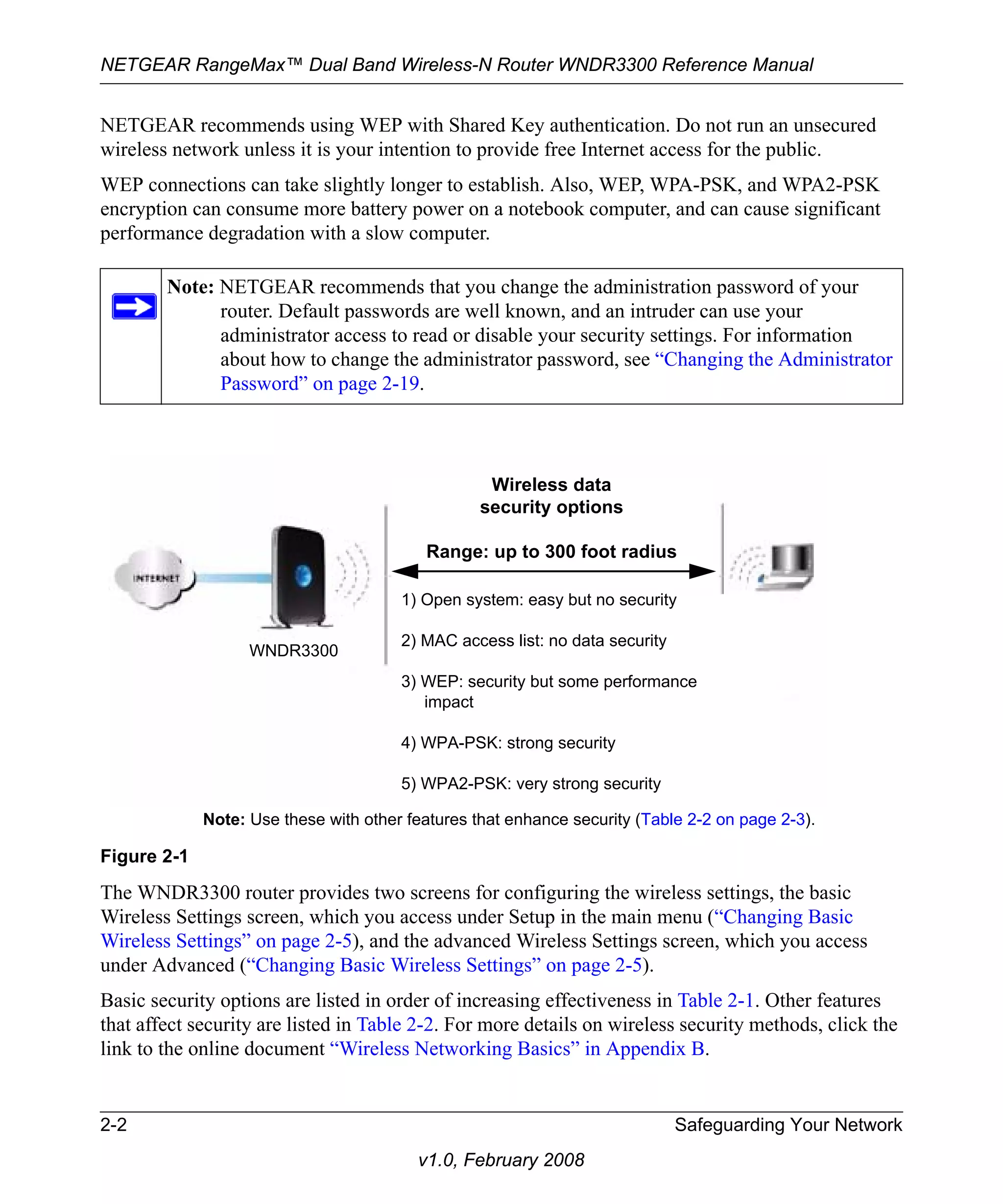
Wireless data 
security options 
Range: up to 300 foot radius 
The WNDR3300 router provides two screens for configuring the wireless settings, the basic 
Wireless Settings screen, which you access under Setup in the main menu (“Changing Basic 
Wireless Settings” on page 2-5), and the advanced Wireless Settings screen, which you access 
under Advanced (“Changing Basic Wireless Settings” on page 2-5). 
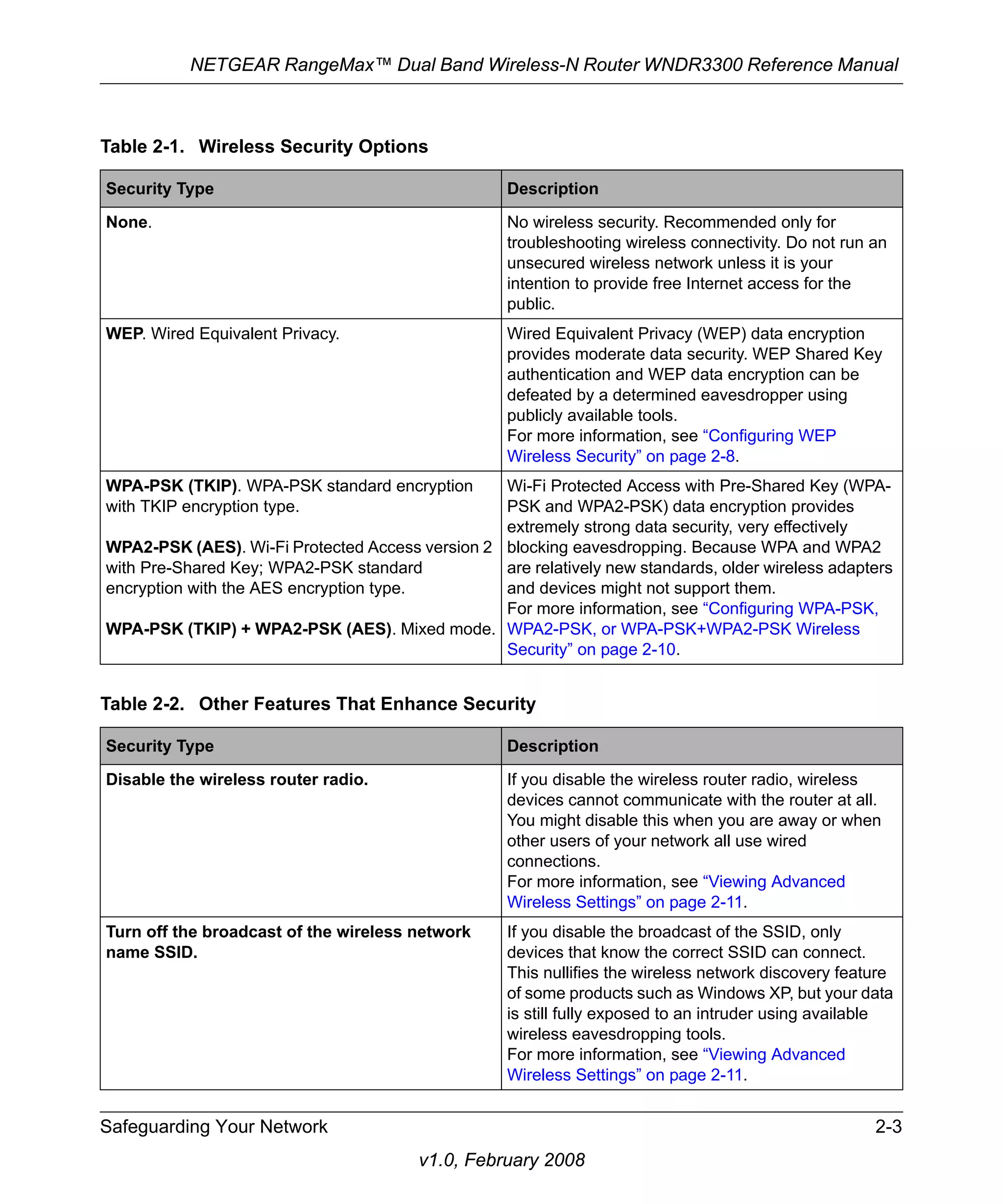
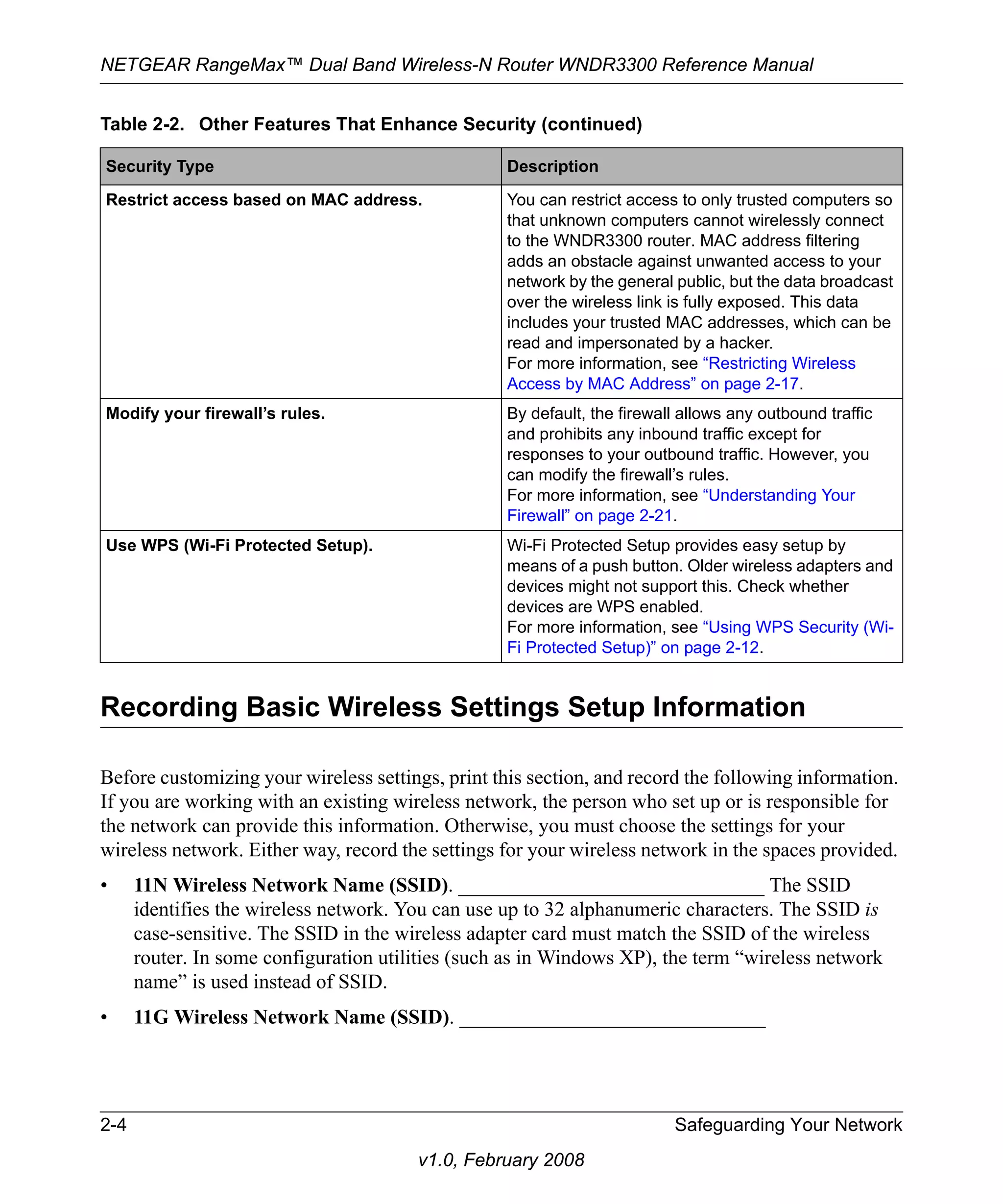
Basic security options are listed in order of increasing effectiveness in Table 2-1. Other features 
that affect security are listed in Table 2-2. For more details on wireless security methods, click the 
link to the online document “Wireless Networking Basics” in Appendix B. 
2-2 Safeguarding Your Network 
v1.0, February 2008 
Figure 2-1 
WNDR3300 
1) Open system: easy but no security 
2) MAC access list: no data security 
3) WEP: security but some performance 
impact 
4) WPA-PSK: strong security 
5) WPA2-PSK: very strong security 
Note: Use these with other features that enhance security (Table 2-2 on page 2-3).
NETGEAR RangeMax™ Dual Band Wireless-N Router WNDR3300 Reference Manual 
Table 2-1. Wireless Security Options 
Security Type Description 
None. No wireless security. Recommended only for 
troubleshooting wireless connectivity. Do not run an 
unsecured wireless network unless it is your 
intention to provide free Internet access for the 
public. 
WEP. Wired Equivalent Privacy. Wired Equivalent Privacy (WEP) data encryption 
provides moderate data security. WEP Shared Key 
authentication and WEP data encryption can be 
defeated by a determined eavesdropper using 
publicly available tools. 
For more information, see “Configuring WEP 
Wireless Security” on page 2-8. 
WPA-PSK (TKIP). WPA-PSK standard encryption 
with TKIP encryption type. 
WPA2-PSK (AES). Wi-Fi Protected Access version 2 
with Pre-Shared Key; WPA2-PSK standard 
encryption with the AES encryption type. 
WPA-PSK (TKIP) + WPA2-PSK (AES). Mixed mode. 
Wi-Fi Protected Access with Pre-Shared Key (WPA-PSK 
and WPA2-PSK) data encryption provides 
extremely strong data security, very effectively 
blocking eavesdropping. Because WPA and WPA2 
are relatively new standards, older wireless adapters 
and devices might not support them. 
For more information, see “Configuring WPA-PSK, 
WPA2-PSK, or WPA-PSK+WPA2-PSK Wireless 
Security” on page 2-10. 
Table 2-2. Other Features That Enhance Security 
Security Type Description 
Disable the wireless router radio. If you disable the wireless router radio, wireless 
devices cannot communicate with the router at all. 
You might disable this when you are away or when 
other users of your network all use wired 
connections. 
For more information, see “Viewing Advanced 
Wireless Settings” on page 2-11. 
Turn off the broadcast of the wireless network 
name SSID. 
If you disable the broadcast of the SSID, only 
devices that know the correct SSID can connect. 
This nullifies the wireless network discovery feature 
of some products such as Windows XP, but your data 
is still fully exposed to an intruder using available 
wireless eavesdropping tools. 
For more information, see “Viewing Advanced 
Wireless Settings” on page 2-11. 
Safeguarding Your Network 2-3 
v1.0, February 2008
NETGEAR RangeMax™ Dual Band Wireless-N Router WNDR3300 Reference Manual 
Table 2-2. Other Features That Enhance Security (continued) 
Security Type Description 
Restrict access based on MAC address. You can restrict access to only trusted computers so 
that unknown computers cannot wirelessly connect 
to the WNDR3300 router. MAC address filtering 
adds an obstacle against unwanted access to your 
network by the general public, but the data broadcast 
over the wireless link is fully exposed. This data 
includes your trusted MAC addresses, which can be 
read and impersonated by a hacker. 
For more information, see “Restricting Wireless 
Access by MAC Address” on page 2-17. 
Modify your firewall’s rules. By default, the firewall allows any outbound traffic 
and prohibits any inbound traffic except for 
responses to your outbound traffic. However, you 
can modify the firewall’s rules. 
For more information, see “Understanding Your 
Firewall” on page 2-21. 
Use WPS (Wi-Fi Protected Setup). Wi-Fi Protected Setup provides easy setup by 
means of a push button. Older wireless adapters and 
devices might not support this. Check whether 
devices are WPS enabled. 
For more information, see “Using WPS Security (Wi- 
Fi Protected Setup)” on page 2-12. 
Recording Basic Wireless Settings Setup Information 
Before customizing your wireless settings, print this section, and record the following information. 
If you are working with an existing wireless network, the person who set up or is responsible for 
the network can provide this information. Otherwise, you must choose the settings for your 
wireless network. Either way, record the settings for your wireless network in the spaces provided. 
• 11N Wireless Network Name (SSID). ______________________________ The SSID 
identifies the wireless network. You can use up to 32 alphanumeric characters. The SSID is 
case-sensitive. The SSID in the wireless adapter card must match the SSID of the wireless 
router. In some configuration utilities (such as in Windows XP), the term “wireless network 
name” is used instead of SSID. 
• 11G Wireless Network Name (SSID). ______________________________ 
2-4 Safeguarding Your Network 
v1.0, February 2008
NETGEAR RangeMax™ Dual Band Wireless-N Router WNDR3300 Reference Manual 
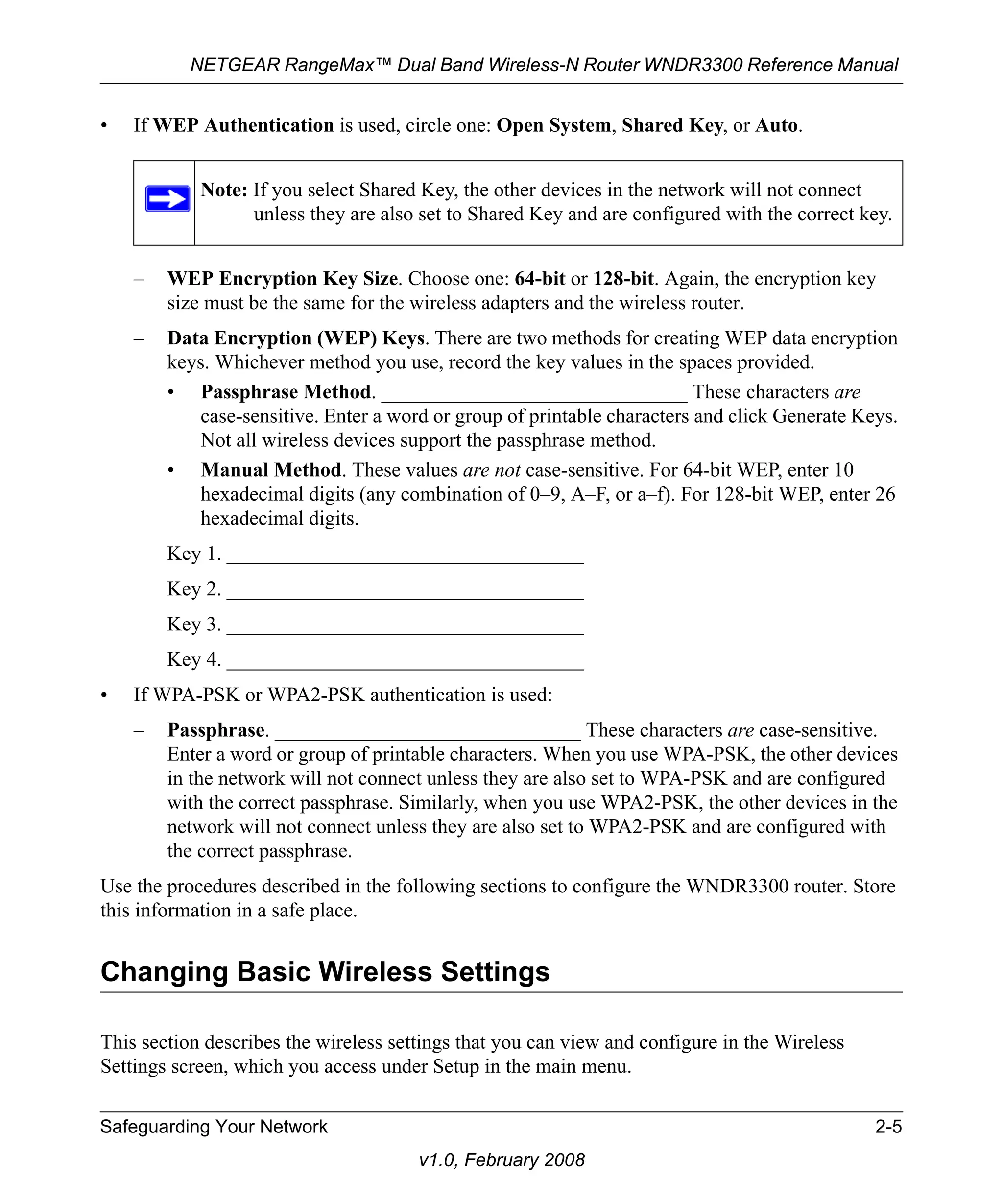
• If WEP Authentication is used, circle one: Open System, Shared Key, or Auto. 
Note: If you select Shared Key, the other devices in the network will not connect 
unless they are also set to Shared Key and are configured with the correct key. 
– WEP Encryption Key Size. Choose one: 64-bit or 128-bit. Again, the encryption key 
size must be the same for the wireless adapters and the wireless router. 
– Data Encryption (WEP) Keys. There are two methods for creating WEP data encryption 
keys. Whichever method you use, record the key values in the spaces provided. 
• Passphrase Method. ______________________________ These characters are 
case-sensitive. Enter a word or group of printable characters and click Generate Keys. 
Not all wireless devices support the passphrase method. 
• Manual Method. These values are not case-sensitive. For 64-bit WEP, enter 10 
hexadecimal digits (any combination of 0–9, A–F, or a–f). For 128-bit WEP, enter 26 
hexadecimal digits. 
Key 1. ___________________________________ 
Key 2. ___________________________________ 
Key 3. ___________________________________ 
Key 4. ___________________________________ 
• If WPA-PSK or WPA2-PSK authentication is used: 
– Passphrase. ______________________________ These characters are case-sensitive. 
Enter a word or group of printable characters. When you use WPA-PSK, the other devices 
in the network will not connect unless they are also set to WPA-PSK and are configured 
with the correct passphrase. Similarly, when you use WPA2-PSK, the other devices in the 
network will not connect unless they are also set to WPA2-PSK and are configured with 
the correct passphrase. 
Use the procedures described in the following sections to configure the WNDR3300 router. Store 
this information in a safe place. 
Changing Basic Wireless Settings 
This section describes the wireless settings that you can view and configure in the Wireless 
Settings screen, which you access under Setup in the main menu. 
Safeguarding Your Network 2-5 
v1.0, February 2008
NETGEAR RangeMax™ Dual Band Wireless-N Router WNDR3300 Reference Manual 
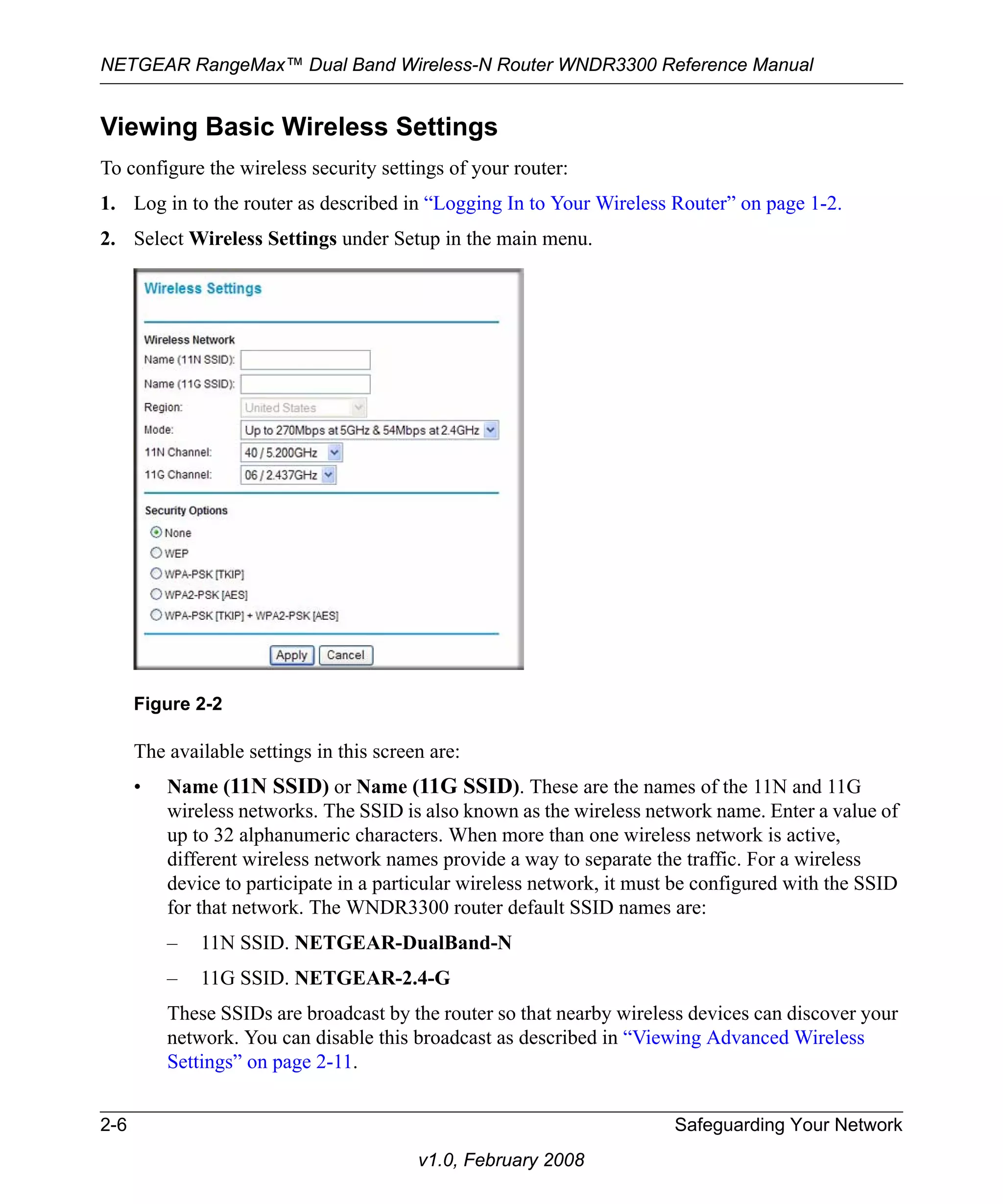
Viewing Basic Wireless Settings 
To configure the wireless security settings of your router: 
1. Log in to the router as described in “Logging In to Your Wireless Router” on page 1-2. 
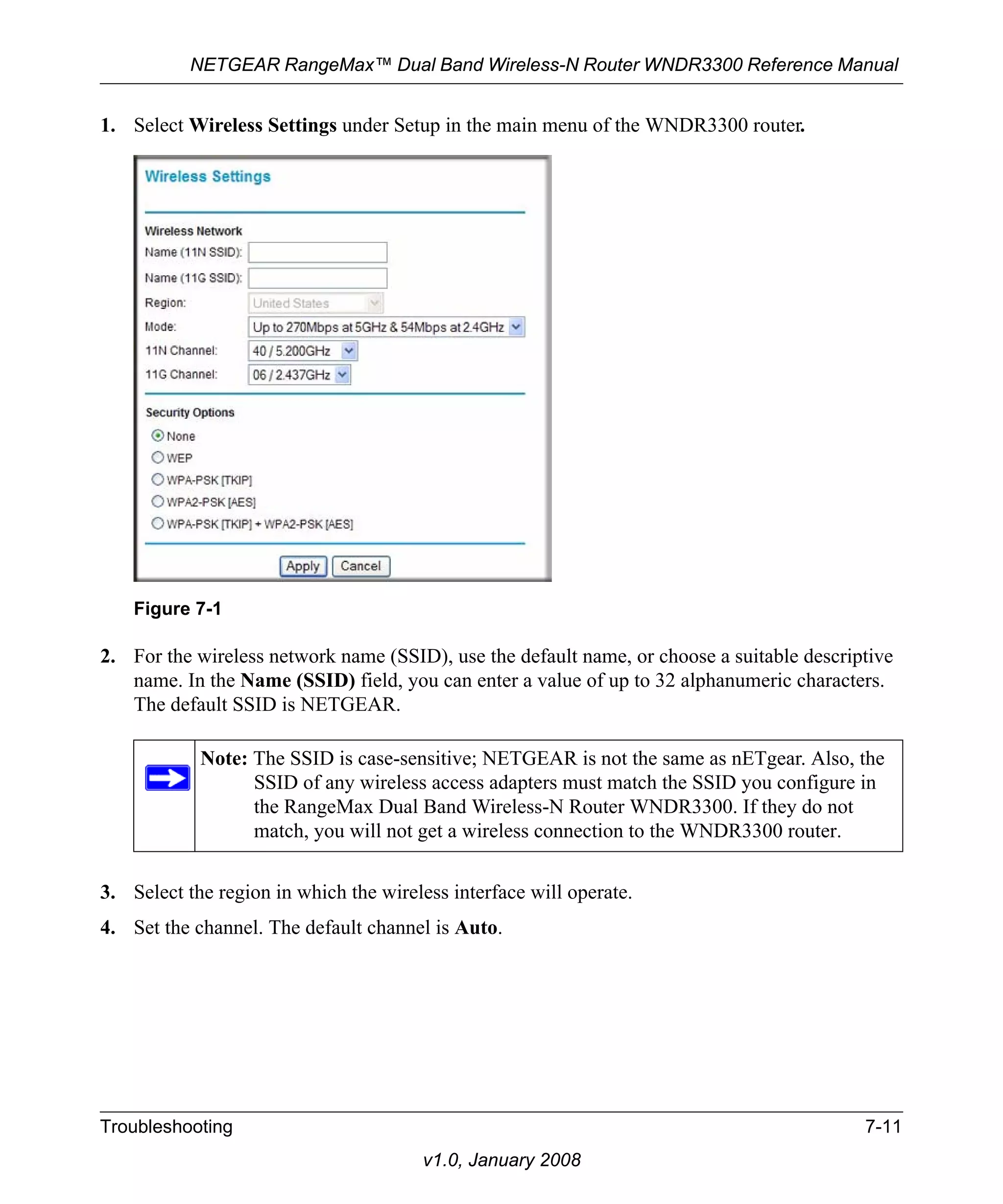
2. Select Wireless Settings under Setup in the main menu. 
The available settings in this screen are: 
• Name (11N SSID) or Name (11G SSID). These are the names of the 11N and 11G 
wireless networks. The SSID is also known as the wireless network name. Enter a value of 
up to 32 alphanumeric characters. When more than one wireless network is active, 
different wireless network names provide a way to separate the traffic. For a wireless 
device to participate in a particular wireless network, it must be configured with the SSID 
for that network. The WNDR3300 router default SSID names are: 
– 11N SSID. NETGEAR-DualBand-N 
– 11G SSID. NETGEAR-2.4-G 
These SSIDs are broadcast by the router so that nearby wireless devices can discover your 
network. You can disable this broadcast as described in “Viewing Advanced Wireless 
Settings” on page 2-11. 
2-6 Safeguarding Your Network 
v1.0, February 2008 
Figure 2-2
NETGEAR RangeMax™ Dual Band Wireless-N Router WNDR3300 Reference Manual 
• Region. This field identifies the region where the WNDR3300 router can be used. It might 
not be legal to operate the wireless features of the wireless router in a region other than 
one of those identified in this field. 
Note: The region selection feature might not be available in all countries. 
• Mode. This field determines which 802.11 data communications protocol is used. You can 
select one of the following modes: 
– Up to 270 Mbps at 2.4 GHz 
– Up to 270 Mbps at 5 GHz and 54 Mbps at 2.4 GHz. This is the default mode. 
– Up to 130 Mbps at 2.4 GHz 
– Up to 130 Mbps at 5 GHz and 54 Mbps at 2.4 GHz 
The following information might help you to decide which mode to select: 
– Up To 54 Mbps. Legacy mode, for compatibility with the slower 802.11b and 
Safeguarding Your Network 2-7 
v1.0, February 2008 
802.11g wireless devices. 
– Up To 130 Mbps. Neighbor Friendly mode, for reduced interference with neighboring 
wireless networks. Provides two transmission streams with different data on the same 
channel at the same time, but also allows 802.11b and 802.11g wireless devices. 
– Up To 270 Mbps. Performance mode, using channel expansion to achieve the 270 
Mbps data rate. The WNDR3300 router uses the channel you selected as the primary 
channel and expands to the secondary channel (primary channel +4 or –4) to achieve a 
40 MHz frame-by-frame bandwidth. The WNDR3300 router detects channel usage 
and disables frame-by-frame expansion if the expansion would result in interference 
with the data transmission of other access points or clients. 
Note: The maximum wireless signal rate is derived from the IEEE Standard 802.11 
specifications. Actual data throughput will vary. Network conditions and 
environmental factors, including volume of network traffic, building materials 
and construction, and network overhead, lower actual data throughput rate.
NETGEAR RangeMax™ Dual Band Wireless-N Router WNDR3300 Reference Manual 
• 11N Channel or 11G Channel. These fields determine which operating frequency is used 
for the 11N or 11G wireless networks. It should not be necessary to change the wireless 
channel unless you notice interference problems with another nearby wireless network. 
For more information about the wireless channel frequencies, click the link to the online 
document “Wireless Networking Basics” in Appendix B. 
• Security Options. These options are the wireless security features that you can enable. 
The security options displayed in this screen might change depending on the wireless 
mode you select. 
– For a detailed explanation of security standards, see “Choosing Appropriate Wireless 
Security” on page 2-1, and the online document you can access from “Wireless 
Networking Basics” in Appendix B, as defined by the IEEE 802.11 wireless 
communication standard. 
– For information about configuring WEP, see “Configuring WEP Wireless Security” 
2-8 Safeguarding Your Network 
v1.0, February 2008 
on page 2-8. 
– For information about configuring WPA, see “Configuring WPA-PSK, WPA2-PSK, 
or WPA-PSK+WPA2-PSK Wireless Security” on page 2-10. 
3. Click Apply to save your settings. 
Configuring WEP Wireless Security 
WEP Shared Key authentication and WEP data encryption can be defeated by a determined 
eavesdropper using publicly available tools. 
WEP offers the following options: 
• Open System. With Open System authentication and 64 or 128 bit WEP data encryption, the 
WNDR3300 does perform data encryption but does not perform any authentication. Anyone 
can join the network. This setting provides very little practical wireless security. 
• Shared Key. With Shared Key authentication, a wireless device must know the WEP key to 
join the network. Select the encryption strength (64 or 128 bit data encryption). Manually 
enter the key values, or enter a word or group of printable characters in the Passphrase field. 
Manually entered keys are not case-sensitive, but passphrase characters are case-sensitive. 
• Automatic. The wireless router automatically detects whether Open System or Shared Key is 
used.
NETGEAR RangeMax™ Dual Band Wireless-N Router WNDR3300 Reference Manual 
Note: If you use a wireless computer to configure WEP settings, you will be disconnected 
when you click Apply. You must then either configure your wireless adapter to 
match the wireless router WEP settings or access the wireless router from a wired 
computer to make any further changes. Not all wireless adapter configuration 
utilities support passphrase key generation. 
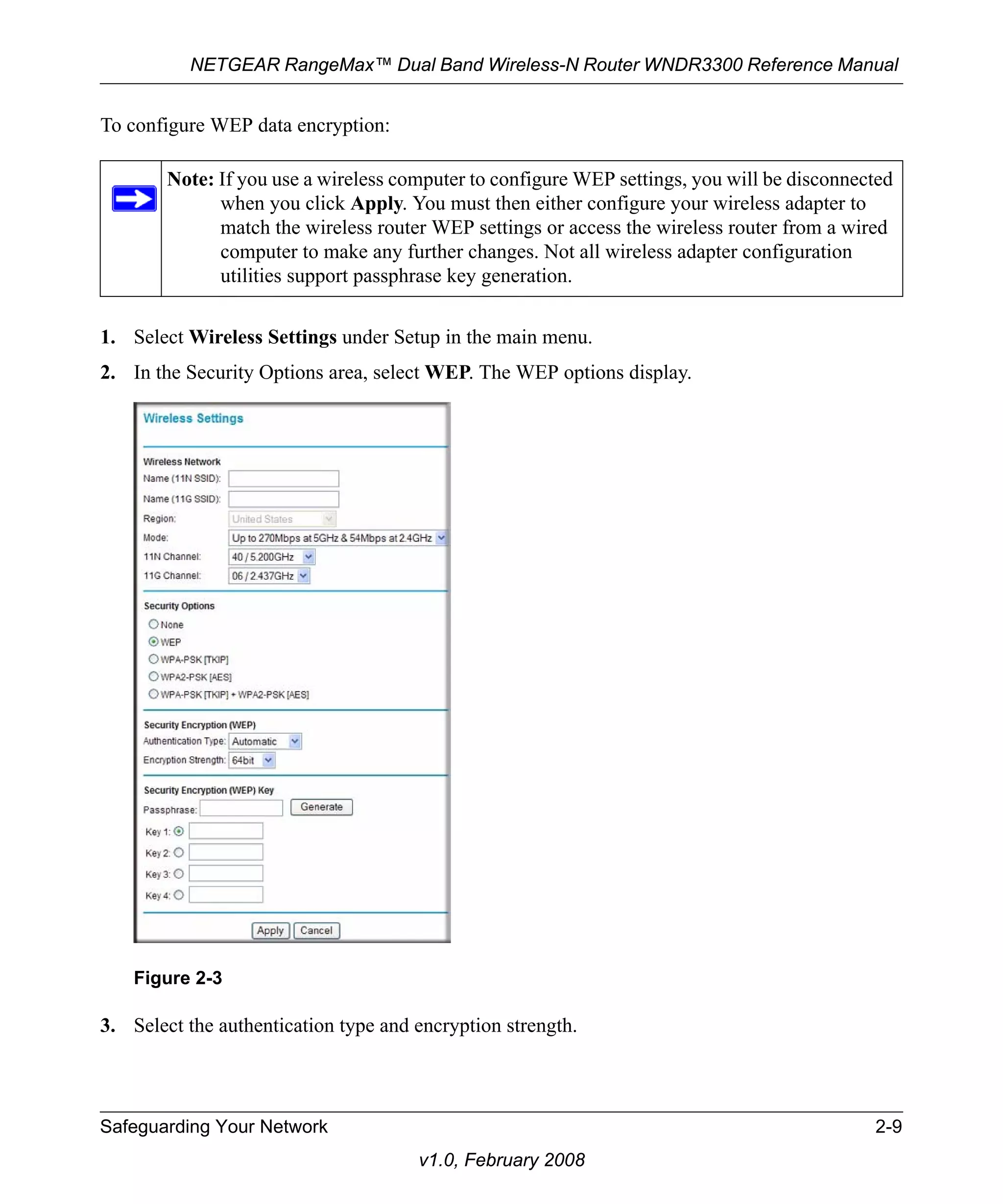
Figure 2-3 
Safeguarding Your Network 2-9 
v1.0, February 2008 
To configure WEP data encryption: 
1. Select Wireless Settings under Setup in the main menu. 
2. In the Security Options area, select WEP. The WEP options display. 
3. Select the authentication type and encryption strength.
NETGEAR RangeMax™ Dual Band Wireless-N Router WNDR3300 Reference Manual 
4. You can manually or automatically program the four data encryption keys. These values must 
be identical on all computers and access points in your network. 
• Automatic. In the Passphrase field, enter a word or group of printable characters, and 
click Generate. The passphrase is case-sensitive. For example, NETGEAR is not the 
same as nETgear. The four key fields are automatically populated with key values. 
• Manual. Enter 10 hexadecimal digits (any combination of 0–9, a–f, or A–F). These 
entries are not case-sensitive. For example, AA is the same as aa. 
Select which of the four keys to activate. 
5. Click Apply to save your settings. 
Configuring WPA-PSK, WPA2-PSK, or WPA-PSK+WPA2-PSK 
Wireless Security 
Wi-Fi Protected Access with Pre-Shared Key (WPA-PSK and WPA2-PSK) data encryption 
provides extremely strong data security, very effectively blocking eavesdropping. Because WPA 
and WPA2 are relatively new standards, older wireless adapters and devices might not support 
them. Check whether newer drivers are available from the manufacturer. 
WPA–Pre-Shared Key does perform authentication. WPA-PSK uses TKIP (Temporal Key 
Integrity Protocol) data encryption, and WPA2-PSK uses AES (Advanced Encryption Standard) 
data encryption. Both methods dynamically change the encryption keys making them nearly 
impossible to circumvent. 
Mixed mode allows clients using either WPA-PSK (TKIP) or WPA2-PSK (AES). This provides 
the most reliable security, and is easiest to implement, but it might not be compatible with older 
adapters. 
Note: Not all wireless adapters support WPA. Furthermore, client software is also 
required. Windows XP with Service Pack 2 does include WPA support. 
Nevertheless, the wireless adapter hardware and driver must also support WPA. 
For instructions on configuring wireless computers or PDAs (personal digital 
assistants) for WPA-PSK security, consult the documentation for the product you 
are using. 
To configure WPA-PSK, WPA2-PSK or WPA-PSK+WPA2-PSK: 
1. Select Wireless Settings under Setup in the main menu. 
2-10 Safeguarding Your Network 
v1.0, February 2008
NETGEAR RangeMax™ Dual Band Wireless-N Router WNDR3300 Reference Manual 
2. Select one of the WPA-PSK or WPA2-PSK options for the security type. The third option 
(WPA-PSK [TKIP] + WP2-PSK [AES]) is the most flexible, since it allows clients using 
either WPA-PSK or WPA2-PSK. 
3. In the Passphrase field, enter a word or group of 8–63 printable characters. The passphrase is 
Figure 2-4 
Safeguarding Your Network 2-11 
v1.0, February 2008 
case-sensitive. 
4. Click Apply to save your settings. 
Viewing Advanced Wireless Settings 
This section describes the wireless settings that you can view and specify in the Wireless Settings 
screen, which you access under Advanced in the main menu. 
To configure the advanced wireless security settings of your router: 
1. Log in to the router as described in “Logging In to Your Wireless Router” on page 1-2.
NETGEAR RangeMax™ Dual Band Wireless-N Router WNDR3300 Reference Manual 
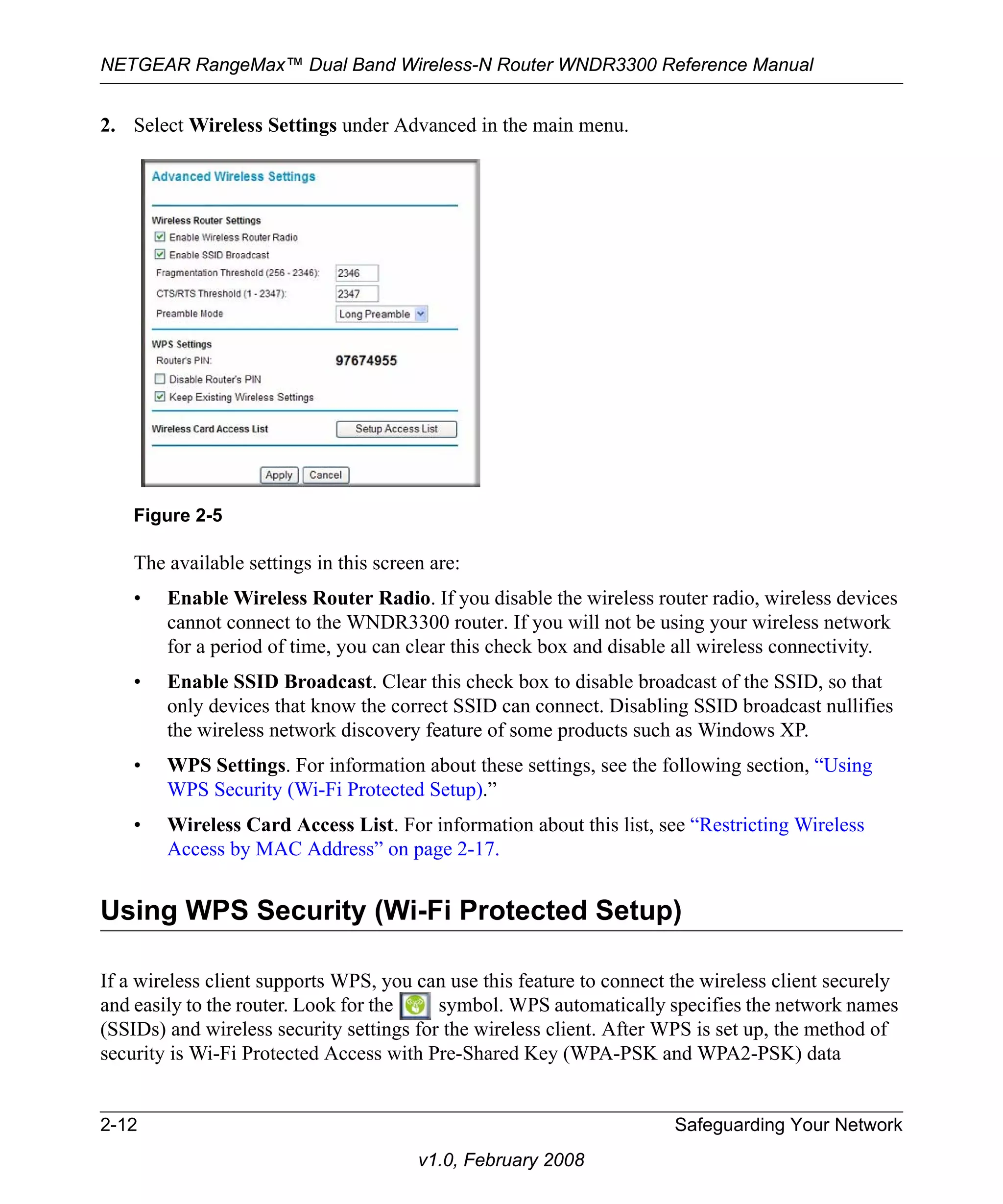
2. Select Wireless Settings under Advanced in the main menu. 
The available settings in this screen are: 
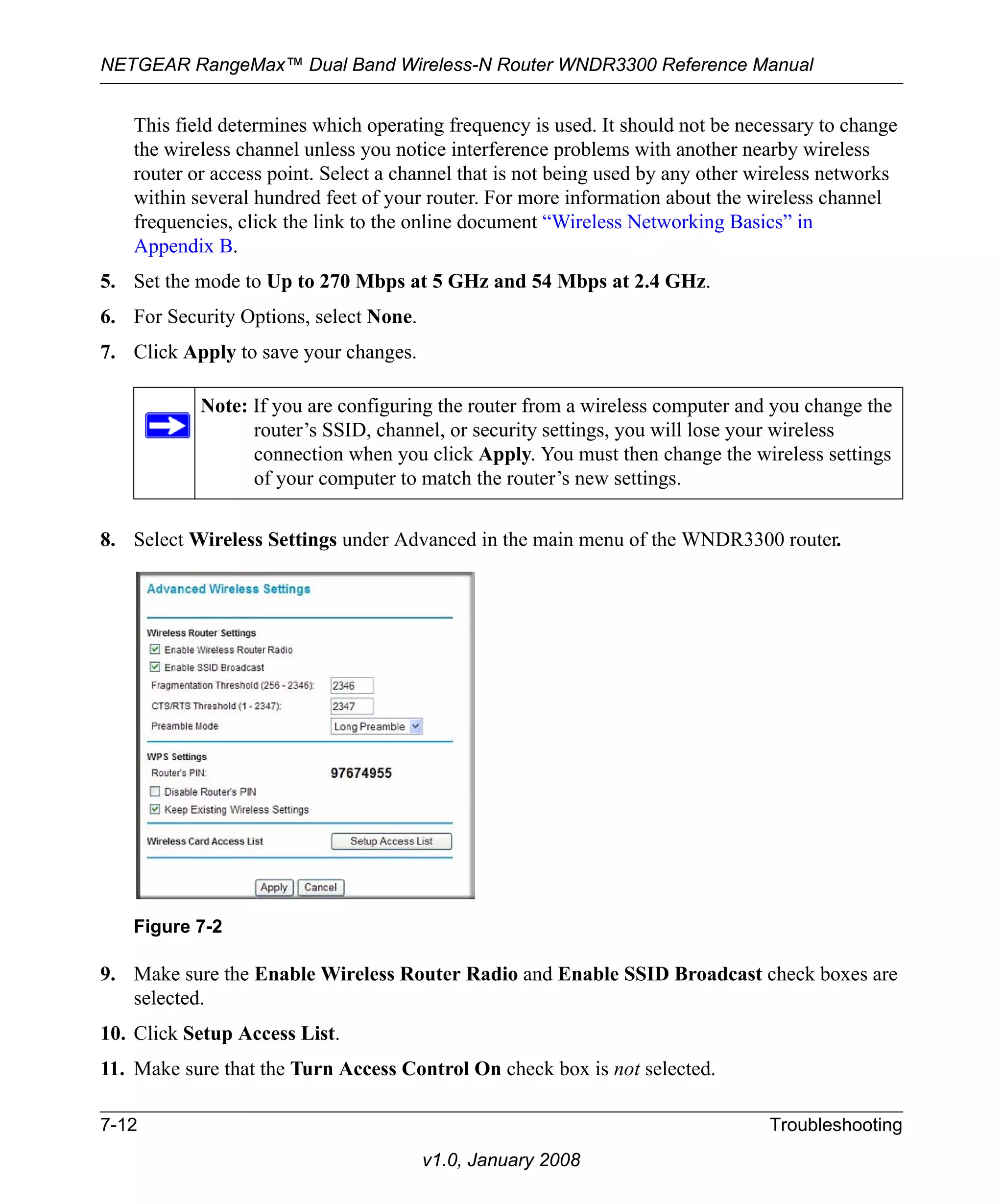
• Enable Wireless Router Radio. If you disable the wireless router radio, wireless devices 
cannot connect to the WNDR3300 router. If you will not be using your wireless network 
for a period of time, you can clear this check box and disable all wireless connectivity. 
• Enable SSID Broadcast. Clear this check box to disable broadcast of the SSID, so that 
only devices that know the correct SSID can connect. Disabling SSID broadcast nullifies 
the wireless network discovery feature of some products such as Windows XP. 
• WPS Settings. For information about these settings, see the following section, “Using 
WPS Security (Wi-Fi Protected Setup).” 
• Wireless Card Access List. For information about this list, see “Restricting Wireless 
Access by MAC Address” on page 2-17. 
Using WPS Security (Wi-Fi Protected Setup) 
If a wireless client supports WPS, you can use this feature to connect the wireless client securely 
and easily to the router. Look for the symbol. WPS automatically specifies the network names 
(SSIDs) and wireless security settings for the wireless client. After WPS is set up, the method of 
security is Wi-Fi Protected Access with Pre-Shared Key (WPA-PSK and WPA2-PSK) data 
2-12 Safeguarding Your Network 
v1.0, February 2008 
Figure 2-5
NETGEAR RangeMax™ Dual Band Wireless-N Router WNDR3300 Reference Manual 
encryption. The WNDR3300 router and any connected clients share the same network names 
(SSIDs), for both 11N and 11G. Note that WPS is not a new security feature—it makes existing 
security features easier to configure. 
Note: Using WPS security might disconnect devices you already have connected to your 
The WNDR3300 router provides two methods for connecting to a wireless client that supports 
WPS: push button configuration or PIN entry. 
Push Button Configuration 
To enable a wireless client to join a network using the menu options in the router’s menu: 
1. Log in to the router. 
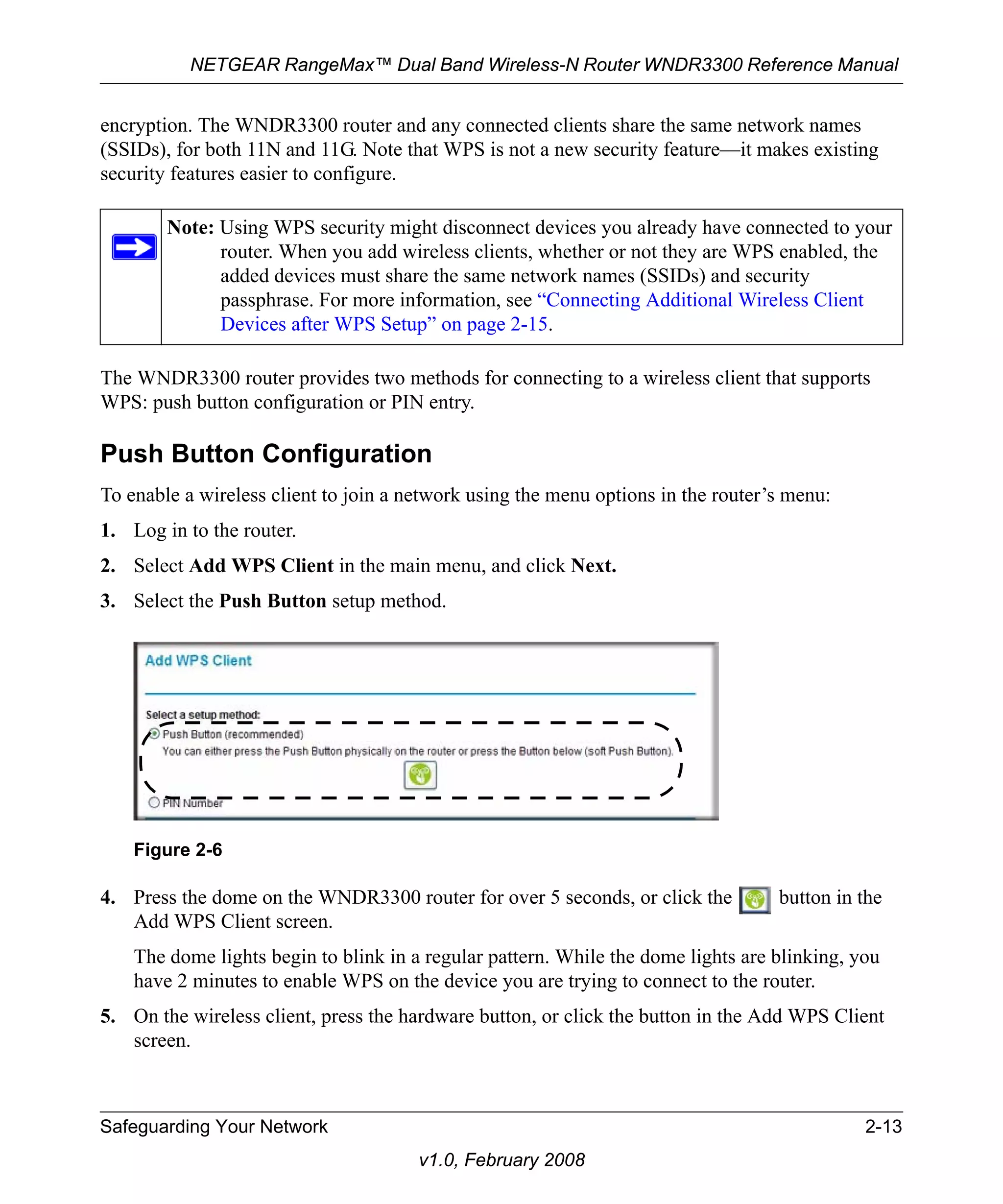
2. Select Add WPS Client in the main menu, and click Next. 
3. Select the Push Button setup method. 
4. Press the dome on the WNDR3300 router for over 5 seconds, or click the button in the 
Add WPS Client screen. 
The dome lights begin to blink in a regular pattern. While the dome lights are blinking, you 
have 2 minutes to enable WPS on the device you are trying to connect to the router. 
5. On the wireless client, press the hardware button, or click the button in the Add WPS Client 
Safeguarding Your Network 2-13 
v1.0, February 2008 
screen. 
router. When you add wireless clients, whether or not they are WPS enabled, the 
added devices must share the same network names (SSIDs) and security 
passphrase. For more information, see “Connecting Additional Wireless Client 
Devices after WPS Setup” on page 2-15. 
Figure 2-6
NETGEAR RangeMax™ Dual Band Wireless-N Router WNDR3300 Reference Manual 
The WNDR3300 router’s dome lights cease blinking when one of these conditions occurs: 
• The router and the client establish a wireless connection. 
• The 2-minute window period expires for establishing a WPS connection. If the connection 
is not established, no WPS security settings will be configured in the WNDR3300 router. 
PIN Entry 
To enable a wireless client to join a network using a PIN: 
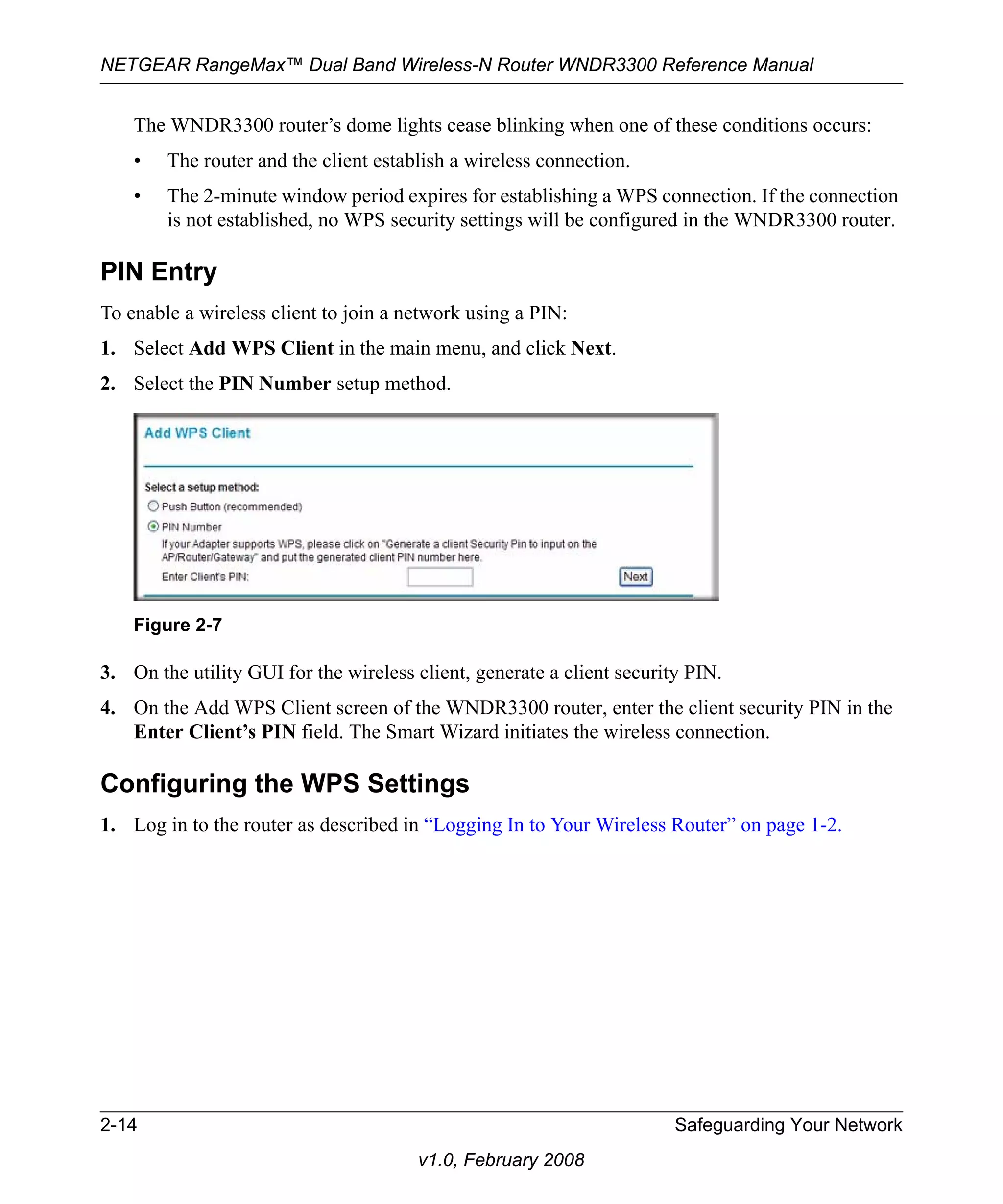
1. Select Add WPS Client in the main menu, and click Next. 
2. Select the PIN Number setup method. 
3. On the utility GUI for the wireless client, generate a client security PIN. 
4. On the Add WPS Client screen of the WNDR3300 router, enter the client security PIN in the 
Enter Client’s PIN field. The Smart Wizard initiates the wireless connection. 
Configuring the WPS Settings 
1. Log in to the router as described in “Logging In to Your Wireless Router” on page 1-2. 
2-14 Safeguarding Your Network 
v1.0, February 2008 
Figure 2-7
NETGEAR RangeMax™ Dual Band Wireless-N Router WNDR3300 Reference Manual 
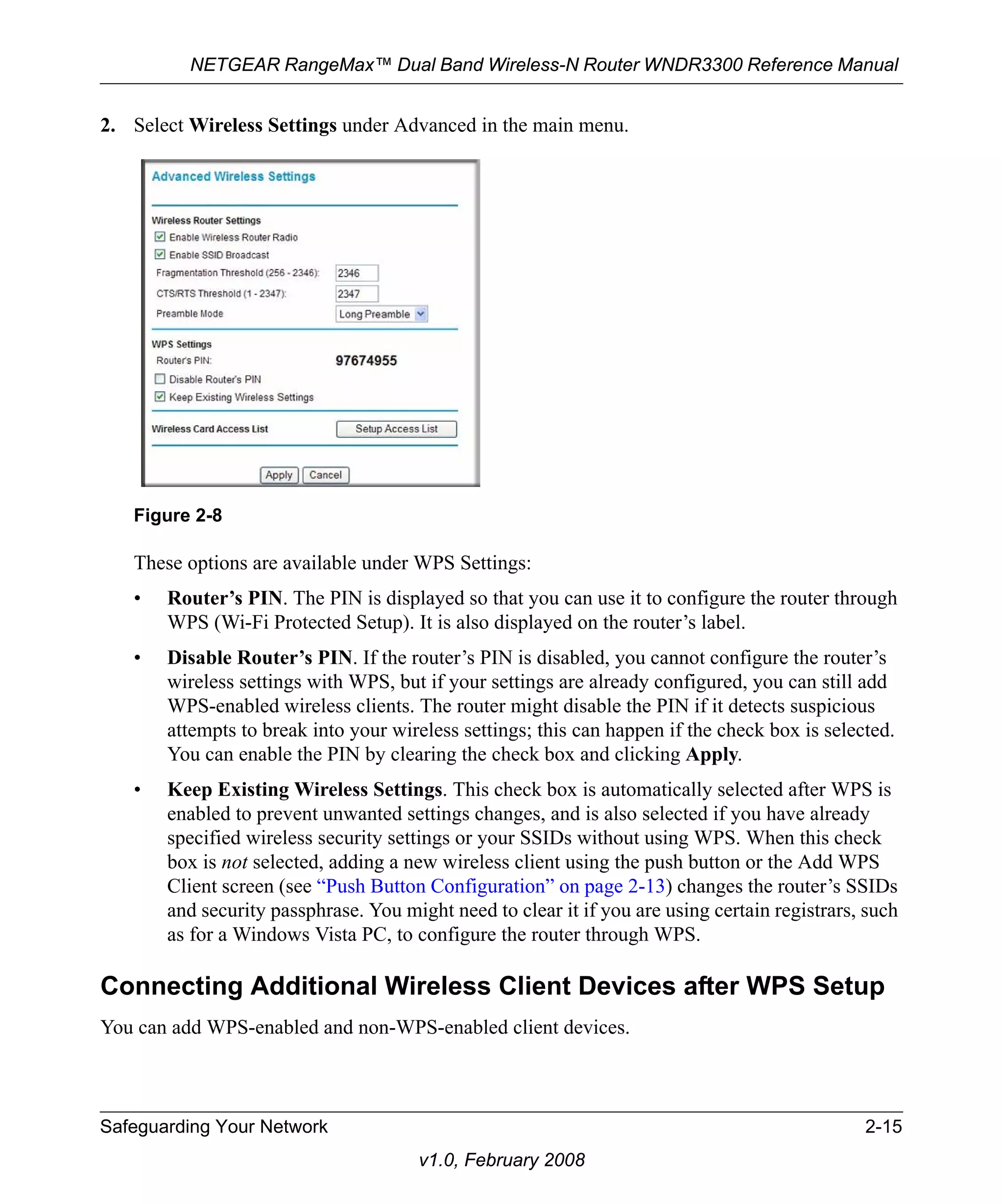
2. Select Wireless Settings under Advanced in the main menu. 
These options are available under WPS Settings: 
• Router’s PIN. The PIN is displayed so that you can use it to configure the router through 
WPS (Wi-Fi Protected Setup). It is also displayed on the router’s label. 
• Disable Router’s PIN. If the router’s PIN is disabled, you cannot configure the router’s 
wireless settings with WPS, but if your settings are already configured, you can still add 
WPS-enabled wireless clients. The router might disable the PIN if it detects suspicious 
attempts to break into your wireless settings; this can happen if the check box is selected. 
You can enable the PIN by clearing the check box and clicking Apply. 
• Keep Existing Wireless Settings. This check box is automatically selected after WPS is 
enabled to prevent unwanted settings changes, and is also selected if you have already 
specified wireless security settings or your SSIDs without using WPS. When this check 
box is not selected, adding a new wireless client using the push button or the Add WPS 
Client screen (see “Push Button Configuration” on page 2-13) changes the router’s SSIDs 
and security passphrase. You might need to clear it if you are using certain registrars, such 
as for a Windows Vista PC, to configure the router through WPS. 
Connecting Additional Wireless Client Devices after WPS Setup 
You can add WPS-enabled and non-WPS-enabled client devices. 
Safeguarding Your Network 2-15 
v1.0, February 2008 
Figure 2-8
NETGEAR RangeMax™ Dual Band Wireless-N Router WNDR3300 Reference Manual 
Adding Additional WPS-Enabled Clients 
To add an additional wireless client device that is WPS enabled: 
Note: Your wireless settings do not change when you add an additional WPS-enabled 
client unless you have cleared the Keep Existing Wireless Settings check box (in 
the Wireless Settings screen). If you do clear the check box, new SSIDs and a 
passphrase are generated, and all existing connected wireless clients are 
disassociated and disconnected from the router. 
1. Follow the procedures in “Push Button Configuration” on page 2-13 or “PIN Entry” on 
2-16 Safeguarding Your Network 
v1.0, February 2008 
page 2-14. 
2. For information about how to view a list of all devices connected to your router (including 
wireless and Ethernet-connected), see “Viewing a List of Attached Devices” on page 6-7. 
Adding Additional Non-WPS-Enabled Clients 
If you are connecting a combination of WPS-enabled clients and clients that are not WPS enabled, 
you cannot use the WPS setup procedures to add clients that are not WPS enabled. You need to 
record and then manually enter your security settings (see “Recording Basic Wireless Settings 
Setup Information” on page 2-4). 
To connect non-WPS-enabled and WPS-enabled clients to the WNDR3300 router: 
1. Restore the router to factory default settings (see Appendix A, “Technical Specifications”). 
After you restore factory settings, all existing connected wireless clients are disassociated and 
disconnected from the router. 
2. Configure the network names (SSIDs) and security passphrase of the WNDR3300 router 
(shown in the Wireless Settings screen) as appropriate, and record that information. See 
“Viewing Basic Wireless Settings” on page 2-6. 
3. For the non-WPS-enabled devices that you wish to connect, open the networking utility, and 
follow the utility’s instructions to enter security settings. 
4. For the WPS-enabled devices that you wish to connect, follow the procedures in “Push Button 
Configuration” on page 2-13 or “PIN Entry” on page 2-14. 
5. For information about how to view a list of all devices connected to your router (including 
wireless and Ethernet connected), see “Viewing a List of Attached Devices” on page 6-7.
NETGEAR RangeMax™ Dual Band Wireless-N Router WNDR3300 Reference Manual 
Restricting Wireless Access by MAC Address 
When a Wireless Card Access List is configured and enabled, the router checks the MAC address 
of any wireless device attempting a connection and allows only connections to computers 
identified on the trusted computers list. 
The Wireless Card Access List displays a list of wireless computers that you allow to connect to 
the router based on their MAC addresses. These wireless computers must also have the correct 
SSID and wireless security settings to access the wireless router. 
The MAC address is a network device’s unique 12-character physical address, containing the 
hexadecimal characters 0–9, a–f, or A–F only, and separated by colons (for example, 
00:09:AB:CD:EF:01). It can usually be found on the bottom of the wireless card or network 
interface device. If you do not have access to the physical label, you can display the MAC address 
using the network configuration utilities of the computer. In WindowsXP, for example, typing the 
ipconfig/all command in an MSDOS command prompt window displays the MAC address as 
Physical Address. You might also find the MAC addresses in the router’s Attached Devices screen. 
To restrict access based on MAC addresses: 
1. Select Wireless Settings under Advanced in the main menu. 
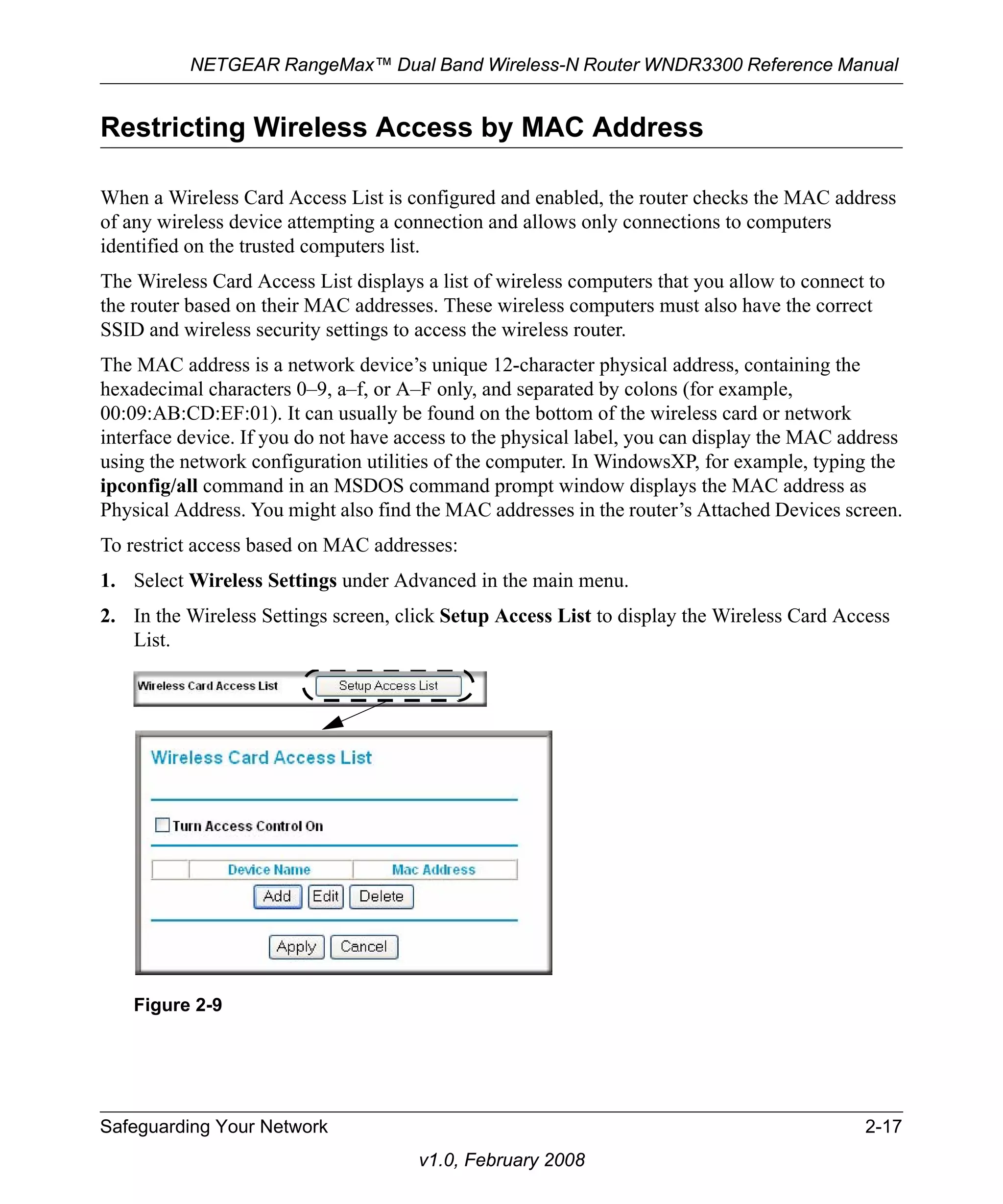
2. In the Wireless Settings screen, click Setup Access List to display the Wireless Card Access 
Safeguarding Your Network 2-17 
v1.0, February 2008 
List. 
Figure 2-9
NETGEAR RangeMax™ Dual Band Wireless-N Router WNDR3300 Reference Manual 
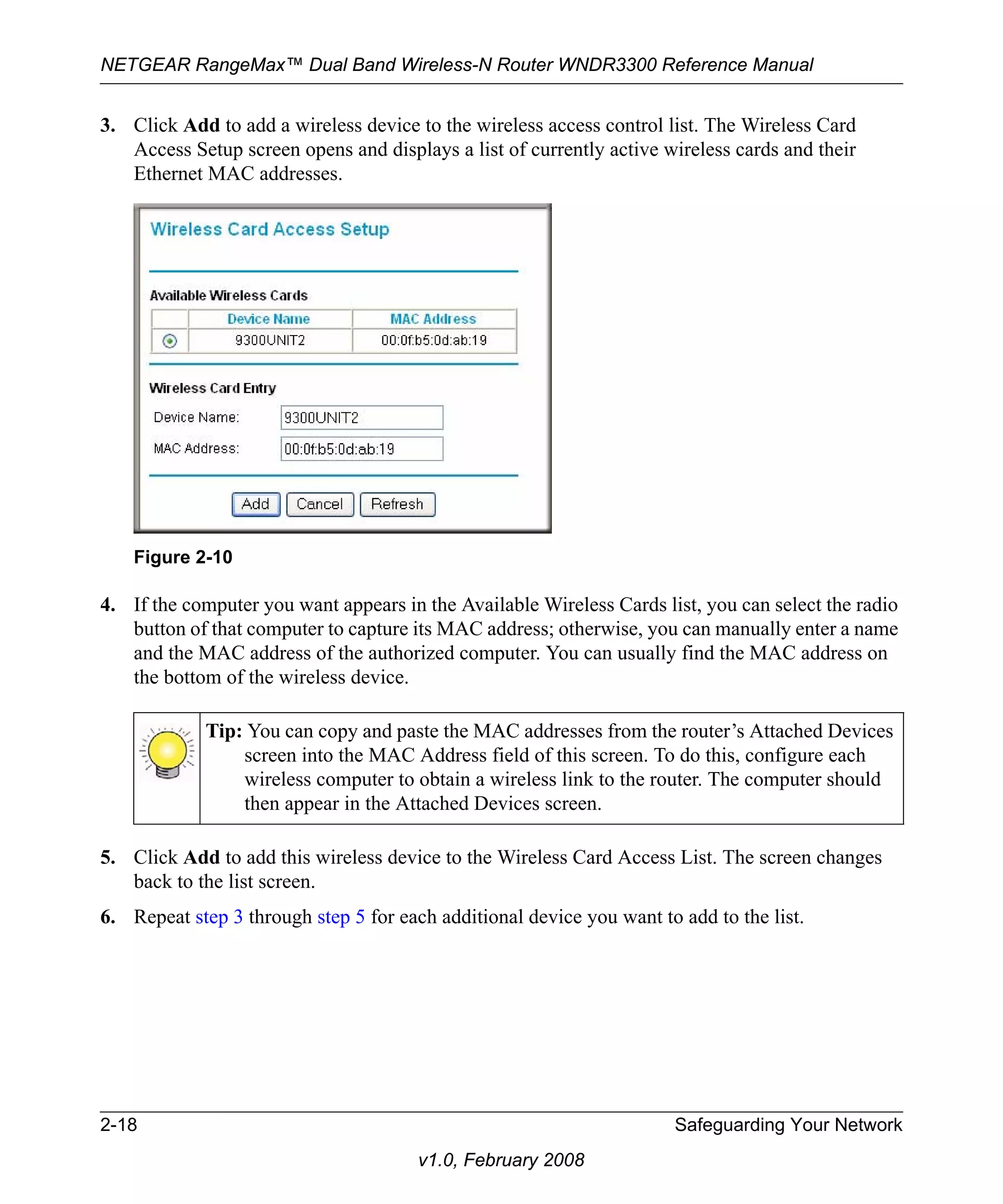
3. Click Add to add a wireless device to the wireless access control list. The Wireless Card 
Access Setup screen opens and displays a list of currently active wireless cards and their 
Ethernet MAC addresses. 
Figure 2-10 
4. If the computer you want appears in the Available Wireless Cards list, you can select the radio 
button of that computer to capture its MAC address; otherwise, you can manually enter a name 
and the MAC address of the authorized computer. You can usually find the MAC address on 
the bottom of the wireless device. 
Tip: You can copy and paste the MAC addresses from the router’s Attached Devices 
screen into the MAC Address field of this screen. To do this, configure each 
wireless computer to obtain a wireless link to the router. The computer should 
then appear in the Attached Devices screen. 
5. Click Add to add this wireless device to the Wireless Card Access List. The screen changes 
2-18 Safeguarding Your Network 
v1.0, February 2008 
back to the list screen. 
6. Repeat step 3 through step 5 for each additional device you want to add to the list.
NETGEAR RangeMax™ Dual Band Wireless-N Router WNDR3300 Reference Manual 
7. Select the Turn Access Control On check box. 
Note: When configuring the router from a wireless computer whose MAC address is 
not in the Trusted PC list, if you select Turn Access Control On, you lose 
your wireless connection when you click Apply. You must then access the 
wireless router from a wired computer or from a wireless computer that is on 
the access control list to make any further changes. 
8. Click Apply to save your Wireless Card Access List settings. 
Now, only devices on this list are allowed to wirelessly connect to the WNDR3300 router. 
Warning: MAC address filtering adds an obstacle against unwanted access to your 
network by the general public. However, because your trusted MAC 
addresses appear in your wireless transmissions, an intruder can read them 
and impersonate them. Do not rely on MAC address filtering alone to secure 
your network. 
Changing the Administrator Password 
The default password for the router’s Web Configuration Manager is password. NETGEAR 
recommends that you change this password to a more secure password. 
Tip: Before changing the router password, back up your configuration settings with the 
default password of password. If you save the settings with a new password, and 
then you later forget the new password, you will have to reset the router back to the 
factory defaults, and log in using the default password of password. This means you 
will have to re-enter all the router configuration settings. For information about how 
to back up your settings, see “Backing Up and Restoring the Configuration” on 
page 6-8. 
Safeguarding Your Network 2-19 
v1.0, February 2008
NETGEAR RangeMax™ Dual Band Wireless-N Router WNDR3300 Reference Manual 
To change the administrator password: 
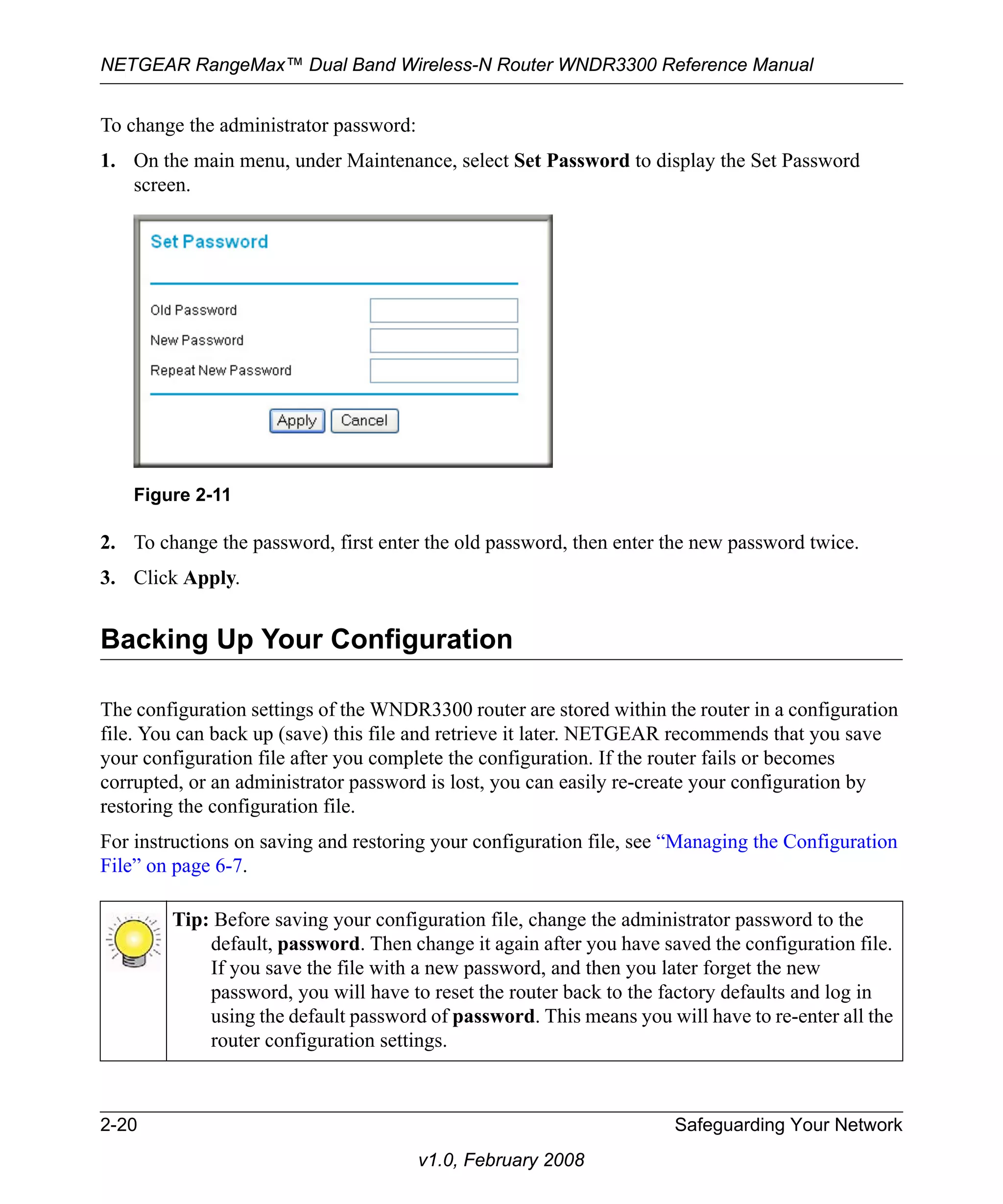
1. On the main menu, under Maintenance, select Set Password to display the Set Password 
Figure 2-11 
2-20 Safeguarding Your Network 
v1.0, February 2008 
screen. 
2. To change the password, first enter the old password, then enter the new password twice. 
3. Click Apply. 
Backing Up Your Configuration 
The configuration settings of the WNDR3300 router are stored within the router in a configuration 
file. You can back up (save) this file and retrieve it later. NETGEAR recommends that you save 
your configuration file after you complete the configuration. If the router fails or becomes 
corrupted, or an administrator password is lost, you can easily re-create your configuration by 
restoring the configuration file. 
For instructions on saving and restoring your configuration file, see “Managing the Configuration 
File” on page 6-7. 
Tip: Before saving your configuration file, change the administrator password to the 
default, password. Then change it again after you have saved the configuration file. 
If you save the file with a new password, and then you later forget the new 
password, you will have to reset the router back to the factory defaults and log in 
using the default password of password. This means you will have to re-enter all the 
router configuration settings.
NETGEAR RangeMax™ Dual Band Wireless-N Router WNDR3300 Reference Manual 
Understanding Your Firewall 
Your RangeMax Dual Band Wireless-N Router WNDR3300 contains a true firewall to protect 
your network from attacks and intrusions. A firewall is a device that protects one network from 
another while allowing communication between the two. Using a process called Stateful Packet 
Inspection, the firewall analyzes all inbound and outbound traffic to determine whether or not it 
will be allowed to pass through. 
By default, the firewall allows any outbound traffic and prohibits any inbound traffic except for 
responses to your outbound traffic. However, you can modify the firewall’s rules to achieve the 
following behavior: 
• Blocking sites. Block access from your network to certain Web locations based on Web 
addresses and Web address keywords. This feature is described in “Blocking Access to 
Internet Sites” on page 3-1. 
• Blocking services. Block the use of certain Internet services by specific computers on your 
network. This feature is described in “Blocking Access to Internet Services” on page 3-3. 
• Scheduled blocking. Block sites and services according to a daily schedule. This feature is 
described in “Scheduling Blocking” on page 3-5. 
• Allow inbound access to your server. To allow inbound access to resources on your local 
network (for example, a Web server or remote desktop program), you can open the needed 
services by configuring port forwarding as described in “Allowing Inbound Connections To 
Your Network” on page 5-1. 
• Allow certain games and applications to function correctly. Some games and applications 
need to allow additional inbound traffic to function. Port triggering can dynamically allow 
additional service connections, as described in “Allowing Inbound Connections To Your 
Network” on page 5-1. Another feature to solve application conflicts with the firewall is 
Universal Plug and Play (UPnP), described in “Using Universal Plug and Play” on page 5-12. 
Safeguarding Your Network 2-21 
v1.0, February 2008
NETGEAR RangeMax™ Dual Band Wireless-N Router WNDR3300 Reference Manual 
2-22 Safeguarding Your Network 
v1.0, February 2008
NETGEAR RangeMax™ Dual Band Wireless-N Router WNDR3300 Reference Manual 
Restricting Access From Your Network 3-1 
v1.0, February 2008 
Chapter 3 
Restricting Access From Your Network 
This chapter describes how to use the content filtering and reporting features of the RangeMax 
Dual Band Wireless-N Router WNDR3300 to protect your network. You can find these features by 
selecting the items under Content Filtering in the main menu of the browser interface. 
This chapter includes the following sections: 
• “Content Filtering Overview” 
• “Blocking Access to Internet Sites” 
• “Blocking Access to Internet Services” on page 3-3 
• “Scheduling Blocking” on page 3-5 
• “Viewing Logs of Web Access or Attempted Web Access” on page 3-6 
• “Configuring E-mail Alert and Web Access Log Notifications” on page 3-7 
• “Setting the Time” on page 3-9 
Content Filtering Overview 
The RangeMax Dual Band Wireless-N Router WNDR3300 provides you with Web content 
filtering options, plus browser activity reporting and instant alerts through e-mail. Parents and 
network administrators can establish restricted access policies based on time of day, Web 
addresses, and Web address keywords. You can also block Internet access by applications and 
services, such as chat rooms or games. 
To configure these features of your router, select the items under Content Filtering in the main 
menu of the browser interface. This chapter describes the screens that display. 
Blocking Access to Internet Sites 
The WNDR3300 router allows you to restrict access based on Web addresses and Web address 
keywords. Up to 255 entries are supported in the Keyword list.
NETGEAR RangeMax™ Dual Band Wireless-N Router WNDR3300 Reference Manual 
Here are some keyword application examples: 
• If the keyword XXX is specified, the URL www.zzzyyqq.com/xxx.html is blocked. 
• If the keyword .com is specified, only websites with other domain suffixes (such as .edu, .org, 
Figure 3-1 
3-2 Restricting Access From Your Network 
v1.0, February 2008 
or .gov) can be viewed. 
To block access to Internet sites: 
1. Select Block Sites under Content Filtering in the main menu. The Block Sites screen displays. 
2. Enable keyword blocking by selecting either Per Schedule or Always. 
To block by schedule, be sure to specify a time period in the Schedule screen. For information 
about scheduling, see “Scheduling Blocking” on page 3-5. 
Block all access to Internet browsing during a scheduled period by entering a dot (.) as the 
keyword, and then set a schedule in the Schedule screen. 
3. Add a keyword or domain by entering it in the keyword field and clicking Add Keyword. The 
keyword or domain name then appears the Block sites containing these keywords or domain 
names list.
NETGEAR RangeMax™ Dual Band Wireless-N Router WNDR3300 Reference Manual 
Delete a keyword or domain name by selecting it from the list and clicking Delete Keyword. 
4. You can specify one trusted user, which is a computer that is exempt from blocking and 
logging. Specify a trusted user by entering that computer’s IP address in the Trusted IP 
Address fields. 
Since the trusted user is identified by IP address, you should configure that computer with a 
fixed IP address. 
5. Click Apply to save all your settings in the Block Sites screen. 
Blocking Access to Internet Services 
The WNDR3300 router allows you to block the use of certain Internet services by computers on 
your network. This is called service blocking or port filtering. Services are functions performed by 
server computers at the request of client computers. For example, Web servers serve Web pages, 
time servers serve time and date information, and game hosts serve data about other players’ 
moves. When a computer on your network sends a request for service to a server computer on the 
Internet, the requested service is identified by a service or port number. This number appears as the 
destination port number in the transmitted IP packets. For example, a packet that is sent with 
destination port number 80 is an HTTP (Web server) request. 
To block access to Internet services: 
1. Select Block Services under Content Filtering in the main menu. The Block Services screen 
Restricting Access From Your Network 3-3 
v1.0, February 2008 
displays. 
Figure 3-2
NETGEAR RangeMax™ Dual Band Wireless-N Router WNDR3300 Reference Manual 
2. Enable service blocking by selecting either Per Schedule or Always, and then click Apply. 
To block by schedule, be sure to specify a time period in the Schedule screen. For information 
about scheduling, see “Scheduling Blocking” on page 3-5. 
3. Specify a service for blocking by clicking Add. The Block Services Setup screen displays. 
4. From the Service Type list, select the application or service to be allowed or blocked. The list 
already displays several common services, but you are not limited to these choices. To add any 
additional services or applications that do not already appear, select User Defined. 
5. Select the radio button for the IP address configuration you want to block, and then enter the 
IP addresses in the appropriate fields. 
6. Click Add to enable your Block Services Setup selections. 
Configuring a User-Defined Service 
To define a service, first you must determine which port number or range of numbers is used by 
the application. The service port numbers for many common protocols are defined by the Internet 
Engineering Task Force (IETF) and published in RFC1700, “Assigned Numbers.” Service 
numbers for other applications are typically chosen from the range 1024 to 65535 by the authors of 
the application. You can often determine port number information by contacting the publisher of 
the application, by asking user groups or newsgroups, or by searching. 
3-4 Restricting Access From Your Network 
v1.0, February 2008 
Figure 3-3
NETGEAR RangeMax™ Dual Band Wireless-N Router WNDR3300 Reference Manual 
• Enter the starting port and ending port numbers. If the application uses a single port number, 
Figure 3-4 
Restricting Access From Your Network 3-5 
v1.0, February 2008 
enter that number in both fields. 
• If you know that the application uses either TCP or UDP, select the appropriate protocol. If 
you are not sure, select Both. 
Blocking Services by IP Address Range 
In the Filter Services For area, you can block the specified service for a single computer, a range of 
computers (having consecutive IP addresses), or all computers on your network. 
Scheduling Blocking 
The WNDR3300 router allows you to specify when blocking is enforced. 
To schedule blocking: 
1. Select Schedule under Content Filtering in the main menu. The Schedule screen displays. 
2. Configure the schedule for blocking keywords and services:
NETGEAR RangeMax™ Dual Band Wireless-N Router WNDR3300 Reference Manual 
a. Days to Block. Select days on which you want to apply blocking by selecting the 
appropriate check boxes. Select Every Day to select the check boxes for all days. Click 
Apply. 
b. Time of Day to Block. Select a start and end time in 24-hour format. Select All Day for 
24-hour blocking. Click Apply. 
Be sure to select your time zone in the E-mail screen as described in “Setting the Time” on 
page 3-9. 
3. Click Apply to save your settings. 
Viewing Logs of Web Access or Attempted Web Access 
The log is a detailed record of the websites you have accessed or attempted to access. Up to 
128 entries are stored in the log. Log entries appear only when keyword blocking is enabled and no 
log entries are made for the trusted user. 
Select Logs under Content Filtering in the main menu. The Logs screen displays. 
3-6 Restricting Access From Your Network 
v1.0, February 2008 
Figure 3-5
NETGEAR RangeMax™ Dual Band Wireless-N Router WNDR3300 Reference Manual 
Table 3-1. Log Entry Descriptions 
Field Description 
Date and time The date and time the log entry was recorded. 
Source IP The IP address of the initiating device for this log entry. 
Target address The name or IP address of the website or newsgroup visited or 
to which access was attempted. 
Action Whether the access was blocked or allowed. 
Restricting Access From Your Network 3-7 
v1.0, February 2008 
Table 3-1 describes the log entries. 
To refresh the log screen, click the Refresh button. 
To clear the log entries, click the Clear Log button. 
To e-mail the log immediately, click the Send Log button. 
Configuring E-mail Alert and Web Access Log Notifications 
To receive logs and alerts by e-mail, you must provide your e-mail account information. 
To configure e-mail alert and web access log notifications: 
1. Select E-mail under Content Filtering in the main menu. The E-mail screen displays.
NETGEAR RangeMax™ Dual Band Wireless-N Router WNDR3300 Reference Manual 
2. To receive e-mail logs and alerts from the router, select the Turn E-mail Notification On 
check box. 
a. Enter the name of your ISP’s outgoing (SMTP) mail server (such as mail.myISP.com) in 
the Your Outgoing Mail Server field. You might be able to find this information in the 
configuration screen of your e-mail program. If you leave this field blank, log and alert 
messages will not be sent by e-mail. 
b. Enter the e-mail address to which logs and alerts are sent in the Send To This E-mail 
Address field. This e-mail address will also be used as the From address. If you leave this 
field blank, log and alert messages will not be sent by e-mail. 
3. If your e-mail server requires authentication, select the My Mail Server requires 
authentication check box. 
a. Enter your user name for the e-mail server in the User Name field. 
b. Enter your password for the e-mail server in the Password field. 
3-8 Restricting Access From Your Network 
v1.0, February 2008 
Figure 3-6
NETGEAR RangeMax™ Dual Band Wireless-N Router WNDR3300 Reference Manual 
4. You can specify that logs are automatically sent by e-mail with these options: 
• Send alert immediately. Select this check box for immediate notification of attempted 
access to a blocked site or service. 
• Send Logs According to this Schedule. Specifies how often to send the logs: Hourly, 
Daily, Weekly, or When Full. 
– Day. Specifies which day of the week to send the log. Relevant when the log is sent 
Restricting Access From Your Network 3-9 
v1.0, February 2008 
weekly or daily. 
– Time. Specifies the time of day to send the log. Relevant when the log is sent daily or 
weekly. 
If you select the Weekly, Daily, or Hourly option and the log fills up before the specified 
period, the log is automatically e-mailed to the specified e-mail address. After the log is sent, 
the log is cleared from the router’s memory. If the router cannot e-mail the log file, the log 
buffer might fill up. In this case, the router overwrites the log and discards its contents. 
5. Click Apply to save your settings. 
So that the log entries are properly time-stamped and sent at the correct time, be sure to set the 
time as described in the next section. 
Setting the Time 
The WNDR3300 router uses the Network Time Protocol (NTP) to obtain the current time and date 
from one of several network time servers on the Internet. To localize the time for your log entries, 
you must specify your time zone: 
• Time Zone. Select your local time zone. This setting is used for the blocking schedule and for 
time-stamping log entries. 
• Automatically Adjust for Daylight Savings Time. Select this check box if your region 
supports daylight savings time. The router will automatically adjust the time at the start and 
end of the daylight savings time period.
NETGEAR RangeMax™ Dual Band Wireless-N Router WNDR3300 Reference Manual 
3-10 Restricting Access From Your Network 
v1.0, February 2008
NETGEAR RangeMax™ Dual Band Wireless-N Router WNDR3300 Reference Manual 
Customizing Your Network Settings 4-1 
v1.0, February 2008 
Chapter 4 
Customizing Your Network Settings 
This chapter describes how to configure advanced networking features of the RangeMax Dual 
Band Wireless-N Router WNDR3300, including LAN, WAN, and routing settings. 
It contains the following sections: 
• “Using the LAN Setup Options” 
• “Using a Dynamic DNS Service” on page 4-5 
• “Configuring the WAN Setup Options” on page 4-7 
• “Configuring Static Routes” on page 4-9 
Using the LAN Setup Options 
The LAN Setup screen allows configuration of LAN IP services such as Dynamic Host 
Configuration Protocol (DHCP) and Routing Information Protocol (RIP). 
To configure LAN IP settings: 
From the main menu of the browser interface, under Advanced, click LAN Setup. The following 
screen displays:
NETGEAR RangeMax™ Dual Band Wireless-N Router WNDR3300 Reference Manual 
Figure 4-1 
4-2 Customizing Your Network Settings 
v1.0, February 2008 
. 
Configuring a Device Name 
The device name is a user-friendly name for the router. This name is shown in the Network on 
Windows Vista and the Network Explorer on all Windows systems. The Device Name field cannot 
be blank. 
Configuring LAN TCP/IP Setup Parameters 
The router is shipped preconfigured to use private IP addresses on the LAN side and to act as a 
DHCP server. The router’s default LAN IP configuration is: 
• LAN IP address: 192.168.1.1 
• Subnet mask: 255.255.255.0 
These addresses are part of the designated private address range for use in private networks and 
should be suitable for most applications. If your network has a requirement to use a different IP 
addressing scheme, you can make those changes in this screen. 
The LAN IP settings are: 
• IP Address. The LAN IP address of the router.
NETGEAR RangeMax™ Dual Band Wireless-N Router WNDR3300 Reference Manual 
• IP Subnet Mask. The LAN subnet mask of the router. Combined with the IP address, the IP 
subnet mask allows a device to know which other addresses are local to it, and which must be 
reached through a gateway or router. 
• RIP Direction. RIP allows a router to exchange routing information with other routers. The 
RIP Direction selection controls how the router sends and receives RIP packets. Both is the 
default. 
– When set to Both or Out Only, the router broadcasts its routing table periodically. 
– When set to Both or In Only, the router incorporates the RIP information that it receives. 
– When set to None, the router does not send any RIP packets and ignores any RIP packets 
Note: If you change the LAN IP address of the router while connected through the 
browser, you will be disconnected. You must then open a new connection to the 
new IP address and log in again. 
Customizing Your Network Settings 4-3 
v1.0, February 2008 
received. 
• RIP Version. This controls the format and the broadcasting method of the RIP packets sent by 
the router. (It recognizes both formats when receiving.) The default setting is RIP-1. 
– RIP-1 is universally supported. RIP-1 is usually adequate unless you have an unusual 
network setup. 
– RIP-2 carries more information. RIP-2B uses subnet broadcasting. 
Using the Router as a DHCP Server 
By default, the router functions as a DHCP server, allowing it to assign IP, DNS server, and default 
gateway addresses to all computers connected to the router’s LAN. The assigned default gateway 
address is the LAN address of the router. The router assigns IP addresses to the attached computers 
from a pool of addresses specified in this screen. Each pool address is tested before it is assigned to 
avoid duplicate addresses on the LAN. 
For most applications, the default DHCP and TCP/IP settings of the router are satisfactory. Click 
the link to the online document “TCP/IP Networking Basics” in Appendix B for an explanation of 
DHCP and information about how to assign IP addresses for your network. 
Specify the pool of IP addresses to be assigned by setting the starting IP address and ending IP 
address. These addresses should be part of the same IP address subnet as the router’s LAN IP 
address. Using the default addressing scheme, you should define a range between 192.168.1.2 and 
192.168.1.254, although you might wish to save part of the range for devices with fixed addresses.
NETGEAR RangeMax™ Dual Band Wireless-N Router WNDR3300 Reference Manual 
The router delivers the following parameters to any LAN device that requests DHCP: 
• An IP Address from the range you have defined 
• Subnet Mask 
• Gateway IP Address (the router’s LAN IP address) 
• Primary DNS Server (if you entered a primary DNS address in the Basic Settings screen; 
otherwise, the router’s LAN IP address) 
• Secondary DNS Server (if you entered a secondary DNS address in the Basic Settings screen) 
To use another device on your network as the DHCP server, or to manually configure the network 
settings of all of your computers, clear the Use Router as DHCP Server check box. Otherwise, 
leave it selected. If this service is not selected and no other DHCP server is available on your 
network, you will need to set your computers’ IP addresses manually or they will not be able to 
access the router. 
Using Address Reservation 
When you specify a reserved IP address for a computer on the LAN, that computer always 
receives the same IP address each time it accesses the router’s DHCP server. Reserved IP 
addresses should be assigned to computers or servers that require permanent IP settings. 
To reserve an IP address: 
1. Click Add. 
2. In the IP Address field, type the IP address to assign to the computer or server. (Choose an IP 
address from the router’s LAN subnet, such as 192.168.1.x.) 
3. Type the MAC address of the computer or server. 
Tip: If the computer is already present on your network, you can copy its MAC 
address from the Attached Devices screen and paste it here. 
4. Click Apply to enter the reserved address into the table. 
Note: The reserved address is not assigned until the next time the computer contacts 
the router’s DHCP server. Reboot the computer or access its IP configuration 
and force a DHCP release and renew. 
4-4 Customizing Your Network Settings 
v1.0, February 2008
NETGEAR RangeMax™ Dual Band Wireless-N Router WNDR3300 Reference Manual 
To edit or delete a reserved address entry: 
1. Select the radio button next to the reserved address you want to edit or delete. 
2. Click Edit or Delete. 
Using a Dynamic DNS Service 
If your Internet Service Provider (ISP) gave you a permanently assigned IP address, you can 
register a domain name and have that name linked with your IP address by public Domain Name 
Servers (DNS). However, if your Internet account uses a dynamically assigned IP address, you do 
not know in advance what your IP address will be, and the address can change frequently. In this 
case, you can use a commercial Dynamic DNS service, which allows you to register your domain 
to their IP address, and forwards traffic directed at your domain to your frequently changing IP 
address. 
Note: If your ISP assigns a private WAN IP address (such as 192.168.x.x or 10.x.x.x), the 
Dynamic DNS service will not work because private addresses are not routed on 
the Internet. 
Your router contains a client that can connect to the Dynamic DNS service provided by 
DynDNS.org. You must first visit their website at www.dyndns.org and obtain an account and host 
name, which you configure in the router. Then, whenever your ISP-assigned IP address changes, 
your router automatically contacts the Dynamic DNS service provider, logs in to your account, and 
registers your new IP address. If your host name is hostname, for example, you can reach your 
router at hostname.dyndns.org. 
Customizing Your Network Settings 4-5 
v1.0, February 2008
NETGEAR RangeMax™ Dual Band Wireless-N Router WNDR3300 Reference Manual 
From the main menu of the browser interface, under Advanced, select Dynamic DNS to display 
the Dynamic DNS screen. 
Figure 4-2 
To configure Dynamic DNS: 
1. Register for an account with one of the Dynamic DNS service providers whose names appear 
in the Service Provider list. For example, for DynDNS.org, select www.dyndns.org. 
2. Select the Use a Dynamic DNS Service check box. 
3. Select the name of your Dynamic DNS service provider. 
4. Type the host name (or domain name) that your Dynamic DNS service provider gave you. 
5. Type the user name for your Dynamic DNS account. This is the name that you use to log in to 
4-6 Customizing Your Network Settings 
v1.0, February 2008 
your account, not your host name. 
6. Type the password (or key) for your Dynamic DNS account. 
7. If your Dynamic DNS provider allows the use of wildcards in resolving your URL, you can 
select the Use Wildcards check box to activate this feature. 
For example, the wildcard feature causes *.yourhost.dyndns.org to be aliased to the same IP 
address as yourhost.dyndns.org. 
8. Click Apply to save your configuration.
NETGEAR RangeMax™ Dual Band Wireless-N Router WNDR3300 Reference Manual 
Configuring the WAN Setup Options 
The WAN Setup options let you configure a DMZ (demilitarized zone) server, change the 
Maximum Transmit Unit (MTU) size, and enable the wireless router to respond to a ping on the 
WAN (Internet) port. From the main menu of the browser interface, under Advanced, click WAN 
Setup to view the WAN Setup screen. 
Disabling the SPI Firewall 
The Stateful Packet Inspection (SPI) firewall protects your network and computers against attacks 
and intrusions. A stateful packet firewall carefully inspects incoming traffic packets, looking for 
known exploits such as malformed, oversized, or out-of-sequence packets. The firewall should be 
disabled only in special circumstances, such as when you are troubleshooting application issues. 
Setting Up a Default DMZ Server 
The default DMZ server feature is helpful when you are using some online games and 
videoconferencing applications that are incompatible with Network Address Translation (NAT). 
The router is programmed to recognize some of these applications and to work correctly with 
Customizing Your Network Settings 4-7 
v1.0, February 2008 
Figure 4-3
NETGEAR RangeMax™ Dual Band Wireless-N Router WNDR3300 Reference Manual 
them, but there are other applications that might not function well. In some cases, one local 
computer can run the application correctly if that computer’s IP address is entered as the default 
DMZ server. 
Warning: DMZ servers pose a security risk. A computer designated as the default DMZ 
server loses much of the protection of the firewall and is exposed to exploits 
from the Internet. If compromised, the DMZ server computer can be used to 
attack other computers on your network. 
Incoming traffic from the Internet is usually discarded by the router unless the traffic is a response 
to one of your local computers or a service that you have configured in the Port Forwarding/Port 
Triggering screen. Instead of discarding this traffic, you can have it forwarded to one computer on 
your network. This computer is called the default DMZ server. 
The WAN Setup screen lets you configure a default DMZ server. 
To assign a computer or server to be a default DMZ server: 
1. In the last Default DMZ Server field, type the last digit of the IP address for that computer. 
To remove the default DMZ server, enter 0 (zero). 
2. Select the Default DMZ Server check box, and click Apply. 
Responding to a Ping on the Internet (WAN) Port 
If you want the router to respond to a ping from the Internet, select the Respond to Ping on 
Internet Port check box. This should be used only as a diagnostic tool, since it allows your router 
to be discovered by Internet scanners. Do not select this check box unless you have a specific 
reason to do so, such as when troubleshooting your connection. 
Setting the MTU Size 
The normal MTU value for most Ethernet networks is 1500 bytes, 1492 bytes for PPPoE 
connections, or 1450 for PPTP connections. For some ISPs, you might need to reduce the MTU, 
but this is rarely required and should not be done unless you are sure it is necessary for your ISP 
connection. For more information, see “Changing the MTU” on page 5-20. 
To change the MTU size: 
1. In the MTU Size field, enter a new size between 64 and 1500. 
2. Click Apply to save the new configuration. 
4-8 Customizing Your Network Settings 
v1.0, February 2008
NETGEAR RangeMax™ Dual Band Wireless-N Router WNDR3300 Reference Manual 
Configuring NAT Filtering 
Network Address Translation (NAT) determines how the router processes inbound traffic. Secured 
NAT provides a secured firewall to protect the computers on the LAN from attacks from the 
Internet, but might prevent some Internet games, point-to-point applications, or multimedia 
applications from functioning. Open NAT provides a much less secured firewall, but allows almost 
all Internet applications to function. For more information about NAT, see “How Your Computer 
Communicates with a Remote Computer through Your Router” on page 5-2. 
To change the NAT option: 
1. In the NAT Filtering area, select either the Secured or the Open radio button. 
2. Click Apply to save the new configuration. 
Configuring Static Routes 
Static routes provide additional routing information to your router. Under usual circumstances, the 
router has adequate routing information after it has been configured for Internet access, and you do 
not need to configure additional static routes. You must configure static routes only for unusual 
cases such as multiple routers or multiple IP subnets located on your network. 
As an example of when a static route is needed, consider the following case: 
• Your primary Internet access is through a cable modem to an ISP. 
• You have an ISDN router on your home network for connecting to the company where you are 
employed. This router’s address on your LAN is 192.168.1.100. 
• Your company’s network address is 134.177.0.0. 
When you first configured your router, two implicit static routes were created. A default route was 
created with your ISP as the gateway, and a second static route was created to your local network 
for all 192.168.1.x addresses. With this configuration, if you attempt to access a device on the 
134.177.0.0 network, your router forwards your request to the ISP. The ISP forwards your request 
to the company where you are employed, and the request is likely to be denied by the company’s 
firewall. 
In this case you must define a static route, telling your router that 134.177.0.0 should be accessed 
through the ISDN router at 192.168.1.100. 
In this example: 
• The Destination IP Address and IP Subnet Mask fields specify that this static route applies 
Customizing Your Network Settings 4-9 
v1.0, February 2008 
to all 134.177.x.x addresses.
NETGEAR RangeMax™ Dual Band Wireless-N Router WNDR3300 Reference Manual 
• The Gateway IP Address field specifies that all traffic for these addresses should be 
forwarded to the ISDN router at 192.168.1.100. 
• A Metric value of 1 will work since the ISDN router is on the LAN. 
• Private is selected only as a precautionary security measure in case RIP is activated. 
Select Static Routes under Advanced in the main menu. The Static Routes screen displays. 
Figure 4-4 
To add or edit a static route: 
1. Click Add to open the Static Routes screen. 
Figure 4-5 
2. In the Route Name field, type a name for this static route. (This is for identification purposes 
4-10 Customizing Your Network Settings 
v1.0, February 2008 
only.) 
3. Select the Private check box if you want to limit access to the LAN only. If Private is selected, 
the static route is not reported in RIP. 
4. Select the Active check box to make this route effective.
NETGEAR RangeMax™ Dual Band Wireless-N Router WNDR3300 Reference Manual 
5. Type the destination IP address of the final destination. 
6. Type the IP subnet mask for this destination. 
If the destination is a single host, type 255.255.255.255. 
7. Type the gateway IP address, which must be a router on the same LAN segment as the 
Customizing Your Network Settings 4-11 
v1.0, February 2008 
WNDR3300 router. 
8. Type a number between 1 and 15 as the metric value. 
This represents the number of routers between your network and the destination. Usually, a 
setting of 2 or 3 works, but if this is a direct connection, set it to 1. 
9. Click Apply to have the static route entered into the table.
NETGEAR RangeMax™ Dual Band Wireless-N Router WNDR3300 Reference Manual 
4-12 Customizing Your Network Settings 
v1.0, February 2008
NETGEAR RangeMax™ Dual Band Wireless-N Router WNDR3300 Reference Manual 
Fine-Tuning Your Network 5-1 
v1.0, February 2008 
Chapter 5 
Fine-Tuning Your Network 
This chapter describes how to modify the configuration of the RangeMax Dual Band Wireless-N 
Router WNDR3300 to allow specific applications to access the Internet or to be accessed from the 
Internet, and how to make adjustments to enhance your network’s performance. 
This chapter includes the following sections: 
• “Allowing Inbound Connections To Your Network” 
• “Configuring Port Forwarding to Local Servers” on page 5-6 
• “Configuring Port Triggering” on page 5-9 
• “Using Universal Plug and Play” on page 5-12 
• “Optimizing Wireless Performance” on page 5-13 
• “Changing the MTU” on page 5-20 
• “Optimizing Your Network Bandwidth” on page 5-21 
• “Overview of Home and Small Office Networking Technologies” on page 5-23 
Allowing Inbound Connections To Your Network 
By default, the WNDR3300 router blocks any inbound traffic from the Internet to your computers 
except for replies to your outbound traffic. However, you might need to create exceptions to this 
rule for the following purposes: 
• To allow remote computers on the Internet to access a server on your local network. 
• To allow certain applications and games to work correctly when their replies are not 
recognized by your router. 
Your router provides two features for creating these exceptions: port forwarding and port 
triggering. This section explains how a normal outbound connection works, followed by two 
examples explaining how port forwarding and port triggering operate and how they differ.
NETGEAR RangeMax™ Dual Band Wireless-N Router WNDR3300 Reference Manual 
How Your Computer Communicates with a Remote Computer 
through Your Router 
When a computer on your network needs to access a computer on the Internet, your computer 
sends your router a message containing source and destination address and process information. 
Before forwarding your message to the remote computer, your router must modify the source 
information and must create and track the communication session so that replies can be routed 
back to your computer. 
Here is an example of normal outbound traffic and the resulting inbound responses: 
1. You open Internet Explorer, beginning a browser session on your computer. Invisible to you, 
your operating system assigns a service number (port number) to every communication 
process running on your computer. In this example, let’s say Windows assigns port number 
5678 to this browser session. 
2. You ask your browser to get a Web page from the Web server at www.example.com. Your 
computer composes a Web page request message with the following address and port 
information: 
• The source address is your computer’s IP address. 
• The source port number is 5678, the browser session. 
• The destination address is the IP address of www.example.com, which your computer 
5-2 Fine-Tuning Your Network 
v1.0, February 2008 
finds by asking a DNS server. 
• The destination port number is 80, the standard port number for a Web server process. 
Your computer then sends this request message to your router. 
3. Your router creates an entry in its internal session table describing this communication session 
between your computer and the Web server at www.example.com. Before sending the Web 
page request message to www.example.com, your router stores the original information and 
then modifies the source information in the request message, performing Network Address 
Translation (NAT): 
• The source address is replaced with your router’s public IP address. 
This is necessary because your computer uses a private IP address that is not globally 
unique and cannot be used on the Internet. 
• The source port number is changed to a number chosen by the router, such as 33333. This 
is necessary because two computers could independently be using the same session 
number. 
Your router then sends this request message through the Internet to the Web server at 
www.example.com.
NETGEAR RangeMax™ Dual Band Wireless-N Router WNDR3300 Reference Manual 
4. The Web server at www.example.com composes a return message with the requested Web 
page data. The return message contains the following address and port information: 
• The source address is the IP address of www.example.com. 
• The source port number is 80, the standard port number for a Web server process. 
• The destination address is the public IP address of your router. 
• The destination port number is 33333. 
The Web server then sends this reply message to your router. 
5. Upon receiving the incoming message, your router checks its session table to determine 
whether there is an active session for port number 33333. Finding an active session, the router 
then modifies the message, restoring the original address information replaced by NAT. The 
message now contains the following address and port information: 
• The source address is the IP address of www.example.com. 
• The source port number is 80, the standard port number for a Web server process. 
• The destination address is your computer’s IP address. 
• The destination port number is 5678, the browser session that made the initial request. 
Your router then sends this reply message to your computer, which displays the Web page 
from www.example.com. 
6. When you finish your browser session, your router eventually senses a period of inactivity in 
the communications. Your router then removes the session information from its session table, 
and incoming traffic is no longer accepted on port number 33333. 
How Port Triggering Changes the Communication Process 
In the preceding example, requests are sent to a remote computer by your router from a particular 
service port number, and replies from the remote computer to your router are directed to that port 
number. If the remote server sends a reply back to a different port number, your router does not 
recognize it and discards it. However, some application servers (such as FTP and IRC servers) 
send replies back to multiple port numbers. Using the port triggering function of your router, you 
can tell the router to open additional incoming ports when a particular outgoing port originates a 
session. 
An example is Internet Relay Chat (IRC). Your computer connects to an IRC server at destination 
port 6667. The IRC server not only responds to your originating source port, but also sends an 
“identify” message to your computer on port 113. Using port triggering, you can tell the router, 
Fine-Tuning Your Network 5-3 
v1.0, February 2008
NETGEAR RangeMax™ Dual Band Wireless-N Router WNDR3300 Reference Manual 
“When you initiate a session with destination port 6667, you must also allow incoming traffic on 
port 113 to reach the originating computer.” Using steps similar to the preceding example, the 
following sequence shows the effects of the port triggering rule that you have defined: 
1. You open an IRC client program, beginning a chat session on your computer. 
2. Your IRC client composes a request message to an IRC server using a destination port number 
of 6667, the standard port number for an IRC server process. Your computer then sends this 
request message to your router. 
3. Your router creates an entry in its internal session table describing this communication session 
between your computer and the IRC server. Your router stores the original information, 
performs Network Address Translation (NAT) on the source address and port, and sends this 
request message through the Internet to the IRC server. 
4. Noting your port triggering rule, and having observed the destination port number of 6667, 
your router creates an additional session entry to send any incoming port 113 traffic to your 
computer. 
5. The IRC server sends a return message to your router using the NAT-assigned source port (as 
in the previous example, let’s say port 33333) as the destination port. The IRC server also 
sends an “identify” message to your router with destination port 113. 
6. Upon receiving the incoming message to destination port 33333, your router checks its session 
table to determine whether there is an active session for port number 33333. Finding an active 
session, the router restores the original address information replaced by NAT and sends this 
reply message to your computer. 
7. Upon receiving the incoming message to destination port 113, your router checks its session 
table and learns that there is an active session for port 113, associated with your computer. The 
router replaces the message’s destination IP address with your computer’s IP address and 
forwards the message to your computer. 
8. When you finish your chat session, your router eventually senses a period of inactivity in the 
communications. The router then removes the session information from its session table, and 
incoming traffic is no longer accepted on port numbers 33333 or 113. 
To configure port triggering, you need to know which inbound ports the application needs. Also, 
you need to know the number of the outbound port that will trigger the opening of the inbound 
ports. You can usually determing this information by contacting the publisher of the application or 
user groups or newsgroups. 
Note: Only one computer at a time can use the triggered application. 
5-4 Fine-Tuning Your Network 
v1.0, February 2008
NETGEAR RangeMax™ Dual Band Wireless-N Router WNDR3300 Reference Manual 
How Port Forwarding Changes the Communication Process 
In both of the preceding examples, your computer initiates an application session with a server 
computer on the Internet. However, you might need to allow a client computer on the Internet to 
initiate a connection to a server computer on your network. Usually, your router ignores any 
inbound traffic that is not a response to your own outbound traffic. You can configure exceptions 
to this default rule by using the port forwarding feature. 
A typical application of port forwarding can be shown by reversing the client-server relationship 
from our previous Web server example. In this case, a remote computer’s browser needs to access 
a Web server running on a computer in your local network. Using port forwarding, you can tell the 
router, “When you receive incoming traffic on port 80 (the standard port number for a Web server 
process), forward it to the local computer at 192.168.1.123.” The following sequence shows the 
effects of the port forwarding rule that you have defined: 
1. The user of a remote computer opens Internet Explorer and requests a Web page from 
www.example.com, which resolves to the public IP address of your router. The remote 
computer composes a Web page request message with the following destination information: 
• The destination address is the IP address of www.example.com, which is the address of 
Fine-Tuning Your Network 5-5 
v1.0, February 2008 
your router. 
• The destination port number is 80, the standard port number for a Web server process. 
The remote computer then sends this request message through the Internet to your router. 
2. Your router receives the request message and looks in its rules table for any rules covering the 
disposition of incoming port 80 traffic. Your port forwarding rule specifies that incoming 
port 80 traffic should be forwarded to local IP address 192.168.1.123. Therefore, your router 
modifies the destination information in the request message: 
The destination address is replaced with 192.168.1.123. 
Your router then sends this request message to your local network. 
3. Your Web server at 192.168.1.123 receives the request and composes a return message with 
the requested Web page data. Your Web server then sends this reply message to your router. 
4. Your router performs Network Address Translation (NAT) on the source IP address, and sends 
this request message through the Internet to the remote computer, which displays the Web 
page from www.example.com. 
To configure port forwarding, you need to know which inbound ports the application needs.You 
can usually determine this information by contacting the publisher of the application or user 
groups or newsgroups.
NETGEAR RangeMax™ Dual Band Wireless-N Router WNDR3300 Reference Manual 
How Port Forwarding Differs from Port Triggering 
The following points summarize the differences between port forwarding and port triggering: 
• Port triggering can be used by any computer on your network, although only one computer can 
5-6 Fine-Tuning Your Network 
v1.0, February 2008 
use it at a time. 
• Port forwarding is configured for a single computer on your network. 
• Port triggering does not need to know the computer’s IP address in advance. The IP address is 
captured automatically. 
• Port forwarding requires that you specify the computer’s IP address during configuration, and 
the IP address must never change. 
• Port triggering requires specific outbound traffic to open the inbound ports, and the triggered 
ports are closed after a period of no activity. 
• Port forwarding is always active and does not need to be triggered. 
Configuring Port Forwarding to Local Servers 
Using the port forwarding feature, you can allow certain types of incoming traffic to reach servers 
on your local network. For example, you might make a local Web server, FTP server, or game 
server visible and available to the Internet. 
Use the Port Forwarding screen to configure the router to forward specific incoming protocols to 
computers on your local network. In addition to servers for specific applications, you can also 
specify a default DMZ server to which all other incoming protocols are forwarded. The DMZ 
server is configured in the WAN Setup screen, as discussed in “Setting Up a Default DMZ Server” 
on page 4-7. 
Before starting, you need to determine which type of service, application, or game you will 
provide, and the local IP address of the computer that will provide the service. Be sure that the 
computer’s IP address never changes. 
Tip: To ensure that your server computer always has the same IP address, use the 
reserved IP address feature of your WNDR3300 router. See “Using Address 
Reservation” on page 4-4 for instructions on how to use reserved IP addresses.
NETGEAR RangeMax™ Dual Band Wireless-N Router WNDR3300 Reference Manual 
To configure port forwarding to a local server: 
1. Select Port Forwarding/Port Triggering under Advanced in the main menu. The 
Forwarding/Port Triggering screen displays. 
2. From the Service Name list, select the service or game that you will host on your network. 
If the service does not appear in the list, see the following section, “Adding a Custom 
Service.” 
3. In the corresponding Server IP Address field, enter the last digit of the IP address of your 
local computer that will provide this service. 
4. Click Add. The service appears in the list in the screen. 
Adding a Custom Service 
To define a service, game, or application that does not appear in the Service Name list, you must 
first determine which port number or range of numbers is used by the application. You can usually 
determine this information by contacting the publisher of the application or user groups or 
newsgroups. When you have the port number information, follow these steps: 
1. Select Port Forwarding/Port Triggering under Advanced in the main menu. The 
Forwarding/Port Triggering screen displays. 
Fine-Tuning Your Network 5-7 
v1.0, February 2008 
Figure 5-1
NETGEAR RangeMax™ Dual Band Wireless-N Router WNDR3300 Reference Manual 
2. Click Add Custom Service. The Ports - Custom Services screen displays. 
Figure 5-2 
3. In the Service Name field, type a descriptive name. 
4. In the Service Type list, select the protocol. If you are unsure, select TCP/UDP. 
5. In the Starting Port field, type the beginning port number. 
• If the application uses only a single port, type the same port number in the Ending Port 
5-8 Fine-Tuning Your Network 
v1.0, February 2008 
field. 
• If the application uses a range of ports, type the ending port number of the range in the 
Ending Port field. 
6. In the Server IP Address field, type the IP address of your local computer that will provide 
this service. 
7. Click Apply. The service appears in the list in the Port Forwarding/Port Triggering screen. 
Editing or Deleting a Port Forwarding Entry 
To edit or delete a port forwarding entry: 
1. In the table, select the radio button next to the service name. 
2. Click Edit Service or Delete Service. 
Application Example: Making a Local Web Server Public 
If you host a Web server on your local network, you can use port forwarding to allow Web requests 
from anyone on the Internet to reach your Web server.
NETGEAR RangeMax™ Dual Band Wireless-N Router WNDR3300 Reference Manual 
To make a local Web server public: 
1. Assign your Web server either a fixed IP address or a dynamic IP address using DHCP address 
reservation, as explained in “Using Address Reservation” on page 4-4. In this example, your 
router always gives your Web server an IP address of 192.168.1.33. 
2. Configure the Port Forwarding screen to forward the HTTP service to the local address of your 
Web server at 192.168.1.33. 
HTTP (port 80) is the standard protocol for Web servers. 
3. (Optional) Register a host name with a Dynamic DNS service, and configure your router to 
use the name as described in “Using a Dynamic DNS Service” on page 4-5. 
To access your Web server from the Internet, a remote user must know the IP address that has 
been assigned by your ISP. However, if you use a Dynamic DNS service, the remote user can 
reach your server by a user-friendly Internet name, such as mynetgear.dyndns.org. 
Configuring Port Triggering 
Port triggering is a dynamic extension of port forwarding that is useful in these cases: 
• More than one local computer needs port forwarding for the same application (but not 
Fine-Tuning Your Network 5-9 
v1.0, February 2008 
simultaneously). 
• An application needs to open incoming ports that are different from the outgoing port. 
When port triggering is enabled, the router monitors outbound traffic looking for a specified 
outbound “trigger” port. When the router detects outbound traffic on that port, it remembers the IP 
address of the local computer that sent the data. The router then temporarily opens the specified 
incoming port or ports, and forwards incoming traffic on the triggered ports to the triggering 
computer. 
While port forwarding creates a static mapping of a port number or range to a single local 
computer, port triggering can dynamically open ports to any computer that needs them and can 
close the ports when they are no longer needed. 
Note: If you use applications such as multiplayer gaming, peer-to-peer connections, real-time 
communications such as instant messaging, or remote assistance (a feature in 
Windows XP), you should also enable Universal Plug and Play (UPnP) according 
to the instructions in “Using Universal Plug and Play” on page 5-12.
NETGEAR RangeMax™ Dual Band Wireless-N Router WNDR3300 Reference Manual 
To configure port triggering, you need to know which inbound ports the application needs. Also, 
you need to know the outbound port number that will trigger the opening of the inbound ports. You 
can usually determine this information by contacting the publisher of the application or user 
groups or newsgroups. 
To set up port triggering: 
1. Select Port Forwarding/Port Triggering under Advanced in the main menu. The 
Forwarding/Port Triggering screen displays. 
2. Select the Port Triggering radio button. The port triggering information displays. 
3. Clear the Disable Port Triggering check box. 
5-10 Fine-Tuning Your Network 
v1.0, February 2008 
Figure 5-3 
Note: If the Disable Port Triggering check box is selected after you configure port 
triggering, port triggering is disabled. However, any port triggering 
configuration information you added to the router is retained even though it is 
not used.
NETGEAR RangeMax™ Dual Band Wireless-N Router WNDR3300 Reference Manual 
4. In the Port Triggering Timeout field, enter a value up to 9999 minutes. This value controls 
the inactivity timer for the designated inbound ports. The inbound ports close when the 
inactivity timer expires. This is required because the router cannot be sure when the 
application has terminated. 
Figure 5-4 
Fine-Tuning Your Network 5-11 
v1.0, February 2008 
5. Click Add Service. 
6. In the Service Name field, type a descriptive service name. 
7. In the Service User list, select Any (the default) to allow this service to be used by any 
computer on the Internet. Otherwise, select Single address, and enter the IP address of one 
computer to restrict the service to a particular computer. 
8. Select the service type, either TCP or UDP or both (TCP/UDP). If you are not sure, select 
TCP/UDP. 
9. In the Triggering Port field, enter the number of the outbound traffic port that will cause the 
inbound ports to be opened. 
10. Enter the inbound connection port information in the Connection Type, Starting Port, and 
Ending Port fields. 
11. Click Apply. The service appears in the Port Triggering Portmap table.
NETGEAR RangeMax™ Dual Band Wireless-N Router WNDR3300 Reference Manual 
Using Universal Plug and Play 
Universal Plug and Play (UPnP) helps devices, such as Internet appliances and computers, to 
access the network and connect to other devices as needed. UPnP devices can automatically 
discover the services from other registered UPnP devices on the network. 
Note: If you use applications such as multiplayer gaming, peer-to-peer connections, real-time 
communications such as instant messaging, or remote assistance (a feature in 
Windows XP), you should enable UPnP. 
To turn on Universal Plug and Play: 
1. From the main menu of the browser interface, under Advanced, click UPnP. The UPnP screen 
Figure 5-5 
5-12 Fine-Tuning Your Network 
v1.0, February 2008 
displays. 
2. The available settings and information in this screen are: 
• Turn UPnP On. UPnP can be enabled or disabled for automatic device configuration. The 
default setting for UPnP is disabled. If this check box is not selected, the router does not 
allow any device to automatically control the resources, such as port forwarding 
(mapping) of the router.
NETGEAR RangeMax™ Dual Band Wireless-N Router WNDR3300 Reference Manual 
• Advertisement Period. The advertisement period is how often the router broadcasts its 
UPnP information. This value can range from 1 to 1440 minutes. The default period is 30 
minutes. Shorter durations ensure that control points have current device status at the 
expense of additional network traffic. Longer durations might compromise the freshness 
of the device status but can significantly reduce network traffic. 
• Advertisement Time To Live. The time to live for the advertisement is measured in hops 
(steps) for each UPnP packet sent. The time to live hop count is the number of steps a 
broadcast packet is allowed to propagate for each UPnP advertisement before it 
disappears. The number of hops can range from 1 to 255. The default value for the 
advertisement time to live is 4 hops, which should be fine for most home networks. If you 
notice that some devices are not being updated or reached correctly, then it might be 
necessary to increase this value. 
• UPnP Portmap Table. The UPnP Portmap Table displays the IP address of each UPnP 
device that is currently accessing the router and which ports (Internal and External) that 
device has opened. The UPnP Portmap Table also displays what type of port is open and 
whether that port is still active for each IP address. 
3. Click Apply to save your settings. 
Optimizing Wireless Performance 
The speed and operating distance or range of your wireless connection can vary significantly based 
on the physical placement of the wireless router. You should choose a location for your router that 
will maximize the network speed. 
Note: Failure to follow these guidelines can result in significant performance degradation 
or inability to wirelessly connect to the router. For complete range and 
performance specifications, click the link to the online document “Wireless 
Networking Basics” in Appendix B. 
The following list describes how to optimize wireless router performance. 
• Identify critical wireless links. 
If your network has several wireless devices, decide which wireless devices need the highest 
data rate, and locate the router near them. Many wireless products have automatic data-rate 
fallback, which allows increased distances without loss of connectivity. This also means that 
devices that are farther away might be slower. Therefore, the most critical links in your 
network are those where the traffic is high and the distances are great. Optimize those first. 
Fine-Tuning Your Network 5-13 
v1.0, February 2008
NETGEAR RangeMax™ Dual Band Wireless-N Router WNDR3300 Reference Manual 
5-14 Fine-Tuning Your Network 
v1.0, February 2008 
• Choose placement carefully. 
For best results, place your router: 
– Near the center of the area in which your computers will operate. 
– In an elevated location such as a high shelf where the wirelessly connected computers 
have line-of-sight access (even if through walls). 
– Avoid obstacles to wireless signals. 
– Keep wireless devices at least 2 feet from large metal fixtures such as file cabinets, 
refrigerators, pipes, metal ceilings, reinforced concrete, and metal partitions. 
– Keep wireless devices away from large amounts of water such as fish tanks and water 
coolers. 
• Reduce interference. 
Avoid windows unless communicating between buildings. 
Place wireless devices away from various electromagnetic noise sources, especially those in 
the 2400–2500 MHz frequency band. Common noise-creating sources are: 
– Computers and fax machines (no closer than 1 foot) 
– Copying machines, elevators, and cell phones (no closer than 6 feet) 
– Microwave ovens (no closer than 10 feet) 
• Choose your settings. 
– Use a scanning utility to determine what other wireless networks are operating nearby, and 
choose an unused channel. 
– Turn off SSID broadcast, and change the default SSID. Other nearby devices might 
automatically try to connect to your network several times a second, which can cause 
significant performance reduction. 
• Use WMM to improve the performance of voice and video traffic over the wireless link. 
Configuring Quality of Service 
Quality of Service (QoS) is an advanced feature that can be used to prioritize some types of traffic 
ahead of others. The WNDR3300 router can provide QoS prioritization over the wireless link and 
on the Internet connection. To configure QoS, use the QoS Setup screen.
NETGEAR RangeMax™ Dual Band Wireless-N Router WNDR3300 Reference Manual 
From the main menu of the browser interface, under Advanced, select QoS Setup. The QoS Setup 
screen displays: 
Using WMM QoS for Wireless Multimedia Applications 
The WNDR3300 router supports Wi-Fi Multimedia Quality of Service (WMM QoS) to prioritize 
wireless voice and video traffic over the wireless link. WMM QoS provides prioritization of 
wireless data packets from different applications based on four access categories: voice, video, 
best effort, and background. For an application to receive the benefits of WMM QoS, both it and 
the client running that application must be WMM enabled. Legacy applications that do not support 
WMM, and applications that do not require QoS, are assigned to the best effort category, which 
receives a lower priority than voice and video. 
Fine-Tuning Your Network 5-15 
v1.0, February 2008 
Figure 5-6
NETGEAR RangeMax™ Dual Band Wireless-N Router WNDR3300 Reference Manual 
WMM QoS is enabled by default. You can disable it in the QoS Setup screen, shown in 
Figure 5-6 on page 5-15, by clearing the Enable WMM check box and clicking Apply. 
Configuring QoS for Internet Access 
You can give prioritized Internet access to the following types of traffic: 
• For specific applications 
• For specific online games 
• On individual Ethernet LAN ports of the router 
• From a specific device by MAC address 
To specify prioritization of traffic, you must create a policy for the type of traffic and add the 
policy to the QoS Policy table in the QoS Setup screen. For convenience, the QoS Policy table lists 
many common applications and online games that can benefit from QoS handling. 
QoS for Applications and Online Gaming 
To create a QoS policy for applications and online games: 
1. From the main menu, under Advanced, select QoS Setup. The QoS Setup screen displays, as 
Figure 5-7 
5-16 Fine-Tuning Your Network 
v1.0, February 2008 
shown in Figure 5-6 on page 5-15. 
2. Click Add Priority Rule. The QoS - Priority Rules screen displays. 
3. In the Priority Category list, select either Applications or Online Gaming. In either case, a 
list of predefined applications or games displays in the Applications drop-down list. 
4. From the Applications list, you can select an existing item, or you can scroll to the bottom of 
the list and select Add a New Application or Add a New Game.
NETGEAR RangeMax™ Dual Band Wireless-N Router WNDR3300 Reference Manual 
a. If you select to add a new entry, the screen expands as shown: 
Figure 5-8 
b. In the QoS Policy for field, enter a descriptive name for the new application or game. 
c. Select the packet type, either TCP, UDP, or both (TCP/UDP), and specify the port 
number or range of port numbers used by the application or game. 
5. From the Priority drop-down list, select the priority that this traffic should receive relative to 
other applications and traffic when accessing the Internet. The options are Low, Normal, High, 
and Highest. 
6. Click Apply to save this rule to the QoS Policy list and return to the QoS Setup screen. 
7. In the QoS Setup screen, select the Turn Internet Access QoS On check box. 
8. Click Apply. 
QoS for a Router LAN Port 
To create a QoS policy for a device connected to one of the router’s LAN ports: 
1. From the main menu, under Advanced, select QoS Setup. The QoS Setup screen displays, as 
Fine-Tuning Your Network 5-17 
v1.0, February 2008 
shown in Figure 5-6 on page 5-15. 
2. Click Add Priority Rule.
NETGEAR RangeMax™ Dual Band Wireless-N Router WNDR3300 Reference Manual 
3. From the Priority Category list, select Ethernet LAN Port. The QoS - Priority Rules screen 
Figure 5-9 
5-18 Fine-Tuning Your Network 
v1.0, February 2008 
changes: 
4. From the LAN port list, select the LAN port that will have a QoS policy. 
5. From the Priority drop-down list, select the priority that this port’s traffic should receive 
relative to other applications and traffic when accessing the Internet. The options are Low, 
Normal, High, and Highest. 
6. Click Apply to save this rule to the QoS Policy list and return to the QoS Setup screen. 
7. In the QoS Setup screen, select the Turn Internet Access QoS On check box. 
8. Click Apply. 
QoS for a MAC Address 
To create a QoS policy for traffic from a specific MAC address, follow these steps: 
1. From the main menu, under Advanced, select QoS Setup. The QoS Setup screen displays, as 
shown in Figure 5-6 on page 5-15. 
2. Click Add Priority Rule.
NETGEAR RangeMax™ Dual Band Wireless-N Router WNDR3300 Reference Manual 
3. From the Priority Category list, select MAC Address. The QoS - Priority Rules screen 
Figure 5-10 
Fine-Tuning Your Network 5-19 
v1.0, February 2008 
changes: 
4. If the device to be prioritized appears in the MAC Device List, select it. The information from 
the MAC Device List will be used to populate the policy name, MAC Address, and Device 
Name fields. If the device does not appear in the MAC Device List, click Refresh. If it still 
does not appear, you must complete these fields manually. 
5. From the Priority drop-down list, select the priority that this device’s traffic should receive 
relative to other applications and traffic when accessing the Internet. The options are Low, 
Normal, High, and Highest. 
6. Click Apply to save this rule to the QoS Policy list and return to the QoS Setup screen. 
7. In the QoS Setup screen, select the Turn Internet Access QoS On check box. 
8. Click Apply. 
Editing or Deleting an Existing QoS Policy 
To edit or delete an existing QoS policy: 
1. From the main menu, under Advanced, select QoS Setup. The QoS Setup screen displays, as 
shown in Figure 5-6 on page 5-15. 
2. Select the radio button next to the QoS policy to be edited or deleted, and do one of the 
following:
NETGEAR RangeMax™ Dual Band Wireless-N Router WNDR3300 Reference Manual 
• Click Delete to remove the QoS policy. 
• Click Edit to edit the QoS policy. Follow the instructions in the preceding sections to 
5-20 Fine-Tuning Your Network 
v1.0, February 2008 
change the policy settings. 
3. Click Apply in the QoS Setup screen to save your changes. 
Changing the MTU 
The Maximum Transmission Unit (MTU) is the largest data packet a network device transmits. 
When one network device communicates across the Internet with another, the data packets travel 
through many devices along the way. If any device in the data path has a lower MTU setting than 
the other devices, the data packets must be split or “fragmented” to accommodate the one with the 
smallest MTU. 
The best MTU setting for NETGEAR equipment is often just the default value, and changing the 
value might fix one problem but cause another. Leave MTU unchanged unless one of these 
situations occurs: 
• You have problems connecting to your ISP or other Internet service, and the technical support 
of either the ISP or NETGEAR recommends changing the MTU setting. These might require 
an MTU change: 
– A secure Web site that won’t open, or displays only part of a Web page 
– Yahoo e-mail 
– MSN 
– America Online’s DSL service 
• You use VPN and have severe performance problems. 
• You used a program to optimize MTU for performance reasons, and now you have 
connectivity or performance problems. 
Note: An incorrect MTU setting can cause Internet communication problems such as the 
inability to access certain Web sites, frames within Web sites, secure login pages, 
or FTP or POP servers.
NETGEAR RangeMax™ Dual Band Wireless-N Router WNDR3300 Reference Manual 
If you suspect an MTU problem, a common solution is to change the MTU to 1400. If you are 
willing to experiment, you can gradually reduce the MTU from the maximum value of 1500 until 
the problem goes away. Table 5-1 describes common MTU sizes and applications. 
Table 5-1. Common MTU Sizes 
MTU Application 
1500 The largest Ethernet packet size and the default value. This is the typical setting for non- 
PPPoE, non-VPN connections, and is the default value for NETGEAR routers, adapters, 
and switches. 
1492 Used in PPPoE environments. 
1472 Maximum size to use for pinging. (Larger packets are fragmented.) 
1468 Used in some DHCP environments. 
1460 Usable by AOL if you don't have large e-mail attachments, for example. 
1436 Used in PPTP environments or with VPN. 
1400 Maximum size for AOL DSL. 
576 Typical value to connect to dial-up ISPs. 
To change the MTU size: 
1. In the main menu, under Advanced, select WAN Setup. 
2. In the MTU Size field, enter a new size between 64 and 1500. 
3. Click Apply to save the new configuration. 
Optimizing Your Network Bandwidth 
As your network grows, it might consist of several segments of different networking technologies, 
each providing different throughput. In planning your network, you should first consider which 
devices will have the heaviest traffic flow between them. Examples are: 
• A media center in one room streaming high-definition video from a server in another room 
• A storage device that is used for backing up your computers 
Fine-Tuning Your Network 5-21 
v1.0, February 2008
NETGEAR RangeMax™ Dual Band Wireless-N Router WNDR3300 Reference Manual 
Next, consider the throughput of your network devices. Where possible, make the heaviest-traffic 
connections using higher-speed technologies, with no lower-speed bottlenecks in the path. 
Figure 5-11 shows a sample network using multiple networking technologies. In this network, the 
two PCs with Gigabit (1000 Mbps) Ethernet adapters have a gigabit connection through the GS605 
switch to the storage server. This connection should allow for extremely fast backups or quick 
access to large files on the server. The PC connected through a pair of Powerline HD adapters is 
limited to the 200 Mbps speed of the Powerline HD connection. Although any of the links in this 
example would be sufficient for high-traffic applications such as streaming HD video, the use of 
older devices such as 10 Mbps Ethernet or 802.11b wireless would create a significant bottleneck. 
5-22 Fine-Tuning Your Network 
v1.0, February 2008 
Figure 5-11 
RangeMax Dual 
Band Wireless-N 
Router WNDR3300
NETGEAR RangeMax™ Dual Band Wireless-N Router WNDR3300 Reference Manual 
Overview of Home and Small Office Networking 
Technologies 
Common connection types and their speed and security considerations are: 
• Broadband Internet. Your Internet connection speed is determined by your modem type, 
such as ADSL or cable modem, as well as the connection speed of the sites to which you 
connect, and general Internet traffic. ADSL and cable modem connections are asymmetrical, 
meaning they have a lower data rate to the Internet (upstream) than from the Internet 
(downstream). Keep in mind that when you connect to another site that also has an 
asymmetrical connection, the data rate between your sites is limited by each side’s upstream 
data rate. A typical residential ADSL or cable modem connection provides a downstream 
throughput of about 1 to 3 megabits per second (Mbps). Newer technologies such as ADSL2+ 
and Fiber to the Home (FTTH) will increase the connection speed to tens of Mbps. 
• Wireless. Your RangeMax Dual Band Wireless-N Router WNDR3300 provides a wireless 
data throughput of up to 300 Mbps using technology called multiple input, multiple output 
(MIMO), in which multiple antennas transmit multiple streams of data. The use of multiple 
antennas also provides excellent range and coverage. With the introduction of the newer WPA 
and WPA2 encryption and authentication protocols, wireless security is extremely strong. 
To get the best performance, use RangeMax NEXT adapters such as the WN511B for your 
computers. Although the RangeMax NEXT router is compatible with older 802.11b and 
802.11g adapters, the use of these older wireless technologies in your network can result in 
lower throughput overall (typically less than 10 Mbps for 802.11b and less than 40 Mbps for 
802.11g). In addition, many older wireless products do not support the latest security 
protocols, WPA and WPA2. 
• Powerline. For connecting rooms or floors that are blocked by obstructions or are distant 
vertically, consider networking over your building’s AC wiring. NETGEAR’s Powerline HD 
family of products delivers up to 200 Mbps to any outlet, while the older-generation XE 
family of products delivers 14 Mbps or 85 Mbps. Data transmissions are encrypted for 
security, and you can configure an individual network password to prevent neighbors from 
connecting. 
The Powerline HD family of products can coexist on the same network with older-generation 
XE family products or HomePlug 1.0 products, but they are not interoperable with these older 
products. 
Fine-Tuning Your Network 5-23 
v1.0, February 2008
NETGEAR RangeMax™ Dual Band Wireless-N Router WNDR3300 Reference Manual 
• Wired Ethernet. As gigabit-speed Ethernet ports (10/100/1000 Mbps) become common on 
newer computers, wired Ethernet remains a good choice for speed, economy, and security. 
Gigabit Ethernet can extend up to 100 meters with twisted-pair wiring of CAT-5e or better. A 
wired connection is not susceptible to interference, and eavesdropping would require a 
physical connection to your network. 
Note: Actual data throughput will vary. Network conditions and environmental factors, 
including volume of network traffic, building materials and construction, and 
network overhead, can lower actual data throughput rate. 
Assessing Your Speed Requirements 
Because your Internet connection is likely to operate at a much lower speed than your local 
network, faster local networking technologies might not improve your Internet experience. 
However, many emerging home applications require high data rates. For example: 
• Streaming HD video requires 10 to 30 Mbps per stream. Because latency and packet loss can 
disrupt your video, plan to provide at least twice the capacity you need. 
• Streaming MP3 audio requires less than 1 Mbps per stream and does not strain most modern 
networks. Like video, however, streaming audio is also sensitive to latency and packet loss, so 
a congested network or a noisy link can cause problems. 
• Backing up computers over the network has become popular due to the availability of 
inexpensive mass storage. Table 5-2 shows the time to transfer 1 gigabyte (GB) of data using 
various networking technologies. 
Table 5-2. Theoretical Transfer Time for 1 Gigabyte 
Network Connection Theoretical Raw Transfer Time 
Gigabit wired Ethernet 8 seconds 
RangeMax NEXT Wireless-N 26 seconds 
Powerline HD 40 seconds 
100 Mbps wired Ethernet 80 seconds 
802.11n wireless 45 seconds 
802.11g wireless 150 seconds 
802.11b wireless 700 seconds 
10 Mbps wired Ethernet 800 seconds 
Cable modem (3 Mbps) 2700 seconds 
Analog modem (56 kbps) 144,000 seconds (40 hours) 
5-24 Fine-Tuning Your Network 
v1.0, February 2008
NETGEAR RangeMax™ Dual Band Wireless-N Router WNDR3300 Reference Manual 
Using Network Monitoring Tools 6-1 
v1.0, February 2008 
Chapter 6 
Using Network Monitoring Tools 
This chapter describes how to use the maintenance features of your RangeMax Dual Band 
Wireless-N Router WNDR3300. You can access these features by selecting the items under 
Maintenance in the main menu of the browser interface. 
This chapter includes the following sections: 
• “Viewing Wireless Router Status Information” 
• “Viewing a List of Attached Devices” on page 6-7 
• “Managing the Configuration File” on page 6-7 
• “Erasing the Configuration” on page 6-9 
• “Upgrading the Router Software” on page 6-9 
• “Enabling Remote Management Access” on page 6-13 
Viewing Wireless Router Status Information 
To view router status and usage information: 
1. From the main menu of the browser interface, under Maintenance, select Router Status. The 
Router Status screen displays.
NETGEAR RangeMax™ Dual Band Wireless-N Router WNDR3300 Reference Manual 
Table 6-1 describes the router status fields. 
6-2 Using Network Monitoring Tools 
v1.0, February 2008 
Figure 6-1 
Table 6-1. Wireless Router Status Fields 
Field Description 
Account Name The host name assigned to the router. 
Firmware Version The version of the current software installed in the router. This will 
change if you upgrade your router. 
Internet Port These settings apply to the Internet (WAN) port of the router:
NETGEAR RangeMax™ Dual Band Wireless-N Router WNDR3300 Reference Manual 
Table 6-1. Wireless Router Status Fields (continued) 
Field Description 
MAC Address The Media Access Control address. This is the unique physical 
address being used by the Internet (WAN) port of the router. 
IP Address The IP address being used by the Internet (WAN) port of the router. If 
no address is shown, or is 0.0.0.0, the router cannot connect to the 
Internet. 
DHCP If set to None, the router is configured to use a fixed IP address on 
the WAN. 
If set to DHCP Client, the router is configured to obtain an IP address 
dynamically from the ISP. 
IP Subnet Mask The IP subnet mask being used by the Internet (WAN) port of the 
router. For an explanation of subnet masks and subnet addressing, 
click the link to the online document “TCP/IP Networking Basics” in 
Appendix B. 
Domain Name Server The Domain Name Server addresses being used by the router. A 
Domain Name Server translates human-language URLs such as 
www.netgear.com into IP addresses. 
LAN Port These settings apply to the Ethernet (LAN) port of the router: 
MAC Address The Media Access Control address. This is the unique physical 
address being used by the Ethernet (LAN) port of the router. 
IP Address The IP address being used by the Ethernet (LAN) port of the router. 
The default is 192.168.1.1. 
DHCP Identifies whether the router’s built-in DHCP server is active for the 
LAN-attached devices. 
IP Subnet Mask The IP subnet mask being used by the Ethernet (LAN) port of the 
router. The default is 255.255.255.0. 
Using Network Monitoring Tools 6-3 
v1.0, February 2008
NETGEAR RangeMax™ Dual Band Wireless-N Router WNDR3300 Reference Manual 
Table 6-1. Wireless Router Status Fields (continued) 
Field Description 
Wireless Port These settings apply to the wireless port of the router: 
Name (11N SSID) The 11N wireless network name (SSID) being used by the wireless 
port of the router. The default is NETGEAR-DualBand-N. 
Name (11G SSID) The 11G wireless network name (SSID) being used by the wireless 
port of the router. The default is NETGEAR-2.4-G. 
Region The geographic region where the router is being used. It might be 
illegal to use the wireless features of the router in some parts of the 
world. 
11N Channel Identifies the 11N channel of the wireless port being used. Click the 
link to the online document “Wireless Networking Basics” in 
Appendix B for the frequencies used on each channel. In Up to 
270Mbps at 5GHz & 54Mbps at 2.4GHz mode, there are two 
channels: a primary channel (P) and a secondary channel (S). 
11G Channel Identifies the 11G channel of the wireless port being used. Click the 
link to the online document “Wireless Networking Basics” in 
Appendix B for the frequencies used on each channel. In Up to 
270Mbps at 2.4GHz mode and Up to 130Mbps at 2.4GHz mode, the 
11G channel is not active. 
Mode Indicates the wireless communication mode: 
• Up to 270Mbps at 2.4GHz 
• Up to 270Mbps at 5GHz & 54Mbps at 2.4GHz (default) 
• Up to 130Mbps at 2.4GHz 
• Up to 130Mbps at 5GHz & 54Mbps at 2.4GHz 
Wireless AP Indicates whether the radio feature of the router is enabled. If this 
feature is not enabled, the Wireless light on the front panel is off. 
Broadcast Name Indicates whether the router is broadcasting its SSID. 
6-4 Using Network Monitoring Tools 
v1.0, February 2008
NETGEAR RangeMax™ Dual Band Wireless-N Router WNDR3300 Reference Manual 
2. Click Connection Status to display the connection status. 
Table 6-2 describes the connection status settings. 
Click the Release button to release the connection status items (that is, all items return to 0). 
Click the Renew button to renew to the connection status items (that is, all items are 
refreshed). 
Click the Close Window button to close the Connection Status screen. 
Using Network Monitoring Tools 6-5 
v1.0, February 2008 
Figure 6-2 
Table 6-2. Connection Status Settings 
Item Description 
IP Address The IP address that is assigned to the router. 
Subnet Mask The subnet mask that is assigned to the router. 
Default Gateway The IP address for the default gateway that the router communicates with. 
DHCP Server The IP address for the Dynamic Host Configuration Protocol server that provides 
the TCP/IP configuration for all the computers that are connected to the router. 
DNS Server The IP address of the Domain Name Service server that provides translation of 
network names to IP addresses. 
Lease Obtained The date and time that the lease was obtained. 
Lease Expires The date and time that the lease will expire.
NETGEAR RangeMax™ Dual Band Wireless-N Router WNDR3300 Reference Manual 
3. Click Show Statistics to display router usage statistics. 
Table 6-3 describes the router statistics. 
To change the polling frequency, enter a time in seconds in the Poll Interval field, and click 
Set Interval. 
To stop the polling entirely, click Stop. 
6-6 Using Network Monitoring Tools 
v1.0, February 2008 
Figure 6-3 
Table 6-3. Router Statistics 
Item Description 
System Up Time The time elapsed since the router was last restarted. 
Port The statistics for the WAN (Internet) and LAN (Ethernet) ports. For each port, the 
screen displays: 
Status The link status of the port. 
TxPkts The number of packets transmitted on this port since reset or manual clear. 
RxPkts The number of packets received on this port since reset or manual clear. 
Collisions The number of collisions on this port since reset or manual clear. 
Tx B/s The current transmission (outbound) bandwidth used on the WAN and LAN ports. 
Rx B/s The current reception (inbound) bandwidth used on the WAN and LAN ports. 
Up Time The time elapsed since this port acquired the link. 
Poll Interval The intervals at which the statistics are updated in this screen.
NETGEAR RangeMax™ Dual Band Wireless-N Router WNDR3300 Reference Manual 
Viewing a List of Attached Devices 
The Attached Devices table contains a table of all IP devices that the router has discovered on the 
local network. From the main menu of the browser interface, under Maintenance, select Attached 
Devices to view the table. 
For each device, the table shows the IP address, NetBIOS host name or device name (if available), 
and the Ethernet MAC address. To force the router to look for attached devices, click Refresh. 
Managing the Configuration File 
The configuration settings of the WNDR3300 router are stored within the router in a configuration 
file. You can back up (save) this file to your computer, restore it, or reset it to the factory default 
settings. 
Using Network Monitoring Tools 6-7 
v1.0, February 2008 
Figure 6-4 
Note: If the router is rebooted, the table data is lost until the router rediscovers the 
devices.
NETGEAR RangeMax™ Dual Band Wireless-N Router WNDR3300 Reference Manual 
From the main menu of the browser interface, under Maintenance, select Backup Settings. 
The following sections describe the three available options. 
Backing Up and Restoring the Configuration 
The Restore and Backup options in the Settings Backup screen let you save and retrieve a file 
containing your router’s configuration settings. 
To save your settings, click Back Up. Your browser extracts the configuration file from the router 
and prompts you for a location on your computer to store the file. You can give the file a 
meaningful name at this time, such as comcast.cfg. 
To restore your settings from a saved configuration file, enter the full path to the file on your 
computer, or click Browse to browse to the file. When you have located it, click Restore to send 
the file to the router. The router then reboots automatically. 
6-8 Using Network Monitoring Tools 
v1.0, February 2008 
Figure 6-5 
Tip: Before saving your configuration file, change the administrator password to the 
default, password. Then change it again after you have saved the configuration file. 
If you forget the password, you will need to reset the configuration to factory 
defaults. 
Warning: Do not interrupt the reboot process.
NETGEAR RangeMax™ Dual Band Wireless-N Router WNDR3300 Reference Manual 
Erasing the Configuration 
Under some circumstances (for example, if you move the router to a different network or if you 
have forgotten the password), you might want to erase the configuration and restore the factory 
default settings. After an erase, the router’s user name is admin, the password is password, the 
LAN IP address is 192.168.1.1 (or www.routerlogin.net), and the router’s DHCP server is 
enabled. 
To erase the configuration, click the Erase button in the Settings Backup screen. 
To restore the factory default configuration settings when you do not know the login password or 
IP address, you must use the restore factory settings button on the rear panel of the router (see 
“Restoring the Default Configuration and Password” on page 7-13). 
Upgrading the Router Software 
The routing software (also called firmware) of the WNDR3300 router is stored in flash memory, 
and can be upgraded as NETGEAR releases new software. Your router can download and install 
the new software, or you can download upgrade files from the NETGEAR website and manually 
send the upgrade file to the router using your browser. 
Tip: To ensure that you are always using the latest router firmware, enable the Firmware 
Upgrade Assistant feature so that the router will automatically detect a new version 
of the firmware on the Internet and alert you to its availability. 
Using Network Monitoring Tools 6-9 
v1.0, February 2008
NETGEAR RangeMax™ Dual Band Wireless-N Router WNDR3300 Reference Manual 
The Checking for Firmware Updates screen appears at login unless you clear the Check for 
Updated Firmware Upon Log-in check box. 
A screen is also provided for upgrading the router. From the main menu of the browser interface, 
under Maintenance, select Router Upgrade to display the Router Upgrade screen. 
From this screen, you can check for new software versions by clicking the Check button. If a new 
version is found, you can download and install it in one step. To enable the Smart Wizard to 
automatically check for a new software version upon login, select the Check for New Version 
Upon Log-in check box . 
Alternatively, you can manually install an upgrade file stored on your computer. 
6-10 Using Network Monitoring Tools 
v1.0, February 2008 
Figure 6-6 
Figure 6-7
NETGEAR RangeMax™ Dual Band Wireless-N Router WNDR3300 Reference Manual 
Tip: Before upgrading the router software, use the router Settings Backup screen to save 
your configuration settings. A router upgrade might cause the router settings to 
revert to the factory defaults. If this happens, after completing the upgrade, you can 
restore your settings from the backup. 
Upgrading Automatically to New Router Software 
If you have selected Check for New Version Upon Log-in, your router alerts you to the new 
software when you log in. Otherwise, you can click the Check button in the Router Upgrade 
screen to search for new software. 
If the router discovers a newer version of software, the message on the left displays when you log 
in. If no new firmware is available, the message on the right displays. 
To automatically upgrade to the new software, click Yes to allow the router to download and install 
the new software file from NETGEAR. 
When the upload is complete, your router automatically restarts. The upgrade process typically 
takes about one minute. Read the new software release notes to determine whether you must 
reconfigure the router after upgrading. 
Using Network Monitoring Tools 6-11 
v1.0, February 2008 
Figure 6-8 
Warning: When uploading software to the WNDR3300 router, do not interrupt the Web 
browser by closing the window, clicking a link, or loading a new page. If the 
browser is interrupted, it could corrupt the software.
NETGEAR RangeMax™ Dual Band Wireless-N Router WNDR3300 Reference Manual 
Upgrading Manually to New Router Software 
To manually select, download, and install new software to your router: 
1. Under Maintenance on the main menu, select Router Status. Note the version number of your 
Warning: When uploading software to the WNDR3300 router, do not interrupt the 
Web browser by closing the window, clicking a link, or loading a new 
page. If the browser is interrupted, it could corrupt the software. 
6-12 Using Network Monitoring Tools 
v1.0, February 2008 
router firmware. 
2. Go to the WNDR3300 support page on the NETGEAR website at 
http://www.netgear.com/support. 
3. Check the most recent firmware version offered against the firmware version shown in the 
Router Status screen. 
4. If the version on the NETGEAR website is more recent, download the file to your computer. 
5. Under Maintenance on the main menu, select Router Upgrade. 
6. Click Browse, and locate the firmware image that you downloaded to your PC (the file ends in 
.img or .chk). 
7. Click Upload to send the firmware to the router.. 
When the upload is complete, your router automatically restarts. The upgrade process 
typically takes about one minute. Read the new software release notes to determine whether 
you must reconfigure the router after upgrading.
NETGEAR RangeMax™ Dual Band Wireless-N Router WNDR3300 Reference Manual 
Enabling Remote Management Access 
Using the remote management feature, you can allow a user on the Internet to configure, upgrade, 
and check the status of your WNDR3300 router. From the main menu of the browser interface, 
under Advanced, select Remote Management. 
To configure your router for remote management: 
1. Select the Turn Remote Management On check box. 
Using Network Monitoring Tools 6-13 
v1.0, February 2008 
Figure 6-9 
Note: Be sure to change the router’s default configuration password to a very secure 
password. The ideal password should contain no dictionary words from any 
language, and should be a mixture of letters (both uppercase and lowercase), 
numbers, and symbols. Your password can be up to 30 characters.
NETGEAR RangeMax™ Dual Band Wireless-N Router WNDR3300 Reference Manual 
2. Under Allow Remote Access By, specify what external IP addresses will be allowed to access 
Note: For enhanced security, restrict access to as few external IP addresses as 
practical. 
6-14 Using Network Monitoring Tools 
v1.0, February 2008 
the router’s remote management. 
• To allow access from any IP address on the Internet, select Everyone. 
• To allow access from a range of IP addresses on the Internet, select IP Address Range. 
Enter a beginning and ending IP address to define the allowed range. 
• To allow access from a single IP address on the Internet, select Only This Computer. 
Enter the IP address that will be allowed access. 
3. Specify the port number for accessing the management interface. 
Normal Web browser access uses the standard HTTP service port 80. For greater security, 
enter a custom port number for the remote management Web interface. Choose a number 
between 1024 and 65535, but do not use the number of any common service port. The default 
is 8080, which is a common alternate for HTTP. 
4. Click Apply to have your changes take effect. 
Note: When accessing your router from the Internet, type your router’s WAN IP address 
into your browser’s address or location field, followed by a colon (:) and the 
custom port number. For example, if your external address is 134.177.0.123 and 
you use port number 8080, then enter http://134.177.0.123:8080 in your browser.
NETGEAR RangeMax™ Dual Band Wireless-N Router WNDR3300 Reference Manual 
Tip: NETGEAR provides helpful articles, documentation, and the latest software 
updates at http://www.netgear.com/support. 
Troubleshooting 7-1 
v1.0, January 2008 
Chapter 7 
Troubleshooting 
This chapter provides information about troubleshooting your RangeMax Dual Band Wireless-N 
Router WNDR3300. After each problem description, instructions are provided to help you 
diagnose and solve the problem. As a first step, review the Quick Tips. 
This chapter includes the following sections: 
• “Troubleshooting Quick Tips” 
• “Troubleshooting Basic Functions” on page 7-2 
• “Troubleshooting the Web Configuration Interface” on page 7-4 
• “Troubleshooting the Internet Connection” on page 7-5 
• “Troubleshooting a Network Using the Ping Utility” on page 7-6 
• “Problems with Date and Time” on page 7-8 
• “Solving Wireless Connection Problems” on page 7-9 
• “Restoring the Default Configuration and Password” on page 7-13 
Troubleshooting Quick Tips 
This section describes tips for troubleshooting some common problems. 
Be sure to restart your network in this sequence. 
1. Turn off and unplug the modem. 
2. Turn off the wireless router and computers. 
3. Plug in the modem and turn it on. Wait 2 minutes. 
4. Turn on the wireless router and wait 1 minute.
NETGEAR RangeMax™ Dual Band Wireless-N Router WNDR3300 Reference Manual 
5. Turn on the computers. 
Make sure that the Ethernet cables are securely plugged in. 
• The Internet status light on the wireless router is on if the Ethernet cable connecting the 
wireless router and the modem is plugged in securely and the modem and wireless router are 
turned on. 
• For each powered-on computer connected to the wireless router by an Ethernet cable, the 
corresponding numbered router LAN port light is on. 
Make sure that the wireless settings in the computer and router match exactly. 
• For a wirelessly connected computer, the wireless network name (SSID) and WEP or WPA 
security settings of the router and wireless computer must match exactly. 
• If you have enabled the wireless router to restrict wireless access by MAC address, you must 
add the wireless computer’s MAC address to the router’s wireless card access list. 
Make sure that the network settings of the computer are correct. 
• Wired and wirelessly connected computers must have network (IP) addresses on the same 
network as the router. The simplest way to do this is to configure each computer to obtain an 
IP address automatically using DHCP. Click the link to the online document “Preparing Your 
Network” in Appendix B, or see the documentation that came with your computer. 
• Some cable modem service providers require you to use the MAC address of the computer 
initially registered on the account. Your wireless router can capture and use that MAC address, 
as described in “Configuring Your Internet Connection Using the Smart Setup Wizard” on 
page 1-5. 
Check the Test light to verify correct router operation. 
If the Test light does not turn off within 2 minutes after you turn the router on, reset the router 
according to the instructions in “Problems with Date and Time” on page 7-8. 
Troubleshooting Basic Functions 
After you turn on power to the router, the following sequence of events should occur: 
1. When power is first applied, verify that the Power light is on. 
2. After approximately 10 seconds, verify that: 
7-2 Troubleshooting 
v1.0, January 2008
NETGEAR RangeMax™ Dual Band Wireless-N Router WNDR3300 Reference Manual 
a. The Power light is solidly on. 
b. The Internet light is on. 
c. A numbered Ethernet port light is on for any local port that is connected to a computer. 
This indicates that a link has been established to the connected device. 
If any of the above conditions does not occur, see the appropriate following section. 
The Power light is not on or is blinking. 
If the Power and other lights are off when your router is turned on: 
• Make sure that the power cord is properly connected to your router and that the power adapter 
is properly connected to a functioning power outlet. 
• Check that you are using the 12V DC 1A power adapter that NETGEAR supplied for this 
Troubleshooting 7-3 
v1.0, January 2008 
product. 
• If the Power light alternately blinks green and amber every second, the router software is 
corrupted. This can happen if a firmware upgrade is interrupted, or if the router detects a 
problem with the firmware. For recovery instructions, contact Technical Support at 
www.netgear.com/support. 
If the error persists, you have a hardware problem and should contact Technical Support at 
www.netgear.com/support. 
The lights never turn off. 
When the router is turned on, the lights turns on for about 10 seconds and then turn off. If all the 
lights stay on, there is a fault within the router. 
If all lights are still on 1 minute after power up: 
• Cycle the power to see if the router recovers. 
• Clear the router’s configuration to factory defaults as explained in “Restoring the Default 
Configuration and Password” on page 7-13. 
If the error persists, you might have a hardware problem and should contact Technical Support at 
www.netgear.com/support. 
The Internet or Ethernet port lights are not on. 
If either the Ethernet port lights or the Internet light does not light when the Ethernet connection is 
made, check the following:
NETGEAR RangeMax™ Dual Band Wireless-N Router WNDR3300 Reference Manual 
• Make sure that the Ethernet cable connections are secure at the router and at the modem or 
Note: If your computer’s IP address is shown as 169.254.x.x: Windows and Mac OS 
generate and assign an IP address if the computer cannot reach a DHCP server. 
These autogenerated addresses are in subnet 169.254.x.x. If your IP address is 
in this range, check the connection from the computer to the router, and reboot 
your computer. 
7-4 Troubleshooting 
v1.0, January 2008 
computer. 
• Make sure that power is turned on to the connected modem or computer. 
• Be sure that you are using the correct cable: 
When connecting the router’s Internet port to a cable or DSL modem, use the cable that was 
supplied with the cable or DSL modem. This cable could be a standard straight-through 
Ethernet cable or an Ethernet crossover cable. 
The Wireless light is not on. 
If the Wireless light does not come on, verify that the wireless feature is turned on according to the 
instructions in “Viewing Advanced Wireless Settings” on page 2-11. 
Troubleshooting the Web Configuration Interface 
If you are unable to access the router’s Web Configuration Interface from a computer on your local 
network, check the following: 
• If you are connecting from a wireless computer, try connecting from a wired computer. 
• Check the Ethernet connection between the wired computer and the router as described in 
“Troubleshooting Basic Functions” on page 7-2. 
• Make sure that your computer’s IP address is on the same subnet as the router. For 
instructions, click the link to the online document “Preparing Your Network” in Appendix B to 
configure your computer. 
• Make sure that your browser has Java, JavaScript, or ActiveX enabled. If you are using 
Internet Explorer, click Refresh to be sure that the Java applet is loaded. 
• Try closing the browser and opening it again, or try a different browser.
NETGEAR RangeMax™ Dual Band Wireless-N Router WNDR3300 Reference Manual 
• Make sure that you are using the correct login information. The factory default login name is 
admin, and the password is password. Make sure that Caps Lock is off when entering this 
information. 
If the router does not save changes you have made in the Web Configuration Interface, check the 
following: 
• When entering configuration settings, be sure to click Apply before moving to another screen 
or tab, or your changes could be lost. 
• Click Refresh or Reload in the Web browser. The changes might have occurred, but the Web 
browser might be caching the old configuration. 
Troubleshooting the Internet Connection 
If you can access your router but you are unable to access the Internet, you should first determine 
whether the router is able to obtain an IP address from your Internet Service Provider (ISP). Unless 
your ISP provides a fixed IP address, your router must request an IP address from the ISP. You can 
determine whether the request was successful using the Web Configuration Manager. 
To check the WAN IP address: 
1. Start your browser, and select an external site such as http://www.netgear.com. 
2. Access the main menu of the router’s configuration at http://www.routerlogin.net. 
3. Under Maintenance, select Router Status. 
4. Check that an IP address is shown for the Internet port. If 0.0.0.0 is shown, your router has not 
obtained an IP address from your ISP. 
If your router is unable to obtain an IP address from the ISP, you might need to force your cable or 
DSL modem to recognize your new router by restarting your network, as described in “Be sure to 
restart your network in this sequence. ” on page 7-1. 
If your router is still unable to obtain an IP address from the ISP, the problem might be one of the 
following: 
• Your ISP might require a login program. 
Ask your ISP whether they require PPP over Ethernet (PPPoE) or some other type of login. 
• If your ISP requires a login, the login name and password might be set incorrectly. 
• Your ISP might check for your computer’s host name. 
Assign the computer host name of your ISP account as the account name in the Basic Settings 
screen. 
Troubleshooting 7-5 
v1.0, January 2008
NETGEAR RangeMax™ Dual Band Wireless-N Router WNDR3300 Reference Manual 
• Your ISP allows only one Ethernet MAC address to connect to Internet and might check for 
your computer’s MAC address. In this case, do one of the following: 
– Inform your ISP that you have bought a new network device, and ask them to use the 
7-6 Troubleshooting 
v1.0, January 2008 
router’s MAC address. 
– Configure your router to spoof your computer’s MAC address. This procedure is 
explained in “Configuring Your Internet Connection Using the Smart Setup Wizard” on 
page 1-5. 
If your router can obtain an IP address, but your computer is unable to load any Web pages from 
the Internet: 
• Your computer might not recognize any DNS server addresses. 
A DNS server is a host on the Internet that translates Internet names (such as www addresses) 
to numeric IP addresses. Typically, your ISP provides the addresses of one or two DNS servers 
for your use. If you entered a DNS address during the router’s configuration, reboot your 
computer, and verify the DNS address as described in the online document you can access 
from “Preparing Your Network” in Appendix B. You can also configure your computer 
manually with DNS addresses, as explained in your operating system documentation. 
• Your computer might not have the router configured as its TCP/IP gateway. 
If your computer obtains its information from the router by DHCP, reboot the computer, and 
verify the gateway address as described in the online document you can access from 
“Preparing Your Network” in Appendix B. 
• You might be running login software that is no longer needed. 
If your ISP provided a program to log you in to the Internet (such as WinPoET), you no longer 
need to run that software after installing your router. You might need to go to Internet Explorer 
and select Tools > Internet Options, click the Connections tab, and select Never dial a 
connection. 
Troubleshooting a Network Using the Ping Utility 
Most network devices and routers contain a ping utility that sends an echo request packet to the 
designated device. The device then responds with an echo reply. You can easily troubleshoot a 
network by using the ping utility in your computer or workstation.
NETGEAR RangeMax™ Dual Band Wireless-N Router WNDR3300 Reference Manual 
Testing the LAN Path to Your Router 
You can ping the router from your computer to verify that the LAN path to your router is set up 
correctly. 
To ping the router from a running Windows PC: 
1. From the Windows toolbar, click the Start button, and then select Run. 
2. In the field provided, type ping followed by the IP address of the router, as in this example: 
ping www.routerlogin.net 
Troubleshooting 7-7 
v1.0, January 2008 
3. Click OK. 
You should see a message like this one: 
Pinging <IP address > with 32 bytes of data 
If the path is working, you see this message: 
Reply from < IP address >: bytes=32 time=NN ms TTL=xxx 
If the path is not working, you see this message: 
Request timed out 
If the path is not functioning correctly, you could have one of the following problems: 
• Wrong physical connections 
– For a wired connection, make sure the numbered Ethernet port light is on for the port 
to which you are connected. If the light is off, follow the instructions in “The Internet 
or Ethernet port lights are not on.” on page 7-3. 
– Check that the corresponding Link lights are on for your network interface card. If 
your router and computer are connected to a separate Ethernet switch, make sure the 
Link lights are on for the switch ports that are connected to your computer and router. 
• Wrong network configuration 
– Verify that the Ethernet card driver software and TCP/IP software are both installed 
and configured on your computer. 
– Verify that the IP address for your router and your computer are correct and that the 
addresses are on the same subnet.
NETGEAR RangeMax™ Dual Band Wireless-N Router WNDR3300 Reference Manual 
Testing the Path from Your Computer to a Remote Device 
After verifying that the LAN path works correctly, test the path from your computer to a remote 
device. 
1. From the Windows toolbar, click the Start button, and then select Run. 
2. In the Windows Run window, type: 
ping -n 10 <IP address> 
where <IP address> is the IP address of a remote device such as your ISP’s DNS server. 
If the path is functioning correctly, replies like those shown in the previous section are displayed. 
If you do not receive replies: 
• Check that your computer has the IP address of your router listed as the default gateway. If the 
IP configuration of your computer is assigned by DHCP, this information is not visible in your 
computer’s Network Control Panel. Verify that the IP address of the router is listed as the 
default gateway as described in the online document you can access from “Preparing Your 
Network” in Appendix B. 
• Check to see that the network address of your computer (the portion of the IP address specified 
by the subnet mask) is different from the network address of the remote device. 
• Check that your cable or DSL modem is connected and functioning. 
• If your ISP assigned a host name to your computer, enter that host name as the account name 
7-8 Troubleshooting 
v1.0, January 2008 
in the Basic Settings screen. 
• Your ISP could be rejecting the Ethernet MAC addresses of all but one of your computers. 
Many broadband ISPs restrict access by allowing traffic only from the MAC address of your 
broadband modem, but some ISPs additionally restrict access to the MAC address of a single 
computer connected to that modem. If this is the case, you must configure your router to 
“clone” or “spoof” the MAC address from the authorized computer. For more information, see 
“Configuring Your Internet Connection Using the Smart Setup Wizard” on page 1-5. 
Problems with Date and Time 
Under Content Filtering in the main menu, select E-mail to display a screen that shows the current 
date and time of day. The WNDR3300 router uses the Network Time Protocol (NTP) to obtain the 
current time from one of several network time servers on the Internet. Each entry in the log is 
stamped with the date and time of day. Problems with the date and time function can include the 
following:
NETGEAR RangeMax™ Dual Band Wireless-N Router WNDR3300 Reference Manual 
Troubleshooting 7-9 
v1.0, January 2008 
• Date shown is January 1, 2000. 
Cause: The router has not yet successfully reached a Network Time Server. Check that your 
Internet access is configured correctly. If you have just completed configuring the router, wait 
at least 5 minutes, and check the date and time again. 
• Time is off by one hour. 
Cause: The router does not adjust for daylight savings time. In the E-mail screen, select the 
Adjust for Daylight Savings Time check box. 
Solving Wireless Connection Problems 
The first steps in solving wireless connection problems are these: 
1. Using your wireless card’s setup utility program, make sure that your wireless card can find 
your wireless router. 
2. Configure and test with the simplest wireless connection possible, and then add security. 
The topics in this section describe these steps. 
Using Your Wireless Card Setup Program 
When you install a NETGEAR wireless card in your computer, a Smart Wizard utility program is 
installed that can provide helpful information about your wireless network. You can find this 
program in your Windows Program menu or as an icon in your system tray. Other wireless card 
manufacturers might include a similar program. 
If you have no specific wireless card setup program installed, you can use the basic setup utility in 
Windows by following these steps: 
1. Open the Windows Control Panel, and double-click Network Connections. 
2. In the LAN section, double-click Wireless Network Connection. 
Use the setup program to scan for available wireless networks. Look for a network name (SSID) of 
NETGEAR or your custom SSID if you have changed it. If your wireless network does not appear, 
check these conditions: 
• Is your router’s wireless radio enabled? See “Viewing Advanced Wireless Settings” on 
page 2-11. 
• Is your router’s SSID broadcast enabled? See “Viewing Advanced Wireless Settings” on 
page 2-11.
NETGEAR RangeMax™ Dual Band Wireless-N Router WNDR3300 Reference Manual 
• Is your router set to a wireless standard that is not supported by your wireless card? Check the 
Mode setting, as described in “Viewing and Configuring Basic ISP Settings” on page 1-5. 
If your wireless network appears, but the signal strength is weak, check these conditions: 
• Is your router too far from your computer, or too close? Place your computer near the router, 
but at least 6 feet away, and see whether the signal strength improves. 
• Is your wireless signal obstructed by objects between the router and your computer? See 
“Optimizing Wireless Performance” on page 5-13. 
If your wireless network appears and has good signal strength, configure your wireless card and 
router for the simplest possible connection, as described in the next section. 
Setting Up and Testing Basic Wireless Connectivity 
Note: If you use a wireless computer to change wireless settings, you might be 
disconnected when you click Apply. Reconfigure your wireless adapter to match 
the new settings, or access the wireless router from a wired computer to make any 
further changes. 
Follow these instructions to set up and test basic wireless connectivity. Once you have established 
basic wireless connectivity, you can enable security settings appropriate to your needs. 
7-10 Troubleshooting 
v1.0, January 2008
NETGEAR RangeMax™ Dual Band Wireless-N Router WNDR3300 Reference Manual 
1. Select Wireless Settings under Setup in the main menu of the WNDR3300 router. 
2. For the wireless network name (SSID), use the default name, or choose a suitable descriptive 
name. In the Name (SSID) field, you can enter a value of up to 32 alphanumeric characters. 
The default SSID is NETGEAR. 
3. Select the region in which the wireless interface will operate. 
4. Set the channel. The default channel is Auto. 
Troubleshooting 7-11 
v1.0, January 2008 
Figure 7-1 
Note: The SSID is case-sensitive; NETGEAR is not the same as nETgear. Also, the 
SSID of any wireless access adapters must match the SSID you configure in 
the RangeMax Dual Band Wireless-N Router WNDR3300. If they do not 
match, you will not get a wireless connection to the WNDR3300 router.
NETGEAR RangeMax™ Dual Band Wireless-N Router WNDR3300 Reference Manual 
This field determines which operating frequency is used. It should not be necessary to change 
the wireless channel unless you notice interference problems with another nearby wireless 
router or access point. Select a channel that is not being used by any other wireless networks 
within several hundred feet of your router. For more information about the wireless channel 
frequencies, click the link to the online document “Wireless Networking Basics” in 
Appendix B. 
5. Set the mode to Up to 270 Mbps at 5 GHz and 54 Mbps at 2.4 GHz. 
6. For Security Options, select None. 
7. Click Apply to save your changes. 
Note: If you are configuring the router from a wireless computer and you change the 
router’s SSID, channel, or security settings, you will lose your wireless 
connection when you click Apply. You must then change the wireless settings 
of your computer to match the router’s new settings. 
8. Select Wireless Settings under Advanced in the main menu of the WNDR3300 router. 
Figure 7-2 
9. Make sure the Enable Wireless Router Radio and Enable SSID Broadcast check boxes are 
7-12 Troubleshooting 
v1.0, January 2008 
selected. 
10. Click Setup Access List. 
11. Make sure that the Turn Access Control On check box is not selected.
NETGEAR RangeMax™ Dual Band Wireless-N Router WNDR3300 Reference Manual 
12. Configure and test your wireless computer for wireless connectivity. 
Program the wireless adapter of your computer to have the same SSID and channel that you 
configured in the router, and disable encryption. Check that your computer has a wireless link 
and can obtain an IP address by DHCP from the router. 
Once your computer has basic wireless connectivity to the router, you can configure the advanced 
wireless security functions of the computer and router (for more information about security, see 
Chapter 2, “Safeguarding Your Network”). 
Restoring the Default Configuration and Password 
This section explains how to restore the factory default configuration settings, changing the 
router’s administration password back to password. You can erase the current configuration and 
restore factory defaults in two ways: 
• Use the Erase function of the router (see “Erasing the Configuration” on page 6-9). 
• Use the restore factory settings button on the rear panel of the router. Use this method for cases 
when the administration password or IP address is not known. 
To restore the factory default configuration settings when you do not know the administration 
password or IP address, you must use the restore settings button on the rear panel of the router. 
1. Press and hold the restore settings button for 10 seconds. 
2. Release the restore settings button, and wait for the router to reboot. 
If the wireless router fails to restart, or the Power light continues to blink or turns solid amber, the 
unit might be defective. If the error persists, you might have a hardware problem and should 
contact Technical Support at http://www.netgear.com/support. 
Troubleshooting 7-13 
v1.0, January 2008
NETGEAR RangeMax™ Dual Band Wireless-N Router WNDR3300 Reference Manual 
7-14 Troubleshooting 
v1.0, January 2008
NETGEAR RangeMax™ Dual Band Wireless-N Router WNDR3300 Reference Manual 
Technical Specifications A-1 
v1.0, February 2008 
Appendix A 
Technical Specifications 
Default Configuration Settings 
This appendix provides factory default settings and technical specifications for the RangeMax 
Dual Band Wireless-N Router WNDR3300. 
Table A-1. WNDR3300 Router Default Configuration Settings 
Feature Default Setting 
Router Login 
Router Login URL http://www.routerlogin.net or 
http://www.routerlogin.com 
Login Name (case-sensitive) printed on 
product label 
admin 
Login Password (case-sensitive) printed 
on product label 
password 
Internet Connection 
MAC Address Use default hardware address 
MTU Size 1500 
Local Network 
Router LAN IP address printed on 
product label (also known as gateway IP 
address) 
192.168.1.1 
Router Subnet 255.255.255.0 
DHCP Server Enabled 
DHCP range 192.168.1.2 to 192.168.1.254 
Time Zone Pacific Time 
Time Zone Adjusted for Daylight Saving 
Disabled 
Time 
Allow a Registrar to configure this router Enabled
NETGEAR RangeMax™ Dual Band Wireless-N Router WNDR3300 Reference Manual 
Table A-1. WNDR3300 Router Default Configuration Settings (continued) 
Feature Default Setting 
A-2 Technical Specifications 
v1.0, February 2008 
Wireless 
Wireless Communication Enabled 
SSID Name • 11N SSID: NETGEAR-DualBand-N 
• 11G SSID: NETGEAR-2.4-G 
Security Disabled 
Broadcast SSID Enabled 
Transmission Speed Autoa 
Country/Region United States in the US, otherwise varies by region 
RF Channel 6 until region selected 
Operating Mode • Mode 1. 802.11n 2.4G mode 
• Mode 2. 802.11n 5G mode and 802.11g legacy 
mode at 2.4G 
Data Rate Best 
Output Power Full 
Firewall 
Inbound (communications coming in from 
the Internet) 
Disabled (bars all unsolicited requests) 
Outbound (communications going out to 
the Internet) 
Enabled (all) 
a. Maximum wireless signal rate derived from IEEE Standard 802.11 specifications. Actual throughput will vary. Network 
conditions and environmental factors, including volume of network traffic, building materials and construction, and 
network overhead, lower actual data throughput rate. 
Network Protocol and Standards Compatibility 
Data and Routing Protocols TCP/IP, RIP-1, RIP-2, DHCP, PPPoE, PPTP, 
Bigpond, Dynamic DNS, and UPnP
NETGEAR RangeMax™ Dual Band Wireless-N Router WNDR3300 Reference Manual 
Table A-1. WNDR3300 Router Default Configuration Settings (continued) 
Feature Default Setting 
Technical Specifications A-3 
v1.0, February 2008 
Power Adapter 
North America 120V, 60 Hz, input 
United Kingdom, Australia 240V, 50 Hz, input 
Europe 230V, 50 Hz, input 
Japan 100V, 50/60 Hz, input 
All regions (output) 12V DC @ 1.5A output, 18W maximum 
Physical Specifications 
Dimensions 1.1" x 6.89" x 4.68" 
28 x 175 x 119 mm 
Weight 1.2 lbs. 
0.5 kg 
Environmental Specifications 
Operating temperature 0° to 40° C (32º to 104º F) 
Operating humidity 90% maximum relative humidity, noncondensing 
Electromagnetic Emissions 
Meets requirements of FCC Part 15 Class B 
VCCI Class B 
EN 55 022 (CISPR 22), Class B 
C-Tick N10947
NETGEAR RangeMax™ Dual Band Wireless-N Router WNDR3300 Reference Manual 
Table A-1. WNDR3300 Router Default Configuration Settings (continued) 
Feature Default Setting 
Restoring the Default User Name and Password 
You can restore the factory default configuration settings to reset the router’s user name to admin, 
the password to password, and the IP address to www.routerlogin.net. This procedure erases 
your current configuration, including your wireless security settings, and restores the factory 
defaults. When you log in after resetting, the Smart Wizard configuration assistant prompts you to 
configure these settings. 
A-4 Technical Specifications 
v1.0, February 2008 
Interface Specifications 
LAN 10BASE-T or 100BASE-Tx, RJ-45 
WAN 10BASE-T or 100BASE-Tx, RJ-45 
Wireless Maximum wireless signal rate complies with the IEEE 
802.11 standard. Actual throughput will vary. Network 
conditions and environmental factors, including 
volume of network traffic, building materials and 
construction, and network overhead, lower actual 
data throughput rate. 
Radio Data Rates Auto Rate Sensing 
Frequency 2.4 GHz and 5 GHz 
Data Encoding Standards 
IEEE 802.11n draft version 1.0 
IEEE 802.11n, IEEE 802.11g, IEEE 802.11b 2.4 GHz 
IEEE 802.11n, IEEE 802.11g 5.0 GHz 
Maximum Computers Per Wireless 
Network 
Limited by the amount of wireless network traffic 
generated by each node. Typically 30–70 nodes. 
Operating Frequency Ranges 2.4G Ghz 2.412–2.462 GHz (US) 
2.412–2.472 GHz (Japan) 
2.412–2.472 GHz (Europe ETSI) 
Operating Frequency Ranges 5G Ghz 5.18–5.24 + 5.745–5.825 GHz (US) 
5.18–5.24 GHz (Europe ETSI) 
802.11 Security 40-bit (also called 64-bit) and 128-bit WEP, 
WPA-PSK, and WPA2-PSK.
NETGEAR RangeMax™ Dual Band Wireless-N Router WNDR3300 Reference Manual 
To restore the factory default configuration settings: 
1. Use a sharp object such as a pen or a paper clip to press and hold the restore factory settings 
button, located on the rear panel of the router, for about 20 seconds. 
2. Release the restore factory settings button, and wait for the router to reboot. 
The factory default settings are restored so that you can access the router from your Web 
browser using the factory defaults. 
Technical Specifications A-5 
v1.0, February 2008
NETGEAR RangeMax™ Dual Band Wireless-N Router WNDR3300 Reference Manual 
A-6 Technical Specifications 
v1.0, February 2008
NETGEAR RangeMax™ Dual Band Wireless-N Router WNDR3300 Reference Manual 
Document Link 
TCP/IP Networking Basics http://documentation.netgear.com/reference/enu/tcpip/index.htm 
Wireless Networking Basics http://documentation.netgear.com/reference/enu/wireless/index.htm 
Preparing Your Network http://documentation.netgear.com/reference/enu/wsdhcp/index.htm 
Virtual Private Networking 
http://documentation.netgear.com/reference/enu/vpn/index.htm 
Basics 
Glossary http://documentation.netgear.com/reference/enu/glossary/index.htm 
Related Documents B-1 
v1.0, February 2008 
Appendix B 
Related Documents 
This appendix provides links to reference documents you can use to gain a more complete 
understanding of the technologies used in your NETGEAR product. 
In addition, you can find initial setup instructions for your wireless router in the NETGEAR 
Wireless Router Setup Manual.
NETGEAR RangeMax™ Dual Band Wireless-N Router WNDR3300 Reference Manual 
B-2 Related Documents 
v1.0, February 2008
Index-1 
v1.0, February 2008 
Index 
A 
access 
blocking 3-1 
remote 6-13 
restricting by MAC address 2-17 
viewing logs 3-6 
access control 
turning off 7-12 
turning on 2-19 
account name 1-6, 6-2 
adding 
client devices 2-15 
priority rules 5-16 
WPS client 2-13 
administrator password, changing 2-19 
advanced wireless settings 2-11 
advertisement period 5-13 
AES (Advanced Encryption Standard) encryption 2-10 
applications 
port forwarding example 5-8 
QoS for 5-16 
attached devices 6-7 
autogenerated IP addresses 7-4 
automatic authentication 2-8 
automatic software upgrade 6-11 
B 
backing up configuration file 6-8 
backing up, transfer time 5-24 
bandwidth, optimizing 5-21 
basic settings 1-5, 2-5 
basic wireless connectivity 7-10 
Bigpond 1-8 
blocking 
access 3-1 
inbound traffic 5-1 
bold text xi 
broadband Internet 5-23 
broadcast status 6-4 
C 
cables, checking 7-2 
channel, wireless port 6-4 
client devices, adding 2-15 
configuration file 6-7 
backing up 6-8 
erasing 6-9 
configuring 
advanced security 2-11 
basic security 2-6 
DMZ server 4-8 
Dynamic DNS 4-6 
LAN IP settings 4-1 
NAT 4-9 
port forwarding 5-6 
port triggering 5-9 
QoS 5-16 
WEP security 2-8 
WPA security 2-10 
WPS 2-14 
connection mode 1-10 
connection range 5-13 
connection status settings 6-5 
connection types 5-23 
content filtering 3-1 
crossover cable 7-4 
custom service, adding to port forwarding 5-7 
customer support ii
NETGEAR RangeMax™ Dual Band Wireless-N Router WNDR3300 Reference Manual 
Index-2 
v1.0, February 2008 
D 
data packets, fragmented 5-20 
date and time, troubleshooting 7-8 
daylight savings time 3-9, 7-9 
default DMZ server 4-7, 5-6 
default factory settings 
listed A-1 
restoring 6-9, 7-13, A-4 
default gateway 6-5 
default LAN IP configuration 4-2 
deleting configuration 6-9 
destination IP address 5-2 
device name 4-2, 6-7 
DHCP server 4-3, 6-5 
DHCP setting 6-3 
disabling 
advanced wireless options 2-12 
firewall 4-7 
router PIN 2-15 
DMZ server 4-7, 4-8, 5-6 
DNS addresses 
entering 1-7, 1-10 
troubleshooting 7-6 
DNS server 5-2 
documents, reference B-1 
domain name 1-6 
Domain Name Server (DNS) addresses 6-3 
Dynamic DNS 4-5 
dynamic IP addresses 1-6 
DynDNS.org 4-5 
E 
electromagnetic emissions A-3 
e-mailing logs 3-7 
encryption 2-1 
encryption keys 2-10 
environmental specifications A-3 
erasing configuration 6-9 
Ethernet cables, checking 7-2 
Ethernet light, troubleshooting and 7-3 
Ethernet MAC address. See MAC addresses 
F 
factory default settings 
listed A-1 
restoring 6-9, 7-13, A-4 
filtering content 3-1 
firewalls 
default settings A-2 
disabling 4-7 
overview 2-21 
Firmware Upgrade Assistant 1-3, 6-9 
firmware version 6-2 
fixed font text xi 
fixed IP addresses 1-7 
fragmented data packets 5-20 
frequency, operating 2-8 
G 
games, online, QoS for 5-16 
generating encryption keys 2-10 
Gigabit Ethernet 5-24 
H 
host name 1-6, 6-2, 6-7 
I 
idle time-out 1-10 
inbound traffic, allowing or blocking 5-1 
Interface specifications A-4 
interference, reducing 5-14 
Internet connection 
default settings A-1 
troubleshooting 7-5 
Internet IP address 1-6 
Internet light, troubleshooting and 7-3
NETGEAR RangeMax™ Dual Band Wireless-N Router WNDR3300 Reference Manual 
Index-3 
v1.0, February 2008 
Internet port, status 6-2 
Internet services, blocking access 3-3 
interval, poll 6-6 
IP addresses 
autogenerated 7-4 
blocking access by 3-5 
current 6-3 
dynamic 4-5 
dynamic or static 1-6 
LAN 4-2 
reserved 4-4 
IP subnet mask 4-3, 6-3 
ISP settings 1-5 
italic text xi 
K 
keys, encryption 2-10 
keywords, blocking by 3-1 
L 
LAN IP setup 4-1 
LAN path, troubleshooting 7-7 
LAN port 
QoS for 5-17 
settings 6-3 
lease, DHCP 6-5 
LEDs. See lights, troubleshooting and 
lights, troubleshooting and 7-2 
local network, default settings A-1 
local servers, forwarding to 5-6 
location, router 5-14 
logging in 1-2 
logging out 1-4 
login required 1-7 
login settings A-1 
logs 
sending 3-7 
time-stamping entries 3-9 
viewing 3-6 
M 
MAC addresses 
attached devices 6-7 
current 6-3 
entering 1-7 
QoS for 5-18 
restricting access by 2-17 
troubleshooting 7-8 
mail server, outgoing 3-8 
managing router remotely 6-13 
manual software upgrade 6-12 
metric value 4-11 
mixed mode encryption 2-3, 2-10 
mode, communication 2-7, 6-4 
MTU size 4-8, 5-20 
multiple input, multiple output (MIMO) 5-23 
N 
NAT (Network Address Translation) 4-7, 4-9, 5-2 
network 
correct settings, checking 7-2 
restarting 7-1 
network protocol compatibility A-2 
Network Time Protocol (NTP) 3-9, 7-8 
O 
obstructions, connecting through 5-23 
online gaming, QoS for 5-16 
Open System authentication 2-8 
operating frequency 2-8 
optimizing bandwidth 5-21 
outgoing mail server 3-8 
P 
packets, fragmented 5-20 
passphrase 2-8, 2-10, 2-11 
password 
changing 2-19 
restoring 7-13
NETGEAR RangeMax™ Dual Band Wireless-N Router WNDR3300 Reference Manual 
Index-4 
v1.0, February 2008 
path, testing 7-8 
physical specifications A-3 
PIN, router 2-14, 2-15 
ping 4-8, 7-6 
placing router 5-14 
poll interval 6-6 
port filtering 3-3 
port forwarding 5-5, 5-6 
port numbers 3-3 
port status 6-6 
port triggering 
configuring 5-9 
overview 5-3 
port forwarding, compared to 5-6 
power adapter, default settings A-3 
Power light, troubleshooting and 7-2, 7-3 
Powerline HD products 5-23 
PPPoE (PPP over Ethernet) 1-9, 7-5 
PPTP (Point to Point Tunneling Protocol) 1-8 
primary DNS server 1-7, 1-10 
printing manual xii 
prioritizing traffic 5-14 
product and publication details vi 
Q 
QoS (Quality of Service) 5-14 
R 
range, connection 5-13 
reducing interference 5-14 
reference documents B-1 
releasing connection status 6-5 
remote computers, accessing 5-2 
remote devices, testing path 7-8 
remote management 6-13 
renewing connection status 6-5 
requirements, speed 5-24 
reserved IP adresses 4-4 
Resource CD 1-1 
restarting network 7-1 
restoring 
configuration 6-8 
default factory settings 6-9, 7-13, A-4 
restricting access by MAC address 2-17 
RIP (Router Information Protocol) direction 4-3 
router PIN 2-15 
router status, viewing 6-1 
S 
sample network, figure 5-22 
scheduling blocking 3-5 
secondary DNS server 1-7, 1-10 
security 
options, compared 2-2 
setting up 2-1 
service blocking 3-3 
service name 1-9 
service port numbers 3-4 
setting time 3-9 
settings, default. See default factory settings 
setup information, gathering 2-4 
Setup Manual 1-1 
Setup Wizard 1-5 
Shared Key authentication 2-8 
SMTP server 3-8 
software, upgrading 6-9 
source computer 5-2 
specifications, technical A-1 
speed requirements 5-24 
SPI (Stateful Packet Inspection) firewall 4-7 
spoofing MAC addresses 1-7 
SSID 2-6, 6-4, 7-11 
SSID broadcast 2-12, 7-12 
static IP addresses 1-7 
static routes 4-9 
status lights, troubleshooting and 7-2
NETGEAR RangeMax™ Dual Band Wireless-N Router WNDR3300 Reference Manual 
router status 6-1 
W 
WAN IP address, troubleshooting 7-5 
WAN setup 4-7 
Web Configuration Interface, troubleshooting 7-4 
Web Configuration Manager 1-2 
WEP encryption 2-3, 2-8 
Wireless Card Access List 2-17 
wireless card, setting up 7-9 
wireless connection type 5-23 
wireless connection, troubleshooting 7-9 
Wireless light, troubleshooting and 7-4 
wireless network name 2-6, 6-4, 7-11 
Wireless port settings 6-4 
wireless radio 2-12, 6-4, 7-12 
wireless security, setting up 2-1 
wireless settings 
advanced 2-11 
basic 2-5 
checking for correct 7-2 
default, listed A-2 
gathering information 2-4 
testing 7-10 
WMM (Wi-Fi Multimedia) 5-15 
WPA2-PSK encryption 2-3, 2-10 
WPA-PSK + WPA2-PSK encryption 2-3 
WPA-PSK encryption 2-3, 2-10 
WPA-PSK+WPA2-PSK encryption 2-10 
WPS (Wi-Fi Protected Setup) security 2-12 
Index-5 
status, router, viewing 6-1 
streaming video and audio 5-24 
subnet mask 4-3, 6-3 
system up time 6-6 
T 
TCP/IP network, troubleshooting 7-6 
technical specifications A-1 
Telstra Bigpond 1-8 
Test light, troubleshooting and 7-2 
testing wireless connections 7-10 
time of day, troubleshooting 7-8 
time to live, advertisement 5-13 
time, setting 3-9 
time-out 
idle 1-10 
port triggering 5-11 
TKIP (Temporal Key Integrity Protocol) encryption 2-10 
trademarks ii 
troubleshooting 7-1 
trusted user 3-3 
typographical conventions xi 
U 
Universal Plug and Play (UPnP) 5-12 
up time, system 6-6 
updating firmware 1-3 
upgrading router software 6-9 
URLs, typography for xi 
user-defined services 3-4 
V 
version, RIP (Router Information Protocol) 4-3 
viewing 
advanced wireless settings 2-11 
attached devices 6-7 
basic security settings 2-6 
logs 3-6 
v1.0, February 2008
NETGEAR RangeMax™ Dual Band Wireless-N Router WNDR3300 Reference Manual 
Index-6 
v1.0, February 2008

Reference manual-for-the-netgear-rangemax-wireless-router-wpn8241380

  • 1.
    NETGEAR RangeMax™ DualBand Wireless-N Router WNDR3300 Reference Manual NETGEAR, Inc. 4500 Great America Parkway Santa Clara, CA 95054 USA 202-10301-01 February 2008 v1.0
  • 2.
    © 2008 byNETGEAR, Inc. All rights reserved. Product Registration, Support, and Documentation Register your product at http://www.NETGEAR.com/register. Registration is required before you can use our telephone support service. Product updates and Web support are always available by going to: http://www.netgear.com/support. Setup documentation is available on the CD, on the support website, and on the documentation website. When the wireless router is connected to the Internet, click the Knowledgebase or the Documentation link under Web Support in the main menu to view support information. Trademarks NETGEAR and the NETGEAR logo are registered trademarks, and RangeMax and Smart Wizard are trademarks of NETGEAR. Inc. in the United States and/or other countries. Microsoft, Windows, and Windows NT are registered trademarks and Windows Vista is a trademark of Microsoft Corporation. Other brand and product names are registered trademarks or trademarks of their respective holders. Statement of Conditions In the interest of improving internal design, operational function, and/or reliability, NETGEAR reserves the right to make changes to the products described in this document without notice. NETGEAR does not assume any liability that may occur due to the use or application of the product(s) or circuit layout(s) described herein. Certificate of the Manufacturer/Importer It is hereby certified that the RangeMax Dual Band Wireless-N Router WNDR3300 has been suppressed in accordance with the conditions set out in the BMPT-AmtsblVfg 243/1991 and Vfg 46/1992. The operation of some equipment (for example, test transmitters) in accordance with the regulations may, however, be subject to certain restrictions. Please refer to the notes in the operating instructions. Federal Office for Telecommunications Approvals has been notified of the placing of this equipment on the market and has been granted the right to test the series for compliance with the regulations. Bestätigung des Herstellers/Importeurs Es wird hiermit bestätigt, daß das RangeMax Dual Band Wireless-N Router WNDR3300 gemäß der im BMPT-AmtsblVfg v1.0, February 2008 ii 243/1991 und Vfg 46/1992 aufgeführten Bestimmungen entstört ist. Das vorschriftsmäßige Betreiben einiger Geräte (z.B. Testsender) kann jedoch gewissen Beschränkungen unterliegen. Lesen Sie dazu bitte die Anmerkungen in der Betriebsanleitung. Das Bundesamt für Zulassungen in der Telekommunikation wurde davon unterrichtet, daß dieses Gerät auf den Markt gebracht wurde und es ist berechtigt, die Serie auf die Erfüllung der Vorschriften hin zu überprüfen. Regulatory Compliance Information This section includes user requirements for operating this product in accordance with National laws for usage of radio spectrum and operation of radio devices. Failure of the end-user to comply with the applicable requirements may result in unlawful operation and adverse action against the end-user by the applicable National regulatory authority.
  • 3.
    v1.0, February 2008 iii NOTE: This product’s firmware limits operation to only the channels allowed in a particular Region or Country. Therefore, all options described in this user's guide may not be available in your version of the product. Europe – EU Declaration of Conformity Marking by the above symbol indicates compliance with the Essential Requirements of the R&TTE Directive of the European Union (1999/5/EC). This equipment meets the following conformance standards: EN300 328, EN301 893, EN301 489-17, EN60950 A printed copy of the EU Declaration of Conformity certificate for this product is provided in the WNDR3300 product package. Europe – Declaration of Conformity in Languages of the European Community Cesky [Czech] NETGEAR Inc. tímto prohlašuje, že tento Radiolan je ve shode se základními požadavky a dalšími príslušnými ustanoveními smernice 1999/5/ES.. Dansk [Danish] Undertegnede NETGEAR Inc. erklærer herved, at følgende udstyr Radiolan overholder de væsentlige krav og øvrige relevante krav i direktiv 1999/5/EF. Deutsch [German] Hiermit erklärt NETGEAR Inc., dass sich das Gerät Radiolan in Übereinstimmung mit den grundlegenden Anforderungen und den übrigen einschlägigen Bestimmungen der Richtlinie 1999/5/EG befindet. Eesti [Estonian] Käesolevaga kinnitab NETGEAR Inc. seadme Radiolan vastavust direktiivi 1999/5/EÜ põhinõuetele ja nimetatud direktiivist tulenevatele teistele asjakohastele sätetele. English Hereby, NETGEAR Inc., declares that this Radiolan is in compliance with the essential requirements and other relevant provisions of Directive 1999/5/EC. Español [Spanish] Por medio de la presente NETGEAR Inc. declara que el Radiolan cumple con los requisitos esenciales y cualesquiera otras disposiciones aplicables o exigibles de la Directiva 1999/5/CE. Ελληνική [Greek] ΜΕ ΤΗΝ ΠΑΡΟΥΣΑ NETGEAR Inc. ΔΗΛΩΝΕΙ ΟΤΙ Radiolan ΣΥΜΜΟΡΦΩΝΕΤΑΙ ΠΡΟΣ ΤΙΣ ΟΥΣΙΩΔΕΙΣ ΑΠΑΙΤΗΣΕΙΣ ΚΑΙ ΤΙΣ ΛΟΙΠΕΣ ΣΧΕΤΙΚΕΣ ΔΙΑΤΑΞΕΙΣ ΤΗΣ ΟΔΗΓΙΑΣ 1999/5/ΕΚ. Français [French] Par la présente NETGEAR Inc. déclare que l'appareil Radiolan est conforme aux exigences essentielles et aux autres dispositions pertinentes de la directive 1999/5/CE. Italiano [Italian] Con la presente NETGEAR Inc. dichiara che questo Radiolan è conforme ai requisiti essenziali ed alle altre disposizioni pertinenti stabilite dalla direttiva 1999/5/CE. Latviski [Latvian] Ar šo NETGEAR Inc. deklarē, ka Radiolan atbilst Direktīvas 1999/5/EK būtiskajām prasībām un citiem ar to saistītajiem noteikumiem. Lietuvių [Lithuanian] Šiuo NETGEAR Inc. deklaruoja, kad šis Radiolan atitinka esminius reikalavimus ir kitas 1999/5/EB Direktyvos nuostatas.
  • 4.
    Nederlands [Dutch] FCCRequirements for Operation in the United States FCC Information to User This product does not contain any user serviceable components and is to be used with approved antennas only. Any product changes or modifications will invalidate all applicable regulatory certifications and approvals FCC Guidelines for Human Exposure This equipment complies with FCC radiation exposure limits set forth for an uncontrolled environment. This equipment should be installed and operated with minimum distance of 20 cm between the radiator and your body. This transmitter must not be co-located or operating in conjunction with any other antenna or transmitter. v1.0, February 2008 iv Hierbij verklaart NETGEAR Inc. dat het toestel Radiolan in overeenstemming is met de essentiële eisen en de andere relevante bepalingen van richtlijn 1999/5/EG. Malti [Maltese] Hawnhekk, NETGEAR Inc., jiddikjara li dan Radiolan jikkonforma mal-htigijiet essenzjali u ma provvedimenti ohrajn relevanti li hemm fid-Dirrettiva 1999/5/EC. Magyar [Hungarian] Alulírott, NETGEAR Inc. nyilatkozom, hogy a Radiolan megfelel a vonatkozó alapvetõ követelményeknek és az 1999/5/EC irányelv egyéb elõírásainak. Polski [Polish] Niniejszym NETGEAR Inc. oświadcza, że Radiolan jest zgodny z zasadniczymi wymogami oraz pozostałymi stosownymi postanowieniami Dyrektywy 1999/5/EC. Português [Portuguese] NETGEAR Inc. declara que este Radiolan está conforme com os requisitos essenciais e outras disposições da Directiva 1999/5/CE. Slovensko [Slovenian] NETGEAR Inc. izjavlja, da je ta Radiolan v skladu z bistvenimi zahtevami in ostalimi relevantnimi določili direktive 1999/5/ES. Slovensky [Slovak] NETGEAR Inc. týmto vyhlasuje, _e Radiolan spĺňa základné po_iadavky a všetky príslušné ustanovenia Smernice 1999/5/ES. Suomi [Finnish] NETGEAR Inc. vakuuttaa täten että Radiolan tyyppinen laite on direktiivin 1999/5/EY oleellisten vaatimusten ja sitä koskevien direktiivin muiden ehtojen mukainen. Svenska [Swedish] Härmed intygar NETGEAR Inc. att denna Radiolan står I överensstämmelse med de väsentliga egenskapskrav och övriga relevanta bestämmelser som framgår av direktiv 1999/5/EG. Íslenska [Icelandic] Hér með lýsir NETGEAR Inc. yfir því að Radiolan er í samræmi við grunnkröfur og aðrar kröfur, sem gerðar eru í tilskipun 1999/5/EC. Norsk [Norwegian] NETGEAR Inc. erklærer herved at utstyret Radiolan er i samsvar med de grunnleggende krav og øvrige relevante krav i direktiv 1999/5/EF.
  • 5.
    FCC Declaration OfConformity We NETGEAR, Inc., 4500 Great America Parkway, Santa Clara, CA 95054, declare under our sole responsibility that the model WNDR3300 RangeMax Dual Band Wireless-N Router WNDR3300 complies with Part 15 of FCC Rules. Operation is subject to the following two conditions: • This device may not cause harmful interference, and • This device must accept any interference received, including interference that may cause undesired operation. FCC Radio Frequency Interference Warnings & Instructions This equipment has been tested and found to comply with the limits for a Class B digital device, pursuant to Part 15 of the FCC Rules. These limits are designed to provide reasonable protection against harmful interference in a residential installation. This equipment uses and can radiate radio frequency energy and, if not installed and used in accordance with the instructions, may cause harmful interference to radio communications. However, there is no guarantee that interference will not occur in a particular installation. If this equipment does cause harmful interference to radio or television reception, which can be determined by turning the equipment off and on, the user is encouraged to try to correct the interference by one or more of the following methods: • Reorient or relocate the receiving antenna • Increase the separation between the equipment and the receiver • Connect the equipment into an electrical outlet on a circuit different from that which the radio receiver is connected • Consult the dealer or an experienced radio/TV technician for help. RangeMax Dual Band Wireless-N Router Tested to Comply with FCC Standards Modifications made to the product, unless expressly approved by NETGEAR, Inc., could void the user's right to operate the equipment. Maximum Wireless Signal Rate Derived from IEEE Standard 802.11 Specifications Actual data throughput will vary. Network conditions and environmental factors, including volume of network traffic, building materials and construction, and network overhead, lower actual data throughput rate. v1.0, February 2008 v FOR HOME OR OFFICE USE
  • 6.
    Model Number: WNDR3300 Publication Date: February 2008 Product Family: Wireless Router Product Name: RangeMax Dual Band Wireless-N Router WNDR3300 Home or Business Product: Home Language: English Publication Part Number: 202-10301-01 v1.0, February 2008 Product and Publication Details vi
  • 7.
    NETGEAR RangeMax™ DualBand Wireless-N Router WNDR3300 Reference Manual Contents vii v1.0, February 2008 Contents About This Manual Conventions, Formats, and Scope ....................................................................................xi How to Use This Manual ..................................................................................................xii How to Print This Manual .................................................................................................xii Revision History ............................................................................................................... xiii Chapter 1 Configuring Basic Connectivity Using the Setup Manual .................................................................................................1-1 Logging In to Your Wireless Router ................................................................................1-2 Configuring Your Internet Connection Using the Smart Setup Wizard ...........................1-5 Viewing and Configuring Basic ISP Settings ..................................................................1-5 Chapter 2 Safeguarding Your Network Choosing Appropriate Wireless Security ........................................................................2-1 Recording Basic Wireless Settings Setup Information ...................................................2-4 Changing Basic Wireless Settings ..................................................................................2-5 Viewing Basic Wireless Settings ..............................................................................2-6 Configuring WEP Wireless Security .........................................................................2-8 Configuring WPA-PSK, WPA2-PSK, or WPA-PSK+WPA2-PSK Wireless Security 2-10 Viewing Advanced Wireless Settings ........................................................................... 2-11 Using WPS Security (Wi-Fi Protected Setup) ...............................................................2-12 Push Button Configuration .....................................................................................2-13 PIN Entry ................................................................................................................2-14 Configuring the WPS Settings ................................................................................2-14 Connecting Additional Wireless Client Devices after WPS Setup ..........................2-15 Adding Additional WPS-Enabled Clients .........................................................2-16 Adding Additional Non-WPS-Enabled Clients .................................................2-16 Restricting Wireless Access by MAC Address .............................................................2-17
  • 8.
    NETGEAR RangeMax™ DualBand Wireless-N Router WNDR3300 Reference Manual Changing the Administrator Password .........................................................................2-19 Backing Up Your Configuration .....................................................................................2-20 Understanding Your Firewall .........................................................................................2-21 Chapter 3 Restricting Access From Your Network Content Filtering Overview .............................................................................................3-1 Blocking Access to Internet Sites ...................................................................................3-1 Blocking Access to Internet Services .............................................................................3-3 Configuring a User-Defined Service .........................................................................3-4 Blocking Services by IP Address Range ..................................................................3-5 Scheduling Blocking .......................................................................................................3-5 Viewing Logs of Web Access or Attempted Web Access ...............................................3-6 Configuring E-mail Alert and Web Access Log Notifications ..........................................3-7 Setting the Time ..............................................................................................................3-9 viii Contents v1.0, February 2008 Chapter 4 Customizing Your Network Settings Using the LAN Setup Options .........................................................................................4-1 Configuring a Device Name .....................................................................................4-2 Configuring LAN TCP/IP Setup Parameters ............................................................4-2 Using the Router as a DHCP Server ........................................................................4-3 Using Address Reservation ......................................................................................4-4 Using a Dynamic DNS Service .......................................................................................4-5 Configuring the WAN Setup Options ..............................................................................4-7 Disabling the SPI Firewall ........................................................................................4-7 Setting Up a Default DMZ Server .............................................................................4-7 Responding to a Ping on the Internet (WAN) Port ...................................................4-8 Setting the MTU Size ...............................................................................................4-8 Configuring NAT Filtering .........................................................................................4-9 Configuring Static Routes ...............................................................................................4-9 Chapter 5 Fine-Tuning Your Network Allowing Inbound Connections To Your Network ............................................................5-1 How Your Computer Communicates with a Remote Computer through Your Router 5-2 How Port Triggering Changes the Communication Process ....................................5-3 How Port Forwarding Changes the Communication Process ..................................5-5
  • 9.
    NETGEAR RangeMax™ DualBand Wireless-N Router WNDR3300 Reference Manual How Port Forwarding Differs from Port Triggering ...................................................5-6 Configuring Port Forwarding to Local Servers ................................................................5-6 Adding a Custom Service .........................................................................................5-7 Editing or Deleting a Port Forwarding Entry .............................................................5-8 Application Example: Making a Local Web Server Public .................................5-8 Configuring Port Triggering .............................................................................................5-9 Using Universal Plug and Play .....................................................................................5-12 Optimizing Wireless Performance ................................................................................5-13 Configuring Quality of Service ......................................................................................5-14 Using WMM QoS for Wireless Multimedia Applications .........................................5-15 Configuring QoS for Internet Access ......................................................................5-16 QoS for Applications and Online Gaming ........................................................5-16 QoS for a Router LAN Port ..............................................................................5-17 QoS for a MAC Address ..................................................................................5-18 Editing or Deleting an Existing QoS Policy ......................................................5-19 Changing the MTU .......................................................................................................5-20 Optimizing Your Network Bandwidth ............................................................................5-21 Overview of Home and Small Office Networking Technologies ....................................5-23 Assessing Your Speed Requirements ....................................................................5-24 Contents ix v1.0, February 2008 Chapter 6 Using Network Monitoring Tools Viewing Wireless Router Status Information ...................................................................6-1 Viewing a List of Attached Devices .................................................................................6-7 Managing the Configuration File .....................................................................................6-7 Backing Up and Restoring the Configuration ...........................................................6-8 Erasing the Configuration .........................................................................................6-9 Upgrading the Router Software ......................................................................................6-9 Upgrading Automatically to New Router Software ................................................. 6-11 Upgrading Manually to New Router Software ........................................................6-12 Enabling Remote Management Access .......................................................................6-13 Chapter 7 Troubleshooting Troubleshooting Quick Tips ............................................................................................7-1 Be sure to restart your network in this sequence. .............................................7-1 Make sure that the Ethernet cables are securely plugged in. ............................7-2
  • 10.
    NETGEAR RangeMax™ DualBand Wireless-N Router WNDR3300 Reference Manual Make sure that the wireless settings in the computer and router match exactly. 7-2 Make sure that the network settings of the computer are correct. ....................7-2 Check the Test light to verify correct router operation. .....................................7-2 Troubleshooting Basic Functions ....................................................................................7-2 The Power light is not on or is blinking. .............................................................7-3 The lights never turn off. ....................................................................................7-3 The Internet or Ethernet port lights are not on. ..................................................7-3 The Wireless light is not on. ..............................................................................7-4 Troubleshooting the Web Configuration Interface ..........................................................7-4 Troubleshooting the Internet Connection ........................................................................7-5 Troubleshooting a Network Using the Ping Utility ...........................................................7-6 Testing the LAN Path to Your Router .......................................................................7-7 Testing the Path from Your Computer to a Remote Device .....................................7-8 Problems with Date and Time .........................................................................................7-8 Solving Wireless Connection Problems ..........................................................................7-9 Using Your Wireless Card Setup Program ...............................................................7-9 Setting Up and Testing Basic Wireless Connectivity ..............................................7-10 Restoring the Default Configuration and Password ......................................................7-13 x Contents v1.0, February 2008 Appendix A Technical Specifications Default Configuration Settings ....................................................................................... A-1 Restoring the Default User Name and Password .......................................................... A-4 Appendix B Related Documents Index
  • 11.
    NETGEAR RangeMax™ DualBand Wireless-N Router WNDR3300 Reference Manual xi Italic Emphasis, books, CDs Bold User input, IP addresses, GUI screen text Fixed Command prompt, CLI text, code Italic URL links v1.0, February 2008 About This Manual The user manual provides information for configuring the features of the NETGEAR® RangeMax Dual Band Wireless-N Router WNDR3300 beyond initial configuration settings. Initial configuration instructions can be found in the NETGEAR Wireless Router Setup Manual. You should have basic to intermediate computer and Internet skills. Conventions, Formats, and Scope The conventions, formats, and scope of this manual are described in the following paragraphs: • Typographical conventions. This manual uses the following typographical conventions: • Formats. This manual uses the following formats to highlight special messages: Note: This format is used to highlight information of importance or special interest. Tip: This format is used to highlight a procedure that will save time or resources. Warning: Ignoring this type of note might result in a malfunction or damage to the equipment, a breach of security, or a loss of data.
  • 12.
    NETGEAR RangeMax™ DualBand Wireless-N Router WNDR3300 Reference Manual Danger: This is a safety warning. Failure to take heed of this notice might result in personal injury or death. • Scope. This manual is written for the WNDR3300 router according to these specifications: Product Version RangeMax Dual Band Wireless-N Router WNDR3300 Manual Publication Date February 2008 For more information about network, Internet, firewall, and VPN technologies, see the links to the NETGEAR website in Appendix B, “Related Documents.” Note: Product updates are available on the NETGEAR, Inc. website at http://www.netgear.com/support. How to Use This Manual The HTML version of this manual includes the following: • Buttons, and , for browsing forward or backward through the manual one page xii v1.0, February 2008 at a time. • A button that displays the table of contents and an button that displays an index. Double-click a link in the table of contents or index to navigate directly to where the topic is described in the manual. • A button to access the full NETGEAR, Inc. online knowledge base for the product model. • Links to PDF versions of the full manual and individual chapters. How to Print This Manual To print this manual, you can choose one of the following options, according to your needs. • Printing a page from HTML. Each page in the HTML version of the manual is dedicated to a major topic. Select File > Print from the browser menu to print the page contents.
  • 13.
    NETGEAR RangeMax™ DualBand Wireless-N Router WNDR3300 Reference Manual – Printing from PDF. Your computer must have the free Adobe Acrobat Reader installed for you to view and print PDF files. The Acrobat Reader is available on the Adobe website at http://www.adobe.com. – Printing a PDF chapter. Use the PDF of This Chapter link at the top left of any page. • Click the PDF of This Chapter link at the top left of any page in the chapter you want – Printing a PDF version of the complete manual. Use the Complete PDF Manual link at the top left of any page. • Click the Complete PDF Manual link at the top left of any page in the manual. The Tip: If your printer supports printing two pages on a single sheet of paper, you can xiii to print. The PDF version of the chapter you were viewing opens in a browser window. • Click the print icon in the upper left of your browser window. PDF version of the complete manual opens in a browser window. • Click the print icon in the upper left of your browser window. save paper and printer ink by selecting this feature. v1.0, February 2008 Revision History NETGEAR, Inc. is constantly searching for ways to improve its products and documentation. The following table indicates any changes that might have been made since the WNDR3300 router was introduced. Table 1-1. Publication Revision History Version Date Description v1.0 February 2008 Original publication.
  • 14.
    NETGEAR RangeMax™ DualBand Wireless-N Router WNDR3300 Reference Manual xiv v1.0, February 2008
  • 15.
    NETGEAR RangeMax™ DualBand Wireless-N Router WNDR3300 Reference Manual Note: NETGEAR recommends using the Smart Wizard™ on the Resource CD for initial configuration, as described in the NETGEAR Wireless Router Setup Manual. Configuring Basic Connectivity 1-1 v1.0, February 2008 Chapter 1 Configuring Basic Connectivity This chapter describes the settings for your Internet connection and your wireless local area network (LAN) connection. When you perform the initial configuration of your wireless router using the Resource CD as described in the NETGEAR Wireless Router Setup Manual, these settings are specified automatically for you. This chapter provides further details about these connectivity settings, as well as instructions on how to log in to the router for further configuration. This chapter includes the following sections: • “Using the Setup Manual” • “Logging In to Your Wireless Router” on page 1-2 • “Configuring Your Internet Connection Using the Smart Setup Wizard” on page 1-5 • “Viewing and Configuring Basic ISP Settings” on page 1-5 Using the Setup Manual For first-time installation of your wireless router, refer to the NETGEAR Wireless Router Setup Manual. The Setup Manual explains how to launch the NETGEAR Smart Wizard on the Resource CD to step you through the procedure to connect your router, modem, and computers. The Smart Wizard assists you in configuring your wireless settings and enabling wireless security for your network. After initial configuration using the Setup Manual, you can use the information in this Reference Manual to configure additional features of your wireless router. For installation instructions in a language other than English, refer to the language options on the Resource CD.
  • 16.
    NETGEAR RangeMax™ DualBand Wireless-N Router WNDR3300 Reference Manual Logging In to Your Wireless Router When the wireless router is connected to your network, you can access and configure the router using your browser. To access the Web Configuration Manager: 1. Connect to the wireless router by typing http://www.routerlogin.net or the router’s LAN IP address (default is 192.168.1.1) in the address field of your browser, and then press Enter. A login window displays: 2. Enter admin for the router user name and your password (or the default, password). For information about how to change the password, see “Changing the Administrator Password” on page 2-19. 1-2 Configuring Basic Connectivity v1.0, February 2008 Figure 1-1 Tip: You can connect to the wireless router by typing either of these URLs in the address field of your browser, and then pressing Enter: • http://www.routerlogin.net • http://www.routerlogin.com If these URLs do not work, you must type the IP address of the router, for example, http://www.192.168.1.1. Note: The router user name and password are not the same as any other user name or password you might use to log in to your Internet connection.
  • 17.
    NETGEAR RangeMax™ DualBand Wireless-N Router WNDR3300 Reference Manual The Checking for Firmware Updates screen displays unless you previously cleared the Check for Updated Firmware Upon Log-in check box. If the router discovers a newer version of the software, you are asked if you want to upgrade to the new software (see “Upgrading the Router Software” on page 6-9 for details). If no new firmware is available, the following message displays. 3. In the main menu on the left, select Basic Settings under Setup. The Basic Settings screen displays showing the wireless router’s home page and suggested default settings. Configuring Basic Connectivity 1-3 v1.0, February 2008 Figure 1-2 Figure 1-3
  • 18.
    NETGEAR RangeMax™ DualBand Wireless-N Router WNDR3300 Reference Manual If the wireless router is connected to the Internet, you can click the Knowledge Base link or the Documentation link under Web Support to view support information or the documentation for the wireless router. If you do not click Logout, the wireless router will wait for 5 minutes after no activity before it automatically logs you out. 1-4 Configuring Basic Connectivity v1.0, February 2008 Figure 1-4 Note: If the Check for New Version Upon Log-in check box is selected, the home page is the Router Upgrade screen. Otherwise, it is the Basic Settings screen.
  • 19.
    NETGEAR RangeMax™ DualBand Wireless-N Router WNDR3300 Reference Manual Configuring Your Internet Connection Using the Smart Setup Wizard You can manually configure your Internet connection using the Basic Settings screen, or you can allow the Smart Setup Wizard to determine your Internet Service Provider (ISP) configuration. The Smart Setup Wizard searches your Internet connection for servers and protocols to determine your ISP configuration. This feature is not the same as the Smart Wizard configuration assistant that appears only when the router is in its factory default state. To use the Smart Setup Wizard to assist with configuration or to verify the Internet connection settings, follow this procedure: 1. From the top of the main menu of the browser interface, click Setup Wizard. 2. Click Next to proceed. Enter your ISP settings, as needed. 3. At the end of the Setup Wizard, click Test to verify your Internet connection. If you have trouble connecting to the Internet, see Chapter 7, “Troubleshooting.” Viewing and Configuring Basic ISP Settings Settings related to your Internet service are specified in the Basic Settings screen. To access the Basic Settings screen, from the main menu of the router’s Web Configuration Interface, under Setup, select Basic Settings. The content you see in the Basic Settings screen depends on whether your ISP requires that you log in with a user name and password for Internet access. • No login required by ISP. If no login is required by your ISP, the following settings appear in Configuring Basic Connectivity 1-5 v1.0, February 2008 the Basic Settings screen.
  • 20.
    NETGEAR RangeMax™ DualBand Wireless-N Router WNDR3300 Reference Manual ISP does not require login Figure 1-5 – Account Name (might also be called Host Name). The account name is provided to the ISP during a DHCP request from your router. In most cases, this setting is not required, but some ISPs require it for access to ISP services such as mail or news servers. – Domain Name. The domain name is provided by your router to computers on your LAN when the computers request DHCP settings from your router. In most cases, this setting is not required. – Internet IP Address. Determines how your router obtains an IP address for Internet access. • If your ISP assigns an IP address dynamically (by DHCP), select Get Dynamically 1-6 Configuring Basic Connectivity v1.0, February 2008 From ISP.
  • 21.
    NETGEAR RangeMax™ DualBand Wireless-N Router WNDR3300 Reference Manual • If your ISP has assigned you a permanent, fixed (static) IP address for your computer, select Use Static IP Address. Enter the IP address that your ISP assigned. Also, enter the subnet mask and the gateway IP address. The gateway is the ISP’s router to which your router will connect. – Domain Name Server (DNS) Address. If you know that your ISP does not automatically transmit DNS addresses to the router during login, select Use These DNS Servers, and enter the IP address of your ISP’s primary DNS server. If a secondary DNS server address is available, enter it also. Note: If you enter or change a DNS address, restart the computers on your network so that these settings take effect. – Router MAC Address. This section determines the Ethernet MAC address that the router will use on the Internet port. Typically, you would leave Use Default Address selected. However, some ISPs (especially cable modem providers) register the Ethernet MAC address of the network interface card in your computer when your account is first opened. They then accept only traffic from the MAC address of that computer. This feature allows your router to masquerade as that computer by “cloning” or “spoofing” its MAC address. To change the MAC address, select one of the following methods: • Select Use Computer MAC Address. The router will then capture and use the MAC address of the computer that you are now using. You must be using the one computer that is allowed by the ISP. • Select Use This MAC Address, and type it in here. – Does Your Internet Connection Require A Login?. If you usually must use a login program such as WinPOET to access the Internet, your Internet connection requires a login. After you select Yes, the Basic Settings screen displays, as shown in the following figure. Note: After you finish setting up your router, you will no longer need to start the ISP’s login program on your computer to access the Internet. When you start an Internet application, your router will automatically log you in. Configuring Basic Connectivity 1-7 v1.0, February 2008
  • 22.
    NETGEAR RangeMax™ DualBand Wireless-N Router WNDR3300 Reference Manual If a login is required by your ISP, the following settings appear in the Basic Settings screen: ISP does require login – Internet Service Provider. This drop-down list contains a few ISPs that need special protocols for connection. The list includes: • PPTP (Point to Point Tunneling Protocol), used primarily in Austrian DSL services • Telstra Bigpond, an Australian residential cable modem service. 1-8 Configuring Basic Connectivity v1.0, February 2008 Figure 1-6 Note: The Telstra Bigpond setting is only for older cable modem service accounts that still require a Bigpond Login utility. Telstra has discontinued this type of account. Those with Telstra DSL accounts and newer cable modem accounts should select No for Does Your Internet Connection Require ALogin?.
  • 23.
    NETGEAR RangeMax™ DualBand Wireless-N Router WNDR3300 Reference Manual • Other, which selects PPPoE (Point to Point Protocol over Ethernet), the protocol used by most DSL services worldwide – Login and Password. This is the user name and password provided by your ISP. This name and password are used to log in to the ISP server. – Service Name. If your connection is capable of connecting to multiple Internet services, this setting specifies which service to use. Configuring Basic Connectivity 1-9 v1.0, February 2008 Figure 1-7 Note: Not all ISPs are listed here. The ones on this list have special requirements.
  • 24.
    NETGEAR RangeMax™ DualBand Wireless-N Router WNDR3300 Reference Manual – Connection Mode. This drop-down list (shown in Figure 1-6 on page 1-8) specifies when the router will connect to and disconnect from the Internet. The list includes: • Always On. The router logs in to the Internet immediately after booting and never 1-10 Configuring Basic Connectivity v1.0, February 2008 disconnects. • Dial on Demand. The router logs in only when outgoing traffic is present and logs out after the idle time-out. • Manually Connect. The router logs in or logs out only when the user clicks Connect or Disconnect in the Router Status screen. – Idle Timeout. Your Internet connection is logged out if there is no data transfer during the specified time interval. – Domain Name Server (DNS) Address. If you know that your ISP does not automatically transmit DNS addresses to the router during login, select Use These DNS Servers, and enter the IP address of your ISP’s primary DNS server. If a secondary DNS server address is available, enter it also. Note: If you enter or change a DNS address, restart the computers on your network so that these settings take effect.
  • 25.
    NETGEAR RangeMax™ DualBand Wireless-N Router WNDR3300 Reference Manual Safeguarding Your Network 2-1 v1.0, February 2008 Chapter 2 Safeguarding Your Network The RangeMax Dual Band Wireless-N Router WNDR3300 provides highly effective security features, which are covered in detail in this chapter. This chapter includes the following sections: • “Choosing Appropriate Wireless Security” • “Recording Basic Wireless Settings Setup Information” on page 2-4 • “Changing Basic Wireless Settings” on page 2-5 • “Viewing Advanced Wireless Settings” on page 2-11 • “Using WPS Security (Wi-Fi Protected Setup)” on page 2-12 • “Restricting Wireless Access by MAC Address” on page 2-17 • “Changing the Administrator Password” on page 2-19 • “Backing Up Your Configuration” on page 2-20 • “Understanding Your Firewall” on page 2-21 Choosing Appropriate Wireless Security Unlike wired networks, wireless networks allow anyone with a compatible adapter to receive your wireless data transmissions well beyond your walls. Operating an unsecured wireless network creates an opportunity for outsiders to eavesdrop on your network traffic or to enter your network to access your computers and files. Indoors, computers can connect over 802.11g/n wireless networks at ranges of up to 300 feet. Such distances can allow for others outside your immediate area to access your network. Use the security features of your wireless equipment that are appropriate to your needs. The time it takes to establish a wireless connection can vary depending on both your security settings and router placement. Stronger security methods can entail a cost in terms of throughput, latency, battery consumption, and equipment compatibility. In choosing an appropriate security level, you can also consider the effort compared to the reward for a hacker to break into your network. As a minimum, however,
  • 26.
    NETGEAR RangeMax™ DualBand Wireless-N Router WNDR3300 Reference Manual NETGEAR recommends using WEP with Shared Key authentication. Do not run an unsecured wireless network unless it is your intention to provide free Internet access for the public. WEP connections can take slightly longer to establish. Also, WEP, WPA-PSK, and WPA2-PSK encryption can consume more battery power on a notebook computer, and can cause significant performance degradation with a slow computer. Note: NETGEAR recommends that you change the administration password of your router. Default passwords are well known, and an intruder can use your administrator access to read or disable your security settings. For information about how to change the administrator password, see “Changing the Administrator Password” on page 2-19. Wireless data security options Range: up to 300 foot radius The WNDR3300 router provides two screens for configuring the wireless settings, the basic Wireless Settings screen, which you access under Setup in the main menu (“Changing Basic Wireless Settings” on page 2-5), and the advanced Wireless Settings screen, which you access under Advanced (“Changing Basic Wireless Settings” on page 2-5). Basic security options are listed in order of increasing effectiveness in Table 2-1. Other features that affect security are listed in Table 2-2. For more details on wireless security methods, click the link to the online document “Wireless Networking Basics” in Appendix B. 2-2 Safeguarding Your Network v1.0, February 2008 Figure 2-1 WNDR3300 1) Open system: easy but no security 2) MAC access list: no data security 3) WEP: security but some performance impact 4) WPA-PSK: strong security 5) WPA2-PSK: very strong security Note: Use these with other features that enhance security (Table 2-2 on page 2-3).
  • 27.
    NETGEAR RangeMax™ DualBand Wireless-N Router WNDR3300 Reference Manual Table 2-1. Wireless Security Options Security Type Description None. No wireless security. Recommended only for troubleshooting wireless connectivity. Do not run an unsecured wireless network unless it is your intention to provide free Internet access for the public. WEP. Wired Equivalent Privacy. Wired Equivalent Privacy (WEP) data encryption provides moderate data security. WEP Shared Key authentication and WEP data encryption can be defeated by a determined eavesdropper using publicly available tools. For more information, see “Configuring WEP Wireless Security” on page 2-8. WPA-PSK (TKIP). WPA-PSK standard encryption with TKIP encryption type. WPA2-PSK (AES). Wi-Fi Protected Access version 2 with Pre-Shared Key; WPA2-PSK standard encryption with the AES encryption type. WPA-PSK (TKIP) + WPA2-PSK (AES). Mixed mode. Wi-Fi Protected Access with Pre-Shared Key (WPA-PSK and WPA2-PSK) data encryption provides extremely strong data security, very effectively blocking eavesdropping. Because WPA and WPA2 are relatively new standards, older wireless adapters and devices might not support them. For more information, see “Configuring WPA-PSK, WPA2-PSK, or WPA-PSK+WPA2-PSK Wireless Security” on page 2-10. Table 2-2. Other Features That Enhance Security Security Type Description Disable the wireless router radio. If you disable the wireless router radio, wireless devices cannot communicate with the router at all. You might disable this when you are away or when other users of your network all use wired connections. For more information, see “Viewing Advanced Wireless Settings” on page 2-11. Turn off the broadcast of the wireless network name SSID. If you disable the broadcast of the SSID, only devices that know the correct SSID can connect. This nullifies the wireless network discovery feature of some products such as Windows XP, but your data is still fully exposed to an intruder using available wireless eavesdropping tools. For more information, see “Viewing Advanced Wireless Settings” on page 2-11. Safeguarding Your Network 2-3 v1.0, February 2008
  • 28.
    NETGEAR RangeMax™ DualBand Wireless-N Router WNDR3300 Reference Manual Table 2-2. Other Features That Enhance Security (continued) Security Type Description Restrict access based on MAC address. You can restrict access to only trusted computers so that unknown computers cannot wirelessly connect to the WNDR3300 router. MAC address filtering adds an obstacle against unwanted access to your network by the general public, but the data broadcast over the wireless link is fully exposed. This data includes your trusted MAC addresses, which can be read and impersonated by a hacker. For more information, see “Restricting Wireless Access by MAC Address” on page 2-17. Modify your firewall’s rules. By default, the firewall allows any outbound traffic and prohibits any inbound traffic except for responses to your outbound traffic. However, you can modify the firewall’s rules. For more information, see “Understanding Your Firewall” on page 2-21. Use WPS (Wi-Fi Protected Setup). Wi-Fi Protected Setup provides easy setup by means of a push button. Older wireless adapters and devices might not support this. Check whether devices are WPS enabled. For more information, see “Using WPS Security (Wi- Fi Protected Setup)” on page 2-12. Recording Basic Wireless Settings Setup Information Before customizing your wireless settings, print this section, and record the following information. If you are working with an existing wireless network, the person who set up or is responsible for the network can provide this information. Otherwise, you must choose the settings for your wireless network. Either way, record the settings for your wireless network in the spaces provided. • 11N Wireless Network Name (SSID). ______________________________ The SSID identifies the wireless network. You can use up to 32 alphanumeric characters. The SSID is case-sensitive. The SSID in the wireless adapter card must match the SSID of the wireless router. In some configuration utilities (such as in Windows XP), the term “wireless network name” is used instead of SSID. • 11G Wireless Network Name (SSID). ______________________________ 2-4 Safeguarding Your Network v1.0, February 2008
  • 29.
    NETGEAR RangeMax™ DualBand Wireless-N Router WNDR3300 Reference Manual • If WEP Authentication is used, circle one: Open System, Shared Key, or Auto. Note: If you select Shared Key, the other devices in the network will not connect unless they are also set to Shared Key and are configured with the correct key. – WEP Encryption Key Size. Choose one: 64-bit or 128-bit. Again, the encryption key size must be the same for the wireless adapters and the wireless router. – Data Encryption (WEP) Keys. There are two methods for creating WEP data encryption keys. Whichever method you use, record the key values in the spaces provided. • Passphrase Method. ______________________________ These characters are case-sensitive. Enter a word or group of printable characters and click Generate Keys. Not all wireless devices support the passphrase method. • Manual Method. These values are not case-sensitive. For 64-bit WEP, enter 10 hexadecimal digits (any combination of 0–9, A–F, or a–f). For 128-bit WEP, enter 26 hexadecimal digits. Key 1. ___________________________________ Key 2. ___________________________________ Key 3. ___________________________________ Key 4. ___________________________________ • If WPA-PSK or WPA2-PSK authentication is used: – Passphrase. ______________________________ These characters are case-sensitive. Enter a word or group of printable characters. When you use WPA-PSK, the other devices in the network will not connect unless they are also set to WPA-PSK and are configured with the correct passphrase. Similarly, when you use WPA2-PSK, the other devices in the network will not connect unless they are also set to WPA2-PSK and are configured with the correct passphrase. Use the procedures described in the following sections to configure the WNDR3300 router. Store this information in a safe place. Changing Basic Wireless Settings This section describes the wireless settings that you can view and configure in the Wireless Settings screen, which you access under Setup in the main menu. Safeguarding Your Network 2-5 v1.0, February 2008
  • 30.
    NETGEAR RangeMax™ DualBand Wireless-N Router WNDR3300 Reference Manual Viewing Basic Wireless Settings To configure the wireless security settings of your router: 1. Log in to the router as described in “Logging In to Your Wireless Router” on page 1-2. 2. Select Wireless Settings under Setup in the main menu. The available settings in this screen are: • Name (11N SSID) or Name (11G SSID). These are the names of the 11N and 11G wireless networks. The SSID is also known as the wireless network name. Enter a value of up to 32 alphanumeric characters. When more than one wireless network is active, different wireless network names provide a way to separate the traffic. For a wireless device to participate in a particular wireless network, it must be configured with the SSID for that network. The WNDR3300 router default SSID names are: – 11N SSID. NETGEAR-DualBand-N – 11G SSID. NETGEAR-2.4-G These SSIDs are broadcast by the router so that nearby wireless devices can discover your network. You can disable this broadcast as described in “Viewing Advanced Wireless Settings” on page 2-11. 2-6 Safeguarding Your Network v1.0, February 2008 Figure 2-2
  • 31.
    NETGEAR RangeMax™ DualBand Wireless-N Router WNDR3300 Reference Manual • Region. This field identifies the region where the WNDR3300 router can be used. It might not be legal to operate the wireless features of the wireless router in a region other than one of those identified in this field. Note: The region selection feature might not be available in all countries. • Mode. This field determines which 802.11 data communications protocol is used. You can select one of the following modes: – Up to 270 Mbps at 2.4 GHz – Up to 270 Mbps at 5 GHz and 54 Mbps at 2.4 GHz. This is the default mode. – Up to 130 Mbps at 2.4 GHz – Up to 130 Mbps at 5 GHz and 54 Mbps at 2.4 GHz The following information might help you to decide which mode to select: – Up To 54 Mbps. Legacy mode, for compatibility with the slower 802.11b and Safeguarding Your Network 2-7 v1.0, February 2008 802.11g wireless devices. – Up To 130 Mbps. Neighbor Friendly mode, for reduced interference with neighboring wireless networks. Provides two transmission streams with different data on the same channel at the same time, but also allows 802.11b and 802.11g wireless devices. – Up To 270 Mbps. Performance mode, using channel expansion to achieve the 270 Mbps data rate. The WNDR3300 router uses the channel you selected as the primary channel and expands to the secondary channel (primary channel +4 or –4) to achieve a 40 MHz frame-by-frame bandwidth. The WNDR3300 router detects channel usage and disables frame-by-frame expansion if the expansion would result in interference with the data transmission of other access points or clients. Note: The maximum wireless signal rate is derived from the IEEE Standard 802.11 specifications. Actual data throughput will vary. Network conditions and environmental factors, including volume of network traffic, building materials and construction, and network overhead, lower actual data throughput rate.
  • 32.
    NETGEAR RangeMax™ DualBand Wireless-N Router WNDR3300 Reference Manual • 11N Channel or 11G Channel. These fields determine which operating frequency is used for the 11N or 11G wireless networks. It should not be necessary to change the wireless channel unless you notice interference problems with another nearby wireless network. For more information about the wireless channel frequencies, click the link to the online document “Wireless Networking Basics” in Appendix B. • Security Options. These options are the wireless security features that you can enable. The security options displayed in this screen might change depending on the wireless mode you select. – For a detailed explanation of security standards, see “Choosing Appropriate Wireless Security” on page 2-1, and the online document you can access from “Wireless Networking Basics” in Appendix B, as defined by the IEEE 802.11 wireless communication standard. – For information about configuring WEP, see “Configuring WEP Wireless Security” 2-8 Safeguarding Your Network v1.0, February 2008 on page 2-8. – For information about configuring WPA, see “Configuring WPA-PSK, WPA2-PSK, or WPA-PSK+WPA2-PSK Wireless Security” on page 2-10. 3. Click Apply to save your settings. Configuring WEP Wireless Security WEP Shared Key authentication and WEP data encryption can be defeated by a determined eavesdropper using publicly available tools. WEP offers the following options: • Open System. With Open System authentication and 64 or 128 bit WEP data encryption, the WNDR3300 does perform data encryption but does not perform any authentication. Anyone can join the network. This setting provides very little practical wireless security. • Shared Key. With Shared Key authentication, a wireless device must know the WEP key to join the network. Select the encryption strength (64 or 128 bit data encryption). Manually enter the key values, or enter a word or group of printable characters in the Passphrase field. Manually entered keys are not case-sensitive, but passphrase characters are case-sensitive. • Automatic. The wireless router automatically detects whether Open System or Shared Key is used.
  • 33.
    NETGEAR RangeMax™ DualBand Wireless-N Router WNDR3300 Reference Manual Note: If you use a wireless computer to configure WEP settings, you will be disconnected when you click Apply. You must then either configure your wireless adapter to match the wireless router WEP settings or access the wireless router from a wired computer to make any further changes. Not all wireless adapter configuration utilities support passphrase key generation. Figure 2-3 Safeguarding Your Network 2-9 v1.0, February 2008 To configure WEP data encryption: 1. Select Wireless Settings under Setup in the main menu. 2. In the Security Options area, select WEP. The WEP options display. 3. Select the authentication type and encryption strength.
  • 34.
    NETGEAR RangeMax™ DualBand Wireless-N Router WNDR3300 Reference Manual 4. You can manually or automatically program the four data encryption keys. These values must be identical on all computers and access points in your network. • Automatic. In the Passphrase field, enter a word or group of printable characters, and click Generate. The passphrase is case-sensitive. For example, NETGEAR is not the same as nETgear. The four key fields are automatically populated with key values. • Manual. Enter 10 hexadecimal digits (any combination of 0–9, a–f, or A–F). These entries are not case-sensitive. For example, AA is the same as aa. Select which of the four keys to activate. 5. Click Apply to save your settings. Configuring WPA-PSK, WPA2-PSK, or WPA-PSK+WPA2-PSK Wireless Security Wi-Fi Protected Access with Pre-Shared Key (WPA-PSK and WPA2-PSK) data encryption provides extremely strong data security, very effectively blocking eavesdropping. Because WPA and WPA2 are relatively new standards, older wireless adapters and devices might not support them. Check whether newer drivers are available from the manufacturer. WPA–Pre-Shared Key does perform authentication. WPA-PSK uses TKIP (Temporal Key Integrity Protocol) data encryption, and WPA2-PSK uses AES (Advanced Encryption Standard) data encryption. Both methods dynamically change the encryption keys making them nearly impossible to circumvent. Mixed mode allows clients using either WPA-PSK (TKIP) or WPA2-PSK (AES). This provides the most reliable security, and is easiest to implement, but it might not be compatible with older adapters. Note: Not all wireless adapters support WPA. Furthermore, client software is also required. Windows XP with Service Pack 2 does include WPA support. Nevertheless, the wireless adapter hardware and driver must also support WPA. For instructions on configuring wireless computers or PDAs (personal digital assistants) for WPA-PSK security, consult the documentation for the product you are using. To configure WPA-PSK, WPA2-PSK or WPA-PSK+WPA2-PSK: 1. Select Wireless Settings under Setup in the main menu. 2-10 Safeguarding Your Network v1.0, February 2008
  • 35.
    NETGEAR RangeMax™ DualBand Wireless-N Router WNDR3300 Reference Manual 2. Select one of the WPA-PSK or WPA2-PSK options for the security type. The third option (WPA-PSK [TKIP] + WP2-PSK [AES]) is the most flexible, since it allows clients using either WPA-PSK or WPA2-PSK. 3. In the Passphrase field, enter a word or group of 8–63 printable characters. The passphrase is Figure 2-4 Safeguarding Your Network 2-11 v1.0, February 2008 case-sensitive. 4. Click Apply to save your settings. Viewing Advanced Wireless Settings This section describes the wireless settings that you can view and specify in the Wireless Settings screen, which you access under Advanced in the main menu. To configure the advanced wireless security settings of your router: 1. Log in to the router as described in “Logging In to Your Wireless Router” on page 1-2.
  • 36.
    NETGEAR RangeMax™ DualBand Wireless-N Router WNDR3300 Reference Manual 2. Select Wireless Settings under Advanced in the main menu. The available settings in this screen are: • Enable Wireless Router Radio. If you disable the wireless router radio, wireless devices cannot connect to the WNDR3300 router. If you will not be using your wireless network for a period of time, you can clear this check box and disable all wireless connectivity. • Enable SSID Broadcast. Clear this check box to disable broadcast of the SSID, so that only devices that know the correct SSID can connect. Disabling SSID broadcast nullifies the wireless network discovery feature of some products such as Windows XP. • WPS Settings. For information about these settings, see the following section, “Using WPS Security (Wi-Fi Protected Setup).” • Wireless Card Access List. For information about this list, see “Restricting Wireless Access by MAC Address” on page 2-17. Using WPS Security (Wi-Fi Protected Setup) If a wireless client supports WPS, you can use this feature to connect the wireless client securely and easily to the router. Look for the symbol. WPS automatically specifies the network names (SSIDs) and wireless security settings for the wireless client. After WPS is set up, the method of security is Wi-Fi Protected Access with Pre-Shared Key (WPA-PSK and WPA2-PSK) data 2-12 Safeguarding Your Network v1.0, February 2008 Figure 2-5
  • 37.
    NETGEAR RangeMax™ DualBand Wireless-N Router WNDR3300 Reference Manual encryption. The WNDR3300 router and any connected clients share the same network names (SSIDs), for both 11N and 11G. Note that WPS is not a new security feature—it makes existing security features easier to configure. Note: Using WPS security might disconnect devices you already have connected to your The WNDR3300 router provides two methods for connecting to a wireless client that supports WPS: push button configuration or PIN entry. Push Button Configuration To enable a wireless client to join a network using the menu options in the router’s menu: 1. Log in to the router. 2. Select Add WPS Client in the main menu, and click Next. 3. Select the Push Button setup method. 4. Press the dome on the WNDR3300 router for over 5 seconds, or click the button in the Add WPS Client screen. The dome lights begin to blink in a regular pattern. While the dome lights are blinking, you have 2 minutes to enable WPS on the device you are trying to connect to the router. 5. On the wireless client, press the hardware button, or click the button in the Add WPS Client Safeguarding Your Network 2-13 v1.0, February 2008 screen. router. When you add wireless clients, whether or not they are WPS enabled, the added devices must share the same network names (SSIDs) and security passphrase. For more information, see “Connecting Additional Wireless Client Devices after WPS Setup” on page 2-15. Figure 2-6
  • 38.
    NETGEAR RangeMax™ DualBand Wireless-N Router WNDR3300 Reference Manual The WNDR3300 router’s dome lights cease blinking when one of these conditions occurs: • The router and the client establish a wireless connection. • The 2-minute window period expires for establishing a WPS connection. If the connection is not established, no WPS security settings will be configured in the WNDR3300 router. PIN Entry To enable a wireless client to join a network using a PIN: 1. Select Add WPS Client in the main menu, and click Next. 2. Select the PIN Number setup method. 3. On the utility GUI for the wireless client, generate a client security PIN. 4. On the Add WPS Client screen of the WNDR3300 router, enter the client security PIN in the Enter Client’s PIN field. The Smart Wizard initiates the wireless connection. Configuring the WPS Settings 1. Log in to the router as described in “Logging In to Your Wireless Router” on page 1-2. 2-14 Safeguarding Your Network v1.0, February 2008 Figure 2-7
  • 39.
    NETGEAR RangeMax™ DualBand Wireless-N Router WNDR3300 Reference Manual 2. Select Wireless Settings under Advanced in the main menu. These options are available under WPS Settings: • Router’s PIN. The PIN is displayed so that you can use it to configure the router through WPS (Wi-Fi Protected Setup). It is also displayed on the router’s label. • Disable Router’s PIN. If the router’s PIN is disabled, you cannot configure the router’s wireless settings with WPS, but if your settings are already configured, you can still add WPS-enabled wireless clients. The router might disable the PIN if it detects suspicious attempts to break into your wireless settings; this can happen if the check box is selected. You can enable the PIN by clearing the check box and clicking Apply. • Keep Existing Wireless Settings. This check box is automatically selected after WPS is enabled to prevent unwanted settings changes, and is also selected if you have already specified wireless security settings or your SSIDs without using WPS. When this check box is not selected, adding a new wireless client using the push button or the Add WPS Client screen (see “Push Button Configuration” on page 2-13) changes the router’s SSIDs and security passphrase. You might need to clear it if you are using certain registrars, such as for a Windows Vista PC, to configure the router through WPS. Connecting Additional Wireless Client Devices after WPS Setup You can add WPS-enabled and non-WPS-enabled client devices. Safeguarding Your Network 2-15 v1.0, February 2008 Figure 2-8
  • 40.
    NETGEAR RangeMax™ DualBand Wireless-N Router WNDR3300 Reference Manual Adding Additional WPS-Enabled Clients To add an additional wireless client device that is WPS enabled: Note: Your wireless settings do not change when you add an additional WPS-enabled client unless you have cleared the Keep Existing Wireless Settings check box (in the Wireless Settings screen). If you do clear the check box, new SSIDs and a passphrase are generated, and all existing connected wireless clients are disassociated and disconnected from the router. 1. Follow the procedures in “Push Button Configuration” on page 2-13 or “PIN Entry” on 2-16 Safeguarding Your Network v1.0, February 2008 page 2-14. 2. For information about how to view a list of all devices connected to your router (including wireless and Ethernet-connected), see “Viewing a List of Attached Devices” on page 6-7. Adding Additional Non-WPS-Enabled Clients If you are connecting a combination of WPS-enabled clients and clients that are not WPS enabled, you cannot use the WPS setup procedures to add clients that are not WPS enabled. You need to record and then manually enter your security settings (see “Recording Basic Wireless Settings Setup Information” on page 2-4). To connect non-WPS-enabled and WPS-enabled clients to the WNDR3300 router: 1. Restore the router to factory default settings (see Appendix A, “Technical Specifications”). After you restore factory settings, all existing connected wireless clients are disassociated and disconnected from the router. 2. Configure the network names (SSIDs) and security passphrase of the WNDR3300 router (shown in the Wireless Settings screen) as appropriate, and record that information. See “Viewing Basic Wireless Settings” on page 2-6. 3. For the non-WPS-enabled devices that you wish to connect, open the networking utility, and follow the utility’s instructions to enter security settings. 4. For the WPS-enabled devices that you wish to connect, follow the procedures in “Push Button Configuration” on page 2-13 or “PIN Entry” on page 2-14. 5. For information about how to view a list of all devices connected to your router (including wireless and Ethernet connected), see “Viewing a List of Attached Devices” on page 6-7.
  • 41.
    NETGEAR RangeMax™ DualBand Wireless-N Router WNDR3300 Reference Manual Restricting Wireless Access by MAC Address When a Wireless Card Access List is configured and enabled, the router checks the MAC address of any wireless device attempting a connection and allows only connections to computers identified on the trusted computers list. The Wireless Card Access List displays a list of wireless computers that you allow to connect to the router based on their MAC addresses. These wireless computers must also have the correct SSID and wireless security settings to access the wireless router. The MAC address is a network device’s unique 12-character physical address, containing the hexadecimal characters 0–9, a–f, or A–F only, and separated by colons (for example, 00:09:AB:CD:EF:01). It can usually be found on the bottom of the wireless card or network interface device. If you do not have access to the physical label, you can display the MAC address using the network configuration utilities of the computer. In WindowsXP, for example, typing the ipconfig/all command in an MSDOS command prompt window displays the MAC address as Physical Address. You might also find the MAC addresses in the router’s Attached Devices screen. To restrict access based on MAC addresses: 1. Select Wireless Settings under Advanced in the main menu. 2. In the Wireless Settings screen, click Setup Access List to display the Wireless Card Access Safeguarding Your Network 2-17 v1.0, February 2008 List. Figure 2-9
  • 42.
    NETGEAR RangeMax™ DualBand Wireless-N Router WNDR3300 Reference Manual 3. Click Add to add a wireless device to the wireless access control list. The Wireless Card Access Setup screen opens and displays a list of currently active wireless cards and their Ethernet MAC addresses. Figure 2-10 4. If the computer you want appears in the Available Wireless Cards list, you can select the radio button of that computer to capture its MAC address; otherwise, you can manually enter a name and the MAC address of the authorized computer. You can usually find the MAC address on the bottom of the wireless device. Tip: You can copy and paste the MAC addresses from the router’s Attached Devices screen into the MAC Address field of this screen. To do this, configure each wireless computer to obtain a wireless link to the router. The computer should then appear in the Attached Devices screen. 5. Click Add to add this wireless device to the Wireless Card Access List. The screen changes 2-18 Safeguarding Your Network v1.0, February 2008 back to the list screen. 6. Repeat step 3 through step 5 for each additional device you want to add to the list.
  • 43.
    NETGEAR RangeMax™ DualBand Wireless-N Router WNDR3300 Reference Manual 7. Select the Turn Access Control On check box. Note: When configuring the router from a wireless computer whose MAC address is not in the Trusted PC list, if you select Turn Access Control On, you lose your wireless connection when you click Apply. You must then access the wireless router from a wired computer or from a wireless computer that is on the access control list to make any further changes. 8. Click Apply to save your Wireless Card Access List settings. Now, only devices on this list are allowed to wirelessly connect to the WNDR3300 router. Warning: MAC address filtering adds an obstacle against unwanted access to your network by the general public. However, because your trusted MAC addresses appear in your wireless transmissions, an intruder can read them and impersonate them. Do not rely on MAC address filtering alone to secure your network. Changing the Administrator Password The default password for the router’s Web Configuration Manager is password. NETGEAR recommends that you change this password to a more secure password. Tip: Before changing the router password, back up your configuration settings with the default password of password. If you save the settings with a new password, and then you later forget the new password, you will have to reset the router back to the factory defaults, and log in using the default password of password. This means you will have to re-enter all the router configuration settings. For information about how to back up your settings, see “Backing Up and Restoring the Configuration” on page 6-8. Safeguarding Your Network 2-19 v1.0, February 2008
  • 44.
    NETGEAR RangeMax™ DualBand Wireless-N Router WNDR3300 Reference Manual To change the administrator password: 1. On the main menu, under Maintenance, select Set Password to display the Set Password Figure 2-11 2-20 Safeguarding Your Network v1.0, February 2008 screen. 2. To change the password, first enter the old password, then enter the new password twice. 3. Click Apply. Backing Up Your Configuration The configuration settings of the WNDR3300 router are stored within the router in a configuration file. You can back up (save) this file and retrieve it later. NETGEAR recommends that you save your configuration file after you complete the configuration. If the router fails or becomes corrupted, or an administrator password is lost, you can easily re-create your configuration by restoring the configuration file. For instructions on saving and restoring your configuration file, see “Managing the Configuration File” on page 6-7. Tip: Before saving your configuration file, change the administrator password to the default, password. Then change it again after you have saved the configuration file. If you save the file with a new password, and then you later forget the new password, you will have to reset the router back to the factory defaults and log in using the default password of password. This means you will have to re-enter all the router configuration settings.
  • 45.
    NETGEAR RangeMax™ DualBand Wireless-N Router WNDR3300 Reference Manual Understanding Your Firewall Your RangeMax Dual Band Wireless-N Router WNDR3300 contains a true firewall to protect your network from attacks and intrusions. A firewall is a device that protects one network from another while allowing communication between the two. Using a process called Stateful Packet Inspection, the firewall analyzes all inbound and outbound traffic to determine whether or not it will be allowed to pass through. By default, the firewall allows any outbound traffic and prohibits any inbound traffic except for responses to your outbound traffic. However, you can modify the firewall’s rules to achieve the following behavior: • Blocking sites. Block access from your network to certain Web locations based on Web addresses and Web address keywords. This feature is described in “Blocking Access to Internet Sites” on page 3-1. • Blocking services. Block the use of certain Internet services by specific computers on your network. This feature is described in “Blocking Access to Internet Services” on page 3-3. • Scheduled blocking. Block sites and services according to a daily schedule. This feature is described in “Scheduling Blocking” on page 3-5. • Allow inbound access to your server. To allow inbound access to resources on your local network (for example, a Web server or remote desktop program), you can open the needed services by configuring port forwarding as described in “Allowing Inbound Connections To Your Network” on page 5-1. • Allow certain games and applications to function correctly. Some games and applications need to allow additional inbound traffic to function. Port triggering can dynamically allow additional service connections, as described in “Allowing Inbound Connections To Your Network” on page 5-1. Another feature to solve application conflicts with the firewall is Universal Plug and Play (UPnP), described in “Using Universal Plug and Play” on page 5-12. Safeguarding Your Network 2-21 v1.0, February 2008
  • 46.
    NETGEAR RangeMax™ DualBand Wireless-N Router WNDR3300 Reference Manual 2-22 Safeguarding Your Network v1.0, February 2008
  • 47.
    NETGEAR RangeMax™ DualBand Wireless-N Router WNDR3300 Reference Manual Restricting Access From Your Network 3-1 v1.0, February 2008 Chapter 3 Restricting Access From Your Network This chapter describes how to use the content filtering and reporting features of the RangeMax Dual Band Wireless-N Router WNDR3300 to protect your network. You can find these features by selecting the items under Content Filtering in the main menu of the browser interface. This chapter includes the following sections: • “Content Filtering Overview” • “Blocking Access to Internet Sites” • “Blocking Access to Internet Services” on page 3-3 • “Scheduling Blocking” on page 3-5 • “Viewing Logs of Web Access or Attempted Web Access” on page 3-6 • “Configuring E-mail Alert and Web Access Log Notifications” on page 3-7 • “Setting the Time” on page 3-9 Content Filtering Overview The RangeMax Dual Band Wireless-N Router WNDR3300 provides you with Web content filtering options, plus browser activity reporting and instant alerts through e-mail. Parents and network administrators can establish restricted access policies based on time of day, Web addresses, and Web address keywords. You can also block Internet access by applications and services, such as chat rooms or games. To configure these features of your router, select the items under Content Filtering in the main menu of the browser interface. This chapter describes the screens that display. Blocking Access to Internet Sites The WNDR3300 router allows you to restrict access based on Web addresses and Web address keywords. Up to 255 entries are supported in the Keyword list.
  • 48.
    NETGEAR RangeMax™ DualBand Wireless-N Router WNDR3300 Reference Manual Here are some keyword application examples: • If the keyword XXX is specified, the URL www.zzzyyqq.com/xxx.html is blocked. • If the keyword .com is specified, only websites with other domain suffixes (such as .edu, .org, Figure 3-1 3-2 Restricting Access From Your Network v1.0, February 2008 or .gov) can be viewed. To block access to Internet sites: 1. Select Block Sites under Content Filtering in the main menu. The Block Sites screen displays. 2. Enable keyword blocking by selecting either Per Schedule or Always. To block by schedule, be sure to specify a time period in the Schedule screen. For information about scheduling, see “Scheduling Blocking” on page 3-5. Block all access to Internet browsing during a scheduled period by entering a dot (.) as the keyword, and then set a schedule in the Schedule screen. 3. Add a keyword or domain by entering it in the keyword field and clicking Add Keyword. The keyword or domain name then appears the Block sites containing these keywords or domain names list.
  • 49.
    NETGEAR RangeMax™ DualBand Wireless-N Router WNDR3300 Reference Manual Delete a keyword or domain name by selecting it from the list and clicking Delete Keyword. 4. You can specify one trusted user, which is a computer that is exempt from blocking and logging. Specify a trusted user by entering that computer’s IP address in the Trusted IP Address fields. Since the trusted user is identified by IP address, you should configure that computer with a fixed IP address. 5. Click Apply to save all your settings in the Block Sites screen. Blocking Access to Internet Services The WNDR3300 router allows you to block the use of certain Internet services by computers on your network. This is called service blocking or port filtering. Services are functions performed by server computers at the request of client computers. For example, Web servers serve Web pages, time servers serve time and date information, and game hosts serve data about other players’ moves. When a computer on your network sends a request for service to a server computer on the Internet, the requested service is identified by a service or port number. This number appears as the destination port number in the transmitted IP packets. For example, a packet that is sent with destination port number 80 is an HTTP (Web server) request. To block access to Internet services: 1. Select Block Services under Content Filtering in the main menu. The Block Services screen Restricting Access From Your Network 3-3 v1.0, February 2008 displays. Figure 3-2
  • 50.
    NETGEAR RangeMax™ DualBand Wireless-N Router WNDR3300 Reference Manual 2. Enable service blocking by selecting either Per Schedule or Always, and then click Apply. To block by schedule, be sure to specify a time period in the Schedule screen. For information about scheduling, see “Scheduling Blocking” on page 3-5. 3. Specify a service for blocking by clicking Add. The Block Services Setup screen displays. 4. From the Service Type list, select the application or service to be allowed or blocked. The list already displays several common services, but you are not limited to these choices. To add any additional services or applications that do not already appear, select User Defined. 5. Select the radio button for the IP address configuration you want to block, and then enter the IP addresses in the appropriate fields. 6. Click Add to enable your Block Services Setup selections. Configuring a User-Defined Service To define a service, first you must determine which port number or range of numbers is used by the application. The service port numbers for many common protocols are defined by the Internet Engineering Task Force (IETF) and published in RFC1700, “Assigned Numbers.” Service numbers for other applications are typically chosen from the range 1024 to 65535 by the authors of the application. You can often determine port number information by contacting the publisher of the application, by asking user groups or newsgroups, or by searching. 3-4 Restricting Access From Your Network v1.0, February 2008 Figure 3-3
  • 51.
    NETGEAR RangeMax™ DualBand Wireless-N Router WNDR3300 Reference Manual • Enter the starting port and ending port numbers. If the application uses a single port number, Figure 3-4 Restricting Access From Your Network 3-5 v1.0, February 2008 enter that number in both fields. • If you know that the application uses either TCP or UDP, select the appropriate protocol. If you are not sure, select Both. Blocking Services by IP Address Range In the Filter Services For area, you can block the specified service for a single computer, a range of computers (having consecutive IP addresses), or all computers on your network. Scheduling Blocking The WNDR3300 router allows you to specify when blocking is enforced. To schedule blocking: 1. Select Schedule under Content Filtering in the main menu. The Schedule screen displays. 2. Configure the schedule for blocking keywords and services:
  • 52.
    NETGEAR RangeMax™ DualBand Wireless-N Router WNDR3300 Reference Manual a. Days to Block. Select days on which you want to apply blocking by selecting the appropriate check boxes. Select Every Day to select the check boxes for all days. Click Apply. b. Time of Day to Block. Select a start and end time in 24-hour format. Select All Day for 24-hour blocking. Click Apply. Be sure to select your time zone in the E-mail screen as described in “Setting the Time” on page 3-9. 3. Click Apply to save your settings. Viewing Logs of Web Access or Attempted Web Access The log is a detailed record of the websites you have accessed or attempted to access. Up to 128 entries are stored in the log. Log entries appear only when keyword blocking is enabled and no log entries are made for the trusted user. Select Logs under Content Filtering in the main menu. The Logs screen displays. 3-6 Restricting Access From Your Network v1.0, February 2008 Figure 3-5
  • 53.
    NETGEAR RangeMax™ DualBand Wireless-N Router WNDR3300 Reference Manual Table 3-1. Log Entry Descriptions Field Description Date and time The date and time the log entry was recorded. Source IP The IP address of the initiating device for this log entry. Target address The name or IP address of the website or newsgroup visited or to which access was attempted. Action Whether the access was blocked or allowed. Restricting Access From Your Network 3-7 v1.0, February 2008 Table 3-1 describes the log entries. To refresh the log screen, click the Refresh button. To clear the log entries, click the Clear Log button. To e-mail the log immediately, click the Send Log button. Configuring E-mail Alert and Web Access Log Notifications To receive logs and alerts by e-mail, you must provide your e-mail account information. To configure e-mail alert and web access log notifications: 1. Select E-mail under Content Filtering in the main menu. The E-mail screen displays.
  • 54.
    NETGEAR RangeMax™ DualBand Wireless-N Router WNDR3300 Reference Manual 2. To receive e-mail logs and alerts from the router, select the Turn E-mail Notification On check box. a. Enter the name of your ISP’s outgoing (SMTP) mail server (such as mail.myISP.com) in the Your Outgoing Mail Server field. You might be able to find this information in the configuration screen of your e-mail program. If you leave this field blank, log and alert messages will not be sent by e-mail. b. Enter the e-mail address to which logs and alerts are sent in the Send To This E-mail Address field. This e-mail address will also be used as the From address. If you leave this field blank, log and alert messages will not be sent by e-mail. 3. If your e-mail server requires authentication, select the My Mail Server requires authentication check box. a. Enter your user name for the e-mail server in the User Name field. b. Enter your password for the e-mail server in the Password field. 3-8 Restricting Access From Your Network v1.0, February 2008 Figure 3-6
  • 55.
    NETGEAR RangeMax™ DualBand Wireless-N Router WNDR3300 Reference Manual 4. You can specify that logs are automatically sent by e-mail with these options: • Send alert immediately. Select this check box for immediate notification of attempted access to a blocked site or service. • Send Logs According to this Schedule. Specifies how often to send the logs: Hourly, Daily, Weekly, or When Full. – Day. Specifies which day of the week to send the log. Relevant when the log is sent Restricting Access From Your Network 3-9 v1.0, February 2008 weekly or daily. – Time. Specifies the time of day to send the log. Relevant when the log is sent daily or weekly. If you select the Weekly, Daily, or Hourly option and the log fills up before the specified period, the log is automatically e-mailed to the specified e-mail address. After the log is sent, the log is cleared from the router’s memory. If the router cannot e-mail the log file, the log buffer might fill up. In this case, the router overwrites the log and discards its contents. 5. Click Apply to save your settings. So that the log entries are properly time-stamped and sent at the correct time, be sure to set the time as described in the next section. Setting the Time The WNDR3300 router uses the Network Time Protocol (NTP) to obtain the current time and date from one of several network time servers on the Internet. To localize the time for your log entries, you must specify your time zone: • Time Zone. Select your local time zone. This setting is used for the blocking schedule and for time-stamping log entries. • Automatically Adjust for Daylight Savings Time. Select this check box if your region supports daylight savings time. The router will automatically adjust the time at the start and end of the daylight savings time period.
  • 56.
    NETGEAR RangeMax™ DualBand Wireless-N Router WNDR3300 Reference Manual 3-10 Restricting Access From Your Network v1.0, February 2008
  • 57.
    NETGEAR RangeMax™ DualBand Wireless-N Router WNDR3300 Reference Manual Customizing Your Network Settings 4-1 v1.0, February 2008 Chapter 4 Customizing Your Network Settings This chapter describes how to configure advanced networking features of the RangeMax Dual Band Wireless-N Router WNDR3300, including LAN, WAN, and routing settings. It contains the following sections: • “Using the LAN Setup Options” • “Using a Dynamic DNS Service” on page 4-5 • “Configuring the WAN Setup Options” on page 4-7 • “Configuring Static Routes” on page 4-9 Using the LAN Setup Options The LAN Setup screen allows configuration of LAN IP services such as Dynamic Host Configuration Protocol (DHCP) and Routing Information Protocol (RIP). To configure LAN IP settings: From the main menu of the browser interface, under Advanced, click LAN Setup. The following screen displays:
  • 58.
    NETGEAR RangeMax™ DualBand Wireless-N Router WNDR3300 Reference Manual Figure 4-1 4-2 Customizing Your Network Settings v1.0, February 2008 . Configuring a Device Name The device name is a user-friendly name for the router. This name is shown in the Network on Windows Vista and the Network Explorer on all Windows systems. The Device Name field cannot be blank. Configuring LAN TCP/IP Setup Parameters The router is shipped preconfigured to use private IP addresses on the LAN side and to act as a DHCP server. The router’s default LAN IP configuration is: • LAN IP address: 192.168.1.1 • Subnet mask: 255.255.255.0 These addresses are part of the designated private address range for use in private networks and should be suitable for most applications. If your network has a requirement to use a different IP addressing scheme, you can make those changes in this screen. The LAN IP settings are: • IP Address. The LAN IP address of the router.
  • 59.
    NETGEAR RangeMax™ DualBand Wireless-N Router WNDR3300 Reference Manual • IP Subnet Mask. The LAN subnet mask of the router. Combined with the IP address, the IP subnet mask allows a device to know which other addresses are local to it, and which must be reached through a gateway or router. • RIP Direction. RIP allows a router to exchange routing information with other routers. The RIP Direction selection controls how the router sends and receives RIP packets. Both is the default. – When set to Both or Out Only, the router broadcasts its routing table periodically. – When set to Both or In Only, the router incorporates the RIP information that it receives. – When set to None, the router does not send any RIP packets and ignores any RIP packets Note: If you change the LAN IP address of the router while connected through the browser, you will be disconnected. You must then open a new connection to the new IP address and log in again. Customizing Your Network Settings 4-3 v1.0, February 2008 received. • RIP Version. This controls the format and the broadcasting method of the RIP packets sent by the router. (It recognizes both formats when receiving.) The default setting is RIP-1. – RIP-1 is universally supported. RIP-1 is usually adequate unless you have an unusual network setup. – RIP-2 carries more information. RIP-2B uses subnet broadcasting. Using the Router as a DHCP Server By default, the router functions as a DHCP server, allowing it to assign IP, DNS server, and default gateway addresses to all computers connected to the router’s LAN. The assigned default gateway address is the LAN address of the router. The router assigns IP addresses to the attached computers from a pool of addresses specified in this screen. Each pool address is tested before it is assigned to avoid duplicate addresses on the LAN. For most applications, the default DHCP and TCP/IP settings of the router are satisfactory. Click the link to the online document “TCP/IP Networking Basics” in Appendix B for an explanation of DHCP and information about how to assign IP addresses for your network. Specify the pool of IP addresses to be assigned by setting the starting IP address and ending IP address. These addresses should be part of the same IP address subnet as the router’s LAN IP address. Using the default addressing scheme, you should define a range between 192.168.1.2 and 192.168.1.254, although you might wish to save part of the range for devices with fixed addresses.
  • 60.
    NETGEAR RangeMax™ DualBand Wireless-N Router WNDR3300 Reference Manual The router delivers the following parameters to any LAN device that requests DHCP: • An IP Address from the range you have defined • Subnet Mask • Gateway IP Address (the router’s LAN IP address) • Primary DNS Server (if you entered a primary DNS address in the Basic Settings screen; otherwise, the router’s LAN IP address) • Secondary DNS Server (if you entered a secondary DNS address in the Basic Settings screen) To use another device on your network as the DHCP server, or to manually configure the network settings of all of your computers, clear the Use Router as DHCP Server check box. Otherwise, leave it selected. If this service is not selected and no other DHCP server is available on your network, you will need to set your computers’ IP addresses manually or they will not be able to access the router. Using Address Reservation When you specify a reserved IP address for a computer on the LAN, that computer always receives the same IP address each time it accesses the router’s DHCP server. Reserved IP addresses should be assigned to computers or servers that require permanent IP settings. To reserve an IP address: 1. Click Add. 2. In the IP Address field, type the IP address to assign to the computer or server. (Choose an IP address from the router’s LAN subnet, such as 192.168.1.x.) 3. Type the MAC address of the computer or server. Tip: If the computer is already present on your network, you can copy its MAC address from the Attached Devices screen and paste it here. 4. Click Apply to enter the reserved address into the table. Note: The reserved address is not assigned until the next time the computer contacts the router’s DHCP server. Reboot the computer or access its IP configuration and force a DHCP release and renew. 4-4 Customizing Your Network Settings v1.0, February 2008
  • 61.
    NETGEAR RangeMax™ DualBand Wireless-N Router WNDR3300 Reference Manual To edit or delete a reserved address entry: 1. Select the radio button next to the reserved address you want to edit or delete. 2. Click Edit or Delete. Using a Dynamic DNS Service If your Internet Service Provider (ISP) gave you a permanently assigned IP address, you can register a domain name and have that name linked with your IP address by public Domain Name Servers (DNS). However, if your Internet account uses a dynamically assigned IP address, you do not know in advance what your IP address will be, and the address can change frequently. In this case, you can use a commercial Dynamic DNS service, which allows you to register your domain to their IP address, and forwards traffic directed at your domain to your frequently changing IP address. Note: If your ISP assigns a private WAN IP address (such as 192.168.x.x or 10.x.x.x), the Dynamic DNS service will not work because private addresses are not routed on the Internet. Your router contains a client that can connect to the Dynamic DNS service provided by DynDNS.org. You must first visit their website at www.dyndns.org and obtain an account and host name, which you configure in the router. Then, whenever your ISP-assigned IP address changes, your router automatically contacts the Dynamic DNS service provider, logs in to your account, and registers your new IP address. If your host name is hostname, for example, you can reach your router at hostname.dyndns.org. Customizing Your Network Settings 4-5 v1.0, February 2008
  • 62.
    NETGEAR RangeMax™ DualBand Wireless-N Router WNDR3300 Reference Manual From the main menu of the browser interface, under Advanced, select Dynamic DNS to display the Dynamic DNS screen. Figure 4-2 To configure Dynamic DNS: 1. Register for an account with one of the Dynamic DNS service providers whose names appear in the Service Provider list. For example, for DynDNS.org, select www.dyndns.org. 2. Select the Use a Dynamic DNS Service check box. 3. Select the name of your Dynamic DNS service provider. 4. Type the host name (or domain name) that your Dynamic DNS service provider gave you. 5. Type the user name for your Dynamic DNS account. This is the name that you use to log in to 4-6 Customizing Your Network Settings v1.0, February 2008 your account, not your host name. 6. Type the password (or key) for your Dynamic DNS account. 7. If your Dynamic DNS provider allows the use of wildcards in resolving your URL, you can select the Use Wildcards check box to activate this feature. For example, the wildcard feature causes *.yourhost.dyndns.org to be aliased to the same IP address as yourhost.dyndns.org. 8. Click Apply to save your configuration.
  • 63.
    NETGEAR RangeMax™ DualBand Wireless-N Router WNDR3300 Reference Manual Configuring the WAN Setup Options The WAN Setup options let you configure a DMZ (demilitarized zone) server, change the Maximum Transmit Unit (MTU) size, and enable the wireless router to respond to a ping on the WAN (Internet) port. From the main menu of the browser interface, under Advanced, click WAN Setup to view the WAN Setup screen. Disabling the SPI Firewall The Stateful Packet Inspection (SPI) firewall protects your network and computers against attacks and intrusions. A stateful packet firewall carefully inspects incoming traffic packets, looking for known exploits such as malformed, oversized, or out-of-sequence packets. The firewall should be disabled only in special circumstances, such as when you are troubleshooting application issues. Setting Up a Default DMZ Server The default DMZ server feature is helpful when you are using some online games and videoconferencing applications that are incompatible with Network Address Translation (NAT). The router is programmed to recognize some of these applications and to work correctly with Customizing Your Network Settings 4-7 v1.0, February 2008 Figure 4-3
  • 64.
    NETGEAR RangeMax™ DualBand Wireless-N Router WNDR3300 Reference Manual them, but there are other applications that might not function well. In some cases, one local computer can run the application correctly if that computer’s IP address is entered as the default DMZ server. Warning: DMZ servers pose a security risk. A computer designated as the default DMZ server loses much of the protection of the firewall and is exposed to exploits from the Internet. If compromised, the DMZ server computer can be used to attack other computers on your network. Incoming traffic from the Internet is usually discarded by the router unless the traffic is a response to one of your local computers or a service that you have configured in the Port Forwarding/Port Triggering screen. Instead of discarding this traffic, you can have it forwarded to one computer on your network. This computer is called the default DMZ server. The WAN Setup screen lets you configure a default DMZ server. To assign a computer or server to be a default DMZ server: 1. In the last Default DMZ Server field, type the last digit of the IP address for that computer. To remove the default DMZ server, enter 0 (zero). 2. Select the Default DMZ Server check box, and click Apply. Responding to a Ping on the Internet (WAN) Port If you want the router to respond to a ping from the Internet, select the Respond to Ping on Internet Port check box. This should be used only as a diagnostic tool, since it allows your router to be discovered by Internet scanners. Do not select this check box unless you have a specific reason to do so, such as when troubleshooting your connection. Setting the MTU Size The normal MTU value for most Ethernet networks is 1500 bytes, 1492 bytes for PPPoE connections, or 1450 for PPTP connections. For some ISPs, you might need to reduce the MTU, but this is rarely required and should not be done unless you are sure it is necessary for your ISP connection. For more information, see “Changing the MTU” on page 5-20. To change the MTU size: 1. In the MTU Size field, enter a new size between 64 and 1500. 2. Click Apply to save the new configuration. 4-8 Customizing Your Network Settings v1.0, February 2008
  • 65.
    NETGEAR RangeMax™ DualBand Wireless-N Router WNDR3300 Reference Manual Configuring NAT Filtering Network Address Translation (NAT) determines how the router processes inbound traffic. Secured NAT provides a secured firewall to protect the computers on the LAN from attacks from the Internet, but might prevent some Internet games, point-to-point applications, or multimedia applications from functioning. Open NAT provides a much less secured firewall, but allows almost all Internet applications to function. For more information about NAT, see “How Your Computer Communicates with a Remote Computer through Your Router” on page 5-2. To change the NAT option: 1. In the NAT Filtering area, select either the Secured or the Open radio button. 2. Click Apply to save the new configuration. Configuring Static Routes Static routes provide additional routing information to your router. Under usual circumstances, the router has adequate routing information after it has been configured for Internet access, and you do not need to configure additional static routes. You must configure static routes only for unusual cases such as multiple routers or multiple IP subnets located on your network. As an example of when a static route is needed, consider the following case: • Your primary Internet access is through a cable modem to an ISP. • You have an ISDN router on your home network for connecting to the company where you are employed. This router’s address on your LAN is 192.168.1.100. • Your company’s network address is 134.177.0.0. When you first configured your router, two implicit static routes were created. A default route was created with your ISP as the gateway, and a second static route was created to your local network for all 192.168.1.x addresses. With this configuration, if you attempt to access a device on the 134.177.0.0 network, your router forwards your request to the ISP. The ISP forwards your request to the company where you are employed, and the request is likely to be denied by the company’s firewall. In this case you must define a static route, telling your router that 134.177.0.0 should be accessed through the ISDN router at 192.168.1.100. In this example: • The Destination IP Address and IP Subnet Mask fields specify that this static route applies Customizing Your Network Settings 4-9 v1.0, February 2008 to all 134.177.x.x addresses.
  • 66.
    NETGEAR RangeMax™ DualBand Wireless-N Router WNDR3300 Reference Manual • The Gateway IP Address field specifies that all traffic for these addresses should be forwarded to the ISDN router at 192.168.1.100. • A Metric value of 1 will work since the ISDN router is on the LAN. • Private is selected only as a precautionary security measure in case RIP is activated. Select Static Routes under Advanced in the main menu. The Static Routes screen displays. Figure 4-4 To add or edit a static route: 1. Click Add to open the Static Routes screen. Figure 4-5 2. In the Route Name field, type a name for this static route. (This is for identification purposes 4-10 Customizing Your Network Settings v1.0, February 2008 only.) 3. Select the Private check box if you want to limit access to the LAN only. If Private is selected, the static route is not reported in RIP. 4. Select the Active check box to make this route effective.
  • 67.
    NETGEAR RangeMax™ DualBand Wireless-N Router WNDR3300 Reference Manual 5. Type the destination IP address of the final destination. 6. Type the IP subnet mask for this destination. If the destination is a single host, type 255.255.255.255. 7. Type the gateway IP address, which must be a router on the same LAN segment as the Customizing Your Network Settings 4-11 v1.0, February 2008 WNDR3300 router. 8. Type a number between 1 and 15 as the metric value. This represents the number of routers between your network and the destination. Usually, a setting of 2 or 3 works, but if this is a direct connection, set it to 1. 9. Click Apply to have the static route entered into the table.
  • 68.
    NETGEAR RangeMax™ DualBand Wireless-N Router WNDR3300 Reference Manual 4-12 Customizing Your Network Settings v1.0, February 2008
  • 69.
    NETGEAR RangeMax™ DualBand Wireless-N Router WNDR3300 Reference Manual Fine-Tuning Your Network 5-1 v1.0, February 2008 Chapter 5 Fine-Tuning Your Network This chapter describes how to modify the configuration of the RangeMax Dual Band Wireless-N Router WNDR3300 to allow specific applications to access the Internet or to be accessed from the Internet, and how to make adjustments to enhance your network’s performance. This chapter includes the following sections: • “Allowing Inbound Connections To Your Network” • “Configuring Port Forwarding to Local Servers” on page 5-6 • “Configuring Port Triggering” on page 5-9 • “Using Universal Plug and Play” on page 5-12 • “Optimizing Wireless Performance” on page 5-13 • “Changing the MTU” on page 5-20 • “Optimizing Your Network Bandwidth” on page 5-21 • “Overview of Home and Small Office Networking Technologies” on page 5-23 Allowing Inbound Connections To Your Network By default, the WNDR3300 router blocks any inbound traffic from the Internet to your computers except for replies to your outbound traffic. However, you might need to create exceptions to this rule for the following purposes: • To allow remote computers on the Internet to access a server on your local network. • To allow certain applications and games to work correctly when their replies are not recognized by your router. Your router provides two features for creating these exceptions: port forwarding and port triggering. This section explains how a normal outbound connection works, followed by two examples explaining how port forwarding and port triggering operate and how they differ.
  • 70.
    NETGEAR RangeMax™ DualBand Wireless-N Router WNDR3300 Reference Manual How Your Computer Communicates with a Remote Computer through Your Router When a computer on your network needs to access a computer on the Internet, your computer sends your router a message containing source and destination address and process information. Before forwarding your message to the remote computer, your router must modify the source information and must create and track the communication session so that replies can be routed back to your computer. Here is an example of normal outbound traffic and the resulting inbound responses: 1. You open Internet Explorer, beginning a browser session on your computer. Invisible to you, your operating system assigns a service number (port number) to every communication process running on your computer. In this example, let’s say Windows assigns port number 5678 to this browser session. 2. You ask your browser to get a Web page from the Web server at www.example.com. Your computer composes a Web page request message with the following address and port information: • The source address is your computer’s IP address. • The source port number is 5678, the browser session. • The destination address is the IP address of www.example.com, which your computer 5-2 Fine-Tuning Your Network v1.0, February 2008 finds by asking a DNS server. • The destination port number is 80, the standard port number for a Web server process. Your computer then sends this request message to your router. 3. Your router creates an entry in its internal session table describing this communication session between your computer and the Web server at www.example.com. Before sending the Web page request message to www.example.com, your router stores the original information and then modifies the source information in the request message, performing Network Address Translation (NAT): • The source address is replaced with your router’s public IP address. This is necessary because your computer uses a private IP address that is not globally unique and cannot be used on the Internet. • The source port number is changed to a number chosen by the router, such as 33333. This is necessary because two computers could independently be using the same session number. Your router then sends this request message through the Internet to the Web server at www.example.com.
  • 71.
    NETGEAR RangeMax™ DualBand Wireless-N Router WNDR3300 Reference Manual 4. The Web server at www.example.com composes a return message with the requested Web page data. The return message contains the following address and port information: • The source address is the IP address of www.example.com. • The source port number is 80, the standard port number for a Web server process. • The destination address is the public IP address of your router. • The destination port number is 33333. The Web server then sends this reply message to your router. 5. Upon receiving the incoming message, your router checks its session table to determine whether there is an active session for port number 33333. Finding an active session, the router then modifies the message, restoring the original address information replaced by NAT. The message now contains the following address and port information: • The source address is the IP address of www.example.com. • The source port number is 80, the standard port number for a Web server process. • The destination address is your computer’s IP address. • The destination port number is 5678, the browser session that made the initial request. Your router then sends this reply message to your computer, which displays the Web page from www.example.com. 6. When you finish your browser session, your router eventually senses a period of inactivity in the communications. Your router then removes the session information from its session table, and incoming traffic is no longer accepted on port number 33333. How Port Triggering Changes the Communication Process In the preceding example, requests are sent to a remote computer by your router from a particular service port number, and replies from the remote computer to your router are directed to that port number. If the remote server sends a reply back to a different port number, your router does not recognize it and discards it. However, some application servers (such as FTP and IRC servers) send replies back to multiple port numbers. Using the port triggering function of your router, you can tell the router to open additional incoming ports when a particular outgoing port originates a session. An example is Internet Relay Chat (IRC). Your computer connects to an IRC server at destination port 6667. The IRC server not only responds to your originating source port, but also sends an “identify” message to your computer on port 113. Using port triggering, you can tell the router, Fine-Tuning Your Network 5-3 v1.0, February 2008
  • 72.
    NETGEAR RangeMax™ DualBand Wireless-N Router WNDR3300 Reference Manual “When you initiate a session with destination port 6667, you must also allow incoming traffic on port 113 to reach the originating computer.” Using steps similar to the preceding example, the following sequence shows the effects of the port triggering rule that you have defined: 1. You open an IRC client program, beginning a chat session on your computer. 2. Your IRC client composes a request message to an IRC server using a destination port number of 6667, the standard port number for an IRC server process. Your computer then sends this request message to your router. 3. Your router creates an entry in its internal session table describing this communication session between your computer and the IRC server. Your router stores the original information, performs Network Address Translation (NAT) on the source address and port, and sends this request message through the Internet to the IRC server. 4. Noting your port triggering rule, and having observed the destination port number of 6667, your router creates an additional session entry to send any incoming port 113 traffic to your computer. 5. The IRC server sends a return message to your router using the NAT-assigned source port (as in the previous example, let’s say port 33333) as the destination port. The IRC server also sends an “identify” message to your router with destination port 113. 6. Upon receiving the incoming message to destination port 33333, your router checks its session table to determine whether there is an active session for port number 33333. Finding an active session, the router restores the original address information replaced by NAT and sends this reply message to your computer. 7. Upon receiving the incoming message to destination port 113, your router checks its session table and learns that there is an active session for port 113, associated with your computer. The router replaces the message’s destination IP address with your computer’s IP address and forwards the message to your computer. 8. When you finish your chat session, your router eventually senses a period of inactivity in the communications. The router then removes the session information from its session table, and incoming traffic is no longer accepted on port numbers 33333 or 113. To configure port triggering, you need to know which inbound ports the application needs. Also, you need to know the number of the outbound port that will trigger the opening of the inbound ports. You can usually determing this information by contacting the publisher of the application or user groups or newsgroups. Note: Only one computer at a time can use the triggered application. 5-4 Fine-Tuning Your Network v1.0, February 2008
  • 73.
    NETGEAR RangeMax™ DualBand Wireless-N Router WNDR3300 Reference Manual How Port Forwarding Changes the Communication Process In both of the preceding examples, your computer initiates an application session with a server computer on the Internet. However, you might need to allow a client computer on the Internet to initiate a connection to a server computer on your network. Usually, your router ignores any inbound traffic that is not a response to your own outbound traffic. You can configure exceptions to this default rule by using the port forwarding feature. A typical application of port forwarding can be shown by reversing the client-server relationship from our previous Web server example. In this case, a remote computer’s browser needs to access a Web server running on a computer in your local network. Using port forwarding, you can tell the router, “When you receive incoming traffic on port 80 (the standard port number for a Web server process), forward it to the local computer at 192.168.1.123.” The following sequence shows the effects of the port forwarding rule that you have defined: 1. The user of a remote computer opens Internet Explorer and requests a Web page from www.example.com, which resolves to the public IP address of your router. The remote computer composes a Web page request message with the following destination information: • The destination address is the IP address of www.example.com, which is the address of Fine-Tuning Your Network 5-5 v1.0, February 2008 your router. • The destination port number is 80, the standard port number for a Web server process. The remote computer then sends this request message through the Internet to your router. 2. Your router receives the request message and looks in its rules table for any rules covering the disposition of incoming port 80 traffic. Your port forwarding rule specifies that incoming port 80 traffic should be forwarded to local IP address 192.168.1.123. Therefore, your router modifies the destination information in the request message: The destination address is replaced with 192.168.1.123. Your router then sends this request message to your local network. 3. Your Web server at 192.168.1.123 receives the request and composes a return message with the requested Web page data. Your Web server then sends this reply message to your router. 4. Your router performs Network Address Translation (NAT) on the source IP address, and sends this request message through the Internet to the remote computer, which displays the Web page from www.example.com. To configure port forwarding, you need to know which inbound ports the application needs.You can usually determine this information by contacting the publisher of the application or user groups or newsgroups.
  • 74.
    NETGEAR RangeMax™ DualBand Wireless-N Router WNDR3300 Reference Manual How Port Forwarding Differs from Port Triggering The following points summarize the differences between port forwarding and port triggering: • Port triggering can be used by any computer on your network, although only one computer can 5-6 Fine-Tuning Your Network v1.0, February 2008 use it at a time. • Port forwarding is configured for a single computer on your network. • Port triggering does not need to know the computer’s IP address in advance. The IP address is captured automatically. • Port forwarding requires that you specify the computer’s IP address during configuration, and the IP address must never change. • Port triggering requires specific outbound traffic to open the inbound ports, and the triggered ports are closed after a period of no activity. • Port forwarding is always active and does not need to be triggered. Configuring Port Forwarding to Local Servers Using the port forwarding feature, you can allow certain types of incoming traffic to reach servers on your local network. For example, you might make a local Web server, FTP server, or game server visible and available to the Internet. Use the Port Forwarding screen to configure the router to forward specific incoming protocols to computers on your local network. In addition to servers for specific applications, you can also specify a default DMZ server to which all other incoming protocols are forwarded. The DMZ server is configured in the WAN Setup screen, as discussed in “Setting Up a Default DMZ Server” on page 4-7. Before starting, you need to determine which type of service, application, or game you will provide, and the local IP address of the computer that will provide the service. Be sure that the computer’s IP address never changes. Tip: To ensure that your server computer always has the same IP address, use the reserved IP address feature of your WNDR3300 router. See “Using Address Reservation” on page 4-4 for instructions on how to use reserved IP addresses.
  • 75.
    NETGEAR RangeMax™ DualBand Wireless-N Router WNDR3300 Reference Manual To configure port forwarding to a local server: 1. Select Port Forwarding/Port Triggering under Advanced in the main menu. The Forwarding/Port Triggering screen displays. 2. From the Service Name list, select the service or game that you will host on your network. If the service does not appear in the list, see the following section, “Adding a Custom Service.” 3. In the corresponding Server IP Address field, enter the last digit of the IP address of your local computer that will provide this service. 4. Click Add. The service appears in the list in the screen. Adding a Custom Service To define a service, game, or application that does not appear in the Service Name list, you must first determine which port number or range of numbers is used by the application. You can usually determine this information by contacting the publisher of the application or user groups or newsgroups. When you have the port number information, follow these steps: 1. Select Port Forwarding/Port Triggering under Advanced in the main menu. The Forwarding/Port Triggering screen displays. Fine-Tuning Your Network 5-7 v1.0, February 2008 Figure 5-1
  • 76.
    NETGEAR RangeMax™ DualBand Wireless-N Router WNDR3300 Reference Manual 2. Click Add Custom Service. The Ports - Custom Services screen displays. Figure 5-2 3. In the Service Name field, type a descriptive name. 4. In the Service Type list, select the protocol. If you are unsure, select TCP/UDP. 5. In the Starting Port field, type the beginning port number. • If the application uses only a single port, type the same port number in the Ending Port 5-8 Fine-Tuning Your Network v1.0, February 2008 field. • If the application uses a range of ports, type the ending port number of the range in the Ending Port field. 6. In the Server IP Address field, type the IP address of your local computer that will provide this service. 7. Click Apply. The service appears in the list in the Port Forwarding/Port Triggering screen. Editing or Deleting a Port Forwarding Entry To edit or delete a port forwarding entry: 1. In the table, select the radio button next to the service name. 2. Click Edit Service or Delete Service. Application Example: Making a Local Web Server Public If you host a Web server on your local network, you can use port forwarding to allow Web requests from anyone on the Internet to reach your Web server.
  • 77.
    NETGEAR RangeMax™ DualBand Wireless-N Router WNDR3300 Reference Manual To make a local Web server public: 1. Assign your Web server either a fixed IP address or a dynamic IP address using DHCP address reservation, as explained in “Using Address Reservation” on page 4-4. In this example, your router always gives your Web server an IP address of 192.168.1.33. 2. Configure the Port Forwarding screen to forward the HTTP service to the local address of your Web server at 192.168.1.33. HTTP (port 80) is the standard protocol for Web servers. 3. (Optional) Register a host name with a Dynamic DNS service, and configure your router to use the name as described in “Using a Dynamic DNS Service” on page 4-5. To access your Web server from the Internet, a remote user must know the IP address that has been assigned by your ISP. However, if you use a Dynamic DNS service, the remote user can reach your server by a user-friendly Internet name, such as mynetgear.dyndns.org. Configuring Port Triggering Port triggering is a dynamic extension of port forwarding that is useful in these cases: • More than one local computer needs port forwarding for the same application (but not Fine-Tuning Your Network 5-9 v1.0, February 2008 simultaneously). • An application needs to open incoming ports that are different from the outgoing port. When port triggering is enabled, the router monitors outbound traffic looking for a specified outbound “trigger” port. When the router detects outbound traffic on that port, it remembers the IP address of the local computer that sent the data. The router then temporarily opens the specified incoming port or ports, and forwards incoming traffic on the triggered ports to the triggering computer. While port forwarding creates a static mapping of a port number or range to a single local computer, port triggering can dynamically open ports to any computer that needs them and can close the ports when they are no longer needed. Note: If you use applications such as multiplayer gaming, peer-to-peer connections, real-time communications such as instant messaging, or remote assistance (a feature in Windows XP), you should also enable Universal Plug and Play (UPnP) according to the instructions in “Using Universal Plug and Play” on page 5-12.
  • 78.
    NETGEAR RangeMax™ DualBand Wireless-N Router WNDR3300 Reference Manual To configure port triggering, you need to know which inbound ports the application needs. Also, you need to know the outbound port number that will trigger the opening of the inbound ports. You can usually determine this information by contacting the publisher of the application or user groups or newsgroups. To set up port triggering: 1. Select Port Forwarding/Port Triggering under Advanced in the main menu. The Forwarding/Port Triggering screen displays. 2. Select the Port Triggering radio button. The port triggering information displays. 3. Clear the Disable Port Triggering check box. 5-10 Fine-Tuning Your Network v1.0, February 2008 Figure 5-3 Note: If the Disable Port Triggering check box is selected after you configure port triggering, port triggering is disabled. However, any port triggering configuration information you added to the router is retained even though it is not used.
  • 79.
    NETGEAR RangeMax™ DualBand Wireless-N Router WNDR3300 Reference Manual 4. In the Port Triggering Timeout field, enter a value up to 9999 minutes. This value controls the inactivity timer for the designated inbound ports. The inbound ports close when the inactivity timer expires. This is required because the router cannot be sure when the application has terminated. Figure 5-4 Fine-Tuning Your Network 5-11 v1.0, February 2008 5. Click Add Service. 6. In the Service Name field, type a descriptive service name. 7. In the Service User list, select Any (the default) to allow this service to be used by any computer on the Internet. Otherwise, select Single address, and enter the IP address of one computer to restrict the service to a particular computer. 8. Select the service type, either TCP or UDP or both (TCP/UDP). If you are not sure, select TCP/UDP. 9. In the Triggering Port field, enter the number of the outbound traffic port that will cause the inbound ports to be opened. 10. Enter the inbound connection port information in the Connection Type, Starting Port, and Ending Port fields. 11. Click Apply. The service appears in the Port Triggering Portmap table.
  • 80.
    NETGEAR RangeMax™ DualBand Wireless-N Router WNDR3300 Reference Manual Using Universal Plug and Play Universal Plug and Play (UPnP) helps devices, such as Internet appliances and computers, to access the network and connect to other devices as needed. UPnP devices can automatically discover the services from other registered UPnP devices on the network. Note: If you use applications such as multiplayer gaming, peer-to-peer connections, real-time communications such as instant messaging, or remote assistance (a feature in Windows XP), you should enable UPnP. To turn on Universal Plug and Play: 1. From the main menu of the browser interface, under Advanced, click UPnP. The UPnP screen Figure 5-5 5-12 Fine-Tuning Your Network v1.0, February 2008 displays. 2. The available settings and information in this screen are: • Turn UPnP On. UPnP can be enabled or disabled for automatic device configuration. The default setting for UPnP is disabled. If this check box is not selected, the router does not allow any device to automatically control the resources, such as port forwarding (mapping) of the router.
  • 81.
    NETGEAR RangeMax™ DualBand Wireless-N Router WNDR3300 Reference Manual • Advertisement Period. The advertisement period is how often the router broadcasts its UPnP information. This value can range from 1 to 1440 minutes. The default period is 30 minutes. Shorter durations ensure that control points have current device status at the expense of additional network traffic. Longer durations might compromise the freshness of the device status but can significantly reduce network traffic. • Advertisement Time To Live. The time to live for the advertisement is measured in hops (steps) for each UPnP packet sent. The time to live hop count is the number of steps a broadcast packet is allowed to propagate for each UPnP advertisement before it disappears. The number of hops can range from 1 to 255. The default value for the advertisement time to live is 4 hops, which should be fine for most home networks. If you notice that some devices are not being updated or reached correctly, then it might be necessary to increase this value. • UPnP Portmap Table. The UPnP Portmap Table displays the IP address of each UPnP device that is currently accessing the router and which ports (Internal and External) that device has opened. The UPnP Portmap Table also displays what type of port is open and whether that port is still active for each IP address. 3. Click Apply to save your settings. Optimizing Wireless Performance The speed and operating distance or range of your wireless connection can vary significantly based on the physical placement of the wireless router. You should choose a location for your router that will maximize the network speed. Note: Failure to follow these guidelines can result in significant performance degradation or inability to wirelessly connect to the router. For complete range and performance specifications, click the link to the online document “Wireless Networking Basics” in Appendix B. The following list describes how to optimize wireless router performance. • Identify critical wireless links. If your network has several wireless devices, decide which wireless devices need the highest data rate, and locate the router near them. Many wireless products have automatic data-rate fallback, which allows increased distances without loss of connectivity. This also means that devices that are farther away might be slower. Therefore, the most critical links in your network are those where the traffic is high and the distances are great. Optimize those first. Fine-Tuning Your Network 5-13 v1.0, February 2008
  • 82.
    NETGEAR RangeMax™ DualBand Wireless-N Router WNDR3300 Reference Manual 5-14 Fine-Tuning Your Network v1.0, February 2008 • Choose placement carefully. For best results, place your router: – Near the center of the area in which your computers will operate. – In an elevated location such as a high shelf where the wirelessly connected computers have line-of-sight access (even if through walls). – Avoid obstacles to wireless signals. – Keep wireless devices at least 2 feet from large metal fixtures such as file cabinets, refrigerators, pipes, metal ceilings, reinforced concrete, and metal partitions. – Keep wireless devices away from large amounts of water such as fish tanks and water coolers. • Reduce interference. Avoid windows unless communicating between buildings. Place wireless devices away from various electromagnetic noise sources, especially those in the 2400–2500 MHz frequency band. Common noise-creating sources are: – Computers and fax machines (no closer than 1 foot) – Copying machines, elevators, and cell phones (no closer than 6 feet) – Microwave ovens (no closer than 10 feet) • Choose your settings. – Use a scanning utility to determine what other wireless networks are operating nearby, and choose an unused channel. – Turn off SSID broadcast, and change the default SSID. Other nearby devices might automatically try to connect to your network several times a second, which can cause significant performance reduction. • Use WMM to improve the performance of voice and video traffic over the wireless link. Configuring Quality of Service Quality of Service (QoS) is an advanced feature that can be used to prioritize some types of traffic ahead of others. The WNDR3300 router can provide QoS prioritization over the wireless link and on the Internet connection. To configure QoS, use the QoS Setup screen.
  • 83.
    NETGEAR RangeMax™ DualBand Wireless-N Router WNDR3300 Reference Manual From the main menu of the browser interface, under Advanced, select QoS Setup. The QoS Setup screen displays: Using WMM QoS for Wireless Multimedia Applications The WNDR3300 router supports Wi-Fi Multimedia Quality of Service (WMM QoS) to prioritize wireless voice and video traffic over the wireless link. WMM QoS provides prioritization of wireless data packets from different applications based on four access categories: voice, video, best effort, and background. For an application to receive the benefits of WMM QoS, both it and the client running that application must be WMM enabled. Legacy applications that do not support WMM, and applications that do not require QoS, are assigned to the best effort category, which receives a lower priority than voice and video. Fine-Tuning Your Network 5-15 v1.0, February 2008 Figure 5-6
  • 84.
    NETGEAR RangeMax™ DualBand Wireless-N Router WNDR3300 Reference Manual WMM QoS is enabled by default. You can disable it in the QoS Setup screen, shown in Figure 5-6 on page 5-15, by clearing the Enable WMM check box and clicking Apply. Configuring QoS for Internet Access You can give prioritized Internet access to the following types of traffic: • For specific applications • For specific online games • On individual Ethernet LAN ports of the router • From a specific device by MAC address To specify prioritization of traffic, you must create a policy for the type of traffic and add the policy to the QoS Policy table in the QoS Setup screen. For convenience, the QoS Policy table lists many common applications and online games that can benefit from QoS handling. QoS for Applications and Online Gaming To create a QoS policy for applications and online games: 1. From the main menu, under Advanced, select QoS Setup. The QoS Setup screen displays, as Figure 5-7 5-16 Fine-Tuning Your Network v1.0, February 2008 shown in Figure 5-6 on page 5-15. 2. Click Add Priority Rule. The QoS - Priority Rules screen displays. 3. In the Priority Category list, select either Applications or Online Gaming. In either case, a list of predefined applications or games displays in the Applications drop-down list. 4. From the Applications list, you can select an existing item, or you can scroll to the bottom of the list and select Add a New Application or Add a New Game.
  • 85.
    NETGEAR RangeMax™ DualBand Wireless-N Router WNDR3300 Reference Manual a. If you select to add a new entry, the screen expands as shown: Figure 5-8 b. In the QoS Policy for field, enter a descriptive name for the new application or game. c. Select the packet type, either TCP, UDP, or both (TCP/UDP), and specify the port number or range of port numbers used by the application or game. 5. From the Priority drop-down list, select the priority that this traffic should receive relative to other applications and traffic when accessing the Internet. The options are Low, Normal, High, and Highest. 6. Click Apply to save this rule to the QoS Policy list and return to the QoS Setup screen. 7. In the QoS Setup screen, select the Turn Internet Access QoS On check box. 8. Click Apply. QoS for a Router LAN Port To create a QoS policy for a device connected to one of the router’s LAN ports: 1. From the main menu, under Advanced, select QoS Setup. The QoS Setup screen displays, as Fine-Tuning Your Network 5-17 v1.0, February 2008 shown in Figure 5-6 on page 5-15. 2. Click Add Priority Rule.
  • 86.
    NETGEAR RangeMax™ DualBand Wireless-N Router WNDR3300 Reference Manual 3. From the Priority Category list, select Ethernet LAN Port. The QoS - Priority Rules screen Figure 5-9 5-18 Fine-Tuning Your Network v1.0, February 2008 changes: 4. From the LAN port list, select the LAN port that will have a QoS policy. 5. From the Priority drop-down list, select the priority that this port’s traffic should receive relative to other applications and traffic when accessing the Internet. The options are Low, Normal, High, and Highest. 6. Click Apply to save this rule to the QoS Policy list and return to the QoS Setup screen. 7. In the QoS Setup screen, select the Turn Internet Access QoS On check box. 8. Click Apply. QoS for a MAC Address To create a QoS policy for traffic from a specific MAC address, follow these steps: 1. From the main menu, under Advanced, select QoS Setup. The QoS Setup screen displays, as shown in Figure 5-6 on page 5-15. 2. Click Add Priority Rule.
  • 87.
    NETGEAR RangeMax™ DualBand Wireless-N Router WNDR3300 Reference Manual 3. From the Priority Category list, select MAC Address. The QoS - Priority Rules screen Figure 5-10 Fine-Tuning Your Network 5-19 v1.0, February 2008 changes: 4. If the device to be prioritized appears in the MAC Device List, select it. The information from the MAC Device List will be used to populate the policy name, MAC Address, and Device Name fields. If the device does not appear in the MAC Device List, click Refresh. If it still does not appear, you must complete these fields manually. 5. From the Priority drop-down list, select the priority that this device’s traffic should receive relative to other applications and traffic when accessing the Internet. The options are Low, Normal, High, and Highest. 6. Click Apply to save this rule to the QoS Policy list and return to the QoS Setup screen. 7. In the QoS Setup screen, select the Turn Internet Access QoS On check box. 8. Click Apply. Editing or Deleting an Existing QoS Policy To edit or delete an existing QoS policy: 1. From the main menu, under Advanced, select QoS Setup. The QoS Setup screen displays, as shown in Figure 5-6 on page 5-15. 2. Select the radio button next to the QoS policy to be edited or deleted, and do one of the following:
  • 88.
    NETGEAR RangeMax™ DualBand Wireless-N Router WNDR3300 Reference Manual • Click Delete to remove the QoS policy. • Click Edit to edit the QoS policy. Follow the instructions in the preceding sections to 5-20 Fine-Tuning Your Network v1.0, February 2008 change the policy settings. 3. Click Apply in the QoS Setup screen to save your changes. Changing the MTU The Maximum Transmission Unit (MTU) is the largest data packet a network device transmits. When one network device communicates across the Internet with another, the data packets travel through many devices along the way. If any device in the data path has a lower MTU setting than the other devices, the data packets must be split or “fragmented” to accommodate the one with the smallest MTU. The best MTU setting for NETGEAR equipment is often just the default value, and changing the value might fix one problem but cause another. Leave MTU unchanged unless one of these situations occurs: • You have problems connecting to your ISP or other Internet service, and the technical support of either the ISP or NETGEAR recommends changing the MTU setting. These might require an MTU change: – A secure Web site that won’t open, or displays only part of a Web page – Yahoo e-mail – MSN – America Online’s DSL service • You use VPN and have severe performance problems. • You used a program to optimize MTU for performance reasons, and now you have connectivity or performance problems. Note: An incorrect MTU setting can cause Internet communication problems such as the inability to access certain Web sites, frames within Web sites, secure login pages, or FTP or POP servers.
  • 89.
    NETGEAR RangeMax™ DualBand Wireless-N Router WNDR3300 Reference Manual If you suspect an MTU problem, a common solution is to change the MTU to 1400. If you are willing to experiment, you can gradually reduce the MTU from the maximum value of 1500 until the problem goes away. Table 5-1 describes common MTU sizes and applications. Table 5-1. Common MTU Sizes MTU Application 1500 The largest Ethernet packet size and the default value. This is the typical setting for non- PPPoE, non-VPN connections, and is the default value for NETGEAR routers, adapters, and switches. 1492 Used in PPPoE environments. 1472 Maximum size to use for pinging. (Larger packets are fragmented.) 1468 Used in some DHCP environments. 1460 Usable by AOL if you don't have large e-mail attachments, for example. 1436 Used in PPTP environments or with VPN. 1400 Maximum size for AOL DSL. 576 Typical value to connect to dial-up ISPs. To change the MTU size: 1. In the main menu, under Advanced, select WAN Setup. 2. In the MTU Size field, enter a new size between 64 and 1500. 3. Click Apply to save the new configuration. Optimizing Your Network Bandwidth As your network grows, it might consist of several segments of different networking technologies, each providing different throughput. In planning your network, you should first consider which devices will have the heaviest traffic flow between them. Examples are: • A media center in one room streaming high-definition video from a server in another room • A storage device that is used for backing up your computers Fine-Tuning Your Network 5-21 v1.0, February 2008
  • 90.
    NETGEAR RangeMax™ DualBand Wireless-N Router WNDR3300 Reference Manual Next, consider the throughput of your network devices. Where possible, make the heaviest-traffic connections using higher-speed technologies, with no lower-speed bottlenecks in the path. Figure 5-11 shows a sample network using multiple networking technologies. In this network, the two PCs with Gigabit (1000 Mbps) Ethernet adapters have a gigabit connection through the GS605 switch to the storage server. This connection should allow for extremely fast backups or quick access to large files on the server. The PC connected through a pair of Powerline HD adapters is limited to the 200 Mbps speed of the Powerline HD connection. Although any of the links in this example would be sufficient for high-traffic applications such as streaming HD video, the use of older devices such as 10 Mbps Ethernet or 802.11b wireless would create a significant bottleneck. 5-22 Fine-Tuning Your Network v1.0, February 2008 Figure 5-11 RangeMax Dual Band Wireless-N Router WNDR3300
  • 91.
    NETGEAR RangeMax™ DualBand Wireless-N Router WNDR3300 Reference Manual Overview of Home and Small Office Networking Technologies Common connection types and their speed and security considerations are: • Broadband Internet. Your Internet connection speed is determined by your modem type, such as ADSL or cable modem, as well as the connection speed of the sites to which you connect, and general Internet traffic. ADSL and cable modem connections are asymmetrical, meaning they have a lower data rate to the Internet (upstream) than from the Internet (downstream). Keep in mind that when you connect to another site that also has an asymmetrical connection, the data rate between your sites is limited by each side’s upstream data rate. A typical residential ADSL or cable modem connection provides a downstream throughput of about 1 to 3 megabits per second (Mbps). Newer technologies such as ADSL2+ and Fiber to the Home (FTTH) will increase the connection speed to tens of Mbps. • Wireless. Your RangeMax Dual Band Wireless-N Router WNDR3300 provides a wireless data throughput of up to 300 Mbps using technology called multiple input, multiple output (MIMO), in which multiple antennas transmit multiple streams of data. The use of multiple antennas also provides excellent range and coverage. With the introduction of the newer WPA and WPA2 encryption and authentication protocols, wireless security is extremely strong. To get the best performance, use RangeMax NEXT adapters such as the WN511B for your computers. Although the RangeMax NEXT router is compatible with older 802.11b and 802.11g adapters, the use of these older wireless technologies in your network can result in lower throughput overall (typically less than 10 Mbps for 802.11b and less than 40 Mbps for 802.11g). In addition, many older wireless products do not support the latest security protocols, WPA and WPA2. • Powerline. For connecting rooms or floors that are blocked by obstructions or are distant vertically, consider networking over your building’s AC wiring. NETGEAR’s Powerline HD family of products delivers up to 200 Mbps to any outlet, while the older-generation XE family of products delivers 14 Mbps or 85 Mbps. Data transmissions are encrypted for security, and you can configure an individual network password to prevent neighbors from connecting. The Powerline HD family of products can coexist on the same network with older-generation XE family products or HomePlug 1.0 products, but they are not interoperable with these older products. Fine-Tuning Your Network 5-23 v1.0, February 2008
  • 92.
    NETGEAR RangeMax™ DualBand Wireless-N Router WNDR3300 Reference Manual • Wired Ethernet. As gigabit-speed Ethernet ports (10/100/1000 Mbps) become common on newer computers, wired Ethernet remains a good choice for speed, economy, and security. Gigabit Ethernet can extend up to 100 meters with twisted-pair wiring of CAT-5e or better. A wired connection is not susceptible to interference, and eavesdropping would require a physical connection to your network. Note: Actual data throughput will vary. Network conditions and environmental factors, including volume of network traffic, building materials and construction, and network overhead, can lower actual data throughput rate. Assessing Your Speed Requirements Because your Internet connection is likely to operate at a much lower speed than your local network, faster local networking technologies might not improve your Internet experience. However, many emerging home applications require high data rates. For example: • Streaming HD video requires 10 to 30 Mbps per stream. Because latency and packet loss can disrupt your video, plan to provide at least twice the capacity you need. • Streaming MP3 audio requires less than 1 Mbps per stream and does not strain most modern networks. Like video, however, streaming audio is also sensitive to latency and packet loss, so a congested network or a noisy link can cause problems. • Backing up computers over the network has become popular due to the availability of inexpensive mass storage. Table 5-2 shows the time to transfer 1 gigabyte (GB) of data using various networking technologies. Table 5-2. Theoretical Transfer Time for 1 Gigabyte Network Connection Theoretical Raw Transfer Time Gigabit wired Ethernet 8 seconds RangeMax NEXT Wireless-N 26 seconds Powerline HD 40 seconds 100 Mbps wired Ethernet 80 seconds 802.11n wireless 45 seconds 802.11g wireless 150 seconds 802.11b wireless 700 seconds 10 Mbps wired Ethernet 800 seconds Cable modem (3 Mbps) 2700 seconds Analog modem (56 kbps) 144,000 seconds (40 hours) 5-24 Fine-Tuning Your Network v1.0, February 2008
  • 93.
    NETGEAR RangeMax™ DualBand Wireless-N Router WNDR3300 Reference Manual Using Network Monitoring Tools 6-1 v1.0, February 2008 Chapter 6 Using Network Monitoring Tools This chapter describes how to use the maintenance features of your RangeMax Dual Band Wireless-N Router WNDR3300. You can access these features by selecting the items under Maintenance in the main menu of the browser interface. This chapter includes the following sections: • “Viewing Wireless Router Status Information” • “Viewing a List of Attached Devices” on page 6-7 • “Managing the Configuration File” on page 6-7 • “Erasing the Configuration” on page 6-9 • “Upgrading the Router Software” on page 6-9 • “Enabling Remote Management Access” on page 6-13 Viewing Wireless Router Status Information To view router status and usage information: 1. From the main menu of the browser interface, under Maintenance, select Router Status. The Router Status screen displays.
  • 94.
    NETGEAR RangeMax™ DualBand Wireless-N Router WNDR3300 Reference Manual Table 6-1 describes the router status fields. 6-2 Using Network Monitoring Tools v1.0, February 2008 Figure 6-1 Table 6-1. Wireless Router Status Fields Field Description Account Name The host name assigned to the router. Firmware Version The version of the current software installed in the router. This will change if you upgrade your router. Internet Port These settings apply to the Internet (WAN) port of the router:
  • 95.
    NETGEAR RangeMax™ DualBand Wireless-N Router WNDR3300 Reference Manual Table 6-1. Wireless Router Status Fields (continued) Field Description MAC Address The Media Access Control address. This is the unique physical address being used by the Internet (WAN) port of the router. IP Address The IP address being used by the Internet (WAN) port of the router. If no address is shown, or is 0.0.0.0, the router cannot connect to the Internet. DHCP If set to None, the router is configured to use a fixed IP address on the WAN. If set to DHCP Client, the router is configured to obtain an IP address dynamically from the ISP. IP Subnet Mask The IP subnet mask being used by the Internet (WAN) port of the router. For an explanation of subnet masks and subnet addressing, click the link to the online document “TCP/IP Networking Basics” in Appendix B. Domain Name Server The Domain Name Server addresses being used by the router. A Domain Name Server translates human-language URLs such as www.netgear.com into IP addresses. LAN Port These settings apply to the Ethernet (LAN) port of the router: MAC Address The Media Access Control address. This is the unique physical address being used by the Ethernet (LAN) port of the router. IP Address The IP address being used by the Ethernet (LAN) port of the router. The default is 192.168.1.1. DHCP Identifies whether the router’s built-in DHCP server is active for the LAN-attached devices. IP Subnet Mask The IP subnet mask being used by the Ethernet (LAN) port of the router. The default is 255.255.255.0. Using Network Monitoring Tools 6-3 v1.0, February 2008
  • 96.
    NETGEAR RangeMax™ DualBand Wireless-N Router WNDR3300 Reference Manual Table 6-1. Wireless Router Status Fields (continued) Field Description Wireless Port These settings apply to the wireless port of the router: Name (11N SSID) The 11N wireless network name (SSID) being used by the wireless port of the router. The default is NETGEAR-DualBand-N. Name (11G SSID) The 11G wireless network name (SSID) being used by the wireless port of the router. The default is NETGEAR-2.4-G. Region The geographic region where the router is being used. It might be illegal to use the wireless features of the router in some parts of the world. 11N Channel Identifies the 11N channel of the wireless port being used. Click the link to the online document “Wireless Networking Basics” in Appendix B for the frequencies used on each channel. In Up to 270Mbps at 5GHz & 54Mbps at 2.4GHz mode, there are two channels: a primary channel (P) and a secondary channel (S). 11G Channel Identifies the 11G channel of the wireless port being used. Click the link to the online document “Wireless Networking Basics” in Appendix B for the frequencies used on each channel. In Up to 270Mbps at 2.4GHz mode and Up to 130Mbps at 2.4GHz mode, the 11G channel is not active. Mode Indicates the wireless communication mode: • Up to 270Mbps at 2.4GHz • Up to 270Mbps at 5GHz & 54Mbps at 2.4GHz (default) • Up to 130Mbps at 2.4GHz • Up to 130Mbps at 5GHz & 54Mbps at 2.4GHz Wireless AP Indicates whether the radio feature of the router is enabled. If this feature is not enabled, the Wireless light on the front panel is off. Broadcast Name Indicates whether the router is broadcasting its SSID. 6-4 Using Network Monitoring Tools v1.0, February 2008
  • 97.
    NETGEAR RangeMax™ DualBand Wireless-N Router WNDR3300 Reference Manual 2. Click Connection Status to display the connection status. Table 6-2 describes the connection status settings. Click the Release button to release the connection status items (that is, all items return to 0). Click the Renew button to renew to the connection status items (that is, all items are refreshed). Click the Close Window button to close the Connection Status screen. Using Network Monitoring Tools 6-5 v1.0, February 2008 Figure 6-2 Table 6-2. Connection Status Settings Item Description IP Address The IP address that is assigned to the router. Subnet Mask The subnet mask that is assigned to the router. Default Gateway The IP address for the default gateway that the router communicates with. DHCP Server The IP address for the Dynamic Host Configuration Protocol server that provides the TCP/IP configuration for all the computers that are connected to the router. DNS Server The IP address of the Domain Name Service server that provides translation of network names to IP addresses. Lease Obtained The date and time that the lease was obtained. Lease Expires The date and time that the lease will expire.
  • 98.
    NETGEAR RangeMax™ DualBand Wireless-N Router WNDR3300 Reference Manual 3. Click Show Statistics to display router usage statistics. Table 6-3 describes the router statistics. To change the polling frequency, enter a time in seconds in the Poll Interval field, and click Set Interval. To stop the polling entirely, click Stop. 6-6 Using Network Monitoring Tools v1.0, February 2008 Figure 6-3 Table 6-3. Router Statistics Item Description System Up Time The time elapsed since the router was last restarted. Port The statistics for the WAN (Internet) and LAN (Ethernet) ports. For each port, the screen displays: Status The link status of the port. TxPkts The number of packets transmitted on this port since reset or manual clear. RxPkts The number of packets received on this port since reset or manual clear. Collisions The number of collisions on this port since reset or manual clear. Tx B/s The current transmission (outbound) bandwidth used on the WAN and LAN ports. Rx B/s The current reception (inbound) bandwidth used on the WAN and LAN ports. Up Time The time elapsed since this port acquired the link. Poll Interval The intervals at which the statistics are updated in this screen.
  • 99.
    NETGEAR RangeMax™ DualBand Wireless-N Router WNDR3300 Reference Manual Viewing a List of Attached Devices The Attached Devices table contains a table of all IP devices that the router has discovered on the local network. From the main menu of the browser interface, under Maintenance, select Attached Devices to view the table. For each device, the table shows the IP address, NetBIOS host name or device name (if available), and the Ethernet MAC address. To force the router to look for attached devices, click Refresh. Managing the Configuration File The configuration settings of the WNDR3300 router are stored within the router in a configuration file. You can back up (save) this file to your computer, restore it, or reset it to the factory default settings. Using Network Monitoring Tools 6-7 v1.0, February 2008 Figure 6-4 Note: If the router is rebooted, the table data is lost until the router rediscovers the devices.
  • 100.
    NETGEAR RangeMax™ DualBand Wireless-N Router WNDR3300 Reference Manual From the main menu of the browser interface, under Maintenance, select Backup Settings. The following sections describe the three available options. Backing Up and Restoring the Configuration The Restore and Backup options in the Settings Backup screen let you save and retrieve a file containing your router’s configuration settings. To save your settings, click Back Up. Your browser extracts the configuration file from the router and prompts you for a location on your computer to store the file. You can give the file a meaningful name at this time, such as comcast.cfg. To restore your settings from a saved configuration file, enter the full path to the file on your computer, or click Browse to browse to the file. When you have located it, click Restore to send the file to the router. The router then reboots automatically. 6-8 Using Network Monitoring Tools v1.0, February 2008 Figure 6-5 Tip: Before saving your configuration file, change the administrator password to the default, password. Then change it again after you have saved the configuration file. If you forget the password, you will need to reset the configuration to factory defaults. Warning: Do not interrupt the reboot process.
  • 101.
    NETGEAR RangeMax™ DualBand Wireless-N Router WNDR3300 Reference Manual Erasing the Configuration Under some circumstances (for example, if you move the router to a different network or if you have forgotten the password), you might want to erase the configuration and restore the factory default settings. After an erase, the router’s user name is admin, the password is password, the LAN IP address is 192.168.1.1 (or www.routerlogin.net), and the router’s DHCP server is enabled. To erase the configuration, click the Erase button in the Settings Backup screen. To restore the factory default configuration settings when you do not know the login password or IP address, you must use the restore factory settings button on the rear panel of the router (see “Restoring the Default Configuration and Password” on page 7-13). Upgrading the Router Software The routing software (also called firmware) of the WNDR3300 router is stored in flash memory, and can be upgraded as NETGEAR releases new software. Your router can download and install the new software, or you can download upgrade files from the NETGEAR website and manually send the upgrade file to the router using your browser. Tip: To ensure that you are always using the latest router firmware, enable the Firmware Upgrade Assistant feature so that the router will automatically detect a new version of the firmware on the Internet and alert you to its availability. Using Network Monitoring Tools 6-9 v1.0, February 2008
  • 102.
    NETGEAR RangeMax™ DualBand Wireless-N Router WNDR3300 Reference Manual The Checking for Firmware Updates screen appears at login unless you clear the Check for Updated Firmware Upon Log-in check box. A screen is also provided for upgrading the router. From the main menu of the browser interface, under Maintenance, select Router Upgrade to display the Router Upgrade screen. From this screen, you can check for new software versions by clicking the Check button. If a new version is found, you can download and install it in one step. To enable the Smart Wizard to automatically check for a new software version upon login, select the Check for New Version Upon Log-in check box . Alternatively, you can manually install an upgrade file stored on your computer. 6-10 Using Network Monitoring Tools v1.0, February 2008 Figure 6-6 Figure 6-7
  • 103.
    NETGEAR RangeMax™ DualBand Wireless-N Router WNDR3300 Reference Manual Tip: Before upgrading the router software, use the router Settings Backup screen to save your configuration settings. A router upgrade might cause the router settings to revert to the factory defaults. If this happens, after completing the upgrade, you can restore your settings from the backup. Upgrading Automatically to New Router Software If you have selected Check for New Version Upon Log-in, your router alerts you to the new software when you log in. Otherwise, you can click the Check button in the Router Upgrade screen to search for new software. If the router discovers a newer version of software, the message on the left displays when you log in. If no new firmware is available, the message on the right displays. To automatically upgrade to the new software, click Yes to allow the router to download and install the new software file from NETGEAR. When the upload is complete, your router automatically restarts. The upgrade process typically takes about one minute. Read the new software release notes to determine whether you must reconfigure the router after upgrading. Using Network Monitoring Tools 6-11 v1.0, February 2008 Figure 6-8 Warning: When uploading software to the WNDR3300 router, do not interrupt the Web browser by closing the window, clicking a link, or loading a new page. If the browser is interrupted, it could corrupt the software.
  • 104.
    NETGEAR RangeMax™ DualBand Wireless-N Router WNDR3300 Reference Manual Upgrading Manually to New Router Software To manually select, download, and install new software to your router: 1. Under Maintenance on the main menu, select Router Status. Note the version number of your Warning: When uploading software to the WNDR3300 router, do not interrupt the Web browser by closing the window, clicking a link, or loading a new page. If the browser is interrupted, it could corrupt the software. 6-12 Using Network Monitoring Tools v1.0, February 2008 router firmware. 2. Go to the WNDR3300 support page on the NETGEAR website at http://www.netgear.com/support. 3. Check the most recent firmware version offered against the firmware version shown in the Router Status screen. 4. If the version on the NETGEAR website is more recent, download the file to your computer. 5. Under Maintenance on the main menu, select Router Upgrade. 6. Click Browse, and locate the firmware image that you downloaded to your PC (the file ends in .img or .chk). 7. Click Upload to send the firmware to the router.. When the upload is complete, your router automatically restarts. The upgrade process typically takes about one minute. Read the new software release notes to determine whether you must reconfigure the router after upgrading.
  • 105.
    NETGEAR RangeMax™ DualBand Wireless-N Router WNDR3300 Reference Manual Enabling Remote Management Access Using the remote management feature, you can allow a user on the Internet to configure, upgrade, and check the status of your WNDR3300 router. From the main menu of the browser interface, under Advanced, select Remote Management. To configure your router for remote management: 1. Select the Turn Remote Management On check box. Using Network Monitoring Tools 6-13 v1.0, February 2008 Figure 6-9 Note: Be sure to change the router’s default configuration password to a very secure password. The ideal password should contain no dictionary words from any language, and should be a mixture of letters (both uppercase and lowercase), numbers, and symbols. Your password can be up to 30 characters.
  • 106.
    NETGEAR RangeMax™ DualBand Wireless-N Router WNDR3300 Reference Manual 2. Under Allow Remote Access By, specify what external IP addresses will be allowed to access Note: For enhanced security, restrict access to as few external IP addresses as practical. 6-14 Using Network Monitoring Tools v1.0, February 2008 the router’s remote management. • To allow access from any IP address on the Internet, select Everyone. • To allow access from a range of IP addresses on the Internet, select IP Address Range. Enter a beginning and ending IP address to define the allowed range. • To allow access from a single IP address on the Internet, select Only This Computer. Enter the IP address that will be allowed access. 3. Specify the port number for accessing the management interface. Normal Web browser access uses the standard HTTP service port 80. For greater security, enter a custom port number for the remote management Web interface. Choose a number between 1024 and 65535, but do not use the number of any common service port. The default is 8080, which is a common alternate for HTTP. 4. Click Apply to have your changes take effect. Note: When accessing your router from the Internet, type your router’s WAN IP address into your browser’s address or location field, followed by a colon (:) and the custom port number. For example, if your external address is 134.177.0.123 and you use port number 8080, then enter http://134.177.0.123:8080 in your browser.
  • 107.
    NETGEAR RangeMax™ DualBand Wireless-N Router WNDR3300 Reference Manual Tip: NETGEAR provides helpful articles, documentation, and the latest software updates at http://www.netgear.com/support. Troubleshooting 7-1 v1.0, January 2008 Chapter 7 Troubleshooting This chapter provides information about troubleshooting your RangeMax Dual Band Wireless-N Router WNDR3300. After each problem description, instructions are provided to help you diagnose and solve the problem. As a first step, review the Quick Tips. This chapter includes the following sections: • “Troubleshooting Quick Tips” • “Troubleshooting Basic Functions” on page 7-2 • “Troubleshooting the Web Configuration Interface” on page 7-4 • “Troubleshooting the Internet Connection” on page 7-5 • “Troubleshooting a Network Using the Ping Utility” on page 7-6 • “Problems with Date and Time” on page 7-8 • “Solving Wireless Connection Problems” on page 7-9 • “Restoring the Default Configuration and Password” on page 7-13 Troubleshooting Quick Tips This section describes tips for troubleshooting some common problems. Be sure to restart your network in this sequence. 1. Turn off and unplug the modem. 2. Turn off the wireless router and computers. 3. Plug in the modem and turn it on. Wait 2 minutes. 4. Turn on the wireless router and wait 1 minute.
  • 108.
    NETGEAR RangeMax™ DualBand Wireless-N Router WNDR3300 Reference Manual 5. Turn on the computers. Make sure that the Ethernet cables are securely plugged in. • The Internet status light on the wireless router is on if the Ethernet cable connecting the wireless router and the modem is plugged in securely and the modem and wireless router are turned on. • For each powered-on computer connected to the wireless router by an Ethernet cable, the corresponding numbered router LAN port light is on. Make sure that the wireless settings in the computer and router match exactly. • For a wirelessly connected computer, the wireless network name (SSID) and WEP or WPA security settings of the router and wireless computer must match exactly. • If you have enabled the wireless router to restrict wireless access by MAC address, you must add the wireless computer’s MAC address to the router’s wireless card access list. Make sure that the network settings of the computer are correct. • Wired and wirelessly connected computers must have network (IP) addresses on the same network as the router. The simplest way to do this is to configure each computer to obtain an IP address automatically using DHCP. Click the link to the online document “Preparing Your Network” in Appendix B, or see the documentation that came with your computer. • Some cable modem service providers require you to use the MAC address of the computer initially registered on the account. Your wireless router can capture and use that MAC address, as described in “Configuring Your Internet Connection Using the Smart Setup Wizard” on page 1-5. Check the Test light to verify correct router operation. If the Test light does not turn off within 2 minutes after you turn the router on, reset the router according to the instructions in “Problems with Date and Time” on page 7-8. Troubleshooting Basic Functions After you turn on power to the router, the following sequence of events should occur: 1. When power is first applied, verify that the Power light is on. 2. After approximately 10 seconds, verify that: 7-2 Troubleshooting v1.0, January 2008
  • 109.
    NETGEAR RangeMax™ DualBand Wireless-N Router WNDR3300 Reference Manual a. The Power light is solidly on. b. The Internet light is on. c. A numbered Ethernet port light is on for any local port that is connected to a computer. This indicates that a link has been established to the connected device. If any of the above conditions does not occur, see the appropriate following section. The Power light is not on or is blinking. If the Power and other lights are off when your router is turned on: • Make sure that the power cord is properly connected to your router and that the power adapter is properly connected to a functioning power outlet. • Check that you are using the 12V DC 1A power adapter that NETGEAR supplied for this Troubleshooting 7-3 v1.0, January 2008 product. • If the Power light alternately blinks green and amber every second, the router software is corrupted. This can happen if a firmware upgrade is interrupted, or if the router detects a problem with the firmware. For recovery instructions, contact Technical Support at www.netgear.com/support. If the error persists, you have a hardware problem and should contact Technical Support at www.netgear.com/support. The lights never turn off. When the router is turned on, the lights turns on for about 10 seconds and then turn off. If all the lights stay on, there is a fault within the router. If all lights are still on 1 minute after power up: • Cycle the power to see if the router recovers. • Clear the router’s configuration to factory defaults as explained in “Restoring the Default Configuration and Password” on page 7-13. If the error persists, you might have a hardware problem and should contact Technical Support at www.netgear.com/support. The Internet or Ethernet port lights are not on. If either the Ethernet port lights or the Internet light does not light when the Ethernet connection is made, check the following:
  • 110.
    NETGEAR RangeMax™ DualBand Wireless-N Router WNDR3300 Reference Manual • Make sure that the Ethernet cable connections are secure at the router and at the modem or Note: If your computer’s IP address is shown as 169.254.x.x: Windows and Mac OS generate and assign an IP address if the computer cannot reach a DHCP server. These autogenerated addresses are in subnet 169.254.x.x. If your IP address is in this range, check the connection from the computer to the router, and reboot your computer. 7-4 Troubleshooting v1.0, January 2008 computer. • Make sure that power is turned on to the connected modem or computer. • Be sure that you are using the correct cable: When connecting the router’s Internet port to a cable or DSL modem, use the cable that was supplied with the cable or DSL modem. This cable could be a standard straight-through Ethernet cable or an Ethernet crossover cable. The Wireless light is not on. If the Wireless light does not come on, verify that the wireless feature is turned on according to the instructions in “Viewing Advanced Wireless Settings” on page 2-11. Troubleshooting the Web Configuration Interface If you are unable to access the router’s Web Configuration Interface from a computer on your local network, check the following: • If you are connecting from a wireless computer, try connecting from a wired computer. • Check the Ethernet connection between the wired computer and the router as described in “Troubleshooting Basic Functions” on page 7-2. • Make sure that your computer’s IP address is on the same subnet as the router. For instructions, click the link to the online document “Preparing Your Network” in Appendix B to configure your computer. • Make sure that your browser has Java, JavaScript, or ActiveX enabled. If you are using Internet Explorer, click Refresh to be sure that the Java applet is loaded. • Try closing the browser and opening it again, or try a different browser.
  • 111.
    NETGEAR RangeMax™ DualBand Wireless-N Router WNDR3300 Reference Manual • Make sure that you are using the correct login information. The factory default login name is admin, and the password is password. Make sure that Caps Lock is off when entering this information. If the router does not save changes you have made in the Web Configuration Interface, check the following: • When entering configuration settings, be sure to click Apply before moving to another screen or tab, or your changes could be lost. • Click Refresh or Reload in the Web browser. The changes might have occurred, but the Web browser might be caching the old configuration. Troubleshooting the Internet Connection If you can access your router but you are unable to access the Internet, you should first determine whether the router is able to obtain an IP address from your Internet Service Provider (ISP). Unless your ISP provides a fixed IP address, your router must request an IP address from the ISP. You can determine whether the request was successful using the Web Configuration Manager. To check the WAN IP address: 1. Start your browser, and select an external site such as http://www.netgear.com. 2. Access the main menu of the router’s configuration at http://www.routerlogin.net. 3. Under Maintenance, select Router Status. 4. Check that an IP address is shown for the Internet port. If 0.0.0.0 is shown, your router has not obtained an IP address from your ISP. If your router is unable to obtain an IP address from the ISP, you might need to force your cable or DSL modem to recognize your new router by restarting your network, as described in “Be sure to restart your network in this sequence. ” on page 7-1. If your router is still unable to obtain an IP address from the ISP, the problem might be one of the following: • Your ISP might require a login program. Ask your ISP whether they require PPP over Ethernet (PPPoE) or some other type of login. • If your ISP requires a login, the login name and password might be set incorrectly. • Your ISP might check for your computer’s host name. Assign the computer host name of your ISP account as the account name in the Basic Settings screen. Troubleshooting 7-5 v1.0, January 2008
  • 112.
    NETGEAR RangeMax™ DualBand Wireless-N Router WNDR3300 Reference Manual • Your ISP allows only one Ethernet MAC address to connect to Internet and might check for your computer’s MAC address. In this case, do one of the following: – Inform your ISP that you have bought a new network device, and ask them to use the 7-6 Troubleshooting v1.0, January 2008 router’s MAC address. – Configure your router to spoof your computer’s MAC address. This procedure is explained in “Configuring Your Internet Connection Using the Smart Setup Wizard” on page 1-5. If your router can obtain an IP address, but your computer is unable to load any Web pages from the Internet: • Your computer might not recognize any DNS server addresses. A DNS server is a host on the Internet that translates Internet names (such as www addresses) to numeric IP addresses. Typically, your ISP provides the addresses of one or two DNS servers for your use. If you entered a DNS address during the router’s configuration, reboot your computer, and verify the DNS address as described in the online document you can access from “Preparing Your Network” in Appendix B. You can also configure your computer manually with DNS addresses, as explained in your operating system documentation. • Your computer might not have the router configured as its TCP/IP gateway. If your computer obtains its information from the router by DHCP, reboot the computer, and verify the gateway address as described in the online document you can access from “Preparing Your Network” in Appendix B. • You might be running login software that is no longer needed. If your ISP provided a program to log you in to the Internet (such as WinPoET), you no longer need to run that software after installing your router. You might need to go to Internet Explorer and select Tools > Internet Options, click the Connections tab, and select Never dial a connection. Troubleshooting a Network Using the Ping Utility Most network devices and routers contain a ping utility that sends an echo request packet to the designated device. The device then responds with an echo reply. You can easily troubleshoot a network by using the ping utility in your computer or workstation.
  • 113.
    NETGEAR RangeMax™ DualBand Wireless-N Router WNDR3300 Reference Manual Testing the LAN Path to Your Router You can ping the router from your computer to verify that the LAN path to your router is set up correctly. To ping the router from a running Windows PC: 1. From the Windows toolbar, click the Start button, and then select Run. 2. In the field provided, type ping followed by the IP address of the router, as in this example: ping www.routerlogin.net Troubleshooting 7-7 v1.0, January 2008 3. Click OK. You should see a message like this one: Pinging <IP address > with 32 bytes of data If the path is working, you see this message: Reply from < IP address >: bytes=32 time=NN ms TTL=xxx If the path is not working, you see this message: Request timed out If the path is not functioning correctly, you could have one of the following problems: • Wrong physical connections – For a wired connection, make sure the numbered Ethernet port light is on for the port to which you are connected. If the light is off, follow the instructions in “The Internet or Ethernet port lights are not on.” on page 7-3. – Check that the corresponding Link lights are on for your network interface card. If your router and computer are connected to a separate Ethernet switch, make sure the Link lights are on for the switch ports that are connected to your computer and router. • Wrong network configuration – Verify that the Ethernet card driver software and TCP/IP software are both installed and configured on your computer. – Verify that the IP address for your router and your computer are correct and that the addresses are on the same subnet.
  • 114.
    NETGEAR RangeMax™ DualBand Wireless-N Router WNDR3300 Reference Manual Testing the Path from Your Computer to a Remote Device After verifying that the LAN path works correctly, test the path from your computer to a remote device. 1. From the Windows toolbar, click the Start button, and then select Run. 2. In the Windows Run window, type: ping -n 10 <IP address> where <IP address> is the IP address of a remote device such as your ISP’s DNS server. If the path is functioning correctly, replies like those shown in the previous section are displayed. If you do not receive replies: • Check that your computer has the IP address of your router listed as the default gateway. If the IP configuration of your computer is assigned by DHCP, this information is not visible in your computer’s Network Control Panel. Verify that the IP address of the router is listed as the default gateway as described in the online document you can access from “Preparing Your Network” in Appendix B. • Check to see that the network address of your computer (the portion of the IP address specified by the subnet mask) is different from the network address of the remote device. • Check that your cable or DSL modem is connected and functioning. • If your ISP assigned a host name to your computer, enter that host name as the account name 7-8 Troubleshooting v1.0, January 2008 in the Basic Settings screen. • Your ISP could be rejecting the Ethernet MAC addresses of all but one of your computers. Many broadband ISPs restrict access by allowing traffic only from the MAC address of your broadband modem, but some ISPs additionally restrict access to the MAC address of a single computer connected to that modem. If this is the case, you must configure your router to “clone” or “spoof” the MAC address from the authorized computer. For more information, see “Configuring Your Internet Connection Using the Smart Setup Wizard” on page 1-5. Problems with Date and Time Under Content Filtering in the main menu, select E-mail to display a screen that shows the current date and time of day. The WNDR3300 router uses the Network Time Protocol (NTP) to obtain the current time from one of several network time servers on the Internet. Each entry in the log is stamped with the date and time of day. Problems with the date and time function can include the following:
  • 115.
    NETGEAR RangeMax™ DualBand Wireless-N Router WNDR3300 Reference Manual Troubleshooting 7-9 v1.0, January 2008 • Date shown is January 1, 2000. Cause: The router has not yet successfully reached a Network Time Server. Check that your Internet access is configured correctly. If you have just completed configuring the router, wait at least 5 minutes, and check the date and time again. • Time is off by one hour. Cause: The router does not adjust for daylight savings time. In the E-mail screen, select the Adjust for Daylight Savings Time check box. Solving Wireless Connection Problems The first steps in solving wireless connection problems are these: 1. Using your wireless card’s setup utility program, make sure that your wireless card can find your wireless router. 2. Configure and test with the simplest wireless connection possible, and then add security. The topics in this section describe these steps. Using Your Wireless Card Setup Program When you install a NETGEAR wireless card in your computer, a Smart Wizard utility program is installed that can provide helpful information about your wireless network. You can find this program in your Windows Program menu or as an icon in your system tray. Other wireless card manufacturers might include a similar program. If you have no specific wireless card setup program installed, you can use the basic setup utility in Windows by following these steps: 1. Open the Windows Control Panel, and double-click Network Connections. 2. In the LAN section, double-click Wireless Network Connection. Use the setup program to scan for available wireless networks. Look for a network name (SSID) of NETGEAR or your custom SSID if you have changed it. If your wireless network does not appear, check these conditions: • Is your router’s wireless radio enabled? See “Viewing Advanced Wireless Settings” on page 2-11. • Is your router’s SSID broadcast enabled? See “Viewing Advanced Wireless Settings” on page 2-11.
  • 116.
    NETGEAR RangeMax™ DualBand Wireless-N Router WNDR3300 Reference Manual • Is your router set to a wireless standard that is not supported by your wireless card? Check the Mode setting, as described in “Viewing and Configuring Basic ISP Settings” on page 1-5. If your wireless network appears, but the signal strength is weak, check these conditions: • Is your router too far from your computer, or too close? Place your computer near the router, but at least 6 feet away, and see whether the signal strength improves. • Is your wireless signal obstructed by objects between the router and your computer? See “Optimizing Wireless Performance” on page 5-13. If your wireless network appears and has good signal strength, configure your wireless card and router for the simplest possible connection, as described in the next section. Setting Up and Testing Basic Wireless Connectivity Note: If you use a wireless computer to change wireless settings, you might be disconnected when you click Apply. Reconfigure your wireless adapter to match the new settings, or access the wireless router from a wired computer to make any further changes. Follow these instructions to set up and test basic wireless connectivity. Once you have established basic wireless connectivity, you can enable security settings appropriate to your needs. 7-10 Troubleshooting v1.0, January 2008
  • 117.
    NETGEAR RangeMax™ DualBand Wireless-N Router WNDR3300 Reference Manual 1. Select Wireless Settings under Setup in the main menu of the WNDR3300 router. 2. For the wireless network name (SSID), use the default name, or choose a suitable descriptive name. In the Name (SSID) field, you can enter a value of up to 32 alphanumeric characters. The default SSID is NETGEAR. 3. Select the region in which the wireless interface will operate. 4. Set the channel. The default channel is Auto. Troubleshooting 7-11 v1.0, January 2008 Figure 7-1 Note: The SSID is case-sensitive; NETGEAR is not the same as nETgear. Also, the SSID of any wireless access adapters must match the SSID you configure in the RangeMax Dual Band Wireless-N Router WNDR3300. If they do not match, you will not get a wireless connection to the WNDR3300 router.
  • 118.
    NETGEAR RangeMax™ DualBand Wireless-N Router WNDR3300 Reference Manual This field determines which operating frequency is used. It should not be necessary to change the wireless channel unless you notice interference problems with another nearby wireless router or access point. Select a channel that is not being used by any other wireless networks within several hundred feet of your router. For more information about the wireless channel frequencies, click the link to the online document “Wireless Networking Basics” in Appendix B. 5. Set the mode to Up to 270 Mbps at 5 GHz and 54 Mbps at 2.4 GHz. 6. For Security Options, select None. 7. Click Apply to save your changes. Note: If you are configuring the router from a wireless computer and you change the router’s SSID, channel, or security settings, you will lose your wireless connection when you click Apply. You must then change the wireless settings of your computer to match the router’s new settings. 8. Select Wireless Settings under Advanced in the main menu of the WNDR3300 router. Figure 7-2 9. Make sure the Enable Wireless Router Radio and Enable SSID Broadcast check boxes are 7-12 Troubleshooting v1.0, January 2008 selected. 10. Click Setup Access List. 11. Make sure that the Turn Access Control On check box is not selected.
  • 119.
    NETGEAR RangeMax™ DualBand Wireless-N Router WNDR3300 Reference Manual 12. Configure and test your wireless computer for wireless connectivity. Program the wireless adapter of your computer to have the same SSID and channel that you configured in the router, and disable encryption. Check that your computer has a wireless link and can obtain an IP address by DHCP from the router. Once your computer has basic wireless connectivity to the router, you can configure the advanced wireless security functions of the computer and router (for more information about security, see Chapter 2, “Safeguarding Your Network”). Restoring the Default Configuration and Password This section explains how to restore the factory default configuration settings, changing the router’s administration password back to password. You can erase the current configuration and restore factory defaults in two ways: • Use the Erase function of the router (see “Erasing the Configuration” on page 6-9). • Use the restore factory settings button on the rear panel of the router. Use this method for cases when the administration password or IP address is not known. To restore the factory default configuration settings when you do not know the administration password or IP address, you must use the restore settings button on the rear panel of the router. 1. Press and hold the restore settings button for 10 seconds. 2. Release the restore settings button, and wait for the router to reboot. If the wireless router fails to restart, or the Power light continues to blink or turns solid amber, the unit might be defective. If the error persists, you might have a hardware problem and should contact Technical Support at http://www.netgear.com/support. Troubleshooting 7-13 v1.0, January 2008
  • 120.
    NETGEAR RangeMax™ DualBand Wireless-N Router WNDR3300 Reference Manual 7-14 Troubleshooting v1.0, January 2008
  • 121.
    NETGEAR RangeMax™ DualBand Wireless-N Router WNDR3300 Reference Manual Technical Specifications A-1 v1.0, February 2008 Appendix A Technical Specifications Default Configuration Settings This appendix provides factory default settings and technical specifications for the RangeMax Dual Band Wireless-N Router WNDR3300. Table A-1. WNDR3300 Router Default Configuration Settings Feature Default Setting Router Login Router Login URL http://www.routerlogin.net or http://www.routerlogin.com Login Name (case-sensitive) printed on product label admin Login Password (case-sensitive) printed on product label password Internet Connection MAC Address Use default hardware address MTU Size 1500 Local Network Router LAN IP address printed on product label (also known as gateway IP address) 192.168.1.1 Router Subnet 255.255.255.0 DHCP Server Enabled DHCP range 192.168.1.2 to 192.168.1.254 Time Zone Pacific Time Time Zone Adjusted for Daylight Saving Disabled Time Allow a Registrar to configure this router Enabled
  • 122.
    NETGEAR RangeMax™ DualBand Wireless-N Router WNDR3300 Reference Manual Table A-1. WNDR3300 Router Default Configuration Settings (continued) Feature Default Setting A-2 Technical Specifications v1.0, February 2008 Wireless Wireless Communication Enabled SSID Name • 11N SSID: NETGEAR-DualBand-N • 11G SSID: NETGEAR-2.4-G Security Disabled Broadcast SSID Enabled Transmission Speed Autoa Country/Region United States in the US, otherwise varies by region RF Channel 6 until region selected Operating Mode • Mode 1. 802.11n 2.4G mode • Mode 2. 802.11n 5G mode and 802.11g legacy mode at 2.4G Data Rate Best Output Power Full Firewall Inbound (communications coming in from the Internet) Disabled (bars all unsolicited requests) Outbound (communications going out to the Internet) Enabled (all) a. Maximum wireless signal rate derived from IEEE Standard 802.11 specifications. Actual throughput will vary. Network conditions and environmental factors, including volume of network traffic, building materials and construction, and network overhead, lower actual data throughput rate. Network Protocol and Standards Compatibility Data and Routing Protocols TCP/IP, RIP-1, RIP-2, DHCP, PPPoE, PPTP, Bigpond, Dynamic DNS, and UPnP
  • 123.
    NETGEAR RangeMax™ DualBand Wireless-N Router WNDR3300 Reference Manual Table A-1. WNDR3300 Router Default Configuration Settings (continued) Feature Default Setting Technical Specifications A-3 v1.0, February 2008 Power Adapter North America 120V, 60 Hz, input United Kingdom, Australia 240V, 50 Hz, input Europe 230V, 50 Hz, input Japan 100V, 50/60 Hz, input All regions (output) 12V DC @ 1.5A output, 18W maximum Physical Specifications Dimensions 1.1" x 6.89" x 4.68" 28 x 175 x 119 mm Weight 1.2 lbs. 0.5 kg Environmental Specifications Operating temperature 0° to 40° C (32º to 104º F) Operating humidity 90% maximum relative humidity, noncondensing Electromagnetic Emissions Meets requirements of FCC Part 15 Class B VCCI Class B EN 55 022 (CISPR 22), Class B C-Tick N10947
  • 124.
    NETGEAR RangeMax™ DualBand Wireless-N Router WNDR3300 Reference Manual Table A-1. WNDR3300 Router Default Configuration Settings (continued) Feature Default Setting Restoring the Default User Name and Password You can restore the factory default configuration settings to reset the router’s user name to admin, the password to password, and the IP address to www.routerlogin.net. This procedure erases your current configuration, including your wireless security settings, and restores the factory defaults. When you log in after resetting, the Smart Wizard configuration assistant prompts you to configure these settings. A-4 Technical Specifications v1.0, February 2008 Interface Specifications LAN 10BASE-T or 100BASE-Tx, RJ-45 WAN 10BASE-T or 100BASE-Tx, RJ-45 Wireless Maximum wireless signal rate complies with the IEEE 802.11 standard. Actual throughput will vary. Network conditions and environmental factors, including volume of network traffic, building materials and construction, and network overhead, lower actual data throughput rate. Radio Data Rates Auto Rate Sensing Frequency 2.4 GHz and 5 GHz Data Encoding Standards IEEE 802.11n draft version 1.0 IEEE 802.11n, IEEE 802.11g, IEEE 802.11b 2.4 GHz IEEE 802.11n, IEEE 802.11g 5.0 GHz Maximum Computers Per Wireless Network Limited by the amount of wireless network traffic generated by each node. Typically 30–70 nodes. Operating Frequency Ranges 2.4G Ghz 2.412–2.462 GHz (US) 2.412–2.472 GHz (Japan) 2.412–2.472 GHz (Europe ETSI) Operating Frequency Ranges 5G Ghz 5.18–5.24 + 5.745–5.825 GHz (US) 5.18–5.24 GHz (Europe ETSI) 802.11 Security 40-bit (also called 64-bit) and 128-bit WEP, WPA-PSK, and WPA2-PSK.
  • 125.
    NETGEAR RangeMax™ DualBand Wireless-N Router WNDR3300 Reference Manual To restore the factory default configuration settings: 1. Use a sharp object such as a pen or a paper clip to press and hold the restore factory settings button, located on the rear panel of the router, for about 20 seconds. 2. Release the restore factory settings button, and wait for the router to reboot. The factory default settings are restored so that you can access the router from your Web browser using the factory defaults. Technical Specifications A-5 v1.0, February 2008
  • 126.
    NETGEAR RangeMax™ DualBand Wireless-N Router WNDR3300 Reference Manual A-6 Technical Specifications v1.0, February 2008
  • 127.
    NETGEAR RangeMax™ DualBand Wireless-N Router WNDR3300 Reference Manual Document Link TCP/IP Networking Basics http://documentation.netgear.com/reference/enu/tcpip/index.htm Wireless Networking Basics http://documentation.netgear.com/reference/enu/wireless/index.htm Preparing Your Network http://documentation.netgear.com/reference/enu/wsdhcp/index.htm Virtual Private Networking http://documentation.netgear.com/reference/enu/vpn/index.htm Basics Glossary http://documentation.netgear.com/reference/enu/glossary/index.htm Related Documents B-1 v1.0, February 2008 Appendix B Related Documents This appendix provides links to reference documents you can use to gain a more complete understanding of the technologies used in your NETGEAR product. In addition, you can find initial setup instructions for your wireless router in the NETGEAR Wireless Router Setup Manual.
  • 128.
    NETGEAR RangeMax™ DualBand Wireless-N Router WNDR3300 Reference Manual B-2 Related Documents v1.0, February 2008
  • 129.
    Index-1 v1.0, February2008 Index A access blocking 3-1 remote 6-13 restricting by MAC address 2-17 viewing logs 3-6 access control turning off 7-12 turning on 2-19 account name 1-6, 6-2 adding client devices 2-15 priority rules 5-16 WPS client 2-13 administrator password, changing 2-19 advanced wireless settings 2-11 advertisement period 5-13 AES (Advanced Encryption Standard) encryption 2-10 applications port forwarding example 5-8 QoS for 5-16 attached devices 6-7 autogenerated IP addresses 7-4 automatic authentication 2-8 automatic software upgrade 6-11 B backing up configuration file 6-8 backing up, transfer time 5-24 bandwidth, optimizing 5-21 basic settings 1-5, 2-5 basic wireless connectivity 7-10 Bigpond 1-8 blocking access 3-1 inbound traffic 5-1 bold text xi broadband Internet 5-23 broadcast status 6-4 C cables, checking 7-2 channel, wireless port 6-4 client devices, adding 2-15 configuration file 6-7 backing up 6-8 erasing 6-9 configuring advanced security 2-11 basic security 2-6 DMZ server 4-8 Dynamic DNS 4-6 LAN IP settings 4-1 NAT 4-9 port forwarding 5-6 port triggering 5-9 QoS 5-16 WEP security 2-8 WPA security 2-10 WPS 2-14 connection mode 1-10 connection range 5-13 connection status settings 6-5 connection types 5-23 content filtering 3-1 crossover cable 7-4 custom service, adding to port forwarding 5-7 customer support ii
  • 130.
    NETGEAR RangeMax™ DualBand Wireless-N Router WNDR3300 Reference Manual Index-2 v1.0, February 2008 D data packets, fragmented 5-20 date and time, troubleshooting 7-8 daylight savings time 3-9, 7-9 default DMZ server 4-7, 5-6 default factory settings listed A-1 restoring 6-9, 7-13, A-4 default gateway 6-5 default LAN IP configuration 4-2 deleting configuration 6-9 destination IP address 5-2 device name 4-2, 6-7 DHCP server 4-3, 6-5 DHCP setting 6-3 disabling advanced wireless options 2-12 firewall 4-7 router PIN 2-15 DMZ server 4-7, 4-8, 5-6 DNS addresses entering 1-7, 1-10 troubleshooting 7-6 DNS server 5-2 documents, reference B-1 domain name 1-6 Domain Name Server (DNS) addresses 6-3 Dynamic DNS 4-5 dynamic IP addresses 1-6 DynDNS.org 4-5 E electromagnetic emissions A-3 e-mailing logs 3-7 encryption 2-1 encryption keys 2-10 environmental specifications A-3 erasing configuration 6-9 Ethernet cables, checking 7-2 Ethernet light, troubleshooting and 7-3 Ethernet MAC address. See MAC addresses F factory default settings listed A-1 restoring 6-9, 7-13, A-4 filtering content 3-1 firewalls default settings A-2 disabling 4-7 overview 2-21 Firmware Upgrade Assistant 1-3, 6-9 firmware version 6-2 fixed font text xi fixed IP addresses 1-7 fragmented data packets 5-20 frequency, operating 2-8 G games, online, QoS for 5-16 generating encryption keys 2-10 Gigabit Ethernet 5-24 H host name 1-6, 6-2, 6-7 I idle time-out 1-10 inbound traffic, allowing or blocking 5-1 Interface specifications A-4 interference, reducing 5-14 Internet connection default settings A-1 troubleshooting 7-5 Internet IP address 1-6 Internet light, troubleshooting and 7-3
  • 131.
    NETGEAR RangeMax™ DualBand Wireless-N Router WNDR3300 Reference Manual Index-3 v1.0, February 2008 Internet port, status 6-2 Internet services, blocking access 3-3 interval, poll 6-6 IP addresses autogenerated 7-4 blocking access by 3-5 current 6-3 dynamic 4-5 dynamic or static 1-6 LAN 4-2 reserved 4-4 IP subnet mask 4-3, 6-3 ISP settings 1-5 italic text xi K keys, encryption 2-10 keywords, blocking by 3-1 L LAN IP setup 4-1 LAN path, troubleshooting 7-7 LAN port QoS for 5-17 settings 6-3 lease, DHCP 6-5 LEDs. See lights, troubleshooting and lights, troubleshooting and 7-2 local network, default settings A-1 local servers, forwarding to 5-6 location, router 5-14 logging in 1-2 logging out 1-4 login required 1-7 login settings A-1 logs sending 3-7 time-stamping entries 3-9 viewing 3-6 M MAC addresses attached devices 6-7 current 6-3 entering 1-7 QoS for 5-18 restricting access by 2-17 troubleshooting 7-8 mail server, outgoing 3-8 managing router remotely 6-13 manual software upgrade 6-12 metric value 4-11 mixed mode encryption 2-3, 2-10 mode, communication 2-7, 6-4 MTU size 4-8, 5-20 multiple input, multiple output (MIMO) 5-23 N NAT (Network Address Translation) 4-7, 4-9, 5-2 network correct settings, checking 7-2 restarting 7-1 network protocol compatibility A-2 Network Time Protocol (NTP) 3-9, 7-8 O obstructions, connecting through 5-23 online gaming, QoS for 5-16 Open System authentication 2-8 operating frequency 2-8 optimizing bandwidth 5-21 outgoing mail server 3-8 P packets, fragmented 5-20 passphrase 2-8, 2-10, 2-11 password changing 2-19 restoring 7-13
  • 132.
    NETGEAR RangeMax™ DualBand Wireless-N Router WNDR3300 Reference Manual Index-4 v1.0, February 2008 path, testing 7-8 physical specifications A-3 PIN, router 2-14, 2-15 ping 4-8, 7-6 placing router 5-14 poll interval 6-6 port filtering 3-3 port forwarding 5-5, 5-6 port numbers 3-3 port status 6-6 port triggering configuring 5-9 overview 5-3 port forwarding, compared to 5-6 power adapter, default settings A-3 Power light, troubleshooting and 7-2, 7-3 Powerline HD products 5-23 PPPoE (PPP over Ethernet) 1-9, 7-5 PPTP (Point to Point Tunneling Protocol) 1-8 primary DNS server 1-7, 1-10 printing manual xii prioritizing traffic 5-14 product and publication details vi Q QoS (Quality of Service) 5-14 R range, connection 5-13 reducing interference 5-14 reference documents B-1 releasing connection status 6-5 remote computers, accessing 5-2 remote devices, testing path 7-8 remote management 6-13 renewing connection status 6-5 requirements, speed 5-24 reserved IP adresses 4-4 Resource CD 1-1 restarting network 7-1 restoring configuration 6-8 default factory settings 6-9, 7-13, A-4 restricting access by MAC address 2-17 RIP (Router Information Protocol) direction 4-3 router PIN 2-15 router status, viewing 6-1 S sample network, figure 5-22 scheduling blocking 3-5 secondary DNS server 1-7, 1-10 security options, compared 2-2 setting up 2-1 service blocking 3-3 service name 1-9 service port numbers 3-4 setting time 3-9 settings, default. See default factory settings setup information, gathering 2-4 Setup Manual 1-1 Setup Wizard 1-5 Shared Key authentication 2-8 SMTP server 3-8 software, upgrading 6-9 source computer 5-2 specifications, technical A-1 speed requirements 5-24 SPI (Stateful Packet Inspection) firewall 4-7 spoofing MAC addresses 1-7 SSID 2-6, 6-4, 7-11 SSID broadcast 2-12, 7-12 static IP addresses 1-7 static routes 4-9 status lights, troubleshooting and 7-2
  • 133.
    NETGEAR RangeMax™ DualBand Wireless-N Router WNDR3300 Reference Manual router status 6-1 W WAN IP address, troubleshooting 7-5 WAN setup 4-7 Web Configuration Interface, troubleshooting 7-4 Web Configuration Manager 1-2 WEP encryption 2-3, 2-8 Wireless Card Access List 2-17 wireless card, setting up 7-9 wireless connection type 5-23 wireless connection, troubleshooting 7-9 Wireless light, troubleshooting and 7-4 wireless network name 2-6, 6-4, 7-11 Wireless port settings 6-4 wireless radio 2-12, 6-4, 7-12 wireless security, setting up 2-1 wireless settings advanced 2-11 basic 2-5 checking for correct 7-2 default, listed A-2 gathering information 2-4 testing 7-10 WMM (Wi-Fi Multimedia) 5-15 WPA2-PSK encryption 2-3, 2-10 WPA-PSK + WPA2-PSK encryption 2-3 WPA-PSK encryption 2-3, 2-10 WPA-PSK+WPA2-PSK encryption 2-10 WPS (Wi-Fi Protected Setup) security 2-12 Index-5 status, router, viewing 6-1 streaming video and audio 5-24 subnet mask 4-3, 6-3 system up time 6-6 T TCP/IP network, troubleshooting 7-6 technical specifications A-1 Telstra Bigpond 1-8 Test light, troubleshooting and 7-2 testing wireless connections 7-10 time of day, troubleshooting 7-8 time to live, advertisement 5-13 time, setting 3-9 time-out idle 1-10 port triggering 5-11 TKIP (Temporal Key Integrity Protocol) encryption 2-10 trademarks ii troubleshooting 7-1 trusted user 3-3 typographical conventions xi U Universal Plug and Play (UPnP) 5-12 up time, system 6-6 updating firmware 1-3 upgrading router software 6-9 URLs, typography for xi user-defined services 3-4 V version, RIP (Router Information Protocol) 4-3 viewing advanced wireless settings 2-11 attached devices 6-7 basic security settings 2-6 logs 3-6 v1.0, February 2008
  • 134.
    NETGEAR RangeMax™ DualBand Wireless-N Router WNDR3300 Reference Manual Index-6 v1.0, February 2008