DECEMBER 2014
A PRINCIPLED TECHNOLOGIES TEST REPORT
Commissioned by EMC Corp.
REDUCING OPERATING EXPENSE WITH EMC ViPR
CONTROLLER AND ViPR SRM
Data growth and increased virtualization within the data center has changed
how some businesses provide services to their customers. In a similar fashion, cloud
computing, with on-demand provisioning models and customers’ desire to self-service
many of their IT needs, is driving organizations to better integrate their existing back-
end platforms with software-defined service technologies. Cloud-based automation
technologies allow enterprises to retain legacy capabilities while remaining nimble
enough to compete in a changing technology ecosystem that emphasizes rapid delivery
of services with less regard for specified physical hardware. In addition, these new
automation technologies create the possibility for organizations to realize operating
expense (OPEX) savings from reductions in administrative time and effort. The new
technologies can shift the Information Technology Service Management (ITSM) burden
from change management to the release management phases and can reduce costs
associated with human error.
In previous hands-on testing at Principled Technologies, we explored how EMC
ViPR Controller 1.0 automates storage provisioning, consolidates monitoring and
reporting, integrates with VMware®, and provides cloud-compatible object stores that
A Principled Technologies test report 2Reducing Operating Expense with
EMC ViPR Controller and ViPR SRM
allow cloud applications to run in your data center.1
Leveraging this previous work in
conjunction with additional hands-on testing with EMC ViPR Controller 2.0 and ViPR
SRM 3.5 storage-resource management software, we analyzed potential OPEX savings
by comparing administrative tasks, change management workflows, data collection and
reporting, and ticket handling processes in a representative environment with and
without ViPR Controller and ViPR SRM. Our analysis shows that an organization similar
to the one in our scenario could realize $1,942,901.60 (USD) in OPEX savings per year by
integrating EMC ViPR Controller into its data center. Adding ViPR SRM, which integrates
with ViPR Controller, could bump this savings up by $2,028,323.22 for a net
$3,971,224.82 of OPEX reduction annually.
DETAILED TEST CASES
About our approach
To analyze potential OPEX savings from deploying ViPR Controller and ViPR
SRM, we researched salary information from publically available sources for a variety of
IT functions, including analysts, administrators, specialists, and director- and C-level
roles.2
We used this data as we created our example ITSM change management process,
which defines how an organization would manage customer requests to ensure minimal
risk to the operating environment. In addition to ticket handling and transfers, we
evaluated the OPEX costs associated with the Change Advisory Board (CAB). The CAB is a
service management layer that reviews each requested change for its impact and risk,
and approves and schedules changes for implementation.
We conducted customer interviews that provided us with real-world
experiences for our framing scenario and supporting data that validated our
calculations. In addition, we leveraged the hands-on testing from our previous EMC ViPR
Controller work where applicable.
Framing scenario
We considered how a large enterprise, with multiple data centers each
containing storage platforms of various ages and from different vendors, would operate.
In our example, this large enterprise has thousands of internal and external customers
who require IT provisioning, data protection, and management services. Our
organization has six different regional data centers geographically dispersed over a wide
1 See the Principled Technologies report for EMC, www.principledtechnologies.com/EMC/ViPR_Software-Defined_Storage_0414.pdf.
2 www.salary.com/category/salary/
An organization
similar to the one in
our scenario could
realize $1,942,901.60
(USD) in OPEX
savings per year by
integrating EMC ViPR
Controller into its
data center. Adding
ViPR SRM could add
$2,028,323.22 more in
OPEX savings—a net
$3,971,224.82 in
OPEX reduction
annually.
A Principled Technologies test report 3Reducing Operating Expense with
EMC ViPR Controller and ViPR SRM
expanse, each with a variety of active storage platforms. Each data center has three
shifts of employees with at least one storage, network, server, and virtualization
administrator on shift at all times.
This organization would necessarily leverage both Fibre Channel and iSCSI for
block storage and file-based NAS storage systems to accommodate the wide range of
requests for its customers. We anticipated an organization of this size would deal with
thousands of requests for additions, changes, and reductions in services yearly.
Our example enterprise has implemented ITSM to help manage their
environment, and has a mature change management process that approves changes to
customer environments. This includes a CAB at each facility,3
which comprises selected
senior management, middle management, and senior engineers who convene daily
using a software-based management system for prioritizing, approving, and scheduling
changes. For more details on the CAB, see Appendix A. To manage costs associated with
their physical infrastructure assets, the organization relies on robust capacity planning
and management that ensures fulfillment of customer needs and requests while
maintaining sufficient stand-by capacity.
To calculate OPEX savings for our enterprise, we researched the salaries of
storage, network, and server administrators; help-desk staff; IT and executive
management; and other supporting full-time employee costs using publically available
sources. See Appendix B for a complete list of salaries and employee roles we used in
our analysis.
Test environment
Our test environment, in our labs at Principled Technologies, simulated various
storage platforms a large organization might encounter. To show how EMC ViPR
Controller or ViPR SRM can manage these various platforms, we used an EMC VNX5500,
an HP EVA 4000 physical array, NetApp® and EMC Isilon simulators running as virtual
appliances on a dedicated infrastructure virtualization host, and a non-supported Dell™
EqualLogic™ 6110 physical array.
To manage the HP EVA 4000, we set up a Windows Server® 2008 R2 x64 server
with HP P6000 CommandView 10.1 and physically connected the server to the SAN
environment. As they were otherwise unutilized during testing, we configured the EMC
SMI-S provider, which allowed us to discover and manage our EMC VNX5500, and the
HP SMI-S provider, which allowed us to access the EVA 4000 using non-HP tools such as
ViPR SRM, on alternate ports.
With the exception of our Command View EVA server, all infrastructure
components, such as our cloud orchestration software; EMC ViPR Controller virtual
3 itsm.certification.info/cab.html
A Principled Technologies test report 4Reducing Operating Expense with
EMC ViPR Controller and ViPR SRM
appliances; Active Directory; DNS; DHCP; and other network services, ran on this
dedicated infrastructure host while our testing targeted a different cluster. We
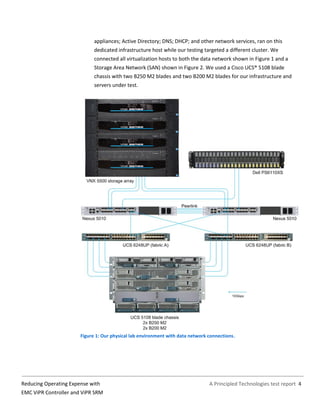
connected all virtualization hosts to both the data network shown in Figure 1 and a
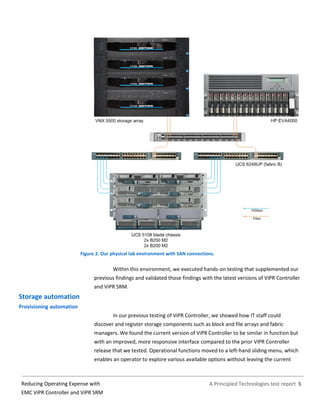
Storage Area Network (SAN) shown in Figure 2. We used a Cisco UCS® 5108 blade
chassis with two B250 M2 blades and two B200 M2 blades for our infrastructure and
servers under test.
Figure 1: Our physical lab environment with data network connections.
A Principled Technologies test report 5Reducing Operating Expense with
EMC ViPR Controller and ViPR SRM
Figure 2: Our physical lab environment with SAN connections.
Within this environment, we executed hands-on testing that supplemented our
previous findings and validated those findings with the latest versions of ViPR Controller
and ViPR SRM.
Storage automation
Provisioning automation
In our previous testing of ViPR Controller, we showed how IT staff could
discover and register storage components such as block and file arrays and fabric
managers. We found the current version of ViPR Controller to be similar in function but
with an improved, more responsive interface compared to the prior ViPR Controller
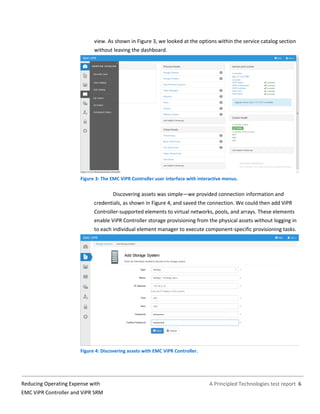
release that we tested. Operational functions moved to a left-hand sliding menu, which
enables an operator to explore various available options without leaving the current
A Principled Technologies test report 6Reducing Operating Expense with
EMC ViPR Controller and ViPR SRM
view. As shown in Figure 3, we looked at the options within the service catalog section
without leaving the dashboard.
Figure 3: The EMC ViPR Controller user interface with interactive menus.
Discovering assets was simple—we provided connection information and
credentials, as shown in Figure 4, and saved the connection. We could then add ViPR
Controller-supported elements to virtual networks, pools, and arrays. These elements
enable ViPR Controller storage provisioning from the physical assets without logging in
to each individual element manager to execute component-specific provisioning tasks.
Figure 4: Discovering assets with EMC ViPR Controller.
A Principled Technologies test report 7Reducing Operating Expense with
EMC ViPR Controller and ViPR SRM
In previous testing with ViPR Controller, we explored how ViPR Controller
automated provisioning saved administrative effort and time.4
In each of our test cases,
we found ViPR Controller handled provisioning faster than an administrator executing
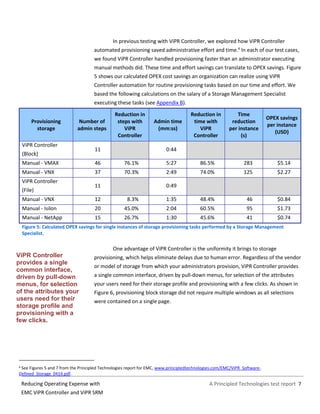
manual methods did. These time and effort savings can translate to OPEX savings. Figure
5 shows our calculated OPEX cost savings an organization can realize using ViPR
Controller automation for routine provisioning tasks based on our time and effort. We
based the following calculations on the salary of a Storage Management Specialist
executing these tasks (see Appendix B).
Provisioning
storage
Number of
admin steps
Reduction in
steps with
ViPR
Controller
Admin time
(mm:ss)
Reduction in
time with
ViPR
Controller
Time
reduction
per instance
(s)
OPEX savings
per instance
(USD)
ViPR Controller
(Block)
11 0:44
Manual - VMAX 46 76.1% 5:27 86.5% 283 $5.14
Manual - VNX 37 70.3% 2:49 74.0% 125 $2.27
ViPR Controller
(File)
11 0:49
Manual - VNX 12 8.3% 1:35 48.4% 46 $0.84
Manual - Isilon 20 45.0% 2:04 60.5% 95 $1.73
Manual - NetApp 15 26.7% 1:30 45.6% 41 $0.74
Figure 5: Calculated OPEX savings for single instances of storage provisioning tasks performed by a Storage Management
Specialist.
One advantage of ViPR Controller is the uniformity it brings to storage
provisioning, which helps eliminate delays due to human error. Regardless of the vendor
or model of storage from which your administrators provision, ViPR Controller provides
a single common interface, driven by pull-down menus, for selection of the attributes
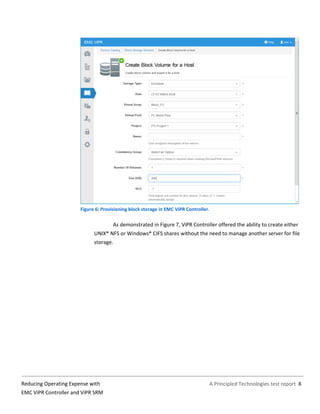
your users need for their storage profile and provisioning with a few clicks. As shown in
Figure 6, provisioning block storage did not require multiple windows as all selections
were contained on a single page.
4 See Figures 5 and 7 from the Principled Technologies report for EMC, www.principledtechnologies.com/EMC/ViPR_Software-
Defined_Storage_0414.pdf.
ViPR Controller
provides a single
common interface,
driven by pull-down
menus, for selection
of the attributes your
users need for their
storage profile and
provisioning with a
few clicks.
A Principled Technologies test report 8Reducing Operating Expense with
EMC ViPR Controller and ViPR SRM
Figure 6: Provisioning block storage in EMC ViPR Controller.
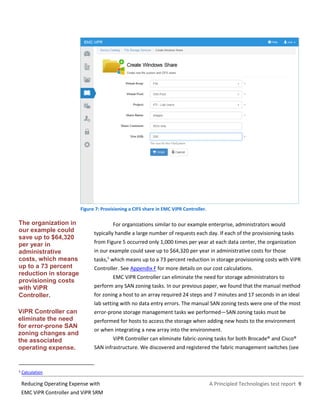
As demonstrated in Figure 7, ViPR Controller offered the ability to create either
UNIX® NFS or Windows® CIFS shares without the need to manage another server for file
storage.
A Principled Technologies test report 9Reducing Operating Expense with
EMC ViPR Controller and ViPR SRM
Figure 7: Provisioning a CIFS share in EMC ViPR Controller.
For organizations similar to our example enterprise, administrators would
typically handle a large number of requests each day. If each of the provisioning tasks
from Figure 5 occurred only 1,000 times per year at each data center, the organization
in our example could save up to $64,320 per year in administrative costs for those
tasks,5
which means up to a 73 percent reduction in storage provisioning costs with ViPR
Controller. See Appendix F for more details on our cost calculations.
EMC ViPR Controller can eliminate the need for storage administrators to
perform any SAN zoning tasks. In our previous paper, we found that the manual method
for zoning a host to an array required 24 steps and 7 minutes and 17 seconds in an ideal
lab setting with no data entry errors. The manual SAN zoning tests were one of the most
error-prone storage management tasks we performed—SAN zoning tasks must be
performed for hosts to access the storage when adding new hosts to the environment
or when integrating a new array into the environment.
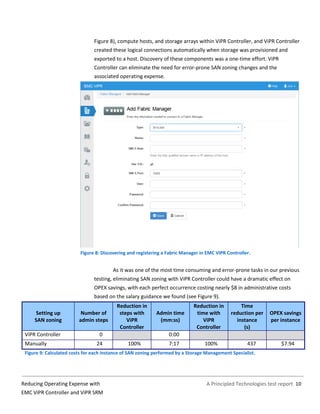
ViPR Controller can eliminate fabric-zoning tasks for both Brocade® and Cisco®
SAN infrastructure. We discovered and registered the fabric management switches (see
5 Calculation
ViPR Controller can
eliminate the need
for error-prone SAN
zoning changes and
the associated
operating expense.
The organization in
our example could
save up to $64,320
per year in
administrative
costs, which means
up to a 73 percent
reduction in storage
provisioning costs
with ViPR
Controller.
A Principled Technologies test report 10Reducing Operating Expense with
EMC ViPR Controller and ViPR SRM
Figure 8), compute hosts, and storage arrays within ViPR Controller, and ViPR Controller
created these logical connections automatically when storage was provisioned and
exported to a host. Discovery of these components was a one-time effort. ViPR
Controller can eliminate the need for error-prone SAN zoning changes and the
associated operating expense.
Figure 8: Discovering and registering a Fabric Manager in EMC ViPR Controller.
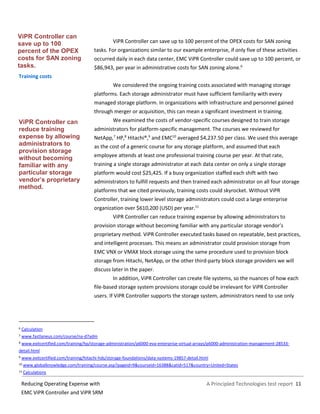
As it was one of the most time consuming and error-prone tasks in our previous
testing, eliminating SAN zoning with ViPR Controller could have a dramatic effect on
OPEX savings, with each perfect occurrence costing nearly $8 in administrative costs
based on the salary guidance we found (see Figure 9).
Setting up
SAN zoning
Number of
admin steps
Reduction in
steps with
ViPR
Controller
Admin time
(mm:ss)
Reduction in
time with
ViPR
Controller
Time
reduction per
instance
(s)
OPEX savings
per instance
ViPR Controller 0 0:00
Manually 24 100% 7:17 100% 437 $7.94
Figure 9: Calculated costs for each instance of SAN zoning performed by a Storage Management Specialist.
A Principled Technologies test report 11Reducing Operating Expense with
EMC ViPR Controller and ViPR SRM
ViPR Controller can save up to 100 percent of the OPEX costs for SAN zoning
tasks. For organizations similar to our example enterprise, if only five of these activities
occurred daily in each data center, EMC ViPR Controller could save up to 100 percent, or
$86,943, per year in administrative costs for SAN zoning alone.6
Training costs
We considered the ongoing training costs associated with managing storage
platforms. Each storage administrator must have sufficient familiarity with every
managed storage platform. In organizations with infrastructure and personnel gained
through merger or acquisition, this can mean a significant investment in training.
We examined the costs of vendor-specific courses designed to train storage
administrators for platform-specific management. The courses we reviewed for
NetApp,7
HP,8
Hitachi®,9
and EMC10
averaged $4,237.50 per class. We used this average
as the cost of a generic course for any storage platform, and assumed that each
employee attends at least one professional training course per year. At that rate,
training a single storage administrator at each data center on only a single storage
platform would cost $25,425. If a busy organization staffed each shift with two
administrators to fulfill requests and then trained each administrator on all four storage
platforms that we cited previously, training costs could skyrocket. Without ViPR
Controller, training lower level storage administrators could cost a large enterprise
organization over $610,200 (USD) per year.11
ViPR Controller can reduce training expense by allowing administrators to
provision storage without becoming familiar with any particular storage vendor’s
proprietary method. ViPR Controller executed tasks based on repeatable, best practices,
and intelligent processes. This means an administrator could provision storage from
EMC VNX or VMAX block storage using the same procedure used to provision block
storage from Hitachi, NetApp, or the other third-party block storage providers we will
discuss later in the paper.
In addition, ViPR Controller can create file systems, so the nuances of how each
file-based storage system provisions storage could be irrelevant for ViPR Controller
users. If ViPR Controller supports the storage system, administrators need to use only
6 Calculation
7 www.fastlaneus.com/course/na-d7adm
8 www.exitcertified.com/training/hp/storage-administration/p6000-eva-enterprise-virtual-arrays/p6000-administration-management-28533-
detail.html
9 www.exitcertified.com/training/hitachi-hds/storage-foundations/data-systems-19857-detail.html
10 www.globalknowledge.com/training/course.asp?pageid=9&courseid=16388&catid=517&country=United+States
11 Calculations
ViPR Controller can
reduce training
expense by allowing
administrators to
provision storage
without becoming
familiar with any
particular storage
vendor’s proprietary
method.
ViPR Controller can
save up to 100
percent of the OPEX
costs for SAN zoning
tasks.
A Principled Technologies test report 12Reducing Operating Expense with
EMC ViPR Controller and ViPR SRM
the ViPR Controller procedures, and those procedures are uniform for all supported
arrays.
Rather than train all administrators on every storage platform, organizations
could provide in-depth training on a single platform to each administrator—creating
experts who can configure, setup, and maintain each platform—and use ViPR Controller
for storage provisioning tasks for all platforms. For our example organization, this could
mean a 75 percent reduction in training costs, because each administrator would
specialize in only one platform instead of four. That is equivalent to $457,650 in savings.
Additional OPEX savings
Beyond storage provisioning and administration, ViPR Controller offers other
opportunities to reduce operating expenses. Many organizations with complex
infrastructures, large customer bases, and contractual obligations to provide designated
levels of service have turned to ITSM to provide a framework for enhancing the quality
of management of their services. Service providers must carefully consider the risk and
possible effect to other services before implementing changes. Change management’s
purpose is to minimize risk by carefully reviewing possible points for human error and to
prevent outages by thoroughly understanding the effect a change will have on the rest
of the environment and by taking any recommended mitigating steps.
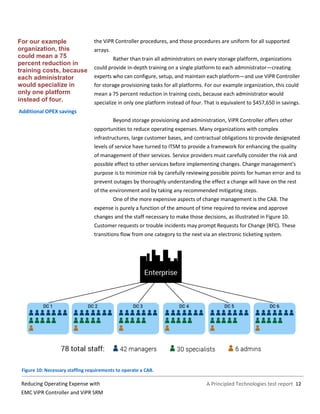
One of the more expensive aspects of change management is the CAB. The
expense is purely a function of the amount of time required to review and approve
changes and the staff necessary to make those decisions, as illustrated in Figure 10.
Customer requests or trouble incidents may prompt Requests for Change (RFC). These
transitions flow from one category to the next via an electronic ticketing system.
Figure 10: Necessary staffing requirements to operate a CAB.
For our example
organization, this
could mean a 75
percent reduction in
training costs, because
each administrator
would specialize in
only one platform
instead of four.
A Principled Technologies test report 13Reducing Operating Expense with
EMC ViPR Controller and ViPR SRM
For example, when the Help Desk receives requests or trouble reports, the
technician assigns the issue to an administrator for research and troubleshooting. If the
administrator determines the problem is outside the scope of his authority, he will
transfer the issue, via the ticket, to the administrator he believes has the ability and
authority to correct the issue. When the correct administrator receives the ticket, she
may discover an infrastructure change is necessary to fulfill the need. She creates an
RFC and the approval process begins. This process generally introduces additional costs
and delays into fulfillment of the request or mitigation of an incident.
ViPR Controller can relieve the costs associated with a Change Advisory Board
(CAB) by removing the work of a significant number of staff from the change phase. The
purpose of change management is to mitigate the risk of humans introducing errors into
the environment. By pre-allocating storage infrastructure, devices, disk pools, and other
resources to ViPR Controller, organizations can avoid frequent infrastructure changes.
Administrators, or possibly the users, fulfill requests in a timely manner without the
introduction of management overhead, which can create a flexible organization with
fewer human resources required for fulfilling requests.
Appendix C shows a systematic example of the costs associated with request,
incident, and change management. Very little of the expense has to do with the actual
task itself; rather, it is the approval process with multiple points of potentially error-
prone data entry, management-intensive labor costs, and quality control checks that
drive up the costs. Based on our calculations, a single change in our organization can
cost up to $162.93.
Of the 7,500 changes that can be handled per year by this example CAB, we
assumed only 30 percent of them are storage or fabric related, and 60 percent of the
storage-related tasks could be handled by ViPR Controller, either by provisioning new
storage or by performing automated SAN zoning. Removing those 1,350 changes from
the change management process could save $219,955.50 in OPEX costs in a single
year,12
an 18 percent reduction in OPEX related to the CAB with ViPR Controller.
Finally, considering that we have six geographically distributed data centers,
each with its own infrastructure to manage, that cost applies to each data center. EMC
ViPR Controller could save an organization like the one in our example up to $1,319,733
in a single year in CAB-related costs.
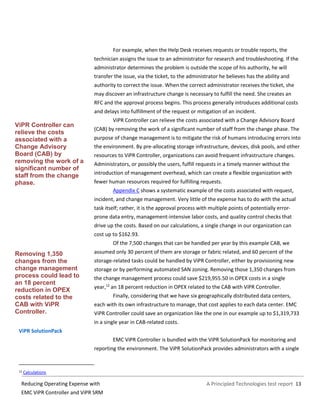
ViPR SolutionPack
EMC ViPR Controller is bundled with the ViPR SolutionPack for monitoring and
reporting the environment. The ViPR SolutionPack provides administrators with a single
12 Calculations
ViPR Controller can
relieve the costs
associated with a
Change Advisory
Board (CAB) by
removing the work of a
significant number of
staff from the change
phase.
Removing 1,350
changes from the
change management
process could lead to
an 18 percent
reduction in OPEX
costs related to the
CAB with ViPR
Controller.
A Principled Technologies test report 14Reducing Operating Expense with
EMC ViPR Controller and ViPR SRM
composite view of the health, capacity, and usage trends of the storage managed by
ViPR Controller. When both the ViPR Controller and ViPR SRM are installed in the
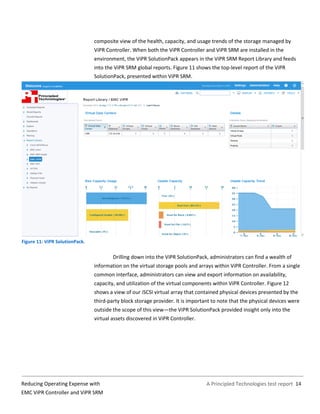
environment, the ViPR SolutionPack appears in the ViPR SRM Report Library and feeds
into the ViPR SRM global reports. Figure 11 shows the top-level report of the ViPR
SolutionPack, presented within ViPR SRM.
Figure 11: ViPR SolutionPack.
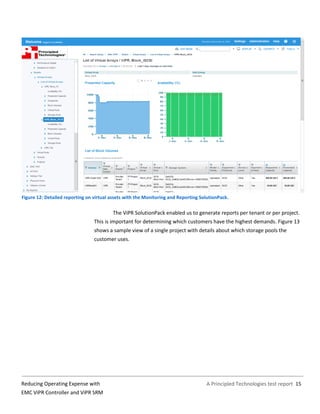
Drilling down into the ViPR SolutionPack, administrators can find a wealth of
information on the virtual storage pools and arrays within ViPR Controller. From a single
common interface, administrators can view and export information on availability,
capacity, and utilization of the virtual components within ViPR Controller. Figure 12
shows a view of our iSCSI virtual array that contained physical devices presented by the
third-party block storage provider. It is important to note that the physical devices were
outside the scope of this view—the ViPR SolutionPack provided insight only into the
virtual assets discovered in ViPR Controller.
A Principled Technologies test report 15Reducing Operating Expense with
EMC ViPR Controller and ViPR SRM
Figure 12: Detailed reporting on virtual assets with the Monitoring and Reporting SolutionPack.
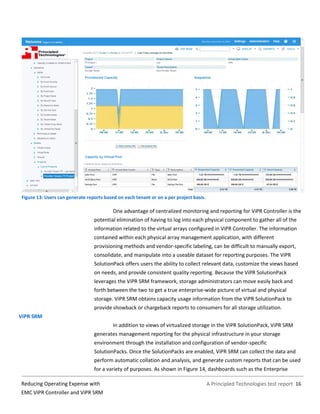
The ViPR SolutionPack enabled us to generate reports per tenant or per project.
This is important for determining which customers have the highest demands. Figure 13
shows a sample view of a single project with details about which storage pools the
customer uses.
A Principled Technologies test report 16Reducing Operating Expense with
EMC ViPR Controller and ViPR SRM
Figure 13: Users can generate reports based on each tenant or on a per project basis.
One advantage of centralized monitoring and reporting for ViPR Controller is the
potential elimination of having to log into each physical component to gather all of the
information related to the virtual arrays configured in ViPR Controller. The information
contained within each physical array management application, with different
provisioning methods and vendor-specific labeling, can be difficult to manually export,
consolidate, and manipulate into a useable dataset for reporting purposes. The ViPR
SolutionPack offers users the ability to collect relevant data, customize the views based
on needs, and provide consistent quality reporting. Because the ViPR SolutionPack
leverages the ViPR SRM framework, storage administrators can move easily back and
forth between the two to get a true enterprise-wide picture of virtual and physical
storage. ViPR SRM obtains capacity usage information from the ViPR SolutionPack to
provide showback or chargeback reports to consumers for all storage utilization.
ViPR SRM
In addition to views of virtualized storage in the ViPR SolutionPack, ViPR SRM
generates management reporting for the physical infrastructure in your storage
environment through the installation and configuration of vendor-specific
SolutionPacks. Once the SolutionPacks are enabled, ViPR SRM can collect the data and
perform automatic collation and analysis, and generate custom reports that can be used
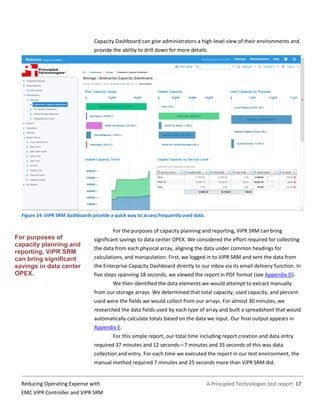
for a variety of purposes. As shown in Figure 14, dashboards such as the Enterprise
A Principled Technologies test report 17Reducing Operating Expense with
EMC ViPR Controller and ViPR SRM
Capacity Dashboard can give administrators a high-level view of their environments and
provide the ability to drill down for more details.
Figure 14: ViPR SRM dashboards provide a quick way to access frequently used data.
For the purposes of capacity planning and reporting, ViPR SRM can bring
significant savings to data center OPEX. We considered the effort required for collecting
the data from each physical array, aligning the data under common headings for
calculations, and manipulation. First, we logged in to ViPR SRM and sent the data from
the Enterprise Capacity Dashboard directly to our inbox via its email delivery function. In
five steps spanning 18 seconds, we viewed the report in PDF format (see Appendix D).
We then identified the data elements we would attempt to extract manually
from our storage arrays. We determined that total capacity, used capacity, and percent
used were the fields we would collect from our arrays. For almost 30 minutes, we
researched the data fields used by each type of array and built a spreadsheet that would
automatically calculate totals based on the data we input. Our final output appears in
Appendix E.
For this simple report, our total time including report creation and data entry
required 37 minutes and 12 seconds—7 minutes and 35 seconds of this was data
collection and entry. For each time we executed the report in our test environment, the
manual method required 7 minutes and 25 seconds more than ViPR SRM did.
For purposes of
capacity planning and
reporting, ViPR SRM
can bring significant
savings in data center
OPEX.
A Principled Technologies test report 18Reducing Operating Expense with
EMC ViPR Controller and ViPR SRM
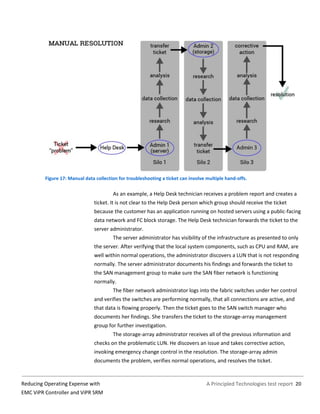
Our lab environment consisted of only a few storage targets. Large enterprises
will have many storage targets, each with their own management interfaces and data
labels. We identified the amount of time to access the information in each of the
individual arrays we used for our storage capacity report (see Figure 15). We used this
data to extrapolate OPEX savings in a larger environment. For this study, we eliminated
data entry and other human errors—our extrapolation was a perfect scenario, which is
typically not the case due to human error.
Array
Per login
(s)
Per pool
(s)
Isilon 22 20
NetApp 25 20
VNX Block 48 21
VNX File 9 19
Figure 15: Storage management times by array.
An increase in the number of arrays in a data center and an increase in the
number of pools defined on each array can significantly affect the required time to
perform manual data collection. If our example organization had 20 of each type of
array in each data center, and if each array had a minimum of five pools, the
administrator would have to spend time logging in and then additional time addressing
each pool—for a total of 80 separate logins and 400 pools to check. A single data
collection run for our simple report would require 2 hours and 48 minutes from IT staff
at each data center. Across the organization, that equals more than two business days’
worth of person-hours from the array managers—all Storage Management Specialists—
to generate a subset of data that ViPR SRM can provide in a matter of seconds. In 18
seconds, we were able to obtain a roll-up of all the capacity in the enterprise, with the
ability to drill down as needed.
If we instead assume the employees at the Help Desk Support level (see
Appendix B) collect this data using ViPR SRM, then generating a similar report could
save $400,658 in OPEX per report each year,13
a 99 percent reduction in capacity-
reporting costs using ViPR SRM. By using ViPR SRM for five small reports involving the
infrastructure components and manual data collection methods described here,
organizations could realize $2,003,290 in OPEX cost savings each year.
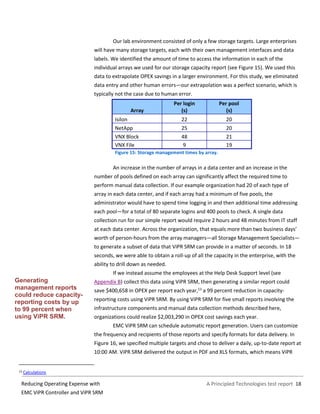
EMC ViPR SRM can schedule automatic report generation. Users can customize
the frequency and recipients of those reports and specify formats for data delivery. In
Figure 16, we specified multiple targets and chose to deliver a daily, up-to-date report at
10:00 AM. ViPR SRM delivered the output in PDF and XLS formats, which means ViPR
13 Calculations
Generating
management reports
could reduce capacity-
reporting costs by up
to 99 percent when
using ViPR SRM.
A Principled Technologies test report 19Reducing Operating Expense with
EMC ViPR Controller and ViPR SRM
SRM can simultaneously provide a static report and a data set for manipulation. This is
particularly useful because report delivery schedules can coincide with daily status
meetings and provide the most recent data at just the right time.
Figure 16: Scheduling automatic report generation and delivery with ViPR SRM.
Performance monitoring and troubleshooting
ViPR SRM can streamline troubleshooting performance issues. Often when a
customer reports an issue, they report only a few seemingly disjointed symptoms or
something such as, “Our system is slow.” How can the Help Desk technician properly
route the ticket to the correct group for resolution?
For many large organizations, administrators organize their staff into
specialized, functional groups such as server management, network support, storage
management, and application development. Each group’s primary responsibility aligns
with their specific skillset, so if a customer reports an issue with an unknown cause,
administrators must transfer the problem ticket among the functional groups so that
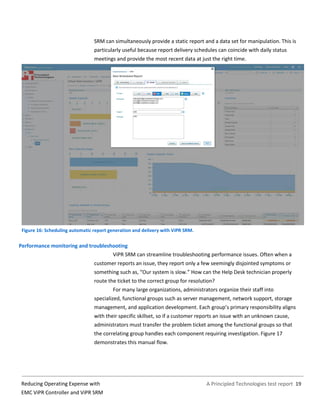
the correlating group handles each component requiring investigation. Figure 17
demonstrates this manual flow.
A Principled Technologies test report 20Reducing Operating Expense with
EMC ViPR Controller and ViPR SRM
Figure 17: Manual data collection for troubleshooting a ticket can involve multiple hand-offs.
As an example, a Help Desk technician receives a problem report and creates a
ticket. It is not clear to the Help Desk person which group should receive the ticket
because the customer has an application running on hosted servers using a public-facing
data network and FC block storage. The Help Desk technician forwards the ticket to the
server administrator.
The server administrator has visibility of the infrastructure as presented to only
the server. After verifying that the local system components, such as CPU and RAM, are
well within normal operations, the administrator discovers a LUN that is not responding
normally. The server administrator documents his findings and forwards the ticket to
the SAN management group to make sure the SAN fiber network is functioning
normally.
The fiber network administrator logs into the fabric switches under her control
and verifies the switches are performing normally, that all connections are active, and
that data is flowing properly. Then the ticket goes to the SAN switch manager who
documents her findings. She transfers the ticket to the storage-array management
group for further investigation.
The storage-array administrator receives all of the previous information and
checks on the problematic LUN. He discovers an issue and takes corrective action,
invoking emergency change control in the resolution. The storage-array admin
documents the problem, verifies normal operations, and resolves the ticket.
A Principled Technologies test report 21Reducing Operating Expense with
EMC ViPR Controller and ViPR SRM
This example has multiple possible points for human error. Each pass from silo
to silo creates an opportunity for a typographical error, which means the next
administrator may research the wrong issue. In addition, each data capture is a possible
transcription problem. Our example is a simplified ticket handling workflow. When
administrators in each silo cannot identify an issue properly, tickets can bounce back
through the system multiple times before arriving at a solution.
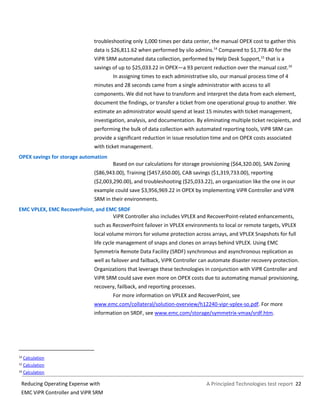
Figure 18 presents the same solution with ViPR SRM leveraged by first-level
analysts who can use the data to gather cross-silo information and pass the problem
ticket to the correct administrator for resolution.
Figure 18: The troubleshooting process with ViPR SRM.
In this example using ViPR SRM, the Help Desk technician transfers the ticket to
an analyst dedicated to triage. The analyst can use ViPR SRM to view the entire end-to-
end infrastructure, and can drill down into each component to discover abnormalities or
events that affect performance. We compared the manual process for logging in to each
element—host, fabric switch, and storage array—with obtaining the same data with
ViPR SRM. Our testing showed the manual process required 4 minutes and 28 seconds
to log in to all the elements (80 seconds for compute, 80 seconds for fabric
management, and 108 seconds for storage management), give a cursory review of each,
and export the data for later review. It took 31 seconds to view and export the data
from ViPR SRM. In an organization like the one in our example, if ViPR SRM assisted in
By eliminating multiple
ticket recipients, and
performing the bulk of
data collection with
automated reporting
tools, ViPR SRM can
provide a reduction in
issue resolution time
and OPEX associated
with ticket
management.
A Principled Technologies test report 22Reducing Operating Expense with
EMC ViPR Controller and ViPR SRM
troubleshooting only 1,000 times per data center, the manual OPEX cost to gather this
data is $26,811.62 when performed by silo admins.14
Compared to $1,778.40 for the
ViPR SRM automated data collection, performed by Help Desk Support,15
that is a
savings of up to $25,033.22 in OPEX—a 93 percent reduction over the manual cost.16
In assigning times to each administrative silo, our manual process time of 4
minutes and 28 seconds came from a single administrator with access to all
components. We did not have to transform and interpret the data from each element,
document the findings, or transfer a ticket from one operational group to another. We
estimate an administrator would spend at least 15 minutes with ticket management,
investigation, analysis, and documentation. By eliminating multiple ticket recipients, and
performing the bulk of data collection with automated reporting tools, ViPR SRM can
provide a significant reduction in issue resolution time and on OPEX costs associated
with ticket management.
OPEX savings for storage automation
Based on our calculations for storage provisioning ($64,320.00), SAN Zoning
($86,943.00), Training ($457,650.00), CAB savings ($1,319,733.00), reporting
($2,003,290.00), and troubleshooting ($25,033.22), an organization like the one in our
example could save $3,956,969.22 in OPEX by implementing ViPR Controller and ViPR
SRM in their environments.
EMC VPLEX, EMC RecoverPoint, and EMC SRDF
ViPR Controller also includes VPLEX and RecoverPoint-related enhancements,
such as RecoverPoint failover in VPLEX environments to local or remote targets, VPLEX
local volume mirrors for volume protection across arrays, and VPLEX Snapshots for full
life cycle management of snaps and clones on arrays behind VPLEX. Using EMC
Symmetrix Remote Data Facility (SRDF) synchronous and asynchronous replication as
well as failover and failback, ViPR Controller can automate disaster recovery protection.
Organizations that leverage these technologies in conjunction with ViPR Controller and
ViPR SRM could save even more on OPEX costs due to automating manual provisioning,
recovery, failback, and reporting processes.
For more information on VPLEX and RecoverPoint, see
www.emc.com/collateral/solution-overview/h12240-vipr-vplex-so.pdf. For more
information on SRDF, see www.emc.com/storage/symmetrix-vmax/srdf.htm.
14 Calculation
15 Calculation
16 Calculation
A Principled Technologies test report 23Reducing Operating Expense with
EMC ViPR Controller and ViPR SRM
Storage-as-a-Service
Self-Service provisioning
One of the advantages of the ViPR Controller interface is the ability to integrate
with an Active Directory, and allow designated users to provision storage for the tenants
and projects with which they are associated. Allowing internal customers, such as
application developers, lab users, and internal IT staff to provision storage for
themselves, rather than have to utilize the request process, can reduce the lag time and
costs associated with ticket management.
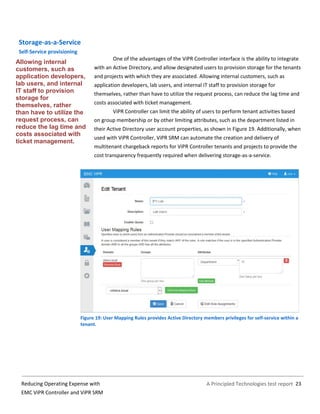
ViPR Controller can limit the ability of users to perform tenant activities based
on group membership or by other limiting attributes, such as the department listed in
their Active Directory user account properties, as shown in Figure 19. Additionally, when
used with ViPR Controller, ViPR SRM can automate the creation and delivery of
multitenant chargeback reports for ViPR Controller tenants and projects to provide the
cost transparency frequently required when delivering storage-as-a-service.
Figure 19: User Mapping Rules provides Active Directory members privileges for self-service within a
tenant.
Allowing internal
customers, such as
application developers,
lab users, and internal
IT staff to provision
storage for
themselves, rather
than have to utilize the
request process, can
reduce the lag time and
costs associated with
ticket management.
A Principled Technologies test report 24Reducing Operating Expense with
EMC ViPR Controller and ViPR SRM
Orchestration integrations
ViPR Controller plug-ins and REST APIs can enable cloud orchestration
applications to leverage the power of automated storage provisioning to speed storage
availability and lower operating expense. In our previous study, we showed how ViPR
Controller integrated with VMware orchestration tools and how it provided
administrators with the ability to add storage-provisioning automation to newly
provisioned VMs in their cloud tenants. ViPR Controller offers the same level of
integration with the latest versions of vCloud Automation Center (vCAC), now known as
vRealize Automation (vRA), and vCenter Orchestrator (vCO), now known as vRealize
Orchestrator (vRO). We set up both products and tested the difference between
automated provisioning and manually performing the same provisioning tasks.
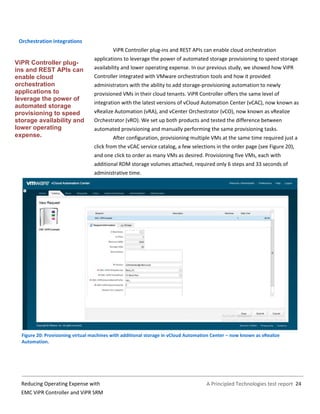
After configuration, provisioning multiple VMs at the same time required just a
click from the vCAC service catalog, a few selections in the order page (see Figure 20),
and one click to order as many VMs as desired. Provisioning five VMs, each with
additional RDM storage volumes attached, required only 6 steps and 33 seconds of
administrative time.
Figure 20: Provisioning virtual machines with additional storage in vCloud Automation Center – now known as vRealize
Automation.
ViPR Controller plug-
ins and REST APIs can
enable cloud
orchestration
applications to
leverage the power of
automated storage
provisioning to speed
storage availability and
lower operating
expense.
A Principled Technologies test report 25Reducing Operating Expense with
EMC ViPR Controller and ViPR SRM
Our manual provisioning tasks required more time and effort. Creating a single
VM with the same parameters as the automatically provisioned system required 4
minutes and 18 seconds and took 50 steps to complete the process, of which 64 percent
involved volume creation and attaching a volume to a VM. The manual provisioning of
five virtual machines with additional RDM storage required 21 minutes and 30 seconds
of administrative time and took 250 steps because of the serialized tasks.
Handoffs within our ticket-driven silo organization can inflate the time required
to fulfill provisioning requests. First, the server team must create the virtual servers with
the configuration parameters requested by the customer. Once the VMs exist, the
server admins transfer the ticket to the storage administrators where they provision the
volumes and export them to the correct virtual host cluster.
The storage administrators document the volume information, and transfer the
request back to the server administration team for completion. The server administrator
rescans the Host Bus Adapters (HBAs) on the cluster, selects a newly provisioned virtual
machine, and changes the properties—creating a new RDM using one of the volumes
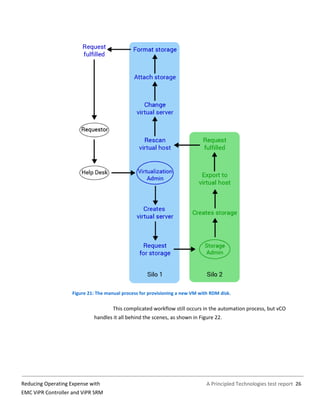
just provisioned and exported to the host cluster. Figure 21 shows the workflow
required to fulfill a request for a single virtual machine with additional RDM storage.
A Principled Technologies test report 26Reducing Operating Expense with
EMC ViPR Controller and ViPR SRM
Figure 21: The manual process for provisioning a new VM with RDM disk.
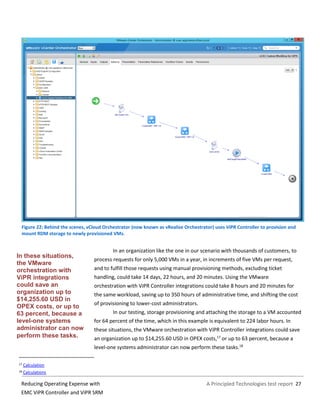
This complicated workflow still occurs in the automation process, but vCO
handles it all behind the scenes, as shown in Figure 22.
A Principled Technologies test report 27Reducing Operating Expense with
EMC ViPR Controller and ViPR SRM
Figure 22: Behind the scenes, vCloud Orchestrator (now known as vRealize Orchestrator) uses ViPR Controller to provision and
mount RDM storage to newly provisioned VMs.
In an organization like the one in our scenario with thousands of customers, to
process requests for only 5,000 VMs in a year, in increments of five VMs per request,
and to fulfill those requests using manual provisioning methods, excluding ticket
handling, could take 14 days, 22 hours, and 20 minutes. Using the VMware
orchestration with ViPR Controller integrations could take 8 hours and 20 minutes for
the same workload, saving up to 350 hours of administrative time, and shifting the cost
of provisioning to lower-cost administrators.
In our testing, storage provisioning and attaching the storage to a VM accounted
for 64 percent of the time, which in this example is equivalent to 224 labor hours. In
these situations, the VMware orchestration with ViPR Controller integrations could save
an organization up to $14,255.60 USD in OPEX costs,17
or up to 63 percent, because a
level-one systems administrator can now perform these tasks.18
17 Calculation
18 Calculations
In these situations,
the VMware
orchestration with
ViPR integrations
could save an
organization up to
$14,255.60 USD in
OPEX costs, or up to
63 percent, because a
level-one systems
administrator can now
perform these tasks.
A Principled Technologies test report 28Reducing Operating Expense with
EMC ViPR Controller and ViPR SRM
Software-defined data center
OpenStack integration
With our ViPR Controller testing, we had the opportunity to integrate ViPR
Controller and OpenStack® Cinder to take advantage of the third-party block storage
provider within ViPR Controller. While ViPR Controller already natively supports several
non-EMC array platforms such as NetApp and Hitachi, some organizations have
unsupported storage arrays that ViPR Controller does not currently support natively.
However, if your storage array has a Cinder driver for provisioning block storage, ViPR
Controller can use OpenStack Cinder as its intermediary, passing the ViPR Controller
provisioning parameters through OpenStack to its backend arrays.
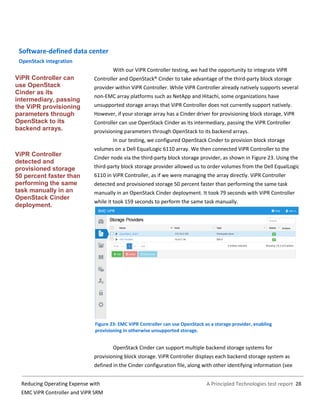
In our testing, we configured OpenStack Cinder to provision block storage
volumes on a Dell EqualLogic 6110 array. We then connected ViPR Controller to the
Cinder node via the third-party block storage provider, as shown in Figure 23. Using the
third-party block storage provider allowed us to order volumes from the Dell EqualLogic
6110 in ViPR Controller, as if we were managing the array directly. ViPR Controller
detected and provisioned storage 50 percent faster than performing the same task
manually in an OpenStack Cinder deployment. It took 79 seconds with ViPR Controller
while it took 159 seconds to perform the same task manually.
Figure 23: EMC ViPR Controller can use OpenStack as a storage provider, enabling
provisioning in otherwise unsupported storage.
OpenStack Cinder can support multiple backend storage systems for
provisioning block storage. ViPR Controller displays each backend storage system as
defined in the Cinder configuration file, along with other identifying information (see
ViPR Controller can
use OpenStack
Cinder as its
intermediary, passing
the ViPR provisioning
parameters through
OpenStack to its
backend arrays.
ViPR Controller
detected and
provisioned storage
50 percent faster than
performing the same
task manually in an
OpenStack Cinder
deployment.
A Principled Technologies test report 29Reducing Operating Expense with
EMC ViPR Controller and ViPR SRM
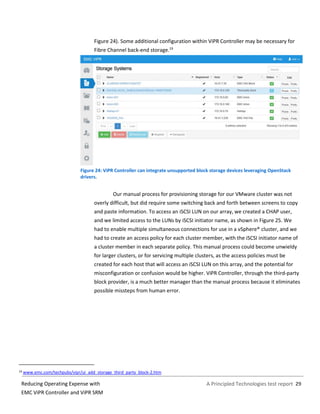
Figure 24). Some additional configuration within ViPR Controller may be necessary for
Fibre Channel back-end storage.19
Figure 24: ViPR Controller can integrate unsupported block storage devices leveraging OpenStack
drivers.
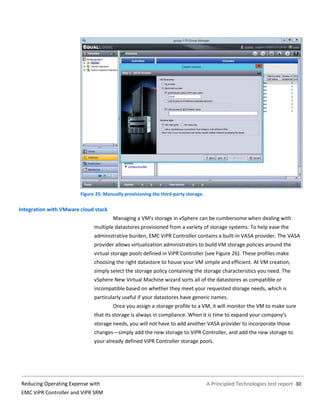
Our manual process for provisioning storage for our VMware cluster was not
overly difficult, but did require some switching back and forth between screens to copy
and paste information. To access an iSCSI LUN on our array, we created a CHAP user,
and we limited access to the LUNs by iSCSI initiator name, as shown in Figure 25. We
had to enable multiple simultaneous connections for use in a vSphere® cluster, and we
had to create an access policy for each cluster member, with the iSCSI initiator name of
a cluster member in each separate policy. This manual process could become unwieldy
for larger clusters, or for servicing multiple clusters, as the access policies must be
created for each host that will access an iSCSI LUN on this array, and the potential for
misconfiguration or confusion would be higher. ViPR Controller, through the third-party
block provider, is a much better manager than the manual process because it eliminates
possible missteps from human error.
19 www.emc.com/techpubs/vipr/ui_add_storage_third_party_block-2.htm
A Principled Technologies test report 30Reducing Operating Expense with
EMC ViPR Controller and ViPR SRM
Figure 25: Manually provisioning the third-party storage.
Integration with VMware cloud stack
Managing a VM’s storage in vSphere can be cumbersome when dealing with
multiple datastores provisioned from a variety of storage systems. To help ease the
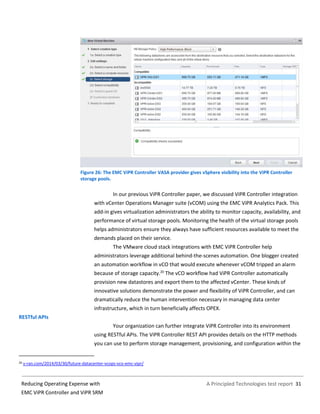
administrative burden, EMC ViPR Controller contains a built-in VASA provider. The VASA
provider allows virtualization administrators to build VM storage policies around the
virtual storage pools defined in ViPR Controller (see Figure 26). These profiles make
choosing the right datastore to house your VM simple and efficient. At VM creation,
simply select the storage policy containing the storage characteristics you need. The
vSphere New Virtual Machine wizard sorts all of the datastores as compatible or
incompatible based on whether they meet your requested storage needs, which is
particularly useful if your datastores have generic names.
Once you assign a storage profile to a VM, it will monitor the VM to make sure
that its storage is always in compliance. When it is time to expand your company’s
storage needs, you will not have to add another VASA provider to incorporate those
changes—simply add the new storage to ViPR Controller, and add the new storage to
your already defined ViPR Controller storage pools.
A Principled Technologies test report 31Reducing Operating Expense with
EMC ViPR Controller and ViPR SRM
Figure 26: The EMC ViPR Controller VASA provider gives vSphere visibility into the ViPR Controller
storage pools.
In our previous ViPR Controller paper, we discussed ViPR Controller integration
with vCenter Operations Manager suite (vCOM) using the EMC ViPR Analytics Pack. This
add-in gives virtualization administrators the ability to monitor capacity, availability, and
performance of virtual storage pools. Monitoring the health of the virtual storage pools
helps administrators ensure they always have sufficient resources available to meet the
demands placed on their service.
The VMware cloud stack integrations with EMC ViPR Controller help
administrators leverage additional behind-the-scenes automation. One blogger created
an automation workflow in vCO that would execute whenever vCOM tripped an alarm
because of storage capacity.20
The vCO workflow had ViPR Controller automatically
provision new datastores and export them to the affected vCenter. These kinds of
innovative solutions demonstrate the power and flexibility of ViPR Controller, and can
dramatically reduce the human intervention necessary in managing data center
infrastructure, which in turn beneficially affects OPEX.
RESTful APIs
Your organization can further integrate ViPR Controller into its environment
using RESTful APIs. The ViPR Controller REST API provides details on the HTTP methods
you can use to perform storage management, provisioning, and configuration within the
20 v-ran.com/2014/03/30/future-datacenter-vcops-vco-emc-vipr/
A Principled Technologies test report 32Reducing Operating Expense with
EMC ViPR Controller and ViPR SRM
data center.21
Embedding RESTful APIs in your higher-level management applications
can give your apps the ability to leverage ViPR Controller automation, without exposing
the ViPR Controller management consoles to consumers.
CONCLUSION
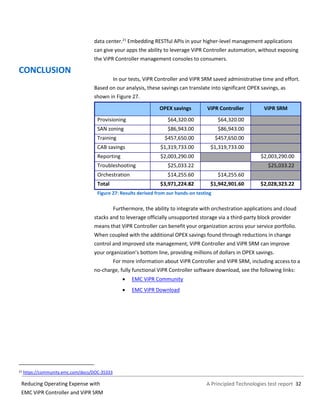
In our tests, ViPR Controller and ViPR SRM saved administrative time and effort.
Based on our analysis, these savings can translate into significant OPEX savings, as
shown in Figure 27.
OPEX savings ViPR Controller ViPR SRM
Provisioning $64,320.00 $64,320.00
SAN zoning $86,943.00 $86,943.00
Training $457,650.00 $457,650.00
CAB savings $1,319,733.00 $1,319,733.00
Reporting $2,003,290.00 $2,003,290.00
Troubleshooting $25,033.22 $25,033.22
Orchestration $14,255.60 $14,255.60
Total $3,971,224.82 $1,942,901.60 $2,028,323.22
Figure 27: Results derived from our hands-on testing
Furthermore, the ability to integrate with orchestration applications and cloud
stacks and to leverage officially unsupported storage via a third-party block provider
means that ViPR Controller can benefit your organization across your service portfolio.
When coupled with the additional OPEX savings found through reductions in change
control and improved site management, ViPR Controller and ViPR SRM can improve
your organization’s bottom line, providing millions of dollars in OPEX savings.
For more information about ViPR Controller and ViPR SRM, including access to a
no-charge, fully functional ViPR Controller software download, see the following links:
 EMC ViPR Community
 EMC ViPR Download
21 https://community.emc.com/docs/DOC-35333
A Principled Technologies test report 33Reducing Operating Expense with
EMC ViPR Controller and ViPR SRM
APPENDIX A – CHANGE ADVISORY BOARD
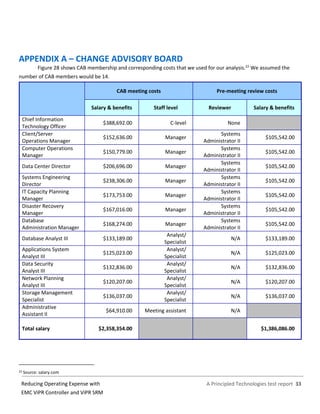
Figure 28 shows CAB membership and corresponding costs that we used for our analysis.22
We assumed the
number of CAB members would be 14.
CAB meeting costs Pre-meeting review costs
Salary & benefits Staff level Reviewer Salary & benefits
Chief Information
Technology Officer
$388,692.00 C-level None
Client/Server
Operations Manager
$152,636.00 Manager
Systems
Administrator II
$105,542.00
Computer Operations
Manager
$150,779.00 Manager
Systems
Administrator II
$105,542.00
Data Center Director $206,696.00 Manager
Systems
Administrator II
$105,542.00
Systems Engineering
Director
$238,306.00 Manager
Systems
Administrator II
$105,542.00
IT Capacity Planning
Manager
$173,753.00 Manager
Systems
Administrator II
$105,542.00
Disaster Recovery
Manager
$167,016.00 Manager
Systems
Administrator II
$105,542.00
Database
Administration Manager
$168,274.00 Manager
Systems
Administrator II
$105,542.00
Database Analyst III $133,189.00
Analyst/
Specialist
N/A $133,189.00
Applications System
Analyst III
$125,023.00
Analyst/
Specialist
N/A $125,023.00
Data Security
Analyst III
$132,836.00
Analyst/
Specialist
N/A $132,836.00
Network Planning
Analyst III
$120,207.00
Analyst/
Specialist
N/A $120,207.00
Storage Management
Specialist
$136,037.00
Analyst/
Specialist
N/A $136,037.00
Administrative
Assistant II
$64,910.00 Meeting assistant N/A
Total salary $2,358,354.00 $1,386,086.00
22 Source: salary.com
A Principled Technologies test report 34Reducing Operating Expense with
EMC ViPR Controller and ViPR SRM
Cost per hour
(based on 52
40-hour weeks)
$1,133.82 $666.39
Cost per minute $18.90 $11.11
Per-meeting overhead
Task Participant
Salary &
benefits
Cost per
minute
Number of
minutes
Cost per
meeting
Preparation of change
list and updating change
database with results
Database
Analyst III
$133,189.00 $1.07 60 $64.20
Cost of CAB meetings
CAB cost per hour $1,133.82
Length of meeting (hours) 1.00
Per-meeting overhead $64.20
Cost per meeting $1,198.02
Cost per minute $19.97
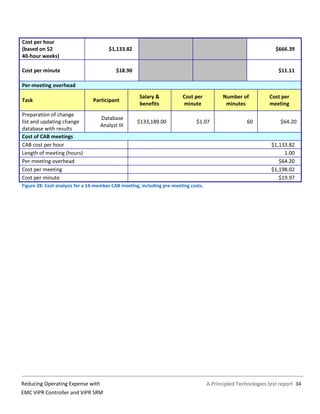
Figure 28: Cost analysis for a 14-member CAB meeting, including pre-meeting costs.
A Principled Technologies test report 35Reducing Operating Expense with
EMC ViPR Controller and ViPR SRM
APPENDIX B – SALARY INFORMATION FOR VARIOUS ROLES IN OUR
ORGANIZATION
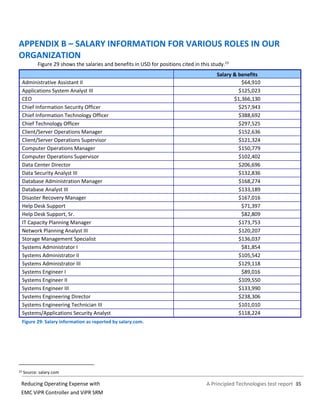
Figure 29 shows the salaries and benefits in USD for positions cited in this study.23
Salary & benefits
Administrative Assistant II $64,910
Applications System Analyst III $125,023
CEO $1,366,130
Chief Information Security Officer $257,943
Chief Information Technology Officer $388,692
Chief Technology Officer $297,525
Client/Server Operations Manager $152,636
Client/Server Operations Supervisor $121,324
Computer Operations Manager $150,779
Computer Operations Supervisor $102,402
Data Center Director $206,696
Data Security Analyst III $132,836
Database Administration Manager $168,274
Database Analyst III $133,189
Disaster Recovery Manager $167,016
Help Desk Support $71,397
Help Desk Support, Sr. $82,809
IT Capacity Planning Manager $173,753
Network Planning Analyst III $120,207
Storage Management Specialist $136,037
Systems Administrator I $81,854
Systems Administrator II $105,542
Systems Administrator III $129,118
Systems Engineer I $89,016
Systems Engineer II $109,550
Systems Engineer III $133,990
Systems Engineering Director $238,306
Systems Engineering Technician III $101,010
Systems/Applications Security Analyst $118,224
Figure 29: Salary information as reported by salary.com.
23 Source: salary.com
A Principled Technologies test report 36Reducing Operating Expense with
EMC ViPR Controller and ViPR SRM
APPENDIX C – CHANGE CONTROL
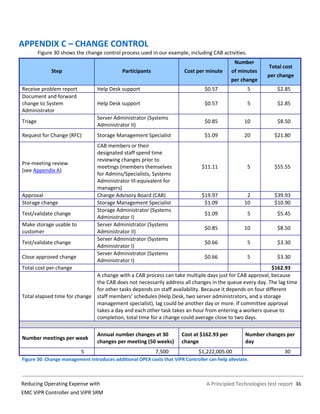
Figure 30 shows the change control process used in our example, including CAB activities.
Step Participants Cost per minute
Number
of minutes
per change
Total cost
per change
Receive problem report Help Desk support $0.57 5 $2.85
Document and forward
change to System
Administrator
Help Desk support $0.57 5 $2.85
Triage
Server Administrator (Systems
Administrator II)
$0.85 10 $8.50
Request for Change (RFC) Storage Management Specialist $1.09 20 $21.80
Pre-meeting review
(see Appendix A)
CAB members or their
designated staff spend time
reviewing changes prior to
meetings (members themselves
for Admins/Specialists, Systems
Administrator III-equivalent for
managers)
$11.11 5 $55.55
Approval Change Advisory Board (CAB) $19.97 2 $39.93
Storage change Storage Management Specialist $1.09 10 $10.90
Test/validate change
Storage Administrator (Systems
Administrator I)
$1.09 5 $5.45
Make storage usable to
customer
Server Administrator (Systems
Administrator II)
$0.85 10 $8.50
Test/validate change
Server Administrator (Systems
Administrator I)
$0.66 5 $3.30
Close approved change
Server Administrator (Systems
Administrator I)
$0.66 5 $3.30
Total cost per change $162.93
Total elapsed time for change
A change with a CAB process can take multiple days just for CAB approval, because
the CAB does not necessarily address all changes in the queue every day. The lag time
for other tasks depends on staff availability. Because it depends on four different
staff members’ schedules (Help Desk, two server administrators, and a storage
management specialist), lag could be another day or more. If committee approval
takes a day and each other task takes an hour from entering a workers queue to
completion, total time for a change could average close to two days.
Number meetings per week
Annual number changes at 30
changes per meeting (50 weeks)
Cost at $162.93 per
change
Number changes per
day
5 7,500 $1,222,005.00 30
Figure 30: Change management introduces additional OPEX costs that ViPR Controller can help alleviate.
A Principled Technologies test report 37Reducing Operating Expense with
EMC ViPR Controller and ViPR SRM
APPENDIX D – EXAMPLE ENTERPRISE CAPACITY DASHBOARD REPORT
DELIVERED VIA EMAIL
Figure 31 shows an example Enterprise Capacity Dashboard report.
Figure 31: An example Enterprise Capacity Dashboard report in ViPR SRM.
A Principled Technologies test report 38Reducing Operating Expense with
EMC ViPR Controller and ViPR SRM
APPENDIX E – SAMPLE CAPACITY DATA FROM MANUAL DATA
COLLECTION
Figure 32 shows sample capacity data from the manual data collection.
Pool Capacity Usable (GB) Pool Used (GB) Pool Used % Total Capacity (GB)
Isilon-001 190 489 72.06 679
Isilon-002 148 252 62.93 400
NetApp-001 92.95 72.28 44 165.23
pool0 10666.793 11327.08 0.51 21993.873
pool1 3208.254 5.01 0 3213.264
pool2 11232.896 10198.881 0.47 21431.777
pool3 10321.119 672.311 0.06 10993.43
Total 35860.012 23016.562 39.09290306 58876.574
Pool 0 600 10100 0.94 10700
Pool 2 4100 15900 0.79 20000
Figure 32: Sample capacity data from manual data collection.
A Principled Technologies test report 39Reducing Operating Expense with
EMC ViPR Controller and ViPR SRM
APPENDIX F – FORMULAS AND CALCULATIONS USED IN THIS REPORT
We used the following formulas and calculations to derive the cost savings for the example organization used in
our scenario.
Provisioning
(Sum of ViPR Controller OPEX Savings in Figure 5) × (number of instances per data center) × (number of data
centers) = OPEX savings per year
Calculation
$10.72 × 1,000 × 6 = $64,320.00
Total time for the manual tasks = 13.4166666667 minutes; per-minute cost of the storage admin = $1.09; total
cost for the manual tasks = $14.62; total OPEX savings for all instances = $10.72
(Total cost for manual tasks – Total OPEX savings for all instances) ÷ Total cost for manual tasks = ViPR OPEX cost
Calculation
($14.62 – $10.72) ÷ $14.62 = .27
1.00 – ViPR OPEX Cost = percent reduction of OPEX costs
Calculation
.27 – 1.00 = –0.73 = 73% reduction
SAN zoning
(OPEX savings per instance) × (number of daily instances) × (number of data centers) × (number of days) = OPEX
savings per year
Calculation
$7.94 × 5 × 6 × 365 = $86,943.00
Training
(Average cost per course) × (number of admins per shift) × (number of shifts) × (number of data centers ×
number of platforms) = training costs for storage administrators.
Calculations
$4,237.50 × 1 × 3 × 6 × 1 = $76,275.00 (for one admin each shift, six data centers, and one platform)
$4,237.50 × 2 × 3 × 6 × 4 = $610,200.00 (for two admins each shift, six data centers, and four platforms)
$4,237.50 × 2 × 3 × 6 × 1 = $152,550.00 (for two admins each shift, six data centers, and one platform)
Cost for all admins trained for 4 platforms – Cost for all admins trained for 1 platform = Training cost savings;
Training cost savings ÷ Cost for all admins trained for 4 platforms = percent reduction
A Principled Technologies test report 40Reducing Operating Expense with
EMC ViPR Controller and ViPR SRM
Calculations
$610,200 – $152,550 = $457,650
$457,650 ÷ $610,200 = .75 = 75% reduction in training costs
CAB savings
(Total number of CAB changes) × (percentage of total that are storage changes) × (percentage of storage
changes ViPR Controller can eliminate) × (CAB cost per change) × (number of data centers) = OPEX cost savings
Calculations
7,500 × 0.30 × 0.60 × $162.93 × 1 = $219,955.50
7,500 × 0.30 × 0.60 × $162.93 × 6 = $1,319,733.00 (one CAB per data center)
Because we already calculated the cost per change ($162.93), we only have to calculate how many changes
were removed from the CAB, and use this to calculate a percent reduction.
(Total number of changes) × (percentage of total changes that are storage changes) × (percentage of storage
changes ViPR Controller can eliminate) = number of changes removed from the CAB
Calculation
(7,500 × 0.30 × 0.60) = 1,350
(Total number of changes – number of changes removed from the CAB) ÷ Total number of changes = percent of
changes remaining
Calculation
(7,500 – 1,350) ÷ 7,500 = .82
1.00 – percent of changes remaining = percent reduction
Calculation
1.00 – 0.82 = 0.18 = 18% reduction
Reporting
(Cost per minute of Storage Management Specialist) × (number of minutes required to perform tasks once) ×
(number of times tasks must be performed) × (number of data centers) × (number of days) = OPEX cost to manually
create report
Calculation
$1.09 × 168 × 1 × 6 × 365 = $401,032.80 = OPEX cost to manually create report.
(Cost per minute of Help Desk Analyst) × (number of minutes required to perform task) × (number of times task
must be performed) × (number of data centers) × (number of days) = OPEX cost to use ViPR SRM
A Principled Technologies test report 41Reducing Operating Expense with
EMC ViPR Controller and ViPR SRM
Calculation
$0.57 × .3 × 1 × 6 × 365 = $374.49 = OPEX cost to use ViPR SRM
(OPEX cost to manually create report) – (OPEX cost to use ViPR SRM) = OPEX savings per report
Calculations
$401,032.80 – $374.49 = $400,658.31 = OPEX savings per report
$2,003,290.00 = OPEX savings for five reports
(OPEX Savings per report) ÷ OPEX Costs for manual report = percent reduction in costs.
Calculation
$400,658.31 ÷ $401,032.80 = .9990 = 99.9% reduction in costs
Troubleshooting
[{(Cost per minute of Systems Administrator II) × (number of minutes required to perform tasks once)} + {(Cost
per minute of Systems Administrator III) × (number of minutes required to perform tasks once)} + {(Cost per minute of
Storage Management Specialist) × (number of minutes required to perform tasks once)}] × (number of times tasks must
be performed) × (number of data centers) = OPEX cost to manually perform data collection
Calculation
$[{0.85 × 1.3333} + {1.03 × 1.3333} + {1.09 × 1.8}] × 1,000 × 6 = $26,811.62 = OPEX Cost to manually perform
data collection for troubleshooting.
(Cost per minute of Help Desk Analyst) × (number of minutes required to perform task) × (number of times task
must be performed) × (number of data centers) × (number of days) = OPEX cost to use ViPR SRM
Calculation
$(0.57 × .52) × 1,000 × 6 = $1,778.40 = OPEX cost to use ViPR SRM to collect data for troubleshooting
(OPEX cost to manually perform data collection for troubleshooting) – (OPEX cost to use ViPR SRM to collect
data for troubleshooting) = OPEX savings
Calculation
$26,811.62 – $1,778.40 = $25033.22= OPEX savings
(OPEX Savings) ÷ OPEX cost to manually perform data collection for troubleshooting = percent reduction in
costs.
Calculation
25033.22 ÷ 26,811.62= .9336 = 93% of costs
A Principled Technologies test report 42Reducing Operating Expense with
EMC ViPR Controller and ViPR SRM
Orchestration
(Average [Systems Administrator III cost per minute + Storage Management Specialist cost per minute]) ×
(number of minutes required for tasks over one year) = OPEX cost without orchestration
Calculations
(Average [$1.02 + $1.09]) × 21,500 = OPEX cost without orchestration
$1.06 × 21,500 = OPEX cost without orchestration
$22,790.00 = OPEX cost without orchestration
(Sys Ad I cost per minute) × (number of minutes required for tasks over one year) = Orchestration OPEX Cost
Calculation
$0.66 × 500 = Orchestration OPEX cost
$330 = Orchestration OPEX cost
(OPEX cost without orchestration × percent time for storage tasks) – Orchestration OPEX Cost = OPEX savings
Calculation
($22,790.00 × .64) – $330.00 = $14,255.60 = OPEX Savings
A Principled Technologies test report 43Reducing Operating Expense with
EMC ViPR Controller and ViPR SRM
APPENDIX G: TEST METHODOLOGIES
TROUBLESHOOTING AND PERFORMANCE TESTING
Using ViPR SRM to identify performance issues
Gathering performance metrics for troubleshooting
1. Log into SRM.
2. Select My Reports.
3. Select VilliersStorage Performance.
4. In the upper right-hand corner, select ToolsEmail me this report.
Identifying performance issues without ViPR SRM
Gathering server performance metrics
1. Log into vCenter Client.
2. Select the correct ESXi host.
3. Select the Performance tab.
4. Click the Advanced button.
5. Use the Switch to: pull-down menu and select Disk.
6. Use Real-time chart view to watch for any performance spikes.
7. Click Chart Options.
8. Under Chart Options, select the category Disk.
9. Deselect the check box labeled Always load these settings at startup.
10. In the Objects section, deselect all objects except for the problematic disk (We selected DGC Fibre Channel Disk).
11. In the Counters section, select read latency, write latency, read rate, and write rate.
12. Click OK to apply the changes.
13. Click the floppy disk icon to export the graph to a file on your computer.
14. Provide a name for the chart and click Save.
Gathering SAN fabric switch performance metrics
1. Log into the SAN MDS device.
2. Select the Summary tab.
3. Verify device port configuration for each device.
4. Select the Logs tab.
5. Select Summary of Statistics.
6. Save the data as a .txt file.
7. Open a blank workbook in Excel®.
8. Select the Data tab.
9. Click From Text to import the .txt file using the Text Import Wizard.
10. Select Delimited and click Next.
11. Select the Tab delimiter and click Next.
12. Click Finish.
13. Select the desired initial cell for import and click OK.
Gathering storage array performance metrics
1. Log into EMC Unisphere.
A Principled Technologies test report 44Reducing Operating Expense with
EMC ViPR Controller and ViPR SRM
2. Select vnx5500-cs0 listed under Systems by Severity.
3. Select StorageLUNs.
4. Sort by Host Information.
5. Right-click the LUN (ViPR-VNX-DS1)AnalyzerSelect Performance Summary.
6. Select Utilization.
7. Select the graph data and copy it to clipboard.
8. Paste the clipboard data into a text editor.
9. Select Response Time (ms).
10. Select the graph data and copy it to clipboard.
11. Paste the clipboard data into a text editor.
12. Select Service Time (ms).
13. Select the graph data and copy it to clipboard.
14. Paste the clipboard data into a text editor.
15. Save the data as a .csv file.
ORCHESTRATION
Creating VMs manually and provisioning storage
Building a VM in VMware vSphere
1. Using administrator credentials, log into the vSphere Web Client.
2. Select the cluster or host that will house the VM.
3. Click Create a new virtual machine.
4. Select Create a new virtual machine, and click Next.
5. Enter a name for the VM, select a location to create it, and click Next.
6. Select a cluster, host, vApp, or resource pool to run the VM, and click Next.
7. Select a destination datastore for VM configuration files and virtual disks, and click Next.
8. Select a compatibility for the VM, and click Next.
9. Select a guest OS, and click Next.
10. Select the desired number of CPUs. We selected 1.
11. Select the desired amount of memory. We selected 2 GB.
12. Select the desired amount of hard disk space. We chose 20 GB.
13. Select the proper SCSI controller.
14. Select the correct network adapter, and click Next.
15. Review the VM configuration, and click Finish.
Provisioning Storage
1. Using administrator credentials, log into EMC Unisphere.
2. Select the target system.
3. Select Storage.
4. Select Storage Configuration.
5. Select Storage Pools.
6. Right-click the target storage poolCreate LUN.
7. Check Thin.
8. Change the User Capacity. We selected 5 GB.
9. Click Apply.
10. Click Yes to confirm.
11. To close the create LUN window, click Cancel.
A Principled Technologies test report 45Reducing Operating Expense with
EMC ViPR Controller and ViPR SRM
Exporting newly created storage
1. Select the newly created LUN.
2. Click Add to Storage Group.
3. From the Available Storage Groups, select the target storage. To move the target storage to the Selected Storage
Groups, click the right arrow.
4. Click OK.
5. Click Yes to confirm.
6. Click OK.
7. Select the newly assigned LUN, and click Properties.
8. Select the Hosts tab, and click Update host information.
9. Click Yes.
10. To close the window, click OK.
Attaching the storage to the VM
1. In the vSphere Web Client, select the host in the cluster that houses the VM.
2. Click the Storage tab.
3. Select Storage Adapters.
4. Rescan the storage adapters. The new storage should now be available for the VM to use.
5. Select the VM, and click Edit virtual machine settings.
6. In the New device dropdown menu, select RDM Disk, and click Add.
7. By matching UIDs, find the correct target LUN, and click OK.
8. To close the VM edit settings window, click OK.
Automating VM creation and provisioning storage with vCAC
1. Using administrator credentials, log into VMware vCloud Automation Center.
2. Select Catalog.
3. In the box of the desired service, click Request.
4. Select the desired number of VMs. We chose five.
5. Click Submit.
6. To close the request, click OK.
OPENSTACK
Provisioning OpenStack Cinder third-party block storage with ViPR Controller for Dell
EqualLogic PS6100
Before undertaking the following steps, ensure that cluster members are logged into the array.
1. Log into ViPR Controller.
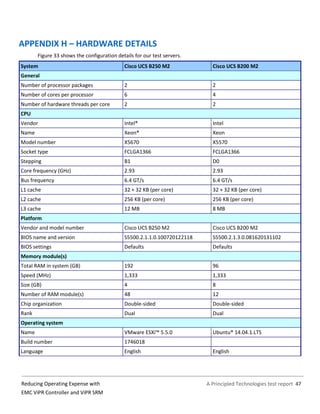
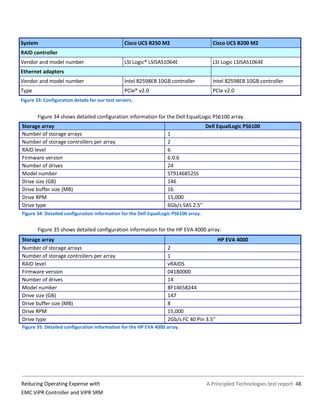
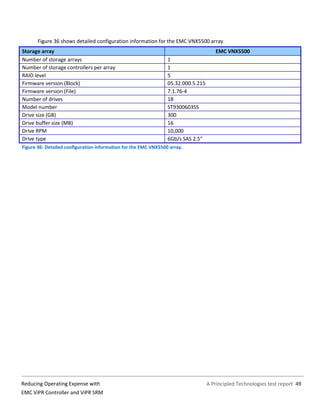
2. Select Service CatalogView Catalog.
3. Click Block storage services for VMware vCenter/ESX environments.
4. Click Create a New Block Volume for VMware.
5. From the pull-down menus, select the following items:
a. Datacenter
b. ESX Host/Cluster
c. Virtual Array (we selected Block_iSCSI)
d. Virtual Pool (we selected iSCSI Block Pool)
e. Project
6. Enter the name of the volume and the size of the volume to provision. We selected 10 GB.
A Principled Technologies test report 46Reducing Operating Expense with
EMC ViPR Controller and ViPR SRM
7. Click Order.
8. Log into the vSphere Client. Select a cluster member, and click the configuration tab. Under Hardware, click
Storage, and rescan the storage adapters. The newly provisioned storage will be available for use.
Provisioning third-party block storage manually for Dell EqualLogic PS6100
Before undertaking the following steps, ensure that cluster members are logged into the array.
1. Log into the Dell EqualLogic PS Series Group Manager.
2. In the right-pane menu, click Volumes.
3. In the right-pane menu, click create volume.
4. Provide a name (and optional description) for the volume. Click Next.
5. Enter the size of the volume to create, and check thin provisioned volume. We selected 10 GB. Click Next.
6. Select Restricted access. Check Authenticate using CHAP user name.
7. Enter the (preconfigured) CHAP user you wish to use for authentication. We used CHAP.
8. Check Limit access to iSCSI initiator name.
9. Log into the vSphere Client.
10. Select the first host in the cluster that will have access to the new storage. Click the Configuration Tab.
11. Under Hardware, click Storage Adapters.
12. Under iSCSI Software Adapter, locate and select vmhba32.
13. In the Detail section, select and right-click the iSCSI name, and choose Copy.
14. Switch back to the EqualLogic PS Series Group Manager.
15. Select and right-click the field for Limit access to iSCSI initiator name, and choose Paste.
16. Under Access type, check Allow simultaneous connections from initiators with different IQNs. Click Next.
17. Click Finish.
18. In the left panel under Volumes, the new volume will appear highlighted. In the left pane Activities menu and
under Access, click Create access policy.
19. Check Authenticate using CHAP user name.
20. Enter the (preconfigured) CHAP user you wish to use for authentication. We used CHAP.
21. Check Limit access to iSCSI initiator name.
22. Switch to the vSphere Client.
23. Select the next host in the cluster that will have access to the new storage. Click the Configuration Tab.
24. Under Hardware, click Storage Adapters.
25. Under iSCSI Software Adapter, locate and select vmhba32.
26. In the Detail section, select and right-click the iSCSI Name, and choose Copy.
27. Switch back to the EqualLogic PS Series Group Manager.
28. Select and right-click the field Limit access to iSCSI initiator name, and choose Paste.
29. Click OK.
30. Switch to the vSphere Client. The last cluster member added should still be selected. Under Hardware, click
Storage, and rescan the storage adapters. The new storage will be available for use.
A Principled Technologies test report 47Reducing Operating Expense with
EMC ViPR Controller and ViPR SRM
APPENDIX H – HARDWARE DETAILS
Figure 33 shows the configuration details for our test servers.
System Cisco UCS B250 M2 Cisco UCS B200 M2
General
Number of processor packages 2 2
Number of cores per processor 6 4
Number of hardware threads per core 2 2
CPU
Vendor Intel® Intel
Name Xeon® Xeon
Model number X5670 X5570
Socket type FCLGA1366 FCLGA1366
Stepping B1 D0
Core frequency (GHz) 2.93 2.93
Bus frequency 6.4 GT/s 6.4 GT/s
L1 cache 32 + 32 KB (per core) 32 + 32 KB (per core)
L2 cache 256 KB (per core) 256 KB (per core)
L3 cache 12 MB 8 MB
Platform
Vendor and model number Cisco UCS B250 M2 Cisco UCS B200 M2
BIOS name and version S5500.2.1.1.0.100720122118 S5500.2.1.3.0.081620131102
BIOS settings Defaults Defaults
Memory module(s)
Total RAM in system (GB) 192 96
Speed (MHz) 1,333 1,333
Size (GB) 4 8
Number of RAM module(s) 48 12
Chip organization Double-sided Double-sided
Rank Dual Dual
Operating system
Name VMware ESXi™ 5.5.0 Ubuntu® 14.04.1.LTS
Build number 1746018
Language English English
A Principled Technologies test report 48Reducing Operating Expense with
EMC ViPR Controller and ViPR SRM
System Cisco UCS B250 M2 Cisco UCS B200 M2
RAID controller
Vendor and model number LSI Logic® LSISAS1064E LSI Logic LSISAS1064E
Ethernet adapters
Vendor and model number Intel 82598EB 10GB controller Intel 82598EB 10GB controller
Type PCIe® v2.0 PCIe v2.0
Figure 33: Configuration details for our test servers.
Figure 34 shows detailed configuration information for the Dell EqualLogic PS6100 array.
Storage array Dell EqualLogic PS6100
Number of storage arrays 1
Number of storage controllers per array 2
RAID level 6
Firmware version 6.0.6
Number of drives 24
Model number ST9146852SS
Drive size (GB) 146
Drive buffer size (MB) 16
Drive RPM 15,000
Drive type 6Gb/s SAS 2.5″
Figure 34: Detailed configuration information for the Dell EqualLogic PS6100 array.
Figure 35 shows detailed configuration information for the HP EVA 4000 array.
Storage array HP EVA 4000
Number of storage arrays 2
Number of storage controllers per array 1
RAID level vRAID5
Firmware version 04180000
Number of drives 14
Model number BF14658244
Drive size (GB) 147
Drive buffer size (MB) 8
Drive RPM 15,000
Drive type 2Gb/s FC 40 Pin 3.5″
Figure 35: Detailed configuration information for the HP EVA 4000 array.
A Principled Technologies test report 49Reducing Operating Expense with
EMC ViPR Controller and ViPR SRM
Figure 36 shows detailed configuration information for the EMC VNX5500 array.
Storage array EMC VNX5500
Number of storage arrays 1
Number of storage controllers per array 1
RAID level 5
Firmware version (Block) 05.32.000.5.215
Firmware version (File) 7.1.76-4
Number of drives 18
Model number ST9300603SS
Drive size (GB) 300
Drive buffer size (MB) 16
Drive RPM 10,000
Drive type 6Gb/s SAS 2.5″
Figure 36: Detailed configuration information for the EMC VNX5500 array.
A Principled Technologies test report 50Reducing Operating Expense with
EMC ViPR Controller and ViPR SRM
ABOUT PRINCIPLED TECHNOLOGIES
Principled Technologies, Inc.
1007 Slater Road, Suite 300
Durham, NC, 27703
www.principledtechnologies.com
We provide industry-leading technology assessment and fact-
based marketing services. We bring to every assignment extensive
experience with and expertise in all aspects of technology testing and
analysis, from researching new technologies, to developing new
methodologies, to testing with existing and new tools.
When the assessment is complete, we know how to present the
results to a broad range of target audiences. We provide our clients with
the materials they need, from market-focused data to use in their own
collateral to custom sales aids, such as test reports, performance
assessments, and white papers. Every document reflects the results of
our trusted independent analysis.
We provide customized services that focus on our clients’
individual requirements. Whether the technology involves hardware,
software, Web sites, or services, we offer the experience, expertise, and
tools to help our clients assess how it will fare against its competition, its
performance, its market readiness, and its quality and reliability.
Our founders, Mark L. Van Name and Bill Catchings, have worked
together in technology assessment for over 20 years. As journalists, they
published over a thousand articles on a wide array of technology subjects.
They created and led the Ziff-Davis Benchmark Operation, which
developed such industry-standard benchmarks as Ziff Davis Media’s
Winstone and WebBench. They founded and led eTesting Labs, and after
the acquisition of that company by Lionbridge Technologies were the
head and CTO of VeriTest.
Principled Technologies is a registered trademark of Principled Technologies, Inc.
All other product names are the trademarks of their respective owners.
Disclaimer of Warranties; Limitation of Liability:
PRINCIPLED TECHNOLOGIES, INC. HAS MADE REASONABLE EFFORTS TO ENSURE THE ACCURACY AND VALIDITY OF ITS TESTING, HOWEVER,
PRINCIPLED TECHNOLOGIES, INC. SPECIFICALLY DISCLAIMS ANY WARRANTY, EXPRESSED OR IMPLIED, RELATING TO THE TEST RESULTS AND
ANALYSIS, THEIR ACCURACY, COMPLETENESS OR QUALITY, INCLUDING ANY IMPLIED WARRANTY OF FITNESS FOR ANY PARTICULAR PURPOSE.
ALL PERSONS OR ENTITIES RELYING ON THE RESULTS OF ANY TESTING DO SO AT THEIR OWN RISK, AND AGREE THAT PRINCIPLED
TECHNOLOGIES, INC., ITS EMPLOYEES AND ITS SUBCONTRACTORS SHALL HAVE NO LIABILITY WHATSOEVER FROM ANY CLAIM OF LOSS OR
DAMAGE ON ACCOUNT OF ANY ALLEGED ERROR OR DEFECT IN ANY TESTING PROCEDURE OR RESULT.
IN NO EVENT SHALL PRINCIPLED TECHNOLOGIES, INC. BE LIABLE FOR INDIRECT, SPECIAL, INCIDENTAL, OR CONSEQUENTIAL DAMAGES IN
CONNECTION WITH ITS TESTING, EVEN IF ADVISED OF THE POSSIBILITY OF SUCH DAMAGES. IN NO EVENT SHALL PRINCIPLED TECHNOLOGIES,
INC.’S LIABILITY, INCLUDING FOR DIRECT DAMAGES, EXCEED THE AMOUNTS PAID IN CONNECTION WITH PRINCIPLED TECHNOLOGIES, INC.’S
TESTING. CUSTOMER’S SOLE AND EXCLUSIVE REMEDIES ARE AS SET FORTH HEREIN.

Reducing Operating Expense with EMC ViPR Controller and ViPR SRM

  • 1.
    DECEMBER 2014 A PRINCIPLEDTECHNOLOGIES TEST REPORT Commissioned by EMC Corp. REDUCING OPERATING EXPENSE WITH EMC ViPR CONTROLLER AND ViPR SRM Data growth and increased virtualization within the data center has changed how some businesses provide services to their customers. In a similar fashion, cloud computing, with on-demand provisioning models and customers’ desire to self-service many of their IT needs, is driving organizations to better integrate their existing back- end platforms with software-defined service technologies. Cloud-based automation technologies allow enterprises to retain legacy capabilities while remaining nimble enough to compete in a changing technology ecosystem that emphasizes rapid delivery of services with less regard for specified physical hardware. In addition, these new automation technologies create the possibility for organizations to realize operating expense (OPEX) savings from reductions in administrative time and effort. The new technologies can shift the Information Technology Service Management (ITSM) burden from change management to the release management phases and can reduce costs associated with human error. In previous hands-on testing at Principled Technologies, we explored how EMC ViPR Controller 1.0 automates storage provisioning, consolidates monitoring and reporting, integrates with VMware®, and provides cloud-compatible object stores that
  • 2.
    A Principled Technologiestest report 2Reducing Operating Expense with EMC ViPR Controller and ViPR SRM allow cloud applications to run in your data center.1 Leveraging this previous work in conjunction with additional hands-on testing with EMC ViPR Controller 2.0 and ViPR SRM 3.5 storage-resource management software, we analyzed potential OPEX savings by comparing administrative tasks, change management workflows, data collection and reporting, and ticket handling processes in a representative environment with and without ViPR Controller and ViPR SRM. Our analysis shows that an organization similar to the one in our scenario could realize $1,942,901.60 (USD) in OPEX savings per year by integrating EMC ViPR Controller into its data center. Adding ViPR SRM, which integrates with ViPR Controller, could bump this savings up by $2,028,323.22 for a net $3,971,224.82 of OPEX reduction annually. DETAILED TEST CASES About our approach To analyze potential OPEX savings from deploying ViPR Controller and ViPR SRM, we researched salary information from publically available sources for a variety of IT functions, including analysts, administrators, specialists, and director- and C-level roles.2 We used this data as we created our example ITSM change management process, which defines how an organization would manage customer requests to ensure minimal risk to the operating environment. In addition to ticket handling and transfers, we evaluated the OPEX costs associated with the Change Advisory Board (CAB). The CAB is a service management layer that reviews each requested change for its impact and risk, and approves and schedules changes for implementation. We conducted customer interviews that provided us with real-world experiences for our framing scenario and supporting data that validated our calculations. In addition, we leveraged the hands-on testing from our previous EMC ViPR Controller work where applicable. Framing scenario We considered how a large enterprise, with multiple data centers each containing storage platforms of various ages and from different vendors, would operate. In our example, this large enterprise has thousands of internal and external customers who require IT provisioning, data protection, and management services. Our organization has six different regional data centers geographically dispersed over a wide 1 See the Principled Technologies report for EMC, www.principledtechnologies.com/EMC/ViPR_Software-Defined_Storage_0414.pdf. 2 www.salary.com/category/salary/ An organization similar to the one in our scenario could realize $1,942,901.60 (USD) in OPEX savings per year by integrating EMC ViPR Controller into its data center. Adding ViPR SRM could add $2,028,323.22 more in OPEX savings—a net $3,971,224.82 in OPEX reduction annually.
  • 3.
    A Principled Technologiestest report 3Reducing Operating Expense with EMC ViPR Controller and ViPR SRM expanse, each with a variety of active storage platforms. Each data center has three shifts of employees with at least one storage, network, server, and virtualization administrator on shift at all times. This organization would necessarily leverage both Fibre Channel and iSCSI for block storage and file-based NAS storage systems to accommodate the wide range of requests for its customers. We anticipated an organization of this size would deal with thousands of requests for additions, changes, and reductions in services yearly. Our example enterprise has implemented ITSM to help manage their environment, and has a mature change management process that approves changes to customer environments. This includes a CAB at each facility,3 which comprises selected senior management, middle management, and senior engineers who convene daily using a software-based management system for prioritizing, approving, and scheduling changes. For more details on the CAB, see Appendix A. To manage costs associated with their physical infrastructure assets, the organization relies on robust capacity planning and management that ensures fulfillment of customer needs and requests while maintaining sufficient stand-by capacity. To calculate OPEX savings for our enterprise, we researched the salaries of storage, network, and server administrators; help-desk staff; IT and executive management; and other supporting full-time employee costs using publically available sources. See Appendix B for a complete list of salaries and employee roles we used in our analysis. Test environment Our test environment, in our labs at Principled Technologies, simulated various storage platforms a large organization might encounter. To show how EMC ViPR Controller or ViPR SRM can manage these various platforms, we used an EMC VNX5500, an HP EVA 4000 physical array, NetApp® and EMC Isilon simulators running as virtual appliances on a dedicated infrastructure virtualization host, and a non-supported Dell™ EqualLogic™ 6110 physical array. To manage the HP EVA 4000, we set up a Windows Server® 2008 R2 x64 server with HP P6000 CommandView 10.1 and physically connected the server to the SAN environment. As they were otherwise unutilized during testing, we configured the EMC SMI-S provider, which allowed us to discover and manage our EMC VNX5500, and the HP SMI-S provider, which allowed us to access the EVA 4000 using non-HP tools such as ViPR SRM, on alternate ports. With the exception of our Command View EVA server, all infrastructure components, such as our cloud orchestration software; EMC ViPR Controller virtual 3 itsm.certification.info/cab.html
  • 4.
    A Principled Technologiestest report 4Reducing Operating Expense with EMC ViPR Controller and ViPR SRM appliances; Active Directory; DNS; DHCP; and other network services, ran on this dedicated infrastructure host while our testing targeted a different cluster. We connected all virtualization hosts to both the data network shown in Figure 1 and a Storage Area Network (SAN) shown in Figure 2. We used a Cisco UCS® 5108 blade chassis with two B250 M2 blades and two B200 M2 blades for our infrastructure and servers under test. Figure 1: Our physical lab environment with data network connections.
  • 5.
    A Principled Technologiestest report 5Reducing Operating Expense with EMC ViPR Controller and ViPR SRM Figure 2: Our physical lab environment with SAN connections. Within this environment, we executed hands-on testing that supplemented our previous findings and validated those findings with the latest versions of ViPR Controller and ViPR SRM. Storage automation Provisioning automation In our previous testing of ViPR Controller, we showed how IT staff could discover and register storage components such as block and file arrays and fabric managers. We found the current version of ViPR Controller to be similar in function but with an improved, more responsive interface compared to the prior ViPR Controller release that we tested. Operational functions moved to a left-hand sliding menu, which enables an operator to explore various available options without leaving the current
  • 6.
    A Principled Technologiestest report 6Reducing Operating Expense with EMC ViPR Controller and ViPR SRM view. As shown in Figure 3, we looked at the options within the service catalog section without leaving the dashboard. Figure 3: The EMC ViPR Controller user interface with interactive menus. Discovering assets was simple—we provided connection information and credentials, as shown in Figure 4, and saved the connection. We could then add ViPR Controller-supported elements to virtual networks, pools, and arrays. These elements enable ViPR Controller storage provisioning from the physical assets without logging in to each individual element manager to execute component-specific provisioning tasks. Figure 4: Discovering assets with EMC ViPR Controller.
  • 7.
    A Principled Technologiestest report 7Reducing Operating Expense with EMC ViPR Controller and ViPR SRM In previous testing with ViPR Controller, we explored how ViPR Controller automated provisioning saved administrative effort and time.4 In each of our test cases, we found ViPR Controller handled provisioning faster than an administrator executing manual methods did. These time and effort savings can translate to OPEX savings. Figure 5 shows our calculated OPEX cost savings an organization can realize using ViPR Controller automation for routine provisioning tasks based on our time and effort. We based the following calculations on the salary of a Storage Management Specialist executing these tasks (see Appendix B). Provisioning storage Number of admin steps Reduction in steps with ViPR Controller Admin time (mm:ss) Reduction in time with ViPR Controller Time reduction per instance (s) OPEX savings per instance (USD) ViPR Controller (Block) 11 0:44 Manual - VMAX 46 76.1% 5:27 86.5% 283 $5.14 Manual - VNX 37 70.3% 2:49 74.0% 125 $2.27 ViPR Controller (File) 11 0:49 Manual - VNX 12 8.3% 1:35 48.4% 46 $0.84 Manual - Isilon 20 45.0% 2:04 60.5% 95 $1.73 Manual - NetApp 15 26.7% 1:30 45.6% 41 $0.74 Figure 5: Calculated OPEX savings for single instances of storage provisioning tasks performed by a Storage Management Specialist. One advantage of ViPR Controller is the uniformity it brings to storage provisioning, which helps eliminate delays due to human error. Regardless of the vendor or model of storage from which your administrators provision, ViPR Controller provides a single common interface, driven by pull-down menus, for selection of the attributes your users need for their storage profile and provisioning with a few clicks. As shown in Figure 6, provisioning block storage did not require multiple windows as all selections were contained on a single page. 4 See Figures 5 and 7 from the Principled Technologies report for EMC, www.principledtechnologies.com/EMC/ViPR_Software- Defined_Storage_0414.pdf. ViPR Controller provides a single common interface, driven by pull-down menus, for selection of the attributes your users need for their storage profile and provisioning with a few clicks.
  • 8.
    A Principled Technologiestest report 8Reducing Operating Expense with EMC ViPR Controller and ViPR SRM Figure 6: Provisioning block storage in EMC ViPR Controller. As demonstrated in Figure 7, ViPR Controller offered the ability to create either UNIX® NFS or Windows® CIFS shares without the need to manage another server for file storage.
  • 9.
    A Principled Technologiestest report 9Reducing Operating Expense with EMC ViPR Controller and ViPR SRM Figure 7: Provisioning a CIFS share in EMC ViPR Controller. For organizations similar to our example enterprise, administrators would typically handle a large number of requests each day. If each of the provisioning tasks from Figure 5 occurred only 1,000 times per year at each data center, the organization in our example could save up to $64,320 per year in administrative costs for those tasks,5 which means up to a 73 percent reduction in storage provisioning costs with ViPR Controller. See Appendix F for more details on our cost calculations. EMC ViPR Controller can eliminate the need for storage administrators to perform any SAN zoning tasks. In our previous paper, we found that the manual method for zoning a host to an array required 24 steps and 7 minutes and 17 seconds in an ideal lab setting with no data entry errors. The manual SAN zoning tests were one of the most error-prone storage management tasks we performed—SAN zoning tasks must be performed for hosts to access the storage when adding new hosts to the environment or when integrating a new array into the environment. ViPR Controller can eliminate fabric-zoning tasks for both Brocade® and Cisco® SAN infrastructure. We discovered and registered the fabric management switches (see 5 Calculation ViPR Controller can eliminate the need for error-prone SAN zoning changes and the associated operating expense. The organization in our example could save up to $64,320 per year in administrative costs, which means up to a 73 percent reduction in storage provisioning costs with ViPR Controller.
  • 10.
    A Principled Technologiestest report 10Reducing Operating Expense with EMC ViPR Controller and ViPR SRM Figure 8), compute hosts, and storage arrays within ViPR Controller, and ViPR Controller created these logical connections automatically when storage was provisioned and exported to a host. Discovery of these components was a one-time effort. ViPR Controller can eliminate the need for error-prone SAN zoning changes and the associated operating expense. Figure 8: Discovering and registering a Fabric Manager in EMC ViPR Controller. As it was one of the most time consuming and error-prone tasks in our previous testing, eliminating SAN zoning with ViPR Controller could have a dramatic effect on OPEX savings, with each perfect occurrence costing nearly $8 in administrative costs based on the salary guidance we found (see Figure 9). Setting up SAN zoning Number of admin steps Reduction in steps with ViPR Controller Admin time (mm:ss) Reduction in time with ViPR Controller Time reduction per instance (s) OPEX savings per instance ViPR Controller 0 0:00 Manually 24 100% 7:17 100% 437 $7.94 Figure 9: Calculated costs for each instance of SAN zoning performed by a Storage Management Specialist.
  • 11.
    A Principled Technologiestest report 11Reducing Operating Expense with EMC ViPR Controller and ViPR SRM ViPR Controller can save up to 100 percent of the OPEX costs for SAN zoning tasks. For organizations similar to our example enterprise, if only five of these activities occurred daily in each data center, EMC ViPR Controller could save up to 100 percent, or $86,943, per year in administrative costs for SAN zoning alone.6 Training costs We considered the ongoing training costs associated with managing storage platforms. Each storage administrator must have sufficient familiarity with every managed storage platform. In organizations with infrastructure and personnel gained through merger or acquisition, this can mean a significant investment in training. We examined the costs of vendor-specific courses designed to train storage administrators for platform-specific management. The courses we reviewed for NetApp,7 HP,8 Hitachi®,9 and EMC10 averaged $4,237.50 per class. We used this average as the cost of a generic course for any storage platform, and assumed that each employee attends at least one professional training course per year. At that rate, training a single storage administrator at each data center on only a single storage platform would cost $25,425. If a busy organization staffed each shift with two administrators to fulfill requests and then trained each administrator on all four storage platforms that we cited previously, training costs could skyrocket. Without ViPR Controller, training lower level storage administrators could cost a large enterprise organization over $610,200 (USD) per year.11 ViPR Controller can reduce training expense by allowing administrators to provision storage without becoming familiar with any particular storage vendor’s proprietary method. ViPR Controller executed tasks based on repeatable, best practices, and intelligent processes. This means an administrator could provision storage from EMC VNX or VMAX block storage using the same procedure used to provision block storage from Hitachi, NetApp, or the other third-party block storage providers we will discuss later in the paper. In addition, ViPR Controller can create file systems, so the nuances of how each file-based storage system provisions storage could be irrelevant for ViPR Controller users. If ViPR Controller supports the storage system, administrators need to use only 6 Calculation 7 www.fastlaneus.com/course/na-d7adm 8 www.exitcertified.com/training/hp/storage-administration/p6000-eva-enterprise-virtual-arrays/p6000-administration-management-28533- detail.html 9 www.exitcertified.com/training/hitachi-hds/storage-foundations/data-systems-19857-detail.html 10 www.globalknowledge.com/training/course.asp?pageid=9&courseid=16388&catid=517&country=United+States 11 Calculations ViPR Controller can reduce training expense by allowing administrators to provision storage without becoming familiar with any particular storage vendor’s proprietary method. ViPR Controller can save up to 100 percent of the OPEX costs for SAN zoning tasks.
  • 12.
    A Principled Technologiestest report 12Reducing Operating Expense with EMC ViPR Controller and ViPR SRM the ViPR Controller procedures, and those procedures are uniform for all supported arrays. Rather than train all administrators on every storage platform, organizations could provide in-depth training on a single platform to each administrator—creating experts who can configure, setup, and maintain each platform—and use ViPR Controller for storage provisioning tasks for all platforms. For our example organization, this could mean a 75 percent reduction in training costs, because each administrator would specialize in only one platform instead of four. That is equivalent to $457,650 in savings. Additional OPEX savings Beyond storage provisioning and administration, ViPR Controller offers other opportunities to reduce operating expenses. Many organizations with complex infrastructures, large customer bases, and contractual obligations to provide designated levels of service have turned to ITSM to provide a framework for enhancing the quality of management of their services. Service providers must carefully consider the risk and possible effect to other services before implementing changes. Change management’s purpose is to minimize risk by carefully reviewing possible points for human error and to prevent outages by thoroughly understanding the effect a change will have on the rest of the environment and by taking any recommended mitigating steps. One of the more expensive aspects of change management is the CAB. The expense is purely a function of the amount of time required to review and approve changes and the staff necessary to make those decisions, as illustrated in Figure 10. Customer requests or trouble incidents may prompt Requests for Change (RFC). These transitions flow from one category to the next via an electronic ticketing system. Figure 10: Necessary staffing requirements to operate a CAB. For our example organization, this could mean a 75 percent reduction in training costs, because each administrator would specialize in only one platform instead of four.
  • 13.
    A Principled Technologiestest report 13Reducing Operating Expense with EMC ViPR Controller and ViPR SRM For example, when the Help Desk receives requests or trouble reports, the technician assigns the issue to an administrator for research and troubleshooting. If the administrator determines the problem is outside the scope of his authority, he will transfer the issue, via the ticket, to the administrator he believes has the ability and authority to correct the issue. When the correct administrator receives the ticket, she may discover an infrastructure change is necessary to fulfill the need. She creates an RFC and the approval process begins. This process generally introduces additional costs and delays into fulfillment of the request or mitigation of an incident. ViPR Controller can relieve the costs associated with a Change Advisory Board (CAB) by removing the work of a significant number of staff from the change phase. The purpose of change management is to mitigate the risk of humans introducing errors into the environment. By pre-allocating storage infrastructure, devices, disk pools, and other resources to ViPR Controller, organizations can avoid frequent infrastructure changes. Administrators, or possibly the users, fulfill requests in a timely manner without the introduction of management overhead, which can create a flexible organization with fewer human resources required for fulfilling requests. Appendix C shows a systematic example of the costs associated with request, incident, and change management. Very little of the expense has to do with the actual task itself; rather, it is the approval process with multiple points of potentially error- prone data entry, management-intensive labor costs, and quality control checks that drive up the costs. Based on our calculations, a single change in our organization can cost up to $162.93. Of the 7,500 changes that can be handled per year by this example CAB, we assumed only 30 percent of them are storage or fabric related, and 60 percent of the storage-related tasks could be handled by ViPR Controller, either by provisioning new storage or by performing automated SAN zoning. Removing those 1,350 changes from the change management process could save $219,955.50 in OPEX costs in a single year,12 an 18 percent reduction in OPEX related to the CAB with ViPR Controller. Finally, considering that we have six geographically distributed data centers, each with its own infrastructure to manage, that cost applies to each data center. EMC ViPR Controller could save an organization like the one in our example up to $1,319,733 in a single year in CAB-related costs. ViPR SolutionPack EMC ViPR Controller is bundled with the ViPR SolutionPack for monitoring and reporting the environment. The ViPR SolutionPack provides administrators with a single 12 Calculations ViPR Controller can relieve the costs associated with a Change Advisory Board (CAB) by removing the work of a significant number of staff from the change phase. Removing 1,350 changes from the change management process could lead to an 18 percent reduction in OPEX costs related to the CAB with ViPR Controller.
  • 14.
    A Principled Technologiestest report 14Reducing Operating Expense with EMC ViPR Controller and ViPR SRM composite view of the health, capacity, and usage trends of the storage managed by ViPR Controller. When both the ViPR Controller and ViPR SRM are installed in the environment, the ViPR SolutionPack appears in the ViPR SRM Report Library and feeds into the ViPR SRM global reports. Figure 11 shows the top-level report of the ViPR SolutionPack, presented within ViPR SRM. Figure 11: ViPR SolutionPack. Drilling down into the ViPR SolutionPack, administrators can find a wealth of information on the virtual storage pools and arrays within ViPR Controller. From a single common interface, administrators can view and export information on availability, capacity, and utilization of the virtual components within ViPR Controller. Figure 12 shows a view of our iSCSI virtual array that contained physical devices presented by the third-party block storage provider. It is important to note that the physical devices were outside the scope of this view—the ViPR SolutionPack provided insight only into the virtual assets discovered in ViPR Controller.
  • 15.
    A Principled Technologiestest report 15Reducing Operating Expense with EMC ViPR Controller and ViPR SRM Figure 12: Detailed reporting on virtual assets with the Monitoring and Reporting SolutionPack. The ViPR SolutionPack enabled us to generate reports per tenant or per project. This is important for determining which customers have the highest demands. Figure 13 shows a sample view of a single project with details about which storage pools the customer uses.
  • 16.
    A Principled Technologiestest report 16Reducing Operating Expense with EMC ViPR Controller and ViPR SRM Figure 13: Users can generate reports based on each tenant or on a per project basis. One advantage of centralized monitoring and reporting for ViPR Controller is the potential elimination of having to log into each physical component to gather all of the information related to the virtual arrays configured in ViPR Controller. The information contained within each physical array management application, with different provisioning methods and vendor-specific labeling, can be difficult to manually export, consolidate, and manipulate into a useable dataset for reporting purposes. The ViPR SolutionPack offers users the ability to collect relevant data, customize the views based on needs, and provide consistent quality reporting. Because the ViPR SolutionPack leverages the ViPR SRM framework, storage administrators can move easily back and forth between the two to get a true enterprise-wide picture of virtual and physical storage. ViPR SRM obtains capacity usage information from the ViPR SolutionPack to provide showback or chargeback reports to consumers for all storage utilization. ViPR SRM In addition to views of virtualized storage in the ViPR SolutionPack, ViPR SRM generates management reporting for the physical infrastructure in your storage environment through the installation and configuration of vendor-specific SolutionPacks. Once the SolutionPacks are enabled, ViPR SRM can collect the data and perform automatic collation and analysis, and generate custom reports that can be used for a variety of purposes. As shown in Figure 14, dashboards such as the Enterprise
  • 17.
    A Principled Technologiestest report 17Reducing Operating Expense with EMC ViPR Controller and ViPR SRM Capacity Dashboard can give administrators a high-level view of their environments and provide the ability to drill down for more details. Figure 14: ViPR SRM dashboards provide a quick way to access frequently used data. For the purposes of capacity planning and reporting, ViPR SRM can bring significant savings to data center OPEX. We considered the effort required for collecting the data from each physical array, aligning the data under common headings for calculations, and manipulation. First, we logged in to ViPR SRM and sent the data from the Enterprise Capacity Dashboard directly to our inbox via its email delivery function. In five steps spanning 18 seconds, we viewed the report in PDF format (see Appendix D). We then identified the data elements we would attempt to extract manually from our storage arrays. We determined that total capacity, used capacity, and percent used were the fields we would collect from our arrays. For almost 30 minutes, we researched the data fields used by each type of array and built a spreadsheet that would automatically calculate totals based on the data we input. Our final output appears in Appendix E. For this simple report, our total time including report creation and data entry required 37 minutes and 12 seconds—7 minutes and 35 seconds of this was data collection and entry. For each time we executed the report in our test environment, the manual method required 7 minutes and 25 seconds more than ViPR SRM did. For purposes of capacity planning and reporting, ViPR SRM can bring significant savings in data center OPEX.
  • 18.
    A Principled Technologiestest report 18Reducing Operating Expense with EMC ViPR Controller and ViPR SRM Our lab environment consisted of only a few storage targets. Large enterprises will have many storage targets, each with their own management interfaces and data labels. We identified the amount of time to access the information in each of the individual arrays we used for our storage capacity report (see Figure 15). We used this data to extrapolate OPEX savings in a larger environment. For this study, we eliminated data entry and other human errors—our extrapolation was a perfect scenario, which is typically not the case due to human error. Array Per login (s) Per pool (s) Isilon 22 20 NetApp 25 20 VNX Block 48 21 VNX File 9 19 Figure 15: Storage management times by array. An increase in the number of arrays in a data center and an increase in the number of pools defined on each array can significantly affect the required time to perform manual data collection. If our example organization had 20 of each type of array in each data center, and if each array had a minimum of five pools, the administrator would have to spend time logging in and then additional time addressing each pool—for a total of 80 separate logins and 400 pools to check. A single data collection run for our simple report would require 2 hours and 48 minutes from IT staff at each data center. Across the organization, that equals more than two business days’ worth of person-hours from the array managers—all Storage Management Specialists— to generate a subset of data that ViPR SRM can provide in a matter of seconds. In 18 seconds, we were able to obtain a roll-up of all the capacity in the enterprise, with the ability to drill down as needed. If we instead assume the employees at the Help Desk Support level (see Appendix B) collect this data using ViPR SRM, then generating a similar report could save $400,658 in OPEX per report each year,13 a 99 percent reduction in capacity- reporting costs using ViPR SRM. By using ViPR SRM for five small reports involving the infrastructure components and manual data collection methods described here, organizations could realize $2,003,290 in OPEX cost savings each year. EMC ViPR SRM can schedule automatic report generation. Users can customize the frequency and recipients of those reports and specify formats for data delivery. In Figure 16, we specified multiple targets and chose to deliver a daily, up-to-date report at 10:00 AM. ViPR SRM delivered the output in PDF and XLS formats, which means ViPR 13 Calculations Generating management reports could reduce capacity- reporting costs by up to 99 percent when using ViPR SRM.
  • 19.
    A Principled Technologiestest report 19Reducing Operating Expense with EMC ViPR Controller and ViPR SRM SRM can simultaneously provide a static report and a data set for manipulation. This is particularly useful because report delivery schedules can coincide with daily status meetings and provide the most recent data at just the right time. Figure 16: Scheduling automatic report generation and delivery with ViPR SRM. Performance monitoring and troubleshooting ViPR SRM can streamline troubleshooting performance issues. Often when a customer reports an issue, they report only a few seemingly disjointed symptoms or something such as, “Our system is slow.” How can the Help Desk technician properly route the ticket to the correct group for resolution? For many large organizations, administrators organize their staff into specialized, functional groups such as server management, network support, storage management, and application development. Each group’s primary responsibility aligns with their specific skillset, so if a customer reports an issue with an unknown cause, administrators must transfer the problem ticket among the functional groups so that the correlating group handles each component requiring investigation. Figure 17 demonstrates this manual flow.
  • 20.
    A Principled Technologiestest report 20Reducing Operating Expense with EMC ViPR Controller and ViPR SRM Figure 17: Manual data collection for troubleshooting a ticket can involve multiple hand-offs. As an example, a Help Desk technician receives a problem report and creates a ticket. It is not clear to the Help Desk person which group should receive the ticket because the customer has an application running on hosted servers using a public-facing data network and FC block storage. The Help Desk technician forwards the ticket to the server administrator. The server administrator has visibility of the infrastructure as presented to only the server. After verifying that the local system components, such as CPU and RAM, are well within normal operations, the administrator discovers a LUN that is not responding normally. The server administrator documents his findings and forwards the ticket to the SAN management group to make sure the SAN fiber network is functioning normally. The fiber network administrator logs into the fabric switches under her control and verifies the switches are performing normally, that all connections are active, and that data is flowing properly. Then the ticket goes to the SAN switch manager who documents her findings. She transfers the ticket to the storage-array management group for further investigation. The storage-array administrator receives all of the previous information and checks on the problematic LUN. He discovers an issue and takes corrective action, invoking emergency change control in the resolution. The storage-array admin documents the problem, verifies normal operations, and resolves the ticket.
  • 21.
    A Principled Technologiestest report 21Reducing Operating Expense with EMC ViPR Controller and ViPR SRM This example has multiple possible points for human error. Each pass from silo to silo creates an opportunity for a typographical error, which means the next administrator may research the wrong issue. In addition, each data capture is a possible transcription problem. Our example is a simplified ticket handling workflow. When administrators in each silo cannot identify an issue properly, tickets can bounce back through the system multiple times before arriving at a solution. Figure 18 presents the same solution with ViPR SRM leveraged by first-level analysts who can use the data to gather cross-silo information and pass the problem ticket to the correct administrator for resolution. Figure 18: The troubleshooting process with ViPR SRM. In this example using ViPR SRM, the Help Desk technician transfers the ticket to an analyst dedicated to triage. The analyst can use ViPR SRM to view the entire end-to- end infrastructure, and can drill down into each component to discover abnormalities or events that affect performance. We compared the manual process for logging in to each element—host, fabric switch, and storage array—with obtaining the same data with ViPR SRM. Our testing showed the manual process required 4 minutes and 28 seconds to log in to all the elements (80 seconds for compute, 80 seconds for fabric management, and 108 seconds for storage management), give a cursory review of each, and export the data for later review. It took 31 seconds to view and export the data from ViPR SRM. In an organization like the one in our example, if ViPR SRM assisted in By eliminating multiple ticket recipients, and performing the bulk of data collection with automated reporting tools, ViPR SRM can provide a reduction in issue resolution time and OPEX associated with ticket management.
  • 22.
    A Principled Technologiestest report 22Reducing Operating Expense with EMC ViPR Controller and ViPR SRM troubleshooting only 1,000 times per data center, the manual OPEX cost to gather this data is $26,811.62 when performed by silo admins.14 Compared to $1,778.40 for the ViPR SRM automated data collection, performed by Help Desk Support,15 that is a savings of up to $25,033.22 in OPEX—a 93 percent reduction over the manual cost.16 In assigning times to each administrative silo, our manual process time of 4 minutes and 28 seconds came from a single administrator with access to all components. We did not have to transform and interpret the data from each element, document the findings, or transfer a ticket from one operational group to another. We estimate an administrator would spend at least 15 minutes with ticket management, investigation, analysis, and documentation. By eliminating multiple ticket recipients, and performing the bulk of data collection with automated reporting tools, ViPR SRM can provide a significant reduction in issue resolution time and on OPEX costs associated with ticket management. OPEX savings for storage automation Based on our calculations for storage provisioning ($64,320.00), SAN Zoning ($86,943.00), Training ($457,650.00), CAB savings ($1,319,733.00), reporting ($2,003,290.00), and troubleshooting ($25,033.22), an organization like the one in our example could save $3,956,969.22 in OPEX by implementing ViPR Controller and ViPR SRM in their environments. EMC VPLEX, EMC RecoverPoint, and EMC SRDF ViPR Controller also includes VPLEX and RecoverPoint-related enhancements, such as RecoverPoint failover in VPLEX environments to local or remote targets, VPLEX local volume mirrors for volume protection across arrays, and VPLEX Snapshots for full life cycle management of snaps and clones on arrays behind VPLEX. Using EMC Symmetrix Remote Data Facility (SRDF) synchronous and asynchronous replication as well as failover and failback, ViPR Controller can automate disaster recovery protection. Organizations that leverage these technologies in conjunction with ViPR Controller and ViPR SRM could save even more on OPEX costs due to automating manual provisioning, recovery, failback, and reporting processes. For more information on VPLEX and RecoverPoint, see www.emc.com/collateral/solution-overview/h12240-vipr-vplex-so.pdf. For more information on SRDF, see www.emc.com/storage/symmetrix-vmax/srdf.htm. 14 Calculation 15 Calculation 16 Calculation
  • 23.
    A Principled Technologiestest report 23Reducing Operating Expense with EMC ViPR Controller and ViPR SRM Storage-as-a-Service Self-Service provisioning One of the advantages of the ViPR Controller interface is the ability to integrate with an Active Directory, and allow designated users to provision storage for the tenants and projects with which they are associated. Allowing internal customers, such as application developers, lab users, and internal IT staff to provision storage for themselves, rather than have to utilize the request process, can reduce the lag time and costs associated with ticket management. ViPR Controller can limit the ability of users to perform tenant activities based on group membership or by other limiting attributes, such as the department listed in their Active Directory user account properties, as shown in Figure 19. Additionally, when used with ViPR Controller, ViPR SRM can automate the creation and delivery of multitenant chargeback reports for ViPR Controller tenants and projects to provide the cost transparency frequently required when delivering storage-as-a-service. Figure 19: User Mapping Rules provides Active Directory members privileges for self-service within a tenant. Allowing internal customers, such as application developers, lab users, and internal IT staff to provision storage for themselves, rather than have to utilize the request process, can reduce the lag time and costs associated with ticket management.
  • 24.
    A Principled Technologiestest report 24Reducing Operating Expense with EMC ViPR Controller and ViPR SRM Orchestration integrations ViPR Controller plug-ins and REST APIs can enable cloud orchestration applications to leverage the power of automated storage provisioning to speed storage availability and lower operating expense. In our previous study, we showed how ViPR Controller integrated with VMware orchestration tools and how it provided administrators with the ability to add storage-provisioning automation to newly provisioned VMs in their cloud tenants. ViPR Controller offers the same level of integration with the latest versions of vCloud Automation Center (vCAC), now known as vRealize Automation (vRA), and vCenter Orchestrator (vCO), now known as vRealize Orchestrator (vRO). We set up both products and tested the difference between automated provisioning and manually performing the same provisioning tasks. After configuration, provisioning multiple VMs at the same time required just a click from the vCAC service catalog, a few selections in the order page (see Figure 20), and one click to order as many VMs as desired. Provisioning five VMs, each with additional RDM storage volumes attached, required only 6 steps and 33 seconds of administrative time. Figure 20: Provisioning virtual machines with additional storage in vCloud Automation Center – now known as vRealize Automation. ViPR Controller plug- ins and REST APIs can enable cloud orchestration applications to leverage the power of automated storage provisioning to speed storage availability and lower operating expense.
  • 25.
    A Principled Technologiestest report 25Reducing Operating Expense with EMC ViPR Controller and ViPR SRM Our manual provisioning tasks required more time and effort. Creating a single VM with the same parameters as the automatically provisioned system required 4 minutes and 18 seconds and took 50 steps to complete the process, of which 64 percent involved volume creation and attaching a volume to a VM. The manual provisioning of five virtual machines with additional RDM storage required 21 minutes and 30 seconds of administrative time and took 250 steps because of the serialized tasks. Handoffs within our ticket-driven silo organization can inflate the time required to fulfill provisioning requests. First, the server team must create the virtual servers with the configuration parameters requested by the customer. Once the VMs exist, the server admins transfer the ticket to the storage administrators where they provision the volumes and export them to the correct virtual host cluster. The storage administrators document the volume information, and transfer the request back to the server administration team for completion. The server administrator rescans the Host Bus Adapters (HBAs) on the cluster, selects a newly provisioned virtual machine, and changes the properties—creating a new RDM using one of the volumes just provisioned and exported to the host cluster. Figure 21 shows the workflow required to fulfill a request for a single virtual machine with additional RDM storage.
  • 26.
    A Principled Technologiestest report 26Reducing Operating Expense with EMC ViPR Controller and ViPR SRM Figure 21: The manual process for provisioning a new VM with RDM disk. This complicated workflow still occurs in the automation process, but vCO handles it all behind the scenes, as shown in Figure 22.
  • 27.
    A Principled Technologiestest report 27Reducing Operating Expense with EMC ViPR Controller and ViPR SRM Figure 22: Behind the scenes, vCloud Orchestrator (now known as vRealize Orchestrator) uses ViPR Controller to provision and mount RDM storage to newly provisioned VMs. In an organization like the one in our scenario with thousands of customers, to process requests for only 5,000 VMs in a year, in increments of five VMs per request, and to fulfill those requests using manual provisioning methods, excluding ticket handling, could take 14 days, 22 hours, and 20 minutes. Using the VMware orchestration with ViPR Controller integrations could take 8 hours and 20 minutes for the same workload, saving up to 350 hours of administrative time, and shifting the cost of provisioning to lower-cost administrators. In our testing, storage provisioning and attaching the storage to a VM accounted for 64 percent of the time, which in this example is equivalent to 224 labor hours. In these situations, the VMware orchestration with ViPR Controller integrations could save an organization up to $14,255.60 USD in OPEX costs,17 or up to 63 percent, because a level-one systems administrator can now perform these tasks.18 17 Calculation 18 Calculations In these situations, the VMware orchestration with ViPR integrations could save an organization up to $14,255.60 USD in OPEX costs, or up to 63 percent, because a level-one systems administrator can now perform these tasks.
  • 28.
    A Principled Technologiestest report 28Reducing Operating Expense with EMC ViPR Controller and ViPR SRM Software-defined data center OpenStack integration With our ViPR Controller testing, we had the opportunity to integrate ViPR Controller and OpenStack® Cinder to take advantage of the third-party block storage provider within ViPR Controller. While ViPR Controller already natively supports several non-EMC array platforms such as NetApp and Hitachi, some organizations have unsupported storage arrays that ViPR Controller does not currently support natively. However, if your storage array has a Cinder driver for provisioning block storage, ViPR Controller can use OpenStack Cinder as its intermediary, passing the ViPR Controller provisioning parameters through OpenStack to its backend arrays. In our testing, we configured OpenStack Cinder to provision block storage volumes on a Dell EqualLogic 6110 array. We then connected ViPR Controller to the Cinder node via the third-party block storage provider, as shown in Figure 23. Using the third-party block storage provider allowed us to order volumes from the Dell EqualLogic 6110 in ViPR Controller, as if we were managing the array directly. ViPR Controller detected and provisioned storage 50 percent faster than performing the same task manually in an OpenStack Cinder deployment. It took 79 seconds with ViPR Controller while it took 159 seconds to perform the same task manually. Figure 23: EMC ViPR Controller can use OpenStack as a storage provider, enabling provisioning in otherwise unsupported storage. OpenStack Cinder can support multiple backend storage systems for provisioning block storage. ViPR Controller displays each backend storage system as defined in the Cinder configuration file, along with other identifying information (see ViPR Controller can use OpenStack Cinder as its intermediary, passing the ViPR provisioning parameters through OpenStack to its backend arrays. ViPR Controller detected and provisioned storage 50 percent faster than performing the same task manually in an OpenStack Cinder deployment.
  • 29.
    A Principled Technologiestest report 29Reducing Operating Expense with EMC ViPR Controller and ViPR SRM Figure 24). Some additional configuration within ViPR Controller may be necessary for Fibre Channel back-end storage.19 Figure 24: ViPR Controller can integrate unsupported block storage devices leveraging OpenStack drivers. Our manual process for provisioning storage for our VMware cluster was not overly difficult, but did require some switching back and forth between screens to copy and paste information. To access an iSCSI LUN on our array, we created a CHAP user, and we limited access to the LUNs by iSCSI initiator name, as shown in Figure 25. We had to enable multiple simultaneous connections for use in a vSphere® cluster, and we had to create an access policy for each cluster member, with the iSCSI initiator name of a cluster member in each separate policy. This manual process could become unwieldy for larger clusters, or for servicing multiple clusters, as the access policies must be created for each host that will access an iSCSI LUN on this array, and the potential for misconfiguration or confusion would be higher. ViPR Controller, through the third-party block provider, is a much better manager than the manual process because it eliminates possible missteps from human error. 19 www.emc.com/techpubs/vipr/ui_add_storage_third_party_block-2.htm
  • 30.
    A Principled Technologiestest report 30Reducing Operating Expense with EMC ViPR Controller and ViPR SRM Figure 25: Manually provisioning the third-party storage. Integration with VMware cloud stack Managing a VM’s storage in vSphere can be cumbersome when dealing with multiple datastores provisioned from a variety of storage systems. To help ease the administrative burden, EMC ViPR Controller contains a built-in VASA provider. The VASA provider allows virtualization administrators to build VM storage policies around the virtual storage pools defined in ViPR Controller (see Figure 26). These profiles make choosing the right datastore to house your VM simple and efficient. At VM creation, simply select the storage policy containing the storage characteristics you need. The vSphere New Virtual Machine wizard sorts all of the datastores as compatible or incompatible based on whether they meet your requested storage needs, which is particularly useful if your datastores have generic names. Once you assign a storage profile to a VM, it will monitor the VM to make sure that its storage is always in compliance. When it is time to expand your company’s storage needs, you will not have to add another VASA provider to incorporate those changes—simply add the new storage to ViPR Controller, and add the new storage to your already defined ViPR Controller storage pools.
  • 31.
    A Principled Technologiestest report 31Reducing Operating Expense with EMC ViPR Controller and ViPR SRM Figure 26: The EMC ViPR Controller VASA provider gives vSphere visibility into the ViPR Controller storage pools. In our previous ViPR Controller paper, we discussed ViPR Controller integration with vCenter Operations Manager suite (vCOM) using the EMC ViPR Analytics Pack. This add-in gives virtualization administrators the ability to monitor capacity, availability, and performance of virtual storage pools. Monitoring the health of the virtual storage pools helps administrators ensure they always have sufficient resources available to meet the demands placed on their service. The VMware cloud stack integrations with EMC ViPR Controller help administrators leverage additional behind-the-scenes automation. One blogger created an automation workflow in vCO that would execute whenever vCOM tripped an alarm because of storage capacity.20 The vCO workflow had ViPR Controller automatically provision new datastores and export them to the affected vCenter. These kinds of innovative solutions demonstrate the power and flexibility of ViPR Controller, and can dramatically reduce the human intervention necessary in managing data center infrastructure, which in turn beneficially affects OPEX. RESTful APIs Your organization can further integrate ViPR Controller into its environment using RESTful APIs. The ViPR Controller REST API provides details on the HTTP methods you can use to perform storage management, provisioning, and configuration within the 20 v-ran.com/2014/03/30/future-datacenter-vcops-vco-emc-vipr/
  • 32.
    A Principled Technologiestest report 32Reducing Operating Expense with EMC ViPR Controller and ViPR SRM data center.21 Embedding RESTful APIs in your higher-level management applications can give your apps the ability to leverage ViPR Controller automation, without exposing the ViPR Controller management consoles to consumers. CONCLUSION In our tests, ViPR Controller and ViPR SRM saved administrative time and effort. Based on our analysis, these savings can translate into significant OPEX savings, as shown in Figure 27. OPEX savings ViPR Controller ViPR SRM Provisioning $64,320.00 $64,320.00 SAN zoning $86,943.00 $86,943.00 Training $457,650.00 $457,650.00 CAB savings $1,319,733.00 $1,319,733.00 Reporting $2,003,290.00 $2,003,290.00 Troubleshooting $25,033.22 $25,033.22 Orchestration $14,255.60 $14,255.60 Total $3,971,224.82 $1,942,901.60 $2,028,323.22 Figure 27: Results derived from our hands-on testing Furthermore, the ability to integrate with orchestration applications and cloud stacks and to leverage officially unsupported storage via a third-party block provider means that ViPR Controller can benefit your organization across your service portfolio. When coupled with the additional OPEX savings found through reductions in change control and improved site management, ViPR Controller and ViPR SRM can improve your organization’s bottom line, providing millions of dollars in OPEX savings. For more information about ViPR Controller and ViPR SRM, including access to a no-charge, fully functional ViPR Controller software download, see the following links:  EMC ViPR Community  EMC ViPR Download 21 https://community.emc.com/docs/DOC-35333
  • 33.
    A Principled Technologiestest report 33Reducing Operating Expense with EMC ViPR Controller and ViPR SRM APPENDIX A – CHANGE ADVISORY BOARD Figure 28 shows CAB membership and corresponding costs that we used for our analysis.22 We assumed the number of CAB members would be 14. CAB meeting costs Pre-meeting review costs Salary & benefits Staff level Reviewer Salary & benefits Chief Information Technology Officer $388,692.00 C-level None Client/Server Operations Manager $152,636.00 Manager Systems Administrator II $105,542.00 Computer Operations Manager $150,779.00 Manager Systems Administrator II $105,542.00 Data Center Director $206,696.00 Manager Systems Administrator II $105,542.00 Systems Engineering Director $238,306.00 Manager Systems Administrator II $105,542.00 IT Capacity Planning Manager $173,753.00 Manager Systems Administrator II $105,542.00 Disaster Recovery Manager $167,016.00 Manager Systems Administrator II $105,542.00 Database Administration Manager $168,274.00 Manager Systems Administrator II $105,542.00 Database Analyst III $133,189.00 Analyst/ Specialist N/A $133,189.00 Applications System Analyst III $125,023.00 Analyst/ Specialist N/A $125,023.00 Data Security Analyst III $132,836.00 Analyst/ Specialist N/A $132,836.00 Network Planning Analyst III $120,207.00 Analyst/ Specialist N/A $120,207.00 Storage Management Specialist $136,037.00 Analyst/ Specialist N/A $136,037.00 Administrative Assistant II $64,910.00 Meeting assistant N/A Total salary $2,358,354.00 $1,386,086.00 22 Source: salary.com
  • 34.
    A Principled Technologiestest report 34Reducing Operating Expense with EMC ViPR Controller and ViPR SRM Cost per hour (based on 52 40-hour weeks) $1,133.82 $666.39 Cost per minute $18.90 $11.11 Per-meeting overhead Task Participant Salary & benefits Cost per minute Number of minutes Cost per meeting Preparation of change list and updating change database with results Database Analyst III $133,189.00 $1.07 60 $64.20 Cost of CAB meetings CAB cost per hour $1,133.82 Length of meeting (hours) 1.00 Per-meeting overhead $64.20 Cost per meeting $1,198.02 Cost per minute $19.97 Figure 28: Cost analysis for a 14-member CAB meeting, including pre-meeting costs.
  • 35.
    A Principled Technologiestest report 35Reducing Operating Expense with EMC ViPR Controller and ViPR SRM APPENDIX B – SALARY INFORMATION FOR VARIOUS ROLES IN OUR ORGANIZATION Figure 29 shows the salaries and benefits in USD for positions cited in this study.23 Salary & benefits Administrative Assistant II $64,910 Applications System Analyst III $125,023 CEO $1,366,130 Chief Information Security Officer $257,943 Chief Information Technology Officer $388,692 Chief Technology Officer $297,525 Client/Server Operations Manager $152,636 Client/Server Operations Supervisor $121,324 Computer Operations Manager $150,779 Computer Operations Supervisor $102,402 Data Center Director $206,696 Data Security Analyst III $132,836 Database Administration Manager $168,274 Database Analyst III $133,189 Disaster Recovery Manager $167,016 Help Desk Support $71,397 Help Desk Support, Sr. $82,809 IT Capacity Planning Manager $173,753 Network Planning Analyst III $120,207 Storage Management Specialist $136,037 Systems Administrator I $81,854 Systems Administrator II $105,542 Systems Administrator III $129,118 Systems Engineer I $89,016 Systems Engineer II $109,550 Systems Engineer III $133,990 Systems Engineering Director $238,306 Systems Engineering Technician III $101,010 Systems/Applications Security Analyst $118,224 Figure 29: Salary information as reported by salary.com. 23 Source: salary.com
  • 36.
    A Principled Technologiestest report 36Reducing Operating Expense with EMC ViPR Controller and ViPR SRM APPENDIX C – CHANGE CONTROL Figure 30 shows the change control process used in our example, including CAB activities. Step Participants Cost per minute Number of minutes per change Total cost per change Receive problem report Help Desk support $0.57 5 $2.85 Document and forward change to System Administrator Help Desk support $0.57 5 $2.85 Triage Server Administrator (Systems Administrator II) $0.85 10 $8.50 Request for Change (RFC) Storage Management Specialist $1.09 20 $21.80 Pre-meeting review (see Appendix A) CAB members or their designated staff spend time reviewing changes prior to meetings (members themselves for Admins/Specialists, Systems Administrator III-equivalent for managers) $11.11 5 $55.55 Approval Change Advisory Board (CAB) $19.97 2 $39.93 Storage change Storage Management Specialist $1.09 10 $10.90 Test/validate change Storage Administrator (Systems Administrator I) $1.09 5 $5.45 Make storage usable to customer Server Administrator (Systems Administrator II) $0.85 10 $8.50 Test/validate change Server Administrator (Systems Administrator I) $0.66 5 $3.30 Close approved change Server Administrator (Systems Administrator I) $0.66 5 $3.30 Total cost per change $162.93 Total elapsed time for change A change with a CAB process can take multiple days just for CAB approval, because the CAB does not necessarily address all changes in the queue every day. The lag time for other tasks depends on staff availability. Because it depends on four different staff members’ schedules (Help Desk, two server administrators, and a storage management specialist), lag could be another day or more. If committee approval takes a day and each other task takes an hour from entering a workers queue to completion, total time for a change could average close to two days. Number meetings per week Annual number changes at 30 changes per meeting (50 weeks) Cost at $162.93 per change Number changes per day 5 7,500 $1,222,005.00 30 Figure 30: Change management introduces additional OPEX costs that ViPR Controller can help alleviate.
  • 37.
    A Principled Technologiestest report 37Reducing Operating Expense with EMC ViPR Controller and ViPR SRM APPENDIX D – EXAMPLE ENTERPRISE CAPACITY DASHBOARD REPORT DELIVERED VIA EMAIL Figure 31 shows an example Enterprise Capacity Dashboard report. Figure 31: An example Enterprise Capacity Dashboard report in ViPR SRM.
  • 38.
    A Principled Technologiestest report 38Reducing Operating Expense with EMC ViPR Controller and ViPR SRM APPENDIX E – SAMPLE CAPACITY DATA FROM MANUAL DATA COLLECTION Figure 32 shows sample capacity data from the manual data collection. Pool Capacity Usable (GB) Pool Used (GB) Pool Used % Total Capacity (GB) Isilon-001 190 489 72.06 679 Isilon-002 148 252 62.93 400 NetApp-001 92.95 72.28 44 165.23 pool0 10666.793 11327.08 0.51 21993.873 pool1 3208.254 5.01 0 3213.264 pool2 11232.896 10198.881 0.47 21431.777 pool3 10321.119 672.311 0.06 10993.43 Total 35860.012 23016.562 39.09290306 58876.574 Pool 0 600 10100 0.94 10700 Pool 2 4100 15900 0.79 20000 Figure 32: Sample capacity data from manual data collection.
  • 39.
    A Principled Technologiestest report 39Reducing Operating Expense with EMC ViPR Controller and ViPR SRM APPENDIX F – FORMULAS AND CALCULATIONS USED IN THIS REPORT We used the following formulas and calculations to derive the cost savings for the example organization used in our scenario. Provisioning (Sum of ViPR Controller OPEX Savings in Figure 5) × (number of instances per data center) × (number of data centers) = OPEX savings per year Calculation $10.72 × 1,000 × 6 = $64,320.00 Total time for the manual tasks = 13.4166666667 minutes; per-minute cost of the storage admin = $1.09; total cost for the manual tasks = $14.62; total OPEX savings for all instances = $10.72 (Total cost for manual tasks – Total OPEX savings for all instances) ÷ Total cost for manual tasks = ViPR OPEX cost Calculation ($14.62 – $10.72) ÷ $14.62 = .27 1.00 – ViPR OPEX Cost = percent reduction of OPEX costs Calculation .27 – 1.00 = –0.73 = 73% reduction SAN zoning (OPEX savings per instance) × (number of daily instances) × (number of data centers) × (number of days) = OPEX savings per year Calculation $7.94 × 5 × 6 × 365 = $86,943.00 Training (Average cost per course) × (number of admins per shift) × (number of shifts) × (number of data centers × number of platforms) = training costs for storage administrators. Calculations $4,237.50 × 1 × 3 × 6 × 1 = $76,275.00 (for one admin each shift, six data centers, and one platform) $4,237.50 × 2 × 3 × 6 × 4 = $610,200.00 (for two admins each shift, six data centers, and four platforms) $4,237.50 × 2 × 3 × 6 × 1 = $152,550.00 (for two admins each shift, six data centers, and one platform) Cost for all admins trained for 4 platforms – Cost for all admins trained for 1 platform = Training cost savings; Training cost savings ÷ Cost for all admins trained for 4 platforms = percent reduction
  • 40.
    A Principled Technologiestest report 40Reducing Operating Expense with EMC ViPR Controller and ViPR SRM Calculations $610,200 – $152,550 = $457,650 $457,650 ÷ $610,200 = .75 = 75% reduction in training costs CAB savings (Total number of CAB changes) × (percentage of total that are storage changes) × (percentage of storage changes ViPR Controller can eliminate) × (CAB cost per change) × (number of data centers) = OPEX cost savings Calculations 7,500 × 0.30 × 0.60 × $162.93 × 1 = $219,955.50 7,500 × 0.30 × 0.60 × $162.93 × 6 = $1,319,733.00 (one CAB per data center) Because we already calculated the cost per change ($162.93), we only have to calculate how many changes were removed from the CAB, and use this to calculate a percent reduction. (Total number of changes) × (percentage of total changes that are storage changes) × (percentage of storage changes ViPR Controller can eliminate) = number of changes removed from the CAB Calculation (7,500 × 0.30 × 0.60) = 1,350 (Total number of changes – number of changes removed from the CAB) ÷ Total number of changes = percent of changes remaining Calculation (7,500 – 1,350) ÷ 7,500 = .82 1.00 – percent of changes remaining = percent reduction Calculation 1.00 – 0.82 = 0.18 = 18% reduction Reporting (Cost per minute of Storage Management Specialist) × (number of minutes required to perform tasks once) × (number of times tasks must be performed) × (number of data centers) × (number of days) = OPEX cost to manually create report Calculation $1.09 × 168 × 1 × 6 × 365 = $401,032.80 = OPEX cost to manually create report. (Cost per minute of Help Desk Analyst) × (number of minutes required to perform task) × (number of times task must be performed) × (number of data centers) × (number of days) = OPEX cost to use ViPR SRM
  • 41.
    A Principled Technologiestest report 41Reducing Operating Expense with EMC ViPR Controller and ViPR SRM Calculation $0.57 × .3 × 1 × 6 × 365 = $374.49 = OPEX cost to use ViPR SRM (OPEX cost to manually create report) – (OPEX cost to use ViPR SRM) = OPEX savings per report Calculations $401,032.80 – $374.49 = $400,658.31 = OPEX savings per report $2,003,290.00 = OPEX savings for five reports (OPEX Savings per report) ÷ OPEX Costs for manual report = percent reduction in costs. Calculation $400,658.31 ÷ $401,032.80 = .9990 = 99.9% reduction in costs Troubleshooting [{(Cost per minute of Systems Administrator II) × (number of minutes required to perform tasks once)} + {(Cost per minute of Systems Administrator III) × (number of minutes required to perform tasks once)} + {(Cost per minute of Storage Management Specialist) × (number of minutes required to perform tasks once)}] × (number of times tasks must be performed) × (number of data centers) = OPEX cost to manually perform data collection Calculation $[{0.85 × 1.3333} + {1.03 × 1.3333} + {1.09 × 1.8}] × 1,000 × 6 = $26,811.62 = OPEX Cost to manually perform data collection for troubleshooting. (Cost per minute of Help Desk Analyst) × (number of minutes required to perform task) × (number of times task must be performed) × (number of data centers) × (number of days) = OPEX cost to use ViPR SRM Calculation $(0.57 × .52) × 1,000 × 6 = $1,778.40 = OPEX cost to use ViPR SRM to collect data for troubleshooting (OPEX cost to manually perform data collection for troubleshooting) – (OPEX cost to use ViPR SRM to collect data for troubleshooting) = OPEX savings Calculation $26,811.62 – $1,778.40 = $25033.22= OPEX savings (OPEX Savings) ÷ OPEX cost to manually perform data collection for troubleshooting = percent reduction in costs. Calculation 25033.22 ÷ 26,811.62= .9336 = 93% of costs
  • 42.
    A Principled Technologiestest report 42Reducing Operating Expense with EMC ViPR Controller and ViPR SRM Orchestration (Average [Systems Administrator III cost per minute + Storage Management Specialist cost per minute]) × (number of minutes required for tasks over one year) = OPEX cost without orchestration Calculations (Average [$1.02 + $1.09]) × 21,500 = OPEX cost without orchestration $1.06 × 21,500 = OPEX cost without orchestration $22,790.00 = OPEX cost without orchestration (Sys Ad I cost per minute) × (number of minutes required for tasks over one year) = Orchestration OPEX Cost Calculation $0.66 × 500 = Orchestration OPEX cost $330 = Orchestration OPEX cost (OPEX cost without orchestration × percent time for storage tasks) – Orchestration OPEX Cost = OPEX savings Calculation ($22,790.00 × .64) – $330.00 = $14,255.60 = OPEX Savings
  • 43.
    A Principled Technologiestest report 43Reducing Operating Expense with EMC ViPR Controller and ViPR SRM APPENDIX G: TEST METHODOLOGIES TROUBLESHOOTING AND PERFORMANCE TESTING Using ViPR SRM to identify performance issues Gathering performance metrics for troubleshooting 1. Log into SRM. 2. Select My Reports. 3. Select VilliersStorage Performance. 4. In the upper right-hand corner, select ToolsEmail me this report. Identifying performance issues without ViPR SRM Gathering server performance metrics 1. Log into vCenter Client. 2. Select the correct ESXi host. 3. Select the Performance tab. 4. Click the Advanced button. 5. Use the Switch to: pull-down menu and select Disk. 6. Use Real-time chart view to watch for any performance spikes. 7. Click Chart Options. 8. Under Chart Options, select the category Disk. 9. Deselect the check box labeled Always load these settings at startup. 10. In the Objects section, deselect all objects except for the problematic disk (We selected DGC Fibre Channel Disk). 11. In the Counters section, select read latency, write latency, read rate, and write rate. 12. Click OK to apply the changes. 13. Click the floppy disk icon to export the graph to a file on your computer. 14. Provide a name for the chart and click Save. Gathering SAN fabric switch performance metrics 1. Log into the SAN MDS device. 2. Select the Summary tab. 3. Verify device port configuration for each device. 4. Select the Logs tab. 5. Select Summary of Statistics. 6. Save the data as a .txt file. 7. Open a blank workbook in Excel®. 8. Select the Data tab. 9. Click From Text to import the .txt file using the Text Import Wizard. 10. Select Delimited and click Next. 11. Select the Tab delimiter and click Next. 12. Click Finish. 13. Select the desired initial cell for import and click OK. Gathering storage array performance metrics 1. Log into EMC Unisphere.
  • 44.
    A Principled Technologiestest report 44Reducing Operating Expense with EMC ViPR Controller and ViPR SRM 2. Select vnx5500-cs0 listed under Systems by Severity. 3. Select StorageLUNs. 4. Sort by Host Information. 5. Right-click the LUN (ViPR-VNX-DS1)AnalyzerSelect Performance Summary. 6. Select Utilization. 7. Select the graph data and copy it to clipboard. 8. Paste the clipboard data into a text editor. 9. Select Response Time (ms). 10. Select the graph data and copy it to clipboard. 11. Paste the clipboard data into a text editor. 12. Select Service Time (ms). 13. Select the graph data and copy it to clipboard. 14. Paste the clipboard data into a text editor. 15. Save the data as a .csv file. ORCHESTRATION Creating VMs manually and provisioning storage Building a VM in VMware vSphere 1. Using administrator credentials, log into the vSphere Web Client. 2. Select the cluster or host that will house the VM. 3. Click Create a new virtual machine. 4. Select Create a new virtual machine, and click Next. 5. Enter a name for the VM, select a location to create it, and click Next. 6. Select a cluster, host, vApp, or resource pool to run the VM, and click Next. 7. Select a destination datastore for VM configuration files and virtual disks, and click Next. 8. Select a compatibility for the VM, and click Next. 9. Select a guest OS, and click Next. 10. Select the desired number of CPUs. We selected 1. 11. Select the desired amount of memory. We selected 2 GB. 12. Select the desired amount of hard disk space. We chose 20 GB. 13. Select the proper SCSI controller. 14. Select the correct network adapter, and click Next. 15. Review the VM configuration, and click Finish. Provisioning Storage 1. Using administrator credentials, log into EMC Unisphere. 2. Select the target system. 3. Select Storage. 4. Select Storage Configuration. 5. Select Storage Pools. 6. Right-click the target storage poolCreate LUN. 7. Check Thin. 8. Change the User Capacity. We selected 5 GB. 9. Click Apply. 10. Click Yes to confirm. 11. To close the create LUN window, click Cancel.
  • 45.
    A Principled Technologiestest report 45Reducing Operating Expense with EMC ViPR Controller and ViPR SRM Exporting newly created storage 1. Select the newly created LUN. 2. Click Add to Storage Group. 3. From the Available Storage Groups, select the target storage. To move the target storage to the Selected Storage Groups, click the right arrow. 4. Click OK. 5. Click Yes to confirm. 6. Click OK. 7. Select the newly assigned LUN, and click Properties. 8. Select the Hosts tab, and click Update host information. 9. Click Yes. 10. To close the window, click OK. Attaching the storage to the VM 1. In the vSphere Web Client, select the host in the cluster that houses the VM. 2. Click the Storage tab. 3. Select Storage Adapters. 4. Rescan the storage adapters. The new storage should now be available for the VM to use. 5. Select the VM, and click Edit virtual machine settings. 6. In the New device dropdown menu, select RDM Disk, and click Add. 7. By matching UIDs, find the correct target LUN, and click OK. 8. To close the VM edit settings window, click OK. Automating VM creation and provisioning storage with vCAC 1. Using administrator credentials, log into VMware vCloud Automation Center. 2. Select Catalog. 3. In the box of the desired service, click Request. 4. Select the desired number of VMs. We chose five. 5. Click Submit. 6. To close the request, click OK. OPENSTACK Provisioning OpenStack Cinder third-party block storage with ViPR Controller for Dell EqualLogic PS6100 Before undertaking the following steps, ensure that cluster members are logged into the array. 1. Log into ViPR Controller. 2. Select Service CatalogView Catalog. 3. Click Block storage services for VMware vCenter/ESX environments. 4. Click Create a New Block Volume for VMware. 5. From the pull-down menus, select the following items: a. Datacenter b. ESX Host/Cluster c. Virtual Array (we selected Block_iSCSI) d. Virtual Pool (we selected iSCSI Block Pool) e. Project 6. Enter the name of the volume and the size of the volume to provision. We selected 10 GB.
  • 46.
    A Principled Technologiestest report 46Reducing Operating Expense with EMC ViPR Controller and ViPR SRM 7. Click Order. 8. Log into the vSphere Client. Select a cluster member, and click the configuration tab. Under Hardware, click Storage, and rescan the storage adapters. The newly provisioned storage will be available for use. Provisioning third-party block storage manually for Dell EqualLogic PS6100 Before undertaking the following steps, ensure that cluster members are logged into the array. 1. Log into the Dell EqualLogic PS Series Group Manager. 2. In the right-pane menu, click Volumes. 3. In the right-pane menu, click create volume. 4. Provide a name (and optional description) for the volume. Click Next. 5. Enter the size of the volume to create, and check thin provisioned volume. We selected 10 GB. Click Next. 6. Select Restricted access. Check Authenticate using CHAP user name. 7. Enter the (preconfigured) CHAP user you wish to use for authentication. We used CHAP. 8. Check Limit access to iSCSI initiator name. 9. Log into the vSphere Client. 10. Select the first host in the cluster that will have access to the new storage. Click the Configuration Tab. 11. Under Hardware, click Storage Adapters. 12. Under iSCSI Software Adapter, locate and select vmhba32. 13. In the Detail section, select and right-click the iSCSI name, and choose Copy. 14. Switch back to the EqualLogic PS Series Group Manager. 15. Select and right-click the field for Limit access to iSCSI initiator name, and choose Paste. 16. Under Access type, check Allow simultaneous connections from initiators with different IQNs. Click Next. 17. Click Finish. 18. In the left panel under Volumes, the new volume will appear highlighted. In the left pane Activities menu and under Access, click Create access policy. 19. Check Authenticate using CHAP user name. 20. Enter the (preconfigured) CHAP user you wish to use for authentication. We used CHAP. 21. Check Limit access to iSCSI initiator name. 22. Switch to the vSphere Client. 23. Select the next host in the cluster that will have access to the new storage. Click the Configuration Tab. 24. Under Hardware, click Storage Adapters. 25. Under iSCSI Software Adapter, locate and select vmhba32. 26. In the Detail section, select and right-click the iSCSI Name, and choose Copy. 27. Switch back to the EqualLogic PS Series Group Manager. 28. Select and right-click the field Limit access to iSCSI initiator name, and choose Paste. 29. Click OK. 30. Switch to the vSphere Client. The last cluster member added should still be selected. Under Hardware, click Storage, and rescan the storage adapters. The new storage will be available for use.
  • 47.
    A Principled Technologiestest report 47Reducing Operating Expense with EMC ViPR Controller and ViPR SRM APPENDIX H – HARDWARE DETAILS Figure 33 shows the configuration details for our test servers. System Cisco UCS B250 M2 Cisco UCS B200 M2 General Number of processor packages 2 2 Number of cores per processor 6 4 Number of hardware threads per core 2 2 CPU Vendor Intel® Intel Name Xeon® Xeon Model number X5670 X5570 Socket type FCLGA1366 FCLGA1366 Stepping B1 D0 Core frequency (GHz) 2.93 2.93 Bus frequency 6.4 GT/s 6.4 GT/s L1 cache 32 + 32 KB (per core) 32 + 32 KB (per core) L2 cache 256 KB (per core) 256 KB (per core) L3 cache 12 MB 8 MB Platform Vendor and model number Cisco UCS B250 M2 Cisco UCS B200 M2 BIOS name and version S5500.2.1.1.0.100720122118 S5500.2.1.3.0.081620131102 BIOS settings Defaults Defaults Memory module(s) Total RAM in system (GB) 192 96 Speed (MHz) 1,333 1,333 Size (GB) 4 8 Number of RAM module(s) 48 12 Chip organization Double-sided Double-sided Rank Dual Dual Operating system Name VMware ESXi™ 5.5.0 Ubuntu® 14.04.1.LTS Build number 1746018 Language English English
  • 48.
    A Principled Technologiestest report 48Reducing Operating Expense with EMC ViPR Controller and ViPR SRM System Cisco UCS B250 M2 Cisco UCS B200 M2 RAID controller Vendor and model number LSI Logic® LSISAS1064E LSI Logic LSISAS1064E Ethernet adapters Vendor and model number Intel 82598EB 10GB controller Intel 82598EB 10GB controller Type PCIe® v2.0 PCIe v2.0 Figure 33: Configuration details for our test servers. Figure 34 shows detailed configuration information for the Dell EqualLogic PS6100 array. Storage array Dell EqualLogic PS6100 Number of storage arrays 1 Number of storage controllers per array 2 RAID level 6 Firmware version 6.0.6 Number of drives 24 Model number ST9146852SS Drive size (GB) 146 Drive buffer size (MB) 16 Drive RPM 15,000 Drive type 6Gb/s SAS 2.5″ Figure 34: Detailed configuration information for the Dell EqualLogic PS6100 array. Figure 35 shows detailed configuration information for the HP EVA 4000 array. Storage array HP EVA 4000 Number of storage arrays 2 Number of storage controllers per array 1 RAID level vRAID5 Firmware version 04180000 Number of drives 14 Model number BF14658244 Drive size (GB) 147 Drive buffer size (MB) 8 Drive RPM 15,000 Drive type 2Gb/s FC 40 Pin 3.5″ Figure 35: Detailed configuration information for the HP EVA 4000 array.
  • 49.
    A Principled Technologiestest report 49Reducing Operating Expense with EMC ViPR Controller and ViPR SRM Figure 36 shows detailed configuration information for the EMC VNX5500 array. Storage array EMC VNX5500 Number of storage arrays 1 Number of storage controllers per array 1 RAID level 5 Firmware version (Block) 05.32.000.5.215 Firmware version (File) 7.1.76-4 Number of drives 18 Model number ST9300603SS Drive size (GB) 300 Drive buffer size (MB) 16 Drive RPM 10,000 Drive type 6Gb/s SAS 2.5″ Figure 36: Detailed configuration information for the EMC VNX5500 array.
  • 50.
    A Principled Technologiestest report 50Reducing Operating Expense with EMC ViPR Controller and ViPR SRM ABOUT PRINCIPLED TECHNOLOGIES Principled Technologies, Inc. 1007 Slater Road, Suite 300 Durham, NC, 27703 www.principledtechnologies.com We provide industry-leading technology assessment and fact- based marketing services. We bring to every assignment extensive experience with and expertise in all aspects of technology testing and analysis, from researching new technologies, to developing new methodologies, to testing with existing and new tools. When the assessment is complete, we know how to present the results to a broad range of target audiences. We provide our clients with the materials they need, from market-focused data to use in their own collateral to custom sales aids, such as test reports, performance assessments, and white papers. Every document reflects the results of our trusted independent analysis. We provide customized services that focus on our clients’ individual requirements. Whether the technology involves hardware, software, Web sites, or services, we offer the experience, expertise, and tools to help our clients assess how it will fare against its competition, its performance, its market readiness, and its quality and reliability. Our founders, Mark L. Van Name and Bill Catchings, have worked together in technology assessment for over 20 years. As journalists, they published over a thousand articles on a wide array of technology subjects. They created and led the Ziff-Davis Benchmark Operation, which developed such industry-standard benchmarks as Ziff Davis Media’s Winstone and WebBench. They founded and led eTesting Labs, and after the acquisition of that company by Lionbridge Technologies were the head and CTO of VeriTest. Principled Technologies is a registered trademark of Principled Technologies, Inc. All other product names are the trademarks of their respective owners. Disclaimer of Warranties; Limitation of Liability: PRINCIPLED TECHNOLOGIES, INC. HAS MADE REASONABLE EFFORTS TO ENSURE THE ACCURACY AND VALIDITY OF ITS TESTING, HOWEVER, PRINCIPLED TECHNOLOGIES, INC. SPECIFICALLY DISCLAIMS ANY WARRANTY, EXPRESSED OR IMPLIED, RELATING TO THE TEST RESULTS AND ANALYSIS, THEIR ACCURACY, COMPLETENESS OR QUALITY, INCLUDING ANY IMPLIED WARRANTY OF FITNESS FOR ANY PARTICULAR PURPOSE. ALL PERSONS OR ENTITIES RELYING ON THE RESULTS OF ANY TESTING DO SO AT THEIR OWN RISK, AND AGREE THAT PRINCIPLED TECHNOLOGIES, INC., ITS EMPLOYEES AND ITS SUBCONTRACTORS SHALL HAVE NO LIABILITY WHATSOEVER FROM ANY CLAIM OF LOSS OR DAMAGE ON ACCOUNT OF ANY ALLEGED ERROR OR DEFECT IN ANY TESTING PROCEDURE OR RESULT. IN NO EVENT SHALL PRINCIPLED TECHNOLOGIES, INC. BE LIABLE FOR INDIRECT, SPECIAL, INCIDENTAL, OR CONSEQUENTIAL DAMAGES IN CONNECTION WITH ITS TESTING, EVEN IF ADVISED OF THE POSSIBILITY OF SUCH DAMAGES. IN NO EVENT SHALL PRINCIPLED TECHNOLOGIES, INC.’S LIABILITY, INCLUDING FOR DIRECT DAMAGES, EXCEED THE AMOUNTS PAID IN CONNECTION WITH PRINCIPLED TECHNOLOGIES, INC.’S TESTING. CUSTOMER’S SOLE AND EXCLUSIVE REMEDIES ARE AS SET FORTH HEREIN.