Jack Gibson
GM – Integration & Development Platforms, National City Corporation
Agenda
n Overview
n Team Background
n Problem
n Transformation
n Solution
l Generation I
l Generation II
n Questions
n Credits
Background
n Integration & Development Platforms performs the
following functions at National City
l Research & Development
l Technology Certification
l Project Engineering
n 2005 - Engineered Technologies
l WebMethods
l Shared J2EE (WebSphere)
l Portal (Sharepoint)
Signs of a problem
n Server Sprawl
l 1000+ new servers per year
l <200 server decommissions per year
n Disparate Solutions
l Growth of JEE containers varying from standards;
Tomcat, Jboss, WebLogic...
l Technology alignment by team or line of business
n Resource Management
l Relation of discretionary project hours to base
engineering support
Traditional Approaches
n Engineering
l The Silver Bullet
l Wrong technology mix
n Governance
l Eliminate choice
l Lack of enforcement
n Organizational
l Accountability
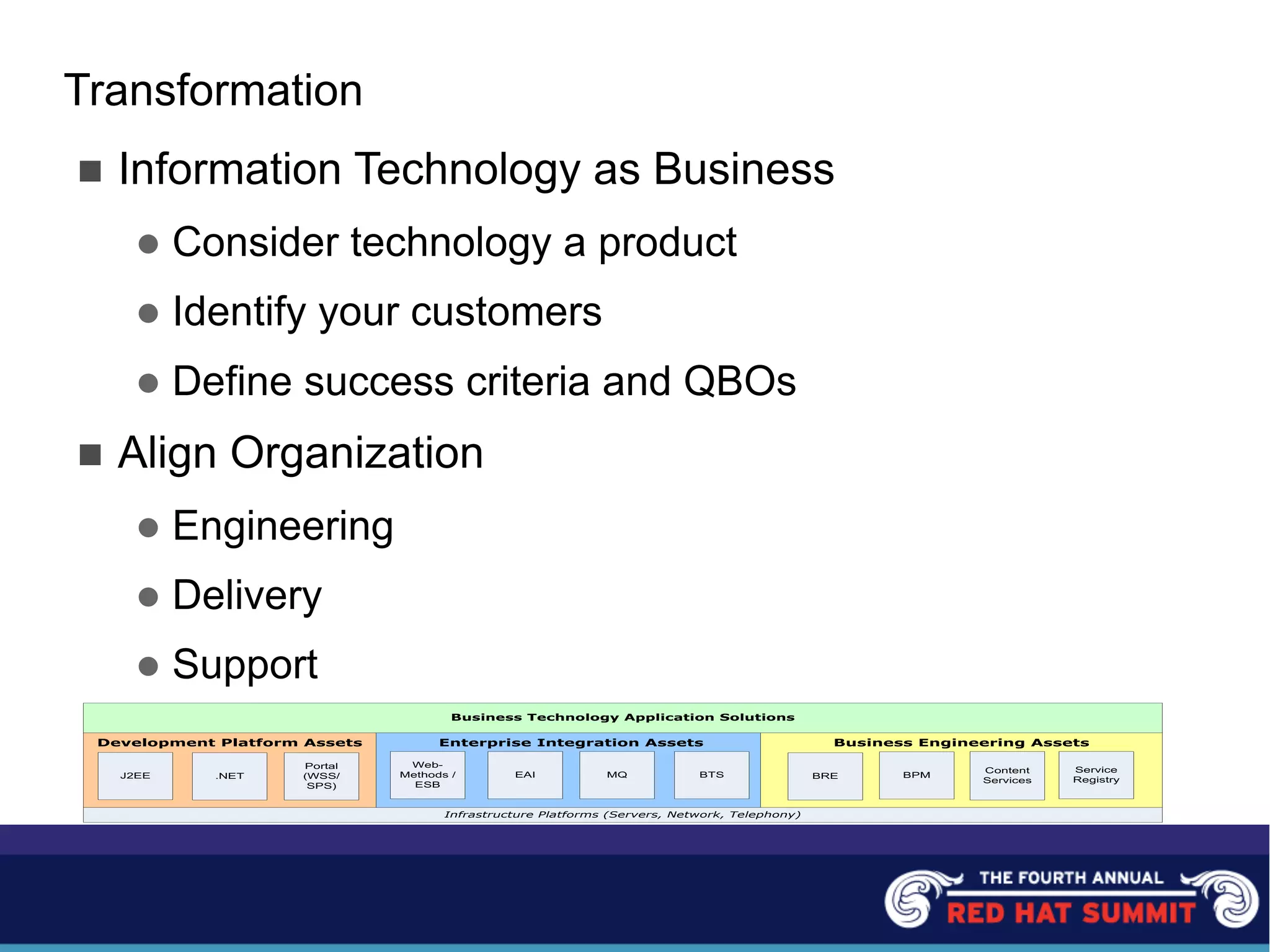
Transformation
n Information Technology as Business
l Consider technology a product
l Identify your customers
l Define success criteria and QBOs
n Align Organization
l Engineering
l Delivery
l Support
Infrastructure Platforms (Servers, Network, Telephony)
Development Platform Assets Enterprise Integration Assets Business Engineering Assets
J2EE .NET
Portal
(WSS/
SPS)
Web-
Methods /
ESB
EAI MQ BRE BPM
Business Technology Application Solutions
BTS
Content
Services
Service
Registry
Process
n Define our initial product
n Use a well accepted process to identify opportunities
and revamp the product set
l Six Sigma (DMAIC)
l DFSS (Design for Six Sigma)
n Voice of Customer
n Instrumentation
n Feature/Capability Vetting Process (Commoditization)
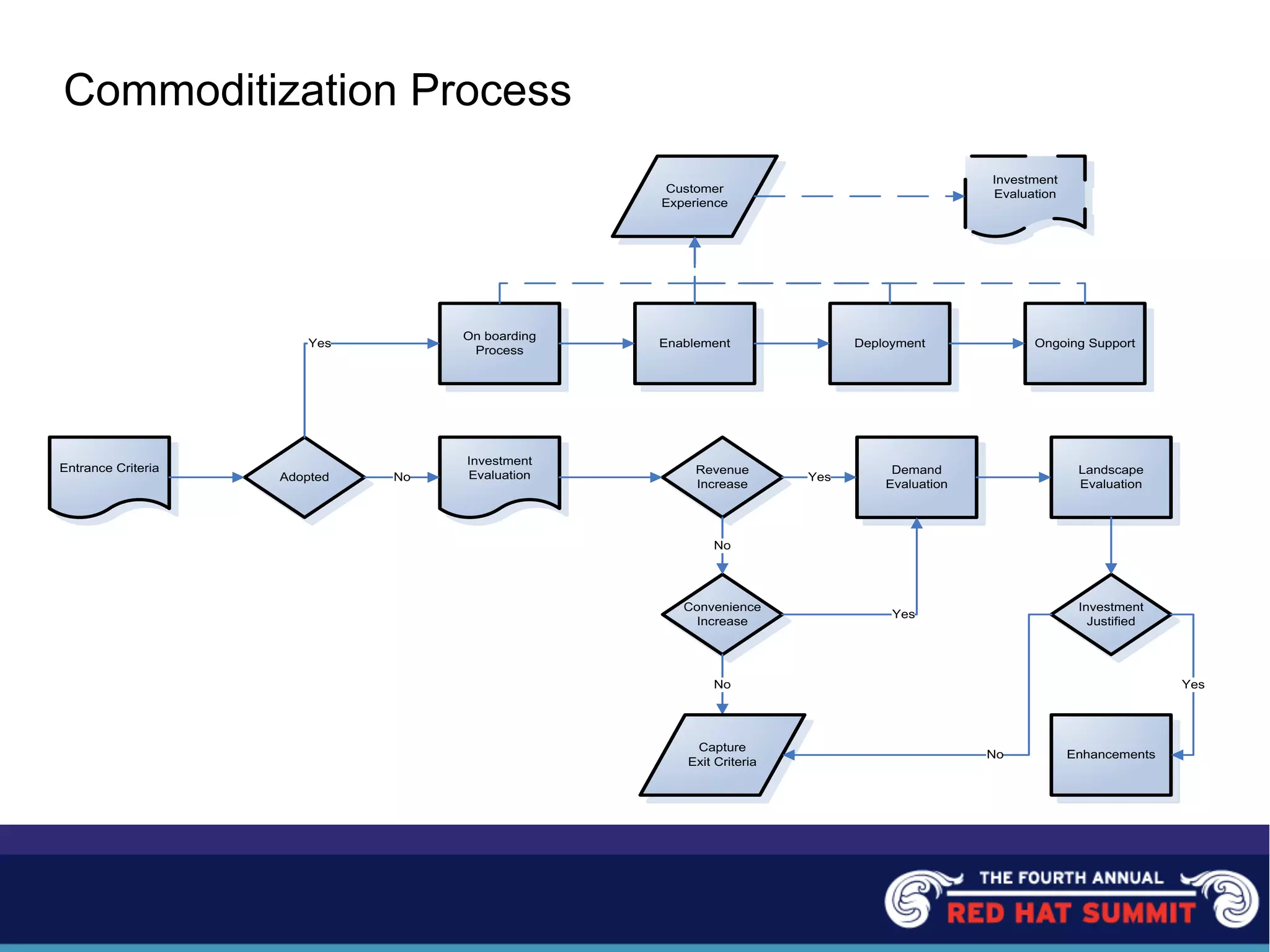
Commoditization Process
Entrance Criteria
Adopted
On boarding
Process
Yes Enablement Deployment Ongoing Support
Investment
EvaluationNo
Revenue
Increase
Landscape
Evaluation
Convenience
Increase
Demand
Evaluation
Enhancements
Customer
Experience
Investment
Evaluation
Investment
Justified
No
Yes
YesNo
Capture
Exit Criteria
No
Yes
Product
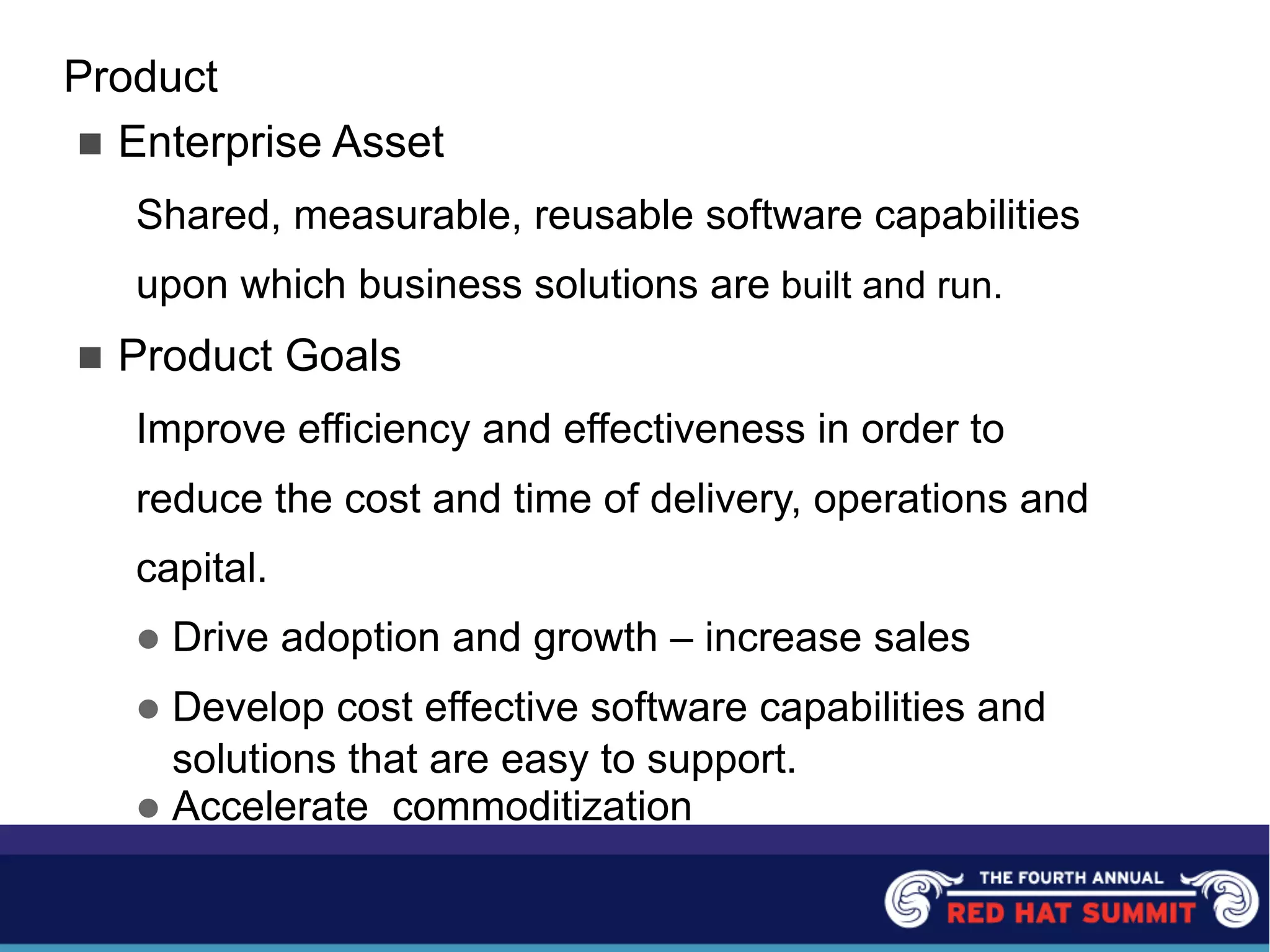
n Enterprise Asset
Shared, measurable, reusable software capabilities
upon which business solutions are built and run.
n Product Goals
Improve efficiency and effectiveness in order to
reduce the cost and time of delivery, operations and
capital.
l Drive adoption and growth – increase sales
l Develop cost effective software capabilities and
solutions that are easy to support.
l Accelerate commoditization
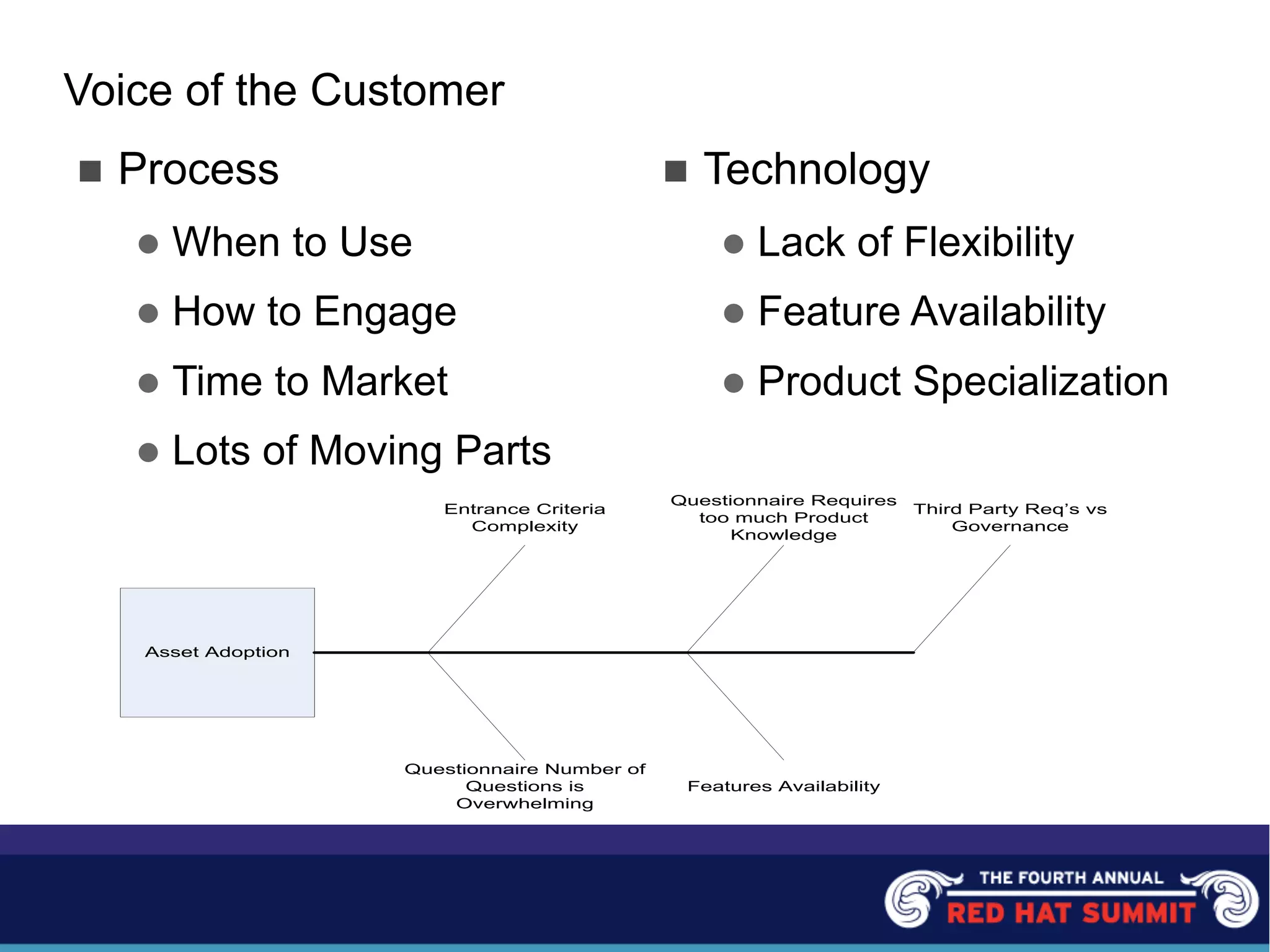
Voice of the Customer
n Process
l When to Use
l How to Engage
l Time to Market
l Lots of Moving Parts
n Technology
l Lack of Flexibility
l Feature Availability
l Product Specialization
Asset Adoption
Entrance Criteria
Complexity
Questionnaire Requires
too much Product
Knowledge
Third Party Req’s vs
Governance
Questionnaire Number of
Questions is
Overwhelming
Features Availability
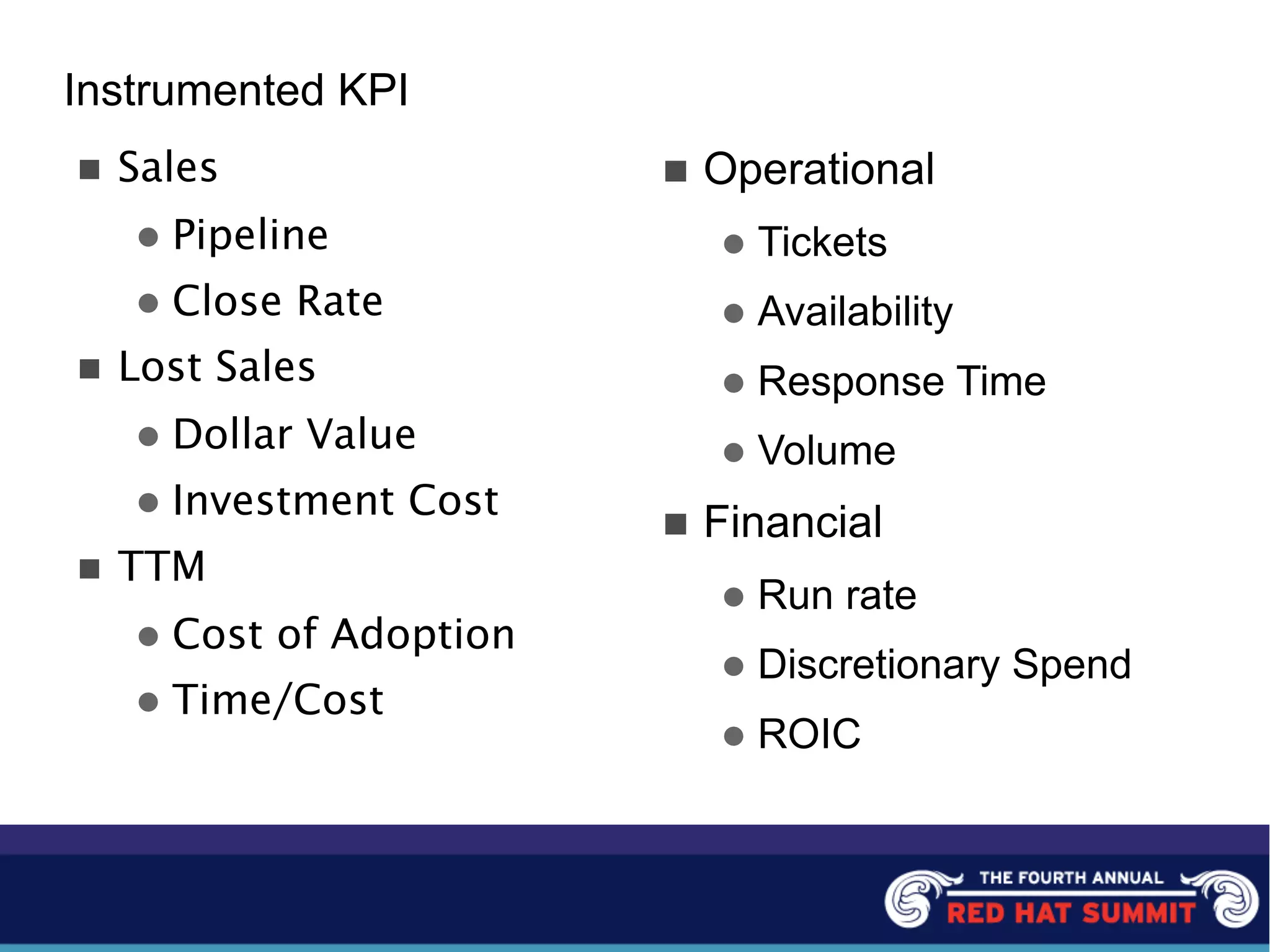
Instrumented KPI
n Sales
l Pipeline
l Close Rate
n Lost Sales
l Dollar Value
l Investment Cost
n TTM
l Cost of Adoption
l Time/Cost
n Operational
l Tickets
l Availability
l Response Time
l Volume
n Financial
l Run rate
l Discretionary Spend
l ROIC
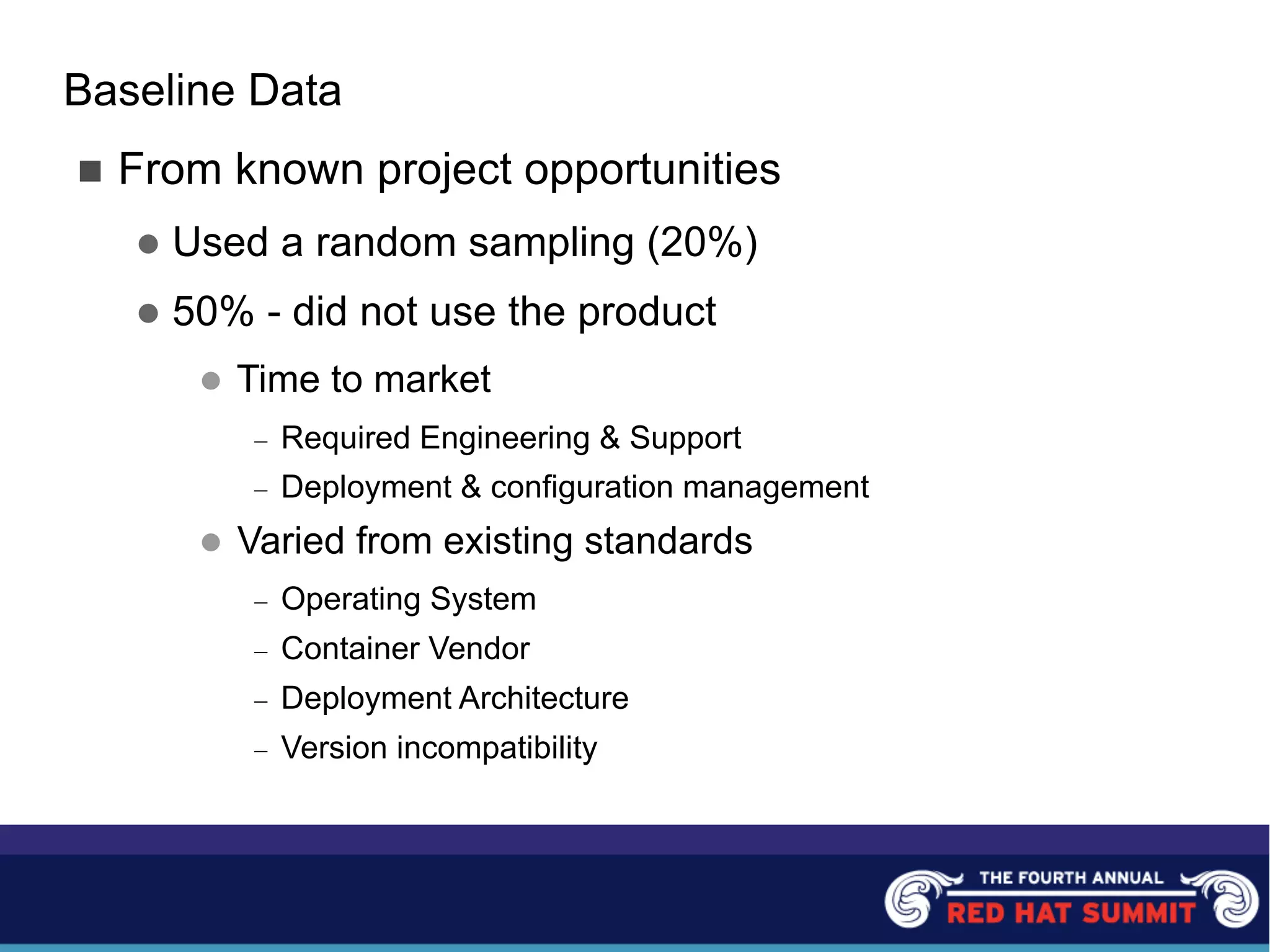
Baseline Data
n From known project opportunities
l Used a random sampling (20%)
l 50% - did not use the product
l Time to market
- Required Engineering & Support
- Deployment & configuration management
l Varied from existing standards
- Operating System
- Container Vendor
- Deployment Architecture
- Version incompatibility
Requirements
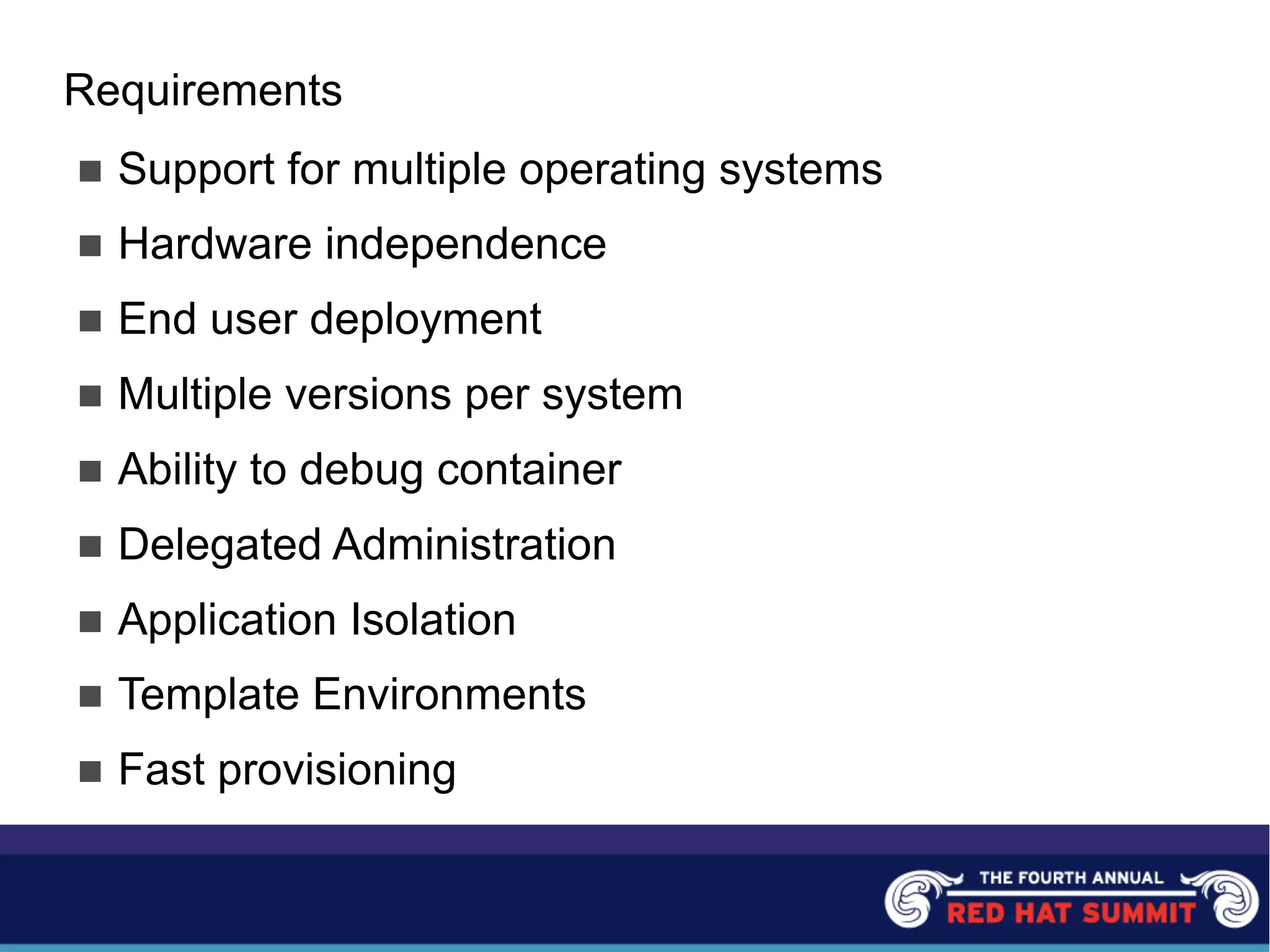
n Support for multiple operating systems
n Hardware independence
n End user deployment
n Multiple versions per system
n Ability to debug container
n Delegated Administration
n Application Isolation
n Template Environments
n Fast provisioning
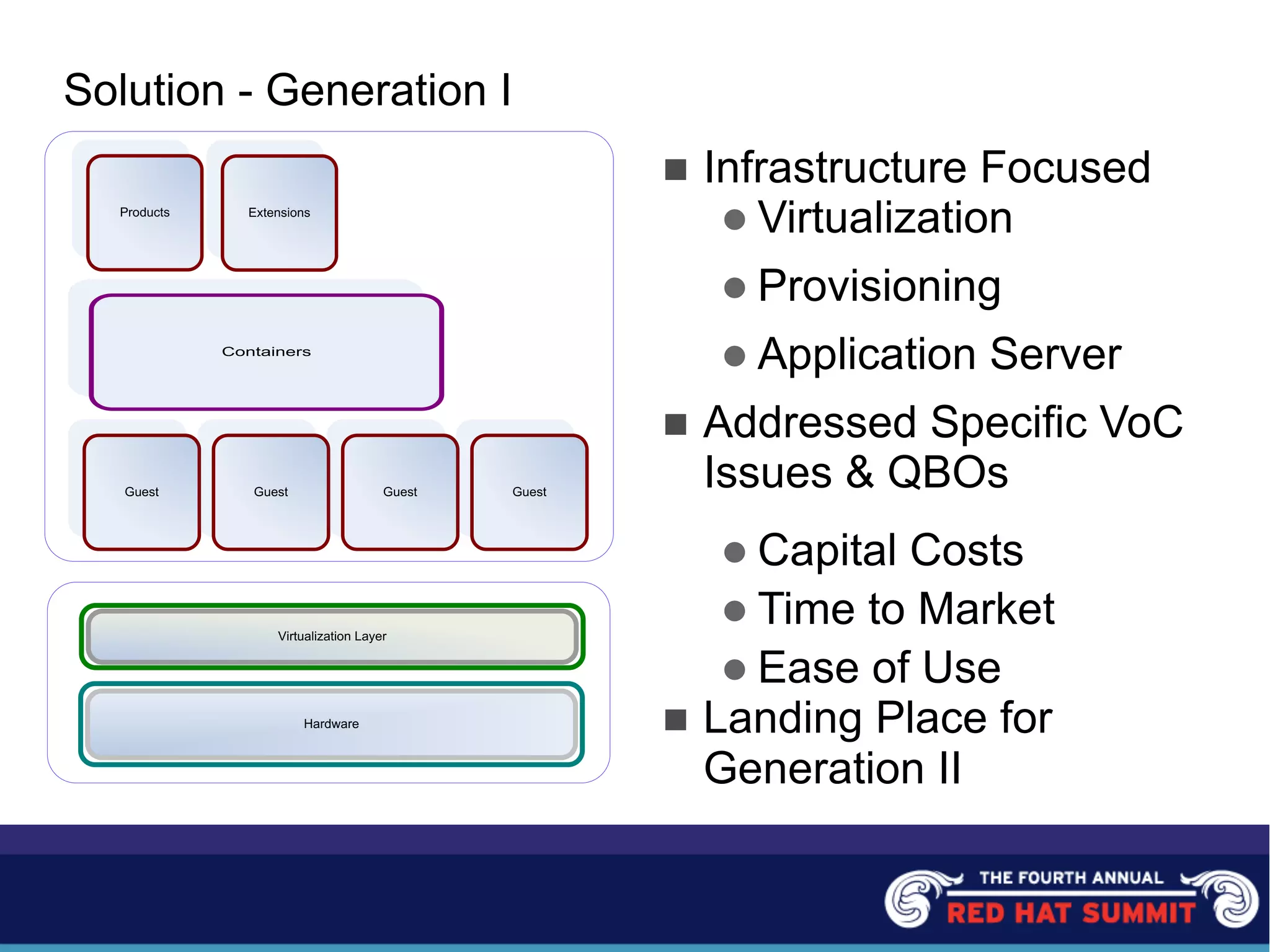
Solution - Generation I
n Infrastructure Focused
l Virtualization
l Provisioning
l Application Server
n Addressed Specific VoC
Issues & QBOs
l Capital Costs
l Time to Market
l Ease of Use
n Landing Place for
Generation II
Containers
Guest Guest Guest Guest
HardwareVirtualization Layer
HardwareHardware
Products Extensions
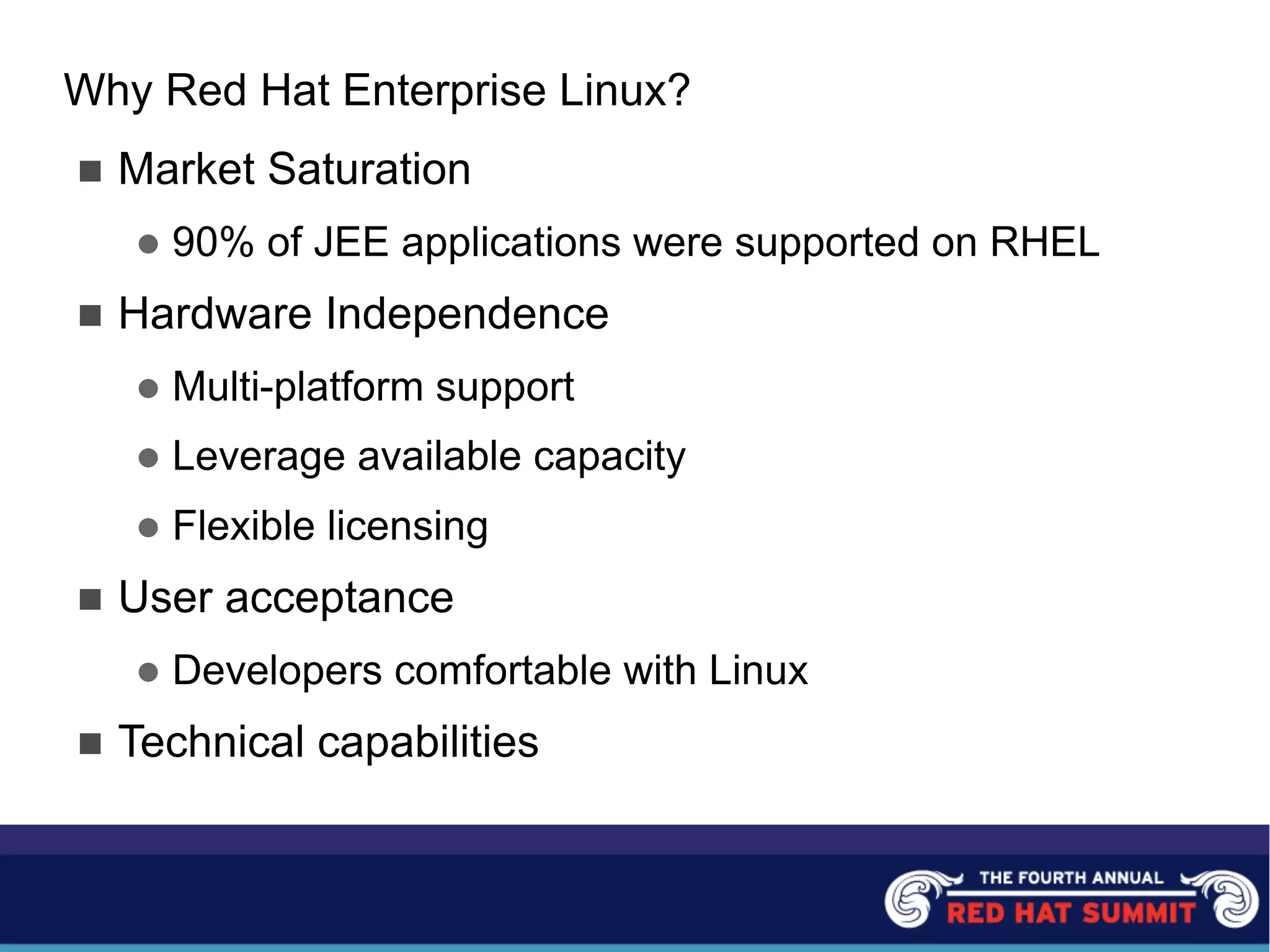
Why Red Hat Enterprise Linux?
n Market Saturation
l 90% of JEE applications were supported on RHEL
n Hardware Independence
l Multi-platform support
l Leverage available capacity
l Flexible licensing
n User acceptance
l Developers comfortable with Linux
n Technical capabilities
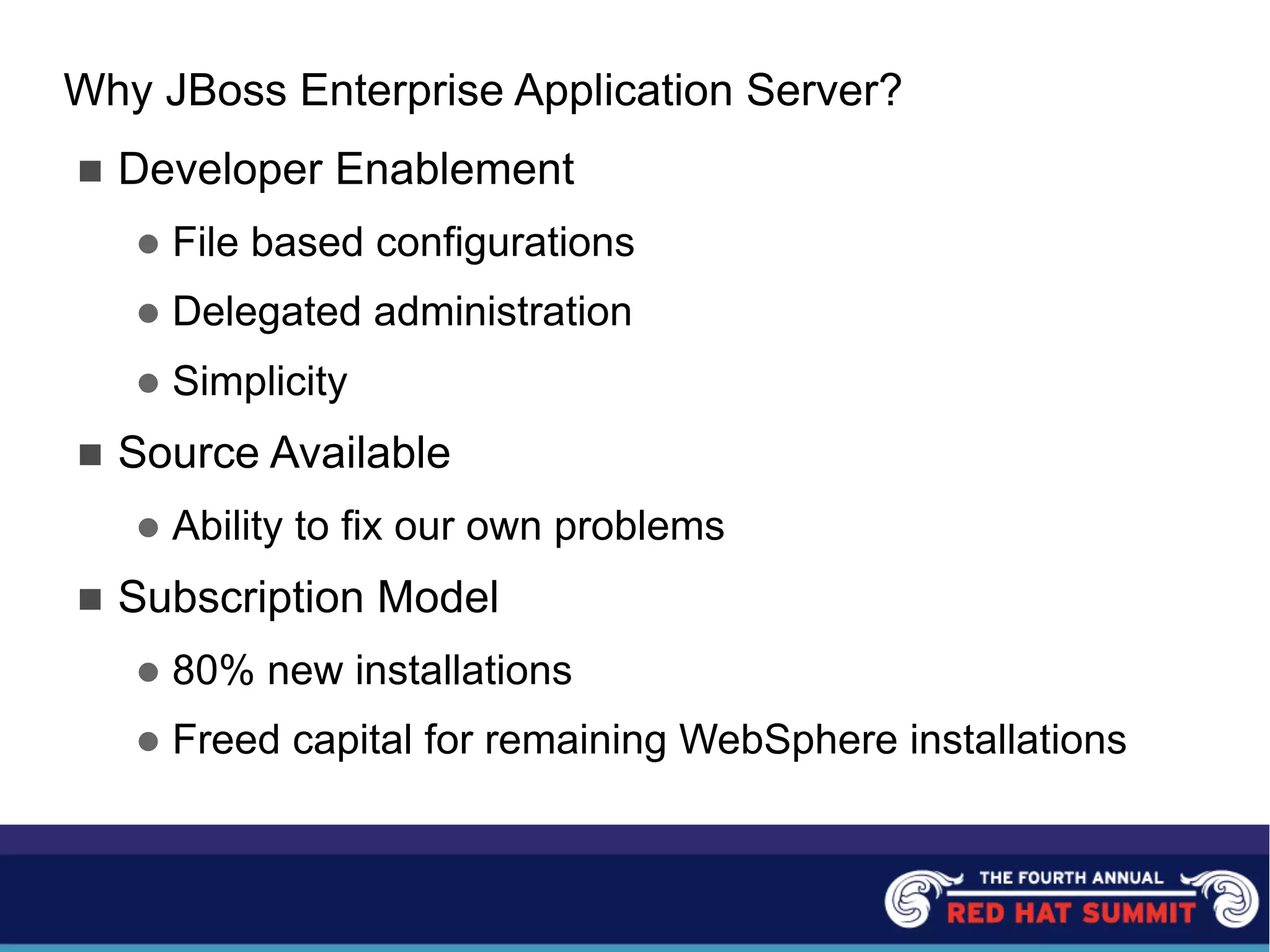
Why JBoss Enterprise Application Server?
n Developer Enablement
l File based configurations
l Delegated administration
l Simplicity
n Source Available
l Ability to fix our own problems
n Subscription Model
l 80% new installations
l Freed capital for remaining WebSphere installations
Why VMWare Infrastructure 3.x?
n Maturity of Platform
l 85% market share
l Platform Support (Solaris, Windows and Linux)
n Administration Tools
l Centralized administration console
l DRS
l Clustering
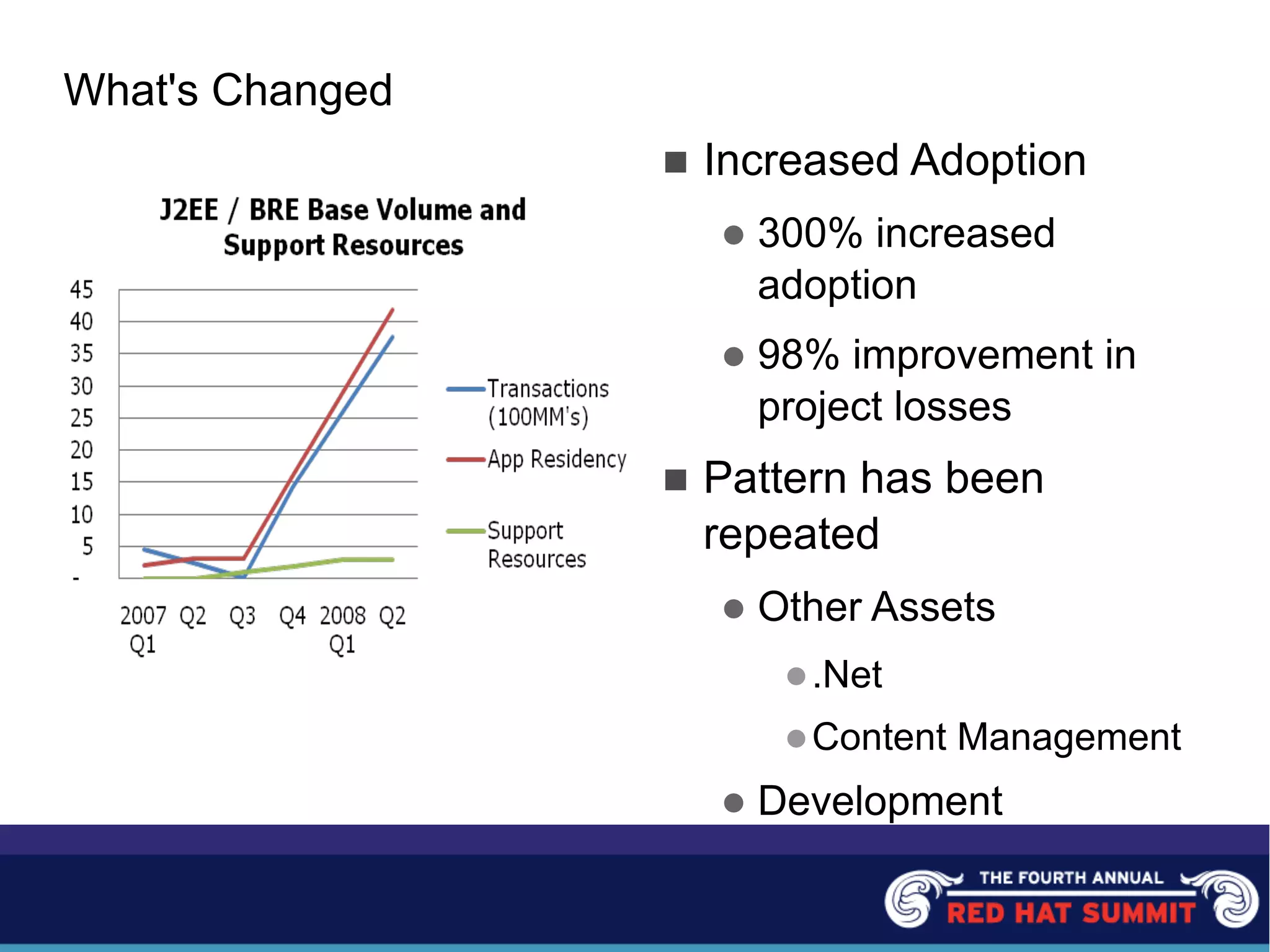
What's Changed
n Increased Adoption
l 300% increased
adoption
l 98% improvement in
project losses
n Pattern has been
repeated
l Other Assets
l.Net
lContent Management
l Development
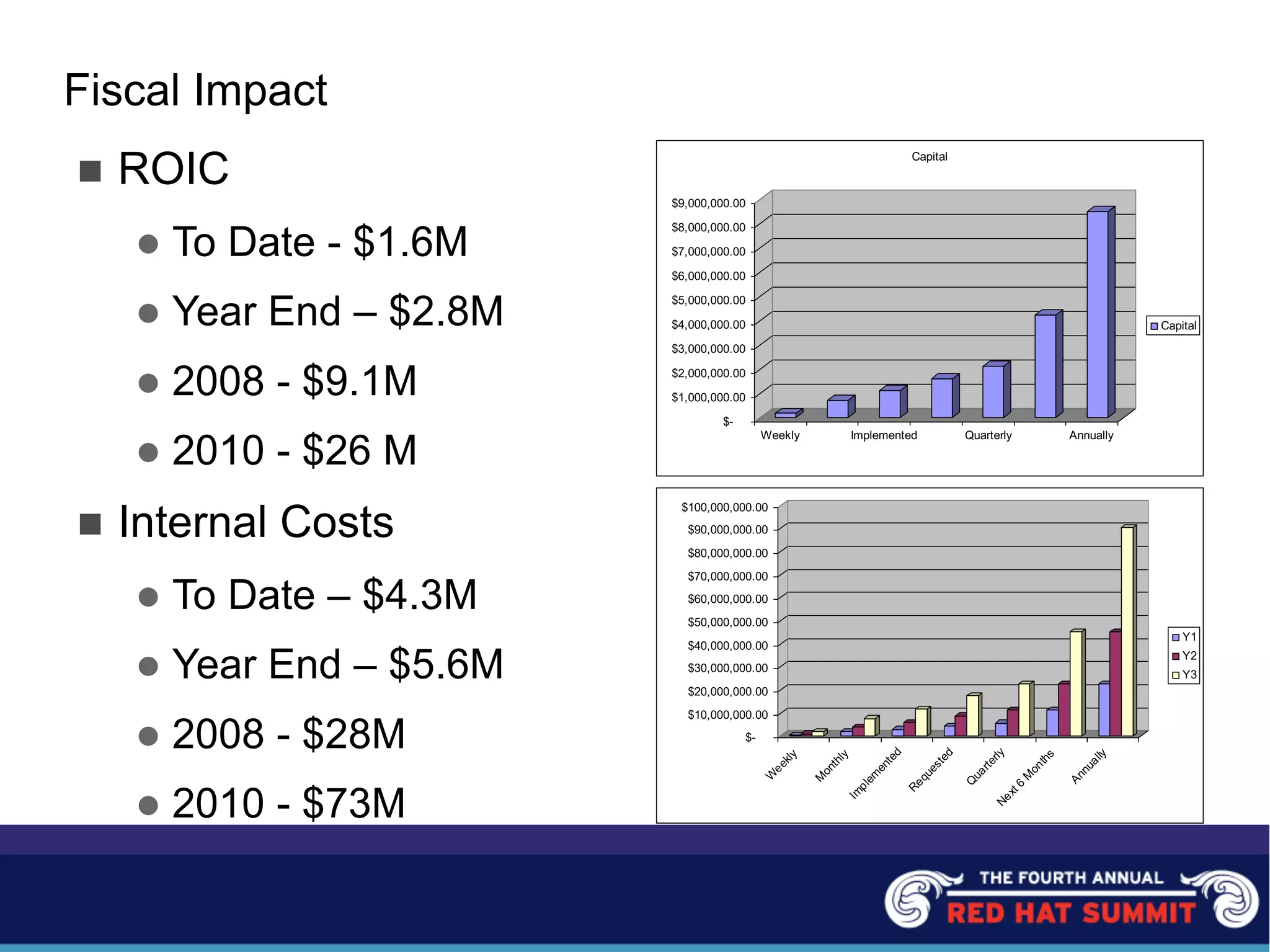
Fiscal Impact
n ROIC
l To Date - $1.6M
l Year End – $2.8M
l 2008 - $9.1M
l 2010 - $26 M
n Internal Costs
l To Date – $4.3M
l Year End – $5.6M
l 2008 - $28M
l 2010 - $73M
$-
$1,000,000.00
$2,000,000.00
$3,000,000.00
$4,000,000.00
$5,000,000.00
$6,000,000.00
$7,000,000.00
$8,000,000.00
$9,000,000.00
Weekly Implemented Quarterly Annually
Capital
Capital
$-
$10,000,000.00
$20,000,000.00
$30,000,000.00
$40,000,000.00
$50,000,000.00
$60,000,000.00
$70,000,000.00
$80,000,000.00
$90,000,000.00
$100,000,000.00
W
eekly
M
onthly
Im
plem
ented
Requested
Q
uarterlyNext6
M
onths
Annually
Y1
Y2
Y3
Cultural Changes
n Evolution of JEE as the common development
platform
l 2006 – 30%
l 2007 – 50%
l 2008 – 60%
n Asset/Stack Concept is common vernacular
n Adoption accelerated the commodity status of virtual
platforms and the JEE container
n Product development is focused now on
patterns/frameworks (Generation II)
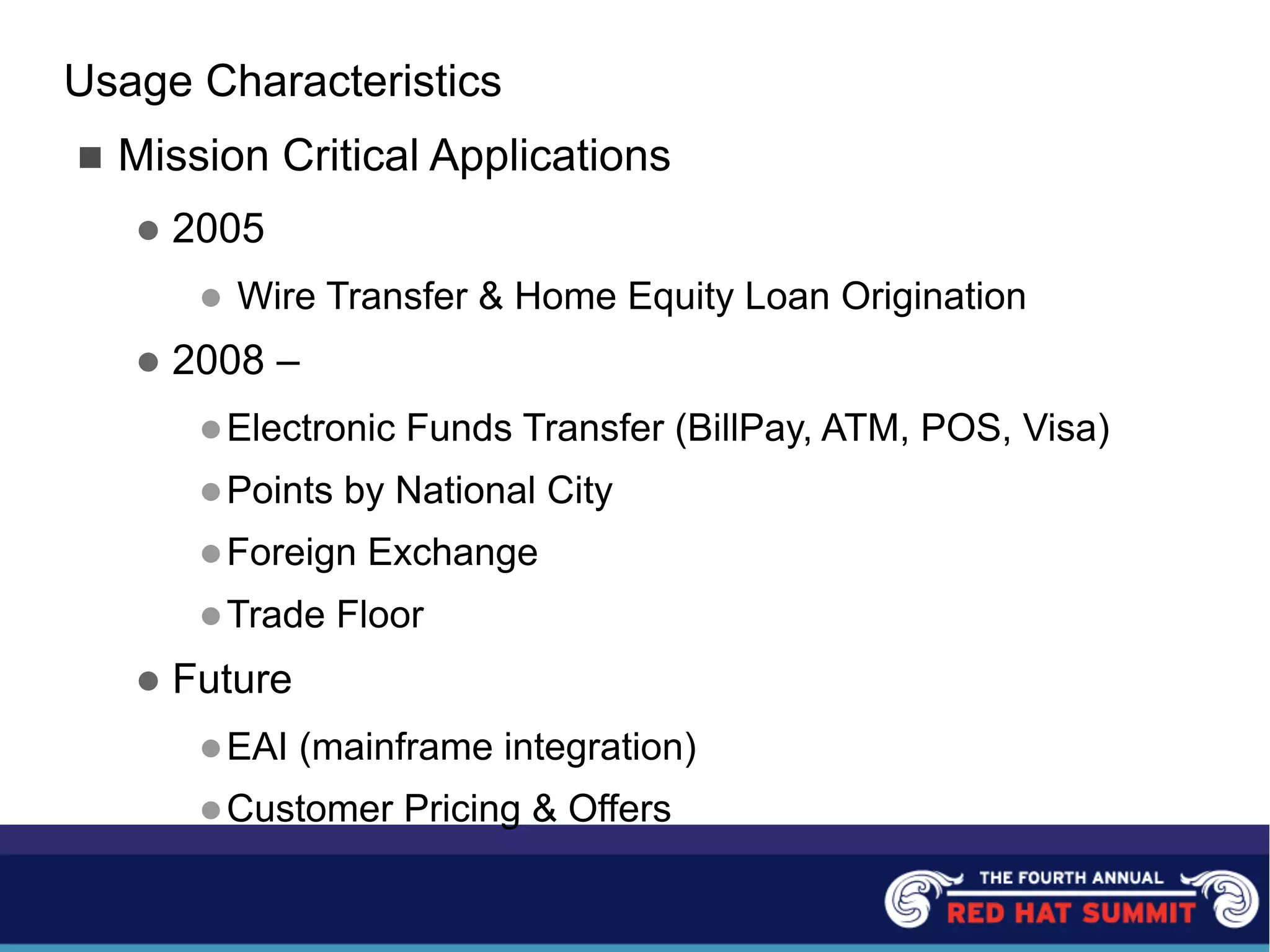
Usage Characteristics
n Mission Critical Applications
l 2005
l Wire Transfer & Home Equity Loan Origination
l 2008 –
lElectronic Funds Transfer (BillPay, ATM, POS, Visa)
lPoints by National City
lForeign Exchange
lTrade Floor
l Future
lEAI (mainframe integration)
lCustomer Pricing & Offers
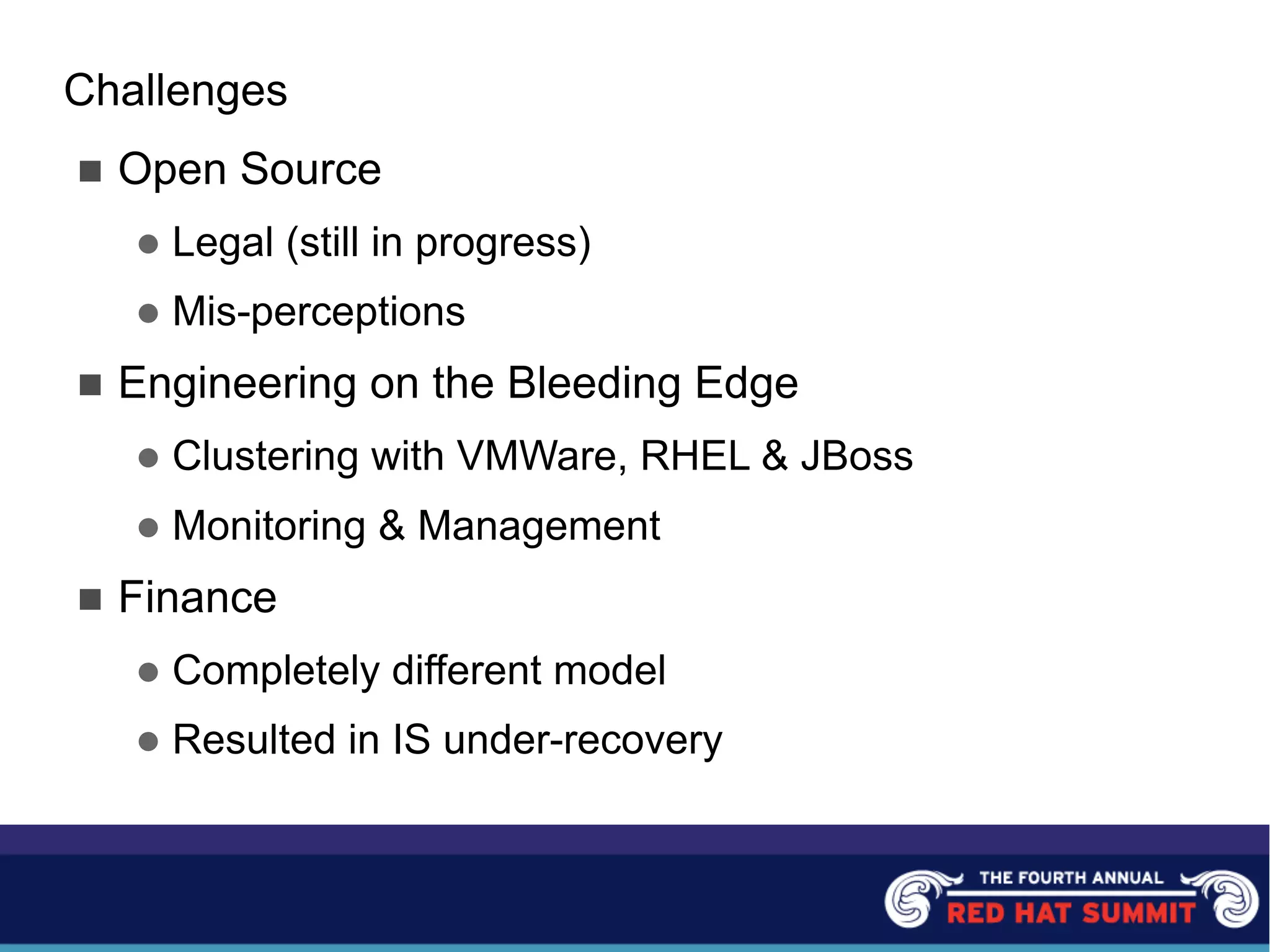
Challenges
n Open Source
l Legal (still in progress)
l Mis-perceptions
n Engineering on the Bleeding Edge
l Clustering with VMWare, RHEL & JBoss
l Monitoring & Management
n Finance
l Completely different model
l Resulted in IS under-recovery
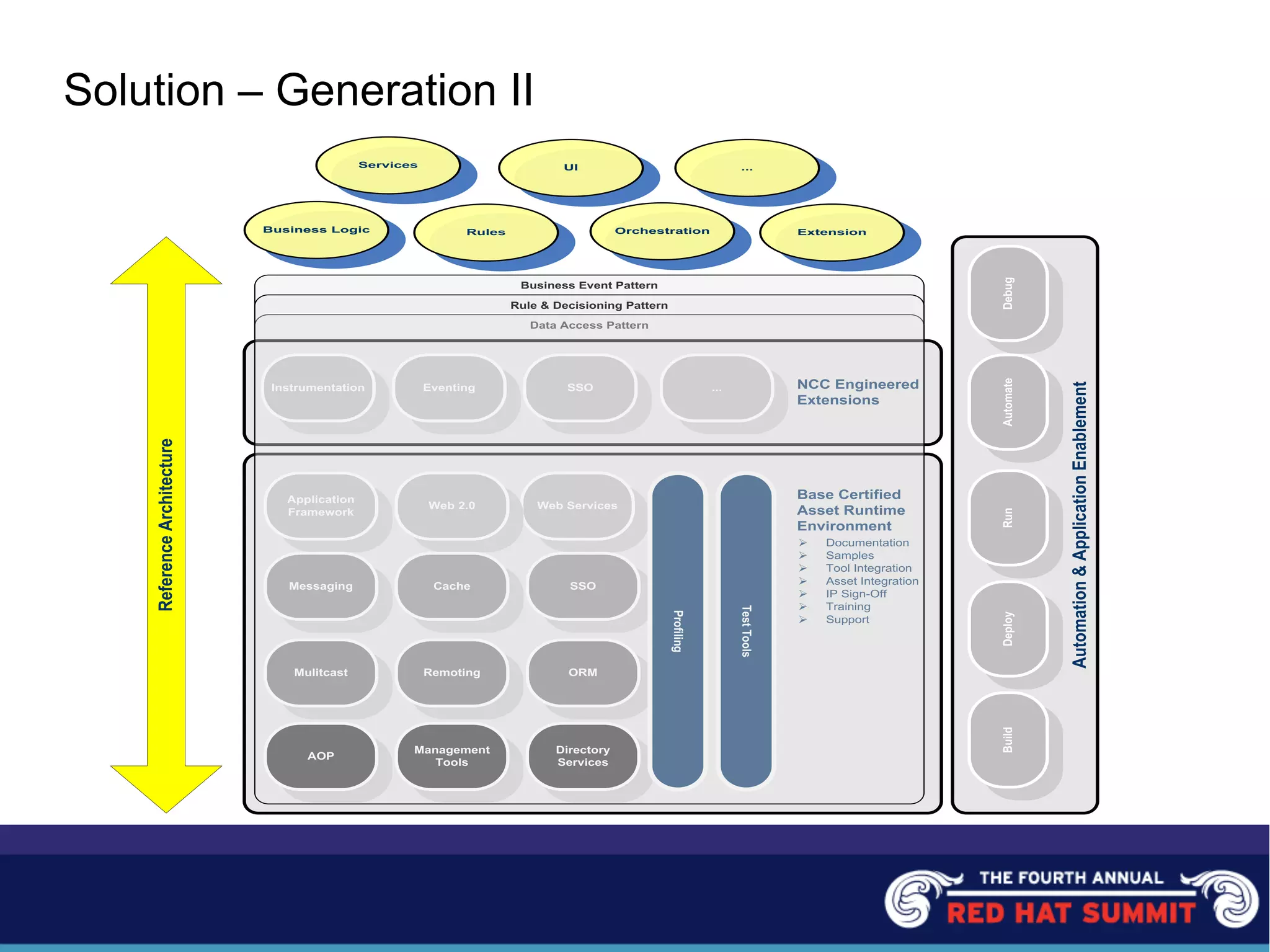
Solution – Generation II
Business Event Pattern
Data Access Pattern
Application
Framework
ORMMulitcast
Directory
Services
Remoting
Management
Tools
Web ServicesWeb 2.0
Messaging Cache SSO
AOP
Profiling
TestTools
Instrumentation SSOEventing ...
Automation&ApplicationEnablement
BuildRunDeployAutomateDebug
ReferenceArchitecture
NCC Engineered
Extensions
Base Certified
Asset Runtime
Environment
Ø Documentation
Ø Samples
Ø Tool Integration
Ø Asset Integration
Ø IP Sign-Off
Ø Training
Ø Support
Rule & Decisioning Pattern
Business Logic Rules Orchestration Extension
Services UI ...
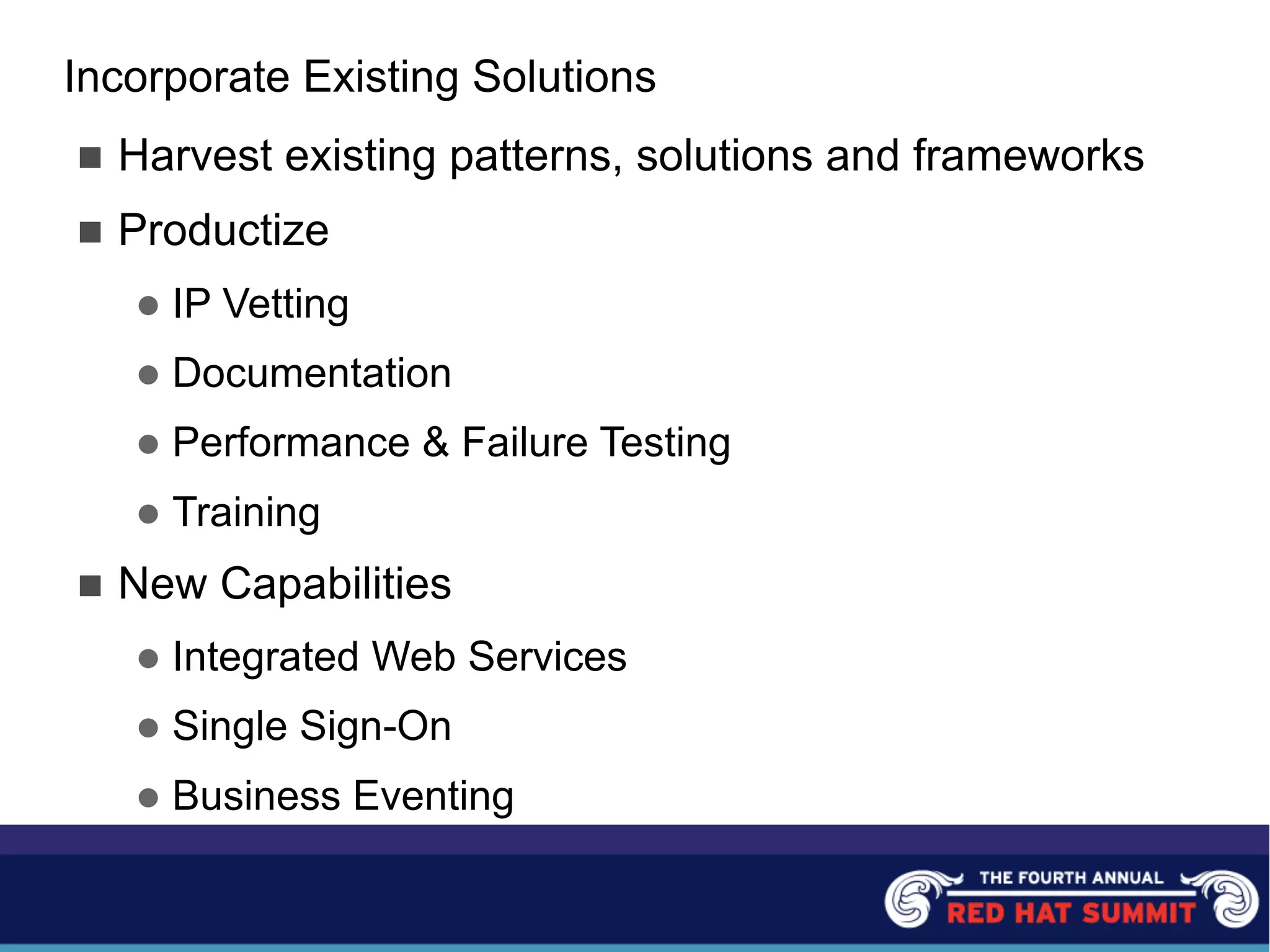
Incorporate Existing Solutions
n Harvest existing patterns, solutions and frameworks
n Productize
l IP Vetting
l Documentation
l Performance & Failure Testing
l Training
n New Capabilities
l Integrated Web Services
l Single Sign-On
l Business Eventing
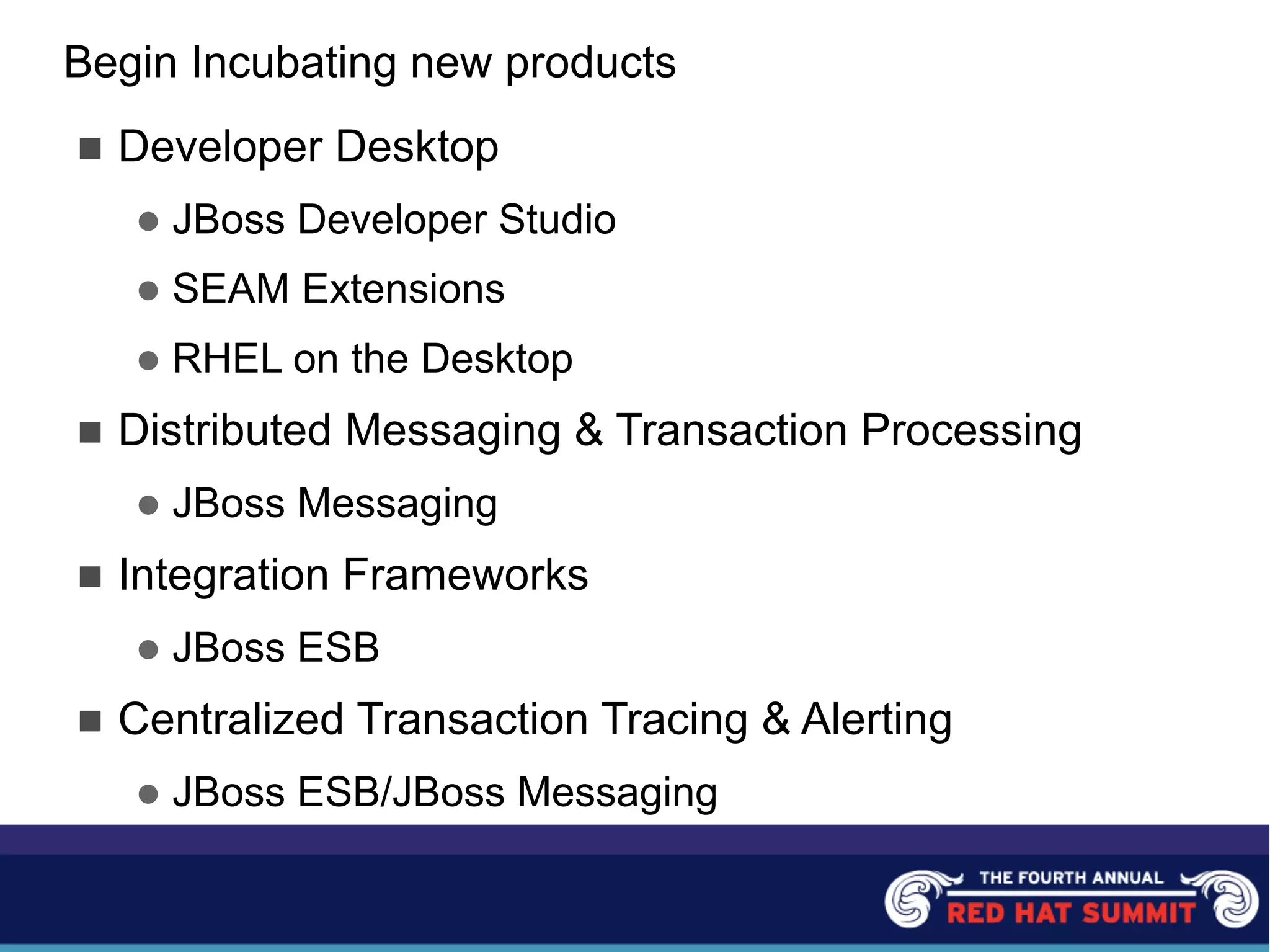
Begin Incubating new products
n Developer Desktop
l JBoss Developer Studio
l SEAM Extensions
l RHEL on the Desktop
n Distributed Messaging & Transaction Processing
l JBoss Messaging
n Integration Frameworks
l JBoss ESB
n Centralized Transaction Tracing & Alerting
l JBoss ESB/JBoss Messaging
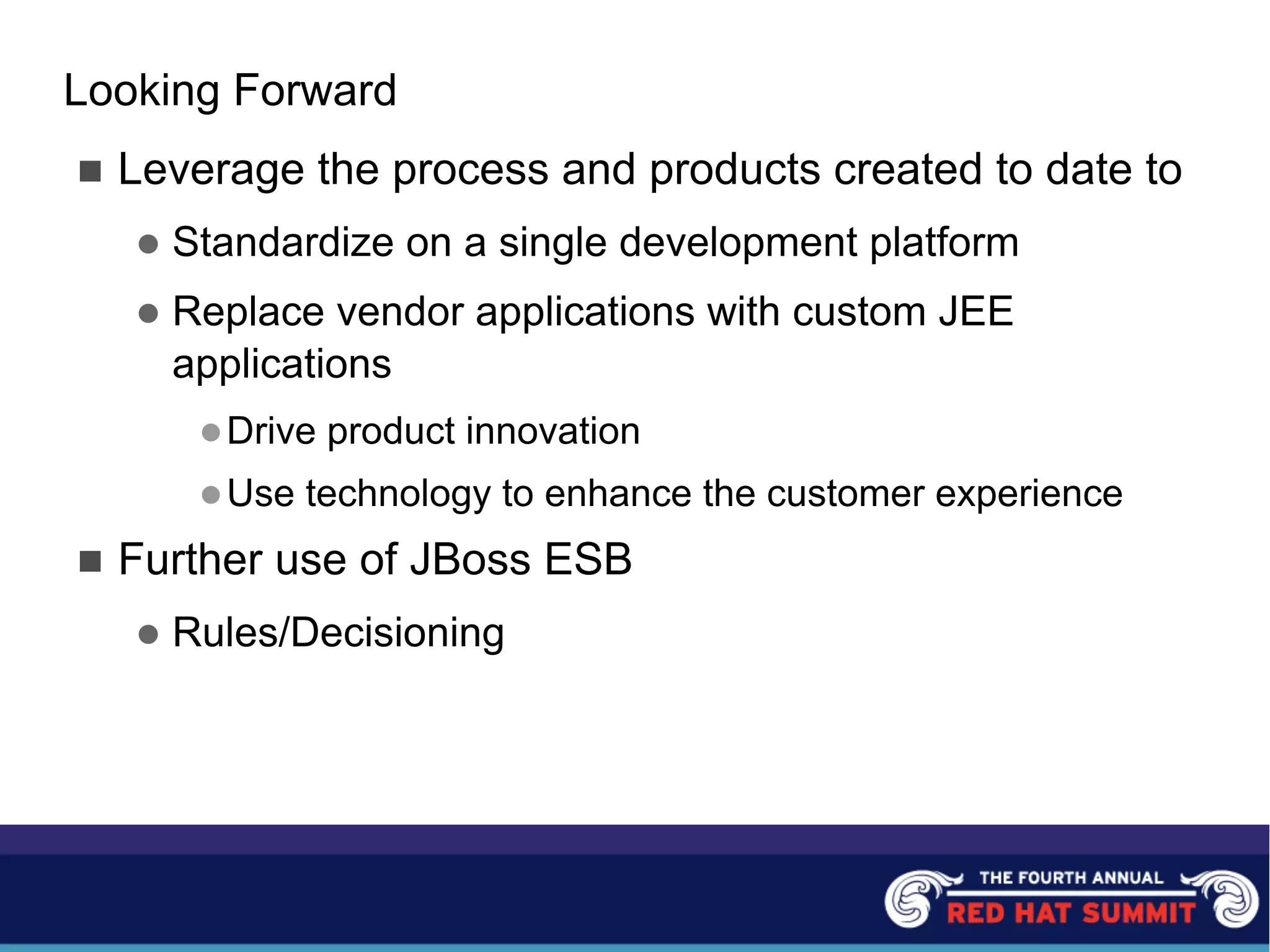
Looking Forward
n Leverage the process and products created to date to
l Standardize on a single development platform
l Replace vendor applications with custom JEE
applications
lDrive product innovation
lUse technology to enhance the customer experience
n Further use of JBoss ESB
l Rules/Decisioning
Questions?
n Questions???
Credits
n John Olson, Developer
n Venkataraman Muthuraligm, Developer
n Vijay Varre, JEE Technical Architect

RedHat Summit 2008 - Virtualizing Java applications leveraging JBoss, RedHat Linux and VMWare.

  • 1.
    Jack Gibson GM –Integration & Development Platforms, National City Corporation
  • 2.
    Agenda n Overview n TeamBackground n Problem n Transformation n Solution l Generation I l Generation II n Questions n Credits
  • 3.
    Background n Integration &Development Platforms performs the following functions at National City l Research & Development l Technology Certification l Project Engineering n 2005 - Engineered Technologies l WebMethods l Shared J2EE (WebSphere) l Portal (Sharepoint)
  • 4.
    Signs of aproblem n Server Sprawl l 1000+ new servers per year l <200 server decommissions per year n Disparate Solutions l Growth of JEE containers varying from standards; Tomcat, Jboss, WebLogic... l Technology alignment by team or line of business n Resource Management l Relation of discretionary project hours to base engineering support
  • 5.
    Traditional Approaches n Engineering lThe Silver Bullet l Wrong technology mix n Governance l Eliminate choice l Lack of enforcement n Organizational l Accountability
  • 6.
    Transformation n Information Technologyas Business l Consider technology a product l Identify your customers l Define success criteria and QBOs n Align Organization l Engineering l Delivery l Support Infrastructure Platforms (Servers, Network, Telephony) Development Platform Assets Enterprise Integration Assets Business Engineering Assets J2EE .NET Portal (WSS/ SPS) Web- Methods / ESB EAI MQ BRE BPM Business Technology Application Solutions BTS Content Services Service Registry
  • 7.
    Process n Define ourinitial product n Use a well accepted process to identify opportunities and revamp the product set l Six Sigma (DMAIC) l DFSS (Design for Six Sigma) n Voice of Customer n Instrumentation n Feature/Capability Vetting Process (Commoditization)
  • 8.
    Commoditization Process Entrance Criteria Adopted Onboarding Process Yes Enablement Deployment Ongoing Support Investment EvaluationNo Revenue Increase Landscape Evaluation Convenience Increase Demand Evaluation Enhancements Customer Experience Investment Evaluation Investment Justified No Yes YesNo Capture Exit Criteria No Yes
  • 9.
    Product n Enterprise Asset Shared,measurable, reusable software capabilities upon which business solutions are built and run. n Product Goals Improve efficiency and effectiveness in order to reduce the cost and time of delivery, operations and capital. l Drive adoption and growth – increase sales l Develop cost effective software capabilities and solutions that are easy to support. l Accelerate commoditization
  • 10.
    Voice of theCustomer n Process l When to Use l How to Engage l Time to Market l Lots of Moving Parts n Technology l Lack of Flexibility l Feature Availability l Product Specialization Asset Adoption Entrance Criteria Complexity Questionnaire Requires too much Product Knowledge Third Party Req’s vs Governance Questionnaire Number of Questions is Overwhelming Features Availability
  • 11.
    Instrumented KPI n Sales lPipeline l Close Rate n Lost Sales l Dollar Value l Investment Cost n TTM l Cost of Adoption l Time/Cost n Operational l Tickets l Availability l Response Time l Volume n Financial l Run rate l Discretionary Spend l ROIC
  • 12.
    Baseline Data n Fromknown project opportunities l Used a random sampling (20%) l 50% - did not use the product l Time to market - Required Engineering & Support - Deployment & configuration management l Varied from existing standards - Operating System - Container Vendor - Deployment Architecture - Version incompatibility
  • 13.
    Requirements n Support formultiple operating systems n Hardware independence n End user deployment n Multiple versions per system n Ability to debug container n Delegated Administration n Application Isolation n Template Environments n Fast provisioning
  • 14.
    Solution - GenerationI n Infrastructure Focused l Virtualization l Provisioning l Application Server n Addressed Specific VoC Issues & QBOs l Capital Costs l Time to Market l Ease of Use n Landing Place for Generation II Containers Guest Guest Guest Guest HardwareVirtualization Layer HardwareHardware Products Extensions
  • 15.
    Why Red HatEnterprise Linux? n Market Saturation l 90% of JEE applications were supported on RHEL n Hardware Independence l Multi-platform support l Leverage available capacity l Flexible licensing n User acceptance l Developers comfortable with Linux n Technical capabilities
  • 16.
    Why JBoss EnterpriseApplication Server? n Developer Enablement l File based configurations l Delegated administration l Simplicity n Source Available l Ability to fix our own problems n Subscription Model l 80% new installations l Freed capital for remaining WebSphere installations
  • 17.
    Why VMWare Infrastructure3.x? n Maturity of Platform l 85% market share l Platform Support (Solaris, Windows and Linux) n Administration Tools l Centralized administration console l DRS l Clustering
  • 18.
    What's Changed n IncreasedAdoption l 300% increased adoption l 98% improvement in project losses n Pattern has been repeated l Other Assets l.Net lContent Management l Development
  • 19.
    Fiscal Impact n ROIC lTo Date - $1.6M l Year End – $2.8M l 2008 - $9.1M l 2010 - $26 M n Internal Costs l To Date – $4.3M l Year End – $5.6M l 2008 - $28M l 2010 - $73M $- $1,000,000.00 $2,000,000.00 $3,000,000.00 $4,000,000.00 $5,000,000.00 $6,000,000.00 $7,000,000.00 $8,000,000.00 $9,000,000.00 Weekly Implemented Quarterly Annually Capital Capital $- $10,000,000.00 $20,000,000.00 $30,000,000.00 $40,000,000.00 $50,000,000.00 $60,000,000.00 $70,000,000.00 $80,000,000.00 $90,000,000.00 $100,000,000.00 W eekly M onthly Im plem ented Requested Q uarterlyNext6 M onths Annually Y1 Y2 Y3
  • 20.
    Cultural Changes n Evolutionof JEE as the common development platform l 2006 – 30% l 2007 – 50% l 2008 – 60% n Asset/Stack Concept is common vernacular n Adoption accelerated the commodity status of virtual platforms and the JEE container n Product development is focused now on patterns/frameworks (Generation II)
  • 21.
    Usage Characteristics n MissionCritical Applications l 2005 l Wire Transfer & Home Equity Loan Origination l 2008 – lElectronic Funds Transfer (BillPay, ATM, POS, Visa) lPoints by National City lForeign Exchange lTrade Floor l Future lEAI (mainframe integration) lCustomer Pricing & Offers
  • 22.
    Challenges n Open Source lLegal (still in progress) l Mis-perceptions n Engineering on the Bleeding Edge l Clustering with VMWare, RHEL & JBoss l Monitoring & Management n Finance l Completely different model l Resulted in IS under-recovery
  • 23.
    Solution – GenerationII Business Event Pattern Data Access Pattern Application Framework ORMMulitcast Directory Services Remoting Management Tools Web ServicesWeb 2.0 Messaging Cache SSO AOP Profiling TestTools Instrumentation SSOEventing ... Automation&ApplicationEnablement BuildRunDeployAutomateDebug ReferenceArchitecture NCC Engineered Extensions Base Certified Asset Runtime Environment Ø Documentation Ø Samples Ø Tool Integration Ø Asset Integration Ø IP Sign-Off Ø Training Ø Support Rule & Decisioning Pattern Business Logic Rules Orchestration Extension Services UI ...
  • 24.
    Incorporate Existing Solutions nHarvest existing patterns, solutions and frameworks n Productize l IP Vetting l Documentation l Performance & Failure Testing l Training n New Capabilities l Integrated Web Services l Single Sign-On l Business Eventing
  • 25.
    Begin Incubating newproducts n Developer Desktop l JBoss Developer Studio l SEAM Extensions l RHEL on the Desktop n Distributed Messaging & Transaction Processing l JBoss Messaging n Integration Frameworks l JBoss ESB n Centralized Transaction Tracing & Alerting l JBoss ESB/JBoss Messaging
  • 26.
    Looking Forward n Leveragethe process and products created to date to l Standardize on a single development platform l Replace vendor applications with custom JEE applications lDrive product innovation lUse technology to enhance the customer experience n Further use of JBoss ESB l Rules/Decisioning
  • 27.
  • 28.
    Credits n John Olson,Developer n Venkataraman Muthuraligm, Developer n Vijay Varre, JEE Technical Architect