red cell morphology indices
Red cell morphology indices are a
group of measurements derived
from a complete blood count (CBC)
that provide information about the
size, shape, and color of your red
blood cells. These indices are used
in conjunction with other
laboratory findings and clinical
information to help diagnose
various blood disorders,
particularly anemias.
red cell morphology indics 1
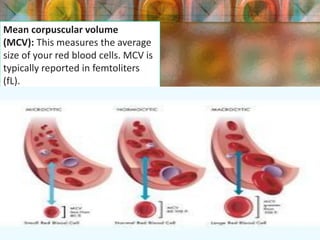
Mean corpuscular volume
(MCV): This measures the average
size of your red blood cells. MCV is
typically reported in femtoliters
(fL).
red cell morphology indics 2
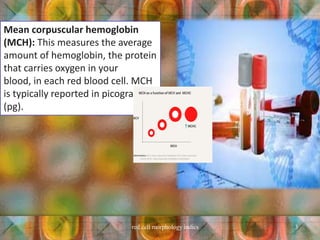
Mean corpuscular hemoglobin
(MCH): This measures the average
amount of hemoglobin, the protein
that carries oxygen in your
blood, in each red blood cell. MCH
is typically reported in picograms
(pg).
red cell morphology indics 3
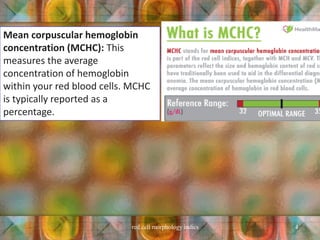
Mean corpuscular hemoglobin
concentration (MCHC): This
measures the average
concentration of hemoglobin
within your red blood cells. MCHC
is typically reported as a
percentage.
red cell morphology indics 4
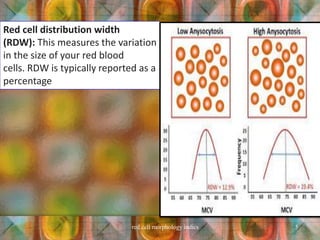
Red cell distribution width
(RDW): This measures the variation
in the size of your red blood
cells. RDW is typically reported as a
percentage
red cell morphology indics 5
Normal ranges for red
cell morphology
indices can vary
slightly depending on
the laboratory, but
here are some general
guidelines:
•MCV: 80-100 fL
•MCH: 27-32 pg
•MCHC: 32-36%
•RDW: 11.5-14.5%
red cell morphology indics 6
interpreting red cell morphology indices:
•MCV:
• High MCV (macrocytosis): This can indicate macrocytic anemia, which is
often caused by vitamin B12 or folate deficiency.
• Low MCV (microcytosis): This can indicate microcytic anemia, which is most
commonly caused by iron deficiency.
•MCH:
• High MCH: This usually occurs in conjunction with high MCV.
• Low MCH: This usually occurs in conjunction with low MCV.
•MCHC:
• High MCHC: This is uncommon and can be caused by dehydration or
spherocytosis, a condition in which red blood cells are abnormally round
and fragile.
• Low MCHC: This can indicate microcytic anemia or hypochromic anemia, a
type of anemia in which red blood cells are pale due to a lack of
hemoglobin.
•RDW:
• High RDW (anisocytosis): This indicates that there is a large variation in the
size of your red blood cells. This can be caused by a variety of
conditions, including iron deficiency anemia, vitamin B12 or folate
deficiency, and hemolytic anemia.
• Low RDW: This is less common and is not usually considered to be clinically
significant.
red cell morphology indics 7

red cell morphology indices.1.pdf

  • 1.
    red cell morphologyindices Red cell morphology indices are a group of measurements derived from a complete blood count (CBC) that provide information about the size, shape, and color of your red blood cells. These indices are used in conjunction with other laboratory findings and clinical information to help diagnose various blood disorders, particularly anemias. red cell morphology indics 1
  • 2.
    Mean corpuscular volume (MCV):This measures the average size of your red blood cells. MCV is typically reported in femtoliters (fL). red cell morphology indics 2
  • 3.
    Mean corpuscular hemoglobin (MCH):This measures the average amount of hemoglobin, the protein that carries oxygen in your blood, in each red blood cell. MCH is typically reported in picograms (pg). red cell morphology indics 3
  • 4.
    Mean corpuscular hemoglobin concentration(MCHC): This measures the average concentration of hemoglobin within your red blood cells. MCHC is typically reported as a percentage. red cell morphology indics 4
  • 5.
    Red cell distributionwidth (RDW): This measures the variation in the size of your red blood cells. RDW is typically reported as a percentage red cell morphology indics 5
  • 6.
    Normal ranges forred cell morphology indices can vary slightly depending on the laboratory, but here are some general guidelines: •MCV: 80-100 fL •MCH: 27-32 pg •MCHC: 32-36% •RDW: 11.5-14.5% red cell morphology indics 6
  • 7.
    interpreting red cellmorphology indices: •MCV: • High MCV (macrocytosis): This can indicate macrocytic anemia, which is often caused by vitamin B12 or folate deficiency. • Low MCV (microcytosis): This can indicate microcytic anemia, which is most commonly caused by iron deficiency. •MCH: • High MCH: This usually occurs in conjunction with high MCV. • Low MCH: This usually occurs in conjunction with low MCV. •MCHC: • High MCHC: This is uncommon and can be caused by dehydration or spherocytosis, a condition in which red blood cells are abnormally round and fragile. • Low MCHC: This can indicate microcytic anemia or hypochromic anemia, a type of anemia in which red blood cells are pale due to a lack of hemoglobin. •RDW: • High RDW (anisocytosis): This indicates that there is a large variation in the size of your red blood cells. This can be caused by a variety of conditions, including iron deficiency anemia, vitamin B12 or folate deficiency, and hemolytic anemia. • Low RDW: This is less common and is not usually considered to be clinically significant. red cell morphology indics 7