What is Red Bull?
• It was created in 1987 and sold by an Austrian company, Red
Bull GmbH
• Its content centers around sports and cultural events and
projects
• By 1992, the product expanded to international markets
• By 2007, Red Bull Media, an organization, was launched to
distribute, collect, and control the Red Bull.
• It is the first and highest selling energy drink in the world
“Red Bull gives you Wings”
Red Bull
without the use of digital media:
• It has a clearly defined personality
• It has a Consumer Centric marketing strategy
• It promotes lifestyle choice rather than a simple, caffeinated drink ,
by understanding the things that their audience love and enable
those activities.
– Markets their product by hosting extreme events instead of just
sponsoring (Red Bull Air Race, Red Bull Crashed Ice)
– Sports team ownership (Red Bull Racing, New York Red Bulls)
• Make an online channel/community that
would extend the Red Bull brand into a
media entity.
• Use Social Media into extremes since
extreme is what the brand is all about.
Objectives:
Free-fall from
Space
Felix Baumgartner’s,
the first man to break
the speed of sound in
free fall before
parachuting to the
ground, on October 14,
2012.
Biggest social
strong suit
Create jaw-dropping
videos showing how
athletes prepare to
engage in extreme
activities and also takes
an actual footage of
the event.
Increase of
subscribers
Crazily increased its
subscribers to 87,801
from 2,142 a day
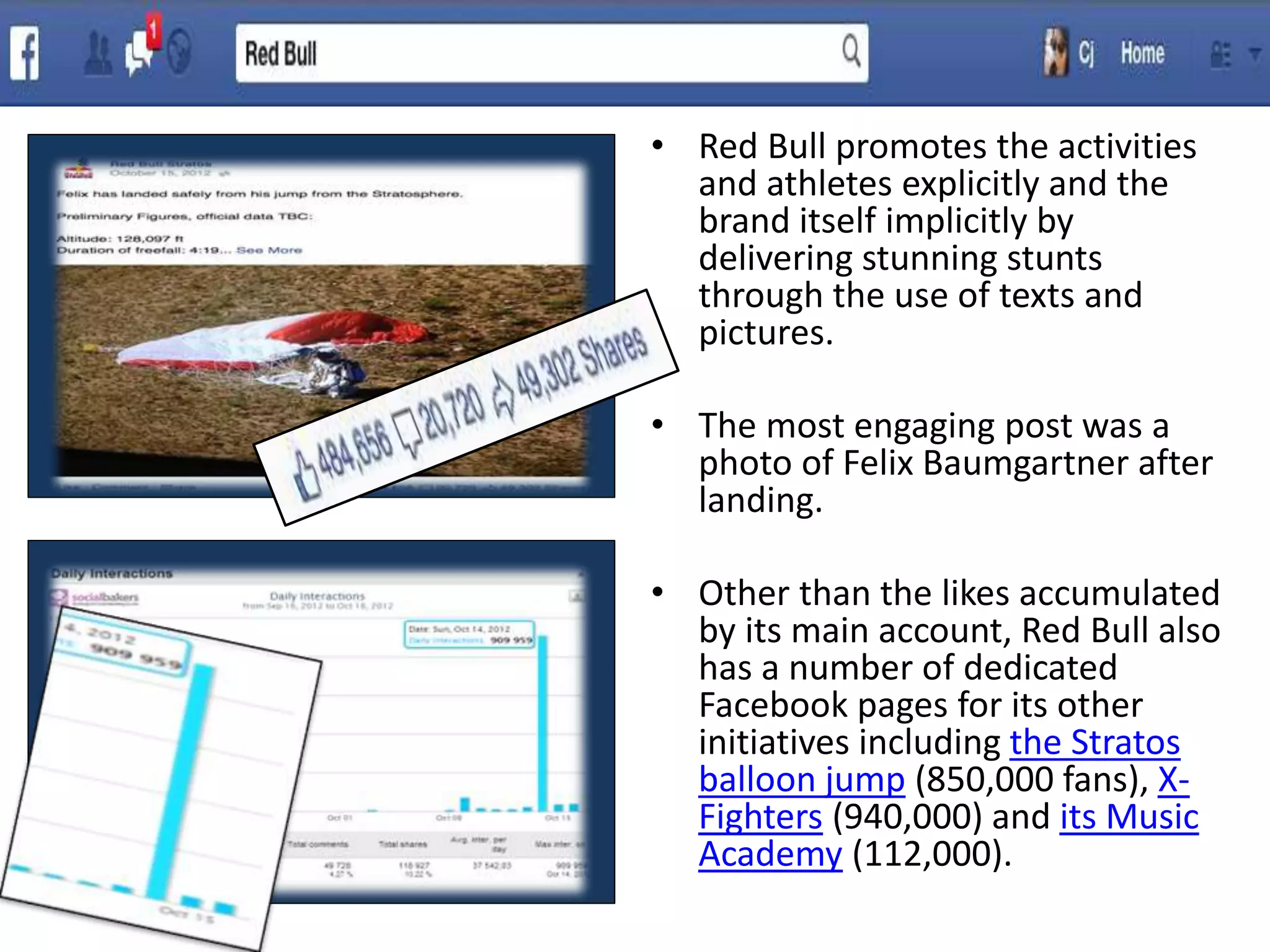
• Red Bull promotes the activities
and athletes explicitly and the
brand itself implicitly by
delivering stunning stunts
through the use of texts and
pictures.
• The most engaging post was a
photo of Felix Baumgartner after
landing.
• Other than the likes accumulated
by its main account, Red Bull also
has a number of dedicated
Facebook pages for its other
initiatives including the Stratos
balloon jump (850,000 fans), X-
Fighters (940,000) and its Music
Academy (112,000).
Felix Baumgartner ‘Free-fall from space’
Twitter
Generally just tweets out links to images and videos of its sponsored
athletes.
Better responds to users on Twitter than on Facebook.
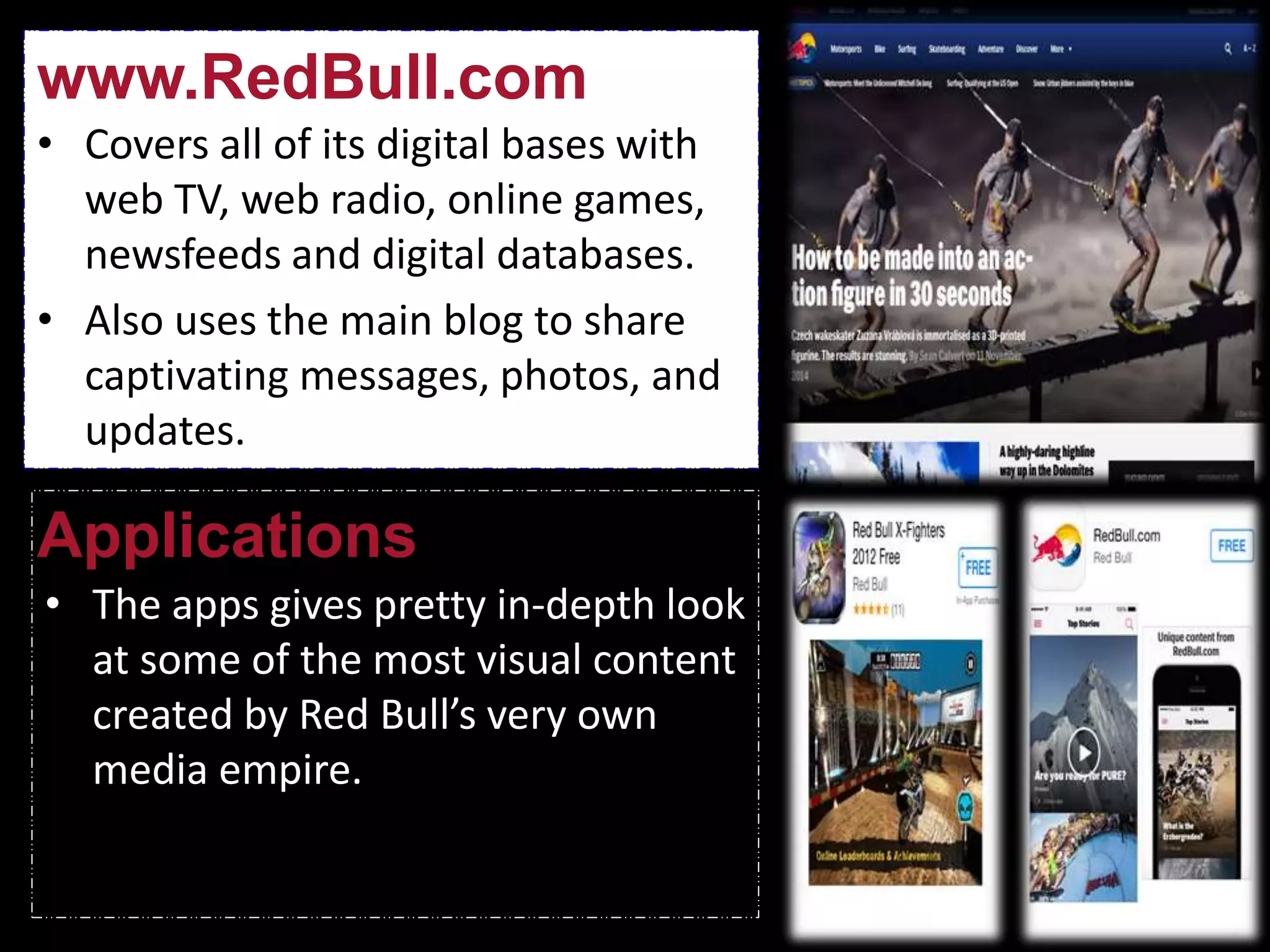
• Covers all of its digital bases with
web TV, web radio, online games,
newsfeeds and digital databases.
• Also uses the main blog to share
captivating messages, photos, and
updates.
www.RedBull.com
Applications
• The apps gives pretty in-depth look
at some of the most visual content
created by Red Bull’s very own
media empire.
Results
Nearly 1 billion
YouTube views have
been generated from
Red Bull content
making Red Bull
Media House one of
the top five sports
content producers on
YouTube globally
In 2011, about 4,083 billion
cans were sold throughout
the world. From 2011 to
2012 Red Bull's global can
sales increased by 12.8
percent to about 5,226
billion, and about 5.387
billion cans sold in 2013.
Today, Red Bull is
an energy drink, a
media house, a
record label, a TV
channel, an
athletic sponsor,
and an event
host.
Red Bull is one of
the most popular
brands on the
world’s largest
social networking
site
Insights : • Help and support target group,
instead of just selling products.
• Don’t be contended in just
traditionally advertising the product.
Think outside the box.
• Do not be afraid to make choices and
decisions, as long as it was planned
thoroughly.
• /www/archive/storage/www/red-bull-stratos-case-study.pdf
• https://econsultancy.com/blog/62178-how-red-bull-uses-facebook-twitter-pinterest-and-
google#i.1fpxasr3g1frku
• http://www.academia.edu/7971507/Marketing_Management_and_Strategy_-
_Case_Study_Red_Bull
• http://masterinbound.com/item/content-case-study-red-bull.html

Red Bull

  • 2.
    What is RedBull? • It was created in 1987 and sold by an Austrian company, Red Bull GmbH • Its content centers around sports and cultural events and projects • By 1992, the product expanded to international markets • By 2007, Red Bull Media, an organization, was launched to distribute, collect, and control the Red Bull. • It is the first and highest selling energy drink in the world “Red Bull gives you Wings”
  • 3.
    Red Bull without theuse of digital media: • It has a clearly defined personality • It has a Consumer Centric marketing strategy • It promotes lifestyle choice rather than a simple, caffeinated drink , by understanding the things that their audience love and enable those activities. – Markets their product by hosting extreme events instead of just sponsoring (Red Bull Air Race, Red Bull Crashed Ice) – Sports team ownership (Red Bull Racing, New York Red Bulls)
  • 4.
    • Make anonline channel/community that would extend the Red Bull brand into a media entity. • Use Social Media into extremes since extreme is what the brand is all about. Objectives:
  • 5.
    Free-fall from Space Felix Baumgartner’s, thefirst man to break the speed of sound in free fall before parachuting to the ground, on October 14, 2012. Biggest social strong suit Create jaw-dropping videos showing how athletes prepare to engage in extreme activities and also takes an actual footage of the event. Increase of subscribers Crazily increased its subscribers to 87,801 from 2,142 a day
  • 6.
    • Red Bullpromotes the activities and athletes explicitly and the brand itself implicitly by delivering stunning stunts through the use of texts and pictures. • The most engaging post was a photo of Felix Baumgartner after landing. • Other than the likes accumulated by its main account, Red Bull also has a number of dedicated Facebook pages for its other initiatives including the Stratos balloon jump (850,000 fans), X- Fighters (940,000) and its Music Academy (112,000).
  • 7.
    Felix Baumgartner ‘Free-fallfrom space’ Twitter Generally just tweets out links to images and videos of its sponsored athletes. Better responds to users on Twitter than on Facebook.
  • 8.
    • Covers allof its digital bases with web TV, web radio, online games, newsfeeds and digital databases. • Also uses the main blog to share captivating messages, photos, and updates. www.RedBull.com Applications • The apps gives pretty in-depth look at some of the most visual content created by Red Bull’s very own media empire.
  • 9.
    Results Nearly 1 billion YouTubeviews have been generated from Red Bull content making Red Bull Media House one of the top five sports content producers on YouTube globally In 2011, about 4,083 billion cans were sold throughout the world. From 2011 to 2012 Red Bull's global can sales increased by 12.8 percent to about 5,226 billion, and about 5.387 billion cans sold in 2013. Today, Red Bull is an energy drink, a media house, a record label, a TV channel, an athletic sponsor, and an event host. Red Bull is one of the most popular brands on the world’s largest social networking site
  • 10.
    Insights : •Help and support target group, instead of just selling products. • Don’t be contended in just traditionally advertising the product. Think outside the box. • Do not be afraid to make choices and decisions, as long as it was planned thoroughly. • /www/archive/storage/www/red-bull-stratos-case-study.pdf • https://econsultancy.com/blog/62178-how-red-bull-uses-facebook-twitter-pinterest-and- google#i.1fpxasr3g1frku • http://www.academia.edu/7971507/Marketing_Management_and_Strategy_- _Case_Study_Red_Bull • http://masterinbound.com/item/content-case-study-red-bull.html